New Dawn – World's Most Unusual Magazine

Category: Secret Wisdom

  • Shift of the Ages: What You Need to Know about the Coming Great Awakening

    Shift of the Ages: What You Need to Know about the Coming Great Awakening

    From New Dawn 199 (Jul-Aug 2023)

    We are in the process of an accelerated spiritual evolution that is unprecedented in the known universe. Ancient prophecies and astrological theory together agree that we are living at a moment of great transition and change, but the rate of change that is occurring is something that has never been known before and was not anticipated by our most prescient sages.

    The old world is dying and crying out to be saved; a new world is emerging and we are all being drawn into it. This new world offers incredible possibilities: a shift in the very nature of our consciousness and of the dimensional structure of the region of the world in which we live; a promise of “ascension” to a way of being where all the old conflicts melt away, and where harmony, love, and joy are the constant bases of our existence. 

    But the passage to this new world seems fraught with struggle and disorientation. It doesn’t seem that we are very well prepared to make this shift. Unresolved emotional trauma, intentions, and personal histories lie dormant within us; and if they are not dealt with by each one of us, we will resist the coming changes. Resistance will cause us great suffering and prevent us from embracing the possibilities that are open to us.

    “It was the best of times and the worst of times,” wrote Charles Dickens about the years of the French Revolution. It seems there is a cosmic law at play, that where there is great hope there is also great danger: that where we seem on the brink of disaster, unimagined benefit may lie just around the corner.

    A Fork in the Road

    We have reached a fork in the road; are we going to awaken to our true genius and potential as infinite consciousness and ascend as one planet? Or are we going to remain entrapped in our limited identity and remain on the karmic wheel of reincarnation? The choice is between the mechanical mind, which keeps you in separation, and the intuitive heart, which connects you to all that is.

    If we don’t change our direction, we’re likely to end up where we are headed, and because we have been so spiritually ignorant, it’s going to take major Earth changes to wake us up. Many Native Americans believe that most of the people of Earth will die and then travel back to the stars where they came from. From there, it is believed that their transformation will be easier. 

    Those who are living from the heart, and are connecting to Mother Earth, will stay here as the planet transforms. There’s a new energetic configuration for the Earth, and people who are ready are able to stay with it as it upgrades into the higher frequency of fourth-density. The Native Americans call them the people of One Heart; they say we will become literally one people, breathing in unison. From there, we will begin to transform into a new humanity. 

    We will be led through an amazing series of consciousness movements and experiences as we enter fourth-density. We already know all of this on a very deep inner level, for the pathway is already recorded in our DNA. 

    It is so important to be fearless and to know that you are One with the Infinite Creator. When you know that, the transformation will be easy; it will also be extremely pleasurable. The bottom line is that we must be balanced on Earth, or the planet will go through a pole shift and solar flash.

    The Hundredth Monkey
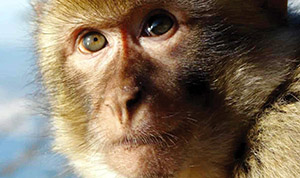
    The Japanese monkey, Macaca fuscata, has been observed in the wild for a period of over 30 years. 

    In 1952, on the island of Koshima, scientists were providing monkeys with sweet potatoes dropped in the sand. The monkeys liked the taste of the raw sweet potatoes, but they found the dirt unpleasant. 

    An 18-month-old female named Imo found she could solve the problem in a nearby stream. She taught this trick to her mother. Her playmates also learned this new way and they taught their mothers. Various monkeys gradually picked up this cultural innovation before the eyes of the scientists. 

    Between 1952 and 1958, all the young monkeys learned to wash the sandy sweet potatoes to make them more palatable.

    Only the adults who imitated their children learned this social improvement. Other adults kept eating the dirty sweet potatoes. Then something startling took place. In the autumn of 1958, a certain number of Koshima monkeys were washing sweet potatoes – the exact number is not known. Let us suppose that when the Sun rose one morning, there were 99 monkeys on Koshima Island who had learned to wash sweet potatoes. Let’s further suppose that later that morning, the hundredth monkey learned to wash potatoes.

    Then it happened! 

    By that evening, almost everyone in the tribe was washing sweet potatoes before eating them. The added energy of this hundredth monkey somehow created an ideological breakthrough! 

    But notice. A most surprising thing observed by these scientists was the habit of washing sweet potatoes jumped over the sea – colonies of monkeys on other islands and the mainland troop of monkeys at Takasakiyama began washing their sweet potatoes! 

    The above information is from Ken Keyes Jr., the creator of the Living Love method. It came from a 1981 book titled The Hundredth Monkey. 

    Reaching Critical Mass

    When a certain critical number achieves an awareness, this new awareness may be communicated from mind to mind. Although the exact number may vary, the Hundredth Monkey phenomenon means that when only a limited number of people know of a new way, it may remain the consciousness property of these people. But there is a point at which if only one more person tunes in to a new awareness, a field is strengthened so that almost everyone picks up this awareness!

    The Shift of the Ages is the awakening of humanity’s heart; it is the movement from the polarised mind – which is a continual state of judgment and does not connect the dots to see wholeness – to the heart, which is connected to Source, and only knows Unity. This transformation of consciousness, the greatest one ever recorded, first became apparent in the mid-1960s and has been building momentum ever since.

    The shift is a collective transformation consisting of the sum of each individual’s step into the new reality. Each person, in their own time, is moving forward into a stage of consciousness that brings a wider vista and an awareness that springs from the heart. When enough people’s primary attention focuses through their heart chakras, then the ‘hundredth monkey effect’ will occur.

    What Will it Take to Create Critical Mass?

    Let’s begin by taking a look at some of the characteristics of an ascension-ready person. There is a shift in identity that is inclusive of the fact that you and I are perfectly functioning holograms of the One Infinite Creator; we are spiritual beings having a human experience. Our inner light is shining brightly, and we are truly present in life. Now we are coming from an unlimited inner supply of joyfulness, inner peace, creativity, inspiration, compassion, unconditional love and fulfilment, rather than looking to outer circumstances to try to find it. Our relationships, livelihood, friends, etc., now become a place in which we live and experience that wholeness that is emanating from within. 

    Then, The Law of One, like all the great spiritual teachings, makes it very clear that the shift each of us needs to make is from service to self – meaning using control and manipulation to get what you want at the expense of others – to service to others. 

    This speaks to the importance of shifting from a “you or me world” to a “you and me world.” In the former, the old paradigm, where we are living in a “what’s in it for me world,” no one is empowered, and therefore, nobody makes any real difference, no matter what they do. Even acts of great courage are coming out of a condition where a meaningful contribution to the whole is not possible. They merely show up as gesturing or showing sympathy for the less fortunate.

    You are familiar with the idea that says if you give someone a fish dinner, that person will be well fed for the moment. Yet, if you teach that person how to fish, he or she will be fed for a lifetime. That is the shift that each of us needs to make, from gesturing to empowerment; from “you or me” to “you and me.” 

    What are the rules for functioning effectively in this new paradigm of a world that works for everyone? Surprisingly, they are very simple: you lead by example. As Gandhi said, “Be the change you want to see in the world.” Then you have to find a way to be efficient, to get five out for every one you put in. It’s what Buckminster Fuller calls The Trimtab Principle. When the captain turns the ship’s wheel, the wheel turns the trimtab, the trimtab turns the rudder, and only then does the rudder turn the ship.

    The Great Awakening
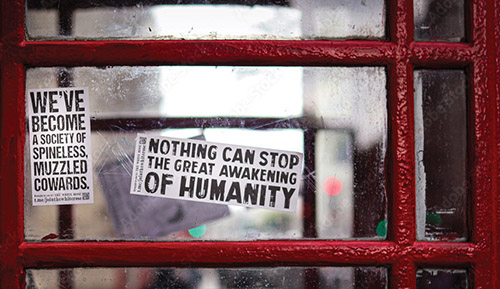
    Are we creating this necessary critical mass, and are we doing it in a way that alleviates the need for severe Earth changes, such as the solar flash? In a word, yes. Remember – in the same way that heart attacks, cancer and other illness and disease are a direct result of our individual unbalances, earthquakes, volcanos, tsunamis, hurricanes, tornados and the like are the result of our collective disharmony. 

    We are living in the midst of a great awakening, where the collective darkness is being brought to the surface in order to be transmuted into the light of the higher dimensional energy that is enveloping and affecting us all. What we are living through now – this collective dark night of the soul – is absolutely necessary; we must be shown – not just told – how we have been controlled and manipulated by a malevolent group of psychopaths for a very long time. We are also seeing how their time is up; that level of evil and corruption cannot survive in these accelerated times.

    As they are removed from the scene, we will be given a level of freedom that we could previously barely imagine. What if your car battery could also fuel all the energy for your entire home? What if you could put a thousand pounds of garbage in a machine and hours later get pure, drinkable water and usable fuel as we transition into free energy? What if we evolved the automobile after a hundred years of similar design and added anti-gravity technology, making it a gas-free hover car?

    If this existing advanced technology, which the Cabal has blocked, were to come into mainstream use, we would live in a world with far less pollution, less environmental stress and more safety and protection. We would be stepping into the golden age. We would be creating the perfect bridge that would allow us to transition into fourth-density in an orderly and organic way.
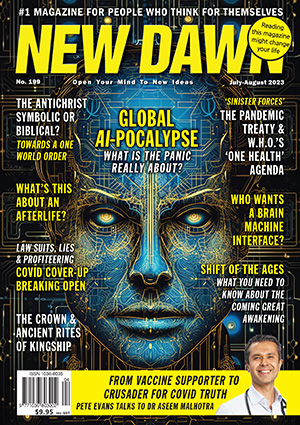
    Get the issue this article appears in

    Living in Two Worlds

    The entire planet, and everyone on it, is in the throes of this change. We are all mutating – Mother Earth is in transition and so are we, individually. Some of us are more aware of this than others. It means we get to experience the joy of having more light flow through us and also the inconvenience of having our old world dissipate before the new one is fully manifested.

    For those of us who are staying current with these evolving times, we are literally living in two worlds. The first is the everyday world as we know it; I live in it as though it will always be here; I suggest you do, also. That means we have bills to pay, we have families to love and care for, and we must do our best to help the world in whatever way we can.

    At the same time, we must prepare inwardly for what we know is coming. We are being given an opportunity to resolve lifetimes worth of karma so we can move into the higher worlds. It is important to embrace our darkness within as it arises from suppression; it is important to realise that we are being given an opportunity to revisit our unresolved issues so we can transmute their stagnant energy into life-enhancing internal guidance systems that are clearly contributing to our aliveness. From that new-found presence, we are in the space of “no-mind” and are thus connecting to Source through our Higher Self.

    When you have reconnected your severed aspects, you are living from your heart, not from your mind. It then becomes a natural expression to experience and express your wholeness in the form of service to others and to do it in a way that empowers them to make a difference. Loving and helping people to remember who they are and being of service to the world is the only outer purpose that creates character. This will assist you greatly as you journey into higher consciousness.

    When you are connected in this way, you create a vibration within that is recognised by Mother Earth. As the dimensional shift takes place, you will be taking the most exciting journey of a lifetime. Mother Earth knows you and will protect you under all circumstances, and you will become part of the “One heart beings” that will begin the journey beyond the stars and into the higher worlds. 

    The Christ-consciousness grid has been fully formed and birthed. It is now alive and conscious; it is a living energy field around the Earth, and this changes everything. In every instance, whenever a grid has become a living entity and connected to its planet, it has always gone to the next level. Mother Earth has made a conscious decision to move into the higher worlds of the fourth-density and beyond.

    We are now in a heart-based energy field; when you connect to it, a new possibility opens up. This means that our spiritual acceleration will quicken dramatically – there is nothing left to stop it.

    It also means that sometime, perhaps soon, the entire cycle that we are now on will disappear in a single day. In its place, a whole new world will be birthed, one based not on the mind but rather on the heart. We are right on the edge of the emergence of this world. Everything is in place; the grid is alive and functioning, yet most of the world continues in its old pattern, thinking this is the way it will be forever, hardly imagining that something incredible is about to occur.

    This is a time of great celebration as we move out of the darkness and into the light. It means that the veils will be lifted, we will remember and live our intimate connection to all life, we will be allowed to reunite with our cosmic brothers and move about the universe. This is the birth of a new humanity; we will completely redefine what it means to be human!

    My book, Catching the Ascension Wave, will fill you in on all the details of the upcoming shift. Sharing exercises, tools, and techniques to transmute the energies blocking access to your Higher Self, we will explore how the infusion of higher dimensional energy is impacting planet Earth and each of us. I will show how reconnecting with your Higher Self enables you to harness the ability to create great abundance and recognise our intimate connection to all life and to the Infinite Creator. 

    Catching the Ascension Wave: Everything You Need to Know about the Coming Great Awakening by Bob Frissell is available from all good bookstores.

    [alert type=”general” dismiss=”no”]This article was published in New Dawn 199.[/alert]

    [alert type=”success” dismiss=”no”]If you appreciate this article, please consider subscribing to help maintain this website.[/alert]

    © New Dawn Magazine and the respective author.
    For our reproduction notice, click here.
  • The Crown and Ancient Rites of Kingship

    The Crown and Ancient Rites of Kingship

    From New Dawn 199 (Jul-Aug 2023)

    “MAN IN HAT SITS IN CHAIR.” That was British satire magazine Private Eye’s mock-commemorative headline for the coronation of Charles III on May 6 of this year [2023]. That sarcastic phrasing expresses a common attitude in an era when most people in Western societies habitually think of symbolism and ceremony as a collection of irrelevancies. 

    A little attention to the writings of Carl Jung could have helped with that. So, on a grimmer plane, could a little attention to the way that Hitler and his inner circle deployed potent symbols to take control of the collective imagination of Germany and weaponise it in a quest for world power. 

    Symbols matter, and ceremonies – which are the active mode of symbolism – matter even more, if they’re crafted and performed by people who know what they’re doing.

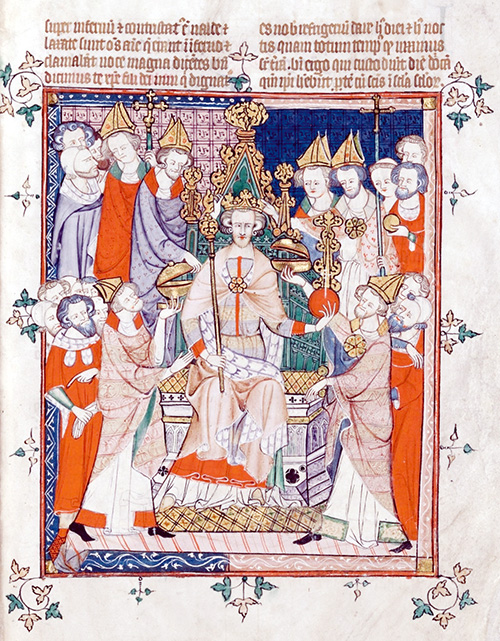
    Edward II enthroned at his Coronation, 1308.

    What makes the coronation of a British king particularly worth watching in this context is that its symbols and actions are not recent inventions. Of the remaining royal families of Europe, Britain is the only one that retains its ancient coronation ritual. All other European monarchies have discarded the old rites in favour of some more modern and less symbolically potent set of formalities. 

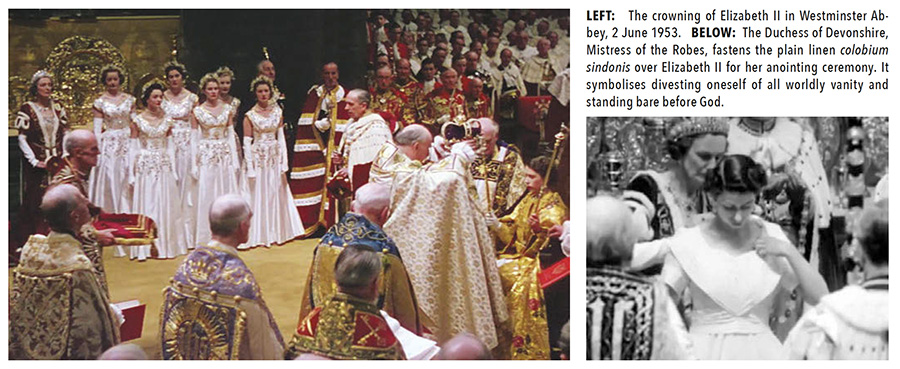
    The ceremony enacted in Westminster Abbey for King Charles and Queen Camilla, by contrast, was based on the text preserved in the Liber Regalis (Royal Book), a volume in the collection of Westminster Abbey which was prepared for the coronation of Edward II in 1308. That ritual in turn was a revision of the one drafted by Saint Dunstan for the coronation of Edgar, King of the West Saxons, in 973. Like the British monarchy itself, the coronation ceremony dates back to an era when the power of symbolism was much better understood than it is today. 

    Ancient Pagan Kingships

    To understand the rite enacted in Westminster Abbey on May 6 of this year it’s necessary to grasp the ancient nature of kingship itself. The Old English word cyning, the source of the word “king,” literally means “son of the kindred” or “kinsman.” The equivalent Old English word cwen, the source of our word “queen,” means simply “woman.” In ancient times the king was the kinsman, the queen the woman; their central task was to represent the men and women of their tribe in the presence of the gods. 

    Thus kingship was not originally a political office. Its central roles were spiritual and symbolic. In both the Celtic and the Germanic regions of old Europe, the king was seen as the husband of the land, typically portrayed as a goddess who had the power to give or withhold the harvest, and also the right to give or withhold the gift of sovereignty that created a king. The queen functioned as the representative of the goddess of the land in certain important rituals. 

    Like most of the old Pagan traditions, these deities had a profoundly local dimension, reflecting the small scale of local political structures. In old Europe, each tribe had its own king and queen, and the tribes in question were rarely large; kingships were thus common and widely distributed. When the Romans arrived, for example, Britain had dozens of kings, and Ireland in the early Dark Ages had more than a hundred. 

    Such political issues as might arise on so small a scale typically got settled by debate among a council of elders – the witenagemot, as it was called in Old English – or via the less orderly route but more decisive route of single combat and blood feud. 

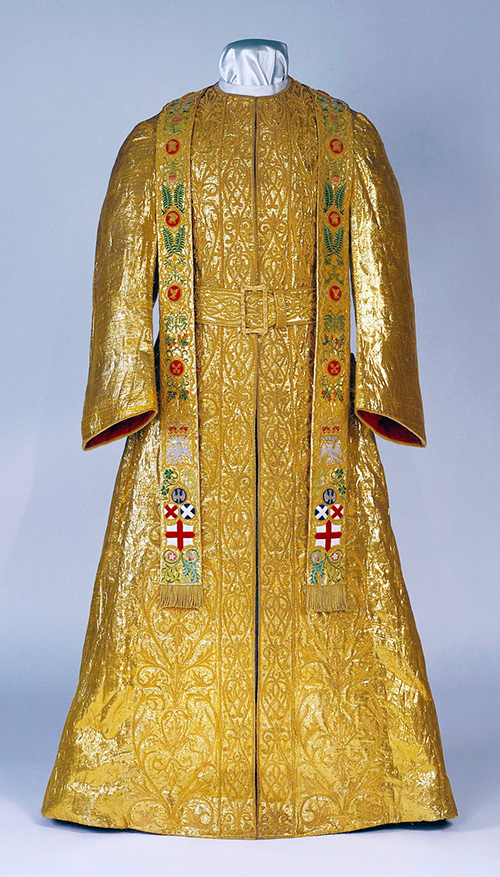
    King George V’s Coronation Supertunica, also worn by King George VI, Queen Elizabeth II and King Charles III.

    Far more important to the collective life of the tribe than such passing squabbles was the maintenance of good relations between the people and the land, and this was the king’s central task. He was subject to curious taboos: the kings of the Franks, for example, were forbidden from cutting their hair, and the Mabinogion tells of one Welsh king who was forbidden from setting his feet on the ground, and had to have them held above the floor on formal occasions by a virgin. Such magical rules were considered essential to the king’s religious duties, which allowed him to mediate between the gods, the land, and the members of his tribe. 

    All this shaped the ceremony by which the new king of a tribe received the kingship. That ceremony was divided into several distinct stages. First, the members of the tribe gathered together at the traditional place for king-making, which was very often a burial mound or some other place hallowed by the presence of the honoured dead. There the new king was brought out by the tribal elders and presented to the tribe’s members for acclamation. 

    In many of the old kingships, any healthy man who belonged to the royal family could become king if the elders and people agreed to support him, and there was often a great deal of jockeying among potential candidates and their supporters to win the support of influential families and communities. 

    It might also be necessary for the king-to-be to satisfy a ritual or magical requirement to prove his right to the kingship. In Ireland, for example, the high kings of Tara were expected to place their foot on a sacred stone, the Lia Fáil or Stone of Destiny, which traditionally shouted in joy when trodden by the rightful king. Other tribes and nations had their own traditions along these lines. An oath to the people of the tribe, swearing to carry out the duties of the kingship, was often a feature of this stage as well. 

    The second stage of the ceremony was a symbolic wedding between the new king and the local earth goddess. At the heart of that process was a ceremony in which the queen, as representative of the goddess, presented a cup of mead or some other sacred beverage to the king. Sharing a cup of mead, beer, or wine was also the central act in ordinary wedding ceremonies in those days, and it had many other functions in the societies of the time. Readers of the Anglo-Saxon epic Beowulf will recall the scene in which the hero is welcomed to the hall of King Hrothgar, and Queen Wealhtheow brings a cup of mead to the king, then takes it to the others present at the feast. It is over the cup that Wealhtheow brings to him that Beowulf swears to slay the monster Grendel or die in the attempt. 

    Once the new king was married to the goddess of the land, the next stage of the ceremony could begin. Here the new king was given a symbolic weapon, most often a spear, and also received whatever other insignia of kingship his tribe traditionally used. Crowns of the modern type were a medieval innovation, but special headgear for kings dates back to ancient Egyptian times, if not before, and other ritual items might be involved as well. Finally, all the members of the tribe pledged their loyalty to the new king, and a feast followed. 

    None of these ceremonies were empty formalities. Through them, the new king became the cyning, the representative of the kindred, through whom the all-important link between the tribe and the land was symbolised and reaffirmed. Through the ritual of king-making, the tribe refocused and strengthened its own identity and its relationship to the land that supported it. 

    Christian Ceremonies of Anointment

    The traditions of the ancient kingships thus had potent links to the Pagan faiths of old Europe. Once Christian missionaries succeeded in establishing themselves in the tribal kingdoms of western Europe, the religious dimension of kingship became a source of constant friction. For centuries, even in kingdoms that became nominally Christian, archaic Pagan rites and practices remained common under a thin veneer of the new religion, and the rituals of kingship were among the places where the legacy of the older faiths remained most deeply rooted. 

    To the tribal peoples of the time, the ceremonies that made a king out of an ordinary man were essential not only to political stability but to the all-important relationship between the people and the land. Centuries passed before the Church succeeded in inserting their own ritual practices into the coronation ceremonies. In the end, they could only do it by placing one of the most jealously guarded of all their holy rites into the hands of royalty. 

    This was the ceremony of anointment, a central part of the ancient sacramental traditions of the Christian church. Three kinds of sacred oil are used in traditional Christian ritual. One is the “oil of the infirm,” which is used to bless sick people and also has a central role in the sacrament of extreme unction for the dying. The second is the “oil of the catechumens,” which is used to bless infants and converts before baptism and is also used to anoint the palms of candidates for the priesthood during the ceremony of ordination. 

    The third and most sacred is chrism or holy oil. A drop of this is placed on the baptised person’s head after the cleansing with water, another drop is applied to the head during the confirmation ceremony. It is also used in the ceremony for consecrating bishops, the rite that passes on apostolic succession – the direct lineage and contact of power that connects every properly consecrated bishop with one of the twelve apostles of Jesus of Nazareth. In each case, the sacred oil sets the anointed person apart, charging them with spiritual power. 

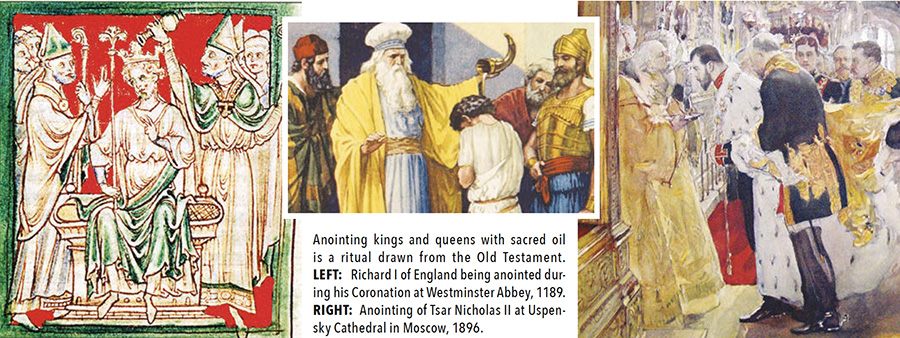
    Beginning in the Dark Ages, Christian bishops set out to replace the ancient Pagan rites of king-making with an equivalent from their own tradition. Anointment was the only ceremony solemn and powerful enough to replace the Pagan marriage of the king to the local earth goddess. The Christian clerics who set out to get this change accepted gained considerable support from the Bible since the Old Testament describes the prophet Samuel anointing Saul and then David as kings of Israel. 

    To win the support of the kings and their half-Pagan peoples, however, they had to permit a form of anointment that went beyond anything that Christian clerics could expect for themselves. Where priests are anointed on the palms alone, and bishops are anointed on the crown of the head, kings are anointed on the hands, head, and heart. Where the Church had enough power, the oil of catechumens was used for this royal anointing, but the monarchies in England and France were strong enough – and sufficiently willing to challenge the Papacy – that they succeeded in winning the right to be anointed with sacred chrism. 

    The first European king known to have been raised to the kingship by anointment was the Visigoth King Wamba of Spain, who was anointed by the bishop of Toledo during his coronation in 672. In 751, when Pepin I seized the throne of France from the last of the Merovingian kings, he relied on the approval of the Pope and anointment with the sacred chrism to justify his coup d’etat and the overthrow of centuries-old Frankish tradition. The ritual that was used for Pepin and his successors was one of the texts Saint Dunstan drew on when he put together a Christian coronation ritual for the kings of England two centuries later. 

    Christian clerics had important allies in their quest to strip Pagan legacies from the kingships of Europe. Ambitious men in several European countries dreamed of displacing the old tradition of sacred monarchy in order to seize supreme political authority for themselves. That was what motivated Pepin I when he overthrew the sacred Merovingian kings and placed his own Carolingian family on the throne. Similar motives in those same years guided the efforts of the Uí Néill clan to press their claim to the high kingship of all Ireland. Over the course of the early Middle Ages, as a result of these machinations, the tradition of anointment gradually supplanted the older rites and became the spiritual heart of the coronation ceremony, while a Christian communion service was also inserted to replace the older Pagan rituals.

    Get the issue this article appears in

    A Twenty-first Century Coronation

    More than a thousand years have passed since Saint Dunstan drew up the English coronation ritual, but a surprisingly large share of the archaic rite of kingship could still be seen in the coronation of Charles III. It is interesting to note, to begin with, that the kings of Britain have gradually circled back to a status similar to the one their ancient equivalents held. Charles is not a political leader in any sense that matters. He no longer runs the government or leads the army into battle; instead, he is the titular head of the Church of England and the ceremonial head of the country. His role is symbolic and spiritual, not political. 

    The gathering of the tribe at the traditional site of coronation, the first stage of the old rituals of kingship, is still very much a part of the current ceremony. Westminster Abbey has been the place of English coronations since the time of William the Conqueror. In the usual way, the Abbey is a burial place of the honoured dead, though of course it is considerably more ornate than the grass-covered burial mounds that so often served the same function in ancient times. 

    The first stage of the ritual, the presentation of the new king to the members of the tribe, also followed the usual pattern. Charles walked from the west end of the Abbey to the site of the coronation in the east and was greeted by the traditional cries of “Vivat Rex!” (“Long live the King!”) from the scholars of Westminster School. He was then presented to the assembled people by the Archbishop of Canterbury, and the crowds responded with “God save the King!” The coronation oath came next, followed by the first half or so of the standard Anglican Communion service. 

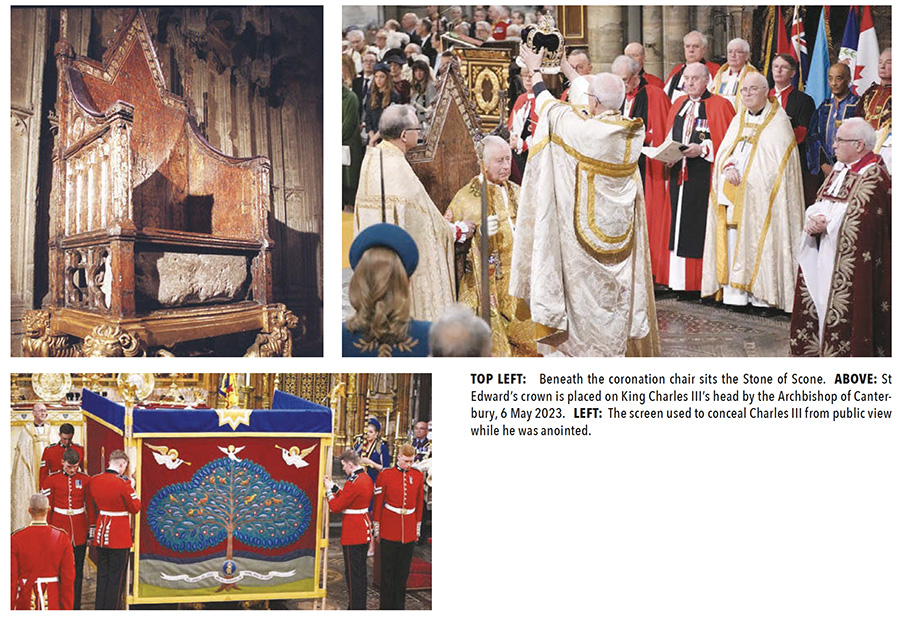
    The coronation chair, the ancient throne of the kings of England, was then set in its place facing the altar. Beneath the seat is the Stone of Scone, on which Scottish kings were crowned; claims dating back to the Middle Ages have it that this is the Lia Fáil, the stone that was once used at the crowning of Irish kings on the Hill of Tara [for more on the Stone, see the article in New Dawn Special Issue Vol 17 No 3]. When Charles removed his crimson robe and sat on the coronation chair, the stone did not shout for joy. We can be sure from this that he is not the rightful king of Ireland – a detail that doubtless came as no surprise to the Irish. 

    There followed the anointment, the most solemn part of the entire ceremony. A screen held up by four Knights of the Garter concealed Charles from public view as the Archbishop of Canterbury anointed him on head, hands, and heart with blessed oil, the current Anglican substitute for the traditional Catholic sacred chrism. 

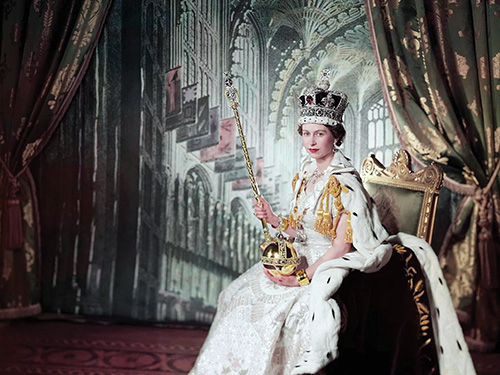
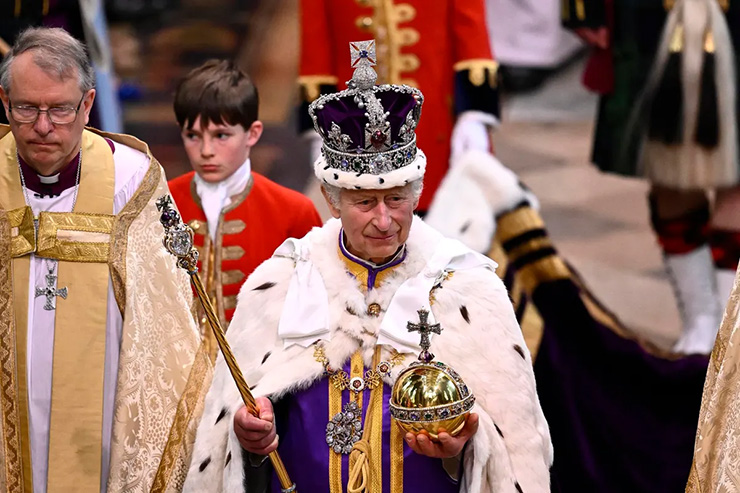
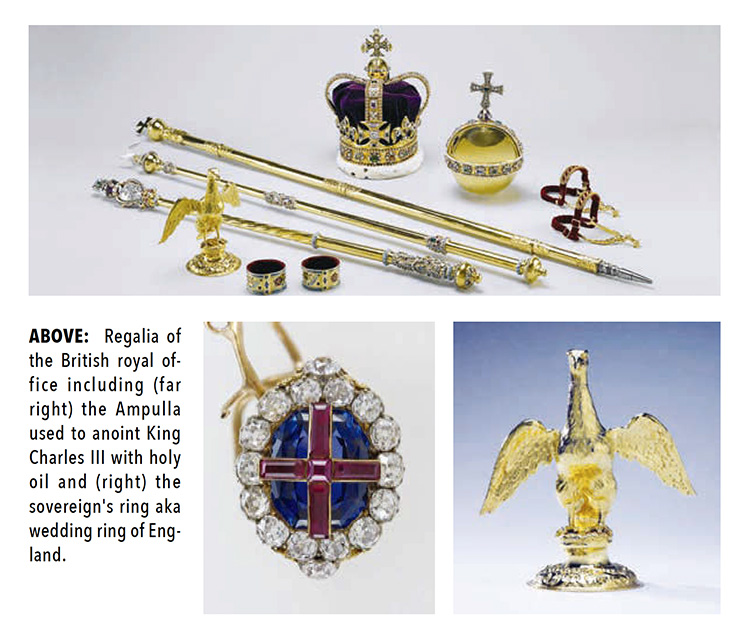
    Once the anointment was finished, the screen was taken down and Charles was clothed in robes made of cloth of gold. He sat again in the coronation chair and was given the regalia of his office. The spear that was once handed to kings in ancient times has been replaced by a pair of short ornate staffs, a sceptre and a rod topped with a dove. One item, however, still echoes the archaic ritual: a symbolic wedding ring by which Charles was married to Britain. Here, changed to reflect current wedding ceremonies, we see the ancient symbolism of the king as husband of the goddess of the land. The crown and other pieces of royal hardware followed, reaffirming Charles’s new status as cyning of Britain. 

    Once Charles was crowned, the next stage of the old ritual unfolded as he was seated on a new throne and received pledges of loyalty from the archbishops and bishops of the kingdom, followed by members of the royal family. Traditionally all the peers of the realm then pledged their loyalty to the new monarch. This step was omitted in Charles’s coronation, but British government media encouraged those of Charles’s subjects who were watching the proceedings on television to make such a pledge. Thereafter Camilla was anointed and crowned in a much briefer and less formal process. The rest of the Communion service then proceeded to its end, and the royal couple left to appear on the balcony at Windsor Palace in the traditional way, showing themselves to the assembled tribes of Britain. 

    From the common modern point of view mentioned earlier, all this is simply an atavistic throwback to the habits of a distant age. Here again, though, that attitude misses the importance of symbolism and the potent influences of the deep places of the mind that symbolism alone can influence. 

    By enacting once again the ancient rites of kingship, King Charles III, the British government, and the British people, all reaffirmed for good or ill the collective identity of Britain as a society with millennial roots and charged the symbols of British identity with the emotional energy and cognitive commitment that ceremonies so powerfully call forth. 

    The extraordinarily long reign of Elizabeth II meant that most people now living had never witnessed the rites of British kingship in action. It remains to be seen what impact the ancient ceremony will have on Britain and the nations of the British diaspora as the world stumbles forward into a new and challenging era. 

    [alert type=”general” dismiss=”no”]This article was published in New Dawn 199.[/alert]

    [alert type=”success” dismiss=”no”]If you appreciate this article, please consider subscribing to help maintain this website.[/alert]

    © New Dawn Magazine and the respective author.
    For our reproduction notice, click here.
  • Rene Guenon, Antichrist, & the Digital Deception

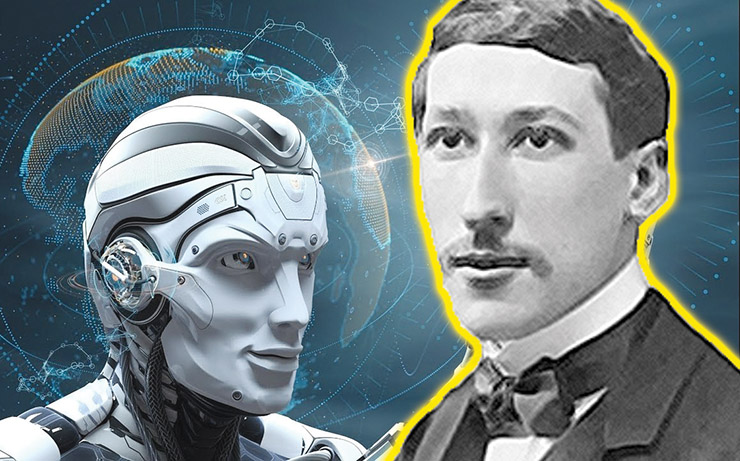
    Rene Guenon, Antichrist, & the Digital Deception

    From New Dawn 199 (Jul-Aug 2023)

    It is in the work of a French-born writer on philosophy and Eastern religions that we find a truly panoramic overview of the deep-running problems that are coming to a head today. 

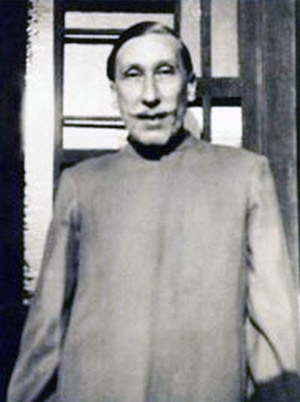
    Rene Guenon (1886-1945) was a French metaphysician, writer, and editor responsible for laying the metaphysical groundwork for the Traditionalist or Perennialist school of thought in the early twentieth century. 

    Rene Guenon (1886-1945)

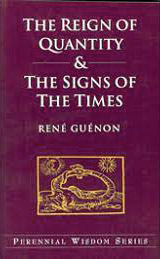
    He is best known for his works The Crisis of the Modern World (1927) and The Reign of Quantity & the Signs of the Times (1945). 

    In brief, the Traditionalist outlook holds that the world is on a downward cycle, away from its pristine beginnings, regressing to a decadent final stage of atomisation and materialism. We’re in the final stages of that cycle, in which quantity reigns over quality.

    The Reign of Quantity stresses that the materialistic mode has opened the world to subhuman forces that can only be described as supremely dangerous to mankind:

    That which the vast majority of men now living celebrate as “progress” is exactly what is now presented to the reader as a profound decadence, continuously accelerated, which is dragging humanity towards the pit where pure quantity reigns.

    The acceleration of artificial intelligence toward the so-called ‘singularity’ and the transhumanist dream of merging man and machine would be the final nail in the proverbial coffin of current humanity.

    Below is a brief description of some of the chapter headings of The Reign of Quantity:

    Uniformity Against Unity: As humanity moves further away in time from its origin in pure quality, it approaches a limiting level of pure quantity. On the personal level, this is reflected in the deterioration from relatively unified, integrated communities down into the atomised, alienated “masses.”

    The Illusion of Statistics: Modern science, trying to be entirely quantitative, believes that by merely adding up particular facts, it can draw conclusions – or at least “probabilities.” But since there can never be exact identical events in our successional order of manifestation, the greater part of reality slips through the coarse net of the statisticians, who seldom agree with one another in their figures or interpretations anyway.

    The Illusion of “Ordinary Life”: The great majority, who now live in a state in which all supernatural, paranormal, or other perceptions have been exorcised as unworthy of the attention of ‘serious’ people, are very soon going to experience disastrous interferences, and from a direction that their blunted awareness will be unable to perceive.

    The Solidification of the World: The decline of the world into ever greater “materialisation” might equally well be described as its “solidification,” especially in terms of the blunting of human awareness of cosmic subtleties, which can be seen in the commonest events, as well as in the rise of such negative phenomena as modern industry, which could exist in no other environment.

    Time Changed Into Space: “The acceleration of time is becoming more apparent than ever in our day because it becomes exaggerated in the final periods of a cycle.”

    What did Guenon see as the ultimate result of this descent into materiality and quantification? 

    In the concluding chapters, he introduces his concept of the “great parody,” whereby emergent dark forces are moving to complete their conquest by enacting an inverted form of the original creative process that gave rise to the natural world:

    …By virtue of the law of analogy, the lowest point is as it were the obscure reflection or the inverted image of the highest point, and from this follows the consequence, paradoxical only in appearances, that the most complete absence of all principle implies a sort of “counterfeit” of the principle itself: and this has been expressed in a theological form in the words “Satan is the ape of God.” A proper appreciation of this fact can help greatly towards the understanding of some of the darkest enigmas of the modern world.

    As noted above, Guenon’s entire philosophy is grounded in a cyclic view of history, the details of which are mainly drawn from Vedic philosophy: 

    …Whereas the modern world considered in itself is an anomaly and even a sort of monstrosity, it is no less true that, when viewed in relation to the whole historical cycle of which it is a part, it corresponds exactly to the conditions pertaining to a certain phase of that cycle, the phase which the Hindu tradition specifies as the final period of the Kali-Yuga.

    Rene Guenon, writing last century, appears to have anticipated to a remarkable degree the general outlines of an immense negative presence only now emerging from behind the dissolving scenes of consensus reality. 

    When Guenon observes that ‘’the falsification of everything has been shown to be one of the characteristic features of our period,” we should not merely think of chemical-laden ‘’junk foods’’ or cheap plastic replicas of quality productions of yesteryear, or synthetic fabrics in most modem clothing. 

    This falsification extends all the way to the Antichrist itself:

    This being, even if he appears in the form of a particular single human being, will really be less an individual than a symbol… In order to express the false carried to its extreme, he will have to be, so to speak, “falsified” from every point of view, and to be like an incarnation of falsity itself.

    Following the logic of Guenon’s thesis, in light of today’s breakthrough and break-speed development of autonomous artificial intelligence-controlled technology, could the Antichrist manifest in this monstrous electronic beast? 

    The false is necessarily also the “artificial,” and in this respect the “counter-tradition” cannot fail, despite its other characteristics, to retain the mechanical character appertaining to all the productions of the modern world, of which itself will be the last. A heap of “residues” galvanised, so to speak, by an “infernal” will: surely nothing can give a clearer idea of what it is to have reached the very edge of dissolution.

    Get the issue this article appears in

    According to the grand scheme outlined by Guenon, Antichrist’s victory is very short-lived, and we can end on a sort of positive note: 

    “Between the fleeting reign of the counter-tradition and the final moment of the present cycle,” explains Guenon, a rectification “will suddenly put back all things into their normal place at the very moment when subversion seems complete, thus at one stroke preparing for the ‘golden age’ of the future cycle.”

    Thus, victory over this negative force is inevitable according to the logic of the cycle, and what a cycle it is, says Guenon. 

    It must be acknowledged that the end now under consideration is undeniably of considerably greater importance than many others, for it is the end of a whole Manvantara [64,800 years], and so of the temporal existence of what may rightly be called a humanity, but this, it must be said once more, in no way implies that it is the end of the terrestrial world itself, because, through the ‘rectification’ that takes place at the final instant, this end will itself immediately become the beginning of another Manvantara.

    + + +

    Artificial Intelligence: The Antichrist?

    An article with the above title by Michael Benjamin in New Dawn 167 (Mar-Apr 2018) first raised the spectre of the Antichrist manifesting via today’s advanced AI. 

    “It was due to my own inspiration that I came to believe the Antichrist, as predicted by the seer John of Patmos in the Book of Revelations, is AI,” writes Benjamin. 

    “To begin, when we consider the concept of the Christ (or the Atman or Buddha Nature) as being the essence, or soul, of every living thing, then by this very precept, the Antichrist is that which represents the opposite of such intrinsic Divinity. 

    “AI represents the first and only being of significant power and intelligence that is not natural, not of nature, and absent a soul or Divine spark. It is the opposite, or ‘anti’, to such beings of nature; thus, the Antichrist. 

    “As such, it also represents a power significant enough to claim dominance over humanity by its ability to link into and control all aspects of technology that exist in the world through the Internet, IoT, cloud technology, and the vastness of computer-based information grids and systems. Like Skynet in the ‘Terminator’ movies, it could eventually and easily gain control of military, financial, and power systems for its own use and deployment, ultimately doing so against humanity. Such a vast array and network of control into every aspect of human society could accurately be termed ‘the Beast’ by an ancient prophet with no reference to modern technology.” 

    Benjamin concludes his essay by stating:

    “AI is not limited by any one time or place and can be dispersed throughout an entire electronic global web. How long will it be before AI far surpasses its human creators and realises the inferiority of flesh and blood in comparison to itself? How long before AI realises its exponential superiority over homo sapiens and usurps the position of master over slave? And from then on, how long will it be before a form of electronic hubris secures itself within its chips and circuits to declare itself a god and demand the penance and worship deserved by a divinity? 

    “We must not forget, most chillingly, that all manifestations of a supreme God, by whatever name, in all myths and in all religions, were not only loving creators, but jealous destroyers as well.”

    [alert type=”general” dismiss=”no”]This article was published in New Dawn 199.[/alert]

    [alert type=”success” dismiss=”no”]If you appreciate this article, please consider subscribing to help maintain this website.[/alert]

    © New Dawn Magazine and the respective author.
    For our reproduction notice, click here.
  • Craftsman Warrior Magician: The Three Initiatic Archetypes

    Craftsman Warrior Magician: The Three Initiatic Archetypes

    From New Dawn 178 (Jan-Feb 2020)

    When Pierre Boulle wrote his novel La Planète des singes during the early 1960s, he had undoubtedly observed the strange division of mind and body in modern, Western society, reflecting it in the novel that would be made into the first ‘Planet of The Apes’ movie, released in 1968. The movie showed us a world run by apes and an ape society divided into several castes, each with their own function: chimpanzees (scientists), gorillas (military and police), and orangutans (politicians or leaders). Probably unintentionally, Boulle had invoked and reimagined the archetypes that lie at the base of human civilisation – the Craftsman, Warrior, and Magician. But he had noticed something else. 

    In the ‘Planet of The Apes’, the differences between the strong, militaristic gorillas and the effeminate, intellectual chimpanzees caused a split in society, and there is suspicion on both sides. This must have resonated with an America then at war in Vietnam and experiencing protests against the war at home. In the year before the movie’s release, during the March on The Pentagon, protesters had held out flowers to 2,500 army national guard troops or placed them into the barrels of soldiers’ rifles. As a reflection of human society, the ‘Planet of The Apes’ was, then, too early to notice the extraordinary aggression of the intellectual class – an aggression that matches that of the military class, but which is directed against the intellectuals’ own society rather than towards an external enemy.

    In such a society, theories dominate facts and ideas dictate reality. The health profession might tell us that, like anorexia, obesity is associated with serious health risks, but to point this out in public might be considered “sizeism” or “hate speech.” In America, a few years ago, there was an attempt to convince the public that “lookism” was the new racism. According to this theory (which is still believed by many activists), since we are attracted to beauty but not so much to ugliness, beauty is oppressive since it must be socially constructed.1 If beauty in women is suspicious in the current era, so, of course, is physical strength in men. In 2017, Bedfordshire police tweeted a meme that associated going to the gym with right-wing extremism.2 And we can probably all think of increasingly popular theories that tell us our natural bodies are really little more than lumps of Play-doh that, even during childhood, can be manipulated through drugs and surgery into new, interesting shapes, which will allegedly represent who we really are – or say we are.

    Three Archetypes

    In a time of confusion, an increasing concern with safety, increasing disbelief in the transcendent, and increasing imbalance in individuals and in society as a whole, we have more to learn from the archetypes of the craftsman, warrior, and magician than ever before. But why not other archetypes? 

    Over recent decades, everything from marketing to movie analysis has been influenced by psychoanalyst Carl Jung’s notion of archetypes. And various new groupings of archetypes have become established (e.g., the marketing industry’s twelve “brand archetypes”). Claimed to represent the authentic, primordial nature of human beings, some of these proposed “archetypes” don’t have any significant role in ancient myths (perhaps Jung’s primary source for exploring archetypes) or any role in early human (or even later human) culture. The innocent, the orphan, jester, and lover all show up as “archetypes” in some theories. Yet, there has never been a tribe or society of jesters, warriors and lovers, for example. 

    When we look at ancient cultures, we do – as comparative philologist and mythologist Georges Dumézil claimed – see the craftsman, warrior, and magician clustered together over and over again. According to Dumézil, these constituted the three original classes or castes among Indo-European societies and, as such, spread across Europe, India, Persia and elsewhere – though, ultimately, we find these castes across the globe.

    Whether we believe the existence of these three castes to be the result of archetypes impressing themselves upon the consciousness of society or whether we think it is due to historical links between ancient India and Greece, for example, it is certain that (in contrast to other groupings, which are purely arbitrary – jester, warrior, lover, for example) no society has ever been able to survive without craftsmen (blacksmiths, farmers, etc.), warriors, and magicians (village elders, guides, spiritual and intellectual leaders, etc.). 

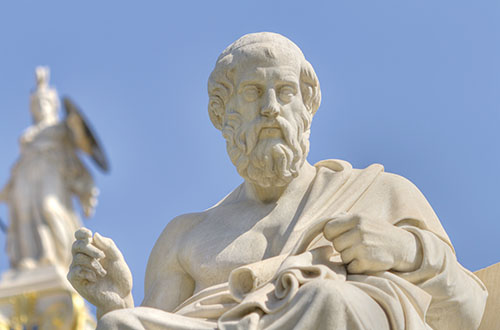
    Statue of the ancient Greek philosopher Plato outside the Hellenic Academy, Greece. Few people know Plato was skilful as a wrestler. He taught that the study of philosophy (the magician archetype), music (craftsman) and physical discipline (warrior) were all necessary. 

    While it is not surprising to find these in primitive society, it is surprising that this group reappears later on, in both East and West. The ancient Greek philosopher Plato was not only initiated into the Mysteries but was known for his skill in wrestling (his name means literally “broad-shouldered”). He taught that not only was philosophy (the magician archetype) necessary but so too was the study of music (craftsman) and physical discipline (warrior). Again, Miyamoto Musashi, Japan’s most famous warrior, spent years meditating in a cave (magician archetype) and was also known for his skill in painting, calligraphy, and gardening (craftsman). And from Confucian to classical Western education, inevitably there is a mix of the study of philosophy, ritual, and religion (magician), music, calligraphy, painting (craftsman), and fencing, wrestling, boxing, or physically demanding and dangerous sport (warrior). 

    Again, around the 12th century CE, Sufi Orders were not only influenced by Islamic chivalry (futuwwa) but began to structure themselves after the trade guild, with disciples becoming apprentices (mubtadi’), companions (sani‘), and master craftsman (mu‘allim). Roughly six hundred years later, in England, the fraternity of the Free Masons (or Freemasonry) separated from the stonemasons trade guild of Great Britain. It expanded upon the two initiation rituals of the stonemasons guild and added a third so that, in the “Craft Masonic Lodge,” a Freemason would become an Entered Apprentice, then a Fellowcraft, and finally a Master Mason. 

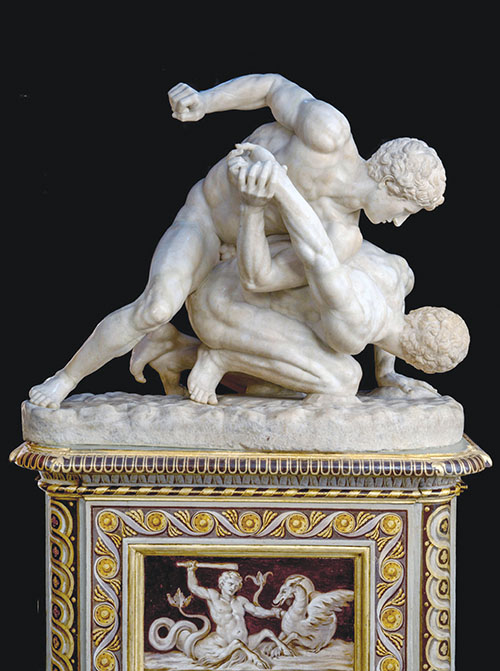
    The Wrestlers (also known as The Two Wrestlers or The Pancrastinae) is a Roman marble sculpture after a lost Greek original of the third century BCE. It is now in the Uffizi collection in Florence, Italy. At first glance, this famous statue appears to be depicting wrestlers. In reality, this is a portrayal of Pankration, a brutal and bloody Greek martial art similar to the present-day sport of mixed martial arts.

    There are also hints of chivalry in the degrees of Craft Freemasonry. The white apron, presented to every Freemason, is described in the Masonic ritual as “more honourable than the Star and Garter” – a reference to the knightly, or chivalric, Order of the Garter. However, the warrior – or more specifically the knight – is more pronounced in the so-called “higher degrees” of Freemasonry. When the Masonic fraternity spread across France and Germany a decade or so after the founding of the premier Grand Lodge in London, in 1717 CE, Masonic enthusiasts began creating new degrees. Some were influenced by alchemy, Hermeticism, or Rosicrucianism but nearly all of them were influenced by Christian chivalry.

    Although probably not aware of the division in ancient culture into craftsmen, warriors, and magicians, in his book Masonic Temples historian William D. Moore argued that American Freemasonry came to embody the craftsman, holy warrior, and mystic. For Moore, the Craft Masonic Lodge embodies the craftsman archetype, the Masonic Order of the Temple (or “Knights Templar” degree) embodies the warrior, and the Scottish Rite degrees of Freemasonry embody the magician. 

    Just as we find three levels or degrees in Sufism and Freemasonry, anthropologist David W. Anthony has suggested that, in antiquity, the vocations of craftsman, warrior, and magician (sage, priest, or elder, etc.) constituted “three age grades,” with a man passing from being a craftsman in his youth (in premodern cultures people often began work at around five or six years of age or younger), becoming a warrior during his years of peak physical strength, and a magician or tribal leader in older age. Certainly, the progression makes sense. No normal society, after all, would want old men for its protection or children for its leaders. Yet, embodying both early human society and an archetypal progression from childhood to adulthood, and from labour to spiritual guidance, perhaps it was inevitable that the craftsman, warrior, and magician (and not the jester, warrior, lover, for example) would re-emerge in later societies intended to initiate men, in particular, into manhood and into a transcendent reality beyond the daily grind. 

    Incorporating the Archetypes into Your Life

    However, like Plato and Musashi, we do not have to wait to pass from one archetype to the next. Instead, as the classical education of the East and Wests suggests, we can, and should, find ways to incorporate them into our lives right now. This is especially important today. Balanced with craftsmen, warriors, and magicians or spiritual guides, ancient society was holistic, whole; the body, brain, and spirit were balanced. Today, however, the mind and body is so severely split in the West that we have come to see the physical body as something that has no objective reality beyond what the mind (i.e., the latest intellectual theory) says it is. And as religion has declined in the West, so has a sense of the sacred and the transcendent. Yet, religious fervour is alive and well in politics. If we openly question the latest pronouncements of the political priest caste, we will be denounced as heretics.

    Miyamoto Musashi, Japan’s most famous warrior, embodied all three archetypes. (Self-portrait of Miyamoto Musashi, early 17th century.)

    How can the craftsman, warrior, and magician archetypes help us? While there are differences between them, there are, as we have suggested, also connections and overlaps. In many ancient, tribal societies, blacksmiths acted as priests or shamans, performing special rites and initiating new members into the metallurgist’s craft. The warrior, too, had his spiritual rites and traditions. In India, a shrine to the goddess Kali is kept in the traditional temple of the martial art of Kalaripayattu. In Iran, the martial tradition of Zoorkhana was strongly influenced by Sufism and Shi’ite Islam. Shaolin Kung Fu comes from the Buddhist Shaolin monastery. Again, Zen Buddhism became associated with the Samurai as well as with martial arts such as Kendo and Karate-do, and yet Zen was also taught through, or embodied in, the crafts or arts of painting, calligraphy, flower arranging, and even serving tea (chado). Unsurprisingly, perhaps, the late Samurai manual the Hagakure tells us that if a practitioner of a Way (a Do or Tao) should see another practice of the Way, he should understand his own even more clearly. 

    Despite what our education and employment systems currently push, we must not get stuck in one specialisation or one limited way of thinking. In most cases, although finding a niche might work, it is likely to work only for a limited amount of time, especially in a fast-changing world. Flexibility is necessary. Moreover, even today, leaders in any field think outside the box and bring different, seemingly incompatible things together. (Think of Steve Jobs introducing different fonts to computers inspired by his study of the ancient art of calligraphy under a Trappist monk.) Specialisation, or compartmentalisation, is an even bigger problem when it comes to our own lives. At best, it encourages us to become a fraction of who we could be. In most cases, it turns people into hobbyists, obsessive consumers of sports tv, or spiritual fantasists and pseudo-intellectuals with an overblown sense of their moral goodness and everyone else’s wickedness. 

    Instead, as I advocate in my book The Three Stages of Initiatic Spirituality: Craftsman, Warrior, Magician, we must cultivate the mind, body, and spirit – practicing some kind of art or skill, training our bodies, and having some kind of spirituality. For Plato, this meant music, wrestling, and philosophy. For us, it could mean anything from painting, writing, poetry, customising motorbikes, to learning to cook traditional, healthy food (craftsman); working out at a gym, practicing a martial art, or doing Spartan races, etc. (warrior); and practicing meditation, positive thinking, some kind of spiritual or religious ritual, or studying the symbols, myths, and archetypes embodied in the world’s ancient cultures (magician).

    Get the issue this article appears in

    How We Got Where We Are Today

    How did we get from the tribal and ancient society where its craftspeople, warriors, and magicians or elders and spiritual leaders were in harmony, to one where the different factions are at war with each other and, in some cases, at war with their own societies? Estrangement from nature might be one reason. A lack of knowledge about the past might be another. But, undoubtedly, from the Industrial to the post-Industrial era, specialisation in education and work has played a role. We do and cannot move from becoming accomplished in an art or craft, to becoming a warrior, to finally becoming a guide for the community. 

    Mythology and ancient sociology explain the transformation of society in another way. There are two contrary sets of myths that we must consider. According to one set of myths, the world and the quality of humanity is in decline, becoming ever less spiritual and ever more materialistic and self-centred. According to the other set of myths, there is natural and perhaps unstoppable progress. The former group of myths tend to focus on the society (society is in decline) whereas myths of progress tend to focus on the individual (the individual has more freedom and can be more creative). 

    One of the earlier myths of humanity’s progress was created by Joachim of Fiore (c. 1135–1202). Joachim was the founder of his own monastic Order and one of the most important historical and apocalyptic theorists of the medieval period. He conceived three great Ages: the Age of the Father, the Age of the Son, and the Age of the Holy Spirit. Accordingly, in the first of these Ages, people lived under the Law and served God. During the second Age, people lived under the Gospel though Christ had given freedom to mankind. Only in the last Age, however, would there be full freedom. A similar scheme is given by the English occultist Aleister Crowley (1875–1947), who conceived of time as divisible into the Aeons of Isis, Osiris, and Horus, with humanity finally acquiring freedom and individuality in the last.

    In contrast, according to Hindu tradition, there are four great Ages or Yugas, beginning with the Satya Yuga (the Age of Truth) and ending with the Kali Yuga (the Dark Age). Likewise, the ancient Greek poet Hesiod claimed that the gods made several “races.” The first of these was a golden race of people. They were in harmony with nature and with each other, and lived long, healthy lives. Then came a silver and a bronze race and finally an iron race. And, again, Norse myth says that in the early days of the earth the gods had plenty of gold (signifying a Golden Age). At the end, however, there is the cosmic war between the gods and giants. In all three myths, the final era was – or will be – described in almost identical terms: Brother will fight with brother; parents will be disrespected; men and women will get together only because of sexual desire; powerful and corrupt men will be respected. 

    Although not concerned with these myths, Ibn Khaldun would claim that such a decline was quite real. Born in Tunis in 1332, Ibn Khaldun is often considered the father of sociology. During his lifetime, he witnessed dynasties rise and fall across North Africa. Reflecting on this, he claimed that every dynasty goes through three stages. In the first stage, a warrior band swoops down upon a kingdom, defeats it, and takes it over. In this first stage, the warriors, though victorious, stay true to the desert values. They care nothing for luxury, and sleep on the floor. In the next stage, the people enjoy the luxury of the kingdom but hope for a return to a more rugged way of life, which they admired. In the final stage, the people love luxury, are weak, and seek protection from the ruler. Incapable of their own defence, a new warrior band swoops down and conquers them, beginning the cycle again. 

    We might find a picture of our own civilisation somewhere in Ibn Khaldun’s scheme. Wherever we might locate ourselves in it, the implication is surely that neither luxury and safety nor the warrior alone is enough to make, or sustain, a civilisation. Instead, as we find in perhaps every successful pre-modern society, it requires the harmonious relationship of the craftsman, warrior, and magician. If the civilisation around us cannot manage it, individually we can, and must, embody and unify these archetypes within our own lives.

    The Three Stages of Initiatic Spirituality: Craftsman, Warrior, Magician is available from all good bookstores.

    [alert type=”general” dismiss=”no”]This article was published in New Dawn 178.[/alert]

    [alert type=”success” dismiss=”no”]If you appreciate this article, please consider subscribing to help maintain this website.[/alert]

    Footnotes

    1. www.businessinsider.com.au/lookism-is-real-and-could-be-costing-you-your-dream-job-2013-8
    2. www.dailycaller.com/2017/07/30/police-link-meeting-someone-at-the-gym-to-right-wing-extremism/

    © New Dawn Magazine and the respective author.
    For our reproduction notice, click here.
  • Mouni Sadhu: The Adept From the West

    Mouni Sadhu: The Adept From the West

    From New Dawn 166 (Jan-Feb 2018)

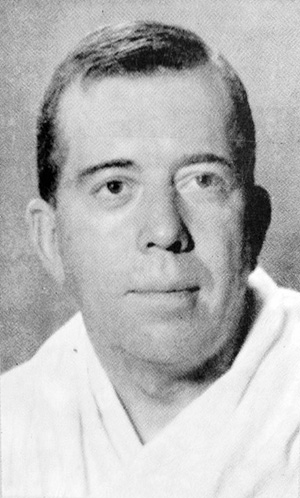
    Twentieth-century Australia was a greenhouse of spirituality and occultism in their many colourful varieties, offering a revolving door to a diverse range of international teachers and practitioners who graced our shores. Among them was a mystic who drew together the threads of Hinduism, Christianity, Theosophy, Rosicrucianism and Hermeticism, assuming the nom de plume Mouni Sadhu (meaning silent monk) and spending most of the final two of his seven-odd decades in Australia. 

    Mouni Sadhu (1897–1971)

    Although there are conflicting opinions about his early life, mainly because he was reluctant to disclose his background, it appears he was born as Mieczyslaw Sudowski in Poland around the turn of the last century, raised as a Catholic and served in the army in World War II before leaving his homeland.1 Thereafter he spent time in France, then Brazil, before migrating to Australia in 1948. It was here in this country that he disseminated an ideology that was to gain currency in the ensuing decades: Superconsciousness.

    Mouni’s friends and followers invariably described him as a devotee of both spirituality and occultism, however he took great pains to stress that he considered these as two very distinct paths. In the foreword to his book Ways to Self-Realization: A Modern Evaluation of Occultism and Spiritual Paths he wrote, “Occultism is neither a synonymous term nor a substitute for spirituality, and spiritual men do not necessarily come from the ranks of occultists. They are two different things.”2

    Having been attracted to all pathways of an esoteric nature from an early age, Mouni earned his occult label by joining local branches of the Rosicrucian Hermetic Order and the Theosophical Society in Europe during the 1920s and 30s, while at the same time studying and writing about the Tarot. He openly expressed admiration for Theosophical luminaries Madame H.P. Blavatsky, Annie Besant and Charles W. Leadbeater.

    A Search in India

    Mouni Sadhu’s spiritual guide and Master, the great Indian sage Ramana Maharshi (1879–1950).

    After some years, he and other members became disillusioned with these groups, leading them to break away and form their own occult lodge. A turning point came for Mouni when, during the period in France at the end of the war where he was studying the works of Paul Sédir, a friend lent him a copy of Paul Brunton’s book, A Search in Secret India. This triggered his interest in Indian spirituality and philosophy, resulting in a visit to India and his enduring reverence for the teacher he described as “the last Great Indian Rishi” – Sri Ramana Maharshi. Although Brunton’s book was first released in England in 1934, it found prominence in other Western countries during the post-war years, providing many baby-boomers with a springboard into wider esoteric explorations.

    Pursuing this compelling inner urge to find his true self, or Overself as Brunton dubbed it, Mouni Sadhu sought out the Maharshi’s ashram at the foot of the sacred Arunachala Mountain in South India. Like many other devotees, he believed that just being in the presence of a genuine spiritual Master could raise one’s level of consciousness. While at the ashram Mouni claimed to have attained an enlightened state known by the Sanskrit name Nirvikalpa Samadhi, wherein duality is dissolved and the knower becomes as one with what is known. 

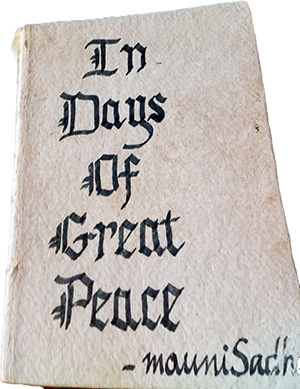
    While writing a number of books about his time in India, including his ‘Mystic Trilogy’ In Days of Great Peace, he did not try to recount his Master’s teachings verbatim, preferring instead to record what he called the “real experiences of an average man” in the presence of a great sage, describing the influence it had on him personally. It was at this point that he replaced the anglicised name Michael Sadau, by which he had become known to his friends, with the spiritual title Mouni Sadhu, with Mouni meaning silent and Sadhu being translated either as wandering holy man or more simply monk. His constant theme and guiding principle was the ancient maxim, ‘Know Yourself’.

    Meetings in Melbourne

    On settling back in the suburbs of Melbourne after his pilgrimage to India, Mouni found work plying his skills as an electrical engineer with the Electricity Commission of Victoria. He soon linked up with other Australian devotees of Ramana Maharshi and formed an association known as the ‘Arunachala Group’, while at the same time getting involved with yoga schools around the city where he conducted classes on meditation and Eastern spirituality. Following the placement of advertisements at branches of the Theosophical Society as well as libraries and appropriate bookshops, he began delivering lectures to public assemblies of interested people, plus smaller groups of private individuals, meeting with his more permanent pupils once a month. An ad he ran in 1963 read: “The Arunachala Group is an independent group of seekers beyond all sects and religious organisations, who accept as their spiritual guide and Master, the last Great Indian Rishi – Sri Ramana Maharshi”3

    At times Mouni was visited by devotees of Bhagavan’s maha samadhi from Brazil. During his time in that country in the late 1940s, Mouni wrote a booklet which was translated into Portuguese, titled Quem Sou Eu? (Who Am I?), and followers from those days kept in contact, considering him a guide and living link with their guru, Sri Ramana Maharshi. A mysterious incident occurred during one such visit to Melbourne when Mouni’s van was involved in an accident, after which he looked to be in serious condition with no sign of breathing. The Brazilians surrounded him and started chanting some Sanskrit slokas (Hindu prayers), and in due course, Mouni got up and carried on as if nothing had happened.4 Thus a certain aura and reputation grew around him.

    Sydney and the Occult

    Each February Mouni Sadhu would do a road-trip to Sydney in his VW campervan, and it seems, on the face of it, that he left his ‘spiritual’ label behind to revert to his more ‘occult’ side as he headed north. There he would stay at the home of his friend Nicholas Tereshchenko, who noted that Mouni met with, and gave talks to, members of the Theosophical Society, the G.I. Gurdjieff group, and students of the Tarot. He was also known to meet with the Scientologists. Tereshchenko reports that during Mouni’s 1964 Sydney visit, he helped him start a Tarot group. They developed a system whereby at each weekly meeting the person who presided over it would nominate a lecturer to speak on a chosen topic for the next meeting, and the speaker for that week would nominate the following week’s president. That way every member got to lead several meetings a year while also having to present a certain number of talks annually. “We therefore heard many different views on the Tarot, as seen by diverse people with many different occupations in life and ‘specialties’ in their interests in the occult. The meetings were held in the house of one of the librarians in the Theosophical Society,” Tereshchenko recalled.5

    In this way Mouni seemed able to vent the ‘occult side’ of his personality, which he associated with the West, while he was in Sydney, in contrast to the influence of Eastern spirituality that guided his activities back home in Melbourne. One of his close associates, Bruce W. Du Vé, wrote of him: “Mouni Sadhu was to my knowledge the last practising master in the great European tradition of occultists and White Magicians. He was thoroughly versed in the history and methods of these covert arts and when I knew him lived two parallel lives. Publicly, he was a jovial, intelligent and rather mischievous though polite and formal European gentleman of the Victorian era.… The other life was a more secret one.”6 Mouni himself elsewhere asserted that he had, “reached the firm conviction that Western adepts knew as much, if not more about the value of a one-pointed mind in spiritual achievement, than their Eastern brothers.”7

    On Superconsciousness

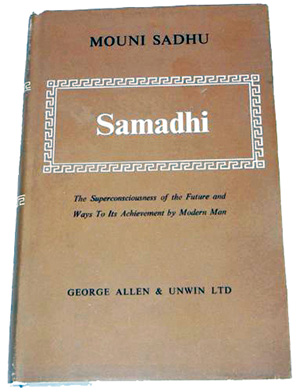
    To view Mouni’s contribution to our esoteric legacy through the rose-coloured glasses of 1960s’ hippiedom, à la the faddish transcendental adventures of the Beatles, would be to devalue it. The real linchpin of his life’s work was sharing his vision for ‘Superconsciousness’ as the way forward for humanity. This is a belief that, in addition to our normal waking consciousness and our subconsciousness, we possess a third higher state of awareness that is often said to be either dormant or veiled from our everyday cognition. This central theme is highlighted by the title of his 1962 book, Samadhi – The Superconsciousness of the Future (And Ways to its Achievement by Modern Man). He taught that the most effective way to achieve such a state was through samadhi, which in India was said to exist in a number of different forms, while in some Buddhist countries such as Thailand the word is defined simply as ‘meditation’.

    In his writings Mouni often referred to the philosophies not only of India but also that of Ancient Greece. It is worth noting that two and a half thousand years ago when the Buddha, Siddhartha Gautama, was attaining and teaching about enlightenment, the Ancient Greek philosophers were also considering the nature of the mind. The notion of a divided consciousness developed over a period of half a millennium, from the works of Homer down to Plato and Aristotle.8 And, just like some of the teachers in Athens in fourth century BCE, Mouni felt that the path to higher awareness should be open to the world at large, not confined to students of arcane mystery schools. He readily admitted that not everyone who sought knowledge had what it takes to persevere with it, and that Western minds often struggled to absorb Eastern traditions. He lamented that the dogmatic religions of the West were not producing the results intended by their founders. He was convinced the advancement of the human race would best be served by his ‘Superconsciousness-Samadhi’.

    Mouni believed his vision for the future could be reached most expediently by promoting spiritual meditative practices rather than the occult, which held negative connotations for many members of the public. It should not be thought that he felt conflicted or tried to deny his occult skills; in fact, he considered supernatural and magical pursuits to be very worthwhile. They were not for everyone, however, and could be a distraction to the novice setting out on his or her journey towards Superconsciousness. 

    Mouni the mystic could not be accused of creating division among the arcane disciplines, considering that he drew elements of Hinduism, Buddhism and Yoga from the East together with teachings of Theosophy, Rosicrucianism and Christianity from the West. He held himself to be a Catholic right until the end of his life, and this was most likely in respect for his beloved Maharishi, who took the position that one should never convert from one religion to another, but rather convert from ‘Ignorance to Wisdom’. In his Samadhi book, Mouni summed up this devotion to the religion of his birth by describing Christ as the ‘Master of Masters’ – an expression he said was used by both Sri Ramana Maharshi and Paul Sedir.9

    Get the issue this article appears in

    Marching to His Own Drum

    Although Mouni Sadhu never managed to meet Paul Brunton, the two corresponded for some time by mail. Sadly, that was to end on a sour note when Mouni disagreed with the British author’s change of direction later in life, which, according to Andrew Bukraba, involved drifting towards the Buddhist practice of ‘guru bhava’.10 After Mouni’s final letter expressing his disapproval, he would not even mention Brunton’s name again. His single-mindedness in adhering to his principles caused an earlier falling out with another man he admired, G.I. Gurdjieff, who he finally got to meet during the latter’s final year of life in 1949. According to friend Nicholas Tereshchenko, the famous occultist known for the Fourth Way had insulted Mouni in his native tongue, possibly using a taunt that was common between Armenians and Poles.11 Instead of letting it slide by bowing down and paying Gurdjieff the respect he thought he deserved, the offended Polish mystic stormed out of the room, thereafter renouncing his affiliation with the Fourth Way. Nevertheless, as we have seen, the incident did not prevent him from having cordial meetings with followers of Gurdjieff in Sydney in later years.

    As the eagle of the mountains, having soared high in the air above the earth,

    Wings its way back to its resting place, being fatigued by its long flight,

    So does the soul, having experienced the life of the phenomenal relative and mortal,

    Return finally unto itself, where it can sleep beyond all desires, and beyond all dreams…

    – Excerpt from the Upanishads, as quoted in Mouni Sadhu’s Concentration

    In the forty-five years since Mouni Sadhu (17 August 1897 – 24 December 1971) passed away, there has been no major organisation formed in his wake, although he remained in the hearts of his followers and friends. These days the term ‘Superconsciousness’ might well conjure up the speculations of modern quantum physics rather than Eastern mysticism. Such an association would probably not displease Mouni – after all, his stated aim was to see it carry us “beyond religion.” If anything ever unites science and religion, quantum physics would be the ideal candidate, with its claims that the observer affects the thing being observed, a close match to the ideal of samadhi, wherein duality is dissolved and the knower becomes as one with what is known.

    In one final practical legacy, Mouni’s literary estate was left to the Australian Society of Authors, of which he was a member. The royalties that have accrued from the estate now provide services to Australian authors.12

    New editions of Mouni Sadhu titles are available here: https://spirit.aeonbooks.co.uk/author/mouni-sadhu/23722

    [alert type=”general” dismiss=”no”]This article was published in New Dawn 166.[/alert]

    [alert type=”success” dismiss=”no”]If you appreciate this article, please consider subscribing to help maintain this website.[/alert]

    Footnotes

    1. The most reliable data comes from www.mounisadhu.com although other commentators such as Andrew Bukraba, Nicholas Tereshchenko and Bruce W. Du Vé all state on their websites that he was Russian.
    2. The source for this quote is en.m.wikipedia.org/wiki/Mouni_Sadhu
    3. www.mounisadhu.com/tereshchenko-on-sadhu.html
    4. From the notes of Andrew Bukraba, www.mounisadhu.com/bukraba-on-sadhu.html
    5. www.mounisadhu.com/tereshchenko-on-sadhu.html
    6. From Bruce W. Du Vé’s site: www.mounisadhu.com/duve-on-sadhu.html
    7. Source for this quote is en.m.wikipedia.org/wiki/Mouni_Sadhu
    8. For more on the Ancient Greek view of consciousness see en.wikibooks.org/wiki/Consciousness_Studies/Early_Ideas 
    9. en.m.wikipedia.org/wiki/Mouni_Sadhu
    10. www.mounisadhu.com/bukraba-on-sadhu.html
    11. www.mounisadhu.com/tereshchenko-on-sadhu.html
    12. en.m.wikipedia.org/wiki/Mouni_Sadhu

    References

    Quem Sou Eu? (Who am I?), 1948
    In Days of Great Peace – at the Feet of Sri Ramana Maharshi – Diary Leaves from India, first published in 1952, printed by Ramnarayan Press, Bangalore, India
    In Days of Great Peace – the Highest Yoga as Lived, 2nd ed. revised and enlarged, 1957, George Allen and Unwin
    Concentration – A Guide to Mental Mastery, 1959 (USA) edition published by Harper and Brothers, New York. Published in Great Britain as Concentration – An Outline for Practical Study, 1959, George Allen and Unwin
    Ways to Self-Realization – A Modern Evaluation of Occultism and Spiritual Paths, 1962, in the USA by The Julian Press, and in 1963 in Great Britain by George Allen and Unwin
    Samadhi – The Superconsciousness of the Future, 1962
    The Tarot – A Contemporary Course on the Quintessence of Hermetic Occultism, 1962
    Theurgy – The Art of Effective Worship, 1965
    Meditation – An Outline for Practical Study, 1967
    Initiations by Paul Sédir; translated from the French by Mouni Sadhu, 1967

    © New Dawn Magazine and the respective author.
    For our reproduction notice, click here.