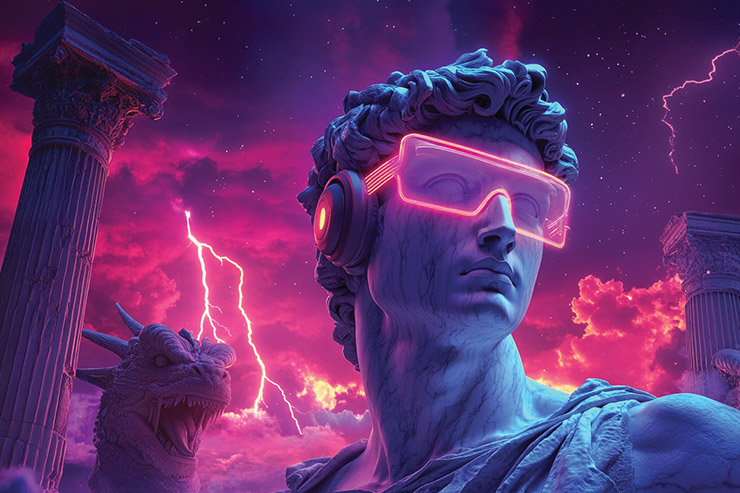
New Dawn – World's Most Unusual Magazine

Category: Secret Wisdom

  • The Neverending Storygame: Decoding the Simulation Through the Ancient Wisdom Tradition

    The Neverending Storygame: Decoding the Simulation Through the Ancient Wisdom Tradition

    From New Dawn 210 (May-June 2025)

    Some conflicts can only be resolved by divine intervention, and so after arguing with your most stubborn intellectual jousting partner about “simulation theory” – the notion that earthly reality is some sort of cosmic computer program – you find yourself in a deserted part of town on a rainy night, the lone customer in a metaphysical shop smelling of incense and old books. 

    An old book is precisely what you need, you tell the bearded proprietor, and not just any book. One that contains the “secret doctrine” of the ancients, a book with all the answers. 

    “Is there such a breviary,” you ask, “revealing all to those who wish to see?”

    “There is,” the old man responds, withdrawing a vellum volume from behind the counter. “I keep one aside for anyone who asks.” 

    “I’m afraid I wouldn’t be able to afford something as magnificent as this,” you say as the book vibrates in your hands. 

    “Oh, but this book is free to anyone who requests it!” the proprietor says. “There are limitless copies, and yet it is worth more than all the riches in the world.”

    At home, you retire to your study, light a candle, and pour a glass of wine. The first thing you notice is the weighty tome is only half-written; half the book is blank. And then, across a manic midnight and into the wee small hours, you read its pages and begin to see. Not the physical reality seen by your eyes but the invisible reality behind it. 

    The mysterious book begins by asking what the great star we call the Sun has in common with the blood flowing through our veins, the special significance of the orbital path of Venus, and what video games have in common with the supreme deity men call by the name God.

    Without the Sun, the book explains, Earth would not exist. It is the starting point, the bringer of light and life, the envoy of the simulation-creation. As we orbit the Sun, which causes the four seasons, its fiery rays come down and lift the water from the sea, which returns to Earth in the form of rain, which causes the foliage to grow, creating oxygen for our atmosphere. 

    An unseen fifth element makes it all possible, a quintessence that simulation-theory eggheads call the “god particle,” forever eluding their understanding. In the human body, the blood acts similarly to the fifth element operating outside it. We breathe in air, charging the bloodstream with oxygen which our central “sun,” or heart, pumps to all the parts of the body, taking from the blood what it needs to fulfil its function. 

    Now let us look at the path of Venus as seen from Earth (see image on the left). The so-called fairest sight in nature, the third brightest object in the sky after the Sun and Moon, appears like a glimmering five-pointed diamond, six months of the year at dawn and six at dusk. The ancient wise men used geometry to trace its trajectory from season to season, year to year, and discovered that over the course of eight years, the path of Venus around Earth forms a mandala shape, or what we call sacred geometry, despite the fact that both planets are in constant motion.

    No atheist vs. believer modern-human argument will ever settle matters of this sort. If you don’t look at the path of Venus and immediately and intuitively understand that the reality in which you exist has been crafted down to the tiniest detail, then you probably wouldn’t be reading this. But you are, so let us explore “simulation theory,” a recent buzzword of Silicon Valley types who are highly adept at staring through the proverbial positivist microscope to perceive the workings of things but who’ve completely lost sight of the big picture and great master-key of occult philosophy: analogy

    When video game technology became sufficiently sophisticated, what did humans do? They invented open environments for a character controlled by the player’s will because there’s no game without free will. The game world is then filled with trials against antagonistic forces and the possibility of failure because nothing would happen without obstacles and opposing forces. Each victory brings upgraded powers, leading to a final destination written by the game’s author. 

    According to ancient doctrines, everything in the universe follows the same laws and patterns, like an immense multidimensional paisley in which each part is a microcosm of the larger to which it is attached. 

    So yes, you’re in a simulation. Of course you are. This is the great secret known to all the world’s spiritual traditions. Only when man became intoxicated by his machines did he lose sight of the fundamental fact that in his own sphere of action here on Earth – aided by will, reason and intelligence – man is a mirror of his simulation author – a creator, transformer, and builder of worlds.

    A gust of wind blows the window open, letting in the silvery moonlight. You decide to leave it open, and the cool night breeze sharpens your mind as the mysterious book reveals the laws governing the reality-construct in which you find yourself, drawing on an excellent summary from the 1908 book The Kybalion. The seven Hermetic laws governing creation are:
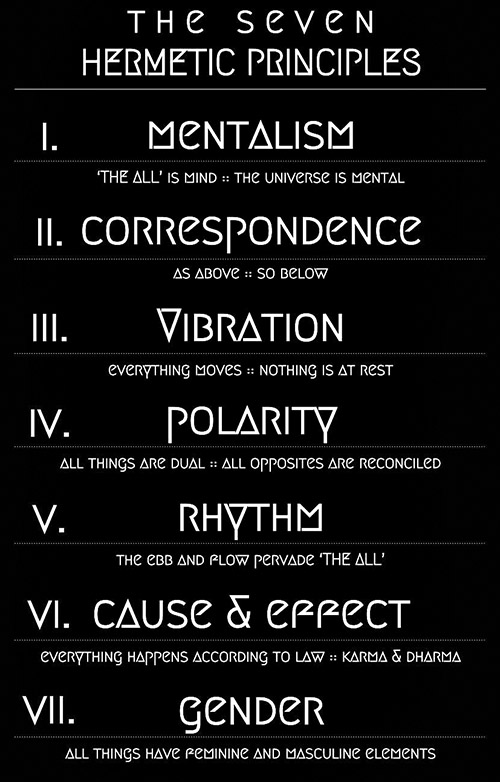
    Mentalism – This is the most relevant to exponents of simulation theory, as it means the universe is based not on matter but consciousness. At the atomic level, what appears to you as solid matter is mostly empty space, and all of Earth will be vaporised when the Sun becomes a red giant billions of years from now. 

    Where will the solid matter go? It will be transformed into a different form of energy that can ultimately be traced back to that mysterious fifth element. 

    Correspondence – Everything in the cosmos exhibits the same pattern, from seasons to civilisations, galaxies to snail shells.

    Vibration – Everything is forever in motion.

    Polarity – Everything presupposes its opposite: life/death, spirit/matter, good/evil.

    Rhythm – The pendulum is always swinging; day is racing to night, the tide goes in and the tide goes out, you inhale and then you exhale. 

    Cause & Effect – Perceived effects come from higher causes.

    Gender – Everything is based on two opposing principles, one active, the other receptive, which come together in the act of creation.

    These are just the laws that run the simulation world. 

    Before revealing what happens in this world, the book with all the answers explains the primordial energy running the whole thing. Consider the proverb about blind men inspecting an elephant. Each can touch a single part – trunk, tusks, ears, enormous scaly body – but cannot see the whole and so thinks an “elephant” is the one part he can grasp. Likewise, the primordial energy of the cosmos has various overlapping ways of being known, and traditional doctrines employ the following terms:

    The quintessence or prima materia is the building block of everything in the universe, which modern science calls Dark Energy

    The primordial generative androgyne “dragon” is felt in the solar plexus and genital region as a dual serpentine energy. Some metaphysical schools refer to this as chaos or undifferentiated energy. 

    The pneuma is a thin vibration detectable in pranayama or sacred breathing; the word means breath and offers direct experience of something like living Spirit. 

    The Great Magical Agent or Universal Plastic Medium, to use two terms employed by Eliphas Levi, is the combination of intelligent spirit acting on the dragon, which consciousness experiences as a kind of viscous material. It’s something like active imagination or magic, and what we use to create possibilities assessed by reason and put into action on the material plane by the will

    The Astral Light is something like what psychology calls the collective unconscious. Levi seems to use it interchangeably with the dragon, quintessence and prima materia, but given his references to it as “saturated with images” and “nature’s imagination,” it appears Astral Light best describes not primordial energy but the archetypal realm of consciousness. 

    In astrology, this is associated with the planet Neptune, whose gravitational energy comes to us at a very high vibration and is likely the place from which artists receive inspiration. Although the ancients could not see this planet, they could feel its frequency above the seven planetary “metals” that power human life. It is the divine realm where ancestral archetypes roam in a kind of living fantasia. It’s no coincidence that the same planet and deity are associated with the unseen world beneath the sea, which is why Gustav Holst wrote an eerie chord progression for Neptune in his 1914 suite “The Planets.” 

    The numen is the Roman concept of divine presence beyond any god or archetype, something like the watchful eyes of the Supreme Author of the simulation. The term means “to nod” and is likely where we get the term “a wink and a nod,” expressing another level of reality to that which is perceived. 

    To spiritual initiates who find their way to the metaphysical dimension, all the unexplainable synchronicities and serendipities in earthly life are experienced as fleeting nods of the higher powers. The Latin term gives us the English word “numinous,” meaning supernatural. 
    Get the issue this article appears in

    Modern humans – say, those whose frame of reference is based on the scientific rationalism and social institutions of the past three centuries – who ponder simulation theory are too smart for their own good or what esotericists would call “intelligently stupid.” They will never crack the code of the reality they inhabit because their human ego – necessary for the trial of earthly incarnation but an impediment to spiritual knowledge – is too wedded to their material intelligence or sense of reason. They will always be a scientist-subject looking at metaphysical reality as an object, unable to transcend the dichotomy and enter the idea-world they behold in their minds. 

    To paraphrase The Upanishads, the simulation is not anything you can see but rather that by which you can see. It’s like asking a fish to explain water from a scientific point of view when water is the very thing in which it lives and which gives it life. A fish’s reality-construct is taken for a given. They do not think about their cosmos – water – only what happens in it, such as eating, spawning, and avoiding predators. 

    The mysterious book has now prepared you for the next revelation, for beyond the laws, principles and primordial energies that drive the simulation reality-construct. What actually happens in it? 

    We are not in a static universe of rigid rule; the seven Hermetic laws taught us that. Everything is in motion, everything has its season. There are various races, gods and archetypes; myths and legends; literature and fairy tales; civilisations that achieve greatness and then fall to barbarian hordes. There are also innocuous humans whose lives are as cogs in the great turning wheel, and there are geniuses, kings, mages and sages who are completely differentiated and distinct, and who possess powers of intelligence, wisdom and creativity that seem to come from another dimension.

    The three shots comprising the last 30 seconds of the 1937 fairy tale film Snow White give us a hint, for they are a visual distillation of ancient doctrines revealing the analogy of how human life and the overworld overlap – the Hermetic dictum from the Emerald Tablet is “As above, so below” – and how archetypal symbols are ever at work in man’s imagination, the medium – or Astral Light – through which human consciousness interacts with divine consciousness.

    As dawn begins to break, you close the magical book of secret wisdom, unable to absorb anymore. 

    We’ll reopen it in the next issue of New Dawn, in part two, when the sacred science – the ultimate field of study for man, the highest challenge, the absolute endeavour – begins to come to life. 

    Christian Chensvold is the author of the new book Gothic Olympus, available from https://arktos.com/product/gothic-olympus/. When a mysterious inheritance leads Julien Stanwyck from the hazy clubs of New York to the absinthe-glowing cabarets of fin-de-siècle Europe and the ruins of a family château, a drama of infernal torments and divine fury rattles the cage of the modern world.

    Gothic Olympus launches the reader into the phantasmagoric odyssey of one man’s mission to reawaken the old gods and defy the onslaught of demonic collectivism and matriarchal tyranny. It follows Julien Stanwyck’s alchemical transformation from a pale, scrawny, angry young man into an Olympian sovereign who conquers death with the sword of Achilles, wins a goddess for a bride through initiation into the Mysteries of Sex, and travels through earthly and celestial realms to fulfill his destiny.

    A mythopoetic allegory for the twilight of Western Civilization between the Belle Époque and the present dystopia, Gothic Olympus detonates the postmodern abyss through a pulse-pounding concoction of dark humor, occult wisdom, and virile spirituality, weaving Julius Evola’s revolt against the modern world with elements of steampunk, dark fantasy, and Decadence. Through the magic mirror of Stanwyck’s trials and adventures, Gothic Olympus is a riveting tale of heroism, a summons to metaphysical awakening, and a daring vision of the greatest force the world has ever known: European man’s imagination. Order here: https://arktos.com/product/gothic-olympus/.

    [alert type=”general” dismiss=”no”]This article was published in New Dawn 210.[/alert]

    [alert type=”success” dismiss=”no”]If you appreciate this article, please consider subscribing to help maintain this website.[/alert]

    © New Dawn Magazine and the respective author.
    For our reproduction notice, click here.
  • Jim Morrison – Secret Teacher: “Break on Through” to Higher Consciousness

    Jim Morrison – Secret Teacher: “Break on Through” to Higher Consciousness

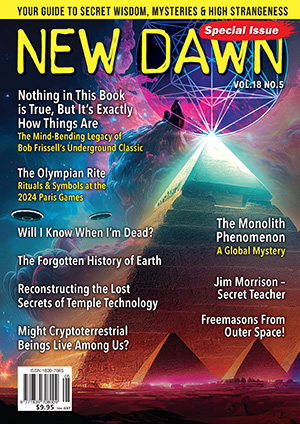
    From New Dawn Special Issue Vol 18 No 5 (Oct 2024)

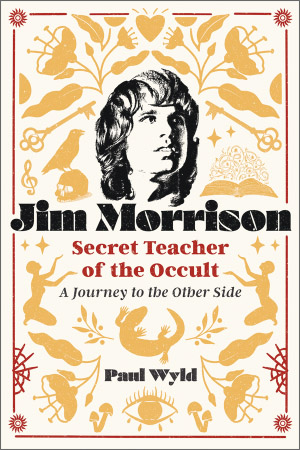
    In the fall of 2019, I set out to show that American classic rock vocalist Jim Morrison of The Doors is not only a secret teacher but one in the Western esoteric tradition.

    A secret teacher is a special kind of person connected to another reality they feel called to explore, a reality beyond what the five senses can perceive and the rational mind can understand. Jim Morrison, Secret Teacher of the Occult: A Journey to the Other Side is about his artistic response to this other reality and why he bravely chose to express it so openly.

    The Western esoteric tradition is filled with secret teachers who feel that their strong connection to this other reality demands expression. Morrison travelled this path as a modern shaman through rock music, poetry, and film. However, this path to self-realisation is often problematic as these individuals are frequently misunderstood. They turn inward and embark upon that “stormy search for the self,” the title of an illuminating 1990 work on spiritual awakening by Christina and Stanislav Grof. Morrison found the courage to make us aware of that other reality through poetic lyrics and his shamanic presence.

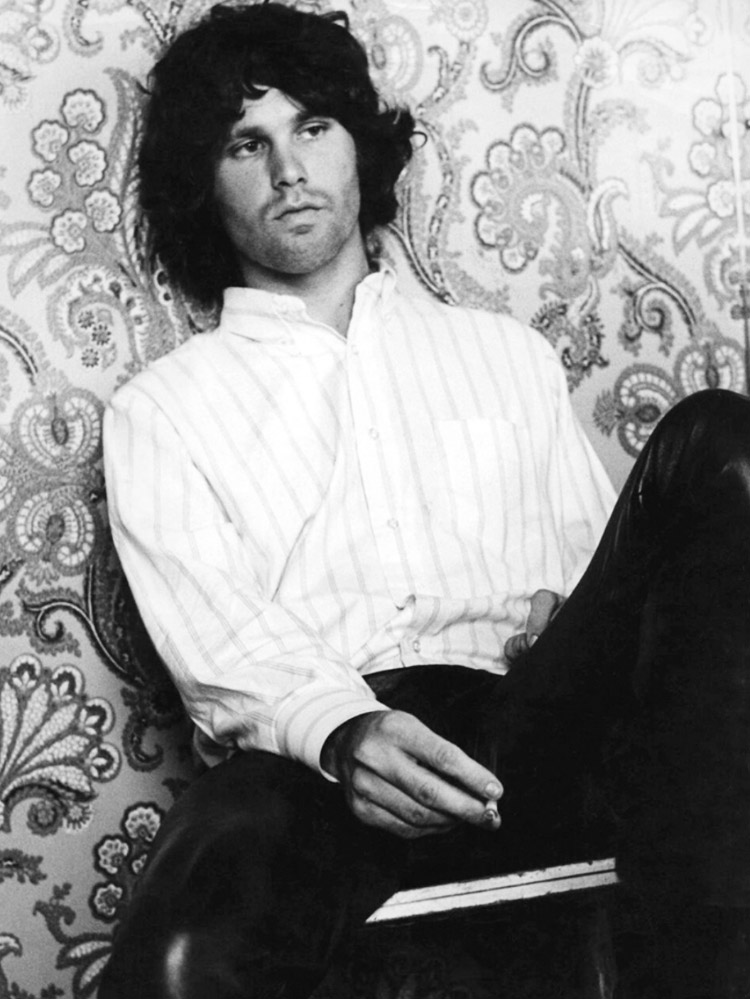
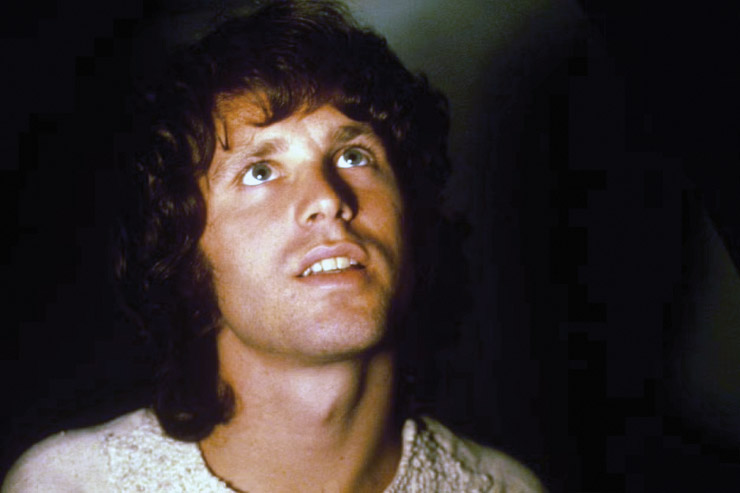
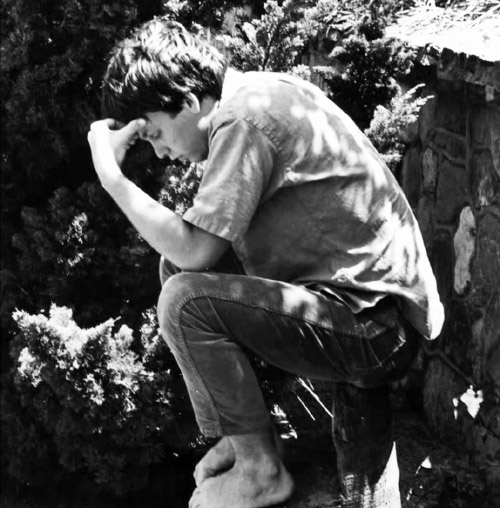
    A young Jim Morrison in contemplation.

    Morrison’s artistic contributions are manifold. He was one of the pioneering lead vocalists in early rock music history, his most significant influence being the legendary Elvis Presley.

    Morrison was drinking one afternoon on the patio of one of his favourite bars in West Hollywood, Barney’s Beanery, when he told American author Jerry Hopkinsthat he wanted to read a biography on Elvis. Hopkins would later co-write with American author Danny Sugarman the first biography on Morrison, 1980’s No One Here Gets Out Alive. Inspired by Morrison’s suggestion, Hopkins wrote Elvis: A Biography, the first of its kind, published in 1971.

    Morrison’s 1969 independent film HWY: An American Pastoral gave him a place in film history. Experimental filmmaking was Morrison’s original artistic ambition, leading him to earn a degree in cinematography from UCLA in 1965. Morrison became one of America’s best poets, writing in short verses much like his favourite poet, the late nineteenth-century French boy wonder Arthur Rimbaud, who also influenced the American Beats and singer-songwriters Patti Smith and Bob Dylan.

    To appreciate the cosmic consciousness in Morrison’s art and better understand him as a human being, you must look back much further.

    Western Esoteric Tradition

    Enlightening clues about Morrison’s true self are found in the centuries-old Western esoteric tradition. It’s a thrilling chronicle of mysterious secret teachers who sought to preserve and expand upon what author Gary Lachman calls “rejected knowledge” in his 2015 work The Secret Teachers of the Western World. Lachman tells of the secret teacher’s struggles against what British poet William Blake called “the mind-forg’d manacles” in his long poem The Marriage of Heaven and Hell.

    The Ancient Greek philosopher Aristotle taught Alexander the Great when he was a boy – a historical figure Morrison greatly admired – that all human beings possess a desire to know. The great library established in Alexandria on Ancient Egypt’s Mediterranean coast in the third century BCE – a city named after Alexander the Great – would satisfy the ancient world’s hunger for knowledge for a number of centuries. Some say the Western esoteric tradition was born from this ancient library, a place where Morrison would have felt right at home.

    Insatiable Quest for Knowledge

    What makes Morrison such a memorable secret teacher is the Alexander the Great warrior-like intensity he channelled into making us aware of that other reality. It’s as if Morrison were picking up where Alexander the Great left off, upset there were no more worlds left to conquer. Only that other reality Aristotle alluded to awaited rediscovery.

    Morrison’s desire to know was so powerful he became a warrior for the human soul’s higher aspirations and potential, as many other secret teachers before him such as Hypatia, Giordano Bruno, Jacob Boehme, John Dee, Aleister Crowley, and William Blake. Morrison’s life was like theirs in many aspects, one rich with spiritual awakening, peak experiences, eccentricity, exceptional intelligence, separation from society as an outsider, an insatiable quest for knowledge, timeless achievements, startling convictions, a strong sense of what twentieth-century British author Colin Wilson called “purpose and meaning,” notoriety bordering on pariah status, a chaotic life that sometimes made interpersonal relationships difficult, run-ins with the law, and persecution.

    Morrison had a great hunger for knowledge. The rooms he lived in during his high school and university years were stacked floor to ceiling with hundreds of books, his own personal Hellenistic Alexandria-type library.

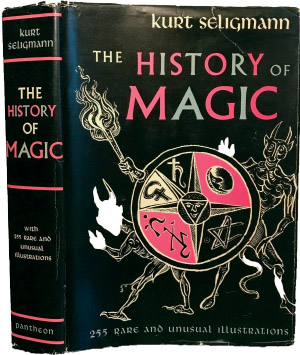
    He made little effort to do well academically yet still earned high grades, focusing on class assignments that interested him and the various books he took inspiration such as Swiss-American artist Kurt Seligmann’s 1948 work The History of Magic.

    Morrison made up stories to excuse himself from class and turned down invitations from popular fraternities so he wouldn’t have to conform. What made him tick was an eclectic array of subjects any hip, artistic, spiritually awake person living in the middle of the twentieth century would gravitate to, such as Symbolist poetry, existential philosophy, literature, ancient history, modern art, Freudian psychology, Beat novelists and poets, avant-garde filmmaking, blues music, and occult esoterica such as alchemy, magic, witchcraft, and demonology.

    These preferences, combined with his love for Elvis Presley, put Morrison on a preordained path to wake us up to cosmic consciousness rock and roll style, what he referred to in his live performances and poems as the “Universal Mind.”

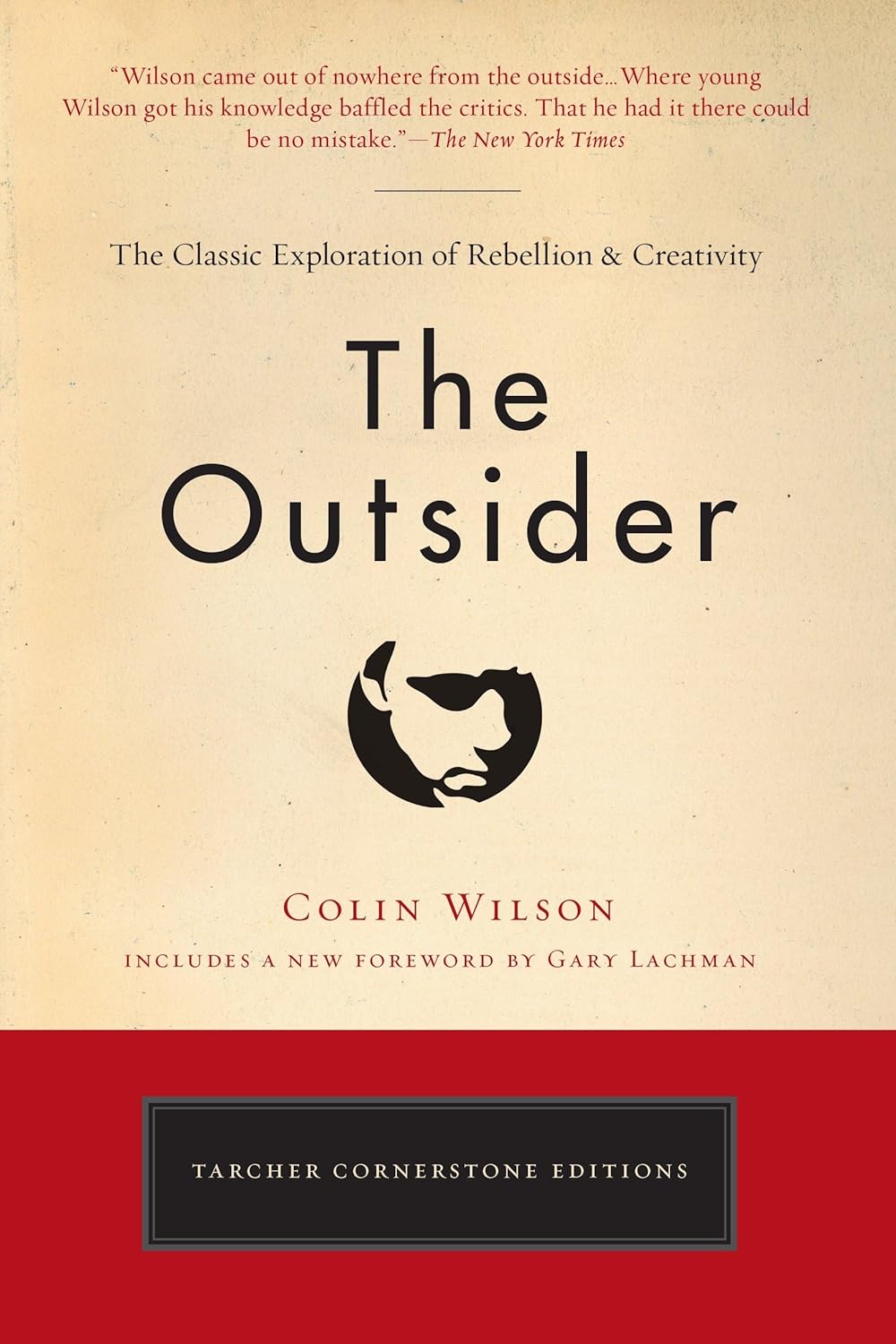
    Morrison was, by temperament, a Romantic. While in high school, he read Colin Wilson’s 1956 work The Outsider, which explores a number of Romantic personalities as well as artists, philosophers and those misunderstood by their contemporaries. Wilson wanted to know why certain geniuses experienced profound “highs” and “lows” that led some to pessimism, depression, drug addiction, terminal illness, and suicide.

    Wilson highlights nineteenth-century Dutch post-Impressionist painter Vincent Van Gogh’s The Starry Night as expressing a heightened awareness he dubs “the peak experience.” Wilson notes that Van Gogh committed suicide one year after painting the masterpiece. Before dying, Van Gogh told his brother Theo, “La tristesse durera toujours” (‘The sadness will last forever’). Morrison shared Van Gogh’s bleak view of life, lamenting in his posthumously produced 1978 poetry album An American Prayer, “Could any Hell be more horrible than now, and real?”

    Morrison nearly met Van Gogh’s fate on more than one occasion. In Three Hours for Magic, The Jim Morrison Special, Doors guitarist Robby Krieger tells the story of how Doors drummer John Densmore and Krieger once spent an entire night talking Morrison out of killing himself. Krieger remembers having to do this for Morrison more than a few times. Morrison took a walk before sunrise and returned in a completely different mood, feeling euphoric, saying “he’d seen the light” and that he’d written a new song, “People Are Strange,” one of the many classics Morrison would write for The Doors. The person threatening to take his own life a couple of hours earlier had vanished.

    Scene from Oliver Stone’s 1991 film The Doors shows the young Morrison (played by Sean Stone) passing by a fatal accident in which the spirits of dying indigenous Indians enter his soul.

    Break on Through to the Other Side

    Morrison possessed a strong connection to the spirit world. He was adamant that ghosts of dying native American workers he encountered at age three on a road trip with his family in New Mexico had entered his soul. Morrison viewed this spiritual indwelling as the most significant event of his life.

    Colin Wilson’s The Outsider would have strongly resonated with Morrison at the start of his journey of awakening.

    Later, Morrison’s spiritual awakening became intense as his laser-focused reading and journaling invoked numerous peak experiences followed by deep falls into depression, boredom, panic, hopelessness, despair, rage, confusion, and violent thoughts. Morrison’s behaviour would sometimes go beyond eccentric and bizarre into psychopathic, one of the hallmark traits of a shaman. He was looking for help, though he didn’t know where to find it or who to trust, fearful that if he revealed his tumultuous inner life, no one would look at him the same again. While a student at George Washington High School in Alexandria, Virginia, from 1959 to 1961, Morrison expressed having a personal issue he didn’t want to share with his parents or his first girlfriend, Tandy Martin. She insisted Jim talk with a local Presbyterian minister. Reluctantly, Jim agreed. Their conversation remains a mystery.

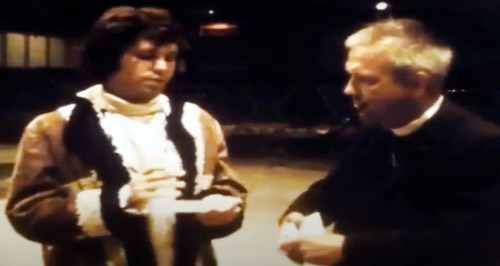
    Morrison would meet another man of the cloth, Pastor Fred L. Stagmeyer, Minister at Large for the Evangelical and Reformed Church. Morrison was friendly to Stagmeyer, who’d made his way backstage one night after a Doors show. Their conversation included a stark warning from Stagmeyer. He pointed out to Morrison that his intent to inspire Doors fans to “break on through to the other side,” to “reinvent all the gods, all the myths of the ages,” and “celebrate symbols from deep elder forests” was not going unnoticed by the Christian Right of 1960s America. Hostility from Christian authorities towards heretics and secret teachers was always the case.

    Jim with Pastor Stagmeyer.

    In The Secret Teachers of the Western World, Lachman discusses how the Catholic Church attempted to end the energising influence of the Italian Renaissance’s great awakening when hermetic and occult texts such as the Corpus Hermeticum were translated into Latin. Suddenly, such investigations into the deeper esoteric dimensions of reality were viewed as a form of insanity. A sort of spiritual guerrilla war ensued, with the forming of many secret societies in countries across Europe and in America to preserve “the rejected knowledge.”

    For Jim Morrison in the 1960s, the Inquisition had long since passed – prolonged imprisonment, torture, and public executions no longer occurred – but not too much else had changed in religious conservative attitudes to what Lachman calls things “new, alien, and other.

    Criminal Charges & France

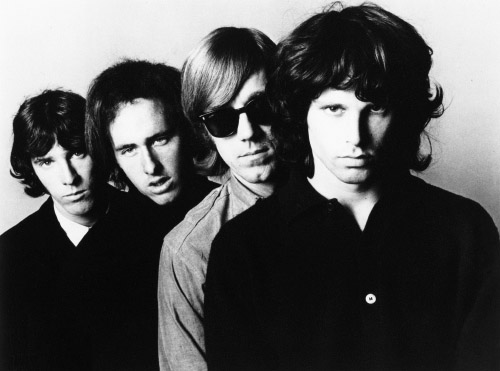
    A 1966 promotional photo of The Doors.

    Morrison’s penchant for pushing it had already gotten him busted at a Doors performance in New Haven, Connecticut, in 1967, the first performer ever to be arrested onstage. Morrison was later charged by the Miami police with multiple offences, including indecent exposure after the infamous March 1st, 1969, Miami Doors concert where it was alleged he’d exposed himself to the audience. On March 5th, the day Morrison’s arrest warrant was issued, FBI agents in Miami sent a brief report of Morrison’s performance to the office of then-feared FBI director J. Edgar Hoover. This was during Richard Nixon’s presidency, a paranoid man who mounted a campaign to have Beatle John Lennon deported, causing Lennon to cancel a planned 1971 tour of America, known back then as the anti-Nixon tour, with anti-war activists Abbie Hoffman and Jerry Rubin. At the request of former Florida governor Charlie Crist during his tenure between 2007 and 2011, the charges against Morrison were re-examined by the Florida Clemency Board. They were found to be weak, and in December 2010, Morrison was posthumously pardoned. 

    The 1960s saw the Western world’s first popular occult awakening. Young people wanted to have fun experiencing the unknown and The Doors became one of their most cherished outlets. Morrison’s flamboyant rebellion made him a not-so-“secret teacher.” He was the eldest son of one of America’s most outstanding officers, Rear Admiral George Morrison. “The Commander,” as Morrison referred to his father throughout his childhood, once offered his resignation to the American Navy due to Morrison’s frequent arrests.

    One of Morrison’s greatest fears came true one fall day in 1970 as a three-man, three-women jury in Dade Criminal Court found him guilty of indecent exposure. Morrison was sentenced to six months incarceration, possibly in Florida’s notorious Raiford Prison, a hostile place where he knew he could easily be killed.

    Get the issue this article appears in

    While still out on bond pending his appeal, Morrison relocated to Paris, France, in 1971 to find himself again as a poet and a person. The pressures he left behind were great. There was the criminal trial in Miami, the fallout from a federal criminal case brought against him in Phoenix, Arizona, for disrupting a commercial airline flight (these two cases put Morrison’s name and face in national news television broadcasts across America), and the expectation that Morrison would remain a highly original artist with The Doors. Besides his enormous legal fees, Morrison was invested heavily in his girlfriend Pamela Courson’s posh West Hollywood clothing boutique, Themis, and her expensive heroin habit, something Morrison detested.

    By 1970, Morrison was no longer the lithe and sexy “Lizard King” of The Doors’ earlier years with his growing paunch, and the music scene in Los Angeles wasn’t impressed with his penchant for passing out drunk in public. As his criminal cases made their way through the courts, Morrison did find refuge in his creativity. He left us some real gems. In 1970, his first book of poems was published, The Lords & The New Creatures, a slender volume filled with fascinating and astute insights on cinema, history, voyeurism, art, sexuality, alchemy, shamanism, and American urban life as well as a long poem that recalls the imagery of the surrealist poets and painters Morrison loved. Heproduced and directed, with the help of his UCLA film school friends, the independent film HWY: An American Pastoral, released in 1969,abouta killer hitchhiking through the Mojave Desert who drives into Los Angeles with one of his victim’s cars (Morrison’s 1967 Shelby GT500 was used in the film). Morrison also contributed to creating one of the most widely acclaimed of The Doors’ six albums, L.A. Woman, released in 1971. Despite these successes, Morrison decided he needed a break from America, that it was time to leave Los Angeles for Paris, confiding in Doors manager Bill Siddons that he didn’t know who he was anymore.

    Waiting to move into their 4th arrondissement apartment, Morrison and Courson stayed in the same room where 19th-century British author Oscar Wilde had died, impoverished and bedridden, on November 30, 1900. Wilde’s health never recovered after two long years in prison following a conviction on moral grounds. In the weeks after the 1969 concert, a “decency” rally was held at a Miami stadium and attracted over 30,000 people. Would a Florida appellate court overturn the conviction? This unknown left Morrison anxious. Then, just three months after he arrived in Paris, Jim Morrison died there on July 3, 1971. Morrison was laid to rest four days later in the same cemetery as Oscar Wilde, Cimetière du Père Lachaise.

    Paul Wyld’s book Jim Morrison, Secret Teacher of the Occult: A Journey to the Other Side explores the mystical and spiritual side of the famed Doors front man. To order your copy, go here.

    [alert type=”general” dismiss=”no”]This article was published in New Dawn Special Issue Vol 18 No 5.[/alert]

    [alert type=”success” dismiss=”no”]If you appreciate this article, please consider subscribing to help maintain this website.[/alert]

    © New Dawn Magazine and the respective author.
    For our reproduction notice, click here.
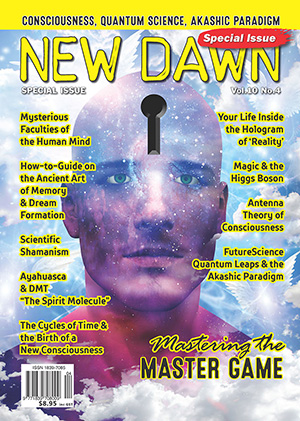
  • Mastering the Master Game: The Self-Completion of Robert de Ropp

    Mastering the Master Game: The Self-Completion of Robert de Ropp

    From New Dawn Special Issue Vol 10 No 4 (Aug 2016)

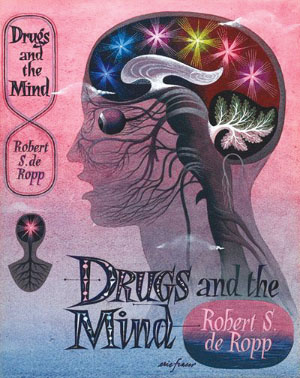
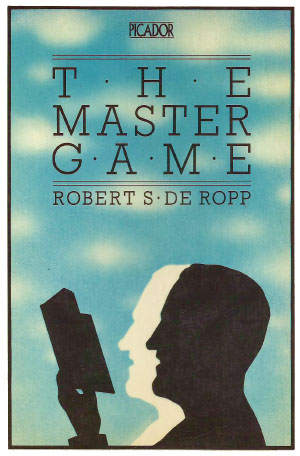
    Biochemist, author, spiritual teacher, kayaking fisherman, founder of an intentional community, misanthrope – Robert de Ropp was a complex man. Within him, the scientist, the magician, the missionary, the domestic oaf, hermit and warrior jostled for position. Practical and forthright, and distrustful of wide-eyed spirituality, he nevertheless became widely known to seekers in the 1960s. Books like Drugs and the Mind, The Master Game, Warrior’s Way and Self-Completion helped many to bridge the gap between drug experiences and disciplined spirituality. 

    Born in England in 1913, he came from an aristocratic background, but the early death of his mother in the post-WWI influenza epidemic and the subsequent lack of interest shown by his father resulted in a bizarre childhood. 

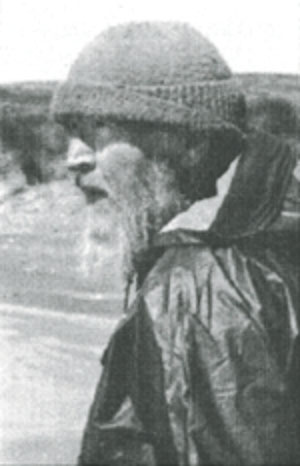
    Rare photo of Robert de Ropp

    His father was a Lithuanian Baron who in the 1920s lost most of his money in ill-advised financial ventures. At the age of 12, de Ropp, who had until that point been advancing through the elite English school system, found himself dumped for two years at the family seat in Lithuania. The mansion itself had not been maintained and, having been shelled in the war, was close to a ruin. Robert rattled around in a freezing cold, rat-infested great house that could accommodate fifty people. The neglected estate was run by the peasant families who had been there for generations, if not centuries. In place of his Oxbridge-oriented classical education the half-starving de Ropp found himself receiving a practical schooling in fishing and traditional agriculture from the old retainers. 

    With little warning he found himself extricated by his father only to be resettled once again, this time in the Australian outback, where he found himself working in a hopelessly misjudged farming venture. When this went bottoms up he made his way to Port Adelaide where he tried unsuccessfully to drown himself. Somehow, the fourteen-year-old managed to get back to England by himself with ten shillings in his pocket. Via a family connection he was taken in by the composer Ralph Vaughan Williams, whose pastoral pieces are now a mainstay of popular classic music radio programming. Finally achieving some stability, Robert studied science and became a molecular biologist. 

    Robert would only have occasional contact with his father, who lived until 1973. William de Ropp was a fascinating figure in his own right. A Germanic Lithuanian aristocrat, he became a confidante of Hitler and enjoyed close contact with him in the mid-1930s. William de Ropp had close connections with high-ranking British figures who were in favour of appeasing Hitler. He was actually being employed as a double agent who was able to obtain considerable intelligence for the British on Hitler’s ambitions and the state of the Luftwaffe. 

    Encountering Ouspensky & Gurdjieff

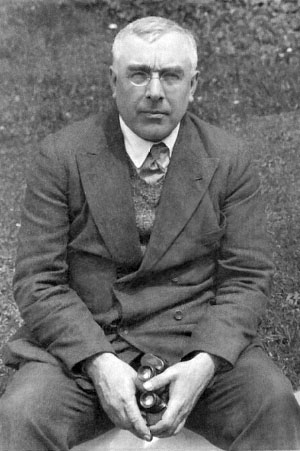
    P.D. Ouspensky (1878–1947) was a Russian mathematician and esotericist known for his expositions of the early work of the Greek-Armenian teacher of esoteric doctrine George Gurdjieff.

    In the 1930s Robert de Ropp got to know the novelist Aldous Huxley and his friend Gerald Heard who taught meditation. Heard was one of the first westerners to teach eastern meditation styles but de Ropp found his approach over-emotional. Not so P.D. Ouspensky, who seemed free from sentimentality and pretentiousness. After a hesitant start, de Ropp joined Ouspensky’s groups and began the work (based in the teachings of G.I. Gurdjieff), which, with development and adaptation, would dominate his inner spiritual life. 

    De Ropp was tough and well-prepared for the physical exertions that form part of the Gurdjieff work. G.I. Gurdjieff taught that man (humans) has no single indivisible ‘I’. Desires, thoughts, feelings, urges, pass constantly through us, each of them claiming the title of ‘I’ temporarily. Certain typical clusters of these ‘I’s form somewhat separate personalities. Each personality may have a separate set of concerns that collect together, representing the different aspects of one’s concerns or the separate contexts in which one must relate to other human beings. As an example, many adolescents experience a taste of this when they experience the discomfort of recognising that the way they behave with family may be very much at odds with the way they behave with friends.

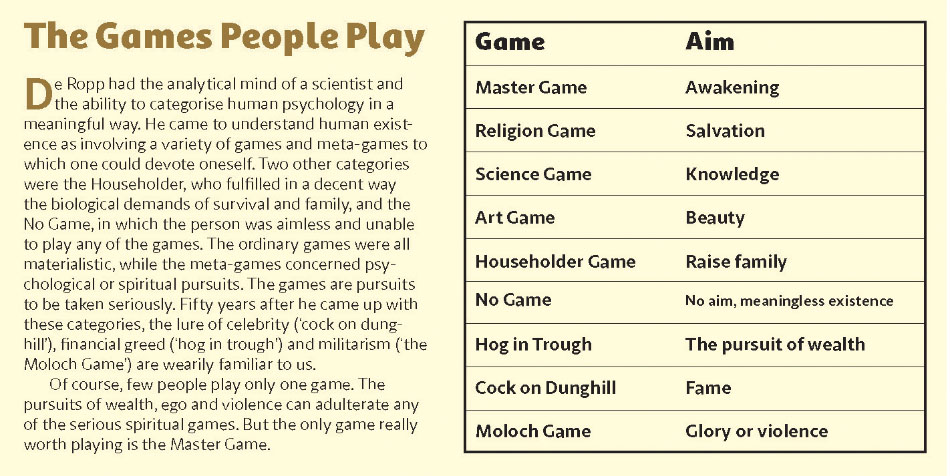
    De Ropp found this to be a key to self-understanding. Obviously disposed to coming up with new categories, as we shall see in other areas of his writing, he analysed his own constituent personalities. What was unique in de Ropp’s approach was his use of the personalities in autobiography. Throughout Warrior’s Way – incidentally one of the most readable, honest, and varied of spiritual autobiographies – de Ropp characterises his behaviour according to the personality which was dominant. These included archetypes such as the Magician, who was able to feel the mystique of nature, and the Scientist, always applying rationality and looking for evidence. Yet others are more individual. The Missionary was that part of de Ropp who wanted to convert others to what he saw as the truth of the Gurdjieff-Ouspensky system. The Missionary was energetic and sincere but authoritarian, dogmatic and domineering. Opposed to the Missionary was the Domestic Oaf, desirous of family, children, a steady job, of house and land. (At times his personalities included the Recluse, the Cynic and others; this was a pragmatic rather than a systematic approach.) 

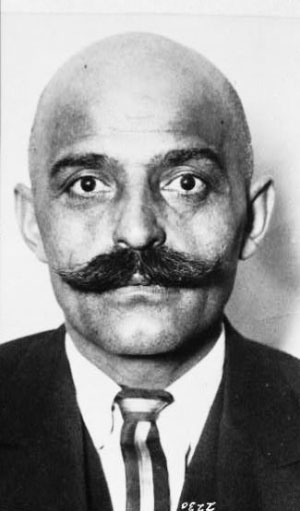
    George Gurdjieff 

    De Ropp worked every weekend at Lyne Place in England and then, after the end of the war, at Franklin Farms in New Jersey for over a decade. He was not alone in feeling that Ouspensky had lost his way and succumbed to a form of the guru trap, with a drinking problem and surrounded by followers who had become dogmatic and authoritarian. He was also not alone in feeling that in his last months Ouspensky had shrugged off this role and lived like a spiritual warrior at the end.

    After Ouspensky died de Ropp finally met Gurdjieff in New York in 1948. With some exceptions, the strict firewalls that Ouspensky erected against what he thought was the increasingly erratic influence of Gurdjieff had broken down. Long term students of Ouspensky encountered Gurdjieff in a series of vivid and pungent encounters. Gurdjieff struck de Ropp as a king in exile, perhaps the last Magus. He was the most impressive man de Ropp met in his entire life – a view to which he held 30 years later. Gurdjieff combined the Tarot archetypes of Magician, Hierophant, Emperor and Hanged Man. Yet, when Robert and his wife walked back with Gurdjieff after a movements class in New York, he wracked his brains trying to remember the question he should have asked Gurdjieff, but it just would not come and they continued in silence. Soon afterwards Gurdjieff would be in such demand that there was no chance for direct contact; De Ropp would have a long illness, and the master died the next year in 1949. In retrospect, de Ropp decided that although Gurdjieff represented unparalleled spiritual possibilities, he just wasn’t up to the challenge. “For the intelligent and the strong he [Gurdjieff] could provide the inspiration of a lifetime. But for the stupid and the weak he could be dangerous, even deadly. You have to be a pretty strong player to be able to play games with such a master.”1 

    The Domestic Oaf won out, eager for a job, a mate and a family, but life was not to be easy. Now on his second marriage and second family, de Ropp built himself a house from scratch for $3,500, and held down a good scientific post.

    Both de Ropp’s wives suffered from mental illness, his first wife to such an extent that she was institutionalised for decades. His scientific professional life would now intersect with his inner mental life to understand the influence of drugs on the mind. 

    Drugs & the Mind

    De Ropp had a common sense attitude to drug use. He didn’t believe that psychoactive substances, whether modern pharmaceuticals or traditional plants, could lead one to anything like true awakening. Yet neither did he agree with the increasingly vociferous prohibition in response to the 1960s drug scene. Anyone who wished to experiment with drugs should be able to do so, preferably in a safe situation. Even though de Ropp had experimented with drug use and concluded that it was a “blind alley, a cul de sac, a dead end,”2 he still recommended that others should not take him for his word but try their own experiments – preferably in safe conditions. Legislation against psychedelics and other mind-altering drugs, he believed, “strikes at one of the most fundamental of all liberties, the liberty of the individual to explore his own inner world by means of his own choosing.”3

    His book Drugs and the Mind not only addressed issues such as the nature of addiction and the use of drugs to treat mental illness. Already in 1957 de Ropp had written: “The greatest public health problem at the present time is mental illness.”4 The book had entire chapters devoted to peyote and marijuana. Of the many mind-altering substances de Ropp personally experimented with, it was not the more dramatic and powerful hallucinogens like LSD or peyote that impressed him, but cannabis when taken as an extract in a sizeable dose. 

    Among the love and peace generation, de Ropp became, if not quite a household name, then certainly the author of one of the significant books of the period. Drugs and the Mind kept company on hippy bookshelves with Huxley’s The Doors of Perception and works by Timothy Leary and Alan Watts. The disciplined and scientific Englishman, now in his fifties, found himself fêted by young Americans who were tuning in, turning on, and dropping out. De Ropp was one of a small number of older people who could see the potential of the new movement. Leary’s message was turn on, tune in and drop out. But could these explorers of inner space turn up (on time), tune up their bodies, and drop unnecessary attachments?

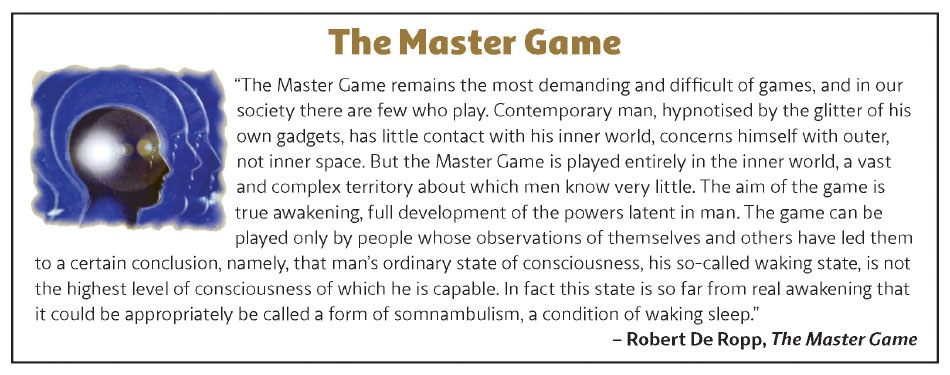
    Unlike Leary or Watts, each of whom de Ropp felt had succumbed to the temptations inherent in being a guru, de Ropp managed to navigate the rapids of the psychedelic tide. Although he could see that young people were in desperate need of self-discipline and grounding, he also felt that the Fourth Way of the Gurdjieff-Ouspensky teachings was somewhat authoritarian in its approach, and neither entirely successful in its methods or transmission. This line of thinking led to his next major book, released in 1968, The Master Game: Beyond the Drug Experience, which sold in the hundreds of thousands. 

    Spiritual Explorers & Teachers

    Throughout his life de Ropp encountered many spiritual explorers and teachers. By the time he moved to California in 1962 he had developed a knack of testing would-be teachers. It was not an infallible touchstone of soundness yet it worked well enough. He simply challenged them in his forthright manner. When he did this to Timothy Leary in 1962, after a long and inspiring talk from Leary on his plans to establish a utopian psychedelic community on the Pacific coast of Mexico, Leary simply turned off his hearing aid. It was a quirky response from Leary but didn’t bode well for the future of a co-operative enterprise. As is so often the case with spiritual teachers, the message was – my way or the highway. De Ropp saw Leary’s hallucinatory tropical utopia as impractical, and he was right – it was closed down by the police after just a few weeks.

    Of the flower power generation, de Ropp admired Ken Kesey but felt he hadn’t followed through successfully. Only Steve Gaskin, founder of the Farm community, met with his approval. 

    De Ropp may be accounted a teacher himself. How did he fare? He describes his hesitancy and self-questioning, but many teachers feel thus inwardly. Rather than displaying these to the pupil, spiritual teachers often overcompensate for their internal doubts. 

    Despite his love for describing life as a game, de Ropp certainly had something of the puritan about him. He detested alcohol and tobacco. City life was not for him and only country living seemed authentic. But most of us live in cities and towns, and they aren’t without their advantages. 

    De Ropp could see that the situation of humanity in the West was changing rapidly and he was able to negotiate the rapids produced by the flood of change. He began his own experimental community, the Church of the Earth, in Sonoma County, California. It was never intended to be a large group. A good portion of the group, with de Ropp’s blessing, started going to J.G. Bennett’s more ambitious International Academy for Continuous Education at Sherborne, England. De Ropp had reservations about those who came back from the accelerated ‘evolution’ of Sherborne House, dubbed by one wag the ‘Bennetron’. “I had expected well-trained, obedient, ready-for-service disciples,” de Ropp wrote, “I received rebellious, starry-eyed, self-opinionated ‘adepts’.”

    When they returned they were in no mood for serious teachers, or so de Ropp concluded, and the whole enterprise collapsed. The Church of the Earth was intended to have been built around the three pillars of garden, temple, and university, feeding the body, spirit and mind respectively. In a 1974 book of the same name, de Ropp describes their attempts at working together and setting up a rural community. The garden seems to have fared the best. The temple or dojo never seems to have got far beyond a wonky physical structure, and of the university there was little mention at all apart from a vague notion of seminars. Perhaps the project’s collapse was to de Ropp’s advantage after all. As a result he never was seduced by the guru trap.

    Get the issue this article appears in

    Warrior’s Way & Self-Completion

    De Ropp seems to have been most stimulated by his attempts to harvest the garden of the sea. He designed and built his own kayaks and became a skilled fisherman. He found the sea a demanding teacher, unforgiving of lapses of attention, requiring the fisherman to successfully adapt to the rhythms of nature. At the end of his penultimate book, Warrior’s Way, de Ropp contemplates existence from his tiny boat in the Pacific Ocean on the northern Californian coast. He has somehow made contact with a Taoist spirit teacher named Fong, who has given him the gift of balance between yin and yang, receptiveness and relaxation balancing the austere demands of the Gurdjieff work; he was a Taoist hermit going with the flow. De Ropp seeks no ultimate answers, feels no need for any metaphysical belief, has no desire or faith in a survival of the personal ego. “My spirit will dance there as the shadow of that rock, among seagulls and pelicans, sea lions and starfish. I would like to give my flesh back to the ocean to feed the fish whose bodies have so often fed me.”5

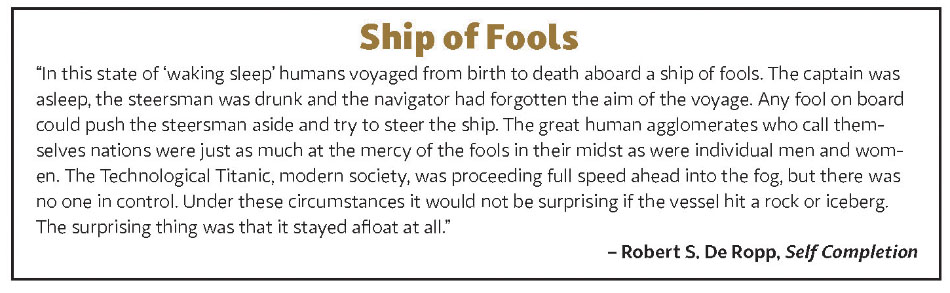
    Forty years ago de Ropp’s concern for the state of humanity and the planet was part of the emerging green movement. His view of modern westerners as “a spoiled, careless, pampered, town-bred manswarm” might seem harsh but we are already several stages down the road, oblivious of the warning signs. We do not even notice them as we wander towards oblivion, our sight focused on smartphones as we stagger towards the cliff. (This is metaphor but it seems that every week someone walks into a lamppost or off a cliff because they’re absorbed by their smartphones. There should be a word for the phenomenon.)

    In his final book, Self-Completion, in which he introduces himself as an elderly hermit, he included insights into Gnosticism and the latest developments in science. The Gurdjieff-Ouspensky work still provided the spine of his teaching but his pragmatic approach combined the work with aspects of Taoism, psychology, Sufism, Arthur Koestler’s holons, and his own bluff, no-nonsense assessment of western culture. 

    In 1987, at the age of 74, he died while kayaking in his beloved Pacific. Having pitted himself against the ocean for years, one suspects he knew that he could not win every time, and would have been content to have died in that manner, honourably, alone with nature, in the Warrior’s Way.

    [alert type=”general” dismiss=”no”]This article was published in New Dawn Special Issue Vol 10 No 4.[/alert]

    [alert type=”success” dismiss=”no”]If you appreciate this article, please consider subscribing to help maintain this website.[/alert]

    Footnotes

    1. Warrior’s Way, Dell Publishing, 1979, 192
    2. The Master Game: Beyond the Drug Experience, Delacorte Press, 1968, 23
    3. Ibid.
    4. Drugs and the Mind, Evergreen, 1957, 167
    5. Warrior’s Way, 351

    © New Dawn Magazine and the respective author.
    For our reproduction notice, click here.
  • Magic and Awakening

    Magic and Awakening

    From New Dawn 68 (Sept-Oct 2001)

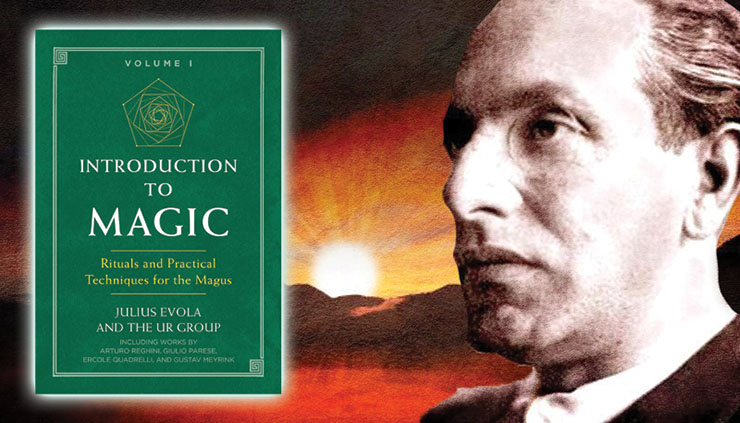
    New Dawn No. 68 (Sept-Oct 2001) featured Jay Kinney‘s review of Julius Evola’s Introduction to Magic Vol 1. This was one of the earliest books penned by Evola that was translated into English and published by a major publishing house.

    Magic (or Magick, as it is sometimes spelled, in order to distinguish it from stage magic) is a word fraught with dubious connotations. It summons up images of robed figures, surrounded by clouds of incense, standing within magical circles, and conjuring demons to do their bidding.

    Even in the magical system that has achieved widest renown, that of the Hermetic Order of the Golden Dawn, magic is associated with complex Qabbalistic rituals, Egyptian god forms, and arcane tools and talismans. Such things are sure to send the average good citizen scurrying in the opposite direction, as quickly as possible. Even for those who are inclined toward the esoteric and spiritual, magic remains the preserve of a few self-chosen magi who have a strong attraction to the arcane.

    Still, there are no lack of books presenting magical systems. Dion Fortune, W.E. Butler, Aleister Crowley, Israel Regardie, William Grey, Franz Bardon, David Griffin, and others have authored numerous tomes to whose teachings one could easily devote a lifetime. Why, then, should we pay any attention to yet another book called Introduction to Magic? The answer is that this new work in hand is unlike any other book on magic previously published, as difficult as that may be to believe.

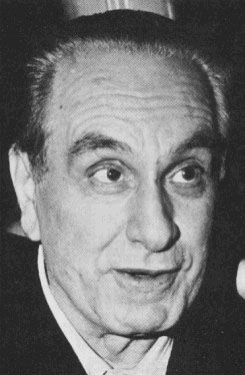
    Julius Evola, the principal contributor to Introduction to Magic, is a figure of some controversy within esoteric circles. Born in 1898, the vital years of his twenties and thirties coincided with Fascism’s reign in Italy, and Evola’s stance toward Fascism – although critical and adversarial at times – was sufficiently positive to make him persona non grata in liberal European circles. However, as tempting as it may be to dismiss past historical figures according to present value judgments, Evola deserves to be judged on his own terms, in his own time. With that in mind, let us take a closer look at the magical system put forth in Introduction to Magic.

    Julius Evola (1898-1974)

    Introduction to Magic is the first of three volumes collecting articles from the Italian esoteric journal UR, published between 1927 and 1929. Evola was the journal’s foremost author, but he was joined by prominent figures in the Italian esoteric scene, such as Arturo Reghini, Giulio Parese and Ercole Quadrelli. All of UR’s writers published under pseudonyms, for the stated reason that “their individual selves count for nothing, because everything valid they can offer now is not of their own creation or devising, but instead reflects a collective and objective teaching.”1 This harks back to such seminal works as the Rosicrucian Manifestoes, or the more recent Meditations on the Tarot, whose authors chose anonymity so as not to distract from the message of their texts.

    The message of the UR Group was as follows: there is a capacity inherent in Man to raise consciousness above the call of the body and the distractions of the mind; a capacity that can lead to an immortal awareness. The means to this awareness is through a rigorous discipline wherein the transitory ego is shed, and the individual consciousness is wedded to the Eternal. In so doing, one passes beyond the conventional notions of Good and Evil, to a place where, in Gustav Meyrink’s words, only “truth” and “falsehood” exist. To know this is not a matter of intellectual knowledge, but of spiritual experience, i.e. of gnosis.

    Introduction to Magic doesn’t merely describe this system, but offers meditative techniques that can lead to the concrete acquisition of the consciousness it describes. In so doing, accounts are offered of what one will encounter – accounts that have the strong ring of truth. In other words, the UR Group was sharing knowledge based on their own experience, not just generalisations or suppositions. And here we approach the core of the UR Group’s unique approach, which raises important questions.

    Most other magical systems presuppose an “other”, be it God or gods and goddesses, to which the magus pays homage or, at least, subordinates his operations. The tendency of the ego to usurp the expanding consciousness, is conventionally kept in check by the reminder of the ego’s diminutive stature in relation to the Divine.

    The UR approach de-emphasises such “others,” focusing instead on the transcendence of the ego by a greater impersonal Self which may itself become Divine. This admittedly dangerous operation requires a resoluteness of will that cannot be abandoned. As “Abraxas” (Quadrelli) notes:

    Once you have begun, you must go all the way, since an interruption leads to a dreadful reaction, with the opposite result. You can easily understand why: at every step you take, an increasingly higher quantity of swirling energy is arrested and pushed upstream; having been excited and provoked, it is filled with tension. As soon as you give up, it will come crashing down upon you and sweep you away.2

    Obviously, this is an approach that will appeal to very few. And the UR Group’s philosophy assumed as much. Quadrelli described the difference between the vast majority of mankind and the initiated few who followed such a path:

    On this side are ignorant people, lacking Knowledge, pale, passive, intoxicated, whose lives are still outside and on this side of the Waters. On the other shore you will find virile men, heroic souls, awakened to disgust, to revolt, to the Great Awakening; having left one shore behind, they dare face the current and the undertow, being led by their ever more firm, unshakable will. Once there, they are known as ‘Survivors of the Water,’ ‘Walkers on the Waters,’ the ‘Holy Race of the Free,’ ‘The Conquerors,’ ‘The Lords of Life and Salvation,’ ‘The Radiant Ones.’ They are the ‘Dragon slayers,’ the ‘Dominators of the Bull,’ ‘Consecrated to the Sun,’ those who have been transformed through Ammon’s power and Wisdom.3

    In defining such a gap between the many and the few, the UR Group implied a spiritual hierarchy that Evola was to elsewhere define explicitly. Taking his lead from Hinduism, Evola affirmed the value of a traditional caste system, (typically composed of the castes of Priest-ruler, aristocratic warrior, merchant, and worker). Society should be ruled by those of the highest spiritual attainment, with all others finding their proper places in the social hierarchy. Such sentiments stand in stark contrast to the modern conception of democracy, which assumes the right of every individual to an equal voice in the direction of society.

    Evola was still working out these ideas at the time of the UR Group project, and his increasingly uncompromising defense of “Tradition” was one factor in the group’s fragmentation after only three or four years of collaboration.

    Western Magic & Hermeticism

    The best known exponent of ritual magic, Aleister Crowley, defined magic as “the Science and Art of causing Change to occur in conformity with Will.”4 Dion Fortune revised this definition to that of “causing changes in consciousness at will.”5 The object of all magic, according to Crowley, is “the uniting of the Microcosm with the Macrocosm.” Stated another way, “the Great Work is the raising of the whole man in perfect balance to the power of Infinity.”6 While the UR Group would not disagree with this objective, their means to achieving it stood apart from that of Crowley, Fortune, and most other magicians.

    Most Western Magic is based on the coupling of Hermeticism and the Qaballa. Hermeticism, with its doctrines of the four elements (earth, wind, water, and fire), and of correspondences between “above” and “below” (i.e. the Macrocosm and the Microcosm), became systematised in the art of Alchemy. Qaballa (or Kabbalah) was the mystical tradition within Judaism, which contributed the concepts of four Worlds, a series of Divine emanations arranged in the glyph of the Tree of Life, and a hierarchy of Divine Names, Angelic intelligences, and so on, with which the Qaballist might interact.

    The magic of the UR Group, however, is wholly Hermetic. There would seem to be two reasons for this. First, the leading UR members, particularly Evola and Reghini, were proponents of a return to Roman and Greek tradition. Evola considered “Hermetico-alchemical knowledge” to be “the most direct and legitimate link to the unique, primordial Tradition.”7 The preoccupations and values of Judaism and Christianity run perpendicular to pagan values of heroism, strength, and honour.

    Second, in its stated goal of self-Deification, the UR teachings had little use for the concept of Deity, beyond that of a potential within certain favoured individuals. The UR work gives high value to Transcendence, but it is the transcendence of the initiate over the pull of earthly bonds, of the supra-human over the merely human. Thus the UR teachings have far more in common with Nietzsche or with Buddhism, than with the Judaeo-Christian religions with their subordination before an external God.

    Nevertheless, the UR Group didn’t narrow its cosmology to the sort of psychological reductionism that sees God or the gods as symbolic figures thrown up by the Collective Unconscious or as mere person-ifications of human capacities. Various essays in Introduction to Magic refer to Beings, entities, and forces that the Magus may encounter along the path. But these are conceptualised as manifestations of two polarising tendencies within the Cosmos: non-human forces that lead either to a degenerative Chaos or to a higher Order. The initiate, according to the UR Group, must distinguish between the two and align himself only with energies and intelligences leading toward the higher Self.

    While Evola and the UR Group placed themselves on the side of Order and high spiritual aspirations, their goal of human Deification led them to see conventional mystical notions, such as “merging with the One” or submission of the Ego to God, as manifestations of a downward pull leading the individual away from his ascent to the Divine. In one essay, Evola appropriates René Guénon’s concept of the “counter-initiation” in characterising Theosophy, Spiritualism, and other “sentimental” movements as “Satanic” impulses.

    This is highly ironic in that the UR perspective has more than a passing resemblance to the so-called Satanism of the contemporary Temple of Set. According to Stephen E. Flowers, “the ultimate aim of Setian philosophy is an active, aware and potent state of relative immortality for the isolate, individual psyche. This is achieved through a system of magic…”8 This is not the time or place to enter into a discussion of whether the Setian definition of the “individual psyche” has more in common with the accepted notion of the ego or with the UR Group’s divinised Self. Suffice it to say that both systems aim at the willed immortality of the initiate, independent of the body, and in contradistinction to the “right-hand path” of mainstream religion or mysticism.

    The perspective put forth in Introduction to Magic, and by Evola in his other writings, raises the question of whether gnosis, (or awakening or liberation, as it is usually referred to in the book) only occurs within the familiar framework of morality. Most mystical and esoteric paths counsel a fidelity to the moral values of the religions of which they are expressions. The saints or mystics who are the exemplars of such paths are generally praised for their piety, compassion, and self-sacrifice; the implication being that spiritual awareness goes hand in hand with “goodness.” The Buddhist figure of the Bodhisatva, who vows to continue to incarnate until all beings have been liberated, as well as the figure of Jesus Christ, who Christian dogma tells us “died for our sins,” are the accepted models for earnest spiritual seekers.

    Evola and the UR Group fly in the face of such norms. Their magical system makes almost no mention of how a would-be magus should comport himself towards others. There are no exhortations to live for the sake of others or to help those who are less advantaged. There are only repeated statements of the need for courage, steadfastness, clear vision, and singleness of purpose on the magical path. Time and again, the reader is reminded of the relativity of “Good and Evil” from the vantage point of the accomplished initiate. At best, the UR system might be characterised as morally neutral, at least by conventional standards.

    Yet it is clear from the authority of the book’s instructions, and the first-person accounts that are included, that the members of the UR Group achieved heights of consciousness that bear the mark of gnosis. Here was a group of Italian esotericists whose loyalties lay with ancient Rome, who were associated with the extreme Right, and who considered the majority of the human race to be asleep and worthy only of being led by an enlightened few. Could it be that they developed a potent system for the advancement of spiritual awareness that works? This is the challenge that Introduction to Magic raises for its readers and which each reader will have to answer for himself.

    Introduction to Magic: Rituals and Practical Techniques for the Magus by Julius Evola and the UR Group is available from the publisher Inner Traditions. The complete Introduction to Magic series is also available.

    Footnotes

    1. Preface to Introduction to Magic, p. xxv.2. Abraxas (Quadrelli) in Introduction to Magic, p. 20.3. Abraxas (Quadrelli) in Introduction to Magic, p. 19.4. Aleister Crowley, Magick in Theory and Practice, p. xii.5. Dion Fortune, quoted by W.E. Butler in Magic, Its Ritual, Power and Purpose, p. 12.6. Aleister Crowley, Magick in Theory and Practice, p. 4.7. Julius Evola, The Hermetic Tradition, p. xvii.8. Stephen E. Flowers, Lords of the Left-Hand Path, p. 241.

  • Applying New Thought Principles to Modern Day Challenges

    Applying New Thought Principles to Modern Day Challenges

    From New Dawn 197 (Mar-Apr 2023)

    “What you think upon grows. Whatever you allow to occupy your mind you magnify in your life. Whether the subject of your thought be good or bad, the law works and the condition grows. Any subject that you keep out of your mind tends to diminish in your life, because what you do not use atrophies. The more you think of grievances, the more such trials you will continue to receive; the more you think of the good fortune you have had, the more good fortune will come to you.”
    – Emmet Fox

    “Life is a mirror and will reflect back to the thinker what he thinks into it.”
    – Ernest Holmes

    Using New Thought principles to change the self can change the greater collective. As we have been told, we must be the peace, the change, and the love we seek in the world because, as the teachers of New Thought understood, it begins within the individual first. 

    In a world that wants us to think we have no individual freedom or power and thus no influence to create a different and better collective, it is imperative that we shift the “locus of focus” from the things we do not want to those we do.

    Knowing we are part of the divine, of God, we come to understand that all the things which hold us in fear – inflation, crime, racism, natural disasters, climate change, political strife, corruption, viruses – are all external to us and have no real sovereignty over us. Our truth is our connection to the invisible substance and infinite Source. It is not the government or Bill Gates or a vaccine made by Pfizer. We are free in our minds and thoughts, and when we learn to direct our minds through focused thought, we create our reality and destiny.

    Going Within

    Everything begins as a thought. Everything. There is no war, circumstance, financial collapse, job loss, or hateful social media post that did not begin as a thought in an individual or in the collective hive mind. This applies to the good in life, too. It starts with our thoughts about who we are, what we want, and what we hope to achieve and experience.

    The first step is to turn within for wisdom, knowledge, guidance and understanding. As spiritual beings having a human experience, we always have access to our spirit via prayer, meditation, quiet time, mindfulness, guided visualisations, and practising feeling the Presence of God within. When we focus on externals, we become consumed by them and forget who we are, and that we have the power to use our minds for a better experience and outcome. By turning off the news, we can tune in to the wisdom within and act upon it.

    New Thought teaches that there is unformed “substance” all around us from which all form is created, sort of like a quantum field of all possibilities. Our thoughts act upon this substance, similar to how the observer acts upon the quantum field, bringing the desired form into being. Through things like prayer – which can be focused attention on a desired outcome – meditation and affirmations, we shape substance into what we want. Prayer in New Thought is not about begging or pleading but affirming we are one with God, one with Source, and that we are aligned with it to create that which we focus our thoughts and minds upon. This has a whole different vibration than begging some anthropomorphic being up in the clouds to please pity us and give us something. 

    Affirming is always in the present tense, and a declaration of “I am” such as “I am healed. I am peace. I am prosperous. I am loved.” We do not say “I want” because the mind focuses on the “want” as lack and that becomes the locus of focus and we get more want. Ever heard the phrase, “You can never get enough of what you don’t want?” This means that if your focus is on lack, on disease, on chaos, on political strife, on inflation and the crappy economy, or on this or that negative external person, event, or situation, that is what you will draw more of into your experience.

    Powerful affirmations could look like this:

    I am an individual expression of the God Source, and the invisible substance with which God creates is within me as my thoughts and beliefs. I have the power to direct my thoughts to use that substance to create my reality.

    I focus my mind and thoughts upon the true source of all there is, God within me, and allow my mind to align with Divine Mind to create that which I desire.

    I am divine spirit in a human body having a human experience and my thoughts direct that experience. Therefore, I choose only empowering, powerful thoughts.

    Treatment of the Mind

    A powerful tool used by New Thought practitioners, specifically in Religious Science, is spiritual mind treatment, also known as affirmative prayer. This is a five-step process that works to change our thoughts, remove doubt and fear, and allow the realisation of the presence of God within so we can then align with it and take right action toward the solution we want. 

    The five steps are as follows:

    1. RECOGNITION (GOD IS) I recognise God as the ultimate, unlimited Presence and Power in the universe. God is all there is and all is God.

    2. UNIFICATION (I AM) I am one with God, unified. I know God through me, as me, in me, and in all things. I am one with God now. 

    3. DECLARATION/REALISATION (I ACCEPT; I AFFIRM) Knowing I am a part of God; I know that without doubt or reservation that the good I desire to experience is now taking form through God’s Power. I declare my desire is complete and I accept it.

    4. THANKSGIVING / ACCEPTANCE (I GIVE THANKS) I thankfully accept that the good I desire is mine right now. I accept and give thanks for this good right here and now.

    5. RELEASE (I LET GO and LET GOD) I release this prayer/treatment to the activity of the Universal Law of Mind, completely freeing myself of doubt or concern. I let go and let God. I release this truth in total belief that it is already done.

    We end a treatment with the words, “And so it is,” much like “Amen” at the end of a prayer. This allows us to release the spiritual mind treatment to God with the total conviction and knowing that it is already done for us. We can repeat the treatment again if we really feel the need, or let it go once with certainty. 

    Treatments literally “treat” the mind to focus thought, desire, and belief toward a certain outcome rather than hope and beg for something, and to filter out all that does not align with that desire. There is even a little science behind this in our Reticular Activating System (RAS), a complex bundle of nerves in the brain stem responsible for regulating wakefulness and sleep-wake transitions. The RAS also acts as a filter for sensory information that comes into the brain and connects the subconscious to the conscious brain and might be responsible for why we perceive certain things and ignore others. If we focus on the bad, we see more of it thanks to the RAS. Same if we focus on the good.

    Illness & Healing

    As COVID-19 spread across the globe, critics argued that the New Thought emphasis on using the mind to heal was useless as a treatment for human diseases. The old-school ways were all about taking pills, having surgeries, and relying on dangerous vaccines and pharmaceuticals. Viruses exist, as COVID proved, and people got sick whether they believed it or not. Though, in the past, New Thought adherents adamantly believed that illness was the lack of realisation of our oneness with God/Source, New Thought practitioners today recognise the scientific aspects of disease while also emphasising that healing does begin in the mind and point to the many examples of people who have healed themselves of cancer, heart disease, and other ailments by using the power of their thoughts and beliefs.

    While we may not all have the mental capacity right now to cure ourselves overnight, we do know that positive and empowering mindsets create viable shifts in the body that promote healing. We are learning every year about the mind-body connection and how healing involves both working in tandem.

    Get the issue this article appears in

    Let There Be Peace on Earth and Let It Begin With Me

    As we return to our true power and understand our divine nature, our lives change. But how do we apply that to the collective? Can one person truly change the world? Change occurs first in the person, then in the home, then the community, and then the world. 

    David R. Hawkins, the author of Letting Go, The Pathway to Surrender, notes that, “The crucial point is: by changing ourselves, we change the world. As we become more loving on the inside, healing occurs on the outside. Much like the rising of the sea level lifts all ships, so the radiance of unconditional love within a human heart lifts all of life.”

    We realise how powerful we are as individuals aligned with the Source of all there is, and how that power emanates outward to others we come in contact with, but it begins within each of us to first get right with our own truth. Someone with no idea of their divinity will not act divinely to others. Someone who believes they are a powerless victim will submit to control by others and teach their children and loved ones to do the same.

    “Let there be peace on Earth and let it begin with me.” So say the lyrics of this beautiful song written in 1955 by Jill Jackson Miller and Sy Miller and is often sung in New Thought Churches. The sentiment applies to love, goodness, healing, wealth, prosperity, and joy. New Thought principles align us with the God/Source within, which is all good, so that we can express goodness outward to others and, in this way, change the world one spirit at a time. 

    [alert type=”general” dismiss=”no”]This article was published in New Dawn 197.[/alert]

    [alert type=”success” dismiss=”no”]If you appreciate this article, please consider subscribing to help maintain this website.[/alert]

    Sources

    www.csl.org/magazine/wp-content/uploads/sites/16/2018/05/CSL_SoM_Treatment_022117.pdf
    www.extension.umn.edu/two-you-video-series/ras
    www.scienceofminduk.org/what_spiritual_mind_treatment.html 

    © New Dawn Magazine and the respective author.
    For our reproduction notice, click here.