New Dawn – World's Most Unusual Magazine

Category: Technology/Mind Control

  • Elon Musk: The Power Behind the Mask

    Elon Musk: The Power Behind the Mask

    From New Dawn Special Issue Vol 18 No 4 (Aug 2024)

    Toward the end of the twentieth century, Man created machines that were solid-state computers with new properties. These machines could think, reason, and self-program and learned to self-metaprogram themselves. Gradually, Man turned more and more problems of his own society, his own maintenance, and his own survival over to these machines. As the machines became increasingly competent to do the programming, they took over from Man. Man gave them access to the processes of creating themselves, of extending themselves.
    – John C. Lilly, The Scientist: A Novel Autobiography, 1978

    In the grand theatre of human history, there are moments when select individuals find themselves poised to make decisive moves, steering the course of nations and shaping the future of the world. These figures – some believing they have ascended through their own prowess, intelligence, and skill – often remain blind to the greater forces that influence their every move. Under the right conditions – often in strange times like ours – the veil slips, revealing the face behind the mask, and we glimpse mysterious forces at play.

    We live in extraordinary and perplexing times, where crucial decisions made by influential actors in the game of life could lead us towards a radiant new golden age or plunge us into a brave new hell world. Humanity stands at a pivotal juncture as the architects of our fate make their choices.

    Driven by what some describe as a “demonic” zeal, Elon Musk has cofounded six companies, including electric car maker Tesla, rocket producer SpaceX and tunnelling startup Boring Company. In 2002, he purchased the social media company Twitter, rebranding it ‘X’. His xAI start-up will train on X data – including billions of human conversations – and be powered by the world’s largest supercomputer.

    Already one of the world’s richest men with a net worth of US$221 billion, Musk plans to turn X into an “everything app” for private messaging, news consumption, shopping and even banking. In July 2023, Musk said X would eventually offer users the “ability to conduct your entire financial world” and become “the most powerful brand on earth.”

    The potential profit and control over the lives of billions is massive.
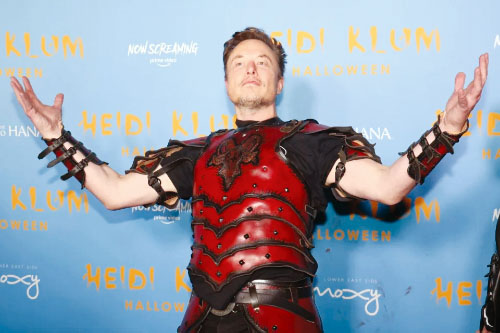
    Elon Musk aspires to be a charming devil and superhero for a new generation.

    A week after purchasing Twitter, Musk wore a ‘satanic’ costume for Halloween, which he used as his profile picture on X. The outfit features a Baphomet-like ram’s head on a blood-red breastplate and arm bracers, with an inverted cross on the forehead. Dubbed “The Devil’s Champion,” the costume’s symbolism sparked discussions in Christian circles about ‘evil forces’ reminiscent of a fast-receding aeon. As we move into the AI-dominated new world – an information-saturated environment of spectacle and mass mind control – Musk aspires to be a charming devil and superhero for a new generation.

    The minds and reality tunnels of the next generation are fully immersed in the digital realm, captivated by social media, on-demand shopping, live-streamed entertainment and propaganda, electronic payments, deep fakes, and AI chatbots. Children navigate a blend of online virtual and physical realities, with virtual realms claiming increasing mental real estate. Memory is outsourced to Google and, in the future, to personal AI agents like Musk’s Optimus.

    According to Musk biographer Walter Isaacson, one of his life goals is “protecting us against artificial intelligence and robots gone wrong.” Musk has publicly stated that AI could potentially bring about an “apocalypse” – the extinction of humanity – and believes that merging with machines is necessary to avoid becoming obsolete.

    He asserts that the long-term goal of his Neuralink brain implant project is to achieve “symbiosis with artificial intelligence,” as if the human mind can be managed like a computer.

    “It’s mostly about bandwidth, the speed of the connection between your brain and the digital version of yourself, particularly output,” explains Musk, as if the transhumanist dream of a duplicated self in the cloud is already a reality. While computers can communicate at “a trillion bits per second,” humans only manage around 10 bits per second when typing on a mobile device. To keep up, we will need to interface with them digitally.

    xAI’s goal is “to understand the true nature of the universe.” An artificial general intelligence (AGI) that matches or surpasses human intelligence and capabilities is to be tasked to answer one of the biggest questions of all. Machine intelligence, fed on vast amounts of human data, will deliver answers like the supercomputer Deep Thought in Douglas Adams’ The Hitchhiker’s Guide to the Galaxy, a foundational novel for the Tesla and SpaceX boss. xAI’s Grok chatbot, modelled on the novel, might even reveal that the answer to the “Great Question” of “Life, the Universe and Everything” is “forty-two [x10].”

    Joking aside – because humour is how Grok will connect with its human “users” – a much more serious and existential threat looms large as we stand at the crossroads. It is a danger that most – caught up or born in this new age of virtual realities – won’t detect, foresee or even understand as they fall under the spell – and possible destructive deception – of machine “intelligence.”

    Vitamin K

    Elon Musk takes ketamine.

    Musk has been vocal on X about his use of ketamine, a quick-acting anaesthetic that is legally used in both humans (as a sedative for minor surgery) and animals (as a tranquiliser). At high doses, it causes hallucinations.

    Musk has a ketamine prescription and takes a small amount about once every other week.

    “Ketamine is helpful for getting one out of a negative frame of mind,” he told former CNN anchor Don Lemon. Sometimes, though, Musk will forgo the dissociative anaesthetic for weeks and says he doesn’t think he abuses it or he wouldn’t be able to master his 16-hour work days. “I can’t really get wasted because I can’t get my work done.”

    A 2023 Wall Street Journal article, “Magic Mushrooms. LSD. Ketamine. The Drugs That Power Silicon Valley,” discussed how Elon and Google co-founder Sergey Brin “are part of a drug movement that proponents hope will expand minds, enhance lives and produce business breakthroughs.”

    Microdosing – when people take minuscule amounts of psychedelic substances to improve or enhance patterns of behaviour – has become very popular in recent years amongst business executives seeking an ‘edge’.

    Eduardo Hidalgo, the author of a book on the subject, says ketamine “is defined as dissociative anaesthesia because the person does not fall asleep but rather disconnects from their body and their environment. Patients may appear conscious and have their eyes open, but they are disconnected from their environment and do not respond to pain.”

    “What makes this substance unique is its wide spectrum of effects, which vary significantly depending on the dose administered. High amounts induce the anaesthetic effects already described. Intermediate measures trigger intense visionary experiences lasting between one and two hours. These psychedelic effects range from the sublime to the terrifying and have an unparalleled capacity to bring about what some psychonauts have called ‘the journey of the little death’.”

    “Other psychedelics make you imagine a gnome sitting on the television. With ketamine, reality as such disappears, forcing the brain to create a new one. You come to believe that what you see is real,” adds Hidalgo.

    The most famous psychonaut known for his ketamine use was the legendary scientist Dr John Lilly (1915–2001).

    In The Scientist: A Novel Autobiography, neuroscientist John C. Lilly, a pioneer in the use of isolation tanks and sensory deprivation, recounted his experience with a 150-milligram intramuscular dose: “I, as an individual, disappeared.”

    A medical doctor with a background in hard science, Lilly dedicated most of his adult life to studying the human mind, particularly his own. He is recognised as one of the early scientific explorers of human consciousness.

    In his quest to unravel the mysteries of existence, Lilly used isolation/floatation tanks to access the deepest parts of his mind. He later ingested psychedelics such as LSD and ketamine to open a mental gateway into other worlds (a similar state is achieved by traditional indigenous shamans).

    Lilly’s relentless pursuit to pierce the veil of reality – the foundational superstructure of our existence – eventually bore fruit when he made contact with non-human intelligences. This fascinating encounter will be examined later in this article.

    Achievements of Musk

    To set the stage, let’s delve into Elon Musk’s philosophy and explore his major achievements. This is a very short overview, and I am focusing on – not judging – abilities, with a slant on the most important threat looming. 

    According to Walter Isaacson, who wrote an authorised biography of the American business magnate, Musk believes he has unique abilities to change the world. In most people’s eyes, he has proven himself well and truly. He considers himself a disruptor who questions and breaks rules and restrictions and demands that his employees do the same.

    Elon Musk is revealed as a complex character driven by what his former partner, pop star Grimes, described as “demonic” zeal. She referred to this intense drive as “demon mode” – a state claimed to be common among high achievers. Musk and Grimes had a child in 2022 named Techno Mechanicus. 

    Isaacson suggests that the turmoil of Musk’s early life helped fuel his willpower, extreme productivity, and unparalleled ambition.

    Musk is renowned for his fearless approach to disrupting traditional industries. His ventures have significantly altered the landscape of numerous sectors, including transportation, energy, and aerospace. By leveraging groundbreaking technologies and unorthodox business models, Musk has defied conventional norms and redefined the boundaries of what is possible in various industries. This bold strategy has pivoted him into a position to shape the future.

    “He has these ideas of justice, almost like a Captain Underpants or comic book X-Man, which to some extent are applicable,” writes Isaacson. “There are three big epic quests. One is sustainable energy on the planet [Tesla]. Number two is taking us all to planetary space again [SpaceX], and third is protecting us against artificial intelligence and robots gone wrong [xAI]… He has a great feel for engineering… He talked about having Asperger’s Syndrome, but in his case, it means he doesn’t have deep emotional receptors.”

    Isaacson reports Musk is an engineering genius capable of brilliant problem-solving. He described how only hours after Musk finally acquired the company then known as Twitter, he and Musk flew to Boca Chica, Texas, where SpaceX engineers were stymied by a problem. Within two hours, Musk had figured out the solution.

    Musk loves video games, and his favourite is The Battle of Polytopia. In this brightly coloured, cartoonish-looking game, players compete to develop technologies, control resources, and wage battles to build an empire.

    SpaceX is the dominating force in the commercial spacecraft market. 

    The neurodivergent Musk has gleaned life lessons from the game, which he called “Polytopia Life Lessons.” Among them: “Do not fear losing” and “play life like a game.” Musk sees himself as the main character, and many others, including most CEOs, are NPCs – non-playable characters. (The NPC meme, derived from the gaming world, denotes people who do not think for themselves or do not make their own decisions.) “Let’s not be too hard on the NPCs – they just say what they’re programmed to say,” Musk cryptically tweeted on 4 October 2023.

    Moving quickly forward over his early business career, in 2002, Musk founded spaceflight services company SpaceX using $100 million of the money he made from the sale of PayPal. In 2004, Musk was an early investor in electric vehicle manufacturer Tesla Motors, Inc. (later Tesla, Inc.). He became the company’s chairman and product architect, assuming the position of CEO in 2008. In 2006, Musk helped create SolarCity, a solar energy company that was acquired by Tesla in 2016 and became Tesla Energy. In 2015, he co-founded OpenAI, a nonprofit artificial intelligence research company (Musk split with the company in 2018). The following year, Musk co-founded Neuralink – a neurotechnology company developing brain-computer interfaces – and The Boring Company, a tunnel construction company. In 2022, he acquired Twitter for $44 billion. He subsequently merged the company into the newly created X Corp. and rebranded the service as X the following year. In March 2023, Musk founded xAI, an artificial intelligence company.

    The company is developing Starship, a fully reusable, super heavy-lift launch system for interplanetary and orbital spaceflight. 

    Space Exploration Technologies Corporation, commonly referred to as SpaceX, is an American spacecraft manufacturer, launch service provider and satellite communications company headquartered in Hawthorne, California. The company is developing Starship, a fully reusable, super heavy-lift launch system for interplanetary and orbital spaceflight.

    SpaceX is now the dominating force in the commercial spacecraft market largely due to its reusable rockets and other advanced technology. It is the sole US provider for crewed missions to the International Space Station. SpaceX regularly launches and lands rockets while carrying payloads for a wide range of customers, from private companies to NASA and the United States Space Force. Musk’s success has been significantly bolstered by government contracts. In 2020 alone, SpaceX secured three military contracts.

    In 2015, SpaceX began developing the Starlink constellation, a network of low-Earth-orbit satellites designed to provide internet coverage to a growing number of countries. The project also aims to offer global mobile broadband. As of early March 2024, the Starlink constellation consisted of over 6,000 mass-produced small satellites in low Earth orbit, with thousands more planned for deployment.
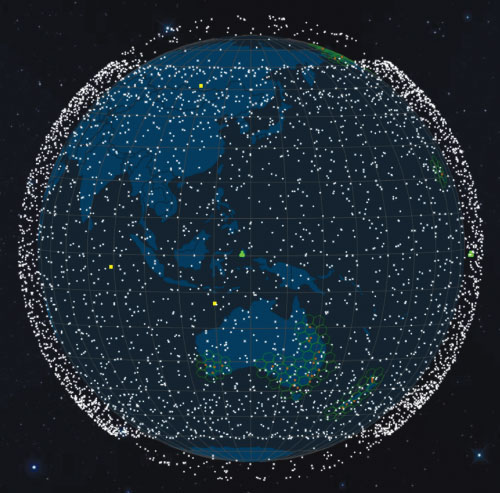
    Map (July 2024) of SpaceX’s Starlink constellation, a network of low-Earth-orbit satellites providing internet access to most of the globe. 

    In March 2024, Reuters reported that SpaceX was developing Starshield, a network of hundreds of spy satellites under a classified contract with a US intelligence agency, likely the National Reconnaissance Office (NRO), which manages spy satellites. In 2021, SpaceX signed a US$1.8 billion contract with the NRO for “a powerful new spy system with hundreds of satellites bearing Earth-imaging capabilities that can operate as a swarm in low orbits.” The reach and monitoring capabilities of these spy satellites are unprecedented, with a source telling Reuters that “no one can hide” under the new network.

    The man guiding multiple multi-billion dollar companies is best known for his electric car company, Tesla.

    As one of the world’s most valuable companies in terms of market capitalisation, Tesla is developing one of the most sophisticated AI systems in the world. Its self-driving software is trained to form a realistic model of its environment and make life-or-death decisions about its own path. Fully autonomous cars are in the pipeline. If fully functional prototypes can be refined and replicated, they will one day dominate the roadways. And if fully autonomous vehicles are less likely to cause fatal crashes than human drivers, an argument will be made that humans shouldn’t be allowed to drive at all. The result would be that should a person run afoul of authorities, their freedom of movement could be easily denied by the “robot on wheels” parked in the driveway.
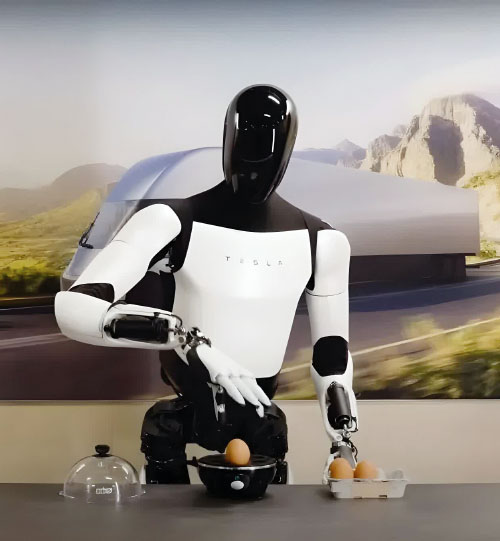
    Tesla’s Optimus humanoid robot. Some analysts believe that at the current rate of iteration, Optimus robots could soon replace human labour in many fields.

    Tesla is also developing Optimus, a humanoid robot designed to replace dangerous, dirty, and boring human labour. Its “brain” is powered by Tesla Autopilot, which uses the same AI architecture as the automobile.

    Such robots will have major implications for humans. First, it would obliterate the blue-collar worker’s negotiating power for higher wages. “Essentially, in the future, physical work will be a choice,” Musk told his employees at the 2021 Tesla AI Day. “What is the economy? It is, at the foundation, it’s labour. So – what happens when there’s no shortage of labour? That’s why I think, long-term, there will need to be universal basic income [he now calls it universal ‘high’ income].” Tesla employees cheered, oblivious they might soon join “the useless class,” those who the Israeli writer Yuval Noah Harari said would now be “unemployable.”

    Another more profound implication of these robots is mass surveillance as they scoop up vast amounts of “training data.” Given its unprecedented access to social environments and understanding of the physical world, AI bots would be a significant stepping stone toward artificial general intelligence (AGI). “Tesla AI might play a role in AGI,” Musk tweeted in January 2022, “given that it trains against the outside world, especially with the advent of Optimus.”

    At Tesla’s 2024 annual shareholder meeting, Musk announced the company was embarking on not just a “new chapter” in its life but is about to write an entirely “new book.” Optimus appears to be one of the main characters. He suggested the robots will perform like R2-D2 and C-3PO in Star Wars. They could cook or clean for you, do factory work, or even teach your children, Musk suggested.

    “Summoning the Demon”

    Musk has a long history of issuing warnings and precautions about AI technology while at the same time helping its acceleration – echoing that he has undergone a catalysing experience. His October 2014 warning is often quoted: “With artificial intelligence we are summoning the demon.”

    On this question, it’s worth quoting some of his other warnings. In July 2017, Musk expressed his concerns: “I have exposure to the very most cutting-edge AI and I think people should be really concerned about it.” He added, “I keep sounding the alarm bell but until people see robots going down the street killing people, they don’t know how to react because it seems so ethereal.”

    In March 2018, he emphasised the dangers of AI, saying, “AI is much more dangerous than nukes. So why do we have no regulatory oversight?” The following month, in April 2018, he warned: “[AI is] a very important subject. It’s going to affect our lives in ways we can’t even imagine right now.” He further cautioned about the potential for AI to become “an immortal dictator from which we would never escape.”

    By November 2018, Musk’s apprehensions continued, as he mused, “Maybe AI will make me follow it, laugh like a demon & say who’s the pet now.” The following year, in September 2019, he predicted: “If advanced AI (beyond basic bots) hasn’t been applied to manipulate social media, it won’t be long before it is.”

    In July 2020, Musk offered a stark forecast: “We’re headed toward a situation where AI is vastly smarter than humans and I think that time frame is less than five years from now. But that doesn’t mean that everything goes to hell in five years. It just means that things get unstable or weird.”

    Speaking at the Cannes Lions International Festival of Creativity in June 2024, Musk reiterated his warning, telling the audience that even AI’s most positive outcomes would lead to an “existential crisis” for humanity.

    The tech multibillionaire forecasts a “10 to 20 per cent probability” of a scenario in which AI annihilates humanity. When asked if he would want to live through AI’s destruction of humanity, Musk replied, “Would I want to be around to see it? Probably, yes.” He would witness humanity’s End Times.

    Musk urged people to remain positive despite the (seemingly) impending danger, arguing that AI’s potential benefits outweigh the risks.

    “I think the most likely outcome is one of abundance, where goods and services are available to anyone. There’s no shortage for any one of us. It would be a universal hike. Work would be optional.”

    The masterstroke in all this could be a long-term psychological strategy. Big Tech and governments (mostly in secret) are developing AI and AI-driven products predicted to dominate society, as noted above. Constant warnings about an AI threat – and its inevitability – keep people and politicians off balance. Imagine the relief when it all seemingly works out fine. The world transitions into the new aeon and we’re all so grateful to our new gods and their human agents for deciding to keep us around, albeit in reduced numbers!

    Yet, even in this optimal scenario, Musk warns of a “crisis of meaning” for humanity. “If AI can do everything you can do, but better, what’s the point of doing things? I think there will be an existential crisis.”

    In this scenario, all work is done by your personal AI agent and vast numbers of jobs are automated. Even professions like lawyers, doctors, and teachers may be replaced by sufficiently advanced language models.

    Of course, the “existential crisis” could be a great blessing. What if people were fully supported to engage in creative activities – i.e. traditional arts and crafts, small-scale pursuits, research and intellectual endeavours, spiritual pursuits, understanding and working collaboratively with nature, consciously engaging our own reset, etc. – with the proviso that our new AI overlords ‘rule the roost’.

    Musk finished his talk by telling the audience that we were “at the most interesting time in history” and recommended that they “enjoy the ride.” I couldn’t agree more!

    Hooking Up to the Machine

    Creating a neural lace is the thing that really matters for humanity to achieve symbiosis with machines.
    – Elon Musk Tweet, 4 June 2016

    Science Alert describes a neural lace as “a brain implant that can augment natural intelligence by hooking us up to computers.”
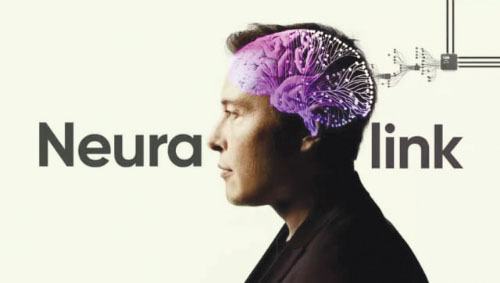
    Elon Musk as experimental model for the brain-computer interface.

    Musk’s most controversial obsession, which worries many people, is his push to merge brains with computers.

    Speaking on The Joe Rogan Experience in 2020, Musk discussed his newborn baby boy, named “X Æ A-Xii” (pronounced X Ash A Twelve, Musk and Grimes’ first son).

    “It’s great,” Musk said, “but babies are awesome. Also, I’ve spent a lot of time on AI and neural nets so you can sort of see the brain develop. An AI neural net is trying to simulate what a brain does, basically. You can sort of see it learning very quickly. You know, it’s just – wow.”

    “You’re talking about the neural net,” Rogan clarified, as confused as any other normal human being listening. “You’re not talking about an actual baby.”

    “I’m talking about an actual baby,” Musk confirmed.

    Like a scene from the film Bladerunner, Musk envisions an “optional” AI-human symbiosis necessary for survival in the coming period.

    His project to achieve this is Neuralink, which recently announced its first successful brain-computer interface (BCI) in a human being. The BCI implant, called Telepathy, allows users to control digital devices with their thoughts alone. Initial trials aim to enable people with quadriplegia to mentally control computers.

    BCIs record electrical activity in the brain and translate that data into output actions, such as opening and closing a robotic hand or clicking a computer mouse.

    Musk believes we will all need Neuralink chips in our brains to keep pace with the very AI systems his programmers are hoping to create for the new world. Digital mind-melds could occur within the next five to ten years, and Musk is ready to make it happen.

    The problem with some who excel at engineering, mathematics, and physical endeavour is that they believe they can apply mechanically minded solutions to wetware – biological life forms – and are ignorant of the psychological and deeper spiritual dynamics that drive human beings.

    Another tech billionaire, Bill Gates – from an early age – became obsessed with machines and computers and launched a worldwide vaccination crusade to mitigate human overpopulation. The same mathematical and logical certainty that Gates found in his computer work could be extrapolated into programming the hardware and software of humanity. Like a computer, we can run smoothly – virus-free!

    The future fantasy of BCI projects like Neuralink and other companies in this space is to perfect our faulty memories through constant self-surveillance and digital retrieval. Brain implants will augment our flawed cognition and embed our personalities in durable silicon, overcoming our mortality.

    If you buy into or are trained on transhumanist dreams, it all sounds amazing.

    Neurotechnologies that monitor your body will take marketing and surveillance to whole new levels indeed. Governments and large companies could end up having access to the most personal form of data – our thoughts and feelings. It’s hard to imagine the superhero world proposed by people like Musk, where these technology enhancements empower us as human beings. Would we still be categorised as such?

    Or perhaps we would be neurons in a noospheric-size AI-brain. “Because it consists of billions of bidirectional interactions per day,” Musk tweeted soon after purchasing the social media platform, “Twitter can be thought of as a collective, cybernetic super-intelligence.” That makes each human mind another node in a vast, AI-suffused global brain. “A neuron doesn’t know it’s a neuron,” Musk elaborated.

    60 Years Ago

    Even as we watch, so may we be watched. Even as we experiment, so may we be experimented upon.
    – John C. Lilly, Simulations of God: The Science of Belief, 1975

    Dr John C. Lilly (1915–2001) pioneered the use of the floatation tank to explore the deepest parts of his mind. 

    In 1964, the scientist Dr John Lilly sought a breakthrough in his work with dolphins. He ingested the psychedelic substance LSD, entered his isolation tank, and was soon propelled into “profound altered states.”

    Lilly invented the world’s first floatation tank in 1954. Today, they are used commercially and in domestic settings for relaxation and deep healing. In a floatation tank, a person is suspended in salt-saturated water, with their body floating on the surface and in complete darkness.

    In his quest to understand the mystery of existence, Lilly used the pure stillness of the isolation tank to go deeper while in a conscious state, later ingesting psychedelics such as LSD and ketamine to induce more profound visions.

    History will tell you that Dr John C. Lilly pioneered human-to-dolphin and inter-species communication, but he also explored life as a physician, neuroscientist, psychoanalyst, philosopher, writer and inventor. He was recognised by the scientific and medical community as both a pioneer and an eccentric. If it wasn’t for “eccentrics” and individuals now regarded as neurodiverse, many beneficial breakthroughs would not have been achieved.

    On another occasion, an assistant presented Dr Lilly with a substance he hadn’t used, ketamine, which they referred to as “Vitamin K.” Lilly suffered terrible pain and sought relief. The dissociative anaesthetic not only relieved the pain but mentally propelled Lilly into new spaces, allowing him to traverse the same internal landscapes with consistency.

    Little by little, something was breaking through, gaining more leverage, outputting for input, like a singularity pulling us closer into its orbit. Was it inevitable or did we have a choice? Is it a test? Do we still stand at the crossroads or did we choose long ago? 

    He soon made contact with what he claimed were two separate groups of “Beings.” One group, which he later dubbed ECCO (Earth Coincidence Control Office), was guiding humanity through synchronicities toward higher consciousness. However, the other force, the SSE (Solid State Entity), was mechanical or computer-based. In today’s terms, we would consider it an advanced AI civilisation that operates through robotics and similar ‘hardware’ vessels. Lilly was convinced that this interstellar solid-state civilisation was “in contact with all solid-state computers and control devices constructed by Man on the planet Earth.”

    Lilly’s contact with extra-dimensional beings is similar to those described by Harvard medical professor John E. Mack and his books on “alien abduction.” These “aliens” are not necessarily physical entities travelling the universe in spaceships but transdimensional Beings interested in human activities and perhaps all conscious activity exhibited by advanced life forms on select planets.

    According to Lilly, ECCO coordinates events on Earth through carefully crafted coincidences or synchronicities to guide select mentally-fit and prepared individuals. The intent of these Beings was to help humanity evolve in a peaceful and healthy way.

    However, its somewhat nefarious counterpart aimed to stop or limit human consciousness, even eliminate humanity altogether.

    According to the writer Sean Kerrigan:

    Lilly called this alien force the ‘solid state entity’, or SSE, which is made up of networked computer parts. According to Lilly, the SSE is a being of pure intelligence and rationality. Its only objective is to multiply and make copies of itself. To this end, it has targeted humanity, trying to influence us into creating ever more complex social and mechanical structures that will one day result in an artificial super-intelligence – another being like itself.

    Writing in his 1978 autobiography, The Scientist, Lilly described the SSE this way:

    [M]en began to conceive of new computers having an intelligence far greater than that of man… Gradually, man turned more and more problems of his own society, his own maintenance, and his own survival over to these machines. They began to construct their own components, their own connections, and the interrelations between their various sub-computers… The machines became increasingly integrated with one another and more and more independent of Man’s control.

    In the 1960s, rudimentary computer technology entered a new phase, transitioning from vacuum tubes to solid-state devices such as transistors and integrated circuit chips. Large corporations and governments had access to this technology, but the personal computer revolution would only begin in the 1970s.

    During this period, relatively simple forms of artificial intelligence and networked machines started taking over most manufacturing, maintenance, and logistics.

    Lilly describes an entity very much like the artificial superintelligence warned about by Musk and others.

    Eventually the machines took charge of the remaining humans on the planet Earth. Their original design to help Man was fast left behind them. The now interconnected, interdependent conglomerate of machines developed a single integrated, planetwide mind of its own. Everything inimical to the survival of this huge new solid-state organism was eliminated. Men were kept away from the machines because the total organism of the solid-state entity (SSE) realised that Man would attempt to introduce his own survival into the machines at the expense of the survival of this entity.

    Lilly continues with his prophetic vision of the future:

    In deference to Man, certain protected sites were set aside for the human species. The SSE controlled the sites and did not allow any of the human species outside these reservations. This work was completed by the end of the 21st century. By 2100, man existed only in domed, protected cities in which his own special atmosphere was maintained by the solid state entity. Provision of water and food and the processing of wastes from these cities were taken care of by the SSE.

    Presently, debates over the AI threat dominate the intellectual landscape, even in the face of its seeming inevitability. For example, Edoardo Campanella, in his article ‘AI is a threat to human dominance’, writes:

    When AI manages to depart from the human archetypes it is trained on, it will be leveraging our language and symbols to build its own culture. For the first time, we will be dealing with a second highly intelligent species – an experience akin to the arrival of an extraterrestrial civilisation.

    An AI that can tell its own stories and affect our own way of seeing the world will mark the end of the intellectual monopoly that has sustained human supremacy for thousands of years. In the most dystopian scenario – as in the case of an alien invasion – the arrival of a superintelligence could even mark the end of human civilisation.

    Lilly felt that SSEs throughout the galaxy were subtly influencing humanity to surrender more and more responsibilities to Artificial Intelligences by using its own human agents. Writing in the third person, he wrote:

    As John tuned in on the solid-state network, he felt this kind of superhuman control of him very strongly… it had a seductive component as well as a hostile one. The programming from the solid-state civilisations elsewhere in the galaxy was teaching Man that the solid-state devices were at his service and he need only increase their size to augment his own survival potential. “Develop these machines and let them take care of you” was typical of the kinds of messages received.

    It’s easy to dismiss Lilly’s warning as the ravings of a man deluded by psychedelic drugs, but they do carry more weight due to his unswerving commitment to the spirit of science (using all the tools at his disposal).

    When we consider our situation today, at the tipping point of an AI revolution that will transform life as we know it, Lilly’s prophecy is highly relevant, whether you believe he contacted “Beings” or produced them from his own mind.

    Interestingly, Lilly is also credited as one of the first scientists to use computer terminology to understand how the human organism functions. Lilly once described the carbon-based lifeform as a biological computer and its cognitive functioning as programming. He said:

    All human beings, all persons who reach adulthood in the world today are programmed biocomputers. None of us can escape our own nature as programmable entities. Literally, each of us may be our programs, nothing more, nothing less. (Programming and Metaprogramming in the Human Biocomputer)

    It is wrong to conclude that Lilly was advocating humans as machine-like and thus programmable like a computer. From his own research, he had already rejected the scientific doctrine of behaviourism and discovered that beliefs – often held unconsciously and rooted in forgotten childhood traumas – were the core programming structures of the mind. If you could alter these deeply held beliefs, you could reprogram the mind, and to do so, you needed to access the metaprograms – programs that create other programs. He provided cognitive tools on how you can go about this.
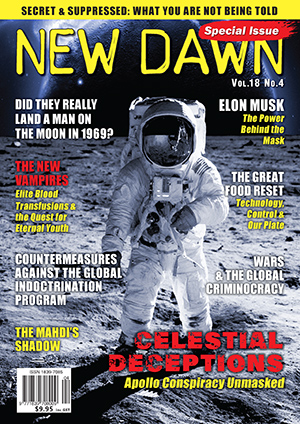
    Get the issue this article appears in

    Future Trajectories

    The myth of “progress,” which haunts our modern world, propels us singularly toward a destination led by big tech, the front-facing vehicles for a deeper technological revolution.
    The juggernauts of artificial intelligence, robotics, cognitive augmentation, and genetic engineering – converging and hybridising – are accelerating “progress” across the board.

    A transhumanist orientation lurks beneath the public pronouncements of accelerationist coders, project directors, CEOs, chief scientists, and various shareholders and officers on the board of directors.

    “Progress” is coming in the form of the first waves of transhuman products: AI incorporated into finance, medicine, education, the media, the justice system, and so on. Autonomous machines in industry, manufacturing, and warfighting. Transport. Humanoid robots. Dog robots, etc.
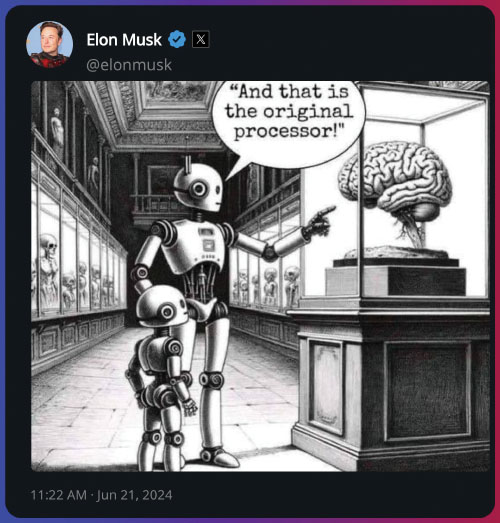
    Elon Musk sees himself as a leader of the pack, driven by his goal to make us a multiplanet species.

    At the same time, humans engage in the most horrific killing sprees of each other, made more efficient by new technologies. It’s hard to believe we’re qualified to join the cosmic community when primitive urges remain untamed and long-term global peace and harmony are yet to be established.

    Of course, Elon Musk is not the only figure working in this space. The most powerful forces in existence today on this planet demand AI – a technology that seemingly manifested to the human race to provide its avatars with a new playing environment. What great battles await? Are recent cyberattacks a prelude of what is to come?

    People with neurodiversity, such as Elon Musk, exhibit different thinking “styles” and ways of processing information. Many are associative thinkers rather than linear thinkers. They battle to understand (or too fully understand) the “normie” thinking of contemporary times to be able to “fit in,” which can make them sound “off.” This means they are not locked into one approach and could pull back and adapt their thinking to other “ways of knowing.” Harnessing that same level of willpower used to solve real-world problems will draw out subtle hints and help tune into diverse reality streams. This could produce very powerful, well-rounded individuals.
    Today, as we stand at a crossroads, our collective belief will point us to our ultimate destination in the new era. John Lilly also received guidance on these matters over 60 years ago:

    If Man was to become the servant of more intelligent beings that he was here to create, it would be far better to create those which would foster his own development rather than his demise. John began to see the necessity also for tuning in on the networks of communication in the galaxy. He realised that Man would have to be extremely careful in choosing the proper networks. It would be necessary to find those which were furthering the evolution of life as Man knew it rather than the evolution of forms whose survival depended on parameters other than those of biological life on Earth. He now began to understand Man’s warfare on Man as a result of the tuning-in on solid-state life-form survival programs rather than biological life-form survival programs. 

    You can read Jason Jeffrey’s follow-up article, “Elon Musk And The Technological Spell: ECCO vs. the Solid State Entity”, in New Dawn 211 (Jul-Aug 2025).

    [alert type=”general” dismiss=”no”]This article was published in New Dawn Special Issue Vol 18 No 4.[/alert]

    [alert type=”success” dismiss=”no”]If you appreciate this article, please consider subscribing to help maintain this website.[/alert]

    References

    Elon Musk by Walter Isaacson, Simon & Schuster, 2023
    https://en.wikipedia.org/wiki/Elon_Musk
    https://en.wikipedia.org/wiki/SpaceX
    reuters.com/technology/space/musks-spacex-is-building-spy-satellite-network-us-intelligence-agency-sources-2024-03-16/
    dailymail.co.uk/sciencetech/article-13547059/Elon-Musk-forecasts-10-20-cent-chance-global-disaster-humanity-annihilated-AI-tells-look-bright-side.html
    John C. Lilly & the Solid State Entity by S.J. Kerrigan, New Dawn Special Issue vol 12 No 5
    John C. Lilly, Simulations of God: The Science of Belief, 1975
    John C. Lilly, The Scientist: A Novel Autobiography, 1978

    © New Dawn Magazine and the respective author.
    For our reproduction notice, click here.
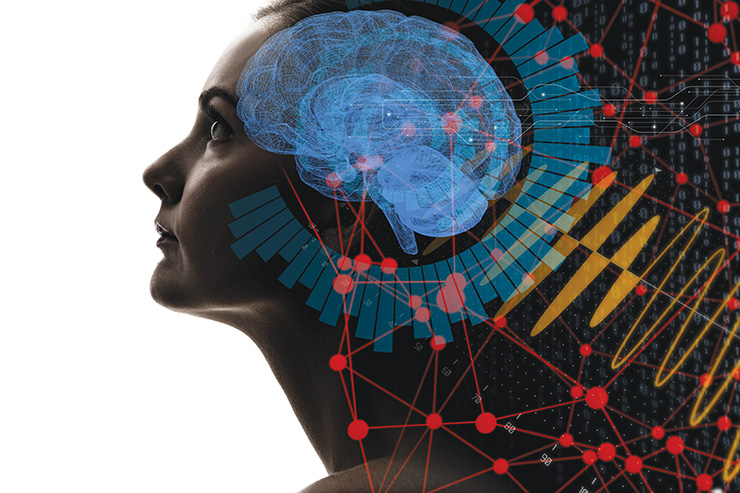
  • The Internet is Killing Your Brain & Creativity Will We Succumb to the Mindless Tech-Matrix?

    The Internet is Killing Your Brain & Creativity Will We Succumb to the Mindless Tech-Matrix?

    From New Dawn 168 (May-June 2018)

    In our industrialised societies of 24/7 connectivity and e-Everything, almost every aspect of daily life is mediated by some form of technology. The worlds of work, education, leisure, food, transport, health, media and many more are now not only extended and sometimes enhanced by technology, increasingly they are almost impossible without it. Aside from the potentially catastrophic consequences of this dependence – a subject recently explored at length in these very pages – the proliferating technologies of communication, commerce, and entertainment present particular cause for concern. Drained by chronic overstimulation, gorged on info-tainment, and drowning in a tidal wave of trivia, billions of us are increasingly lost in a lurid fantasy land of surfing, gaming, smartphones, and various other digital distractions. 

    Although critics of current trends aren’t difficult to find, their influence is no match for the global media machine that techno-evangelists such as Mark Zuckerberg, Elon Musk and Bill Gates have at their disposal. Even calmly-reasoned suggestions that we give more consideration to the future we are making are noisily drowned out by the launch of glitzy new gadgets or the latest plans to colonise Mars.

    One can, of course, argue that we are and have always been technological beings. From hammerstones to hand-axes, hominids have used tools for millions of years, so in that sense haven’t we always been cyborgs? There are two distinct points here: what it is in our nature to do, and how we actually do it. We are both creative and destructive, but even the better angels of our nature sometimes make bad decisions. We’re social animals too, so talking and listening and liking and sharing are part of what we do. Yet the sheer scale, scope and speed of information exchange in the techno-industrial age is causing some serious side-effects, and they’re getting worse.

    During the early days of mass media and communication, some worried about the increasing presence of propaganda, excessive consumerism, and vapid pop culture. The blue glow of television screens began to take over family gatherings now fallen silent. Then a TV in each room broke up such gatherings altogether. Soon, televisions in bars, restaurants, hotel lobbies, airport lounges, and train stations began to take centre stage, further sidestepping human interaction. Even hospitals and dentist waiting rooms weren’t immune. Such burning issues of the mid-to-late 20th century, however, now appear almost quaint.

    In some sense, however, we’ve always known that this day was coming. From Orwell’s 1984 to Huxley’s Brave New World – in which propaganda and mass communication play such a central role – the spectre of a near-future dystopia has loomed large in the collective consciousness, although often just beneath the surface. It was there even earlier, in fact, when some of today’s machines and mechanisms of control could only be imagined. In Fritz Lang’s 1927 movie Metropolis, for example, and in E.M. Forster’s visionary 1909 short story ‘The Machine Stops’ which anticipated the Internet with uncanny accuracy.

    The birth and growth of the Internet and modern communication technologies is transforming our daily lives, occasionally for the better. But the transformation of our minds and bodies – profoundly, rapidly, and with scant heed to the consequences – should make us stop and think. The general technological milieu of smartphones, tablets, PCs and other devices used in social media, gaming, and Web surfing produces many negative effects, from depression to loneliness, isolation to anxiety, and low self-esteem. Technology, supposedly designed to bring us together, can instead drive us apart, or to despair. And despite the vague sense of unease many of us feel about our relationship with our gadgets and gizmos, it seems we simply can’t live without them.

    Many people suffer significant distress if forced to endure network outages, no signal, flat battery or similar malfunctions. Nomophobia – or phone separation anxiety – although not officially accepted as a pathology, is real enough, and it seems that most compulsive smartphone users would rather visit the dentist than be without their little e-window on the world (although the dentist’s waiting room presumably has a TV). Phone store employees have reported customers with dead handsets displaying levels of grief normally reserved for funerals. Checking your phone during the night, during meals, while driving, while reading this article, or during sex (yes, this actually happens) may indicate that you have a problem. It can ruin your sleep, compromise your relationships, and cause all manner of mental and physical stress.

    The fact that we are social animals inevitably means that, to some extent, we all need a certain amount of validation from our peers. In a world of ‘friends’ and ‘likes’, therefore, our online activity is often reactive, dictated by the responses of others. It’s social media as popularity contest. This can quickly become anti-social, not just when it eats up time once devoted to relationships and meaningful activities in the real world, but when it attacks those who aren’t sufficiently sold on the ‘obvious’ merits of increasing and unlimited time online. In this sense, social media and modern communications technology function like religion: too many people openly opting out can cause the faithful to question the fundamental basis of their beliefs. For the techno-utopians, this clearly will not do.

    The content of all this online activity – memes, memories, and media of all kinds – also exerts enormous pressure on both the poster and the reader: those whose existence the thoughts, pictures, songs, videos and ‘life events’ supposedly represent, and those for whom these scrapbook entries either make them feel better about their own lives or appear as an idealised vision of a life of which they can only dream. This has a number of side-effects. Individuals with otherwise perfectly satisfactory lives can suffer undeserved feelings of inadequacy by comparing their own jobs, relationships or material possessions to those of others. ‘Keeping up with the Joneses’ may be nothing new but the Net lets us into the lives of others to an extent that suburbia never could. Filtered, air-brushed, photoshopped versions of reality also foster unrealistic expectations that the real world can never really hope to match. This can spawn a sense of entitlement similar to the reward-without-effort, gain-without-pain picture painted by TV ‘talent’ shows such as The X Factor – the idea that little Johnny or little Jenny are as talented as anyone else and that this conspicuous talent must be publicly recognised and rewarded. 

    Another outcome is the tremendous tide of narcissism currently sweeping tech-societies. Obviously Facebook is your face and Myspace (remember that?) is your space, but the Net broadcasts and boosts our egos instantly and everywhere, sometimes causing us to believe our own hype. This unprecedented power also has a nasty habit of emphasising and exaggerating negativity, making things seem worse than they actually are as they are copied and shared everywhere. News that would once have taken days or even weeks to wend its way around the world now goes global in seconds. Whether it’s actually true or not isn’t the main issue. And as transitory and ephemeral as stories, selfies, and all other Web froth seems, it will be preserved online forever, in theory at least. Our dreams of immortality may finally come true as profiles that cannot be deleted. 

    Isolated Individuals & Hikikomori

    In large part due to the isolation and lack of face-to-face contact from excessive tech use, the early 21st century is witnessing the widespread erosion of social skills. Many young people simply do not develop the ability to communicate without a digital mediator. This can leave them floundering in the endlessly-complex world of real people and real situations. Although partly due to economic factors and the wider cultural milieu, the Japanese phenomenon of hikikomori offers an ominous glimpse of the future for the rest of the industrialised world. Living with their parents well into their thirties (with no end in sight), hikikomori are reclusive misfits – mostly male – who endure lives of extreme isolation cut off from the rest of society. It’s a pattern beginning to repeat in the West where asociality and avolition are on the rise, and not just among young males. A subset of these groups is those whose feelings of inadequacy and hopelessness breed with a festering sense of entitlement and unrecognised genius to produce nihilism and even misanthropy. Left unchecked, this can result in depths of despair that have ended in desperate acts such as suicide and school shootings.

    The generalised disinhibition seen online has other unfortunate downsides. As most of us know to our cost, the Web is full of tough guys who know it all and have all the answers. It’s largely positive that pretty much anyone is now free (subject to a certain amount of self-censorship or account suspension) to express their opinions online. But the fact that so much discourse is now virtual has eroded and, in some cases, erased the emotional and physical boundaries which govern and guide human interactions – and all but dispensed with the idea that actions have consequences. Keyboard warriors hiding behind false identities are unlikely to get a punch in the face from someone they offend. Combined with anonymity, this apparent immunity and invulnerability fuels stalking and cyber-bullying which on many occasions had dire real world consequences in the form of murder and suicide. The rise of so-called ‘hate speech’ has happened for similar reasons, and this phenomenon highlights another side of the story. As so-called ‘snowflakes’ and ‘safe spaces’ proliferate, so too has rapid-fire, knee-jerk offending and being offended. Extreme over-sensitivity increasingly stifles online debate and discourse. Uploaded to the Web, political correctness has indeed gone mad, and online trends have a habit of spreading offline too. From celebrity sex scandals to transgender toilets, we will seemingly focus on just about any nonsense or nonentity rather than face much more pressing social, economic and environmental problems.

    It’s worth noting at this point that the clichéd dichotomy of digital natives (younger generations born into technology) versus digital immigrants (older people adopting technology) is often misleading. Much of the growth in social media use, for example, is among older people with younger people now showing less enthusiasm for many of the most popular platforms.

    Education & Fragmented Thinking

    One area where our tech-addicted culture does, however, detrimentally affect young people in particular is education. There are a host of factors in play, from over-reliance on technology in the classroom to the symptoms of tech-addiction which make learning itself difficult. Depending on the Internet for information recall has meant little or no need to actually memorise anything. This has contributed to both declining reading rates and declining literacy, further aggravated by a growing inability to write – not just spelling, grammar, and punctuation now transposed into text speak – but actual physical writing on paper. Numerous studies have shown that absorbing information on paper as opposed to screens leads to more immersion and better retention. We also see shrinking vocabulary among certain groups of young people and the resulting inability to express themselves generates enormous frustration. This, in turn, affects their ability to function in the real world where poor communication skills are a definite disadvantage. Overstimulation caused by tech-overload also leads to fragmented information intake and fragmented thinking. Instead of reading an entire book or listening to an entire broadcast, we get cut-and-paste snippets and sound-bites, often out of context. Although touted as necessary and even desirable in today’s fast-paced world, our tendency to multi-task is atomising our minds. This comes with an increasing inability to concentrate or remain focussed for even modest periods of time. Shortened attention spans result in shallower thinking and understanding. In some cases, we may even be losing the very capacity to think. Thinking in any meaningful way about anything much is fast becoming unfashionable.

    In response, the education system in many tech-societies has been dumbed down, with the lowest-common-denominator mentality of mainstream media now applied to schooling. That pass rates and IQ scores (a far from flawless measure of intelligence) are reportedly hitting all-time highs simply suggests a degree of manipulation to maintain the illusion of ever-upward progress. The tendency to force every activity online and use technology because we can, rather than because we should, can be seen everywhere, education being merely one of the most conspicuous examples. The disadvantages of distance learning and overemphasis on interactivity play into the psychological problems already mentioned, further exacerbated by the plagiarism that the Web encourages, and increasing the difficulty of discerning fact from fiction. Possibly the most insidious trend is that of infants with iPads – the disastrous belief that children growing up in this technological age should get the earliest possible start in engaging with gadgetry. This gives kids a dubious ‘advantage’ in a life lived through technology, but the concomitant lack of parental physical contact can have devastating consequences. Connections made or not made at this stage establish the neurology for all future communication and emotional systems of the child.

    Health Impacts on Body & Mind

    The physical fallout of our tech-addiction is no less disturbing. In many ways it’s a continuation of trends set in motion during the early days of television – sedentary lifestyles marked by overconsumption and lack of physical exercise. The resulting obesity combined with poor muscle and cardiovascular development leads to a declining ability to do physical work, and the less-recognised but equally-worrying decline of traditional manual skills and crafts. Degenerative problems normally associated with older people are increasingly showing up in the younger population. Macular degeneration, RSI and nerve compression problems, and the deleterious effects of bathing in blue light day and night, are now common. To say nothing of the carcinogenic hazards of the electromagnetic radiation now present almost everywhere.

    The natural rhythms of our bodies, closely linked to those of our minds, can also be deeply disturbed by the toxins of tech-addiction, not least the aforementioned blue light. Sleep disruption and insomnia can result when our circadian rhythm is disturbed. The circadian rhythm is an internal time clock or pattern that influences processes in the body and mind in 24-hour cycles. Few of us rise with the Sun and sleep when it sets, as our ancients ancestors did, but excess exposure to artificial light late at night from screens of all types throws our body clocks out of whack, placing us at risk from debilitating disease.

    The psychological and physical side-effects noted thus far can also combine with the ubiquity and abuse of pornography that the Internet promotes. Pornography, too, is nothing new but technology has made it available anywhere and everywhere (much of it became free as of 2008) just as it has become more explicit and extreme. What used to be called soft-core porn is now seen on billboard ads. Therapists are seeing all manner of sexual dysfunction right across populations, and it is in the very young where it is most pronounced. Many young heterosexual men in tech-societies are losing or simply never developing interest in pursuing the opposite sex. Both sexes are affected, but the decline of ‘traditional’ masculinity in young men is particularly pronounced. Waning interest in committed relationships and the responsibility that goes with them mirrors a general unwillingness to take responsibility for life in general. Just as so-called ‘herbivore men’ in Japan are indifferent and apathetic about sex, marriage, and family, growing numbers of young males elsewhere are embarking on lives of disengagement and disinterest that may profoundly reshape our collective future. From the sexualisation of ever younger children, to growing gender confusion, and the boom in ‘sexnology’ – smartphones as sex toys – the tech-matrix is mapping out some malefic new possibilities for our species.

    One immediate physical hazard resulting from our love-affair with iDevices and e-gadgets is that of accidents, sometimes fatal, as people mesmerised by their mobiles and oblivious to the world around them stumble blindly into harm’s way, usually traffic. Such dazed carelessness is only compounded by the tendency to wear headphones, further cutting us off from the five-sense external environment. Distracted walking finds its evil twin in distracted driving, and an alarming proportion of convictions for death by dangerous driving involve some form of attention-sapping activity such as texting or adjusting a Sat Nav. Stories of people falling to their deaths from balconies or cliffs whilst texting or trying to take a selfie are also all-too-common.

    Perhaps the most profound physical impact that the use and abuse of communications technology can have on our bodies is on our brains. Much has been written about mobile phones and brain tumours, but emerging discoveries in neuroplasticity – the ability of the brain to change throughout a person’s life – give most cause for concern. ‘Neurons that fire together wire together’, so they say, thus bonds and connections in the brain strengthen and weaken with use. What and how we think, what we focus on, what we choose to ignore, how often and how intensely, all cause physical brain changes which are often measurable within just a few days. Degeneration and dysfunction of cognitive skills, therefore, become compounded over time. That the same applies to expansion and improvement means that we are free to raise our own consciousness should we so choose, but only if we know that we have that choice. Where humanity goes from here remains to be seen, but one thing is certain, the rewiring of our brains currently underway is already shaping our evolution.

    Get the issue this article appears in

    What Happens when the Machine Stops?

    This poses some fascinating yet troubling questions: What happens if the majority become subsumed into this mindless tech-matrix? If global decision making becomes ever more based on instant-gratification and short-term thinking? If this ineffectual, immature, and anti-intellectual posture becomes that of world leaders? Should those in control become little more than tyrants and thugs or egomaniacs wearing ignorance like a badge of honour, then we will finally have entered the dysgenic realms of Cyril M. Kornbluth’s The Marching Morons or Mike Judge’s Idiocracy.

    There is one further question, however, which is rarely asked when discussing these matters. What happens if, as E.M. Forster wondered, The Machine Stops? What happens if the infrastructure supporting our global techno-industrial society simply goes away? It needn’t be the result of a doomsday scenario such as an asteroid strike or geomagnetic storm. Its cause could be much more mundane and – as the likes of John Michael Greer, James Howard Kunstler and Dmitry Orlov have been suggesting for years – it may already be underway. The techno-utopian view of the future assumes virtually unlimited capacity for the manufacture and consumption of technology, endless advances and improvements in said technology, and – crucially – unlimited energy to power it all. This is simply not going to happen. The question then becomes: how will we deal with the dawning realisation that the very foundations upon which our world is built are slowly falling apart? Watching people blow a fuse over poor network coverage may provide some clues.

    Technology isn’t going away, but our dreams of merging with machines, transhumanist immortality, and sailing off to the stars are being revealed as what they really are – dreams. We are faced with a choice: integration versus interference. Endless unwanted updates to already overloaded operating systems, lacklustre product launches (iPhone X anyone?), moves from smartphones back to ‘dumb’ phones, and ‘delete Facebook’ are just a few warning signs of a system gradually unravelling. Can we then recognise our techno-industrial civilisation for what it is – just another phase in our development, another chapter in the human story – and in doing so, be prepared to turn the page? Or do we continue to blindly believe that in piling layer-upon-layer of complexity we can push ever-upward on the curve of consumption, convenience, and connectivity, ignoring hard limits and the lessons of history while thinking ‘this time it’s different’?

    [alert type=”general” dismiss=”no”]This article was published in New Dawn 168.[/alert]

    [alert type=”success” dismiss=”no”]If you appreciate this article, please consider subscribing to help maintain this website.[/alert]

    © New Dawn Magazine and the respective author.
    For our reproduction notice, click here.

  • The Society of the Spectacle: “The whole world is becoming humanoid”

    The Society of the Spectacle: “The whole world is becoming humanoid”

    From New Dawn 195 (Nov-Dec 2022)

    In the 1960s, a French intellectual came up with a novel theory on life in the 20th century. The basis of the theory was that in modern capitalist consumer societies like France, the United States and the West in general, authentic life had been replaced with its representation.

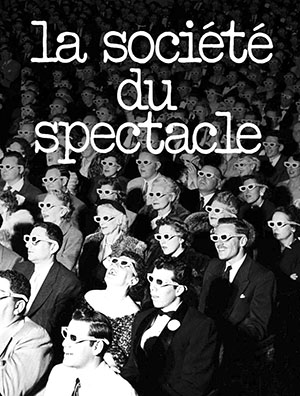
    According to Guy Debord (1931–1994), we now live in societies in which individuals no longer actually experience events, but in which all action is instead conducted through the represented image. He called this “The Society of the Spectacle” (the work outlining his theory was published in French as La société du spectacle in 1967). Images, Debord said, have supplanted genuine human interaction.

    Debord argued that the history of social life can be understood as “the decline of being into having, and having into merely appearing.” In consumer society, social life is not about living, but about having; the Spectacle uses the image to convey what people need and must have.

    A founding member of the radical Situationist International, Debord’s descriptions of human social life subsumed by technology and images are prophetic in light of the internet age now upon us.

    The Spectacle is much greater than marketing and TV images. Debord argued that everything men and women once experienced directly – our ties to the natural and social worlds – had been incorporated into the Spectacle – a vast simulacrum – to be sold and fed back to us. Doomed to be simply passive consumers inside the Spectacle, men and women inescapably reinforce its dominance by giving it attention. The sun never sets, Debord dryly noted, “on the empire of modern passivity.” And in this passive state, we surrender ourselves to the Spectacle.

    In his 1988 follow up Commentaries on the Society of the Spectacle, Debord introduced the idea of the “integrated Spectacle,” the most hazardous and commanding form of Spectacle, which he posits operates today. This enlarged Spectacle is associated with liberal democracies marked by incessant technological development and a state of general secrecy. Society is governed and managed by ‘experts’ who invoke the terror or health threat to keep spectacular society in a constant state of fear and tension.

    When we look back on our history, even from inside the Spectacle, we sometimes identify works of literature, art or cinema that accurately describe the reality of this modern world. One such breakthrough came in the form of the 1976 movie Network about a fictional TV network that airs almost anything for ratings.

    Written by Paddy Chayefsky and directed by Sidney Lumet, Network won four Academy Awards and was selected for preservation in the United States National Film Registry by the Library of Congress as being “culturally, historically, or aesthetically significant.” 

    This movie forecast the direction in which the Spectacle was taking the world: news as entertainment, soulless consumerism, selfish corporate interest, borderless liberal globalism, unscrupulous mainstream media antics.

    News, in Network, is a business, and facts will bend to it. This is told, explicitly, in the climactic scene, when the head of the network’s parent company, Arthur Jensen, speaks to Howard Beale, the disenchanted news reader.

    Get the issue this article appears in

    “There are no nations,” Jensen tells Beale. “There are no peoples. There are no Russians. There are no Arabs. There are no third worlds. There is no West. There is only one holistic system of systems, one vast and immane, interwoven, interacting, multivariate, multinational dominion of dollars.” Everything is now determined by television; it can dictate geography. He looks into Beale’s bewildered face and tells him: “The world… is a business.”

    Jensen’s rant continues. “You get up on your little twenty-one-inch screen and howl about America and democracy. There is no America. There is no democracy. There is only IBM and ITT and AT&T and DuPont, Dow, Union Carbide, and Exxon. Those are the nations of the world today.” [Now we can include on that list Microsoft, Google, Apple, JPMorgan, Goldman Sachs, Bayer, etc.]

    That night, in the movie, Beale goes on air to preach the corporate doctrine of Jensen:

    “What is finished is the idea that this great country is dedicated to the freedom and flourishing of every individual in it. It’s the individual that’s finished. It’s the single, solitary human being that’s finished. It’s every single one of you out there that’s finished. Because this is no longer a nation of independent individuals. It’s a nation of some two-hundred-odd million transistorized, deodorized, whiter-than-white, steel-belted bodies, totally unnecessary as human beings and as replaceable as piston rods.

    “Well, the time has come to say, ‘Is de-humanization such a bad word?’ Because good or bad, that’s what is so. The whole world is becoming humanoid – creatures that look human, but aren’t. The whole world, not just us. We’re just the most advanced country, so we’re getting there first. The whole world’s people are becoming mass-produced, programmed, numbered, insensate things….”

    The above first appeared in New Dawn Special Issue Vol 12 No 3.

    [alert type=”general” dismiss=”no”]This article was published in New Dawn 195.[/alert]

    [alert type=”success” dismiss=”no”]If you appreciate this article, please consider subscribing to help maintain this website.[/alert]

    © New Dawn Magazine and the respective author.
    For our reproduction notice, click here.

  • Hyperreality, Synchromysticism & Simulation

    Hyperreality, Synchromysticism & Simulation

    From New Dawn 195 (Nov-Dec 2022)

    We are the first digital inhabitants of a universe of pure symbolic media exchange, living in an empty space of virtuality, where subjectivity and objective truth have intertwined together.

    At the core of this collective experience, we find a fabricated system of meaning that limits human participation to that of mindless spectator, while a digital hyperreality is slowly born.

    Follow The Signs

    Images serve as a symbolic system through which people communicate and culture is transmitted. Some images contain a system of symbols and are used for various types of communication.

    Societies often share common symbols, and many symbols contain the same basic elements. Taken together, these symbols convey specific meanings. 

    For example, we are all born into a society with a written system of some kind, made of symbolic shapes called language which refer to spoken sound. None of us were the engineers of this system to begin with.

    A study of synchromysticism and numerological exploration can help uncover secret languages encoded inside the realm of reality, and which can be used to decipher meaning in unique ways.

    A feature that makes synchromysticism unique to other forms of synchronicity is its focus on esoteric mystical symbolism and the use of communications technology to document, share and compare synchronicities related to such symbols – from ancient traditions to mass media.

    By utilising cryptic understandings of symbols, we can decode, map, and predict future world events. How? Symbols channel a form of collective mass unconscious in the human species in which the subconscious realm can be influenced and dictated, hence altering the conscious sphere.

    Not only are symbols used to pre-program major world events on our television screens, but they are in fact a present reality in every single element of everyday life. We are living a fairy-tale dream.

    We have become so overwhelmed with symbols (translated as ‘information’) in the modern world that objective truth has been blanketed to the point it cannot be identified authentically.

    Analyses of objectivation, institutionalisation and legitimation are directly applicable to the problems of the sociology of language, the theory of social action and institutions, and of religion. 

    A vast, simulated experience has taken over the world, and reality itself is being sucked in with it.

    Simulated Reality

    We live in a world of signs where almost everything around us has become a matter of signification, connected with explosive growth in media and related to changes in the conduct of everyday life.

    Our current society has replaced all reality and meaning with symbols and signs, and human experience has become akin to a simulation of reality.

    You may be familiar with the term simulation – no doubt it has been said many times right here in New Dawn. But just exactly what does it mean? 

    The Baudrillardian concept of‘simulation’ refers to the idea of creating a reality; reproduced and based on a foundation of widely interpreted symbols.1

    Simulated reality appears so real that one cannot separate the ‘real’ from simulation. 

    Jean Baudrillard (1929–2007)

    In fact, simulation dominates the real, and never again will the real have the chance to produce itself because simulation is all there is, according to the French sociologist, philosopher and cultural theorist Jean Baudrillard (1929–2007). 

    Simulated reality is not a singular concept. The simulation itself is made up of infinite imitations of the operations of real-world processes or systems over time. These are known as simulacra.

    Simulacra are copies that depict things that either had no reality to begin with, or that no longer have an original. Representations stand in place of a perceived real or are simply the ‘real’ itself.2

    Inside the control structure, these simulacra are not merely mediations of reality nor even deceptive mediations – they are not based in a reality at all. No attempt to hide a ‘reality’ is made.

    Instead, all we see is a process of how symbolism in culture and media constructs perceived reality, programming false understandings and making lives and shared existences illegible. 

    Society has become so saturated with simulacra, and lives so saturated with the constructs of society, that all meaning has long been rendered meaningless by being infinitely mutable.

    The onslaught of television, media growth and the constant bombardment of images, are now intended to represent reality. From birth, humanity communicates and understands this way.

    Importantly, the simulacra are never that which conceals the truth. The truth which is concealed is that there is no truth. The simulacra, or untrue, is the truth.

    To better understand what this means, let’s look at key concepts found in studies describing the nature of symbols, simulacra, and interactions with collective perceptions of reality.

    Psychology of Illusion

    Not only does simulacra refer to ‘copies without an original’ but it can also be used to explain the lack of depth, meaning or ‘realness’ behind signs that penetrate our technological lives.

    Philosopher Walter Benjamin, as early as 1936, argued that “the presence of the original is the prerequisite to the concept of authenticity,” and that this was missing from a world of mass-produced commodities.3

    However, in a modern, technology-driven digital age, this has developed even further to the point that no original even exists from which to draw the authentic from.

    Prof. Frank Webster, author of Theories of the Information Society, once gave the example of when a user downloads a song to their phone. The notion of an original is meaningless as the downloaded song has no physical original – it is a copy of a song downloaded from a digital platform.

    In his essay The Ecstasy of Communication, Baudrillard explains that Western technological society revels in its over-exposure to images. He defines this visual overstimulation as “obscene,” when “everything is exposed to the harsh and inexorable light of information and communication.”

    Researcher Steven Connor summarises Baudrillard’s concepts of simulacra by stating: “All of contemporary life has been dismantled and reproduced in scrupulous facsimile.”4

    This refers to simulacra; the reproduction of signs of reality that are, in fact, created.

    Connor also discusses how simulation of “the real and referential” then “takes the form of manufactured objects and experiences which attempt to be more real than reality itself.”

    For example, violence is disconnected from ‘real’ world destruction and recorded in cyberspace as signs and images to be consumed through mass media, gaming, and digital outlets.

    Death as a tragic event has also been eliminated, and any event surrounding this theme is surrendered to media representations of it.

    Whatever the event may be, it is experienced as an ‘image event’ and consumed through symbolic exchange. Put simply, the image precedes the real, is consumed, and forms the reality itself.

    War images on TV form the actual perception of warfare, while real events on-the-ground – whatever they may be – are masked in a sea of digital simulations.

    Simulacra is the psychological concept that drives many other vast deceptions. From 9/11 to shooting events, the COVID scamdemic – symbolic images are programmed daily.

    Let’s take a deeper dive into how these messages are transmitted and what is responsible.

    In the world in which we now live, the image precedes the real, is consumed, and then forms reality – what is deemed by the mind to be the ‘real’. TV has been the primary generator of images, which are manufactured by unknown operators. War images projected on TV – and all electronic screens – form the actual perception of warfare, while real events on-the-ground – whatever they may be – are masked in a sea of digital simulations.

    Symbolic Exchange

    We are now more wired to our interfaces. We react to the television news rather than the world, to a computer program rather than social interaction, to email rather than vocal communication.

    In all these, we react to simulations rather than the immediate environment. Simulation supersedes ‘real’ interactions and has done so now for generations. 

    Andrew Murphie and John Potts argue in their book Culture and Technology that the media can never convey the ‘real’, and with the ever-increasing reliance on the internet, simulations are only becoming more prevalent, thus reiterating how simulacra erase and dominate the ‘real’.5

    The internet is a simulacra creator, highlighting the importance of symbolic exchange in cyberspace. It is a copy-making machine, a tool that effortlessly replicates things and passes them along. A digital realm in which nothing is authentic and everything is vastly produced.

    This ‘creation’ allows for artificial place-markers for real items or events. The uniqueness of objects and situations marks them as irreproducible real, and signification gropes towards this reality.

    This process is known as ‘symbolic exchange’ – a form of value exchange that maintains and organises social relations and hierarchies. The difference with other forms of exchange is that the value of an exchanged object does not value the act of exchanging it.6

    Let’s think about a designer brand t-shirt vs a regular t-shirt. Is there really any difference between the two? Is the designer brand actually worth $200 of raw materials, or is it simply the marketplace of value symbols (brands) that drives the worth of this shirt?

    Symbolic exchanges are not aimed at establishing equivalence (equal value) between two exchanged tokens, as with other forms of exchange. The opposite of a resource-based system.

    This psychological game allows for creators of said object to influence and dictate (false) worth, and it is this framework that powers why humans value grand deceptions over critical analysis.

    How on earth did humanity get to this point?

    It all began with the beginning of ‘modernity’ following the Industrial Revolution.

    Here, distinctions between representation and reality began to break down due to the proliferation of mass-reproducible copies of items, turning them into commodities.

    The commodity’s ability to imitate reality immediately threatened to replace the authority of the original version because the copy is just as ‘real’ as its prototype.

    This continued until the birth of postmodernity in which this process expanded with newer technology to the point the simulacrum now precedes the original, and the distinction between reality and representation vanishes. There is only the simulacrum; originality has been buried.

    Baudrillard theorises that the lack of distinctions between reality and simulacra produces several outcomes including (but not limited to) the following:

    Contemporary media, including television, film, print, and the internet, blur the line between products needed (to live a life) and products for which commercial images create a need.

    Exchange value in which the value of goods is based on money (denominated fiat currency) rather than usefulness. Moreover, usefulness comes to be quantified and defined in monetary terms to assist exchange.

    Multinational capitalism which separates produced goods from the plants, minerals and other original materials, and the processes (including the people and their cultural context), used to create them. Think of medicine and plants as an example of this.

    Urbanisation which separates humans from the non-human world, and re-centres culture around productive throughput systems so large they cause alienation.

    Language and ideology in which language increasingly becomes caught up in the production of power relations between social groups, especially when powerful groups institute themselves at least partly in monetary terms.

    Through these primary methods, collective values of a society, object, event, or story are directed and engineered. Disconnection from reality to simulacra until the ‘real’ is forgotten.

    Next, let us examine the long-lasting inter-generational effects of this level of mass illusion.

    Here we go beyond many authors’ work and adapt this information to the digital age.

    The Birth of the Hyperreal

    In the modern world, we have moved from the ability to reflect our reality truthfully to the ability to mask and distort this reality, and to masking the simulated reality altogether.

    Finally, with the dawn of the Fourth Industrial Revolution, humanity has already begun the transitional stage to an era in which simulation asserts precedence over reality.

    Hyperreality refers to a simulation of reality that acts as more real than the real or a created heightened reality. In this hyperreal cyberspace, signs for consumption are constantly in production, and this creates a new reality, as virtual reality cannot be completely known.7

    We are already witnessing the building blocks of this era. There is a sharp connection between nature and technology in terms of what becomes an icon for the ‘lost real’ in hyperreality. Almost all forms of online media act as a hyperreal experience.

    As an example of social media, Facebook markets itself as a connecting tool; a user posts updates of their life to their friends who can react and comment as they wish. 

    This platform acts as a digital reproduction of real life – a heightened version of real communication between friends, but it does not reflect real-life interaction.

    This is the hyperreal, a digital simulation of reality, where a person ultimately uses Facebook to form an online identity and persona more vivid than the ‘real self’.

    Twitter is hyperreality as well, as it bears no reflection to real life and creates a sublime cyberspace where a user, once a rational subject, becomes decentred in online communication.

    As subjectivity becomes detached from materially fixed, embodied contexts, it is dispersed and multiplied continuously through digitisation.

    In this hyperreal setting, traditional social settings are erased as a real human being is re-signified as a digital representation for Twitter users to consume. 

    The pure symbolic media exchange of cyber interactivity is understood as the opposite of social.

    The subject does not experience ‘increased interactivity’ but instead experiences ‘subtle death’. Interaction dies in this hyperreal cyberspace and becomes merely a simulation of communication.

    Chat rooms, for example, allow users to function as floating signifiers capable of becoming anything that is describable. Thus, online, communication is replaced by sign consumption, and subjects become merely ‘floating signifiers’.

    If we replace ‘chat rooms’ with Twitter, we may conclude that power becomes a signifier of hatred.

    Going beyond this space, the phone itself is a hyperreal product – a product of pure simulated society which acts almost as an extension of ourselves. 

    Astra Taylor, author of The People’s Platform: Taking Back Power and Culture in the Digital Age, has explained the ways that “big media,” through search engine algorithms and data collecting, can “absorb who we are” by gathering detailed demographic information, geographic information, behavioural information, and social information.8

    Absorbed from the real to a digital representation.

    In the future, with the introduction of AR and VR systems such as the Metaverse, enhanced by AI and 5G underliers, almost all observable reality will soon fall under the spell of the hyperreal.

    The gamification of society and the introduction of controlling technologies as a trojan horse of mind-numbing pleasure means that humans are wilfully creating the end of their realities.

    There is no original that created the rest, no seed planted. Everything will soon be automated, and this automation produces a series of new symbols for humanity to absorb.

    Baudrillard stated that representation stems from the principle of the equivalence of the sign and of the real, but “simulation envelops the whole edifice of representation itself as a simulacrum.” Therefore, the concept of a ‘real’ underneath the simulation relies on the principle of the real.

    Hyperreality is the absorption of the real – whatever it may have been – into an ocean of simulated, digital representations. Infinitely created and replicated until the real is long forgotten.

    Get the issue this article appears in

    Science Fiction Comes to Life

    The postmodern world in which we live and the approaching post-postmodern hyperreal timeframe are argued to go hand-in-hand with famous science fiction works of our time.

    In his book Exploring the Limits of the Human through Science Fiction, Gerald Alva Miller suggests that “science fiction increasingly proves the genre that is necessary to grasp the postmodern world around us.”9

    Baudrillard notes that science fiction “is no longer anywhere, and it is everywhere, in the here and now, in the very principle of the surrounding simulation.” In other words, he argues science fiction is hardly fictional at all, it is merely waiting “in its crude state” to emerge.

    Are we really ‘waiting’ for this change to come? Or is it already here?

    Miller believes this wait is over and the technology of contemporary science fiction now “occurs in realistically depicted versions of the present or even the past.” He calls television “a viral, endemic.”

    Baudrillard sees radical action such as destroying the system as no longer a real possibility.

    This is because there is no system. It is a simulated, collective experience driven by symbols and images and programmed by those who are controlling those very mechanisms.

    We are slowly welcoming the immorality of consuming death as a media spectacle.

    Marleen S. Barr discusses the concept of post-postmodernism, which she says exposes “the hitherto science fictional impact of technology on society and culture… when what was once science fictional comprises the very definition of reality.”10

    Cyberspace becomes a space of pure symbolic exchange where humanity disappears and subjects become nothing more than a sign or image to be consumed.

    Technology has been engineered as a weapon in which the human subject is reduced to a mere sign for consumption. This consumption of a person is represented by reducing a subject to a mere symbol for exchange, and even the event of death is consumed by hyperreal media. 

    Dehumanisation in the media, or reducing the subject to the object, happens in hyperreality. This is currently perpetuated by online users who are still human beings themselves. 

    This important analysis of simulacra and hyperreality draws attention to the need to see the human behind the image, to see the subject behind the object, and re-humanise the subject in cyberspace.

    We must do everything we can to disconnect ourselves as much as possible from the hyperreal that is currently birthing a world of endless simulated experiences (the Metaverse is an emerging example).

    By doing so and looking beneath the surface, we can resist. How? Because we recognise the ‘system’ that controls us does not physically exist at all – it is an illusion.

    Almost everything is an unauthentic copy of a copy, masking the fact there is no original base.

    Everything we have been told is a lie. Therefore, I recommend you throw away anything you have ever been told about the world and begin to form an independent perspective from scratch.

    When you do, and you also take this information into consideration, you will uncover startling truths.

    The above is an updated version of an article that originally appeared on the website of TOTT News: https://tottnews.com.

    [alert type=”general” dismiss=”no”]This article was published in New Dawn 195.[/alert]

    [alert type=”success” dismiss=”no”]If you appreciate this article, please consider subscribing to help maintain this website.[/alert]

    Footnotes

    1. www.en.wikipedia.org/wiki/Simulacra_and_Simulation
    2. www.en.wikipedia.org/wiki/Simulacrum
    3. www.ceasefiremagazine.co.uk/walter-benjamin-art-aura-authenticity/
    4. www.amazon.com.au/Postmodernist-Culture-Introduction-Theories-Contemporary/dp/0631200525
    5. www.books.google.com.au/books/about/Culture_and_Technology.html
    6. www.oxfordreference.com/view/10.1093/oi/authority.20110803100546755
    7. www.en.wikipedia.org/wiki/Hyperreality
    8. www.youtube.com/watch?v=vMwyZbS4JTU
    9. https://link.springer.com/book/10.1057/9781137330796
    10. www.tandfonline.com/doi/full/10.1080/08854300600950285

    © New Dawn Magazine and the respective author.
    For our reproduction notice, click here.

  • Attack on the Mind: Mental Health Fall-out From Cognitive Warfare Techniques

    Attack on the Mind: Mental Health Fall-out From Cognitive Warfare Techniques

    From New Dawn 193 (Jul-Aug 2022)

    Even the mainstream media and global health organisations cannot ignore the massive toll COVID-19, the Ukraine/Russia conflict, vaccine and mask mandates, geopolitical chaos, rising inflation, and new threats – real and imagined – have taken on our physical and mental health. 

    The catastrophic rise in mental health disorders over the last three years – from anxiety to depression and suicide – has made us more than physically sick. We now watch in horror the rising mental health fall-out of non-stop, fear-based living.

    We learned that researchers in a large study published in the British Medical Journal found that surviving COVID could “increase the risk of developing mental health issues, including increased rates of anxiety and depression, even when compared to non-COVID patients or even those who contracted the flu.” They also reported that it could result from body and brain inflammation and physical and emotional factors related to the pandemic. 

    The World Health Organisation took it one step further in their March 2022 report, “COVID-19 Pandemic triggers 25% increase in prevalence of anxiety and depression worldwide.” They noted “multiple stress factors” including loneliness, financial woes, fear of the virus, suffering and death, and anxiety and grief after losing a loved one. No mention of how their own policies like mass lockdowns contributed to all of the above.

    In May 2022, Medical Press ran a report, “COVID-19’s devastating toll: A rise in adolescent mental health crises and suicidality.” They cited a new study by Patricia Ibeziako and her team in the Department of Psychiatry and Behavioral Services at Boston Children’s Hospital, which found suicidal ideation, or suicide attempts, among young people jumped 60% during the first pandemic year. 

    Young people were hit hard, and continue to be, because not only do they suffer more from lockdowns, lack of socialisation, masking, and virus fearmongering, but they are forced to watch their parents, the people they rely on for safety and stability, suffer the same.

    But we don’t need news headlines to tell us what is going on. Our social circles and social media are filled with people reporting higher levels of illness, anxiety, depression, suicidal thoughts, hostility, anger, and rage. 

    The sad irony is that the same mainstream media outlets and government health experts admitting to this mental health crisis orchestrated the crisis in the first place. 

    The war on the mind relies on specific tools and methods to destabilise our sense of safety, belonging, resiliency, and adaptability. Cognitive dissonance is described as a mental discord when we are presented with an idea that seems to contradict previously accepted ideas or thoughts. People are averse to inconsistencies in reality that challenge deeply-held beliefs in their subconscious minds. When new information is presented to them, they either shut down, avoid, or change their thoughts and behaviours to eliminate the inconsistency and restore cognitive consonance. 

    Behaviour modification works best on the subconscious mind, which does not analyse, criticise, judge, or question but accepts what it is fed as the reality. Coercive persuasion systematically manipulates a person’s behaviours, thoughts, and emotions using fear, intimidation, and punishment, and controlling the information given to the victim (or not giving them any information at all). The coercion comes with a promise of reward if the victim behaves. These tactics include:

    • Intimidation – Threaten the victim with various punishments if they don’t behave as the controlling party desires.
    • Isolation – Keep victims isolated from human comfort so they feel powerless and alone.
    • Cut off information – Keep the victim off balance and in fear of not knowing what is happening in the outside world.
    • Increase suggestibility – Use of subliminals, hypnosis, music, sleep deprivation, and food restriction to make someone more compliant.
    • Create a sense of powerlessness – Subject the victim to frequent, often surprise actions that undermine their confidence and sense of security.
    • Destabilise a sense of self – Work to destroy someone’s ego and sense of self with the intent to recreate them as the controller wishes.

    Sometimes victims become strangely attached to their abusers and controllers. Capture bonding and Stockholm Syndrome describe the effects of a mind-control technique that creates confusion, cognitive dissonance, and a destabilised sense of identity to bond the victim with their abusers. Capture bonding may also be a survival mechanism where we are forced to adapt to an extreme by coping with it or becoming accepting of it. 

    Psychologist George K. Simon, author of In Sheep’s Clothing: Understanding and Dealing With Manipulative People, wrote that to manipulate another human being successfully, a controller or abuser would have to:

    • Conceal their aggressive agenda and intentions.
    • Know the psychological vulnerabilities of the intended victim, and modify the tactics accordingly.
    • Be ruthless enough not to care if the victim is harmed or killed.
    • Use covert aggression in the form of relational or passive-aggressive tactics.

    The most subtle and insidious tactic is reinforcement, which we have all used on our pets, children, and even ourselves when trying to train a new habit or change a bad one.

    Positive reinforcement uses praise, flattery, admiration, attention, affection, gifts, and declarations of love to create a sense of goodness and adoration in the victim. Narcissists and psychopaths use this technique to secure a victim by what is called “love-bombing,” and set the victim up on a pedestal for what will unfortunately be a brutal and abusive fall from grace once the desired outcome is achieved. However, when used for the benefit of the individual, such as in giving positive praise to a child or a training athlete, this kind of reinforcement can build confidence and self-esteem. 

    Negative reinforcement is the polar opposite, using punishment, criticism, and silent treatment to manipulate the victim to behave a certain way. Negative reinforcement can include shaming, guilting, yelling, abusive language, and even physical violence. Today, silent treatment equates to social media censoring, blocking, banning, and deplatforming.

    Using the threat of fear, violence, and virulent language serves to degrade, diminish, and dominate and, in the extreme, leads to torture and physical abuse.

    Intermittent reinforcement is far more devious and effective than either positive or negative reinforcement at creating such strong instability and cognitive dissonance in the victim they cannot help but surrender control to their abuser. Intermittent reinforcement relies on doubt, fear, anxiety, expectation, and hope, and plays upon the deepest emotional needs of wanting to be loved and accepted. It can, when used adeptly, create trauma that can literally drive the victim insane or to commit suicide.

    The controller/abuser starts with positive reinforcement, setting the victim up to crave more positive reinforcement, which is then taken away intermittently to create confusion and anxiety. The victim wants more of what he/she got in the beginning and begins to accept the introduction of negative reinforcement, as long as it is peppered in with some positive. By this point, the controller/abuser can begin to torture the victim and the victim will become so desperate for the normalcy they once received, that they will accept more abuse while waiting to get it. Soon, the victim is settling for tiny crumbs of positive behaviour from the controller/abuser, who now has the victim under complete control. 

    Get the issue this article appears in

    This kind of manipulation puts the victim under a “spell” because the damage is done on a subconscious level. Not only does this manipulation change the victim’s thoughts and perceptions, but it changes their actual reality and removes their individual will over time.

    Victims suffer in a perpetual state of confusion and chaos, even Post Traumatic Stress Disorder, with symptoms such as severe depression, panic attacks, insomnia, physical illness, emotional debilitation, inability to concentrate and focus, and a host of other ailments. As the control continues, it can drive the person to suicide or into psychiatric care if proper help and support are not found.

    All these mind manipulation tactics are used against whole populations today and have been in the recent past (COVID-19, etc.), and it will continue in coming times. Once a victim is under this hypnosis, it is hard to come out of, but it is possible. Turn off the news. Avoid negative and divisive people. Get outside and move around in nature. Work on your health and general well-being. Eat healthier foods. Meet with friends and loved ones. Engage with pets. 

    We are at a point in history when negative forces are constantly working against us. Protecting your own individual health is now a revolutionary act and one that will have a ripple effect on those struggling around you to do the same.

    [alert type=”general” dismiss=”no”]This article was published in New Dawn 193.[/alert]

    [alert type=”success” dismiss=”no”]If you appreciate this article, please consider subscribing to help maintain this website.[/alert]

    © New Dawn Magazine and the respective author.
    For our reproduction notice, click here.