New Dawn – World's Most Unusual Magazine

Category: Technology/Mind Control

  • The Struggle for a Human Future in the Age of COVID-19 & Electronic Totalitarianism: An Interview with Jeremy Naydler

    The Struggle for a Human Future in the Age of COVID-19 & Electronic Totalitarianism: An Interview with Jeremy Naydler

    From New Dawn 182 (Sept-Oct 2020)

    Jeremy Naydler, Ph.D., holds a doctorate in theology and religious studies, and is a philosopher, cultural historian and gardener who lives and works in Oxford, England. 

    He has long been interested in the history of consciousness and sees the study of past cultures – which were more open to the world of spirit than our own, predominantly secular, culture – as relevant both to understanding our situation today and to finding pathways into the future. 

    His longstanding concern about the impact of electronic technologies on our inner life and on our relationship to nature has found expression in his book In the Shadow of the Machine (Temple Lodge 2018) and in his new book Struggle for a Human Future: 5G, Augmented Reality and the Internet of Things (Temple Lodge 2020).

    KINGSLEY DENNIS (KD): You have said that the biggest threat of technology is not from the apparatus itself but from its corruption of the human essence. What is the major threat of technology against the human essence?
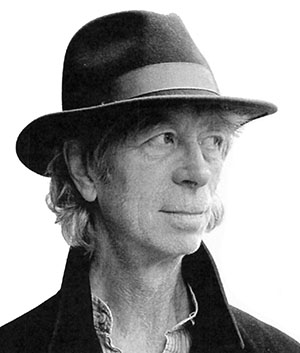
    Jeremy Naydler

    JEREMY NAYDLER (JN): This is something Heidegger wrote about in his seminal essay, ‘The Question Concerning Technology’. He said that technology encourages us to adopt an instrumental relationship to the world, so we tend to see things as means to our own ends rather than as ends in themselves. If that becomes our default mode of relating to the world then that reduces us as human beings. We lose our reverence for nature, we lose our openness to the fundamental mystery of existence, and our sense of the sacredness of life. Then our hearts become hardened. Rather than living in wonder, we find ourselves cut off from spirit, and that is how we lose touch with what it means to be human. This is because to live humanly is at the very least to live with our hearts open to the mystery of existence. I would also say that freedom belongs to the human essence, and the more sophisticated technology gets, the more it tends to undermine our freedom. By freedom I mean the capacity to live by the ideals, aims and values that we have ourselves adopted, rather than having them imposed on us. One of the effects of the technologisation of our lives is that we are more and more hemmed in and forced to conform to a machine-dominated world, with the result that our ability to act freely is compromised. 

    KD: You seem to imply that technology is opposing the natural cosmic order or flow of evolution. In what way is technology in opposition to the cosmic order?

    JN: I wouldn’t want to say that all technology places us in opposition to the cosmic order. There are many technologies that don’t have the devastating effects that we have seen produced by more recent technological developments. It was really with the scientific and industrial revolutions that we collectively embarked upon a course that has led to our “falling out of the Tao.” Our human activities have increasingly been commandeered by the power of our modern technologies, and this is because we have surrendered to an unremittingly instrumentalist attitude, which tells us that the more efficiently we can exploit nature, the better. And so our technologies lead us even further into imbalance. How can anyone look at what is now occurring in the world today and not know that we are rebelling against the cosmic and natural order? 

    KD: Your own research considers what you call the “shadow sides of technology.” Are these ‘tech shadows’ in any way representative, or a projection of, our own human shadows?

    JN: When we consider the digital revolution, and the process of miniaturization that electronic technology has gone through, we can see how incredibly useful it has been to us. The computer and the smartphone have become indispensable for most of us, if we are to function in the contemporary world. But we also need to see that these technologies play into our weaknesses. They cannot really satisfy our deeper yearnings. Rather, they tend to distract us away from what is living within ourselves as our deeper purpose, and instead we fall prey to our more superficial desires. There is the shadow! Or one of the shadows.

    We are all so hungry, but what are we actually hungry for? We can so easily misunderstand our own inner yearnings. We must keep asking: What is it that will really satisfy us? I don’t think it is the next seductively designed iPhone or smartwatch. The “feel good” factor of the shiny new device doesn’t last long, because in the end it is just a thing. And while this technology certainly enables us to do so much more than we can do without it, it does not in itself satisfy the deeper hunger that lives in the soul. 

    KD: In your most recent book you refer to the “infrastructure of electronic totalitarianism.” Would you say that our current global civilisation is shifting into a form of techno-totalitarianism?

    JN: I fear this is what is happening, and it has been accelerated in recent months by the way governments all over the world have responded to the global coronavirus pandemic. There is grave danger that in different countries – even those with long democratic traditions – citizens become adjusted to living under a state of emergency that then becomes normalised. We have very quickly become habituated to the drastic limitations placed on our freedom by our governments, under the pretext of protecting the public from a fatal infectious disease (which it turns out is not nearly as fatal as at first predicted). Then the armoury of state surveillance, electronic tracking and tracing, cashless transactions, immunity passports and so on, is brought to bear on us. 

    Because of the global nature of the pandemic, there has been a degree of harmonisation in the responses of governments to it. Global organisations like the UN, the World Health Organization (WHO) and the WEF (World Economic Forum) are key players influencing governments. There is now an attempt backed by the WHO and the UN to create a global legal framework for dealing with the pandemic. While this may seem perfectly reasonable, it makes me feel uneasy. I can foresee a situation in the future when if you haven’t been vaccinated then you will not be permitted to travel abroad. And that could well be the least of what is in store for us.

    The Italian philosopher Giorgio Agamben, who has been an outspoken critic of the Italian government’s response to the pandemic, has warned that we are rapidly moving to a situation in which we may all find ourselves controlled far more effectively than under any of the old fascist and communist totalitarian regimes of the mid-twentieth century. And that is thanks to the electronic infrastructures that have already been put in place, and are being constantly upgraded, in so many countries all over the world. 

    KD: You also state that the electronic ecosystem will enable machine-organism hybrids to usurp natural organisms as part of an extension of human control over nature. To what extent does such technology represent a ‘replacement of nature’? 

    JN: I will give you an example, which is not exactly a machine-organism hybrid, but it is a machine that is mimicking a living organism and has been designed specifically to take over the functions of that particular creature. The creature is the honeybee, which has suffered an enormous decline over the last few decades. As it is vital for the pollination of many different crops, the decline of the honeybee has caused much concern. 

    There is a great deal of evidence that points to the use of insecticides, especially neonicotinoids, as adversely affecting bees, which is hardly surprising given that they are insects! But bees are also highly electro-sensitive, and many studies also point to the saturation of the atmosphere with electromagnetic fields as another significant factor in their decline. What better solution to the problem of honeybee decline than to design a “robot bee” to replace the honeybee? It won’t be susceptible to either of these pollutants, so we can use it without having to worry about its health or the possibility of it going extinct, because we will be able to mass produce them. A robot bee won’t sting us either. Over the last decade various laboratories around the world, one of which is based at Harvard in the USA, have been developing different “robobee” designs, to make an artificial creature that can replace the real one. (But will it make honey? I don’t think so!) 

    What you see here is the technological mentality aggressively stepping into nature and, instead of us taking the measures needed to reduce the threats to the honeybee population, their plight is seen as an opportunity to make a new commercial product that will replace them. This is just one example. It is by no means the only one, in which technological innovations are being designed to replace living creatures. 

    KD: You ask in your book whether people are prepared the make inner development (the ‘inner turn’) a part of their life. Is the ‘inner turn’ the only way to counteract the encroaching dominance of technology?

    JN: What I notice both in myself and in others, especially since the use of mobile phones and then smartphones became so widespread, is that they take on the role of “the constant companion,” to whom we turn for comfort and reassurance, almost as if they are our best friends. Sherry Turkle wrote a book in 2005 called The Second Self, in which she explored the psychological role of our digital devices, and how we have come to constantly refer to them. We can feel our whole lives are somehow “in them,” and as we live our lives online more and more, if we lose them or they crash it can seem like a devastating loss. Some people Sherry Turkle interviewed said that when their device crashed it felt as if they had lost their lives! It was like a death. 

    That is why it is so important that we keep making the inner turn. In the world’s sacred traditions, there is the figure of the inner companion, sometimes pictured as our guardian angel, or the Sufi “inner friend of the soul,” or the Christ within. Building our relationship to this transcendent inner figure is an important part of the work of spiritual development. It teaches us to remember that there is a higher level of ourselves, the “immortal within the mortal person,” which we have to keep trying to connect with. By no means easy! But you can see how our digital devices can supplant this far more important task, presenting to us a counterfeit “second self” or “inner companion” in place of the authentic one. If we can work on building up the connection with our true “inner friend,” then we become inwardly strengthened and less beholden to the technology. 

    KD: You made an intriguing reference to how Rudolf Steiner regarded electricity as light in a fallen, degraded state. There is the suggestion here that electricity is to Lucifer what Light is to the Sacred Source. Is the enveloping ‘electrosmog’ a way to sever humanity’s connection to its sacred Source?

    JN: Steiner had many extremely interesting things to say about electricity. And one of them was that it should be regarded as light in a sub-material state. That is, it is light that has fallen below the level of nature, into what he termed “sub-nature.” For this reason he warned us to be very wary of building our whole culture on the basis of electricity, because its tendency is to draw us away from nature and to pull us down into sub-nature. 

    One of the purposes of the rollout of 5G is to strengthen the “global electronic ecosystem,” which our computers, large, small and tiny, all function within. But the more we live our lives through our electronic technologies, the more we become alienated from the natural world. The electronic ecosystem becomes a kind of rival to nature’s ecosystems, in the sense that it is the environment in which we spend more and more of our time, never more so than in these last pandemic months. But if the world we feel most safe in is the world mediated by the light of computer screens, then what happens to our relationship to sunlight, not to mention the flowers and trees, the wind and rain? 

    It is important to consider how the light of the computer screen differs from sunlight. What lives in sunlight? Steiner said it is the garment of the cosmic Logos. In saying this, he was reiterating an old teaching. In the Psalms we find God described as wrapping around himself a garment of light. I can’t go into this further here. I devote a chapter to it in my book. All I will say is that the garment of light that the divine is wrapped in is not, and simply cannot be, the light that emanates from the computer screen.

    KD: If Artificial Intelligence (AI) and electricity are two sides of the same phenomenon, then AI could be regarded as a manifestation of an energy in a ‘fallen state’. Would you consider AI therefore to be a manifestation of what Steiner calls the Ahrimanic forces?

    JN: When we consider what kind of intelligence is referred to by the phrase “Artificial Intelligence,” it resolves into an entirely quantitative concept. It is something entirely measurable, and it is measured by the number of “calculations per second” that a machine is able to perform. Computers perform logical operations extremely fast and can therefore be programmed to produce any number of different outputs. This can give the impression that our machines are incredibly clever, much cleverer than we are, but this is a type of intelligence that excludes any real understanding. They don’t really know what they are doing. It is intelligence without consciousness. It is mere cleverness in a meaning-vacuum. It is totally soulless.

    What is it, then, that is manifesting in this type of extremely clever, but utterly cold and soulless intelligence? Could one say that it is the manifestation of a spiritual being? If so, what kind of spiritual being could it possibly be? One way of answering this is to observe what kind of affect the use of Artificial Intelligence has on us in our daily lives. How do you feel, for instance, when in order to do something online you are required to enter all these details in dialogue boxes and drop down menus, and then you have to tick this box and that box, and prove that you are not a computer by interpreting some illegible script. And if you get one single detail wrong, you have to go back and in some cases start the whole process again. I personally experience a sense of constraint, as I am forced to conform to the alien requirements of these algorithms. It feels like I am encountering something fundamentally anti-human here. 

    It is in these small everyday experiences of interacting with this intelligence that we begin to sense the nature of what it is we are dealing with. I think it is better not to rush in with naming it, but rather try to observe as closely as we can what we are experiencing, as if we are dealing with a person, and then build up a picture of the “Who?” behind the AI. Through personifying in this way, we learn to recognise its signature in many different aspects of life. We are constantly encountering it, and we can see it too in the much bigger trends and tendencies that are occurring in the world.

    KD: You have stated that one of the challenges we face today is to “overcome our collective de-sensitisation to these subtle life-forces.” What do you mean by this?

    JN: Modern urban living has de-sensitised us to nature. The digital revolution has accentuated this. To attune yourself to the life-forces in nature, you have to spend a lot of time outside, in the elements, in different light conditions, in sun and in rain. You have to spend time with plants, and in relationship to the soil, to bugs, to the birds and to countless other creatures. And much of this time needs to be spent not doing anything. Just being open, and open to Being. It is what Heidegger talked about when he said “openness to Being” defines the human essence. Just to be present to what is there. In this way, we begin to overcome our collective de-sensitisation to the subtle life-forces in nature. 
    KD: As succinctly as possible, how do you view the short-term future for humanity and life on this planet?

    JN: There’s an extremely powerful trend today in which many human beings are caught up. Many, it seems, feel they don’t really belong to the planet anymore, and are drawn increasingly into the new electronic world that has recently announced that it is an “ecosystem” in its own right! The implication is that it can offer a habitat for the human soul. It doesn’t require great insight to see that the more time people spend online, the more they withdraw their allegiance to the planet. 

    One of the most powerful symptoms of this withdrawal of allegiance to the planet is the fantasy of literally abandoning the Earth and colonising Mars. This fantasy has gripped the minds of some very rich and influential people, for example the billionaire entrepreneur Elon Musk and celebrity scientists like Brian Cox and the late Stephen Hawking. It is symptomatic of a kind of renunciation of our responsibility to the beautiful Earth on which we live. I think this inner renunciation has already taken place for many people, aided and abetted by their online lives, and this is why the fantasy of abandoning the Earth and leaving it to its fate seems so attractive.

    This points to the crying need to take far more seriously our responsibility for nature, recognising that this Earth is where we as humans belong. It is to this Earth that our primary loyalty must lie. To shoulder this responsibility is also to shoulder the heavy weight of guilt, pain and despair that so many of us feel when we read, or see images, of the unceasing devastation that we are collectively inflicting on the Earth and our fellow creatures. 

    However, we need to get over the paralysing effect this has on us and look to see what we can do to heal nature’s wounds. We can join campaigns, of course, sign petitions and try to shop more carefully, but we should also attend to what is closest to us, so we stand more firmly on the Earth. Every garden, every plot of land, no matter how small or modest, is a point of contact with nature. It invites us to tend and care for it, to help to build up the life-forces in it. And if we don’t have a garden, then we can still make a point of walking in nature, even if it’s the local park, and give our attention to the daily miracles that abound. This giving of our attention to nature is absolutely crucial, because through it we root ourselves in the Earth. 

    Many of us feel trepidation for the future, but this feeling alone is not particularly helpful. We need to gather our strength to meet the future with equanimity and make it our daily practice to live with positivity and hope. And we need to know that the quality of our consciousness of nature is in itself a gift that each of us can bestow. If we can live with greater awareness and appreciation of the wisdom and beauty that surrounds us, that itself will make a difference. 

    Struggle for a Human Future: 5G, Augmented Reality and the Internet of Things by Jeremy Naydler is available from all good bookstores and online sellers.

    [alert type=”general” dismiss=”no”]This article was published in New Dawn 182.[/alert]

    [alert type=”success” dismiss=”no”]If you appreciate this article, please consider subscribing to help maintain this website.[/alert]

    © New Dawn Magazine and the respective author.
    For our reproduction notice, click here.

  • Menticide: Don’t Fall Victim to Mind Control Technologies & Techniques

    Menticide: Don’t Fall Victim to Mind Control Technologies & Techniques

    From New Dawn 183 (Nov-Dec 2020)

    In my new book, The War on You, I document how corporate and state elites use information, money, law, and psychology in an effort to control your thoughts and behaviours for their own ends. Most of the psychological warfare documented in the book is a result of living in a fragmented, for-profit culture over which the individual has little control. 

    In case these unconscious structures fail to keep people in their place, the military, secret services, governments, and corporations have developed an impressive array of deliberate mind-control technologies and behavioural analysis firms targeted towards the individual. 

    Brain Chips

    The US Central Intelligence Agency’s (CIA) mind control experiments, dating back to the 1950s, are well-known. Their MK-ULTRA experiments in sensory deprivation continue to be used on Guantánamo Bay captives. But until Ian Cobain’s book Cruel Britannia, few people knew that British psychologists had pioneered the use of sensory deprivation for mind control. 

    During WWII, Lord Swinton “pressed the Home Office for permission to open an MI5 interrogation centre,” codenamed Camp 020. Brightly lit for 24 hours, a resident doctor reportedly said that the Camp induced “mental atrophy and extreme loquacity” in its victims. A resident medical officer named Harold Dearden “dreamed up the regimes of starvation and of sleep and sensory deprivation.” The Camp was one of a number, including the MI19-run Combined Services Detailed Interrogation Centre, later renamed A19. 

    After the War, several individuals convened to share intelligence on mind control. They represented the Defence Research Policy Committee, the Joint Intelligence Bureau, the Canadian Defence Research Board, the CIA’s Research and Development Board, and the Psychology Unit at McGill University (Montreal). The latter was led by Donald Hebb. 

    The scientists referred to their psychological devastation techniques as “menticide.” Hebb subjected terrier puppies to prolonged isolation before trying it on consenting postgraduate students. The British and American governments and the CIA funded Hebb’s successors, including his former student Dr Maitland Baldwin. Baldwin found “that sensory deprivation would almost certainly cause irreparable psychological damage” in humans. 

    The CIA’s Kubark Counterintelligence Interrogation Manual (1963) was based on MK-ULTRA. One of the MK-ULTRA psychiatrists was McGill University’s Dr Ewen Cameron, a colleague of Hebb. Cameron “subjected hundreds of psychiatric patients to large doses of electroshock and total sensory isolation, and drugged them with LSD and PCP,” writes journalist Naomi Klein. In 1960, Cameron lectured to the Brooks Air Force Base, stating that sensory deprivation “produces the primary symptoms of schizophrenia.”

    Tulane University was allegedly involved in the operations, using the services of a state-hospital, as well as funding by a CIA front company called the Commonwealth Fund, to conduct research. The Washington Post reports that the “quest to turn humans into robot-like assassins via electrodes planted in their brains” led to a number of lawsuits, in which several ex-servicemen claim to have been unwitting human test subjects. Plaintiff Bruce Price claims that in 1966, he was ordered into a building full of lab animals in which he was strapped to a gurney. Price kept waking up with bruised arms and covered in blood. A later CT scan, obtained by Price’s lawyer, appears to show that he had been implanted with a mind control device.

    Beyond Freedom & Dignity

    In the 1950s, the psychologist B.F. Skinner utilised the Russian (and later Soviet) scientist Ivan Pavlov’s conditioning techniques to falsely argue that that is how human beings learn. Geneticists pointed out that the potential for knowledge actually comes from innate brain structures, not solely from repetitive learning. But Skinner was correct in that people can be conditioned, if the conditioning is maintained, to behave in certain ways and under certain conditions. 

    Skinner’s work culminated in the publication of his book Beyond Freedom and Dignity (1971), in which he argued that humanity should be scientifically controlled via a blend of Orwellian and Huxleyan social architecture designed to end both human freedom and dignity. 

    Skinner failed to persuade elites to impose a blanket control system. But such a system is gradually creeping in, based on these kinds of ideas. In his work on “nudging,” Barack Obama’s former advisor Cass Sunstein argues that, like rats in a maze, people should be given the illusion of choice in what he and co-authors call choice architecture. Conspiracy forums should be “cognitively infiltrated,” he says, and the supposed rationalism of the official line inserted into chat-rooms. More ominously, he says behavioural science teams should be expanded to control public opinion, for benign reasons, like “nudging” smokers to quit. However, since Brexit in the UK and the British government’s response to coronavirus, we’ve seen the darker sides of “nudging” techniques.

    Nudge Units

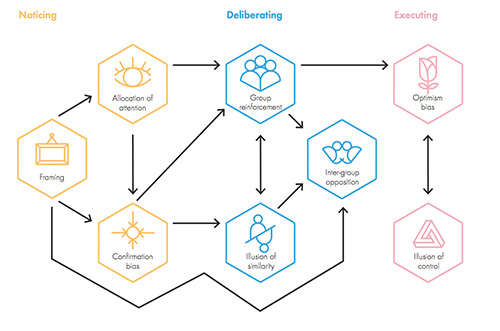
    The Behavioural Insights Team (BIT) was founded by the UK’s Tory-Liberal coalition government in 2010. The Cabinet Office said: “The Behavioural Insights Team, often called the ‘Nudge Unit’, draws on insights from academic research in behavioural economics and psychology, to apply them to public policymaking.” The professed aims of the BIT may sound innocent enough: to use insights in human behaviour from the fields of neuroscience and cognitive psychology to influence behaviour (hence the “nudge”) in positive directions, such as helping people to eat more healthily, keep appointments, and pick up litter. 

    Flow chart by the UK’s Behavioural Insights Team. Nudge Units have appeared in dozens of countries across the world including Australia.

    The first thing to be said about the BIT is the moral question of using subconscious ploys to consciously manipulate human behaviour. This takes away agency and thus autonomy from the individual. That is called manipulation. In fact, policymakers are so interested in the subject of how to use psychology, as opposed to force, to control people that there is even The Persuasion Handbook (2002, SAGE). 

    The second issue is consent. In clinical and psychological trials, the consent of the subject is required. Who consents to be manipulated by the government? But putting aside the moral issues, the third problem is that of context. 

    The government only cares about your health when it affects government spending. As it defunds and privatises, the British government doesn’t want people draining the National Health Service with smoking- and obesity-related complaints. It is cheaper to use manipulation techniques as a kind of preventative medicine than it is to properly fund services that everyone can enjoy. The same applies to the British government’s handling of COVID-19. Rather than spending money on testing, tracking, and tracing, the government used “nudge” units to contain the virus on the cheap by social distancing and clapping every Thursday at 8pm for the National Health Service.

    The fourth problem with the BIT is mission creep. As is standard practice in our Western kleptocracies, the public paid for the foundation and research of the BIT until it was profitable enough to be part-privatised. The BIT now operates in several countries and produces reports on everything from policing to labour productivity; all in the interests of humanity, of course. 

    Joint Threat Research Intelligence Group

    By 2010, the British government’s spy agency, GCHQ and the US agency the NSA, were working together on JTRIG: the Joint Threat Research Intelligence Group. The organisation was secret until Edward Snowden leaked some of the organisation’s files. Many of the files were published by the journalist Glenn Greenwald in The Intercept. One document from 2011 is worth quoting at length. It says that “JTRIG targets a range of individual, group and state actors across the globe who pose criminal, security and defence threats.” JTRIG operations also targeted the online “hacktivist” group Anonymous.

    “JTRIG staff use a range of techniques to, for example, discredit, disrupt, delay, deny, degrade, and deter.” Both established and up-and-coming political analysts, journalists, pundits, personalities and other influential people who challenge the British state may find their websites and social media accounts hacked or incriminating evidence planted on their computers. 

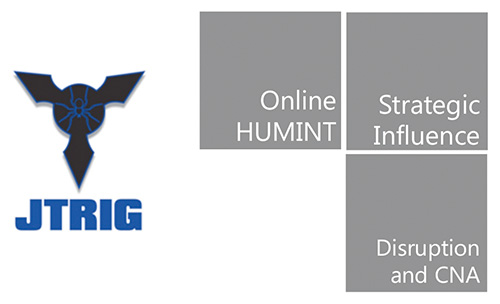
    Pages from top secret documents of the JTRIG program. The scope of JTRIG’s mission includes using “dirty tricks” to “destroy, deny, degrade [and] disrupt” enemies by “discrediting” them, planting misinformation and shutting down their communications. According to Edward Snowden, these influence programs became a “major part” of GCHQ’s operations by 2010 – the same year the UK government established its Behavioural Insights Team.

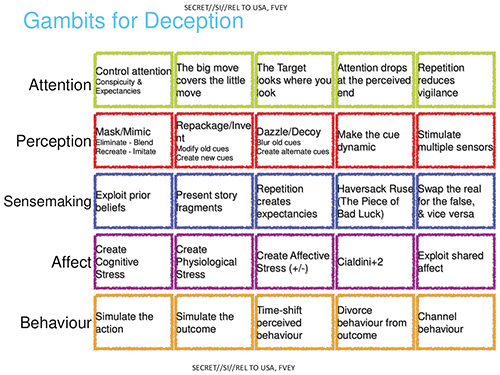
    The techniques include: uploading YouTube videos containing persuasive messages; establishing online aliases with Facebook and Twitter accounts, blogs and forum memberships for conducting HUMINT [human intelligence] or encouraging discussion on specific issues; sending spoof emails and text messages as well as providing spoof online resources; and setting up spoof trade sites. 

    The document goes on to note that “JTRIG provides most of GCHQ’s cyber effects and online HUMINT capability.” GCHQ’s mandate is huge: the whole of Europe, and likely well beyond. It is difficult, therefore, to grasp the potential scope of JTRIG. Above, we noted the civilian government’s use of behavioural science to manipulate society. The JTRIG documents confirm that operatives also study and employ techniques from the human sciences: 

    HUMINT operations can be grounded in scientific theory and evidence from social psychology (i.e., social cognition, attitudes, persuasive communications, conformity, obedience, interpersonal relationships, trust and distrust, and psychological profiling), including its applications to advertising and marketing, and from criminology (i.e., crime prevention).

    The document’s Annex reveals some of the books in the JTRIG library: The Handbook of Trust Research, Influence: Science and Practice, Hacking the Human: Social Engineering Techniques and Security and Countermeasures. JTRIG lists as, and advises using, the following for propaganda operations: “Using stereotypes; Substituting names/labels for neutral ones; Censorship or systematic selection of information; Repetition; Assertions without arguments; [and] Presenting a message for and against a subject.”

    Meet the Artificial You 

    The Boston Globe reports that the US communications giant Verizon has a Wireless Precision Markets Insights programme that combines GPS, user app downloads and visited webpages to market products to individuals. Yves-Alexandre de Montjoye, a mathematician at MIT’s Media Laboratory, “hopes it will be possible someday to run psychological tests on entire cities or countries, simply by analysing the citizens’ phone records.” The newspaper goes on to explain how the Media Lab’s co-developed Sense Networks use cell phone GPS trails “to track where users go in daily routines – to the supermarket, the mall, nightclubs, museums, or movie theatres.” The programme “aggregates the data to create customized market segments” for people keen on music, sports, etc. Media Lab’s Nathan Eagle says that by studying cell phone records, analysts “get a real-time lens into how the aggregate population is actually behaving… That’s useful for anything from urban planning to public health.” 

    We come full circle with Sentient World Simulation (SWS), a programme that pools all the intelligence collected about you. SWS uses that information to simulate and predict how you would behave under certain social conditions, such as civil unrest, economic shocks or environmental catastrophe. 

    But it goes much deeper. The SWS was developed with military money at Purdue University. It creates a digital mirror-image of the real world, including you and me: our streets, towns and even the weather. In order to anticipate how we would react in real life, programmers do things to the digital us: cut our power supplies, simulate weather disasters, crash the economy, etc. This is useful for counterinsurgency planning and market prediction. 

    Technology researcher Mark Baard writes that the US Joint Forces Command (JFCOM-J9) is “capable of running real-time simulations for up to 62 nations, including Iraq, Afghanistan, and China. The simulations gobble up breaking news, census data, economic indicators, and climactic events in the real world, along with proprietary information such as military intelligence.” Based on the behavioural economics theories of Daniel Kahneman, SWS enables “Military and intel officials [to] introduce fictitious agents into the simulations (such as a spike in unemployment, for example) to gauge their destabilising effects on a population.”

    Solutions: Getting Back to Nature

    Self-empowerment is key to winning the psychological war. 

    Modern socio-economic systems isolate humans, simultaneously forcing us to compete. But humans evolved in cooperative, social networks, not within our current, curious blend of isolation and competition. 

    Researchers Apicella et al. studied the behaviours of Tanzanian Hadza, one of the few surviving hunter-gatherer peoples. They conclude that human social cooperation probably stems from similar societies that existed at the beginning of our species. Contrary to the anti-“communist” propaganda positing that communism and socialism encourage laziness, communal societies like the Hadza enjoy mutual reciprocity. Researchers Shirado et al. note that in such societies, “humans are influenced to cooperate by peer pressure.” So-called capitalist propaganda tries to deny us our instinct for cooperation and self-determination. Likewise, dictatorships like Mao’s and Stalin’s used the appeal of authentic communism to justify their centralised tyrannies.

    Living in worker and community cooperatives is one solution to the crisis of social loneliness. Umberson and Montez write: “Social isolation of otherwise healthy, well-functioning individuals eventually results in psychological and physical disintegration, and even death.” They add that “social scientists have gone beyond evidence of extreme social deprivation to demonstrate a clear link between social relationships and health in the general population.” The authors note that, on average, people with better social networks tend to live healthier and longer lives than their relatively isolated counterparts. 

    Life in so-called primitive societies necessitates time outdoors: growing, hunting, and foraging for food; building and maintaining shelter; travelling to trade with neighbours; and travelling to and from homes and community centres for meetings. Researchers Coon et al. note the “promising effects on self-reported mental wellbeing immediately following exercise in nature which are not seen following the same exercise indoors.” 

    Briki and Majed exposed participants to different virtual reality backgrounds, including red, white and green during exercise in laboratory conditions. The authors attributed enhanced wellbeing, particularly increased relaxation, to the green virtual environment. In terms of real-world benefits, think of how little green exists in our concrete jungles. 

    It’s not just being outside that helps the mind. The physical interaction with natural objects is important. Gladwell et al. note: “people’s connectedness to nature appears to be changing and this has important implications as to how humans are now interacting with nature.” They add that “[b]arriers exist, and it is important that these are considered when discussing how to make exercise in the outdoors accessible and beneficial for all.”

    Conclusion: The Joy of Self-Reliance

    The self-sufficiency of stitching, building, maintaining and growing shelter, clothing and food is also psychologically beneficial. Part of today’s widespread mental malaise can be traced to the lack of process. We buy clothes that have already been made. Purchased food has been grown, picked, packaged and delivered by others. We buy or rent prefabricated houses and pay handypeople to maintain them. Dr Kelly Lambert “found that hands-on work satisfies our primal need to make things and could also be an antidote for our cultural malaise.” Psychology Today notes that “[t]oo much time on technological devices and the fact that we buy almost all of what we need rather than having to make it has deprived us of processes that provide pleasure, meaning and pride.” 

    In addition to its structures, the activities of the sovereign community benefit the human mind and enhance affective wellbeing. Our modern, urbanised living takes us ever further from nature. But human-environmental interactions are important for wellbeing. For example, land reform gives people the chance to grow their own food. Researchers Leake et al. cite the “[c]ompelling evidence of major health benefits of fruit and vegetable consumption, physical activity, and outdoor interaction with ‘greenspace’” that has emerged since the millennium. The physiological benefits include improved cardiovascular function, reduced osteoporosis, increased muscle tones, and exposure to light. Nutritional benefits from the kind of brassicas easy to grow independently (e.g., broccoli, cabbage, cauliflower and kale), include folic and ascorbic acids and cancer preventing nutrients. The mental health benefits of communal gardening include increased serotonin from sunlight exposure, which helps reduce depression; feelings of achievement; self-sufficiency; and integrating into a community and social network. 

    A more recent meta-analysis confirms: “gardening increases individual’s life satisfaction, vigour, psychological wellbeing, positive affect, sense of community, and cognitive function.” It is called “horticultural therapy.”

     Dr. Tim Coles’s new book The War on You can be obtained from online booksellers & www.amazon.com/exec/obidos/ASIN/B08HB68N97.

    [alert type=”general” dismiss=”no”]This article was published in New Dawn 183.[/alert]

    [alert type=”success” dismiss=”no”]If you appreciate this article, please consider subscribing to help maintain this website.[/alert]

    Footnotes

    1. Ian Cobain (2012), Cruel Britannia: A Secret History of Torture, Portobello Books
    2. Quoted and cited in ibid. 
    3. Naomi Klein (2007), ‘The US psychological torture system is finally on trial’, Guardian, www.theguardian.com/commentisfree/2007/feb/23/comment.terrorism
    4. Jeff Stein (2010), ‘CIA brain experiments pursued in veterans’ suit’, Washington Post, http://voices.washingtonpost.com/spy-talk/2010/11/cia_brain_experiments_pursued.html
    5. Richard Thaler and Cass Sunstein (2008) Nudge: Improving Decisions about Health, Wealth, and Happiness, Yale University Press
    6. Cass R. Sunstein and Adrian Vermeule (2008) ‘Conspiracy Theories’, John M. Olin Program in Law and Economics, Working Paper No. 387, https://chicagounbound.uchicago.edu/cgi/viewcontent.cgi?article=1118&context=law_and_economics
    7. Cabinet Office (2012), The Behavioural Insights Team, https://web.archive.org/web/20130320014509/https://www.gov.uk/government/organisations/behavioural-insights-team
    8. Sonia Sodha (2020), ‘Nudge theory is a poor substitute for hard science in matters of life or death’, International Science Council and International Network for Government Advice on Science, www.ingsa.org/covidtag/covid-19-commentary/sodha-nudge/
    9. See the company’s website, www.bi.team/
    10. Mandeep K. Dhami (2011), Behavioural Science Support for JTRIG’s (Joint Threat Research and Intelligence Group’s) Effects and Online HUMINT Operations, Cheltenham: GCHQ, www.statewatch.org/news/2015/jun/behavioural-science-support-for-jtrigs-effects.pdf
    11. Glenn Greenwald (2014), ‘How covert agents infiltrate the internet to manipulate, deceive, and destroy reputations’, The Intercept, https://theintercept.com/2014/02/24/jtrig-manipulation/
    12. Dhami, op cit. 
    13. Ibid.
    14. Ibid.
    15. Mark Baard (2007), ‘Sentient world: war games on the grandest scale’, The Register, www.theregister.co.uk/2007/06/23/sentient_worlds/. Part 2 here www.theregister.co.uk/2007/06/23/sentient_worlds/?page=2 and part 3 here www.theregister.co.uk/2007/06/23/sentient_worlds/?page=3
    16. C.L. Apicella, F.W. Marlowe and N.A. Christakis (2012), ‘Social networks and cooperation in hunter-gatherers’, Nature, 25(7382): 497-501
    17. H. Shirado, F. Fu, J.H. Fowler and N.A. Christakis (2013), ‘Quality versus quantity of social ties in experimental cooperative networks’, Nature Communications, 4: 2814
    18. Debra Umberson and Jennifer Karas Montez (2011), ‘Social Relationships and Health: A Flashpoint for Health Policy’, Journal of Health and Social Behavior, 51: 54-66
    19. J. Thompson Coon, K. Boddy, K. Stein, R. Whear, J. Barton and M.H. Depledge (2011), ‘Does participating in physical activity in outdoor natural environments have a greater effect on hysical and mental wellbeing than physical activity indoors? A systematic review’, Environment Science and Technology 45(5): 1761-72
    20. Walid Briki and Lina Majed (2019), ‘Adaptive Effects of Seeing Green Environment on Psychophysiological Parameters When Walking or Running’, Frontiers in Psychology, 10: 252
    21. Valerie F. Gladwell, Daniel K. Brown, Carly Wood, Gavin R. Sandercock and Jo L. Barton (2013), ‘The great outdoors: how a green exercise environment can benefit all’, Extreme Physiology and Medicine, 2: 3
    22. Carrie Barron (2012), ‘Creativity, Happiness and Your Own Two Hands’, Psychology Today, www.psychologytoday.com/gb/blog/the-creativity-cure/201205/creativity-happiness-and-your-own-two-hands
    23. Jonathan R. Leake, Andrew Adam-Bradford and Janette E. Rigby (2009), ‘Health benefits of “grow your own” food in urban areas: implications for contaminated land risk assessment and risk management?’, Environmental Health, 8(1): S6
    24. Masashi Soga, Kevin J.Gaston and Yuichi Yamaura (2017), ‘Gardening is beneficial for health: A meta-analysis’, Preventive Medicine Report, 5: 92-99

    © New Dawn Magazine and the respective author.
    For our reproduction notice, click here.
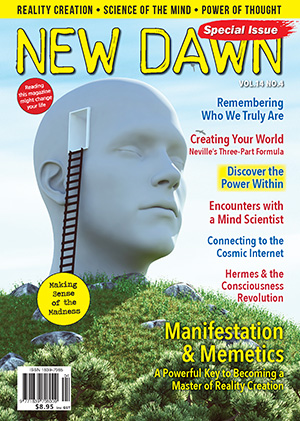
  • Remembering Who We Truly Are in the Face of the Digital Revolution

    Remembering Who We Truly Are in the Face of the Digital Revolution

    From New Dawn Special Issue Vol 14 No 4 (Aug 2020)

    In the Western wisdom tradition, there is a recurrent theme of humanity’s self-forgetfulness. We find it, for example, in Plato, in the Corpus Hermeticum, in Boethius’s The Consolation of Philosophy and in Gnostic texts such as the Hymn of the Pearl. This self-forgetfulness is a forgetting of our spiritual origins, and of the fact that human nature has a transcendent source. The person we ordinarily identify with is not the totality of who we are. This totality includes a spiritual kernel of which we are for the most part unconscious, and yet is nevertheless the foundation of our being, and our relationship to it is the secret of true happiness. 

    The wisdom traditions of both West and East have perennially sought to inculcate awareness of this spiritual kernel, in order to counteract the tendency of humans of all cultural epochs to forget and to neglect our spiritual origins. But where we today differ from cultures of the past is that not only do we suffer from the forgetfulness that is part of the human condition, but we also pay scant attention to the wisdom traditions that seek to rouse us to remembrance. 

    Instead, the whole thrust of contemporary culture is towards distraction, fragmentation and dispersion of consciousness. The Digital Revolution has carried this tendency to an extreme, so much so that if we had deliberately set out to design technologies to induce the distractedness and self-forgetfulness that traditional spirituality has always endeavoured to save us from, then we could hardly have done better. This in turn has led to many of us failing to notice just how corrosive these developments can be to the essential human task of remembering the totality of who we are.

    But as well as inducing distractedness and self-forgetfulness, our technologies are the vehicles of something else, potentially far more detrimental to our wellbeing.

    The Inhuman

    Towards the end of his life, the post-modernist thinker Jean-François Lyotard formulated a question that haunts the times we live in. It lurks beneath the surface of our consciousness, for most of us unarticulated and for that reason all the more menacing. Lyotard had the sensitivity to understand its profound importance, and hence the need to raise it to conscious awareness. The question that he formulated is this:

    What if what is “proper” to humankind were to be inhabited by the inhuman?

    By the ‘inhuman’ we should understand that which is essentially hostile to the human. Lyotard distinguished two kinds of ‘inhuman’ – one is the inhumanity of our social, political and economic systems. The other is the ‘infinitely secret’ inhumanity that invades the soul and holds it hostage. It is this latter kind of inhumanity that is the more insidious of the two, and it is this that, as our relationship with our digital devices becomes ever more intimate, poses the greatest danger to us. For the inhuman is carried towards us by our technologies. 

    While we can stand back from and critique the inhumanity of the social, political and economic systems in which we live, our personal susceptibility to the ingress of the inhuman puts us in far greater jeopardy. This susceptibility has been exploited by the direction that our digital technologies have taken, which has been unwaveringly towards accommodating themselves within the sphere of the human. As they have evolved, they have adapted themselves to the human body as well as to the human soul, becoming physically smaller and lighter and at the same time more powerful and capable.

    The first computers were so large we had to stand in front of them or walk around them in order to operate them. With the invention of desktop computers, it became possible to sit in front of them and engage with them, as it were, face to face. Then it became possible to put computers in our pocket, and now it is possible, with smartwatches and smartglasses, to wear them. At each stage the interface between them and us has become more ‘human friendly’, while at the same time humans have inwardly adjusted to relating to them on a day-to-day, hour-by-hour and even minute-by-minute basis. 

    While the computer has been moulding itself to the contours of the human body and soul, the inner life of human beings has slowly but surely been moulded towards a greater degree of computer-compatibility – affecting our language, our thought-processes and our daily habits. In this evolving symbiosis, in which we have become ever more intertwined with the computer, we have also become more dependent on it. Biological integration is not far away. It is the logical next step. 

    It is of utmost importance, therefore, that we open our eyes to the fact that even though human beings are the inventors, manufacturers and eager consumers of digital technologies, the driving force behind the Digital Revolution is not simply human: the ‘inhuman’ is also seeking to be realised within the human. 

    How are we to characterise this spectre of the inhuman? Human beings have always had the tendency to fall away from their essential nature. For pre-industrial humanity, the danger was conceived in terms of our descending to the animal or bestial level, captives of our untransformed instinctual drives and passions. That, we could say, is to fall beneath the human level: to fall into the sub-human. In our industrial and post-industrial age, the primary danger to our humanity lies less in succumbing to instincts and passions than in succumbing to the cold inhumanity of the machine and the unfeeling, compassionless algorithm. That is to fall into the inhuman. 

    Both tendencies live within us, and both work to undermine the possibility of realising our true human potential, but today it is the peril of the inhuman that we must especially guard against. Its aim is to totally supplant the human, and it will surely succeed, should we fail to ground ourselves in the authentically human. We must wake up to the prospect of the colonisation of the human by the inhuman and, in full awareness of the gravity of the threat posed by the inhuman, consciously take on the challenge of living humanly. 

    To Live Humanly

    What does it mean to live humanly? If the totality of who we are includes a spiritual kernel of which we are for the most part unconscious, then it follows that to live humanly must be to live in greater consciousness of it. It is incumbent on us to strengthen our sense that this spiritual kernel is our deepest and truest self, and therefore the part of us with which we should seek to identify. This requires that we engage in the arduous work of inner transformation, so that those desires, inclinations and deep-seated habits of thought, which draw us away from that essential remembrance, are slowly changed, and become inwardly aligned with what the wisdom traditions tell us is the true centre of our being. 

    This moral effort of turning towards, and rooting ourselves in, the spiritual kernel of who we are also involves a shift in the quality of our thinking. This shift is from reliance on a result-oriented, discursive thinking that runs along from one thought to another, towards giving more value to the stillness and open receptivity of the act of contemplation. Boethius gives the beautiful image of the seekers of truth having to bend their wandering consciousness into a circle and teach their souls ‘to lodge in the treasure house’ at its centre. For there they will find a light, stronger even than the light of the sun, which will illumine their minds from within.

    This ‘contemplative turn’ has always been regarded as the foundation of the spiritual life, but it is of especial relevance to us today. Our technologies are based on the automation of logical analysis, calculation and problem solving, and are fundamentally discursive and result-oriented: they are hyperactive and aim always to output results. By contrast, the act of contemplation brings the mind to a standstill: it is not result-oriented, it cannot be automated, and it can only be engaged for its own sake. It enables us to gain insights into the deeper meaning of things, about which machine thinking knows nothing. These insights can well up from the imaginal world as powerful archetypal images, for contemplative thinking borders on imaginative vision. Equally they can take the form of ideas or intuitions that, like rays of light, illumine a question or life situation from a more comprehensive standpoint. 

    Contemplation is often described as involving the opening of an inner eye of the soul. It is referred to as ‘the mind’s eye’ or ‘the eye of the heart’, and through it we become aware of what is invisible to the physical eye. This more interior source of knowing, which is unconditioned by habits of thought and opinion, could also be described as entailing an opening of the ‘inner ear’ of the soul to the voice of conscience. It can guide us towards a sense of moral certainty about what it is we should or should not do, and to the ideals that can inspire our actions. 

    Aristotle maintained that an action is only fully our own when we have ‘carried back the origin of the action’ to this contemplative part of ourselves, referred to as the nous, or ‘the centre of spiritual intelligence’ within a person. Once it has been carried back to this source, then the action is entirely free because it has been chosen from the centre, rather than from the periphery, of ourselves. 

    In the Western wisdom tradition, the defining characteristic of any action that is truly human is that it is free, precisely because it stems from this originating source. In Aristotle, Thomas Aquinas and Rudolf Steiner, we find this vital tenet reiterated: that we cannot adequately conceive of what it means to live humanly if we exclude freedom. Freedom belongs to the essence of human nature. That is not to say we necessarily live from the essence of ourselves every moment of the day. Far from it! But the trouble is that our digital technologies, because of their tendency to scatter the soul, don’t help us to do this. Rather they introduce a dark undertow with which we must constantly contend, if we are to carry back the origin of our actions to the centre of ourselves.

    This movement back to the centre is the premise of true freedom. It is not given to us on a plate: it has to be won. To become free, we must engage in the work of inner transformation previously referred to, which involves permeating the everyday self and its fantasies, obsessions and desires with the clearly conceived aims that spring from the inmost source of who we are. In Christian mysticism this inner work is called theosis, or ‘making divine’. Another word used to describe it was coined by the Italian poet Dante, who called this inner work ‘to transhumanise’ (trasumanare). The verb ‘to transhumanise’ well expresses the fact that our core human striving must be to overcome ourselves, so that we go beyond the ‘merely human’ life lived at the periphery of who we are. It is a sign of our times that today ‘Transhumanism’ is a materialistic ideology that seeks to technologically ‘enhance’ the human being. Contemporary Transhumanists fail to grasp that to go beyond the merely human can only be achieved by grounding ourselves in the transcendent, and this requires dedicated soul-work, sustained by the spiritual discipline of coming back to the still point at the centre of the circle. 

    As one of the most influential ideologies steering the Digital Revolution, the contemporary Transhumanist movement, shows us the price that the Digital Revolution threatens to exact from us. The price is that we lose our ability to know the meaning and purpose of the spiritual life, we lose even our ability to understand the language that the wisdom traditions use. And ultimately we lose our humanity as, overcome by the collective amnesia regarding what it means to realise our deeper human potential, we succumb to the inhuman.

    The Interiority of Nature

    From nature, too, a price is exacted by the Digital Revolution, which has swamped the natural environment with a complex mix of artificially generated electromagnetic fields. As a result, not just human beings but all living organisms are exposed to levels of electromagnetic radiation far in excess of natural background levels. It would be unwise to assume that this does not have any adverse effect on the wellbeing of living organisms and the ecosystems to which they belong. A growing number of studies show that many organisms are highly sensitive to electromagnetic fields, and that increasing their exposure to them can indeed have demonstrable negative effects. It seems appropriate, at the very least, to extend the remit of the question originally posed by Lyotard to nature and ask: 

    “What if what is ‘proper’ to nature were to be inhabited by that which is hostile to nature? What if the living world were to be infiltrated by a force inimical to life?”

    The rollout of 5G is premised on a further significant increase in the overall amount of radiofrequency radiation to which the planet will be subjected. 5G will help to establish a global ‘electronic ecosystem’ that, in addition to servicing the technological desires and aspirations of city-dwellers living in their ‘smart homes’, will also enable greater monitoring and control of natural ecosystems and living creatures. It involves the insertion of the electronic ecosystem into these natural ecosystems, in order to create a ‘smart planet’.

    The Western wisdom tradition has long acknowledged two aspects of nature: visible and invisible, or manifest and unmanifest. The physical forms that we perceive in the world around us arise from non-perceptible creative and formative forces, which must be taken into account if we are to grasp things in their wholeness. It is these forces which carry the energies of life, just as surely as electromagnetic radiation opposes them. One of the challenges we face today is to overcome our collective de-sensitisation to these subtle life-forces. 

    One step towards doing so is to free ourselves from the dominant utilitarian stance towards nature, which prioritises data-collection and analysis and ever seeks practical results, but is closed to nature’s interiority just as it is closed to the interior of our soul-life. A different kind of consciousness is needed – more receptive, open and empathetic. Regarding this different kind of consciousness, Goethe advised:

    Our full attention must be focused on the task of listening to nature, to overhear the secret of her process.

    All of creation speaks of a transcendent spiritual intelligence at its source, if only we are able to hear it. The mystical path to union with God has long been understood to lead from the loving contemplation of creatures to the contemplation of this greater spiritual intelligence from which they issue, and on which they, like we, ultimately depend. For human beings to forget or neglect this relationship of nature to the divine is as serious a failing as it is for us to forget our relationship to the spiritual intelligence that dwells within us. To put it in Christian terms, the same Cosmic Logos lives at the very heart of both nature and the human soul. 

    Contemporary conditions make it very difficult for such perspectives to be taken with the seriousness they deserve. The incursion of the inhuman has allowed the utilitarian mind to break free of the moral and spiritual constraints that once kept it in bounds. But with the burgeoning electronics industry and the drive to forge a ‘smart planet’, a force hostile to nature insinuates itself into nature’s heart. These developments make nature vulnerable to increasing technologisation, one example of which is the fabrication of completely new synthetic organisms using computer programmes. Another example is the design of remotely controlled robot bees to replace the dwindling number of living bees. Such interventions are only the beginning of a vastly ambitious project to redesign the world to satisfy the requirements of a ruthlessly technological consciousness that has lost all connection with its spiritual roots. This consciousness has no sense of the sacredness of life, nor of the spiritual responsibilities of human beings towards nature.

    Foremost amongst these responsibilities is the obligation to know things in the truth of their being. Of all creatures on Earth, it is human beings alone who have the possibility of selflessly entering into the inner nature of another creature, without seeking to use or exploit it for our own ends. We alone can place ourselves imaginatively and empathetically into the being of another and, through opening the inner eye of the mind, or heart, we have the possibility of beholding the other in their truth. If we can regularly practice this, then we can help to build up a ‘spiritual ecosystem’ that can counterbalance the deathly ‘electronic ecosystem’ currently being established, for our mode of knowing can contribute something positive and life-affirming to the world. It can be a deed of illumination, which gives to nature the gift of our conscious recognition of its sacred ground. 

    Human beings and nature belong together. The struggle for a human future is at the same time a struggle for nature’s future. Just as we depend on nature for our survival, so too does nature depend on the quality of our knowing and relating, through which we may bring spiritual light to the world. 

    The above is slightly abridged and reprinted with permission of the publisher from the Introduction of Jeremy Naydler’s book Struggle for a Human Future: 5G, Augmented Reality and the Internet of Things (Temple Lodge Publishing, 2020). Available from all good bookstores and in Australia from www.rudolfsteinerbookcentre.com.au.

    Jeremy Naydler is the author of two articles on related subject matter that were recently published in New Dawn: ‘Machine Intelligence & Human Intelligence: What is the Difference?’ (New Dawn 170) & ‘5G: The Final Assault’ (New Dawn 173).

    [alert type=”general” dismiss=”no”]This article was published in New Dawn Special Issue Vol 14 No 4.[/alert]

    [alert type=”success” dismiss=”no”]If you appreciate this article, please consider subscribing to help maintain this website.[/alert]

    Footnotes

    1. Lyotard, The Inhuman: Reflections on Time, p.2.
    2. Ibid.
    3. Boethius, The Consolation of Philosophy, 3.11, poem. 
    4. The concept of the ‘inner eye’ goes back to Plato’s Republic, 7.4: 518c-d, where he describes how this invisible organ enables us ‘to look straight at reality, and at the brightest of all realities, which is what we call the Good’. Through St. Augustine, De Trinitate, 9-13 (see especially 12: 22-24), Plato’s teaching concerning the inner eye entered the mainstream Christian tradition.
    5. Aristotle, Nicomachean Ethics, 3.3.17 (1113a17). 
    6. Steiner, The Philosophy of Freedom, p.140: ‘We cannot, however, think out the concept of man completely without coming upon the free spirit as the purest expression of human nature. Indeed, we are human in the true sense only in so far as we are free.’ 
    7. See also Aristotle, Nicomachean Ethics, 3.3.15-18 (1112b32-1113a9); and Thomas Aquinas, Summa Theologiae, 1a2ae: 1.1-4. ‘The whole of this transformation of the human being is summed up by the Fathers in the celebrated formula, “God became man in order that man might become God”.’ Clément, The Roots of Christian Mysticism, p.263.
    8. Dante, The Divine Comedy: Paradise, 1.70. 
    9. See Chapter Three, p.9 with note 22.
    10. See Chapter Three, notes 21, 23, 26 and 42.
    11. A distinction was commonly made, from the early thirteenth century on, between Natura natura-ta (literally, nature ‘natured’) – the forms we perceive in the world around us – and Natura natur-ans (literally, nature ‘naturing’) – the invisible formative forces that unfold into manifestation. 
    12. Goethe, ‘Problems’ (Probleme, 1823), translated in Miller, Goethe: Scientific Studies, p.44.
    13. As Goethe said: ‘The works of nature are like a freshly spoken word of God.’ Letter to the Duchess Louise von Saschsen, 28 December, 1789, quoted in Steiner, Goethe the Scientist, p.198. Compare with Meister Eckhart who affirmed: ‘All things speak God. What my mouth does in speaking and declaring God is likewise done by the essence of a stone.’ Sermons and Treatises, Volume 1, Sermon 22, p.178.
    14. See, for example, Bonaventure, The Mind’s Road to God, pp.20-21. This ‘theophanic view of nature’ is discussed more fully in Naydler, The Perennial Philosophy and the Recovery of a Theophanic View of Nature
    15. The creation of the first synthetic life-form was achieved in 2010 by Craig Venter, based on digitised DNA code. Venter tellingly said at the time: ‘It is the first species on the planet to have its parent be a computer.’ BBC News, 20 May, 2010.

    © New Dawn Magazine and the respective author.
    For our reproduction notice, click here.
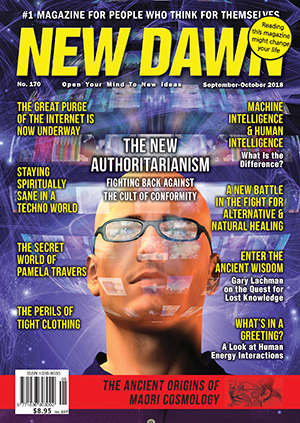
  • UNPLUG: Staying Spiritually Sane in the World of Advanced Technologies

    UNPLUG: Staying Spiritually Sane in the World of Advanced Technologies

    From New Dawn 170 (Sept-Oct 2018)

    When I was sixteen our family moved to western Kentucky, about sixty miles from the Abby of Gethsemani where the famous Trappist (Cistercian) monk Thomas Merton lived. I became acquainted with Merton the year before when I read No Man Is An Island – the book had a significant impact on my spiritual journey. Within months, my mother, father and I decided to spend a day at the Abby. I remember we turned off the main highway onto a winding tree-lined road, suddenly after crossing over a small hill, a steeple-cross appeared in the distance, and we were in the most serene setting I had ever been in. That day marked a major transition in my spiritual life.

    After that day at the Abby I entertained becoming a monk, but circumstances would lead me away from the monastic life. Although I never pursued becoming a monk within a community, I would spend the rest of my life periodically going on retreats in monasteries and retreat centres. It was at the Abby of Gethsemani some twenty-five years later I had a religious calling while on retreat that eventually led me into the Priesthood. 

    In the oncoming years, I studied a variety of meditational practices, beginning with Christian contemplation in which I focused on a religious icon or sacred symbol incorporating the image and the attributes into my spiritual self. This meditation led to Kabbalistic pathworking meditation, Buddhist Diamond meditation, Transcendental Meditation, chakra meditation, and finally settled on mindfulness meditation and Qi Gong. Decades later I incorporated Passage Meditation into my practice. I used several of these meditational practices to reduce stress and anxiety with myself as well as my psychotherapy clients, and currently use them with clients in spiritual direction. With these meditational practices I eventually developed a secular contemplative lifestyle that keeps me connected to the sacred as well as keeping me balanced and sane when it comes to new technologies. 

    Staying Spiritually Sane in the World of Advanced Technologies 

    It took many years of intense work for me to develop a contemplative lifestyle amid my work as a psychotherapist, priest, writer and adjunct professor. The challenge in developing a spiritual lifestyle in our changing world of advanced technologies is to commit to a daily routine and practice. One needs to create an internal personal and outer physical environment that allows one to disconnect from the world of technology. Contemplative practices facilitate and promote this type of setting, and they all come from the world’s religious and spiritual traditions. 

    These traditions promote a calmer, quieter and relaxing environment in which one can experience an inner focus, a calmer mind, a balanced life and a profound change in conscious awareness. The contemplative practices that achieve this type of lifestyle include inner reflection, centring prayer, imaginary journeying, sacred reading, journal writing, Qi Gong, contemplation and all types of meditation. 

    To understand the foundations of contemplative lifestyles, one needs to know where they derive. All contemplative practices come from religions and spiritualities. There are major differences between these two concepts. According to Timothy Freke,1 religion focuses on “rituals, observances, creeds and codes of social morality.” Religion also centres on major “life transitions such as birth, marriage and death with appropriate rites that bind together a community. Religion is the outer form of spirituality,” which is a personal journey of transformation. Within this context, spiritual practices are used to transform a person’s inner life from baser needs into higher needs. To attain this inner transformation, spiritual practices such as prayer, contemplation and meditation are used. However, it is “possible to be religious without being spiritual,” such as “many people piously participate in religious customs without ever understanding a personal journey of spiritual transformation. Fundamentalism of all religious persuasions,” including scientific materialism and scientism with its “insistence on blind faith in dogmas, is religion without spirituality. This is why it divides people rather than uniting them.”

    On the other hand “spirituality is the inner content of all religions, but it does not necessarily have to have a religious context. Spirituality is about setting out on a personal journey of transformation, searching for answers to the most profound questions of life.” In this context, “spirituality is a journey of awakening to who we really are; a journey of opening the heart to the love that permeates the universe; a journey from confusion to meaning; a journey from fear to faith” (faith meaning trust); “a journey from” malaise or dissatisfaction “to a life filled with magic and wonder; a journey from feeling alone in a hostile world to being one with everyone” and everything, a journey into the awakening that all existence is an interconnected whole, in essence, a journey from fragmentation into wholeness or oneness.2

    As stated, contemplative practices are significant components of both religion and spirituality in the development of a personal spiritual lifestyle. A contemplative lifestyle is a life of spiritual unfoldment coupled with the experience of spiritual oneness. Spiritual unfoldment is the process of becoming aware of one’s spiritual nature and aware of the spirit within. Spiritual oneness is the recognition that everything that exists is part of one grand experience, and within that grand experience everything is interconnected or interdependent. Within the experience of spiritual unfoldment and oneness, there is a personal awareness of a divine presence within one’s self and outside of one’s self; this awareness is totally absent in Artificial Intelligent (AI) machines. 

    To live and develop a contemplative lifestyle one cultivates a daily spiritual practice with methods and techniques that open one to become consciously aware of their connection with all existence. The various contemplative practices cited above facilitates conscious awareness and being mindful of the present moment. However, Passage Meditation or PM is a special type of meditation because it is a multi-sectarian practice appealing to both the religious and the non-religious. 

    PM uses mindfulness, wisdom passages and a mantram to centre and keep a person balanced and calm. In this practice, one chooses a wisdom passage from the world’s wisdom traditions and memorises it. During meditation, the meditator says each word in the passage, one word at time, which brings the meditator into the present moment. The passage is repeated over and over for 30 minutes. Then, throughout the day, the meditator says a mantram over and over to keep calm and balanced. The mantram one chooses can be as simple as saying Buddha, St. Frances, Om, or just the word calm over and over. One interesting result of PM is over time the meaning of the wisdom passage becomes incorporated into the meditator’s spiritual life – they become one with the passage. 

    Religion and spirituality have always been major parts of my life as well as science. With science, Einstein had a deep impact on me, especially when it comes to how I understand the connections between religion and science. The moving statement from Einstein that became a beacon for me was “Religion without science is blind. Science without religion is lame.” These words have guided me through my years in scientific research as well as my perceptions of religion and spirituality. 

    In our contemporary world with advanced technologies we have forgotten what Einstein’s words really mean. It takes both of these areas working together and in harmony to keep us balanced as we move into the world of advanced technologies. We already see negative results of these technologies. People are unconsciously becoming addicted, dependent, obsessed, angry, frustrated and anxious with the Internet and technologies in general. If we can’t keep ourselves balanced as we use the technologies we already have, then how are we going to react to new advanced technologies that are now creeping into our lives. Because of these technologies, our spiritual selves or the core that makes us human is fragmenting. 

    This fragmentation is the result of awareness lag. Awareness lag is a phenomenon in which our awareness lags behind the rapidly changing technologies prohibiting us from adequately adjusting to these innovations and inventions. In this phenomenon, we don’t know what to do with our lives or whom to trust because we are blind-sighted by the rapid changes affecting our lives – we simply can’t adjust. We have not prepared for the present or the future, and we don’t understand what is happening and we don’t know where advanced technologies are leading us. 

    Because our awareness lags behind our rapidly changing world, we are overloaded with useless information. By the time we understand what is happening and able to sort through the data, it’s too late because new AI technologies such as smartphones, robotics and the Internet have taken over our lives. Awareness lag can be addressed by slowing down one’s daily pace by using contemplative practices that allow us to be in the moment so we can centre ourselves, freeing our minds, allowing us to understand the direction our lives are heading and what is happening in our existential world. 

    Advanced Technologies Shaping our Spiritual LiFe

    The current technologies that are responsible for fragmenting and overwhelming us are smart TVs, advanced computers, smartphones, robotics, and self-driving vehicles with their accompanying AI algorithms. These technologies are taking us away from intimate face-to-face interactions as we lose sight of our humanness. Many people are becoming lost in these virtual AI realities, and many can’t distinguish the virtual world from the real world. The image of your wife on your smartphone is not your wife, but photons and electrons arranged by AI algorithms creating specific human-like patterns. People mistake the virtual world for the real world, which furthers spiritual fragmentation. Although these technologies add conveniences to our hectic lives, our spiritual selves are suffering. 

    Current technologies are just the tip of the iceberg when it comes to spiritual fragmentation because these new technological innovations seeping into our lives will create more alienation and fragmentation. The following five technologies are destined to change and reshape humans forever. However, to maintain our sense of humanness, there are ways to sustain our spiritual connections through contemplative practices. These practices will keep us centred and in the present moment as we adjust to the radical changes that are here and those that are coming as a result of quantum computers, artificial intelligence (AI), robotics, nanotechnology and gene editing tools.

    The major invention that will be here soon is the quantum computer that uses quantum mechanical phenomena such as superposition and entanglement to perform operations on data. Quantum computers are very different from our conventional computers because the storage capacity is enormous and speed is exponentially faster. This computer with its quantum effects will further fragment our core selves because it will change our reality into something unforeseen.

    Artificial intelligence, also called synthetic intelligence or Machine Learning (ML), is the ‘intelligence’ exhibited by machines or software. Quantum computers will use and control AI programming with unanticipated consequences. There are four types of AI and the first two are already here on your smartphones and self-driving vehicles.  

    Type I AI is purely reactive and is in the category of narrow or weak AI, and is the most basic form. According to an infographic by the website Futurism.com, “It perceives its environment” or “situation directly and acts on what it sees. It doesn’t have a concept of the wider world” and “can’t form memories or draw on past experiences to affect current decisions.” This type of AI is very specialised and was the basic programming for “IBM’s Deep Blue” that “beat [Garry] Kasparov at chess.”3

    Type II AI is called limited memory and is a category of general AI, but currently has very limited decision-making capabilities. This type of AI takes portions “of past information and adds them to its preprogrammed representations of the world,” and “has just enough memory” or experience “to make proper decisions and execute appropriate actions.” Type II examples are self-driving vehicles, chatbots and personal digital assistants. Personal digital assistant is a term for small, mobile, handheld devices that provide computing and information storage and retrieval capabilities for personal or business use, often for keeping schedules, calendars, and address book information. The latest innovation is scheduling using AI voice interactions in which one cannot distinguish between the AI voice and a real person.4

    Type III AI is called theory of mind, an advanced type of general AI that will have the capabilities “to understand thoughts and emotions affecting human behaviour.” This type of AI hypothetically will “comprehend feelings, motives, intentions and expectations” as well as the ability to “interact socially.” However, Type III is “yet to be built,” but will “likely be the next class of intelligent machines.” Examples are C-3PO and R2D2 from the movie Star Wars.5

    Type IV AI is self-aware and “can form representations about themselves,” which is “an extension of the theory of mind.” It is Type IV AI that troubles many in the AI field, a fear that intelligent machines could render humans obsolete or even eliminate humans altogether. Type IV would be aware of “internal states” and “predict the feelings of others.” It will be able to “make abstraction and inferences.” This type of AI is “the future generation of machines” with “super intelligent, sentient and conscious” capabilities but not on the human scale. No machine will fully exhibit humanness. How can you program true emotions, intuitions, hunches, leaps of insight, spiritual transcendence and numinous states into a logical structure – you can’t – because we don’t really understand these experiences and humans are both logical and non-logical – machines are only logical. An example of Type IV would be Eva in the 2015 movie Ex Machina.6

    Robotic systems are mechanical or virtual artificial agents; usually an electro-mechanical machine guided by a computer program such as AI, including machines resembling a human being, and able to replicate specific human movements and functions automatically. These AI machines will eventually take over most of the work presently performed by humans.7 As robots continue to take over many jobs in the workforce, stressing the human psyche, the result is spiritual fragmentation and a loss of internal cohesion.

    The next technology is nanotechnology, also called atomically precise or manufactory machines. These machines are created by the manipulation of matter on the atomic, molecular, or supramolecular scale. The earliest description of nanotechnology refers to the particular technological goal of precisely manipulating atoms and molecules for fabrication of macroscale products, now referred to as molecular nanotechnology.8 These small micro-machines are similar to robots and they will take more jobs from humans, further fragmenting our core selves.

    CRISPR-Cas9, or CRISPR, is a gene-editing tool. The word CRISPR stands for “clusters of regularly interspaced short palindromic repeats.” It is a specialised region of DNA with two distinct characteristics: the presence of nucleotide repeats and spacers. Repeated sequences of nucleotides, the building blocks of DNA, are distributed throughout the CRISPR region. CRISPR is the first genome-editing tool that is faster, cheaper and more accurate than previous techniques for editing DNA, and has a wide range of potential applications. CRISPR is the protein with their RNA guide that finds the area in the DNA to be edited. The Cas9, also a protein, is the editing component that snips and removes the DNA allowing the DNA to be restructured. 

    CRISPR-Cas9 enables geneticists and medical researchers to edit parts of the genome by removing, adding or altering sections of the DNA sequence. It is currently the simplest, most versatile and precise method of genetic manipulation.9 This technology will reshape us physically as well as mentally, further fragmenting our humanness. However, on the upshot, this technology may offset human extinctions due to superintelligent machines creating new forms of humans, but that would also contribute to spiritual fragmentation. 

    Unplugging

    Contemplative practices facilitate a calmer mindful environment. Mindful in this context is the ability to focus attention in the here and now by controlling distractions. Being mindful also means taking time for what really matters in your life by being conscious or aware of where your attention is focused, and what you are doing and feeling. In a mindfulness mode of awareness, you are being sensible, accepting and non-judgmental of what is going on in the present moment and being attentive to your emotions, thoughts and sensations. 

    An example of how mindfulness is used in one’s daily life is to take the time and move into the present moment. Take a few minutes and settle down becoming mindful in the moment, either in front of the technology you are using, or in the room you are in, or what’s going on around you, and focus on your present experience. Close your eyes, take a few deep breaths, and relax. What are you feeling? Are you frustrated, angry, anxious or happy, content and at ease? What are the smells in the room you are in? Are they pleasant or noxious? What are you thinking, is it something specific or non-specific? Where you are sitting, are you comfortable? Do you have aches, pains, itches, tingling sensation or a subtle calmness throughout your body? What do you hear? Do you hear natural sounds such as birds singing, traffic sounds or undefined sounds? Are you comfortable or tense being where you are now? Be mindful of these sensations and experiences for a few minutes. Now slowly move your awareness back into the everyday world. 

    Being mindful in our world of advanced technologies is essential in reducing awareness lag, technology addiction, obsession and dependence by keeping yourself calm, balanced and centred. In this regard, approach all technologies with a mindfulness perspective. Before turning on your computer or any other communication device, sit for a few minutes in front of the technology and close your eyes and focus on your breath going into your lungs and your breath going out of your lungs. On the in-breath, say to yourself “I am calm,” and on the out-breath say to yourself “and I’m at peace.” By sitting in front of your computer or any technology performing a meditation, you centre yourself before being exposed to the Internet, email or Facebook. When you are on a computer or any technology, pay attention to your thoughts, feelings and emotions – if you become anxious, frustrated or angry, stop, take time out and meditate to centre yourself. I say the Buddhist Metta Prayer before turning on my computer to centre and calm myself.

    When on the Internet, selectively pay attention to what you are viewing, and how much time you spend on each such as e-mails or Blogs. While on the Internet, or using your smartphone or on Facebook, always pay attention to your emotions – are you angry, frustrated, happy or in an upbeat mood. In being mindful, do not surf the Internet without a specific goal, always be aware of where you are emotionally. After viewing, take a short 10-minute rest period, re-centre yourself by doing something non-technical or just sit and meditate. At the end of the day, turn off your computer and smartphone, prepare to rest, and relax before going to bed. Take control of technologies and don’t let technologies take control of you because this helps to prevent technology addiction, obsession and dependence. By being mindful, you avoid spiritual fragmentation by moving into a state where your life has purpose and meaning. I control my time at the computer by turning it off each day around 6 PM, and on most Friday afternoons I turn the computer off – in most cases, I don’t turn it back on until Monday.

    Once you have created a mindfulness set of practices in working with technologies, it is time to broaden your contemplative lifestyle to assure you have purpose and meaning in your life. To achieve a contemplative lifestyle and keep yourself mindful and centred, take a no-technology day by limiting your use of technology. As the five advanced technologies discussed earlier take centre stage in our global world, we need time to connect to our humanness – finding meaning and purpose in our life. We ask ourselves, what really matters in my life? It’s not these advanced technologies; it’s our connections with ourselves and with other people, the beauty of a sunset, the songs of birds, the simple evening meal with our loved ones – meals where cell phones are forbidden. When loved ones eat together, there needs to be a rule – no cell phones and no texting, only face-to-face communication – we are humans not AI-driven robots. Find a day you can set aside to reconnect with yourself or life partner or family.

    On the no technology day, UNPLUG and choose the technologies you want to UNPLUG from. I set aside all technologies except for the CD player in which I only play slow relaxing music and Gregorian Chants. Before bed, I may watch a non-violent commercial free movie for a short time and then turn on the Music Choice channel and fall to sleep listening to Soundscapes. As you UNPLUG from your hectic consumer driven materialistic outer life, you will begin to engage in quiet time, listening to slow relaxing music in the background, reading poetic stories or spiritual reading also called lectio divina. Throughout the day, sit and relax by centring yourself in the calmness of meditation. DO NOT THINK ABOUT THE PAST OR THE FUTURE; ONLY BASK IN THE PRESENT MOMENT. 

    Conclusion

    I have found the contemplative lifestyle centring and rejuvenating. Setting aside one day in which I can reflect on what has meaning and purpose in my life is very fulfilling. What’s fulfilling are not new technologies, buying things I don’t want or need, but the interconnections with friends, family and everything around me. It’s our face-to-face human communications with each other that is important, not the phony one-sided view of a person on Facebook. You will never honestly get to know that person electronically; it’s only in our flesh and blood interaction one gets to know a person. 

      If we are not mindful and acutely aware, new advanced technologies will take total control of our life, rendering us pawns in a world of fragmentation. We end up shallow, with no real meaning and purpose in our life. The antidote is to cultivate a contemplative lifestyle using various mindfulness practices such as Passage Meditation and simply UNPLUGGING. 

    [alert type=”general” dismiss=”no”]This article was published in New Dawn 170.[/alert]

    [alert type=”success” dismiss=”no”]If you appreciate this article, please consider subscribing to help maintain this website.[/alert]

    Footnotes

    1. Encyclopedia of Spirituality: Information and Inspiration to Transform your Life by Timothy Freke, Godsfield 2000, 152
    2. Ibid.
    3-6. https://futurism.com/images/types-of-ai-from-reactive-to-self-aware-infographic/
    7. Rise of the Robots: Technology and the Threat of a Jobless Future by Martin Ford, Basic 2015 
    8. Radical Abundance: How a Revolution in Nanotechnology will Change Civilization by K. Eric Drexler, Public Affairs 2013
    9. A Crack in Creation: Gene Editing and the Unthinkable Power to Control Evolution by Jennifer A. Doudna & Samuel H. Sternberg, Houghton Mifflin Harcourt 2017; also see Brett Lothian’s article ‘The Rise of Homo Technicus’ in New Dawn 169.

    © New Dawn Magazine and the respective author.
    For our reproduction notice, click here.
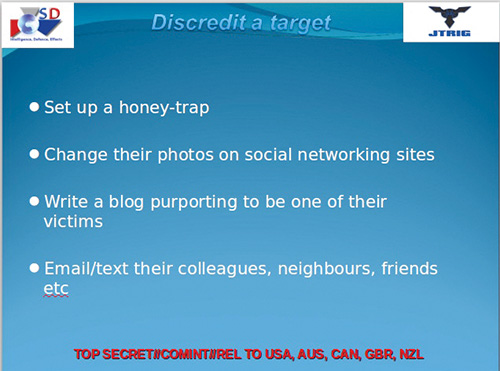
  • I Refuse to be Microchipped

    I Refuse to be Microchipped

    From New Dawn 175 (Jul-Aug 2019)

    If current trends continue, within the next 20 years, almost everyone will be microchipped and dependent on electronics for their survival. Unless we start counter-acting on it now. 

    I am going to quote from three different articles to show that is indeed the direction we are headed before I explain why I won’t be microchipped, implanted or otherwise tracked or made dependent.

    A few quotes from the article ‘People in Sweden Are Upgrading Their Hands, and It Makes Us a Little Scared’:

    Many people in Sweden have been starting to get chipped since the spring of 2018. People get a chip surgically inserted between their thumb and index finger which then replaces all plastic cards, keys, and other things that people usually have to carry with them. And if last year around only 100 people had these chips, then now, according to the Daily Mail, this number has risen to more than 4,000 people and it’s still growing.

    It replaces all electronic wallets, bank cards, travel cards, and different key cards. You can use it to pay by simply touching a terminal with your hand. 

    It’s as small as a grain of rice.

    Its price together with the procedure is $180. Some companies even offer this service to their employees.

    Sceptics think that first of all, nobody can guarantee that the personal information contained in these chips will be confidential. Second, some people are sure that these chips will soon have GPS trackers in them.1

    A recent article in the New York Times was titled ‘“Big Brother” in India Requires Fingerprint Scans for Food, Phones and Finances’:

    Seeking to build an identification system of unprecedented scope, India is scanning the fingerprints, eyes and faces of its 1.3 billion residents and connecting the data to everything from welfare benefits to mobile phones.

    For other countries, the technology could provide a model for how to track their residents.

    The government has made registration mandatory for hundreds of public services and many private ones, from taking school exams to opening bank accounts.2

    And here’s an article from the Guardian, ‘Alarm over talks to implant UK employees with microchips’:

    Britain’s biggest employer organisation and main trade union body have sounded the alarm over the prospect of British companies implanting staff with microchips to improve security.

    UK firm BioTeq, which offers the implants to businesses and individuals, has already fitted 150 implants in the UK.

    The tiny chips, implanted in the flesh between the thumb and forefinger, are similar to those for pets. They enable people to open their front door, access their office or start their car with a wave of their hand, and can also store medical data.3

    The first article claims that microchips do not have GPS trackers in them, but it’s easy to add trackers as that’s already done on animals and soon to follow with employees. Not to mention that most of us already have GPS trackers on them – our phones! In some areas of the world, GPS tracking implants are already being offered for children. “Don’t want to lose your child? Implant a GPS tracker!”

    The reason I believe this development is almost inevitable is that not enough people are speaking up against it. The entire country of India, more than a billion people, simply accepted the fact that they can now no longer buy or sell without electronic identification. A lot of people have a positive view of it. The first article above mocks people who are sceptical of it, implying that we are old-fashioned. Some of the online hashtags used by those who got microchipped reveal positive imagery they associate with it: Cyborg, Biohacker, Bodymod and Digiwell are just a few. 

    In other words: “Getting chipped makes you a Superhuman Android!”

    There are numerous reasons I won’t allow myself to get microchipped or implanted. Nor will I allow all of my data to be stored in one place. Nor will I make all of my buying and selling dependent on one device or on electronics. If someone pulls the plug, where does all the money go? Having all activities, purchases, sales, movements stored and tracked in one place makes a person exploitable, controllable and hopelessly dependent. There is nothing old-fashioned about not wanting to be a slave to technology. That’s reason number one.

    Reason number two is more metaphysical: Metals and electronics interfere with my spiritual energy-field. As if it’s not enough to be surrounded by laptops, cell phones and broadcasting towers at all times almost everywhere in the world, you won’t connect my body to electronic devices! It’s not going to happen.

    Reason number three: I don’t like what happened in India, where fingerprinting in exchange for all sorts of services was made mandatory. That’s only one step shy of making microchipping mandatory. The problem lies in the “mandatory.” When someone tries to force me to do something, I reject it.

    Reason number four is that this was predicted as something undesirable, thousands of years ago. Even people such as myself, who are not particularly religious, are aware of this passage from the Bible:

    It also forced all people, great and small, rich and poor, free and slave, to receive a mark on their right hands or on their foreheads, so that they could not buy or sell unless they had the mark, which is the name of the beast or the number of its name. This calls for wisdom. Let the person who has insight calculate the number of the beast, for it is the number of a man. That number is 666.
    – Revelation 13:16-18

    My interpretation of the number 666 is the Internet’s world wide web. In Hebrew Gematria, the letter w has the value 6. Therefore, 666 can be translated as www. In other words, anyone who isn’t connected to the world wide web through his right hand won’t be able to buy or sell. 

    Does this mean I believe there will come a time that I will barely be able to survive because I refuse to be microchipped? A time where I have to go underground and join a resistance or militia, scrambling for food and shelter? No. That’s not the timeline I choose. Anyone who knows my writings also knows that I believe we can choose our own reality by making the right, conscious choices. And I am going to choose one where I stay microchip-free and continue to live a wonderful, healthy, wealthy and fun life. 

    Should the day come when they try to force this stuff on free people, that is going to create a gigantic black-market and currency systems that are independent of banks. We will learn to trade amongst each other again. 

    [alert type=”general” dismiss=”no”]This article was published in New Dawn 175.[/alert]

    [alert type=”success” dismiss=”no”]If you appreciate this article, please consider subscribing to help maintain this website.[/alert]

    Footnotes

    1. www.brightside.me/wonder-curiosities/people-in-sweden-are-upgrading-their-hands-and-it-makes-us-a-little-scared-644110/
    2. www.nytimes.com/2018/04/07/technology/india-id-aadhaar.html
    3. www.theguardian.com/technology/2018/nov/11/alarm-over-talks-to-implant-uk-employees-with-microchips

    © New Dawn Magazine and the respective author.
    For our reproduction notice, click here.