New Dawn – World's Most Unusual Magazine

Category: Technology/Mind Control

  • Weapons of Mass Distraction: The Media, Advertising & Social Programming

    Weapons of Mass Distraction: The Media, Advertising & Social Programming

    From New Dawn 151 (Jul-Aug 2015)

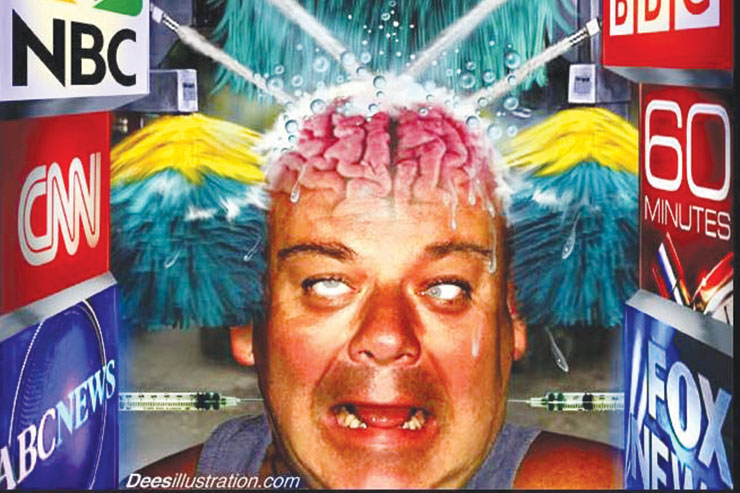
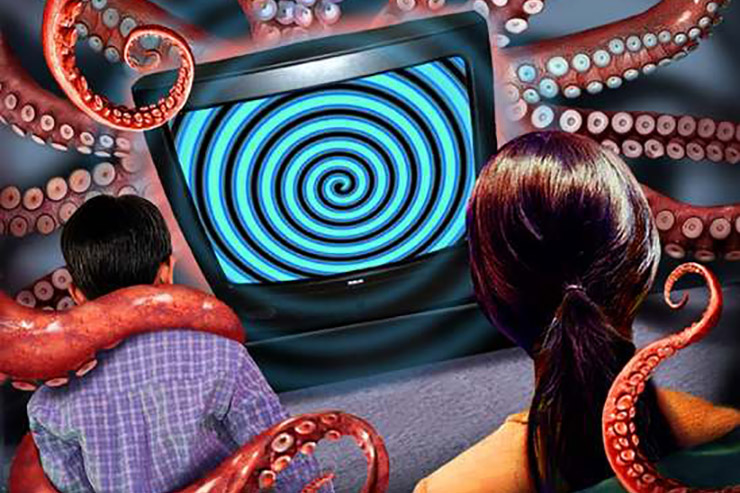
    The mass media is the biggest remote control ever built, and we all exist within the four-walled idiot box it controls. Manipulation of thought and behaviour is a part of our accepted daily lives. Each time we lock eyes on a news story, whether on the tube, the screen, the tablet or the old fashioned way, via a newspaper, we are buying into a perspective that may or may not be our own. We read stuff, and readily accept it as reality, often without ever bothering to source the information or take the time to perform due diligence and research the subject more deeply. We then pass on some of that information to others, and the viral effect can now, with the Internet and cell phones, travel on a global scale in a matter of minutes.

    If you wanted to truly control the minds of the masses, what better way than buying time on the media outlets the masses most visit? And the most effective types of media most able to manipulate our behaviour and change how we think… and even consume? News media, advertising… and now, social networking.

    Get ready to have your channel changed, because with the sheer amount of social programming faced on a daily basis, you are no longer in control of your own remote.

    Media Manipulation

    It’s all bad news, all the time. The stories that bombard us on television, radio and even social networking often tend to be depressing, fearful and anxiety provoking… and they spread like wildfire. But we all know that good things happen in the world. Why then does the media love to focus on the blood, gore and violence? Because we respond to it, that’s why.

    Negative news stories dominate the news because we are hard-wired to respond more to them. It’s simple brain science, really, and harkens back to our days of needing every bit of news we could find in order to guarantee our survival. And much of that news involved FEAR. Predators, lack of food and water, bad weather, other nasty humans… our primitive brain responds to bad news because at one time we needed to know it all. Who cared about the good stuff when there was a chance of death around every corner?

    In his book Secret Societies and Psychological Warfare, author Michael A. Hoffman brings up a strong point for the hypocrisy and mixed messages the media sends, especially when it comes to two of the viewing audience’s favourite things – sex and violence.

    “Have you ever noticed how television and print media will scream themselves hoarse in news documentaries, editorials and heavy analytical pieces about ‘rising pornography, crime, violence, gunplay’, etc? And yet in the same TV Guide announcing the latest special on ‘The Crisis of Sex and Violence’ will appear an advertisement for Miami Vice, the ‘show that brings you the action and excitement you’ve come to expect’, etc. Or your newspaper will condemn sex and violence in the loftiest terms but there in the entertainment section is a half-page advertisement for a new ‘action’ movie accompanied by a photo of women in string bikinis and high heels fondling automatic pistols and machine-guns.”

    Hoffman calls this the Double-Mind of mass media, and we are all guilty of buying out of, and right back into, each of the two minds… the one that repels and the one that accepts. The use of images to alter our emotions is an age-old way of manipulating behavioural responses, and the media excels at imagery that shocks us, terrifies us, and titillates us.

    Misinformation vs Disinformation

    Yet much of the information we are bombarded with via a variety of media sources is not corroborated or fact-checked. Many of the news ‘outlets’ people are getting their news on are satire sites, or blog sites, or websites that allow anyone to post a story without having to prove their points or source their material. It’s become standard business to spread and take viral the most shoddy reporting, which would never hold up to journalism standards of old, even without bothering to find out who funded the story, who owns the website it first appeared on, the source of the information, and whether or not any other news source has reported on it.

    If it’s in print, or on the Internet, or the TV… we buy it. Who has time to find out if it’s true or not? Besides, if you see it in the media then it must be true, right?

    Misinformation abounds. This is information that has no basis in fact, or is the result of poor journalistic skills or shoddy reporting. This is information that mistakenly is called fact and gets spread from person to person, network-to-network, and often goes global before someone decides to finally do a bit of fact checking. By then, it’s often too late, as the populace has already accepted the information as valid and real. Even when later presented with facts, it rarely changes the minds of those already entrenched in the falsities, especially if those falsities support their ideologies and worldviews.

    Disinformation is planted on purpose, like seeds that will grow into accepted facts. Propaganda, rumour, gossip, news, and fear-mongering all spread with an agenda, usually to provoke fear and paranoia and cause people to react in a specific manner.

    Sometimes it’s hard to tell misinformation from disinformation, and often the manipulation occurs in a subtle manner on a subconscious level, which makes it harder to pinpoint, and therefore refute. One of the main reasons why we allow this is because we are so willingly distracted by the media’s idea of what we should know. We would rather spend our time and energy on these distractions than have to face our own truths.

    This could easily explain the power of social networking to create its own form of mind control, as more people spend more time on sites that allow for every possible form of distraction.

    Facebook & Social Networking

    In 2012, the megalith known as Facebook did something quite nasty to its followers. 700,000 unwitting users were basically utilised as guinea pigs in a gigantic social experiment that allowed Facebook to manipulate emotions and emotional responses, without telling anyone it was doing so. Facebook data scientists set out to see if they could influence the emotional state of site users and prompt them to post more positive or more negative content. Using an algorithm that automatically omitted certain content that was either positive or negative, Facebook researchers manipulated users for one week, later publishing their data in the March issue of the Proceedings of the National Academy of Sciences. But once the secret experiment got out, people screamed about the blatant invasion of privacy and manipulative, deceitful tactics of the experiment, even causing some of the scientists behind the study to apologise for their less than ethical methodology. Privacy lawyers and organisations came forward, admonishing Facebook for violating the rights of the users, who were never told about the research.

    Problem is, Facebook had been doing these kinds of things for years, changing the functions and looks of the site to better serve their users, and give them more access to personal information at the same time. Users just didn’t know they were being manipulated until this particular study got attention. The forces behind Facebook understood how easy it was to influence the emotions of users with very little work, and all of it under the radar of the users. Subconsciously, these users were being swayed, even if they weren’t consciously aware of anything different on the site during the week of the study.

    Social Programming

    Are we being ‘programmed’ in the same way we program our DVRs to record our favourite shows? Also known as ‘social engineering’, this tactic of politics, religion and corporate consumerism, even education and academia, involves literally engineering the behaviour, attitudes and desires of large groups of people. Real social engineering is done using specific scientific methods of analysis and decision-making, often for more academic purposes. But social programming goes on every day in ways that are not necessarily meant for the greater understanding of humanity.

    Similar to propaganda, social programming is a type of public relations that sways large groups to accept, deny, support, resist, or anything in between. One of the pioneers of public propaganda, known as the ‘father of public relations’, was an Austrian-American nephew of Sigmund Freud, Edward Bernays. Even though he had a degree in agriculture, he was fascinated by the use of propaganda during wartime, and wondered if the same rules and methods could be applied in peacetime as well. He dove headfirst into the world of psychology and public relations, linking the two to design his own concepts of public persuasion and what he called, “the engineering of consent.”

    By understanding how “group mind” worked, Bernays believed the masses could be controlled and manipulated without being aware of it. He used a lot of his famous uncle’s theories in his quest to shift public perception and promote specific behaviours, including his own desire to help out big business by treating the mass distribution of ideas the same way a company would treat the mass production of materials. His 1928 book Propaganda remains a highly influential examination of his work documenting the relationship between what he called an “invisible government, the true ruling power of the country” and the public that was ruled over, something Bernays saw as necessary to keep order over the chaotic masses.

    This kind of social control is really about regulating the behaviour of both individuals and groups of people in a society, with the influence of propaganda as one of the tools of control.

    Media Methods

    Some of the methods used by the mass media to control the viewers and influence the populace are obvious. Others fly under the radar. All are insidious and are motivated by the desire to reach, and in some way control the largest audience possible.

    Framing is a means of changing public perception about a subject or concern by imposing a ‘frame’ or base of information around the subject. This frame doesn’t necessarily present false information, but rather accentuates specific positives or negatives of the image presented within the frame. Think of a piece of art that may be very straightforward, at least on the surface, yet changes in the eye of the beholder when surrounded by an ornate frame, opposed to a plain plastic one. The media and politicians use framing as a way of getting people to accept a specific party line of thought surrounding a news story or issue.

    To frame an idea is not necessarily mind control, but it is a way to influence thought and behaviour. Two completely different groups of people, representing extremes on an issue, can find a way to frame their points of view on the issue that might actually appeal to those in the middle of the road. Framing can make an extreme concept less intolerable, and a tolerable concept more extreme, depending on how it is used.

    Language is yet another great method of swaying public thought and perception. Use of specific words and phrases can literally shape a society’s political and religious direction, and create a mentality that is as submissive as the elite in control could hope for. Look at the whole ‘us vs. them’ media assault with stories of ‘those blacks’ or ‘immigrants’ or ‘feminists’ or ‘the dirty poor’ or ‘the lazy homeless’ or ‘those terrorist Muslims’ and it’s easy to see how countries can be prodded into accepting violence, aggression, intolerance, bigotry, sexism and even war. By making someone else the threat, the enemy, the reason behind our problems and the thing to be feared, we can shrug off our own responsibilities and dysfunctions and blame the ‘other guy’.

    False accreditation is another way of getting people on board an issue or eager to buy a product or serve a purpose. By mentioning ‘scientific studies’ or some vague ‘ten doctors out of eleven’, an advertiser or news agency can get plenty of people to blindly accept that a new product is worthy of their hard earned dollars, or that such-and-such doesn’t really cause cancer. Giving credit to science, even when it’s false credit, carries a ton of weight with consumers and news audiences, who are too busy and distracted to actually go and research the claims themselves to see if they hold water.

    People have been dumbed down to the point where anything presented as fact, news or science is accepted without a second thought. It’s that second thought that is so critical, but it doesn’t happen often, leaving us reeling, wondering how we got collectively duped again and again.

    [alert type=”info” dismiss=”no”]If you appreciate this article, please consider a subscription to New Dawn magazine.[/alert]

    If You Can’t Beat ‘Em, Distract ‘Em

    Attention is everything, and there are numerous ways to distract a person, and a group of persons. Some of the methods of distraction used by corporations, advertisers, news outlets, politicians and others include:

    • Promoting nationalism – When something happens that threatens our nation, we jump on the patriotic bandwagon, to the point of supporting wars that we cannot afford or getting behind political and religious movements that promote intolerance.
    • Wagging the Dog – How do you get people to stop focusing on a critical issue? By presenting them with an issue that gets more news time, even if it’s trivial and sensationalistic. Someone having an affair? Political scandal? High-powered divorce? Distract them with dirty laundry!
    • Scapegoating – Look for the weakest opponent and focus on him or her. The weak link in the chain is enough to break the chain, and is a surefire way to get public eyes off the chain itself.
    • Misinformation and misleading – When you want the truth to stay hidden, reframe it with a little bit of falsehood, repeat it often enough until it sticks, and sit back while it goes viral.
    • Demonise the other guy – When we want to take the attention off our own sins, what better way than to focus the public lens on the demons in the other guy? Remember McCarthyism in the USA, when people who were against the government’s actions were labelled “Commies” and “America-haters?”
    • Fear mongering – The big one, for what better weapon against common sense and sanity is there than fear, especially hysteria-driven fear? We saw this played out recently with the panic over a few Ebola cases in America that sent the country into a media-driven frenzy of terror and anti-African sentiment.

    Subliminals & Under the Radar Mind Control

    The use of subliminal imagery and words in advertising is well known by now, and with the advent of the Internet, social networking, and technology that allows you to make a fake photo that looks real, anyone can create a subliminal meme or message.

    Back in 1957, a market researcher named James Vicary decided to see what would happen if you inserted words or phrases into a motion picture. Words such as ‘eat popcorn’ and ‘drink Coke’ were inserted into the frames of a movie, just for a single frame and therefore not even long enough to register consciously, and resulted in an increase of sales afterwards. Those results were later called a hoax, but the concept stood strong and the age of subliminals was born, with all kinds of studies, including one at Harvard in 1999 looking at the power of flashing words and images over the subconscious, often with intriguing results. Could you make someone buy a product just by showing a single frame image of a half naked woman holding the product, even if the person buying it didn’t LIKE or NEED the product? Could you implant ideas and images directly onto the pliant and impressionable subconscious so easily?

    The answer was a definitive yes, and controversial, subliminal imagery has been used in product advertising, politics and even in motion pictures and television shows. One of the most interesting uses of subliminal imagery occurred in the movie The Exorcist, where an image of a white-faced demon named Captain Howdy flashes on the screen now and then, despite author William Peter Blatty’s outrage against the use of the image in his film. Another involved the 1943 animated Warner Bros. movie Wise Quacking Duck where Daffy Duck spins a shield. On one frame the words “Buy Bonds” appear on the shield. In one of the most blatant attempts at corporate advertising, an episode of “Parks and Recreation” titled “Community” contained a scene with a Microsoft logo and stickers. Microsoft just so happened to sponsor that particular episode to promote its new Bing search site.

    The technology to not just insert these images into movie frames or paper adverts, but to literally implant them directly into the brain, does exist. An actual United States Patent, 6,506,148, submitted in January of 2003, titled “Nervous system manipulation by electromagnetic fields from monitors,” documents the highly detailed technology available by which, as the Abstract reads, “it is possible to manipulate the nervous system of a subject by pulsing images displayed on a nearby computer monitor or TV set. For the latter, the image pulsing may be imbedded in the program material, or it may be overlaid by modulating a video stream, either as an RF signal or as a video signal.”

    In other words, the manipulation is no longer just done via a single frame here and there, but by actual modulation of the feed or signal and coming right at you via your home computer, cell phone, or television set… even your DVD player. And the manipulation occurs at a remote source.

    “For a TV monitor, the image pulsing may be inherent in the video stream as it flows from the video source, or else the stream can be modulated such as to overlay the pulsing. In the first case, a live TV broadcast can be arranged to have the feature imbedded simply by slightly pulsing the illumination of the scene that is being broadcast. This method can of course also be used in making movies and recording video tapes and DVDs.”

    Desensitise the Masses

    Perhaps it’s all a means of desensitising the masses to the violence, hatred and intolerance in the world. Perhaps it’s a means of numbing the populace to the realities that they have no power, no wealth and really, no say in how the world around them works. By using constant violence, whether on the news or in entertainment shows, and by exposing certain themes of misogyny, racism, and subjugation, eventually the viewing audience comes to accept it all as normal. Desensitisation is a powerful way to get someone to go along to get along, even if it means going along to his or her own death and destruction. Break down the inhibitions, expose the brain to constant images that would otherwise be repellant, and hammer the spirit with darkness and death and fear… and you have the perfect consumer, the perfect citizen, numbed to choices and rebellion.

    In his seminal work Mind Control in America, Steven Jacobson writes: “The techniques of psychotherapy, widely practiced and accepted as a means of curing psychological disorders, are also methods of controlling people. They can be used systematically to influence attitudes and behaviour. Systematic desensitisation is a method used to dissolve anxiety so the patient is no longer troubled by a specific fear, a fear of violence for example.” Jacobson explains how this process serves to allow the patient, or in this case, the public, to adapt to situations and ideas that once terrified them, if they are exposed to them enough.

    Zbigniew Brzezinski, when he was US National Security Advisor, once said: “In the technotronic society the trend would seem towards the aggregation of the individual support of millions of uncoordinated citizens, easily within the reach of magnetic and attractive personalities effectively exploiting the latest communication techniques to manipulate emotions and control reason.”

    Ultimately, we can control what we look at and listen to. We can find better outlets for getting information, maybe even use our own discernment and source the material that is presented to us as fact. Our minds can only be controlled to the extent that we remain numb, unaware and distracted.

    Once we wake up, take back the remote control of our lives, and begin to program our own minds the way we prefer and according to our own ethics and goals and values, it gets an awful lot more complicated for anyone else to take up residence there.

    Reprinted, with permission of the publisher, from MIND WARS © 2015 Marie D. Jones and Larry Flaxman. Published by New Page Books a division of Career Press, Wayne, NJ. 800-227-3371. All rights reserved.

    [alert type=”general” dismiss=”no”]This article was published in New Dawn 151.[/alert]

    [alert type=”success” dismiss=”no”]If you appreciate this article, please consider subscribing to help maintain this website.[/alert]

    © New Dawn Magazine and the respective author.
    For our reproduction notice, click here.
  • Poisoned Mind: Social Media in the 21st Century

    Poisoned Mind: Social Media in the 21st Century

    From New Dawn 150 (May-June 2015)

    According to an article on the website of ‘Radio Free Europe’, a nondescript modern 4-storey building on Savushkina Street, St. Petersburg, houses the innocuously titled ‘Internet Research Centre’.

    Inside the building operate government controlled and tasked teams of professional ‘trolls’. Spread across approximately 40 rooms, the trolls prowl the Internet in 12 hour shifts, generating pro-Kremlin comments and ‘gaming’ Internet forums and online conversations.

    St. Petersburg blogger Marat Burkhard recently came forward to describe the apparent covert activities in detail. Burkhard describes his co-workers as “politically illiterate young people” who must be briefed on current topics at the beginning of each shift and continually supervised.

    At this point it would be pertinent to note the source of the article – Radio Free Europe – notoriously a CIA funded propaganda outlet for decades (now financed, more obtrusively, through the State Department and ‘private donors’). While only the congenitally naive would doubt the veracity of the article’s basic claims, what is (unsurprisingly) lacking is context. Whether financed and operated by Russia’s intelligence agency FSB, or some other shadowy enclave, it is estimated that the entire Russian security establishment currently operates with just one twentieth (1/20) of the US equivalent (not even including the UK and other close Western allies).

    What that means, in a nutshell, is that for every Internet Research Centre in Russia, the CIA/NSA/GCHQ/private contractor nexus would be operating the equivalent of (at least) 20 such centres. Flooding the social media networks, news and other sites of their domestic populations with thousands upon thousands of comments, posts, disruption, disinformation and propaganda bullets every day. Salvos in an escalating, but largely unseen, ‘Information War’.

    Furthermore, recent reports cite the development of software that actually scours the web, automatically switching between user names/identities and generating propaganda, provocations and automated comments as it goes. Coupled with Google’s recent announcement of A.I. software that can discern (Google’s version of) ‘the truth’, it doesn’t take much imagination to envisage any online expression of ‘untruth’, ‘heresy’ or ‘dissent’ being automatically swamped beneath a torrent of managed obscurity, cyber-troll bile, distraction and chicanery.

    Seismically underreported, similar allegations about the ‘troll farms’ or ‘web brigades’ of the West (such as GCHQ’s ‘77th Brigade’) have barely surfaced in the blinding mass of ‘Snowden Revelations’. Chilling images (reportedly leaked from internal GCHQ presentations) document operations in ‘virtual communities’, ‘social identity theory’, ‘herding’, ‘mimicry’ and the ‘psychology of deception’. Much of the language used seems best suited to neutralising dissent and activism in the ‘target’ (domestic) populations (and not the lame-duck excuse of ‘fighting terrorism’).

    As an astounding amount of human activity and intercourse migrates online, public spaces empty and forums/social media fill with a new species – homo digitalis – a being safely cubicled and shepherded into approved opinions, paradigms and navel gazing.

    Accordingly, corporations now view social media and online social networks as their plaything and happy-hunting-ground – each ‘like’, ‘trend’, ‘tweet’ and online action the precious raw material to map, direct and monetise consumer behaviour. Edward Bernays (pioneer marketeer, nephew of Sigmund Freud and author of the seminal text Propaganda) could hardly have dreamed of the marketing, perception management and social engineering possibilities now available at the press of a few attractive and endorphin-stimulating keystrokes. Today’s brave new keyboard-warrior looks an awful lot like yesterday’s plantation indentured servant or herd of cattle (in sleek, Apple designed ergonomic garb).

    A plethora of research (let alone common sense) suggests that our reliance/addiction to social media and its associated devices is already having a profoundly deleterious effect on basic cognitive skills, human interaction, attention spans and functional intelligence. Factor in a cocktail of narcissistic personality disorders and body dysmorphic disorders (with a chaser of smartphones and other hand-held devices) and humankind looks at last set to plunge over the precipice of unfathomable stupidity.

    Doubtlessly technologists (and the teams of psychologists who work for them), minutely design every latest gadget to further exploit the very human weaknesses of vanity and the desperate need to be endlessly and pointlessly distracted. A chronically self-obsessed, trivialised generation (like no other generation before it) of ‘selfie’ snappers and banal ‘tweeters’ is the technocrat’s utopia.

    Disinterested, disenfranchised and disengaged from the outside world, ‘Generation Now’ (the iGeneration) have become tyranny’s best enablers – politically, philosophically and spiritually ineffective – vapid consumers and mindless infants. Delivering themselves up ‘freely’ to the corporate-military-complex – their every mood, ‘status’, location, relationship and conversation accessible in real time or stored in vast information vaults secreted away in distant desert bunkers.

    The very architecture of social media seems intrinsically designed to be nothing more than a gargantuan electronic trap to collect as much data, biometric and psychological information as possible about the population.

    Facebook’s notorious ‘experiments’ in ‘emotional contagion’ and political herding become even more sinister when placed in their rightful context. Despite Facebook’s chummy image and branding, ostensible founder Mark Zuckerberg has made it clear in numerous interviews his desire to mould a future of what can only be described as pure techno-totalitarianism. A consumer’s/user’s every action and thought mediated through the ‘safe’ interface of Facebook – always surveilled, always stalked and tabulated – available to corporations and intelligence agencies at all times. ‘Dangerous’ physical interactions minimised and discouraged.

    Whilst Facebook may have a hidden nativity story, its birth secretly shepherded by funds channelled through In-Q-Tel (the CIA’s venture capital arm), the same in fact may also apply to the very foundational platforms of the Internet itself. Recent research by journalist Nafeez Ahmed has revealed the cosy (symbiotic even) relationship between (‘Don’t Be Evil’) Google and the entire American intelligence apparatus. Mediated through a decades-old shadowy group known as the ‘Highlands Forum’ – leading technologists, corporate heads and intelligence chiefs have met privately innumerable times to cross-pollinate innovations, strategies and policy.

    Ahmed makes it clear that the entire contemporary surveillance landscape may well have been seeded through the Highlands Forum, as business and the secret state pursue their (remarkably similar) aims. Much like the unspoken ‘revolving door’ that operates between the Pentagon and the armaments industries – the board members and senior officials of Google, Facebook and alike have the striking habit of being familiar faces from the recesses of the Pentagon, CIA, NSA and so on. So ubiquitous is this limited personnel pool, that ultimately the question must be asked whether Google and Facebook are simply not just clandestine arms of the national security state.

    No matter how earnestly we may choose to look the other way, even the bedrock technology of the Internet itself (developed apparently to protect communications in case of a devastating nuclear conflict at the height of the Cold War) are naturally products of ARPA (the predecessor of today’s DARPA) the research and development arm of the Pentagon.

    Does it take the mind of a paranoiac to wonder whether decades of social engineering research, think-tank profiling and Rand Corporation policy directives, coupled with the natural desires of bureaucrats, tyrants and salesmen (control of a captive market), has finally produced the perfect homogenised and pasteurised Panopticon Supermarket? An online, and global, Stepford village.

    The only rational reaction to such a possibility is disconnection. To remove oneself from the insidious web of trivia, celebrity inanities, prefabricated media events and puerile conversation. Escape from the moronic matrix. But who has the courage to do that?

    And anyway, I’ve got to check on the status update of my friend’s friend’s friend of a friend’s friend…

    [alert type=”general” dismiss=”no”]This article was published in New Dawn 150.[/alert]

    [alert type=”success” dismiss=”no”]If you appreciate this article, please consider subscribing to help maintain this website.[/alert]

    © New Dawn Magazine and the respective author.
    For our reproduction notice, click here.
  • It’s Time to Unplug from the Matrix Before Our Brains are Totally Rewired

    It’s Time to Unplug from the Matrix Before Our Brains are Totally Rewired

    From New Dawn 146 (Sept-Oct 2014)

    Within 20 years, according to top Artificial Intelligence (AI) researchers, nearly half of all jobs currently occupied by humans will be automated by computers or robots. What purpose will these formerly employed individuals fulfil?

    The elite of society have been discussing this epic moment for decades.

    In April of 2000, Bill Joy, co-founder of Sun Microsystems, wrote an article for Wired magazine called “Why the future doesn’t need us.” The premise of the article revolves around the potential for humans to become obsolete. Joy’s work begins by describing his experience of reading a portion of Unabomber Theodore Kaczynski’s manifesto.

    Kaczynski targeted and injured computer scientist David Gelernter, one of Bill Joy’s friends. To his dismay, Joy had to agree with Kaczynski in his outlook.

    Kaczynski’s manifesto describes a dystopic future in which a ruthless elite eradicate useless humans in the wake of the technological revolution. In an alternate scenario the elite are “good shepherds” that make sure “…everyone’s physical needs are satisfied, that all children are raised under psychologically hygienic conditions, that everyone has a wholesome hobby to keep him busy… These engineered human beings may be happy in such a society, but they will most certainly not be free. They will have been reduced to the status of domestic animals,” writes Kaczynski.

    In the interim between the robotic takeover and our potential extinction, our lives as human beings will be greatly impacted. The industrial revolution triggered similar apprehension with the threat of mechanical automation. This new revolution is altering the very genetic code of humanity, re-wiring our brains, and creating new forms of life unknown to history. Technology has enabled our world to be digitally connected 24/7. Tele-medicine will allow doctors to remotely monitor patients health at home using a system of sensors, including your toilet. But what of the human element? We are in an age of seeming connection, but are we actually entering an age of disconnection?

    Recent news headlines seem to suggest this may be the case. Our social interactions are changing dramatically due to the prevalence of technology. Our brains are being literally re-wired. Human instincts are being twisted. Our drive to connect with others still exists, but it is directed into artificial settings. Technology is augmenting – and may eventually replace – parts of our humanity that have helped us to survive and thrive for ages. Will we be fully domesticated by our technology? One thing is certain: The idea of being human is about to change dramatically in the digital hybrid age we are entering.

    Social Media: Not So Social?

    Social media is a great way to stay connected with your friends online. But how do our digital lives impact our real ones? Researchers at the University of Benedictine at Mesa, Arizona found that Facebook users exhibited signs of anxiety in face-to-face meetings with people they “met” online. The Daily Mail reported recently,

    “The current tendency for people to use Facebook to ‘lurk’ or ‘creep’ on other people’s profiles raised the question of what such activities do to change later face-to-face interactions, particularly among the socially anxious,” explained the researchers.

    To test this theory, researchers from the University of Benedictine at Mesa, led by Shannon Rauch, fitted 26 female students with electrodes that measure galvanic skin response (GSR). These electrodes are used to measure changes in physiological arousal.

    Individuals who “lurked” on the person they later physically met recorded a higher amount of anxiety.

    How else are we being impacted by “social” media? We usually associate 16th birthdays with driver’s licenses and sneaking off for a drive. For newer generations, this is no longer the case. In the United States, the number of teens with driver’s licenses is dropping dramatically. In 1983, 69% of 17 year olds had a license. In 2010, only 46% of 17 year olds had one [Editor’s Note: A similar statistic in Australia’s largest state NSW: in 1991, 79% of young people aged 20-24 held a license; by 2008 the figure had dropped to 51%].

    A 19 year old told the Washington Post that, “If I couldn’t get a ride to see my friend who lives a town over… I could talk on IM or Skype.”

    New York public radio reported on the dropping number of teen drivers in 2012. Young listeners responded to the question of why they are not driving, or driving less. Poor economic conditions were cited. Some said they are simply “going green” in response to global warming. One said, “I drive less because I have become a couch potato. The Internet takes me anywhere I want to go. And services like Netflix provide entertainment at the touch of a button. It’s also a lot more affordable.”

    Krystine Batcho, a professor of psychology at Lemoyne College, told CBS news recently that social media is causing a “distancing phenomenon” among users. “The greater the social media use over time, the life satisfaction decreases,” Batcho said.

    Batcho also pointed out that young people are not developing the language of face-to-face communication.

    Outside of the impact on their personal lives, Facebook users are in fact helping to create artificial intelligence systems when they share their information online. These self-learning systems are expanding more every day as more information is posted. The CEO of Digital Sky Technologies, a Russian venture capital company, invested heavily in Facebook in 2010, saying that it would be “…one of the early platforms for artificial intelligence sometime in the next 10 years.”

    Your life and vitality are literally being used up to create a real life matrix. As James Bamford reported for NOVA in 2009, the US National Security Agency (NSA) has been developing – and are likely now actively using – what whistleblowers have called “HAL.” It is an artificial intelligence that taps into phone calls, cell phone geolocation, emails, and you guessed it, Facebook. A former researcher for the project says “Think of 2001: A Space Odyssey and the most memorable character, HAL 9000. We are building HAL.”

    The “Digital Now”

    The self as we once knew it has ceased to exist. An abstract digital universe is now a part of our identity.
    – Abha Dawesar

    As the world around us crumbles, will we be trapped in a state of complacency so long as we are still “connected”? The perception of contentment and the feeling that “everything is O.K.” is more and more tied to the ability to log on to the web, browse our Facebook feeds, and keep up to date on a never ending stream of data.

    Digital technology and social media have altered our identities and our perception of the world. Indian novelist Abha Dawesar discussed this issue in a 2013 TED Talk. The digital now “…isn’t the now of a shooting pain in your foot or the second you bite into a pastry or the three hours you lose yourself in a great book. This now bears very little physical or psychological reference to our own state,” said Dawesar.

    The Internet has expanded our awareness of global issues, and allowed millions of like-minded people to communicate. This is undoubtedly a positive consequence of technology. This same technology can also be profoundly disconnecting.

    The digital world has created another layer on top of our existing reality. It has mapped our streets, profiled our tastes, and wired everyday objects into the Internet cloud. Google Glass and augmented reality technology allow individuals to interface with this digital reality layered on top of the physical world. Eventually an artificial lens will allow us to view this augmented reality right before our eyes.

    Are we fully present when we are absorbed in our smart phones? Many of us have seen people walking obliviously while texting on their phones. How many moments of potential connection with other people are we missing? More and more people are investing more time in creating and managing online identities while real-world ones are neglected. There are numerous companies that offer “online identity management” services. For those who want to remain anonymous, other services offer to erase you from the web.

    In this age of disconnection, the “digital now” is disconnected from our present lives. It is a distraction, but an especially enticing one. It calls us back even when part of us resists. As we are finding out, the devices that deliver digital content may be altering our brains.

    Digital Dementia: Outsourcing Human Memory

    Our smart devices capture the moment for us. Researchers are finding that due to the dependence on electronic gadgets, we are no longer remembering things themselves. Instead, we remember where to find them. We use Google to find the answer. Our phone has the information we need. Human memory is in fact being outsourced. Will our brains adapt to this new technology in a way that we no longer need to remember people, places and things like we used to?

    This phenomenon has become a recognised issue by scientists in South Korea, who have named it “digital dementia.” South Koreans are heavy technology users who are quick to pick up new gadgets. This makes the population a “canary in the coalmine” for detecting hazards to humanity posed by technology.

    In 2011 scientists from Columbia University, Harvard, and Wisconsin University conducted a study on how human memory is impacted by Internet use. Two groups were given information to type into a computer. One was told that the information would be saved into the computer. The other group believed the information would be erased. As the New York Times reports, “The subjects were significantly more likely to remember information if they thought they would not be able to find it later. ‘Participants did not make the effort to remember when they thought they could later look up the trivia statement they had read’, the authors write.”

    Wearable technology like Google Glass will record our lives in every detail. Sleep patterns, eating habits, social connections and more will be recorded. Will our entire lives be outsourced? Our ‘friends’ are floating in the Internet cloud. What happens when the grid goes down and the technology we have become dependent on to manage our lives is no longer there? Will we still know who we are? Our internal lives are intimately connected with vivid memories. Increasingly, our online identities are taking precedence over our real-world ones.

    According to Ray Kurzweil, Google’s top technology engineer, this problem could eventually be “solved” by connecting our brains to the Internet cloud. This could be accomplished using devices “…the size of blood cells… we’ll be able to send them inside our brain through the capillaries, and basically connect up our brain to the cloud,” Kurzweil says.

    Unplug From The Matrix

    Just as power vacuums develop when super-powers collapse, there is a power vacuum that forms when you leave the helm of your mind, body and spirit. You will be filled by other people’s agendas and fall victim to circumstance. In this state you will function as an unknowing, unconscious biological android living out someone else’s scripts. Unplug from the matrix and take back your consciousness.

    In an age of rising tyranny we need to be alert, discerning and clear-eyed. The technological grid that is infiltrating our lives has the potential to cut us off from ourselves and the wider world, while at the same time giving the illusion of connection. Paradoxically, technology is assisting in the process of becoming aware of this situation.

    The Washington Post published a startling article in 2008 titled “Washington’s Future, a History.” The article looked into the future of America, with a focus on Washington D.C. Multiple experts in the fields of economics, technology and politics contributed to the piece. It described a high tech society in which “small scale” terror attacks and angry rioters plague the streets while implantable ID chips allow government workers to pass through checkpoints.

    As the outside world crumbles, “Google LifeServices” replace big box stores and malls long abandoned. They provide people with prepackaged experiences of outdoor activities and life experiences.

    The Post article speculates that ultimately there will be a revolution against these trends. They foresee a “paper nostalgia movement” that encourages people to write letters and neighbourhood newsletters after the postal service is disbanded. The fictional characters in the piece reflect on the old days of “…simple pleasures of lingering over meals or discovering some new path through the woods.” The individuals engaging in this revolution of true connection are seen as “political or religious extremists” because of their desire to unplug.

    In 2010 the United Kingdom’s Ministry of Defense released a document titled Global Strategic Trends – Out to 2040. By 2040 – and likely before then – many futurists and scientists are projecting that technology will have advanced exponentially, bringing the much anticipated ‘singularity’ closer to reality. The Ministry of Defense hints at some of these possible developments, including the emergence of an “Internet of things,” radical life extension technology, and surveillance of personnel via wireless mood-sensing devices. Ultimately, due to pervasive technology in the environment, it may become difficult to “turn the outside world off.” The document states: “…Even amongst those who make an explicit lifestyle choice to remain detached [from the technology grid], choosing to be disconnected may be considered suspicious behaviour.”

    We need a revolution of true connection before we get to the point of no return.

    Daniel Taylor is the author of The Age Of Disconnection – We Are More Wired Than Ever. But Are We Truly Connected? His book explores the new social phenomena associated with our addiction to technology, and is available from Amazon.com, BarnesandNoble.com, Lulu.com and in E-book form.

    [alert type=”general” dismiss=”no”]This article was published in New Dawn 146.[/alert]

    [alert type=”success” dismiss=”no”]If you appreciate this article, please consider subscribing to help maintain this website.[/alert]

    © New Dawn Magazine and the respective author.
    For our reproduction notice, click here.
  • Celebrities & the Art of Distraction

    Celebrities & the Art of Distraction

    From New Dawn 144 (May-June 2014)

    When you flip through your daily newspaper, or watch the nightly news, chances are you have noticed a steady increase in celebrity news, fashion, and gossip filling up the column inches, and crowding out the news.

    This has been going on for centuries. In Latin it’s called panem et circenses. Translated, it means ‘bread and circuses’, a phrase made famous by the Roman poet Juvenal circa CE 100. In Roman terms, this phrase refers to the creation of public approval by the ruling class, not by any altruistic or progressive means, but through the use of wonderful distractions and entertainment.

    It’s a tried and tested template for keeping the commoners’ point of focus off politics and the economy, and onto the distraction de jour.

    Mainstream media has become incredibly adept at reporting the mindless, and the worthless, while completely ignoring the real news.

    Celebrity is now a commodity, which means it has some value as a means of exchange. In this case, what is being exchanged is your point of attention. On mass, it’s a fairly cheap commodity.

    There are different layers of 21st century celebrity. The new ‘stealth layer’ of celebrity is comprised of Politician, ex-Presidents and Royals, all of whom are permanently plastered on the news because they are unique hybrids – half politician, half celebrity. The Obamas, the Clintons, the Windsors, and the Sarkozys are all hybrids.

    Below the top ruling class echelon you find the garden variety celebrity. Pick your poison. Gwenyth Paltrow has broken up with Chris Martin, Kim Kardashian is pregnant with Kanye’s child, Kourtney Kardashian is partying in the Hamptons, Miley Cyrus is doing a striptease at the Grammys, Rihanna spotted wearing Timberland boots, Hunter Parish is baking brownies and David Beckham is getting his legs waxed again. If ‘A-listers’ aren’t your thing, you can spend your time following children of rock stars (rock ‘n roll royalty), children of wealthy people, or go down market and enjoy the steady stream of Reality TV quasi-celebrities, or young women who have slept with a footballer.

    What the public fail to realise is these people’s faces do not appear in newspapers, magazines and on news websites because they are unusually talented, or because they have something important to offer society. They appear constantly because their face is actually being used to sell something else, like a film, a new TV show, or a retail product. Their appearances are carefully stage-managed media segments, usually organised (for a fee) by PR companies, entertainment managers and agents.

    The saddest part about this PR merry-go-round is that many mainstream media outlets rely on it for a substantial portion of their income – so may feel they have to play the celebrity game simply to survive.

    The biggest victims in this game are the public, who, aside from important news being crowded out by celebs and professional athletes, believe they’re getting something authentic, when in fact it’s nothing near.

    23 January 2014 was an interesting day in world news – or at least it was supposed to be. Top of all major news outlets worldwide was pop star Justin Bieber, who we were told was arrested on DUI and drag racing charges. In addition to mainstream coverage of Bieber’s big day out, Hollywood’s premier gutter gossip outfit, TMZ, began to tweet intensely the arrest, coupled with the Twitter hashtag #FreeBieber. One can only wonder whether or not the event was completely staged. CNN also joined the party, airing a one hour-long special on the 19 year old, “live at ten.”

    The real tragedy of the Bieber PR event was what else happened in the world while Bieber dominated the headlines: Ukrainian protests took a violent turn in Kiev (a prelude to a major geopolitical standoff between the United States and Russia), crucial rounds of Syrian Peace Talks were due to begin in Switzerland, Israeli forces laid siege to Ramallah, and four were killed and 50 were injured as a car bomb ripped through government headquarters in Cairo.

    Still, CNN just couldn’t get enough of the Bieber story, coupling it alongside a full-page Toyota advert on CNN.com with a heart-felt message urging parents to “teach teenagers how to drive during their first years on the road.”

    In two years time it will be Bieber gets married, in 3 years, Bieber gets divorced, in 4 years, Bieber in rehab, and in 5 years – “Bieber finally comes out.” The publicity machine rolls on, while the public suffer the mushroom treatment.

    With celebrities come corporate products. Oscar presenter Ellen DeGeneres dominated global media after the awards ceremony because of her ‘celebrity-selfie’ packed full of Hollywood’s finest. It broke all records on Twitter and stayed on mainstream media heavy rotation for nearly a week. What was sold to the public as an authentic Kodak moment, one where celebrities appeared to be ‘just like us’ – was actually a planned corporate sponsorship stunt. Unknown to a naïve public, DeGeneres just happened to use a Samsung Galaxy Note 3, which she had handed to Bradley Cooper for the group selfie, which was nothing more than an extended commercial for Samsung. Indeed, Samsung has spent millions of dollars to sponsor the Oscars for the last five years.

    Back in the old days, less was more. Rare public appearances actually increased a star’s pulling power, and kept their intrinsic media value from suffering ‘over exposure’. The age of the Internet has flipped that equation on its head unfortunately.

    If a celeb is not trending on Twitter or Facebook, then their stock is dropping and everyone is losing – the celebrity, their manager, their publicist, and their agent – all losing. So the Internet pump must stay on 365 days per year, chronicling what time they left the gym, walking the dog, what they had for breakfast, who they met for lunch and which night club they stumbled out of at 3am. Going offline is not an option because the signal can never go dark – legions of fans and paid fans reside 24/7 on social networks, blogs, forums, in a crowd-sourced effort to disseminate an endless conveyor belt of vapid gossip, be it boring or salacious.

    Social network managers really believe they are offering “a deeper experience” for fans to engage with celebrities. In a 19 February 2012 article published in Forbes, this deeper engagement is explained as follows, “We’re looking for celebrities who will acknowledge their dependence on us and their engagement with us. We want celebrities in fact who will admit that they are like us and… will also show us how they are different, bolder, more outspoken, funnier but not distant.” Really? Like Ellen DeGeneres, her friends and their $1 million “one of us” moment at the Oscars?

    It’s no secret that online publications and social networks generate reams of data these days, and celebrity management have already invested vast sums of money in order to both monitor and analyse the number of hits each celebrity article or image gets. Publicity management then takes this data and presents it back to corporate sponsors in order to prove how many unique views, or millions of media impressions, their celebrity clients attract – thus proving their value as a bona fide media commodity.

    Navigating the alternative media landscape is itself a full-time job, and as enthusiastic and as driven as you might be in searching out and finding the truth, be cognizant of the fact there are celebrity sycophants out there who are even more determined to find out what brand of sunglasses Beyoncé wears. If you find that thought disturbing on a deep level, then that’s a good sign you care deeply about your neighbour indeed.

    Hollywood is the land of illusion, and this faux reality is now amplified through all media channels, not just through TVs and magazines, but in your web browsers and in your palm on your smart phone – all day, every day. Some are completely infatuated with celebrity culture, and sadly for society, some feel that celebrity news is more important than the real news. For these people, show them any real news and their natural self-defensive reaction is to dismiss it, or revert into a form of denial that psychologists commonly refer to as cognitive dissonance.

    If you see this condition present in your celebrity obsessed neighbour, it’s incumbent upon you as an enlightened and awakened soldier of the truth to reach out and try to help them engage with the important issues, and explain how these issues affect all of us, and most importantly – that we’re all in this fight together!

    [alert type=”general” dismiss=”no”]This article was published in New Dawn 144.[/alert]

    [alert type=”success” dismiss=”no”]If you appreciate this article, please consider subscribing to help maintain this website.[/alert]

    © New Dawn Magazine and the respective author.
    For our reproduction notice, click here.
  • The Emerging ‘Mark of the Beast’ System: Sleepwalking into the Surveillance Society

    The Emerging ‘Mark of the Beast’ System: Sleepwalking into the Surveillance Society

    From New Dawn 145 (Jul-Aug 2014)

    Modern technology has created a brave new electronic and borderless world. Surveillance and biometric capturing technologies have advanced significantly in recent years. ID programs have modernised with the likes of ID smartcards linked to huge databases enabling fast and secure electronic authentication among other surveillance functions.

    Advances in digital technologies have made it possible now to construct an identification system capable of monitoring just about every human transaction. The surveillance society is no longer a future probability but a very present reality.

    As Martin Hirst, Associate Professor at Deakin University observes: “…we are clearly living in a well-established surveillance society.”1 This surveillance society has at least several disturbing implications as Hirst proceeds to explain:

    Everything you do is subject to surveillance… We are under constant watch, both physically and electronically. Surveillance is the new normal. It’s everywhere and this ubiquity makes us take it for granted.2

    That ubiquitous surveillance has achieved an almost imperceptible presence in our lives is captured in remarks by Julian Assange in an interview with Global:

    The web accelerated the network’s proliferation into every aspect of modern daily life in advanced societies. The speed of that transformation has left global society unaware of the political and societal implications of using a one-world network as the central nervous system of humanity. Foremost among those implications was the globalisation and totalisation of surveillance.3

    Indeed it’s a profound transformation unfolding as advanced surveillance technologies become smaller, faster and far more powerful and effective. But more, it reveals an eerie dimension to modern surveillance in that while it has become pervasive, it is also now largely invisible. Accordingly, the erosion of freedoms and privacy, and the impacts on social inclusion and exclusion go almost unquestioned. We’ve become preoccupied with the need for high-tech solutions to everything, whether it’s ensuring robust security and safety or prevention of identity fraud and crime.

    Few surveillance instruments are as effective for monitoring the movements of individuals as smart ID cards, particularly when empowered by modern technology and infrastructure. The Secretary General of Interpol and the EDAPS Consortium clearly know this when in an intriguing announcement in 2011, called for development of an electronic “Globally Verifiable Identity Card.” The card was envisaged to be embedded with a contactless microchip and integrated biometric technologies providing “automation of border and migration control at all levels” and verifiable “through national and international databases.”4

    Taking the globally verifiable identification card to a new level is this curious proposal by science fiction writer Elizabeth Moon, who told BBC in 2012 that to change the world everyone should be issued a unique ID barcode or implantable chip:

    … I would insist on every individual having a unique ID permanently attached – a barcode if you will; an implanted chip to provide an easy, fast inexpensive way to identify individuals…5

    Moving forward to 2014, is this chorus of calls for ubiquitous surveillance, global ID systems and universal human chip implants merely the paranoid fantasies of spirited imaginations?

    Renewed calls for the beefing up of the world’s surveillance systems appear to come on the heels of nearly every major breach of security. Malaysia’s missing airliner MH370 on 8 March 2014 is a good case in point. Given the frustration with the search for the missing aircraft, China announced at the end of March a curious plan involving “massively increasing its network of surveillance and observation satellites so it can monitor the entire planet.”6

    Audacious proposals for high-tech surveillance should give anyone pause for concern. However, it seldom does. As a UK public discussion report notes, the surveillance society is widely “seen as the stuff of science fiction, not everyday life.”7

    ‘Receive a Mark in Their Right Hand or in Their Foreheads…’

    It may seem like the stuff of science fiction but a world in transformation driven by the technology of the age also signals a biblical prediction coming into view. Referring to a mark embedded at the right hand or forehead of every individual, we turn to consider a fascinating verse from the New Testament that describes a centralised world financial order.

    Revelation 13:16-17 reads:

    He causes all, both small and great, rich and poor, free and slave, to receive a mark in their right hand or in their foreheads, and that no one may buy or sell except one who has the mark or the name of the beast, or the number of his name. (King James Version)

    These verses come from the book of Revelation written in the latter part of the first century CE. The author is traditionally known as John, the book’s original Greek title is ‘Apocalypse’ which means a prophetic disclosure or ‘Revelation’ from where the latter title of the book originated.

    While the ‘mark’ has been a topic of debate for many years, its concept remains to be seen. Will the mark be a symbolic representation or a functioning hardware device? Will it be a visible inscription or concealed subcutaneous implant? Could it be a hybrid of any of these? Current technologies and techniques already have potential to meet any one or more of these adaptations with variations of scannable tattoos, implantable chips and a growing range of innovative wearable devices.

    Looking at the passage more broadly, scholars of eschatology generally interpret the verses with view of a world dictator (“He”) who exercises global authority and control (“causes all to receive”) using a specialised instrument (“a mark”) to enforce a draconian compliance policy (“that no one may buy or sell except one who has the mark”).

    A crucially important detail in this passage is the mark embedded at the right hand or forehead, suggesting an indispensable device in a newly established opt-in economy in order to buy and sell, with profound implications for surveillance and control. Surveillance of one’s consumer activities was until recent times a cumbersome process, but with the explosion of a new generation of cashless payment technologies, that has all radically changed.

    Indeed, the shopper of today who prefers cashless methods of payment already leaves a trail of digital records that can be tracked and monitored with ease through their daily online and offline shopping activities. The reason for raising an alarm here is that we can already demonstrate the technical capacity to engineer a completely cashless and paperless economy, outfitted with a centralised global digital currency and embeddable device to replace all existing methods of payment. There would be no means or avenue of escape from this horrendous tightly controlled surveillance complex.

    This seems to be the economic model that the passage is describing, and the narrative this analysis will explore, as we look at a few samples among many emerging innovations and developments to affirm that this is the direction the world is heading. It is also important to consider what these technologies and innovations portend with regard to their possible precursor to the mark, and how they may be familiarising users to be more receptive of an embedded bodily device through exposure and usage.

    [alert type=”info” dismiss=”no”]If you appreciate this article, please consider a subscription to New Dawn magazine.[/alert]

    RFID Technology & Chip Implants

    Radio Frequency Identification (RFID) chips have been the object of a great deal of sensationalist commentary over the years.

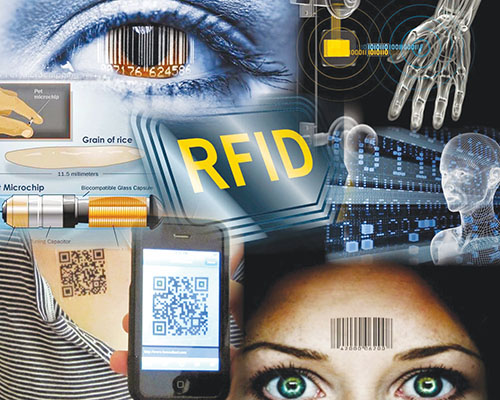
    So what are RFID chips? RFID chips are basically an automatic data capture technology that contains unique identification codes that are readable at varying distances with special reader devices. The tiny size of the chips, about that of a small grain of rice, and their widening deployment over the years, has generated broad publicised concerns about potential privacy invasion.

    These fears are not unfounded. It’s already a mandatory requirement in six states of Australia8 and other parts of the world that domestic animals be implanted with a microchip containing identity data linked to a microchip registry. What starts out voluntary often becomes mandatory.

    While deployment of human chip implants in the mainstream has not materialised, it has in no way dampened the spectre of what could be.

    As Time magazine opined back in 1998:

    Your daughter can store the money any way she wants – on her laptop, on a debit card, even (in the not too distant future) on a chip implanted under her skin.9

    Similarly, CNET News 2003, where we read about MasterCard testing RFID technology for the PayPass credit card to be fitted with a chip, states:

    It could be in a pen or a pair of earrings. Ultimately, it could be embedded in anything – someday, maybe even under the skin.10

    A more recent article on BBC sought to inform readers that “it’s the same exact technology as the card in your wallet” to allay fears of “surveillance and totalitarian control” toward microchip implants. Unlike cards that can be lost or stolen, “you’ll never lose the chip,” assured the advocate of the technology. In remarks that read like a glowing endorsement of microchip implant techniques:

    An implanted chip, by contrast, could act as our universal identity token for navigating the machine-regulated world. Yet to work, such a chip would need to be truly universal and account for potential obsolescence…. It marks the beginnings of a slow move toward a world where everything will be accessed from a single RFID microchip. If that day comes, I can’t think of a safer place to keep it than inside my own body.11

    Promoting mainstream use of human chip implants through the health care industry was a curious television commercial for VeriChip Corp in 2008. Featuring a sequence of patients holding forth a tiny microchip, the ad wastes no time enticing audiences with these apparent assurances:

    To think something so small can connect you to everything that matters. When your life and all you love are on the line, Health Link is always with you. When every second counts in the emergency room, providing immediate access to your medical records….12

    Cybernetics scientist Dr. Mark Gasson of the University of Reading in Britain foresees human chip implants becoming one of life’s necessities in the near future, according to citations in the Sydney Morning Herald in April 2014:

    It’s not possible to interact in society today in any meaningful way, without having a mobile phone. I think human implants will go along a similar route. It will be such a disadvantage not to have the implant that it will essentially not be optional.13

    Are these remarks the creative plot for a sci-fi thriller or do they foreshadow biblical mark realities?

    By contrast, it was fears of RFID chip implants “becoming widespread in humans” that prompt this warning in the same Sydney Morning Herald article, citing Dr. Katina Michael, an associate professor at the University of Wollongong:

    They point to an uber-surveillance society that is big brother on the inside looking out. Governments or large corporations would have the ability to track people’s actions and movements, categorise them into different socio-economic, political, racial, religious or consumer groups and ultimately even control them.14

    The spectre of human microchip implants looms.

    Smart Chips & Contactless Payments

    Contactless payment processes have opened a new chapter in fast, convenient and cost effective methods of payment. Many readers of New Dawn would be familiar with the contactless payment services available in many retail stores.

    MasterCard® PayPass™ and Visa payWave are two established contactless payment services on offer throughout Australia. These services provide contactless payment point-of-sale readers that utilise sophisticated smart chip technology to enable users to make payments with little more than a simple wave of a card. No swiping or inserting the card at the terminal, nor a PIN or signature required for purchases under $100.00.

    Unlike the standard RFID chip, the smart chips in cards contain an antenna loop embedded in the plastic. The far more sophisticated modern chip and their variations still use radio frequency technologies but incorporate a microprocessor and internal memory for read/write and secure data storage and management. Contactless smartcards exchange information with payment terminals using short-range wireless communications and conform to the international standard ISO/IEC 14443 that limits the ability to read and write to the contactless device at a distance less than 10 centimetres.

    The significance of these developments cannot be overstated considering the rapid deployment of converging contactless payments and chip card enabled payment innovations in recent years. It could be said that there’s little experiential difference between making a contactless payment with a wave of a card and a contactless payment with a wave of the right hand. If exposure and repetitive use breeds familiarity, then user sensitivities toward an embedded device-enabled payment paradigm are certainly being numbed.

    Quick Response (QR) Codes

    Could scannable tattoos become what is the mark that enables those who receive it to buy and sell?

    QR codes are two-dimensional machine-readable graphics which consist of a matrix of black modules arranged in a square on a white background. QR Codes are similar to standard barcodes except QR Codes can contain much more information than traditional barcodes.

    QR Codes link the physical with the digital world. They are often displayed on brochures, business cards, posters, clothing and other print advertising. When scanned by a smartphone or device, the QR Code directs the user to a website, phone number or other information.

    Incidentally, QR codes also enable payments by linking the user’s bank account or credit card information to their unique QR Code. Depending on the app, users can either pay by scanning a QR code, displayed on a bill for example, with their smartphone or merchants can accept a mobile payment by scanning a customer’s unique QR Code on their smartphone.15

    While QR codes have been around since the 1990s, it’s only with recent technology we see their extraordinary versatility with enabling a variety of mobile payment methods.16 There’s also been a strange twist to this technology with claims of scannable QR Code tattoos.17 It may be a futuristic and bizarre claim to make that one day such tattoos could enable payments much like the passage describes the mark, but it just goes to show the technology and technical capability is here.

    Wearables, Smartphones & Mobile Devices

    Software applications and near field communications (NFC) among other innovations are rapidly transforming payment processing ecosystems, creating a new era of convenient and fast payment services, with converting phones and other mobile devices into full digital wallets.

    It’s claimed the new digital wallet will soon eliminate any need to carry cash and cards, allowing users to link their debit and credit cards to conduct financial transactions all at the press of a few buttons on a device.18 Once the user has established an account, users can ‘tap’ their phone to pay for shopping at the checkout or pay a friend by transferring money from mobile to mobile.

    Enterprising Australian banks and financial service organisations are pressing onward with trials and roll outs of their infrastructure across the country.19 Trials are even being conducted on a payment microchip embedded in the sleeve of suits at the cuff for easy and convenient payments.20 There’s also digital payment bracelets, wristwatches and other wearable payment devices now commercially available.21

    It seems the acceleration toward a cashless society is becoming like one of an amusement arcade amid the range of novel payment devices coming onto the market. These innovative payment devices are yet another novelty enticing customers toward fully traceable and trackable digital transactions, indeed cultivating user familiarity with a variety of cashless and contactless methods of payment.

    Biometric Enabled Payment Devices

    Biometric payment innovations add yet another range of options for the customer to pay, with biometric scanning devices enabling methods of payment typically with finger, hand or face. A familiar range of benefits are advanced including simplicity, speed, convenience and security of payment.

    PayTouch22 and MyTouch23 are two services that allow users to link their payment cards to their fingerprint for method of payment.

    PayPal, a global payment company, has partnered with Samsung to launch a biometric fingerprint authentication payment option enabled by the Fast Identity Online (FIDO) Alliance ready software. The collaboration allows Samsung Galaxy S5 users to be able to login and shop at any merchant that accepts PayPal on mobile with their fingerprint.24

    If there exist any payment technique that could be said to simulate conducting payments with an embedded mark at the right hand or forehead, that would surely belong to emerging hand and face biometric methods of payment.

    Biyo is touted as a revolutionary biometric digital wallet that allows users to pay with their hand by scanning the unique vein patterns in the palm to create a secure password. The point-of-sale system requires users to register their palm and link it to a credit card of choice. Once registered, the user can make payments simply with their hand at any store where the Biyo terminal is available.25

    It’s trumpeted as the world’s first face recognition payment system and comes from a Finnish start-up company called Uniqul. Uniqul are developing real-time facial recognition payment technology to replace cash, cards and phones and aspire to “revolutionise the world of payments with new paradigms to create amazing payment experiences for users.”26

    There is little presence of biometric payments in Australia, however in a recent move toward this initiative, digital banking tech provider The Systems Work Group have taken on eye-print recognition technology for authenticating mobile banking app users.27

    Accelerating Social & Economic Transformation

    Africa and India offer compelling evidence of the radical transformative impacts of cashless technologies on societies and economies.

    The African experience is an amazing transformation, a continent exhibiting by far the fastest growth in mobile money economics in the world amid deep and broad social disadvantage. Mobile money enables users through payment schemes such as SnapScan and M-Pesa to make a variety of financial transactions with just their phone, even where conventional payment infrastructure is unavailable.28

    An extraordinary feature of Africa’s mobile money implementation is that they have leapfrogged over vital infrastructure otherwise necessary for consumers to engage a modern economy:

    The lack of financial and technology infrastructure could have been perceived as a massive barrier, but instead Africa has managed to leapfrog over a world of credit cards, ATMs, bank managers and branches.29

    Evidently the absence or lack of infrastructure is accelerating the transition to a viable cashless society in this instance.

    A similar technological marvel is unfolding in India with the ambitious rollout of a 12-digit unique ID number known as an Aadhaar to all 1.2 billion residents across the country.30

    The Aadhaar number is stored in a centralised database and links to the basic demographics and biometric information of each individual. It is the largest biometric database in the world. The mission is to empower all residents of the country with a unique identity and a digital platform to authenticate anytime and anywhere.

    The program enables millions of rural and poor people through financial inclusion to participate in the modern cashless economy.31 Of important note here is the aim of the ID, as with all sophisticated ID schemes around the world: To create a detailed digital record of everywhere the ID holder goes.

    It’s a fascinating spectacle of technological revolution and accelerating social and economic transformation on a scale seldom if ever seen. Interestingly, when we compare the systems of the mark and Aadhaar, we note a similar layout where both models utilise a unique ID mechanism to enable access to the financial system of the day. To restate in part:

    He causes all, both small and great, rich and poor, free and slave, to receive a mark….  and that no one may buy or sell except one who has the mark.

    En Route to the Global System of the Mark

    Global citizenship and mobility, international trade, global financial markets and high speed technologies have connected individuals and communities beyond our national borders. Increasingly we’re all part of a connected globalised economy in an era of normalising the digital way of life.

    It would have taken some penetrating foresight in decades past to have envisioned the role technology would play today with enabling almost the entire world’s population access to an advancing modern economy, including the world’s poor: “He causes all… rich and poor… to receive a mark…” Yet, here we witness today this incredible transformation unfolding in places such as Africa and India and elsewhere.

    In an interesting note, the Center for Financial Inclusion, citing a convergence of financial inclusion elements including convenient payment systems and the mobile money revolution, envisions global financial inclusion now within reach.32 Cashless technologies are seen contributing to this “profound demographic shift.”33

    Indeed, it’s these cashless technologies that signal an approaching mark-based enabled buy and sell system with each passing day. It wasn’t many years ago that a global cashless society was even technologically feasible, but we now have the computing capacity and power to make it all happen, and very quickly if need be.

    When we look carefully at what the passage is saying, we can actually see described in this ancient text today’s landscape of cashless and embeddable technologies, which is the system of the mark in its embryonic stage development. As such, the pace at which the world is approaching this prophecy may well be synced to the quickening technological progress taking place around us.

    Engineering the Global Surveillance Society

    The cashless society adds a vast new dimension to the surveillance society. Further to being tracked using conventional surveillance techniques, any user of the Internet, credit card or mobile device can now be monitored by their computer and consumer activities.

    As was earlier outlined, the surveillance society had already arrived with little public awareness of, and appreciation for, its pervasive presence in our lives. A similar phenomenon is confronting us today with the cashless society and fewer still are alert to its encroaching consequence.

    We now embrace surveillance like a dangerous liaison with our preoccupation for everything digital and mobile. As journalist and author Pratap Chatterjee observes:

    Today, the surveillance state is so deeply enmeshed in our data devices that we don’t even scream back because technology companies have convinced us that we need to be connected to them to be happy.34

    Exclusive use of cash in the new surveillance economy provides some level of anonymity but even these efforts will be futile when the day arrives that cash is made obsolete.

    What could it take to galvanise governments into establishing a purely closed digital economy incorporating a device embedded in every individual to buy and sell?

    ID cards, payment cards and mobile devices can be lost, stolen and broken. Accordingly, precursor technologies would converge to create the mark, reconstructed as a hybrid of a unique ID and digital wallet device, embedded in the right hand or forehead for a fully integrated security solution.

    How about a crisis of such consequence that threatens world security and social order? With looming global threats and ongoing instabilities, countries teetering on catastrophic financial collapse amid increasing terrorist activity and conflicts abroad, the shifting sands of the current fragile world order would seem to be signalling its systemic breakdown.

    Perhaps in the midst of such turmoil or following a worldwide economic meltdown, comes a momentous shift to a cashless society with an embedded device compulsory for every individual to participate in the new global financial order. However, the newly hatched revolutionary system will be one that ensnares humanity in a totalitarian global surveillance society unlike the modern world has ever seen given such advanced technology in place. We have already crossed the Rubicon.

    [alert type=”general” dismiss=”no”]This article was published in New Dawn 145.[/alert]

    [alert type=”success” dismiss=”no”]If you appreciate this article, please consider subscribing to help maintain this website.[/alert]

    Footnotes

    Note: All links and web pages accessible at time of publication

    1. M. Hirst, ‘Someone’s looking at you: welcome to the surveillance economy’, 26 July 2013, at http://theconversation.com/someones-looking-at-you-welcome-to-the-surveillance-economy-16357
    2. Ibid
    3. ‘Global mass surveillance should be discontinued immediately’, Global: the international briefing, 2014, at www.global-briefing.org/current-issue/
    4. Y. Shostak, ‘Global Identity Verification and Migration Mobility Control’, MRTDs, Biometrics and Security Standards (2011) Montreal ICAO, 12 September 2011 at www.icao.int/Security/mrtd/7th/Documents/12_am_edaps.pdf and ‘Interpol chief calls for global electronic identity card system’, 6 April 2011 at www.net-security.org/secworld.php?id=10860
    5. ‘Barcode everyone at birth’, BBC Future, 22 May 2012 at www.bbc.com/future/story/20120522-barcode-everyone-at-birth
    6. See S. Chen, ‘China mulls global satellite surveillance after flight 370 riddle’, 30 March 2014 at www.scmp.com/news/china/article/1460652/china-mulls-global-satellite-surveillance-after-flight-370-riddle
    7. D. Murakami & K. Ball, et al (Eds) ‘A Report on the Surveillance Society’, September 2006 at www.dataprotection.ie/docs/A-Report-on-the-Surveillance-Society-For-the-Information-Commissioner/386.htm
    8. ‘Is microchipping mandatory for cats and dogs?’ at http://kb.rspca.org.au/Is-microchipping-mandatory-for-cats-and-dogs_287.html
    9. J.C. Ramo, ‘The Big Bank Theory’, TIME, 27 April 1998 at http://content.time.com/time/magazine/article/0,9171,988228,00.html and for full published version see http://content.time.com/time/magazine/article/0,9171,139035,00.html
    10. D. McCullagh, ‘Chip implant gets cash under your skin’, CNET news, 25 November 2003 at http://news.cnet.com/2100-1041-5111637.html
    11. F. Swain, ‘Why I want a microchip implant’, BBC Future, 10 February 2014 at www.bbc.com/future/story/20140209-why-i-want-a-microchip-implant
    12. See www.youtube.com/watch?v=wW_eAQN7oks
    13. I. Gillespie, ‘Human microchipping: I’ve got you under my skin’, Sydney Morning Herald, 16 April 2014 at www.smh.com.au/digital-life/digital-life-news/human-microchipping-ive-got-you-under-my-skin-20140416-zqvho.html
    14. Ibid
    15. ‘Hot issues in payment: QR code and NFC payment’, Payworks, 30 September 2013 at http://payworksmobile.com/blog/2013/09/30/hot-issues-in-payment-qr-code-nfc-payment/ and ‘QR Codes for Marketing: A Unique Way to Bridge Offline and Online Media’, Human Service Solutions, at www.hswsolutions.com/services/mobile-web-development/qr-code-marketing/ and ‘QR Code’ at http://en.wikipedia.org/wiki/QR_code#cite_note-26
    16. See www.youtube.com/watch?v=dAywQ6spop4
    17. ‘Brave hipster gets animated tattoo using a QR code’, Relaxnews, 11 August 2011 at www.news.com.au/technology/brave-hipster-gets-animated-tattoo-using-a-qr-code/story-e6frfro0-1226113101876
    18. B. Voo, ‘Digital Wallets – 10 Mobile Payment Systems To Take You There’, Hongkiat at www.hongkiat.com/blog/digital-wallets/
    19. A. Bender, ‘Mobile payments in Australia: state of the banks’, Computerworld, 29 January 2014 at www.computerworld.com.au/article/536949/mobile_payments_australia_state_banks/
    20. S. Colqhoun, ‘The world’s first payWave suit’, The Age, 23 April 2014 at www.theage.com.au/executive-style/style/the-worlds-first-paywave-suit-20140422-371xp.html
    21. L. McQuarrie, ‘From Digital Payment Jewelry to Credit Card Timepieces’, 14 August 2013 at www.trendhunter.com/slideshow/payment-devices
    22. See www.pay-touch.com/en/home
    23. See www.mytouchpayments.com/default.aspx
    24. A. Vrankli, ‘PayPal and Samsung launch FIDO authentication and fingerprint payments for Samsung Galaxy S5’, Biometric Update, 25 February 2014 at www.biometricupdate.com/201402/paypal-and-samsung-launch-fido-authentication-and-fingerprint-payments-for-samsung-galaxy-s5
    25. See http://biyowallet.com/
    26. See http://uniqul.com/
    27. ‘Eyeprints To Protect Mobile Banking Transactions’, Find Biometrics, 28 April 2014 at http://findbiometrics.com/eyeprints-to-protect-mobile-banking-transactions/
    28. L. Erasmus, T. Kermeliotis, ‘No cash, no cards: Mobile app lets you pay with just your smartphone’, CNN Marketplace Africa, 20 February 2014 at http://edition.cnn.com/2014/02/20/business/no-cash-no-cards-just-smartphone/index.html?hpt=hp_bn1
    29. R. Botsman, ‘Mobile money: The African lesson we can learn’, Financial Review, 14 February 2014 at www.afr.com/p/boss/mobile_money_the_african_lesson_CwCeQ00CdCxlpFijNamvgM
    30. ‘AadHaar’ at http://en.wikipedia.org/wiki/Aadhaar
    31. Ibid and see ‘From Exclusion to Inclusion with Micropayments’, UIDAI Planning Commission, April 2010 at http://uidai.gov.in/UID_PDF/Front_Page_Articles/Strategy/Exclusion_to_Inclusion_with_Micropayments.pdf and ‘Aadhaar: Financial Inclusion through online authentication’, Aaadaarh UIDAI at www.youtube.com/watch?v=3aQJztNif94
    32. ‘Seizing the Moment: On the Road to Financial Inclusion’ by the Center for Financial Inclusion, October 2013 at http://centerforfinancialinclusionblog.files.wordpress.com/2013/11/seizing-the-moment-fi2020-synthesis-report.pdf
    33. E. Zuehlke, ‘Cashless Technology One Piece of the Financial Inclusion Puzzle’, MasterCard, 4 February 2013 at http://newsroom.mastercard.com/2013/02/04/cashless-technology-one-piece-of-the-financial-inclusion-puzzle/
    34. P. Chatterjee, ‘Mining your information for big brother’, Asia Times Online, 15 October 2013 at www.atimes.com/atimes/World/WOR-01-151013.html

    © New Dawn Magazine and the respective author.
    For our reproduction notice, click here.