New Dawn – World's Most Unusual Magazine

Category: Technology/Mind Control

  • Free Your Mind from Mainstream Media Brainwashing

    Free Your Mind from Mainstream Media Brainwashing

    From New Dawn 162 (May-June 2017)

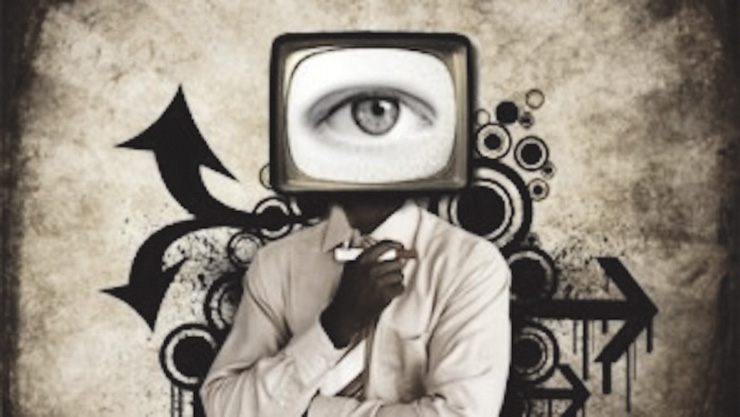
    Starting with Gutenberg’s printing press, then Thomas Edison’s motion picture camera and the introduction of celluloid and the silver screen, and later the cathode ray tube – a select few media institutions, and the men behind them, have enjoyed monolithic monopoly over the information we see and hear.

    Their machine is awesome and seemingly unstoppable, and reaches anywhere, anytime and into the minds of all it targets.

    How does one navigate, let alone make sense, of this 21st century matrix?

    If this transformation were truly an organic process, then most critical minds would be able to rationally deal with our total immersion in media. But the evolution of technology and how we interact with it is not so easy to articulate. As platforms and choice continue to proliferate, the situation is becoming more attuned to Chaos Theory than Darwinian Theory. The media and its modern marketing arms tell us it’s all progress. By now, their role is well defined – as the initial express vehicle on which all new ideas and advancements are delivered into the mainstream. In most cases, one could say the public are now fully preconditioned to accept new media on arrival.

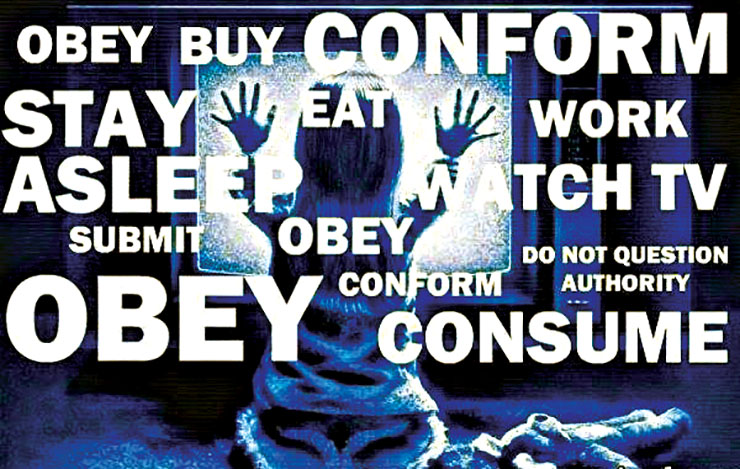
    Whether we care to admit it or not, there are varying degrees of brainwashing and behavioural conditioning with films and TV. That’s why they call it programming. How many of us find ourselves automatically using quotes from popular films or TV shows? And how many of us emulate the fashion or hairstyles of those we see on the screen?

    It happens much more than most people care to admit. Most of us are completely unaware of how much we mimic what we see, and repeat what we hear.

    In the 1976 classic, The Network, the film’s main character, a television prophet named Howard Beale, delivers an unforgettable sermon to his studio audience, perfectly describing the raw nature of mass media in a societal context:

    And why is that woe to us? Because you people and sixty-two million other Americans are listening to me right now. Because less than three percent of you people read books. Because less than fifteen percent of you read newspapers. Because the only truth you know is what you get over this tube. Right now, there is a whole, an entire generation that never knew anything that didn’t come out of this tube. This tube is the Gospel. The ultimate revelation! This tube can make or break Presidents, Popes, Prime Ministers. This tube is the most awesome, god-damn force in the whole godless world. And woe is us if it ever falls into the hands of the wrong people.

    Beale must have known it had already fallen into the hands of the wrong people, namely organised crime, the CIA, the Military Industrial Complex and the transnational global elite.

    The reality is that studio and record executives, and their media producers, are responsible for much of society’s behaviour, as well as the popular cultural archetypes that people adopt. For sure, this is a tremendous amount of power, and don’t think for a moment that executives do not know this. The same can be said for their CIA and Pentagon ‘advisors’ too.

    When in high gear, this culture machine commands any of the following behaviours en masse; foul language, profanity, sexual promiscuity, pre- and extra-marital affairs, drug use and abuse, dysfunctional relationships and families, racial tension, violence, defacing religious symbols, Satanic ritualism, undermining authority figures like fathers, teachers, clergy, and even the worship of the Orwellian security state. It’s all fair game for the media and entertainment industry.

    How is anyone expected to survive this psychological and spiritual onslaught?

    Media Survival 101

    The average person living in a technologically advanced first world society will watch an average of three hours of television per day, as well as another two to three hours spent on computerised electronic devices. If we want to survive with our minds and souls intact, at some point in our lives we have to muster the courage to turn off, and tune-out.

    The sheer volume of content now available means each person must be judicious about how they spend their time. The old binary option for ‘Generation X’, when you said to yourself, “Alright, I have three hours to myself. How am I going to spend that time? Do I watch TV, or do I read a book?” – may no longer apply.

    For Millennials (and others too), it’s more like, “Do I watch TV, YouTube, hangout on Periscope, Instagram, Facebook, or do I stream Hulu, Amazon Prime, iTunes or Roku, or do I read online, with my Kindle, or my Nook, or who knows, maybe a book?”

    The term binge watching also comes to mind. Seven seasons with 10 episodes each, with a continuous interconnected cliffhanger plot line – enough suspense and intrigue to trigger endorphins in the brain to keep you awake all night, enough to watch an entire season of 24… in 24 hours.

    If things are really that bad, or you are feeling anxious over an obsession with keeping up with content, then there is a high probability you are under some degree of media-driven mind control.

    The first step in liberation from the machine is to become a more active consumer of information and content, as opposed to being a passive sieve. That’s not to say you cannot enjoy a movie, or watch a good ball game now and again – everyone needs to step off the hampster wheel and indulge in entertainment from time to time.

    To defeat the linear, force-feeding tube of information and social conditioning by Hollywood and mainstream media… simply read more. Read whatever you can get your hands on – books, print journals, magazines, online articles, and newspapers. Your knowledge retention rate will be higher, and the experience of reading will hone your mental focus, self-reflection and clarity of thought.

    Rather than waste hours watching TV or sitting through a sub-par Hollywood cinema production that you know will be disappointing in the end, instead try listening to radio shows, or podcasts. Instead of drifting down rabbit holes on YouTube, visit websites like Soundcloud instead, and get immersed in their vast audio jungle.

    Another useful practice in liberating your mind from groupthink and staying less susceptible to mainstream brainwashing is to make a concerted effort to occasionally read, watch or listen to content from media outlets or sources that you do not like, or generally do not agree with. This is important for a number of reasons. If you are truly confident in your political beliefs, your worldview or your grasp of current and historical events, then it shouldn’t bother you to hear what ‘the other side’ has to say. If you really want to successfully defend your position, opinion, or ideology, or your side of the political spectrum – then it helps to know the contrarian arguments, and you should want to analyse them as much as possible. This type of open-minded information consumerism is exactly what the establishment culture-makers and matrix operatives do not want you to be involved with – because a confident, well-informed and objective voice is antithetical to the prevailing divide and rule, bipolar political paradigm program that social engineers are currently running on Western society.

    Also, should you ever find yourself growing tired of reading about it, then go and experience it.

    Learn How to Learn

    The American poet Robert Frost famously said, “We all proceed with insufficient knowledge.”

    In the education of the mind, everyone must submit (at least once a day) to the fact that no matter how smart or knowledgeable you think you are on any given topic or event, you actually know very little. You may know more than the person next to you, and you might even be an expert on one layer of a lattice, but more than likely would only have above average knowledge of one corner of the galaxy that is your area of expertise.

    Unfortunately, as far as social media is concerned, it remains a crude platform for human interaction and learning. Your 13.5 inch laptop screen doesn’t always deliver when it comes to human stimulation and speed of exchange that you’ll get through human conversation. The solution to this problem is a simple one – we need to talk more. Talk more, and talk about anything. The most powerful microprocessor on the planet is not in the basement of the NSA in Provo, Utah, or in Jeff Bezos’ server yards in Colorado – it’s between your ears.

    Also, rather than preaching to the choir, try and strike up conversations with people who are smarter or more experienced than you. This is one of the fastest ways to increase your knowledge base and gain valuable insights which you will never get from the mainstream media, or even find in the annals of the Ministry of Truth (Wikipedia).

    Remember: you’re not a robot, so stop acting like one.

    There’s a big world out there – and it’s much bigger than anything inside your TV or smart phone.

    [alert type=”general” dismiss=”no”]This article was published in New Dawn 162.[/alert]

    [alert type=”success” dismiss=”no”]If you appreciate this article, please consider subscribing to help maintain this website.[/alert]

    © New Dawn Magazine and the respective author.
    For our reproduction notice, click here.
  • Control 101: Creating Consensus Reality

    Control 101: Creating Consensus Reality

    From New Dawn 156 (May-June 2016)

    By carefully controlling mainstream media and educational institutions, elite social engineers are able to control the flow of public discourse in order to serve their own goals and interests. By doing this, they create something akin to ‘consensus reality’. In other words, by controlling the perception of public consensus on any particular issue or event, you effectively control the prevailing reality.

    A leading example of this social engineering phenomenon today is in the relentless promotion of war and global conflict throughout the media and education systems. Their carefully coordinated efforts can be boiled down to a simple concept: establishing legitimation and delegitimation in relation to the state or state institutions.

    In today’s formative education, school textbooks and assigned reading material are powerful tools used to shape students’ views. Often what is imprinted in one’s memory is not particular details and facts but rather an atmosphere, an impression, or a tone.1 It can be argued this impression may be more influential in forming a pupil’s contextual world or nationalist view.

    Professor of Education Dr. Michael H. Romanowski, explains: “The authority of textbooks coupled with the ‘objectivity’ of the technical knowledge that they communicate encourages students to accept unquestionably the impressions and worldview created by the language of textbooks.”

    “Although textbooks claim rhetorically not to promote a particular understanding of history and to be objective, they advance a value-laden perspective of reality. Because the selection and structure of knowledge affect our perception of the world, the language and context used to articulate knowledge are crucial. Textbook authors select particular language that creates impressions in the minds of students. These impressions have power and authority because they are presented in the printed and bound textbook with its aura of an authority that is beyond question and criticism. Although textbooks are used in many different ways, they are still dominant and powerful educational tools that shape students’ views.”

    In his study Romanowski goes on to describe how through the careful use of language, US school textbooks depicted Japanese internment camps in the United States during World War II in a manner that marginalised Japanese-Americans, while subtly mitigating any real criticism of the US government’s actions. Some might call this indoctrination, while others may call it brainwashing.

    Much of the ideological instruction for educational institutions is provided through the global governance system run and funded by multilateral institutions like the United Nations and the World Bank. The global management and cultural continuity of this European and North American-led ‘soviet’ is run by a myriad of Non-Governmental Organisations (NGOs), specifically through the UN’s “Agenda 2030”, a set of global directives for the next two decades. Previously these were the UN “Millennium Goals” which have since been overhauled and upgraded by the self-appointed culture experts and social engineers in New York City and Geneva. Through this globalised system, social engineers are able to streamline language and political thought internationally, while simultaneously preparing the next generation to accept a new sanitised political reality.

    In the last two decades, the corporate mainstream media’s efforts to spin endless war narratives on behalf of the state and its defence industry have become more pronounced. Despite numerous critiques and thousands of online articles and activist campaigns, the Establishment is simply doubling-down on their positions.

    Australian journalist and filmmaker John Pilger has emerged as one of the leading voices in recent generations exposing institutional Western war propaganda. He is also one of the few members of the media to challenge the carefully crafted “man of peace” US President Barack Obama.

    Pilger writes: “In 2009, President Obama stood before an adoring crowd in the centre of Prague, in the heart of Europe. He pledged himself to make ‘the world free from nuclear weapons’. People cheered and some cried. A torrent of platitudes flowed from the media. Obama was subsequently awarded the Nobel Peace Prize. It was all fake. He was lying. The Obama administration has built more nuclear weapons, more nuclear warheads, more nuclear delivery systems, more nuclear factories. Nuclear warhead spending alone rose higher under Obama than under any American president. The cost over thirty years is more than $1 trillion.”2

    Regarding the lack of due diligence and complicity by the mainstream media, Pilger adds: “Had journalists and broadcasters done their job and questioned the propaganda that Saddam Hussein possessed weapons of mass destruction; had the lies of George W. Bush and Tony Blair not been amplified and echoed by journalists, the 2003 invasion of Iraq might not have happened, and hundreds of thousands of men, women and children would be alive today.”

    From these examples, it’s easy to see how the state, the education system, and the media all compliment each other to manufacture Western public consent for the business of global military adventurism.

    Today, much less visible new means of control are being perfected. Digital monopolies are run by mega-corporations like Google whose vast informational and ‘smart’ data networks allow a relative handful of people to exert enormous influence over billions of people – without them ever knowing what is happening behind the curtain.

    From a social engineering perspective, this could be described as a form of mass mind control. By employing various strategies designed to manipulate search engines and their results, any cabal can influence public opinion on a range of subjects and issues – which in turn help determine which policies are implemented, political outcomes, and even what laws are passed. Once again, by controlling consensus reality, elites create the reality of their choosing.

    Writer Robert Epstein provides some insight into how something as simple as searching for information has been commoditised and modelled by the digital overlords at Google. He explains:

    “The Google search engine is so good and so popular that the company’s name is now a commonly used verb in languages around the world. To ‘Google’ something is to look it up on the Google search engine, and that, in fact, is how most computer users worldwide get most of their information about just about everything these days. They Google it. Google has become the main gateway to virtually all knowledge, mainly because the search engine is so good at giving us exactly the information we are looking for, almost instantly and almost always in the first position of the list it shows us after we launch our search – the list of ‘search results’.”3

    Another disturbing trend is the state’s increasing role in administrating intellectual tyranny in the 21st century. This idea goes much deeper than just state snooping on its own citizens when you consider the consequences of people becoming afraid or overly self-conscious about which web pages to visit or which search terms they input into Google.

    What happens when our private lives become public property? In the world’s premier police state, the UK, Home Secretary Theresa May recently announced a new bill, known as the “Snooper’s Charter,” which gives Orwellian powers to the state and its security services for tracking UK citizens’ Internet use and web browsing history dating back two years – without the need for any judicial check. Similar invasive measures have already been passed in Australia.

    Technocrat May was accused of rushing the new surveillance laws into place in order to avoid more public scrutiny from critics and civil liberties groups.

    When asked, one anonymous government source provided The Independent newspaper with the standard party line: “Terrorists and criminals are operating online and we need to ensure the police and security services can keep pace with the modern world and continue to protect the British public from the many serious threats we face.”4

    This sounds like a line straight out of Terry Gilliam’s film, Brazil.

    Scottish comedian Frankie Boyle tries to make light of this situation: “No more drunken Googling: all it takes is a misspelled search for ‘bong-making’ and suddenly you’ll be in an orange jumpsuit getting beaten with a pillowcase full of bibles.”

    He continues: “This law will create lots of new jobs, as the person charged with reading all our communications (who will see more unsolicited erections than customer services at Skype) will regularly feed their screaming face into a meatgrinder.”5

    Once again, governments continue to recycle the same tired old talking point by insisting the only people who need worry are those who have something to hide. If that’s the case, shouldn’t we be allowed to snoop on the state? They really shouldn’t mind. It is every citizen’s duty to know everything the state and its corporate partners are up to.

    [alert type=”general” dismiss=”no”]This article was published in New Dawn 156.[/alert]

    [alert type=”success” dismiss=”no”]If you appreciate this article, please consider subscribing to help maintain this website.[/alert]

    Footnotes

    1. ‘Problems of Bias in History Textbooks’ by Michael H. Romanowski, www.socialstudies.org/system/files/publications/se/6003/600310.html
    2. ‘A World War Has Begun’, http://21stcenturywire.com/2016/03/23/pilger-a-world-war-has-begun-now-break-the-silence/
    3. ‘The New Mind Control. “Subliminal Stimulation”, Controlling People without Their Knowledge’ by Robert Epstein, https://aeon.co/essays/how-the-internet-flips-elections-and-alters-our-thoughts
    4. ‘Snooper’s charter: Theresa May to present revised Investigatory Powers Bill with tougher privacy protections’ by Nigel Morris, The Independent, 1 Mar 2016
    5. ‘The snooper’s charter: one misspelled Google search for “bong-making” and you’ll be in an orange jumpsuit’ by Frankie Boyle, The Guardian, 11 Nov 2015

    © New Dawn Magazine and the respective author.
    For our reproduction notice, click here.

  • The Coming Techno Apocalypse

    The Coming Techno Apocalypse

    From New Dawn 162 (May-June 2017)

    Imagine, if you will, a war in the near future. A war not fought between East and West. Not fought between nations, nor creeds nor races. A war fought brother to brother and sister to sister, father to son and mother to daughter.

    Tesh (technologists) against NonTesh (non-technologists).

    The Tesh, a tribe or caste intoxicated and socially validated through their umbilical connection to technology and the Meta/Hive Mind. Glued to Google Glass, status permanently updated: the Tesh always offer the right opinion at the right time. Incapable of nonGroupThink, the Tesh occupy all positions of import in the professional, media, academic and information classes. Opinions counter to Tesh GroupThink are not only by definition incorrect, they are also invisible – filtered, de-platformed and deleted into a silent nonexistence.

    The NonTesh are homeless, stateless non-people. Unable to participate in comfortable society’s rituals and prefabricated dialogues, without access to currency and the staid social discourse that lubricates function in the mainstream. They attack from the margins: wild wastelands, hardware graveyards and mountain ranges of landfill – zones abandoned by the Tesh as beyond rehabilitation. The unknowing progeny of the much-maligned (but historically vindicated) Luddites, the NonTesh build primitive Drone traps, savagely attack convoys of technicians and inflict random violence at the edges of Tesh civilisation. They slaughter and destroy with no plan, no blueprint – a simple, intuitive anger and violence that Tesh mainframe-algorithms cannot comprehend and struggle to strategise against.

    This will be the Final War – man against machine and man against machine-man.

    Trapped by Techno-Blindness?

    The omniscient progress of technology brings with it many benefits – this is beyond serious doubt. But seldom if ever discussed is technology’s insidious and largely invisible detriments. They remain near-invisible for many reasons: commercial imperatives, an infantile inability to see past convenience and short-term rewards and a surfeit of attractive and entertaining distractions. Perhaps the most difficult to discern are those problems that might occur in the moral, predictive, philosophical or ideological realms: spheres apparently far less concrete than instant, addictive neurochemical rewards and the superficial and textural allure of consumer electronics.

    Modern-era human society also appears rusted to the concept of progress – the idea that all technological advances are intrinsically positive whether immediate gains outweigh severe long-term deficits… or not.

    The black silicon squid of hyper-technology sends its powerful tentacles into every domain of human activity, its vice-like grip stultifying thought and any hint of animalistic defensive counter-measures. Our species suffocates in the death-grasp, yet lacks even the primal survival instinct to respond effectively. Is humankind fatally trapped by techno-blindness?

    Big Data & Psychographic Profiling

    While essentially unknown to the general public, the astounding technologies of the London based firm Cambridge Analytica (CA) are credited by some as having a fundamental role in the 2016 election of US President Donald Trump and the ‘Leave’ campaign that led to the UK Brexit. CA trumpets proudly on its website and in its strategic communications that they “use data modelling and psychographic profiling to grow audiences, identify key influencers, and connect with people in ways that move them to action.”

    Birthed at the nexus of leading Cambridge University Psychometric scientists and the SCL Group (self-described as a ‘global election management agency’), Cambridge Analytica works big data to identify and manipulate the intentions of mass voter populations.

    According to CA Chief Executive, Alexander Nix, “Today in the United States we have somewhere close to four or five thousand data points on every individual. So we model the personality of every adult across the United States, some 230 million people.” Harvesting Facebook ‘likes’, smartphone data, purchase histories, subscriptions, church visits, online and other available aggregate information, CA builds profiles of every individual in the target audience (i.e. every potential voter in the US during election season 2016) and generates a ‘psychographic analysis’ in combination with the OCEAN (‘openness to experience, conscientiousness, extraversion, agreeableness, and neuroticism’) personality trait or ‘lexical hypothesis’ model to predict and influence the electoral actions of individuals.

    As reported in the Swiss Das Magazin, with just ten Facebook ‘likes’ as input, CA could “appraise a person’s character better than an average coworker. With seventy, it could ‘know’ a subject better than a friend; with 150 likes, better than their parents. With 300 likes… (the) machine could predict a subject’s behaviour better than their partner. With even more likes it could exceed what a person thinks they know about themselves.”

    Deployed in a number of developing nations, the SCL Group has worked extensively with military and political contacts in activities that Slate magazine described as akin to a ‘coup’ scenario.

    According to their website, “Cambridge Analytica is building a future where every individual can have a truly personal relationship with their favourite brands and causes by showing organisations not just where people are, but what they really care about and what drives their behaviour.”

    Professor Jonathan Albright of Elon University describes CA’s algorithms as “a propaganda machine. It’s targeting people individually to recruit them to an idea. It’s a level of social engineering that I’ve never seen before. They’re capturing people and then keeping them on an emotional leash and never letting them go.”

    CA’s Nix gave an example from their brief tenure on GOP candidate Ted Cruz’s primary campaign. Cambridge Analytica’s big data analysis “identified that there was a small pocket of voters in Iowa who felt strongly that citizens should be required by law to show photo ID at polling stations. Leveraging our other data models, we were able to advise the campaign on how to approach this issue with specific individuals based on their unique profiles in order to use this relatively niche issue as a political pressure point to motivate them to go out and vote for Cruz. For people in the ‘Temperamental’ personality group, who tend to dislike commitment, messaging on the issue should take the line that showing your ID to vote is ‘as easy as buying a case of beer’. Whereas the right message for people in the ‘Stoic Traditionalist’ group, who have strongly held conventional views, is that showing your ID in order to vote is simply part of the privilege of living in a democracy.” According to some sources, CA is able to bombard target individuals with thousands of uniquely tailored and feedback evolving ‘dark ads’ (advertisements that aren’t seen by others).

    ‘Weaponized AI Propaganda Machine’

    In a piece titled ‘The Rise of the Weaponized AI Propaganda Machine’, journalists Berit Anderson and Brett Horvath assert that Cambridge Analytica, “has activated an invisible machine that preys on the personalities of individual voters to create large shifts in public opinion. Many of these technologies have been used individually to some effect before, but together they make up a nearly impenetrable voter manipulation machine that is quickly becoming the new deciding factor in elections around the world.”

    It would be easy to argue that primitive versions of these techniques have indeed been used in various ‘coloured revolutions’ and ‘regime change’ operations for decades at least (and more subtly in the general domestic activities of the mainstream media): perhaps the only salient difference being that now the ‘coup’ chickens have extraordinary ‘Artificial Intelligence’ technologies at their disposal which have now clearly come home to roost.

    Fraught and fragile as our democracies are, the inevitable march of ‘progress’ means we’re about to lose them permanently to The Machine.

    Predictive Policing

    Technology also threatens to advance and empower policing to the realm of monolithic totalitarianism. In an eerie echo of Phillip K. Dick’s ‘Minority Report’ short story, predictive policing software and models are now deployed to assess the assumed future crimes of identified ‘criminal classes’. In Chicago, a city wracked by disproportionate levels of gun homicide, gang violence and rampant police brutality, a report in Scout Magazine notes that, “Microsoft, the Chicago Police Department, and a partner called Third Eye have created a cloud-based solution that predicts what types of criminal activity are likely to take place where. Using historical data, the Chicago force can deploy officers to specific locations across the city based on how likely crime is to occur there. They can also predict crime trends based on the weather, specific times of day or a range of other factors. The LA Police Department has developed an algorithm called PredPol that does the same thing.”

    Unfortunately, these predictive models are often wrong.

    ‘Beware’, a software model developed by security firm Intrado, was tasked with identifying an individual’s “threat level based on their address, searches of the deep web, arrest records, vehicle registrations, criminal records, warrants, property records, ‘known associates’ and the content of their latest social media posts.”

    Adopted in Fresno, California in 2015, ‘Beware’ was soon abandoned in April 2016 after persistent concerns were raised about its accuracy and deleterious effect on privacy.

    Aside from the obvious, nightmarish and Kafka-esque scenarios that predictive policing might produce, it should also be noted that any Artificial Intelligence capability can only be as useful and accurate as the data it utilises. Error-prone, biased or prejudiced inputs will inevitably produce arrests or harassment for what equates essentially to ThoughtCrime or simply being in the wrong place at the wrong time (or even being the wrong person at the wrong time).

    Predictive policing will always risk impugning guilt through data aggregation rather than actual criminal action.

    Star Chamber ‘Justice’

    In recent decades the explosion in electronic and online communications has been a boon for surveillance industries and the instruments of the corporate and political state tasked with gathering masses of information. Post the revelations of NSA whistleblowers like William Binney and Edward Snowden (and Wikileaks’ recent ‘Vault7’ cache of documents), it appears safe to assume that all electronic communications are vulnerable to surveillance at all times.

    It came to light through the Snowden revelations that police and other law enforcement departments have regular and essentially uncontrolled access to ‘products’ of the NSA/CIA and surveillance state. Though use of this ostensibly illegally obtained information is inadmissible in court proceedings, police routinely work around this impasse by creating ‘parallel construction’, a technique to mask the use of ‘unconventionally obtained’ data from defendants or the accused.

    According to an August 2013 Reuters report, “A secretive US Drug Enforcement Administration unit is funnelling information from intelligence intercepts, wiretaps, informants and a massive database of telephone records to authorities across the nation to help them launch criminal investigations of Americans. Although these cases rarely involve national security issues, documents reviewed by Reuters show that law enforcement agents have been directed to conceal how such investigations truly begin – not only from defence lawyers but also sometimes from prosecutors and judges.”

    In the US, local police and the FBI routinely use a device called a ‘Stingray’ that mimics a cell/mobile phone tower and thus can capture metadata and phone traffic content from nearby phones. No warrant is required for their use but The Guardian in August 2016 reported on a “non-disclosure agreement that local police were forced to sign with the FBI before receiving permission to use Stingray – a document that mandated local prosecutors to abandon cases rather than risk information about Stingray becoming public.”

    Using what are legally ‘invisible’ technologies to gather incriminating evidence poses myriad problems for the accused: a frightening ‘Star Chamber’ scenario that is reportedly now commonplace. As Reuters confirms, “If defendants don’t know how an investigation began, they cannot know to ask to review potential sources of exculpatory evidence – information that could reveal entrapment, mistakes or biased witnesses.”

    The continued militarisation of police has been of concern to many. Now airborne drones (Unmanned aerial vehicles or UAVs) are also becoming part of the increasingly high-tech law enforcement arsenal. In the US, North Dakota was the first state to legalise armed police drones. The aircraft will be nominally limited to ‘less-than-lethal’ weaponry (i.e. sonic weapons, tear gas, tasers, rubber bullets and pepper spray) though ‘mission creep’ would appear to make it inevitable that law enforcement will soon patrol from the skies with lethal firepower, a scenario that was science-fiction a few years ago.

    Connecting all to the ‘Internet of Things’ – Including People

    Advancements in ‘smart’ technology (or as author and Silicon Valley critic Evgeny Morozov calls them: “Surveillance. Marketed. As. Revolutionary. Technology.”) and the approaching ‘Internet of Things’ threaten an ominous near-future where common everyday/domestic appliances/devices – cars, dishwashers, refrigerators, televisions, toilets, washing machines, thermostats, alarm systems and alike – are, for ‘convenience sake’, automatically and intrinsically connected to the cloud/internet.

    Speaking in 2012 to the In-Q-Tel (the CIA’s venture capital arm) CEO Summit, then CIA Director General David Petraeus remarked about the impending ‘Internet of Things’ saying, “Items of interest will be located, identified, monitored, and remotely controlled through technologies such as radio-frequency identification, sensor networks, tiny embedded servers, and energy harvesters – all connected to the next-generation Internet using abundant, low cost, and high-power computing – the latter now going to cloud computing, in many areas greater and greater supercomputing, and, ultimately, heading to quantum computing.

    “In practice, these technologies could lead to rapid integration of data from closed societies and provide near-continuous, persistent monitoring of virtually anywhere we choose. ‘Transformational’ is an overused word, but I do believe it properly applies to these technologies, particularly to their effect on clandestine tradecraft. Taken together, these developments change our notions of secrecy and create innumerable challenges – as well as opportunities.”

    US Director of National Intelligence, James Clapper, similarly remarked in February 2016 that, “In the future, intelligence services might use the ‘Internet of Things’ for identification, surveillance, monitoring, location tracking, and targeting for recruitment, or to gain access to networks or user credentials.”

    The day is fast approaching where your fridge might spy on you.

    Imagine Cambridge Analytica’s 4-5,000 data points harvested for every individual, correlated with tens of thousands of domestic data observations, and it becomes possible to build electronic and informational profiles of individuals of staggering scale and darkly malevolent detail.

    Secret CIA Technology Exposed

    Wikileaks’ 7 March 2017 dump of thousands of secret CIA technology documents confirmed a landscape of ubiquitous surveillance and data harvesting. Among the myriad revelations allegedly leaked from the CIA’s Center for Cyber Intelligence in Langley, Virginia:

    “‘Weeping Angel’, developed by the CIA’s Embedded Devices Branch (EDB), which infests smart TVs, transforming them into covert microphones. After infestation, Weeping Angel places the target TV in a ‘Fake-Off’ mode, so that the owner falsely believes the TV is off when it is on. In ‘Fake-Off’ mode the TV operates as a bug, recording conversations in the room and sending them over the Internet to a covert CIA server.” (www.zerohedge.com/news/2017-03-07/wikileaks-hold-press-conference-vault-7-release-8am-eastern)

    As Internet renegade Kim Dotcom noted, the “CIA turns Smart TVs, iPhones, gaming consoles and many other consumer gadgets into open microphones,” and further the “CIA turned every Microsoft Windows PC in the world into spyware.”

    Also described was the CIA capability to hack computer networks while cloaked as another entity or state actor. The CIA UMBRAGE group, according to Wikileaks, “collects and maintains a substantial library of attack techniques ‘stolen’ from malware produced in other states including the Russian Federation. With UMBRAGE and related projects the CIA cannot only increase its total number of attack types but also misdirect attribution by leaving behind the ‘fingerprints’ of the groups that the attack techniques were stolen from.” (https://wikileaks.org/ciav7p1/)

    Further from Wikileaks: “As of October 2014 the CIA was also looking at infecting the vehicle control systems used by modern cars and trucks. The purpose of such control is not specified, but it would permit the CIA to engage in nearly undetectable assassinations.”

    This last point casts an ominous shadow on the 18 June 2013 death of controversial defence and surveillance journalist Michael Hastings. Just hours before his demise in an inexplicable and fiery, high speed auto-crash, Hastings said, “The Feds are interviewing my ‘close friends and associates’” and, “I’m onto a big story and need to go off the radar for a bit.”

    From ‘Smart Dust’ to ‘Bots’ that roam Internet forums and newspaper sites generating automated comments, from Barbie dolls that collect and wirelessly transmit children’s conversations to marketers, and algorithms or artificial intelligences that finger potential criminals, generate credit ratings, parole recommendations and employment decisions: we are about to leave the epoch of human decision making and enter a brave new era of automated or ‘virtual intelligence’.

    Some, like renowned technologist, futurist and Google Director of Engineering Ray Kurzweil celebrate the coming ‘singularity’ – the point when computer intelligence equals or surpasses human intelligence and potentially the human mind melds with technology. Kurzweil predicts that by 2029 our brains will fuse with machines and the event will usher in a new ‘techno-utopia’ where according to his evangel, “We’re going to be able to meet the physical needs of all humans. We’re going to expand our minds and exemplify those artistic qualities that we value.”

    Another noted technologist, Elon Musk, struck a far more cautionary tone in October 2014: “With artificial intelligence we are summoning the demon.”

    Digital Control Machine Will Never Sleep

    It’s easy to drown in the multifarious, conceptual and jargonistic details – the techno-babble and giddy utopianism.

    But the simplest observation is also the best and most essential – in a few short years we will already be in a future where every interaction with any electronic device, technology or landscape will most likely be recorded, stored, analysed and actioned. Every phone conversation will be harvested for advertising data; every comment, search or online visit yielding the raw stuff of social engineering and opinion/vote massaging; every opinion big data grist for the ‘Shock Doctrine’ mill: a traitorous crop of domestic appliances will report on conversations, sleep, ablution and eating habits as online algorithms patrol like nano-ThoughtPolice – reporting social media infractions to employers and state bodies.

    Always on – always transmitting – always analysing and evolving: the Digital Control Machine will never sleep.

    It is, in the most basic form, a nightmare world of permanent, inescapable surveillance and panopticon monitoring: a Technological Prison that serves up constant entertainments and distractions with the small, dutiful price of mental conditioning and omniscient servitude. Permanently connected to ‘the Cloud’, a remotely controlled and infinite feedback system that modulates mood, thought, opinion and activity. Soon we will be digital puppets, addicted to ‘sticky’ devices and rewarded for our compliance by serotonin hits and endless ‘content’.

    In 1984 George Orwell imagined a brutal dystopia of regimented ‘Thought Police’ and perpetual war. Previously, Aldous Huxley’s Brave New World described a future of bio-chemical thought/mood enhancement and control through the cheerfully prescribed and gladly ingested ‘soma’ of ritualised and inescapable entertainments and obligatory trivia and tribal custom.

    Our near-tomorrow will likely be a hybrid of the two – swift, final technological punishment for the troublesome ‘Michael Hastings’ types (those who have transgressed beyond rehabilitation) – and endless, comfortable distraction for those who submit meekly to the gilded techno-cage. A soft, warm and luxurious digital boot “stamping on a human face – forever.”

    Human society’s breathless race to embrace dehumanising and inherently totalitarian technologies must have an end point.

    It’s possible to form a cogent argument that recent political ‘shocks’ and developments (the election of Donald Trump, Brexit, the impending demise of the EU and UN) are in some sense the manifestation of a sublimated rejection of technology (and the government/economic/corporate systems empowered by technology) from a dazzled, bewildered but instinctively antagonistic herd-populace.

    Is it to be war between those Transhumans who accept and rejoice in their hybridisation into the matrix of omniscient ideological control technologies (an adjunct of the modern permanent state of entertainment/distraction and doctrinal/behavioural feedback), and those on the margins who knowingly or intuitively reject the encroachment of optic fibre, microwave blast and touch-screen texture into every last human domain of flesh, thought, sinew and soul?

    The Final War – the ragtag remnants of man-kind against man-machine.

    Tesh versus NonTesh.

    [alert type=”general” dismiss=”no”]This article was published in New Dawn 162.[/alert]

    [alert type=”success” dismiss=”no”]If you appreciate this article, please consider subscribing to help maintain this website.[/alert]

    © New Dawn Magazine and the respective author.
    For our reproduction notice, click here.
  • Manipulating the Mass Mind & Attention

    Manipulating the Mass Mind & Attention

    From New Dawn 159 (Nov-Dec 2016)

    In my 30 years as a self-improvement coach, the most important insight is that where you put your attention is where your energy goes. If you find that hard to believe, try this: Walk through a crowd. Put your attention on the people. Then walk through the same crowd again and put your attention on the gaps between the people. More of them will now make way. Try it. It never fails. Here’s another experiment: Stand at the corner of any city street and look upwards for a while. You will notice people around you also look upwards. They want to know what you are looking at, and for that brief period you determined the direction of their attention.

    If I tell a group of people to think of a red car, there is a great likelihood that all of them will do it. And if I tell them not to think of a red car… they will also think of a red car! They could have chosen to think of a blue mountain instead. From that you realise how easy it is to steer mass attention.

    Rarely will anyone form their own thought or choose different than what they are told. In fact, if you do not make decisions and intentions, someone else will do it for you. You know this from your own life: If your spouse asks you where you want to go for dinner and you don’t really have any specific preference, then they will decide where to go. The same applies on a mass-scale.

    Due to a general weakness of will and awareness, most people have their reality decided for them, with merely the illusion of choice given – such as being able to choose whether you will pay your taxes by credit card or bank wire.

    In school, children do not learn how to think but what to think. They do not learn how to steer attention but instead various things they are supposed to steer attention to.

    It is humbling to realise that most people on the planet do not practice focusing, guiding, re-directing, shifting, retrieving and un-sticking their own attention. Thus the life-experience of most of us is determined by external agendas as given by mass media, schools, our parents and countless other sources that have very little to do with our innermost heart’s truth.

    We are lucky that at least some of the direction we get from outside is benign. We are lucky if we have parents who say, “You are highly talented, intelligent and beautiful,” thus directing our attention in the right direction. Have you ever heard a newscaster tell you, “You are safe, talented, intelligent, beautiful, empowered and able”? Not hardly. You’ll hear you are the victim of horrible circumstances that you can do nothing about.

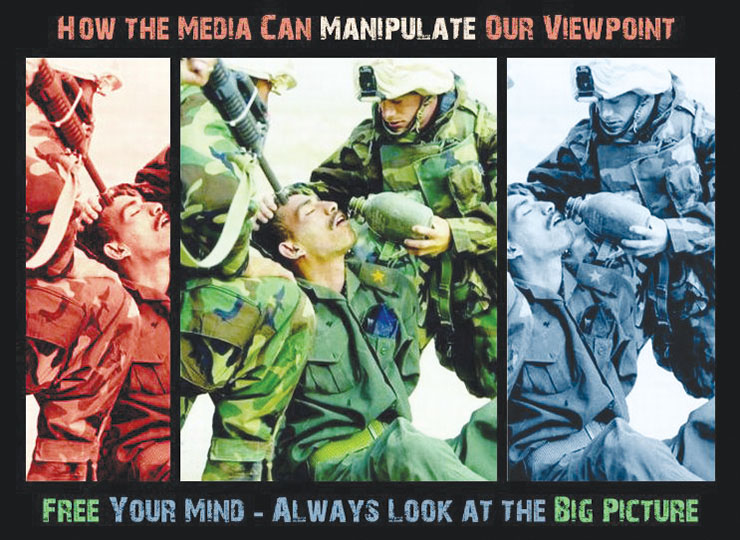
    Through directing attention, you become a mini-reality-creator. But the mass media is the grand sorcerer of reality manipulation as it directs the attention of millions. It’s not generally understood to what bizarre extent the news media actively participate in the creation of our reality. It is thought they only “report” what is “happening,” but that’s not the case.

    The following are different levels of mass-reality-creation by the news media, sorted by the degree of manipulation:

    Level 1: Filtering

    When I create a movie for my work, I usually choose an outdoor location. I make sure to set up the camera in nature so the scenery looks really good. By choosing what to point the camera at, I am excluding everything I don’t want viewers to see, anything that does not fit my agenda.

    I recently filmed breathtaking natural scenery… or at least that’s what it looked like in the final result. I excluded an adjacent parking place, trashcans, roaming dogs, public signs, ugly houses and anything else that disturbed the illusion of me being in paradise. Any filmmaker understands to which extent the filmmaker distorts reality.

    From the millions of events that happen every day, the reporter filters which ones to report. This is a normal process. I do it for my own website by presenting only information relevant to its overall topic. People do it on Facebook by presenting themselves in a certain way and excluding pictures that might put them in a bad light.

    News media, however, tend to apply several filters. The first one is the filter of negative bias. Why? Because at Earth’s current level of consciousness, fear, drama and hatred still capture more interest than peace, prosperity and harmony. Desperate to sell ad slots on their news program and their declining newspapers, most reports are filtered by how much upheaval and action they contain. In addition, televised news media follows the creed, “if there is no footage (video), it doesn’t matter.” When I was younger I worked for a well-known news station where I was told exactly that. I tried to get the editor to cover important angles of a story, but if there was no footage of it, it was as if it didn’t exist.

    If they were to portray life on a day on Earth accurately, as it is for most people most of the time, it might appear “boring.” So the camera zooms in on places of the most mayhem and tragedy. This extreme filtering gives the audience the false impression that the whole world is mostly in a state of chaos, coupled with the implication there is absolutely nothing you can personally do about it. The sensationalist journalist never adds words of advice on improving your life, moving to peaceful surroundings or words of encouragement. He only cares about the sheer terror of explosions, debris, blood and destruction. If any of your relatives talked like a news anchor, you’d consider them mentally unstable.

    A recent movie The Nightcrawler (starring Jake Gyllenhaal) exposes the juvenile and sadistic mindset of some sections of modern “journalism.” No doubt, the last decade has seen a rise in terrorist attacks all over the world. And while these are horrific, they are still actually just localised events, pinpointed at certain buildings with a limited amount of people. They are not nearly as bad as the nation-to-nation all-out-wars we’ve had in decades before that.

    I happened to be in the city of Munich on the day of a terrorist attack at the end of July 2016. The shooting of 9 people at the hands of a 19-year-old kid named Ali went around the world. And yet, I learned it from the news, not from being in Munich at the time. On that day I was riding my bike along the river and went for a swim. I received numerous text messages asking whether I’m still alive and sending blessings to me and my family. You see my point…. things are bad, but rarely as bad as the news says they are.

    On an odd note: The same journalist who happened to be at the Nice (France) terror attack only a week before, shooting live footage of it, also “coincidentally” happened to be pre-positioned at Munich on location and filming. His name is Richard Gutjahr and he is either magnetically attracted to such events for the sake of “terrortainment” or there is something more sinister going on.

    When, if I may ask, is the last time you saw windsurfers in the Palestinian Gaza Territory or a happy family having a barbecue in their Jerusalem garden in the news? These events happen every day, by the hundreds, but they do not automatically come to your mind when I say “Gaza!” or “Israel!” I have been to both Palestine and Israel on numerous visits, both privately and for business, and I’ve always had a great time. Yet when I tell people I am travelling there, they tell me “be careful! That’s dangerous!” They associate these places with the blood and gore the news showed them. They know virtually nothing about the realities of these places than what they have been shown.

    I mean no disrespect to the suffering of people in the Middle East or anywhere else for that matter. I am merely using these extreme examples to make the point of filtered-realities. They cause a lack of balance in our perception of the world as well as desensitising us toward violence.

    Ideally, news media would have to not only show a nice segment at the end of their show, but more positive and interesting segments throughout. Then we learn that the world is a balance of light and darkness. Where are the news reports of hope, inspiration, everyday-heroes and human accomplishment? They are far and few between. If a proper balance of dark and light were given, the audience would become more involved in the healing of darkness rather than apathetic to it.

    Level 2: Distortion

    The next level of reality-manipulation is deliberate distortion by the journalists themselves because they wish to see something in a certain manner or are partial to some political, religious or philosophical ideology.

    Of course, nobody is completely neutral and unbiased, nor is that expected. But one of the problems of our times is there is virtually no mass media outlet that is not widely known as being affiliated with some political, governmental, anti-governmental or philosophical “side” and a far shot from “neutral.” Latest statistics from my country (USA) show that the Top Ten most successful “news” outlets on the Internet are either “right-wing” or “left-wing” affiliated. The fact that we are able to determine whether an outlet is “left” or “right” is in itself problematic. It is disheartening how almost every story “top news outlets” carry is filtered through political bias. In other words, these are not “news” outlets and their employees are not “journalists,” they are unabashed propaganda outlets for one of the two political parties in the US.

    Another form of distortion occurs when a journalist makes something better or worse than it is. He knows the editor will only accept a story if its interesting enough so he adds a few details here and there, knowing nobody will likely ever examine them more closely. From writing my own blog to a fairly large audience, I am somewhat familiar with the problem, but have always resisted the urge to exaggerate reports. I’d rather have some of my reports be understated (“boring”) than to report things that did not happen. Needless to say, I am not only blaming the mass media, as they only reflect the desires of the populace, who favour entertainment and excitement over reason and truth. When that audience goes to the cinema, they rarely pay to see peace, love and harmony, they usually pay to see death and suffering.

    Another form of distortion is that most news stories are reported without wrapping them into a wider context. Most things that happen are part of a greater pattern, part of a history, part of a mindset. Yet, the way stories are reported is as separate pieces that have little or no relation to each other.

    When I report on my blog, I frequently like to put what I wrote into context and comparison with other things I wrote in order to give a congruent overall big-picture. This is not the case in conventional news media where people think that the presidential elections in the US, the hurricane that happened just before, the resignation of the CIA-boss and the resurgent Israel-Palestine conflict (all having happened within a few weeks a couple of years ago) have nothing whatsoever to do with each other and are separate bits of information. But they are interconnected, not only metaphysically but geopolitically. Because the news reports too much and journalists write too quickly, ignoring context and connections, they breed ignorance of the depth and meaning of things.

    Level 3: Deliberate Fabrication

    This is the most intense form of reality-manipulation which hopefully does not occur too often. I recently spoke to someone who used to work for the British “Ministry of Defense.” He shared the following story: Some decades ago a group of reporters went to Northern Ireland to capture footage of the conflict. When they arrived everything was peaceful, so they went ahead and created some chaos, just so they could return home with footage. They bribed a local to make and throw molotov cocktails (amateur bombs) off rooftops into the streets, setting cars and trashcans ablaze. In this instance, the journalists literally created the news. They refused to go home saying “the streets of Belfast are peaceful at this time.” The guy who told me the story lamented that this scandal of sorts was never revealed or reported on to this day. It was covered up by the BBC to avoid embarrassment.

    For a mature human being it is important to at least be aware of how news media manipulates reality. Mere awareness immunises you. You can then read and watch the news without being dragged down to victim-mentality or desensitised apathy, and if you are interested in a story you can then read different news outlets to view the different viewpoints and versions of it and gain a birds-eye-view.

    It’s better not to rely on only one news outlet. In my view, most of these stories are just the world-mind processing garbage, like in some kind of bad dream. None of it needs to have anything to do with you, your reality and the reality of those around you. You experience only what you attract through the contents of your own consciousness and subsequent decisions. In some cases you will have a friend or relative who gets way too caught up in news media, exaggerating the importance of various events.

    Back in the 80s some believed AIDS would completely wipe out the entire planet by the year 2000. It didn’t happen. Then they thought “Swine-Flu” would “wipe out civilisation as we know it”: It didn’t happen. Then they thought 2012 would enlighten humanity to a golden era of peace and bliss. Didn’t happen. And they thought 9/11 would mark the beginning of World War III. Didn’t happen. I dare say that for most of us, life went on like it did the 10 years before and progressed or regressed in accordance with our personal level of consciousness.

    Those who take the news way too seriously very rarely do anything actively to help the situation. They’d prefer being worried and indignant to taking positive action. For them, daily preoccupation with the news is like an escape from their own lives which may lack movement or excitement. But when the time comes that their own lives pick up, their interest in daily news recedes. This means they have chosen to focus their precious attention to places that really matter in the development of their own spirit.

    Attention is the currency of the 21st century and I recommend you use yours wisely. Be conscious of what you give your eyes to see, your ears to hear, your mind to think and your heart to feel.

    [alert type=”general” dismiss=”no”]This article was published in New Dawn 159.[/alert]

    [alert type=”success” dismiss=”no”]If you appreciate this article, please consider subscribing to help maintain this website.[/alert]

    © New Dawn Magazine and the respective author.
    For our reproduction notice, click here.
  • Mind Control in Australia

    Mind Control in Australia

    This article was published in New Dawn 153 (Nov-Dec 2015)

    Philosophers and pundits have long discussed the nature of ‘reality’ itself. For convenience and simplicity we might consider two parallel ‘realities’: one a ‘physical reality’ (the limitations of the body, the physical environment, the mechanical activities and necessities of day-to-day survival) and another ‘mental’ or ‘psychic reality’: the lens through which your mind organises, filters and constructs both an internal and external landscape – a worldview (or supposition of ‘how things are’) both tactile and emotional.

    It seems reasonable to suggest that while ‘physical reality’ (the acquisition of food, shelter, relationships, physical movement etc.) is doubtlessly of primal immediacy, the role of ‘psychic reality’ cannot be overstated in the human experience. We act (alone or in concert with others) according to our interpretation of events, information and stimuli: we move or react in concordance with a framework subtly (or overtly) instilled (or reinforced) by peers, family, media, social mores and the fabric of ‘history’ (as transmitted to us) – a collection of instincts, prejudices, short-cuts and assumptions navigating the approximation of a world our senses deliver to us each waking moment.

    Though somewhat falsely lionised as ‘individuals’ (through a century of aggressive marketing and social engineering), we are actually in essence herd animals – guided by the pack, we take verbal, non-verbal and visual cues from those around us – tribalised into class, socio-economic and other strata through myriad signals, feedback loops and pervasive (yet somehow ostensibly invisible) patterns.

    The herd instinct (in humans as in other creatures) is an invaluable tool for the study and organisation of large populations.

    Positioned in distant southern climes, far from the perceived centres of human civilisation – the thin coastal belt, broad plains and scorched deserts of Australia offer an enticing laboratory for the sciences of experimentation and herd manipulation.

    Wrenched from the hands of its native population through a bloody series of wars and oppression, the modern nation of Australia was established as a British penal colony in 1788. Doubtlessly much has changed and developed since then, but still it’s difficult to shake the image of Australia as contiguous and eternal penal colony.

    Since federation in 1901, examples of Australia as anything but felicitous imperial servant are few and far between. The nation cheerfully delivered its young to be blood sacrifices in the imperial territorial jousts of the twentieth century and various Anglo-American imperial intrigues throughout the latter twentieth century and early twenty-first.

    Beginning in the 1950s, Australia had the dubious pleasure of being Great Britain’s nuclear sandpit. All manner of outrageous and unforgivable atomic ‘experiments’ were conducted across West and South Australia, as unrelenting clouds of nuclear fallout drifted over the largest populations centres on the eastern Australian seaboard (the effects of which were covertly studied by the ‘mother country’ for decades thereafter). Like a serially abused child, this nation of ‘Larrikins’ and ‘Eureka Rebels’ barely raised a mute whimper.

    Among a mere handful of momentary blips (on an otherwise placid radar), one may have been the 1972 Whitlam government’s tepid resistance to the enormous, malevolent and largely secret US military base network that speckles the Australian landscape (like the first signs of approaching disease). Whitlam and his unruly gang were swiftly dispatched in a bloodless coup, and no Australian politician of note has dared rock the boat since.

    Another lonely blip may have been the 1985 ‘Australia Card’ – a national identity card that would have linked and collated personal information and mandatory identifying biometrics. A brazen totalitarian gesture (with a patriotic ‘green and gold’ branding and dazzling press launch), the confused populace felt a bovine unease around the proposal and, lest it spook the cattle, the card stumbled onto a slow oblivion two years later. Interestingly, every salient objective of the ‘Australia Card’ has since come to pass through one gladly received ‘initiative/convenience’ or another (many subsumed by the Medicare Card and Centrelink).

    While certainly queasily deferential to authority, perhaps the most instructional recent historical trait in the Australian experience has been that half-hearted rejection of the ‘Australia Card’ – a proposal so clumsily introduced as to resemble a deliberate provocation, designed to test the waters (and ultimately perhaps to fail – so as to set a line in the sand, demarcating exactly how far the gullible can ultimately be stretched).

    Australia is also a popular testing ground for corporate and consumer technologies. Politely referred to in marketing literature as “early adopters,” most Australians are guileless and enthusiastic proponents of convenient (but potentially sinister) technological innovations. From ATMs, EFTPOS payment systems and microchipped credit cards to mobile phones and wireless networks, Australia has reliably led the world in trialling and adopting these peerless developments in consumer profiling and data capture. Mastercard, Visa, Vodaphone and numerous other corporate behemoths consistently utilise Australia to trial new technologies and techniques.

    Unsurprisingly, Australia was an early and enthusiastic member of the Five-Eyes-Network, a globe-straddling post-WWII domestic and international surveillance co-operative that deployed nascent technologies (like ‘Echelon’) to monitor all electronic communications while ostensibly outsourcing the bulk of domestic spying to international partners (thus lending a [largely unnecessary] air of plausible deniability lest accidental public or journalistic exposure occur).

    Unmistakably fashioned around the twin primary aims of curbing domestic dissent and international commercial espionage, the Five-Eyes-Network would haughtily justify its existence – on the exceedingly rare occasion it had to – with a casual application of Bogey-Man-Of-The-Week™ lotion (Communism®, Terrorism® or whatnot).

    As befits a ‘former’ penal colony, Australia is over-governed and over-regulated (ironically, even a recent government audit decried the overwhelming saturation of legislation and registration). Australian adults are infantilised to the point where they are apparently untrustworthy enough to drink in public places, are sanctioned for riding pushbikes through public parks and must be locked into nightclubs during prescribed ‘volatile’ hours. Supposed private property is regulated behind a wall of incomprehensible bureaucracy, and membership of perfectly legal (but government proscribed) organisations becomes instantly and unquestionably illegal. Physical space in Australia is entirely over-regulated and captured, a timid populace cowered by an unrestrained police force (now empowered to force random fingerprinting), an unchallenged legislature (the Northern Territory has begun ‘paperless’ and therefore incontestable arrests), invincible intelligence agencies (endowed with gargantuan budgets and unaccountable powers) and unassailable rampant corporations.

    When it comes to the mental, political, philosophical and psychic landscape – things are even worse.

    Public discourse in Australia is incredibly narrow, bewilderingly staid, tediously predictable and heavily media-sedated. It’s essentially impossible to hear a publicly expressed homegrown opinion outside of the stultifying confines of mainstream ‘debate’. Some cleave to the ersatz alternatives of the ABC and SBS (both government funded) where a rigidly controlled and astoundingly toothless ‘opposition’ simply refines the mainstream dialogue through the lens of bourgeois political correctness.

    Examples are innumerable, but developments in recent memory will suffice.

    Tabloid flagship of the Police State, Melbourne’s Herald Sun, has for many years been a hysterical advocate for the Western imperial adventure branded as the ‘War On Terror’. Megaphoning a procession of serially unsubstantiated jingoisms (probably directly minted from Australia’s historically sinister intelligence agencies), headlines like “Beheading Plot Smashed,” “Evil Within,” “Thirty Jihadis Return Home” and “Lessons In How To Spot A Jihadi” are loud on volume, long on anonymous ‘official sources’ and forever short on facts.

    A massive police and security agency ‘anti-terror’ operation on 17 September 2014 (involving over 800 police officers, helicopters, bomb sniffing dogs etc. etc.) produced exactly two charges (both of tenuous value) and a firestorm of unquestioning, fevered media coverage (all photos, video and information helpfully supplied by the Australian Federal Police Media Liaison Unit). In Australia, ‘reporters’ no longer ‘report’, they simply cut and paste official media releases.

    With a handful of further ‘terrorist threats’, ‘incidents’ and ‘sieges’ successfully completed, and the herd now appropriately fearful, the then Abbott government introduced a raft of outrageous ‘national security’ laws – each a mortal assault on the limited range of ‘freedoms’ Australians already ‘enjoyed’. Perhaps the most onerous of the morbid bunch was a series of laws known as the ‘mandatory data retention laws’. These provisions stealthily legalised and normalised mass surveillance of the entire (and entirely) clueless Australian population. Not one officially sanctioned pundit bothered to mention that the laws are possibly in breach of at least three articles of the Universal Declaration Of Human Rights and commit Australia to being an official Police State.

    So Machiavellian is the sunburnt landscape, that droves of Australians casually promulgate and disseminate unhinged anti-Islamic diatribes and disinformation – fearful of a chimeric yet apparently approaching ‘Sharia Law’ and ‘Halal’ dictatorship. Egged on by shock-jocks and other media Svengali, the herd quiver at the sight of Mosques, hoax pederastic ‘mass-weddings’ and ‘alien’ attire.

    It would be laughable were it not so ugly.

    Manipulated, like so many head of cattle, by their media, corporate and government masters, Australians have allowed Islam to become the lightning rod for all their fears, prejudices and hatreds – a hoary old trick of tyrants – but forever a successful one to legitimise wars and domestic control.

    Philosophically and psychically manipulated against all their own best interests, Australians are simply unable to think, express themselves or even comprehend outside of the narrow officially designated allowable thought corridor.

    Recently returned from the US, tech entrepreneur Nick Holmes à Court derided Australians as gullible and apathetic, noting that “we as the people, have sat back and snoozed whilst the government passed Orwellian internet censorship laws.” Holmes à Court continued that “no one in Australia gives a f*ck. The lucky country? More like the lazy country.”

    If ever Australians needed a reminder that they labour under government by goon squad, they surely received it on 28 August 2015 when the ‘Australian Border Force’ warned they would be randomly checking people’s papers on the streets of Melbourne. The action was eventually cancelled in a snowstorm of farce, but the fact that it was even considered (and announced) speaks troubling volumes to the decayed corpse of Australian ‘freedom’.

    Docile, compliant and forever fawningly agreeable to its imperial and domestic ‘betters’, the Australian population is often incapable of even the most feeble acts of mental self-defence. Unconscious to the point of comatose, the ‘body politic’ knows nothing, couldn’t care less and drives blind – headlong into an unforgiving future. A slave-nation of idiot infants bewitched by shock-jock tirades and pop-culture baubles, unable to discern the psychic plantation walls that dwarf and surround it.

    Twenty-four million lost souls trapped in the penal mind, prisoners of push-polling, perfidious punditry and permanent war-footing propaganda.

    [alert type=”general” dismiss=”no”]This article was published in New Dawn 153.[/alert]

    [alert type=”success” dismiss=”no”]If you appreciate this article, please consider subscribing to help maintain this website.[/alert]

    © New Dawn Magazine and the respective author.
    For our reproduction notice, click here.