New Dawn – World's Most Unusual Magazine

Author: A.G. Dugin

  • Manifesto of the New Magi

    Manifesto of the New Magi

    From New Dawn Special Issue Vol 15 No 3 (July 2021)

    “The new magi [wizards] establish their art and realise social upheavals. They specialise in geopolitics, mass science, and they subjugate the elements; they tame the Atlanticist Leviathan, and they fatten up the continental Behemoth.”
    – A. Dugin & S. Kuryokhin

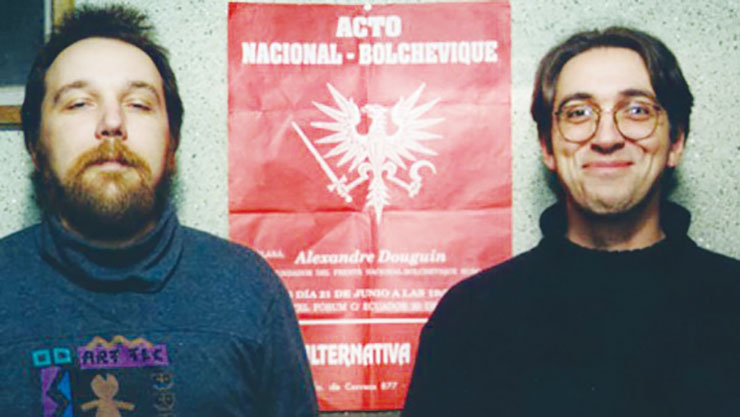
    In their 1995 ‘Manifesto of the New Magi’, Aleksandr Dugin and Sergey Kuryokhin set forth provocative statements calculated to realise a complete mystical transformation of society.  

    Reflecting on the influence of the ‘Manifesto of the New Magi’ in his interview with Charlie Nash for New Dawn magazine, Aleksandr Dugin explained that in the mid-1990s “the people around Kuryokhin and myself were artists, painters, musicians and filmmakers. They were a minority… totally countercurrent [to] the mainstream liberal tendency that surrounded us.” Adding “the influence of [the] New Magus was on one hand, very limited. Very small. But on the other hand, it was read by the [social] elite, the leading people. Many of them were perplexed.”

    The idea for such a Manifesto can be found in the Russian avant-garde of the 1920s, among artists and writers like Kandinsky, Malevich, Mayakovsky, Bely and Yesenin. 

    Sergey Kuryokhin, noted Dugin, was always up to date and “didn’t accept the main moral line, didn’t accept post-modernity as the answer. For him, it was a question. And those who still, in Russia or outside, have the same position, for them the ‘Manifesto of the New Magi’ is still a source of inspiration.” 

    “Because new magic, the new magi,” the Russian professor emphasised, “is not only about some group existing in Russia,” but remains attractive “to all those who share the main principles.”

    Manifesto of the New Magi
    By Aleksandr Dugin & Sergey Kuryokhin —

    1. We are facing a crisis of art, a lack of vitality, and the domination of pure mechanicalism. Post-Modernism – the very syndrome of degeneration – is itself deformed. Interest in art today is either tackiness (theatre, cinemas, and rock concerts), or das provozierte Leben (“the provoked life” in Gottfried Benn’s words), that is the occupation of a narrow and closed circle of “vampiric intellectuals” who have completely lost all orientation, but have not lost the need for food, social status, and vanity.

    2. We are facing a crisis of politics, a lack of thought and fresh ideology, and the degeneration of politics since the splash of Perestroika. Politics has totally lost all logic and life. Politics today is either a pathological conjunction (in the centre) or a pathological caricature (in the periphery). Politics is always and everywhere equally uninteresting.

    3. The critical low points in the degeneration of art and politics have now been reached simultaneously, all at once. This is not always how things go, but it is the case now. The lowest points of the two sinusoids have coincided.

    4. In such moments in the cycle of decline, a new impulse must be acquired for development, one which lies generally outside the sphere of the process itself. Sometimes politics spurs art, and vice versa. But now both spheres are in decline. Impulse must be sought elsewhere.

    5. This new realm is MAGIC. Magic is not events, things and objects but causes; magic does not simply describe but actively operates. Magic precedes art and politics. Art and politics became autonomous only upon being detached from their magical source. This source has not disappeared but merely slipped away to the periphery from where it exerts indirect influence. Secret societies, lodges and orders have governed history and inspired artists.

    6. Indirect influence has not been sufficient as politics and art forgot the necessity of constantly appealing to magic. Only the direct, total replacement of art and politics with MAGIC can save the situation.

    7. Today’s politicians and artists have outlived themselves. Nothing can save them. They are incapable of nourishing themselves with magic and liveliness. They ought to be written off and discarded. They are totally uninteresting. A new type should replace them.

    8. This new type is not a politician or artist dealing with magic, but the NEW MAGUS engaged in politics and art.

    9. All forms of art and all political ideologies have their occult parallels in operative magic. Paintings emerged as worldly depictions of the gods and symbolic signs. Political ideologies are secular expressions of metaphysical and religious doctrines, e.g. capitalism is, according to Max Weber, secularised Protestantism, while socialism and fascism are variations of Indo-European, Aryan traditions in which, according to Georges Dumézil, there is no caste of merchants. The source has gradually been lost sight of. With modern politicians and artists, we are dealing with incurable, inveterate idiots. The degree of talent and ideological success now directly depends on degree of acquaintance with occult doctrines.

    10. This fact must be recognised and accepted as an inevitability.

    11. Instead of a separate art, separate politics, and separate magic, a new synthetic discipline should be introduced, that of MAGIC, which directly establishes its own politics and its own art. The new hermeneutics is that historical context and aesthetic peculiarity should be discarded: it all comes down to occult paradigms. Goethe and Breton, Lenin and Churchill, can all be boiled down to magical paradigms (of the Masonic-Occultist and Hermetic-Rosicrucian bent) which they represented. All the rest can be discarded. Along with the new art and new politics will come a new approach to the study of art and a new political science.

    12. The new scholars of art and the new political scientists will not be separate people from the new artists and new politicians. They will be one and the same figures. And these figures will be none other than the NEW MAGI.

    13. Art thus becomes not the imitation of ritual or the imitation of the manufacture of fetishes, amulets, and idols, but the ritual itself, the manufacturing of amulets, fetishes, and idols.

    14. Politics thus becomes not the captured “remake” of collective orgies or the realisation of vague indirectly perceived metaphysical projects, but the direct myth-making and occult architecture of the masses.

    15. All of this is carried out and conceptualised by the NEW MAGI.

    16. Magic is an operative science. It demands real results, real metamorphoses – of objects, phenomena, and the operator. MAGIC is an experimental science that does not allow “obscurantism” and demagogy. The result, not the project, is the aim. Without concrete “eidetic realisation,” there is no magical act. If everything remains essentially as it was before the magical act, then we are dealing with either failure or charlatanism. Idiots and intellectuals shall not pass.

    17. The NEW MAGI affirm their art and carry out social coups. They specialise in geopolitics, large-scale science, and subjugate the elements; they tame the Atlantic Leviathan and feed the continental Behemoth. The minimum social scale of the NEW MAGIC is a country, people, state, or legions of human masses. Ascetics and marching bands of degenerate sects are of no interest to anyone. The NEW MAGIC deals with the phenomenon of the GIGANTIC, the GIGANTIC-NEW (a la Martin Heidegger).

    18. Our aims will become clear only when people begin to participate in our practice, actively or passively, as subjects or objects. Magic solves all gnoseological problems through Praxis (like Marxism).  

    19. From the outside, the crisis of art and politics may seem to be something objective. But do not build illusions, for it was organised by US in order to clear the path for the NEW RACE, the race of magic kings.

    20. We operate with abysses. For us, the invisible has its own geography. Black is not simply the absence of light, but a huge gamut of shades which earthly optometry has not even dreamed of.

    21. Abyssus abyssum invocate.

    22. In voce cataractarum.

    [alert type=”general” dismiss=”no”]This article was published in New Dawn Special Issue Vol 15 No 3.[/alert]

    [alert type=”success” dismiss=”no”]If you appreciate this article, please consider subscribing to help maintain this website.[/alert]

    © New Dawn Magazine and the respective author.
    For our reproduction notice, click here.
  • Lenin, the Red Avatar of Rage

    Lenin, the Red Avatar of Rage

    From New Dawn 84 (May-June 2004)

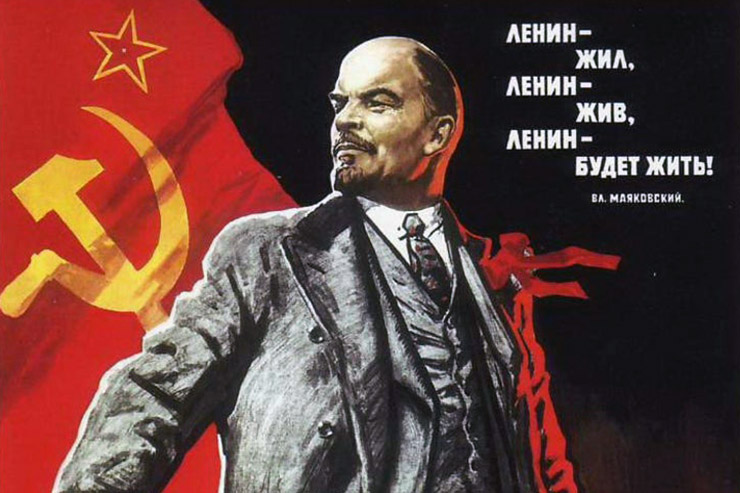
    I didn’t like [Vladimir Ilyich] Lenin (1870–1924) before. Everyone around me was saying: “Lenin, Lenin….” The majority is always wrong. During the Soviet Era, I used to take my small son out to spit on Ilyich statues. At the time, I read Evola and Malynsky and believed that Lenin was a main counter-initiatic agent of the “modern world,” who destroyed the last stronghold of Tradition: the Russian Orthodox Empire.

    I scoffed at Lenin and despised Leninists, and on seeing citations from his works, I felt like pouring boiling water on the authors who used these citations. Let us remember that, in those days, the overwhelming majority of present-day liberal reformists were enthusiastic Leninists, glorifying Ilyich with their always ready little tongues, coiling in their jackets, wriggling and squealing as in a damp, cozy hole.

    I was born too late to witness a period when people sincerely believed in Lenin (and Stalin) as a divinity. I came to live in a sickening decomposing Sovdepia, where no one knew or believed in anything any longer, bending over to whomever was in power at the moment. I thought that Lenin was a dark idol (tagut), raping the later-day Soviet Untermenschen while they grunted with pleasure.

    I was mistaken. I too was completely seized by the general atmosphere of decomposition, but came to a conclusion (absolutely inadequate, though) opposite of the conformist crap. I thought Leninism was the name of the anti-traditionalist hypnosis. Simply put, I hadn’t been to the West, and I couldn’t imagine that humanity could have degraded so much even without any Leninism. I assumed that the fourth proletarian estate was below the third, the bourgeois estate (as asserted by Evola), and, therefore, treating the far-away and unknown capitalism as an evil (but of the second order). I sincerely believed that Lenin was one of the faces of the Antichrist, a Russophobe, Westerner, and enemy of Traditionalism.

    My attitude towards Lenin changed during perestroika. I was particularly shocked during my first trips to Europe. The picture I saw was so repellent, so degenerative, stiff, totalitarian, untermenschist, only with the untermenschism of the people in the West, as opposed to that of the Soviets. It was not passive and absurd, but rather so triumphant, conceited and optimistic, complete and aggressive that I began to reconsider my attitude to the Soviet Fatherland.

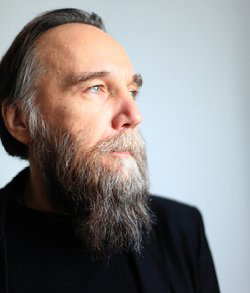
    Prof. Alexander Dugin, Russian philosopher

    At the same time in Russia itself, the most repulsive scum that most exasperated me physiognomically and typologically in the Later Sovdepia turned into “democrats” and “reformists”. The more vile and ugly the person was, for example, Yegor Yakovlev, the author of the most mendacious “Leniniana” of them all, or his namesake Alexander “Small Shoe” Yakovlev, of the CPSU Political Bureau, the “architect of perestroika,” the more shamelessly and harshly he abused and destroyed the Soviet system. On the contrary, in the position of diehard Soviet conservatives, one could definitely discern hardly expected dignity, ethics, stoicism, and fidelity.

    Gradually, these emotions became stronger through my research of common geopolitical themes. A distance, although small, from the Later Soviet period allowed me to view the situation all the more dispassionately, and then a concept began to grow on me that the Soviet society was by no means an expression of the modern spirit and anti-traditionalist Western plague, but a special, confused, and muddy, but nevertheless violent, thrust of a great people to break free from the dark clutches of the present-day Antichrist. In other words, I perceived in Soviet society a paroxysmal attempt to defend certain fundamental principles of traditional society against Western liberal-capitalist entropy.

    The Marxist model cannot be called “traditional” in the normal sense of the word, but in comparison with the liberal model, it has far more features of a traditional society. When it comes to a historical choice, this distinction acquires a special great meaning.

    At this stage, the pro-Soviet positions of Eurasianists and National-Bolsheviks became quite clear and close to me. They turned out to be the only positions sustained by history, whereas the narrow communist constructions or white-guard myths were obviously untenable and disproved by history.

    Incidentally, political history has also disproved Evola’s predictions about the triumph of Soviets as the fourth caste. Evolaism required a revision. The theoretical basis of such a revision was put forward in my speech at the academic conference in Rome devoted to the twentieth anniversary of Evola’s death. Today, it has become an integral part of traditionalist research (my theses “Evola: A View From The Left” is quoted in new Italian reissues of Evola, in professor Giorgio Galli’s works, and is focused on in discussions in many traditionalist circles). I expanded on this theme in my article “Julius Evola E Tradizionalismo Russo,” which is available in French and Italian versions.

    Thus, the name Lenin has changed its meaning. I think that simply history has occurred in such a way that this new meaning has appeared all by itself. It is indicative that even such a fierce hyper-reactionary and anticommunist as Geidar Jemal has recently devoted some heartfelt lines to Lenin.

    The mutation of the metaphysical quality of Vladimir Lenin is an objective fact. When his skull ceased to be sucked at, as some profitable candy, by dirty crowds who have gone (at last) into the sewerage expanses of “liberal reforms,” the features of a continental Titan began to appear on the horizon of the secret line of things.

    A Titan who lost his way, a strange Titan possessed by a great force, Starke von Oben, a magic Eurasian dwarf who declared an unthinkable, impossible jihad on the web of global percentage, the world of exploiters of financial entropy and oppressive vice, and… and… triumphantly won the great fight.

    Lenin smashed the brain of the philistine, razed to the ground the stock exchange and banks, completely exterminated the persistent pre-revolutionary worms (the Gusinskis and Berezovskis of the time), turned upside down the stratified, alienated Later Romanov Russia built on Old-Believers’ corpses, pawned and re-pawned to European nonentities, etc.

    Lenin mobilized the nation for a total upheaval. Yes, it was bloody, but blood is inherent to the birth of all things. Yes, it was allegorical, but the ideological discourse of Tradition has already been for many centuries compelled to disguise itself in dubious formulas of compromise, otherwise the kali-yugical mankind simply would not understand anything, as it has grown dull and bestialized beyond measure.

    However, a new perception of Lenin and Leninism is not an easy job. The vulgarity of plain nostalgia or non-reflexive dogmatism would be out of place as much as the hackneyed preaching of anti-Sovietchiks (incidentally, today’s anti-Sovietchiks are the most disgusting of yesterday’s Sovietchiks; it is not accidental that true dissidents and real fighters against the regime never managed to occupy any position of significance in the political hierarchy). New Leninism should be perceived magically, euroasiatically, eschatologically, and geopolitically.

    His is a solemn and mournful figure, a subtle maniac, through whom the unrestrained winds of the Continent were blowing. Burring, restless, mobile, cunning, stunned, rapaciously carnal, with half a brain and piercing little eyes, he is more vital and perfect than any athlete or orator, more vivid, lofty, and idealistic than any demagogue of “idealism” or “traditionalism.” In Europe I met many Guenonians and Evolians. Some of them were sloppy schizophrenics, others obedient and politically correct Philistines (many work in banks, while others teach the basics of marketing). They are a bunch of misfits, incapable of original thinking, deeds, terrorist acts, or any effective historical action of the slightest importance. The only thing they do is whine, squabble over some trivia, and grumble at the world around, which they do not understand at all and are pathologically afraid of.

    Any halfwit terrorist from the Red Brigades or RAF is a hundred times more attractive then the majority of European “traditionalists.”

    Lenin is a tragic and powerful Angel, one of the Angels of Apocalypse, pouring out the dreadful contents of the final goblet on the insane Earth. The angel of the last winds… The angel of blood and pain…

    I think that Vladimir Ilyich Lenin was a little Eurasian Avatar. He wanted to stop time and open the cycle of Eternal Recurrence. He was our Lenin. But he is dead. You killed him. You and I.

    [alert type=”general” dismiss=”no”]This article was published in New Dawn 84.[/alert]

    [alert type=”success” dismiss=”no”]If you appreciate this article, please consider subscribing to help maintain this website.[/alert]

    Translator’s notes: This article was first published in LENIN electronic weekly run by Misha Verbitsky. http://imperium.lenin.ru/LENIN/. Emmanuel Malynski, the Polish Catholic conspiracy theorist, together with Leon de Poncine, have issued several strong anti-Semitic brochures. Tagut in Arabic. Alexander Yakovlev, the so-called architect of Perestroika, cult figure in Russian liberal circles. The name ‘small shoe’ was given to him because of his lameness. Vladimir Gusinski, notable banker and media tycoon. Boris Berezovski, notable banker, the so-called Usurer of the Family (Yeltsin’s family). Starke von Oben, “the strong one from the skies”, term primarily used by Guido von List. The collective spirit of the perished heroes later embodied in the new generations or certain persons.

    © New Dawn Magazine and the respective author.

    For our reproduction notice, click here.