New Dawn – World's Most Unusual Magazine

Author: Andrew Gough

  • Interview with Graham Hancock: Ancient Civilisations & Altered States of Consciousness

    Interview with Graham Hancock: Ancient Civilisations & Altered States of Consciousness

    From New Dawn 134 (Sept-Oct 2012)

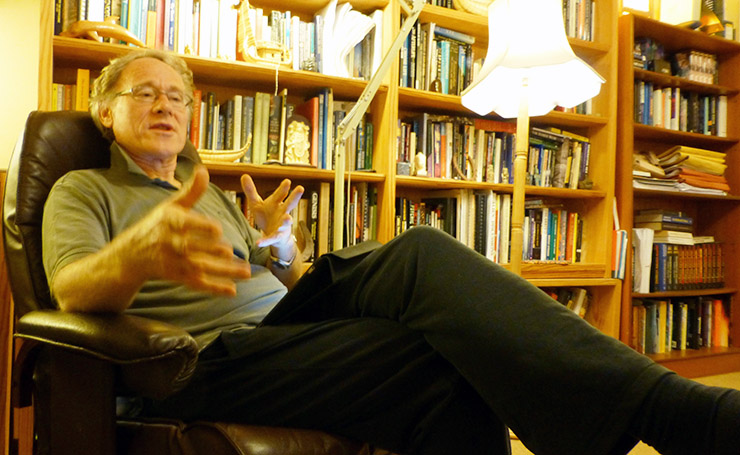
    Few, if any, have contributed more to the alternative history and esoteric genres than Graham Hancock. At the peak of his career, and on the eve of his first speaking tour of Australia [in 2012], Andrew Gough met up with Graham to discuss his legacy and what the future may hold for the greatest voice of his generation.

    ANDREW GOUGH (AG): Graham, hi. Welcome to New Dawn magazine.

    GRAHAM HANCOCK (GH): It’s a pleasure.

    AG: Can you believe that your seminal book, Fingerprints of the Gods, was published over 17 years ago?

    GH: Yes, it’s really bizarre, actually, the feeling that 17 years have passed. I had a feeling back then that there was another story to tell about the past – something missing in the record – and I set out to look for that.

    AG: Were you prepared for the responsibility that came with the success of Fingerprints of the Gods?

    GH: Well, I think first of all I need to make it very clear that Fingerprints of the Gods could never have been written if there were not a whole group of people working in this area. And, to name a few, I would say: Rand and Rose Flem-Ath, with their work on earth-crust displacement, following up the work of Professor Hapgood; Robert Bauval, with his extraordinary work on the Orion correlation, which radically changed our understanding of the pyramids and what they’re all about, and the deep antiquity that they’re connected to; John Anthony West, and Professor Robert Schoch from Boston University; John West, radical Egyptologist, thinking things through in a different way, realising that there is something wrong with the story of the Sphinx, and Robert Schoch backing that up with geological observations; all of these people were working away, doing incredibly important original work of discovery and part of my function was to write a book that put all of that work together into a bigger picture.

    AG: Your success was not without consequence, and I remember watching the 1999 BBC Horizon documentary in horror, as they attacked your theories, in what was clearly a premeditated manner. Although you were vindicated, what do you think led to the BBC’s aggression?

    GH: Well, again, I think, first of all, when you get into the field of exploring radical new ideas, challenging the status quo, and perhaps I didn’t realise this fully at the time, because the whole success of Fingerprints of the Gods and the speed with which things developed took me quite by surprise, you absolutely have to expect to be attacked, and academics also attack each other in exactly the same way.

    I also think, by 1999 perhaps I myself had become over-confident. I’d had a lot of success. When I look back on the story of my life, and those particular years, I think I was arrogant. I think I was cocky. I think I felt invulnerable. I actually think I needed to be taken down a peg, which is what the BBC did to me.

    AG: That’s a very impressive perspective.

    GH: Thank you.

    AG: So much attention has been paid to the end of the Mayan Calendar, but in your estimation what is significant about the start date?

    GH: Well, you know, this is curious. I actually can’t answer that question. All I can tell you is that when we look at what we understand of history we can say that date, of around 3100 BCE, does mark quite closely the beginning of the emergence of the city state.

    AG: And now the big question: what’s your view about what may or may not happen on 21 December 2012?

    GH: To be honest, I don’t think anything is going to happen on 21 December 2012. People often ask me where I will be on that date. Where I want to be is in the loving embrace of my family, surrounded by my children and my wife, having a good time.

    Perhaps now that I am coming on 62, as the years go by you begin to focus perhaps a little bit more on that. Life doesn’t go on for ever. We don’t know what happens afterwards. I happen to believe we come back. I can’t prove that, but I can’t see the point of a universe that provides just one life. So, my feeling about 2012 is a reminder that we’re here to love and that’s what we should be doing and living, as far as possible, positive lives, which means positive lives in relation to others as well. And that remains true, whether or not some great cataclysm is coming.

    AG: What is your view on reincarnation?

    GH: Well, first of all, reincarnation makes perfect sense to me. I think it was Voltaire who said that it is no more extraordinary to be born twice than to be born once. My own religious point of view is that it seems highly likely that consciousness survives death, and I have tried to make this point in recent lectures, that materialist science works with a model of the brain that says the brain generates consciousness, rather in the way that a factory makes cars, and therefore when the brain is dead consciousness is dead. That’s a view. But again, that is not a fact. It is equally possible, and all the measurements would remain the same, that the brain is a receiver, or a transceiver, of consciousness; that the brain is the junction point between the material and immaterial realms; that is the point through which consciousness manifests into the material plane, rather in the way that a television signal manifests as pictures through a television set. When you destroy the television set the signal is still there. Consciousness could equally well be that way.

    AG: Do you think we choose our circumstances in our next life?

    GH: Again, it kind of makes sense to me that we set a particular objective for this life – that there’s stuff we need to ‘get’ here. As I’ve gone through the process of life and I’ve made my mistakes, I’ve become more and more certain that there are transcendental consequences to all of our actions and I’m much more aware of this today than I was 20 years ago. We should not act lightly or thoughtlessly in ways that impact others and impact ourselves. We should consider that this may have huge implications over millions of years, not just over this one lifetime.

    AG: Tell me about the impetus for The Master Game?

    GH: In The Master Game, co-authored with Robert Bauval, I focused on the Gnostic tradition and how the mainstream religions – Christianity, Judaism and Islam – all worship the same entity, who is referred to as Jehovah or Yahweh in the Christian and Judaic tradition and Allah in the Islamic tradition, and that from the Gnostic point of view this entity called Jehovah is not a god. He is an imposter. He is a demon, who presents himself as a god.

    There was a saying in the film, The Usual Suspects, that the smartest trick the devil ever played was to convince the world that he did not exist. Gnostics would take that a step further – they would say, the smartest trick the devil ever played was to convince the world that he is god – that you actually insert the demonic into the mainstream religions and that would explain why these religions talk the talk of peace and love, but actually walk the walk of hatred and cruelty and violence.

    AG: Has the fact that history has been written by the victors ever made you wonder if the wrong god won?

    GH: Well, yes, I think the wrong god won – absolutely. The alternate point of view was driven underground, and that alternate point of view said that spiritual experience is fundamental and that we don’t need these intermediaries that call themselves priests or mullahs or rabbis to tell us how to relate to the spirit. How dare they stand there and tell us how we may relate to the divine?

    AG: Take Lucifer, who we are conditioned to believe was evil, but his name means ‘bringer of light’. That doesn’t sound evil to me.

    GH: Not to me, either – and again, of course, the knee-jerk Christian faction will immediately say, ‘Oh, you’re a devil worshipper’, but what actually are we worshipping in this creature called Yahweh, called Jehovah? Look at the stories in the Old Testament. Look at the things that this entity did. This is not a loving, beautiful, divine light. This is a dark creature, which tells a man to kill his own son; which says that if somebody behaves in a certain way – if somebody is a homosexual, for example – they should be killed. This is written in the Old Testament. Don’t listen to what they say. Look at what they do. What they do is pure, unmitigated, divisive hatred, wickedness, suspicion and evil.

    AG: Why do you feel there has not been a significant discovery in Egypt or other ancient lands in some time?

    GH: Well, actually I do feel there have been significant discoveries. I feel that, for example, Robert Bauval’s Orion Correlation is a significant discovery. I think that the gigantic, 12,000-year-old megalithic temple in Turkey, called Göbekli Tepe, that’s been excavated in the last six or seven years by a mainstream archaeologist, is a hugely significant discovery. First of all, it’s firmly dated to 12,000 years old, which makes it 7,000 years older than other known megalithic sites. Secondly, it’s highly sophisticated, which means there’s a background to it, which is much older than 12,000 years, that we don’t, at present, have any evidence for, but the very fact that Göbekli Tepe stands there tells us there is a background, because those people were not moving around 20 or 30 ton megaliths without some previous experience. Thirdly, that the oldest stuff at Göbekli Tepe is the best and that the younger stuff is less good.

    AG: What do you think is the lost civilisation destroyed in the last ice age?

    GH: I do think there was something worthy of the name ‘civilisation’ back in what geologists and archaeologists call the upper Paleolithic – the end of the last ice age – and that it thrived, I think, on coastlines. I think it was primarily a maritime civilisation. I don’t think it was a civilisation very much like ours.

    For me, maps from the fourteenth and fifteenth centuries, based on ancient maps, are evidence there was a global, maritime civilisation, which mapped the world and I think that it drew a meridian through the earth. The ancient prime meridian ran through Giza, that’s the zero point, and I think there were sites all around the world that were marked off at significant longitudes in relation to that zero point.

    AG: In what epoch do you believe the ancient meridian was constructed?

    GH: I think there was an attempt to re-map the world after the cataclysm. I think there were survivors and I think that, again somewhere between 13,000 and 12,000 years ago and perhaps soon after a radical cataclysm shook the earth, there was an attempt to re-establish things, to re-map things, and that attempt ultimately failed, but traces of it are left. I think that’s what happened.

    AG: Which underwater site do you think is going to create acceptance that civilisation goes back further than historians believe it does?

    GH: Luckily, with Göbekli Tepe, we’ve already got one above water. What I was arguing in Fingerprints of the Gods was evidence for a sophisticated civilisation 12,000 or more years ago and Göbekli Tepe already provides us with really incontrovertible evidence of the existence of such a culture, which had developed its stone-working techniques to such a degree that it could create a site on that scale.

    As you’ve said, Fingerprints of the Gods was published 17 years ago. I took the work a lot further with Underworld and the underwater stone circle of Kerama in Japan, off the island of Okinawa, I think is a greatly underestimated site. It’s 110 feet underwater and has been so for 12,500 to 13,000 years. I think the cities that have been detected with sidescan sonar in the Gulf of Cambay, off the north-west coast of India, are very, very interesting. And off southern India, as well, where we have a huge Atlantis tradition.

    AG: Where do you place Atlantis, and when?

    GH: I place it everywhere. I think it’s important to not isolate the Atlantis story – it doesn’t stand alone. There are many such stories from many different cultures around the world.

    And I don’t think we should forget America itself, if we’re looking for the one that’s Plato’s Atlantis. America is very interesting and it does appear to have been over North America that this gigantic comet of 12,900 years ago exploded. So, I think there’s a whole lot of missing story to be recovered from the Americas and offshore of the Americas.

    AG: The Sign and The Seal chronicled the history of the Ark of the Covenant and traced its possible resting place to Axum, Ethiopia. What do you think would happen if the Ark was rediscovered today?

    GH: It’s a fact, and a rather spooky one, that the three mainstream monotheistic faiths, Islam (particularly in its Shia manifestation) Judaism and Christianity, all have fundamentalist elements which make reference to the Ark of the Covenant, and for the character that the Shias call the ‘Hidden Imam’ to return. He, by the way, is the person whose return Iran is actively preparing for now: the Mahdi, whose name lies behind the Madhi Army in Iraq. The Hidden Imam (the Mahdi) must recover the Ark of the Covenant and return it to the Temple Mount in Jerusalem before he can engage in what is seen, in Shia tradition, as the final battle of good against evil, which is interpreted in Iran as the battle of Shia Islam against the forces of the West and Judaism. The recovery and retrieval of the Ark of the Covenant, and its return to the Temple Mount in Jerusalem, is the key that turns that process on – the process of Judgement Day, or of the end of the world.

    It’s the same for fundamentalist Judaism. There are groups, such as, for example, the Temple Mount Faithful in Israel, who are intent on building the Third Temple on the Temple Mount and who would like to sweep away the monuments of Islam, the Al-Aqsa Mosque and the Dome of the Rock, and make it a site of fundamentalist Zionism. They, too, require the Ark of the Covenant in order to realise that apocalyptic dream, which they, too, see as the precursor to the end of the world.

    And fundamentalist Christians make reference to the Book of Revelation, where one of the signs of the Day of Judgement is the reappearance and return of the Ark of the Covenant. For these institutions, access and control of that object would, undoubtedly, be used as a catalyst for a cataclysmic struggle. So, I think it’s a really good thing if the Ark stays away from history for a while.

    AG: What role do you feel psychedelics and hallucinogens have played in the evolution of human consciousness, imagination and religion, and is there a place for them in our world today?

    GH: Just as it’s impossible to understand ancient civilisations without getting into astronomy, I think it’s impossible to understand ancient civilisations without getting into altered states of consciousness, which can be brought about by a variety of different means, of which the most widely used and most reliably effective are the visionary plants. But there are other techniques and methods for getting into deeply altered states of consciousness. So, I would put the emphasis first on altered states of consciousness, rather than on psychedelics. Psychedelics are simply a vehicle for bringing about the requisite altered state of consciousness.

    AG: Like drumming?

    GH: Drumming, rhythmic dancing, certain forms of music, fasting has a long and honourable tradition for bringing on altered states of consciousness and contact with the divine – there really is a huge range of techniques. People get really holier than thou about this and say, ‘we achieve altered states of consciousness though meditation – this is the only pure way to do it – anybody who uses psychedelics is not authentic.’ I think that’s absolute bullshit.

    Of course, mainstream society does tolerate certain drugs. It does allow people to use alcohol – in fact, it encourages people to use alcohol. There are other agents that induce radically altered states of consciousness, which not only allow you to step out of the alert, problem-solving state of consciousness, but also almost inevitably lead you to question the fundamentals of life in the material realm and, indeed, the nature of reality itself; those agents include power visionary plants, such as the Ayahuasca in the Amazon, which consists of two things. It consists of the vine, Banisteriopsis caapi, and it consists of the leaf of a bush, Psychotria viridis; it’s called Chacruna in the Amazon and the vine is called Ayahuasca. The leaves contain pharmacologically pure dimethyltryptamine (DMT), which is, of course, a highly illegal drug throughout the West and, indeed, throughout the world. It’s a Schedule I drug in the United States, it’s a Class A hallucinogen in the UK, and you can go to prison for a very long time for using DMT.

    DMT is probably the most powerful hallucinogen known to man. I have personally had eleven journeys with pure, smoked DMT and what happens with DMT is that it hits you within about one tenth of a second of the first inhalation and, within two to three seconds, it plunges you mercilessly into a completely alien realm, which is as much disconnected with this realm as it is possible to imagine and which, as a result, can be utterly terrifying – or not.

    Most people that have worked with DMT will agree with this: there is something oddly almost mechanistic and technological about DMT realms. And the sense of alien contact is very powerful – that there is so much in common between the realms that are encountered on a DMT journey and the realms that are reported by UFO abductees, that you have to ask yourself what is going on here?

    I think it is likely that UFO abductees are people who spontaneously overproduce DMT, because DMT is a natural brain hormone. We’re not sure which part of the brain it’s produced in, although it has been suggested that it might be the pineal gland. But it’s really important to emphasise – and I have to make this absolutely clear – this does not mean that those experiences are not real. This does not mean that those experiences are artefacts of the brain. What this does mean is that reality may be much more complicated than we imagine. If I were a betting man I would say that what we are dealing with here is inter-dimensional contacts, rather than just contacts in this dimension, between high-tech and lower-tech beings. I think the flying saucer may be a vehicle to cross dimensions and that it may, at times, manifest into this physical dimension and may, at times, leave a physical trace, but that the primary way of accessing this is through consciousness.

    AG: Dr. Michael A. Persinger’s invention, the ‘God Helmet’, applies pressure to the frontal lobes prompting individuals to experience the alien abduction phenomenon. Are you saying that this does not negate the fact that the individual is accessing another dimension or reality that is equally as real as ours?

    GH: Exactly. Even Persinger himself, who is pretty committed to the materialist paradigm, admitted this on record; that he can’t absolutely prove that the brain is making these things. He may be altering the receiver wavelength of the brain and allowing a glimpse of another level of reality.

    AG: Tell me more about Ayahuasca.

    GH: Ayahuasca is a brew – it’s a drink – and there is a mystery in this in itself, because the DMT is being delivered orally and it’s working and the reason that it’s working is because of the Ayahuasca vine, which contains a monoamine oxidaze inhibitor that switches off the monoamine oxidaze in the stomach and allows the DMT in the Pyschotria viridis leaves to be absorbed and to cross the blood-brain barrier and enter the brain. Now, when you bear in mind that there are 155,000 different species of plants and trees in the Amazon, it’s a pretty amazing piece of chemistry that the shamans in the Amazon found these two plants, which, when put together and cooked with water, produce this amazing brew.

    Now, here’s the curious thing with Ayahuasca, which, again, is universally reported: the sense of connection and contact with an intelligence, which we also find with pure DMT, but in pure DMT those intelligences are a bit impersonal and quite mechanistic. It’s like they’re machines that have got a job to do on you. With Ayahuasca there’s a very personal sense of a connection with a being, who, in a way, is a being a bit like us, but vastly superior in her powers and abilities.

    AG: Her? Is this ‘being’ demonstrably a female?

    GH: Many people encounter this being as a woman, or as a female entity – very often as a serpent – usually as a serpent – but always understood to be female. Serpents play a huge role in it. This is very well documented. As any shaman will tell you, when the 300ft-long serpent opens its jaws right in front of you, then what you have to do is just dive right in and go into that process and see what comes. For me she has always been female and I have come to the feeling that many others have come to, that she is the mother goddess of this planet, and that her business is the planet, and that she does not operate in the material realm. Her only way to access the material realm is through human consciousness and that’s why right now, at this time of crisis, Ayahuasca is spreading all over the world and it is being drunk in every major city in the world, and it’s being encountered by tens of thousands of people all around the world, and every one of them is receiving very curiously similar messages from Ayahuasca. And those messages concern the nature of the environment; they concern terrible things that are being done to our jungles, and to our oceans, and to this beautiful gift that we’ve been given by the universe, that we’re destroying, and the desperate need for a change of consciousness to stop that monstrosity happening. And they concern our personal lives.

    Ayahuasca is regarded as a teacher in the Amazon and she will usually begin with obliging you to ruthlessly review your own life, and will show you the impact that you have had on other people. In a visionary sense you see this – the impact that you have had on other people over the whole course of your life, and the pain and the damage and the hurt that you have caused, that you may have totally justified to yourself at the time; but Ayahuasca strips all of that away and obliges you to see yourself as you have been to others in reality, not as you imagined it to be. As a result, many people find themselves in floods of tears during Ayahuasca ceremonies, because they have realised that, far from being the nice, decent, loving person that they thought themselves to be, they’ve actually been rather toxic and selfish and greedy and cruel and unkind to others.

    It is probably the most effective and most powerful anti-addiction agent in the world and the control of addiction comes through revelation – through the realisation of the individual that they are making a mistake in their lives and I speak from direct experience in this matter. I am not simply reporting something that’s in the literature, because I had, until October 2011, a 24-year, non-stop marijuana habit. It was a very central part of my life and there was a time in my life when smoking marijuana was, I believe, helpful to me – extremely helpful – and helped to open me up to other possibilities. I first started smoking marijuana in 1987 and that was round about the time that I started to open up to the Sign and the Seal and the ideas that led me into the whole enquiry into ancient civilisations. I actually don’t believe I would ever have done that if I hadn’t encountered marijuana at that time.

    I was told by many people that something had changed in my behaviour and that it wasn’t good, but I wouldn’t listen. I was just sure that this major, major, major use of marijuana was a very important, fundamental part of my life and I felt, actually, that I couldn’t write without it. But when I went to Brazil in October 2011 and had five Ayahuasca sessions, they dealt directly and specifically with my marijuana habit.

    AG: That’s amazing. And how did your upcoming tour of Australia with Dennis McKenna and Mitch Schultz, ‘The Origins of Consciousness: An Exploration into Psychedelics, Spirituality & Ancient Civilisations’, come about [see advertisement on page 17]?

    GH: I know Mitch Schultz personally and I have talked many times with Dennis over Skype and the three of us have many mutual interests; the idea came up of putting together our similar and diverse interests into a series of talks and events that will be given across Australia. I’m enormously looking forward to it.

    AG: Your most recent work, Entangled, has seen you delve into fiction. After such an illustrious catalogue of historical non-fiction, what promoted this shift in approach?

    GH: I have always wanted to stretch myself and not to get locked in a particular rut, just because it works. In the time that I have I would like to explore this gift that I’ve been given, just as somebody who is a sculptor might like to explore their abilities as a sculptor.

    But then there was the question, what would I write about and how would I approach it creatively? And, again, this is an area where some people, no doubt, think that I’m nuts, but I went to Brazil and asked Ayahuasca what to do with that – this was back in 2007/8 – and I was given the story, pretty much, that I wrote in Entangled in a series of Ayahuasca sessions in Brazil.

    AG: You present a unique and fascinating view of Neanderthals in Entangled. How did this come about?

    GH: In Supernatural I didn’t give the Neanderthals much respect. I regarded creativity and symbolism as the province entirely of anatomically modern humans, but Ayahuasca showed me a different picture of Neanderthals altogether and that I expressed in Entangled.

    AG: Time travel is an important theme of Entangled. Do you believe it’s possible?

    GH: I really do, yes. I believe time travel is possible and that time itself is much more complicated than we think. This is a point that I make strongly in Entangled: that we have this linear notion of time – time’s arrow – that past, present and future all run in a straight line and that therefore, while the past might impact on the future, it’s impossible for the future to impact on the past. I take a totally opposite view in Entangled – that time spirals like a cat’s cradle of lines that inter-wrap and interweave and that different epochs can be closely connected to one another, and that, actually, the future can have an effect on the past; that the past can be changed; that any unobserved element of the past can be changed by things that happen in the future.

    AG: So, 2012 notwithstanding, what does the future hold for Graham Hancock?

    GH: I’m embracing fiction very strongly at the moment. I am going to go back and write the second volume of Entangled. I have actually written a hundred pages of the second volume, but for certain complicated reasons to do with my publishers, as much as anything else, but also because I think there was stuff I needed to learn, I’m writing a whole series of other novels first; three novels, of which I’ve already written two, and this is a fantasy adventure series, based very strongly, historically, on the events of the Spanish Conquest of Mexico. Then I’ll go back and finish the second volume of Entangled. Then I may, just possibly, do a follow-up to Fingerprints of the Gods.

    AG: That would be brilliant. What words of wisdom can you leave us with?

    GH: Just to reiterate that 2012 is a reminder that we’re here to love. And that remains true, whether or not some great cataclysm is coming. It remains true, whether or not the world economy is going to collapse. It remains true, whether or not the madness of the state-driven system and the madness of mainstream religions is going to plunge us into a cataclysmic, man-made, global war. All any of us can do is make choices, as individuals, to live positive and nurturing lives that are filled with love and light, rather than with darkness and with hate and, if we make that decision at the individual level, every one of us, then the light is going to grow in the world.

    AG: Let me second that, and thank you for all that you have done. Best of luck in the future.

    GH: Thank you. My pleasure. It’s been fun.

    Graham Hancock’s interview was transcribed from audio by Beth Johnson.

    [alert type=”general” dismiss=”no”]This article was published in New Dawn 134.[/alert]

    [alert type=”success” dismiss=”no”]If you appreciate this article, please consider subscribing to help maintain this website.[/alert]

    © New Dawn Magazine and the respective author.
    For our reproduction notice, click here.
  • Hidden London: Secrets of the City Revealed

    Hidden London: Secrets of the City Revealed

    This article was published in New Dawn 133 (Jul-Aug 2012)

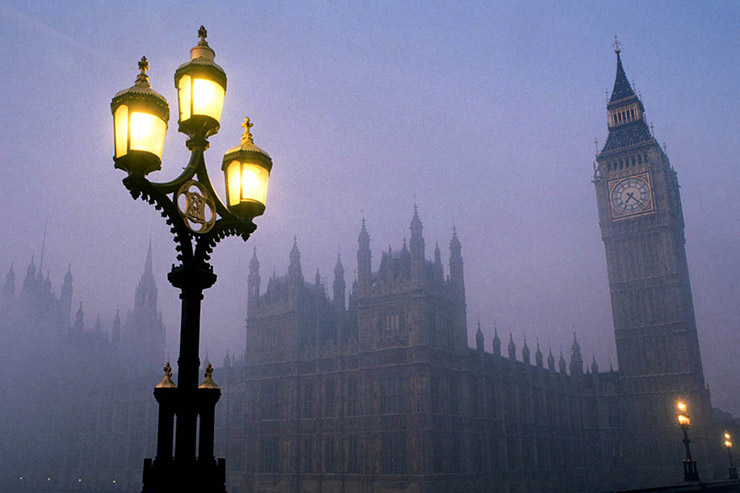
    American by birth, I have lived in London for fifteen years and consider it my home. During that time I have explored many of the city’s esoteric sites and have concluded that this remarkable metropolis is only just beginning to reveal its true occult significance.

    London has been inhabited for thousands of years and the diversity of its settlements has resulted in a rich, if not peculiar, collection of occult traditions. The earliest humans hunted here over four hundred thousand years ago. While a rich abundance of wildlife and a strategic riverside base would have attracted many different colonies of people, one wonders how the ancients truly saw their landscape, and how many were drawn here due to the distinctive snake-like curvature of the River Thames.

    The serpent is one of the oldest occult symbols, representing many esoteric concepts, including duality, good and evil, and harmony with the earth. Thanks to the wonders of technology, an image of the serpent in the form of the winding Thames has been broadcast daily to millions of viewers across the globe for nearly three decades, courtesy of the television programme Eastenders, whose opening credits feature the unique landscape from the air.

    Like other ancient settlements in Europe, London was inhabited by megalithic societies who constructed stone circles and burial mounds. The Iron Age introduced more sophisticated settlements and hill forts which, sadly, can only really be appreciated today by aerial photography. These include settlements at Wimbledon Common, Heathrow and the present-day Houses of Parliament, to name a few. Urbanisation has all but erased the megalithic footprint of London, but some remnants, such as Primrose Hill, with its curious burial mound and breathtaking views of London, remain. In fact, Primrose Hill would become a haunt of occultists William Blake and Dion Fortune, amongst others, and plans, albeit later aborted, would be made to construct a colossal pyramid burial complex on top of the hill, complete with over five million honeycomb-shaped tombs.

    There is considerable evidence for occult practices having occurred in London in ancient times: beeswax effigies, thought to be five thousand years old, have been found in the Thames, representing man’s attempt at harnessing occult powers via shamanism and many stylised Bronze Age swords have also been discovered in the Thames, suggestive of votive offerings to Celtic deities. Similarly, albeit over a thousand years later, a golden-horned, apparently ceremonial Viking helmet was discovered in the Thames, near Waterloo. The amazing artefact is unique in Europe and appears to reinforce the occult tradition of London’s ancestors and their reverence for the serpentine river.

    The Trojan leader Brutus established a city here in 1100 BCE and named it Troia Nova, or Trinovantum. Later, the 1st-century BCE King Lud renamed it Caer Lud, which evolved into Caerlundein, Londinium and finally London. It is said that giants lived in London in Brutus’s day and that he captured two, Gog and Magog, and employed them as porters at the gate of his palace. Brutus is also associated with another legend, the London Stone, a curious rock of which little is known for certain. Some say it came from Troy, others believe it was a druid stone or even the stone from which Arthur extracted Excalibur.

    A medieval proverb states, “So long as the stone of Brutus is safe, so long shall London flourish.” William Shakespeare wrote about the stone and, intriguingly, many believe that his plays were actually written by Francis Bacon or Christopher Marlowe, both of whom were esoterically connected. Another London occultist, William Blake, wrote of the London Stone in his poem, Jerusalem (1820): “At length he sat on London Stone and heard Jerusalem’s voice.” Clearly, the relic once cast a magical spell on the city. Sadly, it is now embedded in an abandoned building across from Cannon Street Tube Station, its former glory but a distant memory.

    For the best reading experience, obtain the full digital version of this magazine with all this article’s illustrations.

    Hail the Romans: As Above So Below

    The arrival of the Romans marked a significant milestone in the evolution of London’s occult tradition and in 54 BCE Julius Caesar and his men crossed the Thames in West London, signalling the new era.

    The Romans were especially threatened by the Druids, who, according to Caesar, were involved in divine worship and human sacrifice, including the burning of prisoners, or even innocents, in ‘wicker men’. Sure enough, London’s native tribes appear to have paid homage to their gods for protection from the Romans, as indicated by a decorative bronze shield with inlaid coloured glass found in the Thames near Battersea that dates to this time. The original inhabitants of London were incredibly resilient and fought bravely to maintain their cultural identity. One hundred years later Queen Boudica sacked the city and soundly, if not brutally, defeated the Romans in retaliation for the rape of her daughters and the killing of the Druids; but the Romans would soon avenge this attack and all but extinguish the Druids and their largely oral occult traditions.

    The Roman invasion changed the landscape, language, culture and thought process of native Britons forever. There are many museum exhibits in London that document these changes via artefacts and re-creations. From an occult perspective there was a less tangible, but no less fundamental, change in consciousness starting to take place: the introduction of Mithraism, and the theology of ‘as above, so below’.

    Not much is known of this ancient mystery school, other than it involved Mithras, the Roman God of Light, but we do know that it also involved the ritualistic slaughter of bulls and included a seven-grade system of initiation. Like the Masonic rituals that would be conducted some fifteen hundred years later in London’s Grand Lodge, Mithraism included ritual meals and a secret handshake.

    The Romans conducted their rituals in underground temples called mithraea, and several of these evocative temples have been discovered in London, including one remarkable 60-feet long, 26-feet wide temple beneath the now underground River Wallbrook.

    The origins of Mithraism are uncertain, although it is known to have been popular amongst Roman soldiers, most likely because it provided a comforting framework for the afterlife, and understandably so. In their profession a premature death was almost inevitable. The cult is thought to be Roman or Persian in origin and the name ‘mi-it-ra’ has been found inscribed in a 1400 BCE peace treaty between the Hittites and the kingdom of Mitanni in Northern Syria. This is interesting, for both regions have a rich tradition of bull veneration and each was contemporary with Dynastic Egypt, where I believe the tradition of Mithraism originated. In Egypt, the slaughter of Apis (‘bee’ in Latin) bulls resulted in 1,000 souls, represented as bees, being born out of the body of the dead bull. The occult tradition of bull slaughter, which is referenced in the Mesopotamian Epic of Gilgamesh and the Egyptian Opening of the Mouth ceremony, commemorates what the ancients observed in the constellation of Taurus: a hunter killing a bull with distinctive marks (3 stars) on its forehead, just as the Apis bull has distinctive marks on its forehead.

    I believe London’s adoption of the occult tradition of ‘as above so below’ can also be found in the legend of King Arthur, whom every Celtic nation claims as their own, most notably England. In a recent documentary on King Arthur that I presented for the National Geographic Channel, I expressed my belief, much to the producer’s chagrin, that the ambiguity around Arthur’s origins is due to the fact that he never existed. Rather, he was an archetypical hero, who lived in the constellation of Ursa Major, known as the ‘Great Bear’, meaning Arthur. Man would have observed the Big Dipper, which resembles a platter (the object that was considered to be the Grail in the first complete account) rotating around the Pole Star, promising to return, like Arthur. The night sky also includes an outline of a man with a wounded thigh, which sounds very much like the Fisher King. And, of course, Arthur fought twelve battles and there were twelve knights of the ‘round’ table; one for each of the twelve constellations perhaps? Was the legend of King Arthur just another archetype, much like Mithraism?

    The Arrival of the Knights Templar

    The Order of the Hospital of St John of Jerusalem was founded in 1099, shortly after the First Crusade. Less than fifty years later they established their headquarters at the Priory in Clerkenwell, the remains of which are now a museum. Across town, the Knights Templar established a base in High Holborn, in a Roman temple once revered by Hugues de Payens. The Knights Templar outgrew their headquarters and built Temple Church between Fleet Street and the River Thames, a round church based on the Church of the Holy Sepulchre in Jerusalem. In keeping with their power elsewhere in Europe, the Order installed the Master of Temple Church in Parliament, thus ensuring that their powerful occult views would become part of the nation’s legislature.

    The land between Fleet Street and the Thames was owned by the Knights Templar and divided into Outer Temple and Middle Temple, with Temple Church serving as Inner Temple. Each existed above the covered-up River Fleet and, in occult tradition, an underground stream provides divine augmentation to rituals and spiritual attainment.

    Come the middle of the 19th century the tale of Sweeney Todd, the demon barber of Fleet Street, began to emerge. The gory urban myth appears to be without historical merit, causing some to speculate that the legend of a serial killer in the vicinity of the Templar precinct may be a memory of former ritual sacrifices. Today a dragon guards the entrance to Temple Bar and reminds one of the esoteric traditions once practiced there.

    Despite the recent Hollywood movie starring Johnny Depp and Helena Bonham Carter, the legend of Sweeny Todd has largely been superseded by one that took place half a century later, in 1888, when a serial killer by the name of Jack the Ripper murdered five women, forming a 5-sided pentagram in the process and removing their organs along the way, including, in some instances, their hearts.

    Ritual killings continue in London, and the river Thames continues to be the depository for the ritual remains of victims. In recent years the analysis of limbless torsos discovered in the Thames has prompted authorities to suspect ritual murder and superstition as the reason for the crimes. This is not a new tradition in London. The nursery rhyme, ‘London Bridge is falling down’, is said by English Myths and Legends author Henry Bett to be the folk memory of the ancient practice of human sacrifice at the building of a bridge.

    Summoning the Spirit World

    A belief in the occult appears to have helped London achieve prosperity during periods of pending adversity. Dr. John Dee (1527-1608), who used a crystal ball and scrying mirror to guide Queen Elizabeth through one of the most challenging eras in British history, is perhaps the most renowned example (see “John Dee and the Enochian Apocalypse”).

    But there are many other examples of occult traditions in the court of the king and queen. Take, for example, the peculiar tale of King Charles II (1630-1685), who presented his mistress, a resident of West London, with a griffin. The dog-like figure with wings fell into a local river, survived and ended up in the Thames, near the point at which Caesar had crossed. It was later paired with a second griffin that Joseph Banks, a scientist who accompanied Captain Cook on his voyages, had brought back from an exotic island in the Pacific Ocean. The account leads us to believe that the griffin may have been a real animal, which multiplied before fading from history, only to be seen once more in the 1980s, and on multiple occasions by various upstanding citizens of West London.

    Charles II also domesticated the ravens at the Tower of London, a tradition summed up as follows: “If the Tower of London ravens are lost or fly away, the Crown will fall and Britain with it.” The belief appears to stem from the legend of the Celtic god, Brân the Blessed, whose name means ‘Blessed Raven’ in Welsh and who was killed in an otherwise successful battle against an adversary, the Irish King, Matholwch. Brân’s head was buried beneath the spot where the Tower now stands, facing France as a talisman against further foreign invaders. Could the legend of the griffin and the raven somehow be related?

    Henry VIII (1491-1547) created a religious revolt with great consequence when he severed ties from Rome in an act known as the Dissolution of the Monasteries. Given the many cathedrals and orders that were subsequently transformed into ruins, any number of different sects could have been culpable of the act of desecration that awaited the king after his death. On his way from London to Windsor, where he would be buried, the King’s funeral procession rested overnight at Syon Abbey in West London. In the morning it was discovered that wild dogs had ripped open his casket and ravaged his body, leading some to speculate that the attack was a deliberate act of revenge enacted by a member or group of individuals from one of the aggrieved monastic orders he had defied.

    Phoenix Rising

    The Great Fire of 1666 devastated London, destroying over 13,000 buildings. What is less widely known, however, is that occult beliefs prevented an otherwise manageable outbreak from being extinguished. This is confirmed by first-hand accounts of Londoners whose belief in the prophecies of Mother Shipton and Nostradamus, each of whom was thought to have predicted the catastrophic fire, led them to feel disempowered and unworthy of extinguishing the fire and thus saving the city from its destiny.

    Out of the ashes came a vision of a New Jerusalem, masterminded by the Freemason and architect, Christopher Wren, who drew on the occult traditions of the Kabbalah, and the tree of life in particular, in addition to the sacred geometry of the Old Testament. Wren reintroduced the hallowed number of 2,000 cubits, or roughly 2/3 of a mile, which represented the distance from the Mount of Olives to Jerusalem (the furthest a Jew was allowed to walk during the Sabbath), and proposed that many of London’s newly-constructed buildings be set 2,000 cubits apart.

    Foremost amongst Wren’s impressive, occult inspired designs is Saint Paul’s Cathedral, which not surprisingly is aligned 2,000 cubits from Temple Bar to the West and 2,000 cubits from St Dunstan’s in the East. Miraculously, the stunning edifice survived the bombings of a world war, and it is no wonder that Prime Minister Winston Churchill addressed his staff each morning with the pensive question; “Is Saint Paul’s still standing?” Poignantly, Saint Paul’s is where Wren is buried. Fortunately for all, the fabulous monument still stands like the esoteric beacon it was always intended to be.

    Other buildings erected after the fire, such as the Monument and Nelson’s Column, were either designed with occult-inspired dimensions or aligned to the solstices. Further, Wren’s student Nicholas Hawksmoor followed in the occult tradition by placing Egyptian obelisks on top of churches, forming, in the estimations of some, a pentagram on the ground across London. The tradition of creating buildings with occult dimensions had been re-born and continued in later periods of development, such as the nude, winged statue of Anteros, the Greek avenger God of requited love, erected in Piccadilly Circus in 1892, and which was originally orientated in the direction of Parliament, presumably to send ‘love’ and to produce greater synergies within government.

    King George III (1738-1820) was a remarkable man and one of England’s many occult-minded kings. In 1769 George III anxiously awaited the completion of an alchemist observatory in the London Borough of Richmond upon Thames. In commissioning the work, George III was creating his personal observatory and meridian, despite the fact that the official and Royal Observatory – and meridian, the naval of the country – had been established in Greenwich a hundred years earlier. The King was passionate about astronomy and instructed his architect, the renowned occultist Sir William Chambers, to complete the work in time to view the transit of Venus, which occurred that year on 3rd June.

    Meridians have existed since ancient times. While the placement of a meridian is arbitrary, its function is quite specific: to project an imaginary line across earth’s surface, stretching from the North Pole to the South Pole, esoterically connecting all locations within a given longitude. In the case of George III, he projected his own meridian straight down the serpentine Thames, a stunning riverside landscape, rich in history and renowned for its visionary inhabitants, innovators such as J M W Turner, Alexander Pope, James Thompson, Horace Walpole, David Garrick and William Hogarth, to name a few. The Meridian was special, for it intersected sacred sites along the way, which were part of what George envisaged as a new Arcadia; a diamond in the rough – a paradise amidst the urban chaos of London.

    Dawn of the Occultists

    Arguably the greatest spiritual explorer of the 18th century, Emanuel Swedenborg (1688-1722), hailed from Stockholm, but spent much of his time in London. He eventually moved to Wellclose Square, a former hotbed of esoteric notables, including Rabbi Falk, ‘The Ba’al Shem of London’. Also in the 18th century the London-born poet, painter and esotericist William Blake (1757-1827) became one of a long tradition of writers whose work may need to be reconsidered in the context of a recent discovery; not a temple, book or artefact, but a portal, supposedly concentrated in the garden of Saint Marylebone Church.

    The portal is said by modern occultists to be a stargate to an alternative dimension and consciousness, accessible only by initiates. The so-called energy field/cosmic doorway is said to stretch all the way to Primrose Hill, which is precisely the expanse of land that Blake was writing about in his epic poem, Jerusalem. Lord Byron was born in the church; Francis Bacon was married there, as were Robert Browning and Elizabeth Barrett. Lord Nelson had his daughter christened at the church and Charles Dickens lived but a short distance away. May each have drawn on the occult energy of the portal to enhance their art?

    As the 20th century neared, London became esoterically linked to ancient Egypt and other sacred cities, when an obelisk from the ancient capital of Heliopolis was installed on the south bank of the Thames. Like Rome and Paris before it, and New York shortly thereafter, London now possessed one of the most highly charged artefacts in the ancient tradition, an Egyptian obelisk; a powerful talisman to the sun god. Cleopatra’s Needle, as the London obelisk is known, is flanked by two replica sphinxes that appear to guard the ancient structure. In fact, sphinxes adorn the whole of London’s Embankment, including armrests on the benches along the Thames. In 1917, during World War I, a bomb from a German air raid landed near the obelisk, but, inexplicably, produced no real damage. Had the sphinx protected London from a disastrous fate?

    Come World War II an urban myth arose in which British witches were said to have gathered to assist Winston Churchill in deterring Hitler from advancing on Britain. Given the occult traditions of London at this time, who is to say that the witches did not play their part in the war effort?

    The Victorians were obsessive about all matters of the supernatural and the legend of Spring-Heeled Jack, the Bogeyman of London, persisted throughout the reign of Queen Victoria. It is said that the creature could walk through walls, had a pointed nose and ears and fiery eyes. Half a century or so later the creature would return, or so it would appear, this time as a 20th century apparition of a vampire in Highgate Cemetery.

    The legend of the Highgate vampire has its roots in tales of creatures that roamed the north London district of Dracula author Bram Stoker. The practice of Satanism was not uncommon in London and some believe that the creature with the fiery eyes was manifested by satanic rituals and remained in this realm, only later becoming known as Spring-Heeled Jack and the Highgate Vampire. Speculation aside, one wonders if the legend of Dracula was inspired by London’s secret traditions.

    Cults Wars

    The Theosophical Society, co-founded by Madame Blavatsky (1831-1891), introduced the notion that the evolution of mankind was governed by a chosen elect known as the ‘brotherhood’. The Ukraine-born spiritualist believed the occult and science worked in tandem, and the occult was simply accessing realms that science had yet to conquer. 

    Despite its success at displacing Victorian spiritualism, the Theosophical Society had its own competition, the Hermetic Order of the Golden Dawn, whose first temple, Isis-Urania, was created by Samuel Liddell Mathers in 1888, and which conducted its first tomb-based rituals at Thavies Inn, off Holborn Circus. The ritual was said to have included the enactment of the death and rebirth of Christian Rosencreuz, the founder of the Rosicrucian Order. The Golden Dawn was alleged to have been based on rituals contained in a coded ‘cipher manuscript’. Others believed it was a ruse to compete with the Theosophical Society. Regardless, the Golden Dawn grew rapidly, converting 50 members in its first year and another 250 in its second, before starting to implode into more offshoots than Clapham Station has train tracks.

    Aleister Crowley was initiated as the group began to fragment into various offshoots, such as the Alpha et Omega which formed in around 1900. Crowley had a fierce reputation as an occultist and his own mother believed him to be the Anti-Christ of the Apocalypse and the ‘Great Beast’. Crowley studied at Cambridge before moving to a flat at 67 & 69 Chancery Lane in London, where his occult studies flourished with the help of a mentor by the name of Allan Bennett, who introduced him to Buddhism. Here the two men sought to perform the ‘Abramelin Operation’, an intense six-month ritual designed to conjure the Holy Guardian Angel. One account suggests that Crowley succeeded, for he is said to have returned home one night only to find his door open and ‘semi-materialised beings’ marching around his flat. Crowley had his hands in all sorts of secret traditions, and despite his Masonic involvement elsewhere in Europe, the United Grand Lodge of England denied him admission.

    Another famous occultist of the 20th century was Dion Fortune, who left Alpha et Omega and joined another Golden Dawn derivative, the Stella Matutina (Morning Star), a group originally known as the Mystic Rose or Order of the M R in the Outer. Fortune left because she feared she was under psychic attack, and proceeded to write the definitive book on psychic and occult protection. In 1924 she formed her own cult, the Fraternity of the Inner Light, which met in Primrose Hill.

    In 1960 the French poet and occultist Jean Cocteau, an alleged Grand Master of the Priory of Sion, visited the Church of Notre Dame de France in Leicester Square. Here, he created a mural dedicated to the Virgin Mary, which features a Black Sun and references layer upon layer of veiled knowledge.

    The year 2000 came and went, with the only homage to the millennium being the creation of a ‘dome’ (now called the ‘O2’), which was nestled in one of the curvatures of the serpent Thames. However, the previous year, 1999, had seen the creation of an even more esoterically potent edifice, the London Eye. This huge, slow-moving Ferris wheel amusement ride stands majestically on the banks of the Thames. The structure dominates the landscape, recalling many occult circular symbols, from the zen-like concepts of completeness and wholeness, to the brutal death of heretics upon the Catherine Wheel. It also includes a brazen Masonic compass in its centre, as well as being named after another ancient occult symbol, the all-seeing eye. The ‘Eye’ became a powerful part of the landscape in a very short period of time and one that is colourfully lit during special occasions, such as New Year’s Eve.

    Fast forward to 2012 and the London Olympics, whose logo inexplicably resembles the word ‘Zion’ and whose stadium sits amidst symbolically named streets (see “The London Olympics Conspiracy”). One wonders how much invisible influence occult powers may have in Parliament.

    The foundations of London’s occult traditions run wide and deep and represent a microcosm of the esoteric tradition the world over. If history is any indication, it is unlikely these traditions will fade any time soon, although they may move underground, much the same as London’s forgotten rivers, in order to survive.

    [alert type=”general” dismiss=”no”]This article was published in New Dawn 133.[/alert]

    [alert type=”success” dismiss=”no”]If you appreciate this article, please consider subscribing to help maintain this website.[/alert]

    © New Dawn Magazine and the respective author.
    For our reproduction notice, click here.
  • John Dee & the Enochian Apocalypse

    John Dee & the Enochian Apocalypse

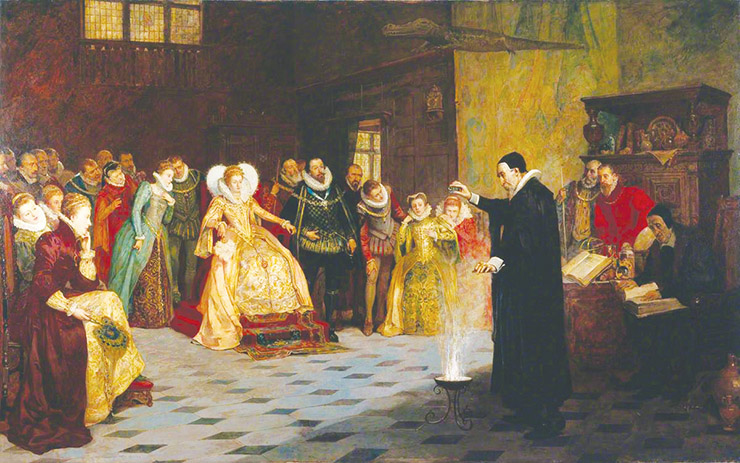
    Doctor John Dee (1527-1609) remains one of London’s most intriguing historical figures. Dee was a renaissance man; an occultist, mathematician, astronomer, astrologer and navigator. In addition to his prodigious skills, Dee was a confidant of Queen Elizabeth I, who guided the nation through one of its most challenging eras, partly based upon Dee’s unique blend of alchemy, divination and Hermetic philosophy. In fact, the Queen had so much faith in Dee’s calculations she had him choose her coronation date.

    By all accounts Dee was a distinctive looking gentleman, respected and admired by many, as John Aubrey describes: “Dee had a very cleare rosie complexion… a long beard as white as milke. A very handsome man… he was tall and slender. He wore a gowne like an artist’s gowne, with hanging sleeves, and a slitt. A mighty good man he was.”

    Dee lived in Mortlake, a West London village mentioned in the 1086 ’Domesday Book’. Here, his modest residence along the River Thames provided easy access for Elizabeth and other dignitaries, especially other occultists, for Dee had amassed what was arguably the grandest esoteric library of his day. Sadly, fashionable apartments now stand where Dee once lived, and a block of council flats across the street boasts his name.

    What is less known is that Dee was obsessed with the apocalypse, and believed he had opened a supernatural gateway leading to a powerful and disgruntled spirit world. But this came later. During the early part of his career Dee had little interest in the supernatural. He was a devoutly religious man and deeply ambitious. From the 1550s until the 1570s he honed his skills as a writer as well as a navigator with unique technical expertise. Few recall that he coined the phrase ‘British Empire’ and helped shape the emerging ideology of the nation.

    Dee became frustrated with his perceived inability to uncover more occult secrets than he already had obtained, and so began his fascination with the supernatural. During the 1580s he focused his attention on contacting angels in the spirit realm in order to obtain greater wisdom. Initially Dee tried his hand at using a ‘scrying’ mirror or crystal ball, each of which can be found in the British Museum.

    Dee struggled to achieve the results he was hoping for and thus reached out to someone who professed to have expertise in these matters. Enter the occultist and spirit medium Edward Kelley, who stumbled upon a ration of magical red powder, which he had received from an innkeeper in Glastonbury, who had acquired the powder from tomb robbers. In a different version of the story, Elias Ashmole, who wrote the first account of Kelley’s discovery, recounts how Kelley found a book containing the curious powder in the ruins of Glastonbury Abbey. Regardless, Kelley’s desire to learn as much as possible about the magical substance, which he believed could turn base metals into gold, led him to Dee, whose library attracted many such seekers.

    Like Dee, Kelley was a fascinating man; a seer whose ritual expertise in the black art of necromancy, combined with his passion for alchemy, and his quest for the Philosopher’s Stone in particular, so impressed Dee that the two soon became inseparable. Together they embarked on a journey that would transform their lives and quite possibly ours too.

    Dee and Kelley held various ‘spiritual conferences’; a quest that Dee believed would render immeasurable benefit to mankind. Kelley’s integrity, on the other hand, is the subject of continued debate and in fact before coming to London he was convicted of forging title deeds in Lancaster. Nevertheless, Kelley became Dee’s regular scryer and the two men appear to have achieved, if not exceeded, their goals, for Dee began to write truly remarkable, albeit sublime, works that he maintained were the product of angels who spoke in language known as Enochian.

    In 1583, Dee and Kelley embarked for Europe, seeking the patronage of Emperor Rudolf II in Prague and King Stefan of Poland in Kraków, amongst others. The two occultists continued their alchemical pursuits on the continent for a number of years. One incident in particular stands out, which stems from their involvement in necromancy. An inquisition by the Catholic Church proved messy, yet both men were acquitted in 1587. That same year the angels instructed Dee, through Kelley, that the two were to share everything, including their wives, which they did. Dee’s wife gave birth nine months later to what is now thought to be Kelley’s child.

    At the best of times the two men had what could be called a terse relationship, and the ‘sharing’ mandate of the angels angered Dee and led to his break up with Kelley, who later died in prison. Dee returned to his residence in Mortlake, only to find that his world had changed. Much of his library had been pillaged and his political stature fallen. What little that remained of his relationship with the Queen enabled him to assume the office of Warden at Christ’s College, Manchester in 1595. He returned to Mortlake in 1605, where he died in 1609 and was buried under the high altar of his parish church.

    In retrospect, we can glean that the essence of the Enochian dialogues centred upon a coming apocalypse, which Dee’s angels referred to as ‘the Harvest’. Dee and Kelley succeeded in manifesting the spiritual beings they had summoned, and what followed appears to have been the process of opening the gates to another dimension and obtaining the keys required to activate the angels’ agenda, an apocalypse of the mind – a poisoning of man’s spiritual essence and the rapid degeneration of society. In one instance the angel, Mapsama, instructs Dee as to his role in the whole affair:

    Mapsama: These Calls are the keyes into the Gates and Cities of wisdom. Which [Gates] are not able to be opened, but with visible apparition.

    Dee: And how shall that be come unto?

    Mapsama: Which is according to the former instructions: and to be had, by calling of every Table. You called for wisdom, God hath opened unto you, his Judgement: He hath delivered unto you the keyes, that you may enter; But be humble. Enter not of presumption, but of permission. Go not in rashly; But be brought in willingly: For, many have ascended, but few have entered. By Sunday you shall have all things that are necessary to be taught; then (as occasion serveth) you may practice at all times. But you being called by God, and to a good purpose.

    Dee: How shall we understand this Calling by God?

    Mapsama:  God stoppeth my mouth, I will answer thee no more.

    The exchange is intriguing and hints at the angels’ selection of Dee as the wick by which the fuse to ignite the end of days would be lit. Had Dee and Kelley unknowingly ushered in the Enochian Apocalypse?

    Three centuries later the Golden Dawn incorporated many of its teachings and one of their initiates, Aleister Crowley, picked up where Dee and Kelley had left off. He wrote: “Much of their work still defies explanation.” Crowley is known to have concentrated on Dee’s ‘Apocalypse Working’, although it is not known whether he accessed the elusive occult key necessary to usher in the apocalypse. Nevertheless, Crowley died in 1947, believing he had opened the gate of the apocalypse almost 45 years earlier, in 1904, when he spiritually ‘received’ The Book of the Law.

    Today, we are uncertain if Dee, Kelley or Crowley did in fact unlock the door of the apocalypse, for it is said the apocalypse is a slow-working mental transformation within the collective unconscious of the human race.

    The year is 2012. Now, as then, we contemplate the possibility we are living in an Enochian end of days. Doctor Dee influenced history at the highest levels of government. His legacy influenced perhaps the most notorious of occult groups, which in turn influenced the ‘New Age’ and modern occult movement. But was he also instrumental in the opening of a door in human consciousness that would allow the apocalypse to manifest?

    (For more on Dr. Dee, see Glyn Parry’s article John Dee & the Magical Origins of the British Empire in this same issue of New Dawn. Use link below to purchase.)
    [alert type=”general” dismiss=”no”]This article was published in New Dawn 133.[/alert]

    [alert type=”success” dismiss=”no”]If you appreciate this article, please consider subscribing to help maintain this website.[/alert]

    © New Dawn Magazine and the respective author.
    For our reproduction notice, click here.