New Dawn – World's Most Unusual Magazine

Author: Angel Millar

  • Craftsman Warrior Magician: The Three Initiatic Archetypes

    Craftsman Warrior Magician: The Three Initiatic Archetypes

    From New Dawn 178 (Jan-Feb 2020)

    When Pierre Boulle wrote his novel La Planète des singes during the early 1960s, he had undoubtedly observed the strange division of mind and body in modern, Western society, reflecting it in the novel that would be made into the first ‘Planet of The Apes’ movie, released in 1968. The movie showed us a world run by apes and an ape society divided into several castes, each with their own function: chimpanzees (scientists), gorillas (military and police), and orangutans (politicians or leaders). Probably unintentionally, Boulle had invoked and reimagined the archetypes that lie at the base of human civilisation – the Craftsman, Warrior, and Magician. But he had noticed something else. 

    In the ‘Planet of The Apes’, the differences between the strong, militaristic gorillas and the effeminate, intellectual chimpanzees caused a split in society, and there is suspicion on both sides. This must have resonated with an America then at war in Vietnam and experiencing protests against the war at home. In the year before the movie’s release, during the March on The Pentagon, protesters had held out flowers to 2,500 army national guard troops or placed them into the barrels of soldiers’ rifles. As a reflection of human society, the ‘Planet of The Apes’ was, then, too early to notice the extraordinary aggression of the intellectual class – an aggression that matches that of the military class, but which is directed against the intellectuals’ own society rather than towards an external enemy.

    In such a society, theories dominate facts and ideas dictate reality. The health profession might tell us that, like anorexia, obesity is associated with serious health risks, but to point this out in public might be considered “sizeism” or “hate speech.” In America, a few years ago, there was an attempt to convince the public that “lookism” was the new racism. According to this theory (which is still believed by many activists), since we are attracted to beauty but not so much to ugliness, beauty is oppressive since it must be socially constructed.1 If beauty in women is suspicious in the current era, so, of course, is physical strength in men. In 2017, Bedfordshire police tweeted a meme that associated going to the gym with right-wing extremism.2 And we can probably all think of increasingly popular theories that tell us our natural bodies are really little more than lumps of Play-doh that, even during childhood, can be manipulated through drugs and surgery into new, interesting shapes, which will allegedly represent who we really are – or say we are.

    Three Archetypes

    In a time of confusion, an increasing concern with safety, increasing disbelief in the transcendent, and increasing imbalance in individuals and in society as a whole, we have more to learn from the archetypes of the craftsman, warrior, and magician than ever before. But why not other archetypes? 

    Over recent decades, everything from marketing to movie analysis has been influenced by psychoanalyst Carl Jung’s notion of archetypes. And various new groupings of archetypes have become established (e.g., the marketing industry’s twelve “brand archetypes”). Claimed to represent the authentic, primordial nature of human beings, some of these proposed “archetypes” don’t have any significant role in ancient myths (perhaps Jung’s primary source for exploring archetypes) or any role in early human (or even later human) culture. The innocent, the orphan, jester, and lover all show up as “archetypes” in some theories. Yet, there has never been a tribe or society of jesters, warriors and lovers, for example. 

    When we look at ancient cultures, we do – as comparative philologist and mythologist Georges Dumézil claimed – see the craftsman, warrior, and magician clustered together over and over again. According to Dumézil, these constituted the three original classes or castes among Indo-European societies and, as such, spread across Europe, India, Persia and elsewhere – though, ultimately, we find these castes across the globe.

    Whether we believe the existence of these three castes to be the result of archetypes impressing themselves upon the consciousness of society or whether we think it is due to historical links between ancient India and Greece, for example, it is certain that (in contrast to other groupings, which are purely arbitrary – jester, warrior, lover, for example) no society has ever been able to survive without craftsmen (blacksmiths, farmers, etc.), warriors, and magicians (village elders, guides, spiritual and intellectual leaders, etc.). 
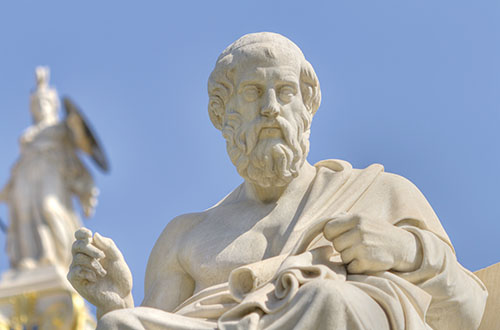
    Statue of the ancient Greek philosopher Plato outside the Hellenic Academy, Greece. Few people know Plato was skilful as a wrestler. He taught that the study of philosophy (the magician archetype), music (craftsman) and physical discipline (warrior) were all necessary. 

    While it is not surprising to find these in primitive society, it is surprising that this group reappears later on, in both East and West. The ancient Greek philosopher Plato was not only initiated into the Mysteries but was known for his skill in wrestling (his name means literally “broad-shouldered”). He taught that not only was philosophy (the magician archetype) necessary but so too was the study of music (craftsman) and physical discipline (warrior). Again, Miyamoto Musashi, Japan’s most famous warrior, spent years meditating in a cave (magician archetype) and was also known for his skill in painting, calligraphy, and gardening (craftsman). And from Confucian to classical Western education, inevitably there is a mix of the study of philosophy, ritual, and religion (magician), music, calligraphy, painting (craftsman), and fencing, wrestling, boxing, or physically demanding and dangerous sport (warrior). 

    Again, around the 12th century CE, Sufi Orders were not only influenced by Islamic chivalry (futuwwa) but began to structure themselves after the trade guild, with disciples becoming apprentices (mubtadi’), companions (sani‘), and master craftsman (mu‘allim). Roughly six hundred years later, in England, the fraternity of the Free Masons (or Freemasonry) separated from the stonemasons trade guild of Great Britain. It expanded upon the two initiation rituals of the stonemasons guild and added a third so that, in the “Craft Masonic Lodge,” a Freemason would become an Entered Apprentice, then a Fellowcraft, and finally a Master Mason. 
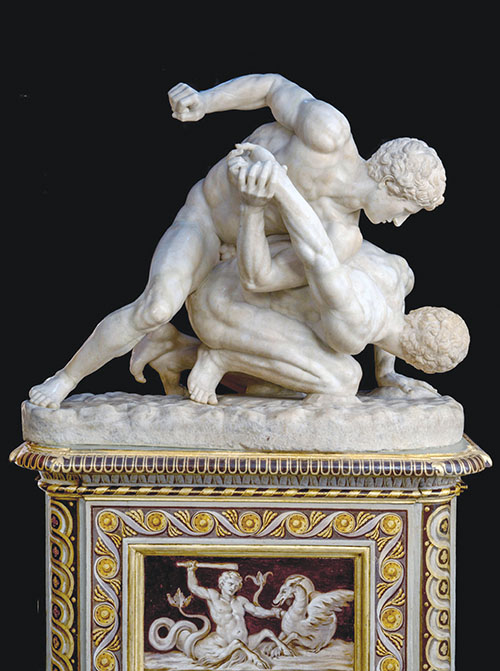
    The Wrestlers (also known as The Two Wrestlers or The Pancrastinae) is a Roman marble sculpture after a lost Greek original of the third century BCE. It is now in the Uffizi collection in Florence, Italy. At first glance, this famous statue appears to be depicting wrestlers. In reality, this is a portrayal of Pankration, a brutal and bloody Greek martial art similar to the present-day sport of mixed martial arts.

    There are also hints of chivalry in the degrees of Craft Freemasonry. The white apron, presented to every Freemason, is described in the Masonic ritual as “more honourable than the Star and Garter” – a reference to the knightly, or chivalric, Order of the Garter. However, the warrior – or more specifically the knight – is more pronounced in the so-called “higher degrees” of Freemasonry. When the Masonic fraternity spread across France and Germany a decade or so after the founding of the premier Grand Lodge in London, in 1717 CE, Masonic enthusiasts began creating new degrees. Some were influenced by alchemy, Hermeticism, or Rosicrucianism but nearly all of them were influenced by Christian chivalry.

    Although probably not aware of the division in ancient culture into craftsmen, warriors, and magicians, in his book Masonic Temples historian William D. Moore argued that American Freemasonry came to embody the craftsman, holy warrior, and mystic. For Moore, the Craft Masonic Lodge embodies the craftsman archetype, the Masonic Order of the Temple (or “Knights Templar” degree) embodies the warrior, and the Scottish Rite degrees of Freemasonry embody the magician. 

    Just as we find three levels or degrees in Sufism and Freemasonry, anthropologist David W. Anthony has suggested that, in antiquity, the vocations of craftsman, warrior, and magician (sage, priest, or elder, etc.) constituted “three age grades,” with a man passing from being a craftsman in his youth (in premodern cultures people often began work at around five or six years of age or younger), becoming a warrior during his years of peak physical strength, and a magician or tribal leader in older age. Certainly, the progression makes sense. No normal society, after all, would want old men for its protection or children for its leaders. Yet, embodying both early human society and an archetypal progression from childhood to adulthood, and from labour to spiritual guidance, perhaps it was inevitable that the craftsman, warrior, and magician (and not the jester, warrior, lover, for example) would re-emerge in later societies intended to initiate men, in particular, into manhood and into a transcendent reality beyond the daily grind. 

    Incorporating the Archetypes into Your Life

    However, like Plato and Musashi, we do not have to wait to pass from one archetype to the next. Instead, as the classical education of the East and Wests suggests, we can, and should, find ways to incorporate them into our lives right now. This is especially important today. Balanced with craftsmen, warriors, and magicians or spiritual guides, ancient society was holistic, whole; the body, brain, and spirit were balanced. Today, however, the mind and body is so severely split in the West that we have come to see the physical body as something that has no objective reality beyond what the mind (i.e., the latest intellectual theory) says it is. And as religion has declined in the West, so has a sense of the sacred and the transcendent. Yet, religious fervour is alive and well in politics. If we openly question the latest pronouncements of the political priest caste, we will be denounced as heretics.

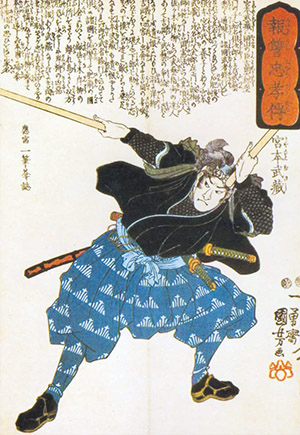
    Miyamoto Musashi, Japan’s most famous warrior, embodied all three archetypes. (Self-portrait of Miyamoto Musashi, early 17th century.)

    How can the craftsman, warrior, and magician archetypes help us? While there are differences between them, there are, as we have suggested, also connections and overlaps. In many ancient, tribal societies, blacksmiths acted as priests or shamans, performing special rites and initiating new members into the metallurgist’s craft. The warrior, too, had his spiritual rites and traditions. In India, a shrine to the goddess Kali is kept in the traditional temple of the martial art of Kalaripayattu. In Iran, the martial tradition of Zoorkhana was strongly influenced by Sufism and Shi’ite Islam. Shaolin Kung Fu comes from the Buddhist Shaolin monastery. Again, Zen Buddhism became associated with the Samurai as well as with martial arts such as Kendo and Karate-do, and yet Zen was also taught through, or embodied in, the crafts or arts of painting, calligraphy, flower arranging, and even serving tea (chado). Unsurprisingly, perhaps, the late Samurai manual the Hagakure tells us that if a practitioner of a Way (a Do or Tao) should see another practice of the Way, he should understand his own even more clearly. 

    Despite what our education and employment systems currently push, we must not get stuck in one specialisation or one limited way of thinking. In most cases, although finding a niche might work, it is likely to work only for a limited amount of time, especially in a fast-changing world. Flexibility is necessary. Moreover, even today, leaders in any field think outside the box and bring different, seemingly incompatible things together. (Think of Steve Jobs introducing different fonts to computers inspired by his study of the ancient art of calligraphy under a Trappist monk.) Specialisation, or compartmentalisation, is an even bigger problem when it comes to our own lives. At best, it encourages us to become a fraction of who we could be. In most cases, it turns people into hobbyists, obsessive consumers of sports tv, or spiritual fantasists and pseudo-intellectuals with an overblown sense of their moral goodness and everyone else’s wickedness. 

    Instead, as I advocate in my book The Three Stages of Initiatic Spirituality: Craftsman, Warrior, Magician, we must cultivate the mind, body, and spirit – practicing some kind of art or skill, training our bodies, and having some kind of spirituality. For Plato, this meant music, wrestling, and philosophy. For us, it could mean anything from painting, writing, poetry, customising motorbikes, to learning to cook traditional, healthy food (craftsman); working out at a gym, practicing a martial art, or doing Spartan races, etc. (warrior); and practicing meditation, positive thinking, some kind of spiritual or religious ritual, or studying the symbols, myths, and archetypes embodied in the world’s ancient cultures (magician).
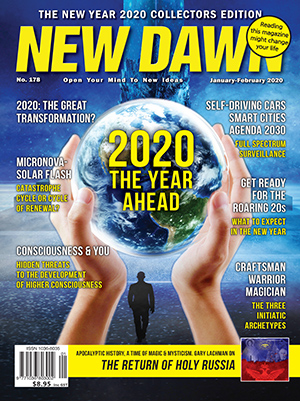
    Get the issue this article appears in

    How We Got Where We Are Today

    How did we get from the tribal and ancient society where its craftspeople, warriors, and magicians or elders and spiritual leaders were in harmony, to one where the different factions are at war with each other and, in some cases, at war with their own societies? Estrangement from nature might be one reason. A lack of knowledge about the past might be another. But, undoubtedly, from the Industrial to the post-Industrial era, specialisation in education and work has played a role. We do and cannot move from becoming accomplished in an art or craft, to becoming a warrior, to finally becoming a guide for the community. 

    Mythology and ancient sociology explain the transformation of society in another way. There are two contrary sets of myths that we must consider. According to one set of myths, the world and the quality of humanity is in decline, becoming ever less spiritual and ever more materialistic and self-centred. According to the other set of myths, there is natural and perhaps unstoppable progress. The former group of myths tend to focus on the society (society is in decline) whereas myths of progress tend to focus on the individual (the individual has more freedom and can be more creative). 

    One of the earlier myths of humanity’s progress was created by Joachim of Fiore (c. 1135–1202). Joachim was the founder of his own monastic Order and one of the most important historical and apocalyptic theorists of the medieval period. He conceived three great Ages: the Age of the Father, the Age of the Son, and the Age of the Holy Spirit. Accordingly, in the first of these Ages, people lived under the Law and served God. During the second Age, people lived under the Gospel though Christ had given freedom to mankind. Only in the last Age, however, would there be full freedom. A similar scheme is given by the English occultist Aleister Crowley (1875–1947), who conceived of time as divisible into the Aeons of Isis, Osiris, and Horus, with humanity finally acquiring freedom and individuality in the last.

    In contrast, according to Hindu tradition, there are four great Ages or Yugas, beginning with the Satya Yuga (the Age of Truth) and ending with the Kali Yuga (the Dark Age). Likewise, the ancient Greek poet Hesiod claimed that the gods made several “races.” The first of these was a golden race of people. They were in harmony with nature and with each other, and lived long, healthy lives. Then came a silver and a bronze race and finally an iron race. And, again, Norse myth says that in the early days of the earth the gods had plenty of gold (signifying a Golden Age). At the end, however, there is the cosmic war between the gods and giants. In all three myths, the final era was – or will be – described in almost identical terms: Brother will fight with brother; parents will be disrespected; men and women will get together only because of sexual desire; powerful and corrupt men will be respected. 

    Although not concerned with these myths, Ibn Khaldun would claim that such a decline was quite real. Born in Tunis in 1332, Ibn Khaldun is often considered the father of sociology. During his lifetime, he witnessed dynasties rise and fall across North Africa. Reflecting on this, he claimed that every dynasty goes through three stages. In the first stage, a warrior band swoops down upon a kingdom, defeats it, and takes it over. In this first stage, the warriors, though victorious, stay true to the desert values. They care nothing for luxury, and sleep on the floor. In the next stage, the people enjoy the luxury of the kingdom but hope for a return to a more rugged way of life, which they admired. In the final stage, the people love luxury, are weak, and seek protection from the ruler. Incapable of their own defence, a new warrior band swoops down and conquers them, beginning the cycle again. 

    We might find a picture of our own civilisation somewhere in Ibn Khaldun’s scheme. Wherever we might locate ourselves in it, the implication is surely that neither luxury and safety nor the warrior alone is enough to make, or sustain, a civilisation. Instead, as we find in perhaps every successful pre-modern society, it requires the harmonious relationship of the craftsman, warrior, and magician. If the civilisation around us cannot manage it, individually we can, and must, embody and unify these archetypes within our own lives.

    The Three Stages of Initiatic Spirituality: Craftsman, Warrior, Magician is available from all good bookstores.

    [alert type=”general” dismiss=”no”]This article was published in New Dawn 178.[/alert]

    [alert type=”success” dismiss=”no”]If you appreciate this article, please consider subscribing to help maintain this website.[/alert]

    Footnotes

    1. www.businessinsider.com.au/lookism-is-real-and-could-be-costing-you-your-dream-job-2013-8
    2. www.dailycaller.com/2017/07/30/police-link-meeting-someone-at-the-gym-to-right-wing-extremism/

    © New Dawn Magazine and the respective author.
    For our reproduction notice, click here.
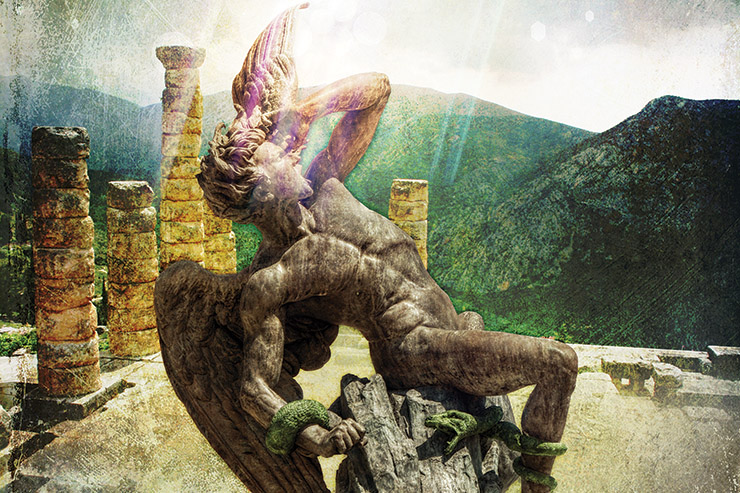
  • Renewal & Integration in a Time of Decline & Conformity

    Renewal & Integration in a Time of Decline & Conformity

    From New Dawn Special Issue Vol 16 No 4 (Aug 2022)

    We should be cautious of prophecies that claim we are on a path of infinite political progress or infinite economic growth – or, conversely, headed toward civilisational collapse. 

    Things are more complicated, and opportunities remain for creating interesting new cultural movements and for personal transcendence and integration (though perhaps not for those who are determined to conform to some outdated societal mould).

    Oswald Spengler (1880-1936) 

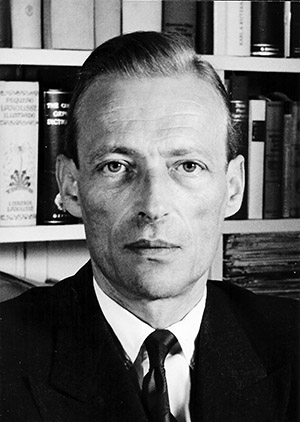
    A century ago, the German intellectual Oswald Spengler (1880-1936) argued that civilisations are organic and, like plants, they take root, blossom, whither, and die. According to Spengler, the West is now in its dying phase. His thesis was countered by another German thinker, Jean Gebser (1905-1973), who argued that human consciousness evolved through the emergence of new stages. The previous stages remained part of the psyche but were superseded. These stages (the archaic, magic, mythical, and mental) were characterised by new developments in language, art, and even perception (e.g., the development of perspective in art).

    Jean Gebser (1905-1973)

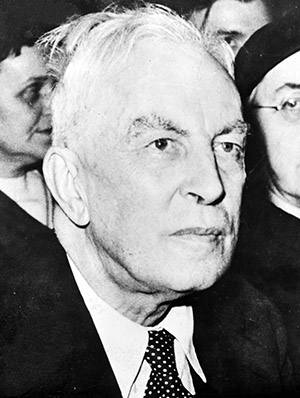
    Perhaps more important was the thesis of British historian Arnold Toynbee (who was influenced by Spengler). While Spengler preferred “culture” to its more developed and complicated phase – civilisation – Toynbee believed that the former type of society preserved itself by worshipping the dead and sticking, unquestioningly, to the rules that the ancestors had laid down. But a civilisation, Toynbee argued, constantly renews itself through the actions of a “creative minority” – a small group of individuals who think differently and create new culture. (One such creative minority was the Beatniks of the 1950s, who attempted to live authentically, creatively, and spiritually in the context of a West in decline, introducing many Americans to Eastern religion, alternative spirituality, and psychedelics.)

    Arnold Toynbee (1889–1975)

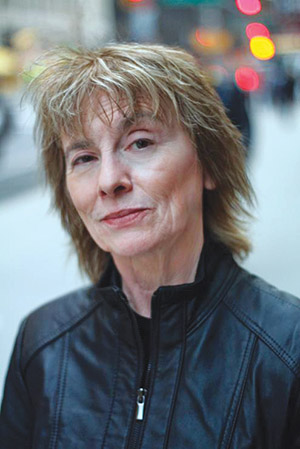
    Spengler’s thesis can be detected in the warnings of feminist social critic and author Camille Paglia. She suggested a few years ago that America may well be in a stage of decline and cited the transgender movement as proof, suggesting that transgenderism gains popularity in the “late phases of culture, as a civilisation is starting to unravel,” e.g., the late Roman Empire, the Weimar Republic, and so on.1 The people of such societies, says Paglia, think of themselves as very sophisticated, but yet, out on the margins of society, or just beyond the borders of the state, those – from the Hun to ISIS – “convinced of the power of heroic masculinity” are gathering, waiting to strike.

    Camille Paglia

    Paglia is not the first to contrast the militant jihadist with young, effeminate Western men and modern Western culture that “no longer believes in itself.” Nor is she the only one worrying about the emergence of hyper-masculine men, though she is unusual, as a feminist and progressive of sorts, for her criticism of the latest political fads. The target of the more “sophisticated” members of our societies tend to be those representing traditional culture, pro-masculinity groups, or groups advocating physical and mental strength. But Paglia is an actual thinker, of course, and not merely another establishment apologist posing as one.

    Disintegration

    Who are the barbarians? When we look at television and movies today, we see that men are not infrequently portrayed as clueless, weak, ignorant, stupid, cowardly, or thuggish. Heroes are dead. And we do not need strength and courage. Of course, this angers a lot of men – especially in the “men’s rights” movement – and some are convinced that it’s a Hollywood conspiracy to deracinate masculinity. But, let’s be honest, if these images of men caught on, it is because that was the experience that so many people had of men.

    I have spoken to men across the United States, and the vast majority told me their father gave them no real attention or guidance growing up or that he was a workaholic, an alcoholic, a “yes man,” a womaniser, a bully, or worse. If they received guidance on how to behave, it usually came from their mother or their first real girlfriend. Unsurprisingly, many young men feel resentment toward older men in power and are suspicious of “masculinity” (a term they equate with working too much, bullying, watching sport, hitting on women, and talking nonsense). 

    Beyond which team to support and which political party to cheer for, the stock advice from fathers to their male children is often little more than “get good grades and get a good job” – or at least some kind of job – or “don’t do what I do; do what I say.” This doesn’t really grab most young men as a satisfactory plan for life. A lot of pain in men goes unnoticed.

    I mentioned the portrayal of men and women on television. In one op-ed a few years ago, the ‘90s sitcom Friends was blamed for the downfall of Western civilisation.2 For the op-ed writer, Ross was the show’s hero – or, at least, he should have been. He was an intellectual (or at least intelligent). But he was boring in comparison to the rest of the Friends gang. As such, society was given the message that intelligence is bad. He got the girl he deserved, the writer tells us: “Rachel, the one who shops.”

    Apparently, not all Rosses are boring. While the writer assures us that there is now a “resistance” forming, made up of “new Rosses” – people of “grit” who are “hiding” in art museums, chess clubs, and so on – Rosses aren’t going to save civilisation from the nightmare Paglia imagines – its collapse and takeover by new barbarians. In real life, Rachel (by which I mean the actress Jennifer Aniston) married (and then divorced) Brad Pitt.

    We don’t need to pick through Aniston’s off-screen love life and its ups and downs to know that the dithering and undynamic Ross wouldn’t have got a look-in with Rachel. And, frankly, why should he? He wanted a woman that was, physically, well out of his league. He could have gone across the hall and asked Joey for some pointers on working out and then set to work improving himself physically – but he didn’t. And, unlike most people, he didn’t want to, or couldn’t, adapt his conversation to his friends, either.

    Ross (and the Friends gang as a whole) reflects the West’s compartmentalisation of people into types: the intellectual (the intellect), the jock (the body), the artistic dropout (the soul), the Democrat, the Republican, the independent, the non-binary, the genderqueer, the two-spirit, and so on, and so on. (Effectively, Friends is a comedic Planet of the Apes without the ape costumes or post-apocalyptic NYC backdrop.) And while compartmentalisation may have helped us create civilisation, it is now contributing to its disintegration. 

    Revolt Against The Shrinking Brain

    Rosses may represent a clumsy resistance to the dumbing down of society. Some of those becoming transgender may, as Paglia suggests, be the sort of people who would have become Beatniks or Hippies in decades past and might be rebelling against the very limited, clichéd 1950s-type notions of gender (pushed in some online “masculinity” and politically conservative circles). Men’s rights groups may be an angry resistance to men not being taken very seriously on a range of issues (e.g., divorce and child custody). And as Paglia suggests, culture may be “starting to unravel” into different types, none of them whole in themselves. But opportunities remain.

    As Paglia notes, that opportunity is open to those who would destroy us and take our liberty away. But that is not the final word. Opportunities are open, too, to the creative, adaptable, and integrated. (The integrated are entirely opposite to the mass of compartmentalised individuals: Rosses, Joeys, and Rachels, etc.)

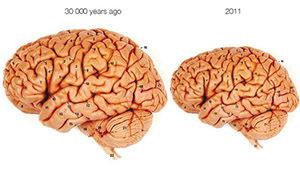
    The human brain 30,000 years ago and today.

    The human (genus Homo) brain quadrupled in size over six million years but, strangely, appears to have decreased in size since the last Ice Age. Diet and environmental factors are blamed. A more recent hypothesis suggests that human brain shrinkage occurred in response to the expansion of our societies and the need for greater compartmentalisation of tasks to sustain and develop those societies (i.e., civilisations). 

    Jeremy M. DeSilva et al. note that “brain differentiation can occur in association with division of labor in the absence of striking changes in body size, illustrating how selection may have operated in humans as social groups increased in size.”3

    Formed into large and increasingly complex organisations, human beings needed specialists, not generalists. It needed some people to focus on medicine and others to focus on engineering, some to focus on creating art and others to focus on fighting wars, and so on, effectively distributing functions throughout the community. DeSilva says, “multiple brains contribute to the emergence of collective intelligence.” 

    The collective brain is most visible in the realm of politics. The ideas of a particular movement are thought up by a handful of individuals at most (these original thinkers are usually dead before their ideas catch on). The average voter and political fanatic (the compartmentalised individual) merely receives these ideas and passes them along, acting as a node in a network. He believes them to be “true” because, unaware of their history, the ideas appear to have emerged out of nowhere, suddenly to be accepted by everyone (every other node) around him. Nevertheless, the more the compartmentalised individual is convinced he arrived at his own conclusions, the more likely he will parrot the latest political mantra, spreading the message to other nodes. And tied into his self-image and survival as a node in a network – if the information is challenged or shown to be false, his response is usually anger, outrage, and ad hominem accusations. In authoritarian societies, detractors are prosecuted and either imprisoned or executed. Typically, though, such societies fail.

    Let’s consider Western civilisation as a brain (or an organism). The current obsession with “diversity and inclusion” can be regarded not as an expression of a moral conviction (as it is presented) but as a survival mechanism: i.e., as an attempt to expand the network so that new nodes can pass along new information about possible threats from outside as well as new opportunities. Racial, sexual, gender and religious diversity within the workforce is often presented as a way for companies to gain an advantage over competition (which seems amoral at best). And notably, although the registration of patents (probably the most concrete marker of innovation in any society) has gone up in the United States over the last few decades, half of these were registered by foreign-born inventors.4 Everyone’s favourite entrepreneur, Elon Musk – founder of Tesla, SpaceX, and Paypal – immigrated from South Africa, first to Canada and then to the US. 

    Renewal & Reintegration

    The integrated individual – capable of thinking, creating, and problem-solving – might be a throw-back to a time before civilisation, but that individual is essential to its survival and renewal. He, or she, is one of Toynbee’s creative minority. Even in more ordinary lines of work, in a fast-changing society, developing different skills and interests will be an advantage and might be essential to remaining relevant to the economy. “Holding a solid grasp of many concepts or decent proficiency in multiple skills,” says Forbes, “can allow for flexibility, in a life and career.”5

    But there are things more essential to life and the human spirit than commerce, of course, though it may be crucial both to the individual and their society. The Renaissance saw a renewed interest in ancient Greek and Roman thought and classical learning, as well as new developments in the arts (such as perspective in painting) and sciences. And epitomised by Leonardo DaVinci (artist and inventor) and, perhaps, more so, by Leon Battista Alberti (architect, mathematician, scientist, painter, poet, expert horseman, and a man keen to demonstrate his physical prowess). The notion of the Uomo Universale (“Universal Man,” usually called the “Renaissance Man” today) was born during this time. 

    We can, of course, find such integrated human beings in different times and places. The ancient Greek philosopher Plato was also a wrestler and believed that youths should be educated through philosophy, music, and wrestling. In Shi‘i Islam, ‘Ali is regarded as both the ideal warrior and ideal mystic and as the exemplar of futuwwa (the Muslim code of “chivalry” or, more literally, “young manhood”). The samurai warrior Miyamoto Musashi was also a renowned painter and calligrapher, and Viking warrior Egill Skallagrímsson was also a renowned poet. 

    Closer to our own time, we find the Renaissance Man turning up primarily in, or on the margins of the occult, with the ability to break the taboos of a spiritually disintegrating culture being, perhaps, necessary to begin the journey towards personal reintegration. Rudolf Steiner was a mystic, educator, painter, author, and architect. G. I. Gurdjieff was a mystic, hypnotist, and (sacred) dance teacher. Carl Jung was both a pioneer of psychoanalysis as well as an artist and visionary author. 

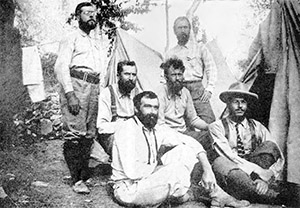
    Aleister Crowley played many roles including that of mountaineer, and notable for being one of the first Westerners to attempt K2, the second-highest mountain on Earth after Mount Everest, in 1902. He is seen on K2 in the above photo, sitting, fourth from left.

    Known primarily as a ceremonial magician, author (fiction and non-fiction), and founder of his own religion (Thelema), Aleister Crowley was also a boxer, mountaineer, adventurer, painter, and poet. If we take half his accomplishments, he is a clichéd “man’s man.” If we take the other half, he is an effeminate, dandyish “girly man.” But, as he advised his adepts, in himself he managed to embrace and develop the “Angel” and the “Demon” – what society might call the “male” and the “female,” the “left brain” and the “right brain,” the body and the spirit, etc.

    Depiction of samurai warrior Miyamoto Musashi

    Modern culture has hemmed us in. Today, painting, poetry, calligraphy, etc., are all seen as “feminine” or “girly.” In contrast to Musashi or Skallagrímsson, modern-day “real men” do not write poetry. In fact, “real men” don’t seem to do much at all. Whether we like it or not, in part, it is against the backdrop of fatherless families and men more interested in gaming and chasing women than in mental, physical, spiritual, and cultural self-development, that the pro-transgender, pro-pan-gender, pro-gender-fluid movement is reacting. And we must agree with them that the 20th-century clichés of gender – the compartmentalised man or woman, individuals who act merely as nodes, passively absorbing and regurgitating whatever they hear – are inseparable from the disintegration of the West and the lack of energy it displays in the arts, philosophy, and other areas of culture. 

    We mentioned Toynbee’s belief that civilisations differ from cultures by constantly renewing themselves through the “creative minority.” Perhaps the best example of a renewal is the Renaissance (literally “Rebirth”) which we already mentioned. But there have been other, smaller revivals, such as artistic movements (Cubism, Surrealism, etc.) and musical movements (Punk, Hip-Hop, etc.). It might even be argued that the emergence of transgenderism, pangenderism, and gender-fluidism into the mainstream is part of a revival (perhaps emanating from the unconscious of the collective intelligence) of the shamanic (since shamans often wore the clothes of the opposite gender and were regarded as neither or both male and female) and, as such, as part of a centuries-long occult revival that includes, at its softer edges, the now virtually omnipresent New Thought movement and New Age spirituality. 

    Get the issue this article appears in

    We mentioned the union of the mystic and the warrior in the figure of ‘Ali, as well as Plato, the philosopher and wrestler. The average person might remain a node in a network of the collective brain, merely absorbing and transmitting ideas to others without ever questioning those ideas, even as the disintegration of their society continues. A new Renaissance will only be brought about by the work of creative minorities. And, today, in a time of increasing hostility towards the body (particularly as an embodiment of strength or beauty), when life is increasing online and virtual, and thinking is increasingly done for us (or against us) by algorithms and artificial intelligence, such a minority must work to elevate the physical body and reintegrate it (as Plato suggested, with his schema of music, philosophy, and wrestling) with the mind and spirit. We must be part-barbarian and part-sophisticated cultural thinker and creator. 

    The future is uncertain but it remains open to the integrated – to those who push forward in different ways, creating new art, new ways of thinking, new movements, new rituals, and new routines, all awakening us to a recognition we are more than nodes in a disintegrating network: that inside of each of us burns a barbarian fire – a spirit – for adventure, for struggle against our limits, for strength and beauty, and wholeness.

    [alert type=”general” dismiss=”no”]This article was published in New Dawn Special Issue Vol 16 No 4.[/alert]

    [alert type=”success” dismiss=”no”]If you appreciate this article, please consider subscribing to help maintain this website.[/alert]

    Footnotes

    1. www.youtube.com/watch?v=I8BRdwgPChQ
    2. David Hopkins, “How a TV Sitcom Triggered the Downfall of Western Civilization,” March 21, 2016, https://gen.medium.com/how-a-tv-sitcom-triggered-the-downfall-of-western-civilization-336e8ccf7dd0
    3. Jeremy M. DeSilva, James F. A. Traniello, Alexander G. Claxton, and Luke D. Fannin, “When and Why Did Human Brains Decrease in Size? A New Change-Point Analysis and Insights From Brain Evolution in Ants.” Frontiers in Ecology and Evolution, 22 October 2021, https://doi.org/10.3389/fevo.2021.742639
    4. Richard Florida, February 1, 2013, “Innovation and the Wealth of Cities,” www.bloomberg.com/news/articles/2013-02-01/innovation-and-the-wealth-of-cities
    5. Jodie Cook, May 13, 2021, “Why Being A Jack Of All Trades Is Essential For Success,” www.forbes.com/sites/jodiecook/2021/05/13/why-being-a-jack-of-all-trades-is-essential-for-success

    © New Dawn Magazine and the respective author.
    For our reproduction notice, click here.
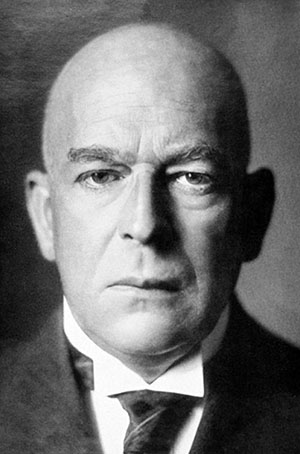
  • The Compass & The Crescent: Secret Societies of the Muslim Freemasons

    The Compass & The Crescent: Secret Societies of the Muslim Freemasons

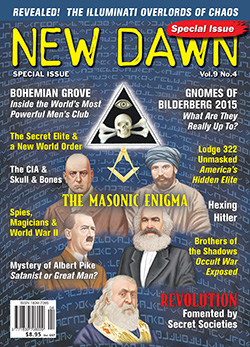
    From New Dawn Special Issue Vol 9 No 4 (Aug 2015)

    Freemasonry burst onto the world stage early in the 18th century, spreading across the globe with remarkable speed. With Lodges established everywhere from London to India, and from America to the West Indies, Freemasons established the first truly global network by the end of the century.

    Although English-speaking Freemasons considered themselves loyal subjects of their respective nations, they also saw themselves as part of a great brotherhood that transcended national borders, class, race, ethnicity, and even religion. This contradiction guaranteed that conflict eventually arose within Freemasonry’s ranks over its role in the world, and who could, and who could not, be made a member.

    The first recorded initiation of a Jew into a Masonic Lodge is that of Edward Rose in 1732. Members of non-monotheistic faiths (such as Hinduism) faced more resistance, and the issue was not resolved until the 19th century.

    Masonic Lodges were sometimes used, unofficially, by colonial powers (especially Britain and France) as part of diplomatic efforts. Initiating foreign dignitaries and even members of monarchies into Freemasonry helped cement relations between the two negotiating countries.

    The Shah of Persia’s ambassador, Askeri-Khan, was initiated into Freemasonry in Paris in November 1808. He was impressed enough to have discussed the possibility of founding a Lodge in Isphahan, Persia (Iran). Two years later, in London, Mirza Abul Hassan Khan, Minister to the Court of Persia, was made a Freemason.

    Things could be more difficult abroad, however, and the issue finally came to a head in 1865. Prosonno Coomar Dutt, a Hindu, had petitioned Lodge Courage with Humanity for initiation into the fraternity. In turn, the Master of the Lodge sought permission from the Provincial Grand Master, Hugh David Sandeman, who refused, citing “social considerations.” Around the same time, Said-ud-Dowlah, a Muslim prince, had been initiated into a Lodge of British Freemasons in Kanpur, India. Sandeman had officially refused permission for the initiation to take place, and, on learning about it, suspended two leaders of the Lodge for insubordination.

    The exclusion of the two men, on the basis of race and religion, became a heated issue inside Freemasonry in India. Before the end of 1864 the news reached the United Grand Lodge of England, which subsequently decreed that Hindus and Muslims could be admitted into the fraternity to foster “brotherhood between man and man.” And they would also be exposed to “true religion and enlightenment.”

    Despite the snobbery, and even revulsion, expressed by some Freemasons, Masonic intellectuals had long been interested in ancient and non-Western religion and its symbolism. During the 18th century, Freemasons developed a vast number of rituals, many of them esoteric or alchemical in nature. A century later, many of these ceased to be performed, or “worked,” and they faded into history. Others were compiled into Rites, some of which competed for prestige, or to be regarded as the most authentic. Notably, one 19th century Masonic Degree interpreted the Christian acronym I.N.R.I. as “India, Nature, Regeneration, Ignorance.” The Freemason had to overcome ignorance, and the “source of knowledge,” according to the Degree, was India.

    Late in the same century a new force emerged in the East: anti-colonialism and national independence. There is a certain irony in the fact that two of the early figures in the push for Indian independence from Britain and for the revival of Buddhism in Sri Lanka had also been involved with Freemasonry, at least to some extent. The enigmatic Madame Helena Blavatsky, head of the Theosophical Society, had been granted a charter for a co-Masonic Order by British esoteric Freemason John Yarker. Colonel Henry Steel Olcott, the Theosophical Society’s number two, had also entered Freemasonry as a young man.

    We will return to Yarker later, but here it is worth mentioning that Blavatsky and Olcott felt profound respect for the cultures they encountered in Asia, and were at the forefront of the independence movements in India and Sri Lanka. Although largely forgotten today, Olcott helped establish a Buddhist school system in Sri Lanka, and petitioned for greater rights for the country’s Buddhists (who were being culturally ‘cleansed’ so that Christian missionaries could proselytise more effectively). He also wrote a Buddhist catechism and helped design the international Buddhist flag, both of which are still in use.

    Abd al-Qadir & Anti-Colonial Politics

    Even before Blavatsky reached India, Freemasonry had already been intertwined with anti-colonial politics in the Middle East. Abd al-Qadir al-Jazairi (1808-1883), Sufi, resistance fighter, and Emir of Mascara in northwest Algeria, joined a Masonic Lodge in Egypt in 1864 after striking up a correspondence with a French Lodge. Other important figures to join the Masonic fraternity included the founding father of pan-Islamic anti-colonial politics, Sayyid Jamal ad-Din al-Afghani, the Grand Mufti of Egypt Muhammad ‘Abduh, and Shaykh Abdullah Quilliam, a convert to Islam and advocate for the rights of Muslims under the British Empire. Why would Muslim activists join Freemasonry during this period?

    Abd al-Qadir, a descendent (sharif) of the Prophet of Islam, was born into a family of prominence in the Qadiriyya Order of Sufism. His father, the head of the Order, seems to have been keen that his son be well travelled and educated in the faith. During 1826-27, the two men journeyed to Mecca for the hajj, visiting Cairo, Damascus and Baghdad along the way. This afforded Abd al-Qadir the opportunity to meet and discuss with scholars of different Sufi traditions, and to gain a deeper understanding of the esoteric and philosophical traditions within Islam.

    This relatively idyllic time was cut short in 1830, with the French invasion of Algeria. Abd al-Qadir’s father initially led the resistance against the colonial power, but when he was too old to continue al-Qadir took over his responsibilities. Despite all efforts, tens of thousands of Algerians were killed, many due to the scorched earth policy of the French who destroyed orchards and crops, causing many to starve.

    Abd al-Qadir was forced to sue for peace in 1847. Taken to France and placed under house arrest, he devoted himself to the study of the works of Sufi master Ibn al-Arabi. In 1855 he was given permission to resettle in Damascus. There, with a small Algerian entourage, al-Qadir established a salon for discussing Sufi writings. He also began teaching the Qura’n and Sunnah at the Umayyad mosque. In 1860 anti-Christian riots broke out in the city. Abd al-Qadir sheltered a number of Christians at his home, and used his armed entourage to protect them. Already respected abroad (Paris’s Asiatic Society registered Abd al-Qadir as a Fellow prior to his departure from France), his actions won the Algerian Sufi new accolades. Among those now taking an interest in Abd al-Qadir was Henry IV, a Masonic Lodge under the jurisdiction of the French Grand Orient.

    The Lodge wrote to Abd al-Qadir, telling him Freemasons believed both in God and the immortality of the soul, and implored him to affiliate. Before this, the Sufi had thought Freemasons were mischief-makers. After the introduction, al-Qadir corresponded with the Lodge and four years later, in 1864, he visited Alexandria, Egypt, where he was initiated into the Lodge of the Pyramids, which acted on behalf of the French Lodge. The relationship ended the following year, however, when he visited Henry IV in Paris. Al-Qadir was troubled to discover that instead of wanting to learn from Islamic spirituality, the brethren were only interested in convincing the Sufi to act as an ambassador for Grand Orient Freemasonry, which was becoming increasingly secular.

    Al-Afghani’s Secret Society

    A few years later, founding father of pan-Islamic, anti-colonial politics Sayyid Jamal al-Din al-Afghani would join the Masonic ‘Craft’ in Egypt. Born in Shia-majority Persia, al-Afghani, as his name suggests, presented himself as an Afghan, and, by implication, an adherent of Sunni Islam, the largest branch of the religion. Despite his lifelong pan-Islamic activism, al-Afghani associated with Babis, Christians, Jews, and secularists, including the Reverend Louis Sabunji, publisher of the London-based al-Nahlah (“The Bee”) newspaper. (It may be worth noting that G.I. Gurdjieff claimed the existence of a Sufi Brotherhood called Sarmoung, often translated as “Bee.”) Another of al-Afghani’s collaborators was Muhammad ‘Abduh (1849-1905), who would go on to become the Grand Mufti of Egypt.

    Al-Afghani became a Freemason in May 1875, and began attending different Lodges, including three Italian Lodges in Cairo. He seems to have held a favourable impression of the fraternity, believing it a revolutionary influence in the world, and a brotherhood bound by the ideal of liberty. Al-Afghani convinced many of his collaborators to join, but apparently to his surprise and dismay attempts to discuss politics inside the Lodges were brushed aside. When the Prince of Wales – Grand Master for England – visited Cairo and was addressed at one Lodge meeting as “Crown Prince,” Al-Afghani was unimpressed. Inside the Lodge, Brothers were regarded as compatriots and equals, “on the level,” but not the Prince of Wales.

    Al-Afghani formed his own National Lodge, affiliating it with the Grand Orient of France. One of the most liberal Masonic jurisdictions, the Grand Orient dropped the requirement of belief in God in 1877. (This remains a requirement in “regular” Lodges of the English-speaking world, though men of all different faiths, and agnostics and Deists, are eligible for admission.) A number of al-Afghani’s students, as well as intellectuals, journalists, army officers, and members of the ulema (Islamic scholars) joined up.

    The National Lodge created several committees to approach Egypt’s ministries, to agitate for better treatment of Egyptian civil servants and officers (who earned a fraction of the Europeans employed in the same capacity). The political agitation alarmed the authorities, and on 24 August 1879, charged with heading a secret society aimed at ‘corrupting’ religion and the world, al-Afghani was seized by the police and put on a ship bound for India. Remarkably, he was undeterred, and spent subsequent years living in different countries (including France), agitating against the colonial powers. He called for Muslims to unite behind a Caliph, and published his journal al-‘Urwat al-wuthqa’. During the following decade, al-Afghani also inserted himself into the politics of Persia.

    Between 1888 and 1889, the Shah of Persia granted a number of concessions to the British. In particular, the tobacco concession that gave the colonial power the right to produce, sell, and export the country’s entire tobacco crop for a period of fifty years. The Shah received a quarter of the tobacco profit, annually, plus a five percent dividend, but the arrangement caused problems for small traders, and even for the ulema, some of whom owned land on which tobacco was grown. Al-Afghani denounced the agreement, and the open hostility from various quarters eventually led the Shah to cancel the concession. Ever the revolutionary, al-Afghani published a pamphlet in 1891 accusing the Shah of selling Persia to the “infidel” and he was once again exiled.

    This was not the end of the pan-Islamic activist’s involvement in Persia. Although now resident in Istanbul, al-Afghani controlled a secret society in Tehran. Two of its members were charged with sedition and given each an 18th month sentence. After his release, one of these two men, Mirza Riza Kirmani, visited al-Afghani in Istanbul. Returning to his home country in disguise, Kirmani assassinated the Shah, Nasir al-Din, on 30 April 1896.

    This wasn’t the first secret society in Persia. Mirza Malkam Khan, an Armenian associate of al-Afghani’s, and a nominal convert to Islam, founded the Faramushkhana (House of Forgetting) in Tehran in 1858.

    Khan had been initiated into the Grand Orient Lodge Sincere Amitie in Paris, in a mass induction of Persian ambassadors a year earlier. The Faramushkhana was modelled on Freemasonry, but it had an explicit political agenda: to marry the political understanding of the West with the religious faith of the East. In order to convince Muslims, it would be claimed that Islam was the originator of modern Western ideas, and this fact had been forgotten over time. Unsurprisingly, the Faramushkhana provoked fierce objections from the religious scholars, though Khan’s aim was, again, to empower Muslims to stand up to the West, not to Westernise Islam.

    Islamising Freemasonry

    Interest in pre-Christian and non-Western cultures, religions, Gnosticism, and symbolism proliferated early on in Freemasonry. During the 18th century, as it spread across Europe, Freemasonry incorporated Hermeticism, Rosicrucianism, Egyptology and chivalry, into various rituals. Before the end of the 19th century, the premier British Masonic journal Ars Quatuor Coronatorum had published articles on Hindu “Brahminical Initiation,” the swastika (a Hindu, Buddhist, and pre-Christian European symbol), the Qabala, and “West African Secret Tribal Societies,” among many other articles on similar themes.

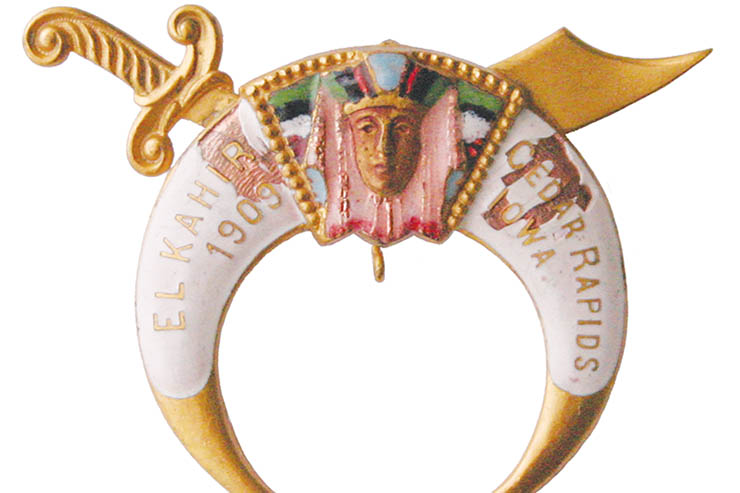
    Already by this time Islam had left its impression on several societies tied to Freemasonry. The Ancient Arabic Order of the Nobles Mystic of the Shrine (better known as the Shriners or the Shrine) had been founded in New York, as had a rival group called the Mystic Order of the Veiled Prophets of the Enchanted Realm (better known as the Grotto). Both required members to be Freemasons. Both adopted the fez as part of its official dress – in the former case, a red one with an Islamic-inspired crescent and the name of the Shriner temple on it, and in the latter case a black one bearing the image of a turbaned figure.

    The Grotto’s nomenclature, ritual, and symbolism was based on the poem “The Veiled Prophet of Khorassan” by Thomas Moore (1779-1852). It focuses on al-Mokanna, the Veiled Prophet Hakem ben Haschem, who lived between the 7th and 8th centuries, and blended Islam with the pre-Islamic Persian religion of Zoroastrianism.

    The Shrine was created by Dr. Walter M. Fleming, with the assistance of Charles T. McClenachan and some other Freemasons, in or around 1870, and its first temple – Mecca Temple – was established in New York. Although long known for its intentionally clownish parades through small suburban towns, some early histories of the Shrine claim a more esoteric origin: the Bektashi Order of Sufi Islam.

    There were more serious attempts to introduce Islamic mysticism to Freemasons and spiritual adventurers in the West. After his failed attempt to scale Kanchenjunga, the world’s third largest mountain, in 1905, Freemason and magus Aleister Crowley (1875-1947) left the Himalayas and headed to Calcutta where he prepared to return to his native England via Persia. Part of Crowley’s preparation was to immerse himself in Sufi literature and to begin writing his “Ghazals of Ishtar,” imitating the style of the Sufis though instead focused on the ancient Babylonian and Assyrian goddess.

    The project turned into The Scented Garden of Abdullah The Satirist of Shiraz. Though his least known work, Crowley, never a shrinking violet, claimed it transcended the Bhagavad Gita and the Tao Te Ching. The work had to be published pseudonymously since it included homoerotic and Gnostic content. The English magus chose the name ‘Abdullah al Haji’ who he claimed was active during the 17th century. Despite the ruse, most copies of The Scented Garden were seized and destroyed by customs during import to Britain from Crowley’s printer in Paris.

    Notably, Crowley says in the text that he cannot discuss the inner working of Sufism, “if only because I am a Freemason.” The implication is, of course, that the two are in some way connected or at least kindred.

    Crowley wasn’t the first English Freemason to see similarity between the Craft and Islam. In 1872, Kenneth MacKenzie founded the Order of Ishmael, on the authority of an Arab in Paris. In theory, at least, Christians (excluding Catholics), Hindus, Zoroastrians, Muslims, and others could be initiated, though the highest of its 36 Degrees was titled “Submission,” the literal translation of Islam (submission to the Will of Allah). John Yarker, a very active and influential figure in the underground esoteric Masonic scene, appears to have been involved in the project – which may have existed more on paper than in practice. Yarker played a role in the ‘fringe’ Masonic life of William Henry Quilliam (1856-1932), better known as Shaykh Abdullah Quilliam.

    Shaykh Abdullah Quilliam & Freemasonry

    Quilliam converted to Islam as a young man, and went on to become an influential figure in Muslim political life in Britain. Believing in the creation of an international Muslim brotherhood, Quilliam agitated for the rights of Muslims under the British Empire, and attempted to expel prejudice against Islam – which had a bad image in Britain during his lifetime. Besides this, the shaykh founded the first mosque in Britain, as well as an Islamic education centre and publishing house to disseminate literature on Islam.

    His activities won him the attention of the Ottoman Empire, which appointed him Shaykh ul-Islam for the British Isles, and funded some of his work. At the same time, Quilliam was active in both regular Freemasonry and the ‘fringe’ Masonic societies of the Sat Bhai (which was influenced by Hindu mysticism) and the Swedenborgian Rite. More significantly, Quilliam was undoubtedly the founder of the Ancient Order of Zuzimites, which adopted the structure of the Masonic Craft Ritual and the symbolism of pharaonic Egypt.

    Quilliam seems to have understood that Freemasonry was more sympathetic to Islam than mainstream society in the English-speaking world. Indeed, some important Masonic journals, which he wrote for, noted his Islamic credentials. It is highly likely that, like Abd al-Qadir and many other Muslims who joined Masonic Lodges, he saw the fraternity as offering the possibility of a transcending of religious and ethnic boundaries – and as a Muslim in a Christian country he would have been all too aware. Perhaps, like Crowley, he saw some manifestations of Islam and Freemasonry as compatible.

    Whatever the case, it is extremely significant that some of the more important and radical Muslim activists sought initiation into Freemasonry during the 19th century, and that some Freemasons and societies linked to Freemasonry were, in turn, influenced by Islam. These historical episodes may have been almost entirely forgotten, but whether we like it or not, these influential individuals and groups helped shape the world we live in today.

    [alert type=”general” dismiss=”no”]This article was published in New Dawn Special Issue Vol 9 No 4.[/alert]

    [alert type=”success” dismiss=”no”]If you appreciate this article, please consider subscribing to help maintain this website.[/alert]

    © New Dawn Magazine and the respective author.
    For our reproduction notice, click here.