New Dawn – World's Most Unusual Magazine

Author: Anthony Peake

  • VALIS “Vast Acting Living Intelligence System”: The Invasion of Philip K. Dick’s Mind

    VALIS “Vast Acting Living Intelligence System”: The Invasion of Philip K. Dick’s Mind

    This article was published in New Dawn Special Issue Vol 8 No 4 (August 2014)

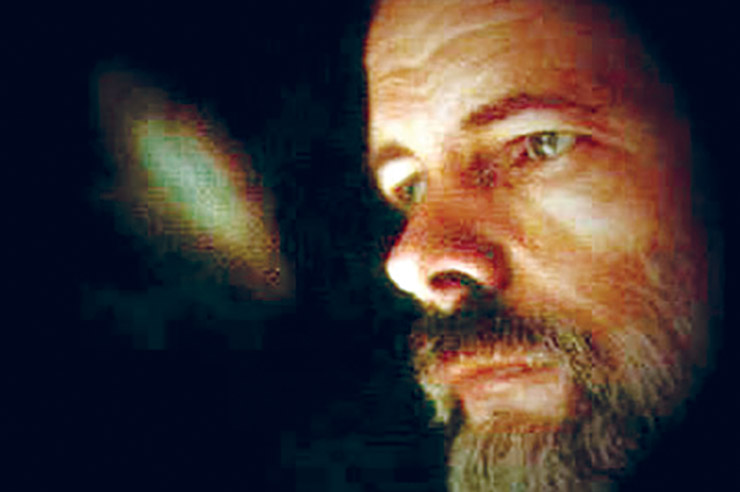
    In an interview with English journalist Charles Platt in 1979, the American science fiction writer Philip K. Dick claimed that in the spring of 1974 his mind was taken over by something he described as a “transcendentally rational mind.” Dick added that up until that point he felt as if he had “been insane all of my life and suddenly I had become sane.” What could he have meant by such a strange comment? Was it simply writer’s imagination or was it something of significance? Dick certainly thought so.

    Philip K. Dick (1928-1982) is considered by many to be one of the greatest American writers of the second half of the twentieth century. This was recognised by fellow author Ursula LeGuin when she called him our “home grown Borges” in reference to the works of the great Argentinian writer.

    But Philip K. Dick was more than just a writer; he was a philosopher who described in his short stories and novels a view of the world brought about from his own experiences. In the final few years of his all-too-short career he wrote a series of semi-autobiographical novels describing his encounter with this entity that invaded his consciousness. The most famous of these novels is VALIS but in many ways the one that most closely follows Dick’s actual encounter is his posthumously published novel Radio Free Albemuth, recently made into an intriguing movie of the same title written, produced and directed by Los Angeles based John Alan Simon.
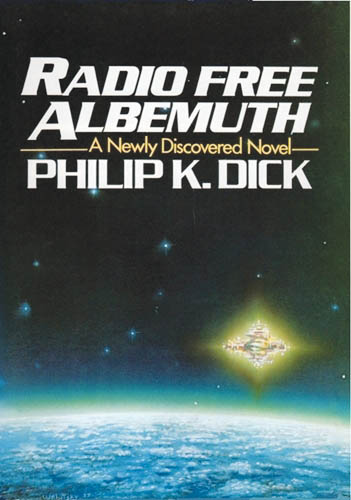
    There is strong evidence that the entity Phil was later to call VALIS, “Vast Acting Living Intelligence System,” had been with him for most of his life, only made more manifest through a series of neurological facilitators (both natural and artificial) that affected Dick in the early 1970s. 

    From a very early age there was something distinctly odd about Philip K. Dick. He was a quiet, somewhat introverted child, recovering from the loss of his twin sister Jane, who died soon after they were born in a cold Chicago December in 1928, and the subsequent abandonment of his father a few years later. As he grew older he was clearly highly intelligent but with certain neurological and psychological problems that caused him difficulties at school. These issues tended to come to the surface during periods of stress such as exams. The young Phil would suffer from vertigo attacks together with strong feelings of disassociation from the physical world. He once described the sensation as like viewing the world through the wrong end of a telescope. It was in one crucial physics exam that something very peculiar took place.

    In an interview with his friend Greg Rickman recorded in October 1981, Dick described how the exam was not going at all well:

    I sat for almost two hours staring at the page and my college entrance depended on getting that test right. It was the final test… I didn’t understand the principle. I didn’t even remember the principle let alone know how to apply it. I prayed and prayed and prayed and prayed and then this voice clicked in and said… “the principle is really very simple.” And then it went on and stated the principle and it explained how it was applied… I got (the test) back with an “A.”1

    Dick believed this “entity” was some form of “guide” that was to become a permanent fixture in his life, lying dormant for years but involving itself in his life and in times of great crisis. In another interview Rickman asked Dick if the voice had ever returned. The writer described that although he regularly sensed its presence its verbal comments were very rare. Dick cited one particularly odd manifestation that took place in the late 1960s. 

    He described how he had been watching a TV programme about the Galapagos turtles. The fight for survival of one particular female turtle had really upset him. After laying her eggs she had turned in the wrong direction and instead of going towards the sea she crawled inland. Soon the heat brought about extreme dehydration. She was dying. As she began to fade her legs were still seen to be moving. The film had been edited to give the impression that the dying turtle was imagining she was back in the ocean. He went to bed with this tragic image in his mind. He woke up in the night to hear the same voice that he had heard many years before during his physics exam. It explained to him that the turtle actually believed she was in the water:

    I was just terribly amazed and dumbfounded to hear that voice again. It wasn’t my own voice because one of the sentences the voice said was “And she shall see the sea” and I would not use the two words “see” and “sea” in the same sentence. It tends to do that, use word choices I don’t use. One time it used the expression “a very poisonous poison” which I would not use.2

    Dick was intrigued by the source of this “voice.” It was clearly located within his brain and yet it used terminology and word structures that were alien to him. Indeed, it was clear from his childhood exam experience that this being knew things he did not know. 

    By the late 1970s Dick discovered a possible answer to this mystery. At that time he had encountered the theories of Princeton psychologist Julian Jaynes. A few years before, in 1976, Jaynes had written a highly influential book entitled The Origin of Consciousness in the Breakdown of the Bicameral Mind. Jaynes suggested the brains of ancient human beings may have been “bicameral.” By “bicameral” Jaynes meant that the twin hemispheres of our ancestors brains were isolated from each other. Whereas modern humans understand that the “inner narrative” we all use to decide upon our actions is all part of a singular “self,” the ancients did not. They heard the “inner voice” and identified it with the voice of the gods. Jaynes then argued that at around 1000 BCE the two hemispheres somehow merged into a unitary consciousness of the sort experienced today. He was of the opinion that certain neurological conditions such as schizophrenia are a throwback to this earlier dual state of consciousness. In this way he attempted to explain how certain individuals hear voices which give instructions, criticise or assist on a regular basis.

    Dick suggested to Rickman this may have been the source of his lifelong “partner,” a subliminal and much wiser version of himself located in his right hemisphere:

    I have that. I have that right hemisphere intuition thing occur. Unless you know what it is it does seem like psychic power. That’s the way the right hemisphere works. It’s got to work like that…. And it seems as if it knows the future. What it sees is in the way of a pattern, and part of a pattern is still yet to come. It is actually seeing part of a pattern that is not fully emerged. It can tell from the section it has what the total pattern will be like. It can fill in the missing part.3

    His comment here is of significance. He is suggesting this life-long partner has “psychic power” and that it uses these powers to assist its less able associate located in the left hemisphere. The question that has to be answered is how can something located within the brain have access to information not available via the everyday senses? A clue may lie in another very curious incident that Dick described in a 1977 interview with journalist Richard Lupoff. This is worth quoting in full:

    Back at the time I was starting to write science fiction, I was asleep one night and I woke up and there was a figure standing at the edge of the bed, looking down at me. I grunted in amazement and all of a sudden my wife woke up and started screaming because she could see it too. She started screaming, but I recognised it and I started reassuring her, saying that it was me that was there and not to be afraid. Within the last two years – let’s say that was in 1951 – I’ve dreamed almost every night that I was back in that house, and I have a strong feeling that back then in 1951 or ’52 that I saw my future self, who had somehow, in some way we don’t understand – I wouldn’t call it occult – passed backward during one of my dreams now of that house, going back there and seeing myself again. So there really are some strange things…4

    What Dick is suggesting here is that his future self was able to go back in time and experience from another location in space an earlier life-incident. Note there are two viewpoints here. Dick’s older self does not re-live the experience from the viewpoint of his younger self. He sees it as an outside observer. This suggests either a very strange time-slip or else that in some profound way part of Phillip K. Dick could view from the present incidents from his own past. What if the consciousness existing in Dick’s older right hemisphere perceives the whole of his life from a vantage point outside of linear time and as such it can travel anywhere within the author’s time-line? If this was the case then from its vantage point it is totally precognitive. It knows the outcome of every decision that its linear-time existing partner will make.

    [alert type=”success” dismiss=”no”]If you appreciate this article, please consider subscribing to help maintain this website.[/alert]

    This suggests a stunning explanation: that the guiding voice may have been Dick’s own future self guiding from the future. That the author had on-going access to information known to his future self is evidenced from the way in which Dick frequently claimed that his fictional plot-lines came from his future experiences. He cited a handful of quite startling “future experiences” that turned up in his earlier fictional writings. For example, here Phil describes how an incident in his book Flow My Tears, the Policeman Said actually came to pass many years later:

    In 1970 I wrote a novel called Flow My Tears, the Policeman Said. One of the characters is a nineteen-year-old girl named Kathy. Her husband’s name is Jack. Kathy appears to work for the criminal underground, but later, as we read deeper into the novel, we discover that actually she is working for the police. She has a relationship going on with a police inspector. The character is pure fiction. Or at least I thought it was. Anyhow, on Christmas Day of 1970, I met a girl named Kathy – this was after I had finished the novel, you understand. She was nineteen years old. Her boyfriend was named Jack. I soon learned that Kathy was a drug dealer. I spent months trying to get her to give up dealing drugs; I kept warning her again and again that she would get caught. Then, one evening as we were entering a restaurant together, Kathy stopped short and said, “I can’t go in.” Seated in the restaurant was a police inspector whom I knew. “I have to tell you the truth,” Kathy said. “I have a relationship with him.” Certainly, these are odd coincidences. Perhaps I have precognition.5

    Is it possible that in writing Flow My Tears Dick incorporated subliminal “future memories” into his work of fiction? As we know, most writers use visualisation techniques in which they allow their subconscious to take the story where it needs to go. Could it be that Phil simply accessed the “memories” of his own non-dominant hemisphere? There was a second incident in Dick’s life in which he found himself experiencing in real life an event he described in Flow My Tears.

    In the book one of the characters, Felix Buckman, meets a black stranger at an all-night gas station. Buckman is in a very emotional state as he has just heard that his sister had died. The stranger and Buckman make an emotional link. Buckman then walks away, only to return and hug the man a few minutes later. Four years after writing the novel Phil found himself helping out a stranger in an all-night gas station when he was overcome with a powerful déjà vu sensation:

    Suddenly I realised that this was the scene in my novel – the novel written eight years before. The all-night gas station was exactly as I had envisioned it in my inner eye when I wrote the scene – the glaring white light, the pump jockey – and now I saw something which I had not seen before. The stranger who I was helping was black. We drove back to his stalled car with the gas, shook hands, and then I returned to my apartment building. I never saw him again. He could not pay me back because I had not told him which of the many apartments was mine or what my name was. I was terribly shaken up by this experience. I had literally lived out a scene completely as it had appeared in my novel.6

    Dick wrote Flow My Tears in the early 1970s, a period in his life in which he had become fascinated by the workings of the two hemispheres of the brain. As we have already seen, Dick had been intrigued by the work of Julian Jaynes. He had also become aware of the surgical operations of Roger Sperry, a neurosurgeon based at the Californian Institute of Technology. Sperry and his associate Michael Gazzaniga had operated on the brains of individuals with severe epilepsy. It was believed that by cutting the communication channels between the two hemispheres of the brain they could stop seizures spreading across the whole brain. In their initial aim they succeeded, the patients showed a marked improvement. But there were intriguing side-effects including the bizarre observation that the patients had become dual personalities. In effect, Sperry and Gazzaniga had created a neurological situation similar to Jaynes’ bicameralism. Dick was fascinated by the implications of these operations and wondered if his own “inner voice” could be explained by this outcome.

    In early March 1974 Dick read an article in the popular science magazine Psychology Today that suggested he could check out his suspicions regarding his own mental duality. The author of the article Harvey Ross described how the condition of a young boy with severe schizophrenically-induced visions was improved by the introduction of a high-protein, low-carbohydrate diet supplemented by a cocktail of vitamins. Ross gave the recipe for the cocktail and included in it the instructions that 500 mg of vitamin C should be taken in the first month with an increase to 1,000 mg for the second month onwards. Ross argued that the large dose of vitamins brings about a marked improvement in the firing of brain cells (neurons) which, in turn, facilitates the synchronisation of the two hemispheres of the brain.7

    As such Dick was very excited by this discovery. This was a way for him to cure himself of his own “bicameralism,” reconnect the two hemispheres of his brain, and finally open up direct, rather than arbitrary, communication with the part of him that had identified itself as being his “Tutelary Spirit.” As the cocktail of vitamins were all water soluble and easily available from any pharmacist, Dick decided he would try this himself. He was already aware of the developments in neurology suggesting that the right and left hemispheres of the brain function independently and that most “normal” people only use their “dominant” hemisphere. For Phil it was logical to conclude that by using Ross’s recipe human consciousness could be raised onto another level of awareness:

    It occurred to me that maybe in a normal person with normal, which is to say, average synchronisation, it might cause firing to take place so efficiently that both hemispheres of the brain might come on together.8

    He then goes on to describe how, after taking the dose, he found that his two hemispheres did, indeed, “came on together” as he termed it. According to one of his biographers, Lawrence Sutin, Dick actually got the recipe wrong and ending up taking seven grams more vitamin C than he should have.9

    This “coming together” may have facilitated the most intriguing part of Dick’s life; a series of events that took place in February and March 1974 that he was later to describe as being his “theophany.” His use of wording here is quite precise. “Theophany” is Greek for “the appearance of God” and this is exactly what Phil believed took place over that period. It seems that the overdose of vitamin C, mixed with a cocktail of pain killers that he was taking to relieve the symptoms of an impacted wisdom tooth, may have allowed his mysterious partner to become far more immanent in his life. He called this entity “AI,” “Firebright,” Zebra, “Sophia,” Shekinah, finally settling on “Vast Acting Living Intelligence System” (VALIS). This being became very active in Phil’s life. It organised his accounts, told him to sack his agent and even had him buy clippers to trim his somewhat unruly nose hair! 

    So what was the source of this “transcendentally rational mind”? Was it really a manifestation of God that Phil believed it to be? Was it simply a misunderstood “inner dialogue” suggesting that Phil was experiencing a form of schizophrenia? An intriguing suggestion made by, among others, astrophysicist Bernard Haisch, anthropologist Martin W. Ball and comedian Bill Hicks is that we are all God and that under certain circumstances we all can access elements of the “mind of god.”

    Phillip K. Dick was of a similar opinion. In his personal journal, now published under the title of The Exegesis of Philip K. Dick, Dick makes the following comment: 

    we ourselves are units of God’s (the total organism’s) memory system? Suppose, for some of us at least, that (called, I think, witnessing) is our prime purpose? We are (parts of) his memory? 

    Dick once described himself as a “acosmic pan-entheist.” He defined this as being somebody who doesn’t believe the universe exists in itself but is an extension of God in space and time. For Phil, God exists outside of space and time and extends himself into space-time.

    In his novel VALIS he described this as being a “concealed god” who takes on the likeness of “sticks and trees and beer cans in gutters,” later adding that God subsequently becomes “debris no longer noticed.” In the Exegesis he went further: “Premise: things are inside out… Therefore the right place to look for the almighty is, e.g., in the trash in the alley.”

    In this model, what exactly is “God”? It is clear Dick was not describing the Western concept of a personal deity but more the Eastern idea of an impersonal life-force that permeates everything. Recent work by researchers such as Vlatko Vedral,10 Tom Campbell11 Nick Bostrom, and Frank Tipler12 suggests the great mystery of the mind-matter split can be explained if that at a more fundamental level everything is simply mathematical information. 

    In his book Decoding Reality, quantum physicist Vedral presents support for such a belief. In effect, the universe and everything in it is a huge “computer” program containing the en-coded information of everything that has happened and can happen. This “program” exists outside of space-time (as space-time itself is part of the program). In a quotation that could have been taken from Dick’s Exegesis, French mathematician Alain Connes, made the following observation:

    It is humility, finally, that forces me to admit that the mathematical world exists independently of the manner in which we apprehend it, that it isn’t localised in time and space. But the manner in which we apprehend it is subject to rules very similar to those of biology. The evaluation of our perception of mathematical reality causes a new sense to develop, which gives us access to a reality that is neither visual nor auditory, but something else altogether.13

    As we are all elements of the program, it is logical to conclude that under certain circumstances we may be able to perceive information within the program. This information (or in-formation as it was termed by another great scientist-philosopher, David Bohm) is analogous to the digitised data found encoded within the reflective surface of a DVD. The DVD contains ALL the information of the respective movie, video game or whatever linear narrative it has been created to re-create. But the linear nature only exists from the viewpoint of the observer. In actuality, all the information exists in a single location, in this case the DVD itself. Many years ago Philip K. Dick made a similar analogy using the technology of his time, a long-playing gramophone record. The information system that the physical universe is based:

    …contains in it as a simultaneous plane or extension everything which was, just as the grooves on an LP contain the part of the music which has already been played; they don’t disappear after the stylus tracks them. A phonograph record is, actually, a long helical spiral, and can be represented entirely in a plane geometry sort of way: in space, although I suppose you can talk about the stylus accumulating the music as it goes along.14

    Does this explain the origin of Dick’s “transcendentally rational mind”? Was he actually accessing the information field from which everything that we perceive is constructed? Or was it simply that he had taken too many mind-altering substances?

    Whatever the case, Philip K. Dick’s encounter with the noetic will continue to fascinate, beguile and intrigue all who encounter them, and, in doing so, will be the source of debate and discussion for many years to come. I hope this article may have made its own small contribution to these discussions.

    The film adaption of Philip K. Dick’s novel Radio Free Albemuth was released in June 2014. The film is written, directed, and produced by John Alan Simon and stars Alanis Morissette in a lead role.

    [alert type=”general” dismiss=”no”]This article was published in New Dawn Special Issue Vol 8 No 4.[/alert]

    [alert type=”success” dismiss=”no”]If you appreciate this article, please consider subscribing to help maintain this website.[/alert]

    Footnotes

    1. Gregg Rickman, To The High Castle Philip K Dick: A Life 1928-1962, Fragments West, 1989, 140 
    2. Gregg Rickman, Philip K. Dick: The Last Testament, Fragments West, 1985, 23
    3. Ibid., 19
    4. Richard A. Lupoff, ‘A Conversation with Philip K Dick’, Science Fiction Eye, Vol. 1, No. 2, August 1987, 45-54
    5. Philip K. Dick, ‘How To Build A Universe That Doesn’t Fall Apart Two Days Later’, 1978, http://deoxy.org/pkd_how2build.htm
    6. Ibid.
    7. Harvey M. Ross, ‘Orthomolecular Psychiatry: Vitamin Pills for Schizophrenics’, Psychology Today, April 1974
    8. Philip K. Dick, The Exegesis of Philip K Dick, Hachette Littlehampton, Locations 990-991, Kindle Edition
    9. Lawrence Sutin, Divine Invasions – A Life of Philip K Dick, Orion Books, 2006, 212
    10. Vlatko Vedral, Decoding Reality – The Universe as Quantum Information, Oxford University Press, 2012
    11. Tom Campbell, My Big Toe: A Trilogy Unifying Philosophy, Physics, and Metaphysics, Lightening Strike Books, 2007
    12. Frank J. Tipler, The Physics of Immortality, MacMillan, 1994
    13 Alain Connes & Jean-Pierre Changeux, Random Thoughts About Mind, Matter and Mathematics, Princeton University Press, 1995
    14. Philip K. Dick, ‘Man, Android and Machine’ (1975), From The Shifting Realities of Philip K. Dick: Selected Literary and Philosophical Writings edited by Lawrence Sutin

    © New Dawn Magazine and the respective author.
    For our reproduction notice, click here.
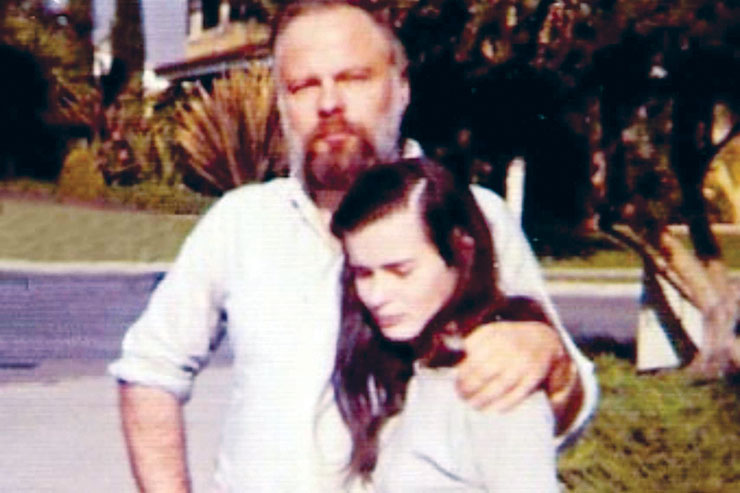
  • A Life of Philip K. Dick: The Man Who Remembered the Future

    A Life of Philip K. Dick: The Man Who Remembered the Future

    From New Dawn 139 (Jul-Aug 2013)

    This year [2013] saw the 30th anniversary of the death of one of the most influential writers of all time, the iconic Philip K. Dick. Although virtually unknown outside of science fiction circles, during his lifetime Dick’s intriguing philosophy on the nature of reality has become a staple of the modern Hollywood movie. Huge blockbusters such as Total Recall, Minority Report, The Adjustment Bureau, Blade Runner, A Scanner Darkly and Paycheck were loosely based directly on his novels or short stories, and movies such as The Eternal Sunshine of the Spotless Mind, Memento, The Matrix, The Truman Show and Inception all owe a huge debt to his vision.

    One of the most intriguing themes of Dick’s writing was the concept of the “precog,” a person who could “see” the future before it happened. In 1954 Phil introduced the concept of precognition in his novel The World Jones Made. In this novel the eponymous anti-hero Floyd Jones can see exactly one year into the future. From then on “precogs” occur regularly in his novels and short stories, most notably in his 1956 short story The Minority Report, his 1964 novel Martian Time-Slip, The Three Stigmata of Palmer Eldritch and many others.

    What was it that made Philip K. Dick interested in precognition? It had not been a particular theme within classical science fiction nor had it been part of the books that the young Philip read during his childhood years and early teens. The answer may lie in one simple fact: Philip K. Dick himself was a “precog.” He was not writing fiction but heavily disguised autobiography. Let us review the evidence.

    Like many of his schoolmates, Phil was expected to attend the University of California in his hometown of Berkeley. But in order to do so he needed to reach the entrance grades required. This possibility started to fade rapidly when, during a crucial physics test, Phil couldn’t remember the key principle behind the displacement of water. As eight of the ten questions involved this principle, he was clearly in trouble. And then it happened: a voice clearly and precisely explained to the surprised young man the scientific principles he so desperately needed to understand. All Phil had to do was write down the words in his head. Phil received an ‘A’ grade.

    Although this “voice” effectively disappeared for many years, Phil continued to sense there was a part of him that was alien in some way. Throughout the 1950s the voice remained silent and then, under somewhat prosaic circumstances, it re-appeared. In an interview with his friend Greg Rickman, recorded in October 1981, Phil described how he had been watching a TV programme about the Galapagos turtles. The fight for survival of one particular female turtle had really upset him. After laying her eggs she had turned in the wrong direction and instead of going towards the sea she crawled inland. Soon the heat had brought about extreme dehydration. She was dying. As she began to fade her legs were still seen to be moving. The film had been edited to give the impression that the dying turtle was imagining she was back in the ocean. He went to bed with this tragic image in his mind. He woke up in the night to hear a voice. In careful and deliberate terms the entity explained to Phil that the turtle actually believed she was in the water:

    I was just terribly amazed and dumbfounded to hear that voice again. It wasn’t my own voice because one of the sentences the voice said was “And she shall see the sea” and I would not use the two words “see” and “sea” in the same sentence. It tends to do that, use word choices I don’t use. One time it used the expression “a very poisonous poison” which I would not use.1

    It is clear Phil recognised the voice as being the same entity that had helped him in his physics exam all those years before. It was back. He was to continue hearing this entity for many years, but only as a faint background whisper. In another 1981 interview he stated:

    I only hear the voice of the spirit when I am falling asleep or waking up. I have to be very receptive to hear it. It’s extremely faint. It sounds as though it is coming from a million miles away.2

    The “Voice” Returns

    In February and March 1974 the voice was to reappear and stay with him. It all started quite innocently. Phil had been in considerable pain after having a wisdom tooth pulled out. His wife, Tessa, called the dentist who prescribed painkillers. As Tessa did not want to leave her husband alone in such a state of agitation she asked if somebody could deliver the prescription to their house in Fullerton. Half an hour later the doorbell rang and Phil dashed to the door. On opening it he saw a young woman clutching the much-needed painkillers. Phil stood back stunned. Around the young woman’s neck was a necklace with a fish pendant. Phil recognised this as a symbol of something deep within himself. He asked her what it was and she explained it was a sign used by the early Christians as a code to show their secret beliefs to fellow Christians.

    Dick later reported this was the first time he experienced the pink light, the same light so central to the Beatles incident (described below). He said a beam of this light shot out of the pendant and entered his brain. This light opened up a part of his brain that had long been asleep. He described it in this way:

    I suddenly experienced what I later learned is called anamnesis – a Greek word meaning, literally, “loss of forgetfulness.” I remembered who I was and where I was. In an instant, in the twinkling of an eye, it all came back to me.3

    As we have already mentioned, up until March 1974 what Dick had called “the voice” manifested itself on rare occasions such as the incident during the school exam. But after Phil’s “anamnesis” his hidden partner was to become very active in his life. It decided that Phil had become far too slovenly in his personal appearance. He was made to go out and buy a pair of nasal hair-clippers and it suggested he trim his beard. The entity even had Phil go shopping for new trendy clothes.

    It was also concerned about the health of the shared body. It had Phil go through his drugs cabinet and forced him to throw out those medications that were proving problematical to his health. It discovered that wine was too acidic for his sensitive stomach and suggested he change to drinking beer. This being had many skills that Phil sadly lacked, such as business acumen. It realised he had made quite a mess of his tax matters and within weeks the entity sorted this out. It also had Phil sack his agent after it read over his royalty statements and discovered massive irregularities.

    All of these were minor interventions compared to its apogee, the saving of Phil’s son’s life. Phil describes how one morning he was lying in a semi-sleep state when he heard the voice announce that his recently born son, Christopher, had a potentially fatal birth defect and that urgent medical attention was needed. Indeed the voice was quite precise when it stated: “Your son has an undiagnosed right inguinal hernia. The hydrocele has burst, and it has descended into the scrotal sac. He requires immediate attention, or will soon die.” Phil told various versions of this story, including one involving him listening to the Beatles and the lyrics of “Strawberry Fields” were changed to give the instruction. Tessa, acting on her husband’s frantic instructions, took Christopher to the family doctor and it was, indeed, confirmed that Christopher had exactly the problem the “voice” had described and surgery was needed.

    Dick’s “Homoplasmate”

    What was the source of this “voice” and how did it have information unknown to Phil? Phil was to conclude that it was an immortal part of himself, something he called a “plasmate.” He argued this entity had bonded with him and in doing so had taken human form, something Phil termed a “homoplasmate.” He was later to describe how his mind had been invaded by a “transcendentally rational mind, as if I had been insane all my life and had suddenly become sane.” He explained that:

    …mental anguish was simply removed from me as if by divine fiat… some transcendental divine power which was not evil, but benign intervened to restore my mind and heal my body and give me a sense of the beauty, the joy, the sanity of the world.

    This being, set free from its shackles by Phil’s “anamneses,” was able to use its powers to help Phil precognise the future. Indeed, Phil realised this being had been the source of a series of peculiar precognitive incidents that had taken place throughout his life.

    For example, in his 1974 novel Flow My Tears the Policeman Said, Phil has a sequence in which one of his characters, Felix Buckman, is distraught at the death of his twin sister, Alys. He finds himself in an all-night gas station and there he meets up with a black stranger. Buckman and the black man start up a conversation. In the summer of 1978 Phil, uncharacteristically, decided to go out late at night to post a letter. In the darkness he noticed a man loitering by a parked car. Phil posted his letter and on the way back the man was still there. In a second uncharacteristic impulse Phil walked over to the man and asked if anything was the matter. The man replied that he was out of gas and he had no money with him. Much to his surprise Phil found himself digging into his pocket and giving the man some cash. The man asked for Phil’s address and said that he would return later and pay him back. As Phil entered his apartment he realised that the money would be of no use to his new friend. There were no gas stations within walking distance. Phil went back out, found the man, and offered to drive him to the nearest all-night gas station. As he stood watching the man fill up his metal gas can he had an alarming sensation of a déjà vu-like recognition:

    Suddenly I realised that this was the scene in my novel – the novel written eight years before. The all-night gas station was exactly as I had envisioned it in my inner eye when I wrote the scene – the glaring white light, the pump jockey – and now I saw something which I had not seen before. The stranger who I was helping was black.4

    Phil drove the black man back to his car, they shook hands and Phil never saw him again. He finishes off his description of this event with a slightly chilling comment:

    I was terribly shaken up by this experience. I had literally lived out a scene completely as it had appeared in my novel…. What could explain all this?5

    Uncanny Precognition

    In early 1974 Phil started a long-term correspondence with a graduate student called Gloria Bush. As time went on Phil described to Gloria some of his deepest thoughts, including his fascination regarding his own precognitive abilities. In a letter dated 9 May of that year he described to Gloria a particularly strange recurring dream he experienced in November 1971. In the dreams he always saw what looked like a Mexican city with “square arrangements of streets and yellow cabs.” The yellow cabs suggested to Phil a location in the USA rather than Mexico or Latin America. At the time of these dreams he was living in Marin County, north of San Francisco. In 1974 he was living in Fullerton, a southern suburb of Los Angeles. Right next to Fullerton is a place called Placentia which is a strongly Hispanic area. Phil explains to Claudia that he was convinced this was the place he saw in these dreams.6

    But Phil’s dreams in 1975 took a turn to the macabre. On 25 February he wrote a letter to Bush that was very different from those he had sent before. In a fascinating postscript to an otherwise standard letter, he mentions “the entity” again. It had clearly been manifesting itself within his life at that time. How regularly and to what intensity we cannot say as we have no other source other than this letter. However, it is clear Phil wanted to bring things to a head. He told Claudia:

    I was up to 5 a.m. on this last night. I did something I never did before; I commanded the entity to show itself to me – the entity which has been guiding me internally since March. A sort of dream-like period passed, then, of hypnogogic images of underwater cities, very nice, and then a stark single horrifying scene, inert but not still; a man lay dead, on his face, in a living room between the coffee table and the couch.7

    On 9 May 1974 he wrote another typewritten letter to Claudia stating that he felt “scared.” He didn’t elaborate on this comment but at the bottom of the letter is a handwritten note that states the following: “p.s. What scares me most, Claudia, is that I can often recall the future.”

    Almost exactly seven years later Phil had failed to answer a series of phone calls to his condominium. A group of neighbours then found his front door open. One witness, Mary Wilson, entered the condo and described how she initially thought nobody was home, but then she spotted Phil’s feet sticking out from behind a coffee table. She immediately asked her mother to phone Phil’s close friend, science-fiction writer Tim Powers. Powers jumped on his motorcycle to see what he could do to help. In his introduction to The Selected Letters of Philip K Dick Volume Four Powers describes what happened next:

    As I was putting the key in the ignition of my motorcycle I heard the sirens of the paramedics howl past me down Main Street. When I got to Phil’s place the paramedics and Mary Wilson were already there and the paramedic had lifted him from between the coffee table and the couch and carried him to his bed, and Mary and I answered a few hasty medical questions about him before they got him into a stretcher and carried him downstairs to the ambulance.8

    Phil’s February 1975 dream had come true in stunning detail. He had seen the circumstances of his own death.

    Who, or what, was the “entity” that seemed to share Phil’s life and know his future? Surprisingly enough Phil believed this being to be a version of himself that existed outside of time; a being that could observe the whole of Phil’s life from a position of timelessness. Phil believed that during his dreams, in his semi-waking states and during certain times of heightened awareness, this timeless part of himself could communicate and use its foreknowledge to assist him.

    In October 1977 Phil made a very curious statement during a radio interview at the Berkeley radio station KPFA FM. He described an incident that took place in 1951:

    Back at the time I was starting to write science fiction, I was asleep one night and I woke up and there was a figure standing at the edge of the bed, looking down at me. I grunted in amazement and all of a sudden my wife woke up and started screaming because she could see it too. She started screaming, but I recognised it and I started reassuring her, saying that it was me that was there and not to be afraid. Within the last two years – let’s say that was in 1951 – I’ve dreamed almost every night that I was back in that house, and I have a strong feeling that back then in 1951 or ’52 that I saw my future self, who had somehow, in some way we don’t understand – I wouldn’t call it occult – passed backward during one of my dreams now of that house, going back there and seeing myself again. So there really are some strange things…9

    If the figure at the end of the bed was a future version of Phil then that version would have foreknowledge of all Phil’s life-experiences between 1951 and 1977. Indeed, if Phil’s interpretation can be taken at face value, we have here evidence that in some way his mind from the mid-1970s was manifesting itself back within its own past.

    Vertical Vs. “Orthogonal Time”

    But Phil was not simply happy with accepting this may be the case, he wanted to create a model to explain such a belief. Immediately after the strange events of February and March 1974, or simply 2-3-74 as he termed them, Phil started to keep a journal. Initially in hand-written form and later as page after page of typewritten sheets with diagrams and side notes, this became known as his Exegesis. In effect this was Phil’s attempt to understand the source and meaning of the visions and revelations that he continued to receive until his death in March 1983.

    We are fortunate that in November 2011 a single volume containing all the main sections of this huge work was published by Houghton Mifflin Harcourt. Running to 976 pages this is a fascinating read and in it one can discover Phil’s own understanding of how a part of him could see the future. His solution was a radical re-interpretation of time itself – something Phil called “orthogonal time.”

    He proposes there are two variations of time, both of which exist at right angles to each other. We are usually only aware of “Vertical Time,” but there is another which runs at right angles to our space-time. He calls this “Orthogonal Time.” If we could perceive both times simultaneously it would look cubical, hence his term cubic time. He proposed that events are actually located within this cubic time. As such the idea of cause and effect cannot be applied within this model. Causality can run in reverse or act simultaneously with an event in the past or the future. In other words within orthogonal time all past and future states exist at this moment. In the whole of the Exegesis Phil makes one passing reference to a physicist by the name of Herman Minkowski, the teacher of the much more famous Albert Einstein. With reference to his own precognitions, Phil wrote:

    This is a disturbing new view but oddly enough it coincides with my dream experiences, my precognition of events moving this way from the future; I feel them inexorably approaching, not generated from the present, but somehow already there but not yet visible. If they are somehow “there” already, and we encounter them successively (the Minkowski block universe; events are all already there but we have to encounter them successively), then this view might be a correct view of time and causality.10

    Phil suggested that the basic premise of his short story Adjustment Team – that there exists a way in which the past can be “adjusted” to change the present – may be another of his fictionalised accounts of something that really takes place.11 

    Phil believed that part of us exists within orthogonal time and this alternate-consciousness can, under certain circumstances, communicate with the every-day self that perceives only linear time. This was the source of “the voice” and VALIS (Vast Active Living Intelligence System, Dick’s gnostic vision of one aspect of God). This is how, in dreams, Phil found himself back in his own past observing an earlier version of himself. In this way “the voice” was his own voice speaking from his own future. This entity created his plot-lines using material from his own future. Was this how the meeting with the black man at the gas station ended up in Flow My Tears The Policeman Said? All information from all parts of our life is readily available to a mind open to receive it. Phil suggested in a letter to his friend Patricia Warrick, written in September 1981, that:

    The universe is an information retrieval system; which is to say, everything that has ever happened, ever been, each arrangement and detail – all are stored in the present moment as information; what we lack is the access or entry mechanism to this stored information… where the past of each object – all its prior manifestations along the Form axis – this is all stored in the present object and can be retrieved.12

    This is again astounding evidence that Phil seemed to be accessing information from some form of infinite data-field. It is very much in keeping with the work of modern-day researchers such as Ervin Laszlo and Bernard Haisch, both of whom suggest this “library” is, in fact, something known as the Zero-Point Field.13

    Is this the answer to the mystery of Phil’s precognitions? It certainly makes sense. The future and the past are simply illusions. Phillip K. Dick and every being that reads this article consist of two independent consciousnesses. One lives in linear time and the other in orthogonal time. And in this way we may all be immortal. After all, the transition between life and death takes place in linear, not orthogonal, time.

    In his novel Ubik Phil created a concept known as “Half Life.” This is a timeless place, hovering between life and death. Tibetan Buddhists call this the “Bardo State.” Is this from where Phil’s eternal mind communicated with him? To paraphrase the title of one of his most intriguing books, could it be we all exist in a place where “Time is Out of Joint”?

    For more on the above, read Anthony Peake’s book The Man Who Remembered the Future: A Life of Philip K. Dick.

    [alert type=”success” dismiss=”no”]If you appreciate this article, please consider subscribing to help maintain this website.[/alert]

    Footnotes

    1. Gregg Rickman, Philip K. Dick: The Last Testament, Fragments West, 1985, 23

    2. John Boonstra, Horselover Fat and The New Messiah, Hartford Advocate, 22 April 1981, reproduced in PKD Otako #06, 22

    3. ‘How to Build a Universe that Doesn’t Fall Apart Two Days Later’, published as an introduction to I Hope I Shall Arrive Soon, Doubleday, New York, 1985

    4. Lawrence Sutin (editor), The Shifting Realities of Philip K. Dick, Vintage, 1995, 268

    5. Ibid., 269

    6. The Selected Letters of Philip K Dick, 1974, Underwood-Miller, 1991, 101

    7. Philip K. Dick, Letter to Claudia Krenz, 25 February 1975

    8. The Selected Letters of Philip K Dick, 1975-76, Underwood-Miller, 1992, ix

    9. Richard A Lupoff,  A Conversation With Philip K Dick, Vol. 1, no. 2, August 1987, 45-54

    10. Philip K. Dick, The Exegesis of Philip K Dick, Hachette Littlehampton, Kindle Edition.

    11. Ibid.

    12. The Selected Letters of Philip K Dick, 1980-1982, Vol. 6, Underwood Books, 2009, 262

    13. Ervin Laszlo, Science and the Akashic Field: An Integral Theory of Everything, Inner Traditions, 2007

    © New Dawn Magazine and the respective author.
    For our reproduction notice, click here.

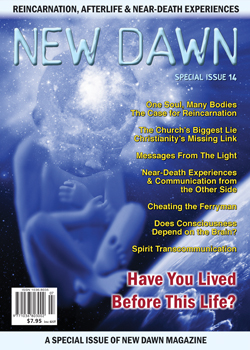
  • Cheating the Ferryman: A New Paradigm of Existence?

    Cheating the Ferryman: A New Paradigm of Existence?

    From New Dawn Special Issue 14 (Dec 2010)

    What happens when we die? This is the ultimate question and one that we still have no real answer. From the first few moments that man became a self-aware being he has pondered upon this mystery.

    Every culture has attempted an explanation, and it is reasonable to conclude that all religions exist to give an account of what happens at that moment and, more importantly, where does the person go after their body dies.

    One of the most enduring myths is that of the Ancient Greeks. They believed that the recently dead would find themselves at the banks of a vast river, the River Styx. Out of the mists would appear Charon, the Ferryman. It was his job to ferry the soul, termed a “Shade,” across to the other side…. To the Land of the Dead.

    But he did not do this for free. He needed a payment. The relatives of the recently dead person made sure the Shade could pay the ferryman. This payment was usually a small coin called an obolus. Depending upon the tradition, either this would be placed under the tongue of the corpse or two oboli would be placed over each eye.

    This well known myth still resonates over three thousand years later. “To Pay The Ferryman” can still be heard today. However, there is a lesser known myth that suggests a deeper truth: The myth of the River Lethe.

    The Greeks believed that before getting to the banks of the Styx the Shade would encounter a much smaller tributary of the great river. This could be crossed with ease by wading from bank to bank. This small river was called the Lethe, and its waters contained a profoundly important quality.

    If the Shade or newly deceased soul drank of this water all their memories would evaporate. They would forget who they are and the events of their life. Their memories would become like those of a new born baby. Of course by doing so the Shade also forgot all of the lessons learned during that life.

    But before doing this the Shade had the option of drinking from a small pool next to the Lethe. This was the Spring of Mnemosyne. By drinking here the Shade’s past-life memories became sharp and distinct. Each action and its subsequent effects became crystal clear. Life’s lessons became precise and understood.

    If the Shade drank of the Spring of Mnemosyne they were allowed to pay the ferryman, board the boat, and sail across the Styx to the Elysian Fields.

    But if a drop of the waters of the Lethe was drunk by the Shade, then they were sent back to be reborn again with no memories of their previous life. Now this was not a form of reincarnation as it is understood by most people. It was a re-birth process in which the same life was lived again. The Shade found itself back in its mother’s womb waiting to start all over again.

    This concept is called “The Eternal Recurrence” and has been a long held alternative belief to that of the linear life found in most religions, even those who have reincarnation as their central belief.

    However, those who have long held this belief never shared it with the masses. Such a belief has always been found in the secret – esoteric – groups within most of the major religions. This is the great secret carried through the ages by the groups loosely termed as “Gnostics.”

    The Gnostic tradition can be found behind the great mystery traditions of the Middle East and Europe. From the Manicheans of Persia to the Cathari of Southern France, and from the Cabbalists of Southern Spanish Judaism to the Sufi’s of Arabia, this hidden knowledge is the real Holy Grail in whose defence the Knights Templar and the Albigenesians died in their thousands to protect.

    In my books I present evidence for this belief system, that at the moment of death we are catapulted back to our moment of birth. The theory is supported by a good deal of evidence from modern science, particularly quantum physics, neurology, psychiatry and consciousness studies.

    I call this theory “Cheating the Ferryman” because I suggest many of us never make it across the River Styx. We never step into Charon’s boat and we never pay him his obolus. We cheat the ferryman out of his fare and return to live our lives again.

    On what evidence do I base such a totally weird idea?

    Dreams & Precognitive Déjà Vus

    Well, for me, the whole theory started with one very peculiar dream. In this dream I experienced a déjà vu… yes a dream that contained the sensation that I was experiencing an event that I had dreamed before, if that makes sense.

    In the dream I had an inner dialogue with another me and this being stated that a déjà vu is a memory of an event that you have lived before in a different life. I then woke up with this idea echoing round my mind.

    I had for some time wanted to write a book and now it seemed that my dream self, or more accurately a part of my dream self, had given me both the theme and the incentive.

    I was surprised to discover that déjà vu is not only the most common anomalous psychological perception (70% of people will experience the sensation at least once in their lives) but also that experts have no real idea what causes it. Various suggestions have been made but none have been shown to be correct.

    As an example, for many years a proposal made by the psychiatrist Paul Efron was considered to have nailed the mystery. Efron suggested that one part of the brain processes information before the other. In this way we have the feeling of experiencing an event twice. This occurs because each hemisphere of the brain receives signals from the right and left visual fields of each eye. As such the non-dominant hemisphere processes the incoming images a split second before the dominant hemisphere. So, in effect, the consciousness receives the signal twice with a short time delay. As one signal is immediately, but not fully, over-written by another we feel as if we have experienced the images twice. But this curious message transferal only works for the eyes. It has recently been shown that congenitally blind individuals experience aural déjà vu sensations. As the brain processes sound in a totally different way to sight, the Efron thesis simply cannot explain this form of déjà vu.

    I wondered if déjà vu may not be simply what it feels it is: a curious sensation that suggests the observer has lived this moment before. The Seattle based psychiatrist Dr. Vernon Neppe has defined déjà vu as, “any subjectively inappropriate impression of familiarity of the present experience with an undefined past.”

    So the “undefined past” could be part of this life or a past life. However this ‘past life’ for me did not imply reincarnation for one simple reason: for a déjà vu sensation to be effective it has to be a memory of the exact circumstances, not a circumstance that is similar. For example, if my “subjectively inappropriate impression” consisted of me remembering being in this place in Victorian times, the two images would be quite different. The location may be the same but my clothing, my companions and the décor would be totally different. It would feel more like a time-slip than a doubling of consciousness. For a déjà vu to be a déjà vu the two impressions have to be identical, in all ways. My memory of the event is identical to my experiencing of the event. I am literally re-living an event from my own past, but a past that is, for the moment, the future.

    Indeed, I have now interviewed many people who experience precognitive déjà vu’s. The ‘memory’ includes a remembrance of what happens/happened next. The subject suddenly has very short-term clairvoyance.

    I found that these precognitive déjà vu sensations are usually reported by individuals who experience three brain-states: migraine, temporal lobe epilepsy (TLE) and schizophrenia. I was intrigued as to why this was the case and began researching what may link these three ‘illnesses’.

    Much to my delight I found there is one common factor, a neurotransmitter called glutamate.

    Perception and Time Distortion

    In a curious coincidence that was to have great significance to me later, I learned that neurotransmitters were first discovered by an Austrian scientist called Otto Loewi. Just like me, Loewi had a dream guider. On Easter Sunday 1920 he awoke in the middle of the night having experienced a really vivid dream. He wrote down what he had experienced and went back to sleep. The next morning he excitedly looked at his notes to find them to be illegible scrawl. He knew that he had dreamed something of profound importance so he went to bed early the next night. The dream came again and when he awoke he reproduced his dream experiment exactly as he experienced it that night. In doing so he isolated a substance that was to eventually be called acetylcholine. Such was the importance of this discovery that in 1936 Dr. Loewi and his English associate Sir Henry Dale were awarded the Nobel Prize.

    What Loewi’s dream had helped find was the first example of the chemicals that were later to be called neurotransmitters. These are internally-generated substances that facilitate the transmission of messages from cell to cell within the body. The most important group is found in the brain and glutamate is the most important of the brain neurotransmitters.

    Glutamate is directly responsible for the peculiar feelings described by migrainers, temporal lobe epileptics and schizophrenics, specifically a sensation that is technically known as “the aura.”

    The aura is a form of early warning system. It is triggered by over-production of glutamate and usually takes place a short time before an attack of migraine or a temporal-lobe seizure. (Glutamate’s role in schizophrenia is different but the overall outcome is similar). Experiencers report sensations of time slowing down, of hyper-sensitivity, of visual or aural hallucinations and profound déjà vu sensations. Déjà vu had been linked with both migraine and TLE for years before Loewi’s serendipitous discovery.

    Here was the link I had been looking for. Déjà vu has, as one of its causes, a flood of glutamate in the brain. It was then that I made my first big step to “Cheating the Ferryman.”

    Quite by chance I was reading an old book I had on Near-Death Experience (NDE). One of the more technical articles discussed the neurochemical causes of the NDE. Much to my surprise I found that glutamate was also connected to this well-reported experience. Another, and quite unrelated, article in the same book discussed one of the most commonly reported elements of the NDE, what is technically known as the “panoramic life review.”

    “My life flashed before my eyes” is a quotation recorded time and time again by people who have close encounters with death. Some report the experience as being a series of snapshots, others that they literally re-live every experience of their life but in super-speed. One person reported that it was as if somebody had recorded a movie of his life and was running it in fast-forward.

    I was fascinated by this link. Both déjà vu and the Panoramic Life-Review were linked by a specific brain-chemical, glutamate. After doing some subsequent research, I found that Dr. Karl Jansen of the Maudsley Hospital in London had been able to reproduce a full near-death experience in volunteers when he had them take small doses of the drug ketamine. Now ketamine is chemically almost identical to glutamate so here again we had an amazing link.

    I was later to find that ketamine, and by implication glutamate, also brings about another curious subjective sensation in the brain: time slows down or almost stops for the experiencer.

    In another fortuitous event I was to be given a first-hand description of a glutamate effect by a person who experienced TLE seizures.

    Temporal Lobe Epilepsy Breakthrough

    I received a phone call one afternoon. It was a lady from a recruitment agency who was wishing to discuss with me a vacancy she was handling. “Margaret” asked me whether I was working and I explained that I was driven to write a book. “What about?” she asked, “I don’t really know at the moment,” I truthfully responded. I then explained that I was reading a good deal about temporal lobe epilepsy and was making some fascinating links.

    She went very quiet and suggested that we should meet up to discuss the vacancy. Three days later I met her at a coffee shop nearby. As soon as she had sat down she explained to me that she had to meet me because she wished to discuss with me something she could not mention in her office where she would have been overheard.

    “Margaret” informed me that she had recently been diagnosed as a having temporal lobe epilepsy. She described to me how she had first discovered that something unusual was happening in her brain.

    She had been having lunch with a work associate in a crowded café. As her associate started to pour a cup of tea from a teapot she suddenly felt a snap over her right ear. Surprised by this she looked at her associate assuming that she too would have heard the noise. One look told her that her lunch companion had heard nothing. This was because she had stopped moving. The stunned recruitment consultant looked round the café and every person was frozen in time and space. It was as if she had suddenly found herself in a three-dimensional photograph. She could hear a low humming sound that seemed all around her. She then looked back at her companion to notice that she was not frozen at all, she was moving incredibly slowly.

    Margaret then realised that the low hum she could hear was, in fact, people’s voices! Her metabolic rate had increased to such an extent that time had slowed down to a crawl. She watched in amazement as the tea slowly appeared from the spout of the teapot and slowly fell into the cup. Margaret assured me that this took hours to take place in her mind.

    At that point she made a fascinating comment. She said that she could have been in this state for days, months, years, “even a lifetime.” Then, after what seemed like many hours, Margaret felt another snap over her right ear and her associate finished pouring the tea and sat back. “Are you okay,” she asked. “I am not sure,” replied Margaret. Her friend then explained that Margaret had suddenly stopped moving and had stared into space… for about twenty seconds! As Margaret explained to me, those twenty seconds had been hours for her. She went on to tell me that she feared she had a brain tumour but after a series of scans she was told that she had TLE.

    I was amazed at this story. Here was evidence that glutamate, when it floods the brain, does, indeed, slow subjective time to an absolute crawl. For some reason I then asked Margaret if she experienced déjà vu. “I get déjà vu’s to kill for” was her reply. “Not only that but when I am in this pre-seizure aura state I know what is going to happen next. I really do see the future!”

    My meeting with Margaret presented me with the final piece of a jigsaw puzzle that I had not known, until that moment, I was trying to complete. I knew then what the book would be about – not an explanation for déjà vu but something much bigger, an explanation as to what happens to human consciousness at the point of death!

    My theory was both simple but stunning. Déjà vu sensations are exactly what they seem to be: they are recollections of past events, otherwise known as lost memories.

    So how can we “remember” the future? Simple, because the future is also the past. Confused? Well the best way to explain this is to give a fictitious example based upon an amalgamation of many NDE reports.

    Get the issue this article appears in

    The Physics of the NDE – Cheating the Ferryman

    Our hero is a skydiver. He is a very unlucky skydiver because his parachute has refused to open and he forgot to pack his back-up ‘shute’. As he plummets to the ground there will be a point where the stress levels will be so high that glutamate floods the brain. In doing so it brings about the subjective slowing down of time. Indeed, for the skydiver the duration of time slows down to a virtual standstill. But his brain remains completely active.

    Just as he is about to hit the ground his motion through space is slowed by the fact that his motion through time has similarly been changed. As we know from the theories of Albert Einstein, time and space are the same thing and they are “relative” to the observer. This is where the word “Relativity” comes from.

    So “relative” to the skydiver, time duration has slowed down to a crawl. For him a split second can last days, weeks, years, even a lifetime. This is exactly what Margaret experienced in the canteen.

    What happens then? Well something very strange. Recall that many people who report Near-Death Experiences explain they see their lives “flash before my eyes.” This is a Near Death Experience. Our skydiver is in a Real Death Experience. There is no way he will survive the impact with the ground. In this case his life does not “flash” before his eyes but he experiences it in a literal, minute by minute, recreation of his life from the moment of his birth. In effect he lives his whole life again. And at the end of the second life it happens again, and again and again. It is like the movie “Groundhog Day,” but it is not a “day” but a “life” – and all this takes place in the split second before he hits the ground.

    This is how he “Cheats The Ferryman.” In his subjective time-frame he never reaches the point of death because it is always in his future.

    But there is more – and this where things get very interesting. I suggest each life-rerun is not like a pre-recorded movie that cannot be changed but more like a video game in which all consequences of all decisions are already programmed in. By applying the latest findings of quantum physics I present a model whereby the implications of something called the “Many-Worlds Interpretation” can be shown to allow such a scenario.

    Put simply, according to the MWI hypothesis there are literally billions of versions of each person and each one of these versions have the capacity to live out – and lay down re-playable memories – the outcomes of every decision made in a lifetime. There is available to each person a recording of every possible life they could live. I call this recording the “Bohmian IMAX.” Others may recognise it as the “Akashic Record” or the “Akashic Field” of Professor Ervin Laszlo.

    I further suggest that at the point of death consciousness splits into two elements. I term these the Eidolon and the Daemon. The Eidolon is the everyday being that calls itself “I” or “me” and it has no knowledge of its previous lives. The Daemon is different. It carries all the memories of the past life (or lives) and as such it acts as a form of “Higher Self” or “Guardian Angel.” In my books I present evidence from modern neurological research to suggest this may be the case.

    The “changes” that bring about a new “life-path” are instigated by the Daemon when it warns the Eidolon of potential dangers lying waiting in the future. These can be conveyed through dreams, precognitions, inklings, voices and many other subtle methods – possibly even a deja sensation.

    We don’t just “Cheat The Ferryman,” we are also given opportunities to change things and possibly put right the wrongs we do.

    I agree that on first encountering this hypothesis it is both bizarre and incredible. But the science does seem to work. Could this be the paradigm changer that we have all been waiting for?

    [alert type=”general” dismiss=”no”]This article was published in New Dawn Special Issue 14.[/alert]

    [alert type=”success” dismiss=”no”]If you appreciate this article, please consider subscribing to help maintain this website.[/alert]

    © New Dawn Magazine and the respective author.
    For our reproduction notice, click here.