New Dawn – World's Most Unusual Magazine

Author: Boris Nad

  • The Return of Myth 

    The Return of Myth 

    From New Dawn Special Issue Vol 15 No 5 (Oct 2021)

    Myth for us – except in exceptional cases of extreme degradation and the secularisation of tradition and culture – is not the fiction of primitives, superstition, or misunderstanding. Instead, myth is a concise expression of the highest sacred truths and principles, which are “translated” into a specific language for worldly life to the extent that such is practically possible. Myth is sacred truth expressed in popular language. Wherever the preconditions for a myth’s understanding disappear, the mythical content must be discarded for another to take its place. 

    The contradictory processes of de-mythologisation and re-mythologisation were not unknown to ancient civilisations, in which old myths were sometimes destroyed (de-mythologisation) and replaced with new myths (re-mythologisation). In other words, the processes of de-mythologisation and re-mythologisation are mutually conditioned and dependent processes. They do not call into question the very foundation of traditional mythical associations; rather, they keep them eternally current and alive. 

    Dangerous Intuitions 

    In Greece, the process of de-mythologisation reached its complete and radical peak after Xenophanes (565–470). This was not followed by any process of re-mythologisation, it was the consequence of a total de-sacralisation and profanation of culture, whose result was the extinguishing of the mythical and the awakening of historical consciousness, in which man ceases to see himself as mythical and instead begins to understand himself as a historical being. This is a phenomenon that has analogies in two moments in history: the first was the process of de-mythologisation brought by early Christianity. 

    For the first Christian theologians, myth was the opposite of the Gospel, and Jesus was a historical figure whose historicity the Church Fathers proved and defended to the unbelieving. This was contrasted by the process of re-mythologisation of the Middle Ages which saw a whole series of revitalisations of ancient mythical content, often conflicting and irreconcilable, ranging from the Grail myths to the myth of Frederick II, eschatological myths in the era of the Crusades, and various millenarian myths. Such was, without a doubt, the re-actualisation of mythical content and their “dangerous intuitions” which transcend their causes and serve as evidence of the very presence of mythical forces within the historical world, which no process of de-mythologisation is capable of destroying or extinguishing. 

    The Consumer Mythology: The Midnight of History

    Another example of the radical process of de-mythologisation was that brought by the Enlightenment era to its peak in the “technological universe.” This is the direct expression of the degradation and decline of modern man, who is no longer a mythical or historical being but merely a “consumer” within the “consumerist and technocratic civilisation,” or simply an “appendix” to the technological universe. The heroic impulse of man as a mythical being, or even a historical being, was extinguished. The destructive forces of de-mythologisation constantly purged and expunged mythical components from the domain of consumerist civilisation and human memory in general, exterminating the “dangerous intuitions” harboured within them. Within the technological universe, which is only the final stage of the fall of (modern) man, the human horizon is finally closing because here man has only one power and only one freedom: the power to spend and the freedom to buy and sell. This freedom and this power testify to the death of man (as known by myth and history) because within the universe of technology and the consumer civilisation anything that transcends this “animal of consumption” cannot exist. “The death of art” spoken of by the historical avant-garde was simply a consequence of the death of man, first as a mythical being, then as a historical being. 

    Of course, the process of de-mythologisation can never be completed for the simple reason that destruction does not touch the mythical forces themselves. They continue to appear and return through history, whether under the guise of the “historical” or as something opposed to history. This is also true for the one-dimensional universe of the technocratic utopia. As a result, in the consumer civilisation, real mythical components are replaced by mythical simulacra, by self-sown sub-cultural ideologies and the “myths” of the consumer mythology whose heroes are comic book figures such as Superman. But the exhaustion of the long and destructive processes of de-mythologisation does not mean a return to mythical time. The German author Ernst Jünger wrote in his At the Wall of Time

    We are standing at the midnight of history, the clock has struck twelve and we look ahead into the darkness, where we see the contours of future things. This view is followed by fear and heavy premonition. Things we see or think that we can see still do not have a name, they are nameless. If we address them, we do not intuit them accurately and they escape the noose of our control. When we say peace, it could be war. Plans of happiness turn into murderous ones, often overnight. 

    In short: “Rough incursions, which in many places convert historical landscapes into elementary ones, hide subtle changes of a more aggressive kind.” 

    At the Dawn of History

    Ernst Jünger’s At the Wall of Time conveys much about the transition of myth into history, about the moment in which mythical consciousness is replaced by the historical. History, of course, has not existed as long as man has historical consciousness and rejects as non-historical the vast spaces and epochs of “pre-history” – whole peoples, civilisations, and countries – because “some person or some event must have very specific characteristics that would make them historical.” The key to this transition, according to Jünger, is provided in the work of Herodotus through which man today “passes as through a land illuminated by the rays of dawn”: 

    Before him (Herodotus) there was something else: mythical night. That night, however, was not darkness. It was more of a dream, and it knew of a different connection between people and events than that of historical consciousness and its selective forces. This brings rays of dawn into Herodotus’ work. He stands on top of the mountain that separates day from night: not only are there two epochs, but also two types of epochs, two types of light. 

    In other words, what we call history is the moment of transition from one mode of existence to something quite different. This is the time of the shift of two cycles which we cannot identify with a change of historical epochs – the matter in question is a profound change in the very existence of man. The sacred in the manner of previous epochs retreats, ancient cults disappear, and in their place come religions which soon afterwards become historical or anti-historical, even when they trigger events and historical plots. The Crusades called by the Western Church deepened divisions and schisms, and eventually gave birth to the Reformation, which began with religious enthusiasm and the desire to return to “biblical beginnings,” only to end with a historical movement which opened the way for the unhampered development of industry and technology unconstrained by the norms of (Christian) tradition and free from human hopes and desires. 
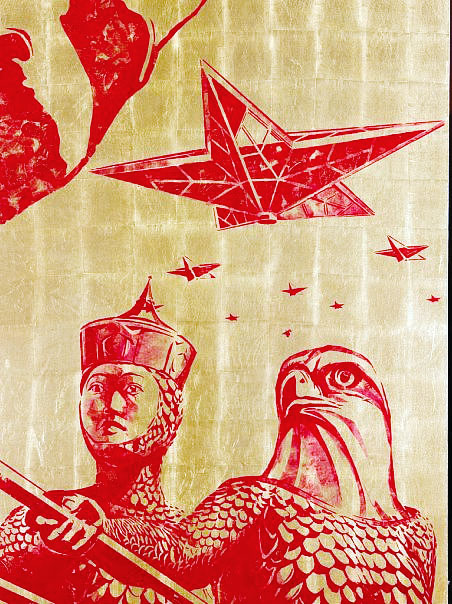
    Artwork by Alexey Belyaev-Guintovt 

    The Grimace of Horror 

    The historical world, the outlines of which we can find in Homer and which were shaped by Thucydides, reached its zenith somewhere at the end of the 19th and beginning of the 20th century with unclear boundaries in time and space. But upon clear consciousness of its laws and regulations, it started to collapse and the vast edifice of history became unstable, signifying penetration by hitherto unknown foreign forces. These forces have a Titanic elementary character, first seen in technological disasters which claimed hundreds of thousands of victims and then in the cataclysmic events of the 20th century, in the world wars and revolutions in which millions were killed and crippled. The release of nuclear energy, radiation, and the environmental destruction that enormous areas were exposed to, the daily toll in blood, whether it was sacrificed to “progress” in peacetime conditions or as a direct consequence of military intervention and conflicts, represented something that emerged out of the framework established by the historical world. 

    Of course, history did not end there, as was expected by Marx or Fukuyama. Rather, what really became apparent is the acceleration of historical time, which condenses events and shortens the distances between key turning points of history. The point, however, is that those forces which we have called historical do not operate alone, and man’s role in these events is fundamentally changing: he is no longer able to act on an equal footing with the gods, to follow them, oppose them, or even subdue them as is represented in myth. As was still the case in the mature historical era, he is no longer an active participant in history guided by passions or his own will. Instead, he now becomes the plaything of something unknown, involved in events that surpass him, against his will and outside of his ideas. 

    The expression of cheerful self-confidence is gradually replaced by a grimace of horror. Man, who until yesterday considered himself a sovereign and master, realises his weakness. The means on which he relied to turn against his creator at the decisive moment prove powerless. Technological systems and social arrangements have their reverse side, their automatic features that do not restrain but encourage destruction, putting man in the position of a wizard’s apprentice who frees forces that he is too immature to handle. Corruption, crime, violence, and terror are consequences rather than causes, and political responses, regardless of colour and sign, do not offer solutions but increase disarray. If the hour of panic had not descended, man would have at least gained awareness of his own downfall. 

    All of this was unthinkable in the mature historical age because man then was still ruled by himself, and thus history as well. History, therefore, could have no sense of direction other than the one given by man himself, his own deeds and thoughts. Each concept of the “meaning of history” was a concept of the emergence of man, whereas in the classical historical age man did not emerge but simply was. The question of the “meaning of history” was a meaningless question, and it is not found in the works of classical writers from Herodotus and beyond. The question of the “meaning of history,” which is always found outside of man, becomes possible only when the focus of history shifts beyond man himself, whether into the sphere of social or technological relations. 

    Modern man discovers his weakness too late. His collapse is not to be blamed on myth or history but on none other than the weakness and cowardice of modern man. The world of “civilised values,” and the historical world in general which he created, proves to be much weaker than we have been accustomed to believe – weaker structurally, spiritually, and ethically. At the first sign of alarm, it begins to collapse, revealing what is, in fact, modern man’s inner readiness for capitulation. 

    This is the “midnight of history” that will soon be replaced by something different; this moment is marked by the spread of Titanic forces demanding sacrifices of blood. 
    Get the issue this article appears in

    Toward Post-History: The Awakening of Myth

    History, let us repeat, has not lasted as long as has man on Earth. But consciousness of this only occurs late within history, perhaps only at its end, when the boundaries of time and space change – on the one hand with the discovery of the distant past of man and lost civilisations, then the past of the planet and the cosmos, and on the other with the discovery of space, of the ocean depths, and the interior of the Earth through archaeological and geological layers in a virtually Vernean way. New perspectives cause dizziness. Pre-history and post-history gain in importance only when history becomes a crumbling edifice. Yet, man’s turn from history towards something that he is not yet able to define or see clearly now resembles escape. 

    In one way or another, the technological universe and the consumer civilisation will come to an end, in the same way that the classical historical epoch ended with technocracy and totalitarian order in its complete form, which arose not out of courage or strength but out of cowardice, weakness, and fear. It is impossible to say how long this will take. It is also irrelevant whether this will happen due to internal attrition, overreach, disaster, or a combination of all these factors together. But in each of these cases, collapse is the consequence of man’s inability to dwell within the historical world and to rule it as a sovereign-supreme being. 

    However, the return of myth is not possible in the sense of a return to the state of “pre-history.” Mythological forces remain present, just as they have been during the entire historical period, but they cannot establish the previous state for lack of the necessary preconditions. First and foremost, the “substrate,” the fertile ground, is missing, as modern man is too weak in the spiritual, psychological, and even “physiological” senses. 

    Together with history, culture and its current meaning gradually disappear as well, remaining a mere instrument of social engineering. In the technocratic utopia, mass culture (as opposed to the culture of the historical period) is just one of the ways for the utopian fantasies and desires of the masses to be channelled. The elite culture, meanwhile, which constantly drifts between conformism and negation, between scepticism and denial, between scepticism and irony and back again to conformism, remains essentially a tool of de-mythologisation and the suppression of the dangerous intuitions contained in myth, thus enabling more or less painless integration into the technological universe under the illusion of free will. The appearance and awakening of dangerous intuitions and dormant archetypes on the margins of the technocratic social mechanism creates a situation of conflict and leads to glitches in its functioning. 

    In the domains beyond the technocratic utopia, culture will need to take a more traditional role than the one it assumes under consumer civilisation. The disintegration of the historical world in its final stage, which we are witnessing today, allows us to see something out of it. 

    For much of the historical period, culture was the privileged domain of sacred and mythical forces. This is one of the ways in which mythical forces can penetrate the world again – historically, realising themselves in history, unlike in the technological universe where they usually manifest themselves through the uncontrolled elements of folkloric subcultures and are often distorted to the point of being unrecognisable simulacra of the mythical, not veritable expressions. Such testify more to the eternal and unquenched need of man for mythical content than they represent a sign of the real presence of the mythical. 

    In the post-technocratic era, culture will be very closely tied to re-mythologisation under the sign of re-recognising and re-awakening true mythical content, the revitalisation and innovation of ancient and traditional forms instead of, as before, their exorcism. The meaning and purpose of de-mythologisation, on the other hand, must be limited to its capacity in traditional societies – to the purification of degenerate “folkloric” mythical forms so that in their place may come forms which veritably represent tradition. 

    The above text is based on passages from Boris Nad’s first volume of selected works in English, The Reawakening of Myth (PRAV Publishing, 2020), available from PravPublishing.com

    [alert type=”general” dismiss=”no”]This article was published in New Dawn Special Issue Vol 15 No 5.[/alert]

    [alert type=”success” dismiss=”no”]If you appreciate this article, please consider subscribing to help maintain this website.[/alert]

    © New Dawn Magazine and the respective author.
    For our reproduction notice, click here.
  • Sacred Geography & the Legend of Agartha: A Spiritual Journey Between History & Mystery

    Sacred Geography & the Legend of Agartha: A Spiritual Journey Between History & Mystery

    From New Dawn Special Issue Vol 15 No 4 (Aug 2021)

    The history of peoples is made by the unwritten history of great travels and world travellers – a history that began long before Herodotus or Marco Polo, in the Neolithic or even earlier, in some fantastical age of mankind. Perhaps even at the dusk of the primordial Golden Age, with glaciation or flood, and with the first in a series of catastrophes faced by the human species. Then followed eras of the migrations of peoples and races. If we believe Plato, then the Atlanteans were the first colonists in the world, and they came from the West. Others say that their ancestors were the Hyperboreans, who fled snow and ice in the Far North of the continent. 

    Over the course of subsequent history, peoples would move from North to South and from East to West – and not otherwise. This constitutes their course through history – a path of aging, degeneration and, at times faster, at times slower, of inexorable decline. This is how great conquests began, those that encompass immense regions, entire continents, and this is how great wars start, like the one that raged under the walls of Ilium – or was this only a shadow of some mythical war waged in the far deeper past, during the mythical age of the Earth? Perhaps at the beginning of time, “in illo tempore.” 

    They did not rush towards unknown and exotic lands, but towards their lost homelands, towards mythical lands of the beginning, towards the riches of the Golden Age. Towards primordial, Edenic abundance. Towards Paradise Lost, such as the biblical one, which we have not stopped searching for here on Earth even today. 

    One Islamic mystic, Suhrawardi, claimed that after death the soul returns to the homeland, for merciful Allah himself commanded this, and this would not be possible if he had not previously resided in it. This mythical homeland is to be found somewhere in the “spiritual East.” In order to find the strength for this, we must start from the spiritual West, the “Western wells of exile.” 

    The true journey, true adventures of the spirit, this Sheikh taught, start in the West. This is a place like a grave, a stockade of the burial-place. Arriving on the soil of an unknown continent, Christopher Columbus thought he had discovered the New Earth mentioned in the Apocalypse of St. John. The famous seafarer believed he was in the Gulf of Paria, and in its fresh currents had discovered the origin of the four rivers of the lost heavenly garden, Eden itself. “God made me the messenger of the new heaven and the new earth, of which he spoke in the Apocalypse of St. John, and before that through the mouth of Isaiah,” Columbus proclaimed to King Juan, “and he showed me the place where to find it.” 

    There is no single land, island, or continent in the world that is a mere geographical certainty. The whole  Earth is a sacred text, a holy book written in special signs – or at least this is what mystics and esotericists believe. The words of this text, it is thought, were written by God himself. Every journey is, in fact, a pilgrimage, for we are always walking on sacred ground. Every land and landscape, far and near, possesses hidden meaning and secret significance – spiritual, symbolic, eschatological, and even profoundly mystical. A landscape is at once both a physical and spiritual reality. This is the domain of a secret, mysterious science – mystical and sacred geography – whose knowledge, as happens, has been lost forever over the course of centuries or millennia. 

    The King of the World 

    Legend claims that somewhere, in the depths of the Earth, in dark caves and secret passages, there still lives one such sacred land inhabited by a secret, mysterious people, one hidden from the sight of others, that this is known to only a few chosen ones on the surface, and that this knowledge is a strictly guarded secret. Or maybe it was until recently. This secret kingdom is called Agartha. This legend is ancient and comes from remote prehistory. Agartha is spoken of in the legends of diverse peoples – white, red, and yellow – in both East and West. Agartha is a kingdom hidden underground, populated by a people gifted with miraculous powers, a people that lives in wisdom and immense wealth. But Agartha is even more than that: it is the spiritual centre of mankind ruled by a hidden ruler, the head of its initiatic hierarchy. His title is “King of the World.” 

    Legend holds that this supreme spiritual and metaphysical centre of mankind, Agartha, has not always been hidden underground, nor will it stay there forever. This condition corresponds to the fallen state of humanity, the age of darkness and confusion which, it is said, has lasted for the past 6,000 years. In 1890, the King of the World allegedly issued the following prophecy in the monastery of Narabanchi: “The time will come when the peoples of Agarthi will come up from their subterranean caverns to the surface of the earth.”

    Travellers who have set their minds to find it have whispered about it. Caravan merchants have told exhilarating tales of it in inns and on mountain trails, in deserts and in remote corners. It is known to Tibetan sages whose teachings nourish monks and lamas. The common crowds, meanwhile, ridicule and laugh at such tales as the superstitions of the uneducated and gullible.

    The tale of Agartha reached the West from two independent sources. In a book published posthumously in 1910, The Mission of India (or The Mission of India in Europe), the French esotericist Saint-Yves d’Alveydre introduced the West to Agartha as a Buddhist myth of a secret centre of the world hidden somewhere in the depths of the Himalayas, India, or Afghanistan. 

    French esotericist René Guénon focused on Agartha as a spiritual centre of the world in his 1927 book The Lord of the World (reissued in 1983)

    D’Alveydre’s account was commented upon by another French esotericist, the founding thinker of Traditionalism, René Guénon. Traditionalist thought, through the works of René Guénon, provided an exegesis of this myth: at its deepest root is the idea of the supreme spiritual centre, the spiritual centre of humanity during the last time-cycle of humanity, i.e., the Iron Age in the traditions of the peoples of the West. 

    As Guénon observed, numerous parallels and analogies of this Buddhist myth of the King of the World can be found across the most diverse traditions, from the Hindu and Jewish through the Islamic and Christian to the Celtic myth of the Holy Grail which was subsequently, superficially Christianised. The very name “Aggartha” or “Agarttha,” Guénon writes, means “imperceptible” and “inaccessible” – “and also ‘inviolable’, since it is Salem, the ‘Abode of Peace’” – but the name of the spiritual centre before the present time-cycle was Paradesha (“supreme country” in Sanskrit), whence the Chaldean Pardes or the Paradisus (“paradise”) known to the Western traditions. Moreover, Guénon drew a connection between Agartha and the “Light of the East” of Islamic esotericism. 

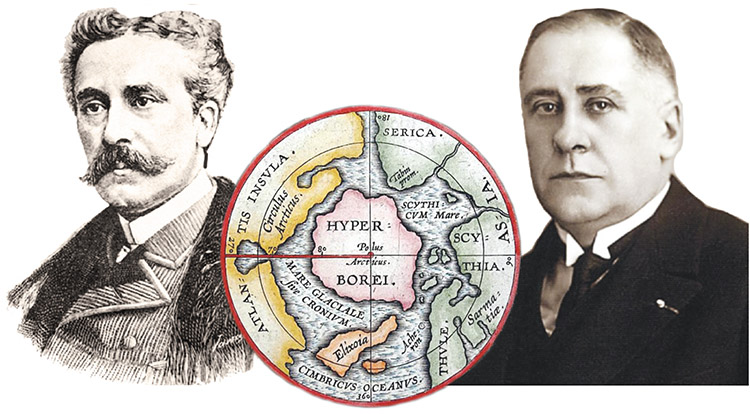
    Legendary Agartha is spoken of in the same breath as forgotten lands such as Hyperborea. Two key figures helped bring the tale of Agartha to the West: French esotericist Saint-Yves d’Alveydre (left) and Polish traveller and author Ferdynand Ossendowski (right). 

    Absolute Pole 

    The “Light of the East” is none other than the “Light of the North,” the “Gold of the North” mentioned by classical writers. In other words, Agartha is only one of many projections of the Pole, the North Pole, Hyperborea or Paradise, which has shifted over the course of history from the North to the West and from the South to the East. There exists, to name it, the Absolute Pole. Agartha is an Eastern projection of the Absolute Pole. We cannot seek this mystical Pole above the surface of the Earth, at the top of Mount Meru as it was in the Golden Age or in the Hyperborean cycle, but only underground – not in the polar ice of the Arctic, but in the East of the Eurasian continent. Emanuel Swedenborg issued the mysterious pronouncement that in our age the “lost word” is to be found only among the wisemen of Tatary and Tibet, i.e., in the East. 

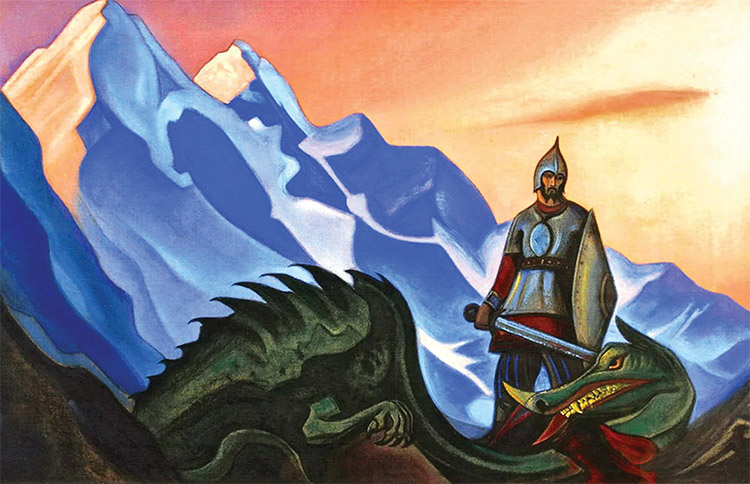
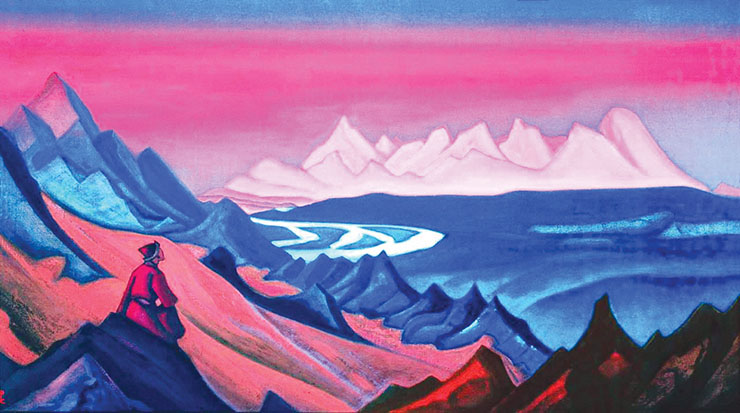
    Svyatogor (giant-warrior) by Nicholas Roerich, 1942

    Some authors claim that contact has been maintained with this centre during almost all of the historical cycle of the West. This contact was at all times direct and realistic. But the final projection of the North Pole – the sanctuary of the sacred King of the World in the East – has become more and more inaccessible and mystified. It was interrupted only in late historical times. Guénon states that this happened soon after the Thirty Years War, more precisely in 1648, when the “real Rosicrucians,” 12 in total, left Europe and withdrew to Asia, to Agartha.

    The second Western source on Agartha was the Polish traveller and author Ferdynand Ossendowski, who in his book Beasts, Men and Gods, published in 1924, reported on his tumultuous trip throughout Central Asia during the years 1921-1922. There is a moment, Ossendowski claims, when stillness overcomes the world, when wild animals stop in their run, horses stop to listen, birds stop flying, and travellers stop in their tracks. Hordes of sheep and cattle and yaks crouch down to the ground, and dogs cease their barking. The wind subsides into a slow trembling of air, and the Sun stops in its motion. For a moment, the whole world sinks into silence. An unfamiliar song penetrates the hearts of animals and people. This is the moment when the King of the World in Agartha speaks with God himself, when tongues of flame in the letters of the Vattan alphabet erupt from his altar. 

    Ossendowski’s account also received the commentary of Guénon. Guénon explains that Ossendowski wrote the name of this underground kingdom as “Agharti,” whereas Saint-Yves d’Alveydre used the form “Agartha,” “the latter being known to have been in contact with at least two Hindus.” The fact that this mysterious legend from the East reached the peoples of the West in two different versions is explained by the fact that d’Alveydre was inspired by Hindu sources, while Ossendowski was informed by Lamaist ones.

    The accounts of d’Alveydre, Ossendowski, and Guénon do not, however, exhaust the traces and hints of “Agartha.” A book published in the 17th century in Leiden mentions a city by the name of “Agartus Oppidum” reportedly located in the Nile Delta of Egypt. This fact was unknown to Guénon. Lucius Ampelius, a Latin author from the third century, claimed that in this city stood a statue with hands of ivory and a bright emerald on its brow. This statue, it is written, incites panic and fear among animals and people, and especially among barbarians. The word oppidum in Latin means elevation, fort, or hill. The meaning of the word Agartus is unknown and has no meaning in Latin. 

    It is also recorded that long ago, in Medeia, near the southern coast of the Caspian Sea stood a city called Asagarta. Ptolemy added that the inhabitants of this land called themselves Sargartians, and Herodotus claims that 8,000 Sargartians (inhabitants of this lost land) were present in the army of the Persian King Darius. Asgard, the mythical city of the Aesir, was the capital of the Sarmatians and Roxalana. Some researchers equate Asgard with Agartha. Others think that Agartha was exactly that city mentioned by the Roman Lucius as lying on the banks of the Nile. This is a mistake – the very same mistake committed by some in regards to Atlantis or Thule. Agartha is in fact Thule, or rather one in a chain of Thules which appear at different times in different meridians. The same is true of its mysterious inhabitants, who at times come out onto the surface of the Earth. Thus, the name Agartha has been known since ancient times, since the very beginning of history, and it can be found everywhere, from ancient Egypt to Bactria, in its projections, in its representation on Earth, in its secondary variations, just as every Thule, including even Atlantis, is only a projection of the primordial and original Hyperborean Thule, the one erected by the hands of man-gods at the dawn of time. 

    Victory (Gorynych the Serpent) by Nicholas Roerich, 1942

    Agartha and America 

    The fact that all the known names of sacred-geographical centres corresponding to cosmic cycles and events – Hyperborea, Thule, Atlantis, etc. – come up in investigations of Agartha, and that this is happening in the modern age, especially since the “discovery” of America, is no coincidence. If the discovery of America, or rather the return of America to history, triggered such unrest among peoples, then what will happen if the prophecy of the end of the world is fulfilled and the secret Agartha becomes known to all of humanity? It is prophesied that the people of Agartha will once more come out onto the surface of the Earth. And likewise, Paradise, the Garden of Eden, is hidden somewhere in the East. It is in the East of the “wise sages of Tatary,” Swedenborg claimed, that we should search for the “long forgotten word.”

    What is the link between Agartha and America? Is it the same thread that interconnects all continents? Could their appearance, or rather re-appearance, on the horizon of world history represent a sign of the “final times,” the “End Times?” The “secret” of America was known to the Vikings, the Egyptians, and the Phoenicians even thousands of years before the Portuguese and Spanish seafarers. 

    Esotericists and the adepts of secret societies, mystics and conjurers, astrologers and neophytes, the followers of secret cults and obscure conspirators – all are still weaving their dark webs around Agartha and the deep mysteries that hide this underground kingdom. 

    Get the issue this article appears in

    America is not only the land of the Apocalypse – a story that speaks about the end of the world and the last revelation. The first newcomers identified America with paradise, where even the trees and plants spoke the “hieroglyphic language of our Adamic or primitive state.” The New World was for them a projection of paradise on Earth, by which God baptised his chosen people – the New Israel. Others identified America, on no lesser grounds, with Atlantis, whose downfall was described by Plato. Failing to observe that the Greek philosopher was precise in the details he gave, and that, besides the island of Atlantis, he also mentioned a “land in the West surrounded by ocean on all sides.” This, there can be no doubt, is the North American continent. America is only its shadow, its projection in the Far West, the “false Atlantis.” 

    America is, of course, not the mythical island of Atlantis that vanished in the Atlantic Ocean at the very dawn of history. It is actually the Green Land, the Land of the Dead, the “Kingdom of Shadows” in the West that is mentioned in the legends and myths of many peoples. America is Trans-Atlantis. What is the meaning of the reappearance of a dead, sunken continent, on the horizon of world history? In the same way, Agartha is also a “land of the dead” which, as prophecy holds, is still to be discovered in the depths of the underground. In historical times, this reportedly was realised by some travellers and seekers. One of them was a Mongolian hunter who could not keep his secret, and thus had his tongue cut out by lamas. The Lama Djamsrap spoke of this in his book. Another was an illiterate Norwegian sailor who claimed to have lived in Agartha for several years. The reader will see that these fleeting mentions are not without grounds, and that America and Atlantis are closely connected without the topic of Agartha, the mysterious kingdom hidden in the everlasting dark, deep underground, and deep in the past. It is closely connected with the worlds of the dead and the past – with the past that refuses to die. And it verily conceals many secret histories of the human race.

    And yet, the idea of an underground hiding place of the incarnation of the sacred, celestial principle is in itself contradictory. According to sacred logic, the seats of spiritual authority are to be found in mountains, not in the underworld, which is logically and naturally connected with the chthonic, the infernal, and the hellish. Moreover, archetypes and ideas themselves choose their bearers throughout history, and it is not always possible to accurately distinguish between “real” and symbolic continents, lands, and cities mentioned in sacred texts, from the Vedas to the Bible. In sacred texts, the sacred and earthly planes, physical and sacred geography, physics and metaphysics, constantly intersect. But, overall, these fabulous lands are not the product of mere fantasy: rather, the matter is one of a fragile memory for which it is still necessary to find the appropriate keys. 

    In this sense and according to this logic, the “Light of the North” or “Light of the East,” indeed the “Light of Agartha,” is not strictly localisable on the terrestrial plane. Likewise, journeys to and accounts of Agartha are not only or not mainly travels in geography and history, but travels of the spirit, travels whose “interior centre” is that within man. As the Chandogya Upanishad says, “Now, the light which shines higher than this heaven, on the backs of all, on the backs of everything, in the highest worlds, than which there are no higher – verily, that is the same as this light which is here within a person.” The chains of “Agarthas” lead along and are the chains of spiritual journey. In journeying to Agartha, we are travelling into the light of myth. The reawakening of myth is a reawakening of that hidden, mysterious, inner light within ourselves. In this dimension, “lost and found” lands, islands, continents, and kingdoms like Agartha have something to tell us that is quite different from the “positive geographical discoveries” and “research” of recent history. 

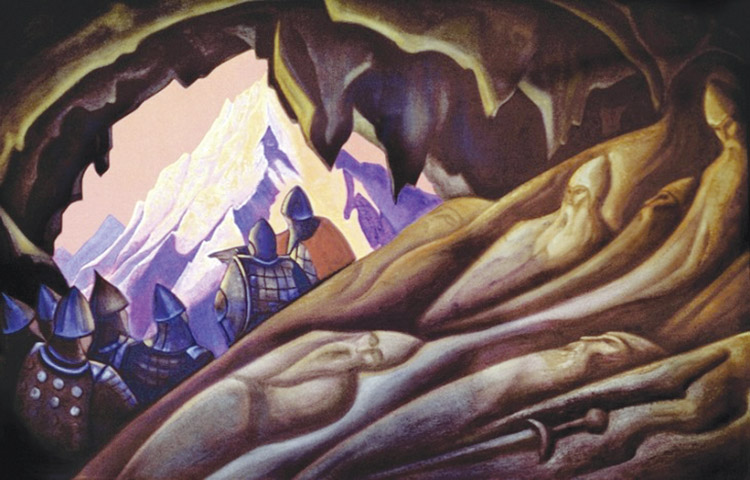
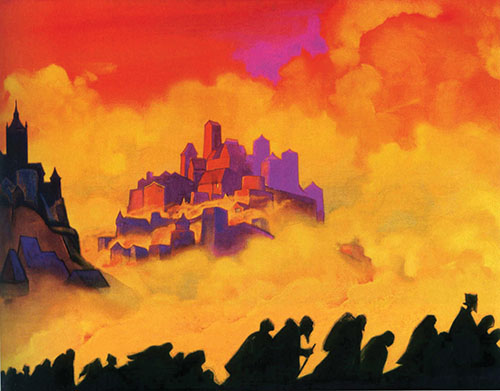
    Bogatyrs (Heroes) Have Risen by Nicholas Roerich, 1940

    The above text is based on passages from Boris Nad’s first volume of selected works in English, The Reawakening of Myth (PRAV Publishing, 2020), particularly the second part, A Tale of Agartha. The book can be ordered via PravPublishing.com.

    [alert type=”general” dismiss=”no”]This article was published in New Dawn Special Issue Vol 15 No 4.[/alert]

    [alert type=”success” dismiss=”no”]If you appreciate this article, please consider subscribing to help maintain this website.[/alert]

    © New Dawn Magazine and the respective author.
    For our reproduction notice, click here.
  • The Eurasian Vision: From the End of History to a New Beginning

    The Eurasian Vision: From the End of History to a New Beginning

    From New Dawn Special Issue Vol 15 No 3 (June 2021)

    The Eurasian idea is an open idea. It is open toward both the past and the future – what will happen in the future depends on how we understand and interpret the past. This is a very urgent problem, for we are by all means witnessing the collapse of the current international order, an order which was not really international but rather defined by the order of “one sovereign and one master.” In practice, this was a liberal order, defined by very specific visions and ideas into whose circles we inadvertently moved. Now we are finally free from this. We can take a breath of fresh air with full lungs and start “from scratch.” 

    Of course, this does not really mean starting from nothing. In the 1920s, the foundations for the Eurasian vision were laid by the persistent, quiet, patient work of enthusiasts (such as Petr Savitsky) and, even before, in the works of Danilevsky, Leontiev, and Dostoyevsky. These thinkers outlined a “Copernican revolution of history”: the future is not predetermined, and time does not run linearly. There are no privileged points on the globe, nor is there one privileged time, unless we adopt the axioms of liberal ideology. There is no singular and binding direction of historical development; rather, there are many divergent directions that cannot be compared to one another in terms of stages in the development of a single process. 

    Taken together, Danilevsky believed that these directions make up the richness of history and express the different possibilities of mankind’s development. In fact, every civilisation has its own time, and it draws its own schemata over the course of its development. Only the totality of civilisational paths gives the unique tracing that is the “development of humanity.” The new beginning for world order based on this recognition would correspond to the “other beginning” of which the philosopher Martin Heidegger spoke. 

    Liberal ideology has hitherto prescribed what “progress” is: it is always in the same direction, the only direction allowed. Behind this ideology has stood one world power: the United States of America. There is fundamentally only one world – that is the teaching they preached, a teaching which emerged out of the Enlightenment and quickly spread across the planet. 

    But, if the world is not a universe, then it is, in fact, a pluriverse: there are many worlds. Many of them have been hidden under the illusion of one world: opposite the First World during the Cold War stood the Second (Communist) World, and behind this, somewhere in the shadows, was the Third World (the non-aligned world which is today called the “Global South”). 

    This reality was not all-encompassing: the illusion of “convergence” revealed the reality of many worlds which were, in fact, many different civilisations – the American, the European, the Russian, Islamic, Indian, Chinese, etc. This is the truth that the West failed to grasp. Nor does it understand this today. The West was intoxicated by its victory in the Cold War in 1991, which was supposed to be followed by the “end of history” of which Francis Fukuyama spoke. That was what the West wanted to hear at the moment… And it seemed that all of humanity was obeying its will. 

    Yet, this obedience was only seemingly voluntary. It was backed by the world’s strongest power with its aircraft carriers capable of projecting its military might at “any point on the planet.” Then came the regime changes (of “undesirables” making up the “axis of evil”): colour revolutions, more or less violent coups, open military interventions, the occupation of entire countries… This is what the proclaimed “freedom” boiled down to. This was, however, only the “unipolar moment” in the history of the world. It is finished now. 

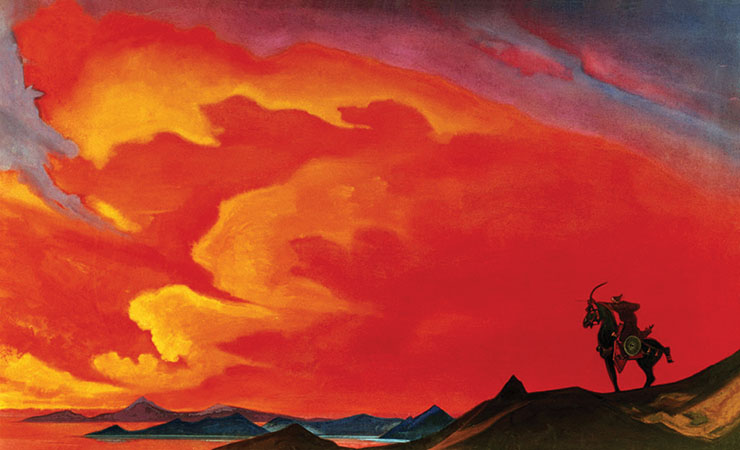
    ‘Armageddon’ by Nicholas Roerich, c.1935

    The End of Western Hegemony

    What’s happened with the hitherto hegemon? The hegemon is “tired” and is no longer capable of dictating to the whole of humanity. At first glance, it seems that all of this has been done by one tiny virus: the coronavirus. This, of course, is not the case. The virus was preceded by a prolonged fatigue, a crisis that has progressed within the West itself since at least the 1970s. 

    First, there was the “retreat of the West” (which is not a civilisation, but rather an ideological construct based on several basic Enlightenment ideas currently holding a certain number of countries together), and today its collapse is underway. The virus only made this crisis visible, and it will not be solved by any monetary measures, nor by ever-new military interventions as the globalists are now demanding. 

    Many are not yet aware of this major change. What about them? That is not our problem. What is important is grasping that the fundamental paradigms for the world of the future are being shaped today – or rather, it would be more appropriate to say, for the worlds of the future, because in such a world there will obviously be no single binding model that would be true for everyone. 

    “Western universalism” was only an illusion. Perhaps it was sweet and appealing to a few countries in which these ideas originated, but it was still only that: an illusion. Living in illusions is ill-advised. The awakening had to come sooner or later. But if it comes too much later, this awakening will be bitter. Today, people are waking up from the “American dream” to discover that it was a well-promoted nightmare and that they can live quite well without it.

    At the same time, this poses a challenge to Eurasia which, after a brief absence, is finally returning to the historical scene. How can this transition be made as painless and with as few victims as possible? In other words, how can it be made known to the hitherto hegemon that it is no longer the hegemon (the one determining the future of all of humanity)? This is no easy task. 

    Today, of course, the hegemon is threatening and rattling its weapons. It is gathering forces for what appears to be a “final showdown” for the “final battle of history.” Will this decisive battle take place at all? It has nothing new to offer. It is only a more militant, slightly upgraded version of the same, with tolerance or its illusion abolished. In its upgraded edition, liberalism is becoming openly totalitarian (having hitherto been so covertly: “If you don’t want to be a liberal, you will be excluded from history” is now “Everyone must be a liberal”).

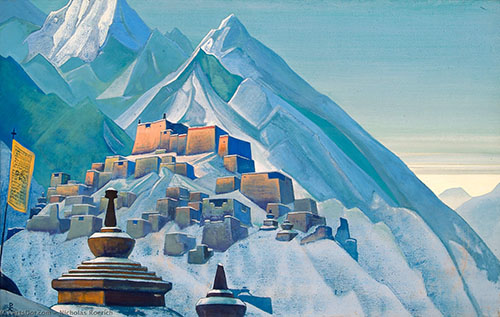
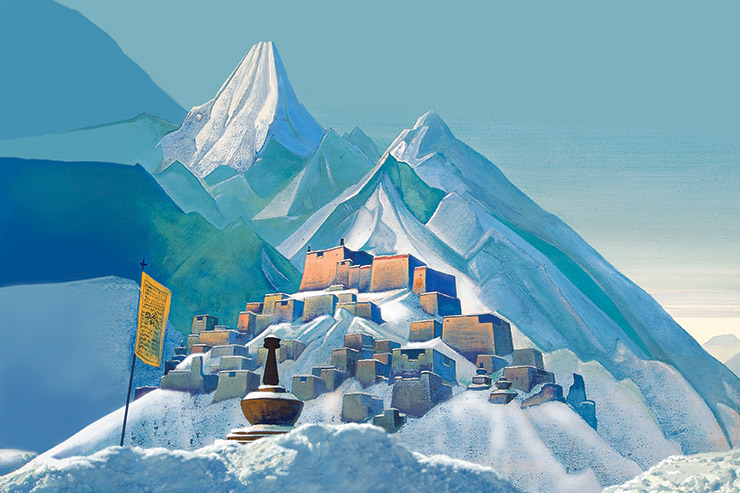
    ‘Tibet, Himalayas’ by Nicholas Roerich, 1933

    Rise of Eurasia

    Meanwhile, new concepts and ideas have taken shape in Eurasia and are quickly being transformed into reality. One of these important projects is the “New Silk Road.” It is, in fact, a very old project that is now being revived, dressed in the new spirit of our times, a project to which the hegemon offers nothing other than interference (the same with the Nord Stream 2 gas pipeline). The hegemon wants quarrels, conflicts, and wars between peoples to thereby impose its dominance. This is how it ruled before. The Russian thinker Aleksandr Dugin has recently spoken of the need to “internationalise peoples” to oppose this hegemony, i.e., nations must not lose sight of the larger whole. They have to look at the much broader picture. This is a fundamental geopolitical reality which we cannot afford to forget. 

    The other reality is that of Eurasia itself. First and foremost, an alliance between China and Russia has taken shape. Integration in different forms is taking effect across the Eurasian continent – integration from which America is to be expelled. The Eurasian Economic Union is the initial form of such, its first incarnation, so to speak. The term “first in history,” however, should be used only with caution because it was preceded by the Soviet Union, before that by the Russian Empire, and still earlier by the empire of Genghis Khan. After all, every real historical project has its reflection in the distant past. The hope remains that for now, this “empire” still in outline develops in the direction of a fully-fledged Eurasian Empire. 

    This process could encourage others on other continents. We could imagine, for example, a Brazilian Empire, sovereign and independent, around which a circle of South American countries would gradually take shape. We could think of African empires or an Islamic caliphate (a true, not a fake one). And we could, in the distant future, imagine a North American Empire, one which would not claim universality for itself and which would express the North American people’s characteristic way of self-understanding, their internal Logos. Every empire, in fact, offers its own answer to the question of what the human being is. The North American people have not yet found a way to understand themselves (there is simply no “American dream”) and have thrown themselves into slavery to false elites in the service of “globalism.”

    Future of Humanity an Open Project

    Either way, the future of humanity is now an open project. Its future actors are defining their places. This is why it is imperative to move away from what the Russian philosopher Aleksandr Dugin calls the “Western codification of consciousness,” which is the custom of looking at the world through Western eyes. The Western cultural, political, social, and economic models are exhausted or have become a burden – an unnecessary, harmful, even dangerous burden. It is important to reassess these models or (if necessary) to abandon them altogether, once and for all, as soon as possible. The Western models for a “mandatory future” should be opposed by our own models of a possible and desirable future. 

    First and foremost, the concept of the nation-state and nationalist state has been overcome. As Rodrigo Sobota remarked, “we cannot forget the fact that the crystallisation of the nation-state as an artificial notion of the specifically Western character has deeply divided us.” The modern nation, reared within the homogenous nation-state and inspired by narrow and exclusive ethnonationalism, is not the same as the people, the community reared by long-standing history and culture, nor is the nation-state the only possible state. Along with the concept of the nation-state, “we must necessarily admit that the ancient Hegelian myth of the state, crystallised as he saw it in the venerable Imperial Germany, is in terminal decline.”

    In today’s globalised world, nation-states, the undoubted product of the 19th century, as well as their firmly fixed borders, are disappearing, and new, supranational, continental or even global entities are being created. These are not merely processes of inevitable “dissolution,” but also processes of creating something new – opportunities for building new relations and ties between peoples. These processes are usually ambiguous in history: it is difficult to determine what is actually collapsing and what is being built. Not everything goes as planned. Processes can be reversed in one direction or another. In the new conditions, both colonialism and anti-colonialism are taking on new forms. Those ideas and concepts, which over the past three or more centuries gave impetus to the “modern West” and enabled its planetary supremacy in a brief historical period, are now exhausted. 

    This is most clearly visible today in the West itself: individualism, liberalism, and utilitarianism no longer ensure superiority – not even material – but are instead turning into obstacles and hindrances. Moreover, they are the reason for the internal collapse and rapid disintegration of Western society and its entire civilisation. All of them belong to the age of the Enlightenment as the fruits of the reason of “enlightened man,” “his majesty the Western European thinker.” It is vain to continue fruitless debates about “values” which are already dead and belong to the irreversible past. Is there a more obvious sign of “internal decay” than this?

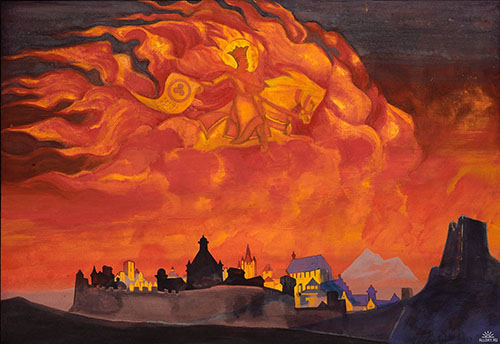
    ‘Sophia: The Wisdom of the Almighty’ by Nicholas Roerich, 1932

    Death of the Old, Birth of the New

    We need to build new political, civilisational, and economic structures of continental proportions. We think that empires would be the most suitable for this. When we say “empire,” we have in mind the broadest possible meaning, entities sufficiently elastic and robust (at the same time) to protect their civilisational space from “outside intrusion.” This does not mean that existing nations will disintegrate or disappear within them. On the contrary, by being within them, they will acquire the conditions for normal development. 

    As for where this development will lead them, let the question remain open. “Human” in the plural is “the people,” and every people has its own unique face and character. Every people ought to continue their own particular development, with their own language, tradition, history, culture, and the special heritage which makes them precious and different from others. Empires arise out of the pursuit of this freedom. But this is not “freedom from,” but “freedom for”: freedom for everyone to be who they are. 

    Today, let us repeat, we live in an age of the agony and death of one civilisation – the Western one. This is a time of crisis, an interregnum, of which the great Italian philosopher Antonio Gramsci said: “Crisis consists precisely in the fact that the old is dying and the new cannot be born; in this interregnum a great variety of morbid symptoms appear.” The agonal cramps of one civilisation allow us to sense the contours of the future world. The “new” often comes into the world with birth pangs. There is no way for the sounds and voices of this to be silenced, no matter how hard they try to do so in the West. 

    The death of a civilisation, as a rule, means the birth of a new civilisation, or civilisations, which are in part created over its corpse (in this case, the dead body of the “West”). The new states and new arrangements are not completely “new,” just as “old” civilisations never die completely and entirely. Something will be taken over or inherited and given a whole new meaning and significance in a completely different context, while other things will be condemned to oblivion. The paradigms of new civilisations are built on old foundations. Both the Soviet Union and America, for instance, mysteriously resurrected the concept of empire and thus shaped the bipolar world of the past century. 

    Cultivating All Unique Cultures

    In the first place, this applies to the sphere of culture. Culture is no longer and can no longer be dictated from one centre. We must free culture, or rather cultures, from everything that is outlived, boring, and stereotypical and return cultures to their original meaning. Culture and art are not planetary entertainment for bedtime; culture and art are revelations, awakenings, something that disquiets and moves us to search further for the “new.” Instead of one planetary and commercialised culture, pleasure for the masses, an intoxicating narcotic that always bears the same stamp (“made in the USA”), we will have cultures in the plural. “Yes” to Chinese, Russian, Korean, Greek, French, Finnish, Serbian, and many other cultures – as well as true American culture, a culture that has its own deep roots. “No” to the culture of stereotypes that boils down to faceless imitations, tediously and always repeating the same dilapidated, banal, and now wholly outdated clichés. We must return culture to its original meaning by creating it (anew). And this is, perhaps, our foremost task at the moment. 

    Today we are concentrating our thoughts on the future, on the “new beginning,” while looking back on the past. This is natural and logical. It cannot be otherwise, for everything new “is only a new expression of an ancient, eternal desire,” just as any true “other beginning” is not a mere return to or imitation of the past, but a “new beginning, more primordial than the previous.”

    Boris Nad’s book The Reawakening of Myth is available to purchase from PRAV Publishing (www.pravpublishing.com) and online booksellers. With thanks to Jafe Arnold for the translation.

    [alert type=”general” dismiss=”no”]This article was published in New Dawn Special Issue Vol 15 No 3.[/alert]

    [alert type=”success” dismiss=”no”]If you appreciate this article, please consider subscribing to help maintain this website.[/alert]

    © New Dawn Magazine and the respective author.
    For our reproduction notice, click here.