New Dawn – World's Most Unusual Magazine

Author: Brendan Murphy

  • The Amazing Story of the Clairvoyants Who Observed Atoms

    The Amazing Story of the Clairvoyants Who Observed Atoms

    From New Dawn Special Issue Vol 6 No 4 (Aug 2012)

    In few, if any, science textbooks or records of Nobel laureates will you find the name of a bona fide and publicly acknowledged occultist or clairvoyant. This, however, is not because such individuals never contributed anything to the history of science. On the contrary, it is due to a profound hubris and acute myopia within the institution of Science that talented metaphysical pioneers have not been credited with scientific discoveries and insights that were ahead of their time. In this material, excerpted from Chapter 6 of my book The Grand Illusion (Vol. 1), we hone in on the startling work of two such metaphysicists in particular.

    Occult Chemistry: Leadbeater and Besant

    From 1895 to 1933, Annie Besant (1847-1933) and Charles Leadbeater (1854-1934), two of the best known theosophists and metaphysicians of the 20th century, conducted clairvoyant investigations into all of the then known elements and certain compounds in order to observe the so-called “fundamental building blocks” that composed them, as well as their general structure. This involved the apprehension of visual information at sub-microscopic levels far beyond the ability of the eyes to perceive. The term for this kind of clairvoyant perception today is micro-psi (Besant and Leadbeater referred to it as “magnifying clairvoyance”).

    The initial investigations were collected and published in the first edition of Occult Chemistry in 1908 (the book was subtitled Investigations by Clairvoyant Magnification into the Structure of the Atoms of the Periodic Table and Some Compounds). A second edition of the 1908 material was issued in 1919. The sum total of Besant and Leadbeater’s clairvoyant observations of the chemical elements were collected and published posthumously in a third edition of Occult Chemistry in 1951.

    An article entitled “Occult Chemistry” appeared in the Theosophical publication Lucifer in 1895 (the year Leadbeater and Besant began their collaboration) and was reprinted as a separate pamphlet in 1905. In it, three chemical elements, hydrogen, nitrogen, and oxygen, were clairvoyantly examined and their analyses presented tentatively to the public by Besant and Leadbeater.

    Hydrogen, the first chemical atom selected for analysis, and possessing the lowest atomic weight, was found to be composed of eighteen smaller entities. Clairvoyantly it was seen to consist of six small bodies, contained in an egg-like form. According to Leadbeater/Besant, it rotated with great rapidity on its own axis, vibrating at the same time, and the internal bodies performed similar gyrations. “The whole atom spins and quivers, and has to be steadied before exact observation is possible,” they wrote.

    The six little bodies are arranged in two sets of three, forming two triangles that are not interchangeable. Further, the six bodies are not all alike; they each contain three smaller bodies – each of these being an ultimate physical atom – but in two of them the three atoms are arranged in a line, while in the remaining four they are arranged in a triangle.1

    The Ultimate Physical Atom (UPA)
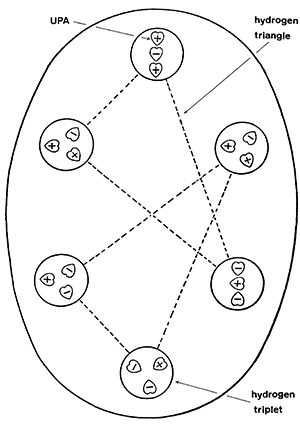
    Figure 1. The hydrogen “micro-psi atom.” The UPAs are the heart-shaped objects designated a plus or minus sign denoting either an inflow (minus) or outflow (plus) of energy. Stephen M. Phillips argues that each triangle is a single hydrogen nuclei and that the micro-psi observation has somehow bonded two together. The mid-sized circles are therefore quarks, and the heart-shaped entities sub-quarks. (Source: Occult Chemistry by Annie Besant and C.W. Leadbeater.)
    Figure 1. The hydrogen “micro-psi atom.” The UPAs are the heart-shaped objects designated a plus or minus sign denoting either an inflow (minus) or outflow (plus) of energy. Stephen M. Phillips argues that each triangle is a single hydrogen nuclei and that the micro-psi observation has somehow bonded two together. The mid-sized circles are therefore quarks, and the heart-shaped entities sub-quarks. (Source: Occult Chemistry by Annie Besant and C.W. Leadbeater.)

    As noted, in 1895 – when physical atoms were still thought to be the most basic unit of matter – Leadbeater and Besant observed in the early stages of their investigation that hydrogen was not a unity but was composed of eighteen smaller units. These smaller units they dubbed an “ultimate physical atom” (UPA), and later took to referring to them as “Anu” (singular and plural) – the Sanskrit term for this new entity. They had no way to determine the exact size of the UPA but they found it existed in two varieties: positive and negative (or Yin and Yang). The positive and negative aspects wound around each other in opposite directions (somewhat like the snakes on the caduceus, or the helical structure of DNA), forming the UPA.2

    According to Besant and Leadbeater, the UPA was a very complex entity, with only its main characteristics provided in their diagram. “It is composed entirely of spirals, the spiral being in its turn composed of spirillae, and these again of minuter spirillae.”3 In addition to this reference to the subatomic fractality of “matter,” they correctly declared that the Anu was definitely not the electron. The spirals composing the UPA, if unwound, would actually be found to be circles or strings – twisted around on themselves many times to create the helical form depicted.

    Oxygen was found to consist of 290 minor atoms and nitrogen of 261. Now, this is where it gets even more interesting. When Besant and Leadbeater divided the number of UPAs in oxygen by the number of UPAs comprising hydrogen (18), they arrived at 16.11, almost exactly the atomic weight of the oxygen atom (16). This procedure yielded the same precision with nitrogen, an even more complex structure than oxygen, and therefore much more challenging to apprehend clairvoyantly for the occultists. In fact, this uncanny precision continued right through the entire table of known elements of the time (minor human counting errors notwithstanding).

    Although science had not identified such a thing as the ultimate physical atom, Besant and Leadbeater had identified this tiny entity as comprising physical atoms. Moreover, by using hydrogen as the standard (being the first element in the periodic table – itself being composed of eighteen UPA), they were able to ascertain the atomic weight of the elements by dividing the number of UPA they observed by eighteen. Should Besant and Leadbeater have been merely “delusional cranks,” we should not expect this kind of amazing result.

    As a matter of fact, this ability to deduce the accepted atomic weights of the elements from the number of UPAs they observed was the only thing Occult Chemistry had in common with the chemistry of 1895.4

    Noteworthy is the way the UPA was depicted by Leadbeater/Besant as being created by an upwelling of force from a higher-dimensional source – just as in the hyperdimensional physics advocated by Paul LaViolette, David Wilcock, Richard Hoagland, and others researching aether physics. (Those readers interested in the notion of an aetheric medium and its false elimination from mainstream science are referred to in my The Grand Illusion 1.) The models of physics on the cutting edge have been left with no choice but to incorporate other dimensions or ‘levels’ of reality to account for today’s scientifically observable phenomena. Furthermore, Leadbeater and Besant’s clairvoyant analysis provides intimate and detailed verification of the hyperdimensional torsion and/or spin forces embedded in the ‘aether’, which I write about extensively in The Grand Illusion 1.
    [alert type=”info” dismiss=”no”]If you appreciate this article, please consider a subscription to New Dawn magazine.[/alert]

    How They Arrived at the UPA

    Leadbeater and Besant explained: “Any gaseous chemical atom may be dissociated into less complicated bodies; these, again, into still less complicated… [T]he fourth dissociation gives the ultimate physical atom. This may vanish from the physical plane, but it can undergo no further dissociation on it.”5 (emphasis added)

    Note that in their description of the UPA is a hint of multidimensional behaviour (this becomes relevant shortly). Interestingly, in 1888, the co-founder of Theosophy (it was founded in 1875), Helena P. Blavatsky, pre-empting Leadbeater and Besant by at least seven years, explained in The Secret Doctrine that on the next higher plane (etheric), what then-current science considered an undecomposable unity would – to higher perception – prove very complex. Water, for example would feature “many other constituents” besides just hydrogen and oxygen.

    As theosophists, Leadbeater and Besant would have anticipated the composition of the elements they clairvoyantly inspected (having obtained some hard-to-get samples via Sir William Crookes) to be much more complex than scientists of their time believed. They were right.

    Believe it or not, there appears to have been another earlier clairvoyant ahead of the game. At a time when Isaac Newton (a Hermeticist, though not clairvoyant) was arguing that matter was composed of impenetrable atoms given motion by outside forces, Emmanuel Swedenborg taught that matter was made up of a series of particles in ascending order of size, each of which was composed of a closed vortex of energy which spiralled at infinite speeds to give the appearance of solidity.6

    Two types of UPAs were observed by Besant and Leadbeater (see Figure 2), and they were identical in every way except “the direction of their whorls and of the force which pours through them. In the one case force pours in from the ‘outside,’ from fourth-dimensional space, and passing through the atom, pours into the physical world [‘male’]. In the second, it pours in from the physical world, and out through the atom into the ‘outside’ again, i.e., vanishes from the physical world.”7 (This was the “female” UPA.)
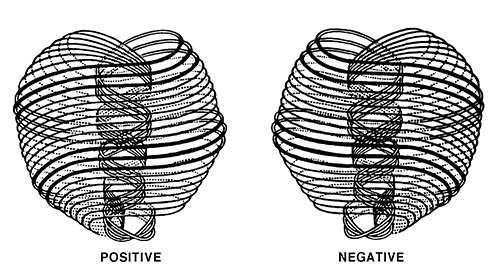
    Figure 2: The Two Types of Ultimate Physical Atoms, Male and Female (Source: Occult Chemistry by Annie Besant and C.W. Leadbeater)
    Figure 2: The Two Types of Ultimate Physical Atoms, Male and Female (Source: Occult Chemistry by Annie Besant and C.W. Leadbeater)

    In agreement with present-day aether researcher Paul LaViolette, David Yurth states in Seeing Past the Edge that these two opposite or mirror image particles constitute what we now refer to as matter and anti-matter states.8 This makes sense in light of Leadbeater and Besant’s comments that the positive/male UPA flows its creative energy outwards into our reality while the negative/female (anti-matter) counterpart transmutes energy from our reality back into the aether.

    Leadbeater and Besant said that if the higher-dimensional energy flow was stopped even momentarily, the whole manifest universe would disappear, “as a cloud melts away in the empyrean. It is only the persistence of that flow which maintains the physical basis of the universe.”9 LaViolette (among many others) has vindicated our two eminent occultists on this point, agreeing that without this constant flow,

    the subatomic particles and energy waves composing our physical universe would gradually dissipate, disolving [sic] into a state of uniformity. What would remain would be the ever-present, vast, and unfathomable multi-dimensional consciousness, of which we are a part, and whose now featureless calm “surface” had once generated our beautiful physical universe.10

    Physicist Nassim Haramein also supports this view, stating that, “without spin, none of reality can come to exist. All things spin!” Haramein agrees that “spin is fundamental to creation and objects that appear to be inanimate exist solely because spinning atoms within allow the objects to radiate, and hence, appear in our reality.”11 How did Leadbeater and Besant (and Swedenborg) know with such certainty so far in advance of science that our “physical” world’s source of origin is the aetheric medium’s spin dynamics?

    Besant and Leadbeater described the ultimate physical atom as a sphere, slightly flattened, with a depression at the point where the force flows in, causing a “heart-like” form. “Each atom is surrounded by a field,” they wrote, “formed of the atoms of the four higher planes, which surround and interpenetrate it.”12 If this is accurate, then etheric, astral and mental particles are of increasingly large size (physicists are searching for these “super particles” without realising they have already been quietly discovered).

    Leadbeater and Besant’s depiction of the UPA was fundamentally toroidal and way ahead of their time: “It turns incessantly upon its own axis, spinning like a top; it describes a small circle with its axis, as though the axis of the spinning top moved in a small circle; it has a regular pulsation, a contraction and expansion, like the pulsation of the heart.”13 Spin was first proposed in physics thirty years later by Goudsmit and Uhlenbeck in 1925 and was confirmed in electrons by Phipps and Taylor in 1927. The circular precessional motion described by the axis of the spinning UPA would later become known in physics as Larmor precession. Though the expansion and contraction (radial pulsation) described by Leadbeater and Besant is still unknown to physicists today, LaViolette points out that this description is quite plausible in the context of the ancient aether physics.14

    The UPA’s spinning motion is common to globules in complex plasmas,15 and as we see in Chapter 9 of The Grand Illusion, many of Leadbeaters’ and other metaphysicists’ clairvoyant observations can be accounted for in light of plasma dynamics. For instance, when exposed to an electric current the UPAs, as depicted by Besant and Leadbeater in 1919, arranged themselves in physical rows of “particle chains” – just like globules in complex plasma, as illustrated by A. Piel et al.16 In this UPA formation the depression of one UPA receives the aetheric flow of its neighbouring particle and then passes it out through its own apex, and so on.

    In Occult Chemistry Leadbeater refers to the UPA as having a certain level of apparent consciousness, and our best occultists and mystics (and scientists) all seem to agree that the universe is indeed conscious at all levels. It is interesting, as Jay Alfred points out, that David Bohm’s research into plasmas yielded the observation that electrons in a plasma configuration began to act as if they were part of a larger, interconnected whole, so much so that he frequently had the impression that the electron sea was “alive.” Mircea Sanduloviciu and colleagues have even created plasma spheres that can grow, replicate and communicate, fulfilling most traditional requirements for biological/living cells.17

    The links between consciousness and the spiralling energy inherent in the multidimensional fabric of the cosmos are increasingly being elaborated on by modern science. It is interesting to note some of the parallels between modern toroidal models and the fundamentally toroidal model Besant and Leadbeater described during their clairvoyant investigations. While Wilcock states that the aether’s substance naturally forms itself into a spherical formation because of the near-uniformity of the aetheric pressure on all sides, as well as the fact that it is the most ‘harmonic’ shape, he acknowledges that changing energy densities in the aether can cause these spheres to warp to some extent. For instance, they may stretch and flatten to create a donut-like shape, otherwise known as the torus, a model employed by Wilcock, Haramein18 and string theory.
    Occultists’ Vindication Arrives Via Dr. Phillips

    In the late 1970s Stephen Phillips, then a physics graduate student at the University of California, happened across some of the diagrams from Occult Chemistry. Contrary to what we might expect of most physicists, he took a serious interest in the material, and the end result was a major technical validation of the data obtained by Leadbeater and Besant.

    Dr. Phillips discovered that “Besant and Leadbeater’s clairvoyant descriptions of the chemical elements are completely consistent with the Quark, Quantum Chromodynamic and Super-String theories of modern subatomic physics.”19 This he detailed in depth in his 1980 book The Extra-Sensory Perception of Quarks, in which Phillips reconciled Occult Chemistry with modern physics. Because of his work, “Occult Chemistry now stands as a glittering testimony to the validity of Besant and Leadbeater’s claims.”20

    To clarify, a UPA’s ‘whorls’ are the ‘strings’ of modern string theory. Phillips suggests, based on comparisons between the occultists’ whorls and the ‘strings’ of string theory, that “[a] whorl is a closed, 26-dimensional, bosonic string (the reported presence of spherical ‘bubbles in koilon’ in 7th-order spirillae imply that whorls extend beyond the sixth, compactified dimension, so that they must be 26-, not 10-, dimensional strings,)” and also that “[t]he UPA is a subquark state of a superstring composed of ten strings, i.e. the superstring is itself a composite object.”21

    Thus, Phillips has reinterpreted Besant and Leadbeater’s observations to be not those of atoms, but of subquarks and quarks. The notion of quarks was only introduced into modern physics decades later in 1964 by Gell-Mann and Zweig.22 Quarks are the building blocks of so-called ‘elementary’ particles, and are generally accepted as existing by the scientific community today.

    However, Phillips’ model is actually a subquark (or composite quark) model. In it subquarks make up quarks, quarks make up elementary particles (protons, etc.), elementary particles make up atoms, and so on. Thus, Phillips has identified the UPAs as subquarks, and, as Donald DeGracia reports in Beyond the Physical: A Synthesis of Science and Occultism, he calls his subquarks “omegons” to indicate they are the final and smallest form of physical matter (omega is the final letter of the Greek alphabet). Phillips shows, through rigorous quantitative procedures, that “the sub-quark combinations predicted by his model are almost in exact agreement with the detailed structures presented by Besant and Leadbeater.”23 He has successfully correlated the structure of the UPA with superstring models: the UPA itself is the ‘superstring’ of modern subatomic physics.

    However, please note: the only way Phillips could get the numbers generated by his theory to match the actual observations of Besant and Leadbeater was to infer that when they were observing the subquark structure of an atom, they were not observing one atom but two atoms that had somehow fused together – as a result of their interference with and observations of these entities – to create a diatomic arrangement. This might have resulted from the spreading of the particles’ wave packets/de Broglie waves caused by the mental stabilisation of the particles by the theosophists, removing the uncertainty in their momentum, therefore increasing the uncertainty of their spatial locations.

    From a slightly different angle, the procedure, in effect, may have ‘teased out’ some of the inherent non-locality of the particles’ de Broglie waves/wave packets in time-space or ‘reciprocal space’ so as to influence their locations in space-time:

    [E]ach particle would become so delocalised that there would now be just as much chance of finding it near an adjacent atomic nucleus as there was in finding it in the much smaller space occupied by the nucleus prior to its coming under observation… their wave functions would eventually overlap significantly, leading to a non-vanishing probability of their mutual strong interaction.24

    The clairvoyantly observed structure of micro-psi atoms (MPAs) consisted of two overlapping triangular formations, with each triangle containing nine UPAs, while the contemporary view of hydrogen is of a lone electron orbiting a nucleus of one proton. However, from the viewpoint of modern quark theory, that lone proton is actually an arrangement consisting of three quarks. Phillips further claims that each quark is in turn made up of three subquarks, meaning the hydrogen atom consists of nine subquarks. Because in Besant and Leadbeater’s hydrogen there were two triangles each of nine UPAs, Phillips’ conclusion is that each triangle must correspond to an atom of hydrogen as understood by modern science, meaning that the hydrogen structure observed by Besant and Leadbeater was actually made up of two atoms of hydrogen.

    In the end, there are far too many correspondences between what Besant and Leadbeater observed and what is now scientifically known about subatomic behaviour, to dismiss their work.

    The shapes they described, the fact that they observed isotopes… before isotopes were widely recognised in science… and a host of other relevant observations; all of these are ideas that were completely unknown to the science of their day.25

    The table on page 62 provides a partial overview of Leadbeater and Besant’s clairvoyant observations as compared with subsequent scientific discoveries.
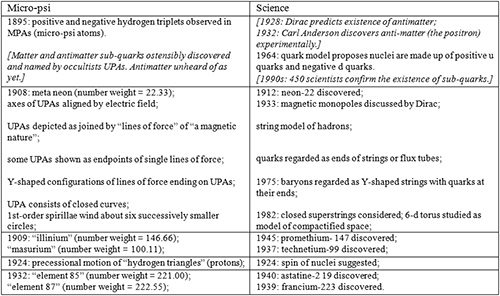
    “Some micro-psi anticipations of scientific discoveries and ideas.” Note: Brendan Murphy’s comments in italicised brackets. (Source: Stephen Phillips, Extrasensory Perception of Subatomic Particles, Journal of Scientific Exploration, 9(4), 489–525, 1995.)
    “Some micro-psi anticipations of scientific discoveries and ideas.” Note: Brendan Murphy’s comments in italicised brackets. (Source: Stephen Phillips, Extrasensory Perception of Subatomic Particles, Journal of Scientific Exploration, 9(4), 489–525, 1995.)

    As DeGracia points out, Phillips has shown that to comprehend the finer points of Occult Chemistry one requires an advanced understanding of modern physics. Besant and Leadbeater described the quantum nature of physical matter in 1895, exactly as science would thirty years later and more. How did they know about quarks and subquarks so far in advance of their official scientific discovery?

    To gain some comprehension of how controversial the terrain we tread here, the existence of sub-quarks was only recently scientifically accepted, and even then not unanimously. Yurth reports that in the 1990s an armada of 450 scientists confirmed the existence of sub-quarks with an “unprecedented” level of scrutiny, and still physicists at the American Physical Society, MIT, Princeton and Columbia University succeeded in suppressing the publication of the research data in such mainstream publications as Scientific American, Physics Letters, Physics Review and Nature.26 Thank goodness for free scientific enquiry, eh?

    Regardless, Besant and Leadbeater were obviously capable of perceiving the fundamental nature of matter using occult means, the siddhis. According to Leadbeater, there is a tube-like structure that protrudes from the Ajna, or third-eye chakra of the etheric body, and it is by means of utilising this tube as an organ of vision that one can exercise micro-psi. As we can see, there is good reason to believe him. This psi faculty/ability is one of the siddhis Patanjali wrote about in his Yoga Sutras circa 400 BCE.
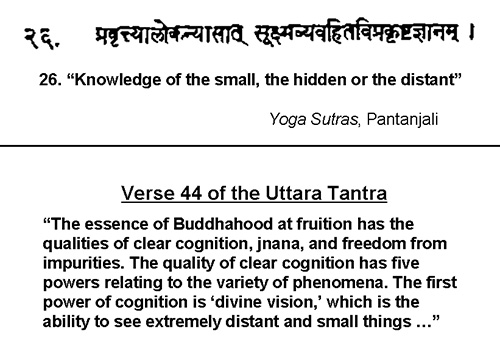
    In Aphorism 3.26 of the Yoga Sutras (c. 400 BCE), the earliest known treatise on yoga, its author Patanjali refers to a particular siddhi in which a yogi can gain “knowledge of the small, the hidden or the distant by directing the light of a superphysical faculty.”
    In Aphorism 3.26 of the Yoga Sutras (c. 400 BCE), the earliest known treatise on yoga, its author Patanjali refers to a particular siddhi in which a yogi can gain “knowledge of the small, the hidden or the distant by directing the light of a superphysical faculty.”

    One more interesting thing about sub-quarks highly pertinent to our occult leitmotif: the sub-quark’s track looks the way it does because in our space-time continuum the particle exists and then does not exist, exists and then does not exist. The discovery of the sub-quark constituted the very first scientifically verified instance of multi-dimensional behaviour in a measurable physical entity: “…in the rarified environment of the particle accelerator, the sub-quark exists-disappears-exists-disappears with a consistent, repeated, predictable frequency pattern…”27

    Leadbeater and Besant stated that the UPA – like the sub-quark today – could vanish from its plane but could undergo no further subdivision. It is truly the most fundamental aspect of physical matter at our density level. The scientific verification of Leadbeater and Besant’s observations clearly indicates the human ability to peer into domains non-existent to our ordinary senses and science’s conventional equipment – domains our most fundamental known ‘particles’ (standing wave structures) venture rhythmically in and out of. Yurth comments that this brings us “literally to the Edge of creation.”28 Do pause and let all of that sink in for a moment.

    Conclusions

    Our occultists are quantitatively and qualitatively vindicated from almost every conceivable angle. (I cover more angles than we have space for here in The Grand Illusion 1.) If we accept Phillips’ conclusion that ultimate physical atoms (UPAs) are sub-quarks rather than atoms, as Leadbeater/Besant once thought, then it is from dedicated occultists that we have obtained the first and possibly most accurate and detailed depictions of them and the aetheric medium that spawns them. On top of that, we must credit the initial discoveries of several isotopes to Leadbeater and Besant.

    Overall, the interrelated combination of clairvoyant observations, string theory, and ‘anomalous’ research findings that the Standard Model cannot explain – but which aether models easily incorporate – is too powerful to ignore.

    Brendan D. Murphy’s website is http://www.brendandmurphy.net.

    [alert type=”general” dismiss=”no”]This article was published in New Dawn Special Issue Vol 6 No 4.[/alert]

    [alert type=”success” dismiss=”no”]If you appreciate this article, please consider subscribing to help maintain this website.[/alert]

    Footnotes:

    1. Annie Besant & Charles W. Leadbeater, Occult Chemistry: Clairvoyant Observations on the Chemical Elements, 1919
    2. Annie Besant & Charles W. Leadbeater, Occult Chemistry, 1950
    3. Ibid
    4. Donald DeGracia, Beyond the Physical, 109
    5. Besant & Leadbeater, 1919
    6. See Victor Zammit, A Lawyer Presents the Case for the Afterlife, Ch. 2, www.victorzammit.com
    7. Besant & Leadbeater, 1919
    8. David Yurth, Seeing Past the Edge, 252
    9. Besant & Leadbeater, 1919
    10. Paul LaViolette, Subquantum Kinetics: A Systems Approach to Physics and Cosmology
    11. Nassim Haramein, What is the Origin of Spin?, www.theresonanceproject.org/pdf/origin_of_spin.pdf
    12. Besant & Leadbeater, 1919
    13. Ibid
    14. Paul A. LaViolette, Genesis of the Cosmos, 238-9
    15. Jay Alfred, Our Invisible Bodies, 49
    16. Ibid., 50
    17. Ibid., 65-8, 133-4
    18. See www.theresonanceproject.org/research.html for Haramein’s model
    19. DeGracia, 110
    20. Ibid. See also Phillips
    21. Stephen Phillips, Extrasensory Perception of Subatomic Particles, Journal of Scientific Exploration, Vol. 9, No. 4, 1995, 489-525
    22. Ibid., 110-11
    23. Ibid., 111
    24. Phillips, 1995
    25. DeGracia, 113-5
    26. Yurth, 255
    27. Ibid, 54-5
    28. Ibid, 55

    © New Dawn Magazine and the respective author.
    For our reproduction notice, click here.
  • Developing Your Unseen Powers: A Practical Guide

    Developing Your Unseen Powers: A Practical Guide

    Repeated ignorant or stubborn denial of the existence of certain powers does not keep them from existing – except for us! 
    – Harold M. Sherman, psychic

    Everyone has some level of innate intuitive capability, as has been demonstrated repeatedly over several decades of experiments by the parapsychological community through tens of thousands of trials utilising thousands of regular people with no known or presupposed psychic gifts. (That is to say nothing, of course, of those many successful experiments carried out with people having well established reputations for performing “paranormal” feats.)

    While some people are born with obvious psychic talents, most of us have to invest time and effort over the long-term in order to develop them from their latent state. In this article we will look at some guidelines and relevant principles for unblocking and developing your innate intuitive abilities.

    Open Your Mind & Eliminate Closed Ones

    Have you ever noticed how closed-minded sceptics (CMS) rarely if ever have any experiences with the siddhis (psychic faculties) or “the paranormal” in general? Soviet research into psychokinesis involving Nina Kulagina demonstrated qualitatively that a sceptic’s mere presence has an effect on a psychic’s ability to function properly. Hence, with a CMS (or several) in the room or otherwise involved in the experiment, a psychic is more likely to “fail,” thus “proving” the CMS right (at least in his own narrow reality tunnel). It is merely a case of self-fulfilling prophecy. Thus, regarding your own psi abilities what you believe is true, to a large extent – and unfortunately the presence of non-believers nearby or within the experimental setup can be detrimental.

    Dr. Valerie Hunt’s research in Infinite Mind showed a correlation between electromagnetic auric frequencies and the “level” of consciousness occupied by the individual. Healers, mediums and mystics show higher frequencies in their electromagnetic fields than others not of those categories, illustrating that those possessed of “higher” consciousness are, in some sense, literally “on a higher frequency.” Those fixated on or believing solely in “material reality” exhibited lower dominant frequencies and were bereft of the higher.

    In fact, gamma frequencies in the brain of 40-100 Hertz – the highest of the better known bands of brainwave frequencies (the higher band being Lambda, reaching up to about 200 Hz1) – have been linked to the ability to manifest intention in the world. Gamma states represent the brain in hyperdrive, working at its most intensity. “This oscillation is conducive to creating links across many parts of the brain,”2 facilitating an integrated whole-brain state. Paradoxically, the extreme high and low ends of the brainwave spectrum have the same states of consciousness associated with them, and different oscillations can be present at once in different parts of the same brain.3

    To illustrate, Russian psychokinetic (PK) psi star Nina Kulagina (1926–1990) – who, under controlled experimental conditions, could (among other things) separate an egg yoke from the white from a distance of 6 feet while it floated in a saline solution using only her intention – exhibited low frequency theta brainwaves of 4 Hz – normally associated with a deeply relaxed trance – whilst simultaneously showing extreme physiological agitation/arousal, including a pulse rate of 240 bpm. These strenuous efforts left her absolutely exhausted, and temporarily blind on that particular occasion.4

    Perhaps all of the above explains why Kulagina’s PK abilities “worked better in an atmosphere of friendly mutual trust and belief” – PK, as we know, generally requires intense states of physiological arousal and higher frequency brainwave activity, all of which drains large reserves of bioenergy. PK is a higher brain function. Kulagina experienced less stress when working alone and it was said that her PK ability was mood-dependent (both her own mood and that of the observers) and expended more energy in a hostile or sceptical atmosphere5 (where the local consciousness fields would have been less coherent). Hostile sceptics have something of an innate psi- or consciousness-damping effect; they literally operate at a lower frequency, their mind fields interfering with those of the test subject (and even the target). The fact that separate minds interact via measurable electromagnetic fields (and some not-so-measurable fields) has been proven by Hunt and others, and I detail much of this research in The Grand Illusion (TGI).

    Negativity causes chaos and/or entropy in the personal and local ambient energy fields, whereas positivity, gratitude, or love – heart-based emotions – cause coherence, beauty and order – just look at the instances of saints and yogis whose dead bodies have remained impervious to decay for weeks, months, and even years!6 This is worth considering before any psi endeavour where you intend to act as a receiver of information. Firstly, open-mindedness is a bare minimum requirement (confidence and trust in the process is even better). Additionally, being in a state of peaceful heart-based coherence is likely to enhance receptive abilities. In combination with deliberate intention, this has been shown to also be enough to wind and unwind DNA samples at will in laboratory conditions, with powerful implications for self-healing possibilities (see TGI).

    In 1942 psychologist and parapsychologist Gertrude Schmeidler initiated her infamous “sheep-goat” experiments, designed to test whether belief and open-mindedness would enhance psi function in contrast to scepticism. Two groups, “sheep” who believed in or were simply open to psi, and “goats” who did not believe it could happen for them under test conditions (but were not hostile to the possibility of it happening to or for other people), were put through identical standard controlled Extrasensory Perception (ESP) tests. The outcome indicated that believers in the possibility of ESP scored better than those who did not: the disbelievers scored lower, ergo belief is a legitimate variable mediating psi functions.7 “A meta-analysis by [psychologist Tony Lawrence], covering 73 experiments by 37 different researchers, clearly confirms that subjects who believe in psi obtain, on the average, higher results than those who do not believe in it.”8

    American psychic and author Harold Sherman (1898–1987) had noted in the early 1940s that while it is possible to receive thought impressions from a sceptic, it is extremely difficult for someone of that mindset to act as receiver.9 Sherman, who was ahead of his time, explained that telling yourself with certitude there is no such thing as psi is tantamount to instructing your subconscious mind to shut down the psi faculties so they do not operate for you.10 In a dream-like reality such as ours, it pays to be open-minded – especially if you want to be more intuitive.

    Meaning, Emotion, Need, Novelty & Other Factors in Psi

    Need, novelty, and emotion have long been known to play a part in psi phenomena. Carl Jung (1875–1961) – the originator of the theory of psychological archetypes – noted with interest that the English medium Eileen Garrett fared poorly in parapsychologist J.B. Rhine’s card-guessing experiments because she was unable to conjure any feelings for Rhine’s “soulless” test-cards.11 Much experimentation has also shown that psi effects have a tendency to start out higher in the initial stages of testing and then drop off as the participants lose interest and boredom sets in (the “decline effect”).

    Charles Tart actually went so far as stating that card-guessing experiments are, ironically, “a technique for extinguishing [psi] in the laboratory,” that is, they bore the subjects into a decline effect.12 Rhetorically, Sherman asked how he could possibly be expected to get excited over five abstract symbols that had nothing to do with his emotional system or that of the sender (they lacked meaning/personal significance or relevance).13

    Biologist and author Lyall Watson notes in Supernature that the most effective telepathic messages generally are bound up in trauma and crisis – and we see plenty of evidence to that effect in The Grand Illusion Vol. 1. He continues to explain that it makes sense biologically, since states of well-being and pleasure produce no sense of urgency – such information can be leisurely conveyed by the “normal” channels. However, for alarm signals to be of real use, they have to travel the fastest way possible.14 That “way” is superluminally/nonlocally. Much as Cleve Backster’s plants could detect the death of bacteria and brine shrimp nearby, our human telepathic connections must – even if only subliminally – serve a biological imperative, helping us survive and propagate as a species by sensing and avoiding danger.

    The limbic system, which includes the amygdala and hippocampus, is considered today to be the emotional centre in the brain, as well as the seat of our survival instinct. We might therefore suppose that life-threatening events, usually being highly emotionally charged, might ignite the temporal lobe and related structures in the brain into downloading nonlocal psi information from the vacuum/aether. Dr. Melvin Morse believes humans have a sixth sensory ability located “within” the right temporal lobe, hippocampus, and related limbic structures. According to him, this region “interprets information obtained through communication with an interactive universe,” and allows for telepathic communication with other people through their right temporal lobes. “It involves perception of other realities.” He states that we perceive the operation of the right temporal lobe as “intuition.”15

    In 1889 a committee of psychical researchers began a five-year project of compiling what they named a Report on the Census of Hallucinations – the first major research effort of the English Society for Psychical Research, featuring 410 data collectors. The committee included Henry and Eleanor Sidgwick, Alice Johnson, arch-sceptic Frank Podmore, and the esteemed Frederick Myers. Out of the 17,000 responses, 2,273 people reported having had “hallucinations” (psi experiences). Tellingly, most occurred in a crisis, usually a death crisis, signifying the importance of emotion, need, and above all, meaning in paranormal events.16 These were some of the earliest scientific results illustrating nonlocal correlations between well-acquainted (meaningfully connected) people.

    Aside from raw emotion, biological threats to loved ones (or oneself), and so on, another factor conducive to psi is simply novelty. Russell Targ and Harold Puthoff in their scientific remote viewing research in the 1970s found that the more difficult and challenging a remote viewing (RV) task they devised for test subjects, the more likely the results were to be good. They, too, observed a need-serving theme in their RV research at Stanford (see Chapter 12 of TGI). As a result of consistently challenging and interesting tests and protocols (with the added benefits of feedback and encouragement), they found that their subjects actually improved their psi performance over time, in contrast to Rhine’s and others’ results with card-guessing and other repetitious and dull forms of testing, where decline effects were often observed.

    In Sherman’s view, the absence of a strong or even an ordinary emotional factor is the greatest handicap in any psychic endeavour. Since his pioneering long-distance telepathy experiment with Sir Hubert Wilkins decades ago (detailed in New Dawn 136 and Chapter 11 of TGI), much data has accumulated indicating there is a great deal of truth in this. The stronger the emotional charge, the greater the likelihood that psi data will penetrate from the “subconscious” to the conscious mind.

    It is well known by occultists that emotionally charged events are more likely to impress themselves, inadvertently or otherwise, on the mind of another than are events with little emotional content. In occult terms, this interaction beyond the standard space-time realm is occurring via the astral plane/octave – the home of emotion. The more strongly the plasma-like astral body/field (or mind-field) can be made to vibrate in response to emotional content, the more likely the relevant data penetrates through from the subconscious to the conscious level of awareness. When sleep is involved, the conditions seem to be even more conducive to accidental telepathic contact, as it is an altered state of consciousness (theta and delta brainwave states) that opens us up to the frequencies of the astral or even mental planes while simultaneously eliminating most data/noise from the physical senses.

    Undoubtedly, much “paranormal phenomena” (including poltergeist phenomena, PK, and telepathy) can be linked to strong emotional content. There are indications that what we experience as presentiment or precognition may be, in some sense, the strong emotional content of a probable “future” event (which is actually occurring in a parallel universe in present time, along with all our “past” and “future” lives) then filtering “back” through time into our subconscious or even conscious awareness. (See Chapter 12 of TGI.)

    Hypnosis

    Hypnosis can aid our ability to peer into these “future” events and timelines. The young actress Irene Muza was in a hypnotic trance when she was asked if she could see what awaited her in her future. She wrote that her career would be short and her death would be “terrible,” though she dared not specify how she would die. The experimenters erased what Muza had written before bringing her out of the trance so she would not see it. She therefore had no conscious knowledge of what she had written. Some months later, however, in 1909, her prediction of a short career and terrible death was unexpectedly fulfilled when her hairdresser allowed some drops of an antiseptic lotion made of mineral essences to fall on a lighted stove, instantly enveloping Muza in flames. Her hair and clothing set alight, she was severely burned and tragically died in hospital a few hours later.17

    Hypnosis has been successfully employed for psychokinetic purposes as well. Take American Ted Serios, the “thoughtographer” born in 1918 who could create colour pictures on unexposed film simply through sheer will and intention while he stared into the lens of a Polaroid camera. His talent grew out of a DIY hypnosis experiment with a friend (a fellow bellhop at the Chicago Conrad Hilton Hotel) who instructed Serios under hypnosis that he could take photos of the contents of his mind. And thereafter, so he could – somewhat erratically, mind you. (Serios was tested extensively under controlled conditions.)

    Interestingly, Serios had to work himself virtually into a state of rage to be effective during these experiments. Notably, Israeli “paranormalist” Uri Geller has been able to achieve similar feats, taking photos of himself on high-speed black and white film through a solid black lens cap. Dr. Chris Humphrey explains this is due to quantum tunnelling: if the quantum de Broglie probability wave exists on both sides of a barrier, then its particle (photons in this case) can sometimes be on one side, and sometimes on the other, without ever passing through the barrier.18

    PK: Set Your Intent, Let Go & “Let God”

    During his first stay at the Stanford Research Institute (SRI – now Stanford Research Institute International), Ingo Swann worked on experiments with physicist Hal Puthoff, who was making forays into researching psi ability. This example demonstrates that we can and do interact with matter via our minds, whether we intend to consciously or not (and even under pressure and in the presence of sceptics in this case).

    On the evening of the 6th of June 1972, Swann was asked to try to influence a magnetometer located in the basement, which he was duly escorted down to, with one catch: the magnetometer – inside a quark detector, in actual fact – was buried under five feet of concrete underneath his feet, and thus invisible to him. What was visible to the extremely chagrined Swann (who was not forewarned by Puthoff of the nature of the experiment) was a chart recorder with its pen slowly tracing out a graceful wavy line. It was “monitoring the magnetic stability of the magnetometer and had been doing so for some weeks without any change in the rhythmic fluctuations,” Swann recalls. “The whole of this contraption was encased in an aluminium container and insulating copper canister. As well, it was in a supercooled, hence superconducting shield.” The Josephson junction inside the detector would detect any variation of magnetic flux in the supercooled equipment and the effect would show up as a change in the steady sine wave recording on the chart which they could all see.

    Swann started “probing” mentally to see if he could identify the expensive underground device, and when he sensed some “metallic differences” he tried to affect them, stating so as he went along. With all eyes glued on the sine wave, Swann attempted several times to perturb the well-shielded system, but to no avail. Insisting that he could see something, Swann proposed that sketching it out might assist the process. When no paper could be found to draw on, Puthoff suggested he draw directly onto the chart paper. “So I sketched a this, and then a that: ‘Is this the Josephson junction?’ I asked. ‘If so, I think I can see it quite well’.”

    With that comment, the ink pen gave a tiny jerk, and then stopped momentarily. Then it lifted up above its previous pattern, and “somewhat above this it wobbled along for no less than about TEN SECONDS – long enough for two wavy line intervals to have occurred.”19

    The point here is that when the distortion in the sine wave took place Swann was not trying to affect the equipment – he was simply trying to sketch what he could see with his mind’s eye. In those moments where his volitional mind was distracted and his goal momentarily suspended, the desired outcome occurred effortlessly. In laboratory tests with PK in ordinary people (Swann is known to be a gifted psychic, though more in the realm of remote viewing than PK), effects often fail to appear until the subject has their attention diverted.20 This is something that astral traveller Sylvan Muldoon wrote of some 80 years ago, explaining that charging the mind with desire or intent creates “stress” for which the mind seeks an outlet or release via a part of the subconscious he called the cryptoconscious Will: “Then [it] gets a chance to work on the ‘stress,’ and that which you had given up trying to attain ‘materialises’!”21

    Tips for Development

    • Open your mind to the possibility that psi can work for you
    • Believe in yourself
    • Operate in a peaceful state of heart-based coherence for receptive psi (such as receiving a telepathic signal)
    • Remove yourself from distractions and hostile or sceptical parties whose chaotic energy fields may negatively influence your own
    • Meditate for psi development (the more the better). If you can participate in a group of people with a mutual interest in their perceptual development, then all the better. I used to attend a trance mediumship group – not necessarily because I wanted to “channel,” but it did accelerate my clairvoyant development. The coherent group energy will heighten and refine your own through a “quantum additive” effect, accelerating your development. When I stopped attending the group my nascent clairvoyant faculties unfortunately regressed back to square one.
    • For PK, a less passive, more aroused state of heightened emotion may be desirable. If you want to bend spoons or change the weather it might help to get fired up!
    • Eliminate psi-negative beliefs at the conscious level by being well informed on the reality of the psi faculties (reading my book TGI 1 will definitely achieve that goal).
    • Eliminate subconscious negative (psi-blocking) beliefs through techniques such as Psyche-K and perhaps also EFT.
    • Try letting go and “getting out of the way.” Sometimes your intention has a way of manifesting when you direct your attention on to something else, or, as some have put it, when you “let go and let God.” Try setting your intention, letting the thought go, and trusting that the deed will be done.
    • A slightly different tactic: be grateful in advance that your attempt has already been successful. “All great masters know in advance that the deed has been done.” The aether/vacuum doesn’t “do” linear time. It only “knows” the present moment. Thus, what is true for you in the present is what will continually present itself to you until that truth changes.
    • If you want to design experiments or tests for receptive/perceptual psi, find ways to make it novel, interesting, and meaningful to you personally. Avoid boredom at all costs!
    • Practise some form of pranayama (yogic breathing) on a daily basis for maximal development of your health and psychic faculties.

    You can read more about this subject matter in Brendan Murphy’s book The Grand Illusion: A Synthesis Of Science And Spirituality – Book 1, available for purchase at www.brendandmurphy.net.
    [alert type=”general” dismiss=”no”]This article was published in New Dawn Special Issue Vol 7 No 2.[/alert]

    [alert type=”success” dismiss=”no”]If you appreciate this article, please consider a contribution to help maintain this website.[/alert]

    Footnotes

    1. Extraordinary States, www.bethcoleman.net/gamma.html.

    2. D. Church, The Genie in Your Genes, Energy Psychology Press, 2009, 99.

    3. Extraordinary States.

    4. L. Watson, Supernature, Coronet Books, Hodder Paperbacks Ltd, 1974, 139-40.

    5. J.D. LaMoth & L.F. Maire III (Defence Intelligence Agency), Soviet and Czechoslovakian Parapsychology Research, 1975.

    6. See B.D. Murphy, The Grand Illusion: A Synthesis of Science & Spirituality Vol. 1, Balboa Press, 2013.

    7. I. Swann, Dr. Gertrude Schmeidler, www.biomindsuperpowers.com/Pages/RealStoryCh9.html

    8. Who is Mario Varvoglis?, www.parapsych.org/members/m_varvoglis.html.

    9. H. Wilkins & Harold Sherman, Thoughts Through Space, Hampton Roads, 2004, xx.

    10. Thoughts Through Space, xxi.

    11. C.G. Jung, Synchronicity, First Princeton/Bollingen Paperback Edition, 1973, 18.

    12. Russell Targ & Harold Puthoff, Mind-Reach, Hampton Roads, 2005, 11.

    13. Thoughts Through Space, 129.

    14. Supernature, 260.

    15. P.M.H. Atwater, The Big Book of Near-Death Experiences, Hampton Roads, 2007, 340.

    16. M. Grosso, Experiencing the Next World Now, Paraview Pocket Books, 2004, 27-8.

    17. C. Wilson, The Occult, Watkins Publishing, 2004, 127-8.

    18. C. Humphrey, UFOs, Psi and Spiritual Evolution, Adventures Unlimited Press, 2004.

    19. I. Swann, The Varian Hall of Physics, www.biomindsuperpowers.com/Pages/RealStoryCh37.html.

    20. Supernature, op. cit., 151-2.

    21. S. Muldoon & Hereward Carrington, The Projection of the Astral Body, Rider Books, 1992.

    © New Dawn Magazine and the respective author.
    For our reproduction notice, click here.