New Dawn – World's Most Unusual Magazine

Author: Philip Coppens

  • The War  on the Cathars

    The War on the Cathars

    From New Dawn 110 (Sept-Oct 2008)

    The “Cathar heresy” that struck Southern France in the 13th century, and was viciously persecuted by the Roman Catholic Church, remains a pool of interest and intrigue. What really happened, and what did the Cathars actually believe? 

    Wars between nations or faiths are commonplace. Sometimes, the leaders of nations turn against a minority resident within their own borders. But the Albigensian Crusade is unique in history, as the Pope on March 10, 1208 proclaimed a crusade against a ‘heresy’ that was present inside Catholic Europe itself. “These heretics are worse than the Saracens!” he proclaimed.

    In retrospect, the crusade was one of the bloodiest episodes in European history. Indeed, the decades-long persecution of simple folk has often been seen as the event that prepared the way for the birth of Protestantism, as it awakened ordinary Europeans to the realisation that something was not ‘quite’ right within the papal corridors.

    Today, the ‘heretics’ are most commonly known as Cathars, but historically they went under a number of guises for, in fact, they were not a uniform organisation at all.

    The main focus, however, has always been on the Cathars (from the Greek word meaning ‘pure’), a name that is normally reserved for the dissident Christians who lived in Southern France and Northern Spain.

    Catharism arrived in southern France and northern Italy in the 11th century. It was present in Orléans as early as 1022, when thirteen Parfaits – the name for the ascetic Cathar elders – were condemned to the stake. At the time, the south of France (the Languedoc) was not yet under the political control of Northern France. In the Languedoc, Catharism, endorsed by the local nobility, became a popular alternative to the Catholic Church. The likes of the Count of Toulouse – one of the most important rulers of Southern France – supported Catharism.

    Cathar Beginnings

    The first Cathar Synod was held between 1167 and 1176 at St. Felix-de-Caraman, near Toulouse. The event, attended by many local notables, was presided over by the Bogomil papa Nicetas of the Balkan dualist church (see ‘The Bogomils: Europe’s Forgotten Gnostics’ by Paul Tice, New Dawn No. 106, January-February 2008), assisted by the Cathar bishop of (Northern) France and a leader of the Cathars of Lombardy.

    The Synod marked the start of the real struggle between the Catholic Church and Catharism, as the Church now had an organised body to fight. Of course, it meant ‘the enemy’ now had a name, and could thus be more easily fought.

    As early as 1178, Louis VII of France asked for a forceful intervention to stamp out the New Church. In 1208, Pope Innocent III repeatedly tried to use diplomacy to stop the spread of Catharism, but in that year his papal legate Pierre de Castelnau was murdered (allegedly by an agent serving the Count of Toulouse). The event pushed him from diplomacy into military action. Some now consider the death of de Castelnau a false flag operation, engineered so that the crusade would be declared.

    Whichever scenario is true, the end remains the same: an estimated 200,000 to one million people died during the twenty year campaign, which began in earnest in Béziers in July 1209. Papal troops marched to Béziers where they ordered that 222 people, suspected of being Cathars, be handed over to them by the town’s citizens. When this was refused, the papal troops decided to attack. One of the crusaders asked their leader, the Papal Legate Arnaud-Amaury, how to distinguish between the 222 heretics and the thousands of faithful Catholics that lived in the city. “Kill them all,” was the abbot’s alleged reply. “God will recognise his own!” The number of dead that day was between 7,000 and 20,000, the latter figure being the one quoted when Arnaud-Amaury reported back to the Pope.

    With such carnage, the other towns (e.g. Narbonne and Carcassonne) offered no resistance and soon the Southern counts had lost their territories and powers to the King of France and his allies. For these Northern lords, attaining the lands of the Languedoc had always been paramount; their mission had been accomplished.

    Though the crusade was over, only the powerbrokers who supported the spread of Catharism had been removed from power, their lands confiscated. What about the people? It is a known fact that the more one hunts down a group, the more convinced it becomes in its ways. Hence, at the end of the Albigensian Crusade, Catharism wasn’t by any means eradicated.

    For this purpose, the Inquisition was established in Toulouse in 1229 to guarantee that any future resurgence of this ‘heresy’ was nipped in the bud – literally – but also that a new phase of the campaign could commence: individual manhunts to track down Parfaits (the Cathars elders) who were still hiding and preaching within the general population.

    From 1233 onwards, hunting down Catharism was no longer done via wide-sweeping crusades, but on an individual basis. This meant any Cathars caught were ferociously interrogated about the secret network they were part of, their hideouts, their clandestine financiers and supporters, etc.

    Faced with the incredible pains subjected to their bodies, and the Cathar oath not to lie, the Inquisition learned important secrets about the underground network. Despite this, René Weis, author of The Yellow Cross, states: “The Cathar movement in the late-thirteenth-century Sabartès was an underground organisation, and the Inquisition of Geoffroy d’Ablis never penetrated to its core in spite of the fact that it executed most of their leaders.”

    Many Cathar elders realised the lethal dangers they faced and began to take refuge in the fortresses at Fenouillèdes and Montségur, while others were able to incite uprisings, which forced the Inquisition out of Albi, Narbonne and Toulouse. Count Raymond-Roger de Trencavel even led a military campaign in 1240, but was defeated at Carcassonne, surrendered and was exiled to Aragon.

    The Church felt victory was near and only those Cathars hiding in the castles remained to be eradicated. A siege began of the castle of Montségur, where 300 soldiers and 200 Parfaits stood off an army of 10,000. Among the Cathars inside Montségur were the Cathar bishop of Toulouse and the Cathar bishop of the Razès, Raymond Aguilher, leading members of the ‘heresy’.

    After a ten month siege, in March 1244, the castle surrendered. Though their life would be spared if they recanted, the Cathars preferred to be burnt, rather than reject their faith – a true sign of their conviction, which is one of the key reasons why Catharism today has such a wide appeal with the local people of Southern France.
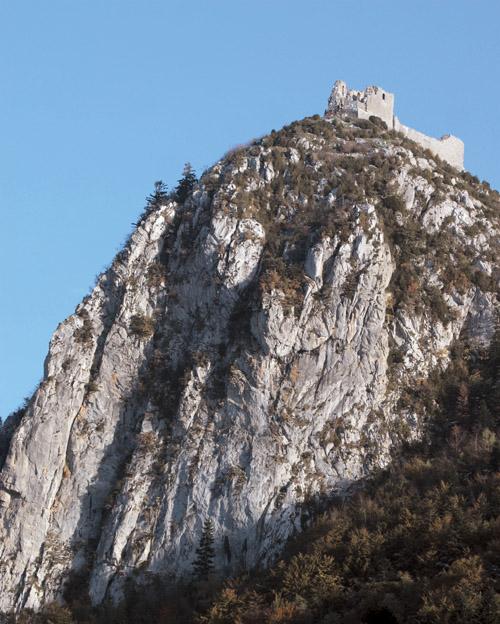
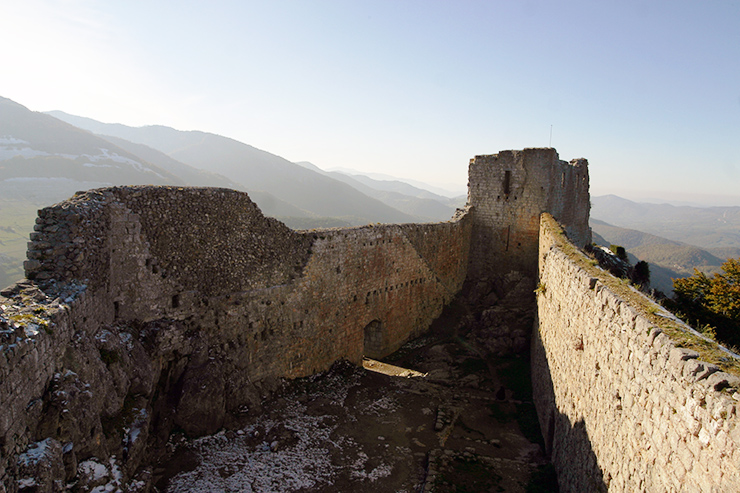
    Montségur. Photo courtesy of Andrew Gough, www.andrewgough.co.uk
    Montségur. Photo courtesy of Andrew Gough, www.andrewgough.co.uk

    The fall of a small, isolated but very idyllic fort, that of Quéribus, in August 1255, is often seen as the final demise of Catharism, but that is not true. In fact, in the following decades, there was something of a Cathar revival. The much hunted Cathar Parfait Pierre Authié even consoled the Count of Foix, Roger-Bernard III, in March 1302 in the hall of Tarascon castle, even though he was later buried by the Bishop of Carcassonne. It shows how many local lords still remained loyal to the Cathar cause.

    The underground survival of Catharism has become symbolised by the events that occurred in and to the small village of Montaillou, near Montségur, as it was the subject of Emmanuel Le Roy Ladurie’s pioneering book of the same name. From 1294 to 1324, the daily routines of Montaillou’s 250 inhabitants are known, as they survived in the records of Jacques Fournier, later to be Pope Benedict XII. It was Fournier, then the local Catholic bishop, who unleashed the Inquisition at Pamiers against the villagers, even resulting in the arrest of the entire village in 1308. One should, perhaps, be happy they weren’t all killed…

    Fournier also captured the last Cathar Parfait to be burnt at the stake: Guillaume Bélibaste, in 1321. Bélibaste’s bailiwick was the area between Rennes-le-Château – known for the mysterious 19th century priest Bérenger Saunière, who is at the core of the mystery of the so-called Priory of Sion and Dan Brown’s bestselling The Da Vinci Code – and the coastal city of Perpignan.

    Bélibaste was the son of a rich farmer from Cubières. He became a shepherd and a Parfait, the pupil of the Parfaits Pierre and Jacques Authié, whom had stayed with Bélibaste’s family in Cubières. As the Inquisition’s stranglehold tightened, Bélibaste settled across the border, in Catalonia, where the political regime did not persecute Cathars, and he was able to make baskets and carding combs, as well as become the mentor to a local Cathar community. He nevertheless decided to return to his homeland, but was caught, tried, and burnt at Villerouge-Termenès.

    Bélibaste’s death signalled the end of the official Occitan Cathar Church, which blossomed in the 11th century, organised in 1167, and perished in 1321. But though officially defeated in France, elsewhere, e.g. in Bosnia, Catharism continued to exist into the 15th century, when its adherents converted to Islam. Some, however, argue that Catharism in France may have disappeared as an organised Church in 1321, but that as a religion… it remains alive until today.

    Though it was the Inquisition – the accusers – that wrote down the life of Authié and Bélibaste, there is general consensus the insights the accounts provide into their lives and beliefs are credible. Indeed, what precisely the Cathars believed, remains somewhat of an enigma. Some have even used it as a blank canvas, to paint their own thoughts or convictions on. Hence, a lot of myths and falsehoods now exist about Catharism.

    The Cathar Revival

    At the core of the Cathar faith was the rejection of the material world, which was seen as a trap imprisoning the soul. All things material were seen as evil and to be opposed and rejected. Hence, they built no churches, were largely vegetarian and shared both common possessions and ate common meals. Though it is true that their doctrine had room for Jesus and the Bible, especially the Gospel of John, and that they proclaimed Christ had no real body (if he was the Son of God, how could he have a body of flesh, which was evil?) and hence also died no real death, all of these accommodations should be seen as educational tools so that they could explain to those that had been raised as Christians where both teachings differed.

    But in the end, their doctrine was appealing not so much for its core beliefs, but because the Catholic clergy were corrupt and as materialistic as one could be.

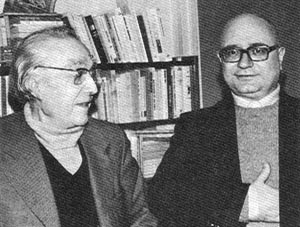
    Today, Catharism is largely seen as a dualist religion, like most Gnostic and oriental teachings. The man largely responsible for identifying Catharism as such was Déodat Roche (1877-1978), often referred to both as ‘the Cathar Bishop’, if not ‘the Cathar Pope’. However, outside of France, his name is relatively unknown, as is that of his friend and Professor of Sociology René Nelli of the University of Toulouse (and often referred to as ‘the vicar of Catharism’), who lectured on the subject all over France.

    Their fame has largely been eclipsed by the likes of Otto Rahn and Antonin Gadal, who saw the caves of the valley south of Foix as secret initiation centres for the Cathars – a theory that is now often widely accepted, but which has very little academic support.

    Gadal continued the work started by the local historian Adolphe Garrigou. From the 1930s onwards, circles were formed around Gadal and the already mentioned Roche and Nelli. Together, they formed “La Société du souvenir de Montségur et du Graal,” to promote the forgotten history of Catharism – but specifically tying it to the Holy Grail – and the promotion of Montségur, and the region as a whole. It is here that what is now known as ‘neo-Catharism’ was born, and it has little to do with the original belief.

    A second circle of Cathar enthusiasts had the countess Pujol-Murat as a key figure; she was one of Otto Rahn’s patrons. Rahn was a young German academic, whose books greatly advanced interest in Montségur and Catharism, both in the 1930s and now (see my article ‘The Strange Life of Otto Rahn: Author, Poet, Grail Seeker, SS Officer’, in New Dawn No. 109, July-August 2008). The countess claimed to be a descendent of Esclarmonde de Foix, who was seen (though historically inaccurately so) as one of the most esteemed Cathar Parfaits of the early 13th century and in some accounts held to be responsible for the rise of Montségur as the ‘Vatican’ of Catharism. It should be pointed out that these hilltop castles (like Montségur) were never ‘Cathar cathedrals’, as some would have it, but merely refuges for the Parfaits escaping the Inquisition.

    The Countess hoped to discover the lost treasure of the Cathars – and the Templars – which she believed was the Grail itself, supposedly hidden at Montségur by Esclarmonde, just before she threw herself off the mountain to escape from the papal troops. Some therefore believed the Grail was hidden there, whereas others felt the Grail had been secreted out of Montségur, days before its fall. It is said four Cathars descended down the steep slopes, carrying with them a ‘treasure’. Though the story of this escape is true, whether they carried anything is a matter of debate. Furthermore, as the descent was steep and arduous, whatever they carried must have been small.

    Amidst the wild speculation as to what they might have secured, some believe it was a holy book, containing the wisdom of the Cathar religion. It is indeed unlikely the Cathars secured a physical treasure, if only because it would have been too heavy, and in their eyes, unimportant: Catharism saw everything on this plane of existence as evil and despicable; money and wealth were chief amongst Earth’s – and Satan’s – vices.

    Authors such as Walter Birks and R.A. Gilbert, as well as Elizabeth van Buren, have suggested the Cathars guarded a manuscript, knowledge – a spiritual treasure. This manuscript is often said to be the ‘Book of Love’ and is linked with the Gospel of John, and is claimed to contain “sublime teachings, marvellous revelations, the most secret words confided by our Lord Jesus Christ to the beloved disciple [John the Evangelist]. Their power would be such that all hatred, all anger, all jealousy would vanish from the hearts of men. The Divine Love, like a new flood, would submerge all souls and never again would blood be shed on this earth.”

    It is known that books were very important to the Cathars, and some, such as “Stella,” by the Cathars of Desenzano, talk about the wars between God and Lucifer – underlining their dualist doctrine. But as Saint Dominic, founder of the Inquisition, is often depicted committing these books to the fire, it should come as little surprise that few have survived his ‘intervention’.

    However beautiful Montségur is, the ‘real’ Cathar heartland are somewhat gentler slopes where now desolate villages once thrived. One such village, Arques, near Rennes-le-Château, is where the hunted Parfait Pierre Authié preached and found refuge, and the modern Cathar researcher Déodat Roche was born and lived. Today there is a museum dedicated to him.
    Deodat Roche

    Though Roche was part of the modern Cathar Revival, he never focused too much on the promotion of Montségur or the ‘initiation caves’, which for him were distractions – tourist attractions. Roche focused on the true Cathar belief.  But the question needs to be asked whether he discovered this, or whether he knew so all along.

    For those who have studied and known Roche, there are hints that somehow Roche’s interest in Catharism was very fundamental – that he may have been one himself. He is known to have made solitary early morning walks to a hill just outside of Arques, where he was taken as a young child by his father. The site holds a statue of the Virgin Mary, and though this might appear typically Christian, the Cathars of the 14th century are known to have made similar pilgrimages to the nearby basilica of Notre-Dame-de-Marceille, which held a Black Madonna. As in Notre-Dame-de-Marceille, did the Virgin Mary in Arques have a secondary – dualist – meaning for Cathars – and Roche?

    As mentioned, his home town of Arques also had a strong connection with Authié. Roche once unearthed an image of Pierre Authié and both he and others who saw this noted how remarkably similar the two men looked. Roche was not only mayor of Arques; he had also held important positions within the French judicial system. He was also a very private individual. He never spoke about whether or not he felt that he was indeed the possible reincarnation of Authié. Roche must have understood that what he was doing was uncovering what had been buried with Authié. If he did feel that he was the incarnation of Authié, then it was clear that upon this Parfait’s death, he had after all not entered Heaven.

    So, what was Catharism? A dualist religion is primarily seen as a religion that believes in two competing forces, good versus evil, but it is much more than that. An insight into the Cathar cosmography comes from Authié himself. He preached that the Devil had sneaked into Paradise, after waiting 1,000 years at it doors. Once inside, he seduced the spirits, who all fell from a hole in Paradise for nine days and nine nights. After this Fall, they ended up on Earth. When Heaven had largely become depleted, God immediately plugged the hole. But the souls on Earth soon were saddened by their loss and the Devil offered them as comfort such overcoats that would make them forget the bliss of Heaven: the human body, which began a series of incarnations. It thus became Mankind’s mission to ascend back to Heaven, i.e. break the cycle of incarnations. By accepting this cosmography and performing the Consolamentum, one’s next death would end the soul’s odyssey and return it to Heaven.

    The two most important Cathar rituals were the Consolamentum and the Endura (see side bar on adjacent page).

    In conclusion, neo-Catharism had little to do with Catharism as such. The notion of Jesus as a man of flesh and blood was rejected by the Cathars, yet neo-Cathars underline how the Cathars believed that Mary Magdalene was the wife of Christ. Yuri Stoyanov has indeed confirmed that the Cathars claimed as such and that this belief had no counterpart in Bogomil doctrines, meaning that the Cathars were unique amongst the dualists to have this belief. Their religion was not at all based on the knowledge that Jesus and Mary Magdalene created a dynasty but that, instead, Cathars in Southern France, where Mary Magdalene was a popular saint, used her in their cosmography, to illustrate the feminine aspect of the divine duality.

    Cathars underlined the 1,000 years the Devil had to wait at the gates of Paradise before he entered it. Cathars saw it as their mission to have the soul repent for the sin of being seduced by the Devil, and once accomplished, it would return to Heaven. The Church, however, saw it differently, using especially Revelation 20:7, where it is said that after 1,000 years, Satan would be released from his prison. Seeing Catharism rose approximately one millennium after the death of Christ, chronicler Ralph the Bard and St Hildegard of Bingen – the latter who stated she had a vision in which she saw Satan released from his chains – said Catharism was in fact the return of Satan, there to destroy the Church. It was the very reason why it had to be destroyed; for many Christians, conquering Catharism meant slaying Satan. Thus, not only Catharism, but the Cathar Crusade itself, had an innate dualism to it too.

    [alert type=”general” dismiss=”no”]This article was published in New Dawn 110.[/alert]

    [alert type=”success” dismiss=”no”]If you appreciate this article, please consider subscribing to help maintain this website.[/alert]

    © New Dawn Magazine and the respective author.
    For our reproduction notice, click here.
  • Mysterious Celtic Mummies of the Gobi

    Mysterious Celtic Mummies of the Gobi

    The discovery of Caucasoid mummies in China shows that East and West have been meeting since the Bronze Age. Do they validate some of our most ancient legends?

    Christopher Columbus is said to have been the first to break down the barrier that was the Atlantic Ocean, that massive body of water separating two continents. But such a physical obstruction never existed between Europe and the East – one could always travel over land. The discovery of Caucasoid mummies in China provides not only indisputable evidence ‘Europeans’ travelled to the far East thousands of years before anyone imagined, it has also created controversy.

    At the beginning of the 20th century, the likes of Sven Hedin, Albert von Le Coq and Sir Aurel Stein travelled to the East in search of ancient civilisations, hoping to reach the then forbidden city of Lhasa, the capital of Tibet, and its ruler, the Dalai Lama. On their travels to this almost mythical region, they stumbled upon many ancient ruins and on occasion spoke about the discoveries of desiccated bodies.

    In 1907, the Russian explorer Pyotr Kuzmich Koslov (1863-1935) actually reached Lhasa and met the Dalai Lama. Afterwards, he organised further expeditions and excavated Khara Khoto, a Tangut city founded in 1032 that had been ruined by the Ming Chinese in 1372. Koslov unearthed a tomb fifty feet below the ruins and found the body of a woman, apparently a queen, accompanied by various sceptres, wrought in gold and other metals. Though Koslov took numerous photographs that were published in American Weekly, he was not allowed to disturb or remove anything from the tomb, which was sealed again. His last expedition to Mongolia and Tibet occurred from 1923 to 1926 and resulted in the discovery of Xiongnu royal burials at Noin-Ula.

    Mu & Lemuria

    When news of such discoveries were reported back in the West, it ignited a wide interest in the mysteries of the East, which even today remain largely beyond the reach of most tourists. It were in these remote regions that James Churchward (1851-1936) claimed he had found evidence of a lost civilisation: Mu. For Churchward, Mu was a lost civilisation and continent in the East, which he estimated was 50,000 years old and once the home of 64 million inhabitants. Though Mu once stretched from Micronesia in the West to Easter Island and Hawaii in the Pacific Ocean, knowledge – if not descendants – of Mankind’s original homeland could possibly be found in India and surrounding regions. Churchward believed that the primary colony of Mu was the Great Uyghur Empire, Khara Khoto being its ancient capital, and the civilisation was at its height around 15,000 BCE. Check any encyclopaedia and you will find Churchward ‘borrowed’ that name from the historical Uyghur, who today live primarily in the Xinjiang Uyghur Autonomous Region of China.

    Churchward’s Mu was not too different from Madame Blavatsky’s Lemuria, and it was the American Theosophist Gottfried de Purucker (1874-1942) who published his thoughts on Blavatsky’s doctrine in 1937. He argued that this region, this “enormous tract of country, most of it desert waste,” was once fertile and lush with cities, and that it was here one would “find the seat from which we came as a racial stock,” which was the “Fifth Root Race.” Blavatsky described the fifth root race as such:

    The Aryan races, for instance, now varying from dark brown, almost black, red-brown-yellow, down to the whitest creamy colour, are yet all of one and the same stock – the Fifth Root-Race – and spring from one single progenitor, […] who is said to have lived over 18,000,000 years ago, and also 850,000 years ago – at the time of the sinking of the last remnants of the great continent of Atlantis.

    Later, the French author Robert Charroux (1909-1978) wrote that the Gobi Desert had Magi, or sages of the East, surpassing in wisdom even those resident in Tibet. Stories go that these cities once had ocean ports, and Edgar Cayce even argued that a “City of Gold” will be discovered in the Gobi Desert, including a temple with elevators and electric cars. Others have seen this region as the homeland of those ancient UFOs, the vimanas.

    Taklamakan Desert Gives Up Its Secrets

    But whereas the Gobi Desert might still hold some secrets, it is the Taklamakan Desert that has provided us with revelations. The Taklamakan Desert is a large sandy expanse, part of the Tarim Basin, a region roughly between Tibet and Mongolia, in western China, and crossed at its northern and southern edge by the Silk Road. Conditions are so harsh that travellers avoided the desert as much as possible, but in millennia gone by the region was populated and habitable – very much like de Purucker argued.

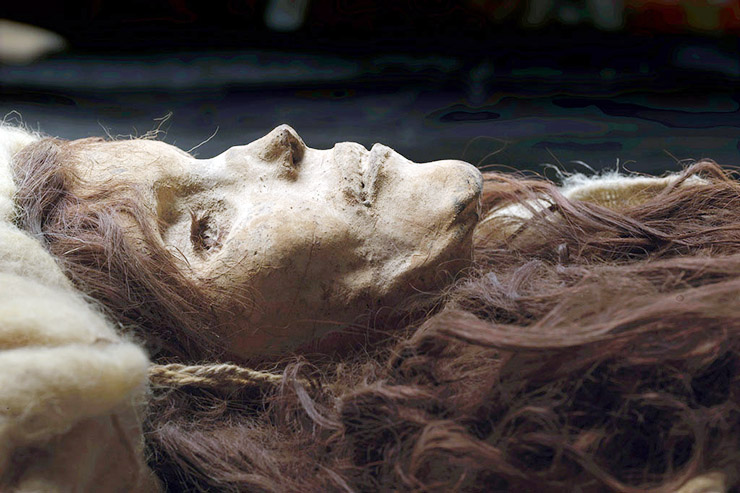
    In recent decades, however, the south east section of the desert, on the edge of Gobi, has become an oasis for archaeologists and historians, as it is here that hundreds of Caucasoid mummies have been found. The most notable mummies are the tall, red-haired “Cherchen man” (dated to ca. 1000 BCE), the “Hami Mummy” (c. 1400-­800 BCE) and the “Witches of Subeshi” (4th or 3rd century BCE), who received their name because of the tall pointed hats they wore. However, the oldest mummy of all is the “Loulan Beauty” (1800 BCE).

    Though not the oldest, one of the most famous mummies of the Taklamakan Desert is that of “Cherchen Man” (see photo in PDF version). His body was placed in a poplar-wood box, lowered into narrow shaft grave, and left for eternity. The climatic circumstances that make this region so inhospitable today preserved these corpses over the millennia, turning them into mummies.

    Cherchen Man is six feet tall, was around fifty years old at the time of his death, has reddish brown hair, a long nose, full lips and a ginger beard. He was buried in a red twill tunic and tartan leggings, and his body is far better preserved than any Egyptian mummy. Most interestingly, Cherchen Man too was buried with no less than ten hats, one of which looks Roman, another looking like a beret, a cap, and even a conical “witch” hat – something commonly found with many of the mummies. His body dates back to 1000 BCE and he looks like a Bronze Age European. In fact, he’s every inch a Celt. Even his DNA says so.

    Next to him were found the mummies of three women and a baby. One of the women is dressed in a red gown, wearing tall boots, her hair brushed and braided. She has a red yarn through her ear lobes and – like the man – has several tattoos on her face. All mummies were painted with a yellow substance, believed to help in the preservation of the body. The baby, probably 3-4 months old, is wrapped in brown blankets, tied with blue and red cord, with a blue stone placed on each eye (see photo in PDF version).

    The oldest of the mummies is the 4,000 year old “Loulan Beauty,” (see photo in PDF version) a mummy discovered in 1980 in an ancient Chinese garrison town located by Sven Hedin in 1900. The town is near the Lop Nor marshes on the north-eastern edge of the Lop Desert. Hedin recovered many manuscripts that state the culture was wiped out by a large seismic occurrence which drastically changed the climate of the area and turned it into a desert. But that was several millennia after the Loulan Beauty lived. This female mummy has long, fair hair. Aged 45 when she died, the Loulan Beauty was buried with a basket of food containing domesticated wheat, combs and a feather. No doubt, these nourishments were for the afterlife.

    She is not the lone ‘European’ to have lived here in those days: the cemetery at Yanbulaq contained no less than 29 mummies that date from 1800-500 BCE, 21 of which are Caucasoid. Best preserved of all the corpses is “Yingpan Man,” who is also known as “the Handsome Man,” a two metres tall 2,000 year old Caucasian mummy discovered in 1995. His blond bearded face was covered with a gold foil death mask, which is a Greek tradition; he also wore elaborate golden embroidered red and maroon wool garments with images of fighting Greeks or Romans. His head rests on a pillow in the shape of a crowing cockerel.

    Elsewhere in the Tarim Basin, hundreds of other mummies have been found, with the earliest ones being genetically Caucausoid or Europoid. Some of the mummies are thought to have been sacrificial victims. A young woman was found partially dismembered, her eyes gouged out. A baby boy had apparently been buried alive. The question remains whether the latter was sacrificial, or he was merely buried with his dead mother.

    How did Europeans End up in the Tarim Basin over 4,000 years ago?

    Although their location is certainly an intriguing one, interest in these mummies exists largely because they are ‘out of place’ relics. Not only does DNA evidence show that the earliest arrivals were from Europe, analyses such as the weave of the cloth reveal it was identical to those found on the bodies of salt miners in Austria, dating from 1300 BCE. The wooden combs buried in Asia are also identical to those found in Celtic countries. So are the stone structures on top of their burial sites – similar to the dolmens of western Europe.

    Despite such certainties, archaeologists and historians have struggled to fill in the ‘soft evidence’ – which are nevertheless the most important questions: how did they get to China, and why did they go?

    We know about these early European visitors to the Tarim Basin largely thanks to the work of Dr. Victor Mair, a professor of Chinese Studies at the University of Pennsylvania. His fascination began when he toured the Urumchi Museum where some of the mummies are displayed. He then invited Dr. Elizabeth W. Barber of Occidental College (California) to visit the mummies and give her expert opinion on the weaving of their clothes.

    “From around 1800 BCE, the earliest mummies in the Tarim Basin were exclusively Caucausoid, or Europoid,” says Mair. East Asian migrants arrived in the eastern portions of the Tarim Basin about 3,000 years ago, while the Uyghur peoples arrived after the collapse of the Orkon Uyghur Kingdom, based in modern-day Mongolia, around the year 842.

    Mair has also stated:

    The new finds are also forcing a reexamination of old Chinese books that describe historical or legendary figures of great height, with deep-set blue or green eyes, long noses, full beards, and red or blond hair. Scholars have traditionally scoffed at these accounts, but it now seems that they may be accurate. (http://en.wikipedia.org/wiki/Tarim_mummies)

    In short, Mair leaves little doubt that we are confronted with a ‘lost civilisation’ of a group of European settlers in a region millennia before any historical accounts were recorded.

    Mair believes that early Europeans headed in different directions, some travelling west to become the Celts in Britain and Ireland, others taking a northern route to become the Germanic tribes, and then another offshoot heading east and ending up in Xinjiang. His team suggests they may have arrived in the region by way of the forbidding Pamir Mountains about 5,000 years ago.

    His opinions tally with those of textile expert Barber, who in her book The Mummies of Ürümchi examined the tartan-style cloth and concluded that the garments can be traced back to Anatolia and the Caucasus, the steppe area north of the Black Sea. She argues this group of people divided, starting in the Caucasus and then splitting, one group going west and another east – confirming Mair’s opinion.

    So, what do we know about these people? We know they were horsemen and herders using chariots, and may have invented the stirrup. We know they had arrived in this region by 1800 BCE. That around 1200 BCE, they were joined by another wave of Caucasoid immigrants from what is now Iran (the so-called Saka branch).

    In fact, the Saka nomads had high-pointed hats – like the ones found next to Cherchen Man – as displayed on the Persepolis reliefs in southern Iran. A bronze statue found in the Altai Mountains from the 5th century BCE has a similar hat. Most important is the fact that the statue has Caucasoid features, and shows similarities in dress to Cherchen Man. It is therefore clear that apart from ‘hard’ DNA evidence, there is other incontrovertible evidence of an early European presence in China. The discovery of the mummies indeed rewrites history.

    When Sir Thomas Douglas Forsyth reported on his 1875 mission to the region, he stated many of the people were tall, fair-faced, with light eyes, sandy whiskers and hair. He added they “only require to be put into coat and trousers to pass, so far as outward appearance goes, for the fairest Englishman.” Two millennia before, Pliny the Elder in “Taprobane” wrote about the Seres, which were described to the Roman Emperor Claudius by an embassy from Taprobane (Ceylon). He said they “exceeded the ordinary human height, had flaxen hair, and blue eyes,” a description which comes close to those people living in the Tarim Basin. Pliny the Elder also said they had an “uncouth sort of noise by way of talking, having no language of their own for the purpose of communicating their thoughts.”

    Political Controversy

    Though no texts have been found in relation to the Tarim mummies, it is now accepted these emigrants spoke a language known as Tocharian (the Chinese called them Yuezhi), that proved to be close to the languages of western Europe. Today, the region‘s inhabitants are the Uyghur people. With their light-coloured skin and hair, many Uyghur‘s are obviously of mixed genetic ancestry, and this fact has a political dimension.

    If one were to find evidence of a Bronze Age seafarer in America, it would obviously create controversy. The discovery of the ‘European’ mummies on Chinese soil also has major political implications. The region is rife with separatist movements and the government fears that promoting a truly unique archaeological find might result in serious social and political unrest. This is one of the main reasons why the Terracotta Army is far more famous than the Tarim mummies!

    Social unrest is greatest between the Uyghur and the Han Chinese. In their drive to lay claim to the region, the Loulan Beauty was even raised to the status of racial icon by the Uyghur, who call her “mother of the nation” – without little supporting evidence.

    The Chinese historian Ji Xianlin, writing a preface to Ancient Corpses of Xinjiang by Wang Binghua, says that China “supported and admired” research by foreign experts into the mummies – i.e. Mair and Barber.

    “However, within China a small group of ethnic separatists have taken advantage of this opportunity to stir up trouble and are acting like buffoons. Some of them have even styled themselves the descendants of these ancient ‘white people’ with the aim of dividing the motherland. But these perverse acts will not succeed,” Ji writes.

    In comparing the DNA of the mummies to that of the modern day Uyghur, Mair’s team found some genetic similarities with the mummies, but “no direct links.” The fact of the matter is that neither the Uyghur nor the Han Chinese seem to be directly related to these ancient settlers – and that both are modern additions to, and admixtures in, a region populated millennia earlier.

    What the discoveries suggest is that both immigrants and modern local Chinese are a mixture of races. “While it is clear that the early inhabitants of the Tarim Basin were primarily Caucasoids,” Mair has written, “it is equally clear that they did not all belong to a single homogeneous group. Rather, they represent a variety of peoples who seem to have connections with many far-flung parts of the Eurasian land mass for more than two millennia.”

    He adds: “Modern DNA and ancient DNA show that Uyghurs, Kazaks, Kyrgyzs, the peoples of central Asia are all mixed Caucasian and East Asian. The modern and ancient DNA tell the same story.”

    Furthermore, a National Geographic study of the DNA of the mummies suggests the Tarim Basin was continually inhabited from 2000 BCE to 300 BCE and preliminary results indicated the people, rather than having a single origin, originated from Europe, Mesopotamia, India and other regions yet to be determined.

    It underlines, once again, that ethnic groups, whether ancient or modern, are genetically a mixture of many races.

    The Formation of the Silk Road

    What brought ‘Europeans’ to the Tarim Basin over 3,800 years ago? The southern Taklamakan Desert is an area where the Silk Road once flourished and prosperous cities were built. In Khotan, two large rivers were channelled, creating an oasis that grew wheat, rice, corn, cotton, grapes, peaches and melons, and irrigated fields for the grazing of sheep. It is clear that life must have been good in those days, and our ancient adventurers had everything they could want. However, because of gradual climate change, the cities were eventually abandoned and subsequently eroded and buried by the dunes.

    The Silk Road was an ancient caravan route connecting China to the West. The Caucasoid mummies in this part of the world suggest the trade route is older than previously thought – very much like transoceanic contact might be several millennia older than Columbus’ first voyage to America.

    The Silk Road was not just a conduit for silk; many other products were transported and traded and the routes were not merely travelled by merchants, but anyone wanting to go East – or West. The routes should therefore be seen as the ancient ‘highways’ between China and the Mediterranean Sea.

    Trading between the East and West occurred from the dawn of civilisation – if not before. Between 6000 and 4000 BCE, people in the Sahara were already importing domesticated animals from Asia. By 3000 BCE, lapis lazuli – the only known source of which was Badakshan, in northeastern Afghanistan – was found in Egypt. Most specifically, the supply of Tarim Basin jade to China from ancient times is well established. Nephrite jade from mines in the region of Yarkand and Khotan – not too far from the lapis lazuli mines of Badakshan – was found in China. Xinru Liu writes:

    It is well known that ancient Chinese rulers had a strong attachment to jade. All of the jade items excavated from the tomb of Fuhao of the Shang dynasty, more than 750 pieces, were from Khotan in modern Xinjiang. As early as the mid-first millennium [BCE] the Yuezhi [Indo-European people] engaged in the jade trade, of which the major consumers were the rulers of agricultural China. (http://en.wikipedia.org/wiki/Tarim_mummies)

    The Tarim mummies overturn the idea that the West and the East developed independently and they only recently started to interact. As Dr. Mair notes,

    I do believe that there is a growing mountain of hard evidence which indicates indubitably that the whole of Eurasia was culturally and technologically interconnected.

    An interesting question is did the Celts go east – or did a Caucasoid group of people, perhaps native to the Tarim Basin, go to Europe? Turning the path of travel in the opposite direction could offer confirmation of speculation this region was an ancient ‘homeland’ that spread to other regions – specifically Europe.

    With so little known about Bronze Age Celts both in Europe and Asia, no firm conclusions can be drawn either way – and perhaps never will. However, the Book of Manu (also known as the Laws of Manu), one of the supplementary arms of the Vedas, states that the “Uyghurs had settlements on the northern and eastern shores of the Caspian Sea” and German anthropologist Max Muller (1823-1900) wrote that “the first Caucasians were a small company from the mountains of Central Asia.”

    These conclusions are obviously ‘old’ – but are they therefore erroneous? Written more than a century before the Tarim mummies were discovered, they actually speak of the presence of Caucasians in China. And if they got that right, is it possible they got other things right too?

    Only future discoveries are likely to tell. But at least it’s an undeniable fact there was contact between Bronze Age Caucasians and East Asians along the Silk Road. The evidence is for all to see in the Urumchi Museum.

    [alert type=”general” dismiss=”no”]This article was published in New Dawn 112.[/alert]

    [alert type=”success” dismiss=”no”]If you appreciate this article, please consider subscribing to help maintain this website.[/alert]

    © New Dawn Magazine and the respective author.
    For our reproduction notice, click here.
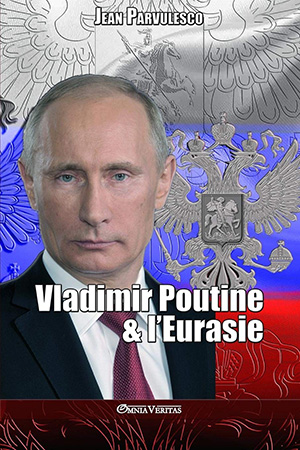
  • Vladimir Vladimirovich Putin & the Eurasian Empire of the End Times

    Vladimir Vladimirovich Putin & the Eurasian Empire of the End Times

    From New Dawn 111 (Nov-Dec 2008)

    Russia has always perceived of itself as a Eurasian country.
    – President V.V. Putin, November 2000

    …an epochal, grandiose revolutionary admission, which, in general, changes everything. The prophecy of [French conspiratologist] Jean Parvulesco has come to pass… There will be a Eurasian millennium.
    – Alexandre Dugin, Russian thinker and author

    The French visionary writer Jean Parvulesco’s main agent – if not hope – for world change rests with Vladimir Putin. Parvulesco argues that – whether we are aware of it or not – we find ourselves at the crossroads of “great history,” where a totally new era is about to be born.

    For such a new period to begin, the old needs to die first. For Parvulesco, this is the old “democratic system” of political correctness, which he feels has now reached its limits and is no longer supportable. It has become “a permanent and total nightmare.” Many will wonder how the “new world” is to come about. The best example of what appeared to be a sudden, almost instantaneous collapse is seen in the fall of the Soviet Union, two decades ago. It illustrates that powerful empires can, from one day to the next, completely disappear, requiring a new society and structure to be built from the ground upwards.

    When news of the collapse of the Soviet Union appeared on television screens, the system had already imploded. It was just the public revelation of its death; the disintegration of the communist system had already occurred. According to Parvulesco, the collapse of “democratic Europe” has already taken place too, and we are now in the years between its collapse and the public acceptance of its demise – and the start of a new Europe.

    For Parvulesco, the evidence of the collapse of this system is apparent in the recent political history of Italy and Germany, and to some extent that of France and Great Britain. But in each case he feels the same dire situation has transpired: an “immense empty desert,” the wasteland of “social democracy.” A local version of what he sees as a “worldwide conspiracy,” but one that has failed and will soon be sent back to the “black hole” from where it came.

    Parvulesco knows what to write on the death certificate; but he also feels he knows what the New Europe will be: the “Eurasian Empire of the End Times.” He labels our timeframe an interregnum where what happened to Russia is actually evidence that dramatic political change is possible. The Soviet Union was the first domino to fall, with the others in Europe soon to follow.

    Could he be right? In 1976, Parvulesco published “La ligne géopolitique de l’URSS et le ‘projet océanique fondamental’ de l’Amiral G.S. Gorchkov” (The geopolitical line of the USSR and the ‘fundamental oceanographic project’ of Admiral G.S. Gorchkov), which he labelled “political-revolutionary research.” In it he wrote that the Soviet Union would end up changing the course of history. And changing the course of history is, for Parvulesco, the only true goal politics should have.

    Parvulesco therefore provides an interesting type of prophecy. Whereas most prophets predict the end of the world at a given time, his type of prophecy brings more detail about the type of change and how. As to its timeframe, it is very much like “when the time is right.”

    So, what is meant to happen? Parvulesco argues that across Europe there are geopolitical groups at work – often clandestinely – laying the groundwork for the Eurasian agenda. Like the Project for a New American Century, there are other think tanks hard at work – and judging from the amount of newspaper headlines they don’t get, much more secretly – to bring about a new Eurasia. Despite their secrecy, Parvulesco was able to lay his hands on one article titled “The Imperial Eurasian Pact.” Similar to the idea put into action by the Neocons after 9/11 (an agenda that claimed to want to bring peace to the world by using the power of America’s military might), this group states that, “It is the confrontation of our imperial and catholic [universal] doctrines with the current political-historical reality […] which will see the final emergence of the catholic Great Empire which constitutes our ultimate objective, the Imperium Ultimum, the Regnum Sanctum, which should comport, in principle, three operational stages […].”

    The first stage is the creation of a Paris-Berlin-Moscow axis, that is considered to be the axis along which this major change will occur. This axis will tie together the destiny of three nations (France, Germany and Russia).

    The second stage is the integration of what was traditionally known as West and East Europe, together with Russia, Siberia, India and Japan.

    The final stage involves what is termed the destruction of the “global democratic conspiracy,” led by the United States, including a revolutionary liberation of its people, after which America as a whole (North and South) will become one entity. We can only wonder whether the present drive by the US to expand NAFTA and create a North American Union are steps in this direction.

    The end of the planetary superpower that is the United States is forecast to be an act of self-destruction, a continental civil war very much on par with the first Civil War. The extreme dissatisfaction within the United States, the extreme disparity between the archconservative religious community and the more liberal, means that being elected as president on a genuine agenda (rather than one of total style but no substance) is almost impossible. For Parvulesco, it will be primarily America’s Catholic, ex-European community that will lead America towards its new destiny – and cause the demise of the current “global conspiracy.” There will be a new Europe, but also a new America.

    In the end change is a social process, but it often needs a symbol. Hitler became the face of World War II, Lenin – more than Marx – that of communism, etc. So who is the new face of Europe, and who is the creator of this new Eurasian Empire? For Parvulesco, that “messiah” is already here: Vladimir Putin. Even though Putin is no longer president, his influence as Russian prime minister remains virtually omnipresent.

    Vladimir Putin remains the face of the New Russia, a country with a vast territory and natural resources that is able to hold Europe to ransom, energy-wise, should it ever want to.

    Who is Vladimir Vladimirovich Putin? This is a question that many in a non-Parvulesco universe have also asked. Seen as a pawn of the KGB’s successor, in Parvulesco’s world, Putin is the direct emanation of the secret revolutionary groups of the Armed Forces of the Soviet Union. These, he believes, are trying to make their decades-long secret battle open and public, moving from a type of synarchic, behind the scenes government, into a more open type of rule.

    Whereas some conspiracy theorists claim the CIA and various secret societies like Skull & Bones are the real puppet masters of American politics, Parvulesco says the situation in the Soviet Union was not much different. Ruled for a long time by secret powerbrokers whose agents are now stepping out into the open taking the course of Russian politics into the direction they have been trying to steer it from behind the veil for a number of decades.

    Unlike in the US where the “conspiracy” is often faceless, Parvulesco lists two people as Russia’s master conspirators. One was the chief of the Soviet security service (GRU) and one time Commander in Chief of the former Warsaw Pact, General S.M. Stemenko (died 1976), the other was Marshall N.V. Ogarkov, a former head of the Soviet military. Marshall Ogarkov, who died in 1994, is rumoured to have been behind a failed coup attempt which in turn led to a kind of counter-conspiracy that brought Mikhail Gorbachev to power.

    Parvulesco is convinced that if this counter-conspiracy had not succeeded, the end of the Soviet Union would have occurred several years earlier, with a transition from the Soviet Union to the New Russia that would have been much harsher. Indeed, it underlines that years before the actual demise of the Soviet Union, the regime was comatose, ready for the taking, just like – in Parvulesco’s eyes – Western Europe (and the United States of America) is now.

    Parvulesco is not alone in his assessment of these two men. French intelligence expert Pierre de Villemarest who wrote the history of the GRU, labelled “the Soviet’s most secret service,” says Gen. Sergei Matveevich Stemenko was “one of the first geopoliticians of the Soviet Union, perhaps even the first.” Though de Villemarest calls Stemenko a Soviet, he considered himself to be truly a “Great Russian.” “For this caste,“ writes de Villemarest, “the Soviet Union was an Empire that was called to dominate the Eurasian continent, not only from the Ural to Brest, but also from the Ural to Mongolia, from Central Asia to the Mediterranean.”

    The “dream” of Russia à la Stemenko may be seen as merely returning back to the days when Russia was a true empire, before the days of the Bolshevic Revolution. But for Parvulesco, that in itself is part of a larger, and most intriguing puzzle – a mission.

    The above is connected to this article in the same issue of New Dawn: Men of Mystery: Raymond Abellio & Jean Parvulesco – Their Vision of a New Europe

    [alert type=”general” dismiss=”no”]This article was published in New Dawn 111.[/alert]

    [alert type=”success” dismiss=”no”]If you appreciate this article, please consider subscribing to help maintain this website.[/alert]

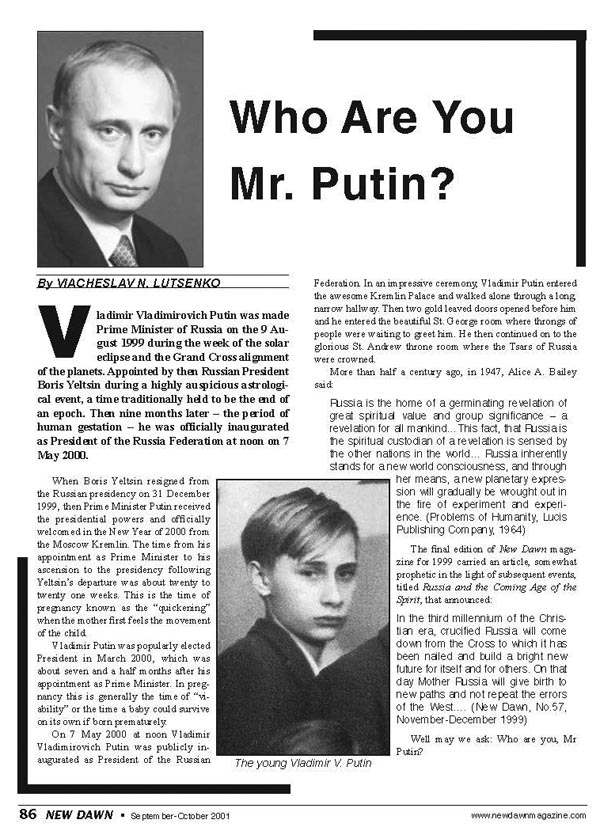
    Vladimir Putin was the subject of an article in the Sept-Oct 2001 issue of New Dawn that prophetically discussed the symbolic significance of his ascension to power and the important role he was destined to play in the future of not only Russia, but the world.

    © New Dawn Magazine and the respective author.
    For our reproduction notice, click here.
  • Men of Mystery: Raymond Abellio & Jean Parvulesco – Their Vision of a New Europe

    Men of Mystery: Raymond Abellio & Jean Parvulesco – Their Vision of a New Europe

    From New Dawn 111 (Nov-Dec 2008)

    Raymond Abellio and Jean Parvulesco are two prominent French esotericists who have visualised and tried to implement a roadmap for what Europe – and the Western world as a whole – should become. It is a future where the real role of the Priory of Sion comes into its own.

    Raymond Abellio claimed that the Flemish occultist S.U. Zanne, pseudonym of Auguste Van de Kerckhove (1838-1923), was amongst the greatest initiates of the modern era. But hardly anyone knows who he is. Some have placed Abellio in the same category – he too is a great unknown for most. And those that have looked at Abellio largely conclude that he was a French fascist politician with an interest in esotericism.

    Was he? Part of the problem is that Abellio’s writings – like that of so many alchemists – need a key. So much of their material is coded text, and Abellio himself used to laugh that most people’s keys “only opened their own doors” – not his. Who was he really, and what were his true political aims?

    Raymond Abellio is the pseudonym of Georges Soulès (1907-1986), who rose to fame in France during World War II when he became the secretary general of the MSR (Mouvement Social Révolutionnaire) in 1942. The invitation to join the organisation had come from none other than Eugène Schueller, owner of the cosmetics giant L’Oréal. As the British researcher Guy Patton, author of Masters of Deception, points out: “This group had evolved out of the sinister Comité Secret d’Action Revolutionaire (CSAR), also known as the Cagoule. Soules was now to become acquainted with Eugène Deloncle, head of the political wing, dedicated to secret, direct, and violent action.”

    Later, Patton adds: “So here we have a Socialist turned Fascist, deeply involved in political movements, who actively collaborated with the Vichy government. In the course of his political activities, he was to work closely with Eugène Deloncle, who […] was closely acquainted with a fellow engineer, François Plantard, and whose niece married [French President François] Mitterrand’s brother, Robert.”

    Though never confirmed, it is claimed that Abellio was involved with Bélisane publishing, founded in 1973. Bélisane published several books on Rennes-le-Château, the village so intimately connected with the Priory of Sion. In his book Arktos, Joscelyn Godwin refers to Raymond Abellio as another ‘Bélisane’ pseudonym. For Guy Patton, Abellio is part of a network that tried to create a New Europe, ruled by a priest-king, whereby various modern myths, like the Priory of Sion, are meant to provide the modern Westerner with a longing of sacred traditions and rule, very much like the myths of King Arthur that gave a surreal dimension to European politics in medieval times.

    Abellio’s political views have therefore been described as very utopian, and he has been suspected of synarchist leanings – the belief that the real leaders of the world are hidden from view, politicians being merely their puppets. But in truth, Abellio had a well-defined vision for social change. When the battle lines of the Cold War were drawn after World War II, he tried to find the best of both camps and hoped he could unite them. Why? To create a type of Eurasian Empire, stretching from the Atlantic to Japan, an idea later taken up by the novelist and theoreticist, his friend Jean Parvulesco.

    French Esotericist Jean Parvulesco

    “Parvu” is largely responsible for acquainting at least some with the visions of Abellio – though whether it was the real Abellio or a character created by Parvulesco remains open to debate. Guy Patton sums up Abellio’s view as being “typical of an extreme right-wing esotericism, the aim of which is to ‘renew the tradition of the West’. He wanted to replace the famous Republican slogan, ‘Liberty, Equality, Fraternity’, with ‘Prayer, War, Work’, to represent a new society built on an absolute hierarchy led by a king-priest.”

    The implication, however, is that several of the people involved were not truly devoted to esoteric spirituality and merely used it as a mask for making money, acquiring more power, and pushing an extreme right wing agenda. Though that is the case for some of those involved, within the mix of powerful and/or money-hungry people most agreed that Abellio was truly a ‘spiritual’ man. And it was Professor Pierre de Combas who is credited with Abellio’s transformation from politician Georges Soulès into the visionary Abellio (the Pyrenean Apollo), making him not merely a “man of power,” but also a “man of knowledge” – an initiate?

    To understand his vision, we need to acknowledge that Abellio’s system, as mentioned, needs a key, and without a key there is no understanding – hence, no doubt, why he is often misunderstood. Secondly, his system is complex and difficult to summarise in a few words and is best described by listing some examples.

    He wanted to “de-occultise” the occult (e.g. his book “The End of Esotericism,” 1973), whereby he hoped this would help science. His knowledge of science – acquired as a polytechnic student – meant that he could build bridges between the two subjects, for example between the 64 hexagrams of the Yi-Ching and 64 codons of DNA, or the correspondences between the numbers of the Hebrew alphabet and the polygons that could be inscribed in a circle.

    The most famous of his works is “The Absolute Structure” (1965) which led to him being regarded as an heir to phenomenological philosopher Husserl. Such topics, of course, hardly make for bestsellers, but are the type of study one expects from a genuine alchemist.

    His drive for an “absolute structure” is a vital ingredient in his idea of the “Assumption of Europe,” i.e. what he sees as the destiny of Europe: “the Occident appears to us not to be only as an interval separating the opposing masses of the East and the West, but is the most advanced carrier of the dialectic of the present time.” Abellio did not believe in the subject-object duality that continues to drive most politicians into fear-mongering and the other usual tactics employed by their ilk, but instead preferred a more complex model, centred on Conscience (the zero point), which evolved along the base towards Quantity (science) and upwards to Quality (knowledge), which gave him a six-armed cross. This is the “hypercubic” cross, to use Salvador Dali’s words, a man who also spoke of the “Assumption of Europe” in some of his paintings. The “hypercubic cross” allowed Abellio to express all ontological and spiritual problems in dynamic terms – and it is clear that he used complex wording, making his thinking difficult to understand, which is no doubt why he is easily misunderstood, was thought to be writing mumbo-jumbo, or simply neglected.

    First of all, to get our heads around his terminology, we need to know that the Bible was one of Abellio’s most often consulted books and he described the stages of the evolution of a civilisation in Christian terms: birth, baptism, communion, etc. This is why he said that the next stage in Europe’s development mimicked Assumption, which is specifically linked with the Virgin Mary – the Saint deemed to play a pivotal part in Europe’s future. She is, of course, a supernatural being who is said to have appeared on numerous occasions to counsel Christian Europe on which direction to take, such as in the politically charged “secrets” of Fatima in 1917.

    In 1947, in his book “Towards a New Form of Prophecy, an essay on the political notion of the sacred and the situation of Lucifer in the modern world,” he notes, “not more than any other being, man is but an addition, a juxtaposition of Spirit and Matter, but an accumulator and an energy transformer, of variable power according to the individual, and capable of passing his energetic quantity from one qualitative level to another, higher, or lower.” Thus, we see a mixture of Christian eschatology, prophecy, as well as Gnostic doctrines on what it is to be truly human.

    The visionary Abellio was also an astrologer. He predicted the fall of the Soviet Union in 1989, as well as the ascent of China. He qualified its Marxism as “Luciferian,” which he did not suggest should be interpreted in a moral sense, but that Chinese materialism had to be integrated in terms of the Absolute Structure, in opposition to the individual and “Satanic” materialism of the United States.

    In the West, it was the task of freedom fighters – terrorists? – to bring about this change. These “heroic” battles were brought to life in his novels. In retrospect, he said that his first three novels were indeed “apprenticeships,” where his heroes evolved, while his final novel – published 24 years after “The Pit of Babel” (1962) – “Motionless Faces” (1986) was for him “that of the companion who is trying to become master.”

    However, many consider “The Pit of Babel” to be his best work and it is here that he plots intellectuals that are disengaged from all forms of ideology and scruples engaging in widespread terrorism. It is a theme he revisited in “Motionless Faces,” where the primary character attempts to poison the population of New York, not by any straightforward means but by using the creation of an illuminated architect who had built a type of “counter-structure” underneath Manhattan, which was reserved for an elite – a type of urban Agarttha.

    The heroine of his last novel is named Helen, also – not coincidentally – the name of the companion of Simon Magus. In the end, she perishes, taken to the centre of the earth by a subterranean stream underneath Manhattan. In the case of the historical Simon Magus, Helen was the personification of Light held prisoner by matter. Abellio specifically chose his name because he identified himself with Apollo, another deity connected with light, and Raymond Abellio’s initials – RA – were of course those of the Egyptian sun god.

    Abellio himself never met his “ultimate woman,” even though he searched for her. She may have been Sunsiaré de Larcone, herself a writer of fantasies as well as a model, who died at the age of 27 in a car crash in 1962. She called herself his disciple. Other equally beautiful women had gone before, and would go after, but no-one was apparently worthy of being “his” woman. Hence, his tomb contains an empty space for his “Lady.”

    It is “Motionless Faces” that Jean Parvulesco studied in detail in his essay, “The Red Sun of Raymond Abellio,” published in 1987. Parvu is a novelist who was both close and far removed from Abellio. Close, because they shared a similar vision of the “Great Eurasian Empire of the End.” He, too, had his initiators, and he saw himself heir to the “Traditional School,” represented by authors such as René Guénon and Julius Evola, whom he met in the 1960s. Parvu was preoccupied with “non-being,” the forces of chaos, which make him into something of a dualist, i.e. a Gnostic. With Evola he shared the idea that there is a need for a final battle against the counter-initiatory and subversive forces (the non-being). Like Evola, he had an interest in Tantrism.

    Parvulesco often uses the term “Polar” in reference to the “polar fraternities” with which Guénon had once associated. He sees these as important instruments in the creation of modern Europe. He also used the term to refer to the Hyperborean origins of the present cycle of humanity, which he argued would soon end with a polar reversal. Here he is close to Guénon, but far from Abellio’s thinking, who had an altogether more optimistic vision of the future. So despite their kinship and a common goal, they were not agreed on how exactly the New Europe would be accomplished.

    Parvulesco has often been cited by extreme right-wing European authors. Some of them have claimed him as one of their own, but it is clear that no single writer is in charge of who and where his name is used.

    In the early 1960s, Parvu was close to the OAS, the “Organisation Armée Secrète,” a terrorist group opposed to Algerian independence from France. This put him in opposition to De Gaulle, yet he is known to have claimed to be a strong supporter of De Gaulle. Incidents such as this make it difficult to place him on the political spectrum, and it’s best simply not to try and put him into one category. Indeed, what sets him and Abellio apart is largely that they had an independent vision of the future – and the role of politics. They realised that the world was radically changing, and though their models might in the end prove not to work or be unrealisable, it does not negate the fact that they were innovative thinkers.

    It is Parvulesco who provides further details as to what this New Europe would be and why, specifically, a priest-king is needed as its ruler. In ancient times, these rulers were primarily seen as a denizen of both worlds, a mediator between this reality and the divine realm. Parvulesco makes it clear that “the beyond” is guiding us towards Europe’s destiny, whereby the role of European leaders is first and foremost to correctly interpret the signs, rather than invent new goals and targets.

    Interdimensional Gateways

    A few constant themes run through Parvu’s writings, one of them being that of gateways to other dimensions. Whenever historical people (most often politicians) make appearances in his novels, they are not the politicians we know but their doubles who evolve in our and another dimension. The novels of Parvulesco are hence often seen as those of the “eternal present,” or the “ninth day.”

    In “Rendez-vous au manoir du Lac,” the setting is a strange site where there is a gateway to heaven – Venus in particular – from where, according to Parvulesco, some chosen ones have to transit. In “En attendant la junction de Vénus,” he repeats this claim, but links it with French president François Mitterrand and specifically the Axe Majeur of Cergy-Pontoise, near Paris. This axis is the creation of artist Dani Karavan and is the “soul” of this new town. It stretches for three kilometres and if ever archaeologists stumbled upon its remains in future centuries, it would be classified as a leyline. Though the project commenced before Mitterrand’s presidency, it was during his term in office that the line became properly defined and executed. Today, it is seen – in France – as an enigmatic work, far superior to the Louvre Pyramid or Arche de la Défense, which has set the likes of Dan Brown and Robert Bauval questioning the reasons behind these projects. The Axe, however, is a far more ambitious, greater and more enigmatic project. When we note that Abellio was closely associated with the Mitterrand family, we can merely ponder whether he had a hand in the project.

    With the Axe Majeure, it is clear that we are in a strange world where politics and esoterica mingle, partly in this dimension and partly in a divine realm. Well, Abellio hoped that from this mixture a new form of politics and a New Europe would arise. And it is here where we need to see the role of the Priory of Sion, not so much – as Dan Brown and others would like it – as the preservers of a sacred, old bloodline, but a new priesthood – a mixture of politician and esotericist, i.e. like Abellio himself – that can rule a New Europe.

    So even though Abellio and Parvulesco are often described as synarchists, they repeatedly referred to themselves as freedom fighters laying the foundation for this New World. The new powerbrokers would not always remain hidden puppet masters, but would clearly one day step to the forefront to take up the role of priest-king. And for such thinkers, it was a given that France had come closest to attaining this ideal under De Gaulle, whereby the “Great Work” of Mitterrand was seen along the same lines, though clearly not to the same extent.

    Abellio and Parvulesco were therefore New Agers building “An Age of Aquarius.” However, they did not focus on personal transformation, but on social transformation. As an author one might argue that Parvulesco operates within the domain of the “esoteric thriller,” which in Hollywood is seen in Roman Polanski’s ‘The Ninth Gate’ or Umberto Eco’s Foucault’s Pendulum. But both works have great difficulty in convincingly integrating the “passage to another world” within their storyline, often leaving the reader/viewer unsatisfied, or – alternatively – unconvinced of the end goal. Lovecraft has a better reputation and others argue that Parvulesco, thanks to the influence of both Abellio and Dominique de Roux, has gone further, and done better. But the main point is that his esoteric thrillers were to make this step through this “interdimensional passage” not as an individual, but as a society – as Europe.

    De Roux (1935-1977) greatly inspired those authors who evoked what is known as “novels of the End” – however they saw the transformation of Europe. Parvulesco actually began his literary career in the magazine Exil published by de Roux. De Roux travelled widely, and in 1974 wrote “The Fifth Empire,” about the struggle for independence in Portugal’s colonies, which brings up the same struggle for a country’s new future. The title “The Fifth Empire” is an allusion to a popular Portuguese myth, namely that of the lost king. Like King Arthur, the Portuguese king Dom Sebastian was said to one day return to lead his people to a fabulous destiny – which, as can be expected in light of Abellio and Parvulesco’s ideology, was not necessarily of this plane. To quote the Portuguese poet and occultist Fernando Pessoa (a friend of Aleister Crowley): “We have already conquered the sea, there only remains for us to conquer the sky and leave the earth for others.”

    Russia, Putin and the New Europe

    What Algeria and De Gaulle had been for Abellio, what Portugal was for De Roux, Putin’s Russia is for Parvulesco. But it is in Abellio’s preface to “The Fifth Empire” that we find an interesting note explaining the true context and “key” that unlocks their works: “Those who attach a profound meaning to coincidences cannot be but stricken by the fact that the last message of Fatima was delivered in October 1917, at the moment when the Bolshevik Revolution began. What subtle link of the invisible history was thus established between the two extremities of Europe?”

    For esotericists who saw our dimension as being infiltrated by the other plane of existence, the coincidences of the apparitions of the Virgin Mary at Fatima and her clearly political messages to do with the future of Russia and how it should embrace the Virgin Mary, are part and parcel of this Great Empire. Not merely a political ambition, but part of their vision as to how “real politicians” work together in league with the “denizens of the otherworld” so as to accomplish the Assumption. Hence why Parvulesco believes Putin’s Russia to be so important. This is why, no doubt, Abellio tried to make contact with the Soviets to enable this New Europe, which indeed has come about largely under Putin’s presidency.

    As mentioned, for British author Guy Patton, Abellio and Parvulesco are French fascists who abused newly created myths like that of the Priory of Sion to increase their influence, power and wealth. But this, of course, is merely one interpretation. Take the literature of the Priory and its creator Pierre Plantard and we discover he was close to De Gaulle’s regime. Plantard in fact ran part of De Gaulle’s “terrorist cells” in Paris when De Gaulle was struggling for power. Then, Plantard used the Priory to create an ideology that saw a unified Europe, from the East to the West, and it is obvious those involved in the promotion of the Priory later spoke of the importance of François Mitterrand.

    The Priory is indeed a fabricated myth, a non-existent secret society. But it is equally clear the individuals involved (Plantard) and those linked to it (Abellio, and to some extent Parvulesco), had genuine convictions of what a future Europe should be. Their interest in Marian apparitions was genuine, and they saw them as divine guides along the path that Europe had to walk to its future and its next stage, its Assumption. As Parvulesco pointed out, it depends whether you believe in coincidences or not. If not, then you will argue the major political events of the past century are but tangentially related to the messages received from these apparitions. If you do believe coincidences have meaning, then it is clear this New Europe is slowly emerging.

    In the 1980s, Parvulesco reviewed a strange novel, “La boucane contre l’Ordre Noir, ou le renversement,” by one “Father Martin,” who had already published “livre des Compagnons secrets. L’enseignement secret du Général de Gaulle.” For an avowed Gaullist, Parvu was obviously in his element. The novel itself has certain common points with one volume of the tetralogy of Robert Chotard, “Le grand test secret de Jules Verne.” Both books speak of a “reserved region” in Canada from where there is a conspiracy directed to change the world’s climate. The base is controlled by the sinister “Black Order” and aims to create a pole reversal – a theme also explored by Jules Verne. We can only wonder whether the stories of HAARP – set in nearby Alaska – might be inspired, or reflective, of this. But it is here that we see the final framework of their political ambition: they saw their quest not so much as a desire, a longing, but as a genuine struggle of good versus evil – if a New Europe did not come, the “Black Order” would have won. And in the end, perhaps Abellio and Parvulesco should thus be seen as modern knights, fighting for Europe – a new Europe.

    The above is connected to this article in the same issue of New Dawn: Vladimir Vladimirovich Putin & the Eurasian Empire of the End Times

    [alert type=”general” dismiss=”no”]This article was published in New Dawn 111.[/alert]

    [alert type=”success” dismiss=”no”]If you appreciate this article, please consider subscribing to help maintain this website.[/alert]

    © New Dawn Magazine and the respective author.
    For our reproduction notice, click here.