New Dawn – World's Most Unusual Magazine

Author: Frank DeMarco

  • Robert Monroe & the Science of Astral Travel

    Robert Monroe & the Science of Astral Travel

    From New Dawn 145 (Jul-Aug 2014)

    For nearly half a century, Robert Monroe has been the “out-of-body” man, the man who took the subject of astral travel out of the realm of religious or occultist dogma and plopped it right in the middle of mainstream America, and eventually the world.

    His books describing his experiences were world-wide best-sellers. But his contribution ranged far beyond writing books. He perfected a technology that made it possible for others to learn to experience altered states at will; invented a stripped-down, de-mystified language to describe these states; and created an institute to conduct residential programs to give people practical experience.

    Nineteen years after his death, his influence continues to spread. Odd, then, how little attention people give to his later conclusions. It isn’t that he recanted, but that he reformulated. And that reformulation moves “out-of-body” from curiosity to entry-point.

    Bob Monroe
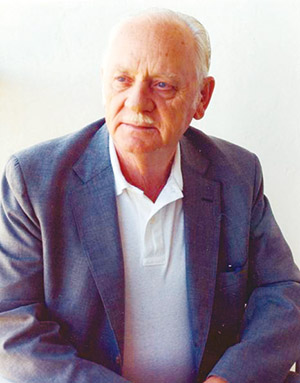
    Bob Monroe (1915–1995)

    Monroe’s capsule biography would read something like this: Born in 1915 into a middle-class, midwestern American family, he dropped out of college, moved to New York, began writing (and eventually selling) radio scripts, became a producer of successful radio shows, married a couple of times and had a daughter, and, by the time he turned 40, was living the life of the well-to-do businessman in suburban New York, a life that included sailing boats and flying airplanes. Then – as we’ll describe shortly – he began having inexplicable out-of-body experiences which grew in importance to him until they came to dominate the last third of his life.

    His first book, Journeys Out of the Body (1971), was his initial, relatively unemotional summary of his experiences. Shortly after the book’s publication, his experiences changed radically, as described in Far Journeys (1985). In the years between the appearance of his first and second books, he began creating ways to help others have the same kinds of experiences. He created Hemi-Sync®, The Monroe Institute, and what we might call Monroe-speak. His third book, his grand summing-up, Ultimate Journey, appeared in 1994, not long before he died on St. Patrick’s Day, 1995. An interesting, successful life. A life that started to become important to the world one Sunday afternoon in 1958, when he was 42 years old.

    Out-of-Body Experience

    As he describes it in his first book, Journeys Out of the Body, he had lain down for a nap when

    …a beam or ray seemed to come out of the sky to the north at about a 30-degree angle from the horizon. It was like being struck by a warm light.… I thought it was sunlight at first, although this was impossible on the north side of the house. The effect when the beam struck my entire body was to cause it to shake violently or ‘vibrate’. I was utterly powerless to move. It was as if I were being held in a vise.

    After a few seconds, he forced himself to move, and the vibrations slowly faded.

    (Oddly enough, few people who write about Monroe’s experiences seem to have noticed this beam that “seemed to come out of the sky.” We will come back to it.)

    That was not an out-of-body experience, but it was the beginning. Although the beam was a one-time thing, the vibrations and the temporary paralysis happened nine more times in the following six weeks. He had a physician friend examine him for physical or mental abnormalities, but the doctor merely suggested he had been working too hard, which was reassuring, but not helpful. If this phenomenon was not a symptom of something going wrong, what was it?

    Remember, this was the 1950s. The concept – the very terminology – of out-of-body travel was unknown to mainstream culture. As he put it in Far Journeys, his early investigations took him

    …beyond conventional scientific circles (total rejection), religions (‘It’s the work of the devil’), parapsychology (‘Interesting. Sorry, no data available’), and Eastern disciplines (‘Come study at our ashram in northern India for ten years’).

    He was on his own. So far as he knew, nobody else had ever experienced what he was going through. But he was stubborn, in his quiet way. As time went on and the experiences persisted, and then deepened, so did his desire to understand what it all meant. He said later that it took a full year and 40 trips out-of-body before he accepted the reality of out-of-body experience.

    So what was he going through?

    Monroe, in Far Journeys, defined an out-of-body experience as

    …a condition where you find yourself outside of your physical body, fully conscious and able to perceive and act as if you were functioning physically – with several exceptions. You can move through space (and time?) slowly or apparently beyond the speed of light. You can observe, participate in events, make wilful decisions based upon what you perceive and do. You can move through physical matter such as walls, steel plates, concrete, earth, oceans, air, even atomic radiation without effort or effect. You can go into an adjoining room without bothering to open the door. You can visit a friend three thousand miles away. You can explore the moon, the solar system, and the galaxy if these interest you. Or – you can enter other reality systems only dimly perceived and theorised by our time/space consciousness.

    But by the time he wrote that he had been doing it for many years. For a long time, all he knew was that he could somehow detach from his physical body, and roam around his bedroom, or around the house or even the neighbourhood. After a while he found that he could think himself elsewhere, apparently regardless of distance. He made some experiments to verify or disprove what he was perceiving, but, as he wrote, after a while such experiments became oddly boring.

    (By the way, it is a common assumption that out-of-body exploration naturally leads to voyeurism, but this mistakes the nature of the experience, which is less like watching a movie than like vivid imagination. The word “imagination” can be misleading: In this case it refers not to fantasy, but to what might be called imagination as a tool of perception.)

    Locale II

    In retrospect, until Journeys Out of the Body was published Monroe’s life had only begun moving into uncharted waters. So that first book’s descriptions are not his last word. For instance, he separated his experiences into Locale I, II, and III. Locale I was physical reality, as we experience it. The realm he called Locale III, I’m not going to discuss here, because I think he came to see this earlier idea as misleading, and the later books make no mention of it.

    Let’s concentrate on Locale II. He called it the natural home of the second body – the part of ourselves that could journey beyond the physical. That body, he said, was very responsive to Locale II, where apparently thought powers everything. He concluded that those who had once lived in the physical world had created what he experienced as solid matter in Locale II, either automatically (because they still thought that way) or deliberately (for pleasure or comfort). Such simulations, he concluded, were also created by higher beings for the benefit of those just emerging from the physical world.

    Locale II was inhabited “by entities with various degrees of intelligence with whom communication is possible.” Monroe said that, “In this vastness lie all of the aspects we attribute to heaven and hell.” And, during these early excursions, he began to learn how to contact the dead, a development that would grow to great importance.

    But if Locale II was real, where was it, and how was it that we could contact it? In Journeys Out of the Body he gave us the key: He said his theory depended on

    the wave-vibration concept, which presumes the existence of an infinity of worlds all operating at different frequencies, one of which is this physical world. Just as various wave frequencies in the electromagnetic spectrum can simultaneously occupy space, with a minimum of interaction, so might the world or worlds of Locale II be interspersed in our physical-matter world. Except for rare or unusual conditions, our ‘natural’ senses and our instruments which are extensions thereof are completely unable to perceive and report this potential. If we consider this premise, the ‘where’ is answered neatly. ‘Where’ is ‘here’.

    In other words, our experience is determined by what we tune into. If our receiver is set only to the here-and-now world, that’s all we will receive. If, accidentally or by training, we start picking up other wave-lengths, we are going to be living at least to some extent in a different world. Something shifted the knob on Monroe’s tuner, and he began to pick up other programs, and then he learned to shift the knob himself. That is the basis of all that followed.

    Meanwhile he was moving from being a lone explorer into an organiser of expeditions, on two fronts. First came the ‘Explorers’, then the ‘Gateway Voyages’ and other residential programs.

    Beyond the Personal

    Journeys Out of the Body, published in 1971, brought him thousands of letters, including “many hundreds” from people writing to thank him for assurance they weren’t crazy. By the time he published Far Journeys in 1985, he was no longer working on his own. He had begun to create what became The Monroe Institute (TMI), he had put together Explorer teams, he had invented the Hemi-Sync technique, and he had begun offering the Gateway program, teaching others to do what the culture at large still didn’t dream possible.

    I often say Monroe gave the world three gifts: a technology, a language, and an environment.

    The technology was hemispheric synchronisation, or Hemi-Sync. Simply put, this consisted of feeding sound of one frequency into one ear, and sound of a somewhat different frequency into the other ear. This forced the two halves of the brain to work together to make sense of the input; it also allowed him to input specific combinations of frequencies to facilitate desired brain states, and hence, it was hoped, mental states. Thousands of hours of experimentation discovered certain particularly useful combinations, which he noted and named.

    And that nomenclature was the second of his gifts, a value-neutral language to use to describe various mental states, so that they could be examined and employed with fewer emotional overtones. He numbered them as Focus 3, 10, 12, 15, and 21 through 27. This stripped-down language became a means of structuring and re-thinking the experience, and quickly became familiar not only to the explorers with whom he discovered and developed them, but to participants in the residential programs he developed.

    These residential programs, with the institute supporting them, are the third part of his legacy, a supportive environment combining individual experience of the various focus levels with group debriefings and interpersonal discussion. Taken together, the three tools helped thousands of people to carry on Monroe’s explorations in their own way, finding their own answers to their own questions. (“I don’t know,” he used to respond when asked to define things. “You go find out and come back and tell me and then we’ll both know.”) But before the residential programs came the Explorers.

    Explorers, Gateway & Beyond

    Before there was an institute, there was a group of unpaid volunteers, drawn by curiosity. Lying on a waterbed in a darkened, silenced room, wired to instruments that were monitored during the entire experience, they received Hemi-Sync signals and other communications from their monitor through headsets, and could speak to the monitor (and a tape recorder) through a microphone.

    In order to help them get into a borderland sleep state, Monroe employed the Frequency Following Response he had discovered. “We could tell easily from the instrument readout when they were and when they were not in Focus 10. It could not be imagined or faked…” Then he inserted higher-frequency beta signals to “enhance perceiving by means other than the five physical senses,” and the subjects began to experience light and colour patterns, voices and music, and “sometimes loud explosions that startled the subject completely out of Focus 10 – something that has still to be explained.”

    Monroe described in Far Journeys how one Explorer, having “developed a very close relationship with what appeared to be some four or five beings, one of whom acted as spokesman,” allowed them to experiment in using her body as a sort of “transmitting set between dimensions.” She let them experiment with talking through her vocal cords, which, after a lapse of about three and a half minutes, they did. And this was the beginning of acquisition of a vast amount of material, from her and from others. As he put it, “the Explorer Material is a combination of fascinating, baffling, awe-inspiring, thought-provoking, sometimes boring data that is certainly much in conflict with many of the belief systems that we have within our culture and civilisation.”

    The Gateway program, initially weekend programs held “at motels, conference centres, and special meeting facilities throughout the United States,” developed into a residential course given from Saturday afternoon to Friday morning at TMI, half an hour south of Charlottesville, Virginia. The program was carefully designed to lead people from normal C1 consciousness to other, less usual, states. It’s all done a little at a time, and the net effect is to dissolve what Monroe called the Fear Barrier and unleash the formidable power of individual curiosity. In Gateway, many people learn for the first time by personal experience that they are more than their physical body.

    Over the years, additional programs were developed, a process that continues today. By my rough count, the Institute currently offers nearly two dozen programs of one kind or another. All use Hemi-Sync or the newly developed Spatial Angle Modulation (SAM) technology, and, in all cases, the group energy is an important part of the process, as it combines irreplaceable first-hand experience with nearly equally valuable second-hand reports of other people’s experience of the same exercise at the same time.

    Later Views

    The biggest changes in Monroe’s life after publication of Journeys Out of the Body were in the nature of his journeys. In 1972 he told himself that rather than his conscious self, his ego, determining what to do while he was out-of-body, “the decision to do is to be made by my entire self.” As he put it, “The presumption I made was that my Greater Self (soul?) always knew what it was doing.” And this brought him from local traffic onto the Interstate – the open highway. From this point on his reports centre on the Second State, the reality beyond the world our senses report, which he had initially described as Locale II.

    In Ultimate Journey he says the Institute, “moved away from seeking materialistic explanations to look at the other end of the spectrum.” They discovered that much of what appeared to him to be out-of-body activity had been explained away as dream activity.

    Most important, the mind-consciousness present in the out-of-body state is significantly different from that in physical wakefulness. Initially, intellectual and analytical focus do not seem to be present, at least not in terms we understand. However, the insertion of physical consciousness changes this. Conversely, the emotional extremes of the symbolic right brain are often totally absent and are usually more difficult to activate.

    As always, Monroe defines a Belief – as opposed to a Known – as anything that cannot be fully understood or identified.

    So it must be said: the Different Overview you are beginning to consider can at most be a belief until you begin to test it for validity within your own ongoing experience during your life as an active Human Mind. As small beliefs convert to Knowns, perhaps larger Different Overview beliefs will follow the same path – until you are free.
    What Does it Mean?

    Monroe’s life is almost a textbook case of a man following where he was led, not dreaming that what seemed simply a personal preoccupation would broaden and meet response and lead his life in an entirely unanticipated direction. He let his total Self drive and open up his life unimaginably. His ideas changed. By the end of his life he was no longer talking about going “out-of-body”; instead he would talk of moving “out-of-phase.” Remember his description of many frequencies operating in the same space, overlapping but not interfering? Remember the analogy of changing the tuning on our radio receiver? By the end of his life, he had concluded that this is what he had been doing. He hadn’t gone “out-of-body” in the sense of leaving an empty shell behind; he had changed his focus of attention – had gone “out-of-phase” with the physical – and then had gotten back into phase to report, and carry on his life.

    Oh, and remember the beam that “seemed to come out of the sky,” which started it all? Years later, I asked my own guidance about it, and was told that right from the beginning Monroe was being put on notice that this was not a strictly material manifestation; that the beam was not necessary to produce the effects, but it did serve to loosen his mental bonds. Perhaps so. That still leaves more questions unanswered than answered, but that seems to be the nature of life.

    From “out-of-body” to “out-of-phase” is a long step, and a productive one. When you realise we are more than our physical bodies; that our consciousness inhabits many worlds at once; that it isn’t a question of leaving your body vacant but of redirecting your attention, you begin to understand that learning to go out-of-body is not the goal, but the doorway.

    [alert type=”general” dismiss=”no”]The Monroe Institute in the United States offers an extensive range of programs and products. Find out more by visiting their website www.monroeinstitute.org, email: info@monroeinstitute.org[/alert]

    [alert type=”general” dismiss=”no”]This article was published in New Dawn 145.[/alert]

    [alert type=”success” dismiss=”no”]If you appreciate this article, please consider subscribing to help maintain this website.[/alert]

    © New Dawn Magazine and the respective author.
    For our reproduction notice, click here.

  • Intuitive Linked Communication: A Practical Way to Connect

    Intuitive Linked Communication: A Practical Way to Connect

    This article was published in New Dawn 146 (Sept-Oct 2014)

    You can communicate with minds on the other side. In fact, you already do, whether or not you know it. It’s just a matter of learning to do so consciously. You already use the necessary techniques. Communication is communication, whether with physical beings or non-physical.

    I have been doing this for more than 25 years. After some fumbling experiments with automatic writing, I learned how to engage in written dialogue, and in the next few years I learned how to get into closer touch with what I now call The Guys Upstairs (TGU). Early in 1993 I allowed them to come through in speech as I held myself in a conscious but altered state, and this led to years of my acting as conduit for them to answer the questions posed by others.

    What I can do, you can learn to do, and I’ll show you how. It isn’t really difficult. Employing this technique correctly, within its limitations, will provide you with information. Once you obtain that information, you have to weigh it, just as you do with information you obtain in other ways. Verification is always going to be an issue. But that merely amounts to saying, don’t check your common sense at the door.

    Intuitive Linked Communication

    I don’t use the word “channelling,” chiefly because it makes the process seem more mysterious, more “special” than it is. So one day I asked the guys for a better way to describe the process we were engaged in, and they came up with Intuitive Linked Communication, or ILC. I like that. It is a good descriptor that doesn’t exalt either the process or those engaged in it. It is simply a method of mind-to-mind communication.

    A little thought will show you that mind-to-mind communication is the same process whether we think of it as telepathy, or access to guidance, or channelling, or after-death communication. In each case, your mind directly contacts another mind. The variable is not the process, but the other mind.

    Telepathy connects you to a mind in another physical body.

    Accessing guidance connects you to minds specifically attuned to yours.

    What is commonly called channelling connects you to minds on the other side that are, by definition, within your range, but are not necessarily specifically attuned to you.

    And after-death communication is nothing but connecting with specific minds on the other side that have had lives on earth.

    You see? What at first seems like four different processes is actually one process, connecting with four different kinds of mind.

    In the past decade my conversations have come to include specific individuals of three types: some of my own “past lives”; deceased people I have known closely, such as my father, a brother, and friends; and historical figures such as Carl Jung and Ernest Hemingway. They seemed to be familiar with anything I knew, even if it was long after their own time. So, Hemingway could talk about Star Trek videos. Lincoln could discuss the 2006 elections. Joseph P. Kennedy could talk about the cover-ups that followed his sons’ assassinations. How could this be?

    TGU say that it is because the mind is subject to the laws of the non-physical world, rather than the physical world, and because all times continue to exist, and because all communication involves the creation of a temporary joint mind.

    Let’s look at those three statements:

    The mind is subject to the laws of the non-physical world, rather than the physical world. The physical and non-physical worlds differ from each other in two main ways.

    In the physical world, we have no way to move our bodies forward or backward in time, but our minds do it all the time, effortlessly. We can no more fall forward into the future than we can fall backward into the past, physically, but in the non-physical world, apparently all times are equally available. This suggests that although the brain is located in the physical world, mind is in the non-physical, because mind obeys non-physical laws.

    The non-physical world does not experience the illusion of separation that we do in the physical. Although our bodies keep even the most ardent of lovers separate, our minds know no such boundary. Everything connects and knows it connects. And this suggests that communication always takes place between minds operating under non-physical conditions, even when you are talking to your neighbour.

    All times continue to exist. Physical-matter 3D reality is divided by time as it is by space, and we necessarily experience ourselves as always balancing on the knife-edge of the present moment, as though the past ceased to exist and the future had not yet come into existence. But from a perspective outside of time-space, either no times exist or all times exist, and the guys say it is the latter. (They also say it isn’t a matter of one past and future, but of many pasts and futures, available for us to choose.) All times continuing to exist within their own frame of reference, communication between minds in different times becomes not only conceivable, but commonplace.

    Communication involves the creation of a temporary joint mind. Especially when communication is not funnelled through the senses, knowing jumps from one mind to another. I have concluded that it is this temporary joint mind, in connection with the fact that all times are equally alive within their own frame of reference, that allows Hemingway to experience Star Trek with me.

    A Working Model of Minds on the Other Side

    Over the course of several days in 2007, TGU discussed the nature of the soul. As they said, “It is from lack of a plausible model more than from any other single thing that the division between seen and unseen world has come to seem so absolute.” I put the entire 5,000-word discussion (and two diagrams) as “A Working Model Of Minds On The Other Side” on my blog, I of my own knowledge… www.hologrambooks.com/hologrambooksblog. Here is the part relevant to communication.

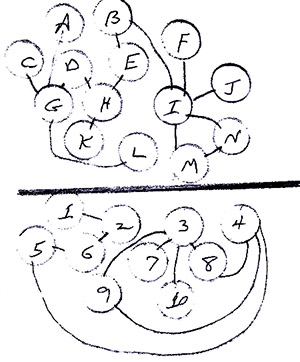
    ‘The Guys Upstairs’ had Frank draw this diagram, a radically simplified look at how minds can connect across time and different worlds.

    TGU had told me that the pattern of mind we create by living survives on the other side, and is available for us to contact. I asked them to spell out what they meant.

    They started by having me draw a diagram, and letter the circles arbitrarily, not implying hierarchy.

    In the diagram the lettered circles represent minds on the non-physical side of life, then there is the dark line representing the “veil between worlds” separating 3-D and non-3-D, and then the numbered circles representing minds in 3-D. The lines between circles are links of affiliation, temperament, etc. that organise the fields.

    This is radically simplified. It takes no account of the multiple overlapping layers of relationship that become more obvious as you look more deeply in time and space. Nonetheless, you can see that things connect not simply and uniformly like single-cell organisms, but complexly like the physical body.

    Suppose A knows chemistry, B psychology, F practical politics, and J is an artist. Perhaps A connects to G because one is parent and the other is child. Perhaps G in turn connects to C, D and L by profession, affection, and kinship respectively. (And here you see the tip of the iceberg of complexity: if G is kin to A and L, L is in some way kin to A as well as G.)

    Now if 3, say, inquires about chemistry, he may need to talk to A. If they are not close enough in wavelength that it may be done directly, then, either silently and unobserved by 3, or openly and described to 3 (as a “control,” say), 3 gets linked to A by whatever route serves. So it may be that 3 can link to I, a good networker. The chain may have to go like this: 3 -> I -> B -> E -> H -> D -> G -> A and back! But as soon as 3 and A have once linked up, they will have established a direct link. In future exchanges, 3 could then perhaps go by way of A (silently or explicitly) to reach G, and any that connect via G, by a shorter or more direct route. Thus the network is ever changing.

    (Remember, explanations are analogies that try to explain the unfamiliar by comparing it to the nearest similar thing. You could say that the colour orange is “like” red, and also “like” yellow, but the statement would be incomprehensible to those who have experienced red and yellow until they have also experienced orange. Thus, the circles in the diagram are not units but are complex meeting-points, different parts of which may come into play in different circumstances.)

    The difference between the nature of the physical and nonphysical world makes us as valuable to the other side as it can be to us. The ability to form ever more complex relationships is central to the universe (to physical and nonphysical reality considered as one). And – since we are in contact with the part of the universe that is outside of time, in which all moments of time exist equally – we may contact all the past, all the future, anyone and everyone in the physical or nonphysical part of the world. So what can’t we reach? The key is to redefine ourselves, redefine the world, so as to disable the thought systems that persuade us that it is not possible. It is that simple, that easy, that overwhelmingly powerful. But it can only be done one by one.

    Practicing ILC

    It’s much like talking on the telephone. When you go to use the phone, you don’t ask permission, or engage in elaborate rituals, or wonder if the phone really exists or if you are worthy to use it. You just take it for granted and talk! This isn’t all that different. Here’s the process, step by step.

    1. Form a question or have in mind something you want to discuss. Until you are entirely comfortable with the process, don’t ask life-or-death questions, don’t ask about your health, and don’t ask your source to predict the future. I’ll explain why, below.
    2. Write the question down. Not only does the process of phrasing the question focus the mind, it provides a record of what you ask, to remind you later what your starting-point was.
    3. Get in a quiet, receptive mental space, and wait. Be open to whatever comes. You may get words, or general ideas, or “knowings,” or what seem like stray thoughts out of nowhere.
    4. Whatever comes, write down whatever will help you to remember what you got. Don’t judge the information’s relevance or accuracy at this point, just receive it as best you can.
    5. Ask follow-up questions as they occur to you, and again be open to whatever comes. Continue until the process dries up.
    6. While you’re still in the process, don’t judge what you’re getting. The payoff will come later, when you re-examine what you got and find yourself saying, “holy cow, where did that come from?”
    7. After you are back in a more or less normal mental state, take another look at what you received, in light of the question you started with, which you wrote down. See what you can make of it. Don’t treat it as gospel, and don’t dismiss it as fantasy. Treat it at least as seriously as you would if you were interpreting a dream.

    That’s all there is to it.

    “What? That’s it? That’s all there is?”

    Well, there’s always practice, practice, practice, but yes, that’s all there is. Let’s look at the process.

    The Process and the Information

    It is critically important to bear in mind the two-stroke way the mind processes information. First it perceives, then it interprets what it perceived. These are complementary functions, both necessary, but they function alternately. While you are in the process of perceiving, you can’t be interpreting. While interpreting, you can’t be receiving. Eliminating either function, or cutting either one short, distorts the results. Indeed, it may prevent you from acquiring anything at all.

    Ideally, while perceiving, we function as temporary know-it-alls, accepting without question anything we receive. While perceiving, we don’t judge. Remember, as soon as you start interpreting, and for as long as you continue interpreting, you have ceased perceiving. Perceive first. Interpret later. It’s the only way it can be done. Don’t let that left-brain logic machine prevent you from perceiving. But then, after you have perceived, it’s the interpreter’s moment. The process of analysis is just as important as the process of perception – but each in its own time.

    In your analysis, there are two useless worries that you might as well dismiss immediately: Is it true, and who or what is the source?

    1) Is it true? It’s natural to ask this question because we don’t want to be fooling ourselves. But ask yourself, how do you know what’s true in the rest of your life? I think it comes down to two things. Either it resonates (feels true) or doesn’t, and it either is supported by whatever data we have, or it isn’t. I don’t know any other tests we can employ, either in ordinary communication or in Intuitive Linked Communication. As with the rest of life, you don’t take it for Gospel, and you don’t refuse to even look at it. You use your judgment.

    2) Who or what is the source? This is another good and natural question. But again, ask yourself, what is the source of your dreams? Your intuitions? Your inexplicable certainties? What is the source of your thoughts or ideas? Ultimately, it’s all a mystery. I don’t know of anything to do other than to follow the advice Jesus gave long ago, to judge things by the fruits they bear.

    Obstacles

    Herewith, a list of obstacles that may present themselves in your practice of ILC. Overcome these, and you’re good to go. Merely being aware of them is more than half the battle.

    • False expectations. Don’t prejudge how the information is going to come. I have had it come in so many ways: visuals or ideas that I have had to interpret; words that arise within me, that I speak without trying to shape or edit them; knowings; hunches; urges; vague impressions. What I get doesn’t always “make sense” – that is, it can’t always be immediately understood or interpreted.
    • Fear of what you might encounter. Set your intention to contact only those beings who have your highest good at heart. The intention itself will protect you.
    • Stepping on the hose. If you ask questions that raise too much anxiety, your own anxiety about the answer may prevent you from getting anything. That’s why, earlier, I said you shouldn’t start off asking life-or-death questions.
    • Keeping score. It doesn’t matter when you “get it.” There are no prizes for finishing first. Inventor Thomas Edison used the trial-and-error method with great success, and regarded failures as steps to ultimate success. Don’t discourage yourself by your expectations.
    • Illusion of separation or of distance. If we were really separate, connecting would involve overcoming some obstacle. But distance is not involved in non-physical communication, and the way to overcome the illusion of separation is to practice empathy, such as that which connects mothers and their new-born children.
    • Ego, too large or too small. Succeeding at ILC is no big deal. Don’t let your ego swell because you succeed. It is, after all, a universal human ability. Why get puffed up because you learned what somebody taught you? At the other extreme, you don’t need to be “special” to do it.
    • “I can’t do it.” There’s no harm in trying. If at first you get no results, pretend, if necessary to get started. Answer the question as if you really had someone on the line. Often this will quickly segue into the real thing, and when it does you will know the difference. The only thing is, if you use this method to prime the pump, remember that you did. Even at best, you might sometimes fool yourself inadvertently. Don’t do it deliberately or from carelessness.
    • “I don’t want someone reading my mind!” This fear of people overhearing what we’re thinking is a misunderstanding of what’s going on. You aren’t reading, or overhearing, or collecting data. As I said earlier, it’s closer to active empathy.
    • Finally, two complementary errors that stem from ignoring the necessarily complementary nature of this form of communication. If you neglect the process of analysis, you may fall into what I call Psychic’s Disease. If you neglect perception, the pitfall might be called Over-Rationalism.
    • Psychic’s Disease: Beware of thinking that if you feel it strongly, it must be true. Trust, but verify.
    • Over-Rationalism: Equally, beware of the reaction that says, “I don’t have a logical reason for what I just perceived, so it must be false and needn’t even be examined.”

    Problems Arising

    As you can imagine, a world in which we all knew we could extend our awareness to the other side would be a very different place. Will be a very different place, I hope. But it won’t come without problems, and here’s a few that come to mind.

    What do you do about the information people bring back? How are we to judge? They aren’t right just because they’re sure they’re right; they aren’t wrong just because we’re sure they’re wrong.

    Of course there are going to be the fakers, the hoaxers. One more reason to keep our faculties of discernment polished.

    And there are those with Psychic’s Disease, sincere but unbalanced in their belief and perhaps their need to believe.

    And the pretentious, who will claim false authority, speaking as if delegated by the person they are convinced they spoke to. They may be sincere, but they also may be motivated at least partially by the need to bolster their own importance. I spent many months discussing Hemingway’s life and work with him. Can I claim to be his authorised spokesman? I don’t think so. I connected with those aspects of Hemingway for which I had resonance – the writer, the romantic, the family man, political observer, above all – but I know nothing of other sides of him, for instance the hunter, the warrior, the fisherman, the celebrity, the prodigious consumer of alcohol. I would doubt anyone claiming to encompass all aspects of anyone they connect to, no matter how strongly they feel. Nonetheless, this is a problem that’s going to grow with time, I suspect, as the practice of ILC widens.

    Still, if ILC is a real ability (and I am convinced it is), we have to decide how to deal with its down side. I don’t see that we can do more than we do in the rest of life: use our judgment, look at the person’s track record and general air of reliability, and preserve a cautious scepticism.

    Another problem, at an entirely different level. Once we know that we can contact the dead, do we have obligations to do so? If we know we can help them (and sometimes we can), how far does our implicit obligation extend? Does it exist at all? What are the ground rules? Probably we’re going to have to make them up (or discover them) as we go.

    Get this issue this article appeared in

    Conclusion

    We already extend beyond time/space. Because we do, it is easy to get information from the part of ourselves that is already on the other side, and easy for that part of us to get information from others. In fact, many people have learned to do it almost without noticing because they were focused on other goals.

    Some who read this will hear an inner voice saying “yes, that’s the way it is; this actually can be done, though it may require practice.” Just listening to the voice helps break the logjam. Making your own attempts helps more. Overcoming your own scepticism and making the effort to not negate results by declaring that you made it all up helps even more.

    Working with friends is another step. Coming out into the open about your experiments and your experiences adds vastly to the effect. Every attempt – even if made in silence in a darkened room on an island without telephones, so to speak – adds its weight to the scales. And so it goes, as each one pioneers as best he or she can. You can do this, and you will find it well worth doing.

    [alert type=”general” dismiss=”no”]This article was published in New Dawn 146.[/alert]

    [alert type=”success” dismiss=”no”]If you appreciate this article, please consider subscribing to help maintain this website.[/alert]

    © New Dawn Magazine and the respective author.
    For our reproduction notice, click here.