New Dawn – World's Most Unusual Magazine

Author: Frank Joseph

  • Earth Versus the Flying Saucers

    Earth Versus the Flying Saucers

    From New Dawn Special Issue Vol 13 No 1 (Jan 2019)

    Earth’s armed forces have more or less continuously engaged intruders from outer space since 1916 to the present day. Although losses of equipment and even lives have occurred on both sides, humans are still at a distinct technological disadvantage. 

    Military Encounters with Extraterrestrials (Bear and Company, 2018) chronicles this unfinished, undeclared, unofficial, mostly unknown conflict from the UFO destruction of munitions factories across the United States, just before that country’s participation in World War One, to the current struggle for Syria, where rebel army commanders tell of alien craft “hunting down and systematically targeting innocent locals, using unknown, weaponised technology not of this Earth, or anything our fighters have ever seen.”1 

    How and why did this covert, if real, War of the Worlds come about? Prior to the early 20th century, sightings of off-world vehicles were sometimes documented in official records or depicted in visual artwork preceding the Bronze Age and Classical Epoch, throughout the Medieval Period and Renaissance, into the Industrial Era. It was only after early heavier-than-air technology developed sufficiently to drop high explosives from altitude that a perceptible shift in humanity’s relationship with extraterrestrials occurred. If they had been content to monitor our cultural growth during the millennia leading up to that lethal innovation, its actual deployment as a killing machine convinced them that intervention was necessary. 

    The first, purpose-built aircraft of its type – a spindly Bristol T.B.8, powered by a single, 60 kW radial engine to 105 km/h, carrying a dozen 4.5 kg bombs over 470 kilometers – made for a crude beginning. But its appearance in the first weeks of World War One was enough for anyone with an objectively broad perspective of human progress to extrapolate today’s ‘stealth’ bomber, armed with thermonuclear warheads, from the operational debut of its biplane forerunner, after little more than one hundred years, a mere blink of the eye in human history. 

    The next, self-evident step – creation of a “United States Space Force” – was taken just last year. Given the accelerating pace of scientific advancement, another hundred years will extend human reach beyond the solar system, with proportionate improvements in fire-power. Alien intelligence might view with indifference whether or not we continue to effectively kill each other in ever more destructive wars, confined as we are to a single planet. However, the inevitable expansion of our bellicose species’ potential for the conquest of outer space cannot be welcome news for non-humans elsewhere. Quite the contrary, it can only be regarded by them as nothing less than an armed invasion. Hence, extraterrestrial interest in and even interference with Earth’s military affairs.

    Inter-Planetary Hostilities in 2018

    Because Military Encounters with Extraterrestrials went into production some eleven months ago, its history necessarily ends in late 2017. The inter-planetary hostilities it documents, however, are on-going, and spilled over into 2018. Accordingly, it was filled with the kind of armed forces’ engagements that characterised this continuous conflict since its inception, throughout the last one hundred and three years. 

    2018’s first sighting of its kind was caught on video during the late afternoon of February 26. The footage clearly shows a pair of white, luminous spheres hovering low (circa thirty meters) over the Royal Navy base at Plymouth, England. One of them in the foreground gradually vanishes, then shortly thereafter rematerialises, as though phasing in and out of another dimension or time.2 
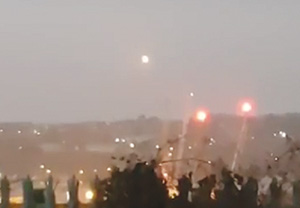
    A pair of white, luminous spheres hovering low over the Royal Navy base at Plymouth, England, on 26 February 2018.

    That same night, at 19:45 hours, on the other side of the Northern Hemisphere, a trio of United States Air Force fighter jets repeatedly circled the American town of De Soto, near the east bank of the Mississippi River, in southwestern Wisconsin, before flying off in a northerly direction. Immediately following their disappearance, blue, star-like lights were observed moving “very fast across the sky with absolutely no sound.”3 

    A few days later, two USAF fighters engaged a smaller, triangular object in apparent combat over Lincoln County, Nevada, a desert area that includes the notorious Area 51, a semi-secret US Air Force base located less than one hundred thirty kilometres from Las Vegas, and allegedly involved in reverse engineering crashed alien spacecraft. According to observer Tim Doyle, “it definitely looked as though the three crafts were interacting with each other.” He “believed the trio were involved in a plane dogfight.”4 
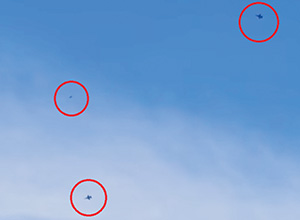
    Two USAF fighters engaged a smaller, triangular object in apparent combat over Lincoln County, Nevada.

    On March 3, two USAF A-10 jets were sighted in low-level close pursuit of a “darker and smaller object” over the Indiana town of LaGrange, two hundred twenty-five kilometres east of Chicago.5 The Fairchild Republic A-10 Thunderbolt II carries a single, 30 mm GAU-8/A Avenger rotary cannon with 1,174 rounds, plus a couple of AIM-9 Sidewinder, air-to-air missiles. 

    On the night of the 21st, military helicopter gunships chased an unspecified number of “bright lights” over Fayetteville, North Carolina, home of the US Army’s Fort Bragg, the largest military installation in the world (by population) with more than fifty thousand active duty personnel.6 Some of them are veterans of the fighting for Afghanistan, where UFOs have been sighted since American involvement began in 2001. During late March, three luminous objects were video recorded in stationary position over a US Army base near Surobi.7 

    At 03:43, in the early morning of April 23rd, an observer was “looking northeast to Nellis Air Force Base, which is about nine kilometres from my location [North Las Vegas, Nevada]. A singular white light appears heading in my direction,” he reported to the National UFO Reporting Center, in Davenport, Washington. “The light was as bright as Jupiter, as if I was staring at a plane with headlights turned on. Then the light dimmed and starting moving southeast; the dimmed light didn’t look like any flight-related lights I’ve seen, and it didn’t have a pattern in its blinking; it looked as if it was twinkling due to it being a heat source, or due to the atmosphere, but it was definitely not a pattern typical of airplanes. There also was no sound of any kind that I would have heard in a quiet night. A helicopter sound would have been a dead giveaway, and I also checked on my smart-phone for nearby planes to see what it was, and nothing showed up for that portion of the sky… The appearance and behaviour of this object tells me it was unknown.”8

    Just ten days later, Nellis Air Force Base was again the location for another altogether different sighting by multiple eyewitnesses who reported seeing the military installation being surveilled by a diamond-shaped craft “with six to nine oval objects around it. The diamond was very large, and looked like it was on fire, like vapor around it.” The diamond shape and its accompanying orbs “hovered for twenty to thirty minutes. No airplanes in sky, and that is not common here.”9 
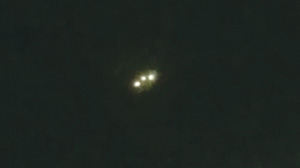
    Photo of a mysterious orange-yellow light snapped by a serviceman at Holloman Air Force Base.

    During the early evening of May 8, a serviceman at Holloman Air Force Base, in New Mexico, was “driving home from work on base, and casually glanced to my right (south) and noticed two, orange-yellow lights floating and casting a lot of light on the ground between two and eleven kilometres away. I pulled over to look closer, and as I was recording with my phone, when a third appeared in a triangle formation with the other two. They did not appear to move or fall. I heard no audible noise. I know they were not flares from anything, because they were stationary, and the only thing in the direction where I was looking was open desert. Nor were they aircraft. After I observed for around five minutes, they all just disappeared within quick succession.”10 

    On the afternoon of May 29, Lucas Budel video documented a highly unusual, unidentified flying object alternately diving and climbing over High Wycombe, Buckinghamshire, northwest of London. The pale, white craft streamed wisps of cloud-like vapours in its strange undulations across the sky of his home town, which is not only the present location for Headquarters Air Command, but site of a former RAF base “which used to investigate UFO sightings.”11

    Around 22:12, June 7, two low-flying helicopters were seen closely pursuing a brightly illuminated orange sphere over Rye, New Hampshire. Another military chopper was observed hard on the heels of a smaller, metallic object above Harford County, Maryland on June 13.12 

    Reporting for the Mutual UFO Network, Roger Marsh told how a man and his wife “were setting up a telescope in a local park on a full moon at 11:15 p.m.” on the night of June 28, in Buckeye, Arizona. “Before the telescope was fully set up,” the husband testified, “a vertically-aligned, donut-ringed object with yellow-orange light/surface appeared below the moon, travelling from southeast to northwest at extremely high velocity and low altitude, roughly one hundred fifty to three hundred meters AGL [above ground level]. The object made absolutely no sound, but at closest approach was within one kilometre of our vantage point/location. The witness is a United States Air Force veteran and Special Operations intelligence analyst who previously held a top-secret with caveats clearance.”13 

    On June 29, a “cigar-like shape with no wings” was observed from Belmar, on the New Jersey coast, around 15:00, “moving north-northeast over the ocean at high altitude. A couple minutes later, two fighter jets came from the west and circled back out over ocean.”14 Another cigar-shaped object, bright and silvery, was spotted “moving across the sky from west to east,” according to one eyewitness, around 08:00, July 2, over Bennett Springs, Missouri. “Approximately fifteen minutes later, four stealth bombers flew in the same direction” from Whiteman Air Force Base, located 150 kilometres north, outside the town of Knob Noster, where the 509th Bomb Wing operates Northrop Grumman B-2 Spirit stealth bombers.15 

    On July 11, several helicopters were observed from the town of Warrington, eleven kilometres north, pursuing a large exceptionally bright object hovering near the Naval Air Station Joint Reserve Base Willow Grove, Pennsylvania. The UFO changed it shape from oval to triangle, before vanishing after 22:00, reappearing in the same position about four hours later.16 July 15, an eyewitness sitting in his Virginia Beach, Virginia patio, around 16:00, “saw a large, brownish, rectangular object flying nonchalantly by… for about two to three minutes”, before it “went straight off into a southeasterly direction.”17 Virginia Beach is home to both the Naval Air Station Oceana and Fleet Area Control and Surveillance Facility. 

    Nuclear Blast over Thule Air Base

    The premiere extraterrestrial event of not only 2018, but of the last five years, took place when a nuclear blast detonated over one of America’s most important military installations. Early warning radar at Greenland’s Thule Air Base detected an in-coming meteor of substantial size, but commanders there were not afforded even enough time to sound a general alarm, given the object’s Mach 74 rate of descent. That’s 24.4 kilometres per second, or 86,905-kph. It exploded with 2.1 kilotons of force, equal to 2,100 tons of TNT, sufficient to have obliterated the Thule Air Base with a direct hit or at an altitude lower than the 43.3-kilometre air burst of July 25, just five minutes before midnight. It was the largest since a 400-kiloton superbolide blew up over Chelyabinsk, in 2013. 
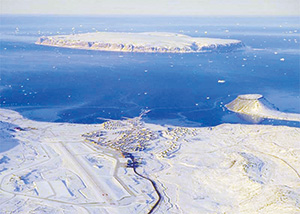
    Aerial picture of Thule Air Base, 2005.

    While that Russian event seems to have been an entirely natural affair, the same could not be said for last year’s Greenland incident.Thule Air Base is the United States Air Force’s northernmost base, located 1,207 km north of the Arctic Circle and 1,524 km from the North Pole. It is home to the 21st Space Wing’s global network of sensors providing missile warning, space surveillance and space control to North American Aerospace Defense Command (NORAD) and Air Force Space Command. The base hosts the 12th Space Warning Squadron, which operates a Ballistic Missile Early Warning System, designed to detect and track ICBMs launched against North America. 

    Thule is also host to Detachment 1 of the 23rd Space Operations Squadron, part of the 50th Space Wing’s global satellite control network. As such, it is the ideal target for a preemptive strike aimed at crippling America’s nuclear-armed missile capabilities, or alternatively, a cautionary message. “Was it a UFO-directed meteor strike fired as warning shot across the bows of the USAF base,” asked Miami Herald reporter, John Bennett, “urging humans to disarm their nuclear weapons?” 

    If so, it would not have been the first time such a dramatic exhortation arrived on Earth, as documented in Military Encounters with Extraterrestrials. US Air Force reaction itself lends some credibility to such a conclusion. One might imagine that a thermonuclear blast narrowly missing one of the foremost military installations in the world would have merited abundant cause for international publicity. Yet, commanders at the Thule Air Base kept classified the story until it was first reported by Australian news media, five days later. Even then, and since, the event has received scant attention. One wonders why? “An answer may lie in another question,” Bennett writes: “Were there any reported UFO sightings before, after or in any conjunction with the recent Greenland event?” 

    That question is more easily answered by numerous, visual encounters documented in the United States alone on July 25. Simultaneous, widely separated sightings occurred at 01:00 in Snohomish, Washington, where a triangular UFO with three lights at its corners was spotted, and, 2,630 kilometres away, two unusual lights, one of them brightly blinking, hovered over Isle, Minnesota. A silvery disk trailing a “long flame, travelling from west to southeast” over Tarzana, California was observed at 05:05.

    Multiple witnesses in different areas of Florida’s St. George Island told how, at 21:30, “a circular, red object appeared, seemingly out of nowhere, and held its position for approximately twenty to thirty seconds, then faded out of sight completely. It was an opaque red, with an orangeish halo effect… About ten minutes later, two separate ones appeared with one about fifteen to twenty degrees off the horizon… One red light appeared, while the other two appeared in approximately the same area and degree of the first sighting. But what made this even more fascinating was that this last one actually started with one red light, then added another red light, and then another. For a total of three red lights seeming to be on one object, slightly angled. And then all five lights in the sky vanished.” Half an hour later, “several strange yellow orbs hovered over the Puget Sound,” near Gig Harbor, Washington.18 

    As some ten persons attending an August 14 party at Myrtle Beach, South Carolina watched half a dozen jets flying overhead, they noticed a circular, metallic object – “smooth, with no other design” – moving in the opposite direction from the fighters. As one of them turned toward the UFO, it flew “away at an incredible speed”19 The state’s Air National Guard is headquartered one hundred airline-miles to the west, in Columbia. 
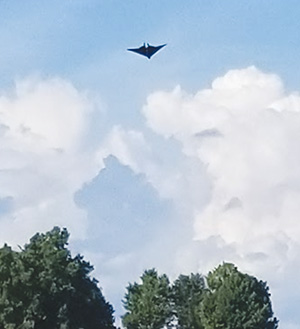
    The unusual UFO encountered by a father and his son at a drill site in Perrysville, Ohio, on September 3, 2018.

    A father and his son photographing a drill site in Perrysville, Ohio, encountered an unusual UFO on September 3. “It looked just like a sting ray, and was all black. My dad is a private pilot and former Army, and I am retired from the Marine Corps, and we both have never seen a delta-shaped craft like this. We also did not hear a jet engine or anything to indicate a craft was nearby. My dad has reached out to other pilots to help identify, without any help.”20 Flying slowly at five hundred feet altitude or less, the triangular object ran front-to-back down its centre line with a slender, pointed fuselage. A pair of bulbous features protruded from the wing’s trailing edge, surmounted by two, vertical struts, the right one bent about fifteen degrees inward. The object “was heading towards the Mansfield Lahm Air National Guard Base, in the nearby city of Mansfield, where the 179th Airlift Wing (179 AW) unit is stationed.”21 

    September 19, at 06:19, a woman “went to the kitchen, and from my patio doors saw two, pulsating, strobe-like lights in the eastern sky. The lights flashed red and white, and were above the tree line. The lights came closer, growing in size, and hovered side by side. The one on the left moved away from the other light, and the lights of both objects pulsed faster and brighter. Then the light on the right went to the East, and [I] watched until it was out of sight. The other light went south, and was observed to move fast across the sky until it was out of sight. Neither one diverted from its path; in other words, they moved straight in a path.” The lights “were too large and too bright to be airplane lights, and moved much faster.”22 The sighting took place at the Illinois town of Belleville, home of Scott Air Force Base, one of America’s most important military installations, where a Unified Combatant Command coordinates transportation for all US services. 

    Several persons in Newberry, Arkansas witnessed “a large metallic cylinder” travelling at sixty meters altitude, between 130 and 190 kmh, on September 23. About ten minutes after the UFO disappeared, seven fighter jets flew in its direction in two-to-three-minute intervals.23 Newberry is located between Little Rock Air Force Base to the south, the Ebbing Air National Guard Base, 188th Wing, in the west, and Blytheville Air Force Base, to the north. 

    At 22:05, October 2, a crewman on the flight deck of USS Tripoli (LHA-7) observed a UFO while his 45,693-ton amphibious assault ship was berthed at the Pascagoula, Mississippi shipyard. The object “clearly was in the shape of a triangle with two, distinct, red lights at the bottom… It was flying too fast, as if it were breaking the sound barrier, without sound… As it got closer, you could clearly see the underbody of the craft. It had white lines going across the bottom connected to the red lights that I had seen.”24 The USS Tripoli specialises in electronic warfare at sea. 

    When a formation of “military helicopters chasing an unidentified flying object” passed over Surrey Park, Phoenix, Arizona, lower than one hundred fifty meters, “windows shook, doors rattled,” during the early morning hours of November 13. “Felt like an earthquake.”25 Headquartered in Phoenix, the Arizona Air National Guard is equipped with Sikorsky UH-60 Black Hawk helicopters. 

    A pair of RAF Typhoon interceptors “were scrambled in response to unidentified aircraft approaching the United Kingdom… the fighter jets took off from Losimos on Monday [December 10] under a quick response alert mission that was undertaken as a precautionary measure to an unknown aircraft or aircraft [plural] approaching UK airspace. No intercept took place, and the jets later returned to base in Moray, northeastern Scotland.” The Eurofighter Typhoon is a twin-engine, canard–delta wing, multi-role fighter, with a maximum speed of Mach 2, or 2,495 km/h, at a service ceiling of 19,812 meters. Despite these impressive performance statistics, the interceptors were apparently out-run by the “unknown aircraft or aircraft.”26 
    UFO Delays Rocket Launch: Another Cover-up
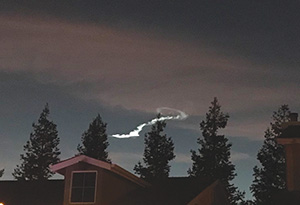
    The “mysterious light” that cancelled the Vandenberg heavy rocket lift-off. This photo reveals the perfect circle that appeared in the sky which was put down to being a “noctilucent cloud.”

    On December 19, the CBS Sacramento website headlined, “Mysterious Light Appears In The Sky After Rocket Launch Canceled At Vandenberg Air Force Base.” The article refers to an incident seven days earlier when “the scheduled 5:44 p.m. launch of the Delta IV Heavy Rocket in Southern California was scrubbed, or cancelled, leaving many wondering what was in the sky. A representative from Vandenberg Air Force Base had no information about the sight in the sky. Travis Air Force Base also did not have information on the light, but the National Weather Service believed it may have been a meteor. There has not been an official confirmation of what caused the light, but multiple National Weather Service accounts have speculated that it was from a meteor or meteorite. The National Weather Service Bay Area is calling this a Noctilucent cloud, a cloud that can be formed from a meteor or space debris entering the upper atmosphere.”27 

    These academic presumptions are contradicted, however, by numerous photographs and videos of the phenomenon which defined a perfect circle in the evening sky, unlike meteors or falling space junk which trace more or less straight lines in their descent.28 Was the appearance of this uniquely “Mysterious Light” and scrubbing the Vandenberg lift-off entirely coincidental? What are the odds for that? 

    Given numerous instances over the decades of missile launches aborted and even destroyed by UFOs, the Delta IV Heavy Rocket launch appears to have been cancelled by something more significant than a “Noctilucent cloud.”

    Frank Joseph’s Military Encounters with Extraterrestrials is the first, comprehensive military history of armed confrontations between humans and extraterrestrials. It can be ordered from all good bookstores and online sellers.

    [alert type=”general” dismiss=”no”]This article was published in New Dawn Special Issue Vol 13 No 1.[/alert]

    [alert type=”success” dismiss=”no”]If you appreciate this article, please consider subscribing to help maintain this website.[/alert]

    Footnotes

    1. Ken Oz, www.altheadlines.com/syria-large-ufo-sighting-8-28-13-13250773
    2. www.latest-ufo-sightings.net/2018/03/ufo-naval-base-plymouth-uk-february-2018.html
    3. www.nuforc.org/webreports/ndxe201802.html
    4. www.latest-ufo-sightings.net/2018/03/us-fighter-jets-ufo-apparently-dogfight-lincoln-county-nevada.html
    5. www.nuforc.org/webreports/ndxe201803.html
    6. www.nuforc.org/webreports/ndxe201802.html
    7. www.latest-ufo-sightings.net/2018/03/strange-lights-filmed-over-afghanistan.html
    8. www.nuforc.org/webreports/ndxe201804.html 
    9. www.nuforc.org/webreports/ndxe201805.html 
    10. www.latest-ufo-sightings.net/2018/05/amazing-triangle-ufo-sighting-over-holloman-air-force-base-new-mexico-8-may-2018.html
    11. Shocking moment ‘UFO’ spotted hovering near High Wycombe RAF base, www.youtube.com/watch?v=Frk1HzYRHJA 
    12. UFO Seen in Maryland, www.youtube.com/watch?v=zsvkpGNqb9I
    13. www.mufon.com/ufo-news, Case 93454
    14. www.nuforc.org/webreports/142/S142227.html
    15. www.nuforc.org/webreports/142/S142049.html 
    16. www.nuforc.org/webreports/ndxp180713.html
    17. www.nuforc.org/webreports/ndxe201807.html
    18. www.nuforc.org/webreports/ndxe201807.html
    19. www.nuforc.org/webreports/ndxe201808.html
    20. www.ufostalker.com/sighting/95977
    21. www.mysteriousuniverse.org/2018/10/triangular-ufo-spotted-near-site-of-famous-military-ufo-chase-in-ohio 
    22. www.nuforc.org/webreports/ndxe201809.html
    23. www.nuforc.org/webreports/ndxe201809.html
    24. www.nuforc.org/webreports/143/S143350.html
    25. www.youtube.com/watch?v=-w2rYbT-gV0
    26. Jets Scrambled to Intercept “Unknown Craft” Over UK, www.youtube.com/watch?v=nCOps9VwIfE
    27. sacramento.cbslocal.com/2018/12/19/did-you-see-the-bright-light-in-the-sky
    28. Mysterious Cloud Trail Over California Was A Meteor Trail, www.youtube.com/watch?v=oiNPYwtUYMo

    © New Dawn Magazine and the respective author.
    For our reproduction notice, click here.

  • America Before: The Key to Earth’s Lost Civilisation

    America Before: The Key to Earth’s Lost Civilisation

    From New Dawn 175 (Jul-Aug 2019)

    Humans were in America long before we’ve been told, and the Australian Aborigines have a genetic connection to the Amazon which once had great cities. FRANK JOSEPH looks at the fresh discoveries in Graham Hancock’s latest book.

    As the former editor-in-chief (1993 to 2007) and ongoing writer for Ancient American – a US magazine examining Old World impact on the New World before 1492 – recently released materials regarding pre-Columbian possibilities often come my way. I was surprised, however, to find that Graham Hancock’s latest tome, America Before, compares remarkably with Before Atlantis (2013), my own book, published six years earlier, in more than title. 

    Both works go into the Bering land-bridge Theory, megalithic alignments with the Cygnus constellation, Easter Island’s moai, Gobekli Tepe, the discoveries of Albert Goodyear, Brazil’s Stonehenge, the Meadowcroft Rock shelter, Neanderthals, the Clovis First Controversy, Pedra Furada, etc., etc. Other topics tackled in America Before – Ohio’s Great Serpent Mound, North American earthworks, the Piasu Bird, Cahokia, et al. – were likewise described at length in my earlier releases: Discovering the Mysteries of Ancient America (2006), Atlantis and Other Lost Worlds (2008), Unearthing Ancient America (2009), Advanced Civilizations of Prehistoric America (2010), Lost Worlds of Ancient America (2012), Lost Colonies of Ancient America (2014), and Lost History of Ancient America (2016). 

    Independent research that arrives at common conclusions tends to validate disparate investigators at work in the same field. Of them all, Graham Hancock is certainly the best known, thanks to his early association with such prestigious periodicals as The Times, The Independent, The Economist, and The Guardian, which granted him access to major book publishers with international distribution, such as St. Martin’s Press, publisher of his latest work. His Fingerprints of the Gods was a worldwide bestseller. At the time of its release in 1995, critics – even those sympathetic to the author’s belief in ancient catastrophism – faulted him for merely reworking long-known if not well-publicised information. But they were forced to admit that Hancock acquainted millions of readers with otherwise neglected information about the deep past. 

    America Before is not unlike Fingerprints of the Gods in that it introduces an international audience to a version of antiquity not otherwise available in schools or mainstream publications. America Before also joins Before Atlantis in highlighting “a global cataclysm that occurred near the end of the Ice Age around twelve thousand eight hundred years ago. A disintegrating comet crossed the orbit of the Earth and bombarded our planet with a ‘swarm’ of fragments.” Familiar language to readers already familiar with The Destruction of Atlantis (2002) and its sequel. Survivors of Atlantis (2004) similarly tells how an abundance of physical proof for worldwide destruction left by comets during the Bronze Age was offered by scientists meeting at Fitzwilliam College in Cambridge, England. 

    In 1997 they presented undeniable evidence in the form of annual growth rings at Irish bogs and oak forests, ash-fall deposits from Greenland ice-cores, impact lines made by colossal waves along the shores of Morocco, abrupt lake level changes from Western Europe to South America, and small, glassy spherules that result specifically from cometary collisions subjecting rock to intense heat. Earth’s periodic brushes with celestial upheaval belong to a pattern of astronomical interface with our planet that abruptly terminated the Ice Age, as described in America Before and earlier in Before Atlantis.

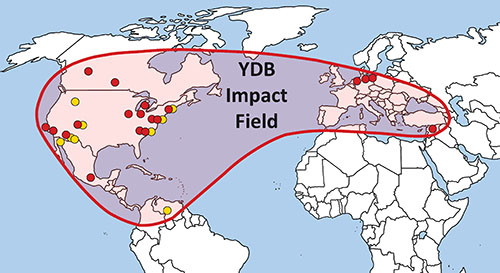
    Buried in the floor of Lake Cuitzeo was a thin, dark layer containing unequivocal evidence for a large, cosmic body that struck central Mexico just when the Younger Dryas period opened with such violence. Virtually identical sediment strata dated to the same period have been previously located at numerous locations throughout North America, Greenland, and Western Europe. According to Science Daily, “The data suggest that a comet or asteroid – likely a large, previously fragmented body, greater than several hundred meters in diameter – entered the atmosphere at a relatively shallow angle. The heat at impact burned biomass, melted surface rocks, and caused major environmental disruption.” The resulting crater became Lake Cuitzeo, measuring twelve and one-half miles across, with an average depth of ninety feet. 

    Dr James Kennett, professor of earth science at the University of California (Santa Barbara), told the Proceedings of the National Academy of Sciences: “These results are consistent with earlier reported discoveries throughout North America of abrupt ecosystem change, megafaunal extinction, and human cultural change and population reduction. These changes were large, abrupt and unprecedented, and had been recorded and identified by earlier investigators at a ‘time of crisis’. The timing of the impact coincided with the most extraordinary biotic and environmental changes over Mexico and Central America during the last approximately twenty thousand years, as recorded by others in several regional lake deposits.” 

    Professor of earth science Dr James Kennett and other researchers postulate from the evidence that a fragmented comet slammed into the Earth close to 12,800 years ago, causing rapid climatic changes, megafaunal extinctions, sudden human population decrease and cultural shifts and widespread wildfires (biomass burning). They studied the impact spherules in 18 sites in nine countries on four continents for their study. (Graphic credit: YDB Research Group)

    The floor of Lake Cuitzeo is rich in spherules formed when they collided with each other at high velocities during the whirling chaos of an extraterrestrial impact. They are joined by numerous specimens of lonsdaleite – an identifiable configuration nanodiamonds assume when they are pressured by large meteorite collisions – and aciniform soot, the acne-like appearance of dust residue resulting from the same cause. “These materials form only through cosmic impact,” Kennett explained, not through volcanic or other natural terrestrial processes. In the entire geologic record, the only other known continental layer with abundant peaks in lonsdaleite, impact spherules and aciniform soot is in the sixty-five-million-year-old Cretaceous-Paleogene boundary layer that coincided with the extinction of the dinosaurs. 

    Evidence for Early Human Settlement

    “Recent discoveries show that North America was first peopled at least one hundred thirty thousand years ago,” according to Hancock, “many tens of thousands of years before human settlements were established in Europe and Asia.” Homo sapiens-sapiens? Yes, but the European continent was actually settled one hundred seventy thousand years earlier by Neanderthals. In fact, the oldest evidence for proto-humans in Europe goes back 1.3 million years. “At least” is a bit of an understatement for human settlement in the New World, because Before Atlantis describes how prehistorian Juan Armena Camacho discovered lithic implements at Hueyatlaco, seventy miles south-east of Mexico City. According to US geologist Dr Virginia Steen-McIntyre, “radiometric dates using methods identical to those used in Africa to date the early sites there place Hueyatlaco’s stone tools to slightly over a quarter of a million years ago.” 

    Some thirty years prior to Camacho’s find, a still older site came to light one mile north from the Oklahoma town of Frederick, at a ten-mile-long, half-mile-wide ridge. Ten to twenty-five feet beneath the surface of this gravel deposit occur dozens of well-crafted stone implements cemented in place in common strata with the bones of extinct animals firmly dated to seven hundred fifty thousand years ago. C.N. Gould, Director of the Oklahoma Geological Survey, reported: “There can be no doubt that the artifacts occur in the pit near the basal portion, on the same level as the fossil remains. An examination of the undisturbed face of the pit, immediately above the position of the finds, showed unbroken, nearly horizontal strata above it. As the case stands, it looks very much as though the artifacts are of the same antiquity as the fossil animals. At the same time, it would be well to reserve final judgment until we are certain that the artifacts are not secondary inclusions.” 

    Since Gould released his report in 1929, subsequent investigations of the Holoman Pit, as it is locally known, repeatedly confirmed that the stone tools are not later inclusions but were indeed laid down at the same time the animal bones were stratified, three quarters of a million years ago. As recently as 2005, archaeologist Silvia Gonzalez of Liverpool’s John Moore’s University in England discovered a line of human footprints dating back forty thousand years ago near Puebla, in Mexico. Conventional scholars, convinced no human set foot in Middle America before twelve thousand years ago, sought to debunk the heretical period she assigned the evidence by dispatching a team of leading geologists led by Paul R. Renne, director of California’s Berkeley Geochronology Center, to the site. 

    Once there, they took repeated argon testing to investigate the magnetic imprint of the foot-printed, magmatic rock, together with other state-of-the-art procedures. Renne announced their results in the scientific journal Nature, stating that the rock featuring the footprints was not forty thousand years old after all. It was, instead, 1.3 million years old

    During the early 20th century, archaeologist Carlos Ameghino (1865 to 1936) led teams of excavators along the Argentine coast south of Buenos Aires after detecting clues to an early habitation site at Miramar. By 1914, he discovered numerous stone tools cemented within Pliocene Era strata. As Silvia Gomez experienced in the following century, Ameghino’s critics commissioned a group of professional geologists to debunk his assertion. Instead, they verified it, stating that the artefacts had been laid down between two million and three million years ago. Although their analysis was released by the prestigious Anales del Museo de Historica Natural de Buenos Aires, it has since been ignored by archaeologists in the outside world. 

    Australia-Amazon: An Unexpected Discovery

    “Certain tribes of the Amazon jungle,” states America Before’s back cover blurb, “are closely related to Australian Aborigines. How did this extraordinary, unexpected, and extremely ancient DNA signal get to the Amazon?” This question elevates Hancock’s new book with fresh discoveries that threaten to shake the scientific establishment to its core by opening an entirely new and revolutionary archaeological theatre of operations. 

    The vast Amazon region has long been dismissed by mainstream scholars as anciently under-populated and barren of all but the most backward, native cultures, hermetically sealed off by nature from the outside world. Hancock writes, “in September 2015, Pontus Skoglund, his senior colleague Professor David Reich of the Department of Genetics at Harvard Medical School, and other leading experts in the field, announced in the pages of Nature that they had found new evidence in South America, and specifically in the Amazon rainforest, that called for a rethink.” 

    Researchers mapped similarities in genes, mutations and random pieces of DNA of Central and South American tribes with groups in other parts of the world including Australia. Warmer colours indicate the strongest affinities. Researcher Skoglund said “a statistically clear signal linking Native Americans in the Amazonian region of Brazil to present-day Australo-Melanesians and Andaman Islanders” was confirmed. (Graphic credit: Pontus Skoglund, Harvard Medical School)

    He quotes Skoglund’s “genome-wide data to show that some Amazonian Native Americans descend partly from a Native American founding population that carried ancestry more closely related to indigenous Australians, New Guineans and Andaman Islanders than to present-day Eurasians or Native Americans,” and are, in Hancock’s words, “more closely related to Melanesian Papuans and Australian Aborigines than to any other Native American population.” “We spent a really long time trying to make this result go away,” Skoglund explained, “but it just got stronger.” In the end, “a statistically clear signal linking Native Americans in the Amazonian region of Brazil to present-day Australo-Melanesians and Andaman Islanders” was confirmed. 

    “We also know it has to be pre-Columbian,” added Professor Eske Willerslev of Denmark’s Center for GeoGenetics at the University of Copenhagen. Further studies by Willerslev and his colleagues “found Australian DNA already present in skeletal remains from Lagoa Santa, Brazil, dated to 10,400 years ago, and confirmed the suspicion of the researchers that the anomalous genetic signal must have reached South America in the Late Pleistocene – that is, near the end of the last Ice Age, [when] a group of people carrying Australo-Melanesian genes settled in what is now the Amazon jungle.” 

    The headline of the Oct/Nov 2010 edition of Cosmos magazine and accompanying by-line, augmented by a photograph of an American skull (Luczia) exhibiting morphology that closely resembles Australian Aboriginal people. The oldest human skull unearthed in the Americas has cranial features similar to those of Australian Aborigines. Another piece of anomalous evidence pointing to an early human story, but largely ignored because it contradicts official scientific theory.

    This is undoubtedly one of the most striking revelations ever made in the entire history of archaeology, as inexplicable as it is astounding. It does not mean that a few Australoid castaways accidentally washed ashore on Peruvian shores, then somehow traversed the formidable Andes Mountains and descended into Brazil’s totally different, but no less forbidding jungle, where they cohabited with a few, indigenous individuals.

    Rather, DNA evidence signifies a mass-migration of Australo-Melanesians to Amazonia, where they interbred with native peoples on such a broad scale some ten and a half centuries ago, the genetic imprint is still discernible. Their epic, 12,940–kilometre, trans-Pacific voyage to coastal Peru and subsequent 1,890–kilometre trek to Brazilian rain forest were successfully achieved at a time when Western European Man was struggling to survive the challenging Upper Paleolithic, or Late Stone Age. Australia’s contemporaneous material culture was itself far too underdeveloped for undertaking anything even approaching an oceanic crossing of such magnitude, not only in terms of the extreme distances concerned, but especially regarding the large number of persons participating in the expedition, or expeditions. 

    The maritime technological requirements necessary for conducting an operation of transpacific scope alone rule out all possibilities for Australoid responsibility. Moreover, what conceivable motivation could have possessed them to attempt such a huge enterprise? Hancock wonders if a third party was involved – a different, unrelated, unknown, though far higher culture that, for reasons even more obscure, transported Australo-Melanesians to Amazonia. 

    Speculation like this begins to conjure ‘legendary’ Lemuria, the pre-Polynesian civilisation that rose to ancient heights of technological greatness and imperialist domination of the Pacific realm, before succumbing to a natural catastrophe sufficiently powerful enough to shake the very foundations of the Earth itself. Hancock, however, shies away from any Lemurian connotations. 

    Ancient Amazonia Rises Out of the Cleared Forests

    Even so, America Before’s most valuable and original contribution to our deepening grasp of antiquity is its investigation of Amazonia, an area of the world hitherto neglected by conventional and alternative researchers alike. They traditionally laboured under the assumption that Brazil’s rain forest was always far too environmentally hostile for civilisation to have taken root there. Hancock cites the academic view “that the Amazon could only have been inhabited for about 1,000 years, and then only by very small groups of hunter-gatherers, since the jungle was ‘resource poor’.” 

    Among the very few archaeologists who personally challenged this dominant paradigm was Percy Harrison Fawcett. His disappearance in search of the lost city of Z during 1925 seemed to confirm consensus opinion that no such place could possibly exist in the Brazilian jungle, and America Before is remiss in failing to properly credit or even mention in passing the British Colonel, whose self-sacrificial, if percipient effort foreshadowed the very discoveries Hancock describes in Chapters 11 through 17. 

    Together with the two previous chapters detailing Amazonia’s genetic connection with Ice Age Australia, they combine to represent the book’s highest worth. Nowhere else may readers learn more about the Amazon Basin’s otherwise unknown archaeological wealth. 

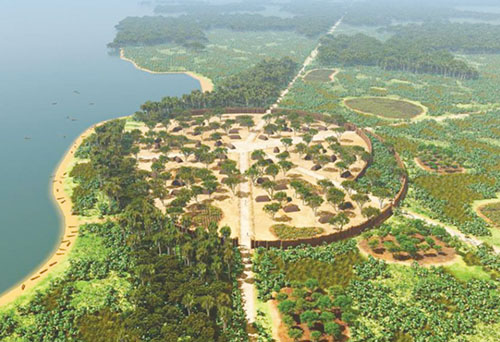
    An artist’s conception shows a Xinguano village of the Brazilian Amazon as it might have appeared before 1492. An example of how the Amazon was once likely inhabited by hundreds of thousands of people in numerous well-managed cities, towns and villages. Archaeologists have found traces of wide, curbed roads and managed parklands. 

    He tells how the first modern Europeans travelling the Amazon River from Ecuador to its estuary on the Atlantic coast of Brazil saw “great cities” that “glistened in white” (suggesting limestone construction, like that favoured by Maya construction engineers) during their 7,000-kilometre, seventeen-month journey. Some of these urban centres were “more than twenty kilometres from end to end, roughly the length of Manhattan… enormous expanses were given over to productive agriculture, and there were signs everywhere of large and well-organised political and economic systems linked to centralised states that were capable of fielding disciplined armies thousands strong.” 

    Hancock quotes the mid-16th century expedition’s Spanish chronicler, Dominican friar Gaspar de Carvajal, concerning an abandoned, native “villa, in which were a great deal of porcelain ware of various makes, both jars and pitchers, very large, with a capacity of more than twenty-five arrobas [one hundred gallons] and other small pieces such as plates and bowls and candelabra of this porcelain of the best that has ever been seen in the world, for that of Malaga [Spain’s centre for pottery production] is not its equal, because this porcelain which we found is all glazed and embellished with all colours, and so bright, that these colours astonish, and, more than this, the drawings and paintings which they make on them are so accurately worked out that one wonders how with only natural skill they manufacture and decorate all these things making them look just like Roman articles.” Native porcelain of such high quality does not appear in Brazilian archaeology. 

    The largest native city Carvajal and his companions saw was greater than twenty kilometres in extent, with a population of twenty thousand or more residents. Their chieftain, Machiparo, also ruled over “many settlements and very large ones, which together contribute for fighting purposes fifty thousand men…” 

    Two, subsequent expeditions, twenty years later and 1637-38, respectively, supported Carvajal’s report. Hancock quotes UCLA Professor David Wilkinson, “an authority on long-term and large-scale phenomena in world politics [who] has made a special study of the level of civilisation in the Amazon prior to European contact.” Based on a late 17th-century report that one of Brazil’s native cities could field 60,000 warriors, Wilkinson found “comparative-civilisational standards have implied an urban population of 300,000 to 360,000.” 

    He goes on to describe “more than 30 epidemics – smallpox, measles, and other outbreaks – some on a massive scale – in 16th-18th century South America.” With fatal consequences in the upper ninety percentile, the Amazonian metropolitan areas literally died out though depopulation. “Once left deserted,” Hancock explains, “the great cities and monuments and other public works of any hypothetical Amazonian civilisation would quickly have been encroached upon and soon completely hidden by the jungle…” They only began re-emerging in 1977, “when giant, geometrical earthworks were discovered in the Rio Branco area of the Brazilian state of Acre, in the southwestern Amazon.”

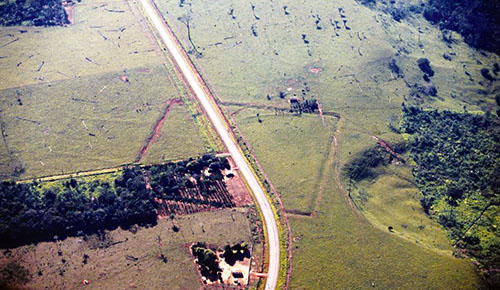
    It was the first of many related sites that have since come to light, including a pair of perfect squares – 200 metres and 100 metres wide – connected by a 20-metre-wide, 100-metre-long causeway. Archaeologists estimate “that as many as 1,500 geoglyphs might ultimately be found.” Severino Calazans, the largest Amazonian structure of its kind so far surveyed, “defined by an enclosure ditch twelve metres wide, measures 920 metres.” This particular location and other, outsized designs “have since been revealed by mass clearing of the forest for the cattle industry, thus becoming visible, especially from the sky, over the past 30 years. Indeed, the enormous size of the geoglyphs makes it easier to distinguish their shape and configuration from an aerial perspective, than at ground level…” 

    Groups are composed chiefly of circles, ellipses and rectangles, suggesting possible celestial orientations. Hancock writes that “because they offer an unobstructed view of the horizon, such locations are also very often what ancient astronomers looked for when they set out monuments on the ground – aligned, say, to the June solstice sunset or to the March equinox sunrise. Without a full-scale archaeo-astronomical survey of the Amazonian geoglyphs,” however, their suspected celestial significance remains unproven. 

    Their resemblance to Old World Stone Age sites nevertheless inspires provocative comparisons. Hancock tells how “the square enclosure ditch at Severino Calazans shares the ground plan, base diameter and cardinality [orientation to the Four Cardinal Directions] of the Great Pyramid of Egypt. That epoch, moreover, around 2500 BC, coincides and overlaps with the megalithic epoch in Europe, so another curiosity is the way that the circular geoglyphs of Amazonia resemble henges – the circular embankments with deep, internal ditches that surround the great, stone circles of the British Isles. The scale is very similar and the resemblance is so obvious that even the most sober archaeologists, usually wary of cross-cultural comparisons, are willing to remark upon it.” 

    The Severino Calazans site, formed by a single square-shaped ditch, is cut and partially destroyed by Highway BR-317. A farm has been built inside the area enclosed by the ditch. Indigenous people consider the earthworks sites as sacred and do not use them for housing. (Photograph by Sanna Saunaluoma)

    Whatever critics may make of America Before, they cannot deny that its unique discussion of the lost civilisation of the Amazon, plus revelations concerning the mind-boggling heritage of its present-day descendants from 9th millennium BCE Australia, opens new vistas of antiquity, as trailblazing, as they are intriguing. 

    America Before is available from all good bookstores.

    [alert type=”general” dismiss=”no”]This article was published in New Dawn 175.[/alert]

    [alert type=”success” dismiss=”no”]If you appreciate this article, please consider subscribing to help maintain this website.[/alert]

    © New Dawn Magazine and the respective author.
    For our reproduction notice, click here.
  • Our Real “War of the Worlds”

    Our Real “War of the Worlds”

    This article was published in New Dawn Special Issue Vol 6 No 5 (October 2012)

    Like many New Dawn readers, I occasionally heard rumours over the years of firefights alleged to have taken place between United States armed forces and technologically superior Nazi naval units in, of all places, Antarctica, soon after the Second World War. Having authored several 20th century military histories,1 possibilities for such a confrontation seemed to me unlikely in the extreme, an impression deepened by some writers, who insisted the Germans were piloting “flying saucers” around the South Pole. 

    These far-fetched claims long convinced me that the subject was unworthy of consideration, until I was recently shocked to learn how the US Navy actually did launch nothing less than a secret, full-scale invasion of Antarctica less than a year following the Second World War, and under highly suspicious circumstances that have never been fully explained, even after the passage of nearly seven decades. I was determined now to investigate this truly bizarre event with the sole aim of discovering, if possible, what really happened – to discard every groundless speculation, hearsay or obvious fantasy – by narrowing my research exclusively on hard data and credible information only from reliable sources. Here are those facts: 

    With the words, “these proceedings are closed,” US General Douglas MacArthur, representing the victorious Allies, accepted Imperial Japan’s surrender aboard the battleship USS Missouri on 2 September 1945, thereby officially concluding the Second World War. But eleven months later, a huge armada departed US waters on 26 August 1946 for Antarctica. Its flagship was the USS Philippine Sea, Captain Delbert S. Cornwell commanding her 3,448 officers and enlisted men. At 27,100-tons, she was among the largest aircraft carriers afloat, powered by eight boilers and four Westinghouse geared steam turbines for a combined 150,000 horse power and a range of 20,000 nautical miles. In addition to the Philippine Sea’s 100 fighters, dive- and torpedo-bombers, she bristled with arrays of five-inch artillery and 40-mm Bofor anti-aircraft guns. Four-inch, 2.5-inch, and 1.5-inch steel armour protected her 888-foot-long hull, hanger deck and conning tower. 

    The Philippine Sea was screened by USS Brownson (Commander H.M.S. Gimber) and USS Henderson (Captain C.F. Bailey). At 3,460 tons each, these Gearing Class destroyers were 390 feet long, and powered pairs of General Electric steam turbines, plus four boilers for 60,000 horse power. Armament consisted of half-a-dozen five-inch guns guided by Mark 37 Gun Fire Control Systems with Mk25 fire control radar linked to Mark 1A fire-control computers. Additional weapons included twelve 40-mm Bofors guns, sixteen 20-mm Oerlikon cannons, and ten 21-inch torpedo tubes. 

    These surface units were joined by a 312-foot-long submarine, the 2,401-ton Sennet, with 10 officers and 71 enlisted men aboard. In addition to 24 torpedoes, Commander Joseph B. Icenhower’s boat featured a five-inch deck gun, one 40-mm Bofors, and a single 20-mm Oerlikon cannon. 

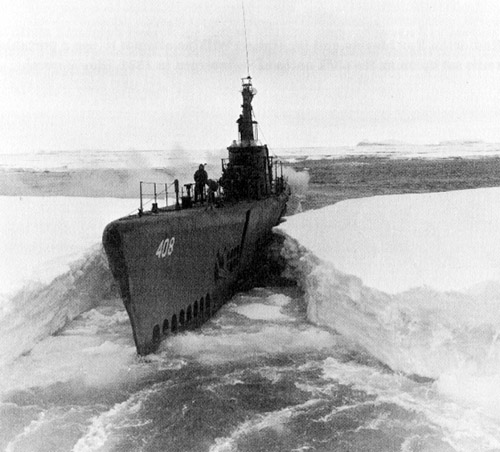
    USS Sennet struggles through Operation Highjump (Image Credit: US Navy, Arctic Submarine Laboratory, 1946)

    All warships were supported by the tankers USS Canisteo and USS Cacapon (Captains Edward K. Walker and R.A. Mitchell, commanding, respectively), plus the supply ships USS Merrick (Captain John J. Hourihan) and USS Yancey (Captain J.E. Cohn, commanding). 

    Their passage through Antarctic waters was cleared by the ice-breakers USS Burton Island (Commander Gerald L. Ketchum) and USCGC Northwind (Captain Charles W. Thomas, commanding). Two seaplane tenders – USS Pine Island (Captain Henry H. Caldwell, commanding) and USS Currituck (commanded by Captain John E. Clark) – were part of the Antarctic-bound fleet. They were Barnegat-class vessels, 2,750 tons fully loaded, 311 feet long, each manned by 215 crewmembers, and armed with two 5-inch guns, six dual 20-mm anti-aircraft guns, plus four depth-charge racks. Combined, the Pine Island and Currituck stored 160,000 gallons of aviation fuel, enough spare parts, repairs, and berthing for two, full seaplane squadrons. 

    These capacious tenders serviced six specimens of a large and powerful flying boat. With a wing area of 1,408 square feet and loaded weight of 56,000 pounds, the Martin PBM Mariner’s twin Wright R-2600-12, fourteen-cylinder, 1,700-horse power, radial engines allowed its seven-man crew to deliver 4,000 pounds of bombs over 3,000 miles. Another half-dozen examples of the Sikorsky H-5 helicopter (referred to in the Navy as the HO3S Dragonfly) flitted between USS Philippine Sea and the seaplane tenders. 

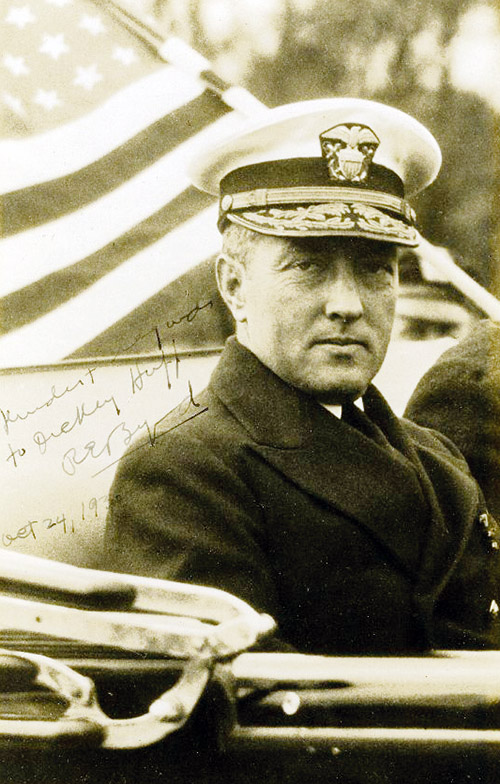
    So many ships and aircraft necessitated their division into an Eastern Group commanded by Captain George J. Dufek, a Western Group headed by Captain Charles A. Bond, a Central Group, Rear Admiral Richard H. Cruzen, commanding, and a Carrier Group with none other than Richard E. Byrd, Jr. in overall command. This is the same Admiral Byrd world-renowned for his epic polar explorations during the 1920s and ‘30s. He was usually to be found aboard the USS Mount Olympus (Captain R.R. Moore, commanding), a Mount McKinley-class, amphibious force command ship, with advanced communications equipment and extensive combat information spaces for large-scale landing operations. The 12,142-ton, 459-foot-long vessel, operated by 729 officers, specialised technicians and enlisted men, was armed with a pair of five-inch deck guns, eight 40-mm guns, and twenty 20-mm anti-aircraft guns. 

    Operation Highjump

    Altogether, the four Groups were known collectively as Task Force 68. Their assignment, referred to officially, if rather vaguely in an initial report as “The United States Navy Antarctic Developments Program,” was to establish Little America IV, a research base in the Antarctic; train personnel and test equipment in frigid conditions; determine the feasibility of establishing, maintaining and utilising bases in the Antarctic and investigating additional, possible base sites; develop techniques for establishing, maintaining and utilising air bases on ice; increase knowledge of hydrographic, geographic, geological, meteorological and electro-magnetic propagation conditions in the area.2 

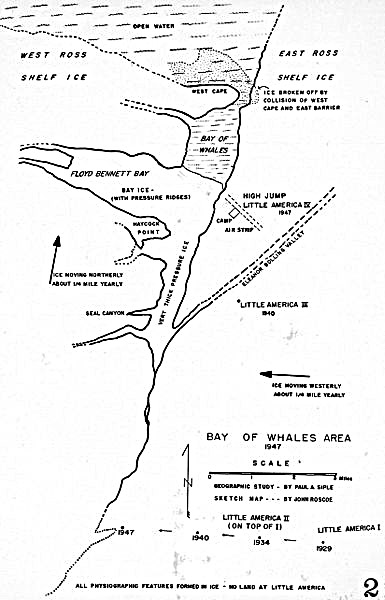
    Upon landing at the Bay of Whales on 15 January 1947, work commenced on building a headquarters, Little America IV, in what was to be of one of the few expedition goals actually attained. 

    The report also mentioned that the expedition aimed at consolidating and extending United States sovereignty over the largest practicable area of the Antarctic continent, a goal previously and emphatically denied in repeated public pronouncements issued by the US government, even before Operation Highjump ended. In any case, its official, modest, entirely peaceful agenda was overwhelmingly dwarfed and contradicted by the prodigious fire-power and armed might assembled by Task Force 68. In fact, few research scientists and very little investigative equipment were included. Moreover, most of its stated objectives were never attempted, much less achieved. 

    No personnel training nor equipment testing took place. No effort was made to explore possibilities for other base sites involving aircraft or ships. No practice manoeuvres or exercises of any kind were undertaken. And whatever was learned, if anything, about Antarctica’s hydrographic, geographic, geological, meteorological and electro-magnetic propagation conditions was never disclosed. While Operation Highjump’s declared goals represented hardly more than an academic exercise, it was in reality an entirely military affair.3 An aircraft carrier, two destroyers, a pair of armed seaplane tenders, one submarine and a sophisticated communications ship, supported by a flotilla of supply vessels, plus 112 aircraft and 4,700 servicemen organised by US Navy commanders and rear admirals – including world-famous Richard E. Byrd, Jr. himself – far outstrips the requirements of some scientific investigation, no matter how ambitious. 

    This unlikely armada entered the Ross Sea ice pack on 31 December 1946, finally landing at the Bay of Whales by 15 January the following year. Work commenced there at once on building a headquarters, Little America IV, in what was to be of one of the few previously announced expedition goals actually attained. Just forty days later, the Central Group cast off to join the rest of Task Force 68’s units already withdrawing toward South America for repairs, thus prematurely terminating their massive, expensive mission, which had been originally scheduled to take from half a year to eight months. Even so, in only eight weeks, its aircraft logged 220 hours flying time over 22,700 miles – an area half the size of the United States – taking some 70,000 reconnaissance photographs, only a very few of which were subsequently released to the public by the Navy. To this day, the remainder, if they still exist, are still classified. The aerial survey also recorded ten new mountain ranges. 

    Attacked by Flying Objects?

    Immediately after arriving in several Chilean ports, word of the apparently aborted expedition’s high strangeness and even disasters that plagued it began spreading like wildfire from some loose-lipped Operation Highjump sailors. Admiral Byrd himself contributed to the dire speculation. The mainstream press in Chile was quoting some of his men to the effect that his expedition had “run into trouble” and suffered “many fatalities.” Instead of denying these allegations, he expressed deep concern to reporter Lee van Atta about real possibilities for devastating aerial attacks on the US at a time when the whole world, having been largely devastated, was at peace, hardly what one would have expected to hear from the leader of a purely scientific enterprise. Van Atta published the results of his startling interview, headlined “Aboard the Mount Olympus on the High Seas,” in the 5 March 1947 edition of El Mercurio, a conservative newspaper and Chile’s largest, “considered the country’s paper-of-record and its Valparaíso edition is the oldest daily in the Spanish language currently in circulation,” since 1827.4 

    Rear Admiral Richard E. Byrd, Jr. (1888-1957) 

    “Admiral Richard E. Byrd warned today that it was imperative for the United States to initiate immediate defense measures against hostile forces threatening from the Arctic or Antarctic,” according to van Atta. “The Admiral explained that he was not trying to unduly alarm anyone, but the cruel reality is that in case of a new war, the United States could be attacked by flying objects which could move from pole to pole at incredible speeds. This statement was made as part of a recapitulation of his own polar experience, in an exclusive interview with the International News Service. 

    “Talking about the recently completed expedition, Byrd said that the most important result of his observations and discoveries is the potential effect that they have in relation to the security of the United States. He repeated the above points of view, resulting from his personal knowledge gathered both at the north and south poles. The fantastic speed with which the world is shrinking – recalled the Admiral – is one of the most important lessons learned during his recent Antarctic exploration. 

    “‘I have to warn my compatriots’, Byrd said, ‘that the time has ended when we were able to take refuge in our isolation and rely on the certainty that the distances, the oceans, and the poles were a guarantee of safety’.”5 

    On his return to Washington, D.C., after Byrd’s interrogation by Security Services officers, he never uttered another word about Operation Highjump, which was simultaneously classified, thereby legally preventing any of its veterans from ever discussing the mission.6 Shortly thereafter, the US Navy published a brief, not very informative, even evasive summary of the Antarctic expedition’s “achievements,” which nonetheless stated that some losses had been incurred.7 Although these were glossed over and minimised, the typically anonymous report nonetheless admitted that fully half of Byrd’s seaplane and helicopter forces had been destroyed, and that he himself was nearly brought down in the aircraft he was flying, avoiding an otherwise inevitable crash only because he jettisoned everything on board, save the most bare essentials and reconnaissance films he had just taken for staying aloft. During that perilous flight, he had gone missing for more than three hours in an episode of lost time officially blamed on failed radio communications.8

    The summary further admits that Task Force 68 did indeed suffer some human casualties, but all were supposedly due to accidental causes. On 30 December 1946, three men flying George 1, their Martin flying-boat, died when it crashed, allegedly during a blizzard. Six surviving crewmembers were rescued thirteen days later. Another man died in a construction accident, totalling the number of fatalities. The official summary concludes by explaining that the mission was terminated due to the early approach of winter and worsening weather conditions – which were supposedly just what the Americans had specifically come for and required to test themselves and their equipment. 

    [alert type=”success” dismiss=”no”]If you appreciate this article, please consider subscribing to help maintain this website.[/alert]

    Soviet Secrets Released

    Released in 1948, short film coverage of Operation Highjump, ironically entitled, “The Secret Land” – although more of a breast-beating propaganda send-up for the US Navy than a real documentary – nevertheless gives viewers something of a feeling, however incomplete, for the expedition.9 It went otherwise unnoticed by the general public, and, beginning with the onset of the Korean War two years later, soon fell into virtual obscurity over the next forty years. 1991’s collapse of the Soviet Union, however, suddenly declassified literally millions of previously secret papers, among them, surprisingly, a 1947 description of Task Force 68’s mission to Antarctica. 

    That Joseph Stalin should have known far more about it than the American people is not surprising. Their country’s close alliance with him during World War Two allowed his spies to infiltrate all levels of the US government, including its armed forces – espionage that peaked, but did not end, with the 1953 conviction of Communists Julius and Ethel Rosenberg for their betrayal of America’s atomic bomb research to the USSR. As early as the 1930s, through the Second World War and into the so-called “Cold War,” US Congressman Samuel Dickstein (New York) was a Democrat Party confidant of President Franklin Roosevelt, all the while a paid agent of the NKVD, the Russian secret police. There were many others like him, and, because of the often high positions attained, they had access to classified undertakings such as Operation Highjump

    Its details, hidden from the US public and the rest of the outside world, were transmitted by a Soviet operative to the Kremlin, where they languished until their rediscovery before the turn of the 21st century. Shortly thereafter, a Moscow Television documentary featured spokesmen from both the Russian Army (Dr. Dimitri Filippovitch, lieutenant adjutant) and prestigious Russian Academy of Sciences physicist, Dr. Vladimir Wasilev, who finally disclosed the Stalin era report about Task Force 68’s covert experiences in Antarctica. 

    An Attack by “Spherical Lights”

    It quotes radioman John P. Szelwach aboard USS Brownson, where, around 0700 hours, in the early morning darkness of 17 January 1947, just two days after Admiral Byrd’s Central Group made landfall at the Bay of Whales, “we observed the following: On the horizon, a bright, colourless light. We thought it was another ship. We were below the Antarctic Circle in unchartered waters [off Charcot Island, in the Weddle Sea]. Our radar was activated to no avail. I and my shipmates in the pilothouse port side observed for several minutes the bright lights that ascended about 45 degrees into the sky very quickly. We couldn’t i.d. the lights, because our radar was limited to 250 miles in a straight line. Our quartermaster, John Driscoll, recorded this in our log.”10 

    Their ominous sighting was followed nearly three hours later, when the lights (five) reappeared in the same area of the Ross Sea and began to rapidly close on the destroyer. Commander Gimber ordered the ship’s 40-mm Bofors anti-aircraft guns and 20-mm Oerlikon cannons to commence firing on the objects, which flew over the Brownson at high speed and low altitude (about 200 feet), without sustaining any hits. This encounter opened a series of brief, but fierce skirmishes that lasted over the next several weeks, according to the Soviet espionage report, between Task Force 68 and the lights, resulting in “dozens” of officers and men killed or wounded. Most casualties were suffered by Admiral Byrd’s Central Group, which even the sanitised, post-expedition US Navy version admitted had to be evacuated by the Burton Island ice-breaker from the Bay of Whales on 22 February 1947. 

    After four days, in a kind of parting shot, the spherical lights executed a dramatic attack witnessed by Lieutenant John Sayerson, a flying-boat pilot aboard one of the seaplane tenders: “The thing shot vertically out of the water at tremendous velocity, as though pursued by the devil, and flew between the masts [of the ship] at such a high speed that the radio antenna oscillated back and forth in its turbulence. An aircraft [Martin flying-boat] from the Currituck that took off just a few moments later was struck with an unknown type of ray from the object, and almost instantly crashed into the sea near our vessel. I could hardly believe what I saw. The thing flew without making any sound, as it passed close over our ships and harmlessly though their lethal anti-aircraft fire. 

    “About ten miles away, the torpedo-boat Maddox burst into flames and began to sink. Despite the danger, rescue boats went to her aid before she sank twenty minutes later. 

    “Having personally witnessed this attack by the object that flew out of the sea, all I can say is, it was frightening.”11 

    February 26th’s engagement was the last experienced by Task Force 68, which by then was already in headlong retreat from Antarctica. 

    Although identity of the invincible “lights” was unknown to Lieutenant Sayerson, he wondered if they were perhaps German “wonder weapons” operated by survivors of the recently defeated Third Reich flying out of a secret Antarctic base. His speculation is still shared by investigators today, not without cause. 

    German Expeditions to Antarctica

    Nine years before the mighty forces of Operation Highjump had been routed from the South Polar Region, the Schwartzwald, a freighter built during 1924, was refitted in Hamburg shipyards for Germany’s most ambitious Antarctic expedition at a cost of about one million Reichmarks, almost a third of the entire mission’s budget. Re-named after the Schwabian region in southern Germany, the Schwabenland was mounted with steam catapults for a pair of Dornier Do J II Wal (“Whale”) seaplanes. They were powered by pairs of 650 HP BMW VI water-cooled V-12 engines mounted in tandem, inside a nacelle above the high-mounted, strut-braced monoplane wing aligned with the hull. The forward engine drove a tractor propeller, while the rearward turned a pusher propeller. 

    At 56 feet, 7 inches long, with a 72-foot, 2-inch wingspan, the unarmed Wal had a maximum take-off weight of 15,432 pounds and an effective range of 497 miles, with carrying capacity for twelve passengers. Dornier’s reliable, rugged, seaworthy aircraft established its suitability for polar operations as early as 1925, when famed Norwegian explorer, Roald Amunsen, flew two of them into the Arctic. Now, thirteen years later, they were being loaded with specially designed Zeiss RMK 38’33 Reihenmess-bildkameras and miles of film. 

    By late 1938, the German Society of Polar Research was ready to undertake its assignment: locating an area in Antarctica for establishment of a whaling station, as a means of augmenting their country’s production of fat. Whale oil was then the most important raw material for the production of margarine and soap in Germany, the second largest purchaser of Norwegian whale oil, importing some 200,000 metric tons annually. To avoid this dependency on foreign imports, the Reich needed to find alternative sources outside the Arctic, then something of a Norwegian monopoly. But the military side of the expedition was apparent in its determination to scout possible locations for a naval base in the Antarctic. 

    The mission, although not secret, was, after all, headed by a captain in the Kriegsmarine, the German Navy, Alfred Ritscher, a veteran Arctic explorer. He and his fellow 33 German Society of Polar Research members, together with the Schwabenland’s 24 officers and crew, were addressed in Berlin by none other than Admiral Richard E. Byrd, Jr., who, in the next decade, would be heading his own expedition in the same direction. Thus, the first connection between Task Force 68 and the Third Reich appears early on as a prelude to Operation Highjump. Byrd evinced sincere enthusiasm for the German undertaking, regretfully turning down Ritscher’s invitation to join it, only because of deteriorating relations between their two nations. 

    Captain Alfred Ritscher

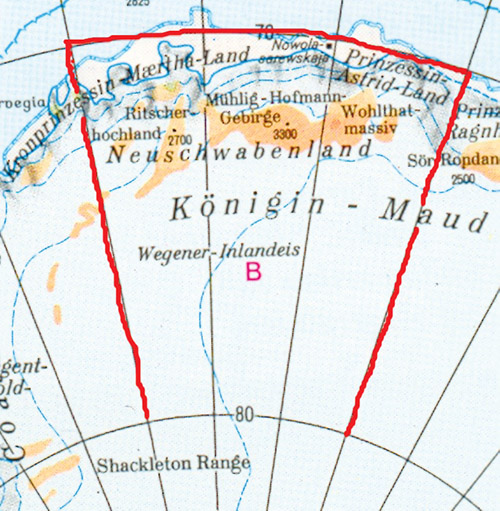
    On 17 December 1938, the New Schwabia Expedition left the port of Hamburg, arriving one month and two days later at the Princess Martha Coast of Antarctica. After dropping anchor at 4° 30’ W and 69° 14’ S, Ritscher and company spent three weeks at Queen Maud Land, the same area later invaded by America’s Task Force 68. They flew their seaplanes, nicknamed Passat and Boreas, in fifteen missions across some 370,000 square miles of the continent, taking tens of thousands of photographs and making a colour film of their finds. These included a mountain still known as Ritscher Peak, Schirmacher Oasis (named after its discoverer, Boreas pilot, Richard Heinrich Schirmacher), and a far larger ice-free region, some 300 square miles in extent, embracing a trio of large lakes, plus several smaller lakes, separated by masses of barren, reddish-brown rocks, and filled with relatively warm, brackish water of green, blue and red algae. Connected to the sea, the geothermal heated area represented a perfect setting for a military base, particularly for u-boats. 

    The location of Neuschwabenland

    Although the Germans reconnoitred nearly a fifth of Antarctica – most of it never seen before – they left no permanent structures, save for a few hundred small, aluminium stakes flying swastika pennants dumped by the Dornier Whales on snow-covered ground between 20°E and 10°W. In honour of his ship, Ritscher christened this area Neuschwabenland, or “New Schwabia,” a purely cartographic designation never intended as a territorial claim. The name still appears on many maps of Queen Maud Land, which the German Society of Polar Research departed on 6 February 1939. Soon after arriving back in Hamburg on 11 April, plans were laid for a return to Antarctica, which the outbreak of war in September forever cancelled. 

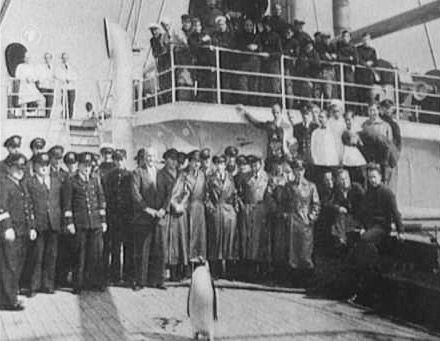
    Members of the German Society of Polar Research after arriving in Antarctica are entertained aboard the Schwabenland by a native performer.
    German Society of Polar Research expedition members pose with the Nazi swastika flag.

    Over the next six years of international conflict, no u-boat put in at New Schwabia or anywhere else along the continental coast, contrary to postwar speculation, if only because the Kriegsmarine’s submarine force was taxed to its limits and beyond by the exigencies of transoceanic combat. All its u-boats have been satisfactorily accounted for since, and absolutely no evidence exists to even suggest that a military installation of any kind – temporary or permanent – was based in Neuschwabenland. 

    Spherical “Lights” not Third Reich Forces

    Nor did German aeronautical engineers ever develop the kind of overpowering spherical “lights” that attacked Task Force 68. While Third Reich advances in jet and rocket technology are well known, plans, eyewitness reports, and even photographs of Iron Cross-insignia bedecked flying saucer-like craft attributed with truly out-of-this world performance capabilities are undocumented, postwar fabrications perpetuated by uncritical writers more interested in controversial sensationalism than factual research. At most, Luftwaffe draftsmen may have sketched out theoretical concepts for designs somewhat resembling disc-shaped air-frames late in the war. But these pipe dreams certainly never left their drawing board, given the very long-term development such projects required, to say nothing of the Fatherland’s steady depletion of all materials and resources. At the time of Admiral Byrd’s early 1947 interview with a Chilean newspaper, no one, not even German scientists, had built “flying objects which could move from pole to pole at incredible speeds.” 

    In 2007’s Moscow Television documentary about Operation Highjump, aerospace engineer Professor Dr. Valeri Burdakov and astro-physicist Yuri Bondarenko theorised that electro-magnetically operated extraterrestrial vehicles would naturally base themselves at Antarctica and the Arctic in order to take advantage of streams of magnetic energy streaming from the Earth’s South to the North Pole. Our planet, they explained, is like a large bar magnet, which continuously repels these lines of force at one end and attracts them at the other. An electro-magnetic propulsion technology might be able to ride these magnetic currents similar to a ship riding the ocean currents of the sea. The US Navy’s published report about Operation Highjump declared that one of its primary goals was to study the South Polar Region’s “electro-magnetic propagation conditions.” To carry this out, each seaplane was equipped with a magnetometer, a device that resisters anomalies in the Earth’s magnetism, thereby determining hollow spaces under the surface ice or ground. 

    Antarctica’s 300-square-mile anomaly the Dornier Wal pilot discovered and years later scouted by Lieutenant Commander David Bunger, flying his Marin Mariner for Task Force 68, was, as Admiral Byrd stated, “a land of blue and green lakes and brown hills in an otherwise limitless expanse of ice” – an idyllic location for an installation, if not for u-boats, then for something else.12 

    Beings from Another World?

    Developed from the foregoing facts, however incomplete, the most credible possible reconstruction of events, at least in general outline, begins with the accidental find by the German Society of Polar Research of a base near the coast of New Schwabia built and occupied by beings from another world in possession of highly advanced flight technology. Returning with this disclosure to Hamburg, Captain Alfred Ritscher begins organising a return trip prior to its cancellation by the advent of war. 

    Immediately after the close of hostilities, he arrives in the United States, where he confides the disturbing, secret discovery made in February 1939 to his old friend, Richard Byrd. Somehow, both men determine that the extraterrestrials embody a serious threat, and the highly regarded Admiral uses his prestige and influence to organise Operation Highjump, a codename for the armed invasion of Antarctica and planned destruction of its alien base.13 But his Task Force is defeated and retreats in the face of superior weaponry. 

    The story does not end here, however. Just three months later, a pair of UFOs crashed in the New Mexico desert, not far from America’s original nuclear research facilities, where the first atomic bomb was constructed just two years before. Published testimony by US military veterans of the famous Roswell Incident reveals that both flying disks were deliberately shot down during the first week in June 1947 by Air Force batteries operating, not ground-to-air missiles or anti-aircraft fire, but highly focused radar beams that fatally disrupted the space craft’s guidance systems.14 Over the next twelve years, a secret war raged around the world between extraterrestrial intruders violating the air space of several nations determined to defend it, as thoroughly documented by competent researchers. 

    Outstanding among them is Ukrainian Paul Stonehill, born in Kiev, who received his BA in Political Science from California State University for his thesis on the USSR’s invasion of Afghanistan. A world-recognised expert on Soviet covert operations, his published books describe hundreds of bloody skirmishes between Russian interceptors and off-world craft throughout the Stalin era and after.15 Similar aerial confrontations occurred over Britain and the United States during the same period. Losses occurred on all sides, but the earthlings usually came off second best. These combat engagements came to a head, according to American physicist Joseph P. Farrell and historian Henry Stevens, under cover of the International Geophysical Year, when, at the height of the Cold War, the air forces of the United States and the Soviet Union, in a unique and unprecedented cooperative effort, together attacked New Schwabia with nuclear weapons. 

    “Three bombs were thus detonated at an altitude of approximately 300 miles above the target,” writes Farrell, “one on August 27, 1958, one on August 30, 1958, and a third on September 6, 1958.”16 

    These high altitude bursts were apparently aimed at causing severe enough disruption of the South Pole’s electro-magnetic field to short out the alien space-crafts’ operational capacities; to literally fry their directional systems. Just how effective was this joint, if drastic effort is not fully known, but it certainly demonstrated the urgency felt by both the Americans and Russians. 

    That the under-publicised, triple atomic bombing of Antarctica was not, after all, a final solution has been suggested as recently as the 12 January 2011 up-date of a previous 13 December article entitled, “WikiLeaks Set To Reveal U.S.-UFO War In Southern Ocean”. The EU Times stated, “A new report circulating in the Kremlin today prepared for President Medvedev by Russian Space Forces (VKS) 45th Division of Space Control, says that an upcoming WikiLeaks release of secret U.S. cables details that the Americans have been ‘engaged’ since 2004 in a ‘war’ against UFOs based on or near the continent of Antarctica, particularly the Southern Ocean. 

    “According to this report, the United States went to its highest alert level on June 10, 2004 after a massive fleet of UFOs ‘suddenly emerged’ from the Southern Ocean and approached Guadalajara, Mexico barely 1,600 kilometres (1,000 miles) from the American border. Prior to reaching the U.S. border, however, this massive UFO fleet is said in this report to have ‘dimensionally returned’ to their Southern Ocean ‘home base’ …Since 2004, this report continues, fleets of Southern Ocean UFOs have continued to emerge from their bases, with the latest such event being this Friday past, when another of their massive fleets was sighted over the South American nation of Chile.”17 

    Interestingly, the EU Times’ quoted report describing UFOs that “‘suddenly emerged’ from the Southern Ocean” is identical to Operation Highjump accounts of spherical lights shooting out of the water. If, indeed, such an interplanetary war has been raging, perhaps on and off, for the past 65 years, then the consistent determination of world leaders to keep all knowledge of it from the rest of mankind is understandable: Were they to admit that the most potent Earth-made weapons – even nuclear bombs – are patently inferior to extraterrestrial violators of our air space, resultant social dislocation could shatter human civilisation, especially in our present condition of economic fragility and cultural instability. Less certain is the future of such a secret conflict. 

    [alert type=”general” dismiss=”no”]This article was published in New Dawn Special Issue Vol 6 No 5.[/alert]

    [alert type=”success” dismiss=”no”]If you appreciate this article, please consider subscribing to help maintain this website.[/alert]

    Footnotes

    1. The Axis Air Forces, Praeger Press, 2011; Mussolini’s War, Helion, 2010; Last of the Red Devils, Galde Press, 2003.
    2. David A. Kearns, Where Hell Freezes Over: A Story of Amazing Bravery and Survival, Thomas Dunne Books, 2005.
    3. Just before departing for Antarctica, referring to Operation Highjump, Byrd declared to representatives of the American press, “My expedition has a military character.” www.youtube.com/watch?v=znbHUcbKkjk&feature=related
    4. Peter Kornbluh, The Pinochet File: A Declassified Dossier on Atrocity and Accountability, The New Press, 2003.
    5. Lee Van Atta, “El almirante Richard E. Byrd se refiere a la importancia estrategica de los polos,” Santiago de Chile, El Mercurio, 5 March 1947.
    6. “Byrd was returned to Washington, D.C., debriefed, and his personal and operational logs from the mission were seized and remain classified to this day…” Joseph P. Farrell, Reich of the Black Sun, Adventures Unlimited Press, 2004, 247.
    7. Robert S. Dietz, Some oceanographic observations on Operation Highjump: final report, University of California Libraries, 1948.
    8. Three hours over due, but his plane did not run out of fuel?
    9. www.youtube.com/watch?v=tHXZGV6mQfs
    10. www.thetruthbehindthescenes.org/2010/05/23/us-navy-secret-operation-high-jump-antartica/comment-page-1/
    11. www.youtube.com/watch?v=znbHUcbKkjk&feature=related The NKVD report refers to Sayerson’s ship as the “Casablanca,” probably because the Russian spy had trouble pronouncing its real name, Currituck. The Soviet agent also stated that an American vessel set afire and destroyed was the USS Maddox, either a torpedo boat or torpedo-carrying destroyer. Official records list only the Henderson and Brownson as part of Task Force 68, which possessed no torpedo boats. Both destroyers survived the mission and are accounted for. A USS Maddox was indeed sunk by enemy action, but five years earlier by a German dive-bomber during the Allied invasion of Sicily. Actually, there were at least three American destroyers known by that name (DD-168, DD-622, and DD-731), all of them contemporaneous. The US Navy has long been notorious for falsifying the identity of its ships and re-writing their histories if they embarrass official policy. Cases in point include 1944’s pre-Normandy Invasion Battle of Slapton Sands, where a number of vessels were sunk and many servicemen killed by Kriegsmarine torpedo boats, but unacknowledged for the next half century; another American massacre, off the Italian coast near Bari, in 1943, was censored when numerous Allied units, illegally carrying nerve gas, were sunk by the Luftwaffe; although the largest loss of US troops at sea (1,015 fatalities) in a single incident occurred when the troopship, Rohna, was sunk by a German guided missile in the Mediterranean on 26 November 1943, only after aged veterans won a lengthy, costly lawsuit against the US Navy 57 years later did they receive official recognition for their role in the disaster. So too, the “Maddox” cited by Soviet espionage was similarly consigned to an official memory hole.
    12. www.eaglespeak.us/2009/03/sunday-ship-history-operation-high-jump.html
    13. Although the German Society of Polar Research took more than 16,000 aerial photographs of Antarctica in 1939, Ritscher allowed publication of a chosen few, rather unenlightening examples; the rest have never been seen by outsiders. So too, a radically edited, truncated version of the full-colour film his colleagues made of the expedition was briefly premiered in the Reich during the early war years. Since then, only snippets of a swastika flag waving in a south polar breeze, or a few Society members posing on the ice are still occasionally viewed. Task Force 68 was thrown together with a truly frantic haste, in contradistinction to its allegedly scientific purposes, as though it were absolutely imperative to the security of the United States. The ice-breaker Burton Island, for example, had only recently been commissioned, and was still undergoing sea trials off the Californian coast, when Operation Highjump was launched. Pulling a newly commissioned ship off trials adds to the mission’s sense of urgency still echoed months later, even after conclusion of the expedition, when Byrd could only talk about potential attacks coming from over the Polar Regions.
    14. http://crazyhorsesghost.hubpages.com/hub/Interview-With-One-Of-The-Army-Sergeants-At-Roswell-In-1947
    15. Paul Stonehill, The Soviet UFO Files, Clb, 1998; with Philip Mantle, UFO Case Files of Russia, 11th Dimension Publishing, 2010.
    16. Joseph P. Farrell, Reich of the Black Sun, Adventures Unlimited Press, 2004, 254.
    17. www.eutimes.net/2010/12/wikileaks-set-to-reveal-us-ufo-war-in-southern-ocean/

    © New Dawn Magazine and the respective author.
    For our reproduction notice, click here.
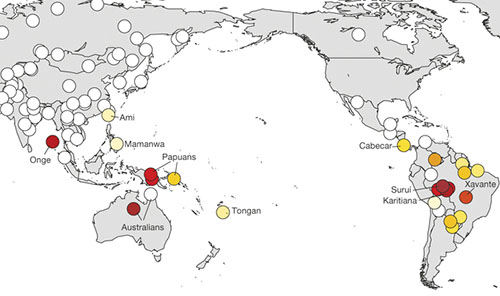
  • Lemuria in Australia & the Pacific

    Lemuria in Australia & the Pacific

    From New Dawn 95 (Mar-Apr 2006)

    The most important questions we can ask are about ourselves, not only as individuals, but as a species. Where did we come from? How did we get here? A question that has bedevilled us for as long as we can remember is: Where and when did we take the step from savagery to civilisation?

    Mainstream historians, who write our textbooks, insist they know: in Mesopotamia, about 5500 years ago. But they are contradicted by places like Chatal Hueyuek, a 13-hectare condominium village that flourished as part of a much broader urban centre in central Turkey, 15 centuries earlier. More ancient still, archaeologists excavated a nine-metre-high, stone castle in the Near East, at Jerico, that is a 1000 years older. The sophisticated level of construction at Chatal Hueyuek, Jerico, and similar, pre-fourth millennium BCE sites proves they were not the first of their kind, but must have developed from much older precursors. Just who were these precursors, and how far back into prehistory did they lay the foundation for all subsequent civilisations, including our own?

    This was the question that sparked more than ten years of concerted research and world travel. I found clues left behind by the long-dead ‘Cliff-Dwellers’ of the American Southwest; among the living oral traditions of Polynesia, Micronesia, Melanesia, Australia, and New Zealand; and in the pre-Buddhist temples of Japan and Southeast Asia.

    The accumulated evidence compelled me to conclude that mankind’s first civilisation gradually arose in the Pacific around 50,000 years. This period coincided with the Upper Paleolithic, or Late Stone Age, famous for its cave-art in southwestern France, and lowered sea-levels, allowing for occupation of Australia by exposed land-bridges. For the next 38,000 years of relative peace and isolation, the Pacific islanders developed the scientific and spiritual arts to high degrees of sophistication through close observance of natural law.

    Their country was known as Mu, the “Motherland,” less a specific geographical territory, than a people and culture spread out over many lands from what is now west-coastal America, throughout Oceania, to Japan. The inhabitants were “Lemurians,” or the residents of sea-girt Mu. Although they venerated numerous deities, the Sun personified the literal and spiritual Enlightenment of a Compassionate Intelligence that ordered the Universe, and attached the eternity of the human soul to recurring patterns evidenced in the cycles of nature.

    The Motherland itself was mostly a low-lying, tropical country, much of it close to the equator, and therefore beset by a hot climate. Her population lived in small fishing villages or on farms. Cities were not unknown, but more ceremonial than urban centres. Step-pyramids, temples, plazas and other examples of sacred architecture, many oriented to various positions of the Sun, adorned the verdant landscape. Lemuria’s prolonged civilised idyll lasted until 12,000 years ago, when the last Ice Age came to an end, causing dynamic increases in sea-level. Much, but not all, of Mu was inundated, and large numbers of its inhabitants fled to the Americas and Asia, where the Jomon Culture arose in Japan.

    Lemurian refugees and their descendants migrated across China and the then-fertile Gobi Desert region. But Mu recovered from the Late Pleistocene devastation, and her people spent the next 69 centuries elevating their scientific spirituality to levels of achievement still unsurpassed, particularly in monumental construction and what would today be referred to as the development of “psychic powers,” still known throughout Polynesia as mana.

    In 3100 BCE, however, an aberrant comet passed near the Earth, provoking a global catastrophe. The lands of Mu were severely effected, and some slipped beneath the sea. Many immigrants escaped to South America, superseding a previous Lemurian colonisation of Pacific coastal Peru. The troublesome comet returned less than a thousand years later to unleash a bombardment of meteoritic material. Mu suffered, but endured, then revived yet again. Her agricultural engineers transformed the high hills of the Philippines into mountainous rice terraces, making Luzon the breadbasket of the Pacific.

    Then, in 1628 BCE, major volcanism and violent seismicity spawned by a final, cometary pass, afflicted the South Central Pacific. Most of the lands of Mu dropped beneath the sea, or were depopulated by hundred-foot-high tsunamis. With her ceremonial centres toppled, and infrastructure shattered beyond repair, the survivors abandoned what was left of their broken Motherland. Their arrival in other parts of the world acted as powerful stimuli for the beginning of new societies, forming the basis of new civilisations in Asia and America. The lost Motherland was subsequently remembered by numerous names – Rutas, Haiviki, Baralku, etc. – by the various peoples who shared in the Lemurian experience.

    During the eighth century BCE, early or proto-Romans began celebrating the annual Lemuria festival to mollify the restless spirits (lemures) of their ancestors. Four hundred years later, the Lemurian domination of Japan ended with the collapse of the Jomon Culture and the arrival of a Mongoloid people from Korea. They found the islands already inhabited by Caucasian indigenes, the degenerated descendants of once-civilised Lemurians. As recently as the early 19th century, the last Lemurians were exterminated by Polynesians in the Poike Ditch Massacre at Easter Island.

    Later that same century, English scientist, Philip Lutley Sclater, postulated the former existence of Lemuria to explain the occurrence of early primates on either side of the Indian Ocean. His contemporary, the German biologist, Ernst Haeckel, concluded that mankind first evolved in Lemuria. But the first popular discussion of the Pacific Motherland was not published until 1926, by British Army Colonel James M. Churchward. His Lost Continent of Mu, based on a translation of ancient tablets purporting to describe the drowned civilisation, ignited a controversy that persists to this day.

    Dismissed by most readers as a fantasy at best or a fabrication at worst, it found credibility 60 years later, when Kihachiro Aratake found a monumental building under water near Yonaguni, southernmost of the Japanese Ryukyu Islands. Its discovery was followed by at least a dozen other sunken structures observed off the shores of Japan, Taiwan, Pompei, Fiji, Peru and North America. This story, as incredible as it may appear to mainstream scholars, was not invented, but emerged entirely from an immense body of evidence, including related folk traditions, archaeological remains and artefacts, geology, and genetics.

    If Mu really existed and the natural catastrophe that destroyed her actually took place, we should expect at least something of this drama to have left its mark in Australia and New Zealand. Indeed, a people who never knew the written word, yet preserved a vivid knowledge of the Lemurian disaster, are the Australian Aboriginals. They tell of Mu-Mu-Na, the flaming rainbow serpent, also known as Mu-It, that fell from heaven to cause a world flood. When recounting the story, even today, Aboriginals swing a bull-roarer named after their mythic rendering of the deluge-inducing comet, because it imitates the fearsome sound produced by the falling “rainbow-serpent.” Their narrations often include descriptions of an ancestral paradise before it sank beneath the sea, remembered as Baralku.

    New Zealand’s Maori tell of a priest who prayed for salvation from a great celestial flame that threatened to incinerate the world when it was still new. His prayers were answered with a colossal flood that quenched all the fires, but wiped out a once splendid kingdom, killing most of its inhabitants. Australian Aborigines believe the tenets of their “Dream-time” cult arrived from the “land of Perfection” before it was engulfed by the sea. In Mangaian myth, Ru was the god of Avaiki, the undersea palace of the dead, and creator of an island at the centre of the world, Rangi-motia, yet another name for the sunken civilisation.

    The noted 19th century anthropologist Abraham Fornander researched a “Polynesian legend from Raiatea Society group, which states that the Deluge was occasioned by the wrath of Rua-Haku (‘Rua, the Lord’), the great ocean-god of that group.” The Deluge itself was known as Te tai o Rua-tapu after its flood-hero, Rua-tapa, in pre-Christian New Zealand. He was a legendary craftsman from Avaiki, who taught the Maori ancestors the art of woodcarving. Churchward’s statement that “the word tau (ta-oo) is one of the few of the Motherland that has been handed down” appears borne out in Hora-nui-a-Tau, “the Great Out-Stretched Land of Tau,” and Hau-papa-nui-a-Tau, “the Hilly Land of Tau.” In Maori folk tradition, these were the homelands from which the Tangata-Whenua, the original inhabitants of New Zealand, arrived in the ancient past.

    The Lemuria glyph symbolising their homeland was configured into a “T,” and pronounced ta-oo, identical to tau in the Greek alphabet. The same T-glyph is repeated in Aboriginal bark painting. It encloses seven sparkling figures corresponding to the Pleiades. Aboriginal myth recalls that the constellation belonged to a group of spirits, the Muramura, which combines the names of the sunken Motherland with that of the sun-god, Ra. They created human beings by smoothing out the limbs of unformed beasts, then gave them the first rites of initiation into sacred mysteries. The Muramura were said to have travelled over the world before being drawn up into the night sky by a long hair cord. Their name (a contraction of Mu, the Motherland, and the ‘Egyptian’ sun-god, Ra), function as creators of human life, and world-travellers, emphasising their Lemurian identity.

    The Hawaiians referred to the same constellation by the provocative name of Humu. Their tau-shaped “Cross of God” was known as the ta-ha-oo. Nearly 3000 miles from Hawaii, a colossal pyramidal platform, the Tauhala, stands in Mu’a, an ancient port-city on the Polynesian island of Tonga. These self-evidently Lemurian names spread across the vast ocean from Australia to Hawaii are invariably connected to enduring traditions of a lost homeland destroyed by an awesome act of nature.

    The Maoris believed that Te-Tumu was the ‘source’ which gave birth to mankind in the land of Mataaho, known in the Marquesas’ Deluge-chant, Tai-Toko, as Matahou. Sometime thereafter, it was overwhelmed by a killer-wave which some ancestral survivors escaped by sailing a great “canoe” called the Takitumu, “in remembrance of the original home they came from,” according to the ‘Travels of Tamatea’, an indigenous New Zealand chant transcribed in the late 19th century. It also mentions a place called Muri-wai-hou, a submarine realm reigned over by Limu, the god and guardian of the dead, from his vast palace in the depths of the sea. The chant describes the lost country of Irihia:

    “It was a great home of the Maori people, and in it was situated the whare-kura (or temple of learning) of Rongo-marae-roa. It was from this land that men and tribes dispersed to the islands of the great ocean.”

    Numerous oral traditions such as these have been confirmed by regional geologic evidence, which defines the three natural catastrophes that decimated Lemuria before 3000 BCE, around 2100 BCE, and in 1628 BCE. A submerged forest near Wellington in Hutt Valley, New Zealand, dated to circa 3100 BCE, shows a good correspondence with the similar submerged forest deposits of this age in western Europe. Along the west coast of Australia, a prominent ‘fresh’ submerged beach platform has been noted by divers at a depth of three to four meters below sea-level, which has also been tentatively dated to about 5000 years ago.

    American investigator Kenneth Caroli states that “the last known mega-tsunami in the Indian Ocean hit western Australia around 2000 B.C.” William Jett, a US anthropologist, says there was “severe climate change in Asia about 2100 B.C.”

    Get the issue this article appears in

    The outstanding volcanic event of 1628 BCE, the final destruction of Mu, was a blast produced by New Zealand’s Taupo Valley centre. Says Caroli, “the Taupo volcanic zone is quite large, about two hundred fifty kilometres long by forty to fifty kilometres wide, encompassing more than just New Zealand’s north island. It is also broken down into sub-regions. Via carbon-14 dating, it could be exactly contemporary with Akiachak, in Alaska.” It generated a 200-foot high wall of water travelling several hundred miles per hour like an all-encompassing shock-wave throughout the entire Pacific Ocean. Islands standing in its way were overwhelmed and utterly swept clean of every obstruction. Whole archipelagos vanished or were depopulated. Others abruptly sank beneath the surface of the ocean in accompanying earthquakes.

    Section of the Kaimanawa ‘Wall’

    Despite the trans-Pacific devastation of these natural catastrophes, the physical remains of Lemurian civilisation in New Zealand still exist. Immediately south of Lake Taupo, the Kaimanawa ‘Wall’ is more probably a step-pyramid or terraced, ceremonial marae of immense proportions. The American maverick archaeologist, David Hatcher Childress, who investigated the site in 1996, observed that “the blocks seem to be a standard 1.8 meters long by 1.5 meters high. The bottom block runs straight down to 1.7 meters and beyond. The blocks run for twenty five meters in a straight line from east to west and the wall faces due north. The wall consists of approximately ten regular blocks that are seemingly cut and fitted together without mortar.”

    The Lemurian impact on New Zealand and Australia was profound. And as more evidence emerges to confirm the ancient oral traditions of its native inhabitants, mankind gradually realises that our civilised origins are far more profound, technologically and spiritually greater than we have been led to believe.

    [alert type=”general” dismiss=”no”]This article was published in New Dawn 95.[/alert]

    [alert type=”success” dismiss=”no”]If you appreciate this article, please consider subscribing to help maintain this website.[/alert]

    © New Dawn Magazine and the respective author.
    For our reproduction notice, click here.

  • The Soul in the Sea: Re-Uniting with the Dolphins

    The Soul in the Sea: Re-Uniting with the Dolphins

    “What mystery is the sea,” exclaimed Herman Melville, “whose stirrings speak of a hidden soul beneath!”1 I only understood what the great American meant for the first time two years ago, while visiting the Roatán Institute for Marine Sciences in Honduras. It was located at an otherwise uninhabited islet just off the mainland, where a shallow barrier corralled more than thirty dolphins within some six square acres. The top of the fence stood so low above the water, all but the most arthritic dolphin could easily hop over it. In fact, several have made good their escape in this manner, I was told, only to jump back inside a few days later.

    As part of their daily routine, all the resident dolphins are herded together and taken out to sea, where they often frolic with their friends and relations in the wild for an hour or so – much like walking one’s pet dogs – before returning to the fenced-in islet. Perhaps they regard it as a sanctuary from sharks, enjoy its largesse of flattering attention from scientists and tourists, are bribed by free squid and herring – among their favourite delicacies – or all these amenities and more no human can guess.

    Together with fellow tourists guided by a local handler, we waded into shallow depths and were immediately met by a female dolphin, which allowed us to come quite close, even touch her. Expecting to feel a hard or at least tough, scaly exterior, I was surprised by her supple, smooth, warm skin, so human-like.

    “No one who has ever touched the skin of a dolphin,” wrote famed oceanographer, Jacques-Yves Cousteau, “is likely to forget the silken, elastic, soft feel of it.”2 But a deeper impression was made by her light brown eyes. Behind the anticipated high intelligence and complex awareness, there was something even more compelling lurking deeper inside. If, as the old French saying has it, “the eyes are the mirror of the soul,” then her gaze betrayed a core mystery comparable only to a kindred connection.3

    The feeling is not uncommon. Cetacean researcher Ann Spurgeon spoke for many, when she observed, “We looked often into the dolphins’ eyes, and the quality of the look they returned was unlike that of any animal we have known.”4

    According to no less an authority on the sea than Cousteau himself, “it is obvious that dolphins are often motivated by curiosity, and especially by curiosity about man. One literally can see it in their eyes. This is a fact that can be doubted only by someone who has never really looked a dolphin in the eye. The brilliance of that organ, the spark that is so evident there, seems to come from another world. The look which the dolphin gives – a keen look, slightly melancholy and mischievous, but less insolent, conniving and cynical than that of monkeys – seems full of indulgence for the uncertainties of the human condition.”5

    Belgium’s pioneering underwater archaeologist and the world’s first aquanaut went further: “The glimmer of interest which sparkled in their eyes seemed to be a human glimmer.”6 Robert Sténuit’s radical suggestion articulated my, as yet, unformulated suspicion – a wordless knowing beyond understanding, much less expression, as though my own mind had been somehow confronted with or partially overtaken by a significant truth too grand or potent for me to really comprehend or to put into words.

    Richard Wagner’s Hans Sachs articulated my perplexity in The Mastersingers of Nuremberg: “I feel it, but cannot understand it; cannot completely recall it, but can never forget it. I can grasp it entirely, ’though cannot measure it. But how can I grasp that which seems immeasurable? … It seemed so old, and yet was so new.”7

    Cousteau was no less taken by his first, personal contact with a wild dolphin. “It was an extraordinary situation,” he confessed, “as though the barrier between man and animal no longer existed. There was some sort of strange understanding between us. It would be very difficult for me to say exactly what our feelings were for one another, but there was undoubtedly something.”8

    Such an inexpressibly profound impression is not unknown to other persons touched by the creature’s singular energy field. “Those who have come very close to dolphins feel it inside themselves,” stated Dr. Horace Dobbs, a leading delphinologist, “yet cannot explain it. Exactly what it is remains a mystery. For want of a better word, let us call it spirit of the dolphin.”9

    Dolphin Meets Humans

    From the moment the Roatán dolphin first approached our gaggle of tourists, I could not escape the strong impression – realisation, perhaps – that it was very rapidly probing us with the powerful energy of some unseen and inconceivable instrument; scanning each one of us individually; psychically scoping us out down to the absolute bottom of our souls; reading everything in our conscious and subconscious minds; assessing the totality of our identity; determining our threat or friendly potential; yes, judging us – completely and thoroughly within the matter of a few seconds.

    Being in the ocean with a living, breathing dolphin close enough to touch it was nothing like seeing one perform at Sea World, watching it on television, or reading about cetaceans in a library. No “virtual reality” approximates sharing the same water with such a singular creature. Although common enough these days, and similarly enjoyed by many thousands of tourists around the world, my dolphin encounter near Roatán was nevertheless a memorable, if ineffably real occurrence.

    I approached it with no expectations, no preconceived ideas, but left myself open to whatever might or might not happen. I did not endeavour to “mind meld” with the creature, nor force any such boorish impertinence upon it, and instead hoped to learn something not otherwise available in less personal circumstances. To be honest, the experience was somewhat tinged with fear, not for what the dolphin would do, but what it could do. However amiable it outwardly appeared, being at the mercy of a nine-foot-long, three-hundred-ten-pound, mentally sharp beast moving through the water seven times faster than the best human swimmer and with the agility of a bull-whip in an environment where bodily inferior men are sluggish and clumsy, gave me pause. Aristotle and his 4th century BCE colleagues believed the dolphin was the fastest creature in the sea, and they may have been right.

    In 1975, Jacques Cousteau wrote of his personal experience aboard a French Navy cruiser “in the waters of the Far East… I realised that the school of dolphins, in catching up to and then passing the Primauguet, as it moved at full power, must have been swimming at a speed of no less than fifty miles per hour!” Later, he calculated that a dolphin needed to beat its tail one hundred twenty times per minute, or two strokes every second, to reach a speed of just ten knots, or 11.5 miles per hour.10

    Professor Paul Budker, director of the National Museum of Natural History and the Laboratory of Colonial Fisheries in Paris, found that dolphins “move as though by magic, and are capable of producing more power per pound of muscle than any other animal.”11

    Cambridge University’s Sir James Gray observed that “the form given by Nature to the dolphin is more effective than that of any submarine or torpedo conceived by man.”12

    Dolphin Aggression Rare

    While friendly toward humans, dolphins do have a temper and occasionally show aggressive behaviour, not always for obvious reasons. “A dolphin could kill a man with a blow of its snout,” writes Sténuit. “It could dismember him with a snap of its jaws, because it possesses a double row of strong, conical teeth, eighty-eight in all, which sink in with precision. But never, absolutely never, has a dolphin or a porpoise attacked a man, even in legitimate defence, with a harpoon in its side, or when, with electrodes in its skull, it has been massacred in the name of science.”13

    Since Sténuit made this statement in 1968, three humans have, in fact, been killed by Orcas, the first on 21 February 1991, at Canada’s Sealand of the Pacific, in British Columbia, which thereafter closed its doors for good; again in 1999, but most recently and famously, eleven years later in Shamu Stadium at San Diego, California’s Sea World, by the largest Orca in captivity, weighing six-and-a-quarter tons and measuring over twenty-two feet long.

    In spring 1985, author Timothy Wyllie was brutally attacked at Key Largo, Florida by a sexually aggressive male dolphin intent on raping him. All these incidents and similarly negative encounters occurred with captive dolphins, whose naturally amiable dispositions were perverted by the unnatural conditions imposed on them

    For example, the “Seaworld of Hurt” web site reports that an Orca called “Tilikum” was “held captive against his will; all he could do was swim in small circles and float aimlessly at the surface of the water, far away from the expansive ocean in which he had swum a hundred miles a day alongside his family members.” His artificial environment was a “barren one-hundred-foot-by-fifty-foot pool – just thirty-five feet deep… He was forced to perform every hour, on the hour, eight times a day, seven days a week. When ‘Tilikum’ did not perform a trick correctly, food was withheld from both him and his tank-mates, which caused a great deal of tension, and as a result, ‘Haida’ and ‘Nootka’ would bite ‘Tilikum’ and rake the entire length of his body with their teeth. The constant stress and exhaustion gave him stomach ulcers.

    “When the park closed its doors at the end of each day, the three incompatible Orcas were crammed into a tiny, round, metal-sided module for more than fourteen hours until the park reopened the next morning. Over the course of twenty-one years at SeaWorld, where he is confined to a tank containing 0.0001 percent of the quantity of water that he would traverse in a single day in nature, ‘Tilikum’ has been involved in multiple incidents of aggression. The stress of captivity drives ‘Tilikum’ to exhibit abnormal repetitive behaviour, including chewing on metal gates and the concrete sides of his tank – so much so that most of his teeth are completely worn down.”14

    These typical seaquarium conditions – less hideous than those in so-called “Third World” countries – are on a par with the worst penitentiaries, which similarly bring out the worst in human behaviour. “No aquarium, no tank in a marine land, however spacious it may be,” Jacques Cousteau pointed out, “can begin to duplicate the conditions of the sea. And no dolphin who inhabits one of those aquariums or one of those marine lands can be considered normal… There is no doubt that a dolphin who lives among humans for any length of time undergoes a deep psychological modification.”15

    Aggressive confrontations between dolphins and ourselves take place mostly under captive environments. Free dolphins in the wild are not known to have ever deliberately killed or injured anyone. That said, there are accounts, however rare, of their overt sexual interest. Wyllie writes that the only man he ever knew who truly hated dolphins was a father who claimed that his son was raped by one, although under what circumstances, he did not specify.16

    If real enough, the isolated and extreme rarity of these incidents must nevertheless be stressed to put them into balanced perspective. Guilt for negative encounters with dolphins, however, has been and continues to be virtually entirely on the human side. They are, after all, our fellow mammals, still imperfect, for all their admirable qualities, and far more typically dedicated to refraining from killing us, for which, in view of our past and present atrocities committed against all cetaceans, they have abundant justification.

    “When we work to save them,” stated Frank Robson, New Zealand’s leading cetologist of the last century, “we are, in a sense, acting to save ourselves.”17 In spite of the horrific abuses we continue to heap upon them, wild dolphins continue, as they always have, to seek out and enjoy our company, even volunteering to rescue unknown numbers of us from otherwise certain death at sea. In this, they are either abysmally naive or angelically high-minded. Given their prodigious brain, however, the former alternative is less likely. It is as though they remember how, more than twenty-five centuries ago, Greeks made killing dolphins a capital offense, and enacted their own form of reciprocal legislation against taking human life. However rarely observed, Pacific killer whales occasionally encircle a pod, individually seizing and devouring a victim, until all the dolphins have been devoured, behaviour from which the species’ original term derived: Orca gladiator.

    No less appropriately, the genus name Orcinus means “of the kingdom of the dead,” from the original Etruscan and later Roman god, Orcus, punisher of evil souls in the Afterlife. Among themselves, killer whales, as well as dolphins, commit infanticide, similarly practiced by raptors, most notably eagles, as well as elite human societies, such as those made famous by the Spartans and Vikings. Alpha males of our own, pre-modern, militaristic ancestors routinely inspected newborns for the slightest indication of physical deformity or any other inherent anomaly, as predatory birds still do. If discovered, the baby or hatching was, or is, discarded to safeguard the species’ genetic integrity.

    Such behaviour may contrast with but cannot detract from the dolphins’ over-riding amiability toward fellow mammals, us included. Even the dolphin I met off the coast of Honduras, while certainly congenial, pointedly refused to obey some of its human handler’s instructions. As Robson discovered, “there is absolutely no way a wild dolphin can be forced to comply with the wishes of a human. If it suits him, he’ll comply. If he doesn’t feel like it, he won’t.”18
    [alert type=”success” dismiss=”no”]If you appreciate this article, please consider subscribing to help maintain this website.[/alert]

    Dolphin Conference

    Of all the enigmas Jacques Cousteau observed during almost seven decades of underwater exploration, perhaps his most bizarre encounter took place sixty years ago, off a reef in the middle of the Indian Ocean. In the process of gathering material for his now-classic film, The Silent World, he “saw a dolphin rise to the surface to breathe, and then let himself sink down into the water again, without swimming.” This sighting followed several days of other, unusual delphine behaviour, when, “every morning at about ten o’clock,” a small pod of dolphins swam by his anchored research vessel. Intrigued, Cousteau and a fellow diver slipped into the sea.

    “To this day, I have not forgiven myself for not taking a camera,” he recalled. “The sight that greeted us was one that we have never seen again. There were about fifteen dolphins – probably the school that we had seen going past Calypso every morning – in the crystal-clear water, on the side of the reef. They were sitting on the bottom, in a group, as though they were holding a conference. I say ‘sitting;’ I mean that they were literally poised on their tails.

    “They remained where they were, stirring a bit and looking at one another. Then they continued with their meeting. But when we tried to move in closer to them, they swam away immediately. It was a unique and extraordinarily impressive sight. The truth is that I still have no idea what they were doing.” Telepathically communicating with each other, most likely. Cousteau himself wrote that their “meeting” suggested “an underwater congress.”19

    More intriguing still, about what did they confer? Given their proximity to Calypso, they were probably discussing the untypical presence of anthropomorphic divers in an otherwise unvisited area of the vast Indian Ocean; what could have brought the strangers here, how should the pod regard them, and related issues of the moment. The dolphins sat together, as humans do, yet another comparison between both species – like eye similarity, the soft spot at the top of our head corresponding to the dolphin’s blow hole, human-like fingers, hands, thighs, knees, feet and toes in the dolphin embryo, etc., etc. – indicating a shared evolution of some kind.

    Can all this mean that we were once dolphins before our ancestors returned to dry land, where primate attributes are more useful? If so, do the dolphins still preserve a cultural or collective memory of our aquatic past, and regard us on account of it as their mammalian relatives? Is that the real basis for their demonstrable love of humankind? Given their immense intellect, they may know much more; everything, in fact, there is to understand concerning the illimitable bounty of the sea. What they might teach us about it could mean the difference between our annihilation or survival in an age of extinction.

    Poisoning of the Oceans

    The animals’ wholesale slaughter by Japan has assumed international notoriety, but even more devastating is progressive poisoning of the planet’s water resources. Just how far rising levels of toxicity have already gone to reduce dolphin world population is difficult to determine. But cetologists do know that the first birth given by a dolphin mother dies from all the human toxins it ingests, while a second birth usually survives, because its immediate predecessor absorbed most of the toxins. This process, even if it continues at present levels – which, of course, it won’t – must result in at least cutting dolphin populations in half.

    “The growing presence of toxic chemicals in the marine environment presents a crisis unlike any ever faced on this planet,” warns Blue Voice, an ocean conservation organisation founded in 2000. “Vast quantities of toxic chemicals enter the waterways and oceans of the world each day and accumulate, then bio-magnify in the marine food chain. In a time when we have reduced the number of large pelagic fish by ninety percent and the bio-mass of the oceans by seventy percent, we are poisoning much of the living marine resources that remain. This has staggering global implications for ocean life and human health. A level of one hundred parts per million of mercury has been found in a bottlenose dolphin killed for food in Japan – a level more than one hundred times that accepted by Japanese health authorities… Dolphins, toothed whales, large tuna and swordfish are among the marine creatures with highest levels of contamination, because they feed at the apex of the food chain.”20

    Whenever greed and self-interest are at issue, Man’s indifference to the suffering and extermination of his fellow creatures – even if their plight endangers himself – is human nature. As such, it cannot be eradicated by education or legislation, but will only disappear with himself. This was what Cousteau and other scientists realised and advocated in the last century.

    “Redemption will come only when we return to the water, as sea mammals did in the past,” Cousteau repeatedly declared; “gravity is the original sin… The sea, the great unifier, is man’s only hope… We must plant the sea and herd its animals using the sea as farmers instead of hunters. That is what civilisation is all about – farming replacing hunting… If we go on the way we have, the fault is our greed, and if we are not willing to change, we will disappear from the face of the globe, to be replaced by the insect. If we were logical, the future would be bleak, indeed. But we are more than logical. We are human beings, and we have faith, and we have hope, and we can work.”21

    That work, as he envisioned it, was gradually returning us to our aquatic origins in the baptism of a new species to wash away the original sin of our human-all-too-human nature. Nor is the prospect as fantastic as it may seem. Some human populations living in an intimate relationship with the sea are already developing marine mammal characteristics.

    Projecting what we have learned or suspect about such transformational potentials and our own aquatic origins into some inconceivably distant future, we can imagine an Earth entirely restored to its original, pristine condition. All its creatures roam free – unhunted, unexploited, and unharmed, save by natural predators, as part of the eternal balance of life – through an unpolluted environment of worldwide fresh air and water.

    The wheel of organic existence runs on undisturbed, because no trace may be found of the viral species that formerly dominated this exquisitely beautiful planet, save among the last vestiges of its overgrown and crumbling cities. Their former inhabitants are gone, for the good of the world and themselves. Nor can the descendants of this lost race be found among the deserted, disintegrating ruins, because they have – all of them – reunited with their brother and sister dolphins in the sea.

    [alert type=”general” dismiss=”no”]This article was published in New Dawn 153.[/alert]

    [alert type=”success” dismiss=”no”]If you appreciate this article, please consider subscribing to help maintain this website.[/alert]

    Footnotes

    1. Herman Melville, Typee: A Peep at Polynesian Life, Penguin Classics, 1996
    2. Jacques-Yves Cousteau, Dolphins, Doubleday & Company, 1975
    3. Gregory Y. Titelman, “Les yeux sont le miroir de l’dme,” Dictionary of Popular Proverbs and Sayings, Random House, 1996
    4. Splurgein cited by Amada Cochrane & Karena Callen, Dolphins and Their Power to Heal, Healing Arts Press, 1992
    5. Cousteau, op. cit.
    6. Robert Stenuit, The Dolphin, Cousin to Man, Sterling Publishing Co., Inc., 1968
    7. Richard Wagner, The Mastersingers of Nuremberg, G. Schirmer, Inc., 1932
    8. Cousteau, op. cit.
    9. Horace Dobbs, Dolphin Healing, Judy Piatkus Publishers, 2000
    10. Cousteau, op. cit.
    11. John C. Lilly, Lilly on Dolphins, Anchor Press, 1975
    12. Eleanor Devine & Martha Clark, The Dolphin Smile, The Macmillan Company, 1967
    13. Stenuit, op. cit.
    14. Seaworld of Hurt, www.seaworldofhurt.com/features/30-years-three-deaths-tilikums-tragic-story/
    15. Cousteau, op. cit.
    16. Timothy Wyllie, Dolphins, Telepathy and Underwater Birthing, Bear and Company, 1993
    17. Frank Robson, Pictures in the Dolphin Mind, Sheridan House, 1988
    18. Ibid.
    19. Cousteau, op. cit.
    20. www.bluevoice.org/news_sharedfate.php
    21. Cousteau, op. cit.

    © New Dawn Magazine and the respective author.
    For our reproduction notice, click here.