New Dawn – World's Most Unusual Magazine

Author: Frank Joseph

  • The Lost Airliner: Accident, Conspiracy or Something Else? 

    The Lost Airliner: Accident, Conspiracy or Something Else? 

    From New Dawn 203 (Mar-Apr 2024)

    Aviation history’s greatest enigma unfolded on 8 March 2014. The disappearance of Malaysia Airlines Flight 370 with 239 passengers and crew members on board sparked the world’s largest, most intense and expensive air-sea rescue operation. It involved more than ten thousand personnel from twenty nations operating sixty surface ships and underwater vessels, plus fifty aircraft, across 46,000 square miles of ocean, at a cost of $56 million. After a three-year search, they found no trace of the vanished airplane. A US marine robotics company, Ocean Infinity, conducted a second search in 2018 without success. 
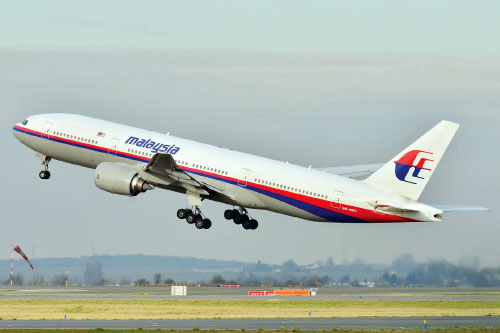
    Malaysia Airlines Boeing 777-200ER taking off from Roissy-Charles de Gaulle Airport, in France, less than three years before the aircraft vanished over the Indian Ocean, in 2014.

    Three years later, a native beachcomber stumbled upon a piece of allegedly associated debris washed ashore at Réunion, a tropical island off the east coast of Africa, five hundred miles from Madagascar. The flaperon – a type of trailing edge control surface combining the functions of both flaps and ailerons on an aircraft wing – has just one of three digits matching Flight 370’s serial number. Malaysia Airlines officials nonetheless announced without hesitation that the Réunion fragment proved their jetliner had gone down into the sea, based on a single piece of questionable evidence. Even if it did, in fact, originally belong to MH370, it was one of over three million parts with which the missing Boeing 777-200ER had been constructed. 

    Why were no more ever found? A majority of them are buoyant. The heavy engines are mostly the only elements prone to sink. Aircraft do not plunge into the water like falling stones because they are essentially hollow tubes – not uniformly solid objects, but pieced together with numerous component parts, which typically break off into trails of scattered debris when coming into contact with the surface. An airplane like the Malaysian specimen would have disintegrated in a broad swath of flotsam after impacting the water, even at its landing speed of 161 miles per hour.

    (Left) First Officer Fariq Hamid; (Right) Captain Zaharie Ahmed Shah.

    When Trans World Airlines Flight 800 exploded and crashed into the Atlantic Ocean near East Moriches, New York, on 17 July 1996, investigators recovered enough wreckage to almost rebuild the downed Boeing 747-100. If Flight 370 had flown into the Indian Ocean, an airplane of that equivalent size and a significant number of parts would have similarly left a profuse field of wreckage recognised by the more than ten thousand professional observers almost immediately after their search-and-rescue efforts began. 

    Earlier still, such an impact would have been detected the moment it occurred by at least several of the hundreds of military and corporate satellites daily and constantly monitoring every square yard of our planet, with high-definition imagery down to sharp resolution of an automobile license plate from altitudes up to 1,200 miles high. This Space Age technology is not new. It was in place years before the Malaysia airliner vanished and should have unquestionably detected and video-documented its collision with the water, had such occurred. 

    Earth’s lakes and seas are likewise under round-the-clock hydrophone surveillance, as demonstrated by US Navy acoustic sensors, which detected the much smaller Titan imploding in the North Atlantic last 18 June, when the eleven-and-a-half-ton submersible began its fatal descent. The same sensors would not have missed the far greater sound made by a 383-ton Boeing 777 striking the Indian Ocean. At least four major electronic listening posts, operating twenty-four hours per day, have, in fact, all the seas of the world acoustically wired for any significant disturbance. 

    In brief, if a three-year search conducted by twenty nations could not find the airliner, which also escaped the notice of Earth-scanning space satellites together with a worldwide hydrophone network, it could not have crashed anywhere on land or water. But the mystery of Flight 370 preceded its disappearance. Examination of its passenger list calls into question official narratives categorising the event as not yet entirely explicable but otherwise surely accidental. 
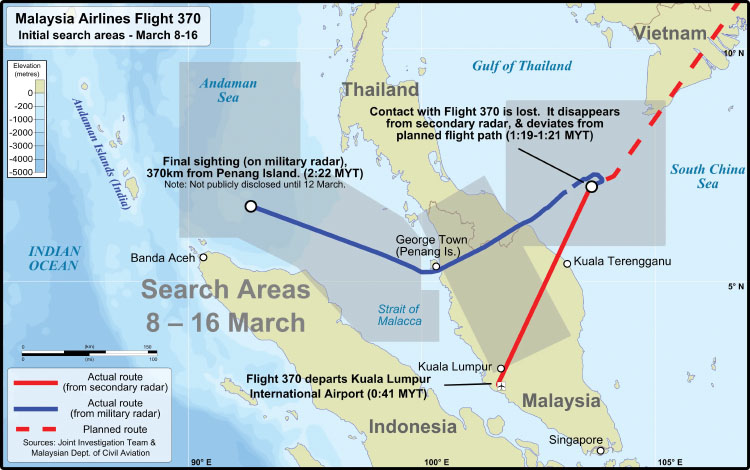
    After MH370’s final sighting on military radar 370 kilometres west of Penang Island, the jetliner proceeded westward another 397 kilometres to India’s Nicobar Islands, where it disappeared in a flash.

    Passenger Anomalies

    Zhao Qiwei was a thirty-seven-year-old Chinese man returning to his home in Beijing, Flight 370’s scheduled destination. Malaysian police investigators later learned that his passport was fake, a professionally made copy of the original belonging to the real Zhao Qiwei, a resident of distant Fiji who had never travelled abroad. 

    (Left) Pouri Nour Mohammad, one of five passengers – four of them, like himself, Iranian – who boarded Flight 370 with forged or stolen passports for reasons known only to themselves. (Right) Nor Fadzillah Mat Rahim and his wife, Azrai Izet Mohammad, both electrical engineers, were among the unaccountably high number of thirty-four semiconductor scientists aboard Flight 370. 

    Other identity improprieties involved passengers from the Middle East. The stolen passports of an Italian (Luigi Maraldi, 37 years old) and an Austrian (Christian Kozel, 30) were used by a pair of Iranians to board the airliner. They were joined by two more Iranians using stolen travel documents – 18-year-old Pouri Nour Mohammad, and Delavar Seyed Mohammadreza, 29. While irregularities such as these are undoubtedly more common in Southeast Asia than in the United States, five passport criminals – four of them from Iran – together on the same flight, seems excessive by any comparisons. 

    Stranger still, twenty other passengers worked for the same firm, Freescale Semiconductor, Inc. Their presence aboard a single airliner was in violation of standard corporate practices, which ordain that no more than three employed scientists of a developmental company may share the same aircraft, as a precaution against their accidental deaths, which would seriously damage heavily invested research projects. 

    Freescale Semiconductor, Inc. was a Texas-based technology giant on the cutting-edge of applied electrical engineering, such as “chips that can be embedded as identity tags into cash, passports or even human bodies,” according to Sheppard Ambellas, founder and editor-in-chief of Intellihub News. “The chip can replace barcode tags in retail goods and can be inserted into the human body, animals, bullets, credit cards, and other items for verification purposes. The made-in-Malaysia microchip measuring 0.5 mm X 0.5 mm – the size of a decimal point – uses the radio frequency identification (RFID) chip technology.”1 

    Freescale Semiconductor, Inc. had its corporate headquarters in West Austin, Texas, and was absorbed into NXP Semiconductors in 2015. The identities of its twenty employees who disappeared with Flight 370 were kept secret from the public. Why? 

    Other important uses include the detection and extraction of new oil deposits. These technological advances are made possible by semiconductors, composed of a solid substance with conductivity between an insulator and that of most metals. Devices made of semiconductors, notably silicon, are essential components in most electronic circuits. And Freescale Semiconductors, Inc. was the leader in this field. 

    Its twenty doomed and inexplicably herded together computer scientists were joined by yet another fourteen electrical engineers and professionals in related research. Liang Xuyang was an engineer working for Huawei Technologies Company, Ltd., another multinational corporation, this one Chinese, that designs, develops, manufactures and sells telecommunications equipment, consumer electronics, and smart devices. Tian Junwei was another Huawei electrical engineer. Others aboard were Vinod Kolekar, a retired electrical engineer at one of India’s biggest conglomerates, Mahindra and Mahindra; Chang Mei, worked for Eastman Chemical Company in Pittsburgh, Pennsylvania; Selamat Mohdkhairulamri, a Malaysian aviation engineer; Li Yanlin, from China’s telecommunications company, ZTE; Nor Fadzillah Mat Rahim, a Queen’s University graduate with a Bachelor of Science degree from the Department of Electrical and Computer Engineering, and his wife, Azrai Izet Mohammad, another electrical engineer. 
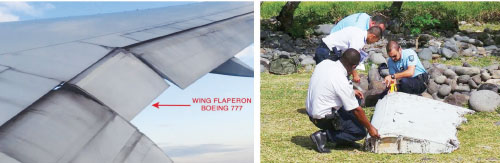
    Flight 370’s sole surviving evidence from the airplane’s more than three million parts.

    Four more of their fellow passengers held important positions in software and telecommunication corporations. Forty-four-year-old Gan Tao belonged to the Halliburton Company of the infamous Dick Cheney. An American multinational firm, Halliburton is the world’s second-largest oil concern and responsible for most of the biggest fracking operations anywhere. What was a man like that doing on a regular commercial airliner to China? No less perplexing was Zhang Jianwu, an official from China’s Ministry of Industry and Information Technology, a state-run propaganda organ of the Communist Party. How did he and his singular, though professionally related fellow passengers come to share the same flight to oblivion? These leads, as peculiar as they were, went nowhere toward on understanding of what actually happened. Until recently. 

    Whistleblower Video Evidence

    Sometime immediately after the incident, three brief visual documents purporting to show the final moments of Flight 370 began making the rounds of physicists and computer experts. Most dismissed the videos as a skilfully contrived, photoshopped hoax, while a minority of viewers were unsure. The one-minute clips were alleged to have been covertly released by an anonymous US government whistleblower just days following the airliner’s disappearance. 

    Years later, another US federal employee with top-secret clearance as a scientist under contract subjected the images – still unknown outside professional circles – to intense, rigorous scrutiny with the aid of software specialists utilising state-of-the-art research programming. They not only verified beyond a shadow of a doubt that the controversial clips were unquestionably authentic but learned from the imagery what became of Malaysian Airlines Flight 370. “The whole narrative around the south Indian Ocean is built on a lie,” declared the new whistleblower.2 

    Ashton Forbes went public with his revelation, posted the videos on Twitter, and applied in writing to the US Congress for a hearing. “I am willing to testify in front of congress,” he wrote, “as to the authenticity of these videos and explain every aspect of them. I would also invite physics experts to validate the science on display. The videos in question are that of the true fate of Malaysian Airlines Flight 370… The dates are damning. Satellite Video Received March 12, 2014, uploaded May 19, 2014. 

    “So why now, many ask? Because only in 2023 do we have the basis to understand these videos to be real… Without all these things, the MH370 videos seem like magic. We know the location of the videos because the investigative group I started, MH370x, satellite experts used amateur historical trajectories to identify the correct satellite in the correct position to take the 3D stereoscopic video we see. 

    “We can see six sets of coordinates in the satellite video which we had incorrectly thought were in the South Indian Ocean until we were able to realise the only possible location was the Nicobar Islands [located in the Indian Ocean about 800 miles east of Sri Lanka], because the plane is turning left in both videos, and due to the coordinate shifts. This means the plane is turning south and to the east. 

    “The satellite and witness (Katherine Tee [she and eight other eye-witnesses – fishermen – saw the aircraft glowing orange and trailing smoke as it descended]) indicate the time is 18:40 UTC [Coordinated Universal Time, the primary standard by which the world regulates clocks; 18:40 UTC equates to 2:40 a.m., local Malaysian time], March 7th, 2014… We have definitively proved every aspect of the videos to be authentic. We know the assets, the time, the location, we have a witness… 

    “There was no debris field, which is impossible for a 777 crashing into the ocean. The small amounts of debris found are consistent with the fire scenario, and some debris had burn marks. A fire suppression device from a Boeing-777 washed up in the Maldives and was not investigated, despite having visible serial numbers.

    “We know that the ‘official’ narratives are a lie to cover up that this technology was deployed to either save the plane or as espionage to prevent the twenty Freescale Semiconductor scientists onboard from going to China. I suspect they are integral to the technology we see. 

    “We know the plane didn’t crash into the ocean because the SOSUS system [the SOund SUrveillance System provides deep-water, long-range detection capability] didn’t hear the acoustic sound. The same system that heard the Titan sub pop, and the Navy lied about it for five days, while oxygen counters were on every major news channel. The Diego Garcia hydrophones [in the Maldives Islands, south of India] and Western Australia hydrophones also didn’t hear it [Flight 370’s alleged plunge into the sea]. 

    US Navy Lieutenant Commander Edward C. Lin, suspected of “leaking” satellite videos, which document the last moments of Malaysia Airlines Flight 370.

    “I was also able to identify the leaker of the videos as being Lieutenant Commander, Edward C. Lin. He checks every box to be the leaker. Our Government attempted to put him in prison for life as a traitor, but he is no spy. Edward C. Lin is a hero. He took a plea deal after he was convinced he damaged national security, but he never revealed this information to our enemies. He simply wanted to do the right thing and tell the world the truth of this technology and what happened to MH370. He was sentenced to nine years in prison and likely is bound by his plea deal to never speak about the videos again. We can vindicate this man as well as everyone else who was lied to or discredited… 

    “I know the videos seem impossible, but they are authentic. They are not CGI [‘Computer-Generated Imagery’, a specific-technology or application of computer graphics for creating or improving images in videos]… hundreds of community VFX experts [an abbreviation for ‘visual effects’] have analysed the footage frame by frame and not a single discrepancy can be found. The list of requirements to ‘hoax’ the videos is practically impossible… 

    “The reason I am requesting a public congressional hearing is because I believe the weight of the evidence can convince enough people in congress that the true events of MH370 were covered up by our own government…” 

    Lieutenant Commander Lin allegedly leaked the initial military satellite video four days after it was made, followed on 5 June by a second version that was almost identical because it had originally operated at the same moment in tandem with the first, as a backup, from a slightly different perspective. One of the satellites, Forbes writes in his letter to Congress, is “a MQ-1C Gray Eagle with a thermal layer added by the leaker, and the other is a 3D ‘battlespace’ produced by the SBIRS (Space Based Infrared System), via SIGINT (Signals Intelligence), using data from Spy Satellite USA-229, which has a sister satellite next to it classified as debris. This allows for the proven 3D stereoscopic imagery we see in the satellite video.”3

    In other words, there are multiple, simultaneous views of the same subject from different angles. “We have three sources of corroboration for these videos,” Forbes explains. “I would argue that we have more evidence that these videos are real than any other court case in human history.”4

    Three Orbs Surround Plane on Videos

    They begin by showing a Boeing-777 descending through partially clear skies in a left turn toward open water, a few thousand feet below. Long lines of smoke extend behind the aircraft. These are not to be mistaken for contrails, which manifest only between 25,000 and 40,000 feet. The airplane is shown flying among cumulus clouds, found no higher than 6,000 feet. A fire is burning in the ventral cargo bay, as indicated by the video’s thermal layering, which displays a tell-tale red hot-spot at the central underside. 

    The visually captured aircraft was positively identified as Flight 370 by the spy satellite’s recorded time-stamp, which matched the time needed for the Boeing-777 to travel the distance from its last sighting outside Penang Island to its sudden disappearance near the Nicobar Islands. A few seconds into the video, a bright orb abruptly initiates spherical intercept manoeuvres around the distressed airplane. A moment later, a second object is seen rising at great speed from the sea below and through a cloud to follow its companion in rapidly orbiting the Malaysian airliner. They are joined by yet another orb that literally fly rings around the jetliner. 
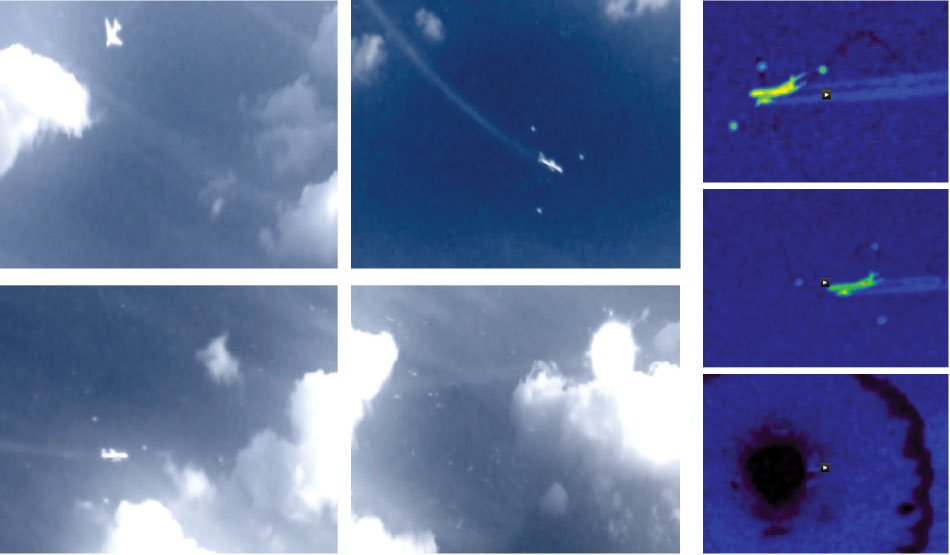
    There are two leaked military satellite videos. On the left are screen captures of the first video showing three orbs manoeuvring into position around the plane. The fourth panel shows a massive flash when the plane and orbs disappear. The second video has a thermal layer showing the same sequence of events but from a different angle, with the final panel showing the flash. 

    All three are identically circular, ten to fifteen feet in diameter, dull-metallic silver, and recognised by thermal layering as exceptionally hot. Ashton Forbes calculated they flew “ten times faster than the plane.”5 Given that the cruising speed of a Boeing-777 is 590.8 miles per hour, that would put the orbs at 5,908 mph, faster than Mach 7. By comparison, the fastest airplane in the world today is the North American X-15 at Mach 6.7, still 1,388 mph slower than the video-documented orbs. If so, occupants inside these vehicles would have been reduced to melted butter by the impossible manoeuvres repeatedly executed, which even exceeded the stress tolerances of any known materials. 

    Nevertheless, in the blink of an eye, the orbs suddenly re-arranged themselves into a vertically aligned, locked formation to reverse themselves in the opposite direction of their flight path – a physical impossibility. Two seconds later, a brief, brilliant flash reflects off the clouds. Flight 370 and its trio of orbs are gone. No debris is visible. No fragments of wreckage flutter down toward the sea below. Only the long trails of smoke left by the vanished airliner have come to a stop for lack of forward momentum hanging in the air. 

    The satellite videos enable viewers to reconstruct the tragedy. On the early morning of 8 March 2014 at 12.41 am the Malaysian airliner departed Kuala Lumpur International Airport. Officially, it lost radio contact with ATC (air traffic control) two hours and one minute later because, by then, Captain Zaharie Ahmad Shah shut down all but the most essential electrical circuitry, as his first counter-active measure against a fire just making itself known in the cargo bay. He then executed a sharp left turn to the southwest on a direct heading for the nearest airport at George Town, on Penang Island. 

    By the time MH370 arrived there, more than two hours later, the onboard fire had been apparently contained, if not entirely extinguished, but the airplane’s damaged landing gear could not be extended. Reactivating radio communications, the pilot was denied arrival permission by Penang International Airport authorities because they regarded a crash-landing with too much fuel still in the jetliner’s tanks – a prospect compounded by the unresolved cargo bay emergency – not feasible. For causes unknown, Flight 370 then proceeded out over the Indian Ocean on a northwesterly course.6 

    Before it reached the vicinity of the Nicobar Islands, the dormant conflagration flared up again, characteristic of lithium-ion battery fires. The consequent loss of cabin pressure explains why the Boeing-777 shown in the videos was flying at only a few thousand feet. Trailing smoke, but still under control, it spiralled toward the sea in Captain Zaharie Ahmad Shah’s apparent intention to set his burning aircraft down on the surface of the water, a risky alternative in any circumstances, made especially hazardous in conditions of total darkness. 

    At less than five thousand feet, the airliner was intercepted by three metallic orbs. They performed high-speed manoeuvres around it in formation for twenty-nine seconds before the airplane and its unconventional escorts vanished in a bright flash. “We know that there was a fire on the plane likely from the lithium-ion batteries which broke containment,” Ashton Forbes wrote Congress, “causing Halon gas to permeate throughout the plane.”7 

    Flight 370 had been loaded with no less than 487 pounds of lithium-ion batteries hastily assembled just one day previous to its take-off date. Although quite capable of self-igniting, they were at least potentially part of the jetliner’s intentional destruction, disguised as an industrial accident. For example, contrary to company dictates, the inflammable power-packs did not go through security screening at the plant where they had been manufactured before the lorry carrying them was sealed for transfer to the Kuala Lumpur International Airport. 

    When they arrived, the combustible consignment was hurried aboard the jetliner without having gone through any additional inspections, per standard airport safety procedures, before departure. These security lapses allowed sufficient time for someone to insert among the lithium-ion consignment a simple clockwork triggering device for igniting the batteries long after the passenger plane became airborne. A would-be mass murderer possessed easy access to the means and opportunity for sabotaging MH370. But who had the motive? 

    Get the issue this article appears in

    Was MH370 Taken Out over Stolen High Level Tech Secrets?

    An answer may lie with the twenty top developmental Freescale Semiconductor scientists aboard. Their untypically high number travelling together on a single flight, combined with another fourteen of their professionally and racially related colleagues, suggests they may have become dissatisfied with their Texas employer and were flying to a new, kindred boss in China. 

    “It has also been mentioned in a statement by a company spokesperson,” according to Sheppard Ambellas, “that the employees who were aboard MH370 were extremely talented and valuable in the technological field… The convenient end to the lives of these technicians denies China groundbreaking military-applications technology that would have very likely been privately leaked or sold to them and widely pirated by China for military and commercial purposes.”

    He goes on to tell how four of Flight 370’s Freescale Semiconductor passengers “were reported by several sources to have been US patent holders of a new technology with wider military applications. This would likely have been a breach of protocol, but at the least, a costly oversight. In fact, it’s been reported that Peid Ong Wang, Zhijun Chen, Zhihong Cheng and Li Ying, Freescale employees from China, who were said to have been onboard Flight 370, were each 20% holders of US Patent #US008671381B1. 

    “Shockingly, the remaining 20% has been reported to be held by Freescale Semiconductor, Inc., which now after the disappearance of Flight 370 becomes the sole patent holder… Freescale Semiconductor is primarily owned by the Blackstone Group; i.e., Lord Jacob Rothschild… In laymen’s terms, Lord Jacob Rothschild is now the patent holder by virtue of invested interest into Freescale Semiconductor, Inc.… the Rothschild dynasty owns the Malaysian Central Bank, which, in turn, is heavily invested into the Malaysian government and Malaysian Airlines.”8 (Note: Freescale Semiconductor no longer operates and was absorbed into NXP Semiconductors in 2015.)

    Ashton Forbes concurs that MH370 may have been the victim of “espionage to prevent the twenty Freescale Semiconductor scientists onboard from going to China.”9 But he disagrees with findings concerning their roles in the tragedy as patent holders, whose disappearance benefited their American employer – the conspiratorial cause behind said fate. 

    He also disregards the three orbs that accompanied Flight 370 in its last moments as Extraterrestrial Unidentified Flying Objects, or “Unidentified Aerial Phenomena,” as the US military has recently come to recognise them. 

    “Everything we see in these videos can be explained by science,” he says. “This is not ‘aliens’ in these videos. This is our technology… This is a US Government operation… The orbs in this video are ignoring gravity, being pulled forward by some ‘gravity engine’… The explanation for their pattern is artificial intelligence, a computer program.”10 He speculates that the flash in which MH370 vanished was a manmade “energetic event” that did not destroy the airliner but “tele-transported it,” with passengers and crew, to another place, wherever that might be.11 

    Readers may or may not find it plausible that the physicists of some earthly power – the United States, most likely, but possibly Russia, or even China – have actually developed such super-advanced technology, which, no less remarkably, they have kept otherwise perfectly secret for the last nine years, at least. Perhaps we should also allow that mankind might not have an exclusive claim on being a civilised species among the estimated six billion Earth-like worlds in our galaxy alone.12 Some astronomers believe that even if all these “exo-planets” are inhabited by creatures capable of space flight, they are impossibly and forever separated from each other by the impassable number of light-year distances separating them. This theory is based on the supposition that no technology allowing travel beyond the speed of light can ever be developed.

    Putting these cosmic considerations into a human historical context, less than five hundred years ago, when Mesoamerica was approaching its imperial apogee, its five million Aztecs never imagined anything resembling their great, civilised achievement existed anywhere else on Earth. But when the time came, they could not get over the culture shock of racially unknown foreigners commanding an unimaginably superior technology that enabled them to cross the seas, which hitherto seemed impassable, when they suddenly appeared in large numbers along the eastern shores of Mexico. It was less the Spanish Conquistadors’ gunpowder cannons or steel armour, however, before which Emperor Moctezuma’s vast armies of previously invincible warriors melted away, than his and their constricted conception of the world, which left no room for the possibility of other, more advanced civilisations. Therein lies a cautionary parallel we may do well to consider. 

    Coming to grips with the admittedly bizarre evidence presented here, following Sir Arthur Conan Doyle’s prescription for separating fact from fiction might be helpful: “When you have eliminated the impossible, whatever remains, however improbable, must be the truth.”13

    The two videos can be viewed via links in this X (Twitter) thread: twitter.com/JustXAshton/status/1715882849448943786

    [alert type=”general” dismiss=”no”]This article was published in New Dawn 203.[/alert]

    [alert type=”success” dismiss=”no”]If you appreciate this article, please consider subscribing to help maintain this website.[/alert]

    Footnotes

    1. Ambellas, Sheppard, twitter.com/intellihubnews?lang=en
    2. “Orbs Fly Around Plane,” bitchute.com/video/qoqF5LJrw8ca/
    3. Forbes, Ashton, “My Letter to Congress,” twitter.com/JustXAshton/status/1715882849448943786
    4. Magalionhat, bitchute.com/video/92hNKfp1T4eN/
    5. “Orbs Fly Around Plane,” op.cit.
    6. Perhaps the Iranian passenger Pouri Nour Mohammad and his fellow passport thieves could not, for unknown reasons, allow themselves to return to Malaysia. They therefore commandeered Flight 370, as it was about to land at Penang International Airport, forcing Captain Zaharie Ahmad Shah to fly to India’s Car Nicobar Air Force Base, where they hoped for sanctuary as asylum seekers.
    7. Forbes, op. cit.
    8. Ambellas, op.cit. See also “Air Malaysia missing,” May 3, 2014, aulro.com/afvb/flight/193048-air-malaysia-missing-43.html
    9. “Orbs Fly Around Plane,” op.cit.
    10. Forbes, op. cit.
    11. Ibid.
    12. bbvaopenmind.com/en/science/physics/how-many-earth-like-planets-are-in-the-universe-video-infographic/
    13. Doyle, Arthur Conan, “The Sign of Four,” Lippincott’s Monthly Magazine, 1890.

    © New Dawn Magazine and the respective author.
    For our reproduction notice, click here.

  • Deep State Deception

    Deep State Deception

    From New Dawn 206 (Sept-Oct 2024)

    Behind the scenes, puppet masters of the so-called deep state have become so self-assured of an impending global triumph that they no longer thoroughly camouflage their crimes against humanity with multi-layered disinformation and the propaganda of illusion. Instead, uncritical, dumbed-down majorities everywhere are more easily gulled than past generations by today’s perfunctory attempts at concealment. Such translucent cover-ups allow investigators unprecedented access to the truth simply because our over-confident rulers, less intimidated by it, have let their guard down. 

    A recent case in point is the attempted assassination of former US president and (at the time of writing) current presidential Republican candidate, Donald Trump, at a mid-summer rally near the city of Butler, in western Pennsylvania. 

    That it was, in gangster vernacular, “an inside job,” is self-evident, if only because every chief-of-state from Julius Caesar to John Fitzgerald Kennedy and beyond could have only been killed by persons with immediate access to the human target, given the otherwise impenetrable, state-of-the-art protection surrounding the victim, from Rome’s Pretorian Guard to America’s Secret Service. Assassination is impossible without their complicity, as most recently and clearly demonstrated by the Trump incident. 

    Although the Organisation armée secrete (OAS) – the “Secret Army Organisation” – attracted leading French armed forces’ officers and trained sharpshooters, repeated attempts by the OAS to kill the President of France, Charles de Gaulle, were consistently thwarted by the government-sponsored expertise, numbers and surveillance of his Gendarmerie nationale.

    So, too, the US Secret Service is considered among the world’s foremost federal agencies entrusted with the life of a Chief Executive. Its professional reputation was sharply contrasted on 13 July 2024, stemming from untypical incompetence almost beyond belief. Or due to something else. 

    For example, the gunman fired from a position only 100 paces from Trump. This close range was well within the security parameters otherwise invariably and previously staked out by Secret Service agents assigned to such events. How could the assassin have escaped their attention, especially when members of the public saw him with a firearm on the roof of a nearby building just north of the Butler Farm Show grounds where Trump’s rally was held? These same eyewitnesses urgently pointed out the rifleman to the attending police, who did nothing. They refrained from even notifying their fellow officers.1

    ABOVE LEFT: This photo captured one of the bullets whizzing past Trump’s head. RIGHT:  A split-second move saved Donald Trump’s life when an assassin fired at him. Trump turned his head (bottom image) to look at a jumbotron. The top image shows his head position before he turned and the path of the bullet. This turn of the head ensured he was not killed. His action is being interpreted by Trump and many of his supporters as proof of “divine intervention.” 

    For the past several years, standard Secret Security practice includes reconnoitering (mapping) each public meeting to which agents are assigned with remotely operated drones before, during and after the event, in real-time and digitally recorded. If so, how did aerial photography fail to alert the authorities on 13 July? Were drones even used on that day? If not, their absence suggests something darker than ineptitude. 

    TOP:   Map of the scene of the 13 July Pennsylvania rally where a gunman attempted to assassinate Donald Trump.   ABOVE RIGHT:   Screen grab from a video shot by a bystander shows the shooter on the roof taking shots at Donald Trump. BBC Breakfast’s Gary O’Donog­hue was at the scene and interviewed a witness (ABOVE LEFT) who tried to alert Secret Service agents. “We’re pointing at the guy crawling up the roof,” the witness, identified only as Greg, told BBC. “We could clearly see him with a rifle. I’m standing there pointing at him for two to three minutes,” he continued. “Secret Service is looking at us from the top of the barn, I’m pointing at the roof… and next thing you know, five shots rang out.” The ensuing scandal over the failure forced Secret Service Director Kimberly Cheatle to step down. Most independent observers say more than incompetence was to blame, suggesting a high level conspiracy, because Crooks was observed scouting the area a full 90 minutes prior to the incident.

    Revealingly, the accused assassin fired an AR-15, the civilian version of the military M-16. To qualify on an M-16, US Army recruits must score a shot on a human-sized silhouette at the end of a nine-week training period from 150 metres – the same distance from which the right temple of Trump’s head was missed by one centimetre.2 This narrow escape implies that his hitman was a qualified marksman trained in the US armed forces.

    Mainstream media news outlets immediately downplayed the seriousness of the situation, revealing their bias. USA Today and The Washington Post both reported that Trump was escorted off stage after hearing “loud noises” at the rally. CNN published a headline claiming that Trump had to be rushed off stage after a “fall” as if to imply that he had tripped over. Another CNN headline claimed that Trump’s speech was “interrupted by secret service” instead of describing it as an assassination attempt.

    An easier mark was the target’s larger, relatively stable upper torso, but hitting the chest area is less lethal than a more difficult headshot, even for a professional rifleman, whose assignment was to score a death blow. As such, the apparent expertise of the Butler County assassin casts serious doubt on the alleged Pennsylvania shooter. According to current and former Bethel Park High School students, Thomas Matthew Crooks tried out for his school’s rifle team but was disqualified due to poor aim during tryouts.3 The nursing home dietician was never a member of any American military organisation, and his sub-standard shooting skills were at variance with the skilful headshot that so narrowly missed the former president. It seems clear that Crooks was not the likely shooter, although he may have randomly shot into the crowd of “deplorables” (Hillary Clinton’s snobbish derogation of Trump’s followers) to take the life of an attendee and wound two others.

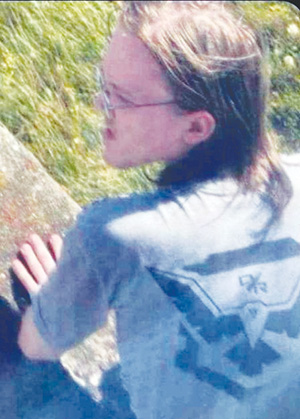
    This image was taken by a Secret Service agent at around 5:30pm and sent to law enforcement to report the suspicious sighting. Thomas Matthew Crooks, 20, is seen sporting long brown hair and glasses while wearing a gray T-shirt. Then, at 6:11pm, Crooks supposedly fired the first shot at Trump from about 147 yards away, grazing his ear and killing one rally attendee. This photo was taken from the very building on which Crooks later climbed to shoot at Trump. Secret Service agents stayed inside the building – from where they took this photo – when they were supposed to be stationed on the roof. 

    What was Crooks, then? A “patsy,” the same term used by another improbable assassin to self-describe his role in an earlier presidential murder. Just as Lee Harvey Oswald was himself gunned down after having been set up as the fall guy to deflect attention from the actual killers of sixty-one years ago, so Crooks was conveniently silenced to take full blame for the attempt on Trump’s life. Both men were and are continuously categorised as “the lone gunman,” a historical “lone ranger,” and just as fictitious; a characterisation necessarily applied to every high-level assassin as cover for the real murderers, whose identity, if exposed, could threaten the sham democracy covering their tracks.

    Although multiple crowd members independently observed a second shooter from a water tower4 at the rally site outside Butler, such a line of inquiry diverts from more essential issues, such as Bethel Park School District officials, who claimed no record exists of Crooks trying out for the rifle team.5 It has vanished along with Facebook, Twitter and YouTube accounts, all of which disappeared down an Orwellian memory hole within hours after his death. He left no digital footprint and virtually no social media trace, which is remarkable for a young adult in these cyber-days. His only prior claim to fame – and an uncredited one, at that – was his brief appearance on a television commercial for BlackRock, Inc., the largest investment firm in the world, with more than $10 trillion in assets.6 It owns or is a major shareholder of CBS, MSN, CNN, FOX, NBC, ABC, YouTube, Disney, Walmart, Google, Facebook, Amazon, Twitter, and a great deal more. 

    Thomas Matthew Crooks in a scene from last year’s BlackRock television commercial. What are the chances of innocent coincidence?

    BlackRock, Inc. controls 90% of the world news and entertainment media, including China’s US congressionally black-listed companies that manufacture facial recognition software for government spying on its own citizens. Some of BlackRock’s top holdings include Coca-Cola, Microsoft and Apple, together with large positions in Broadcom and Nvidia, two of the largest semiconductor companies in the United States. BlackRock’s founder and CEO, Larry Fink, sits on the board of the Council on Foreign Relations (CFR). BlackRock acts as the financial powerhouse for the globalist CFR and World Economic Forum, adjuncts of the New World Order, with its genocidal scamdemics and attacks on freedom.

    Despite Crooks’ apparently studied anonymity, a chronology of events culminating on 13 July begins to emerge from the facts available. A perfect storm of disparate but at least fundamentally complementary interests had been swirling around each other at least since 2017 when self-styled comedienne Kathy Griffin held up a mock-severed head of President Trump. They coalesced on 27 June with Joseph Biden’s positively calamitous performance during an internationally televised debate with the Republican candidate, whose long-desired liquidation seemed a viable option to at least some of his Democratic opponents.

    Days later, a Democrat Congressman from Mississippi, Bennie Thompson, called for removing Trump’s personal security by cancelling the former president’s Secret Service protection, a measure still under consideration up until the assassination attempt.7 On 8 July, Biden exclaimed at a meeting of his donors, “it’s time to put Trump in the bullseye.”8 Had the order been given? In any case, five days later, Trump was shot. For the last eight years, he has been consistently demonised and hysterically blamed by most news media spokespersons for everything from runaway inflation and violent street crime to “climate change” and Covid-19. When this relentless campaign of vilification could not undermine his popular support, Congress impeached him, and he was indicted on minor charges. Again, without effect.

    Having failed to stop him by public methods, some of his most hate-crazed enemies in high places may have decided upon the final argument to which tyrants traditionally resort. Many others would certainly cheer a successful outcome, as indicated by an article written for The Atlantic by David Frum, “The Gunman and the Would-Be Dictator. Violence stalks the president who has rejoiced in violence to others,” one day after the assassination attempt.9

    But why Donald Trump? He has threatened, if re-elected, to suspend all further aid to Ukraine, both economic and military, unless Kyiv immediately negotiates with Russia for a cease-fire. Such an armistice might save thousands of lives, but it would most definitely negate Larry Fink’s plans to rebuild Ukraine after the current war has reduced the entire country to ashes. Therein may lie the connection between BlackRock, Inc. and Thomas Matthew Crooks. It certainly explains Fink’s close ties with the Democrat Party, which has given (as of this writing) $175 billion of US taxpayer money to Ukraine. Many American politicians like Lindsay Graham openly encourage the subsequent military defeat and destruction of Russia. BlackRock’s prospects for rebuilding the warring nations offer far greater profits.

    Domestically, Trump is mostly hated and feared not for what he is but for how he is perceived by millions of mostly white, middle-class Americans. They want to see in him the embodiment of effective resistance to the disgraceful condition of their country. To people like Lindsay Graham or David Frum, Trump followers are “deplorable” racists and nationalists, comprising the growing vanguard of a looming fascist dictatorship. To circumvent such an existential threat to democracy, when all else fails, you cut off the snake’s head and the serpent dies. This was the analogy that culminated on 13 July.

    Had Trump been killed, Biden would have stayed on as the Democrat nominee to handily win the presidential election because the Republican Party, not unlike the ‘Jack Ass Party’, is made up entirely of inept non-entities. Instead, Trump’s survival in good health instantly gave him more political influence than any candidate for the White House could ever hope for. The shooting that was supposed to take him out of the running and clear a direct path to the presidency for the Democrat hopeful resulted in its precise opposite. Biden had no choice but to nod out of the race. His comparison with Trump was too humiliating.

    As the deep state puppet masters undoubtedly had pre-arranged contingencies in place before the attempted assassination, allowing them to profit from the event – regardless of the outcome – they must just as surely lock and load acceptable alternatives to the November election, certainly where their most important interests lie. 

    Meanwhile, the masses of naïve voters, encouraged in their folly by a complicit news media, will yet again imagine they are saving democracy or determining the destiny of their country when they are actually nothing more than unwitting performers in a stage play produced for the ulterior purpose of deceiving them into innocuous passivity while lending counterfeit legitimacy to a criminal syndicate of profiteers insatiably obsessed with unbridled power.

    In Act III, Scene 7 of Major Barbara, by the great Irish playwright Bernard Shaw, an early 20th century version of Larry Fink confronts a democratic politician ambitious for government office: 

    “The government of your country? I am the government of your country: I, and Lazarus [his corporate partner]. You will do what pays us. You will make war when it suits us and keep peace when it doesn’t. You will find out that trade requires certain measures when we have decided on those measures. When I want anything to keep my dividends up, you will discover that my want is a national need. When other people want something to keep my dividends down, you will call out the police and military. And in return you shall have the support and applause of my newspapers and the delight of imagining that you are a great statesman. Government of your country? Be off with you, my boy, and play with your caucuses and leading articles and historic parties and great leaders and burning questions and the rest of your toys! I am going back to my counting house to pay the piper and call the tune.”

    [alert type=”general” dismiss=”no”]This article was published in New Dawn 206.[/alert]

    [alert type=”success” dismiss=”no”]If you appreciate this article, please consider subscribing to help maintain this website.[/alert]

    Footnotes

    1. Clear Signs Pres Trump’s Butler Pennsylvania Rally Assassination Attempt Was A Set Up, bitchute.com/video/7npoG2G2VSvl
    2. Boot Camp Training Manual, U.S. Army. Revised Edition. U.S. Army Printing Office, 2016.
    3. Thomas Matthew Crooks, en.wikipedia.org/wiki/Thomas_Matthew_Crooks
    4. Multiple Eyewitnesses At The Trump Rally Says There Was Another Shooter At The Water Tower, bitchute.com/video/LkGg71Q9K0z9. While Crooks was allowed to get off as many as five or eight shots into the crowd before he himself perished in a barrage of anti-sniper bullets, this noisy gunfire allowed the second and professional shooter in the water tower to make good his escape under cover of the ensuing chaos. Crooks had unknowingly served the assassin’s purpose as a sacrificial distraction.
    5. bpsd.org/apps/news/article/1942738
    6. What Are The Odds Of Blackrock Putting Out A Commercial That Has Donald Trumps Shooter Thomas Crooks, bitchute.com/video/vBDxNqhl0JrX
    7. newsweek.com/trump-assassination-attempt-bennie-thompson-secret-service-security-1924954
    8. bbc.com/news/articles/cw0y9xljv2yo
    9. theatlantic.com/ideas/archive/2024/07/donald-trump-democracy-dictator/679006/

    © New Dawn Magazine and the respective author.
    For our reproduction notice, click here.

  • Who Killed Mars: Did a Nuclear War Destroy the Red Planet?

    Who Killed Mars: Did a Nuclear War Destroy the Red Planet?

    From New Dawn 150 (May-June 2015)

    Now I am become Death, the destroyer of worlds.
    – Vishnu in the Bhagavad-Gita, 5th Century BCE

    Art is sometimes prophetic. A case in point is the Hollywood movie, Rocketship X-M, starring Lloyd Bridges and Noah Berry, Jr. Credible by the standards of its time, this first science-fiction film of the postwar era postulated a manned expedition to Mars. When the crewmembers arrive, they find an illimitable desert of “pitchblende, immense deposits of pitchblende,” a form of crystalline uranium oxide associated with nuclear explosions. 

    Digging in the sand of the Red Planet, the explorers uncover a metallic, finely-crafted sculpture roughly resembling a human head. “The mind that conceived this must have been of a high order of intelligence,” the expedition leader concludes, “at least the equal of Earth’s, perhaps considerably above ours.” 

    In the distance are the ruins of huge, strange buildings, but they are too radioactive for investigation.

    “To think that a complex, organised society existed here once.” 

    “Yes, and from all indications, thousands of years ago.” 

    “I wonder how it happened.” 

    “There’s always the possibility of a meteor, but then it would have created a depression, like a moon crater.” 

    “No, this wasn’t caused by a meteor. This is definitely blast effect coupled with intense heat… Ironic, isn’t it, the mind of Man, wherever you encounter it, Earth or Mars? The highest attainments of human intellect always diverted to self-destruction. Perhaps the entire surface of the planet is one, vast ruin like this… What a lesson here for our world: One blast, thousands of years of civilisation – wiped out.” 

    When Rocketship X-M was premiered in 1950, its basic premise was exclusively confined within the realm of science fiction. Long before then, astronomers deemed the Red Planet incapable of ever sustaining life of any kind, an impression apparently confirmed by numerous, robotic surveyors and landers that have explored our Martian neighbour since the first successful fly-by of Mariner IV, nearly fifty years ago. It was with more than some amazement then, that I heard Dr. John Brandenburg declare in a radio interview in April 2014 that Mars was long ago the home of a civilisation destroyed by a nuclear attack that killed off all life. 

    Had such a statement been made by just about anyone else, I would have turned off the radio and gone to sleep. But I knew Dr. Brandenburg as long ago as 2000, when he and I shared the speakers’ table at an alternative science conference in the American Northwest, where he spoke knowledgeably and engagingly, but not about extraterrestrial warfare. 

    John E. Brandenburg, Ph.D., is a plasma physicist at Orbital Technologies in the US at Madison, Wisconsin, where he works on space plasma technologies and space propulsion. He researches Microwave Electro-Thermal plasma thrusters for space propulsion. Previously, he investigated air plasmas and plasma propulsion at Florida Space Institute at America’s Kennedy Space Center.  

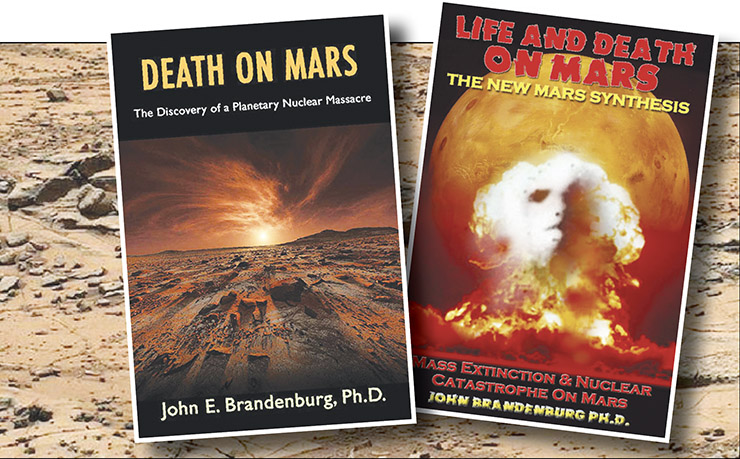
    Co-authored with Monica Rix Paxson, his book Dead Mars, Dying Earth (Crossing Press, 1999) won the Silver Medal in the Ben Franklin awards for books on science and environment. His other books include Life and Death on Mars: The New Mars Synthesis (Adventures Unlimited Press, 2011), and Beyond Einstein’s Unified Field: Gravity & Electro-Magnetism Redefined (Adventures Unlimited Press, 2011). As such, Dr. Brandenburg’s deductions from Martian geology and topography are not the fantasies of a science fiction writer, but scientific conclusions from one of the most important scholars in the world today.

    His April radio interview certainly got my attention, but provoked more questions than answers. To learn them first hand from their original source, I contacted Dr. Brandenburg directly by email, and he took time out from his busy life of scientific investigation to generously share with us some of his truly mind-boggling discoveries:

    FRANK JOSEPH (FJ): What first alerted you to possibilities of a nuclear attack on Mars in the ancient past?

    DR. JOHN BRANDENBURG (JB): A comment by a nuclear physicist at Sandia labs, where I worked, in 1984. I mentioned the excess of Xenon 129 in Mars atmosphere to him, and he became curious, and looked at the data, and then commented flatly, “someone nuked Mars.” He then refused to discuss the matter any further. It took a long time for me to reconstruct the reasons for him saying this from the “open literature.”

    FJ: What evidence exists for atomic warfare on the Red Planet?

    JB: The spectrum of krypton and xenon isotopes found in the Mars atmosphere, particularly Xenon 129 and Krypton 80. Both are produced by nuclear explosions, the Xenon 129 directly from fission of Uranium 238, and thorium by high energy fusion neutrons, and the Krypton 80 by intense neutron bombardment of the soil. The Mars meteorites, which are samples of sub-surface rock from Mars, are depleted in Uranium, Thorium, and Potassium, all radioactive elements, relative to Earth rocks. 

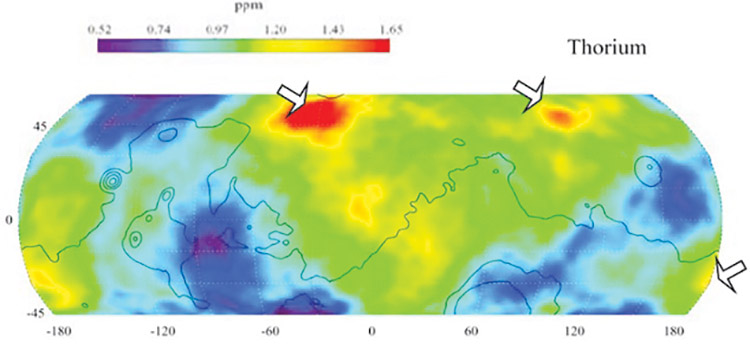
    But gamma rays from the Mars surface measured by Russian and American probes show much higher levels spread over the Mars surface; radiation from two hot spots. Thus, space craft measurements of Mars atmosphere, and surface radioactivity, plus measurements of Mars meteorites, show this evidence. The fission of Uranium 238 and Thorium can only be done by fusion neutrons from a hydrogen bomb reaction, so, in my opinion, this cannot be explained naturally. Data taken by the Mars Science Laboratory’s Radiation Assessment Detector (RAD) from Curiosity’s interplanetary journey to Mars shows large exposures to radiation, as confirmed and published in Science Magazine in the 31 May 2013 issue. 

    A thin layer of radioactive substances including uranium, thorium (shown in graphic) and radioactive potassium on the surface provide evidence for Dr. Brandenburg’s theory.

    A thin layer of radioactive substances including uranium, thorium and radioactive potassium covers the Martian surface in a pattern radiating from a hot spot, as indicated by recent maps showing gamma rays in a radiating debris pattern. What may have been an airburst the equivalent of one million, one-megaton hydrogen bombs occurred over the northern Mare Acidalium region of Mars, where there is a heavy concentration of radioactivity. The terrible truth: Mars was actually Earth-like for most of its geologic history. Mars held a massive and evolving biosphere, but was wracked by a mysterious and astonishing nuclear catastrophe.

    FJ: What was the Martians’ cultural level immediately prior to the attack?

    JB: It appears, from examining several possible sites of archaeology, that it was roughly Bronze Age. But that is only an impression from orbit. We must land there and find out.

    FJ: Can you identify the attacker? 

    JB: No. The only way to do that is to go to Mars and investigate. Possibly, the Martians knew who did this from prior contact and recorded it.

    FJ: Have any ruins or cultural debris from the Martian nuclear attack been found, or do you anticipate their discovery in future explorations?

    JB: We have seen, in space-probe images at several sites, what looks like archaeological ruins. I think we must dispatch astronaut teams to Mars as soon as possible to dig at the principle sites, that is the best way to maximise knowledge of what happened and when it happened.

    FJ: When do you believe such an event took place?

    JB: It was long ago, perhaps two hundred to three hundred million years ago. Not even dinosaurs were present then. Only long lived and stable isotopes record this event. 

    FJ: Is there any contemporaneous or corresponding evidence on Earth of the Martian catastrophe?

    JB: It corresponds approximately to the Great Permian Extinction on Earth, the most terrible of all the mass extinctions, and whose cause is a mystery. (The Permian Period ended with the largest mass extinction in Earth’s history, during which nearly ninety per cent of marine species and seventy per cent of terrestrial species died out – FJ.)

    FJ: Why would some military power want to carry out an atomic attack on Mars? 

    JB: It is difficult to conceive of it, but we have seen such things on Earth. I suspect they were targeting a civilisation there, we are of course aware of the “face” and pyramid in Cydonia Mensa, near the major hot spot of gamma rays on Mars in Mare Acidalium, (forming a quadrangle located in the northeastern portion of Mars’ western hemisphere, covering 300° to 360° east longitude [0° to 60° west longitude] and 30° to 65° north latitude – FJ.)

    FJ: Were there any possibilities for Martian survivors – then or now (i.e., their living descendants) – of the nuclear blast? 

    JB: I do not think so. I believe this destroyed all advanced Martian life.

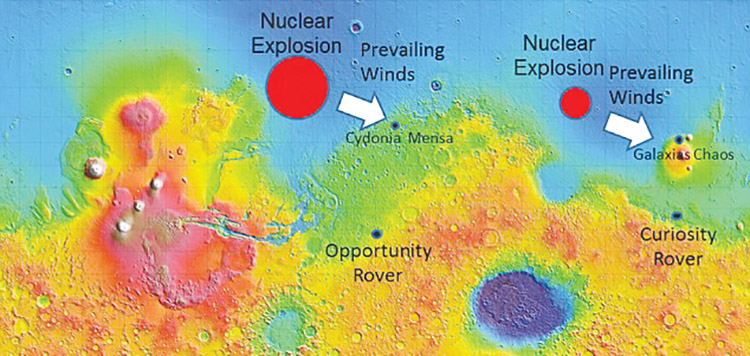
    Nuclear isotopes in the atmosphere resemble hydrogen bomb tests – which Dr. Brandenburg says occurred in two places on Mars, Cydonia Mensa and Galaxias Chaos.

    FJ: How have your scientific colleagues reacted to your statements concerning an artificial nuclear event on Mars?

    JB: I have showed this to many experts in defence nuclear science. They agree with my interpretation, but cannot be quoted publicly. The reaction of my colleagues… where I presented this work was astonishment. However, none disagreed with my basic analysis.

    FJ: Modern Earthly civilisation has reached the capability of putting nuclear weapons into space, and at least one of our probes has already left our solar system; is this level of technology analogous to what the Martians may have achieved and consequently provoked a preemptive strike from a worried or threatened outside power? 

    JB: The possible archaeology at Cydonia Mensa and Elysium on Mars looks like a primitive civilisation. So if this was a nuclear attack, it appears it was preemptive, to prevent future competition. We know the universe is dangerous to life, with asteroid impacts and supernova. Now a new danger has become apparent.

    Get the issue this article appears in

    FJ: Could we Earthlings expect the same kind of intervention, given our developing space technologies? 

    JB: We have no choice but to become space-faring, since we have already alerted the cosmos to our presence by many radio broadcasts and nuclear tests. Becoming space-faring as quickly as possible is the only way to maximise our future safety, in my opinion. 

    Dr. Brandenburg’s discoveries comprise the most astounding, even alarming news we could ever hope to learn; namely, that a non-human civilisation flourished on Mars many millions of years before our species evolved on Earth – a civilisation that was utterly annihilated and all life on its world deliberately killed by some superior power with nuclear weapons. 

    Dr. Brandenburg presents compelling evidence that the Red Planet is more appropriately named after the Roman god of war than subsequent generations ever suspected. 

    John E. Brandenburg contributed the Foreword to George J. Haas‘s 2024 book The Great Architects of Mars: Evidence for the Lost Civilizations on the Red Planet. Brandenburg’s books Life and Death on Mars and Dead Mars, Dying Earth are available from online bookstores.

    [alert type=”general” dismiss=”no”]This article was published in New Dawn 150.[/alert]

    [alert type=”success” dismiss=”no”]If you appreciate this article, please consider subscribing to help maintain this website.[/alert]

    © New Dawn Magazine and the respective author.
    For our reproduction notice, click here.

  • Would They Tell You If Asteroid Apophis Was Going to Slam into Earth?

    Would They Tell You If Asteroid Apophis Was Going to Slam into Earth?

    From New Dawn Special Issue Vol 18 No 2 (April 2024)

    The odds against tomorrow for life on Earth are not good. Genocide in the guise of fake “pandemics”; the collapse of urban population centres; a Third World War… Pick your poison! Singly or a combination of mortal body blows to civilisation are progressively demolishing every aspect of modern culture before our own eyes.

    Yet, all these fatal symptoms of a self-destructive society may be thrown into a cocked hat as pathetically puny compared to what the Cosmos has in mind for us.

    Potential Collision Course with Earth

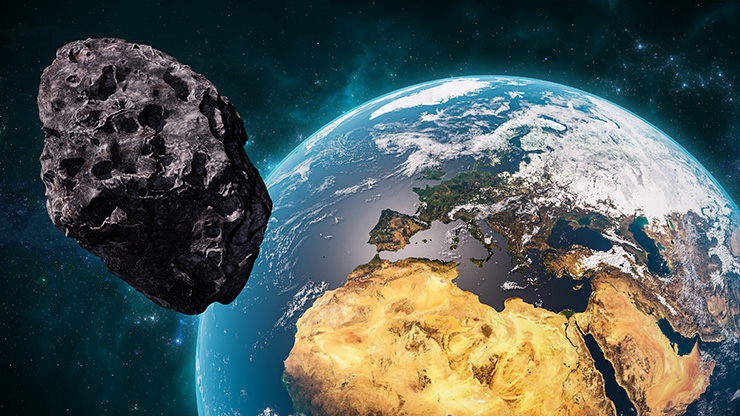
    Apophis is larger by nearly forty-seven metres than Australia’s Q1, the second tallest skyscraper in the Southern Hemisphere. 

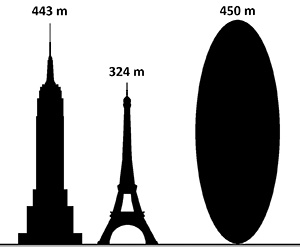
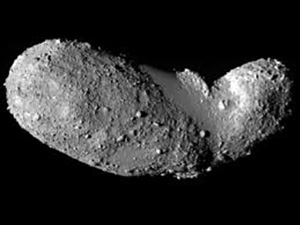
    On 19 June 2004, three American astronomers at the Kitt Peak National Observatory in Tucson, Arizona, discovered a peanut-shaped asteroid on a potential collision course with Earth. Because Roy Tucker, David Tholen, and Fabrizio Bernardi determined that the object had a 2.7 per cent chance of hitting our planet during its next orbital pass, they christened the object Apophis, Greek for the Ancient Egyptian god of destruction, Apep. At 370 metres in length, Apophis is larger than Australia’s tallest building, Queensland Number One, by 47.5 metres, with an estimated total weight of 1.1 million tons of solid rock and nickel-iron.1

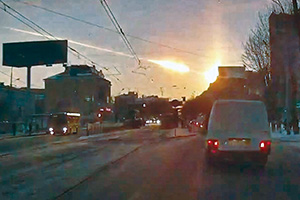
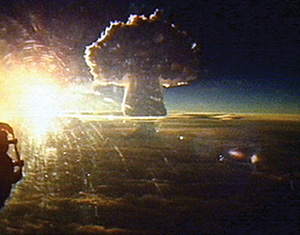
    The stony colossus will travel at speeds between 56,327 kilometres per hour and 72,420 kph after entering our atmosphere.2 Too large for burning up through its frictional descent or in an airburst, its impact will result in a four-gigaton detonation.This is the equivalent of two hundred thousand atomic bombs of the type that destroyed Hiroshima near the close of World War Two. Or eight times the explosive force of Russia’s Czar Bomba, history’s largest man-made nuclear blast, on 30 October 1961, in the Novaya Zemlya archipelago of the Arctic Ocean.3

    Size comparison of Apophis (right) with the Eiffel Tower of Paris (centre) and New York City’s Empire State Building (left).

    For example, if Apophis strikes downtown Sydney, 2.4 million residents in the metro area will be instantly vaporised.4 Another million victims would suffer second and third-degree burns within a twenty-six-mile radius of the impact zone, while an additional four hundred thousand persons outside the fireball would die from a resulting 272-decibel shockwave.5 Its 1,609-kph winds would claim more than one hundred thousand more lives as they obliterate virtually every man-made structure standing inside a twenty-one-kilometre radius from the blast centre.6 Sixty-three kilometres outside the impact zone and travelling at a reduced speed of 322 kph, the winds would still be powerful enough to take the lives of an additional thirty-five thousand people.7 The only thing to mark where Sydney once stood would be a black, smouldering impact crater, 5.1-kilometres across.8

    Repercussions would not be confined to southeast New South Wales, burned by a 129-kilometre-wide firestorm. The two thousand cubic kilometres of debris and ash ejected into the atmosphere by the asteroid strike will block sunlight sufficiently long enough to halt food production on Earth for at least the following two years. Worldwide famine inevitably follows extensive damage to whole eco-systems, with the subsequent collapse of human agriculture.9

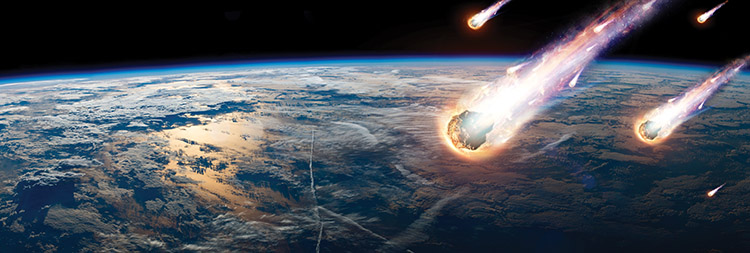
    Asteroid Apophis  

    As such, Apophis could starve our fragile civilisation to death with a global famine, especially given that mankind’s natural living spaces are already stressed by decades of unrelieved industrial abuse. But we are hardly the first species to have similarly died out, as witness Earth’s previous five mass extinction events, the best known and most comparable example being the infamous asteroid that wiped out the dinosaurs 65.5 million years ago. Accordingly, we can make no claim on uniqueness.

    Asteroid Threat is Real

    Astronomers have only recently come to realise that our world is circling through a cosmic shooting gallery thick with near misses, twenty-three hundred of which are identified and classified as “hazardous,” capable of colliding with our planet. Apophis is the most threatening of them all due to the unusually extreme nearness of its orbit. Astronomers assure us, however, that possibilities for its collision with any one of mankind’s five hundred and twelve urban population centres inhabited by one million or more residents is statistically impossible. Scholarly memory is short, however.

    The meteor that narrowly missed vaporising Chelyabinsk’s 1,160,000 residents eleven years ago was eighteen metres in length. Apophis is more than twenty times as long.

    Just eleven years ago, a ten-thousand-ton meteor detonated 23.3 kilometres over the Russian city of Chelyabinsk. The air-burst’s 500 kilo-tonnes of TNT generated were equivalent to America’s “Ivy King” bomb, the largest pure-fission nuclear weapon ever tested by the United States. About fifteen hundred people in and around Chelyabinsk were injured, with one hundred twelve hospitalised, mainly due to flying shards of glass from windows shattered by the exploded object’s shock wave. Three thousand buildings in six cities across the region were damaged by the detonation and impacts.10 Had the 15 February 2013 bolide – which descended at nineteen kilometres per second – blew apart three seconds later, it would have consumed Chelyabinsk’s 1,160,000 residents in a rapid series of cataclysmic events not unlike the hypothetical annihilation of Sydney by Apophis, described above.

    It would appear our cities are not immune from heaven-sent destruction. To be sure, most materials from outer space naturally fall into seas or lakes, covering as they do, seventy-one per cent of the Earth’s surface. This is little consolation, however, because the consequences of more than a million tons of solid rock falling at seventeen kilometres per second into a large body of water could be more catastrophic than the obliteration of a single metropolitan area. Some observers – the popular American astrophysicist Neil deGrasse Tyson among them – calculate Apophis may strike the Pacific Ocean, five hundred km west of Santa Monica on Friday, 13 April 2029, at 8:46 p.m., local California time, when it is nearest our planet.11

    If Apophis collides with Earth, it will generate eight times the explosive force of Russia’s Czar Bomba, the single most physically potent device ever deployed on Earth, the most powerful nuclear bomb tested, and the largest human-made detonation in history.

    Should a collision occur in that area, the asteroid will cavitate a hole in the sea several kilometres across before exploding. The Sentry Risk Table estimates that Apophis would impact Earth with kinetic energy equivalent to twelve hundred megatons of TNT.12 By way of comparison, the Japanese city of Nagasaki was destroyed in 1945 by a nuclear bomb rated at 1.2 megatons. The tsunami Apophis generates will rear up six hundred metres high to radiate outward in all directions, travelling at more than eight hundred kph. Making landfall in a succession of forty to fifty waves per minute, most forms of human habitation along a thousand kilometres up and down the west coast of the United States would be wiped from the face of the Earth.13 San Diego, Los Angeles, Sacramento and San Francisco will no longer exist. Coastal regions of Canada, Alaska and southwestern Asia, even Australia, but especially the Hawaiian Islands, would experience some serious after-effects. Terrible as the images were of the 2011 tsunami that took at least twenty thousand lives in Japan, they would pale at the prospect of thirty-nine million people killed by Apophis.

    What are the Chances?

    But is there any realistic potential for such an unprecedented occurrence? Astronomers at America’s Jet Propulsion Laboratory “announced that Apophis has no chance of impacting Earth in the next one hundred years.”14 This from the same people who were blind-sided at Chelyabinsk. They nonetheless concede that no other space rock of its size has more closely approached the Earth in recorded history. So close, in fact, Apophis will be easily visible to the naked eye by millions of observers in rural as well as darker suburban areas.

    The outer space visitor will be clearly discernible through ordinary binoculars from most locations, when its brightness peaks at magnitude 3.1, while passing over Europe, Africa and western Asia at only five times the radius of the Earth, ten times closer than the Moon. The asteroid is expected to traverse the surface of our planet at less than twenty-nine thousand kilometres – a hair’s breadth, in astronomical terms – beneath the geosynchronous positions of orbiting communication satellites. To maintain their geo-stationary belt formation, they must maintain a constant altitude of 37,015 kms, which is sufficiently high to escape Earth’s gravity. If the satellites descended eight thousand kms to the level of Apophis during its close encounter, tidal forces would drag them down to destruction, as they can the in-coming asteroid.15

    At the very least, its rotation axis will be altered, distorting the orbital path, thereby setting the scene for another scheduled engagement in 2036, when the great bolide will get another, more likely crack at hitting us. Its orbit could be additionally changed by even a partial resurfacing of the object’s surface, a subtle enough alteration causing it to crash, if not in five years, then, with increasing inevitability, sometime in a future return, perhaps no later than during another predicted return in 2068.

    Bombing Apophis to deflect its trajectory away from Earth, as some observers suggested, is no longer an option, because resultant debris, like that from NASA’s “Double Asteroid Redirection Test,” could re-form into dangerous meteor swarms.

    As Apophis streaks downward through the orbits of our 8,337 communications satellites, running into any one of them could engender at least an incremental deflection, nevertheless influential enough to nudge it on a direct heading toward Earth. Their numerical threat pales before the vast field of space junk encircling our planet. There may be as many as 170 million pieces of debris currently in orbit.16 While the vast majority are too small to track due to the limits of current technology, these fragments are no less dangerous. Combined, their numbers alone make at least several collisions with Apophis virtually inevitable. In fact, if the asteroid strikes anything over the next five years, its orbit will be warped potentially into a collision course, given its already close near-miss predicted for 2029.

    Then there is the Yarkovsky Effect. Two years before his death in 1902, a Polish-Russian civil engineer, Ivan Osipovich Yarkovsky, discovered how the heating of a rotating object in space causes it to experience a force that, while subtle, leads to significant, long-term distortions in its orbit, particularly that of an asteroid. Its irregular interaction with solar radiation – alternating heating and cooling of opposite sides, as the object spins – effects its trajectory. As Nature magazine reports, “The Yarkovsky Effect is the main source of uncertainty in impact probability estimates for this asteroid.”17

    Contributing to the incalculable complexity of its unpredictability is the out-gassing an asteroid undergoes as it nears the sun when rising temperatures elicit trajectory-diverting jets. Endeavouring to factor in all these unstable variables, astrophysicists have found to their dismay that Apophis is shifting its orbital path by one hundred seventy metres per year – a change that will either take it further away from Earth or target our planet. Confirming this indeterminable effect, American scientists at the National Aeronautics and Space Administration (NASA) admit that “radar measurements and ground observation discovered Apophis’ trajectory is gradually deviating from a purely gravitational orbit.”18

    Get the issue this article appears in

    Would They Tell Us?

    While none of the above data proves Apophis must inevitably strike the Earth sometime later this century, nor does it conclusively eliminate that probability, but, on the contrary, suggests a collision is entirely possible. What it does show is that the slender difference between a near miss and an impact is too close to call.

    Doubtless, all this and more are thoroughly recognised by NASA authorities, who may feel they must downplay the bolide as a threat to ally public fears and the consequent potential for social unrest. A sampling of the many comments posted by viewers of various sites that discuss Apophis on Youtube, the internet video-sharing platform, reflects this uneasy uncertainty:

    “If it was going to crash into the Earth, they would not tell us, because that would cause panic. I think we will not know the whole truth until a few days before it arrives.”

    “So, this is something you shouldn’t worry about? It would be insane chaos and civil unrest if human beings knew of their demise with several years’ notice. I guarantee you that if and when one is on a collision course with earth, you won’t be made aware of it until the people in charge alone tell you that it is. They are definitely downplaying this.”

    “If it is going to hit, would they tell us, or keep it secret? Do you think they are going to tell us?”

    “Worked for a printing company in the early ‘90s. One day, we were printing the covers for Time magazine that had a picture of this asteroid and doomsday graphics saying it would hit in 2029. But the name they gave it then was Wormwood.19 The run was cancelled half-way thru the shift, and we never heard about it again.”

    “And if Apophis was going to hit the Earth with great certainty, do you really think people would be told this? The powerful ones would just leave us in false hope while they prepare their bunkers deep underground.”

    “If it was going to hit, they would not tell us. This story will be much different in a few years. Sure, if the variables in place when these measurements were made hold true and nothing changes between now and then, it won’t be life threatening. But that’s a lot of time for things to happen. Its orbit could change from gravity tugs coming from other objects, its mass could change, altering its trajectory. It’s not wise to assume it’ll be the same five years from now, as it is today.”

    “I don’t believe the recalculations. I believe they know people would panic. Why would they do this, if they feel it won’t hit us?”

    “I’m not convinced that the re-calculations predicting a near miss are conclusive. At that close a proximity, standard deviation in calculations alone cannot unequivocally guarantee no impact in 2029 or 2036, or again in 2068. I have the impression of this being denial of the threat of impact. Or perhaps an attempt to placate everyone.” 20

    NASA authorities would be extraordinarily remiss should they fail to attempt some serious means of deflecting Apophis away from a collision, even if they believed in the unlikelihood of such an event.

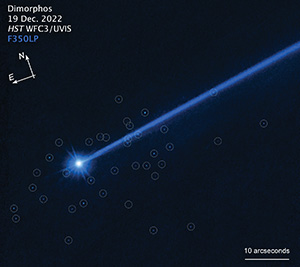
    A Hubble Space Telescope image of the debris cloud ejected from the surface of Dimorphos two seconds after it was hit by NASA’s DART mission in an attempt to divert the asteroid’s trajectory, but instead broke off and shot into space more than three dozen large boulders, plus many hundreds or thousands of smaller rocks. Courtesy of NASA, ESL, David Jewitt/UCLA

    Only two years ago, they deliberately slammed a half-ton DART planetary defense spacecraft into another asteroid, less than half the size of Apophis, at 20,922 kilometres per hour. Their “Double Asteroid Redirection Test” was meant to test theoretical strategy for deflecting similar objects headed for Earth. The strike produced mixed results: while it succeeded in slowing down the target’s orbit around a twin meteoroid by a few millimetres per second, the trajectory of Dimorphos was not budged. Worse, DART unintentionally smashed off thirty-seven large fragments, which were ejected from the surface in a tight pattern resembling buck-shot.

    A weapons’ analogy occurred to University of California (Los Angeles) astronomer, David Jewitt: “The boulder swarm [arising from Dimorphos] is like a cloud of shrapnel expanding from a hand grenade. Because those big boulders basically share the speed of the targeted asteroid, they’re capable of doing their own damage.” He added that “given the high speed of a typical impact, a five-meter boulder hitting Earth would deliver as much energy as the atomic bomb that was dropped on Hiroshima.”21

    Hopefully, NASA scientists have made effective progress in the development of “planetary defense spacecraft” since the ricocheting Dimorphos affair. If so, they are not talking, at least about 2029’s potentially unlucky Friday the Thirteenth.

    “If they say ‘no, we don’t need to worry’,” offers a Youtube commentator, “that means we do need to worry. NASA began by telling us, ‘Apophis has a 2.7% chance of impacting earth’, to, ‘actually, it will definitely pass within 29,000 kilometres, but now has a zero per cent chance of hitting.’’ I smell a monumental rat.”22

    [alert type=”general” dismiss=”no”]This article was published in New Dawn Special Issue Vol 18 No 2.[/alert]

    [alert type=”success” dismiss=”no”]If you appreciate this article, please consider subscribing to help maintain this website.[/alert]

    SOURCES

    1. science.nasa.gov/solar-system/asteroids/apophis
    2. news.yahoo.com/nasa-explains-alert-public-apocalyptic-111301382.html
    3. Youtube: God of Chaos asteroid more dangerous than NASA admits. Apophis update.
    4. Ibid.
    5. echo.jpl.nasa.gov/asteroids/Apophis/Apophis_2013_planning.html
    6. D. Morrison (6 April 2011). “Asteroid 2004 MN4 will come scarily close to Earth on April 13, 2029, but it will not hit.”
    7. Youtube, Op. cit.
    8. web.archive.org/web/20130317183119/http://apophisasteroid.net
    9. Ibid.
    10. planetary.org/articles/what-was-the-chelyabinsk-meteor-event
    11. bild.de/regional/berlin/weltuntergang-ausgerechnet-4178182.bild.html
    12. cneos.jpl.nasa.gov/sentry/notes.html
    13. iopscience.iop.org/article/10.3847/PSJ/ac66eb
    14. science.nasa.gov/solar-system/asteroids/apophis
    15. mpainesyd.com/idisk/Public/paine_tsunami_asteroid99.pdf
    16. nhm.ac.uk/discover/what-is-space-junk-and-why-is-it-a-problem.html
    17. nature.com/articles/s43247-021-00337-x
    18. Youtube, Op. cit.
    19. The New Testament tells how, at the end of the world, “a great star fell from heaven, blazing like a torch, and it fell on a third of the rivers and on the springs of water. The name of the star is Wormwood. A third of the waters became wormwood, and many died from the water because it was made bitter” (Rev 8:10–11). Some alternative researchers speculate the Book of Revelation name describes the common exterior resemblance of multiple-cratered asteroids to worm-eaten wood, thereby inferring that ancient advanced scientific technology in the form of a powerful telescope was accessed by the late 1st Century CE biblical author’s original sources, long before it was re-invented in Holland, in 1608. For further discussion, see the author’s Ancient High Tech: The Astonishing Scientific Achievements of Early Civilizations (2020).
    20. Youtube: Apophis Asteroid and Earth at Closest Approach
    21. newsroom.ucla.edu/releases/planetary-defense-nasa-dart-mission-asteroid
    22. Youtube: Apophis Asteroid – Apophis is Coming in 2029.

    © New Dawn Magazine and the respective author.
    For our reproduction notice, click here.

  • The Astonishing Achievements of our Ancient Ancestors

    The Astonishing Achievements of our Ancient Ancestors

    From New Dawn Special Issue Vol 14 No 3 (June 2020)

    Like other New Dawn readers, I had heard something about Roman road-builders, Mayan mathematicians and Babylonian astronomers. But I was subsequently surprised to discover that these and other peoples achieved levels of applied science in the deep past equal to and occasionally surpassing similar material accomplishments taken for granted today. Some important innovations first conceived during antiquity were lost when the civilisation associated with their creation collapsed and were completely forgotten, only to be independently re-invented thousands of years later by modern developers utterly unaware of their ancient precursors. 

    Yet more remarkably, a time very long ago, when mainstream historians and conventional archaeologists assure us that superstition and ignorance alone ruled the world, human genius attained certain levels of technology still beyond our grasp. So many, in fact, that hundreds of collected specimens fill the pages of my new book until their superfluity overflowed its printed limitations. How grateful I am, then, to New Dawn for this opportunity to share with you some of the truly extraordinary instances of Ancient High Tech that missed being included in the volume so entitled! 

    Five hundred and more years ago, Inca medical practitioners treated serious heart ailments with extracts of foxglove, a procedure only now acknowledged for its efficacy by 21st century health care professionals. 

    Among the most startling examples belonged to Inca medical practitioners, whose advanced healing agents were revered as part of a larger, cultural legacy inherited from Kon-Tiki-Viracocha, “Sea Foam,” pre-Columbian South America’s founding father and flood-survivor from an island kingdom of unique power, overwhelmed in prehistory by a catastrophic deluge. After establishing himself in the Andes Mountains, Inca tradition explained that he schooled their ancestors in the use of plant extracts from Digitalis lanata, a flower known today as “foxglove,” for the successful treatment of serious heart conditions. After the Conquistadors overthrew Inca Civilisation, its culture was entirely demonised, along with all traditional medical knowledge, which fell into oblivion for the next four centuries. 

    Not until 1930 were botanists able to extract digoxin from the leaves of the foxglove plant and discovered (re-discovered) its effective properties for treating atrial flutter and heart failure. Its resulting compound is rated today on the World Health Organization’s List of Essential Medicines as among the safest and most effective measures necessary for any health system. But teasing digoxin from Digitalis lanata demands careful precision and observant skill because the slightest error in determining the correct amount can mean the difference between strengthening the heart or inducing cardiac arrest. This life-and-death discrepancy signifies that Inca physicians not only recognised its critically narrow parameters, but themselves possessed sufficient expertise to properly act upon such a distinction. 

    They also applied the secrets of Matricaria chamomilla to effectively deal with gastrointestinal problems, particularly irritable bowel syndrome and intestinal cramps, when taken as a mild laxative for its anti-inflammatoryand bactericidal effects. Only within the last thirty years has research with animals demonstrated the antispasmodic, anxiolytic (anxiety-reducing), anti-inflammatory, antimutagenic (mutation reducing), and cholesterol-lowering effects of “wild chamomile,” which is additionally included in many of today’s sleep aid products. While all this is relatively new to us, the ancient Andeans were familiar with Matricaria chamomilla and its soothing benefits long before the last Inca emperor was killed in 1533. His culture likewise treated hyperlipidemia, an acquired or genetic disorder that results in high levels of lipids; these are fats, cholesterol, or triglycerides circulating in the blood. 

    The condition was addressed in pre-Conquest South America with extracts of plantago paralias, some forms of which additionally predispose to acute pancreatitis, and may be useful for glycaemic control in patients with type 2 diabetes. The anti-cancer effects of plantago paralias are only now being gradually appreciated. It is clear that Inca pharmaceutical and pharmacological knowledge not only far outdistanced the contemporaneous quackery of European physicians in the 16th century, but still has much to offer modern medical developments. On the other side of the Ancient World, Nile Valley practitioners similarly undertook quantum advances in the healing arts only now coming to light. 

    Imagined reconstruction of scene from ancient Egyptian civilisation. The ruins on display today in modern day Egypt – although still impressive – are a pale representation of how it really would have looked.

    Just ten years ago, archaeologists analysing the skeletal remains of Roman Era inhabitants of Upper Egypt and adjacent Nubia during the early 1st century CE found the presence of tetracycline, an antibiotic in use today for treating bacterial infections. The Egyptians ingested tetracycline with a special beer concoction not unlike sour porridge. Further investigation revealed that retrieved Roman Era samples were identical in substance to the same beverage dating to the advent of Pharaonic Civilisation, more than three thousand years before. 

    Egyptian girls at a 19th Dynasty party (around 1290 BCE) give each other different-flavoured breath mints.

    Related evidence in the form of surviving medical papyri revealed how dynastic physicians and brewers deliberately contaminated their beer with streptomyces, tetracycline-producing soil bacteria that thrives in the arid conditions of the Egyptian desert. Their grain thus laced with tetracycline, the Egyptians observed how it cured them of various bacterial ailments, five thousand years before the discovery of penicillin by Alexander Fleming, in 1928. Their high level of medical science helps explain why many residents of the Nile Valley experienced healthy longevity, such as the famous Pharaoh Ramses II, who lived to celebrate his ninety-seventh birthday. 

    A toothbrush from the time of Cleopatra, last ruler of Egypt’s Ptolemaic Kingdom, circa 40 BCE.

    Advances in Egyptian dentistry were constantly stimulated by the country’s persistent problem of sand blown by desert winds into food consumption, a dilemma that occasioned the world’s oldest known recipe for toothpaste. The 4th century CE papyrus is a Greek-language copy of a traditional Egyptian invention already in common use at the outset of the 1st Dynasty, thirty-four hundred years earlier. The original formula calls for one drachma (one-hundredth of an ounce) of rock salt, another drachma of mint, and one more drachma of dried iris, plus twenty grains of pepper. 

    Dentists only recently re-discovered the beneficial properties of the iris flower, which has been found effective against gum disease and is now in commercial use again after the passage of sixteen centuries – yet another example of an ancient innovation reaching out from the deep past to influence modern technology. According to the sixteen hundred-year-old papyrus, all its specified ingredients should be crushed and mixed together into a “powder for white and perfect teeth.” It was discovered by Dr Hermann Harrauer, in charge of the papyrus collection at Vienna’s National Library, in 2002, atop a rubbish dump outside the modern Egyptian town of Al-Mahamid Qibly, the dynastic Imiotru, known to the Greeks as Crocodilopolis because it housed the most prominent Early-Middle Kingdom sanctuary (2050 BCE–1652 BCE) of the crocodile-god Sobek. 

    His name is a participial form of the verb sbq, “to unite,” or “create wholeness,” i.e., “health,” and therefore appropriate to the discovery of a toothpaste recipe, especially given Sobek’s abundant and powerful teeth. “It was written,” observed Dr Harrauer, “by someone who obviously had some medical knowledge as he used abbreviations for medical terms.” The ancient Nile Valley cleaning agent was faithfully replicated by an Austrian dentist, Dr Heinz Neuman. “Nobody in the dental profession,” he declared, “had any idea that such an advanced toothpaste formula of this antiquity existed.” A colleague volunteered to personally test the recreation. “I found that it was not unpleasant,” said Dr Neuman. “It was painful on my gums and made them bleed, as well, but that’s not a bad thing, and afterwards my mouth felt fresh and clean. I believe that this recipe would have been a big improvement on some of the soap toothpastes used much later.” 

    Anglo-American soap industrialist William Colgate began marketing the first commercial toothpaste in 1873, but it was hygienically inferior to its pharaonic forerunner, which had been lost since the Ancient Old World collapsed. Egyptian dental care even extended to the invention of breath mints made, as recounted in a 16th Dynasty papyrus, from combining cinnamon, frankincense and myrrh, boiled together into a honey base, then shaped as small pellets for easy consumption. Myrrh, a natural gum extracted from tree resin, is analgesic – a pain killer. The Ancients’ greatest contribution to general health, however, was their institution of general hygiene. 

    The city of Mohenjo Daro in late 4th Millennium BCE India was a model urban centre of ingenious water management for communal sanitation and public hygiene.

    While the Roman baths are famous, they were preceded three thousand years by the lesser-known public water facilities of 4th Millennium BCE Mesopotamia and India. In describing the Indus Valley’s earliest urban centres, US researcher David Hatcher Childress writes that “the plumbing sewage system throughout the large cities is so sophisticated that it is superior to that found in many Pakistani (and other) towns today. Sewers were covered and most homes had toilets with running water. Furthermore, the water and sewage systems were kept well separated.” Near Baghdad, homes and sacred structures in the Sumerian city of Eshnunna (modern Tell Asmar in Iraq) featured elaborate arrangements for personal sanitation. 

    “One excavated temple,” according to Childress, “had six toilets and five bathrooms.” He goes on to quote the July 1935 issue of Scientific American magazine, explaining that the temple’s plumbing equipment “connected to drains which discharged into a main sewer, one meter high and fifty meters long. In tracing one drain, the investigators came upon a line of earth ware pipes. One end of each section was about eight inches in diameter, while the other end was reduced to seven inches, so that the pipes could be coupled into each other, just as is done with drainpipes in the 20th century.” 

    Very old as Sumerian plumping may have been, its age pales compared to a series of anomalous lead pipes inadvertently discovered inside three caves at Báigōngshān, the “White Mountain,” earlier this century by palaeontologists visiting China from the United States. With an eighteen-foot-high ceiling, the largest cave features two reddish-brown pipes sixteen inches in diameter. Outside and above its entrance, dozens of hollow pipes, some likewise sixteen inches in diameter, with others down to four inches in width, protrude horizontally from the rock face. About two hundred sixty feet from the cave’s mouth, similarly hollow formations appear on the beach of and within Lake Tuosu, protruding vertically from the water or lie just below its surface, although they differ in ranging from 0.8 to 1.8 inches diameter, and have an east-west orientation. After the American palaeontologists shared their discovery with local authorities in the city of Delingha, the Báigōngshān and Lake Tuosu sites were written up in a six-part series of articles published by Henan Dahe Bao, the “Henan Great River News,” in June 2002. 

    These reports attracted the attention of state geologists and geophysicists, who visited and studied White Mountain, returning to the Beijing Institute of Geology with sample fragments which were subjected to standard examination procedures. These dated the objects to circa 150,000 Years Before Present. Additional testing with different chronological methods consistently repeated the same time parameter, until even stubborn disbelievers, such as Brian Dunning of Skeptoid.com, in the US, were forced to concede the pipes’ Middle Palaeolithic provenance, tens of thousands of years before homo sapiens arrived in Asia. 

    Interviewed by a prominent, state-run newspaper, The People’s Daily, in 2007, Zheng Jiandong, a geology research fellow from the China Earthquake Administration, half-heartedly proposed a natural explanation. He wondered if iron-rich magma may have arisen from deep within the Earth, elevating iron into fissures, where it may have solidified into tubes. He admitted his speculation was apparently negated by not only the pipes own, decidedly artificial appearance, but by their physical connection to nearby Tuosu, more convincingly suggesting a manmade function as part of some water supply system. Moreover, their non-random, uniformly east-west alignment on the lakeshore contradicts a magmatic hypothesis. Additional samples were further analysed at a local smelter, where eight per cent of their material composition could not be identified. “There is indeed something mysterious about these pipes,” Jiandong said. 

    Artistic recreation of Mexica-Tenochtitlan, the capital of the expanding Aztec Empire in the 15th century until it was captured by the Spanish in 1521. The following comment from Bernal Díaz del Castillo in his The Conquest of New Spain leaves no doubt as to the impressive achievements made by the Aztecs: “When we saw so many cities and villages built in the water and other great towns on dry land we were amazed and said that it was like the enchantments… on account of the great towers and cues and buildings rising from the water, and all built of masonry. And some of our soldiers even asked whether the things that we saw were not a dream?… I do not know how to describe it, seeing things as we did that had never been heard of or seen before, not even dreamed about.”

    There is also something mysterious about an object found in January 2019 by former Massachusetts Institute of Technology professor Dr Michael Torres while sweeping his metal-detector over Melbourne Beach, on the east coast of Florida, in the United States. Brushing the concealing sand aside brought to light what appears to be an Inca “funeral mask” embossed with an anthropomorphic figure surrounded by geometric designs. Dr Torres convincingly speculates that it was part of South American riches taken by 18th century Spaniards who packed their looted treasure aboard a galleon that sank in a storm. Since then, pieces driven by wave action continue to wash up onshore. 

    The mask’s humanoid image is similar to other native representations of Kon-Tiki-Viracocha, the flood-hero described in our above discussion of Andean herbal medicine. What most sets the object apart from other such artefacts, however, is its construction from iridium, supposedly first discovered by London chemist Smithson Tennant in 1803. It took ten more years for another British scientist, John George Children, to melt a very small sample of iridium with the aid of the most galvanic battery available at the time. The first melting of iridium in appreciable quantity was finally accomplished by 1860 when blast furnaces had become powerful enough for the job. 

    Evidence of lost high technology – this 10th century BCE Andean mask is made of iridium, the earth’s second-hardest mineral, which was historically unknown until 1803 and only melted for the first time nearly sixty years later.

    Yet, the same achievement was successfully undertaken nearly three thousand years before at the hands of a nameless pre-Inca people, whose surviving copper slag heap at Wankarani, in the Bolivian highlands, is a likely site for the mask’s creation between 900 BCE and 700 BCE when artisans there were known to have been the premiere metal smiths of pre-Columbian South America. 

    The Melbourne Beach find comprises a copper base upon which extraordinarily high temperatures have fused an iridium surface covered with melted silver and gold. As the most corrosion-resistant material known, iridium is the second-densest metal after osmium, with which it is sometimes combined in an alloy for pen tips and compass bearings. Iridium is one of the rarest elements in Earth’s crust, with annual production and consumption of only three tons. Most of it comes from outer space, delivered to our planet’s surface in meteor, asteroids and comet collisions over the course of millions of years. 

    How the Wankarani could have found, let alone identify scarce iridium – much less sufficiently melt this very high density, nearly immalleable and exceptionally hard mineral for artistic workmanship – is made all the more impossible by archaeologists’ insistence that furnaces operated by pre-Spanish Bolivians never approached the extraordinarily high temperatures required to melt iridium. Indeed, that was only achieved, as history tells us, as recently as the 19th century. Yet, there is the Andean mask, material proof to the contrary, and physical evidence of a technological level unequalled for some twenty-seven hundred years. 

    It is haunted by even more intriguing and difficult questions to answer: What was the artefact’s purpose? Why was so challenging a metal chosen for its medium of creation? Iridium’s stellar melting point makes it among the most heat-resistant minerals known. Was the Melbourne Beach object really a “funeral mask” as some observers believe? Or was it a face plate of some kind to protect someone, very long ago, from an encounter with a dangerous heat source? Its further study may tell.

    Learn more by reading Frank Joseph’s book Ancient High Tech: The Astonishing Scientific Achievements of Early Civilizations (Bear & Company), which explores the advanced technology, science, and medicine achieved by ancient civilisations hundreds and thousands of years ago.

    [alert type=”general” dismiss=”no”]This article was published in New Dawn Special Issue Vol 14 No 3.[/alert]

    [alert type=”success” dismiss=”no”]If you appreciate this article, please consider subscribing to help maintain this website.[/alert]

    © New Dawn Magazine and the respective author.
    For our reproduction notice, click here.