New Dawn – World's Most Unusual Magazine

Author: Frank Joseph

  • Mankind’s Cradle of Civilisation Found in Java?

    Mankind’s Cradle of Civilisation Found in Java?

    “Men fear time,” the old saying used to go, “but time fears the Sphinx.” That famous statue and Egypt’s Great Pyramid before which it has reclined for thousands of years have been long regarded as the most ancient monumental structures on Earth. Indeed, their late 20th century reappraisals indicated that they were even older than suspected.

    Beginning in 1974, a medical physicist and colleague of Albert Einstein, Kurt Mendelssohn, showed that the Great Pyramid was not the 2560 BCE tomb of some vainglorious king described by mainstream scholars.1 Instead, the “Mountain of Ra” was raised nearly six centuries earlier, at the very outset of Pharaonic Civilisation, as a massive public works project to unify the numerous, divisive tribes of the Nile Delta in the common cause of its construction.

    So too, the Great Sphinx – roughly contemporaneous, according to Egyptologists, with the Great Pyramid – has been back-dated to at least 5000 BCE – two millennia before the first Egyptian dynasty – by an American geologist at Boston University. During the early 1990s, Robert M. Schoch found that erosion on the Sphinx was not caused by the effects of wind-driven sand, as consensus opinion held, but by moving water, when conditions at the Nile Valley were far more rainy, long prior to the 26th century BCE.2

    As recently as 2009, these extreme chronological disclosures were radically eclipsed by radiocarbon testing of a monumental ceremonial centre in southern Turkey. Its T-shaped pillars, arranged in concentric, stone circles emblazoned with anthropomorphic, zoomorphic and geometric bas-relief images, pushed the start of civilisation back to eleven thousand years ago. But now, even Gobekli Tepe’s primacy has been overtaken by the announcement last autumn of a much larger megalithic complex, half a world away from Anatolia, two thousand or more years older.

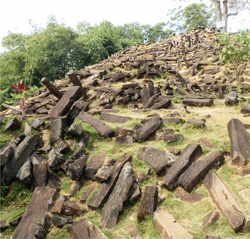
    The paradigm-shattering ruins were found in western Java, fifty kilometres southwest of Cianjur, a city with more than two million residents; Jakarta lies one hundred twenty kilometres to the northwest. A half-hour drive over asphalt and unpaved roads to the village of Karyamukti passes through mountainous landscape dotted with rice paddies and farms flourishing in the volcanic soil with chillies, peanuts, pineapple and corn, then skirts an immense tea plantation. At Mount Padang, hardy visitors need about twenty minutes to climb some 370 stone steps, rising at almost a forty-degree angle, ninety-five metres to the summit, which is crowned with the largest megalithic site in southeastern Asia. It encompasses more than twenty-five hectares, including nine hundred square metres of five, rectangular, stone courtyards ascending northwest to southeast, precisely laid out on a series of landscaped terraces, and neatly organised into low walls, inner partitions, and outward gateways, all of them connected by flights of stairs.

    Within and without the enclosures are dozens of standing monoliths, but many more lie scattered about. The entire complex comprises an estimated 3,703,700 black, andesite blocks ranging from one to two metres in length, and formed by geological processes into polygonal structures of five-, six- or eight-sided columns. (Andesite is an extrusive, igneous rock, a type of basalt formed by volcanic action.) Average dimensions for the columns are 0.3-by-0.3-by-1.5 metres. These smooth-sided blocks weigh from ninety to six hundred kilograms, with an average, individual weight of about three hundred kilograms. In other words, the site’s prehistoric workers transported approximately 1,111,110,000 kilograms (1,224,790 short tons) of building materials 885 metres above sea level, up the precipitous slopes of Mount Padang. Added to their burden was a non-local source for their andesite, which had to be brought in from some distant quarry unknown to academic scholars.

    Archaeologists were further surprised to find traces of a kind of adhesive, glue or perhaps cement that bound some of the top courses of the walls. Beneath, investigators were perplexed by the presence of several layers of sand that had been deliberately incorporated into the original stonework by the prehistoric engineers, perhaps allowing the blocks to move and slide against each other with the motion of seismic disturbances, instead of rigidly resisting such geologic upheavals and breaking under tension. Here was possible evidence for ancient earthquake-proof construction. Java is notorious for its tectonic violence, which claimed the lives of about eighty victims as recently as 2 September 2009. But it seemed utterly inconceivable that some pre-industrial people living in a remote, Indonesian backwater could have actually applied a form of technology our modern world has only recently begun to grasp.

    ‘Musical’ Rocks

    Contributing to the stones’ high strangeness, most of them possess an unusual quality that may have additionally warranted their distant importation by the ancient builders to the top of Mount Padang. Most of its andesite blocks and columns resonate with a bell-like tone when struck with another hard object. They belong to a rare, geological occurrence known as lithophony, the property of some rocks to emit musical sounds under percussive stress. Although only slightly more than one dozen lithophonic boulder fields have been identified in the world, most are found on private property, or have been obliterated by urban development.

    Two, separate sites identically named “Ringing Rocks Park” may be visited in the United States at Upper Black Eddy and Lower Pottsgrove Township, or Stony Garden on the northern slope of Haycock Mountain, all in Pennsylvania. Yet another American “Ringing Rocks” field is found in Montana’s Deerlodge National Forest, on the southwestern flank of Dry Mountain, in Jefferson County, southeast of Butte. Australia has its own “Ringing Rocks” in northwest Queensland, and Mexico’s Cerro de las Campanas, or “Hill of the Bells,” is located on a hill in the city of Querétaro. There are the Musical Stones of Skiddaw in Cumbria, England, but Scotland’s Clach a’ Choire is more cogent to our investigation, because this “Ringing Stone Of Tiree” bears fifty-three circular “cup marks” made by New Stone Age musicians, 4,500 years ago. They, like the builders at far-off Java’s Mount Padang, discovered something unusually mystical in the bell-like sounds. Remarkably, all these various sites produce very different tones from one another; no two locations sound exactly alike.3

    During laboratory testing of several lithophonic rocks in 1965, Pennsylvania geologist Richard Faas found that they created a series of tones at frequencies lower than the range of human hearing, and only became audible when they interacted with each other. Although lithophonic rocks sound metallic, their somewhat higher iron content is not responsible for such music, but rather a combination of the density of the stone and high degree of internal stress. Or so geologists speculate. In truth, beyond the cursory examinations undertaken by Faas, no actual studies to identify the source of lithophony have been made. Why some rocks produce ringing tones remains a scientific riddle.

    Their anomalous appearance among the ruins of Mount Padang is another dimension of their ancient mystery. No doubt, they were used by the prehistoric inhabitants as part of their ceremonial and spiritual activities. A concentration of lithophonic rocks on the site’s first terrace is referred to as “the gamelan stones” for their suggestive arrangement and the variety of musical sounds they make. Notes they produce have been identified as F, G, D and A by Hokky Situngkir from the Bandung Fe Institute, an Indonesian research organisation.4

    Alignments at Gunung Padang

    Archaeo-astronomers have determined that at least several of Mount Padang’s larger standing stones point to very definite celestial phenomena, such as sunrise and sunset on the summer and winter solstices, together with those of the spring and vernal equinoxes. The ceremonial centre’s name may, in fact, have actually derived from these prehistoric solar orientations. For example, the word padang, in the language of the Sundanese people of West Java Province, translates as “bright.” Gunung Padang, the archaeological zone itself, is commonly referred to by native residents as Sundapura, or “the Shrine of the Sun,” while the hill on which the ruins are located (“Mount Padang”) is traditionally called Parahyang Padang: “Where The Sun Ancestors Dwell,” or “Place Of The Ancestors Of The Sun.” These names or titles imply that the original inhabitants were astronomer-priests and/or priestesses, who aligned some of their monoliths with important solar positions. As such, these “Sun Ancestors” were light-worshippers, not unlike the European megalith-builders, who often oriented their own standing stones in western France and the British Isles with identical solar coordinates. Today, Gunung Padang is still sought out as a holy place by the two hundred to seven hundred visitors, most of them religious pilgrims, who visit every month.

    Geomantic alignments are also in evidence. Terrace I is deliberately aligned with nearby Mount Gede, where Karuhun cemetery has been revered for untold generations as the country’s oldest ancestral burial ground. Five, crudely sculpted, andesite thrones stand in Terrace II; six more are found in Terrace V. Although overshadowed by their massive courtyards, Mount Padang’s hundreds of stone terraces are themselves engineering marvels, two metres in height and diameter, with an uncanny resemblance to their far better known agricultural counterparts at another mountainous location on the other side of the world, in the Inca citadel of Machu Picchu, among the Peruvian Andes.

    The Mysterious Nan Madol

    But this South American parallel is not Gunung Padang’s only overseas’ comparison. No less great is an astounding, perhaps kindred mystery 4,345 kilometres northeast from Java, in a remote corner of the western Pacific Ocean. Off the coast of the Micronesian island of Pohnpei – “Built Upon An Altar” – stand the massive ruins of a long-dead archaeological site. Incongruously built on a coral reef less than two metres above sea level, Nan Madol – “Spaces In Between” – is a series of rectangular islands and colossal towers choked by draping vegetation. Ninety-two man-made islands are enclosed within the “downtown” area’s 2.6 square kilometres. All are inter-connected by an extensive network of what appear to be massive canals, each nine metres across and more than one metre deep at high tide.

    An estimated two hundred fifty million tons of prismatic basalt – related to Gunung Padang’s andesite – went into the construction of Nan Madol. Its stone girders rise in a cribwork configuration to eight metres. Between four and five million stone columns went into the construction of this prehistoric megalopolis. These prismatic columns range in length from one to four metres, although many reach six metres. Their average weight is around five tons each, but the larger examples weigh twenty or twenty-five tons apiece. An estimated four to five million basalt pillars, girders and logs went into building Nan Madol. It is, in effect, a double-walled enclosure comprising thirteen thousand, five hundred cubic metres of coral, with an additional four thousand, five hundred cubic metres of basalt. Remove all concealing vegetation, and visitors would behold crudely worked masses of basalt contrasting with orderly courses of stone rising in massive towers and overpowering walls amid a complex of smaller, rectangular buildings and man-made lakes interconnected by dozens of canals and numerous steps, sometimes formed into grand staircases, and spread out over eighteen square kilometres.

    Construction migrated to the main island of Pohnpei, where a rectangular enclosure fifteen metres long by eleven metres wide, with bisecting, one-metre-high interior wall, was discovered in a remote, swampy meadow high in the mountains; its configuration and mountaintop setting are particularly reminiscent of Gunung Padang. Although the Micronesian island’s twin courtyards contain a five hundred square-metre area, a pair of inner platforms are only a third of a metre high. As at Nan Madol, roughly cut basalt boulders and basalt “logs” were stacked to form the enclosure. Several others stand on Pohnpei’s southwest coast, with the largest example atop a two hundred forty-metre-high mountain. The summit is entirely surrounded by walls about two metres high connected via paved walkways to several terraced platforms.

    No one knows who raised them, when or why. Micronesian myth recounts only that exceptionally tall, twin-brother sorcerers, named Olisihpa and Olsohpa, arrived sometime during the ancient past in a “large canoe” from their distant homeland. It was a great kingdom of glittering splendour, until falling stars and earthquakes eventually destroyed Kanamwayso, which sank to the bottom of the sea. This native oral tradition seems like a variation on the more famous story of Mu, or Lemuria, a deeply ancient and supposedly sophisticated, pan-Pacific civilisation that exerted lasting influence on both Asia and America prior to its destruction by a natural catastrophe similar to the tsunami that ravaged northern Japan, in 2010. Before the analogous loss of Kanamwayso, Olisihpa and Olsohpa allegedly built the basalt enclosures and staircases that continue to grace Nan Madol and Pohnpei. Despite more than one hundred years of scientific investigations, however, no known culture has been associated with these places. Meanwhile, the moist, tropical climate skewers accurate carbon-dating at both locations.

    Nor is their original purpose entirely clear. Nothing about either location suggests real urban centres, lacking as they do any provision for food production or storage. No human burials have been found there, save a few, individual skeletons of above-average stature – calling to mind local myths of the founding-fathers, Olisihpa and Olsohpa – unearthed by Japanese archaeologists during the 1930s. The rectangular arrangement of walls with regularly spaced openings and partitions suggest a ceremonial function. But for what people, and why in this extremely remote, obscure corner of the vast Pacific? Nevertheless, Nan Madol’s and Pohnpei’s fundamental resemblances to Gunung Padang imply, at the very least, a relationship of some kind, however inconceivable.

    14,000 BCE?

    Yet more extraordinary than even these comparisons and the monumental greatness of the Indonesian site itself is its uniquely profound age. The first archaeological survey of Gunung Padang appears in a “Report, the Department of Antiquities” (Rapporten van de Oudheidkundige Dienst) for Holland’s colonial office, whose anonymous author posited during 1914 that the ruins could not predate the official beginning of Java’s history in the early 5th century CE, although they appeared much older. For the rest of the 20th century, the site went unrecognised by the outside world, even after it was briefly mentioned by the prolific Dutch archaeological author, Dr. N.J. Krom, in 1946’s Under Palm And Banyan Trees.5 

    Thirty-three years later, a Canberra team from the Australian National University’s Centre for Archaeological Research – “dedicated to investigating and learning with and about the people, languages, and land of Asia and the Pacific region” – returned for the site’s first, scientific examination.6 In doing so, they determined that Gunung Padang was far older than previously imagined. Lichen growth alone covering many of the megaliths bespoke an antiquity going back millennia before Java’s earliest known culture. Not until February 2012, however, was a State-sponsored evaluation of the site carried out, when thorough radiocarbon testing revealed it was built and first occupied about 4,800 years ago. This surprisingly early Third Millennium BCE date placed Gunung Padang squarely within Western Europe’s Megalithic Age, with implications for transoceanic contact, however heretical such considerations struck conventional scholars.

    But as the researchers were carrying out their investigations, they noticed traces on Mount Padang’s surface of what might be other, underground structures. No less a supporter of science than the President of Indonesia himself, Susilo Bambang Yudhoyono, lavished the archaeologists with costly GSSI and Multi-Channel SuperSting R-8 ground-penetrating radar units, plus GEM-Ovenhausser geo-magnetometers. These state-of-the-art instruments readily found and accurately confirmed the existence of large and small chambers, walls, gates and staircases buried deep beneath the often-visited, open-air ruins in a virtual subterranean mirror image of Gunung Padang.

    According to team leader and geologist, Dr. Danny Hilman Natawidjaja, “3-D geo-electric and geo-radar [procedures] discovered two doors in the hallway” of a chamber measuring ten-by-ten-by-ten metres at a depth of twenty-five metres.7 Throughout last summer and into early fall, he and his twenty colleagues – leading seismologists, philologists, archaeologists, anthropologists, and petrographers – carefully dredged up organic materials, which were sent for laboratory testing in the United States, because the Indonesians were determined to avoid any appearance of politically motivated results.

    “US lab validates Cianjur ‘ancient structure’ theory,” The Jakarta Post announced on 5 November. “A recent analysis of carbon-dating by the Miami-based Beta Analytic Lab has apparently validated findings by a government-sanctioned team that a man-made structure lies buried under Mount Padang in Cianjur, West Java. The lab used samples of sand, soil and charcoal found at a depth of between three and twelve metres beneath the mountain’s surface. Based on geo-electric, geo-radar and geo-magnetic [surveys], a large chamber is buried at least up to fifteen metres from the surface… Carbon-dating test results from the Miami lab show that the structure could date back to 14,000 B.C., or beyond.”8

    Since publication of The Jakarta Post report, repeated and additional analysis by Beta Analytic scientists confirmed their initial 14,000 BCE findings. The significance of this discovery cannot be over-stated, because it crosses the Ice Age event horizon. Even Turkey’s Gobekli Tepe, for all its Tenth Millennium BCE antiquity, came into being only after the close of the last glacial epoch, when environmental conditions were moderating sufficiently to allow for the development of proto-civilisation. Less distracted by the incessant challenges to their survival, our ancestors were afforded opportunities for broader, more complex social cooperation. But Gunung Padang proves that humans were already in possession of a relatively high culture two thousand years earlier, while the Ice Age was still in progress.

    This “Shrine of the Sun” has radically pushed back the origins of civilisation to remoter levels of time and space, because mainstream palaeo-anthropologists, fixated on Europe and the Near East, are resistant to the very notion of mankind’s transition from ‘savagery’ in Indonesia. Yet, it is precisely here that Stephen Oppenheimer, a British geneticist, member of Green Templeton College, Oxford, and an honorary fellow of Liverpool School of Tropical Medicine, traced the beginnings of civilised mankind with his controversial Eden in the East, in 1999.9 It had been preceded during the previous century by The Lost Continent of Mu, written by another Englishman, James Churchward, an Imperial British Army colonel serving in India, where his translation of original Hindu monastery source materials likewise recorded how humans took that first step in the Western Pacific realm.10 My own The Lost Civilization of Lemuria (2006) and Before Atlantis (2013) similarly trace the rise of homo erectus in Java, his Pacific-wide dispersal and accelerated evolution after the eruption of history’s greatest volcanic event, and his descendants’ subsequent invention of civilisation.

    These conclusions are wonderfully brought to life by recognition of Gunung Padang as Man’s earliest-known megalithic complex. Its apparent sophistication declares that it was not the first, but must have been preceded by the construction of even earlier ceremonial centres. Civilisation is, therefore, older than we presently comprehend. If, however, the quest for its ultimate origins goes on, and deeper into the past than ever imagined, then at the very least, Gunung Padang is pointing us in their proper direction.

    [alert type=”general” dismiss=”no”]This article was published in New Dawn 136.[/alert]

    [alert type=”success” dismiss=”no”]If you appreciate this article, please consider a contribution to help maintain this website.[/alert]

    Footnotes

    1. Kurt Mendelssohn, The Riddle of the Pyramids, London: Thames & Hudson, 1974.

    2. Robert M. Schoch, Voices of the Rocks, NY: Harmony, 1999.

    3. Ringing Rocks Park, Upper Black Eddy, Pennsylvania, www.youtube.com/watch?v=V4VtjFhysgc; Ringing Rocks Park, Lower Pottsgrove Township, Pennsylvania, www.youtube.com/watch?v=NBfrLoBpsIQ; Ringing rocks, Queensland, Australia, www.youtube.com/watch?v=dl_zL4g2gvs; Musical Stones of Skiddaw, England, www.youtube.com/watch?v=inWKcmVEwvs; Ringing Rocks, Montana, www.youtube.com/watch?v=smiCS1Ixfts; Cerro de las Campanas, Querétaro, Mexico, www.youtube.com/watch?v=_dMRcnlZ2tk; The Ringing Stone, or Clach a’ Choire, Scotland, www.youtube.com/watch?v=eNn-4O_G-bU

    4. www.abovetopsecret.com/forum/thread880575/pg1

    5. Dr. N. J. Krom, Onder Palmen En Waringins, Holland: Uitgeverij in Den Toren, 1946.

    6. ANU Centre for Archaeological Research, http://chl.anu.edu.au/archaeology/car.php

    7. www.abovetopsecret.com/forum/thread880575/pg1

    8. “U.S. lab validates Cianjur ‘ancient structure’ theory,” 5 November 2012, The Jakarta Post, www.thejakartapost.com/news/2012/11/05/us-lab-validates-cianjur-ancient-structure-theory.html.

    9. Stephen Oppenheimer, Eden in the East, London: George Weidenfeld & Nicholson, Ltd., 1999.

    10. Col. James Churchward, The Lost Continent of Mu, U.S.: Brotherhood of Life, 1987 reprinting of the 1924 original.

    11. Frank Joseph, The Lost Civilization of Lemuria, U.S.: Bear and Company, 2006; Before Atlantis, U.S.: Bear and Company, 2013.

    © New Dawn Magazine and the respective author.
    For our reproduction notice, click here.
  • America’s Arcane Origins

    America’s Arcane Origins

    From New Dawn 94 (Jan-Feb 2006)

    Political activists of the so-called “religious Right” in the United States never tire of preaching that their country was founded as “a Christian democracy.” But they are wrong on both counts.

    When Benjamin Franklin was leaving the first Continental Congress, he was asked by one of many anxious patriots waiting outside the courthouse, “What have you given us?” Franklin replied, “A republic, if you can keep it.”

    The difference might seem trivial or even non-existent to narrow-minded persons for whom democracy and dictatorship are the only conceivable forms of government. Yet, the very word, “democracy,” does not occur once in the Bill of Rights, the US Constitution, or any state constitution. It was mentioned often by America’s Founding Fathers, but invariably as a synonym for “mob rule,” and, along with obsolescent monarchy, an evil to be avoided.

    Thomas Paine, the American Revolution’s most eloquent voice, summed up his colleagues’ view of democracy when he described it in his world-famous “Rights of Man” as “a species of demagoguery, wherein clever charlatans, making promises as enticing as they are impossible to fulfil, win for themselves unwarranted power and wealth, persuading gullible people to discard their liberties for a secret tyranny masquerading as public freedom.”

    Particularly in the writings of Thomas Jefferson, the historic models held up for emulation did not include Greek democracy, but the Venetian and Roman republics. The difference between these examples most important to men like Paine and Jefferson was the concept of citizenship. Anyone born in a democratic state automatically becomes a citizen with all the privileges that entails, including the right to vote. In a republic, one is not born a citizen, but may only become one when he or she reaches adulthood; can demonstrate at least a fundamental grasp of the workings of their government, and is either going to school or gainfully employed.

    In modern America, all that remains of these basic requirements is a restriction against voting until one’s eighteenth year. Foreigners must, in fact, pass tests proving their basic comprehension of the Constitution before becoming US citizens, which makes them more knowledgeable, discerning voters than native-born Americans, who are supposed to receive the same kind of rigorous Constitutional education, but rarely, if ever, do. In demanding at least some qualifications for citizenship, America’s Founding Fathers believed that responsible leaders could only by chosen by a competent electorate. Today, however, such notions are shunned as “elitist” in most countries described as “democratic.”

    Yet more shocking to bible-beating conservatives, if they were to learn the awful truth, is that the United States was not founded by Christians, at least of the kind they would approve. Instead, that country’s constitutional republic was conceived, fought for and built almost entirely by deists. While the majority of Americans, then as now, were at least nominally Christian, most of their leaders were not. George Washington, John Hancock, Patrick Henry, Paul Revere and virtually all of their intellectual compatriots were deists. The term is not generally familiar today, but signifies a person who believes in a universal, compassionate Intelligence that made and orders Creation, manifests its will through natural law, but requires no religious dogma to be understood, only the faculty of reason with which every human is endowed.

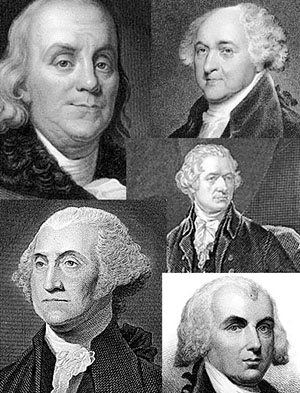
    America’s most famous deists were among the Founding Fathers of the country. Notable deists were the men in this montage, from top right proceeding clockwise, John Adams, Thomas Paine, James Madison, George Washington, and Benjamin Franklin.

    Referring to the church of his day, Paine wrote, “The Christian theory is little else than the idolatry of the ancient mythologists, accommodated to the purposes of power and revenue… My own mind is my own church.” Like his fellow deists, who made a clear distinction between church and state, he was convinced that freedom meant being able to speak one’s mind on all subjects, religious as well as political. He did not “condemn those who believe otherwise. They have the same right to their belief as I have to mine.”

    Nor were the deists anti-Christian. They concluded that Christianity had at its theological core the same mystical truth found in every genuine spiritual conception; namely, the perennial philosophy of compassion for all sentient beings as the means by which the human soul develops. This recognition, however, deeply offended mainstream Christians, who insisted their brand of faith alone was correct, all others being heretical at best or demonic at worst.

    As an example of the extremes these defenders of the One True Religion went to demonstrate their piety, hob-nails initialled “T.P.” were sold by the thousands to Londoners who could walk all day on the name of Thomas Paine. His treatment in the land he had done so much to free was more harsh. When he walked through the streets of his hometown in Bordentown, New Jersey, doors and window shutters were pointedly banged shut as he passed by, while cries of “Devil!” followed him everywhere.

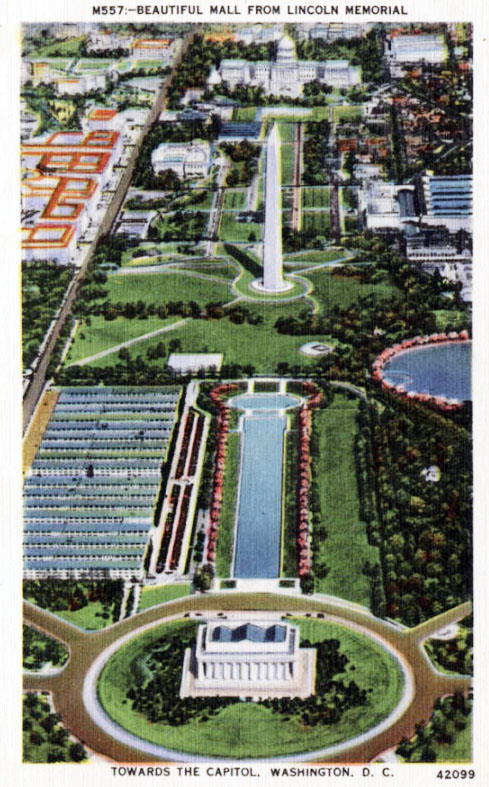
    Modern American Christian crusaders would be even more alarmed to learn that not only was their country founded by deists, but its capitol deliberately designed as a metaphor for Freemasonry. In his profoundly researched book, The Secret Architecture of our Nation’s Capital (London: Century Books, Ltd., 1999), author David Ovason offers abundant evidence to show that Washington, D.C. was built by Freemasons who incorporated their arcane, even heretical ideas in the White House, the Washington Monument, the Library of Congress, the Post Office, the Capitol Dome, the Federal Trade Commission Building, the Federal Reserve Building, even Pennsylvania Avenue itself.

    Freemasons laid a cornerstone in most, if not all, of the major buildings in Washington, D.C. (Source: https://blog.philosophicalsociety.org/2019/11/29/freemasonry-design-washington-dc/

    But what is, or was, Freemasonry? Like any idea or organisation that persists over time, Freemasonry deviated from its initial purpose until, in the end, it bore only slight, outward resemblance to its origins. By way of comparison with a group alleged without much real foundation to have been Freemasonry’s precursor, the Knights Templar was founded in the early 12th century, ostensibly for guarding pilgrim routes to Jerusalem with a few soldiers sworn to poverty and abstinence, but grew to become a virtually autonomous army richly equipped and armed, finally blossoming into an economic entity so potent it called down on itself the murderous envy of a French king.

    So too, Freemasonry began in 1717 as a fraternity dedicated to humanitarian, deistic principles for Englishmen unhappy with the royal powers-that-be, and so were forced to operate with discretion. By the time early Americans were ready to part ways with the Mother Country, Freemasonry had spread to their shores and was embraced by many revolutionaries as an expression of opposition to everything British, including the Church of England. The secret order continued to grow in membership and prestige, until it was infiltrated and perverted from its high-minded ideals by Spartacus Weishaupt, a demented power-freak who wanted a respectable vehicle for subversion and insurrection. Separated by a vast ocean from the facts, even Thomas Jefferson was fooled by Weishaupt’s duplicity.

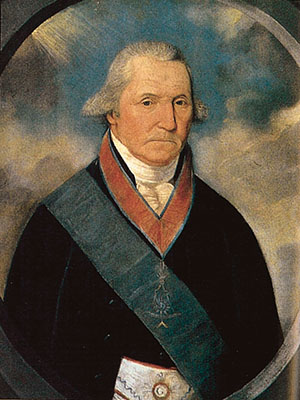
    Dressed in full Masonic regalia of a past master, US President George Washington sat for this portrait by William J. Williams, a fellow Mason, in 1794.

    Henceforward, the “Free and Accepted Masons” were lumped together with Communists as the secretive enemies of Western Civilisation, and outlawed in most European countries. Even in the United States, though they were never banned, the Freemasons were under suspicion by the Federal Bureau of Investigation for many years, and condemned by several congressmen. Thus criminalised or under suspicion, their popularity went into a long decline, until today their once numerous, now largely abandoned lodge buildings, some still bearing masonic emblems, testify to an aging, dwindling following. It is wrong, therefore, to parallel the Freemason George Washington, for example, with the likes of Adam Weishaupt, anymore than it is to equate George Washington with George Bush.

    “The very struggle for independence seems to have been directed by the Masonic brotherhood,” Ovason writes, “and, some historians insist, had even been started by them.” Indeed, the War for Independence began in a warehouse owned by a Mason, and a majority of the revolutionaries who undertook the Boston Tea Party of 1773 were Masons. The most famous American Mason was George Washington himself, although some biographers not altogether happy with Freemasonry have tried to minimalise his association with it. In fact, however, he was the first Master of the Alexandria, Virginia lodge (Number 22) from April, 1788 until December the following year.

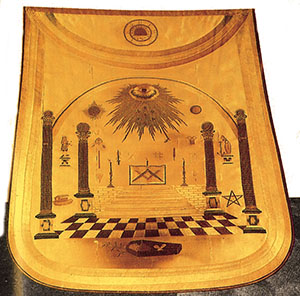
    On a visit to America in 1784, Marquis de Lafayette presented this Masonic apron to his old friend, former commander in chief, and fellow craftsman, George Washington.

    It was this lodge number that was carried before him on a masonic standard, as Washington, leading ranks of fellow Masons all wearing their emblematic aprons, walked in procession to the founding of the American capital, in 1793. The event was commemorated in a pair of bronze panels designed in 1868. They portray him laying the cornerstone surrounded by masonic symbols, including the square and trowel. Washington was still Master Mason when inaugurated as the first President of the United States on 30 April 1789. After his death ten years later, he was laid to rest at his Mount Vernon estate in a masonic funeral, during which all save one of the pallbearers were members of his own lodge.

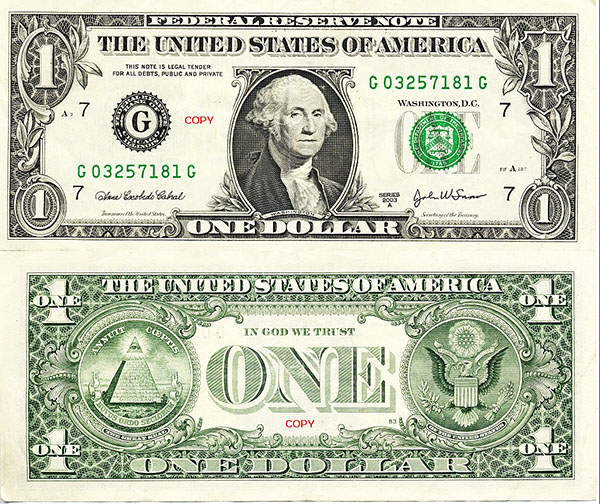
    Ovason observes in a companion volume (The Secret Symbols of the Dollar Bill, CA: HarperCollins, 2004) that Washington’s masonic significance was not only expressed in the city to which he gave his name: “The portrait of George Washington, at the centre of the dollar bill, is highly symbolic.” The President’s image is centrally framed by the last letter in the Greek alphabet, an Omega, for “completion”, or the Ultimate, and implying that the foremost Founding Father represented the apogee of human values. His appearance on the one-dollar bill is by no means the only non-Christian symbol found here.

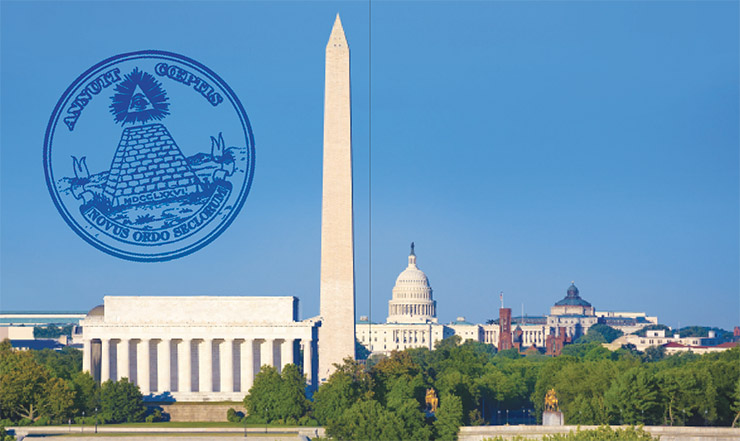
    Especially cogent is the illustration of a truncated pyramid surmounted by a radiant delta enclosing a single eye beneath the words Annuit Coeptis. A motto on a scroll near the base reads, Novus Ordo Seclorum. Both were derived from the great Roman writer, Virgil. In his classic epic, the Aeneid, he directs a prayer for assistance to Jupiter, king of the gods: Audacibus annue coeptis, or “Favor our daring undertaking!” Novus Ordo Seclorum, “a New Order for the ages,” was taken from one of his famous Ecologues – Magnus ab integro seclorum nascitur ordo, or, “The great series of ages is born anew.”

    Esoteric symbolism is replete on the rear side of the United States one dollar bill. (Top) Front side of the dollar bill.

    “The idea of a truncated pyramid was Masonic,” Ovason writes. It is certainly “pagan,” and generally understood to mean stability and virtue in the 18th century. According to President William McKinley, the twenty fifth president of the United States and himself a Mason, it also meant strength and duration. But these obvious characterisations only represent the figure’s exoteric aspect. Far less well recognised, the pyramid depicted on the one-dollar bill, unlike any in the Nile Valley, has seventy two stones. This amount is hardly circumstantial, because it has been revered by mystics as one of the most sacred of all numerals.

    Since Pythagorean times, in the 7th century BCE, and millennia earlier still in ancient Egypt, 72 has represented the ways of writing and pronouncing the name of the Almighty, not the Christian or even Old Testament Yahweh, but God as represented by the Sun, as it moves through space and time. Ovason explains, “Due to the phenomenon called precession, the Sun appears to fall back against the stars. This rate of precession is one degree every seventy two years.” In other words, the dollar bill’s seventy two stones signify the deist conception of the Supreme Being as rooted in the pre-Christian, non-Biblical Ancient World.

    The single-eyed triangle radiating energy above the truncated pyramid is another Egyptian image, the Utchat, or Udjat, the all-seeing eye of Ra, a sun-god and the divine king of heaven. Esoterically, the Utchat was identified with Maat, the moral law pervading all Creation. Its appearance hovering above the apex of the dollar bill pyramid not only reinforces the solar symbolism of that sacred structure, but embodies the principle of Maat America’s Founding Fathers sought to inculcate in the constitutional republic they designed.

    But the esoteric, deistic, even “pagan” Freemasonry of America’s Founding Fathers is most apparent in the arcane influence that Ovason traces throughout the design and construction of the US capital. These early Americans did not weave this occult symbolism through their country’s foremost city for clubbish reasons, but because their iconological signs were the emblems of a new civilisation they wanted to create in the New World.

    For New Dawn’s 92nd issue, Jason Jeffrey described in “Washington, D.C.: A Masonic Plot?” how the White House is located at the apex of a five-pointed star – the ancient geometric seal of King Solomon, with which he conjured supernatural powers – formed by the intersections of Massachusetts, Rhode Island, Vermont and Connecticut Avenues with K Street NW. But the significance of this urban pentagram is overshadowed by what Ovason has identified as the city’s chief orientation to Virgo.

    He writes that central Washington, D.C. has twenty public zodiacs, with Virgo prominent in each one. The founding of Federal City, as it was previously known, laying the cornerstones of the President’s House, in the wing of the Capitol and the foundation stone of the Washington Monument, all were timed to coincide with the appearance of this astrological figure. Ovason shows that the White House, Capitol building and Washington Monument form a strangely imperfect “Federal Triangle” that only makes sense when we realise it identically resembles a configuration made by the stars – Arcurtus, Spica and Regulus – that bracket Virgo.

    On evenings from August 10th to the 15th, as the Sun sets over Pennsylvania Avenue, the Constellation Virgo appears in the sky above the White House and the Federal Triangle. At that same moment, the setting Sun appears precisely above the apex of a stone pyramid in the Old Post Office tower, which is just wide enough to occlude the solar disc. According to the 19th century Freemason, Ross Parsons, “The Assumption of the Virgin Mary is fixed on the 15th of August, because at that time the Sun is so entirely in the constellation of Virgo that the stars of which it is composed are rendered invisible in the bright effulgency of his rays.”

    Formal ground-breaking ceremonies for the National Archives Building were conducted under Virgo. Two years later, three planets were in Virgo for the official laying of the structure’s cornerstone. The Federal Reserve Building is replete with a five-petaled design motif, the symbol of Virgo. The great clock at the Library of Congress is depicted with a comet in Virgo. Because of its centralised location, Ovason believes that “the Library of Congress was sited in this position and its symbolic program established precisely in order to demonstrate the profound arcane knowledge of the Masonic fraternity which designed Washington, D.C. … the city was surveyed, planned, designed and built largely by Masons.” Indeed, no less than twenty one memorial stones with lapidary inscriptions from various masonic lodges line the inside shaft of Washington Monument.

    But why would they incorporate so many references to Virgo in their capital? As Ovason points out, the construction of Washington, D.C. “marked one of those rare events in history when a city was planned and built for a specific purpose.” He fails to mention, however, that nearly two hundred years before, the first permanent European settlement in North America foreshadowed Virgo’s ceremonial centre on the Potomac River.

    In 1606, Sir Francis Bacon established Jamestown in Virginia, ostensibly named after Elizabeth, the Virgin Queen. But the emblem he chose, and which survives today as the state seal, is the image of Pallas Athene, Parthenos, the virgin goddess of Greek myth, the divine patroness of civilisation.

    Bacon, as Greg Taylor observed in the same issue of New Dawn, prefigured the Freemasons with his vision of a practical utopia based on individual liberty and social responsibility – essentially the same ideals that formed the basis of the US Constitution. When America’s Founding Fathers came to compose that document, they perpetuated the identical sacred virginal symbolism initiated at Jamestown.

    Repeated symbolism in the architecture, astrological timing and the very lay-out of Washington, D.C. to Virgo-Virgin Athene represent homage to the Eternal Feminine, Goethe’s “ewige Weiblicher,” which, in his “Faust,” leads us onward – “zieht uns hinan.” The Freemasons who envisioned and constructed the capital of the United States did so to put their new country in accord with that pure (“virginal”) energy they believed to actually exist as the demiurge of Creation. They worshipped that energy, personified in the goddess, a concept that was anathema to the patriarchal Christians of their time (and ours?).

    As Ovason concludes, “A city which is laid out in such a way that it is in harmony with the heavens is a city in perpetual prayer.” Given so great a distance the present occupants of Washington, D.C. have strayed from the original intentions of its designers, the US capital needs all the prayers it can get!

    [alert type=”general” dismiss=”no”]This article was published in New Dawn 94.[/alert]

    [alert type=”success” dismiss=”no”]If you appreciate this article, please consider subscribing to help maintain this website.[/alert]

    © New Dawn Magazine and the respective author.
    For our reproduction notice, click here.
  • Synchronicity: The Key of Destiny

    Synchronicity: The Key of Destiny

    From New Dawn 88 (Jan-Feb 2005)

    Synchronicity is the most mysterious thing in the world. Synchronicity is the term parapsychologists use for “meaningful coincidence.” It happens to everyone, more often than we realise. But synchronicities are not “mere” coincidences, random accidents without significance.

    Going through a half-forgotten collection of old photographs, you’re surprised to find the snap-shot of a friend you lost contact with years ago. Just then the telephone rings and the voice on the other end of the line belongs to the same person in the photo.

    You’re desperate to find a parking place because you’ve got to be on time for a crucial appointment. There’s not an open spot as far as the eye can see. Suddenly, a car pulls out in front of you, leaving you a space right in front of the address where you’re expected.

    You’ve just finished reading a book about rare birds, when the first humming-bird you’ve ever seen in your back yard is drinking nectar from a nearby flower.

    These are typical incidents of synchronicity. And while most people brush them aside as insignificant happenstance, some of the greatest minds in history have grappled with this universal enigma. “Synchronicity” was coined by last century’s leading psychologist, Carl Gustav Jung. Fascinated as he was by it, even Albert Einstein could not understand how it worked.

    A synchronous event of my own in 1991 prompted me to interview, over the next six years, eventually 100 persons about their feelings on this elusive enigma. The meaningful coincides they shared with me proved more illuminating than anything I ever read on the subject.

    Collecting them into a loose order, I was somewhat astounded to see that these synchronous events experienced by my friends and acquaintances arranged themselves into repeating categories. Although many of the persons interviewed differed widely in age, spiritual beliefs or education, the meaningful coincidences they recounted all belonged to specific groups of common experience.

    Widening my research, I found that persons belonging to other cultures, sometimes long dead – often many hundreds of years ago – fell into the same seventeen categories which emerged from the men and women who told me of their own fortuitous occurrences. Their often dramatic, occasionally funny, always numinous testimony formed the basis for a book I wrote, Synchronicity & You, Understanding the Role of Meaningful Coincidence in your Life. Synchronicity is fundamentally a form of guidance that enters into the personal lives of every human being. Even if we knowingly discard it, at least part of its influence enters our subconscious.

    Some guiding synchronicities form a category best described as “Warnings.” A representative incidence of admonitory synchronicity not included in my book was recounted by the California poet, Miriam Hohf:

    “Many years ago, when I was a small child living in the Pennsylvania countryside, I took long walks by myself across the fields and into the forest, listening to the birds and talking to the rabbits and squirrels. I never felt afraid and deeply loved all the trees and animals. But on one otherwise beautiful, sunny day, my surroundings felt different somehow.

    “Everything was absolutely calm and motionless. Just when I approached the edge of the forest, however, a gust of wind suddenly arose, loudly rustling the leaves. I stopped and listened to them, because I felt they were speaking to me. They seemed to be saying, ‘Go away! Do not come into the woods today! There is danger here! Danger! Not safe to play here today! Go away!’ For the first time, a chill of fear ran through me and I fled, almost in tears. I did not visit the forest again, too afraid to return.

    “About a week after my experience, mother told me about a terrible story just published in the local paper. It seems that on the same day the leaves spoke to me the body of another little girl was found by the police. She had been brutally raped before being murdered. Did the spirits of the forest warn me in the rustle of their leaves?”

    Another prominent category of synchronicity falls under the heading of Numbers, which thread together mystical human experience, often with surprising results. The number 57, for example, is an intimate characteristic of the American Revolution, as investigator Arthur Finnessey abundantly demonstrates in his well-researched book, History Computed.

    Among the outstanding examples he cites is the last time the Liberty Bell rang, in tribute to George Washington, before it cracked on February 22, 1846 – 57 years after his 57th birthday. Together with his titles and signature, the closing paragraph of the US Constitution, following its original seven articles, makes up 57 words. It was ratified by 57 yes-votes from New Hampshire, and all Constitutional law begins with the Constitution’s 57th word – that word being, “All.” On February 6, 1777, 57 weeks to the day after the pivotal Battle of Princeton, another turning-point took place when the French joined the American cause. They fought off 19 British warships, making it possible for Washington to defeat Cornwallis on October 19, 1781, in a war which began on the 19th of April, 1775 – 57 is the sum of these three significant 19s.

    Washington’s only two victories over British Commander Cornwallis were 57 days apart. So too, 57 days separated the other decisive battles of the war, at Cowpens and the Guilford Courthouse. The final anniversary of Lexington and Concord celebrated during the Revolutionary War was precisely 57 months, 57 weeks and 57 days after they were fought. In South Carolina’s most famous assault at “Fort Ninety Six”, 57 Americans were killed. Interestingly, “96” is the sum total of the number of men who signed the Declaration of Independence (57) and the Constitution (39). The American Revolution’s 57th month concluded on 19 January, 1780; the Redcoats took Charleston exactly twice times 57 (114) days later. Twelve times 57 (684) days before, the decisive Battle of Monmouth was fought.

    In numerical symbolism, 57 is the combination of two numerals, 5 and 7. Five is associated with male energy (i.e., war), while seven signifies the completion of cycles. Together they form a symbolic concept perfectly reflecting the completion of major military cycles running like inter-linking themes throughout the history of the Revolutionary War. Isodore Kozminsky refers to any number from 55 to 64 as “the Sword,” associated with military victory (Numbers, Their Meaning & Magic, NY: Samuel Weiser, 1977, page 51).

    These ancient interpretations of 57 make its frequent recurrence throughout the War of Independence very appropriate. Yet, we stand in awe of its historical significance: Was it somehow an out-growth or expression of America’s violent struggle for freedom, or did it from the beginning (from before the beginning) determine historical events?

    The outstanding feature of 57, around which acausal incidents revolved, was a major rift in the fabric of history – the American Revolution. All other, similarly powerful historical events likewise produce extraordinary high levels of meaningful coincidence. In fact, the more dramatic, even traumatic, the event, the greater the intensity and sheer number that appear.

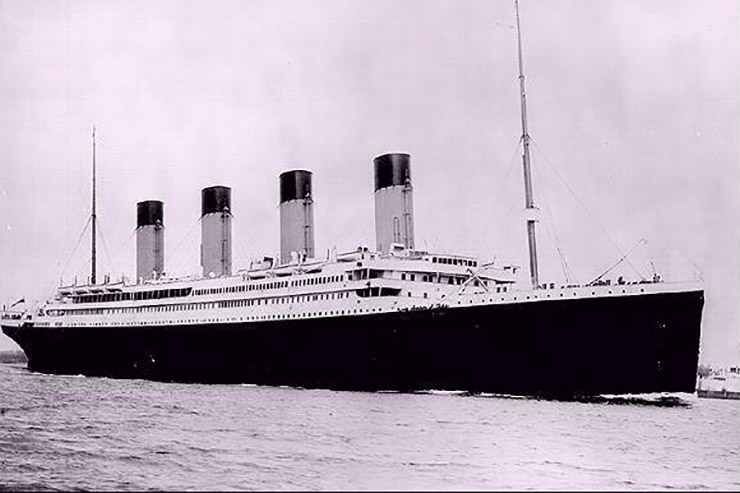
    An outstanding example was the Titanic disaster. Hardly any other single occurrence in the 20th century generated such a large collection of impressive examples. So many, in fact, they embraced all 17 categories of synchronicity. The meaningful significance of particular numerals played its part in the Titanic disaster, too – in that classic bad-luck symbol, Number 13.

    That this traditionally unfortunate number was factually associated with the most infamous of unlucky ocean liners should come as no surprise. Two, separate examples serve to illustrate. A British journalist, W.T. Stead, demonstrated his contempt for superstition by deliberately concluding a story on the 13th of April, 1912. Further tempting fate, his narration described the discovery of an ancient Egyptian sarcophagus and the curse of violent death alleged to overtake anyone who verbally translated its inscription. The next day, R.M.S. Titanic met the disaster in which Stead perished.

    A fellow passenger who lightheartedly challenged the deadly number was from Youngstown, Ohio. George Wick had been traveling with his family through Europe for several months and booked homeward voyage on Titanic. While in transit to Cherbourg, where the doomed ship would make final docking before attempting her transatlantic crossing, he stopped at Paris. There he purchased a Grand Prix sweepstakes ticket, choosing Number 13 on purpose, just to prove to everyone that he was not superstitious. “Watch and see what it does for me!,” he exclaimed. Several days later, Wick went down with the vessel.

    The “Warnings” cited in Miriam Hohf’s childhood experience proliferated around the Titanic before she sailed. A White Star insignia crumbled to pieces in the hands of Mrs. Arthur Lewis while she was pinning it to her husband’s cap. He was just about to board R.M.S. Titanic, where he was a steward. At the time, she regarded the incident as a bad “omen,” although he dismissed her expressed anxiety as foolishness, until the ship foundered a few days later. Fortunately, Mr. Lewis survived.

    In another Titanic-related warning, Colonel John Weir, a mining engineer with a worldwide reputation, almost canceled his first class ticket because of distressful feelings about the voyage. Staying at London’s prestigious Waldorf Astoria, he awoke on the morning of April 10th to find that the water pitcher atop his dresser had unaccountably shattered, soaking his clothes. He seriously expressed his premonitory feelings to the hotel manager, who allayed the Colonel’s “superstitions” enough for him to reluctantly board the great ocean liner. While at sea, Weir told his secretary about the burst water pitcher, could not shake his sense of foreboding, and said he must get off Titanic at the next opportunity, when it docked in Queenstown, Ireland. Again dissuaded, he remained aboard, only to go down with the ship he intuited was doomed.

    As some measure of the magnitude of synchronous phenomena associated with the disaster, no less than 899 persons who initially booked passage for Titanic’s maiden voyage eventually refused to board her because of warnings they experienced in the forms of various omens, premonitions, dreams and precognitive events. An additional 4,066 would-be passengers either missed the boat or canceled their reservations, usually under apparently normal circumstances, but sometimes through unusual coincidences that prevented them from sailing.

    Blanche Marshall suffered a hysterical outbreak on April 10th, 1912, as she and her family watched the Titanic steam past the Isle of Wight from the roof of their home overlooking the River Solent. In a virtual panic, she said the liner would sink before it reached New York and railed against her husband, daughters and servants for being blind to her vision of masses of people drowning in the freezing waters of the North Atlantic.

    While neither Mrs. Marshall nor anyone she knew sailed aboard the Titanic, she was prevented from boarding another doomed liner just three years later by similar precognition. In 1915, her husband had booked tickets for their return trip to England from America aboard the Lusitania. She thought nothing of it until she saw the May 1st date of the tickets. Convinced the ship would be torpedoed and sunk on that passage, Blanche convinced him to change their booking. Interestingly, she felt safe traveling on Lusitania at any other time. It was only the prospect of the May 1st crossing that alarmed her. True to her sense of foreboding, the vessel was torpedoed and sunk with heavy loss of life on the same voyage she refused to take.

    A sub-category of “Premonitions” is synchronous literature. Published in 1892, From the Old World to the New described the sinking of an ocean liner after colliding with an iceberg in the North Atlantic. The “fictional” name of its captain, E.J. Smith, likewise belonged to the man who commanded R.M.S. Titanic, twenty years later. Interestingly, the author of From the Old World to the New, W.T. Stead, lost his own life on board the same ship.

    While Titanic was being readied for her maiden voyage, the May issue of Popular Magazine was coming off the presses with the story of Admiral, an 800 foot-long ocean liner crossing the North Atlantic through calm seas at 22 1/2 knots. She strikes an iceberg and sinks, leaving the survivors among her thousand passengers to be rescued by a steamer. Similarities to the real-life tragedy convinced readers the story was based on Titanic’s particulars. But author Mayn Clew Garnett was said to have received the details for his novelette in a dream he had while sailing on the Titanic’s sister ship, Olympic. While he may have been influenced by physical parallels noticed during his passage aboard the virtually look-a-like vessel, Garnett’s selection of 43 north latitude for Admiral’s collision with the iceberg was virtually the same position at which Titanic met her identical fate.

    Literature is not alone among the arts which figure into synchronous events. More in black humour than conscious precognition, a crewman and his wife made recordings for each other, the husband singing “Only To See Her Face Again” to her “True Til Death,” on April 7, 1912, prior to his service about the world’s greatest ocean liner. Three days later, he sailed on the Titanic, never to return.

    Animal interaction in human experience forms its own, distinct category of synchronicity, and was not missing in the fate of R.M.S. Titanic. The age-old sailor’s belief that rats leave ships long before any apparent danger of sinking was exemplified aboard R.M.S. Titanic, when two crewmen in a forward boiler room saw panic-stricken rodents scampering aft, away from the starboard bow. Next day, an iceberg struck that very spot. Both men escaped the disaster with their lives, because the rats’ sudden appearance had made them uneasy enough to station themselves, as often as possible, in the immediate vicinity of the lifeboats.

    Another incident of animal synchronicity associated with Titanic concerns Bess, a thorough-bred horse belonging to Isadore Straus, the co-founder of Macy’s Department Store. The same night he and his wife were killed in the sinking, six-year-old Bess suddenly died of causes the veterinarian was unable to determine.

    Tactile sensations comprise a sub-heading of “Death” in synchronicity. The unaccountable perfume of flowers associated with someone close and recently deceased is not uncommon. Another example belongs to May de Witt Hopkins, who experienced the fragrance of roses in her London home one day after R.M.S. Titanic sank. Although word of the disaster had spread by that time, names of those on board were not yet published. But with the flowery scent filling her room from no apparent source, Hopkins suddenly felt that someone she knew was trying to make her aware of his or her death. She later learned that a friend, who was, unbeknownst to her, a passenger on the ship, had indeed perished when it went down. Interestingly, her own mother, during the late 19th century, had been similarly alerted to the death of a loved one by a mysterious, flowery odour.

    “Inanimate Objects,” like the White Star insignia that fatefully disintegrated in the hands of Mrs. Lewis, comprise a wide-ranging group of synchronous experiences. The Managing Director of the White Star Line, Joseph Bruce Ismay, survived the Titanic, but thereafter resigned his post, because he was publicly, although unfairly, blamed for the tragedy. He spent the next 25 years of his life in virtual seclusion, dying on October 17, 1937. That same Sunday afternoon, a framed, oval mirror that hung in Ismay’s office during his tenure at the White Star Line suddenly crashed from its hook, scattering broken pieces across the floor.

    Two weeks after Titanic was lost, a large wooden crate left unclaimed at Pier 61, in New York harbour, was opened by port authorities. They were surprised to see that it contained a meticulously detailed model of the sunken vessel. It had originally been sent to the US for promotional purposes on behalf of the White Star Line and was supposed to be returned to the London offices on the doomed ship’s return voyage. But the 30 foot-long representation was accurate in more particulars than anyone could explain. Although it presented a full compliment of 20 davits, there were only a dozen miniature lifeboats. Moreover, the bow was partially ruined and a long crack appeared from the keel toward the upper deck, mimicking the actual damage sustained by Titanic.

    As might be expected, “Dreams” are an important category of synchronicity. While traveling in Europe during the spring of 1912, a New York lawyer, Isaac C. Frauenthal, dreamt of being aboard a large ship which collided with some floating object and began to sink. His was a long, vivid nightmare, in which he clearly recalled the sights and sounds of calamity. Several nights later, the identical psycho-drama repeated itself, and he told his brother and sister-in-law that it must be a warning against their up-coming voyage on R.M.S. Titanic.

    But they laughed at his dream and convinced him to go through with their return trip to America aboard the doomed White Star liner. All three survived the sinking foretold in Isaac’s recurring nightmare.

    Perhaps the most inexplicable aspects of synchronicity are those more infrequent instances of “Parallel Lives.” When Lucien P. Smith narrowly escaped death during the terrible fire on Viking Princess, in 1966, it was his second, major disaster at sea. A survivor of the Titanic, he was in his mother’s womb when that ship sank, just as Mrs. Astor, also aboard, was pregnant with her son, John Jacob. Both children were born eight months after the sinking, in which their fathers perished. Their mothers died in the same year, 1940.

    Individual lives and major conflicts are events sometimes so powerful they echo beyond their own time and appear to replay themselves in the future. Such an extraordinary case of parallel history began to unfold when William C. Reeves went aboard the tramp steamer, Titanian, as an ordinary seaman, departing Scotland for New York on April 13, 1935. Ten days later, at 2300 hours, he was ordered into the foc’s’le head to stand watch.

    Although the sea was calm, the darkness was moonless and impenetrable. Reeves began to feel increasingly uneasy, not only because of the very poor visibility conditions he now faced as ship’s look-out. He thought, too, of the premonitory novel he had been reading in his cabin, Morgan Robertson’s Futility. Reeves was unable to keep his mind from drifting back to a dramatic moment in the book when Titan’s look-out missed seeing an iceberg in time to avoid disaster. Also, he could not help but notice the ironic similarity of his ship’s name, Titanian, and Robertson’s Titan with Titanic.

    As his sense of irony deepened into anxiety, he realised that the time was now 23:35, just five minutes before the hour Titanic struck the iceberg. Reeves knew that penalties were severe for raising a false alarm, the darkness ahead showed no sign of danger, and for some moments he hesitated to act. But at last his feelings of imminent collision overwhelmed him and he ordered the bridge to stop engines, “Iceberg ahead!”

    No sooner had the ship’s speed dropped off, than she smashed into several large fragments of ice, which twisted her bow and disabled her propeller. Slowing to full stop, Titanian’s crew were astonished to behold an enormous iceberg looming directly ahead out of the darkness. The floating mountain appeared at 23:40, the same hour of Titanic’s collision.

    Doubtless, had the Titanian not stopped in time, she would have followed her predecessor to the bottom. An SOS sent to Cape Race, Newfoundland, brought rescue to the stranded crew.

    The multiple synchronicities of this parallel event – the similar ships’ names, Reeves’ powerful premonition, his reading of Robertson’s book, precisely the same hour for meeting with a deadly iceberg – far out-strip all considerations on behalf of mere chance. Instead, they clearly define the operative principle of meaningful coincidence as a legitimate phenomenon.

    [alert type=”general” dismiss=”no”]This article was published in New Dawn 88.[/alert]

    [alert type=”success” dismiss=”no”]If you appreciate this article, please consider subscribing to help maintain this website.[/alert]

    © New Dawn Magazine and the respective author.

    For our reproduction notice, click here.