New Dawn – World's Most Unusual Magazine

Author: Guido Mina Di Sospiro

  • Of Cannibals, Inquisitors, Mainstream Militants & Escape Artists

    Of Cannibals, Inquisitors, Mainstream Militants & Escape Artists

    From New Dawn Special Issue Vol 12 No 1 (Feb 2018)

    Recently re-reading St. Augustine’s Confessions, written over sixteen hundred years ago, I was struck by one aspect that had previously eluded me: the authors he refers to are, for the most part, still known to us today. Whether consciously or not, he was already contributing to building the Western canon. The Aristotelian-Euclidean-Cartesian-Newtonian-Darwinian/Spencerian canon by which the Western world operates to this day has been in the making for millennia. Along the way, there were death blows to the possibility of at least one other canon, for example the Platonic Academy, which was first destroyed by the Roman dictator Sulla in 86 BCE. Then, having been revived centuries later, was closed once and for all by Justinian I in 529 CE. The Church had/has its Canon Law and was, for centuries, a strict enforcer of it, with anything beyond it being perceived as heresy and vigorously stamped out.

    While the Western world in the 21st century is free from alacritous canon-enforcing enterprises such as the Holy Inquisition, it nevertheless operates by a canon which remains very much the mentioned Aristotelian-Euclidean-Cartesian-Newtonian-Darwinian/Spencerian one, inculcated into us all from kindergarten to the grave, echoed not only by schools of all levels, but by governments, the media, official institutions and nonofficial entities and, last but not least, by the entertainment industry. 

    Judging from the history of mankind, the simple reality is that people both need and like dogmas. Concepts that to an uninvolved and level-headed mind seem grotesque, evil and everything in between, at a certain time and in a certain place looked just right. Customs that appear barbaric today were the norm once, and vice versa. The Holy Inquisition is the obvious target, as is the Nazis’ Final Solution. But what of Stalin’s Great Purge? The Khmer Rouge Killing Fields? Ethnic cleansing in the Balkans? 

    And then there are many less obvious examples. 

    In his book Los Invencibles de América, Spanish author Jesús Á. Rojo Pinilla maintains that, far from committing genocide against the Aztecs in what is today Mexico, Cortés and his conquistadors saved them from a self-inflicted holocaust. Animal husbandry being unknown to the Aztecs, they and their neighbours were essentially eating each other to the brink of extinction. Not only did they commit tens of thousands of human sacrifices every year for religious motivations, and thereafter ate the thighs of the sacrificial victims, but their cannibalism was widespread because of the scarcity of food. The contemporary Western canon, still a staunch supporter and propagator of the Leyenda Negra (the British/American propaganda that demonises Spain and all things Spanish), in the face of historical and archaeological evidence teaches us the opposite: that pre-Columbian Mexico was the Garden of Earthly Delights and that the conquistadors proceeded to exterminate everyone. DNA testing on the contemporary Mexican population reveals that 30% of them are of pure Aztec or Maya descent; 60%, mestizo; and only 10%, white. If the alleged holocaust had in fact taken place, wouldn’t the DNA of contemporary Mexicans indicate an overwhelmingly white descent? 

    One should think of dogmas or, in their combined puissance, of the canon as an inescapable force not dissimilar from gravity. Can it, in fact, be escaped at all?

    Some readers of my books have sent me e-mails asking for suggestions about what they might read in order to break out of the Western canon. I’ve been thinking about that request for some time and, while a complete list of books would be impossible and at any rate well beyond the scope of this piece, I suspect that a small list, to begin with, could be of help to those curious minds that are contrarian by nature, or disillusioned with the current Western canon and the all-pervasive propaganda that reinforces it. Here follows my (drum roll) eye-opening, assumption-challenging, horizon-broadening list.


    The I CHING, not only mankind’s first (known) book, but a very thorough dissertation on accidentality in juxtaposition to Western man’s obsession, i.e., causality, that self-evident and asinine nexus between cause and effect on which Western philosophy nevertheless built entire systems. Moreover, consulting the I CHING as a divinatory tool can be as infuriating as it can be enlightening. 

    Skipping thousands of years, Lin Yutang’s The Importance of Living. Lin Yutang was a philosopher of life, translator of Chinese classics into English, novelist and an inventor. He is the one who finally solved the riddle and, in 1946, succeeded in producing the unthinkable: a workable Chinese typewriter! Amid his writings he left many epigrams, lustrous exercises in witty prose as well as in non-linear thinking. You would think that the Dude, from the film ‘The Big Lebowski’, has metabolised his teachings, for example: “It is amazing how few people are conscious of the importance of the art of lying in bed.” “It is characteristic of play that one plays without reason and there must be no reason for it.” “A good traveller is one who does not know where he is going to, and a perfect traveller does not know where he came from.”

    Jesus Lived in India: His Unknown Life Before and After Crucifixion by Holger Kersten. To reconfigure Jesus as a Buddhist does the world the great favour of releasing him from the Abrahamic tradition. Also, his not dying on the cross is explained with such abundance of telling details (often in plain sight in the various gospels), I tend to be convinced of their veracity. And Paulinism being smuggled and imposed as Christianity – that has caused not a little trouble down the centuries.

    A New Science of Life: The Hypothesis of Formative Causation by Rupert Sheldrake. It opened my eyes, many years ago, and since then Rupert and I have become friends. Darwin (and, by extension, Herbert Spencer, that great co-opter): Goodbye. The first chapter magisterially sums up biology as it’s taught to this day in all schools; from the second chapter on, welcome to a new world. When first published, the prestigious journal of science Nature attacked it with the editorial A Book for Burning? (as it dared to go against the strongly-held convictions of the scientific priesthood). Echoes of the Holy Inquisition from the mainstream scientific world. 

    Of the trinity of essential, prescient works that describe the decadence of the West – Oswald Spengler’s The Decline of the West, René Guenon’s The Crisis of the Modern World, and Julius Evola’s Revolt Against the Modern World – I would pick the latter, with Hermann Hesse’s warning that it is a “really dangerous” book. And so it is. It’s difficult not to be swept away by this radical rethinking of history. Its Wagnerian scope and intrinsic power make it one of the most disruptive books ever written, particularly because it’s so well constructed and so profoundly erudite. I would recommend it, but with the caveat: to be read cum grano salis by a mature, Apollonian reader, not by an impressionable, Dionysian youth.

    The less heady but equally central The Revolt of the Masses by José Ortega y Gasset may well provoke the ire of contemporary progressive “thinkers” and the joy of those who don’t digest their propaganda. Compare and contrast the very well-established concept: “Everybody is entitled to their opinion” (grammatically incorrect in deference to feminist sensitivities) to “The sovereignty of the unqualified individual, of the human being as such, generically, has now passed from being a juridical idea or ideal to be a psychological state inherent in the average man.” The masses, maintained Ortega y Gasset, are the rabble; only the individual counts, if (s)he goes through a process of initiation, which is life-long. 

    Very valuable is Aldous Huxley’s anthology The Perennial Philosophy: An Interpretation of the Great Mystics, East and West, an excursus across space and time in search of the same matrix.

    Weren’t St. Francis of Assisi and St. Anthony of Padua a bit peculiar – and extreme? Where did Cervantes draw inspiration for many of the adventures in his Don Quixote? Idries Shah’s The Sufis explains how much the West owes to Sufism and its teachings, and introduces the fundamental practice of non-linear thinking.

    For a touch of India from a Western perspective, and limiting it to a single book, I would pick Paul Brunton’s A Search in Secret India. His sensible approach, unwillingness to be credulous, and nevertheless slow transition from being a non-believer to becoming open to wonder, is a wonder in itself.

    Julius Evola wrote various books that deserve mention. But having to choose, in addition to Revolt, I would signal The Hermetic Tradition, praised even by C.G. Jung, whom Evola disliked for obvious reasons, chiefly the former’s insistence on the “lowly” unconscious.

    Which brings us to Carl Gustav Jung who is not an author but a voyage. He touched upon just about everything, and his most gifted disciple, Marie-Louise von Franz, was as insightful, as well as possessed, unlike her teacher, of the art of concision. The reader who wants to depart from what
    (s)he has been taught since the crib could start with Jung’s exceptional Answer to Job. And for a touch of early ufology, Flying Saucers: A Modern Myth of Things Seen in the Skies.

    While on the subject, George Adamski’s Inside the Spaceships is a great read; should the story not be true, it would still be highly engaging, eye-opening science fiction. For a more level-headed treatment of the subject, Patrick Harpur’s Daimonic Reality: A Field Guide to the Otherworld remains one of the best works on this elusive theme (while I would stay away from anything written by Whitley Strieber under the pretence of being true). 

    Graham Hancock’s Fingerprints of the Gods was written, as a successful breakthrough, with the technique of fiction, rather than nonfiction. As a result, it’s an engaging read. Some of its claims are… odd (Atlantis in Antarctica!), others, for example the actual occurrence of the Great Flood, have been confirmed by various other open-minded scholars. 

    I like anything either written or published by David Hatcher Childress, the real-life Indiana Jones. The back-covers of his books are full of bombastic tidbits, but in fact his writing is well-researched and careful, and he tends to present unusual facts and findings while consistently trying to strike a balance between enthusiasm and plausibility. 

    David Conway’s Complete Magic Primer begins with an excellent, if condensed, history of magic and mysticism, and slowly morphs into an instruction manual. In other words, it teaches hands-on magic. Only for the stout of heart; I would not be toying with any of this, especially if I were not a believer. 

    Forbidden Archaeology by Michael Cremo and Richard Thompson is useful in revealing in a very methodical and indeed scientific way to what extent mainstream science has gone in suppressing the evidence pointing to the reality that humans have inhabited this planet for much longer than we are told. In Chapter 1.11, for example, there is a very lucid explanation of the “Phenomenon of Suppression”: the different stages by which an anomalous finding is either ignored, explained away, ridiculed, dismissed, or suppressed. Quite an enterprise from an activity – science – that originally set out to explain the unexplained or seemingly unexplainable. While the ponderous tome of 914 pages doesn’t make for the liveliest reading, it is nevertheless an impressive contribution. 

    More on the wacky side, and far more entertaining, is Terence McKenna’s True Hallucinations: Being an Account of the Author’s Extraordinary Adventures in the Devil’s Paradise. For those who will never try “heroic doses” of psilocybin mushrooms deep in the Colombian jungle, this is a wild, vicarious ride, an amalgam of science, literature, myth and exotica from an adventurer whose genuine inquisitiveness in things psychedelic goes hand in hand with mythomania – what an exuberant explosion of literary and philosophical high kitsch! If not persuaded, there follows the endorsement from The New York Times: “The polysyllabic sentences he lards with intellectual references are an attempt to lend credibility to the otherwise debunked subject of drugs.” Yes, a hatchet job from The New York Times could not make for a more valuable endorsement. 

    Equally wacky and even more wide-ranging is The Morning of the Magicians: Secret Societies, Conspiracies, and Vanished Civilizations by Louis Pauwels and Jacques Bergier, quite an international bestseller down the decades. Inter multa alia, the reader will find a description of how hands-on alchemy actually works; a parallel between the Mayans and the Nazis; and then some. As ever, the nagging question is: What if even a fraction of this were true? What have we been told instead, and why?

    With scholarly discipline but also with a decidedly English sense of humour, The Rough Guide to Unexplained Phenomena 2 by John Michell and Bob Rickard, takes a path along that shadowy territory between the known and the unknown, between the dogmas of mainstream scientists and the reality of phenomena that happen regardless of such dogmas. Much as, in a dramatic reversal, Galileo said centuries ago, after being forced to recant his claim that the Earth moved around the immovable sun: “And yet it moves.” (Back then, science, in its nascent state, was based on unbiased inquiry and rejected dogmas de facto. Today, mainstream science has morphed into a scientific priesthood.) The late John Michell was the author of, among others, View over Atlantis, one of the cult reads of the 1970s; Bob Rickard is the founder and editor of the Fortean Times.
    Get the issue this article appears in

    My friend and co-author of two novels, Joscelyn Godwin, has written, translated, and edited many books that could be on this list. One of them, Artkos: The Polar Myth, explores a different origin of mankind in conjunction with various other occult myths. I should remind the reader that while I do not necessarily adhere to any of the beliefs expounded in these books, I am interested in learning about alternate versions of the same reality, which some (at times lunatic) fringes were, or are, convinced of. The level of scholarship is very high, as in all of Joscelyn’s works.

    Finally, and possibly shockingly, I would include a few instalments from George MacDonald Fraser’s outrageously entertaining Flashman saga – take your pick. That’s because his masterful portrayal of Flashman is too close to what man’s nature really is once stripped of all its phony, superimposed veneer of civility. In fact, should man be “re-wilded” (and all it takes is a catastrophe, natural, nuclear or otherwise), Flashman’s outrageous trespasses would, in comparison, seem benign. 

    This is far from an exhaustive list, which did not set out to be complete in the first place; lastly, please remember that the following caveat applies to its every book: to be read cum grano salis [‘with a grain of salt’]. 
  • Evolution Upside-Down: History is Cyclical, Not Linear

    Evolution Upside-Down: History is Cyclical, Not Linear

    From New Dawn Special Issue Vol 12 No 3 (June 2018)

    Charles Darwin possessed some characteristics which greatly endear him to me. He was an ‘amateur’, not a professional, making it clear that an all-consuming thirst for knowledge is a mania, not a profession, with its clerical and bureaucratic overtones. And there is something immensely dashing about his voyage on the Beagle. True, he was looking for confirming instances of his pre-established theory; also true, he did seem to neglect whatever evidence he chanced upon that went against it. But the confirmation bias syndrome seems to be embedded in human nature. Objectivity is impossible. 

    Anyway, when he published his seminal works Origin of Species (1859) and The Descent of Man (1871), he happened to have the right ideas at the right time. It was the age of Positivism, that proud and most legitimate descendant of the Enlightenment. And it was the dawn of the most materialistic and deterministic age in recorded history. Darwin’s theory of biological evolution through natural selection was enthusiastically co-opted by Herbert Spencer and the intelligentsia, and applied to society as a whole. The evolutionary dogma is now taught in every school in the Western world, and found in every textbook, and not just of science, but also of history, civics, etc. The whole ethos of Western societies is imbued with, and hinges on, the materialistic myth of evolution and progress.

    The broad concept of ‘evolution’, therefore, has been an invaluable ally to modern societies. Implicitly, but often also explicitly, these maintain that, by finding themselves at the apex of the process of societal evolution, the cosmology they incarnate could not be but the best one. It is a Machiavellianly powerful argument. Why, we were apes; then, humans who could barely, say, light a fire; eventually, we mastered nature (and how!); and now, as exponents of modern democracies in the free, secular and enlightened world, we spread the good news to our fellow humans in less privileged countries, or rather ‘developing’ countries and, surely, by the laws of evolution. (Among many, many ‘anomalies’, Göbekli Tepe, the archaeological site in Anatolia, debunks such a simplistic explanation, but that does not seem to matter to the establishment.) Indeed, such ideas spread like the plague. 

    As a consequence, a Single Thought is imposed upon the world, along with a Single Behaviour. The same way of reasoning, the same ‘values’, the same way of speaking, dressing, even eating. A completely arbitrary subjective point of view has been disguised as objective and is being imposed on a global scale through cultural lobbies and the mass media. Glory to the intrinsic supremacy of the evolutionary dogma, and its ramifications: liberalism and the free market, the latter being, in effect, the result of merciless natural selection.

    Leibnitz, and far more recently Popper, postulated that we live in “the best of possible worlds.” It is the principle of sufficient reason. While Leibnitz argued that God could not have created but the best of possible worlds, one that is constantly undergoing changes for the better, Popper affirmed that contemporary Western societies, and their socioeconomic system, represent the very best system that could possibly be conceived as opposed to previous social and cultural organisations.

    Now, dear reader, if you agree with Leibnitz and Popper, read no further. You are a well-adapted human specimen, the result of a pervasive cultural indoctrination, or outright brainwash. A true son/daughter of your times. If you don’t agree, read on – at your own risk.

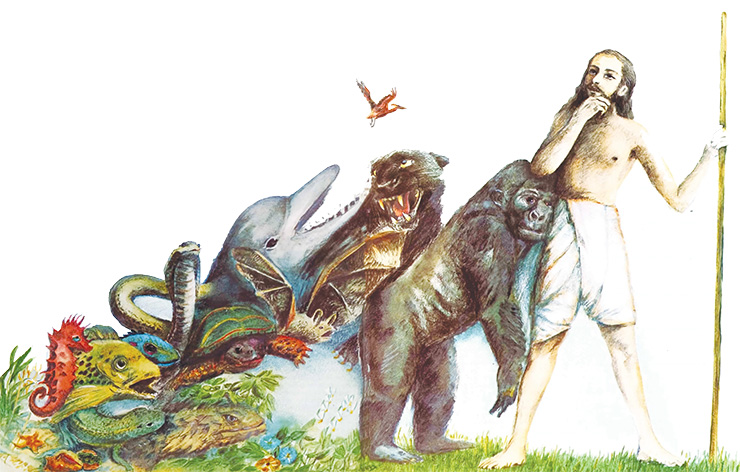
    When I was a teenager, an Italian progressive rock group released an album entitled Darwin. One of its songs encouraged the listener to “think a little differently.” It continued by explaining that nothing had been created by God, but rather all creation had created itself, and then had constantly improved thanks to the laws of evolution. Even spaghetti rock was co-opting its own warped version of Darwinism! Well, I now ask you to “think a little differently.” For you see – I do not believe that man is derived from the ape by evolution, but that the ape is derived by man by involution.

    Joseph de Maistre explained that savage peoples are not primitive peoples in the sense of original peoples, but rather the degenerated and/or degenerating remains of ancient peoples that have disappeared. I rebel against the evolutionary dogma and assert that animal species clearly show the degeneration of primordial man’s potential. In a nutshell, the ‘forbidden philosopher’ Julius Evola wrote: “These unfulfilled or deviant potentials manifest themselves as byproducts of the true evolutionary process that man has led since the beginning. For this reason, ontogenesis, the biological history of the individual, does not repeat in any way the process of phylogenesis, the presumed evolutionary history of the species, but passes again through some eliminated possibilities. It stops to roughly outline them and then moves beyond, subordinating these possibilities to the superior and specifically human principle, which is defined and fulfilled little by little in the development of the individual.”

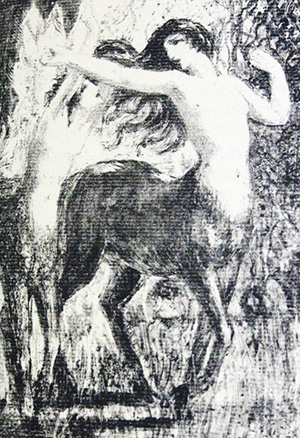
    Contrarian enough? It makes wonderful, if non-linear, sense. But the scientist would need proof. (Institutional science, incidentally, does tend to play a fixed game, as it sets up its own rules, and implicitly dismisses anything that does not quite conform with them.) Imagine, for example, a centaur, a four-legged horse body topped by a two-armed human torso with head. This lovely creature, if unearthed somewhere, would bring evolutionary theory to its knees, because there are simply no ancestors from which centaurs might have descended. On the other hand, the esoteric world may well consider us, two-legged humans, the degenerated and maimed mongrels of a centaur. 

    Artist’s rendition of a Centaur that appears in French poet Maurice de Guérin’s literary work Centaur.

    Poets seek truth, not scientists. The French poet Maurice de Guérin in his Centaur has the creature meet Pan, coming down from the mountains to the valley, there to drink from a river. It is night time. The river shimmers, a silver streak under the moon. This is the archaic Pan, a being immediately belonging to the Earth, not at all a god, though later he will be promoted to that rank. And it is Pan that De Guérin’s Centaur sees that night on the opposite side of the river, or… the first man. The Centaur is overwhelmed by disgust. And by sadness. In him, the Centaur sees a maimed individual. That being on the other side of the river announces, furthermore, his own demise, and the end of the Golden Age. Not by chance does the river seem, in the night, a silver streak. The Silver Age has begun.

    The world must have been in mourning when man detached himself from this part of his own being. The Golden Age gives way to the Silver Age. The lot will fall to Herodotus, in the fifth century BCE, to transition from the Silver Age to the Bronze Age. He stands at the cusp of the two epochs, and ushers in history. The Renaissance, and later the Enlightenment, will usher in the Iron Age, in which we live at present. 

    The scientist cannot but reject this. He must. Of course, if palaeontologists or archaeologists did unearth the remnants of a Centaur, it would not only be a fatal blow to evolutionary theory, but to science as a whole. Also, finding true anachronisms would be useful. Such as human beings fossilised inside the stomach of, say, an allosaur; or a trilobite in Cenezoic (‘recent’, up to 65 million years old) strata. But again, science, and Western societies, by and large, tend to dismiss or indeed conceal evidence that may damage the status quo. This censorship is a survival tactic, not in any way shocking or original. But apparently traces of nicotine were recently found inside an ancient Egyptian sarcophagus. Tobacco being a plant of the New World, such a discovery should have changed if nothing else our perception of history. Indeed, it would mean so much more. Not surprisingly, very little has been said or made of this. Why, Atlantean studies, i.e., the entertaining of the possibility that there was an advanced civilisation in prehistoric times, are deeply subversive. They make nonsense of Darwin, Marx, and Freud, and greatly annoy the professorial ‘experts’. They question the Big Bang cosmology. They inspire no belief in progress or social engineering. And ultimately open the door to the “black tide of mud,” as Freud called the occult (really the esoteric) in his famous feud with Jung. 

    A few years ago, I spent quite a number of afternoons and evenings interviewing the shaman, or rather ‘bundle-carrier’, of the Miccosukee tribe, in the Everglades of South Florida. After a few sessions I realised that the man was able to read my next question as I formulated it in my mind and would answer to it without my asking it orally. As would be expected, I was utterly unable to read his mind, or anybody’s. Eventually, a very odd take on history surfaced from his words.

    When the Spaniards kicked out the last Moor, thus achieving their epochal Reconquista after eight centuries of Muslim occupation, that very year, 1492, Columbus officially and ostensibly discovered America (in error?). It is hardly a coincidence. Certainly, metahistory is not taught in any school, so people are at best perplexed by it. That there should be powers involved in epochal changes which go well beyond the pettiness of human greed and social upheavals would seem a self-evident truth, yet contrariwise denied out and out as utterly unthinkable by the heralds of the evolutionary historical dogma. And what did the white men do when they came to America, asked the bundle-carrier? 

    They found the Golden Age, I realise now, in retrospect. It was not the New World; it was the Old World, older than history, older than myth.

    Yes, America was still in a state of grace. Macroscopic cereal only grew here: corn, Zea mays, bearing grains on very large ears which did not require any milling. It was the food of giants, of the Titans. Cacao, Theobroma cacao, the Fruit of Gods, which ‘theo-broma’ means in Greek. The origin of this tropical understory tree were the Amazon Headwaters from where it moved to Central America. Cocoa cultivation began by Mayan tribes in Central America, around 1500 BCE. Mayans and Aztecs attributed divine origin to the cocoa tree, brought to them by god Quetzacoatl. The sacred beverage called ‘chocolatl’ was consumed from golden cups. And the list goes on. Tobacco, i.e., Nicotiana tabacum. An herbaceous plant, tobacco was first used by the peoples of the pre-Columbian Americas. Native Americans cultivated the plant and smoked it in pipes for medicinal and ceremonial purposes. The rustica variety was used by shamans to enter trance states and induce hallucinations. Tomato, Lycopersicon esculentum, was another gift of the Golden Age. A fruit which grew readily not from a tree, and could be cultivated anywhere, provided there be enough warmth. Its edible, fleshy, usually red fruit has become a staple for cuisines the world over. What would Italian cooking be without it? No pizza? No pasta? And what of the following other godly gifts: vanilla; potatoes (which, ironically, made the Industrial Revolution possible); immense herds of bison grazing and roaming freely in the Northern Plains? What of the turkey, which has become such a symbolic animal in the US, and is raised and eaten all over the world? No fowl of this size grew in Europe and, again, with good reason, as Europe had left the Golden Age, then the Silver Age, and indeed was leaving even the Bronze Age.

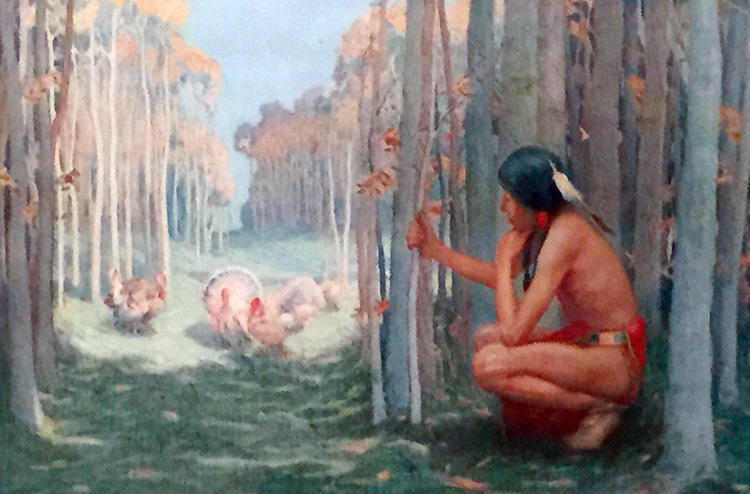
    I have a print by Eanger Irving Couse which I bought in Taos, New Mexico. Painted about a hundred years ago, it depicts a sylvan scene. A native American, wearing only a loin-cloth, and crouching on his knees, is hiding behind a clump of trees, keenly observing, unseen, some turkeys in a clearing, a few paces from him. With his right hand he is clutching what at first sight appears to be a spear. On closer inspection, one realises he is merely holding on to a branchless sapling, which can be mistaken for a spear, but is in fact a slender young tree rooted in the ground. This image, incidentally very well executed, speaks volumes. The native American, slim but evidently not hungry, does not intend to kill the turkeys, but does enjoy observing them.

    Photo of the author’s Eanger Irving Couse print.

    Such people, primitive, original people, deserved the Golden Age in which they still lived. They had no need for eschatology. Indeed, drawings have been found in caves depicting primitive hunters hunting also in their after-life. There really was no after-life, no demarcation between life here and life elsewhere. The Golden Age was the Garden of Earthly Delights, and gold itself, paradoxically, was not needed.

    White man brought along not only a host of exotic diseases, but banking, the greatest disease of them all.

    Indeed, the Catholic Church had been banning for centuries the charging of interest, as it perceived it as usury, with banking, and lending, becoming an accepted practice only during the early Renaissance. 

    “What,” asked my friend, the Miccosukee bundle-carrier, “what did the white men need banking for in America?” As a matter of fact, they owned everything: land, trees, rivers, fish, fowl, game. Everything they saw. Yet, they introduced that supreme artifice – banking. 

    We know what has happened since to the millions of bison that used to roam the prairies, at the hand of the white man, hunting for sport with lever action rifles. We know what has happened to the native Americans. Yet, we continue to disguise our societies as the logic result of evolution and progress.

    Frederic Edwin Church, the painter from the Hudson River School, made it a point to record the last vestiges of the Golden Age in this continent. He spared no effort in reaching the remotest places so as to portray their Golden Grandeur. Far more than Turner or Caspar David Friedrich, respectively from England and Germany; precisely because he roamed the Americas, he had the last chance to sing her Golden glory.

    But the evolutionary dogma has branched out and infected also the world of art. It is hard to believe, as art should have been the only field immune to such poison. Yet, we have been told that art, too, evolves. Who could like Giotto now, he who did not know perspective? Clearly, Pier della Francesca and Paolo Uccello, who introduce it, were far superior. But they pale in comparison to the grandeur of Michelangelo and, later, Tiziano. However, Caravaggio, with his shadows and chiaroscuro, is far more evolved. Not to mention Goya. Away at last from those stale religious subjects, into the far better common-life themes. But impressionism fuzzed this up too – a change for the better, of course – and all the other -isms led to the best artistic expression of them all: abstract art, a.k.a. ‘anything-goes-ism’. Indeed, as a further development along the evolutionary scale leading to perfection, ugliness became beautiful, and the beautiful, ugly. Major cities across the Western world number many a museum dedicated to this pinnacle of artistic evolution: ugly art. All along, Theodor W. Adorno and other Marxist philosophers were busy singing the praises of ugliness. 

    How can we defend ourselves from the aberrations caused by the globalised co-option and imposition of an all-encompassing evolutionary dogma? I think I have given you some hints. History is cyclical and not, as we are eloquently and assiduously told, linear. We are caught up in the very low ebb, at present. The Iron Age, or the Kali Yuga, as described in traditional Hindu texts. But the tide may come in the future. In the meantime, we are already doing what is best: differentiating ourselves from mainstream thinking.

    P.S.: My wife and I have quite a collection of abstract painting of which we are very fond; inconsistency is a good sign.

    Guido Mina di Sospiro’s Forbidden Fruits: An Occult Novel, co-authored by Joscelyn Godwin, is available from all good bookstores.

    [alert type=”general” dismiss=”no”]This article was published in New Dawn Special Issue Vol 12 No 3.[/alert]

    [alert type=”success” dismiss=”no”]If you appreciate this article, please consider subscribing to help maintain this website.[/alert]

    © New Dawn Magazine and the respective author.
    For our reproduction notice, click here.