New Dawn – World's Most Unusual Magazine

Author: John Chambers

  • The Mysterious Connection Between Past-Life Recall, Near-Death Experiences, Alien Abductions & Multiple Personality Disorder

    The Mysterious Connection Between Past-Life Recall, Near-Death Experiences, Alien Abductions & Multiple Personality Disorder

    This article was originally published in New Dawn 131 (Mar-Apr 2012) and reprinted in New Dawn Special Issue Vol 13 No 2 (April 2019)

    On 2 January 1885, a mental patient named Louis Vivet, suffering from dédoublement (“double consciousness or “split personality”) escaped from the famous Bicêtre asylum in Paris. A month later he was rounded up and transferred to the military hospital in Rochefort, France.

    At Bicêtre, Vivet had suffered from having one alternate personality (or autre, “other”). In July 1885, his physicians at Rochefort reported that he now had eight personalities. In Rewriting the Soul: Multiple Personality and the Sciences of Memory (University of Princeton Press, 1995), Canadian philosopher Ian Hacking writes, “Our phrase ‘multiple personality’ appeared in print in England in a year, explicitly to describe Louis Vivet.”1 Multiple personality disorder (MPD) – today usually referred to as dissociate identity disorder (DID) – had entered history.

    At Bicêtre, Vivet had displayed all the appalling symptoms of what was called, in full, grande hysterie chez l’homme avec dédoublement de la personnalité [“major hysteria in a person, with split personality”]. At Rochefort, he presented all the same symptoms, but more so. Dr Hacking describes him as suffering from, “Every kind of pain, paralysis, anesthesia, contracture, muscular spasm, hyperesthesia, mutism, rash, bleeding, coughing, vomiting, convulsing; every kind of epileptic seizure, catatonia, somnambulism, Saint Vitus’ dance (chorea), arc de cercle (in which the patient lies horizontal, face up, with a totally arched back), language impairment, animalisation (the patient becomes a dog), machinisation (the patient becomes a steam locomotive)… constipation, anorexia, bulimia, alcoholism, debility”2 and much more.

    Multiple personality disorder entered history with the case of Frenchman Louis Vivet in the late 1800s.

    Vivet’s physicians believed, as we would today, that his condition stemmed from childhood abuse. Vivet was the son of an alcoholic prostitute who beat and neglected him. He ran away from home at eight, committed theft, and was put in prison. This pattern of crime and punishment was repeated again and again, accompanied by increasing physical and mental hysteria. At Rochefort, Vivet shifted easily and unexpectedly between his eight personalities which ranged from pious and docile to violent and convulsive. He slowly began to recover. In about 1890 he was released in reasonably stable condition. From then on he is lost to history.3

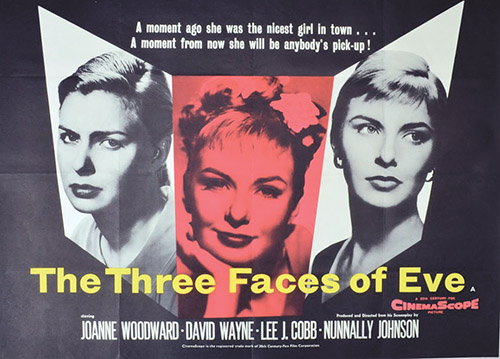
    Over the next seventy years, only a dozen or so cases of MPD were reported and treated, mostly in France. Then, in 1956, the release of the movie The Three Faces of Eve, supposedly based on a true story, starring Joanne Woodward as Eve and Lee J. Cobb as the psychiatrist, caused a mild stir with its depiction of a woman with three personalities. There was a flurry of cases of MPD. In 1976, the film Sybil, also ostensibly based on an autobiography – Sybil: The Classic True Story of a Woman Possessed by Sixteen Personalities – starring Sally Fields as Sybil and Joanne Woodward as the psychiatrist,created a sensation. In the twenty years between the two films, there had been growing public concern over child abuse. This set the stage for an enthusiastic reception for Sybil. Subsequently, therapists began to uncover dozens, even hundreds, of “alters” in their clients. The number of people suffering from MPD/DID rose exponentially until, in the mid-1990s, researchers could claim as many as 100,000 cases.
    This story of the abrupt proliferation of incidences of MPD, beginning toward the end of the last century and following on the heels of a trickle of such cases over the preceding seventy to eighty years, is a well-known one. What isn’t well-known is that the same brief window of time (estimated by Dr Hacking at 1874-1886) that saw the birth of multiple personality disorder also saw the birth of three other altered-state-of-consciousness phenomena: past life recall; recall of near-death experiences (NDEs); and UFO sightings (which came to include alien abductions). 

    Moreover, if we draw lines on a graph tracing the proliferation of incidences of the four phenomena over the next 100-120 years – until about 2000 – we observe that the four follow almost the same path. The four lines virtually pile up on top of each other. In other words, all four of the phenomena make their appearance in roughly 1874-1886, trail along with little more than a smattering of occurrences for the next 60-80 years, and then – usually sparked off by a highly dramatic public event such as the film Sybil in the case of MPD/DID – abruptly proliferate at an exponential rate, approaching, in the 1990s, figures as high as 100,000. 

    Does this mean that all four phenomena are just different facets of the same phenomenon?

    All four have one thing in common (and this is true of the alien abduction side of UFO sightings if it is not true of the sightings themselves): They are recalled experiences. They must be remembered to be brought into being. Our awareness of them is dependent on the existence of the faculty of memory – that is, memory as a storehouse. This seems obvious in the case of MPD/DID, where only one personality manifests at one time, and the rest must remain in storage, “in our memory.” But it’s also the case with past-life recall; a past life can only be recalled if it, too, is stored somewhere “in memory.” And near-death experiences can only be remembered – assuming, that is, that the experiencer can be resuscitated – if they’ve been stored, somehow, somewhere in our memory.

    The phenomena of “missing time” is common to alien abductions; abductees find they can’t account for hours, even days, of their time, until, at a certain point – usually when they’re undergoing therapy – they recall that during that missing time they were whisked away to a UFO. (The experience of seeing a UFO in real time doesn’t require “memory.”)

    Ian Hacking asserts in Rewriting the Soul that the concept of memory as a storehouse only came into being just after 1874, and was invented by the scientists, and their colleagues, who were treating Louis Rivet. The concept was invented because the science of that time had proven – or so it was thought – that the soul does not exist. Religion now had sole ownership of the concept of the soul. Only the church had the right to inquire into its nature. Scientists, finding themselves without an object they could examine as they had examined the soul, came up with an alternate concept, and this was memory as a storehouse. That was the real soul; its study would yield an equal portion of truth.

    As Dr Hacking writes, “Memory, already regarded as a criterion of personal identity, became a scientific key to the soul, so that by investigating memory (to find out its facts) one would conquer the spiritual domain of the soul and replace it by a surrogate, knowledge about memory.”4

    Should we infer from this that the phenomena of MPD/DID, past-life recall, recall of NDEs, and alien abductions into UFOs are merely made-up realities, figments of our imagination? Ian Hacking certainly believes this is true as regards the soaring growth of incidences of multiple personality disorder/dissociative personality disorder over the past 20-30 years.

    But, first: to try to follow the Canadian philosopher’s line of reasoning, let’s see if it’s true that all four of these phenomena really do trace out roughly the same growth curve, coming out of nowhere in 1874-1886, lying fallow for the next 60-80 years, and then, as the twentieth century comes to a close, bursting forth in a wild proliferation of incidences. 

    UFOs & Alien Abductions

    France’s Jacques Vallée, writing in Passport to Magonia: On UFOs, Folklore, and Parallel Worlds (1993; “Magonia” is a cloud realm in a French Medieval folk tale), is the most eminent of a school of UFO researchers who believe UFOs go back a very long way in our history. He holds that aliens have visited us for millennia as angels, succubi, fairies, leprechauns, and so forth, and that their trysts with us in the past often resembled the alien abduction encounters of today. There are those who believe, for example, that medieval tales of persons’ being flown to witches’ sabbaths where the Devil rapes them with an ice-cold cast-iron-like penis, are really early accounts of abductees’ being whirled away to UFOs where their orifices are violated by ice-cold metal probes wielded by alien researchers.

    Temple University History Professor Dr David Jacobs is a prominent member of the other, “modernist,” school of UFO research. He insists that the earliest reported UFO sightings took place between November 1886 and May 1887, in western and mid-western states of the US, when thousands of people claimed they saw dirigible-type cylindrical airships sailing through the skies. The dates place this sighting at the upper end of Dr Hacking’s “memory creation” window of 1874-1886; in fact, the sightings took place about the same time Louis Vivet was being examined by his physicians at Rochefort. From May 1887 on, nothing resembling a UFO (with the exception of “foo-fighters,” phantom disks said to pursue Allied fighter jets near the end of World War Two) was sighted until 24 June 1947, when aircraft pilot Kenneth Arnold reported observing nine saucer-like vehicles hurtling through the skies above Mt. Rainier, Washington. This headline-grabbing event, as powerful in impact as the release of the film Sybil which preceded the explosion of incidences of MPD, was the starting point for an equally explosive proliferation of UFO sightings, which by the end of the century were said to number in the millions.

    Artist’s impression of Kenneth Arnold’s 1947 sighting of nine saucer-like objects flying above Mt. Rainier, Washington. 

    In the 1970s, the phenomenon of “alien abductions” began to spin off from that of UFO sightings. Soon, almost as many alien abductions as UFO sightings were being reported. Whitley Strieber, author of Communion, and Anne Strieber, asserted in The Communion Letters (1997) that by the mid-1990s the number of alien abductions was probably as high as a quarter-of-a-million. In Abduction (1994), Pulitzer Prize-winning Harvard psychiatrist John E. Mack reported that “polls of the prevalence of the UFO abduction phenomenon in the United States, including a survey of nearly six thousand Americans conducted by the Roper organisation between July and September 1991, indicate that from several hundred thousand to several million Americans may have had abduction or abduction-related experiences.”6 Dr Jacobs, analysing the same Roper report, put the figure, conservatively in his view, at five million. 
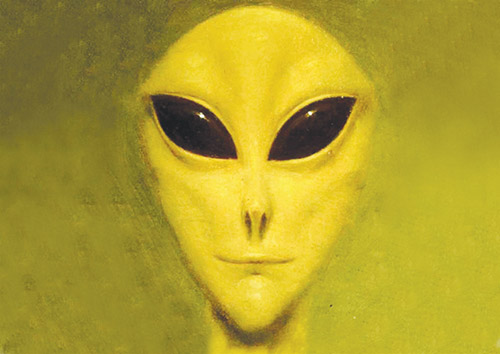
    On 26 December 1985, Whitley Strieber had an experience in which he believed he was abducted from his cabin in upstate New York by nonhuman beings. The above is a rendition of the ‘alien’ he encountered, this picture appearing on the front cover of his first nonfiction book, Communion (1987), which described the experience. The story was turned into the influential 1989 film of the same name. 

    Past Life Regression & NDEs

    The growth rate for the recall of near-death experiences (NDEs) kept pace with those traced out by incidences of MPD and alien abductions. Although in Otherworldly Journeys (1987), Harvard theologian Carol Zaleski compiled tales of ostensible NDEs from different cultures throughout history, many of these accounts probably describe quite different phenomena. The reporting of NDEs really only began when medical science had advanced to the point where people could be resuscitated after a significant length of time “among the dead.” It’s noteworthy that H.G. Wells published two short stories, “Under the Knife,” in 1896, and “The Door in the Wall,” in 1906 – the first only a decade, the second two decades, after Dr Hacking’s window for creation of the concept of memory – which eerily describe NDEs, the second with an exactness of detail usually found only in accounts of NDEs made possible by post-1970 resuscitation methods. Wells’s stories probably reflect unreported real events. From that point on, there are hardly any reports of NDEs until at least the early 1960s. By the late 1960s, the number of such reports was expanding exponentially, and the experience was becoming almost commonplace. According to Gallup polls, by 1991 the figure had risen to eight million. With continuing improvements in resuscitation technology, the figure would continue to rise. 

    The results of past-life regression therapy – hypnotising clients so they can recover their “past lives” – aren’t always reported, and sometimes the recollection of past lives is hidden in a thicket of broader psychological and psychiatric issues. Yet it’s possible to date the first recorded incidence of this fourth altered state of consciousness to just a few years after the close of Dr Hacking’s memory-as-storehouse-invention window. One of the earliest cases is that of the Swiss medium Hélène Smith, who, in 1895-1897, under the direction of philosopher-psychologist Théodore Flournoy, recalled past lives as Marie Antoinette and an East Indian princess. (These cases are usually regarded today as examples of MPD.) Smith was a medium; the “seances” were immortalised in Dr Flournoy’s From India to the Planet Mars (1899). In Les Vies Successives (1911), Colonel Albert de Rochas described turn-of-the-century experiments in Paris on nineteen persons whose consciousness was regressed back through birth to an existence as a discarnate spirit and then to one or two of their past lives.7 In The Belief in a Life after Death (1961), C.J. Ducasse chronicledsimilar experiments carried out at almost the same time by a group of physicians in New York City.8

    Then, for the next 60-70 years, travellers in search of reports of past-life recall will find themselves labouring across a vast, arid desert, with only one – though notable – oasis: Asa Ray Martin (1887-1949), a business school owner in Sharon, Ohio, who was the first American to regularly practice past-life regression therapy. In Researches in Reincarnation and Beyond (1942),Martin describes how over a period of twelve years he regressed 500 subjects, achieving remarkable results that included enabling a number of them to “talk, sing, and chant in languages of which they had no knowledge – Chinese, Arabic, German, for example – and their grammar and syntax would reflect their past personalities.”9 (It was at about this time that Edgar Cayce began his remarkable career in which past-life recall played a small, if vital, role.)
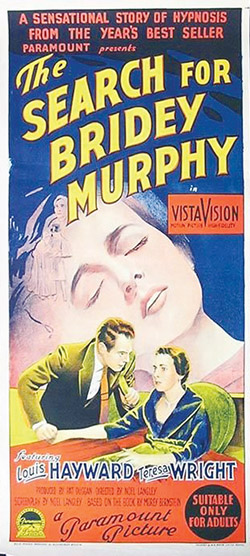
    The desert ends abruptly in 1956, with a towering, mountain-sized, past-life recall public event. This is the publication of The Search for Bridey Murphy by hypnotherapist Morey Bernstein. Bridey Murphy was a nineteenth-century Irishwoman who was a past lifetime of a Colorado housewife, Ruth Simmons, whom Bernstein had regressed hypnotically. Simmons convincingly recalled many details of Murphy’s life; historical research seemed to bear out these details. 

    The book and subsequent movie struck a nerve. People became intensely interested in reincarnation. Therapists became involved in past-life regression therapy. The curve for the number of past-life recalls shot upward at an exponential rate, until, in 1990, Hans TenDam could report in Exploring Reincarnation that “[therapist Joe] Fisher’s estimate that past-life therapy has since been responsible for healing hundreds of thousands of people… may be an overstatement, but the total number may be well towards 100,000.”10 By the late 1990s, the figure was probably approaching half-a-million: one Vancouver, B.C., therapist declared in 1994 that she had personally regressed 10,000 clients to past lives. Though past-life regression therapy has to some extent shifted away from the US, the figure, as we’ll see, remains high.

    These four phenomena, aping one another in distinctive growth patterns that first crawl slowly forward, then suddenly soar upward, constitute an extraordinary plenitude of altered-state-of-consciousness experiences. Would they never have come into existence had not a group of French physicians and their colleagues decided, late in the nineteenth century, to devise a way of understanding memory that would give them the means to gain knowledge of the soul?

    Dr Hacking makes it clear he doesn’t believe that men and women had, before 1874, no knowledge of the nature of memory. He writes: “I do not mean that we began to think about memory only in the late nineteenth century. The previous chapter [of Rewriting the Soul] dipped into the art of memory and listened to [eighteenth-century English philosopher John] Locke’s moving observation that episodes from the past ‘very often are roused and tumbled out of their dark cells into open daylight, by turbulent and tempestuous passions; our affections bringing ideas to our memories, which had otherwise lain quiet and unrewarded’. But there was little conception of a knowledge about memory before the nineteenth century…. [It was roughly in 1874-1886 that] the depth knowledge, the knowledge that there are facts about memory, came into being. Why did it come into being then? Because the sciences of memory could serve as a public forum for something of which science could not openly speak. There could be no science of the soul. So there came to be a science of memory.”11 This science of memory was based on the notion that memory is a storehouse, preserving in permanent form material as meaningful as that which the Church claimed to uncover in the soul. 

    Multiple Personality Disorder/DID

    Dr Hacking’s book focuses only on the birth, the painfully slow progress, and the sudden extraordinary flowering, of incidences of multiple personality disorder/dissociative identity disorder. He ignores the three other varieties of recall of altered states of consciousness that are the subject matter of this article. He makes it clear that he believes the rapid rise of cases of MPD/DID is a “copycat” phenomenon. The film Sybil didn’t give a name to the state of being possessed by “alters” that was already afflicting many; rather, the time was ripe for people to be so overpoweringly influenced by the film that they set about manufacturing a definition of themselves as afflicted by MPD. “Feedback” between therapist and client was a vital element in this process (as it had been a vital, “co-creative,” element in the relationship of Louis Vivet and his doctors); therapist and client together “co-created” the state of being called multiple personality disorder.

    Various cultural phenomena, particularly TV, were critical factors in the formation of MPD/DID. Dr Hacking writes: “Some really dysfunctional multiples going through a bad patch switch personalities very rapidly, each time assuming a new stock character. The effect is similar to that of switching TV channels by channel surfing. This impression is enhanced because patients with a great many alters often choose, for some of their personalities, the names of characters in sitcoms, soaps and crime series. It happens that TV remote controls became available in America just about the time that today’s florid multiples became abundant. I am not saying that multiples consciously act out television fantasies – or, at any rate, that they do so any more than the rest of us. We constantly mimic others.”12

    The Canadian philosopher goes so far as to imply it was no accident that, at the same time that as many as 100 channels became available on TV, sufferers from MPD appeared who claimed to harbour as many as 100 alters, that is, other personalities.

    Dr Hacking does not believe in the existence of an enduring soul. He seems to be, instead, a proponent of the modern-day theory of the social construction of reality. This theory holds that ‘reality’ does not exist. Physical ‘reality’, no less than social ‘reality’, is at bottom a social and linguistic construct. Scientific ‘knowledge’, far from being objective, reflects and encodes the dominant ideologies and power relations of the culture that produced it. 

    The Satanic Ritual Abuse Scare

    There is one major cultural event of the past few decades that, in retrospect, seems clearly to have been a social construction of reality, and to bear out Dr Hacking’s contentions. This is the phenomenon of, in the words of Ontario’s Religious Tolerance website, “Satanic Ritual Abuse (SRA), [which] can be defined as the psychological, sexual, and/or physical assault forced on an unwilling human victim, and committed by one or more Satanists according to a prescribed ritual, the primary aim of which is to fulfil their need to worship the Christian devil, Satan.

    “A ‘Satanic Panic’ swept the US and Canada, starting about 1980 and continuing until the late 1990s. It included beliefs that underground and sometimes inter-generational Satanic cults were murdering as many as 60,000 people per year. The panic died after 15 years because of lack of hard evidence that it ever existed as a significant problem. A survey by Redbook magazine in 1994 found that 70% of American adults believed in the existence of abusive Satanic cults. Thirty-two percent explained away the absence of hard evidence or other proof by believing that ‘the FBI and police ignore evidence because they don’t want to admit the cults exist’. There is a near consensus among investigators today that SRA is either nonexistent or occurs at an extremely low and undetectable level.”13
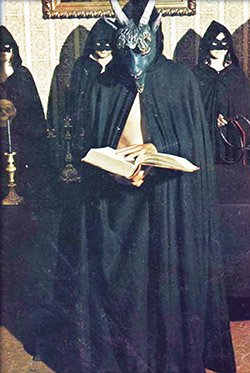
    ‘Satanic’ ritual from a 1970s movie. Hysteria over secret Satanic cults led to the ‘Satanic Panic’ that swept the US and Canada in the 80s and 90s.

    Past-life recall, NDE recall, and alien abduction came into being, endured, and burst into prominence in the same way and in the same time frame as MPD. Are these first three, then, merely different facets of the same altered-state-of-consciousness stream of reality that gave birth to the fourth? Are these three merely fabrications, products of the infinite suggestibility of humankind?

    Dr Hacking would probably say yes. He would likely argue that Kenneth Arnold’s encounter with nine UFOs over Mt. Rainier in Washington in 1947 did not open people’s eyes to see clearly what they had been seeing all along (still less would he say that the UFOs seen by Arnold were the first in a steadily mounting wave of visitors from outer space). Instead, he would say that Arnold’s sighting, for reasons having to do with where society was at, at the time, struck at the heart of the vast impressionability of humankind; that we began, aided and abetted by each other, by the media, and by the rulers of society, to increasingly “make up” UFOs – and, not long afterward, to make up alien abductions. Dr Hacking would probably regard the publication of The Search for Bridey Murphy not as some explosive event opening us up to deeper parts of our psyche; rather, he would see the book as no more nor less than an irresistible invitation to dream, to create, to invent, to make believe that we are far vaster (in that we possess many lives) than we’d thought we were – to, in effect, “socially create” that reality. 

    Let’s pause here. Surely this isn’t the whole truth. There is a real world; its properties are not merely social constructs and facts. Evidence does matter. Wise men and women, while not attributing to UFOs, to past lifetimes, to near-death experiences, an ultimate nuts-and-bolts reality, have nevertheless glimpsed archetypal forms – other, different, powerful realities – lying behind and within these phenomena, realities that ensure them a permanence beyond the flux of transient phenomena. 

    C.J. Jung is one. John White writes, in “What Are UFOs?”, in New Dawn Special Issue 17: “In his book Flying Saucers: A Modern Myth of Things Seen in the Sky, Jung proposed that UFOs are symbolic projections of deep human yearnings for wholeness and transformation in the collective psyche of humanity. Without denying their physical nature – because, of course, UFOs have been photographed and tracked on radar – Jung speculated that UFOs are either our own psychic projections perceived objectively in the sky or they are the appearance of real objects which afford humans an opportunity to project mythological symbols from deep in the collective psyche.”14 White lists other ways of understanding the phenomena of UFO sightings and alien abductions. It is likewise possible to list other ways of understanding past-life recall and NDEs – ways that give these phenomena a profound if ultimately unknowable objective reality while making allowance for the infinite number of forms they seem to take in the face of humankind’s infinite ways of seeing.

    Where are Memories Really Stored?

    Could the “social construction” that was the invention of memory as a storehouse really have moulded our faculties of perception in such a way that we were able to invent the (otherwise non-existent) phenomena of MPD, past-lives, NDEs and alien abductions? This seems unlikely; and, besides, it has become increasingly clear in our time that the notion of memory as a storehouse is a limited, maybe an erroneous, one. This notion came into existence, as Dr Hacking suggests, at the end of the nineteenth century, as a political tool – “memoro-politics” – enabling scientists to pursue their deepest investigations despite the co-optation of the soul by the church. Increasingly in our time the notion is being put forward that memory is not only not stored in the brain, but it might not even be localised in the body. In Transplant Memories, Dr Michael Grosso writes of anomalous memories associated with transplant operations. He tells the story of Claire Sylvia, who “reports that after her heart and lung transplant she suddenly had cravings for foods she never liked before such as beer, green peppers, and chicken nuggets. Later, when she met her organ donor’s family, she learnt that the young man who gave her a new heart was indeed fond of these foods, and was actually carrying a container of chicken nuggets when he died. Tim, the donor, was possessed by a constant craving for action during his life; Claire, after her transplant, became unaccountably restless, and felt urges to travel in a manner quite unlike her pre-transplant self. She also found herself having dreams of beautiful women and flirting with other women; prior to her operation, she had no homosexual leanings.”15

    Claire even dreamt of Tim, at a time when she didn’t know who her donor was and certainly not what he looked like. Dr Grosso asks: “What are we to make of these cognitive memories, which we can assume for the sake of argument to have been accurately reported? Transplant memories suggest that memory may occur apart from any coding, storage, and retrieval from the central nervous system. We haven’t the foggiest notion of how to make sense of this.”16 He cites further research that seems to indicate that no matter how much, or what parts, of the brain are removed, memory survives. Dr Grosso concludes with a wild speculation: “For all we know, the brain’s complete destruction will liberate, not annihilate, consciousness.”17

    In “Intermediate States: Charles Fort’s Degrees of Reality,” Colin Bennett continues in the same vein, providing examples to show us that not only is memory not localised in the brain, but many other so-called “brain” functions may not be localised in the brain either. Among a number of other cases, he cites that of Pacho Penaloza, of La Paz, Bolivia, who “blasted off a quarter of his brain and a third of his skull when mishandling a pistol in 1984. He was in a coma for three months, his right side was expected to be permanently paralysed, and he was also expected to be deprived of speech. A new skull-cover was reconstructed by Minnesota plastic surgeons Joseph Skow and Frank Pilney, using a section of bone taken from a rib and another part of Pacho’s skull, and a scalp-flip stitched into place. Apart from a clenched fist and a limp, Pacho made a complete recovery.”18

    It seems that (as Ian Hacking suggests) the conceptualisation by Vivet’s doctors of memory (which they were certain was contained in the brain) as a faculty of storage, was a more or less arbitrary one, chosen solely to give the doctors a path to knowledge of the soul. Increasingly, it seems that memory doesn’t need a physical container at all. Perhaps it abides as a kind of mist surrounding the body – or perhaps as a mist extending throughout the universe. The ancient concept of the Akashic files – a higher reality in which all human knowledge is stored – may not be so far-fetched after all. 

    Altered States of Consciousness Today

    What does our altered states-of-consciousness graph look like today? In the first decade of the twenty-first century, do our four phenomena continued to soar upward intermingled?

    Reported cases of MPD/DID tapered off considerably in the first decade of the twenty-first century, suggesting that many of them may have been, like cases of satanic ritual abuse, the product of a kind of psychic panic. 

    The status of past-life recall, as reflected in the estimated number of past-life regression sessions taking place over the past ten years, is quite different. Therapist Bob Holmes, of Toronto, Ontario, Canada, told me: “Conservatively I would guess at in excess of one hundred thousand past life sessions world-wide and maybe it is several times that number. This loose guesstimate doesn’t include past life readings by psychics.”19 [The late] Dr Roger Woolger, a leading past-life regressionist, added: “My guess is that in the US there must be a decline in this field. On the contrary, in countries like Turkey, Brazil, Portugal, India, Japan and the Netherlands there is a growing number of practitioners who engage in regression therapy.”20

    Hans TenDam of Amsterdam, the Netherlands, president of the European Association for Regression Therapy (EARTH) and author of Exploring Reincarnation (1990), told me the field of past-life regression therapy grew rapidly in 1978-1990, then stabilised. “Probably over the last five years [before 2011] things are picking up again,” he said. “It is spreading in South Asia and slowly gaining ground in Europe.” Given the large number of variables, he added, it’s difficult to arrive at an exact figure. But, taking a wild guess, he estimates, worldwide, “the total number of sessions per year at 350,000.” In the last twenty-five years about one to one-and-a-half million people will have experienced one or more past-life sessions – [though] of very divergent quality, effect and credibility.”21

    Regarding UFO sightings, Clifford Clift, International Director, Mutual UFO Network (MUFON), Greeley, Colorado, reports that: “We had approximately 6,000 sighting reports to MUFON in 2010. Worldwide, I would estimate 12,000, but don’t know for sure… The sighting numbers are up over the year 2000, but that may be due to people being more aware of MUFON. One other figure you need to be aware of is only one out of ten people will report their sighting to MUFON or others.”22

    Xavier Passot, of the Centre National d’Etudes Spatiales (CNES), in Toulouse, France, cautions: “It’s very difficult to announce a figure on worldwide UFO sightings… Moreover, any comparison of UFO sightings between 2000 and now would be skewed by many social parameters, e.g. the growing use of internet which makes UFO sightings reporting easy, and issues having to do with sci-fi films.”23

    Regarding alien abductions, Will Bueche, in Boulder, Colorado, representative of the John E Mack Institute, made the following, unexpected (in terms of the graphs we have been charting), statement:

    “Our impression, based on the experiencers who worked most closely with Dr Mack, who had recurrent experiences throughout their lives, is that alien encounters diminished markedly in the year 2000. Some people reported distinct communications conveying the message that the experiences would become rare, while others simply reported that they became infrequent without explanation. Though ‘one-off’ experiences continue to sometimes happen to these people on occasion, it is no longer the norm to have many experiences each year, with some ebb and flow, as was the case in the last decade of the preceding century.

    “A review of the literature suggests that the 1980s and the 1990s (all the way to 2000) was the period of most intense activity for these experiences.

    “The way in which the experiences seem to have stopped reinforces our impression that these are or were actual contact experiences of some kind, evidently on a schedule of its own – though as an organisation we maintain an uncertainty about what level of reality they occur in, given the lack of material evidence contrasted with the wealth of experiential evidence (the direct experiences by people of sound mind).

    “Another possibility could be that the experiences are continuing with another (younger) generation with whom the John E Mack Institute does not have contact, or, that the experiences may have changed from the seemingly physical and therefore difficult to dismiss (or dare we say, too terrifying to dismiss), to something more subtle (and pleasant) that may be more easily confused with dream states. But these alternative possibilities are only speculation.”24

    The incidences of NDEs continue to rise, the most recent Gallup Poll reporting that 20 million Americans claim to have had near-death experiences. 

    These altered-states-of-consciousness experiences continue to mystify us. The greatest mystery of all is why they resemble each other; why they seem to be facets of the same unknown reality. Perhaps only an in-depth comparative study of the four phenomena, which appeared at the end of the nineteenth century and today are as bewildering as ever, will begin to give us some answers. 

    [alert type=”general” dismiss=”no”]This article was originally published in New Dawn 131 (Mar-Apr 2012) and reprinted in New Dawn Special Issue Vol 13 No 2.[/alert]

    [alert type=”success” dismiss=”no”]If you appreciate this article, please consider subscribing to help maintain this website.[/alert]

    Sources

    Colin Bennett, “Intermediate States: Charles Fort’s Degrees of Reality,” The Anomalist 7 (Winter 1998/99), 79-157.

    John Chambers, “H.G. Wells (1866-1946): Did the Father of Science-Fiction Have a Near-Death Experience?” The Secret Life of Genius: How 24 Great Men and Women Were Touched by Spiritual Worlds,” Rochester, VT: Inner Traditions/Destiny Books, 2009, 179-186.

    Theodore Flournoy, From India to the Planet Mars: A Study of a Case of Somnambulism with Glossolalia, New Hyde Park, N.Y.: University Books, 1963. 

    Michael Grosso, “Transplant Memories,” The Anomalist 7 (Winter 1998/99), 71-78. 

    Ian Hacking, Rewriting the Soul: Multiple Personality and the Sciences of Memory, Princeton, N.J.: Princeton University Press, 1995.

    David M. Jacobs, Secret Life: Firsthand Accounts of UFO Abductions, New York: Simon & Schuster, 1992.

    C.G. Jung, “Flying Saucers: A Modern Myth of Things Seen in the Skies,” Civilization in Transition. Bollingen Series XX. Princeton: Princeton University Press, 1970, 307-432. 

    John E. Mack, Abduction: Human Encounters with Aliens, 2nd edition, New York: Ballantine Books, 1995.

    Personal Communication, Will Bueche, representative, John E Mack Institute, September 2011. 

    Personal Communication, Clifford Clift, MUFON, July 2011.

    Personal Communication, Bob Holmes, July 2011.

    Personal Communication, David Jones, Ph.D. July 1996.

    Personal Communication, Xavier Passot, CNES, July 2011.

    Personal Communication, Hans Ten Dam, July 2011.

    Personal Communication, Roger Woolger, July 2011.

    Religious Tolerance Website: www.religioustolerance.org/sraover.htm

    George Schwimmer, Ph.D., “A.R. Martin: Pioneer in Past-Life Regression,” The Journal of Regression Therapy, Vol. VII, No. 1 (December 1993), 16-28.

    Michael Shermer, Why People Believe Weird Things: Pseudoscience, Superstition, and Other Confusions of Our Time, New York: Saint Martin’s Griffin, 2002.

    Whitley Strieber and Anne Strieber, The Communion Letters, New York: HarperPrism, 1997.

    Hans TenDam, Exploring Reincarnation, London: Arkana, 1990.

    John White, “What Are UFOs?” New Dawn Special Issue 17 (Spring 2011), 3-9.

    Roger, J. Woolger, Ph.D., Other Lives, Other Selves: A Jungian Psychotherapist Discovers Past Lives, New York: Bantam, 1987.

    Carol Zaleski, Otherworld Journeys: Accounts of Near-Death Experience in Medieval and Modern Times, Oxford: Oxford University Press, 1987.

    Footnotes

    1. Hacking, 172

    2. Ibid, 174

    3. Ibid, 174-175

    4. Ibid, 198

    5. Personal Communication, David Jones, Ph.D.

    6. Mack, 85

    7. TenDam, 7-8

    8. Woolger, 87-88

    9. Schwimmer, 23-24

    10. TenDam, 8

    11. Hacking, 219

    12. Ibid, 32

    13. www.religioustolerance.org/sraover.htm

    14. White, 7

    15. Grosso, 71

    16. Ibid, 73

    17. Ibid, 77

    18. Bennett, 99-100

    19. Personal Communication, Bob Holmes

    20. Personal Communication, Roger Woolger

    21. Personal Communication, Hans Ten Dam

    22. Personal Communication, Clifford Clift

    23. Personal Communication, Xavier Passot

    24. Personal Communication, Will Bueche

    © New Dawn Magazine and the respective author.
    For our reproduction notice, click here.
  • Caodaism: How a Secretive Sect Based on Spirit Communication Shaped the Destiny of Vietnam

    Caodaism: How a Secretive Sect Based on Spirit Communication Shaped the Destiny of Vietnam

    From New Dawn Special Issue 11 (Mar 2010)

    Caodaism was always the favourite chapter of my briefing to visitors. Caodaism, the invention of a Cochin civil servant, was a synthesis of the three religions. The Holy See was at Tanyin. A Pope and female cardinals. Prophecy by planchette. Saint Victor Hugo. Christ and Buddha looking down from the roof of the Cathedral on a Walt Disney fantasia of the East, dragons and snakes in technicolour. How could one explain the dreariness of the whole business: the private army of twenty-five thousand men, armed with mortars made out of the exhaust pipes of old cars, allies of the French who turned neutral at the moment of danger?

    So writes Thomas Fowler, the disillusioned narrator of The Quiet American, Graham Greene’s 1955 novel set in Vietnam in the final months of France’s doomed struggle to hold onto its Far Eastern possession. Fowler, a British journalist covering the war, has taken the day off from his desk in Saigon to go northwest to Tanyin (actually, Tay Nim) province, where he watches a Caodaist religious ceremony.

    His cynical description of Caodaism makes it sound as if this esoteric religion, founded in Vietnam in the 1920s, is nothing more than a cover for one of the many private and/or secret armies running wild in Indochina during its rebellion against France. But Caodaism is seen here only through the narrow, atheistic eyes of the embittered Fowler, and is accordingly twisted.

    The real Caodaism, however bizarre its trappings, is a vibrantly spiritual faith. It is practiced today by more than five million people in Vietnam, Cambodia, Japan, Australia, Canada, and parts of the US, particularly California. It announces the Tam Ky Pho Do, or Third Period of Salvation, when heaven will reveal itself directly to earth and all religions will unite in mutual understanding.

    And, though it’s not even a century old, it sprang largely from the convergence of two rich and ancient cultural traditions in Vietnam: the Chinese and Indian spiritual and religious practices – i.e., Confucianism, Taoism, Buddhism – that were brought to Vietnam over two thousand years ago, and the indigenous belief systems of Vietnam – i.e., the land as a place of benign, malignant, and mystical spirits; Hau Bong, or spirit mediumship in the shamanic mode – that stretch back before recorded history.

    Channelling and “Saint Victor Hugo”

    Two odd phrases stick out in Fowler’s description of a Caodaist ceremony that tell us unequivocally this new religion also has a jarringly modern, esoteric – even beguilingly mysterious – side. The first phrase is, “Prophecy by planchette;” the second is, “Saint Victor Hugo.”

    What exactly is “prophecy by planchette?”

    A planchette is the tiny, heart-shaped, three-legged marker that scurries across the letters of the alphabet written on an Ouija board and spells out words and phrases said to be communicated by disembodied spirits. It’s the descendant of the three-legged table that, placed on a larger table, with the hands of the medium and one other person lying on its surface, tapped out spirit messages by raising and lowering one leg. Such “table-tapping” was the mode of otherworldly communication preferred by the aristocrats and literati of France when, in the mid-nineteenth century, a tidal wave of enthusiasm for this occult pastime swept across the country.

    And “Saint Victor Hugo?”

    In 1853–1855, while in exile on the Channel island of Jersey from the dictatorship of Napoleon III, the great French author of The Hunchback of Notre-Dame and Les Misérables participated in over 100 table-tapping séances. While other political exiles and members of his family looked on, Hugo chatted with the illustrious dead such as Shakespeare, Molière, Galileo and Luther; legendary animals like Balaam’s Ass and the Lion of Androcles; abstractions like The Novel and India; spirits that had never been alive, like the Shadow of the Sepulcher and Death; extra-terrestrials from Mercury and Jupiter; and the occasional errant Jersey island ghost.

    On five occasions – February 11 and 18 and March 8, 15 and 22, 1855 – the spirit of Jesus Christ (or so the transcripts tell us) held forth through the tables to the assembled guests. His subject was the coming of a “third” religion that would supersede Christianity just as Christianity had superseded Druidism (the ancient religion of Britain). Victor Hugo was to be the prophet of this new religion, which held that (1), not only do men and women have individual conscious souls, but animals, plants and stones do as well, and (2), God is in the process of bringing a “universal pardon” to our world, and in fact to every soul in the universe; even Satan will be granted amnesty.

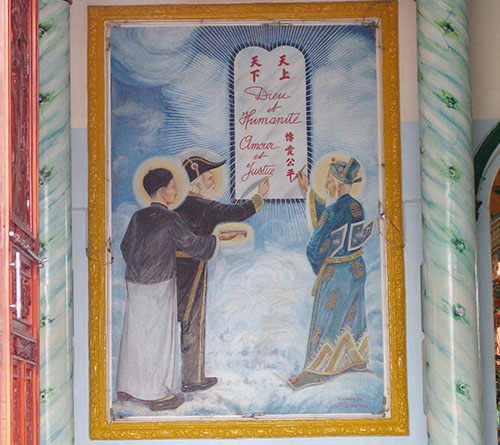
    A painting inside the Tay Ninh Holy See depicting Caodai’s Three Saints signing a covenant between God and humanity. From left to right: Sun Yat Sen, Victor Hugo and Nguyen Binh Khiêm. (Photo courtesy of Ernie Lo, January 2007, http://en.wikipedia.org/wiki/Cao_Dai)

    This all sounds strangely familiar to devotees of Caodaism. Some seventy years after Hugo spoke to the spirits on Jersey, 8,000 miles away in Vietnam, the newly-aborning religion would announce itself through spirit guides as, “The Third Great Universal Religious Amnesty.” According to its tenets, God would grant a pardon to all the religions of the world and in so doing bring peace to the universe. At an historic “summit” séance in Saigon on Christmas Eve 1925, attended by members of the Pho Loan group, the powerful spirit having overall responsibility for communicating Caodaism to our world would reveal his true name and declare that he was the reincarnation of Jesus Christ.

    All this would happen seventy years after the Jersey séances. Back on that windswept island in the early 1850s, the mysterious process that would somehow transmit the spirit of Jesus Christ’s channelled pronouncements to Saigon in the 1920s and elevate Victor Hugo to the status of Caodaist saint, was putting forth its roots in another direction. The séance transcripts tell us that on September 12, 1853, the “living phantasm” of Napoleon III came to Victor Hugo while the dictator was asleep. A three-hour “trial” of the channelled Emperor ensued, at the end of which Napoleon III humbled himself abjectly before the writer and apologised for the wrongs he had inflicted on Hugo and the world.

    This was the last “spirit communication” with the Emperor. But Victor Hugo would never cease to attack the real, living French dictator virulently and publicly. In 1860, Napoleon III, with the British, invaded China. His ostensible motive was to protect Roman Catholicism in that country. The allies inflicted a crushing defeat on a defending army of Tatars that greatly outnumbered them but was short on modern firearms; when the battle was over, 3,000 Chinese, two British, and three French lay dead. Once arrived in Peking (now Beijing), the French and British troops spent days looting, burning and ransacking China’s Imperial Summer Palace, one of the seven wonders of the modern world. The Chinese capitulated immediately.

    This piece of imperialist vandalism redoubled Hugo’s hatred of Napoleon III. He wrote, “Imagine some inexpressible construction, something like a lunar building… suppose in a word a sort of dazzling cavern of human fantasy with the face of a temple and palace, such was this building…. One day two bandits entered the Summer Palace. One plundered, the other burned. Victory can be a thieving woman [Queen Victoria], or so it seems… It contained not only masterpieces of art, but masses of jewelry… One of the two victors filled his pockets; when the other saw this he filled his coffers. And back they came to Europe, arm in arm, laughing away. Such is the story of the two bandits.”

    The Chinese would gratefully remember Hugo’s rebuke to Napoleon III. The great writer spoke out just as vehemently when, in 1862, the French Emperor invaded Cochin China, again to “protect” Catholicism. By 1869, all of Indochina had been subdued. Vietnam was now a province of the French colonial empire.

    When the Vietnamese began to foment rebellion against the French in the early 20th century, Napoleon III was bitterly remembered as the author of all their woes. The Vietnamese held the memory of Victor Hugo dear; he was their defender and their friend.

    The Emergence of Caodaism

    The séances ended in 1855. In 1870, Victor Hugo, now free to return to France (the Emperor had been deposed), packed the copious transcripts away in a trunk. He had kept all news of the séances away from his political enemies, fearing they might hold up the transcripts as proof that he was a lunatic. The great author died in Paris in 1885. Certain stipulations in his will governed when and if the transcripts could be published.

    In 1900, the energies that would create Caodaism began to coalesce around the person of Ngo Minh Chieu (1878–1932), a young Confucian scholar who joined the French civil service in Saigon in 1899. Chieu combined learning in Chinese philosophy with a knowledge of ancient Vietnamese spiritistic-shamanic traditions and Taoist Shamanism, abetting this with wide reading in nineteenth-century European spiritists such as the astronomer/psychic researcher Camille Flammarion; the founder of Spiritism Allen Kardec; Leon Denis; and probably Theosophical Society leader Annie Besant.

    Closeup of a traditional Caodai altar. (Photo courtesy of http://en.wikipedia.org/wiki/Cao_Dai)

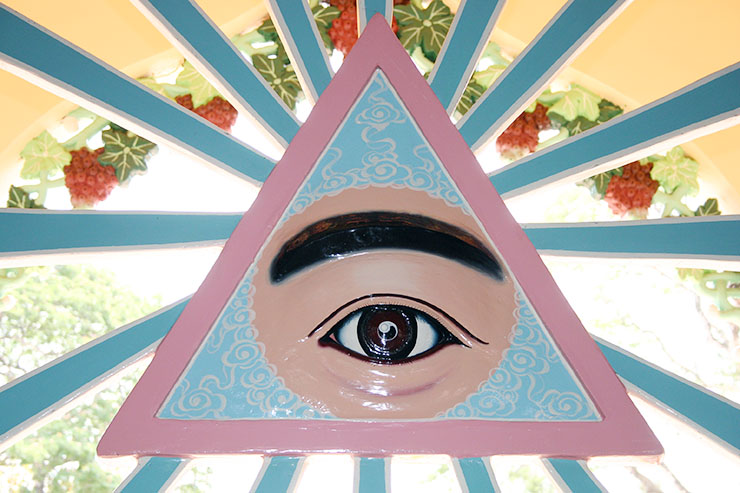
    Transferred to Phu Quo island, the shy, now isolated adept immersed himself in mediumistic phenomena, using the Cau Co or “spirit pen” to communicate with traditional Chinese deities like the red-faced demon slayer Guan di Gong. He encountered a powerful entity that revealed itself only through the mystical name of Cao Dai Tien Ong Dai Bo Tat Ma-Ha-Tat. He was vouchsafed a vision, probably in mid-1920, of a large eye encompassed by rays of light; this was to become the “Divine Eye,” or “Left Eye of God” (Thien Nhan) that, signifying universal and individual consciousness, is a key icon of Caodaism. Arrived back in Saigon in 1924, the humble modern-day shaman/administrator drew disciples to himself as he studied how to worship Duc Cao Dai.

    Now a signal event took place. In 1923, the first collection of the transcripts of Hugo’s channelling experiences – Chez Victor Hugo: Les Tables Tournantes de Jersey – was published in Paris. The volume was highly incomplete, excluding many of the transcripts of the more tradition-challenging séances. It did include Hugo’s five sessions with the “spirit of Jesus Christ.”

    Available in Vietnam, and reviewed in the Saigon newspaper L’écho Annamite, the book seized the attention of the many who were still grateful to Victor Hugo. It galvanised a group of young French-speaking Vietnamese civil servants into conducting their own table-tapping experiments. Soon, a spirit calling itself Thuong-De viet Cao-Dai giao-dao Nam-Phuong, or “Jade Emperor, Supreme Deity, alias Cao-Dai, religious teacher of the Southern Quarter,” manifested to announce that it had come to “teach the truth to the people of Annam.”

    The group called itself Pho Loan. It was soon instructed to switch from table-tapping to the use of the corbeille à bec (“basket with beak”). Central to this procedure was a wicker basket shaped like an upside-down crow. Four ropes were attached to the basket, each held by a different medium so that no one personality could control the communication. The basket was suspended in such a way that its “beak” could make contact with a flat, fine surface of sand beneath; thus the spirit writings were written in the sand.

    On Christmas Eve, 1925, at the previously mentioned landmark séance, the commanding spirit previously calling itself A.A.A. (the first three letters of the Romanised Vietnamese alphabet) now manifested to reveal that its true name was Ngoc Hoang Thuong De Viet Cao Dai Giao Dao Nam Phuong and to affirm its reincarnational identity with Jesus Christ.

    It declared:

    Be joyful tonight on this the anniversary of my appearance to teach the religion in the West. Your allegiance brings much happiness to me… Soon you must help me establish the religion. Have you seen my humility? Imitate me so that you may genuinely claim to be religious men.

    Now Ngo Minh Chieu, whose lived experience of mediumship would be essential to the development of Caodaism, was invited to join the group. It became apparent that he and the Pho Loan members worshipped the same supreme being.

    On October 7, 1926, a spirit-dictated petition, signed by 247 Caodaists, gave the French authorities notice that a new religion had been established. The religion held that the world’s misery was caused by the disunity existing between all religions, and that its aim was to perfect the Tam Giao (“three teachings,” that is, Confucianism, Taoism and Buddhism) of Vietnam. The religions of the world would be brought into equilibrium.

    Increasingly, spirit visitors of world stature manifested through the corbeille à bec. They included Lao-Tzu; Li Po, China’s great 8th century Taoist poet; the female Bodhisattva Quan Am; Joan of Arc; Louis Pasteur; René Descartes; Vladimir Lenin – and, very soon, Victor Hugo. Martin Ebon writes in the Introduction to Victor Hugo’s Conversations with the Spirit World: A Literary Genius’s Hidden Life:

    Adherents have meticulously recorded that the first, momentous encounter with this spirit took place on April 20, 1930, at 1:00 a.m., the earthly interviewer being one Ho-Phap. A bit later, the entity said that one prominent Caodaist, Tran-Quang-Vinh, was, actually, a reincarnation of the French poet’s third son, François-Victor Hugo (1828–1873). Tran later became head of the Cao Dai Army, and eventually Minister of Defense (1948–1951) in the ill-fated government of Bao Dai. During a session of the Cao Dai’s legislative body, the deceased Victor Hugo was appointed titular head of the movement’s ‘foreign missions’, that is, its actual ambassadorial representation abroad.

    In The Quiet American, Greene’s narrator Fowler fingers General Thé (the name is a pseudonym), the Caodaist Chief of Staff, as a savage and out-of-control ally of the Americans who, already in Vietnam, are attempting, through the “quiet American” Alden Pyle, to create a “Third Force” that will stand up to the French and Vietminh armies. Fowler (but perhaps not Greene) seems almost to assume that politics was the real raison d’être behind the creation of Caodaism, and that it is already badly compromised in what will become the Vietnam quagmire.

    Others have wondered about this. In “Through God’s Left Eye” (Underground, Summer 2008), author Paul La Farge asks himself, perhaps with tongue partly in cheek, if some of the more obscure spirit messages might not be coded messages, detailing the movement of troops and supplies. He quotes a message from the spirit of Victor Hugo: Yes, it’s this kind of gas, which they call hydrogen. More or less dense, which makes the healthiest part, When they say that the Spirit of God swam above the waters, It’s in that sense that the word must be understood…” Professor La Farge wonders if this bizarre message might not be “a Caodaist cipher behind which some violent activity lurked” [meaning, perhaps], “The mortar shells will arrive at midnight, by boat.”

    In fact there may be elements of this in Caodaist communications. But the vast majority of Caodaist spirit messages are transparently of deep spiritual intent. In other messages, Hugo spoke eloquently of beauty, divine peace, harmony, science and wisdom. He revealed that “there are… other universes than ours in the infinite and that their creatures know not the word ‘war’.” Moreover, in these worlds “soul-power is master of human weakness.” The Hugo entity averred that “death will be vanquished by uplifted conscience. There is no difference between the living and the dead.”

    Caodaism in Modern Times

    Caodai’s “Vatican,” called the Tay Ninh Holy See,
    is located in Tay Ninh, Vietnam. (Photo courtesy http://en.wikipedia.org/wiki/Cao_Dai)

    Certainly, in welcoming the spirit of Victor Hugo – and of that great Resistance fighter Joan of Arc! – Caodaism had found a way of allying itself with a hidden Western tradition of anticolonialism. As the number of Caodaist adherents increased almost exponentially, multiplying the need for administrative entities, Caodaism shaped itself into three “powers.” The first – the Eight Sided Temple – consisted solely of spirits, with the 8th century Tang Dynasty poet Li Po serving at one point as “spiritual Pope” in this power. The second power, that of The Heavenly Union Temple, was comprised entirely of mediums, and served as the administrative branch. The third, The Nine-sphered Temple, inspired by the organisation of the Roman Catholic Church, was host to nine hierarchies, including adepts, student priests, priests, bishops, archbishops, principal archbishops, cardinals, legist cardinal, censor cardinals, along with the Pope; this became the executive branch. Women were early on accepted in all these roles. Caodaism’s expanding membership soon called for a church or temple. Spirit guides indicated appropriate land near the capital of Tay Ninh province. Over a twenty-year period, the Tay Ninh Great Divine Temple, with its multiple acres and numerous attendant structures, was built here, emerging as the “Vatican City” – the Holy See – of Caodaism.

    The Tay Ninh temple, although neutered by Vietnam’s post-1975 communist regime and today a quasi-Caodaist theme/amusement part, remains the holiest of the Caodaist places of worship. In The Quiet American, narrator Thomas Fowler lays out for us, if sardonically, its most striking attributes. Entering the temple, he notes a famous mural on the wall:

    Saint Victor Hugo in the uniform of the French Academy with the halo round his tricorn hat point at some noble sentiment Sun Yat Sen [the founder of modern China] was inscribing on a tablet, and then I was in the nave. There was nowhere to sit except in the Papal chair, round which a plaster cobra coiled, the marble floor glittered like water and there was no glass in the windows… The dragons with lion-like heads climbed the pulpit: on the roof Christ exposed his bleeding heart, Buddha sat, as Buddha always sits, with his lap empty. Confucius’s beard hung meagerly down like a waterfall in the dry season.

    Unremarked by Fowler is best-known feature of the temple: the picture of the “Divine Eye,” or “Left Eye of God” that signifies universal and individual consciousness. This was the eye first seen in a vision by Ngo Minh Chieu.

    In the fifth year of its existence, Caodaism boasted 500,000 members. By the 1950s, an estimated one in eight South Vietnamese was a Caodaist. The religion treated Tay Ninh province as if it were a feudal theocracy, collecting taxes for itself and maintaining a standing militia of tens of thousands of men. At the same time, the movement was beginning to splinter into a number of factions, some with marked ideological differences.

    The Phnom Penh Post reporter Sebastian Strangio offers a succinct summary of the history of Caodaism from the fall of the French garrison in Dien Bien Phu in 1954 (bringing with it the French surrender) to the present:

    But when South Vietnamese President Ngo Dinh Diem, a staunch Catholic, came to power in 1955, the domestic political calculus began to turn against the Caodaists. In 1956, Diem forcibly disbanded the Caodaist militias and other nationalist rivals. Following the fall of Saigon in 1975, the communists took their revenge, confiscating Caodaist property and arresting or exiling many of its leaders. Relations between the Cambodian Caodaist and the Vietnamese government were difficult during the occupation of the 1980s, but have since improved.

    But despite some positive changes, rights groups and exiles say the Vietnamese government continues to ban participation in independent Caodaist factions and oversees all internal Caodaist affairs. “Undercover government agents have infiltrated the administration of Caodaism, and the religion has to function according to the government’s [rules] without respecting the current religious constitution,” said Hum Dac Bui [a spokesman for www.Caodai.org, a California-based non-profit organisation]. “The Tay Ninh Holy See has become more or less a place of tourist interest for the profit of the government and is totally paralysed from a religious point of view.”

    “Brad Adams, Asia director of Human Rights Watch, said that only the government-approved Caodaist sect is legally recognised and that those who belong to splinter groups are subject to ‘harassment, arbitrary detention, and imprisonment’.”

    The persecution of Caodaists by the post-1975 Communist regime saw a steady exodus of adherents out of Vietnam. Approximately 50,000 have settled in the United States, half of them in California. There are twenty temples in California, most of them small; a temple is under construction in Garden City that will be a miniaturised version of the Great Divine Temple in Tay Ninh.

    There are approximately 2,000 Caodaists in Australia today. A large temple was constructed over a period of nine years in Wiley Park, New South Wales. Like the semi-completed temple in Garden City, California, it is modelled after the Great Divine Temple in Tay Ninh.

    There are currently over 1,300 Caodaist temples in Vietnam; these serve the great majority of the five million adherents to Caodaism that are spread around the world today.

    All that is required in the practice of Caodaism is a vegetarian diet ten days a month and biweekly attendance at services. Doctrinal loyalty is not required. During services Caodaists bow before the Divine Eye, chant, and meditate; sometimes there are addresses. In California, as in other Western places of worship of Caodaism, séances are no longer carried out. If the spirit of Victor Hugo still hovers over this faith, no doubt he has moved on to California, where the dark-blue Pacific can remind him of the dark-blue Atlantic pounding on the shores of Jersey island, where so much of it, so mysteriously, began.

    [alert type=”general” dismiss=”no”]This article was published in New Dawn Special Issue 11.[/alert]

    [alert type=”success” dismiss=”no”]If you appreciate this article, please consider subscribing to help maintain this website.[/alert]

    © New Dawn Magazine and the respective author.
    For our reproduction notice, click here.
  • Sir Isaac Newton & the Land Where Time Began

    Sir Isaac Newton & the Land Where Time Began

    From New Dawn Special Issue Vol 7 No 3 (June 2013)

    The sixth-century BCE Greek philosopher-mystic Pythagoras was a man of spectacular achievement. Plutarch says that he taught an eagle to come at his command and stoop down to him in flight.1 He taught the doctrine of reincarnation and was thought to remember twenty-two of his past lives. He founded an order whose adherents strove to free themselves from the cycle of earthly incarnations through vegetarianism, silence, and contemplation of the ultimate reality of the universe.2

    Up through the seventeenth century CE, scholars believed Pythagoras journeyed to Sidon, in Phoenicia, where he met the descendants of a man named Moschus (or Mochus) who had lived five hundred years before. Moschus was the Phoenician name for Moses, and his descendants gave Pythagoras esoteric doctrines passed down to them from their illustrious ancestor.3

    Pythagoras returned to his home in the Greek colony of Crote in southern Italy to further develop his mystical philosophy which stated that the numerical relationships reflected in the relationships between musical chords are the bedrock of reality. Adding to this the secret doctrines of Moses, he discovered that the planets revolved around the sun. He also discovered the law of universal gravitation (including the inverse-square law of attraction), which he expressed allegorically as the divine music of the spheres holding the planets in thrall to the sun.

    But, wait a minute! Didn’t Sir Isaac Newton (1642-1727) discover the law of universal gravitation?

    Yes, he did. But Sir Isaac didn’t think his discoveries were original. He thought he was recovering parts of a body of primordial knowledge called the prisca sapientia (the “pristine wisdom”). Bits of this ancient knowledge had been transported through the Flood by Noah. It had caught the interest of the Egyptians, then the Jews, then the Phoenicians, until it emerged almost fully-blown in the philosophy of Pythagoras. It spread throughout the ancient world, meeting with resistance only when Aristotle insisted that the sun revolved around the earth and that many of the Pythagorean beliefs were irrational.

    Almost all this knowledge disappeared in the third and fourth centuries CE with the collapse of the Roman Empire. So complete was the loss that mathematician Alfred North Whitehead could say in 1970: “By the year 1500 Europe knew less than Archimedes, who died in 212 BCE.”4 The “sacred philosophy” did not re-emerge until after the fall of Constantinople in 1453, when it was rediscovered in ancient texts, many thought lost forever, many never known, by the seers of the Italian Renaissance.

    The French philosopher/mathematician René Descartes (1596-1650) believed in the existence of the prisca sapientia, declaring that when God created mankind, “certain primary seeds of truth [were] implanted by nature in our human minds.” By Descartes’s time the seeds had been “stifled [in us] owing to our reading and hearing, day by day, so many diverse errors.” Descartes regretted that the ancients had concealed these truths in symbols. He suspected their motives: “They have perhaps feared,” he remarked scornfully, “that their method being so very easy and simple, would if made public, diminish, not increase public esteem.”5

    Isaac Newton and his contemporaries believed that, in the pre-Flood world where truth and the bounty of God walked hand-in-hand, the places of worship resembled a combination of planetarium and cathedral. Astronomy flourished in this land of the perfect fusion of science and spirituality, especially since the antediluvian peoples lived for centuries (this was the time of Methuselah, who died at the age of 969). Richard Hinckley Allen writes:

    Following the opinion of [the first-century CE Jewish historian] Josephus, [the second-century CE Christian theologian] Origen said that the constellations were known long before the days of the patriarchs by Noah, Enoch, Seth, and Adam – indeed were mentioned in the Book of Enoch as ‘already named and divided;’ and he claimed that ancient longevity was a blessing specially bestowed to give opportunity for a long-continued period of observation and comparison of the heavenly bodies.6

    Josephus consulted the historical records of Tyre (which were lost not long after his death) and wrote enigmatically that this knowledge survived the Flood thanks to the preservation of one of the pillars upon which all knowledge had been inscribed.7

    William Stukeley, Newton’s contemporary, and the first archaeologist to truly understand Stonehenge, read multiple ancient sources and declared that the pre-Flood sages got along without a telescope because “in the beginning of the world… [people] lived 7, 8, or 900 years, [and] they had time in one man’s life to perfect the art of astronomy.” Both William Whiston and Newton believed the people of the land of the prisca sapientia understood the circulation of the blood and that white light contains within itself the spectrum of seven colours8 (William Harvey would “rediscover” the first, and Newton would rediscover the second).

    These ideas (which we will shortly examine at length, especially as regards Isaac Newton) began to fade in the mid-seventeenth century. They succumbed in the face of man’s widening exploration of the world, which contradicted the idea of a universal Flood; to the dawning of the Age of Reason, which brought with it a process of demythologising; and to Darwin’s discoveries of the age of the earth and the origin and evolution of species.

    The Sources of the “Pristine Wisdom”

    These ideas would fade – but they never quite faded away. In the early twentieth century, certain maverick artists and thinkers revived the notion of a pure science and a high civilisation that existed before our own. British novelist D.H. Lawrence (1885-1930), author of Sons and Lovers and Women in Love, wrote in Fantasia of the Unconscious in 1922:

    I honestly think that the great pagan world of which Egypt and Greece were the last living terms, the great pagan world which preceded our era, once had a vast and perhaps perfect science of its own, a science in terms of life. In our era this science crumbled into magic and charlatanry. But even wisdom crumbles.

    I believe that this great science previous to ours and quite different in constitution and nature from our science once was universal, established all over the existing globe. I believe it was esoteric, invested in a large priesthood. Just as mathematics and mechanics and physics are defined and expounded in the same way in the universities of China or Bolivia or London or Moscow today, so, it seems to me, in the great world previous to ours a great science and cosmology were taught esoterically in all countries of the globe, Asia, Polynesia, Atlantis, and Europe.

    …In that world men lived and taught and knew, and were in one complete correspondence over all the earth. Men wandered back and forth from Atlantis to the Polynesian Continent as men now sail from Europe to America. The interchange was complete, and knowledge, science was universal over the earth, cosmopolitan as it is today.

    Then came the melting of the glaciers, and the world flood. The refugees from the drowned continent fled to the high places of America, Europe, Asia, and the Pacific Isles. And some degenerated naturally into cave men, neolithic and palaeolithic creatures, and some retained their marvellous innate beauty and self-perfection, as the South Sea Islanders, and some wandered savage in Africa, and some, like Druids or Etruscans or Chaldeans or Amerindians or Chinese, refused to forget, but taught the old wisdom, only in its half-forgotten symbolic forms. More or less forgotten, as knowledge: remembered as ritual, gesture, and myth-story.9

    Maverick Armenian-Greek mystic/spiritual teacher G.I. Gurdjieff (1877?–1949) believed the Sufis were the spiritual heirs of “the old master magicians of Altai” who lived in an advanced civilisation in Central Asia that began 40,000 years ago. Gurdjieff’s disciple J.G. Bennett wrote that, according to his teacher:

    In that palaeolithic age art and religion were still one; secular and religious consciousness had not yet separated out, and spirit and matter were not yet in opposition; nor was evil an absolute force seeking the overthrow of good. All things and all attitudes to things were filled with the magnetic, synthesizing radiance of hypercosmic energy, which Gurdjieff called conscious energy. In such a unified world the great Initiates developed the unique type of spirituality that still distinguishes Sufism today, wherein the polarising activity of mind is submissive to the over-riding Spirit that ever seeks a return to the One. Only in the later more alienated religious systems, Gurdjieff believed, do we find the divisive seeds of philosophical dualism.10

    Newton’s Primordial Cathedral-Planetariums

    Sir Isaac Newton wouldn’t have accepted Gurdjieff’s idea of the antediluvian world, but he would have agreed with him that spirituality was on a par with science in that era. Newton never ceased striving to find out the nature of the prisca sapientia in its purest form. He had deduced the existence of the primordial cathedral-planetariums from the temples, which he called prytanea after the later Greek model, that had been erected not long after the Flood and whose structures contained echoes of the prisca sapientia. Historian Robert Markley contends that these prytanea embodied a timeless mathematical form; that they were “a kind of computational code by which true knowledge [of the prisca] could be demonstrated and transmitted without interruption, interference, or corruption.”11 Newton speculated that the shape of the prytaneum had been transported through the Flood in the shape of the Ark itself; he thought the “divine dimensions” of the prytanea and the Ark were later embedded in Solomon’s temple. The ancient prytaneum “framed,” or mirrored, the shape of the Solar System; this shape had been embodied in later temples. Noah’s Ark had transported sacred fires that had burned in the prytanea; Noah used this to prepare a burnt offering to the Lord once the Ark had made landfall. And, in these temples, Newton further deduced, the priests and priestesses had circled around the ever-burning flame in the central hearth in emulation and worship of the celestial bodies that revolved around the sun.

    A great deal of apocryphal literature surrounds the Noahic Flood story. From its mention in the Koran and the New Testament, Newton may have known the story of the ever-burning light that illuminated the inside of the Ark. Journalist Rene Noorbergen tells us that references in the Bible support the contention that

    …Electricity may have played a vital role in the operation of the ark. One reference is found in Genesis 8:6, where the Hebrew word challon or ‘opening’ is used, referring to the window through which Noah released the birds. The other reference, however, utilises a different word – tsohar – which is translated as ‘window‘ but does not mean window or opening at all! Where it is used (twenty-two times in the Old Testament), its meaning is given as ‘brightness, a brilliance, the light of the noonday sun’. Its cognates refer to something that ‘glistens, glitters or shines’. Many Jewish scholars of the traditional school identify tsohar as ‘a light which has its origins in a shining crystal’. For centuries Jewish tradition has described the tsohar as an enormous gem or pearl that Noah hung from the rafters of the ark, and which, by some power contained within itself, illuminated the entire vessel for the duration of the Flood voyage.12

    Newton may also have known the story, told by John Cassianus in about 428 CE, that Noah’s son Cham (or Ham) was “expert in all the arts and sciences of the antediluvian generations, and wished to save this accumulated natural knowledge of man.” His father forbade him to bring the “unholy” knowledge on board the Ark. Cham inscribed the knowledge on metal plates which he buried. After the Flood, Cham succeeded in finding these plates; thus, writes Cassianus, he “transmitted to his descendants a seedbed of profanity and perpetual sin.”13

    Did the descendants of Moses really pass knowledge to Pythagoras? Could Moses possibly have known anything about the philosophy of the pre-Flood world?

    Newton thought that the biblical description of Creation was written by the prophet Samuel, who had gotten his information from Moses. The description hardly sounds scientific to us today; but Newton insisted the Genesis account was accurate but couched in simplistic terms because the author wanted the common man to understand it. To the objection that the entire Creation could scarcely have happened in seven twenty-four-hour periods, Newton replied that God had started the world rotating on its axis only on the fourth or fifth day, and then slowly the Deity simply made the days long enough to accomplish all He had to accomplish.

    (We know now that the historians of the late Renaissance wanted to prove that Mosaic doctrines influenced Pythagoras because they could not bear to believe that some of the greatest ideas in the Western world had originated in pagan Greece. If these ideas didn’t originate in the Christian New Testament, then they were determined to prove that the ideas came from the Hebrew scriptures which formed the background to Christianity.)

    Frank Manuel explains in The Religion of Isaac Newton that: “Moses knew the whole of the scientific truth – of this Newton was certain – but he was speaking to ordinary Israelites, not delivering a paper to the Royal Society, and he popularised the narrative without falsifying it.”14 Rob Iliffe similarly explains that in the early post-Flood world the priesthood “concealed these [scientific] truths from the vulgar. At this time there was a ‘sacred’ philosophy – communicated only to the cognoscenti – and a ‘vulgar‘ version, promulgated openly to the common people.”15 Newton himself sounds almost as critical as Descartes when he remarks sardonically that, “The [ancient] philosophers loved so to mitigate their mystical beliefs that in the presence of the vulgar they foolishly propounded vulgar matters for the sake of ridicule, and hid the truth beneath discourses of this kind.”16

    Pythagoras & Newton: Same Theories, Different Time Period

    Can it possibly be that Newton’s scientific discoveries, which revolutionised the world, were known in every detail to Pythagoras and his followers in the sixth century BCE?

    Sometime in the 1690s, Newton confided to a disciple, the Scottish mathematician David Gregory, that he intended, in the forthcoming revised edition of the Principia, to, in Gregory’s words,

    spread himself in proving the agreement of his own findings with those of the ancients and ‘principally of Thales’, the legendary founder of Greek philosophy. He would demonstrate that what Epicurus and Lucretius had affirmed was true and valid, and that the charge of atheism laid on them was unjust. [Newton would assert that] Thoth, the Egyptian Hermes or Mercury, had been ‘a believer in the Copernican system’, while Pythagoras and Plato had ‘observed the gravitation of all bodies towards all’.17

    In 1692, at the instigation of Newton, his close friend the brilliant young Swiss mathematician Nicolas Fatio de Duillier told the eminent Dutch mathematician/astronomer Christiaan Huyghens in a letter that Newton had discovered that all the chief propositions of the Principia [Mathematica] had been known to ancients like Pythagoras and Plato, although those worthies had turned them into a “great mystery.” A startled Huyghens wrote back that the ancients may have known the solar system was heliocentric, but they could not possibly have known that the orbits of the planets were elliptical.18

    Newton begun very early to disseminate these ideas to those who were closest to him. In Book Two of the 1685 De Mundi, he describes the ancient philosophy and astronomy behind the work of Plato, Pythagoras, and the Roman King Numa Pompilius. Newton argued, as Newton Project Director Rob Iliffe explains, that

    the Ancients had believed in a heliocentric cosmos but that this had been perverted by misinterpretation. Whereas Pythagoras and others had correctly understood the true meaning of symbolic representations of a heliocentric cosmos, with a central Sun encircled by the concentric orbits of the planets, Greeks such as Aristotle assumed that the central object in such a scheme was the Earth…. Via Orpheus and Pythagoras, the Greeks had originally received their understanding of the natural world from the Egyptians.

    Not only did Thoth (the Egyptian Mercury) know that the planets went around the sun, but Moses had promulgated the theory that atoms are the fundamental building blocks of the universe.19

    David Gregory summarised the ancient beliefs that Newton believed anticipated the Principia:

    The moon was like another Earth, and itself like other celestial bodies; therefore, the planets and their satellites were heavy masses of the same substance as the Earth;

    Bodies in the solar system exercised a mutual gravitation that extended to all other systems (each fixed star being the centre of a gravitational system of planets), that force itself extending indefinitely in all directions;

    All matter was made of atoms, and they were hard, solid, and immutable; gravity accrued to both atoms and to the bodies they composed; gravity was proportional to the quantity of matter in every body;

    The proportion in which gravitational power decreased with distance was analogous to the law governing tension and pitch in a string instrument, and was concealed in the ancient concept of the “harmony of the spheres;”

    The cause of gravity was explained in the “mystical philosophy” of the ancients by their supreme divinity, Pan, playing on his pipe – that is, by the direct exercise of God’s divine power in all bodies whatsoever.20

    But what does it mean to say that “the harmony of the spheres” is the same as the inverse-square law of gravitational attraction? One of the clearest explanations comes from Newton’s time, from the hand of arguably Newton’s most brilliant disciple, the mathematician Colin MacLaurin. He wrote in 1750:

    A musical chord gives the same notes as one double in length, while the tension or force with which the latter is stretched is quadruple: and the gravity of a planet is quadruple of the gravity of a planet at a double distance. In general, that any musical chord may become unison to a lesser chord of the same kind, its tension must be increased in the same proportion as the square of its length is greater; and that the gravity of a planet may become equal to the gravity of another planet nearer to the sun, it must be increased in proportion as the square of its distance from the sun is greater. If therefore we should suppose musical chords extended from the sun to each planet, that all these chords might become unison, it would be requisite to increase or diminish their tensions in the same proportions as would be sufficient to render the gravities of the planets equal. And from the similitude of these proportions the celebrated doctrine of the harmony of the spheres is supposed to have been derived.21

    For some commentators, the question of the supposed similarity of Newton’s doctrines with those of Pythagoras takes second place to an even more beguiling question: If Newton hadn’t totally immersed himself in the philosophy of Pythagoras, would he ever have come up with the universal law of gravitation? Did Pythagoras’ tantalising notions of the music of the spheres and the pipes of Pan, insofar as they represented a true portrait of the dynamics of the universe – to push, prod, stretch, open up, redirect, inspire and bedevil Sir Isaac – that had it not been for them, he would never have conceived the idea of an all-controlling gravitation? (A secondary question, occasionally asked, is: Did the prolonged meditation of Pythagoras on the mystical number of seven provide Newton with an indispensable impetus pushing him to the discovery that light is composed of seven colours?)

    In a seminal article, “Newton and the Pipes of Pan,” J.E. McGuire and J.B. Rattansi tackle this question. They explain that Newton’s textual analyses of ancient natural philosophy

    …provide a pedigree for his own doctrines, to legitimate them for an audience which still widely accepted the idea of a prisca sapientia. He could use them as a direct defense for his own doctrines, as he does in the Opticks, and, on one occasion, during the controversy with Leibniz. Furthermore, the documents dealt with in this paper do not tell us whether his own adoption of the doctrines he ascribes to the ancients preceded his textual studies. Such basic problems as the existence of the void, the properties of matter, and the character of the divine agency lay beyond the experimental procedures they could deploy. Newton’s solutions to some of these problems are explained and defended by the analogical reasoning whose patterns he defined in the Regulae. But the possibility that the ancient texts might have provided clues, and guided his thoughts in one direction or another, can by no means be excluded.22 (author’s underlining)

    Beyond the question of whether Newton’s intense meditation on the philosophy of Pythagoras was indispensable to his discovery of the principle of universal gravitation, there lies an equally beguiling question (and one that could never have been raised in Newton’s time):

    After years of collaboration with analytical psychologist Carl Jung, Nobel Prize-winning Austrian physicist Wolfgang Pauli (1900-1958) came to the conclusion that the collective unconscious posited by Jung certainly existed. Pauli further decided that the archetypes theorised by Jung (and which he thought had a greater reality than physical reality) certainly existed, and that the fundamental components of science, the “background physics” of the universe, so to speak, derived their being without a doubt from those archetypes.23

    Did Sir Isaac Newton and Pythagoras, across the gulf of 2,300 years, tap into the very same cluster of archetypes of the collective unconscious – that same single cluster that gave its essential shape to both the principle of gravitation and the allegory of the music of the spheres?

    If this is so, perhaps René Descartes, with his notion of the prisca sapientia as comprised of seeds of truth planted in the mind of man, is closer to the truth than Sir Isaac Newton, who saw in the prisca sapientia the spiritual and scientific force that defined a pristine primordial land that still couldn’t save itself from God’s wrath in the form of the Flood.

    [alert type=”general” dismiss=”no”]This article was published in New Dawn Special Issue Vol 7 No 3.[/alert]

    [alert type=”success” dismiss=”no”]If you appreciate this article, please consider subscribing to help maintain this website.[/alert]

    Footnotes

    1. Plutarch, The Lives of the Ancient Greeks and Romans. Translation by John Dryden, The Modern Library, 1992, 80
    2. Eduard Zeller, Outlines of the History of Greek Philosophy, Meridian Books, 1955, 47-48
    3. J.E. McGuire & P.M. Rattansi, “Newton and the ‘Pipes of Pan’,” Notes and Records of the Royal Society of London, Vol. 21, No. 2 (Dec., 1966), 130
    4. Marcelo Gleiser, The Dancing Universe: From Creation Myths to the Big Bang, Dutton/Penguin Group, 1997, 70
    5. Quoted in Prisca Sapientia, MathPages, www.mathpages.com/home/kmath066/kmath066.htm
    6. Richard Hinckley Allen, Star Names: Their Lore and Meaning, Dover, 1963 (1899), 27-28
    7. Quoted in Jed Z. Buchwald & Mordecai Feingold, Newton and the Origin of Civilization, Princeton University Press, 2013. (Yahuda MS 16.2 fols. 47V, 52; Josephus, 1841)
    8. David Boyd Haycock, William Stukeley: Science, Religion and Archeology in Eighteenth-Century England, Boydell Press, 2002, 95 (The Newton Project) www.newtonproject.sussex.ac.uk/view/texts/normalized/OTHE00021
    9. D.H. Lawrence, Psychoanalysis and the Unconscious and Fantasia of the Unconscious, Mineola, 2005, 54-55
    10. Victoria LePage, “G.I. Gurdjieff & the Hidden History of the Sufis,” New Dawn 107 (March-April 2008), 67-72
    11. Robert Markley, “Newton, Corruption, and the Tradition of Universal History,” In Newton and Religion: Context, Nature, & Influence, James E. Force & Richard H. Popkin, eds. Dordrecht, Kluwer Academic Publishers, 1999, 136
    12. Rene Noorbergen, Secrets of the Lost Races: New Discoveries of Advanced Technology in Ancient Civilizations, Bobbs-Merrill, 1977, 45-46
    13. Joseph Needham, Science and Civilization in China, Volume 5, Chemistry and Chemical Technology, Part IV, Spagyrical Discovery and Invention: Apparatus, Theories and Gifts, Cambridge University Press, 1980, 346
    14. Frank E. Manuel, The Religion of Isaac Newton, The Fremantle Lectures 1973, Clarendon Press, 1974, 364-365
    15. Rob Iliffe, Newton: A Very Short Introduction, Oxford University Press, 2007, 96
    16. Sir Isaac Newton, The Original of Religions, (The Newton Project) www.newtonproject.sussex.ac.uk
    17. McGuire & Rattansi, 109-110
    18. Ibid., 110
    19. Iliffe, 96
    20. Rattansi, 187-188
    21. Quoted in McGuire & Rattansi, 117
    22. Ibid., 137
    23. John Chambers, “Physics and the Unconscious: The Discoveries of Wolfgang Pauli and Carl Jung,” Atlantis Rising 98 (March-April 2013), 39

    © New Dawn Magazine and the respective author.
    For our reproduction notice, click here.

  • The Chinese Nostradamus

    The Chinese Nostradamus

    From New Dawn 129 (Nov-Dec 2011)

    This year [2011] is the 700th anniversary of the birth of Liu Ji (1311-1375), military commander of Chinese forces both on land and on sea and long-time advisor to the first Ming emperor Zhu Yuanzhang, whom he helped bring to power.

    Liu Ji, who eventually became grand chancellor at the imperial court, was a man of protean interests and the author or co-author of books on warfare including comprehensive treatises on the use of gunpowder in firearms (Huolongjing), and, in particular, on the use of the medieval Chinese firearm known as the fire lance. Liu Ji (who is at least as well-known by his honorific or “courtesy” name of Liu Bowen) also wrote works on astronomy, the calendar, magnetism, geomancy, feng-shui, and other subjects skirting the supernatural.

    In this latter category, he wrote one book that holds the same fascination for us today as it did for Liu Ji’s contemporaries. This is the Shaobing ge (The Baked Cake Ballad), a collection of prophecies of future events. The predictions are cloaked in a welter of abstract, allusive and arcane language. They seem to be stunningly accurate in their prediction of future events (such as the coming of Sun Yat Sen, founder of the Chinese Republic, in 1911). They bid fair to being compared to the prophetic Centuries of Michel de Nostradamus, the French prognosticator who wrote 200 years in Liu Ji’s future.

    Basing his calculations on knowledge of cycles covering 50-year periods, this Chinese Nostradamus prophesied that the 50-year period from 1860-1910 would unfold as follows:

    Strong nations will seek to subdue weak ones while oppressed nations and people will rise in strife to throw off their unvirtuous rulers. The people in China, likewise, will agitate and revolt against their foreign rulers from the North. The country will be weak and divided as it will be suffering from all these conflicts and other calamities.1

    In a discussion of Liu Ji and his prophecies, in Occult magazine, Sybil Leek writes that,

    In more specific terms, Liu Ji pointed out that his people would see great floods in the years of the swine (1873), the snake (1887) and the goat (1893) and 1911, another year of the swine. He indicated that within twenty-four years after the greatest flood, the existing rulership of the country would meet with great difficulties and dangers of an overwhelming nature, and the Wise Man in the name of the Moon would arise as the new sage and statesman to act for the cause and destiny of the country. The ‘Wise Man in the Name of the Moon’ is the birth name of Sun Yat Sen, the founder of the Chinese Republic.

    Leek goes on to explain:

    China was weakened by the Taiping Rebellion and the actions of the revolutionaries from 1860 onwards. The great flood took place in 1877, the year of the swine. There were wars with France, England and Japan in 1865, 1884 and 1895, each of which brought humiliation and losses of territory to the Manchu dynasty. The final crisis took place in 1911 when the Chinese revolution broke out to overthrow the once great and long Manchu regime, exactly 24 years after the great flood of the Yellow River. Other important historic events in this 50-year era were: the Russo-Japanese War of 1904-1905; the Japanese conquest of Korea in 1911; the Spanish-American War of 1898-1899; and the French annexation of Indochina in 1883.2

    Does the warrior, politician, prognosticator of the future and explorer of ancient “New Age” lore known as Liu Ji or Liu Bowen have the right to be called “the Chinese Nostradamus?”

    There are those who think so. Others contend that, while Liu Ji genuinely was a figure of great power and importance amidst the clashing ideologies, peoples, and life styles of fourteenth-century China, much of Shaobing ge was composed hundreds of years later, after many of the events it “predicts” had taken place, and was fraudulently credited with Liu Ji’s name in order to bestow divine legitimacy on those events. This school of thought traces the inception of the Shaobing ge not to the Ming or even the Qing era, but to the work of fiction writers and the propagandists of anti-Manchu sectarian organisations and secret societies that flourished in the early eighteenth century.3 

    Some hold there really was a Shaobing ge, composed by Liu Ji and consisting of prophetic messages – but it was greatly adumbrated, added to, and revised in later centuries, becoming the centrepiece of a number of Chinese messianic documents built on, in the words of Barend J. ter Haar, “the concrete expectation that one or more saviours will descend to earth to rescue a select group of human beings from imminent or currently raging apocalyptic disasters.”4

    What really happened may be a complex mixture of all the above – including the exciting if uncomfortable fact that Liu Ji may really have produced predictions for the future, some of which have come true in stunning fashion.

    The Chinese World of the 14th-15th Centuries

    A brief look at the tumultuous times in which Liu Ji lived and left his mark may provide the beginnings of an answer.

    Late fourteenth-century and early fifteenth-century China under the Ming dynasty saw the last great flowering of Chinese culture before a lengthy period of stagnation that ended only at the beginning of the twentieth century. Paper (100 BCE), the seismograph (132 CE), gunpowder (220 CE), and printing (movable wooden blocks by the sixth century CE, movable type by the eleventh) – all these were only a few of the inventions that China had developed centuries before the West, and it had pioneered such devices as the compass, the stirrup, suspension bridges, canal locks, iron chains, and water-powered mills and looms as well.

    Under the Ming, China brought these advanced technologies to the height of efficiency. Art (particularly pottery), printed texts of every sort (a preponderance of them being scholarly), and architecture (both sacred and profane), flourished as never before. Defences, paved highways, bridges, temples and shrines, stupas, tombs, memorial arches and rock gardens were built in profusion. The walls of some five hundred cities were reconstructed. According to a legend that has followed him up to modern times along with that of his prowess as a prognosticator, Liu Ji himself was “an ingenious builder of imperial cities.”5 

    From 1405 to 1433, the eunuch admiral Zheng He, born four years before Liu Ji died, would lead at least one expedition of 200 (perhaps even 371) ships, some of them the tallest in the world, on a diplomatic and exploratory mission to South-east Asia, Africa, the Indian subcontinent, the Persian Gulf, the Arab states and the Red Sea. Gavin Menzies speculates, in 1421: The Year China Discovered America, that this fleet, captained by its Chinese Vasco da Gama and carrying a crew of 28,000, even penetrated as far as the west coast of North America.6 To cap the achievements of this era in a literary mode: in 1403-1408 three thousand scholars laboured to compile and copy what is still the longest encyclopaedia ever produced, the Yung-Lo Ta Tien (Grand Encyclopedia of the Yung-Lo Ta Tien Reign-Period) – an astonishing 11,095 volumes, containing 50 million Chinese characters. (Only 370 volumes have survived, scattered in libraries around the world.)7

    Who Was Liu Ji (Liu Bowen)?

    Liu Bowen was an exemplar of, and helped to mould, this world of vibrant and many-faceted activity. He was born in Qingtian County (modern-day Wencheng County, Zhejiang Province) in 1311. Tall, wiry, eager and precocious, he rose swiftly in the imperial civil service, acquiring the skills of engineer, writer, soldier and administrator, and others. When one of the leaders of the Red Turban secret society, a former travelling monk, grotesque in appearance but highly capable, Zhu Yuanzhang (1328-1398), seized Nanking from the Mongols in 1356, Liu Ji was at his side. Twelve years later, Zhu drove the descendants of the Great Khan out of Beijing and became the first Ming emperor.8 Liu served in many administrative posts under Zhu Yuanzhang. He was a commanding officer in sea and land battles. He studied and wrote on a wider range of topics than any other man of his time, particularly in the fields of warfare and divination.

    Joseph Needham writes of him, in Science and Civilization in China (Volume Five, Part Seven), that, “Liu Chi [Ji]… was a striking personality, of remarkable qualities both civil and military. In philosophy he was a skeptical naturalist, interested in all kinds of science and proto-science – astronomy, the calendar, magnetism and geomancy – and a friend of the eminent mathematician and alchemist Chao Yu-Chin. But he was also concerned with administration, and for long an advisor to the first Ming emperor. In war he commanded at battles both on land and afloat, having in one instance (+1363) his flagship destroyed by a ‘flying shot’ (fei phao) just after he had transferred to another vessel.” Needham sums up Liu’s unique abilities: “Liu Chi was the sort of man who could successfully conjure a change in the wind just when the commander-in-chief needed it.”9

    Needham’s vivid description of Liu Ji brings out the adventurous side of his life, as no account of this remarkable man can fail to do. This action-oriented dimension of the prognosticator-warrior was exploited in full by Taiwanese TV in a 404-episode mega-series, Shen Ji Miao Suan Liu Bo Wen (The Amazing Strategist Liu Bowen), that aired five nights a week from August 23, 2006, to March 12, 2008. This TV spectacular tells how Liu Bowen’s amazing ability to predict the future helped Zhu Yuanzhang overthrow the Yuan emperor and establish the Ming empire. In actual fact, Liu Bowen’s death in 1375 is shrouded in mystery: his multifarious talents may have incurred the jealousy of Zhu, who, increasingly perceiving his lieutenant as a threat, harassed Liu Bowen so much that he died of sorrow and indignation; the emperor then erased much evidence of the warrior-seer’s accomplishments. The TV mega-series takes advantage of these blank spaces, writing in a passionate love affair between Bowen and Princess Nanfeng, daughter of the deposed Mongol emperor. (Did this high-powered liaison really take place? The best that can be said is that there is no strong reason to suppose that it did not.)

    In the early stages of the story, Princess Nanfeng tries to assassinate Emperor Yuanzhang, is blinded for her failed attempt, and seeks refuge in the shop of A Tian, who turns out to be Bowen’s best friend. There she meets Liu and his sister, A Xiu, who is training in the martial arts. When Liu discovers who this refugee is, he tries to restore her sight and keep her from trying to assassinate Emperor Yuanzhang again; Bowen wants to promote good relations between the present Ming emperor and the former Mongol emperor.

    A treacherous Ming official, Hu Weiyong, tries, for personal gain, to persuade the Ming emperor to have Nanfeng killed. A battle of wits ensues that pits the noble Liu Bowen against the evil Hu Weiyong. It’s this battle, filled with bloody combat, sizzling romance, and the wrenching encounters of Bowen with the gods from whom he channels searing images of the future, that kept millions of Taiwanese glued to their TV sets for more than eighteen months. At the end of 404 episodes, when the contest is decided in favour of the Ming dynasty, the aid of Liu and his paranormal powers has been indispensable.10 

    How much truth is there in this TV production, and the depiction of Liu Ji as a man of magical clairvoyant power? Did he really “channel” future-event predictions that, gathered into a volume called Shaobing ge, rival those of Nostradamus in their beguiling obscurity and – when they can be interpreted – their occasional striking accuracy?

    Liu Bowen’s Specially Encoded “Moon Cakes”

    Many modern scholars, as we’ve seen, tend to think not. Ter Haar writes that in the nineteenth century,

    One of the first paragraphs of the 1811 initiation manual [put together by secret societies plotting the downfall of the Manchu dynasty and the resurrection of the Ming in a series of divinely-ordained, messiah-led, apocalyptic battles] states that in 1643 an ‘Inscription by Liu Bowen’ was spit out by the (Yellow) River in Kaifeng… It predicted the return of the Ming under the Zhu family, bringing peace.11

    Perhaps not conscious fraud as much as powerful, self-deluding, emotional need – it must have seemed to the members of the society as if they were channelling the document! – wafted Liu Ji’s imprimatur into the ritualised agendas of these anti-Manchu secret societies. Nevertheless, there is a story, with some claim to historical truth, that suggests just how cryptic messages in baked cakes, prophesying China’s future, might have come to be associated with Liu Ji.

    The Chinese have a custom, said to date from the end of the Yuan Dynasty (1271-1368) of eating baked “moon cakes” at yearly mid-autumn festivals. The custom had its origins in the revolutionary times preceding the fall of the Yuan, when the general populace, lashed into fury by the oppressive regime, rose up again and again against their Yuan masters. The messages had to be transmitted in secret so that the insurrectionists could meet at the right time and the right place. Zhu Yuanzhang and Liu Bowen had the idea – or so the story goes – of spreading the rumour among the peasants that a deadly plague was afoot in the land and the only way to prevent it was by eating specially-prepared mooncakes. These special cakes were to be quickly distributed – each containing an encoded message coordinating the Han Chinese revolt for the fifteenth day of the eighth lunar month.

    The messages were in the form of a simple puzzle or mosaic printed on the surface of the cake. To read it, you had to cut the four mooncakes per package into four pieces each. The sixteen parts would then be put together in the right order to reveal the message. The evidence would be destroyed by eating.

    But Yuan government officials were everywhere, and it was almost impossible to send the messages without their being detected.

    Liu Bowen devised a new plan: the messages, particularly the critical one of “Uprising on August 15,” would be baked inside the mooncakes. This was done, and the buried-message cakes were successfully distributed. The insurrectionary armies converged on Beijing on August 15, and soon the city fell to Zhu Yuanzhang.

    The memory of this conspirators’ device, enhanced by legend and the life story of the charismatic Liu Bowen, could have been transformed into a legend of cryptic prophetic messages from the gods “hidden” inside a book called The Baked Cake Ballad.12

    According to legend, the Shaobing Song, as it is also known, predicted the future of China including the 1449 Mongol invasion, the 1911 founding of the Republic of China and much, much more.

    To further quote Sybil Leek:

    The next era of Liu Ji’s visions was the 50-year period from 1911 to 1960. Liu Ji predicted the Chinese-Japanese war which would come in the year of the ox (1937) and would last for 1,085 days. He did not see the end of the war as a lasting peace. But he foresaw that around 1947 a great statesman would arise to lead the Chinese into an era of peace.

    Among other major predictions he made were that a world war would involve every country and that 1917, the year of the snake, would be one of the most ominous dates in the period. He predicted an earthquake in Japan in 1923, the year of the swine; the great world depression in 1931, the year of the snake; and the European war in 1939, the year of the rabbit.

    Other interpreters believe that the Shaobing ge contains cryptic allusions to the rise of the great eunuch admiral of Ming times, Zheng He, the establishment of the Quin dynasty, the Opium Wars, and the first Sino-Japanese War, along with the founding of the Republic of China in 1911.13

    Another Text Accurately Forecasted China’s Future

    Liu Ji was not the first Chinese prognosticator of the future to be spoken of in the same breath as Nostradamus. In the reign of Emperor Tang Taizong (599-649 CE), Li Chun-feng and Yuan Tian-gang wrote a book that seems to contain a startlingly accurate forecast of China’s struggle against Japan in World War Two.

    This strange and ancient text, called Tui bei tu (“Back-Pushing Sketch,” apparently an allusion to the sixtieth, final, and farthest-in-the-future prophecy in the book), has never been translated into English. Dr. Yow Yit Seng writes in Chinese Dimensions: Their Roots, Mindset and Psyche that this prophetic work consists of

    sixty illustrated diagrams [called ‘surreal drawings’ by other commentators], each with lyrics and descriptions in a cryptic style. Each scenario uses a ‘Celestial Stem and Terrestrial Branch’ used in [the] Chinese calendar, as well as a scenario from the I Ching. Each scenario seems to have accurately predicted events in Chinese history from the Táng dynasty onwards. It accurately predicted that there would be twenty-one emperors in the [Tang] dynasty from the [Li] family, with one of them from outside the family. It also foretold the rise of Empress Wu Zetian, the only ruling empress in the history of China.

    To illustrate the difficulty of translating the Tui bei tu into English – or any language – in intelligible fashion, Dr. Yow provides a rough translation of Scenario 39, which depicts a bird standing on top of a mountain, with the rising sun at the bottom of the picture.

    The lyrics run somewhat as follows:

    Bird without leg, moon in the mountain.

    The sun rises, everyone cries.

    Disharmony in mid-December.

    Sparrows to the south of the mountain, traps to the north.

    One morning cries from metal rooster is heard.

    The sea is lifeless, the day is over.

    Dr. Yow writes that,

    the Chinese character of a legless bird with a mountain is the character ‘Island’. Hence the event refers to an island nation. The island nation is linked to the rising sun; hence, Japan. When a million soldiers invade China with unprecedented cruelty and inhumanity, everyone cries.

    In December of 1941, the Japanese talked peace in the United States, while secretly attacking Pearl Harbour. [This] fits the description ‘Disharmony in December’.

    There are sparrows (small birds) south of the mountain, referring to small nations in South East Asia being captured. In the picture there is certainly an eagle that could trap it, coming from in the North, symbolising the United States. (Incidentally, the word luo is also the first word of the Chinese name for President Roosevelt, the US president who subdued Japan.)

    Japan surrendered in August 1945. This corresponds to the Chinese calendar year of [the] rooster. The month of surrender was August, a ‘metal’ month.

    The sea is lifeless when Japanese troops surrender unconditionally. Ri refers either to the day, or in this case to Japan (riben).

    Dr. Yow concludes: “While the earlier scenarios depict events from the various dynasties, the later scenarios could probably describe events outside China.”14 

    The Tui bei tu, like the Shaobing ge (though in its vastly expanded form as the youthful adventures of Liu Bowen), had its moment in the television sun. From April 16, 2007, to May 11, 2007, Chinese TV aired in twenty instalments a serial called A Change of Destiny about two young men who hope to change their destiny by making use of the scenario-diagrams of the Tui bei tu. One tricks the other into buying a fake set of diagrams. This is straightened out; but the hopes of the two for an extraordinary future are dashed when they see that, every which way they interpret the scenarios, courting the future with the help of the Tui bei tu is always to court disaster. The future is our own responsibility, and not that of sixty predictive drawings. The 20-episode Change of Destiny series was extremely popular all across China, and shows the hold that divinatory practices still have on this country now embracing cut-throat capitalism.15 

    So odd and cryptic are the predictions of Shaobing ge that there are no translations, into any language, that are not to some extent creations of the translator almost as much as they are creations of Liu Ji and whatever gods, if any, communicated his predictions to him.

    Below are a few lines of text from the Baked Cake Ballad, in a translation so rough, so raw, and obscure, that it is virtually impenetrable. To try to interpret it is to be left fending for yourself in a forbidding if provocative jungle of words that are seemingly stand-alone because they seem to be completely unconnected.

    Yet a translation like this is so rough that it can never really mislead, even while it illuminates only with the greatest difficulty. Perhaps these words are worth trying to interpret, though, if only to catch a mention of what’s going to happen in 2012, in China and in the world.

    World hunger and cold are strange, the pillars of Germany by the baby dragon.

    10,000 Sun sub-stack layer, (Wanli descendants) ancestral mountain shell clothing line.

    Wu Zi Ji-Chou tangled everywhere, people are not at home, occasional famine bandits hair, safe guarding the good sweet-scented osmanthus.

    Chaos to the former pro-Western thief, no one dared to Zhongliang admonition, glad to see descendants of shame see the day, recession gas transported back to heaven, lack of ears on Kyrgyzstan in the middle and a Machine made to go West, East.

    Red Head Boy and Girl are bleeding, upside-down triple the total before I go, shall be synthesized Sichuan pages, (predicted emperor) eighteen wins between the fire and water.

    [alert type=”general” dismiss=”no”]This article was published in New Dawn 129.[/alert]

    [alert type=”success” dismiss=”no”]If you appreciate this article, please consider subscribing to help maintain this website.[/alert]

    Footnotes

    1. Leek, 42; 2. Ibid; 3. ter Haar, 154; 4. Ibid, 163; 5. Needham, Vol. 1, 144; 6. Seng, 100; 7. Needham, Vol. 1, 145; 8. Roberts, 444; 9. Needham et al, Vol. 5, Part 7, 25, 232; 10. Wikipedia: Addicts, http://wiki.d-addicts.com/Shen_Ji_Miao_Suan_Liu_Bo_Wen; 11. ter Haar, 158; 12. Liu Bowen and the Moon Cakes, http://history.cultural-china.com/en/47H2345H11800.html; 13. Leek, 43; 14. Seng, 252-254; 15. Wikipedia: Change of Destiny, http://en.wikipedia.org/wiki/A_Change_of_Destiny

    Works Consulted

    Sybil Leek, Sybil Leek’s Psychic Notebook,” Occult: New Dimensions of Life in the Field of Psychic Phenomena 5 (3) (October 1974): 42-45+.

    Liu Bowen and the Moon Cakes on Mid-Autumn Festival, http://history.cultural-china.com/en/47H2345H11800.html

    Gavin Menzies, 1421: The Year China Discovered America, New York: HarperCollins/Harper Perennial, 2008.

    Joseph Needham, Science and Civilization in China, Vol. 1, Introductory Orientations. Cambridge: Cambridge University Press, 1954.

    Joseph Needham, Gwei-Djen, Lu; Ping-Yi, Ho; and Ling, Wang. Science and Civilization in China. Vol. 5, Chemistry and Chemical Technology, Part 7, Military Technology: The Gunpowder Epic. Cambridge: Cambridge University Press, 1986.

    J.M. Roberts, The Penguin History of the World, London: Penguin Books, 1980.

    Yow Yit Seng, Chinese Dimensions: Their Roots, Mindset and Psyche, Selangor Darul Ehsan, Malaysia: Pelanduk, 2006.

    Barend J. Ter Haar, “Messianism and the Heaven and Earth Society: Approaches to Heaven and Earth Society Texts,” David Ownby en Mary Somers Heidhues, Eds., “Secret Societies” Reconsidered, New York: M.E. Sharpe, 1993, 153-176.

    Wikipedia: Addicts, http://wiki.d-addicts.com/Shen_Ji_Miao_Suan_Liu_Bo_Wen

    Wikipedia: Change of Destiny, http://en.wikipedia.org/wiki/A_Change_of_Destiny

    © New Dawn Magazine and the respective author.
    For our reproduction notice, click here.

  • Ouija: How the Spirit World Helped a Pulitzer Prize-Winning Poet

    Ouija: How the Spirit World Helped a Pulitzer Prize-Winning Poet

    From New Dawn Special Issue Vol 6 No 2 (April 2012)

    Sois sage dear heart & set my teachings down 
    If you do not your world will be undone
    & heaven itself turn to one grinning skull.1

    These lines appear in the poem “The Will,” by James Merrill (1926-1995), arguably the greatest American poet of the latter half of the twentieth century. Critics rarely mention that for most of his life Merrill was deeply involved with discarnate entities on a Ouija board, and that the poet’s 550-page masterpiece, The Changing Light at Sandover (Knopf, 1982), is based entirely on his conversations with those spirit guides. Fully one-third of the book consists of direct quotes from the numerous spirits with whom, with varying degrees of belief, ambivalence, and denial, Merrill hammered out the problems of the universe.

    The lines quoted above are channeled from “Ephraim,” the first spirit guide with whom Merrill communicated on the Ouija board. Ephraim’s words place a crushing burden on the poet’s shoulders. The spirit is telling Merrill that if he doesn’t tell the world everything the spirits have told him, the world will be “undone,” i.e., destroyed. And that isn’t all: “heaven” (the “afterworld,” the “divine”) will be destroyed as well.

    Ephraim seems to be implying (this is borne out by other quotes in The Changing Light at Sandover) that the afterworld exists, but that it needs man to give it definition, to give it shape and purpose. Behind this outlandish assertion lies the strange assumption that the spirits come to us, via the Ouija board or by whatever means, not because we need acknowledgement and answers, but because they need acknowledgement and answers. The German phenomenological philosopher Martin Heidegger has said, “God needs Being;”2 Ephraim’s statement seems to bear this out.

    Over the past 160 years, the West has seen a great flowering of interest in, and practice of, channeling, i.e., receiving messages ostensibly from the spirit world. During this period, four literary/philosophical figures of stature have, by dint of lengthy encounters with the spirit world and the records they’ve kept of those encounters, provided us with valuable information concerning the nature of channeling. James Merrill is the most recent of these four.

    The first was Victor Hugo (1802-1885), author of The Hunchback of Notre Dame and Les Misérables. Hugo’s feverish conversations with a hundred and twenty discarnate entities on Jersey island in 1853-1855 were at the centre of a sudden, ecstatic, upsurge of interest in channeling in England and France beginning in 1852. Instances of Ouija board-type channeling already went back a long way: In Rome, in 371 CE, a group of noblemen used an olive wood tripod supporting a circular metal dish with the alphabet engraved on the rim (a ring on a thread was suspended overhead) to obtain a message whose content led to all of the participants’ being executed for treason.3But from the time of the consolidation of Christianity up till the early nineteenth century, there are few records of such séances, no doubt because such activity usually led to a burning at the stake. By 1848, the grip of religion had relaxed sufficiently to allow the Fox sisters, of Hydesville, New York, who were channeling raps from the afterworld, to capture the attention of the world and bring about the birth of Spiritualism in the US and England and Spiritism in France.

    The Irish poet W.B. Yeats (1865-1939) was a third dominating literary influence to become immersed in channeling. In 1925, Yeats published A Vision, a summary of his three years of talks with the spirit world through the agency of his wife Georgie’s automatic writing. Nobody was much interested; by this time the anti-mystical influence of Freud and a growing disillusionment stemming from World War One had dampened interest in channeling. (In 1992, the University of Florida published all 4,000 pages of the transcripts of Yeats’s talks with the spirit world.) In 1916, the Swiss philosopher-psychiatrist Carl G. Jung (1875-1961), who had broken with Freud and was already exploring other dimensions of reality, had a frightening encounter with the spirit world whose full details became known only in 2008 with the publication of Jung’s personal diary, The Red Book. (There had been some mention of the encounter in Jung’s 1962 autobiography.) Carl Jung was the fourth towering figure of our times to take the phenomenon of channeling seriously.

    James Merrill and his lifetime companion David Jackson first used a Ouija board in 1955. (The planchette, a three-legged marker sliding over the letters of the board, had by now replaced the three-legged table, tapping with one leg, that Victor Hugo used.) By this time the influence of Jung, with its focus on transpersonal realms of archetype and collective unconscious, had superseded that of Freud. The wisdom of the East was opening up to seekers in the US and Europe. The stage was set for a second great upsurge of interest in channeling, one that reached its peak in the early 1980s and has only recently begun to wane.

    People tend to either dismiss channeling completely or hang on the spirits’ every word. This is too bad, since the truth of channeling is not only complex, but may be far different from anything we have imagined so far. Carl Jung found this out in the summer of 1916. One day, a huge host of unhappy spirits of the dead seemed to stream in and occupy his living room. Before he could ask them anything, they hurled questions at him: “What is the nature of man?” “What is the nature of the universe?” “Who is God?” “Is God dead?” They told Jung that the dead know nothing beyond what they know at the moment of death.4

    Was this an isolated incident? To say that the spirits come to us because they need help, and not the other way round, seems like a preposterous assertion. Yet there are hints here and there, especially in the writings of Hugo, Jung, Yeats and Merrill, that to pose such a question is at least to embark on a fruitful inquiry. This writer can’t hope to do anything more than point the reader in a few directions. To explore in depth what the spirits told James Merrill seems like a good way to start.

    James Merrill

    The future author of The Changing Light at Sandover was born in New York City on March 3, 1926, the second son of Charles Edward Merrill, co-founder and senior partner of the investment brokerage firm of Merrill-Lynch. The younger Merrill grew up in a milieu of wealth and privilege. He attended the best schools in New York and New Jersey and graduated from Amherst College with highest honors after having taken a leave of absence to serve in World War Two.

    At 28, Merrill, with several volumes of poetry under his belt and a well-received off-Broadway play, had established himself as a talent to be watched. That was when he and David Jackson, living in Stonington, Connecticut, came across a Ouija board, began playing with it, and watched with bewildered amusement as the heart-shaped marker moved rapidly from letter to letter of the alphabet laid out in two curving rows on the brown, placemat-sized, board. Ephraim had arrived; he claimed to be a bisexual Greek Jew strangled to death at age 32 in 36 CE at the court of the Emperor Tiberius;5and he was charming and witty enough to hold the attention of the ultra-sophisticated, very intelligent, very well-read, and very skeptical Merrill and Jackson. Their attention rarely wandered as, over the ensuing months, years, and decades, a steady stream of equally captivating spirits came gliding across the Ouija board to beguile them with enchanting tales of our multidimensional reality.

    By 1975, the hard-working Merrill had garnered a reputation as America’s leading poet. In that year, he put together his first volume of poetry devoted almost exclusively to his Ouija board adventures. Published in 1976 as Divine Comedies, it earned him a Pulitzer Prize. In 1978, Merrill published Mirabell: Books of Number, a continuation of the Ouija board saga; and in 1980 the final volume, Scripts for the Pageant, for which he earned a National Book Award. All three books were published together in 1982 as a single, 550-page poetic epic, The Changing Light at Sandover. James Merrill died suddenly of an AIDS-related heart attack on February 6, 1995. He was not quite sixty-nine.

    The Spirits on Ancient History

    Over more than thirty years, the spirits communicated to the two men a dazzling vision of our world as one set in motion by a God who is only one of a pantheon of gods, and who, like the deity of the Gnostics, has all but withdrawn from His creation. Our world, the spirits told them, was shaped and is controlled in its human and non-human dimensions by four archangels who are aided in their task by the discarnate spirits of a sentient species, long extinct, that preceded ours on earth. Reincarnation is a definitive, abiding principle of our world and the other levels of reality to which it is linked. But our universe is a troubled one; the gods are at war with one another, and our own God is failing for reasons that have entirely to do with us, his human creation. Only Merrill and Jackson – and all of us together – can help Him survive.

    The spirits call this God “God B,” or “God Biology.” The “youngest brother” of many gods, He was, eons ago, made custodian of the Milky Way galaxy and charged with the task of seeding our planet with sentient life.

    Four archangels, Michael, Gabriel, Emmanuel, and Raphael, work at his side. It was they who moulded our world, bringing it through geological age after geological age until it had been properly prepared for habitation.

    Two “root races” preceded our own, although that term – familiar to students of Madame Blavatsky, Rudolph Steiner, Edgar Cayce and their depictions of the Lemurians and the Atlanteans – is not used by Merrill’s spirit guides.

    The first sentient species God placed on earth was a race of intelligent, immortal, winged humanoids living in what is now China. The spirits allude to this species’ central city… a vast obsidian pile gleaming on the plain rutted by his machines. The winged humanoids destroyed themselves in an atomic war of such violence that God had to throw up a shield of positive matter6 – the Himalayas – to protect our planet from radioactive fallout.

    The second species, whom the spirit guides call the Atlanteans, was a race of unusually intelligent half-men/half-horses, resembling the centaurs of mythology. On the one hand these centaurs, in the beginning a grazing, pastoral breed, were limited in their ability to manipulate the environment because they had forelegs with hooves, not hands with opposable thumbs. On the other hand, this didn’t seem to hinder them from breeding a species of winged feathered servants by feeding uranium into the eggs of green grass flies. The centuries flashed by. The centaurs’ forehooves evolved into stubby fingers and they were able to store their grain in silos, using refracted sunlight to control the temperature. They continued to breed their winged servants in incubators, speeding them through 6,000 generations a year. When the servants emerged from their incubators, they were as tall as their masters, humanoid in shape, pitch-black in colour, and with burning red eyes. They resembled giant upright bats – and (coincidentally, or not) the “mothmen” described by John Keel in The Mothmen Prophecies.

    These bat-creatures became the centaurs’ engineers, constructing their masters’ arenas and cities and running their heating and lighting plants.

    There was a problem. The centaurs were immortal, and the Atlantean continents had become crowded with fenced-off areas containing all of the older generations of the centaurs down to the most primitive and ancient. The young, “witty” centaurs had taken to tormenting the very old trapt in their primitive form.7 The centaurs came up with a solution: They would annihilate the previous generations using atomic bombs. And they would get their servants, the bat-creatures, to do it for them.

    The servants faithfully carried out their duty. But now the bat-creatures, being themselves immortal, and proliferating quickly, began to fear that their masters would do the same thing to them. They rose up against the centaurs and, using atomic bombs, slaughtered all but a few.

    The bat-creatures now set out create an empire in the air. They forced the surviving centaurs to build landing strips and antigravitational skeins – continent-wide “crusts” sculpted with latticed cities and smooth plains. They forced the centaurs to man “anchor points,” huge stones glowing with radiation. This radiation, beamed up, would hold the floating continents in place in the ozone layer.

    The bat-creatures enjoyed their empire in the air for a thousand years. But earthly vegetation had encroached more and more thickly on the anchor points, which could no longer be manned by the centaurs since they had evolved into ravenous longnecked creatures / reptilian heads [ripping at] greenery – dinosaurs.8

    The radiation moorings frayed; the bat-creatures, arrogant and complacent, ignored this. Then one beam tore, then another; there was a sudden cataclysmic unravelling of the moorings; and the bat-creatures’ latticed cities shimmered, shred, and plunged to earth. All died; and all were damned, first for killing the centaurs, then for neglecting the mooring points. The bat-creatures, now a useless squeaking thinking cloud shunning light,9 were condemned by the four archangels never to take life again but to labour constantly in the service of mankind.

    God B took the fate of his first two creations (and of the bat-creatures) very seriously. He decided that what had brought about the downfall of these species was their immortality. Being immortal, they could kill each other only with nuclear weapons. And, being immortal, they had not overcome the need to fight because they had not been able to learn properly – because immortality had provided them with no deadlines.

    And so God brought homo sapiens, ourselves, into the world, and gave us mortality and a cycle of reincarnations.

    The Spirits on Reincarnation

    In The Changing Light at Sandover, the spirits have a great deal to say about reincarnation. They explain that all nature is suffused with soul; that “Mother Nature” is the resting place of soul,10 and that the reincarnational cycle of which humankind is a part demands that we live lives as animals, plants, and even rocks, as well as men and women. Merrill is told he is now living his 268th and last incarnation. Jackson is told that he has lived 289 lifetimes and must live several more. He is understandably dismayed, since this means he will be separated from Merrill.11 

    The spirits explain that, “Soul falls into two / Broad categories: run-of-the-mill / souls who / Life by life, under domed thicknesses, / Plod the slow road of Earth – billions of these / Whom nothing quickens, whom no powers indwell / …The other soul belongs to an elite: / At most two million relatively fleet / Achievers…”12

    The souls of the two million elite, whom the spirits call the movers and shakers of mankind, enjoy a privilege not available to the other souls on earth: they spend time between lifetimes being recalibrated. This process, called cloning, takes place in the “Research Lab” and is carried out by the shades of multitudes of bat-creatures who labour without rest. Merrill is told that, between this lifetime and his last, these workers

    wafted him hither, added the humus of / the Jew plus the gene of a chemist (& failed musician)

    with the result that

    et voilà U are not JM [James Merrill] what u might want to be / but a productive 5.5.13

    “5.5” is Merrill’s talent rating, so to speak, a component of his Basic Formula. A talent rating quantifies the soul’s aptitude for serving mankind; Merrill, a partial 5,14 is very high on the scale.

    Esoteric essences, called soul densities, may be injected into souls between lifetimes; one such is shooting, a special quality found only in plants. It is a cool upward thrust of / carbons. An intensity that might translate as pride; its insertion gives the soul, when reborn, spectacular vitality but a short lifespan. The poet Edwin Muir, the novelist Yukio Mishima, and the horticulturist Luther Burbank, all benefited from this lively brand of Lab cloning.15 

    In some schools of thought, such as Hinduism, and some channeling experiences, such as that of Victor Hugo, the rebirth of human being into animals, plants, and especially rocks, is seen as a punishment; according to Merrill’s guides, it’s a gift, an opportunity for enlightenment and exploration – a saintly elevation.16 The poet W.H. Auden (1907-1973), eventually one of the spirit guides on Merrill’s Ouija board, has been reborn as a soul romping through the mineral world; the spirits report one night that, Our witty poet surfacing off Alaska as a vein of pure / radium has havocked a nosy radio ship. 58 in lifeboats!

    Most of the world’s population – the “run-of-the-mill / souls who/ Life by life, under domed thicknesses / Plod the slow road of Earth”17 – spend no time in the Research Lab but instead “get a short pep-talk, then rejoin the race.”18It seems that Earth’s population explosion beginning in the nineteenth century has stretched the amount of available soul matter thin. The spirits tell Merrill that to rectify the situation,

    We have in the past century had to resort to / souls of domestic animals, most recently the rat./ By 2050 these too will be exhausted, & then?/ Wilder strains, mountain cats & forest monkeys. So / now u / Begin to see how without visibly interfering / We of the Lab must go about our work.19

    Only the souls of the elite two million are eventually able to graduate from the cycle of reincarnation. Then they move upward through nine levels of afterworld purity. Those that reach the top are the best that humanity is capable of. They are incorporated into a kind of celestial blood bank from which transfusions of their soul-matter are made available on the basis of need to earth’s most talented mortals, especially its geniuses. The spirits explain that,

    Since mid 19th cent. souls of the great scribes / Have been used 1/9 on earth reincarnated, 8/9 / as let us say safety deposits. We mine them… Proust / is deservedly enshrined. Tap him & as a statesman / at a dull banquet he converses, seems to be himself / But part of his mind literally wanders: Out on loan!20

    (Victor Hugo’s spirit guides describe a roughly analogous procedure to the French poet.)

    Merrill and Jackson are told that the shade of the French poet Arthur Rimbaud shared its soul matter with that of the living British-American poet T.S. Eliot; this afterworld-to-earth Vulcan mind meld gave birth to Eliot’s famous poem The Wasteland. W.H. Auden’s shade, often present at the séances, is connected to the living Merrill in the same way, while the largely silent presence of the shade of W.B. Yeats has the same kind of relationship with the mortal David Jackson.21

    The V Group of Gifted Souls

    A group of spectacularly gifted souls, numbering five and called “the Five” (or, “the V”), play a very particular role in the advancement of humanity. When we’re born, we have no memory of our past lives – except for the V. These five souls reincarnate again and again remembering every detail of all their previous lives. They are the spiritual leaders of mankind, whose “immortal” names are Laduman, Soriva, Rachel, Torro and Von.22 They take life again and again as athletes, artists, scientists, politicians and religious leaders.

    The spirits explain:

    These have lived centuries & live today heldover lives / Not in the scheme you know of the 9 stages. Remaining / Aware of it all, knowing the fruitlessness of speaking / Of their knowledge, they return to earth charged with / Energy / Beyond the norm.23

    The Five began as “reincarnations” of the archangels Michael, Raphael, Emmanuel and Gabriel, each of these archangels representing one of man’s five (“V”) senses. Michael is “God’s seeing on earth;” his earthly incarnations include Akhnaton, Madame Curie, and Galileo. The Archangel Raphael is God’s hearing on earth, and has been reborn as Homer, Mohammed, Mozart, and an East German astrophysicist (alive today, but anonymous), inter alia. The archangel Emmanuel, God’s touching on earth, has spent time among us as Montezuma, Noah, and George Cotzias. (Cotzias is a scientist/friend of Merrill who had been engaged in unlocking the genome governing aging and now speaks to Merrill from the afterworld.)24 Sometimes these supercharged beings return to earth to live completely anonymous lives. (These often our choicest agents, declare the spirits).25 

    The Spirits on a Curious Period in Ancient Egypt’s History

    The first two representatives of God B’s V were the twinned souls of Akhnaton and Nefertiti. The lifetime in ancient Egypt of this strange twinned soul is of particular importance, and the spirits spend some time explaining it to Merrill. His account in The Changing Light at Sandover reads like ancient Egyptian history seen through hallucinogenic glasses, or the acid trip of a genius.

    Akhnaton/Nefertiti were married at age thirteen and ruled for eighteen years, according to Merrill’s spirit guides. The royals oversaw a switch in religious belief and a leap forward of all the sciences. Polytheism was abolished; the temple priests were strangled; the slaves were freed; and the worship of a single god was introduced. A surge of creativity sweep across Egypt: Physicians found great cures; there were no fevers / A generation was born a hand taller than its parents / Light storage much like the battery was invented / both palaces and humble homes were lit and heated by the sun.26 Harnessing the power of the sun, the Egyptians controlled the tides up and down the Nile and closed the Straits of Gibraltar, allowing just enough water in to turn the Mediterranean into a tranquil lake.

    The crowning achievement of this epoch was the erection of a fifteen-metre-high rock crystal pyramid with dimensions sculpted in such a way as to harness every ray of the sun and enable Akhnaton to rule the world. For one year, 1,500 workers polished the capstone to perfection. On the night before it was to be lowered onto the top of pyramid, Akhnaton, watching with Nefertiti on a barge decorated with diamond pyramids, was so intensely thrilled his physicians fed him opium each hour.27

    The setting-in-place of the capstone, attempted at the first moment of dawn, was a cataclysmic failure. The proportions of the pyramid were a fractional millimetre wrong;28 there was a violent, fiery explosion, and the crystal pyramid rose, fell, then melted into a lake of molten crystal (which, the spirits tell Merrill, is still there, solidified beneath Thebes). Far away on the island of Crete, the volcano Thera erupted, destroying the city of Minoa. Akhnaton and Nefertiti, their twinned soul unutterably harrowed, cut their wrists, held their arms over the side of the barge, and bled to death into the Nile. The devastation was such as to render the surrounding deserts infertile for 1,200 years.

    This fiery ending to monotheistic Egypt (provoked by no less than His beloved, first two, “twinned,” V souls) devastated God B and made him rethink his plans.

    God B & the “No Accident Clause”

    Up until this time, it seems, mankind had complete free will; “Chance” prevailed upon the earth. God B now decided to invoke the “No Accident Clause,” that is, to remove an element of free will from the souls of the elite two million who guide the destinies of man. Hitherto, these movers and shakers were free to do whatever they liked – to remain open to the randomness of the universe. But God B now moved from a policy of, so to speak, total deregulation, to one of some regulation, commanding his archangels to clone certain controls into his ruling elite. As scholar Judith Moffett tries to explain, “Apparently the No Accident clause means that what happens to [God’s chosen] souls is planned and purposeful to the minutest detail.”29

    From the 14th century BCE to the 20th century, then, mankind has not had complete free will; through the movers and shakers of humankind, God B has exercised a high degree of control over our lives. But now the No Accident Clause is unravelling. This is because religious and moral standards are eroding quickly in our time, and also because human beings not belonging to the elite are increasingly acquiring the money, the power and the leisure time to do great damage, e.g., to buy and sell atomic bombs. Accidents have begun, the spirits tell Merrill. Like the first faint twirls of smoke / We see all the old signals.30

    The spirits hint that God B fears that mankind, his third sentient species upon earth, may also be about to destroy itself with atomic bombs. He has prepared for this contingency. A fourth sentient species, which God calls Alpha Man, waits in the wings. This race will be immortal (after a little time), winged, and without genius. The divine spark of genius is responsible for mankind’s greatest achievements, and also for his most hideous disasters; if homo sapiens fails, there will be no more genius. The new race of Alpha Man will – if it is needed – Swim & glide, / A simpler, less willful being. Duller too? / If so, is that sharp edge not well lost / Which has so variously cut and cost?31

    James Merrill on the Spirits

    What did James Merrill think about all this? Did he think the spirits really existed, and that the stories they told were really true?

    In an interview with this writer, the poet claimed to have “maintained an attitude of perfect ambivalence toward the spirits for twenty-five years,”32 never being quite able to accept them, and never being quite able to reject them. Either these “communicators,” as he called them, using Yeats’s terminology, were outside us working on our minds, which was fantastic, or they were inside us working through our total consciousness, which was also fantastic. We were all far more than we knew.

    What was the reality of these spirits? The poet said they often seemed to him to be metaphor and reality – subatomic reality – both at the same time. They were literally who they said they were – and they were also powers, energies, manifesting from “within the atom,” the elemental forces of nature itself. The bat-creatures’ story of building cities into the sky was exactly that. But it was also, somehow, the story of a fatal destabilising of the atom – or an account of the extension of man’s brain, in an earlier phase of our evolution, through the addition of a cortex.33

    Merrill insisted all his life that the spirit guides, if they possessed a measure of objective reality (and he tended to believe they did), were dependent for the expression of that reality on pictures and ideas created by the mind of man. These powers/energies would be “invisible, inconceivable,” he said, “if they’d never passed through our heads and clothed themselves out of the costume box they’d found there.” It followed from this that the spirits would manifest themselves differently from culture to culture, from epoch to epoch, from person to person. “A process that Einstein could entertain as a formula might be described by an African witch doctor as a crocodile,” said Merrill, adding that, “what’s tiresome is when people exclusively insist on the forms they’d imagined. Those powers don’t need churches in order to be sacred. What they do need are fresh ways of being seen.”34

    He wasn’t just “making it all up,” Merrill insisted. “I worked very hard,” he said, “in putting the poem together, to try to persuade the reader that these things actually happened… What does rather sadden me are the critics who think that we were pretending – that we didn’t have the experience.”35

    It seems that the disasters attended man on earth have also attended God B; that God’s welfare is intimately bound up with that of his creations.

    Towards the end of The Changing Light at Sandover, Merrill and Jackson are brought into the presence of God. The spirits empower them to use the Ouija board to “listen” to His “song.” What the Ouija board spells out is:

    Ive brothers hear me brothers signal me
    alone in my night brothers do you well
    I and mine hold it back brothers I and
    mine survive brothers hear me signal me
    do you well I and mine hold it back I
    alone in my night brothers I and mine
    survive brothers do you well I alone
    in my night I hold it back I and mine
    survive brothers signal me in my night
    I and mine hold it back and we survive 36

    The shade of W.H. Auden, listening in from the Other Side, tells them the Deity is like a shipwrecked sailor, alone / keeping up his nerve on a life raft.37

    Even such urbane and skeptical Ouija board adventurers as Merrill and Jackson are shocked and saddened by this encounter. It sets them to thinking; and, in this brief discussion, we can take up only one thread of that thinking.

    In the beginning, Merrill had thought the spirits were himself and David Jackson. Then he thought they were a kind of amalgam, some otherworldly energy necessarily filtered and distorted through his mind and sense organs.

    He had become increasingly aware that the spirits shifted and changed the more he got to know them, as if he were in some sense the author of this drama – and as if they too were the authors.

    Merrill now recalled the time when the spirit guide who spoke to them most often revealed that, when he began to serve them through the Ouija board, his form on the Other Side was as a black-and-white centaur. But, he says, as he had grown to love them, and they had grown to love him, he suddenly found himself transformed into a Technicolour peacock. He tells them:

    B4 [before] our meetings I was nothing no time passd but now / yr touch like a lamp has shown me to myself & I am / me! [the peacock].38

    The mortals’ “touch like a lamp” has been sorely lacking in mankind’s relations with God. There has been a reverse transformation: Over the past few centuries, our increasing indifference to God has drained Him of His power. Earlier “Great Scribes” (to whose number, the spirits tell Merrill, he belongs) have described, in function of the fullness of their faith, a God very different from what Merrill and Jackson have seen. The spirits tell Merrill this when, speaking directly in the afterworld to two deceased friends of the Ouija board adventurers, Maria and Wystan, while Merrill and Jackson listen in through the Ouija board, they say:

    Dante heard that song [God B’s desperate “shipwrecked sailor” plea] / The lyrics may be changing / Dante saw the rose in fullest bloom / Blake saw it sick / You and Maria [deceased friends of JM and DJ, observing from the other side] who have seen / The bleak unpetalled knob / Must wonder, can it last till spring? / Is it still rooted in the sun?39

    How the Spirit World Relies on the Living

    At séances, in some religious philosophies, in accounts of experiences in other aspects of multidimensional reality, other hints peek through that the paranormal beings with whom we speak need us as much as we need them. At a séance conducted by prominent South Florida medium Marilyn Raphael, one of the more forceful spirits, a frequent visitor at these séances, stated:

    We as inhabitants of the spirit world no longer have what you call a light around us. You are our light. The light is created by the living. The disembodied soul has no energy to create light. When we come into your room, we feed on your light and your energy. Now once we feed on your energy, we feel your thought patterns. You create the vision for us to see ourselves. Your energy is what we here live from. We become the apparition, we become the dialogue, we become the writer of ourselves when we can have your energy. But we do not take your energy unless we are invited.40 

    It is as if humankind were the sense organ of God; as if it were only through the human imagination, functioning in the incarnate mode, that the spirit world can sense and see itself. And, if that is so, then the exhortations of these beings to humankind to survive and expand are in a sense cries for help; they, too, are fighting to survive.

    Dannion Brinkley writes in Saved by the Light his classic account of a near-death experience, that, while communicating with a group of Light Beings, he was seized by “the amazing realisation that the Beings were desperately trying to help us, not because we were such good guys, but because without us advancing spiritually here on earth, they could not become successful in their world.”41

    In Abduction: Human Encounters with Aliens, Harvard Medical School Professor of Psychiatry and Pulitzer Prize-winning author John E. Mack wonders if the alien abductors aren’t extensions of ourselves seeking redemption through reintegration with us. “The alien identity seems to be connected in some way with the soul of the human self,” he writes, “and one of the tasks the abductee then confronts is the integration of their human and alien selves, which takes on the character of reensoulment of their humanity.”42

    Even astral-traveller Robert A. Monroe, in his three autobiographical volumes, hints at the importance of man to other dimensions of the universe when he says that we secrete an astral substance, called Loosh – that only we secrete – that is essential to beings in many levels of the universe, who periodically, and surreptitiously, come and “harvest” us.

    On a more conventional note: the importance of man to God was understood very well by the Kabbalistic scholars of long ago. Gershom Scholem, world authority on Jewish mysticism, sums it up:

    “Opposite poles, both man and God encompass within their being the entire cosmos. However, whereas God contains all by virtue of being its Creator and Initiator in whom everything is rooted and all potency is hidden, man’s role is to complete this process by being the agent through whom all the powers of creation are fully activated and made manifest. What exists seminally in God unfolds and develops in man… Man is the perfecting agent in the structure of the cosmos… He is also the ‘transformer’ who through his own life and deeds amplifies these forces to their highest level of manifestation and redirects them to their original source.”43 

    James Merrill’s spirit guides might have been dictating this.

    [alert type=”general” dismiss=”no”]This article was published in New Dawn Special Issue Vol 6 No 2.[/alert]

    [alert type=”success” dismiss=”no”]If you appreciate this article, please consider subscribing to help maintain this website.[/alert]

    Footnotes

    1. Merrill, Divine Comedies, 41; 2. Heidegger, 291; 3. Dodds, 222; 4. Chambers, Secret Life of Genius, 215-217; 5. Merrill, Sandover, 8; 6. Ibid., 459; 7. Ibid., 168; 8. Ibid; 9. Ibid., 122; 10. Ibid., 389; 11. Ibid., 143; 12. Ibid., 139; 13. Ibid., 145; 14. Ibid., 143; 15. Ibid., 151; 16. Ibid., 309; 17. Ibid., 511; 18. Ibid., 139; 19. Ibid., 145-146; 20. Ibid., 189; 21. Ibid., 217, 219; 22. Ibid., 131; 23. Ibid; 24. Ibid., 142-143; 25. Ibid; 26. Ibid., 227; 27. Ibid., 126; 28. Ibid., 127; 29. Moffett, 198; 30. Ibid., 476; 31. Ibid., 512; 32. Personal Communication, January 1978; 33. Moffett, 191-192; 34. Merrill, Recitative, 68; 35. Radio Interview, “Voices and Visions,” 1985; 36. Merrill, Sandover, 360; 37. Ibid., 362; 38. Ibid., 155; 39. Ibid., 363; 40. Unpublished manuscript: Night Out on the Earth Plane; 41. Brinkley, 46; 42. Mack, 49; 43. Scholem, qtd. in Reincarnation, 191-192.

    Works Consulted

    Dannion Brinkley, Saved by the Light: The True Story of a Man Who Died Twice and the Profound Revelations He Received, New York: Harper Collins, 2008.

    E.R. Dodds, Professor, “Supernormal Phenomena in Classical Antiquity,” Proceedings of the Society for Psychical Research, Vol. 55, Part 203 (March 1971): 189-237.

    C.A. Buckley, “Quantum Physics and the Ouija-Board: James Merrill’s Holistic World View,” Mosaic: A Journal for the Interdisciplinary Study of Literature 26 (2) (Spring 1993): 39-61.

    John Chambers, “The Channeled Myths of James Merrill,” The Anomalist 5 (Summer 1997): 41-58.

    John Chambers, The Secret Life of Genius: How Twenty-Four Great Men and Women Were Touched by Spiritual Worlds, Rochester, VA: Destiny Books/Inner Traditions, 2009.

    John Chambers, Night Out on the Earth Plane, Unpublished Manuscript.

    John Chambers, Victor Hugo’s Conversations with the Spirit World: A Literary Genius’s Hidden Life, Rochester, VA: Destiny Books/Inner Traditions, 2008.

    Martin Heidegger, Contributions to Philosophy (From Eknowning), [Beiträge zur Philosophie: Vom Ereignis], Bloomington: Indiana University Press, 1999.

    John E. Mack, Abduction: Human Encounters with Aliens, New York: Scribners, 1994.

    J.D. McClatchy, ed., Recitative, San Francisco: North Point Press, 1986.

    James Merrill, “The Art of Poetry, 31: James Merrill,” The Paris Review 84 (Summer 1982): 184-219.

    James Merrill, The Changing Light at Sandover, New York: Alfred A. Knopf, 1996.

    James Merrill, James Merrill: Voices from Sandover, Princeton, NJ: Films for the Humanities and Sciences, FFH 4182, VHS, 1990.

    James Merrill, Radio Interview, “Voices and Visions”: A Guided Tour of Revelations,” Documentary, Canadian Broadcasting Corporation, 1985.

    James Merrill, “The Will,” Divine Comedies, New York: Atheneum, 1976, 41.

    Judith Moffett, James Merrill: An Introduction to the Poetry, New York: Columbia University Press, 1984.

    Gershom Scholem, qtd. in Reincarnation: A New Horizon in Science, Religion, and Society. Sylvia Cranston and Carey Williams, New York: Julian Press/Crown Publishers, 1984.

    © New Dawn Magazine and the respective author.
    For our reproduction notice, click here.