New Dawn – World's Most Unusual Magazine

Author: James Wasserman

  • The Old Man of the Mountain & the Spiritual Revolution He Created

    The Old Man of the Mountain & the Spiritual Revolution He Created

    From New Dawn 182 (Sept-Oct 2020)

    But to live outside the law, you must be honest
    I know you always say that you agree. 
    – Bob Dylan, Absolutely Sweet Marie, 1966

    Whispered scenes of an inaccessible mountain pass filled with a Garden that resembles Paradise as described in the Quran. Drugged adolescent boys who were secretly carried there while unconscious awake to find themselves lying on golden couches, surrounded by streams of honey, clear water, and wine, with succulent fruits for the taking. And then the beautiful houris, those with lovely eyes, sensuously dancing, young women skilled in the arts of love initiating these young men in the true joys of Heaven. No virgins these, they are trained for pleasure. After four to five days in their company, the boys are drugged again with opium and hashish and carried back to the palace of the Old Man of the Mountain. Awakening in his presence, they describe to the court their experience and await their Master’s command. At the promise of return to that Garden, they will be willing to sacrifice themselves to his political plan.
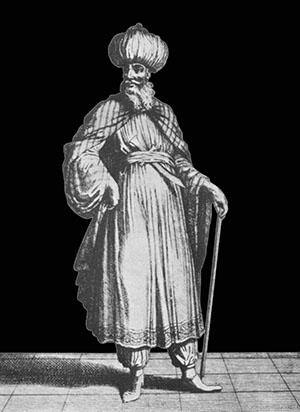
    Imaginative portrait of Hasan-i-Sabah created by an unknown 19th-century artist.

    And so the myth of Hasan-i-Sabah has been told for 700 years, brought to its perfection by the Venetian traveller Marco Polo. An earlier writer described the Master handing his disciple a golden dagger and identifying its target. While neither is certainly true, they are so tantalising as to be irresistible. I and many others were seduced by these stories into my lifelong interest in the Assassins. William S. Burroughs and Mick Jagger are two others who have been fascinated with this account, and the Assassins are mentioned in the writings of both Bocaccio and Nietzsche. (I give Marco Polo’s complete tale in an appendix to my book Hasan-i-Sabah: Assassin Master, along with numerous citations from the Quran describing that very Garden.) 

    Who was the real Hasan-i-Sabah and why does he matter? Curiously, while he died almost exactly 900 years ago (1124), his story encapsulates so much of today. The details of his political conflicts seem torn from this morning’s headlines, while his religious ambitions are practised in the daily spiritual life of countless people who may never have heard his name. 

    This is so because of the contact Hasan’s disciples had with the European Crusaders. The Crusades lasted from 1095 to 1291 and helped to intertwine the cultures of Christianity and Islam. The Knights Templar and the Syrian Assassins had a long series of documented historical interactions. The two groups of religious warriors had many similarities in their structure and the nature of their beliefs and values. Their common creeds of service to a higher truth, the righteousness of their cause, their shared appreciation of courage, discipline and loyalty were often more important than the apparent differences of their faiths. Abraham’s monotheism, after all, worships a God who is essentially the same in the three related religions of Judaism, Christianity and Islam. 
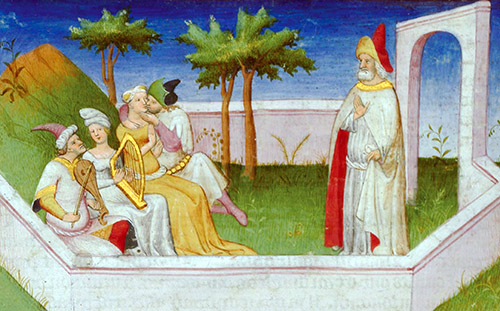
    Manuscript illustration (1410) from The Travels of Marco Polo shows the Old Man of the Mountain in the Garden observing his young disciples (fidais) at play with their love mates. 

    The name ‘Assassin’ spread fear among contemporary rulers from China to England, especially in Muslim lands. Academics who preached against the sect were terrorised, as were clergy, generals, governors, mayors, and influential politicians and court advisors whose policies targeted the group. And there were many who did because the Assassins stood outside the political and religious order of their day. While the murder of individual enemies may be a distasteful thought, it is certainly a more humane way to conduct a war for survival than killing mass numbers of uninvolved civilians or soldiers who bear no policy responsibility. Unlike the behaviour of modern indiscriminate terrorists who kill fellow Muslims daily, Hasan-i-Sabah’s assassinations were few and laser-focused on policymakers only.

    Hasan-i-Sabah was a rebel. He was the founder of the world’s most successful secret society, and he may truly be said to be characterised as a mystery wrapped in an enigma. He carved out an independent space for himself and his followers in the high Persian mountains. The Nizari Ismailis or Assassins defended and expanded their territory for 166 years. Their descendants today are led by their Imam, the Aga Khan, and are one of the most advanced and sophisticated Muslim sects on the planet – competently-led, broadminded, educated, and self-sufficient. They no longer practice the political policies of their medieval forefathers, instead substituting education, publishing, modern institution-building, cultural preservation, medical care, encouraging general prosperity, and offering social programs for their faithful.

    Hasan himself was born to a well-to-do Shiite family in the northern Persian city of Rayy, near modern Tehran, a lively commercial hub of its day. It was a crossroads city of east and west, with a long, exotic, and interesting history. Travellers and merchants from India, China and Central Asia met Greeks, Romans and Egyptians. Shamans, Buddhists, Hindus, Muslims, Jews, Christians, Pagans of every stripe, Zoroastrians, Manichaeans and others passed through Rayy, trading and sharing their wares, practices and ideas.

    Hasan felt the call of the spirit in adolescence and was introduced through friends to a minority Shiite offshoot group of schismatics called the Ismailis. They were estranged from the majority of Muslims, both Sunnis and Shiites. They were a breakaway sect whose beliefs in a spiritual leader called the Imam were primary. And they were considered heretical because the Ismailis had split on the identity of the seventh Shiite Imam and actually posited a Prophet beyond Muhammad, an absolute travesty according to orthodox Islam, whether Sunni or Shiite.

    After being personally recruited by various representatives (dais) of the Ismaili faith for some time, Hasan’s resistance was worn down and he accepted their teachings, swore the oath of allegiance, and was soon promoted to a position of responsibility. This exposed him to what we might call the Mystery Traditions of antiquity. The Gnostic Ismailis believed in a Neoplatonic celestial hierarchy ruling life on earth and taught practices designed to allow the initiate to rise into higher consciousness and commune with such cosmic energies. It was a very different kind of faith and practice than the Arab tribal version of Islam that had conquered Persia some 400 years before Hasan’s birth. 
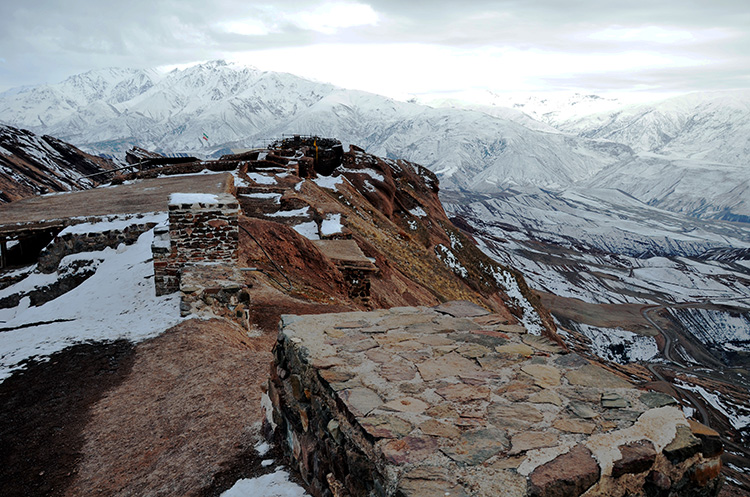
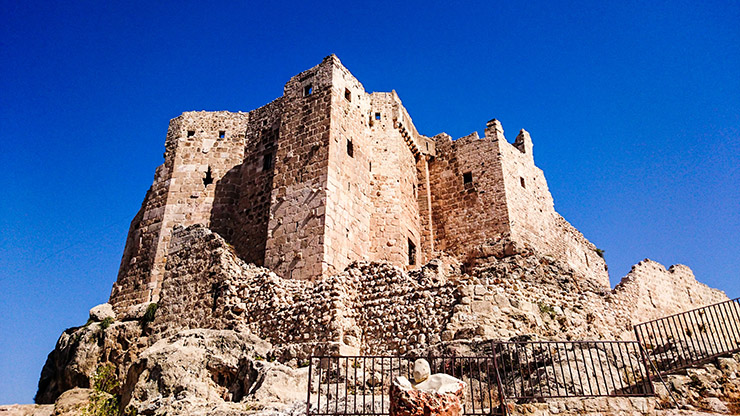
    Hassan Sabah’s castle, located in northeastern Gazor Khan Village near Mo’alem Kalayeh in Roudbar of Alamout, is a historical fortress perched atop a 220-meter cliff, sitting 2163 meters above sea level on the southwestern slopes of the Houdkan Mountain range, part of the larger Alborz Mountains. (https://en.wikipedia.org/wiki/List_of_World_Heritage_Sites_in_Iran)

    Shiism and Ismailism were spread by conversion. And conversion involves dialogue, a mutual sharing of ideas and beliefs. This theme of transformation through give-and-take is crucial to an understanding of Hasan. Ideas totally foreign to either the Arab people or Islam itself become incorporated into Persian Ismailism by its contact with alien cultures. Mesopotamia is the cradle of Western civilisation and its rich spiritual beliefs were a key part of the Persian culture in which Hasan and Ismailism were active. The Zoroastrian Persians had no problem with the concept of semi-divine higher beings like the Imam, any more than the Egyptians of old would have questioned the divine status of the pharaoh, or Jews concerned with the elevated status of a prophet like Moses who spoke directly with God. Shiite doctrines like the sacred blood of the Prophet, transferred through Ali (his nephew) and Fatima (his sole surviving child and wife of Ali) to their descendants, echoed similar ideas of the House of David among Christians and Jews. Jesus carried the messianic legacy of the bloodline of David, the poet-warrior king of Israel. All historians discuss the input of Greek Hermetic ideas into Shiism and later Ismailism. 

    The third- through fifth-century writings of Greek Neoplatonic philosophers had been carried to Persia by fleeing monks after the sixth-century campaigns of Justinian had closed the pagan monasteries and outlawed religions other than Christianity. The Sasanian king Khosrow I welcomed them. Zoroastrianism was not incompatible with the concepts of a supreme, transcendent, and incomprehensible Deity – opening itself gradually through a refined descent through the levels of Being, that its essence could be better communicated with mankind. Though the Hermetic writings were lost to the West for a thousand years, Renaissance scholars like Marsilio Ficino and Pico della Mirandola gained access to them from Eastern sources and brought about a rebirth of esoteric wisdom in Europe.

    Meanwhile in the East, Illuminist doctrines from various earlier heresies so altered mainstream Islamic beliefs that the resulting spiritual paths were nearly unrecognisable to orthodox Arab Muslims. These included tales of miracle-working Imams and other holy men. The eclectic doctrines that grew among the various Shiite/Ismaili groups included: belief in reincarnation and metempsychosis; deification of Imams and sometimes dais; intense speculations on the nature of God; attention to divination and prophesy; doctrines concerning the nature of the soul, death, the afterlife, and immortality; teachings on the cyclical nature of time and history; qabalistic investigations of the esoteric significance of letters and numbers; and occasionally, the overthrowing of traditional Islamic behavioural restrictions on sexuality, the use of intoxicants, and dietary limitations.

    The Shia/Ismaili concept of the living Imam allowed for an emotional connection between the aspirant and his or her master that was not available to the more straitlaced Sunni acolyte. The ability to direct the disciple’s love of God through the spiritual master is an ancient practice. The teacher serves as the physical manifestation of the divine principle. Meanwhile, the anticipated redeemer or Mahdi awaits the divinely ordained moment for His appearance, silently guiding the Imam in his duty to shepherd humankind through the dark hours in which we must all spend our material existence. These hidden and speaking Imams are the personification of the metaphysical soul of the universe. They are wise enough to guide us all toward Truth. The Imam is sometimes referred to as the “speaking Quran,” for he alone can be trusted to separate the outer, exoteric teachings, or zahir, of the written text from its inner esoteric meaning, or batin, its essence. 

    Hasan-i-Sabah would learn from his Ismaili instructors that they had carried this reverence and appreciation of the Imam to the highest level of any Shiite sect; that the Imam enjoys the greatest amount of ilm or Gnosis, and that he can communicate this to the community. He would also have learned that the Ismailis analysed creation in vast cycles composed of incomprehensibly mysterious and profound cosmological eras, and of the energies operative in each. Ismailis viewed seven prophets (natiqs) as being charged with the guidance of humanity. The first six were Adam, Noah, Abraham, Moses, Jesus, and Muhammad. But Ismailis added a seventh, Ismail or his son Muhammad ibn Ismail, to this rarified group of world teachers. Hasan would have understood that accepting a prophet after Muhammad was an unforgivable blasphemy to orthodox Islam. His own capacity for independent thought must have been stimulated by this. 

    Each of the Prophets brought a code of behaviour, the sharia, to rein in the harmful tendencies and mischief normally associated with mankind. Sharia was not an example of success. Rather it was an admission that the higher message of the Prophet had reached its limit and rule-making became necessary.The Imam is a successor to the Prophet. He is charged with conveying the original message of the Prophet and with revealing reality (haqiqa) through the teaching. While the Prophet appears only periodically, the Imam is always present, otherwise the world would collapse. 

    Hasan would have been taught about the Final Judgment when the unredeemed and the ignorant are separated from those who had dared to perfect themselves and become the worthy companions of the Imam and his Truth. Hasan also understood that these teachings on the nature of the Ismaili beliefs needed to be conducted in silence and accompanied by ritualised personal pledges. How else could the Ismaili dais have been protected? How else could they know who to trust? How else could Hasan be expected to reach out to others and spread a fundamental heresy without some kind of oath-taking?

    Several years after his initiation and initial training, Hasan was instructed to travel to Egypt where he strengthened his faith. The head of the Ismaili sect was the Fatimid Imam/Caliph al-Mustansir. This spiritual teacher was unique, chosen by God and inspired with the special wisdom and insight so that he could interpret complex doctrinal issues. Hasan attended a university for Ismaili missionaries for 18 months. Having some problems with the military dictator who had usurped the Imam’s power, Hasan left Egypt and returned to the Mideast. He travelled as a missionary through Syria, Israel, Iraq, and Iran for ten years and finally took possession of a mountainous castle/fortress known as Alamut in the year 1090. Strategically apportioned as a defensive structure, he improved it in such a manner that it long served his community and functioned as the headquarters for Ismaili offshoots in Syria, Afghanistan, and India. Hasan-i-Sabah was the original Old Man of the Mountain.

    Several of the esoteric themes that are explored in my new biography of the Old Man include the concept of the Assassins as an initiatory society of graded spiritual ascent. Something secret, mysterious, and progressive took place in the conversion and initiation process administered by the Ismaili dais, and in the training program by which the dais were educated. This is undisputed by modern scholars, including the most orthodox and those most inclined to treat the Ismailis with the greatest deference and respect. We know that the Ismaili and Nizari mysteries included increasing revelations of the inner doctrine. We know they had a system of oaths to assure secrecy. As one who has spent his adult life studying and participating in hierarchical secret societies, I believe there is much to be said for the private, teacher-to-student communications about the nature of Truth. The idea of looking for esoteric meaning within scripture, exploring the higher reaches of philosophy to understand Truth, exploring numerology, Qabalah, and thaumaturgy, asking questions of commonly accepted ideas, seems a more than acceptable way for people to creatively expand their intelligence.

    The Qiyama doctrine is another topic I explore in some depth. I believe it may have been one of the most profound and revolutionary concepts ever uttered and embraced by a religious community. The Qiyama declared the immanence of the “Inner Imam,” what Aleister Crowley called the “True Will” some 700 years later. The inner essence of an individual’s spiritual reality and personal source of guidance was asserted to be superior to any rule-making or forced adherence to outer forms of behaviour. This revelation was proclaimed by the fourth Lord of Alamut in 1164, some forty years after Hasan’s passing.

    I also devote attention in Hasan-i-Sabah: Assassin Master to the drug issue and the derivation of the name Assassins from Hashish. Although forbidden in Islam, images of hashish and wine are shared by Sufis and countless others in the Mystery Traditions. Intoxication is a symbol or metaphor for the ecstatic experience of Divine Union. It is such an overpowering and disorienting phenomenon that it is often compared in the language of mysticism with drunkenness.
    Get the issue this article appears in

    In closing, I would like to state that the primary thesis of my new book is Gnosis, the aspirant’s direct personal experience of God while within the human body. The knowledge of God transcends all the doctrinal rigours and hierarchies of all the established religions of the world through time. The celebrated Sufi mystic Mansur al-Hallaj (ca. 858–921) was suspected of being an Ismaili. He had acquired great influence among certain members of the Sunni royal family, and jealous enemies arranged his murder. He experienced a Gnostic union with God during which he was known to cry out Ana’l-Haqq, “I am the Truth.” His disciples went on to found a number of Sufi orders.

    Hasan-i-Sabah: Assassin Master also includes the first English translation of Rashid al-Din’s 1310 version of the text of The Biography of Our Master. Mentioned and quoted repeatedly by all reliable authors on the Assassins, how it had not been translated before was a mystery that is now solved. There is also a translation of a purported letter exchange between Hasan and the Seljuk Sultan Malikshah in 1091. The book includes some 900 footnotes and nine detailed maps of the regions discussed in the text. With an extensive glossary of names and terms, a timeline, along with a comprehensive bibliography and index, one hopes it will prove a useful study guide for the interested reader.

    James Wasserman’s Hasan-i-Sabah: Assassin Master, with a foreword by Tobias Churton, is available from all good bookstores. 

    [alert type=”general” dismiss=”no”]This article was published in New Dawn 182.[/alert]

    [alert type=”success” dismiss=”no”]If you appreciate this article, please consider subscribing to help maintain this website.[/alert]

    © New Dawn Magazine and the respective author.
    For our reproduction notice, click here.
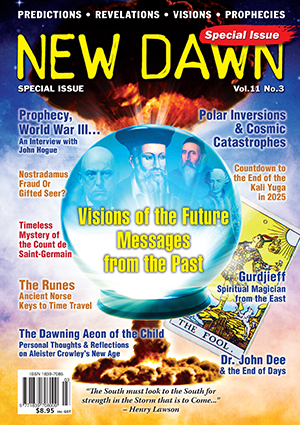
  • The Dawning Aeon of the Child: Personal Thoughts & Reflections

    The Dawning Aeon of the Child: Personal Thoughts & Reflections

    From New Dawn Special Issue Vol 11 No 3 (June 2017)

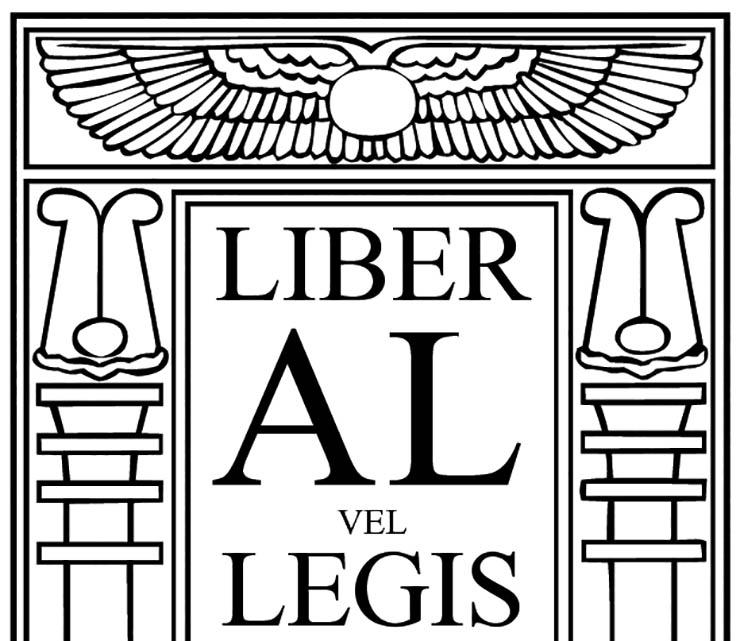
    In 1904, while visiting Cairo with his wife Rose, the English occultist Aleister Crowley received a text known as The Book of the Law via direct voice transmission. He described its author as “a messenger from the forces ruling this earth at present.” Three one-hour sessions over a three-day period resulted in 220 verses announcing a New Aeon with a New Law for mankind – a changing of the guard of the spiritual hierarchy ruling the planet. The Book of the Law proclaims a new era in ethics, morality, culture, and science.

    Crowley insisted The Book of the Law proved the first postulate of religion, the existence of Higher Consciousness independent of the human brain and body. He would spend the next 43 years of his life explaining and proclaiming its message and significance in all his writings.

    An inspiring, mysterious, and poetic text, devotees of The Book of the Law interpret its message as the sole rule and guide of their lives. Many have found it fulfils that role admirably, never failing to provide insight and direction when called upon.

    We must then ask ourselves: What does the inauguration of a New Aeon mean? I remember a cynical comedian from my childhood. He called himself “the Old Philosopher” and had recorded a funny rant on a 45rpm record, mocking the celebrations of the New Year. His pitch was something like, “New what? New worries, new problems? I’d rather have out with the New and in with the Old because I am familiar with the Old!” I remember laughing with my parents as I first became aware of the irony of the dual-edged nature of progress. Looking at the New Aeon from my perspective today, I am acutely conscious of that irony in a manner that I was not when I took my first steps on this path a half century ago.

    This new Aeon of the Child (Horus) follows that of the Father (Osiris) and the Mother (Isis). While Crowley spoke of these aeons as 2,000-year periods – seemingly corresponding to the astrological divisions of the Precession of the Equinoxes – I think they may best be understood as longer term symbolic constructs rather than calendrical dating systems. The aeons appear to be indicators of larger cultural and historical trends by which human progress and evolution may be understood and identified.

    The Aeon of the Mother (Isis) is characterised as a time of unity with Nature, the ascendant Priestess, intuition over intellect, before the widespread use of writing and even language, the Palaeolithic period. Hunter-gatherers searching throughout the land, moving where directed by the patterns of rainfall, weather and soil fertility, maintaining a synchronous and harmonious relation with the environment that bespoke a oneness and lack of separation. Cave dwelling and the building of rudimentary shelters, individual and communal skirmishes, the fears of the night assuaged by the introduction of fire, the opening of the sciences by the charting of the heavens. Paganism reigned as the spiritual answer to the questions of existence. The many gods who controlled the world were appealed to with intention and sincerity that embodied the fervour, fear, and gratitude of a dependent human being, the Babe sustained at the Breast of the All.

    The Aeon of the Father (Osiris) introduced the formula of self-sacrifice, the religion of the Dying God. From Osiris and Adonis to Christ, the community was ‘saved’ by the courage of the Chosen One, willing to plunge into Death at the command of a Greater Destiny whose impersonality demanded an abrogation of self-interest to the wider needs of his fellows. At the same time, mankind began to exercise dominance over Nature. Building a more dependable food supply with the mass herding of pastoral animals and land and crop cultivation. The taming of rivers with dams, the massive construction of edifices that towered above the landscape and celebrated the power of the mind and our species. Language, writing, philosophy, measurement were all aspects of this purposeful rearrangement of the natural world, the shaping and sculpturing of reality as if man were a co-creator working with the Heavenly Father to root out chaos and leave his personal stamp on existence.

    At the same time, suffering was conceived as the norm. Massive armies raged through continents sweeping aside civilisations with their swords and arrows and the armoured steeds on which they rode. Life was cheap. Individuality and personal rights were unknown. Sin was a constant nagging force whose instinctual power and insistence must be rejected and triumphed over at all costs. Salvation was to be sought in the after-death state and was based on obeying dictated ethical and religious principles, unquestioning adherence to the teachings of those who knew better, those who made the rules. Expect no satisfaction in the here and now. This is the testing ground of humanity, the place of Trial and Tribulation. These challenges would temper the soul with hardship. Their mastery would open the joys of the next world to the acolyte who listened.

    The current Aeon of the Child (Horus) represents a more confident period of self-awareness, as the Babe bursts forth fully-armed to confront the world in which he or she is launched. The legitimate birth of the rightful claimant of existence, one who participates without restriction in the natural order of the universe, cognizant, questing, and entitled. Just watch kids at play. Crowley calls this period that of “the recognition of the individual as the unit of society.”

    On the other hand, there are the terrors of the Child contradicting this unity, the fears and insecurities as it navigates its way through the darkness of uncertainty. The natural and optimistic self-assertion of the soul freed from oppression is opposed by the demanding irrationality of the squalling baby – absolutely shameless in its own self absorption. As a parent himself, Crowley was well aware of this dual nature and had no hesitation about expressing it.

    In his Introduction to the first popular publication of The Book of the Law in 1938, Crowley wrote the following:

    Observe for yourselves the decay of the sense of sin, the growth of innocence and irresponsibility, the strange modifications of the reproductive instinct with a tendency to become bisexual or epicene, the childlike confidence in progress combined with nightmare fear of catastrophe, against which we are yet half unwilling to take precautions.

    Consider the outcrop of dictatorships, only possible when moral growth is in its earliest stages, and the prevalence of infantile cults like Communism, Fascism, Pacifism, Health Crazes, Occultism in nearly all its forms, religions sentimentalised to the point of practical extinction.

    Consider the popularity of the cinema, the wireless, the football pools and guessing competitions, all devices for soothing fractious infants, no seed of purpose in them.

    Consider sport, the babyish enthusiasms and rages which it excites, whole nations disturbed by disputes between boys.

    Consider war, the atrocities which occur daily and leave us unmoved and hardly worried.

    We are children.

    These words could have been written this morning rather than nearly eighty years ago. Perhaps if we substitute “Facebook” for “the wireless” we can feel totally up-to-date.

    Crowley wrote further of the fraudulent political constructs of democracy, fascism, and communism from which we still suffer. He described them as “cavort[ing] crazily all across the globe.” He pegged them for what they are: “abortive births of the Child, the New Aeon of Horus.” A sobering characterisation that the purveyors of Fake News might contemplate as they work to inflame the passions of their historically-illiterate flocks.

    In contrast with the common tendency to over-idealise progress and modernity, one cannot help but compare Genghiz Khan of the Aeon of Osiris with Kim Jong Un, his pathetic alter-ego in the Aeon of Horus.

    As an admirer of Thomas Jefferson, I believe his writings in the Declaration of Independence were the opening doctrinal pronouncement of the politics of the New Aeon:

    We hold these truths to be self-evident, that all men are created equal, that they are endowed by their Creator with certain unalienable Rights, that among these are Life, Liberty and the pursuit of Happiness.

    Jefferson wrote further that government must not be trusted to be the arbiter of human conduct. “In questions of power, then, let no more be heard of confidence in man, but bind him down from mischief by the chains of the Constitution.” Imagine if the chains of the Constitution and its Bill of Rights were wrapped around the necks of the violent thugs raging through the streets of Berkeley, California as I write – transforming a town noted as the birthplace of the modern “Free Speech Movement” into a bastion of the tyranny of the mob and the triumph of censorship and intimidation.

    Get the issue this article appears in

    • • •

    With all that said, Crowley did not waver in his faith in this new stage of the evolution of human consciousness. He acknowledge a balance in all things. He was specifically singled out as the Prophet of the New Aeon and he wrote this glowing tribute in that same Introduction, “Liberty stirs once more in the womb of Time.”

    When I become discouraged by life’s hard experiences – or the caterwauling of our modern Anarchists, Snowflakes and Social Justice Warriors – I can turn for solace and inspiration to the words that express my fondest hopes for the future of humankind in the New Age. Words that celebrate a new day coming – words that help me learn to gaze with wisdom, patience, and tolerance at the birth pangs of the New Aeon.

    Among the Class A writings of Thelema (those that must not be changed inasmuch as the style of a letter because, as Crowley indicated, they originate from the highest level of Truth) is Liber Tzaddi. It is one of my favourites, an optimistic description of the transition to this New Age of Horus. Here is a long extract. If I may be forgiven for presuming to speak for Crowley, I imagine these words may have sustained him as well.

    1. In the name of the Lord of Initiation, Amen.
    2. I fly and I alight as an hawk: of mother-of-emerald are my mighty-sweeping wings.
    3. I swoop down upon the black earth; and it gladdens into green at my coming.
    4. Children of Earth! rejoice! rejoice exceedingly; for your salvation is at hand.
    5. The end of sorrow is come; I will ravish you away into mine unutterable joy.
    6. I will kiss you, and bring you to the bridal: I will spread a feast before you in the house of happiness.
    7. I am not come to rebuke you, or to enslave you.
    8. I bid you not turn from your voluptuous ways, from your idleness, from your follies.
    9. But I bring you joy to your pleasure, peace to your languor, wisdom to your folly.
    10. All that ye do is right, if so be that ye enjoy it.
    11. I am come against sorrow, against weariness, against them that seek to enslave you.
    12. I pour you lustral wine, that giveth you delight both at the sunset and the dawn.
    13. Come with me, and I will give you all that is desirable upon the earth.
    14. Because I give you that of which Earth and its joys are but as shadows.
    15. They flee away, but my joy abideth even unto the end.
    16. I have hidden myself beneath a mask: I am a black and terrible God.
    17. With courage conquering fear shall ye approach me: ye shall lay down your heads upon mine altar, expecting the sweep of the sword.
    18. But the first kiss of love shall be radiant on your lips; and all my darkness and terror shall turn to light and joy.
    19. Only those who fear shall fail. Those who have bent their backs to the yoke of slavery until they can no longer stand upright; them will I despise.
    20. But you who have defied the law; you who have conquered by subtlety or force; you will I take unto me, even I will take you unto me.
    21. I ask you to sacrifice nothing at mine altar; I am the God who giveth all.
    22. Light, Life, Love; Force, Fantasy, Fire; these do I bring you: mine hands are full of these.
    23. There is joy in the setting-out; there is joy in the journey; there is joy in the goal.
    24. Only if ye are sorrowful, or weary, or angry, or discomforted; then ye may know that ye have lost the golden thread, the thread wherewith I guide you to the heart of the groves of Eleusis.
    25. My disciples are proud and beautiful; they are strong and swift; they rule their way like mighty conquerors.
    26. The weak, the timid, the imperfect, the cowardly, the poor, the tearful – these are mine enemies, and I am come to destroy them.
    27. This also is compassion: an end to the sickness of earth. A rooting-out of the weeds: a watering of the flowers.
    28. O my children, ye are more beautiful than the flowers: ye must not fade in your season.
    29. I love you; I would sprinkle you with the divine dew of immortality.
    30. This immortality is no vain hope beyond the grave: I offer you the certain consciousness of bliss.
    31. I offer it at once, on earth; before an hour hath struck upon the bell, ye shall be with Me in the Abodes that are beyond Decay.
    32. Also I give you power earthly and joy earthly; wealth, and health, and length of days. Adoration and love shall cling to your feet, and twine around your heart.
    33. Only your mouths shall drink of a delicious wine – the wine of Iacchus; they shall reach ever to the heavenly kiss of the Beautiful God.

    (Full text of Liber Tzaddi at www.sacred-texts.com/oto/lib90.htm)

    [alert type=”general” dismiss=”no”]This article was published in New Dawn Special Issue Vol 11 No 3.[/alert]

    [alert type=”success” dismiss=”no”]If you appreciate this article, please consider subscribing to help maintain this website.[/alert]

    © New Dawn Magazine and the respective author.
    For our reproduction notice, click here.
  • Political Secret Societies: The Hidden Paths of Power

    Political Secret Societies: The Hidden Paths of Power

    Did Zanoni belong to this mystical Fraternity, who, in an earlier age, boasted of secrets of which the Philosopher’s Stone was but the least; who considered themselves the heirs of all that the Chaldeans, the Magi, the Gymnosophists, and the Platonists had taught; and who differed from all the darker Sons of Magic in the virtue of their lives, the purity of their doctrines, and their insist­ing, as the foundation of all wisdom, on the subjugation of the senses, and the intensity of Religious Faith?
    – Zanoni, Sir Edward Bulwer Lytton

    The governments of the present day have to deal not merely with other govern­ments, with emperors, kings and ministers, but also with the secret societies which have everywhere their unscrupulous agents, and can at the last moment upset all the governments’ plans.
    – British Prime Minister Benjamin Disraeli, 1876

    Two very different views of secret societies are revealed in the quotations above. The first describes a spiritual brotherhood pledged to Wisdom and guiding humanity toward the realm of the Infinite; the second seeks to expose the machinations of power-seekers who cloak their manipulative agendas in darkness. In addition to spiritual and political secret societies, one could add criminal secret societies such as the Mafia, or even clandestine elite military units – neither of which will be discussed here.

    All secret societies share certain fundamental themes. Membership is restricted to those who have an abiding interest in the subject. Thus, a spiritual group will attract people seeking more knowledge of a particular teacher or type of practice. The student is aware of the subject matter in advance and will approach the group for further instruction. More rarely, an individual may be “tapped” by the group because of a perceived affinity to its purpose.

    In a political secret society, membership is restricted to those who share an ideological affinity with the goals the group represents. At the furthest end of the political spectrum, the mission will be revolution. Such a society will go to great lengths to defend itself. Generally there will be small semiautonomous cells working in overall concert but with cut-outs introduced at all levels to pro­tect other members from exposure or betrayal. This type of society is represented by a contemporary group such as al-Qaeda. The infamous Weathermen of the 1960s and 1970s had a sim­ilar structure. The clandestine revolutionary model was developed and perfected by Hasan-i-Sabah, leader of the Nizari Ismaili Order of Assassins between the late 11th and early 12th centuries.

    On another political plane are ideological groups such as the Council on Foreign Relations, or participants in the World Economic Forum. Here we find leaders in politics, business, finance, education, and the media who may share a belief in the value of global solutions; are in high positions of authority and influence; and represent different levels of involvement with the inner circle of the group. Most members simply welcome the opportu­nity to associate with other well-known luminaries and are honoured by being offered membership or attendance privileges. Yet, the ideology at the highest levels of such groups supports a world government – to be adminis­tered by a class of experts and planners, entrusted with running centrally organised social and political institu­tions. Although members may be persuaded to add their considerable voices to certain transnational political and economic policies, they may not be as supportive (or even aware) of the long-range ambitions of the inner circle. While these groups quite often hold their meetings in secret, their membership lists are a matter of public record. It is the central agenda that is disguised.

    Adam Weishaupt founded the Bavarian Illuminati in 1776. The Illuminati are perceived by many as spanning the chasm between the spiritual and the political secret society. Often credited (or blamed) for influencing the French Revolution in 1787, the Illuminati taught a doctrine of social and political liberation that hinged on the equal­ity of man, the embrace of rationalism, and the denial of crown and church as the legitimate institutions for the regulation of social and moral values. The bitterness of life in Europe at this time – when church and state monopolised resources and often acted in an irresponsi­ble manner toward the citizenry – created widespread resentment among all classes. While the views of the Illuminati may sound quite advanced for the time, the European revolutions they are believed to have encour­aged degenerated into brutal bloodbaths whose singular lack of moral compass was appalling.

    Reprinted with permission from The Mystery Traditions: Secret Symbols and Sacred Art by James Wasserman (Destiny Books, 2005).
    [alert type=”general” dismiss=”no”]This article was published in New Dawn Special Issue Vol 6 No 6.[/alert]

    [alert type=”success” dismiss=”no”]If you appreciate this article, please consider a contribution to help maintain this website.[/alert]

    © New Dawn Magazine and the respective author.
    For our reproduction notice, click here.
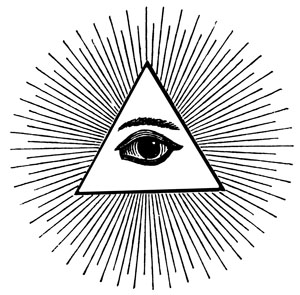
  • Symbols & Psyche: Exploring Gateways to Realms of Knowledge, Power & Understanding

    Symbols & Psyche: Exploring Gateways to Realms of Knowledge, Power & Understanding

    From New Dawn 116 (Sept-Oct 2009)

    The Muggle world is filled with symbols. From Coke cans to McDonald’s arches, IBM computers to Apple Macintoshs, from flags to emblems and medals, to the endless variety of product packaging, modern culture is brimming with images. Open the Yellow Pages of your phone book – with the emblematic pair of walking fingers – and you will find a myriad of professional logo designers and artists, many of whom have trained at colleges whose crests may date back a century or more.

    Walk or Don’t Walk based on a traffic light flashing a message designed to prevent you from being run over by a car – whose distinctive hood ornament differentiates it from its competitors, and which is fuelled by different brands of gasoline whose identity may be apprehended from afar while travelling at high speed. Look at the dashboard and you can ascertain operational norms, be warned of engine trouble, and learn by iconic means about the vehicle and its amenities.

    We live in a world filled with visual identifiers intended to convey meaningful information at a glance without the need for words.Heraldry, the distinctive symbols of noble warrior families, traces back to the Middle Ages, when grand tournaments were held with jousts between heavily-armoured knights wearing visors. Since individuals were unrecognisable in such gear, unique coats-of-arms were designed to identify the combatants to fans and foe alike. Taverns and inns, village blacksmiths, printers and publishers, all manner of craftsmen and merchants were as recognisable in villages and cities a thousand years ago, as they are in today’s hyper-illuminated metropolitan areas and quieter rural main streets.However, there is another level of symbolism that goes beyond the merely commercial, socially informative, or technologically useful.

    And that is the universe of sacred symbols, whose resonance in the archetypal levels of the human psyche can cause spiritual change and expand consciousness beyond the confines of mundane reality. Symbols that serve as gateways to realms of knowledge, power, and understanding that inform and control life on earth, and, presumably, the after-death state of non-physical life as well. Symbols that can open the mind to communication with spiritual beings who welcome the opportunity to interact with human consciousness. Symbols that confirm to the aspiring student the nature of the truths he or she seeks.

    Symbols are the alphabet of the Law of Correspondence. This universal principle acknowledges the inter-connection of all things with all other things, the existence of multiple relationships within Nature’s kaleidoscopic richness.

    In The Mystery Traditions, I quoted the following statement by Titus Burckhardt from his book Alchemy, “True symbolism depends on the fact that things which may differ from one another in time, space, material nature, and many other limitative characteristics, can possess and exhibit the same essential quality.”

    This article will briefly examine two symbols of great importance to human life. I hope the reader may gain an insight into the richness of the subject and an appreciation for the multiplicity of ideas involved in the study of symbolism. I also hope it may suggest a means by which other symbols may be explored.

    The Circle

    Let us then begin with the Circle, a symbol of unity, wholeness, and completeness – a figure that seems to contain all within itself. Yet, conversely, it defines and delineates space. Thus it is simultaneously an image of distinction, separation, and difference – setting boundaries between that which is within and that which is without. It is a barrier against intrusion, offering a cocoon of protection within which growth may occur in safety – the egg wherein the babe may take form and mature, the magical circle in which spiritual progress may be made.

    The circle is traditionally a symbol of the Sun. To understand the derivation of this association, one need only look up at the sky. With a point in the centre, the circle is the glyph of the Sun in the alphabet of astrology. Its astrological zoomorph is the male lion, king of beasts, powerful, ravenous, swift, courageous, triumphant, regal. He is filled with a self-confidence that allows for the enjoyment of leisure, a kind of benign self-indulgence or laziness that springs from an understanding of his role in the aptly-named pride, or family of lions, over which he rules.

    The Sun is a symbol of resurrection. Each day it rises from the depths of night to gradually illumine the world. Through the course of the day it waxes in power and pulses with life-giving heat. Its radiance sustains the growth of crops and the activities of all species on earth. As the day draws to a close and the light of the sun diminishes, it sends forth rays of magnificent colour that herald its decline and descent, its apparent death as it is about to be swallowed by the dragon of night. And yet on the morrow it comes forth again, bursting the chains of its imprisonment, rising to herald the new dawn. It is the embodiment of continuity and hope, of the possibility of life beyond death, and of triumph in adversity.

    The Sun is a symbol of the self and of self-consciousness. It represents the unique individuality of each being. As he stands out among the luminaries of heaven, so is each of us the centre of our own universe. While it may not be quite politic to express it in words, each of us feels that he or she is the centre around which the world, as we know it, revolves. The Book of the Law expresses this image beautifully in the passage, “In the sphere I am everywhere the centre, as she, the circumference, is nowhere found.” While there are many who like to imagine themselves as amorphous ripples in a universal continuum, Nature herself rebels against this fantasy. The Sun is her proof.

    In the world’s mythology, the Sun is the archetypal essence of numerous deities who span all cultures while sharing the same identity.

    Ra in the Egyptian pantheon is hawk-headed. The hawk is far-seeing, inhabits the very heights of the celestial environment, is swift as a beam of light, able to penetrate all darkness and depths to snatch forth his nourishment from the myriad of creatures over whom he reigns. Ra is the creator god, both the spark that enlivens the world and the sustaining energy that keeps it alive. Ra was the first and most powerful of the gods; like the Sun, his role is that of prominence, leadership, and dominion.

    The Sun subsumes the resurrection gods, the saviours who act as mythic intercessors between Deity and humanity. The Sun is the eye of God monitoring its creation – prominently, unavoidably, consistently omnipresent in our world that we may learn the lesson of our own essence. The Sun is the link, the representative, the prince, vice-regent, and son of God – visible representative of the Invisible Father of all. As such, he is Jesus, Adonis, Bacchus, Krishna, Apollo, even the Buddha. His death is suffered as an inspiration to us of a life beyond, offering the promise of victory over the chthonic states of non-existence.

    The Tree of Life

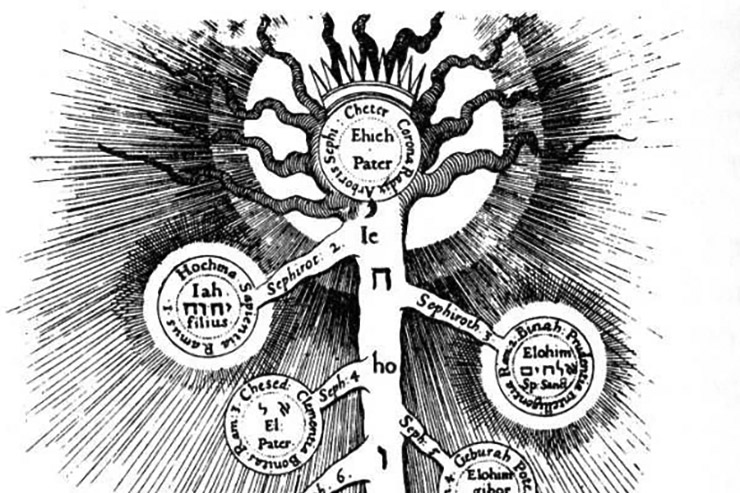
    In the diagram of the Tree of Life (page 16) – the traditional esoteric geometric representation of the mystic totality of existence – the Sun is the number six, the Sephira, or sphere, of Tiphareth, Beauty. Tiphareth stands in the balance, midway between the topmost sphere of Kether, the Crown – the Point, the first manifestation of the Infinite – and the bottom sphere of Malkuth, the Kingdom – the world of three-dimensional physical reality in which we live. Tiphareth occupies the central of the three pillars of the Tree of Life, the Middle Pillar, surrounded on either side by the Pillars of Mercy and Severity.

    As the Sun is Tiphareth, the number six, its geometrical figure is the hexagram. The hexagram further exemplifies the nature of the Sun as intercessor or balance point between above and below, heaven and earth, God and man. The hexagram is formed by the union of the ascending male triangle of Fire, and the descending female triangle of Water. The number six, or hexad, was called “the Perfection of Parts” by Pythagoras. This reminds us that Tiphareth (Beauty) is the sphere of Harmony. And harmony is produced by the joining together of distinct, and, in some cases, discordant elements, to produce a unified and aesthetically pleasing whole. Pythagoras observed that the number six is the first mixture of odd and even, being the multiplication of two by three. The Pythagoreans designated odd numbers as male, and even numbers as female. Thus, we are reminded once again that the number six and the hexagram represent the union of male and female, the harmony upon which all creation relies.

    The Sun’s metal is gold, the luminous and most beautiful of all, whose value has been an unchanging indicator of wealth and a medium of exchange for millennia. A visit to any fine Egyptian collection, in either a museum or the pages of a book, will show the prominence of gold as the chosen metal of pharaonic iconography and architecture. Similarly, gold was the metal chosen for most of the ritual implements in the Temple of Solomon. It was also used to cover the sacred Ark of the Covenant. Medieval and Renaissance Europe used gold liberally in churches, shrines, and palaces, as did the Aztec, Mayan, Indian, and Chinese royalty and priesthood. Gold is the ultimate symbol of the perfection reached by the alchemist – who removes in countless stages the myriad of impurities that make up lead, and allows for its transformation and refinement into the king of metals.

    In the body, the Sun is the heart, symbolically the single most important organ. The heart is the central pumping station of the blood, the essence of life. All survival and health depend on its regular and consistent motion. Long regarded as the seat of courage, the heart was torn from the chest of enemies and eaten by ancient warriors, that they might increase their own strength by ingesting the essence of worthy opponents. Colloquially we speak of a person “with heart” to describe the motivation and self-discipline necessary to pursue a course of success in life. The heart denotes sincerity, the appreciation of the essence of the self in action. It is also the symbolic seat of love, the motivating force that sustains the world through generation.

    Among the parts of the Soul in the Qabalah, the Sun is one of six of the ten Sephiroth that compose the intellect, known as the Ruach. Here again, the Sun acts as an intercessor between the higher levels of the soul (the Self, Life Force, and Intuition) and its lowest aspect (the Animal Soul of Nature). The Intellect weighs and analyses, decides on the appropriate response to stimulation from above and below. It acts as the mediator between “heaven” and “earth.”

    On the level of spiritual experience, the Sun is a symbol of the magical virtue of Devotion to the Great Work, the path by which an aspirant may reach the heights of spiritual potential. The stage of initiation represented by Tiphareth, the sphere of the Sun, is known as the Knowledge and Conversation of the Holy Guardian Angel. This may loosely be understood as the point at which the upward motion of the soul is met with a profound response from the higher reaches of Divinity. A direct interaction occurs in the consciousness of the aspirant that allows for an understanding of one’s continuing mission, the reality of one’s faith in the quest, and the nature of the tasks and obligations under which one is to continue. Such an interaction is a perfect expression of the symbol set we began exploring with the Circle.

    The Moon

    In order to balance this Solar meditation, let us now turn to the Moon. She is represented by various glyphs in the astrological alphabet because of the several stages of her passage during the twenty-eight days of the lunar cycle from New to Full Moon. However the Crescent is the Moon’s standard astrological symbol.

    The Moon is the unconscious self. It represents the hidden parts of the psyche from which spring moods, emotions, dreams, and intuition. The depths of the soul are the very realm of images. The unconscious mind is the wellspring of magic and witchcraft – in which the hidden forces of nature are brought into operation by direct appeal from the hidden forces of the self. (On a practical level, to access such deeper levels of consciousness, the rational intellect must be enlisted to help strategise a means to bypass itself.) The Moon is the symbol of universality, the collective unconscious, the pleroma, wherein the individual self is united with the universal life stream.

    The Moon traditionally represents the Goddess, the complement of the solar male deity. In Egypt, she is Isis, the Enchantress. Isis is a complex deity who is identified as the mate of both Ra and Osiris, Lord of the Underworld. She is variously known as the daughter and mistress of Ra, and wife and sister of Osiris. (Osiris may be considered the nocturnal aspect of Ra – the Sun god beneath the horizon, Lord of the realm of death. Symbols, as the reader may have noticed, tend to run together. Their fluidity and tendency toward transmutation are among their lessons.)

    The Moon is further identified with goddesses such as Persephone, whose tenure in the Underworld is balanced by her time on earth. Diana, the beautiful virgin goddess of the hunt, is another lunar archetype, as is Mary, Athene, Vesta, Kuan Yin, Astarte, Inanna, and Kali. The symbols of the Moon and Venus run in close parallel (as do those of the Sun and Mars), so one can easily include Hathor, Venus, and Aphrodite, as well as darker feminine archetypes such as Lilith, Ereshkigal, Hecate, and Ashtoreth.

    Like the phases of the Moon, the Female archetype is intimately associated with time and the rhythms of life – from the tidal patterns of the ocean to the menstrual cycle. The natural threefold aspect of the feminine archetype is traditionally associated with menstruation: the virginal youth, wife and mother, and crone. Many calendars are lunar-based, among them the Jewish and Muslim calendars in use today.

    The Moon is a symbol of fecundity in her identification with the Woman, the ark of life sailing through the seas of time. Moon cycles also regulate planting and harvesting, and thus she is identified with nourishment and sustenance.

    On a physical level, the Moon reflects the light of the Sun at night. It is described as a “dead” planet, that is, one without a measurable active core. While these facts are aspects of the feminine archetype, particularly that of the Hag or Crone phase and the dark side of the witch power, there is a great deal more to consider. The Moon is the nocturnal complement of the Sun. How she illuminates the night may be of less immediate importance than the fact that she does. Walking through the countryside by the light of the Moon, it matters little whether the light that guides us is reflected or intrinsic.

    On the Tree of Life, the Moon is Yesod, the Foundation, the ninth Sephira. Yesod is also located on the Middle Pillar, directly below Tiphareth, and directly above the physical world of Malkuth, the tenth Sephira. Yesod completes the geometric symmetry of the preceding Sephiroth, while Malkuth hangs like a pendant from the Tree.

    Yesod is the world of images and ideas (angels) just prior to their incarnation in the matter and form of Malkuth. The Moon is of the Formative World, Yetzirah, the realm of causes behind the veil of physical life, the astral plane whose vibratory undulations inform the world of substance.

    Yesod is the number nine, the number of months of pregnancy. Reducible to three, nine is the first square of an odd number. (Three is “the first and proper joining together of unities,” that is, it is the extension from Point, to Line, to Plane, self-contained in and of itself.) Nine was called “Ocean” or “Horizon” by the Pythagoreans because it is the height of numbers: to go further to ten is only a return to one. Nine is the natural limit of number.

    The Moon’s metal is silver, the other traditional coin of the realm, defender of value, medium of exchange, and symbol of the beauty of the mineral world – shining and luminous, of pure composition.

    In the body, the Moon is the genitals, the organs of generation, and the sensual, instinctive, insistent fire of those passions on which lives and kingdoms are both built and destroyed. An unruly world of excess which may be channelled through initiation to become the engine of manifestation and great power.

    Get the issue this article appears in

    On the level of spiritual experience, the Moon is associated with the magical virtue of Independence. How interesting that after discussing her universality and identity with the unconscious mind – as well as the characterisation of the Moon as “the reflection” of the Sun – she would be identified with Independence. Perhaps the lesson here is that as Yesod is the Foundation, the Work can only take place within the individual. We must learn to separate the many strands of inherited and environmental tendencies in order to uncover our true and unique natures.

    While we have explored several aspects of these two important symbols, we have only touched the surface. It would be possible to write volumes on the archetypal symbolism of the Sun and Moon. By looking at the teachings implicit in the Circle and Crescent, we have entered a world, nay a universe, of magic, astrology, mythology, religion, morality, psychology, astronomy, biology, physics, and history. Most importantly, we have glimpsed a path by which men and women may achieve the ultimate goals of our lives – spiritual attainment, universal consciousness, oneness with God, and the accomplishment of the Great Work.

    Pedestrians may still safely cross the street in obedience to lights flashing with signs of upraised hands or stick figures in motion. Let us conduct our own ascent to the cosmic reaches of Eternity through the sacred symbols of Initiation.

    [alert type=”general” dismiss=”no”]This article was published in New Dawn 116.[/alert]

    [alert type=”success” dismiss=”no”]If you appreciate this article, please consider a contribution to help maintain this website.[/alert]

    © New Dawn Magazine and the respective author.
    For our reproduction notice, click here.