New Dawn – World's Most Unusual Magazine

Author: Kenneth Smith

  • Voyages Beyond the Body: Unlocking the Secrets of Out-of-Body Experiences

    Voyages Beyond the Body: Unlocking the Secrets of Out-of-Body Experiences

    From New Dawn 205 (Jul-Aug 2024)

    This article arises from the shamanic-styled presentations of Carlos Castaneda, an anthropologist who delivered several best-selling books about his apprenticeship to don Juan Matus. As I have previously written, I also apprenticed to don Juan and have examined this path for several decades, writing about it as Kenneth Smith and Ken Eagle Feather. Out-of-body experience (OBE) is actively cultivated by this lineage of shamans and is one element of dreaming, an in-house term with technical connotations distinguishing it from ordinary dreams.

    In this view, dreaming – including OBE – results from the natural capacities of the human energy body, an arrangement of energy that surrounds and permeates the physical body. As energies cohere (come together) within the energy body, they produce perception and meaning. Change the coherence or cohesion of energy and you change perception. By consciously entering dreaming, you have changed your cohesion by altering the phase or ordering of energy within the energy body.
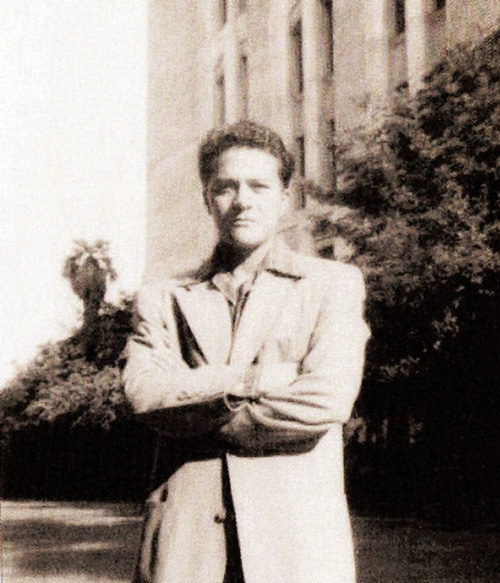
    A young Carlos Castaneda at the University of California. His seminal 1968 book The Teachings of Don Juan: A Yaqui Way of Knowledge, was a major best seller and highly influential text expounding the teachings of a particular lineage of powerful shamans.

    For example, the ordinary experience of daily life represents one phase of cohesion, one coherence of vibrations. OBE reflects a change of phase, a shift in the pattern of energy within the energy body resulting in different perceptions. Throughout the day, we all have minor changes in phase, such as going from home to work. Your home and work environments each have distinct cohesions based on all the elements and conditions that went into forming those environments, and you’ve learned to transition from one to the other – a remarkable feat. A significant shift of cohesional phase results in entirely new events such as OBE, also a remarkable accomplishment.

    To intentionally cultivate OBE, it is helpful to know that it is not only possible but natural. In one study, researchers found that 95 per cent of cultures worldwide report OBEs, with an incidence ranging from 10 per cent of the population to virtually all, depending on the educational conditioning or values of the population. Eighty-nine per cent of those interviewed wanted another OBE, while 78 per cent found lasting benefit. Another indication of the normalcy of OBE, pervasive relaxation was the single, most prevalent element associated with having an OBE.1

    OBE is often discounted by scientists as illusory, with these scientists relating them to temporal-lobe seizures or otherwise abnormal neural (brain) activity. For instance, neuroimaging studies have shown the irregular recognition of body location during OBE to be associated with the temporal and parietal cortex.2 Among their functions, these areas of the brain process information into meaning and sense of spatial location. Based on current knowledge, this anomaly of “irregular recognition” may easily be interpreted as the OBE being a somehow false experience. Yet, wouldn’t one expect different neural patterns resulting from an out-of-the-ordinary experience? Because the focus of attention is outside the physical body, wouldn’t this different localisation of awareness produce different neural readings pertaining to body location? Moreover, since there is specific brain activity that occurs by the ordinary act of walking down a street, by the same rules, shouldn’t this common behaviour be considered illusory?

    Similar dynamics occur with research of near-death-experience (NDE), an event that may include OBE. For example, NDE is often discounted by relating it to temporal lobe abnormalities, including seizures, yet there is little correlation of temporal lobe seizures with NDE accounts. NDEs are also debunked by relating them to the effects of a dying brain. However, NDEs do not necessarily occur near death. As a result, proponents of transphysical phenomena such as OBE and NDE regard these criticisms as forcing data to comply with existing models of perception.3

    If we examine numerous personal accounts the world over of OBE as well as pictures of reality developed by mystics, we open the doors to acknowledging other behaviours outside of ordinary life. Shamans, for instance, typically develop OBE, or at least some type of specialised dreaming, as part of their practices. From this, we can recognise that OBE not only occurs spontaneously but can also be the result of deliberate skill involving the focus and shift of attention. This, in turn, brings about a firm conviction that there is another side to life, that there is another dimension to humans that we can step into and use in practical ways, just as we do in daily life. All things considered, OBE is a natural capacity of human perception. It is just not yet accepted as part of our current reality.

    Stages of developing OBE include entering dreaming where you experience a blackness that is at once heavy and dense, yet peaceful and relaxing. This is akin to meditation. The next step is entering your dreams – lucid dreaming, as it is often called, where you can control the dream. From here, you cultivate OBE where you have additional abilities.4

    OBE is frequently attributed to a flight of imagination, an intense dream, or lucid dreaming. However, a classic OBE carries a set of five characteristics: exteriorisation, form, locomotion, emotions, and environment. Exteriorisation is the projection of awareness where a dreaming body is distant from the physical body and views events from that location. This has been termed astral projection, while these days is more commonly referred to as OBE.

    There is usually a sense of having form of some kind during OBE. Due to conditioned habits, this often resembles the person’s human form. For others, such as those with a shamanic bent and having a power animal, the form might be an animal. It seems the longer the duration of an OBE, or the more frequently a person has OBEs, the form spontaneously becomes a sphere. At more advanced stages, the form becomes a concentrated point of awareness.

    No matter the form, the requirements of the physical and dreaming bodies are different. They have different cohesions, different specifications, if you will. For instance, the physical body needs air, the dreaming body doesn’t. As a result, the dreaming body can travel to deep space or underwater without concern.

    This leads to the next element defining OBE. The dreaming body has the ability of locomotion, of being able to move and change location. This might be within a room, to distant geographic locations, or even to other planets or dimensions. During an OBE I had many years ago, I visited Mars. Travelling from Earth to Mars took only an instant. The journey was a sudden shift in awareness rather than a sense of movement through time and space. Mars was reddish and rocky, just like NASA photos. Hovering about the landscape, I noticed geometric figures of different shapes. Through a telepathic-like process, I was able to briefly communicate with them. The gist of this is that they were lifeforms but foreign to human thinking. The geometric patterns represented energetic configurations of their non-corporeal awareness.

    During other OBEs, I travelled to a world Castaneda describes as being inhabited by inorganic life. Here, I experienced a pitch-black dimension that felt extremely dense and heavy yet unlike the darkness of the initial stages of dreaming. It was as though gravity was significantly greater than on Earth. I was surrounded by pencil-shaped entities filled with soft light of different colours having very low radiation. The nature of time was quite different. It seemed that hours had passed while I was in that region, but when I awoke my clock indicated that just a few minutes had gone by. Castaneda more fully addresses this throughout The Art of Dreaming, where don Juan discusses several aspects related to this dense world.5 

    The visits to Mars and another dimension can be chalked up as resulting from an overactive imagination, trauma, or whatever. However, if we take a hard look at these as being only a minimal reference to many, many other reports worldwide, perhaps we can better redefine what it means to be human.

    Next on the list, the dreaming body has emotions. It is not a dry experience such as found with remote viewing or other psychic functions. A form combined with emotions offers a useful reference to daily life. As a result, there is a correlation of learning that bridges the daily and dream worlds that can significantly accelerate our understanding of consciousness.

    A key difference between dreams and OBE is that during an OBE the environment is stable. During a dream, including a lucid dream, the environment may spontaneously shift. Even in a lucid dream, where control of the dreamscape is more evident, the environment might change, or the person dreaming can intentionally change the environment. During an OBE, the environment remains constant. It is stable. If a person desires a new environment, the dreaming body goes to that location rather than changing the panorama on the spot. This further connects processes of consciousness in daily and dream lives. As a result, dreaming gains the same practical utility of learning and application as found while awake.

    During OBE, you can begin stabilising the experience by relating it to daily life. At first, for instance, you learn control by focusing on a known place, somewhere you’re familiar with, so you have the feel of it to guide your out-of-body travels. It also helps to know your place in your daily world by knowing what kind of life you want to build. Stability in your daily world feeds steadiness in dreaming. Something peaceful and strong balances emotions which carry over into dreaming. Amid this orientation to OBE, know why you want OBE in the first place. Cultivate a strong, balanced focus toward that goal.
    Get the issue this article appears in

    In addition, meditation promotes dreaming as do exercises like disrupting routines, where you interrupt your daily habits. Both loosen cohesion to help you change phase. Your focus of energy creates a new cohesion. You then integrate dreaming and OBE into your daily life and vice versa to develop your sense of reality and expand consciousness in general.

    Overall, OBE accelerates learning by offering new experiences, environments, and perspectives to draw you out of a slumber. You eventually gain a sense of flow, of directed movement of energy toward a goal. This is not unlike that of an athlete hitting the zone for optimal performance. It comes from finding a relaxed, centred, purposeful pace in daily life. You may even find yourself going through an ordinary day as though it were a dream, a minor shift in phase that delivers powerful results because you’ve altered your relation to your world.

    Dreaming, including OBE, is “simply” a way to become aware of more human capacities and acknowledge there’s more to life. But don’t constrict your newfound awareness to OBE. Dreaming helps awaken other perceptions such as seeing a luminous world of energy in which the energy body is part. And while OBE often requires an unyielding effort to initially produce, you also need to ease up and enjoy life to gracefully allow changes in phase that yield new experiences and enhance your life.

    Kenneth Smith’s book, Power Up Your Energy Body: Out-of-Body Experience & Expanding Consciousness, is available from online bookstores.

    [alert type=”general” dismiss=”no”]This article was published in New Dawn 205.[/alert]

    [alert type=”success” dismiss=”no”]If you appreciate this article, please consider subscribing to help maintain this website.[/alert]

    Footnotes

    1. Gabbard, Glenn O and Twemlow, Stuart. With the Eyes of the Mind: An Empirical Analysis of Out-of-Body States. New York: Praeger, 1984, 27-39. 
    2. Blanke O, et al. “Out of body experience and autoscopy of neurological origin.” Brain, 127, 2004, 243-258. 
    3. Kelly, Edward F and Kelly, Emily Williams. Irreducible Mind: Toward a Psychology for the 21st Century. Lanham, MD: Rowman & Littlefield Publishers, 2007, 531-535.
    4. Smith, Kenneth. Power Up Your Energy Body: Out-of-Body Experience & Developing Consciousness. Wilmington, NC: EB Dynamics, LLC, 2024, 127-131.
    5. Castaneda, Carlos. The Art of Dreaming. New York: HarperCollins, 1993.

    © New Dawn Magazine and the respective author.
    For our reproduction notice, click here.
  • Carlos Castaneda: The Myth and the Man

    Carlos Castaneda: The Myth and the Man

    From New Dawn 187 (Jul-Aug 2021)

    Carlos Castaneda burst onto the scene in the 1960s after rave reviews of his early books, The Teachings of Don Juan and A Separate Reality. This was during the early heyday of psychedelics and here was an anthropologist telling the world how to do it right – and by right, I mean using drugs to enter advanced states of consciousness while guided by his Native American teacher, don Juan Matus. Over the next couple decades, Castaneda went on to publish several best-sellers about an ancient lineage of shamans who originated in central Mexico.

    During those years, Castaneda has been the subject of acclaim, almost to mythological proportions from adoring fans. He was also, and continues to be, the target of ruthless criticism among assertions that he was a fraud, that he made the whole darn story up, and delights in laughing at us all on the way to the bank.

    A young and scholastically inclined Carlos Castaneda in his early UCLA years.

    In my view, he is neither deserving of being placed on a pedestal, which is contrary to shamanic teachings he espoused, nor of having people decry his work without accurate foundation. I rest my considerations on having implemented the teachings in his books and subsequently finding my own teacher, which it turned out was to be don Juan, himself. I also used Castaneda’s books as a primary reference to fully engage the path and crystalise don Juan’s instructions to me. In other words, I replicated Castaneda’s experiment.

    I think Castaneda was a brilliant anthropologist. His books clearly paved the path for others to enact. But he shouldn’t be equated as having the knowledge of don Juan, as even with Castaneda’s extensive learning their worlds remained far apart. However, with his artful renditions of encountering a world seen and lived by only a few, it is easy to allow him a meritorious rise to stardom.

    The Teachings

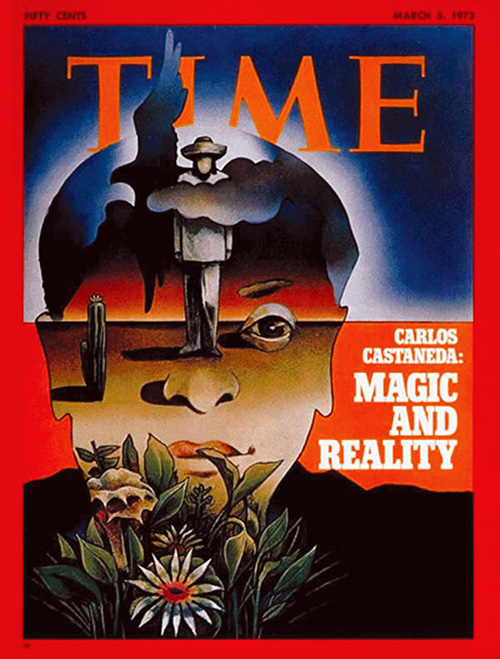
    The popularity of Carlos Castaneda’s books was such that he made the front cover of TIME, Mar. 5, 1973. Back then, a cover feature in TIME had a huge impact for the person profiled.

    Don Juan hooked Castaneda into learning the craft by giving him an anthropologist’s dream, that of introducing him to a foreign cultures’ practices of using lizards as dreaming emissaries, visiting inorganic worlds, and learning the social machinations of shamans. But this didn’t speak to the main agenda of don Juan’s teachings: engaging Castaneda with his complete energy body, accelerating the development of consciousness, and doing so in a way that would move him away from ancient perspectives and into contemporary practices.

    In the early stages of Castaneda’s apprenticeship, mind-altering substances – power plants – were integral to his learning shamanism. He initially thought they were the basis of don Juan’s teachings. However, he later realised that this thinking was erroneous. Castaneda came to understand that don Juan gave him several types of psychoactive plants to alter his awareness in order to gain experience.Without using them, don Juan thought that Castaneda was too slow to catch onto the teachings. But once Castaneda grasped the meaning behind their use, he stopped using them, noting that the most meaningful events and personal changes occurred when he was sober and clear-headed, and not from having ingested drugs.1 As a result of his research efforts, Castaneda was awarded a doctorate in anthropology from University of California, Los Angeles (UCLA).

    An important consideration, Castaneda’s conversations with don Juan were in Spanish, so Castaneda translated them into English. Initially, he used the term “sorcery” for the philosophy, translating from don Juan’s use of the word “brujo” which has many connotations. Early in his apprenticeship, Castaneda also relegated the teachings to Yaqui culture. But don Juan regarded the teachings not to be associated with any culture and found both sorcery and Yaqui connections to be inadequate. In his later work, Castaneda settled on the terms “shaman” and “seer.”2-4

    My Task

    Becoming immersed in Castaneda’s accounts of a wholly new relation with life, I experimented with disrupting routines, a way to begin looking at the world with a fresh lens. I used the inevitability of death as an advisor for how I wished to live my life. I also practiced with reasonable skill techniques such as the gait of power, a means of running at night unencumbered by rough terrain. The grand experiment took place when I packed my bags and left Florida for Arizona determined to find my own teacher, one who was on a par with don Juan. Once in Tucson, I found him in short order. It was beyond my wildest imagination that I would meet don Juan himself. I had successfully employed the instructions on how to find a teacher as presented in Castaneda’s writings by treating them as textbooks. 

    Castaneda’s task given to him by don Juan was to bring to light shamanic teachings, not by what he thought about them but in line with don Juan’s verbatim instructions and explanations. Don Juan later gave me the task of writing about Castaneda’s books. As part of my training with don Juan, I had to rely on Castaneda’s books for many of the details concerning shamanic practices. My apprenticeship was similar to yet different than Castaneda’s. While I have had many experiences that parallel his, our characters and temperaments are not well-matched. This resulted in contrasting methods of instruction by don Juan. For instance, Castaneda was with don Juan for extended periods; I was with him only for short visits. Don Juan fully explained his teachings to Castaneda; don Juan required that I obtain additional instruction from a wide variety of sources in order to expand and elaborate on his teachings to Castaneda. 

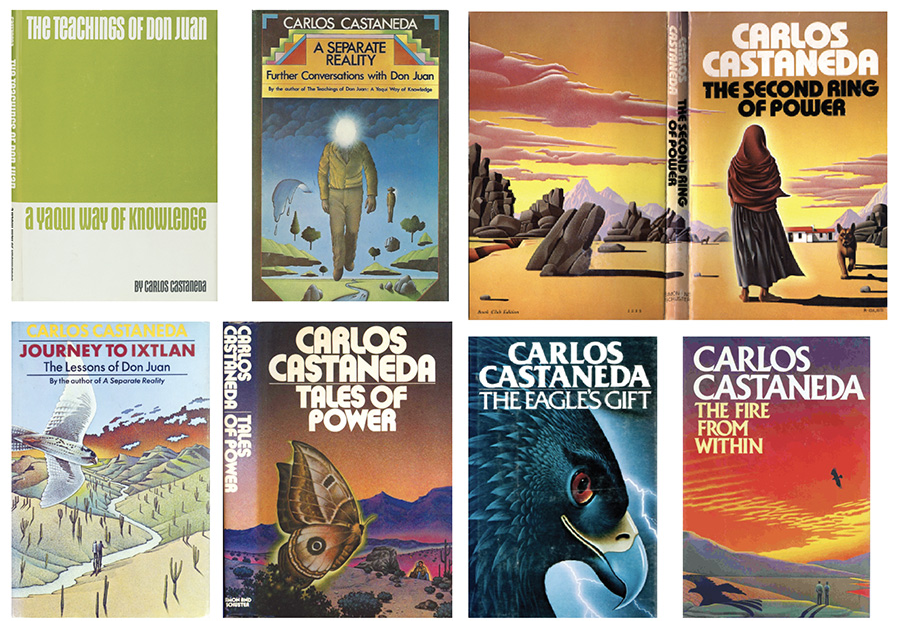
    Down memory lane… Hardback editions of Carlos Castaneda’s first seven books.

    The Great Debunking

    Castaneda’s work was and continues to be controversial. People of high esteem claim that awarding Castaneda a doctorate was UCLA’s worst mistake ever. Everyone knows his books are fiction (really?… everyone?). Castaneda is a fraud, continued a litany of accusations. He never talked with me about it, so it must be false. Such shamans could not possibly exist. Their worldview is simply preposterous. You won’t find one anthropologist who doesn’t think Castaneda to be a clever con man. It’s a hoax. UCLA has revoked his PhD! On and on….

    Debunking the Debunkers

    I’ve found that much of the criticism is baseless, often riddled with errors. While I rely on my experience as evidence of Castaneda’s legitimacy, there are other factors. Hearing well-credentialed scientists decry Castaneda, stating that his PhD had been revoked, I wanted to verify the claim. A representative of the UCLA anthropology department told me that it wasn’t true, that Castaneda was viewed as any other PhD graduate and, oh, by the way, the anthropology department hears such erroneous claims and rumours all the time.5

    It is noteworthy that jumping on the debunking bandwagon (any bandwagon) is a fallacy of logic, of good reasoning. People enjoying their bandwagon ride tend to studiously disregard corroborations of Castaneda’s work. A body of evidence supporting Castaneda’s efforts includes an assortment of books written by both academics and laypeople.6-15 But, hey, let’s not pay attention. Too messy to do so. Our worldview, and so the world itself, might crumble.

    To balance things out, I’ve met academic notables who support Castaneda’s efforts, even saying that anthropology students would do well to verse themselves in Castaneda’s books because he demonstrated a high level of proficiency in conducting himself as an anthropologist in the field when dealing with don Juan and other shamans.16

    It’s also important to assess the work of the debunkers. It is often the case that they commit the same mistakes of research methodology that they accuse Castaneda of committing. (Projection, plain and simple.) And they take to their bank the claims of their colleagues without critical evaluation, a dereliction of scientific duty. As a result, part of the arguments against Castaneda stands on compiling and continuing prior research errors. As don Juan maintained, the intent for most people is to shun information that doesn’t conform with their thoughts.17

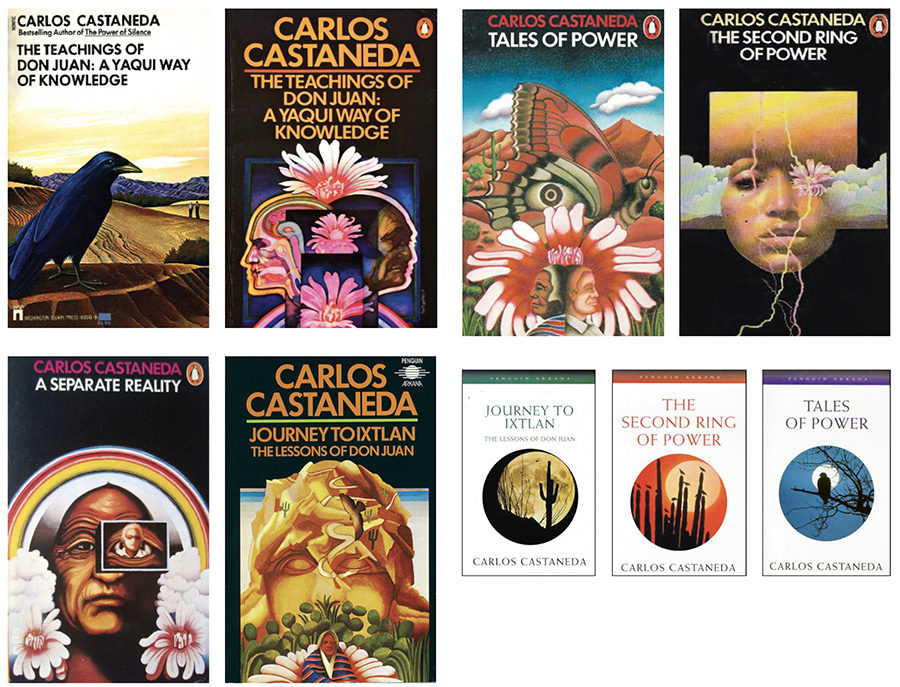
    Selection of paperback editions of Carlos Castaneda’s books.

    An Emic Style

    Another factor in addressing Castaneda’s legitimacy is understanding his style of anthropological investigation, which he stated was an emic approach, a classic but seldom used method.18 This is an accounting based on the point of view of a participant rather than an etic approach where the researcher is on the outside looking in. Etic practitioners often say that theirs is the more objective method whereas those in the emic camp say you really don’t know until you’ve been there yourself.

    If we apply an emic standard, and so regard his research as originating from inside the shamanic tradition rather than the more common and seemingly detached observing and reporting, Castaneda’s books are entirely consistent with that body of teachings. His books may then be viewed as the culmination of a learning project where he was required to perform the teachings to achieve anthropological insight. In this light, his books represent having personally learned about and then reported on shamanism, a true representation of emic anthropology.

    Wavefield Science

    Controversies surrounding Castaneda are no different than those surrounding new scientific theories or pretty much any other advance in thinking and understanding. For example, modern quantum wavefield physics is also controversial as are and were many scientific discoveries. It often takes a couple generations for new views, especially those at a cosmological level, to take hold.19

    It turns out that the emerging field of wavefield physics supports what shamans have known for centuries (with scientific publications occurring after Castaneda began publishing): the world is exclusively energy, physical objects only appear to be material due to a coherence of energy, other dimensions exist, and any point of view or method is an interpretation. Modern wavefield science deals exactly with the same central pillars of cosmology shamans have investigated. It is therefore accurate to say that the considerations of a new breed of wavefield researchers are now catching up to those of ancient shamans.20 Emerging wavefield theory stands to be key evidence in validating Castaneda’s work. 

    The Man

    Aside from professional controversy, there was (and maybe still is) concerns that Castaneda had somehow slipped off the path don Juan helped him navigate only to entertain the dark side of life a bit too much. This line of thinking presents a host of problems, some of which I’ll address. First, though, darkness is a common element among mystics, shamans being one type. For example, old cycle shamans referred to the dark sea of awareness because its content was beyond their grasp, and so the unknown was dark, as in not yet grasped.

    And then there’s the dark side of the old cycle that don Juan struggled to get Castaneda to turn away from, things like controlling others, seeking recognition, and succumbing to the unknown in a way that prevented more robust growth. In addition, given that he was a three-prong nagual (a certain type of energy body) subject to erratic behaviour and that he also had old cycle tendencies, a dimension of darkness was within him. Castaneda illuminated these personal foibles throughout his books, adding immeasurable insights to his writings.

    It may be that Castaneda placed too much emphasis on achieving academic recognition. He may have not made the full shamanic cut in that he placed more emphasis on anthropology than on don Juan’s wisdom of trying to get him to avoid those types of pitfalls.

    As portrayed in his books, Castaneda may also have fallen too much under the influence of those around him. At a given point, don Juan was out of the picture and Castaneda’s sense of membership hinged on those with whom he associated. As a result, once ardent followers lamented that his work had become darker than the higher-end shamanism of don Juan. This was something don Juan warned him about (another testament to the books and author) but he evidently struggled.

    Furthermore, in his later years Castaneda suffered from terminal illness, something that can derail the best of us. He died on 27 April 1998, 72 years old, due to complications arising from liver cancer.21

    Get the issue this article appears in

    Closing Thoughts

    When Castaneda codified a once oral tradition, a new mould was cast of the teachings. He provided a formative body of information for common reference. Since the tradition is rooted in exploring the energy body rather than instilling a set philosophy, this strain of shamanism often takes different turns in the road. As don Juan said, there is no official version of shamanic knowledge, and the passage of time requires new ways of interpreting and explaining it.22

    Carlos Castaneda eloquently set the tone for subsequent shamanic literature as his books established the framework of this mystical tradition. In so doing, he also standardised much of the terminology in a manner similar to any academic, scientific, or trade discipline. Quite a feat. All said and done, as don Juan had taught, a shaman’s task is paramount over personal considerations – a challenge to which Castaneda performed impeccably.

    Kenneth Smith’s new book Power Up Your Energy Body: Out-of-Body Experience & Expanding Consciousness, is available from Amazon.com.

    [alert type=”general” dismiss=”no”]This article was published in New Dawn 187.[/alert]

    [alert type=”success” dismiss=”no”]If you appreciate this article, please consider subscribing to help maintain this website.[/alert]

    Footnotes

    1. Castaneda, Carlos. Tales of Power. New York: Washington Square Press, 1974, 243.
    2. Castaneda, Carlos. The Art of Dreaming. New York: HarperCollins, 1993, vii.
    3. Castaneda, Carlos. The Power of Silence. New York: Washington Square, 1987, xi.
    4. Castaneda, Carlos. Journey to Ixtlan. New York: Washington Square Press, 1972, viii.
    5. Personal telephone conversation and e-mail correspondence with UCLA Department of Anthropology, October 2005.
    6. Noel, Daniel. Seeing Castaneda, Second Edition. New York: TarcherPerigee, 1976.
    7. Williams, Donald Lee. Border Crossings: A Psychological Perspective on Carlos Castaneda’s Path of Knowledge. Toronto: Inner City Books, 1981.
    8. Tomas. The Promise of Power: Reflections on the Toltec Warriors’ Dialogue from the Collected Works of Carlos Castaneda. Charlottesville, VA: Hampton Roads Publishing, 1995.
    9. Tart, Charles. States of Consciousness. Lincoln, NE: iUniverse.com, Inc., 2000.
    10. Eagle Feather, Ken. Traveling with Power: The Exploration and Development of Perception.Charlottesville, VA: Hampton Roads Publishing, 1992, 1996.
    11. Smith, Kenneth. Shamanism for the Age of Science: Awakening the Energy Body. Rochester, VT: Bear & Company, 2011.
    12. Sanchez, Victor. The Teachings of Don Carlos: Practical Applications of the Works of Carlos Castaneda. Santa Fe, NM: Bear & Co., 1995.
    13. Classen, Norbert. Das Wissen der Tolteken (The Knowledge of the Toltecs). Eurasburg, Germany: Edition Tonal, 1992.
    14. Abelar, Taisha. The Sorcerers’ Crossing: A Woman’s Journey. New York: Viking, 1992.
    15. Donner, Florinda. Being-in-Dreaming: An Initiation into the Sorcerer’s World. New York: HarperCollins, 1991.
    16. Personal conversation with Edward Spicer, Professor Emeritus of Anthropology, University of Arizona, Tucson, September 1976.
    17. Castaneda. Power of Silence, 165-166.
    18. Dissertation Abstracts International, Xerox University Microfilms, 33B (May-June 1973): 5625-B.
    19. Kuhn, Thomas S. The Structure of Scientific Revolutions, Third Edition. Chicago: University of Chicago Press, 1996.
    20. Smith, Kenneth. The Energy Body: A Space Age Exploration of Consciousness, Life, and Reality. Kure Beach, NC: EB Dynamics, LLC, 2021.
    21. County of Los Angeles, California, Certificate of Death 090130425, April 28, 1998.
    22. Castaneda, Carlos. The Fire from Within. New York: Simon & Schuster, 1984, 49.

    © New Dawn Magazine and the respective author.
    For our reproduction notice, click here.