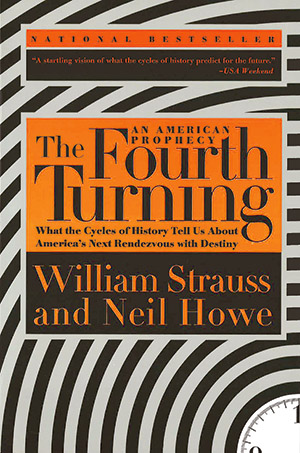
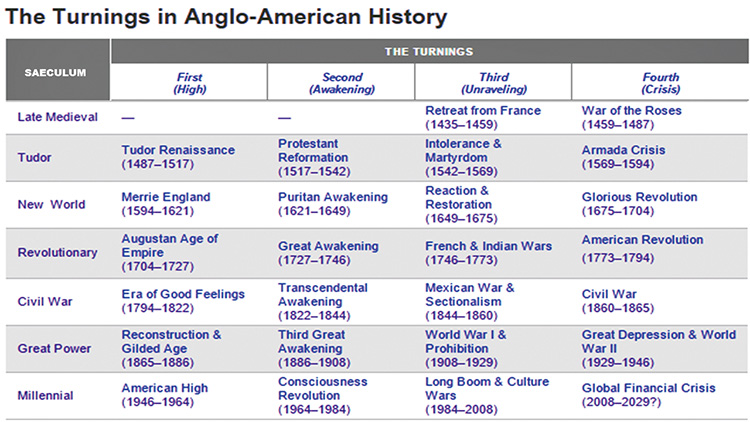
The remarkable 1997 book The Fourth Turning: An American Prophecy by William Strauss and Neil Howe argues that the familiar linear approach to history taught in most western education and academia is a fairly recent paradigm containing dangerous flaws. They argue, instead, that seeing history in terms of recurring cycles provides insights that modern linearity obscures – “one year’s (or one saeculum’s) winter is more like the prior winter than like the autumn that came right before it,” they explain.1
The authors state that by perceiving these cycles, we can perhaps become more aware of impending change. On the contrary, linear or straight-line thinking often causes its adherents to be completely blindsided. Using American history as an example, they point out that as late as December 1773, the idea that the American Revolution would begin in the near future seemed nearly impossible. The same can be said about November 1859 regarding the impending start of the American Civil War that broke out in 1861. Or early October 1929 when virtually nobody expected the sudden end to the Roaring Twenties caused by a catastrophic crash of the stock market that started on October 24 (“Black Thursday”), accelerating from October 29 (“Black Tuesday”).2
Building upon their observation of generational cycles occurring every four generations going back through history for millennia, Strauss and Howe predicted that the current mood of pessimism and disillusionment is typical of a specific point in the cycle. This inevitably precipitates a major crisis which the authors, writing in 1997, predicted would arrive sometime between 2005 and 2025:
Around the year 2005, a sudden spark will catalyse a Crisis mood. Remnants of the old social order will disintegrate. Political and economic trust will implode. Real hardship will beset the land, with severe distress that could involve questions of class, race, nation, and empire. Yet this time of trouble will bring seeds of social rebirth. Americans will share a regret about recent mistakes – and a resolute new consensus about what to do. The very survival of the nation will feel at stake. Sometime before the year 2025, America will pass through a great gate in history, commensurate with the American Revolution, Civil War, and twin emergencies of the Great Depression and World War II.3
In 2011, I wrote an essay regarding these pronouncements of Strauss and Howe, in the process of my reflecting on the tenth anniversary of September 11, 2001. At that time, I said:
It is clear that many of these predictions are coming true, particularly the prediction that “political and economic trust will implode.” It would appear, however, that so far, no “great Crisis” as momentous as the Revolution or the Second World War has yet been sparked. The two authors’ warnings that those living in 1929 or 1859 or 1773 did not see the impending Crisis of their age should give us cause for concern that such a Crisis may yet be around the corner, and cause to pay attention to the cycles that the authors outline in their book.4
Almost exactly ten years later, it certainly feels as though the Crisis that Strauss and Howe predicted has either arrived or very much “around the corner.” The way we choose to act over the coming months and years will be critical for our future and that of generations to come.
Descent into Linearity
Whether you agree with all the conclusions and predictions in The Fourth Turning, one of the most noteworthy features of the book is the authors’ demonstration that the peculiar modern faith in linear progress is a historical anomaly. They find evidence that “nearly all non-Western cultures accept the periodic regularity of time” – meaning by “periodic regularity” the view that time operates in cycles, with a kind of circular rhythm, in contrast to the view that time is linear, which is a relatively modern development in their analysis.5
Strauss and Howe argue that this modern linear view of time is a product of the Enlightenment that dominated the eighteenth century, during which this approach grew into “a complementary secular faith… – the belief in indefinite scientific, economic, and political improvement.”6 They posit that this faith in linear progress reached its height at the end of the nineteenth century, and that it has always been strongest in America where a widespread belief developed that mankind had finally broken away from “any risk of cyclical regress.”7
Strauss and Howe state:
Triumphal linearism has shaped the very style of Western and (especially) American civilisation. Before, when cyclical time reigned, people valued patience, ritual, the relatedness of parts to the whole, and the healing power of time-within-nature. Today, we value haste, iconoclasm, the disintegration of the whole into parts, and the power of time-outside-nature.8
These are broad generalisations, and any book of this nature will test the reader’s patience with such sweeping categorisations, but these overviews do appear to capture some truths worth considering.
Interestingly, this very belief in unbroken linear progress that has gripped western thought since the Enlightenment is reinforced by the dogmas of Darwinism and modern official teachings on our ancient history. It theorises that we have supposedly evolved in a generally unbroken upward line from the “ape-like progenitors” Darwin describes in Descent of Man9 all the way to modern humans, who then progressed from early hunter-gatherers to pastoral herders living a nomadic life, to basic planters and harvesters capable of organising simple villages, and who then made it in a linear fashion to create increasingly complex civilisations.
Although virtually all academia today still enforces some version of the above linear paradigm of humanity’s ancient history, the evidence overwhelmingly suggests this view of the ancient past cannot possibly be correct. Instead, compelling evidence supports the conclusion that humanity was highly advanced in the distant past (long before ancient Greece and Rome) and, for some reason, fell into relative ignorance for millennia thereafter – a very nonlinear view of ancient history.
Cycling Back to the Ancient World
Archaeological evidence around the world points to advanced capabilities which even today we barely understand, including the quarrying and transportation of massive blocks weighing over a hundred tons at sites such as Pumapunku in South America, the Osirion in Egypt, or blocks weighing well over a thousand tons at Baalbek in modern-day Lebanon, and the remarkable level of precision displayed on certain ancient artefacts (including on some of the massive blocks at Pumapunku).
Author Christopher Dunn, a professional engineer and craftsman with extensive experience in the aerospace industry, compiled an overwhelming amount of evidence demonstrating beyond any possible dispute that archaeological artefacts found throughout Egypt and available for detailed examination today exhibit evidence of advanced precision machining. These could not have been manufactured any other way, certainly not with hand tools such as the chisels and pounding-stones on display in many museums, right next to the amazing artwork supposedly produced with such crude implements.
He explores several examples in his groundbreaking 2010 book, Lost Technologies of Ancient Egypt: Advanced Engineering in the Temples of the Pharaohs, establishing beyond doubt that artefacts in Egypt display manufacturing precision built on a knowledge base which was later completely lost for thousands of years. Modern engineers would, in many cases, have a difficult time duplicating these artefacts today (in fact, they could not have done this with tools available just fifty years ago, before advances of recent decades).
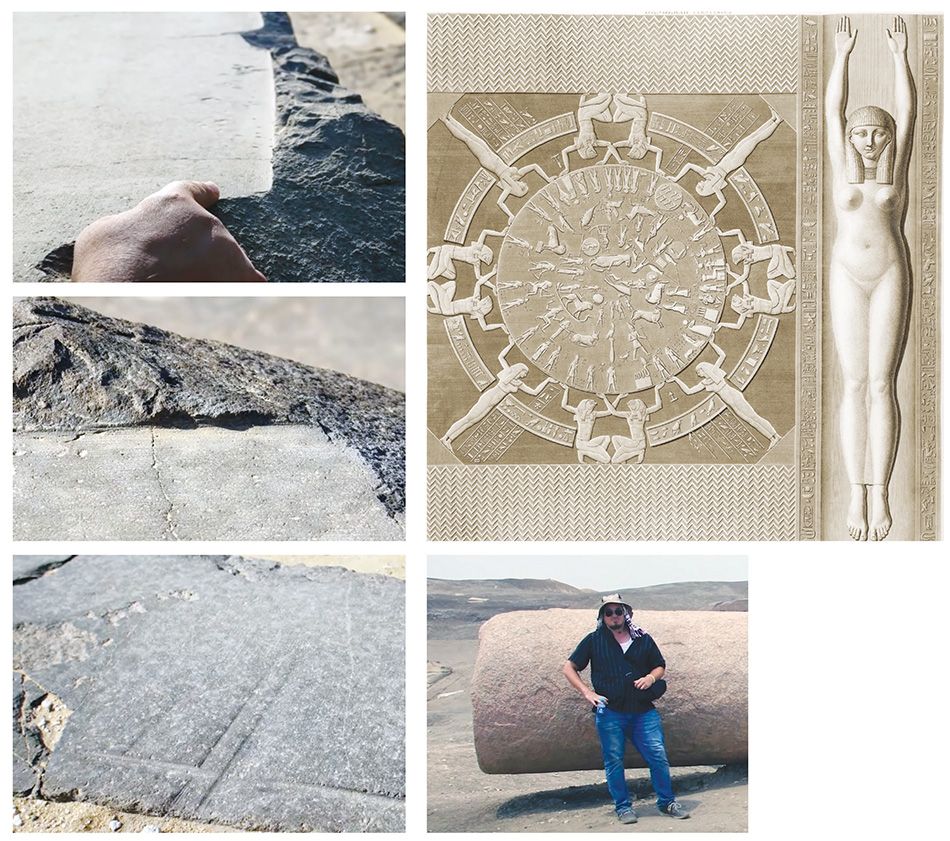
(Above right)Cyclical time in ancient Egypt. Rendition of the Dendera zodiac on the ceiling of the temple of Hathor in Dendera, Egypt. (Other images) Researcher and documentary film-maker Ben Van Kerkwyk of UnchartedX has filmed hundreds of hours of footage of marks made by ‘high tech’ circular saws on hard stone in ancient Egypt. See www.youtube.com/channel/UC2Stn8atEra7SMdPWyQoSLA
Building on the work of Christopher Dunn, and in some instances travelling to Egypt with him, as well as travelling on his own to other ancient sites around the globe, researcher and documentary film-maker Ben Van Kerkwyk of UnchartedX has filmed hundreds of hours of footage allowing viewers of his videos to see with their own eyes these ancient artefacts and ancient tool-marks. Dunn and Van Kerkwyk’s research demonstrates undeniable evidence of advanced technologies, suggesting that sophisticated civilisation existed before dynastic Egypt, capable of producing artwork and objects that even the ancient Egyptians could not duplicate.
The interested reader (or the sceptic who still doubts the existence of advanced technologies that upend the conventional timeline of human history taught in academia) is strongly encouraged to visit Ben’s website at www.unchartedx.com and his associated YouTube channel. Watch two or three of his videos and see the evidence which speaks for itself. The most compelling proof involves ‘mistakes’ where marks and cuts on ancient artefacts reveal that the person operating a cutting tool made an error. Judging by the cuts that can be seen today, the tool continued its incision further than would have been the case with simple hand tools. These ‘mistakes’ show that some kind of high-powered equipment was employed that carried on with the cut before the operator stopped it.
Our Shared Body of Myth
In addition to the physical archaeological evidence scattered around the globe, which we can still examine today, there is another amazing body of evidence in the world’s surviving myths, from cultures on every inhabited continent and island of our earth. As I have been documenting for over a decade, this body of myth can be shown to be based on a common system of celestial metaphor and closely related in a way that explodes the conventional paradigm of humanity’s ancient history.
The very existence of a worldwide system of this nature, in which specific mythical characters are associated with specific constellations – and in which certain characteristics accompany constellations and the mythical figures associated with those constellations across mythologies in cultures separated by enormous distances and by vast oceans – cannot be explained within the timeline of history promoted by conventional academia.
How can we explain obvious parallels in sacred stories preserved among the cultures of the Americas as well as in well-known myths of ancient Greece, for example, or between biblical stories and the myths of the cultures of the Pacific Islands, the civilisations of ancient Mesopotamia, the Ko-Ji-Ki of early Japan, and the Sanskrit epics of ancient India?
These connections suggest the existence of some predecessor culture (or cultures), now completely ignored or denied by today’s official paradigm, prior to the most ancient civilisations known to academia. This system of celestial metaphor in myth was already fully developed in the earliest surviving texts of ancient Egypt, ancient India, and ancient Mesopotamia.
Even beyond those connections, which cannot be explained using the conventional paradigm of human history, the myths of cultures around the world preserve evidence of an extremely sophisticated understanding of celestial mechanics, including an understanding of the rate of precession (whose mythological importance is discussed in my accompanying article on page 51).
Conventional history holds that precession (a very subtle celestial phenomenon, and one that requires many years and even centuries of careful observation and record-keeping and analysis to even detect) was not discovered until the time of the Greek astronomer Hipparchus (190–120 BCE). The rate of precession of one degree every approximately 72 years was not even known when Ptolemy wrote his Almagest in the second century CE. Yet, the precessional number 72 and its multiples (including 108, 216, and 432) appear over and over in ancient myths and sacred stories around the world – and in contexts which can be shown to metaphorically relate to the observable effects that precession has on the constellations of the night sky!
The myths, in other words, demonstrate that precession was understood in the distant past, long before it was ‘discovered’ (actually re-discovered) by Hipparchus. Far from a linear progression, humanity realised enormous levels of understanding and achievement in very ancient times (more ancient than any civilisation known to conventional history), only to lose that knowledge for thousands of years. The evidence indicates we have yet to come close to regaining those levels of understanding and ability – a shocking proposition for the adherents of the linear model of human progress!
Although this evidence (both mythical and archaeological) is easy to examine, abundant, and very difficult to dispute, conventional academia has – in remarkable lockstep – roundly rejected anyone arguing that the current paradigm is gravely flawed and in need of radical revision. Instead, they have continued to cling to the dogmas of linear progress. In my 2011 article exploring The Fourth Turning and the tenacity of the linear dogma, I wrote:
It is quite likely that the faith in linearity that Strauss and Howe detail in their book has blinded scholars and others to the possibility of an ancient advanced civilisation and created a bias towards the acceptance of Darwinian biological theories, which in turn lead to linear anthropological theories as well.10
Re-visiting the question after ten more years of work, and after the discovery of much more evidence showing beyond doubt the existence of a worldwide system of metaphor operating at the foundation of the world’s ancient myths, I am less inclined to take such a charitable view in describing the ongoing propagation of historical paradigms that cannot possibly be true, and which are roundly refuted by overwhelming evidence.
Indeed, there is now plenty of evidence that the truth of our ancient history has been actively suppressed as part of a conspiracy reaching back thousands of years to empower some at the expense of the vast majority of humanity. Keeping this history secret makes it easier to keep us divided and from the ancient wisdom preserved in the myths.
Cyclical Time & Patterns
Interestingly enough, in The Fourth Turning, Strauss and Howe note that ignorance of the cyclical nature of time, or even massive attempts to deny these cycles and live as though cycles do not exist, does not free us from the cyclical nature of time at all. On the contrary, their findings suggest that cultures embracing cyclical time are less buffeted by the waves of the changing cycles, while cultures ignoring cycles exacerbate their effects so that they experience even greater volatility – all the more painful because it is unexpected (unlike the cycles experienced by cultures that expect and respect the cyclical nature of time).
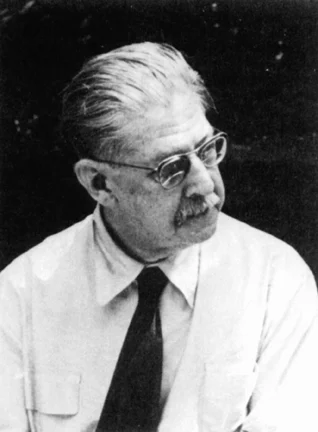
The analysis of Alsatian scholar R.A. Schwaller de Lubicz uncovered numerous cyclical patterns and harmonies between generations living hundreds or even thousands of years apart (at similar distances from precessional turning points). He points this out in his books such as Sacred Science:
R.A. Schwaller de Lubicz (1887-1961)
Since the Middle Ages, our Occident [the West] has been blinded, particularly by the cerebration of the Greek Eleatics who preferred reasoning to experimentation. The beginning of this disquieting period of “arguers” can be situated with the Eleatic school around 550 or 500 BC, a school founded at about the same time as the Pythagorean order, of mystico-religious character. Those five centuries before the precessional passage from Aries to Pisces stand in curious correspondence with our sixteenth century, also five centuries before the next precessional passage from Pisces to Aquarius: Toward the year 1500, with the Renaissance, ancient Greece was again raised to honour in the West.11
Later in the same book he writes:
Their [the Stoics’] champion was Zeno of Citium, who lived from 362 to 260 BC, which is about two hundred years before the precessional transition from the vernal point of the sign of Aries to that of Pisces. In the Stoic pursuit of freedom, we find a curious similarity to the ideal of the revolutionaries of 1789, a revolution which was also situated about two centuries before the new precessional transition of the vernal point from the sign of Pisces to that of Aquarius. This brings to mind a similar great revolution which took place at the end of the Old Empire of the Pharaohs, about 2400 BC, two centuries before the passage of the vernal point of the sign of Taurus into that of Aries.12
In light of these and other apparent harmonies, de Lubicz declared, “The history of the world is strangely cyclical.”13
While Strauss and Howe seem to indict the European Enlightenment for starting the modern dogmatic cult of unbroken linear progress, it should be noted that the Enlightenment was at its core a virulent rejection of the stifling institutions of feudalism dominating Europe throughout the Middle Ages. It was an attempt to free Europe, intellectually and economically, from those ongoing feudal patterns – patterns that grew directly out of the destruction of the ancient ways by the proponents of literalist Christianity, by whom the Roman Empire was taken over and then broken apart, ushering in centuries of brutal oligarchy supported by the teachings of the Church.
As I have demonstrated in my examination of the stories of the Bible totalling many hundreds of pages, overwhelming evidence proves that those stories are based on the same system of ancient metaphor that formed the foundations for the myths and stories of other cultures around the world. Literalistic interpretations of the Bible are mistaken and only leads to misinterpretation of the scriptures. Thus, the rejection of lingering remnants of feudalism – and oppressive literalistic religious dogmas abetting feudal oppression – appears to have led to a (perhaps understandable) mistake when this rejection of the literalist Church and its flawed teachings offered in its place the ‘secular faith’ described by Strauss and Howe, with uncritical belief in unending and inevitable “scientific, economic, and political improvement.”
As American economist Michael Hudson, author of numerous books and essays including the newly-revised third edition of his original 1972 book Super Imperialism – now subtitled in this current edition The Economic Strategy of the American Empire – has explained at length, the oligarchical beneficiaries of the feudalist system did not passively accept the philosophical, political, and economic attacks on the structures of oligarchy launched during the eighteenth century and which gained ground throughout most of the nineteenth: they struck back quite forcefully and managed to erect numerous powerful neo-feudal structures to preserve their exploitative racket.
Moving into the danger zone. US presidential elections in 2024 and 2028 are certain to exacerbate geopolitical tensions across the globe and further societal division in the United States.
I suggest that the Crisis predicted by Strauss and Howe, which may now be unfolding before our very eyes, along with virtually all other “Crisis” examples offered by these authors (including the American and French Revolutions, the American Civil War, the Great Depression and Second World War), can best be understood in light of this centuries-old struggle against the proponents of feudalism (and, in the modern era, neo-feudalism – complete, it seems, with draconian restrictions on movement and travel reminiscent of the condition of serfs in Medieval Europe).
Feudalism can be seen to be the system established by those opponents of the ancient wisdom preserved in the myths – myths testifying (along with overwhelming archaeological evidence) to the cyclical nature of the human story, and to the existence of a now-forgotten predecessor culture (or cultures) whose very existence is vehemently denied by academia and by the proponents of the modern ‘science’ cult and unending linear ‘progress’.
We find ourselves in the midst of one battle in a very, very old war.
If it could be demonstrated that substantially all the sacred traditions of the world – from the myths of the ancient Egyptians to those of the Norse, from the stories of the Olympian gods and goddesses of Greece to the Vedas of ancient India, to the legends of the Maori and of the Inca and the Maya and the shamanic cultures of Asia, and even to the ‘Bible stories’ found in the scriptures which made their way into the canon of the Old and New Testaments and influenced ‘Western civilisation’ for almost two thousand years – share an identical system of celestial allegory, designed to convey a similar esoteric message about the nature of human existence and the nature of the universe we inhabit, that fact would instantly become one of the most important discoveries of our time.
The ramifications of such a discovery would be profound.
First, it would raise the important question of how such an intimate kinship among cultures spanning essentially the entire globe, reaching to the most remote tribes in some of the world’s most isolated jungles, mountains, and steppes, and existing in time across a gulf of centuries (from the earliest ancient Sumerians and Egyptians to cultures which survived into the nineteenth and even twentieth centuries with their traditional belief-systems largely intact), ever came to be. Nearly every possible explanation for a common esoteric system across so many cultures would overturn or radically upset the conventional historical paradigm, which is generally staunchly ‘isolationist’ and dead-set against theories positing ancient contact across oceans between cultures, and which denies the possibility of an advanced ancient civilisation or civilisations predating the known civilisations of history.
Second, a discovery showing that the original intention of the scriptures of the Old and New Testaments, and the esoteric technique of celestial allegory they employ, is either very similar or identical to the intention and technique of the Greek, Norse, Maya, Maori and Egyptian myths, would immediately subvert the wall of separation which has been erected between the religions patterned on those Old and New Testament scriptures and the sacred systems of all the world’s ‘pagans’.
We have been led to believe, for at least the past seventeen centuries, that the faiths which sprang from the biblical texts were based upon historical events and historical figures, in contrast to the pagan mythologies peopled by deities and entities which personify forces of nature, and that this difference set the biblical faiths completely apart from the nature-worshipping pagan systems. Even those who deny the supernatural aspects of the biblical stories tend to fall into this trap (including the most up-to-date academics), searching for evidence of a ‘historical Jesus’ and wondering whether he might have had a ‘secret wife’, or asking questions about who Moses really might have been (perhaps Akhenaten?), when they would never dream of trying to discover the ‘historic’ Hercules or Horus or Aztec god Tezcatlipoca, or whether any of them might have had a ‘secret wife’ and descendants who are still alive today.
Third, such a discovery arouses the question of why such an unusual method of transmission and preservation was selected, and what exactly that message might be. And finally (for now at least – there are many other profitable questions which could be raised), there is the important question of how the esoteric understanding of ancient scriptures and myths was so thoroughly lost. This question is especially important when it comes to the interpretation of the scriptures of the Old and New Testaments, because the literalist interpretation (as opposed to the esoteric interpretation that the texts themselves invite) has played so dominant a role in world history – and continues to do so to this day.
In fact, it can be demonstrated quite convincingly that the myths of the world’s sacred traditions – including those in the biblical scriptures – consist almost entirely of celestial allegory. The system of celestial allegory is complex, and multi-layered, but a strong sense of its basic workings can be obtained through the consideration of the stories related to the zodiac wheel, one of the central aspects of the entire system.
A suspicion that the stories in the Old and New Testament might be celestial in nature can be raised by the simple fact that the tribes of Old Testament Israel, and the disciples called by Jesus in the New Testament gospels, are twelve in number. Indeed, it can be satisfactorily demonstrated that the scriptures of the Old Testament clearly indicate the twelve ‘tribes’ of Israel are intended to describe the twelve constellations (groupings of stars – ‘tribes’ of stars, if you will) of the zodiac, and the same for the twelve disciples of the New Testament.
The Esoteric Meaning of the Story of Samson
The demonstration of the connection (especially to someone sceptical of the theory) requires some extended discussion and diagrams, and it is much easier to examine some other well-known biblical stories, where the connection is immediately obvious and difficult to deny.
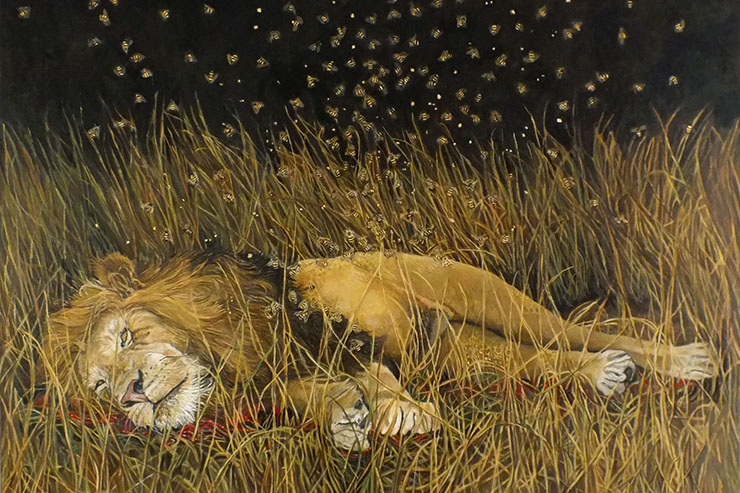
One of these is the story of Samson, the famous strong-man of the book of Judges, who is described in chapter fourteen as taking a trip “down” to Timnath to meet a woman “who pleased him well,” encountering a lion on the way down and slaying it with his bare hands. After a time he returned and found that the carcass of the lion was now buzzing with a swarm of bees and honey (presumably the bees built a hive in the carcass of the dead lion).
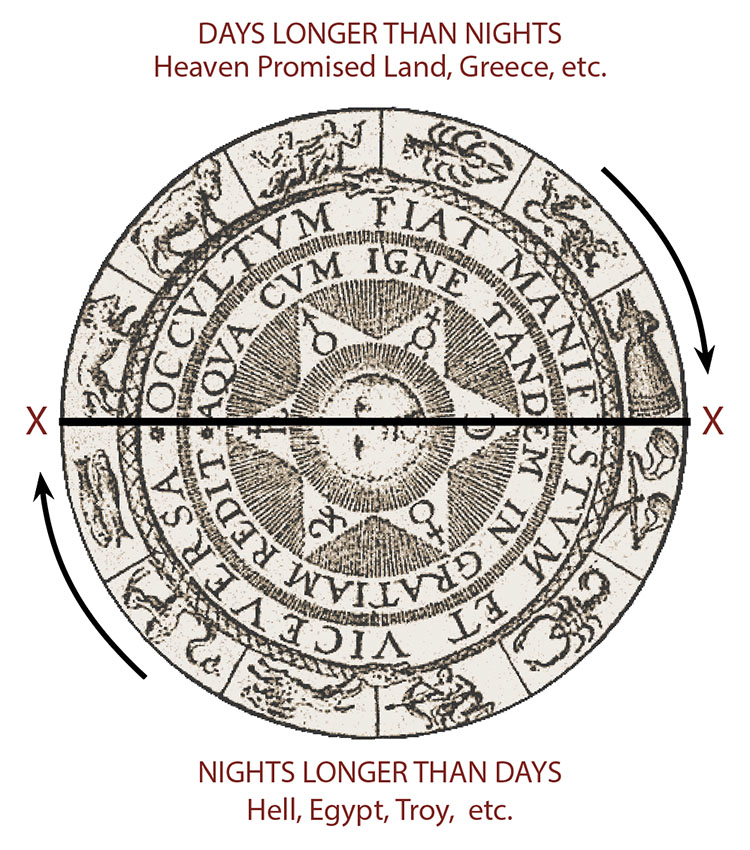
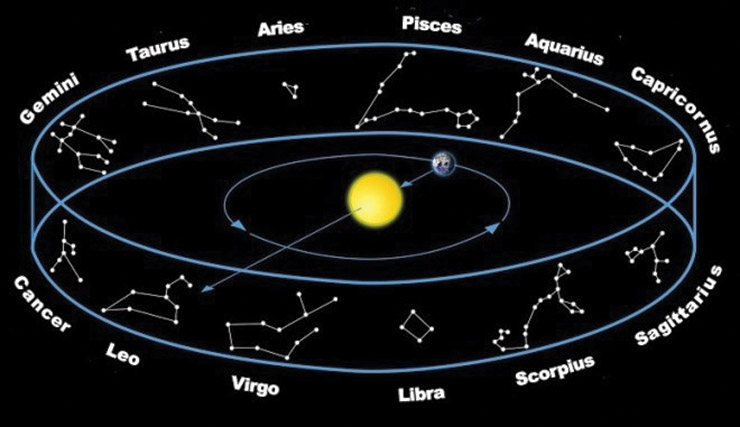
This event provides the material for a “riddle” which Samson puts to the Philistines, and they are unable to answer it. The fact that it is described as a riddle should cause us to consider it very closely – the text is practically inviting us to ask of the hidden meaning to this puzzle, and one is soon found if we consider the zodiac wheel. In the zodiac wheel (left), the sun’s progress through the year is indicated with the signs shown as they would have been during the ‘Age of Aries’ (for good and cogent reasons which lie outside the scope of this particular article).
Each year, due to the obliquity of the ecliptic (the earth’s tilt upon its axis), the path of the sun during the day traces an arc that is either above or below the line of the celestial equator. The celestial equator is the imaginary great circle which can be said to encircle the inside of the ‘heavenly sphere’ at a distance of ninety arc-degrees down from the north pole, or up from the south pole for observers in the southern hemisphere, although the rest of this discussion will take a northern-hemisphere-centric perspective, since the biblical texts (and the land of Egypt from whence they almost certainly originated) come to us from lands situated in the northern hemisphere. The sun’s ecliptic path crosses above this line at the point of the spring equinox each year (the March equinox for the northern hemisphere), after which days are longer than nights as the sun progresses towards the ‘summit’ of the summer solstice in June, and then the path crosses back down below that line at the point of the fall equinox, and the onset of the part of the year in which nights are longer than days.
In the above diagram, the line of the celestial equator is indicated as a horizontal line, above which are the months with days longer than nights, and below which are the months with nights longer than days. The direction of the sun’s progress throughout the year is indicated by arrows, and the points at which the sun crosses the line are marked each with a large ‘X’ indicating the two equinoxes.
From the point of summer solstice, at the top of the zodiac wheel, if the sun is going down towards the autumn equinox (the way Samson in Judges 14 is initially going down towards Timnath), he will first encounter the zodiac sign of Leo the Lion (just as Samson encountered a young lion on his way). Next, he will encounter the sign of Virgo the Virgin, who obviously corresponds to that beautiful woman of Timnath.
But what about the swarm of bees? As it happens, if Samson continued around the wheel and came back again to the point of Leo the Lion, the sign he would encounter just prior to reaching Leo would be Cancer the Crab (indicated in the somewhat archaic zodiac used above by a design that looks more like the animal we would call a lobster). It is an indisputable fact that the constellation of Cancer contains a shimmering cluster of stars known as the Beehive Cluster (and for this reason, ancient depictions of lions sometimes show them as having a bee coming out of their mouth or having a bee flying just in front of their dignified leonine visage).
Clearly, all of these zodiac correspondences in the event which furnished the material for the ‘riddle of Samson’ are unlikely to be sheer coincidence. It is difficult to argue that the events of the book of Judges involving Samson (and there are many more of them which have similar celestial correspondences) took place in the historical life of a literal human being, and just happened to match up perfectly with the constellations of the zodiac between Cancer and Virgo (with the directions ‘up’ and ‘down’ matching perfectly as well).
While it may be – just barely – possible to argue these events could be the accurate record from the life experiences of a literal, historical human being named Samson, the fact this same pattern of celestial allegory (often involving zodiac signs) is repeated over and over throughout the scriptures of the Old and New Testaments (and the myths of the world) effectively puts the ‘coincidence’ argument to rest.
The Story of Abraham & Isaac
To see another example which argues strongly for a celestial and allegorical approach to the events of Old and New Testament scripture, it is first important to understand that the ‘crossing’ points of the equinoxes, where the sun’s daily path crosses the celestial equator (once upward at the spring equinox and once downward at the fall or autumnal equinox) were anciently allegorised as places of sacrifice. In the New Testament stories, of course, these ‘crossings’ would involve an actual sacrifice upon a cross. But in the Old Testament, we see a famous sacrificial scene in the near-sacrifice of Isaac by his father Abraham upon Mount Moriah.
The story is found in the book of Genesis, in the 22nd chapter. There, we are told that God directs Abraham to take his beloved and only son Isaac up a mountain in the land of Moriah and offer him up for a burnt offering. Abraham and Isaac dutifully trudge up the mountain, and Isaac makes note of the fire and the wood for the sacrifice, and asks his father, “but where is the lamb for a burnt offering?” (verse 7).
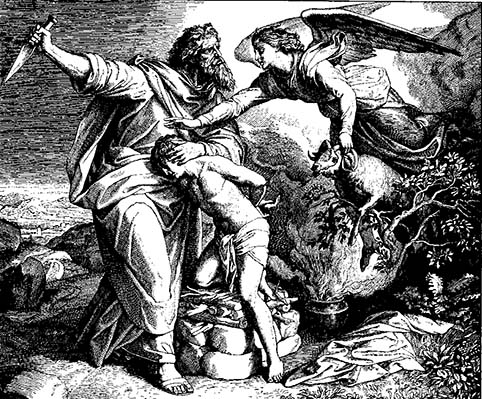
The famous sacrificial scene involving Abraham and son Isaac, as outlined in the book of Genesis, encodes an esoteric narrative not apparent to the casual reader. Woodcut engraving “The Sacrifice of Isaac” by Julius Schnorr von Carolsfeld, 1860.
Here again we clearly have the elements which point to an esoteric rather than a literal interpretation of the text. The fact that the characters in the story are trudging up the mountain indicates we should suspect the story involves the sun’s path up towards the summer solstice. Since equinoxes are often indicated with a sacrifice, the equinox on the way up towards the summit of the year would be the spring equinox, not the fall equinox.
The mention of ‘fire’ in the text is also indicative of the ancient symbology of the sun’s path or the ecliptic: in ancient Mithraic symbology, for instance, the equinoxes are indicated by two distinctive characters who each carry a torch, with one of them carrying his torch pointing upwards to indicate the spring equinox (sun climbing up towards summer solstice) and one of them carrying it pointing downwards to indicate the autumnal equinox (in which the sun is declining downwards towards winter). The identification of the sun’s ecliptic, and especially the equinox, with the symbol of fire is amply supported by the discussion and evidence presented by Giorgio de Santillana and Hertha von Dechend in their magnum opus Hamlet’s Mill (1969).
Having identified some clues indicating this story may depict events at an equinox, and specifically at the spring equinox when the sun is “ascending the mount” which culminates at summer solstice, we read on to see if there are any confirming symbols which might correspond to a zodiac sign. Sure enough, as Abraham is in the very act of stretching forth his hand and taking the knife to slay his son, we are told that an angel of the LORD directs Abraham to stay his hand, and as Abraham “lifted up his eyes, and looked,” behold, he saw “a ram caught in a thicket by his horns” (verse 13). This miraculous appearance of a ram caught in a thicket is confirmatory evidence that the story of Abraham and Isaac ascending Mount Moriah is actually an esoteric allegory pointing to the sun’s passage through the spring equinox, which takes place right at the beginning of the sign of Aries, the Ram.
Goddess at the Gates of the Underworld
Such celestial allegories can be found throughout the scriptures of the Old Testament, as well as in the sacred traditions of other cultures the world over. We know that the crucifixion of Christ in the New Testament is also surrounded by equinoctial imagery, but in this case the primary imagery is autumnal. Some evidence includes the presence of Mary (or more than one Mary) at or near the base of the cross during the crucifixion – representative of the zodiac sign of Virgo the Virgin.
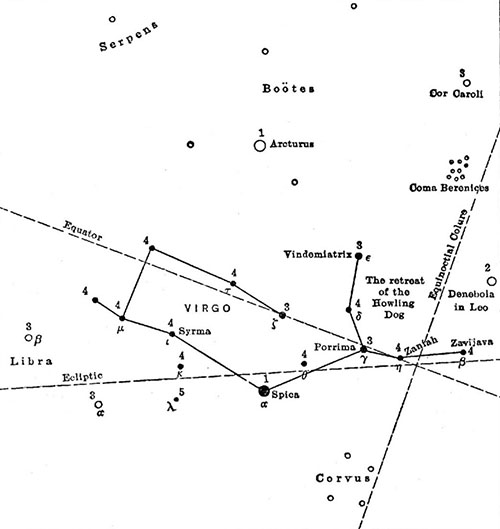
The constellation Virgo is associated with a sheaf of wheat and harvest season (marking as she does the autumnal equinox), with the star Spica traditionally associated with wheat. Virgo’s outstretched arm is marked by a star anciently designated Vindemiatrix, which literally means ‘grape-gatherer’, as if she is plucking the fruit of the vine. These two symbols, of grapes and of wheat, are representative of the autumnal activities of the harvest season, and we find them prominently repeated in the Last Supper meal of bread and wine, immediately prior to the crucifixion.
CONSTELLATION VIRGO
The constellation Virgo stands just at the edge of the autumnal equinox, the gateway to the lower half of the year, allegorised in sacred traditions around the globe as ‘the underworld’, or Hades, Sheol, and Hell. Appropriately enough, we see the ancient Apostles’ Creed asserts that immediately after Christ died, he “descended into hell,” although this assertion has confused some literalist Christian theologians who do not realise the scriptures encode the motions of the starry heavens.
In many myths around the world there is the figure of a maiden or a virgin or a goddess who stands at the gates of the underworld. This confirms that the esoteric pattern being described is extremely ancient – probably traceable to an ancient advanced civilisation prior to the dawn of any known historical civilisation – or at least to advanced or ascended sages from that pre-historic time. Often, this maiden or goddess greets the souls of the newly deceased or (in some cases) living heroes who are embarking upon a trip to the underworld, and in many cases she offers them wine or mead. All of this is in keeping with the pattern we are examining, and can be explained by the fact Virgo is located at the very ‘gates of the underworld’, and that she is associated with both grapes and the sheaf of wheat.
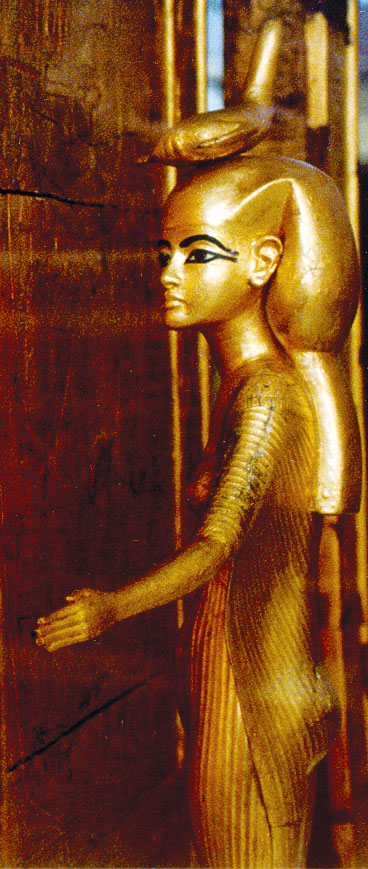
This gilt statue of the scorpion-goddess Selket from ancient Egypt was discovered standing guard over the canopic chest in the tomb of King Tutankhamun. This example of Selket (with Scorpion on her head) has Virgo’s outstretched arm.
We see her as Medea directing Odysseus on his quest to the realm of the dead, in the Odyssey of Homer. We see her as the ‘old goddess with the scorpion tail’ who greets the souls of the dead and gives them drink, found in the mythology of the Maya and many other Native American cultures according to de Santillana and von Dechend (Hamlet’s Mill, 243-244). The addition of a scorpion tail, of course, comes from the fact that the constellation Scorpio or Scorpius is found not far from Virgo, just beyond Libra and below the line of the celestial equator on the ‘underworld side’ of the fall equinox.
De Santillana and von Dechend note that this scorpion-goddess at the gateway to the realm of the dead and found in the mythology of the Americas is very reminiscent of the scorpion-goddess Selket from ancient Egypt, a beautiful gilt statue of whom was discovered standing guard over the canopic chest in the tomb of King Tutankhamun. Of course, the conventional historians assure us there could have been no contact between the cultures of ancient Egypt and the civilisations of Central or South America, and yet each has a scorpion-goddess associated with the entry of souls into the realm of the dead.
A maiden with mead at the edge of the underworld is also present in Norse mythology, as discovered by Maria Kvilhaug and detailed in her important Masters’ dissertation The Maiden with the Mead (2004). All of these myths, from cultures found around the globe, undoubtedly allegorise the sign of Virgo at the gate of the autumnal equinox and the lower half of the year (the half which was depicted in ancient myth as Hell, Hades, or the underworld). Most of them involve the offering of mead or wine, beverages made from wheat or from grapes, both of which were associated with the constellation Virgo. Some of the goddesses incorporate the sign of Scorpio as well.
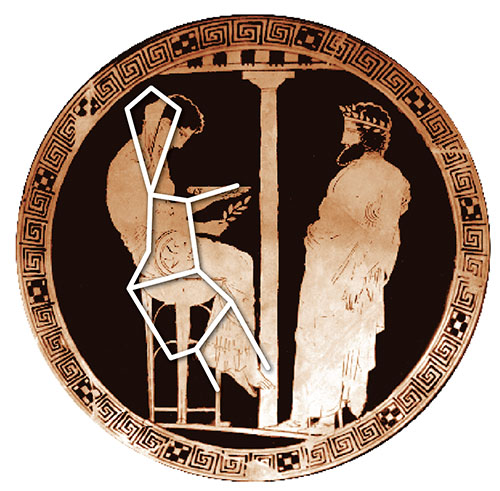
An outline of the priestess of Delphi (the Pythia) showing that she is directly related to the constellation Virgo.
We also see a Virgo-like figure in the Pythia of the important ancient Greek oracle at Delphi, who was depicted as being seated on a tripod near a great rift leading to the underworld containing the body of the dragon-serpent Python: the fumes which proceeded from that rift caused the Pythia to go into a trance-state in which she could relay knowledge from the realm of the gods. In the ancient art, this maiden was often depicted as holding a sacred laurel branch and a plate of sacred water from the nearby spring – both characteristics that can be associated with the outline of the constellation Virgo, as is the seated posture of the constellation. The circle of water corresponds to the dim outline of stars that can be seen in the Virgo constellation chart above the outstretched arm of the maiden, which is sometimes depicted in other myths as a tambourine, or other circular instrument.
Why Encrypt Esoteric Teachings?
The foregoing examples should suffice to establish the fact that the ancient mythologies of the world (of which the scriptures of the Old and New Testament were originally part) were intended to be understood allegorically and esoterically, rather than literally. This immediately triggers the question of why? Why would the ancients ascribe such importance to the motions of the heavens and the heavenly bodies, the rising and setting of the sun, moon, planets and stars each day and throughout the year?
The answer to that question is multi-layered, and it is profound. Essentially, the ancient sages wished to convey truths esoterically, truths so deep that they would tend to ‘trip up’ the logical intellect, the aspect of our thinking usually described as ‘left-brained’.
To illustrate the power of esoteric teaching, perhaps the best example is the famous scene from the original Karate Kid movie (1984), in which a frustrated Danny is finally fed up with waxing cars, sanding the floor, painting the fence (up, down), and painting the house (side-side). He confronts his teacher, Mr. Miyagi, and demands to know when he is going to finally be permitted to learn martial arts. The ensuing scene is so powerful that it has become world-famous: Mr. Miyagi demonstrates to Daniel-San that he has already been learning the secret art, in the motions of all his chores. Mr. Miyagi shows Daniel-San the ‘hidden teaching’ inside the motions of waxing the car, or painting the fence, and by unexpectedly launching ferocious attacks on Danny (accompanied by terrifying shouts), makes Daniel-San experience for himself that the martial art will actually work as advertised.
This is the essence of the esoteric: it is not designed to keep knowledge secret, but rather to impart knowledge. If Mr. Miyagi had tried to explain various blocks to Danny, Danny would probably have had all kinds of questions, and doubts, and ‘what if’s’. By first giving Danny the motions in a ‘disguised’ format (and ensuring that Daniel-San internalised those motions), Mr. Miyagi enabled Danny to experience them for himself, achieving what the ancients called gnosis – a type of knowledge that comes not from the intellect or from ‘believing’ but rather from experience.
It is quite possible – in fact it is almost certain – that the esoteric myth-systems of the world were designed to convey gnosis in much the same way. In fact, there is evidence these metaphors were not just a bunch of “stories built to hide the teachings about the motions of the stars,” but that the motions of the stars themselves were also allegories which convey profound teachings about the nature of human existence, and about the nature of the universe. Like the martial art Mr. Miyagi wanted to impart to Daniel-San, these profound teachings are of the sort that the intellectual ‘left-brain’ mind will choke upon.
There is evidence they teach a ‘holographic universe’ and a cosmology anticipating the discoveries of modern quantum physics by many thousands of years. Anyone who has encountered quantum physics knows it is very difficult to accept, and elicits the kind of incredulous questions that Mr. Miyagi would probably have gotten from Daniel-San had he tried to teach karate using ‘left-brain explanations’ instead of his esoteric ‘wax on, wax off’ method.
In brief, they were using the motions of the stars to teach about the existence of a spiritual realm which interpenetrates and coexists with the material realm, and to which one could travel using shamanic techniques in order to effect changes which would impact the material world or to gain knowledge that could otherwise not be accessed using strictly material or even ‘scientific’ methods.
If the ancient sages, or the ancient civilisation or civilisations which preceded the earliest-known civilisations of history such as Sumer and Egypt, possessed such an advanced cosmography, it may go a long way towards explaining their incredible architectural achievements, achievements which conventional historical paradigms are at a loss to explain.
How Did We Lose Access to the Ancient Wisdom?
This possibility brings us to the final question this incredible information raises: what happened to it? How did a large portion of humankind lose access to this ancient wisdom? Much of it seems to have been lost before the dawn of the earliest-known historical civilisations, although it is clear some portion of it survived in the ancient cultures of the world – in large part, perhaps, because of the exquisitely-crafted esoteric myths we have been discussing.
But somewhere along the line, the esoteric understanding of these myths was replaced by a literalist approach, and it appears this process was a deliberate subversion carried out by the originators of literalist Christianity in the case of the scriptures of the Old and New Testaments. There, the literalists were able to wage a successful campaign to silence, marginalise, or eliminate the gnostic teachers and the texts which taught a gnostic approach (the Nag Hammadi texts, found in the twentieth century buried beneath a cliff along the Nile River in Egypt, testify to this ancient campaign). Then, allied with the power of the Roman Empire, the literalists expanded their campaign against esotericism and the shamanic to other cultures of Europe.
Literalist Christianity later took this campaign across the oceans, to eradicate the ancient wisdom in the cultures of the Americas, and later into Polynesia and even into Asia, including the civilisations of India, China, Tibet, and others.
There is much more to this story, and it is one whose ending has yet to be written. There is no doubt the ancient wisdom entrusted to the human race is esoteric in nature, and attempts to suppress this truth – often through violence, threats, and deliberate falsehood – have caused tragic loss and suffering throughout human history since at least the rise of literalism during the first through fourth centuries CE. Stemming that violence, and healing that damage, will require courage, and it will require wisdom. The first steps, perhaps, include understanding this ancient esoteric system, and the profound wisdom the sages of pre-history intended it to convey to us and to future generations.
Timing is everything. Everything moves in cycles. Our days are defined by the turning of the earth, our weeks and months by the cycle of the moon, while the seasons of the year are caused by the relationship between the earth and the sun.
The monthly cycle of a woman’s body, upon which the conception and birth of every child depends, has been associated with the cycle of the moon from ancient times. Despite a condescending denial of this ancient association in recent decades by proponents of “modern science” – who argue that there is no way heavenly bodies such as the moon impact biological functions in women or men – recently published findings from a long-term study over fifteen years revealed that the moon does indeed impact that monthly cycle (see “Women temporarily synchronize their menstrual cycles with the luminance and gravimetric cycles of the Moon,” Science Advances, January 2021, www.science.org/doi/10.1126/sciadv.abe1358).
For the past twelve years, I have been exploring and presenting evidence that the world’s ancient myths are based on the stars and heavenly cycles – that ancient stories and all the characters and figures described in them correspond directly to constellations and celestial features. This is an esoteric system stretching around the globe and forming the foundation for myths from every inhabited continent and island, including the myths of the cultures of the Americas, Africa, Australia, the islands of the Pacific, as well as ancient India, China, Mesopotamia, Egypt, Japan, and Greece. This system forms the foundation for the Norse myths and for the stories contained in the scriptures of the Bible, from Genesis all the way to the Revelation of John.
The myths use the heavenly cycles, including the cycles of the moon and the planets, but most especially the annual cycle with its effect on the hours of darkness and light as we move through the equinoxes and solstices. They are part of an esoteric language in which different parts of the cycle are understood to represent specific aspects of our experience in this incarnate life and thus convey powerful truths for our understanding and benefit.
In addition to the cycles with which we are familiar from our own experience, such as the annual cycle with its changing seasons and lengths of the day, the ancient myths also use the less obvious and far more gradual cycle known as precession. This is a cycle unfamiliar to most people and rarely taught in formal schooling or mentioned in anything we see on television or in the movies. It proceeds at such a slow pace that even an entire human lifetime of carefully observing the heavens will barely reveal its subtle action.
Indeed, the motion of precession is so subtle and gradual that it was not even articulated by any writers of whose work we are today aware, until the work of the astronomer Hipparchus who lived between the years we today designate as 190 to 120 BCE. Many centuries passed before astronomers could narrow down estimates of the rate of the motion of precession with any degree of accuracy.
Understanding Precession
To understand why precession is so difficult to detect, let’s examine its effect on what we see in the sky from our vantage point on earth. If we spend any amount of time looking at the stars at night, we will soon observe that the position of the constellations slowly changes as we go throughout the year.
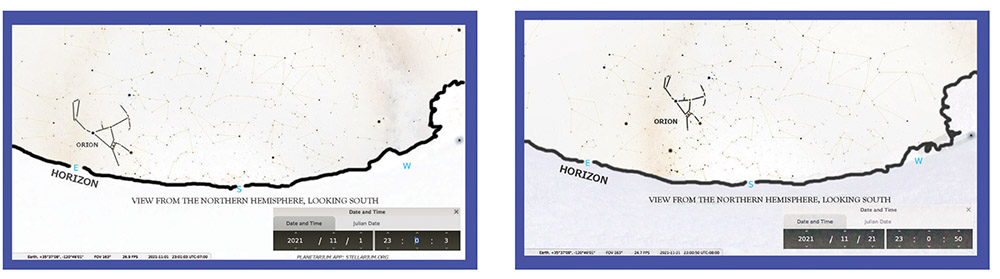
FIGURE 1 (left): Date and time box show that at one hour before midnight, on 1st November, all the stars of Orion have now risen in the east and are above the horizon. FIGURE 2 (right): As we move through the year, the stars rise a few minutes earlier each night. Thus, they are farther along their journey from the east to the west at the same time on successive nights. Here we see that by the 21st of November, the stars of Orion have moved much higher by the same hour shown above: one hour before midnight.
For example, as I write this at the very end of October and beginning of November, the majestic constellation we call Orion is rising above the eastern horizon in the hours after dark, such that the entire constellation clears the hills to the east of where I live about one hour before midnight (see Figure 1). However, as we continue through the year, the stars of the constellation Orion will rise just a little bit earlier each night (about four minutes earlier per night, at the latitude where I live), such that in just a few weeks the entire form of Orion will be above the eastern horizon two hours before midnight, and thus even higher in the sky later on (see Figure 2). In a few months, the constellation will be high in the sky nearing its zenith.
This change in the position of the constellations as we go from one night to another is a result of the changing relationship between the earth and the sun as we move through the year. Orion dominates the night sky during November through April (the winter months for the northern hemisphere), but as the year goes on and the stars of Orion continue rising earlier and earlier each night, the constellation will be farther and farther along its journey from east to west as the sun goes down, until at last we will observe that at nightfall, when the stars start to become visible, the familiar form of Orion is all the way over at the western horizon. As the year progresses even further, into the end of May and the beginning of June, Orion will already be below the western horizon when night falls and the stars appear.
Because this movement is a function of our annual dance with the sun, the position of any given star (say, for example, the centre star in Orion’s famous three-star belt) will be back in its same position when we on earth get back to the same point relative to the sun in our annual cycle. Of course, to measure this phenomenon precisely, we need to stand in exactly the same spot from one year to the next. In fact, we have to rest our chin (or our telescope) in exactly the same location. If we do, we should find that the star in question is in its expected position when we get back to the exact same point in our annual cycle.
How do we know when we get back to the exact same point in our annual cycle? We cannot simply use an ordinary calendar and pick the exact same calendar date (such as November 1st) and assume that we are back to the same point relative to the sun. As we know, the calendar “slips” around a little bit from one year to the next due to the fact that our earth’s daily turning does not match up evenly with our annual cycle. The earth turns on its axis 365 times and a little bit more each year, which means that we have to come up with corrections such as the concept of the “leap year” to keep the calendar from slipping to the point that January 1st falls in the summertime instead of the wintertime (for the northern hemisphere) due to that little extra bit of turning each year.
So, if we want to know when we are back to the exact same point in our relationship with the sun, it is much easier to observe the great station points of the year that we call the solstices and the equinoxes. If we use the winter solstice, for example, to measure some specific star, we will know we have returned to the exact same point in our annual cycle. We can see if that star is in the same place that it was the prior winter solstice (keeping in mind that we will need to take our measurement at the exact same time and with our chin or our telescope in the exact same place as when we measured that star’s location the year before).
If we are very careful with our measurements, then we should find that the same star is in its appointed place the following year. That is what we, in fact, do find because when we get back to the exact same point in relation to the sun, we should be able to look up into the sky at exactly midnight (for example) and trust that the scene in the heavens is the same it was when we crossed midnight at this exact same point in the annual cycle the year before.
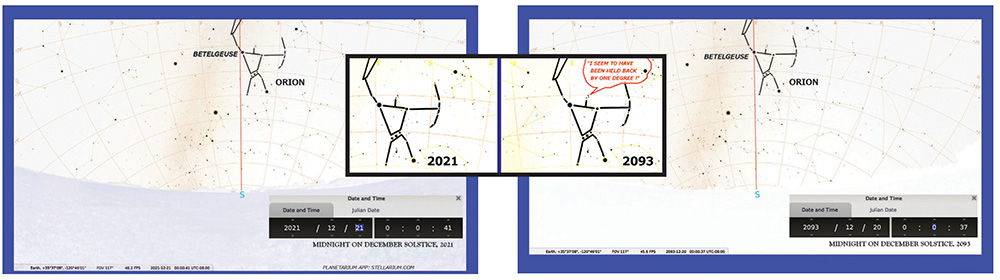
FIGURE 3 (left): Position of the stars of Orion midnight on December solstice, 2021. Compare this to the position of the same stars 72 years later, shown in Figure 4: the “delaying” action of precession will “hold the stars back” ever so slightly after 72 years, but only by a single degree of arc. FIGURE 4 (right): Position of the stars of Orion midnight on December solstice, 2093. The gears of precession grind very slowly, but after 72 years, the stars have been “held back” by one degree of arc. Observe, for example, the position of the star Betelgeuse, at Orion’s shoulder just below the upraised arm: it has ben “delayed” by about one degree over 72 years on the December solstice.
But there is another motion going on which throws a twist into the orderly round of the march of the stars from one year to the next. It is so subtle that we will not be able to measure it very easily with standard equipment unless we take the same measurements every year for a very long time. Over the course of many years, the expected star will keep returning to its expected spot on the expected day, but if we measure its position each year for many decades (keeping careful records each year, of course), we will begin to see it “struggling” to make it to its appointed spot in the heavens – as if some force is very slowly “delaying” that star or “holding it back” from one year to the next.
This action is so slow and subtle that it takes 72 years for that star to be held back by a single degree of arc (about the width of your littlest finger, held at arm’s length from your face). Due to that very slow delay, after 72 years the star will be delayed by a whole degree on the appointed day and time from the place that you measured it at the exact same place and time, 72 years before. Indeed, this delay holds back all of the stars. It is as if the entire fabric of the heavens is held back ever so slightly over decades so that Orion is one degree lower 72 years from now on the night of (let’s say) the December solstice than Orion will be this year on the December solstice at the same hour – and so will the stars of Taurus, and the Pleiades, and all the rest of them.
Of course, very few astronomers can make 72 successive annual measurements of the same star as we’ve just described, even if they start at the early age of 10 years old. For the ancients to even perceive the motion of precession would require meticulous record-keeping for more than one human lifetime – not to mention a system for ensuring that all the observers rested their chins in precisely the same spot when taking annual measurements.
Even after 72 years of observation, the delay is very slight – just one degree! And for the stars to be delayed by two degrees would take another 72 years, or a total of 144 years to get the two-degree displacement. After thousands of years, this “delaying action” will have a real impact.
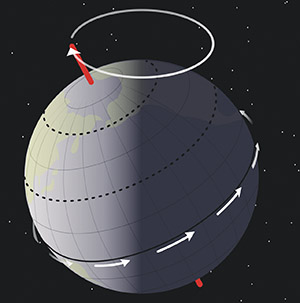
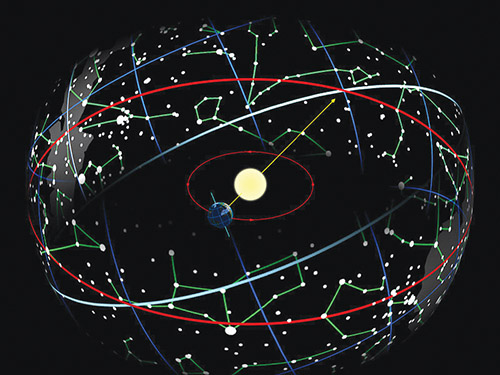
FIGURE 5: Precession appears to “hold back” the night sky by one degree every 72 years due to a 23.5° wobble of Earth’s axis as shown here. One cycle of the wobble takes approximately 25,920 years, which is 12 x 2,160 years.
The reason this motion is called “The Precession of the Equinoxes” is that, after thousands of years, this slight delaying action changes the background of stars such that the constellation expected above the horizon before sunrise on the significant morning of the March equinox (the spring equinox for the northern hemisphere) will be delayed so much that it will still be below the horizon – and the constellation that normally precedes it in the march across the sky and through the year will be above the horizon instead.
We know there are 360 degrees in a complete circle, so if the motion of precession delays the background of stars by one degree every 72 years, we can determine how many years it takes to delay the constellation expected to be just ahead of the sun on the morning of the March equinox (or even the constellation in which the sun is located on the March equinox, although we obviously can’t see the stars once the sun clears the horizon) due to the action of precession.
FIGURE 6: Another way of seeing the action of precession. Earth in its orbit around the sun causes the sun to appear on the celestial sphere moving along the ecliptic (red), which is tilted 23.5° with respect to the celestial equator (blue-white). Over very large spans of time, different zodiac constellations appear behind the sun as it rises at the March equinox. Image credit: Wikipedia/Tau’olunga
The constellations along the plane of our solar system, the plane between the earth and sun, is known as the “ecliptic.” The background constellations along this ecliptic plane are known as the zodiac constellations. Although the constellations are not all exactly the same size, if there are 12 zodiac constellations and 360 degrees in a full circle, then we can calculate that each constellation in the zodiac should occupy a space of that circle totalling 30 degrees (since 360 degrees in a circle, divided by 12 zodiac constellations, gives us 30 degrees per zodiac constellation). Thus, if precession “holds back” the night sky by one degree every 72 years, then it would take 2,160 years for this motion of precession to delay the sky so much that the expected zodiac sign above the eastern horizon on the morning of the March equinox is “held down” completely below the horizon, such that the preceding zodiac constellation would be above the horizon instead.
The same is true for the zodiac constellation forming the background for the sun itself on the March equinox – after 2,160 years of delaying action, the sun will be in the “preceding” constellation instead of the “expected” constellation. In other words, the sun will have “precessed” into the preceding constellation of the zodiac due to the inexorable motion of precession.
Understanding the End of an Age
This replacement of one entire zodiac constellation by another is what is meant by the “End of an Age.” An “Age” is a precessional Age and is generally identified with the constellation in which the sun rises on the March equinox during that entire Age. The Age of Taurus eventually gave way (due to the delaying motion of precession) to the Age of Aries (Aries being the zodiac constellation that precedes Taurus across the sky), and after another 2,160 years or so, the Age of Aries in turn gave way to the Age of Pisces, which is now giving way to the Age of Aquarius.
The authors of the seminal 1969 book Hamlet’s Mill, Professors Giorgio de Santillana and Hertha Von Dechend, made the brilliant observation that this subtle motion of one constellation taking over the special position in the sky from a preceding constellation could be allegorised in myth. For example, in the usurpation of the throne of the rightful ruler by a jealous brother, as in the story of Osiris and his usurping brother Set, in the mythology of ancient Egypt.
They went on to observe that all “End of the World” imagery common in myths (not only in the Bible where we find the apocalyptic scenes described in the Revelation of John and some of the sermons of Jesus in the gospels, but also in other myth-systems such as the Norse myths with their prophesies of Ragnarokk), must be allegorisations of the “End of a Precessional Age.” One “world” is (figuratively speaking) destroyed and replaced with a new one. The heavenly arrangement of the Age of Taurus, for example, was replaced by the arrangement of the Age of Aries, in which the sun rose in the new sign on the March equinox and also in the new sign on the other important stations of the annual cycle, including the June solstice, September equinox and December solstice.
To support their argument, the authors of Hamlet’s Mill found “precessional numbers” relating to the cycle operating in myths around the globe, particularly in myths having to do with these themes of “usurpation” and the “End of the World.” For example, they point out that the ancient philosopher Plutarch tells us quite specifically that in the myths of ancient Egypt, the rightful king Osiris is killed by his jealous brother Set along with seventy-two henchmen!
It should be noted that the actual rate of precession is not one degree every seventy-two years exactly, but rather one degree every 71.6 years – but we should be able to understand why the myths “round up” to 72 for a metaphorical story.
Similarly, as the authors of Hamlet’s Mill also note, the Norse myths tell us (in the Poetic Edda also known as the Elder Edda) that when the final dreadful day of Ragnarokk arrives, the heroes of Odin’s hall of Valhalla will march out to do battle. The verses declare that Valhalla has 540 doors, through each of which will march eight hundred warriors on the day and that they must go to battle with the Wolf on the last day, for a total of 432,000 warriors (which, of course, relates to the precessional number of 72 and to the 2,160 years of a precessional Age, in that 432 is double 216 and six times 72).
These numbers constitute a powerful argument in favour of their theory. Moreover, in the intervening years since Hamlet’s Mill was published, I found abundant evidence to support their theory in that the imagery in these apocalyptic battles and cataclysms (whether we are talking about the scenes described in the Book of Revelation or in the descriptions of Ragnarokk, or in other apocalyptic battles from other mythologies, such as the great Battle of Kurukshetra in the Mahabharata of ancient India) can be shown to correspond to specific constellations – proving beyond any doubt that these “End of the World” scenes are celestial metaphor.
What is the purpose of such metaphor? That can be debated, although it stands to reason that if the cycle of the moon has an impact on the time of month that a woman can conceive a new life, then the other cycles up to the slow and inexorable turning of the cycle of precession can have an impact on our lives.
I am also quite convinced that the myths use these heavenly cycles as an esoteric code to convey to us powerful messages about subjects we should understand in this life. The “displacing” motion of precession (by which one constellation’s place is “usurped” by another) relates to themes of displacement in our own life, including the theme of alienation, which I have found to be a central theme in the myths – alienation, indeed, from our own Self, which some pioneering modern psychologists connect to psychological trauma. The myths appear to have a dominant central theme about alienation from our Self and the path towards recovery. A subject that should interest all of us, very deeply.
For an introduction to the ancient system of understanding the stars, read David Warner Mathisen’s Star Myths of the World Volumes One through Four, available from all good bookstores. His most-recently published books are The Ancient World-Wide System (2019) and Myth and Trauma (2020). Book previews are available at www.starmythworld.com.