New Dawn – World's Most Unusual Magazine

Author: Michael Grosso

  • Mind at the Centre: The Radical Liberation of My Mental World

    Mind at the Centre: The Radical Liberation of My Mental World

    It is a curious fact that we have successfully used our minds to penetrate profound secrets of the physical universe, but when it comes to grasping the nature of our minds, we are baffled. This is the famous mind-body problem, the ‘hard’ problem being to account for our consciousness, which is utterly unlike anything physical. The mind, it seems, has a hard time trying to understand itself.

    In this essay, I describe how I evolved my view of the subject, which is deeply at odds with mainstream physicalism. Without putting a label on my view, there were two crucial steps I took, theoretical and empirical.

    First, a comment on the word empirical – it comes from a Greek verb that means ‘experience’, but the modern trend has been to use it only for sense experience, which is too narrow. All kinds of experience are possible, including dreams, out-of-body states, hallucinations, visionary trances – the whole range of reported mental experiences.

    Certain experiences I had were decisive in helping me form my concept of mind. Very few people are concerned with trying to understand the nature of their own minds; we all use our minds constantly but rarely reflectively. This shouldn’t surprise us. Our brains evolved to help us survive and replicate in a material world. To wonder too much at the mysteries of being could be extremely hazardous. To do so represents a study called philosophy of mind, one of a subset of problems that come under the heading of metaphysics.

    The question about the nature of our minds is not only fundamental but riddled with controversy. Nor is the topic inconsequential, as I suggest in my conclusion. But here is the problem – in an age of advanced physical science, a certain default conception of mind has jelled into a state of uncritical acceptance. Although people constantly use mental terminology – the problem is on my mind, I dreamt of my dead aunt, I remember the first time we met, I am afraid to take the exam, I felt that was a beautiful piece of music, etc., etc. – the mainline view has taken the form of physicalism. According to this view, our mental life is in one way or another reducible to some set of physical conditions, especially if they are brain-based. Talk of mind for many who subscribe to physicalism is pegged as folklorish. It’s talk of something that either doesn’t exist or if it does is some kind of puzzling illusion without any real effects on anything. My instinctive response to that self-satisfied conceit: bullshit!

    I first became conscious of this situation when I was in graduate school at Columbia University. I recall one day casually mentioning to a fellow student that from time to time I had psychic experiences. My friend looked at me rather wide-eyed and said: “But that’s impossible! It would imply dualism!” Evidently, it was official. I could not have had the experiences I said I had. I realised there was a choice: ignore, deny, indeed destroy my own experience or reject the mainline dogma that my fellow student had blithely repeated.

    One thing I learned from this exchange: the counter-intuitive anti-mind position is entrenched in the prevailing ‘educated’ culture. It often seems necessary to have a jolting psychic encounter before one comes out and opposes the reigning dogmas. Neuroscientists who have near-death epiphanies make strong witnesses willing to come out and challenge mainstream materialism.1

    After graduate school I continued to have psychic experiences that were officially forbidden, telepathic and precognitive, as well as incidents of unexplained physical events, and even some that pointed toward postmortem survival.2

    All these are officially forbidden because they contradict the materialist creed; they imply the independent reality of mental occurrences and therefore perhaps of a mental world. But most outrageous is anything suggesting people survive bodily death. The official standpoint wants us completely and totally dead.

    I knew I wasn’t the only person in the world to have psychic experiences. So I met others who had been in the metaphysical twilight zone, began to read the vast literature on the subject, and got to know contemporary researchers.

    All of this information and all the persons involved in this largely extra-institutional field of study altered my perception of reality. I learned to see myself in a different light. I often had dreams that I lived in a house with rooms I didn’t know I had, rooms that opened up into wild landscapes. I would often wake up feeling both uneasy and exhilarated. I was confident I had hardly begun to know myself. And here is one coup I can boast of: I learned to resist feeling nauseated when I listened to know-it-alls pontificate about the non-existence of things I knew by acquaintance.

    I taught college level courses on psychic phenomena and found that virtually all my students were able to write reports – given highly specific criteria to guide them – on cases of apparent psychic performance they were able to dig up from their immediate social environment. Add the constant appearance of such phenomena as themes in movies, TV, fiction, art, and now everywhere on the Internet – and finally, and scarcely a minor matter, the whole of history, especially the so-called ‘religious’ history of humankind, is oozing at every pore with all that officially forbidden psychic, spiritual, and mystical stuff and its attendant physical weirdness. The most extraordinary case I came across was the ecstatic, Joseph of Copertino, a full-spectrum thaumaturge, and in my eyes, a neat mock-up for a postmodern Superman.3

    How the massively profound and mysterious experience of the human race can be squeezed into the pint-sized intellectual apparatus of reductive physicalism, beats me. To insist on such a tyrannically constricted peep-hole into reality is a war-crime against the human spirit. The main point: my own experience and the experience of countless human beings blatantly contradict the little jail-house worldview of reductive physicalism. So much for that initial, but for me, decisive first step in talking about the nature of mind: as it should, experience trumps theoretical obsession. On now to theory.

    Certain theoretical steps freed me to form a picture of mind more in tune with my experience. Ideas of William James, Irwin Schrödinger, and Carl Jung combined to get rid of an oppressive assumption. As long as I saw my mind and interior world as solely an outgrowth of my brain, my existence seemed that of a doomed outlier, a creature tainted to the core by contingency and suffering from severe causal impotence.

    William James, however, offered an alternate view of what might be going on. In a lecture on immortality he gave to a Harvard audience at the end of the nineteenth century, he was faced with trying to account for a variety of human experiences that made no sense in light of the new scientific materialism, according to which everything mental must be some kind of secondary side effect of the really real stuff, the physical. James showed that we are free to assume that consciousness does not emerge from the brain at all. We may in fact assume that brains transmit but do not create consciousness. Consciousness may be a reality, or dimension of being, in and of and even for itself. Mind, not derived from anything physical, does interact with the physical. So we can grant all the mind-brain correlations of neuroscience, without assuming that mind is brain-born or brain-derived.

    The idea used to illustrate this is a radio or a TV set: what is heard or seen through such machines originate from somewhere outside the machines. The machines (our brains) are detectors, transmitters, transducers of signals, energies, but from elsewhere; brains are not creators of anything and minds are not machines.

    I – my mind – is affected by my body; I can also affect my body, even my brain, and it turns out that the brain is more plastic than formerly assumed. By effort and practice one’s mind can appropriate parts of the brain to reconnect and recapture a lost function. But then brain disease can impair mental function. However, evidence shows that people with impaired brains sometimes recover their mental capacities just before death. This seems to show that impaired brains suppress but do not destroy mental function and content since the latter may reappear as death disentangles mind from brain.

    The big point learned from James is that although we live enmeshed with and through our brains, our personal mental life is part of a pre-existing and larger reality. The irreducibility of the mind to the brain that James’s view entails has been reiterated in a different form in recent times with talk of the so-called “hard problem” enunciated by David Chalmers. Virtually everybody nowadays agrees that the reduction of consciousness to the physical is not even remotely conceivable.

    Now to a big idea. It seemed perfectly reasonable to assume that consciousness, if not brain-derived, is then a given, a basic part of the basic furniture of being. As far as the mainline view, with a little help from James, we have just turned it upside down. Instead of reducing and eviscerating the substance of mind, we have assigned it a much wider and more fundamental place in nature.

    There’s a second move I made toward the radical liberation of my mental life. Schrödinger, one of the founders of quantum mechanics, declared that mind is and can only be numerically one. There is nowhere in the world of mind that you can carve out pieces so as to make mind plural, as you could a sheet of paper or a carbon atom. This doctrine of the one mind, which inspired Schrödinger, can be traced back to the Hindu Upanishads,

    The one mind that is filtered through my brain is bound to create the illusion of isolation and separateness. We then naturally identify with our bodies and unique personal perspectives, so the differences between you and me are real enough. And yet, the more deeply we enter ourselves, the more we merge toward the oneness of our humanity that lies in our common consciousness. Simply as a practical point I would say: The way toward the oneness of humanity is not by forcing uniformity but by not fixating on our uniqueness. We can celebrate diversity without neglecting the underlying oneness of spirit.

    Another teacher that helped free me to place mind at the centre of my worldview was C. G. Jung. According to Jung, we live from moment to moment and from first to last in a psychical world of images. The stream of interweaving mental and bodily imagery that we experience, punctuated by episodes of more but different kinds of dream imagery, is our existential milieu. There is no exit from this infinitely complex and nuanced world of subjectivity. Jung’s psychical idealism in which the psyche is composed of images is literally where it’s at. It’s impossible to exit from our subjectivity. This, however, does not imply solipsism. In fact, it suggests a much wider range of communication potential. According to the physicalist, however, we have no deep communal mental or spiritual roots; we are separate bodies driven wholly and solely to consume and replicate.

    Thanks to my own experience, and helped by fellow travellers, I fought my way free from the suffocating worldview that would have imposed itself on me, if I had let it. Aware now of the primal status of my inner reality, of its numerical oneness in Schrödinger’s Upanishadic sense, and of its self-existence and pervasiveness in nature, I’m in a better place than I began, with the albatross of physicalism off my back. Once we expand our concept of mind, the range of the possible increases exponentially. The idea is not just to think this but to embrace it as we embrace somebody we love.

    I want to discuss two big ideas in relation to this expanded concept of mind. The first is the question of life after death, a perennial belief or at least hope of humankind. No doubt that if the prevailing view of mind as some blurry side-effect of living brains is correct, afterlife or immortality talk would have to sputter to a stop. My story is not quite so grim. I can at least report that a large body of evidence exists suggesting that some people survive death with their personalities intact.4 The vast majority of competent scientists and generally educated people are ignorant of this evidence, and seem to lack the curiosity (or the courage) to look into it with an open mind.

    I will make one specific point about the idea of consciousness after death. If physicalism were true, we’d have to say no to life after death. But physicalism is false, as anyone with a mind can prove with thoughtful self-scrutiny. So the question remains open. If the model suggested here is true, and consciousness does not ‘emerge’ from the brain – if in short the brain does not create but transmit consciousness – then brain-death would not entail consciousness-death. This move will not guarantee there is a heaven. But the scene has shifted to a sunnier living-room, a room with bay windows that look out upon what seems a magical and enticing forest. Consciousness after bodily death assumes a new mantle of possibility. In light of the evidence collected by researchers, a country of new thought awaits explorers with honest minds and rich hearts.

    Given the premise of a primary mental reality, as put forth here, there is another big issue related to rejection of the mainstream view of mind. In the world traditions, besides the idea of life after death, we find ideas of divine agencies – of spirits, angels, demons, gods, goddesses, and so forth. The so-called new atheists have tried to demolish religion, but the critique is shallow, intolerant and too sweeping. They mostly have nothing to say of interest about the core spiritual beliefs that revolve around the mystical experiences of religion.

    Expansion of the concept of mind as one and transpersonal, based on our discussion of James, Schrödinger, and Jung, helps us understand how certain religious ideas might arise: for example, the belief in agencies listed above, along with the belief that humans can interact with these higher ones, however named or described. Different cultures and individuals perennially engage the transcendent mind we have described, always in diverse ways, using diverse vocabularies, rites and myths. While happily granting all this, we also assume there is the transcendent one mind, the one underlying consciousness that seeps into our experience through our uniquely conditioned brains and cultures. This too is real and may be thought of as the matrix of all transcendent experience.

    In short, while materialists are forced to condemn the whole of ‘religion’ as nonsensical and pernicious, once we acknowledge the reality of transcendent mind, we can appreciate the positive content of all the religions. But we can – must – also carry on a critique of the violently stupid and anti-human offshoots of religious psychopathy.

    I think that a good deal of anti-religionism can be as narrow and destructive as the warped religionism the critics love to attack. This leads to my final thought regarding my evolution toward this highly expanded (and radically democratic) view of mind. My views are broadly shared by a significant portion of scholars and thinkers, living and dead. But at this point we are a minority, a voice in the wilderness of self-destructing neo-liberalism,5 and at a time when physicalist metaphysics and practical materialist ideologies are triumphant almost everywhere on the planet.

    To take a single but revealing example, consider the amount of money the US invests in its military budget. Of the $1.11 trillion dollars of federal discretionary spending, the US in 2015 consumed 54% or $598.5 billion dollars on the military budget, equal to the next seven largest military budgets, China, Saudi Arabia, etc. Now here is my strange-sounding question: How much of the discretionary spending goes to research on what happens to people after we kill them? The answer, of course, is nothing at all. More than half the national treasure is spent on producing and sustaining an unprecedented world-dominating military machine, with tentacles in the 800 bases planted all over the planet.

    This may be an odd way to point out how our civilisation operates, but it’s only one example of how materialist values are acted out to the detriment of life everywhere. What’s clear is that the default option is military not diplomatic, force rather than persuasion. Another example is the way the pharmaceutical industries are edging talk (and therefore mental) therapy out of existence.6 Our entire capitalist-consumerist economy privileges materialist values such as limitless profit and gratification of appetite over justice and self-mastery. Materialism today is not just a philosophical position. It is an attitude, a disposition – a cancer metastasizing in human society. It needs to be not just intellectually refuted but excised from the entrails of a morally corrupt culture.

    [alert type=”general” dismiss=”no”]This article was published in New Dawn Special Issue Vol 10 No 4.[/alert]

    [alert type=”success” dismiss=”no”]If you appreciate this article, please consider subscribing to help maintain this website.[/alert]

    Footnotes

    1. See, for example, Eben Alexander’s challenging Proof of Heaven (2012) and Marjorie Woolacott’s equally compelling Infinite Awareness (2015), both neuroscientists with experiences that helped them realise they were misled by their mainstream teachers in the field of medicine, as I was at first misled by the mainstream current of thought.
    2. See, Soulmaking (1997), also consciousnessunbound.blogspot.com
    3. The Man Who Could Fly: St. Joseph of Copertino and the Mystery of Levitation (2016)
    4. The literature on this is vast but the reader might begin with Irreducible Mind (2007), Eds. Ed Kelly, Emily Kelly.
    5. See Noam Chomsky, Chris Hedges, Naomi Klein, Abbe Martin, etc. much that is instructive is available online, especially YouTube.
    6. See Peter Goetsche’s Deadly Medicines and Organized Crime: How Big Pharma Has Corrupted Healthcare (2013).

    © New Dawn Magazine and the respective author.
    For our reproduction notice, click here.
  • Consciousness: The Beginning & the End

    Consciousness: The Beginning & the End

    Nothing is more certain than the fact that we are conscious. And yet there is something very puzzling, even uncanny, about being conscious; and the learned talk of the mystery of consciousness. The mystery centres around the origin of consciousness; the prevailing scientific view is that consciousness is a property that emerges from complex brains. The problem is that we haven’t the foggiest idea of how the stuff of our minds could conceivably come forth from anything physical. Bits of electrified meat don’t easily translate into episodes of consciousness – we have it, we know it, in some sense we are it – but what it is and where it came from escapes us.

    There is also a mystery about the future of consciousness – I mean for each one of us there is the mystery of what comes after death. There’s no easy answer to the ‘after’ question, but I will offer my opinion, based on my own experience and research. We might begin by saying that the imagination of the human race is clearly in the affirmative about the ongoing journey after death. The mythic consensus is that consciousness continues after death, and does so in many forms and styles; accounts are recorded in the history of religion and poetry and more recently in the annals of psychical research. No doubt individuals have always had their private views and hunches on the great mystery. But a crucial turn of events took place in the seventeenth century; the scientific revolution began to overthrow the entire mythical worldview of humanity with its instinctive sense of gods and souls and spirits. The sky was disrobed of its divinity and turned into meaningless emptiness; according to Leopardi’s Story of the Human Race, all the illusions of the imagination were exposed and a great void of meaning settled down triumphantly in their place. Our consciousness, the new prophets of reductive materialism declared, will vanish with the brain’s entropic rot.

    Are we really forced into this worm’s-eye view of reality? People generally go along with the stories, rites, and customs for dealing with death that they inherit. But some break free and think for themselves. Some are exposed to modern scientific ideas (possessed by the conceits of reductive materialism) and the idea of another world starts to seem unreal. And yet, our views (apart from fashion) continually change in the face of new and unexpected experiences. So how we view death and the fate of our consciousness is sometimes based on the kinds and intensities of experience we have. For example, I am at least open to the idea of something going on after death because of some odd experiences I’ve had. (For an account of some of these, see my Soulmaking [1997] Hampton Roads: Charlottesville, VA.) A person who has had an unusual experience is likely to be more receptive to the idea of postmortem survival. Of course, one might have such a vivid encounter, and still in the end dismiss it as some seductive delusion. Others, on the other hand, may embrace great cosmic schemes on the basis of trivial coincidences.

    I have come to form my own view based on my experiences and my own thinking. My attitude toward this question of life after death is slightly odd. Three times I had encounters that were clear evidence for something smacking of survival, (including on one occasion being attacked and physically paralysed by a ghost), and yet I have doubts; I lack robust confidence that I will survive. Nevertheless, I would insist there are good reasons not to be cowed into premature disbelief.

    We can be silent about the dreaded subject or we can discuss and confront it. Moreover, it seems natural enough to yearn for more life, for infinite life, and there is no reason to suppress, condemn, or feel embarrassed about these yearnings. Let me explain one reason I resist the idea of survival. If indeed consciousness is an emergent property of the brain, it’s hard to suppose it could go on when the brain dies. In spite of being acquainted with ghosts and telepathy and precognition, the initial dependence on and emergence from the brain weighs against the idea of survival. But there is a way to move ahead on this. It is to drop the assumption that consciousness must be a product of the brain. Consciousness, after all, is utterly different in kind from anything physical we are acquainted with (barring certain abstract resemblances to quantum states). If one thinks carefully about it, the idea that consciousness grows out of our brains is more a verbal construct than an intelligible idea.

    Does the Brain DETECT OR Transmit Consciousness?

    Some scientists and philosophers have indeed argued that consciousness is not produced by the brain; rather, they hold that the brain is more like an organ that detects or transmits consciousness than produces it. According to this view, consciousness pre-exists and transcends body and brain, although it interacts with them. The important move is this: if we deny that consciousness is born from the brain, there is no reason to believe it must disappear with the death of the brain. (This is similar to an argument used by Plato in the dialogue Phaedo.) Now this shift toward the idea that we possess or are constituted by an irreducible mental factor has certain advantages. One of them William James noticed in his Ingersoll Lecture on Immortality of 1898: we are no longer obliged to try to figure out how the brain could create consciousness. If it’s so hard trying to explain consciousness as an emergent property of brains, it may be because it does not emerge from brains in the first place. Henri Bergson makes a similar point by suggesting that the mind by its nature continually overflows the boundaries of brain and body.

    This hypothesis of the irreducible nature of mind is consistent with the idea of postmortem survival. As pointed out, if the beginning of consciousness is not essentially tied to the brain, then death of the brain needn’t imply death of consciousness. This way of looking at consciousness as something basic in nature has other advantages. It is in tune with the great spiritual traditions that posit the primacy of some kind of greater mind. It also helps explain unusual mental functions like extrasensory perception. Consider something like telepathy, direct mind-to-mind contact. According to the view we have touched on, we are already mentally connected, it’s just that our minds generally cluttered with sensations and all kinds of distracting thoughts screen us (some would say protect us) from the mental life of others; if through some accident or discipline we could remove the clutter we would “see” things otherwise occluded.

    But there is something else. Our revision provides a basis for a type of experimentation that promises to induce experiences, impressions, and insights into the mystery of life after death. For this very personal question of life after death, there are things we can do; alter our life style, revise attitudes and values, and adopt specific practices. Reading about case histories and weighing all the arguments and interpretations are necessary and admirable. We need to supplement this indirect method by practice. And we need to experiment with the most fascinating subject we can readily find – ourselves.

    Break on Through to the Other Side

    Throughout history people have engaged in practices designed to help them “break on through to the other side” (The Doors). Certain kinds of people are more suited for this kind of venture: edgy, neurotic, strong-willed. These are the people who practice divination and shamanism; inspired poets, dancers and musicians; prophets and mystics; or ordinary people who find themselves in extraordinary, dangerous, life-threatening situations. By accident or by deliberate practice, human beings have and continue to have encounters with the transcendent. In terms of our practical hypothesis, they are either forced by circumstance or choose by discipline to remove the clutter of their ordinary mental life, so as to increase the likelihood of being struck by some form of transcendent lightning.

    There is nothing terribly strange about calling for this kind of self-experimentation. Traditions of the world are full of such practices. The native peoples of the Americas have always cherished their vision quest in highly individual ways. In the ancient world there were all sorts of mystery religions, which were group inductions into what Aristotle called pathe, experiences, not episteme, rational cognition. Like the native Americans, techniques of fasting, dance, chant, manipulation of symbols, etc., were used to induce contact with spirits, gods, and goddesses. Most famous were the Eleusinian Mysteries that lasted two thousand years in ancient Greece, an annual rite whose most notable effect was to create confidence in the soul’s immortality; after a nine day fast, the ingestion of a kykeon or “brew” of beer and psychoactive ergot, the rite culminated in the telesterion: the Goddess Persephone appeared in a blaze of glory. The experience was transformative as we know from testimonials of various notables, including Cicero and Sophocles and (indirectly) Plato. Different mystery rites used different gods to induce their encounter with the powers suggestive of immortality.

    With the rise of Christianity, a new mystery was invented called the Mass. As Carl Jung has explained, the Mass is a classic mystery rite in which the divine and immortal powers temporarily become present on the altar and the human becomes one with the God. And in the ancient world, even philosophy, especially as practiced by Platonists and neo-Platonists, was a kind of mystery rite designed to induce direct awareness of other worlds and higher dimensions of reality. Modern analytic philosophy would be at the antipodes of ancient philosophy, which was always about radical liberty and self-transformation. So, for Plato, philosophy was defined as the “practice of death” – in short, detachment of the psyche from the soma. To “practice death” is to quiet the distracted brain and open oneself to the greater consciousness.

    It is certainly an ironical fact that in this age of science and technology that seems to sponsor materialism, medical science is responsible for thousands of paradigm-challenging near-death experiences. NDEs and the Eleusinian rites have this in common: they produce feelings of confidence about the reality of another world. The near-death experience has become the equivalent of an ancient Greek mystery rite.

    In 2001, the Dutch cardiologist Pim van Lommel published a paper in the Lancet that described about a hundred and fifty cases of cardiac arrest in which individuals reported NDEs. This publication made headlines around the world. What is interesting is that these people had any experiences at all. The mainline view of neuroscience is that to have any conscious experience, certain specific parts of the brain (stem, frontal cortex, etc.) must be functionally interacting. But the moment the heart stops, blood stops flowing to those brain parts, so they can’t function. Nevertheless, in these cases, not only are there conscious experiences but experiences of an exalted character; brain quits working but consciousness doesn’t; on the contrary, it expands and intensifies in cognitive scope and richness of meaning. The NDE, instead of reflecting materialist views of mind, reflects the traditional view of mind as an independent reality – to be released not annihilated at death. In a near-death incident, the ‘filter’ on the full flood of consciousness is ripped away; the famous luminous bliss-drenched experience results. According to near-death research, deprived of a functioning brain, you may still have profound, conscious experience. This is an extraordinary scientific discovery.

    It would be a mistake to focus on one strand of evidence, however striking. What the diligent seeker of the mysteries must do is gain a sense of a whole family of pressure points on the belly of reductive materialism. We began by pointing to the sheer fact of consciousness, which is the basis of everything, and about which we know practically nothing. But there are specific features of consciousness that are suggestive for our purposes. Physicist Steven Weinberg, who thinks physics is inching toward a theory of everything, admits he would love to unpack the riddle of memory. Nobody even knows for sure if memory is even “stored” in the brain no less how.

    Memory Puzzles

    There are oddities of memory that compound the mystery of consciousness. A phenomenon only recently being studied is called ‘terminal lucidity’. These are cases widely reported of persons suffering from Alzheimer’s or other forms of brain disease unable to recognise even members of their own kin; then, at a time very near death these persons suddenly regain their memories, as if their conscious minds were starting to disengage from their brains in preparation for departure. Other puzzles about memory involve the stupendous mnemonic feats of some people afflicted-blessed with so-called ‘savant-syndrome’. And let me say that we fail to appreciate the astonishing creative power of the most common dream, in which an individual fashions for himself out of nothing a full-spectrum sensory world that one becomes completely immersed in – surely a phenomenon to give the earnest neuro-fundamentalist a headache. All these intellectually squishy spots we are palpating have something in common: the phenomena – dreams, terminal lucidity, and the enlarged mental faculties associated with arrested development – all these seem to be related to consciousness being forced back into itself. We attain to the omnipotence of dream, when (like the mystic) we cast aside reason and sense in sleep. The omnipotence of memory, whether with savant or near-death experiencer, seems to result from being robbed of the capacity to negotiate the external world. Again, the ‘filter’ is debilitated or entirely cast off.

    What I’m trying to say is this: Anyone who craves a more inwardly felt conviction not only concerning their survival but the qualitative value of that survival, should head for the green fields of personal experimentation. It would, however, help to know that behind us stands a mass of human experience that seems to say, “Yes, we found something – come on! Do not fear!” It would be useful to bear in mind the lush variety of tales, stories, and authenticated reports contending or implying that real people survive bodily death.

    It seems important there are many forms of experience that seem to reveal different people survived death. The manifold of breakthroughs seems to fit with the theory that has guided these reflections. The notion is that we – our individual mind-bodies – are immersed (so to speak) in a sea of consciousness. The pressure is constant on us, so to speak, and the slightest crack or fissure in our cognitive apparatus will cause a cascade into our consciousness.

    There is a well-known case of a man from North Carolina being visited by his father’s angry apparition during a series of dreams. The father proved himself by instructing his son as to the whereabouts of his hidden but final will and testament. He had hid it in an old Bible, and then died. The will was found and probated in court; it led to a more fair distribution of the father’s estate. Mr. Chaffin was dead for four years; no one knew the whereabouts of the will he had hidden in the old Bible until an apparition of the dead man revealed it to his living son. Actually, there is a parallel story about the last missing Cantos of Dante’s Divine Comedy. They were said to be missing until Dante’s son received intelligence from a dream of his illustrious father. Hidden in a secret compartment sequestered in a wall, the manuscript was found. In general, there are patterns of phenomena that are like words in a language that seems to want to speak to us. Such patterns cluster around the event of death. An interesting example would be the psychokinetic events often reported to occur at the moment of somebody’s death. Ernesto Bozzano collected cases of clocks stopping at the moment of death, paintings falling off walls, glassware shattering, pianos playing themselves, and in fact a huge variety of actual occasions. What appears to be happening is that a psychic factor at the moment of death is released and expresses itself in some meaning-bearing part of the environment. Again, the idea of death as a transition to enhanced power is indicated.

    As I said, the paths to post-mortem consciousness are manifold. One way is via reincarnation, and here I must mention the massive achievement of Ian Stevenson in collecting case histories all over the world. Thousands of carefully assessed cases – to use Stevenson’s word – suggest that memories, likes and dislikes, physical habits and even bodily marks may be identified usually among children no older than eight years old. Stevenson’s work has implications for understanding the depth and complexity of the human personality. These may shape our lives even if for the most part we are consciously out of touch with them. The Buddha once said that a person can see all his or her previous lives at the moment of enlightenment.

    Discarnate Intelligence

    Mediumship is another way that information about other worlds and discarnate intelligence may be obtained. Mediumship is found in the vicinity of ecstasy and possession. Mediums generally deploy ‘controls’, psychic constructs essential to make contact with the subliminal universe. A striking bit of evidence for life after death came about at the turn of the last century. The medium was the great Leonora Piper, under the careful investigation of the highly critical Richard Hodgson. It happened that Piper obtained a new control, called GP (for George Pelham); in life, he happened to be an acquaintance of Hodgson. The younger man was skeptical about survival, and promised offhandedly that should he die first, he would do his best to prove it to Hodgson. Soon after he fell off a horse in New York and was killed. Soon after that he was claiming to be speaking and writing through the body of Leonora Piper (as her new ‘control’). Hodgson wrote up the ensuing experiments in painstaking critical detail, and published the five hundred pages in the English Proceedings for Psychical Research. During “GP”’s tenure as control of Piper, “he” received one hundred and fifty people, thirty of whom GP in life personally knew. The personality that acted through the medium’s body behaved in a recognisably consistent manner, always in character and knowledgeable of precisely the thirty persons he knew in life, never confusing anyone he knew in life with any of the remaining strangers at the sittings. In short, the persona acting through Piper’s vocal chords and nervous system acted exactly like the real personality of a deceased person – a very difficult case to dismiss.

    So there is some robust evidence for life after death – as well as much that is tantalising and dubious. In the meantime, if you are impatient, you can try to launch your consciousness out of this world here and now and not hang on mincing proof, nor care about arguments or degrees of their weightiness. It might for all we know be very easy to gain an insight into the beginning and the end of consciousness. “Imagination is Eternity,” said William Blake who also said that death was just stepping from one room into another. It may not be possible to step all the way in, but you may be able to push open the door for a peek.
    [alert type=”general” dismiss=”no”]This article was published in New Dawn Special Issue Vol 6 No 2.[/alert]

    [alert type=”success” dismiss=”no”]If you appreciate this article, please consider subscribing to help maintain this website.[/alert]

    © New Dawn Magazine and the respective author.
    For our reproduction notice, click here.
  • Padre Pio Paranormal Man

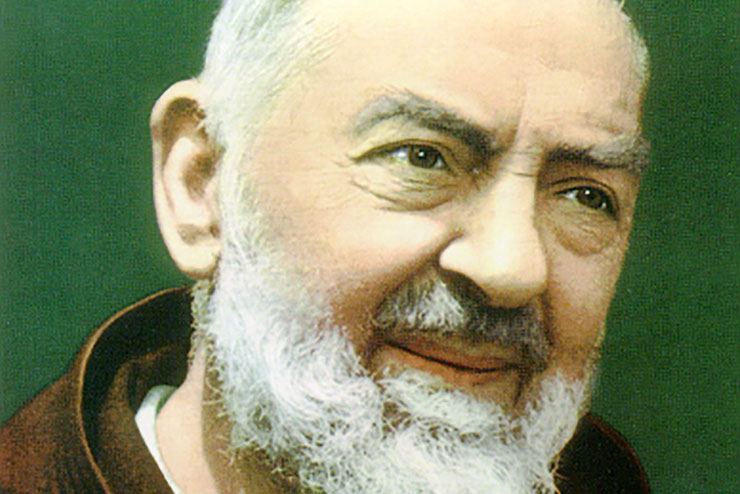
    Padre Pio Paranormal Man

    During the Second World War the Americans had an airbase in Bari, about seventy-five miles from San Giovanni Rotondo, a village in Southern Italy that houses Capuchin friary. According to US intelligence, the Germans had a munitions facility in the hills nearby; an officer was assigned the job of bombing it. As the planes neared San Giovanni, the officer saw in the sky before him the figure of a monk waving him back.

    Dumbfounded by this spectacle, the officer ordered the planes to turn back. When the war ended, he went to the friary and met the monk who had appeared in the sky. His name was Padre Pio (1887 – 1968).On a trip to San Giovanni Rotondo in 1979, I was unable to learn the officer’s name or any details confirming this fantastic story. According to Father Joseph Pius Martin, an American friar in San Giovanni, the pilot lives in Florida – the only additional lead I obtained.

    Stories like the flyer’s are legion. The work of sorting out fact from fiction is still underway. Many incredible claims about Padre Pio are well-documented; but many are based on hearsay, part of the folklore growing around the monk. One extraordinary thing about Padre Pio was his ability to induce belief in the extraordinary. He had a gift for catapulting people into a fairyland of living mythic powers. In Padre Pio’s world, ideas of fantasy and creatures of mythology come to life: Madonnas, guardian angels, shapeshifting demons, bilocation, magical cures, time-travel, and a good deal more. However you rate the literal truth of particular claims, his story is bound to disturb our routine picture of what is possible. Around the Padre, the incredible became credible, the impossible became actual.

    And yet, no matter how extraordinary the feats of Padre Pio, he was a human being. I assume therefore that his “miraculous” powers are latent powers of all human beings. I underscore this with reason. Some people will resist the claims about Pio because they might see them as meant to ratify church dogma. (The truth is that miracles have been used for propaganda.) However, while I grant that you cannot fully understand Padre Pio’s miracles apart from the symbols and archetypes of his Christian world, I also think they transcend that world and point to a universal human potential. Moreover, comparable phenomena from other traditions bear this out, the best contemporary example being the case of Sai Baba.1

    These phenomena point to possibilities rejected by the custodians of the intellectual and moral establishment: by scientific materialists, who make up the rank and file of academia, and by liberal and fundamentalist Christians, who wear their own conceptual blinkers. Since, however, a critical review of evidence is impossible here, I will restrict myself to trying to give a rough idea of the man, the range of his unusual powers, and to noting their possible implications for human evolution.

    EXTRAORDINARY ACCESS TO THE INTERNAL ENVIRONMENT

    From early childhood Francesco Forgione lived in a world of visionary hyper realities. At five he cried so much, especially at night, that his father once lost his temper and hurled him to the ground. Recalling these early years, Padre Pio said: “My mother would turn off the light, and a lot of monsters would come up close to me, and I would cry.”2 Padre Pio said of these early experiences: “It was the devil who was tormenting me.” Terrifying visions continued throughout his life, inseparable from his higher visions. Raptures, ecstasies, often lasting hours, in which his senses were suspended, occurred frequently. We know of these from his letters3 and from observations of his spiritual directors such as Father Agostino4 who eavesdropped on the Padre’s conversations with invisible beings. These included Jesus, Mary, Francis of Assisi, and his guardian angel. One has to read Agostino’s Diary to get a sense of the intense reality of Padre Pio’s visionary encounters.

    Padre Pio’s internal environment was also infested with dark hostile forces. The higher visions were preceded by shapeshifting diabolic apparitions: huge black cats, naked women who danced lasciviously before him, an invisible entity that spat in his face and tortured him with deafening noises, an executioner who whipped him. According to one of his confreres: “Padre Pio was very alert to unexpected movements and sounds. He said that the devil appeared to him in all shapes. He had fear even of a mouse, because the devil would start out as a mouse and turn into a claw and go for his eyes.”5

    These encounters were physical. In Pietrelcina, you can still see claw marks and splattered inkspots made by the alleged demons. Once, the iron bars of the monk’s cell were found twisted out of shape after a night of grappling with invisible forces. Although no one beside the Padre ever saw the demons, the din they made was often heard by eavesdropping monks. Even more striking, Padre Pio was often found unconscious, sometimes on the floor beside his bed, covered with bruises from the uncanny assaults.

    A well-witnessed event occurred in July 1964. A possessed woman was dragged to San Giovanni. When she saw Pio, she cried out in an unnaturally deep voice: “Pio, we will see you tonight.” That night the friars thought the house was struck by an earthquake. The Superior rushed to Pio’s room and found him on the floor, bleeding from the head. Oddly, there was a pillow under his head. Pio explained that the Madonna put it there. In the morning, the possessed woman (undergoing exorcism from another priest) shrieked: “Last night I was up to see the old man. I hate him so much because he is a fountain of faith. I would have done more, except the Lady in white stopped me.” This taxes my boggle-threshold as much as it must the reader’s; nevertheless, Schug based his account on eyewitnesses not disposed to sensationalism. Pio’s face was so disfigured he was unable to appear in public for five days. On another occasion he was found with broken bones in his arms and legs.

    The attacks lasted throughout his long life. In 1918 he wrote: “I cannot describe to you how those wretched creatures were beating me! Several times I thought I was near death. Saturday it seemed as if they really wanted to finish me….” (Epistolario, III, p.311.) Sometimes his afflictors came to him under the disguise of his spiritual director, Father Agostino, or as an apparition of a saint or guardian angel. Padre Pio had a technique for exposing these sinister masquerades, but not without having to endure a good deal of anguish and uncertainty.

    The psychologically sophisticated reader is bound to be skeptical about these reports of demonic assault. One might turn to Wilhelm Reich for an explanation. Reich believed such experiences were the result of repressed orgone energy turning against oneself. Or we could invoke the pathology of poltergeist phenomena to explain Padre Pio’s demons. I am not certain how smoothly these explanations would fit.

    The point I want to make about “demons” and evolution is this: It does appear, as a matter of psychological fact, that the more one advances in higher states of consciousness, the greater the likelihood of attracting combative, destructive forces that try to drag you back down to ordinary reality. The story of the Buddha struggling to meditate on the Immovable Spot under the Bo Tree is a classic Eastern illustration. In Pio’s case, the combat occurred at two levels: Throughout his life he was molested by invisible “diabolic” forces; but throughout his life he was also persecuted by jealous, envious, and malicious human beings, often individuals within the church hierarchy. It has, in fact, been argued by Ennemond Boniface6 that certain individuals in the church were responsible for the priest’s death.

    If Padre Pio had to battle sinister forces, he also received supernormal favours. In Padre Pio’s world, for instance, higher help took the form of his “guardian angel.” The notion of guardian angels may amuse modern rationalists; still, new age enthusiasts show a keen interest in the functional equivalent of such helping entities. Carlos Castaneda, you may recall, fascinated us with his talk of “allies,” those unspecified forces out there ready to help us. The phenomenon of “channelling,” its invocation of inner guides and otherworldly helpers, echoes the ancient doctrine of guardian angels. Similar parallels are notable in the UFO contactee literature.

    Padre Pio’s guardian angel was no slouch. One of his most striking achievements was to serve as translator of French and Greek, languages Pio was unacquainted with. Paranormal comprehension of Greek is more impressive than French, the latter being in many ways similar to Latin and Italian. In 1912, Agostino, by way of experiment, wrote letters to Pio in French and Greek. When Pio received them he was at Pietrelcina for medical reasons, under care of a parish priest, don Salvatore Pannullo. Pannullo wrote on August 25, 1919: “I, the undersigned, testify under oath, that when Padre Pio received this letter (a letter in Greek and in the Greek alphabet), he explained its contents to me literally. When I asked him how he could read and explain it, as he did not know even the Greek alphabet, he replied: ‘My Guardian Angel explained it all to me’.”

    The virtue of this report (unfortunately scant in detail) is that we must assume either that both Pio and Pannullo conspired in an act of pure deception or that the story is true. I personally doubt a conspiracy; the records point to Pio’s lifelong scrupulous adherence to truth.

    Guardian angel aside, we can assume the translation occurred by telepathy. But this would be telepathy of a rare order; for the telepathic transmission of skills (such as understanding a language) between living persons is unknown in experimental parapsychology. I might add that Agostino confirmed Pio’s ability to comprehend the letters written in French and Greek. There are also stories of Pio hearing confessions in languages he did not know.

    Apparently, guardian angels are well-rounded in their education; the following story shows they know something about automobile mechanics. In 1959, a woman was driving with her husband from Rome to San Severo. (The couple prefer to remain anonymous.) En route their car broke down; for two hours cars sped by without stopping. Toward nightfall, the woman grew anxious and began to pray to Padre Pio. Within ten minutes a black car pulled up and an elegant young man dressed in blue stepped out. He lifted the hood and said: “Look, you lost all the water from the radiator, and it’s burnt out. Take your can and fill it up with water. Near here, there is a farmhouse, which has a well; take the water from there.”

    The husband took the can from the car trunk and did as the young man said. The man then took a black box from his car, produced a roll of adhesive tape, and sealed the radiator. He had beautiful hands with agile rapered fingers. The dog, who normally barked at strangers, sat in the car’s back seat, strangely calm. The husband returned with the water and filled the radiator.

    “You can return home safely; anyhow, you are quite near,” said the mysterious helper, who then got in his car and drove off.

    The couple watched the car pull away and looked for the license plate. There was none! Instead they saw a white strip marked with hieroglyphics. The car moved away slowly on Via Aurelia; suddenly it vanished.

    Arriving home in a “dreamy state,” they reflected on further oddities: The young man somehow knew there was an empty can in the trunk; also, that they lived “quite near.” Later they tried to relocate the well and farmhouse but despite diligent efforts were unable to. There was no farmhouse in the area where their car broke down.7

    Padre Pio’s extraordinary access to his internal worlds included access to other people’s internal worlds. Two well-attested examples were his ability to read minds, especially in the confessional, and his ability to change or convert minds.

    Like Saint John Vianney, the famous Curè of Ars, Padre Pio displayed supernormal powers of mind reading in the confessional. Hearing confessions was paramount in Pio’s long ministry. Hour after hour, day after day for over fifty years, he sat in a wooden booth and listened to people pour out their most intimate secrets.

    John Schug, who wrote one of the more critical books in English on Pio,8 tells of a confessor who had the intention to murder his wife. “Murderer!” Padre Pio roared in the church. The man skulked away and returned the next day, penitent and purged of his intention.

    Schug provides a detailed first-person account of Federico Abresch’s confessional encounter with Pio. According to Abresch, a Lutheran convert, Pio recalled actions and thoughts he had long forgotten. “He enumerated with precision and clarity all of my faults, even mentioning the number of times I had missed Mass.” Pio reminded Abresch of something he had forgotten years ago when he got married. In fact, it was only through Pio’s remarks that Abresch was able to reconstruct his past. Pio apparently had a more exact knowledge of Abresch’s unconscious mental history than Abresch.

    Abresch, by the way, regarded this as proof that something more than merely human “thought-transference” was involved. The fact that Pio could “read” the unconscious of another person seemed evidence of God’s action, something totally beyond human potential. But Abresch is mistaken. Evidence from mediumship and experimental parapsychology show that telepathic leakage from another person’ s unconscious does in fact occur. Once again I believe we are dealing with a general potential of the human mind, brilliantly manifest in exceptional beings such as Pio.

    Padre Pio’s access to internal environments enabled him not just to read but to change or convert minds. The Gospels portray Jesus as a man who took immediate psychic possession of his disciples. Pio too apparently had this ability; consider the following example from Schug.

    Unemployed Laurino Costa sent Padre Pio a telegram asking for prayer to help him find a job. The Padre telegrammed back: “Come to San Giovanni Rotondo at once.” The young man arrived penniless and was standing with a crowd of men in the sacristy. Padre Pio, who had never met Laurino, shouted at him: “Laurino, come here. I see you have arrived.” Bewildered, the youth approached. “Laurino, you will feed my sick.” (A cook was needed in the new hospital.) “But Padre,” Laurino protested, “I’ve never cooked an egg in my life.” The Padre insisted: “Go and feed my sick. I’Il always be near you.” Laurino went to the hospital and rang the doorbell. The Mother Superior answered: “You must be the experienced cook we’ve been waiting for.” Within three hours he was at work. Laurino admitted to Schug: “To this day (14 years later) I still don’t know what happened. All day long I found myself calmly working and telling others what to do, as though I was carrying out a routine I had been used to.”

    MASTERY OF TIME AND SPACE

    Reports abound of Pio’s double appearing everywhere, from the American midwest to China and Africa. The idea of bilocation blatantly contradicts the belief that a human being is a physical object occupying one space. The idea that Jack could be at 42nd Street and Fifth Avenue in New York and simultaneously at Main and Third in Shebogan, Wisconsin, is obviously absurd. Nevertheless, the annals of saints, yogis, and psychics are full of bilocation stories, sometimes well attested.

    Padre Pio bilocated by means of his voice, his presence, his aroma; he appeared in people’s dreams and sometimes he appeared fully materialised.

    Mary Pyle, one-time secretary to Maria Montessori, spent the last 45 years of her life in San Giovanni Rotondo. In her diary she wrote: “One day I went into the sacristy and said to Padre Pio: ‘Father, I believe my mother is in Florence today.’ His immediate answer, given with certainty was: ‘No, she is in Umbria.’ Surprised I said, ‘No Father, I do not believe she was supposed to go to Umbria.’ But he insisted, looking far into space. ‘She’s been in Umbria.’ A few days later I received a letter from my mother who told me: ‘Thank Padre Pio for the visit he paid me while I was sick in bed in Perugia (which is in Umbria). I did not see him with my eyes, nor did I hear him with my ears, but I felt his presence near my bed’.”9

    Padre Pio knew in advance he would be able to bilocate at a particular place. The Vicar General of Uruguay, Monsignor Damiani, a frequent visitor at San Giovanni, once told him he wanted to die in San Giovanni; he wanted Pio to assist at his death. Pio said the Vicar would die in Uruguay, but promised assistance anyway when the day of reckoning came. In 1941, the Vicar died in Uruguay. Cardinal Barbieri was in the house where Damiani resided the night he died. Someone knocked on his half-open door. He noticed a Capuchin pass, got up and went to Damiani’s room. The Vicar had just died of a heart attack, but left a note on his dresser: “Padre Pio was here.”10

    Many bilocation stories revolve around healings. A typical example: June 12, 1952. Lucia Bellodi, stricken with pernicious diabetes was on her death bed when she sat up and began to wave her hands. She cried out that Padre Pio had appeared to her, told her she was cured and that she should come to his monastery. By June 16 she regained her speech and stopped having to consume twenty-five quarts of water a day. When she visited the Padre he smiled and said: “I’ve been waiting for you.”

    A tantalising case is that of Cardinal Mindszenty. According to a reliable Vatican source he once received a “visit” from Pio while imprisoned in Communist Hungary. The monk of course was in San Giovanni, but his double turned up with water, wine, and altar breads, served Mass and vanished. When Schug wrote to confirm this from Mindszenty, he received back a one-sentence letter: “I cannot say anything about that.” If the story were false, it’s not clear why the Cardinal didn’t say so, unless he meant to perpetuate a pious myth.

    This form of bilocation, if it actually occurred, implies materialisation of the double and teleportation of objects. There are, in fact, many reports, some of them reasonably compelling, of other saints bilocating at great distances and teleporting physical objects. Two outstanding examples are Saint Martin of Porres and Sister Maria Agreda of Spain. Scott Rogo’s book, Miracles,11 documents the prodigies of these two saints.

    I want to note in passing another phenomenon related to Pio’s bilocatability. He was, on many occasions, said to disappear from the confessional, a structure in full view and always surrounded by crowds of devotees. He would reappear in the rectory or sacristy. Asked about these disappearances, which occurred when he had a hard time breathing, the Padre would casually remark, “I flew over your heads.”

    Perhaps the best authenticated type of Pio’s bilocation was via his characteristic odour. The odour of sanctity is linked with the phenomenon of bodily incorruption.12 The incorrupt bodies of saints are known to give off inexplicable fragrances, but with Pio the paranormal fragrance made his presence known to people at a distance. The scent emanated from his person and also, contrary to nature, from the blood that came from his stigmata. The first doctors who examined him actually complained that the monk was using perfume. Padre Pio’s brand of “perfume” however, was noticed by people far away from him, sometimes thousands of miles.

    Bernard Ruffin, whose book on Pio is the best in English,13 gives a detailed account of the fragrance occurring to a Lutheran seminarian, Robert Hopcke, in Plainfield, New Jersey in 1978, ten years after Pio’s death. William Carrigan, normally skeptical of miracle stories, reported to Ruffin his perception of the aroma at his desk at Foggia (about twenty miles from the monastery): “I had no trouble in identifying the aroma as that of Padre Pio. It wasn’t something you could confuse with any other odour.” Padre Alberto D’Apolito, Pio’s confrere for many years, wrote in 1978: “The reality is that hundreds of thousands of individuals, even unbelievers, have testified and continue to testify that they have suddenly and inexplicably perceived the perfume of Padre Pio.” Emilio Servadio, a Jew and leading Roman psychoanalyst, had a powerful experience of Pio’s scent during a visit to San Giovanni in 1937.

    If the Padre had a knack for “prolonging his personality”14 in space, he could also prolong it in time. Precognition, if a fact of nature, wrenches our normal view of time, cause and effect. (It seems impossible for something that hasn’t occurred to influence us in any way). Even so, there are countless claims of Pio’s paranormal forays into the future. These were usually done offhandedly, never as public pronouncements. Pio was unusually prescient about what Italian cities would be bombed during the war and what soldiers would return.

    Like spiritual masters in other traditions, Pio foretold the year of his death. He often had prevision of others’ deaths. A young priest, Father Dionisio, on his way to Venice for studies, said goodbye to Pio. “Studies! Studies!” Pio muttered, “think of death, instead, so that when it comes…. “ His voice trailed off. A confrere who overheard commented on Pio’s strange way of saying goodbye. Pio shrugged wistfully. Twenty days later the young priest was dead. In 1983 Pope John Paul was almost assassinated; I watched a Vatican official on TV say that Pio had told the Polish Cardinal years ago he would one day be Pope; he also said the Polish Pope would be brought down in blood early in his tenure. I hope Pio’s prophetic gift is flawed, for he once said a war was coming which would destroy two thirds of humanity.

    SYMBOLIC TRANSFORMATION OF PHYSICAL REALITY

    In my view, supernormal psychic phenomena reflect an evolutionary trend toward increasing porousness of matter to the goals of consciousness. It is as if some restless shapeshifting creative spirit were struggling to make matter plastic and permeable to human dreams and desires – especially the matter of the human body.

    Eastern, occult, and Christian traditions speak of the subtle, astral, pneumatic, or light bodies. The physical phenomena of mysticism reflect this trend toward the symbolic transformation of the body of flesh into a more expressive body of light. Incorruption, luminosity, inedia, the odour of sanctity, levitation, and other phenomena may be looked at from this perspective.

    The stigmata illustrate the malleability of the human body to the power of the spiritual imagination. Francis of Assisi was the first to reproduce the wounds of Christ in his own body, and since Francis hundreds of cases have been reported. The Church by and large takes a dim view of these often bizarre lesions, recognising they may be symptoms of hysteria as much as signs of heroic sanctity.

    But Padre Pio’s stigmata were unique. Visible for over fifty years, the apertures in his palms were perfectly circular, and were never inflamed, infected, or suppurated; the blood, which gushed from all five wounds, was copious and bright red. It effused an unnatural fragrance. At his death the wounds healed without a trace of scar tissue, a fact that is dermatologically inexplicable. While some cases of stigmata can reasonably be ascribed to hysteria, let me at least note that nobody adequately informed would dare to characterise this down-to-earth, often uncouth, ironical, and fanatic-despising man as hysterical.

    With Francis and Pio, the wounds arose from a passionate identification with the crucified Christ. Whether we think of the stigmata as miraculous or pathological, at the very least they say something about the physical power of the imagination; if imagination can produce such extraordinary lesions, it could be mobilised for healing purposes. The stigmata show the power of the imagination to mold the human body. Here life imitates art; both men, be it noted, were first stigmatised while contemplating artworks showing the crucifixion. The stigmatised body is a living sculpture.

    Padre Pio’s fame is also due to his reputation as a healer. Reports of extraordinary healings continue even after his death. Many, if not most, of the healings ascribed to Padre Pio were probably psychosomatic. Intense faith, expectation, contact with an authoritative figure like Padre Pio might well lead to improvement in many functional, psychogenic disorders.

    But many stories, if true, imply a radically higher type of healing. For example, there is the account of Vera Calandra’s dying child materialising a new bladder; of Gemma di Giorgio’s pupilless blind eyes being made to see; and of Giovanni Savino’s blown out eye (due to a dynamite accident) being rematerialised. So far, however, the medical documentation I’ve seen for these claims is less than compelling.

    Claims for medical clairvoyance also exist. In the early 1950s Padre Costantino Capobianco had a sinus problem. X-rays were taken; three doctors recommended surgery. “What are these things?” asked Pio about the X-rays. “They’re all wrong.” A fourth specialist was consulted; the X-rays were misinterpreted, the surgery unnecessary.15

    Padre Pio once said his real work would begin after his death. Moreover, the Church requires of her duly canonised saints evidence of postmortem miracles. This seems like a tough requirement, but a possible example may be the following: Teacher Alice Jones of Liverpool, England, suffered from neurofibroma, which paralysed her from the left hip to the toe. Alice, 50, a Protestant, was visited by a Catholic priest, Eric Fisher, who prayed over her. “As he knelt there,” said Alice, “there appeared another figure rising from his body. I was so frightened I couldn’t move. The figure had the face of an old man with a white beard. He spread his hands in front of me and I could see the holes in his palms. I seemed to hear the words, ‘Stand up and walk.’ So I did. And I suddenly felt whole again. Suddenly I was no longer crippled and the man was gone.” Later she recognised the face of the man who cured her in a photo of Padre Pio. Dr. Francis Mooney, a Liverpool physician, testified: “I have very often come across neurofibroma and have never heard of a single case where it has cleared up spontaneously…. I had her X-rayed. There is no medical explanation for the fact that she is completely cured.”16

    The healed body is a foretaste of the resurrected body. Supernormal healings are symbolic of the transformation of the corporeal body into a spiritual body. The odour of sanctity is another example of the symbolic transformation of natural bodily existence. The symbolism is clearest in bodily incorruption. Once the Christian imagination projected the vision of a new man – a new spiritual body – the dead bodies of Christian saints begin to behave oddly. They don’t decay like other corpses. Perversely, they stay intact, moist, flexible, for months, for decades, sometimes for hundreds of years. They exude mysterious oils, occasionally bleed, and often give off remarkable fragrances. It is as though an energy has been released that opposes bodily decay, something that holds entropy in contempt and wants to revise the symbolism of death.

    Another phenomenon expressing this symbolic modulation of matter is levitation. Levitation is not well-attested in Pio’s life (whose speciality seems to have been bilocation). However, the phenomenon has been well-documented among the saints, notably Teresa of Avila and that all-time great, mystical acrobat, Joseph Copertino. Numerous creditable witnesses observed Joseph’s aerial antics for decades.17 Levitation strikes against one of the fundamental forces of nature – the forces of gravity. Among the saints, it is a dramatic physical expression of the soul’s ecstatic flight. Levitation, as displayed by Joseph and Teresa, symbolises the ascent toward the Most High.

    It shows humanly formed matter shedding fundamental limitations; I think in the case of Joseph we are witnessing one of the creative prodigies of the symbolic imagination, a phenomenon that throws open the doors to new worlds of speculative possibilities. A careful study of Joseph’s aerial flights will show that they were occasioned by specific types of imagery of a) heavenly elevation and b) the Madonna or archetype of the feminine. The levitations were physical expressions of imaginal worlds, and I would put them on a continuum with the stigmata or other types of expressive imaginally-guided human products such as works of art.

    As for Paranormal Man, perhaps the ecstasy of the saints holds the secret to our escape from planet Earth, our entree to navigating the galaxies. Anyone acquainted with the literature of flying saucers knows how frequently levitation phenomena are reported. The phenomena take many forms. Gravity-suspending beams of light, for instance, seem to lift individuals into apparent spacecraft. The alien spaceships themselves make light of the rules of terrestrial flight dynamics. In the case of Joseph of Copertino, the greatest levitator in recorded history, passionate sublimated love, aimed toward the archetypal figure of Mary in Heaven was the fuel enabling him to suspend the geometry of the universe. In Joseph’s future space technology, ecstatic love is the power that suspends the law of gravity.

    The funny sky epiphanies we call UFOs might, for all we know, be dislocated dreams or ecstatic projections of alien visionaries from other worlds. The phenomena of bilocation and levitation may be clues to the secrets of hyperspace travel and the answer to the great UFO mystery. Other beings on other worlds are likely to have had millions, if not billions, of years to evolve these crudely and fleetingly manifested capacities of our terrestrial saints and shamans.

    Another item in Pio’s supernormal physiology was hyperthermia. Padre Pio produced abnormal amounts of bodily heat. Doctors had to use huge bathroom thermometers to take his temperature, which often shot up to 125 degrees; the mercury in ordinary thermometers broke the glass. Extreme irregularities in bodily function are well known among shamans18 and other ascetic types. Teresa Neumann19 who had the stigmata and who evidently neither ate nor drank for years, is a modern case of an ecstatic plagued by bizarre bodily symptoms. In the case of Padre Pio, supernormal heat production is definitely related to what’s going on inside the man. It seems clear to me that we are dealing with a case of symbolic transformation.

    From his letters and statements, we know one thing for sure: The Capuchin was literally burning with love for Jesus. Young Pio wrote a letter to Padre Benedetto on October 22, 1919, describing what happened to him just before acquiring his fully visible stigmata: “I cannot tell you what happened in that moment,” he wrote, “which was a moment of sheer martyrdom. On the evening of the 5th, I was hearing a boy’s confession (a seminarian at San Giovanni Rotondo) when all of a sudden I saw a most exalted heavenly person. I was plunged into extreme terror. He stood before the eye of my mind, holding some kind of special instrument in his hand, like a very long iron spear with a well-sharpened point. It seemed that fire shot out of its point.

    “Seeing this person and watching him plunge the instrument violently into my soul happened in an instant. I groaned with pain and felt as if I were dying. I told the boy to go away because I felt ill.

    “This agony lasted without interruption until the morning of August 7…. It seemed that even my viscera were being pulled out by that spear. Every fibre of my being was consumed by fire.” The heat effects, observed in saints known for their holy ardours, proceed from internal causes; they do not seem to be produced by normal physical forces.

    When I spoke with reliable informants at San Giovanni I was told of even stranger powers the Padre had over physical nature. For instance, Pio had the apparent ability to direct the behaviour of animals; in one story, a woman with problems getting up on time for Mass was sent a bird to awaken her and a troop of local stray dogs to escort her to the church on time. Francis of Assisi tamed the Wolf of Gubbio with soultalk and (in a practical vein) with the help of a decent meal. Linnets and lambs, hares and songbirds were said to obey the commands of Joseph of Copertino.

    The Gospels tell us that Jesus calmed a storm at sea. There are contemporary reports of shamans commanding the elements. For instance, John Neihardt witnessed Black Elk conjure rain from a cloudless afternoon sky “during a season of drought, one of the worst in the memory of the old men.”20 David Barker, an anthropologist, was in Dharamsala, India, on March 10, 1973, when he observed a Tibetan priest-shaman, Gunsang Rinzing, stop a rainstorm to permit a festival of mourning. The shaman had built a large fire and recited with intense concentration mantras for 20 hours. Barker writes: “ …the rain had diminished to a drizzle, and by 10 o’clock it had become only a cold fog over a circle with a radius of about 150 meters. Everywhere else in the area it continued to pour, but the crowd of six thousand refugees was never rained on…” Barker observed that the atmosphere had an “airless” quality and reports feeling disoriented for weeks after the experience.21

    In light of these observations it is easier to entertain accounts such as those of a Roman engineer Pasquale Todini who said Padre Pio sent him away from the monastery during a torrential rainstorm but arrived in town dry. In the course of the engineer’s walk, the rain around him was reduced to a sprinkle. (See Carty’s account of this, pp.57-58.)

    Enough has been said to indicate the range of Padre Pio’s curious capacities: special access to internal environments, mastery of time and space, symbolic transformation of physical reality. I offer no attempt to explain any of this, or for that matter to prove it rigorously. Padre Pio, though a unique spiritual personality, is only one example of extraordinary types from the world of Western and Eastern mysticism, mediumship and shamanism. The interesting thing is what all this might be saying about the possible future of humanity.

    Alfred Russell Wallace, it may not be too well known, was the co-founder along with Charles Darwin of the modern theory of evolution. What is even less well known is the fact that Wallace, a scientist of unquestioned genius, was a close student of psychic phenomena. Most mainstream scientists prefer to shove this embarrassing fact under the rug. In my opinion, however, Wallace’s openness to psychic phenomena prove him to be an even greater scientist than is supposed; for Wallace took a second giant step in trying to build a bridge between psychical research and the theory of evolution.

    Wallace did firsthand investigations into the physical phenomena of mediumship and, as he said, found himself “beaten by the facts.” Wallace took spiritualism quite seriously. “It would appear then,” he wrote in 1878, “that if my argument has any weight, that there is nothing self-contradictory… in the idea of intelligences unrecognisable directly by our senses, and yet capable of acting more or less powerfully on matter.”22 Wallace suggested that some principle of psychic intelligence was needed to round out the approach to the problem of evolution. He stated emphatically that Natural Selection “is not the all-powerful, all-sufficient, and only cause of the development of organic forms.”

    Modern biology has followed Darwin, who was not interested in the strange phenomena Wallace had taken the trouble to investigate. But in my opinion, Alfred Wallace laid the groundwork for the better evolutionary paradigm. Open to all the crucial data, it was a paradigm based on the hypothesis of a general intelligence at work in evolution, capable of transcending space and time, and geared toward the transformation of organic nature in accord with the creative imagination of the human spirit. Wallace opened new horizons in our thinking on human evolution; he would have found an ally in Padre Pio.
    [alert type=”general” dismiss=”no”]This article was published in New Dawn Special Issue 9.[/alert]

    [alert type=”success” dismiss=”no”]If you appreciate this article, please consider subscribing to help maintain this website.[/alert]

    REFERENCES

    1. E. Haraldsson, Miracles Are My Calling Cards: An Investigative Report on the Psychic Phenomena Associated With Sathya Baba, Rider: London, 1987.
    2. Padre Pio of Pietrelcina: Acts of the First Congress of Studies Padre Pio’s Spirituality, Ed. Gerado Di Flumeri, San Giovan: Rotondo, 1972.
    3. Epistolario of Padre Pio, Vol. 1, San Giovanni Rotondo: 1973.
    4. Diario, Agostino da S. Marco in Lamis, San Giovanni Rotondo: 1975.
    5. J. Schug, Padre Pio: He Bore the Stigmata, Huntington, Indiana: Our Sunday Visitor, p.55, 1975.
    6. E. Boniface, Padre Pio Le Crucifie, Nouvelles Editions Latines: Paris, 1971.
    7. A. Parente, Send Me Your Guardian Angel, Our Lady of Grace Friary: San Giovanni Rotondo, 1983.
    8. Ibid.
    9. The Voice of Padre Pio, Vol. 5, No.3, 1975, pp.14-15.
    10. C.M. Carty, Padre Pio the Stigmatist, Rockford, Illinois: Tan, 1973.
    11. D.S. Rogo, Miracles, The Dial Press, New York, 1982.
    12. C. Cruz, The Incorruptibles, Rockford, Illinois: Tan, 1977.
    13. B. Ruffin, Padre Pio: The True Story, Huntington, Indiana: Our Sunday Visitor, 1982.
    14. This was the expression Padre Pio used to explain how he bilocated when someone asked. Other times he just said God sent him places. The interesting point is he himself continually affirmed the reality of his excursions through hyperspace. For another angle on the evidence, his confreres often heard him giving absolution or otherwise conversing with invisible or far-off beings.
    15. See Ruffin, p.266.
    16. The Friends of Padre Pio (newsletter), Vo1. 2, 3, pp.14-16.
    17. A. Pastrovicchi, Saint Joseph of Copertino, Rockford, Illinois: Tan, 1980.
    18. M. Eliade, Shamanism: Archaic Techniques of Ecstasy, Princeton: Princeton University Press, 1970.
    19. C.M. Carty, Who is Teresa Neumann?, Rockford, Illinois: Tan, 1974.
    20. J. Neihardt, Black Elk Speaks, New York: Pocket Book, 1972. See the postscript.
    21. D. Barker, Psi phenomena in Tibetan culture, Research in Parapsychology, 1978, Metuchen, New Jersey: Scarecrow, 1979, pp.52-55.
    22. A.R. Wallace, Miracles and Modern Spiritualism, London: Spiritualist Press, 1878.

    © New Dawn Magazine and the respective author.
    For our reproduction notice, click here.