New Dawn – World's Most Unusual Magazine

Author: Michael Howard

  • Truth About the Knights Templar

    Truth About the Knights Templar

    From New Dawn Special Issue 11

    So many books, articles and academic treatises have been written about the Order of Poor Knights of the Temple of Solomon in Jerusalem – usually shortened to the Knights Templar – that it is difficult to separate fact from fiction, or fantasy.

    Founded in CE 1118 by a French nobleman to protect the pilgrim routes from southern Europe to the Holy Land or Palestine, it was originally a company of only nine knights. It increased in size in the next ten years until it had 15,000 warrior monks and 40,000 lay members and was the richest religious community in Christendom. Its eventual downfall and destruction was just as dramatic as the chaste Christian knights were accused of practising ‘unnatural sin’, blasphemy, heresy, and devil worship.

    The sudden rise of the Templars, their considerable wealth obtained by loading their empty ships with spices, silk and other luxury goods on the journey back to Europe, and their special status within the Roman Catholic Church, brought criticism and created powerful enemies.

    Even the Vatican became critical of the Order, and in 1207 Pope Innocent III denounced the knights for their excesses and for “employing doctrines worthy of demons.” A year later he issued a papal bull because the knights had refused to accept his authority and replaced it with that of their own Grand Master. In 1238 Pope Gregory IX even accused the Templars of practising heresy but no charges were brought against them.

    The term “pride of a Templar” became commonplace as a description for any arrogant person. In battle, despite their religious beliefs or perhaps because of them, the Templars were renowned for their courage and ruthlessness. When sacking cities and towns in Palestine the knights showed no mercy, killing men, women and children indiscriminately so that the streets literally ran with the blood of the massacred. This was despite the fact that the Order was rumoured to have made secret alliances and deals with the Saracens. It is possible these were of the same nature as the financial deals allegedly made between some NATO troops and Taliban forces in the modern Afghan war.

    In France the Templars owned large tracts of land and many properties including whole villages that they ruled as feudal landlords. The Order owed no allegiance to the French crown and paid no taxes to the states on their income as merchants and farmers. Eventually this brought them into open conflict with the French king Philip IV, also known as Phillipe Le Bel or the Fair. When he came to the throne he found the kingdom he had inherited was bankrupt. Vast sums of money had been spent in funding the crusades to the Holy Land and in real terms the Templars were wealthier than the king. At first Philip turned on the Jews as a source of income, and then he began to consider the Templars and plotted how he could discredit them and seize their assets.

    To move against the Order Philip first needed to get rid of the incumbent pontiff, his arch-enemy Pope Boniface VIII. The king publicly accused him of atheism, blasphemy and immorality and in 1305 managed to get him replaced by his own puppet pope, Clement V, who ruled the Church from Avignon in France instead of Rome.

    Rumours about strange activities within the Order of the Temple and their heretical beliefs had been circulating for some years. It was said they had an inner circle who worshipped a golden calf, a human head or skull, or a cat or goat-headed idol with obscene rites. Their monastic rule of chastity was apparently a sham as the knights practised the ‘unnatural vice’ of homosexuality as part of their secret rituals of initiation into the Order.

    When three knights were expelled from the Order for grave misconduct and offered to inform on their former comrades, King Philip saw his chance to act. He tricked the Grand Master of the Templars, Jacques de Molay, into leaving his headquarters in Cyprus and travel to Paris on the pretence that the king wanted to discuss launching a new crusade. De Molay duly arrived at the French court bearing 150,000 gold florins and ten horse-loads of silver ingots as a gift to the king. While De Molay and his personal bodyguard were staying at the Templar commanderie in Paris, King Philip closed his trap on the Order.

    On 13 October 1307 the king ordered dawn raids on the Paris headquarters and De Molay and sixty of his knights were arrested. Orders had also been issued to provincial governors all over France and simultaneously all the Templar religious houses were raided, their members arrested and, most importantly for the king’s cunning plan, their physical assets were seized by the crown.

    A month later Pope Clement V meekly issued a papal bull addressed to the monarchs of Europe informing them the Templar Order had been declared heretical and they should arrest all its members in their lands. Some obeyed the papal decree but in some countries the Templars were virtually unharmed and its members were assimilated into other chivalric orders.

    In total eighty-eight charges were brought against the Templars in France with the support of the pope, who in fact got involved in the legal proceedings against them. Two early charges, of consorting with women and being inclined to Islam, were dropped. However, the other charges remained, and these were that the knights had denied Christ as the saviour and redeemer of humanity, spat and trampled on the cross at their initiations into the Order, adored an unspecified idol, perverted (desecrated) the sacrament, practised ritual murder, wore a cord “of heretical significance,” performed “ritual kisses” during naked initiation ceremonies, and were traitors to the other Christian forces in the Middle East.

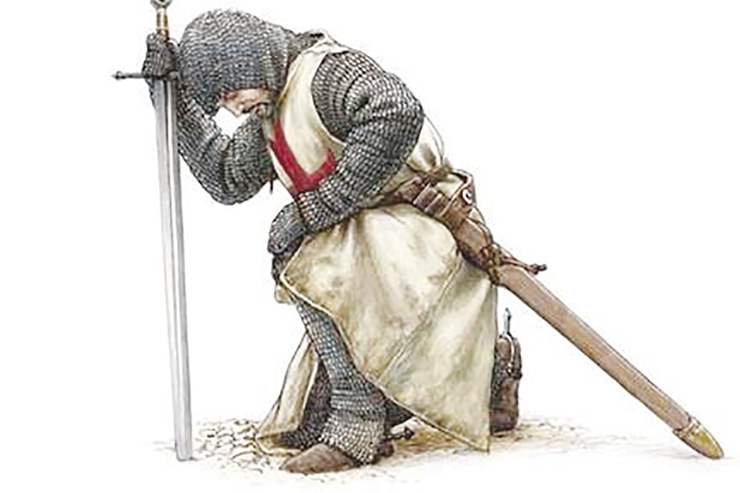
    Knights who had been inducted into the inner circle of the Order confessed that the Templar priests had forced them to deny and renounce Christ. They were told he was a false prophet and made to spit three times on a crucifix and trample it underfoot. Some candidates were reluctant or too scared to carry out this blasphemous act and were forced to do it at sword point. Others who still refused were punished by being flogged daily and put on a ration of bread and water until they agreed.

    New Evidence about the TemplarConfessions

    In 2003 the historical researcher Dr. Barbara Frale was allowed access to documents previously held in the ‘secret archive’ of the Vatican library relating to the trial of the French Templars at Chinon in 1310. Known as the Chinon Parchment, this document describes the confessions of the leading Templars in France including the Order’s French Grand Master. The confessions were freely given without torture and the trial took place with Pope Clement present. Evidence was provided of the initiation rite into the Order involving spitting on the cross. However, in their defence, the knights said that this act was merely carried out as an ordeal to test the candidate’s mettle. It was to see how they would cope if captured by the Saracens and forced to renounce their faith.

    One of the charges made against the Templars was that at their initiation they had to strip naked. The priest who was presiding over the ceremony then kissed the candidate on the mouth, the naval (solar plexus), the ‘base of the spine’ and on their penis. This evidence was regarded by the Inquisitors as proof the knights had broken their sworn vow of chastity and indulged in the sin of homosexuality. In fact this practice may be linked with the accusation the Templars were traitors who made pacts with their Saracen enemies. In 1166 twelve Templar knights were hanged in Jerusalem for betraying a Christian fortress in Jordan to the army of the emir of Damascus.

    It was claimed the Templars had made a secret pact with the infamous Order of Assassins and also had connections with the heretical Islamic sect of Sufis. It is possible that through these contacts the Templars had been exposed to certain mystical or occult practices of the Saracen mystery schools. In these the master breathes on certain parts of the initiate’s body to stimulate the psychic centres or chakras. This practice could be easily misinterpreted as kissing.

    As we have seen, the Templars were accused of worshipping a non-Christian god represented as an idol or image. This took variously the form of a human head or skull, sometimes with two or three faces, a large black cat or a goat, and even a cockerel-headed man, that has been identified by some writers with the Gnostic deity Abraxas. In fact, a figure of this description has been found on Templar seals. Descriptions of the head described it as having ‘old skin’ as if it had been embalmed or mummified and eyes that ‘flashed like lightning’. Others said it was a skull made of silver or black metal. One Templar from the Parisian commanderie said the head had a long beard and the knights knelt before it and kissed it calling it their saviour. One Irish knight said the skull had spoke and it was claimed that such oracular sacred heads were common among the Syrians.

    Some have suggested the image worshipped by the Templars was the Shroud of Turin. Dr. Barbara Frale claims to have found the confession of a French Templar called Arnaut Sabbalier in the Vatican’s secret archives. In it he said he was shown “a linen cloth on which was impressed the image of a man.” He was told to kiss the feet of this image three times in veneration. Dr. Frale said the Shroud, which is supposed to be a medieval forgery, went ‘missing’ between the fall of Constantinople (modern Istanbul) in 1204 and the early fourteenth century. During this period Dr. Frale claims it was in the guardianship of the Order of the Temple.

    When the idol was in the form of an image of a black cat or cat-headed god, it was associated with fertility and was supposed to bring good harvests to the farms owned by the Order. In England a Templar called Stephen of Stapelbrugge was interrogated in June 1311 and asked if he knew anything about the adoration of a cat. He replied that such an idol was not known in England but he had heard of its adoration by the Order “in overseas parts.” Some writers suggest this feline deity may have represented the ancient Egyptian cat and lion-headed goddesses Bast and Sekhmet.

    One image found in a French commanderie depicted a demonic figure with a feline face, beard, female breasts, bat wings, cloven feet and horns. The 19th century French occultist Eliphas Levi (Alphonse Louis Constant) identified this figure as ‘Baphomet’. His famous illustration of it shows a hermaphrodite figure with a goat’s head, a human torso with female breasts, and goat’s legs with hoofed feet. On its forehead is a pentagram, the five-pointed Morning Star of Lucifer the Lightbearer, and between its horns blazes a candle representing the Gnostic light of spiritual illumination. Levi described Baphomet as a pantheistic image of the Absolute. Other occultists identify him with Azazel, the biblical scapegoat and leader of the Watchers or fallen angels who taught civilisation and the magical arts to early humans.

    Although the persecution of the Templars was concentrated in France, the papal bull issued by Clement V to the royal heads of Europe spread it all over the Continent. The pope sent a separate letter to King Edward II of England instructing him to arrest all Templars in the country. At first the king refused to obey, even telling the pope the English Templars were innocent and remained faithful to the Roman Catholic Church. However, politics intervened, as not only was King Edward betrothed to the daughter of the French king, but he also needed the support of the pope in his struggle to keep the throne of Scotland threatened by Robert the Bruce. Reluctantly Edward issued orders to all the sheriffs in England to detain the Templars in their areas. But he commanded they should not be held in “harsh conditions” or subjected to torture.

    Many English Templars had already gone underground and the sheriff of York was rebuked by the king for allowing Templar knights to “wander throughout the land” disguised in secular clothes. Because Edward had forbidden the knights to be tortured, very little evidence was gathered against them. In one case the only evidence of wrongdoing was the testimony of a young boy who said a common saying among his contemporaries was “Beware the kiss of a Templar.” Where evidence was found the knights concerned were sent to monasteries as penance and the Order’s estates and properties were seized by the crown or handed over to rival military-religious organisations such as the Knights of St John. In 1292 it was said there were still over fifty estates in England in Templar hands.
    How the Templars Became Linked with Freemasonry

    In Scotland the situation was more complicated due to the ongoing struggle for the throne. King Edward had to keep the pope’s approval and he did that by accusing the Templars of heresy. The first trial of the Scottish knights began in October 1309 at the royal palace of Holyrood House, but only two defendants were brought before the court and both of them were Englishmen. Masonic sources claim that when the Order was suppressed in France the Templar commander of Auvegne fled by ship with eight knights and landed at Mull in Scotland. There they allegedly joined up with other Templars who had escaped from England and the Order survived. An alternative version says the Order survived under the auspices of the Knights of St John or Hospitallers and became associated with the operative lodges or guilds of stonemasons that eventually became Freemasonry.

    In the fifteenth century King James II of Scotland is supposed to have appointed Sir William St Clair of Sinclair as the “patron and protector of Scottish masons” and decreed it would be a hereditary title. Sir William is famous as the architect and builder of Rosslyn Chapel, whose unique medieval stonework has carvings of images drawn from biblical, pagan, Masonic and Gnostic sources. Rosslyn also has connections with the Scottish Templars and is said that, like King Solomon when he built his temple in Jerusalem, Sir William hired “artificers from foreign kingdoms.” In fact, the ground plan of the chapel is said to be based on that temple.

    In a lecture called ‘The Origins of Freemasonry’ given in the Albert Halls in Stirling, Scotland, in 2001, the Masonic historian Dr. Robert Lomax claimed that the layout of Rosslyn Chapel was an exact replica of the third temple in Jerusalem built by King Herod and destroyed by the Romans in the first century CE. He also claimed a carving in the lower frame of the window in the south-west of the Scottish chapel depicts the first degree initiation of Entered Apprentice in Freemasonry. In the image a man is shown kneeling between pillars, the twin pillars at the entrance to Solomon’s temple and also seen in Masonic lodges. He is depicted as blindfolded with a halter or noose around his neck. The end of the rope is held by a second man who appears to be wearing the tunic of the Knights Templar with its distinctive equal-armed cross. The candidate is holding a book – the Bible? – which has an identical cross on its cover.

    Dr. Lomas pointed out in his talk that the only other figure depicted in the carvings at Rosslyn with a noose around its neck is an image of Shemyaza, one of the alternative names for the leader of the Watchers or fallen angels mentioned in the Bible and the apocryphal Book of Enoch. He went on to claim from Masonic insider knowledge that William St Clair built the chapel at Rosslyn to house or conceal certain artefacts excavated by the Templars from beneath the ruins of the temple at Jerusalem. Other writers have speculated that the chapel is the repository for the Holy Grail or even the head of St John the Baptist.

    It is known that when the king of Jerusalem granted land to the nine founding fathers of the Templars, they spent several years excavating under the ruins of Solomon’s temple. The tunnels they dug were re-excavated in the nineteenth century by Lt. Charles Warren of the Royal Engineers. Warren was a prominent 33 degree British Freemason who was later knighted and became the Commissioner of the Metropolitan Police. In that role he was responsible for the investigation, or possible cover-up, of the infamous Jack the Ripper murders in East London, which some writers claim had a Masonic connection.

    Considerable speculation has surrounded the mysterious excavations made by the medieval knights under the temple. It has been claimed they unearthed an ancient buried treasure, such as gold and silver ceremonial vessels used in the original temple, and that was the source of that immense wealth. More fantastically it has been suggested they may have found the Holy Grail, the Ark of the Covenant or the Pillars of Tubal Cain, on which were carved all the knowledge preserved from pre-antediluvian times.

    HRH Prince Michael of Albany, the present claimant to the Stuart throne, believes the Templars unearthed several manuscripts saved from the fire that destroyed the Great Library of Alexandria. These allegedly contained lost knowledge on the esoteric nature of music, geometry and metallurgy. Gaeton Delaforge, a member of one of several modern occult groups who use the Templar name, has claimed the knights found relics and documents relating to the spiritual traditions of ancient Egypt and Israel.

    As is well known, Solomon’s temple is extremely significant in the mythology and symbology of Freemasonry and this links it with the Templars. The Masonic initiation is based on the ritualistic murder of Hiram Abiff, the architect and master builder of Solomon’s temple, by three fellow stonemasons using the tools of the trade. Solomon himself is depicted in rabbinical legend as a sorcerer and magician who summoned and employed elemental spirits to help build the temple. His marriages to several foreign princesses is also denounced in the Old Testament where it is said he “sacrificed and burnt incense in high places” (I Kings 3:3). In fact, these ‘high places’ were the hills outside the city crowned with sacred groves dedicated to the worship of the Canaanite goddess Ashtaroth, the ‘Queen of Heaven’ and her consort Baal with offerings of spiced cakes, honey and libations of wine.

    It was not until the eighteenth century that the Order of the Temple, allegedly driven underground four hundred years previously, began to emerge again under the guise of Freemasonry. In 1736 one of the most famous figures in contemporary Masonry, the Chevalier Andrew Ramsey, a Scottish supporter of the Jacobite cause and a tutor to the sons of the exiled Stuart dynasty in France, said that Freemasonry was the heir to the Templar tradition. Although Chevalier Ramsey hinted at the connection between the medieval knights and Masons, it was Baron Karl Gottlieb von Hund, who established a Templar degree within Freemasonry with the creation of the Strict Observance Rite.

    Von Hund had been initiated into a Masonic lodge in Paris led by Lord Kilmarnock, the Grand Master of Scottish Freemasonry, which claimed to have inherited a Templar tradition. Von Hund said he was initiated by a mysterious masked figure known as the ‘Knight of the Red Feather’, who he later identified as Prince Charles Edward Stuart, popularly known to his Jacobite followers as Bonnie Prince Charlie. Whoever this person, he allegedly gave Von Hund permission to start a Masonic lodge in Germany working the higher degrees of Templarism.

    Baron von Hund had a rival in this neo-Templar revival in Germany called Johann Augustus Starck. He claimed to have been inducted into a Masonic-Templar lodge in St Petersburg in imperial Russia. He had also made independent connections with a surviving Templar tradition in southern France connected with the medieval Cathar heresy. Starck believed the original Templars had learnt occult lore from contacts in Persia, Syria and Egypt and a secret society they had encountered while fighting in the crusades.

    In 1807 a Portuguese member of the former knights of the Society of Jesus Christ, a name allegedly adopted by the Templars in Portugal and Italy when the Order was outlawed, travelled to Paris. There he is supposed to have founded a new Masonic lodge combining Freemasonry with Templarism. A rival Masonic-Templar lodge already existed in the city claiming descent from a knight who was anointed by Jacques de Molay as the new Grand Master of the Order before he was burnt at the stake by the Inquisition. It allegedly owns a charter of foundation that is dated 13 February 1324.

    It is difficult to establish or definitively prove any historical connection between the Knights Templar and Freemasonry. However, some Masonic historians have drawn comparisons between the three knights who betrayed the Order to King Philip of France and the three murderers of Hiram Abiff in the Masonic myth. References are also made to the assassination of a prominent Templar commander, Charles de Monte Carmel. He was murdered shortly before the suppression of the Templars and his killers concealed his body by burying it under a thorn tree, where it was found by his fellow knights.

    [alert type=”general” dismiss=”no”]This article was published in New Dawn Special Issue 11.[/alert]

    [alert type=”success” dismiss=”no”]If you appreciate this article, please consider subscribing to help maintain this website.[/alert]

    Bibliography

    Michael Baigent and Richard Leigh, The Temple and the Lodge, Jonathan Cape, 1989
    A. Bothwell-Gosse, The Knights Templars, The Co-Mason n.d.
    Simon Brightman, In Search of the Knights Templar: A Guide to Sites in Britain, Weidenfeld & Nicolson, 2006
    Michael Haag, The Templars: History & Myth, Profile Books, 2008
    Alexander Horne, King Solomon’s Temple in the Masonic Tradition, The Aquarian Press, 1972
    Alain Demurger, The Last Templar, Profile Books 2009
    Helen. J. Nicholson, The Knights Templar on Trial: The Trial of the Templars in the British Isles 1308-1311, The History Press, 2009.

    © New Dawn Magazine and the respective author.
    For our reproduction notice, click here.
  • Witchcraft Before Wicca: The Cunning Men and Wise-Women of Old

    Witchcraft Before Wicca: The Cunning Men and Wise-Women of Old

    From New Dawn Special Issue Vol 11 No 4 (Aug 2017)

    Today the popular image of witchcraft in the mass media and in books and magazines is largely defined by ‘Wicca’, a form of neo-pagan witchcraft created by a retired English civil servant called Gerald Brosseau Gardner (1884–1964) in the 1940s. It is now established worldwide as a post-modern, ‘nature religion’ with a spiritual emphasis on Goddess worship. Modern witchcraft, however, did not begin with Gardner and it has a hidden history before Wicca. This history has connections with the famous occultist Aleister Crowley and also with Australia.

    From the 1800s onwards there were several revivals of witchcraft in Britain based on historical precedents. These forms of pre-Wiccan witchcraft are variously known today as traditional witchcraft or ‘Traditional Craft’, the ‘Old Craft’ or ‘Elder Craft’, the ‘Sabbatic Craft’, ‘The Nameless Arte’, and ‘The Crooked Path’. There is also plenty of evidence from historical sources, folklore accounts, court cases and, later, newspaper reports in Britain, of the activities of ‘cunning folk’ and other practitioners of folk magic. In popular terminology and belief they were variously known as ‘white witches’, ‘wizards’, ‘sorcerers’, conjurors’, ‘pellars’, ‘planet readers’ (astrologers), and ‘hedge doctors’ (herbalists). These magical practitioners operated widely in both the rural and urban areas of the British Isles and they were consulted by all levels of society from farm labourers to the owners of large country estates.

    These cunning folk or ‘white witches’ offered a wide range of services to their clients. They were popularly believed to possess the Sight (the ability to foresee the future and events at a distance, now called ‘remote viewing’ by parapsychologists), exorcise ghosts and banish spirits and poltergeists, cast spells to attract love and money, locate lost or stolen property and missing people using divination or by consulting spirits, and heal the sick using the ‘laying on of hands’ or herbal remedies. Most importantly, as far as their clients were concerned, they could counter the malefic spells cast by so-called ‘grey’ or ‘black’ witches. In some cases the cunning man or wise-woman acted for the general population and the authorities as unofficial witch-finders. However, all types of witches were believed to be able to cure and curse, hex and heal.

    Although there are obvious similarities with some of the modern magical practices carried out by Wiccans, most of the methods and techniques used by the old-time witches bear little resemblance to those used by the neo-pagan witches who appear today in the press or on television. Often the cunning folk practised dual faith observance and the charms, amulets, prayers and incantations they used invoked Jesus, the Virgin Mary, the Trinity and the company of saints. Psalms were used for magical purposes as spells and they still are in some modern traditional witchcraft circles. With the coming of the new religion of Christianity and the suppression of ancient paganism, objects such as the cross, saints’ medallions and even holy water were widely used by folk magicians because they were believed to possess ‘virtue’ or magical energy and had inherent healing power.

    Christian symbolism was used in folk magic rituals involving psychic protection, counter-magic and healing. Many of the old pagan charms were Christianised and some of the saints took on the earlier attributes of pagan gods and goddesses. Sacred springs previously dedicated to goddesses for instance were re-dedicated either to the Virgin Mary or to female saints such as Winifrede or Bride. Healing charms replaced the names of pagan deities such as Woden, Loki and Thor with God, Jesus and the Holy Ghost. A considerable amount of the old pagan beliefs survived in faery lore. There are many historical examples of witches and cunning folk travelling into a hollow hill, or mountain or visiting a prehistoric burial mound to meet the ‘Queen of Elfane’ (Faeryland). Some mortals entered into ‘faery marriages’ with so-called demon lovers and in return were instructed in herbalism and given the Sight. These gifts were passed down the generations such as in the case of the famous ‘fairy doctors’ or physicians of Mydffai in South Wales.

    This knowledge of magical charms, herbal remedies and secret plant lore was often passed down in families either orally or by the medium of written texts. Many of the cunning folk and witches of the 18th and 19th centuries were literate people and had been educated to a stage where they could read and write. Several of the most famous cunning men or wizards were doctors, schoolteachers, small business owners, or even clergymen. Books on magic, fortune-telling and astrology were available and could be purchased mail-order from booksellers in London who specialised in the occult and pornography. In the 19th century several astrological and occult magazines were published and had a wide readership. There is also evidence of hand-written grimoires or magical manuals circulating among witches and magicians. These were similar to the modern Wiccan ‘Book of Shadows’, except that instead of neo-pagan seasonal rituals they contained spells, charms and recipes for herbal remedies.

    Because it was widely believed that certain of the cunning folk could ‘smell out’ malefic practitioners of the magical arts, several of the famous cunning men were credited with being able to locate or even control the witches living in their neighbourhood. It was only a short step from this belief to the idea that some of these cunning men might also be ‘witch masters’ – the leaders of their local coven. According to Victorian tales, such covens or covines met in the remote countryside at full moon to worship Old Hornie (the Devil) and practise their evil spells against God-fearing folk who were tucked up in bed. These may have been romanticised accounts, but there is evidence that solitary cunning men and wise-women did meet up with others in their locality to practice magic, swap recipes for spells and exchange occult knowledge. It is logical that to avoid prying eyes such clandestine gatherings would be held at lonely spots in the countryside and on the nights that the moon gave the most light.

    ‘Old George’ Pickingill

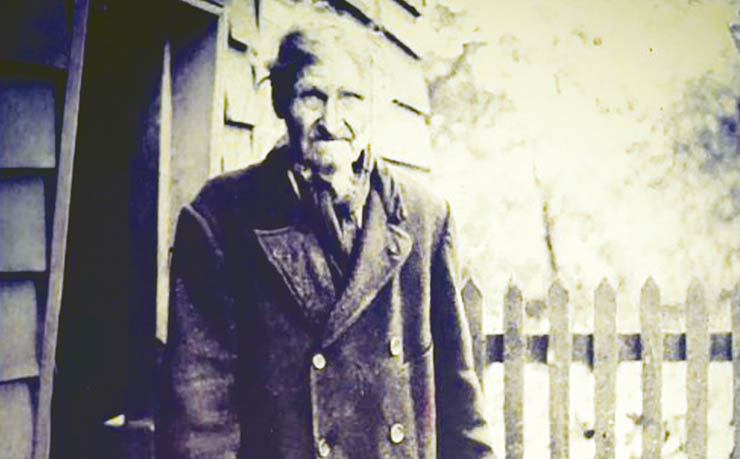
    One of these alleged ‘witch masters’ was the Essex cunning man ‘Old George’ Pickingill (1816–1909), who is also credited with having a role in modern Wicca.1 Pickingill or Pickingale (his surname is uncertain) fitted the stereotyped image of a wizard and was described as “a gaunt, ragged creature, dirty, unkempt, and fierce, with piercing eyes which terrified all who saw him.”2 He was widely feared and respected in the Essex village of Canewdon, where towards the end of his life he lived as a widower and worked as a farm labourer. He was said to possess the Sight, inherited from his Romany ancestors, and could find missing property and see into the future. In addition he had the magical power to summon up elemental spirits to physical manifestation and allegedly would make them cut the hay while he sat in the hedge puffing on his pipe and swigging cider.

    The local farmers feared the power of the old wizard so much that they bribed him with beer and food so he would not curse their animals or farm machinery. His landlord also allowed him to stay rent-free in his cottage. It was said that if Old George pointed his blackthorn walking stick, or ‘blasting rod’, at a person they would be paralysed to the spot. They would only be released when the wizard decided. If Old George stood on the doorstep of his cottage and blew a special wooden whistle he owned, all the witches in the village would be forced to come to his bidding and dance in the churchyard. This suggests he was the Magister or master of the local coven.

    People who passed Pickingill’s tumbledown cottage late at night and looked in through the dust-grimed and cobwebbed windows alleged they saw the old man dancing with his imps or familiar spirits. The ornaments and furniture also joined in the mad dance like the Sorcerer’s Apprentice sequence starring Mickey Mouse in the Walt Disney film Fantasia. When a woman visited Pickingill when he was dying she reported seeing his imps scampering about on his bedcover in the shape of white mice.

    Another source says that Old George was regarded as the ‘Devil incarnate’ by the locals and his family were feared all over eastern England as ‘a race apart’ of witches, warlocks and wizards. It was also claimed that Pickingill was so famous, or infamous, that he was visited by occultists and magicians from all over Europe who sought his advice and instruction.3 When this writer visited Canewdon in 1977 a local resident (then in her seventies) told him that her mother had been a member of George Pickingill’s coven. It apparently consisted of thirteen women with Old George as the ‘Devil’ or male leader. She added that strangers from outside the village and some from ‘far away’ came to consult him because of his occult knowledge and magical powers.

    E.W. Liddell, who was initiated into Pickingill Craft in Essex in the 1950s, has alleged that George Pickingill worked in his early life as a horse dealer and used to travel all around southern England. During this period he allegedly founded nine covens led by priestesses he had specially selected because they had the ‘witch blood’ and psychic or magical powers. It is further claimed that in either 1899 or 1900, while he was a student at Cambridge University, the famous ‘black magician’ Aleister Crowley was briefly involved with one of Pickingill’s covens in Norfolk. His mentor in the Hermetic Order of the Golden Dawn, Allan Bennett, allegedly introduced him to the Craft. It has been also alleged a photograph exists showing Crowley, Bennett and Pickingill together, but it has never emerged into public view.4 Crowley did not last long in the witch coven he joined as he failed to attend meetings. He later told Gerald Gardner, when the two men met in May 1947, that he left because he “refused to be bossed around by a woman.”5

    Gardner further told Crowley’s literary executor and first biographer, John Symonds, that the Great Beast was “very interested in the witch cult, and had some idea of combining it with the Order [the OTO or Ordo Templis Orientis], but nothing came of it.”6 When the writer Francis King met Louis Umfraville Wilkinson, a close friend of Crowley’s who officiated at his funeral service in December 1947, Wilkinson told him Crowley said he had “been offered initiation into the witch cult” as a young man.7

    It was true that Crowley had been interested for many years in establishing a popular neo-pagan nature religion and it is probable that he and Gardner discussed it when they met. Crowley certainly granted the founder of Wicca a charter to establish a lodge of the OTO, although he did nothing about it. It has even been suggested that Crowley might have considered Gardner as his possible successor as the head of the Order after his death. E.W. Liddell claims that Crowley used a technique of “magical recall” to remember the rituals of the old Norfolk coven and he then passed them on to Gardner.8 It is also said that the New Forest coven into which Gardner was initiated in September 1939 was a surviving remnant of one of the Nine Covens.9 Gardner, however, influenced by the theories of Dr. Margaret Murray, author The Witch Cult in Western Europe (1920), was more interested in promoting witchcraft publicly as a Goddess worshipping, neo-pagan, nature religion for the masses. Neither the image of Old George Pickingill as a ‘cunning man’ or the beliefs and practices of traditional or historical witchcraft, fitted with this radical and innovative concept.

    Since Gerald Gardner died in 1964, Wicca, in both its Gardnerian and Alexandrian forms (named after Alex Sanders, the self-styled ‘King of the Witches’) has spread worldwide. It can now be found in the United States, Canada, Europe, Australia, New Zealand, South Africa and even Brazil and Japan. In the 1970s an Australian called Simon Goodman (aka Ian Watts) claimed he had been initiated into what he called ‘Sussex Craft’. This has allegedly been brought over to Australia from a village in Sussex in England and was connected with George Pickingill. From the description of its rites and beliefs it seems to have been closer to historical or traditional witchcraft than modern Wicca. A male Magister or Master led the coven and they exclusively worshipped the Horned God (unlike modern Wiccan covens that are mostly Goddess orientated). The ritual implements used in the circle by the Sussex coven included a stang (forked staff), cauldron, a human skull, and a besom.

    Get the issue this article appears in

    Wicca & Traditional Witchcraft

    What of traditional witchcraft today and the differences between it and modern Wicca? Unlike the average Wiccan, the traditional witch prefers to work outdoors rather than in a cosy, centrally heated, suburban sitting room. For that reason they do not go ‘skyclad’ (naked), preferring robes or cloaks with hoods. This is why traditional groups are sometimes called ‘robed covens’. As one would expect from the fact that they usually work outdoors, the genii loci or ‘spirits of place’, the wights or earth spirits of the land, are very important in their workings.

    The mystical concept of the enchanted or sacred landscape is important, because traditional witches regard themselves as the stewards or guardians of ancient sites such as stone circles, standing stones and burial mounds. They will frequently work their rites on or near the prehistoric trackways that mark the ‘spirit paths’, ‘ghost roads’ or leylines that crisscross the British countryside between these natural power centres. However, they are likely to be less sentimental about the environment than Wiccans. They recognise that nature can be ‘red in tooth and claw’ and that the natural laws are based on ‘the survival of the fittest’.

    Unlike Wiccan covens that are ruled by a High Priestess with her High Priest as consort and initiation is always male to female or female to male, traditional covines are led by a male leader known as the Magister, Master or Devil, who initiates both men and women into the Craft. The female leader is known variously as the Magistra, Mistress, Maid, Lady, Dame, or Queen of the Sabbat. The Magister has a male deputy called the Summoner who is responsible for organising the dates, times and places for the meetings. Some groups also have a Verdelet or Green Man whose task is to teach the other coveners the secrets of the magical powers and healing properties of herbs and plants.

    Within the operative or magical practices of traditional witchcraft one can find the concept of spirit flight (astral projection) to the Witches’ Sabbath, sometimes using the sabbati unguenti or ‘flying ointment’ made from narcotic plants. Techniques of psychic vision, trance, mediumship, ‘true dreaming’ and spirit possession are also used to contact the Otherworld in ways that are allied to ethnic forms of shamanism. Elementals and spirits are summoned and there is communion with the realm of Faerie, the use of familiars, fetches (the witch’s astral double) and spirit guides, shapeshifting into animal form, divination, necromancy, and wortcunning (herbalism).

    Some traditional witches follow old-style dual faith observance using the psalms, working with the company of saints and employing Christian imagery, symbolism and liturgy in a heretical and subversive way. This is akin to similar practices found in voodoo and Santeria in North and South America. In common with the witches and cunning folk of the past, the modern traditional witch can both cure and curse as the need arises.

    Traditional witches approach divinity in either a duotheistic or polytheistic way. The goddess of the witches has both a bright and a dark aspect, often associated with the waxing and waning of the moon. She can be personified mythologically as Hecate, Diana, Frau Holda, Lilith, or the Queen of Elfane (Faeryland). The witch god is also dual-faced as the Lord of the Wildwood, the Green Man and the Oak King in summer and the Lord of the Wild Hunt, Lord of Death or the Holly King in winter. In mythic terms he is represented as Herne, Wayland, Puck or Robin Goodfellow, Tubal Cain, Sylvanus, Lucifer, or the King of Elves. He also appears in animal form as a stag, bull, goat, ram or a black dog. Many traditional witches prefer not to associate their deities with any mythology. Instead they refer to them obliquely as the Old Ones, the Owd Lad and Owd Lass, the Old Man and the Old Woman, the Lord and Lady, the Horned One, the Devil, the Old Dame, or just Him and Her.

    Although a few traditional and hereditary witches (those belonging to a family tradition) have come out of the shadows in recent years, they are more reluctant than Wiccans to seek publicity. They are not likely to appear on daytime television wearing crushed velvet robes, waving knifes and swords and covered in occult bling. In fact they often look surprising normal, wear ordinary clothes and blend into the background. Because they possess a fund of knowledge about the stars, trees, plants, ancient history and the weather, people may just think they have a keen interest in country matters, nature and folklore.

    Wicca obviously attracts many people, especially those seeking a trendy ‘green’ form of spirituality that worships nature. Those who follow the Old Craft today do not regard themselves as ‘nature worshippers’. Many actually do not believe it is a religion per se, and certainly not a ‘nature religion’. Instead they regard it as a mystery cultus offering an ancient heritage of forbidden wisdom and occult (hidden) knowledge. It is a mystical path that leads to spiritual enlightenment and ultimately to gnosis and union with the Godhead. It represents a bright lantern shining in the dark for those dedicated seekers to follow who still seek the ancient Mysteries in the modern world.

    [alert type=”general” dismiss=”no”]This article was published in New Dawn Special Issue Vol 11 No 4.[/alert]

    [alert type=”success” dismiss=”no”]If you appreciate this article, please consider subscribing to help maintain this website.[/alert]

    Footnotes

    1. E.W. Liddell, The Pickingill Papers: Old George Pickingill and the Origin of Gardnerian Wicca (edited and annotated by Michael Howard), Capall Bann UK, 1994
    2. Eric Maple, The Dark World of the Witches, Robert Hale Ltd UK, 1962, 185
    3. Charles Lefebure, Witness to Witchcraft, Ace Publishing USA, 1970, 51-54
    4. Liddell, 21
    5. Jack Bracelin, Gerald Gardner: Witch, Octagon Press UK, 1960, 158
    6. Letter in the Gerard Yorke Collection at the Warburg Institute, London quoted in Professor Ronald Hutton, The Triumph of the Moon: A History of Modern Neo-Pagan Witchcraft, Oxford University Press UK, 1999, 219
    7. Francis King, Ritual Magic in England, Neville Spearman UK, 1970, 140-141
    8. Liddell, 160
    9. Liddell, 23

    © New Dawn Magazine and the respective author.
    For our reproduction notice, click here.
  • Who Did Kill Rasputin?

    Who Did Kill Rasputin?

    From New Dawn Special Issue Vol 8 No 3 (June 2014)

    Before the First World War the Russian royal family, the Romanovs, were heavily involved in occult activities. In the years between 1900 and 1905, the French occultist Dr. Gerard Encausse (Papus) made several visits to Russia for undisclosed reasons. In fact, he had been personally invited to the country by Tsar Nicholas II and was holding magical séances at the royal palace in St Petersburg for the tsar and his German-born wife, the Tsarina Alexandra. Both were interested in Spiritualism and the occult.

    Dr. Encausse was a member of a French magical society called the Kabbalistic Order of the Rosy Cross (CORC). This was founded in France in 1888, the same year as the famous Order of the Golden Dawn in England. Dr. Encausse claimed to have been initiated into a Golden Dawn lodge in Paris run by Samuel Liddell Macgregor Mathers and his wife Moina. The Marquis Stanilas de Guaita and Josephin Peladan, two prominent French occultists, had created the CORC. Peladan had been born into an eccentric and fanatical Roman Catholic family who were supporters of the restoration of the French monarchy. His brother, Adrien, practised as a homeopathic doctor and had many wealthy and titled patients. He claimed to have been initiated in 1858 into a secret Rosicrucian order in Toulouse which had survived since the Middle Ages.

    At the magical rituals held at the royal palace, Dr. Encausse attempted to conjure up the tsar’s dead father, Alexander III, who was also interested in Spiritualism. In fact, Alexander had invited the English medium D.D. Home to Russia to hold séances attended by aristocrats and members of the royal court.

    In the early 1900s Russia was on the brink of revolution. There were riots in the streets, strikes, and rumours of mutiny in the armed forces. Against this turbulent background of civil disorder, the weak Tsar Nicholas II sought advice from the ‘Other Side’ on how to handle the situation. The message that came back from the spirits advised the tsar to resist the subversive and revolutionary forces threatening his throne, or he would lose control of Russia and topple from power. If the tsar did not take immediate action to deal with the deteriorating situation, then his authority and rule would be seriously undermined.

    Despite this warning, Nicholas refused to act decisively and with the outbreak of the First World War in August 1914, the situation spiralled out of control as the spirits had predicted. This led to Nicholas losing his throne and eventually his life at the hands of Bolshevik revolutionaries. The vengeful Bolsheviks massacred his family and seized power from the democratic government set up after the tsar abdicated.

    After his last visit to St Petersburg in 1905, Dr. Encausse stayed in contact with the tsar, and the occultist and the monarch exchanged letters at regular intervals. In this correspondence, they discussed various esoteric matters of mutual interest. However, Dr. Encausse confided to his fellow occultists that in his opinion Nicholas was a weak and easily influenced person who relied too much on his spiritual sources. The French magician believed that the tsar should instead listen more to his ministers and take their advice on the day-to-day running of the country.

    The ‘Mad Monk’

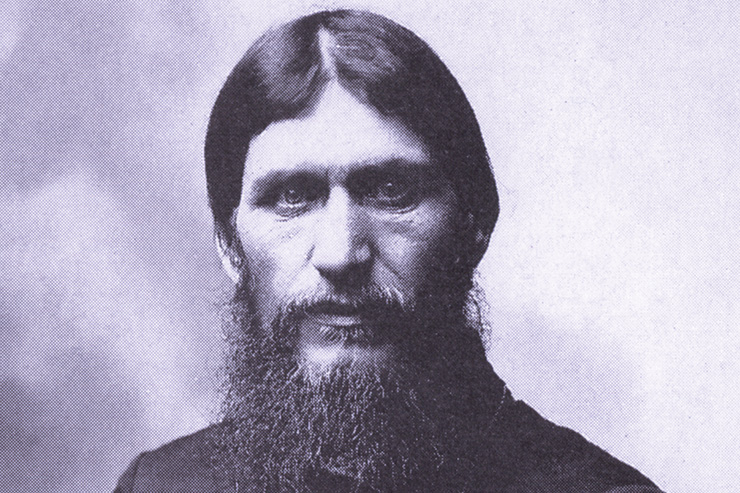
    The French occultist became particularly worried about how the tsar and tsarina had fallen under what he regarded as the malefic influence of a charismatic wandering ‘holy man’ called Grigory Yefimovich Rasputin. Rumoured to have been involved with the unorthodox religious sect known as the Khlysty or ‘People of God’, Rasputin managed to be invited to the royal court. As a result, he became the spiritual advisor, friend and confidante of the Tsarina Alexandra and also forged relationships with other Russian aristocrats.

    The Khlysty were a neo-Gnostic sect condemned by the Russian Orthodox Church because of their practices of flagellation and sexual indulgence to make contact with God and achieve spiritual enlightenment. At this time there were many quasi-religious sects in Russia and numerous wandering holy men and healers such as Rasputin.

    How much the tsarina knew of Rasputin’s background is not known, but she must have been aware he was using his personal charm and hypnotic powers to seduce many of her female courtiers. Although there is no evidence they had a sexual affair, Alexandra seems to have been infatuated with the unkempt ‘holy man’. She was in awe of his magical powers after he used his healing abilities to save the life of her haemophiliac son, the heir to the imperial throne. From then on, she would not allow anyone to say a bad word against him.

    Despite his wild physical appearance, Rasputin exerted a strange power over women, especially wealthy ones. It was said this was due to his ability to withhold orgasm for long periods. One aristocratic lady said the experience of making love with Rasputin was so pleasurable that she actually fainted during it. Such comments have led some writers to suggest the ‘Mad Monk’, as his enemies dubbed him, was a skilled adept in Tantric techniques from Eastern occultism and a practitioner of sex magic.

    Many friends of the Romanov royal family and members of the Russian government warned the tsar that Rasputin’s influence over his wife was sinister and evil. Dr. Encausse also wrote to Nicholas and warned him that in Kabbalistic terms the holy man was an unholy vessel like Pandora’s famous box of misfortune. As such, he contained all the “vices, crimes and filth of the common Russian people.” Prophetically, the French occultist said if the vessel was ever broken (i.e. Rasputin was killed) all its “dreadful contents will spill across Russia” destroying everything they touch.

    [alert type=”info” dismiss=”no”]If you appreciate this article, please consider a subscription to New Dawn magazine.[/alert]

    Prelude to The Great War

    In the 1900s it was widely expected there would soon be a war involving the major European powers. It was alleged that at a secret conference in Brussels, attended by leading Freemasons and members of secret societies as early as 1905, a plot had been hatched to bring down the Romanovs along with the other crowned heads of Europe. As the Great War approached, it was believed Rasputin was their secret weapon in achieving this aim.

    The First World War broke out in August 1914 following the assassination of Archduke Franz Ferdinand and his wife the Archduchess Sophia of the Austro-Hungarian Empire. When they were killed in Sarajevo, Bosnia by members of a secret society of Serbian nationalists known as the Order of the Black Hand, Rasputin warned the tsar not to let Russia get involved in a war with Germany. The monk predicted that if the Russian armed forces joined with those of Britain and France against Germany and their Ottoman and Austro-Hungarian allies, the country would suffer “a terrible defeat.” In the violent civil disorder to follow, the monarchy would fall from power. For once, the tsar ignored the advice of his ‘spiritual sources’ and committed the imperial Russian army and navy to the allied cause against Germany.

    Following the assassinations in Sarajevo, Tsarina Alexandra sent Rasputin several urgent telegrams asking for his advice about the international situation. Rasputin replied that on no account should Mother Russia get involved if, as was widely expected, war broke out among the major European powers. If she did, “It will be the finish of all things.” It is presumed Rasputin was not aware Russian secret agents had been implicated in the assassination plot. Allegedly, the Russian military attaché in Belgrade had paid 8,000 roubles to the leaders of the Order of the Black Hand. The attaché had also told them that Tsar Nicholas II would support the cause of Serbian nationalism if war broke out between Russia and the Austro-Hungarian-German alliance.

    It was also rumoured that in early 1914 representatives of the Black Hand had secretly met with members of the politically subversive French Masonic lodge of the Grand Orient at the Hotel St Jerome in Toulouse, France. At this meeting the assassination of Austro-Hungarian Emperor Franz Joseph and Archduke Ferdinand had been discussed. The plot was organised by the Black Hand with renegade elements of French Masonry and allegedly had the tacit support of the Russian tsar. The idea was to create the right conditions for a war between the European monarchies leading to their destruction, although why Nicholas II would support the anti-royalist plan remains unclear as he had all to lose from it.

    Following the murder of Franz Ferdinand and his wife, Kaiser Wilhelm told the Austro-Hungarian ambassador in Berlin that military force had to be used to neutralise Serbian nationalism and he offered his country’s support in any action the empire decided to take. The Kaiser quoted intelligence reports that suggested Russia would not intervene. On 28 July 1914, four weeks after the assassinations, the Austro-Hungarian Empire declared war on Serbia. In response to this, Tsar Nicholas ordered the Russian army to mobilise. The Kaiser warned the tsar that unless his forces stood down he would mobilise German troops. Five days later, when this ultimatum had been ignored, Germany declared war on Russia and the First World War began.

    When war was declared, Rasputin said if he had not been ill he would have travelled to St Petersburg to see the tsar personally. If this had happened, he boasted, Russia would never have entered the war and he would have single-handedly changed the course of world history. The pro-war elements claimed Rasputin was a pacifist and a pro-German traitor. It was even said the holy man was a secret agent working for the German intelligence service. The Germans had allegedly planted him in the royal palace to give the tsar and tsarina false advice and counsel.

    As the war dragged on, the rising casualties at the front and food shortages at home led to strikes and riots, and open hostility to the Romanovs surfaced among the population. This unrest was aided and abetted by the subversive activities of left-wing socialist and revolutionary agitators who wanted to replace the existing regime with a worker’s republic. Rasputin meanwhile had received a psychic premonition of impending doom and believed his life was under threat. In 1916 he wrote to the tsar spelling out the consequences to Russia and the Romanov dynasty if he was killed. He said should he be murdered by common assassins who were Russian peasants, whom he described as his “brothers,” the royal family would have nothing to fear. If, however, his killers were aristocrats, then “brother will kill brother” and no nobles would be left in the country.

    Several political factions in Russia had previously attempted to stop Rasputin’s influence on the royal family by violent means. In 1913 a conspiracy was revealed to kidnap the mystic monk, castrate him because of his sexual activities, and then kill him. Rasputin, however, was tipped off about the plot and managed to evade capture.

    A year later, on 19 July, a prostitute attacked Rasputin while he was holidaying at the Black Sea resort of Yalta, later to be the meeting place of the Allied wartime leaders towards the end of the Second World War. The prostitute stabbed Rasputin in the stomach, but despite losing a considerable amount of blood, he managed to survive the attack. When questioned by police, the woman said she had tried to murder the so-called ‘holy man’ because he was a heretic and ‘fornicator’ who had seduced a nun. She was diagnosed as unfit to stand trial due to insanity and was committed to a mental hospital. This appears to be an official cover-up.

    Significantly perhaps, the assassination attempt on Rasputin occurred only weeks after the murder in Sarajevo of Archduke Franz Ferdinand and his wife by members of the Black Hand secret society.

    Enter the SIS

    Rasputin’s prediction of his own death came eerily true in December 1916, when a group of right-wing aristocrats conspired with the British Secret Intelligence Service (MI6 or Military Intelligence Department Six) to kill him. The SIS was a branch of the Foreign Office set up in 1909. According to Michael Smith’s book Six: A History of Britain’s Secret Intelligence Service: Part 1: Murder and Mayhem 1909-1939, at the beginning of the First World War the head of SIS in London, known by the code letter ‘C’, made overtures to the Russian intelligence service. This was because of serious British concerns about the commitment of Tsar Nicholas II to the war effort. In September 1914, ‘C’ was granted permission by the Foreign Office in London and the Russian government to send several military officers to set up a SIS bureau in Petrograd, the new name for St Petersburg. Its name had been changed because the original sounded too German.

    One of the SIS officers, Lieutenant Stephen Alley, was a fluent Russian speaker who had been born in a village near Moscow. Before the war he worked in Russia for the Maikop & General Petroleum Trust, an American oil company owned by the future US president Herbert Hoover. The company was building a new oil pipeline across southern Russia to a port on the Black Sea. When war broke out, Lt Alley left the company and joined the British Army. He was then recruited by military intelligence, joining the SIS. Because of his Russian background, Lt Alley was sent to Petrograd posing as a military attaché to the British Embassy.

    The British intelligence officer soon discovered there were members of the Russian government, especially in the Ministry of Foreign Affairs, who were worried about the way the war was going. Some went so far as to support a separate peace treaty with Germany. Apparently there had been several clandestine meetings between officials of the two countries at the Russian and German embassies in Rome. It was said the Grand Duke of Hesse in Germany had even been in personal touch with the German-born tsarina. He had urged her to use her influence with her husband and members of the Russian government to seek a peace agreement.

    In November 1915, Lt Alley was in charge of what the SIS Russian bureau termed ‘background intelligence operations’. Two other officers, who had been recently sent out from SIS’s London headquarters, assisted him. One of them, Lt Oswald Rayner, was originally given the task of secretly opening and examining telegrams and letters. The SIS was particularly interested in the activities of neutral Swedish shipping companies believed to be supplying goods to Germany in defiance of the Royal Navy’s blockade.

    Before joining the Secret Service, Rayner had worked in Finland, then a Grand Duchy of the Russian Empire. He taught English and befriended a wealthy local couple who funded his further education at Oxford University, where he studied modern languages. At Oxford, he became friendly with Prince Feliks (Felix) Yusupov, a member of one of the wealthiest and most influential aristocratic families in Russia. Rayner then worked as a correspondent for The Times newspaper in London and later joined the civil service where he became a friend of the future wartime prime minister, David Lloyd George. When war broke out in 1914, Rayner joined the British Army. He was commissioned as an officer and assigned to ‘special duties’ with the SIS. Like Lt Alley, his fluency in Russian had him sent to Petrograd to join the British Secret Service unit operating in the city.

    With persistent rumours circulating that the Russian government was keen to make peace with Germany, the SIS began to focus on the specific stories about Grigory Rasputin, his alleged involvement in a pro-German anti-war peace movement and his peculiar influence over the tsarina. Their intelligence suggested the holy man was either the leader or at the very least a leading mover in a so-called ‘peace party’ made up of politically prominent Russians.

    As a result, several right-wing pro-war elements within the Russian aristocracy were counter-plotting to remove Rasputin permanently so he could not influence the tsar and tsarina with his views. One of these conspirators, a member of the Duma or Russian parliament, Vladimir Purishkevich, approached a SIS officer offering information on the plot. He told the officer a plan had been drawn up to “liquidate Rasputin.” At the time, the officer was unaware that three of his SIS colleagues, Alley, Rayner and an ex-Indian Army officer Captain John Dymoke Scale, were in fact closely involved in the plot to kill Rasputin.

    Lt Alley and Capt Scale had become suspicious of the tsarina’s close relationship with her spiritual advisor. Knowledge of Rasputin’s pro-German sentiments was common knowledge by 1916. Even The Times accused him of being a Germanophile whose influence at the Russian royal court was described as both “potent” and “baleful.” Capt Scale described Rasputin as a “drunken debaucher” who was adversely influencing Russian government policy and “clogging the war machine.” It was becoming evident the Mad Monk had to be neutralised, and this could only be achieved by his death.

    The Plot to Kill Rasputin

    The key figure in any British Secret Service involvement in a plot to terminate Rasputin with ‘extreme prejudice’ would be Lt Oswald Rayner. This was because of his long friendship with Prince Yusupov who was the leader of the conspirators. The prince invited the holy man to a ‘party’ at his family’s palace on the banks of the River Neva in Petrograd. Yusupov persuaded his wife, Princess Irina, the niece of Tsar Nicholas, to lure the monk to the party, although she was not actually going to be present. It was a typical British Secret Service ‘honey-trap’ operation that has been carried out many times since. Also present at the party was a prominent aristocrat, the Grand Duke Dimitry Pavlovich, the tsar’s second cousin; an army officer, Lieutenant Syukhotin, who was a close friend of the prince; Vladimir Purishkevich; an army medic Dr. Stanilaus de Lazoret – and the SIS officer Lt Oswald Rayner.

    The usual version of events is that Rasputin was first given some small chocolate cakes and wine laced with cyanide. When these had no apparent effect, he was shot in the chest at close range with a revolver. The holy man apparently survived this, attacked his would-be killers and managed to escape from the house. The assassins pursued him and he was shot three more times. His body was then bundled into a car and driven to the Petrovsky Bridge over the River Neva, where it was thrown into the icy waters. Despite the poison and several gunshot wounds, Rasputin was still alive, if barely, when he was tossed into the river and drowned.

    In reality, when Rasputin arrived at the prince’s home he was given copious amounts of alcohol until he was drunk. He was then tortured, beaten with a leather cosh on the testicles. There may have been a sexual element to this, but the aim was to get Rasputin to confess to his anti-war activities and name the other pro-German conspirators involved. Finally, he was shot several times using at least three different weapons. It is alleged that Rayner used his standard Secret Service issue Webley revolver to fire the last shot that finally finished off Rasputin. His body was then disposed through a hole in the ice of the frozen river.

    It is not clear if the senior officer running the SIS Russian bureau in Petrograd was fully aware of the involvement of Rayner and the other British officers in Rasputin’s murder. He expressed total surprise at the news when relaying it to ‘C’ in London. There is indication the three SIS officers had not received official sanction for the operation. They acted without London’s approval because they feared that the plan for a Russian peace treaty with Germany was well advanced. In fact, under torture Rasputin had even named a date in January 1917 when it would be signed.

    Two of the three SIS officers seemed to have been quickly posted elsewhere. Capt Scale was not even in Russia when the operation was carried out. He had already been sent to Romania to assist in a SIS operation to prevent the invading German army from capturing and using the oilfields and grain stores in the country by sabotaging them. He was later to return to Petrograd where rumours were still rife that the British Secret Service had somehow been involved in Rasputin’s death.

    Lt Oswald Rayner was transferred to SIS’s Stockholm office, but Lt Alley stayed in Russia and took over as head of the bureau. He eventually was given the role of liaison officer with the new provisional government and had the task of persuading them to keep the faith by pursuing the war with Germany. He was later sacked from SIS for allegedly refusing to carry out an order to assassinate one of the Bolshevik revolutionary leaders – Josef Stalin. The real reason was said to be that ‘C’ in London wanted to get rid of Lt Alley. It is possible this was because of the lieutenant’s alleged involvement in the plot to torture and murder Rasputin.

    The reaction to and consequences of the death of the Mad Monk were immediate, confirming the holy man’s own predictions about the event at the hands of the aristocracy. The Russian peasantry held him in great regard and reverence. When the news of his violent death spread, he was treated like a religious martyr and the finger of suspicion was pointed at the royal palace. Following the murder, rumours began to circulate of a right-wing coup by army officers to oust Tsar Nicholas II because he was a weak leader who was losing the war for Russia. The secret police investigated these stories, but in fact the real threat to the tsar’s continued rule and precarious position came from extreme left-wingers and, ironically, the supporters of a liberal democratic form of government.

    Fall of the Monarchy

    In March (or February by the Old Calendar still used in Russia) 1917, food riots broke out in Petrograd and other major Russian cities. Troops sent to put them down instead sided with the hungry demonstrators and joined them in their protest. As law and order broke down, a new liberal democratic provisional government was appointed to run the country. Faced with widespread and mounting criticism and a violent reaction to his policies, Nicholas decided the best thing for the country was to abdicate in favour of his younger brother, Grand Duke Michael. Unfortunately, the new tsar did not have the support or confidence of the peasants and, more importantly, the police and armed forces. In turn, Michael was forced to abdicate and he passed his executive powers to the provisional government. This move was widely applauded in Western capitals, as it was mistakenly believed that Russia was entering a new era of democracy replacing the autocratic rule of the tsars.

    Unfortunately, divided by internal disputes and trying to fight an increasingly unpopular war, the provisional government ruled for only eight months until November (or October) 1917. During this short period of democratic rule, it did manage to promote freedom of speech, religious worship and assembly and ended the censorship of the press. This freedom was short lived as in July 1917 a group of soldiers, sailors and Bolsheviks attempted to seize Petrograd. They were only prevented from doing so by the intervention of regular army units who were still loyal to the provisional government.

    Kaiser Wilhelm, himself interested in Spiritualism with an extensive private library of occult books, also decided to interfere in Russia’s internal affairs. He allowed the Bolshevik revolutionary leader Vladimir Illyich Lenin to return to Russia from Switzerland via Germany with his followers in a sealed train. Lenin promised Kaiser Wilhelm that if he managed to seize power by overthrowing the provisional government the war would be ended. On his arrival in Russia, Lenin was greeted by jubilant crowds and finally on 7 November (October) 1917, the Bolsheviks seized power. Troops from the garrison in Petrograd mutinied and, assisted by sailors and an armed workers’ militia called the Red Guard, they stormed the Winter Palace.

    Russia’s New Government

    The Bolshevik revolution was not bloodless by any means as in 1918 fighting broke out between the new Soviet government and the so-called ‘White Russians’ led by aristocrats still loyal to the monarchy. The Allies intervened and American, British, French and Italian troops landed on Russian soil. Their mission was to help the White Russians in the civil war and to seize materials stored in the ports of Archangel and Murmansk so they would not fall into the hands of the Germans. From October 1919 until January 1920, Allied forces blockaded the Russian coast and supplied the White Russians with military equipment.

    Despite their intervention, the Allies failed to prevent the ultimate defeat of the White Russian forces and the eventual establishment of the Soviet Union. In 1918, Tsar Nicholas, his wife and their children were brutally murdered by the Bolsheviks in the cellar of a house in Ekaterinburg, where they had been held captive. Rasputin’s prediction had come true. Nicholas had tried to seek asylum in Britain, but his cousin King George V, persuaded by his government, refused him and his family refuge. The king never fully recovered from the guilt he felt over the matter. Ironically, one of the first acts of the new Bolshevik regime was to ban all religious sects, occult groups and secret societies that had flourished in imperial Russia under the rule of the Romanov dynasty.

    [alert type=”general” dismiss=”no”]This article was published in New Dawn Special Issue Vol 8 No 3.[/alert]

    [alert type=”success” dismiss=”no”]If you appreciate this article, please consider subscribing to help maintain this website.[/alert]

    © New Dawn Magazine and the respective author.
    For our reproduction notice, click here.
  • Secret Societies and The First World War

    Secret Societies and The First World War

    From New Dawn 146 (Sept-Oct 2014)

    This August [2014] the centenary of the beginning of the First World War was marked by the release of new books, magazine articles, radio programmes and television documentaries. There has also been considerable public discussion among mainstream academics and historians about the causes of the war and whether the slaughter of millions on both sides was justified.

    It has been suggested World War One was a struggle for power between rival empires, the political and economic control of Europe, and the colonial dominance of the Far East. It was certainly the end result of a gradual military build-up and arms race since the early 1900s by the main protagonists. However, there were darker and more sinister forces at work involving secret societies that wanted to overthrow the European monarchies and change the traditional order in Europe.

    As early as the end of the 19th century some observers were predicting a major European war. In a series of lectures on ‘Occult Science, Theosophy and the Catholic Faith’ given to a gathering of occult students in 1893, this idea was mooted by the lecturer C.G. Harrison. These talks were published in book form three years later under the title The Transcendental Universe (George Redway & Co, 1896). In general they dealt with occult subjects such as the Cabalistic Tree of the Life, the difference between Satan and Lucifer, the celestial hierarchy of angels, the Theosophical Society and the ‘Hidden Masters’ of Madame Blavatsky. In the second lecture, however, Harrison deviated from esoteric matters to refer to the Russian Empire and a confederation of Slavic states in south-eastern Europe that had recently broken away from the Ottoman Empire. He predicted these “little states” would only remain independent until the “next great European war.” He also said that it was the destiny of the Russian Empire to die “so the Russian people may live” and referred to “experiments in Socialism” that would create a higher form of civilisation. These developments, Harrison suggested, would cause innumerable political and economic difficulties in Western Europe.

    Assassins, Emperors & Occultists

    The French Martinist and occultist Dr. Gerard Encausse (aka ‘Papus’) was closely associated with the Russian royal family. He claimed before the First World War that a “large financial syndicate” was behind the current political problems and upheavals in Europe, especially in France and Russia. Specifically, he identified the Freemasons and the Carbonari, an anti-clerical Italian secret society, as the organisation’s prime movers and claimed the centre of the conspiracy was in the City of London banking district with branches in Germany. Dr. Encausse said the aim of this shadowy group of financiers was to gain control of the world’s gold reserves. To do this they planned to create social, political and economic instability and possibly even war between the major European powers.

    The actual flashpoint that led to the First World War was a tragic event in the Bosnian city of Sarajevo. On 28 June 1914 Archduke Franz Ferdinand, the heir to the Austro-Hungarian Empire, and his Czech wife Archduchess Sofia, were on an official visit. As their car drove through streets lined with cheering crowds a small group of fanatical assassins attacked the royal party. One threw a crude bomb at the vehicle that bounced off the bonnet and exploded on the road. The car’s occupants were unharmed but the explosion injured twenty bystanders. The would-be assassin fled the scene and was later arrested by the police after trying to commit suicide using cyanide. Having survived this attack and believing they were safe, the royal couple proceeded on. Unfortunately their driver took a wrong turn and brought his passengers into a fateful and deadly contact with the remaining assassins. One walked up to the side of car and fired two shots with his pistol, killing the archduke and his wife instantly.

    The three main assassins in Sarajevo were a teenager named Gavrilo Princip, who was the shooter, and two of his equally young friends. They were all Serbian nationalists belonging to a secret society called the Order of the Black Hand. The group’s members included military officers, lawyers, civil servants and university lecturers. However, the Sarajevo assassins were young students with socialist and anarchist views who had decided to make a violent gesture against the Habsburg monarchy. When the case came to court it was claimed the young men had not acted alone and were part of a wider conspiracy with more universal objectives.

    In his book L’Attentat de Sarajevo (1930) Alfred Moussett recorded that at the trial of Gavrilo Princip (Gabriel Prince in English) it was claimed a Masonic lodge in France had financed the Order of the Black Hand in their political activities. When he testified, Princip’s co-defendant Vaso Cubrilovic (1897-1990) made the fantastic claim that the assassination of Franz Ferdinand had been planned two years earlier at a meeting of senior French Freemasons in Toulouse. Allegedly at this secret gathering a sentence of death was passed on the archduke. Cabrilovic also said that the Browning automatic pistol used in the assassination had been provided by a Serbian Freemason called Ziganovic. It was also stated in court that Princip was a Mason (although he was far too young to have been one) and the group of assassins had been trained by another member of the fraternity called Tankosi.

    Gavrilo Princip died in an Austrian prison in 1918 from tuberculosis, but Cubrilovic was released in November 1918 when the Allied powers won the war. After he came out of prison Cubrilovic turned into a model citizen. He was a schoolteacher and a professor at the University of Belgrade, a member of the Serbian Academy of Arts and Sciences, and after the Second World War served as a Yugoslavian government minister during the communist regime of Marshall Tito. Cubrilovic’s anti-Albanian writings in the late 1930s calling for ethnic cleansing are said to have influenced the terrible events of the Bosnian War in the 1990s.

    It was widely known that Austrian Emperor Franz Josef I was paranoid about secret societies and Masonry in particular. His wife the Empress Elizabeth had been brutally stabbed to death by an assassin with secret society links in 1898. The emperor himself had been the subject of an assassination attempt by the Black Hand in 1911. Franz Josef believed French Freemasons were plotting to start a war between Austria-Hungary and Russia. The aim of such a conflict was to bring down both monarchies. His worst fears would have been confirmed by the revelation during the trial of his nephew’s murderers that the Russian military attaché in Belgrade had passed 8,000 roubles from his government to the Black Hand leadership. With this gift came a personal assurance from Tsar Nicholas II that he would support Serbia in any armed conflict with the Habsburg Empire.

    The German Kaiser

    Kaiser Wilhelm II of Germany was a friend of Archduke Ferdinand and was shocked when he heard of his death. He immediately offered German support to crush the Order of the Black Hand.

    Events soon spiralled out of control when on 28 July a still distraught Emperor Franz Josef declared war on Serbia because of the murder of his nephew and heir. In response Russia began to mobilise its military forces to defend their Serbian ally. The German kaiser told Tsar Nicholas that unless the Russian army stood down Germany would also mobilise. The demand was ignored and on 1 August Kaiser Wilhelm declared war on Russia. France and Britain were asked by the German government to remain neutral in the conflict. But two days later the German ambassador in London informed Sir Edward Grey, the British Foreign Secretary, that his country’s troops planned to march through neutral Belgium into France. In defence of the Belgians and the French, Britain declared war on Germany and its allies and the First World War began. Four years later it is estimated about 16 million soldiers and civilians had been killed.

    Kaiser Wilhelm, who was related through his grandmother Queen Victoria to most of the European royal families, believed the popular conspiracy theories about Freemasonry and other secret societies. These beliefs coloured both his domestic and foreign policy. Throughout the kaiser’s reign until his forced abdication in 1918 he believed Jewish elements in the German press, left-wing politics and international banking were plotting to overthrow him. When he abdicated the kaiser blamed an international conspiracy for starting the Great War, engineering Germany’s defeat and his own downfall.

    Ironically, when hostilities began Kaiser Wilhelm was effectively sidelined and became a puppet ruler controlled by a military junta led by his generals. As a result he was increasingly excluded from political decisions and the day-to-day running of the war. Any support that Wilhelm had from the public and the ruling officer class faded away in 1918 when it became clear Germany was losing the war and the kaiser became a convenient scapegoat. Many blamed Wilhelm for getting the country involved in the first place. When he was told the army’s officer corps would no longer support him and popular uprisings began, Wilhelm fled by train from Berlin to a self-imposed exile in neutral Holland. There he formally announced his abdication and ended the 400 year old reign of the Hohenzollern royal dynasty in Germany.

    [alert type=”info” dismiss=”no”]If you appreciate this article, please consider a subscription to New Dawn magazine.[/alert]

    According to the British occultist Lewis Spence in his book The Occult Causes of the Present War (1941), at his Dutch retirement home Wilhelm had an extensive library. Among the hundreds of books he collected and read were many volumes on esoteric subjects such as Freemasonry, Luciferianism, secret societies and the occult. The ex-kaiser had always been interested in occultism and Spiritualism. In fact in 1888 it was reported he had even attended a séance held to contact the spirits of the dead. However, later in life, he was to criticise and condemn some civil servants who had become involved in occult activities. Wilhelm’s interest in Spiritualism and alternative spirituality was shared by his cousin the Russian tsar and also the tsarina, who patronised the ‘holy man’ Rasputin because of his healing powers.

    One of Wilhelm’s friends and regular correspondents was an English occultist with German links called Houston Stewart Chamberlain (1855-1927), the husband of the composer Richard Wagner’s step-daughter, Eva. Chamberlain and Wilhelm shared similar views and the Englishman also had his own idiosyncratic ideas about German racial superiority. In the 1920s these ideas influenced the ideology of Adolf Hitler and his emerging National Socialist Party. Wilhelm invited Chamberlain to his royal court in Berlin and even arranged for his writings to be distributed among army officers and placed in school libraries.

    Rudolf Steiner & the Great War

    The German kaiser’s interest in the occult and esotericism was shared by the Chief of Staff of the Army, General Helmuth Von Moltke (1848-1916). He was influenced by his wife’s Austrian spiritual mentor Rudolf Steiner (1861-1925), the founder of the Anthroposophical Society. Today Steiner is best known for his radical education methods taught in Waldorf schools and his promotion of biodynamic agriculture.

    Von Moltke first met Rudolf Steiner in 1904 and they remained friends until the end of the general’s life. One of Von Moltke’s critics, Dietrich Graf Von Hulson-Haeseler, Chief of the Military Cabinet, opposed his appointment as Chief of Staff because of his occult interests. He condemned Moltke as an irrational religious dreamer who believed in “nonsense” such as guardian angels and faith healing. Because of the criticism of his appointment, Kaiser Wilhelm ordered Von Moltke to “stop dabbling in the supernatural,” or at least keep his unusual interests private. This did not prevent the general and his wife frequently contacting Rudolf Steiner and secretly following his esoteric philosophy and teachings on subjects such as the lost continent of Atlantis, karma, reincarnation and the spiritual realm.

    Rudolf Steiner was also a firm believer in the hidden power and influence of secret societies on world events and generally regarded them as satanic in nature. He believed their ultimate aim was the enslavement of the human race. In 1916 and 1917 Steiner strayed into the political arena during a series of lectures in Switzerland. In one he suggested that secret societies were responsible for the current war. Transcripts of the talks were later published in two volumes under the title The Karma of Untruthfulness: Secret Societies, the Media, and Preparations for the Great War. In one of the lectures, given on 8 January 1917, Steiner claimed that secret cabals wanted to preserve the economic position of the English speaking countries (Britain and the United States) in Europe and destroy the dominance of Germany and Austria-Hungary. The First World War certainly achieved that aim as the ruling monarchies of both power blocs were overthrown. The Austro-Hungarian empire was dismembered, while Germany became a republic. The Russian Empire collapsed to be replaced with one of the “experiments in Socialism” that resulted in the Soviet Union, as predicted by the English occultist C.G. Harrison in his lectures given over a decade before in 1893.

    Ahead of his time, Steiner also warned his students of the future threat to personal freedom. He told them the Anglo-American materialistic worldview would lead to the social control of the human race and the suppression of spiritual development. Predicting the present global economic situation, Steiner said individual governments were not really in control of national finances. Instead, the international banking system was the real controller. It was infiltrated or being used by secret societies working towards an “Ahrimanic [satanic] world order” based on rationalism and materialism.

    With regard to the First World War, Steiner seems to have laid the blame on a plan hatched by the British to manipulate France and Russia and create a pan-Slavic federation in south-eastern Europe. He also said that the agenda of the occult secret societies from their origin in ancient times was to preserve a monopoly on knowledge. They allegedly taught their followers that the destiny of the Anglo-Saxon race was to rule the world and Steiner gave the British Empire as an example of this process. According to the Austrian occultist, it was also the plan of the secret societies for “centuries into the future.” Steiner later identified the Russian Revolution as the work of these clandestine groups. This was because it furthered their mission of social control over millions of people using a totalitarian political system, i.e. communism.

    In November 1918 the Armistice was signed between the Allied and Central European powers at the former royal palace of Versailles in France. It is said that at the signing the British Foreign Secretary, Lord Curzon, remarked it was not a real peace treaty and represented only a truce in hostilities between the major European powers. He even correctly predicted that a new war would break out between the Allies and Germany within twenty years. In September 1939 Lord Curzon’s prediction came true when Britain declared war on a Nazi Germany led by Adolf Hitler. Many historians have said it was the severe conditions of the Treaty of Versailles that humiliated the Germans which led to the Second World War.

    The Hidden Hand

    After what was called the Great War ended, fingers of suspicion began pointing towards hidden influences that might have been responsible for it. The famous American industrialist and founder of the Ford Motor Company, Henry Ford (1863-1947), had no doubts. Talking in the 1920s about the First World War, Ford blamed it on the machinations of a secret cabal of “Jewish bankers.” It was a belief that was not unusual and found support in many quarters, not least among those politicians and senior military personnel who had actually been involved in the Great War.

    For instance, during the war Winston Churchill was the First Lord of the Admiralty in charge of the then powerful Royal Navy that ruled the world’s seas. In the 1920s Churchill expressed his admiration for the anti-Semitic conspiracy theorist Nesta Webster, who believed the Illuminati were responsible for the French and Russian Revolutions. Churchill even wrote about an international conspiracy operating behind world affairs. He mentioned Adam Weishaupt of the 18th century Bavarian Illuminati and attempts to overthrow Western civilisation in the same sentence as Karl Marx and Leon Trotsky.

    On the German side, General Erich von Ludendorff, the Chief of Staff of the Army after Von Moltke, put the blame for his country’s defeat on the forces of “international Freemasonry.” He also held it responsible for bringing the United States into the war in 1917, which dramatically changed the military balance in the Allies’ favour after two years of stalemate in the trenches. Von Ludendorff was also another anti-Semite who regarded Masonry as a cover and a source of power for “international Jewry.” The general believed Kaiser Wilhelm had metaphorically been “stabbed in the back” by conspirators led by “Judeo-Freemasons” and international bankers.

    On 7 March 1919 a public meeting of the Citizens’ Association in Vienna, Austria was organised by Count Czernin, the former foreign minister of the Austro-Hungarian Empire. A lecture was given by Dr. Richard Schuller, once an economist in the Austrian foreign office, on the subject of ‘Freemasonry and the World War’. A nationalist politician and lawyer called Dr. Friedrich Georgi Wichtl also told the audience, which included members of local Masonic lodges, that the assassination of Archduke Franz Ferdinand had been organised by Serbian Freemasons using the Order of the Black Hand as their tool. Dr. Wichtl also accused Masons of involvement in the assassination of King Carlos I of Portugal in 1908. He was another cousin of Kaiser Wilhelm of Germany and had been murdered by two anti-monarchist republicans while visiting Lisbon.

    One of the assassins, Alfredo Luis de Costa, was a journalist working for socialist publications and a Freemason. Previously he had been involved in an abortive coup against the Portuguese government. In common with Gavrilo Princip who assassinated Franz Ferdinand six years later, the killers of King Carlos had used Browning automatic pistols.

    It is obvious from the overwhelming evidence that before, during and after the First World War, there was a widespread belief that the subversive activities of secret societies set the world on course for a murderous global conflict.

    The notion of secret cabals manipulating world events – like sinister puppet-masters – is a powerful one in history. It is an idea that still exists today among conspiracy theorists, except that in the early 21st century secret cabals like the Illuminati, renegade Freemasons and ‘international bankers’ are said to be planning World War III. If the 1914-1918 conflict was, as optimistically claimed afterwards, the ‘war to end all wars’ then the next global war will definitely be the one that ends civilisation.

    [alert type=”general” dismiss=”no”]This article was published in New Dawn 146.[/alert]

    [alert type=”success” dismiss=”no”]If you appreciate this article, please consider subscribing to help maintain this website.[/alert]

    © New Dawn Magazine and the respective author.
    For our reproduction notice, click here.
  • Enoch & the Watchers: The Real Story of Angels & Demons

    Enoch & the Watchers: The Real Story of Angels & Demons

    From New Dawn Special Issue 8 (Winter 2009)

    Every visible thing in the world is put under the charge of an angel. 
    – St Augustine

    In 2002 the British newspaper The Sunday Telegraph reported that the Vatican had banned the veneration of those angels who do not appear in the authorised texts of the Bible. This was an attempt to counter the influence of unnamed New Age groups who were allegedly recruiting new members within the Roman Catholic Church. In future, prayers were only to be directed to the three archangels Michael, Gabriel and Raphael who are mentioned in the Bible. According to the apocryphal and banned Book of Enoch these were the angelic beings responsible for binding the wicked fallen angels or Watchers who had transgressed God’s law. The news report said that the early Church had excluded the book, attributed to the Old Testament prophet and patriarch Enoch, from the authorised version of the Bible because it described these fallen angels and their activities.

    Who are the Watchers or fallen angels and why was the early Church and the modern Vatican so concerned about them?

    Genesis 6:1-4 says: “When men began to multiply on the face of the Earth, and daughters were born to them, that the sons of God saw the daughters of men that they were fair; and took them wives of all which they chose.” Traditionally the Ben Eloha or ‘sons of God’ numbered several hundred and they descended to Earth on Mount Harmon. Significantly this was a sacred place to both the Canaanites and the Hebrews who invaded their land. In later times shrines to the gods Baal, Zeus, Helios and Pan and the goddess Astarte were built on its slopes.

    These Ben Elohim or ‘fallen angels’ were also known as the Watchers, the Grigori and the Irin. In Jewish mythology the Grigori were originally a superior order of angels who dwelt in the highest heaven with God and resembled human beings in their appearance.1 The title ‘Watcher’ simply means ‘one who watches’, ‘those who watch’, ‘those who are awake’ or ‘those who do not sleep’. These titles reflect the unique relationship between the Watchers and the human race since ancient times.

    In the esoteric Luciferian tradition they were a special elite order of angelic beings created by God to be earthly shepherds of the first primitive humans. It was their task to observe and watch over the emerging human species and report back on their progress. However they were confined by the divine prime directive not to interfere in human evolution. Unfortunately they decided to ignore God’s command and defy his orders and become teachers to the human race, with unfortunate repercussions for both themselves and humanity.

    Most of the information we have about the Watchers and their activities comes from the apocryphal Book of Enoch. In the orthodox Bible the prophet Enoch, from the Hebrew ‘hanokh’ or instructor, is a mysterious figure. In Genesis 4:16-23 he is described as the son of Cain, the “first murderer,” and the first city built by his father is named after him. Further on in Genesis 5:18-19, and several generations later, Enoch is named as the son of Jared, and it is during his lifetime that the Watchers either arrive or incarnate in human bodies.

    In the apocryphal Book of Jubilee, allegedly dictated by “an angel of the Lord” to Moses on Mount Sinai when he also received the Ten Commandments, it says that Enoch was “the first among men that are born on Earth [sic] who learn writing, knowledge and wisdom.” It says that Enoch wrote down “the signs of Heaven” (the zodiac signs) according to their months in a book. This was so human beings would know the seasons of the years in relation to the order of the months and their respective stellar and planetary influences. The indication is that Enoch received this information from extraterrestrial angelic sources, i.e. the Watchers, and therefore he was a cultural exemplar.

    The Fallen Angels Instruct Humanity

    Two hundred of the ‘fallen angels’ descended from the heavenly realm on to the summit of Mount Hermon and they were so smitten by the beauty of human women that, using their new material bodies, they had sex with them. This further incurred Yahweh’s wrath and, according to the Bible, the consequence of this miscegenation between the Fallen Ones and mortals led to the creation of half-angelic, half-human offspring (Genesis 6:4).

    These children were called the Nefelim or Nephilim and they were the giant race that once inhabited Old Earth. The fallen angels taught their wives and children a variety of new technological skills, magical knowledge and occult wisdom. This suggests that psychic abilities and magical powers were originally an ancient inheritance from the angelic realm given to early humans. In the Luciferian tradition this is known in spiritual and metaphorical terms as the ‘witch blood’, ‘elven blood’ or ‘faery blood’ that is possessed by witches and wizards.

    In the Book of Enoch it says that the leader of the fallen angels was called Azazel, and he is often identified with Lucifer (the Lightbringer) or Lumiel (‘the light of God’). He taught men to forge swords and make shields and breastplates (body armour). Azazel also taught them metallurgy and how to mine from the earth and use different metals. To the women he taught the art of making bracelets, ornaments, rings and necklaces from precious metals and stones. He also showed them how to ‘beautify their eyelids’ with kohl and the use of cosmetic tricks to attract and seduce the opposite sex. From these practices Enoch says there came much ‘godlessness’ and men and women committed fornication, were led astray and became corrupt in their ways.

    This was the basis for the early Church condemning the fallen angels for teaching women to make necklaces from pieces of gold and bracelets for their arms. St Paul said that women should cover their head in the synagogue (Corinthians: 11:5-6). This was because the fallen angels were supposed to be attracted to human females with long flowing hair. The custom of women covering their hair in churches is still found in Roman Catholicism and also in the customs of Islam.

    The fallen angel Shemyaza, another form of Azazel, is said by Enoch to have taught humans the use of root cuttings and the magical art of enchantment; the fallen angel Armaros taught the resolving (banishing) of enchantments; Baraqijal taught astrology; Kokabiel, the knowledge of the constellations (astronomy); Chazaqiel, the knowledge of the clouds and the sky (weather lore and divination); Shamsiel, the signs of the sun (the solar mysteries); Sariel the courses of the moon (the lunar cycles used in horticulture and agriculture and the esoteric lunar mysteries); Penemuel instructed humans in the art of writing and reading; and Kashdejan taught the diagnosis and healing of diseases and the science of medicine.

    It is obvious from these descriptions of the teaching abilities of the Watchers that they were cultural exemplars and the bringers of civilisation to the early human race. It is therefore strange that in orthodox Judeo-Christian religious texts they are misrepresented as evil corrupters of humanity.

    Some idea of the original exalted status and real nature of the ‘sons of God’ and ‘the angels of the Lord’ can be found hidden in the ancient annals of angelic lore. For instance, Kokabiel is described as “a great angelic prince who rules over the stars.”2 In the Sibylline Oracles, Araqiel is one of the fallen angels who guides the souls of the dead to judgement in the underworld.

    Shamsiel, possible originally a Babylonian sun god, was called “the prince of Paradise” because he was one of the guardian angels who watched over the gates to Eden. In this role he took Moses to see the heavenly garden and he also watched over the treasures of King David and his son Solomon the Wise. This reference may be to spiritual treasures rather than physical gold and jewels. In the Jewish Zohar he is named as the chief aide-de-camp to the mighty Archangel Uriel and bore his standard into battle.

    Sariel was an angel associated with fertility of the earth and the spring equinox (northern hemisphere) in March. He governed the martial zodiac sign of Aries the Ram and was invoked for protection against the malefic power of the Evil Eye.

    [alert type=”info” dismiss=”no”]If you appreciate this article, please consider a subscription to New Dawn magazine.[/alert]

    Azazel – Lucifer – Lumiel

    Azazel, the leader of the Watchers, as mentioned before, was identified with Lucifer or Lumiel. In the Quran it is said that Lucifer-Lumiel (Iblis) rebelled against Allah because he was told to bow down and worship the clay-born “man of earth” Adam and refused. He was forced to fight a battle in Heaven with the Archangel Mikael or Michael and his Army of the Lord. As a result Lumiel and his rebel angels were cast out of Heaven and fell down to Earth. Here Lumiel became the “Lord of the World” and in Christian mythology he was falsely identified with the bogeyman Satan. However, esoterically in the Luciferian tradition, Lumiel or Lumial is not an evil satanic figure luring humankind into temptation and acts of evil as the Church represents him. He is “the angel of God [who] rebelled against the static, established cosmic order and set in motion the forces of change and evolution…”3

    It is possible that Lumiel may have originated in Canaan as Shahar, the god of the morning star (Venus). He had a twin called Shalem, who was also symbolised by the planet Venus, but as the evening star. These divine bright and dark twins represented the solar light emerging from the darkness of night at dawn and descending into it at dusk. They were the children of the goddess Asherah, and there is archaeological evidence from the Middle East that the Hebrews adopted her worship when they settled in Canaan and practised it alongside reverence of the tribal storm god Yahweh. The Old Testament has several references to the continued worship of Asherah as “Queen of Heaven” by the allegedly monotheistic Hebrews. This took place at shrines in sacred groves on hills where they made offerings of cakes and incense to the goddess. In Canaanite mythology, Shahar, as the Lord of the Morning Star, was cast down from heaven for defying the high god El in the form of a lightning bolt. In that form he fertilised Mother Earth with his divine phallic force.

    Azazel is represented as a metal-smith and a fire-working sorcerer or magician. He has also been compared to the biblical first smith Tubal-Cain, a descendant of the half-human, half-angelic “first murderer” Cain. The actual name Azazel has variously been translated as ‘god of victory’, ‘the strength of God’, ‘the strong god’ and even ‘the goat god’. In the apocryphal Apocalypse of Abraham, he is called “the lord of heathens” suggesting he was originally a pagan god. He has also been identified with the serpent in the Edenic myth that seduced the first woman and “Mother of All Living,” Eve. In a Persian text known as the Urm al-Khibab or The Primordial Book, dating from the 8th century CE, the angel Azazil or Azazel is said to have refused to acknowledge the superiority of Adam over the angels. As a result Allah expelled him and his rebel angels from the heavenly realm to live on Earth. More generally in Islamic lore Azazel or Azrael is the angel of death and he acts as a guide for the souls of the dead.

    In Leviticus 16:8-10 and in the Dead Sea Scrolls a curious Hebrew ritual is recorded that features Azazel as the name for the ‘scapegoat’ that takes on the communal sins of Israel. It says that the high priest Aaron took two goats from the flock and cast lots (practised divination) to choose which one would be the scapegoat and sacrificed as a “sin offering.” The Scrolls say that the high priest confessed all the “impurities of the children of Israel” over the head of the Azazel goat. By this ritually symbolic act he transferred to the unfortunate animal all their guilt and sins so they could be absolved of them. The goat was then either cast out into the wilderness to die or thrown over a cliff to be dashed to pieces on the rocks below.

    This ancient and archetypal concept of the scapegoat sacrificed for the sins of the human race and abandoned in the wilderness is a powerful and potent motif that appears several times in biblical myths. It can be seen in the story of Cain who becomes an exiled wanderer on the Earth after being marked by God and banished “east of Eden” after killing his brother Abel. In one Jewish legend the wise King Solomon, a powerful magician who could summon and control demons, fell from grace because he “whored after foreign gods.” He was forced by God to leave Jerusalem and wander in the desert disguised as a beggar.

    Also after their exodus from slavery in Egypt, Moses and the Israelites were forced to spend forty years wandering in the desert before they were allowed to enter the Promised Land (Canaan). In Ancient Egyptian mythology, the dark god Set is represented as a divine outcast who dwells in the desert and, after she left Adam, his first wife Lilith or Liliya fled to the wilderness away from human habitation. In the New Testament Jesus wandered in the wilderness for forty days and nights. He was not accepted as a teacher in his own town of Nazareth and was rejected as the promised messiah by his people. When Jesus was crucified he symbolically took on the role of the sacrificial scapegoat who dies to cleanse the sins of the human race.

    It is possible that the account of the ritual of the goat-god Azazel may have been an autumn equinox or harvest rite of Syrian, Hittite or Canaanite origin adopted by the Hebrews. Originally a goat would have been selected by means of a divination ritual and then offered to a desert god or demon that had to be placated by the shedding of blood. Eventually the sacrifice was made to Yahweh as a petition to forgive the sins of his followers. Azazel was popularly believed to have a retinue of hairy he-goat demons known as the se’irim who, like the Watchers, lusted after human women. It cannot be a total coincidence that the Church imagined the Devil or Satan in the form of a hairy half-human he-goat with a massive erect phallus who had sexual intercourse with his female worshippers at the Witches Sabbath.

    Shemyaza is seen by some modern Luciferians as either the emissary of Lumiel or one of his avatars (an incarnated divine being in human form). He not only fell in love with human women, but also with the Babylonian deity Ishtar, the goddess of love and war. She promised to have sex with him if he would in return reveal to her the secret name of God. When Shemyaza told her, Ishtar used this forbidden knowledge to ascend to the stars and she reigned over the constellation of Pleiades or the Seven Sisters. While the other Watchers were rounded up by the archangels and punished by God, Shemyaza voluntarily repented his error and sentenced himself to hang upside down in the constellation of Orion the Hunter, with whom he is sometimes identified in the Luciferian tradition. In the Qabalistic tradition, Naamah, the sister of the biblical first smith Tubal-Cain, seduced Azazel and she has been associated with Ishtar.4

    “A race between Gods and men”

    As we have seen, the end result of the illicit relationships between the Watchers and “the daughters of men” was, according to Judeo-Christian propaganda, the spawning of a monstrous race of warlike, blood-drinking cannibalistic giants called the Nephilim. Genesis 6:4 less dramatically describes them as “the mighty men of old, men of renown.” At first they were fed manna (ambrosia or the food of the Gods?) by Yahweh to stop them consuming human flesh, but they rejected it. They slaughtered animals for food instead and then began to hunt down and eat human prey.

    It has been speculated that this legend is based on the culinary habits of the nomadic desert herdsmen in the Middle East, who were voracious meat-eaters. In the biblical myth of Cain and Abel the dispute between the two brothers that led to the first murder is over the nature of the offerings made to Yahweh. Abel, a “keeper of sheep” or nomadic herdsman offered the “firstlings of the flock…” and Cain, who was “a tiller of the ground” or farmer-gardener offered “the fruit of the ground” (Genesis 4:2-4). Abel’s burnt offerings of animal flesh and blood were pleasing to Yahweh, but he rejected the vegetables, cereal and fruit offered by his brother. On a purely material level, as opposed to a mythic and spiritual metaphor, this story may reflect the struggle for dominance between nomadic herdsmen and the early farmers of the Neolithic Age in the Middle East.

    The idea of semi-divine heroes was born from the ancient myths of unions between the Gods and mortals. The poet and writer Pindor (518-438 BCE) described the heroes of the past as “a race between Gods and men.” In the Dead Sea Scrolls the terrible human-eating Nephilim are in fact described as the guardians of arcane knowledge who “knew all the mysteries of nature and science.” There are also oblique references to the breeding techniques they taught that suggest they instructed early humans in the domestication and rearing of animals.

    Additional references also hint at experiments that led to the creation of ‘monsters’ by the interbreeding of animals with different and unrelated species. In modern theosophical occultism there are legends about the lost continent of Atlantis that claim its scientists bred half-human, half-animal hybrids as a slave race. In our own time scientists are experimenting with genetic research and animal cloning experiments. It is widely rumoured that in China there have recently been abortive attempts to create a new half-human, half-animal hybrid species. These unnatural experiments led to the cataclysmic disaster that destroyed Atlantis. This also relates to the destruction of the Nephilim and the early human race in the biblical Flood. Records of such an event can also be found in the mythology of ancient peoples worldwide and especially among the Babylonians in the Middle East. In fact, it is claimed that the story of Noah and the Flood in the Old Testament originated in Babylonian and Sumerian myths.

    10,000 BCE and the End of the Ice Age

    It is known that around 10,000 BCE there seems to have been a cultural explosion that transformed early humankind. At the end of the last Ice Age the first signs of agriculture appeared in the Middle East with a shift from a nomadic hunter-gatherer lifestyle to that of settled farming. This marked the beginning of civilisation in this area. As early as 9500 BCE barley, wheat and rye were being cultivated and oats, peas and lentils were being grown by our Neolithic ancestors in what is now modern Kurdistan, between Turkey and Iraq. At the same time dogs, goats and sheep were also domesticated. Within a thousand years copper and lead smelting was being practised in Anatolia (modern Turkey) and archaeologists believe this process was first discovered in Kurdistan, along with weaving and pottery making. The ancient Kurdish culture was also the first to develop a script and was one of the earliest literate societies in the Middle East.

    The Kurds claim to be the descendants of the ‘Children of the Djinn’ (spirits), the offspring of a mating between the djinns and mortal women. In some parts of Kurdistan, especially among the sect of Yezedis, who worship the Peacock Angel (Azazel, the leader of the fallen angels), can be found tall, fair-haired people with blue eyes. Although anthropologists believe they may be of ancient European ancestry, popular folk belief among the Kurds says they are descendants of the ‘Children of the Djinn’, who in ancient times brought civilisation to early humankind.

    In general the ancient Middle East was known as ‘the cradle of civilisation’ with the earliest city-states being founded in the Mesopotamian area (modern Iraq and Iran). The early indigenous people of the region, the Sumerians and Akkadians, developed the first written language, studied astronomy and created libraries. The Babylonians and Assyrians followed them and in the mythology of all these races are stories of how the Gods descended to Earth and taught them the arts of civilisation.

    In the Book of Enoch it says that when Yahweh saw the lawlessness, chaos, corruption and sexual immorality that had been caused by the interaction of the Watchers and humans he decided to intervene through the agency of the archangels Michael, Raphael, Gabriel and Uriel. He commanded Raphael to bind Azazel hand and foot like a sacrificial goat and cast him into a deep ravine in the desert. Gabriel was sent on a divine mission to destroy “the bastards and reprobates” and “the children of the Watchers amongst men.”5 The Archangel Michael, the commander of the Army of God, was sent to arrest Shemyaza and bind him “under the earth” until Judgement Day. As we have seen, the fallen angel repented his sins and sentenced himself to cosmic exile among the stars.

    The Book of Jubilee says that the archangels bound the Watchers “in the depths of the earth” and in Judaic lore they are imprisoned in a mysterious “second Heaven.” However, it is also said that some of these “mighty warriors” have a special place reserved for them in Sheol, the Jewish underworld. There they are said to lie in state “with shield and spear intact.”

    Christian O’Brien has suggested6 there is a connection between the biblical Watchers and the semi-divine, semi-mythical Tuatha De Danann (Children of the goddess Dana). This race of ancient magicians descended to Earth on the sacred hill of Tara in prehistoric Ireland. With the coming of Christianity, the Tuatha De Danann was banished into the ‘hollow hills’ and became the Sidhe (Shee) or ‘Shining Ones’, the elves and faeries of Irish folklore. There has always been a strong belief among the peasantry in Ireland that the Good People or faeries were originally the fallen angels who sided with Lucifer in the Battle of Heaven.

    In this article we have constantly referred to the Watchers as angelic beings with a spiritual form who incarnated in physical bodies to have sexual relations with mortal women. In recent years a considerable amount of speculative literature has been published suggesting that instead they were of earthly origin. Popular best-selling authors such as Andrew Collins,7 Graham Hancock and Ian Lawson have claimed that the biblical myth of the Watchers represents memories of a primeval ‘elder race’ of super-humans belonging to a lost civilisation who taught their technology to more primitive people. Lawson has claimed that this (unknown) ancient race may have been spiritually advanced souls who incarnated to help early humankind and were corrupted by them in the process. Collins has also recently launched a new project to investigate the magical aspects of the legend.

    Symbolism of the Myth of the Fallen Angels

    What is the esoteric significance behind the myth of the fallen angels, the expulsion of Lucifer from Heaven and the Fall of Man as represented by the Garden of Eden saga? In the Bible Lucifer is often depicted in the reptilian form of a dragon or serpent and in the West this creature is symbolic of evil and the powers of chaos. Babylonian, Hittite, Canaanite, Iranian, Egyptian, Greek and Norse myths all describe in various forms a struggle between a supreme father-god, representing cosmic order and harmony, and a younger rebellious god who challenges and tries to overthrow divine authority. Although these conflicts usually take place in a pre-human epoch, they are also sometimes depicted as occurring in world history and are often connected with the creation and early development of the human species and the rise of ancient civilisations.

    Symbolically, Lucifer or Lumiel is known as the Lord of Light as he is the first-born of creation. He represents the active cosmic energy of the universe and has been identified with fire, light, phallic power, independent thought, consciousness, progress, liberty and independence. The founder of the modern Theosophical Society, Madame Helena Blavatsky, described the Lightbringer as “the spirit of intellectual enlightenment and the freedom of thought” without whose influence humanity would be “no better than animals.”8

    In the Bible Lucifer (or Satan as he is mistakenly called) is often depicted in reptilian form as either a dragon or a serpent. In Western mythologies this creature is commonly misrepresented as a symbol of the powers of darkness, chaos and evil. In contrast, in Eastern mythology the dragon is a good omen representing fertility and good fortune. Lumiel-Lucifer is often identified with the serpent in the Edenic myth described in Genesis. In the Luciferian tradition, the biblical serpent is regarded as the personification of knowledge, wisdom and enlightenment who liberated the first humans from the spiritual ignorance imposed on them by Yahweh. The serpent is seen as the symbol of an outside liberating force that quite literally opened the eyes of Adam and Eve to the reality of the created universe and the wonders of the material world.

    The snake, serpent or dragon is an ancient mythical and archetypal image of the solar phallic power or life force that is associated with Lucifer and the explosion of light following the divine celestial event that created the universe (known by modern scientists as the Big Bang). When the first man and woman ate the forbidden fruit from the Tree of the Knowledge of Good and Evil in the astral or heavenly garden, they became consciously aware. Their first realisation was that their physical ‘cloaks of flesh’ were naked. They rushed to cover their genitals as they had become aware of the so-called ‘serpent power’ or kundalini that can be raised by sexual intercourse and non-reproductive sex acts. They also ate from the Tree of Life which initiated the cycle of birth, life, death and rebirth and of human souls incarnating in physical form.

    Interestingly, the anthropologist and shamanic teacher Dr. Michael Harner has described an experience he had in the jungle of the Peruvian Amazon after partaking of the hallucinogenic vine ayahuasca. He had a vision of a dragon-prowed ship with a crew of bird-headed humans. He then encountered an ancient race of reptilian entities that he believes exist within each human being in the brain stem at the base of the skull and the top of the spinal column. These reptilian life forms told Dr. Harner they had arrived on Earth aeons ago from the stars. Allegedly, they created life here so they had somewhere to hide and were the true masters of the planet. The anthropologist mentioned this to an old Indian shaman and he said he knew about these entities and called them the “Masters of the Outer Darkness.”9

    The myth of the Watchers, the Fall of Lucifer and the Fall of Man all represent the primeval Dreamtime or ‘Golden Age’ of cosmic and earthy harmony and primal innocence that may have existed on the material plane or on some kind of astral or pre-material plane. It is the symbolic or actual physical destruction of this heavenly or earthly paradise, where humans and animals lived together and communicated by a universal language, which is reflected in such myths and legends. In shamanic terms it is known as the Great Separation when humans no longer knew or understood the language of the animals. It was also a time when humans began to communicate together in different languages and this is represented by the biblical story of the Tower of Babel.

    The myth of the Golden Age or Paradise on Earth is closely linked with the fall of Lucifer from Heaven and the diminishing of his former status as the first-born of creation to become the Lord of the World. On a symbolic and metaphorical level, as well as a physical one, it is also connected to the separation of humans from nature and their natural environment that is manifesting in our modern times. It was the deliberate intervention of Lucifer and the fallen angels in human evolution, rather than any defiance of cosmic authority, which ultimately lead to their fall from heavenly grace. The Watchers’ only ‘crime’ was that they wanted to help the progress of their human flock. However, the refusal of Lucifer-Iblis to recognise the creation of human beings means that the Fall from heavenly grace was inevitable.

    In the Luciferian tradition Lumiel is promised redemption and the restoration of his former status in the cosmic plan. This can only come to pass when the human race spiritually evolves. So it is to the benefit of Lumiel and his teaching angels to help us achieve that end. The relationship between humanity and the leader of the Fallen Ones is therefore very much a symbiotic one, as they need each other.

    [alert type=”general” dismiss=”no”]This article was published in New Dawn Special Issue 8.[/alert]

    [alert type=”success” dismiss=”no”]If you appreciate this article, please consider subscribing to help maintain this website.[/alert]

    Footnotes

    1. G.A. Davidson, Dictionary of Angels, The Free Press, USA, 1971, p. 127.

    2. Ibid, p.164.

    3. Dr. Stephen Flowers, Fire and Ice, Llewellyn, USA, 1990, pp.43-44.

    4. Michael Howard and Nigel Jackson, The Pillars of Tubal Cain, Capall Bann, UK, 2000 and 2003, p.65; Michael Howard, The Book of Fallen Angels, Capall Bann, UK, 2004.

    5. R.H. Charles, The Book of Enoch, Society for the Promotion of Christian Knowledge, UK, 1912, p.37.

    6. Christian O’Brien, The Genius of the Few, Daintus, UK, 1985.

    7. Andrew Collins, From the Ashes of Angels, Michael Joseph, UK, 1996; Andrew Collins, The Gods of Eden, Headline, UK, 1998.

    8. Helena Blavatsky, The Secret Doctrine Vol: II, Theosophical Society, India, 1921, p. 171, 255, 539.

    9. Dr. Michael Harner, The Way of the Shaman, Harper & Row, USA, 1980

    © New Dawn Magazine and the respective author.
    For our reproduction notice, click here.