New Dawn – World's Most Unusual Magazine

Author: Marie Jones & Larry Flaxman

  • Weapons of Mass Distraction: The Media, Advertising & Social Programming

    Weapons of Mass Distraction: The Media, Advertising & Social Programming

    From New Dawn 151 (Jul-Aug 2015)

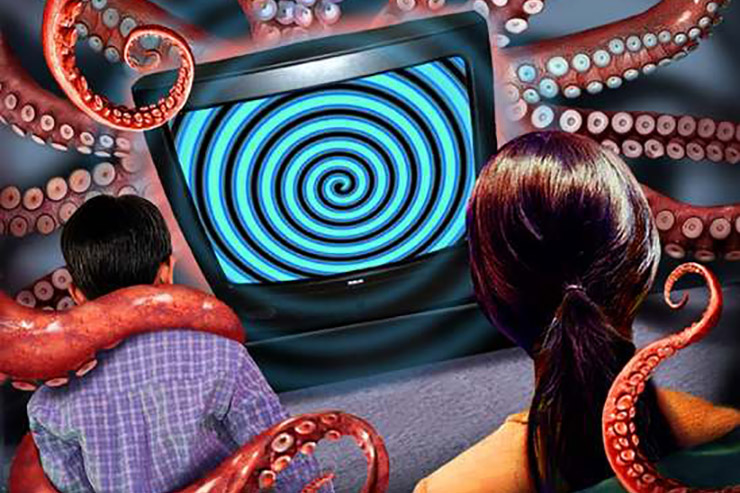
    The mass media is the biggest remote control ever built, and we all exist within the four-walled idiot box it controls. Manipulation of thought and behaviour is a part of our accepted daily lives. Each time we lock eyes on a news story, whether on the tube, the screen, the tablet or the old fashioned way, via a newspaper, we are buying into a perspective that may or may not be our own. We read stuff, and readily accept it as reality, often without ever bothering to source the information or take the time to perform due diligence and research the subject more deeply. We then pass on some of that information to others, and the viral effect can now, with the Internet and cell phones, travel on a global scale in a matter of minutes.

    If you wanted to truly control the minds of the masses, what better way than buying time on the media outlets the masses most visit? And the most effective types of media most able to manipulate our behaviour and change how we think… and even consume? News media, advertising… and now, social networking.

    Get ready to have your channel changed, because with the sheer amount of social programming faced on a daily basis, you are no longer in control of your own remote.

    Media Manipulation

    It’s all bad news, all the time. The stories that bombard us on television, radio and even social networking often tend to be depressing, fearful and anxiety provoking… and they spread like wildfire. But we all know that good things happen in the world. Why then does the media love to focus on the blood, gore and violence? Because we respond to it, that’s why.

    Negative news stories dominate the news because we are hard-wired to respond more to them. It’s simple brain science, really, and harkens back to our days of needing every bit of news we could find in order to guarantee our survival. And much of that news involved FEAR. Predators, lack of food and water, bad weather, other nasty humans… our primitive brain responds to bad news because at one time we needed to know it all. Who cared about the good stuff when there was a chance of death around every corner?

    In his book Secret Societies and Psychological Warfare, author Michael A. Hoffman brings up a strong point for the hypocrisy and mixed messages the media sends, especially when it comes to two of the viewing audience’s favourite things – sex and violence.

    “Have you ever noticed how television and print media will scream themselves hoarse in news documentaries, editorials and heavy analytical pieces about ‘rising pornography, crime, violence, gunplay’, etc? And yet in the same TV Guide announcing the latest special on ‘The Crisis of Sex and Violence’ will appear an advertisement for Miami Vice, the ‘show that brings you the action and excitement you’ve come to expect’, etc. Or your newspaper will condemn sex and violence in the loftiest terms but there in the entertainment section is a half-page advertisement for a new ‘action’ movie accompanied by a photo of women in string bikinis and high heels fondling automatic pistols and machine-guns.”

    Hoffman calls this the Double-Mind of mass media, and we are all guilty of buying out of, and right back into, each of the two minds… the one that repels and the one that accepts. The use of images to alter our emotions is an age-old way of manipulating behavioural responses, and the media excels at imagery that shocks us, terrifies us, and titillates us.

    Misinformation vs Disinformation

    Yet much of the information we are bombarded with via a variety of media sources is not corroborated or fact-checked. Many of the news ‘outlets’ people are getting their news on are satire sites, or blog sites, or websites that allow anyone to post a story without having to prove their points or source their material. It’s become standard business to spread and take viral the most shoddy reporting, which would never hold up to journalism standards of old, even without bothering to find out who funded the story, who owns the website it first appeared on, the source of the information, and whether or not any other news source has reported on it.

    If it’s in print, or on the Internet, or the TV… we buy it. Who has time to find out if it’s true or not? Besides, if you see it in the media then it must be true, right?

    Misinformation abounds. This is information that has no basis in fact, or is the result of poor journalistic skills or shoddy reporting. This is information that mistakenly is called fact and gets spread from person to person, network-to-network, and often goes global before someone decides to finally do a bit of fact checking. By then, it’s often too late, as the populace has already accepted the information as valid and real. Even when later presented with facts, it rarely changes the minds of those already entrenched in the falsities, especially if those falsities support their ideologies and worldviews.

    Disinformation is planted on purpose, like seeds that will grow into accepted facts. Propaganda, rumour, gossip, news, and fear-mongering all spread with an agenda, usually to provoke fear and paranoia and cause people to react in a specific manner.

    Sometimes it’s hard to tell misinformation from disinformation, and often the manipulation occurs in a subtle manner on a subconscious level, which makes it harder to pinpoint, and therefore refute. One of the main reasons why we allow this is because we are so willingly distracted by the media’s idea of what we should know. We would rather spend our time and energy on these distractions than have to face our own truths.

    This could easily explain the power of social networking to create its own form of mind control, as more people spend more time on sites that allow for every possible form of distraction.

    Facebook & Social Networking

    In 2012, the megalith known as Facebook did something quite nasty to its followers. 700,000 unwitting users were basically utilised as guinea pigs in a gigantic social experiment that allowed Facebook to manipulate emotions and emotional responses, without telling anyone it was doing so. Facebook data scientists set out to see if they could influence the emotional state of site users and prompt them to post more positive or more negative content. Using an algorithm that automatically omitted certain content that was either positive or negative, Facebook researchers manipulated users for one week, later publishing their data in the March issue of the Proceedings of the National Academy of Sciences. But once the secret experiment got out, people screamed about the blatant invasion of privacy and manipulative, deceitful tactics of the experiment, even causing some of the scientists behind the study to apologise for their less than ethical methodology. Privacy lawyers and organisations came forward, admonishing Facebook for violating the rights of the users, who were never told about the research.

    Problem is, Facebook had been doing these kinds of things for years, changing the functions and looks of the site to better serve their users, and give them more access to personal information at the same time. Users just didn’t know they were being manipulated until this particular study got attention. The forces behind Facebook understood how easy it was to influence the emotions of users with very little work, and all of it under the radar of the users. Subconsciously, these users were being swayed, even if they weren’t consciously aware of anything different on the site during the week of the study.

    Social Programming

    Are we being ‘programmed’ in the same way we program our DVRs to record our favourite shows? Also known as ‘social engineering’, this tactic of politics, religion and corporate consumerism, even education and academia, involves literally engineering the behaviour, attitudes and desires of large groups of people. Real social engineering is done using specific scientific methods of analysis and decision-making, often for more academic purposes. But social programming goes on every day in ways that are not necessarily meant for the greater understanding of humanity.

    Similar to propaganda, social programming is a type of public relations that sways large groups to accept, deny, support, resist, or anything in between. One of the pioneers of public propaganda, known as the ‘father of public relations’, was an Austrian-American nephew of Sigmund Freud, Edward Bernays. Even though he had a degree in agriculture, he was fascinated by the use of propaganda during wartime, and wondered if the same rules and methods could be applied in peacetime as well. He dove headfirst into the world of psychology and public relations, linking the two to design his own concepts of public persuasion and what he called, “the engineering of consent.”

    By understanding how “group mind” worked, Bernays believed the masses could be controlled and manipulated without being aware of it. He used a lot of his famous uncle’s theories in his quest to shift public perception and promote specific behaviours, including his own desire to help out big business by treating the mass distribution of ideas the same way a company would treat the mass production of materials. His 1928 book Propaganda remains a highly influential examination of his work documenting the relationship between what he called an “invisible government, the true ruling power of the country” and the public that was ruled over, something Bernays saw as necessary to keep order over the chaotic masses.

    This kind of social control is really about regulating the behaviour of both individuals and groups of people in a society, with the influence of propaganda as one of the tools of control.

    Media Methods

    Some of the methods used by the mass media to control the viewers and influence the populace are obvious. Others fly under the radar. All are insidious and are motivated by the desire to reach, and in some way control the largest audience possible.

    Framing is a means of changing public perception about a subject or concern by imposing a ‘frame’ or base of information around the subject. This frame doesn’t necessarily present false information, but rather accentuates specific positives or negatives of the image presented within the frame. Think of a piece of art that may be very straightforward, at least on the surface, yet changes in the eye of the beholder when surrounded by an ornate frame, opposed to a plain plastic one. The media and politicians use framing as a way of getting people to accept a specific party line of thought surrounding a news story or issue.

    To frame an idea is not necessarily mind control, but it is a way to influence thought and behaviour. Two completely different groups of people, representing extremes on an issue, can find a way to frame their points of view on the issue that might actually appeal to those in the middle of the road. Framing can make an extreme concept less intolerable, and a tolerable concept more extreme, depending on how it is used.

    Language is yet another great method of swaying public thought and perception. Use of specific words and phrases can literally shape a society’s political and religious direction, and create a mentality that is as submissive as the elite in control could hope for. Look at the whole ‘us vs. them’ media assault with stories of ‘those blacks’ or ‘immigrants’ or ‘feminists’ or ‘the dirty poor’ or ‘the lazy homeless’ or ‘those terrorist Muslims’ and it’s easy to see how countries can be prodded into accepting violence, aggression, intolerance, bigotry, sexism and even war. By making someone else the threat, the enemy, the reason behind our problems and the thing to be feared, we can shrug off our own responsibilities and dysfunctions and blame the ‘other guy’.

    False accreditation is another way of getting people on board an issue or eager to buy a product or serve a purpose. By mentioning ‘scientific studies’ or some vague ‘ten doctors out of eleven’, an advertiser or news agency can get plenty of people to blindly accept that a new product is worthy of their hard earned dollars, or that such-and-such doesn’t really cause cancer. Giving credit to science, even when it’s false credit, carries a ton of weight with consumers and news audiences, who are too busy and distracted to actually go and research the claims themselves to see if they hold water.

    People have been dumbed down to the point where anything presented as fact, news or science is accepted without a second thought. It’s that second thought that is so critical, but it doesn’t happen often, leaving us reeling, wondering how we got collectively duped again and again.

    [alert type=”info” dismiss=”no”]If you appreciate this article, please consider a subscription to New Dawn magazine.[/alert]

    If You Can’t Beat ‘Em, Distract ‘Em

    Attention is everything, and there are numerous ways to distract a person, and a group of persons. Some of the methods of distraction used by corporations, advertisers, news outlets, politicians and others include:

    • Promoting nationalism – When something happens that threatens our nation, we jump on the patriotic bandwagon, to the point of supporting wars that we cannot afford or getting behind political and religious movements that promote intolerance.
    • Wagging the Dog – How do you get people to stop focusing on a critical issue? By presenting them with an issue that gets more news time, even if it’s trivial and sensationalistic. Someone having an affair? Political scandal? High-powered divorce? Distract them with dirty laundry!
    • Scapegoating – Look for the weakest opponent and focus on him or her. The weak link in the chain is enough to break the chain, and is a surefire way to get public eyes off the chain itself.
    • Misinformation and misleading – When you want the truth to stay hidden, reframe it with a little bit of falsehood, repeat it often enough until it sticks, and sit back while it goes viral.
    • Demonise the other guy – When we want to take the attention off our own sins, what better way than to focus the public lens on the demons in the other guy? Remember McCarthyism in the USA, when people who were against the government’s actions were labelled “Commies” and “America-haters?”
    • Fear mongering – The big one, for what better weapon against common sense and sanity is there than fear, especially hysteria-driven fear? We saw this played out recently with the panic over a few Ebola cases in America that sent the country into a media-driven frenzy of terror and anti-African sentiment.

    Subliminals & Under the Radar Mind Control

    The use of subliminal imagery and words in advertising is well known by now, and with the advent of the Internet, social networking, and technology that allows you to make a fake photo that looks real, anyone can create a subliminal meme or message.

    Back in 1957, a market researcher named James Vicary decided to see what would happen if you inserted words or phrases into a motion picture. Words such as ‘eat popcorn’ and ‘drink Coke’ were inserted into the frames of a movie, just for a single frame and therefore not even long enough to register consciously, and resulted in an increase of sales afterwards. Those results were later called a hoax, but the concept stood strong and the age of subliminals was born, with all kinds of studies, including one at Harvard in 1999 looking at the power of flashing words and images over the subconscious, often with intriguing results. Could you make someone buy a product just by showing a single frame image of a half naked woman holding the product, even if the person buying it didn’t LIKE or NEED the product? Could you implant ideas and images directly onto the pliant and impressionable subconscious so easily?

    The answer was a definitive yes, and controversial, subliminal imagery has been used in product advertising, politics and even in motion pictures and television shows. One of the most interesting uses of subliminal imagery occurred in the movie The Exorcist, where an image of a white-faced demon named Captain Howdy flashes on the screen now and then, despite author William Peter Blatty’s outrage against the use of the image in his film. Another involved the 1943 animated Warner Bros. movie Wise Quacking Duck where Daffy Duck spins a shield. On one frame the words “Buy Bonds” appear on the shield. In one of the most blatant attempts at corporate advertising, an episode of “Parks and Recreation” titled “Community” contained a scene with a Microsoft logo and stickers. Microsoft just so happened to sponsor that particular episode to promote its new Bing search site.

    The technology to not just insert these images into movie frames or paper adverts, but to literally implant them directly into the brain, does exist. An actual United States Patent, 6,506,148, submitted in January of 2003, titled “Nervous system manipulation by electromagnetic fields from monitors,” documents the highly detailed technology available by which, as the Abstract reads, “it is possible to manipulate the nervous system of a subject by pulsing images displayed on a nearby computer monitor or TV set. For the latter, the image pulsing may be imbedded in the program material, or it may be overlaid by modulating a video stream, either as an RF signal or as a video signal.”

    In other words, the manipulation is no longer just done via a single frame here and there, but by actual modulation of the feed or signal and coming right at you via your home computer, cell phone, or television set… even your DVD player. And the manipulation occurs at a remote source.

    “For a TV monitor, the image pulsing may be inherent in the video stream as it flows from the video source, or else the stream can be modulated such as to overlay the pulsing. In the first case, a live TV broadcast can be arranged to have the feature imbedded simply by slightly pulsing the illumination of the scene that is being broadcast. This method can of course also be used in making movies and recording video tapes and DVDs.”
    Desensitise the Masses

    Perhaps it’s all a means of desensitising the masses to the violence, hatred and intolerance in the world. Perhaps it’s a means of numbing the populace to the realities that they have no power, no wealth and really, no say in how the world around them works. By using constant violence, whether on the news or in entertainment shows, and by exposing certain themes of misogyny, racism, and subjugation, eventually the viewing audience comes to accept it all as normal. Desensitisation is a powerful way to get someone to go along to get along, even if it means going along to his or her own death and destruction. Break down the inhibitions, expose the brain to constant images that would otherwise be repellant, and hammer the spirit with darkness and death and fear… and you have the perfect consumer, the perfect citizen, numbed to choices and rebellion.

    In his seminal work Mind Control in America, Steven Jacobson writes: “The techniques of psychotherapy, widely practiced and accepted as a means of curing psychological disorders, are also methods of controlling people. They can be used systematically to influence attitudes and behaviour. Systematic desensitisation is a method used to dissolve anxiety so the patient is no longer troubled by a specific fear, a fear of violence for example.” Jacobson explains how this process serves to allow the patient, or in this case, the public, to adapt to situations and ideas that once terrified them, if they are exposed to them enough.

    Zbigniew Brzezinski, when he was US National Security Advisor, once said: “In the technotronic society the trend would seem towards the aggregation of the individual support of millions of uncoordinated citizens, easily within the reach of magnetic and attractive personalities effectively exploiting the latest communication techniques to manipulate emotions and control reason.”

    Ultimately, we can control what we look at and listen to. We can find better outlets for getting information, maybe even use our own discernment and source the material that is presented to us as fact. Our minds can only be controlled to the extent that we remain numb, unaware and distracted.

    Once we wake up, take back the remote control of our lives, and begin to program our own minds the way we prefer and according to our own ethics and goals and values, it gets an awful lot more complicated for anyone else to take up residence there.

    Reprinted, with permission of the publisher, from MIND WARS © 2015 Marie D. Jones and Larry Flaxman. Published by New Page Books a division of Career Press, Wayne, NJ. 800-227-3371. All rights reserved.

    [alert type=”general” dismiss=”no”]This article was published in New Dawn 151.[/alert]

    [alert type=”success” dismiss=”no”]If you appreciate this article, please consider subscribing to help maintain this website.[/alert]

    © New Dawn Magazine and the respective author.
    For our reproduction notice, click here.
  • 11:11 Is it Happening to You?

    11:11 Is it Happening to You?

    From New Dawn 112 (Jan-Feb 2009)

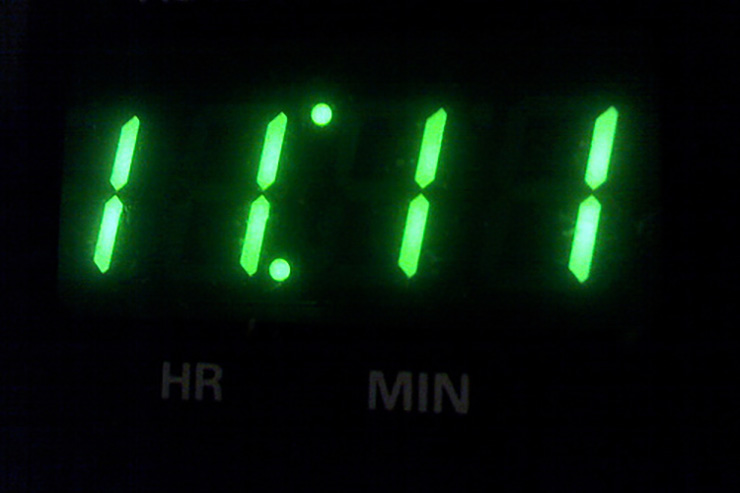
    Imagine waking up at exactly the same moment night after night for years and seeing the same time appear on the alarm clock beside your bed. For those who experience this strange occurrence, their first thoughts might be that it was random chance, or simply the product of an overactive imagination. But is it? Is there perhaps a hidden message that is encoded within these mysterious events?

    It is most assuredly not their imagination causing them to awaken at exactly 11:11pm each night, or to see “11:11” appear on digital readouts, watch faces, billboards, signs, and even calculators. The time prompt phenomenon is real and it is happening to people all over the world.

    The significance of “11:11” may be linked to the coming enigmatic year of 2012, when some scholars believe that the exact moment of transformation predicted in the Mayan Calendar, and prophesied by the Hopi, the Hindu and even the Bible itself, will occur at 11:11am GMT. This theory further suggests that our “junk DNA,” the approximately 97% of our non-coding DNA, will somehow be responsible for triggering this spiritually awakened state of consciousness.

    Regardless of one’s belief in the numerous theories surrounding 2012, those who find this mysterious number sequence appearing over and over again, often for years at a time, the significance seems elusive.

    Some believe the time prompts, which do not always have to occur at 11:11, may be a type of “wake up call” from a source of higher intelligence. Perhaps these entities are eager to alert our attention to both personal and collective changes we are soon to deal with. Others report experiencing paranormal or spiritual events during these time prompts. Some have even claimed to see their guardian angels, or encounter aliens and ghosts! Others still report nothing but an annoyance that a particular series of numbers seems to haunt and taunt them as they go about their daily lives.

    “I wake up every night at the same time, sometimes 11:11pm, sometimes 1:11am, 2:22am, 3:33am,” a geophysicist told us. When asked if anything unusual occurred, he said no, but that the very circumstances intrigued him. Was the brain triggering this nightly occurrence, or was there an outside, external source causing the influence?

    Others report the exact same circumstances, even down to looking at clocks throughout the day and noticing the time to be 11:11a.m., 1:11p.m., and on and on. Each time they looked, they became “aware” of the synchronistic pattern, but did not really understand what was behind it. Is it sheer coincidence? Is the brain itself acting as an inner alarm clock, or prompt?

    One woman told us: “I have this problem and it really IS becoming a problem… I don’t even wear a watch anymore, I’m always looking at the clock at 11:11am/pm and 1:11am/pm. I’ll even wake up just to look at the clock at 1:11am… It’s getting worse, too. Last night I woke up at 1:11am, 2:22am, and 3:33am!”

    Another individual named Cinde, had much to say about these prompts.

    First of all, I try very hard NOT to follow man’s time.  To me, clocks and the structure of time were created by man to control man, and I simply do not want to be controlled by anyone.  I do have to follow it for work, however.  The rest of the time, I try to simply go by natural time.  No clock required.

    I work 2nd shift.  So I’m up pretty late.  And because of this stupid phenomenon, I don’t sleep well at night.  I tend to wake up at 11:11pm (on my night’s off), followed by 1:11am.  Sometimes, but not always, it will continue with 2:22, 3:33, etc.  But that is rare.

    As a result of not sleeping well, I tend to snooze in the mornings, relaxing, cat napping, and watching TV until I FEEL it’s time to get up.  When do I get this “feeling”?  11:11am.  I’ll get up, do what I have to do, and hang around until it’s time to get ready for work.  I have an alarm set for 1:30, since I have to leave by 2.  But it never fails, I will look at the clock early, and it’s usually 1:11.

    On one online message board, one person reported: “Everyday of my life it seems I see, 1:11, 2:11, 3:11, 4:11, 5:11, 6:11, 7:11, 8:11, 9:11, 10:11, 11:11, 12:11, I was born on 4/11/89, I’ve been seeing 11:11 for quite sum time now and I know there is no way it can be a coincidence (sic), I have so many unusual 11:11 stories…”

    One of the more intriguing reports: “One of my sightings that really stands out is walking past 2 boys wearing bright red football shirts as I turned round to look back at them (don’t know why I did) they both had number 11 on their backs!”

    11  11

    Over at AngelScribe.com, readers post their stories of encounters with invisible angels at such times as 11:11, 2:22, and on.

    “Last night as I pulled into my driveway, I looked down at my mileage and it read 11,111.1! Weird! Than (sic) I woke up this morning at 2:22am! This is just getting too weird! Those Angels are working their magic!”

    “In the summer of 1978 I began seeing 1111. I also see 111, 222, 333, etc. Sometimes I’ll wake in the middle of the night at exactly 1:11. These numbers have appeared on boxes, license plates, house numbers, friends addresses, phone numbers, totals at the grocery store.”

    “I woke up at 11:11 last night! I had only been asleep a short time! This morning I was outside with my granddaughter and she said she wanted to go in! Weird, she never wants to go in! LOL… so we went in and sat in the rocking chair and turned a video on… I noticed that the time on the VCR and cable box was 11:11! I love the little reminders… makes my day go so much better!”

    It seems that the more people we had an opportunity to speak with while writing our book, the more we came to realise that these stories all seem to share common, recurring traits. Is there a scientifically objective reason why the time prompt phenomenon seems so incredibly common? From a statistical standpoint, it would seem patently obvious that there was some type of connective correlation. But what? And equally as important, why?

    Perhaps, the truth combines elements of all these explanations.

    But it’s not just the number 11 that is showing up in people’s lives – often accompanied by unusual events or profound insights. Sometimes it’s 2:22, 3:33, 4:44 or any combination of digits that sparks a pattern and shakes us out of our complacent view of the world as random and chaotic.

    Throughout the history of human experience, mysterious numbers and strange sequences appear. Even in nature we find numbers, often grouped into sequences and patterns that seem to form an underlying structure to all of reality – both the seen and unseen.

    Two of the most stunning examples are the Golden Ratio and the Fibonacci Spiral, both of which imply a higher order of measurement behind what many of us take for granted, like the proportion of our own bodies, or the layout of petals on a flower.

    The Golden Ratio, also known as the Divine Ratio, the Golden Ration and Golden Mean, is an irrational number of approximately 1.618033988749. This ratio is found throughout the natural, scientific and man-made worlds as the highest expression of balance, symmetry and aesthetics. This fundamental formula can be described as “the ratio whereby the ratio of the whole to the larger section equals the ratio of the larger section to the smaller section.”

    Referred to as “phi,” this ratio is present in many sacred icons such as the measurements of the Great Pyramid of Giza, the structure of a five-pointed star, a Pentagram (a sacred object to followers of Plato and Pythagoras) and even in the outline of the Acropolis near Athens, Greece (which takes the shape of a Golden Rectangle.) Most notably, as represented by Leonardo Da Vinci’s famous Vitruvian Man, the golden ratio is present in the structure of the human body, with outstretched arms and legs showing the Golden Ratio at work.

    Sacred geometry is the realm of the divine nature of numbers, suggesting that the great churches, temples and megalithic structures and monuments that mark the earth follow a pattern based upon heavenly properties and resonances.

    Harmonics and music actually form the foundation of many of the accepted mathematical laws. Even within the field of sacred geometry, the basics of musical theory provide a structure from which the divine and the human find common ground. One such example is the famous Rosslyn Chapel with its remarkable display of sacred geometry and the use of symbol, harmonics and numbers to convey a sense of otherworldliness, and a divine connection.

    [alert type=”info” dismiss=”no”]If you appreciate this article, please consider a subscription to New Dawn magazine.[/alert]

    Rosslyn Chapel is a 15th century chapel designed by William Sinclair of the St. Clair family of Scottish nobles descended from the Norman knights, and some claim, linked to the Knights Templar. Originally known as the Collegiate Chapel of St. Matthew, Rosslyn has gained notoriety from the recent best-selling book and movie The Da Vinci Code by Dan Brown, which served to further inextricably link it to the legend of the Holy Grail. Many historians and esotericists even insist the Grail legend itself ends at Rosslyn, where ensconced deep within its walls may lie a secret that only music itself can unlock.

    Father Richard Augustine Hay was the principle authority of the Chapel and St. Clair Family. He wrote that Rosslyn was unlike any other house of God’s service, and that it was a “most curious work, that which it might be done with greater glory and splendour.” Sir William is said to have engaged the services of the best masons and workmen available in Europe at the time to build this magnificent structure. Hay and other Rosslyn researchers suggest that the west wall of the Chapel was intended by design to be a model of Jerusalem’s Wailing Wall. In addition, in 2005, mystical symbols carved into the stone ceiling were reportedly discovered which appear to be a musical score hidden in 213 cubes in the ceiling. The cubes, when combined, formed a series of patterns that resulted in a one-hour musical accompaniment for 13 medieval prayers!

    Many scholars insist that these musical tones and corresponding patterns on the ceiling cubes are far more than mere coincidence, and that one day we may be able to unlock a medieval secret by repeatedly playing the proper frequencies. While some have attempted, so far the musical mystery remains just that.

    Even the Universe itself can be described in both harmonic and mathematical terms. In fact, some scientists and mathematicians believe that our Universe is comprised of six discrete numbers, and that these numbers are so precisely tuned as to suggest the presence of a higher intelligence at work. Call it the “Universal Symphony” if you will.

    In his book Just Six Numbers, Sir Martin Rees, the Royal Society Research Professor at Cambridge University and Astronomer Royal, makes a bold case for explaining how these six fundamental numbers can explain the entirety of the physical cosmos. These numbers, “constant values that describe and define everything from the way atoms are held together to the amount of matter in our universe,” were somehow imprinted during the Big Bang itself and began a process of cosmic evolution that allowed for the creation of stars and galaxies, as well as all of the necessary energy states that govern matter and force as we know it.

    The six fundamental numbers that shape the Universe, and helped make it in the first place, are:

    Nu – “N” a critically huge number with the value of

    1,000,000,000,000,000,000,000,000,000,000,000,000. This is a ratio of the strength of electrical forces holding atoms together, divided by the force of gravity (which is 10 to the 37th power) between them. If this number were smaller, even by a few zeros, it has been posited that the Universe’s lifespan would be too short for biological evolution to occur. As Rees states, a short-lived universe would mean that no creatures could ever grow larger than insects, with no time for biological evolution to unfold. Thus, a buggy world indeed.

    Epsilon – 0.007 – Another ratio, this time the proportion of energy released when hydrogen fuses into helium. This number defines how firmly atomic nuclei bind together and how all of the atoms on Earth were made. The value of epsilon controls the power from the Sun and how stars transmute hydrogen into all the atoms of the periodic table. Carbon and oxygen are common, and gold and uranium are rare, because of what happens in the stars. Were this number 0.006, or 0.008, Rees states that we could not possibly exist, again suggesting that the minutest tweaks would have resulted in a universe far different than this one.

    Omega – The cosmic number 1 or omega measures the amount of material in our Universe – galaxies, diffuse gas, and ‘dark matter’. Omega refers to the relative importance of gravity and expansion energy in the Universe. According to Rees, a universe with too high of an Omega level would have collapsed long ago; too low, no galaxies would have formed. The inflationary theory of the Big Bang says omega should be one, but astronomers have yet to measure its exact value. Some scientists point to the finely-tuned initial speed of expansion as a hint of Creative Intelligence.

    Lambda – the force of cosmic antigravity that was discovered in 1998. This is an extremely small number and appears to control the expansion of the Universe; however, it has no effect on scales of less than a billion light years. If Lambda were any larger, its effect would have stopped galaxies and stars from forming and cosmic evolution would have been “stifled before it could even begin.”

    Q = 1/100,000 – The basic seeds for all cosmic structures such as stars, galaxies and clusters of galaxies, all of which were imprinted in the Big Bang itself. The fabric – or texture – of our Universe depends on a number that represents the ratio of two fundamental energies. If Q were smaller, the Universe would be inert and without structure; if Q were much larger, the Universe would be a violent place where no stars or suns could exist, dominated by giant black holes.

    Delta – 3 – the number of spatial dimensions in our world. Rees argues that life can only exist in three dimensions, not two or four. At least in our Universe, but not necessarily in others. This number it seems has been known for hundreds of years, but is now being viewed in a whole new way, especially in light of superstring theory, which posits that the most fundamental underlying structure are vibrating superstrings that operate in a potentially 10-dimensional “arena.”

    “Mathematical laws underpin the fabric of our universe – not just atoms, but galaxies, stars and people,” Rees writes. The goal of theorists, Rees continues, is to one day “encapsulate the essence of the physical laws in a unified set of equations.”

    These six numbers allow for the absolute “rightness” of the universe that we live in, a rightness that in turn allowed for all the perfect chemical and physical combinations, events and interactions to lead to the creation of stars, galaxies and planets.

    English astronomer James Jeans said, “The universe appears to have been designed by a pure mathematician.” The laws that govern motion, gravitation, force and matter are all, at their foundation, mathematical laws that give order to nature and form the bedrock of all physical reality. The word “astronomy” itself means “law of the stars,” and those laws have their basis in mathematics.

    While many consider the mix of science and spirituality to be tantamount to oil and water combining, there are some spiritually leaning scientists who look to this fine-tuning of our Universe as an indication of an intelligent force behind all of creation. Is it beyond the realm of possibility that God may be a number? Though no scholar has yet come up with the perfect divine equation, it is still quite evident that the mark of a master Mathematician with deep respect for numbers is behind what we perceive as our reality.

    The “God numeral,” according to physicist Scott Funkhouser, could be an unimaginably big number, say 10^122, or 10 times itself 122 times. This number seems to show up in some very critical cosmic instances, appearing first in the late 1990s when scientists began researching the presence of dark energy. This energy is believed to be behind the accelerating rate of expansion we see in our universe. This same number, albeit with a give or take of a factor of ten, appears in other important ratios, such as the ratio of mass of the observable Universe to that of the smallest “quantum” of mass, which is 6×10^121. In the current Universe, one of the measurements of entropy that determines the many ways in which particles can be spatially arranged is 2.5×10^122.

    On a more microcosmic level, our personal lives mirror this same fundamental truth. We live according to numbers. Whether we ascribe to the beliefs of astrology, which tells us about our character traits through the positioning of stars at the times of our births, or we are the result of DNA and its own numeric structural forms, numbers own us. Regardless, we seek to find meaning and understanding in them when they appear over and over again in our lives. There are those who even believe that numbers have the power to shape our lives, our relationships, and our destinies.

    Numerology consists of a number of systems, traditions or beliefs that posit a mystical or esoteric relationship between numbers and physical objects. Numerology and numerological divination were popular among early mathematicians such as Pythagoras, but are now regarded as pseudo mathematics by most modern scientists.

    According to accepted scientific tenets, it would not be entirely accurate to call numerology a science. Rather, it can best be described as a belief system founded on the concept that the “number behind a name” can literally dictate a person’s destiny, future, and fortune. Like astrology, numerology is based upon the idea that everything, even the names we were given by our parents at birth, has a profound meaning and purpose in the realisation and unfoldment of our individual paths. From the jobs we choose to the places we live, to the mates we give our hearts to, people throughout the centuries have studied their astrological and numerological charts and signs in hopes of gleaning prescient information and patterns which might enable them to make better informed life choices.

    The human brain is hard-wired to seek and find patterns wherever it can, in order to understand a complex situation or arrangement. This phenomenon, known as “matrixing,” or more commonly “pareidolia,” is a universal human response. The term pareidolia, according to Wikipedia, describes a “psychological phenomenon involving a vague and random stimulus (often an image or sound) being perceived as significant. Common examples include images of animals or faces in clouds, the man in the moon, and hidden messages on records played in reverse.”

    Get the issue this article appears in

    Many studies support the brain’s ability to not only construct patterns based upon evident information, but additionally, to assign a time upon them. To wake up once at “11:11” would mean little… but if the brain makes a neural connection after waking up twice at that specific time, that connection would then become an embedded time code that will continue to manifest, becoming a learned response.

    If indeed the brain can tell time, and if the brain engages in the matrixing of meaning in an attempt to discern a pattern, how can we then know whether a time prompt is just a time prompt, a sheer coincidental event dictated by the Law of Truly Large Numbers or something more miraculous? Remember, according to that law, when there is a large enough sample of people or subjects, pretty much anything can happen.

    Perhaps we will find out on a numerologically significant date, when our collective “junk DNA” may be triggered, sending us to a new level of conscious awareness. Maybe we will find out individually, as the meaning behind the math sinks in through our experience as we find ourselves guided by a higher source along our path.

    Either way, one thing is certain – we will know what the sages and scholars knew before us.

    It all comes down to numbers.

    The laws of nature are but the mathematical thoughts of God.
    – Euclid

    [alert type=”general” dismiss=”no”]This article was published in New Dawn 112.[/alert]

    [alert type=”success” dismiss=”no”]If you appreciate this article, please consider subscribing to help maintain this website.[/alert]

    © New Dawn Magazine and the respective author.
    For our reproduction notice, click here.