New Dawn – World's Most Unusual Magazine

Author: Mehmet Sabeheddin

  • Saint-Yves d’Alveydre & The Synarchy of Agarttha

    Saint-Yves d’Alveydre & The Synarchy of Agarttha

    From New Dawn 151 (Jul-Aug 2015)

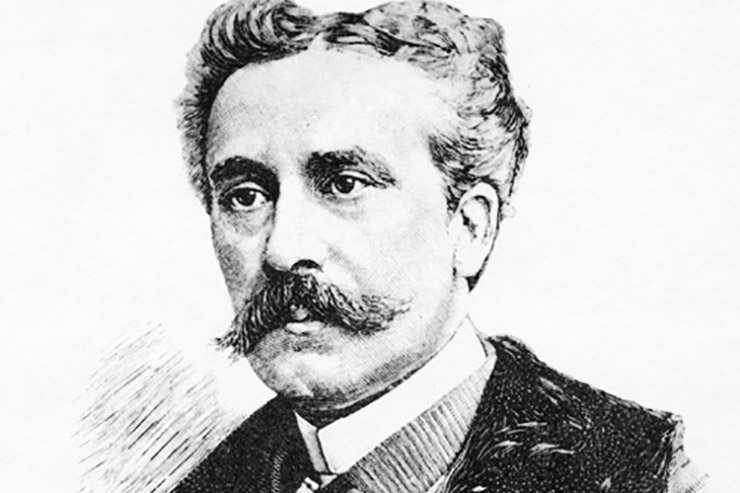
    The French writer Alexandre Saint-Yves d’Alveydre (1842-1909) was an extraordinary figure, a strange mixture of occultist and political philosopher. Born into humble circumstances, he led an adventurous life before marrying the wealthy former Countess of Keller. After settling down in Paris he threw himself wholeheartedly into the study of ancient texts, languages and Eastern wisdom. Amassing an enormous library of rare books and manuscripts, Saint-Yves took lessons in Sanskrit, Hebrew and Arabic. His tutor was a mysterious Afghan who was known by the Muslim name Haji Sharif (or Hardjji Scharipf, 1838-?).1

    Professor Joscelyn Godwin says of Saint-Yves’ enigmatic teacher:

    His name may have been a pseudonym; he may have been an Afghan; some called him Prince… The manuscripts for which Hardjji [Haji] was responsible, now in the Library of the Sorbonne in Paris, show that he was a learned and punctilious teacher, and the source of two still unsolved enigmas: the holy land of Agarttha, and its sacred language of Vattanian.2
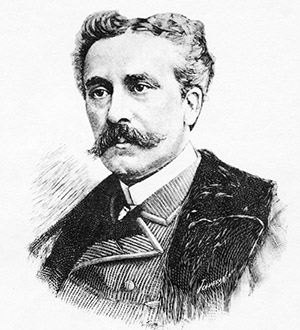
    Artist’s sketch of Alexandre Saint-Yves d’Alveydre (1842-1909) – who was called one of the last utopians of the nineteenth century.

    Haji Sharif, said Saint-Yves, was an “emissary” of “Agarttha” [Saint-Yves’ preferred spelling], the great initiatory centre in Central Asia presided over by a “Sovereign Pontiff” who “directs the entire life of the planet in a discreet and unseen way.” French researchers are convinced a shadowy group of Eastern initiates, who had been forced to flee their homeland for political reasons, contacted Saint-Yves in an effort to seed certain powerful ideas in the West. Saint-Yves also made an oblique reference to another Eastern guide, a “more serious” Guru who communicated to him the “secret teachings of the Brahmins.” Despite the ridicule heaped upon him by his numerous detractors, Saint-Yves steadfastly maintained that the highest officials of what he called the “Brahminical Church” had initiated him into the deep mysteries of Oriental wisdom.

    In Western Christendom Jerusalem and often Rome are referred to as ‘Holy Cities’, ancient centres permeated with religious significance. Due to the notions imparted to him by his mysterious Asian teachers, Saint-Yves would come to be regarded as the leading exponent of the idea, then starting to gain attention in nineteenth century Europe, that the primordial Holy Land was concealed below the surface of the Earth somewhere in Central Asia. Protected from inquisitive, avaricious Westerners, the spiritual powerhouse of the planet was, Saint-Yves declared, the subterranean realm of Agarttha. Originally on the surface, Agarttha was transferred underground and concealed from humanity at the onset of the Kali Yuga in around 3200 BCE.

    A focus on the regions of Central Asia as the ‘homeland’ of ancient wisdom was not in itself new. The Swedish savant Emmanuel Swedenborg asserted: “Henceforth it is among the sages of Tibet and Tartary that we must look for the Lost Word.” The Catholic mystic Anne-Catherine Emmerich had very clear visions of the “Mountain of the Prophets,” situated far beyond Tibet, where all true knowledge is preserved. The old legend of the “Wise Men from the East,” who were miraculously guided to the Christ child, may be a thinly disguised pointer to that Eastern spiritual centre from where emissaries are dispatched to the outer world. Saint-Yves assured his readers it is from Agarttha that such “divine envoys” as Orpheus, Moses, Jesus and many others have come “when humanity requires them.”

    Modern day commentators on Agarttha, “that underground realm placed at the centre of the Earth, where the Lord of the World reigns,” conclude it is more or less symbolic. Some say it is primarily metaphorical, since the name “Agarttha” is itself said to mean “inaccessible” or “inviolable.” Agarttha is of no one country, of no one nation, but universal; the mysterious hierarchy of enlightened masters, gnostic magi, yogis and perfected adepts – headed by the Lord of the World – maintain subtle links with their emissaries in the outer world. “Agarttha is a faithful image of the eternal Word throughout all Creation,” wrote Saint-Yves.

    The French journalist and eminent Orientalist Jean Marquès-Rivière explains:

    There is an even greater mystery, that which the Asian doctrines call THE MYSTERY OF REFLECTIONS. This is what the Wisdom of Egypt put on the Emerald tablet: ‘As above, so below’. There is a strange harmony between the different levels of manifestation. Man has a sign that is found both on earth and in heaven. The Centre of transhuman power has indeed a reflection on earth; it is a constant tradition in Asia and this Centre (earthly? I do not know to what extent) is called, in Central Asia, Agartha. It also has other names that there is no need to include here. This Centre has as its mission, as its ‘raison d’être’, to lead the Earth’s spiritual activities. To do this it uses every possible means3

    Synarchy

    Saint-Yves d’Alveydre also drew inspiration from the medieval Knights Templar, long held by occultists to have been Europe’s hidden rulers during the Middle Ages. He believed the Templars’ immense wealth and power came from their adherence to a socio-political system he termed Synarchy. For thousands of years Agarttha had “radiated” Synarchy to the upper world. Synarchy views society as a living organism like the human body. As Saint-Yves explained: “The first function corresponds to nutrition and that is economics. The second can be defined as the will, and that is legislation and politics. Finally, the third corresponds to the spirit and that includes science and religion.”

    Synarchy stood in total opposition to “government by brute force, that is, military conquest, political tyranny, sectarian intolerance, and colonial rapacity.” André Chaleil in Les Grands initiés de notre temps points out that:

    Synarchy, as Saint-Yves understands it, is the old dream of the meeting of left and right, of workers and capitalists, of scholars and priests, under the same banner and in the same spirit. It is already, in some way, the myth of the defence of the West against itself in face of the threat of Anarchy, or government without principles.

    To Saint-Yves the Knights Templar, as faithful adherents of Synarchy, stood for universal peace, friendship between peoples, and co-operative federalism. With the demise of the Templar Order early in the fourteenth century, Europe strayed far from the path of Synarchy, succumbing to the forces of chaos and dissolution. As long as Europeans persisted in their chaotic, unprincipled government systems, Agarttha would remain closed to them.

    While his enemies openly questioned his sanity, a small group of supporters hailed Saint-Yves as a gifted visionary. Jean Saunier remarked in his 1971 book La Synarchie:

    Saint-Yves d’Alveydre was not such a strange author as one might believe. On the contrary, might he not appear to have been one of the last of the utopians of the nineteenth century?
    Enter Eurasia

    The hugely influential French occultist and prolific author known as Papus (Dr. Gérard Encausse, 1865-1916) declared Saint-Yves d’Alveydre his “intellectual master.” Papus introduced the master’s books to members of the Russian Court and made his ideas well known in Russian mystical circles. But the master also had his own intimate connections with the Russian aristocracy through his wife’s family. In his book Mission de l’Inde, written in 1886, Saint-Yves noted approvingly:

    The deeply religious sentiment of the Russian masses, their instinctive occultism, their language, their legends, their prophecies, and the Hermetic interpretation that some sects keep of the sacred scriptures, are all so many ties indicative of an intellectual and social alliance with Asia.4

    He continued by urging Britain’s Queen Victoria to “craft an understanding between Your government and that of Russia.” With repeated references to benevolent Agarttha and the enlightened system of Synarchy, he criticised “the egotistical brutality that presides not only over the relations of Christian peoples with each other, but over the relations of their Colonial regime toward other continents and other communities of believers.” Saint-Yves saw Russia as the potential liberator of the Asian peoples from colonialism, writing in an open letter to the Russian Tsar:

    Sire, have caution when touching Afghanistan and do not advance into the territory of these amphictyons without pronouncing the ancient password of the Kingdom of God… Then, if, in the regions of India, England does not bring about its downfall by establishing Synarchy, Providence will put wind in your sails, because marching in the footsteps of Ram, Sire, You will only have fought in the name of Christ and Saint Michael, the Solar Archangel, to redeem the peoples after having freed them.5

    Expressing a thoroughly Eurasian outlook, Saint-Yves added: “The peoples of Central Asia feel great sympathy toward Russia and toward its sovereign.”

    A decade later, in 1896, echoing his intellectual master, Papus sent a message to Nicholas II calling on the Russian tsar to “immortalise his Empire by its total union with Divine Providence.” By 1899 Papus was warmly received by the imperial family and established a lodge of his Martinist Order at the Russian Court in St Petersburg. The Martinist Order, with its strong emphasis on Christian mysticism, set itself in opposition to what Papus saw as the growing atheism and secularism of Freemasonry. Central to the inner teachings of Papus’ Martinist Order were the legend of Agarttha and the visionary writings of Alexandre Saint-Yves d’Alveydre.

    Most secret societies and esoteric groups have, like the great world religions, a ‘founding myth’. A story imbued with sacred meaning, said to originate in the most ancient past and faithfully preserved down through the ages. In Freemasonry this is the legend of the building of King Solomon’s Temple. Today’s Rosicrucians claim a special connection to ancient Egypt. Many esoteric orders trace their origins to encounters with ‘other worldly’ entities. The Abrahamic faiths are full of seminal accounts of prophets instructed and empowered by heavenly emissaries and divine messengers. Asian secret societies also preserve detailed stories of their legendary heroic beginnings, usually connected to mysterious sacred centres. So it is no surprise that Agarttha, along with its complex socio-political system of Synarchy, became part of the mythos of certain powerful European secret societies.

    After his death in 1909 the “Friends of Saint-Yves” assembled the master’s papers and took on the task of disseminating his many books. Foremost among these was the posthumous publication in 1910 of Mission de l’Inde (Mission of India) with its incredible revelations of the secret subterranean kingdom. In the 1920s, René Guénon cited Saint-Yves approvingly in Le Roi du Monde (The King of the World) a study of symbolism and myth. Other notable followers included Victor Blanchard, Nizier Anthelme Philippe, René A. Schwaller de Lubicz and Émile Dantinne.

    Synarchy continued within the closed ranks of secret societies and esoteric study circles in France as well as abroad. Synarchy heavily influenced the development of Rudolf Steiner’s political thought and his ideas for social reform. Conspiracy researchers link Synarchy to a number of open political movements ranging from the 1930s leftist “X-Crise Club” to pro-Hitler Vichy France. Synarchy played a role in South American politics, particularly in Mexico. British writers Lynn Picknett and Clive Prince charge Synarchy with being the driving force behind the European Union.

    As recently as 2011, hundreds of people were arrested or detained in Turkey on suspicion of involvement in a national revolutionary secret society known as “Ergenekon/Agartha.” Turkish authorities claimed “Agartha” members were planning a coup with the help of senior leaders in the country’s military and security forces.6

    The fascinating Franco-Romanian novelist and esoteric researcher Jean Pârvulescu (1929-2010), who undertook a detailed study of the works of Saint-Yves d’Alveydre, suggested a secret brotherhood called “Agartha” existed in the Soviet Union’s special intelligence service, the GRU. According to Pârvulescu, the current Russian President Vladimir Putin is an envoy of this clandestine “Agartha” Order and is carrying forward their Eurasian plan.

    [alert type=”general” dismiss=”no”]In 2008 Inner Traditions published the first English language version of Saint-Yves d’Alveydre’s ‘Mission de l’Inde’ under the title The Kingdom of Agarttha: A Journey into the Hollow Earth (with an extensive Introduction by Prof. Joscelyn Godwin).[/alert]

    [alert type=”general” dismiss=”no”]This article was published in New Dawn 151.[/alert]

    [alert type=”success” dismiss=”no”]If you appreciate this article, please consider subscribing to help maintain this website.[/alert]

    Footnotes

    1. It is suggested by some conspiracy researchers that ‘Haji Sharif’ was in fact the renowned Islamic thinker and anti-colonial political activist Sayyid Jamal ad-Din al-Afghani (1838-1897). In 1885, the year Saint-Yves met ‘Haji Sharif’, Afghani was in Paris, where he began publishing an Arabic newspaper entitled “The Indissoluble Blond.” Among the members of Afghani’s anti-colonialist circle in Paris were Asians involved with the Theosophical Society as well as Christian and Jewish Middle Easterners. Regarded by his enemies as an inveterate intriguer and political chameleon, Jamal ad-Din al-Afghani is also believed to have been associated with Madame H.P. Blavatsky.
    2. Introduction by Prof. Joscelyn Godwin, The Kingdom of Agarttha: A Journey into the Hollow Earth (Inner Traditions, 2008)
    3. Introduction by Jean Marquès-Rivière, Asia Mysteriosa: The Oracle of Astral Force (Polair Publishing, 2012)
    4. Introduction by Prof. Joscelyn Godwin, The Kingdom of Agarttha: A Journey into the Hollow Earth (Inner Traditions, 2008)
    5. Ibid.
    6. In Turko-Mongol creation stories Ergenekon is a hidden land located in the inaccessible valleys of the Altay mountains.

    © New Dawn Magazine and the respective author.
    For our reproduction notice, click here.
  • A Prophecy for Our Time?

    A Prophecy for Our Time?

    From New Dawn Special Issue Vol 11 No 3 (June 2017)

    One of the world’s oldest legends tells of a vast underground network of tunnels and passageways connecting the great continents of the earth to a subterranean realm somewhere beneath the heart of Central Asia.

    “Among the Mongolian tribes of Inner Mongolia,” claimed the British journalist H. T. Wilkins, “there are traditions about tunnels and subterranean worlds which sound as fantastic as anything in modern novels. One legend – if it be that – says that the tunnels lead to a subterranean world of Antediluvian descent somewhere in a recess of Afghanistan, or in the region of the Hindu Kush. It is Shangri-La where science and the arts, never threatened by world wars, develop peacefully, among a race of vast knowledge. It is even given a name: Agharti.”

    In The Mysterious Unknown, the French writer Robert Charroux, drawing on the Ancient Wisdom, describes Agharti as “a mysterious subterranean kingdom that is said to lie under the Himalayas and where all the Great Initiators and the Masters of the World in the present cycle are still living. Agharti is an initiatory centre…”

    ‘Agharti’, also rendered ‘Agarttha’ and sometimes ‘Agartha’, owes its popularity to the 1920s best-selling book Beasts, Men and Gods. Written by the Polish academic and explorer Dr. Ferdinand Ossendowski (1876–1945), it is a chronicle of his adventures in Central Asia in the tumultuous years following the Russian Revolution.

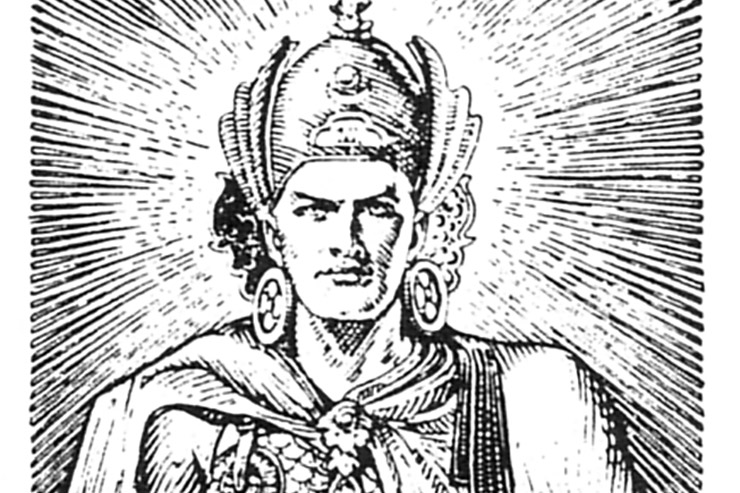
    What makes Ossendowski’s account unique is his claim that everywhere he went in Central Asia he encountered the shadowy legend of “The King of the World” – reigning over the subterranean power-centre of Agharti – who “knows all the forces of the world and reads all the souls of humankind and the great book of their destiny.” This unseen ruler of the planet and his council of Masters wield telepathic influence over persons in our ‘outer’ world. Often visiting disciples in their dreams, they send forth messengers at fortuitous times to confer with their agents, scattered among the nations.

    Occasionally, the King of the World came out in person. He would visit some holy place, arriving and leaving mysteriously. He had done so at a temple in the Mongolian town of Narabanchi in the winter of 1890/91.

    A Prophecy for Today?

    In Beasts, Men and Gods, Ossendowski recounts a quite remarkable prophecy given by the King of the World. A Buddhist lama, the Hutuktu of Narabanchi, told Ossendowski in 1921 that the King of the World made the following pronouncement “thirty years ago,” which corresponds to winter 1890/91:

    “More and more the people will forget their souls and care about their bodies. The greatest sin and corruption will reign on this earth. People will become as ferocious animals, thirsting for the blood and death of their brothers. The ‘Crescent’ will grow dim and its followers will descend into beggary and ceaseless war. Its conquerors will be stricken by the sun but will not progress upward and twice they will be visited with the heaviest misfortune, which will end in insult before the eye of the other peoples. The crowns of kings, great and small, will fall… one, two, three, four, five, six, seven, eight… There will be a terrible battle among all the peoples. The seas will become red… the earth and the bottom of the seas will be strewn with bones… kingdoms will be scattered…whole peoples will die… hunger, disease, crimes unknown to the law, never before seen in the world.

    “The enemies of God and of the Divine Spirit in man will come. Those who take the hand of another shall also perish. The forgotten and pursued shall rise and hold the attention of the whole world. There will be fogs and storms. Bare mountains shall suddenly be covered with forests. Earthquakes will come… Millions will change the fetters of slavery and humiliation for hunger, disease and death. The ancient roads will be covered with crowds wandering from one place to another. The greatest and most beautiful cities shall perish in fire… one, two, three… Father shall rise against son, brother against brother and mother against daughter…. Vice, crime and the destruction of body and soul shall follow…. Families shall be scattered…. Truth and love shall disappear…. From ten thousand men one shall remain; he shall be nude and mad and without force and the knowledge to build him a house and find his food…. He will howl as the raging wolf, devour dead bodies, bite his own flesh and challenge God to fight…. All the earth will be emptied. God will turn away from it and over it there will be only night and death.

    “In the fiftieth year only three great kingdoms will appear, which will exist happily seventy-one years. Afterwards there will be eighteen years of war and destruction. Then the peoples of Agharti will come up from their subterranean caverns to the surface of the earth.”

    Immediately following this prophecy Ossendowski writes:

    “Afterwards, as I travelled farther through Eastern Mongolia and to Peking, I often thought: ‘And what if…? What if whole peoples of different colours, faiths and tribes should begin their migration toward the West?’”

    After again quoting the Buddhist lama, Ossendowski ends his book: “Karma may have opened a new page of history! And what if the King of the World be with them? But this greatest Mystery of Mysteries keeps its own deep silence.”

    The Year 2030

    If we accept that the mysterious King made this prediction in the winter of 1890/91, as Ossendowski was told, then the 50 years of strife and misery (marked by the First World War, the end of the European monarchies, revolutions, famine, disease, class/ethnic/religious conflicts, the financial chaos of the Great Depression) would take us through to the years of the Second World War. This followed by 71 years of happy stability under three great kingdoms (perhaps a reference to the East-West stand off at the end of 1945). Bringing us remarkably close to 2012, a year made famous by its association with the supposed end of the Mayan calendar. Then commences 18 years of war.

    Many modern day commentators believe we’re in the initial stage of a long ‘war’, with the Anglo-Americans and the Western alliance locked in a new kind of ‘asymmetric warfare’ with Russia, China and their allies in the global South. Others, notably American politicians, see an endless ‘War on Terror’ as currently underway between the West and radical Islam. The culmination of this 18-year period of global conflict brings us to the years 2029-2030. This is when the people of the “subterranean” realm will come “to the surface of the earth,” making their existence known to all.

    Leaving aside the esoteric and mystical symbolism implicit in the Agharti mythos, some further observations are worth making. As we approach the year 2029, the date prefigured in the King of the World’s prophecy delivered in 1890/91, we look back on a century of bloodshed and misery unprecedented in history. World wars, genocides, social and political upheavals, ecological crisis, economic instability, are only some of the terrible catastrophes to befall mankind in the last hundred years.

    Against this background, some contemporary visionaries see the wars in Iraq and Afghanistan, threats against Iran, even the destabilisation of the Chinese province of Xinjiang, as part of the working out of an ancient plan. Added to all this is the spectacular rise of the peoples of Asia. A great awakening is quietly underway in Central Asia, fuelled in large part by China’s grand scheme to re-establish the ancient Silk Road. Will we see the dawn of a powerful Great Eurasian confederation by 2029? Many expect so.

    As the mystic Baron Roman Ungern von Sternberg (1886–1921) told Ferdinand Ossendowski:

    “I shall die! But no matter, no matter… The cause has been launched and shall not die… The tribes of Jenghiz Khan’s successors are awakened… In Asia there will be a great state from the Pacific and Indian Oceans to the shores of the Volga… It will be the victory of the spirit.”

    Is this the ‘victory of the spirit’ for which certain Eastern mystics and their allies in the Eastern-orientated occult circles in the West have long been labouring in secret? For at least the last one hundred years a select few Western occultists have known that the rise of Asia was near and inevitable. Back in 1888, Madame H. P. Blavatsky, who spoke openly of being guided by ‘The Masters of the East’, predicted an inevitable show down between East and West:

    “Then, perhaps, there will be a new invasion of an Atilla from the far East. One day the millions of China and Mongolia, heathen and Mussulman, furnished with every murderous weapon invented by civilisation, and forced upon the Celestial of the East, by the infernal spirit of trade and love of lucre of the West, drilled, moreover, to perfection by Christian man-slayers – will pour into and invade decaying Europe like an irrepressible torrent.”

    Secretive mystic-politico groups, known to history by various and sundry names: the ‘Grand Lodge of Vril’, the ‘Order of the Green Dragon’, ‘Society of Green Men’, ‘Black Dragon Society’, ‘Han Temple of Buddha-Shakti’… Claiming a link with Agharti, these have all worked quietly in the shadows to lay the foundations for a sort of fraternal union between Eastern and Western occultists. In a document issued by one of these occult orders, we’re informed:

    The Master of the Three Worlds, whose initials are K.R.T.K.M, reigns over a community of Magi… The next Buddha will come from the North, and will be the Kalki-avatar of the Hindus, or Kundaliniavatar, who will wear on his finger the metal ring of Genghis Khan. His coming will mark the return of the Golden Age, and will precede the advent of the luminous race, contemporary with the resurrection of Mu or Tao-Land.

    It will be the end of the Kali Yuga, the casting out of the Jotün and the cacodamons from the governmental centres of the earth, and of 100,000 years of evil karma inherited from the darkness of Atlantis.

    Here we have hints of a link between the King of the World’s prophecy and the end of the Kali Yuga. A connection that did not escape the attention of French esotericist Rene Guenon (1886–1951) who wrote his own study of the King of the World, Le Roi du Monde, in 1927. Guenon was also interested in the work of scholar Gaston Georgel who claimed, based on his extensive research, that the end of the Kali Yuga would come in the northern hemisphere winter of 2029/2030.

    Time, as they say, will tell.

    [alert type=”general” dismiss=”no”]This article was published in New Dawn Special Issue Vol 11 No 3.[/alert]

    [alert type=”success” dismiss=”no”]If you appreciate this article, please consider subscribing to help maintain this website.[/alert]

    © New Dawn Magazine and the respective author.
    For our reproduction notice, click here.
  • The Man Who Conjured Hitler

    The Man Who Conjured Hitler

    From New Dawn Special Issue Vol 7 No 3 (June 2013)

    Follow Hitler. He will dance, but it is I who have written the music.… Don’t weep for me: I shall have had more influence on the course of history than any other German.
    – Dietrich Eckhart, on his deathbed, Christmas 1923

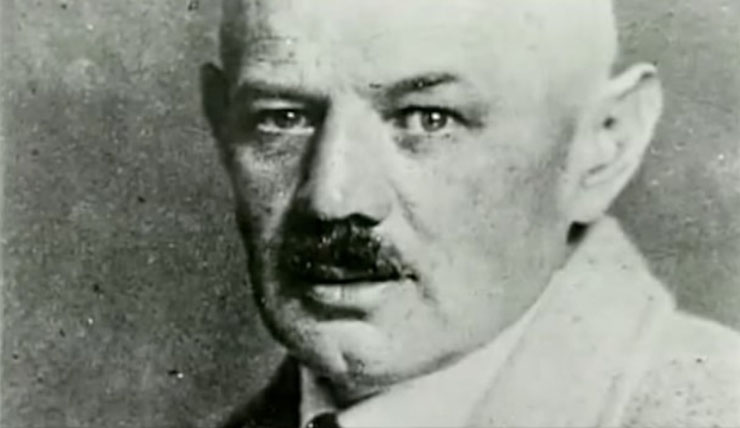
    Dietrich Eckart (1868-1923) was a prominent figure in Germany’s bohemian and occult subculture before World War I. A well-known playwright, poet and journalist, he was involved with the shadowy Baron Rudolf von Sebottendorff and the secretive Thule Society in Munich.

    After hearing Adolf Hitler speak at a political meeting in 1919, Eckart recognised Hitler’s talent as a demagogue and an organiser. He saw in Hitler someone who could translate the occult worldview of the Thule into action. He quickly took Adolf Hitler under his wing and made him his protégé.

    Eckart popularised a central tenet of the Thule Society, the belief in the coming of a “German Messiah” who would redeem the nation from its defeat in World War I. Eckart expressed his anticipation in a poem he wrote months before he first met Hitler. In the poem, Eckart refers to ‘the Great One’, ‘the Nameless One’, ‘Whom all can sense but no one saw’. When Eckart met Hitler, Eckart was convinced that he had encountered the prophesied saviour.

    Eckart introduced Hitler to Capt. Ernst Rohm, who had important links to senior officers in the German army. Rohm, an open homosexual later murdered on Hitler’s orders, headed up the Thule Society’s military wing. Other Thule initiates Eckart introduced to Hitler included Rudolf Hess (who would become Hitler’s deputy) and Alfred Rosenberg (later to play an important role in the Third Reich).

    Significantly, Eckart provided Hitler with funds and supported him in his rise within the German Workers’ Party (DAP), the Thule Society’s political front group. Eckart had been one of the founders of the party which Hitler quickly transformed into the National Socialist German Workers’ Party (NSDAP). He was the original publisher of the party tabloid, the Völkischer Beobachter, a Munich newspaper first bought by Rudolf von Sebottendorff in the name of the Thule Society. Eckart also wrote the lyrics of the quasi-mystical Nazi anthem “Germany Awake.”

    Historians agree that Eckart exerted considerable – and unequalled – influence on Hitler. Without his patronage the young Austrian veteran would never have become the leader of the party that came to completely dominate Germany in the 1930s.

    Under Eckart’s guidance Hitler was first made into a political Führer. His 1921 article was in fact the first to describe Hitler as the “Führer” of the German people. He put his library at Hitler’s disposal and taught him to express himself more articulately.

    Eckart is credited with helping Hitler develop his almost hypnotic power of oratory. As Professor Alan Bullock observed in Hitler: A Study in Tyranny: “Hitler’s power to bewitch an audience has been likened to the occult arts of the African medicine-man or to the Asiatic shaman; others have compared it to the sensitivity of a medium and the magnetism of a hypnotist.”

    So who was Dietrich Eckart?

    Eckart has been called “a seeker of other realities,” regarded by some as a mystic and a seer. No ordinary political journalist, one biographer noted:

    Dietrich Eckart was never a politician in the usual sense. As a politician he remained – as he did a poet – a seer of essentials, and from this standpoint he passed judgement on men and events. With the politics of everyday and their advancement, with practical Realpolitik and its hypocrisy and readiness to compromise, he had nothing to do. (Adolf Dresler, Dietrich Eckart, 1938)

    THE ‘MASTER-ADEPT’

    Addicted to morphine for much of his life and suffering from alcoholism in his later years, Eckart was described by the American journalist Edgar Ansel Mowrer as “a strange drunken genius.” His friend Alfred Rosenberg wrote of him: “Without the sweet poison [of morphine] he could not live… Eventually he was taking daily measures from which a normal man, not possessed of such bear-like strength, would have died.”

    An incurable romantic, Dietrich Eckart saw himself as following in the tradition of the great German thinkers Heinrich Heine, Arthur Schopenhauer and Angelus Silesius. He was also well acquainted with Buddhism and the lore of ancient India.

    However, according to James Webb, author of The Occult Establishment, “the basis of Eckart’s doctrine was Christian mysticism. Man must free himself from the world and deny the supremacy of matter, which is illusion. Only death will break the spell under which humanity labours.”

    The German historian Steigmann-Gall concludes that, “far from advocating a paganism or anti-Christian religion, Eckart held that, in Germany’s post-war tailspin, Christ was a leader to be emulated.”

    The British author Trevor Ravenscroft in his sensationalist best-selling book The Spear of Destiny describes Eckart as the “Master-Adept” responsible for Hitler’s rise from obscurity to absolute power. “Dietrich Eckart,” says Ravenscroft, “contrived to open the centres in the astral body of Adolf Hitler, giving him the possibility of vision into the macrocosm and a means of communication with the Powers.”

    The French writers Pauwels and Bergier in their Morning of the Magicians also single out Dietrich Eckart as Hitler’s occult master. They claim that Eckart’s role as an occult counsellor was related explicitly to invisible hierarchies.

    Thule was thought to have been the magic centre of a vanished civilisation. Eckardt [sic] and his friends believed that not all the secrets of Thule had perished. Beings intermediate between Man and other intelligent beings from Beyond, would place at the disposal of the Initiates [i.e. the members of the Thule Society] a reservoir of forces which could be drawn on to enable Germany to dominate the world … [its] leaders would be men who knew everything, deriving their strength from the very fountain-head of energy and guided by the Great Ones of the Ancient World.

    Researchers of the occult, as well as some spiritual teachers, have long concluded Adolf Hitler was a vehicle for other forces. Something or someone else was behind him. Was Dietrich Eckart the vital link between Hitler and those Powers? After Eckart’s death in 1923, Hitler deliberately attempted to conceal his immense debt to the Thule. Once in control of Germany, he ordered the ruthless suppression of all occult organisations and esoteric teachings.

    After a few years as pupil of the master Eckart, Hitler embarked on his own ‘independent’ path. From the mid-1920s, Adolf Hitler felt he had outgrown the occultist milieu, and was now solely dependent on “Providence” to guide him to victory. In Mein Kampf, Hitler’s contemptuous attack on ‘wandering scholars’ showed his disdain for the conspiratorial secret society approach of groups like the Thule Society.

    Eckart’s influence waned with Hitler’s growing renown and self-confidence. The original vision of the Thule was sacrificed in the brutal and bloody struggle for power and control. However, up to his death in 1945, Hitler continued to hold Dietrich Eckhart in high regard. He dedicated the second volume of Mein Kampf to his deceased mentor.

    Get the issue this article appears in

    The controversial Indian guru Osho (formerly known as Bhagwan Shree Rajneesh) declared “Hitler was used by an esoteric group” and “the entire concept of Hitler’s philosophy was given by some hidden schools.” Osho believed that once Hitler became ‘independent’ he began to go down. Osho claimed:

    Who was behind this? Some esoteric group was behind this, and that esoteric group was trying something. When Hitler became independent, he lost every power. In his last days, he was just ordinary. After this particular moment, when he lost contact, whatsoever he did went against him. Before this, whatsoever he did was always in his favour. (I Am The Gate)

    Historians have yet to fully uncover the complex underground of German secret societies and occult traditions from which the Nazi Party emerged early last century. When they do, Dietrich Eckart will surely be revealed as the occult mage who conjured Adolf Hitler.

    [alert type=”general” dismiss=”no”]This article was published in New Dawn Special Issue Vol 7 No 3.[/alert]

    [alert type=”success” dismiss=”no”]If you appreciate this article, please consider subscribing to help maintain this website.[/alert]

    © New Dawn Magazine and the respective author.
    For our reproduction notice, click here.
  • Brothers of the Shadows: Overlords of Chaos

    Brothers of the Shadows: Overlords of Chaos

    From New Dawn Special Issue Vol 9 No 4 (Aug 2015)

    Who controls the past controls the future. Who controls the present controls the past.
    – George Orwell, 1984

    Back in 1893, an elusive Englishman named Charles George Harrison (b.1855) delivered a series of six lectures to the Berean Society, a London based association of Christian esotericists. Harrison, described as a “mysterious and unknown figure,” was an English occultist and Anglican Christian. A record of his lectures can found in the book The Transcendental Universe. What is clear is that C.G. Harrison had access to highly sensitive information and a good deal of inside knowledge of world changes then being engineered by certain circles in England.

    In his second lecture Harrison spoke of “the next great European war” and of how the “national character” of the Slavic peoples would “enable them to carry out experiments in Socialism, political and economical, which would present innumerable difficulties in Western Europe.” The “next great European war” points to what would be the First World War of 1914-18, while the “experiments in Socialism” predict the 1917 Bolshevik Revolution which brought about the Soviet Union, one of the boldest and bloodiest politico-economic experiments in human history. Harrison said the plan of a particular secret elite, which he doesn’t mention by name, was that “the Russian Empire must die that the Russian people may live.” It is amazing to consider these truly prescient words were spoken in 1893, 21 years before the First World War and 24 years before the Russian Revolution. Today we know that in 1917 Bolshevik leader Vladimir Lenin was transported from Zurich, then the banking capital of the world, to Russia in a train loaded with gold and weapons to start the revolution.

    Discussing C.G. Harrison’s extraordinary foreknowledge, Sevak Gulbekian asks:

    How could he [Harrison] know about the forthcoming War as well as the “experiments in Socialism,” which would take a grip on Russia and its surrounding states for most of the twentieth century? If he was not, as he claimed, a “practical occultist” himself, it is reasonable to assume he had contact with people who were, and who had access to the malign plans…1

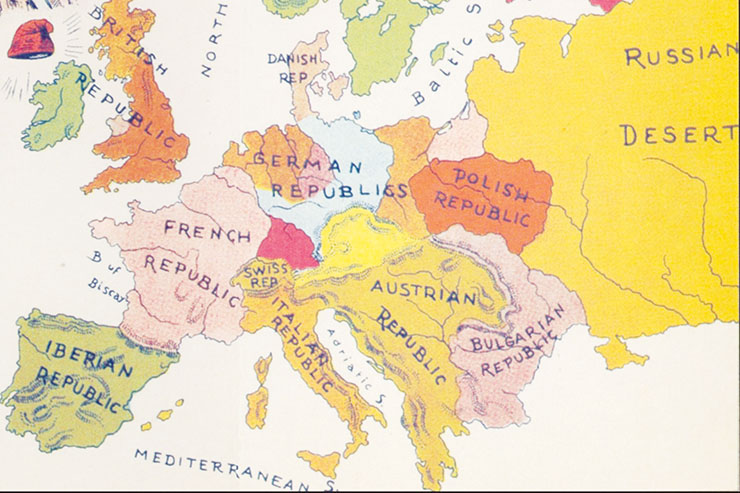
    Another significant piece of information coinciding with Harrison’s insights into the future is a cartoon map of Europe printed in the Christmas 1890 edition of the satirical English weekly, The Truth. Over the map is written: “The Kaiser’s Dream.” It showed wherever monarchies had been up to that time, there were going to be republics. The Austro-Hungarian Empire of the venerable Hapsburg monarchy had disappeared, as had the centuries old Russian Empire. Over the territory of Russia we read the words “Russian Desert.” In addition, Germany is identified with the words “German Republics”! Commenting on this map from 1890, Sevak Gulbekian notes:

    This map signifies not only a foreknowledge – similar to Harrison – of the fate of Russia to become a cultural as well as an economic ‘desert’, but also of the future splitting of Germany into ‘republics’. The magazine’s editor, Henry LabouchEre, was a Freemason. Was his remarkable foresight pure luck, or once again did he have some inside knowledge of future plans to shape the world?

    Why destroy the Hapsburg Empire? The influence of the Catholic Hapsburgs, as heirs of the Holy Roman Empire, was felt through all Europe. As Catholic Europe’s most important royal house they posed a particular obstacle to Britain’s plans for the Continent. Austria-Hungary, along with the ruling Hapsburg dynasty, had to be wiped off the map in order to create a patchwork of small states in Eastern Europe. These could be easily manipulated by London. Count Arthur Polzer Hoditz, director of the cabinet of the last Austro-Hungarian emperor stated in his memoirs that, “the destruction of the Hapsburg Empire was carefully prepared.” Late 20th century research reveals the suicide in 1889 of Crown Prince Rudolf, the Hapsburg Emperor Franz Joseph’s only son and heir, was a planned political assassination. Less than a decade later in 1898 the Empress Elizabeth was brutally murdered by a secret society member in Geneva. And the killing in 1914 of Emperor Franz Joseph’s nephew Franz Ferdinand in Sarajevo by a member of the Serbian secret society of the Black Hand, had as its immediate consequence the outbreak of the First World War.

    The occultist Rudolf Steiner (1861-1925), who knew a great deal about the mysterious nexus of politics and the occult, mentioned the above map in a talk given in Switzerland at the height of the First World War. He said the map, as a secret document, was in existence since the last decades of the 19th century. This is the same time as the British imperialist Cecil Rhodes was laying the foundations for “a secret society with but one object, the furtherance of the British Empire, and the bringing of the whole uncivilised world under British rule…” According to the American historian Carrol Quigley in his book Tragedy and Hope, Cecil Rhodes set up such a secret society known as the “Society of the Elect” in 1889.

    Sevak Gulbekian explains Rudolf Steiner’s perspective thus:

    Behind the outer façade of world affairs, suggested Steiner, the machinations of occult groups or ‘brotherhoods’ were at work. Certain of these brotherhoods had wanted the Great War to take place, and had manipulated events to bring it about. In doing this, they sought to protect the dominant economic position of the English-speaking world, and in turn to crush the ‘mediating’ role of Central European powers such as Germany, the Austro-Hungarian empire, and so on.

    These occult brotherhoods – small groups of men who met together in ‘lodges’ and practiced ceremonial magic as a means of achieving certain goals – originated from the English-speaking (Anglo-Saxon) world and were allied, in particular, with Anglo-American interests. Their aim was to extend Anglo-American influence across the globe, and to ensure the predomination of Anglo-American culture. Furthermore, they sought to extend its superiority into the distant future; essentially to ensure that the present state of affairs continues evermore.

    Rudolf Steiner in one of his lectures about the influence of secret societies on politics says that in the Slavic peoples there lies a “special future.” He believed at some point in the future a cultural-spiritual highpoint would be reached in the Slavic countries, principally Russia. This is apparently known to the Anglo-Saxon occult brotherhoods which seek to manipulate these powers and bring them directly under British domination. Steiner’s revelations, based in part on his intimate involvement with Europe’s leading secret societies, help explain the major events of the 20th century. Two world wars, the partition of Europe into the Anglo-American dominated West and the Soviet controlled East, the decades long ‘stand-off’ between Eastern communism and Western capitalism in the ‘Cold War’, the collapse of the USSR and the declaration of an Anglo-American dominated unipolar world, can all be traced to the dark intrigues of the Brothers of the Shadows.

    [alert type=”general” dismiss=”no”]This article was published in New Dawn Special Issue Vol 9 No 4.[/alert]

    [alert type=”success” dismiss=”no”]If you appreciate this article, please consider subscribing to help maintain this website.[/alert]

    Footnote

    1. ‘Brothers of the Shadows: A Perspective on Conspiracies’ by Sevak Gulbekian, New Dawn 86 (September-October 2004)

    © New Dawn Magazine and the respective author.
    For our reproduction notice, click here.
  • The Hidden History of China’s Secret Societies

    The Hidden History of China’s Secret Societies

    From New Dawn Special Issue 11 (Mar 2010)

    Thanks to the latest Hollywood martial arts blockbuster along with a steady stream of Hong Kong action films, audiences around the world have been entertained by wild and colourful portrayals of Chinese secret societies.

    These extravagant fictional tales often obscure the plain truth that for at least two thousand years secret societies did play a vital part in the dynamics of China’s political, social and religious life. Right up to the birth of the People’s Republic in 1949, secret societies were a special characteristic of old China.

    “The officials draw their power from the law; the people, from the secret societies.” This Chinese saying sums up the centuries-old conflict between rulers and ruled, privileged and oppressed in imperial China. Secret societies were directly involved in all the peasant rebellions in Chinese history. As early as the second century, the armed uprising that eventually overthrew the Han dynasty was instigated by a Taoist sect called the Yellow Turbans, whose leader was renowned for his gift of spiritual healing and supernatural powers. The Yellow Turbans in their mixture of religion and political dissatisfaction may be regarded as the forerunners of the secret societies that sprang up all across China.

    By organising opposition to excessive taxation and the despotism of corrupt bureaucrats, secret societies gained widespread support. In the words of Chinese historian Teng Ssu-Yu, they were the “nerve centres” of opposition to the imperial government, “which profit from favourable circumstances to start insurrections and rebellions.” The secret society formed a hidden parallel empire, a state within a state, and this was a major source of its strength. Nocturnal initiation ceremonies, arcane teachings, secret signs, symbols and passwords, all helped bind a member’s loyalty to the fraternity. As China expert Jean Chesneaux explains:

    The secret societies claimed a rival order to that of emperor and mandarins. Vis-à-vis established society they constituted an ‘anti-society’ in the sense in which modern physicists talk of an anti-matter or an anti-universe… Their rites, secrets, oaths of initiation, conventional ideograms – features of which the Triad has provided very typical examples but which are found also in all similar associations – made a powerful contribution towards the consolidation of this autonomous order. The discipline was extremely strict, and any violation, betrayal, or collusion with the authorities was punished by death.1

    One of the most influential of China’s secret societies went by the name White Lotus. It often had to change its name in order to conceal its identity, and was associated with other groups, principally the Society of Heaven and Earth (also called the Hung society or Triad). The White Lotus functioned primarily as a spiritual body, but in times of political dissatisfaction and social upheaval it quickly took on the outer characteristics of a radical political movement. As a Chinese imperial decree written in 1813 points out:

    In normal times the society was engaged in daily worship… and preached that by reciting scriptures and verses, one can escape the dangers of swords and arms, water and fire…. But in times of famine and disorder they might plot for the Greater Enterprises (the founding of a new dynasty).

    The White Lotus society led one of the largest rebellions in the second quarter of the fourteenth century against the foreign rule of the Mongols. Known as the Red Turban Rebels (due to their distinctive red headbands) White Lotus members were behind the formation of the Ming dynasty (1368–1644) headed by former Buddhist monk Chu Yuan-chang, who assumed full imperial powers under the title Hung Wu. According to Professor Chesneaux:

    Chu Yuan-chang [Hung Wu], the leader of a peasant rebellion against the Mongol Yuan dynasty in the fourteenth century, belonged to the White Lotus sect, of Manichaean origin, and the name of the new dynasty which he founded, the Ming (which means ‘light’ in Chinese), originated in the esoteric vocabulary of the Manichaeans.2

    That the Ming emperor Hung Wu was both a former Buddhist monk and a Manichaean initiate is significant because the White Lotus teachings blended Buddhism and native Taoism with Gnostic elements which had entered China from Central Asia with Manichaean missionaries. Later secret societies venerated Hung Wu above all other historical figures and pledged their allegiance to the Ming dynasty that he established hundreds of years after its collapse. In 1644 the foreign Manchus, who had menaced the Chinese Empire for centuries, claimed the Dragon Throne and established the Ch’ing dynasty. The secret society networks were united in a common purpose: “Overthrow the Ch’ing and restore the Ming.”

    By the nineteenth century the cruel and despotic misrule of the Manchus had resulted in nearly a century of political and religious turmoil, leaving China in chaos and unable to effectively confront Western incursions. In the history of all the popular rebellions the name of the White Lotus appears and disappears. They have been linked with the famous Shaolin Temple of Chan Buddhism, reputedly where Chinese martial arts originated, and the Shaolin monks who took a blood oath to resist the Ch’ing dynasty. After the failure of the two great insurrections of the late eighteenth century, the White Lotus was the victim of violent persecution. In 1813 White Lotus members called the Eight Diagrams (named after geometrical figures used in Taoist divination) nearly took over the Forbidden City in Beijing.

    The Society of Heaven and Earth or Triads absorbed much from the White Lotus tradition, and is sometimes regarded as its successor. Persecuted and hunted down by government forces, White Lotus initiates either organised new societies under new names or assimilated with the Triads. All these secret fraternities while clearly united in one political aim summed up in the slogan, “Overthrow the Ch’ing and restore the Ming,” also had their core mystical elements and ceremonial rites. They believed in, and taught, occult techniques to their members, among them the use of ‘magic amulets’ and numerology. J.S.M. Ward, an early twentieth century British expert on secret societies and bishop of an esoteric Christian community, concluded that, “the Hung or Triad Society seems justly entitled to claim that it is a lineal descendant of the Ancient Mysteries. Its signs are of primeval antiquity…” Bishop Ward published an exhaustive study of Triad practices, documenting the striking similarities to those of many other secret organisations.

    At this point it is worth commenting on a strange connection between the secret societies of the Far East and Western esotericism. In the 1880s a young French aristocrat deserted the Foreign Legion in Indochina to join a network of secret societies, the T’ien-ti hui and the Bac Lieu. These Triads were of Chinese origin and viewed as Taoist societies. Count Albert de Pouvourville (1861–1940) thus described his membership in the Triads as a “Taoist initiation.” On his return to Paris, de Pouvourville became a successful writer and journalist, publishing under his Taoist initiate’s name Matgioi. In his writings he condemned French colonial policy in Southeast Asia and explored Chinese and Vietnamese history. He also undertook important translations of Taoist texts. At the same time Albert de Pouvourville, the Taoist secret society initiate, joined the Gnostic Church in Paris and was consecrated a bishop with the spiritual name of Tau Simon. Around 1904 he launched the journal La Voie, and published Les Enseignements secrets de la Gnose (The Secret Teachings of Gnosis). Stanislas Guaita, another French writer and occultist, was strongly influenced by de Pouvourville, as was Rene Guenon who acknowledged him as “one of my Masters” in 1918. Through Count de Pouvourville, Guenon received a Taoist initiation and was led to write his own studies of the metaphysics of the Taoist tradition.

    By the start of the twentieth century China’s secret society networks had grown into a considerable force. They had long experience of resistance to the imperial bureaucrats and could rely on the support of the peasants and the poor. Writing in 1908, a young Chinese radical living in exile in Paris noted how throughout the Chinese Empire there existed, “secret revolutionary associations whose importance in the history of China has been great and whose activity in the contemporary [revolutionary] movement is considerable.”

    The hated Ch’ing dynasty continued on until 1911 when it was overthrown by Dr. Sun Yat Sen’s Republican Party, with the considerable aid of the Triads. A Triad member of long standing, Sun Yat Sen had made use of the secret society networks to recruit supporters, raise funds, and disseminate propaganda on behalf of the Republican cause. The 1911 Revolution fulfilled one of the Triad’s traditional aims – “Overthrow Ch’ing.” On a visit to the tombs of the Ming emperors, China’s first president declared that the Ch’ing had finally been dethroned.

    Mao Zedong is known to have been a keen student of Chinese history particularly China’s numerous peasant uprisings. Mao studied the structure and role of secret societies in these tumultuous events, and used this knowledge in building the Chinese Communist Party and waging a successful guerrilla war against both the Japanese invaders and the right-wing forces of Chiang Kai-shek. In these struggles Chairman Mao appealed directly to the ‘revolutionary spirit’ of the secret societies, urging them to join the ant-Japanese resistance and work for the liberation of China.

    [alert type=”general” dismiss=”no”]This article was published in New Dawn Special Issue 11.[/alert]

    [alert type=”success” dismiss=”no”]If you appreciate this article, please consider subscribing to help maintain this website.[/alert]

    Footnotes

    1. Jean Chesneaux, Secret Societies in China in the Nineteenth and Twentieth Centuries

    2. Jean Chesneaux, Peasant Revolts in China, 1840-1949

    © New Dawn Magazine and the respective author.
    For our reproduction notice, click here.