‘Eurasia’ was not a name you heard in Australia thirty years ago. Apart from an obscure reference in academic publications focused on the Soviet Union, ‘Eurasia’ (Ezrasia) would occasionally be mentioned by emigres from the former Russian Empire who had made their way to Australia in the post-war period. Many of these Russians had lived for years in Harbin, Manchuria after fleeing the 1917 Bolshevik Revolution and resulting Russian Civil War.
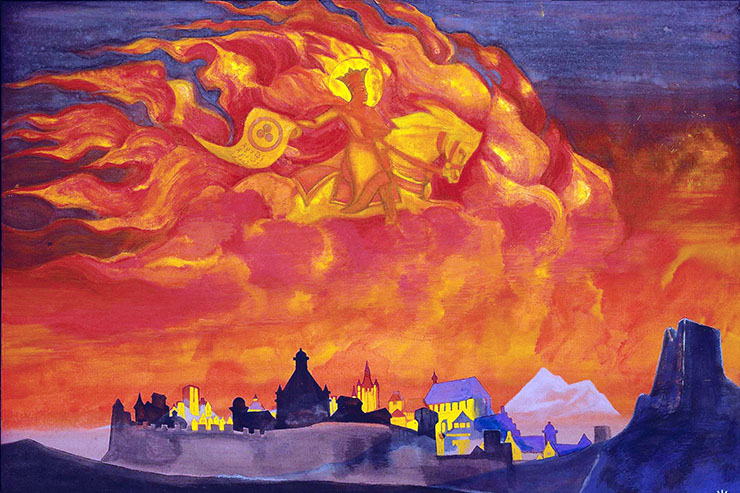
My earliest recollection of ‘Eurasia’ was in a talk on the Russian artist Nicholas Roerich’s 1924-28 Central Asian expedition given to a meeting of the Melbourne-based Gnostic group the Order of the Pleroma. The speaker, an elderly gentleman who had corresponded with Professor Roerich in the 1940s, captivated his listeners with a vivid account of the Russian explorer’s extraordinary journey through Siberia, Mongolia, across the Gobi desert to Tibet and the scarcely known Trans-Himalayas. Covering vast unexplored regions of Eurasia, Roerich visited ancient monasteries, holding discussions with lamas, hermits and sages. He heard of ancient legends about the holy mountain, the planetary axis, and of the mysterious sacred land of Shambhala. Roerich immediately recognised how the vivid stories of Shambhala matched the Siberian myth of ‘Belovodye’ – the mystical ‘Golden Land’ also known as the ‘White Waters’.
While in Kashmir, Roerich’s encounter with long-forgotten wisdom inspired him to undertake a series of paintings dedicated to the Great Teachers of humanity – The Banners of the East. Roerich’s experiences led him to conclude that all cultures stem from a single source disseminated during the great migrations of people in distant historical times. This common source, he believed, should be searched for in Eurasia.
The Russian writer Maxim Gorky called Nicholas Roerich “the greatest intuitivist of modern life.” However, Roerich and his wife Elena always maintained they were directed in their undertakings by ‘Messengers of Wisdom’, the same mysterious personages who guided another Russian mystic, Madame H.P. Blavatsky, in the nineteenth century.
Prior to setting out in 1924 on their grand Central Asian expedition, the Roerich’s were instructed by their spiritual guide to launch the ‘Great Plan’, a Sacred Union of the East. A truly visionary geopolitical program, the Great Plan called for the union of Mongolia, Tibet, parts of India and China, with Siberia. This vast Eurasian Sacred Union was to have as its capital the equally visionary city of Zvenigorod that Roerich believed would appear in the Altai Mountains. While Roerich’s mystical Eurasian Sacred Union never materialised, his adventures in the service of this ‘utopian’ dream did capture the imagination of the world, drawing attention eastward to the great wonders of Central Asia.
According to historian John McCannon, “Aside from its breathtaking scope and fantastic nature, the most striking thing about the Great Plan is the way in which it wed political aspiration with esoteric belief… any attempt to understand Roerich’s political actions without taking into account his occult convictions…. is fruitless or inadequate.”
Nicholas Roerich was held in high regard by Russian emigres in Australia who were devoted to esoteric teachings. The writer Andrew Tomas, who was born in the Russian imperial city of St. Petersburg in 1906, considered Nicholas Roerich to be his Master. Tomas, who lived in China before settling in Australia in 1948 and becoming an Australian citizen, wrote of first meeting Roerich in Shanghai in 1935. The profound impact that Roerich had on Tomas is evident in two of his books published in the 1970s, Shambhala: Oasis of Light and Beyond the Time Barrier. Today, Tomas is remembered as a pioneering Australian UFO researcher, the author of popular paperbacks like We Are Not the First: Riddles of Ancient Science and On the Shores of Endless Worlds.
Fascinated by Nicholas Roerich’s journeys, I asked a Russian-Australian ‘old time’ esotericist for more information on Eurasia. He kindly gave me a book, A New Party in Russia by P. Malevsky-Malevitch, one of the first books about Eurasianism written in English way back in 1928. Nicholas Roerich was indeed inspired by a thoroughly Eurasian vision. One centred on the reconciliation of apparent opposites, the transcending of ideological differences, from which a new grand synthesis can emerge and a new day dawn for the peoples of earth, neither exclusively Western nor wholly Eastern, but truly Eurasian.
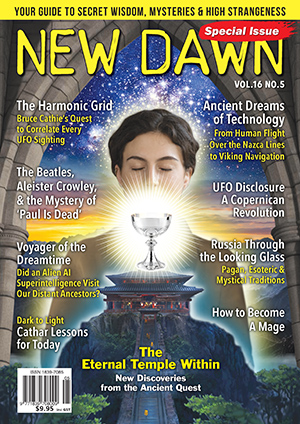
When in 1991 it was decided to publish a magazine that explored conspiracies, cover-ups and metaphysics, with a positive eye on the future, the title ‘New Dawn’ was suggested. Then those involved remembered Nicholas Roerich’s enigmatic statement, “The East has said that when the Banner of Shambhala encircles the world, verily the New Dawn will follow.” So, on the 1st May 1991, the first issue of New Dawn magazine appeared.
I remember one of my discussions with Brother Michael as if it were only last week. Though it took place in the summer of 1989, a mere 34 years ago! A gifted linguist, he was a private French tutor, Michael taught himself Arabic so he could read the Quran and the works of Muslim mystics. As often happened when we met, our conversation passed seamlessly from the history of Sufism in Australia – Hazrat Inayat Khan’s Australian disciple Baron von Frankenberg and Meher Baba’s 1959 visit – to the spread of New Thought in the country at the start of the last century.
Advertisement in a Melbourne newspaper for Cole’s Book Arcade that highlights “New Thought and Occult Books.” Once the world’s largest bookstore, Cole’s Book Arcade was known as ‘The Poor Man’s University’.
Brother Michael fondly recalled his mother and her parents as dedicated ‘spiritual seekers’, some of his first memories were of being taken to New Thought meetings in 1920s Melbourne. His maternal grandparents were introduced to the ‘Higher Thought’ after attending public lectures by the American ‘Mental Healer’ Dr Frederic Bell, who toured Australia in 1900 before establishing himself in Melbourne for a period around 1906. Dr Bell – billed in the press as the “Prince of Orators, Song Lecturer and Teacher of Practical Occultism and the New Thought” – captivated Australian audiences with his talks on subjects like “Dreams, Visions, Prophecies and Revelations Explained” and “The Prodigal Son from an Occult Perspective.”
New Thought inspired a diverse range of organisations and activities in early 20th century Australia. Michael told how his mother’s family frequented the New Thought Club in Collins Street and avidly read the latest books on ‘practical occultism’ available at the New Thought & Occult Book Store as well as Cole’s Book Arcade, then the world’s largest bookstore. Michael accompanied his mother to Sunday services of the Melbourne New Thought Centre, participating in New Thought-inspired children’s programs. He remembered seeing the influential American New Thought lecturer and writer Dr Julia Seton on her final Australian lecture tour. The founder of the Church and School of the New Civilization in the United States, Dr Seton was a major figure in the development of the New Thought movement from the esoteric and metaphysical point of view.
Spiritual Healers
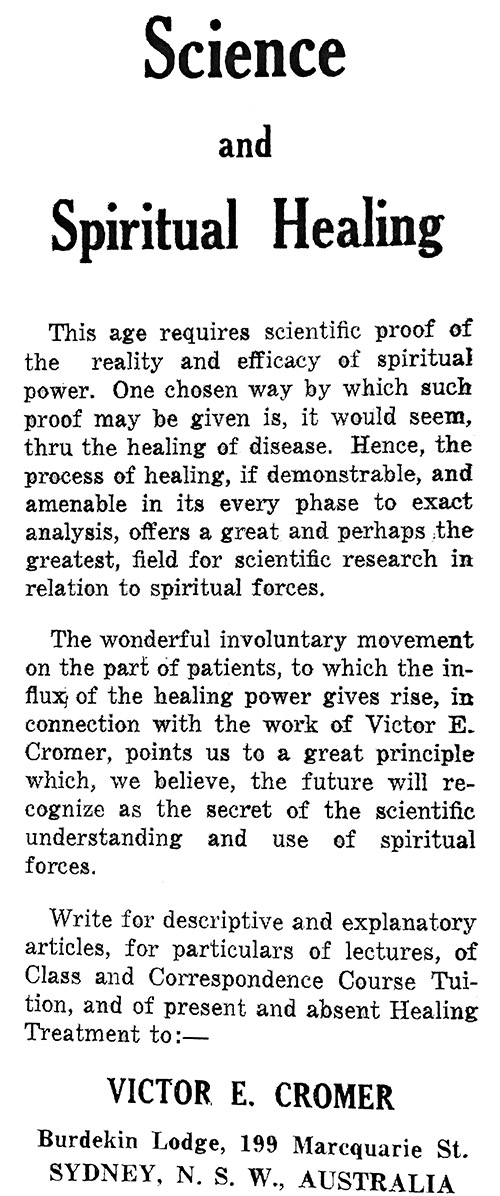
Victor E. Cromer broadcast on Sydney Radio 2GB in the late 1920s, urging his listeners to “tune-in to the spiritual healing power.” His mass healings at Sydney Town Hall attracted large and enthusiastic crowds along with the attention of the mainstream media who ridiculed them as “nothing more or less than mass hysteria.” Consequently the State Health minister was called on to enact legislation “to deal with” Mr Cromer and “all other unregistered healers.”
Michael’s grey eyes, which matched his well-worn three-piece suit, lit up as he recalled a childhood journey to Sydney in 1928 with his grandfather to meet the ‘seer’ and ‘Mental Healer’ Mr Victor E. Cromer. Originally from South Australia, Cromer founded the Spiritual Healing Institute in Burdekin House, Macquarie Street, then Australia’s most prestigious address. Michael’s grandfather credited Cromer’s ‘distant healing’ with curing him of a chronic health condition.
“Grandfather and Mr Cromer were firm friends, old correspondents. They knew each other from when Mr Cromer lived in Melbourne, both having started out in the workers’ movement. Mr Cromer founded the Worker’s Educational Association of South Australia and went to Germany as the Australian delegate to the Socialist International where he met Lenin, Trotsky, and Ramsay McDonald, the future British PM. With the outbreak of the Great War, disillusioned with politics as the best vehicle for social revolution, he gave himself 100% to the higher cause of spiritual revolution, the healing of mind and body through divine power and Higher Thought.”
Michael said his grandfather also subscribed to the publications of another prominent Sydney spiritual healer, Sister Veni Cooper-Mathieson, who lectured weekly at The Truth Centre. A tireless organiser for New Thought, Sister Veni founded several organisations over the years, including ‘The Universal Truth Centre & Metaphysical College’, ‘The Esoteric College’, ‘The Universal Truth Publishing Company’, and ‘The New Thought Book Depot & Library’. The latter was promoted as “the Premier Australasian Centre for the dissemination of Higher Thought, Metaphysical, Occult, Esoteric, Mental Culture, Physical Culture, Health Culture, Dietetic, Humanitarian, and other progressive literature. Our stock of New Thought books is the largest in Australasia.”
In his book A History of the New Thought Movement, Horatio Dresser notes that “the pioneer work of Sister Veni Cooper-Mathieson in Australia began in 1903, under the title ‘The Women’s White Cross Moral Reform Crusade’.” Adding that Sister’s first magazine, The Truth Seeker, was established in January 1905.
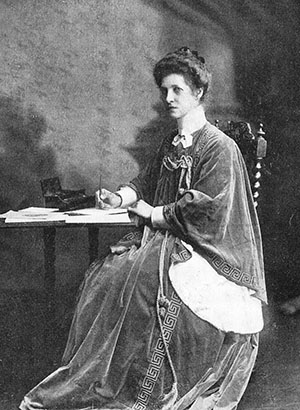
Australian New Thought pioneer, healer and metaphysical teacher Sister Veni Cooper-Mathieson (1867–1943).
“In April 1909, the Church Universal in Perth, Western Australia, was organized. In December 1914, this church was moved to Sydney, and a Truth Centre was established. The first magazine [The Truth Seeker] was united with The Healer and called The Revealer in 1915.”
Michael had no clear memory of seeing Sister Veni but was adamant that his mother and grandfather would have frequented her Truth Centre during visits to Sydney in the twenties.
By the 1930s New Thought peaked in Australia and started to steadily decline. Popular enthusiasm for spiritual healing soon passed over in favour of the modern wonders of medical science. The impact of secularisation brought a loss of belief in Australia’s divinely ordained destiny. A notion widespread in the years immediately after Federation. No longer seen as the land of which Sister Veni once prophesied:
It is the vision of the Future that reveals to the waiting nations that thou, O! Queen of the South! Thou last of the lands to arise from the sea, shall yet be first in splendour, greatest in wisdom and highest in power and glory. Out of thee shall sons and daughters arise that shall be mighty before the Lord of Life; and from them shall come the seed of the new and regenerate humanity.1
Richard, Duc de Palatine
Richard, Duc de Palatine
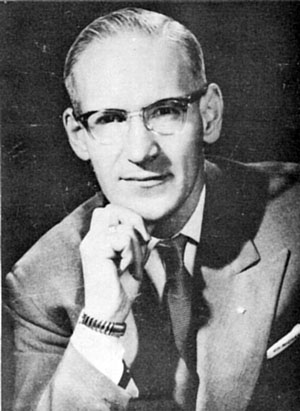
Exposed from birth to New Thought, spiritual healing, occultism, and a bewildering array of ‘progressive’ and ‘alternative’ beliefs and practices, no surprise then that when in college, Michael attended lectures of the Psychological Society of Victoria, where he met his future ‘Master Teacher’ Ronald Powell (later known as Rev. Richard, Duc de Palatine). While listening to Powell lecture on Atlantis in November 1940, Michael felt himself transported back to the days of the legendary city!2
Ronald Powell, born in North Fitzroy on 4 July 1916, had himself undergone a profound spiritual experience while in the library of the Melbourne Theosophical Society where he was mysteriously drawn by the “Invisible Presence” to study “the extant writings concerning the Gnostics, Essenes and Secret Mysteries.” By 1944, Powell became convinced “that one day he would cause to be formed a Brotherhood which would partially restore the Sacred Lore and encourage people to prepare themselves for the Illumination and Interior Communion with the God within as practised in the Secret Brotherhoods of all the ages.”3
In 1948, the Invisible Presence directed Ronald Powell, whom Michael had come to know quite well in the post-war years, to sail for England to begin his mission. Powell confided to Michael and his Melbourne friends that his work was not in Australia. Settling in London’s Kensington, Ronald Powell, who legally changed his name to Richard, Duc de Palatine, established the Pre-Nicene Gnostic Church and shortly after the Brotherhood & Order of the Pleroma. Following his Master Teacher’s footsteps, Michael left Australia for England in the 1950s, moving on to France to study with the French Gnostic Church. On his return to Australia, Michael took charge of the Australian branch of the Brotherhood & Order of the Pleroma headed by his old teacher Richard, Duc de Palatine in London.
Fast forward to January 1991, the first Gulf War got underway when the US unleashed Operation Desert Storm with unprecedented airstrikes on Iraq. It was clear that the whole story of the war and the events leading to it were not being presented in the dominant mainstream media. A small group met in the library of the Arab Cultural Centre in Brunswick, Melbourne, to discuss the need for a publication to present the other side of the story. A magazine examining the hidden dimensions of world affairs and a forum for alternative views and ideas neglected in the mainstream media. But what should such a publication be called?
Michael came by unexpectedly, carrying with him a book by Nicholas Roerich. When told we were in search of a name for a new magazine, he quickly turned to a passage in the Roerich book which read, “The East has said that when the Banner of Shambhala encircles the world, verily the New Dawn will follow.”
“That’s your name – the New Dawn,” Michael said with assurance. At the very moment he spoke those words we heard Nina Simone singing Feeling Good on the radio playing in the background, with the refrain, “It’s a new dawn. It’s a new day. It’s a new life for me. And I’m feeling good.” So New Dawn magazine was born.
Before he passed on in 2003, Michael assured us New Dawn magazine would endure for many years, the rightful heir and “flowering in current times” of work commenced by the spiritual pioneers who went before. He left a bequest to New Dawn which included magazines published by Sister Veni Cooper-Mathieson and the writings of Richard, Duc de Palatine, among others.
Is there behind all men that live One all-containing Soul, Where symbols, apt for each one, give A transcript of the Whole?
We are not all the Self we seem; We are twined around with men Who once performed this mortal dream, And dream in us again. – ‘The Silent Land’ by Bernard O’Dowd, Australian socialist & New Thought advocate
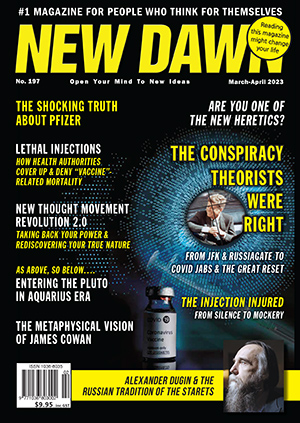
[alert type=”general” dismiss=”no”]This article was published in New Dawn 197.[/alert]
[alert type=”success” dismiss=”no”]If you appreciate this article, please consider subscribing to help maintain this website.[/alert]
Footnotes
1. “Australia! … Land of the Dawning” by Veni Cooper-Mathieson
2. Meeting With A Magus, The Untold Story of Richard, Duc de Palatine & The Brotherhood & Order of the Pleroma, New Dawn Special Issue Vol. 13 No. 2
France, the ancient land of Gaul, holds an unparalleled place in the history of the development and spread of mystical, esoteric, and occult teachings in the West.
Southern France is the region where the ‘Good Christians’ or Cathars (the name derived from the Greek word katharos, meaning ‘The Pure’) emerged in the twelfth and thirteenth centuries.
The Cathars received their central teachings from the Bogomils (meaning ‘beloved of God’), a Gnostic community active in the Balkans since at least the tenth century.
At the heart of Cathar doctrine is the notion that true Christianity (which the Cathars claimed to possess via a secret line of apostolic succession from St John) is a life lived, not simply a doctrine believed. For them, the life of Jesus was a model the ‘Good Christian’ must strive to emulate, not a vicarious sacrifice to be blindly accepted on trust.
The existence of the Cathars challenged the legitimacy of the Roman Church, as historian Zoe Oldenbourg explains in Massacre at Montségur:
The Cathars declared themselves the heirs of a tradition that was older than that held by the Church of Rome – and, by implication, both less contaminated and near in spirit to the Apostolic tradition. They claimed to be the only persons who had kept and cherished the Holy Spirit which Christ had bestowed upon His Church; and it looks as though this claim was at least partially justified….
After the manner of the Bogomils and the followers of the Eastern Gnostic Prophet Mani, the Cathars believed in a cosmic battle between the principles of Light and Darkness on whose meetings and encounters everything in the universe is based. Darkness was for them the unperfected, the transient. They identified all clerical and secular rulers as the personification of the Darkness.
“Today we are better informed than they were concerning the practices of the Early Church,” says Zoe Oldenbourg, “and have to admit that the Cathars merely followed a tradition somewhat more ancient than that of the [Roman] Church herself. It was with some appearance of reason that they claimed Rome as the party guilty of ‘heresy’ through her falling-out from the original purity which had characterised the Church of the Apostles.”
As it did with the Gnostic Christians, Rome saw the Cathars as a threat.
“Catharism was spreading with extraordinary speed in Southern France,” points out the French writer Maurice Magre. “It was the radiant cult of the pure spirit which took possession of men’s souls, and it seriously endangered the materialistic Church of the pope.”
The central tenets of the Cathars, particularly the prominence they ascribed to Mary Magdalene and St. John, confirm they were a manifestation of a hidden stream of secret teachings called by the Prophet Mani, the universal ‘Religion of Light’.
Forced underground by persecution and massacres, the Gnostics would later re-emerge at the appointed time.
The Gnostic Revival
Jules-Benoit Doinel
Six hundred years after Rome launched the murderous Crusade against the ‘Good Christians’, a group of French mystics were inspired to play a unique role in the revival of the Gnostic tradition in the modern world.
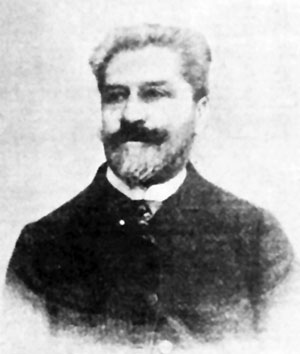
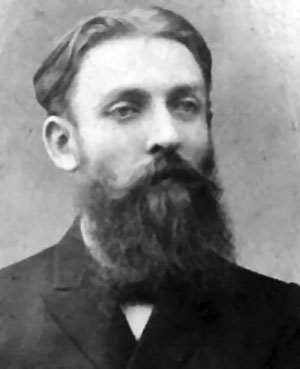
Jules-Benoit Doinel (1842–1902) had frequented esoteric and mystical circles for some years. One of these, formed around the Countess of Caithness, took a particular interest in ancient Gnosticism. Dr Stephan A. Hoeller, author of Gnosticism: New Light on the Tradition of Inner Knowing, informs us:
It was into this milieu that the ancient Gnostic tradition was reborn in France in the late nineteenth century. Jules-Benoit Doinel du Val Michel, a scholarly esotericist who had been a devoted researcher of the documents of the Cathar faith, had a mystical experience in 1890, in which he received spiritual empowerment to reconstitute the Gnostic church of old. His experience occurred in the splendid chapel at the residence of the Duchess de Pomar, Countess of Caithness, in Paris. This remarkable noblewoman was a friend of Madame Blavatsky and an early Theosophist and patroness of esoteric movements….
Déodat Roché
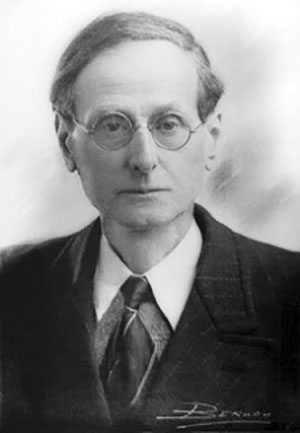
Doinel recorded an account of his ‘mystical experience’ and ‘spiritual empowerment’, which was later preserved by Déodat Roché (1877–1978), the foremost historian of Catharism.
One evening, in the autumn of 1890, at the Paris circle of Lady Caithness, Doinel received the communication, “Prepare yourselves. Soon the Bishops of the Albigensian Synod of Montségur are going to appear.” Doinel could not remember the exact words but the sense he recalled from the magical communication of Guilhabert de Castres, the famed Cathar bishop:
We came to you from the most distant of the two Empyrean circles. We bless you. That the principle of good, God, be eternally praised and blessed, glorified, and adored. Amen.
We came to you dear ones… you will establish the Assembly of the Paraclete and you will call it the Gnostic Church.
Doinel and the circle of mystic seekers were seized by “an understandable emotion,” tears streamed from their eyes. Doinel felt fire in his veins, akin to the fire the apostles felt on their heads at Pentecost. A voice was heard: “That the Holy Pleroma bless you. That the Aeons bless you. We bless you as we bless the martyrs of the Pyrenaean Tabor. Amen. Amen. Amen.”
Jules Doinel, as instructed, established the Église Gnostique (Gnostic Church), which was organised along sacramental lines. The teachings of the new church were strictly Gnostic, women were ordained to priestly and episcopal offices, and Doinel also established once again the sacrament of the Consolamentum reminiscent of the Cathars.
Joanny Bricaud
Soon other gifted esotericists joined the French Gnostic Church, among them Fabré des Essarts, Albert de Pouvourville, Paul Sédir, Lucien Mauchel, Victor Blanchard, and René Guénon.
Given Jules Doinel’s connections to France’s leading mystics and occultists, the Gnostic Church soon became known as “the church of the initiates.” Doinel consecrated the remarkable esoteric writer Papus (Dr Gerard Encausse) as a Gnostic bishop and joined Papus’ Martinist Order. Among Doinel’s acquaintances was Abbe Berenger Sauniere, the parish priest of Rennes-le-Château.
In 1908, at Lyon, Joanny Bricaud (1881–1934) held the Holy Synod of Gnostic Bishops which elevated him as patriarch of the Gnostic Church under the name Tau Jean II. On becoming patriarch, he declared:
The religious evolution of which we are a part shows us that a new religion is necessary. Gnosticism offers itself as the desired religion. Gnosis is the complete and definitive synthesis of all beliefs and all ideas of which humanity has need to realise its origin, its past, its end, its nature, the contradictions of existence and the problems of life….
Gnosis is the very essence of Christianity. Here, my beloved, is the just definition of Gnosticism. But, by Christianity, we do not only mean the doctrine taught since the arrival of the divine Savior, but also the one taught before Jesus’ arrival, in the old temples, the doctrine of Eternal Truth. Our Church is the antinomy of that of Rome. The name of that one is Force; the name of ours is Love.
Our Sovereign Patriarch is not Peter, the impulsive, who denied three times his master and took up the sword, but John, the Savior’s friend, the apostle who relied on his heart and in it knew best the immortal sentiment, the oracle of light, the author of the Eternal Gospel, who took up only Speech and Love.
In The Esoteric Christian Doctrine, published in 1907, a year before he became patriarch of the Gnostic Church, Bricaud wrote:
The main aim of the Universal Gnostic Church is to restore the original religious unity, that is to establish and spread a Christian Religion true to the universal religious tradition. It is not hostile towards any Church. It respects the customs and laws of all peoples. It is essentially large and tolerant, which permits it to admit all men without distinction of nationality, language, or race.
Sadly, the ecumenical brotherhood and openness of spirit cultivated by Bricaud could not prevent persecution and strife befalling the Gnostic Church in France.
Bricaud’s successor, the saintly Monsignor Constant Chevillon, Tau Harmonious (1880–1944), was cruelly executed by Nazi collaborators after the Vichy government suppressed the Gnostic Church.
Nevertheless, it was from France that the Gnostic Church spread to Portugal, Italy, Belgium, and South America.
“The Gnostic tradition, which originally had its home in France,” Dr Stephan Hoeller tells us, “came to be established in England and later in the United States, initially as a result of the efforts of a bishop of French descent who was raised in Australia.”
The Gnosis Restored
With fascism and communism on the rise across Europe, far away in Australia a young spiritual seeker began questioning the historical foundations of Christianity.
Richard, Duc de Palatine
In his quest for truth, Richard, Duc de Palatine (born Ronald Powell in 1916) joined “the biggest occult library in the Southern Hemisphere at the Theosophical Lodge in Melbourne,” where he studied “the extant writings concerning the Gnostics, Essenes and Secret Mysteries.” By 1944 he became convinced “that one day he would cause to be formed a Brotherhood which would partially restore the Sacred Lore and encourage people to prepare themselves for the Illumination and Interior Communion with the God within.”
In 1940s Melbourne, Richard, Duc de Palatine, a learned and charismatic figure, attracted much attention. His insight was uncanny, but for all this, he was perceived as being a very humble person who seemed to exude love and peace wherever he went. In 1948 he told his friends his mission was not in Australia, and he travelled to London, where in 1953 he was consecrated as Bishop Richard John Chretien Duc de Palatine by the Patriarch Hugh George de Willmott Newman. The name of Duc de Palatine being a personal and spiritual title.
In October 1953, Richard, Duc de Palatine established in London the Pre-Nicene Gnosto-Catholic Church, with the stated object of “restoring the Gnosis – Divine Wisdom to the Christian Church, and to teach the Path of Holiness which leads to God and the Inner Illumination and Interior Communion with the Soul through the mortal body of man.”
From his base in London’s Kensington, Richard, Duc de Palatine travelled on several occasions to France where he contacted the surviving bishops of the French Gnostic Church. They encouraged him to fulfil his mission of transmitting the Gnostic tradition to the English-speaking world. He was also received by representatives of France’s leading mystical orders, including the surviving Grand Master of the Johannite Templar Order.
In a profile of Richard, Duc de Palatine’s life, we read that he held high office in many esoteric bodies:
Through these Orders and his many contacts, particularly in France which he frequently visited, Richard was able to bring forth in a semi-public forum the hidden teachings, the Gnosis of the Soul, which exposed the false vestiges of truth that had been foisted onto the people.
Through his London-based Pre-Nicene Publishing House, Richard, Duc de Palatine issued a series of booklets on Christian Gnosticism, with titles like “The Inner Meaning of the Mystery Schools,” “The Christian Mysteries,” and “Christ or Jesus?” He also published The Lucis Magazine as the official organ of ‘The Sovereign Imperium of the Mysteries’.
Reviewing Richard, Duc de Palatine’s early writings, it is obvious how far-sighted and spiritually gifted he was. Articles in his magazine ranged from discussions of “The Fallen Angels” and the “Dead Sea Scrolls” to the “Christian Fathers on Reincarnation” and “Spiritual Illumination.” In the book The Key to Cosmic Consciousness, he is described as an “outstanding mystic and illumined teacher and writer” whose “knowledge and experience stems from his own illumination in 1956, after applying the teachings of the early Gnostic Fathers…”
Fifty years ago, Richard, Duc de Palatine contrasted the Gnostic spirit of tolerance with the dogmatism of the mainstream Churches:
The true Gnostic or Christian makes no claim that he alone is right or that his teaching is the only one required or necessary for salvation. He demands that no one accept the statements of himself or anyone else on faith but insists that everyone should prove these things for himself.
Richard, Duc de Palatine’s magazines and booklets were disseminated around the world, and his Brotherhood and Order of the Pleroma had branches in South Africa, Nigeria, the USA, and Australia. In 1971 he moved to the United States where he continued his work up to the time of his death in 1977.
“He left behind a rich heritage, and because of his pioneering work a breach was made in the consciousness of the people…. but the keys to find the Door are still guarded and can only be found within the Wisdom Schools which through its Rite of Succession pass on the Keys to the Door.”
Within the Australian branch of the Brotherhood and Order of the Pleroma, established in the early 1950s by students of Richard Duc de Palatine, the ‘Good Christians’ or Cathars held a special place of honour and reverence.
The Good Men and Women of the Languedoc are remembered annually on 16 March, the anniversary of the fall and martyrdom of Montségur in 1244, the last Cathar stronghold.
Back in 1958 the Essene Press in Texas published an intriguing little book entitled UFOs Confidential: The meaning behind the most closely guarded secrets of all time.
The authors George Hunt Williamson and John McCoy were closely involved in the 1950s UFO contactee phenomenon. In fact George Hunt Williamson was a pioneering UFO researcher and one of the “four guys named George” among the famous contactees of the 50s. The others were George Adamski, George King, and George Van Tassel.
Williamson had “witnessed” George Adamski’s historic encounter with an extraterrestrial from Venus on 20 November 1952. He also received messages from “Space intelligences” by way of radio telegraphy as well as the Ouija board, and wrote several widely read books on Flying Saucers among them Other Tongues-Other Flesh, Road in the Sky, Secret Places of the Lion and The Saucers Speak! He developed many of the themes of modern UFOlogy and was the first to present what is today referred to as the “ancient astronaut theory.” Independent researcher Alec Hiddell, in his article “Tracks in the Desert,” says Williamson wrote “the most remarkable UFO documents ever conceived.”
But Hiddell points out that while George Hunt Williamson was a prolific writer on the theme of contact with extraterrestrial intelligences:
It would however, be a capital error to classify him solely as a UFO researcher. He was above all an occultist whose activities helped to usher in a new magical aeon – the aeon of the Flying Saucer. No attempt can be made to understand him or his work unless this fact is first taken into account.
International Bankers
George Hunt Williamson and John McCoy believed the reason governments refuse to acknowledge UFOs and the visitors from other worlds is due to the machinations of a “Hidden Empire” of international bankers. As they explain in UFO Confidential:
Many people have asked the inevitable question: ‘If visitors from other worlds are here, why doesn’t our government inform us of such a momentous event?’ The reason is obvious… all governments, yes all, are under the complete control of the ‘International Bankers’ who also control all money and thus create depressions and prosperity whenever they want it. They want and need a divided world so that wars may continue and their wealth steadily increase.
According to Williamson and McCoy:
These secret world rulers will never allow official UFO announcements to be made public. If they did allow it, it would spell their doom. If the technology of the space visitors is revealed it will immediately eliminate the need for oil, gas, automobiles, and practically everything else that drains the public….
Although written over fifty years ago and reflecting widespread anxieties of the post World War II period, a good many of the ideas set-forth in UFOs Confidential remain with us today. Nowhere is this clearer than in the chapter headed “The Drama of Earth’s Great Delusion.”
Surprisingly, it is not too difficult to see several parallels between life in the 1950s, when UFOs Confidential first appeared, and our own time. Back then, in the Cold War era, the subversive ‘enemy’ of the so-called ‘free world’ was Soviet communism. Today the Cold War is a vague memory and we’re told a global ‘War on Terror’ is necessary to safeguard ‘freedom’. In the 21st century ‘Al Qaeda’ and ‘Terrorism’ have now replaced the Soviet Union and communism as the ‘enemies of freedom’.
The extract on the opposite page is from Part II of UFOs Confidential – “The Drama of Earth’s Great Delusion” – where John McCoy poses the question, “If you wanted to absolutely control a world, how would you go about it?”
Hidden Empire
In Other Tongues-Other Flesh, George Hunt Williamson discusses the role of the “Hidden Empire” in concealing information from the public about extraterrestrial intelligences. He again poses the often asked question, “Why haven’t the ‘powers that be’ announced what they know about the Flying Saucers?”
“If they acknowledge extraterrestrial origin,” Williamson writes, “it would mean that they must acknowledge extraterrestrial allegiance as well. There would be extraterrestrial interference with established government, and no world power would welcome such a situation. If Universal truth came to the people of Earth, their schemes and plans for mankind would crumble. No longer could they exploit the masses.”
George Hunt Williamson was indeed a man ahead of his time. His books discuss everything from the nature of life on earth, Mayan mysteries, environmental collapse and the secret plan for global government, to the identity of UFOs and the dawn of the Aquarian New Age. Over fifty years ago, Williamson received the following astonishing message from a higher intelligence.
The United Nations must collapse because that which you read from the Nostradamus forces is true. The war lords, the ‘International Bankers’ will use the United Nations to form their super-government. This will not be. There are no Christ forces in the United Nations. That does not mean that there are not some good people who are in the United Nations. But the organisation itself is a centre, using gullible people. I say it is demon controlled and must go down. The Master has said, and it is written in Corinthians by our beloved Paul: ‘All forms of authority and power must be put down before I come.’ And the United Nations fits that category.
Everybody wants the New Age, but they want it to be an American New Age, or a British New Age, or a Communistic New Age. I say that all forms of government will collapse. Every seat of government will fall utterly and completely. Every economic system will be eliminated. All forms of authority which are under the direct guidance and tutelage of the Black Dragon will perish.
As for his native United States of America, Williamson was warned:
I speak strongly because I feel strongly. I am perturbed at the entire situation that is taking place in the United States of America… What is this statement that the United States will be spared? The United States will be submerged… The United States is the centre for the darkest forces upon the Planet Earth.
These messages were published in 1958 by Neville Spearman Ltd under the title Secret of the Andes. The London publishers had received the original manuscript from South America where George Hunt Williamson was then resident at the Monastery of the Brotherhood of the Seven Rays in Peru. Due to its highly controversial nature, Neville Spearman edited out about a quarter of the manuscript. The revelations were apparently too startling to appear in print at the time.
Famed parapsychologist Andrija Puharich, best known for popularising the Israeli psychic Uri Geller, had a chance encounter in Mexico with one of George Hunt Williamson’s associates, a Dr. Charles Laughhead. Laughhead described Williamson as “a very fine voice channel or medium,” who had “been in frequent communication for over a year with one of the ancient Mystery Schools in South America.”
Dr. Laughhead related to Puharich how:
These sessions covered a wide range of subjects, from ancient history and life origins on this planet, to science and religion. This Brotherhood also has a communication centre for contacts with intelligences on other planets and star systems, and on spacecraft. Some of these intelligences are obviously not human… Their knowledge and wisdom far exceed our comprehension. For simplicity we referred to them as Space Beings or Space Brothers…
George Hunt Williamson continued to travel on expeditions to many parts of the world, conducting his research largely in private, and out of public view. He reportedly passed away in California in 1986, at the age of 60.
“He was among the first to connect all those dots and draw us a believable picture of the chariots of the gods in action,” noted UFO journalist Sean Casteel. Alec Hiddell identifies Williamson as one of the small group of men from whom “the contemporary UFO mythos first grew and took shape.”
Today the name Illuminati is used in popular conspiracy literature to describe a mysterious hidden elite out to gain power over the whole world. For some writers the Illuminati is synonymous with a shadowy cabal of international bankers and mega-rich ‘Insiders’, while others see the ‘Enlightened Ones’ as the ultimate secret society committed to the enslavement of humanity in a ‘Satanic’ One World government. In the opinion of Tokyo based journalist Benjamin Fulford, former Asian Bureau chief for Forbes magazine, “the Illuminati are really inbred families of European and North American traditional aristocracy and banking families… Their goal is to create a world government.”
In order to understand the origin of much of what is written today about the Illuminati, it is necessary to begin with Adam Weishaupt (1748-1830), a professor of canon law at the University of Ingoltstadt in Bavaria. Together with four of his friends, Weishaupt founded the Order of the Illuminati – that is, the ‘Enlightened Ones’ – on 1 May 1776. Modelling his political secret society on the Catholic Society of Jesus (the Jesuits), he sought to advance the anti-clerical, anti-monarchist, liberal ideals proposed by Voltaire, Diderot, and other French philosophers of the time. “Princes and nations,” he forecast, “will disappear” and then “the human race will become one family and the world the abode of reasonable men.”
Weishaupt tried to infiltrate and control the lodges of Freemasonry in an effort to advance his political agenda. He wrote: “The great strength of our Order lies in its concealment, let it never appear, in any place in its own name, but always covered by another name, and another occupation. None is fitter than the three lower degrees of Freemasonry; the public is accustomed to it, expects little from it, and therefore takes little notice of it.” In March 1785, in response to widespread anxiety in Catholic Bavaria over Weishaupt’s activities, the Bavarian government outlawed the Illuminati. Weishaupt, dismissed from his university post, fled into exile and ordered the Illuminati to go underground.
When four years later, in 1789, the merciless French Revolution broke out, sending shock waves through Christian Europe, conservative writers suggested it was the result of a plot hatched by secret societies, principally the Freemasons. Books and pamphlets began to circulate revealing the Illuminati as the hidden hand behind the Revolution, having transferred its secret operations from Bavaria to France. A leading proponent of this idea was Abbé Augustin Barruel (1741-1820), a French Jesuit Catholic priest who had taken refuge in England.
Barruel believed a widespread conspiracy involving Freemasons – inspired and directed by the Illuminati – was out to destroy Christianity and the European monarchies. Revealingly perhaps, the Jesuit priest Barruel dedicated his four volumes to the “English nation.” Barruel made a clear distinction between the radical Freemasons on the Continent and their Masonic brethren in England, describing the latter as “a society composed of good citizens.” Interestingly, Barruel pointed out how in Britain the Masonic lodges were loyal to the Crown, writing: “Let us admire it [the wisdom of England] for having known how to make a real source of benefit to the State out of those same mysteries which elsewhere conceal a profound conspiracy against the State and religion.”
Inspired by Barruel, the Scottish Freemason John Robison published a book of his own (see accompanying article in this same issue ‘Darkness Over All: John Robison and the Birth of the Illuminati Conspiracy’ by Mike Jay). The revelations by Barruel and Robison on the secret causes of the French Revolution created a sensation. Across Europe their claims were championed enthusiastically by conservative forces locked in battle with republicans. Catholic traditionalist author Joseph de Maistre referred to the Illuminati when he spoke of those “guilty men who dared to plan and even organise in Germany that dreadful, most criminal conspiracy to extinguish Christianity and royalty in Europe.”
In an article in New Dawn Special Issue 11, Dr. Richard B. Spence, a specialist in the history of intelligence agencies, noted “that both Barruel and Robison wrote their books in Britain and that the government of Sir William Pitt the Younger embraced and promoted their ideas. At the very least, Pitt exploited the conspiracy theory to effectively discredit and demonise the French Revolution.”
Secret Societies & Subversive Movements
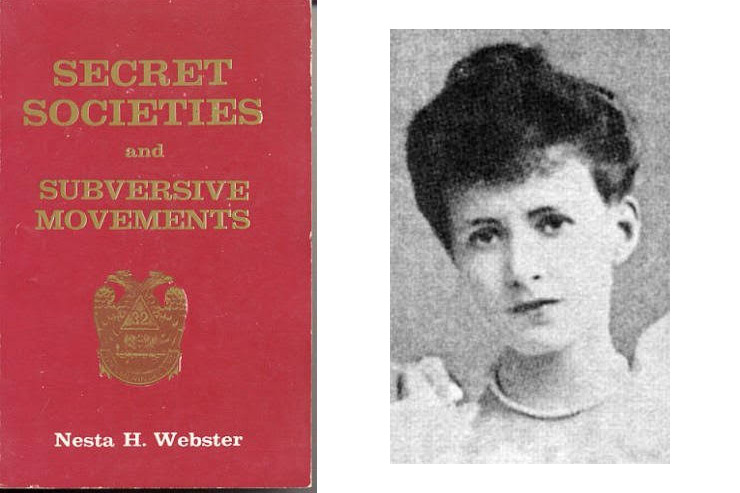
Following the 1917 Russian Revolution, in which the anti-monarchist, atheistic Bolsheviks forcibly seized power, the English writer Nesta Webster published The French Revolution: A Study in Democracy. In the tradition of Barruel and Robison, she claimed a secret conspiracy had prepared and carried out the French Revolution, concluding that: “The lodges of the German Freemasons and Illuminati were thus the source whence emanated all those anarchic schemes which culminated in the Terror.”
Mrs Webster’s most influential book, however, was Secret Societies and Subversive Movements, in which she set out to document the existence of a vast, centuries old, secret conspiracy to overthrow Christian civilisation. Building on the work of Barruel and Robison, Nesta Webster argued that behind the forces of world revolution “whether Pan-German, Judaic, or Illuminist – beyond that invisible secret circle which perhaps directs them all,” is another force, still more potent, an “Occult Power.”
Webster had a wide and influential readership. H.G. Wells called her Secret Societies and Subversive Movements, “a book that all serious people interested in the British situation ought to read and think about… I believe her [Mrs. Webster’s] influence has spread far beyond the circle of her actual readers.” Winston Churchill praised her in a 1920 article entitled “Zionism versus Bolshevism: A Struggle for the Soul of the Jewish People,” where he wrote of the growth of a “world-wide conspiracy for the overthrow of civilisation and for the reconstitution of society on the basis of arrested development, of envious malevolence, and impossible equality” which “played, as a modern writer, Mrs. Webster, has so ably shown, a definitely recognisable part in the tragedy of the French Revolution.” After reading Webster’s books, the British economic reformer Major C.H. Douglas, father of the Social Credit movement, declared: “Any serious endeavour to identify the origins of world unrest and war inevitably and invariably leads back to what is loosely called occultism.”
It was not long before Nesta Webster’s writings made their way across the Atlantic to North America where they found a ready audience among right-wing Christians. “Without the influence of Nesta Webster,” notes the British historian Nicholas Goodrick-Clarke in Black Sun, “it is likely that few Americans today would have heard of the Illuminati. Due to the re-publication of her books and the popularisation of her ideas among the radical right, the Illuminati became a major theme of American conspiracy literature from the late 1960s onward.”
Nesta Webster, like Barruel and Robison before her, was quick to absolve English Freemasonry of any involvement in political subversion. By focusing on the ‘evil German’ Illuminati as the guilty party, she effectively diverted attention away from Britain’s clandestine role in many of the upheavals in Europe. That Mrs Webster, the daughter of a senior partner in Barclays Bank, was a committed British imperialist with close ties to the English ruling class, there is no doubt. After the First World War, Nesta Webster supported punitive measures against Germany. Starting in 1922 she penned a series of attacks against Pan-Germanism in the pages of The Morning Post. Webster believed that powerful forces in 1920s Germany had secretly allied with Bolshevik Russia to bring down the British Empire. She castigated the Jews for being dupes of Pan-Germanism who “from the time of Frederick the Great had frequently acted as Prussia’s most faithful and efficient agents.”
With Hitler’s rise to power in the 1930s, Webster supported Nazi Germany, seeing in the Third Reich a bulwark against the hated Soviet Union. A position held by sections of the British establishment who believed Hitler’s Germany was more of a threat to Communist Russia than the British Empire.
More than any other author, Nesta Webster’s writings have played a major role in shaping the political/occult conspiracy theories in the English-speaking world for nearly a century. In the years prior to the Second World War, Webster enjoyed a special relationship with elements in British Intelligence. In fact her book World Revolution: The Plot Against Civilisation was based on lectures she gave to British military officers and members of the Secret Service at the end of the First World War.
Richard Gilman, author of Behind World Revolution: The Strange Career of Nesta H. Webster, who extensively studied her life, concluded that the real “function of her books was to blame the crimes of Britain’s power elite on others as well as defend the Empire in general.”