New Dawn – World's Most Unusual Magazine

Author: Mehmet Sabeheddin

  • The Masons and the Moors

    The Masons and the Moors

    This article was published in New Dawn 86 (Sept-Oct 2004)

    The origins of Freemasonry – as would be expected of such a “venerable secret society” – are shrouded in myth, legend and almost impenetrable obscurity. Since at least the late 18th century Masonic writers have sought to establish a link between the Knights Templar and the Freemasons. Freemasonic lore and symbols have been traced to ancient Egypt and Phoenicia. Yet, despite all the books and articles exploring Freemasonry published over the last hundred years, there is one area that has not received attention. It concerns Freemasonry’s debt to Islamic mysticism and a shadowy tradition connecting the Masons with the Moors of North Africa.

    Moorish Science

    The involvement of Freemasons in the establishment of the United States of America is well documented. In fact Masons featured so prominently in drafting the American Declaration of Independence that many people believed it a thoroughly ‘Masonic project’. Not only George Washington but also the US founding fathers Benjamin Franklin and Thomas Jefferson were high-degree Masons. Masonry had a profound influence on the formation of American society, but there was also another secret power which has gone completely unnoticed.

    The Kingdom of Morocco under the leadership of Sidi Mohammed Ben Abdullah, known as King Mohammed III, was the first country in the world to recognise the United States of America as an independent nation in 1777. This historic act by the North African Muslim kingdom highlights the relationship then existing between America’s Masonic leaders and the Moors. Before exploring this strange connection further we need to understand the part played by the Moors in the transmission of knowledge to Europe.

    Moor is the classical name in Europe of the Muslim people of North Africa. In Spain, where Muslims ruled for over five hundred years, Arabs are still called Moros. The term “Moor” came to be synonymous with “Muslim” in many contexts, for example the Muslim communities in the Philippines are known to this day as Moros. The Supreme Wisdom of the Moors, much of it derived from ancient Egypt, has come to be known as “Moorish Science”.

    The Moors provided the vital link between ancient and modern civilisation. The light of knowledge which illuminated the Moorish lands of Spain and Sicily was instrumental in dispelling the gloom of ignorance that enveloped mediaeval Europe.

    “It was under the influence of Arabian and Moorish revival of culture,” writes Robert Briffault in The Making of Humanity, “and not in the 15th century, that the real renaissance took place. Spain and not Italy, was the cradle of the rebirth of Europe. After sinking lower and lower in barbarism, it had reached the darkest depths of ignorance and degradation when the cities of the Saracenic world Baghdad, Cairo, Cordova, Toledo, were growing centres of civilisation and intellectual activity. It was there that the new life arose which was to grow into a new phase of human evolution. From the time when the influence of their culture made itself felt, began the stirring of a new life.”

    The Orientalist Stanley Lane-Poole acknowledged the great impact Moorish civilisation had on Europe when he wrote:

    For nearly eight centuries under her Muslim rulers Spain set to all Europe a shining example of a civilized and enlightened state. Art, literature and science prospered as they then prospered nowhere else in Europe. Students flocked from France and Germany and England to drink from the fountains of learning which flowed only in the cities of the Moors. The surgeons and doctors of Andalusia were in the vanguard of science; women were encouraged to devote themselves to serious study, and a lady doctor was not unknown among the people of Cordova.1

    The 19th century French writer on the esoteric sciences, Gerard Encausse, known as “Papus”, noted how “the Gnostic sects, the Arabs, Alchemists, Templars” form a chain transmitting ancient wisdom to the West. This explains why within the Ritual of Freemasonry there is the admission “we came from the East and proceeded to the West.” A Masonic author Bernard H. Springett says:

    The plain fact that much of what we now look upon almost entirely as Freemasonry has been practised as part and parcel of the religions of the Middle East for many thousands of years, lies open for anyone who cares to stop and read, instead of running by. But it is frequently and scornfully rejected by the average Masonic student…2

    So we find that just as Europe borrowed considerably from the learning of the Moors, European Freemasonry took its “secret wisdom” from the Muslim East.

    With the end of Moorish rule in Spain, the Europeans began to colonise Africa, Asia and the Americas. In time European Christians conquered Muslim territories and the great debt Western civilisation owed to the Moors was quickly forgotten. By the 18th century European Christians saw themselves as the predestined rulers of the world with a divine mission to “civilise” the heathen. Western historians conveniently ignored the immense contribution of the brilliant and energetic Moorish civilisation in delivering Europe from mediaeval barbarism. We can only conclude this is a result of the pride and presumption of Westerners, which prevent them from recognising the truth or importance of their debts to the East.

    Seekers of Truth

    The founders of the American republic, as high-degree Freemasons, were aware of the importance of Moorish wisdom and culture to the birth of Western civilisation. This may explain why Morocco was the first nation in history to recognise the United States, and what’s really behind the story of George Washington being presented with a Moorish flag. Some researchers believe this flag consisted of a red background with a green five-pointed star in the centre of it. The star or pentagram, which the Moors called the Seal of Sulaiyman and coloured green to honour Islam, also figures prominently in Masonic art and architecture. The layout of the city of Washington D.C. – designed by Freemasons – incorporates the pentagram.

    When Freemasons travelling in the Moorish lands encountered Sufis, the mystics of Islam, they soon recognised a common bond. “Sufi-ism,” said Sir Richard Burton, was “the Eastern parent of Freemasonry.” John Porter Brown, an American diplomat in Turkey in the mid 1800s, was a Freemason who wrote sympathetically of the Sufi path. In The Darvishes, he admits finding it “rather strange that the Dervishes of the Bektashi Order consider themselves quite the same as the Freemasons, and are disposed to fraternize with them.” Brown commented how in Turkey Freemasonry had come to be generally regarded as “atheism of the most condemnable character.” A position not unlike the one held by Papus, the celebrated French occultist and Gnostic bishop, who tried to counter the Masonic lodges which, he believed, were in the service of British imperialism and the international financial syndicates. Papus also viewed Freemasonry as a diabolical perversion of the ancient secret tradition and atheistic at heart.

    When Madame Blavatsky (1831-1891) set out in search of hidden wisdom it was to the Moorish land of Egypt that she journeyed. Blavatsky claimed to be a disciple of the Masters Morya and Koot Hoomi. The researcher K. Paul Johnson convincingly shows her tales of the “Masters” to be modelled on real people, many genuine occult adepts. Prominent among them Jamal ad-Din al-Afghani, a Sufi scholar, tireless political intriguer, and the leader of radical movements throughout the Muslim world, whose travels enigmatically paralleled those of Madame Blavatsky for more than thirty years. Best remembered for co-founding the Theosophical Society and helping to popularise Buddhism and Hinduism in the West, Blavatsky also proudly wrote of “living with the whirling dervishes, with the Druze of Mount Lebanon, with the Bedouin Arabs and the marabouts of Damascus.”

    Madame Blavatsky’s “Masters” are very close to the Sufi tradition of Khwajagan (Persian: “Masters”). Ernest Scott states “the Khwajagan teachers are entirely corporeal and literal, having been physically located in the Hindu Kush area since the 10th century. The Hindu Kush range is in Afghanistan: geographically, it forms the Western extreme of the Himalayas.”3 Scott quotes from a paper by a Turkish writer who describes how members of the Khwajagan:

    …intervene from time to time in human affairs. They do this, not as leaders or teachers of mankind, but unobtrusively by introducing certain ideas and techniques. This intervention works in such a way as to rectify deviations from the predestined course of human history. This inner circle, it is claimed, concentrates its activities in those areas and at those times when the situation is critical for mankind.”4

    Certainly Madame Blavatsky’s teacher Jamal ad-Din al-Afghani, who was raised in Afghanistan, fits the description of a Master Adept. His life is described as a mysterious odyssey that led through lands as far apart as India and America. Received by heads of state in Cairo and Istanbul, he moved in both underground radical circles and the highest centres of power in European and Oriental capitals.

    The idea of living ‘spiritual guides’ or masters is central to Sufism. In the words of Sir John Glubb Pasha: “Sufism cannot be defined in words, nor can it be comprehended by the human intellect. It can only be imperceptibly ‘caught’ or imbibed by association with a Sufi master.” The Sufi master is revered by his disciples for being in contact with a level of higher consciousness, his mission on Earth directed by higher powers. Studying the lives of some of the greatest Sufi masters we often find them to be wandering holy men (& women) whose actions are usually misunderstood by orthodox believers. The shrines of Sufi masters are centres of trance dancing, exorcism, and miraculous healings.

    The Sufi tradition is integral to Moorish Science.

    Sufi masters are also renowned for communicating with their followers through dreams. There are numerous stories of Sufi saints appearing in a disciple’s dreams and using telepathy to direct followers to undertake a special mission.

    Mission to America

    A few years after Madame Blavatsky founded the Theosophical Society in New York in 1875, the Master Adept Jamal ad-Din al-Afghani turned up in America around 1882. Two Americans of African descent, who are rumoured to have studied under al-Afghani, were the parents of the man who would one day establish Moorish Science in the United States.

    Noble Drew Ali (born Timothy Drew) early in the 20th century took a job as a merchant seaman and found himself in Egypt. According to one legend, Noble Drew Ali made a pilgrimage to North Africa where he studied with Moorish scholars and received a mandate from the king of Morocco to instruct Americans of African descent in Islam. His association with the ruler of Morocco is significant when we recall the historic relationship between this Moorish country and the early United States.

    At the Pyramid of Cheops his followers believe he received initiation and took the Muslim name Sharif [Noble] Abdul Ali; in America he would be known as Noble Drew Ali. On his return to the United States in 1913 he had a dream in which he was ordered to found a movement “to uplift fallen humanity by returning the nationality, divine creed and culture to persons of Moorish descent in the Western Hemisphere.” He organised the Moorish Science Temple along lines similar to Masonic lodges, with local temple branches and “Adept Chambers” teaching the esoteric wisdom derived from the secret circle of Eastern Sages, the Master Adepts of Moorish Science.

    Noble Drew Ali is said to have made a historic visit to Washington, D.C. in order to reclaim the Moorish flag and obtain official recognition to call his people to their true faith, “Al Islam”. The US president, believing that African Americans would not embrace Islam, gave Noble Drew Ali full authority to teach Moorish Science in America.

    By the end of the 1920s, membership in the Moorish Science Temple had grown substantially. With increasing numbers of African Americans rallying behind Noble Drew Ali the Moorish movement soon came under the scrutiny of the FBI. In 1929 several Moors, including Noble Drew Ali, where detained for questioning by the Chicago police. Released from custody, Noble Drew Ali fell ill and never recovered. Many Moors suspected his death the result of a severe police beating.

    Following the inexplicable ‘death’ of Noble Drew Ali, the Moorish Science Temple continued and gave rise to unique Islamic groups among the African American community. Much of the known history of Moorish Science in North America is extremely complex and obscure.

    By the 1950s some white American poets and jazz musicians came into contact with Moorish Science. The North African cities of Tangiers and Marrakech held a magic attraction for the leaders of America’s counterculture, with writers like William S. Burroughs spending years living in the Moorish lands. The Moorish Orthodox Church of America was formed by white Americans who held Moorish Science passports and had ties with certain “Wandering Bishops” of the Old Catholic and Eastern Orthodox churches.

    Joseph Matheny, the American author and media theorist, first encountered Moorish Science when he was researching time travel and quantum consciousness. In his book Ong’s Hat The Beginning, the Moorish Orthodox Church is called “one of the most secretive and mysterious religious organisations ever known to man” and:

    a revolutionary and heretical sect of Islam that carries on an ancient tradition which sought to counterbalance the forces of orthodox Islam. Despite the controversial and dubious nature of the MOC, part of their tradition has been to serve as the torch bearers of freedom against the tyrannical and repressive aspects of the Earth’s patriarchal power structure as our planetary consciousness shifts to the Age of Aquarius and sets its site on unlimited freedom and the expression of life in all of its true wonder and beauty.

    Years before the “War on Terror” and Bush’s invasion of Afghanistan and Iraq, this writer attended a lecture organised by people associated with the Moorish Orthodox Church. The speaker, a Moorish Sheik returned from a long sojourn in the East, claimed Freemasonry is built on a twisting of the truth of Moorish Science. It is the secret power behind the West based on the Supreme Wisdom derived from esoteric Islam. The European colonisers usurped the knowledge of the Moors and created a nefarious system of control that blinds man to his true identity. Freemasonry was identified as a chief player in the world “Babylonian” system, the mastermind of the institutions of indoctrination that prevent the full knowledge of the True God to be known. Moorish Science is the effective counter to the Freemasonic imposters and a force for Truth, Love, Peace, Freedom and Justice. The Sheik also revealed how Afghanistan and Iraq figure in sacred geography and numerology, and mentioned a secret war between the Anglo-American and Asiatic powers.

    Is there a struggle between occult brotherhoods to influence human destiny? Are the dramatic events taking place in the world, from the continuing strife in Palestine, Iraq and Afghanistan, to the rivalry between the forces of Atlanticism (Britain and the USA) and Eurasia (Russia and China), just surface manifestations of a deeper conflict? Certainly the strange saga of Moorish Science and the Moorish Orthodox Church adds weight to the observation made by one of the 20th century’s most controversial mystics:

    …There is a history behind our so-called history that you cannot even conceive of. History has a deeper base. The periphery that we know as history is not the reality. Behind our so-called history continues another history, a deeper one about which we know nothing.5

    [alert type=”general” dismiss=”no”]This article was published in New Dawn 86.[/alert]

    [alert type=”success” dismiss=”no”]If you appreciate this article, please consider subscribing to help maintain this website.[/alert]

    Footnotes:

    1. Stanley Lane-Poole, Studies in a Mosque

    2. Bernard H. Springett, Secret Sects of Syria and the Lebanon

    3. Ernest Scott, People of the Secret

    4. Ibid.

    5. Bhagwan Shree Rajneesh, I AM THE GATE: The Meaning of Initiation and Discipleship

    © New Dawn Magazine and the respective author.
    For our reproduction notice, click here.

  • The Dawn of Aquarius: A New People, A New Consciousness, A New Era

    The Dawn of Aquarius: A New People, A New Consciousness, A New Era

    This article was published in New Dawn 78 (May-June 2003)

    Aquarius will be the new age, the new life. First there will be disastrous events, gigantic upheavals, turmoil and change of all kinds….
    – Omraam Mikhael Aivanhov (1900-1986)

    The transition to a new zodiacal age is altering the political map of the world. For the last two thousand years much of human history has been determined by events in Europe and the near Middle East. From Greece and Rome, the great power centres of two millennia ago, with their inheritance from ancient Egypt and Mesopotamia, a distinct civilisational impulse spread westward into Europe, eventually reaching North America. Decisions made in the grand capitals of Europe and, for much of the last century in New York and Washington, have impacted the lives of millions of people in every part of the planet.

    The advent of the Age of Aquarius coincides with the emergence of new world power centres. Just as old Egypt, Babylon and Sumeria were eclipsed by Greece and Rome, so too the ‘old world’ of Western Europe and North America will be overtaken by new geopolitical alliances and fresh centres of global influence. And this will be accompanied by a dramatic change in consciousness, as the worn-out Western values and Eurocentric rationalist thought prevailing for the last few centuries surrender to the new Aquarian thinking.

    The current turmoil and conflict unleashed on the planet by the United States and Britain is only the beginning of the climax of a struggle between cosmic influences of which most people are completely unaware. Today, America and Britain embody atrophied and degraded Piscean energies. The Anglo-Americans, as the standard bearers of bankrupt Western materialism, are trying to reorganise the world, imposing their imbalanced, egoistic approach to life on all societies. Yet their latest brutal and insane actions, witnessed in the tragic invasion of Iraq, are part of a frantic effort to prolong their collapsing system. Despite all their apparent power and wealth, Anglo-American universalism is in a state of rapid decline leading to death.

    A new era, a new consciousness and a new people are on the horizon, as the planet goes through a turbulent transitional period paving the way to the Aquarian Age.

    Aquarian Consciousness

    Whether the earth is shaken by natural catastrophes, or nuclear warfare, or both, earth and the life upon it does survive. More than that, however: A New Age emerges and the devastating changes that have preceded it are understood to have been necessary purgations effecting the transformation of humanity into a new mode of being. By analogy, just as the individual near death experiencer may have to endure the pain and suffering associated with the trauma of almost dying before positive personal transformation can take place, so the world may need to undergo a “planetary near-death experience” before it can awaken to higher, more spiritual, collective consciousness with universal love at its core.
    – Kenneth Ring, Transpersonal Psychologist

    Two thousand years ago, at the time of transition from the Age of Aries to that of Pisces, there were secret schools, most notably the Essenes, trained and taught to align themselves with the spiritual impulses of the incoming age. These small communities worked quietly, in retreats; but with the discovery of the Dead Sea Scrolls we now know they were actually the ‘seedbed’ from which came the original Christian revelation.

    These separated mystic communities provided the necessary environment for the message of Jesus the Christ. With their unique synthesis of Zoroastrian, Pythagorean, Egyptian and Israelite spirituality, the Essenes acted as a bridge between the ‘old age’ religions and the unfolding new revelation. Above all, they represent the budding of a new consciousness which would impact history for two millennia. The declining Roman Empire’s embrace of Christianity led to the triumph of the new religion in Europe. With the arrival of the Age of Pisces, Christianity became synonymous with ‘Western civilisation’.

    Writing a century ago, the gifted Englishman Edward Carpenter speculated about Man’s evolutionary future and the development of a new humanity imbued with a new consciousness. “We do not know,” he observed, “what possible evolutions are to come, or what new forms of permanent place or value, are being already slowly differentiated from the surrounding mass of humanity.” Carpenter noted that “at the present time certain new types of humankind may be emerging, which will have an important part to play in the societies of the future – even though for the moment their appearance is attended by a good deal of confusion and misapprehension.”

    Throughout the writings of the 20th century’s most influential spiritual teachers from Charles W. Leadbeater and Rudolf Steiner, to Bhagwan Shri Rajneesh and Omraam Mikhael Aivanhov, we find numerous references to the immanent emergence of a new human type. With one voice they link this new humanity to the dawn of the Aquarian era, which they warn will be ushered in by a major purging of mankind. In the words of Omraam Mikhael Aivanhov: “The Age of Aquarius is fast approaching, and it is going to overturn and shatter all the old forms and values that human beings thought of as permanent.”

    According to all the great mystic teachers and seers, the Age of Aquarius is heralded by a time of immense conflict and turmoil never before witnessed in recorded history.

    Writing in his book Love and Sexuality, Aivanhov notes:

    Human beings need to suffer before they begin to wish for harmony and peace and the splendour of the new life. If they are not ground down by all kinds of sufferings, they will never understand or make up their minds to work for the Kingdom of God.

    John White, a respected New Age author, observes in Science and Spirit that if modern civilisation is destroyed, “some people will survive, according to the predictions and prophecies. The great loss of life will open up niches in the environment where new life forms can emerge. Those most deeply attuned to cosmic processes will become the seedbed from which, it is said, a new race, a higher humanity will evolve in accelerated fashion.”

    The survivors of this ‘great tribulation’ ushering in the Aquarian Age will be those men and women who have not been ensnared by the ‘strong delusions’ of the dying old order.

    A remnant, who like the ancient Essenes before them, renounce the ephemeral fleeting attractions of the old era, will also live on to protect the law of the truth and lead the survivors in the new era.

    Most professing Christians are looking for the return of Christ who they expect to establish a new age. But how many Christians are willing to prepare themselves, after the manner of the Essenes and the Gnostic secret schools, for this new era? Christians are fighting each other over dogmas and doctrines. They are like the Pharisees of Christ’s day, searching the Scriptures in vain, unable and unwilling to see the plain truth in front of their eyes! Christians spend their time serving the very System of Money and Power which crucified Jesus the Christ and persecuted his early followers. The True God is not to be found in any of today’s Christian Churches. Christianity, a religion of the Piscean Age, has chosen to stay with the old order and will invariably perish with it.

    A new community is now being prepared in response to the first impulses of Aquarius. They are the ‘seedbed’ of the new era, a Noah’s Ark of Safety and Light in a time of turmoil, confusion and chaos.

    New Eurasia

    The Truth of Life descends from the world of Eternal Light to illuminate the minds, regenerate the hearts, raise and renew the souls of all the sons of Truth destined to constitute the nucleus of the new humanity of which the Slavs will be the cradle.
    – Peter Deunov, Bulgarian Mystic, 1898

    The inspired Gnostic Master Teacher Peter Deunov (Beinsa Douno), who lived in Bulgaria from 1864-1944, prophesied the birth of “a new type of man” on Earth to coincide with the astrological Age of Aquarius. According to Deunov, the final stage of the previous Piscean Age, transmitted by the Anglo-Saxons, was passing. In the new aeon the Slavic people are predestined to play a leading role. Speaking to his early Gnostic students, Deunov announced: “You are the chosen children of truth who were preordained to form the seed of the new humanity of which Slavdom as a family, descendants of Judah, will become the hearth.”

    The 20th century, in Deunov’s prophetic scheme, was a preparatory period distinguished by the waxing and waning of Anglo-American civilisation. From this perspective the collapse of the British Empire and the rise of the USA at the end of the Second World War marked a key turning point in history. Anglo-American culture having reached its peak is now in its death-throes, and the first light of the new culture is dawning in keeping with the incoming Aquarian influences.

    Russia constitutes the largest Slavic nation, and the last hundred years may rightly be said to have been the time of Russia’s ‘Golgotha’ or ‘crucifixion’. A hundred years of incredible human suffering and enormous national sacrifice claimed millions of Russian lives. Within the first five decades of the 20th century the Apocalyptic Horseman of Famine and War ravaged the vast Russian land. Archaic landmarks swept aside and old values overturned only to be replaced by radical new ways which themselves were soon found wanting. Spectacular material triumphs accomplished at the cost of personal liberty and paid for by human sacrifice. Was such collective suffering a preparation for the new era?

    Could it be Russia, a land that has endured so much in the 20th century, will finally find its prophetic destiny in this third millennium? Revolutions, civil war, famine, two world wars, political repression…. were these all part of a cleansing process signaling the beginning of a new era in which Russia discovers her true mission?

    Alice A. Bailey, who is credited by many as the founder of the contemporary New Age movement, saw a unique role for Russia in ushering in the new era. Writing at a time when Russia was firmly behind the communist iron curtain, she predicted:

    Behind the closed borders of that mysterious and magnificent country [Russia], a great and spiritual conflict is proceeding, and the rare mystical spirit and the truly religious orientation of the people is the eternal guarantee that a true and living religion and culture will finally emerge.

    Rudolf Steiner (1861-1925), who established the Anthroposophical society, believed the Slavic “folk soul” would play a major role in the future development of a new humanity. He saw the Slavs as a bridge between the Orient (East) and the Occident (West). According to Steiner, the religious thought of the Orient belongs to the past; the Occident’s philosophical-scientific thought to the present; the Slavic soul will bridge the two and create a pathway to a spiritual future. More than any other national soul, claimed Steiner, the Russian group soul strives to realise the world of the spirit. In Russia the synthesis of the highest features of both Eastern and Western cultures would one day be achieved.

    “Its geographic location places Russia between two extreme, monolithic cultures – between the materialist countries of the West and the passive, world-denying countries of the East. It is appropriate that Russia creatively unite these extremes,” wrote Nikolai Belotsvetov, one of Steiner’s leading Russian followers.

    “Our country is a peculiar country, placed between the hammer of Europe and the anvil of Asia, destined to reconcile them in one way or another,” wrote the world famous chemist Dmitri Mendeleev. “It is my deep conviction that Russia is called to allay the age-old hostility between Europe and Asia, to reconcile and unite those two different worlds, and find a proper balance between the progressive but proud and inconsequent individualism of Europe and the sense of social and political cohesion of Asia…”

    For the last two thousand years of the Piscean Age, civilisation has traveled the course of the Sun from East to West, reaching its apogee in the modern USA. With the end of the Piscean era, history and civilisation is reorienting. We are seeing a return to origins with the emergence of a new power centre at the cross-roads of the East and West, in Eurasia, the great heartland of Russia.

    The history of Russia is not the history of a country, but of a world. It is, in fact, the history of a vast organic whole which had for its cradle the immense open spaces of Eurasia. In the words of one author:

    The Eurasian world, as such consists of vast plains which extend, broken here and there by low mountain ranges, between the Arctic Ocean, the Pacific, the Black Sea, the Caucasian Range, the Iranian plateau, the heights of the Pamir and the Hindu Kush, and join up, through the tortuous valleys and foothills of the Tian Shan and the Altai ranges, with the plains of Eastern Turkestan and Mongolia.1

    According to the Ancient Wisdom teachings, in remote prehistory a spiritual disaster accompanied by a catastrophic shift in the Earth’s axis caused a great migration to Eurasia from the primal northern region of Hyperborea. Theosophical writers believe that millions of years ago Eurasia was the homeland of the people who:

    …later descended into the Indian peninsula those peoples who call themselves ‘Aryans,’ the ‘High Caste,’ who later were divided into Four Castes: Brahmanas, Kshattriyas, Vaisyas, and Sudras. From the southeastern parts came later the Babylonians, the Assyrians, the Medes and the Persians; and the peoples of Europe, Greeks, Romans, especially.2

    Viewed in the light of the Ancient Wisdom teachings, the appearance of Eurasia on the global stage is not only an affirmation of arcane origins but also of the Shambhala influence in our day. Eurasia, the Russian heartland, has long been called “Northern Shambhala” by Buddhist teachers. Having studied Tibetan Buddhism, Nikolai Roerich developed a deep interest in Shambhala and led a scientific expedition through Eurasia to look for traces of the hidden kingdom.3 He later remarked, “The East has said that when the Banner of Shambhala would encircle the world, verily the New Dawn would follow.”

    At this crucial period in world history we see the first signs of a Eurasia-oriented geopolitical alliance between Germany, Russia, India and China, as a counter balance to the Anglo-American order. Russia, together with the former Soviet states of Central Asia, constitutes the Eurasian ‘kernel’. In the West this Eurasian alliance reaches to Germany, while in the far East it includes China and north Korea. Iraq, Iran and Afghanistan make up the southern flank of Eurasia. The geopolitical struggles and wars of the first years of the 21st century are the outcome of not only political and economic factors, but of resistance to incoming cosmic energies. All around us we’re confronted with clear proof of the passing of one age and the dawn of a new era in human history.

    Britain and the United States represent the final phase of a Western civilisation which succeeded a decaying Rome at the start of the Piscean Age. And like ancient Rome before its collapse, the Anglo-American rulers are desperately seeking to expand what the writer Philip K. Dick termed the ‘Black Iron Prison’. However, the West at its zenith can only be the ‘evening land’, the place where the Sun sets to rise again in the East. To the ancient Egyptians the western lands were, after all, the kingdom of the dead.

    The End & The New Beginning

    For as the lightning cometh out of the East, and shineth even unto the West; so shall also the coming of the Son of Man be.
    – Jesus, Matthew 24:27

    The time in which we now live is charged with cosmic significance as nations and peoples unconsciously struggle to align themselves either with the old aeon influences or the incoming forces of the new Aquarian Age. The prophecies and predictions of so many gifted seers leave us in no doubt – we are right now in a turbulent, even chaotic, transitional period. Nations who cling to the dying old order will fall, to be finally swept away in the coming cataclysm, eclipsed by new global powers, of which Eurasia is preeminent.

    Out of this world catastrophe will come a new era attuned to Aquarius. Now is the time of decision, preparation and separation. People who separate from the old order and prepare themselves by harmonising with the rhythm of Aquarius will form the ‘seedbed’ from which develops a new culture and a new consciousness. Those who today place their trust in rampant materialism and the exploitation of the planet, all the while glorying in their wealth, power and might, will be debased.

    One hundred years ago the venerable European monarchies looked safe and secure, impervious to change. The British Empire, on which it was said the ‘sun never sets’, straddled the globe triumphant. Less than a century later the British Empire is no more and the traditional European monarchs a vague memory. A similar fate awaits today’s triumphalist powers. The victims of history will soon be the victors as the Earth is bathed in the Great Light of the Aquarian Age.

    [alert type=”success” dismiss=”no”]If you appreciate this article, please consider subscribing to help maintain this website.[/alert]

    © New Dawn Magazine and the respective author.
    For our reproduction notice, click here.
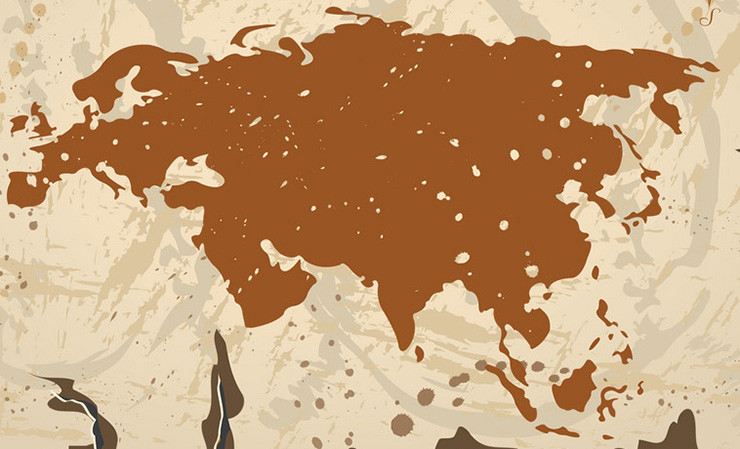
  • The Secret of Eurasia: The Key to Hidden History and World Events

    The Secret of Eurasia: The Key to Hidden History and World Events

    From New Dawn 68 (Sept-Oct 2001)

    Beneath the broad tide of human history there flow the stealthy undercurrents of the secret societies, which frequently determine in the depths the changes that take place upon the surface.
    – A.E. Waite1

    Have secret societies and occult brotherhoods been active behind the scenes of world events for thousands of years? Do these guardians of secret wisdom shape the growth of human consciousness and influence the destiny of nations? Are hidden masters of occult knowledge empowering and infiltrating certain political, cultural, spiritual and economic movements, in fulfilment of an ancient plan? Could it be that man’s great upheavals, wars, and revolutions, as well as his pioneering discoveries in science, literature, philosophy and the arts, are the result of a ‘hidden hand’? Can we decode history and find the mysterious interface between politics and occultism, thereby uncovering the real movers and shakers in our modern world?

    The German philosopher Oswald Spengler warned of a “mighty contest” between groups of men of “immense intellect” who the “simple citizen neither observes nor comprehends.” Back in 1930 Ralph Shirley, the editor of the London Occult Review, Britain’s leading journal of esoteric sciences, endorsed “the suspicion that the ranks of occultism are secretly working for disintegration and revolution. Positive proof in the shape of a group of occultists working with this objective in view recently came under the notice of the present writer.”

    This article appeared in New Dawn 68 which significantly was released over the period Sept-Oct 2001.

    Major-General Fuller, a former disciple of Aleister Crowley, who had links to British military intelligence, wrote about an insidious force using “Magic and Gold” striving “to gain world domination under an avenging Messiah as foretold by Talmud and Qabalah.” Fuller’s former chief Crowley worked as a secret agent for both Britain and Germany, although his British handlers noted his ‘unreliability’ warning he should only be used in espionage operations with the utmost care. During the First World War the German Foreign Office secretly requested the occultist Gustav Meyrink to write a novel blaming the Freemasons of France and Italy for the outbreak of war.

    Madame Blavatsky believed the Catholic society of Jesuits had transferred their headquarters from the continent to England where they plotted to plunge man into passive ignorance and institute “Universal Despotism”. The founder of the Theosophical Society, a woman of immense intellect and first hand experience of secret societies, warned:

    Students of Occultism should know that while the Jesuits have by their devices contrived to make the world in general, and Englishmen in particular think there is no such thing as Magic and laugh at Black Magic, these astute and wily schemers themselves hold magnetic circles and form magnetic chains by the concentration of theircollective WILL, and when they have any special object to effect or any particular and important person to influence.2

    The French Revolution, one of Europe’s most important political upheavals, was largely the work of Masonic lodges dedicated to the overturning of the monarchy and an end of the established Catholic religion. In Proofs of a Conspiracy (1798), John Robison showed that the political clubs and correspondence committees during the revolution, including the famous Jacobin Club, sprang from these Masonic lodges.

    The influence on history of mysticism, the occult and secret societies is generally dismissed by Western academics. Mainstream historians choose to ignore this aspect because they believe it has no real significance to world politics. In fact it is only through acknowledging the role and influence of the ‘occult underground’ that important world events can be fully understood and placed in their real historical perspective.

    Atlantism Verses Eurasianism

    Secret societies and the teachers of occult wisdom consistently trace their origins back to the very dawn of civilisation. Within Judeo-Christian culture, the secret schools speak of Adam, Seth, Moses and the Patriarchs as initiates of a divine wisdom carefully passed from one generation to the next. Other occult groups look back beyond ancient Egypt and the Mystery schools of Greece, to the lost continent of Atlantis. Still others trace their lineage to Sumeria or Babylon and the mysterious plains of Tartary.

    Examining mankind’s myths, legends and arcane stories we encounter countless references to a vanished primordial civilisation. The brilliant French metaphysician Rene Guenon wrote of a great Hyperborean culture that flourished around the Arctic Circle and of its outposts Shambhala in the East and Atlantis in the West. Plato wrote of Atlantis, describing it as the heart of a great and powerful empire which, due to the indiscriminate mixing of “the sons of God” with “the children of men,” suffered “violent earthquakes and floods” and “disappeared beneath the sea”. According to occult tradition, Atlantis came to an end after a lengthy period of chaos and disaster brought about, in the words of Madame Blavatsky, because the “Atlantis-race became a nation of wicked magicians.” Atlantis was destroyed by a conspiracy of evil magicians who had seized control of the mighty continent.

    Long before the final end of Atlantis, great migrations took place to different centres of the earth. In one legend we are told of a righteous remnant journeying from the Arctic Circle to Shambhala, in the remote fastness of Central Asia. Other legends suggest Atlantean survivors established the ancient Egyptian civilisation.

    Victoria LePage, the author of one of the most comprehensive studies of Shambhala explains how Atlantis and Shambhala are more than mere geographic locations:

    In folklore Atlantis and Shambhala are implicitly linked together as charismatic images of heart’s desire, two shining mirages that lie on the farthest horizon of human longing, unattainable, always receding as we reach for them; at best no more than ideal states of consciousness never realized. But their association seems to have a far more real and historically concrete basis than that. Initiatic tradition affirms they have both genuinely existed, one in the western sea, the other in the eastern mountains, as lynchpins of what was once a network of Wisdom centers located on a great power-grid extending around the globe. Further, Shambhala still exists within a framework that awaits reactivation.3

    In order to identify the historical activities of secret societies we need to appreciate the origin of a most powerful idea. Occult lore speaks of Shambhala as the positive centre of the Brotherhood of Light, and Atlantis the negative centre of the evil magicians, the Brothers of the Shadow. Wherever we look we see the division of secret societies and occult endeavours into these two opposing ‘Orders’. All occult movements and teachings inevitably serve either the “Order of Eurasia” or the “Order of Atlantism”, with their respective symbolic centres of Shambhala and Atlantis. Concealed behind a multitude of different forms and represented by an array of unsuspecting agents of influence, these two centres – Shambhala and Atlantis – represent two different impulses in human evolution.

    Viewed from the perspective of sacred geography, in our present historical cycle, Atlantism is the triumph of the most destructive and diabolical elements in the civilisation of the West. One modern authority on sacred geography and geopolitics observes:

    Sacred geography on the basis of “space symbolism” traditionally considers the East as “the land of Spirit”, the paradise land, the land of a completeness, abundance, the Sacred “native land” in its fullest and most perfect kind. In particular, this idea is mirrored in the Bible text, where the eastern disposition of “Eden” is treated.

    Precisely such understanding is peculiar also to other Abrahamic traditions (Islam and Judaism), and also to many non-Abrahamic traditions – Chinese, Hindu and Iranian. “East is the mansion of the gods”, states the sacred formula of the ancient Egyptians, and the same word “east” (“neter” in Egyptian) meant at the same time “god”. From the point of view of natural symbolism, East is the place where the sun rises, Light of the World, material symbol of Divinity and Spirit.

    The West has the opposite symbolical meaning. It is the “country of death”, the “lifeless world”, the “green country” (as the ancient Egyptians called it). West is “the empire of exile”, “the pit of the rejected”, according to the expression of Islamic mystics. West is “anti-East”, the country of decay, degradation transition from the manifest to the non-manifest, from life to death, from completeness to need, etc. West is the place where the sun goes, where it “sinks down”.4

    Russia & the Magical Universe

    Russia, geographically the largest country on earth, occupies a unique position in the study of human history furnishing us with a window into the world of secret societies, occult teachers, and subterranean political currents.

    Ideas and practices drawn from magic and the occult have always been a part of Russian life. In the sixteenth century Tsar Ivan IV consulted magicians and was aware of the occult significance of the precious stones set in his staff. His reign was the culmination of the dream of building a prophetic, religious civilisation in the Eastern Christian tradition of Byzantium. Surrounded by secret orders of apocalyptical monks, Ivan saw himself as heir to the Israelite kings and attempted to transform Russian life in accord with his magical view of reality. Ivan was convinced the Russian nation had a special mission to accomplish, nothing short of the redemption of the world.

    In 1586, Tsar Boris Godunov offered the huge salary of 2000 English pounds a year, with a house and all provisions free, to John Dee, the English magus and spy master, to enter his service. Dee’s son Dr. Arthur Dee, who like his father was an alchemist and Rosicrucian, went to Moscow to work as a physician. Mikhail Romanov, the first Tsar of the Romanov dynasty, allegedly ascended the throne with the help of Dr. Arthur Dee and British agents. Before their rise to power the Romanovs were accused by their enemies of practising magic and possessing occult powers.

    Saint Germain

    The legendary Count of Saint Germain, described as an alchemist, spy, industrialist, diplomat and Rosicrucian, became involved in several political intrigues in Russia and was, according Nicholas Roerich, “a member of the Himalayan brotherhood.” In 1755 he traveled throughout Eurasia to study occult teachings, and may even have visited Tibet. It is said that while studying occultism in Central Asia the Count was introduced to the secret rites of Tantric sex magic which provided him with a technique to prolong his youth. He also engaged in spying operations against the notorious British India Company. Saint Germain founded two secret societies called the Asiatic Brethren and the Knights of Light. As early as 1780 he warned Marie Antoinette that the French throne was in danger from an international conspiracy of ‘Brothers of the Shadow’. Rumours continued to circulate for many years after his alleged death that Saint Germain was still alive working behind the scenes in European politics or studying occult doctrines in Central Asia.

    West Meets East

    Occult powers seem to be a matter of national temperament… Russia tends to produce mages – men or women who impress by their spiritual authority; no other nation has a spiritual equivalent of Tolstoy and Dostoevsky, or even of Rozanov, Merezhkovsky, Soloviev, Fedorov, Berdaev, Shestov. Certainly no other nation has come near to producing anyone like Madame Blavatsky, Gregory Rasputin or George Gurdjieff. Each is completely unique.
    – Colin Wilson, The Occult

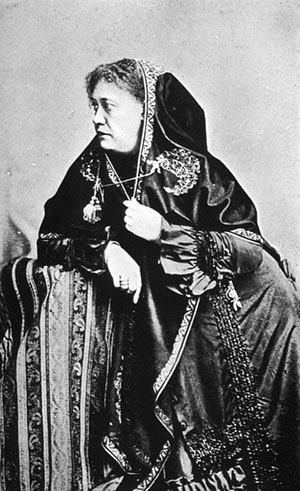
    The process of synthesis of the occult traditions of East and West is seen in the work of Helena Petrovna Blavatsky, founder of the Theosophical Society and the author of the magnus opus The Secret Doctrine. Born Helena von Hahn, the daughter of a Russian military family and cousin to the future Russian Prime Minister Count Witte, she is a true emissary of the Eurasian Order. Nevill Drury says of the Russian occultist:

    Her main contribution to mystical thought was the manner in which she sought to synthesise Eastern and Western philosophy and religion, thereby providing a framework for understanding universal occult teaching.5

    Helena Petrovna Blavatsky

    Madame Blavatsky traveled throughout Asia and Europe, joined Garibaldi’s national revolutionary militia, fighting in the battle of Mentana, in which she was severely wounded. In the late 1870s, shortly after the publication of her first book Isis Unveiled, a compelling indictment of contemporary Western religion as spiritually bankrupt, she moved from the United States to India where the headquarters of the Theosophical Society remains until this day.

    In 1891 the future Tsar Nicholas II, in the company of the mystic Eurasian scholar Prince Ukhtomsky, visited the headquarters of the Theosophical headquarters at Adyar. Prince Ukhtomsky’s description of the society is revealing:

    At the insistence of H.P. Blavatsky, a Russian lady who knew and had seen much, the idea sprang up of the possibility, and even the necessity, of founding a society of theosophists, of searchers for the truth in the broadest sense of the word, for the purpose of enlisting adepts of all creeds and races, of penetrating deeper into the most secret doctrines of oriental religions, of drawing Asiatics into true spiritual communion with educated foreigners in the West, of keeping up secret relations with different high priests, ascetics, magicians, and so on.6

    Madame Blavatsky wanted to unite Central Asia, India, Mongolia, Tibet and China, in order – with the involvement of Russia – to create a grand Eurasian power able to oppose British ambitions. Traveling across India Blavatsky agitated against British rule and found herself accused by the colonial authorities of being a Russian spy. Prince Ukhtomsky saw support for Eurasia in the “readiness of the Indians to group themselves under the banner of the strange northern woman.” He believed Madame Blavatsky had been forced to leave India by “the suspiciousness of the English.”

    As early as 1887 H.P. Blavatsky had become a topic of debate in “mystic Petersburg” and received the prestigious support of Ukhtomsky’s friend the mysterious Tibetan Dr. Badmaev, soon to become notorious for the favour he received at the Russian imperial court and his relationship with Rasputin. Madame Blavatsky’s sister insisted that the Russian Orthodox Metropolitan of Kiev had recognised the young Helena’s psychic gift, and admonished her to use her powers with discretion, as he felt sure they were given her for some higher purpose.

    Dr. Stephan A. Hoeller, a scholar of comparative religion and a Gnostic Bishop, reminds us that Blavatsky,

    was a true daughter of Mother Russia. Some feel that her life and character correspond strongly to the archetype of the traditional Russian wandering holy person, known as the staretz (literally ‘old one’), denoting a wandering, non-clerical ascetic, or pilgrim, who travels about the countryside, exhorting people concerning spiritual matters, sometimes in a decidedly unorthodox manner.7

    After H.P. Blavatsky’s death in London in 1891, the Theosophical Society came under the firm control of the English occultists Annie Besant and C.W. Leadbeater, a confirmed British imperialist. The Eurasian orientation given to early Theosophy by H.P. Blavatsky was compromised by the influence of British Masonry and Leadbeater’s esoteric High Anglicanism. In the great struggle of the magicians the Eurasian impulse found new historical agents in the West, among them the celebrated French magus Papus.

    Grand Battle of the Magicians

    When the 19th century will have come to an end, one of the Brothers of Hermes will come from Asia to unite humanity again.
    – Nostradamus

    Papus

    Papus, together with Oswald Wirth and De Guaita, dreamed of uniting occultists everywhere into a revived Rosicrucian brotherhood, an international occult order in which they hoped the Russian Empire would play a leading role as the bridge between East and West.

    Papus was the pseudonym of Dr. Gerard Encausse (1865-1916), a disciple of Joseph Saint-Yves d’Alveydre (1842-1910), an initiate of the French Gnostic Church and often the instigator of many of the occult groups of his time. One of the most famous turn-of-the century occultists, he was the founder of the Hermetic School in Paris, which attracted many Russian students, and directed the leading French occult review, L’Initiation. Papus was also the head of two secret societies, the L’Ordre du Martinisme and the L’Ordre Kabbalistique de la Rose-Croix.

    When the Russian Tsar and Tsarina visited France in 1896, it was Papus who sent them a greeting on behalf of “the French Spiritualists,” hoping that the Tsar would “immortalise his Empire by its total union with Divine Providence.” This greeting was reminiscent of the hopes of mystics at the time of Tsar Alexander I’s Holy Alliance.

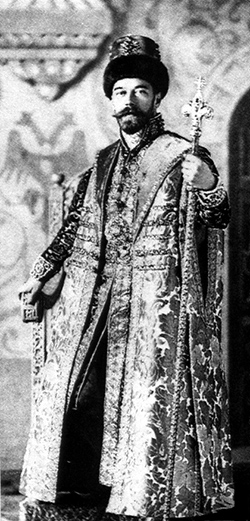
    Tsar Nicholas II

    Papus made his first visit to Russia in 1901 and was introduced to the Tsar. He quickly set up a lodge of his Martinist Order in St. Petersburg with the Tsar as the president of the “Unknown Superiors” who controlled it. The historian James Webb says Papus “was merely reviving a devotion to a philosophy that had flourished in Russia at the turn of the 18th and 19th centuries before being suppressed.”

    As the foremost student of Saint-Yves d’Alveydre, Papus knew of the key role to be played by Russia in unifying Eurasia and her occult destiny as the Empire of the End, the outward manifestation of the enigmatic power of ‘Northern Shambhala’.

    Through Papus the Imperial family became acquainted with his friend and spiritual mentor Master Philippe (Nizier Anthelme Philippe). A sincere Christian mystic, he was given rank and honours by the Russian Tsar, and maintained contact with the imperial court until his death in 1905.

    Papus returned to St. Petersburg in 1905 where it was rumoured he, in the presence of the Imperial couple, evoked the spirit of the Tsar’s father, Alexander III, who offered practical advise on handling a political crisis.

    Both Master Philippe and Papus played an important political role at the Russian court. They not only advised the Tsar on affairs of state but maintained contact with influential Russian initiates of the Martinist Order, among them two of the Tsar’s uncles and numerous relatives. The German occultist Rudolf Steiner, who had his own disciples among the German General Staff, followed the mission of the two Frenchmen, disturbed by Papus’ “extensive influence in Russia”. A strong advocate of the alliance between France and Russia, Papus warned the Tsar of an international conspiracy aimed at world domination.

    He believed that the vast Russian Empire was the only power capable of thwarting the conspiracy of the ‘Shadow Brothers’. He also urged the Tsar to prepare for the coming war with Germany, then being engineered by sinister forces in Berlin. According to one account, he promised the imperial family that, the Romanov monarchy would be protected as long as he, Papus, was alive. When the news of his death reached Alexandra in 1916, she sent a note to her husband (at the time commanding the Russian armies at the front in World War I) containing the words ‘Papus is dead, we are doomed!’8

    Papus promoted his Martinist Order as a counter to the Masonic lodges which, he believed, were in the service of British imperialism and the international financial syndicates. From his papers it is known that he furnished documentation to the Russian authorities about Masonic activities in Russia and Europe. Papus condemned Freemasonry as atheistic in contrast to the esoteric Christianity of the Martinist Order. He castigated “our epoch of scepticism, adoration of material forms, so vitally in need of a frankly Christian reaction, independent of all priesthoods.” Shortly after returning from his first visit to Russia in 1901, a series of articles appeared in the French press for which Papus was largely responsible. They warned of a “hidden conspiracy” the existence of which the public was totally unaware and of the machinations of a sinister financial syndicate trying to disrupt the Franco-Russian alliance. The public is blind to the real forces of history:

    It does not see that in all conflicts whether arising within or between nations, there are at the side of the apparent actors hidden movers who by their self-interested calculations make these conflicts inevitable….

    Everything which happens in the confused evolution of nations is thus prepared in secret with the goal of securing the supremacy of a few men; and it is these few men, sometimes famous, sometimes unknown, who must be sought behind all public events.

    Now, today, supremacy is ensured by the possession of gold. It is the financial syndicates who hold at this moment the secret threads of European politics…

    A few years ago there was thus founded in Europe a financial syndicate, today all-powerful, whose supreme aim is to monopolise all the markets of the world, and which in order to facilitate its activities has to acquire political influence.

    The Papus inspired articles in Echo de Paris revealed the role of the British Secret Service, which was exposed as being behind British Freemasonry, to isolate and weaken Russia. In France British agents concentrated on anti-Russian propaganda, while in Russia they used “financial trickery” to infiltrate all levels of society. Every effort was required “to preserve the Russian Emperor – so loyal and so generous – from the evils… [of ] the syndicate of financiers… which at present controls the destinies of Europe and the world.”

    The Mysterious Tibetan

    St. Petersburg… in 1905 was probably the mystical centre of the world.
    – Colin Wilson, The Occult

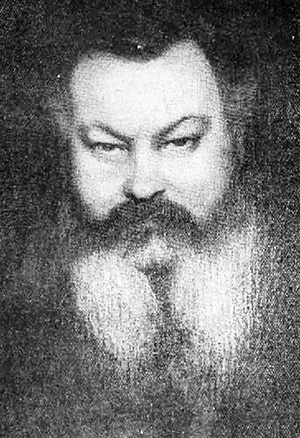
    Shamzaran (Pyotr) Badmaev was a Buriat Mongol who had grown up in Siberia and converted to Russian Orthodoxy with Alexander III acting as his godfather. He gained considerable influence at the Ministry of Foreign Affairs and the Tsar granted him the title of Privy Councillor. Badmaev was renowned as a doctor of Tibetan medicine, herbalist, and healer, who treated high society patients at his fashionable ‘Oriental Medicine’ clinic in St. Petersburg. Described by a Russian historian as “one of the most mysteries personalities of the day,” and a “master of intrigue”, Badmaev enjoyed a close association with the mystic healer Rasputin.

    Shamzaran (Pyotr) Badmaev

    Known as ‘the Tibetan’, Badmaev dreamed of the unification of Russia with Mongolia and Tibet. He involved himself in endless projects aimed at the creation of a great Eurasian empire. Russia’s historic mission, he believed, lay in the East, where she was destined to unite the Buddhist and Muslim peoples, as a counter to Western colonialism. Badmaev outlined his vision in a 1893 report to Tsar Alexander III entitled ‘The Tasks of Russia in the Asiatic East’. His considerable political expertise secured the support of the Mongol tribes in the Russo-Japanese War.

    In a letter of 19 December 1896, Badmaev wrote to Tsar Nicholas II: “…my activities have the aim that Russia should have greater influence than other powers upon the Mongolian-Tibetan-Chinese East.” Badmaev expressed particular concern over the influence of England in the East, stating in a special memorandum:

    Tibet, which – as the highest plateau of Asia – rules over the Asiatic continent, must without doubt be in the hands of Russia. By commanding this point, Russia will surely be able to make England more compliant.

    Badmaev knew of the legend, popular in Mongolia, China and Tibet, about the ‘White Tsar’ who would come from the North (from ‘Northern Shambhala’) and restore the now decadent traditions of true Buddhism. He reported to Tsar Nicholas II how “Buryats, Mongols and especially lamas… were always repeating that the time had come to extend the frontiers of the White Tsar in the east….”

    Badmaev had a close association with a highly placed Tibetan, the lama Agvan Dordzhiyev, the tutor and confidant of the 13th Dalai Lama. Dordzhiyev equated Russia with the coming Kingdom of Shambhala anticipated in the Kalachakra texts of Tibetan Buddhism. The lama opened the first Buddhist temple in Europe, in St. Petersburg, significantly dedicated to the Kalachakrateaching. One of the Russian artists who worked on the St. Petersburg temple was Nicholas Roerich, who had been introduced to the legend of Shambhala and Eastern thought by lama Dordzhiyev. George Gurdjieff, another man of mystery who had an impact on Western mysticism, knew Prince Ukhtomsky, Badmaev, and lama Dordzhiyev. Was Gurdjieff, accused by the British of being a Russian spy in Central Asia, a pupil of the mysterious Tibetans?

    “I am training young men in two capitals – Peking and Petersburg – for further activities,” Dr. Badmaev had written to Tsar Nicholas II.

    Mystical Anarchism

    The sway of ‘the Tibetan’ reached beyond the Imperial court into the Russian intelligentsia and further still to the subterranean world of espionage and revolutionary politics. One of the intellectual movements at the time of the 1905 political upheavals was called “Mystical Anarchism”. Two of its leading exponents were the poet and writer Viacheslav Ivanov and George Chulkov, both associates of Dr. Badmaev. Chulkov, like ‘the Tibetan’, is described as an unconscious medium transmitting mysterious forces.

    A radical political doctrine aimed at reconciling individual freedom and social harmony, Mystical Anarchism drew on the ideas of Friedrick Nietzsche. This is not surprising when we consider Nietzsche’s positive view of Russia as the antithesis of the decadent West, and the German philosopher’s appreciation of Buddhism and Oriental culture.

    According to the historian Bernice Glatzer Rosenthal, Mystical Anarchists, convinced “that unseen forces are guiding events here on earth, believed that political revolution reflected realignments in the cosmic sphere, and that a new world of freedom, beauty, and love was imminent.”

    Advocating the abolition of all external authorities and all constraints on the individual – government, law, morality, social custom – they were indifferent to legal rights as merely “formal freedoms” and opposed constitutions and parliaments in favor of sobornost’. By sobornost’ they meant a free community united by love and faith whose members retain their individuality (as distinct from individualism, self-affirmation apart from or against the community)….

    They grounded this ideal in their notion of the “mystical person,” the soul or the psyche, which seeks union with others and recognizes itself as a microcosm of the macrocosm, as distinct from the “empirical person,” the I or the ego, which asserts itself apart from or against others. Evoking and developing this “mystical person” would make feasible a “new organic society” united by invisible inner ties of love (eros, not agape), “mystical experience,” and sacrifice – the very opposite of liberal society, based on the social contract and mutual self-interest and characterized by rational discourse.9

    Mystical Anarchism is a thoroughly Eurasian sociopolitical idea. Here we have a most arcane motif in a modern form: The great struggle of the empirical, plutocratic Western civilisation, against the mystical, sacrificial culture of Eurasia. In occult terms it is the conflict of the impulse of ‘Shambhala’ with the renegades of ‘Atlantean civilisation’. The Brotherhood of the Northern Light battling it out with the Brothers of the Shadow, external manifestation of the long war between the agents of Being and Non-Being.

    Nicholas Berdyaev, Dmitri Merezhkovsky, Zenaida Hippius, Valerri Briusov, Mikhail Kuzmin, Alexandre Blok, Vasili Rozanov, along with a host of other Russian poets, writers and artists, transmitted different aspects of Mystical Anarchism and the Eurasian vision. When in the years before the Revolution the Sufi Master Inayat Khan visited Russia, he found much to commend in “the Eastern type of discipleship which is natural to the nation.”

    Merezhkovsky saw the possibility of evolving a “new religious consciousness” from the two peculiarly Russian types represented by Tolstoy and Dostoievsky. Tolstoy stood for a pantheistic mysticism of the flesh, and Dostoievsky for the more ascetic spiritual values. “In this Russia the ‘Man-God’ shall be manifested to the Western world, and the ‘God-man’ for the first time to the Eastern, and shall be, for those whose thinking already reconciles both hemispheres the ‘One in Two.’”

    After the Bolshevic Revolution, Blok contrasted the new Russia with the West. He called Russia the “Scythian,” i.e., the young, fresh nation whose destiny it was to challenge the decaying West:

    We are the Scythians, we are the Asians… Centuries of your days are but an hour to us, Yet like obedient slaves, We’ve held a shield between two hostile races – Europe, and the Mongol hordes… From war and horror come to our open arms, The embrace of kin, Put the old sword away while there’s time, Hail us brothers… Ah, Old World, before you have perished, join our fraternal banquet.

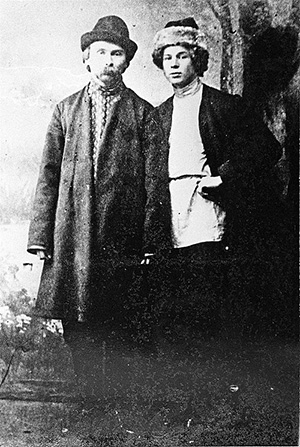
    The poet Nikolai Kliuev and his young friend Sergei Esenin featured occult images and Eurasian themes in their work. At the end of 1917 Kliuev (1887-1937), a prophet and emissary of Eurasia, wrote:

    We are the host of sunbearers.
    On the hub of the universe
    we will erect a hundred-story, fiery house.
    China and Europe, the North and the South
    Will come to the chamber in a round-dance of playmates
    to match together Abyss and Zenith.
    Their godfather is God Himself and their Mother
    is Russia.

    Kliuev’s protege, Esenin (1895-1925), longed for the end of the old world and its replacement by a new one, and even proclaimed a new religious trend called “Aggelism,” with clear roots in Russian Gnosticism. He hailed both Christ and Gautama the Buddha as geniuses because they were men of “word and deed”. In a letter to a friend, Esenin wrote:

    People, look at yourselves, did not Christs emerge from you, and can you not be Christs? Can I with will-power not be a Christ…? How absurd all our life is. It distorts us from the cradle, and instead of truly real people some kind of monster emerges.

    Nikolai Kliuev (left) and Sergei Esenin in Petrograd. 1915

    He warned the United States, to him the symbol of all non-Russian and rationalist sources, not to commit the mistake of “unbelief” and ignore the new “message” from Russia, as the way to the new life is only through Russia. A friend wrote how Esenin and his fellow ‘Scythian’ poets wanted a “deepening of the political revolution to the social” and came to regard Russian Marxism as “coarse”. Before his death Esenin became convinced ‘evil forces’ had usurped the Revolution and the Bolshevics betrayed Russia’s mission.

    The famed poet Nikolai Kliuev knew both Dr. Badmaev and Grigory Rasputin, and like the latter had been initiated into a secret school of Christian sexual mysticism with similarities to Tibetan Tantra and Indian Shivaism. “They called me a Rasputin,” Kliuev wrote in a 1918 poem. Kliuev’s spirituality was deeply rooted in the tradition of the Russian religious dissidents like the Old Believers, the Khlysty and Skoptsy, who formed a veritable subterranean river among the common people. Kliuev admitted how challenged by a Khlyst elder to “become a Christ,” he was introduced to the secret community of “Dove brethren”. With the help of “various people of secret identity”, Kliuev traveled all over Russia participating in secret rituals and imbibing the occult traditions of the Russian East.

    In his poems Kliuev sought to convey the mystic spirit of Eurasia. He was a prophet of Belovodia, the name given by Russian Old Believers to the awaited earthly paradise similar to Shambhala. Kliuev envisioned a radical transformation of Russia that would bring about a classless society where peasant culture would triumph over industrialism, capitalism, and the general mechanisation of life. He expressed his concern about the dangers of soulless Western civilisation in a 1914 letter to a friend:

    Every day I go into the grove – and sit there by a little chapel – and the age-old pine tree, but an inch to the sky, I think about you… I kiss your eyes and your dear heart… O, mother wilderness! Paradise of the spirit… How hateful and black seems all the so-called civilised world and what I would give, what Golgotha I would bear – so that America should not encroach upon the blue-feathered dawn… upon the fairy tale hut.

    Nicholas Berdyaev

    The Russian philosopher Nicholas Berdyaev articulated the vision shared by pre-revolution Russian thinkers as well as the cultural elite, when he wrote of the end of Western rationalism and the birth of a new era of the spirit which would witness the struggle of Christ and Antichrist. He saw the popularity of mystical and occult doctrines as proof of the approach of this New Era, and called for a “new knighthood”. “Man is not a unit in the universe, forming part of an unrational machine, but a living member of an organic hierarchy, belonging to a real and living whole.” Berdyaev’s attacks on Western materialist values only reflected a view widely held by Russian society. Writing in exile in the early 1930s he observed:

    Individualism, the ‘atomisation’ of society, the inordinate acquisitiveness of the world, indefinite over-population and the endlessness of people’s needs, the lack of faith, the weakening of the spiritual life, these and other are the causes which have contributed to build up that industrial capitalist system which has changed the face of human life and broken its rhythm with nature.

    Journey to Shambhala

    Nicholas Roerich was a man who brought glory to our [Russian] people; he is a representative of our civilisation and of its culture, one of its pillars.
    – Mikhail Gorbachev

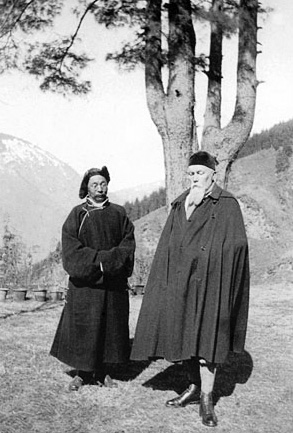
    Nikolai Roerich with a lama, 1933.

    Nikolai Konstantinovitch Roerich (1874-1947) had been introduced to the idea of Shambhala while working on the construction of the first Buddhist temple ever to be built in Europe. Personally acquainted with Russia’s pre-revolution intelligentsia, Roerich became a highly respected and prolific artist. A student of Madame Blavatsky’s works, Roerich believed in the transcendent unity of religions – in the notion that one day the Buddhist, the Muslim, and the Christian would realise their separate dogmas were husks concealing the truth within. Between 1925 and 1928, Roerich undertook five remarkable expeditions through Central Asia, focusing on the mysterious region between the Urals and the Himalayas, the area regarded as the heart of Eurasia. The traditions and legends encountered by Roerich in his travels are described in the books Altai-HimalayaHeart of Asia and Shambhala.

    In the tradition of Tibetan Buddhism, Shambhala is the hidden land in which the teachings of the Kalachakra (‘Wheel of Time’) Tantric school are kept in their purest form. Roerich discovered that the Shambhala of Tibetan Buddhism is not too different from the legend of Belovodia preserved by Russian Christian mystics. An elder of the Old Believer sect confided to Roerich:

    In distant lands, beyond the great lakes, beyond the highest mountains, is a sacred place where all truth flourishes. There one may find the supreme knowledge and the future salvation of mankind. And this place is called Belovodia, meaning the white waters.10

    Nicholas Roerich wrote how on a visit to the Mongolian capital Ulan-Bator in the 1920s, he heard soldier-revolutionaries singing:

    The war of Northern Shambhala.
    Let us die in this war
    To be reborn again
    As Knights of the Ruler of Shambhala.

    By ‘Northern Shambhala’ is meant Russia-Eurasia. In his book Heart of Asia, Roerich defined Shambhala not so much as a coming kingdom but an event – a new epoch for humanity of which Shambhala and Belovodia are timeless symbols:

    You have noted the concept of Shambhala corresponds to the aspirations of our most serious Western scientific research…. In their striving, the Eastern disciplines of Shambhala and the best minds of the West, which do not fear to look beyond the outworn methods, are uniting.

    Roerich never doubted the crucial role Russia would play in bringing together the noblest wisdom of both the East and the West. In Russia a new synthesis would emerge and a new day dawn for humanity, neither exclusively Western nor wholly Eastern, but truly Eurasian. In 1940, as the world found itself plunged into war, Roerich discerned the first glimpses of a New Era and wrote:

    The Russian people have piled together great stones. To the admiration of everyone they have built no tower of Babel but a Russian tower. A Kremlin of Sun-bearers with a hundred towers!… Listen – that is the future, and how radiant it is!”

    A year later in 1941 he commented:

    The whole world is rushing towards Armageddon. Everyone is confused. Everyone is unsure about the future. But the Russian people have found their course and with a mighty flood are streaming towards their radiant future.

    ‘You Must Pay Attention to Me, In Order to See Me’

    Humanity’s radiant future, like Shambhala, stands at the threshold. An invisible college of men and women in every age and nation have glimpsed it and responded to the impulse. Living in the first years of a new millennium we are witnessing the unfolding of an ancient plan. Just as there is no day without night, so too there is no authentic New Era without its counterfeit. And as the darkness must give way to the new dawn, so our present Dark Era will pass away in the great light of ‘Northern Shambhala’.

    Behind the tangle of present day events the ancient battle is being concluded. “In wartime,” said the emissary of Atlantism Winston Churchill, “truth is so precious that she should always be attended by a bodyguard of lies.” Empowered by the wicked Magicians of Atlantis, Western secret societies are in a state of occult warfare with the Order of Eurasia.

    We await the arrival of the New Era of Shambhala, the casting out of the Brothers of the Shadow from the governmental and financial centres of the earth, and the end of the evil karma inherited from the darkness of Atlantis.

    Alice Bailey, who described Shambhala as “the vital centre in the planetary consciousness” and related it to the Second Coming of the Christ, also prophesied Russia’s special role in bringing in the true New Era:

    Out of Russia… will emerge that new and magical religion about which I have so often told you. It will be the product of the great and imminent Approach which will take place between Humanity and the Hierarchy. From these two centres of spiritual force, in which the light which ever shineth in and from the East will irradiate the West; the whole world will be flooded with the radiance of the Sun of Righteousness. I am not here referring, in connection with Russia, to the imposition of any political ideology, but to the appearance of a great and spiritual religion, which will justify the crucifixion of a great nation and which will demonstrate itself and be focused in a great and spiritual Light which will be held aloft by a vital Russian exponent of true religion – that man for whom many Russians have been looking, and who will be the justification of a most ancient prophecy.11

    [alert type=”general” dismiss=”no”]This article was published in New Dawn 68.[/alert]

    [alert type=”success” dismiss=”no”]If you appreciate this article, please consider subscribing to help maintain this website.[/alert]

    Footnotes:

    1. Arthur Waite, The Real History of the Rosicrucians
    2. Letters of H. P. Blavatsky as quoted in The Occult Establishment by James Webb
    3. Victoria Le Page, Shambhala: The Fascinating Truth Behind the Myth of Shangri-la
    4. Alexander Dugin
    5. Nevill Drury, Dictionary Of Mysticism And The Esoteric Traditions, 1992
    6. As quoted in The Harmonious Circle by James Webb
    7. Stephan A. Hoeller, “H.P. Blavatsky: Woman of Mystery and Hero of Consciousness,” The Quest, Autumn 1991
    8. Stephan A. Hoeller, “Esoteric Russia”, Gnosis Magazine, No.31, Spring 1994
    9. The Occult in Russian And Soviet Culture, edited by Bernice Glatzer Rosenthal
    10. Nicholas Roerich, Heart of Asia
    11. Alice Bailey, Prophecies by D.K.

    © New Dawn Magazine and the respective author.

    For our reproduction notice, click here.
  • The Message of Evita

    The Message of Evita

    From New Dawn 41 (Mar-Apr 1997)

    “Evita is untouchable…. Children are born today saying Peron! Evita! Not even the military governments were able to erase that.”
    – Mayor Manolo Quindimil (1996)

    Evita, the name by which Argentina’s beloved first lady Eva Duarte Peron (1919-1952) was known to the world, is again back in the international media spotlight. Her legendary life now the basis of the film Evita. But the Hollywood production met with national controversy in the land of her birth. “The script by this Englishman attacks our history, offends our dignity and is an insult to the Peronist people,” said Peronist legislator Marta Rivadera. “I am in favour of freedom of expression but am against this lie which will distort the figure of our saint.”

    “Evita holds a place in Argentine history equivalent to that of Abraham Lincoln in the United States,” explains Enrique Pavon Pereyra, who knew Evita personally.

    During her short life the Argentine working people revered Evita, while the wealthy oligarchs despised her and spread all manner of hateful slanders. Today, some circles still fear the memory of a woman who died forty-five years ago.

    Who really was Evita? The message, some say, is important, not the messenger. Today, the life of the messenger Evita Peron is shrouded in myth and legend. What we can know for certain are her thoughts and words recorded for posterity in books and published speeches. By understanding the tremendous vision she shared with her remarkable husband Juan Peron we can grasp something of her timeless greatness.

    EVA & JUAN PERON

    “When I chose to be Evita, I chose the path of my people.”
    – Eva Peron

    Evita was born Eva Maria Duarte on May 7 1919 in Los Toldos, Argentina, the fifth and youngest illegitimate child of Juana Ibarguren. Struggling free from a life of grinding poverty she moved to the Argentine capital to find work as a radio soap opera actress.

    1943 saw the young Colonel Juan Peron appointed Argentina’s Secretary of Social Welfare and Labour in the military junta of General Farrell. His leadership abilities and determination to radically empower the Argentine working class soon became obvious to all. Peron single-handedly transformed the labour movement and strengthened the unions. As his popularity grew – he was appointed vice president and Minister of War – opposition from reactionary elements in the armed forces and the wealthy land-owning class also grew.

    1944 found Evita working as a radio actress and commentator on Argentina’s leading radio station in Buenos Aires. A year earlier she had reached the top of her profession and was among the highest paid radio actresses in the country. Evita later described her work on radio as a combination of singer, disc-jockey, actress and lady commentator all in one. These were the glory days of radio when people relied on the airwaves to deliver news and comment along with entertainment.

    On Saturday, January 15 1944, an earthquake destroyed the ancient Argentine town of San Juan, claiming the lives of over ten thousand people. Col. Peron distinguished himself in organising the relief effort. Evita, already greatly interested in social welfare, attended a meeting of artists called by Peron to raise funds for the rebuilding of the town.

    Peron described the meeting at which a young woman, then unknown to him, boldly spoke out:

    “I remember that she wasn’t seated in the first row; that she was wearing a very simple dress; that she was thin, that she had blonde hair, and that she had a little hat, like they wore in those days. ‘We don’t need festivals,’ she replied to proposals that had been made, ‘we should go directly to ask, without offering anything….Let’s go to the streets, to the public places, to the hippodrome, to the theatre, to all the important places, and say to the people, our brothers are stricken, we have to help them! We have to get money from those that have it, because those that don’t have it can’t give it.’

    “I liked the way this woman thought and worked. I thought she wasn’t like the others. She had something very superior to the others in the way she talked and in her suggestions. She was practical and had new ideas.

    “‘Good, very well,’ I said to her then, ‘it’s your idea, organize it.’ And that’s the way it was. She organized everything.”

    In another recollection, Peron told how he was struck by Evita’s zeal and conviction. “I looked at her and felt that her words were overpowering me….I saw in Evita an exceptional woman. A true passion, animated by will and by a faith comparable to that of any of the early Christians.”

    Evita shared Juan Peron’s commitment to social justice. Peron saw in Evita a kindred spirit and co-worker in the struggle for a revitalised Argentine nation. “When I first knew Evita what attracted me to her was not the beautiful woman but the good woman,” Peron later wrote. “It’s true that she combined those two things: beauty and goodness. Instinctively I perceived that the collaboration of a woman of this kind would be invaluable for the social task I had in mind….I had to prepare a woman who would be the feminine leader of my political movement: a capable woman with enough basic culture, natural talents of intuition, with dedication…”

    On her daily radio programmes Evita dramatically recounted Peron’s welfare reforms. They were a passionate mix of radio drama and current affairs. One of her most popular broadcasts went on at seven in the evening, when men and women were together after work. Evita explained to her listeners all about “that newcomer in the Ministry of Social Welfare”. She obtained records from Peron’s deputies and office secretaries and brought the story of the fast rising military officer and his vision, to the masses.

    Looking back on this hectic period Peron recalled “…our private life [was] totally subordinated to the political and social calling…a veritable tyranny to which we submitted ourselves as if it were a mission. Evita, in those first days, didn’t care much about her appearance, or want to be taken for an elegant woman. She went to work, and working all day didn’t leave much time to care for herself.”

    As Peron’s influence and mass support grew, Argentina’s reactionary ruling class started a campaign of vilification aimed at undermining his popularity. He was openly living with Evita, and in a staunchly Catholic country, this provided ammunition for his enemies. Professor Robert D. Crassweller in his book on Peron, points out:

    “Evita’s image as a prostitute, strongly held in some quarters, was one consequence although it had no basis in fact. But it served well the sense of class antipathy and division that was growing up around Peron, and in a society so deeply fragmented and so hotly personalized any weapon that came to hand was welcome.”1

    By 1945 the forces of U.S. imperialism, alarmed at the course of developments in Argentina, formulated a policy to derail the growing anti-Yankee, anti-British, nationalist-labour coalition inspired by Juan Peron. Spruille Braden, whose family made their fortune exploiting Chile’s natural resources, became United States ambassador to Argentina. A protege of Nelson Rockefeller, Braden’s job was to guarantee Argentina’s compliance with the goals of U.S. imperialism in South America.

    The U.S. ambassador had several explosive meetings with Peron. Unable to persuade the Argentine vice president to accept Washington’s demands, Braden openly intervened in Argentina’s internal affairs, giving speeches to audiences of Peron’s opponents, and publicly criticizing Peron. Part of this U.S. instigated disinformation campaign smeared Peron as a fascist and ‘Nazi agent’. “North Americans are the greatest criminals and thieves in the history of the world”, wrote Juan Peron.

    Events came to ahead in October. Reactionary army officers led by an insignificant general insanely jealous of Peron, staged a coup. On October 12th, Peron was ousted from all his government posts and arrested by the pro-U.S. clique. With Peron exiled to an island prison, the self-appointed cabinet officers set about organising their own regime. They had reckoned without Evita, and they underrated the support of the working people for Peron.

    On the boat to the prison island, Col. Peron turned to the officer guarding him. “Well, I lost,” he said. “But, you know, there is only one person for whom I need to care. I am your prisoner but I am also your fellow army officer. May I ask you a favour?”

    “What is it, Colonel Peron?” the officer asked. “Give a pistol to Evita for me – to defend herself or to kill herself if someone touches her. Tell her I will not live after her….”

    When word spread of Peron’s imprisonment, Evita started organising their bands of working class supporters, the descamisados or “shirtless ones”, with furious speed.

    Evita rallied the labour unions and all who listened in a popular uprising that would forever change Argentina. Evita told the union leaders: “Look, this is not just our chance, it is your last chance to create a new social order, or we can all go back to the old social order.”

    As the Argentine masses realised what had happened to Peron, riots broke out all over Buenos Aires and other provincial cities. By October 17 the Argentine capital was almost in the hands of organised bands of descamisados. More than half a million people, led by over fifty thousand labourers, gathered in front of Government House, demanding “our leader, Peron.”

    Fearing bloody civil war, the military promptly released Peron and he appeared before the crowds on the Government House balcony. On October 23 he secretly married Evita. Then began his campaign for the presidency.

    In a desperate attempt to destroy Peron’s presidential bid, the U.S. State Department issued the notorious “Blue Book,” a scandalous report officially entitled Consultation among the American Republics with Respect to the Argentine Situation. Containing all the false charges generated by Ambassador Braden, the “Blue Book” was a vicious piece of propaganda. The agents of U.S. imperialism went to work massively publicising its charges. Half the space of many newspapers – with newsprint scarce – was devoted to reprints from it.

    PERON’S VICTORY

    “The reign of the bourgeoisie has terminated throughout the world. The government of the peoples begins. With that, demi-liberalism and its consequence, capitalism, has ended its cycle; the future belongs to the people.”
    – Juan Peron

    Despite the calculated disinformation of the U.S. State Department’s “Blue Book” and Ambassador Braden’s intrigues, Peron emerged victorious, following the first honest election in Argentina in decades. There was rejoicing in the streets that night of February 24 1946, as Peronist representatives gained an overwhelming majority in the Chamber of Deputies and almost all the seats in the Senate.

    In a direct move against the iniquitous Anglo-American financial interests, Peron nationalised the Central Bank of Argentina one day before the election. Two years later he referred to this move in a speech: “Nationalisation has been, without doubt, the most transcendent financial measure of the last fifty years.”

    “Is it true that you represent a new doctrine?” the Associated Press reporter asked Peron after the 1946 election. To which Peron replied, “Yes, in effect, but not so new as forgotten for a long time, because it is already 2,000 years old: Christianity.” His new government immediately launched a “social programme of a revolutionary nature.”

    The new Argentine president enacted legislation establishing labour councils to protect workers from arbitrary dismissal, reduced the working week to forty-four hours, raised wages, nationalised the British owned railway system and established free health clinics for the poor.

    Evita’s total devotion to the ideals of Peronism impressed all who heard her spell-binding, stirring oratory. From her quiet opening, modestly referring to herself as Peron’s little echo, she told her audience: “I was no better off than you not long ago. Now I exist only to interpret Peron’s great crusade to you – his people. I am only here to save his energy, to explain his ideals, to carry out his glorious programme….”

    The new government granted women the right to vote in 1947 and eighteen months later Evita organised the Peronist Women’s Party. Meaningless feminist theories did not interest her. Her actions did more, in the words of one observer, “to bring women into public life in Argentina than a large army of feminists could have done.” In an early speech, Juan Peron paid tribute to the many women, inspired by Evita, who joined the Peronist ranks:

    “This Revolution has been echoed by Argentine womanhood as few events in history have ever been. This is indeed auspicious, for if man is a rationalist, woman possesses what is above masculine rationalism; an intuition which is always superior to the success we men may be able to attain. For this reason I render homage to the women of my country in whom the men of the Revolution found an echo that fills us with satisfaction and pride.”

    Evita Peron was a legend well before her death. Her autobiographical La Razon de Mi Vida (“My Mission in Life”), written in late 1951, after she learned that she had cancer, was a best seller in Argentina and abroad. Some 50 million copies were printed, 150 000 copies selling on the first day of publication. An Arabic edition was distributed in Egypt and throughout the Mediterranean. Wherever people were rising up to confront imperialism, Evita’s book appeared.

    In La Razon de Mi Vida she vents her anguish at the injustice suffered by the poor at the hands of the oligarchs. A strong sense of the evils of bourgeois capitalism and crusading zeal for social justice were inseparable from Evita’s personality. She wrote:

    “I remember well that I was sad for many days when I discovered there were wealthy people as well as poor people in the world; and the strange fact is that I didn’t resent so much the existence of poor people as I did to discover there were also rich. The theme of rich against the poor, has been, since then, my sole concern in my deepest solitude.” Throughout her years with the Argentine president, Evita always scrutinised all government policies regarding worker’s rights and social welfare.

    “It is distressing to compel men to live in an unjust world,” Juan Peron once lamented. With Evita by his side, he tirelessly laboured to build a new nation “in which every part of Argentine society should contribute its share for the benefit of the community: the worker, his muscles; the middle class, its intelligence and activity; the rich, their money….”2

    The Argentine leader exposed the principle of unbridled liberty in the economic sphere, remarking: “We do not favour unilateral liberty where the rich are free to do whatever they like while the poor have but one liberty: to die of hunger.

    “It is necessary to end the economy of exploitation and replace it by a social economy without exploiters or exploited and where each one receives a just payment in accordance with his capacity and effort. Capital must be at the service of economy and not economy at the service of international capitalism as has occurred up to now.”

    The 1949 Argentine National Constitution, inspired by Peron’s ideas, stipulated that it is the duty of the State to supervise the distribution and use of land and intervene in order to develop and increase its yield for the good of the community. The State must give each peasant or his family the possibility of becoming the owner of the land he cultivates. Capital must be at the service of national economy and its main object must be social welfare. The different forms of exploitation cannot oppose the ends of public welfare of the Argentine people.

    EVA PERON FOUNDATION

    “…Peronism, which perhaps at times doesn’t respect the forms but which tries to assimilate and comply with the principles, is an effective, real, and deep way of practising Christianity…”
    – Juan Peron

    Evita made part of her grand vision a reality through the Eva Peron Foundation, a charity organisation that distributed over $50 million a year to the poor and needy. The foundation avoided the quagmire of government bureaucracy by relating directly to the people. As Evita explained:

    “It was Peron himself who told me: ‘The people who have been deeply punished by injustice have more confidence in people than in institutions. In this, more than in anything else, I fear the bureaucracy. In government it is necessary to have a lot of patience and to know how to wait for everything to move. But in the works of social assistance you cannot ask anybody to wait.’”3

    In the first eleven months of Peron’s presidency, Evita gave away close to $4,500,000 worth of school books, clothes, shoes, furniture, toys, and food, to those in need. Prof. Crassweller explains:

    “With such singleness of direction, the foundation flourished as none other. By the end of the 1940s it exceeded, in size, in influence, and in general significance, most of the ministries of the government. Its assets exceeded $200 million. It had 14,000 permanent employees, including thousands of construction workers and a staff of priests. It acquired for distribution to the poor fantastic amounts of supplies….Its flood of revenues came from many sources. Labor unions donated cash and goods made in the factories where members worked.”4

    Evita built more schools, orphanages, hospitals and retirement homes than all previous Argentine governments combined. Prof. Crassweller conveys the sheer enormity and range of the foundation’s work:

    “Twelve hospitals, with the best equipment available anywhere, were built. A thousand new schools appeared. There were clinics, medical centers, homes for the aged, convalescent centers, a home for girls who had come to Buenos Aires looking for work, transit homes for those needing temporary shelter, student cities, children’s homes, including a famous Children’s City built to the scale of its inhabitants, with small markets, a church, public buildings, a bank that issued script, streets, houses, and dormitories for four hundred and fifty particularly disadvantaged children. The foundation also built the Barrio Presidente Peron, a development with six hundred new houses just west of Buenos Aires, and it built Evita City, a planned community with 15,000 homes. Many of the public structures were notable for a tone of luxury unfamiliar in such places, a touch of brocade and damask and crystal, and this was deliberate, a form of social recompense.”

    As if painfully conscious of her own mortality, Evita was “working through the day and through much of the night, at a pace the human body cannot long tolerate.” She did not smoke. Like her husband she drank no alcohol, only water. Just as the Christians in ancient Rome died for Christ, Evita reminded the Peronist faithful, “We, who love Peron more than anything, are going to die for Peron, because we are not defending a personal thing, but a national cause.”5

    Juan Peron, after only three years in office, had made Argentina the fourth industrial power in the world. Land reforms boosted agricultural production and the Argentine Institute for Trade Promotion set the price of Argentina’s booming exports. The development of a national economy resulted in vast public works projects, bringing economic prosperity. By 1949, Peron’s doctrine was summed up in the word Justicialismo, a term coined from the Spanish words for “social” and “justice”. Justicialismo, the ideology of Peronism, being officially defined as “a doctrine whose object is the happiness of man within the society of mankind through the harmonizing of material, spiritual, individual and collective forces, appraised from the Christian standpoint.”

    JUSTICE & CHRISTIAN SOCIALISM

    “I have always thought that above all material values are the permanent values of spirit, which are the only eternal things.”
    – Juan Peron

    “Justicialism”, Peron proclaimed, “is nothing but national Christian socialism.” Above all, the goal of Justicialismo was to transform the Argentine masses into an “organised community” in which conflicting interests would be brought into harmony.

    Evita Peron clearly defined the difference between an organised community and a dispersed mass by comparing Spartans with Helots. The former constituted a great people with conscience, personality and social organisation, while the latter lacked those three qualities and lived as slaves.

    “The history of Peronism,” said Evita, “is already a long battle of seven years to have a suffering and sweating mass – as General Peron many times called it – become a people with social conscience, personality and organisation.

    “You must remember how many times General Peron addressed workers, industrialists, merchants, professionals, everybody, asking them to organise themselves.

    “Peron wants a people which feels and thinks, which acts properly guided. For this reason he set three objectives: social justice, economic independence and political sovereignty.

    “Peron wants a united people, because then nobody will exploit it, nor will it be defeated by any other force in the world. Peron wants a people where everybody is privileged.”6

    The United States faced the problem of what to do about Peron. His legally won 1946 election, after the publication and distribution of the “Blue Book”, was an open defeat of United States diplomacy in Latin America. The U.S. could not afford to openly oppose Peron, at the possible cost of Latin American solidarity. Washington chose instead to try to publicly live with the “Peron problem”, while simultaneously carrying on covert operations designed to undermine and discredit the Peronist revolution.

    Peron understood the real nature of the international forces arrayed against him. He saw how the British and U.S. imperialists had actually used the Argentine Communist Party to oppose his labour-nationalist coalition. The Communists broke up strikes in the railways and meat packing plants (owned by Anglo-American interests) and strenuously fought the anti-imperialist descamisados. “For capitalist oligarchy a communist party is better than a Justicialist enemy,” declared a popular Peronist slogan of the era.

    The globalist forces, so hostile to nationalism and responsible for the division of the world between capitalism and communism, Peron termed: “the Great Internationals of Sinarchy.”7

    Sinarchy is a type of collective shadow world government that brings together the highest leaders of the big imperialist powers. The Argentine leader said that “Masonry, Zionism, international societies of different kinds are but a consequence of the globalisation of the present world. They are the hidden forces of imperialist domination.”8

    “Capitalism and Soviet Communism are but two of them,” Peron observed, “seemingly opposed but in reality perfectly united and co-ordinated.

    “Everything can be summarized by saying that the capitalist regime has abused property and is to blame for communism because it has given it a reason to exist. Without the exaggerated exploitation of the old capitalist regime, communism would never have existed. That is the cause, and communism is the effect. In order to remove the effect, it is necessary to remove the cause.”9

    Re-elected by an even greater margin in 1951, Peron continued to reshape Argentina. Reviewing the achievements of his presidency in the face of opposition from Britain and the U.S., Peron wrote:

    “During the ten years of Justicialist Government [1945-55] Argentina was free and sovereign. Nobody poked their noses with impunity. But at the end of those ten years, international sinarchy, together with vernacular politicians at the service of foreign interests and colonialism, treaded on us.”

    A NATION MOURNS

    “I pray God that He should not allow these madmen to lift their hand against Peron, for on that day, woe to them! I shall go forth with the working people, I shall go forth with the women of the people, I shall go forth with the descamisados, and I shall leave no brick standing that is not Peronist.”
    – Evita Peron, May 1 1952

    Evita tirelessly carried on her work at the foundation, but now she was dying of cancer. At first resistant to treatment of any kind, she accepted the inevitability of surgery.

    On May 7 1951, a little more than twelve months before her death, Evita declared:

    “Peron is the air we breathe; Peron is our sun, Peron is life. I want nothing but to be the heart of Peron. Because, though I do my best to understand him and learn his marvellous ways, whenever he makes a decision, I barely mumble. Whenever he speaks, I hardly utter a single word. Whenever he gives advice, I scarcely dare make a suggestion. What he sees I hardly glimpse. But I see him with the eyes of my soul….And I have pledged myself to collect the hopes of the Argentine people and empty them in the marvellous heart of Peron so that he may turn them into realities.

    “The humble people, my general, have come here to prove, as they have always done, that the miracle that happened 2,000 years ago is occurring again. The rich, the learned, the men in power never understood Christ. It was the humble and the poor who understood, because their souls, unlike the souls of the rich, are not sealed up with avarice and selfishness.”

    Argentina’s powerful Catholic Church, traditionally aligned with Peron’s enemies the oligarchs, did not approve. The Church hierarchy was already upset by Peron and Evita’s interest in the esoteric sciences and the intrusion of the Eva Peron Foundation into education and youth affairs.

    Evita responded to the Church’s disapproval explaining: “Once I read in a book by Leon Bloy, about Napoleon, that he could not conceive heaven without his Emperor. This appealed to me and in a speech I said that I also could not conceive heaven without Peron.

    “Some people thought that this was almost a heresy. Nevertheless, every time I think of it, it seems more logical to me.

    “I know that God alone will fill heaven.

    “But God, who could not conceive heaven without His mother, whom He liked so much, will forgive me because my heart cannot conceive it without Peron.

    “I shall not commit the heresy to compare him (Peron) to Christ…but I am certain that, by imitating Christ, Peron feels a deep love for humanity and that this, more than anything else, makes him great, magnificently great.”10

    Evita continued to decline. On June 4 1952 she rallied for a last appearance in public at Peron’s inauguration for a second term. She now weighed only eighty pounds. Later in June, she endured radiotherapy, was burned, and suffered much.

    To the end Evita’s concern was for her beloved General. “As she lay in bed on a bad day toward the end, more dead than alive, Peron walked by in the corridor beyond her door, coughing as he passed. ‘Did you hear that?’ she said to her doctor. ‘General Peron is coughing, because he smokes too much. Please, tell him not to smoke. Examine him. See that he doesn’t get sick.’”11

    During her last weeks, Evita wrote her public will. When she died on July 26 1952, at age 33, the nation was in shock. She never held any official post but had become the most famous and beloved woman in the world. The largest funeral in the history of the Argentine was held with millions of mourners lining the streets as her coffin passed with full military honours.

    On October 17, the anniversary of her 1945 mass rallies to free Peron, a day set aside to honour “Evita, Spiritual Chief of the Nation,” Evita’s public will was read to the people. It began: “I wish to live eternally with Peron and with my people. This is my absolute and permanent desire, and therefore my last will. Where Peron is and where my descamisados are, there will my heart ever be, to love them with all the forces of life and all the fanaticism that burns my soul.”

    She continued: “I will be with them, with Peron, to fight against the traitorous and perfidious oligarchy, against the cursed race of exploiters and the dealers in humanity….if I have committed errors, I have committed them out of love and I hope that God, who has always seen into my heart, will judge me not for my errors, nor for my defects, nor for my guilt, but for the love that consumes my life.

    “I…was born of the people and suffered with them. I have the body and the soul and the blood of the people. I can do nothing other than to surrender myself to my people.”

    Evita passed from the scene of history, a great and truly unique woman for whom no counterpart can be discerned.

    In 1955 Juan Peron was overthrown by pro-Anglo-American military officers and forced to leave the country. As one commentator wrote of his years away from Argentina: “In exile, Peron had continued to espouse the basic tenets of his political creed: hatred of bourgeois capitalism and all forms of imperialism; advocacy of the Third World causes (such as economic independence), which he so early championed and of which he now calls himself the father; and government with and for, if not by, the people.”12

    Returning in 1973 to an Argentina in political and economic chaos, Peron was reelected to the presidency with 67% of the vote. After only nine months in office Peron died and joined his beloved Evita.

    “Yes. I confess I have an ambition, one sole and great personal ambition: I would like that the name of Evita would appear someday in the history of my country. I would like that it would say of Evita, even if it would not be more than a small footnote, at the end of the wonderful chapter which history will certainly dedicate to Peron, something approximately like this: ‘There was, by the side of Peron, a woman who dedicated herself to take to the President the hopes of the people, which Peron would promptly convert into realities.’ And I would feel properly and fully repaid if the footnote would end like this: ‘Of that woman we only know that the people used to call her, caressingly, EVITA.’”13

    [alert type=”general” dismiss=”no”]This article was published in New Dawn 41.[/alert]

    [alert type=”success” dismiss=”no”]If you appreciate this article, please consider subscribing to help maintain this website.[/alert]

    REFERENCES

    1. Peron and the Enigmas of Argentina, Robert D. Crassweller, 1987, W.W. Norton & Company, New York

    2. Doctrina Peronista, Juan Domingo Peron, 1952, Republica Argentina, Buenos Aires

    3. La Razon de Mi Vida. English translation: My Mission in Life, Eva Peron, 1952, Vantage Press, New York

    4. Peron and the Enigmas of Argentina, Robert D. Crassweller, 1987, W.W. Norton & Company, New York

    5. Historia del Peronismo, Eva Peron, 1951, Subsecretaria de Informaciones, Buenos Aires

    6. Historia del Peronismo, Eva Peron, 1951, Subsecretaria de Informaciones, Buenos Aires

    7. La Hora de los pueblos, Juan Domingo Peron, 1968, Madrid

    8. La Hora de los pueblos, Juan Domingo Peron, 1968, Madrid

    9. Catecismo de Doctrina National Justicialista, Buenos Aires

    10. La Razon de Mi Vida. English translation: My Mission in Life, Eva Peron, 1952, Vantage Press, New York

    11. Peron and the Enigmas of Argentina, Robert D. Crassweller, 1987, W.W. Norton & Company, New York

    12. The New Encyclopedia Britannica, 15th Edition

    13. La Razon de Mi Vida. English translation: My Mission in Life, Eva Peron, 1952, Vantage Press, New York

    © New Dawn Magazine and the respective author.

    For our reproduction notice, click here.
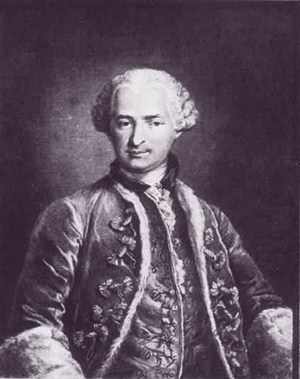
  • The Truth is Out There

    The Truth is Out There

    This article was published in New Dawn 31 (Jul-Aug 1995)
    “A paranoid is someone who knows a little of what’s going on. ”
    William S. Burroughs

    “Ignorance…brought about anguish and terror. And the anguish grew solid like a fog and no one was able to see.”
    – The Gospel of Truth, 17:10, Nag Hammadi Texts

    “Humanity is asleep, concerned only with what is useless, living in a wrong world….Do not prattle before the People of the Path, rather consume yourself. You have an inverted knowledge and religion if you are upside down in relation to Reality. Man is wrapping his net around himself. A lion (the man of the Way) bursts his cage asunder.”
    – The Sufi Master Sanai, teacher of Rumi, in The Walled Garden of Truth (1131 C.E.).

    What role does conspiracy and cover-up play in the multifarious facets of life in the closing years of this twentieth century? Are powerful groups manipulating events as part of a long-range strategy to bring about a totally controlled global society? Does recognition of conspiracies lead to paranoia and delusion? Or does it actually explain events and thereby empower people?

    It is not the purpose of this short article to examine the range of crimes, cabals and secret plots broadly covered by the word conspiracy. Nor do we intend to prove the existence of some international conspiracy at work in the crisis torn world of the 90s. What we want to touch on is the implications of conspiracy theories for personal transformation. What we want to explore here is a different way of seeing the world.

    First let us define the meaning of that seemingly disturbing word: “conspiracy”. Webster’s International dictionary gives, as one connotation, “a combination of men for an evil purpose; a plot”. The Oxford Dictionary of English agrees, defining conspiracy as “a combination of persons for an evil or unlawful purpose; an agreement between two or more to do something criminal, illegal or reprehensible; a plot”.

    If, as a significant number of researchers claim, it can be shown that influential – largely hidden – elites have knowingly combined their efforts in a plot(s) to manipulate and control people and events, then on the basis of the standard definition just cited, a conspiracy does indeed exist.

    Readers who are accustomed (or is it conditioned?) to automatically regard any mention of conspiracy as irrational paranoia, will find this very subject a ‘problem’.

    Jonathon Vankin, the author of two excellent books exploring a host of conspiracy theories, observes that, “The word ‘conspiracy’ may be a ‘problem’ for some, but only because it represents the unknown, mystery, and risk. Those are the things that grip the human mind and bring it to life. These ideas can only be a problem for those who wish to keep our minds under control.”

    Last century the British politician, Benjamin Disraeli, a man of wide political experience, declared that “the world is governed by very different personages from what is imagined by those who are not behind the scenes.” This century U.S. President Franklin D. Roosevelt has been quoted as saying: “In politics, nothing happens by accident. If it happens, it was planned that way.”

    “Ruling elites will use conspiracy,” states political scientist and activist Dr. Michael Parenti. “They will finance elections, publicity campaigns, publishing houses, wire services, and academic studies. They will use surveillance, mobsters, terrorists, assassins and death squads.”

    Conspiracy researchers ‘look behind the dark curtain’ that shrouds history and the sacrosanct assumptions reinforcing contemporary society.

    There really are, as investigative author Jim Hougan says, two kinds of history, the safe, sanitized “‘Disney version,’ so widely available as to be unavoidable…and a second one that remains secret, buried, and unnamed.”

    This “second” version of history, Jonathon Vankin and John Whalen argue, does indeed have a name: “conspiracy theory.” According to the co-authors of 50 Greatest Conspiracies of All Time the official, safe “Disney” version of history “could just as easily be called the ‘New York Times version’ or the ‘TV news version’ or the ‘college textbook version.’ The main resistance to conspiracy theories comes not from people on the street, but from the media, academia, and government – people who manage the national and global economy of information.”

    The structure of the modern world demands mass adherence to faith in the institutions that maintain the existing order and make it run. These institutions are innumerable: government, business, science, education, politics…and their survival is dependent on people’s faith in authority.

    “We have to believe the institutions are functioning in our best interests,” wrote Vankin in his 1991 ground-breaking book Conspiracies, Cover-Ups and Crimes. “We have to believe what the people within those institutions assure us to be true.”

    This is why ‘conspiracy theories’ are universally anathema to the Establishment. They directly challenge the status quo, undermining the blind faith of the ‘brainwashed’ masses in society’s machiavellian ‘leaders’!

    Vankin quotes anthropologist Jules Henry as saying that “our civilization is a tissue of contradictions and lies.” Henry used the term “sham” for the everyday deceptions that reinforce this malignant society. “Sham gives rise to coalitions because usually sham cannot be maintained without confederates.” In other words, to keep the system afloat requires a conspiracy. “In sham,” Henry continues, “the deceiver enters into an inner conspiracy against himself.”

    Acknowledging the conspiracies and cover-ups behind history and contemporary events means we can no longer lie to ourselves, like Colin Wilson’s “Outsider” who “cannot live in the comfortable insulated world of the bourgeois, accepting what he sees and touches as reality.”

    Modern civilisation is a conspiracy against Reality.

    R.D. Laing explains in The Politics of Experience how people are ‘conditioned’ and ‘brainwashed’ by modern society. Beginning with the children, Laing says, “It is imperative to catch them in time. Without the most thorough and rapid brainwashing their dirty minds would see through our dirty tricks. Children are not yet fools, but we shall turn them into imbeciles like ourselves, with high IQs if possible.

    “From the moment of birth, when the Stone Age baby confronts the Twentieth century mother, the baby is subjected to these forces of violence, called love, as its mother and father, and their parents and their parents before them, have been. These forces are mainly concerned with destroying most of its potentialities, and on the whole this enterprise is successful. By the time the new human being is fifteen or so, we are left with a being like ourselves, a half-crazed creature more or less adjusted to a mad world. This is normality in our present age.”

    In our conditioned environment we accept what we are told, largely without question. Society, or more precisely the ruling elites, define reality.

    Central to every conspiracy is the suppression of specific information or the deliberate avoidance of certain key facts. Control of information is a mechanism of social control. If information is used by the ruling elites to programme and mentally enslave people, then information can be used to deprogramme and liberate them. Knowledge is the key to freedom.

    According to the Sufis, the potential for clear, direct perception in man in his everyday life is largely frustrated by a distorting complex of sociopsychological conditioning factors. Often these appear in the seemingly innocuous forms of unfounded assumptions and expectations. Consequently man is ready mental putty in the hands of powerful manipulators. Conspiracies are detected only by the exercise of unfettered perception and thinking. Thus, conspirators must propagate a necessary level of confusion in those whom they seek to deceive and control.

    The mere realisation of the existence and activities of various ‘conspiracies’ orchestrated by powerful ruling elites, has a largely liberating effect on a thinking individual, disclosing to him as it does the vast magnitude of the lies and deception incorporated in the various layers of official culture. The whole social structure, educational structure, economic and political structures are directly challenged.

    Once a person realises that there is a ‘hidden history’ behind our so-called history, they invariably start to want to break away from the futile human pattern of seeing reality as it is not and thereby living a lie. They want to abandon the anaesthetic of ignorance and suppression within which man cocoons himself and to embrace the intensity of reality – as it is.

    Conspiracies and cover-ups do exist. However, their underlying root cause is our own irresponsibility, ignorance and inactivity. The world tells us what we want to hear, giving us justifications for different states of irresponsibility. Civilization may well be destroying itself, but individuals don’t have to destroy themselves with it.

    The modern world with its phobias, neurosis, contradictions and conflicts, is what we must overcome. We must break our links, sever our ties; plumb the depths of our unconsciousness, and cut the bonds with which we’ve bound ourselves.

    Confronted by the intrigue of conspiracy and cover-up, we don’t react to the sham by constructing an equally dogmatic, paranoid worldview. Nor do we become down-cast, depressed or consumed with red-hot anger. There is no point in hiding away or running wildly in the street. Just be AWARE. From the inner certainty, clarity and calm of AWARENESS proceeds right and constructive action. Channel your anger, your fear, your hopes and dreams into TOTAL AWARENESS. By discerning society’s true condition you are free from the bonds of ignorance and no longer a pawn in the game. Awakening from the sleep of conditioned existence we can appreciate the words of the Sufi teacher Al Ghazzali: “The higher one ascends a mountain, the farther one sees.”

    Some radical students of the Bible identify the existing social, political and economic order as “Babylon”. A name synonymous with a system of total oppression and exploitation, taken from the Book of Revelation. The government, the bureaucracy, indeed all worldly authorities are mere instruments of Babylon. Babylon, built on falsehood and sustained by ignorance, will one day come crashing down because of fundamental untruths. Awakened to the actual nature of this world, one’s life is that of exile. A stranger in a strange land. Conspiracy and cover-up is what we first encounter when we begin to perceive real life in Babylon.

    “It may be that mankind has been invited to participate in a bizarre kind of contest with some undeclared cosmic opponents,” says Brad Steiger, a writer on the paranormal. “Man may have been challenged to play the Reality Game; and if he can once apprehend the true significance of the preposterous clues, if he can but master the proper moves, he may obtain a clearer picture of his true role in the cosmic scheme of things.”

    [alert type=”success” dismiss=”no”]If you appreciate this article, please consider subscribing to help maintain this website.[/alert]

    © New Dawn Magazine and the respective author.
    For our reproduction notice, click here.