New Dawn – World's Most Unusual Magazine

Author: Mehmet Sabeheddin

  • 2012, the Apocalypse  & the End of the Age

    2012, the Apocalypse & the End of the Age

    Cultures that view themselves as waning are usually those most likely to tap into doomsday scenarios, especially when the world’s end is followed by universal renewal.

    – Prof. Anthony Aveni, American anthropologist & astronomer

    An Apocalypse (Greek: ἀποκάλυψις apokálypsis; “lifting of the veil” or “revelation”) is a disclosure of something hidden from the majority of mankind in an era dominated by falsehood and misconception, i.e. the veil to be lifted…. By extension, apocalypse can refer to any End Time scenario, or to the end of the world in general.

    – Wikipedia (www.wikipedia.org)

    In 1997, a former reporter with the Wall Street Journal, Michael Dronin, wrote The Bible Code, based on the notion that hidden messages are embedded in the Bible. Not surprisingly, considering the uncertainty of the times, The Bible Code quickly became a best seller. Using a numerological system said to be derived from Jewish mysticism and facilitated by computer technology, Drosnin searched for signs of the ‘End Times’ and discovered the years 2006 and 2012 are of special importance. According to Dronin’s Bible Code system in 2012 the Earth will be hit by a devastating comet.

    In Dan Brown’s mega best-selling fictional tale, The Da Vinci Code, his lead character Robert Langdon, in answer to a question about ‘the end of the world’, explains:

    “Many religions speak of the End of Days. It refers not to the end of the world, but rather the end of our current age – Pisces, which began at the time of Christ’s birth, spanned two thousand years, and waned with the passing of the millennium. Now that we’ve passed into the Age of Aquarius, the End of Days has arrived.”

    For Dan Brown and many others we’re not talking about an ‘end of the world’ with all its connotations of the destruction of humanity or the planet, but the transition from one age to another. Bible scholars support this view pointing out that often when the Gospel writers mention the ‘world’, the original Greek word used is ‘aion’, meaning age, or system of things. The biblical ‘end of the world’ refers not to the destruction of all life on the planet but to the conclusion of an allotted period of time, or a system of things. The end of the zodiacal Age of Pisces and the transition to the new Age of Aquarius is marked by a change in consciousness.

    The Swiss psychologist C.G. Jung took an interest in the zodiacal ages and concluded we now live in an ‘End Time’ period, the transition from Pisces to Aquarius. Not long before his death in 1961, Jung experienced a series of visions of a future great catastrophe. His long-time associate, Marie-Louise von Franz, claimed Jung saw a worldwide conflagration occurring around the year 2010. Students of Mayan prophecy will be sure to note the close proximity of 2010 to the end date of the Mayan calendar.

    Michael Dronin, Dan Brown, and Carl G. Jung – three very different writers – but their speculations about the ‘End Times’ have gained considerable attention in the Western world.

    Less than a century ago, in the aftermath of the carnage and upheaval of the First World War, many of Europe’s most astute thinkers and writers concluded the Western world was in its death throes. They took the rationalism and materialism engulfing Europe in the first decades of the twentieth century as inevitable symptoms of the slow ‘decline of the West’. Many shared Oswald Spengler’s conviction, persuasively set forth in his 1918 book The Decline of the West, that Western civilisation was in an unstoppable process of spiritual and cultural disintegration.

    The great French writer and Noble Prize winner Romain Rolland was amongst those who believed Europe was dying and that the only hope for the world lay in Asia. The celebrated French novelist and adventurer André Malraux also looked to Asia for inspiration. After his first journey to South East Asia in 1923 he openly attacked the sterility of materialistic Western culture, and in the following years he devoted himself to the radical nationalist uprising against Western imperialism that was developing in Indo-China.

    A half a century earlier in 1888, the redoubtable Madame H.P. Blavatsky penned a controversial expose of the Catholic Jesuit order for an issue of her Theosophical journal Lucifer. After documenting the conspiratorial activities of the Jesuits, Madame Blavatsky left her reader in little doubt about the coming show down between the East and the West:

    “There is a prophecy in the heathen East about the Christian West, which, when rendered into comprehensible English, reads thus: ‘When the conquerors of all the ancient nations are in their turn conquered by an army of black dragons begotten by their sins and born of decay, then the hour of liberation for the former will strike’. Easy to see who are the ‘black dragons’. And these will in their turn see their power arrested and forcibly put to an end by the liberated legions. Then, perhaps, there will be a new invasion of an Atilla from the far East. One day the millions of China and Mongolia, heathen and Mussulman, furnished with every murderous weapon invented by civilisation, and forced upon the Celestial of the East, by the infernal spirit of trade and love of lucre of the West, drilled, moreover, to perfection by Christian man-slayers – will pour into and invade decaying Europe like an irrepressible torrent. This will be the result of the work of the Jesuits, who will be its first victims, let us hope.”

    One hundred years after Blavatsky penned these apocalyptic words, ‘decaying Europe’ which for centuries thanks to ‘the infernal spirit of trade and love of lucre’ had plundered the lands of Asia, Africa, and the Americas, found itself challenged by fast rising new global powers. The creation of the European Union and the absorption of the former socialist East European states were not enough to stop spiritual and cultural paralysis overtaking lands once identified as the ‘Christian West’.

    For much of the twentieth century the United States led the Western world. With the end of the British Empire after World War Two, American economic, social and cultural values steadily became almost synonymous with the ‘West’. Today in 2012 the United States desperately strives to maintain its ‘New World Order’ of global dominance. At home the United States is in major social and economic trouble. In a country where the wealthiest 5% control 60% of the nation’s wealth, many find themselves in agreement with the late American novelist Kurt Vonnegut who remarked just before his death, “Working people have no leverage whatsoever. I’m trying to write a novel about the end of the world. But the world is really ending!”

    The decline and fall of Europe and the USA may look like the end of the world. “This is going to be just like the Book of Revelation said it was going to be – the end of the world as we knew it,” the late Hunter S. Thompson wrote back in 2003.

    The Apocalypse and the ‘End Time’ loom menacingly on the horizon. But is it really the ‘end of the world’ or are we witnessing the end of a civilisation that long ago reached its high point and now is in rapid decline? The Piscean Age which dominated the world for roughly the last two thousand years, represented by the Christian West, is quickly fading as we experience the first influences of the coming Aquarian Age. These are tumultuous and challenging times, pregnant with great possibilities, both constructive and destructive. Though an atheist, André Malraux predicted that “the third millennium will be spiritual or there will be no third millennium.” In the end this remains the only guarantee of a future worth living.

    [alert type=”general” dismiss=”no”]This article was published in 2012 New Dawn Collector’s Edition.[/alert]

    [alert type=”success” dismiss=”no”]If you appreciate this article, please consider subscribing to help maintain this website.[/alert]

    © New Dawn Magazine and the respective author.
    For our reproduction notice, click here.
  • V. V. Putin & Eastern Wisdom

    V. V. Putin & Eastern Wisdom

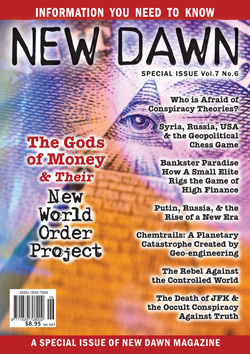
    From New Dawn Special Issue Vol 7 No 6 (Dec 2013)

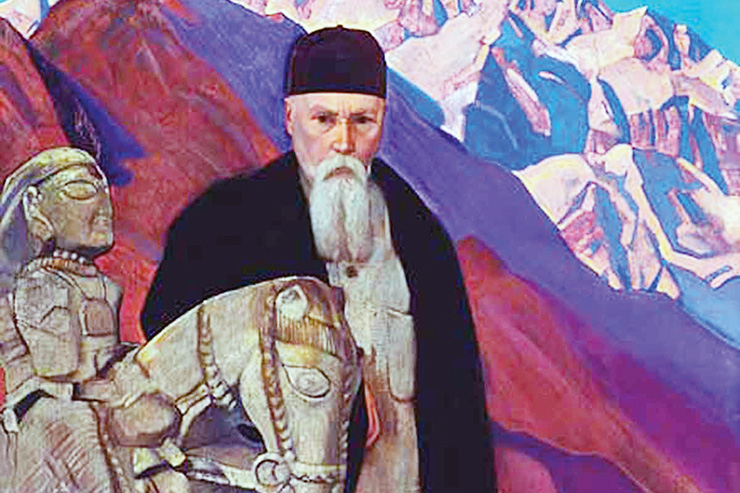
    Back in October 2000, the newly elected President of the Russian Federation, Vladimir V. Putin, granted a revealing interview to the editors of India Today and The Russian Journal. President Putin paid special tribute to Nicholas Roerich, the Russian artist, explorer and mystic, stating:

    “Roerich’s life was an amazing life, a marvel of creativity and astonishing example of spiritual closeness that, perhaps doesn’t lie on the surface, but is nevertheless the spiritual closeness that binds all peoples.”

    In December 2002, President Putin’s wife Lyudmila opened an exhibition of Nicholas Roerich’s work at the National Museum of India in Delhi.

    Nicholas Roerich (1874-1947) is remembered today as a celebrated Russian painter and occultist, whose intrepid journeys through Central Asia captured the attention of the Western public in the 1920s and 1930s. But Nicholas Roerich was also a master of ‘spiritual geopolitics’ who sought to establish a pan-Buddhist, transnational ‘New Country’ stretching from Tibet to southern Siberia, including territory that was governed by China, Mongolia, Tibet, and the Soviet Union. This ‘New Country’ was conceived by Roerich as the manifest, earthly expression of the invisible Kingdom of Shambhala, “the Holy Place, where the earthly world links with the highest states of consciousness.”1 This Shambhala Project was to establish the Sacred Union of the East.

    The American scholar John McCannon, who is writing a biography of Roerich, points out that in today’s Russia Roerich’s ideas are discussed at the highest echelons:

    Roerich’s name has appeared with surprising frequency in civic and academic discussion of international relations and new directions in foreign policy. Mainly, he has been cited by political scientists and strategic thinkers in Russia looking for models of ‘multipolarity’ and ‘global pluralism’ to counter U.S. hegemony and seemingly triumphalist or confrontational political theories from the West…2

    Since the earliest days of his first presidency, Vladimir Putin has worked tirelessly to lay the foundations of a Eurasian alliance. Just weeks after paying tribute to Nicholas Roerich, Putin told an international forum that “Russia has always perceived of itself as a Eurasian country.” Then in 2001, Russia and China, along with the states of Central Asia, founded the Eurasian political, economic and military organisation known today as the Shanghai Cooperation Organisation. Mongolia, Pakistan, Iran and India, have all expressed interest in joining the group.

    In the lead up to his election for a third term as Russian president, Putin set out his grand Eurasian vision in a series of widely published articles.

    Nicholas Roerich was introduced to the Buddhist legend of Shambhala while working on the first Buddhist temple ever constructed in Europe, in St. Petersburg the imperial capital of the vast Russian Empire. The Russian Tsar Nicholas II, although a devout Orthodox Christian and head of the Russian Church, had a deep interest in mysticism and Eastern wisdom. On several occasions the Tsar received the Buddhist monk Dorzhiev, assuring him that, “Buddhists in Russia may feel as if under the wing of a mighty eagle.” Construction of the St Petersburg Buddhist temple commenced in 1913 to coincide with the 300th anniversary of the Romanov dynasty. That same year Lama Dorzhiev, a friend of Nicholas Roerich and George Gurdjieff, wrote that Russia was about to fulfil the old Buddhist messianic myth of Shambhala by founding a great Buddhist empire in the East.

    One hundred years later in 2013, President Putin, himself a native of St. Petersburg, promised “100-percent support” for Russia’s Buddhists. Speaking during a visit to Russia’s Buryatia republic, Putin said he was proud that Russia is the only country in Europe where Buddhism is officially recognised as a traditional religion. The Russian President emphasised that “Buddhism plays a significant role in Russia… It has always been that way. It is well known that the Buddhists helped during both world wars.” Putin described Buddhism as a “kind, humanist learning based on love for others and love for one’s country,” and said he, the federal government and regional authorities were “always at [the Buddhists’] disposal and ready to support them.”3

    Like Tsar Nicholas II, President Vladimir Putin is known to be a devout Russian Orthodox believer with a strong interest in Eastern wisdom. A master of both sambo and judo, Putin has often spoken of how the martial arts – imbued with Asian philosophy – are intended to train the body and the mind. Though an Orthodox Christian, he is conscious of the spiritual authenticity of other traditional religions. And like Nicholas Roerich, who was born Orthodox Christian but later became steeped in Buddhism, Vladimir Putin may well sympathise with the view that the highest forms of all the world’s religions point to the same ultimate reality.

    For more about Russian President Putin, check out New Dawn Special Issue Vol 8 No 5. 

    [alert type=”general” dismiss=”no”]This article was published in New Dawn Special Issue Vol 7 No 6.[/alert]

    [alert type=”success” dismiss=”no”]If you appreciate this article, please consider subscribing to help maintain this website.[/alert]

    Footnotes

    1. See ‘From Synarchy to Shambhala, The Role of Political Occultism and Social Messianism in the Activities of Nicholas Roerich’ by Markus Osterrieder, www.scribd.com/doc/119329670/From-Synarchy-to-Shambhala

    2. ‘By the shores of white waters: the Altai and its place in the spiritual geopolitics of Nicholas Roerich’ by John McCannon, www.roerichmongolia.org/files/sibirica%20full%20text%20article.pdf

    3. ‘Putin Promises 100% Support for Buddhists’, RIA Novosti, 11 April 2013, http://en.ria.ru/russia/20130411/180578136.html

    © New Dawn Magazine and the respective author.
    For our reproduction notice, click here.

  • Chinese Triads, Japanese Black Dragons & Hidden Paths of Power

    Chinese Triads, Japanese Black Dragons & Hidden Paths of Power

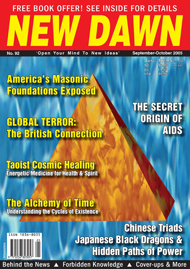
    From New Dawn 92 (Sept-Oct 2005)

    The influence of secret societies on the history of the West is well documented in numerous books and articles. Freemasons figured prominently in the American Revolution and the birth of the American Republic. The French Revolution, with its notions of “Liberty, Equality, and Fraternity,” originated in the radical Masonic lodges. Secret societies have been connected to a range of movements that sprang up around Europe in the eighteenth and nineteenth centuries to defend people’s rights against the abuses of royal and priestly power, and to promote freedom by any and every means.

    Secret societies are often viewed as a largely Western phenomenon, but their roots reach deep into the ancient civilisations of the East. While much is written about Europe’s hidden fraternities, little attention has been given to Asia’s secret societies and the important part they played in organising resistance to the violent onslaught of European colonialism. As one China specialist points out, the Chinese secret societies “were closely linked to the struggles which the Chinese people tirelessly waged… against their internal and external adversaries.”1

    Secret societies were deeply rooted in Chinese historical reality, and did not divide matters into the spiritual and the mundane. The source of their power lay in their total opposition to the established order: political and religious, social and ideological. The secret societies relied for support primarily upon the oppressed classes of China. They were the authentic expression of popular hostility to China’s harsh imperial authorities and to foreign encroachment. In the words of the Sorbonne professor Jean Chesneaux:

    the secret societies constantly threatened the imperial regime in the nineteenth century, formed a powerful part of the tidal wave which finally overwhelmed it in 1911, and reacted strongly to foreign penetration at the end of the nineteenth century as they did to the Japanese invasion in the twentieth.2

    Enter the Black Dragon

    Secret societies also emerged in Japan, Korea, Vietnam, and Southeast Asia. Like the societies in China, their mystico-political teachings combined elements of Buddhism, Taoism, and traditional beliefs. All refused to recognise the dominant system and resolutely opposed the humiliations inflicted by the Western powers.

    By the late nineteenth century secret society networks in Indochina were struggling against French occupation. Tracing their origins to China, these Vietnamese brotherhoods served economic and social purposes as well as religious ones. A sense of solidarity between members was strengthened by initiation rites drawn from Buddhism and Taoism, and directed by a spirit medium. Resembling Freemasonry in some ways, their elaborate ceremonies were held at night with the blessings of Buddhist monks. As in China these groups had clearly defined political objectives, in this case, the ending of French domination.

    In the 1890s members of the Japanese secret society Genyosha (the Black Ocean society) created the Tenyukyo (Society for the Celestial Salvation of the Oppressed) which gave covert support to the Tonghak, a Korean mystico-political group, espousing equality and the dignity of human beings, opposed to Korea’s imperial Yi dynasty.

    Founded in the mid 1800s, the Tonghak or Eastern Learning society sought to rally the Korean people against foreign intrusion. The movement’s leader Ch’oe Che-u, after a period of ‘aimless wandering’ reminiscent of a Taoist monk, derived the movement’s ideology from Confucianism, Buddhism, and Taoism. The Tonghak greatly contributed to the development of Korean national consciousness, one of their leaflets proclaiming:

    The people are the root of the nation. If the root withers, the nation will be enfeebled… We cannot sit by and watch our nation perish. The whole nation is as one, its multitudes united in their determination to raise the righteous standard of revolt…

    At the dawn of the twentieth century secret societies were behind radical nationalist uprisings across Asia. From the Young Turks and Young Persians of the Muslim East to Japan’s Black Ocean society and Chinese Triads, the secret societies provided support networks for Asia’s young revolutionaries.

    With Japan’s military victory over Russia in 1905, Tokyo became the centre of a powerful Pan-Asian movement aimed at freeing all the people of Asia from Western domination. One notable founding member of the Black Ocean society was Toyama Mitsuru (1855–1944).

    According to historian Richard Storry, Mitsuru “appeared to be the opponent of all established governments in Asia, including that of his own country. Chinese, Indian and Filipino dissidents visiting Tokyo tended to gravitate to his home in Shibuya.” A complex, charismatic, and controversial figure known as the “Shadow Shogun” and “Spymaster Supreme,” Mitsuru became one of the most powerful men in Japan. A master of traditional Japanese brush work, he lived frugally and remained a private citizen all his life.

    Hiraya Amane, another prominent leader of the Black Ocean society and a pioneer of revolutionary Pan-Asian solidarity, compiled the first authentic history of the Triads and other Chinese secret societies. His book was the fruit of friendships he cultivated with Chinese secret society leaders and militant Chinese revolutionaries. Hiraya Amane’s writings were diligently studied by a new generation of Japanese secret society members in the 1920s.

    The Amur River Society (Kokuryukai), later to become notorious in the West as the Black Dragon society, took over the work and traditions of the Black Ocean society in the years leading up to the First World War. Established in 1901 by a Black Ocean society leader and Buddhist monk, Ryohei Uchida, the Black Dragons, with their Pan-Asian vision, had links with the Triads and supported China’s 1911 Republican Revolution. Their agents undertook intelligence gathering operations in China, Korea, Manchuria, Mongolia, Siberia, and established relations with anti-colonialist circles in the Muslim world.

    Forming alliances with revolutionaries in Indochina, India, Indonesia and the Philippines, the Black Dragons also had close contact with several Buddhist sects. Throughout the 1920s and 30s the Black Dragon society supported Indian independence activities, providing political and financial assistance to Indian nationalists who looked to Japan as the only Eastern power capable of liberating Asia from the stranglehold of European colonialism. One such Indian nationalist was Subhas Chandra Bose (founder of the anti-colonialist Indian National Army), a correspondent in the 1930s for the influential German journal Geo-political Review, published by Professor Karl Haushofer.

    Major General Karl Haushofer encountered the Pan-Asian geopolitics and Buddhist mysticism of Japan’s secret fraternities during his time in Tokyo as the German military attaché. After the First World War, Haushofer became Professor of Geopolitics at the University of Munich where Rudolf Hess (later to become Hitler’s deputy) was his student assistant. Haushofer wrote that, “the struggle of India and China for liberation from foreign domination and capitalist pressure agrees with the secret dreams of Central Europe.” He urged Japan to come to terms with China and the Soviet Union, and consistently advocated an alliance between Germany and the USSR. This would facilitate what Haushofer called the “Eurasian continental organisation from the Rhine to the Amur and the Yangtze [rivers].”

    Some researchers are convinced Haushofer, a lifelong admirer of Oriental wisdom, was the emissary of “Unknown Superiors” in Asia, effectively acting as a crucial link between the Eastern secret societies and their European counterparts in the German lodges. The French authors Pauwels and Bergier mention a rumour that Haushofer was initiated into a secret Buddhist society and to have sworn, if he failed in his ‘mission’, to commit suicide “in accordance with the time-honoured ceremonial.” Haushofer, who committed suicide in 1946, is still remembered today by Russia’s Eurasian thinkers because he never reconciled himself to Hitler’s invasion of the USSR. Had the Nazi leadership taken note of Haushofer’s views, the Second World War could have been avoided. No doubt conscious of Haushofer’s remarkable role in hidden history, Anton LaVey, founder of the Church of Satan in the United States, dedicated his infamous Satanic Bible to the German general.

    By the start of the Second World War agents of Japanese secret societies, all lumped together by Western intelligence agencies under the name Black Dragons, were operating worldwide from North Africa to the United States. One successful Black Dragon agent in America was Satohata Takahashi. Sent to the US in 1929, Takahashi formed a mystico-political movement called the Society for the Development of Our Own, recruiting several thousand members to his Pan-Asian cause, most of them of African-American, Filipino, or East Asian descent. The “Five Guiding Principles” of the group were “Freedom, Justice, Equality, Liberty, and Honour.”

    Through Takahashi the Black Dragon society channelled financial aid to Black Muslim groups in the US. The Moorish Science Temple, founded by Noble Drew Ali in 1913, taught the true origin of Black Americans was “Asiatic.” Another Muslim teacher, Master Wallace D. Fard, the mysterious leader of the Allah Temple of Islam declared, “I’m an Asiatic black man. I have come to America to save my long lost uncle [the Black Americans].” Fard’s chief disciple the Honorable Elijah Muhammad, prophet of the Nation of Islam, told his followers, “It is Japan’s duty to save you; they have been given the power by the Asiatic nation to save you in the West.” Another organisation to enjoy Takahashi’s patronage was the Pacific Movement of the Eastern World, which campaigned for the US to stay out of the war and promoted the Pan-Asian agenda among non-white Americans.

    Based on intelligence reports from their agents around the globe, the Black Dragon leadership in Tokyo concluded in 1941 that the United States had secretly started preparing to enter the war against Germany, Italy and Japan. Fearing a surprise American attack on Japanese forces, the Black Dragons urged Japan’s military hierarchy to launch a pre-emptive strike on the US. “The signal for war in the Pacific was given on August 26, 1941, at a session of the Black Dragon Society in Tokyo,” an American author noted in 1944. After the Japanese attack on Pearl Harbor the espionage and sabotage operations carried out by the Black Dragons became legendary.

    However, the society’s original mystico-political vision of Pan-Asian solidarity and anti-colonialism had been subsumed in the pre-war years by Japanese ultra-nationalism and militarism. Many Black Dragon members were part of Japan’s industry and government, holding key diplomatic and military posts. With the Japanese surrender in 1945 some Black Dragons in government were charged as war criminals. But the Allied victory in Asia could not extinguish the dream of freedom. Japan had shattered the myth of the military invincibility of Western colonialism. The seeds sown by the secret societies flourished in a new wave of national liberation movements that led the peoples of Asia to independence in the years immediately following the end of the war.

    Political Intrigues of Secret Societies in the Modern World

    A century and a half ago, the British politician Benjamin Disraeli commented that, “the world is governed by very different personages from what is imagined by those who are not behind the scenes.” In our twenty-first century most people, mesmerised by the electronic media, are conditioned to dismiss the notion that secret societies may be tied-up with political intrigue. Yet Western intelligence agencies frequently rely on clandestine conspiratorial networks in their subversion of foreign governments. British intelligence services have a long history of involvement with underground ‘Muslim’ brotherhood groups actively opposed to the Arab nationalist states of the Middle East. The roots of the recent bloody conflict in the Russian republic of Chechnya can be traced to British intelligence service support of secretive ‘Muslim’ sects in the Caucasus. Many believe the American CIA is currently using a range of quasi-religious cults in clandestine operations aimed at destabilising the People’s Republic of China.

    “The history of the world is the history of the warfare between secret societies,” said the African American poet Ishmael Reed. Has world history been shaped by conspiratorial groups employing secret knowledge? Are the Anglo-American secret societies engaged in a titanic struggle with Eastern adepts and their allies?

    At a time when a shadowy global “war on terror” is used to justify increased government control and the serious erosion of personal freedom, we’d do well to recall the admonition of the Roman poet Ovid: “It is one’s duty to learn from the enemy.” The counterculture novelist William S. Burroughs once suggested the form of the Chinese secret society served as the perfect mode of organisation for marginal groups. Indeed, when the State becomes the oppressor of its own citizens, the only alternative is to disconnect and seek autonomy by any means necessary. The hidden history of secret societies may still have a lot to teach us.

    [alert type=”general” dismiss=”no”]This article was published in New Dawn 92.[/alert]

    [alert type=”success” dismiss=”no”]If you appreciate this article, please consider subscribing to help maintain this website.[/alert]

    Footnotes

    1. Jean Chesneaux, Secret Societies in China in the Nineteenth and Twentieth Centuries 
    2. Ibid.

    © New Dawn Magazine and the respective author.
    For our reproduction notice, click here.

  • Otto Rahn & the Quest for the Holy Grail

    Otto Rahn & the Quest for the Holy Grail

    This article was published in New Dawn 43 (Jul-Aug 1997)

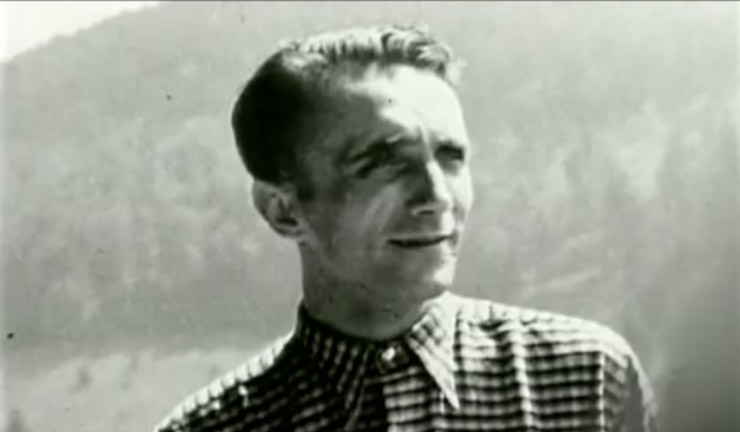
    Otto Rahn (1904-1939), described as a gifted young author and historian, was one of this century’s truly fascinating figures. Prior to his mysterious death, at age 35, he wrote two books about the Cathars of southern France: Kreuzzug gegen den Gral (“Crusade Against the Grail”) and Luzifers Hofgesind (“Lucifer’s Court”). Myth and legend continue to shroud both his life and tragic death. His books influenced such authors as Trevor Ravenscroft and Jean-Michel Angebert. In the 1982 best selling book Holy Blood, Holy Grail, Otto Rahn’s name appears in a small but intriguing footnote.

    Otto Rahn believed that he had found the location of the Holy Grail Mountain, the Montsalvat of legend, in the Cathar mountain fortress of Montsegur in the French Pyrenees. He was, says  Prof. Joscelyn Godwin, “largely responsible for the mythological complex that associated the Cathars and Montsegur with the Holy Grail and its Castle.”

    Norma Lorre Goodrich in her own highly acclaimed work The Holy Grail pays tribute to Otto Rahn’s Kreuzzug gegen den Gral (“Crusade Against the Grail”) describing it as “a wonderful book, a monument to this German idealist author, who died mysteriously during a descent in the Alps.”

    According to his French translator, Otto Rahn believed with absolute conviction that (1) the Cathars were the last owners of the Holy Grail, and (2) the Holy Grail “perished” when they died at the hands of the “pope and the King of France” at the beginning of the thirteenth century.

    Otto Rahn maintained that hidden within the Grail Romances was the essence of Catharism. The Quest for the Holy Grail was a symbolic presentation of Cathar initiation and the Grail itself (which in Wolfram von Eschenbach’s Parzival is a sacred stone) symbolised the Secret Tradition of the Cathars.

    The war of the Roman Catholic Church against the Cathars is variously described as a war where Roma and Amor stood opposite each other, in which the catholic (‘common’) idea triumphed with flame and sword over the catharic (‘pure’) idea.

    The Cathars or Cathari were members of a Gnostic Christian community which appeared in Western Europe in about 1050. They were also known as the Albigensians or men of Albi. This name derives from the city of Albi in southern France which was one of the Cathars’ chief centres. Perhaps as many as two million people belonged to the movement by the twelfth century and Catharism was beginning to become a serious rival of the Church of Rome.

    The Cathar claim to be the true church of Jesus Christ was a real threat to the authority of the Roman Church as Zoe Oldenbourg explains in Massacre at Montsegur:

    “The Cathars declared themselves the heirs of a tradition that was older than that held by the Church of Rome — and, by implication, both less contaminated and near in spirit to the Apostolic tradition. They claimed to be the only persons who had kept and cherished the Holy Spirit which Christ had bestowed upon His Church; and it looks as though this claim was at least partially justified….

    “Today we are better informed than they were concerning the practices of the Early Church, and have to admit that the Cathars merely followed a tradition somewhat more ancient than that of the [Roman] Church herself. It was with some appearance of reason that they claimed Rome as the party guilty of ‘heresy’ through her falling-out from the original purity which had characterized the Church of the Apostles.”

    The medieval Cathars believed in a cosmic battle between the principles of Light and Darkness on whose meetings and encounters everything in the universe was based. Darkness was for them dark matter, the unperfected, the transient. They identified all clerical and secular rulers, principally the Catholic Church as the personification of the Darkness. In their mythology the sun symbolised the primordial Light from which all life emerged. Miguel Serrano coined their doctrine: Solar Kristianity. For Otto Rahn, Montsegur was the “Lighthouse of Catharism.”

    Rahn’s Grail Quest

    Otto Rahn was born on 18 February, 1904 in Michelstadt in southern Germany. In secondary school he developed a fascination with the history of the medieval Cathars, their faith and revolt against king and pope. From 1922 to 1926 he studied jurisprudence, German philosophy and history. Rahn intended to write a dissertation on Guyot, the Provencal Troubadour on whose lost Grail poem Wolfram von Eschenbach claimed to have based his Parzival.

    The medieval Germanic tale of Parzival, revived in the 1800s by Wagnar’s popular mystical music dramas, fired Otto Rahn’s latter day quest for the Holy Grail. He soon pieced together a series of clues gleaned from a study of the history of the Cathars and the poem of Wolfram von Eschenbach, a Knight Templar of the thirteenth century.

    Driven by his deep interest in the Cathars and Grail legends, from 1928 to 1932 Rahn researched and travelled widely in France, Spain, Italy and Switzerland.

    Early in the summer of 1929 Otto Rahn made his first appearance in the Languedoc region of southern France. He quickly settled in the village of Lavelanet and over the next three months systematically explored the ruined Cathar temple-fortress on Montsegur as well as the surrounding mountain grottoes.

    It was in Languedoc that the city of Carcassonne, the holy mountain of the Cathars (Montsegur) and the mysterious church of Rennes-le-Chateau were located. All of these places were steeped in Cathar lore and it was here that all legends of the Holy Grail seemed to converge.

    At Montsegur, writes Nigel Pennick, “in 1244 the heretical Cathars had made their last heroic stand against a Catholic crusade which finally triumphed in their destruction. Here, tradition affirms that on the night before the final assault, three Cathars carrying the sacred relics of the faith slipped unnoticed over the wall. They carried away the magical regalia of the Merovingian King Dagobert II and a cup reputed to be the Holy Grail.

    “Possession of the Grail has always been the dream of chivalric orders. The Knights of King Arthur’s Round Table, the Templars, even the Teutonic Knights have sought the mystic vessel. But Otto Rahn believed that he could triumph where centuries of questing had failed. He had studied the sacred geometry of Montsegur, its sunrise orientations and its relationship with other sacred places, and had discovered secret underground passages, where he felt the treasure must be concealed.” (Hitler’s Secret Sciences)

    Nigel Pennick traces Otto Rahn’s knowledge of ‘sacred geography’ back to the Druids and Templars. The Cathars were also said to be familiar with this esoteric science.

    In many meetings with the local people (he spoke the local Provencal language fluently) Otto Rahn gathered everything concerning the Cathars and the Grail.

    In 1931 Rahn made an extensive exploration of the grottoes of the Sabarthes area south of Montsegur, notably Ornolac and the massive cavern of Lombrives. Here he explored a huge chamber called “the Cathedral” by the local people. Rahn later described this magnificent cavern as follows:

    “In time out of mind, in an epoch whose remoteness has been barely touched by modern historical science, it was used as a temple consecrated to the Iberian God Illhomber, God of the Sun. Between two monoliths one which had crumbled, the steep path leads into the giant vestibule of the cathedral of Lombrives. Between the stalagmites of white limestone, between walls of a deep brown colour and the brilliant rock crystal, the path leads down into the bowels of the mountain. A hall 260 feet in height served as a cathedral for the heretics.”

    Rahn tells how, “Deeply stirred I walked through the crystal halls and marble crypts. My hands put aside the bones of fallen pure ones and knights…”

    The local people called him a “seducer doubled with believer, an eternal adolescent with a superhuman passion for the Grail and the Hermetic Tradition”.

    Both Kreuzzug gegen den Gral (“Crusade Against the Grail”) and Luzifers Hofgesind (“Lucifer’s Court”) are full of remarkable insights and revelations of important historical links.

    Deep within the grottoes of Sabarthes Otto Rahn found chambers in which the walls were covered with symbols characteristic of the Knights Templar, side by side with emblems of the Cathars. This finding confirmed the notion, fostered by esoteric historians, that the Knights Templar and the Cathars were at one time closely associated. One intriguing image carved into the stone wall of a grotto was clearly a drawing of a lance. This depiction immediately suggests the bleeding lance that appears over and over again in the Arthurian legends.

    The legend of the Grail, explains the Chilean mystic Miguel Serrano, “reappears forcibly Christianised in the Middle Ages. The Templars disseminated it. It is centred on the legend of the court of King Arthur (who is the King of the Grail and is also called Amfortas). It is interesting to point out that Arthur is Arthos, Bear, that is to say Arctic. By which the exact geographical position of the lost continent of the first Solar Age is pinpointed: Hyperborea, seat of the Grail. In the Middle Ages, it became a cup, when the myth was Christianised, the one from which Christ was said to have drunk at the Last Supper, or else the one in which Joseph of Arimathea received the blood of Christ as it spurted from his side as he hung on the cross.”

    Otto Rahn believed it was possible to trace the Cathars, who guarded the Holy Grail in their castle at Montsegur, back to Druids who converted to Gnostic Manichaeism. The Druids in Britain were forerunners of the Celtic Christian Church. He saw in the culture of the medieval Cathar stronghold of Languedoc strong resemblances to the Druids. Their priests akin to the Cathar Parfaits. The Cathar secret wisdom being preserved by the later Troubadours, the travelling poets and singers of the medieval courts of France.

    Most Troubadours, according to Rahn, were secret Cathars. Their apparent yearning and longing songs only seldom dedicated to a special woman, their feminine symbolism referred to the Cathar community, the Sophia, the Wisdom of the Gnostics. Julius Evola explains in The Mystery of the Grail: “To make this doctrine inaccessible to the profane, it is hidden in an erotic symbolism, similar to the Grail cycle where it is represented by a heroic symbolism.”

    When Otto Rahn first studied Wolfram von Eschenbach’s Parzival he noticed remarkable similarities with names and places in southern France, and he suspected that Parzival’s Grail castle Munsalvaesche (Richard Wagnar called it Montsalvat) was none-other than the Cathar solar-fortress Montsegur. In Eschenbach’s work he discerned the influence of Cathar poetry. Otto Rahn adopted from the research of Cathar enthusiast Antonin Gadal the probably incorrect assumption that the persecuted Cathars had retreated under the earth and celebrated their mysteries in subterranean churches. Gadal gave Rahn the freedom of his library and private museum. In letters Rahn called him his “Trevrizent” (the uncle of Parsifal in Eschenbach’s work) and developed the propositions laid out in Gadal’s Au Chemin du Saint Graal.

    Antonin Gadal believed that the Cathars or ‘Good Christians’ derived from the original ‘Johannite’ form of Gnostic Christianity. ‘Johannite Christianity’ was based on the teachings of St John the Evangelist, the disciple whom Jesus loved and personally instructed in the Mysteries. The Cathars were said to possess the original version of John’s Gospel.

    The tale that Otto Rahn actually found the Grail and kept it until the end of World War II in the Wewelsburg, the SS castle near Paderborn, is easily disproved. There was a Grail in Wewelsburg but it was just a huge rock crystal. Rene Nelli, an important scholar of Catharism, maintains that existing Cathar texts do not mention the Grail, while Julius Evola did not think much of the Cathar Grail thesis.

    Return to Germany

    Otto Rahn left France in September 1932 and returned to Germany to devote himself to further studies of the Grail. In 1934, following on from his library research and his various expeditions, Rahn completed Kreuzzug gegen Gral (“Crusade Against the Grail”).

    Rahn showed that the heroes of Wolfram von Eschenbach’s Grail romances were modelled after real personalities. The pure knight Parzifal was a Carcassone Cathar, one of the foremost and heroic victims of the Crusade. The hermit Trevrizent was the Cathar Bishop Guilhabert de Castres; the King Anfortas, Raimon-Roger de Foix; and Montsegur was Montsalvage. Moreover, Montsalvage is protected by a Fountain “Salvage” in which Rahn believed he recognised the intermittent fountain of Fontestorbes, a few kilometres from the Pog, Montsegur’s promontory. Also, the forest around Montsalvage is called the “Briciljan” and close by Montsegur is Priscilien Wood. Rahn firmly concluded that the Fortress Castle of Montsegur was the Temple of the Grail.

    Rahn associates the Cathar Church with the Church of the Grail, with the mystical group Fideles d’Amour of Dante. He believed that the Templars after their enforced dissolution found refuge in the Pyrenean caverns. Rahn wrote of the many indications that the white tunic with octagonal red cross of the Templars was to be found with the black cassocks and yellow cross of the Cathars in the dark grottos of Sabarthes.

    Rahn believed that the Grail consisted of several tablets of stone engraved with runic or even pre-runic inscription. He believed that it was either one perfect emerald with 144 facets or 144 tablets of stone engraved in emerald. This emerald would have graced the Crown of Lucifer, symbolising his third eye, and which fell to earth, precisely on the Montsegur.

    Soon after its publication Kreuzzug gegen den Gral came to the attention of Nazi SS leader Heinrich Himmler. The SS hierarchy were eager for Otto Rahn’s collaboration in SS-sponsored research. After first joining the SS heritage bureau, the Ahnenerbe, as a civilian, his superiors quickly recognised his talents. Persuaded to formally join the SS in 1936, Otto Rahn became member 276 208 of the Allgemeine-SS.

    Paul Ladame, a friend of Rahn’s, insists that Otto joined the SS because there was no option. Ladame says Otto was no Nazi or racist. Himmler offered him a salary and the freedom to conduct his own academic research. To refuse may have resulted in Rahn’s eventual imprisonment anyway.

    In September 1935 Rahn was writing excitedly to the chief of the Ahnenerbe about the places he visited in his hunt for Grail traditions in Germany, requesting complete confidence in the matter with the exception of Himmler.

    Otto Rahn is even rumoured to have founded a neo-Catharist circle within the SS. In the summer of 1936 he undertook, by order of the SS, an expedition to Iceland. Intriguingly, the ship that sailed for Iceland flew a flag with a blue swastika on white background (in sharp contrast to the official standard of the Third Reich). Highlights of this journey formed part of some chapters in his second and final book Luzifers Hofgesind (“Lucifer’s Courtiers”), published in 1937.

    Rahn’s second book reads quite differently from his first. Arnaud d’Apremont writes in the preface to Luzifers Hofgesind that its style is more ideological, to all appearances ‘national-socialist’. However, more perceptive critics see Rahn in a quandary, having to toe the nationalist party line, negotiate the censor, and be able to write the full objective text he would have liked. He may even have indicated the irony of his position in the book’s title.

    But it is clear from Luzifers Hofgesind that Otto Rahn did not see Lucifer as synonymous with Satan, the Adversary, or the Devil. To Rahn, Lucifer was the Pyrenean Abellio, the Celtic Belenos, the Nordic Balder, the Greek Apollo. These are the Light-Bearers, an attribute Rahn, himself, wanted recognition for: a Lucifer.

    For Rahn the primordial Light came not from the East but from the North. He travelled around the ancient sacred places of Europe: Externsteine, the site of Irminsul, sacred symbol of the Saxons; Thingveillir, place of assembly of the ancient Icelanders, and Reykholt, birthplace of Sturlusson, the Nordic Homer and author of the Edda.

    One reviewer describes Luzifers Hofgesind as “an expedition through the ‘garden of roses,’ Rahn’s affectionate term for the Kingdom of the Asgardian Elfin, and a realm closed to non-believers or the uninitiated. Rahn dreams of a return to Thule, the primordial centre of the European Hyperboreans. He pines for a return to the Golden Age.”

    For Rahn the Holy Grail was an emblem set up in opposition to the Catholic Church — indeed it was a truly Luciferian [Light-Bearer] symbol. Lucifer stood in opposition to the god of Darkness, the god of the Church of Rome. Thus Otto Rahn wrote in his final book:

    “There is much more [Light] than in the houses of god — cathedrals and churches — where Lucifer neither is able nor wishes to enter due to all the sombre, stained glass windows whereon are painted the Jewish prophets and apostles, the Roman gods and saints. The forest, that, that was free!”

    During his time with the SS Rahn noticed that his telephone was tapped and that he was being spied upon.

    We know that Otto Rahn fell into disgrace with the Nazi hierarchy in late 1937 and for disciplinary reasons was assigned a tour of duty at the SS run Dachau concentration camp. In the winter of 1938/39 he wrote to the SS Reichsfuhrer requesting immediate dismissal from the SS. A few months later he was dead.

    Rumours abound concerning Otto Rahn’s departure from the Nazi SS. Some claim that he was a homosexual or of Jewish ancestry, but evidence is lacking. In a conversation Rahn claimed that he had been betrayed and that his life was in danger. In a letter to a friend he openly expressed his concern about the Third Reich:

    “I have much sorrow in my country. Fourteen days ago I was in Munich. Two days later I preferred to go into my mountains. Impossible for a tolerant, liberal man like me to live in the nation that my native country has become.”

    Col. Howard Buechner, the author of the Emerald Cup, says that Rahn “let it be known that he opposed the war for which Germany was obviously preparing in 1938. In place of war, he believed that Germany and then Europe, should be transformed into a community of ‘Pure Ones’ or Cathars. In other words, Rahn’s long association with the history of the Cathars and their unjust persecution by the church and the throne of France, had led to his conversion to the Cathar faith. He was also proposing a ‘New Order’ in which the states of Europe, and perhaps all other nations, would adopt the Cathar beliefs in the interest of world peace.”

    Otto Rahn gave his last public lecture — based on Luzifers Hofgesind — in January 1938. A local newspaper reported on his talk:

    “The Albigensians [Cathars] were exterminated. 205 leading followers of the Light-Bearer were burnt on a huge pyre by Dominicans in the South of France after a large-scale priestly Crusade in the name of Christian clemency. With fire and sword, the Lucifer doctrine of the Light-Bearer was persecuted along with its followers. The Albigensians are dead, but their spirit lives on and has an effect today through new devotion and rejuvenated enthusiasm. The Vicar of Christ could truly burn men; but he was mistaken if he believed that he burned along with them their spirit, devotion and longing. This spirit became alive again before many men yesterday, powerfully and visibly, in Otto Rahn, a descendant of the old Troubadours.”

    A little over one year later, on 13 March 1939 — almost on the anniversary of the fall of Montsegur — Otto Rahn died in the snow on the Tyrolean mountains. “In the manner of the Cathar heretics,” says Nigel Pennick, “Rahn voluntarily left a world he saw disintegrating.” A few years earlier Otto Rahn had written in Kreuzzug gegen den Gral (“Crusade Against the Grail”):

    “Their doctrine allowed suicide but demanded that one did not put an end to his life because of disgust, fear or pain, but in a perfect dissolution from matter. This kind of Endura was allowed when it took place in a moment of mystical sight of divine beauty and kindness…It is only one step from fasting to suicide. To fast requires courage but the final act of definitive ascesis requires heroism. The consequence is not as cruel as it may look.”

    The story of the enigmatic life and work of Otto Rahn, symbolising as it does a greater mystery, will always fascinate both students of the Holy Grail and seekers of the Cathar tradition. This mystery can be discerned in the following quote from Miguel Serrano’s Nos: Book of the Resurrection:

    “When we talk about the religion of love of the troubadours, of the initiated knights of the Grail, of the true Rosicrucians, we must try to discover what lies behind their language. In those days, love did not mean the same thing as it does in our day. The word Amor (Love) was a cipher, it was a code word. Amor spelt backwards is Roma. That is, the word indicated, in the way in which it was written, the opposite to Roma, to all that Rome represented. Also Amor broke down into ‘a’ and ‘mor’, meaning Without-Death. That is, to become immortal, eternal, thanks to the way of initiation of A-Mor. A way of initiation totally opposed to the way of Rome. An esoteric, solar Kristianity. The Gnostic Kristianity of Meister Eckhart. And mine. Because I have tried to teach western man to resurrect Kristos in his soul. Because Kristos is the Self for western man.

    “This is why Roma destroyed Amor, the Cathars, the Templars, the Lords of the Grail, the Minnesanger, everything which may have originated in the ‘Hyperborean Blood Memory’ and which may have had a polar, solar origin.

    “The love talked and written about so much in novels, poetry and magazines, the love of one’s neighbour, the universal love of the churches, love of humanity, has nothing whatsoever to do with ‘loveless love’ (A-Mor, Without-Death), which is a harsh discipline, as cold as ice, as cutting as a sword, and which aspires to overcome the human condition in order to reach the Kingdom of the Immortals, Ultima Thule.”

    This remains a fitting tribute to Otto Rahn.
    [alert type=”general” dismiss=”no”]This article was published in New Dawn 43.[/alert]

    [alert type=”success” dismiss=”no”]If you appreciate this article, please consider subscribing to help maintain this website.[/alert]

    © New Dawn Magazine and the respective author.
    For our reproduction notice, click here.
  • Esoteric Australia

    Esoteric Australia

    From New Dawn Special Issue 3 (June 2007)

    In 2001 as Australians celebrated the centenary of federation, no attention was paid to the role of mystic thinkers and esoteric ideas in Australian history. The vast majority of Australians know nothing of the “inner side” of their country’s political, cultural and religious evolution.

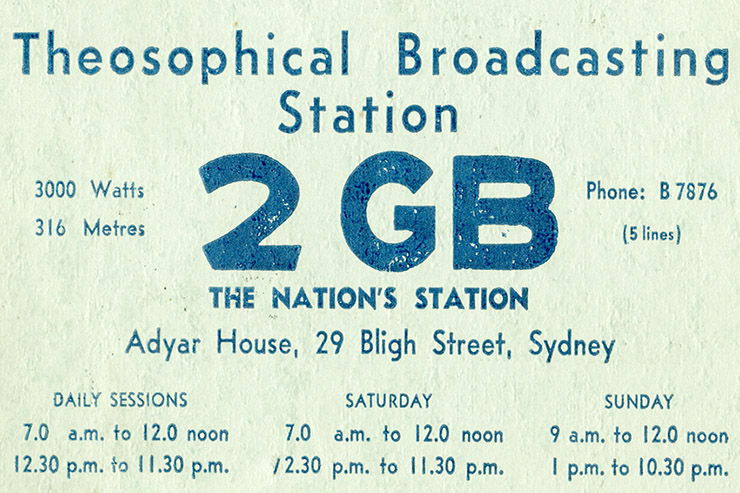
    How many people are aware, for example, that the call sign of Sydney’s pioneering radio station 2GB stands for the martyred sixteenth century mage Giordano Bruno (GB)? Or that Prime Minister Alfred Deakin, a major force in the foundation of the Australian Commonwealth, was heavily involved in spiritualism and an enthusiastic student of Madame Blavatsky’s writings? Who knows of Walter Burley Griffin’s use of occult principles in the design of Canberra, the national capital? Who today remembers the Star Amphitheatre built at Sydney’s Balmoral Beach to welcome the “World Teacher, when He Comes”? Or that in the 1920s Sydney was proclaimed a “great theosophical centre”, home of the renowned and controversial occult teacher, the Bishop Charles Webster Leadbeater. A prolific writer on metaphysics and one of the world’s greatest clairvoyants, Leadbeater predicted the “emergence of the new ‘sub-race’ in Australia and New Zealand.”

    In Other Temples, Other Gods, Nevill Drury and Gregory Tillett observe that, “despite its relative youth as a modern nation,” Australia, “has had a colourful and active history of occultists and occult movements.”1

    Some of the leaders of progressive politics in Australian were also students of esoteric wisdom. In 1892 the labour organiser William Lane’s political novel The Workingman’s Paradise was published in Sydney. In it the working girl Nellie says scornfully, “There is no God. How can there be?” But the mysterious socialist Geisner rebukes her in words straight from Madame Blavatsky’s Secret Doctrine. There is at least “the imperishable breath of the universe”. For Geisner explains, “the Purpose of Life is self-consciousness…. God seeking to know God. Eternal Force one immeasurable Thought. Humanity the developing consciousness of the little fragment of the universe within our ken.”2

    Disillusioned with the socialist movement in Australia, William Lane (1861-1917) established a communalist settlement in South America. A non-smoker and non-drinker, Lane was also a vegetarian who recognised the importance of a healthier attitude to diet. Inspired by Lane’s vision and example, hundreds of Australian workers sailed with him in 1893 to the “New Australia” colony in Paraguay.

    The first Gnostic study circle was established in Melbourne in 1886. A year earlier the Reverend Charles Strong led most of his congregation out of Victorian Presbyterianism to found a native, ethical church, the “Australian Church”. Strong’s Australian Church sponsored the Religious Science Club, a forum for all manner of independent thought and spiritual enquiry.

    AUSTRALIA & THE THEOSOPHICAL SOCIETY

    Such was the interest in mysticism and spiritualism at the turn of the century that Australia came to prominence in the largest international occult movement of the day – the Theosophical Society.

    “The occult movement which achieved the greatest publicity in Australian history,” explain Drury and Tillett, “and for which Australia was an international focus for many years, was the Theosophical Society.”3

    In the early 1890s study circles devoted to Theosophy as presented in the texts of Madame Blavatsky had formed around Australia, leading to the founding of the Australasian Section of the Theosophical Society in 1895.

    As Drury and Tillett explain:

    The progress of the T.S. [Theosophical Society] was steady; lectures given, meetings held, leaflets and publicity material produced, and journals published. Lodges were established throughout Australia…. But it was the lecture tours of one man which established Theosophy as a movement of public interest in Australia: Charles Webster Leadbeater toured the country in 1905, following a lecture tour of several years in the U.S.A. during which he attracted thousands of enthusiastic listeners, and in 1914 he settled in Sydney, remaining there more or less permanently until his death in 1934.4

    By the 1920s there were more paid-up members of the Theosophical Society than members of the Communist Party of Australia. The twenties witnessed a surge of Theosophical activism as Australian Theosophists sort to present a vibrant alternative to the mainstream, including the growing political ideologies of bolshevism and fascism. In addition to the public lectures, lodge meetings, and libraries, there was the Society owned Sydney Radio station 2GB as well as a successful publishing enterprise. Journals with titles like Advance! Australia and Theosophy in Australia, presented the society’s views and analysis of turbulent world events. Writing in Advance! Australia, one of the society’s leaders called for:

    purified patriotism, the promotion of a noble type of Australian citizenship, vitally Australian, eagerly conscious of Australia’s specific place and part in the building of the future, no less eagerly conscious of the wider and equally vital citizenship involved in Australia’s membership of the British Commonwealth, and recognising too… there is a World citizenship, the obligations of which may no longer be ignored.5

    Walter Burley Griffin wrote of “Building for Nature” and the “outdoor arts in Australia” in the pages of Advance! Australia. Together with Marion Mahoney Griffin, he set up an “organic” community at Castlecrag, Sydney. Griffin hoped for the awakening of “disused powers of the universal mind” and social renewal as people turned inward to reconnect with “the possibilities of co-operation between head and mind in social service and creative effort.”6

    Adyar Hall, the Theosophical Society’s impressive Sydney centre, served as the meeting place for many original social, political and spiritual groups, among them “The Australia First Movement”. Founded by P.R. Stephensen, a one time associate of Aleister Crowley, Australia First campaigned against Australian involvement in the Second World War.

    A.R. Mills, a Melbourne solicitor active in Australia First, had been on the fringe of the Theosophical Society. During the 1920s and 1930s, Mills formed the world’s first Odinist religion, a mixture of Nordic mythology and occultism.

    A persistent notion running through all the organisations and individuals concerned with esoteric wisdom is the conviction Australia has a special role to play in the dawn of a new Golden Age. Although popularised mainly by the Theosophists, the idea of Australia’s secret occult destiny surfaces in various mystical circles. In the early decades of the twentieth century the tireless Veni Cooper-Mathieson who founded – among other orders and institutions – the Home of Truth Esoteric College, the Church Universal, the Universal Truth Publication Company, taught that Australia was the “land of the dawning.”

    AUSTRALIA: HOME OF A NEW HUMANITY

    Madame Blavatsky, co-founder of the Theosophical Society, is credited with developing the theory that humanity evolves through a sequence of Seven Root Races, “four of which have already lived their day, the fifth still exists, and two are to appear in the future.”7

    In a series of lectures delivered in Sydney in August 1915, Bishop Leadbeater proclaimed “Australia and New Zealand as the home of a new sub-race.” He had detected in Australia “children and young people of a distinctly new type.” A new antipodean human type characterised by intuition and the powers of synthesis. Jill Roe in her book on Theosophy in Australia writes:

    Leadbeater urged his audience to align themselves with evolutionary law, assuring them that present confusions were merely transitional. He held that, despite distance and a small population, the Antipodes provided a favourable site for inauguration of a new era of brotherhood and cooperation, being neither decadent like Britain nor overblown by capitalist pride like America, and not yet delivered into unworkably democratic systems by ‘too young souls’. There was crudity, and reverse class legislation, but the wholesome environment held promise.8

    In Leadbeater’s view, however: “It would be important to purify child-rearing practices, by abstinence from alcohol, meat and tobacco, and to educate the next generation correctly…. The reward would be the coincidence of a new sub-race and the World Teacher in fifteen or twenty years’ time.”9

    By embracing techniques of physical and mental purification, Leadbeater believed in a couple of generations the whole of Australia would be controlled by a new people, who would constitute “what in Europe we should call the aristocracy of the country; that is to say, the best types”.10

    Of course the Bishop’s message was not taken up by the Australian people and no new “aristocracy” emerged to lead the Antipodes into a new Golden Age. Was there any truth in Leadbeater’s predictions?

    Nations, like individuals, have choices that eventually determine outcomes far beyond what can be recognised in the immediate. A collective – a group soul – like the individual soul must decide with which impulses to align. Nations can choose either the forces of materialism leading to decay and atrophy, or the higher influences of the spirit capable of leading to a New Beginning. In the case of Australia and New Zealand, the birth of the ‘new people’ was limited and distorted due to the infection of Mammonism. By concentrating on the search for outer happiness, following the path of the kingdoms of this world, the Australian nation stifled the quest for inner transcendence and the Kingdom of God.

    By taking the way of materialism Australians cut themselves off from the subtle influences of the spirit and cosmic destiny. Manning Clark, Australia’s greatest historian, expressed the spiritual crisis of modern Australia when he said:

    The decline of faith begat nihilism, and nihilism begat hedonism. It looked as though in the contest between Mammon and ‘millennial Eden’ Mammon had won. The dreams of all those who had migrated to the great south land had evaporated. The Aborigine had been corrupted and debased by contact with the white man. The voices of the Catholic who had spoken of a land dedicated to the Holy Spirit, the Dutch Protestants who had called for the discovery of a land that would yield ‘uncommonly large profit’, and the pleas of the followers of the Enlightenment with their faith in human perfectibility, had all dropped from a roar to a whisper, Mammon had won: Mammon had infected the ancient continent of Australia. The dreams of humanity had ended in an age of ruins.11

    Yet in every generation, and in every nation, there is always a remnant of men and women who have not succumbed fully to negative earthly bonds. They are the silent ones who stand among the ruins of the modern era, living testimonies to the higher world of the spirit. The ability of any nation or people to realise their spiritual potential and partake in the dawn of a new Golden Age depends on the vitality of this remnant.

    Have Australia and New Zealand forfeited their occult birthright?

    Certainly some of the ‘new people’ characterised by intuition and the powers of synthesis are found today in Australia, as well as in many other places throughout the world. The future depends on the ability of this remnant to impact the greater society and become a new Noah’s Ark capable of surviving the coming times of tribulation and transition. True, nearly every nation has a myth promising them a leading role in the dawn of a New Age. The universality of this myth in no way detracts from the responsibility it places on a people with ‘ears to hear’ the message of the times. Every people are called to turn within and align with the New Era. And Australasia is not impervious to this call, to this great Thought.

    Over a century ago, in 1892, the Australian socialist and mystic William Lane wrote:

    The brute-mother who would not be comforted because her young was taken gave birth in the end to the Christs who have surrendered all because the world sorrows. And we, in our yearning and our aspirations, in our longings and our strugglings and our miseries, may engender even in these later days a Christ whom the world will not crucify….12

    The earth still awaits the revelation of the Christ people, the new humanity destined to carry out the great work in which we all have a part to play. At the end of his book, William Lane challenged his readers with words that speak to us today:

    Let us not be deceived! It is in ourselves that the weakness is. It is in ourselves that the real fight must take place between the Old and the New. It is because we ourselves value our miserable lives, because we ourselves cling to the old fears and kneel still before the old idols, that the Thought still remains a thought only, that it does not create the New Order which will make of this weary world a Paradise indeed.13

    [alert type=”general” dismiss=”no”]This article was published in New Dawn Special Issue 3.[/alert]

    [alert type=”success” dismiss=”no”]If you appreciate this article, please consider subscribing to help maintain this website.[/alert]

    .

    Footnotes:

    1. Nevill Drury and Gregory Tillet, Other Temples, Other Gods
    2. As quoted in Jill Roe, Beyond Belief, Theosophy in Australia 1879-1939
    3. Nevill Drury and Gregory Tillett, Other Temples, Other Gods
    4. Ibid.
    5. As quoted in Jill Roe, Beyond Belief, Theosophy in Australia 1879-1939
    6. Ibid.
    7. H.P. Blavatsky, The Secret Doctrine
    8. Jill Roe, Beyond Belief, Theosophy in Australia 1879-1939
    9. As quoted in Jill Roe, Beyond Belief, Theosophy in Australia 1879-1939
    10. As quoted in Gregory Tillett, The Elder Brother: A Biography of Charles Webster Leadbeater
    11. Professor Manning Clark, A Short History of Australia
    12. ‘John Miller’ (William Lane), The Workingman’s Paradise
    13. Ibid.

    © New Dawn Magazine and the respective author.
    For our reproduction notice, click here.