New Dawn – World's Most Unusual Magazine

Author: Nicholas Corrin

  • The Secrets of Longevity

    The Secrets of Longevity

    From New Dawn 147 (Nov-Dec 2014)

    Today, longevity is a hot topic. Sometimes it goes by other names such as anti-aging, cellular renewal, or regenerative medicine, but since it is a focus of current interest, there is money to be made. As a result, there are all types of pundits, whether MDs or Wellness coaches, plying their wares. Usually their ‘expertise’ ends up urging us to purchase a slew of supplements to slow down the aging process. This is not without good reason. 

    For example, resveratrol, an ingredient found in red wine, grape seed and grape skin extracts, is known to preserve that portion of the chromosome called the telomere, and in-so-doing stop degeneration of our DNA during cellular division. When telomere length is not degraded, any new cells produced are good quality copies of previous cells, which translates into our tissues not becoming structurally entropic. It is equivalent to maintaining a physiological Xerox machine, so that you only produce high quality photocopies of your original ‘documents’ (i.e. your cells).

    Although the science of telomere preservation is important, and although combinations of specific supplements can be helpful in promoting longevity, I would like to take a deeper, more thoughtful approach in this essay since New Dawn readers are a special kind of audience with an appreciation for unusual ways of thinking. And the main difference between what I will present in this article and typical perspectives on longevity is that we need to consider not just the length but also the breadth of a human life.

    As a clinician specialising in alternative medicine, I must deal with every type of human problem, whether it be physical, metabolic, immunological, psychological, or even spiritual. Our lives are cut short by negative factors, which may originate from outside ourselves or from within. Immunity, emotional equilibrium, structural alignment and metabolic hygiene all strongly influence an individual’s chances of a long, robust existence.

    Rare photo of Li Ching-Yuen, martial artist, herbalist and tactical advisor. His death is recorded in 1933, but he was said to have been born in 1677. This would have made him 256 years of age at the time of his death.

    If we were able to minimise the effects of these negative factors, what would be the ‘normal’ length of a human life? Today, the figure of 120 years seems far from unreasonable. There are, in fact, historical records of people living way beyond that. Though it might seem hard to believe, Li Ching-Yuen, a Chinese man born in 1677 apparently endured to an extraordinary age, his life spanning the French Revolution, the American Declaration of Independence, the Russian Revolution and the First World War, with Li’s passing occurring quietly and without fanfare during the roaring twenties at the age of 256.

    What was Li’s secret? Li wrote a brief treatise specifying his diet, exercise, specific herbal regimen, and sexual practices. Unfortunately, most of the herbs Li collected directly from the mountains where he lived are no longer available to us, and the stripped down world we inhabit today has drastically reduced springs of vitality it once offered. What then, practically speaking, can we distil from Li’s example? Suffice it to quote from one of Li’s students who summed up Li’s recipe as follows:

    Keep a quiet heart, sit like a tortoise, walk sprightly like a pigeon and sleep like a dog.

    In fact, there was more involved than this in Li’s longevity regimen. What he trained himself to do was align his every expenditure of life energy with the flows and rhythms of nature. Consider that every step we take, every mouthful of food we consume, every sexual fluid we release or every menstrual cycle we pass through involves a small but cumulative decrease in our total life energy, and the more so each act diverges from the innate ‘settings’ of nature. By consistently resetting the dial, by consistently avoiding excess expenditure and also by consistently replenishing outflows with net inflows, Li was able to accomplish his amazing feat.

    In terms of modern biosciences and specifically anti-aging, is there a technical way of understanding this? The answer is yes. It comes down to two things: epigenetics and flow dynamics. In the field of epigenetics, we apply nutritional, behavioural or lifestyle changes in order to influence gene expression in a positive direction. In the field of flow dynamics, we beneficially modulate the bio-magnetic and bio-electrical systems of the body in order to enhance fluid circulation, detoxification at the cellular level, and revitalisation of our tissues and organs. Taken together, both of these approaches could be summed up as keeping the waters of the body clean and coherent

    Water, which composes 99% of the human body at a molecular level, is intrinsically coherent and life sustaining, but its coherency can easily be compromised by toxins, pathological microorganisms, EMFs, drugs, poor diet, poor posture and negative emotions. All of these end up affecting gene expression in a negative direction, and shortening the telomere, thus leading to premature aging or death.

    In 1912, Alexis Carrel was awarded the Nobel Prize for Medicine. One of Carrel’s main topics of interest was cellular longevity. On 17 January 1912 he began a twenty year long experiment using an embryonic chicken heart which he was able to maintain fully alive into the 1930s, considerably beyond the normal lifespan of an adult chicken. He accomplished this by keeping the fluids in the petri dish clean and fresh. Although his experiment was never successfully replicated, and his thesis would later be repudiated in mainstream biology by the so-called Hayflick limit, Carrel’s work actually substantiates what Li-Ching Yuen was doing. If the fluids of the body are kept clean and fresh, longevity is enhanced.

    “Be like flowing water,” said Bruce Lee, echoing the ageless advice of Lao Tzu in the Tao Te Ching. Flowing water is Life. Ever changing, ever refreshing itself, no drop in the river is ever the same, though its position is unaltered, as Heraclitus observed watching on the banks of that bright Greek river in the ancient sunlight. 

    And what are we composed of, if not mostly water? The cell (cytoplasm) is mostly water, the cells are bathed in an interstitial matrix, mostly water, the brain and spinal column are cushioned and massaged by cerebrospinal fluid, mostly water, the brain itself is over 80% water, and of course the fetus develops in a uterine ocean, rocked gently by the natural rhythms of the cosmos. Indeed, there is striking evidence that our paleo-anthropological forebears went through an aquatic phase, wading in the coastal waters. From my research I have concluded that this aquatic phase of our development has determined our profound physical and spiritual relationship with the fluid element, and the minerals and flow patterns it contains. 

    For example, iodine and magnesium, elements in which most of the world’s population are chronically deficient, come to us essentially from marine waters. Without adequate magnesium, our bodies cannot convert Vitamin D into its active form resulting in a degradation of our immunity, an increased porosity of our bone matrix and a foreshortening of our lives. Vitamin D is really metabolised energy from the Sun, and magnesium (plus iodine and a range of trace minerals) is metabolised energy from the sea. When fire and water, sun and ocean, feed into our bodies in harmony, a synergy is produced which sustains and prolongs human life.

    Entering the Zone

    To approach the question of longevity in a thoughtful way, we must first ask, what is time? According to special relativity theory, time is part of the dyad spacetime which, as we know, is curved because it is subject to gravitational forces. Under the impress of great masses, even cosmic light is forced to bend and so, when observed through powerful telescopes, distant stars and galaxies appear to us as ovals – it is as though their forms had been refracted through a giant wine glass. 
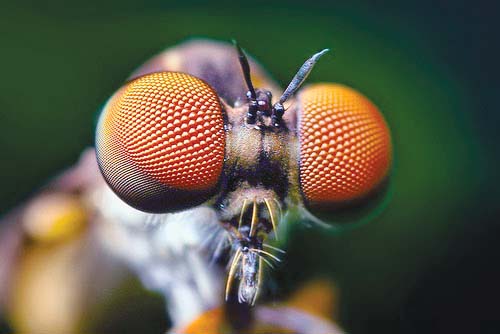
    Close up of the eyes of a fly. It can be postulated that these small creatures are, at the experiential level, living more slowly, hence longer, relatively speaking, than homo sapiens. 

    But subjective or experiential time is even ‘curiouser’ to our commonsense assumptions than the mere fact macroscopic spacetime (and therefore what we think of as duration) can be warped by gravitational forces. Recent studies have demonstrated that the inner processing of sensory-cogitational signalling by insects is far more profuse and rapid than the human version. Research conducted at Trinity College Dublin in the Republic of Ireland has demonstrated the capacity of small creatures such as flies and mosquitoes to read flickering light at least four times faster than we do. This explains why it is so hard to kill them: a fruit fly, for example, nonchalantly eludes our clumsy attempts to dispatch it. It is as though it can read our thoughts in advance. We now know that the fly has a much faster “flicker fusion frequency” than we do, so for it, time is experienced as passing more slowly than for us. To a fly, our attacking hands move in ultra slow motion because their tiny brains are able to discern flickering light forms much more distinctly than we do. (To accomplish something comparable ourselves, we’d have to slow down a video into separate framed images). 

    In brief, the insects’ experience of time is slower, therefore longer at the microsecond level, than ours, more replete with genuine light-filled experience and reflective response than we who observe them. A humbling thought indeed: these swarming, often annoying and usually despised creatures are, at the experiential level, living more slowly, more fully, hence longer, relatively speaking, than homo sapiens. 

    How does this bizarre information relate to our personal pursuit of longevity? Let’s take a moment to dwell on the question of how we measure longevity. Is it to be seen just as a straight line from birth to death? Or should it be understood as a dynamic upward moving spiral? How does length (years) correlate with curvature (experience)?

    Another curious phenomenon is that when we are truly immersed in something, especially something creative, we often lose all sense of linear time. Where did that time go when we were so deeply absorbed in the object of our attention, or the object of our affection? Stranger still, we often seem most deeply satisfied when we ‘lose’ ourselves in such things. Longevity, conventionally understood, implies an unbroken linear continuum extending from past into the future, yet lived life, especially in moments of deep immersion, strongly conflicts with this idea.

    Yet again, when we are in ‘the zone’, we feel generally hyper-aware yet totally relaxed. Our senses are heightened, our reflexes are extremely attuned, and our powers of response greatly enhanced. In such states our sense of time is also radically changed. It is as though everything occurs simultaneously in some strange way, and we are able to process unlimited amounts of changing information with ease. We can read things with grace and speed. The ‘time’ we inhabit in such states can be compared to the super-processing capabilities of the fruit fly with its superior flicker frequency abilities. Were we able to spend more of our lives in these non-linear time modes, our longevity would be altered internally, at the phenomenological level of supra-consciousness. It would be comparable to the idea of travelling close to the speed of light and thereby slowing down the aging process. 

    What I have explored is how this spiralling of renewal and enrichment at the level of the mind also works at a cellular level, the level of the body. To arrive at real longevity (not mere numbers of years), we need to generate fresh, consciously renewed awareness of the present moment, and along with that, intertwining with it, a maintenance of our physical tissues with minimal degradation of DNA during ongoing cellular replication. Our goal must be the seamless renewal of thoughts and emotions at a conscious level in conjunction with undamaged renewal of cells and tissues at a somatic level.

    Are You Present?

    The essential, we have always been told, is to live in the present moment. If we are not there, then where are we? Are we, indeed anywhere at all? Does it matter if I attain a healthy old age if the range of my thoughts and feelings is not genuinely in tune with outer reality or, most important of all, with deep inner truth; worse still, what if I have allowed my streams of consciousness to have been manipulated by outside forces? If I am not in full possession of myself, can I claim my days and hours as my own or am I merely a ‘computer’ processing thoughtforms from elsewhere?

    Interestingly, it appears that children are much more adept at discerning flicker frequency than adults, especially older adults. Could this be one reason why time seems to pass much more slowly for us when we are very young? Because it really is passing more slowly and therefore our childhood years occupy more of our total experiential time than the number of years they represent arithmetically?

    This, although it might appear to be a strange question, is really a question about mapping. Consider, for example, how conventional two dimensional mapping of the globe distorts the physical size of landmasses such as Europe and Greenland, making them appear much larger than they actually are. 

    We have now stepped through the looking glass, but in today’s world we are also all being secretly looked at, watched over, and our private load of thoughts and emotions is increasingly made to percolate through external, flickering light pathways.

    A World of Flickering Distractions

    The French philosopher Paul Virilio has written graphically about a flickering world of light emanations bouncing off cathode ray tubes and coursing wildly through fibre-optic cables. Virilio’s warning is that people are in danger of getting lost in a virtual, electronically driven interactive world of synthetic communications. The embryonic phases of the Internet and IT have ushered us into a brave new world, as we are now witnessing with increasing frequency and alarm. How far and fast things have leapt into the technological abyss is shocking, and this has gone along with our general subjective sense that time is speeding up. Logically speaking, if time is speeding up, are not our lives thereby being experientially shortened?

    ADD and ADHD have reached epidemic proportions in the contemporary developed world. Along with obesity and early-onset degenerative diseases including diabetes and cancer, distractability has become the new normal. Cloud computing has increasingly entranced the average person, and private information of all sorts is ‘dropped’ and stored online in virtual versions of two way mirrored rooms. Light emitting screens all flicker, whether they are TVs, computer monitors or smart phones. Dogs, like insects, are able to discern this flickering of light from such screens whereas we slow-witted humans are easily duped by the magic of projected imagery, no matter how contrived or toxic this imagery may be. Our incapacity to read flickering light as such makes us consume virtual information purveyed to us like a drug, and the more we do this, the more we are in danger of losing not just our privacy, but our very independence of mind.

    We can conclude that the more distracted I am, the less I am in possession of myself. And the less in possession I am of myself, the shorter in real terms is my stay on this planet. 

    The Human Machine

    In 1637, Rene Descartes published his famous Discourse on the Method, which presented the animal as a machine and the human being as almost a machine. With a self-protective nod to the Inquisition, Descartes had to publicly acknowledge the presence of a human soul interpenetrating the anatomical and physiological mechanisms via the pineal gland. A century or so later, in Man Machine which was published in 1748, Descartes’s compatriot Julien Offray de La Mettrie dispensed altogether with any need for a vestigial spiritual presence and presented man as pure machine. These were the heady days of the Enlightenment, and essentially all of what we encounter today, whether it be Hollywood Terminator movies or the Transhumanism movement, was founded by the intellectual drivers of that time. This was the conceptual platform that allowed both IT and cybernetics to emerge. 

    It is vital, for our purposes, to understand this very clearly indeed, because longevity is today a very fashionable subject in both medical and wellness circles, but is generally approached from a robotic perspective without this being consciously acknowledged. There are two undeclared goals:

    • Preservation of the physical form, whether via surgical replacements, prosthetic devices, genetic modifications or other technical interventions.
    • Preservation of the ego-entity by the downloading of this entity’s contents into a new vehicle, whether by cloning, revitalisation of decrepit tissues or other technical procedures and interventions.

    Unsurprisingly, such a technological pursuit for individual immortality is very appealing to rich and powerful individuals or groups with control over resources and companies with scientific outreach. Ray Kurzweil is probably the main exponent of these concepts and ventures, but all of this derives directly from Enlightenment theories reducing the human being to a robotic essence. Today, such thinking is much in favour since technology advances with apparent exponential velocity. 

    If our essence is machine, the answer to our challenges, quite obviously would be through technology. But if our essence is more than machine, what then? What role can and should technology play in extending our lifespan? In what ways could a purely technological perspective ever lead to a qualitative enrichment of the present moment, and thus lengthen life from a subjective point of view?

    According to Karl Popper, who formulated the empirical falsification principle underpinning the modern scientific method (a hypothesis is only verifiable to the extent that it can inherently be proven to be false), La Mettrie’s doctrine would provide an even sharper edge to the upcoming theory of evolution, and especially, I would add, to today’s neo-Darwinist creed. Popper, though a mainstay of the scientific mainstream, also cautioned that the consensual acceptance of La Mettrie’s concept by contemporary biologists, physicists and philosophers represents the human being as, in essence, a computer.

    There is a clear continuum here between 18th century Enlightenment reduction of the human being to a machine and 21st century absorption of the human being into the computer, and thereby into the covert realms of manipulated consciousness. 

    Many people today wish desperately to escape from the matrix and the growing sense of asphyxiation it produces. There still remain a few spots on the planet which are relatively unchanged, though for how much longer, who can say? Let’s take a brief look at these and draw some further conclusions about longevity.

    The Blue Zones

    As a boy growing up in England I recall being fascinated by reports of people from the Caucasus who were apparently living beyond the age of a hundred and sixty. In 1984, I spent a year living in Western Turkey where I befriended a young woman named Selma whose family had emigrated from Turkic speaking regions of Central Asia. Selma told me how common it was for people in those areas to live up to one hundred and twenty. She also told me that people were not expected to act in mature ways until rather late in life. She had cousins who behaved, and were expected to behave, like teenagers, even in their mid-forties. The thought occurred to me: could it be that we age prematurely because we are expected to be too responsible too quickly? 

    After decades of working in the field of advanced holistic medicine, I have by now developed an ultra-refined ‘sixth’ sense of body-mind dynamics. What I can say without question is that longevity is as much attitudinal as biological. In other words, we have a chronological age, a biological age and an attitudinal age, and these three may each diverge widely from one another.

    So where can we look around for viable models for long, healthy and happy lives? 

    In Dan Buettner’s best selling book, The Blue Zones, he explores five small geographical areas around the globe where the local inhabitants outlive people in developed Western nations by at least a decade; and perhaps even more importantly, they retain their vigour, vitality, strength, love of life and even their sexuality where their typical counterparts amongst us would probably be in wheelchairs, incontinent, perhaps lost in dementia or staring vacantly at TV sets. The five areas Buettner identified are Okinawa in Japan, the Greek island of Ikaria, Loma Linda in California, the Nicoya peninsula in Costa Rica, and Sardinia in Italy. 

    Not too long ago I read an article by an English journalist who went to Ikaria to investigate. He interviewed a small section of the local population. He first approaches a robust, white haired man sitting in a café high up in the hills, puffing away on a cigarette. The man’s name is Gregoris. The writer approaches Gregoris and informs him politely that smoking is bad for the health. Gregoris smiles and replies that he’s been smoking a pack a day for the past seventy years. He also drinks about four glasses of red wine a day. Gregoris is (at the time of that interview) already ninety-nine years old. His story is not uncommon. Most Ikarian males between the ages of 65 and 88 report having sex with “good duration” and “achievement” and a few of these continue to do so even into their nineties. Soon he encounters ninety-nine year old Evangelia Karnava, a small strong woman who radiates energy. When asked her secret, she declares, “Coca Cola. I can’t live without it.” She plans, she says, on living to the age of 115, and who would doubt her?

    What, no expensive supplements or life extension products in fancy bottles? Instead, Coca-Cola, lots of wine, cigarettes? Are these the Secrets of Longevity? Of course not, but these Blue Zone inhabitants prove to us that a long life is not attained by textbook purity, nor by striving to be too healthy. Nor is it reducible to diet and hygiene. Ironically, what the average well-intentioned naturopathic doctor orders you to consume (or not consume) might in fact upset your equilibrium and shorten your lifespan – as well make your life less fun. It is vitally important to be free, to have fun and to break the rules. Conclusion: attitude ultimately overrules political correctness in diet and behaviour.

    So what are the other basics we can extrapolate from the long, full and vital lives of people living in these sun-drenched environments? For simplicity’s sake, I will list them here:

    • A healthy local based diet. People eat fresh, locally grown, organic or wild-crafted foods. For example, the wines and herbal teas drunk in Ikaria and Sardinia are filled with the vital energies of place, and local greens have exceptionally high levels of antioxidants. There is an unbroken continuum between the mineral and vegetal life-forces of the region and the human inhabitants who have learned how to distil these forces.
    • A strong sense of community and shared values, festivals and celebrations. Avoidance of loneliness, depression, self-absorption and depression.
    • Laughter and good humour.
    • Plenty of good quality sleep, and perhaps also naps during the day.
    • Rising early.
    • Minimal use of drugs or any synthetic foodstuffs.
    • Minimal exposure to WiFi and electromagnetic pollutants.
    • Minimal exposure to ‘doctored’ news sources or infotainment.
    • A great deal of time spent in the open air.
    • A light hearted and courageous approach, a fluid, bright form of stoicism.
    • Respect, love and inclusion for the elderly whose value is never put into question. To squirrel them away into a ‘home’ would bring shame on the family.
    • Sunshine and proximity to flowing water.
    • Daily aerobic exercise. It is not at all uncommon for nonagenarians to walk three or more cliff miles each day.
    • A sense of purpose in each of the activities you are engaged in.
    • No excess calorie intake and low use of refined sugar. (Burn your fuel before you re-fuel.)
    • High intake of omega 3s, iodine and trace minerals from the ocean.
    • Simplicity and gratitude. Lack of guilt, greed or shame.
    Get this issue

    The Grey Zones

    The Blue Zone people, and the inhabitants of other areas where people live simple lives and have access to sunshine, clean air, water and life-force have much to teach us. But the truth is that most of us do not, and cannot, live in such pristine, simple environments, nor can we easily generate around ourselves the sorts of protective communities produced historically by these areas. We are the inhabitants of the Grey Zones, struggling to survive in heavily polluted environments, controlled by corporate mis-management of the food chain, beset with worries and anxieties and almost drowning in information overwhelm. Not to mention the effects of electromagnetic pollution, chemtrails and mind control initiatives: it is a sad fact that modern humans need to use enormous amounts of energy simply in order to retain their basic healthy functioning. Moreover, if we try to retain integrity in a complex and corrupt geo-political environment, we must also focus on staying awake, which only creates further demands and stressors acting upon our fragile life-force. So what to do?

    Besides trying to replicate, as much as possible, the conditions and behaviours of the Blue Zone inhabitants, in the Grey Zones we can still re-calibrate our life force through epigenetics and energetic adjustments. This re-calibration work is what we offer at my clinic and also during my workshops and trainings. It involves what I call the Infinite Body System and it incorporates a repertoire of vertical, spiral and other flowing movements all of which help to reintegrate the mind into the body and also to make our fluids run clean and fresh, just as Bruce Lee and Lao Tzu recommended.

    How long we live is partly a matter of chance and partly of choice, but most importantly, both length and breadth of our lives will depend upon what we live for. Living with purpose and in pursuit of meaning is both our right and our responsibility. The priority, echoing Viktor Frankl, is to listen to what Life asks of us. Our response to that last question will ultimately determine how long we are here, and whether our stay will have been a narrow one, or great and broad as an estuary tipping gracefully into the sea.

    Nicholas Corrin is the author of The Power of Letting Go, a comprehensive study of self-healing, meditation, and our personal place in the cosmos. Signed copies are available direct from the author through www.nicholascorrin.com or look it up on www.amazon.com.

    [alert type=”general” dismiss=”no”]This article was published in New Dawn 147.[/alert]

    [alert type=”success” dismiss=”no”]If you appreciate this article, please consider subscribing to help maintain this website.[/alert]

    © New Dawn Magazine and the respective author.
    For our reproduction notice, click here.
  • Crop Circles: Messages from Another World?

    Crop Circles: Messages from Another World?

    From New Dawn 155 (Mar-Apr 2016)

    If there were a hazard meter capable of measuring the precariousness of human survival on planet Earth, the needle would surely be pointing deep into the red zone. James Lovelock, father of the Gaia hypothesis, predicts that within the next hundred years 80% of humanity will have been wiped out. The unstoppable juggernaut of global warming and its concomitant catastrophes, he says, will utterly decimate our species. Moreover, effective interventions are no longer feasible, and what is now inevitable cannot be undone. Hopefully, Lovelock concludes, the small portion that survives “Armageddon” will have finally learned to live in harmony with nature and the environment. It will be a new beginning: a species that will have re-modelled itself, not so much through technology as through severe pain, loss and hardship.

    Assuming that Lovelock may be right on this one, are there currently alien forms of life observing us and monitoring our perilous situation? Are there, as some appear to believe, aliens now living in our midst, collaborating with covert military and governmental agencies, perhaps even darkly precipitating these events? Or are there, conversely, communications softly whispered to us from inter-dimensional entities attempting to assist us, even at this late hour? Or again, is this all just in our heads, nothing but the froth and fantasy of human delusion?

    To attempt to answer seriously the burning question of human-alien interaction, we need first to consider whence the word alien originates, and how language, as substrate and vehicle of human consciousness, can as easily give rise to phantoms and fears as insight and understanding. The word itself derives from the Latin word alienus, which signifies something (or someone) strange, foreign and fundamentally other. In the United States, the intermediate status between an illegal immigrant and a full-fledged citizen is termed resident alien. Such an individual has the right to work and reside in the country but not to vote. The resident alien is given a “green card.” It always struck me that there must be something in the American psyche linking green cards with little green men.

    What we deem to be alien is, unconsciously, seen by us as foreign, impenetrable, untrustworthy, thus capable of betrayal. What is truly dangerous, however, is our habit of casting other human beings as truly other than us. Whenever the word alien is uttered, there is always a shadow of fear and potential violence. At the same time, history has taught us that other human beings, and that includes ourselves, are not to be trusted. Why, therefore, would we not be deeply fearful of real aliens?

    The concept of the Grays and Reptilians of alien origin masquerading as humans, deviously operating from seats of power behind the scenes, has gripped certain sections of the popular imagination, but this is nothing more than pulp fiction playing on deep-seated, infantile fears. Such phobias within the population actually are highly useful to the shadowy forces within the Deep State that cleverly employ the subterfuge of malign alien presences and strange UFO incursions in order to deflect attention away from secretive, super hi-tech, and highly classified military experiments.

    Those who control the reins of fear control history and world events. Certainly, the twentieth century’s dark history of disenfranchisement, from the internment of Japanese Americans during World War II to the current, very real threat of summarily corralling hundreds of thousands of Muslim Americans en masse and placing them in FEMA camps, demonstrates the interplay of racially driven fears, totalitarian reflexes and connotations surrounding the concept of the alien.

    One could also say that the Native American population, and similarly the indigenous Australian peoples (amongst others), were historically targeted for destruction or exploitation by conquering military or corporate invaders. The original inhabitants were seen as irredeemably alien, if not sub-human. The entire global history of colonisation, missionary zeal, enslavement and genocide, as famously depicted in Conrad’s novel, Heart of Darkness, revolves around the perception of the racially other as fundamentally alien, inferior and requiring redemption. This was obviously the rationale behind Hitler’s “Final Solution.”

    Before we probe further into etymology and the interweaving of language, history, psychology and geopolitics, let’s rewind the spool and time-travel backwards into the mists of prehistory. Aeons ago, wide-eyed and tremulous, our pre-hominid forebears emerged from thick tangles of jungle under whose cover they’d swung or timidly crept, dimly aware there existed vaster worlds beyond the familiar forest canopy. They then stumbled upon a stone strewn wilderness of dancing grasses littered with new dangers and opportunities. Propelled by an irrepressible inner destiny, which scholars would later call “evolution,” as early man stepped out tentatively on to the scorched savannahs, he encountered night as never before, wide-open and naked, as though for the first time. Used to seeing the glowing eyes of nocturnal predators within the thick drapery of vines and foliage, here, with the shock of the new, he would see, unclothed in all its awesome enormity and strangeness, the full moon and the firmament replete with innumerable watchful presences each moving with a precise, coordinated logic utterly different from the movements of animals, winds, water or other things of this earth. Here was the crucible of an ineffably superior order, of a slowly nascent conception of astrological powers and later on of astronomy, of man’s hauntingly nostalgic sense of his own lost extraterrestrial origins.

    Above him unfurled windswept swathes and rising gulfs of air, driving him to seek refuge in caves. But what refuge could he possibly find from these great lanternous gyres? The mysterious turnings in the deep blue-blackness stirred the contemplative mind of our ancestors, stimulating the explosive growth of the cerebral cortex. For we urgently required more thinking capacity to examine this new, hieroglyphic nature of reality. Man’s symbol-making mind was being birthed beneath the stars. And these stars helped him navigate, not just on earthly pathways, as a nomadic tribal being, but also inwardly, as a traveller of the mental dimensions, and as a seeker. The night gave rise to terrors, but also to the sublime, the ethereal, the intellectual and, most importantly, as far as we are here concerned, to the feeling that we humans are not alone: there exists a bridge between the higher and the lower realms.

    All this would be articulated in the ziggurats of the early Mesopotamian people, the raised promontories of the Mayans and, somewhat later, the tall thin spires of Gothic cathedrals; later still, in the ensuing scientific age, super-sensitive antennae perched atop questing satellites and far-flung space probes.

    The Vatican Checking for Aliens?

    Today, even the Vatican owns, and runs, a private astronomical observatory. Why would the Holy See construct a sky-scouring facility in the Arizona desert? The Vatican Observatory, overseen by Brother Guy Consolmagno, direct appointee of Pope Francis himself, incorporates the so-called Vatican Advanced Technology Telescope. In the director’s own words, the purpose is to joyfully study the glory of the stars, crown jewels of the Lord’s creation:

    All the science we do, and all the outreach we do, reflects a quality that motivates everything we do in astronomy: a sense of joy. The stars are glorious, and it’s a treat to be engaged in their study. Their glory proclaims the Glory of their Creator!

    That, at least, is the official version. But the Vatican has centuries of strategic survival instinct to draw on, and would not want to be caught with its “pants down.” For if advanced alien life forms were detected, or suddenly communicated with us on planet Earth, the viability of any religious ideology would rely on it being able to seamlessly assimilate this new “exo-biblical” factor. The Vatican Observatory surely shows just how seriously the Catholic Church is taking the idea of imminent human-alien interaction.

    Many writers and scholars have proposed extraterrestrial links to very early human civilisations whose prowess, in many respects, far surpasses our own, despite, or perhaps because of no extant evidence of what we would term technological tools. This begs the question as to whether more advanced techniques, impervious to our current knowledge, were employed. When, for example, university research projects in Peru attempted to replicate the precise stone-cutting of pre-Inca builders, their results proved to be embarrassing failures, even with the use of modern power tools and advanced computer software.

    Today we have convinced ourselves that modern humans can 3-D print just about anything we wish, yet we ourselves have not the faintest clue as to how the stones for ancient megalithic constructions were cut and fitted, let alone transported to their final destination sites. The sarsen stones of Stonehenge along with other sacred megalithic constructions remain impenetrable enigmas. There must be something very irritating here for the scientific mind – which too easily degrades itself into the arrogant scientistic mind – that these riddles have not yet been solved. For those outside the mainstream, a preferred explanation tends to be there was help “from above”; that is, extraterrestrials sojourning on Earth collaborated or advised in the construction and development of early human civilisations.

    Today there are multiple bursting files of “evidence” and sworn affidavits by persons highly ranked within the military as to interactions with alien spacecraft and/or alien beings. The so-called Disclosure Project was designed to collate and integrate as much of this evidence as possible. Yet the attempt to persuade the general public always gets stymied by officialdom itself. Thus, hearsay, conspiracy theory, claims and counterclaims end up inducing a paradoxical mix of credulity and disbelief in the average Joe. This, we must understand, is very much to the benefit of whoever is trying to control public opinion.

    What is actually going on? Is there any way of penetrating all the manipulated projections and mind control without falling prey to irrational speculation?

    The Crop Circle Connection

    Whilst there seems to be a very dark and militaristic aspect to human-alien interaction, to my mind, one of the most intriguing and compelling arenas of human-alien communication has been crop circles. The almost spontaneous delivery of these ciphers, or cryptograms, as much as the actual content they encode, gives one the sense of a downstreaming of intelligent communication from another dimension. The ugly attempts to ridicule them as hoaxes perpetrated by pranksters is utterly unconvincing when one compares the refined geometric elegance of a genuine circle with a known fraudulent one. The deliberate disinformation from official sources has been exposed in the writings of longtime researchers such as Freddy Silva in his book Secrets in the Fields.1

    With crop circles we are not necessarily dealing with three dimensional alien beings residing far away on exoplanets. Such mainstream, rational versions of alien life aboard sister earthships are quite conventional and are naively based upon the premise that other regions of the cosmos, due to purely mathematical probability, would have allowed for the emergence of exotic yet fundamentally comparable versions of ourselves. Here, instead, we seem to be dealing with invisible, intangible fields of intelligence, capable of creating extraordinary ciphers and delivering them to us by altering the molecular and electromagnetic structure of stalks of wheat. The sense we have been getting, for over three decades, is of someone trying to tell us something, or show us something, or, perhaps, remind us of something. Most importantly of all, the impetus to communicate, the sense of urgency is coming from them, not from us. What are “they” trying to tell us?

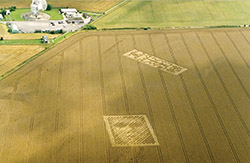
    The two Chilbolton formations appeared in August 2011 near the Chilbolton Observatory in Hampshire, UK. Are extraterrestrials trying to tell us something or show us something? Photo Copyright: Lucy Pringle, www.lucypringle.co.uk

    2001 was the year, we are often reminded, that our world irrevocably changed when the Twin Towers came crashing down on that fateful September 11th day in New York. But it was also the year that, near Chilbolton Observatory in Hampshire, UK, two astonishing crop circles, or rather, crop rectangles, appeared. What is even more interesting is that these were first sighted on the morning of Tuesday, August 21st, exactly three weeks before the mega-attack in Manhattan occurred. Is this a coincidence, or is there some synchronicity involved?

    The two Chilbolton formations consisted of, on the one hand, a section of binary code reminiscent of a computer chip and, on the other, a blurry humanoid face within a rectangular frame measuring 44m by 57m. The wheat stalks composing the face were bent in such a way as to make the image appear pixilated with heavily overhung brows, deep sockets, and an inscrutable demeanour. The Chilbolton face is, above all, emotionless. Looking back at it now, would it be off the mark to suggest that it conjures up a spectral reflection of what we have today become beneath the thin veneer of our civilisation, in a world racked by incessant wars, internecine conflicts, drone attacks and desensitised acts of extreme brutality?

    Or is it a kind of identikit portrait, sent for our perusal, of an actual alien race from a far-off galactic zone?

    As for the “computer chip” segment, it contained a message. This message was decoded by Paul Vigay, a computer expert who back-linked it to a coded signal originally sent out by SETI on November 16th, 1974, from the Arecibo Observatory in Puerto Rico. SETI had aimed its coded message at a star cluster known as M13 in the Hercules constellation. The purpose of the outgoing message was to deliver technical information about life in our Solar System to intelligent aliens who, it was hypothesised, if they existed, would most likely be capable of decoding it. The Arecibo radio signal had been delivered in binary code with a total of 1679 pulses.

    The returning signal, if authentic, appeared to provide reciprocal information about the alien species within M13, including its population (21.3 billion) and the high prevalence of silicon in its periodic table, suggesting to some interpreters that these aliens sending us back their own encoded messages may be cyborgs or robots.

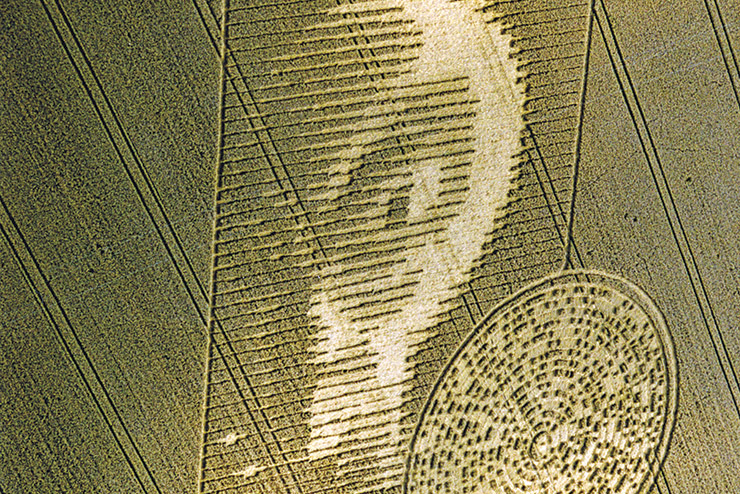
    Alien “portrait” at Sparsholt

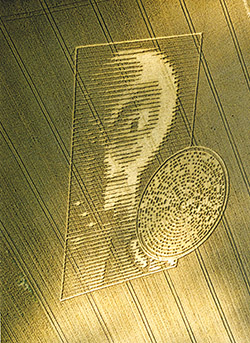
    The impressive 2002 Sparsholt formation, a rendition of our common projection of an alien, ET or Gray. Copyright: Lucy Pringle, www.lucypringle.co.uk

    Hardly another year had passed before yet another formation, again in Hampshire but this time at Sparsholt near the town of Winchester, appeared. It consisted of a “portrait” within an even larger rectangle, about 120m in length.2 The huge rectangle framed a clear rendition of our common cultural projection of an alien, ET or Gray. Looking at it gives one the distinct feeling this is a highly intelligent and refined, also deeply ironic, form of communication. Unlike the Chilbolton “portrait,” instead of a pixilated image, the Sparsholt “portrait” evokes an image on an old cathode ray TV screen. For, when viewed from above, the figure we see in the field is composed of clearly delineated horizontal lines.

    Thus the Sparsholt portrait is clearly intended to be interpreted as a projection from an undetectable alien source. This projection has itself been projected as if it were a TV image. Not only that but this small screen image suggests the producers are thoroughly aware of how we humans project outwards from our culturally manipulated unconscious, clichéd visual renditions of what aliens are “supposed” to look like. All of these factors lead one to suspect that whoever produced this crop rectangle at Sparsholt knows far more about us than we could possibly imagine. And that this knowledge “they” have of us is not limited to the type of information encoded in the original SETI radio signals which focused on external data such as Earth’s global population back in 1974, the atomic numbers for elements constituting the basic constituents of organic life in our Solar System, the composition of the DNA molecule, the height of the average human, and the Arecibo telescope itself from which the original, outgoing message was dispatched. No, the Sparsholt formation appears to show us that the emitters can read our minds, can penetrate our unconscious imaginal codes, not merely our rational, science-based ones. At Sparsholt, we may be presented with evidence of extraterrestrial insight into human psychic functioning, relayed back to us as a riddle to be solved. To put it most unequivocally, this Hollywood head-and-shoulder rendition of an ET in the rectangular frame does not attempt to represent what distant aliens look like; on the contrary, it reveals to us how we ourselves project names and forms outwardly from our own unenlightened understanding and semi-superstitious modes of perception, exactly as did the chained prisoners in the story of Plato’s Cave.

    But there is more: offset from the huge rectangular framed portrait at Sparsholt and perched on the ET’s left shoulder in such a way that it literally breaks through the lateral perimeter of the frame, is a wide disc encrypted with bits of binary coded information. When the experts finally deciphered the contents of this disc, what messages did they find? Paul Vigay, already mentioned in a previous paragraph, set about the work of deciphering the disc with an open, inquisitive mind. It struck him at first that the binary disc reminded him of the notched metal plates inside old Victorian music boxes, then of cymatics and later of planetary grid systems. Very soon, however, Vigay came to discern a semantic content encrypted into the disc. By invoking the “bits per byte” methods of notation commonly used by computer programmers, Vigay was quickly able to translate the disc’s outwardly spiralling sequence of raised and flattened tufts of wheat into text. What emerged was the following:

    Beware the bearers of FALSE gifts and their BROKEN PROMISES. Much PAIN but still time. (Damaged word.) There is GOOD out there. We OPpose DECEPTION. Conduit closing (BELL SOUND).3

    What can we conclude from these enigmatic words? I suggest this message is a cryptic call to that part of humanity that remains capable of hearing what the Greeks called the Music of the Spheres; almost a command, although delivered as a whisper, just as the Music of the Spheres was not so much a sound as an inner harmony between parts. Nonetheless, a call to arms, on the level of the heart and the mind, a reminder of our individual spiritual responsibility. If there is a side to human interaction with aliens which, whether real or imagined, focuses on predation, abduction, conquest and exploitation, there is also this gentle voice exhorting us to stay vigilant, lucid and receptive; to retain our grip on the wheel of reality by staying true to a deeper vision.

    Archons & Ahriman

    The entire alien-interaction theme brings to mind the Gnostic concept of archons, and in particular Ahriman, that master meddler and deceiver. It maybe that the contrasts between light and dark, inspiration and terror streaming out of the extraterrestrial sphere articulate the esoteric Manichean tensions between good and evil entities, and the effects of forces which are inimical to our spiritual and existential growth. One could perhaps say that these forces are not truly situated somewhere else but reside within the human heart, and that the human heart, with its potentially limitless scope of understanding, encompasses both opposing extremes.

    Rudolf Steiner, in one of his lectures on Lucifer and Ahriman, has this to say on the subject:

    If the right stand is to be taken to Ahriman’s future incarnations, people must become far more objective where their own impulses are concerned, and far, far more subjective where the external world is concerned – not by introducing pictures in fantasy but by bringing interest, alert attention, and devotion to the things of immediate life.4

    Since we first ventured out, many millions of years ago through that verdant curtain at the forest’s edge, we humans have stumbled, and occasionally swaggered through trials, challenges, conquests, epiphanies and corruption, searching endlessly for our own peculiar destiny. Indeed, it is only recently we have become aware that the very stars above us must, like us, perish, they too have their share of conflicts and will eventually be extinguished, transforming into red giants or white dwarfs, or collapsing into limitless, hyperdense black holes of forgetting and nothingness. In our hearts we carry both love and hatred, both the Christ impulse and the Ahriman or Luciferian impulse.

    The innumerable snowflakes that have fallen around us since that first intrepid and fateful venturing out on to the open plain have threatened our survival with the promise of terminal cold, but they have also delivered tiny, inimitable packets of cosmic perfection, of which the mysterious crop circles are fantastic elaborations. We ourselves are nothing but extraterrestrials stranded on a distant planet. We shall find our longed for origins in the sky only by rediscovering that way back home here on Earth.

    [alert type=”general” dismiss=”no”]This article was published in New Dawn 155.[/alert]

    [alert type=”success” dismiss=”no”]If you appreciate this article, please consider subscribing to help maintain this website.[/alert]

    Footnotes

    1. Freddy Silva, Secrets In The Fields, Hampton Roads Publishing, 2002
    2. Bob Rickard & John Michell, Unexplained Phenomena, 2nd Edition, Rough Guides Ltd., 2007, page 229
    3. www.cropcircleresearch.com/articles/alienface.html
    4. Rudolf Steiner, The Influences of Lucifer and Ahriman, Anthroposophic Press, 1993, page 35

    © New Dawn Magazine and the respective author.
    For our reproduction notice, click here.
  • How Long Do You Choose to Live? The Truth About Longevity

    How Long Do You Choose to Live? The Truth About Longevity

    Recently my wife and I were driving back from Seattle to the island of San Juan where we live. To reach the island you must take a ferry from the small port town of Anacortes, some two hours north of Seattle, once the famed capital of Grunge. Now the stomping ground of Yahoo, Google, Amazon and Microsoft, this new Seattle is in constant motion… but not the motion of people walking about, conversing and interacting.

    As in so many places around the world today, Seattlites’ gaze is increasingly dug into their smart phones, a ceaseless thumb twirling, the last vestige of the bodily urge to move. Except, that is, for the hordes of Lance Armstrong lookalikes speeding by on their bicycles, the same look in their eyes, the same expression on their faces.

    Around this digitised social mass there is only an inexorable motion upwards: everywhere you look you see scaffolding rising to support the mutating species of tech-humans required to run this ultimate software machine. Glisteningly boring architecture wraps its soulless coils around the tree-lined communities with their famed water views, slowly asphyxiating them as might a giant python its prey. This brave new world emanates a distinct whiff of Singularity as technology continues its phallic and parabolic rise against the dwindling forces of nature.

    Or perhaps not. Nature is also uprising, with an unstoppable force of its own. As TS Eliot once wrote, the centre no longer holds. From the relative calm at the eye of the storm, we are now being spun out into the concentric rings of tempest that surround it. The centre is collapsing as the outer rings unleash the hounds of chaos.

    A perfect storm? Loss of faith in government, in religion, in financial regulation, in science, in our humanity; even loss of trust in our species capacity to prevail against self-administered adversity. Shadows are building around the glib optimism spouted by governments with their sycophantic media vomit and cherry-picking disregard for scientific consistency.

    As we shall see, this entropy at the centre need not always mean death and destruction. It could mean exactly the opposite. In fact, it is this very same dynamic (implosion at the centre, explosive growth at the periphery) that allowed larrea tridentate – humble creosote bush and longest living species of plant yet discovered – to endure for over eleven thousand years, outliving all the multicoloured empires man has sought to erect on this Earth.

    Elsewhere, in the deeps, swim arctic whales in whose flesh lie embedded ivory tips of harpoons aimed at their flanks by whalers of the early nineteenth century. Deeper still, close by the vents on ocean floors through which rise intense heat from beneath the planetary crust, delicate tube worms called lamellibrachia stack upwards like surreal, futuristic skyscrapers of the forgotten depths. These subluminous creatures can easily live out a quarter of a millennium. And if we go deeper still, under the very bottom of the basins of the great oceans, we encounter the largest biomass on Earth, that composed by archaea – tiny, ancient, unicellular creatures not to be confused with their later evolutionary relatives, the bacteria. We know that archaea metabolise time far more slowly than we do. How long can one of them survive? It has been posited that the answer may lie well north of one million years.

    And strange as all that may sound, it is not the strangest of all. That prize must go to turritopsis nutricola, the so-called immortal jellyfish. But we’ll get to him, or her, a little later.

    Longevity in a World Gone Mad

    Let me return for a moment to our drive back from Seattle. The whole day there had been a misty pall hanging over the entire region, giving it a sort of milky humidity through which the sun could not penetrate. By evening, as we drove in towards the harbour, the sun had broken through and hung above the horizon, a vermilion acrobat of astonishingly beautiful elegance, in slow motion descent. Just beneath it, waves of scorched yellows and ochres etched themselves between the far horizon and the lowest hanging cloud, suggesting that above the entire Pacific Ocean a great fire was raging. We drove slowly in our car, mesmerised by the bizarre beauty. From the CD player, tracks from Laurie Anderson’s album, Bright Red, played out softly:

    and when you think you’re swimming to the surface,

    you’re swimming right down,

    down to the bottom, all the way to the bottom…

    The entire landscape had become a dreamscape. There was a simple reason for this: fire. Five of the westernmost states of the US had caught flame: California, Idaho, Oregon, Montana and now eastern Washington. At this time of writing, the fires are officially “out of control.” Unable to quell them even after bringing in the army, the US government has requested the assistance of special crews from Down Under. Trained forest firefighters from Australia and New Zealand are due to land in Boise, Idaho.

    At around this same moment, a foiled terrorist attack has just taken place in Europe aboard the Arras-to-Paris train. A Moroccan man, naked to the waist, wielding an AK 47 and carrying nine magazines, a hand gun and a boxcutter knife is wrestled down by three Americans and a Briton just before he is able to unleash multiple rounds from a temporarily jammed barrel. That fire was stopped, just.

    Fear of death by fire, fear of death by water. These terrors lurk within the recesses of our unconscious, and for good reason they are now welling up. Just as parts of the rapidly desiccating land masses are catching flame and the ocean levels growing taller, and more menacing.

    So here we get to my point, or my $64,000 question: does it make sense for us to talk about longevity in a world that has become so precarious? Is it not rather like planning for retirement when we all know that the shadows of deflation and hyperinflation stalk the countries we inhabit, and especially those of the West, which are functionally bankrupt? When we see that the dying fiat currencies are being kept alive on inhalers called QE, the stock markets pumped full of steroids swollen anabolically by corporate buybacks to distract the eye from dwindling price-to-earnings ratios, the militarisation of police forces and all the other aggressive control reactions the authorities are throwing at a global situation they sense is fundamentally spinning out of central control? Is there a place amongst these madding crowds to hunker down and cultivate a long, happy and healthy life?

    How Long to You Choose to Live

    About ten years ago I read a book entitled How Long Do You Choose to Live? The name of the author is Peter Ragnar. Known for his unbridled pursuit of physical immortality and record beating feats of physical strength, Ragnar is also a successful businessman and New Age guru. Is it a sign of mental illness to believe that one can live forever? Not necessarily, although it might be a sign of mental illness to want to live forever. But we will get into that later. For now, let’s look at Ragnar’s basic premises, and then let’s see what he is doing to remain “forever young.”

    Ragnar notes that the Bible speaks about individuals living to immense ages. Noah was the last of the batch of early patriarchs who lived to be a thousand years (Noah himself died a little prematurely at age 950). After Noah, lifespan shortened dramatically. Less than three hundred years after Noah’s passing, Moses would only live to be 120, although most people today would agree that, with all that Moses had to live through, he went through a great deal of what we would now call stress, both personal and professional. Even back then, stress can’t have been good for you.

    In China and in India too, there are tales, whether fiction or fact, of tremendous longevity. Taoism in particular developed an esoteric cult of longevity which aimed at transcending death altogether. This was by dint of becoming a Taoist Immortal, or Cloud Wanderer. Such a path entailed diligent self-cultivation practices, and not only at a physical level of health. The fundamental concept is alchemical: which is to say that it is possible not only to slow down the processes of cellular decline and live a long life, but also in-so-doing to gradually spiritualise the body’s core energies in such a way as to build a sort of special energy vehicle (or capsule) for the self to survive intact in the worlds to come.

    Ragnar’s interest is not focused on that, however. It is purely focused on extending his physical life indefinitely. Or at least, he suggests, giving it a good try. Seeing whether it is in fact possible. One of Ragnar’s favourite texts is As A Man Thinketh by James Allen. Here is one sentence from Allen’s famous book:

    You are today where your thoughts have brought you;

    you will be tomorrow where your thoughts take you.

    Taking this literally, we are presented with a simple but radical notion: our thoughts precede our material circumstances. Is it possible to infer from this that if we change the way we think about aging (and dying) we can literally control the rate at which we physically decline; even, in theory, postpone death by refusing to accept the inevitable arrival of that cloaked and hooded figure with his sickle (the Ultimate Terrorist)? Is this an outrageous act of stupidity, or at least of hubris? Or does it merit closer attention? Ragnar, to his credit, is giving it a go and doing pretty well so far.

    Longevity & States of Mind

    Let’s switch gear to a recent study. A paper just published in JAMA in February 2015 describes a twelve-year study conducted by researchers at the University of London on a group of 6,489 people. What the research team was trying to find out was whether perceived age has any influence on mortality. In other words, say you are aged 60 but in your mind you perceive yourself to be 50, could that conceivably affect your lifespan? The research team concluded very clearly that it does. Those people who perceived themselves to be younger than their actual age lived longer (or died later) than those people whose self perceived age was identical to their biological age. People whose perceived age was greater than their biological age died the soonest. Mortality rates were 24.6% in the last group and only 14.3% in the first, almost double. Well, well, well. Perhaps there is something to this after all.

    In my previous article on longevity for New Dawn (see Nov-Dec 2014 issue), I mentioned how in some cultures you aren’t expected to behave like an adult until well into middle life. These cultures (I was referring to the people of the South Caucasus) lived typically into what we would today call extreme old age (120+).

    Are there any examples currently of people who have attained an extraordinary age, and also managed to remain vital and healthy? If so, how important is mental attitude in all this, and what other factors may be involved?

    Officially, the two oldest living persons in China and possibly the world are both Uyghurs from Xinjiang province. Alimihan is 127 and can still thread a needle without glasses. Her blood pressure and appetite are those of person one-third her age. Yakup is 120 and looks like a very fit 60 year old. He bends and squats without no obvious signs of arthritis or weakness. He walks around all day long tending to his five sheep and helping to feed the family’s other animals. His son in law attributes Yakup’s longevity to the fact that “he never stops moving.”

    Okay, so we know exercise is good and if you don’t use it you lose it. But, surely there would have to be some special water, herbs, diet (or perhaps esoteric spiritual practice) that has kept Yakup supple, strong and vital all these years. No: corn naan (a kind of flat bread) and tea are the only things he consumes each and everyday. No proteins, no antioxidants, no alkaline water, no blue-green algae, no super-raw-food diet, no human growth hormone, no special anything. Just corn bread and tea.

    If you check out those centenarians from the Greek island of Ikaria from my previous New Dawn article, you will see that most of them are not too politically correct when it comes to diet. Smoking, drinking copious amounts of wine, even Coca Cola are mentioned by numerous 100 year-old residents as daily pleasures which enhance their wellbeing and thus their longevity. On the other hand, they consume a diet rich in local greens, herbs, fruits and vegetables, little meat, and very little if any WiFi. Instead of sitting (as I am at this moment) glued in front of a computer, they are clambering over the windblown cliffs on their way to visit a neighbour or friend, and perhaps share a glass or two, or maybe even three. Women from Spain are, after the Japanese, the second longest living women in the world. Why? No doubt similar reasons apply as do in Greece. These Spanish women live more communally, are more expressive, more spontaneous, less pent up than many of their Anglo-Saxon counterparts, and do not refrain from drinking some wine with their meals, but not in a way that exhibits immoderation or alcoholic tendencies.

    But let’s get back to what Peter Ragnar recommends in his book How Long Do You Choose To Live?

    I would say he breaks things down to the following factors:

    1) Make sure you get regular, direct exposure to sunshine

    2) Actively focus your powers of positive belief, keep your mind open, and tap into limitless potential

    3) Keep your body fluids running clear and clean like a mountain stream so that your cells do not accumulate toxins and thus degrade

    4) Avoid three things like the plague: Stress, Drugs and Doctors

    5) Learn how to breathe deeply. Always oxygenate yourself well with fresh air and detox thoroughly with powerful exhalations

    6) Learn how to do “electric breathing” practices (that is, Qigong or Pranayama)

    7) Avoid noise pollution as much as possible (including the silent noise within from negative states of mind)

    8) Avoid electromagnetic pollution as best you can (including radio towers, WiFi and the proximity of smart phones)

    9) Drink only clear, clean, energised water and keep your PH alkaline

    10) Become a vegetarian. Eat raw food

    11) Exercise diligently and keep your muscles strong and primed

    12) Use hydrotherapy and dry skin brushing regularly: take hot/cold baths or showers

    These suggestions, simple as they might seem, are not so easy to put into practice as we all know. Not all of us can retire to a mountain retreat, have access to (or afford) garden-fresh organic produce, or drink vibrationally charged, purified water let alone breathe in uncontaminated air. By contrast, most of us are submerged in thickening seas of electrosmog. Before too long there will likely be class action suits about a slew of deaths caused by this invisible electrical pollution, just as there have been huge class action suits about deaths from smoking tobacco.
    [alert type=”info” dismiss=”no”]If you appreciate this article, please consider a subscription to New Dawn magazine.[/alert]

    How Can I Minimise the Damage?

    Realistically speaking, most of us tend to think: “How can I minimise the damage?” rather than “How can I maximise my potential?” We are playing catch up. The big irony is that the mainstream keeps assuring us people’s lives are manifestly getting longer. This is true, at least in developed parts of the world. But people’s bodies (and minds) are also growing weaker, fatter, slower and disturbingly disconnected. Our DNA is degrading, our robustness and vitality diminishing.

    Chronic degenerative disease is the new normal. And it is happening by stealth: no-one in a position of authority is willing to admit what is going on. The human being is morphing into a defenseless blob. Health, without the “QE” of more and more drugs and prosthetic interventions, is sliding on a downward trajectory. But this situation is actually perfect for big business interests. And perfecter still for those who want to fast-forward us into a post-Singularity world: a world where human and machine have finally fused. The ultimate makeover. The ultimate transgender wet dream fantasy: conquest of death by technology.

    On 18 August, scientists at Ohio State University announced they had grown a human brain in the lab. Their miniature brain, about the size of a pencil eraser, is not conscious and supposedly resembles that of a five-week old fetus. It has been engineered from adult skin cells. Interestingly, the research work and its fruit (if that is the right word) were presented to the Military Health System Research Symposium in Fort Lauderdale, Florida.

    The research team claims their brain is connected to a spinal cord, and even a retina. This work was accomplished by turning initial adult stem cells into pluripotent cells, which were then programmed to become central nervous system cells in the lab grown brain.

    What the heck are pluripotent cells, you may well ask? Actually, they are a kind of stem cell that can develop any which way. That’s why they are called pluripotent cells: they have plural powers, archetypal, magical powers of transformation and metamorphosis. And we are full of them. Nor are these cells only responsive to secretive scientists working on semi-classified projects. One of the most powerful remedies I use in my clinic is made from the aloe arborescens leaf. This leaf contains multiple factors including special sugars (polysaccharides) which can dramatically transform macrophages (human white blood cells) into pluripotent cells. There is an interesting documented case about a young girl who was born without an esophagus. After being given a preparation of the aloe formula, her body was able to grow one. Conclusion: nature still has the upper hand when it comes to technology.

    The Immortal Jellyfish

    Let’s get back to our friend turritopsis nutricola, the Immortal Jellyfish. How does this bizarre creature manage to defeat Father Time? It’s by a process known as transdifferentiation. When the adult, medusa shaped jellyfish senses danger, it has the option of floating back up to the surface of the ocean and simply reverting back into a blob. That is, its cells go backwards in time, from highly differentiated adult ones to cells which are essentially primitive stem cells. It hangs close to the surface until the danger has past. Then it re-morphs back into a medusa with tendrils, stomach, sense organs and so on. Of course, whilst in the blob state it could always get eaten. This is a risk it has to take. But if it escapes the marauding jaw of a fish, it returns to its fully fledged form as though nothing had ever happened. Thus, it does not age, it simply regroups, refreshed and revitalised. And it isn’t homo sapiens with all his superior intellect and technological prowess. It’s just a “stupid” jellyfish. Conclusion: when the going gets tough, simplify. Get rid of what you don’t need. Hang for a while and cling only to the essentials. Bide your time and then return, stronger than ever.

    Nature shows us many other examples of great intelligence and adaptability in supposedly primitive micro-organisms such as amoeba, which move around by means of limbs called pseudopods that they can sort of “haul in” and compress back into their blob-like core as they move fluently through pond water or through the extracellular fluids of your body. My own longevity system, which is called the Infinite Body SystemTM, was developed by studying creatures such as the amoeba proteus, and in fact by studying the precise movements of many diverse things in the universe, from nebulae to single molecules of water. We should remind ourselves that since the planet first began to sustain forms of life, there have been multiple extinctions and those species that found themselves over-specialised in a rapidly changing environment were the first to go. There is a lesson in that.

    Longevity & Reincarnation

    But we have one more twist of the puzzle to ponder over. When we speak of longevity, are we assuming that we live only once?

    In Old Souls by Tom Schroder, the author sets out to explore whether there is any hard evidence for reincarnation. He is a sceptic for whom lack of convincing proof would mean that the idea of rebirth is pure fantasy. A seasoned journalist, Schroder is allowed to accompany physician and psychiatrist Dr. Ian Stevenson on his field work in search of proof of reincarnation.

    Stevenson’s field work spans three continents, three cultures and three languages: Lebanon, India, and the USA. By the end of his travels with Stevenson, Schroder’s scepticism has been shaken to the core. It has become conviction, so mind-blowing is the evidence: concrete, compelling recollections of past life by children. These detailed accounts are not hazy. They consist of precision-sharp references to life information (inner and outer) of biographically identifiable individuals whose deaths occurred only months, weeks and, in some instances, just hours prior to the birth of the child in whom they “re-incarnate.”

    The documentation in Schroder’s book is of paramount importance to our interest in longevity. Why? Because if we only live once, then it makes sense to approach life as a private business: a precious, personal stretch of time. It is “our” time” and “our” life to live out as we see fit. If we wish to burn the candle at both ends, so be it. If we wish to “stretch” our bit of fabric so as to live a little bit longer, we will need to practice longevity. If we follow Ray Kurzweil and the other prophets of Singularity, we can go down that synthetic yellow brick road. But what if we live more than once? Does it still make sense to focus so much on longevity, or are we missing the point?

    I am sure that New Dawn readers from Australia all remember Kerry Packer, that brash, outspoken entrepreneur of the late twentieth century. In terms of personality, Kerry Packer had more than a few things in common with Donald Trump and Rupert Murdoch, another Australian! In 1990, Kerry suffered one of his four major heart attacks whilst playing polo. The attack left him clinically dead for a total of six minutes. Later on at a press conference he referred to this experience: “I’ve been to the other side and let me tell you, son, there’s f*cking nothing there… there’s no one waiting there for you, there’s no one to judge you so you can do what you bloody well like.”

    Packer’s conviction that “there’s nothing f*cking there” on the other side and that thus you can (and should) do what you like has to be one of the best tools we possess for understanding the way the world works today. The so-called elites, with their protective fatty membrane of politicians, media sycophants and rigged judiciaries, operate from the same belief system as Packer: we only live once, the world is up for grabs and may the best man (or rather, the worst man) win. There’s nothing to worry about except winning and holding on to what you’ve got. The rest is just empty background space, cannon fodder and raw materials to be exploited.

    They are convinced that they are right in this. They feel superior to everyone else in understanding the basic facts better and therein lies their right to the winnings. To remain undisturbed in their hegemony, they airbrush over their nihilistic beliefs, hiring legions of liars (politicians and media) to spread illusions of ethical governance to conceal the boundless predation and depredation in which they are so invested.

    The world we inhabit today is increasingly unstable. Geopolitical tensions between nation blocs are intensifying. Conflicts in the Middle East and elsewhere are threatening to spill out into the greater, perhaps even global, arena. War is now being increasingly spoken about in alternative media as a deliberate tactic to distract Western populations from the financial crimes of banks, corporations and corrupted government. The general awareness today, albeit a semi-conscious one, is of an Orwellian drift in government.

    At the same time we are witnessing an unravelling of natural balances involving weather patterns, symbiotic relationships between plants and insects, magnetic currents and polar fluctuations, sudden decreases in solar activity and so on. The spirit of our times is far from one of calm and predictability.

    So what to do? I’d like to suggest there is a way to consider the pursuit of longevity that is more real – and more meaningful – than simply trying to live for a very long time, and stay healthy. That way of thinking seems almost narcissistic unless, that is, our goals are greater and deeper than that. I would like to point out that often people who have a strong sense of integrity and truth live longer, healthier lives than their less awakened contemporaries. Their very strength of character seems to sustain their bodies and keep them vital.

    I will end this article by stressing that, as I see it, longevity in our times must involve both courage and generosity of spirit. Now more than ever we see how all life is profoundly interwoven and interconnected. Decades ago, Einstein pointed out that if bees suddenly vanished, we too would be gone in a few short years. A sobering thought back then. How much more so today? Our longevity as a species is utterly dependent upon the longevity of other species, just as our longevity as an individual is utterly dependent upon the fellowship and support of our companions. We cannot allow the threads of life to unravel. Living in support of ethical and spiritual values invites a powerful life force into the human heart. Living from the heart with steadiness and courage may be the best recipe for longevity there is. In the end, it is not the quantity of years that count, it is the quality of experience and how your life was lived, no matter what the circumstances.

    [alert type=”general” dismiss=”no”]This article was published in New Dawn 153.[/alert]

    [alert type=”success” dismiss=”no”]If you appreciate this article, please consider subscribing to help maintain this website.[/alert]

    © New Dawn Magazine and the respective author.
    For our reproduction notice, click here.