New Dawn – World's Most Unusual Magazine

Author: Robert Guffey

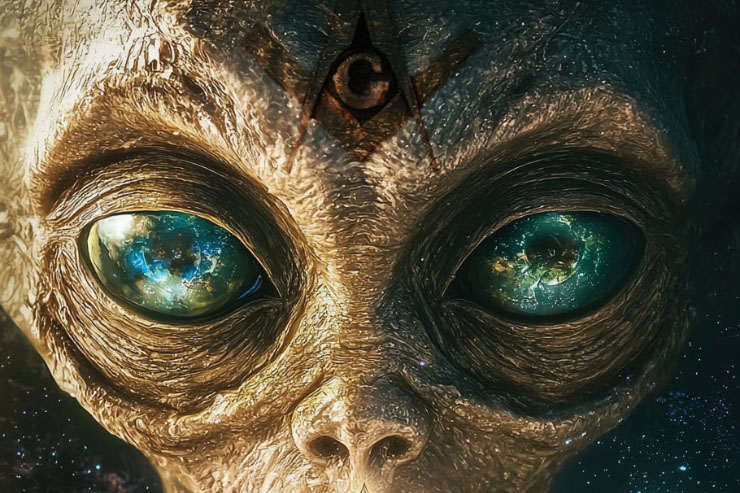
  • Freemasons from Outer Space!

    Freemasons from Outer Space!

    From New Dawn Special Issue Vol 18 No 5 (Oct 2024)

    My interest in the connection between Freemasonry and extraterrestrial encounters dates back to February 17, 1998, when I had a rather vivid and peculiar dream involving a Masonic Lodge, the very same Lodge in which I would eventually be initiated. I should point out that this dream preceded my initiation into Freemasonry by about four years. In fact, when the dream occurred I had no interest in joining Freemasonry or any other fraternal organisation. My knowledge of Freemasonry was limited to a select number of books I had read on the subject while in college and very little else.

    This was the dream:

    I walk into the Masonic Lodge on Cabrillo Avenue in Torrance, a building I have never before entered. I find myself sitting in a waiting room that contains a lot of empty wooden chairs. I look up at the walls. I see a very realistic painting depicting the face of a white owl. I glance back at the empty chairs, then turn to look once more at the painting. Now the white owl has changed. Its face has merged seamlessly with the attributes of an owl and that of an alien Gray as seen on the cover of Whitley Strieber’s 1987 book, Communion. (In 2015 a UFOlogist named Mike Clelland published a book called The Messengers: Owls, Synchronicity and the UFO Abductee, in which Clelland reports that many abductees often first see their abductors in the form of owls, but in 1998 I had no knowledge that anyone believed owls and extraterrestrials were in any way connected.)

    In the dream I am not surprised by this shift. I simply continue staring at the empty chairs. After a while, I glance back at the painting. Now the owl is gone, and the impassive face of a Gray alien has taken its place. At this point, I rise from that uncomfortable little chair in the waiting room, stroll into the hall, and approach a pair of ornate wooden doors above which are carved the words: MASONIC RESEARCH CENTER. I push the doors open and see a vast library of old, rare books on the other side. I very much want to begin reading them all. One particular volume stands out at the bottom of the shelf. I pull out the hefty tome and lift it. In the dim light the title on the cover is unusually clear and is rendered in gothic, golden lettering: THE FREEMASONS & THE GUFFEY CLAN THROUGH THE AGES.
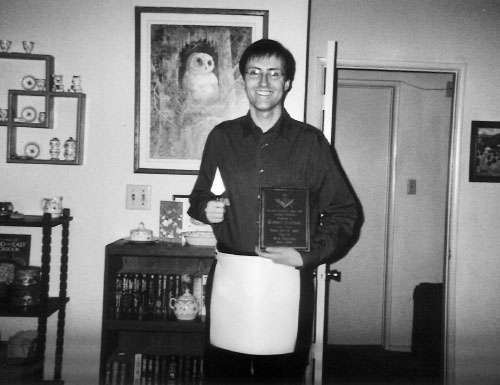
    A  photograph of Robert Guffey taken in July of 2003 only a few hours after he underwent the third degree of Freemasonry. (Author’s note: “Given the subject matter of this article, it’s weirdly appropriate that I’m standing in front of a painting of a white owl. This was not done on purpose. In fact, I didn’t even recall the presence of the owl in the image until I decided to dig up the photo in order to scan it for use in this article.”)

    I don’t get a chance to read the book or even open it. Suddenly, I notice that strange, surreal creatures are wandering around in the musty, dust-speckled aisles. They weave in and out of the crowds of normal-looking humans (all of them elderly men) who are standing in the stacks looking at old books as well. The creatures appear to have emerged from a surrealist painting by the likes of a Max Ernst or a Remedios Varo, some mad visionary with a bent imagination. The creatures become aware of my presence and begin to hone in on me. So I put the book back on the shelf and run.

    I find a staircase and traverse the steps two at a time. I pass the second floor, then the third floor (even though the Masonic Lodge in Torrance only has two floors). I press my palms against a metal door and emerge onto the roof. It’s nighttime. To my surprise, there’s a helipad on the roof. A helicopter, its blades spinning faster and faster, is waiting for me. For a moment I think I’ve escaped the angry creatures in the library. I start moving towards the helicopter, then pause abruptly. An eyeless stone dog stands between me and the helicopter. It’s motionless. I know it doesn’t want me to pass. Its grey, craggy, stone flesh morphs into real skin. The dog (a greyhound) turns bright red. Then it moves towards me, its crimson eyes growing larger and larger. I turn away from the hound and begin to clamber over the side of the roof. Fortunately, in the complete darkness, my palms discover thick hemp ropes down which I climb to the sidewalk below. I’m confident I’ve escaped… and then I wake up.

    This oddly detailed dream, which I jotted down as soon as I awoke, places a picture of an alien in a Masonic antechamber, but the alien’s face is hidden behind a seemingly innocuous portrait that one might find in a waiting room in any doctor’s office in America.

    Seventeen years after this unusual dream, during the summer of 2015, I spent several days camping in San Simeon, not far from Hearst Castle and Piedras Blancas. Hearst Castle, of course, was built by William Randolph Hearst, the main inspiration for Orson Welles’ Citizen Kane (1941), considered by numerous film scholars to be the greatest film ever made. Piedras Blancas was the site of the infamous B-flick, The Monster of Piedras Blancas (1958), which is all about a cryptozoological reptilian beastie that regularly emerges from the Pacific Ocean to behead the locals and feast on their remains when he’s not trying to abduct the lighthouse keeper’s nubile young daughter.

    Perhaps it was the polar opposite extremes of these two cinematic influences that determined my equally schizophrenic reading material for this particular camping trip: Journey to the East by Herman Hesse, an acknowledged classic of Western literature redolent with extremely sophisticated esoteric symbolism, and Flying Saucer Occupants by Coral and Jim Lorenzen, which would appear to the casual observer to be little more than a lurid paperback collecting dubious claims of encounters with alien beings. Indeed, the front cover bears certain similarities to the layouts of supermarket tabloids like the late, lamented Weekly World News: a sensationalistic black and white photo depicting a glowing flying saucer hovering behind an electrical tower is juxtaposed with carnival-barker-style come-ons emblazoned in bold, orange letters:
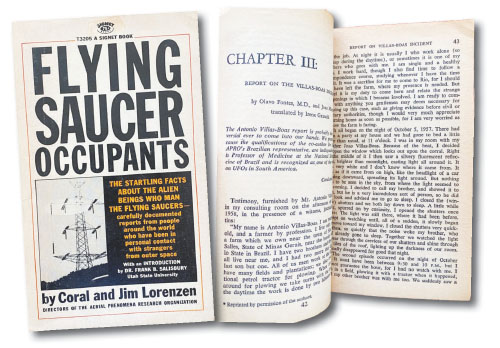
    In July of 1967, when this book was published, most reasonable people glancing at this cover at their local bookstore or newsstand would have immediately dismissed the contents of the book as outlandish trash, not worthy of their time or attention. How many literature professors, intimately familiar with the complex symbolism woven into Herman Hesse’s well-respected novel, would ever have deigned to open a copy of the Lorenzens’ book for even a few seconds? And yet, if this hypothetical literature professor had done so, he or she might have been pleasantly surprised to discover significant overlaps between the two works.

    Hesse’s Journey to the East is steeped in hermetic, Masonic, kabbalistic, and alchemical symbolism. The book is a phantasmagorical allegory about an initiate (a young man named H.H.) in an ages-old secret society known as “The League.” Hesse employs layers upon layers of symbolism to chronicle the man’s physical and psychic journey from ignorance to illumination. Because I’m a 32nd Degree Scottish Rite Freemason, it was not difficult for me to recognise the numerous Masonic symbols embedded in Hesse’s novel. There’s no doubt in my mind that Hesse was a Freemason himself.

    What did surprise me, however, is that such symbolism can also be found in the Lorenzens’ book about alien encounters – though I suspect the Lorenzens were not aware of this symbolism themselves. Such symbolism is not present throughout the book. Indeed, it appears only in a single chapter, Chapter Three, entitled “Report on the Villas-Boas Incident.”

    The main feature of this chapter is an extensive scientific report regarding the first alien abduction investigation in modern history, now generally known as “the Villas-Boas Incident.” The report was written in 1958 by Dr. Olavo Fontes, at the time a Professor of Medicine at the National School of Medicine of Brazil, and a journalist named Joao Martins. The Antonio Villas-Boas case predates the far more famous 1961 Betty and Barney Hill abduction, the subject of a bestselling book entitled The Interrupted Journey by John G. Fuller. Fuller’s book became the basis for Richard A. Colla’s 1975 made-for-TV-movie The UFO Incident starring James Earl Jones and Estelle Parsons. The Villas-Boas case never quite received the same amount of attention as the Hill abduction, perhaps because it did not occur in the United States.

    Villas-Boas was a twenty-three-year-old Brazilian farmer whose life abruptly turned upside down at 1:00 A.M. on Wednesday, October 16, 1957, when a metallic, oval-shaped object descended from the sky and landed in the very same soil Villas-Boas was in the process of tilling with the help of his family’s tractor. Nonhumans emerged from the craft, abducted Villas-Boas, and dragged him into the ship where they took blood samples from his chin, then forced him to have sex (twice) with a nude, humanoid blonde who certainly did not appear to be from Earth.

    As I read the details of this encounter, I recalled a passage from Dr. Jacques Vallee’s 1988 book Dimensions: A Casebook of Alien Contact, in which Vallee commented that many of the most confusing and absurd details associated with the testimonies of alien contactees sometimes reminded him of the seemingly inexplicable initiation rites practised by secret societies throughout the ages:

    Is this confusion technique deliberately used to effect change on a major scale? Answering such questions could also help us to understand the strong resemblance that anyone who has examined the beliefs of esoteric groups could not fail to note between certain UFO encounters and the initiation rituals of secret societies. This “opening of the mind” to a new set of symbols that is reported by many witnesses is precisely what the various occult traditions also try to achieve.
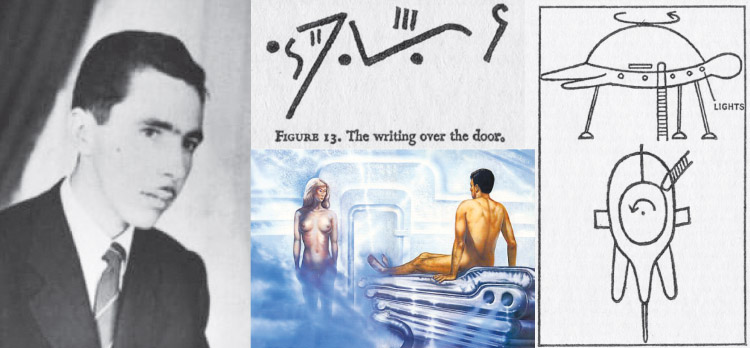
    Antonio Villas-Boas was a twenty-three-year-old Brazilian farmer whose life abruptly turned upside down in 1957 when he was abducted by strange beings and forced to have sex with a humanoid blonde. In the case report, Villas-Boas described the craft as metallic and oval-shaped and also recalled the etching over its door.

    The Initiation of Antonio Villas-Boas

    Many of the details reported by Villas-Boas mirror Masonic initiation rites. From an esoteric perspective, Villas-Boas’ name itself is of considerable interest. Names (both proper and place names) have always been intertwined with esoteric Fortean phenomena. For example, the late James Shelby Downard has written extensively about the connections between hermeticism and toponymy, or the study of place names, in such essays as “The Call to Chaos: From Adam to Atom By Way of the Jornada del Muerto” and “Sorcery, Sex, Assassination and the Science of Symbolism.” Loren Coleman, in his 1983 book Mysterious America, calls this line of research “the Name Game”:

    As you travel about in this Mysterious America, be it on your way to work or play, or to some vacation destination, you pass many streets, or transit many towns with names we all have come to take for granted. How often have we paused to think about the meaning behind the names? Was the word of some special significance? Was this location named for a person, another place or an event? And if it was named for a person, what did their name originally mean? And who and why was it tacked on to this place? Are there some harmonic insights we can gain from looking a little deeper? Why do some places or even people seem to be the focus of inexplicable events while others are the host of more mundane incidents?

    In Chapter 3, I have discussed devils’ names and Fortean places. The fact that some areas had strange and weird vibrations or events connected to them gave native Americans and later settlers enough evidence to actually label these locales after the Ruler of Hell. In America, the use of the name “devil” regarding certain geographical fixtures, therefore, gives some indication of a history of mystery surrounding these spots.

    There is indeed a power in place names that can be traced back much farther than the arrival of the Europeans in North America. Other researchers have noted the undeniable significance of this power. Former police officer David Paulides, author of the Missing 411 series of books regarding a slew of mysterious disappearances in our National Forests, recently commented on this Name Game himself while being interviewed about his 2014 book, Missing 411—The Devil’s in the Detail:

    The word “devil” and other names that have negative connotations seem to come up with disappearances an abnormal amount of time, as this “Devils Nest” [in the Rocky Mountains] did, as in the name The Devil’s in the Detail, this latest book. So that title has double meanings, meaning that the “devil” name is used a lot in locations where these people disappear […] and the detail is important. If we could really know why [these locations] were named that way, that would be fascinating.

    Related to toponymy is anthroponomastics, or the study of proper names. Charles Fort, the father of paranormal research, commented on anthroponomastics several times throughout his four books. For example:

    In the New York Herald, Nov. 26, 1911, there is an account of the hanging of three men for the murder of Sir Edmund Berry Godfrey on Greenberry Hill, London. The names of the murderers were Green, Berry, and Hill. It does seem that this was only a matter of chance. Still, it may have been no coincidence, but a savage pun mixed with murder…

    There is a view by which it can be shown, or more or less demonstrated, that there never has been a coincidence. That is, in anything like a final sense. By a coincidence is meant a false appearance, or suggestion, of relations among circumstances. But anybody who accepts that there is an underlying oneness of all things accepts that there are no utter absences of relations among circumstances – or that there are no coincidences, in the sense that there are no real discords in either colours or musical notes…
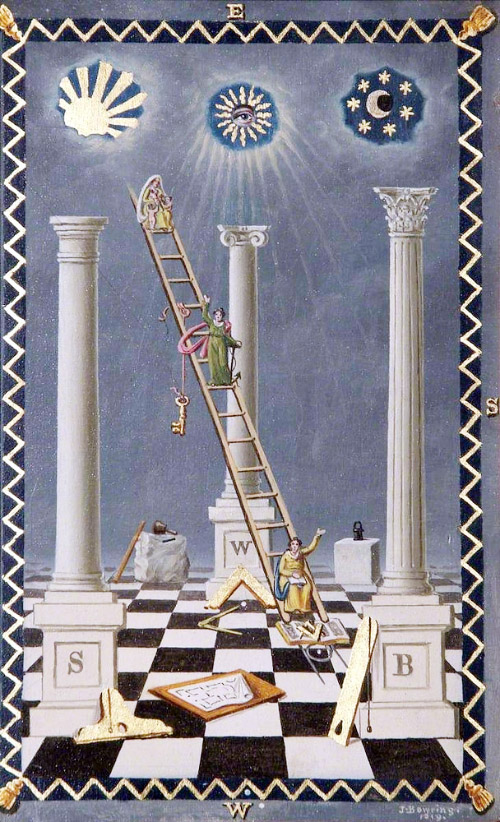
    This diagram is replete with Masonic symbolism including the two pillars of Boaz and Jachin, along with lesser known third pillar.

    The name “Villas-Boas” is loaded with such coincidental/non-coincidental Masonic significance. In every Masonic Lodge stands two pillars: Boaz and Jachin. According to Albert Pike, who designed the thirty higher degrees of Scottish Rite Masonry as they are performed today, “Unity is Boaz, and the Binary is Jachin. The two columns, Boaz and Jachin, explain in the Kabalah all the mysteries of natural, political, and religious antagonism.” According to scientist Richard Schowengerdt, a 33rd Degree Scottish Rite Freemason, Boaz and Jachin “are the twin pillars of equilibrium.” Unity is Boaz. Boaz is unity. And what could be more symbolic of “unity” than people from two different worlds bonding together in sexual union in order to produce offspring, which is what ostensibly occurred aboard an interplanetary spacecraft in Brazil in 1958, according to the testimony of Villas-Boas.

    Of course, Boas’ is only the first of many similar reports that will follow throughout the decades. In Latin, the word “villas” translates as “houses.” Therefore, his name might be translated as “Houses of Unity.” This is exactly what Masonic Lodges were intended to be from their very inception – temporary autonomous zones where members of various religions, cultures and social classes could unite under a single banner, i.e., the melding of various “worlds” into one.

    It’s interesting to note that Villas-Boas’ encounter occurred in the early morning hours of October 16, 1957, less than two weeks after the launch of the first artificial Earth satellite, Sputnik 1. Symbolically, Sputnik pierced the veil between worlds, initiating the slow deterioration of the artificial boundaries between nations, a natural evolution of the universalist philosophies of Freemasonry.

    As if on purpose, Masonic symbolism is woven throughout Villas-Boas’ encounter. After initially being pursued by a lone five-foot-tall humanoid wearing gray overalls and a helmet, Villas-Boas is subsequently attacked by “three men” who proceed to subdue him. This mirrors the third degree initiation in which the candidate is attacked by “three ruffians” who use violence in an attempt to wrest a sacred object from the initiate. As even the most casual student of Freemasonry knows, the number three recurs throughout the various degrees of Masonry. As I wrote in my first book, Cryptoscatology: Conspiracy Theory As Art Form:

    [N]ot only are there three original Grand Masters, three assassins, and a total of thirty-three degrees of the Masonic hierarchy, but there are also three Principal officers, three symbolic steps […], three obligations, three lights upon the Altar, three “pillars” that support the Lodge, and three knocks that gain the candidate admission into the Lodge, followed by three more knocks to summon the Brethren.

    The number three recurs throughout Villas-Boas’ tale as well. Not only is he attacked by the aforementioned three humanoids, but at one point he mentions that the “weird men” were wearing “three-cornered” metal plates on their helmets, from the forehead of which “sprouted three round silvery metal tubes.” What appears to be a clock inside the craft keeps time in three-hour increments: “There was a hand on it and a black mark that corresponded to our 6 o’clock. Other markings of the same kind were to be seen where our 9 o’clock and 3 o’clock stand.” He also mentions “three metal poles” affixed to a windowless room in the craft (just as a Lodge room has no windows). These “poles” must have been important as one of the humanoid men points at them as if wanting Villas-Boas to take special note of them. Villas-Boas describes them as appearing to be “on fire” even though he can’t “feel any warmth coming from them.” These “poles” are analogous to the three pillars of Freemasonry. Beyond Jachin and Boaz, there is indeed a third pillar. Richard Schowengerdt has said:

    [T]here’s a third pillar which is not mentioned in Masonry much but it’s alluded to when they talk about the three lights of Masonry – the Master, Senior Warden, and Junior Warden – that the central pillar is the Master who harmonises these two streams of the two pillars. Wisdom, Strength, and Beauty. And […] the Master is considered to be Beauty, in the centre, and there’s Strength and Wisdom, the other two poles.

    Not only does Villas-Boas mention “three legs” of a tripod that hold up the craft many times throughout his account, but he goes out of his way to stress that sleep eluded him for several days after his encounter; not until “the third night” did sleep return.

    Villas-Boas describes being guided up “a ladder” that leads him to his experiences with the people of the stars or the heavens; the path of the Masonic initiate has been illustrated in this way, symbolically, for centuries. (See William Steven Burkle’s essay “The Masonic Ladder and the Great Chain of Being,” available at Freemasons-freemasonry.com, for more information about the esoteric symbolism of the Masonic Ladder.)

    Villas-Boas describes his arms being “held fast by two of the men,” which is what occurs in the third degree. The ruffians undress him, which also happens in the third degree, then “make signs” at him.
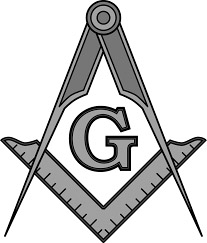
    The Masonic square and compass.

    Even more important than the ladder in Freemasonry is the “square.” The central symbol of Freemasonry has always been the square and compass. The question, “Are you on the square?” became a surreptitious method of asking a stranger if he was a fellow Freemason. Of course, over time, this eventually filtered down into popular slang as the question “Are you being square with me?” (i.e., “Are you being honest with me?”). Villas-Boas mentions squares throughout his account. Not only is he led into a “small square room” by the three ruffians, but he also notes “many little square lamps fitted into the border where the walls met and circling it entirely.”

    The core of the ship is described as an egg-shaped oval bordered on either side by two small, square rooms. The outside of the craft itself is described as an egg held up by three poles or pillars. The egg symbolism is suggestive on several different levels, as Villas-Boas’ entire purpose for being taken aboard the craft is to fertilise the eggs of the female entity with whom he is compelled to have sexual relations. As Albert Pike notes in his influential Masonic book, Morals and Dogma, the letter “G” circumscribed by the square and compass, a symbol found in every Masonic Lodge, is representative of “the generative principle,” i.e., the act of sexual union, the ultimate symbol of “unity” or balancing “the cosmic she and he,” which was the principle goal of the ancient kabbalistic alchemists.

    The symbolism continues as the three ruffians extract DNA samples from Villas-Boas and collect his blood in a “chalice-shaped vessel.” A blood-filled chalice immediately evokes images of the Holy Grail, which has been tied into Masonic lore in such popular books as Holy Blood, Holy Grail by Michael Baigent, Richard Leigh and Henry Lincoln. These three authors believe that “the Holy Grail” is symbolic of a particular bloodline, not a physical chalice. Was Villas-Boas chosen at random by these beings, or was there something about his bloodline – his heritage, his DNA – that made him an ideal candidate for this ritualistic ceremony to balance “the cosmic she and he”?

    As in any mind-expanding ritual, Villas-Boas’ body undergoes extreme stress before the moment of illumination. After being exposed to some kind of strange-smelling smoke, Villas-Boas vomits. In The Teachings of Don Juan: A Yaqui Way of Knowledge, Carlos Castaneda reports that “an effortless sensation of vomiting without the contraction of the diaphragm” preceded his own initial mystical experience induced by the consumption of the sacred peyote plant. This experience is quite similar to the age-old folktales of a hapless villager being abducted by fairies and dragged down into subterranean caverns where the human is given strange-tasting pieces of bread or cake imbued with an otherworldly aroma that causes the abductee to undergo a mind-altering experience and fall asleep for many years, as happens to the title character of Washington Irving’s classic 1819 short story, “Rip Van Winkle.” The connection couldn’t be clearer when Villas-Boas mentions that the shoes of his abductors look “like those described in the fairy tales of old.”
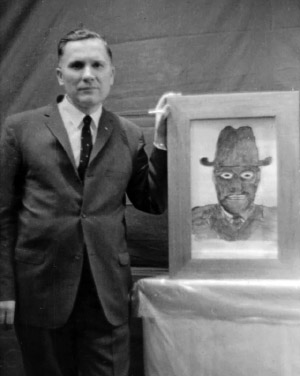
    Albert K. Bender and a drawing of the Man in Black.

    It’s also worth noting that one of the three ruffians “spread a liquid all over” his skin with an object “that looked like a wet sponge.” The liquid “was clear as water but much thicker and odourless,” which parallels the story Albert K. Bender tells in his 1962 book Flying Saucers and the Three Men. Since his tale was first released, Bender’s account of being abducted by a trio of otherworldly “men in black” has filtered into mass consciousness via a steady stream of blockbuster films, TV shows, cartoons, and science fiction novels. Before the “men in black” became a household phrase, it was known only to a select group of UFOlogists familiar with Bender’s odd tale. Bender insisted three extraterrestrial beings dressed in black materialised in his bedroom, then whisked him away to a subterranean laboratory beneath Antarctica where, with “great efficiency,” “[t]hree beautiful women, dressed in tight white uniforms”:

    …removed every stitch of clothing, leaving me naked as the day I was born. For a moment all three of them stood there, looking at my body, but I believe the motive was not one of curiosity – they probably were checking to see if they missed anything, for one of them then removed my watch.

    Two of them remained beside me as the other walked into the shadows and returned with a metal vial containing a liquid which they poured over my body. Then the three massaged the liquid into my skin. As they did so my body became warm as if heat were being applied. They massaged every part of my body without exception, turning me over on my stomach and my sides. They expressed no emotion, neither that of revulsion nor enjoyment, as they carried out the matter.

    Villas-Boas’ claims about being similarly anointed by three supernal beings was reported to Fontes and Martins in February 1958 but did not appear in print until the publication of the June 1962 issue of a Brazilian UFO periodical entitled SBESDV Bulletin, by which point Bender’s book would already have been written, if not published. Villas-Boas’ story wasn’t widely reported in the United States until the release of the Lorenzens’ aforementioned 1967 book, Flying Saucer Occupants.

    Consider the significance of such peculiar recurring details, and not just the ritualistic baptism in water – which is described by both Bender and Villas-Boas in such a blatantly sexual context that the whole ceremony comes off as a surreal distortion of the Catholic sacrament, or perhaps a return to the sacrament’s original source, as Masonic scholar C.W. Leadbeater claims the Catholic baptism has its roots in the Ancient Mysteries from which Masonry itself emerged – but also the Masonic recurrence of the number three. What are the chances of these details overlapping between two different reports from two very different people dwelling in two separate countries? Also worthy of note is the fact that Bender claims his abduction occurred in 1953, four years before Villas-Boas’ encounter.

    Reopening the Investigation
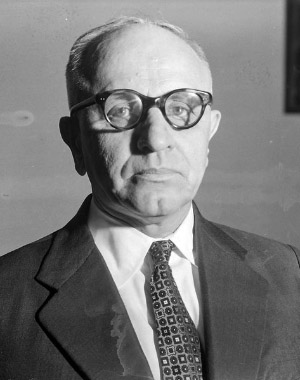
    Antonio Villas-Boas, who was a lawyer later in his life, died in 1991.

    In 2000, almost ten years after Villas-Boas’ death in 1991 at the relatively young age of fifty-two, UFOlogist Pablo Villarrubia Mauso reopened the investigation into Villas-Boas’ abduction and uncovered fascinating information never reported by the Lorenzens in Flying Saucer Occupants or elsewhere. Mauso went to the trouble of visiting the original landing site in Brazil and interviewed Villas-Boas’ nephew, Joao Francisco de Queiroz, who informed Mauso that the scene of Villas-Boas’ abduction had been a nexus for paranormal phenomena as long as the local inhabitants could remember:

    “During the night, right there at Hacienda Aldeia o Mata [the phrase ‘Aldeia o Mata’ translates roughly from Portuguese as ‘Village in the Woods’], we would all listen in terror to the sound of a hand beating the handle of a large corn-grinding mortar inside a shack. When we went to check, there was no one around and the handle remained tied, suspended, and the mortar’s opening was covered by a large clay urn.” And there was more. Joao Queiroz also said that they could hear the sound of a galloping horse that couldn’t be seen, while the farm hands told stories of a “black-hooded phantom horseman” […]. We returned to Queiroz’s house. His wife, Maria Olimpia, told us that her husband’s parents had committed suicide in 1947 and that the local peasants attributed the tragedy to the fact that the area was bewitched.

    Even more intriguing, perhaps, is the fact that Villas-Boas was abducted more than once – the second time by members of official government agencies in the United States. According to Villas-Boas’ seventy-year-old sister, Odercia Villas-Boas, soon after telling his story to Dr. Olavo Fontes and Joao Martins, Antonio received a visit from “five men dressed in green uniforms” who compelled him to travel with them to the United States:

    “Some [of these men] spoke Portuguese; others English. I think they were from NASA. They kept visiting several times over eight or ten years. […]. He was subjected to questioning and the lie detector in California. He was taken to an open area where the remains of a flying saucer could be found. They then showed him another, in good condition, inside an enclosed area like a museum, asking him if it was identical to the one he had seen. He told me that it was very similar. He was always accompanied by a journalist who had a foreign name and acted as an interpreter, and was always surrounded by uniformed American personnel.”

    “He was in the United States for three days,” Odercia told us. “They later gave him two properties near San Francisco and San Rafael. I managed to see the deeds. They sent him back to Rio, where he spent between fifteen and twenty days in a hospital, undergoing new examinations and tests. This affected him greatly, it seems. According to the medical report, Antonio was in excellent mental health and not crazy.”

    Did US authorities try to purchase Antonio’s silence by giving him properties in California? Why was he not allowed to speak publicly?

    Even if the general scientific community did not take Villa-Boas’ story seriously, it seems that someone in a position of authority was taking it quite seriously indeed. The reason I myself took Villa-Boas’ story seriously when I first encountered it is because I recognised the obvious Masonic symbolism contained within it. It’s more than possible that certain initiated individuals in the corridors of power had a similar reaction back in the late 1950s and responded accordingly.
    Get the issue this article appears in

    Freemasonry & Extraterrestrial Encounters

    In 2003, between undergoing the first and second degrees of Freemasonry in the very same building that featured so prominently in my February 17, 1998 dream, a fellow initiate lent me a book entitled At the Sign of the Square and Compasses by Freemason Geoffrey Hodson that also seems to connect Masonic rituals with the manifestation of entities just as diminutive as the extraterrestrials described by so many abductees. In Section 3 of the book, “The Lesser Mysteries Continue to be Enacted,” Hodson describes – in a rather nonchalant manner – how “little people” or “gnomes” would sometimes appear in his Lodge during the enactment of the initiatory degrees:

    If the [Junior Deacon] does not command [the] respect [of these little people], they will laugh and mimick him and the candidate. In fact the gnomes are amused by most of the ceremony, except at those times when its force arrests them, when they become serious for the time being. The gnomes play about the temple floor, march with grotesque and absurd mimicry behind the procession, and follow the journeys, thoroughly enjoying themselves all the time and really getting much fun out of the ceremony. They are a superior kind of gnome – in a way probably representatives of their race, sent by their superiors in that capacity…

    These gnomes might be called “ceremonial” gnomes. They are dressed in an imitation of our [Masonic] clothes, generally in bright colours, vivid red and green being the most common… The same is true of apron, collar, and jewels, which they assume on occasion. Apparently some of these little people stay in the temple, as I have noticed them, before the ceremony starts, and frequently join the procession on entrance, following the [Rightful Worshipful Master] through the two lines of officers – sometimes with a R.W.M. of their own, with [Deacons] and staff complete…

    I have not usually noticed more than three gnomes at a time in the temple, though there may be more…

    It could be significant that Hodson often noticed the “little people” appearing in the Lodge in groups of three. If we extend this line of thinking further, it might be equally significant that Whitley Strieber, the aforementioned author of Communion, has discussed the importance of the number three in his own otherworldly encounters. According to Peter Levenda, author of Sinister Forces: A Grimoire of American Political Witchcraft, Strieber has often spoken of:

    […] hearing “nine knocks” associated with visits by his alien stalkers […]. The “nine knocks” of Whitley Strieber’s experience is related both in Transformation and in his later book, Breakthrough. They took place on the evening of August 27, 1986 while he was at his upstate New York cabin. There was a definite series of three distinct sets of three knocks, for a total of nine knocks, coming from a corner of the ceiling. Strieber seemed to understand this as an invitation to go outside and meet “the visitors”… an invitation he declined, from fear. His cats also reacted in terror, staring at the spot the knocks came from.

    Then, as he relates in Breakthrough, exactly eighteen months to the day from his experience of nine knocks, an entire town – Glenrock, Wyoming – was awakened at 2:45 A.M. on February 27, 1988 by the same phenomenon: nine knocks in three groups of three on the sides of their houses, their cars, their doors. This was related in the local newspaper, but no one ever discovered the cause of this bizarre event.

    And when Strieber wrote The Secret School in 1997, it contained nine “lessons” divided into three “triads.”

    Rocket engineer Jack Parsons, co-founder of the Jet Propulsion Laboratory, claimed to have communed with an alien being in the Mojave Desert in February of 1945; significantly, this close encounter was followed by mysterious knocks that arrived in three sets of three on January 10, 1946 while Parsons performed magic rituals in his home in Pasadena.

    What could be the significance of frequently discredited, dubious phenomena like UFO sightings and alien encounters being in some way connected to Masonic symbolism that dates back to antiquity? Why would superior beings from lightyears away feel the need to mimic esoteric rituals enacted for centuries by Freemasons and other related secret societies? Of course, it could be that these are the wrong questions. Perhaps these “superior beings” aren’t mimicking anything at all of human origin. Perhaps the Freemasons are mimicking them. Perhaps these beings are the source of the symbolism in the first place.

    Consider this passage from Anthony Roberts and Geoff Gilbertson’s little-known 1980 book, The Dark Gods:
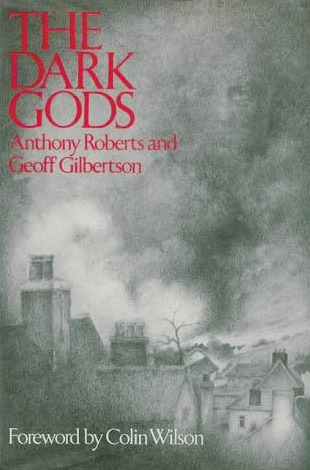
    A bold acknowledgement of the supernatural, ultraterrestrial element at the roots of Masonry was made by a certain Dr. George Oliver, writing in 1823. Dr. Oliver was a historian of the masonic tradition and he openly recognised that the inner secrets of Masonry were not only confined to this planet. He wrote: “The ancient masonic tradition – and I have good reasons for believing this – says that our secret science existed before the creation of this globe and that it was widespread throughout other solar systems.” The “good reasons” that Dr. Oliver professed stemmed from the archives of the masonic order to which he belonged.

    Therefore, the speculations laid out here regarding the connections between Masonic symbolism and alleged extraterrestrial encounters are not at all new; in fact, they date back almost two hundred years, if not more.

    It might be worthwhile for dedicated UFOlogists to revisit classic abduction reports aside from that of Antonio Villas-Boas and see if such blatant Masonic symbolism appears in those cases as well. This could very well be the key to unlocking essential aspects of what has come to be known as the alien abduction phenomenon. 

    [alert type=”general” dismiss=”no”]This article was published in New Dawn Special Issue Vol 18 No 5.[/alert]

    [alert type=”success” dismiss=”no”]If you appreciate this article, please consider subscribing to help maintain this website.[/alert]

    Footnotes

    1. Robert Guffey, “Dream (2-17-98),” Black Book Vol. 1 (n.p.), p. 43.
    2. It’s worth noting that this abduction occurred on a Wednesday. According to Chapter One of John Keel’s 1970 book UFOs: Operation Trojan Horse (see pp. 19-20), most UFO sightings occur on Wednesday: “If the UFO phenomenon had a purely psychological basis, then there should be more sightings on Saturday night when more people are out of doors, traveling to and from entertainments, etc. Instead we find that the greatest number of sightings are reported on Wednesday, and then they slowly taper off through the rest of the week. The lowest numbers occur on Tuesday […]. This does not mean that flying saucers are out in force every Wednesday night. But when there is a large flap, it nearly always takes place on Wednesday.”
    3. Jacques Vallee, Dimensions: A Casebook of Alien Contact (Chicago: Contemporary Books, 1988), p. 188.
    4. Loren Coleman, Mysterious America (Winchester, MA: Faber & Faber, 1983), p. 235.
    5. “David Paulides Missing 411 Devil’s in the Details Part 1 of 2—December 13, 2014,” YouTube.com (accessed 20 Jan. 2018).
    6. Charles Fort, The Books of Charles Fort (New York: Henry Holt, 1957 [1941]), pp. 848-50.
    7. Albert Pike, Morals and Dogma (Richmond: L.H. Jenkins, 1956 [1871]), p. 772.
    8. Robert Guffey, “Rosicrucianism, Freemasonry, and Esoteric Science,” Nexus Vol. 23, No. 4 (June/July 2016), p. 41.
    9. Coral and Jim Lorenzen, Flying Saucer Occupants (New York: Signet Books, 1967), p. 46.
    10. Robert Guffey, Cryptoscatology: Conspiracy Theory as Art Form (Walterville, OR: TrineDay, 2012), p. 172.
    11. Lorenzen, Flying Saucer Occupants, p. 51.
    12. Ibid. p. 55.
    13. Ibid. p. 57.
    14. Guffey, “Rosicrucianism, Freemasonry, and Esoteric Science,” p. 41.
    15. Lorenzen, Flying Saucer Occupants, p. 59.
    16. Ibid. p. 67.
    17. Ibid. p. 49.
    18. Ibid. p. 47.
    19. Pike, Morals and Dogma, p. 632.
    20. James Shelby Downard, “The Call to Chaos,” in Adam Parfrey (ed.), Apocalypse Culture: Expanded & Revised Edition (Portland: Feral House, 1990), p. 309.
    21. Lorenzen, Flying Saucer Occupants, p. 50.
    22. Carlos Castaneda, The Teachings of Don Juan: A Yaqui Way of Knowledge (New York: Pocket Books, 1975 [1968]), p. 40.
    23. Lorenzen, Flying Saucer Occupants, p. 52.
    24. Ibid. p. 49.
    25. Albert K. Bender, Flying Saucers and the Three Men (Clarksburg: Saucerian Books, 1962), pp. 153-55.
    26. C.W. Leadbeater, Ancient Mystic Rites (Wheaton, IL: The Theosophical Publishing House, 1986 [1926]), p. 32.
    27. Pablo Villarrubia Mauso, “Antonio Villas-Boas: Total Abduction,” Inexplicata: The Journal of Hispanic Ufology, Inexplicata.blogspot.com, November 5, 2007 (accessed 20 Jan. 2019).
    28. Ibid.
    29. Geoffrey Hodson, At the Sign of the Square and Compasses (Madras, India: Vasantra Press, 1976), pp. 66-67.
    30. John A. Keel would definitely want me to mention that August 27, 1986 was a Wednesday.
    31. Peter Levenda, Sinister Forces Book Three: The Manson Secret (Walterville, OR: TrineDay, 2006), pp. 273-74.
    32. Jacques Vallee, Messengers of Deception: UFO Contacts and Cults (Brisbane, Australia: Daily Grail Publishing, 2008 [1979]), p. 12.
    33. John Carter, Sex and Rockets: The Occult World of Jack Parsons (Port Townsend, WA: Feral House, 2004 [1999]), p. 126.
    34. Anthony Roberts and Geoff Gilbertson, The Dark Gods (London: Panther Books, 1985 [1980]), p. 235.

    © New Dawn Magazine and the respective author.
    For our reproduction notice, click here.
  • The Illusion of Control: The Priory of Sion & the Illuminati

    The Illusion of Control: The Priory of Sion & the Illuminati

    From New Dawn Special Issue 2 (May 2006)

    This whole secret society business is a slippery one. What is a secret society? How far back do they go? Human beings have been forming exclusive clubs ever since the first moment they developed enough intelligence to distinguish differences among their fellow human beings. Women had their own club, the warriors had another, and the priests still another.

    In ancient Egypt the simple act of reading was considered sacred knowledge, meant only for the priest caste. Not even the Pharaoh knew how to read. Imagine the leader of an entire country being dependent on a small sect lurking behind the scenes in order to enact even the simplest of proclamations. How would such a country ever survive?

    Perhaps this is what poet T.S. Eliot meant when he wrote in 1936, “You have to consider that any esoteric occult ritual is today socially acted out by the daily publishing and consuming of newspapers.” The simple act of reading would have been considered a magical ritual to the “uninitiated” of ancient Egypt. Therefore, merely by reading these words, you can consider yourself part of the original Inner Circle. How does it feel to be illuminated?

    It always serves the purpose of the Inner Circle to keep as much knowledge away from the profane as humanly possible. If you’re dependent on me to interpret the holiest of sacred texts, then my job security is quite higher than it would be otherwise, isn’t it? The job of any priest caste is to convince the underlings that God (i.e., the Mysteries) is accessible only through them.

    For example, Jesus was not officially made divine until the Council of Nicea voted on the issue in 325 CE.1 Amusingly, Jesus almost lost out on this, the Heavyweight Championship Title of the Cosmos, by only a few votes. It was necessary to transform Jesus into the Son of God because the Church wished to maintain control over the image of Godhood in the minds of the masses.

    If Jesus isn’t divine, why do people need to flock to our Church leaders who act as a direct conduit to Him? No one goes to Church every Sunday to talk to Gandhi, no matter how many great deeds he performed in his lifetime. Nobody ever sees Gandhi in a tortilla or on a billboard on the side of the freeway. Such devotion does not exist for kind-hearted philanthropists like Martin Luther King or Mother Teresa. No, the only game in town is divinity, and if you don’t have that you don’t have a Church, and if you don’t have a Church you don’t have parishioners, and if you don’t have parishioners you don’t have money flowing into the coffers of the Vatican on a daily basis. Simply put, the Council of Nicea had to trademark the image of God, and the only way to do it was to make Jesus “theirs,” to make him divine. Those who dared to remove the thin veil of divinity from Jesus, particularly in the fourteenth century, were burned at the stake.

    Unfortunately for the Church, the Gnostics and the Knights Templar were doing just that. Both organisations could be considered remnants of the Essenes, a hermetic secret society of Jews who flourished in Palestine from the second century BCE to the first century CE. Questioning the divinity of Jesus is one of the main reasons these “secret societies” were considered to be so dangerous. This is what forced them to go underground and develop secret signs and handshakes in order to pursue the rigours of genuine knowledge as opposed to the dogma of religious belief.

    The significance of the Essenes’ philosophy is a central teaching embedded in the Rose Croix degrees of Scottish Rite Freemasonry, particularly the 17th degree. In his encyclopedic book Morals and Dogma, which concerns itself with the esoteric roots of Freemasonry, Albert Pike writes extensively about the Essenes and their connection to Jesus. Pike believed that Jesus himself was an initiate of the Essenes.

    Thus, we see the need for secret societies emerge from two different impulses: one group feels the need to control, while the other feels the need to defend themselves against control. The Hegelian dialectic as warfare between opposing human impulses… between opposing secret societies. Fortunately, as William Burroughs once said, “Control is controlled by its need to control.”2 Some people need to feel as if they are in control every second of the day; this requires knowing what other people are doing at all times instead of tending to their own business. But if one is clever enough, it’s not difficult to control the controllers while allowing them to maintain the illusion they’re still calling the shots.

    Knowing the enemy is on your trail, it’s sometimes necessary to create false fronts – red herrings, as it were – to keep the controllers off-balance and confused. When a lizard knows it’s being pursued by a predator, it will often shed its tail in order to distract its would-be killer. The predator will waste time pouncing on the tail; meanwhile, the lizard is scurrying off into the underbrush, where it can recoup and wait to reemerge, far stronger than before.

    The same is true of secret societies. It’s sometimes necessary to create faux secret societies in order to capture the public’s attention, while the real important deeds are being performed in the shadows. What’s the use of a secret society even your mother is fully aware of?

    Most mainstream Americans – indeed, mainstream citizens of any country – would be amazed at how many obscure secret societies are operating under their noses at all times. Some of these societies are insignificant, others quite powerful. From their names alone, most people wouldn’t be able to separate the wheat from the chaff. For example, have you ever heard of The Royal Order of the Jesters? How about The Mystic Order of the Veiled Prophets of the Enchanted Realm? Or the Order of the Trapezoid? Or the Royal Order of Quetzalcoatl?

    By now, almost everybody has heard at least a whisper of such secret societies as the Priory of Sion and the Illuminati. They were real organisations, that much is certain, but in both cases their actual influence was very short-lived.

    The Priory of Sion

    As anybody who has read the best selling novel The Da Vinci Code already knows, the Priory of Sion is said to be an ancient secret society that has controlled world affairs for centuries. In truth, the man who started the Priory of Sion in 1956 was a rightwing confidence man named Pierre Plantard who was eventually imprisoned over allegations concerning fraud, embezzlement, and child corruption. His reputation as a charlatan was established early on. A French police report in 1941 states:

    Plantard, who boasts of being in contact with numerous men of politics, appears to be one of those illumines and pretentious young people, heads of more or less fictitious groups, wanting to give themselves importance and who take advantage of the current movement in favour of youth to attempt to get themselves taken into consideration by the government.3

    Plantard loved to weave tall tales about the Priory, boasting an impressive list of Grand Masters that stretched all the way back to the fourteenth century, perhaps even earlier. Alchemists like Nicolas Flamel and Robert Fludd, scientists like Leonardo da Vinci and Isaac Newton, and accomplished novelists like Victor Hugo and Jean Cocteau, were all High Muckety-Mucks at one point or another, according to the good Monsieur Plantard.

    Plantard even claimed the Priory of Sion linked back to the Knights Templar and the Crusades. The Priory, however, is actually far younger. Researchers Lynn Picknett and Clive Prince determined that although the Priory “was established in 1956, it draws almost exclusively on late-nineteenth-century material for its history and folklore, suggesting that whoever the shadowy figures were behind Plantard and the Priory, they belonged to that era.”4 After a great deal of detective work, Picknett and Prince determined that a group of French synarchists were the true architects of the Priory of Sion myth.

    The concept of synarchy was developed in the late nineteenth century by Joseph Alexandre Saint-Yves as a response to the anarchist movement so prevalent in Europe at that time:

    Saint-Yves’s concept of synarchy was essentially a reaction to the rise of anarchy and therefore its opposite – a highly ordered method of government based on what he believed were universal laws and principles. Everything and everybody has its place and purpose; harmony is achieved by keeping to that place and fulfilling that purpose, whereas any circumvention of those natural laws leads to disaster. Everyone has to remain in his or her allotted station in life. (Papus likened the individual’s relationship to a nation or race to the cells’ relationship to the body. As each was preordained to fulfil a specific function, attempting to do anything else would only cause problems for both the individual and the organism as a whole.)

    His works outlined an ambitious, visionary program for establishing synarchy in France and beyond. Each state must be highly organised at every level, with everyone in his or her own specific place; otherwise anarchy would triumph. Challenging one’s status would not be tolerated.5

    Picknett and Prince choose to believe the synarchist influence, and therefore the Priory influence, has been influential to this very day in forging a European Union.

    Though Picknett and Prince both admit the Priory story is a hoax, they suspect it is a hoax “in the same way that intelligence deceptions are hoaxes.”6 They believe the Priory is a mask the synarchists have worn over the years for various reasons. In 1956 the purpose was to act “as a front for groups plotting Charles de Gaulle’s return to power […]. Later, in the 1960s, it was revived with a new purpose, a misinformation exercise” that popularised the myth of an existing bloodline of Jesus Christ for the purpose of diverting “other esoteric groups from seeking out certain archives.”7

    The truth of Picknett and Prince’s theories is impossible to know; some simply do not wish to know. For many people, the truth does not matter. After all, the theories of Picknett and Prince were colourful enough to pique the imagination of Dan Brown, who based his novel The Da Vinci Code, in part, on their 1997 book The Templar Revelation: Secret Guardians of the True Identity of Christ.

    Dan Brown and Plantard are very similar in some ways. Brown, like Plantard, has a vivid imagination and a gift for telling an exciting tale. Plantard, like Brown, employed almost every significant historical figure and esoteric organisation, such as the Knights Templar, in order to make his myth seem palatable. But if Plantard was right, that the Priory links all the way back to the Knights Templar, the connection is a tenuous one. The two organisations are as much connected as a severed tail is to a panicked lizard.

    The Illuminati

    The same can be said of the Illuminati, a secret society formed in Germany by the dean of the faculty of law at Ingolstadt University on May 1, 1776. According to Masonic historian Manly P. Hall, Weishaupt’s secret society sprang out of the academic setting in which he worked every day: “There can be no doubt that Adam Weishaupt found himself in the midst of scholastic plotting and counterplotting. To him, the campus of the university was a microcosm of the world, and the conspiracies which flourished in the school symbolised the larger strife between reactionary and progressive factions.”8

    Anyone who has had the slightest contact with modern academia can sympathise with Weishaupt’s position. The struggle between conservative and progressive factions has never been more Machiavellian than now. In this context I am by no means using the traditional political terms of “conservative” and “progressive.” In fact, the conservative factions in academia are, for the most part, represented by people who would be considered “liberal” by the outside world; alas, their liberal views do not extend toward their students. They are authoritarians who wish to control the minds of their students with extreme regimentation and useless rules. It is this same type of authoritarianism that Weishaupt found himself up against in the 1700s.

    Two Freemasons named Baron Adolf von Knigge and Johann Joachim Christoph Bode helped Weishaupt form the Illuminati for the purpose of combating this authoritarian strain, not only in academia but in German society in general. The Illuminist Order never boasted more than two thousand members at a time, but these members were the brightest and most influential intellectuals of the day. However, their political goals did not constitute the entire purpose of the organisation; these goals were merely a natural outgrowth of their esoteric philosophies. As Hall states:

    Certainly there was an undercurrent of things esoteric, in the most mystical sense of that word, beneath the surface of Illuminism. In this respect, the Order followed exactly in the footsteps of the Knights Templar. The Templars returned to Europe after the Crusades, bringing with them a number of choice fragments of Oriental occult lore, some of which they had gathered from the Druses of Lebanon, and some from the disciples of Hasan Ibn-al-Sabbah, the old wizard of Mount Alamut.

    If there was a deep mystical current flowing beneath the surface of Illuminism, it is certain that Weishaupt was not the Castalian Spring […]. Weishaupt emerged as a faithful servant of a higher cause. Behind him moved the intricate machinery of the Secret Schools. As usual, they did not trust their full weight to any perishable institution. The physical history of the Bavarian Illuminati extended over a period of only twelve years. It is difficult to understand, therefore, the profound stir which this movement caused in the political life of Europe. We are forced to the realisation that this Bavarian group was only one fragment of a large and composite design […].

    The ideals of Illuminism, as they are found in the pagan Mysteries of antiquity, were old when Weishaupt was born, and it is unlikely that these long-cherished convictions perished with his Bavarian experiment. The work that was unfinished in 1785 remains unfinished in 1950.9

    Indeed, just as it remains unfinished today. Like a magician waving a handkerchief in order to distract his audience from the shenanigans occurring in the shadows, the Secret Schools sometimes find it necessary to feed bread and circuses to the profane in order to satiate their uncontrollable need to feel in control at all times.

    Bread and circuses can take many forms. Recently, they’ve taken the form of pulp best sellers and multi-million dollar movies. In the past, they took the form of sermons and impressive stained glass windows and bells ringing atop church steeples all across the countryside. The opium of the masses is constantly morphing and adapting to the times.

              Control is controlled by its need to control.  

    [alert type=”general” dismiss=”no”]This article was published in New Dawn Special Issue 2.[/alert]

    [alert type=”success” dismiss=”no”]If you appreciate this article, please consider subscribing to help maintain this website.[/alert]

    Footnotes

    1. Michael Baigent, Richard Leigh and Henry Lincoln, Holy Blood, Holy Grail, (Dell, 1983).
    2. William S. Burroughs, Dead City Radio (Island Records, 1990).
    3. Lynn Pickett and Clive Prince, The Sion Revelation (Simon & Schuster, 2006), p. 65.
    4. Lynn Pickett and Clive Prince, The Sion Revelation (Simon & Schuster, 2006), pp. 317-18.
    5. Ibid, pp. 338-39.
    6. Ibid, p. 429.
    7. Ibid, p. 430.
    8. Manly P. Hall, The Adepts In the Western Esoteric Tradition Vol. IV: Masonic Orders of Fraternity (Philosophical Research Society, 1950), pp. 76-77.
    9. Ibid, pp. 78-80.
    © New Dawn Magazine and the respective author.
    For our reproduction notice, click here.
  • William S. Burroughs: 20th Century Gnostic Visionary

    William S. Burroughs: 20th Century Gnostic Visionary

    From New Dawn 199 (Nov-Dec 2006)

    In 1984, in Boulder, Colorado, an interviewer asked William S. Burroughs (1914-1997), “What religious persuasion would you consider yourself?” Without hesitating, Burroughs replied, “Gnostic, or a Manichean.”1Upon reading those words, suddenly everything made sense.

    Perhaps it’s appropriate that the above conversation occurred in 1984. In many ways, Burroughs was a far more lucid and accurate analyst of twentieth century politics than even George Orwell, whose speculative concept of “newspeak” in his 1948 novel 1984 was quickly overshadowed by the real-world machinations of post-WWII Madison Avenue advertising techniques and Washington D.C. public relations firms.

    Superior to Aldous Huxley’s brilliant 1958 collection of essays, Brave New World Revisited, Burroughs’s 1974 book The Job is a must-not-live-without essential guide to charting the opaque labyrinth of obfuscation and lies regularly constructed by the Reality Studio to protect itself from the light of scrutiny. Unlike his more naïve contemporaries among the Beat literary movement, Burroughs never took his eye off the twitchy sharpshooter in the corner, the wild card in the deck known as Control.

    With the analytical eye of a surgeon (Burroughs studied medicine at Harvard, specialised knowledge that would eventually serve him well in his novels), Burroughs performed an autopsy on the body politic in a multitude of bleak and humorous novels, foremost among them Junky (1953), Naked Lunch (1959), The Soft Machine (1961), Nova Express (1964), and The Place of Dead Roads (1983).

    But Burroughs never limited his vision to merely charting out the intricate connections that make up the system of control. Like Huxley before him, who eventually followed his dystopian novel Brave New World with a Utopian counterpoint titled The Island, Burroughs himself attempted to construct his own vision of a Utopia in such novels as The Wild Boys (1971) and Cities of the Red Night (1981).

    In both cases, Burroughs seemed to suggest that a Utopia was not possible except within an isolated oasis, what Hakim Bey would call “a temporary autonomous zone.”2 In the first case, the autonomous zone takes the form of an all-male enclave in the jungles of North Africa; these commandos, trained in combat for defensive purposes, can reproduce without the aid of women and travel through the trees on prehensile hemorrhoids. In Cities of the Red Night, Burroughs’s Utopia is based on historical fact and manifests as an island settlement established by Captain Mission, an actual pirate who lived in the eighteenth century.Mission explored the Madagascar coast and found a bay ten leagues north of Diego-Suarez. It was resolved to establish here the shore quarters of the Republic – erect a town, build docks, and have a place they might call their own. The colony was called Libertatia and was placed under Articles drawn up by Captain Mission. The Articles state, among other things: all decisions with regard to the colony to be submitted to vote by the colonists; the abolition of slavery for any reason including debt; the abolition of the death penalty; and freedom to follow any religious beliefs or practices without sanction or molestation.3

    In both Wild Boys and Cities of the Red Night, Burroughs celebrates the notion of an autonomous zone kept separate from the madding hordes through potentially violent defensive measures, where a human being is allowed to pursue life free from the constant surveillance of overly authoritarian social structures. In Burroughs’s hands, William Golding’s Lord of the Flies would no doubt have a very different outcome.

    Burroughs’s libertarian brand of morality was based on Jack Black’s notions of the “Johnson family” as chronicled in Black’s 1926 autobiography You Can’t Win. The impact this book had on Burroughs when he was still a young man can’t be overestimated. In Burroughs’s own words, the Johnson creed can be described as follows:

    “The Johnson family” was a turn-of-the-century expression to designate good bums and thieves. It was elaborated into a code of conduct. A Johnson honours his obligations. His word is good and he is a good man to do business with. A Johnson minds his own business. He is not a snoopy, self-righteous, troublemaking person. A Johnson will give help when help is needed. He will not stand by while someone is drowning or trapped under a burning car.4

    Surely in Burroughs’s world this would be the only mandatory social stricture established for his personal temporary autonomous zone.

    Burroughs’s vision of a Utopian autonomous zone could be seen as a metaphor for the Gnostic concept of “the pneuma,” an infinitesimally small fragment of the divine that exists in all human beings.

    Gnosticism, an early form of Christianity, flourished in the Middle East until approximately the second century CE when the movement was violently suppressed by Roman Catholic authorities. Dr. Stephan Hoeller, the current bishop of the Gnostic Church in Los Angeles, distinguishes Gnosticism from traditional forms of Christianity in this way:

    [Gnosticism is] much more orientated toward the personal, spiritual advancement and transformation of the individual, regarding figures such as Jesus as being helpers rather than sacrificial saviours. It is a form of religion that has […] a much more ecumenical and universal scope in terms of its relationship to spiritual, religious traditions other than the Christian.5

    According to literary scholar Gregory Stephenson:

    …the attitude that characterises all the Gnostic systems is that the world, the body, and matter are unreal and evil. They are illusions that are the products of malevolent powers called Archons, chief among whom is Sammael (the god of the blind or the blind god), also called Ialdabaoth or the Demiurge. These creator-gods are not the Deity of the Supreme Being, though they make claim to being so. The Deity is completely transcendent – absolutely distinct, apart, and remote from the created universe. However, a portion of the divine substance, called the pneuma, is enclosed in the human body – within the human passions and the human appetites […]. The aim of Gnosticism is to liberate the pneuma from its material, delusional prison and to reunite it with the Deity. The Archons seek to obstruct this liberation and to maintain their dominion.6

    This basic theological structure applies to almost all of Burroughs’s work. Burroughs’s strong sense of morality, of the distinct difference between right and wrong, is often lost in the lurid morass of details concerning his personal life. His heroin addiction, his homosexuality, his arrest in Mexico for the accidental death of his wife, his early experimentation with yage in South America and his later fascination with Wilhelm Reich’s unorthodox theories regarding orgone energy – all of these unusual aspects of his life, though admittedly intriguing, are often reduced to gossipy anecdotes that threaten to diminish the importance of the work itself.

    Burroughs was never the star of his own novels, not even in his highly autobiographical debut, Junky. The central figure in all his novels is war – a continuous war between Freedom and Control, what Burroughs himself might very well refer to as “good and evil.”

    The conflict between good and evil is considered to be a hollow theme by most literary scholars. After all, is this not the purview of Tolkienesque sword and sorcery epics and four-colour superhero comics? Surely no major literary figure of the twentieth century ever bothered to waste his time on such silliness.

    But that’s not quite true. In the work of no other American writer do we find this theme explored in as complex and harrowing a manner as in the novels and essays of William Burroughs. At the beginning of this essay Burroughs described himself as a “Manichean.” Burroughs defined this term as follows:

    The Manichean believe in an actual struggle between good and evil, which is not an eternal struggle since one of them will win in this particular area, sooner or later. Of course, with the Christians there was this tremendous inversion of values where the most awful people are thrown up as this paragon of virtue for everyone to emulate…7

    The Manichean sect of Gnosticism spread across three continents over the course of eleven hundred years beginning, approximately, in CE 240. It was founded by the Persian prophet Mani, who was eventually imprisoned at the age of 61, tortured for 26 days, and assassinated. According to Dr. Hoeller, Mani is among “two of the great luminaries of the Gnostic tradition.”8

    Dr. Hoeller sums up Mani’s basic doctrine as follows:

    In the beginning, said Mani, the kingdoms of Light and Darkness coexisted in uneasy peace. While Light had no quarrel with the existence of Darkness and would have remained content existing side-by-side with it, Darkness would have it otherwise. Darkness was in a state of agitation and wrath and decided to attack and invade the realm of light.

    As the legions of Darkness approached the realm of Light, the primal light needed to defend itself. It called upon the Mother of Life to bring forth the Primal Man (a cosmic figure, not related to Adam or other human beings except in an indirect way). The Primal Man in turn had five sons, and together the six expelled the Dark forces from the kingdom of Light and pursued them onto the battlefield of the lower aeons. Unfortunately, on the battlefield the chief demons of Darkness overpowered the Primal Man and his five sons and devoured them, incorporating their luminous essence into their dark forms. This is how the first terrible intermingling of Light and Darkness occurred […].

    In the course of the rescue efforts the Primal Man is freed, and he gloriously ascends to the Godhead. The souls of the human beings, however, have been left behind, along with Light particles that derive from the captivity of the Primal Man and of his sons. It is only at this point that the material world as we know it comes into being. The Earth is created as an alchemical vessel of purification and transformation where the Light can be extracted from dark matter. The Sun and the Moon are both vessels of Light that serve as vehicles to transport Light upwards out of earthly darkness.9

    In Burroughs’s world, evil disguises itself as good and good disguises itself as evil. The Archons are Christians and politicians and “jus’ good folk.” The Gnostics are roving bands of criminals and thieves known only to themselves as “the Johnsons.” The visionaries, the ones who have attained genuine gnosis (i.e., “knowledge”) can see through the illusions forged by control, identify the face of the enemy, and from that point begin the quest for true freedom.

    These visionaries regularly employ unorthodox and seemingly “insane” methods to overthrow the hypnotic bonds of control: opiates, orgone energy, tape recorders that are used to cut up, analyse, and reconfigure the endless barrage of shallow mass media used to keep the masses docile, astral travel through time and space, hermetic magic, telepathy, etc. These are the tools of the twentieth century Gnostic in Burroughs’s revitalised Libertatia.

    The goal of these latter day Gnostics is to establish an autonomous zone, a physical approximation of the pneuma, while having as much fun as possible trying to “wise up the marks,” a paraphrase of a key sentence in the third chapter of his 1964 novel Nova Express: “And you can see the marks are wising up, standing around in sullen groups and that mutter gets louder and louder.”10

    The Archons are represented on Earth by parasite-infected control-freaks Burroughs aptly calls “the shits”: “…my contention is that evil is quite literally a virus parasite occupying a certain brain area which we may term the RIGHT centre. The mark of a basic shit is that he has to be right.11 The shits will use all the power they have on this planet in order to prevent the Johnsons from waking up the marks.

    This conflict between good and evil is played out in Burroughs’s fiction over and over again, perhaps most prominently in Nova Express. In this novel the Johnsons are called “The Nova Police” and the shits are called “The Nova Mob,” or simply “The Board”: “All right you board bastards, we’ll by God show you ‘Operation Total Exposure.’ For all to see. In Times Square. In Piccadilly.”12 Operation Total Exposure represents an attempt by the Nova Police to pull back the illusory curtain that protects the parasite-infected Reality Studio from being seen in its true form, to induce gnosis in the madding hordes, to transform the “marks” into “Johnsons.”

    In chapter one of Nova Express, Inspector J. Lee of the Nova Police addresses the human race:

    What scared you all into time? Into body? Into shit? I will tell you: ‘the word.’ Alien Word ‘the.’ ‘The’ word of Alien Enemy imprisons ‘thee’ in Time. In Body. In Shit. Prisoner, come out. The great skies are open.13

    Chapter two, titled “Prisoners, Come Out,” is an open letter addressed to the “peoples of the earth” and is signed by Inspector Lee. In this letter the Inspector explains that the purpose of his novels are

    …to expose and arrest Nova Criminals. In Naked Lunch, Soft Machine and Nova Express I show who they are and what they are doing and what they will do if they are not arrested. Minutes to go. Souls rotten from their orgasm drugs, flesh shuddering from their nova ovens, prisoners of the earth to come out. With your help we can occupy The Reality Studio and retake their universe of Fear Death and Monopoly.14

    In his 1978 collaboration with Brion Gysin, The Third Mind, Burroughs wrote in reference to Nova Express:

    A new mythology is possible in the space age where we will again have heroes and villains with respect to intentions toward this planet.15

    The central villain of Inspector Lee and his Nova Police is a Demiurge-like figure named Mr. Bradly-Mr. Martin who leads the extraterrestrial Nova Mob, and through this Mob he has kept the Earth enslaved for thousands of years. In The Third Mind, Burroughs describes Mr. Bradly-Mr. Martin in terms that are overtly Gnostic:

    Mr Bradly-Mr Martin, in my mythology, is a God that failed, a God of Conflict in two parts so created to keep a tired old show on the road, The God of Arbitrary Power and Restraint, Of Prison and Pressure, who needs subordinates, who needs what he calls “his human dogs” while treating them with the contempt a con man feels for his victims – But remember the con man needs the Mark – The Mark does not need the con man – Mr Bradly-Mr Martin needs his “dogs” his “errand boys” his “human animals” – He needs them because he is literally blind. They do not need him. In my mythological system he is overthrown in a revolution of his “dogs.”16

    Throughout the novel, Inspector Lee explicitly warns the people of Earth about some of the most insidious tools the Mob is using against them:

    Their drugs are poison designed to beam in Orgasm Death and Nova Ovens – Stay out of the Garden of Delights – It is a man-eating trap that ends in green goo – Throw back their ersatz Immortality – It will fall apart before you can get out of The Big Store – Flush their drug kicks down the drain – They are poisoning and monopolising the hallucinogen drugslearn to make it without any chemical corn – All that they offer is a screen to cover retreat from the colony they have so disgracefully mismanaged. To cover travel arrangements so they will never have to pay the constituents they have betrayed and sold out. Once these arrangements are complete they will blow the place up behind them.17

    The succeeding chapters introduce us to members of Mr. Bradly-Mr. Martin’s Archon-like Nova Mob:

    ‘Sammy the Butcher,’ ‘Green Tony,’ ‘Iron Claws,’ ‘The Brown Artist,’ ‘Jacky Blue Note,’ ‘Limestone John,’ ‘Izzy the Push,’ ‘Hamburger Mary,’ ‘Paddy the Sting,’ ‘The Subliminal Kid,’ ‘The Blue Dinosaur’.18

    In a section eerily redolent of current events, a chapter titled “Coordinate Points,” the Inspector does us the favour of outlining the Mob’s plan to bring about global destruction:

    The basic nova mechanism is very simple: Always create as many insoluble conflicts as possible and always aggravate existing conflicts – This is done by dumping life forms with incompatible conditions of existence on the same planet – There is of course nothing “wrong” about any given life form since “wrong” only has reference to conflicts with other life forms – The point is these forms should not be on the same planet – Their conditions of life are basically incompatible in present time form and it is precisely the work of the Nova Mob to see that they remain in present time form, to create and aggravate the conflicts that lead to the explosion of a planet that is to nova – At any given time recording devices fix the nature of absolute need and dictate the use of total weapons – Like this: Take two opposed pressure groups – Record the most violent and threatening statements of group one with regard to group two and play back to group two – Record the answer and take it back to group one – Back and forth between opposed pressure groups – This process is known as “feed back” – You can see it operating in any bar room quarrel – In any quarrel for that matter – Manipulated on a global scale feeds back nuclear war and nova – These conflicts are deliberately created and aggravated by nova criminals – […] In all my experience as a police officer I have never seen such total fear and degradation on any planet – We intend to arrest these criminals and turn them over to the Biological Department for the indicated alterations.19

    Jack Kerouac once wrote, “Burroughs is the greatest satirical writer since Jonathan Swift,” but the truth is that Burroughs never wrote a word of satire in his life. He was writing about life as he saw it, exactly as he experienced it. The Nova Mob and the virus parasites from outer space were not metaphors for him. They were real.

    Burroughs, perhaps more so than F. Scott Fitzgerald or even Ernest Hemingway, was the prime mimetic writer of the twentieth century. He never wrote anything other than realistic novels. Marshall McLuhan, author of Understanding Media and The Gutenberg Galaxy, might have been the first to catch onto this subtle but significant point when he wrote in 1964,

    It is amusing to read reviews of Burroughs that try to classify his books as nonbooks or as failed science fiction. It is a little like trying to criticise the sartorial and verbal manifestations of a man who is knocking on the door to explain that flames are leaping from the roof of our home.20

    Indeed, Burroughs wasn’t trying to satirise modern culture, nor was he trying to create a hypothetical, science fictional representation of it. He was simply explaining his society within the only context that seemed appropriate to him, and that context was undoubtedly a Gnostic one.

    Even the so-called science fictional elements of his books were not intended as satire or metaphor. Burroughs could very well have been introduced to the Nova Express model of invading extraterrestrials (and/or intrusions from alternate dimensions) at a very young age. In various interviews, for example, Burroughs has recounted one of his earliest childhood memories.

    When he was four, he woke up early in the morning and saw little gray men playing in a block house he had made. “I felt no fear,” he said, “only stillness and wonder.”21 When asked about this incident in 1987, interviewer Larry McCaffery offhandedly referred to such experiences as “hallucinatory.” Burroughs replied, “I wouldn’t call them hallucinatory at all. If you see something, it’s a shift of vision, not a hallucination. You shift your vision. What you see is there, but you have to be in a certain place to see it.”22

    This image of “little gray men” evokes more recent, popular conceptions of extraterrestrials as seen on the mass market covers of any number of books by Whitley Strieber, the author of Communion (1987), Transformation (1988) and several others in which his ostensible contacts with alien beings are delineated. Burroughs was so convinced of the reality of invading extraterrestrials that in 1989 he wrote a letter to Strieber asking to visit him and his family in their cabin in upstate New York. The 1996 revised edition of Victor Bockris’s With William Burroughs: A Report from the Bunker contains an in-depth interview about this meeting:

    I was very interested in his first books and I was convinced that he was authentic. I felt he was not a fraud or fake […]. I wrote a letter to Whitley Strieber saying that I would love to contact these visitors […]. His wife, Anne Strieber, wrote back saying, “We, after talking it over, would be glad to invite you to come up to the cabin.” So we spent the weekend there. I had a number of talks with Strieber about his experiences, and I was quite convinced that he was telling the truth […].

    Burroughs follows this comment by exploring the idea of “invasion” on all levels. He genuinely believed the human race was, and is, being infected by hostile intelligences on a regular basis:

    When I go into my psyche, at a certain point I meet a very hostile, very strong force. It’s as definite as somebody attacking me in a bar. We usually come to a standoff, but I don’t think that I’m necessarily winning or losing […]. Listen, baby, I’ve been coping with this for so many years. I know this invasion gets in. As soon as you get close to something important, that’s when you feel this invasion, and that’s the way you know there’s something there. I’ve felt myself just marched up like a puppy to go and do something that would get me insulted or humiliated. I was not in control […]. There are all degrees of possession. It happens all the time. What you have to do is confront the possession. You can do that only when you’ve wiped out the words. You don’t argue […]. You have to let it wash through. This is difficult, difficult; but I’ll tell you one thing: You detach yourself and allow this to wash through, to go through instead of trying to oppose, which you can’t do […]. The more you pull yourself together the further apart you get. You have to learn to let the thing pass through. I am a man of the world; I understand these things. They happen to all of us. All you have to do is understand them or see them for what they are, that’s all.23

    John Lash, co-founder of Metahistory.org, a website that concerns itself with Gnosticism and related topics, has many Burroughs-like perceptions regarding the Gnostic model of spiritual “intrusion.” Lash states:

    It might be said that Gnostics believed that only by confronting what is insane and inhumane in ourselves, can we truly define what is human. In essence, to define humanity is to defend it against distortion. Gnostics asserted that the capacity for distortion of humanitas, or dehumanisation, is inherent in our minds, but this capacity alone is not potentially deviant. Since we are endowed with nous, a dose of divine intelligence, we are able to detect and correct distorted thinking […]. In a practical sense, Gnostic teachers in the Mystery Schools instructed the neophytes in how to face the Archons both as alien intruders, comparable to the Greys and Reptilians of contemporary lore, and as tendencies in their minds. The detection of […] intrusion in both these modes of experience seems to be unique to the finely nuanced noetic science of the [Gnostic] Mysteries.24

    And it is this “finely nuanced science” that Burroughs attempted to keep alive in the form of fiction. Burroughs’s many readers were all potential recruits, “marks” who had “wised up” just enough to see a hint of light behind the illusion. His sincerest hope was that at least some of them were paying attention, would pick up the tools he left behind within his books, and use them to storm through the mass of Nova Mobsters whose unenviable job is to surround and protect the ramparts of the fragile Reality Studio until its dying day.

    [alert type=”general” dismiss=”no”]This article was published in New Dawn 99.[/alert]

    [alert type=”success” dismiss=”no”]If you appreciate this article, please consider subscribing to help maintain this website.[/alert]

    Footnotes:

    1. Gregory Corso Interview, “Attack Anything Moving.” Burroughs Live: The Collected Interviews of William S. Burroughs 1960-1997, Ed. Sylvere Lotringer, New York: Semiotext(e), 2000.

    2. Bey, Hakim, T.A.Z., Brooklyn: Autonomedia, 1991, p. 99.

    3. Burroughs, William S., Cities of the Red Night, New York: Holt, Rinehart and Winston, 1981, p. xii.

    4. Burroughs, William S., The Place of Dead Roads, New York: Henry Holt, 1983, p. ix.

    5. Robert Guffey Interview, “The Suppressed Teachings of Gnosticism.” Paranoia Magazine, www.paranoiamagazine.com/hoeller.html.

    6. Stephenson, Gregory, The Daybreak Boys: Essays on the Literature of the Beat Generation, Carbondale: Southern Illinois U P, 1990, p. 60.

    7. Gregory Corso Interview.

    8. Hoeller, Stephan A, Gnosticism: New Light on the Ancient Tradition of Inner Knowing, Wheaton: Quest, 2002, p. 135.

    9. Ibid, pp. 140-41.

    10. Burroughs, William S., Three Novels: The Soft Machine, Nova Express, The Wild Boys, New York: Grove P, 1988, p. 196.

    11. Burroughs, William S., The Adding Machine, New York: Seaver, 1986, p. 16.

    12. Three Novels, p. 197.

    13. Three Novels, p. 186.

    14. Three Novels, p. 189.

    15. Burroughs, William S. and Brion Gysin, The Third Mind, New York: Viking, 1978, p. 97.

    16. Ibid.

    17. Three Novels, p. 188.

    18. Three Novels, p. 236.

    19. Three Novels, pp. 235-36.

    20. Murphy, Timothy S, Wising Up the Marks: The Modern William Burroughs, Los Angeles: U of California P, 1997, p. 145.

    21. Bockris, Victor, With William Burroughs: A Report From the Bunker, New York: St. Martin’s Griffin, 1996, p. xx.

    22. Hibbard, Allen, Conversations with William S. Burroughs, Jackson: U P of Mississippi, 1999, p. 182.

    23. With William Burroughs: A Report From the Bunker, pp. 242-46.

    24. Lash, John, “A Gnostic Catechism: Encounters with Aliens in a Mystery School Text.” www.metahistory.org/GnosticCatechism.php.

    © New Dawn Magazine and the respective author.
    For our reproduction notice, click here.