New Dawn – World's Most Unusual Magazine

Author: Richard Smoley

  • New Dawn & the Tradition of Alternative Publishing

    New Dawn & the Tradition of Alternative Publishing

    This article was published in New Dawn 126 (May-June 2011)

    The origins and influences for a publication as rich and manifold as New Dawn are difficult to trace in any simplistic way, particularly for someone who has come to write for it comparatively late in its development, but all the same a few things can be said.

    There has always been a market for publications that cater to the human need to explore the unknown and reach beyond the categories of conventional knowledge and experience. The Theosophist, founded by the noted occultist H.P. Blavatsky in 1879 and dedicated to exploring a wide range of esoteric traditions, is an example from the nineteenth century. In London in 1887, Blavatsky, with fellow Theosophist Mabel Collins, founded another journal, Lucifer, which survived for ten years and whose provocative title has ensured Blavatsky’s notoriety among conservative Christians to this day. Another London-based publication – and one of the most distinguished and fascinating specimens from the early twentieth century – was the monthly Occult Review. Published intermittently between 1905 and 1951, it featured contributors like magus Aleister Crowley; Arthur Edward Waite, co-creator of the Rider-Waite Tarot deck; and Paul Brunton, author of works such as The Hidden Teaching behind Yoga.

    A noted predecessor on the European continent was the French review Planète (“Planet”), published by Louis Pauwels and Jacques Bergier as a follow-up to the sensational success of their 1959 book Morning of the Magicians (first published in English as The Dawn of the Magicians in 1962). The spirit of Pauwels’ and Bergier’s venture could be summed up by this quote from Morning of the Magicians:

    Trends of thought that escape the notice of the trained observer; writings and works to which the sociologist pays scant attention, together with social phenomena that he considers too insignificant or too odd to worry about, are perhaps a sure indication of events to come than facts that are there for all to see and the openly expressed opinions and general trend of thinking which cause him serious concern.

    And so it has turned out to be, not only for the general public but even for those who are supposed to be in the know. American readers are by now used to reading headlines that say “US Surprised by Developments in [insert nation],” and Tim Weiner’s Legacy of Ashes: The History of the CIA tells an uninterrupted story of bungling and incompetence in practically every area that much-feared organisation has touched. The good news: if you’re worried about it, it’s probably not that important. The bad news: watch out for things you never even thought of worrying about. One could argue that the role of a genuine alternative press is precisely to register and discuss these things we have never heard of.

    In any event, the reach of Planète, which was published between 1961 and 1972, extended into fields such as sociology, futurology, and even literary fiction: Planète was the magazine that first brought the Argentinian author Jorge Luis Borges to a wide public.

    Gnosis & Alternative Media in the US

    The alternative press in the United States today owes a great deal to the 1960s counterculture, whose ornate psychedelic newspapers, bizarre and hilarious underground comics, and publications like The Whole Earth Catalog set the tone for alternative publishing for the next generation. For a period extending from the mid-’70s to the mid-’90s, publications such as Co-Evolution Quarterly (a spinoff of The Whole Earth Catalog), New Age Journal, Yoga Journal, were investigating the burgeoning spiritual scene in a way that was both sympathetic and critical: many a hypocritical guru got his comeuppance from these magazines. Jay Kinney, an editor for Co-Evolution Quarterly who was also an underground cartoonist, started an influential journal of the Western spiritual traditions in 1985, called Gnosis. Gnosis took its inspiration from a number of influences, some of them (the psychology of C.G. Jung) comparatively well known, others (Gnosticism, the science fiction of Philip K. Dick) then quite obscure.

    Gnosis, of which I was editor from 1990 to 1999, with Jay Kinney as publisher and editor-in-chief, was a freewheeling and eclectic quarterly whose contributors included witches, Satanists, Gnostic bishops, and Eastern Orthodox priests. It had the great advantage of being under the auspices of the nonprofit Lumen Foundation, an organisation dedicated to little else than publishing Gnosis. The fact that there was no organisation with its own agenda looking over our shoulders meant that we could publish what we liked. Gnosis dedicated each issue to a specific theme – the ones dedicated to G.I. Gurdjieff and psychedelic spirituality were among our best-sellers. This approach enabled us to go into topics in depth and from a number of different angles, but it had certain commercial disadvantages. Many readers found it more expedient to buy individual issues that interested them (and avoid buying ones that didn’t) rather than subscribing.

    Gnosis was able to keep going on an infinitesimal budget until the late 1990s, which saw many casualties among the ranks of small alternative magazines. The 1970s and 1980s had been comparatively good years for these publications in the US. The burgeoning capacity of the Macintosh computer for design and a comparatively low postage rate made it possible for little magazines to grow and even thrive, but toward the end of the century the situation changed dramatically. Independent bookstores – which were major vendors of these magazines – began to fail as two large chains, Barnes & Noble and Borders, began to monopolise the bookselling business. As a result, many small, independent magazine distributors – themselves children of the ’60s – began to collapse as well, often owing publishers tens of thousands of dollars. At the same time, the proliferation of the Internet was robbing print media of a great deal of their glamour. It was in this atmosphere that Gnosis closed its doors in 1999. Some larger magazines in the field, notably New Age Journal (today called Body + Soul) and Yoga Journal, taking the hint from their heavily female demographics, survived by recasting themselves into ladies’ lifestyle magazines.

    The situation remains to this day. The bookstore chains have retrenched somewhat – Borders filed for bankruptcy this year – but their place has been taken by the Internet giant Amazon, and while independent bookstores are said to be making a comeback, this is a trend that is hardly noticeable to the average reader. For someone of my generation (I was born in 1956), it seems particularly sad that old harbour of refuge for free spirits – the metaphysical bookstore – has more or less vanished. These bookstores were an odd lot, ranging from the superb to the ludicrous. I remember going into one in San Francisco’s North Beach in 1980 and overhearing a conversation that the clerk – a fat lady with eyes made up like a cat’s – was having on the phone. “Well,” she was telling her interlocutor, somewhat impatiently, “we really would have to know what the curse was for…”

    Others – Weiser’s in New York, the Bodhi Tree in West Hollywood, even one called The Mystic Eye, on the edge of Harvard Square, which I frequented as an undergraduate – were meccas proffering incense fumes and esoteric knowledge in thick blue volumes to many whose spiritual aspirations did not fit under any known denominational rubric.

    Most of these shops are gone now; even New York City, which prides itself on its rich cultural texture as well as on its eccentrics, has only one left. Other parts of the English-speaking world have not been exempt from the trend; London’s largest and most respected esoteric bookshop, Watkins, was closed temporarily in early 2010 until it was bailed out by investors.

    In intellectual terms, one major influence on New Dawn has clearly been the British writer and philosopher Colin Wilson, whose persistent investigations into the mind’s unknown capacities – which Wilson calls Faculty X – have inspired countless readers to explore such figures as Crowley, Gurdjieff, and Gregory Rasputin, not to mention the more conventional themes of existentialism and phenomenology. Indeed Wilson started out focusing on mainstream thought in his first book, The Outsider, published in 1956, when he was only twenty-four, but he was fair-minded enough to remain open to alternative views of reality, and covered these sympathetically and brilliantly in later works including The Occult (1969).

    James Webb

    The occult is rejected knowledge. It may be knowledge which is actively rejected by an Establishment culture, or knowledge which voluntarily exiles itself from the courts of favour because of its recognised incompatibility with the prevailing wisdom. The word “occult” means “hidden,” and in this idea lies the key to the occult’s forbidding appearance. Something may be hidden because of its immense value, or reverently concealed from the prying eyes of the profane. But this hidden thing may also have achieved its sequestered position because the Powers That Be have found it wanting. Either it is a threat and must be buried, or simply useless, and so forgotten.

    – James Webb, The Occult Underground

    Another influential writer on the occult, James Webb (1946-1980), was neither so open-minded nor so lucky. His works, such as The Occult Underground and The Occult Establishment, are tainted by a curious smug disdain for their subject matter, perhaps influenced by his background: unlike the self-educated Wilson, Webb had a conventional upper-class British education at Harrow and Cambridge. Wilson, who wrote a never-published introduction to The Occult Establishment, observed that the object of Webb’s books was “to demonstrate that ‘the occult’ is merely a curious aberration of the human mind, a proof that man has failed to outgrow primitive superstition, and that one of his most incorrigible characteristics is his longing for the comfort offered by fake messiahs and gurus.”

    Webb was nevertheless influential, if not in promoting esoteric themes, at least in presenting them and fitting them into a larger picture of Western cultural currents. In a preface to The Occult Underground, he contended that “to ignore the occult revival of the 19th century is to ignore a large slice of modern intellectual development, and that the proper understanding of the workings of the occult mind explains much which has puzzled commentators on the history of the last fifty years as well.” Webb’s books explore figures such as Blavatsky and the Theosophists, Jiddu Krishnamurti, the French occultists Éliphas Lévi and Joséphin Péladan, as well as the occult influences on more celebrated figures such as William Butler Yeats and Adam Mickiewicz, who is generally regarded as Poland’s greatest poet.

    Webb’s last book, The Harmonious Circle: The Lives and Work of G.I. Gurdjieff, P.D. Ouspensky, and Their Followers, was published in 1979, and as a whole reflects both Webb’s strengths and weaknesses as an observer of the esoteric scene. It is thorough and for the most part accurate, and in many ways remains the best treatment of the Gurdjieff-Ouspensky milieu, but like Webb’s other works it is flawed by a condescension toward its subject matter as well as by occasional wild lapses of judgment. In an early chapter, Webb bizarrely tries to prove that Gurdjieff was the same person as Ushe Narzunoff, a Central Asian adventurer, an argument that falls apart as soon as one looks at two photographs of the men (helpfully reproduced in Webb’s book), which display the obviously Asiatic Narzunoff and the equally obviously Caucasian Gurdjieff. (Webb claims, unconvincingly, that the photos were doctored.)

    The Harmonious Circle was written in a phase of Webb’s life when he was confronting mental breakdown. Joyce Collin-Smith, sister-in-law of Ouspensky’s disciple Rodney Collin, recalls that at one point he phoned her “saying he was being ‘persecuted’ by his publishers and adding wildly that the French Freemasons had got it in for him.” Moreover, he was no longer quite so capable of treating his material with upper-class British disdain. In a letter to Collin-Smith from this period, he writes, “My life has just emerged from a nightmare…. I had a full scale nervous breakdown, with hallucinations, visions, and a fine repertoire of subjectively supernatural experiences. Hoist with my own petard, I would say. Despite the undoubtedly hallucinatory nature of many of my experiences, a residue remains which I simply have to take seriously. I can’t fit all the altered states of consciousness into one system. Gnosticism and some of the Indian systems seem to provide the best framework.” Not long thereafter he put a shotgun to his head and killed himself.

    Webb’s work, though flawed in certain respects, had the great advantage of drawing together many disparate strands of history and thought and weaving them together into a readable and intelligent portrait, and as such he stands as an important precursor not only of New Dawn but of the burgeoning trend, led by Antoine Faivre, emeritus professor at the Sorbonne, to study esotericism as a legitimate part of the Western legacy.

    Other influences on New Dawn clearly include another Australian publication, Nexus, which has been published since 1986 and, by its own description, covers “health breakthroughs, future science and technology, suppressed news, free energy, religious revisionism, conspiracy, the environment, history and ancient mysteries, the mind, UFOs, paranormal and the unexplained.” Another, less recognised influence was Critique, a magazine published by Bob Banner out of Santa Rosa, California, in the late 1980s, whose subtitle, “Exposing Consensus Reality,” has been echoed by New Dawn’s “Challenging Consensus Reality.”

    What is Consensus Reality?

    What, then, is the consensus reality that New Dawn is challenging? It is the idea, reinforced by mainstream media and mainstream thought, that the truth occupies a narrow bandwidth of reality that coincides with the obvious, the predictable, and the knowledge that is supposedly proven and unassailable. We have already seen one good reason for challenging this conventional notion of reality: it has huge blind spots, which are exposed every time some totally unforeseen development – sudden invasions, political upheavals over entire regions, shocking and inexplicable attacks by terrorist groups – shakes the world. The standards of normalcy do not help us very much when we are confronted with these events, which occur precisely when things are not normal – when ordinary systems of justice and economic distribution cease to operate; when large masses of people have no influence on political authority; when individuals feel that their only chance to make their voices heard is through violence. The fact that such incidents occur – and occur with such frequency – indicates that the mainstream perspective is, if not completely wrong, at least seriously incomplete.

    Sixteen years ago, in a 1995 interview with GROK magazine, New Dawn editor David Jones observed, “Look at the profile of a ‘successful’ journalist. They know to write within the accepted parameters. They don’t dare say that the ‘emperor has no clothes…’ They certainly don’t want to upset the consensus reality. They’d be out of a job. If you are a mainline journalist you stay on safe ground between the well-defined goal posts…. If you want to be acceptably different you write about the environment…You express outrage over human rights violations a thousand miles away, and put an Amnesty International sticker on your car… That’s your limit.”

    “On the immediate level,” Jones added, “New Dawn strives to present the ‘other side of the story.’ And this is just not a convenient cliché.” Regarding the AUM Supreme Truth group, a Japanese new religious movement that carried out a nerve gas attack on the Tokyo subway system in 1995, Jones said, “The underlying premise of the Establishment media reporting is ‘Oh, these people are a crazy religious cult, ipso facto they’re guilty…. Hey, everyone knows people with strong religious convictions are potential mass-murderers.’ In response, New Dawn asks, ‘What is going on here?… What do these AUM Supreme Truth people actually believe, where are they coming from, and what is their motive, if any?’ Invariably, when you start to dig beneath the sensationalised radio, TV, and newspaper stories, a bigger picture begins to form.” In order to enable readers to draw their own conclusions, New Dawn published the AUM Supreme Truth’s statement of its motives for its acts. (At more or less the same time, Gnosis did something similar, reprinting the official statements of the Solar Temple, a French cult nineteen of whose members had committed mass suicide in October 1994.)

    New Dawn started in the aftermath of the 1991 Gulf War, one of the strangest and most ambiguous wars of recent decades. Saddam Hussein’s invasion of Kuwait in 1990 was on the surface a clear-cut act of aggression, but serious questions remain about the US government’s response to border tensions that had been between Kuwait and Iraq before the invasion took place. At that time, April Glaspie, then American ambassador to Iraq, told Hussein, “We have no opinion on the Arab-Arab conflicts, like your border disagreement with Kuwait…. [US Secretary of State] James Baker has directed our official spokesmen to emphasise this instruction.” While the US maintained that this did not give Hussein, then an American protégé, carte blanche to invade, he clearly took it as such. Was this merely a colossal blunder on the part of the US State Department? Was it the result of some grand but nefarious strategy for bringing Saddam, and Iraq, to heel?

    “New Dawn made its appearance at this time as a photocopied 32-page desktop published zine,” Jones recalls. “Our first issues dwelt on the US war crimes in the Gulf conflict, the dangers of a so-called New World Order run by the UN Security Council on behalf of the big Western powers, economic exploitation of the nations of the global South, and the role of intelligence agencies in international affairs.

    “Over the following months we expanded into other ‘controversial’ areas such as the CIA’s involvement in the drug trade, international terrorism, banking, and the subversion of sovereign nations. Gradually our subscription list grew and we had enough money to actually print the magazine. By May 1992 we were printing 1,000 copies of a bimonthly 40-page New Dawn magazine.”

    Over the years, New Dawn gave similar coverage to Libya’s alleged role in the Lockerbie airline bombing of 1988; the Federal Bureau of Investigation’s assault on the Branch Davidian compound in Waco, Texas, in 1993; and the bombings of the Oklahoma City US federal building in 1995.

    “It can be a painful experience having your cherished beliefs and conditioned prejudices upset,” Jones observed in the GROK interview. “Depending on a person’s ‘conditioned thinking’ New Dawn, at various times, has been called ‘extreme left-wing,’ ‘extreme right-wing,’ ‘nazi,’ ‘anarchist’, ‘bizarre’ and ‘crazy’… You name it. Christian fundamentalists see Satan, rightists condemn us as left-wing radicals and doctrinaire leftists denounce us as fascist loonies. Our response is, ‘Look in the mirror… what do you see?’

    “One prominent Melbourne professional ‘skeptic’ angrily denounced New Dawn on his radio program. Despite the fact that what he said was simply incorrect, it revealed more about his thought-processes or lack of them.” (This last remark serves as a reminder that self-proclaimed “skeptics” and “skeptical inquirers” are among the most bigoted and closed-minded individuals on the current cultural scene.)

    New Dawn Readers

    If none of these appellations quite fits, who, then, are New Dawn’s readers? In the first place, they are probably independent-minded. Because so much of the material in the magazine challenges political shibboleths on all bands of the political spectrum, readers of this magazine are likely to be neither left-wing nor right-wing in any pure sense of those terms. And this is an important point. There is often a demand for consistency in one’s political beliefs, but this kind of consistency usually amounts to buying one’s beliefs wholesale: if you agree with the left (or the right) on issue X, you are automatically expected to agree with it on issue Y. On the face of it, however, there is no reason that the right, the left, or the centre should have the monopoly on truth. In fact a reasonable person might agree with the American philosopher Ken Wilber, who once observed that no one is brilliant enough to be completely wrong.

    Jones has pointed out that New Dawn readers “want something more… Something that transcends the ‘modern’ values, concepts, and relationships that are totally incompatible with nature, as well as with their own inner aspirations, capacities, and identity.

    “We’ve got nonconformist, renegade Christians, Muslims, and New Agers. A good percentage of readers are seriously interested in metaphysics, and many would believe, like Camille Paglia, that God is humanity’s most important invention. As expected, New Dawn readers are hyperskeptical of the mainline media and prefer to buy their reading matter at obscure bookshops. There’s a high level of interest in all things alternative, particularly related to health, new science and religion. New Dawn readers don’t feel themselves ‘victims’, just people out to handle the problems of this life, with their sights set on something higher.”

    And it may be in the hands of just such people that the destiny of humankind lies. We live in an age that is threatened not so much by the possible triumph of the wrong ideology as by the triumph of ideologues as a whole. Their opposites are free men and women who have abandoned the mental crutches of credos and slogans and taken the responsibility to think and act for themselves.

    The Russian esotericist Boris Mouravieff, writing in the 1960s, said that the hope of the world lies in what he called the “new man,” the individual who is intellectually, emotionally, and spiritually awake. Can these new men and women be found among the readership of New Dawn? Of course I have no way of knowing. But I remain convinced that those who will form the vanguard of humanity over the next century, and who represent the best prospects for the human race, will share many of the values that New Dawn readers hold most dear.
    [alert type=”general” dismiss=”no”]This article was published in New Dawn 126.[/alert]

    [alert type=”success” dismiss=”no”]If you appreciate this article, please consider subscribing to help maintain this website.[/alert]

    © New Dawn Magazine and the respective author.
    For our reproduction notice, click here.
     

  • The Mysterious Kybalion

    The Mysterious Kybalion

    From New Dawn 124 (Jan-Feb 2011)

    People who have spent time grazing in metaphysical bookshops may have come across a mysterious volume called The Kybalion, written by “Three Initiates” and first issued by the Yogi Publication Society of Chicago in 1908.

    The most familiar edition is a plain volume bound in blue cloth and stamped with gold, in a format like those of other books from the same publisher, including various works on yoga by one Swami Ramacharaka.

    The Kybalion claims to be a brief introduction to a mystical tradition that has survived from antiquity. The core of the work is a series of aphorisms that, the authors contend, go back to the “early days” and were “passed on from teacher to student,…the exact signification and meaning of the terms having been lost for several centuries.”

    The word, taken at face value, looks vaguely Greek, but it has no meaning in this language (the closest Greek word to it, curiously, is kybeia, meaning “dice game” or “trickery”). It is also tempting to connect this work with the Jewish mystical tradition known as the Kabbalah, but as a matter of fact the Kabbalah is never mentioned in The Kybalion.

    Rather it presents itself as the essence of the teaching of Hermes Trismegistus (“Thrice-Greatest Hermes”), a legendary, semidivine figure who is said to have brought learning to Egypt in the remotest past. Hermes Trismegistus (pictured at top, right side) is often identified both with the Greek god Hermes and the Egyptian god Thoth (pictured at top, left side).

    The Kybalion is organised according to seven basic principles, which, it says, form the basis of occult philosophy:

    1. Mentalism. “The All is Mind; the Universe is mental.”

    2. Correspondence. “As above, so below; as below, so above.”

    3. Vibration. “Nothing rests; everything moves; everything vibrates.”

    4. Polarity. “Everything is Dual; everything has poles; everything has its pair of opposites.”

    5. Rhythm. “Everything flows, out and in; everything has its tides; all things rise and fall.”

    6. Cause and Effect. “Every Cause has its Effect; every Effect has its Cause; everything happens according to Law.”

    7. Gender. “Gender is in everything; everything has its Masculine and Feminine Principles; Gender manifests on all planes.”

    The origins of this book are difficult to trace. As I noted in the accompanying article, “The Secret Science of Mind,” it is believed to have been written by William Walker Atkinson, who operated the Yogi Publication Society in Chicago (he is generally acknowledged to be “Swami Ramacharaka”).

    As the first principle – “Mentalism” – suggests, the ideas of The Kybalion bear some resemblance to New Thought, a movement to which Atkinson was closely connected.

    The universe, The Kybalion tells us, is contained in “the Mind of the All”: “The All creates the Universe mentally, in a manner akin to the process whereby Man creates Mental Images.” This idea is central to practically all New Thought teachings.

    Nevertheless, the book does echo a more remote past. The term “The All,” for example, resembles the Greek to pan – which also means “the all” and which appears in some Hermetic maxims, most famously Hen to pan: “All is one.”

    Given the claims made for it, the most obvious source to examine for the roots of The Kybalion is the Corpus Hermeticum or “Hermetic body” of texts. These were composed in the early centuries CE and purport to expound the wisdom of Egypt as narrated in a series of discourses and dialogues including Hermes and his son Tat (a version of “Thoth”). And indeed there are intriguing resemblances between these works and The Kybalion.

    The first text of the Corpus Hermeticum, the Poimandres (whose name is probably a Greek adaptation of the Egyptian p-eime-n-re or “mind of authority”), tells us that the source of the universe was nous – consciousness or mind – much as The Kybalion asserts the principle of “Mentalism.” Moreover, this divine mind is described as “being androgyne and existing as light and life” – which parallels the concept of “Gender” as set out in The Kybalion.

    The Kybalion also speaks of the principle of correspondence. This idea appears in another ancient Hermetic text: the extremely brief and elliptical Emerald Tablet, which says, “Quod est superius est sicut quod est inferius, et quod est inferius est sicut quod est superius, ad perpetranda miracula rei unius”: “What is above is like what is below, and what is below is like what is above, to enact the wonders of the one thing.” (The Emerald Tablet is said to have originally been written in Syriac, a Semitic language spoken in antiquity in the eastern Mediterranean world, but it survives only in somewhat dissimilar translations in Latin and Arabic.)

    Whether there really was a collection of aphorisms known as The Kybalion that was passed down from master to pupil from ancient times is hard to say. There are, to my knowledge, no copies of it in any form that predate the 1908 edition, but that does not mean there were none.

    And there are claims of similarly hidden texts in other traditions. The Russian esotericist Boris Mouravieff claimed that esoteric Christianity has an unpublished set of aphorisms called The Golden Book, some of which he quotes in his three-volume work Gnosis: Study and Commentaries on the Esoteric Tradition of Eastern Orthodoxy (although these do not resemble the maxims of The Kybalion to any great degree).

    In a blog posting, Tarot scholar Mary K. Greer suggests a plausible direct source for The Kybalion. In 1884, Anna Kingsford, an Englishwoman who founded an organisation called the Hermetic Society, published a book entitled The Virgin of the World of Hermes Trismegistus, which presents an adaptation of the Hermetic texts. As Greer points out, the introduction to this book bears a strong similarity to many of the ideas in The Kybalion. And in fact the introduction to The Virgin of the World, written by Kingsford’s associate Edward Maitland, does contain a number of things that are echoed in The Kybalion.

    For example, Maitland asserts that consciousness is “the indispensable condition of existence,” and that matter “is a mode of consciousness,” which certainly resonates with The Kybalion’s doctrine of mentalism. Maitland also mentions “the law of correspondence between all planes, or spheres, of existence.” He also speaks of “the doctrine of Karma,” which dictates “the impossibility either of getting good by doing evil, or of escaping the penalty of the latter” – an obvious parallel to The Kybalion’s “law of cause and effect.” In light of these resemblances and The Kybalion’s insistence that it contains the essence of Hermetic teaching, it is very likely that Kingsford and Maitland’s work was at least one of The Kybalion’s sources.

    Thus it is possible to trace out a lineage for The Kybalion: the original Hermetic texts, which have been known in the Western world since the fifteenth century and which have existed in English versions since at least the seventeenth; and the digest of these texts as presented by Kingsford and Maitland in Victorian London.

    But there is a major difference between the original Hermetic teachings and the New Thought–flavoured doctrines of The Kybalion. The Corpus Hermeticum did not exist in a philosophical vacuum; its elevated and abstruse dialogues form only a part of the ancient Hermetic literature. Much of the rest consists of magical texts, and scholars have become increasingly aware that these cannot be so easily divorced in content or inspiration from the Hermetic writings.

    What does this mean in short? It means that the ancient Hermetists probably did not use a type of New Thought-like mind power in their practice. Rather they probably made use of such things as magical rituals, divination, and invocations of the gods, just as we see in most ancient religions. The use of mind power as we find it in New Thought seems to be very much an innovation of the nineteenth century.

    Hence the aphorisms in The Kybalion are very likely a pious fraud. Certainly their style and mode of thought are more evocative of twentieth-century America than of ancient Egypt or Greece. Even so, it would be mistaken to conclude that this work is unfaithful to the tradition it invokes. A spiritual tradition is based, certainly, on timeless and unchanging truths; but the application to which these truths are put will vary from age to age, in accordance with that age’s need. In this sense, The Kybalion can lay genuine claim to the Hermetic heritage.

    [alert type=”general” dismiss=”no”]This article was published in New Dawn 124.[/alert]

    [alert type=”success” dismiss=”no”]If you appreciate this article, please consider subscribing to help maintain this website.[/alert]

    Sources

    Brian P. Copenhaver, Hermetica: The Greek Corpus Hermeticum and the Latin Asclepius in a New English Translation with Notes and an Introduction, Cambridge: Cambridge University Press, 1992.

    Mary K. Greer,  “Sources of The Kybalion in Anna Kingsford’s Hermetic System,” http://marygreer.wordpress.com/2009/10/08/source-of-the-kybalion-in-anna-kingsford%E2%80%99s-hermetic-system (Accessed Nov. 11, 2010).

    Anna Kingsford and Edward Maitland, The Virgin of the World of Hermes Mercurius Trismegistus, www.sacred-texts.com/eso/vow/index.htm (Accessed Nov. 11, 2010).

    Walter Scott, Hermetica: The Ancient Greek and Latin Writings Which Contain Religious or Philosophic Teachings Ascribed to Hermes Trismegistus, Boston: Shambhala, 1985 [1924].

    “Three Initiates,” The Kybalion, Clayton, Ga.: Tri-State Press, 1988 [1908].

    Roelof Van den Broek, “Hermetic Literature I: Antiquity,” in Wouter J. Hanegraaff et al, eds., Dictionary of Gnosis and Western Esotericism (Leiden: Brill, 2005), 1:487-99.

    © New Dawn Magazine and the respective author.
    For our reproduction notice, click here.
  • The Bible: Myth or History?

    The Bible: Myth or History?

    From New Dawn 123 (Nov-Dec 2010)

    Every civilisation needs a myth; but woe to the civilisation whose myth has been found wanting. That is the position of Christianity today. It came to ascendance at a time when the myths of Greece and Rome had lost their credibility. The pagans themselves laughed at the stories of their gods; Plato sought to censor them. Christianity triumphed because it offered its sacred scriptures not as myth but as fact. Mystical adepts had always known that the stories in the Bible were not meant to be taken entirely at face, but as the religion degenerated into priestcraft, these insights were forgotten or suppressed.

    Today we have come full circle. Over the last two centuries a staggering number of scholars – the vast majority Christians themselves, many of them clergymen – have laboured on the great project of seeing how much of the Bible is historically valid. The verdict has not, in general, gone in the Bible’s favour. Little by little its validity as a plausible source for the facts it claims to recount has been eroded. In the nineteenth century, scientists such as Charles Lyell and Charles Darwin showed that the epochal changes in geology and biology could not have happened in the six thousand years allotted to them by Genesis, while the German scholar David Friedrich Strauss (who was a Lutheran pastor) showed that much that the Gospels said about Jesus was probably not accurate in any factual sense, but consisted of stories and legends that had accumulated around him after his life.

    But the inquiry did not end there. Much of the Hebrew Bible consists of history – the history of Israel from primeval times to around 500 BCE. It tells of patriarchs such as Abraham, Isaac, and Jacob; of the bondage of the Israelites and their miraculous liberation by the hand of God; and of David and Solomon and their successors to the thrones of Israel and Judah.

    Until fairly recently scholars took much of this account at face value. But as our knowledge of the first millennium BCE in the Near East has improved, it has become more and more obvious that the Bible cannot be entirely trusted even in these areas.

    I must digress here to make an important point. Many of the articles in New Dawn present what is called “alternative history” – views of the past that run counter to what conventional scholars believe. This approach is valuable and refreshing, if only because academics tend to operate like a team of horses with blinders on. Nevertheless, what I am going to be saying in this article (and in the following article, “God’s Forgotten Wife”) is not alternative history. It is conventional scholarship, and it consists of things that anyone would learn at a mainstream seminary or divinity school, although these findings have not always trickled down to the public at large.

    To take one fairly simple example, two hundred years ago nearly everyone in the Judeo-Christian world believed that the first five books of the Bible (known to the Jews as the Torah, to the Christians as the Pentateuch) were written by Moses. Today practically no scholar who is not a fundamentalist believes this. Many scholars do not even believe that a person such as Moses ever lived, or that an exodus from Egypt ever occurred in anything like the way it is described. Moreover, a generation ago it was generally accepted that the accounts of David and Solomon in the books of Samuel and Kings were reasonably accurate – even contemporary – accounts. But today it is agreed that these histories were written centuries later, and the glories ascribed to these two monarchs were vastly overstated.

    To summarise all these findings, an article of this length cannot hope to be complete. All the same, it is possible to sketch out some of the major findings along with their implications.

    Israel in History: The Archaeological Evidence

    The history of Israel begins with the patriarchs Abraham, Isaac, and Jacob. The general setting for their lives is best placed in the early second millennium BCE. The original texts (there were several) that make up what today we call Genesis were not written until around the seventh century BCE. Consequently, what we have about these patriarchs is a collection of legends with an interval of a millennium between the events and the written accounts. It would be hard to find anything here that could be called real history.

    As we come closer to the present, the picture becomes clearer, although it does not necessarily validate the Bible as a source. The descent of Jacob and his twelve sons into Egypt to escape a famine in Canaan does resonate with a well-documented period (in the seventeenth and sixteenth centuries BCE) in which Egypt was ruled by the Hyksos, Semitic “foreign kings” that came from the northeast. But here too it is very hard to reconcile the biblical account (again written almost a thousand years later) with the Egyptian documents. They portray the Hyksos not as slaves but as rulers; indeed an Egyptian king list includes one “Yaqub” – identical to “Jacob.”1 They did not flee a tyrannical Pharaoh but were thrown out by the Egyptians themselves – an almost complete reversal of the biblical account.

    As for the flight of the Israel to the land of Canaan to escape their Egyptian taskmasters, this too is hard to accept, because in the period in which this is supposed to have happened – the thirteenth century BCE – Canaan was an Egyptian province, complete with governors and forts and garrisons. Egypt would retain control over Canaan until around 1160 BCE.

    In fact the first mention of Israel in any contemporary text comes from a stele from the reign of Pharaoh Merneptah, the son of Rameses II (often portrayed as the pharaoh of the Exodus), and it dates to 1207 BCE. It tells of an Egyptian campaign into Canaan, and in it Merneptah boasts, “Israel is laid waste; his seed is not.”2 Obviously this is an exaggeration, but it suggests that at this time the people of Israel were an already well-established population at a time when Pharaoh still ruled the land.

    Scholars generally agree that there was no conquest of Canaan by the Israelites as described in the book of Joshua. How, then, did Israel come to be? To understand this, we have to grasp something about the geography of Palestine. The country can be roughly divided into three north-south strips. The first is a fertile coastal plain parallel to the Mediterranean shore. The second is a band of hill country east of the plain. The third and easternmost is the Jordan River valley. It was the second of these regions, the hill country, that was the Israelite homeland. In the Late Bronze Age (1500-1200 BCE), it was sparsely populated. But at the beginning of the Iron Age in the thirteenth century, its population rose dramatically. And it is these Iron Age settlements that scholars believe were the homes of the proto-Israelites. There was very little in their material culture (alphabet, pottery, and so on) that differentiated them from the Canaanites of the coastal plain, except that the proto-Israelites’ culture was more primitive – the pottery was crude and poorly ornamented, for example – and, strangely, the bones of pigs are almost completely absent from the animal remains that are found at these sites, indicating that these people, whoever they were, had a taboo against eating pork even in the earliest times.

    Where did these hill people come from? Scholars do not agree entirely, but they are more or less unanimous in stating that most of them were not freed slaves coming up from Egypt. In all likelihood, they were people fleeing the social breakdown in the Bronze Age culture of the Palestinian coastal plain – itself only a localised version of the end of Bronze Age civilisation that was taking place all around the eastern Mediterranean. They were probably augmented by a small number of nomads who adopted sedentary ways of life. These hill people were not city dwellers; their social units were extended families that were themselves organised into tribes, which in turn formed a loose confederation that resembles the one described in the book of Judges.

    Myth Made History: Moses, David & Solomon

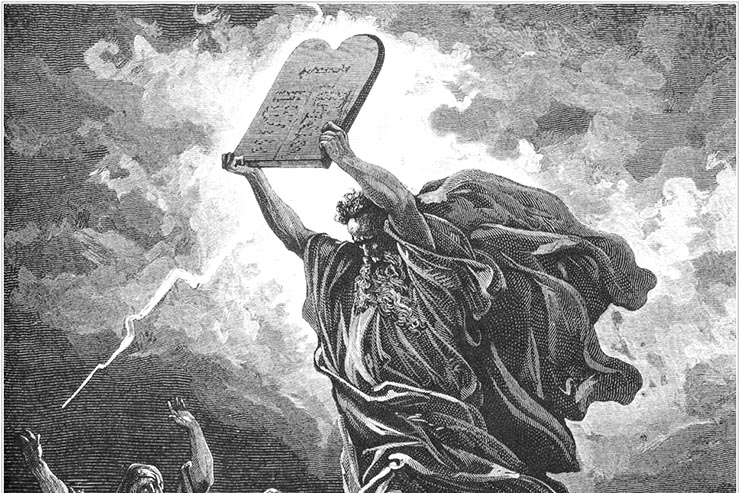
    Did Moses live? There is no reference to him in any contemporary source. The name Moses is a curious one; it is Egyptian, and it literally means “son,” as we see in some Egyptian names: Thutmosis (or Thutmose), the name of several pharaohs, means “son of Thoth,” the god of learning. It would be odd if Moses had been the prophet’s original name, just as in the English-speaking world there are many Johnsons and Williamsons, but practically nobody with the surname “Son.” Possibly his name originally included the name of an Egyptian god that Moses himself – or later chroniclers – chose to remove.

    Scholars thus have stopped believing in any great migration that resembles the biblical account. To the extent that they lend any credence to the story of Exodus at all, they grant the possibility that a charismatic leader led a small band of former Semitic slaves to the hill country of Palestine and that as Egyptian power began to wane in that area, this people, along with the hill people that had already settled there, was able to shake off its chains.

    To move on to the late eleventh and tenth centuries BCE, the period that biblical historians call “the united monarchy,” when Israel was supposedly ruled by a single king – Saul, followed by David and David’s son Solomon. According to the Bible, this was the zenith of Israel’s power and influence. David supposedly ruled over a territory that stretched from the Euphrates to Gaza (1 Kings 4:24), while Solomon accumulated vast riches and a thousand wives. But the archaeological remains and extrabiblical texts say virtually nothing about these rulers; some scholars go so far as to doubt whether there ever was a united monarchy at all. Richard A. Freund, professor of Jewish history at the University of Hartford, Connecticut, in the US, sums up the situation:

    If… David was so prominently involved in the lives of so many different peoples in the region, it stands to reason that he would be mentioned in one of these different non-Israelite literatures. If… Solomon conducted international relations with Egypt, marrying into the royal family and importing horses, why wouldn’t there be a record somewhere in Egypt that would corroborate this relationship?…. But no independent corroboration of these events exists from archaeological evidence or source not influenced by biblical tradition, save perhaps an early medieval collection called the Kebra Nagast, the national epic of Ethiopia.3

    The earliest extrabiblical reference to David comes from an inscription found at Tel Dan in northern Galilee in 1993. Dated to the ninth century BCE, it contains a claim by Hazael, king of Aram, that he has killed Ahaziah, king of Israel, and Jehoram, “king of the house of David.”4 Hazael, Ahaziah, and Jehoram are all mentioned in the Bible, so this inscription confirms these men lived and ruled and that there was a house of David in the ninth century BCE. Nevertheless, this inscription dates more than a hundred years later than David is supposed to have lived, so it confirms nothing more about him.

    Nor is there much archaeological evidence for the existence of Solomon’s Temple, which would have been built around 940 BCE.5 Indeed the archaeologist Israel Finkelstein contends that Jerusalem, supposedly Solomon’s magnificent capital, was actually a rather humble place. “Digging in Jerusalem has failed to produce evidence that it was a great city in David or Solomon’s time,” he argues. “Tenth century Jerusalem was rather limited in extent, perhaps not more than a typical hill village.”6

    There is archaeological evidence for a highly prosperous and centralised monarchy in Israel, but, Finkelstein contends, it was in the ninth century BCE and not the tenth. Remains include palaces, storage centres, and even stables. They are centred around Samaria, the capital of the northern kingdom of Israel (the ten tribes that seceded from the house of David after Solomon’s death, ending the united monarchy). They were the work of the Israelite king Omri and his heirs – every last one of whom, according to the Bible, “wrought evil in the eyes of the Lord” (1 Kings 16:25).7 The most notorious of the Omrid dynasty was Ahab, whose queen was the proverbially wicked Jezebel.8

    It is thus really only in the ninth century BCE that biblical history and the extrabiblical evidence begin to converge, and in the eighth century the picture becomes still clearer. The Bible tells of the destruction of the northern kingdom of Israel at the hands of the king of Assyria in 722 BCE (2 Kings 17:3-23); this is confirmed by an Assyrian stele. The Bible also says that Hezekiah, king of the southern kingdom of Judah, was able to save his tiny nation from destruction by the Assyrians. This too has a parallel in the surviving Assyrian records – although these happen to mention the huge tribute of gold and silver that Hezekiah had to pay in return. The Bible, by contrast, credits the survival of Judah to the miraculous intervention of Yahweh, whose angel “smote in the camp of the Assyrians an hundred fourscore and five thousand” (2 Kings 19:35-36).

    Yahweh’s Companions?

    But it is when we turn to the religious history of ancient Israel that the picture becomes truly astonishing. After all, the intense interest in the Bible has a great deal to do with the part that is said to be played by God in history: specifically the revelation of the one true God, Yahweh, to the nation of Israel, and his granting of the land of Canaan to them in perpetuity on condition that they obey his law and worship him alone. But here, too, the extrabiblical sources create a much more checkered picture. Egyptian texts of the Late Bronze Age do show some familiarity with a god called “Yhw” (Egyptian, like Hebrew, did not employ vowels in its script) in connection with some nomads located in the southern part of Jordan.9 This resonates with the biblical account, which has Moses learning about Yahweh in Midian (see Exodus 3), which is in the same area. And it is possible, as we have seen, that a charismatic leader like Moses could have led a small band to Canaan and used this god as a rallying-cry to unify the hill folk and create a national identity for them. But even so, the reality would be very different from the story narrated in the Pentateuch.

    Scholars today generally agree that the revelation of a monotheistic Yahweh to Moses and his spiritual heirs is not an accurate picture of what happened. Instead, they contend, Yahweh only gradually – over the course of several centuries – came to be seen as the sole god of Israel and as the supreme god of the universe. Frank Moore Cross, one of the most distinguished Old Testament scholars of his generation, has argued that originally Yahweh was an epithet of El, the high god of the Canaanite pantheon, in his function as patron deity of a confederation of tribes known as the Midianite League. Cross says that Yahweh later became differentiated from El among the proto-Israelites, and eventually came to displace him.10

    Margaret Barker, another biblical scholar, has an even more radical suggestion. She contends that throughout most of the era of the First Temple (c.940-586 BCE), both El and Yahweh were worshipped in the Temple in Jerusalem as separate deities, forming a trinity with Asherah, Yahweh’s divine consort (see the next article). El retained his position as the high god – the lord of the universe – whereas Yahweh was the national god of Israel alone. It was only with the “reforms” of the religion of Judah that took place under King Josiah in 621 BCE (2 Kings 23) that Asherah was discarded and Yahweh was conflated with El. In fact, Barker claims, the Josianic “reform” was actually a radical restructuring of the faith. The Bible portrays it differently, as a purge of alien elements, but that is because the Bible was written by the party that instigated the purge. It was this party that created the Deuteronomic history in the Bible (comprising Deuteronomy, Joshua, Judges, 1 and 2 Samuel, and 1 and 2 Kings), which has shaped our historical understanding of this period to this day. Nearly all the biblical texts I have mentioned above are taken from the Deuteronomic account.

    Obviously there is a great deal more to say about these matters, and endless numbers of books have been written about them. I have limited my discussion here to the Hebrew Bible simply because of space. The New Testament is problematic as well, but for different reasons. Here it is not archaeology or the larger historical context that is the question: there is ample extrabiblical evidence for the existence of the Second Temple, which was still being completed at the time of Christ and was sacked by the Romans in 70 CE. Indeed the Temple’s western wall, today called the Wailing Wall, still survives. There is also ample extrabiblical documentation of figures such as Herod the Great and Pontius Pilate. There is no such documentation for Jesus, but this is not in itself problematic. We might reasonably expect some archaeological evidence for the existence of David and Solomon, who were supposedly great monarchs, but Jesus was comparatively obscure in his own day. It is only when we ask who Jesus was and what his earliest followers thought him to be that the controversies arise.

    In any event, we have seen a strange reversal over the last two hundred years. At the beginning of the nineteenth century, the educated world in the West took the Bible as history while the Homeric epics, the Iliad and the Odyssey, were written off as legend. Then in the early 1870s, the pioneering archaeologist Heinrich Schliemann unearthed the ruins of Troy in Asia Minor, and scholars realised that the Homeric poems – whether or not their specific characters ever lived – were firmly grounded in the world of Late Bronze Age Greece. Ironically, when scholars examined the Bible in the same fashion, they came up with little more than a few isolated inscriptions and the stables of the wicked King Ahab.

    Get the issue this article appears in

    Literal Truth of the Bible Under Attack

    Does this all matter? Does the Bible have to be true in a historical sense? Not necessarily. As I noted at the outset, esotericists have long acknowledged that these stories are in many ways symbolic of higher truths. The book of Exodus, with its ten plagues and miraculously gushing stones, is in all likelihood not true historically. But the British Kabbalist Warren Kenton, writing under the pen name Z’ev ben Shimon Halevi, gives an intricate and profound analysis of the mystical dimensions of this saga in his book Kabbalah and Exodus.

    What the original authors of the biblical texts may have intended is a difficult question to answer, since we do not even really know who they were. Nevertheless, Christianity has often proselytised on the premise that the stories in the Bible are literally true. It is reasonable to assess the Bible in terms of the claims that its proponents have made for it, and those claims have been found wanting.

    All this said, the scholars who have delved so deeply into the historicity of the Bible over the last two hundred years have shown tremendous moral and intellectual courage. They have not, for the most part, been debunkers but have been serious scholars of Judaism and Christianity who are often profoundly committed to their faith. Some have turned to archaeology to validate this faith and have had to admit they were wrong. Joseph Callaway, an American professor of biblical archaeology, tried to find the city of Ai, supposedly destroyed by Joshua (Joshua 7-8), but he concluded that the city did not exist in Joshua’s time. He wrote: “For many years, the primary source for the understanding of the settlement of the first Israelites was the Hebrew Bible, but every reconstruction based on the biblical traditions has floundered on the evidence from the archaeological remains.”11 Callaway took early retirement from his very conservative seminary rather than cause any embarrassment on this count.

    Many journalists have lacked Callaway’s integrity, so you can pick up an American newsmagazine such as Time and read an account of Moses that treats him as if he were Churchill or John F. Kennedy.12 To bring the far more elusive truth to light would no doubt cause many readers to cancel their subscriptions. Sometimes the weaker a myth is, the more stridently it is defended.

    [alert type=”general” dismiss=”no”]This article was published in New Dawn 123.[/alert]

    [alert type=”success” dismiss=”no”]If you appreciate this article, please consider subscribing to help maintain this website.[/alert]

    Sources:

    Margaret Barker, The Great Angel: A Study of Israel’s Second God, Louisville, Kentucky: Westminster John Knox Press, 1992.
    Frank Moore Cross, Canaanite Myth and Hebrew Epic: Essays in the History of Religion of Israel, Cambridge, Massachusetts: Harvard University Press, 1973.
    William G. Dever, What Did the Biblical Writers Know and When Did They Know It? What Archaeology Can Tell Us about the History of Ancient Israel, Grand Rapids, Michigan: Eerdmans, 2001.
    –  – . Who Were the Ancient Israelites and Where Did They Come From?, Grand Rapids, Michigan: Eerdmans, 2003.
    Israel Finkelstein and Neil Asher Silberman, The Bible Unearthed: Archaeology’s New Vision of Israel and the Origin of Its Sacred Texts, New York: Simon & Schuster, 2001.
    Richard A. Freund, Digging through the Bible: Modern Archaeology and the Ancient Bible, Plymouth, U.K.: Rowman & Littlefield, 2010.
    Simon Goldhill, The Temple of Jerusalem, Cambridge, Massachusetts: Harvard University Press, 2004.
    Z’ev ben Shimon Halevi, Kabbalah and Exodus, London: Rider, 1980.
    Hershel Shanks, et al., The Rise of Ancient Israel, Washington: Biblical Archaeology Society, 1992.
    D. Winton Thomas, ed., Archaeology and Old Testament Study, Oxford: Oxford at the Clarendon Press, 1967.

    Footnotes:

    1. Dever, Who Were the Early Israelites?, 10.
    2. Finkelstein and Silberman, 57; see also Dever, Who Were the Early Israelites?, 202.
    3. Freund, 117.
    4. Freund, 117–18.
    5. Goldhill, 31.
    6. Finkelstein and Silberman, 124, 133.
    7. Biblical quotations are taken from the Authorised (King James) Version.
    8. For an account of the archaeological findings and their relation to the house of Omri, see Finkelstein and Silberman, ch. 7.
    9. Dever, Who Were the Early Israelites?, 128.
    10. Cross, 44, 71.
    11. Quoted in Dever, 47–48.
    12. A good example is Emily Mitchell and David Van Biema, “In Search of Moses,” Time, Dec. 14, 1998; www.time.com/time/magazine/article/0,9171,989815-7,00.html; accessed Sept. 21, 2010. The article is worth careful deconstruction. It does, for example, ask “Did Moses even exist?” and mentions such evidence as the Merneptah inscription. But the vast bulk of it is devoted to a retelling, in Time-style prose, of the biblical account as literally true. The reader is subtly led to believe that somehow, in the end, all these things did happen. The article is a cover story, timed to the release of the film The Prince of Egypt. A more recent article, “How Moses Shaped America,” by Bruce Feiler (Time, Oct. 12, 2009; www.time.com/time/magazine/article/0,9171,1927303-3,00.html; accessed Sept. 21, 2010) discusses the political uses made of the Moses story by American politicians without attempting to touch the historical issue of whether this figure actually lived.

    © New Dawn Magazine and the respective author.
    For our reproduction notice, click here.
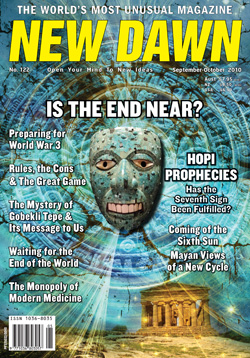
  • Waiting for the End of the World: René Guénon and the Kali Yuga

    Waiting for the End of the World: René Guénon and the Kali Yuga

    From New Dawn 122 (Sept-Oct 2010)

    Currently the fear – or hope – of the closing of the age pervades the air like a thick vapour. Sometimes this end is envisaged as an environmental calamity, sometimes as the second coming of Christ, sometimes as the return of the space brothers to claim their own.

    Figures including Jose Argüelles, the prophet of the 1987 Harmonic Convergence; Terence McKenna, the late pope of psychedelia; and the channelled entity known as Kryon have fastened onto 2012 as the turning point.

    A less well known, though in a way equally influential, figure was the French esoteric philosopher René Guénon, whose writings often speak of the end of a cycle that he equated with the Kali Yuga, the “dark age” of Hindu cosmology. While he did not point to 2012 or any other specific date, his ideas do resonate with some of these expectations for the dawning age to come.

    Born in Blois, France, in 1886, Guénon had a conventional education in mathematics. In his youth he began to explore occult currents in Paris and was initiated into esoteric groups connected with Freemasonry, Martinism, Taoism, and Advaita Vedanta. In 1911, he was initiated into a Sufi tariqah (order) under the leadership of an Egyptian sheikh, Abder Rahman Elish El-Kebir. In 1930, he moved to Egypt, where he converted to Islam and lived until his death in 1951. In the meantime, he published a wide range of books, articles, and reviews espousing what he said was the universal and primordial tradition underlying all religions.

    For Guénon, tradition is the ne plus ultra of human life. He conceives of tradition as a hierarchy: higher knowledge emanates from a now-hidden spiritual centre to all of humankind through the “orthodox” traditions, among whom he includes (with many caveats and qualifications) the great world religions as well as certain other lines such as Freemasonry. Or to put it more accurately, this tradition is preserved in certain initiatic lineages that lie embedded in these faiths, such as the Kabbalah in Judaism, Taoism in Chinese religion, and Sufism in Islam. The esoteric dimension of Christianity had, he believed, practically disappeared by the late Middle Ages and was now preserved (if at all) by small initiatic groups that he apparently regarded as inaccessible. Indeed Guénon’s conversion to Islam was motivated in part by his belief that these Western lineages had almost completely died out by the twentieth century.

    In fact, according to Guénon, this transmission of traditional knowledge – the “doctrine,” as he often styles it – has become almost completely blocked in our era. This, he argued, is the result of a long cosmic cycle, which is called a Manvantara in Hindu cosmology, and which is divided into four yugas or ages: the Satya Yuga, the Treta Yuga, the Dvapara Yuga, and the present Kali Yuga. The problems and anxieties of the current era are the result of this age. It’s worth exploring why he believed this and what he thought it meant.

    The Reign of Quantity & the End of an Age

    Guénon was first and foremost a metaphysician – indeed, he was one of the greatest and most lucid thinkers who have delved into this arcane subject. And for him, metaphysics concerns universal principles; the details of circumstance are of value only insofar as they illustrate these. At the beginning of his best-known work, The Reign of Quantity and the Signs of the Times (first published in 1945), he writes that “considerations of that order” – namely, factual details – “are worth nothing except in so far as they represent an application of principles to certain particular circumstances.”1

    Thus Guénon said that he not a prophet in any conventional sense of the term. He was not a visionary and believed that the visionary prophecy of the current age was nothing more than a cloud of lies emitted by sinister “counterinitiatic” forces. If he spoke of an outlook that made it possible “to foresee, at least in its broad outlines, what will be the shape of a future world,” he insisted that “previsions of this kind have not really any ‘divinatory’ character whatever, but are founded entirely on… the qualitative determinations of time.”2

    The use of the word “qualitative” may seem peculiar here, but for Guénon, the polarity between “quality” and “quantity” was central to understanding the dynamics at play. In his 1931 book The Symbolism of the Cross, he depicted reality in the form of a three-dimensional cross – one that has the dimension of height and depth in addition to the familiar two of length and breadth. At the top of this cross is what he called “absolute quality” – an abstract state that is impossible for us to conceive, because it has no element of quantity whatsoever. (An interesting mind game: try to conceive of a universe in which there is no number or quantity of any sort. It’s almost impossible to do.) At the bottom of this cross is “absolute quantity” – another abstract state that is impossible to conceive. (Again, try to imagine a universe where there is only number, in which there is nothing that has any particular qualities such as colour, shape, or anything else of the kind.)

    Hence it’s not possible in this relative level of existence to reach the absolute end of each pole, but in a given age one of the two will be more pronounced and the other less pronounced to an exactly inverse degree. According to Guénon, the Manvantara proceeds in an ages-long cycle from an era where quality is emphasised – the legendary time known to the Hindus as the Satya Yuga and to the ancient Greeks as the Golden Age – to one in which quantity comes more and more to dominate. This is our present era, the Kali Yuga or what the Greeks called the Iron Age. That’s why Guénon speaks of the present era as one of “the reign of quantity.” He goes on to argue that all the primary characteristics of our time are the result of this reign of quantity.

    Guénon produces modern philosophy and science as evidence for his argument. Modern Western philosophy to all intents and purposes begins with René Descartes (1596-1650), who divided the world into what he called res cogitans (literally, “the thing that thinks”) and res extensa (literally, “the extended thing”). That is to say, the world is divided into that which experiencesres cogitans – and that which is experienced: res extensa. According to Descartes (at least as interpreted by Guénon), everything material is characterised by – and only by – extension, by what can be measured and quantified.

    While this all may sound extremely abstract, Guénon argued – rightly, I believe – that this attitude has profoundly shaped Western thought over the last few centuries. Essentially, he is saying, materialistic science focuses exclusively on quantity: “The more specifically ‘scientific’ point of view as the modern world understands it… seeks to bring everything down to quantity, anything that cannot be so treated is not taken into account, and is regarded as more or less non-existent.”3 Unfortunately, as Guénon goes on to say, this creates any number of logical contradictions. Science conceived purely in terms of quantity argues that the same causes produce the same effects, but as Guénon points out, this is absurd, as no two events are ever completely identical. He also criticises “the delusion which consists in thinking a large number of facts can be of use in itself as ‘proof’ of a theory; …even a little thought will make it evident that facts of the same kind are always indefinite in multitude, so that they can never all be taken into account.”4

    This is precisely the problem that contemporary philosophers call “the justification of induction.” You base a theory on any number of similar events that have happened in the past; but how can you account for the ones that you have not seen, and how can you be sure that future facts will yield the same results? Bertrand Russell put the point wittily when he wrote, “The man who has fed the chicken every day throughout its life at last wrings its neck instead, showing that more refined views as to the uniformity of nature would have been useful to the chicken.”5 The notion of causation is at least as problematic.6 These facts place a ceiling on the degree to which science can understand and explain the universe.

    The Real Meaning of “Value”

    As even this short discussion suggests, Guénon raises profound philosophical issues, and contemporary thought has not done a terribly impressive job of coping with them. But, he contends, the problems go further still. In a chapter of The Reign of Quantity entitled “The Degeneration of Coinage,” he explores the economic aspects of the issue. At first glance, one might think that nothing was more purely quantitative than money. But that, Guénon argues, is an illusion fostered by the degenerate age we live in: “The ‘economic’ point of view…, and the exclusively quantitative conception of money which is inherent in it, are but the products of a degeneration which is on the whole fairly recent,… money possessed at its origin, and retained for a long time, quite a different character and a truly qualitative value, remarkable as this may appear to the majority of our contemporaries.”7

    In traditional societies, Guénon says, money had a sacred character. Not only were the coins stamped with the images of gods and other sacred symbols, but the currency was controlled by the spiritual authorities rather than by the secular powers. Money was meant to be a reminder of “value” in the qualitative as well as the quantitative sense. Today, however, “nobody is able any longer to conceive that money can represent anything other than a simple quantity.”8 Even such words as “value” and “estimate” have been deprived of their qualitative character, and today, when we ask how much a man is worth, we are almost always thinking in terms of cash and equities rather than moral or spiritual calibre.

    This quantitative approach extends to every object we use. “In a traditional civilisation,” Guénon writes, “each object was at the same time as perfectly fitted as possible for the use for which it was immediately destined and also made so that it could at any moment, and owing to the very fact that real use was being made of it (instead of its being treated more or less as a dead thing as the moderns do with everything that they consider to be a ‘work of art’), serve as a ‘support’ for meditation,… thus helping everyone to elevate himself to a superior state according to the measure of his capacities.”9 One obvious example are the tools of Masonry, such as the square, compass, and plumb line, each of which was intended to convey a spiritual and ethical meaning in the days when Masonry was limited to practicing stonemasons. Manufactured goods have no such meaning or value.

    It is not possible here to go further into Guénon’s critique, but even this short discussion reveals that his insights into the woes of the current era were remarkably perceptive and prescient. In The Crisis of the Modern World, published in 1927, he said, “It is… to be expected that discoveries, or rather mechanical and industrial inventions, will go on developing and multiplying more and more rapidly until the end of the present age; and who knows if, given the dangers of destruction they bear in themselves, they will not be one of the chief agents in the ultimate catastrophe, if things reach a point at which this cannot be averted?”10

    Guénon’s charge that the modern world has no use for anything apart from quantity could be substantiated by cases from every conceivable source. Writing about the BP oil spill in the Gulf of Mexico, in early July 2010 a front-page article in The Wall Street Journal reported, “BP PLC is pushing to fix its runaway Gulf oil well by July 27, possibly weeks before the deadline the company is discussing publicly, in a bid to show investors it has capped its ballooning financial liabilities.” Why did BP choose this date? “The July 27 target date is the day the company is expected to report second-quarter earnings and speak to investors.”11 In other words, the fact that the BP spill, one of the greatest environmental disasters in history, fouled a large portion of the Gulf of Mexico, killed innumerable creatures, and devastated the lives of people all along the Gulf Coast was not reason enough for the company to hurry: it needed a second-quarter earnings report to goad itself into action. Nothing could illustrate the reign of quantity more clearly.

    The Kali Yuga

    All this said, when it comes to Guénon’s discussion of the Kali Yuga as a traditional Hindu doctrine, he stands on much shakier ground. He says that the Kali Yuga began some six thousand years ago.12 He also says this era is close to its end. In The Crisis of the Modern World he writes: “We have in fact entered upon the last phase of the Kali-Yuga, the darkest period of the ‘dark age’, the state of dissolution from which it is impossible to emerge otherwise than by a cataclysm.”13

    Not all traditional sources agree about this point. The Hindu sage Sri Yukteswar, best-known as the master of the celebrated yogi Paramahansa Yogananda, discusses the matter in his book The Holy Science. Sri Yukteswar says that the Kali Yuga is actually over, although this has not been recognised even by many Hindu authorities. Ironically in light of Guénon’s claims, it was the very occlusion of the sacred centre that made it impossible to calculate the yugas correctly.

    Traditional dating for the beginning of the Kali Yuga starts from the death of Krishna, the avatar of Vishnu, at the end of the war between the Pandava and Kaurava clans chronicled in the Hindu epic the Mahabharata. Some sources date this to 3012 BCE, others to 1400 BCE.14 As the Kali Yuga began to dawn, Yudhisthira – the victorious Pandava king – gave his throne over to his grandson, Raja Parikshit. “Together with all the wise men of his court,” according to Sri Yukteswar, Yudhisthira “retired to the Himalayan Mountains, the paradise of the world. Thus there was none in the court of Raja Parikshit who could understand the principle of correctly calculating the ages of the several Yugas.”15

    Sri Yukteswar maintains that the Kali Yuga actually ended in 1699 CE. While his views may have been imbued with a belief in progress by his own British education and do not necessarily correspond with those of the majority of Hindus,16 at any rate his claim to being a source of “traditional” knowledge is much higher than Guénon’s. David Frawley, an American Vedic astrologer, agrees with Sri Yukteswar in saying that the Kali Yuga ended in 1699.17 In any event, the dating is far from clear-cut. In fact, many traditional sources reckon on a much larger scale for the duration of the Kali Yuga, placing its length at 432,000 years. If this were the case, it would render any imminent end to this epoch highly improbable.18

    One of the sources that come closest to Guénon’s view of the Kali Yuga is H.P. Blavatsky (1831-91), founder of the Theosophical Society. In her magnum opus, The Secret Doctrine, Blavatsky writes, “The Kali-yuga reigns now supreme in India, and it seems to coincide with the Western age.”19 Blavatsky, writing around 1888, dates the beginning of this epoch to “4,989 years ago” – close to the traditional date of 3012 BCE – and places its end roughly at the close of the nineteenth century: “We have not long to wait, and many of us will witness the Dawn of the New Cycle.”20

    This resemblance is peculiar, because Guénon loathed Blavatsky and Theosophy and criticised them in his first published book, Theosophy: History of a Pseudo-Religion. For Guénon, Theosophy was the ultimate counterinitiatic force, distorting and perverting the truth of traditional knowledge. He especially detested the Theosophical doctrine of evolution, which teaches that each living thing – indeed each atom – is progressing on a cycle of devolution into matter followed by evolution into higher consciousness. The Theosophical view is similar to Guénon’s in saying that the present era is the one in which materiality is most dominant and that it is coming to an end, but it generally portrays the progress of the human race in far more positive terms than Guénon.

    The connections between Guénon and Theosophy are intricate. One of his first spiritual teachers was the occultist Papus (Gérard Encausse), who was head of the French branch of the Theosophical Society, and the scholar Mark Sedgwick, whose book Against the Modern World is the best introduction to the impact of Guénon’s thought, sees Theosophy as one of Guénon’s chief influences.21 While it is impossible to go into this controversy here, it is at least clear that both Blavatsky and Guénon believed the end of the Kali Yuga was at hand. Another central figure in the esotericism of the twentieth century, C.G. Jung, did not deal at length with the Kali Yuga, but in Aeon, his compendious analysis of the symbolism of the astrological ages, he suggests 1997 as the starting point of the New Age, for intricate astronomical reasons.22

    Waiting for the End of the World

    Are we, then, at the end of a cycle? In one sense, yes, of course we are. There are many cycles in nature: every year, every day, is the end of a cycle. But whether we are at the end of the Kali Yuga is, at the very least, moot. My own impression is that the more genuinely traditional Hindus tend to see the Kali Yuga in terms of the much longer time frame of 432,000 years. While Guénon reviled the West and its attempt to erode the traditional values of Asian civilisation, ironically his view that the end is at hand comes far closer to the spirit of Christianity, the ultimate Western religion – which for 2,000 years has been predicting the imminent return of Jesus – than it does to Hindu thought.

    What does this mean in practical terms for us today? Waiting for the end of the world (or of the age) is a kind of narcotic. It enables the human mind to accommodate its own notion of cosmic justice to the realities at hand (because the wicked – who are always, of course, the others – will be brought low, while the good – oneself and whatever group one identifies with – will be exalted). It also serves as what psychology calls a displacement of the fear of death. For each of us individually, the end of the world is certainly coming, in a few decades at the very longest. But human beings dislike contemplating the certainty of death. They find it easier to deal with it by casting it in the remote and highly improbable form of whatever cataclysm happens to suit the fashions of the moment. (For a fuller treatment of this dynamic, see the chapter “Nostradamus and the Uses of Prophecy” in my book The Essential Nostradamus.)

    Unfortunately, we cannot stand around waiting for the end of the world to solve our problems for us. If we genuinely are at a threshold of a new era, we will be able to cross it only if we discard the contrived apocalypticism that suffuses mass culture and to which Guénon, as powerful a thinker as he was, was not immune.

    Nevertheless, Guénon’s claim that we are living under the reign of quantity is hard to refute. One has only to read prominent journals such as The Wall Street Journal and The Economist to see that the real protagonist in all their stories is money – money in the abstract, as a kind of hypostatised entity that stipulates all value and dictates all morality. What is good, we are being told, is what is good for money. Whether or not the Kali Yuga is about to end, we can bring the end of the reign of quantity a few steps closer by looking into ourselves and making sure that the values by which we guide our lives are more than merely economic ones.

    [alert type=”general” dismiss=”no”]This article was published in New Dawn 122.[/alert]

    [alert type=”success” dismiss=”no”]If you appreciate this article, please consider subscribing to help maintain this website.[/alert]

    Footnotes

    1. René Guénon, The Reign of Quantity and the Signs of the Times, trans. Lord Northbourne (Harmondsworth, Middlesex, UK: Penguin, 1972), 7.

    2. Guénon, The Reign of Quantity, 57.

    3. Guénon, The Reign of Quantity, 85.

    4. Guénon, The Reign of Quantity, 87.

    5. Bertrand Russell, The Problems of Philosophy (New York: Barnes & Noble, 2002 [1912], 42.

    6. For a more complete discussion of these issues, see my book The Dice Game of Shiva: How Consciousness Creates the Universe (Novato, Calif.: New World Library, 2009), chs. 4 and 5.

    7. Guénon, The Reign of Quantity, 133.

    8. Guénon, The Reign of Quantity, 136.

    9. Guénon, The Reign of Quantity, 137.

    10. René Guénon, The Crisis of the Modern World, trans. Arthur Osborne et al. (Ghent, N.Y.: Sophia Perennis et Universalis, 1996), 39.

    11. Monica Langley, “BP Sets New Spill Target,” The Wall Street Journal, July 8, 2010, A1.

    12. René Guénon, The King of the World, trans. Henry D. Fohr (Hillsdale, N.Y.: Sophia Perennis et Universalis, 2001), 49.

    13. Guénon, The Crisis of the Modern World, 17.

    14. See Klaus R. Kostermaier, A Survey of Hinduism, 3d ed. (Albany: State University of New York Press, 2007), 97.

    15. Jnananavatar Swami Sri Yukteswar, The Holy Science (Los Angeles: Self-Realization Fellowship, 1990), 16-17.

    16. See the forthcoming work by Joscelyn Godwin, Atlantis of the Occultists and the Cycles of Time.

    17. David Frawley, Astrology of the Seers: A Guide to Vedic/Hindu Astrology (Twin Lakes, Wis.: Lotus, 2000), 36-39.

    18. For a helpful summary of the various views, see Joseph Morales, “The Hindu Theory of World Cycles in the Light of Modern Science”; http://baharna.com/karma/yuga.htm (accessed January 14, 2010).

    19. H.P. Blavatsky, The Secret Doctrine (Wheaton, Ill.: Quest, 1993 [1888]), 1:377.

    20. Blavatsky, Secret Doctrine, 1:xliii-xliv.

    21. Mark Sedgwick, Against the Modern World: Traditionalism and the Secret Intellectual History of the Twentieth Century (Oxford: Oxford University Press, 2004), 40-44.

    22. C.G. Jung, Aion: Researches into the Phenomenology of the Self, trans. R.F.C. Hull (Princeton: Princeton/Bollingen, 1959), 94.

    © New Dawn Magazine and the respective author.
    For our reproduction notice, click here.
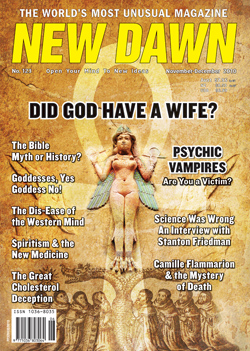
  • A Pagan Christ? Reflections on the Real Christmas Story

    A Pagan Christ? Reflections on the Real Christmas Story

    From New Dawn 105 (Nov-Dec 2007)

    Strictly speaking, a pagan Christ is a contradiction in terms. The very concept of paganism was constructed by Christians who wanted to distinguish their faith from the old religion of Greece and Rome, which by the end of classical antiquity was observed only by peasants in remote rural areas – the pagani, or “country people,” or – to use words that are similar in tone – rustics, rubes, hayseeds. So there can be no pagan Christ. Paganism is all that Christianity is not.

    Once we go past this elementary point, however, we see that the situation is not so simple. The resemblance between Christianity and its rivals could never be entirely overlooked. The Church Father Augustine (354–430) wrote, “That which is now called the Christian religion existed among the ancients, and never did not exist from the planting of the human race until Christ came in the flesh, at which time the true religion which already existed began to be called Christianity.” Whatever Augustine meant by this – and it’s not entirely clear from the context – one thing it could mean is that the “true religion” is universal and has always existed; only comparatively late did it come to be codified in the teachings of Christ.

    Before I go further into what this “true religion” might be, it’s necessary to stop and take a look at early Christianity in its context. Christianity, as is well known, grew up in the Roman Empire, a time of remarkable fecundity in religious belief, with a huge and dizzying marketplace of gods and cults and philosophies for the seeker to choose from, many of which bore more than a passing resemblance to one another. It’s impossible to believe that Christianity was not affected by this background. Although the Christians insisted that their religion was true and all the others were false, they still had to account for the fact that theirs was not so different from many of those they were denouncing.

    Over the past century, one of the most influential views of the relationship between Christianity and paganism has been that of Sir J.G. Frazer (1854–1941), author of the classic work The Golden Bough, first published in 1890 and updated in many editions thereafter. A pioneer of comparative mythology, Frazer delved into the compendious collections of lore and legend that scholars were amassing in his time and noticed that Christianity had taken many of its elements from the religions it would eventually displace.

    The most famous instance is Christmas. The birthday of Christ was not recorded and is not known; in the early centuries of the religion that bears his name it was not celebrated. But by the fourth century, Christ’s birthday came to be observed as a holiday. In the East (starting in Egypt), the date selected was January 6. But the Western church, which had never observed this date, set Christ’s birthday as December 25. Why? One Christian writer quoted (but not named) by Frazer explains: “It was a custom of the heathen to celebrate on the same twenty-fifth of December the birthday of the Sun, at which they kindled lights in token of festivity. In these solemnities and festivities the Christians also took part. Accordingly when the doctors of the Church perceived that Christians had a leaning to this festival, they took counsel and resolved that the true Nativity should be solemnised on that day and the festival of the Epiphany on the sixth of January.”

    Another, possibly more revealing, case involves the festival commemorating the death and resurrection of Christ. Today Easter is celebrated on the first Sunday after the full moon after the March equinox. (This is to some extent a simplification of the complex process of fixing the date of Easter, but it will serve our purposes here.) Frazer noted that there was an ancient tradition by which the death of Christ was observed on March 25, regardless of the phase of the moon. Remarkably, this coincided with the date on which the death and resurrection of a pagan god, Attis, was celebrated. Still more significantly, the parts of the world where Christians observed Easter on this date – western Asia Minor and Rome – were precisely the areas where the cult of Attis was most popular.

    Attis, according to the myth, was a handsome young shepherd who was born of a virgin. Beloved of the Great Goddess of life, he was said in some legends to have been killed by a boar, in others to have died after castrating himself. (The priests of the Attis cult were all self-made eunuchs, in imitation of him.) After his death, he was changed into a pine tree.

    It’s curious that the death and resurrection of Christ should have been celebrated in such close conjunction with that of one of the deities that the Christians so detested. What’s even more interesting is the underlying similarity of the myths: both are celebrations of a god, born of a virgin, who has died and risen again. More surprisingly still, Attis was not the only god in antiquity who was believed to have died and risen again. There was also Adonis, worshipped in Babylonia and Syria. Adonis, another beautiful young man, was said to die every year. His death caused passion to cease and beasts and men to forget to reproduce; all life would be extinguished if Ishtar, the goddess of life, did not rescue him annually from the halls of death. And of course there is Osiris, the slain and dismembered king of Egypt who was reassembled by his wife Isis (another goddess of life) to serve as the lord of the dead.

    Even this cursory sketch suggests how many parallels we can find between Christianity and pagan religions. Moreover, it was obvious that the pagan faiths were much older than the Christian one. Christianity looked like a mere copycat of these religions, and that’s exactly what many of its pagan critics contended. The Christian fathers countered with a remarkably clumsy response: that Satan, foreseeing that Christ would come to earth, came down first and created religions that were merely diabolical imitations of the truth.

    Those of us who find this argument implausible are left wondering exactly what the relationship between Christianity and these pagan cults was. Frazer saw the mystery religions of Attis and Adonis and Osiris as essentially fertility cults: Their rites were designed to mimic and foster the rebirth of life each spring. According to Frazer, Christ had come as a teacher of “ethical reforms”; the mythologies of the fertility cults were gradually assimilated to the faith of Christ’s followers “so as to accord in some measure with the prejudices, the passions, the superstitions of the vulgar.” Frazer writes:

    To live and to cause to live, to eat food and to beget children, these were the primary wants of men in the past, and they will be the primary wants of men in the future so long as the world lasts…. These two things, therefore, food and children, were what men chiefly sought to procure by the performance of magical rites for the regulation of the seasons.

    This all may sound plausible – as it certainly did to Frazer’s rationalistic late-Victorian contemporaries – but there’s one small problem with it. The idea that the mysteries of Attis and Adonis and Osiris, and by extension of Christ, were mere attempts to reproduce and sustain the cycles of life was known to the ancients and explicitly refuted by them. Plutarch, writing in the late first century CE, contends:

    And we shall also get our hands on the dull crowd who take pleasure in associating the [mystic recitals] about these Gods either with changes of the atmosphere according to the seasons, or with the generation of the corn and sowing and ploughings, and in saying that Osiris is buried when the corn is hidden by the earth, and comes to life and shows himself again when it begins to sprout.

    Cicero, the Roman statesman and philosopher (106–43 BCE), also says there is something more to the mysteries:

    These Mysteries have brought us from rustic savagery to a cultivated and refined civilisation. The rites of the Mysteries are called “initiations” and in truth we have learned from them the first principles of life. We have gained the understanding not only to live happily but to die with better hope.

    We can safely say this much: The ancient mysteries were more than rites intended merely to ensure that the crops grew and the animals bred. But what, then, were they? What is the dying “with better hope” that Cicero mentions? And why does the story of Christ, springing from the monotheistic world of Judaism, so much resemble those of the gods that went before?

    At this point it would be helpful to address an extremely important issue: the reliability of the historical accounts of Jesus. Apart from a few extremely brief references in non-Christian writers such as Tacitus and Pliny the Younger (which talk about the Christians as a sect but say practically nothing about Christ himself), we have to rely on the canonical gospels: Matthew, Mark, Luke, and John. Scholars unanimously accept these as the oldest gospels, with the possible exception of the Gospel of Thomas, an early sayings collection with a strongly Gnostic tinge; the many other gospels that were written are almost certainly later – one reason they didn’t find their way into the New Testament.

    Unfortunately, even these texts present Jesus at a remove. None of them, it is now generally acknowledged, was written by any of the Twelve Apostles or even by anyone who knew or saw Jesus personally. The earliest Gospel, Mark, is dated to around 70 CE; the latest, John, to around 100 (these dates are highly approximate). Nowhere in these Gospels is the claim that the writer himself has seen what he is describing. Indeed most scholars today agree that none of the texts in the entire New Testament was written by any of the Twelve Apostles.

    The only surviving eyewitness account of Christ is found in Paul’s first letter to the Corinthians. Paul did not know Jesus when he was alive, but he writes that after Jesus had appeared to Cephas (Peter), the twelve, and various other witnesses, “last of all he was seen of me also, as of one born out of due time” (1 Cor. 15:5). (Biblical quotations are from the Authorised King James Version.) This experience, usually equated with Paul’s vision on the road to Damascus (Acts 9:1–7), is an eyewitness account: Paul is claiming that he has had a vision of the risen Christ like that of the other apostles. Inasmuch as Paul died during Nero’s persecution in Rome in 64 CE, this text is almost certainly earlier than any of the Gospels. But Paul does not say anything more about his experience, and he says almost nothing at all about Jesus before his death.

    In their 1999 book The Jesus Mysteries, Timothy Freke and Peter Gandy argue that the extreme scarcity of direct evidence about Jesus, together with the strong resemblance of his story to other pagan myths, means that Jesus did not exist as a historical figure. He was created by Gnostic sages as a kind of Jewish equivalent of the dead and reborn gods of the pagan Mediterranean world.

    Freke’s and Gandy’s view, although interesting, seems to be an overstatement given the evidence. They say that Paul’s vision (as described by himself) may have been a later addition to 1 Corinthians, a claim that, to my knowledge, no reputable scholar would agree with; or perhaps that it was a mystical vision of some sort. But the context of 1 Corinthians 15 indicates that, as Christians have always claimed, Paul, like the others who claimed they had witnessed the resurrection of Christ, regarded it as an actual encounter with the risen Jesus. Whatever it was they saw or did not see, this much seems indisputable. Indeed, if we go to 1 Thessalonians, another letter of Paul’s, which was the first New Testament book to be written (it’s generally dated to around 50 CE), we see Paul saying, “The Jews… both killed the Lord Jesus, and their own prophets” (1 Thess. 2:14–15). “We believe that Jesus died and rose again,” he writes in the same letter (1 Thess. 4:14). In both these instances, he is stressing the historical actuality of these events: they are not a myth. Furthermore, Paul is not introducing this idea as a novelty but as a premise that he expects his readers to share.

    About the historical Jesus, then, we can say this much: that as early as 50 CE, no more than twenty years after his death and still well in the lifetime of his disciples, his followers preached that he had suffered and died and was resurrected. These facts are not later mythic accretions but among the first things the historical record says about Jesus.

    What, then, does this all mean? Paul’s own ideas seem to have grown and changed over time. In 1 Thessalonians, his first surviving epistle, he sounds like a modern-day fundamentalist, obsessed with the Rapture. In fact the idea of the Rapture comes from 1 Thess. 4:17: “Then we which are alive and remain shall be caught up together with [the dead] in the clouds, to meet the Lord in the air.” Later, Paul becomes more mystical. In 1 Corinthians he explicitly denies the physical resurrection of the dead: “It is sown a natural body; it is raised a spiritual body…. Flesh and blood cannot inherit the kingdom of God; neither doth corruption inherit incorruption” (1 Cor. 15:44, 50). This, incidentally, puts mainstream Christianity in the bizarre position of teaching a doctrine – the resurrection of the physical body – that is explicitly denied by its own scriptures. I do not know of any other such case in all of world religion.

    Nonetheless, resurrection is at the core of Christianity from its earliest days, just as it was of the mystery religions of Attis and Adonis and Osiris that preceded it. And, like the pagan mysteries, which enabled its initiates to die “with better hope,” Christianity viewed the resurrection not an isolated case that happened to one (possibly divine) man, but something that is the common human inheritance, potentially available to everyone: “Now is Christ risen from the dead, and become the firstfruits of them that slept” (1 Cor. 15:20). This was not the concept of resurrection as commonly taught, but part of what the Church Father Origen (185–253) called “the deeper and more mystical doctrines which are rightly concealed from the multitude.”

    The nature of this resurrection lies at the heart of the old pagan mysteries and the Christian faith alike. To best understand it in a short space, it would be helpful to use the common metaphor of a seed, used both by Jesus in the Gospels and by Paul (as well as in some of the pagan mysteries). A seed is something extremely small and contains only in germ the full plant; this is the metaphor Paul uses to compare what he calls “the resurrection body” with the “natural body.” Christ in the Gospels likens the kingdom of heaven to a seed on several occasions as well: for example, “the kingdom of heaven is like to a grain of mustard seed” (Matt. 13:31).

    What, then, is this “seed”? What is the kingdom of heaven, for that matter? If you were to read the works of many theologians, you might conclude that they don’t know. But this is a central concept in esoteric Christianity. It is not difficult to grasp, but it is subtle. I’ve discussed it in detail in my book Inner Christianity, but in essence it comes to this: There is that in you which says “I.” It is consciousness in its pure form; it is never seen, but always that which sees. You may think you are your body or your emotions or your thoughts, but the fact that you can step back and look at all these things at a distance proves that these things are not you – not in the truest and fullest sense. In fact it is your very confusion of your “I” with your thoughts, emotions, and sensations that constitutes the fundamental problem of human existence. Liberation or enlightenment or, as the early Christians called it, gnosis is the freeing of the “I” from its identification with its own experience. Paul writes, “That which thou sowest is not quickened until it die” (1 Cor. 15:36). Esoterically, this means that the “I” must “die” – must detach itself from its former identifications – before it can be “resurrected” or “born again,” that is, realise its fullest potential in a life that is not limited by the body or the psyche. In the course of this liberation the “I” realises its own immortality.

    This, in the simplest and most concise language that I can muster, is the secret that I believe lies at the heart of esoteric Christianity and of the Christian mystery itself. To speak of the resurrection of the physical body, explicitly denied by Paul, is to misunderstand; it is the symbolic death and rebirth of the true “I” – called “I am” in the Gospel of John – that is really the point. But it is an arcane point, and not everyone can grasp it. Early Christianity eventually allowed ordinary believers to believe in a physical resurrection because it was easier to understand; only those who wanted to go deeper were told the truth. As Origen writes, “The resurrection of the body,… while preached in the churches, is understood more clearly by the intelligent.” Origen is saying that the doctrine “preached in the churches” is not the whole story. Regrettably, however, as Christianity developed in later centuries, those who had only an inaccurate, secondary understanding of this truth came to lead the church. Because they did not understand the deeper message, they suppressed it, with consequences that have been disastrous for the spiritual life of the West.

    In any event, the revelation of the true nature of the “I” makes the correspondence between the Christian mystery and those of the pagans much easier to understand. If these things are true, they are universally true, and if they are universally true, they must have been known in many times and places and cannot be the bailiwick of a single religion. That, I would suggest, is why Augustine can say that the “true religion” always existed. It’s also why the mystery religions so resembled Christianity. They were expressing a universal truth to which Christianity was also pointing.

    Get the issue this article appears in

    All the same, this does not entirely explain the innumerable parallels between the Christ of the Gospels and the figures of ancient myth. Often it does seem that characteristics of the ancient pagan gods were later associated with Christ – and at a fairly early stage. The virgin birth, for example, is not mentioned in Mark, the earliest canonical Gospel, or for that matter by Paul. But it does appear in Matthew and Luke, which are generally dated to between 80 and 100. This suggests that by this point certain myths and legends had attached themselves to the basic story of Christ’s death and resurrection.

    Exactly how this happened is unclear. There is no contemporary documentation of this process, or, for that matter, of Christ himself apart from the Gospels to serve as a check. The best guess seems to be something like this: The earliest Christians believed they had some experience of the risen Christ, and this was the central part of their message from the very beginning. By the end of the first century, as the Gospels were being written, the historical kernel of the story of Christ was expanded and recast, partly to imitate familiar aspects of pagan myths but also to symbolically express certain truths. That’s why Origen could write:

    Very many mistakes have been made because the right method of examining the holy texts has not been discovered by the greater number of readers… because it is their habit to follow the bare letter….

    Scripture interweaves the imaginary with the historical, sometimes introducing what is utterly impossible, sometimes what is possible but never occurred…. [The Word] has done the same with the Gospels and the writings of the Apostles; for not even they are purely historical, incidents which never occurred being interwoven in the “corporeal” sense…. These passages, by means of seeming history, though the incidents never occurred, figuratively reveal certain mysteries.

    This process began with the Gospels but did not end with them. It continued for several centuries later, as we’ve seen with the Christian appropriation of Christmas and Easter in the fourth century. Later still, in the fifth century, when the cult of the pagan goddesses was suppressed, there was a need for a feminine face of divinity, and the mother of Christ was elevated to this role; many of the attributes of Ishtar and particularly Isis were then attached to her. Christianity’s success was at least partly due to its remarkable genius and flexibility in adapting pagan myths to its own ends. Ultimately, however, the true greatness of the faith lies in its profound and haunting expression of what may be the central mystery of human existence.

    [alert type=”general” dismiss=”no”]This article was published in New Dawn 105.[/alert]

    [alert type=”success” dismiss=”no”]If you appreciate this article, please consider subscribing to help maintain this website.[/alert]

    Bibliography

    Raymond E. Brown,  Introduction to the New Testament, New York: Doubleday, 1997.
    J.G. Frazer, The Golden Bough, New York: Macmillan, 1922.
    Timothy Freke and Peter Gandy, The Jesus Mysteries: Was the “Original Jesus” a Pagan God?, New York: Three Rivers, 1999.
    The Greek New Testament, edited by Kurt Aland et al. Third edition. N.p.: United Bible Societies, 1966.
    G.R.S. Mead, Thrice-Greatest Hermes: Studies in Hellenistic Theosophy and Gnosis, York Beach, Maine: Samuel Weiser, 1972. Originally published 1906.
    Origen, Contra Celsum, translated by Henry Chadwick, Cambridge: Cambridge University Press, 1953.
    Origen, On First Principles, Edited and translated by G.W. Butterworth, New York: Harper & Row, 1966.

    © New Dawn Magazine and the respective author.
    For our reproduction notice, click here.