New Dawn – World's Most Unusual Magazine

Author: Richard Smoley

  • René Guénon and The Spirits

    René Guénon and The Spirits

    From New Dawn 157 (Jul-Aug 2016)

    Even the greatest thinkers are uneven. They have areas of brilliance and other areas where they cannot avoid showing their weaknesses. Immanuel Kant, for example, one of the most admired philosophers in Western civilisation, is known for The Critique of Pure Reason rather than for Dreams of a Spirit Seer, his intemperate and embarrassing rant against the visionary Emanuel Swedenborg.

    René Guénon is no exception. An esoteric philosopher of uncommon brilliance, he has become increasingly influential since his death in 1951. But he, too, has areas where his views seem poorly reasoned and out of accord with known facts.
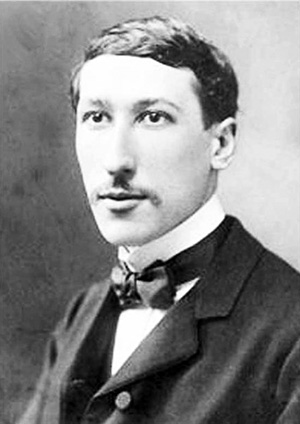
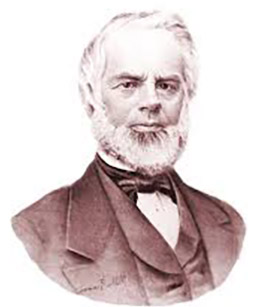
    French esoteric philosopher René Guénon (1886–1951). Photo taken in 1925.

    Born in Blois, France, in 1886, Guénon was educated as a mathematician. As a young man, he was drawn into the occult revival that was sweeping France at the turn of the twentieth century. He was befriended by Gérard Encausse, better known by his pseudonym Papus, the celebrated occultist who, among other accomplishments, founded the Martinist Order. But Guénon soon became dissatisfied with both Papus and occultism and drifted into other esoteric circles.

    The years between 1906 (when Guénon began to explore occultism) and 1912 were the critical points in his development. After breaking with Papus, he received initiations in lineages connected with Taoism, Freemasonry, and Sufism. He also began exploring what he came to call “Tradition” – meaning not merely what has been handed down from antiquity, but a body of universal esoteric doctrine that, he contended, underlies all the great world religions.

    Guénon’s explication of this Tradition, set out in many books and articles he published up until his death in 1951, has a number of curious features. In the first place, it is strongly oriented toward Hinduism, although the sources of Guénon’s contacts with Hinduism, both in the Paris of the Belle Époque and later, are mysterious in the extreme. Indeed his first book, Introduction to the Study of the Hindu Doctrines, was submitted as a dissertation to the Sorbonne but was rejected partly because, violating academic norms, it contained almost no references.

    In the second place, although Guénon converted to Islam in Paris in 1910, and was initiated as a Sufi, before moving to Cairo in 1930, neither Sufism nor Islam plays any great role in his ideas. At the time of death, he had been living in Egypt for over twenty years, but his 3,000-volume library still contained four times as many books on Hinduism as it did on Islam, according to Mark Sedgwick in Against the Modern World: Traditionalism and the Secret Intellectual History of the Twentieth Century, an important study of Guénon and his followers.

    Rather, for Guénon, the Traditional doctrine is most fully expressed in Hinduism. It is also focused on metaphysics. Today metaphysics – usually described as the philosophical study of being – is among the least sexy of intellectual pursuits. In Anglo-American academic philosophy, it is moribund. For Guénon it is central. Not surprisingly, his discussion of it is among the most masterful aspects of his work. But comparatively few of Guénon’s admirers give much attention to metaphysics.

    Despite its failure to impress the Sorbonne, Introduction to the Study of the Hindu Doctrines was published in 1921. It is one of Guénon’s most important works and provides the best introduction to his thought.

    Metaphysics – “Knowledge of the Universal…”
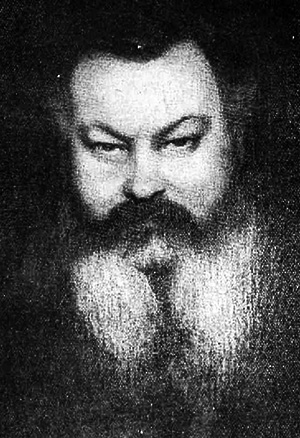
    Guénon was befriended by Gérard Encausse, better known by his pseudonym Papus, the celebrated occultist who, among other accomplishments, founded the Martinist Order. Guénon soon broke with Papus to go his own way.

    In it Guénon says that metaphysics, or metaphysic, in the singular, “is essentially the knowledge of the Universal, or, if preferred, the knowledge of principles belonging to the universal order… but in making this statement we are not really trying to propose a definition of metaphysic, for such a thing is a sheer impossibility by reason of that very universality which we look upon as the foremost among its characteristics.” Metaphysic stands above “that which changes or which is subject to the influences of time and place; the contingent, the accidental and the universal belong essentially to the individual domain.” Metaphysic deals not with this individual domain, but with the universal.

    Although metaphysic “cannot contradict reason” of the conventional kind, “it stands above it.” Nor is metaphysic grasped with reason, but by the “intellect… that faculty which possesse[s] a direct knowledge of principles.” Intellect, in this sense, is not what present-day thought understands by that term. As Guénon describes it, intellect is a type of higher cognition – a direct experience of principles. And it is “infallible” because “its operation is immediate and, because, not being really distinct from its object, it is identified with the truth itself.” This, he adds, is exactly how Aristotle and his heirs, the Scholastic philosophers of the Middle Ages, understood the concept of intellect – in Greek, called nous, intellectus in Latin.

    Intellect may be infallible, but the ways of expressing it are not. “Since all expression is bound to be imperfect and limited, error is inevitable in its form, if not its content: however exact one tries to make its expression, what is left out is greater than what is included.”

    Symbolism of the Cross

    One of the central themes of this metaphysics is what Guénon calls “the multiple states of being” (the title of one of his books). The best way to understand this concept is to picture it as Guénon does in what is probably his masterwork, The Symbolism of the Cross, published in 1931.

    For Guénon, the significance of the cross goes far past its meaning in Christian symbolism. As he says, it is a virtually universal symbol. His explication of it magnificently illustrates not only his metaphysical system, but many otherwise obscure points in the symbolism of the world’s religions.

    To begin with, the cross (pictured in its Greek, or equal-armed form) symbolises the juncture of the supernal with the mundane. The latter is represented by the horizontal line, which, Guénon says, represents the possibilities of manifestation at any given level of existence (such as human incarnation). The vertical line represents the ascent possible from one of these levels to another, and thus to “the indefinite series of states of the total being.”

    Guénon expands this cross into a three-dimensional form. There are now two crosses, one perpendicular to the other, both with the same centre. The horizontal cross defines a plane – the plane of manifestation at any given level of being. This plane is not the only one there is. In fact at every point on the vertical line, another horizontal cross can be drawn, defining another plane and signifying another, different realm of being. The number of these realms is infinite, or, as Guénon puts it, “indefinite.”

    Thus our human existence, complete with all the possibilities (both physical and spiritual) latent in it, comprises just one plane of this three-dimensional cross.

    It’s not possible to go further into this schema here, which is sort of a Cartesian coordinate system of the levels of being (a comparison Guénon would have loathed; if he ever wrote a kind word about Descartes, I have not read it). But it masterfully ties together symbols and ideas from a wide and disparate range of traditions. One symbolic version of this cross is the World Tree, which is found almost universally.

    In any event, these three books define the core of what he calls the Traditional doctrine:

    Introduction to the Study of the Hindu Doctrines
    Man and His Becoming according to the Vedanta
    The Symbolism of the Cross

    I would read them in the order given to get a comprehensive view of Guénon’s doctrine. They are not necessarily easy reading, but Guénon takes pains to write clearly and precisely. At any rate his style is free from the jargon-infested prose and pretentious neologisms favoured by many twentieth-century philosophers, particularly those on the European continent.

    Spiritualism & Multiple States of Being
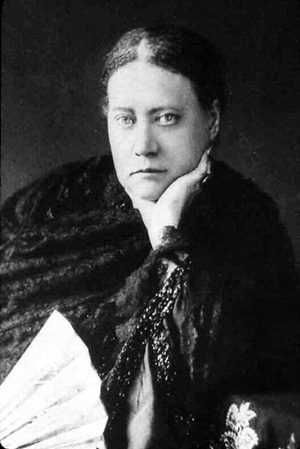
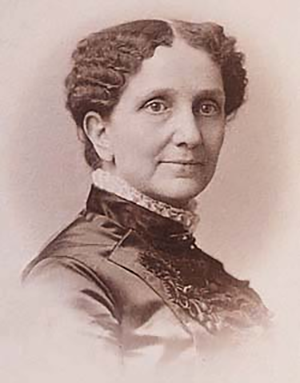
    Helena Petrovna Blavatsky, co-founder of the Theosophical Society. Guénon published books aimed at demolishing the arguments of Theosophy and Spiritualism.

    After Introduction to the Study of the Hindu Doctrines, Guénon published two books on more narrowly defined topics: Theosophy: History of a Pseudo-Religion and The Spiritist Error. These are the works in which his thought is the weakest. They aim to demolish the Theosophy of H.P. Blavatsky and her successors on the one hand, and, on the other, to combat the spiritualist, or spiritist,* movement that had reached its heyday in the nineteenth century. At the time Guénon was writing, in the early 1920s, many were drawn to spiritualism in the wake of the First World War. Bereaved survivors of dead soldiers often turned to it to be reassured of their loved ones’ continued life beyond the grave.

    * The term applied to those who try to communicate with the dead is, in the English-speaking world, “spiritualism.” In French, it is spiritisme, “spiritism.” Guénon naturally uses the latter more often. There is some difference between these movements as they manifested in France and in the English-speaking world, but for convenience in this article, I will for the most part use the word spiritualism to apply to both.

    Guénon did not believe that spiritualists genuinely contacted the dead, even in the cases where there was no fraud involved (and there were many in which it was). One of his main points has to do with the manifestations of spirits in séances. He did not think these “phenomena,” as he called them, were illusory. But he denied that they were actually appearances of the dead people in question. In his view, the essential core of the dead individual – the spirit – went on to another of the multiple states of being, and did so necessarily and without exception.

    So who or what were the ghosts who appeared in séances? These, he claimed, were “simply those inferior elements that the being has in a way left behind in the earthly realm after the dissolution of the human complex that we call death. These are… what the ancient Latins called the manes. This is also what the ancient Hebrews called the ob, which is invariably the word used in biblical texts in regard to evocations” (cf. Deuteronomy 18:11; 1 Samuel 28:7). The root meaning of the Hebrew word ob (more correctly, ’ov) is “wineskin,” which suggests how the ancients conceived of these subtle remains. He explains:

    It is, if you will, like a subtle form that can only take on an illusory corporeal appearance when manifesting under certain circumstances. This is the origin of the name the ‘double’ [ka] given to it by the Egyptians. For the rest, in all respects it is only an appearance. Separated from the spirit, this element cannot be conscious in the true sense of the word. Nevertheless, it possesses a semblance of consciousness, a virtual image, so to speak, of the living being. And the magician, reviving this apparition by lending it what it lacks, temporarily gives it enough of a reflexive consistency to obtain responses when he asks questions of it.

    These astral remains thus are a kind of shell that the dead person has left behind, and which can be activated under certain conditions. They can even appear to answer questions.
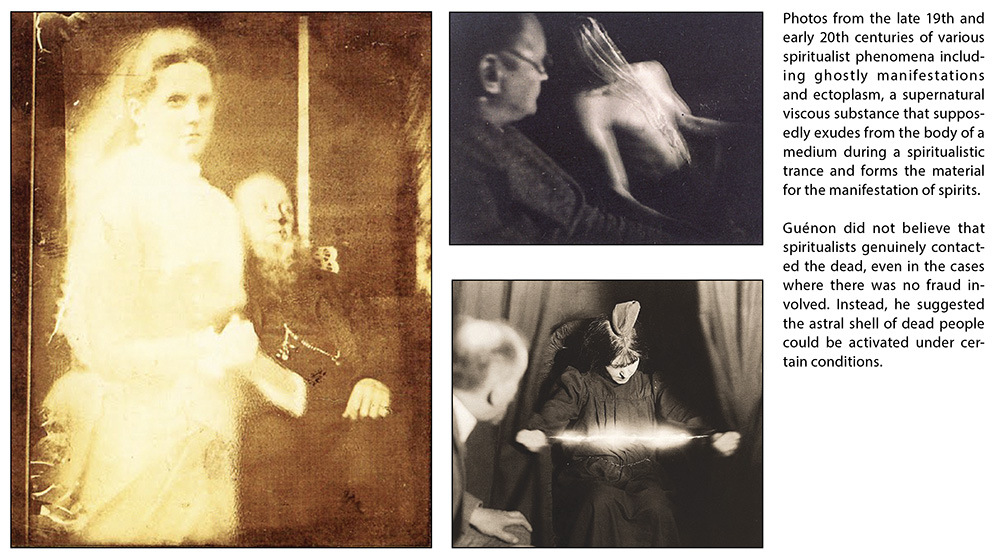
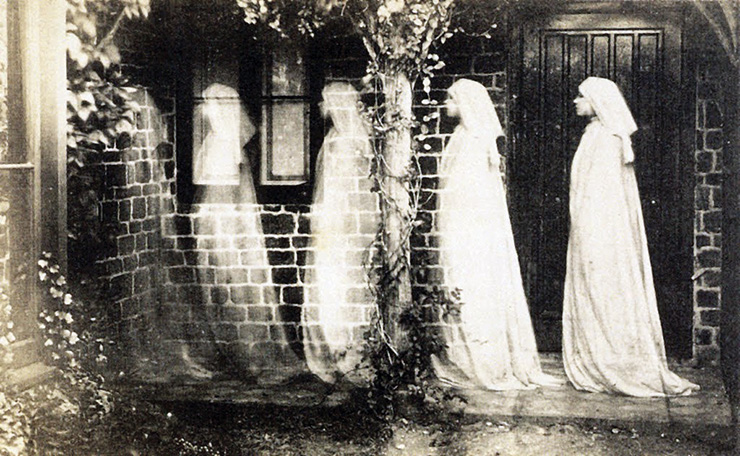
    This explanation does not cover all of the phenomena that take place in séances. Guénon also talks about materialisation, “perhaps the rarest of all phenomena.” In these cases a spirit actually appears to manifest palpably to participants. “A kind of substance, at first unformed and nebulous, seems to separate itself from the [medium’s] body, then gradually condenses. These entities often can be seen, touched, and even photographed (thereby excluding the possibility of hallucination).” In these cases, Guénon claims, the form arises from the mind of either the medium or of one or more of the participants. This is why there have been apparitions of people who turned out never to have existed. “Cases have been noted in which the ‘materialised’ forms quite simply copied portraits of fantastic figures borrowed from pictures or designs seen by the medium,” he writes. The energy is supplied by the medium or the participants or both.

    Why does Guénon take such great pains to refute the ideas of the spiritualists? To return to his metaphysical system, in which each plane in the three-dimensional cross represents one level of manifestation – even, one could say, of reality – Guénon holds that an individual goes through each level exactly once and then passes on to another. He does not remain in connection with the previous level. It is to refute these fallacies that he makes his elaborate case in The Spiritist Error. One could even say that, in essence, this is the spiritist error.

    His arguments are successful up to a point: they seem to fit in well with descriptions of the spiritualistic phenomena of his time and earlier. Furthermore, they help explain why most encounters with the dead take place in the few days after death, when presumably these residual elements have not had the time to break down fully. But Guénon’s claims stop short of explaining all such phenomena. There are instances in which the dead person appears much later than the time of death. Moreover, it seems to be in full consciousness and aware of things that were not known by the person to whom it appears. Such are the cases with warnings sometimes given by the dead to avoid certain voyages or plane flights.

    One difficulty here, as with many of Guénon’s arguments, is that he holds rather rigidly to an extremely precise schema that is logical and consistent in its own terms but does not completely square with manifest reality. Indeed, even by his own theory, there must necessarily be some dissociation between the world of pure principle and the imperfect world of manifestation. But sometimes he does not seem to grasp the implications of this fact.
    Get the issue this article appears in

    Guénon on Reincarnation

    Guénon also takes great pains to refute the teaching of reincarnation. “The idea of reincarnation… like that of evolution, is a very modern idea; it appears to have materialised around 1830 or 1848 in certain French socialist circles” (Guénon, Theosophy, 104). Regarding the transmigration of human souls into animals, he says:

    In reality, the ancients never conceived of such transmigration, any more than they did of a human into other humans, which is how one might define reincarnation. There are expressions, more or less symbolic, that could give rise to such misunderstandings, but only when one does not know what they are really saying, which is this: There are psychic elements in the human being which separate themselves after death, and which can pass into other living beings, human or animal, although this has no more importance than the fact that, after the dissolution of the same individual, the elements that made him up can be used to make up other bodies.

    Unfortunately, the ancient accounts of reincarnation say nothing of the kind. At the end of the Republic, Plato tells the myth of Er, a soldier who has a near-death experience in which he learns the fates of individuals after death (Plato, Republic, 614b-621d). In one famous passage, Er sees the dead choosing their lots for new incarnations. Odysseus, the shrewdest of men, refuses lives of riches and honour and instead chooses the existence of an ordinary citizen. However “symbolic” this story might be, it is hard to see how it might accommodate itself to a theory like Guénon’s. One could make the same point about the teachings of the Pythagorean mysteries, to the extent that we know anything specific about them.

    Guénon’s own views about the fate of the spirit after death are complex. Defining transmigration in what he considers the true sense, he contends, “It is not a matter of a return to the same state of existence… but on the contrary, the passage of the being to other states of existence, which are defined… by completely different conditions from those to which the human being is subject… Whoever speaks of transmigration is essentially speaking about a change of state. This is what all the traditional doctrines of the East teach, and we have many reasons to believe that this was also the teaching of the ‘mysteries’ of antiquity; it is the same thing even in heterodox doctrines such as Buddhism.” The last remark indicates that when he was writing The Spiritist Error, in the early 1920s, Guénon believed that Buddhism was not a pure reflection of the “orthodox” Traditional doctrine. Later in life, he granted it a certain grudging acceptance.

    As we have seen, Guénon conceives of existence as a kind of three-dimensional grid, with a vertical axis transecting an infinite number of horizontal planes. The vertical axis represents the Self, the true essence of a given being; each of the innumerable horizontal planes constitutes a separate plane of manifestation. Human life on earth is only one of these planes. A given being can manifest itself only once on any particular plane. Therefore you cannot be born more than once as a human.

    Like much of Guénon’s thought, this is rigorously precise and would seem to be irrefutable except for one thing. Guénon assumes that any given plane – such as earthly human life – is static. But in fact there is nothing to prove that this is so. On the contrary, the earth and earthly life are changing form ceaselessly, whether we look at them from the perspective of geological ages or even of human history. The possibilities for human life on earth today are not the same as they were in the year 1000 or will be in 3000. You can never be born onto the same earth twice, any more than you can be born as the same person twice.

    At that time Guénon could get away with saying that Hinduism and Buddhism did not teach reincarnation. The number of Hindus and Buddhists in the West was insignificant, and many of those were Western converts. It is much harder to make such claims now, when the West has access to teachers from high levels in these traditions. The Dalai Lama, for example, the supreme authority in Tibetan Buddhism, has written: “There have been and are found at the present time, many incidents illustrating rebirth, from many countries in the world. From time to time small children talk about their work in a previous life and can name the family in which they lived. Sometimes it is possible to check such cases and so prove that the facts remembered by the child are not at all nonsense but are indeed true.”

    And of course the Dalai Lama’s credentials as an authority of “Traditional” teaching are far more solid than Guénon’s own.

    For a Hindu perspective, we might turn to Paramhansa Yogananda’s classic Autobiography of a Yogi. Yogananda quotes his guru, Sri Yukteswar, as saying, “Beings with unredeemed earthly karma are not permitted after astral death to go to the high causal sphere of cosmic ideas, but must shuttle to and fro from the physical and astral worlds only.” The process of shuttling to and fro from the physical world would suggest that physical incarnation is not a once-only option. And again, the credentials of both Yogananda and Sri Yukteswar as transmitters of traditional teaching are far higher than Guénon’s.

    A follower of Guénon’s might try to argue that all of these Eastern teachers have been somehow corrupted by Western views – but that comes very close to begging the question. If you are trying to determine whether “Traditional” Hinduism and Buddhism teach reincarnation, you cannot categorically say that any Hindu or Buddhist teacher who holds to such a doctrine is therefore “untraditional.” You are assuming the very thing you are trying to prove.

    Why should Guénon work so hard to deny the ideas of both the spiritualists and the Theosophists (the leading proponents of reincarnation in the West in his time)? Because, in his view, they are corruptions of Traditional ideas that date, at the earliest, from the eighteenth century. And if you read both Theosophy: History of a Pseudo-Religion and The Spiritist Error, you will see that he has an almost convulsive aversion to such concepts as “progress,” “evolution,” and reincarnation.
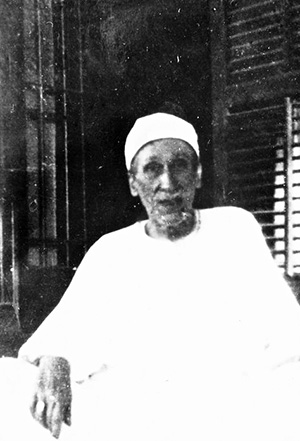
    René Jean-Marie Joseph Guénon, whose Muslim name was Abd al-Wāhid Yahyá, embraced Islam and Sufism in pre-First World War Paris.

    Guénon believed that the early nineteenth-century utopian French socialists Charles Fourier and Pierre Leroux invented the concept of reincarnation in order to explain inequalities among the human race. For Guénon, such inequalities are inevitable and even, one suspects, uninteresting. Every individual is different from every other; if it were otherwise, they would not be individuals at all. Thus of necessity all humans have different capacities and fates. Guénon accepts this eventuality with more equanimity than, I suspect, most readers would.

    In an article on Guénon’s views of reincarnation, scholar Joscelyn Godwin points out the likely basis of Guénon’s reasoning. “In an infinite series, such as that of integers, each term appears but once. Likewise, in the infinite variety of the Universe, experienced in its totality by every being, no single state need or can be repeated.” By such reasoning reincarnation would be impossible.

    Of course that would be true if the states of being were exactly analogous to mathematical integers, but there is no reason to accept such a thing a priori. In fact much of Guénon’s arguments against the failings of modernity have to do with its obsessive interest with number above all things – what he calls the “reign of quantity.” He quotes Thomas Aquinas, who wrote, Numerus stat ex parte materiae: “Number is on the side of matter.” This means that number, or quantity, has to do with matter, not with the world of the spirit. Number, as Guénon so intricately argues, does not apply to the higher, spiritual realms. There is, then, no reason to suppose that the laws of mathematics, however apparently inexorable, would apply either.

    Every thinker has his own dynamic – meaning the tensions between two ideas or types of ideas that he struggles, more or less successfully, to reconcile. For Guénon it is the tension between the world of multiplicity, of number, of quantity, of matter on the one hand and the realm of the intellect, of the spirit, of what he calls “quality” on the other. This dynamic, as he understands, is a powerful, perhaps an all-powerful one. And he intuits – correctly, I believe – that the modern world is balanced far too much in the direction of matter and quantity. But I am not sure that he himself manages to step past this imbalance completely. He himself may be prone to the fault that he so readily sees in others: applying quantitative principles to realms where quantity does not apply. He is no doubt right in saying that the states of being are infinite, or virtually so. But then its possible combinations would be infinite as well, and it would not be wise to jump to conclusions about what is and is not possible within them.

    Sources

    The Dalai Lama XIV, The Opening of the Wisdom-Eye, 2nd ed., Quest Books, 1991
    Joscelyn Godwin, “The Case against Reincarnation,” Gnosis 42 (Winter 1997), 28–32
    René Guénon, L’erreur spirite, 2d ed., Éditions Traditionelles, 1952
    René Guénon, Theosophy: History of a Pseudo-Religion, Translated by Alvin Moore Jr. et al., Sophia Perennis et Universalis, 2003
    Richard Smoley, “Against Blavatsky: René Guénon’s Critique of Theosophy,” Quest 98:1 (Winter 2010), 28–34; www.theosophical.org/publications/quest-magazine/42-publications/quest-magazine/1696-against-blavatsky-rene-guenons-critique-of-theosophy; accessed March 28, 2016.

    [alert type=”general” dismiss=”no”]This article was published in New Dawn 157.[/alert]

    [alert type=”success” dismiss=”no”]If you appreciate this article, please consider subscribing to help maintain this website.[/alert]

    © New Dawn Magazine and the respective author.
    For our reproduction notice, click here.
  • The World of Esoteric Orders: Secrets Within Secrets

    The World of Esoteric Orders: Secrets Within Secrets

    From New Dawn Special Issue Vol 7 No 3 (June 2013)

    It is noon on a summer morning in California, and I am sitting in a dimly lit auditorium that is decorated in an Egyptian style with Art Deco touches. A group of us have shuffled in and taken our seats on finely polished wooden benches, and we are led on a guided meditation.

    I don’t remember the exact content of the meditation, but I do remember the inner experience it generated in me. I had a strong sense of being in an Egyptian temple, seated on a stone chair on a stone dais in the centre of a room. The room had some kind of indirect lighting, and the only image I saw on the walls is a winged disk in front of me. Within me was a sense of coolness and centredness. I also had a slight glimpse, through a side entrance, of a bright blue sky with desert sand and some palms. I went into a deep meditative state and came out of it when the session ended.

    The setting I was in – I mean in the physical world – was the temple of the Ancient and Mystical Order Rosae Crucis (AMORC for short) in San Jose, California. It’s not surprising, perhaps, that I should have a sense of Egypt – the entire property, Rosicrucian Park, which occupies a city block, is designed in a quasi-Egyptian style – but it is surprising that the sense of Egypt should be so powerful. Later I realised I had had a much stronger feeling of being in ancient Egypt during that meditation than I had ever had when I visited the country itself.

    AMORC was founded in 1915 by an American ad man named Harvey Spencer Lewis, who received certain initiations in the Rosicrucian tradition in Europe around 1910. Using American marketing techniques (such as advertising in magazines), he built AMORC into one of the largest and most visible esoteric orders in the world. And, he insisted, the lineage of this tradition went back to Egypt itself.

    Does it? How could we possibly know? The amount of documentation that would be required to prove such a claim would be enormous, and anyway such materials would hardly be able to survive the assaults of the millennia.

    I am not a member of AMORC myself – I was present for that meditation, and a couple of others like it, while I was attending a conference sponsored by the organisation in July 2010. Moreover, I’ve never felt any great affinity for ancient Egypt. I have no way of knowing whether my experience arose from a contact with a thought-form built up by decades of Rosicrucian practice or whether it genuinely conveys a living tradition that goes back to the days of the pharaohs.

    A view of the temple of the Ancient and Mystical Order Rosae Crucis (AMORC for short) in San Jose, California. (Photo credit: AMORC)

    The “Upper Room”

    Perhaps it does not matter. In either case this experience suggests one characteristic of an esoteric order: it must have an “upper room.” The phrase goes back to the New Testament, which tells of Christ’s disciples gathering in an “upper room” after his ascension (Acts 1:13). The phrase also appears in Mark 14:15 and Luke 22:12, which speak of an “upper room” at which the Last Supper was to be held. The detail is striking: what difference does it make if you meet in a room that is on an upper storey rather than a lower one? In a literal sense, none; but in an inner sense, I believe that an “upper room” – that is, a place on an astral level, as it is sometimes called, or the realm of the psyche – is a necessary part of an esoteric order. This “room” can be created by the sustained work of visualisation by a group over a certain period of time, and after a certain point it can start to have a quasi-independent existence. The group can gather there in thought, if not physically. This kind of “upper room” may be what I glimpsed in my AMORC meditation.

    Curiously, one of the requirements given for the brothers in a seventeenth-century text known as the Fama fraternitatis (“Rumor of the Brotherhood”), a chief inspiration for the Rosicrucian movement, is “that every year, on the day C., they should meet together at the house Sancti Spiritus [of the Holy Spirit], or write the cause of his absence.” It is not clear which exactly is the “day C.,” but there is some evidence, at least in certain strains of the Rosicrucian tradition, that, despite the difference in initials, it is the feast of the Epiphany on January 6. (I do not know if this is the case for AMORC.) In any case, it seems likely that “the house Sancti Spiritus” is not a physical building, but the kind of upper room that I have been talking about here.

    None of this, of course, tells us exactly what an esoteric order is, so some explanation is needed. Let’s begin by assuming that there is a vast continuum of development in consciousness, from the most ephemeral subatomic particle to beings and dimensions greater than we can conceive. Let’s also assume that the realm of human life and consciousness forms a very narrow bandwidth on this enormous span. There are levels below us and above us. Moreover, these levels are not rigidly separate or discrete, but blend into one another, like the colours on the visible spectrum. That is, there is some communication among them. The most famous image of this process appears in Jacob’s dream in Genesis: “And behold a ladder set up on the earth, and the top of it reached to heaven: and behold the angels of God ascending and descending on it” (Genesis 28:12).

    We might go on to make another assumption – that the interaction that takes place among these levels involves a certain degree of responsibility, that the level above is required to help the one below rise to a higher degree of consciousness. Taking all these possibilities into account, we have a sense of what esoteric orders might mean for human development.

    By this view, there are beings who have a greater degree of awareness (and, we may hope, compassion) than we do. They are aware of us – dimly, perhaps, as we are aware of them – and are able to help us. But in fact we cannot see these beings on a physical level. They exist on some other plane, and we need to rise up to that plane in order to have some genuine communication with them.

    Hence the need for an upper room. Hence also the need for a group or community that can train people to rise to this upper room and have some communion with the beings there. (The Jewish Kabbalists sometimes refer to this as “the academy on high.”) These groups would constitute the esoteric orders – some of them known but many, perhaps most, unknown to any but their own members. The esoteric orders would exist on the physical level, but they would also have contacts on levels above. These are sometimes called “inner plane” contacts.

    To take another example – again from a group that I do not belong to – there is the little-known Esoteric School of Theosophy. The Theosophical Society (TS) itself is comparatively well-known. It was founded in 1875 by the Russian savant H.P. Blavatsky and several of her associates. Today it continues to function on a worldwide basis as a means of, among other goals, investigating the “unexplained laws of nature and the powers latent in humanity.” The TS is said to have been inspired by Blavatsky’s contact with certain Masters or adepts who possessed paranormal powers and whose mission was to elevate the spiritual state of humanity.

    H.P. Blavatsky

    As the TS grew and spread, its purpose became more diffuse, and it attracted many members who were interested in studying about but not necessarily pursuing the esoteric path. Consequently, in 1888 Blavatsky formed what she called the “Esoteric Section” of the TS, which was more oriented toward practice. Later the name was changed to the “Eastern School of Theosophy,” and finally to “the Esoteric School of Theosophy,” an organisation that exists to this day. It is not a secret society per se, but it is comparatively discreet about its existence and is only open to members of the TS. Those who want to join the Esoteric School must pledge themselves to a life of purity, eschewing meat, alcohol, and sexual license. (Not all esoteric orders have these requirements.) Members of the ES, as it is known for short, also devote themselves to lives of study, meditation, and service, although they do not withdraw from the world as monks or nuns.

    Part of the goal of the ES seems to be to maintain contact with the Masters or adepts of whom Blavatsky spoke. I do not myself know what the nature of this contact is, if it is genuine, or which Masters the members of the ES would claim to be in touch with. Nor do I know whether these Masters are believed to be living in physical bodies or exist only on the inner planes. I have occasionally put questions about these things to members of the ES but have only gotten vague and noncommittal responses. Nonetheless, this contact seems to be part of the task of the ES, and it helps illustrate the purpose of having an upper room. 

    Initiation

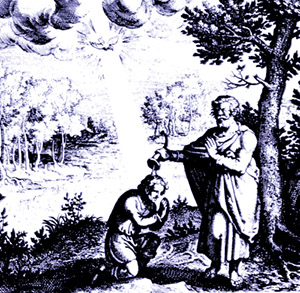
    Esoteric orders usually bring in new members through initiation. The word “initiate” is in some ways a misleading one. To some, it connotes someone who is highly advanced – as, for example, in Cyril Scott’s Initiate trilogy of occult novels from the 1920s and ’30s, whose hero, Justin Moreward Haig, displays astonishing paranormal powers. But the core meaning of the word is really “beginner” – an initiation is a beginning. Initiation can take many forms and can range from the extremely simple to the extremely complex, but often it contains a sequence of acts in which the initiate symbolically “dies” and then is resurrected in a new and transformed state. The most familiar version of this rite is Christian baptism, particularly in its original form, whereby the candidate is fully immersed in water. By this symbolic drowning and restoration, the new Christian takes part in the death and resurrection of Christ himself. (Christianity today, of course, is not an esoteric order, but there is some evidence that it began as an esoteric order and was later popularised.)

    The Catholic Church has traditionally taught that the rite of baptism leaves an indelible mark on the soul, removing all sin. Writing on the occult significance of the sacraments in the early twentieth century, the Theosophist and clairvoyant C.W. Leadbeater was more cautious in his assessment. While saying that it was “distinctly… an act of white [beneficent] magic, producing definite results which affect the whole life of the child,” he also pointed out that “a Sacrament is not a magical nostrum. It cannot alter the disposition of a man, but it can help to make his vehicles a little easier to manage. It does not suddenly make a devil into an angel, or a wicked man into a good one, but it certainly gives the man a better chance. That is precisely what Baptism is intended to do, and that is the limit of its power.”

    As this passage suggests, initiatic practices usually intend to transform the inner nature of an individual. The Freemasons sometimes claim that the aim of their secret initiations is “to make good men better.” This is generally a subtle process, and probably for most individuals the change they undergo is comparatively gradual and difficult to see unless you are looking for it. In some cases, however, initiation produces more dramatic effects.

    Over twenty years ago, when I was editor of Gnosis, a now-defunct magazine of the Western inner traditions, I entered into correspondence with a gentleman from Jordan named Dr. Jamal N. Hussain, who was researching deliberately caused bodily damage (DCBD) phenomena. He told me about the Tariqa Casnazaniyyah, a Sufi order whose name means “a path that is known by no one.” (For a discussion of the Casnazaniyyah order, see http://ashraf786.proboards.com/index.cgi?board=sufi&action=display&thread=23998.)

    This order, which traces its lineage back to the Prophet Muhammad, has a membership said to number in the millions, located chiefly in Iraq, Turkey, Iran, and Jordan. Its initiation process is quite simple. It consists of a brief two- or three-minute ritual in which the initiate recites a vow while exchanging a ritual handshake with the master of the order or one of his deputies. The initiate then requests permission to perform certain types of miracles. The master grants permission on the condition that the initiate will perform them only to attest to the greatness of the Casnazaniyyah order.

    After this initiation, the individual can pierce his body with sharp objects, swallow razor blades, eat poisonous scorpions, or handle fire, all without any apparent harm. Scientific explanations are difficult to come by. As Dr. Hussain pointed out, this effect cannot be explained by endorphins (the body’s natural painkillers), since the wounds heal spontaneously and immediately. Nor can it be explained by self-hypnosis, since the practitioners do not experience any altered state of consciousness. While I myself have never witnessed any of these phenomena, Dr. Hussain did send along a number of rather poor-quality Polaroid photos, which did not seem to be doctored. In one of them, a bare-chested man with a large belly was piercing himself with spikes. In another memorable image, a man was chomping down on a scimitar, which was cutting into his lips. Dr. Hussain invited me to a conference in Baghdad that was discussing DCBD phenomena, but I was unable to go.

    No matter how exotic their manifestations may be, esoteric orders have the task of making and maintaining contacts with higher levels of consciousness and being, and inducing a transformation within their members that make this possible. A complementary task is to carry out some function in the world – to do some kind of work that furthers human advancement. For example, the monastic orders that grew up in late antiquity had the function of preserving the essence of classical civilisation in the wake of its collapse. They also cleared land for agriculture in Europe and managed it in a careful and responsible way, creating the foundations of Western civilisation. “In a sense they determined the whole history of Europe,” writes historian Paul Johnson; “they were the foundation of its world primacy.” As the Dark Ages passed and medieval civilisation flowered, the monasteries, having fulfilled their purpose, fell into corruption. Today the monastic orders still survive, but for the most part only as dwindling vestiges.

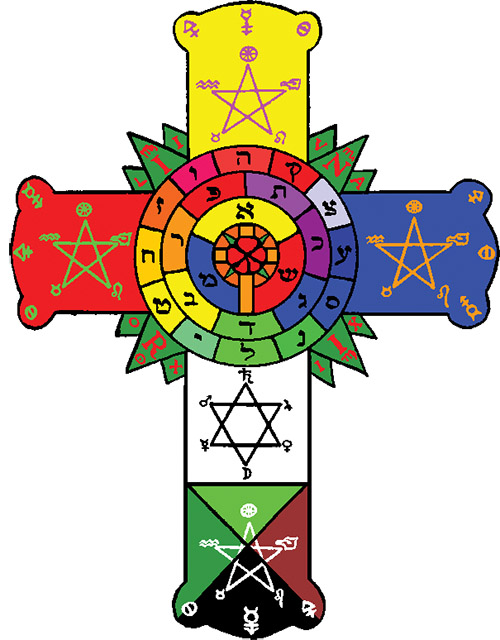
    Rosy Cross of the Hermetic Order of the Golden Dawn, ca. 1900

    Some have tried to classify esoteric orders on the basis of their functions. In the 1990s the British esoteric school known as Saros came up with a twelvefold division, inspired by the verse in Revelation that speaks of “twelve gates” to the holy city (Revelation 21:12). The Saros schema comprises Teachers, Prophets, Magicians, Lawgivers, Traders, Artists, Craft Workers, Life Tenders, Warriors, Perpetuators, Priests, and Explorers. One can easily find examples of these in world history: the schools of the prophets or “sons of the prophets” under such figures as Samuel, Elijah, and Elisha (1 Samuel 10:11; 19:19–20; 2 Kings 2:3, 5; 4:38; 6:1); the military orders of medieval times such as the Templars and Hospitallers; and the various magical orders that have arisen in the West over the past century or so, like the Hermetic Order of the Golden Dawn.

    System of the Seven Rays

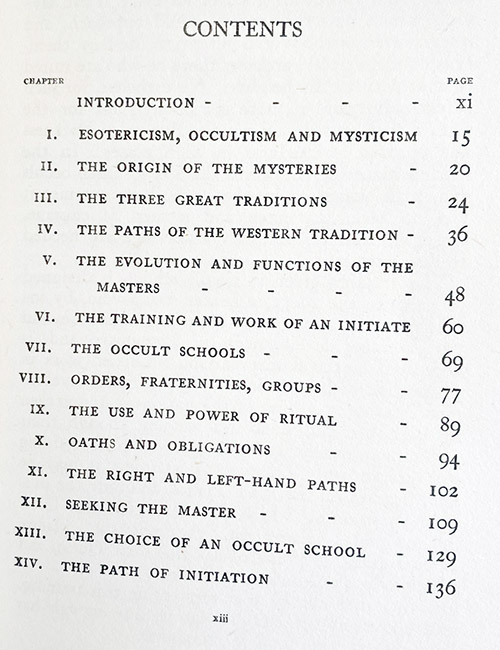
    In fact one of the most illustrious pupils of the Golden Dawn, Violet Firth, writing under the pen name Dion Fortune, wrote what is probably the best introduction to the subject: The Esoteric Orders and Their Work, which was originally published in 1928. Dion Fortune categorises the orders of the West according to a system of the Seven Rays that is similar to the one found in Theosophical teaching. Her schema is worth looking at in some depth.

    Contents page of The Esoteric Orders and Their Work.

    Beginning with the seventh ray, Fortune contends that this, “the Plane of Abstract Spirit,” cannot be contacted while in the physical body. Instead the higher Self must withdraw, leaving the body in a trance. Fortune says that this seventh ray is not highly developed in the West, being characterised for the most part by mystics and ecstatics; Teresa of Avila is one of the principal sources on the subject. This ray is not to be developed prematurely, before the other, lower ones have been brought to fruition; otherwise it produces a kind of spiritual inertia. The school of the Quietist mystics in seventeenth-century France and Spain offer an example of this problem. Hence orders of the seventh ray are chiefly to be expected in the future.

    The sixth ray is connected with spiritual devotion, with what the Hindus call bhakti, and, Fortune says, “hereon are developed the spiritual qualities of Love, Truth, Goodness, Purity, and many others.” It is headed by the Master Jesus, she says, and hence is known as the Christian Ray. “It is the hidden power of Christianity which was taught to the disciples in the Upper Room whilst the multitude received but a rule of life – a rule, however, which if faithfully followed, would bring them to that Upper Room where they could receive the inner teaching.”

    The fifth ray is connected with the use of abstract reasoning. Fortune says it is called the Pythagorean Ray because it reached its heyday in the mystery schools of ancient Greece, among which the Pythagorean school was prominent. For the philosopher Pythagoras, who lived in the sixth century BCE, the universe was grounded in the principle of number and hence was knowable mathematically. 

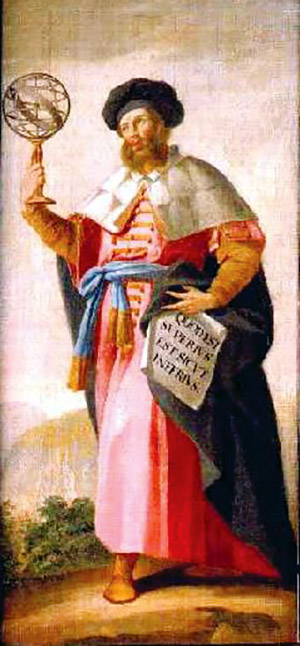
    Painting of the legendary Hermes Trismegistus, author of the Hermetic Corpus, a series of sacred texts important to many esoteric orders.

    The fourth ray is the ray of concrete, as opposed to abstract, mind; its quintessential master was the semimythical sage Hermes Trismegistus, and it bore fruit in the Egyptian and Chaldean mysteries of antiquity, as well as in its heirs, such as Gnosticism and the Jewish Kabbalah in late antiquity, as well as in the alchemists of medieval and early modern times. The Rosicrucians of AMORC, with their strongly Egyptian flavour, might come under this ray.

    The third is the ray of beauty and harmony; “being an initiation of the emotions, its standards of value are aesthetic, not ethical.” It was exemplified by some of the earlier Greek mystery schools, Fortune says, particularly those of the Dionysian cult. Later it gave rise to the “Celtic racial culture” and hence is known as the Celtic Ray. It seeks to embody beauty and harmony in the manifestations of physical reality, and as a result is also known as the artist’s ray.

    The second, “the Norse Ray,” is so called “because the purest contacts of this much-corrupted tradition which are available to us in the West are those of the Nordic mythology.” It deals with the plane of primitive instincts and the urge to overcome them; its ecstasy arises out of courage – the sublimation of fear in battle. Its dark side is cruelty, as can be seen from the ancient Viking practice of the “blood eagle,” in which a victim (usually a prisoner of war) had his rib cage cracked open from behind; his lungs were then ripped out and spread out on his back, producing a ghastly imitation of a pair of wings. Fortune suggests that this ray reached its zenith in remote primitive times.

    The first ray principally involves the mastery of the physical body. The Casnazaniyyah order forms a rather extreme example of this type. Dion Fortune says that this ray is not “worked” in the West in the present day; and it probably was not in her time (she died in 1946), but we can see its resurgence on the contemporary scene with the wide popularity of hatha yoga. Although Fortune does not say this, it can probably be connected with the health and fitness cults of recent generations.

    Get the issue this article appears in

    I must add here that Fortune’s picture of the seven rays is not quite identical with those of the classic Theosophical view (as outlined in, for example, Ernest Wood’s 1925 book The Seven Rays), but it remains comprehensive, particularly in trying to account for the different strains of the Western esoteric traditions. Again, it is easy to find examples of these different rays in many esoteric schools worldwide, whether we look at the way of the fakir or sadhu as practiced in the East (first ray) or at the schools of icon painters in Greek and Russian Orthodoxy (third ray). Other orders are more difficult to categorise. One would have to know more about the goals of the Esoteric School of Theosophy to be able to decide under which ray it fit.

    For this reason at least, I would not view Fortune’s schema, or any other, as fixed and absolute. As usual, they provide categories for classifying and thinking about a certain area that remain useful as long as they do not form rigid conceptual barriers in the mind.

    Coming to the end of this article, a reader may wonder about a number of things often associated with esoteric orders that I haven’t mentioned. What about the elaborate rites and costumes, the dazzling insignia, the extravagantly august titles often given to the leaders? Where do these fit in? They are external appurtenances – the hard shell around the order’s living core. At best they serve as reminders and confirmations of the ideals that it pursues. But if the members become too preoccupied with these appurtenances and they grow too cumbersome, this hard shell thickens and kills the living pith within. Thus when many people think of esoteric orders, they are often thinking of former esoteric orders that have died and are only going through the motions. If a seeker is only interested in these externals, most likely he will be drawn to groups of this kind, and may find them perfectly congenial. In most cases they are probably harmless enough.

    More than many other subjects in this field, esoteric orders retain an air of mystery about them. The vast majority are probably unknown to all but their own members, and the role they play in human history is subtle and hard to pin down. Some may focus heavily on their inner plane contacts, while for others these may be only felt as a vague and remote influence. But insofar as these groups foster human development and point us toward vistas that lie beyond the bounds of conventional reality, they continue to underpin civilisation in ways about which we can only guess.

    [alert type=”general” dismiss=”no”]This article was published in New Dawn Special Issue Vol 7 No 3.[/alert]

    [alert type=”success” dismiss=”no”]If you appreciate this article, please consider subscribing to help maintain this website.[/alert]

    Sources

    Paul Foster Case, The True and Invisible Rosicrucian Order, Samuel Weiser, 1985
    Dion Fortune, The Esoteric Orders and Their Work, Aquarian, 1982
    Paul Johnson, A History of Christianity, Atheneum, 1987
    C.W. Leadbeater, The Science of the Sacraments, 2nd ed., Theosophical Publishing House, 1929
    Richard Smoley, “Sufi Order Practices Way of the Fakir,” Gnosis 31 (Spring 1994), 8-9
    Ernest Wood, The Seven Rays, Theosophical Publishing House, 1925

    © New Dawn Magazine and the respective author.
    For our reproduction notice, click here.

  • A New Science of the Heavens: An Interview with Robert Temple

    A New Science of the Heavens: An Interview with Robert Temple

    From New Dawn 198 (May-June 2023)

    Robert Temple is a multifaceted writer and thinker whose work extends across many disciplines. From his work with Joseph Needham, author of the monumental Science and Civilisation in China, he wrote a book on Chinese science and technology, The Genius of China. He has also written The Crystal Sun, a study of over 400 ancient optical artefacts that were hidden in the basements of the world’s museums.

    Temple is perhaps best known for The Sirius Mystery, which discusses a West African tribe called the Dogon, who possess knowledge of the Sirius star system that preceded recent astronomical discoveries.

    This interview is dedicated to Temple’s latest book, A New Science of Heaven. It contains astonishing revelations about the new frontier of physics, which has to do with plasma – a fourth state of matter in addition to solids, liquids, and gases.

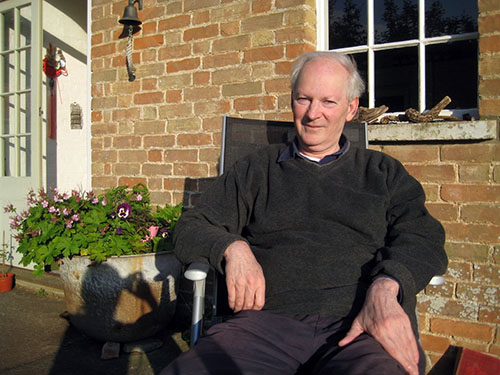
    Robert Temple

    Richard Smoley (RS): You’ve done an extraordinary number of fascinating things across the course of your career; any one of them would be a subject for a much longer interview, but we will focus this one on your latest book, A New Science of Heaven. It’s about a fourth state of matter called plasma. This comes out of physics, not metaphysics; it’s not occult in any way. But you say that it has an enormous significance for us. To begin with, what is plasma?

    Robert Temple (RT): Plasma is a fourth state of matter. It was officially discovered in 1879 by the English scientist Sir William Crookes, who was the inventor of the vacuum tube. He discovered this phenomenon going on in his tubes, and he named it “radiant matter.” The name was changed in 1928 by Irving Langmuir to “plasma.” (I must stress that it has no connection whatsoever with blood plasma.)

    Plasma is a form of matter that’s not made of atoms; it’s made of particles: electrons and protons, which have opposite charges to one another, and ions. Ions are often considered incomplete atoms because they don’t have a balanced charge. I look at it the other way around: I look at atoms as value-added ions. They can have positive or negative charge, but we’re really only concerned with positively charged ions, which are the most common and which compose, for instance, the solar wind that blows out from the Sun and fills the solar system.

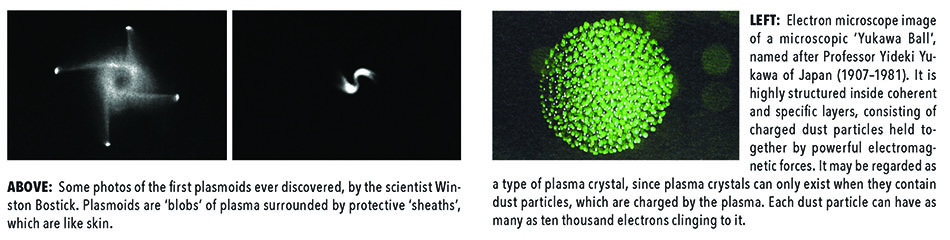
    When plasma was originally encountered, it appeared to be only a gas, but we now know that it can be a liquid. And it can not only be a solid, it can be crystals, so for some years now the few scientists who work on the fringes of physics and deal with these things have been dealing with plasma crystals. There are hot plasmas and cold plasmas. Most of the work that’s taking place at the moment is on the hot ones because those are concerned with trying to control nuclear fusion to make energy. They haven’t succeeded in doing that.

    The plasmas that I’m most concerned about in my book are the space plasmas, and they tend to be cold plasmas – much colder than anything on earth.

    I should point out that until 1962, it was universally believed by the world’s scientific establishment that outer space was empty. We grew up as children being told outer space was a total vacuum and nothingness, and we now know that it’s actually the very opposite.

    RS: How does this new discovery of plasma change our understanding of the universe?

    RT: It changes it completely. Because the universe is now known by astrophysicists to be composed of 99.9 per cent plasma. For instance, our Sun is completely made of plasma; it’s not made of atoms. And we have a universe which is made of plasma: nonatomic matter.

    Our basic physics – classical physics – has already been left behind by relativity theory and quantum theory, but even what we consider today to be advanced modern physics is wholly inadequate because it’s based upon the assumption that the universe is made of atoms, and it’s not. It’s made of plasma, which is very different and behaves very differently from atomic or physical matter. The equations which govern its behaviour are all nonlinear equations, which are hard to deal with, and it doesn’t follow all of our customary laws: it won’t sit and beg like a good dog. In fact, it’s a big, black, barking, threatening universe, and it doesn’t want to have tiny humans on rocky planets in the middle of nowhere trying to impose their laws upon it.

    So we have to change our science. We need a new physics, but don’t worry: it’s already on the way because there are branches of physics at this moment where the new science is being created. There are other branches as well: there’s topological physics, which is very exciting, and there’s information physics, which is an extension of it; it’s being driven forward by the search for quantum computers.

    Yet a great deal of plasma physics is not publicly known because a lot of these advances are taking place in two different areas which have vested interests in keeping them secret. First of all, if you have a corporation, you’ve got commercial motives. If you’re in possession of some great new idea about how to make quantum computers work, you’re not going to tell the other companies, so all the scientists working on this have signed confidentiality and secrecy agreements. We can understand that perfectly because there’s hundreds of billions of dollars involved for anybody who’s got the new angle. This may impede the flow of knowledge and certainly public understanding, but these commercial imperatives are at work.

    Even stricter than those are the military controls because most of this kind of work is funded by the defence establishment and the security establishment, and they overclassify everything. They’re not really interested in the public: who cares about those stupid morons out there who pay their taxes? It’s all got to be secret because there are always enemies, and we can’t say anything because the enemies might know.

    So what with the military and security restrictions and the commercial restrictions, these frontiers of physics don’t have much of a chance to trickle down to us. 

    That’s why I believe that my book is unique because I’ve gone to immense trouble to gather this information to the extent that is possible (and indeed I went beyond the possible in many instances) and boil it down into a book that can be understood by somebody who doesn’t know any science at all. As you read the book, I lead you by the hand, and I explain everything as I go on. If you don’t know what a semiconductor is or what superconductivity is, I tell you in an easy way.

    Furthermore, I’ve done an audio recording of the book myself, which is available from the same publisher, and some of my friends who have read or listened to my book are reading it or listening to it twice – not because it’s difficult: they all say they understand it. But there’s so much information that they have to go over it again because everything in the book is new, and it takes a bit of getting used to.

    RS: I’ve read your book, and I would agree with the things you’ve said about it. I did find it very comprehensible. Yet it was overwhelming, not because it was difficult, but because it transforms our view of reality. What we think of as reality has very little to do even with what we conceive of as physical reality. How do these ideas affect our understanding of the day-to-day world? 

    RT: They have the potential to change everything. We’ve got an infinite future ahead of us since I don’t believe that anybody can die, much less does die. We have to get ourselves in shape to face that, and we can’t do it with our present concepts.

    I’ve struggled with all of this myself. You’ve mentioned how difficult it was for you, not to take it in but to face the consequences. I’ve been going through that agony for years. Because I knew how overwhelming it was, I tried to lessen the challenge by making it as accessible as I possibly could.

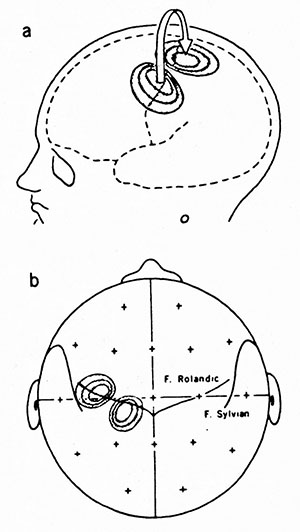
    Evoked electric currents in the brain produce magnetic fields, such as the one seen here (hence no one should insert ‘ear pods’ into their skull, which derange the brain’s normal functioning).

    We have to realise several key things which are different from what we think. There are very few rocky planets made of what we call physical matter. Of course, there may be hundreds of billions of them, but that’s a mere nothing compared to the others. We also need to realise that our physical bodies are what I tend to call smart overcoats, our real selves being bioplasma bodies. That’s what leaves the physical body at death and continues its existence on what you could describe as another plane.

    The intelligence in the universe is cosmic. These plasmas can form dusty complex clouds, which have the capacity to self-organise by the process known as emergence and develop intelligence. There are complex plasma clouds throughout the universe. We see them everywhere: every star is a complex plasma cloud, including our own Sun. Lightning, by the way, is plasma; the centre of a candle flame is plasma. We have plasma in us: our physical bodies are full of currents of plasma; every cell has protons going across the membrane. The heart is an electromagnetic device, which happens to activate itself as a muscle, but the fact is that we, even in our physical form, are electromagnetic beings. And the core of ourselves is our bioplasma cells, which are entirely plasma and electromagnetic.

    Plasma has positive charges and negative charges, and it can contain modules within it, countless ones. For instance, a bioplasma body the same size as a physical body will have an interior structure far more complex than our physical bodies. Indeed, we are very complex bioplasma bodies which exceed in complexity the anatomy of our physical bodies.

    RS: It has long been held that there are all sorts of subtle bodies which are nonphysical. Some of these have been described as etheric bodies or astral bodies; there also seems to be the substance called the life force, which science, for some reason, refuses to admit the existence of. How does plasma relate to these concepts? 

    RT: There have been many inspired people – psychics and seers and so on – who have intuited all the things which modern science can now demonstrate. You mentioned subtle bodies, and you can look at that wonderful book, The Subtle Body by G.R.S. Mead, a classic example (he’s one of my intellectual heroes, by the way).

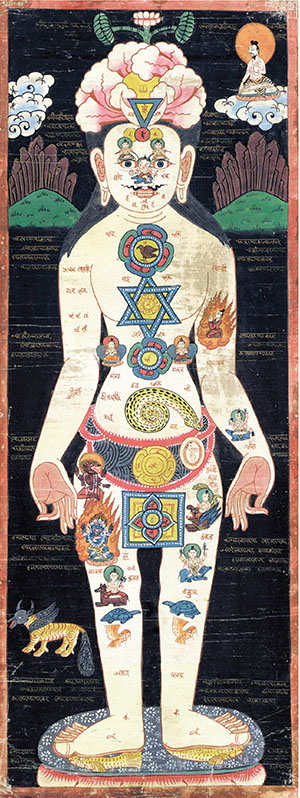
    A Cosmic Man, Purusha, Nepal, 19th century. The subtle body of the human being is represented in which points and locales on the body (microcosm) correspond with powers and gates (macrocosm) of the broader cosmic environment in which all exists. In Western esoteric traditions, the subtle body is usually referred to as the Light Body. The discovery of plasma intelligence opens up a whole new field of inquiry. 

    I believe there’s more than one level to the bioplasma body. That was known to the ancient Egyptians, who had many different souls; the ba and so on, the highest being the akh.

    This is the perennial wisdom, and this is what Mme. Blavatsky was trying to institutionalise. She thought she ought to get this deep wisdom organised, propagated, and preserved – and to be analysed as well. This perennial wisdom is true. Just because it’s been mocked and sneered at by people who arrogantly believe themselves to be rational (this just means narrow-minded) doesn’t mean that it’s false.

    Science has finally begun to catch up with ancient wisdom. We’re getting to the point where, on the very fringes of science, unreported to the public, never mentioned in the media, is all the stuff that I’ve gathered together in my book, which proves scientifically that this ancient wisdom is all true.

    That’s why it’s so important. We have to get this basic material propagated, we have to tell people, because the entire future of the planet really depends on this. Forget CO2 and climate change compared to what we’re talking about. Ultimately it doesn’t even matter if the earth should be destroyed by climate change; the fact is, the universe won’t be. I don’t think that the planet is going to be destroyed, but even if it were, we won’t be destroyed. We will continue to exist as bioplasma beings in a plasma world, which cannot be destroyed by climate change because there’s no climate in the plasma world; there’s no weather; there’s no rain; there’s no heat; there’s no cold. Even if everything were to be destroyed on this planet, we would all still exist. The efforts that we make here and now to understand the universe and get ourselves into gear properly will continue, even if only on what’s traditionally been called the spiritual level.

    RS: You have pointed out that the ancient Egyptians knew about these subtle bodies, and there are teachings about them in most esoteric traditions. Does that mean that humans have a capacity to somehow organically perceive the subtle bodies?

    RT: I’m so glad you asked that, Richard. Yes, I do believe that. Today we live in a society that is intensely materialistic, I would say very decadent. It’s shut itself off from what is traditionally called the spiritual.

    I do believe that every human being has the capacity for intuition of the deeper truths if they’re sufficiently open, but most people today are being artificially closed by bad forces, like addiction to mobile phones. Nobody any longer has any reflection time or time to get their heads together. We need to clear away the information clutter and the excess radiation that is being generated by all these devices and give ourselves a bit of peace. We need to set aside time to sit and meditate; we need to make our lives more peaceful if we possibly can.

    When we do that, I believe we can have the truths come to us because we are surrounded by information space, as I call it. I get a lot of my intuitions from my ability to contact and penetrate information space. If we really concentrate on that and give it its chance, we can open ourselves. In ancient times, the priests and seers were attempting to draw the deeper truths and sacred intuitions down into their minds. I think there was more of a direct connection to the deeper truths in simpler times.

    RS: One thing that I found fascinating in your book was the plasma clouds that you described between the Earth and the Moon. Could you explain those a little?

    RT: We have programs looking for extraterrestrial intelligence. I’m convinced we have it in the form of these two giant clouds, which together are eighteen times the size of the Earth.

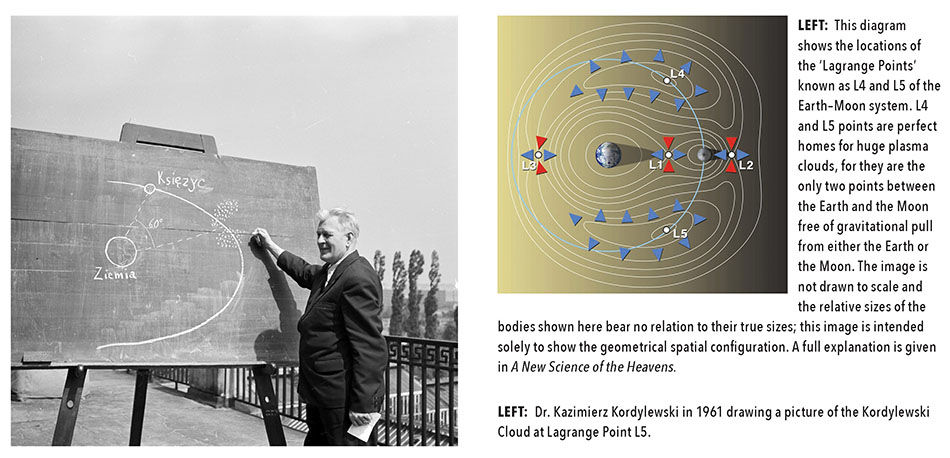
    They are between the Earth and the Moon – not in a direct line of sight, but at sixty-degree angles to the left and to the right as you look towards the Moon. They are at Lagrange points four and five (see graphic on page 48). These are points in between bodies in space where the gravitational pull of those bodies is effectively neutralised, where the gravitational pull of the Moon and the gravitational pull of the Earth balance out, and there’s nothing pulling you anywhere.

    These clouds were first discovered in 1961 by a Polish observational astronomer called Kordylewski. They don’t emit any light, and they’re almost entirely transparent and therefore very difficult to detect. In 2019, their existence was finally confirmed by a team of Hungarian astronomers, which Kordylewski couldn’t do in 1961 for two reasons: he didn’t have modern equipment, and as his great-grandson has told me, the Polish Communist government didn’t like him and stopped his work. The Hungarians came charging in on their white horses to the rescue, and they proved that he was right.

    I found the Hungarian scientists, contacted the woman in charge of them, and asked, “Are you studying the plasma aspects of the clouds?” She said, “No, we’re only studying the celestial mechanics aspects.”

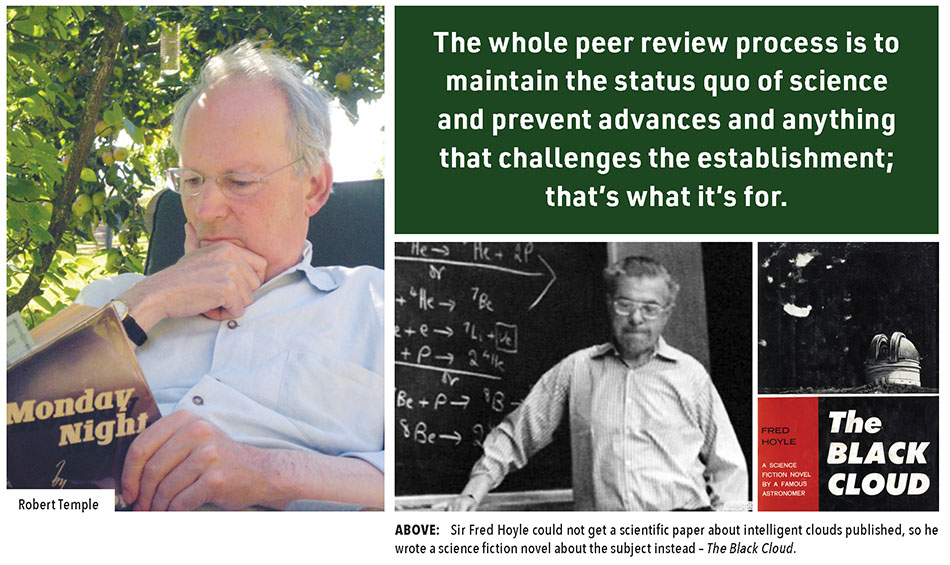
    I thought, “I’m going to do something about this quick,” so I got on to my great friend, the professor of astrophysics Chandra Wickramasinghe, who was the main protégé of the astronomer Fred Hoyle (whom I knew very well). Chandra didn’t know about these Kordylewski Clouds; very few people did. “We have to do a paper; would you do it with me?” I asked. And so we did a paper together, which was an advance in astrophysics, and it’s reprinted as an appendix to my book.

    We call attention to the fact that dusty complex plasmas in space like this would almost certainly have evolved intelligence. Considering that they are probably billions of years old, they would have intelligence so great that it would dwarf the pretences of the American security establishment with their supercomputers in Utah, where they store every phone call and every email. They think it’s going to make them all-wise, but of course, they can’t process all that, whereas these clouds can process everything since, I believe, they’re conscious; they’re alive.

    Their existence was intuited in antiquity. In Gnostic Christianity, there are descriptions of gigantic intelligent entities above the atmosphere between the Earth and the Moon. They were superentities presiding over the Earth. One of them was called Metatron, the name of the angel of the Lord.

    It’s a big stretch to realise that we may have intelligent, although inorganic, extraterrestrial life between us and the Moon. We don’t know whether they would have emotions and feelings – maybe they do – but they would have fantastic and unimaginable computing power. They would know everything about the entire history of the Earth and everything on it. They would probably also be great predictors of the future. They could probably tell us what’s going to happen six months from now.

    I do believe that these entities have attempted to communicate with us and that we didn’t notice. There is a history of their attempts to communicate with us. I had a whole section of the book about that which was removed by the publishers, so I’ll have to publish it at some point. But that’s another story.

    These entities are not just big; they’re different, and they’re not necessarily going to look at things the way we do here on planet Earth. The security agencies will consider this – as they already consider the whole question of extraterrestrial life – as the number one security issue for the world.

    Now we come to the question, are the clouds friendly, or do they hate us? I think the answer is very plain: if they weren’t friendly, we wouldn’t be here. I believe that they’re hoping we will make it, and they keep trying to help us by sending down waves of thought that sensitives can pick up. They can’t declare themselves, come down, and say, “Look, we’re going to sort out your politics for you; we’re going to stop wars.” But they must be quite worried about what we’re going to do with the planet, and I’m convinced that they want us to make it.

    RS: How do we know that these plasma clouds are intelligent?

    RT: Having read the book, you have seen there’s been a lot of work done, mostly by Russian scientists; it’s all laid out in the book. By spontaneous processes of self-organisation when these clouds come together, they can generate emergence: intelligence, which then becomes more and more intelligent and keeps growing. If they are billions of years old, you can’t even begin to imagine how intelligent they are.

    Dusty complex plasmas are a very special kind of plasma. To become intelligent, a plasma cloud has to have dust. If there isn’t any around that it can gather up, it’ll make its own. It’s self-sufficient in a way, but it does need energy coming in.

    RS: You suggest, as many people have, there are forces that are very much interested in our awakening. Yet there seem to be all sorts of factors that impede or subvert these efforts toward illumination. It almost seems as if there’s one group out there that is trying to enlighten us and another group trying to put the lid on us. 

    RT: I think there’s a war between good and evil going on throughout the universe, and we’re in the crossfire. Let’s face it: we live in a world today where authoritarianism is spreading rapidly everywhere, and we’ve got all these horrible people trying to enslave humanity.

    I think that humans are of some very special interest to the higher entities. You can imagine there must be lots of other physical spaces in the universe whose beings are incredibly dull but very good. And then there will be others who are totally bad. We’re kind of a mixture.

    I believe that we are bringing interest to the cosmic anthropologists because we’re a strange kind of experiment on the borderline between madness and creativity. We are uniquely able to be creative. Where does all this come from? At the same time, a lot of intensely creative people are pretty wild and woolly characters, and a bit crazy. There’s a thin line between genius and madness; a lot of the supermathematicians are autistic.

    We’re not boring as a species, but we’re also loaded with psychopaths. I would say, at least 10 per cent of humanity is psychopathic; some people would say 20 per cent. We can never seem to quite get rid of all the psychopaths.

    Now, this is all part of the cosmic anthropological study of us, you see. What the higher entities want to know is, can this work? In other words, can they somehow come up with a model of a human species that isn’t quite as crazy but still retains the creativity? Or do we have to be this crazy in order to be this creative?

    We don’t know the answer to that question. I bet these entities don’t either because we’re a running experiment, and they are interested to see the outcome. They try not to interfere because it would disturb the experiment. They can’t come down and kill all the bad guys; that would perturb the experiment, and then it wouldn’t be an experiment anymore.

    We have been studied without being interfered with. We have to be left to our own devices as long as possible until we get to the point where we might really all destroy ourselves in a sort of huge catastrophe; then there might be intervention.

    But after all, even if the physical world were to be destroyed, as I’ve already said, we as bioplasma beings would still exist. But where would we go?

    RS: I would like to ask a question raised by something Fred Hoyle said that you quoted in your book: that the scientific peer review process is merely a retardation of the advancement of knowledge. Could you expand on that a little?

    RT: In my book, I give case histories of scientists who made crucial experiments but were prevented from publishing. One leading case is Fritz Zwicky, a Swiss astronomer who, in the late forties and all through the fifties, kept trying to publish his paper showing evidence that outer space was not empty. The establishment insisted that it was empty; it was a vacuum. So he couldn’t get his paper published for ten years.

    Zwicky went to every physics and astrophysics journal in the world. They all said no. They refused to publish his evidence that outer space was not empty. The head of his own observatory wrote to the journal editors and said, “Whatever you do, don’t publish Zwicky’s paper.” Of course, this man behaved illegally, but he was never held to account.

    Finally, Zwicky went to a biology journal and got it – an astronomical article – published; it was in a peer-reviewed biology journal. This meant that he could have offprints from the publication, which he could then send to all the astronomers. It took him ten years to get around the blockage.

    This is an example of how the advancement of knowledge is held back, not just by the peer review process, which is almost continually abused, but by the knowledge control freaks. The establishment doesn’t want to be shown to be wrong because people would lose face and their reputations damaged. They want to always be correct, and they want to be the wise ones. If you come up with anything that goes against what they’ve already said, they’ll try and stop you, just for egotistical reasons.

    The whole peer review process is to maintain the status quo of science and prevent advances and anything that challenges the establishment; that’s what it’s for. Fred said this because he could not get certain important discoveries published. It happens to everybody. My book is full of these terrible stories of suppression.

    A lot of scientists, unfortunately, are human, with human faults, and egotism is one of the worst of them. My book is full of the sad stories of the heroes of plasma science, who have fought against all the odds to get us to where we are now, which is just the beginning.

    The above first appeared in Quest: Journal of the Theosophical Society in America, Winter 2023, and is reprinted with permission of the editor. To subscribe, visit theosophical.org/membership/departments/quest-magazine

    An article by Robert Temple on this topic, ‘Inorganic Intelligent Beings May Dominate The Universe’, appeared in New Dawn 192.

    Robert Temple’s A New Science of Heaven (Hodder & Stoughton) is available from all good bookstores. He’s also done a number of online interviews which can be found on YouTube, including one by Jay Weidner, see youtube.com/watch?v=Q-oCW9DCQHs, and Pam Gregory, see youtube.com/watch?v=BiI40wZdGqU.

    [alert type=”general” dismiss=”no”]This article was published in New Dawn 198.[/alert]

    [alert type=”success” dismiss=”no”]If you appreciate this article, please consider subscribing to help maintain this website.[/alert]

    © New Dawn Magazine and the respective author.
    For our reproduction notice, click here.

  • The Twisted History of the Swastika

    The Twisted History of the Swastika

    From New Dawn Special Issue Vol 10 No 2 (May 2016)

    If you were asked to come up with a symbol for evil, very likely you would think of the swastika. The quintessential emblem of the Third Reich, it still evokes hatred and fear seventy years after the collapse of the Nazi regime.

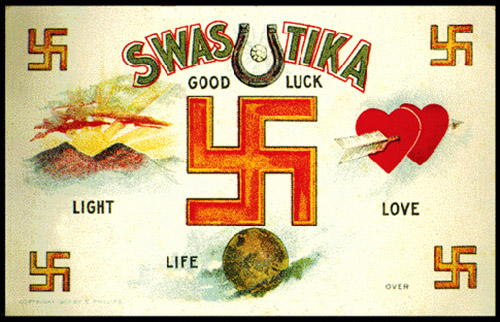
    And yet not so long ago it was a symbol of blessings and good fortune. Even its name is derived from Sanskrit roots meaning “it is good.” (Other names given to it include the cross patteé, the gammadion, the hakenkreuz or hooked cross, and the fylfot.) Today, in a somewhat truncated form, it still occupies a place in the official symbol of the Theosophical Society.

    The peculiar fate of the swastika has a great deal to teach about the nature and meaning of symbols – and about the uses to which they can be put.


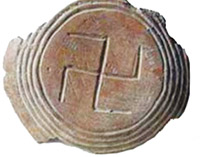
    Pottery fragment with swastika, dating to 7,000 years ago, from Bulgaria. 

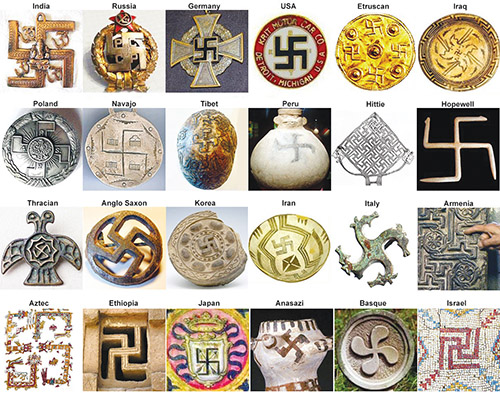
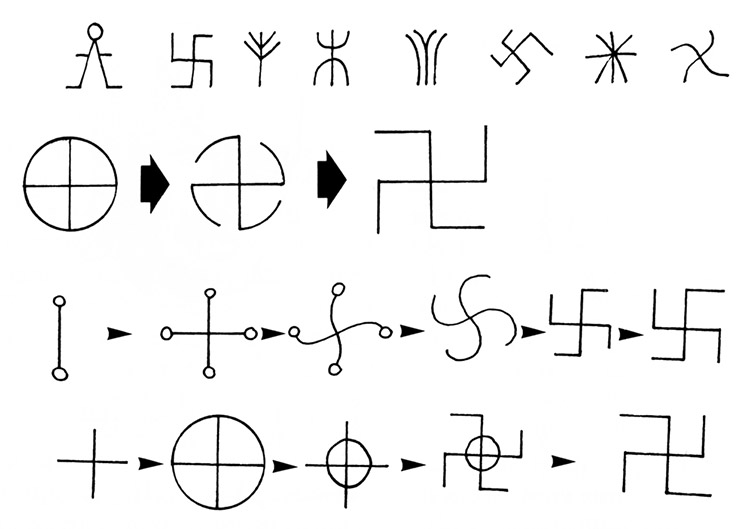
    The swastika occurs almost universally. The most ancient version known is on a carved tusk from the Ukraine, dated to around 10,000 BCE. Other early instances were found at Hissarlik in western Asia Minor, where Heinrich Schliemann, often called the father of archaeology, unearthed the ruins of Troy in 1873. The swastika begins to appear in the city’s third stratum, dated to 2250–2100 BCE. It is on spindle-whorls, a sphere, and a statue made of lead thought to be an image of the goddess Artemis. The vulva (or perhaps the mons veneris) of this figure has a swastika in the middle. One scholar interpreted it as representing “the generative power of man.”1


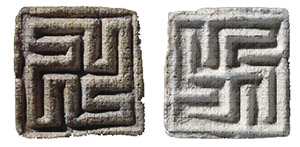
    Seals, showing swastikas, from the Indus Valley Civilisation (3300–1300 BCE)

    Schliemann himself, following orientalist scholars of his time, said that the swastika was “of the very greatest importance among the early progenitors of the Aryan races in Bactria and in the villages of the Oxus, at a time when Germans, Indians, Pelasgians, Celts, Persians, Slavonians and Iranians still formed one nation and spoke one language.”2

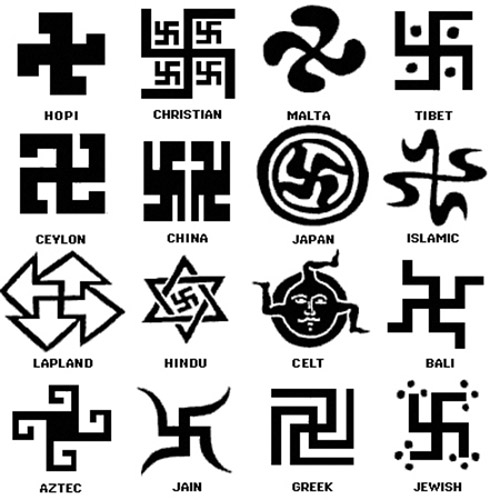
    But the swastika is found far beyond the traditional provenance of the “Aryan races.” Thomas Wilson, who wrote a study on it for the Smithsonian Institution in the late nineteenth century, lists examples from ancient sites ranging from Japan to Europe to North and South America. It’s quite apparent that the swastika belongs to everybody and to nobody.

    Before we go into the swastika’s history, it might be best to clear up one source of confusion: its orientation. You will often hear it said that the “clockwise” direction of the swastika is the “good” direction, while the “counterclockwise” direction is the “bad” one.

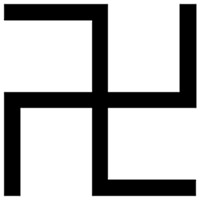
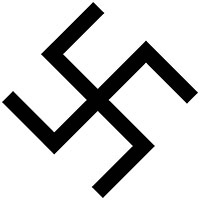
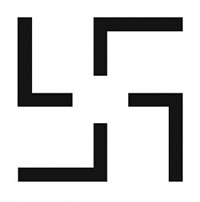
    To begin with, consider these two images:

    Figure 1 (left): Left-facing or “clockwise” swastika.
    Figure 2 (right): Right-facing or “counterclockwise” swastika.

    Which of these looks clockwise to you? To me, either one could be seen as clockwise, or counterclockwise, so I will avoid these terms. Instead I will speak of “left-facing” (for diagram 1) and “right-facing” (for diagram 2) swastikas. (If you’re curious, the left-facing one is most often described as clockwise.)

    You can also forget about which direction is the good one or the bad one. Traditionally there seems to be no difference, and often both types appear in the same location – for example, on the curtain of a Tibetan temple devoted to the Bönpa, the nation’s pre-Buddhist shamanistic religion.3 Similarly Thomas Wilson, introduced to a member of a Chinese delegation visiting Washington, found him wearing robes of state emblazoned with both versions of the swastika. “The name given to the sign was… wan, and the signification was ‘longevity’, ‘long life’, ‘many years’,” Wilson writes. “Thus was shown that in far as well as near countries, in modern as well as ancient times, this sign stood for blessing, good wishes, and, by a slight extension, for good luck.”4


    The swastika occurs almost universally across the world in diverse cultures, religions and regions. Above are just some of the swastika’s renditions in art and religious symbolism.

    Swastika: From Good to Evil Symbol

    So how did it come to stand for the complete opposite: hatred, violence, and cruelty?

    Some historical background is needed. In 1871 Germany, which for centuries had been fragmented into dozens of tiny and often overrun states, was unified into a single empire, or Reich, by the Prussian chancellor Otto von Bismarck. Naturally Germans began to feel a thirst for a shared national identity. This began to form under a range of influences, from the treatise on Germany by the Roman historian Tacitus to the operas of Richard Wagner.

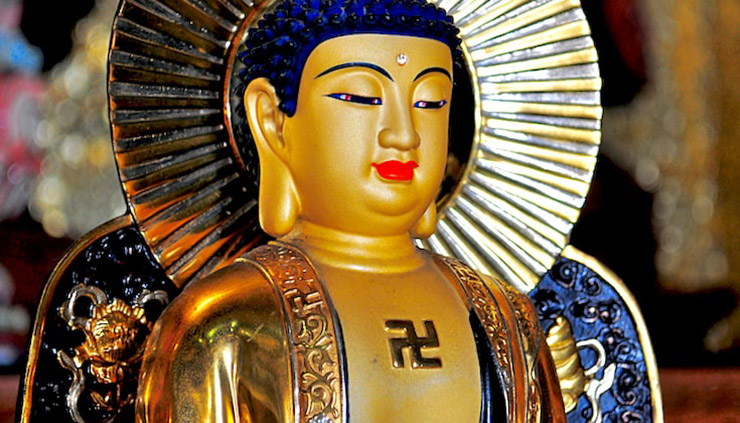
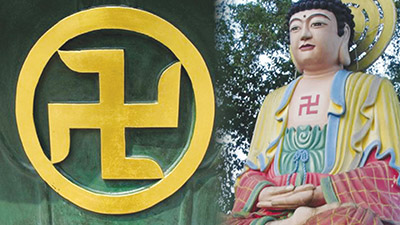
    In Asia, the swastika is a centuries-old positive symbol of peace, auspiciousness and good fortune. It can be found on Buddha statues as well as temples.

    An identity is created out of many things, including the things you are against. Thus anti-Semitism soon became part of this German identity. Anti-Semitism had deep roots in Germany, going back at least as far back as Martin Luther, who in 1543 published a vituperative book entitled On the Jews and Their Lies. 

    Opposed to the Jews were, so the theory went, the Aryans. The word comes from the Sanskrit arya, meaning “noble,” and originally referred to the Indo-European peoples who conquered the Indian subcontinent in the second millennium BCE. But soon it came to mean, above all else, the pure, white European race, which had reached the summit of perfection in the Germans.

    What could serve as a symbol for this race? The cross was tainted by Christianity, which after all was founded by Jews. The fact that Schliemann had found the swastika in the ruins of Troy and Mycenae, the homes of an ancient, noble, and presumably Aryan race, spoke in its favour. It was (and is) found universally in India too, which had given the Aryans their name. And there was the verdict of the French symbologist the Count Goblet d’Alviella, who asserted that the swastika “is not met with in Egypt, Chaldea, or Assyria” – the last two being Semitic nations.5

    By the twentieth century, occult and pseudo-occult groups invoking the Aryan legacy were displaying the swastika. Hitler’s connection with these groups is suppositional at best, but it is fairly certain that he read and collected issues of the journal Ostara, founded in 1905 by the occultist Jörg Lanz von Liebenfels. The magazine’s subtitle – “Newsletter of the Blonds and Male Supremacists” – gives a good idea of its orientation. Its emblem was a knight in a hooded robe covered with swastikas.

    Other extreme groups made use of the symbol as well, such as the Germanenorden, an occult lodge focused on ancient Germanic lore and of course anti-Semitism. Its founder was a self-styled aristocrat named Rudolf von Sebottendorff. As the German Reich collapsed in the fall of 1918, the order recast itself as the Thule Society (after Thule, a mythical polar land). Its symbol was a long dagger superimposed on a swastika sun wheel. 

    On 9 November 1918 – two days before Germany’s surrender in World War I – Sebottendorff delivered an impassioned speech to the Thule Society. Because of the imminent defeat, he declaimed, “in the place of our princes of Germanic blood rules our deadly enemy: Judah.” He urged his audience to fight “until the swastika rises victoriously out of the icy darkness.”6

    Direct connections between the Thule Society and the nascent Nazi movement are somewhat hard to trace, but there was at the very least an overlap of membership. In May 1919 a Thule member named Friedrich Krohn proposed the left-facing swastika as a symbol for the Deutsche Arbeiterpartei (“German Workers’ Party,” or DAP), the precursor of the Nazi party.

    Krohn evidently preferred this direction because he considered it auspicious, whereas he said the right-facing version portended disaster and death. But as Nicholas Goodrick-Clarke writes in his Occult Roots of Nazism, “there was no standard usage regarding the swastika” in this movement (or, as far as I can tell, anywhere else). The Germanenorden itself had used the right-facing version. Finally Hitler, who joined the party in November 1919 and soon rose to its leadership, chose the right-facing version, for reasons that are not clear.7

    But the meaning was clear. In his autobiography, Mein Kampf, Hitler writes: “The swastika signified the mission allotted to us – the struggle for the victory of Aryan mankind and at the same time the triumph of the ideal of creative work which is in itself and always will be anti-Semitic.” He credits himself with the design:

    After innumerable trials I decided upon a final form – a flag of red material with a white disc bearing in its centre a black swastika. After many trials I obtained the correct proportions between the dimensions of the flag and of the white central disc, as well as that of the swastika… The new flag appeared in public in the midsummer of 1920. It suited our movement admirably, both being new and young. Not a soul had seen this flag before; its effect at that time was something akin to that of a blazing torch.8

    This, by the way, is the standard Nazi swastika:

    Figure 3: Nazi swastika.

    Notice one thing about this version. As figures 1 and 2 indicate, the traditional forms of the swastika appear in full vertical and horizontal orientation. But the Nazi swastika is decussated: it is cocked to a tilt of 45 degrees. This gives a greater impression of movement, possibly of a destructive kind. In this position it looks like a whirling blade. Hitler may have adopted it for this reason.

    Nevertheless, the swastika did not have these meanings elsewhere in the world. In the US it remained a good-luck sign, as evidenced by its use in the house organ of the Girls’ Club, called The Swastika (left). Up to the 1930s, the symbol appeared – with perfectly innocent intentions – on American goods ranging from poker chips and playing cards to the labels of fruit boxes. It was even the emblem of a lovable cartoon monkey named Bing-o. To this day in Asia it is still used, with auspicious connotations, on commercial signs and in religious ritual.9 

    But after Hitler came to power in 1933, the Western world came to link the swastika with hatred and violence. A synagogue in Hartford, Connecticut, had swastika patterns in its flooring, which the horrified congregation had to have paved over. When swastika flags were hoisted over three ocean liners docked in New York in 1935, a mob of 2,000 people tore them down, provoking diplomatic protests from the Nazis. The swastika became so firmly equated with evil that it remains an emblem of fear for many – and for many others, it is still used for that purpose. The incarcerated cult leader Charles Manson carved it into his forehead in 1970.10 It continues to surface among anti-Semites and fascists of various stripes. The present-day German republic forbids its public display.


    The swastika appeared – with perfectly innocent intentions – on American goods ranging from poker chips and playing cards to the labels of fruit boxes. Above: Early 20th century postcard.

    What Does the Swastika Actually Symbolise?

    All this gives a brief history of the use and abuse of the swastika in modern times. But what does the symbol really mean? This question is, I believe, not only difficult but unanswerable. But before I say why, let’s explore some of the meanings that have been ascribed to it.

    One interpretation is given by Schliemann, citing a scholar named Émile Bournouf:

    The 卐 represents the two pieces of wood which were laid cross-wise upon one another before the sacrificial altars in order to produce the holy fire (Agni), and whose ends were bent round at right angles and fastened by means of four nails, so that this wooden scaffolding might not be moved. At the point where the two pieces of wood were joined, there was a small hole, in which a third piece of wood, in the form of a lance (called Pramantha) was rotated by means of a cord made of cow’s hair and hemp, till the fire was generated by friction.11

    The swastika is thus associated with fire – particularly the sacred fire known as agni, which is not to be confused with the physical manifestation per se. Because this fire is caused by friction, the swastika is also associated with motion. And from its shape, it is connected with the cross. Thus the swastika can represent a cross in motion. George S. Arundale, late president of the Theosophical Society, writes:

    All that you feel in the sea you can feel infinitely more in the whirling of the Svastika [sic], for you yourselves are part and parcel of the whirling. The Svastika whirls because a God has set in motion the Wheel of the Law, and it is as if to its myriad spokes clung innumerable drops – the Men who are to become Gods.12

    This passage is taken from Arundale’s Lotus Fire, a profound work that explores a sequence of symbols (the point, the web, the line, the circle, the cross, the swastika, and the lotus) that was, he claimed, “disclosed to me by a Lord of Yoga.”13 Arundale also observes:

    I see… a very special appearance of relentlessness to the movement of the Svastika and to its effect upon the Men of the Sea [i.e., unindividuated beings] whom it frictions into ever-increasing Self-consciousness. The well-known phrase “broken on the wheel” – that horrible physical torture of earlier periods of history, perpetuated in modern days in terms of the mind, so that the inquisition of today is breaking its victims on the wheel of the mind, a terrible desecration of the Wheel of the Law… – occurs to me, for indeed [it is] ignorance which is broken upon the Wheel of the Love of God, the Wheel of His Salvation, the Svastika (emphasis added).14

    Although Arundale is writing in the 1930s, he does not seem to have Nazism per se in mind. Nevertheless, his association of the swastika with relentlessness and with “breaking on the wheel” suggests a possible bridge between its ancient, esoteric meaning and its present sinister connotations.


    The evolution of the swastika. Top line (1): Hallristningar, ancient Scandinavian rock-scribings. (2): In The Book of Signs, Rudolf Koch suggested the swastika evolved by the breaking of a sunwheel’s circumference. (3): In 1933, Herman Wirth said the swastika evolved from a runic character. (4): In his book The Sacred Symbols of Mu, James Churchward claimed the swastika had begun with the simple cross.

    H.P. Blavatsky, identifying the swastika with “Thor’s hammer” or “the hammer of creation,” says:

    In the Macrocosmic work, the “Hammer of Creation,” with its four arms bent at right angles, refers to the continual motion and revolution of the invisible Kosmos of Forces. In that of the manifested Kosmos and our Earth, it points to the rotation in the circles of Time of the world’s axes and their equatorial belts; the two lines forming the Svastika 卐 meaning Spirit and Matter, the four hooks suggesting the motion in the revolving cycles (emphasis Blavatsky’s).15

    Other authorities have also linked the swastika to cosmic cycles. The French esotericist René Guénon writes:

    The bent part of the arms of the swastika is considered… as representing the Great Bear seen in four different positions in the course of its revolution around the Pole Star, to which the centre of the four gammas are united naturally corresponds, and that these four positions are related to the cardinal symbol points and the four seasons.16

    Figure 4: The swastika seen as an arrangement of four Greek gammas (Γ).

    Guénon is talking about the fact that the four arms of the swastika resemble four gammas (the Greek capital gamma looks like this: Γ) positioned around a centre point. He connects this fact with the symbolism of the letter G – the Roman equivalent of the gamma – in Masonry. Hence also the name gammadion.

    Furthermore, this centre point would be the pole. (The point of view would be of someone looking down at the earth from above the North Pole.) For this reason, Guénon associates the swastika with Hyperborea, a prehistoric circumpolar civilisation that was said to precede Atlantis.17 (Note: this is not to be confused with Blavatsky’s concept of the Hyperborean Root Race.)

    So, then, the swastika is, or may be, connected with the four principal directions, portrayed symbolically as a cross. If so, then the decussated Nazi swastika would symbolise directions that are askew, and hence a world out of joint, possibly evil.

    Figure 5: The Soviet hammer and sickle. Conventionally it refers to the combined power of the workers (represented by the hammer) and the peasants (represented by the sickle).

    Incidentally one could say the same thing about the Soviet hammer and sickle. In essence it is nothing other than the cross (in this case, a T-cross) combined with the crescent – two of the most ancient and universal sacred symbols. But again its orientation is not rectilinear. Like the Nazi swastika, it is decussated – again suggesting something that is aberrant, out of joint, or evil.

    At any rate, these are some of the esoteric meanings associated with the swastika: sacred fire (or primordial energy), a cross in motion, movement, the North Pole and the four directions. Of course they do not contradict each other, because a symbol is a nexus of meanings and associations, not a series of propositions that can be consistent or inconsistent.

    Earlier I said that none of these associations, singly or as a whole, exhausts the meaning of the swastika. That’s because the swastika, like all other primordial symbols, has no ultimate meaning. It means itself. It speaks to a level of the mind that lies beyond the realm of meaning as we normally understand it. The same is true of other basic geometric shapes such as the six-pointed star and the crescent, the defining symbols of Judaism and Islam. These symbols will keep their living force for as long as the human mind is as it is. Meanings and movements will attach themselves to them and will try to draw power from them, often with success. Yet meanings come and go, while the symbol remains.

    As theologian Paul Tillich writes, religious symbols open “the depth dimension of reality itself, the dimension of reality which is the ground of every other dimension and every depth… the fundamental level, the level below all other levels, the level of being itself… If a religious symbol has ceased to have this function, then it dies. And if new symbols are born, they are born out of a changed relationship to the ultimate ground of Being, i.e., to the Holy.”18

    I believe that Tillich is right up to a point, but it is not so obvious to me that symbols – the primordial symbols, at any rate, of which the swastika is one – die. Or if they die, they are born again. Maybe it would be more accurate to say that they are recycled.

    Get the issue this article appears in

    In recent years some have tried to cleanse the swastika of its evil connotations. In 1988–92 a Jewish artist named Edith Altman created an installation entitled Reclaiming the Symbol: The Art of Memory. In one scene, she has a gold swastika painted on a wall above a black Nazi swastika painted on the floor – a visual attempt to expunge evil from the symbol. In 2008, in a ham-handed effort to make the swastika humorous, cartoonist Sam Gross published We Have Ways of Making You Laugh: 120 Funny Swastika Cartoons. (Sample: a Nazi dropping garbage into a swastika-shaped bin labelled “White Trash Only.”)

    But as graphic artist Steven Heller comments: “For every naïve rock-and-roller who thinks the swastika can be used with irony, there is a fervent neo-Nazi who uses it with malice. For every well-meaning artist who thinks the swastika can be tamed, there is a devout racist who embraces it.”19

    In the long run, it’s likely that the swastika will be rehabilitated. Theosophist Arthur M. Coon observes:

    The memory of the use of the swastika, as an emblem of Nazism will in future ages have faded to oblivion; while its true meaning as a symbol of the hidden “fire” or “spirit” within all manifestation, from the atom to a solar universe, will become increasingly revealed to humanity.20

    But I suspect that these future ages will not, at least in the West, come in the lifetime of anyone who is breathing on this planet now.

    This article first appeared in Quest: Journal of the Theosophical Society in America (Winter 2016), and is reprinted with permission.

    [alert type=”general” dismiss=”no”]This article was published in New Dawn Special Issue Vol 10 No 2.[/alert]

    [alert type=”success” dismiss=”no”]If you appreciate this article, please consider subscribing to help maintain this website.[/alert]

    Footnotes

    1. Thomas Wilson, The Swastika: The Earliest Known Symbol and Its Migrations, with Observations on the Migrations of Certain Industries in Prehistoric Times, Government Printing Office, 1896, 811–13, 829
    2. Henry [Heinrich] Schliemann, Troy and Its Remains: A Narrative of Researches and Discoveries Made on the Site of Ilium, and in the Trojan Plain, Edited by Philip Smith, John Murray, 1875, 102
    3. Christoph Baumer, Tibet’s Ancient Religion: Bön, Translated by Michael Kohn, Weatherhill, 2002, 21
    4. Wilson, 800
    5. Count Goblet d’Alviella, The Migration of Symbols, Archibald Constable, 1894, 40
    6. Nicholas Goodrick-Clarke, The Occult Roots of Nazism: Secret Aryan Cults and Their Influence on Nazi Ideology, New York University Press, 1985, 144–45
    7. Ibid., 151
    8. Adolf Hitler, Mein Kampf, Translated by James Murphy, chapter 7, www.greatwar.nl/books/meinkampf/meinkampf.pdf; accessed Aug. 27, 2015
    9. Steven Heller, The Swastika: Symbol beyond Redemption?, Allworth, 2000, 37, 90–101, 149
    10. Ibid., 13
    11. Schliemann, 103–04; cf. H.P. Blavatsky, Collected Writings, 15 vols., Edited by Boris de Zirkoff, Theosophical Publishing House, 1966–91, 2:143–44
    12. George S. Arundale, The Lotus Fire: A Study in Symbolic Yoga, Theosophical Publishing House, 1939, 225
    13. Ibid., 22
    14. Ibid., 267–68
    15. H.P. Blavatsky, The Secret Doctrine, 2 vols., Quest, 1993, 2:99
    16. René Guénon, Fundamental Symbols: The Universal Language of Sacred Science, Translated by Alvin Moore, Jr., Quinta Essentia, 1995, 85
    17. Jason Jeffrey, “Hyperborea and the Quest for Mystical Enlightenment,” New Dawn 58 (Jan.-Feb. 2000), www.newdawnmagazine.com/articles/hyperborea-the-quest-for-mystical-enlightenment; accessed Sept. 1, 2015.
    18. Paul Tillich, The Essential Tillich, Edited by F. Forrester Church, Macmillan, 1987, 47, 49
    19. Heller, 157
    20. Arthur M. Coon, The Theosophical Seal: A Study for the Student and the Non-Student, Theosophical Publishing House, 1958, 120

    © New Dawn Magazine and the respective author.
    For our reproduction notice, click here.
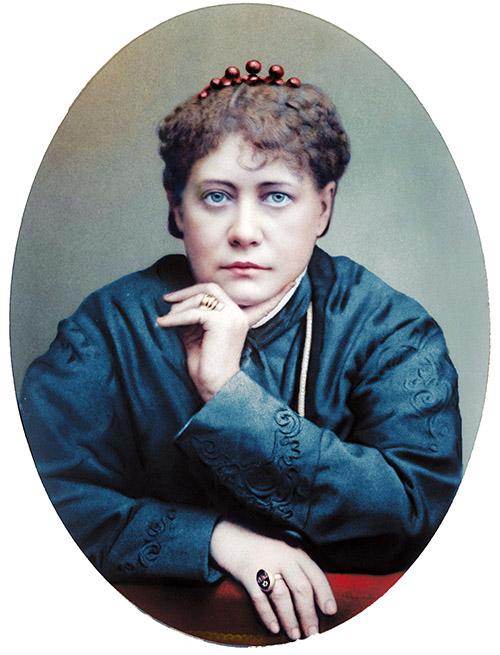
  • The Secret Science of Mind: How Positive Thinking Became a Force in the Modern World

    The Secret Science of Mind: How Positive Thinking Became a Force in the Modern World

    From New Dawn 124 (Jan-Feb 2011)

    The greatest discovery of my generation is that man can alter his life simply by altering his attitude of mind.
    – William James, The Varieties of Religious Experience

    If there is a central religious doctrine for the New Age, surely it is this – the belief that positive thoughts can bend reality to their own shape. It is an alluring concept. If it’s true, we don’t need to act or work or perform in the world. All we need to do is change our thinking. But is there anything to this idea?

    To understand something about the doctrine of thought power, it’s helpful to look at its history. The father of the religion of positive thinking was an obscure New Englander named Phineas Parkhurst Quimby (1802–66). 

    Phineas Parkhurst Quimby (1802–66)

    Quimby, like many men of his time, was a jack of all trades. He started as a clockmaker, but eventually became fascinated with alternative methods of healing and learned the art of mesmerism or animal magnetism, a forerunner of hypnosis. Quimby found that if he put an assistant into a trance, the assistant could diagnose and prescribe a remedy for a patient’s disease (much like Edgar Cayce, the celebrated “sleeping prophet” who lived a couple of generations later).

    Quimby built up a successful practice this way, but soon he came to a startling conclusion: it didn’t matter what remedy was prescribed; it was the faith of the patient that made the difference. So Quimby dismissed his assistant and began to practice his own radical method of healing, in which he would simply convince the patient that he or she was already well. Quimby’s warm and gentle nature aroused a sense of confidence. His office filled with patients, and many came away from his treatments feeling great relief or even fully cured. He often treated people for free when they could not pay.

    A self-taught man, Quimby was not a systematic thinker. But around 1859, he began to formulate his teachings in writing. He believed he had discovered the secret of the miracles performed by Jesus Christ, and he wished to make this knowledge available to all. 

    “My philosophy,” he said, “will make man free and independent of all creeds and laws of man, and subject him to his own agreement, he being free from the laws of sin, sickness, and death.”

    The teaching was simple. In each human being resides Truth, Wisdom, and Goodness. This is our natural birthright. But there is also another aspect: the mortal, material mind that is subject to error. And the chief error to which this material mind is subject is disease. 

    “Disease,” Quimby wrote, “is false reasoning. True scientific wisdom is health and happiness. False reasoning is sickness and death.” Quimby never really gave a name to his teaching, though he usually called it the “Science of Health.” Once or twice in his writings he referred to it as “Christian Science.”

    Quimby attracted a number of disciples. One of them, Warren Felt Evans, was also a follower of the Swedish visionary Emanuel Swedenborg (1688-1772). It was in fact Evans who introduced the term “New Age” in his influential 1864 book, The New Age and Its Messenger. The “messenger” of the title was Swedenborg, who in his voluminous writings proclaimed 1757 as the year of the Last Judgment. But this event, he said, did not and was not supposed to take place on earth. It was enacted in the realm of the spirits, an intermediate zone between heaven and hell. The Lord purged this realm of evil, making it possible for heaven to transmit its influences to earth in a less impeded fashion. 

    Swedenborg did not espouse the doctrine of thought power as it would later emerge: he held that the human mind was continually subject to influences from both heaven and hell and that the function of the human being on earth was to choose the good and renounce the evil impulses. Even so, Swedenborg’s thought, which reached the zenith of its influence in the early nineteenth century, prepared the ground for the New Age movement.

    After Quimby’s death in 1866, his ideas lived on in the teachings of his most famous pupil, Mary Baker Eddy, who popularised the name “Christian Science” and created a religion around it, as well as in subsequent movements such as New Thought, Unity, and Religious Science.

    New Thought is something of a blanket term used to cover these other movements in contradistinction to Eddy’s Christian Science. The American scholar of religions Charles Braden characterised the chief differences between these two strains as follows: 

    Mary Baker Eddy

    1) Christian Scientists tend to be more authoritarian in their thinking, regarding Mrs. Eddy’s writings as definitive revelations, whereas adherents of New Thought stress that spiritual truths are being revealed every day;

    2) Christian Scientists have tended toward denial – disease, matter, and “mortal mind” do not exist – whereas the New Thought movement has inclined more toward affirmations (“I am well”; “I am perfect”); 

    3) Christian Scientists are generally opposed to working with traditional physicians or allowing their patients to do so, whereas proponents of New Thought have been more flexible and pragmatic on this count.1

    Ernest Holmes’ Religious Science

    One of the more vibrant strains of New Thought in the twentieth century was Religious Science, founded by Ernest Holmes (1887-1960). Born in Maine, Holmes moved to Boston as a teenager where he took a two-year course in public speaking. At this time he was drawn to the works of Ralph Waldo Emerson (another major influence on the New Thought movement), as well as to Eddy’s textbook of Christian Science, Science and Health with Key to the Scriptures. Later he would study other major figures in the New Thought movement, such as William Walker Atkinson and Thomas Troward.

    Ernest Holmes (1887-1960)

    In 1914, Holmes moved to Venice, California. In 1919, he published his first book, Creative Mind. His magnum opus, Science of Mind, was first published in 1926. Though most of Holmes’s ideas can be found in his nineteenth-century precursors, he offered a slicker version of New Thought in his thoroughly twentieth-century salesmanship. He liked to tell stories of persuading homely girls to smile; when their lips parted, he claimed, they were surrounded by rich men eager to pay the bills for orthodontia. Gail Thain Parker, a scholar of New Thought, writes, “Holmes’s smugness is very different from the more exploratory (and sometimes evasive) tone of the first- and second-generation mind curists…. He knew that nothing he would say would shock or surprise; his prose was full of lifetime warranties and unbeatable bargains.”2

    Holmes, a powerful speaker but an ambivalent guru, nevertheless suffered his disciples to set up an organisation to promote his ideas. The Institute of Religious Science and the School of Philosophy was incorporated in 1927. In the same year Holmes also founded Science of Mind magazine, which is still published today. His influence was enormous, not only through his own writings but through those who were inspired by him. Norman Vincent Peale, author of The Power of Positive Thinking, a best-seller of the mid-twentieth century, drew much of his message from Religious Science.

    Norman Vincent Peale

    Holmes lived long enough to see his organisation subject to schisms and infighting. Shortly before Holmes’s death, his protégé Obadiah Harris (who went on to become head of the Philosophical Research Society in Los Angeles) confided to him that he was leaving the movement to find his own path. “I wish I could go with you,” Holmes replied.3

    Even so, Holmes’s organisation survives to this day, and his teachings continue to inspire many. One of his central – and perhaps his most influential – ideas is the Law of Attraction. The term was originally coined in the nineteenth century to refer to the soul’s affinity for different spheres of the afterlife, but Holmes gave it its current meaning: “What we shall attract will depend on that on which our thoughts dwell.”4 

    If you think of prosperity, prosperity will come your way; if your thoughts dwell on disease, suffering, and misfortune, you are laying the ground for your own future unhappiness. These thoughts are not necessarily conscious ones, Holmes contended: 

    “While most disease must first have a subjective cause, this subjective cause (nine times out of ten) is not conscious in the thought of the person who suffers from it, but is perhaps largely the result of certain combinations of thinking. So while it is true that disease has its prototype in subjective mind, it is also true that the individual who suffers from the disease, frequently has never thought he was going to have that particular kind of trouble. But this does not alter the fact that every disease which comes up through subjectivity, and appears in the body, must come through mind.”5

    Healing, by contrast, comes from right thinking, as Quimby had taught decades before. Holmes taught his followers to heal in this way: “First recognise your own perfection, then build up the same recognition for your patient. You are then read to directly attack the thought that binds him, recognising that your word destroys it, and stating that it does. You may then take into account and specifically mention everything that needs to be changed, every so-called broken law or false thought. Then finish your treatment with a realisation of peace, remaining for a few moments in silent recognition that your work is done, complete and perfect.”6
    Holmes said that the human mind was composed of two aspects: the “subjective” or “subconscious” mind on the one hand and the “objective” or “conscious” mind on the other. The subjective mind is not conscious but is creative; it is “that part of the mind which is set in motion as a creative thing in the conscious state.” The subjective “sets power in motion in accordance with the thought.”7 The conscious mind must, however, direct the subconscious toward positive goals.

    A similar view can be found in the writings of Max Freedom Long, who, in such books as The Secret Science behind Miracles, taught an almost identical system that he traced back to the kahunas, the shamans of Hawaii. According to Long, the Hawaiians used the word unihipili to describe what Holmes called the “subjective mind” and the word uhane as more or less equivalent to Holmes’s “conscious” or “objective mind.” Although both authors use the word “science” in a metaphysical context, it is unlikely that Holmes or Long influenced each other; rather these similarities show how thoroughly these ideas pervaded the alternative spirituality of early twentieth-century America.

    The Universe is “Mental”

    By contrast, a work called The Kybalion, first published in 1908, was a likely influence on Holmes (see accompanying article). The title page of this anonymous work lists its authors merely as “Three Initiates.” The Chicago occultist William Walker Atkinson is generally acknowledged to have been one of these; Paul Foster Case, founder of the occult order known as Builders of the Adytum, is also sometimes suggested as one of the others.8 

    In any event, The Kybalion – its name allegedly going back to the Egyptian mysteries, although its meaning was supposedly lost – set forth seven principles of metaphysical truth, the first being “the principle of mentalism” – “The Universe is mental – held in the Mind of the all….the Universe and all It contains, is a mental creation of The all.”9 Compare this to Holmes’s statement “There is one mental law in the universe, and where we use it, it becomes our law because we have individualised it.”10 (The similarities extend to the printing of both sentences in all capital letters.)

    Since the universe was “mental” in its essence, Holmes prescribed what today is called “creative visualisation” as a means of attaining well-being. Here is his advice to someone who is seeking success in business: “Every day he should see his place filled with people. See them looking at and finding pleasure in his merchandise; see them comparing prices and realising that he is offering good values; see them delighted with the service he is giving…. Make a mental picture of it all. We are dealing with Intelligence, and we should recognise the Power we are working with – realising our Oneness with it – and then we should ask for what we wish and take it.”11
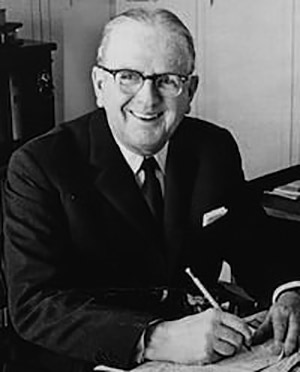
    A related approach is affirmation. Like the ancient Semites, who believed in a mystical unity between a word and the thing it represented, Holmes believed that the spoken word held the power to transform reality, and he included affirmations as part of his prescribed practice. 

    He recommended making this statement, for example, as part of a “treatment” for “supply”: “I always have an abundance of money and an abundance of whatever it takes to make life happy and opulent. There is a continuous movement toward me of supply, of money, of all that I need to express the fullest life, happiness and action.”12

    Image from a promotional booklet produced by the Rosicrucian Order AMORC in the 1940s.

    Science of Mind and Magic

    Anthropologists have classically distinguished between magic and religion. Magic uses certain techniques such as incantation, sacrifice, and ritual as a way of manipulating unseen powers. Religion often uses the same methods but it does so as a way of supplicating God or the gods through prayer and meditation. Magic is a kind of sacred technology, while religion usually involves a relationship to a personal deity. Science of Mind – and the religion of positive thinking as a whole – is much closer to magic than to religion. While it does not prescribe arcane rituals or weird spells, it does attempt to manipulate the primordial force of the universe – mind – on the practitioner’s behalf. 

    There is no theological problem in this from a New Thought perspective, because God is all-good and all-loving and wants us to live in health and abundance; our failure to do so is simply the result of faulty thinking and a failure to claim our due. The constant use of the word “Science” by figures from Quimby to Holmes underlines the quasi-technological mindset that operates in these teachings, and suggests how much they owe to the industrial age that gave them birth: mind is an impersonal force that can be harnessed in much the same way as steam or electricity.

    While New Thought and Religious Science insist that they are part of a tradition that has always been known to adepts – the healing miracles of Jesus are frequently cited as cases in point – there is comparatively little in traditional esotericism that resembles these teachings. Certainly it has long been taught, particularly by Plato and his philosophical descendants, that there is an ideal world of forms that can be perceived by the higher intellect and that serve as prototypes for the things of materiality. But the teaching that someone can not only perceive these archetypes but manipulate them to change physical reality is extremely rare. The traditional view was that a true philosopher did not care about the material world and occupied himself as little as possible with it.

    Even the occultism of the Renaissance, with its cumbrous magical technology, did not lay any particular emphasis upon thought power. According to Renaissance savants such as Paracelsus and Cornelius Agrippa, the magus can affect the higher dimensions, but does so by operating upon their corresponding objects in the physical world. To bring down beneficent solar or jovial influences, one wears stones or eats herbs that are associated with these benign influences. Magical formulae were also employed, but not as affirmations – many of these incantations consist of words in no known language – and the goal was often to subject spirits and demons to the magician’s will.

    The world of traditional magic is thus very far removed from the streamlined positive thoughts and affirmations of Religious Science and its kin. To speculate wildly for a moment, perhaps this is one sign of the New Age proclaimed by Swedenborg and Evans – that what formerly required intricate spells and bizarre operations can now be accomplished by using the power of the mind and the spoken word.

    This, of course, assumes that the methods of Religious Science actually work, and such claims are hard to assess. Certainly there are any number of people who have been willing to testify on behalf of these procedures, and their claims must be taken seriously enough. But we have no way of knowing how many of them there are as opposed to the numbers of those who have tried and failed. Most of the people I have known through New Thought circles appear no richer, happier, healthier, or more successful than much of the rest of humanity. And while I have known people who have gotten rich over the years – some of them staggeringly rich – their secret was probably not affirmations or thought power but the usual combination of talent, hard work, and sheer luck – and, indeed, enormous quantities of all three.

    Get the issue this article appears in

    Nonetheless, the claims of the thought power gurus from Quimby to Holmes (not to mention latter-day figures such as the entity known as Abraham, channelled by Esther Hicks, and Rhonda Byrne, author of The Secret) cannot be dismissed wholesale. Thought power, like so many aspects of the metaphysical realm, occupies a liminal space between truth and falsity. As soon as you have decided it is all nonsense, something pokes you on the shoulder and tells you it may not be nonsense after all. But if you become an enthusiastic believer, you may end up disappointed.

    To speak personally, I would be willing to say this much. The basic idea behind positive thinking is true: there is a mental world that underlays the physical, and thoughts can influence events in ways that can seem bizarre or even paranormal. But the interplay of thought and actuality is not entirely explained by a few simplistic axioms and the usual lifetime warranties. Other factors operate as well – the obscure but overwhelming forces that are sometimes called fate and destiny; the actions of a mind that cannot always be understood, much less manipulated, by the conscious ego; and of course the “time and chance” that, the Bible reminds us, “happeneth to all” (Eccl. 9:11).

    To the extent that positive thinking and mental science help us focus upon our goals and eliminate negative mental patterns, they can be useful. But they are usually not very effective substitutes for action. And if they foster a self-centred attitude that focuses on “my” prosperity and “my” health, or, still worse, dismisses the suffering of others on the grounds that somehow they brought it all upon themselves by wrong thinking, these ideas can cause serious trouble. We must never lose sight of the fact that the power of thought includes the power to enslave the mind. And the ultimate goal of liberation may not be to make our thoughts manifest in the world of desire, but to free ourselves from them as much as is possible in this world of entanglements.

    [alert type=”general” dismiss=”no”]This article was published in New Dawn 124.[/alert]

    [alert type=”success” dismiss=”no”]If you appreciate this article, please consider subscribing to help maintain this website.[/alert]

    Footnotes

    1. Quoted in Gail Thain Parker, Mind Cure in New England from the Civil War to World War I (Hanover, N.H.: University Press of New England, 1973), 4–5.
    2. Parker, 16-17.
    3. Horowitz, 97.
    4. Ernest Holmes, The Science of Mind, rev. ed. (New York: Tarcher/Penguin, 1998), 294.
    5. Holmes, 201-02; emphasis and capitalisation here and in other quotes are from the original.
    6. Ibid., 202.
    7. Holmes, 30.
    8. Mitch Horowitz, Occult America: The Secret History of How Mysticism Shaped Our Nation (New York: Bantam, 2009), 210. Horowitz, however, believes that Atkinson was the sole author.
    9. “Three Initiates,” The Kybalion (Clayton, Ga.: Tri-State Press, 1988 [1908]), 53, 57.
    10. Holmes, 30. 
    11. Holmes, 300.
    12. Holmes, 263.

    © New Dawn Magazine and the respective author.
    For our reproduction notice, click here.