Séances. Mediums. Apparitions. And fraud. These are a few of the things that come to mind when the subject of Spiritualism comes up. Like so many things in the world of the occult, Spiritualism presents a dual face of mystery and deception. The minute one begins to believe, one comes across evidence suggesting that the whole thing may be a hoax. The minute one starts to think it’s a hoax, evidence appears to suggest there might be something to it after all.
So also it must have seemed during Spiritualism’s heyday during the mid-nineteenth century. The craze began in the US, when in March 1848 two sisters, Margaret and Kate Fox, began to experience strange rappings in their house that, they claimed, had been generated by spirits. Soon they were able to work out a kind of Morse code with the raps so they could exchange questions and answers with the visitors from the other world.
Although the sisters’ evidence was eventually called into question – Margaret Fox later admitted the whole thing was a hoax, only to retract her confession afterward – Spiritualism became one of the great fads of the era, to the point where even Abraham Lincoln attended a séance at the White House in April 1863.
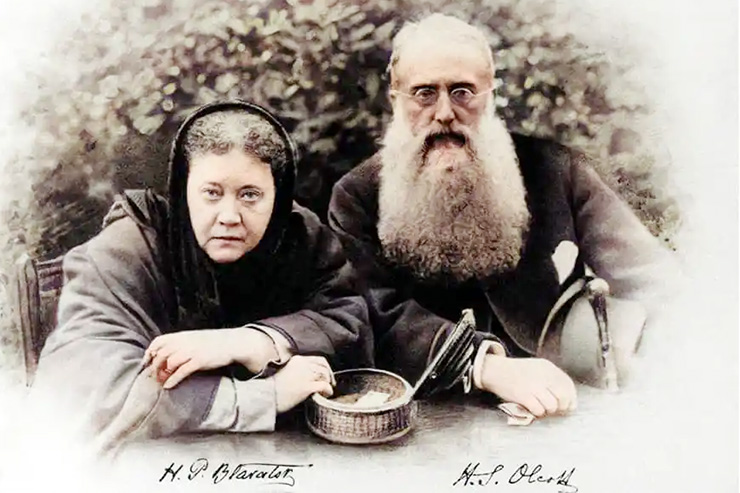
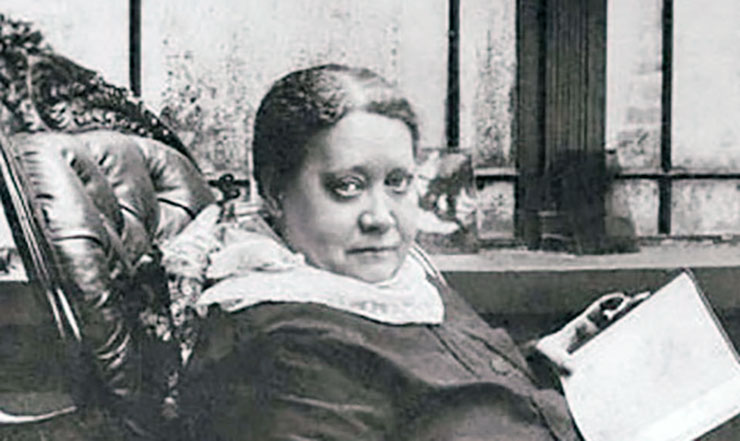
Another figure associated with Spiritualism had a rather ambiguous connection with the movement. Helena Petrovna Blavatsky, a Russian noblewoman turned spiritual adventurer, initially associated herself with Spiritualism, only to decry it later.
Blavatsky’s own story is surrounded by its own amount of shadows and haze. By her own account, in 1849, at the age of eighteen, she left her elderly husband (to whom she had been married for a mere three weeks) and began a worldwide search for spiritual truth that took her as far afield as England, Italy, Egypt, India, and possibly Tibet. Around 1851, she claimed, she met a master from India who agreed to give her training in occultism if she would take part in a larger mission to disseminate the teachings of universal brotherhood throughout the world.
Much of the next twenty years of Blavatsky’s life is hard to document. Both in her own account and in those of her followers, fact and legend are inextricably mixed. But one of the earliest places for which there is proof of her appearance is Cairo in 1871, where she found herself stranded after a shipwreck. Here she started a “Société Spirite [“Spiritualist Society”] “for the investigation of mediums and phenomena.” The ill-fated organisation foundered within two weeks, as the mediums drank and cheated; once a madman broke in to interrupt the proceedings. While there is evidence that the society did regroup and continue at least into the following year, Blavatsky was not part of it: she had gone further afield, first to Odessa in her native Russia, then to Paris, finally sailing to New York, where she arrived in July 1873 and where she made her first impact on a spiritually hungry public.
Indeed one of the most significant encounters of Blavatsky’s life took place through Spiritualism. In the improbable setting of a remote farmhouse in Vermont, a spirit medium named William Eddy allegedly materialised a range of ghostly beings, who appeared in period costume. Eddy would sit in a narrow closet in his farmhouse, and a blanket would be hung across the doorway. Shortly after Eddy entered the closet, the blanket would be pulled aside, and the ephemeral image of a dead person would appear, only to disappear soon afterward, sometimes in the full gaze of the spectators.
At Eddy’s farmhouse in the autumn of 1874, the visiting Blavatsky met Henry Steel Olcott, a correspondent from a New York newspaper who had come to report on the phenomenon. Olcott later recounted that on the night of Blavatsky’s arrival, the Eddys’ closet produced the shades of “a Georgian servant boy from the Caucasus; a Mussulman merchant from Tiflis; a Russian peasant girl; and others… The advent of such figures in the séance room of those poor, almost illiterate Vermont farmers, who had neither the money to buy theatrical properties, the experience to employ such if they had had them, nor the room where they could have availed of them, was to every eye-witness a convincing proof that the apparitions were genuine.”
What did Blavatsky believe about these phenomena? Her equivocal attitude toward Spiritualism is best illustrated by a clipping in her scrapbook. It is a copy of an article she wrote in 1875 entitled “The Science of Magic.” In the printed version of the article she states, “I am a Spiritualist,” but on the clipping she corrects the statement to “I am not a Spiritualist.”
These contradictions are not necessarily the result of either schizophrenia or dishonesty. Blavatsky believed that the Eddy apparitions were real occult phenomena – but they were not the spirits of the dead. According to Olcott, she told him that if the Eddy phenomena were genuine, “they must be the [etheric] double of the medium escaping from his body and clothing itself with other appearances.”
In an 1872 letter, Blavatsky explains her views: “[The Spiritualists’] spirits are no spirits but spooks – rags, the cast off second skins of their personalities that the dead shed in the astral light as serpents shed theirs on earth, leaving no connection between the reptile and his previous garment.” In the case of William Eddy, these astral shells would presumably have been using Eddy’s etheric body as a kind of subtle matter in order to manifest. In the Theosophical view, the astral body is discarded at a certain point after death. Usually it simply disintegrates as the physical body does, but under certain conditions, it can be inhabited by vortices of subtle energy that can make it appear to physical sight in the guise of the deceased.
A similar, but not identical, phenomenon was displayed by Blavatsky herself. In November 1874 Olcott visited her in New York, “where,” he reported, “she gave me some séances of table-tipping and rapping, spelling out messages of sorts, principally from an intelligence called ‘John King’.” Supposedly the shade of the celebrated buccaneer Henry Morgan, “it had a quaint handwriting, and used queer old English expressions.”
But Olcott eventually became convinced that “John King” was not the ghost of the long-dead Morgan. He later wrote, “After seeing what H.P.B. could do in the way of producing mayavic (i.e., hypnotic) illusions and in the control of elementals, I am persuaded that ‘John King’ was a humbugging elemental, worked by her like a marionette and used as a help toward my education. Understand me, the phenomena were real, but they were done by no disincarnate human spirit” (emphasis in the original).
Elementals are, in the Theosophical view, nature spirits who live on the astral and mental planes. These entities are centres of force; they do not have any form in their own right. Hence they can be shaped and controlled by human thought, responding to the preconceptions of the perceivers, individual or collective. The so-called spirit of “John King” would have been an elemental that Blavatsky shaped with the force of her own will and concentration – as perhaps she had done in the Eddy farmhouse.
The subtleties of these ideas are considerable, and it would be hard to disentangle them all in an article of this length. But the theory seems to go something like this: sometimes, as in Eddy’s case, a wandering astral shell can temporarily inhabit the etheric body of a medium and so make its presence known to the physical senses. In other instances, such as with Blavatsky’s phenomena, the will of an occultist can mould the subtle matter of the “astral light” into the shape desired.
To dismiss these ideas out of hand would, in my view, be foolish. On the other hand, to verify them would require an intense training in esoteric practices that is difficult to come by. For our purposes, though, the essential point is clear. There is a middle ground between the allegations of the skeptics – that all spiritualistic phenomena are simply fraudulent – and the beliefs of the credulous, who take everything at face value. While there have been fraudulent mediums, it would be overhasty to dismiss every spiritualistic experience as a fraud. At least some of the phenomena associated with Spiritualism seem to be the play of forces in the astral realm, that domain of thoughts and images that is as plastic as the figments of our imaginations – and indeed contains them.
Reincarnation has become an increasingly popular doctrine in the West. For example, polls taken in the US over the past couple of decades have shown that between 20 and 28 percent of the population believe in it. The figures for western Europe are similar.
What explains the appeal of an idea that until recently was the province of a few occultists and eccentrics? Some of it can be explained by the appeal of Asian religions, such as Hinduism and Buddhism, to which reincarnation has always been integral. But this does not explain much: you could turn the argument around and say that Hinduism and Buddhism are so appealing because they teach reincarnation.
The allure of the doctrine is easy to see, particularly when it is weighed against the conventional Christian view of heaven and hell. The latter is hard to defend in the light of any real sense of cosmic justice. It holds that the deeds of an individual’s life on earth will bring upon him either eternal reward or eternal damnation. And this is hard to swallow. Even the greatest monsters of history, no matter how many evil acts they committed, committed only a finite number of acts. How can even these extreme cases merit an infinite series of punishments?
By contrast, the doctrine of reincarnation, along with the closely associated doctrine of karma, holds that evil acts do entail retribution – but only in proportion to the act. The punishment suits the crime. Nor do good deeds done in a single life win the individual an infinite life of bliss, merely a limited number of auspicious future lives.
The idea of reincarnation has also spread because of the specific form in which it has been disseminated. Many of the ideas about reincarnation in New Age and other sectors of alternative spirituality can be traced back to the influence of Theosophy. During the 136 years of its history, the Theosophical Society, always a tiny organisation (worldwide membership in 2008 was under 21,000), has been influential out of all proportion to its numbers.
The Theosophical view of reincarnation is fundamentally an optimistic one. There is a purpose to these nearly endless cycles of birth and death. It is the education of consciousness. The Self descends into the darkness of materiality through a process known as involution. Then it begins to reascend, through a process known as evolution. This is not the evolution of the Darwinists, which is essentially a blind and meaningless process. Rather it is a carefully structured series of lessons in identifying with, and then detaching oneself, from the material world. Each separate incarnation is a tiny phase of this process.
Thus the trajectory of the journey of each human soul is an upward one. An evil or misspent life is only a delay or setback in a process that is ultimately going in a positive direction in any event.
When it’s stated this way, one immediately sees why this idea is so appealing. Far more than the conventional Christian view – or the secular materialist view, which holds that death is final and nothing survives the body’s demise – the evolutionary picture of reincarnation speaks to the current age, with its deeply rooted belief in progress.
This view of reincarnation, pioneered by the Theosophists, differs in some major ways from the pictures given by Hinduism and Buddhism. These portray the soul’s progress not as an ascent upward, where success is ultimately guaranteed no matter how many setbacks take place along the way, but as a merciless whirligig from which the only recourse is to escape. Indeed, they teach that we have lived through this cycle a virtually endless number of times already. In the Hindu Katha Upanishad, Death says:
The passing-on [i.e., death] is not clear to him who is childish,
Heedless, deluded with the delusion of wealth,
Thinking “This is the world! There is no other!” –
Again and again he comes under my control.
And in one of the Buddha’s discourses we read, “What, monks, do you think is more: the water in the Four Great Oceans or the tears, which you have shed when roving, wandering, lamenting and weeping while on this long way, because you received what you hated and did not receive what you loved?”
The fundamental cause of this cycle of rebirths, in both Hinduism and Buddhism, is ignorance or heedlessness. The remedy is enlightenment, which (in Hindu terms) leads to moksha or release, or (in Buddhist terms) to nirvana, or cessation. For the rest of this article, let us focus specifically on Buddhism.
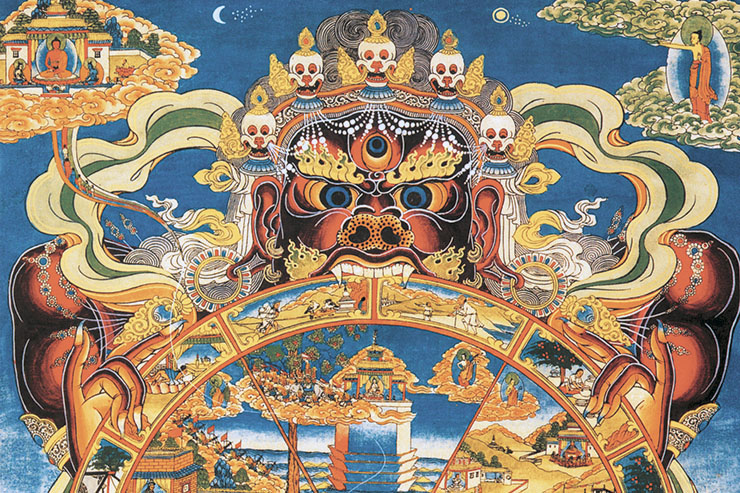
One of the most elaborate pictures of the cycle of births and deaths can be found in the Tibetan Buddhist Wheel of Birth and Death. While the symbolism of this wheel is too intricate to describe in full here, one thing it depicts is the six realms of existence, three of which are bad, three of which are comparatively good. The three good realms are those of the gods, the asuras or demigods, and humans. The three bad realms are hell, the realm of the pretas or hungry ghosts, and the realm of animals.
Beings are drawn to the hell realms through acts of violence and cruelty. As in Christian teaching, these are places of unimaginable suffering. The thirteenth-century Tibetan sage Longchenpa writes:
All the tears you have shed would be more (than the water) in the four oceans,
And the amount of molten metal, foul blood, and excrements
You have consumed when your mind had become a denizen of hell or a spirit [i.e., a preta]
Would not be matched by the rivers flowing to the end of the world.
Longchenpa again emphasises the circularity of this process: his description of hell is not a warning of future punishment, but a reminder to the aspirant of what he has already undergone during many lifetimes in the immeasurable past. Buddhist teaching differs from that of Christianity by saying that since karma is finite, the suffering of hell beings and pretas, though enormous, is finite as well.
The animal realm is less painful than the worlds of the hell beings and hungry ghosts but scarcely more desirable. Humans are drawn there by bestial behaviour – by obsession with food or sex, the cravings that we share with the animals. While animals do not suffer continually, they too are beset with pain and grief. Moreover, they do not have the mental capacity to achieve liberation, “not realising the natural misery of their state,” as Longchenpa puts it.
The human realm, although it too is characterised by suffering, is the most auspicious. Buddhist texts emphasise the rarity and preciousness of a human birth. The sage Nagarjuna writes:
More difficult is it to rise
from birth as animal to man,
Than for the turtle blind to see
the yoke upon the ocean drift;
Therefore, do you being a man
practice Dhamma [the Buddhist teaching] and gain its fruits.
Here lies the advantage of being born into the human realm. Individuals here are not so deeply immersed in suffering as they are in the realms of hell beings and hungry ghosts. Nor are they in such favourable circumstances as the gods, who enjoy so much pleasure and delight that they have no interest in liberation, or even the demigods, who have relatively enjoyable circumstances but are tormented by the jealousy of the gods, with whom they wage continual warfare. The human existence is an intermediate one, where beings are endowed with enough intelligence to follow the path to liberation but not so intoxicated with pleasure that they have no interest in it.
Note that the gods and demigods, though their lives are pleasant compared to ours, are not immortal. Eventually their good karma is exhausted and they fall down into less favourable realms. This goes on endlessly. In one traditional text, a sage who is asked about the power and strength of Indra, king of the gods, points to a line of ants marching on the ground and says, “Each of those ants has been an Indra.”
It would be mistaken, however, to conclude from all this that Buddhism is at its core a pessimistic, world-denying doctrine, as many have done. The German scholar of Buddhism Hans Wolfgang Schumann observes, “To assume that in their present life more than a few advanced seekers are able to conquer craving and ignorance would be to overrate man. Most men will need a long time, a whole series of rebirths in which by good deeds they gradually work themselves upward to better forms of existence. Finally, however, everyone will obtain an embodiment of such great ethical possibilities that he can destroy craving and ignorance in himself and escape the compulsion for further rebirth. It is regarded as certain that all who strive for emancipation will gain it sometime or other.”
Schumann is referring to the attitude of the Theravada (“way of the elders”), one of the two primary divisions of Buddhism. The other sector, known as the Mahayana (or “great vehicle”), which includes such lines as Tibetan Buddhism and Zen, moves still further in a universalistic direction. It encourages its adherents to strive, not for nirvana per se, but for the condition of the bodhisattva – one who renounces or rather postpones enlightenment to work on behalf of the illumination of all sentient beings. In short, both sectors of the Buddhist tradition are ultimately positive in nature. If they do not teach evolution as such, they nevertheless hold that the gates of mercy are infinite and will eventually accommodate all beings, no matter how far they may seem from their goal.
For all the scarcity in the world, one thing we never seem to be lacking is advice. We’re constantly deluged with exhortations of one sort or another – for diet, exercise, health, wealth, happiness, spiritual illumination. Of course these pieces of advice often conflict.
The question then becomes, whose advice do we take? There are few, if any, sources of authority that have not been called into doubt: church, society, government, the media, even the grand edifice of science itself. Consequently we’re thrown back on ourselves as the final arbiters of our own decisions, and while this may give a sense of freedom, that very freedom can feel dizzying and disorienting.
In putting together some brief suggestions about how to live one’s life, I’m making no claim to grand success or touting myself as a model, but having looked at many of these things from the perspective of the Western esoteric traditions, I can at least offer a few thoughts.
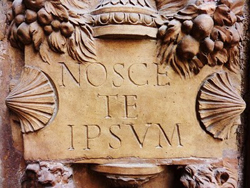
To my mind, there is one and only one universal and inflexible commandment that is to be applied at all times and in all situations: it is the old Greek axiom inscribed in Apollo’s temple at Delphi, Gnothi seauton: “Know thyself.” This exhortation has many levels of meaning. At the most basic level, it calls us to understand the truth about ourselves and our actions in daily life – such as knowing how many cups of coffee you can drink without facing insomnia tonight, or recognising how far you can be trusted (or trust yourself) in a delicate moral situation. Could you spend a weekend alone with your best friend’s spouse and keep everything above board? Maybe you can, maybe you can’t.
Knowing yourself in this relentlessly honest way, making what the Twelve-Step programs call “a searching and fearless moral inventory of ourselves,” is necessary not only for freeing oneself from addiction but for facing the challenges of day-to-day life as well. It calls for a merciless honesty in realising all one’s weaknesses and limitations – but without the insane and compulsive guilt that often results from such realisation. It does little good to moan, like the more fanatical Christian saints or characters in Dostoyevsky’s novels, about how you are the most wretched sinner on earth, particularly since in all likelihood the truth is that you are no better and no worse than anyone else.
This realisation may be deflating (we all want to excel and will choose to excel in our sins if we lack any alternative), but it’s also freeing. Furthermore, it leads to the next dimension of knowing yourself: having compassion. The French have a saying: Tout comprendre, c’est tout pardonner: “To know all is to forgive all.” This is applied to ourselves as well. Christ urges us to be “wise as serpents and harmless as doves” (Matt. 10:16). In one sense, this verse means that in order to live in any truly meaningful way, we have to see ourselves with two eyes: one of remorseless honesty, one of forgiveness and compassion. If we lack one or the other, life soon goes out of balance. Compassion without honesty becomes a license for anything; honesty without compassion breeds pathological guilt.
Given these principles, how are we to apply them to everyday life? Let’s begin with our relationship to the body. Not so long ago, what was healthy was (or seemed) reasonably clear: a balanced diet, regular exercise, moderation in (or abstention from) use of alcohol or tobacco. Today, on the other hand, we’re deluged with claims that any number of things in our daily lives are bad for us. There is probably no food product that hasn’t been hailed by one source as a cure-all and damned by another as a poison. Fruits and vegetables? Laced with pesticides. Meat? Riddled with antibiotics and hormones. Water? Polluted. Even organic products have come under suspicion. If we took all these claims seriously, we would be unable to let a single morsel pass our lips.
Claims about what’s healthy are often equally preposterous. I was amused, for example, by a study conducted by Harvard University several years ago. It showed that men who ate more than ten servings of tomatoes a day had a 35 percent reduced risk of prostate cancer. Even if we grant that the study was sound, who is going to eat ten servings of tomatoes a day? Probably if you did, the harm done to your stomach by the acid in the tomatoes would probably more than outweigh the benefits to your prostate. And this is merely one item. If you multiplied this sort of claim for everything on the market, it would require a Gargantuan diet to protect yourself from all illness – and then, of course, you would have to deal with obesity.
I make this point at such length because health (of which nutrition is, of course, merely one aspect) in many ways has become a preoccupation, even a neurosis in contemporary society. The American esotericist Manly P. Hall once said that there is a type of person that confuses God with vitamins. This kind of confusion is partly the handiwork of the mass media – for whom sensationalistic claims are the very lifeblood – but we are most susceptible to it if we remain disconnected from ourselves.
What can you eat, and what can’t you eat? The answer varies wildly from person to person. Some people need meat; others find it loathsome or nauseating. Some people can drink alcohol; others ought to stay away from it at all costs. The same goes for coffee or tobacco or almost any item you can put into your mouth. As for residues and contaminants, we have to face the issue with common sense. There is no way of avoiding them all. The most sensible approach is notice what adverse effects any given product has on you and act accordingly, while staying away from products that have extremely high risks associated with them.
Even so, it’s important to remember that scientific reports and media broadcasts all have this in common: they are talking about generalities and probabilities. There is nothing wrong with this in itself; it is how science thinks. But we ourselves are not generalities or probabilities; we are individuals, and what applies to people as a whole may not apply to us.
Again, of course, this can turn into a license for anything. A man may destroy his health through smoking while insisting that he, unlike everyone else, can smoke without harm. But you can cut through a great deal of this nonsense (inner and outer) with a certain amount of self-knowledge and inner honesty. Self-knowledge naturally includes a knowledge of the body, and this does not so much mean knowing the body as an abstract anatomical object as knowing how the body feels, even from moment to moment. Someone who is attentive in this way is far more likely to have a clear picture of what is good for her and what isn’t. It will be much easier for such a person to be able to connect, say, a feeling of late-afternoon fatigue with a skimpy breakfast eaten several hours earlier. Consequently, it will be far easier to fine-tune your diet according to what you really need rather than what the books and magazines say you need (advice that, in any case, usually turns out to be contradictory).
I could say much the same things about any other health-related issue – exercise, sleep, medicine. But let’s go on and suppose that your investigations reveal that you need to make some changes in your way of life. In order to accomplish this, you will again need a certain amount of self-knowledge to know what will work and what won’t. Take exercise. Many people admit that they could use more exercise, but the vast majority of these do one of two things: procrastinate (the spiritual teacher G.I. Gurdjieff once observed that the sacred quality of hope had in modern man deteriorated into a noxious disease called “tomorrow”) or launch into some regimen that they have almost no chance of maintaining in the long run. If you’ve spent the last twenty years in front of the television, it makes very little sense to declare by fiat that from now on you will work out for two hours a day. You will probably quit within the week. Someone who is both more serious about exercise and more honest with himself might start with ten minutes a day. Ten minutes a day, after all, is better than nothing, and it has a far greater chance of remaining enjoyable or at any rate manageable to someone who is just beginning. Notice also the element of compassion: rather than inflicting exercise on yourself like a punishment, you are introducing it into your life in a kind and thoughtful way. As the regimen becomes more of a habit, you can expand it, and maybe after a few years (we are, after all, talking about a long-term change in life habits) you will find yourself working out for two hours a day.
It doesn’t take a great deal of imagination to extend these principles into most areas of your life. In the case of finances, for example, say you realise you need to save more money. How much, really, are you going to be able to save from month to month? It’s far better to aim for a more modest amount that you will be able to sustain rather than to put away a huge chunk that you will only need to dip into a month or two from now. Some changes may be astonishingly easy to make; others require more patience and skill.
When you begin to examine these dimensions of life through the lens of self-knowledge, you will almost certainly find resistance of one kind or another within yourself. Looking through my own life, I’m constantly amazed by what forms resistance takes and where it manifests. The most obvious types have to do with things I find unpleasant – doing a dirty job, delivering a message the other person will not want to hear – but often I find myself curiously resistant to doing things that on the face of it require no unpleasantness at all – sometimes even something as simple as returning a phone call from a friend. Beyond a certain elementary point it’s useless to analyse why I don’t feel like making the call. What’s more important is simply being aware of the resistance and consciously going past it to do what you need to do.
All of this may seem obvious enough, but there is another, subtler dynamic going on. It’s one that, for example, I have almost always found to be involved in procrastination of any sort (procrastination being merely one form of resistance). The need to accomplish something, when it runs up against inner obstacles, creates a curious cycle: the energy that you would have devoted to the task starts to feed the resistance, so that you finds yourself going around in circles. I need to make the phone call; I don’t want to; the fact that I don’t want to makes the task seem larger and more obnoxious than it is; which in turn makes me want to do it even less; and so on. I have known people who have tied up practically their entire lives this way. Sometimes the task does indeed turn into something daunting, as is the case with hoarders, who find themselves so buried in clutter that an entire day of cleaning will hardly make a dent in it.
Where does the solution lie? In his book Skillful Means: Gentle Ways to Successful Work, the Tibetan lama Tarthang Tulku writes:
Once we understand how we escape from our difficulties and fears, we can resolve to change this pattern. The next time you encounter a problem and find yourself looking for a way around it, you can make a conscious decision to redirect your energy, to go into your problem and find a solution. Although you may at first feel a resistance to doing this, the positive feelings you will gain from honestly facing work and life will strengthen your ability to meet future challenges directly, and you will increase your incentive to grow.
When we honestly evaluate our motivation, our attitudes, our strengths and weaknesses, we begin to see a deeper side to our nature from which we can draw a vital energy that lends real meaning to our lives.
Tarthang Tulku speaks of gaining energy as a result of facing resistance. This is an important point. You may literally feel that there is a subtle wall of energy between you and your task, and you almost find yourself bouncing off it as if it were a force field. All of this is, of course, your own creation, and you can pierce through it simply by “honestly facing work and life” and plunging in. My own experience with this leads me to formulate it in what may be a strange way: when I confront the task, it sometimes feels as if I am somehow slicing into this wall of resistance.
The good news is that “slicing into” the resistance immediately begin to free up the energy that was bound up in it; it is as if some subtle membrane that was keeping things bottled up has burst and the energy is now free to circulate into the task itself. As a result, simply overcoming the resistance can give you much of the energy you need to accomplish the job.
These are, I realise, only rather brief indications of a process that individuals need to explore for themselves. Usually it’s easiest to do this in the context of an esoteric school of one sort or another, where tasks are often set up to create this kind of resistance and to teach the student how to overcome it. One of the most common techniques is to give a student a job he or she is not particularly good at. The intellectual is sent to carpentry; the businessman is told to paint a picture; the dreamer is given financial accounts to reckon. Indeed one of the functions of esoteric schools is precisely to teach the skills of overcoming resistance to the pupils. Finding one’s way in daily life with only a few indications is a harder task, but with luck it can be accomplished.
Whether it takes place in the context of an esoteric school or in an ordinary office, this overcoming of resistance again takes us back to knowledge. You can only overcome resistance if you see it. A friend of mine who was interested in the spiritual side of animal training was trying to teach her dog not to bark. “To stop a dog from barking,” she said, “you first need to make it aware it’s barking.” So it is with resistance: to overcome it, you must first see that you’re caught up in it. If you avoid this realisation through excuses, self-justification, blaming other people, and so on, you have lost before you begin.
Because awareness is so important to all aspects of inner growth, it’s usually made a central point of many esoteric teachings. Gurdjieff called it “self-remembering”; the Buddhists call it “mindfulness”; whatever the name, the process is more or less the same. You are to see yourself, and you are to see yourself as you are now, not in some past or future that is in any event largely the creation of your own imagination. To do this requires conscious presence, and there are many ways of practicing this on a day-to-day basis.
So far I’ve been speaking of self-knowledge in a comparatively external sense: seeing clearly one’s own strengths and weaknesses in daily life and coping with them as a builder has to cope with defects in a site or materials. This kind of knowledge is not to be despised; it can add tremendously to one’s efficiency and productivity. But it assumes that you know what your work is, and for many people this remains a highly vexing issue.
The answer, I believe, lies in a concept for which there is no word in English. In Sanskrit it is called svadharma, and it roughly means doing one’s own duty. The classic text that discusses it is the Bhagavad-Gita, one of the greatest of the Hindu sacred scriptures, written probably between the fifth and second centuries BCE. This book forms a part of a much larger whole, the titanic epic known as the Mahabharata, which culminates in a great war between two rival clans, the virtuous Pandavas and the corrupt Kauravas. One of the greatest warriors among the Pandavas is Arjuna, and his charioteer is Krishna, the incarnation of the god Vishnu. As the lines are drawn up for the decisive battle, Arjuna sees his relatives and some of his closest friends on the opposing side. He knows that enormous numbers of them will be slain, and he loses heart. He turns to Krishna and says he does not want to fight; he has no appetite for the power or glory that victory would bring.
Most of the Bhagavad-Gita consists of Krishna’s reply. It contains philosophy and cosmology as well as directions for yogic practice, but all of this centres on Krishna’s urging Arjuna to fight. Arjuna is a Ksatriya, a member of the warrior caste, and it is his duty – his dharma – to take part in the battle. Krishna goes so far as to say: “Better one’s own duty [to perform], though void of merit, than to do another’s well: better to die within [the sphere of] one’s own duty: perilous is the duty of other men.”
The word for “one’s own duty” here is svadharma. It is not a moral duty in the ordinary sense: rather it is the duty that is embedded in your deepest self. No one else can do the job that you were created to do. Liberation consists not of inaction or withdrawal from the world but of performing your duty selflessly and without attachment to results. Arjuna’s dharma is to fight in this monumental battle, which has more than a political or even moral function. It is destined to bring an end to the age and to restore a corrupt cosmic order.
People learn their svadharma, their special functions, in many different ways and at many different times of life. One person knows hers from childhood; another discovers it only in middle age. It is revealed by still, small voices and by visions on the road to Damascus, but also sometimes in a career aptitude test or by answering an ad in the classifieds. It may remain steadfastly the same, a ridgepole upon which one’s entire life depends, or it may gradually change and shift as time and circumstances change. In any event, it has a single core feature: you have (or come to have) the unshakable sense that this function, whatever it is, is why one exists, is what you were created to do.
For the Hindus, svadharma is intimately intertwined with svabhava, one’s own being, the core of one’s essence. To know your own work is to know your own being; you can’t understand one without the other. For some, this function may involve wealth and position; for others, modest and humble circumstances. It may call one person onto the magnificent stage of history and may require another to spend his life in obscurity. In any case, to know one’s task is in a very profound sense to know oneself.
Such a perspective leads us very deep into the recesses of our own nature, and as we make this journey of self-knowledge, we paradoxically go past the self as it’s conventionally conceived – the ego, the street-level personality. Ultimately we move toward our true nature, what we may call the “true I,” which Christianity calls the spirit or the kingdom of God, which Hinduism calls Atman or the Self, and which is known in countless other traditions under countless other names. The Hindu sage Sri Ramana Maharshi went so far as to say that simply following the question “Who am I?” as far back as possible in oneself will lead to enlightenment.
Strictly speaking, however, one can never, perhaps, truly know oneself. This is simply because what one is, the “I am” at the core of one’s being, the Self, is always that which knows. “The Kingdom of the Father is spread out upon the earth, and men do not see it,” says Christ in the Gnostic Gospel of Thomas. Men do not see it because it is the very principle in them that sees. The path to this realisation is, it would seem, an endless one, not because progress is impossible but because progress, if it is real, always opens up new horizons and new directions to move in.
[alert type=”general” dismiss=”no”]This article was published in New Dawn 104.[/alert]
[alert type=”success” dismiss=”no”]If you appreciate this article, please consider subscribing to help maintain this website.[/alert]
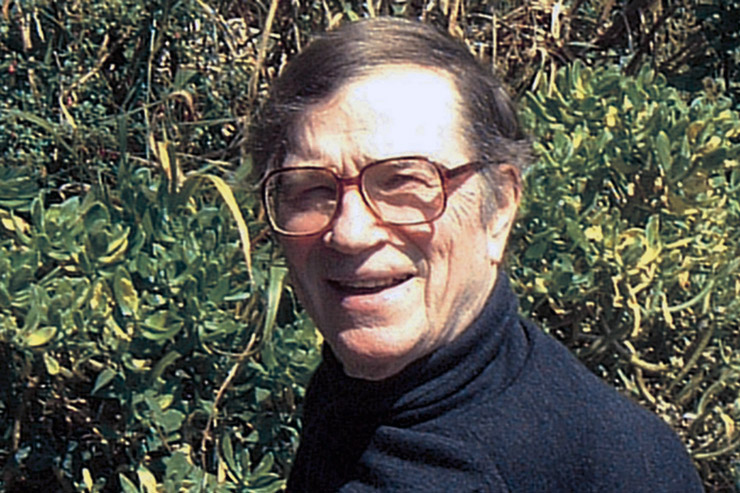
Colin Wilson passed away on 5 December 2013. A tribute to his life and examination of his work written by Colin Stanley appears in New Dawn 143 (March-April 2014). New Dawn Special Issue Vol 8 No 2, published in April 2014, contains an interview with Colin conducted by Australian writer Louis Proud. The following article was published in New Dawn on the occasion of Colin Wilson’s 80th birthday in 2011.
Whether we agree with him or not, Colin Wilson has to be one of the most challenging and stimulating writers of the last half century.
– Gary Lachman, American writer & musician
I have heard Colin Wilson speak in person only once. It was in 1987 or 1988, when he gave a lecture at the First Unitarian Church in San Francisco. The event was well-attended, with at least a couple of hundred people present. But what struck me most about the talk was the strange state of consciousness it inspired in me.
I had come in no special mood, and I remember nothing of the evening before or after. But I remember observing myself as Wilson spoke and finding myself possessed of a completely clear and attentive concentration. A great deal of the noise of the usual mental chatter was simply absent. At the same time I was alert and aware – I was not merely absorbed in the talk, as one can be in a particularly gripping movie thriller.
Because the state disappeared soon after the lecture ended, I can only believe that this peculiarly focused and alert attention was a reaction to something that Wilson himself was generating. I mention it here because this kind of concentrated attention is one of the central themes of Wilson’s work and thought.
Born in Leicester, England, in 1931, Wilson came from a middle-class background and as a teenager pursued a conventional education in the sciences. But at some point he discovered literature and philosophy, and he became so engrossed in these that he neglected his studies, dropping out of school at the age of sixteen. In the 1950s, he spent time among the political and intellectual circles of London, and for a while spoke at London’s famed Hyde Park Corner – the world’s capital for soapbox orators – on anarchical syndicalism. This was not, as he later admitted, because of any real sympathies for syndicalism but “because I was bored, frustrated, and had a vague feeling that something ought to be done about something. I also wanted to practise speaking in public, and would have been equally happy to discourse on Communism, Mormonism, or Nudism.” He also engrossed himself in an intense program of reading, which bore fruit in his first book, The Outsider, published in 1956.
The Outsider was a tremendous success, and won accolades from mainstream critics such as Cyril Connolly, who in the Sunday Times of London called it “one of the most remarkable first books I have read for a long time.” As its title suggests, this insightful and gracefully erudite book deals with what Wilson contends is one of the central themes of twentieth-century literature: the individual who is isolated, set apart, alienated from the crowd. He is typified by Meursault, the central character in Albert Camus’s The Stranger, who starts the novel by stating, “Mama died today. Or maybe yesterday, I don’t know.” Meursault’s affectless response to his mother’s death is followed by an equally impassive love affair and the killing of an Arab (the novel is set in Algeria). Although Meursault has committed the act in self-defence, his utter apathy during the course of the trial leads to his conviction.
Twentieth-century literature (and nineteenth-century literature to a certain degree) is teeming with Meursaults: Fyodor Dostoevsky’s Underground Man; Joseph K. in Franz Kafka’s The Trial, who is arrested, tried, and executed without even knowing what he has done; and the bored and alienated scholar Antoine Roquentin, hero of Jean-Paul Sartre’s Nausea – all of whom Wilson discusses in The Outsider.
As this brief list suggests, The Outsider reflects Wilson’s interest in existentialism. To most people today, existentialism is more of a mood than a philosophical system. One thinks of gloomy French intellectuals in smoky cafés, immersed in opaque but inevitably pessimistic discussions. But existentialism means something quite specific in philosophical terms. Unlike Thomas Aquinas and other Aristotelian philosophers who came to dominate Roman Catholic philosophy, the existentialists argued that man has no essence – that is to say, there is nothing he is at his core that God has created (most forms of existentialism are radically atheistic). Or rather, man’s essence is derived from existence, from his actions in the world. Because God has not made man in any particular way, man is free. If he feels he is not free, this is only because he has failed to acknowledge his own freedom.
The notorious pessimism of the existentialists comes from the idea that man’s freedom is the result of his existence in an alien and indifferent world. There is no intrinsic meaning in the universe, because there is no God who created it. It is up to man to make his own meaning.
Unfortunately, as Wilson recognised, this stance creates problems. You can take up carpentry to while away the time, but can you create meaning and purpose for your own life as you might make a workbench? Some of the existentialists – particularly Sartre – may have thought so, but Wilson argues that this creation of meaning, while necessary, cannot be accomplished just by taking up a cause at random.
Wilson also displays a deep affinity with another, less well-known twentieth-century philosophical school: phenomenology. While phenomenology is a vast and intricate system none of whose primary exponents completely agree, it contends that all consciousness is intentional; it is toward something. Explaining the thought of Edmund Husserl, the founder of the school of phenomenology, Wilson writes, “All mental activities are essentially acts, analogous to reaching out one’s hand or shooting an arrow at a target.” Indeed, he adds, “the mind has no equivalent of the non-intentional act – even becoming unconscious under anaesthetic” (emphasis here and in other quotes Wilson’s).
Existentialism and phenomenology set the stage for Wilson’s mature thought, but it is perhaps with the great twentieth-century sage G.I. Gurdjieff with whom he has the deepest affinity. Wilson discusses Gurdjieff in The Outsider, in his 1970 book The Occult: A History, and in other works, including Gurdjieff: The War against Sleep. Indeed, Wilson contends, “Gurdjieff’s system can be regarded as the complete, ideal Existenzphilosophie [existentialist philosophy].” Why? Because it shows a genuine and realistic way to rise up from the sleep of ordinary, habitual life – the boredom and alienation that are the marks of the existentialist antihero – and awaken into a higher dimension of experience.
As Wilson points out, one of the central disciplines in Gurdjieff’s teaching is “self-remembering” – which Wilson describes as follows: “Normally, when you are looking at some physical object, the attention points outwards, as it were, from you to the object. When you become absorbed in some thought or memory, the attention points inwards. Now sometimes, very occasionally, the attention points both outwards and inwards at the same time, and you find yourself saying, ‘What I, really here?’: an intense consciousness of yourself and your surroundings.” It may have been Wilson’s own self-remembering that stimulated a similar response in me during that lecture over twenty years ago.
It is this self-remembering, this awakening, deliberate or inadvertent, that Wilson discovers in many account of mystical experience. Gurdjieff might have agreed. When asked once what higher consciousness was like, he replied, “Everything more vivid.” For Wilson, this awakening is the gateway to what he calls Faculty X, which he calls “the power to grasp reality,” and which “unites the two halves of man’s mind, conscious and unconscious.”
Wilson argues that “Faculty X is the key to all poetic and mystical experience; when it awakens, life suddenly takes on a new, poignant quality. Faust is about to commit suicide in weariness and despair when he hears the Easter Bells; they bring back his childhood, and suddenly Faculty X is awake, and he knows that suicide is the ultimate laughable absurdity.”
It is Faculty X, and Wilson’s exploration of it, that provides the key to much of his writing, which over the years has ventured further and further into the waters of the paranormal. For Wilson, Faculty X does not lie in some distant evolutionary future, when the human race will have evolved capacities that now seem preternatural; it is something we possess in latent form now, and which in fact our remote ancestors may have possessed in the past, when the human mastery of the physical world was far less complete and when people had to rely on inner resources for tasks that we now entrust to machines.
But Faculty X has more than merely pragmatic value. When it is awakened, it provides an intensity of experience, a lived reality that not only makes “everything more vivid” but provides the added dimension of meaning for which the existentialists pined so acutely – and which forms what may be the point of focus for Wilson’s voluminous writings. If there is a thread that holds together a body of work that comprises over one hundred published books, it is, I suspect, Faculty X and the strange sense of vivid concentration of which I had a glimpse over twenty years ago.
How do Wilson’s insights look today? We live in a time of change, which continues to accelerate to the point of destabilising not only nations and societies but the individual soul. There is a fascination with new technologies – with iPads and Facebook – that seems to take us away from the issues of meaning and presence that Wilson emphasises so strongly. But if these novelties distract us from the existential questions that face us, they neither answer these questions nor remove them. At best they are diversions, like a film or a game of chess, which might take our minds off our problems for an hour or two but which leave the problems waiting for us when they are done. Even politics and world affairs, I suspect, serve as this kind of entertainment for many.
I believe that Wilson is right. If we are to win the war against the sleep of everyday life, it will not come out of technology nor even from political or social reform, as much as this may be needed. It will come from the liberation of individuals who awaken from the dreams that pass across their televisions and computer screens – and their minds – and are able to say, “I – here now.”
[alert type=”general” dismiss=”no”]This article was published in New Dawn 126.[/alert]
[alert type=”success” dismiss=”no”]If you appreciate this article, please consider subscribing to help maintain this website.[/alert]
This article was published in New Dawn 137 (Mar-Apr 2013)
I was in search of the unknown… – Madame H.P. Blavatsky (1831-1890)
Gary Lachman is one of today’s most intelligent and prolific authors on the world of the occult. He started out in the 1970s in the New York rock scene as one of the original members of the groundbreaking New Wave band Blondie. In 1996 he moved to London, where he established himself as a full-time writer, contributing to publications such as Fortean Times, The Guardian, and The Times Literary Supplement.
Since 2001 he has produced a steady stream of books, including Turn Off Your Mind: The Mystic Sixties and the Dark Side of the Age of Aquarius; The Secret History of Consciousness; A Dark Muse: A History of the Occult; and Politics and the Occult: The Right, the Left, and the Radically Unseen. In recent years he has published biographies of major esoteric figures including P.D. Ouspensky, Emanuel Swedenborg, Rudolf Steiner, and Carl Jung.
I first came to know Gary in the ’90s, when he was a frequent contributor to the now-defunct Gnosis magazine, for which I was editor. Although we’ve been in constant touch over the years, the last time I saw him in person was in 2006, when he was in New York to be inducted into the Rock and Roll Hall of Fame as part of Blondie. We had a long conversation over lunch that led to his book Politics and the Occult. In 2012 Gary published Madame Blavatsky: The Mother of Modern Spirituality, a biography of the pioneering nineteenth-century spiritual figure H.P. Blavatsky (also known as HPB). In January 2013 I conducted an e-mail interview with him about the book and about Blavatsky.
RICHARD SMOLEY (RS): To begin with, could you say a little bit about who H.P. Blavatsky was for those who aren’t familiar with her?
GARY LACHMAN (GL): Helena Petrovna von Hahn was born in 1831 into a family of the lower Russian nobility. Around her eighteenth year, she fled a brief and unconsummated marriage to an older man, Nikifor Blavatsky, and embarked on what by all accounts was a twenty-odd-year-long global quest for secret knowledge, triggered by her reading of her great-grandfather’s occult library and her own mystical experiences. During this time, she said, she met her Master Morya in London, who charged her with a mission: to reach Tibet, where she would be tutored in the control of her psychic abilities. She surfaced in New York City in 1873, where she lived in a woman’s cooperative on the Lower East Side. A meeting with Colonel Henry Steel Olcott led to a lifelong Platonic relationship, and in 1875, she, Olcott, and William Quan Judge founded the Theosophical Society. The rest is history.
RS: What made you choose her as the subject of a biography?
GL: I had already written studies of Ouspensky, Jung, Swedenborg, and Rudolf Steiner. As I argue in the book, HPB was a seminal influence on practically the whole of modern spirituality and esotericism. All of my work is centred on the idea of an evolution of consciousness, both in the individual and in culture at large. It seemed to make sense to take a new, fresh look at someone who kick-started a whole movement dedicated to this idea. Also, it struck me that much of what we think we know about HPB was really a myth, made up of hearsay and misperception, repeated for more than a century. I can’t say I’ve told the truth about Blavatsky, but I’ve tried to point out what others haven’t.
RS: What influence does Blavatsky continue to have on the current spiritual scene?
GL: Well, the Theosophical Society, in its many different forms, continues today. Much of what we think of as New Age really has its roots in Blavatsky’s early work. Tibetan and Mahayana Buddhism, as we understand it in the West, for example, emerged from her and her early followers. W.Y. Evans-Wentz, who collected the funerary texts we know as TheTibetan Book of the Dead, was a Theosophist, and much of his work is informed by Theosophical ideas. Also, our contemporary interfaith and multifaith sensibilities, our striving toward a broad religious tolerance, has its roots in Blavatsky’s belief that all the major religions have their source in an ancient, ‘secret’ doctrine. She was very much ahead of her time.
RS: There is a broad spectrum of opinion about Blavatsky. On one end there are those who regard her as a fraud pure and simple. On the other end are those who see her as a much-maligned saint. Where would you place yourself on this continuum?
GL: Well, I don’t see her as a fraud or as a saint, so I guess I am in the middle, or rather, perhaps ‘above’ this either/or opposition. In the book I refer to a concept I borrow from the novelist Hermann Hesse. In an essay on Dostoyevsky, Hesse speaks of what he calls ‘Russian Man’, who is an antinomian character, “an hysteric, drunkard, criminal, poet and saint, all wrapped up in one.” Think of Rasputin, the ‘holy devil’. HPB was what we call a ‘trickster’, although that is something of a cliché. She wasn’t above mystical high jinks when she felt it was necessary – or when she got exasperated with the sanctimonious devotees who often wasted her time. But she was also a deeply spiritual, I would even say religious, moral character; I liken her to the Russian startzi – deeply spiritual individuals who gave off a kind of spiritual electricity. But she didn’t wear this on her sleeve.
RS: After having done so much research on Blavatsky, do you personally believe that her alleged occult powers were genuine?
GL: I keep an open mind about her powers. For one thing, I’ve had enough anomalous experiences to accept that the standard ‘scientific’ view of reality simply doesn’t cover all the bases, things like precognitive dreams, telepathy, and very convincing synchronicities. Of course, some of the things claimed about HPB – materialising teacups and other items – do seem impossible. But I point out in the book other examples of similar abilities. I look at a few of the most well known examples, and, given what we know about them – and we can only go by the accounts that have come down to us – I try to see how she could have faked them – if she did. Of course, because I can’t see how she could have faked the teacup or some other ‘materialisation’, doesn’t mean she couldn’t have. But I did rack my brain quite a bit about it, and I think I covered every possible angle. So my take is that, yes, they are incredible, but perhaps not impossible. I mean, look at what science tells us about dark matter, dark force, super strings, and n-dimensions. That seems pretty incredible too. Were her ‘phenomena’ important? That’s a different question.
RS: Blavatsky made much of her connection with the hidden Masters Morya and Koot Hoomi, as well as other Masters. Some take these to be actual men endowed with superhuman capacities who guided her in her path and in the creation of the Theosophical Society. Others say they are figments of her imagination. What’s your own position on this issue?
GL: Blavatsky’s Masters seem to me to be composed of several different things. There was the ‘mysterious Hindu of my dreams’ that came to her in her earlier life, and more than once saved her life – at least that was the story she told in her later years. Then there was the idea of ‘unknown superiors’, high-ranking individuals in the Rosicrucian Freemasonry her great-grandfather practised. Reading of these mysterious powerful but ‘hidden’ men, Blavatsky became committed to finding them and to realising the vision of a progressive, united Europe they championed. The Theosophical Society was her way of trying to make their goal of a universal fraternity come true. Then there were the actual men and women she encountered in her quest for knowledge; people like herself who were pursuing a similar quest. She considered many of these ‘Masters’ – a title of respect and gratitude. But of course the most significant Masters were Morya and Koot Hoomi, flesh-and-blood men who had mastered their own psychic powers and who taught her how to master her own. Whether they had the powers she claimed is still up for debate, but I believe they did exist. HPB lived out a myth and she saw these people as embodiments of the inner guides she believed were helping her on her path. So the Master she knew from her childhood dreams and the Master she met in London in 1851 may not have been the same actual person, but for her we can say that they fulfilled the same role.
RS: In your book you allude to unseen hands that work behind the scenes of history. Do you think there are such forces, and if so, how did they use Blavatsky?
GL: I’m not sure about the ‘hidden hand’ version of history – and the phrase ‘hidden hand’ comes from the esoteric scholar Joscelyn Godwin. That idea is a kind of staple of occult history, and also of our contemporary conspiracy consciousness. In one sense I’m not partial to it – I think we need to solve our problems ourselves, rather than expect a saviour, either some ‘inner circle’ of humanity or benevolent aliens or extradimensional beings or Mayan calendars, to do it for us. But on the other hand, given the dominance of the ‘rational’ view that history is meaningless, or, at best, the result of purely material forces, I think the idea of something at work ‘behind the scenes’ can be positive. At least it posits some meaning or intelligence at work. But the notion of some cabal of advanced individuals, holed up in the Himalayan fastness – or at the centre of the earth, or in the Arctic – does seem a bit de trop. I tend to see the idea as a metaphor for the evolutionary urge. But then perhaps there are angelic beings who drop us hints from time to time.
RS: Could you tell us a bit about Blavatsky’s major works, Isis Unveiled and The Secret Doctrine?
GL: In the book I say that I am more partial to Isis Unveiled than to The Secret Doctrine. One reason is that Isis Unveiled is often overlooked compared to her other major work. I think it is a remarkable achievement. It is one of the first occult compendiums, a fascinating, if often exhausting, collection of what esoteric and occult literature and philosophy was available at the time. It is the source of so much of what we see as ‘alternative’ literature today. In a way it is like Charles Fort’s books, only much better-written and containing more cogent argument. Basically, with Isis Unveiled Blavatsky tried to resurrect the Hermetic wisdom, which had been in eclipse since the 1600s. If nothing else she deserves credit for formulating the first philosophical – not religious – criticism of Darwinian evolution in it; credit for this is usually given to Samuel Butler (author of Erewhon), who wrote a remarkable series of books attacking Darwin in the 1870s and ’80s. Unfortunately these are forgotten today, but their arguments are still quite pertinent. (Someone should send copies to Richard Dawkins.) But Blavatsky got there ahead of Butler by a few months. She should be recognised in the history of ideas for this.
The Secret Doctrine is a kind of bible of esoteric and occult thought. It presents a full scale esoteric history of humanity and the universe, and presents the occult wisdom that Blavatsky says she learned during her tutelage in Tibet. It has more of a ‘carved in stone’ character than Isis Unveiled and has given rise to numerous offshoots, some good, some not so good.
RS: The Secret Doctrine presents an elaborate alternative history of human evolution, with references to things like Atlantis and Lemuria. What do you personally make of this history?
GL: I found it most profitable to read HPB’s occult history as a gigantic sci-fi or fantasy epic, a modern mythology, something along the lines of, say, Olaf Stapledon’s ‘future histories’ Last and First Men and Starmaker. I felt the same about Rudolf Steiner’s similar readings of the akashic record. I also think, though, that while the details in both Steiner’s and Blavatsky’s readings of Atlantis and Lemuria and so on can seem frankly unbelievable, the general sense of an earlier form of consciousness they present has much of value. With most such spiritual visions – William Blake’s can fit in here, as can Jung’s as depicted in TheRed Book – we have to sift through what is personal, what is simply the unconscious being creative, and what may be a symbolic presentation of our actual spiritual reality. At the same time, there is much cogent argument for the idea that civilisations existed well before what we considered the beginning of history. In fact, the ‘official’ accounts are regularly pushed further and further back. Will archaeology eventually prove HPB was absolutely right? I doubt it. But it may and probably will show that she was right in saying that we aren’t the first ones to spend time on our planet.
RS: One criticism that is frequently levelled at Blavatsky was that she was a racist, and that her views on what she called the ‘Aryan root race’ inspired Nazism and similar ideologies. Where does the truth lie on this issue?
GL: Basically, although some of HPB’s remarks about race break the cringe barrier and are unacceptable to us, she was no more racist than what the prevailing sensibilities of the time accepted. Sadly, her remarks about root and subraces in The Secret Doctrine inspired some proto-Nazi characters in Austria and Germany – if you can call what they did with her brief remarks ‘inspired’. We can’t hold her responsible for that, or for any other appropriation of her ideas by less tolerant characters. In a sense, HPB is in the same position Nietzsche was in when the Nazis appropriated some of his work – he was in no way racist, nor was he a war monger, but Nazi hacks presented him in this way. It wasn’t until serious scholars repaired his reputation that he was cleared of any Nazi taint. The same needs to be done for HPB, and if I’ve helped in this effort, I am glad. I saw no evidence of Blavatsky being personally racist, and indeed, she abandoned her white, European privilege to live with Hindus and Sinhalese during her time in India and Ceylon (Sri Lanka). She was more anti-European, even anti-white, we can say, given her remarks about the British Raj and the Christian missionary movement. Some have called her anti-Semitic, but what this really means is that she had little fondness for the Judeo-Christian religion. One forgets that her central mission was the founding of a universal fraternity, regardless of race, creed, sex, or colour. One also forgets that she had much more influence on Gandhi than she did on Hitler. Gandhi found his life’s work through his contact with Theosophy.
RS: Could you say a little bit about the Theosophical Society and its place in twentieth- and twenty-first-century spiritual currents? What influence does it continue to have?
GL: Well, I’m not a Theosophist and am not associated with any Theosophical group, so I can only speak of what I’m aware of peripherally, as it were. But the Theosophical Society in its different forms – there are quite a few different incarnations of it – is still alive and kicking. I know here in London the Theosophical Society is a centre for a wide-ranging series of talks, lectures, and other activities, all linked to the themes of spirituality, consciousness, and ‘lost knowledge’. There is quite a lively Theosophical presence on the Internet, with several different sites devoted to different aspects of Theosophy in general and Blavatsky in particular. My book itself seems to have stimulated some discussions. So I think it will continue to maintain an important place in the ‘alternative’ world. What I have found with practically all of the movements or groups associated with the people I’ve written about – Steiner, Swedenborg, Ouspensky, etc. – is that they are all looking for ways to reboot themselves, to attract a wider, younger audience, to make themselves more inclusive. I think this is also paralleled in the broader, outer world. I’ve been involved with some art events in Europe and England at major museums and galleries that have had spirituality at their centre, and Theosophy is a frequent element in these. In fact, I am supposed to be involved in a major retrospective of the work of the Swedish Theosophical painter Hilma af Klint in Stockholm later this year. I think in general the official world is starting to see what many of us have been aware of for years: that esotericism has had a much bigger influence on the modern world that we realise.
RS: What are your own views of human evolution, particularly as it relates to the current era? What do you think is happening with the human race as a whole at this stage of the game?
GL: As I say, pretty much all my work is focused on the idea of an evolution of consciousness. My view is informed by the work of people like Colin Wilson, Owen Barfield, Jean Gebser, and others; I write about it at length in my book A Secret History of Consciousness. In a general sense, I think we are seeing the beginning of the breakdown of the kind of scientific reductionism that has been the dominant mode of consciousness for the last four centuries. This doesn’t mean that a neon sign will rise up over the horizon announcing the start of a new age. It doesn’t work like that, and we shouldn’t look for signs of this change in the news. Changes in consciousness don’t necessarily mean immediate changes in society or the world. All work begins with the individual. But I do think that in the last century or so, more and more people have realised that science, or rather, scientism, is simply no help when it comes to the big questions, such as ‘What is this all about?’ Science is very good on know-how but useless on ‘know why’. The Higgs boson can’t tell me why I exist and what I am supposed to do now that I’m here. For a long time we went along with the notion that if science can’t answer these questions, then they are nonsense. But that doesn’t work any more. The main challenge is for us to understand how our own consciousness works, not try to explain it away, as much contemporary neuroscience and philosophy of mind have tried to do. Science can’t tell me the meaning of my life, and the established religions – which once were able to satisfy this need for meaning – seem no longer capable of it. I think the answer lies in ourselves, in our own minds. I think HPB would have agreed.
Gary Lachman’s biography of the pioneering nineteenth-century spiritual figure H.P. Blavatsky is titled Madame Blavatsky: The Mother of Modern Spirituality (352 pages, Tarcher 2012). It’s available from all good bookstores. Gary Lachman’s website is www.garylachman.co.uk. [alert type=”general” dismiss=”no”]This article was published in New Dawn 137.[/alert]
[alert type=”success” dismiss=”no”]If you appreciate this article, please consider subscribing to help maintain this website.[/alert]