From New Dawn 112 (Jan-Feb 2009)
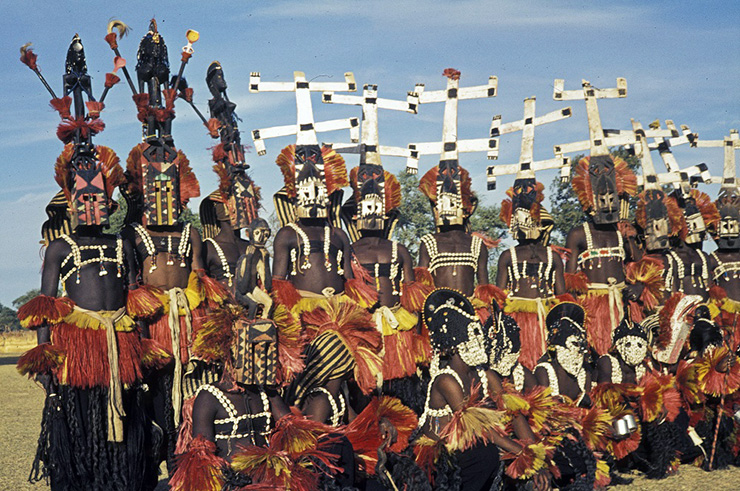
Along the cliffs of the Bandiagara escarpment in Mali – south of the Niger river and north of Upper Volta – live the modern-day Dogon tribe, a reclusive society consisting of approximately 300,000 individuals. To all outward appearances, they are a primitive tribe, who manage a near-subsistence living as onion farmers, metal-workers, weavers, and artisans under the often difficult conditions of a Sahelian climate, one that typically provides four months of rain followed by an extended dry season.
The current locale of the Dogon, which is far from any of the well-travelled routes of modern society, may have been a deliberate choice based on its ability to shelter a valued traditional way of life from unwelcome outside influences – the Dogon are thought to have migrated to this region from the Niger River in the 1500’s as a way of avoiding forced conversion to Islam.
Although Dogon society may seem well distanced from outside contact, their culture appears to constitute a kind of spiritual crossroads for several important ancient religious traditions. The Dogon are the keepers of a well-preserved cosmology that is cast in the symbols and myths of the classic ancient cosmologies. These myths provide a conceptual framework upon which many Dogon civic traditions are based, and often take forms distinctly similar to those that are known to have existed in ancient Egypt.
Likewise, the cosmology is often expressed ritually through familiar acts that are shared commonly with Judaism – such as the wearing of skull-caps and prayer shawls, the celebration of a Jubilee year, and the practice of circumcision. Furthermore, the cosmology appears to be a close relative to the ancient Vedic tradition of India, which served as the foundation for Buddhism and Hinduism.
Likewise, key concepts are couched in well-defined cosmological keywords whose pronunciations and meanings often closely reflect similar pronunciations and meanings found in the ancient Egyptian hieroglyphic language. Parallels such as these suggest that the Dogon religion may well have had its roots in much more ancient cosmological traditions.
What we know of Dogon cosmology and religion was attained through the expeditions of French anthropologists Marcel Griaule and Germaine Dieterlen, which began in the 1930’s and continued until Griaule’s untimely death in 1956. These studies culminated in two primary texts relating to Dogon religion, entitled Dieu D’Eau and Le Reynard Pale (later translated into English as Conversations With Ogotemmeli and The Pale Fox.) Griaule and Dieterlen meticulously documented a well-kept secret Dogon tradition – known primarily to the Dogon priests and a relative handful of other tribe members.
After decades of devoted study, Griaule himself was eventually initiated into the Dogon cosmological tradition. In fact, the tradition as Griaule describes it is actually open to any person who chooses to pursue it in an orderly manner. Griaule and Dieterlen tell us that the Dogon priests are required to respond truthfully to any question posed to them that is deemed to be in order, or appropriate to the initiated status of the questioner. Likewise, a priest is required to remain silent – or even to lie, if necessary to protect inner secrets of the tradition, in response to a question that is deemed to be out of order.
In 1975, nearly two decades after Griaule’s death, the studies of Griaule and Dieterlen stirred controversy with the publication of a book by Robert K.G. Temple called The Sirius Mystery. Temple’s book focused on unexpected Dogon knowledge of subtle astronomic details relating to the stars of Sirius, many of which should be undetectable without access to a powerful telescope. Temple offered this purported Dogon knowledge as evidence of a possible alien contact. Soon after, popular researcher Carl Sagan countered the suggestion of an alien contact with the proposal that the Dogon priests had simply learned these facts about the stars of Sirius from some modern visitor – a suggestion that Germaine Dieterlen sought to refute by producing a 400-year-old carved artefact that depicted the star system.
During the 1980’s, a second wave of anthropologists – led by Belgian Walter Van Beek – restudied the Dogon and – notwithstanding Griaule’s description of Dogon cosmology as a well-kept secret – reported an inability to recreate Griaule’s findings. Van Beek wrote in his book Dogon: Africa’s People of the Cliffs (p. 103):
The Dogon have no creation myth, no deep story relating how the world came into being. (An anthropologist some decades ago probed his informants for creation myths so insistently that the Dogon, polite as ever, obligingly produced them….)
Unfortunately, what Professor Van Beek and his colleagues failed to notice – as apparently did every other Dogon researcher for the first half-century following Griaule’s death – were the many abiding parallels that can be shown to exist between Griaule’s Dogon cosmology and that of classical Buddhism.
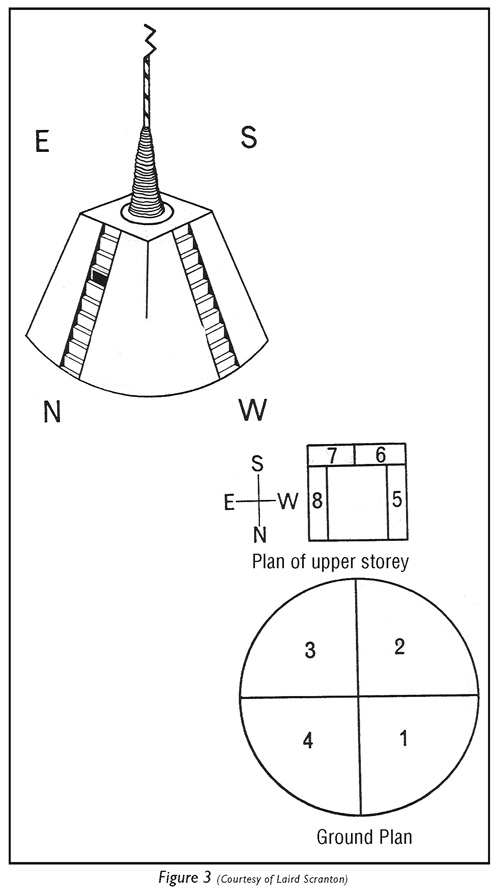
Both the Dogon and Buddhist cosmologies begin conceptually with an aligned symbolic ritual structure that serves as a grand mnemonic for the cosmology itself – the Dogon granary and the Buddhist stupa. These structures are built on a common base plan and evoke a series of matching symbolic shapes, such as the figure of a circular base around a central point that represents the sun, intersecting perpendicular lines that symbolise the axis munde, a dome or hemisphere that represents the concept of essence or substance (the Dogon say mass or matter), and culminate in a square that is said to represent the concept of space. Both structures serve as the foundation for a complex system of cosmology that ultimately defines matter as the product of primordial threads woven by a spider; these threads are said to pass through seven vibrations conceived of as rays of a star of increasing length, and are characterised by the spiral that can be drawn to inscribe the endpoints of the rays.
In essence, we can show that Griaule’s descriptions of Dogon cosmology closely conform to a known system of cosmology, and therefore that the correctness of Griaule’s observations are directly affirmed. Such parallels leave Professor Van Beek in the unenviable position of having falsely accused the Dogon priests of fabrication – a claim that we know most assuredly cannot be true.
The classic Dogon granary – a structure that Van Beek later called “a chimera known only to Griaule” – is in truth a symbolic structure that is quite well-known to large populations all across India and Asia. (Details of Buddhist stupa symbolism were documented some two decades after Griaule’s death by Adrian Snodgrass of the University of West Sydney, Australia – a leading authority on Buddhist architecture and symbolism – in his book The Symbolism of the Stupa.)
We can only surmise that the rush to judgment against Griaule’s Dogon cosmology was done without adequate consideration of the principles of comparative cosmology. No critic seems to have seriously investigated the possibility that Dogon cosmology as reported by Griaule might represent a known and legitimate cosmological form.
(In fairness, although Griaule openly cited parallels between Dogon and ancient Greek mythology, neither Griaule, Dieterlen, nor any member of their anthropological team seems to have been aware of the many intimate parallels to Buddhism.)
The same might be said for researchers in other disciplines whose fields of studies might be potentially impacted by the findings of comparative cosmologists.
There are suggestions that the earliest characters in various ancient written languages may have borrowed their shapes and meanings from ancient cosmology. This possibility should not be a surprising one, since key elements of Egyptian cosmology are known to have existed in pre-dynastic cultures.
For example, there is clear evidence for the worship of both the mother goddess Neith and the creator god Amen that dates from pre-dynastic times – well before the first surviving written text in Egypt. This view is also upheld by a variety of on-going parallels that become evident when we compare Dogon cosmological drawings with ancient Egyptian glyph shapes, and key words of Dogon cosmology with likely counterparts in the ancient Egyptian hieroglyphic language.
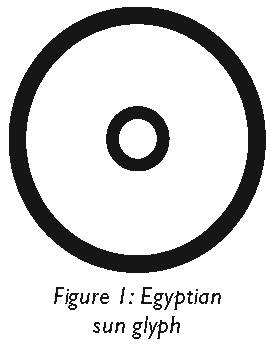
A classic example of this apparent relationship between cosmological shapes and written characters is found in the Egyptian sun glyph (Figure 1), which for traditional Egyptologists can represent the sun, the concept of a day, or can indicate by its presence in a word that the word’s meaning relates to a period of time.
Any Egyptologist will be aware of the multiple meanings of the glyph, but few offer credible suggestions for how this specific shape may have come to be assigned to these specific meanings. Some researchers attribute the dotted-circle shape to an effect that happens when a person stares too long at the glaring sun. My personal view is that the natural impulses of humanity will likely be reflected in those of a typical five-year old, and in my experience, no five-year-old draws the sun as a circle around a central dot. More often, he or she draws the sun as a simple circle, perhaps coloured yellow.
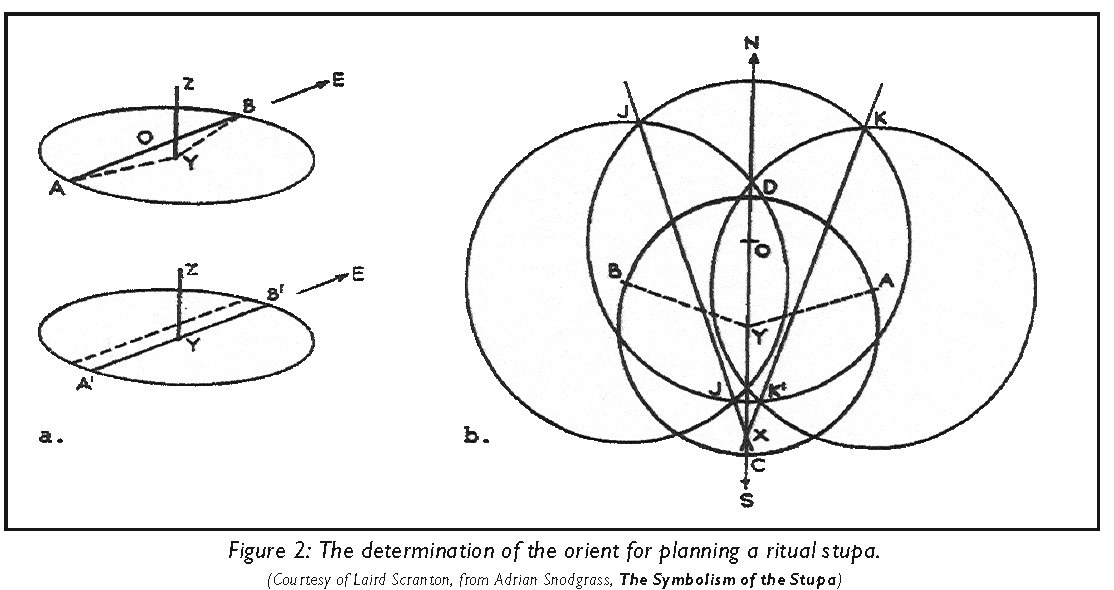
In Dogon and Buddhist cosmology, the sun glyph shape represents the starting point both for the cosmology and for the ritually aligned structures that both mnemonically symbolise the cosmology. The base of these structures are established when an initiate draws a circle around a central stick or gnomen. This simple act creates an effective sun dial which can be used to track the hours of a day. The sun glyph shape can be thought of as resulting from the circular progression of shadows that are cast by the sun as it shines on the central stick throughout the course of a day. Consequently, the figure becomes a sensible symbol to represent both the sun and the concept of a day as defined by a single rotation of the earth in relation to the sun. We can see these meanings play out symbolically in terms of the ancient Egyptian hieroglyphic word for ‘week’, which is written with only two characters – the sun glyph and the number ten.
As a second step in the alignment of a ritual stupa or granary, the initiate marks the two longest shadows of the day (morning and evening) at the points where they intersect the drawn circle (see Figure 2). These points define an east/west line or axis that will pass through the stick on the two equinoxes, and that moves progressively further away from the stick until the date of the next solstice. In this way, the same sun glyph figure can be used to track and measure the length of a season or a year, and thereby comes to represent the concept of a period of time.
The many close parallels that exist between the Dogon and Buddhist cosmologies define a kind of framework, within whose context we can make sense of the various fragmentary references of Egyptian cosmology.
For example, the Egyptian god Amen is a likely counterpart to the ‘hidden’ Dogon god Amma; the eight paired gods and goddesses of the Egyptian Ogdoad or Ennead share important attributes with the eight male/female ancestors of Dogon tradition. Like the ancient Egyptians and the Buddhists, the Dogon conceive of the processes of creation in terms of multiple Worlds. The Dogon define a Second World similar to the Egyptian Underworld that is associated with a jackal – a figure who is symbolic of the concept of disorder – and is governed by a canine who is assigned the role of judge between truth and error. Likewise, careful comparison shows that many of the key Dogon cosmological drawings take shapes reminiscent of ancient Egyptian glyphs and are often defined by the Dogon priests in relation to concepts or meanings similar to those found in ancient Egypt.
In fact, there are many different ways in which the study of Dogon cosmology provides us with potential insights into the forms and meanings of ancient Egyptian hieroglyphic characters and words. It is almost impossible for the comparative cosmologist to miss stark similarities between words such as Ogo (the name of a character who plays the role of light in Dogon myth) and Aakhu (the name of the Egyptian light god), or Sigui (the name of an important Dogon festival) and skhai (an Egyptian word meaning ‘to celebrate a festival’.) Support for these comparisons is most often provided by the cosmology itself, which typically defines a second level of meaning for important cosmological words – one that is logically disconnected from the first such that one cannot reasonably derive one meaning from the other.
Another example is that Amma and Amen are both defined as ‘hidden gods’, but both words can also mean ‘to grasp, to hold firm, or to establish’. The significance of these multiple meanings may be more obvious in the Dogon language, where – because no actual written Dogon language exists – words must be grouped based on similarity of pronunciation. However in the modern view of the Egyptian hieroglyphic language, the choice has been made to categorise words based on commonality of spelling – not pronunciation – and so any significance that may have originally rested on similarities of pronunciation is often rendered effectively transparent.
The initial impulse to consider the possible influences of cosmology on the Egyptian hieroglyphic language begins with the many persistent parallels that have been shown to exist between modern-day Dogon culture and that of ancient Egypt. These are documented in greater detail in my book The Science of the Dogon, but include such subtle practices as the founding of villages and districts in deliberate pairs – one called Upper and the other Lower.
Cultural comparisons between the Dogon and the ancient Egyptians range from the types of calendars observed, to common units of measure such as the cubit, to the observance of similar holidays and festivals, common modes of dress for their priests, common ritual practices such as circumcision, and a host of common words, mythical themes and symbols relating to concepts of cosmology. Given the depth and breadth of these other cultural parallels, it seems somewhat surprising that the Dogon have no native written language, but rather simply define an extensive set of drawn figures and signs. Many of these are closely associated with concepts of cosmology, and often take similar form and meaning to written Egyptian glyphs.
Given that the Dogon are understood to place a high value on purity of language, it seems unthinkable that they might once have possessed a written language but then – as an entire culture – somehow simply lost track of it. It seems far more likely that the priestly Dogon tribe never possessed a written language.
The absence of a written language among the Dogon suggests that any close contacts that may have occurred between the Dogon and the ancient Egyptians may have happened prior to the onset of written language in Egypt, or roughly at the boundary between pre-dynastic and dynastic Egypt. Support for this view can be found in many other aspects of Dogon cosmology and culture, which can also be seen to make sense if we postulate an early Dogon relationship to ancient Egypt.
Where Dogon cosmology defines eight relatively undifferentiated ancestors/teachers who emerge as paired opposites, ancient Egypt defines eight paired ancestor/gods and goddesses, who together define a category of deity that is simply not found in Dogon cosmology. Again and again we see non-deities in Dogon cosmology – characters from Dogon mythology (such as a jackal who symbolises the concept of disorder and a fox who is defined as a judge between truth and error) rise to the status of deities in ancient Egypt.
Yet Dogon cosmology also includes many cosmological elements from pre-dynastic Egypt that are known to have carried forward to ancient Egypt much in their pre-dynastic form. Such evidence again points to a likely timeframe for any close contact between the Dogon and the ancient Egyptians at or around the boundary between pre-dynastic and dynastic Egypt.
Matching aspects of Dogon and Buddhist cosmology provide us with a series of defined shapes that are evoked by the cosmology and explicitly assigned to symbolic concepts – the first of these is the circular sun glyph shape, which both the Dogon and Buddhists associate with the sun (see Figure 3, page 55). Among others is the shape of a hemisphere or dome, which is associated with the concept of essence or mass, substance or matter. Another is the shape of a square, which the Dogon and Buddhists correlate to the concept of space. (One expressed purpose of a stupa is to define an ordered space from a disordered field.)
These shapes and their associated concepts, the pairing of which is cross-confirmed between the plans of the Buddhist stupa and the Dogon granary, play out in similar ways to the sun glyph when we examine their usage in ancient Egyptian words. My book Sacred Symbols of the Dogon traces the likely origins of these shapes along with likely relationships between them and ancient Egyptian counterparts, and illustrates how concepts such as mass and space play out symbolically in the definitions of various ancient Egyptian cosmological words. It is not surprising that the decidedly scientific creational themes of ancient cosmology should play out in terms of symbols that appear to relate to scientific concepts.
Most importantly, it is the cross-confirming evidence that can be drawn from comparative cosmology that supports a new view of Egyptian language. The straightforward argument runs like this: Dogon cosmology assigns a specific word to a cosmological concept and associates that word both with a drawn cosmological shape and with two logically-disconnected meanings. Buddhist stupa symbolism – through its direct parallels to Dogon cosmology – directly affirms the association between the concept and the shape. The pronunciation of the Dogon word, along with its well-defined pair of meanings, links us to a set of corresponding Egyptian words pronounced like the Dogon word, and which reflect the same logically-disconnected concepts. Most often, at least one of these related written Egyptian words includes the related Dogon cosmological shape as a written glyph.
Perhaps the best clue to indicate that the ancient Egyptian hieroglyphic language was intended to be primarily symbolic – rather than phonetic – in nature lies with its lack of written vowel sounds. Like ancient Hebrew and other contemporaneous ancient languages, vowel sounds are only implied in ancient Egyptian hieroglyphic words. When we interpret the word symbolically – by substituting concepts for glyphs to produce a symbolic sentence – any question of a missing vowel is rendered moot. No vowel is provided because none is required. It is a known fact that Hebrew acquired markings later in history to signal vowel sounds, whereas the Egyptian hieroglyphs did not. To the comparative cosmologist, it seems nonsensical to choose phonetic interpretation as the first purpose of a language that deliberately omits key phonemes from every word.
Additional clues to the symbolic meanings of Egyptian glyph shapes are provided in Egyptian mythology, and are perhaps best understood through comparisons to Dogon cosmology. In Dogon myth, each discreet mythological character – such as the one true Dogon god Amma, who initiates creation, or Ogo, a character who plays the role of light in Dogon myth – represents a component stage of creation – the very same component stages that are illustrated by the Dogon cosmological drawings whose shapes we correlate to Egyptian glyphs. This hint leads us to examine Egyptian deities and glyphs shapes in a similar context, and ultimately to uncover a systematic relationship between Egyptian deities and Egyptian glyph shapes – governed by similarities of pronunciation between the name of the deity and the corresponding glyph. This relationship is outlined in great detail in my book Sacred Symbols of the Dogon.
From this perspective, evidence of a symbolic written language becomes one of the signature attributes of a likely parent cosmology – one that could provide a sensible conceptual umbrella over the Dogon, Buddhist and Egyptian cosmologies.
Likewise, it becomes glaringly obvious that ancient Chinese writing, which increasingly, based on recent discoveries, can be reasonably dated to a period contemporaneous with the ancient Egyptian hieroglyphs and ancient Hebrew – shares key attributes in common with these written cosmological symbols. These begin with a Chinese sun glyph that takes a form similar to the Egyptian sun glyph and that carries the same three signature cosmological meanings. We know that Chinese language first emerged in the earliest Chinese civic centres that – according to some authorities – arose at the sites of important ritual shrines. These proto-cities were carefully aligned to the cardinal points according to the same principles as a Buddhist stupa.
Clearly, the relationship between ancient cosmology and early written language offers us an important key by which to potentially synchronise yet another classic cosmology with the three cosmologies we have already addressed.
[alert type=”general” dismiss=”no”]This article was published in New Dawn 112.[/alert]
[alert type=”success” dismiss=”no”]If you appreciate this article, please consider subscribing to help maintain this website.[/alert]
© New Dawn Magazine and the respective author.
For our reproduction notice, click here.