New Dawn – World's Most Unusual Magazine

Author: Will Hart

  • Keyhole: Unlocking the Secret Geometry of the UFO Enigma

    Keyhole: Unlocking the Secret Geometry of the UFO Enigma

    From New Dawn Special Issue Vol 12 No 2 (April 2018)

    In my latest book Ancient Alien Ancestors, I present several discoveries one of which I want to go over briefly. I say ‘discovery’, implying, more or less, that I went through a process of research and tracked it down.

    It kind of happened that way but not quite. I had been studying the Great Pyramid of Giza in Egypt for a long time, but the Byzantine nature of the puzzle started causing me an overload. The enigmas of that edifice are many, entangled and impossibly complex. Stopping short of a mental meltdown, I let it go for a while.

    One morning I woke up with the compelling thought to experimentally shift the prime meridian from Greenwich 0 to Giza, 31 E longitude. That made Giza the new 0 longitude (actually, Giza/Nile River delta). I did not plot out this scenario; the idea came to me first thing when I woke up. 

    Next, I got a map and looked at Mississippi River delta, 89 W longitude. Then I added 31 to that and came up with 120 degrees! That is a very significant number in geometry, especially when we are talking about the Earth and the Great Pyramid.

    The Greenwich prime had obscured that fact, and nobody was pointing out this exact relationship between the Nile and Mississippi deltas. They both sit on 30 N latitude, precisely 120 degrees apart. 

    Now consider that the Nile flows from south to north; the Mississippi from north to south. I realised they were inverted mirror images of each other. Something was going on with this. I also realised it was a very big anomaly. So is the 30 N latitude which is seldom mentioned.

    I then found that the Tigris-Euphrates was exactly 15 degrees east of Giza; the Yangtze delta 90 E degrees also and both on the 30 N parallel. The question that popped into my head: what is behind these rivers flowing into deltas, all along a single northern latitude around the globe?

    I know of no geological dynamics that logically explains this and I have never heard a geologist try. Erosion, deposition, floods – they are all random processes. Then there was the fact that the earliest civilisations emerged in these river valleys on 30 N latitude. Another anomaly.

    When a whole bunch of facts added together turns up an enigma, people either dig for the answer or chalk it up to ‘coincidence’. A quaint shallow concept that explains nothing unless one has a simple mind. It reveals a bias toward thinking the universe is based on random variables… dumb! You can check the foregoing in my book.
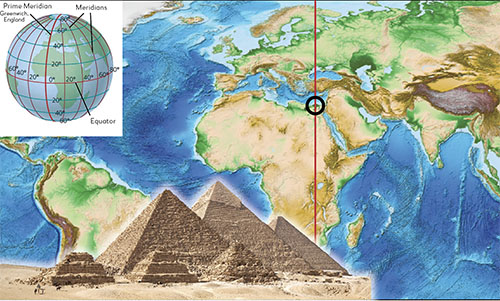
    Prime Meridian experimentally shifted from Greenwich 0 to Giza.

    Anomalies as Clues to the Bigger Picture

    What is an anomaly? Basically anything that does not fit the model, or expectations, “something that deviates from what is standard, normal,” says the dictionary.

    I realised, after many decades studying anomalies, that they are the Achilles heel of modern science and academia. When these ‘experts’ are confronted with a serious anomaly (i.e. the Great Pyramid), they abandon the scientific method, circle the wagons, and become babbling morons. The nonsense spouted on how this massive, precision-engineered edifice was built is quite shocking. We are given to believe it was built by people using hammer-stones, wooden sledges and ropes. 

    They present a scenario that is so improbable that it short-circuits even normally rational minds. People using Stone Age technology could not build such a sophisticated edifice. Our scholars are either stupid or just plain liars. Never mind, the Egyptians somehow did it, case closed. Minds shut, anomaly disposed of, everybody goes home. Problem is, the anomaly and the response to it are like a computer virus. It grows, spreads and starts causing fragmentation and loss of system integrity.

    Already a substantial number of people around the world utterly reject the orthodox theories. Get enough of these anomalies piling up and credibility and trust become real issues. We are approaching that watershed critical mass point now.

    UFOs exist, but then again they don’t, because they shouldn’t according to the laws of physics. Anomalies. Nothing in our rule-based 3D material dimension can appear and disappear in an instant. 

    In addition, it is impossible to see events in the future because it has not yet happened in linear time, right? Wrong.

    Paranormal, psi, psychic phenomena occur and have been scientifically observed in controlled settings. Scientist Russell Targ noted his experiences while carrying out research into such phenomena in the following quote.

    “Stanford Research Institute (SRI) conducted investigations into the human mind’s capacity for expanded awareness, also called remote viewing, in which people are able to envision distant places and future events and activities. For two decades SRI’s research was supported by the CIA and other government agencies. I was co-founder of this once secret program which began in 1972.” (See ‘The Scientific and Spiritual Implications of Psychic Abilities’, www.bibliotecapleyades.net/ciencia/ciencia_psycho10.htm.)

    Since these phenomena do exist but shouldn’t by the rules that supposedly govern the dimension we live in, they are anomalies. As such, official science shows them the backdoor and politely asks them to leave and not return. Yet, the fact they exist puts us in a paradoxical position.

    We seem to be living in a Universe that is, in reality, much more complex and inexplicable. Nonetheless, these anomalies must be explained and accounted for. 

    Quantum Nature of Reality

    Now our view of normal starts getting twisted out of shape. As shown above, scientific investigations have proven that paranormal phenomena are real (that was one study, there are more.) However, we have to keep in mind that these things are weird only in the context of the rules defined by physicists. They have a model of the cosmos and our place in it. That model is predicated on there being an external universe that exists independent of our observations. In that model objects exist in three-dimensional space.

    In fact, that description is not the newest upgrade. There is the quantum-view, the 2.0 version, now held by many scientists. The foregoing was actually the mechanical model from Newton that existed until Einstein blew it up.

    In his relativity model, the space/time continuum is an interdependent whole. We cannot have space without time and objects need both to exist and move about. It is a package deal. Quantum mechanics came along and changed everything. There is no external universe made of solid objects existing in space independent of our observations. 

    What actually exists is an unexplainable paradox. Our observations change the underlying conditions of the universe. We are in an entangled presence. No pure objectivity is possible because our very observation changes the field.

    Objects are vibrating fields comprised of waves of energy. Well, that is unless they are particles comprised of quantum units. We have a situation where the smallest foundational components of the observable universe are called wavicles

    Moreover, experiments demonstrate that quanta of light that are sent off in opposite directions maintain their connection to one another. Each photon is affected by what happens to its twin, even millions of kilometres away, if one gets bumped the other feels it.

    Physicist David Bohm conducted those experiments. Now, we are starting to talk about a universe in which UFOs and psi phenomena can and do exist. This is good for me because I have been studying such things for 40 years now, with people thinking I was a fringe dweller, or worse. 

    You have no doubt seen and pondered holograms, those two-dimensional graphics that appear be three-dimensional. They may hold the key that opens the door and helps explain anomalies. Here is a definition of what is behind a hologram.

    “The Holographic Principle holds that the information which describes all of the particles of matter and vibrations of energy in the bulk of the sphere fundamentally ‘lives’ at the boundary of the sphere.”  

    In plain English, the form of a 3D object is fully embedded in every point on a two-dimensional surface. Holograms form when a beam of light hits a plate and sends off refracted interference patterns. They contain the image of the hologram. It only exists as a field of light in space that appears to have three dimensions. So much for the technical explanation. We both know what they look like and they are essentially illusions.

    There is no 3D object floating in space. But knowing that does not change the fact that we see an object floating in space. Odd, yes, and welcome to the paranormal dimension of the holographic universe. 

    Art by Raphael Terra © Esoterica Art Agency (esotericaartagency.com)

    My UFO Encounter

    All this is relevant to my research and thinking about ‘Ancient Aliens’. For me, this whole process started back in the late 1960s. I was living in Scandinavia and had an encounter with a UFO. It surprised me to the bone. Then and there my worldview shattered, and I had to try and explain it. Shortly thereafter Erich von Däniken’s book Chariots of the Gods? came out. I got a copy and was enthralled by the possibilities he suggested.

    We forget, at least those my age do, that those were the heady days of the Space Race, men setting foot on the Moon, UFO flaps as headline stories for two decades and so on. All of a sudden this new book comes out intimating that perhaps Earth was visited by extra-terrestrials in the past. Maybe these ancient enigmas found all over the Earth such as pyramids had an explanation – ancient astronauts

    That proposition dovetailed into images of our astronauts in spacesuits climbing into a capsule before launch. ‘Star Trek’ and decades of sci-fi novels and films reinforced the concept of long-distance space travel in (hardware) 3D spaceships. 

    An archetype started forming. UFOs were advanced spacecraft piloted by aliens who were physical like us… but different. The simple formula was ancient astronauts had landed their ships on Earth, bio-engineered humans and departed.

    In 1970 I recall what NASA promised. The next phase of space exploration was setting up a lunar colony. After that, manned Mars missions. The whole fictional environment of sci-fi was being spun as if it was real science. 

    Here we are almost 50 years later waiting for the still promised lunar mission. It keeps getting postponed every few years. Why? In fact, NASA never really explained why they pulled the plug on the lunar mission back then. 

    I suspect that some goo-goo got splattered all over the walls of Mission Control. They learned some things, quite a few actually, from the early manned missions. Unpleasant things about human beings in gravity-free habitats quickly losing muscle mass; unable to sleep; an entire list of nasty side effects, in fact.

    I investigated the situation because I did not think NASA was passing the smell test. Liar, liar, pants on fire. (NASA: Never A Straight Answer.) The longer and deeper I thought about it, more and more reality floated up to the surface. 

    It seems there are some real intractable problems with extended space flight. The kind that bursts bubbles and makes you stop and think. Example: A trip to Neptune compromises the astronaut’s ability, in deep space, to communicate with Mission Control on Earth. Why? It takes eight minutes for a signal to travel that far. That means about 20 minutes turnaround time in an emergency. That won’t work. Extrapolate that scenario to interstellar space. We just hit the ‘Star Trek’ kill switch.

    Nobody is going to be sent out on a suicide mission costing hundreds of millions of dollars. We will never be that far out on the edge of the solar system and forget about interstellar space travel. That was pure fantasy.

    I know this sounds strange coming from an Ancient Alien theorist. But facts are facts, and they threw me for a loop when first discovered. With the deleterious health side effects coupled with the above, extended space travel is caput.

    Is NASA informing the public of these naughty little details? Of course not! I could add the problems with a fail-safe oxygen generating system but that’s overkill.

    This impacted my whole psychology about ancient aliens and modern UFOs. I realised that any alien civilisation in our Universe or dimension would be confronted by the same problems. In my latest book I went over this, however I think I was a bit too optimistic in my conclusions.

    Get the issue this article appears in

    UFOs: Through physical Space or via Portals?

    Returning to the 1970s momentarily, I was struggling to understand the encounter I had in 1968. There was also a very high-level scientist who had a similar experience and was also a UFO researcher. His name was Jacques Vallee [see article on page 45 of this issue].

    Vallee had been on the team that developed the first prototype of the Internet. He had done design for NASA. I mean one smart guy. After years of researching the phenomenon, Vallee was not happy with the aliens-in-hardware-spacecraft model. That was the prevailing thinking back then among the research community. 

    He wrote a book explaining his objections, Passport to Magonia. That was followed by a radical proposition: the aliens were not from our dimension, but they entered and left it at will. They had been engaged in this activity in the remote past up to the present day. This became the Interdimensional Parallel Universe theory, hotly disputed by many researchers at the time. 

    I was at a crossroads when that came out and stirred up a huge controversy. I had studied the phenomenon, all the anomalies, and simply could not figure it out. In fact, I got to the point of being turned off by the politicking among researchers. That is when I chose to drop the modern UFO phenomenon and focus on the mysteries of ancient history. I reasoned that perhaps Vallee was correct. 

    There were lots of strange stone megaliths scattered all over the planet. I could not imagine how aliens from another dimension could manipulate them or why they would feel compelled to. I decided consciously (half-informed) to pursue the enigmas of the past. My working hypothesis was that an advanced ET civilisation had seeded the Earth, visited and bioengineered humanity into a hybrid race, implanted much knowledge in the Sumerians, and history unfolded.

    My approach was a hybrid of its own. I discovered a paper written by two eminent scientists, Sir Francis Crick and Leslie Orgel [see Will Hart’s article “The Scientific Case for Alien Intervention” in New Dawn 167]. I was convinced they were onto something with Directed Panspermia. They laid out a bold refutation of Darwin’s doctrines and a good case for alien intervention.

    I still think their approach has a core of valid facts, and their work raises many serious questions about evolution. Beyond that, how life emerged on planet Earth.

    Erich von Däniken was a popular writer, but these two were scientists. I steered a middle course. Everything proceeded fairly smoothly for a while. Then in recent years psychological dissonance started to hit me. It took decades to go through hundreds of ancient sites and many thousands of artefacts to come to it.

    The problem was that if aliens had come to Earth in spacecraft, why had I not seen one depiction of them? I mean the craft they arrived in and left, that is. You would expect that the Sumerians, who claimed they lived with the Annunaki, would have carved one on a stelae somewhere. They carved plenty of depictions of the gods. All these anomalies, evidence of ancient high technology, yet not one spaceship… it did not add up.
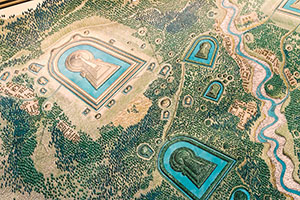
    Graphic representation of the original layout of the Nintoku-tenno-ryo Kofun (mausoleum of Emperor Nintoku) with numerous smaller ones (located in Osaka Prefecture, Japan).

    What I was finding instead were artefacts that suggested perhaps a portal of some kind was used. That mainly came in the last few years when I found out two things I had never noticed before or had but was focused on other priorities. 

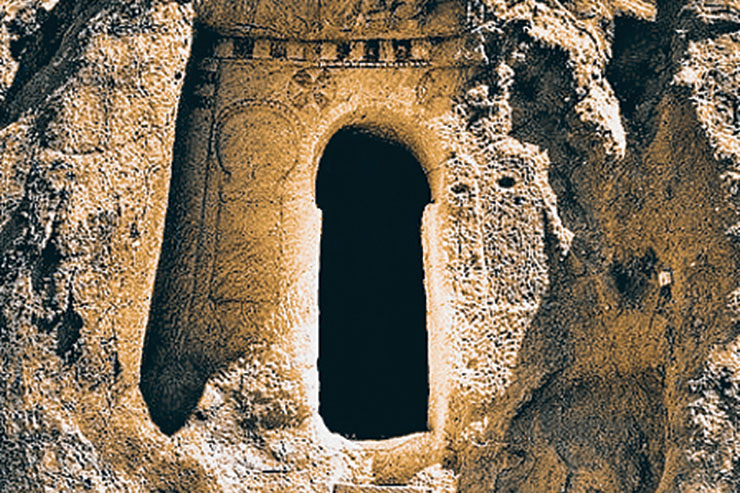
    That was 1) the keyhole pattern found worldwide, and 2) the trapezoid embedded in a wide variety of ancient artefacts. 

    Step-by-step, as I needed it, new data came streaming in bringing fresh insights. I discovered and visited Japan to see their Keyhole Kofun. Massive structures surrounded by moats, hiding in plain sight. The Japanese do not promote them as a tourist attraction. In fact, a veil of tight security and secrecy surrounds them. The Royal Family owns and controls the main ones. Incredibly, there are an estimated 150,000 Kofun spread around the country. Even archaeologists get the ‘no trespass’ turnaround.
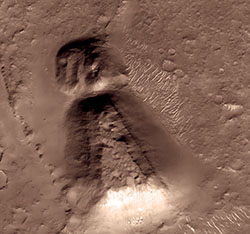
    Kofun-like structure recently discovered on planet Mars.

    Indeed, here is a very deep level anomaly. Keyhole structures resembling those in Japan have been found in the Arabian Desert. I have found the pattern at sites around the world. Perhaps the most surprising is the obvious keyhole design of St. Peter’s Square.

    At the same time I was running into trapezoid windows, doorways, cave entrances, everywhere I looked. Snap! It dawned on me in a flash. The Keyhole Kofun had a trapezoidal lower section and a circular section above that. 

    Time rolled by and a bigger bolt hit me. This one was a bit of a shocker. I was looking at some ‘pyramids’ and suddenly noticed… those are not pyramids. They were not designed using a square base surmounted by four inward leaning triangles. None of them came together to a point on top. 
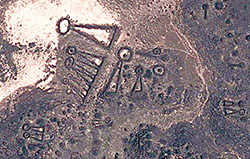
     Structures in Harrat Khaybar, Saudi Arabia, with distinctive keyhole design. These mysterious structures are estimated to be at least 9,000 years old.

    A square base was surmounted by four trapezoids. The structures were truncated to accommodate a platform on top that held a solar temple. We had Westernised these structures and had triangles and pyramids in our minds. But they were not there, like the holographic images.

    You cannot understand why the ancients built them by studying the geometry of triangles and true pyramids. The trapezoid is an embedded feature of ancient sites all over the globe. It isthe geometry we should have been investigating.
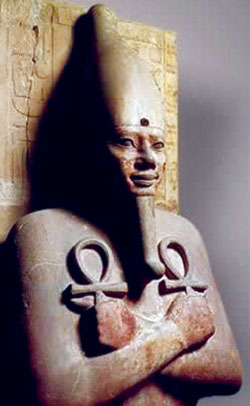
      What was the message the ancients were trying to pass along to us in those shapes? Think of another trapezoid, circle combination, this one small. The ankh! Especially those from 1st dynasty Ancient Egypt which had a pure trapezoid under a perfect circle. That was later changed to a stem underneath a loop. 

    The message has to do with the nature and structure of the space/time continuum we inhabit. Keyhole. Just like the phi code was embedded in ancient buildings, including the pyramids. Today, scientists and programmers are rediscovering it. Now phi is embedded in algorithms in a zillion software applications. 

    That ratio is a very deep secret related to how the universe design’s structures. At this point I have abandoned the hardware archetype. Don’t get the wrong idea; the concept was not that important in my latest book. One of my objectives in the volume is to present the best UFO evidence and integrate Ancient Aliens with the modern UFO phenomenon. The phenomenon forms a continuum. 

    I feel compelled to examine the possibilities of interdimensional transit. I wonder what conditions would have to exist to facilitate it. I am taking the keyhole and trapezoid shapes and trying to pierce that veil as well. The title of my next book is going to be Alien Presence

    [alert type=”general” dismiss=”no”]This article was published in New Dawn Special Issue Vol 12 No 2.[/alert]

    [alert type=”success” dismiss=”no”]If you appreciate this article, please consider subscribing to help maintain this website.[/alert]

    © New Dawn Magazine and the respective author.
    For our reproduction notice, click here.
  • Ancient Civilisations: Six Great Enigmas

    Ancient Civilisations: Six Great Enigmas

    From New Dawn 90 (May-June 2005)

    We stand today at an unprecedented turning point in human history. In recent years two versions of ancient history have formed. One, we shall call ‘alternative’ history, the other we shall refer to as ‘official’ history. The former ponders over a variety of anomalies and tries to make sense out of the corpus of evidence, i.e., the pyramids and timelines, why they were built, by whom and when. The latter conducts digs, catalogues pottery shards, and tries to defend its proposal there are no enigmas, and virtually everything is explained.

    At one point perhaps as late as fifteen years ago these two camps seem to be engaged in an informal dialogue. That all changed after, 1) the Great Sphinx redating controversy caught Egyptologists off guard and, 2) the impact of Chris Dunn’s book The Giza Power Plant: Technologies of Ancient Egypt at the end of the last decade.

    There is no more dialogue and no more polite, gloves on debate. The proponents of ‘official’ history have taken an increasingly political and ideological approach to the issue. They now do little more than offer pronouncements of the historical ‘truth’ on the one hand, and denounce of all those who dare challenge officialdom on the other.In this context we offer evidence that our ‘scholars’, the gatekeepers who control our institutions of ‘higher learning’, refuse to consider.

    The Great Pyramid – Precision Engineering

    This colossal structure, the last of the seven ancient wonders and the largest stone building in the world, still provokes awe, controversy and a plethora of theories that inspire bitter debate to this day. Instead of going over the well-established mysteries, we would like to shine new light on this important enigma that appears out of place in ‘Stone Age’ Egypt.

    The real challenge the Great Pyramid still poses to us in the opening decade of the Third Millennium is the physical plant itself. Theorists have gone on endlessly speculating about how it was built and the metaphysical, cultural and religious significance and/or symbolism behind its construction. Though several authors have offered tantalising possibilities, none have been conclusively proven.

    The mystery remains unsolved.

    To begin with, the massive size – the staggering volume and weight of the building blocks – remain problematic. With an estimated 2.3 million blocks with a weight of about 4 million tons, the pyramid is two-thirds the mass of the Hoover Dam. The sheer size and the numbers of blocks that had to be quarried and moved into place, presents numerous architectural, construction and engineering headaches.

    These issues have been raised time and again, yet are still unsettled. It is time to move on and define the even more difficult issues. We consider the core ‘hard’ problems to be those that reflect precision engineering and assembly line manufacturing accomplished on a massive scale. The primitive tools scenario concocted by Egyptologists does not explain the following tasks:

    1. Creating precision-cut casing blocks weighing 16 tons, fitted together and held by a super-glue mortar that maintained a tight seal forming a nearly seamless shell.

    2. Leveling the 13-acre limestone bedrock base to a degree of accuracy only recently achieved with laser technology.

    3. Squaring the base to True North with minimal deviation.

    4. Excavating the ‘Descending Passage’ 350 feet into solid bedrock at a 26-degree angle while keeping the tunnel arrow-straight for its length.

    5. Bringing the massive 48-story pyramid together around complex internal structures, retaining the true shape to enable the builders to form the apex. (These internal structures include four enigmatic ventilation shafts and a coffer in the King’s Chamber that is too large to have been moved through the opening. It shows evidence of having been cut with a jewel-tip saw.)

    6. Extensive usage of different types of machined granite inside the Great Pyramid chambers.

    The father of modern Egyptology, Sir Flinders Petrie, marvelled at the precision and size of the casing blocks. He carefully measure the blocks and found that “the mean thickness of the joints are .020 and therefore, the mean variation of the cutting of the stone from a straight line and from a true square, is but .01 on length of 75 inches up the face, an amount of accuracy equal to most modern opticians’ straight-edges of such a length.”

    The modern international engineering firm of Daniel, Mann, Johnson & Menendhall conducted a forensic analysis of the Great Pyramid. Their findings are evaluated in an article published in Civil Engineering.

    The pyramid was oriented with its major sides either north-south or east-west. This in itself was a remarkable undertaking, given the accuracy to which it was done, because the Egyptians had to perform the work using astronomical or solar observations – the compass had not yet been invented. The dimensions of the pyramid are extremely accurate and the site was levelled within a fraction of an inch over the entire base. This is comparable to the accuracy possible with modern construction methods and laser levelling.1

    The summary speaks volumes between the lines. The problems with the Descending Passage are numerous. For starters the tunnel is less than 4 x 4 feet, enough for no more than one excavator wielding a hammer-stone at any given moment. How would our proposed digging crew negotiate the space in the suffocating darkness once they had dug down 50 feet and more? In addition how would the 26-degree angle be set and maintained without lights or levels? The lack of carbon deposits on walls and ceiling indicate that torches were not used.

    Once again, Petrie measured the passage and found an amazing accuracy of .020 of an inch over 150 feet and a mere .250 inch over 350 feet of its constructed and excavated length. We submit that this passage with its smooth surfaces, squared shape, and accurate angle could not have been tunnelled with primitive tools and methods.

    The Great Pyramid remains the world’s greatest wonder and ancient enigma. We suggest researchers should pay more attention to these details and ask about the materials used inside the Great Pyramid, especially near the ventilation shafts. We now have two doors blocking a very important shaft, the one that pointed to the star Sirius in 2450 BCE.

    The Origin Of Dogs – Biogenetic engineering

    Now we turn to a mystery that nearly equals the pyramid, though it is a little known conundrum hidden in the mists of remote antiquity. Let us start with a simple question that appears to have an obvious answer: what is a dog? It turns out geneticists in the past decade have shown the answer is not so obvious. In fact, generations of anthropologists, archaeologists and wildlife biologists turned out to be dead wrong when it came to the origins of “man’s best friend”.

    Prior to DNA studies conducted in the 1990s, the generally accepted theory posited that dogs branched off from a variety of wild canids, i.e., coyotes, hyenas, jackals, wolves and so on, about 15,000 years ago. The results of the first comprehensive DNA study shocked the scholarly community. The study found that all dog breeds can be traced back to wolves and not other canids. The second part of the finding was even more unexpected – the branching off occurred from 40-150,000 years ago.

    Why do these findings pose a problem? We have to answer that question with another question: how were dogs bred from wolves? This is not just difficult to explain, it is impossible. Do not be fooled by the pseudo-explanations put forth by science writers that state our Stone Age ancestors befriended wolves and somehow (the procedure is never articulated) managed to breed the first mutant wolf, the mother of all dogs. Sorry, we like dogs too, but that is what a dog is.

    The problems come at the crucial stage of taking a male and female wolf and getting them to produce a subspecies (assuming you could tame and interact with them at all). Let us take this one step further by returning to our original question, what is a dog? A dog is a mutated wolf that only has those characteristics of the wild parent, which humans find companionable and useful. That is an amazing fact.

    Think about those statements for a moment. If you are thinking that dogs evolved naturally from wolves, that is not an option. No scientist believes that because the stringent wolf pecking order and breeding rituals would never allow a mutant to survive, at least that is one strong argument against natural evolution.

    Now, if our Paleolithic ancestors could have pulled off this feat, and the actual challenges posed by the process are far more taxing, then wolf/dog breeders today certainly should have no problem duplicating it. But like the Great Pyramid, that does not seem to be the case. No breeders have stepped up to the plate claiming they can take two pure wolves and produce a dog sans biogenetic engineering techniques.

    The evolution of the domesticated dog from a wild pack animal appears to be a miracle! It should not have happened. This is another unexplained enigma.

    [alert type=”info” dismiss=”no”]If you appreciate this article, please consider a subscription to New Dawn magazine.[/alert]

    Mohenjo Daro – Civil Engineering

    Since indoor plumbing did not arrive in modern societies to any extent until the 20th century, and urban planning has still not been adopted much to this date in history, what we find in the ancient city of Mohenjo Daro is anomalous indeed.

    This city in the Indus Valley was built on a grid system about 4,500 years ago, obviously planned out and drawn up before the first brick was laid. It had houses, some with indoor plumbing, a granary, baths, an assembly hall and towers all made out of standard size bricks. The streets were about eight to ten feet wide on average, and were built with well-engineered drainage channels.

    Mohenjo Daro was divided into two parts; the Citadel was on the upper level and included an elaborate tank called the Great Bath that was made of fine quality brickwork and drains. The Great Bath was 40 feet long and 8 feet deep, a huge public facility by any standards. A giant granary, a large residential building, and several assembly halls were also on this upper level.

    The Great Bath was made watertight by the use of two layers of brick, lime-cement and then finally sealed with bitumen (tar). The bath included a shallow section for children.

    We should wonder how an ancient culture of which nothing is known, not even their language, created this sophisticated city at a point in time many thousands of years ahead of the curve? Civil engineers do not crawl out of thatched-roof huts able to draw up plans for a complex urban environment. We need to address the following question to archaeologists and historians:

    1. Where are the cities that demonstrate the path of urban development, social and technical organisation, leading to Mohenjo Daro?

    2. How do you explain the sudden emergence of a complex society when 99.99% of the rest of humanity were living primitively?

    These issues cannot be brushed aside with some arrogant pretence that the questions have already been addressed and answered by digging up and labelling pottery shards and other artefacts. We have been and are being overly indulgent with our “soft sciences” regarding their cavalier assertions about having all the answers. In fact, they have very few, so why are they throwing stones at independent researchers from behind glass towers?

    Extraordinarily little is known about the Indus Valley civilisation that once spanned nearly a thousand miles with other cities matching the description of Mohenjo Daro.

    We file this under our list of great enigmas and challenge orthodox scholars to prove differently as with the first two of our mysteries.

    We note that the Indus Valley civilisation was contemporary with the Great Pyramid. It is often said this was one of the first three civilisations, having a written script that has never been deciphered. Now we turn next to the mother of all civilisations, Sumer.

    Sumeria – The Source Of Civilisation

    Are we missing something or are our historians looking at our earliest civilisations through a strange and distorted lens? Like Egypt and the Indus Valley, the biblical ‘Land of Shinar’ – the birthplace of Abraham – was a brutally hot, largely barren, empty desert with a mighty river cutting a swath through it. Does this sound like the magnet that would attract late Stone Age tribes to hunker down and pull wonders out of a hat?

    In fact, historians thought Shinar was a piece of biblical fiction until the mid-19th century, but now they know everything about it with complete certitude that we, the unwashed masses, dare not question. Nonetheless, we encourage readers to maintain an attitude of healthy skepticism and dare to question ‘official history’.

    As is the case with the culture that built the cities of the Indus Valley, no one knows who the ancient Sumerians were or where they came from. They called themselves ‘the black-headed ones’ and spoke a strange language that was unrelated to the languages of the Semitic tribes in the region. Some linguists note a similarity between the Sumerian language and that of the Basques, another anomalous culture.

    We find it curious that any primitive peoples would choose the rigours of a hostile desert environment to settle in and build a civilisation. Why not a gentle river in a forested mountain valley? Especially in light of the fact that Sumeria contained very few resources, no forests, no minerals, not even the rocks that were plentiful in Egypt.

    How are we to explain the fact this mysterious culture managed to invent all of the core components of civilisation under such restrictive conditions? It occurs to us that a culture would need minerals like copper, gold, silver and tin immediately available to experiment with over the course of generations in order to create process metallurgy. There is nothing simple or accidental about making the connection between raw ores, the metals they contain, and how to reduce them out of their native state using high heat.

    Nevertheless, the Sumerians not only figured out geology, how to obtained the ore, knew the levels of heat needed and how to build kilns to achieve it, they also took very different metals and created the first alloy, bronze. As metal-smiths were performing these feats, other citizens were apparently creating the wheel, building cities, ziggurats, inventing writing, movable type, the ox-drawn plow, cereal crop agriculture, and advanced mathematics, to mention the most notable of their innovations.

    Something is wrong with this picture. Most human beings were counting using their fingers, if at all, hunting animals and gathering plants for their meals. Yet, we find the Sumerians in classrooms learning the principles of the sexigesimal math system. Yes, the very same 60-base system we use today to keep track of hours, minutes and seconds. This advanced system was the first to reveal that a circle has 360 degrees and can be subdivided using 60, 30, 15, 12, etc., all fractions of the root number.

    Teotihuacán – Anomalous Technical Evidence

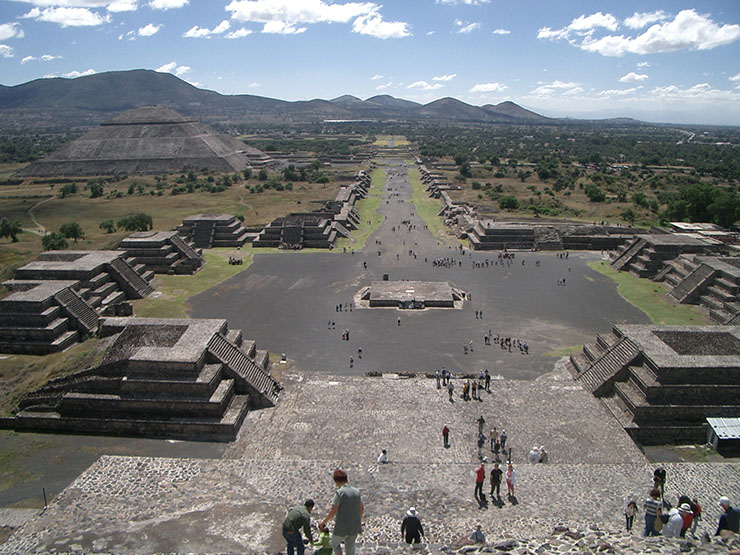
    Teotihuacán, in Mexico, is an immense, even overwhelming archaeological site, oriented along a twin axis. In the 1960s a team of archaeologists and surveyors mapped out the entire complex in great detail. The resultant map revealed an urban grid centred around two principal, almost perpendicular, alignments.

    From the Pyramid of the Moon at the north end, the complex extends south along the Avenue of the Dead beyond the Ciudadela and Great Compound complexes for about 3.2 kilometres. To this north-south axis we must add an east-west alignment that led from a point near the Pyramid of the Sun to a spot of prime astronomical significance on the western horizon.

    Anthony Aveni, an astronomer-anthropologist, discovered that on the day the Sun passes directly overhead in the spring of the Northern Hemisphere (May 18), the Pleiades star cluster makes its first annual predawn appearance. It was at this point on the western horizon that the Pleiades set, and the builders aimed the east-west axis.

    Additionally, the Sun also sets at this point on the horizon on August 12 – the anniversary of the beginning of the current Mesoamerican calendar cycle (5th Sun) – determined by a consensus of academic and independent scholars to have begun on August 12, 3114 BCE.

    It is very clear Teotihuacán was laid out according to a set of alignments that reflected celestial, geographic, as well as geodetic relationships. Walking along the avenue from one pyramid to another, up the steps to the top, and surveying the site from a multitude of angles, one is struck by the sense of being in the middle of some vast geometric matrix.

    Teotihuacán was the first true urban centre in the Americas. At its peak around 500 CE, it boasted a population of an estimated 200,000. George E. Stuart, archaeologist and the editor of National Geographic magazine sums up our ignorance:

    We speak of it with awe, as we do the pyramids of Egypt, but we still know next to nothing about the origins of the Teotihuacános, what language they spoke, how their society was organised, and what caused their decline.2

    As for one the most anomalous of artefacts on the planet, in the 1900s archaeologists discovered a sheet of mica in the upper tiers of the Pyramid of the Sun. This was no ho-hum pottery shard to catalogue and file away in a dusty box, yet that is about how archaeologists treated the find. To anyone with even a smattering of technical knowledge, discovering a large sheet of mica in an ancient pyramid site comes as a shock. In fact, it is one of the great ‘smoking guns’ that turn archaeologists mum.

    Mica is an inflammable and non-conductive mineral that grows in fairly weak plate-like structures. It is not at all useful as a structural building material. NASA uses it as a radiation shield in space vehicles. Mica is also utilised in electronic components and microwave ovens, and it is a good shield for electromagnetic radiation, like radio waves. Like the Great Pyramid, the Pyramid of the Sun has a subterranean cavity under the middle of the pyramid. A large pyramid with layers of thick mica would be an excellent EMI shield.

    Its placement in the complex raises questions that we could only answer today after the development of electronic, atomic and space age technologies.

    Thick sheets of mica were also found by archaeologists about 400 meters down the avenue from the Sun Pyramid, these precision-cut sheets were of considerable size: 27.5 meters square. They were located under a rock-slab floor of a complex now called “the Mica Temple”.

    What possible reason could the builders have had for including a layer of mica in any structure? It was obviously not decorative. To add greatly to the growing mystery, the particular mica used was traced to Brazil. Now we are getting in deep. How would a supposedly indigenous “Stone Age” culture know that mica existed 3200 kilometres away in the jungles of Brazil? Not only that, how did they transport these large sheets over that long distance intact without wheeled vehicles? Surely not via relay teams on foot travelling overland! No large seagoing boats or ports have ever been found in ancient Mexico.

    High Technology In Stone Age Peru

    Lake Titicaca borders Bolivia and Peru in the Andes. The highest large lake in the world, there are many signs it was once exposed to the ocean. Megalithic structures like the Gateway of the Sun in Tiahuanacu, Bolivia, also indicate a long lost past. The gateway was carved out of one solid block, the hard way to make a gate.

    Moving northward near Cuzco, Peru, we find even more large, impressive and mysterious structures. Here we find walls built with complex jigsaw type megalithic blocks similar to the more familiar walls found at nearby Machu Picchu. Some of the megalithic structures contain complex cut-rocks weighing over 100 tons; a few were joined together by bronze clamps. Some of the bronze had obviously been poured in place, a skill not available in pre-Columbian Peru.

    Like Sumer, the high Andes is an unlikely location for Stone Age cities, evidence of advanced technologies, and seminal agricultural discoveries. It is well established that the region around Tiahuanco, at 12,500 feet elevation, had been turned into a highly productive agricultural zone. That was achieved by the building of dikes, dams, canals and raised beds that created microclimates which protected the plants from frost.

    We have attempted to show our planet is full of ancient wonders and mysteries that have yet to be solved. You can find more information as well as our theories on who and what created these enigmas in our books, The Genesis Race (by Will Hart) and Ancient Gods and Their Mysteries: Will They Return in 2012 AD? (by Robert Berringer).

    [alert type=”general” dismiss=”no”]This article was published in New Dawn 90.[/alert]

    [alert type=”success” dismiss=”no”]If you appreciate this article, please consider subscribing to help maintain this website.[/alert]

    Footnotes:

    1. ‘Program Management BC’, Civil Engineering, June 1999, Craig Smith, P.E., www.pubs.asce.org/ceonline/0699feat.html

    2. ‘The Timeless Vision of Teotihuacán’, National Geographic magazine, December 1995

    © New Dawn Magazine and the respective author.
    For our reproduction notice, click here.

  • The Dawn of the Genesis Race: Our Extraterrestrial DNA and the True Origins of the Species

    The Dawn of the Genesis Race: Our Extraterrestrial DNA and the True Origins of the Species

    The mysteries of ancient history, such as how the Great Pyramid was built and by whom and why, have been well established over the past four decades. Similar archaeological enigmas litter the landscape around the planet and they raise many difficult questions about the origin of human civilisation.

    Erik Von Daniken’s series of books, which began with Chariots of the Gods, presented archeological evidence while recounting many mythological traditions that have “gods” arriving on Earth from a distant world and bringing technology and the arts of civilised life to primitive human tribes.

    Many writers followed Von Daniken’s lead and an entire school of alternative historical thought called the “ancient astronaut” theory emerged over the years. This school must be distinguished from another branch largely defined by such writers as Graham Hancock, which we can sum up as the “lost civilisation” school.

    The latter does not figure into this discussion nor is it covered in my book The Genesis Race because it never really addresses the issue of the ultimate origins of Man or civilisation. Even if you accept the idea ancient Egypt and Sumer had their origins in Atlantis, who created that civilisation and from what precursors?

    The essential questions the author has been studying over the past three decades are: 1) how did life originate and evolve on Earth?, and 2) how did civilisation suddenly emerge from mankind’s primitive roots? To my mind it seemed the ancient astronaut theory could be defeated if Darwin’s theory proved to be correct, which “official science” claims it has been. That premise can be justified using several valid arguments.

    The “ancient astronaut” theory generally includes the idea summed up in the first chapter of Genesis, which indicates the “gods” genetically engineered a proto-human race. The actual verse reads, “Let us make man in our image.” If Darwinism is accurate then this assertion would be untrue and the notion of cosmic intervention by an advanced race would fall apart.

    The second reason is Darwin’s theory has not only been applied to biology, it is also used to explain the emergence and development of human civilisation by a process referred to as cultural evolution.

    At its core Darwinism is based on a simple concept: life evolves slowly via a process of incremental adaptations to a wide variety of external stimulus. He applied it to biology and anthropologists, archaeologists and historians applied the same principles to culture and human history. If this is correct then we should not find any abrupt transformations in human “evolution” either biological or historical.

    I reason that if Darwinism is accurate then there may not be any valid scientific basis for the “ancient astronaut” theory, which posited intervention and rapid-fire metamorphosis in both the biological and historical spheres. The results of this research proved surprising. Darwinism is not only unproven – it has been shown by scientists to be fatally flawed. This is where my book, The Genesis Race, begins. Chapters two and three clearly show the flaws in the theory of evolution. It has failed exactly where Darwin feared it might – in the fossil record. Here we find – instead of widespread confirmation – a large number of missing links.

    The general public is given to believe the only “missing link” in the fossil record exists between apes and man. This is not true. The fossil record contains hundreds of gaps between ancient and modern plant and animal species. Darwin referred to the gap separating the primitive non-flowering plants (gymnosperms) and flowering plants (angiosperms) as the “abominable problem.” Why? Because the gymnosperms, like ferns, existed for billions of years and they still exist today. The angiosperms, like roses, appeared on the scene about 150 million years ago and they exist today. Where is the evidence showing the fern evolved through a series of slow, incremental changes into a rose?

    According to Darwinism the angiosperms evolved from the gymnosperms. If this is true then where are the intermediate forms linking the two very different types of plants? They have not been found in the fossil record and none exist today. This seems impossible and it is if you accept the principles of Darwinism.

    There is no scientific explanation for the lack of intermediate plants linking the ancient and modern types. In fact, there should be millions of such fossils since they would have been evolving for hundreds of millions of years, far longer than flowering plants.

    Scientists also have no explanation why gymnosperms and angiosperms exist side by side. Somehow all the intermediate plants they say connect the two kingdoms mysteriously vanished from the fossil record and became extinct. Logic would dictate that the older, ancient plants (non-flowering) should have been the ones to go the way of extinction. This is actually enough evidence to kill Darwinism. Official science would have us believe the only dissenters against Darwinism are Creationists that come from the ranks of the Religious Right. However, I present numerous references to bona fide scientists that slam the door on Darwin’s theory of natural evolution.

    What is, or should be, of great interest to anyone interested in the pursuit of science – as it applies to getting to the truth of human origins and the emergence of civilisation – are the works of Francis Crick and Fred Hoyle.

    While Von Daniken’s books were becoming popular in mainstream culture, these two eminent scientists wrote books about the origins of life on Earth. Both were highly critical of Darwinism and posited that life did not originate on Earth. They said the seeds of the biosphere originated in the cosmos.

    In his book Life Itself, Crick – a Nobel prize-winner and the co-founder of the shape of the DNA molecule – claimed an advanced civilisation transported the seeds of life to Earth in a spacecraft. Hoyle, an astronomer who gave the world the steady state theory of the Universe, proposed that life came from the stars borne on comets or riding on the currents of light waves. The unfortunate thing is these rigorous scientific arguments were largely dismissed or completely ignored by “official science”, and also overlooked by the same folks embracing Von Daniken’s relatively unscientific, yet popular approach. (Erik did make people question and think.)

    I want to clarify what I mean by that statement. Von Daniken claimed he was presenting a theory yet the title of his first book ended with a question mark. A new theory is normally offered by presenting arguments against the currently accepted theory, as Crick and Hoyle did, and it is presented assertively with equal measures of humility and confidence that do not end in a question mark. His somewhat insecure and uncritical approach has characterised much of the “ancient astronaut” literature, which official science finds easy to debunk.

    That is why The Genesis Race begins with a serious critique of Darwinism. That is followed by several chapters re-examining the account of human genesis and the early history found in the Bible. A revolutionary analysis of the first three chapters clearly shows there were two creation events of life (and mankind) on Earth. It also shows the history given in the Bible agrees with the findings of paleontology and anthropology. In the first chapter we find that an early proto-human race was created and lived in the wilderness, like other animals, as hunter-gatherers. They were given “every green thing to eat” by the gods andGenesis 1 ends with that covenant.

    However, in the second chapter we are told Adam is created to be a gardener and Eve is taken from Adam’s rib and the “gods” give them clothing and self-awareness. The chronological account of Creation in the second chapter is entirely different than that of the first chapter of Genesis.

    This is a critical point. Not only do the two accounts differ completely, we find Adam is not to live in the wilderness as an animal but is intended to be a caretaker and farmer. If the two accounts are compared side by side the difference is obvious: Adam and Eve are not equivalent to the race created inGenesis 1; and Genesis 2 and 3 are not a detailed elucidation of the events described in the first chapter, which is normally implied or taught in church Bible classes.

    What the first three chapters of Genesis actually describe are: 1) the creation of a proto-human race, the pre-Neanderthals and Neanderthals who live as hunter-gatherers in an innocent state as described in chapter 1, followed by, 2) the genesis of modern Homosapiens (Adam) fit for the agricultural revolution. That is exactly the history given in Genesis and it agrees with everything modern science establishes about the chronology of human pre-history.

    This is a radical revision giving much stronger support to the Biblical version of human genesis and how and why the agricultural revolution took place. It also clarifies who the “us” refers to when God is abruptly referred to as ‘a plurality’ that intervenes and genetically alters life on Earth, the Genesis Race; and it sets the stage for a presentation of the enigmatic archaeological and additional evidence that further supports the theory of intervention by a technologically advanced extraterrestrial race.

    Archaeology has never even addressed all the questions raised by the sudden emergence of agriculture and highly advanced civilisations in Mesopotamia and Egypt in the 3rd millennium BCE, let alone answered the most critical ones.

    From the perspective of conventional archeological and anthropological thinking, the origins of humankind and the emergence of civilisation from the Stone Age remain enigmatic. We have incontrovertible proof our ancestors could not have built the Great Pyramid with the tools and methods they possessed. Yet official science simply ignores or tries to explain away many serious questions and issues such as how the Great Pyramid – the world’s largest precision-engineered stone structure – was constructed using only hammer-stones, ropes, manpower and sledges.

    However, there are other issues that need to be addressed and today’s genetic research is shedding new light on this field. The implications of several important recent findings seem to have escaped the attention of many independent investigators. Established archaeologists and anthropologists have either ignored or railed against the findings of these controversial DNA studies. I am referring to genetic studies into the origin of the domesticated dog and into the diet of our Paleolithic and early Neolithic ancestors.

    You may ask what do the dog and Stone Age dietary habits have to do with solving the enigmas of mankind’s ancient past? The answer is everything. Until recently it was believed dogs (Canis familiaris) came from a variety of wild canines such as wolves, coyotes, dingos, jackals, etc. But the latest DNA research shows that the wolf alone is the ancestral race of all dogs.

    This poses a set of very difficult problems. The first dog would have been a mutant wolf. However, wolves are extremely sensitive to the genetic fitness and strength of each member of the pack. They are constantly testing and establishing a stringent social pecking order and only the alphas reproduce. So how would a mutant ever have survived and reproduced given the rigours of pack behaviour? No wolves in captivity have produced viable mutants and geneticists tell us mutants are normally unfit and do not survive.

    We are faced with a real conundrum. If we pose that early human tribes intervened and bred wolves into dogs we are faced with an equally impossible scenario. How could primitive humans have known it was possible to selectively breed a wild animal into one possessing only those traits beneficial to them? We take the characteristics of dogs for granted, however, they present us with a profound mystery. A dog is the embodiment of only those wolf traits that people find useful, attractive and safe. How did genetically illiterate Stone Age humans achieve this feat of genetic engineering?

    This problem is compounded when we are confronted by evidence from our earliest civilisations showing that salukis, sighthounds and the pharaoh’s hound, had already been bred in ancient Sumeria and Egypt. How is it possible our ancestors, recently emerged from the Stone Age, could have successfully engineered purebred lines at the onset of civilisation? In addition, dogs are not only temperamentally different than their wild progenitors, they differ physiologically as well.

    A wild alpha male and female only breed once a year, whereas dogs can breed any time. Wolves shed their winter coats, dogs do not. These diverging physiological characteristics take time to develop, in fact, many generations. Again, how did our ancestors at the onset of civilisation accomplish this?

    This mystery is underscored by the fact most of the modern dog breeds originated thousands of years ago. Science has not even addressed most of these issues let alone have the experts satisfactorily explained how wolves became dogs – 100,000 years ago – nor have they shown the step-by-step transitions. Purebred dogs just suddenly appear in the archeological record as if by magic. This is also true of agriculture and our key cereal and legume crops. Wheat, corn, beans and rice pose a second set of genetic enigmas.

    Research into the dietary habits of Stone Age tribes around the globe show our ancient hunter-gatherer ancestors subsisted on leafy plants and lean muscle meats. This makes perfect sense because these foods were readily available, took little or no processing, and wild game could be cooked over an open fire. The problem with our grain crops, and they are the basis of civilisation, is wild grass seeds are so miniscule the cost/benefit of harvesting them was not in favour of it. They also require harvesting, threshing and cooking technology since they have to be boiled extensively. This was technology Stone Age Man lacked.

    The reason grains have to be cooked is that the human gut is not adapted to digest wild grains. This makes it very clear the use of wild grass seeds as a primary food source is of recent origin. Our Paleolithic ancestors did not subsist on them. Once again, this poses a set of formidable problems that need to be studied rigorously. If our ancestors did not harvest and eat wild grains, how could they have domesticated and bred the wild species so quickly?

    Without many generations of trial and error experimentation – culminating in a vast body of agronomic knowledge and agricultural practices that would have included genetics and breeding – it is all but impossible to understand how the agricultural revolution was brought about. Official science tries to explain the evolution of nomadic hunter-gatherers into sedentary, crop-growing farmers by claiming they discovered crops quite by accident. We are told it happened when a primitive villager tossed a seed bearing plant into the trash pile and noticed that it sprouted.

    But that trite tale can hardly explain how they selected the best wild species to use as the basis for the agricultural revolution. There are thousands and thousands of potential wild plants that could be turned into agricultural crops. How is it people with very little experience with wild grasses were able to pick the best varieties to breed? This represents a quantum leap. What we are asked to believe is that our ancestors, without much experience at the seminal stage of civilisation, were able to select and breed the very best varieties of wild grass species.

    How do we know this is true? Because we still grow the very crops they supposedly selected even after 5000 years of continuous technological and agricultural development. We are asked to suspend disbelief and accept they also constructed the largest precision-engineered stone building the world has ever seen – the Great Pyramid of Giza – using only primitive hand tools and backbreaking labor. Something is obviously wrong with this picture.

    Is it logical to assume our Earthly ancestors could (or would) have thrown together the agricultural revolution and then the entire civilisations of Sumer and Egypt out of whole cloth? No it is not; and neither do these suppositions represent sound science.

    For those of us in the alternative history camp, one of the most fundamental questions we must impress upon the public and upon ‘official science’ is to ask where are the antecedents and precedents? Show us the slow Darwinian stages of development that official history presupposes. How can you explain the sudden appearance of genetically altered food crops and advanced engineering techniques at the onset of human civilisation?

    We need step-by-step documentation and incontrovertible evidence and it ought to be copious and devoid of missing links since we are supposedly talking about events that occurred thousands and not tens or hundreds of millions of years ago, as is the case with biological evolution.

    Where did our Paleolithic ancestors acquire the knowledge and skills to breed wild plants into food crops while also constructing planned cities? How did they achieve an exacting command of the principles of civil engineering as exhibited in Sumeria and the Harrappan civilisation of the Indus Valley? How did humans go from mud huts and collecting leafy plants to building ziggurats, flush toilets, public bathhouses (Mohenjo Daro), making bread in ovens, and inventing process metallurgy seemingly overnight? In plain language, where is the proof – the missing links – demonstrating your (official science) theories are confirmed in the archaeological record and meet simple standards of logic and commonsense?

    Turning to what our ancestors in Sumer, Mexico, Egypt and Peru have to say about the origins of agriculture and civilisation we find a very different story. According to the ancient records, written and oral traditions, none of the earliest civilisations claimed they invented it. What is of profound interest is they are in unanimous accord in claiming they were given the arts of civilisation by the ‘gods’.

    It is very unlike human nature to give credit to anyone else for anything we have invented or achieved. The ancient Egyptians left copious records of every aspect of their culture in a huge collection of artwork, hieroglyphics and texts. Yet we find no reference in their 3,000 year history as to how or why ‘they’ built the pyramids. What a curious lapse of documentation for such a communicative race assuming they did indeed built the pyramids. Would they have omitted any reference to their most important monuments?

    That seems a preposterous supposition and yet Egyptologists gloss over it as they do the lack of mummies in the alleged ‘pyramids-as-tombs’ scenario they embrace without blushing.

    These are all clues, pieces of a vast planetary puzzle, telling the story of the Genesis Race. The references to these ‘gods’ that arrived on Earth to uplift man are described in the Bible and other ancient texts and traditions. Their megalithic calling cards are found in Egypt, Mexico, Peru and China.

    The Darwinian-based theories of ‘official science’, concerning the origin of Man and human civilisation, lead to a series of intellectual dead ends. If we closely examine the record we find civilisation was founded upon five primary inventions: 1) Agriculture, 2) Urbanisation, 3) Writing, 4) The Wheel, and 5) Process metallurgy.

    Now, what happens when we try to uncover the origins of these key inventions in the archaeological and historical record? We find anthropologists and historians positing that agriculture was probably discovered by accident when our primitive ancestors tossed plants into the garbage heap and noticed the seeds produced new plants. Of course that does not explain what motivated them to plant and harvest wild grass seeds (they almost never ate) and how they learned to selectively breed and domesticate (alter) these plants genetically.

    Well, they brush aside these queries with the same logic. This, too, was probably a serendipitous process that moved forward by a series of benign and happy coincidences. We are given to imagine the first domesticated animal, an example of perfect selective breeding, also took place when Paleolithic tribesman – via unknown techniques – domesticated a line of mutant wolves. Then we learn that process metallurgy, too, was the result of an accident, when someone dropped a piece of malachite into a campfire and observantly noticed that as it melted it produced copper.

    In short, the fundamental paradigm ‘official science’ has formulated on how human life originated and how we created civilisation rests on a series of ‘miraculous’ accidents and impossible knowledge and skills! Egyptologists would have us believe the primitive tribes living along the Nile in oval huts who used mud-bricks to build mastabas for millennia were suddenly capable of advanced quarry operations, stonemasonry, architecture and corporate engineering.

    Of course, they cannot explain how these primitive peoples built a massive, precision-engineered pyramid using only round hammerstones, wooden sledges and human labor. The Egyptian’s could not have built it, did not build it, and never claimed they were the pyramid’s creators. It is simply not possible to quarry, lift, drag and transport 70-ton blocks of granite 500 miles from the Aswan quarry to Giza and up 150 vertical feet and precisely position them in the King’s Chamber as Egyptologists claim was done.

    I have repeatedly challenged Egyptologists, and their irrational, unscientific fellow travellers to demonstrate how the blocks of granite in the King’s Chamber can be quarried and lifted out of the quarry-bed and transported using the primitive tools and methods they claim were used. It cannot be done! Furthermore, this author claims he can show that any academics – mathematicians, anthropologists and/or engineering professors – who believe and teach these absurdities to students are lunatics running the asylums – our scientific institutions and universities.

    This is certainly a serious, bold indictment and yet it must be made because it is true and it is high time to expose the intellectual chicanery and fraud perpetrated upon generations. I am not making these claims to create a controversy but to resolve a long-standing debate that has profound ramifications since it involves eliminating falsehoods and getting to the historical facts. How can I make such strong accusations with complete confidence?

    First, the author has studied the engineering problems intensively and extensively comparing the building of modern-day monuments using state-of-the-art technology to the construction of the Great Pyramid using primitive tools and methods. Second, I have examined the recent record of tests conducted by Egyptologists and others trying to prove they could quarry, move and lift blocks of stone using nothing but ancient tools and techniques. Both studies yielded the same results: the Great Pyramid could not have been built with hammerstones, sledges and ramps.

    One test filmed by Nova was organised by Egyptologist Mark Lehner and involved leading experts in a variety of fields. The team set out to quarry, move and lift a 35-ton obelisk into place. They failed miserably at every step. The master stonemason could not quarry the block using the primitive tools he was given. A Cat was called in to quarry the block and lift it onto a flatbed truck; sensing defeat they never even tried to transport it using a wooden sledge. The block was half the weight of one those used in the King’s Chamber.

    A Nissan funded Japanese team conducted another serious test in 1978. They set out to build a small-scale duplicate of the Great Pyramid also using the primitive tools and techniques Egyptologists claim the ancients employed. This group was confident they could demonstrate how it was done. However, when they tried to quarry the blocks they found the hammerstones were not equal to the task. They called in pneumatic jackhammers. When they tried to ferry the blocks across the river on a primitive barge, they sank. They called in a modern tugboat for help.

    Then they loaded a block onto a sledge only to find that it stubbornly sank into the sand when they tried to drag it to the site. They called for trucks and loaders. The final coup d’ grace was delivered when they were forced to call in helicopters to lift and position the blocks into place. Even using modern technology the Japanese team found, to their utter embarrassment, they could not bring the apex of their tiny 60 feet tall replica together. They suffered a bitter and quite humbling defeat in the unforgiving Egyptian desert. Their replica of the Great Pyramid turned out to be a joke.

    We are supposed to believe men using tools marginally better than Stone Age equipment, quarried, lifted and hauled millions of blocks of stone to form a precision-engineered 4-million ton tomb. Stuff of nonsense! The conventional scenario is not just an absurd proposition that can only be maintained using intellectual smoke and mirrors, it is downright silly. The real question is, how could anyone with any commonsense have ever believed it?

    There are, of course, many other problems with the primitive tools and methods scenario and the Great Pyramid. To begin with Mark Lehner commissioned an engineering firm to study the site. They found that the 13-acre base had been leveled with an accuracy equal to that achieved by modern day lasers. Are we to believe a 13-acre limestone bench was planed with that degree of precision using rounded hammerstones to grind down the rock until it was almost perfectly flat?

    Furthermore, the Descending Passage was actually the next phase of this massive construction project. It too had to be dug out of solid bedrock. The problems with this phase of the project are manifold. The passageway was only about 3 by 4 feet, just large enough to accommodate one worker at a time. It was dug 150 feet underground maintaining a precise angle of 26 degrees and a negligible deviation from side to side and bottom to top throughout its length. Then it was opened up into several rooms and another passageway. How?

    Why would the ancients dig a straight tunnel under a 4-million ton tomb and how was the passageway kept straight and true? Egyptian ‘engineers’ had no more than ropes in their toolkits. The author can also prove these two phases alone – leveling the base and digging the Descending Passageway – would have required half the time Egyptologists have allotted to the entire construction project. They, in fact, never even include these two phases in their calculations.

    But we have other important fish to fry.  During decades of research the author noted some curious similarities between Sumer, Egypt and the Indus Valley – the sites of our earliest civilisations – that do not add up. As we all know now, the ruins of Sumer are located in modern day Iraq. Our history and anthropology books routinely tell us that agriculture and civilisation were given birth in benign and highly fertile river valleys. But when we stop and closely examine these locations we find they are some of the hottest, driest and most inhospitable places on the planet.

    The temperatures in these locations for 6 months out of the year are typically between 35-48 degrees Celsius. It is true the alluvial flood plains of the Nile, Tigris-Euphrates and ancient Indus rivers were fertile. But it takes considerable agronomic and hydrological knowledge to know this and to convert the marshes and control the floods to turn these wetlands into productive farmland. The question is how did our ancient ancestors, so recently emerged from the hunter-gatherer way of life, so quickly acquire this knowledge and develop these skills?

    When we peer out from the ziggurats of ancient Sumer, the sandblasted pyramids of Egypt or the ruined cities of the Indus Valley, we do not see fruited-plains but vast, blistering, desert expanses. Is it not difficult to envision our primitive ancestors rolling out their blueprints for civilisation while squinting into the sun and deciding this is where the first cities and great monuments would be built and the first real cropland cultivated?

    The scenario jars the mind and makes hash out of the comfortable fantasies painted by ‘official science’. Is something starting to smelly funny or is the author’s nose just too sensitive? I do seem to detect the subtle aroma of too many skeletons and enigmas – having been shoved hurriedly into too many closets and musty catacombs – wafting up from ancient stones and bones…

    We have to examine several other items that do not pass the smell test. Sumer, Egypt and the Indus Valley share some other critical features in common which make them unlikely places for primitive peoples to have developed our firstcivilisations. We should expect to find civilisations evolving where people had immediate access to a wide variety of resources. The most logical scenario would be in river valleys near forested, mineral rich mountains.

    This is a logical expectation since people needed water, fuel (wood) for fires, tool handles and building materials as well as copper, gold and silver to make jewellery and tools and so on. We would expect to find this association not just to establish they had immediate access to these necessary resources, but also that they had been engaged in a prolonged period of extracting, processing and working with these resources.

    Unfortunately, Sumer, the birthplace of civilisation, was completely lacking in forests, minerals and even stones. This is a curious, illogical fact. How did this strange tribe, speaking an odd tongue and calling themselves ‘the black-headed people’, invent civilisation in the middle of a barren desert wasteland? Egypt was also bereft of forests, as was the Indus Valley. The point is not that civilisation was or is impossible in these areas, but that it is supposed to have originated in these harsh, desert environs lacking many basic resources.

    Yet we find the Sumerians ingeniously mining copper and tin and creating the first alloy, bronze, in kilns around 3000 BCE. In rapid-fire succession they invented the wheel, the chariot, the sailboat, writing, cities, labor specialisation, civil engineering and on and on. Ostensibly, the tribes of the Indus Valley and the Nile would soon follow. They did all this while most of the world’s tribes were still living as hunter-gatherers, another fact that demolishes the theories of cultural Darwinists. You cannot explain the radical departure from the human norm by several tribes without invoking some form of racism or inexplicable genetic deviations.

    The other curious features we find in common among Earth’s ‘first’ civilisations are that none of them claimed they invented agriculture, laws, morality or the other prime tools of civilisation.

    The Sumerians claimed they owed everything to the ‘gods’ (Annunaki) that had descended from the heavens to Earth to create and teach mankind the arts of civilised life. The ancient Egyptians referred to the Nefertu who ruled over them during the Zep Tepi (First Time) for thousands of years until they handed over the reigns to the human pharaohs.

    Our real human history as handed down by our ancestors is far more exciting and incredible than the pabulum ‘official’ science has been force feeding us for many generations. Mankind is indeed on the threshold of a re-awakening to a new dawn; the time of profound revelations about the truth of our astonishing origins and history is at hand.
    [alert type=”general” dismiss=”no”]This article was published in New Dawn 81.[/alert]

    [alert type=”success” dismiss=”no”]If you appreciate this article, please consider subscribing to help maintain this website.[/alert]

    © New Dawn Magazine and the respective author.

    For our reproduction notice, click here.