I am the founder and premier investigator of the Mars research group known as The Cydonia Institute and a member of the Society for Planetary SETI Research (SPSR). My research encompasses over 30 years of study and analysis of NASA and ESA images of the planet Mars.
I have coauthored two books and six peer-reviewed science papers that discuss anomalous formations on the surface of Mars. Over the past two decades, I have attended various science conferences and seminars as an invited speaker and appeared on numerous radio, podcasts and television programs, such as Beyond Belief and Coast to Coast with George Noory. I also appeared on the History Channel’s Ancient Aliens, The Proof is Out There and The UnXplained with William Shatner.
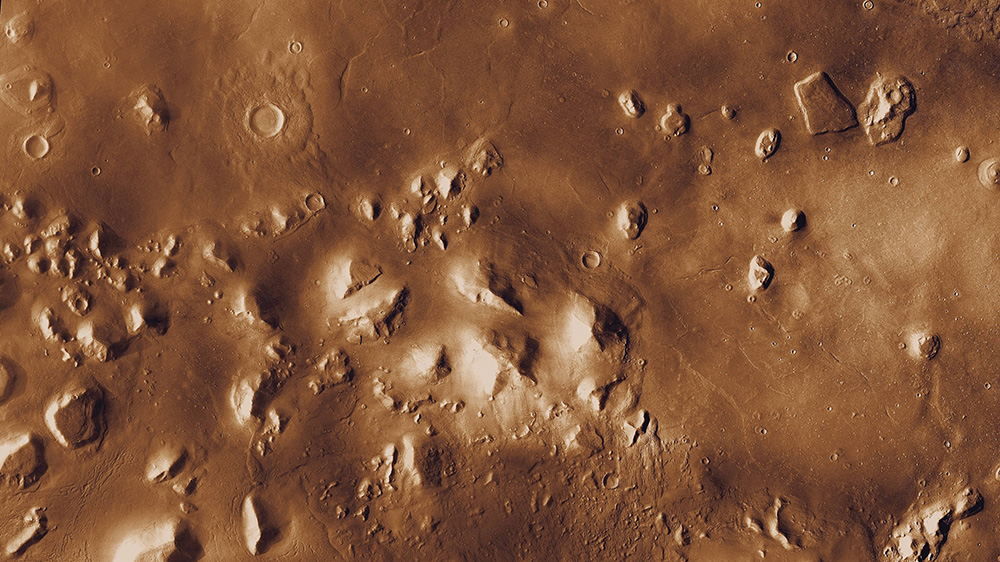
Discussion of artificial objects on Mars first began with the discovery of the “Face on Mars” back in 1976. Later, other intriguing and anomalous objects in the same region were found to display geometrically interesting characteristics. The above picture of the Cydonia region shows the famous “Face on Mars” top centre. The landscape is scattered with other intriguing images including pyramid shapes.
From Artist to Investigator: A Journey into Mars’ Anomalies
Before I continue, I would like to make a very clear point. I am not a scientist. I am an artist. My early schooling was in the visual arts. I am a sculptor, painter, art instructor, writer, curator, and the former director of the Sculptors’ Association of New Jersey. I have exhibited extensively throughout the New Jersey and New York area and was represented by the Grace Harkin Gallery in New York’s East Village. By the close of the 1980s, my work was recognised by one of the most influential art dealers of the twentieth century, Ivan Karp, and I had a one-man show at his gallery, the OK Harris Gallery of Art in SoHo. I was on top of the world.
Outside my short art career, I had a great interest in archaeology and studied the artwork of the Olmec, Maya, Aztec and Native American cultures. I attended glyph workshops at the University of Pennsylvania and learned to read Maya hieroglyphs. I also joined the Pre-Columbian Society, holding membership with the University of Pennsylvania and its affiliate in Washington D.C.
After finding a book by Randolfo Pozos titled The Face on Mars, Evidence for a Lost Civilization? my studies quickly turned to Mars. The structural formations presented in his book were truly remarkable. Around this time, a friend informed me about a new video by Richard C. Hoagland featuring his UN Briefings titled The Moon/Mars Connection. Hoagland was one of the first researchers to promote the discovery of the famous Face on Mars and expose evidence of artefacts on the moon.
Moving forward with the eyes of an artist, over the next thirty years, I acquired a vast collection of images from the ever-growing NASA archives. I found numerous formations with a high degree of geometric form and symmetry and others with pictographic design. Shuffling through my best-of-list, I decided to present some of these discoveries as a traveller’s guide to these anomalous structures on Mars.
My investigation opens with a short history of aerial photography, from the innovative use of hot air balloons and aeroplanes to the current use of high-tech satellites and LiDAR. I scrutinise its ‘bird’s eye view” advantage for military reconnaissance and explore the creation of Google Earth, which has enabled armchair archaeologists to travel the world. They have discovered everything from giant bird and deer geoglyphs to the ruins of long-lost ancient cities submerged by the sands of time.
Exploring Elysium Planitia: The Pyramids of Mars
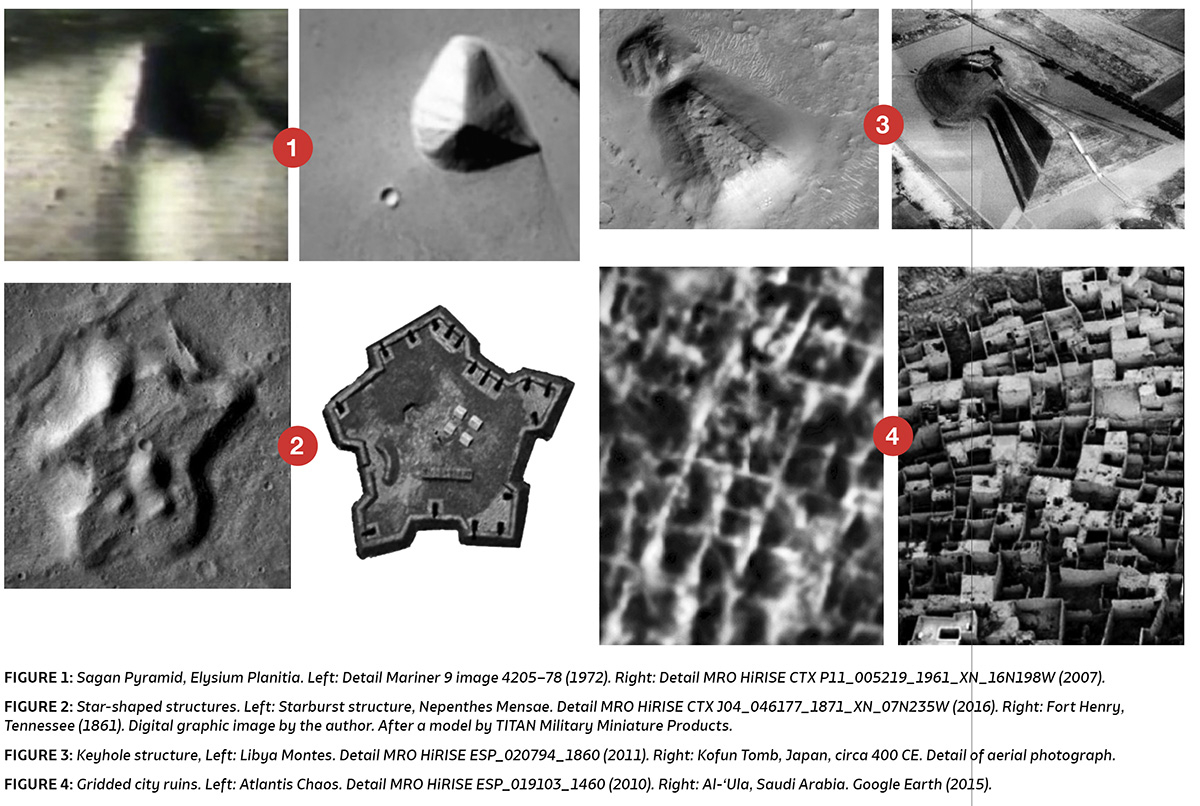
My tour of Martian structures begins in the northeastern quadrant of the red planet in an area known as Elysium Planitia. There, I provide the reader with the opportunity to take another look at a set of enormous pyramidal formations that were once made famous by the world-renowned astronomer Carl Sagan (Figure 1). He was so intrigued by one of these pyramidal formations that he included it in his early lectures and his 1980 book and television series Cosmos. Unfortunately, Sagan never had the opportunity to examine better images. Five years after his death, the European Space Agency released a high-resolution image of the area that showed the pyramids to be real and captured an entire complex of additional pyramidal structures.
Mysteries of Nepenthes Mensae: The City of Symbols
From there, the reader travels to west and is confronted with a pair of city complexes occupying the planet’s Nepenthes Mensae region. The pair of settlements includes over 20 pictographic and geometrically shaped structures nestled within a small and condensed area. The first settlement consists of a small group of highly symmetrical and geometrically shaped structures that include a Hexagonal Pyramid, a U-shaped Delta, and a Five-sided Star formation (Figure 2). The complex also features pictographic formations representing a full-bodied Dove, Killer Whale and the head of a Bulldog Bat. The second Nepenthes Mensae settlement consists of a connective train of four aligning platforms, each containing an assortment of highly symmetrical and geometric structures such as ovals, squares, triangles and rectangles.
Another mysterious feature is below this pair of city settlements within the same area of the Nepenthes Mensae region of Mars. Both NASA and The European Space Association (ESA) released a set of images showing an elongated hexagonal structure that is highly symmetrical. The six-sided structure has a thick, relatively flat platform with a central mound formation. After doing a quick Google search of ancient ruins around the world, much to my amazement, I found the remains of an identical elongated hexagonal mound in the southern region of central Turkey. Known as Araban Hoyuk, the six-sided mound has a similar flat platform design with a central mound formation, just like the structure on Mars. I sat staring at the screen in disbelief; I was looking at its terrestrial companion, a true doppelganger.
Libya Montes and the Keyhole Enigma
Continuing my tour on a westward trek, I take the reader to a well-known area of the planet just above Isidis Planitia known as Libya Montes. It is here that NASA proudly proclaimed to have photographed an odd formation that resembles an “exclamation mark” on the surface of Mars. The isolated formation appears to sit alone in the middle of nowhere. Although the highly symmetrical structure can also be seen as a keyhole and screams of artificiality, NASA scientists quickly dismissed it as a natural phenomenon.
Taking on the challenge, my colleagues and I delved into a comprehensive analysis of the keyhole-shaped structure and produced a science paper which shows this geometrically precise structure to not only be highly symmetrical but also match the design of the keyhole-shaped tombs found in Japan (Figure 3).
As a result of our studies, the Martian Keyhole structure can now be found all over the World Wide Web in news reports, blog articles and YouTube videos. It was also featured on the History Channel’s Ancient Aliens and the UnXplained program with William Shatner.
Pushing further west, across this once thriving planet, the reader travels down below Valles Marineris and into the Atlantis Chaos region of Mars. Once there, the reader is exposed to an extensive investigation of the remains of an ancient city nestled along the vast edge of a dead lake. The city consists of a gridded network of broken walls and shattered foundations that bring to mind the compartmentalised city of Al-‘Ula in Saudi Arabia (Figure 4) or the shell-shocked remains of Dresden after World War II.
Directly below the remains of this gridded city in Atlantis Chaos are two neighbouring settlements. Both settlements contain a set of five large geometrically shaped formations that include squares, triangles, and other polygonal forms. They are all very similar in size and have almost identical dimensions.
Parrotopia: A City Under the Wings
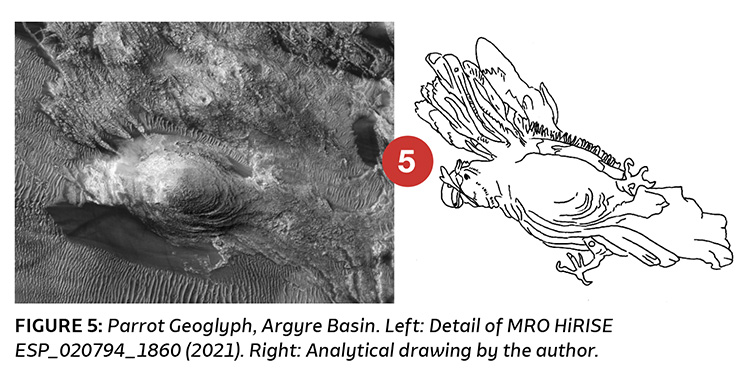
The tour concludes in a large-impact crater located within the southwestern quadrant of the planet known as Argyre Basin. Setting on the western side of this massive basin, the reader will experience a real “bird’s eye view” of a parrot-shaped formation over a mile long (Figure 5). The sculpted parrot formation has clear and recognisable features in the appropriate size and shape of a real parrot. It has a head, eye, beak, body, and wing. Additional anatomical components include two legs with feet and toes. When two geologists and four veterinarians examined the formation, they all confirmed that this parrot geoglyph on Mars has over twenty-two points of anatomical correctness. Yes, that’s right, over twenty-two points of anatomical correctness!
Beyond the mind-blowing accuracy of the parrot formation, the wing area above the main body contains the remains of an entire city. Dubbed Parrotopia, the city includes a port jetty, a towering lighthouse and other shoreline-related structures. Hidden within the wings streets and gridded infrastructure, we find the pictographic imprints of the Maya Rain God in his various mythological incarnations.
Before the Parrot geoglyph’s inclusion in my new book, it was the subject of two papers published in peer-reviewed science journals. It featured on the History Channel’s Ancient Aliens and The Proof is Out There programs. It was also mentioned on the front page of the Wall Street Journal and, most importantly, as a “tip of the hat” to its discover Wil Faust, an anthropologist and city planner from Pennsylvania, NASA officially titled the area Parrotopia.
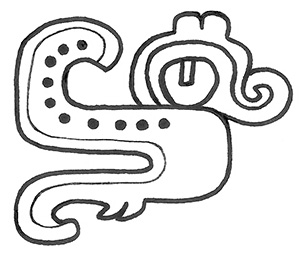
The reader is left with a little-known Mayan story that records what archaeologists read as a Star-War. The conflict was between the ancient cities of Naranjo and Tikal with the occupants of the planet Mars. Maya records show that Naranjo was founded around 896,000 years ago by a group of unknown people related to Mars and worshipped a primordial creature known as the Zip Monster, the patron god of Mars (Figure 6). It appears that just as the 13 colonies of America fought a revolutionary war with their homeland, England, to acquire independence 22,000 years ago, the colonies of Naranjo and Tikal fought a similar battle for independence with the occupants of Mars.
Figure 6: Zip Monster. Detail of page from the Dresden Codex. Drawing by the author.
This New World story sounds quite similar to the Sumerian stories of the Anunnaki wars between Earth and Mars with Enlil and Marduk, as interpreted by Zecharia Sitchin. In both versions, all life on Mars is extinguished by some kind of nuclear war. This dim scenario is supported by NASA’s detection of high levels of Xenon 129 within the Martian atmosphere, which was recently revealed by theoretical plasma physicist and astrophysicist Dr. John Brandenburg.
The current evidence of structures and ruined cities presented in official NASA and ESA images of Mars suggests that they were built after their original occupants were destroyed. Therefore, it is speculated that what we see today are the abandoned remains of that second occupation, which was only partially destroyed.
When this collection of structures is examined, you will find that they exhibit a direct correlation between the architecture and iconography of many of the cultures found on Earth, most notably within North and South America. These findings are supported by image specialist James S. Miller, geomorphologist William R. Sanders and geologist Michael Dale. They offer pro and con arguments for the artificial and natural origins of these unusual formations. Side-by-side comparisons of Martian structures are presented with their terrestrial counterparts, offering evidence of a shared aesthetic achieved in two opposing worlds.
In the foreword to The Great Architects of Mars, Dr John Brandenburg says that the evidence presented would appeal to anyone interested in the mysteries of Mars and our ancient past or if we entertain the idea that Mars and the Earth share a common point of origin. He states: “This is a unique and extremely important book, which provides the clearest and most precise evidence, ever compiled, to support the existence of artificial structures on the surface of Mars.”
As an artist, I have an eye for art and architecture, and my book, The Great Architects of Mars, results from those observations. I invite you to take another look at Mars with clear eyes and remember that through NASA’s own pictures, the truth will be revealed.
George J. Haas’s book The Great Architects of Mars: Evidence for the Lost Civilizations on the Red Planet (with a foreword by John E. Brandenburg, PhD) is available from Inner Traditions.
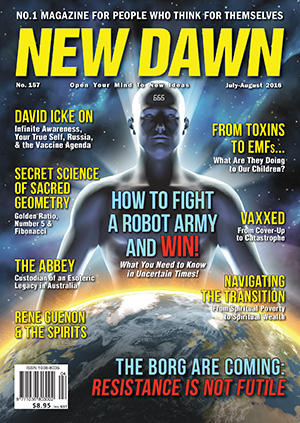
As a tribute, we are posting this article by Gordon White, who made his transition and passed from this world in May 2026. Although the article was written in 2016, its analysis and Gordon’s advice remain highly relevant in today’s chaotic world.
Humans have a tendency to overestimate short term risks and under-estimate long term ones. You see this when you watch people nervously smoking a cigarette at the airport because they are anxious flyers: what is actually most likely to kill you?
You see this on a wider level when you watch whole industries over-react to short term wobbles and then under-react to long term changes… The music, publishing and news businesses all overspent on short term Internet trends while failing to correct their spectacular decline. (Remember when Murdoch bought MySpace?) The same reaction is now found in mature Internet businesses that pay billions of dollars to acquire companies that have never made a cent in revenue, such as Facebook’s acquisition of Instagram.
Today, most people are abstractly aware that automation is increasing, that we are in some sense living through the rise of the robots. We bite the bullet and use the automated checkouts at the supermarket, we observe the novelty of self-serve kiosks at fast food restaurants, we have long-since adjusted to online banking and ATMs. In 2015, drones fired more ammunition than warplanes in Afghanistan, a first in history.
These are early stage changes. To draw an analogy with the Industrial Revolution – and we should draw many analogies with it – these changes are akin to those first, crude, automated fabric looms invented in the north of England. The railways and mega-factories are still to come. What we fail to notice when we queue for the supermarket checkout is we are at the inflection point in the automation revolution. Over the last thirty years, this process has already largely removed well-paid working class industrial jobs. On the other side of this inflection point, the graph gets mighty pointy, mighty quick. It is where the majority of Middle Class jobs live.
Jobpocalypse
Today, 20% of American households do not contain even one employed person. And of those that are employed, only 44% work more than thirty hours a week. The alleged global economic recovery has been a story of great jobs at the top – finance, engineering, etc – and loads of jobs at the bottom – bartending, office cleaning, Uber driving – but nothing in the middle. Education, administration, and construction jobs for instance – all mainstays of the middle – are still in decline. What this means is that 95% of post-recession income gains have gone to the top 1%. Fully 100% of the gains have gone to the top 10%. The net result is that the jobs added in the US economy since the Great Recession are paying 23% less than the jobs lost.
According to Pew Research, two out of three American households were considered Middle Class in 1971. Today it is less than half. This state of affairs is primarily caused by the replacement of higher paying jobs with lower paying ones, through the impact of both automation and offshoring policies such as NAFTA. From 2004 to 2014, median incomes in the US fell 13%, while household expenditures increased by 14%.
The impact of these calamitous numbers is and will continue to be felt outside America’s shining seas. It is the largest economy on earth, the principal trading partner for most of the world and 70% of its GDP is based on consumption. What happens when there is no money left over for consuming?
In his excellent book, Get a Job, Build a Real Career, Defy a Bewildering Economy, independent economic commentator Charles Hugh-Smith writes the following:
There is a widespread sense of disbelief that automation can eat high-skill, middle-class jobs in the same way that it ate low… factory jobs. In this view, the 50 employees of Craigslist wiping out thousands of middle-class jobs in the classified ad industry was a fluke. But the reality is that the strongholds of middle-class jobs – for example, healthcare, education, government, and national defense – are all increasingly unaffordable and therefore ripe for wholesale creative destruction of costs, jobs and business as usual.
An Oxford University study predicts 35% of existing UK jobs are at risk of automation in the next 20 years. In Australia, that number is predicted to reach 44% over the same time frame, according to a recent federal government report.
An obvious manifestation of automation’s impact is not just unemployment, but underemployment, commonly referred to as the gig economy. About a third of the US workforce are either independent or contract workers. Share of gig workers in manufacturing, health and education has doubled, and has increased by a factor of five in public administration. The same trend is being mirrored in Australia.
For certain, accountants, dentists and nurses will still exist in twenty years time. However there will be far fewer of them and the costs associated with accessing them may well be prohibitive. This trend is already emerging. After shedding 220 financial advisors, the Royal Bank of Scotland replaced them with artificial intelligences. To speak to a real human for financial advice, you need to have £250,000 or more. (RBS received a total of £45 billion in taxpayer bailouts during the financial crisis.)
The RBS approach to providing financial advice is an example of what is known as a Mostly-Autonomous-System. It is significantly cheaper to automate 97% of a function than it is to automate 100% of a function. The MAS approach is what we will experience first and most. Where once there were fifty nurses, there may be three, whose principal function is monitoring of the MAS performing the lion’s share of nursing duties, stepping in for the final 3% of tasks or as needed. The same thing will happen for accountants, doctors, teachers, dentists… really anything that relies on either repeated tasks or access to a previously rote-learned body of knowledge as these are both functions that are already better performed by artificial intelligences and robots.
The suspicion that technological change may not be all it is cracked up to be is commonly called the Luddite Fallacy, which tells you everything about how it’s regarded by economists. Nevertheless, a Luddite-Lite view has a lot going for it. Technological change can indeed sometimes increase GDP but these increases are unevenly distributed, which is to say they make the rich richer. At the peak of its market capitalisation – USD$28 billion – Kodak employed 140,000 people with wages that could support property ownership and the raising of families. When Instagram was acquired for a billion dollars, it had thirteen employees and had not made a cent in revenue.
During the nineteenth century, around half of the US population was employed in agriculture. Now that is less than two percent. It was the fundamental changes caused by the Industrial Revolution that triggered this shift. In the opening years of the twentieth century, the largest employment sector in the US economy was domestic service. So the suspicion that things get very bad before they (might) get better is well founded.
Demography is Destiny
The average age of the Japanese farmer is 67. Across the developed world, the average age is 60. A G7 meeting held in April in Japan’s northern prefecture of Niigata discussed plans for replacing these aging farmers with an automated workforce, with robots. These plans are emblematic of the coming world’s response to the demographic time bomb that is the retirement of the baby boomers. Reducing human sovereignty over our own food supply builds in catastrophic risk to our medium term future but, for central planners, this appears to be a better choice than re-engineering a healthier, more interactive economic ecosystem. It costs less.
In the US, 10,000 people will retire every single day between now and 2030. Sixty percent of them are retiring without any savings. Whilst it might seem like good news that baby boomers are departing better paying jobs that can be subsequently filled by a younger generation afflicted by high unemployment, it is anything but. Leaving aside the enormous burden such a reality has for the West – increased healthcare costs paid for by rising taxes that further reduce demand in the economy – retired people spend very little and those that retire with no money spend even less. The evaporation of demand out of economies that overwhelmingly run on consumption means all those cushy, well-paid boomer jobs will ride off into the sunset with those that occupied them.
The two main pistons driving fundamental and permanent changes in Western economies are the rise of automation and the demography of the population. This is how we can tell that something very different to the traditional ‘boom and bust’ cycle is happening. Surprising opportunities may present themselves in the short term because short term changes are unpredictable. Long term changes, on the other hand, are very predictable.
Much of this long-term predictability comes down to the market’s intrinsic inability to discover the cost of long-term consequences. It has no way to price in what happens to economic activity when we lose forty percent of Middle Class jobs, or what happens to food prices when Sydney expands into its nearby farmland. Price discovery is an immediate function which means, by definition, it can’t model future opportunity cost. So there is no inherent mechanisms that allow us to adjust on an ongoing basis to the risks and opportunities these changes present. And you only need to look at the state of politics in the world today to realise we will get no help from that quarter. Politicians are allergic to hard truths or tough challenges, lest either of them spoil their chances for re-election.
Nearly two thirds of Australia will become dependent on the labour force by 2046, due to the retirement of the baby boomers and the rise of the robots. Our tax base will be shrinking just as we need it to be about five times larger to pay for increased healthcare and welfare programmes. This funding gap will result in an increase in taxation, which pulls more demand out of the economy, which will further shrink the tax base, which was the problem in the first place. The same funding gap will provide unstoppable incentives to further automate areas reliant on public funding such as health care and education in an effort to engineer out as much cost as possible. Thus these two trends compound on each other, like runaway climate change.
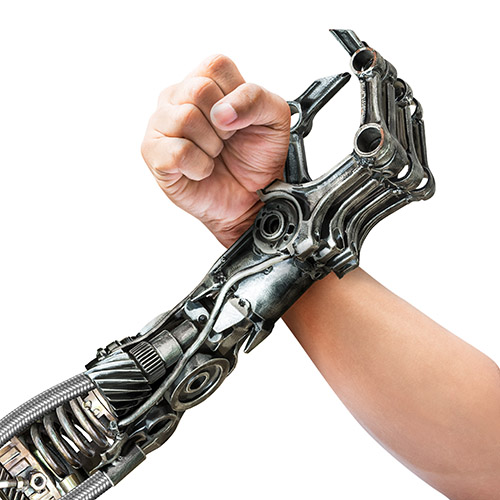
When it comes to fighting the robot army, we are on our own. This is both the bad news and the good news.
Pivot to the Real
In the medium term, we are all at risk of either unemployment or casualisation/underemployment. Over the same time period, policy responses will reduce your earning power through a combination of tax increases and inflation. Inflation being the only tool left for central planners to keep government debt actually payable, especially if they stump for a universal living wage as a stopgap solution for the impact of automation. (This appears to be the most popular policy currently being floated by think tanks and academics.) Whichever way you slice it, whatever combination of future effects impacts you personally, the short term response calls for dramatic, even radical, cost reduction.
We should be doing this already as you probably do not need to be told how the cost of living has already shot to the moon at the same time median incomes have declined. In the US, food has doubled since 1978, housing has more than tripled, higher education is eleven times higher, and the cost of raising a child increased 40% between 2000 and 2010. We thus arrive at a situation where – according to a recent Bankrate poll – almost two thirds of Americans do not have enough savings to cover a $500 repair bill or a $1,000 emergency room visit. The US federal poverty level for a family of five is $28,410, and yet almost 40 percent of all American workers do not even bring in $20,000 a year.
Over the last thirty years, as our domestic dwellings increased in size and cost, we had fewer and fewer people living in them. It is a heresy of heresies to say this, particularly in Australia, but single family or even single person dwellings are not the norm. Since humans started building permanent shelters about ten thousand years ago, multi-generational occupancy has been the norm. The last fifty or so years of the mortgage industry will ultimately be seen as a noble eyeblink in the human story.
Multi-generational or multi-family dwellings provide a tremendous amount of power and sovereignty over the looming changes:
They provide greater economic redundancy if one or more people becomes unemployed or underemployed.
They reduce energy costs per person.
They can reduce childcare costs.
They minimise food waste and cost.
They can reduce the cost of elderly care.
They increase the total amount of time available to adults in the household to pursue additional economic activity via side projects, an essential step in the casualisation of the workforce.
They spread the cost and inputs associated with improved water harvesting and domestic food growing, thus reducing living costs and improving health outcomes.
They have more than forty years of scientific proof that these living conditions improve the psychological health of its occupants, particularly young children and the elderly, who both benefit tremendously from increased family time.
Newspapers are fond of mocking Millennials for their seeming inability to move out of the family home. This is economically unreasonable as they are competing for jobs that have declined in income by almost a quarter at a time when house prices are at historic highs.
It seems Millennials are also more aware of the extreme changes that are looming, even if they struggle to articulate it. Sixty percent of Australian students are currently training for jobs that will not exist in the future. Jan Owen, chief executive of the non-profit Foundation for Young Australians, told the ABC: “Most 15 years olds are going to have up to 17 jobs in five different industries and in order to be prepared for that kind of working life, which is very, very different to their parents or their grandparents, they are going to need to, as well as having the disciplines that they study, they are going to need to have a very broad based what we would describe as enterprising skill set.”
The newspaper mockery completely misses the wider trend going on here. Multi-generational occupancy is but a small subset of what I call the ‘pivot to the real’. Unlike the boomers, Millennials value experiences over status objects such as large cars, they prefer team or networked activities to solo endeavours, they value local over expensive.
They are also about to become the largest demographic cohort in the workforce, as more and more boomers retire. In fact, by 2025, Millennials will make up 75% of the Western workforce, bringing their values and attitudes with them. Although it does not currently look like it, I have more confidence that the independent greengrocer in the middle of town has a brighter future than the big box retailer on the edge of it.
So it is not just the boomers and their jobs that are heading off into the sunset, it is also the boomer version of the good life. Replacing it – whether forced through reduced economic participation or unforced through choosing to participate in these cultural changes – will be the return of the real, the authentic, the shared experience. We should see this as a hugely exciting opportunity. Call it the shared glass half full.
Described in a single sentence, seeing off the robots is all about positioning your life so that it gains from volatility instead of being adversely impacted by it. An example: Your redundancy should free up more time for childcare or family support, thus freeing up other household members to increase their paid workload. You can also use the time for side projects and retraining. These scenarios can and should revert or shift with any subsequent changes. Fundamentally, an economy is a learning system and right now it is heading off to Big School. Gaining from volatility means creating a life that learns as it learns, adapts as it adapts.
On a practical basis, this involves:
Getting and staying out of debt: Debt adds future risk just as the future is getting riskier. Servicing debt reduces your buying power even as we head into a world where it is already reducing.
Assert sovereignty over your own food supply: This does not mean growing all your food and harvesting all your water, but it means doing as much of both of those things as possible in your domestic environment. At the same time it means being aware of your local food supply chain and supporting it.
Continuous training: Embark on a lifelong practice of cultivating rare – and thus by definition – in-demand skills. You will have multiple careers, multiple sources of income… probably even at the same time. Be the nurse who knows how to operate a Mostly Autonomous System, not the nurse that is replaced by one. Value flows only to what is scarce. MBAs aren’t scarce. Knowing how to use data management platforms is scarce.
Location, non-Location, Location: Radically rethink your attitude to place. Be prepared to, and excited by the prospect of, dramatically reducing cost even as you improve your quality of life. Also be prepared to uncover mankind’s noble, nomadic roots and move where opportunities abound. Tremendous growth will accompany these economic changes but that growth will not be evenly distributed. Fish where the fish are, so to speak.
Finally, and probably of most interest to readers of this magazine, reposition what wealth and meaning are for you. The Joneses have retired. There is no need to keep up with them. A new understanding of life’s goals and purpose is emerging just when we need it most and it falls to the spiritually-inclined to both lean into this trend and be leaders of it.
In Tibet’s Amdo region, shamans watch the clouds from the mountain tops to alert the villagers down below of weather changes. In this system, weather is caused by an interaction of the spirits, humans and Nature. These shamans intercede and engage with the spirits to modify the weather for the whole community. This is a wonderfully useful metaphor for our own roles in the dynamic interaction between the rise of automation, changes in the economy, changes in demography and the potential for something new and authentic emerging from in amongst all this risk and anxiety. The possibility of transmutation for those brave enough to climb up the mountain is very high.
There is something of a fairy tale quality to the process we are experiencing. Think about it. It took the rise of the robots – the apogee of the artificial – to trigger the appeal of the analogue, to inaugurate the return of the real. So this is how you defeat a robot army, not by being more robotic, but by being more human.
Gordon White’s book, The Chaos Protocols: Magical Techniques for Navigating the New Economic Reality (Llewellyn, 2016), explains how we can navigate these changes and even benefit from them. The Chaos Protocols is available from online booksellers.
[alert type=”general” dismiss=”no”]This article was published in New Dawn 157.[/alert]
[alert type=”success” dismiss=”no”]If you appreciate this article, please consider subscribing to help maintain this website.[/alert]
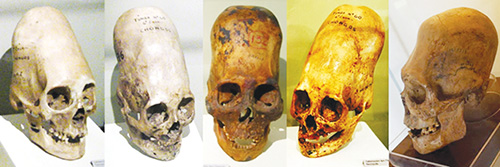
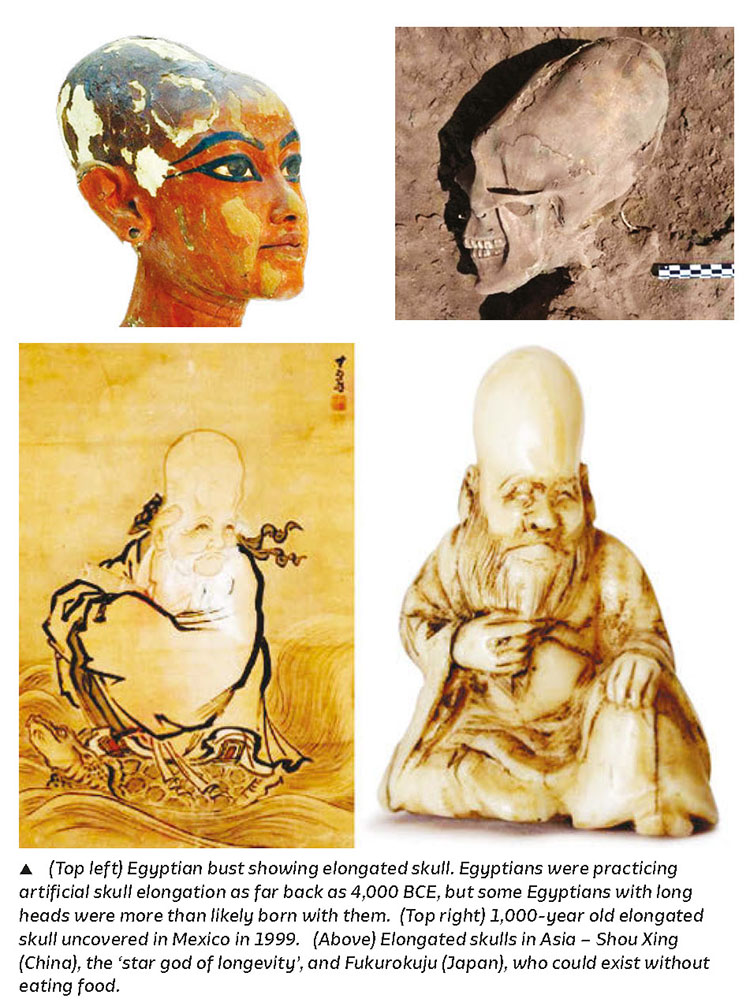
In 1929 something unexpected was discovered in a country that was already brimming with the unexpected. A burial ground containing the remains of 300 individuals with elongated skulls was found in the township of Paracas in Peru. Believed to have lived around 3,000 years ago, these people were unique in their morphology – they had massively elongated skulls, they were tall, they were of all ages and genders, and a large number of them had the remnants of red hair clinging to their skulls.
Some of the ‘massively’ elongated skulls of Paracas – the skulls are unique in their morphology, there are hundreds of them of all ages and genders, and a number of them have the remnants of red hair clinging to their heads.
These skeletons have been the subject of great debate for almost 100 years and are generally agreed to be examples of artificial skull deformation, which is the practice of deforming the head to redirect the growth of the skull. However, a human skull that is elongated after birth displays flattening of both the forehead and the back of the head, and the skull volume is not changed. The Paracas skulls are somewhat different – they are larger than an artificially elongated human skull and have a correspondingly larger internal volume.
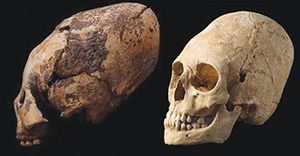
Examples of elongated skulls found outside the Americas include the ‘M72’ skull (left) found in China and estimated to be 12,000 years old, and (right) a 1,600-year old elongated skull from France.
In addition, the skull morphology is quite different – the skull is not flattened, and a number of physiological differences can be easily identified. For example, the sagittal suture, which runs across the top of a human skull, is entirely absent, and the foramen magnum (the hole in the bottom of the skull that connects the neck) is situated towards the very back of the skull. The eye sockets are greatly enlarged, and it appears there are some foramina (the openings in the skull for nerves and blood vessels) in different places, all of which precludes these skulls from being able to be considered truly human.
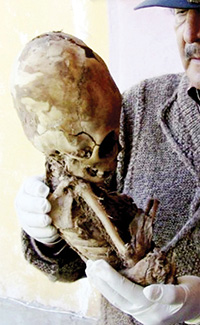
Mummified infant with elongated skull, Peru.
Samples of 18 Paracas skulls were obtained by researcher Brien Foerster, of which only 12 proved suitable for analysis. Two separate laboratories provided results which showed that four of the samples contained mitochondrial DNA identified as Haplogroup B consistent with a Native American, Asian or Pacific ancestry, but the other eight skulls were genetically quite different.
These eight mystery samples returned DNA readings for Haplogroup U2 (a group found in Europe, the Middle East and Central Asia), group K (Western Asia), and J/H (North Africa, Arabia and the Middle East) – none of which accounts for the unusual skull shape, but which might go far in accounting for the mysterious red hair.
It also raises somewhat of a mystery as to how and why these long-headed individuals traversed half the globe to get to South America, or vice-versa, around 3,000 years ago.
Lord Pacal
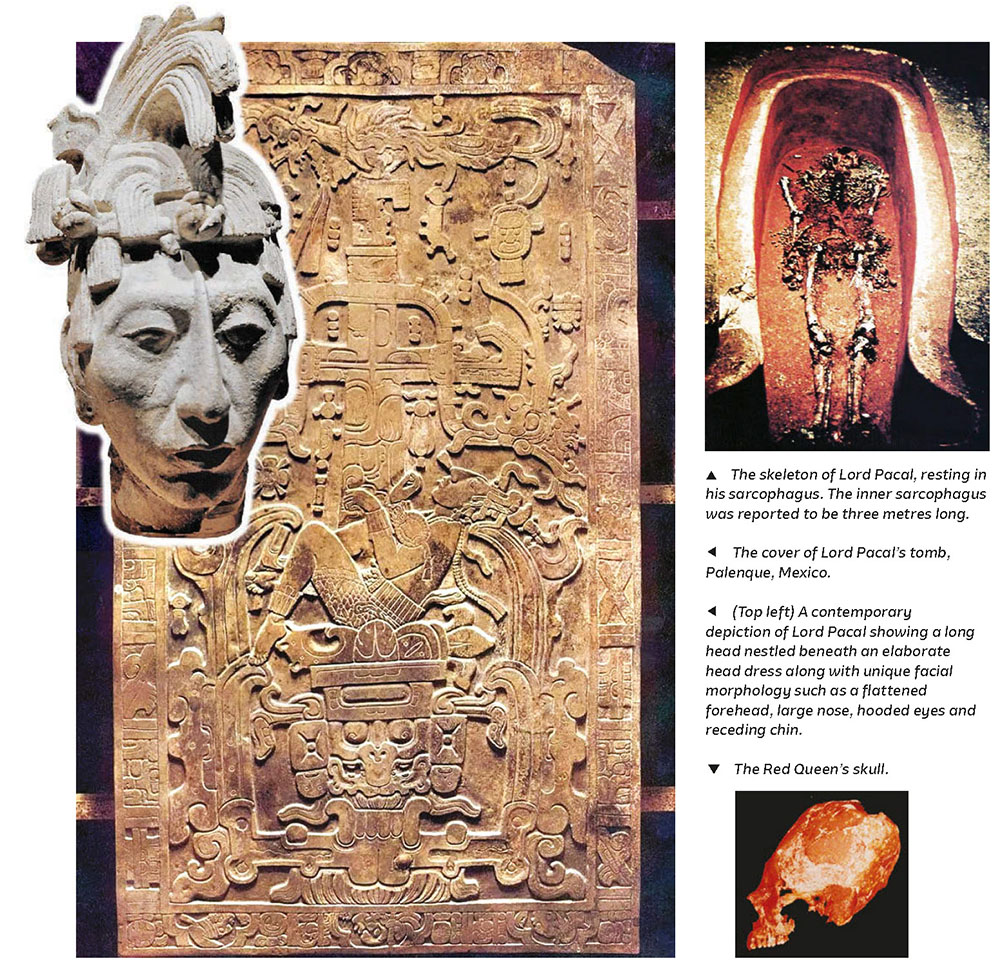
The Mayan city of Palenque is situated four thousand kilometres north of Paracas in Mexico. Palenque is famous for the tomb of Lord Pacal who ruled his kingdom between 603 and 683 CE. Pacal’s tomb was discovered in 1948, and Erich von Däniken made much of it in his Ancient Astronauts theory when he claimed the infamous lid of the sarcophagus showed a carving of Pacal seated inside a space capsule. This beautiful, intricate and eternally enigmatic carving sprawls across an incredible 5-ton slab of rock that is 3.6 metres long, 2.2 metres wide and 29 centimetres thick, and was situated over a sarcophagus that was equally enormous by human standards, measuring 1.7 metres high, 2.5 metres wide, and 3 metres long.
Verbal reports from the time of the excavation stated that the skeleton was tall and had an elongated skull. An image of Pacal’s skeleton, still reclining in his tomb, unfortunately has the skull obscured, but it does show a long-legged individual who almost entirely takes up the length of his sarcophagus. In support of Pacal’s unusual size and appearance, Mayan legends recount that he was “a god and… a giant monster.” The words of the South American god Viracocha also come to mind when he said, “If ever my subjects were to see me, they would run away.”
Hidden in a pyramid beside Pacal’s tomb were the remains of the Red Queen, discovered fairly recently in 1994. There is an image of the Red Queen’s skull in the public domain, and it is most definitely elongated. The most interesting thing about the image of the Red Queen’s skull is the fact that we have one – Pacal’s skull may never again come to light. In 1977 the townsfolk of Palenque protested the removal of Pacal’s remains so vehemently that the tomb was sealed back up and Pacal’s bones are now forever safe from prying eyes. Fortunately for posterity, the Maya were consummate artists who accurately depicted the world around them, so there are depictions of Pacal carved in stone all around the Palenque pyramid site. It is clear from these contemporary images that Pacal’s head was elongated.
Numerous examples of elongated skulls are on display in museums across Mexico, and tall personages with these strange heads are often depicted alongside their human counterparts in Mayan art.
A Global Phenomenon
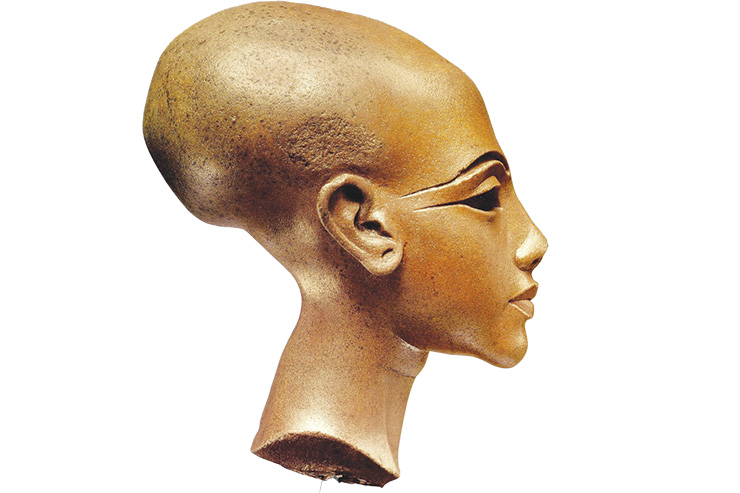
No elongated skulls are found in the fossil record for the evolutionary ascent of man, although there is some contention over whether some Neanderthal skulls dating back 50,000 years display artificial elongation. Apart from this single outlier, elongated skulls only began to appear with regularity once Homo Sapiens did. They show up in every centre of civilisation across our planet, and apart from the large group of 300 individuals found in Paracas, South America, the next largest centre of skull elongation was half a world away amongst the dynastic nobility of Egypt of 2,000 BCE.
Elongated skulls have been found in North America, and examples have been uncovered in China, Korea, Egypt, the Middle and Near East, the Pacific Islands, Africa, and all across Europe, some of them dating as far back as 30,000 years. There are even reports that Australian Aboriginals indulged in the practice, with one Kow Swamp skeleton purportedly displaying signs of artificial deformation. Reviewing the archaeological record, it becomes apparent that skull elongation was a global phenomenon.
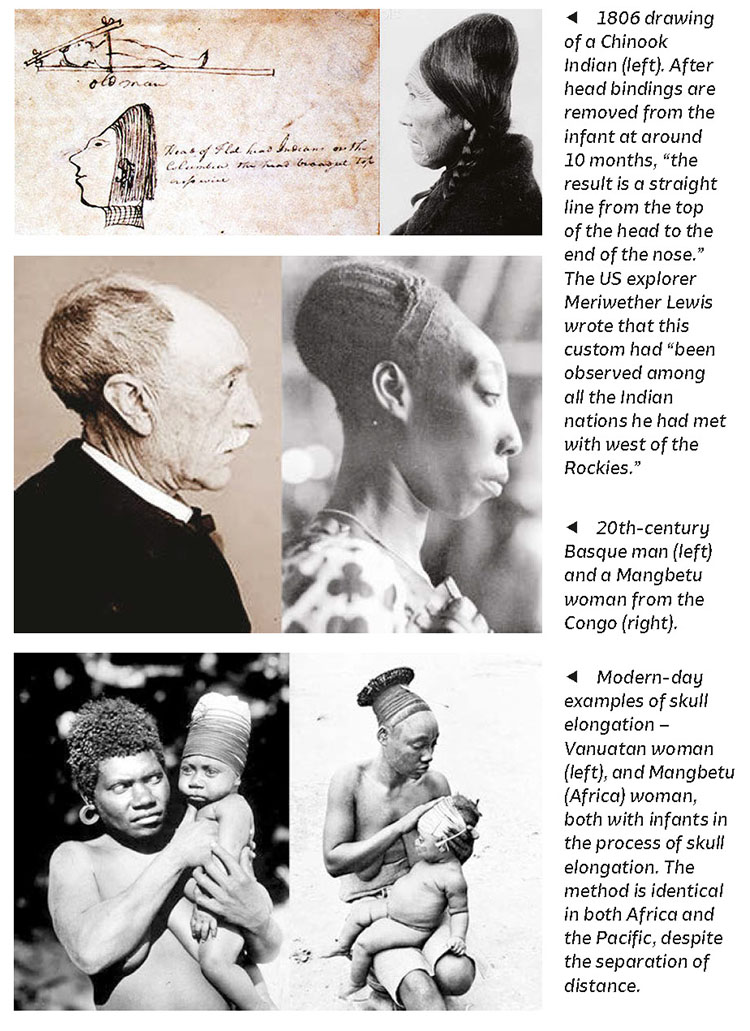
It is suggested that elongated skulls are the motherlode of ancient alien proofs, and very possibly they are. However, alongside those individuals who appear to have been born with elongated skulls, as evinced by their slightly non-human morphology, it is clear there also existed an abundance of regular humans with a penchant for artificial cranial deformation. In the deep dark recesses of history, there seems to have been two groups of people with elongated skulls extant on this planet – those people who came by their long heads naturally, and those who were seeking to emulate the natural-born long heads… but for what purpose?
According to a Spanish account from the early 1500s, the Mayans said they elongated their heads “because our ancestors were told by the gods that if our heads were thus formed we should appear noble.” Emulating royalty, or emulating a being held in even higher regard than royalty – i.e., a ‘god’ – might account for the practice of skull elongation among humans continuing on into modern times. However, this doesn’t explain how or why the god-like personages being imitated came by their elongated heads in the first place, except to say that somewhere in the recesses of history came the appearance of gods and kings who not only looked different to us but were also greatly superior, and humanity has attempted to imitate them ever since.
Elongation in Modern Times
In the 1840s, the Chinook Indians of North America were found to be actively practising skull elongation on their infants by the use of boards. The Basque people of Europe were practising skull elongation well into the 20th century, and the Mangbetu people of the Congo, who have roots that can be traced back to Egypt, are still practising cranial deformation today, as are some people on the island nation of Vanuatu who, we are told, never had historical contact with cultures outside of the South Pacific. This cannot possibly be true, however, considering the method of skull elongation employed in the South Pacific is identical to that employed in Africa. Could the same process extant across both Africa and Polynesia really be the result of nothing more than coincidence?
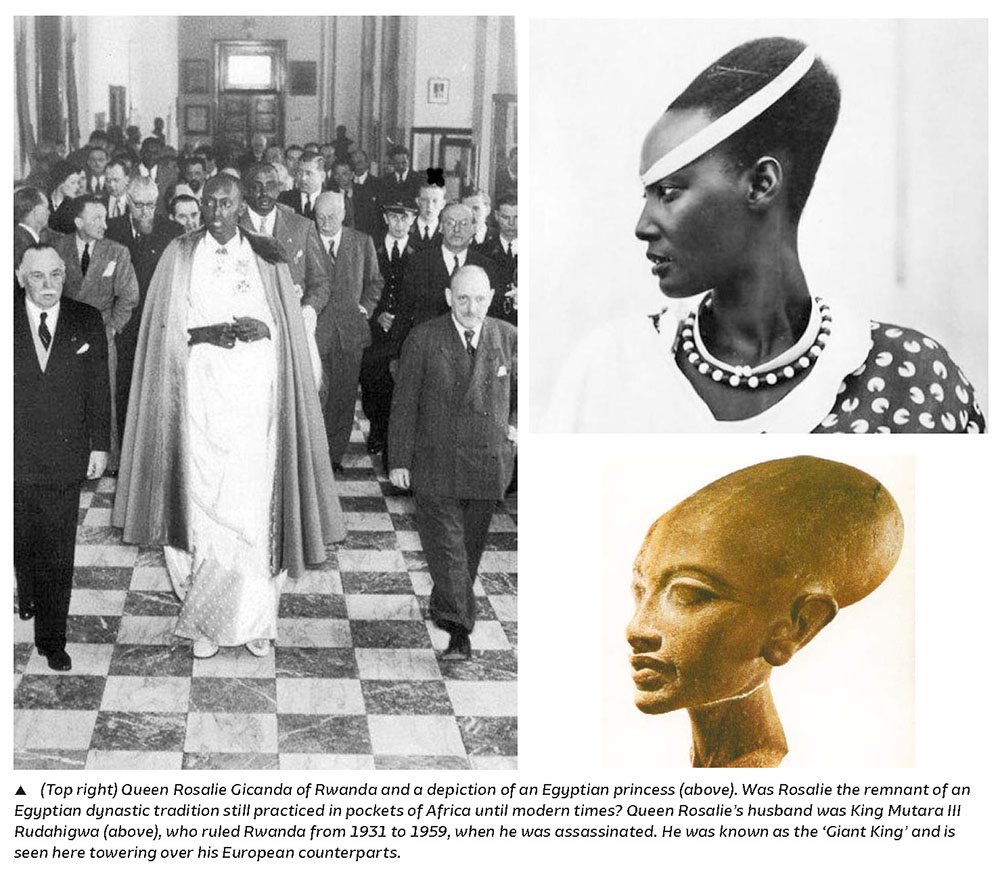
One personage from modern times who possessed a very fine elongated skull was Queen Rosalie of Rwanda. Rosalie was assassinated in 1994 (coincidentally the same year the Red Queen of Palenque was discovered), so we may never know what circumstances led to her skull elongation – although it must be assumed that, like the Egyptian Pharaohs, it was to signify or emulate a royal lineage. Rwanda is quite a distance from Egypt – nearly 5,000 kilometres – but given that both countries are situated on the African continent and given that Rosalie was a bona-fide African queen, it’s possible she was heir to a 4,000-year-old dynastic Egyptian practice. Adding to the mystery, Rosalie’s husband, King Mutara III Rudahigwa, was known as the ‘Giant King’ of Rwanda, reminding us of the tall people of Paracas and the unnaturally tall Lord Pacal of the Maya kingdoms, all of whom sported elongated skulls.
If Isolationism is to be accepted as the dominant paradigm of evolution, then how do we explain the emergence of elongated skulls across the planet and in such disparate populations and communities?
Size Versus Volume
It is often said that while artificial cranial deformation can alter the shape of a human skull, it cannot alter the volume of a skull. However, this is not quite true, and a small change in volume is indeed occurring at the expense of the thickness of the bone.
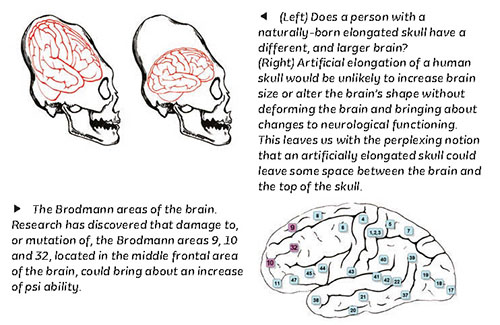
The volume of a naturally-born elongated skull is estimated to be in the range of 2,000 to 2,500 cubic centimetres, compared to the 1,300 to 1,500 cubic centimetre capacity of the average human head. Thanks to Darwinian evolution, we have been led to believe that larger brain size leads to higher intelligence, which led to the assumption that the neurological processing power of a person with an elongated head must be equally as large. Unfortunately, it also leads to the uncomfortable notion that the brain shape of an individual with a naturally-born elongated skull must be quite different, along with the equally uncomfortable proposition of trying to apportion its varying lobes and other component parts. If any endocasts (brain casts) of elongated skulls have been made, they are not publicly available, so at this point in time we are unable to know if the brain of such individuals entirely filled the brain case or not.
Following on from this train of thought is the assumption that a human who has endured skull elongation must also have a similarly enormous brain, however it is highly unlikely that a human brain would increase in volume just because the container it resides in has changed, which leaves us with the possibility of a normal-sized and relatively normal-shaped human brain resting inside an over-sized and elongated skull.
As for any imagined changes to its shape, the human brain is such a delicate organ that deformation of any one of its myriad parts is generally sufficient to bring about neurological impairment, if not death. The frontal lobe is the most likely part of the human brain to be adversely affected during artificial skull elongation; damaging the brain’s frontal lobe causes issues with “memory, emotions, impulse control, problem solving, social interaction, and motor function,” along with a host of other impairments. Persons with frontal lobe damage would become incapable of fending for themselves, or at best turn into behavioural misfits.
Given that artificial skull elongation can only be undertaken in the first few months of life, it begs the question of why any parent would wilfully deform their child, knowing that a single misstep in the process could lead to impairment or death. It is unlikely that elongation of the skull as a practice would continue from prehistoric to modern times if these were to be the expected neurological outcomes. And given that modern populations with elongated skulls display no negative side effects, it is safe to assume that most humans with artificially elongated skulls somehow avoided damaging their brains. But is it possible that some kind of change to the frontal lobe is brought about by skull elongation, but with entirely unexpected outcomes?
Psychic Developments?
According to recent research, it seems that it is possible, under the right conditions, to modify the frontal lobes of the brain and bring about an enhancement of functioning. A 2023 research paper reported evidence of increased psi ability in individuals with damage to, or mutation of, the frontal regions of the brain, specifically the Brodmann areas 9, 10 and 32, which are all located in the area of the brain which would experience the direct pressure of artificial skull elongation.
In order to prove their hypothesis, the researchers induced reversible damage to this area of the brain using magnetic fields and, incredibly, logged an observable increase in psychokinetic ability in the participants.
These same researchers have suggested that our “nervous system may have evolved to inhibit psi” in order to prevent “exposure to constant bombardment with irrelevant stimuli from telepathy, precognition and clairvoyance that might divert attention away from environmental events threatening survival.” They also suggest that the “frontal lobes of the brain act as a filter to inhibit psi” and that humans may have “innate psi abilities that are suppressed by this frontal lobe filter.”
Is it possible that the flattening of the forehead during artificial skull elongation does indeed impact the frontal lobe of the brain – not enough to damage its functioning, but just enough to subtly alter the mid-frontal cortex and accentuate or bring about psi abilities? If this is true, then our most ancient of ancestors may have practised skull modification as a means to revive psi abilities that had been lost due to the biomechanical structure of the human brain. Given their supposed ignorance and primitive natures, how did they come by this most esoteric of knowledge?
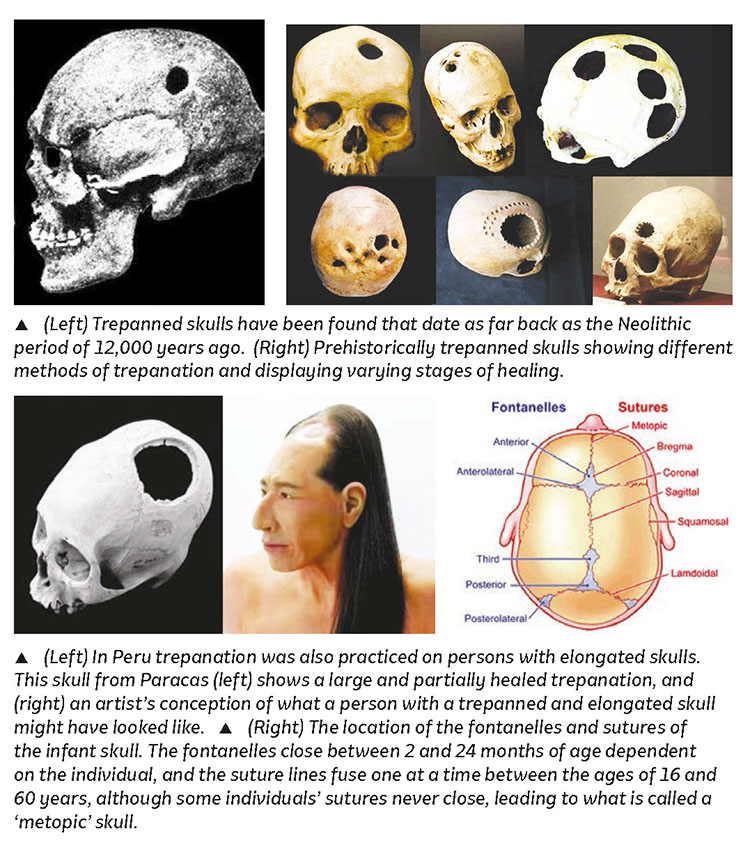
Trepanation
If there is anything to be learned from history, it is that a number of cultures felt that human heads required modification. A vast number of skulls unearthed from all over the world from as far back as 10,000 BCE display evidence of trepanation, which in plain terms is the practice of putting a hole in your head. The only use for skull trepanation in modern times is medical, and because of this modern understanding of trepanation, it is assumed that the same understanding of the practice has held true throughout history – a difficult concept for archaeologists to swallow since it implies that ‘primitive’ humans not only understood the mechanisms of the brain but also appeared to be in possession of surgical techniques that we discovered for ourselves only recently.
Trepanation is not an easy process, even for practised professionals. The skin and muscle covering the head must be cut in order to expose the skull, then a portion of the skull itself must be removed. In addition, the practitioner needs to have an intimate understanding of cerebral pressure and infection control, and has to perform the trepanation without damaging nerves, blood vessels, the three layers of meninges surrounding the brain, and the brain itself.
It has been suggested that in prehistoric times the technique used for trepanation was scraping with stones, shells, obsidian or shark teeth, but experiments have shown that these implements were “incapable of cutting with regularity and precision.” Despite this finding, it is still believed that scraping the skull with stone or flint must be the only probable process involved. However scraping a hole in a skull takes a long time – fifty minutes “counting the periods of rest due to fatigue of the hand” according to one attempt at re-creation. Without the use of anaesthetics, which are assumed to have been unavailable in 10,000 BCE, a fifty-minute procedure with the practitioner huffing and puffing with a stone or a shark’s tooth would surely have been untenable for the patient.
From a survey of prehistorically trepanned skulls with signs of bone regrowth, the survival rate is estimated to be as high as 90%. In some parts of the world, trepanation continued to be practised until Medieval times with a comparably high survival rate, despite the lack of proper tools, anaesthetic and sterilisation procedures. Trepanation for medical purposes continued successfully in Europe up until the early 1800s, when ‘ownership’ of the practice was transferred into the fledgling Western medical paradigm. But there was such a dismal survival rate – only 10% – due to the constant penetration of the meninges that it was discontinued until modern times. Unsurprisingly, it was the pathetic survival rate produced by 19th-century Western practitioners, along with the burgeoning ego of modern medicine, that made the discovery of prehistorically trepanned skulls so impossible to accept for the archaeologists who kept digging them up.
Trepanation in Palaeolithic and Neolithic times was widespread across the planet – North, Central and South America have produced the most trepanned skulls, but the oldest come from Europe and China. Trepanned skulls have also been found in Africa and Asia, and in the southern hemisphere have been found in Melanesia, Micronesia, New Guinea, Tahiti, the Solomons, New Caledonia and New Zealand, indicating the practice was widely dispersed even across the disparate and isolated islands of Oceania.
Talismanic Attributes
One unexpected practice associated with trepanation is the collection of the extracted skull piece and its use as an amulet. Such amulets have been found in Neolithic burials across China and Europe, indicating that bone scraping could not have been the method used in these particular cases as the skull section needed to be extracted in one piece. This practice also suggests some kind of magical or talismanic aspect imbued upon the individual being trepanned, as though the process conferred upon them mystical, shamanic, or godlike powers such that they became worthy of reverence on every level.
It is the accepted wisdom that trepanation was performed for medical reasons – conditions such as trauma to the skull that causes a fracture, bleeding or pressure on the brain. Other suggested reasons include headache or epilepsy, ‘bad behaviour’, mental illness, or to release demons from the inside of the head. Some pundits have been daring enough to suggest that tumours could also have been removed from the brain by prehistoric practitioners, but this intimates that the ancients had ways of locating the position of the tumour before they began drilling the hole, along with highly developed skills as neurosurgeons. Since it is assumed that CT scans were unavailable until they were invented in 1967, the location of the tumours could only have been divined by magic. The removal of the tumour must have been performed by magic, too.
However, the situation gets worse for the anthropologist because from the inspection of trepanned skulls held in museums all over the world, which are all quite ancient, not only did the majority of trepanned individuals survive, but there are quite often no injuries apparent on the skulls at all. On some skulls, the trepanations have been performed multiple times, and some of the holes are surprisingly ornate and decorative.
It is no doubt true that medical emergencies have been the motivation behind a number of prehistorically trepanned skulls, but there may have been a more esoteric reason for ancient peoples to endure the risk and trauma of skull trepanation.
Room to Move
Both the practice of trepanation and the artificial elongation of skulls have the same ultimate effect – they give the brain ‘room to move’. It’s this notion of giving the brain ‘room to move’ that we need to explore.
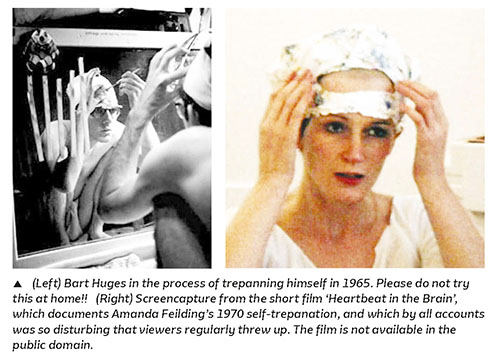
In 1962 Bart Huges, a Dutch medical student who was denied his degree because of his cannabis advocacy, theorised that man’s state of consciousness was related to the volume of blood in the brain. He theorised that the upright stance of modern humans limited the flow of blood to the brain and consequently reduced the range of human consciousness. As an additional consequence, some parts of the brain ceased to function entirely, while others, particularly the speech and reasoning centres, increased their functions to compensate.
In connection to this, when humans are born, the plates of their skulls are separated by suture lines such that the pulsation of blood in the brain can be observed in the fontanelles (the soft parts of a baby’s skull). Huges believed the closing of the sutures and the sealing of the skull into a hard shell suppressed the pulsation of the brain’s arteries, and that some parts of the brain were deprived of blood and ceased to properly function.
Adding to the blood flow impairment caused by the closing of the skull’s sutures, Huges posited that our transition from all fours to standing upright with our heads positioned above our hearts might have improved our chances of survival by permitting us to “see further, run faster, and make tools with our bare hands.” But this new position disadvantaged us in other ways. Blood was draining from our brains and impairing its metabolism of glucose and oxygen, consequently reducing the range of human consciousness.
Huges hypothesised that an increase in brain metabolism should therefore increase our level of consciousness, citing drugs that produce a ‘high’ also serve this function in their action of capillary expansion inside the brain, leading to increased levels of glucose and oxygen and, theoretically, bringing about an expanded level of consciousness.
In an attempt to rectify Nature’s attempt to keep us from reaching enlightenment by sealing our brains inside a fixed, hard case, Huges reasoned that trepanation could be one way to reverse the sealing of the sutures. It would enable the brain to pulse again and the membranes around the brain to expand. To test his theory, Huges trepanned himself in 1965 and experienced such beneficial results that he decided to bring the world’s attention to the trepanation miracle.
Joe Mellen – The Experimenter
Joe Mellen met Huges in the late 1960s and became instantly intrigued by his ideas. After a couple of failed attempts, Mellen successfully trepanned himself in 1970 and described the process and its results in his book Bore Hole. Mellen recounted the difficulties encountered as he attempted to drill a hole in the front part of his skull. On his third attempt, he reported:
“Over the next three or four hours I got gradually higher; the feeling I had was of increasing lightness, literally as if a weight was being lifted from my mind. In the days that followed, I realised it was a permanent change in my consciousness that had taken place.”
Mellen believed that his increased awareness and altered level of consciousness were a direct consequence of the increased brain metabolism that resulted from the increase of blood to his brain, which caused more cells in his brain to function simultaneously. Both Huges and Mellen described similar benefits of their brains being free to pulse again:
“This expanded consciousness brings the realisation that love and health are greater than money or power. It transcends the Ego. It lifts one above the petty level of blind faith and intolerance to a place where one sees all that we have in common, irrespective of language.”
Allowing the brain to pulse again brought other benefits as well, such as: “expanded consciousness, intensified awareness of sensory perceptions; increased efficiency in social operations, increase in cooperation and social harmony, less conflict and chaos; restoration of creativity, [and] comprehension of the ‘bigger picture’.”
As time passed and Mellen’s bore hole began to seal itself over, he discovered it was reducing the benefits he had been enjoying. This may be why so many skulls extracted from Palaeolithic and Neolithic burial grounds display multiple bore holes to maintain their higher state of awareness. Or perhaps a more permanent and less-invasive solution was found by our ancestors, which was the elongation of the skull in order to provide the brain with ‘room to move’.
These ideas raise perplexing questions:
Were human skulls modified in order to emulate abilities that other beings seemed to naturally possess?
Were trepanation and skull elongation a mechanical means designed to bring about a higher, or different, level of consciousness and/or psychic ability?
Were ancient civilisations purposely transforming themselves into superior beings?
Proof?
Bart Huges made many attempts to produce verifiable evidence of the effects of trepanation and the improvement of what he called ‘bloodbrainvolume’, but unfortunately the diagnostic tools available in the 1960s were insufficient for the task. Not so in 2005 when the International Trepanation Advocacy Group, formed in 1997, were finally able to show that the “blood flow enhancement attained by skull trepanation resembles the blood flow characteristics of youth, and on this basis the reduced blood flow through the brain characteristic of middle age can be restored to a youthful level,” exactly as Huges had theorised in 1965.
Unsurprisingly, both Huges and Mellen were briefly forced into psychiatric care after their self-trepanations – it appears that modern medical professionals do not accept that a hole in our heads could promote a higher level of consciousness. However, the allopath’s utilitarian approach to the human body means they often miss – or wilfully ignore – the more subtle, energetic aspects of the human body, which it seems can be modified, accentuated and revitalised by changes to our physiology.
Despite this medical censure, a small group of individuals remain committed to researching the effects of trepanation. Aside from the International Trepanation Advocacy Group, there is also the Beckley Foundation, which uses “cutting-edge brain imaging technologies to examine the neurophysiological changes underlying altered states of consciousness” and was founded by Joe Mellen’s partner Amanda Feilding in 1998. Fielding self-trepanned herself in 1970, filmed it, and released it as the documentary ‘Heartbeat in the Brain’.
Elongation and Trepanation – Two Sides of the Enlightenment Coin?
If you’ll pardon the pun, it is time for modern man to review our close-minded understanding of prehistoric trepanation and elongation of skulls. Given that modern-day persons who have been trepanned display a calmer demeanour and level of enlightenment that many of us aspire to, while at the same time possibly having access to a level of mental processing denied to the closed-headed individuals surrounding them, would it be beyond possibility for such individuals to have once been treated as ‘other’ and be revered as enlightened members of their community, perhaps performing functions as shamans, healers, rulers or arbiters of law?
And would these same honours be bestowed upon individuals with elongated skulls, who no doubt enjoyed the same kind of beneficial increase of blood flow to their brains as well an increase in psychic abilities, and who could also have been revered as superior human beings?
Evidence suggests we have the potential to evolve beyond the ‘thinking animal’ and join the more enlightened civilisations of the universe, but as long as our skulls remain sealed tightly shut, our brains are unable to transcend their physical limitations. While some choose psychedelics to overcome this disability, the path to enlightenment could be as simple as a hole in the head.
Image sources available upon request. Footnotes available in the purchased edition.
The name Harry Turner has returned to prominence after David Grusch, the former US intelligence officer and UAP whistleblower, recently drew attention to Turner’s declassified 1971 Australian Joint Intelligence Organisation report. Here we present Bill Chalker’s article on his friend Harry Turner and Turner’s findings, which now appear to reveal the edges of a much larger cover-up of the UFO phenomenon.
Reading the recently released US Office of the Director of National Intelligence (ODNI) report by the Unidentified Aerial Phenomena (UAP) Task Force, I know we have been this way before. Exactly 67 years ago, right here in OZ. There are profound lessons for the Pentagon here.
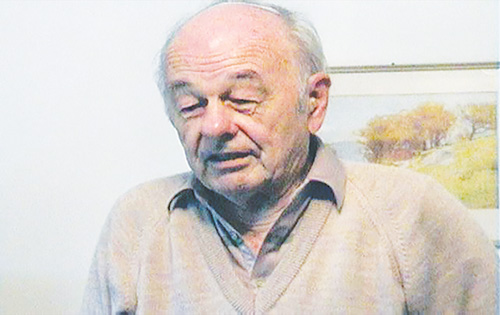
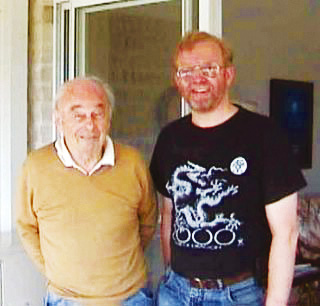
O.H. (Oliver Harry) Turner (photo courtesy of Bill Chalker)
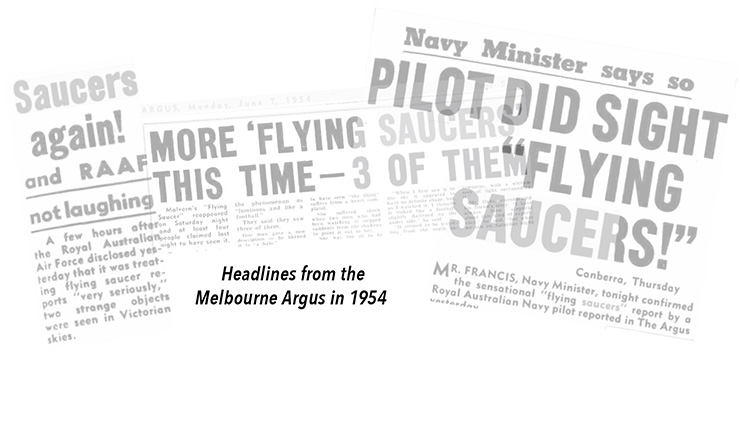
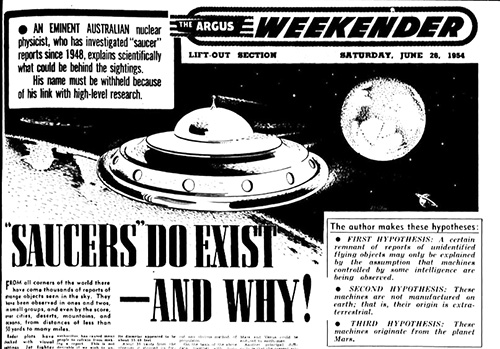
The headline of Melbourne’s Argus newspaper in its Weekender section of 26 June 1954 read: “‘Saucers’ do exist and why!” The article was written by an “eminent Australian nuclear physicist, who has investigated ‘saucer’ reports since 1948,” whose name “must be withheld because of his link with high-level research.”
The Melbourne Argus was prominently reporting on a massive wave of UFO sightings in Victoria – the most significant of the early sighting waves in Australia that attracted official interest. A classified Directorate of Air Force Intelligence (DAFI) file minute, dated 2 Nov 1955, reads:
A ministerial statement in the House (Australian parliament – B.C.) on 19 Nov 53 (indicates) that the RAAF make detailed investigations of every report received (which in truth we are not yet doing).
The Australian nuclear physicist stated:
From all corners of the world there have come thousands of reports of strange objects in the sky… over cities, deserts, mountains and oceans… Radar plots have checked with visual sightings. Jet fighter aircraft have attempted to intercept them and have been out manoeuvred. (Governments)… have set up investigation centres… there remain several hundred reports that can’t be explained…
Finally, I appeal to the Air Forces and Security Services of the Western World to release their suppressed information….
The Australian scientist hypothesised:
A certain remnant of reports of UFOs may only be explained by the assumption that machines controlled by some intelligence are being observed….. These machines are not manufactured on earth; that is, their origin is extraterrestrial.
O.H. (Oliver Harry) Turner
The scientist was O.H. (Oliver Harry) Turner, who at that time was working in the physics department of Melbourne University. In 1982, he elaborated on his secret role to me.
DAFI asked Turner to undertake a classified “scientific appreciation” of their files. He recommended greater official interest and specific interest in visual radar reports, concluding:
The evidence presented by the reports held by RAAF tend to support the… conclusion… that certain strange aircraft have been observed to behave in a manner suggestive of extraterrestrial origin.
DAFI questioned Turner’s findings. They instead followed misleading official US advice, concluding that his recommendations, notably the setting up of a scientific “investigating panel,” were impractical and not justified.
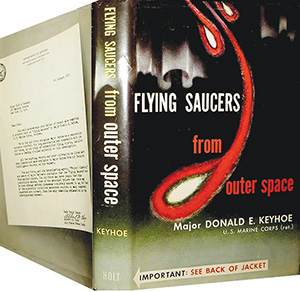
In studying the RAAF/DAFI UFO files, Turner also utilised retired Marine Corps Major Donald Keyhoe’s USAF reports, described in his bestselling book Flying Saucers from Outer Space, and suggested the RAAF seek official USAF confirmation of the legitimacy of Keyhoe’s data. Turner said of Keyhoe’s “USAF data” that “if one assumes these Intelligence Reports are authentic, then the evidence presented is such that it is difficult to assume any interpretation other than that UFOs are being observed.”
The Argus Weekender article by “an eminent Australian nuclear physicist,” who turned out to be O.H. (Oliver Harry) Turner.
The disposition of Harry Turner’s controversial report is a revealing indictment of official handling of the UFO controversy. Faced with his provocative conclusions, with Keyhoe’s data as one cornerstone, the Director of Air Force Intelligence (RAAF) did seek official confirmation from America. The Australian Joint Service Staff (intelligence) in Washington wrote to him saying:
I have discussed with the USAF the status of Major Keyhoe. I understand that his book is written in such a way as to convey the impression that his statements are based on official documents, and there is some suggestion that he has made improper use of information to which he had access while he was serving with the Marine Corps. He has, however, no official status whatsoever and a dim view is taken officially of both him and his works.
When it came to considering Turner’s classified report, the Department of Air concluded:
Professor Turner accepted Keyhoe’s book as being authentic and based on official releases. Because Turner places so much weight on Keyhoe’s work he emphasised the need to check Keyhoe’s reliability. (The Australian Joint Service Staff communication) removes Keyhoe’s works as a prop for Turner’s work so that the value of the latter’s findings and recommendations is very much reduced.
Turner’s findings, including one in which he recommended setting up a scientific “investigating panel” in light of the “discrediting” of Keyhoe’s data, were found to be impractical and not justified.
The big problem with all this was that it was based on an act of conscious or unconscious misrepresentation on the part of the US Air Force. They were engaged in a misguided campaign to undermine the popularity of Donald Keyhoe’s books. While Keyhoe may have slightly “beat up” his USAF data, the intelligence reports quoted by Keyhoe and used by Turner to support his conclusions to DAFI were authentic! Eventually, the USAF admitted that Keyhoe’s material was indeed from official Air Force reports.
In both the US and Australian militaries, political myopia effectively scuttled Australia’s first serious flirtation with a scientific investigation of UFOs. Fortunately, Turner’s secret 1954 report was “located” in classified RAAF UFO policy files that I examined in 1982 with Squadron Leader Ian Frame from DAFI.
Opening Turner’s UFO Files
I first had contact with Harry Turner back in 1982. He opened his UFO files to me. Turner told me that the case which impressed him the most was when radar at the restricted Woomera rocket range facility in South Australia picked up a UFO on 5 May 1954.
At about 1600 on 5th May, an unidentified Target was observed on radar… The target appeared on High Beam at a range of about 60,000 yards… approaching ‘R’, described a Hyperbola over ‘R’ and went out at a bearing of approx. 90 degrees… I timed it over 15,000 yards 10 seconds which would make its speed approximately 3600 M.P.H.…
From ‘R’, “Vickers-Armstrong” indicated he was
standing by the Security Officer’s hut, and looking towards the radar post… observing one of our trials through binoculars. This object appeared to be travelling towards me or directly across a path of the approaching [RAAF] the Canberra [jet bomber capable of launching a nuclear strike]. When it got to the path of the Canberra it turned to my right and was going in the direction from which the Canberra had just come.
When it got directly over the Canberra it slowed down. During this time, I found it very hard to believe what I was seeing, so I shut my eyes and then looked again through the binoculars and the object was still stationary over the flight path of the Canberra… The object appeared to be travelling about three times as fast as the Canberra… It was perfectly circular all the time and a dark grey colour…
At the end of 1954, Turner went to England, working at Harwell, the British atomic energy research establishment. Returning to Australia in 1956, he was stationed at Maralinga, until 1964, as the Australian Health Physics representative during the controversial British atomic bomb trials.
By 1968, Harry Turner was working in the Directorate of Scientific and Technical Intelligence (DSTI) of the Joint Intelligence Bureau (JIB – later JIO, then DIO), becoming their head of the nuclear science section. He told me JIB did not want to be drawn on the “UFO problem” which they viewed as a complex conjectural matter that might drag them into the limelight.
In August 1968, Turner advised the JIB director that “DAFI is not anxious to retain responsibility for UFO analysis but would be prepared to continue collation responsibility” but due to “(a) lack of scientific capability, (b) no specific position has been established for UFO work which means additional duties for personnel allocated to other duties,” meant “many of the explanations offered by DAFI, usually under political pressure, impose a considerable scientific credibility gap.”
During May 1969, at Turner’s suggestion, a new RAAF UFO report form was devised, intended to give a more scientific slant to the reports. Turner was working secretly with other scientists to set up a “rapid intervention” team to investigate cases of UFO physical evidence (“landing” events) within the Defence Science and Technical Organisation (DSTO), with four or five scientists, and an aircraft on standby.
In a memo dated 8 November 1969 to the Director of JIB, Turner indicated that he had Dr Morton from ANU, Dr John Symonds from the Australian Atomic Energy Commission, and Dr Michael Duggin, then of the National Standards Laboratory. George Barlow of Defence Science and Technology (DST) also offered to help his group. Arthur Wills, then Chief Defence Scientist, “had agreed to this.” Dr John Farrand, who became chief defence scientist, alerted me to the memo’s existence. The plans for the scientific team had been almost finalised. However, fate intervened.
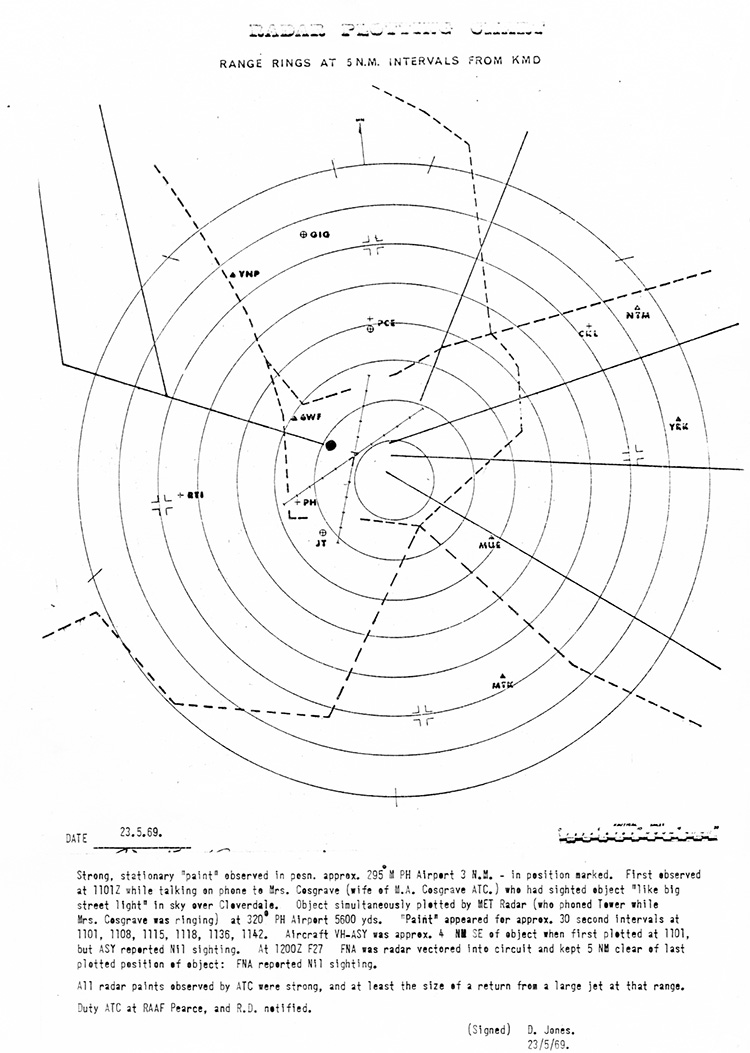
Radar report for the Cloverdale UFO incident on 23 May 1969.
In mid-1969, a major UFO flap broke out in Western Australia, centred in Perth, including an impressive visual radar event at Cloverdale, and tracked on Kalamunda radar on 23 May. DAFI asked the Defence “intervention” group to assist. It was not yet in place, so Harry Turner was seconded to help out. He found the radar case intriguing, concluding: “Neither the Kalamunda radar observation nor Mrs. C__’s sighting can be readily explained by conventional objects or phenomena.” He criticised the DAFI system, in particular referring to the lack of assistance given to local Air Force Intelligence officers. Air Force did not take kindly to criticism, particularly when it came from an “outsider” – a JIB scientist. Turner’s access to the DAFI UFO files was withdrawn.
Harry Turner’s JIB superior, Bob (R.H.) Mathams, the Director of Scientific Intelligence, told me that he didn’t encourage Turner’s UFO interests and that his access to DAFI files was an informal liaison agreement that became unworkable after Defence restructuring.
JIO’s “dance” with UFOs was almost entirely driven by Turner’s interest. His battle to establish the DSTO “rapid intervention” group continued, with numerous papers and memos in the period 1969 to 1971.
In a January 1970 submission, Turner even utilised Dr Jacque Vallee’s listing of 1,000 worldwide UFO landings or near landing reports (appended in Vallee’s 1969 watershed book Passport to Magonia) to highlight to JIB the potential military threats.
“The information suggests the existence of 3 ‘weapon systems’ – (1) a device to interfere with electrical circuits, (2) a device to induce paralysis, (3) a heat ray,” related Turner, continuing,
There is circumstantial evidence that these weapons are at times used deliberately, although mostly in a defensive role. A number of reports allege that a lone car at night has been followed, and after being stopped by a beam, some kind of interaction has developed between the car occupants and the landed craft occupants. Information is included which deals with residual effects on the environment of the landed craft. It is these residual effects which offer the greatest potential reward to scientific investigation at this stage.
Even reports of this nature failed to get Turner’s proposed study traction. (Recently, uninformed internet-based ‘researchers’ got excited when they ‘rediscovered’ this document, mistakenly thinking it was a secret official Australian policy document.)
The RAAF’s “UFO problem” continued as an unwanted burden. In July 1971, Captain R.S. Royston (DAFI) wrote:
Although I am directly concerned with any possible threat to Australian security, I am not particularly interested in the subject of UFOs, even though my directorate devotes valuable time to this problem. I accept the US assessments without question and consider that it would be a complete waste for we here in Australia to spend valuable time and money in further detailed investigations.
JIB deputy director and DSTI head Bob Mathams discussed Turner’s persistent “sub rosa” UFO crusade. Matham stated his position to Turner, specifically from a scientific intelligence point of view, that there were insufficient resources, and that he was not convinced of “a sufficient scientific intelligence component in the UFO problem,” and
that there is still considerable controversy concerning UFOs and this will undoubtedly continue until the subject is fully examined by some competent authority. Such an examination, however, would require a considerable effort to collect information on UFO sightings, to investigate reports of such sightings and to examine all information in an objective, scientific manner.
The deputy director agreed, revealing (in February 1970):
I am sure that there is an area for investigation that should be pursued by some authority. That authority, however, would need very considerable resources indeed. I am forced, therefore, whilst agreeing that the subject should be studied somewhere, to decide that JIO cannot be that somewhere. Without considerable back-up we would be wasting our time and the RAAF have apparently cancelled out the little that they were doing.
Lost Opportunities, OZ-style
Harry Turner persisted, even getting the JIO director to sign a May 1971 minute paper on the “Investigation of UFO sightings,” directed to the Deputy Secretary of Defence, that recommended passing on responsibility for the investigation of UFOs from the RAAF to Defence science, as distinct from DSTI (in JIO) which should focus on a limited number of select cases (say six per year) over a two to three year period, after which JIO could make a better determination if “a strategic intelligence interest exists.”
When DSTO came on the scene in 1974, Turner saw it as potential better home for his ideas. The UFO subject interested people like George Barlow (Defence Science No 2) and Dr John Farrands, the Chief Defence Scientist, but not enough for Turner’s plans to come under their direct remit. Turner’s secret “UFO science war” effort ended. The RAAF’s limited and stagnating approach continued.
Despite the secret UFO science wars orchestrated by Harry Turner, the situation was frustrated by perceptions of limited resources and politicking – a lost opportunity for some solid scientific examination of the UFO mystery, but a situation with powerful lessons for the shape-shifting spectre of more recent dances with the UFO phenomenon – now recast in the tight terminology of UAPs (Unidentified Aerial Phenomena).
In October 2021, the book Skinwalkers at the Pentagon: An Insiders’ Account of the Government’s Secret UFO Program by James T. Lacatski, D.Eng., Colm A. Kelleher, PhD, and George Knapp revealed that the US Defense Intelligence Agency (DIA)’s Advanced Aerospace Weapon System Applications Program (AAWSAP) and Utah businessman and space entrepreneur Robert Bigelow’s BAASS (Bigelow Aerospace Advanced Space Studies) program, had examined military and civilian UFO/UAP experiences, and possible “paranormal and correlates” that are strongly anchored in bizarre events at Bigelow’s Skinwalker ranch.
The broader and far stranger aspects of the UFO phenomena that Harry Turner had studied for decades in Australia was now getting a rare focus via the Pentagon.
Driven by Lacatski (DIA), who had his own bizarre experience at the Skinwalker ranch, DIA investigators got dragged into the very weird phenomena. One of the significant Pentagon players, given the pseudonym “Jonathan Axelrod,”
was also the lead investigator of the now infamous ‘Tic Tac’ case that had embroiled the Nimitz Aircraft Carrier Strike Group in a series of cat and mouse high stakes games off the coast of San Diego… the so-called Tic Tac [UFO] had out-maneuvered and out-performed multiple F/A-18 Hornets…
The book highlights the so-called bizarre “hitchhiker” effect, with “Jonathan Axelrod” and his family as “poster children”,
for the eruption of anomalies in the home following trips to Skinwalker Ranch… For more than a dozen years following his July 2009 and subsequent trips to the ranch, Axelrod’s wife and (then) teenage children were subjected to nightmarish “dogmen” appearing in their backyard; to blue, red, yellow and white orbs routinely floating through the home and in the yard; to black shadow people standing over their beds when they awoke; and to a relentless barrage of loud, unexplained footsteps walking up and down the stairs in their house… Axelrod and his family were certain that the trigger for this transformation was his first trip to Skinwalker Ranch.
These sorts of bizarre experiences feature in many places, but I’ll describe one from my focus here – Harry Turner.
In July 2002, he handed me ten pages of his handwritten notes about his investigation, in 1971 and 1972, of a Canberra woman, Mrs Klein. In an extraordinary way, these notes prefigured the extraordinary elements of the UFO abduction cases that are better known today. At the time of Harry Turner’s interview, they were completely unknown.
Harry Turner and Bill Chalker, northern NSW, June 2004 (photo courtesy of Bill Chalker).
The hidden aspects of the alien abduction mystery would not become generally known until Budd Hopkins described them in his bestselling 1987 book Intruders. Mrs Klein’s story, as captured in Harry Turner’s notes, revealed a potent revelation of the alien abduction contact drama yet to come. Her story was relatively unpolluted by modern culture’s fixation on certain aspects of the phenomenon.
I described Vicki Klein’s strange experiences in detail in my 2005 book Hair of the Alien. Below I describe one bizarre episode that powerfully resonates with those of Axelrod and others in the 2021 Skinwalkers book:
The neighbour Mrs. Z. claimed that during the evening of September 7, 1971, she had gone to the rear of the house because her dog was playing up. Turner’s notes state, “as the dog retreated indoors, she noticed two figures in Mrs. Klein’s backyard… Mrs. Z. thought they must be Mr. and Mrs. Klein but was puzzled as to why they should be standing in that position and be so still. So she went towards them and shone her torch on them. They turned out to be a tall metal-meshed clad figure (like ‘Claude’ – the entity Vicki Klein had been interacting with, unknown at that point to the neighbour), with his ‘dog-faced’ companion. They… gradually faded away.” Harry Turner in his notes reports: “These two disparate types claim they are ‘one people’. The tall blonde… but the ‘dog-faced’ one has pointed ears, eyes with large pupils and no iris… longish flattened nose, thin mouth, dressed in blue-grey tunic with tight banded collar… The dog-faced type can appear to look more human-like if they wish to…”
Some of the contents of Skinwalkers at the Pentagon makes me think that James Lacatski and the BAASS/AAWSAP teams were shaping up similarly to the network Harry Turner developed in Australia back in the late 1960s and early 1970s from Defence Science and other scientists.
Perhaps they should consider in detail the legacy of Harry Turner and the secret UFO wars of OZ.
[alert type=”general” dismiss=”no”]This article was published in New Dawn 190.[/alert]
[alert type=”success” dismiss=”no”]If you appreciate this article, please consider subscribing to help maintain this website.[/alert]
Most people think of Glastonbury as a quiet little town in Somerset, England, that occasionally hosts the “Glasto,” otherwise known as the Glastonbury Festival. This five-day event has in the past featured, since its inception in 1970, some of the biggest names in the performing arts, music artists like U2, David Bowie, Coldplay, T-rex, Oasis, Billie Eilish, Bruce Springsteen, Jay-Z, Lady Gaga and Tom Jones, as well as theatre, dance, comedy, cabaret and circus acts on smaller stages.
The Festival typically brings in about 200,000 people and raises money for various charities. It has all the trappings of the American 60s counterculture Woodstock festival, but with modern touches added over the decades.
Many people attending the Festival may not realise they are walking upon sacred ground. Ground that Joseph of Arimathea once walked upon. Ground that King Arthur once walked upon. Ground that some believe Jesus Christ himself once walked upon.
The Town By the Tor
The town of Glastonbury, at last census, boasted a population under ten thousand people. The civil parish of Somerset, Glastonbury is about 23 miles south of Bristol and a mile across the River Brue from Street. Once a centre of commerce with its Glastonbury Canal and the Street railway station, it nowadays looks like a sleepy town at the foot of the enigmatic Glastonbury Tor, a dramatic hill in the distance, about ten minutes from the centre of town. At the top of the hill stands St. Michael’s Tower.
The Glastonbury Thorn in November 2010. Unfortunately, one month after this photograph was taken, it was cut down by vandals.
It is rumoured that beneath the Tor is a hidden hollow cave that can take you to the fairy world of Annwn, where the lord of the Celtic Underworld, Gwyn ab Nudd, lives with the Cauldron of Rebirth. Annwyn has been associated with Avalon of Arthurian legend, the land of the dead, with the Tor as the gateway to this otherworld. This may have led to a more recent rumour of the Tor being the place where Jesus’s alleged great uncle, Joseph of Arimathea, brought the Holy Grail to keep in hiding. As part of the legend of King Arthur, the Grail was the main object of his knightly quests and Glastonbury Tor has long been thought to be the famed Isle of Avalon where the body of King Arthur was sent to rest in eternal slumber.
The Nanteos Cup, from the 14th–15th century, is located in the National Library of Wales.
The Tor is often referred to as “Ynys yr Afalon” which means “the Isle of Avalon” by the Britons, also known as the Isle of Glass because of how the Tor was reflected in the waters that once surrounded it. The Tor is close to the Glastonbury Abbey where legend places the burial coffins of King Arthur and Lady Guinevere, and the Welsh monastery that housed the Nanteos Cup. The Nanteos Cup is a medieval wood mazer bowl held for many years at Nanteos Mansion, Rhydyfelin, near Aberystwyth in Wales. Up to the late 19th century, it was said to have the supernatural ability to heal those who drank from it and traditionally believed to be fashioned from a piece of the True Cross of the crucifixion.
Near the Tor stand two ancient oak trees known as Gog and Magog, named after the prophesied invader of Israel and the land he came from, marking the entrance to the land of Avalon.
Shrouded in its mysterious past, the low-lying damp ground around the Tor produces a visual effect known as a Fata Morgana, during which the Tor seems to be literally rising out of the silvery mist. The Italian term Fata Morgana comes from the name of the powerful sorceress of the King Arthur legend, Morgan le Fay. This strange optical illusion is referred to in the title of the hugely popular book series The Mists of Avalon by Marion Zimmer Bradley.
A Visit From a Boy King
Religious art depicts Joseph of Arimathea at St. Michael’s Tower, which is the remnant of a church that once stood on the Tor.
Rich with Arthurian legend and lore, the Glastonbury town and Tor also hold secrets to an even greater kingly visitation, that of Jesus Christ himself. Legend has it that Jesus came to Glastonbury as a boy with his great uncle Joseph of Arimathea, and his mother Mary, on a boat over the then flooded Somerset Levels. When Joseph arrived, he stuck his staff into the ground where it miraculously bloomed into the famed Glastonbury Thorn, also known as the Holy Thorn, a giant hawthorn tree that grew just a few miles from the town and flowered twice each year, once in the spring, the time of “resurrection,” and once around Christmas to mark the birth of Christ.
There was a tradition where a sprig was cut each year from the tree by the oldest child attending the St. John’s School and sent to the Queen. The Holy Thorn became a centre of pilgrimages during the Middle Ages but was cut down during the English Civil War. Replacement trees in the immediate spot didn’t fare too well, and now there are numerous hawthorn trees all over Glastonbury, including on the grounds of the Glastonbury Abbey, the St. John’s Church, and the Chalice Well.
Poet William Blake wrote of the legend of the boy Jesus visiting Glastonbury in his poem, ‘Jerusalem’:
And did those feet in ancient time Walk upon England’s mountains green? And was the Holy Lamb of God On England’s pleasant pastures seen?
Glastonbury’s rich legends label it the western cradle of Christianity, at least in the British Isles. The Roman Empire, the centre of Christianity, had established trade links in the region, and Glastonbury bustled with a thriving arts community because of it. It was already an established centre for Celtic traditions and beliefs with a high level of culture, and Christian missionaries eager to convert pagans no doubt saw Glastonbury as a prized jewel, possibly even bringing relics back with them on their travels there.
The grounds of Glastonbury Abbey were located near the base of the Tor and consisted of a wattle and daub building, possibly the first church ever built in the British Isles, dedicated to the Virgin Mary. It has been posited that disciples of Christ built the church in the 1st century AD.
We have read of the missing or lost years of Jesus between the ages of 12 and 30, and that he travelled to India and the Far East to pursue spiritual studies. But he may have visited the British Isles much earlier after the death of his father, Joseph.
This was not uncommon during the time of Jesus. People often travelled from the Middle East to Britain, seeking trade or sending Roman-raised children to receive an education elsewhere. Despite the hardships of travel and the perception of isolation of the British Isles, this kind of journey happened all the time.
In this painting on the banner of the parish church of Pilton, east of Glastonbury, Joseph of Arimathea and the boy Jesus sail up the Brue River to Glastonbury.
Who Was Joseph of Arimathea?
Joseph of Arimathea was the man responsible for the burial of Jesus Christ. His account can be found in the four Gospels: Matthew 27:57–60; Mark 15:42–46; Luke 23:50–53; and John 19:38–42. He came from the Judean town of Arimathea and was a part of the Sanhedrin – the council of Jewish religious leaders who called for Jesus’ crucifixion. Joseph was opposed to the council’s decision and was a follower of Jesus, but because of his position on the Sanhedrin, he kept it secret.
He was also very wealthy, although the source of his wealth is unknown (he is noted according to numerous sources to have done much travelling for trade in tin, wool, and other commodities). Joseph of Arimathea may have been a merchant in metals who often bartered in tin and took young Jesus with him on his journeys to England, India, and even to South America. Britain led the world at this time in tin mining, and Joseph was referred to as ‘Nobilis Decurio’ or Minister of Mines to the Roman Government by Gildas the Wise, a British monk who lived from 500-750 AD.
After Jesus’ crucifixion, Joseph went to Roman governor Pontius Pilate to request his body. Nicodemus, a Pharisee, accompanied Joseph, and they were granted custody of Jesus’s body, immediately preparing it for burial. Following Jewish custom, they wrapped the body in linen strips mixed in myrrh and aloe. On the Day of Preparation before the Jewish Sabbath, they quickly placed Jesus in Joseph’s own tomb. The day after, the chief priests and Pharisees went to Pilate to request that the stone Joseph had placed in front of the tomb be sealed, and a guard posted for three days to prevent Christ’s disciples from stealing the sacred body to fabricate a resurrection and match the prophecy. Despite the precautions, Jesus rose from the dead on the third day.
As for Joseph being a blood relative of Jesus, there is no such connection directly stated in the Bible itself, but the argument can be made that the members of the Sanhedrin would have never given the body of Jesus to someone who was not a blood relative. According to Jewish and Roman law, only the next of kin could accept the body of an executed criminal, so unless the wealthy Joseph of Arimathea found a way to buy the body and the Sanhedrin’s silence, he very well may have been Jesus’s great uncle.
It is said Joseph made many trips to Britain for trade and eventually brought the gospel to that country. Glastonbury legend holds that he returned to the same area some thirty years after the crucifixion and resurrection of Jesus, leading the twelve disciples there in 63 AD. The local king allowed them to settle on the Isle of Glass (Avalon), then an island in the marsh waters, where they fasted, prayed, and built the Old Church to honour the Virgin Mother. After they died, Pope Eleutherius restored the Old Church and founded a community of twelve hermits that eventually became the medieval monastic community.
Crossroads of Legend and History
We forget that legend is often a fictionalised truth and reflects actual events and people, embellished over time in the same manner as the famous game Chinese Whispers (aka Telephone) in which people whisper a phrase in the ear of the next person down the line. By the time the last person receives the phrase, it most likely has been added onto, if not outright changed from its original form. But it contains most aspects of its original form.
Numerous writings refer to Joseph visiting Glastonbury with the boy king, lending credence to the legends.
An ancient map of Great Britain. Its earliest-known name was Albion.
In his book, The Missing Years In the Life of Christ, Bertrand L. Comparet says: “Another Cornish tradition is to the effect that Joseph of Arimathea came in a boat to Cornwall and brought the boy Jesus with him, and the latter taught him how to extract tin and purge it of the wolfram. When the tin is flashed, then the tinner shouts ‘Joseph was in the trade’.”
Traditional tales told in Somerset include stories of Jesus and Joseph coming in a “ship of Tarshish to the Summerland, and sojourned in a place called ‘Paradise’.” “Summerland” is Somerset and at the mouth of the River Brue lies Burnham. An old Ordnance Survey Map gives the name of the area around Burnham as “Paradise.” Glastonbury appears in ancient writings by the name “Paradise.”
The greatest kings, bishops, saints, and heroes of the British race were buried at Glastonbury Abbey for a thousand years. There are historical references that suggest Jesus’s visit was real, including that of Taliesin, the Druid and Welsh prince and bard of the 6th century, who wrote: “Christ, the Word from the beginning, was from the beginning our teacher, and we never lost His teaching.”
Church Historian Hugh Paulinus de Cressy wrote in 1668 AD: “This our land of Brittany, though called by the Romans another word, as being divided from the whole then discovered habitable earth, yet by the riches of Divine mercy received the beams of the Sun of Righteousness before many other countries nearer approaching to the place where He first rose.”
There are numerous references to the presence of early Christianity in Britain from the likes of Tertullian, who wrote of the parts of Gaul and regions of Britain to receive the teachings of Christ and which were never penetrated by the reach of the Romans. The Roman Christian theologian Sabellius wrote in 250 AD that although Christianity was privately practised in other regions, Britain was the first nation to publicly proclaim its following of Christ’s teachings.
Gildas the Wise proclaimed in the 6th century that, “These islands, stiff with cold and frost, and in distant region of the world, remote from the visible sun received the beams of light, that is the holy precepts of Christ, at the latter part, as we know, of the reign of Tiberius Caeser.” There are numerous references of the “light” coming to Britain alongside those of the introduction of Christianity.
Cardinal Baronius, Church Historian, Librarian to the Vatican, quotes a Vatican manuscript, dated 35 AD, that in the same year the Jews arrested Joseph of Arimathea, they put Lazarus, Mary, Martha, and two other Christians on a boat and cast it adrift in the Mediterranean. When they reached land, they trekked by foot or four-legged beast to Britain. St Gregory of Tours, an early historian, writes in his History of the Franks about Joseph of Arimathea preaching the gospel of Christianity in Britain.
De Cressy says: “Now the most eminent of the primitive disciples, and who contributed most to this heavenly building, was St. Joseph of Arimathea, and eleven of his companions along with him, among whom is reckoned his son of the same name.” Could that son of the same name really have been Jesus?
Historians of the time noted that British King Arviragus granted to Joseph of Arimathea a considerable area at Glastonbury as a site for a church and its accessory buildings and fields. This was proven as fact in 1066 AD when William the Conqueror surveyed the kingdom’s lands for tax purposes and published it in the “Domesday Book.” Completed in 1088 AD, it contains the following: “The Domus Dei, in the great Monastery of Glastonbury, called The Secret of the Lord. This Glastonbury church possesses in its own Villa XII hides of land which have never paid tax.” The name of the early church, “Domus Dei,” means “The Home of God” and “The Secret of the Lord.”
When the Glastonbury Abbey was destroyed by fire in 1134 AD, King Henry II of England issued a royal charter to rebuild it, calling the Abbey “the mother and burying-place of the saints, founded by the very Disciples of our Lord.”
At the burial place of Joseph of Arimathea at Glastonbury is a sarcophagus. Upon it, there is a Latin epitaph said to have been recorded by the 14th-century monk Roget of Boston when it was exhumed in 1345 AD: “To the Britons I came after I buried Christ. I taught. I have entered my rest.”
If Jesus did walk the grounds of Glastonbury, and we have only the witnesses of ancient times to tell us he did, then one wonders how many other places he walked with his great uncle in search of trade routes? One wonders if Jesus as a child and later as a young man visited numerous places over the course of those missing 18 years which now remain a mysterious enigma… much like that of King Arthur, who many writers and scholars to this day believe is the Celtic equivalent of the story of the Christ.
There are obvious similarities between the stories of Jesus Christ and King Arthur. References abound that link Joseph of Arimathea to Arthurian legend, as with the stories of the Grail and his travels with Mary and Jesus and eventual burial at Glastonbury Abbey. In 540 AD, the historian Maelgwyn of Avalon, in Historia de Rubus Britannicis, writes: “In this church they worshipped and taught the people the true Christian faith. After about fifteen years Mary died and was buried at Glastonbury. The disciples died in succession and were buried in the cemetery.” Another book, St Joseph of Arimathea at Glastonbury by historian Lionel Smithett Lewis, quotes another historian, John of Glastonbury, who claimed to have traced the lineage of King Arthur through his mother, Igraine, through her paternal line, to Joseph, and it was his belief all twelve round table knights descended from Joseph.
King Arthur as one of the Nine Worthies, detail from the “Christian Heroes Tapestry” in The Cloisters, New York. Dated c. 1385.
Were Jesus and Arthur different interpretations of the same story?
Both were conceived in a mystical way. Jesus was the result of the “virgin birth” when the Holy Spirit impregnated Mary. Arthur was born of a man looking like his father who impregnates his mother under enchantment.
Both were considered saviours, messianic figures with twelve devoted followers who carried out their missions.
Both were considered kings in their own right and gained their followings due to supernatural or “miraculous” acts. Both men fulfilled a prophecy. Both were betrayed.
Arthur was married to Guinevere, an adulteress. Jesus was said to have been married to Mary Magdalene, an alleged prostitute. Both women were powerful influences upon these men.
Both are associated with the symbols of swords and stones. Jesus proclaimed he was not here to bring peace but a sword and referred to his disciples as stones. Arthur is associated with the famed sword in the stone, Excalibur.
Both men were believed to walk between the earthly and spiritual worlds.
Both were said upon their deaths to one day return to help restore humanity.
There are challenges proving either man really existed in the same fashion that we currently believe because we are interpreting legends that passed down through the ages. Yet the circumstantial evidence, especially with the links between Joseph of Arimathea and the Christian and Arthurian worlds, and the ongoing research by those who seek proof in the physical historical records, is there for those willing to extend their faith beyond pure fact.
No matter if they were one and the same king, their stories are interwoven into the fabric of Glastonbury’s rich history and lore.