New Dawn – World's Most Unusual Magazine

Category: Afterlife

  • A Western Book of the Dead

    A Western Book of the Dead

    I have known since I was a very small boy in Australia that there are worlds beyond physical reality, and that we can journey to those worlds and gain first-hand knowledge of the multidimensional universe and about what actually happens after death.

    When I was nine years old, I was woken up to these possibilities during a crisis of illness. I was rushed to hospital in Melbourne after complaining of a pain in my lower right abdomen. The medical staff found that my appendix was about to burst and I was wheeled into an operating room in short order for an emergency appendectomy.

    Under anesthesia on the operating table, I found myself hovering above my body, somewhere up near the ceiling. I decided I didn’t want to watch the bloody work with the scalpel and flowed through the door and along the corridor to where my mother sat hunched and weeping. I couldn’t stand her pain, so I drifted off to a window, to the brightness outside, to the colours of spring and the laughter of young lovers seated at a sidewalk table, drinking each other’s smiles. I felt the pull of the ocean. I could not see the beach from the hospital window, so I floated through the glass and out onto a ledge where a blackbird squalled at me and shot straight up into the air. I followed the bird and sailed over the rooftops.

    I saw a huge moon-round face, its mouth opened wide to form the gateway to Luna Park. I swooped down through the moon-gate – and plunged into darkness. I tried to reverse direction, but something sucked me downwards. It was like tumbling down a mineshaft, mile after mile beneath the surface of the earth.

    I fell into a different world. It was hard to make out anything clearly in the smoke of a huge fire pit. A giant with skin the colour of fine white ash lifted me high above the ground, singing. The people of this world welcomed me. They were tall and elongated and very pale, and did not look like anyone I had seen in my nine years in the surface world. They told me they had dreamed my coming, and raised me as their own. For the greater part of my schooling, I was required to dream – to dream alone, in an incubation cave, or to dream with others, lying in a cartwheel around the banked ashes of the fire in the council house.

    Years passed. As I grew older, my recollection of my life in the surface world faded and flickered out. I became a father and grandfather, a teacher and elder. When my body was played out, the people placed it on a funeral pyre. As the smoke rose from the pyre, I travelled with it, looking for the path among the stars where the fires of the galaxies flow together like milk.

    As I spiralled upward, I seemed to burst through the Earth’s crust into a world of hot asphalt and cars and trams – and found myself shooting back into the body of a nine-year-old boy in a Melbourne hospital bed.

    It was a little hard to discuss these experiences with the adults around me at that time, and we did not yet have Raymond Moody’s useful phrase “near-death experience” to describe an episode of this kind. One of the doctors said simply, “Robert died and came back” – with memories that made me quite certain of the existence of worlds beyond the obvious one, and of the fact that consciousness survives physical death.

    There is great contemporary interest in the NDE in Western society, and this is a very healthy thing, because to know about the afterlife, we require first-hand experience, and need to be ready to update our geographies and itineraries frequently in the light of the latest reliable travel reports. In ancient and traditional cultures where there is a real practice of dying, near-death experiencers – who may be called shamans or initiates – have always been heard with the deepest attention and respect.

    There is a Tibetan name for such a person, delog, pronounced “day-loak”. It means someone who has gone beyond death and returned. The famous Tibetan Book of the Dead, with its detailed account of the possible transits of spirit after death, emerged from the experiences of such travellers.

    But to have first-hand knowledge of what lies beyond death, we do not have to go through the physical extremity of an NDE. We can learn through our dreams, the dreams in which we receive visitations from departed loved ones and others who are at home on the Other Side, and the dreams in which we travel beyond the body and into their realms.

    Our dreams open portals into the multidimensional universe, including the places we may travel after physical death. As we become active dreamers, we come to realise that dreaming is not so much about sleeping as about waking up – to a deeper reality and a deeper meaning in life, and death.

    The Departed are Dreaming with Us

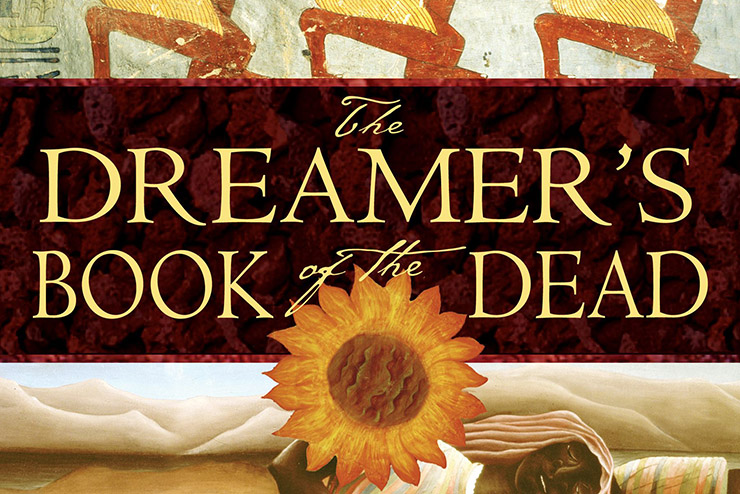
    One of my driving purposes in writing The Dreamer’s Book of the Dead was to help some of the many people in our society who are hungry for confirmation that communication with the departed is not “weird” or “unnatural”, let alone impossible, and that it is possible to extend love and forgiveness and healing across the apparent barrier of death. We encounter our departed, especially in dreams, because they are still around (sometimes because they have unfinished business or are not actually aware they are dead); or because they come visiting; or because we travel, in dreams or visions, into astral realms where the departed are entirely at home.

    It’s not just that we dream of the dead; our departed are dreaming of us, and trying to reach us through dreams. Sometimes our departed return as counsellors or “family angels”, as my father returned to me, many times, in the year after his death in Australia in 1987, with loving messages and practical guidance for the family. Sometimes our departed need us to play guides, because they are confused or stuck between the worlds, clinging to old appetites and attachments – which can be extremely unhealthy for the living, who may pick up the feelings and addictions and even the past physical symptoms of the dead.

    One of the cruelest things that mainstream Western culture has done is to suggest that communication with the departed is either impossible or unnatural.  There is nothing spooky or “supernatural” involved, though these experiences take us into realms beyond physical reality. It is especially easy to meet our departed in dreams (if we are willing to listen to our dreams) for three reasons:

    Our Departed are Still With Us

    Quite frequently dreams reveal that the departed are present because, quite simply, they never left. The departed may linger because they have unfinished business, or wish to act as guide and protector to the family, or are attached to people and places they loved in waking life, and this may be a perfectly happy situation for a year or two.

    But there comes a time when our departed need to move on, for their own growth, and so they do not become a psychic burden to the living. Because our society does a poor job in preparing people for the afterlife, many people who have passed on do not know they are dead, and hover in a limbo close to familiar people and places on this Earth. After death, we continue to be driven by our ruling interests, appetites and addictions. Some of those who have died but not truly “passed on” continue to try to feed their cravings via the living. When the departed remain earthbound, the effects are unhealthy both for those who have died and those among the living to whom they are connected. When the dead are enmeshed with the living, the result is mutual confusion, loss of energy, and the transfer of addictions, obsessions and even physical ailments from the departed to the person whose energy field he or she is sharing.

    Helping the departed may involve a loving dialogue, a simple ritual of honouring and farewell, and invoking spiritual helpers. As we become active dreamers, familiar with the geography of the afterlife, we may find we are called on to provide personal escort services and help to instruct some of our departed on their options on the other side. William Butler Yeats noted, with a poet’s insight, that “the living can assist the imaginations of the dead.”

    Our Departed Come Calling

    Most people who remember dreams can recall one in which someone on the other side made a phone call, sent a letter, or simply turned up at the door or the bedside. Our departed return to us in dreams for all the reasons they might have called on us in physical life – including the simple desire to tell us how they are doing and see how we are coping – and for larger reasons: to bring emotional healing, to bring us helpful information, to instruct us on life beyond death and the reality of worlds beyond the physical.

    Our departed may come visiting to offer or receive forgiveness. They may come to show us how they are doing on the other side.

    Our departed can be excellent psychic advisers when they achieve clarity on the other side and are aware that they are not confined to the rules of space and time.

    Our departed may come as health advisors and family counsellors. My friend Wanda Burch had received many dreams containing possible health advisories, but was finally driven to seek medical attention when her deceased father turned up in her dreams in a doctor’s white coat and yelled at her, “You have breast cancer!” Her father’s dream intervention helped put her on the path of healing and recovery.

    Our departed may visit us in dreams to help us prepare for our own deaths and reassure us that we have friends on the other side.

    In Dreams, We Travel to Realms of the Departed

    In our dreams, we are released from the laws of physical reality, and travel into other dimensions, including environments where the departed may be living. Through dreams of this kind, we can begin to develop a personal geography of the afterlife, which will be vastly enriched when we learn the art of conscious dream travel, which is at the heart of my own teaching and practice.

    In my workshops, I often invite participants to focus on a dream or memory of a departed person and make it their intention to journey – with the help of shamanic drumming – to seek timely and helpful communication with that person and to learn about the environment where that person is now living. From these journeys, we have collected multifarious and fascinating details of reception centres, transition zones, places of recovery and further education and communications arrangements on the other side. We have learned that more than one vehicle of soul survives physical death, and each has a different destiny. We have explored many afterlife locales shaped by human imaginations and collective belief systems.

    Dreaming is the Best Preparation for Dying

    A second reason I wrote The Dreamer’s Book of the Dead is that I believe that dreaming is the best preparation for dying, and that through dreams we can gain first-hand knowledge of the transitions of spirit after death. Active dreamers have no doubt there is life after death. We become familiar with many alternative neighbourhoods and transition zones on the Other Side. We may develop the understanding – again through direct experience – that consciousness survives the body in more than one energy body, and that different vehicles of consciousness have different fates.

    By helping someone who is approaching death to open to their dreams, we help them to find their way home, and approach the last stage of physical life with greater courage and clarity, as a time of growth and awakening.

    All we need do, to begin with, is to suggest to the dying person that if he or she happens to remember a dream, we would love to hear it, and to cherish the moment of sharing.

    Open a safe space for dreaming, and beautiful things can happen. Katy’s octogenarian father Ed moved into hospice care after a debilitating series of strokes. His doctors thought he would probably succumb to kidney failure within a month. In fact, he survived for another six months, a time of deepening pain and frustration over the failures of the flesh that was nonetheless a period of immense learning and high adventure thanks to his discovery of dreaming. In each of her frequent visits, Katy gently encouraged him to share any dreams he remembered.

    As dream sharing became daily practice for Katy’s father, many varied gifts came through. Some of his dreams rehearsed him for physical adjustments he needed to make as his body declined, easing these passages for a proud and once strong man. Dreams of broken plumbing and laying pipes, for example, prepared Ed for the catheterization that was eventually required.

    In an intriguing series of dreams, he was excited to find himself doing new work and feeling really good about it – an unlikely scenario, in ordinary reality, for a sick man in his 80s. In one of these dreams, he was working on an “angel machine.” When Katy asked him what that was, he explained, “I’m supposed to comb out the feathers on the angel wings” and giggled like a happy child, full of wonder.

    Towards the end, Katy’s father often slipped into waking dreams, moving between the worlds with increasing fluency, learning the art of re-entering a sleep dream to gather more insight and energy effortlessly, without any formal instruction.

    One of his big dreams seemed to promise a happy landing on the other side and opened a fascinating personal locale in the possible afterlife. He dreamed that on a day of heavy snow, he attended a magnificent banquet in a beautiful mansion. Everyone was dressed to the nines, and an elegant, distinguished man wearing an ambassador’s sash with his dinner jacket showed Ed around and poured him a delicious drink “like white champagne” but beyond anything available in ordinary reality. Delighted by his welcome, Katy’s father had the feeling he would be going back to the mansion of the dream ambassador. On the day he passed, it was snowing heavily for the first time in months, as in the dream.

    Through their days and nights of dream sharing, father and daughter deepened their loving connection. Katy confirmed and validated her father’s experiences as he opened to realities beyond the physical, an inspiring example of how we can help each other on the roads of dying (and living). Katy believes that dreaming provided her father with a vehicle in which he could travel to the other side. “He was fearful of leaving this life that he loved so much, but with the dreaming he grasped that perhaps there really is a life ‘over there’ that is just as much fun.” His fear of death gave way to a willingness to let go.

    The story of Ed’s dreaming does not end with his passing. Within days, he started turning up in the dreams of his loved ones. He appeared to the one family member who had not been able to visit him in the hospice, sat with her under a tree for what seemed like hours, and made her laugh. He returned Katy’s visits in the dreamtime. In Katy’s dreams, he often appeared doing things (like skiing) that he had failed to do, or to master, in the life he had left.

    This moving episode confirms the wisdom of the Lakota Indian saying that “the path of the soul after death is the same as the path of the soul in dreams.” This is why dreaming is the best preparation for dying.

    The Poet as Guide to the Other Side

    I had another reason for undertaking The Dreamer’s Book of the Death. I have noticed that most of us tend to live with more courage and clarity – and cope with the challenges of everyday life with better grace – when we have looked Death in the face.

    As we do this, we may enlist the support of personal guides who are quite familiar with conditions on the Other Side.

    I was well advanced on my work, a little after Samhain/Halloween in 2004, when I learned that I had drawn a most interesting helper. On a raw day on the Connecticut coast, I was leading a visionary journey for a circle of my advanced students. We had made it our shared intention to travel to a location in nonordinary reality that I call the House of Time, a place from which onward journeys to other times and other life experiences are usually easy, and where encounters with master teachers sometimes take place. I was drumming for the group and watching over them while – at the same time – I let part of my consciousness travel into the Library of the House of Time.

    I found Yeats waiting for me, on an upper level. He asked me, “What better guide to the Other Side than a poet?” The answer that came to me was: none. I remembered how Virgil appears as Dante’s guide through the Inferno, drawn by Dante’s “love and long study” of his poetry. Whether the Yeats who was appearing to me now was a projection of a part of myself, or some essence of his life and work, or the individual spirit of the dead poet, I could hardly refuse his offer to guide me.

    So my work took on a further dimension. This, of course, was not my first encounter with Yeats. He had appeared in my dreams many times. In one series of dreams, he demonstrated experiments in “mutual visioning” that he had conducted with Florence Farr, and attempts to build his Celtic Castle of the Heroes on the astral plane with his great (but forever lost) love Maud Gonne.

    But after that post-Halloween encounter in 2004, things picked up. While I immersed myself in fresh study of the books and papers in which Yeats had recorded his efforts to communication with the dead and to monitor the soul’s journey between death and rebirth, the play of dreams and visions and synchronicity in my own life became intense and wonderful. That benign entity that Koestler called “the Library Angel” worked overtime, arranging bookish discoveries at the most unlikely times and places. In a screened and protected psychic environment, I was introduced to many “dead” people who described their experiences of afterlife transitions in vivid and fascinating detail. Sometimes I felt that the dead were holding a séance for the living – specifically myself.

    I gained a new depth of understanding of what Yeats had laboured to convey about death and dreaming in the two versions of his fascinating, difficult book A Vision. He concluded that the main difference between the dream state during physical life and the dream state after death is that prior to death the soul remains in “exclusive association with one body.”

    In the 1925 edition of A Vision, Yeats made his simplest and most important observation about the connection between death and dreaming: “In sleep we enter upon the same life as that we enter between death and birth.” He explains that in dreaming, the spirit may travel through some of the levels of being that are accessible after death. In rare cases, moving beyond the astral plane, the spirit may discover “a new centre of coherence” in the celestial body. So dreaming may be an exact rehearsal for the progression of the spirit after death as it gradually disentangles itself from lower energy bodies to move to higher planes.

    In the 1937 edition of A Vision, Yeats develops the provocative thesis that our dreams of the departed are frequently the result of the departed reaching for us. Yeats describes an early phase in the after-death transition that he calls “Dreaming Back,” through which the departed seek to review, understand and resolve the issues of the life experience that has ended. With the help of “teaching spirits” a soul in this phase “may not merely dream through the consequences of its acts but amend them, bringing this or that to the attention of the living.” During this phase the dead often appear to the living in dreams.

    Yeats wrote that “the souls of enlightened men return to be schoolmasters of the living, who influence them unseen.” I believe this has been my experience, and that it is an experience open to all of us, which will unfold according to our interests and affections, and our willingness to do the work.

    In The Dreamer’s Book of the Dead I have sought to honour Yeats’s grand design of producing a Western Book of the Dead that shows a little of what happens in the soul’s journey between death and rebirth. At its heart, the message of my Book of the Dead is as simple, and as urgent, as this: We don’t need to wait for death to remember what the soul knows: how and why we came into our present bodies, and where we will go when we leave them.
    [alert type=”general” dismiss=”no”]This article was published in New Dawn 96.[/alert]

    [alert type=”success” dismiss=”no”]If you appreciate this article, please consider subscribing to help maintain this website.[/alert]

    © New Dawn Magazine and the respective author.
    For our reproduction notice, click here.
  • Is the Afterlife What We Think It Is? A Challenge from Near-Death Studies

    Is the Afterlife What We Think It Is? A Challenge from Near-Death Studies

    There are millions of stories now of near-death experiences from around the world; each a snippet, a teaser, of what appears to exist on the other side of death. No other human drama carries quite the power this phenomenon does to unmask traditions of a “grim reaper,” and reveal instead an aliveness that continues after our bodies take their last breath and our brains cease to function.

    This aliveness we call an “afterlife,” because in most cases, what near-death experiencers describe sounds like or certainly seems to be sparkling luminations of higher, finer aspects to what we know: cities, gardens, forests, landscapes, roads, rivers, busy people quite alive and doing things, schools, hospitals, opportunities of varied types to reassess earthly existence, to forgive, learn, and then advance toward a goal we can only term “spiritual.”

    Because the stories that come from experiencers are so compelling, I’d like to share a few from my research base. Surely after hearing them, you will be more than impressed that an afterlife must indeed exist and that life goes on after we die. Once I have shared these accounts, though, I intend to introduce others that will stretch what we think we know about life after death. The concept of “afterlife” may not be as previously stated or broadly believed.

    Afterlife Stories

    Arthur E. Yensen died in 1932, at least as near as we can tell he did, from severe injuries in an automobile accident. The vividness of what happened next remained fresh in his memory, not only after he revived, but throughout what later became a long and productive life. As Yensen put it: “Gradually the earth scene faded away, and through it loomed a bright, new, beautiful world – beautiful beyond imagination! For half a minute I could see both worlds at once. Finally, when the earth was all gone, I stood in a glory that could only be heaven.

    “In the background were two beautiful, round-topped mountains, similar to Fujiyama in Japan,” Yensen continued. “The tops were snowcapped, and the slopes were adorned with foliage of indescribable beauty. The mountains appeared to be about fifteen miles away, yet I could see individual flowers growing on their slopes. I estimated my vision to be about one hundred times better than on earth. To the left was a shimmering lake containing a different kind of water – clear, golden, radiant, and alluring. It seemed to be alive. The whole landscape was carpeted with grass so vivid, clear, and green, that it defies description. To the right was a grove of large luxuriant trees, composed of the same clear material that seemed to make up everything.”

    Yensen described the people there as young-looking and lively, yet possessing a weightless grace in their movements. Their bodies were somewhat translucent, so was the grass and trees; their clothing minimal. One man told him: “Everything over here is pure. The elements don’t mix or break down as they do on earth. Everything is kept in place by an all-pervading Master Vibration, which prevents aging. That’s why things don’t get dirty, or wear out, and why everything looks so bright and new.” Yensen learned how heaven could be eternal from this man (Atwater, 1994, 53-55).

    Muriel E. Kelly, weakened by rheumatic fever and a serious heart murmur, became very ill and passed into another world. “I found myself standing on a cobble-stone road with people around me dressed in bright robes – red, blue, pink. Everything was so bright and sunny. Birds were singing. Baby angels were smiling and flying around. I saw all different sizes of angels. The music was hauntingly beautiful.”

    Hearing her name called, Muriel turned to see Jesus beside her, dressed in a white-and-red robe. “He knelt down,” she said, “and gave me a hug and I hugged him back. He told me we were going somewhere to talk.” During the course of their time together, Jesus led her to an apartment building with many doors, and told her which door to knock on. A voice inside beckoned her to enter. It was her mother, who had died when Muriel was nine, leaving behind five children. Their reunion was love filled. “I asked Mama where Daddy was, and Cecil, Willie, John, and Paul. Mother told me they weren’t there ‘cause it wasn’t their time. I had no idea what she meant, so she took me to an area where we sat on a cloud and looked over the whole world. My mother located my dad and brothers riding in a car. We could see right through it. Dad was driving, and we heard my brothers and Dad crying, saying, ‘I wish Muriel was still here. We miss her.’” Muriel began to cry for her earthly family and wished to be back with them. She got her wish (Atwater, 1999 and 2003, 106-107).

    Cecil L. Hamilton told of swimming with his brother. “He had a problem. I tried to get him out of the water, but in his panic he pulled me under several times. We both drowned. He died, but I came back.” While Hamilton was in the grips of death, he suddenly found himself stepping into a light-filled world. “I noticed everything – sky, buildings, glass – emitted its own light. And everything was much more colourful ….a river meandered around. On the other side was a city, and a road running through it to another city, and another city, and another and another. Right in front of me but across the river were three men. They projected themselves to me. They didn’t walk or fly; they projected over. I didn’t recognise them, yet I knew one was Lynn Bibb.” Hamilton explained, “I was named after him. He died a matter of weeks before I was born.”

    Hamilton continued with his story: “I knew these three men were looking out for me, like a welcoming committee to escort me over the river to the first city. I had the feeling that if I went with them, there would be no coming back, so I hesitated. The first city was like first grade. People stayed there until they were ready to go to the next city – your eternal progression, from city to city. Behind me and to the left was a strong light source, very brilliant and filled with love. I knew it was a person. I called it God for lack of a better term. I could not see it; I felt what seemed like a male presence.”

    God and Hamilton engaged in a long conversation, the young man asking Him about the universe and reasons for everything. Then God questioned if Hamilton wanted to return to the physical world. “I do want to return,” he said. God asked why. “I said I would help my mother whom my father had left with four children and one on the way. God kind of chuckled and asked for the real reason. I said I would leave the earth a little better than I found it. ‘Then you may return with some of the knowledge of the things you have learned, but the rest will be veiled for a time. Live in such a way that you will not feel bad when you return here again.’ I woke up face down in the mud of the river bottom and was ‘lifted’ to the top” (Atwater, 1991 and 2003, 45-47).

    Each of these three accounts describes a particular arrangement of structures, shapes, people, and behaviours that are familiar to us – adding heft to the belief that the afterlife either reflects our earthly life or is an extension of it. The testimonies that follow, however, deviate from what I have just relayed. The focus with them is more fluid with an absence of structured form. I’ll begin with the near-death experience of Ray Kinman that he had as a teenager from an accidental overdose.

    “Now this is very difficult to describe,” cautioned Kinman. “Time ceased to exist. Past and future were completely nonexistent. I was traveling in an intense, burning ‘now.’ ‘Now’ was everything. I ceased to be a noun (person, place, or thing) and became a verb (an action). I was Ray-ing, instead of Ray. I was given a huge message. The Being told me, ‘This is Who You Really Are,’ as the Universe opened up to me. I could not tell the difference between myself and the infinite galaxies. I became all-powerful and all-knowing – yet I was still Ray. Then the Being introduced me to another Being of the most Incredible Beauty and Love that anyone could comprehend. It was a Greater Being of intense Light. It was God. The first Being guided me to this Light and let it enfold and swallow me up. I became one with Love times a million, billion, trillion forever and ever. We were made of the same stuff! Every Being that had ever existed in all of Creation was now part of this Greater Whole Being called God. I was one with all of them, and yet I was still Ray – all-powerful, little old me!

    “‘This is Who You Really Are,’ thundered the Light. It looked like a galaxy except the points of light were not stars, they were Beings. Every Being there was singing this incredibly beautiful music and praising God. After some indefinite length of Now-ness, I was told that I must go back. I was given another message that was very important. I was told I may return anytime I wished to. Coming back to my body felt like I was stuffed into a vessel of pain and exhaustion.” Kinman was very clear that this was not like any drug experience. This was truth – he was shown the way things really are (Atwater, 2007, 35-36).

    Tannis Prouten had a severe anxiety attack that seemed to claim her life. As she explains: “I felt like ducking as the ceiling was only an inch from me, then I was outside, moving through very dark, very vast space.” She saw small, round, glowing spheres around her that she came to realise were lost souls. Before she could react, “Very rapidly I was enveloped within this most divine, living, golden-white light, my HOME. The joy, bliss, humility, awe were beyond human capability to bear. The LIGHT was an infinite, loving, accepting BEING without form. IT had personality. IT communicated with me telepathically. IT was pure TRUTH.”

    As the intensity of her experience increased, she came to realise: “I was the LIGHT and the LIGHT was me. I was still a unique, separate, point of consciousness with the same sense of humour and awareness that I had always had, but the paradox is that I was MORE. I had become homogeneous with the LIGHT. I was all love, wisdom, truth, peace, joy, for all eternity. Human words fail to express this experience. Not only was the message of my true nature conveyed to me telepathically, but I experienced the SPIRIT of the message – I felt IT with every speck of my being. There was absolutely no possibility of hiding, distorting information, or lying in communicating with the LIGHT. I fell madly in love with the SPIRIT OF TRUTH! There was no concept of space or time in the GREATER REALITY. All takes place or exists in the ETERNAL NOW. That is my last conscious memory of the experience” (Atwater, 2007, 26-28).

    Neath-Death Experiences that challenge accepted notions

    Many near-death episodes are like these last two, seeming to counter the idea of biblical, religious, medieval, or even mythological traditions of an afterlife that features core imagery basic to the spread of culture and consensus throughout the human family. We have a long history of such commonalties especially in regards to death, the greatest of all mysteries, and what happens to us after we die. Findings in the field of near-death studies, though, are beginning to challenge not only traditional but non-traditional beliefs as well. Maybe there’s more to learn from our shared histories than what we thought.

    Scenarios are reported that openly defy the idea of an afterlife as an end point or a dwelling place or a platform for progressive states of learning. Here are some examples of these exceptions and the questions they invite:

    How can a future sibling exist concurrent with a present one?

    Merla Ianello recalls that as a child she saw a guest in her home who was three or four years old choke to death trying to eat a plastic-wrapped frozen juice treat called an Ice Pop. She insisted on naming them “Death Pops” after that, and one day she asked her mother who the child was. Her mother, staring in disbelief, said, “It was you.” Merla remembers her mother’s screams and how upset her father was, yet couldn’t identify with the distressed child because to her that child must have been really naughty to have caused such a fuss. Even though it took her years to admit that the child was her, one feature of the episode was never in doubt – the presence of her little brother Michael in the kitchen with the rest of the family. She talked a lot about Michael, much to the chagrin of her mother. You see, Michael wasn’t conceived until the following year. No mention had ever been made of a future child nor did the mother even want one. How then could he appear physically and fully present, even holding an Ice Pop, long before he was born? (Atwater, 1999 and 2003, 142-144.)

    Does the belief of an “afterlife” apply when incarnations are back-to-back?

    Rand Jameson Shields was hit on the head by a man diving into a swimming pool. Dazed, he ventured out into deep water and drowned. “The ceiling of the sky above me rolled back to reveal an infinite light universe, the earth below me dissolved away, and I intuitively understood my soul’s purpose and the nature of the spiritual universe.” A woman grabbed for him and he was resuscitated, yet during the following year his soul was pulled away from his body eighty times. “I was made to physically ‘re-experience’ sixty-eight events from previous lives. Thirty-four of these experiences were of my most recent life, including the entire period my soul spent between my last death and my birth in this life.” Years later he was able to visit one of the towns involved and uncovered “114 precise pieces of evidence verifying that every one of my thirty-four unique childhood re-experiences occurred to this man who died twenty-eight months prior to my birth, to the day. I have not found one piece of evidence that contradicted any of my past-life memories” (Atwater, 1999 and 2003, 140-141).

    What are we to think about continuous lives, one occurring soon after the other, rather than an individual taking up residence in some heavenly realm after dying? Or, the full manifestation of a future sibling, even participating in a family event, long before the child was born? Exceptional cases such as these are actually rather commonplace – like missing twins reappearing, aborted fetuses coming back as older or grown children, animals as much a part of “the other worlds” as they are in this one. And, here’s another “wrinkle,” there are group events that further stretch the time-honoured definitions of an afterlife.

    How can four separate experiences be the same – and – simultaneous?

    My very first encounters with the near-death phenomenon happened at St. Alphonsus Hospital in Boise, Idaho. The woman I was visiting had suffered a heart attack yet revived. She was white with fear when I arrived and told me that while clinically dead she had floated out of her body and into a dark tunnel which led toward a bright light. Once in the light, she saw a landscape of barren, rolling hills filled to overflowing with nude, zombie-like people standing elbow to elbow doing nothing but staring straight at her. This so horrified her that she started screaming and snapped back into her body. She continued to scream until sedated. As I listened to her, two other people entered the room, an elderly man and woman, both using canes. Each had suffered heart failure at the same time in the same hospital, were considered clinically dead, but were resuscitated. None knew each other before being rushed to the hospital, nor did they have the same doctor. They found out about each other thanks to nurses who heard their strange stories – the same as the woman I was visiting – which also matched that of one more person. I was unable to see this man as he was still sedated after screaming uncontrollably. None of these people had the same religion, background or lifestyle. None had mutual friends or common interests. All had lived long lives of varying degrees of hardship and success; two were still married to their original spouse and had several grown children. The others were divorced. The only common denominator I could find after asking a lot of questions to them or to people who knew them, was that their strange encounter at death strengthened the pain they already felt from deeply-held guilts and fears about how they had lived and what they had done in their lives (Atwater, 1988, 14-16).

    Why would 20 people have the same experience at the same time in the same place?

    Arvin S. Gibson shared with me a case of his where a 20-person fire-fighting crew called “Hotshots” all succumbed from lack of oxygen while trapped by a sudden burst of flames near a mountain top. One by one each of the men and women fell to the earth, suffocated. Each of the twenty saw each other leave their bodies and float upwards. One, by the name of Jake, looked down at a fellow crew member who had been born with a defective foot. As the man came out of his body, Jake said, “Look, Jose, your foot is straight.” A light brighter than sun shining on a snowy field appeared. Jake was met by his deceased great-grandfather, who acted as a guide throughout a long and extensive near-death scenario. Jake pleaded to stay, as he did not want to revive in a horribly burned body. He was then told that neither he nor any of his crew who chose to return would suffer ill effects from the fire. “This was done so that God’s power over the elements would be made manifest,” Jake affirmed. After rescue, each crew member confirmed the mutual event. Some claimed to have talked to each other while out-of-body. Separately, each of these claims was verified. All involved had met deceased relatives as part of their scenario, and had to choose whether or not they would return to earth (Atwater, 2000, 165-166).

    ‘Seeing’ Beyond the Veil of Death

    It is easy to assume that the four people who had matching hellish experiences met in dying what they had repressed during their lives – negative emotions that were still “eating away at them.” Such an assumption would be in keeping with the voluminous writings of Emanuel Swedenborg, an incredible scientist several centuries back who had also mastered the ability to “see” beyond the veil of death. It was his contention that after we died, we entered realms of our own making, based on our attitudes and beliefs (Atwater, 2000, 233-235, 424). We could expand on this idea by inferring that, because the hellish accounts were virtually identical, there could have existed at that hospital a type of energy (perhaps from previous emotional outbursts) that the four of them unconsciously activated in a similar fashion to outpicture their deeply-held beliefs. Possible? Yes, but there is more to consider.

    The group experience of twenty hotshot fire-fighters challenges the conclusions of Swedenborg and anyone else, myself included, who tried to tie near-death scenarios solely to the attitudes and beliefs of experiencers – the idea that “you get what you expect.” What appears to be obvious may not necessarily be as true as it seems.

    There are lots of shared experiences, such as between a parent and child in the same accident, between friends who die together and similarly revive, between people who never knew each other but found out about their mutual episodes years later once they started asking questions. People on opposite sides of the world can go through the same thing, at the same or different times, yet their separate lives, beliefs, feelings do not match nor did they ever – even though their near-death experiences did. And there are even incidents like what happened to Nadia McCaffrey.

    Nadia was a participant in the original research I conducted with child experiencers of near-death states (Atwater, 1999 and 2003, 86-88). Years later, while caring for a woman who was dying, she nearly died herself following severe seizures. Several days afterward, still in pain, she called me and we exchanged stories. The upshot was that Nadia’s seizures had begun at the same moment our granddaughter Myriam’s seizures had. When Nadia died, so had Myriam (from bacterial meningitis). The two met each other in spirit as they died. Myriam enabled Nadia to have another near-death experience, this time one that clarified and detailed her life’s mission. Myriam had always been unique in this regard, for she had the ability to force, push, or aid a person in accessing their own inner truth. Nadia’s first near-death experience had left her with many questions, especially about her purpose for being alive. Her second one, thanks to Myriam, filled in the missing pieces and helped her launch a new type of hospice (Atwater, 2004, 122-123).

    How can this incident be explained? Or any of those I’ve shared? Do our moments at the edge of death or while clinically dead really unveil an afterlife? Or, is there something else going on that we miss in our great hurry or even greater desire to accommodate what is before us and name it what our traditions claim it to be?

    Near-Death Episodes as Growth Events

    Two clues, present in almost every case I have worked on, caused me to toss the notion of “afterlife.” I no longer consider it relevant. To help you understand why I say this, a presentation of the clues and my observations follow.

    Clue #1 – almost to a person near-death experiencers say “I got what I needed.”

    To an extent, Swedenborg was right. What he missed is what people really meant when they spoke such words, and the broader perspective necessary to interpret what people experienced and what he himself actually witnessed. Being literal isn’t always productive. It’s like trying to see an aura. Aim your gaze a little past what is in front of you and suddenly you begin to see things you never recognised before. Do this with the phrase, “I got what I needed,” and you’ll notice as I did that the near-death experience unfolds in patterning that mimics an accelerated “growth event.” Life insists on growth and change. If we block these urges, something will happen to unblock them. That something is what I call a “growth event.”

    A growth event is any kind of sudden, unexpected twist in life that twirls you around and changes your attitudes and stretches your mind. Growth events, all of them, give us an opportunity to face our inner selves and be honest about what we find, to glimpse higher, more spiritual realities, to expand beyond limiting ideas, to discover the impossible and experience the “paranormal,” to become in some way transformed.

    I believe the near-death experience is a growth event, perhaps one of those that seems “reserved” for people who need a “good shove” in making life changes. Here is a brief synopsis of what I found that underscores this:

    • Most near-death episodes happen during major junctures or times of unusual stress in the individual’s life, when guidance or direction would be most helpful.
    • Young children, relatives and caregivers can be affected as well – to the degree that it is almost as if the child had the experience for them. Yet the extent to which the episode transformed the youngster becomes more apparent as he or she matures, and can be a quiet but powerful directive in the life path chosen.
    • Causes and conditions of death can reflect, at least symbolically, the experiencer’s past or current state of psychological growth.
    • Greeters on death’s threshold always match (accommodate to) whatever is necessary to alert or calm the experiencer.
    • As the episode deepens, the scenario’s message parallels almost exactly the subconscious needs of the individual at that moment in time.
    • Life reviews and “lecture” sessions cover material either omitted, ignored, or not yet learned in life by the individual involved. Life previews alert to what might be the future – for good or ill.
    • Afterward, the experiencer’s behaviour tends to shift to whatever has been undeveloped or partially developed – physically in the sense of brain function/-nerve sensitivity, and psychologically in the sense of personal growth/maturity – as if whatever traits are missing in the individual’s maturing process are now being “filled in” (Atwater, 2007, 244).

    Whatever the truth of this, and it may never be proved one way or the other, the need factor is plainly obvious as to the timing, storyline, and outcome of near-death states – not in the sense of predetermination, rewards/punishment, or wish fulfillment, but rather, in terms of a subconscious “agenda” of a higher order.

    Clue #2 – the most oft-repeated phrase near-death experiencers say after their episode is “Always there is life.”

    This fact struck me. If it is true, and I believe it is, then how can there be an afterlife? Or a before life? Or anything else but life? Implied here is that in some form, somewhere, somehow, eternal and forever, life exists as an ongoing extension of itself, acting upon and interacting within itself, ever conscious, intelligent, and aware…. life unending. Indicated as well is that we are that life, existent within the existence of a forever that can be counted on. These four words sum up and explain all else. They take us beyond attitudes, dictums, dogmas, preferences, traditions, even what we can imagine. These four words are as if a prayer answered.

    Once I recognised the import of this, all the experiencer narratives I had ever encountered or heard from other researchers made sense. If you allow yourself to step back from all the minutiae – who said what where and under what conditions – a different picture emerges that transcends the individual storylines from both adults and children. That “different picture” describes a vastness to the creation we are a part of, while focusing in on the souls that we are, as we participate in a journey of awakening to our real identity and purpose…. what reality really is.

    Tens of thousands of reported cases, not only in the Western world, but throughout Africa, China, India, the Pacific Rim, Russia, Israel, Thailand, Korea, Turkey, from jungle dwellers to desert clans, from the backs of buffalo riders to the canyons of Wall Street, this, the near-death phenomenon, if viewed as it occurs at the time that it does, offers a picture of the other side of death that mirrors what quantum physics seeks to uncover and explain…. that all is consciousness…. and everything else is illusion. With experiencer estimates running between four to five percent of the general population worldwide, umpteen million are involved. The phenomenon is that widespread.

    The 12 Heavens and Hells

    It is no small thing, then, for us to take a second look at what has been reported. The concept of heaven and hell changes when we do this.

    Near-death states show that once you leave your body in death, regardless of whatever comes next, you eventually find yourself moving to or present within an energy frequency you resonate with. What you find there corresponds for the most part to what you are capable of responding to, i.e., beings, shapes, forms, activities. These frequency realms resemble a “layer cake” of many levels, each separated from the other by degrees of lighter or heavier vibrations. The heavier more dense vibrations hold what most people call “hell” in that they consist of negative or lower forms of thought that reside in close proximity to the earthplane. Apparently you stay within this range of vibration for as long as it best serves your development as a soul. You do not leave until you have changed your attitudes, thoughts and feelings, and are ready for another opportunity to improve and advance. The faster, higher, more subtle vibrations are what most people term “heaven” and they also are in close proximity to the earthplane. There is a sense of benefit here, as if one has found one’s true home. You leave whatever level of this positive, supportive domain you are in once you have further advanced as an awakened soul and are more unified in spirit.

    I have counted from experiencer descriptions what appears to be the existence of twelve heavens and twelve hells. Yet, this “layer cake” of energy frequencies (layered thoughtform realms) seems to be open at both ends. I have found nothing to indicate otherwise. Claims of souls forever and eternally trapped or condemned in the heavier levels, or basking in the glory of ascension in the finer, lighter ones, do not hold up. When you really study the import of what people encounter on the other side of death, you come to realise that unlimited possibilities are available because of the power unleashed from awakenings. To whatever degree a soul awakens, consciousness expands – individually and universally.

    Yes, “detours” are reported, to places like borderlands or shadow areas where individuals in spirit form may tarry. It seems that in some cases where the ego personality refuses to merge with its soul, spirit can remain “apart” somehow, as if lost, disconnected, confused, or determined to fulfill a vow or promise before moving on. Spirits like this are often seen as “ghosts” by those who are still embodied. The idea, then, of “way stations” is upheld in near-death accounts, places where spirits reside until helped in some fashion. These “catch-all” places appear to be necessary diversions so that one can “shake” free of that which initially hinders. What matters most throughout this entire arrangement of heaven/hell/borderlands, though, is the resonance factor, i.e., “like attracts like.” Our religions insist that it is deeds done or not done that is the final determinate of where we wind up once dead, yet nothing from experiencer cases fully validates this. Their testimony indicates something else – that self-acceptance or self-rejection is what creates our energetic “signal.”

    Time and Space, Soul and God

    The concept of time and space also changes when we take that second look. Near-death experiencers are adamant in stating that neither time nor space exist. They claim that everything on the other side of death resides in a kind of “NOW” moment devoid of boundaries, limits or definitions other than that of the relationship between perception and perceivers. Time and space are seen as purposeful, however. From the bulk of near-death accounts, time is experienced by individuals as a type of “doorway” space moves through in sparkling waveforms of potential. That sparkle comes from light in the process of becoming dense enough within the “cradle” of space to take on the shapes and forms of what is termed matter. What becomes apparent from experiencer testimony, however, is that, in a way few can understand or explain, time not only enables but protects the manifestation of existence that space allows, so thought can reproduce itself. It’s consciousness. It’s as if all of life, every tiny speck of it, all of what we encounter on the other side of death, every vibratory “wiggle” of it, exists as it does within a giant brain processing thought… and we are projections of that thought, and so are planets, asteriods, solar systems, and so forth.

    This brings us to another way of considering soul.

    Near-death states illuminate the reality of soul, our soul, everybody’s soul, and establish soul as a power source without form or gender. Some call it our Higher Self or our Greater Self, and that we as a soul are immortal, an extension of The Divine. Soul is experienced as having its own will, and an agenda above and beyond anything we might relate to from the personality level of our egos. What emerges from this discovery is the realisation that souls go through learning cycles similar in purpose to people on earth, and that souls can and often do incarnate in groups to accomplish specific things of a larger nature. The soul-level of our being is recognised as possessing perfect memory and an almost unbelievable grasp of Creation’s Story and our place in its overall scheme. On this level, which most experiencers consider a higher level of being, the goal of continued incarnations in human or other forms, appears to be a furtherance of what can be experienced creatively as we seek to expand our roles as Co-Creators with the Creator. Winding our way through the peaks and valleys of humanness appears to aid in this process. You get a real sense that life and death and the forms we take on fulfill an even Higher Will for an even Greater Purpose.

    With that said, we can approach the topic of God or Deity.

    The greatest discovery the vast majority of near-death experiencers make after realising there is life on the other side of death, is that an intelligence beyond what we can fathom exists – there is a Deity. And that Deity or God is so massive, so powerful, so encompassing, that it is often described by experiencers as more brilliant and mighty than a million suns, existent as a Presence without need of name, identity or definition. The biblical injunction to call It “I AM THAT I AM” suffices as a reference. All that exists is seen to exist within this allness, this oneness. It is as if there is only One Mind, yet many thinkers. This, the One Mind, is often described as spreading out from a webbing or matrix field of Its Own Consciousness, embracing what exists from the stirring of Its Own Thought. Changeless as the Supreme Consciousness it is, The One appears ever changing once projections of Its Thought take on free will and the endless variation possible in that freedom. Life is God made visible. The awesomeness of this tends to dissolve any ideas or previous beliefs anyone ever had about religious dictums or mythological characterisations. A favourite phrase experiencers come to use is: We are one with The One.

    When reconsidering near-death cases, realise as you do that four patterns to the phenomenon exist, not just one. The spread that follows results if you also factor in deviations in experiencer behaviour and beliefs before and after their episode:

    • Initial Experience (very few elements): An introduction for the individual to other ways of perceiving reality… stimulus.
    • Unpleasant or Hellish Experience (frightening scenarios): A confrontation with distortions in one’s own attitudes and beliefs… healing.
    • Pleasant or Heavenly Experience (uplifting scenarios): A realisation of how important life is and how every effort that one makes counts… validation.
    • Transcendent Experience (limitless expanses): An encounter with Oneness and the collective whole of humankind… enlightenment (Atwater, 1999, 133).

    If you are objective about this spread, what you see here is a fascinating panorama, not about the existence of an afterlife and the do’s and don’ts of living, but of what very well could be the movement of our consciousness as it evolves through the human condition via stages of awakening. These stages of awakening extend from the first realisation of something greater, an initial awareness, to confrontations with the bias of perception followed by opportunities to cleanse and start anew. This leads to the bliss and the ecstasy of self-validation and the discovery of one’s worth, until at last the moment comes when unlimited realms of truth and wisdom are embraced.

    It’s all about consciousness, moving in and through our story and larger types of stories, as the One Mind experiences Itself through variations in Its Thought. Still, there is more to note here. Present in experiencer accounts is a deeper sense seldom vocalised that consciousness itself, by itself, as itself, is also awakening and expanding. To give this meaning, let me quote St. Teresa of Avila, the great Spanish mystic and reformer, who, near the end of her life, said: “The feeling remains that God is on the journey, too.” The invitation here is for us to move past defining concepts and ideas of an afterlife that are birth-to-death centred, and embrace instead a new vision of life as an emanation of spirit evolving in its capacity to handle the power from its Source. Why limit ourselves; experiencers don’t.
    [alert type=”general” dismiss=”no”]This article was published in New Dawn Special Issue 7.[/alert]

    [alert type=”success” dismiss=”no”]If you appreciate this article, please consider subscribing to help maintain this website.[/alert]

    References

    P. M. H. Atwater, L.H.D. with David Morgan (2000), The Complete Idiot’s Guide to Near-Death Experiences, Macmillan/Alpha Books, Indianapolis, IN.

    P. M. H. Atwater, L.H.D. (1988), Coming Back to Life, Dodd, Mead & Co., New York, NY.

    (1994), Beyond the Light, Birch Lane Press, New York, NY.

    (1999), Future Memory, Hampton Roads, Charlottesville, VA.

    (1999 and 2003), Children of the New Millennium, Three Rivers Press, New York, NY; replaced by The New Children and Near-Death Experiences, Bear & Co., Rochester, VT.

    (2004), We Live Forever, A.R.E. Press, Virginia Beach, VA.

    (2007), The Big Book of Near-Death Experiences, Hampton Roads, Charlottesville, VA.

    © New Dawn Magazine and the respective author.
    For our reproduction notice, click here.

  • Reincarnation, the ‘Interlife’, Universal Consciousness & the Holographic Soul

    Reincarnation, the ‘Interlife’, Universal Consciousness & the Holographic Soul

    This article was published in New Dawn 116 (Sept-Oct 2009)

    Modern studies repeatedly suggest that a significant proportion of people in the Western world now believe in reincarnation. Although this phenomenon can be traced back to various esoteric movements that flourished from the second half of the 19th century, it gained significant ground with the explosion of popular interest in Eastern spiritual approaches in the 60s. And it was reinforced by a proliferation of therapists offering to regress people into their past lives.

    Yet now the tide seems to be turning again. For some years the emphasis has been moving more towards the idea that we are all part of the One, the All, the Source, the Absolute, the Ultimate, the Great Spirit or whatever we choose to call the ‘universal consciousness’. Of course this is not a new idea. But what is changing is that especially more intellectually minded spiritual seekers are tending towards the view that anything outside of the ‘One’ is mere ‘illusion’.

    In fact this word illusion is used a great deal in spiritual circles these days, although actually in quite different contexts, and it is perhaps worth considering what these are. Of course readers would all agree that the physical world itself is to some extent an illusion, at least inasmuch as it is underpinned by the nonphysical planes and states of being that science is increasingly pointing towards. But what about the idea that we only reincarnate for as long as we fail to see through the ‘illusion’, and that as soon as we gain ‘enlightenment’ we can ‘break the bonds of karma’ and ‘reunite with the Source’? More radical still, what about the idea that any notion of individuality is completely illusory on all levels, and that as soon as we die there is no sense of continuation of any sort of individual soul consciousness?

    Whether or not they make it explicitly clear, these latter two are the ‘illusion models’ supported by a significant proportion of our best-known spiritual commentators of modern times – be they proponents of, for example, the ‘power of now’, or of ‘cosmic ordering’, or of ‘quantum mysticism’. Yet to see the world in this way is entirely at odds with what we might call the ‘experience model’, which holds that we lead many lives in order to see all sides of every emotional coin, and to learn to deal with the manifest challenges that life on this planet provides. In other words, a model in which the emphasis is on an individual soul growing by experience over many lifetimes.

    If we are to adopt a rational approach then, rather than relying on ‘revealed wisdom’ ancient or modern, it is surely sensible to consider which of these models is best supported by logical analysis and the available evidence.

    We can start with the premise that there must exist some sort of ultimate force or energy that underlies the entire universe, both seen and unseen, which is the Origin or Source of everything in it. However ineffable it may be, this principle of a universal consciousness is almost a logical necessity, and it is certainly supported by scientific research at both the quantum and the macrocosmic level. The idea that ‘we are all one’ is also a common element of transcendental experiences, whether spontaneous, meditative or induced by hallucinogens. So our next step must be to investigate whether, at the same time, there is any real evidence to support the idea of an individual consciousness that exists or survives independent of the physical body.

    The most relevant area of research here is near-death experiences. In particular we are interested in cases that involve subjects returning with factual information that is subsequently verified, and yet so obscure that they could not reasonably have acquired it in any ‘normal’ way.

    Near-Death Experience & Reincarnation Cases

    One of the most fascinating cases on record took place in the early 70s, and involves a gifted young Russian scientist called George Rodonaia. His work on chemical brain transmitters was sufficiently valued by the KGB that they were not prepared to lose his expertise to the US by letting him take up an invite to further his research at Yale. On the day of his departure, as he stood on the pavement in Tbilisi waiting for a taxi to the airport, he was deliberately mown down by a car and pronounced dead at the scene. His body lay in a morgue for three days, but as the autopsy began his eyelids flickered and he was rushed to surgery.

    As a man of science George had never had any time for religion. So those close to him were bewildered when, three days into his lengthy recovery, he began to describe what had happened while he was ‘dead’. In fact his was a relatively non-typical and highly transcendental experience, but for our current purposes he also claimed he had also been able to travel anywhere he liked while ‘out of body’. In particular he was drawn to a newborn baby in the hospital adjoining the morgue because she would not stop crying, and doctors had been unable to diagnose the problem. Much to his surprise he found that he was able to communicate with her telepathically, and also to scan her body and establish that her hip had been broken, probably at birth. Incredibly, as soon as George was well enough to pass on this information, the doctors x-rayed the baby and found that she did indeed have a fractured hip.

    There are other, similar cases of near-death experiences involving obscure, factual information that combine to strongly suggest that our individual awareness or consciousness does indeed continue to exist even when the physical brain is absolutely non-functional. So far so good. But is there any evidence to support the further idea that individual souls have many lives?

    Here we encounter two important areas of research, the first involving children who have spontaneous memories of past lives. Although historically most of these cases have come from Asia, one of the finest involves a young American boy called James Leininger of Lafayette, Louisiana. Born in 1998, his fascination with toy planes from the earliest age took a more sinister turn as he approached his second birthday, when vivid nightmares began. He would thrash around in his sleep, kicking out with his legs up in the air and moaning: “Airplane crash, on fire, little man can’t get out.” His mother Andrea had no particular religious convictions but, when her mother suggested these might be memories of a past life, she began to encourage little James to talk about them. And he began to reveal startling details, such as that the pilot of the plane was also called James; that he had been shot down by the Japanese; that he had flown Corsairs; and that one of his fellow pilots went by the name of Jack Larsen. He also mysteriously mentioned the single word Natoma.

    His father Bruce remained dubious about any sort of spiritual explanation, but he knew that neither he nor any other member of their family had any particular interest in aircraft or the war. So he began to research, and quickly established that an aircraft carrier called the USS Natoma Bay had been stationed in the Pacific during World War II and had taken part in the notorious battle for the Japanese island of Iwo Jima early in 1945. He ordered a book about this, and was flicking through it one day when James pointed to the island of Chichi Jima on a map and exclaimed, “Daddy, that is where my plane was shot down.” He then made contact with the ‘Natoma Bay Association’, who confirmed that Jack Larsen had been one of the pilots, and also that only one pilot had been lost at Chichi Jima: 21-year-old Lt James M. Huston Jr.

    Bruce also knew that Huston had flown Wildcats, not Corsairs, on the Natoma Bay. But when he made contact with Huston’s elderly sister she kindly sent him some photos – including one of her brother standing proudly next to a Corsair. Military records then showed he had originally been part of an elite special squadron who test-flew these planes. But the real clincher involves three ‘GI Joe’ dolls. When Bruce asked his son why he called them Leon, Walter and Billie he replied, “Because they greeted me when I went to heaven.” Again military records confirmed that three of Huston’s fellow Natoma Bay pilots were Lt Leon S. Conner, Ensign Walter J. Devlin and Ensign Billie R. Peeler – and that all three had died before Huston on other engagements. None of this detailed information is available on the internet pages about the Natoma Bay even now, let alone in popular books and so on.

    Past Lives & Hypnotic Regression

    The second area of past-life research is hypnotic regression. With this we must first appreciate that the human brain appears to store a complete record of everything we have ever been exposed to, no matter how briefly or how long ago, and that although most of these memories remain inaccessible to our normal consciousness they can be accessed in trance. So apparently authentic and detailed past lives, even including strong emotions and strange accents and so on, have sometimes been proved to come from perfectly normal sources – not least historical fiction, which is often overlooked by spiritual researchers. Nevertheless, there remain some cases involving information so obscure that only a paranormal explanation seems appropriate.

    One of the finest involves a young woman dubbed Jane Evans, who was one of many subjects regressed by the Welsh hypnotherapist Arnall Bloxham. She first visited him in the late 60s and proved a responsive subject who, over the course of a number of sessions, regressed into six separate lives from Roman times onwards. She would go on to be the star of a 1976 documentary made by the initially sceptical BBC producer Jeffrey Iverson, entitled ‘The Bloxham Tapes’. Her most celebrated past life was that of a persecuted Jewess in 12th century York, but on close investigation this case is somewhat inconclusive. In fact her strongest life in terms of obscure evidence involved Alison, a young servant to the 15th century French financier and merchant, Jacques Coeur.

    Some of the historical information Jane came up with in trance was relatively obscure, and could only be verified by professional French historians. For example, she said that Charles VII’s nickname was “heron legs”; that his son Louis had poisoned his wife; that his mistress Agnes Sorel had two pet dogs clothed in “coats of white fur with jewelled collars”; and that Coeur was Jewish and his father was a goldsmith. Perhaps more impressive was her knowledge that Coeur was an avid collector of art, with paintings by Jean “Fouquet,” the court painter to the king and one of Coeur’s debtors; by Jan “van Eyck,” the court painter to the nearby Duke of Burgundy; by “Giotto,” an Italian master from the previous century; and by the little-known “John of Bruges” who, Iverson established only with great difficulty, was also known as John Bondolf and was a Flemish court painter for the king’s grandfather. More impressive again was her report that Coeur had a “body servant” called Abdul, who was “dressed differently from the others” – because it was only from obscure French court records of the time that Iverson was able to confirm that he did indeed have an Egyptian body slave.

    Impressive enough, yet the clincher in this case is Jane’s recall of a “beautiful golden apple with jewels in it” that she said had been given to Coeur by the Sultan of Turkey. All of Iverson’s initial attempts to verify the existence of such a piece drew a blank until his last night in Coeur’s home town of Bourges, when he returned to his hotel to find a message from a local historian. The latter reported that he had been searching through contemporary archives when he found “an obscure list of items confiscated by the Treasury from Jacques Coeur”; and in that list was a “grenade” of gold – a pomegranate. Of course this is so like an apple in shape and size that the English word contains the French root pomme. It is also worth noting that one sceptic’s supposed attempt to trace all these details to a historical novel is a complete travesty, because the novel has an entirely different plot and contains virtually none of these obscure details.

    Again there are other, similar cases of both childhood recall and regression that involve equally obscure yet verifiable information about past lives. But could all these merely result from subjects tapping into some sort of universal memory, or even from possession by the deceased? Probably the strongest evidence that these are indeed memories from the subjects’ own, individual, past lives comes from subjects also being regressed into the time between lives, or ‘interlife’.

    This stems from the research of a number of pioneering psychologists and psychiatrists around the world, who each stumbled on the interlife independently in the 70s and 80s. Their subjects’ reports are extremely consistent, so that the experience can be broken into five main elements: transition and healing, past-life review, soul group interaction, next-life planning and returning. This evidence from what now constitute thousands of subjects from diverse backgrounds suggests strongly that there is a continuity of individual soul identity across many lives.

    The Holographic Soul

    So how do we properly bring this evidence of individual soul survival and reincarnation together with the idea of a universal consciousness that underlies everything? Although the most profound spiritual sources have hinted at the truth throughout the ages, the most simple yet elegant solution has only become available to us in recent decades with the discovery of the hologram. And it involves applying this principle not to the brain, nor to memory, nor even to the universe as a whole, but instead to soul consciousness itself:

    Soul consciousness is holographic. We are both individual aspects of the Source, and full holographic representations of it, all at the same time. However this does not mean that soul individuality is in itself an illusion. The principle of the hologram is that the part contains the whole, and yet is clearly distinguishable from it.

    The other message that comes through loud and clear from interlife research, as well as from the most profound spiritual sources, is that free will and personal responsibility reign supreme. This is what allows us to learn from our mistakes, and to grow as souls. So any next-life previews seen between lives merely represent major probabilities and lesser possibilities, and there is no karmic punishment or predestiny. Indeed the idea of karma itself has arguably outlived its usefulness, because it is clear that the dynamics of how our attitudes, intentions and experiences feed into the futures we create for ourselves, both across and within lives, are far too complex to be reduced to simplistic ‘laws’.

    In conclusion it appears that there are no ‘flaws in the grand plan’. The physical world is not an abomination created by fallen angels. Nor is the reincarnation cycle something to be escaped from at all costs, either by suddenly gaining the enlightenment to see through the illusion, or by learning to give up all ‘attachment’ so as to generate no more karma. Although we would do well to aim for a degree of emotional detachment and balance, and regular meditation is absolutely invaluable in trying to bring our ‘higher selves’ to the fore, life is to be lived and experienced!

    So where does it all end? Interlife evidence, again backed by the most profound spiritual sources, suggests that we continue to reincarnate until we have exhausted all the possibilities for growth in the physical plane. And this is only the ‘end of the beginning’ of the soul’s journey, because there are many other opportunities for new experiences in other realms. As for the idea of ‘reuniting with the Source’, the concept of the Holographic Soul suggests that we never split off from It in the first place, and that It is always within us and us within It.

    What about the million dollar question from which ‘illusionists’ tend to shy away? What is the whole point of the universe in the first place, and how do we humans fit into the ‘big picture’?

    The Source’s primary aim, in diversifying into all the billions of holographic soul aspects of itself that operate in the various realms throughout the universe, is to experience all that is and can be. So as individualised aspects of the Source who have chosen to reincarnate on this planet, we are merely fulfilling a small part of that objective by gaining a balance of all the experiences available via this route.

    James Leininger’s amazing story is documented in the book Soul Survivor: The Reincarnation of a World War II Fighter Pilot

    [alert type=”success” dismiss=”no”]If you appreciate this article, please consider subscribing to help maintain this website.[/alert]

    © New Dawn Magazine and the respective author.
    For our reproduction notice, click here.
  • At the Threshold: How Near-Death Experiences Transform People

    At the Threshold: How Near-Death Experiences Transform People

    From New Dawn Special Issue Vol 6 No 2 (April 2012)

    My research has shown me that the near-death experience is not some kind of anomaly, but is, rather, part of the larger genre of transformations of consciousness. The clue most researchers miss is stress; specifically, the intensity which comes from that stress (known in shamanism as “high stress”). The entire pattern of aftereffects and the degree to which people change, can be traced to that factor. It’s the intensity that shifts experiencers into what is called a “threshold experience” – one that straddles the boundary between this world and other worlds, between the brain and that which lies beyond what the brain can access, between reality and miracles, mind and spirit, life and death, heaven and hell, sanity and insanity.

    Once we understand this shift, we can begin to unravel how the transformational process works. At the threshold of who we think we are and what lies beyond body and brain, is the core of ancient mysteries. We are transformed by the Oneness we find there.

    My research of near-death states spans 33 years and covers nearly 4,000 adult and child experiencers. Not counted in this are the many sessions I held with significant others. Before my own near-death experiences in 1977, I was equally involved for over a decade studying and experimenting with altered and mystical states, psychic phenomena, and the transformational process, involving over 3,000 people. For some reason unknown to me, my research projects were never small. I have always preferred looking at things from multiple angles and differing views. Police investigative techniques have been my protocol throughout. Since this method relies heavily on observation, comparison, and analysis, it is never constrained by words, language, or culture. Numerous sources of verification are used, and this can include questionnaires for double checking previous findings.

    This work has enabled me to recognise that near-death experiences are not some kind of anomaly, but are rather part of the larger genre of transformations of consciousness. We single them out as “different” because near-death states occur mostly at accident scenes, in hospitals, or in environments where devices are available to record vital signs thanks to trained emergency personnel. Contrary to the notion of how these episodes form, the scenarios they cover, and the pattern of physiological and psychological aftereffects that usually increase overtime – is the fact that near-death-like experiences (where death is not imminent) and impactual spiritual transformations (regardless of how caused) manifest the same patterning.

    What links these types of in-depth transformational experiences is stress; more importantly the intensity of that stress.

    Before such an episode occurs there are stressors, conditions in the experiencer’s life, that point to either unrest or inattention. And these are present universally. What caught my eye with near-death and near-death-like states were episodes that occurred under these conditions:

    • during major life junctures;
    • when a decision needed to be made, and at times of deep dissatisfaction,
    • disappointment, frustration;
    • when feeling hurried all the time or excessively strained;
    • while “running a tight ship,” insisting on personal control;
    • as lifestyle maintenance toppled one’s ability to keep it going;
    • alongside pushing limits – at work, at play, in everything;
    • when demanding and strict rules limit one’s beliefs and activities;
    • without existence of meaningful goals, or when in strong denial;
    • during “happy” times that were really a façade;
    • when overly satisfied or complacent.

    The common thread present in each situation is stress. Even with babes and the unborn. Mother’s stress, as well as that of the father, can readily become the child’s stress. Sometimes it’s as if children have their experience for parents or doctors or significant others… to relieve or heighten their stress.

    And the type of stress I recognised was the kind that pushes a person beyond his or her limits, beyond that which is “safe”… a threshold experience.

    On February 29, 2000, the Daily Progress Newspaper in Charlottesville, Virginia, reported that Bruce Greyson, M.D., a professor of psychiatry and near-death researcher at the University of Virginia, was able to show a link between the phenomenon of near-death experiences and a natural physical response to trauma. He found that experiencers have more dissociative episodes – the normal kind, not the pathological kind – than those who were close to dying but did not have a near-death experience. Greyson was quoted as saying: “It’s basically narrowing your focus so much that you block out things that are going on around you.”

    What he is describing is what shamans, spiritual, and mystical folk have for aeons of time referred to as the goal of “high stress”… what it takes to push one past the threshold or boundary of what is known.

    Reaching the Stress Threshold

    Through the ages sacred initiations of the greatest order demanded a “death” – seldom physical. They required the death of the ego. One had to “die unto the self,” leaving behind previous desires and wants, to take on the trusted role of healer-guide who then dedicated the rest of his or her life in service to others. The core of shamanic vision quests (“calling for a vision” – or asking the spirits for guidance) still today consists of ceremonial rituals that mimic or come close to actual physical death. Probationers are prepared for this; still, there is no real preparation for that overwhelming, “over the top” fear that pushes one’s panic button. Once that threshold is breached, the individual either passes into madness or breaks through the passageway into otherworlds of spirit that engender a transformation of consciousness.

    Consider the mythological traditions of the “hero’s journey” or the making of “wise ones.” High stress was always the deciding factor: how the individual faced “the watcher at the gate” (fear at the stress threshold), overcame that fear (passed through/ascended), entered into the otherworlds of spirit (that null space where everything is said to converge/suspend/expand into the collective whole), and is imprinted from the aftereffects (bears the “mark” of ascension). This “journey” is what establishes the extent to which the individual changes or is transformed.

    The formula then for a transformation of consciousness (the basic energetics) is: intense period of change, high stress that narrows one’s focus, feeling driven or accelerated beyond states of fear/panic, encountering a threshold or boundary, maybe meeting a greeter of some kind, passing into a null space of energy convergence, becoming infused with knowing, imprinted or altered by null space exposure, returning as one who has been expanded or enhanced by the experience – as if forever “marked” by the pattern of aftereffects.

    I’ve seen this thousands of times – experiencers who behave as if they have been punched, jerked, hit, pushed, or somehow spun around. Something physical happened to them, something separate from any mind play or otherworldly visitation or event that put them at death’s door. And that “something” shifted their futures by pushing them into a unique arena of experience. The “something” that set them apart I call a “power punch.” It is a force. It is an energy. It is intense.

    This intensity, what narrows a person’s focus in high stress, is the key, the hinge, to understanding near-death and near-death-like experiences and impactual spiritual transformations.

    Of the 21% in my near-death research who claimed they did not have aftereffects worth mentioning, or any at all, these were the people whose episode seemed so superficial to them that they described it as if a fleeting dream. Sixty percent were openly expressive about how intense their episode was and how it had altered their lives in dramatic ways. These experiencers exhibited most or all of the aftereffects pattern. Many seemed stunned at how much they had changed once they compared “before” with “after.”

    The 19% who were so radically affected that it seemed as if they had become a different person or at least an altered version of who they had once been, bore the full brunt of the “power punch” – and showed it. Before and after photos illustrated the depths of what they had been through and how it had changed them. Almost to a person they displayed the full pattern of physiological and psychological aftereffects.

    And, with the 73% in my research who had electrical sensitivity afterwards, I was able to establish that it was the intensity of their near-death episode that had been the determining factor in causing this condition – not how long or short their episode, or, how much light they had been exposed to during their scenario. No matter how I approached this, cross-comparing brief and longer near-death states, complicated and simple – regardless even of imagery or how it was described – I still reached the same conclusion: what mattered most in every respect was the intensity of the episode, not the episode itself.

    The Colloidal Condition

    Reaching the threshold, or boundary between realities, and then crossing through, compares almost exactly with what science calls a colloidal condition.

    A colloidal condition is where forces suddenly collapse and then converge. This in-between state creates antiforce, which is antigravity. Particles caught in this unique state between implosion and explosion transmute, and remain forever changed by that transmutation. On a molecular level, these particles show evidence of enlargement and of having taken on different and enhanced characteristics. An example of this is what happens when water is stirred.

    There are several ways water can be stirred. For the sake of this discussion, we’ll rotate it. Spin the water. Round and round. Faster and faster. Really spin it. Stop suddenly and reverse the direction. When the spin stopped, the water collapsed into itself, creating an implosion. But just before a reverse spin could be initiated, where the water could explode back out again, conditions mysteriously changed. Both the water and everything contained within it were briefly held in suspension. This is called a colloidal condition; the particles caught therein are referred to as colloids.

    The same thing can happen to the human brain if suddenly hit, jarred, or severely jiggled, especially during trauma or in an accident or fall. Typically, a colloidal-like suspension of consciousness will follow whereby the environment appears to expand out as time slows to a standstill. The individual feels somehow caught in-between realities, as if he or she slipped through a crack in time and space and suddenly became resident of a world neither here nor there. This peculiar feeling of being suspended in between realities affects a person so deeply that it can permanently alter the way the individual regards the world at large and his or her place in it.

    The colloidal condition best describes what we can know of passing into and through a threshold experience. Once again, here’s how it works:

    • forces suddenly collapse, then converge;
    • a momentary state of suspension results;
    • everything caught in that suspension expands and enlarges as antigravity is created;
    • inherent or unlimited potential is released;
    • whatever is present is imprinted (becomes permanently altered by what happened);
    • whatever is present then transmutes (takes on different characteristics);
    • as reversal of motion is completed, forces are restored, suspension ends, but the imprinting (transmutation) remains.

    The majority who go through such a process experience an enlargement and expansion of consciousness, exhibit the sudden surfacing of latent abilities, face a confusing array of psychological and physiological aftereffects, and are never quite the same again.

    It is my belief that the reason this process of convergence and transmutation is universal, is because all of us, now and through the ages, are and have always been imprinted by the same creative impulse that originated us. The mark of our creation is what we display whenever our consciousness is set free to rediscover itself and the source of its being. After a threshold experience, we feel as if we have found “home” because the home we think we’ve found already exists within us – and always has. We recognise the place because we never left it to begin with.

    High stress pushes us to where we must face that legendary boundary that separates worlds readily accessible (what we know), from those either infra or ultra to our sense of perception (what seems as if fantasy, imagination, or mystery). In mythology, fear is the “watcher” at the threshold gate. Intercessories who can act as guides are loved ones who have previously died, angels, religious figures, visitors from other worlds, special animals, maybe birds. The final arbitrator, though, is always the heart.

    The Key Role of Our Heart

    Tradition says that it is the heart that decides: if you make it through the threshold gateway, where you go once you pass, and if you can return to the life you left. Drawings from ancient Egypt illustrated this final step by showing a set of scales for weighing a person’s heart at death. If the heart was weightless like a feather (indicative of a selfless life), the individual passed into the worlds of spirit. If heavy (indicative of being ego bound), the individual was rejected and had to face punishment or some type of abandonment.

    How can the heart organ, unique as it is, be the final arbitrator of what happens at the passageway?

    Let’s take a moment to examine how this might be true. Research has shown that 60 to 65% of all heart cells are neural cells. This enables the heart to function in many ways like our brain does. Yes, the heart is the major glandular structure in the body, but it also produces an electromagnetic field 5,000 times more powerful than that of the brain. Shaped like a torus doughnut, the heart field busily converts one form of energy into another as it generates an infinite number of harmonic waves. These harmonics run throughout all bodily systems, and are so sensitive that they react to conditions four to five minutes before actual occurrence. This futuristic awareness tells the heart if what’s coming is positive or negative so it can prepare. First the heart feels the coming event, then the brain is aware of it, then the eyes see it. The heart, literally, is our first responder.

    Harmonic heart-waves come into coherence when you feel good, are in love, experience happiness, have bonded with someone in a positive way, or are in a supportive relationship. When the heart’s energy coheres, it taps into higher energy fields to empower itself, while emoting feelings of love and connectedness. This feeling sense operates like a thinking mind and with an unbelievable memory. Heart harmonics entwine worldwide. Spiritual traditions claim this is so because our heart is the centre of our soul. A soul set free by these harmonics, serves – as foretold in ancient Egypt and from wise ones who recognise the power of the heart.

    Love, or lack of it, dominates near-death, near-death-like, and spiritually transforming experiences. The fullness of love, being loved, and discovering the power of love appears to determine the overall effect transformational states have on experiencers, their significant others, and anyone who hears their stories. It is no exaggeration to say that the majority of threshold experiencers return “in love with love.” Being bathed in love beyond measure, pales anything less. A challenge experiencers have afterwards is to “step down” this power a few degrees so as not to freak out people.

    The heart’s code is love: love of Source, love of others, love of self. To talk about threshold experiences is to talk about the heart’s ability to expand, embrace, and include the fullness of waveform harmonics. Where does this take us? Always to the same place… Oneness.

    All transformative experiences throughout what we can know of time reflect this… what is now termed “the perennial philosophy.” All the great thinkers have spoken of this, going back to Plato and beyond. All native peoples draw pictures of this or speak of it in their songs and stories. All of those who successfully passed the “tests” of the hero’s journey, who made it through the boundary and returned infused with a new wisdom and a new knowledge – described what they discovered as Oneness:

    • One God.
    • One people.
    • One family.
    • One existence.
    • One law – love.
    • One commandment – service.
    • One solution to problems – forgiveness.

    This, the perennial philosophy, is what many believe to be the only true religion. All religious thought, irrespective of denomination, creed, or messiah figure, takes its root from this type of experience. If threshold energy is intense enough, and affects experiencers deeply enough, individuals return as if “God instructed.” This is why so many near-death researchers believe that religion itself sprang from individual narratives of near-death experiences.

    In whatever manner this is debated, there is a wonderful corollary that comes from China. Historically, there is a lineage in China of Tibetan Storytellers, usually illiterate peasants, who are known as “Gesar Artists.” These storytellers recount numerous lines of extraordinary sophistication – tales of their most venerated hero, Gesar, a Knight from the Kingdom of Heaven, sent to earth to save and protect Tibetans. Gesar’s story has been passed from generation to generation, but not by memorising it! To be a true Gesar Artist (not just a story-teller), one must experience something akin to a near-death state or what shamans call “dying unto the self” (an ego death)… in order to achieve the personal experience of what Gesar came to earth to teach. They must become as if “God instructed.”

    There is no denying that the early teachers of humankind came from the otherworlds beyond the passageway. Shamanic beings, visionary images, spirit manifestations, near-death and near-death-like experiences, the dead come to life – what some label as paranormal occurrences – are actually more akin to spiritual awakenings than to what is often tossed off as paranormal or psychic phenomena.

    We have endowments to assure life’s continuance: procreation/birth. We also have endowments to assure life’s evolution: renewal/rebirth. This is not imagination. The spiritual, what enables renewal and rebirth, is real.

    Human Transformation & The Master Plan

    After a total of 43 years researching, experimenting, and studying a gamut of historical and first-hand, spiritually-transforming states, I can say that there is a biological imperative not only for life to exist and to continuously evolve in form, capacity, and intellect, but to reach an even higher order as if following a “Master Plan.” What happens as a result of transformational states feeds that plan because of how an individual’s experience and the consequences of that experience, can be passed from parent to child, generation to generation, biologically. Many have suspected this, but thanks to the DNA research currently being conducted, the markers of how this happens have been found. Jean-Baptiste Lamarck (1744-1829) was a French naturalist who argued that traits acquired in life by parents could be passed on to their offspring (in violation of Darwin and his theory of natural selection). His work was shunned in his time. Scientists have now rediscovered his work; naming what they have verified… “Lamarckism” (refer to www.qimr.edu.au/research/labs/emmaw/index.html).

    Take a good look at historical patterns. Each sudden evolutionary lift and/or period of discovery, as well as each renaissance, was preceded by stories of people who described threshold-type experiences, and to the degree that, it appeared as if the masses were “waking up.” These physical and spiritual energetics led to bursts of new ideas, creativity, invention, and healing. Each breakout period seeded generations to follow, as if a biological imperative existed to ensure that the human race could reach a greater potential. We know now that if the numbers of those who change are high enough, evolutionary adaptation – even of this magnitude – can happen in a single generation.

    The science that puts this into perspective is the study of fluid dynamics.

    Fluid dynamics shows how birds in flight maintain organised formations even when individual birds make mistakes, how rotating colonies of bacteria stay together regardless of challenge, how a herd of buffalo maintains order even in full gallop, how crowds of people pour out from an event as if “directed.” Whenever an energetic wave pattern forms, a natural rhythm of movement emerges. Whatever is present when this happens functions as if “one mind.”

    Fluid dynamics tells us that it only takes 4 to 5% of any group, condition, or situation to change, for the whole assembly to follow. Once that tipping point of 4 to 5% is reached, energy excites and becomes highly charged. This creates what is called “superfluidity”… a state of energy that cannot be contained.

    Currently the conservative estimate worldwide for people having had a near-death experience is 4 to 5% of the general population. This estimate does not take into consideration near-death-like and spiritually transforming experiences that are also intensely life changing. Counting them too could easily double or triple that figure, indicating that a realignment of global consciousness toward a higher order is well on its way to becoming highly charged.

    Freedom tops that higher order, along with open communications, human rights, improved health benefits, equality in education, participatory governance, cooperative incentives for advancement, creativity and the arts.

    The idea that near-death aftereffects constitute “a benevolent virus” is true. Regardless of whether one thinks in terms of a “Christ Consciousness” that can be achieved by anyone willing to follow the teachings of Jesus, or the act of becoming “god instructed” by practicing the disciplines of Gesar Artists, today’s revolution bears all the markings of a “soulquake.” Forget any linkage to the so-called “New Age” beliefs of the 1960s. This is more of a “New Thought,” the validation of a higher order of existence, of reality.

    The goal of every spiritual and religious tradition is to “release the soul from exile,” to teach that no one is ever separated from his or her divine essence. It is the transformational process, though, that actually reconnects soul with Source. Near-death states model this, the reawakening we can all attain.

    For further research, please read Near-Death Experiences: The Rest of The Story by P.M.H. Atwater, L.H.D., Charlottesville, VA; Hampton Road, 2011.

    [alert type=”general” dismiss=”no”]This article was published in New Dawn Special Issue Vol 6 No 2.[/alert]

    [alert type=”success” dismiss=”no”]If you appreciate this article, please consider subscribing to help maintain this website.[/alert]

    References

    P.M.H. Atwater,  Near-Death Experiences: The Rest of the Story, Charlottesville, VA: Hampton Road, 2011

    H. W. Dresser, A History of the New Thought Movement, New York, NY: Thomas Y. Crowell, 1919.

    T. Hongkai, “Legacy of a Tibetan Storyteller”, China Daily.

    F. O’Brien, A Benevolent Virus, Norwich, England: John Hunt, 2010.

    R. Rees, “Electrophysiology of Intuition”, Paper presented at the ChildSpirit Conference, Chattanooga, TN, 2007.

    A. Rogers, “Going With the Flow”, Newsweek Magazine, 1998.

    C. B. Schmitt, “Perennial Philosophy: From Agostino Steuco to Liebniz”, Journal of the History of Ideas, 27, 505–532, 1966.

    D. Williams, “At the Hour of Our Death”, Time Magazine. Available at www.time.com/time/magazine/article/0,9171,1657919,00.html. I originally picked up on the issue after reading the article, “The Sins of the Fathers, Take 2”, written by Sharon Begley, Newsweek Magazine, 26 January 2009.

    Daniel K Morgan & Emma Whitelaw, “The Case for Transgenerational Epigenetic Inheritance in Humans”, Mammalian Genome: Official Journal of the International Mammalian Genome Society; 19 (6): 394-7, 2008.

    © New Dawn Magazine and the respective author.
    For our reproduction notice, click here.
  • Messages from The Light: Near-Death Experiences & Communication from the Other Side

    Messages from The Light: Near-Death Experiences & Communication from the Other Side

    The closest contact with our afterlife is when we have a near-death experience (NDE). More and more people report such an experience. The reason being, that medical science gets better every day. We are more capable to bring back to life a growing number of people who go through a critical medical situation. But also without a critical medical situation people can have a NDE.

    What messages do near-death experiencers (NDErs) get out of this? And what messages can non-experiencers get out of it? A lot I can assure you, and these messages are extremely valuable. When we learn to understand them, they can lead to a much better and more rewarding life.

    NDEs are extraordinary experiences. They overwhelm those who have had them and their lives completely change. They are absolutely convinced these experiences are real. Many even assert they are more real than everyday life. This is because their awareness grows tremendously. They seem to become awareness themselves. They can sense everything there is to sense. All knowledge is freely available to them and they just need to tap into it. Every question is answered immediately. On top of all this there appear to be no physical limitations, and neither does time form a limitation. It doesn’t exist, or rather, it exists all at the same time.

    The most overwhelming aspect of their experience is that NDErs feel they are immersed in the most wonderful feeling of peace, acceptance and unconditional love. Especially the unconditional nature of the love they feel is something that leaves a lasting impression on the NDEr, because just think of what it means. Unconditional love means that there are no conditions to be met in order to receive this love. We don’t have to do anything specific in order to get it. In addition, the love that is felt is indescribable due to its completeness and all-embracing aspect. An NDEr described it as follows: “When I would add all the love I had received throughout my life together, it would still be a fraction of what I felt there.”

    Many NDErs feel that what they have experienced is their “Home.” They are sure that it is where they originate from and they know they belong there. They are also convinced this home is where we will eventually go back to when we die. This apparently means that the moment we are born we acquire the right to return to this wonderful place. It is our birthright. As a consequence, their fear of death completely disappears.

    All of this seems too good to be true. Actually, there is a slight problem, because NDErs start to long to return back to that place again. This is why they often become seriously homesick after their NDE. On average it takes about seven years for an NDEr to settle with the idea they are here and not there, and there is a purpose to it. So having the experience has its little drawbacks.

    Except for the good news that there is a wonderful place where we will all go to, there is also a bit of “other” news. It needs to be acknowledged that a non-negligible number of people haven’t experienced a completely blissful NDE, and some people have even experienced terrifying NDEs.

    At this moment it still isn’t clear what causes this kind of NDE. Apart from the problem we have in defining ‘bad’ and ‘good’, there is no way we can assert that terrifying NDEs are there only for ‘bad’ people, and positive ones only for ‘good’ people.

    Are these experiences not just the result of a lack of oxygen, or of some chemical reactions and neurological processes in the brains of a dying patient?

    Good scientific so-called prospective research indicates this is not the case. In this kind of research a specific procedure was followed to create an objective pool of people who had experienced a cardiac arrest. A number of people from that pool turned out to have had an NDE. These people could then be compared with the people of the same pool that didn’t have one. Differences between both groups would be interesting, because they could give an indication of what causes NDEs.

    This kind of research was conducted in different countries throughout the world, and in none of these did the researchers find any significant differences between the two groups.

    For instance, no differences were found with respect to physiological changes in the brain, because people from both groups had a loss of oxygen and had brain cells dying. This means these factors cannot be the cause for NDEs, something that has often been asserted. In some research, pharmacological factors (drug treatments during resuscitation) and psychological reactions to approaching death were investigated, but neither could these factors explain NDEs.

    The Light

    From a scientific point of view it is still to be determined what really causes NDEs, but for me it is clear these experiences truly are the first step into heaven, or however you want to call it. I have several reasons to believe this. One of them is The Light that some NDErs get into contact with. Like everything else in a NDE, The Light is something NDErs find very difficult to describe. It communicates as if it is some kind of intelligent being, but then again there are NDErs who find themselves to be part of this Light. The Light is often described as the centre of all unconditional love.

    In the presence of The Light some NDErs have their life-review, which to me is a second reason to believe NDEs are true. They see their life as a film, but in fast forward mode, or they just see pictures. Some describe their life-review as a stream of memories. The overall feeling was something like “this is you.”

    Interestingly, the life-review can be extremely detailed. The smallest details of our life are still there and we are able to relive them. Moreover, we can relive these details in a very peculiar way. We can feel our life from our own point of view, but also from the viewpoint of everyone else. It means that we are able to feel what we did to others as if we are those others.

    In this way we can feel the wonderful things we did to others, but also the less optimal things. The remarkable thing is that there is no judgement. The Light doesn’t judge us, nor does anyone else. If there is anyone judging us, it is ourselves. An NDEr said that the life-review seems not to be a matter of wrong or right, but a matter of becoming conscious of what happened and how we chose between the many options we get in life.

    Unity Universe

    This very direct kind of feeling of what others felt is extraordinary and in a way unearthly. It can only be possible when there is a profound interconnectedness between all people. Even without life-review NDErs say they experienced a very deep connection with others, with nature and even with The Light. This interconnection is so complete that one could even conclude that, in fact, I am you, and you are me, and we are nature. There is no difference. NDErs feel we all have a particle of The Light within us, which actually means that we all participate in The Light. And to briefly come back to people who had a distressing NDE: The Light is also within them and they will always have the possibility to return home to where The Light is. A full separation from The Light is utterly impossible, because we all are and will always be an indispensable part of it.

    When we consider this profound interconnection and also remember the other aspects of NDEs such as a tremendous awareness, limitless and freely available knowledge, no physical or time constraints, we can only conclude that we are part of one Unity Universe.

    No Lesser Souls

    There is more good news. Since we are all interconnected and all carry The Light within us, we are all important. There are no lesser souls. One NDEr said:

    No-one is more than another. God wants the best for us, more than we can ever dare to dream of. But He wants the best for all of us. He doesn’t draw boundaries. God is also freedom. We pose restrictions on ourselves. We make prisons in our own head. We even allow others to make prisons in our own head by accepting the restrictions they pose upon us.

    Our importance is not only based on us partaking in The Light, but also because we all have an important task to fulfil while here on earth. As one NDEr put it: “No-one would be here unless we have a task.” The exact task is unknown. NDErs who return to their body are unable to recall what that task is. They are unable to take with them all the knowledge that seemed so freely available during their experience. It simply is too much and too elaborate to hold on to. Moreover, our physical body and brain are inadequate to take it all in. Only a few people were able to remember what their task is, but the majority only knows they are here for a purpose.

    Creative Power

    One task that NDErs seem to agree on is to learn about love. We do that in a world limited by time and space where we have to make our choices. Many NDErs will agree we have a free will and we are free to choose our way through our world. But since we are part of a Unity Universe our interconnectedness makes that everything we do has an effect somewhere else. All our actions, even the seemingly insignificant ones, ripple through the universe. They have an effect. They do something. They create. Actually, we create. We have a creative power through what we do and think. One NDEr said:

    Everything I do has influence on everything.… Nothing is lost. It is a kind of law of conservation of energy. That is why we shouldn’t do to others what we don’t want for ourselves. Moreover, what we send, we’ll attract. We should also be mindful of our thoughts, because we create with our thoughts.

    Through our choices we learn about love. From life-reviews we know that we always have many options in life. And the more difficulties we have in life, the more interesting the options become that we can choose from. It seems to be very beneficiary when we would choose for those options that bring love and peace. This means that it is best to act in accordance with our inner core, which is our particle of The Light. When we do that, we create positive ripples that travel through the universe. They have a soothing, healing, energising and/or inspiring effect somewhere, and it is bound to return to us in some or other form.

    Much Needed Changes

    In the last few decades we used our freedom of choice to pursue only our ‘short-term self-interest’. We were indifferent to other people’s suffering and indifferent to the suffering of nature. By doing that we created an ‘I don’t care about you’ society. Our system is primarily focused on our own financial wealth. There is little place for spiritual wealth. Many people have even started to believe that ‘greed is good’ and there are too many who think it is perfectly acceptable to cheat other people with the only intention of benefiting themselves.

    Somehow we have acquired the idea that we are not interconnected and that we are immune for the consequences of our actions. The negative ripples we created have backfired at us through the Great Recession, which still affects especially the US, Europe and Japan. We in fact created this ourselves. One NDEr explicitly told me that the crisis was based on the combination of greed and indifference. And another NDEr had a clear warning, because she says that our extreme self-interest also has to do with how we treat nature: “The credit crisis is really just the tip of the iceberg. Our greed is bringing disorder to the whole system of earth.”

    From my many interviews with NDErs I strongly got the impression that our world is going through a period of much needed changes. These are crucial times, for we have arrived at a crossroads. One NDEr told me: “At the moment humanity is going through the struggles of its adolescence. Who am I now? Who do I want to be? Will we choose for our soul or for our ego?” And another NDEr said: “There is a different way of living and loving that does justice to ourselves, others and the earth. We live on the edge of a number of crises that can give humanity a very rough time.”

    Long Term “Our-Interest”

    It is my assumption that the Great Recession is there to remind us that we can’t just do something and have the illusion that we can simply walk away from what we did. We can’t think that the fallout of our actions would not affect us even if we run away fast. The recession shows that we are interconnected in a profound way. Therefore, it would be better if we were to abandon the flawed idea that we are not interconnected. This means that we should take the next step in our development. We should expand our short-term self-interest to include everyone else’s interest and the interest of nature, and it should be a focus on the longer term. In short: We should start focusing on a long-term “our-interest.” This is the most important message that can be derived from NDEs.

    What does it mean to focus on a long-term “our-interest”? At least it means that we have to develop respect for each other, for the animal world and nature as a whole. This means to have good intentions; to cherish integrity within ourselves and others; to be honest, incorruptible and non-greedy; to allow others to have something we would like to have and still be genuinely happy for them; to be truly satisfied with the many things we have and to be grateful; to continuously create positive ripples. This list can be extended because it is far from complete, but in short it means that it would be more optimal if we would use our free will to become aligned with The Light.

    Align with The Light

    How do we become aligned? Praying and meditating to get closer to the Light is ok. But not everyone wants to pray or is able to meditate. Fortunately, both are not necessary. It can be much easier than praying or meditating. Remember, The Light is very close by. Actually, it is part of us. It is within us. We just have to start realising that, every day. Realise that we are participating in The Light and that through this Light we are profoundly interconnected with all and everyone. If we would realise that every day, over and over again, then this awareness of our interconnectedness will automatically lead to the alignment with The Light.

    Read more in Christophor Coppes’ book Messages from The Light: True Stories of Near-Death Experiences and Communication from the Other Side (New Page Books, 2010), available from all good bookstores or www.amazon.com.

    [alert type=”general” dismiss=”no”]This article was published in New Dawn Special Issue 14.[/alert]

    [alert type=”success” dismiss=”no”]If you appreciate this article, please consider subscribing to help maintain this website.[/alert]

    © New Dawn Magazine and the respective author.
    For our reproduction notice, click here.