New Dawn – World's Most Unusual Magazine

Category: Ancient Mysteries

  • Mystery of Shambhala

    Mystery of Shambhala

    From New Dawn 72 (May-June 2002)

    I believe the idea of Shambhala has not yet come to full flower, but that when it does it will have enormous power to reshape civilisation. It is the sign of the future. The search for a new unifying principle that our civilisation must now undertake will, I am convinced, lead it to this source of higher energies, and Shambhala will become the great icon of the new millennium.
    – Victoria LePage, Shambhala

    For thousands of years rumours and reports have circulated that somewhere beyond Tibet, among the icy peaks and secluded valleys of Eurasia, there lies an inaccessible paradise, a place of universal wisdom and ineffable peace called Shambhala – although it is also known by other names.

    James Hilton wrote about it in the 1933 book Lost Horizon, Hollywood portrayed it in the 1960s film ‘Shangri-la’, and recent films such as ‘Kundun’, ‘Little Buddha’ and ‘Seven Years in Tibet’ allude to the magical utopia. Even author James Redfield, noted for his New Age best seller The Celestine Prophecy, has written a book called The Secret of Shambhala: In Search of the Eleventh Insight.

    Shambhala, which in Sanskrit means “place of peace, of tranquillity,” is thought of in Tibet as a community where perfect and semi-perfect beings live and are guiding the evolution of humanity. Shambhala is considered to be the source of the Kalachakra, which is the highest and most esoteric branch of Tibetan mysticism.

    Legends say that only the pure of heart can live in Shambhala, enjoying perfect ease and happiness and never knowing suffering, want or old age. Love and wisdom reign and injustice is unknown. The inhabitants are long-lived, wear beautiful and perfect bodies and possess supernatural powers; their spiritual knowledge is deep, their technological level highly advanced, their laws mild and their study of the arts and sciences covers the full spectrum of cultural achievement, but on a far higher level than anything the outside world has attained.

    By definition Shambhala is hidden. Of the numerous explorers and seekers of spiritual wisdom who attempt to locate Shambhala, none can pinpoint its physical location on a map, although all say it exists in the mountainous regions of Eurasia. Many have also returned believing that Shambhala lies on the very edge of physical reality, as a bridge connecting this world to one beyond it.

    The Sanskrit and Tibetan Shambhala has also been identified by no less an authority than Alexandra David-Neel, who spent years in Tibet, with Balkh – in the far north of Afghanistan – the ancient settlement known as “the mother of cities”. Present day folklore in Afghanistan asserts that after the Muslim conquest, Balkh was known as the “Elevated Candle” (“Sham-i-Bala”), a Persianisation of the Sanskrit Shambhala.

    Tibetan lamas spend a great deal of their lives in spiritual development before attempting the journey to Shambhala. Perhaps deliberately, the guidebooks to Shambhala describe the route in terms so vague that only those already initiated into the teachings of the Kalachakra can understand them.

    As Edwin Bernbaum says in The Way to Shambhala:

    As the traveller draws near the kingdom, their directions become increasingly mystical and difficult to correlate with the physical world. At least one lama has written that the vagueness of these books is deliberate and intended to keep Shambhala concealed from the barbarians who will take over the world.1

    The lama’s reference to the barbarians “who will take over the world” is directly connected to the prophecy of Shambhala. This prophecy tells of the gradual deterioration of mankind as the ideology of materialism spreads over the earth. When the “barbarians” who follow this ideology are united under an evil king and think there is nothing left to conquer, the mists will lift to reveal the snowy mountains of Shambhala. The barbarians will attack Shambhala with a huge army equipped with terrible weapons. Then the 32nd king of Shambhala, Rudra Cakrin, will lead a mighty host against the invaders. In a last great battle, the evil king and his followers will be destroyed.

    As the cultures of the East and West collide, the myth of Shambhala rises out of the mists of time. We now have access to numerous Buddhist texts on the subject, along with reports by Western explorers who set out on the arduous journey in search of Shambhala. There is much we can learn for our own individual journey of spiritual understanding.

    The Lost World of Agharta

    The idea of a hidden world beneath the surface of the planet is a very ancient one indeed. There are innumerable folk tales and oral traditions found throughout many countries speaking of subterranean people who have created a kingdom of harmony, contentment and spiritual power.

    The early European travellers to Tibet consistently told the same tale of a hidden spiritual centre of power. Adventurers recounted fantastic tales of a hidden kingdom near Tibet. This special place is known by numerous local and regional names, which no doubt caused much confusion among early travellers as to the kingdom’s true identity. These early travellers knew it as Agharta (sometimes spelt Agharti, Asgartha or Agarttha), although it is now commonly known as Shambhala.

    Taking the legend in its most basic form, Agharta is said to be a mysterious underground kingdom situated somewhere beneath Asia and linked to the other continents of the world by a gigantic network of tunnels. These passageways, partly natural formations and partly the handiwork of the race which created the subterranean nation, provide a means of communication between all points, and have done so since time immemorial. According to the legend, vast lengths of the tunnels still exist today; the rest have been destroyed by cataclysms. The exact location of these passages, and the means of entry, are said to be known only to certain high initiates, and the details are most carefully guarded because the kingdom itself is a vast storehouse of secret knowledge. Some claim that the stored knowledge is derived from the lost Atlantean civilisation and of even earlier people who were the first intelligent beings to inhabit the earth.

    The first Westerner to popularise the legend of Agharta was a gifted French writer named Joseph-Alexandre Saint-Yves (1842-1910). Saint-Yves was a self-educated occultist and political philosopher who promoted in his books the establishment of a form of government called ‘Synarchy’. He taught that the body politic should be treated like a living creature, with a ruling spiritual and intellectual elite as its brain.

    In his quest for universal understanding, he decided in 1885 to take lessons in Sanskrit, the classical and philosophical language of India. He learnt far more than he expected. Saint-Yves’s tutor was a certain Haji Sharif, who was believed to be an Afghan prince. Through this mysterious personage, Saint-Yves learnt a good deal about Oriental traditions including Agharta.

    The manuscripts of Saint-Yves’ Sanskrit lessons are preserved in the library of the Sorbonne, written in exquisite script by Haji. According to Joscelyn Godwin, writing in Arktos:

    Haji signed his name with a cryptic symbol and styled himself “Guru Pandit of the Great Agarthian School.” Elsewhere he refers to the “Holy Land of Agarttha”… In due course he informed Saint-Yves that this school preserves the original language of mankind and its 22-lettered alphabet: it is called Vattan, or Vattanian.2

    Saint-Yves soon discovered his training enabled him to receive telepathic messages from the Dalai Lama in Tibet, as well as make astral journeys to Agharta. The detailed reports of what he found there became the crowning volume of his series of politico-hermetic “Missions”: Mission des Souverains, Mission des Ouvriers, Mission de Juifs, and finally Mission de l’Inde (The Mission of India).

    In The Mission of India we learn that Agharta is a hidden land somewhere in the East, below the surface of the earth, where a population of millions is ruled by a “Sovereign Pontiff”, who is assisted by two colleagues, the “Mahatma” and the “Mahanga”. His realm, Saint-Yves explains, was transferred underground and concealed from the surface-dwellers at the start of the Kali Yuga, which he dates around 3200 BCE. According to Saint-Yves, the “mages of Agarttha” had to descend into the infernal regions below them in order to work at bringing the earth’s chaos and negative energy to an end. “Each of these sages,” Saint-Yves wrote, “accomplishes his work in solitude, far from any light, under the cities, under deserts, under plains or under mountains.”3 Now and then Agharta sends emissaries to the upper world, of which it has perfect knowledge.

    Agharta also enjoys the benefits of a technology advanced far beyond our own. Not only the latest discoveries of modern man, but the whole wisdom of the ages is enshrined in its libraries. Among its many secrets are those of the relationship of soul to body, and of the means to keep departed souls in communication with incarnate ones.

    To Saint-Yves, these superior beings were the true authors of Synarchy, and for thousands of years Agharta had “radiated” Synarchy to the rest of the world, which in modern times has chosen foolishly to ignore it. When the world adopts Synarchical government the time will be ripe for Agharta to reveal itself.

    Much of what Saint-Yves reveals in his books about Agharta, to the modern reader, appears of a bizarre nature. His writings are in a similar vein to the reports of strange worlds visited by numerous out-of-body explorers over the ages. After his own investigation of Saint-Yves, the respected historian of esotericism Joscelyn Godwin wrote:

    I believe Saint-Yves did ‘see’ what he described, and that he did not consider himself, to the slightest degree, to be writing fiction or deriving anything from anyone else. The proof is in his utter seriousness of character, and in the publications and correspondence of the rest of his life, which take Agartha… for unquestionable realities. But it is quite another matter to accept his Agartha in all the actuality and physicality that he attributed to it.4

    Until the start of the twentieth century, the legend of Agharta remained very much… a legend. Stories of Agharta had widely spread in Europe since the publication of Saint-Yves’s books, but evidence to support the claims remained as elusive as ever. Indeed, it might well have been expected that in the rational and materialistic new century, such stories would finally be confined to the realms of fantasy: a colourful tradition to be ranked alongside other ancient mysteries such as the lost continents of Atlantis and Mu.

    But such a supposition did not allow for the remarkable discoveries of two intrepid explorers who in the 1920s went into the vastness of Asia and there unearthed evidence about Agharta which far exceeded that of any previous reports. Their accounts, indeed, became the cornerstone of our present knowledge of the secret kingdom.

    Strangely, neither man knew each other, yet both were of Russian extraction. One made his discoveries about Agharta while fleeing for his life from the Bolsheviks in Russia; the other came shortly after from self-imposed exile in America, seeking to penetrate the mysteries of Tibet. Their names were Ferdinand Ossendowski and Nicholas Roerich.

    The King of the World

    Writing in the early part of last century, Russian traveller Ferdinand Ossendowski said he noticed there were times in his Mongolian travels when men and beasts paused, silent and immobile, as though listening. The herds of horses, the sheep and cattle, stood fixed to attention or crouched close to the ground. The birds did not fly, and marmots did not run and the dogs did not bark. “Earth and sky ceased breathing. The wind did not blow and the sun did not move…. All living beings in fear were involuntarily thrown into prayer and waiting for their fate.”5

    “Thus it has always been,” explained an old Mongol shepherd and hunter, “whenever the King of the World in his subterranean palace prays and searches out the destiny of all peoples on the earth.”6 For in Agharta, he said, “live the invisible rulers of all pious people, the King of the World or Brahatma, who can speak with God as I speak with you, and his two assistants: Mahatma, knowing the purposes of future events, and Mahinga, ruling the causes of those events…. He knows all the forces of the world and reads all the souls of mankind and the great book of their destiny.”7

    Ferdinand Ossendowski (1876-1945), a polish scientist who spent most of his life in Russia, was as intrigued with legends and with the occult as he was with politics. As he fled through “Mysterious Mongolia… the Land of Demons,” he paused frequently to speak with Buddhist monks and lamas about the traditions associated with lakes, caves and monasteries. There was one story he said he encountered everywhere in Eurasia: he called it the “Kingdom of Agharti”, regarding it as nothing less than “the mystery of mysteries.”8

    Ossendowski’s knowledge of the hidden kingdom came about after he fell into the company of a remarkable fellow Russian speaker, a priest named Tushegoun Lama, who had also fled the Russian Revolution, and could claim personal friendship with the Dalai Lama, then the supreme ruler of Tibet.

    It was from Tushegoun Lama that Ossendowski heard the first hints about Agharta and be inspired to investigate the stories and ultimately produce the first detailed modern report on the subterranean kingdom. He called this report, Beasts, Men and Gods (1922), and it is now a rare and much sought-after book.

    During their journeying, Tushegoun Lama told Ossendowski of the miraculous powers of the Tibetan monks, and the Dalai Lama in particular – powers, he said, that foreigners could scarcely begin to appreciate. Then, he went on: “But there also exists a still more powerful and more holy man… The King of the World in Agharti.”9

    At that point, according to Ossendowski’s account, the Lama did not wait around to answer questions, but rode off on his horse. The poor Russian was left standing in the settling dust with a series of whirling questions rushing through his head. He had to wait several months before he began to get any answers to these questions.

    Later, another Tibetan called Prince Chultun Beyli told Ossendowski that sixty thousand years ago a holy man had led a tribe of his followers deep into the earth. They settled there, beneath Central Asia, and through the use of the holy man’s incredible wisdom and power, and the labours of his people, Agharta became a paradise. Its population now numbered in the millions, and all were happy and prosperous.

    The Prince also added the following details:

    The kingdom is called Agharti. It extends throughout all the subterranean passages of the whole world…. These subterranean peoples and spaces are governed by rulers owing allegiance to the ‘King of the World’… You know that in the two greatest oceans of the east and the west there were formerly two continents. They disappeared under the water but their people went into the subterranean kingdom. In underground caves there exists a peculiar light which affords growth to the grains and vegetables and long life without disease to the people.10

    Ossendowski, understandably, found much that was puzzling as well as confusing in these accounts. Nonetheless he was convinced that he had come across something more than just a legend – or even an example of hypnosis or mass vision – but more likely a powerful ‘force’ of some kind, evidently capable of influencing the course of life on planet earth.

    Interestingly, Ossendowski reports that the enormous powers the people of Agharta were believed to control could be used to destroy whole areas of the planet, but equally could be harnessed as the means of propulsion of the most amazing vehicles of transport. It has been suggested that this could be a prediction of nuclear energy and flying saucers! (Beasts, Men and Gods was, of course, published in 1922, long before such topics were even being discussed).

    Ossendowski closes off his book with the prophecy of the King of the World (see “A Prophecy From the Inner Earth!”, page 33), in which it is stated materialism will devastate the earth, terrible battles will engulf the nations of the world, and at the climax of the bloodshed in 2029, the people of Agharta will rise out of their cavern world.

    Emissary of Shambhala

    It would be easy to dismiss Agharta/Shambhala as pure fantasy, were it not for a very credible explorer who searched for, found and returned to tell us something about his experiences.

    Nicholas Roerich (1874-1947), a Russian born artist, poet, writer, mystic and distinguished member of the Theosophical Society, led an expedition across the Gobi Desert to the Altai mountain range from 1923 to 1928, a journey which covered 15,500 miles across thirty-five of the world’s highest mountain passes.

    As Victoria LePage puts it in her book Shambhala:

    Roerich was a man of unimpeachable credentials: a famous collaborator in Stravinsky’s Rite of Spring, a colleague of the impresario Diaghilev and a highly talented and respected member of the League of Nations.11

    He was also influential in the Franklin Delano Roosevelt United States administration, and was the pivotal force behind placing the Great Seal of the United States on the dollar bill.

    Nicholas Roerich was first exposed to Buddhism and heard of Shambhala in St. Petersburg, Russia during his involvement with the construction of the Buddhist temple under the guidance of Lama Agvan Dordgiev.12

    One of the reasons for Roerich’s expedition may have been to return a stone said to be part of a much larger meteorite possessing occult properties called the Chintamani Stone, alleged to have come from a solar system in the constellation of Orion. The stone, says LePage, “was capable of giving telepathic inner guidance and effecting a transformation of consciousness to those in contact with it.”13

    According to Lamaist legend, a fragment of this Chintamani Stone is sent forth to help establish spiritual missions vital to humanity, and is returned, when missions are completed, to its rightful home in the King’s Tower in the centre of Shambhala.14 Such a stone was said to be in the possession of the failed League of Nations, its return being entrusted to Roerich. Though it is not known whether he was able to return the fragment or not, his expedition helped those who believed that Shambhala was more than a myth.

    Roerich believed in the transcendental unity of religions – in the notion that one day the Buddhist, the Muslim, and the Christian would realise their separate dogmas were husks obscuring the kernel of truth within. All his works embraced the belief that all faiths awaited a new age in which this chaff of dogma would be stripped away, humanity would toss aside its discords, and all would come together in a paradise of universal brotherhood. His symbol for the coming paradise was Shambhala.

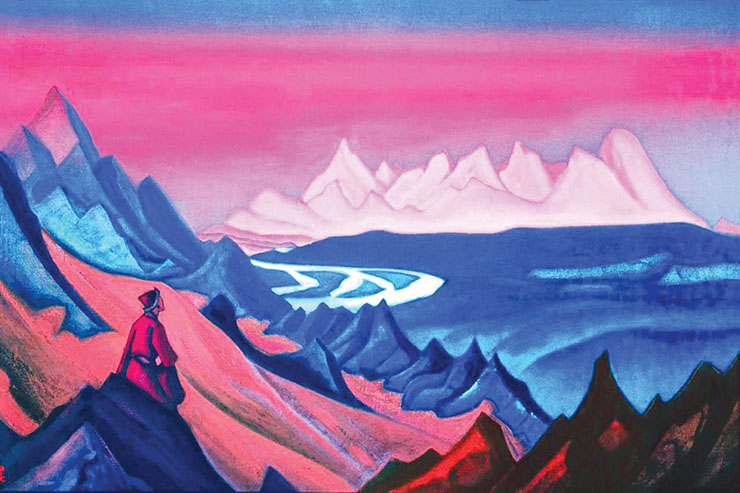
    Roerich kept a diary during the trip (published as Altai-Himalaya: A Travel Diary)15 and, while in Mongolia, noted that, “belief in the imminence of the era of Shambhala was very strong.” In his book, Heart of Asia, Roerich describes both his scientific observations and his personal spiritual quest. Although he was ready to listen to tales of underground cities as part of the adventure, his main interest centred on the spiritual dynamics of Shambhala and its importance as a symbol of the coming age of peace and enlightenment. This blending of the scientific and the spiritual is also present in the hundreds of paintings Roerich made throughout the expedition.

    “His eye captured the shapes and colours of the mountains, monasteries, rock carvings, stupas, cities and peoples of Asia,” writes Jaqueline Decter inNicholas Roerich. “His soul understood their spirit; and his brush forged a synthesis of beauty.” Throughout his life, Roerich strove to link all scientific and creative disciplines to advance true culture and international peace, citing the power of art and beauty to accomplish such a feat.

    The Roerich Peace Pact, which obligated nations to respect museums, cathedrals, universities and libraries as they did hospitals, was established in 1935 and became part of the United Nations organisational charter. The connection between Shambhala and the Peace Pact is clearly evident in the following speech given at the Third International Roerich Peace Banner Convention in 1933:

    The East has said that when the Banner of Shambhala would encircle the world, verily the New Dawn would follow. Borrowing this Legend of Asia, let us determine that the Banner of Peace shall encircle the world, carrying its word of Light, and presaging a New Morning of human brotherhood.16

    “Today,” notes LePage, “every major Russian city has a Roerich organisation that expresses his ideas for a new type of enlightened civilisation based on the utopian principles of Shambhala.”17

    The Sign of Shambhala

    Shambhala itself is the Holy Place, where the earthly world links with the highest states of consciousness. In the East they know that there exists two Shambhalas – an earthly and an invisible one.
    – Nicholas Roerich, The Heart of Asia

    Nicholas Roerich and party set out in 1924 to explore India, Mongolia and Tibet. Like Ossendowski before him, Roerich soon encountered stories about a secret underground kingdom. He jotted down his thoughts on this hidden kingdom and these notes were later published in a remarkable record of the expedition entitled Altai-Himalaya: A Travel Diary.18

    In the summer of 1926, Roerich reported a strange event in his travel diary. He was encamped with his son, Dr. George Roerich, and a retinue of Mongolian guides in the Sharagol valley near the Humboldt mountain chain between Mongolia and Tibet. At the time of the event in question, Roerich had returned from a trip to Altai and built a stupa, “a stately white structure,” dedicated to Shambhala.

    In August the shrine was consecrated in a solemn ceremony by a number of notable lamas invited to the site for the purpose, and after the event, writes Roerich, the Buriat guides forecast something auspicious impending. A day or two later, a large black bird was observed flying over the party. Beyond it, moving high in the cloudless sky, a huge, golden, spheroid body, whirling and shining brilliantly in the sun, was suddenly espied. Through three pairs of binoculars the travellers saw it fly rapidly from the north, from the direction of Altai, then veer sharply and vanish towards the southwest, behind the Humboldt mountains.

    One of the lamas told Roerich that what he had seen was “the sign of Shambhala,” signifying that his mission had been blessed by the Great Ones of Altai, the lords of Shambhala. They had also been witness to a classic UFO, twenty years before the “official” beginning of the phenomenon with Kenneth Arnold’s sighting in 1947.

    Roerich’s account of such a sighting aroused great interest in Europe and, corroborated as it was by George Roerich, brought to the West the first concrete evidence that there might be something present in Eurasia that defied understanding. Victoria LePage describes its significance as such:

    In its vivid colour and factuality, its bizarre but unarguable reference to an unknown golden aircraft that behaved as no ordinary airplane could, the Roerich story could rightly be called the first reliable intimation that the kingdom of Chang Shambhala was perhaps knowable as more than an intellectual curiosity, a popular Asian fable… and from about 1927 onward the world centre in the northern mountains exerted on Western occult circles the fascination of an idea whose time has come.19

    Which brings us to the very nature of reality. Paranormal experiences, including UFO sightings, are always indicative of an altered state of consciousness that allows the witness to see other realities. Often the experience is similar to a lucid dream, where ordinary space-time physics no longer applies.

    The Eastern mystical view of the world can be quite different from the Western scientific view of it. It maybe that the guidebooks to Shambhala are describing a landscape transformed by the visions of a yogi taking the journey there: Where we would see a mountaintop gleaming with snow, he would see a golden temple with a shining god. In that case, we might be able to travel the same path, but with a different view of reality.

    To travel to Shambhala, as Nicholas Roerich journeyed, is to undertake at one and the same time an inner mystical journey and an outer physical one through desolate and mountainous territory to a cosmic powerhouse.

    An old Tibetan story tells of a young man who set off on the quest for Shambhala. After crossing many mountains, he came to the cave of an old hermit, who asked him, “Where are you going across these wastes of snow?”

    “To find Shambhala,” the youth replied.

    “Ah, well then, you need not travel far,” the hermit said. “The kingdom of Shambhala is in your own heart.”20

    [alert type=”general” dismiss=”no”]This article was published in New Dawn 72.[/alert]

    [alert type=”success” dismiss=”no”]If you appreciate this article, please consider subscribing to help maintain this website.[/alert]

    Footnotes:

    1. Edwin Bernbaum, The Way to Shambhala: A Search for the Mythical Kingdom Beyond the Himalayas, 2001, p.25.
    2. Joscelyn Godwin, Arktos: The Polar Myth in Science, Symbolism and Nazi Survival, 1993, p.83.
    3. Subterranean Worlds: 100,000 Years of Dragons, Dwarfs, the Dead, Lost Races & UFOs from Inside the Earth, Walter Kafton-Minkel, 1989, p.188.
    4. Joscelyn Godwin, Arktos: The Polar Myth in Science, Symbolism and Nazi Survival, 1993, p.85.
    5. Ferdinand Ossendowski, Beast, Men and Gods, 1922, p.300.
    6. Ibid, p.300.
    7. Ibid, p.303.
    8. Ibid, p.300.
    9. Ibid, p.118.
    10. Alec Maclellan, The Lost World of Agharti, The Mystery of Vril Power, 1982, p. 66.
    11. Victoria LePage, Shambhala: The Fascinating Truth Behind the Myth of Shangri-la, 1996, p.11.
    12. See New Dawn No. 68, p. 85.
    13. Victoria LePage, Shambhala: The Fascinating Truth Behind the Myth of Shangri-la, 1996, p.10.
    14. Andrew Tomas, Shambhala: Oasis of Light, 1976, p.32.
    15. Nicholas Roerich, Altai-Himalaya: A Travel Diary (1929); Other books by Roerich: The Heart of Asia (1930); Shambhala (1930)
    16. Speech by Francis Grant in The Roerich Pact and Banner of Peace, 1947
    17. Victoria LePage, Shambhala: The Fascinating Truth Behind the Myth of Shangri-la, 1996, p.12.
    18. Nicholas Roerich, Altai-Himalaya: A Travel Diary (1929).
    19. Victoria LePage, Shambhala: The Fascinating Truth Behind the Myth of Shangri-la, 1996, p.12.
    20. As quoted in Edwin Bernbaum, The Way to Shambhala: Jacques Bacot, Introduction a l’histoire du Tibet, 1962, p.92N.

    © New Dawn Magazine and the respective author.
    For our reproduction notice, click here.
  • Lost Technology of the Ancients: The Crystal Sun

    Lost Technology of the Ancients: The Crystal Sun

    From New Dawn 65 (Mar-Apr 2001)

    The ancient Greek Pythagoreans of the 5th century BC believed that the sun was a gigantic crystal ball larger than the earth, which gathered the ambient light of the surrounding cosmos and refracted it to earth, acting as a giant lens.

    A giant lens? In the 5th century BC? Perhaps it was because nobody until now has been willing to recognise that lenses existed in antiquity, and that the crystal sun idea was overlooked, and has never been described in any books on the history of science or philosophy. However, it appears in my book The Crystal Sun.

    What, then, is all this about ancient lenses? Surely some mistake?!

    The fact is that I have located more than 450 ancient lenses in museums all round the world, and I even own a Greek crystal lens of the 6th century BC myself. Photos of many of these ancient lenses appear in my book. Anyone interested in full details of the actual lenses themselves should obtain the hardback edition of my book, because ten appendices full of such detailed information have been omitted from the paperback because the book was too thick.

    Ancient lenses! Well, how far back do they go? The earliest actual lenses which I have located are crystal ones dating from the 4th Dynasty of Old Kingdom Egypt, circa 2500 BC. These are to be found in the Cairo Museum and two are in the Louvre in Paris. But archaeological evidence showing that they must have been around at least 700 years earlier has recently been excavated at Abydos in Upper Egypt. A tomb of a Pre-Dynastic king there has yielded an ivory knife handle bearing a microscopic carving which could only have been done under considerable magnification (and of course can only be seen with a strong magnifying glass today). Thus, we know that magnification technology was in use in Egypt in 3300 BC. I reproduce both photos and drawings of this crucial evidence.

    But magnification technology was not of interest merely for making and viewing small carvings. Its most important use was in telescopes. In fact, on the jacket of my book the reader will encounter an ancient image of someone looking through a telescope. This is a photo I took of a fragment of a Greek pot excavated about twenty years ago at the Acrocopolis in Athens, and dating to about the 6th century BC.

    If there is all this evidence, why has no one ever talked about it before? The answer seems to be that unique capacity for stupidity which so distinguishes the human race, for obstinacy and the determination not to see. I call it consensus blindness. Everybody agrees not to look at things that make them uncomfortable, or which they think shouldn’t exist. Therefore, the fact that more than 450 ancient lenses have been sitting around in the world’s museums for all of these years and have been invisible is explicable only by invoking the theory that people subconsciously conspire not to see what they don’t want to see.

    It is not as if I have come up with a little bit of vague evidence and want to use it to construct some wacky theory of my own. There are plenty of people crying in the wilderness with theories based on a little bit of disputed evidence. That is not the case with my book at all. I am standing right in the centre of the town square surrounded by a mountain of evidence which can only be ignored if people are so determined to look the other way that they are prepared to walk around with their necks crooked.

    I attended the 8th International Congress of Egyptologists in Cairo in the spring of 2000, and went prepared to deliver a paper on ancient Egyptian optical technology. But I was not allowed to deliver it. I was told there was ‘no appropriate category’. Alas, it is true that there was no such category, as I was the only historian of science present at the Congress of 1500 people, a fact which I found rather depressing.

    It might be worthwhile to review just why my discoveries are so important for Egyptology, and everyone interested in the pyramids needs to know about them as well.

    First of all, there is the famous question of the orientation of the Great Pyramid. It is so perfectly oriented to the geographical points of the compass that no one has ever been able to understand how this was done, for the accuracy exceeds any hitherto known technology of ancient Egypt.

    Then there is the equally famous question of how the extreme accuracy of the construction of the Great Pyramid was possible. In 1925, J. H. Cole discovered in his survey that the great pavement, upon which the Great Pyramid partially rests and which surrounds it, is flat to within 15 mm. Earlier scholars had commented that the accuracy of the surface of the Great Pyramid was equivalent to the accuracy of the grinding of an optical reflective mirror in a giant modern telescope. The original (now largely destroyed) casing stone sides of the structure have been compared in their precision to the mirror of the Mount Palomar Telescope. How were such feats accomplished?

    Back in the 1960s and 1970s, the Argentine physicist Jose Alvarez Lopez claimed that it was physically impossible for the Great Pyramid to have been constructed without extremely accurate optical surveying techniques such as are used in theodolites. I met Lopez in the 1970s and he told me this himself, arousing my interest in this question for the first time. But Lopez said to me sadly that he could not find any evidence for any ancient optical technology, so it was all a mystery.

    Well, it is a mystery no longer.

    The Great Pyramid was clearly surveyed with early forms of optical surveying instruments that we could call proto-theodolites. This is all described at great length in my book, and I urge anyone interested in the pyramids to read all about it.

    I have proved from archaeological evidence that the technology for surveying the Great Pyramid existed at least as far back as 3300 BC, and doubtless earlier than that, since we can hardly presume that the ivory knife handle was the first such object to exist, as it is already highly sophisticated and suggests a long-standing tradition.

    I was surprised as I strolled through the museums of the world and saw ancient lenses on public display labelled as all kind of crazy things – as anything but lenses! When I went to study ancient Greek lenses in the Department of Classical Antiquities at the British Museum, I met one member of the staff who insisted that there never were any ancient Greek lenses. (This is despite the fact that Aristophanes describes one in his play The Clouds, and there are countless ancient references to optical technology in the ancient literature, which I have combed exhaustively and described in my book.) I then proceeded to photograph and measure some ancient Greek lenses in that very room, which the person concerned refused to acknowledge, and I thought more than a little ironic that there is a display cabinet standing just outside the door to the room containing ancient Greek lenses mis-labelled as ‘counters’, and which can be seen clearly magnifying the strands of the cloth underneath them.

    When I was in the Athens Archaeological Museum studying Mycenaean lenses, which were clearly on display in the Mycenaean Room (where they are mis-labelled), I could not help but be aware that a former Deputy Director of the same museum had written an article about an apparent crystal lens which he had himself excavated on Crete, but he neglected to mention in his article that his own museum had many such lenses in display cabinets which anyone could walk into the museum and see on any day of the week.

    Ancient lenses tended to be of rock crystal until Carthaginian and Roman times, beginning about the 4th century BC, after which glass lenses became more common (being much cheaper), and crystal lenses then became rare.

    I discovered significant numbers of ancient British lenses, mis-catalogued in mineral collections; they had been moved to geological museums from their original archaeological collections and were thought to be ‘crystal specimens’! Some of them were most ingenious, and had what I called ‘resting-points’ protruding from their backs so that they could rest on a surface and an artisan could reach his cutting tool round the back and have both hands free for his work. In ancient Troy, one crystal lens excavated by Schliemann had a hole in the centre. Some people thought this was an argument for claiming that the lens in question was ‘useless’ because it was perforated in the middle and thus clearly no lens. However, the hole in the centre in no way interferes with the magnification, and offers an extremely clever way for an artisan to insert his cutting tool directly through the middle of the magnifier, and have magnification of his work all around it in a circle!

    Schliemann excavated about 48 crystal lenses at Troy, but these all disappeared during the Second World War, and all that remained were catalogue descriptions and a single photo of four of the lenses in a group (reproduced in my book). I tried for many years to find these missing lenses, and a friend who various times approached the museum in East Berlin where the lenses were last known to have been stored was repeatedly lied to and told that the lenses had ‘been destroyed by Allied bombing in the War’. But of course all this was complete rubbish. When the truth finally came out about the missing Trojan gold hoard found by Schliemann, and that the Red Army had seized it and taken it back to Russia, I suspected the lenses were probably with the gold. And indeed they were. But I have never been granted access to them; the Russians are afraid the Germans will claim them back, and so they won’t let scholars have normal opportunities to study them.

    To return to the subject of the ancient British lenses, I should mention that they provide the missing physical evidence that the late Professor Alexander Thom was looking for when he said the accuracy of the astronomical observations of the ancient Britons exceeded the capacities of the naked eye, and he wondered about their optical technology. We now have the lenses that seem to fill Thom’s need. Indeed, there are good reasons for suspecting that the real purpose of the trilithon lintels at Stonehenge were to support a wooden observation platform for telescopic observations of the moon. In other words, Stonehenge would have been domed. I present the evidence for all of this in my book at some length.

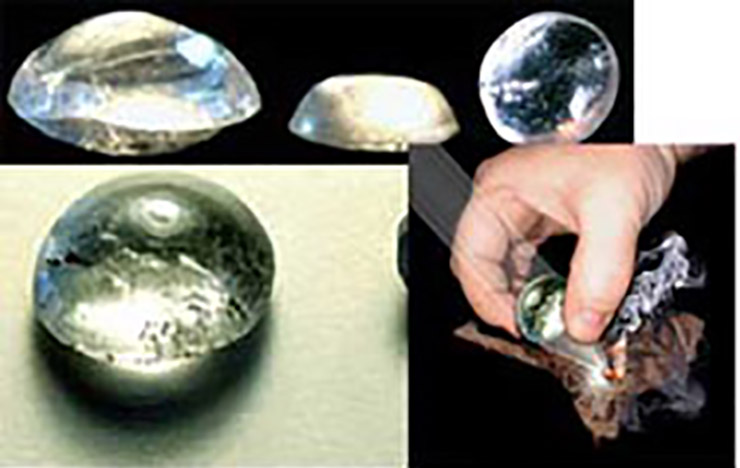
    The only group of archaeologists who wholly and enthusiastically welcomed my findings into early optics were the Scandinavian ones, in particular the Swedish archaeologists. Far from being put out with my findings, they were delighted by them. I made very extensive studies of the Viking lenses, and recently one of my articles has been published in Swedish translation in the Swedish archaeological annual, Gotlдndskt Arkiv (Vol. 72 for the year 2000). The Vikings were the last of the ancients, as far as optical technology went, and they accomplished miracles of crystal engineering. They actually produced crystal lenses as small as water drops that could magnify three times. I call their achievements ‘micro-optical technology’.

    Although my discoveries about ancient Chinese optical technology were rather limited (extracts from ancient texts plus reports of six excavated ancient lenses which I was unable to inspect personally, in one case because of floods preventing me from getting to a provincial museum), The Crystal Sun is being translated into Chinese and I have been asked to lecture about it at China’s leading technical university, Tsinghua University in Beijing, of which I am a Fellow.

    My resources not being infinite, I never travelled to Mexico and Peru to inspect the ancient crystal lenses which apparently are to be found there, so the New World is not well represented in my account. I hope others will remedy this deficiency one day. I do, however, have a special account of the so-called ‘Skull of Doom’, a life-sized crystal skull of Maya origin, in my book, since it was the first ancient crystal object I ever studied, when I was 18 years old!

    There is much weird lore in my book, so much so in fact that it cannot all be absorbed as casual reading. I have written a long chapter on the subject of ‘thunderstones’, and another on meditative hallucinations, all of which are linked in wonderful ways to ancient optical ideas. I give a lot of attention to the religious traditions associated with light, from ancient Egypt down through the ‘light-theology’ of Christians like Robert Grosseteste in the Middle Ages.

    But it is not only light that is considered in The Crystal Sun. Shadows are equally important. In ancient Egypt, the science of shadows was far advanced and highly precise. And in this connection I have made a major discovery, which is shown in a photograph taken on 21 December. For I found that there is a special winter solstice sunset shadow cast upon the south face of the Great Pyramid, which nobody had ever noticed before, despite the fact that it has been clearly visible once a year for at least 3500 years. Just think, 3500 missed opportunities!

    As the Gnostic Gospel of Thomas likes to say, ‘Those who have ears to hear, let them hear.’ I would extend this to say: ‘Those who have eyes to see, let them damned well start using them! It would make a change!’

    What is this winter solstice shadow, then? It is a shadow cast by the second pyramid, known as the Pyramid of Khafre (or Chephren, which is the Greek form of the name), upon the Great Pyramid at sunset on 21 December.

    But the mere fact that one pyramid casts a shadow on another is not the point. What is important is the nature of that shadow. And here is where it all gets very interesting. Anyone who has made a study of the interior of the Great Pyramid will be aware that both the ascending and descending passages inside the structure have the same slope, a curious angle of slightly more than 26 degrees. This in itself might seem a bit odd. But bearing in mind how the ancient Egyptians loved a good tease, it was wonderfully amusing and surprising for me to discover that at sunset on the winter solstice they had chosen to project a giant shadow on the exterior of the same structure having the same slope as the passages concealed on the inside!

    It was a bit of a game, surely: what you see on the outside is what you get on the inside, but you can only realise this if you already know it in advance! In other words, it was for the initiated only. They could have their little laugh to themselves, but nobody else knew what the hell was going on.

    I also managed to demonstrate that the ascending passage leading up to the causeway from the Valley Temple beside the Sphinx also has this same slope. Its slope had never been considered or measured before. And yet the fact that its slope is the same as the ascending and descending passages of the Great Pyramid surely indicates a common canon of design for the two structures, at the very least.

    If the Egyptians were really intending to cast a shadow on the outside of the Great Pyramid which secretly indicated the nature of the slopes to be found in the concealed interior, then there are important consequences to be considered: it means that the Pyramid of Khafre had to be the precise size it is, and in precisely the position it is, for this shadow to be correctly cast.

    That is rather a lot of stone to lug around, just to cast a shadow.

    So isn’t there something more to this than just the common slope angle? Well, yes, there is indeed. It just so happens that this odd angle of slightly more than 26 degrees is the only acute angle possible for a right triangle to be formed that is known as ‘the golden triangle’, because it embodies the famous Golden Mean Proportion. And it also just so happens that the Golden Mean Proportion is at the basis of the entire canon of ancient Egyptian art and architecture, as I also explain in my book at some length. And in fact, the shadow if truncated by a vertical line running up the middle of the south face of the Great Pyramid, does actually form a golden triangle, which once again is mirrored on the inside, because it is a similar golden triangle which determines the precise point of commencement of the Grand Gallery on the interior of the pyramid, as I show in a drawing in my book. And as for the vertical line running up the pyramid, that too is real, and has been shown from an aerial photograph, although it is invisible to the naked eye or by any perceptual means at ground level. There is actually a purposeful slight indentation of a few inches in the construction of the side of the pyramid, discovered in measurements made by Petrie. This ‘apothegm’, as geometers call such vertical lines, forms the right angle to transform the solstice shadow into a perfect golden triangle.

    So we see here the Egyptians were playfully carrying on with their geometric obsessions in full view of the world, casting giant shadows in golden mean proportion, but for at least 3500 years nobody noticed.

    All this blindness! What more have we not noticed?

    I hope that people will dip into, if not fully read, The Crystal Sun, because all of these findings are important and need to be known. I was disappointed not to be able to speak at the Cairo Conference and reveal some of these findings to the Egyptologists. For instance, I was able to demonstrate the existence and use of diamond-tip drills in Egypt, but they are so small they can easily be overlooked, just as the much larger lenses always have been. I wanted to warn the diggers that those dirty little objects that might seem like tiny dark pebbles could be diamond drill tips. But alas, they still don’t know.

    One of the lessons from all of this is surely the need for archaeologists not to close their eyes to scientific subjects. They have always been reluctant to study the fundamentals of astronomy, so the field of ‘archaeo-astronomy’ is one of struggle and travail, making relatively little headway in the academic community, despite heroic efforts on the part of a few scholars. But as for ‘archaeo-optics’, as its sole investigator, I fear we have a long way to go before its implications will get through to other scholars. And so, I ask you as readers to help out, by calling these things to the attention of anyone you know, and beating some friendly drums. Let’s get the news out!

    [alert type=”general” dismiss=”no”]This article was published in New Dawn 65.[/alert]

    [alert type=”success” dismiss=”no”]If you appreciate this article, please consider subscribing to help maintain this website.[/alert]

    © New Dawn Magazine and the respective author.

    For our reproduction notice, click here.
  • Hyperborea & the Quest for Mystical Enlightenment

    Hyperborea & the Quest for Mystical Enlightenment

    From New Dawn 58 (Jan-Feb 2000)

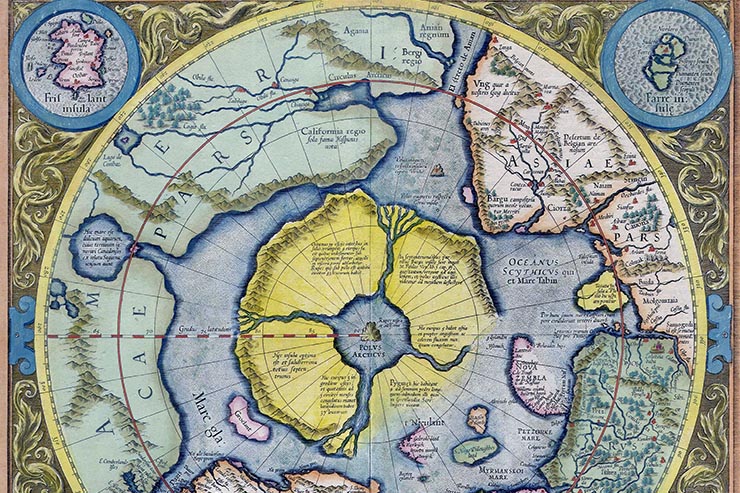
    Far north, somewhere near the icy regions of the North Pole, legend speaks of an ancient and mostly forgotten civilisation. Mythical in character, the Hyperborean civilisation is said to have flourished in the northern most region of planet Earth at a time when the area was suitable for human habitation.

    According to certain esoteric systems and spiritual traditions, Hyperborea was the terrestrial and celestial beginning of civilisation. The home of original Man. Some theories postulate Hyperborea was the original Garden of Eden, the point where the earthly and heavenly planes meet. And it is said Man transgressed Divine Law in this Golden Age civilisation, the ultimate price being his banishment to the outside world. Man ventured into other regions of Earth, establishing new civilisations, bringing to an end this great and glorious Golden Age.

    The Golden Age is central to manifold ancient traditions and myths. Significantly, the Golden Age appears most frequent in the traditions of cultures stretching from India to Northern Europe — the area directly beneath the Polar regions. Joscelyn Godwin, in Arktos, The Polar Myth in Science, Symbolism and Nazi Survival, says:

    The memory or imagination of a Golden Age seems to be a particularity of the cultures that cover the area from India to Northern Europe… But in the ancient Middle East there is an obvious relic of the Golden Age in Genesis, as the Garden of Eden where humanity walked with the gods before the Fall. The Egyptians spoke of past epochs ruled by god-kings. Babylonian mythology… had a scheme of three ages, each lasting while the vernal [Spring] equinox precessed through four signs of the zodiac; the first of these, under the dominion of Anu, as a Golden Age, ended by the Flood. The Iranian Avesta texts tell of the thousand-year Golden Reign of Yima, the first man and the first king, under whose rule cold and heat, old age, death and sickness were unknown.1

    The most fully developed theory of this kind, and probably the oldest one, is the Hindu doctrine of the Four Yugas. The four ages in this system are the Krita or Satya Yuga (four units), Treta Yuga (three), Dvapara Yuga (two), and Kali Yuga (one), the whole tenfold period making up one Mayayuga. The Kritayuga corresponds to the Golden Age, the Kali Yuga to the current period of time.

    Every description of the Golden Age period relates how the ‘gods’ walked with men in a perfect and harmonious environment balanced between the terrestrial and celestial. Humanity suffered no sickness and no aging in this timeless paradise. After the Fall, man ‘fell’ into Time and suffering, forfeiting the gift of immortality.

    Madame Blavatsky, the founder of Theosophical Society, claimed the ‘second root race’ originated in Hyperborea, before the later races of Lemuria and Atlantis. The Russian metaphysician Alexandre Dugin says that it was the home of the “solar people”, connected to what is now northern Russia. “Solar people,” Alexandre Dugin explains, are a “cultural-spiritual type” who are creative, energetic and spiritual. They are the opposite of “lunar people”, a psycho-spiritual type who are materialistic, conservative and wary of change.

    The ancient Greeks had a legend of Hyperborea, a land of perpetual sun beyond the “north wind”. Hecataeus (circa 500 BC) says that the holy place of the Hyperboreans, which was built “after the pattern of the spheres”, lay “in the regions beyond the land of the Celts” on “an island in the ocean.” According to popular accounts, the God Apollo’s temple at Delphi was founded by individuals from Hyperborea. The Greek lyric poet Alcaeus (600 BC) sang of the actual or mystical journey of Apollo to the land of the Hyperboreans:

    O King Apollo, son of great Zeus, whom thy father did furnish forth at thy birth with golden headband and lyre of shell, and giving thee moreover a swan-drawn chariot to drive, would have thee go to Delphi… But nevertheless, once mounted, thou badest thy swans fly to the land of the Hyperboreans.

    The wearing of a star-embroidered robe by the King and ‘Ruler of the World’ — the heavenly sphere serving as a symbol of the earthly one — is a custom that can be traced to the Hyperboreans. Embroidered in gold on blue silk were the figures of the sun, moon and stars. Such robes were worn by the kings of Ancient Rome and Julius Ceasar, as well as Augustus and the Roman Emperors.

    Earthenware statuettes found in a grave in Yugoslavia show the ‘Hyperborean Apollo’ in a chariot drawn by swans. The god wears, on his neck and breast, yellow figures of the sun and stars; on his head is a rayed crown with a headband that has a zigzag pattern. His robe, which reaches to the ground, is dark blue with yellow designs.

    Collapse of Hyperborea

    One of the most popular theories for the collapse of Hyperborea was a physical inclination (catastrophe) of the Earth’s axis. Man’s transgression of Divine Law caused a shift in the metaphysical balance, the effect of which was catastrophic on the Earth plane. Julius Evola, the noted Italian metaphysician, explains that at this point the first cycle of history closed, and that of the second, the Atlantean, began:

    The memory of this Arctic seat is the patrimony of the traditions of many people, in the form either of real geographic allusions, or of symbols of its function and original significance, often transferred to a super-historical significance, or else applied to other centres that may be considered as copies of the original one… Above all, one will notice the interplay of the Arctic theme with the Atlantic theme… It is known that the astrophysical phenomenon of the inclination of the earth’s axis causes a change of climate from one epoch to another. Moreover, as tradition tells, this inclination took place at a given moment, and in fact through the alignment of a physical and a metaphysical fact, as if a disorder in nature were reflecting a certain situation of a spiritual order… At any rate, it was only at a certain moment that ice and eternal night descended on the polar region. Then, with the enforced emigration from that seat, the first cycle closed and the second opened, initiating the second great era, the Atlantean Cycle.2

    The memory of a Golden Age, although rendered in an archetypal or mythological form, serves a super-historical purpose. This is why the remembrance of the ancient civilisation of Atlantis is sometimes enmeshed with that of Hyperborea. We cannot expect to ‘prove’ the physical existence of these civilisations. All myths are known to have a historical basis. Transmitted primarily by oral tradition, they are wrapped in a catchy and simple tale that ensures their survival and transmittal down through the ages. Myth serves an extremely vital function — a recollection of our beginnings, a knowledge of where we are heading, and what we are supposed to do. It is only now in the Kali Yuga that we have disconnected from tradition, losing the ability to correctly interpret and understand myths with historical kernels of truth.

    Hyperborea Revived

    The legend of Hyperborea revived during the 18th and 19th centuries when a flurry of books were published dealing with the idea that civilisation had first appeared not in the Middle East, but somewhere else.

    The popular theory of the day postulated that the so-called ‘Aryans’ (Europeans) were superior and more intelligent than Semites (Middle East peoples). Therefore, logically, civilisation could not have originated in the Middle East and Hebrew was probably not the first language.

    The Frenchmen of the Enlightenment were in no doubt that “Eden” was situated on higher ground. The Germans similarly, who were looking for their Aufklarung, also sought to be free of a history tied to the Mediterranean and Middle East regions. British and German scholars studied ancient Indian (Vedic) civilisation and leant the Sanskrit language. Many believed Sanskrit the original language of the ‘Aryans’.

    With new sources of knowledge from ancient Egypt, Chaldea, China and India, researchers were treading on dangerous ground as far as questioning Man’s origins. Biblical history was still strictly upheld and moving too far from this historical boundary could have you silenced.

    Writers such as Jean-Sylvain Bailly (1736-1793), the Rev. Dr. William Warren (1800s), Bal Gangadhar Tilak (1856-1929) and H.S. Spencer (1900s), developed out theories, often borrowing from earlier sources, attempting to prove man’s origins in the Polar region.

    Tilak’s book Arctic Home (published 1903) begins by stating the well known fact that warm weather remains in the Arctic regions, which shows the climate was far different during the interglacial period. According to Tilak, scientists do concede the existence, in the past, of a warm circumpolar continent, and the circumstances there would not have been nearly unfavourable as imagined.

    Tilak was convinced the ancient Indian Vedic texts point unmistakably to a “realm of the gods” where the sun rises and sets once a year, showing that their writers could understand the astronomical conditions at the North Pole.

    Tilak, who had a perfect mastery of Vedic language, placed the original Arctic home existing around circa 10,000 BC, just prior to its destruction and the beginning of the last Ice Age.

    His book had little impact in the West but was popular in India. When the learned Zoroastrian H.S. Spencer wrote his book The Aryan Ecliptic Cycle (1965), a development of Tilak’s work, he was able to obtain endorsements from Sir S. Radhakrishna, then President of India. As well as from dignitaries of the Theosophical Society in Adyar and the Sri Aurobindo Ashram in Pondichary.

    Spencer’s approach commenced not with the Vedic but the Zoroastrian scriptures, going further than Tilak in tracing the progress of the ‘Aryans’ from the North to their new homes, and the schisms that beset them on the way.

    Spencer’s ‘Aryans’ made their presence felt after they travelled far and wide. They moulded the religions and cultures of Egypt, Sumeria, Babylon, and of the Semites, hitherto worshippers of feminine lunar deities.

    However, the search for a terrestrial ‘Hyperborea’ by many researchers and the movement of an original ‘race’ has been extremely difficult and presumptuous. Proving human habitation possible at the North Pole somewhere between 8000 and 10,000 BC is no mean feat, particularly if you were living in the 18th century. The numerous theories posited offering contradictory or tendentious ‘evidence’ has served only to discredit the whole notion of Hyperborea. The same could be said of theories attempting to prove the existence of the ‘lost continent of Atlantis’. The drive to prove the actuality of a terrestrial Hyperborea has overshadowed its occult and symbolic importance.

    The Spiritual Pole

    In the quest to discover the ‘physical’ location of Hyperborea, most writers overlooked the possibility that the mythology served a special symbolic and spiritual purpose. What if the truth behind the legend was esoteric, and not exoteric as some even today still maintain?

    Many traditions speak of a supreme spiritual centre or ‘supreme country’. The ‘supreme country’ that does not necessarily lay at a specific earthly point, but exists in a primordial state, unaffected by terrestrial cataclysms.

    The ‘supreme country’, commonly regarded as ‘polar’ in orientation, symbolically is always represented as being at the ‘Axis of the world’ — and in most cases is referred to as a ‘Sacred Mountain’. Rene Guenon in his book The Lord of the World says:

    Almost every tradition has its name for this mountain, such as the Hindu Meru, the Persian Alborj, and the Montsalvat of Western Grail legend. There is also the Arab mountain Qaf and the Greek Olympus, which has in many ways the same significance. This consists of a region that, like the Terrestrial Paradise, has become inaccessible to ordinary humanity, and that is beyond the reach of those cataclysms which upset the human world at the end of certain cyclic periods. This region is the authentic ‘supreme country’ which, according to certain Vedic and Avestan texts, was originally sited towards the North Pole, even in the literal sense of the word. Although it may change its localisation according to the different phases of human history, it still remains polar in a symbolic sense because essentially it represents the fixed axis around which everything revolves.3

    The Vedic texts say the ‘supreme country’ is known as Paradesha, also called the ‘Heart of the World’. It is the word from which the Chaldeans formed Pardes, and Westerners Paradise.

    There is notably another name for it probably even older than Paradesha. This name is Tula, called by the Greeks Thule. Common to regions from Russia to Central America, Tula represented the primordial state from which spiritual power emanated.

    It is known that the Mexican Tula owes its origin to the Toltecs who came, it is said, from Aztlan, the ‘land in the middle of the water’, which is evidently Atlantis. They brought the name Tula from their country of origin and gave it to a centre which consequently must have replaced, to a certain extent, that of the lost continent. On the other hand, the Atlantean Tula must be distinguished from the Hyperborean Tula, which latter represents the first and supreme centre….4

    In this case — Tula — representing a centre of spiritual authority — does not remain fixed in a geographical location. Guenon states that the Atlantean cycle, successor to the Hyperborean cycle, is associated with Tula. The Atlantean Tula is an image of the original primordial state situated in a northern or Polar location. As world cycles progress onward, the supreme seat of spiritual power regresses further and further into hiding and obscurity. This, of course, is deliberate and predictable as humanity descends into the end of the age (Kali Yuga), progressively enmeshing itself in the material plane until the reversal of established world order is imposed.

    It should be emphasised here that Tula, or the centre of spiritual authority, constitutes the fixed point known symbolically to all traditions as the ‘pole’ or axis around which the world rotates. Metaphysically speaking, the world rotates around this seat of power even if it’s not geographically North or South.

    In the Buddhist tradition ‘Chakravarti’ literally means “He who makes the wheel turn”, which is to say the one who, being at the centre of all things, directs all movement without himself participating, or who is, to use Aristotle’s words, the “unmoving mover”.

    The turning of the world, the ‘Pole’ and axis, combine to depict a wheel in the Celtic, Chaldean and Hindu traditions. Such is the true significance of the swastika, seen worldwide from the Far East to the Far West, which is intrinsically the ‘sign of the Pole’.

    The Pole and Mystical Enlightenment

    It is in medieval Iran that we find extant literature on the Spiritual Pole and the experience of mystical ascent to it. The Iranian Sufis, drawing not only on Islam but on the Mazdean, Manichean, Hermetic, Gnostic and Platonic traditions, blended a sacred knowledge said to be ‘scientific’, mystical and philosophically practical.

    Esoterically… the Persian theosophers situated their “Orient” neither to the East, nor to the South, wither they faced in prayer towards the Ka’ba. “The Orient sought by the mystic, the Orient that cannot be located on our maps, is in the direction of the north, beyond the north.” [The Man of Light in Iranian Sufism by Henry Corbin, 1978] About this Pole reigns a perpetual Darkness, says the Recital of Hayy ibn Yaqzan, one of the visionary recitals of Avicenna (Ibn Sina). “Each year the rising sun shines upon it at a fixed time. He who confronts that Darkness and does not hesitate to plunge into to it for fear of difficulties will come to a vast space, boundless and filled with light.” [Ibid] This Darkness, says Corbin, is the ignorance of the natural man. “To pass through it is a terrifying and painful experience, for it ruins and destroys all the patencies and norms on which the natural man lived and depended…” [Ibid] But it must be faced consciously before one can acquire the saving gnosis of the light beyond.

    The Darkness around the Pole, annually pierced by the sun’s rays, is at once terrestrial and symbolic. On the one hand, this is the situation at the North Pole, where there are six months of night and six of day. It is characteristic of esoteric tradition that the same image is valid on two or more levels. But as Corbin and Guenon never tired of pointing out, the symbolic level is not a fanciful construct on the basis of hard terrestrial fact: it is quite the other way round. In the present case, the mystical experience of penetrating the Darkness at the Pole is the fundamental reality and the authentic experience of the individual. The fact that the set-up of the material world reflects the celestial geography is what is contingent. In brief, in this teaching as in Platonism, it is the supersensible realm that is real, and the material realm that is a shadow of it.5

    The seeker, through deep meditation on spiritual matters, succeeds in entering a world of mystical experience, and makes a pilgrimage to Hyperborea that can not be discovered from maps. Aristeas, the Greek poet, in shamanic rapture, is said to have travelled to Hyperborea while “possessed by Apollo”. Mystical soul-travel to Hyperborea is common in ancient Greek literature.

    The journey to this Pole is sometimes illustrated as the ascent of a column of light, extending from the depths of hell to the lucid paradise in the cosmic North.

    As previously mentioned, the Pole is also a Mountain, called Mount Qaf in Islamic tradition, whose ascent, like Dante’s climbing of the Mountain of Purgatory, represents the pilgrims progress through spiritual states.

    Guenon, in The Lord of the World, explains “the idea evoking the representation under discussion is essentially one of ‘stability’, that is itself a characteristic of the Pole.” The Mountain, referred to as an ‘Island’, “remains immovable amidst the ceaseless agitation of the waves, a disturbance that reflects that of the external world. Accordingly, it is necessary to cross the ‘sea of passions’ in order to reach the ‘Mount of Salvation’, the ‘Sanctuary of Peace’.”

    Our search for Hyperborea is our desire to return to Paradesha or Paradise — the primordial spring of Man’s original existence. The importance of knowing the terrestrial location of a lost civilisation at the northern regions is thus overshadowed by its symbolic relevance.

    To seek Hyperborea is to quest for spiritual enlightenment. The Mountain, the Island, the immovable Rock, fixed in a Polar orientation, relays a symbolic representation of our search for Ultimate Reality. Its immovability anchors us to this important task.

    [alert type=”general” dismiss=”no”]This article was published in New Dawn 58.[/alert]

    [alert type=”success” dismiss=”no”]If you appreciate this article, please consider subscribing to help maintain this website.[/alert]

    Footnotes:

    1. Arktos, The Polar Myth in Science, Symbolism and Nazi Survival by Joscelyn Godwin, p. 16.
    2. Quoted in Arktos, The Polar Myth in Science, Symbolism and Nazi Survival, p. 58-9, original source Revolt Against the Modern World by Julius Evola, 1951.
    3. The Lord of the World by Rene Guenon, p. 50.
    4. Ibid, p. 56
    5. Arktos, The Polar Myth in Science, Symbolism and Nazi Survival by Joscelyn Godwin, p. 167-8.

    © New Dawn Magazine and the respective author.

    For our reproduction notice, click here.
  • How the Great Pyramid Was Built

    How the Great Pyramid Was Built

    From New Dawn 54 (May-June 1999

    No one in the world really knows how the Great Pyramid of Giza was built – that is, of course, except for myself! Such is how I start a lecture or speech on this controversial subject. As an attention grabber, it works well, but it is nothing compared to the subject matter at hand.

    There are about as many proposed methods of construction as there are people who propose theories on the subject, with the informed reader aware of most. The following brief and condensed explanation of the Great Pyramid’s construction is one of the most fantastic and unconventional methods ever proposed. With some consideration, this is possibly the method that makes the most sense.

    The following narrative of the Great Pyramid’s construction is based on a privately published and very rare book called Pharaoh’s Pump written by the late independent researcher, Edward J. Kunkel. This is the book that is so highly regarded in the recent best selling book, 5/5/2000: Ice, the Ultimate Disasterby Richard W. Noone.

    Pharaoh’s Water Pump

    Traditional Egyptologists explain the subterranean passages and the chamber deep below the Great Pyramid as a change in design. Egyptologists tell us after working so long and hard on this part of construction the Pharaoh decided he wanted to be entombed in a chamber up in the pyramid. Pyramidologists tell us the passages are designed and built as Man’s prophetic chronology set in stone. Others say the descending passage and subterranean room were used to view the stars.

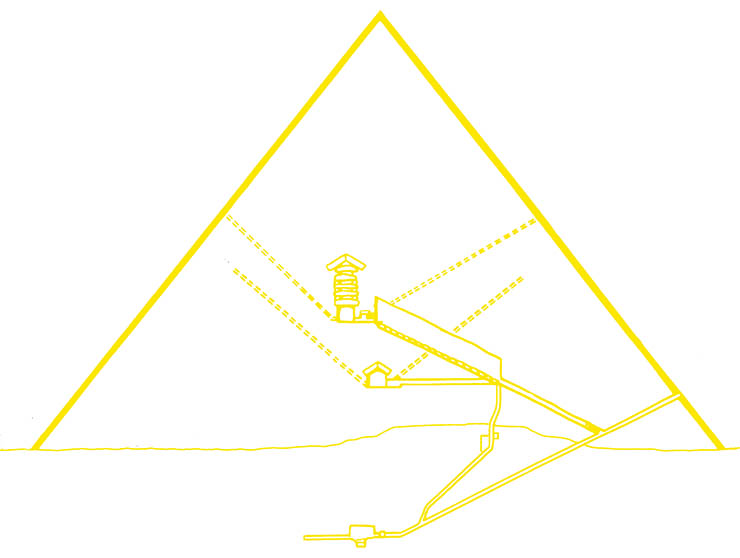
    The Pharaoh’s Pump Foundation and the book Pharaoh’s Pump maintain that these passages cut into solid bedrock are a colossal and enormous hydraulic ram pump! This hydraulic ram pump is built on a gigantic scale never duplicated in the ancient or modern world. Massive amounts of pumped water was used to supply a series of water locks, up to the Great Pyramid, transporting barges with stones to the building site. With its own pumped water and a series of water locks as a lifting medium, the Great Pyramid supplied its own water power to build itself!

    Before the Great Pyramid’s construction, the site was not flat but a granite outcropping. The shape and size of this outcropping is unknown. In the finished pyramid the granite outcropping protrudes up to a height near the bottom of the Grand Gallery. The site is on a gradual sloping hillside. Uphill from the Great Pyramid is the Libyan Desert.

    Almost all agree that the two subterranean shafts and the subterranean room were excavated before the pyramid was built. Herodotus, the famous Greek historian, tells us ten years were spent in preparation. The subterranean excavations at the construction site were the preparatory work needed before construction started.

    At this stage of construction, there was only one mechanical element needed to create the largest, most colossal, hydraulic ram water pump ever created! That one single mechanical element being a drain and valve. The dead end shaft, cut in the south-eastern corner of the Subterranean Chamber is 2 feet 7 inches wide, 2 feet 5 inches high and 52 feet 9 inches long. Its direction is from true north to south. Its position is horizontal and it lies at the lowest corner of the lowest chamber. This suggests that it functioned as a drain, but it dead ends in the rock. Even though it is 105 feet below the base of the building, it is still high enough from the outside to function as a drain.

    The cutting of this shaft must have been an awful job. It is so small – only 29 inches high and 31 inches wide with a length of 52 feet, leaving very little elbow room. Maybe a midget crew cut it. I’ll never believe that its existence is due to over-sight or gross error. I’ll never shrug it off as a miscalculation. I have too much respect for the ancient engineers for that. Why is there so much interest in the lowest shaft of the Subterranean Chamber? The answer lies in this simple fact: a waste duct in this particular area would be definite proof that the engineers had cut a simple water ram in the solid rock!

    Around the base of the Great Pyramid and in its immediate vicinity are a number of unusual and hard to explain cuttings in the solid rock. Among these cuttings are the “crypts” that contain the so-called “sunships.” Traditional Egyptologists maintain these ships were entombed at the same time as the Pharaoh and the ships were used during the funereal precession. The location of the sun ship pit and other features indicate that they were created at the same time as the Great Pyramid and were part of a drain system with a valve that would complete the greatest water ram pump in the world. The dead end shaft that leads south from the Subterranean Chamber heads directly towards the sunship pit. This water drain system of the pump was unnecessary after the Great Pyramid was completed. Later the ancients used the pit for ceremonial purposes after the functional purpose of this cutting was no longer needed. Our current understanding of the passage from the Subterranean Chamber towards the sunship pit is that the passage is a dead end.

    Apparently this dead end has never been examined with the idea in mind that it may be a drain duct. In 1954, two sun ships were discovered in the rock hewn cavity at the very southern base of the pyramid. It is reasonable to assume that the size and shape of this cavity has been surveyed and recorded. Such data is hard to come by. It would be interesting to examine the north wall and ascertain the distance from it to the terminus of the dead end. The terminus of the dead end is about 83 feet south of dead centre of the building. This leaves a space of about 300 feet to its southern base. In short, I believe there exists a connecting duct, between the dead end and the sun ship cavity. Explorers might hit pay-dirt if they take a good hard look at the end of the dead end and the north wall of the sun ship’s crypt.

    This pump was a simple water ram of monstrous proportions. A ram that pumps far more water than it wastes. My guestimate? At least 4 tons for one ton of wastage to a height of 60 feet during a time cycle of one minute. The sun ship cavity itself may be part of it. My line of reasoning follows this pattern. Originally, the cavity was cut for use as part of the drain for the water pump. When the Great Pyramid was completed the pit was no longer needed. Only after the construction of the Great Pyramid were the sun ships installed in their pits. Why not decorate and touch up these pits with some regal trappings?

    I have believed from the very beginning that this tube is part of a drain and that its outlet is sealed in as clever a fashion as the ancients managed to conceal other openings. It is utterly fantastic to believe that the ancient engineers overlooked this common device – a drain that can be opened and closed at will and thus employ the same mechanics of the common ram. I predict that one or more baffle walls will be found in the horizontal tube leading south from the subterranean chamber, the function of which is to slow down the high velocity of water discharge and ease the shock exerted on the waste valve.

    What will the drain valve look like? It will be a “door with pivots.” We call them butter-fly valves. They are easy to open and close and are operated by a handle. Pairs of holes with granite seats to fit this type of valve are found in the passage near the top of the lower diagonal. No one, for a moment, doubt that these seats and holes are for this type of “door.”

    There are two other check valves in the subterranean cuttings. A short distance down in the solid rock of the lower diagonal is an offset “wherein,” says Sir Flinders Petrie (The Pyramids and Temples of Giza), “hung a door that swung inward.” A pair of eight inch round holes are found here, one in the east wall and the other in the west wall. Adjacent to these round holes is granite masonry. This mechanical element, given a hydraulic interpretation, is a check-valve. The holes support a round shaft and the granite masonry is the valve seat. Halfway up the passage leading from the Subterranean Chamber to the lower part of the Grand Gallery is the Grotto. Detailed research indicates it too in ancient times housed a check valve.

    How the Water Was Pumped

    The Ancients were doing what every engineer does before he undertakes a massive construction project. The machine comes first, and in this case it was a water pump. These subterranean cuttings formed a hydraulic ram pump. The lower diagonal holds about 88 tons of water! When the valve in the drain is opened the water in the lower diagonal moves down. Then the drain valve is closed. The water in the lower diagonal continues to move down compressing the air in the Subterranean Chamber. This chamber has an air capacity of 7000 cubic feet! Once this moving water has compressed the air to the maximum, the water stops moving. At that point, the check valve in the upper end of the lower diagonal closes. The highly compressed air in the Subterranean Chamber pushes water up through the “grotto” and onto the rocky knoll. Research including computer modelling shows that the water ram pump would easily pump water to a height of the top of the completed Great Pyramid.

    Water ram pumps are a very interesting device and are still being built and sold to this day. Water ram pumps work and work well. When you shut a water faucet off and the pipes rattle, think about the ancient engineers who used the same force in a colossal scale to move and lift the blocks in constructing the Great Pyramid.

    What existed at this point is a mound of rock with a passage in the centre that leads up from the Subterranean Chamber and the descending passage down to the Subterranean Chamber. All of the subterranean passages and subterranean valves were finished and the colossal hydraulic ram was ready to go. The source of water for the pump was the ancient lake of Moeris. This lake was huge, about the size of Lake Erie. Its elevation was above the base of the Great Pyramid. Water for the pump was brought to the site and channelled into the lower diagonal from this lake.

    If the hydraulic ram pump pushes water up the central shaft it will be wasted because the water will just flow down the granite outcropping. At this stage, parabulious walls were built around the building site. This created a catch basin for the water. Near the base of the Great Pyramid to this day can be seen these same “parabolus walls” made of earth, which surround the building. The walls form a rectangular basin and look like the remains of an ancient catch basin or reservoir. The 14 foot vein of river silt found inside is mighty convincing evidence that in ancient times this rectangular enclosure held water, and formed a pond 180 acres in area. And the little rocky knoll, upon which the pyramid stands, became a little rocky island.

    The Construction Process

    Try to envision, if you will, the rocky knoll high above the Nile before a single block was set. It must have been a bleak, bare, gray mound of limestone. It was not flat. The perimeter had to be levelled off to create a base for the first row of casing stones. To use the water, it must be caught. The simplest device to catch it is a ditch. Once a ditch was cut in the location of the first row of casing stones and filled with water, it formed a perfect device for a levelling operation. Water would pour from the ditch at the lowest contour of the rock. This lowest contour determined the elevation of the base. Five hundred chisellers could be put to work at one time and whack the perimeter of the base down to a uniform level. The still water in the ditch would be their gauge, and simplify surveying operations.

    The next step would be to move the casing stones from the quarry across the river up to the base of the prepared building site of the Great Pyramid. How would you bring 16 ton stones from across the river, that are already on barges, up to the site of the Great Pyramid? A site with subterranean cuttings that are a hydraulic ram pump. Evidence indicates that a series of water locks from the Nile to the building site were created to move the stones up from the river to the building site. The locks worked just as the water locks work in the Panama Canal. The subterranean cuttings that are a colossal hydraulic ram pump supplied the needed water to operate the locks.

    Comparatively recent excavations have exposed the cutting of a giant rock-hewn stairway with huge risers, ascending from the basin near the Nile River to the top of the knoll. This cutting has the basic characteristics of the remains of a series of water-locks, although every relic that would indicate water-locks is gone. The accepted explanation for this cutting was to extract blocks for structural use in the pyramids. I never believed this explanation because the cutting is too precise, too neat, and too regular. If the ancients were quarrying blocks alone, the sides, the treads, and the risers would have been left rough and uneven.

    As they are today, these stairs are too wide to be of practical use as water-locks, but if a wall were built in the centre of the steps, dividing the stairway in two, the result would be two narrower sets of stairs. If appropriate masonry were placed in this divided stairway with pairs of water-gates made of wooden planks, the locks would be complete. When water was pumped into the locks they would have been ready to take stone laden barges up one set of locks, while the empty barges came down through the other. I believe that this stairway of locks is part of the 60 foot roadway described by Herodotus.

    The completion of the first course of casing stones formed a rectangular enclosure in which water could be impounded, forming a pool or artificial pond. Once this pool was created, barges with the rough interior stones were brought up the locks into the pool and put in place with remarkable ease. The block was moved into place by workers wading waist high in a pool of water. When the block was in position, the water level was lowered, which set the stone gently down on the floor of the pool. When this pool was filled with the rough interior stones, the next course of casing stones were brought up and placed above the previous course of casing stones. This created a higher pool of water. Barges with rough interior stones were brought up the locks and put in place with remarkable ease, until that pool was filled. A 16 ton casing stone or even a large 40 ton monolithic block could be moved and set as gently as a mother lays her sleeping babe in a crib. This simple process continued, step by step, course by course, level by level, until the Great Pyramid was completed!

    The workers moved the stones into the correct position on special barges. Then the water in the pool was lowered, gently lowering the stone in place. The barges were such that when the stone was lowered into place the barge could be removed from the stone, similar to a modern day forklift. With the use of water as a powerful and easily controlled lifting medium, the massive weight and size of the stones created no problems. Using the largest casing stones possible is a measure of economy. Large stones mean less quarrying work and finishing of the faces. The same is true for the rough cut stones one sees now that the casing stones have been removed. Since moving the stones to the building site is the least labour intensive part of the construction, the use of very large stones makes the job easier.

    It is interesting to note that the sides of the Great Pyramid “bend inward.” Or to put it another way, the sides of the Great Pyramid have a concave crease from the apex down to the centre of the base of each side. The Great Pyramid of Giza actually has eight sides. This was vital because of the hydrostatic pressure of the water inside the pyramid during construction. The Great Pyramid is the only pyramid in the world with this characteristic. This feature must have made the design and construction more difficult, but it was a must. Each side bends inward against the pressure of the water inside of the pyramid just as a dam like Hoover Dam bends towards the force of the water it holds back. The casing stones have precision joints that are cemented together to make the exterior of the Great Pyramid water tight. This was not to keep the pesky Egyptian rain out, but to hold water in during construction.

    According to Herodotus: “… they raised the remaining stones to their places by means of machines formed of short wooden planks. The first machine raised them from the ground to the top of the first step, on this there was another machine, which received the stone on its arrival, and conveyed it to the second step, whence a third machine advanced it still higher.” Another translator of Herodotus offers this translation: “They made it first in the shape of stairs, and lifted up the stones that remained with engines made of short timbers. From the ground they raised them to the first range of stairs; when the stone came up to this, it was set in another engine that stood on the first range, and drawn up from this to the second range; and thence by another engine to the third, for there were as many engines as there were ranges of stairs . . .” In the first, the word “machine” is used, while in the second, the word, “engine.” But the gist of the translations are identical.

    In modern usage, the words ‘engine’ and ‘machine’ are often used synonymously. And it may be here that in the translation of the ancient Greek the meaning of these two words are even more closely allied. For example, the dictionary defines the word catapult as “an ancient engine of war.” By a physicist’s definition, a catapult is not an engine of war, but a machine of war. An engine uses fuel directly to make it go. More than a hundred years ago, the US state of Ohio built an elaborate system of canals. Even today, in the vicinity of Akron, Ohio, century old water-locks are in operation. Nowadays, pleasure craft pass through them. The lock-gates are made of wooden planks about eight feet long. These locks are truly machines. They are water elevators and a floating body can be raised or lowered in them. They are made of stone andshort wooden planks. I believe that the machines Herodotus described were a series of water-locks. Elsewhere in the same volume he tells of seeing an old dry-dock that was used by King Necos to repair damaged war vessels. Think of this: How can anyone build a dry-dock and not use a water-lock? It cannot be done.

    The construction of the Great Pyramid continues. Upon the completion of each level, the next level above was assembled on the level before it. But how are the massive blocks moved up to ever greater heights as the construction progresses? As each level was completed, a water lock was built to move the blocks up to the next level. These series of locks moved blocks up the north face of the pyramid, one lock per level, all the way to the top. When the top of the pyramid was completed, the top lock was not needed. That lock was removed and the casing stones put in place. Small stones and rubble were placed in the area of the removed lock by hand. If solid close fitting stones were used then the water from the pump could not supply water to the rest of the locks below the top lock. Each lock was removed and replaced with casing stones from the top to the bottom with small stones and rubble placed in the area of the locks. Herodotus says he was told the pyramid was finished from the top, downward. To this day one can see along the north face where small stones and rubble fill the location of the series of locks.

    Most have heard the legends and myths that tell the stones were levitated into place by some unknown force. Some fables speak of the stones being somehow floated to their destination. These stories from distant past, lacking detail, do speak great truth. Even though this description is brief and abbreviated, you now know the answer to the riddle of the ages! You know how the Great Pyramid was built! No massive ramps almost the size of the pyramid itself. No sweated brow or tortured back. No multitudes of slaves harnessed like animals heaving to the crack of the whip. No aliens from distant worlds. Just workers wading waist deep in cool pools of water. Men moving barges, operating valves, locks and pumps under the watchful eye of talented Ancient Engineers.

    Building the Great Pyramid was not an exercise of oppression by a ruthless Pharaoh. Building the Great Pyramid was a snap! Its construction was an orderly, systematic, inventive and wondrous, piece of cake. But why build it? WHY? What was its purpose? Was it a tomb to be used once by an all powerful ruler? Was it built as a sacred place for those initiated in secret societies of higher wisdom to perform unknown rites? Was it somehow an observatory to view the stars? Was it built as prophecy in stone to confirm Biblical prophecies? What is the meaning of the mysterious interior chambers and passages? Is it a power source that we do not understand? Is it a temple, tomb or machine? The answer to why the Great Pyramid was built is the subject of the second half of this series to be published in the next issue of New Dawn.
    [alert type=”general” dismiss=”no”]This article was published in New Dawn 54.[/alert]

    [alert type=”success” dismiss=”no”]If you appreciate this article, please consider a contribution to help maintain this website.[/alert]

    © New Dawn Magazine and the respective author.

    For our reproduction notice, click here.
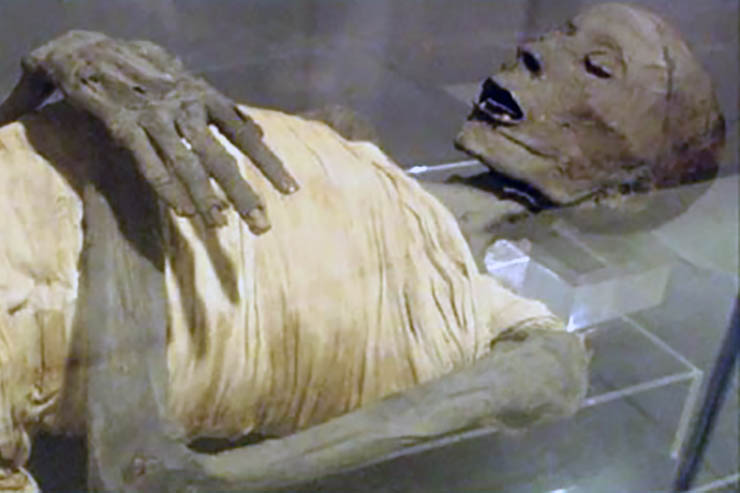
  • The Curse of the Cocaine Mummies

    The Curse of the Cocaine Mummies

    In the movie, Contact, Jodie Foster plays an astronomer who establishes communication with a civilisation beyond our solar system. In the television program, The Curse of the Cocaine Mummies, a different, but equally fascinating, contact is established between ancient Egypt and ancient Peru. A German forensic scientist busted the Egyptian mummy Ramses II for possession of cocaine. Cocaine, as most people know, grows only in the Andes. How did Ramses II get his dope?

    The idea of ancient transoceanic contact between the Old and New Worlds before Columbus (other than the Vikings) is simply not acceptable within the tightly controlled halls of academia. Professor John Baines, an Egyptologist at Oxford is a typical case. He calls the idea of ancient transoceanic trade “absurd” and bolsters his “argument” by noting that he doesn’t know any professional Egyptologists, anthropologists or archaeologists who are “seriously” researching the idea. This is because, he says, the idea is not “perceived” to have “any real meaning for the subjects.”

    Professor Baines’ view reminds us of the priests who refused to look through Galileo’s telescope to see the blemishes on the Moon because this revelation did not conform to their preconceived ideas of reality. Academia is geared to not looking at the problem. This ostrich approach has predictable results: results that do not necessarily have any bearing upon the quest for truth and in fact, impede the search.

    The simple fact that we find sun-worshiping civilisations building pyramids, obelisks and preserving their dead by wrapping them in cloth (mummies) on both sides of the Atlantic is rarely even discussed within the archaeological and anthropological journals despite the fact that every child when first confronted with the facts raises the obvious question “why?” For four hundred of the past five hundred years scholars have puzzled over the facts. Three theories emerged yet only one survives today.

    Cortes’s secretary was one of the first to put forward the idea that both Old and New Worlds were remnants of an even older “lost” civilisation. The “Aztlan” of ancient Mexico and the “Atlantis” of ancient Egypt, he argued, were one and the same. With this simple idea the commonalities between buildings, culture and mythologies of the ancient people of Mexico, Peru and Egypt could all be explained as “echoes” of a lost world.

    The second theory presented was the idea that Mexico and Peru were settled by people from the Old World who already possessed the skills needed to build pyramids and preserve bodies. Most argued that they came from ancient Egypt but others suggest the Sumerians, people of ancient India, the Phoenicians and even the Templars from France. Again, a simple idea was used to explain an obvious problem.

    The third theory, was the idea of “separate development.” Here the focus is upon “how” people arrived in the Americas rather than upon the impressions of the Europeans following Columbus’ “discovery” of the New World. Although this is the more complicated of the theories — thus violating the scientific principle of Occum’s Razor (so beautifully articulated in Contact) that when confronted by conflicting theories for an unexplained phenomena one should prefer the simpler explanation, it is, nevertheless, the only theory that is considered scholarly in today’s universities.

    It is within this context that we must watch The Curse of the Cocaine Mummies. Cocaine and tobacco are plants that originated in America and were unknown to the Old World if we are to believe the traditional paradigm. The first tear in the fabric of the dogma came on the 16th of September 1976 when the mummified remains of Ramses II arrived at the Museum of Mankind in Paris. To repair the damage to the mummy, a scientific team was assembled which included Dr. Michelle Lescot of the Natural History Museum (Paris). She received fragments from the bandages and found a plant fragment ensnared within the fibres. When she looked at it under a microscope she was amazed to discover that the plant was tobacco. Fearing that she had made some mistake she repeated her tests again and again with the same result every time: a New World plant had been found on an Old World mummy. The results, little known in North America, caused a sensation in Europe.

    Professor Nasri Isk-ander, the Chief Curator at the Cairo Museum thought he had an explanation. As an avid pipe smoker he argued that “maybe a piece of tobacco dropped by haphazard” from the pipe of some forgotten archaeologist. Dr. Lescot responded to this charge of “contamination” by carefully extracting new samples from Ramses II’s abdomen, all the while having others photograph the process. These samples which could not possibly be “droppings” were then tested and once again were established to be tobacco.

    The discovery of tobacco fragments in the mummified body of Ramses II should have had a profound influence upon our whole understanding of the relationship between ancient Egypt and America but this piece of evidence was simply ignored. Then, sixteen years later, again quite by accident, more evidence emerged. In 1992, toxicologist, Dr. Svetla Balabanova of the Institute of Forensic Medicine in Ulm (Germany) tested the ancient Egyptian mummified remains of Henut-Tawy, Lady of the Two Lands. The results came as a “shock” to this scientist who regularly used the identical testing methods to convict people of drug consumption. She had not expected to find nicotine and cocaine in an ancient Egyptian mummy. She repeated the tests and sent out fresh samples to three other labs. When the results came back positive she published a paper with two other scientists. (Balabanova, S., F. Parsche and W. Pirsig, “First Identification of Drugs in Egyptian Mummies”, Naturwissenschaften 79, 358 (1992) Springer-Verlag 1992.)

    If Balabanova was surprised by the results of her tests she was even more surprised at the vitriolic response to her publication. She received a flood of letters threatening, insulting and accusing her of fraud. When she reminded her critics that she was simply applying the very same techniques that she had used for years in police work where her results were considered “proof positive” her critics didn’t seem to care. She was condemned as a “fraud.”

    Dr. Rosalie David, Keeper of Egyptology, Manchester Museum took up the challenge of investigating the “cocaine mummies” which she thought “seemed quite impossible.” She began by sending tissue and hair samples from her museum out to labs. She was working on the dual assumption that one of two things are true: 1. Balabanova’s tests were compromised; or 2. The mummy was not truly ancient” (i.e. it was fake). Dr. David flew to Munich to review the techniques and excavation records to see if the body, which had originally been purchased by King Ludwig I of Bavaria was genuine or not.

    Dr. Alfred Grimm, the Curator of The Egyptian Museum in Munich said that “the Munich mummies are real Egyptian mummies. No fakes. No modern mummies. They came from ancient Egypt.” After spending days pouring over the docum-entation associated with the “cocaine mummy” Dr. David relented saying: “it seems evident that they are probably genuine…”

    When she returned to Manchester she discovered that her own Museum’s mummies had traces of tobacco. Dr. David said: “I’m really very surprised at this.”

    Dr. Balabanova’s work had been validated by the test results from Manchester but she was now hooked on the problem and began collecting samples of naturally preserved bodies housed in museums all around Europe. She obtained 134 separate bodies taken from ancient Sudan dating to a time long before Columbus or the Vikings. One third of these bodies contained both nicotine and cocaine.

    The exciting realisation that there was certainly contact between ancient Peru and ancient Egypt has now been established. The cocaine mummies from Egypt and Sudan have changed the rules of this controversial game. There is no longer a warrant to exclude the hypothesis of transoceanic trade in ancient times.

    Is the principle of Occum’s Razor only to be applied when the outcome is safely assured to confirm to traditional dogma about theories of the past? It appears so. The cocaine mummies jumped the tracks of long established views. Despite overwhelming evidence we still find ourselves in the last decade of the twentieth century dealing with a ‘scientific’ establishment that ridicules its own members and refuses to look at the results of its own principles if the results don’t confirm the favourite views of the reigning orthodoxy.

    One step forward. Two back.
    [alert type=”general” dismiss=”no”]This article was published in New Dawn 47.[/alert]

    [alert type=”success” dismiss=”no”]If you appreciate this article, please consider subscribing to help maintain this website.[/alert]

    © New Dawn Magazine and the respective author.
    For our reproduction notice, click here.