New Dawn – World's Most Unusual Magazine

Category: Ancient Mysteries

  • Was There a Civilisation X?: Evidence Indicates There Was

    Was There a Civilisation X?: Evidence Indicates There Was

    From New Dawn Special Issue 8

    Atlantis: everyone knows the name and almost everyone knows that the name refers to a mythical, sunken island continent in the Atlantic Ocean, according to a story told by the Greek philosopher Plato sometime during the 4th century BCE. Whether or not Atlantis existed has been a matter of conjecture for nearly four hundred years, ever since Francis Bacon published his novel The New Atlantis in 1626. Atlantis is a controversy that continues to this day.

    For some folks, Atlantis existed just as Plato explained, but for others the idea alone runs across the grain of prevailing scholarship and archaeological investigation. For those who are sure Atlantis did exist, it is a belief. But for the skeptic, a prehistoric civilisation with technical sophistication is pure fiction. Unfortunately, for those who believe there is no proof, Atlantis has been ‘discovered’ by researchers in almost every part of the world, from South America to the Eastern Mediterranean to the British Isles.

    Although scholarly consensus is convinced that Plato’s fictitious tale of Atlantis was based on the Island of Thera’s destruction in 1628 BCE, Atlantis remains as the Holy Grail of archaeology, even if archaeologists won’t admit it. Discovering evidence – even the smallest artefact – that the lost continent of Atlantis really existed would be the greatest find in the annals of all historical disciplines. History would not only be made, but have to be rewritten. However, until that evidence is discovered and confirmed, the controversy will rage on between believers and skeptics, with the skeptics having a distinct advantage. It’s all about evidence.

    Solid evidence is important and there is no direct evidence that Atlantis existed. No ancient stone or sign has ever been found stating ‘Atlantis this Way’ or ‘Welcome to Atlantis.’ No artefact has been discovered proving that sophisticated Atlantean equipment was used by any culture or civilisation during prehistoric times. This being the case, why do some people insist that the story of Atlantis is fact?

    The answer to this question lies in the Valley of the Nile, ancient Egypt, and the enigmatic Old Kingdom period. It’s where my hunt for Atlantis began.

    STANDARD EXPLANATION MISINTERPRETS THE EVIDENCE

    The ruins of ancient Egypt are unique. Nowhere else in the world are there such magnificent megalithic structures as well as fields of granite. It’s obvious that the builders of ancient Egypt’s temples and pyramids used granite, as well as limestone and basalt, as primary materials in their architectural designs. The importance of this fact cannot be overlooked.

    Working with stone is not easy and working with granite – the hardest rock known to man – and achieving any scale of economy in order to build big and build everywhere, like the ancient Egyptians did, is impossible without diamond studded tools. Today, such large and numerous projects on a big scale require specialised tools and equipment. Case in point: Giza’s Great Pyramid was the tallest structure in the world until France erected the Eiffel Tower in 1889.

    So, how could the ancient Egyptians build an entire civilisation out of limestone, basalt and granite using little more than copper chisels, stone hammers, dolerite pounding rocks, and brute strength? How could a large number of granite statues, some in excess of forty feet tall, be carved with such detail and perfection and then erected?

    The traditional explanation is that they did it with copper chisels, stone hammers, dolerite pounding rocks, and brute strength. However, for me, since no culture or civilisation was able to duplicate in complexity, scale, and quantity, the Old Kingdom construction efforts during the next 4,000 years, then the traditional understanding must be an incorrect interpretation of the evidence – the most erroneous being the Great Pyramid. Skepticism is a two-way street.

    The idea that the Great Pyramid was a tomb defies logical and cogent reasoning. First, funeral items were never found within any of the pyramid’s chambers. Nor are there any inscriptions describing it as a tomb. Second, its internal design is strange and does not accommodate human beings. Passageways that lead to its three chambers are a little more than three feet in height and width. Nor are there any steps; so, to move about you have to crawl on your hands and knees. This makes moving about inside the pyramid next to impossible for anyone, let alone a ritual funerary party. Third, the walls and ceiling of the uppermost chamber, the alleged burial chamber, was built from seventy-ton slabs of granite with another five layers of granite in the area directly above its ceiling. Finally, as any good detective would consider important, a colossal structure such as the Great Pyramid requires enormous resources to build which, consequently, requires a valid and reasoned motive. A tomb is not one of them.

    At a cost of thirty-five billion in adjusted (US) dollars, according to engineer Markus Schulte, there had to be a very good reason to build the Great Pyramid; a reason or a cause that united a nation in mind and in spirit. To be sure, the currently accepted idea that the Great Pyramid’s construction was a national project is an accurate interpretation of what likely happened. However, any large scale operation that consumes billions of dollars in resources must return some type of social benefit. In the case of the Great Pyramid, the benefit somehow involved water.
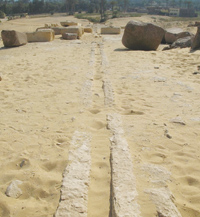
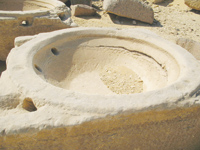
    image_15
    A trough links the pyramid/temple site to the valley below at Abu Sir. Image courtesy of the author.
    image_17
    Basin at Abu Gorab (1 mile north of Abu Sir). Image courtesy of the author.

    On the Giza Plateau just south of the middle pyramid, a granite trough emerges from the sand (see illustration). At Abu Sir, south of Sakkara, a limestone trough runs the course of the hill on which a pyramid was built, and at both Abu Sir and its neighbour pyramid, Abu Gorab, there are numerous stone basins. Although denied by most Egyptologists, there is also evidence that a system of tunnels exists under the Giza Plateau. The so-called ‘Tomb of Osiris’ runs deep into the ground as does ‘the pit’ in the Great Pyramid’s subterranean chamber. Near the granite trough there is also two square tunnels drilled into the bedrock, although now filled with sand. Furthermore, the Great Pyramid’s original design included a perimeter wall, which might have functioned as a retaining wall for a reservoir for fresh water that flowed through a canal from the ancient Lake Moeris.

    A DEVICE, NOT A TOMB

    In his 1967 book The Pharaoh’s Pump, Edward Kunkel put forth the idea that the Great Pyramid was a hydraulic device. According to Kunkel, the Great Pyramid served as a ‘ram’ style water pump in order to facilitate moving large quantities of stone. Through a series of locks, stone blocks arriving from Upper Egypt were moved onto the Giza Plateau by barge, through a system of canals that linked the Nile River to the Great Pyramid. In Kunkel’s theory, the Great Pyramid housed two pumps. One was built underground and a second pump was built above ground. The underground pump consisted of the subterranean chamber and its associated passageways, and the above ground pump, the middle and upper chambers.

    The underground ‘ram’ style water pump used energy created by compressing water to maintain water flow, as did the middle chamber for the upper pump. In the lower pump, the subterranean chamber functioned as a compression chamber, and in the upper pump, the middle chamber functioned as a compression chamber. The odd niche in the middle chamber, according to Kunkel, was a safety value, and the upper (King’s) chamber, a secondary compression chamber.

    Kunkel’s theory is not as wild as it first seems. In his book he discusses the archaeological evidence that supports his idea. However, the notion that the middle and upper chambers functioned as compression chambers is a stretch of engineering imagination. For the upper pump to function, water would have to enter the Grand Gallery from the lower pump and then flow into the middle and upper chambers. Once in the upper chamber, the continuous flow of water from below would create two streams exiting the pyramid through the shafts built into the north and south sides.

    Unfortunately, Kunkel’s upper pump theory requires the creation of a vacuum, a number of valves, and some type of combustible fuel and combustion chamber to drive the pump, which according to Kunkel was located above the uppermost chamber. None of which appear plausible, although the theory that the subterranean chamber functioned as a ‘ram’ style water pump makes sense.

    According to marine engineer John Cadman, Kunkel made the mistake of theorising that the entire pyramid was a water pump. Cadman realised that only the subterranean chamber and associated passageways would have functioned as a pump. So, Cadman set out to solve it the engineering way.

    With as many photos of the subterranean chamber as he could find, Cadman built a model to test his theory, the first of which didn’t work. Accordingly, he went over the model’s design looking for weak points, and built a second model. This one worked the first time. He then built two more models, one which was made with a glass top and ink injectors in order to study the flow of the water inside the chamber. After studying this model he concluded that the chamber was designed to efficiently circulate and move water through the output and waste line.

    Cadman experimented further by adding a vertical pipe connected to the input pipe, called a ‘stand pipe’. In a ram pump, water enters the compression chamber from an elevated source. Inside the compression chamber an opened valve allows water to flow out until the velocity forces the valve shut; when the valve closes high pressure forces water past the check valve and through the output line. When the valve reopens, water once again flows down the input pipe into the compression chamber. A vertical pipe connected to the input line facilitates the pressure wave exiting the system and thereby allows greater cycling, i.e. water is moved through the pump at a faster rate. He also discovered that the stand pipe increases the intensity of the compression wave inside the chamber.

    Cadman’s conclusion: whoever carved the subterranean chamber out of bedrock knew exactly what they were doing. The chamber’s design was deliberate and engineered to quickly move water through the system. Furthermore, the compression wave resulting from the pump’s action was apparently more important to the builders of the pyramid than the water being pumped. This leads to another question: why would the pyramid builders design a device that intentionally sent a compression wave up through the body of the pyramid?

    Although the answer to that question still lies in the future, the significance of Cadman’s modelling of the Great Pyramid’s subterranean area is obvious. The builders of the Great Pyramid understood engineering physics, at least in the area of hydraulics which requires scientific inquiry and the application of science; in other words, technology.

    Herein is the answer to how the pyramid builders built an entire civilisation out of limestone, basalt and granite. If they had achieved an understanding of hydraulics sufficient to build a large ram pump, certainly they also achieved an understanding of physics sufficient to develop some type of machine technology.

    Of course, skeptics would argue if they used machines to build, then where are the machines now?

    I, too, would like to know what happened to the machines, but the reality is the machines they used, or what is left of them, probably disintegrated and returned to the elements from which they were made long ago. Exposed to weathering, only rock can withstand the corrosiveness of the environment for extremely long periods of time, although the possibility exists that beneath the Saharan sands lies the machining treasure of Civilisation X. Even so, there is another way to demonstrate that powered machines were used in the process of building the Old Kingdom’s magnificent structures.

    Whether a hand tool or power tool, every tool leaves its mark, and marks from hand tools are very different than those made by machines. Anyone who has taken metals or wood shop in high school knows this to be true. A cut made from a table saw is flat and straight where as a cut made by a person using a hand saw is less precise, not quite as flat or straight.

    The telltale signs of a power tool or machine are the minute marks the blade’s teeth make as they remove material. Although difficult to see, close up the marks from the blade are visible and make a regular pattern across the surface of the cut material. These marks are called ‘feed lines’ and are left by the machine as the operator feeds the material into the cutting blade. Finding evidence of feed marks on stone at one of Egypt’s ancient sites would be the equivalent of finding the machine that made those marks.
    THE STONE AT ABU RAWASH

    With the Great Sphinx and three pyramids, the Giza Plateau is the jewel of Egypt’s modern day tourist economy, and rightfully so. Without question there is no other place with such magnificence. However, there’s little-known ancient ruins five miles to the north, just off the road to Alexandria, called Abu Rawash. It’s not on the tourist map, but is as spectacular as Giza, although in a very different way.

    According to Egyptology, Abu Rawash’s pyramid was built 4,570 years ago during the fourth dynasty by Djedefre, that dynasty’s third ruler. What’s fascinating about this pyramid is that it was never finished. Only fifteen or so courses of the pyramid were laid and the descending passage is exposed to the sky. It’s a fantastic site to visit and provides insight into pyramid construction and design.
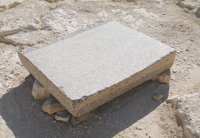
    image_19
    Machined granite slab at Abu Rawash. Image courtesy of the author.

    The most intriguing aspect of Abu Rawash, though, lies on its south side, a hundred feet or so from the base of the pyramid. There is a pink granite slab approximately four feet in length, three feet wide, and a foot in thickness. It’s propped up on a dozen or so stones the size of a softball. The granite stone is pristine, as if it was hidden away for thousands of years and only recently uncovered. The surface of the stone is smooth to the touch and at its top is an arc, precise in its edge, which separates the stone’s smooth surface from its rough. On the smooth surface there are two slice marks, one near the top and another toward the bottom. And as you look close at the stone’s surface, minute horizontal striations are clearly visible in the same pattern of the separating arc.

    Unmistakably, this pink granite slab was cut using a machine; irrefutable evidence that whatever construction crew was responsible for the pyramid at Abu Rawash, they were using some type of power saw. Abu Rawash isn’t the only place, either.

    There is evidence elsewhere that powered equipment was used by the pyramid builders – on the Giza Plateau, on the east side of the Great Pyramid at the north end of the basalt patio. Originally, the machine marks on these stones were not visible, hidden by adjoining blocks of a finished patio. But sometime over the course of the last four thousand years or more scavengers removed a number of blocks from the patio’s periphery, particularly the north end, exposing what the pyramid builders did not want anyone to see. Mistakes made by the men who operated the saws. At Giza, the evidence is just as compelling as what exists as Abu Rawash.

    WAS THERE A CIVILISATION X?

    Since the ancient Egyptians that lived from the third through the first millennium BCE were not known to have developed machine technology, and no other civilisation since has until modern times, the builders responsible for the stone at Abu Rawash and the Great Pyramid’s basalt patio must have existed at a remote time in prehistory. The evidence speaks for itself.

    There was Civilisation before Civilisation. I like to refer to it as Civilisation X.

    Who were they? Was Egypt a colony of Atlantis as some theorists have put forth? Or were they an unknown culture never described by ancient peoples?

    Although everyone knows that the story of Atlantis is attributed to the Greek philosopher Plato, most people don’t realise the story of Atlantis is Egyptian in origin. According to Plato’s dialogues Timaeus and Critias, he heard the story second hand from his uncle Solon who originally heard it from the temple priests at Sais where the Atlantis tale was said to be inscribed upon the temple’s pillars. Unfortunately, such an inscription has never been found. So no one knows whether or not Plato’s story of Atlantis is fact or fiction.

    There’s no question that Plato’s tale of Atlantis was a social moral. The pertinent question is, in my opinion, was there a kernel of truth to the story? In other words, was Plato inspired to write Timaeus and Critias from known history of the time?

    I think that is likely the case. There are a number of ancient cataclysm myths such as the Greek’s Deucalion’s Flood, the Hopi’s ‘Blue Star’, Sumer’s ‘The Epic of Gilgamesh’, and Egypt’s story of ‘Hathor as the Eye of Ra’, just to name a few. There are also two tales of catastrophe in the biblical Genesis, Noah’s Flood and the Tower of Babel.

    In modern times these ancient stories of death and destruction have been attributed to fantasy or a way of explaining life’s mysteries. I think such an interpretation is not only superficial but an insult to our ancestors. Who are we to say they were primitive and ignorant in their understanding of the world around them?

    Indeed, we should understand these ‘myths’ for what they are, ancient history told as a story in oral tradition that was designed to be understood as metaphor to be interpreted, and not a literal account. With that in mind, a fresh look at the biblical Tower of Babel story allows unique insight into our remote past. On its surface, the Tower of Babel story is just another fable where God’s wrath befalls an unsuspecting world:

    The whole world had one language and a common speech. Mankind was capable of planning and completing just about anything. Now the whole world had one language and a common speech. As men moved eastward, they found a plain in Shinar [Babylon] and settled there.

    They said to each other, “Come, let’s make bricks and bake them thoroughly.” They used brick instead of stone, and tar for mortar. Then they said, “Come, let us build ourselves a city, with a tower that reaches to the heavens, so that we may make a name for ourselves and not be scattered over the face of the whole earth.”

    But the LORD came down to see the city and the tower that the men were building. The LORD said, “If as one people speaking the same language they have begun to do this, then nothing they plan to do will be impossible for them. Come, let us go down and confuse their language so they will not understand each other.”

    So the LORD scattered them from there over all the earth, and they stopped building the city. That is why it was called Babel – because there the LORD confused the language of the whole world. From there the LORD scattered them over the face of the whole earth.

    – Genesis 11:1-9

    Taken literally the story makes little sense. However, as metaphor the imagery is easy to understand. First, the word Babel in Hebrew sounds like the Hebrew word for confused. In my opinion what they were building was not a literal tower. In fact, the tower they were building was not a tower at all. The tower represents the technical state humanity had achieved at that time and that they were building a great civilisation. The text is clear on this point: “mankind was united through a single language and could accomplish just about anything.”

    It’s ludicrous to think that some magic event occurred that picked people up and moved them across the world while at the same time mysteriously altering their language. This, too, is metaphor.

    In the insurance industry customers are protected from floods, fires, tornados, and other unfortunate events. They are referred to as ‘Acts of God’ and are nothing more than natural disasters. Today, although we know that the disaster is a result of nature, we still perceive these events as acts of God. And a number of people, particularly those who hold spiritual views, assign their responsibility to God. Why would it be any different five thousand years ago?

    I don’t think it would. We still blame God today for all sorts of personal disasters.

    What the Tower of Babel story is expressing in metaphor is that a natural disaster of immense proportions occurred that decimated civilisation. Over many generations, isolated pockets of survivors struggled back onto the road of civilisation, and because of their isolation unique languages developed in diverse regions.

    HISTORY UNLEASHED

    According to history pundits, civilisation emerged around the world at about the same time, around 3000 BCE; in the Nile Valley, the Indus Valley, Mesopotamia, as well as South America at Caral, Peru and Japan from within the Jomon culture. Scholars interpret the sudden rise in societal organisation as an evolutionary phenomenon, a natural progression of humankind. But how do we know that as a fact?

    We don’t. It’s an assumption based solely on archaeological evidence, and given the evidence for the use of powered equipment at Abu Rawash and Giza, and the scientific modelling of the subterranean section of the Great Pyramid, it appears to be a false assumption.

    Maybe we should pay more attention to ancient myth such as the story of Hathor as the Eye of Ra and ancient records such as the Palermo Stone or the Turin Papyrus.

    According to the Turin Papyrus, before Egypt’s first dynasty – preceding 3000 BCE – the ‘Followers of Horus’ ruled for 13,000 years and before them ‘the gods’ ruled for 20,000 years. Thus, according to the ancient Egyptians their civilisation’s history dates back 36,000 years.

    What happened to obscure this history?

    Between 14,000 BCE and 9,000 BCE catastrophe occurred on our planet, a cataclysm we simply refer to as ‘the end of the Ice Age’; science refers to it as the Terminal Pleistocene Extinction. We know for a fact that during that time many large mammalian species became extinct. If civilisation existed at that time, and the evidence is convincing that it did, the women and men living at that time would also have suffered the consequences of global calamity. For the survivors it would have been a long and difficult journey on the road to re-establishing civilisation.

    Edward Malkowski‘s book – Ancient Egypt 39,000 BCE: The History, Technology & Philosophy of Civilization X – takes a fresh look at the physical and textual evidence for a technical, prehistoric civilisation.

    [alert type=”general” dismiss=”no”]This article was published in New Dawn Special Issue 8.[/alert]

    [alert type=”success” dismiss=”no”]If you appreciate this article, please consider subscribing to help maintain this website.[/alert]

    © New Dawn Magazine and the respective author.
    For our reproduction notice, click here.
  • What was the Sphinx?

    What was the Sphinx?

    From New Dawn 112 (Jan-Feb 2009)

    There has never been a satisfactory answer to what the Sphinx actually is or was. Anyone who goes to Giza can see for himself or herself that there is something ‘wrong’ with the Sphinx. It only takes an instant. The body is gigantic and the head is just a pimple. The Egyptians never did anything like that, they were always meticulous about proportions in their art. So how is it that we have this monster with a tiny head sitting there in the sand, then?

    There are several other things wrong with the Sphinx. They are:

    • The back is flat. Who ever saw a lion with a flat back, no big chest, and no mane?
    • The Sphinx is sitting in a deep hole in the ground. Why is that? Why is it not sitting somewhere high up so that it can show off?
    • There is a ruined temple right in front of the Sphinx, with a wall practically up against its nose, and no door in that wall. Why obstruct the view of the Sphinx from the front like that? And if the temple was for worshipping the Sphinx, why is there no access from the temple to the Sphinx, so that you can’t even get to it?
    • The pit in which the Sphinx sits seems to be deeply eroded, as if by flows of water. What caused all that? It looks as if water has poured down the sides. On the other hand, there are no such vertical erosion patterns on the Sphinx itself, which instead has clear horizontal erosion patterns. How can these two different patterns at right angles to each other be reconciled? And what could possibly have caused either of them?

    None of this makes any sense if you think about it. Of course, many people don’t think. They just gawp and move on, their brains in neutral.

    But when my wife Olivia and I first saw the Sphinx many years ago, we just stood there in astonishment and both agreed that the whole thing was wrong, wrong, wrong.

    So now after many years of work, we think we have found some answers. Naturally, any new idea about anything that ‘everybody knows’ makes (1) conventionally thinking people enraged, and (2) makes anti-establishment people delighted. No prizes for guessing which side I’m on.

    Let me first declare my position on what has become something of an entrenched notion amongst my fellow anti-Establishmentarians. I do not believe that the Sphinx is 12,500 years old. Nor do I believe in ‘ancient rain’.

    I do believe that the Sphinx is older than conventionally believed. But I do not believe it is thousands of years older, or anything of that kind.

    I do believe there is water erosion at the Sphinx site, but I do not believe it had anything to do with ‘ancient rain’, nor do I believe there was anything there to be eroded at the time any ‘ancient rain’ fell.

    So what is the answer, then?

    Sphinx Island & Moat

    The water of the Nile in those days, at the time of inundation once a year (which no longer happens because of the Aswan dam), came right up to the edge of the Sphinx Temple, where there are even quays in front. So what I believe happened was that the water of the Nile was let into the Sphinx Pit, which I now call the Sphinx Moat, by some simple water-raising devices, led along the narrow channel between the Sphinx Temple and the Valley Temple (the two structures in front of the Sphinx), and its flow was controlled by a series of sluices and water gates. The signs of these sluices and gates, with their many bolt holes and so forth, no longer exist, because new stones and cement have been laid over them. But not to worry! I took plenty of photographs of them before they disappeared, and those are all reproduced in our book. Everyone can then see it all very clearly. The reason why the temple wall is in front of the Sphinx is to act as the fourth barrier to the water. The reason why there is no door in the wall is that it would have let the water out.

    The horizontal erosion on the side of the Sphinx (where it is not covered by ‘restoration stones’) is because the Sphinx was sitting in the middle of a moat filled with water. The vertical erosion on the sides of the pit, especially the south side, is because of the continual dredging of the Moat due to the windblown sand accumulating there. Every time the Moat was dredged, water poured down in torrents onto the sides, leading to vertical erosion, accentuated by the natural cavities in the limestone bedrock.

    So I think the Sphinx was, amongst other things, an island!

    This immediately solves the puzzle of the evidence recorded by the fifth century BCE Greek historian Herodotus, who said that King Cheops let water in from the Nile to surround an island at Giza. Here it is!

    Whose Head is on the Sphinx?

    So we have got an island. Now what do we do with it? And why is King Cheops’s head the size of a pimple on the front of this large flat-backed lion, surrounded by water? What’s going on?

    But wait! Who says that is King Cheops’s head? Some say it is King Chephren’s head, but if you have ever seen Chephren’s head on that huge statue in the Cairo Museum, you know they look nothing alike at all, since Chephren has a long face and the Sphinx has a round face, just for starters, and there’s plenty else that’s not the same too.

    At this point of my wonderings, I began to feel really uncomfortable. I generally know when something doesn’t fit. I may not know what does fit, but I more often know what does not.

    And that face is neither Cheops (not that we know what he really looked like anyway, as the only likeness of him that survives is a three inch-high ivory statuette, which could be your Uncle Tony or even your Auntie Madge for that matter) nor old Chephren Long-Face. So who is it?

    It was at this point that I discovered one of those forgotten sources which keep falling into my lap, and in this case it was an article written by a German archaeologist named Ludwig Borchardt long before the Sphinx was excavated, when only its head and neck were sticking above the sand. Borchardt used to go and stand there and look at it. In those days, you could look the Sphinx in the eye and he wouldn’t even flinch, in fact he smiled back. Nowadays, he’s very stuck up, with his head high above us if we stand at his feet, so you can’t make out the details of his head all that well.

    Borchardt got to thinking. He noticed that the Sphinx was wearing eye-paint stripes (no comment, pharaohs have the right to do what they like as consenting adults in the privacy of their own Sphinx Pits), and he knew that those were not worn in the period known as the Old Kingdom, when Cheops and Chephren lived. He noticed the details of the stripe patterns in the strange headdress worn by the Sphinx. The face had to be that of a pharaoh, since this headdress was the sacred religious headdress of the pharaoh known as a nemes. But Borchardt, who was head of the German Institute at Cairo and therefore knew a thing or two, realised that those stripe patterns were also not used in the Old Kingdom.

    He started to do some research on nemes headdresses, and he discovered that those particular stripe patterns were only used in the Middle Kingdom period, hundreds of years later than Cheops and Chephren. He wrote this all up in technical form and published it in a distinguished scholarly periodical (in German of course, but I have translated it and it appears as an appendix to our book), and concluded that the Sphinx had been carved in the Middle Kingdom Period, not in the Old Kingdom period.

    But everybody laughed at poor old Borchardt. Who ever heard of such a thing? The Middle Kingdom! Borchardt must have gone crazy! And then the Sphinx was excavated in 1926, and finally completely excavated in 1936, and it was perfectly clear to everyone that the Sphinx was much older than the Middle Kingdom. But everybody forgot that Borchardt had never seen the Sphinx’s body at the time he wrote the article, he was only talking about the head.

    So I have reopened the case and concluded that the head was recarved in the Middle Kingdom, just as Borchardt said, and what is more, I believe I can even identify precisely which pharaoh’s face that is. Of course, to find that out, you really need to see the book.

    However, it is all very well identifying the face on the Sphinx. Some people might be satisfied just doing that. But no, it’s like watching a film noir without knowing the ending. Even if you know whodunnit, you still want to know the motive.

    “Everybody knows” Herd Mentality

    So what was the Sphinx before it had that guy’s face carved on it? Well, to figure that one out you have to try to figure out what the Sphinx was before that pharaoh got his chisels on it. This draws one’s attention to the flat back. “Everybody knows” that the Sphinx has the body of a lion. As soon as I hear that “everybody knows” something, I know that it must be wrong. I have a pathologically anti-herd mentality. All you have to do is tell me “everybody knows” something, and I will instantly disbelieve it. That is because crowds are always wrong. Crowds have about as much sense as a mollusc.

    I started from the premise that the Sphinx was not a lion at all. Millions of people see it every year, from all over the world, and they all “know” that it is a lion. So that means that it cannot possibly be one. They “know” it is a lion because they have been told that it is a lion. The Germans were told that Hitler was their saviour and so they “knew” it, the Russians all “knew” that Stalin was like a gentle father, who would look after them. Yes, everybody, or at least everybody they knew, “knew” these things. And people also all once “knew” that the Earth was flat, and that the Sun went round the Earth. Those things were all “known.” But were they true?

    If it wasn’t a lion, what was it? Well, it had to be an animal with a straight back, with no huge chest, and no mane. It also had to be an animal that crouched like that with its legs stuck out in front of it. (There is no use looking too closely at the paws, as they are completely covered in restoration stones, and have been shaped to look like “what everybody knows,” in order to re-confirm the consensus falsehood which everybody has agreed to believe in.)

    Anubis – Guardian of the Necropolis

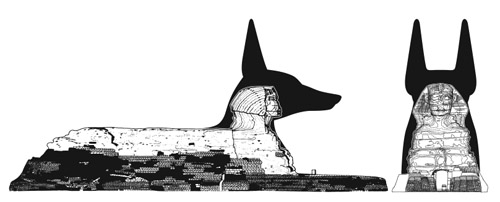
    The Sphinx is crouching there at the entrance to the Necropolis like a guardian. Well, there it is! It is a guard dog! The ancient Egyptians had a god called Anubis, who was a crouching wild dog, generally referred to as a jackal (although strictly speaking there were no jackals in Egypt, and Anubis was really a wild dog species which is now extinct). Anubis was the guardian of the Necropolis, the guardian of the dead, and he was often depicted in the precise position of the Sphinx – and famously in a statue found in the Tomb of Tutankhamun as well – so that his image is familiar to almost anyone who has ever had an interest in ancient Egypt.

    Anubis001

    In Figure 1 I show the drawing I commissioned which shows how the recarved head of the Sphinx was carved out of the neck stump which remained on the Sphinx after the original statue was mutilated by the rampaging mobs who smashed up everything they could on the Giza Plateau during the period of chaos known as the First Intermediate Period, between 2200 and 2000 BCE.

    It was the easiest thing in the world to knock the ears and nose off the Sphinx when the Sphinx was Anubis. You couldn’t put them back because the Sphinx was carved out of the solid bedrock, and the pieces must have been smashed to bits anyway. So the later exhibitionist pharaoh could even tell himself he was doing a pious act and ‘restoring’ the statue by flaunting himself, just as, say, Madonna helps the world, doesn’t she? Tom Cruise is also saving the world, remember? Yes, we all know that all celebrities are getting their pictures in the papers only for noble causes, and it has nothing to do with wanting people to look at them, or with such a low thing as vanity.

    Speaking of movie stars, the Sphinx is now so botoxed and has had so much plastic surgery from crazy ‘restoration’ (which is all shown in great detail in our book) that he could easily get a lead part in a blockbuster. But his ‘nose job’ didn’t go so well, as it is still missing. It was hacked off in the 13th century by a fanatical imam named Sheikh Mohammed, who wished to purge Egypt of non-Islamic influences. He got as far as the nose, at least. (The story that the nose was shot off by Napoleon’s soldiers is false.)

    So now we have a crouching Anubis as an island, surrounded by a little lake. And at last we have something which students of the ancient texts can suddenly recognise. For the most ancient surviving Egyptian texts, known as the Pyramid Texts, often speak of a sacred place associated with the Giza Necropolis called Jackal Lake. And here it is!

    Now we are getting somewhere. It is all beginning to make sense. In our book we gather together the many ancient texts which refer to Anubis guarding the Necropolis, situated at Giza, being beside a causeway, and being very large. We also reproduce Fourth Dynasty Giza tomb reliefs showing a giant Anubis, which may be intended as actual depictions of the Sphinx.

    Secret Chamber Beneath the Sphinx

    Most people who are intrigued by Egyptian mysteries have been wondering for a long time whether there might be any secret chamber beneath the Sphinx. I have crawled around inside the Sphinx, and I describe the tunnel which exists in the rear portion of the Sphinx’s body, as well as the vertical tunnel carved out of the bedrock beneath the Sphinx’s rump, and reproduce photos of these. In Figure 2 you see a photo which Olivia took of me with my head sticking out of the Sphinx’s ass, which perhaps proves how well I know him.

    Temple001

    Then an amazing thing happened. I came across a passage in one of the old books which I collect, in this case one published in 1715, which described a chamber beneath the Sphinx and gave an eyewitness account of it! I was astounded. The book referred to earlier accounts of this chamber, but neglected to say who had written them or when they had been published. Slight problem! How was I to find these books?

    If you went into the British Library and told a librarian you needed a book published before 1715 which described a chamber beneath the Sphinx, you would be told to come back when you had the author’s name or the title of the book. All I had to go on was ‘a book mentioning the Sphinx before 1715’, so how did I do it?

    That is where my special abilities come in, which enable me to obtain information which others seem not able to obtain. I am what you might call an information retrieval expert, and I do not need to know anything about the field in order to obtain its ‘concealed’ information. There is no such thing as concealed or destroyed information: it is all there in Information Space if you have access. Everyone knows about the emails which people think they have deleted from our computers, but which can be recovered by computer data recovery experts (as part of a criminal investigation, for instance). Well, there is a higher version of that, which enables all information which has ever existed in any material form to be accessed from the wholly non-material realm of Information Space.

    Unfortunately, I have never met anyone who seems to be able to access this material methodically and systematically. Most human beings can access it in a feeble and flickering fashion, by means of what is called ‘intuition’ or ‘hunches’. Perhaps it is just as well that proper access to all this information is limited. After all, the purpose of our being here in the material world is to see how we cope without information. That is why people like myself find it so difficult to communicate what we know when we somehow, in a way we do not understand, acquire information from Information Space. It is mostly not intended for circulation, and maybe I should not even be doing it. When I reveal such information to people, they never believe me anyway, so I generally do not bother.

    I cannot explain how I access it. I seem to ‘see through matter’ in some way which is difficult to describe, and I see the Information behind it on the other side. Matter becomes increasingly transparent to me every day anyway, and I no longer believe in it. On only one occasion was I so desperate that I ‘raped’ Information Space. That was when our beloved dog Kim was mistakenly locked in a room with a digital security code. Because she was old and ill and needed water, and might otherwise die before I could get someone with the code to come, I ‘accessed’ the numerical code, punched it in, the door opened, and I released her. I didn’t do it instantly. I first made two or three hysterical wrong attempts and wasted precious minutes through being over-stressed. I made myself try to remain calm and then got it right. This meant that I actually had to access the whole number of several digits, none of which was known to me. Really, we are not supposed to do this sort of thing, but my dog was more important to me than protocol.

    Also important to me is a Larger Dog, the Sphinx! I feel almost as affectionate towards him as I did… well, no, that would not be fair to Kim. But I also like the Dog Star. In fact, I am a sucker for dogs, I really am. I am not a cat person, even though I am a great fan of the original version of the film ‘Cat People’ (1942). Watch it sometime! See my review of it on my website.

    I was eventually able to find 281 years’ worth of published eyewitness accounts of the chamber beneath the Sphinx, including detailed information about exactly where it was, its size, and the fact that it contained the remains of a wooden coffin. Because the chamber was described as having hieroglyphics on the walls, I am certain that it was what archaeologists call ‘an intruded burial’, but it must have been a royal one, as a shaft was carefully constructed and a chamber cut in one of the most important monuments in Egypt, within the sacred precincts of the royal Necropolis. The shaft was sealed with cement by Émile Baraize in 1926. A century earlier, Henry Salt also sealed some openings and passages elsewhere at the Sphinx, and was sharply criticised for it by the French Count de Forbin. All of this is described in full detail in our book. So, yes, there is a ‘secret chamber’ beneath the Sphinx. And the information in our book proves this beyond all possibility of doubt. But no, it is not original and does not date from the time of the Sphinx’s carving. Also, it is empty, so there is no gold or treasure. But if we could just read what it says on the walls!

    Another thing I was able to demonstrate is that the Sphinx and the three Giza pyramids were part of a single unified design concept of the Giza Plateau. The position and size of the Sphinx is determined precisely in relation to the three pyramids, in a manner never before noticed. This is shown and explained at great length in the book, and it is not really possible to summarise that material, as it is too lengthy and detailed for a brief description. I can say, however, that it was part of a resurrection cult. In the process of explaining this in detail, I even have occasion to explain the true nature of those bizarre reliefs in a crypt at Denderah which have excited a great deal of speculation, the ones with the ‘lightbulbs’, although they are 2,500 years more recent, and their only connection is through the symbolism.

    I hope everybody will get a lot out of looking through our book, and, who knows, maybe even reading it. Stranger things have happened.

    Oh yes, I almost forgot: ‘Woof! Woof!’

    [alert type=”general” dismiss=”no”]This article was published in New Dawn 112.[/alert]

    [alert type=”success” dismiss=”no”]If you appreciate this article, please consider subscribing to help maintain this website.[/alert]

    © New Dawn Magazine and the respective author.
    For our reproduction notice, click here.
  • Arkaim: Russia’s Ancient City & the Arctic Origin of Civilisation

    Arkaim: Russia’s Ancient City & the Arctic Origin of Civilisation

    From New Dawn 111 (Nov-Dec 2008)

    Vast shadowy forces are moving in Central Asia – or rather in the greater region we call Eurasia – which may change the face of our global society and civilisation forever.

    Even as the balance of geopolitical forces is shifting inexorably in favour of the Eurasian superpowers – principally Russia, China, the Central Asian states and India – a new spiritual wind is blowing out of Inner Asia and its many hidden mystical schools, promising to sweep the new entente into unprecedented heights of international power, politically and culturally. The immensity of the coming turbulence occasioned by this shift from West to East is incalculable, the outer symptom of a global revolution of consciousness.

    Already the transformation of consciousness accompanying this hemispheric shift is creating both exaltation and unease in all people sensitive to evolutionary change. As the West moves through increasing economic and geopolitical tumult towards what many regard as a birthing into a new World Age, pressing questions are being asked. What are we mutating into and what kind of social realities will replace those we know? The mystery and the terror is not so much the speed of change as its unknown destination. Where are we heading? To what precipice sheer and awful, or to what blessed landfall?

    Striving to answer such questions, many leading esotericists today have turned to certain very ancient traditions to throw light on the crisis of our times. Increasingly heeding the overwhelming evidence for their thesis, they suggest that the key to humanity’s future lies in its distant past, in the heritage of an unknown antediluvian race that lived in a time so remote that its existence has been erased from racial memory.1

    A Forgotten Race

    Perhaps 100,000 years ago or more, so the hypothesis runs, a great star-gazing Ice Age people lived in the Arctic region, at that time a temperate zone, before migrating south to Inner Asia as conditions changed and the great ice sheets melted. There, in a fertile, paradisaical land, these unknown sages became the core of a Ural-Altaic race that continued to evolve over the millennia, improving the stock of primitive humanity by intermarriage, developing cosmological sciences and political structures that sowed the seeds of our present civilised state, migrating across the earth and then disappearing, leaving immortal legends about itself behind.

    The British author John Michell cites the massive evidence for such a civilisation, which he regards as essentially magical, and still faintly visible across the earth for those who care to look:

    The entire surface of the earth is marked with the traces of a gigantic work of prehistoric engineering, the remains of a once universal system of natural magic, involving the use of polar magnetism together with another positive force related to solar energy. Of the various human and superhuman races that have occupied the earth in the past, we have only the dreamlike accounts of the earliest myths. All we can suppose is that some overwhelming disaster… destroyed a system whose maintenance depended upon its control of certain natural forces across the entire earth.2

    Michell is one voice among many claiming that in the archives of prehistoric peoples a forgotten race has left traces of an advanced body of knowledge, seemingly both spiritual and technological, which can guide us, if we will, into a viable future.

    Despite being ignored by mainstream historians and anthropologists, this theory is being ever more insistently put forward by highly accredited researchers as evidence for the enormous age of our species continues to be found not only in the legends of races in every part of the planet but also in the thousands of technological anomalies being unearthed in unlikely geological strata.

    The ancient Greek historians had much to say on this subject, especially concerning the legends of Asia Minor which told of the descent thereto, in the depths of the Ice Ages, of the Hyperboreans, a mysterious race of superior beings from polar regions whose Pillar works on earth sought to mirror the starry heavens above. Yet it is Central and Inner Asia further to the east, a vast land of steppes, mountains and sandy deserts, whose people preserve the most significant memories of a time beyond telling when cities populated the deserts and an Elder race walked tall on the earth. And it is these Ural-Altaic regions that are now taking centre stage as the search continues for the roots of homo sapiens and the path into a viable future.

    Arkaim: A Bronze Age Town in the Southern Urals

    In 1987, in the middle of the Russian steppe, a team of Russian archaeologists unearthed the ruins of a fortified town called Arkaim, causing great excitement in scientific ranks and a surge of neo-pagan and nationalist enthusiasm among Russian intellectuals. The region was known to have preserved landmarks of the most diverse cultures, ranging from every epoch and every direction of the compass, but Arkaim was the first clear evidence of an ancient advanced culture flourishing on Russian soil.

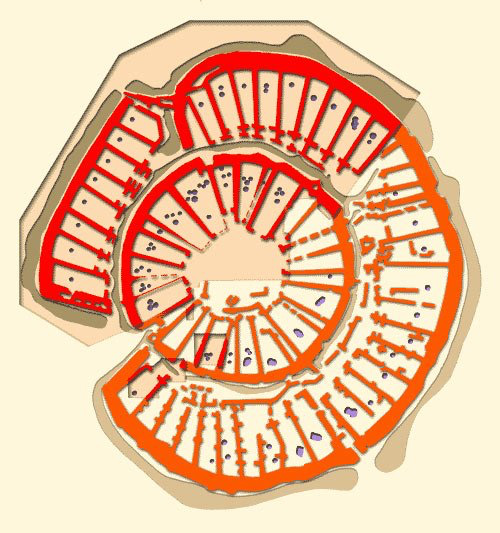
    Constructed on a circular principle around a central square, with about sixty semi-dugout houses built within its ramparts, the settlement was situated in the southern Urals, near the Russian city of Chelyabinsk. It was defended by two concentric ramparts of clay and adobe blocks on a wooden frame, and could only be entered via four intricately constructed passageways that would have made the entrance of enemies extremely difficult. The inhabitants and the common central square were thus well protected by Arkaim’s defensive, inward-turned ground plan. The town was found to be closely aligned to several celestial reference points, and is therefore believed to have been an observatory as well as a fortress, an administrative and a religious centre.

    A layout map of Arkaim in Arkaim: 1987-1998 by D. G. Zdanowich, published by Chelyabinsk State University, pg 18

    Dubbed “the Russian Stonehenge,” this Bronze age settlement was about 3,600 years old and was contemporaneous with the Cretan-Mycenaean civilisation, with the Egyptian Middle Kingdom and with the Mesopotamian and Indus valley civilisations, and older by several centuries than Homer’s fabled Troy, whose circular layout it so closely resembled. Arkaim was inhabited for 200 years and was then mysteriously burned down and deserted.

    The Russian team’s explorations showed that Arkaim enjoyed an advanced technology for its time. It was equipped with a drainage gutter and storm sewage system and had actually been protected from fire: the timbered flooring of the houses and the houses themselves were imbued with a fireproof substance – a strong compound the remnants of which can still be found in the ruins. Each house gave onto an inner ring road paved with wooden blocks; and in each house there was a hearth, a well, cellars, an oven and provision for a cooled food storage system. The oven was such that it may have been possible to smelt bronze in it, as well as to fire pottery.

    Subsequent to this exciting excavation, more than another twenty fortified settlements and necropolises were unearthed in the Arkaim Valley, some stone-built, larger and more impressive than Arkaim. With Arkaim possibly its capital, the complex came to be called the Land of Cities and presented scientists with many mysteries. It was the first concrete evidence of a lost neolithic civilisation in southern Russia, confirming what had long been believed, that the southern Urals and northern Kazakhstan, situated at the junction of Asia and Europe, was an important region in the formation of a complex Aryan society.

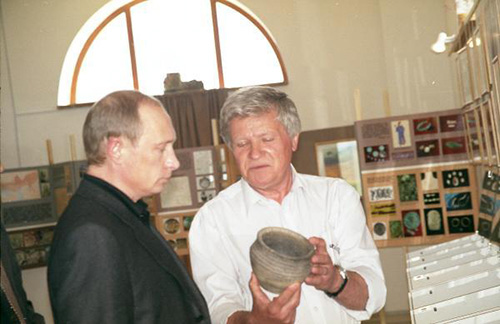
    Russia’s president Vladimir Putin visited the site in 2005, meeting in person with the chief archaeologist Gennady Zdanovich.

    A possible light was thrown for the first time on the development, nature and wide migratory pattern of early Indo-European culture, and stimulated all sorts of theories in Russian circles about the Aryan roots of the Slavic people.3

    This, however, has been only the beginning of the quest for a new ethnic, cultural and religious identity in a small but influential Russian minority since the demise of the Soviet Union. Increasingly rejecting the American and European vision of a global hegemony rooted in Western Christianity, Russians, besides their interest in their Indo-European roots, are turning eastwards to find a connection with the Turkic/Mongol ethnic strain. Many, especially among the young, are already embracing the mystique of a united Eurasian people and community cemented by spiritual bonds far older than those of Christianity or Islam. Arkaim has become a ready focus for these ideals, a symbol of the future basis for world peace.

    Ar-ka means sky, and Im means earth, says Alex Sparkey, a Russian writer. He explains that this means Arkaim is a place where the Sky touches the Earth. Here the material and the spiritual are inseparable.

    The East and the West are fused here. Today, in Russia, we feel that Mankind is faced by the necessity to choose Oneness. Western culture must come into unity with Eastern wisdom. If this can happen, the harmony that once reigned supreme in the Land of Cities will be restored.4

    In fact, it is doubtful whether peace and harmony existed in the period of Arkaim, since it and the surrounding fortified settlements were obviously geared to warfare or at least to heavy defensive measures in a hostile environment. It is noteworthy that the cult of Tengri, the Mongol/Turkic Sky God who plays a prominent part in Central Asian religion, fosters a fierce competitive nationalism rather than peaceful relations with neighbours. However, Sparkey is right to emphasise the principle of harmonious accord implicit in the Arkaim ideology, pointing as it does to the settlement’s inheritance of a once more peaceful culture.

    The head of the archaeological team observed:

    A flight above Arkaim on board a helicopter gives you an incredible impression. The huge concentric circles on the valley are clearly visible. The town and its outskirts are all enclosed in the circles. We still do not know what point the gigantic circles have, whether they were made for defensive, scientific, educational or ritual purposes. Some researchers say that the circles were actually used as the runway for an ancient spaceport.5

    The truth is that Arkaim was a troy town, so-called after the city in Asia Minor that the Greek king Agammenon destroyed during the Trojan Wars. Built on the same circular principle as Troy, as described in Homer’s Iliad, but at least six hundred years older, Arkaim finds its prototype in Plato’s Atlantis with its three concentric circles of canals; in legendary Electris, the Hyperborean city some said was built under the Pole Star by the sea-god Poseidon; and in Asgard, the sacred city dedicated to the Norse god Odin that is described in the Icelandic saga, the Edda. All these legendary troy towns have the same circular ground plan. They have gone down in history as neolithic Wisdom centres and the seats of ancient god-kings, and this undoubtedly throws light on the cultic function of Arkaim in its day, as we shall see.

    In Russia’s more mystical quarters there is intense interest in the ancient town, seeing it as the city temple built by the legendary King Yama, ruler of the Aryans in the Golden Age, which will once again become the centre of the world.6 However, the discovery of the settlement has opened a historical aperture onto far more than the battles and conquests of an aggressive Indo-European people waged across Eurasia and south into the Mediterranean lands, where their war chariots shattered the peace of Old Europe. What the Land of Cities has revealed in its very structure and history is above all the still earlier past of the Ural-Altaic peoples – a past of such enormous antiquity that it presents more mysteries than it solves.

    Built in the unique architectural mould of nordic Asgard, the most sacred shrine of the Aesir of which the Prose Edda relates that “men call it Troy,” Arkaim may have been a shrine dedicated to the Aryan Sun religion, yet the roots of its dedication would have lain ultimately in the far older cult of the Pole star. Essentially, this was the religion of the shaman, the wizard, the medicine-man and other wonder-workers in touch with the spirits of nature.

    Thus the swastika, thought to be the exclusively Aryan symbol of sun-worship misappropriated by the Nazis,7 and found depicted on many of the clay pots unearthed in Arkaim, is an older religious and metaphysical symbol than that attached to the Aryan Sun God, its roots lying in totemic shamanism. René Guénon, the eminent French esotericist, points out that the swastika, symbolising eternal motion around a motionless centre, is a polar rather than a solar symbol, and as such was a symbol central to the Pole star cult, originally dedicated to a planetary deity connected to Ursa Major, the Great Bear. This centre, Guénon stresses, “constitutes the fixed point known symbolically to all traditions as the ‘pole’ or axis around which the world rotates…” The swastika is therefore known world-wide as the ‘sign of the pole.’8

    In short, it would be a mistake for Russian ethnic pride to train too narrow a focus on Arkaim’s Aryan background, for the town was heir to a great civilising force that existed in the Eurasian corridor long before there were Indo-Europeans. One universal feature of troy towns is missing in Arkaim – presumably because it has been destroyed over the centuries – and that is the altar pillar in the central square. Undoubtedly, in Arkaim we see a late expression of a megalithic Pillar religion that once reigned universally in every corner of the globe, among nearly all peoples, whatever their ethnic type, and which became associated with troy towns. It is the oldest religion known to us and goes back to the most remote antiquity when men saw the heavens as revolving around the axis of the Pole Star.

    Only later did the Sun, as the centre of the revolving stellar system, replace the Pole Star as the supreme deity of the Pillar cult and lead to the elevation of the Sun God of the Indo-European peoples. It led to their greater intellectual development, to complex civilisations, to advanced arts and sciences and the transcendence of nature.

    Troy towns like Electris – and Arkaim – were built as stellar observatories. Their function was to unite earth to the starry cosmos above according to the principle of “as above so below” by means of a central axis symbolised by a stone pillar. Thus Diodorus Siculus of the first century BCE, quoting the historian Hecataeus, described the sanctuary of Electris as a troy town after the pattern of the spheres, by which he meant an astronomical design similar to that of Stonehenge and other ancient sun temples, in which the scheme of the heavenly spheres or astral shells surrounding the earth was represented diagrammatically by a series of concentric circles marked by walls, ditches or moats around a central pillar-stone.9

    These enclosed and heavily guarded sanctuaries sacred to the gods of the greater cosmos were inhabited only by initiated priests and their families, and were forbidden to the wandering nomads beyond the ramparts. The mystery to archaeologists is how such an advanced astronomical science can have been pursued at a time when hunter-gatherers still roamed the land. Colin Wilson, a highly accredited investigator, in answer takes us back to the Sumerians of ancient Mesopotamia, a people who almost certainly had their origin in Central Asia, as the Bible states: “As men migrated from the east, they found a plain in the land of Shinar [Sumer] and settled there.” Sumer is regarded as the site of one of the first true civilisations in human history.

    Wilson points out that the Sumerians were accomplished astronomers who had compiled tables of the motions of all the planets, including Uranus and Neptune, as early as five thousand years ago, long before the existence of Arkaim. He adds that according to the library of clay tablets compiled by the Assyrian King Assurbanipal (669 – 626 BCE) and unearthed during the nineteenth century, the Sumerians had also understood the precession of the equinoxes, and therefore knew about the zodiac.10

    Further revelations of the Sumerians’ sophisticated astronomical science convinced Wilson that the Chaldaean astronomers understood our solar system as well as Isaac Newton did.11 Indeed Wilson came to believe that a scientific knowledge of the universe existed on earth as far back as 64,000 years ago, if not far longer.

    Evidently Arkaim was a Wisdom Centre in a network of such Centres that once related all the prehistoric peoples of the earth to each other under the spiritual aegis of the Pillar religion and its priestly elites. The remains of countless similar stone circles, menhirs and troy towns are scattered throughout Europe, the Americas, Eurasia and the Pacific lands, memorials to great crisscrossing migrations of peoples, all loyal to the same axial principle that relates earth to the heavens.

    As to the cradle of this great diaspora, the mystical Russian painter and explorer Nicholas Roerich saw thousands of such megalithic pillar-works in the highlands of Tibet and believed them to be older than any found elsewhere. He suggested they had strong links to the works of the Celts and the Scythian tribes, as also to the megaliths of Carnac in Brittany, and that they represented a Pillar cult that had its beginnings long ago in the Trans-Himalayas of Inner Asia.12

    This proposed Eurasian cradle of the troy town phenomenon is reinforced by the researches of one Jacob Bryant in 1776. Bryant, a noted expert in Homeric Troy, published an encyclopaedia of ancient mythology in which he claimed the Trojans were descended from a very old “Atlantean” race that had long ago settled across the whole of Eurasia.13 If the first troy towns were built in Central Asia, could the universal Pillar religion also have had its beginning there?

    As I have said, various versions of the cult of the World Pillar as it spread around the world were once known from the Americas to northern Africa, where the blond Tamahu worshipped the Magna Mater and her spouse the Heaven-Bearer, as did their cousins in Brittany and Spain. In Hindu India the World Axis, Mt. Meru, ascended into the revolving heavens above through the centre of the three worlds, and in the Canary Islands the Cro-Magnon Guanches, now extinct, worshipped with sacrifices the god of the World Pillar whom they called “the God who Holds the Heavens,” and who thus prevented the collapse of the foundations of the world.”14 A remnant of this belief-system survives in the legend of Jacob’s Ladder in the Hebrew Book of Exodus, in which we learn that on this Ladder angels ascend and descend between heaven and earth.

    Each race has considered a certain tree as symbolic of the World Pillar and therefore sacred. In the Voluspa, the song of the Old Norse prophetess, the tree on which the god Odin hung in order to receive the sacred runes was called Yggdrasil, the heaven-pole or world axis. The World Ash Yggdrasil was declared to be the greatest of all trees and the best; its limbs spread over the world and above the heavens, its shaft the pivot of the ever-revolving sky. At the foot of that tree the laws were first brought into being by the Aesir, the Norse gods, and Yggdrasil was worshipped as the source of all higher knowledge.15

    To the inhabitants of Sumer, whose language is unknown – being neither Indo-European nor Semitic – the Pillar was a dominant religious feature: thus Nippur, one of Sumer’s chief cities, as long ago as 3800 BCE had the meaning of “Bond of Heaven-Earth.” A prominent researcher on this subject says that in the text of the Sumerian ‘Enuma Elish’, “clues to the purpose of Nippur were found in references to a heavenward tall pillar reaching to the sky.”16 In ancient Egypt, the land of the Hamitic peoples, the city of An or Anu, which was renamed Heliopolis by the Greeks, originally meant Pillar City.17 As a commentator has pointed out, this fact may shed light on the mysterious djed pillar, the “backbone of Osiris,” often associated with Heliopolis.18

    Like others of the Pillar fraternities, the totemic shaman too dedicated his life and calling to the vision of the marriage of heaven and earth achieved by means of a heaven-bearing Tree of Life. In ancient Crete he was a familiar adjunct to the temple rituals of the Great Mother Demeter; in Siberia, Mongolia and the Americas, he was the magician and wise man of his tribe. Beating his drum and climbing the central pole of his yurt, the symbolic pillar by which he communed with the sky spirits above, the shaman thus brought down healings, prophecies and advice from the ancestors to the people of his community. The Mongol-Turkic shamanic tradition with its Sky God Tengri and its World Tree still survives over a vast area of the planet, although its roots are lost far back in the mists of the palaeolithic age.

    The mystery of Arkaim is indeed the mystery of the Pillar religion. Who brought to all the primitive peoples of earth this knowledge of the Polar Axis, uniting them for many thousands of years in a common planetary culture? Who taught them the astronomical secrets of the solar system, the zodiac and precession of the equinoxes at a time in prehistory when human intelligence was not supposed to be evolved enough to have developed that knowledge alone? And what part did Arkaim play in that dissemination?

    [alert type=”info” dismiss=”no”]If you appreciate this article, please consider a subscription to New Dawn magazine.[/alert]

    Tracing the Arctic Origins of Civilisation

    The Babylonians believed in a mysterious paradise in “the far north” where a race of great sages lived; and the ancient Greeks too extolled a northern Elysium in which they believed the Hyperboreans, a wise, peaceful and long-lived race, lived in great splendour and prosperity. Even though Delphi was regarded as the centre of the Greek world, its god Apollo and his sister, the goddess Artemis, were acknowledged to be originally deities of this secret land far to the north, where stood the cosmic axle that the Greeks called Helice, “That Which Turns.” Many Greek historians as well as later scholars located this northern paradise in Scythia or the Altai, and as having its source in the shamanism that grew up around the semi-mythical magicians and pole-lords of Altai. But research and sacred tradition both suggest its origins go further back still to northeastern Asia within the Arctic Circle, to a society that flourished on the shores of the Siberian Sea.

    How long ago, or for how long, this circumpolar culture may have existed no-one knows: possibly 200,000 years or more. In The Interpretation of Radium, the acclaimed physicist Frederick Soddy stated that some of the beliefs and legends which have come down to us from antiquity may be “evidence of a wholly unknown and unsuspected ancient civilisation of which all other relic has disappeared.”19 There may have been, he suggested, previous cycles in the unrecorded history of the world when civilised men lived “in a past possibly so remote that even the very atoms of civilisation literally have had time to disintegrate.”20

    On the basis of years of investigation, Charles Hapgood, a New England professor of history, in 1982 declared that possibly as long ago as 100,000 years BCE the hub of a worldwide maritime civilisation with a highly developed level of scientific knowledge must have been in existence in the Arctic Circle.21 Until lately Hapgood’s finds, presented in Earth’s Shifting Crust (1958) and Maps of the Ancient Sea Kings (1966), have been largely ignored in scientific circles, even though they elicited support from the great physicist Albert Einstein; but today interest in them is mushrooming among a growing number of highly accredited investigators.

    René Guénon appeals to the oldest and most authentic esoteric traditions in claiming that long before the Indo-European races arose, at a time when a hunter-gatherer humanity was still at a primitive stage of development, the tropics were differently distributed and a great Hyperborean culture flourished around the Arctic Circle, “in the Islands of the Blest on the shores of the Ocean where the great maelstrom whirls.”22

    Only later, after a catastrophic change in geological conditions, did this senior race migrate southward, some to Central Asia, others, possibly crossing the Bering Strait, to Atlantis to the west. The latter has been located by some researchers in the Antilles, two large islands beyond the Gulf of Mexico widely regarded as the remains of what was once a great sunken landmass.23 (In support of this theory, the Caribs and the tribes of Hispaniola have long had a tradition that many of the islands of the Antilles, a well-known earthquake zone, were once connected by a single landmass, before a great cataclysm about 15,000 years ago submerged the connection and left only the known island fragments.)24

    Leaving aside Guénon’s oblique reference to the two southern refuges of the Hyperboreans being in Russia and Central America, he suggests that in both cases the two groups brought with them advanced mathematical and astronomical knowledge and the seeds of arts and sciences that would eventually be passed on to our brute ancestors to become the basis, about eight thousand years ago, for our own civilisations.

    Both Sumer in the Middle East and Central America have flood stories written down long before the biblical account of Noah’s flood, and in all these stories the salvific activity of the Elder race is pivotal. There is the Sumerian story of Utnapishtim and his wife, who, helped by the gods, survived a flood and were made immortal; and likewise early American accounts tell how the god Viracocha, who “came from the east,” destroyed the earth in a great flood. Later, after a man and a woman survived by taking refuge in a floating box, “Virachocha recreated the peoples of the earth, and gave each one his own language and songs.”25 Wilson cites many such instances in which flood stories about the Hyperboreans and their salvation of our race are to be found in both the Old World and the New.

    Guénon is emphatic, however, that of the two primary locations, both of which have at times borne the name of Tula (known to the Greeks as Thule), that of Central Asia was the elder. The Atlantean Tula, says Guénon, must be distinguished from the Hyperborean Tula, the supreme Holy Land, which latter represents the first and supreme centre for the entire current Manvantara, and is the archetypal “sacred isle.”

    All the other “sacred isles,” although everywhere bearing names of equivalent meaning, are still only images of the original. This even applies to the spiritual centre of Atlantean tradition, which only governed a secondary historical cycle, subordinate to the Manvantara.26

    Plato himself notes this hierarchical distribution: the Atlantean empire, he said, was only one nexus established by the gods in a greater network of Centres whose capital was elsewhere “at the centre of the Universe.”27 Thus the Eurasian heartland, Guénon says in his brief but ground-breaking work, The Lord of the World, has indeed become that “centre of the Universe,” the authentic “supreme country” which,

    According to certain Vedic and Avestan texts, was originally situated towards the North Pole, even in the literal sense of the word. Although it may change its localisation according to the different phases of human history, it still remains polar in a symbolic sense because essentially it represents the fixed axis around which everything revolves.28

    However, this still does not tell us why the location in Central Asia was chosen as the Hyperboreans’ primary destination? Guénon’s response to this question is cryptic in the extreme. He admits he is dealing with proscripted material he is not permitted to divulge, but goes so far as to reveal that Mt. Meru, the “polar mountain” stands in the centre of the “supreme country” – and Mt. Meru, as is now generally understood, symbolises the mysterious World Axis or World Tree of esoteric tradition. In other words, Central Asia was chosen because the World Axis was there; that was the real goal of the migration. The World Axis was, and is, the “centre of the Universe”; it is the World Axis that renders its geographical location a Holy Land – a fact which is only now being elucidated in para-scientific circles.

    As we shall see in the second part of this article, the earth’s esoteric structure is a subject that has been veiled in secrecy for thousands of years, and this applies especially to the mystic’s Mt. Meru or World Axis. John Major Jenkins, in his book Galactic Alignment, is one of the first modern researchers to throw light on the meaning of this and much other Hyperborean lore that Guénon was unwilling or unable to discuss. Beyond referring to the senior race as “the guardians of Earth’s sacred mysteries,” Guénon’s initiatory vows kept him silent.

    Who, then, were these mysterious Hyperboreans – or as we might perhaps better call them, these Elders, these early Masters of Wisdom who understood the importance of the World Axis? The records of most of the Bronze age nations have a legend that an unknown race of Elders gave us kingship and civilisation and that they came from the gods and understood the most powerful secrets of our planet – secrets that have since been lost.

    The Elders have been known as the Nephilim, the Sons of God, the Anunnaki, the Watchers and many other appellations; G.I. Gurdjieff spoke of them as agents of the divine Demiurge from a previous cycle of humanity. But beyond being credited with great wisdom and magical powers as well as having giant stature and extremely high craniums, little more is known about them. Did they really exist? All that can be said with certainty is that they remain a benign shadowy presence moving inscrutably in the background of virtually all the prehistoric traditions of our race.

    These souls from Sirius, say the ancient texts, descended down the World Axis and incarnated on earth long ago in order to aid our fledgling species. When a great catastrophe towards the end of the Ice Age, around the twelfth millennium BCE, threatened us with extinction, these sons and daughters of the gods instituted the hieros gamos, a genetic science that mingled their genes with ours and so bred a superior human stock with a greater survival potential that spread gradually from the heart of Asia on one hand, and Atlantis on the other, to the rest of the world.29

    The climate changed again around the ninth millennium BCE, which is widely regarded as the date of the demise of Atlantis and the enforced dispersal of its people both westward to Central America and eastwards to Europe. Bringing catastrophic earthquakes and coastal flooding to vast areas of the globe30 and a severe threat to the survival of our species, it was a racial crisis that brought another response from the senior race.

    Although the Elders had gone, their dynastic descendants, a long line of neolithic priest-kings, began a new evolutionary programme. In their migrations from Central Asia, the Ural-Altaic race is credited with establishing in every corner of the earth its Pillar religion, which Plato’s Critias vividly describes as also the religion of the Atlanteans. Stone pillar altars have survived in Malta from c. 5000 BCE, also from Catal Huyuk, in Anatolia, c. 5800 BCE.31 The Pillar religion is the earliest known vehicle of a comprehensive body of wisdom originally centred on the Pole Star, in which the moon is the primary image of the mysteries of birth, generation and death. It is the fundamental root of all the religions and esoteric traditions we know today, as well as all our higher learning. Its spread heralded the dawn of peaceful, egalitarian, Goddess-loving societies clustered in neolithic towns and villages around the world wherein the feminine principle was dominant and strife little known.32

    Arkaim and the Sun Gods

    Modern historians have found that three great floods seem to have occurred in the known span of human history. According to Stephen Oppenheimer in Eden in the East, the third of these, around the fifth millennium BCE, corresponded to Noah’s Flood and was the greatest of the three, peaking during the fourth millennium.33 It caused catastrophic coastal flooding, tsunamis and severe earthquakes, and also desertification of the interior of the land masses, and civilisation disappeared. Once again the species was threatened with a reversion to savagery, and once again salvation appeared from Inner Asia.

    In the third millennium BCE, so the Chinese Celestial records tell us, the Sons of the Sun – also known as the Sons of Heaven – fanned out across the world from their homeland in the Karakorum Range at the western end of the Trans-Himalayas, bearing with them the higher revelation of the Sun religion.34 It was a patriarchal and hierarchical belief-system that disclosed new depths of metaphysical and technological knowledge inducive to civilisation. Everywhere the stone circles whose central axis was dedicated to the Pole Star, like Stonehenge in ancient Britain, evolved over a further thousand years into more sophisticated observatories focused instead on the Sun and its circling planets, and human culture once more blossomed.

    This innovation, however, was not without inter-faith warfare, since many ethnic groups, such as the Mongol/Turkic peoples of the eastern steppes, remained loyal to the Pole Star cult. At the same time, pyramids as well as defensive troy towns like Arkaim sprang up in dedication to the Sun Gods, whose mystique became more and more occulted as enmity grew for the powerful new faith. Indeed Arkaim may have been the seat of one of the Solar mystery religions of that period, and the fiery holocaust that destroyed the settlement after two hundred years of operation may well have been caused by that same internecine conflict between the old order and the new.

    The pictorial evidence contained in the ‘Enuma Elish’ shows that the Sumerians understood full well that the Elders they revered so much were “from the gods” – not gods themselves but human beings, though far more advanced in consciousness. According to the murals they have left us, the early Egyptians too knew in some sense that their deities were really high shaman masters, each masked in the official headdress of his animal totem. But that understanding was to be occluded with the increasingly aggressive dominance of the Solar religion, when a kind of darkness of amnesia fell over the collective consciousness of our race. The Solar priesthoods withdrew behind barricades, and a spiritual division opened up in society that had never before existed.

    As the historian Giorgio de Santillana has pointed out in Hamlet’s Mill, from then on the enlightened understanding of our forbears began to descend into mythology and superstition as small pockets of secret wisdom called temples shone out in a sea of darkness, and a mystique of gods replaced the cosmological knowledge of an earlier age.35 While bands of initiate culture-bearers spread out across the globe to sow the seeds of civilisation once more, a nucleus of the senior race withdrew deep into the mountain ranges of High Asia that surround the Takla Makan desert and severed all direct contact with the outside world.

    Ever since, the whole Eurasian heartland, from the Urals to the Gobi and including southern Siberia, has borne the stamp of a special sanctity. High Asia in particular has been called by a succession of peoples and religions Paradesha, the Forbidden Land, the Land of the Living Gods, Thule, Djong, Uttarakuru, Olmolungring, Shambhala, the Holy Land and the Land of White Waters. Whatever its current name, almost all esoteric traditions in the Old World have related this vast, mysterious Inner Eurasian region, so rich in higher knowledge, to the legendary Elder race and revered it as the home of the Ancient Wisdom for the present World Age.

    The legend of the Sons and Daughters of God has thus never died, though it has gone underground. Inner Asia, thought to be the immemorial cradle of shamanism as well as of all yogic and religious systems, is believed by many to be still spiritually efficacious, still a holy land which, under a single governing Hierarchy, nurtures without fear or favour arcane schools and brotherhoods persecuted elsewhere. Sufis, Buddhists, Nestorian Christians, Taoists, Zoroastrians, Jews, Neo-Platonists and others who have been hidden from the profane world by long chains of initiatic transmission have never failed to find sanctuary in that specially blessed protectorate, where everything began.

    From being hidden in shadows for thousands of years, today the region is being illuminated by an intense spotlight from every possible angle. The discovery of Arkaim is only one such angle. The highly publicised row between China and Tibet is another; the ever-worsening struggle between the US and Russia for military dominance over the oil- and gas-rich provinces of Central Asia; the increasing commitment of Russia, China, Iran and India to a Eurasian geopolitical bloc, in tacit opposition to the Western powers; and at the same time the awakening of interest in the West to the mysterious spiritual wealth that can be glimpsed in the place, are yet other factors bringing the heart of Asia to the very centre of world attention. Yet the questions they pose remain unanswered.

    What is the secret of the Holy Land? Who really were the Elders who gave us civilisation? Are they still guiding our evolution in discarnate form? What is the secret of the World Axis? Do we as yet understand the archetypal principles that shape our planet? And why are we only now beginning to ask such questions?

    [alert type=”general” dismiss=”no”]This article was published in New Dawn 111.[/alert]

    [alert type=”success” dismiss=”no”]If you appreciate this article, please consider subscribing to help maintain this website.[/alert]

    Footnotes:

    1. Colin Wilson, Atlantis and the Kingdom of the Neanderthals, Bear & Co., Vermont, 2006.
    2. John Michell, The View Over Atlantis, Sphere Books, London, 1975, 117.
    3. V.A. Shnirelman, Archaeology and Ethnic Politics: the Discovery of Arkaim, Unesco, 1998.
    4. Alex Sparkey, The Ancient Land of Arkaim, from Spirit of Ma’at: Russia: Land of Living Mysticism, Vol. 3, No. 9, 3.
    5. Pravda.Ru, An Ancient Aryan Civilisation, 16/07/2005.
    6. Shnirelman, op. cit., 38.
    7. Louis Pauwels & Jacques Bergier, The Morning of the Magicians, Souvenir Press, London, 1960, 188.
    8. René Guénon, The Lord of the World, Octagon Press, U.K., 1983, 9.
    9. Victoria LePage, Shambhala, Quest Books, Illinois, USA, 1996, 197, citing Diodorus Siculus, The Library of History, Loeb Classical Library, London, 1936 – 67.
    10. Colin Wilson, op. cit., 32.
    11. Ibid., 32.
    12. Nicholas Roerich, Shambhala: In Search of the New Era, Inner Traditions International, 1930, 221.
    13. Jacob Bryant, A New System or An Analysis of Ancient Mythology, T. Payne, P. Elmsly, B. White and J. Walter, publishers, London, 1776.
    14. Jurgen Spanuth, Atlantis of the North, Sidgwick & Jackson, 1979, 123 – 24.
    15. Joseph Campbell, The Masks of God, Vol. 1, Penguin, Harmondsworth, 1984, 121.
    16. Alan F. Alford, Gods of the New Millennium, Hodder & Stoughton, London, 1996, 261.
    17. Ibid., 261
    18. Ibid., 261
    19. Frederick Soddy, The Interpretation of Radium and the Structure of the Atom, Putnam, New York, 1922, quoted by Colin Wilson, op. cit., 292.
    20. Ibid., 292.
    21. Colin Wilson, op. cit., 2.
    22. Hesiod [Works], R. Lattimore, trans., University of Michigan Press, Ann Arbor, 1959, 172 – 3.
    23. Lewis Spence, The History of Atlantis, Rider, London, 1926; cited by Geoffrey Ashe, Atlantis, Thames & Hudson, London, 1992, 21.
    24. Eberhard Zangger, The Flood from Heaven, Sidgwick & Jackson, London, 1992, 66.
    25. Colin Wilson, op. cit., 91.
    26. René Guénon, op. cit., 56.
    27. Plato, Timaeus and Critius, Desmond Lee, trans., Penguin, Harmondsworth, 1983, 145.
    28. René Guénon, op. cit., 50.
    29. Ibid, 56.
    30. Stephen Oppenheimer, Eden in the East, Weidenfeld & Nicolson, London, 1998, 30 – 41.
    31. Anne Baring & Jules Cashford, The Myth of the Goddess, Penguin, 1993.
    32. Ibid., 50 –56.
    33. Oppenheimer, op. cit., 35.
    34. Andrew Tomas, Shambhala: Oasis of Light, Sphere Books, London, 1976, 26.
    35. G. Santillana & H. Von Deschend, Hamlet’s Mill, Gambit International, Boston, 1969.

    © New Dawn Magazine and the respective author.
    For our reproduction notice, click here.
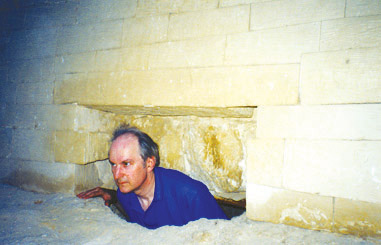
  • A Pagan Christ? Reflections on the Real Christmas Story

    A Pagan Christ? Reflections on the Real Christmas Story

    From New Dawn 105 (Nov-Dec 2007)

    Strictly speaking, a pagan Christ is a contradiction in terms. The very concept of paganism was constructed by Christians who wanted to distinguish their faith from the old religion of Greece and Rome, which by the end of classical antiquity was observed only by peasants in remote rural areas – the pagani, or “country people,” or – to use words that are similar in tone – rustics, rubes, hayseeds. So there can be no pagan Christ. Paganism is all that Christianity is not.

    Once we go past this elementary point, however, we see that the situation is not so simple. The resemblance between Christianity and its rivals could never be entirely overlooked. The Church Father Augustine (354–430) wrote, “That which is now called the Christian religion existed among the ancients, and never did not exist from the planting of the human race until Christ came in the flesh, at which time the true religion which already existed began to be called Christianity.” Whatever Augustine meant by this – and it’s not entirely clear from the context – one thing it could mean is that the “true religion” is universal and has always existed; only comparatively late did it come to be codified in the teachings of Christ.

    Before I go further into what this “true religion” might be, it’s necessary to stop and take a look at early Christianity in its context. Christianity, as is well known, grew up in the Roman Empire, a time of remarkable fecundity in religious belief, with a huge and dizzying marketplace of gods and cults and philosophies for the seeker to choose from, many of which bore more than a passing resemblance to one another. It’s impossible to believe that Christianity was not affected by this background. Although the Christians insisted that their religion was true and all the others were false, they still had to account for the fact that theirs was not so different from many of those they were denouncing.

    Over the past century, one of the most influential views of the relationship between Christianity and paganism has been that of Sir J.G. Frazer (1854–1941), author of the classic work The Golden Bough, first published in 1890 and updated in many editions thereafter. A pioneer of comparative mythology, Frazer delved into the compendious collections of lore and legend that scholars were amassing in his time and noticed that Christianity had taken many of its elements from the religions it would eventually displace.

    The most famous instance is Christmas. The birthday of Christ was not recorded and is not known; in the early centuries of the religion that bears his name it was not celebrated. But by the fourth century, Christ’s birthday came to be observed as a holiday. In the East (starting in Egypt), the date selected was January 6. But the Western church, which had never observed this date, set Christ’s birthday as December 25. Why? One Christian writer quoted (but not named) by Frazer explains: “It was a custom of the heathen to celebrate on the same twenty-fifth of December the birthday of the Sun, at which they kindled lights in token of festivity. In these solemnities and festivities the Christians also took part. Accordingly when the doctors of the Church perceived that Christians had a leaning to this festival, they took counsel and resolved that the true Nativity should be solemnised on that day and the festival of the Epiphany on the sixth of January.”

    Another, possibly more revealing, case involves the festival commemorating the death and resurrection of Christ. Today Easter is celebrated on the first Sunday after the full moon after the March equinox. (This is to some extent a simplification of the complex process of fixing the date of Easter, but it will serve our purposes here.) Frazer noted that there was an ancient tradition by which the death of Christ was observed on March 25, regardless of the phase of the moon. Remarkably, this coincided with the date on which the death and resurrection of a pagan god, Attis, was celebrated. Still more significantly, the parts of the world where Christians observed Easter on this date – western Asia Minor and Rome – were precisely the areas where the cult of Attis was most popular.

    Attis, according to the myth, was a handsome young shepherd who was born of a virgin. Beloved of the Great Goddess of life, he was said in some legends to have been killed by a boar, in others to have died after castrating himself. (The priests of the Attis cult were all self-made eunuchs, in imitation of him.) After his death, he was changed into a pine tree.

    It’s curious that the death and resurrection of Christ should have been celebrated in such close conjunction with that of one of the deities that the Christians so detested. What’s even more interesting is the underlying similarity of the myths: both are celebrations of a god, born of a virgin, who has died and risen again. More surprisingly still, Attis was not the only god in antiquity who was believed to have died and risen again. There was also Adonis, worshipped in Babylonia and Syria. Adonis, another beautiful young man, was said to die every year. His death caused passion to cease and beasts and men to forget to reproduce; all life would be extinguished if Ishtar, the goddess of life, did not rescue him annually from the halls of death. And of course there is Osiris, the slain and dismembered king of Egypt who was reassembled by his wife Isis (another goddess of life) to serve as the lord of the dead.

    Even this cursory sketch suggests how many parallels we can find between Christianity and pagan religions. Moreover, it was obvious that the pagan faiths were much older than the Christian one. Christianity looked like a mere copycat of these religions, and that’s exactly what many of its pagan critics contended. The Christian fathers countered with a remarkably clumsy response: that Satan, foreseeing that Christ would come to earth, came down first and created religions that were merely diabolical imitations of the truth.

    Those of us who find this argument implausible are left wondering exactly what the relationship between Christianity and these pagan cults was. Frazer saw the mystery religions of Attis and Adonis and Osiris as essentially fertility cults: Their rites were designed to mimic and foster the rebirth of life each spring. According to Frazer, Christ had come as a teacher of “ethical reforms”; the mythologies of the fertility cults were gradually assimilated to the faith of Christ’s followers “so as to accord in some measure with the prejudices, the passions, the superstitions of the vulgar.” Frazer writes:

    To live and to cause to live, to eat food and to beget children, these were the primary wants of men in the past, and they will be the primary wants of men in the future so long as the world lasts…. These two things, therefore, food and children, were what men chiefly sought to procure by the performance of magical rites for the regulation of the seasons.

    This all may sound plausible – as it certainly did to Frazer’s rationalistic late-Victorian contemporaries – but there’s one small problem with it. The idea that the mysteries of Attis and Adonis and Osiris, and by extension of Christ, were mere attempts to reproduce and sustain the cycles of life was known to the ancients and explicitly refuted by them. Plutarch, writing in the late first century CE, contends:

    And we shall also get our hands on the dull crowd who take pleasure in associating the [mystic recitals] about these Gods either with changes of the atmosphere according to the seasons, or with the generation of the corn and sowing and ploughings, and in saying that Osiris is buried when the corn is hidden by the earth, and comes to life and shows himself again when it begins to sprout.

    Cicero, the Roman statesman and philosopher (106–43 BCE), also says there is something more to the mysteries:

    These Mysteries have brought us from rustic savagery to a cultivated and refined civilisation. The rites of the Mysteries are called “initiations” and in truth we have learned from them the first principles of life. We have gained the understanding not only to live happily but to die with better hope.

    We can safely say this much: The ancient mysteries were more than rites intended merely to ensure that the crops grew and the animals bred. But what, then, were they? What is the dying “with better hope” that Cicero mentions? And why does the story of Christ, springing from the monotheistic world of Judaism, so much resemble those of the gods that went before?

    At this point it would be helpful to address an extremely important issue: the reliability of the historical accounts of Jesus. Apart from a few extremely brief references in non-Christian writers such as Tacitus and Pliny the Younger (which talk about the Christians as a sect but say practically nothing about Christ himself), we have to rely on the canonical gospels: Matthew, Mark, Luke, and John. Scholars unanimously accept these as the oldest gospels, with the possible exception of the Gospel of Thomas, an early sayings collection with a strongly Gnostic tinge; the many other gospels that were written are almost certainly later – one reason they didn’t find their way into the New Testament.

    Unfortunately, even these texts present Jesus at a remove. None of them, it is now generally acknowledged, was written by any of the Twelve Apostles or even by anyone who knew or saw Jesus personally. The earliest Gospel, Mark, is dated to around 70 CE; the latest, John, to around 100 (these dates are highly approximate). Nowhere in these Gospels is the claim that the writer himself has seen what he is describing. Indeed most scholars today agree that none of the texts in the entire New Testament was written by any of the Twelve Apostles.

    The only surviving eyewitness account of Christ is found in Paul’s first letter to the Corinthians. Paul did not know Jesus when he was alive, but he writes that after Jesus had appeared to Cephas (Peter), the twelve, and various other witnesses, “last of all he was seen of me also, as of one born out of due time” (1 Cor. 15:5). (Biblical quotations are from the Authorised King James Version.) This experience, usually equated with Paul’s vision on the road to Damascus (Acts 9:1–7), is an eyewitness account: Paul is claiming that he has had a vision of the risen Christ like that of the other apostles. Inasmuch as Paul died during Nero’s persecution in Rome in 64 CE, this text is almost certainly earlier than any of the Gospels. But Paul does not say anything more about his experience, and he says almost nothing at all about Jesus before his death.

    In their 1999 book The Jesus Mysteries, Timothy Freke and Peter Gandy argue that the extreme scarcity of direct evidence about Jesus, together with the strong resemblance of his story to other pagan myths, means that Jesus did not exist as a historical figure. He was created by Gnostic sages as a kind of Jewish equivalent of the dead and reborn gods of the pagan Mediterranean world.

    Freke’s and Gandy’s view, although interesting, seems to be an overstatement given the evidence. They say that Paul’s vision (as described by himself) may have been a later addition to 1 Corinthians, a claim that, to my knowledge, no reputable scholar would agree with; or perhaps that it was a mystical vision of some sort. But the context of 1 Corinthians 15 indicates that, as Christians have always claimed, Paul, like the others who claimed they had witnessed the resurrection of Christ, regarded it as an actual encounter with the risen Jesus. Whatever it was they saw or did not see, this much seems indisputable. Indeed, if we go to 1 Thessalonians, another letter of Paul’s, which was the first New Testament book to be written (it’s generally dated to around 50 CE), we see Paul saying, “The Jews… both killed the Lord Jesus, and their own prophets” (1 Thess. 2:14–15). “We believe that Jesus died and rose again,” he writes in the same letter (1 Thess. 4:14). In both these instances, he is stressing the historical actuality of these events: they are not a myth. Furthermore, Paul is not introducing this idea as a novelty but as a premise that he expects his readers to share.

    About the historical Jesus, then, we can say this much: that as early as 50 CE, no more than twenty years after his death and still well in the lifetime of his disciples, his followers preached that he had suffered and died and was resurrected. These facts are not later mythic accretions but among the first things the historical record says about Jesus.

    What, then, does this all mean? Paul’s own ideas seem to have grown and changed over time. In 1 Thessalonians, his first surviving epistle, he sounds like a modern-day fundamentalist, obsessed with the Rapture. In fact the idea of the Rapture comes from 1 Thess. 4:17: “Then we which are alive and remain shall be caught up together with [the dead] in the clouds, to meet the Lord in the air.” Later, Paul becomes more mystical. In 1 Corinthians he explicitly denies the physical resurrection of the dead: “It is sown a natural body; it is raised a spiritual body…. Flesh and blood cannot inherit the kingdom of God; neither doth corruption inherit incorruption” (1 Cor. 15:44, 50). This, incidentally, puts mainstream Christianity in the bizarre position of teaching a doctrine – the resurrection of the physical body – that is explicitly denied by its own scriptures. I do not know of any other such case in all of world religion.

    Nonetheless, resurrection is at the core of Christianity from its earliest days, just as it was of the mystery religions of Attis and Adonis and Osiris that preceded it. And, like the pagan mysteries, which enabled its initiates to die “with better hope,” Christianity viewed the resurrection not an isolated case that happened to one (possibly divine) man, but something that is the common human inheritance, potentially available to everyone: “Now is Christ risen from the dead, and become the firstfruits of them that slept” (1 Cor. 15:20). This was not the concept of resurrection as commonly taught, but part of what the Church Father Origen (185–253) called “the deeper and more mystical doctrines which are rightly concealed from the multitude.”

    The nature of this resurrection lies at the heart of the old pagan mysteries and the Christian faith alike. To best understand it in a short space, it would be helpful to use the common metaphor of a seed, used both by Jesus in the Gospels and by Paul (as well as in some of the pagan mysteries). A seed is something extremely small and contains only in germ the full plant; this is the metaphor Paul uses to compare what he calls “the resurrection body” with the “natural body.” Christ in the Gospels likens the kingdom of heaven to a seed on several occasions as well: for example, “the kingdom of heaven is like to a grain of mustard seed” (Matt. 13:31).

    What, then, is this “seed”? What is the kingdom of heaven, for that matter? If you were to read the works of many theologians, you might conclude that they don’t know. But this is a central concept in esoteric Christianity. It is not difficult to grasp, but it is subtle. I’ve discussed it in detail in my book Inner Christianity, but in essence it comes to this: There is that in you which says “I.” It is consciousness in its pure form; it is never seen, but always that which sees. You may think you are your body or your emotions or your thoughts, but the fact that you can step back and look at all these things at a distance proves that these things are not you – not in the truest and fullest sense. In fact it is your very confusion of your “I” with your thoughts, emotions, and sensations that constitutes the fundamental problem of human existence. Liberation or enlightenment or, as the early Christians called it, gnosis is the freeing of the “I” from its identification with its own experience. Paul writes, “That which thou sowest is not quickened until it die” (1 Cor. 15:36). Esoterically, this means that the “I” must “die” – must detach itself from its former identifications – before it can be “resurrected” or “born again,” that is, realise its fullest potential in a life that is not limited by the body or the psyche. In the course of this liberation the “I” realises its own immortality.

    This, in the simplest and most concise language that I can muster, is the secret that I believe lies at the heart of esoteric Christianity and of the Christian mystery itself. To speak of the resurrection of the physical body, explicitly denied by Paul, is to misunderstand; it is the symbolic death and rebirth of the true “I” – called “I am” in the Gospel of John – that is really the point. But it is an arcane point, and not everyone can grasp it. Early Christianity eventually allowed ordinary believers to believe in a physical resurrection because it was easier to understand; only those who wanted to go deeper were told the truth. As Origen writes, “The resurrection of the body,… while preached in the churches, is understood more clearly by the intelligent.” Origen is saying that the doctrine “preached in the churches” is not the whole story. Regrettably, however, as Christianity developed in later centuries, those who had only an inaccurate, secondary understanding of this truth came to lead the church. Because they did not understand the deeper message, they suppressed it, with consequences that have been disastrous for the spiritual life of the West.

    In any event, the revelation of the true nature of the “I” makes the correspondence between the Christian mystery and those of the pagans much easier to understand. If these things are true, they are universally true, and if they are universally true, they must have been known in many times and places and cannot be the bailiwick of a single religion. That, I would suggest, is why Augustine can say that the “true religion” always existed. It’s also why the mystery religions so resembled Christianity. They were expressing a universal truth to which Christianity was also pointing.

    Get the issue this article appears in

    All the same, this does not entirely explain the innumerable parallels between the Christ of the Gospels and the figures of ancient myth. Often it does seem that characteristics of the ancient pagan gods were later associated with Christ – and at a fairly early stage. The virgin birth, for example, is not mentioned in Mark, the earliest canonical Gospel, or for that matter by Paul. But it does appear in Matthew and Luke, which are generally dated to between 80 and 100. This suggests that by this point certain myths and legends had attached themselves to the basic story of Christ’s death and resurrection.

    Exactly how this happened is unclear. There is no contemporary documentation of this process, or, for that matter, of Christ himself apart from the Gospels to serve as a check. The best guess seems to be something like this: The earliest Christians believed they had some experience of the risen Christ, and this was the central part of their message from the very beginning. By the end of the first century, as the Gospels were being written, the historical kernel of the story of Christ was expanded and recast, partly to imitate familiar aspects of pagan myths but also to symbolically express certain truths. That’s why Origen could write:

    Very many mistakes have been made because the right method of examining the holy texts has not been discovered by the greater number of readers… because it is their habit to follow the bare letter….

    Scripture interweaves the imaginary with the historical, sometimes introducing what is utterly impossible, sometimes what is possible but never occurred…. [The Word] has done the same with the Gospels and the writings of the Apostles; for not even they are purely historical, incidents which never occurred being interwoven in the “corporeal” sense…. These passages, by means of seeming history, though the incidents never occurred, figuratively reveal certain mysteries.

    This process began with the Gospels but did not end with them. It continued for several centuries later, as we’ve seen with the Christian appropriation of Christmas and Easter in the fourth century. Later still, in the fifth century, when the cult of the pagan goddesses was suppressed, there was a need for a feminine face of divinity, and the mother of Christ was elevated to this role; many of the attributes of Ishtar and particularly Isis were then attached to her. Christianity’s success was at least partly due to its remarkable genius and flexibility in adapting pagan myths to its own ends. Ultimately, however, the true greatness of the faith lies in its profound and haunting expression of what may be the central mystery of human existence.

    [alert type=”general” dismiss=”no”]This article was published in New Dawn 105.[/alert]

    [alert type=”success” dismiss=”no”]If you appreciate this article, please consider subscribing to help maintain this website.[/alert]

    Bibliography

    Raymond E. Brown,  Introduction to the New Testament, New York: Doubleday, 1997.
    J.G. Frazer, The Golden Bough, New York: Macmillan, 1922.
    Timothy Freke and Peter Gandy, The Jesus Mysteries: Was the “Original Jesus” a Pagan God?, New York: Three Rivers, 1999.
    The Greek New Testament, edited by Kurt Aland et al. Third edition. N.p.: United Bible Societies, 1966.
    G.R.S. Mead, Thrice-Greatest Hermes: Studies in Hellenistic Theosophy and Gnosis, York Beach, Maine: Samuel Weiser, 1972. Originally published 1906.
    Origen, Contra Celsum, translated by Henry Chadwick, Cambridge: Cambridge University Press, 1953.
    Origen, On First Principles, Edited and translated by G.W. Butterworth, New York: Harper & Row, 1966.

    © New Dawn Magazine and the respective author.
    For our reproduction notice, click here.
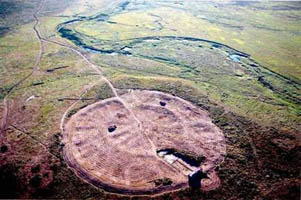
  • The Lost Lands of Mu and Lemuria: Was Australia Once Part of a Sunken Continent?

    The Lost Lands of Mu and Lemuria: Was Australia Once Part of a Sunken Continent?

    From New Dawn 103 (Jul-Aug 2007)

    Lemuria and Mu are interchangeable names given to a lost land believed to have been located somewhere in either the southern Pacific or Indian Oceans. This ancient continent was apparently the home of an advanced and highly spiritual culture, perhaps the mother race of all mankind, but it sank beneath the waves many thousands of years ago as the result of a geological cataclysm of some kind.

    The thousands of rocky islands scattered throughout the Pacific, including Easter Island, Tahiti, Hawaii and Samoa, have been claimed by some to be the only surviving remains of this once great continent. The theory of a lost continent in this area has been put forward by many different people, most notably in the mid 19th century by scientists in order to explain the unusual distribution of various animals and plants around the Indian and Pacific Oceans.In the late 19th century occultist Madame Blavatsky reincarnated the idea of Lemuria as a lost continent / spiritual homeland and influenced a host of subsequent occultists and mystics including well known American psychic healer and Prophet Edgar Cayce. The popularisation of Lemuria / Mu as a purely physical place began in the 20th century with ex-British army officer Colonel James Churchward, and the idea still has many adherents today.

    But is there any physical evidence to back up these claims of an ancient continent beneath the Pacific or Indian Ocean? Or should these ‘lost homeland’ stories be interpreted in another way entirely, perhaps as the symbol of a mythical vanished ‘Golden Age’ of man?

    The Land of Mu

    The idea of a lost continent known as ‘Mu’ in the Pacific Ocean does not actually have a particularly long history, neither is it mentioned specifically in any ancient mythologies as some writers have suggested. The title ‘Mu’ originated with eccentric amateur archaeologist Augustus le Plongeon (1826-1908), who was the first to make photographical records of the ruins of the archaeological site of Chichen Itza in Yucatán, Mexico. Plongeon’s credibility was badly damaged by his attempted translation of a Mayan book known as the ‘Troana Codex’ (also known as the ‘Madrid Codex’).

    In his books Sacred Mysteries Among the Mayans and Quiches (1886) and Queen Moo and the Egyptian Sphinx (1896) Plongeon interpreted part of the text of the Troana Codex as revealing that the Maya of Yucatán were the ancestors of the Egyptians and many other civilisations. He also believed that an ancient continent, which he called Mu, had been destroyed by a volcanic eruption, the survivors of this cataclysm founding the Mayan civilisation. Plongeon equates Mu with Atlantis and states that a ‘Queen Moo’ originally from Atlantis, travelled to Egypt where she became known as Isis, and founded the Egyptian civilisation. However, Plongeon’s interpretation of the Mayan book is considered by experts in Mayan archaeology and history as completely erroneous, indeed much of what he interpreted as hieroglyphics turned out to be ornamental design.

    Lemuria

    ‘Lemuria’, the alternative name for the lost continent, also originated in the nineteenth century. Ernst Heinrich Haeckel (1834-1919), a German naturalist and supporter of Darwin, proposed that a land bridge spanning the Indian Ocean separating Madagascar from India could explain the widespread distribution of lemurs, small, primitive tree-dwelling mammals found in Africa, Madagascar, India and the East Indian archipelago. More bizarrely, Haeckel also suggested that lemurs were the ancestors of the human race and that this land bridge was the “probable cradle of the human race.”

    Other well-known scientists, such as the evolutionist T.H. Huxley and the naturalist Alfred Russell Wallace, had no doubt about the existence of a huge continent in the Pacific millions of years previously, which had been destroyed in a disastrous earthquake that submerged it beneath the waves, much as Atlantis was thought to have been drowned.

    Before the discovery of continental drift it was not unusual in the mid to late 19th century for scientists to propose submerged land masses and land bridges to explain the distribution of the world’s flora and fauna. In 1864, the English zoologist Philip Lutley Sclater (1829-1913) gave the hypothetical continent the name ‘Lemuria’ in an article ‘The Mammals of Madagascar’ in The Quarterly Journal of Science, and since then it has stuck.

    The Geologists’ View

    Zoologists and geologists now explain the distribution of lemurs and other plants and animals in the area of the Pacific and Indian Oceans to be the result of plate tectonics and continental drift. The theory of plate tectonics, and it is still a theory, affirms that moving plates of the Earth’s crust supported on less rigid mantle rocks causes continental drift, volcanic and seismic activity, and the formation of mountain chains. The concept of continental drift was first proposed by German scientist Alfred Wegener in 1912, but the theory did not gain general acceptance in the scientific community for another 50 years.

    With this understanding of plate tectonics geologists now regard the theory of a sunken continent beneath the Pacific as an impossibility. They also point out that theories of lost lands in the Pacific mostly originate in the 19th century, when knowledge of the area was limited and well before the Pacific sea floor had been mapped.

    Blavatsky’s Lemuria

    The idea of Lemuria as something more than a physical place, or at least somewhere which had been inhabited by non-human entities before the appearance of man, derives from the writings of colourful Russian occultist Helena Petrovna Blavatsky (1831-1891). Blavatsky was the co-founder, together with lawyer Henry Steel Olcott, of the Theosophical Society, in New York in 1875. The Society was an esoteric order designed to study the mystical teachings of both Christianity and Eastern religions.

    In her massive tome The Secret Doctrine (1888) Blavatsky describes a history originating millions of years ago with the ‘Lords of Flame’ and goes on to discusses five ‘Root Races’ which have existed on earth, each one dying out in an earth-shattering cataclysm. The third of these Root Races she called the ‘Lemurian’, which lived a million years ago, and who were bizarre telepathic giants who kept dinosaurs as pets.

    The Lemurians eventually drowned when their continent was submerged beneath the Pacific Ocean. The progeny of the Lemurians was the fourth Root Race, the human Atlanteans, who were brought down by their use of black magic, their continent of Atlantis sinking beneath the waves 850,000 years ago. Present humanity represents the Fifth Root Race.

    Blavatsky envisioned her Lemuria as covering a vast area. In her own words it stretched from

    …the foot of the Himalayas, which separated it from the inland sea rolling its waves over what is now Tibet, Mongolia, and the great desert of Schamo (Gobi); from Chittagong, westward to Hardwar, and eastward to Assam. From thence, it stretched South across what is known to us as Southern India, Ceylon, and Sumatra; then embracing on its way, as we go South, Madagascar on its right hand and Australia and Tasmania on its left, it ran down to within a few degrees of the Antarctic Circle; when, from Australia, an inland region on the Mother Continent in those ages, it extended far into the Pacific Ocean…

    Blavatsky also describes survivors of the catastrophic destruction of Lemuria escaping to become the ancestors of some of the Aboriginal tribes of Australia. She maintained that she took all of her information regarding Lemuria from ‘The Book of Dzyan’, supposed to have been written in Atlantis and shown to her by the Indian adepts known as ‘Mahatmas’.

    Madame Blavatsky never claimed to have discovered Lemuria; in fact she refers to Philip Schlater coining the name Lemuria, in her writings. It has to be said that The Secret Doctrine is an extremely difficult book, a complex mixture of Eastern and Western cosmologies, mystical ramblings and esoteric wisdom, much of it not meant to be taken literally.

    Blavatsky’s is the first ‘occult’ interpretation of Lemuria, but on one level it should not be equated with the physical continent later proposed by Churchward. What Blavatsky and other occultists since have suggested concerning Lemuria could be partly interpreted as an ideal spiritual condition of the soul, a kind of spiritual-historical vision.

    Nevertheless, there are some psychics and prophets who even today regard the existence of ancient Lemuria / Mu as a physical reality. Indeed, there are a few who when ‘hypnotically regressed’ have recalled former lives as citizens on the doomed continent.

    Lemuria and Australia

    The writings of Blavatsky and other Theosophists about Lemuria, and the idea of Australia as part of this ancient lost continent and the scene of a lost golden age, had a significant influence on mystics and occultists in the country at the end of the 19th century.

    Queensland-born novelist Rosa Campbell Praed represented Australia as the last remnant of ancient Lemuria and believed the myth of the lost continent to be based on fact. In Praed’s case, she used the theosophical idea of Lemuria to present an idealised primeval history of Australia, a land very different to the Queensland frontier country wracked by racial violence she had witnessed first-hand as a child.

    Other evidence for this fascination with ancient Lemuria comes in the series of Australian adventure of the 1890s known as “the Lemurian novels.” In The Last Lemurian, written in 1898 by historian of Australian exploration and adventure-romance novelist George Firth Scott, the narrator Dick Halwood discovers the remains of legendary Lemuria out in the Australian desert, in a plot involving reincarnation, pygmies, a bunyip-monster, and an occult Yellow Queen.

    John David Hennessey’s An Australian Bush Track (1896) calls Lemuria ‘Zoo-Zoo land’, and locates it somewhere in northern Queensland. Its inhabitants, the Zoo-Zooans, are a “remnant of a great nation which came there from some part of the mainland of Asia,” but had lost all the arts of high civilisation they once possessed. The Lost Explorer (1890) by James Francis Hogan has Lemuria as ‘Malua’, located in the centre of Australia, and ruled by the cannibalistic Queen Mocata, the last survivor of a superior race that once lived in “the interior of the great southern continent.”

    The idea that Australia was once part of this lost Eden has also influenced those of a more practical bent, and attempts have been made to locate traces of Lemurian civilisation on both the west and east coasts of Australia.

    Aboriginal art, artefacts and mythology have also been used to identify the Aborigines as prehistoric remnants of the Lemurians (following Blavatsky again), who somehow escaped the devastation of 20,000 or so years ago. Indeed, in some Theosophical publications of the first quarter of the 20th century Aborigines were described as the last of the Lemurians. However, the Aborigines of Australia had already been established on the continent for at least 30,000 years at the time of the supposed destruction of Lemuria, in fact they have perhaps the longest continuous cultural history of any people on Earth, so the theory of them having a Lemurian origin does not hold water.

    Colonel James Churchward

    The lost civilisation of Lemuria / Mu was brought dramatically back to public attention in 1931 with the publication of Colonel James Churchward’s bizarre The Lost Continent of Mu, the first in a series of five books by Churchward about the lost continent.

    In the book he claimed that the lost continent of Mu had once extended from an area north of Hawaii southwards as far as Fiji and Easter Island. According to Churchward, Mu was the original Garden of Eden and a technologically advanced civilisation which boasted 64,000,000 inhabitants. Around 12,000 years ago Mu was wiped out by an earthquake and submerged beneath the Pacific. Apparently Atlantis, a colony of Mu, was destroyed in the same way a thousand years later. All the world’s major ancient civilisations, from the Babylonians and the Persians, to the Maya and the Egyptians, were the remains of the colonies of Mu.

    Churchward claimed he received this sensational information when, as a young officer in India during a famine in the 1880s, he became friendly with an Indian priest. This priest told Churchward that he and two cousins were the only survivors of a 70,000 year old esoteric order which originated on Mu itself. This order was known as the ‘Naacal Brotherhood’.

    The priest showed Churchward a number of ancient tablets written by the Naacal Order in a forgotten ancient language, supposed to be the original language of mankind, which he taught the officer to read. Churchward later asserted that certain stone artefacts recovered in Mexico contained parts of the ‘Sacred Inspired Writings of Mu’, perhaps taking ideas from Augustus le Plongeon and his use of the Troana Codex to provide evidence for the existence of Mu.

    Unfortunately, Churchward never produced any evidence to back up his exotic claims, he never published translations of the enigmatic Naacal tablets, and his books, though they still have many followers today, are perhaps better read as entertainment than factual studies of Lemuria / Mu.

    Nan Madol

    It was James Churchward who first posited the theory that the site of Nan Modal, on Pohnpei Island in the North Pacific Ocean, was one of the seven cities of ancient Mu / Lemuria.

    The cyclopean ruins of Nan Modal, at one time a ceremonial centre covering 11 square miles, consist of around 90 small artificial islands built up out of a lagoon, and interlinked by a network of tidal canals. These islands, situated on the tidal flats southeast of Temwen Island, Micronesia, contain house foundations, sea walls – thirty feet tall in places, tunnels and burial vaults, all constructed entirely from prismatic basalt columns stacked crisscross like log cabins. These rocks weigh several tons on average, with the largest weighing 25 tons.

    What makes the construction all the more remarkable is that the stone had to be transported some distance to the site, as no quarries have been found nearby, though they do exist elsewhere on the island. A clue to how this feat was achieved are crystal basalt columns discovered at the bottom of the lagoon near Temwen Island and on the shores of other islets in the area, which would suggest that the stones were transported by raft.

    Modern Pohnpeians, on the other hand, believe the stones were flown over the island using black magic. Radio carbon dates and analysis of pottery from Nan Madol reveal that construction of the site began around 1200 CE, though the area may have been occupied from as early as 200 BCE. Such dates would certainly preclude any connection with Churchward’s Lemurians or their descendents.

    At the beginning of the 13th century CE the island of Pohnpei is thought to have been conquered and unified by the mysterious ‘saudeleur’ dynasty, and it was then that the spectacular complex was constructed as a ceremonial and political seat for the new royal line. The saudeleur line was brought to an end in the 1500s by exiled Pohnpeian warrior, Isokelekel. The new chiefs, known as Nahnmwarki, occupied Nan Madol for a couple of hundred years, but by the 1800’s when the first Europeans arrived, the site was deserted. Why this happened remains one of the many mysteries of this incredible site.

    The Kerguelen Continent

    In the last twenty or so years submerged civilisations have once again been in the news due in particular to a number of intriguing underwater discoveries. In 1999 the Joint Oceanographic Institutions for Deep Earth Sampling (JOIDES) Resolution research vessel made an amazing discovery drilling in an area of the southern Indian Ocean about 3,000 km to the southwest of Australia.

    The researchers discovered that an underwater plateau about a third the size of Australia, known as the Kerguelen Plateau, was actually the remains of a lost continent, which sank beneath the waves around 20 million years ago. The team found fragments of wood, a seed, spores and pollen, in 90 million year old sediment, as well as types of rocks associated with explosive volcanism.

    One of the many fascinating points about the Kerguelen Plateau is that it contains sedimentary rocks similar to those found in India and Australia, which indicates that they were at one time connected. Scientists believe that around 50 million years ago, the continent may have had tropical flora and fauna, including small dinosaurs. With further research planned, the fascinating puzzle of the Kerguelen Plateau may yet resurrect the Lemuria debate.

    Yonaguni Island and the Gulf of Cambay

    In 1985 off the southern coast of Yonaguni Island, the westernmost island of Japan, a Japanese dive tour operator discovered a previously unknown stepped pyramidal edifice. Shortly afterwards, Professor Masaki Kimura, a marine geologist at Ryukyu University in Okinawa, confirmed the existence of the 183m wide, 27m high structure.

    This rectangular stone ziggurat, part of a complex of underwater stone structures in the area which resemble ramps, steps and terraces, is thought to date from somewhere between 3,000 to 8,000 years ago. Some researchers have suggested these ruins are the remains of a submerged civilisation – and that the structures represent perhaps the oldest architecture in the world. Connections with Lemuria and Atlantis have also been mentioned.

    However, some geologists, such as Robert Schoch of Boston University, and others with knowledge of the area, insist that the underwater ‘buildings’ are natural, mainly the result of ocean erosion and coral reef settlements and similar to other known geological formations in the region. Furthermore, archaeologists also point out that no man-made tools or weapons have been recovered from the site, which would indicate human settlement.

    In December 2000 a team from the National Institute of Ocean Technology (NIOT) claimed to have discovered the remains of a huge lost city 36 metres underwater in the Gulf of Cambay, off the western coast of India. A year later further acoustic imaging surveys were undertaken and evidence recorded for apparent human settlement at the site, which included the foundations of huge structures, pottery, sections of walls, beads, pieces of sculpture and human bone. One of the wooden finds supposedly from the city has given a radiocarbon date of 7500 BCE, which would make the site 4,000 years earlier than the oldest known civilisation in India.

    Research is ongoing at this fascinating site, now known as the Gulf of Khambat Cultural Complex (GKCC), which if the dates are proved correct, may one day radically alter our understanding of the world’s first civilisations. However, it must be added that a number of marine geologists believe that the NIOT scientists have made serious errors in their interpretations of the sonar images obtained from the area. The opinion of these researchers is that the supposedly ancient ‘ruins’, shown as geometric patterns on the images, are natural rock formations and there is no evidence that the artefacts discovered in the area of the site, including the radio-carbon dated block of wood, are associated with it. The debate is still continuing among geologists, archaeologists and historians on this controversial discovery.

    Whether any of these underwater finds in the Pacific and Indian Oceans prove to be the remains of forgotten civilisations or not, one thing is certain man will always be searching for a lost homeland or a more spiritually satisfying ancient past. In this sense Lemuria or Mu will always be more than just a physical place.

    [alert type=”general” dismiss=”no”]This article was published in New Dawn 103.[/alert]

    [alert type=”success” dismiss=”no”]If you appreciate this article, please consider subscribing to help maintain this website.[/alert]

    Sources and Further Reading

    The Lost Continent of Mu by J. Churchward, C.W. Daniel Co. Ltd, 1994 (1931).
    The Lost Land of Lemuria: Fabulous Geographies, Catastrophic Histories by Sumathi Ramaswamy, University of California Press, 2005.
    The Secret Doctrine II – Anthropogenesis by H.P. Blavatsky,  Theosophical University Press, Pasadena, California, 1970 (1888).
    Other Temples, Other Gods: The Occult in Australia by N. Drury & G. Tillett, Sydney, Hodder & Stoughton, 1982.
    http://news.bbc.co.uk/2/hi/science/nature/353277.stm ‘Lost Continent Discovered’. The Kerguelen discovery.
    www.hinduonnet.com/fline/fl1905/19050670.htm ‘Questionable Claims’. The finds in the Gulf of Khambat.
    www.morien-institute.org/yonaguni.html Morien Institue page about Yonaguni.
    www.pohnpeiheaven.com/nanmadol.htm ‘Pohnpei Between Time and Tide’.
    www.uoregon.edu/~wsayres/NanMadol.html Dr. William S. Ayres’s site about his work in Nan Madol.

    © New Dawn Magazine and the respective author.
    For our reproduction notice, click here.