New Dawn – World's Most Unusual Magazine

Category: Ancient Mysteries

  • Before the Fall: Evidence for a Golden Age

    Before the Fall: Evidence for a Golden Age

    From New Dawn 95 (Mar-Apr 2006)

    If you asked them what life was like in prehistoric times, most people would conjure up an image like the famous opening scenes of 2001: Space Odyssey – groups of hairy savages grunting and jumping around, foaming at the mouth with aggression as they bash each over the heads with sticks. We take it for granted that life was much harder then, a battle to survive, with everyone competing to find food, struggling against the elements, men fighting over women, and everyone dying young from disease or malnutrition.

    A whole branch of “science” has grown up around this view of the human race’s early history. This is a relatively new discipline of evolutionary psychology, which tries to explain all of the negative sides of human nature as “adaptations” which early people developed because they had some survival value. Evolutionary psychologists explain traits like selfishness and aggression in these terms. Life was such a struggle that only the most selfish and aggressive people survived and passed on their genes. The people with gentle and peaceful genes would have died out, simply because they would have lost out in the survival battle.

    Evolutionary psychologists see racism and war as “natural” too. It’s inevitable that different human groups should be hostile to one another, because once upon a time we were all living on the edge of starvation and fighting over limited resources. Any tendency to show sympathy for other groups would have reduced our own group’s survival chances.

    But fortunately we don’t have to believe any of this crude nonsense. There is now a massive amount of archaeological and anthropological evidence which suggests this view of the human race’s past is completely false. Life for prehistoric human beings was far less bleak than we might imagine.

    Take the view that life was a “struggle to survive.” The evidence suggests that the lives of prehistoric human beings were a lot easier than those of the agricultural peoples who came after them. Until around 8000 BCE, all human beings lived as hunter-gatherers. They survived by hunting wild animals (the man’s job) and foraging for wild plants, nuts, fruit and vegetables (the woman’s job). When anthropologists began to look at how contemporary hunter-gatherers use their time, they were surprised to find that they only spent 12 to 20 hours per week searching for food – between a third and a half of the average modern working week! Because of this, the anthropologist Marshall Sahlins called hunter-gatherers “the original affluent society.” As he noted in his famous paper of that name, for hunter-gatherers, “The food quest is so successful that half the time the people do not seem to know what to do with themselves.”1

    Strange though it may sound – the diet of hunter-gatherers was better than many modern peoples’. Apart from the small amount of meat they ate (10-20% of their diet), their diet was practically identical to that of a modern day vegan – no dairy products and a wide variety of fruits, vegetables, roots and nuts, all eaten raw (which nutrition experts tell us is the healthiest way to eat.) This partly explains why skeletons of ancient hunter-gatherers are surprisingly large and robust, and show few signs of degenerative diseases and tooth decay. As the anthropologist Richard Rudgley writes, “We know from what they ate and the condition of their skeletons that the hunting people were, on the whole, in pretty good shape.”2

    The hunter-gatherers of Greece and Turkey had an average height of five feet ten inches for men and five feet six for women. But after the advent of agriculture, these had declined to five feet three and five feet one. An archaeological site in the lower Illinois Valley in central USA shows that when people started cultivating maize and switched to a settled lifestyle, there was an increase in infant mortality, stunted growth in adults, and a massive increase in diseases related to malnutrition.

    Hunter-gatherers were much less vulnerable to disease than later peoples. In fact, until the advances of modern medicine and hygiene of the 19th and 20th centuries, they may well have suffered less from disease than any other human beings in history. Many of the diseases which we’re now susceptible to only actually arrived when we domesticated animals and started living close to them. Animals transmitted a whole host of diseases to us which we’d never been exposed to before. Pigs and ducks passed the flu on, horses gave us colds, cows gave us the pox and dogs gave us the measles. And later, when dairy products became a part of our diet, we increased our exposure to disease even more through drinking milk, which transmits at least 30 different diseases. In view of this, it’s not surprising that with the coming of agriculture, people’s life spans became shorter.

    The transition from a nomadic hunter-gatherer way of life to a settled agricultural one began in the Middle East at around 8000 BCE, spreading into Europe and Asia over the following millennia (and developing independently in some places). Many of the world’s cultures have myths that refer to an earlier time when life was much easier, and human beings were less materialistic and lived in harmony with nature and each other. In ancient Greece and Rome this was known as the Golden Age; in China it was the Age of Perfect Virtue, in India it was the Krita Yuga (Perfect Age); while the Judeo-Christian tradition has the story of the garden of Eden. These myths tell us that, either as a result of a long degeneration or a sudden and dramatic “Fall,” something “went wrong.” Life became much more difficult and full of suffering, and human nature became more corrupt. In Taoist terms, whereas the earliest human beings followed the Way of Heaven and were a part of the natural harmony of the Universe, later human beings became separated from the Tao, and became selfish and calculating.

    Many of these myths make clear references to the hunter-gatherer way of life – for example, the Greek historian Hesiod states that during the Golden Age “the fruitful earth bore [human beings] abundant fruit without stint,” while the early Indian text the Vaya Purana states that early human beings “frequented the mountains and seas, and did not dwell in houses” (i.e. they lived a non-sedentary way of life). The garden of Eden story suggests this too. Originally Adam and Eve ate the fruit from the tree of knowledge, until they were forced to leave the garden and forced to “work hard and sweat to make the soil produce anything.” It appears that, at least in part, these myths are a kind of “folk memory” of the pre-agricultural way of life. The agricultural peoples who worked harder and longer, had shorter life spans and suffered from a lot more health problems must have looked at the old hunter-gatherer way of life as a kind of paradise.

    Warfare and Social Oppression

    There are other significant reasons why these peoples would have seen earlier times as a Golden Age. There is a great deal of evidence suggesting that prehistoric human beings were much less war-like than later peoples. Archaeological studies throughout the world have found hardly any evidence of warfare during the whole of the hunter-gatherer phase of history. There are, in fact, just two indisputable cases of group violence during all of these tens of thousands of years.

    A cluster of sites around the Nile Valley show some signs of violence from around 12,000 BCE. The site of Jebel Sahaba, for instance, has a grave containing the bodies of over 50 people who apparently died a violent death. And in south-east Australia, there are some signs of inter-tribal fighting – as well as of other kinds of social violence such as the cranial deformation of children – at several different sites dating from 11,000 and 7000 BCE. Lawrence Keeley’s book War Before Civilisation suggests several other examples of prehistoric violence and warfare, but all of these are dubious, and have been dismissed by other scholars. For example, Keeley sees cut marks on human bones as evidence of cannibalism, when these are more likely to be the result of prehistoric funeral rituals of cleaning bones of their flesh. He also interprets highly abstract and stylised drawings in caves in Australia as depicting battles, when they are open to wide variety of other interpretations. In this way, as the anthropologist R. Brian Ferguson remarks, Keeley’s “rhetoric exceeds his evidence in implying war is old as humanity.”3

    The lack of evidence for warfare is striking. There are no signs of violent death, no signs of damage or disruption by warfare, and although many other artefacts have been found, including massive numbers of tools and pots, there is a complete absence of weapons. As Ferguson points out, “it is difficult to understand how war could have been common earlier in each area and remain so invisible.” Archaeologists have discovered over 300 cave prehistoric “art galleries,” not one of which contains depictions of warfare, weapons or warriors. In the words of the anthropologist Richard Gabriel, “For the first ninety-five thousand years after the Homo sapiens Stone age began [until 4000 BCE], there is no evidence that man engaged in war on any level, let alone on a level requiring organised group violence. There is little evidence of any killing at all.”4

    There seems to have been equality between the sexes in prehistoric times too. The fact that women provided so much of the tribe’s food strongly suggests they had equal status, since it’s difficult to see how they could have low status while performing such an important economic role. The healthy, open attitude ancient hunter-gatherers had to the human body and to sex – shown by the massive numbers of sexually explicit images and objects archaeologists have discovered – suggests this too, since the oppression of women appears to be closely linked to a sense of alienation from the human body, and a negative attitude to instincts and bodily processes.

    Contemporary indigenous peoples are sexually egalitarian too. Before European conquest and colonisation, many of them traced descent and ownership of property through the mother’s rather than the father’s side of the family. And as the anthropologist Tim Ingold notes, in “immediate return” hunter-gatherer societies (that is, societies which live by immediately using any food or other resources they collect, rather than storing them for later use), men have no authority over women. Women usually choose their own marriage partners, decide what work they want to do and work whenever they choose to, and if a marriage breaks down they have custody rights over their children.5

    In prehistoric societies there were no status differences between individuals either. There were no different classes or castes, with people who had more power and possessions than others. For archaeologists, the most obvious signs of social inequality are differences in graves, in terms of size, position and the goods which are placed inside them. Later agricultural societies have larger, more central graves for more “important” people, which also have a lot more possessions inside them. Men generally have more “important” graves than women. But the graves of the ancient hunter-gatherers are strikingly uniform, with little or no size differences and little or no grave wealth.

    Almost all contemporary hunter-gatherers show a striking absence of any of the characteristics that we associate with social inequality. The anthropologist James Woodburn speaks of the “profound egalitarianism” of immediate-return foraging peoples and emphasises that no other way of human life “permits so great an emphasis on equality.”6 Foraging peoples are also strikingly democratic. Most societies do operate with a leader of some kind, but their power is usually very limited, and they can easily be deposed if the rest of the group aren’t happy with their leadership. People don’t seek to be leaders – in fact if anybody does show signs of a desire for power and wealth they are usually barred from consideration as leaders. And even when a person becomes a leader, they don’t have the right to make decisions on their own. Decisions are made in co-operation with other respected members of the group.

    Get the issue this article appears in

    The Ego Explosion

    All of this strongly argues against the idea that prehistoric human beings were brutes whose only concern was survival, and whose lives were full of cruelty and conflict, as men competed against each other for status and food and sex. Warfare, social oppression and male domination – and an existence that was “nasty, brutish and short” – belong to a later phase of human history. Evidence from artwork, cemeteries and battle sites suggests there was an “eruption” of these social pathologies during the fourth millennium BCE, starting in the Middle East and central Asia. The root cause of this change seems to have been environmental. Around this time massive areas of land which had been fertile for thousands of years started to turn into desert. This happened all over the Middle East and central Asia, creating the massive belt of arid or desert land which runs across from the Steppes of southern Russia to the Arabian and Iranian deserts. The groups who lived in the area – including the original Indo-Europeans and Semites – were forced to flee and look for new fertile lands, causing massive waves of migrations.

    This environmental disaster seems to have changed the psyche of these peoples. Whereas before they had been peaceful and egalitarian, now they became aggressive, hierarchical and patriarchal. Over the following centuries they spread over Europe, the Middle East and Asia, killing and conquering the peaceful “Old World” peoples they came across, including the civilisation of Old Europe (which was reconstructed by the archaeologist Marija Gimbutas). By 500 BCE, these peoples had more or less completely conquered the whole of Eurasia, leaving only a few indigenous peoples such as the Laplanders of Scandinavia, the tribal peoples of Siberia, and the indigenous peoples of the forests and hills of India. In mainland Europe the only surviving non-Indo-European indigenous peoples were the Basque people of northern Spain (who amazingly still survive today) and the Etruscans of Italy, who were soon to be wiped out by the Romans.

    In my book The Fall, I try to explain how these people were (and are) different from the peaceful peoples who came before them. My theory is that the environmental catastrophe (the drying up of their fertile lands) caused an “Ego Explosion.” These peoples developed a stronger and sharper sense of identity, or of individuality, which made them feel more separate to nature and to other people, and more liable to be aggressive and to lust after power and status. We – modern day Eurasians – are the descendents of these peoples, and we have inherited their strong sense of ego. This is still the main difference between us and indigenous “unfallen” peoples such as the Native Americans, Australian Aborigines and the peoples of Oceania, and the reason why they have a much more respectful attitude to nature than us, and a more spiritual vision of the Universe. Our strong sense of ego “walls us off” from other people and nature, makes us unable to sense the alive-ness of the world around us, and may ultimately be responsible for our extinction as a species.

    However, there are some signs that, as a culture, we are slowly transcending the “fallen” psyche, and going beyond our ego-separateness. Over the last 300 years or so, there has been a new spirit of empathy growing, which has led to less cruel treatment of children and animals, less severe punishments for criminals, the women’s movement, the abolition of slavery, the socialist movement, a new respect for nature, a more open and healthy attitude to sex and the human body and so on. And there has been a new sense of the sacred and of the possibility of self-transcendence, which has led to a massive upsurge of interest in esoteric/spiritual philosophies and practices like paganism, shamanism, Buddhism, meditation and so on.

    There are signs that we are reconnecting with nature, regaining our sense of the aliveness of the world and of the hidden mysteries of the cosmos. The characteristics of the prehistoric golden age may be slowly re-emerging. The only question is whether there is enough time left for these characteristics to emerge fully, before the old “fallen” psyche leads us to self-destruction.

    The idea that human history is a gradual but continual progression – starting from a state of savagery, with generations slowly making technological and social advances and passing these down, and leading to the pinnacle of western European civilisation – is a leftover from the Victorian era, part of the same colonial mentality which saw “primitive” indigenous peoples as subhumans who could be justifiably conquered and killed. Rather than a progression, the last 6000 years of war, oppression, misery and hardship are the result of a painful degeneration from an earlier, healthier state. We may finally be moving forward now – but only in the sense of turning a full circle, and rekindling glimmers of ancient harmony.

    [alert type=”general” dismiss=”no”]This article was published in New Dawn 95.[/alert]

    [alert type=”success” dismiss=”no”]If you appreciate this article, please consider subscribing to help maintain this website.[/alert]

    Footnotes:

    1. Sahlins, M. (1972). Stone Age Economics. New York: Aldine de Gruyter,. p.36.
    2. Rudgley, R. (2000). Secrets of the Stone Age. London: Random House, p. 36.
    3. Ferguson, R.B. (2000). ‘The Causes and Origins of Primitive Warfare.’ Anthropological Quarterly, 73.3, 159-164, p.159.
    4. Gabriel, R. (1990). The Culture of War: Invention and Early Development. New York: Greenwood Press, p. 21.
    5. Ingold, T., Riches, D. & Woodburn, J. (Eds.). (1988). Hunters and Gatherers, Volume 2: Property, Power and Ideology. Oxford: Berg.
    6. Woodburn, J. (1982). ‘Egalitarian Societies.’ Man, 17, 431-51, p.432.

    © New Dawn Magazine and the respective author.
    For our reproduction notice, click here.

  • The Alchemy of Time: Understanding the Great Year & the Cycles of Existence

    The Alchemy of Time: Understanding the Great Year & the Cycles of Existence

    From New Dawn 92 (Sept-Oct 2005)

    The age of iron has no other seal than that of Death. Its hieroglyph is the skeleton, bearing the attributes of Saturn: the empty hourglass, symbol of time run out…
    – Fulcanelli

    The inspiration for this article comes from my almost nineteen years of research into the Great Cross of Hendaye and the French alchemist Fulcanelli. The unknown, anonymous, alchemist Fulcanelli in his masterpieceThe Mysteries of the Cathedrals first brought the cross at Hendaye, France to the world’s attention.

    While the details of this research can be found in other articles written by myself and in the two books I co-authored,1 it can be stated that the Great Cross at Hendaye appears to be describing not only the end of the great four ages of the Hindu Yuga system but also the four ages of alchemical chronological time keeping. According to the cross at Hendaye, the Iron Age, or the Kali Yuga, will be coming to an end with the galactic alignment on the winter solstice of December 21st, 2012.

    According to the mythology of the Yuga system, there are four ages of life and time on our planet. It is important to remember there are many cycles within cycles in the Hindu Yuga system so the years mentioned next may have to do with a larger cycle than the one addressed in this article. Perhaps the huge number of years referred to below is the cycle of the solar system as it circles another star, or perhaps it is a portion of the great cycle of one revolution around the galactic centre.

    The first age is the Satya Yuga or the Golden Age, according to Fulcanelli. The Hindu texts tell us that this age lasts 1,728,000 years. This is an age of extreme splendour when the beings on our planet appear to live much longer than they do now. In this age there are no wars, famines, strife or evil.

    The second age is called the Treta Yuga, or the Silver Age. As in the second law of thermodynamics, or entropy, things begin to slip in this age and the beings on Earth begin to deteriorate. This slippage, at least during this second age, is the beginning of corruption, and evil is introduced into the planetary sphere. This age lasts 1,296,000 years according to the Vedic texts of India.

    The third age of this cycle is called the Dvapara Age, or the Bronze Age. This is the beginning of the ‘fall’ of humanity. In this age corruption comes on more fully, evil begins to spread, and things start to fall into disharmony. This age lasts 864,000 years.

    The last age is called the Kali Yuga, or the Iron Age. This age is the age we are in right now. Evil and corruption become the driving force as greed, wars, famine and disease spread across the planet like a tidal wave of death and destruction. This age lasts, according to the Hindu texts for 432,000 years.2

    What is important to understand while discussing these huge numbers found in the Hindu texts is they are describing the four ages within a context of understanding that each successive age is shorter than the previous age. The Satya Yuga, or the Golden Age, is one quarter longer than the Treta Yuga, or the Silver Age. The Treta Yuga is one quarter longer than the Dvapara Yuga, or the Bronze Age. Understanding these differences in the lengths of the ages becomes important to the following discussion.

    According to Fulcanelli and the cross at Hendaye, the alchemical Four Ages comprise the four quadrants of a 25,920 year-long cycle called the precession of the equinoxes. Essentially, the precession of the equinoxes can be explained by the fact that our Earth has a wobble. Like a top spinning on the floor, as it begins to lose momentum this wobble of the Earth takes nearly 26,000 years to unfold. The strange engraving of the four ‘A’s’ (see Figure 5) on the cross of Hendaye is a “hieroglyph of the universe”, according to Fulcanelli. It is “comprised of the conventional signs of heaven and earth, the spiritual and the temporal, the macrocosm and the microcosm, in which major emblems of the redemption (cross) and the world (circle) are found in association.”

    The Precession of the Equinoxes

    What Fulcanelli appears to be saying here is that the precession of the equinoxes is to be divided into four distinct ages of 6,480 years each (4 divided into 25,920) or, to round off the figures to approximately 6,500 years each. This is also interesting because the zodiacal cycle, which lasts 25,920 years, has four fixed signs. These are the signs of Aquarius, Taurus, Leo and Scorpio. These four signs are separated by 6,500 years each. Also in the Book of Ezekiel and in the Book of Revelation we are told of the angel with four faces. This angel has the face of a Lion (Leo), a Bull (Taurus), a Man (the angel) and an Eagle (in older times Scorpio was represented by an eagle instead of a scorpion). Apparently, according to Fulcanelli, both of these books in the Bible are warnings and messages about the four quadrants of the precession of the equinoxes and appear to be telling us that there is some kind of great change whenever we arrive at one of these four signs.

    Of course it is well known that we are currently entering the Age of Aquarius. The Cross at Hendaye and Fulcanelli are telling us there are tremendous changes to be found here on Earth when we enter into one of the four fixed signs. Apparently these changes can be cataclysmic.

    Obviously this 6,500 year long dating of the four alchemical ages disagrees with the Hindu Yuga system, which insists that each Yuga is of varying time lengths. It is in trying to iron out the dissimilarities in these two time periods that the hyperdimensional aspects of time can be best revealed.

    It is well known in modern physics that four dimensional space, of which time is an aspect, is in the shape of a hypersphere (see Figure 3). This hypersphere appears similar to the shape of a donut, or a bagel. The energy, or the flow of the energy stream, within this hypersphere works like this: As shown in the illustration, the flow comes out of the bottom of the sphere, winds its way up around the outside edge, crosses the outside equator of the torus sphere and moves towards the hole in the top of this torus. The energy flow then begins to fall through the top of the hole and begins to spin in a vortex. This energy flow continues until it comes out of the bottom side of the torus where the energy flow begins its outward expansion again. This flow is continuous and, in a sense, infinite.

    The Four Dimensional Hypersphere torus is also represented by the hypercube. A hypercube is a cube within a cube according to physicists. Essentially this cube, also called ‘The Cube of Space’ or the ‘Tetragrammatron’ by the alchemists, is a straight edged version of the donut shaped hypersphere (see Figure 2).

    Scientists love to be able to construct objects using straight lines, so they have created the hypercube to help them better understand the hyperdimensional universe that surrounds us. Alchemists, however, like to use the curved lines of nature, so the donut shaped torus or hypersphere, is a better, more natural visual description of hyperdimensional space and will be the one I use in this article.

    The alchemists believe there is a hyperdimensional ‘body’ around every living thing on Earth. This hyperdimensional ‘body’ or sphere known to mystics as the luminous energy body, also surrounds every planet and star as well. Each object in the three dimensional world is an affectation of four-dimensional space. Humans, animals, plants, planets and stars are the solid inside of the fourth dimensional energy flow. As you will see, time also travels in this fashion.3

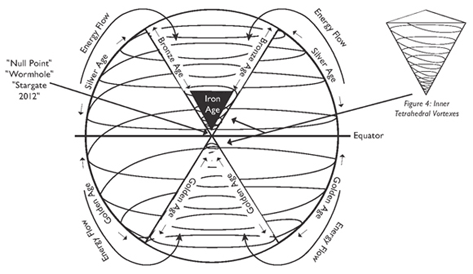
    In order to begin to comprehend the topographical nature of time, it is very important to understand the guts of this hyperdimensional sphere. By the ‘guts’ I am referring to the vortexes that make up the energy flow running through the centre of the hypersphere. As the energy flow begins to fall into the vortex that runs through the centre of the sphere, it takes on the shape of a tetrahedron.

    A tetrahedron, as shown in Figure 4, is the building block of three-dimensional space and is the founding member of the Platonic Solids. The tetrahedron is the simplest object that can be created in three dimensions. The only object with just four sides, the tetrahedron is also shaped like a vortex.

    Let us digress for a moment and discuss vortexes. Back in the Midwest of the United States, where I come from, there is a place called Tornado Alley. This is the flat Great Plains that stretches from Texas to the Dakotas. Each year this area is visited by numerous tornados, which wreak havoc on the farms and towns of this area. These tornados usually start in May and last until early August. Having witnessed several tornados in my early years I became fascinated by them and was once even a ‘storm chaser’. In my young and foolish days I used to chase after tornados with my Bolex 16mm camera in order to capture them on film. I became very familiar with these lethal vortexes.

    But understanding tornados also helps us understand vortexes and the density of forces in the hypersphere. Tornados (and also hurricanes) are made up of air like that which surrounds us all the time. But as the air begins spinning it takes on a strange solidity. While the swirling air at the top of a tornado is somewhat dangerous, it is the spinning air near the surface of the ground that is really dangerous. Near the tip of a tornado, where it is in contact with the ground, the air takes on the quality of solid iron. The tips of tornados can rip buildings apart, throw cars and trucks thousands of feet, and punch chaffs of wheat into the very centre of trees like a bullet. As the air spins more violently, the tip of the tornado vortex becomes as strong as 50 locomotives engines and possesses the density of the hardest of metals. Yet it is just comprised of air molecules. But these molecules are spinning so quickly they create a mass that is extremely powerful. It is the spin of the air that causes it to densify and take on the solidity of metals.

    Getting back to the central core of our hyperdimensional torus, we can understand the vortexes inside this sphere and how time unfolds by using the tornado analogy. As the energy flow begins to dip down into the top of the tetrahedral shaped vortex, it begins to spin. As the energy flow descends, its spin becomes more rapid and compressed. Like a tornado, as it reaches further down, the tip of the vortex ‘hardens’. It could be said that his hardening of vorticular forces is what makes up the solidity of our three dimensional space. Each human, plant, animal and indeed every planet and star alike are the hardened tips of hyperdimensional vortexes, which are flowing all around us constantly.

    Like air, these hyperdimensional forces are pretty much invisible to us. It is only when these forces coagulate into a spinning vortex that they can be seen and felt. It is through the rapid spinning of four-dimensional space that the solidity of the third dimension is actually created. The mystics from all great traditions know this and they realised these inner dynamics of the fourth dimension as it interacts with the third dimension. The fourth dimension is the surrounding sphere and the third dimension are the tetrahedral vortexes that make up the central core of the sphere. To the ancients, four-dimensional space was called ‘spirit’ and three-dimensional space was called ‘matter’.

    So what does this have to do with time and the topography of time? Remember the dilemma we face in trying to make the four ages of the precession match up with the Ages or Yugas from the Hindu system? By attempting to make the two into one we can not only understand the topology of time, but also we can map time like the ancients and we can know where we are in the river of time.

    As shown in illustration Figure 3, imagine that we are coming through the very centre of where the two tetrahedral tornado vortexes intersect at the very centre of the inner hyperdimensional sphere. Moving down the bottom vortex towards the outside surface of the sphere, each spin in the vortex takes longer and is wider and slower than the previous spin in the vortex. In other words, the energy flow expands after it passes the ‘null’ point in the very centre of the hyperdimensional sphere, or torus, where the tips of the two tetrahedral vortexes touch.

    This energy flow continues its expansion as it climbs over the lip of the bottom edge of the sphere where the vortex meets the outside edge of the sphere. The energy flow continues to expand until it reaches the outside equator area of the sphere. Once it gets past the equator, the energy flow begins to condense, the flow begins to move faster and the spin density increases. This flow continues until the energy flow reaches the upper lip of the outside of the hyperdimensional sphere where it begins to ‘fall’ into the top of the tornado tetrahedral vortex.

    Now as the flow of energy falls down the vortex towards the null point at the very centre of the sphere it begins to harden as it spins faster and faster. This goes on and on until the vortex is so hard it is like iron. This is how the fourth dimensional forces create three-dimensional reality. As the vortex spins faster and faster eventually it compresses down to the point where it has nowhere to go but outwards again. This occurs at the null point in the centre of the sphere and the energy flow now begins to once again expand.

    The Golden Age is the time period that starts at the null point in the centre of the sphere and continues through the bottom vortex. As the energy flow expands outwards time appears to slow down. The entire period of the Satya Yuga, or the Golden Age, continues as the energy flow goes down the bottom vortex and rounds across the top of the sphere. It continues expanding until it arrives at the equator.

    The equator of the outside of the hyperdimensional sphere is the borderline between the Satya Yuga and Treta Yuga, or the Golden Age and the Silver Age. Now the energy flow begins to contract as it flows upwards towards the north pole of the hypersphere.

    The Silver Age, or the Treta Yuga, continues until the energy flow rounds the top lip of the hyperdimensional sphere and begins to fall into the upper tetrahedral vortex. This then is the borderline between the Treta Yuga and the Dvapara Yuga, or the border between the Silver Age and the Bronze Age.

    About two thirds down in the upper vortex, where the energy flow is spinning so fast that it becomes as solid as iron, is the beginning of the last Age, the Kali Yuga, or the Iron Age. This spinning continues to gain density, compression and speed as it races towards the central null point in the very centre of the sphere. As it approaches this null point the forces become unbelievably fast, violent and dense. It is only when these forces achieve maximum density and they can no longer compress any further that they begin to suddenly flip and begin the expansion of the flow. This happens in an instant. This is the shift from the Iron Age, or the Kali Yuga to the Golden Age, or the Satya Yuga. The borderline between the Iron Age and the Golden Age is the most distinct border in this topographical illustration of hyperdimensional time. It is the most jarring and is instantaneous.

    Take notice of the hourglass shape of the two tetrahedral vortexes inside the hyperdimensional sphere. Is this why Fulcanelli tells us about the hourglass in the quote at the beginning of this article? In Hindu mythology the God Shiva dances the world into and out of existence playing his dhamaru which is a two sided drum shaped like an hourglass.

    Notice that, like the number of years in the Hindu Yuga system, the distance travelled through our ages in the hypersphere is similar; the Golden Age, which is the distance between the null point in the centre and the outside equator is twice the distance as that travelled through the Silver Age which is the distance from the equator to the top of the lip of the upper vortex. Equally, the distance travelled from the top of the vortex to two thirds down, which is the Bronze Age, is half the length of the Silver Age. Finally, the tip of the vortex is half the length of the Bronze Age.

    This part, called the Iron Age, is the Age in which we live. This is also why, in the Iron Age, each second feels shorter than the second before. This is why each day, each month and year appear to be going faster than they did previously. In the topology of time this effect can be easily understood and explained.

    Also remember, even though the distance travelled is much further in the Golden Age than it is in the Iron Age, the number of years it takes is the same. It takes 6,480 years to go through the Golden Age just as it takes 6,480 years to go through the Iron Age, but it feels much different. In the Golden Age each second, each day, each month and year appear to be longer than the previous day, month and year. Time is expanding in the Golden Age and with that expansion the anxiety and tension of the Iron Age disappears. It is a paradise, especially to those who may have survived the passing through the wormhole, or the null point at the centre of the hyperdimensional sphere.

    Therefore, the years listed within the Yuga system are actually symbolic times that explain the lengths of time as it is felt not as it is lived. So the Golden Age or the Satya Yuga feels like it is much longer than the Kali Yuga, or the Iron Age.

    The shamans in Peru tell us that we are approaching the Pacha Cuti, which means literally ‘the world turned upside down’. They say that it will arrive in the year 2012. This is also the year when the great Mayan calendar reaches its end point. The cross of Hendaye is quite explicit in saying we are reaching the very end of the Iron Age. I would suggest that the null point, or the wormhole at the very centre of the hypersphere, is very likely the 2012 date. Our hypersphere appears to be regulated by the periodic alignment of the galactic centre with the Sun. This also matches the four fixed signs of the zodiac and explains why the Christian tradition is preparing for the endtimes.

    Oddly enough, it also appears that Stanley Kubrick is trying to tell us about the end of our Age in his masterpiece film 2001: A Space Odyssey. The Starchild at the end of the film has passed through the Star Gate of the black monolith and is returning to Earth to create a new world or a new Age.4

    It is through our understanding of the Four Ages, the fixed signs of the zodiac, and the Yuga system that we can finally appreciate the message our ancestors have handed down to us. We are about to pass through the Star Gate, the wormhole, and the null point of hyperdimensional space.

    The Cross of Hendaye reveals the most important knowledge of all, which is the end of time and the beginning of the Golden Age. Awareness of this knowledge helps us all to more fully comprehend the nature of the times in which we reside and the destiny of the human race.

    The Quality of Time

    At the very core of all the great spiritual traditions to be found across the planet from the ancient Egyptian to the Incan and Mayan, Indo-Tibetan, Alchemical Europe and even the Hebrew Kabbalah lies the knowledge of the secret of the alchemy of time. Unencumbered by the excessive demands, stresses and speed of the modern age, our ancestors spent lifetimes in contemplation of the essential mysteries of our world.

    One of the great mysteries they discovered was that time is not stagnant or linear but flows in great transformative cycles. In fact, it is only recently modern historians have begun arguing that time travels in a straight line. Within the limited period of historical examination these modern historians are viewing a snap shot of history and believe this snapshot represents the entire picture. But does it?

    The alchemists of Egypt and Medieval Europe knew that time moved in great elongated cycles, and that each part of the cycle had a ‘quality’. This quality shaped and reformed the world. Just as sunrise has a different quality from midnight, so too does each aspect of the great cycle possess a quality that distinguishes it from other parts of the cycle. When the cycle of time changes, so too do events change here on Earth.

    These sacred scientists and alchemists of our past used various devices and practices to mark the changes in the quality of time. Astrology, divination and prophecy are some of the more obvious processes that our ancestors used to understand the mysterious process of time.

    At the heart of the secrets traditions of the Egyptian and Greek mystery schools they knew that a process, which they called the precession of the equinoxes, measured the Great Cycle or the Great Year. What they understood was that the stars in the night sky are not fixed. Through their long observation and meditation upon the heavens they came to realise that the stars and the constellations were slowly changing their place in the sky above us. Creating the zodiac to assist them in these huge measurements of time they used the twelve signs to act as a giant time clock. Through this they began to understand the Great Cycle. They realised that it took 2,160 years to move through each sign of the zodiac and that it took 25,920 years for the equinoxes to move through all 12 signs. The creation of the Great Year of nearly 26,000 years gave them a clock that allowed them to measure time.

    They then came to understand that each of the signs, or places on the clock appeared to bring forth changes in the quality of life here on Earth. So they came to realise that every 2,160 years the quality of time changed. They also began to understand that the four quadrants of this great chronological clock appeared to bring forth even sharper changes in the quality of time. The four signs associated with these four quadrants are the signs of Aquarius, Taurus, Leo and Scorpio. There does seem to be some historical linkage between this idea that passing through the edges of these four signs brings great changes here on Earth. About 6,500 years ago we passed through the sign of Taurus. Coincidentally, the human race began domesticating cattle, building walled cities, developing agriculture, fighting wars and beginning the city-states that would evolve into governments and monarchies. Thirteen thousand years ago, as we passed through the Age of Leo, great changes occurred including a dramatic climate shift as the ice ages began to end. The extinction of many animals including the Woolly Mammoth, the Saber Tooth Tiger, the Giant Tree Sloth, and many other species happened at about this time. Interestingly, according to anthropologists, the emergence of Cro-Magnon Man appears to have occurred about 26,000 years ago, the last time we passed through Aquarius.

    The Great Cross at Hendaye is a 350-year-old alchemical monument to the end of time. It sits in a churchyard in Hendaye, France. The Great Cross at Hendaye appears to be a symbolical construct that explains this science of the cycles of time. The Cross at Hendaye describes the extraordinary changes that are about to occur in our present era. It speaks of the end of our current Age of Iron and the creation of a coming Golden Age.

    The great cosmic time clock in the sky is changing. We are now entering the quadrant of Aquarius. From what the alchemical Cross at Hendaye is saying, this change is sure to have a dramatic effect on our species and on our planet.

    What these changes are, or will be, is anybody’s guess. But they are sure to be spectacular and remarkable. The end of time, the end of this age and the great transformation of humanity is at hand. This change in the quality of time will govern and dictate the changes here on our fragile planet. The changes in the quality of time cannot be forestalled. The fundamentalist revival taking place all over the world reveals more about the quality of time from which we are emerging than it does reveal anything about the quality of time for that which is coming.

    The Peruvian shamans living high up in the Andes Mountains have come down to tell us that a new species of human being is about to appear. They call this being ‘Homo Luminous’. They tell us that forerunners of Homo Luminous are already among us right now. Like Cro-Magnon Man of 26,000 years ago, the last time we passed through the cusp of Aquarius, so too now a new human is emerging.

    This new human will possess entirely new qualities that we do not have. The great Avatars, Jesus Christ, Krishna and many others may have been early arrivals for this newly emerging species. Aquarius is the only one of the four quadrant signs that is symbolically represented by a human, and this human carries a container of water. This symbology is interesting as DNA can only be activated in water. So even the symbolic nature of the sign of Aquarius seems to suggest a change in the genetic structure of the human race.

    Our spiritual existence is really a unique combination of free will and predestination. While we possess the ability to act freely within the moment, there is little we can do about the larger cycles of time and the qualities that emerge at the cusp of each of the four great signs. So as the hand on the great cosmic time clock passes into Aquarius one can expect massive changes to occur. While the ancient art of alchemy is concerned with many aspects of our existence including the extraction of light from plants and minerals, the transformation of the dark lead of our physical being into the pure gold of enlightenment and much more, alchemy also is a symbolic ontology concerned with the observation in the changes of the ‘quality’ of time through the 25,920 years-long duration of the Great Year.

    The world is changing. The past will disappear and history will become legend and finally myth. Our destination is unknown. The only thing we know for sure is that it will change.

    [alert type=”general” dismiss=”no”]This article was published in New Dawn 92.[/alert]

    [alert type=”success” dismiss=”no”]If you appreciate this article, please consider subscribing to help maintain this website.[/alert]

    Footnotes:

    1.  See www.jayweidner.com; The books A Monument to the End of Time: Alchemy, Fulcanelli and the Great Cross and Mysteries of the Great Cross of Hendaye: Alchemy at the End of Time are authored by Jay Weidner and Vincent Bridges.
    2. For more information, see ‘Tolkien at the End of Time: Alchemical Secrets of the Lord of the Rings’ by Jay Weidner and Sharron Rose in New Dawn No. 82 (January-February 2004), and ‘Reflections on the Cycle of the Great Yuga’ by Sharron Rose at www.sharronrose.com.
    3. For more information on the luminous energy body, see my films Healing the Luminous Bodywith Dr. Alberto Villoldo, ArtMind with Alex Grey and Yoga of Light with Sharron Rose.
    4. See ‘Alchemical Kubrick: 2001: The Great Work on Film’at www.jayweidner.com.

    © New Dawn Magazine and the respective author.
    For our reproduction notice, click here.

  • Ancient Civilisations: Six Great Enigmas

    Ancient Civilisations: Six Great Enigmas

    From New Dawn 90 (May-June 2005)

    We stand today at an unprecedented turning point in human history. In recent years two versions of ancient history have formed. One, we shall call ‘alternative’ history, the other we shall refer to as ‘official’ history. The former ponders over a variety of anomalies and tries to make sense out of the corpus of evidence, i.e., the pyramids and timelines, why they were built, by whom and when. The latter conducts digs, catalogues pottery shards, and tries to defend its proposal there are no enigmas, and virtually everything is explained.

    At one point perhaps as late as fifteen years ago these two camps seem to be engaged in an informal dialogue. That all changed after, 1) the Great Sphinx redating controversy caught Egyptologists off guard and, 2) the impact of Chris Dunn’s book The Giza Power Plant: Technologies of Ancient Egypt at the end of the last decade.

    There is no more dialogue and no more polite, gloves on debate. The proponents of ‘official’ history have taken an increasingly political and ideological approach to the issue. They now do little more than offer pronouncements of the historical ‘truth’ on the one hand, and denounce of all those who dare challenge officialdom on the other.In this context we offer evidence that our ‘scholars’, the gatekeepers who control our institutions of ‘higher learning’, refuse to consider.

    The Great Pyramid – Precision Engineering

    This colossal structure, the last of the seven ancient wonders and the largest stone building in the world, still provokes awe, controversy and a plethora of theories that inspire bitter debate to this day. Instead of going over the well-established mysteries, we would like to shine new light on this important enigma that appears out of place in ‘Stone Age’ Egypt.

    The real challenge the Great Pyramid still poses to us in the opening decade of the Third Millennium is the physical plant itself. Theorists have gone on endlessly speculating about how it was built and the metaphysical, cultural and religious significance and/or symbolism behind its construction. Though several authors have offered tantalising possibilities, none have been conclusively proven.

    The mystery remains unsolved.

    To begin with, the massive size – the staggering volume and weight of the building blocks – remain problematic. With an estimated 2.3 million blocks with a weight of about 4 million tons, the pyramid is two-thirds the mass of the Hoover Dam. The sheer size and the numbers of blocks that had to be quarried and moved into place, presents numerous architectural, construction and engineering headaches.

    These issues have been raised time and again, yet are still unsettled. It is time to move on and define the even more difficult issues. We consider the core ‘hard’ problems to be those that reflect precision engineering and assembly line manufacturing accomplished on a massive scale. The primitive tools scenario concocted by Egyptologists does not explain the following tasks:

    1. Creating precision-cut casing blocks weighing 16 tons, fitted together and held by a super-glue mortar that maintained a tight seal forming a nearly seamless shell.

    2. Leveling the 13-acre limestone bedrock base to a degree of accuracy only recently achieved with laser technology.

    3. Squaring the base to True North with minimal deviation.

    4. Excavating the ‘Descending Passage’ 350 feet into solid bedrock at a 26-degree angle while keeping the tunnel arrow-straight for its length.

    5. Bringing the massive 48-story pyramid together around complex internal structures, retaining the true shape to enable the builders to form the apex. (These internal structures include four enigmatic ventilation shafts and a coffer in the King’s Chamber that is too large to have been moved through the opening. It shows evidence of having been cut with a jewel-tip saw.)

    6. Extensive usage of different types of machined granite inside the Great Pyramid chambers.

    The father of modern Egyptology, Sir Flinders Petrie, marvelled at the precision and size of the casing blocks. He carefully measure the blocks and found that “the mean thickness of the joints are .020 and therefore, the mean variation of the cutting of the stone from a straight line and from a true square, is but .01 on length of 75 inches up the face, an amount of accuracy equal to most modern opticians’ straight-edges of such a length.”

    The modern international engineering firm of Daniel, Mann, Johnson & Menendhall conducted a forensic analysis of the Great Pyramid. Their findings are evaluated in an article published in Civil Engineering.

    The pyramid was oriented with its major sides either north-south or east-west. This in itself was a remarkable undertaking, given the accuracy to which it was done, because the Egyptians had to perform the work using astronomical or solar observations – the compass had not yet been invented. The dimensions of the pyramid are extremely accurate and the site was levelled within a fraction of an inch over the entire base. This is comparable to the accuracy possible with modern construction methods and laser levelling.1

    The summary speaks volumes between the lines. The problems with the Descending Passage are numerous. For starters the tunnel is less than 4 x 4 feet, enough for no more than one excavator wielding a hammer-stone at any given moment. How would our proposed digging crew negotiate the space in the suffocating darkness once they had dug down 50 feet and more? In addition how would the 26-degree angle be set and maintained without lights or levels? The lack of carbon deposits on walls and ceiling indicate that torches were not used.

    Once again, Petrie measured the passage and found an amazing accuracy of .020 of an inch over 150 feet and a mere .250 inch over 350 feet of its constructed and excavated length. We submit that this passage with its smooth surfaces, squared shape, and accurate angle could not have been tunnelled with primitive tools and methods.

    The Great Pyramid remains the world’s greatest wonder and ancient enigma. We suggest researchers should pay more attention to these details and ask about the materials used inside the Great Pyramid, especially near the ventilation shafts. We now have two doors blocking a very important shaft, the one that pointed to the star Sirius in 2450 BCE.

    The Origin Of Dogs – Biogenetic engineering

    Now we turn to a mystery that nearly equals the pyramid, though it is a little known conundrum hidden in the mists of remote antiquity. Let us start with a simple question that appears to have an obvious answer: what is a dog? It turns out geneticists in the past decade have shown the answer is not so obvious. In fact, generations of anthropologists, archaeologists and wildlife biologists turned out to be dead wrong when it came to the origins of “man’s best friend”.

    Prior to DNA studies conducted in the 1990s, the generally accepted theory posited that dogs branched off from a variety of wild canids, i.e., coyotes, hyenas, jackals, wolves and so on, about 15,000 years ago. The results of the first comprehensive DNA study shocked the scholarly community. The study found that all dog breeds can be traced back to wolves and not other canids. The second part of the finding was even more unexpected – the branching off occurred from 40-150,000 years ago.

    Why do these findings pose a problem? We have to answer that question with another question: how were dogs bred from wolves? This is not just difficult to explain, it is impossible. Do not be fooled by the pseudo-explanations put forth by science writers that state our Stone Age ancestors befriended wolves and somehow (the procedure is never articulated) managed to breed the first mutant wolf, the mother of all dogs. Sorry, we like dogs too, but that is what a dog is.

    The problems come at the crucial stage of taking a male and female wolf and getting them to produce a subspecies (assuming you could tame and interact with them at all). Let us take this one step further by returning to our original question, what is a dog? A dog is a mutated wolf that only has those characteristics of the wild parent, which humans find companionable and useful. That is an amazing fact.

    Think about those statements for a moment. If you are thinking that dogs evolved naturally from wolves, that is not an option. No scientist believes that because the stringent wolf pecking order and breeding rituals would never allow a mutant to survive, at least that is one strong argument against natural evolution.

    Now, if our Paleolithic ancestors could have pulled off this feat, and the actual challenges posed by the process are far more taxing, then wolf/dog breeders today certainly should have no problem duplicating it. But like the Great Pyramid, that does not seem to be the case. No breeders have stepped up to the plate claiming they can take two pure wolves and produce a dog sans biogenetic engineering techniques.

    The evolution of the domesticated dog from a wild pack animal appears to be a miracle! It should not have happened. This is another unexplained enigma.

    [alert type=”info” dismiss=”no”]If you appreciate this article, please consider a subscription to New Dawn magazine.[/alert]

    Mohenjo Daro – Civil Engineering

    Since indoor plumbing did not arrive in modern societies to any extent until the 20th century, and urban planning has still not been adopted much to this date in history, what we find in the ancient city of Mohenjo Daro is anomalous indeed.

    This city in the Indus Valley was built on a grid system about 4,500 years ago, obviously planned out and drawn up before the first brick was laid. It had houses, some with indoor plumbing, a granary, baths, an assembly hall and towers all made out of standard size bricks. The streets were about eight to ten feet wide on average, and were built with well-engineered drainage channels.

    Mohenjo Daro was divided into two parts; the Citadel was on the upper level and included an elaborate tank called the Great Bath that was made of fine quality brickwork and drains. The Great Bath was 40 feet long and 8 feet deep, a huge public facility by any standards. A giant granary, a large residential building, and several assembly halls were also on this upper level.

    The Great Bath was made watertight by the use of two layers of brick, lime-cement and then finally sealed with bitumen (tar). The bath included a shallow section for children.

    We should wonder how an ancient culture of which nothing is known, not even their language, created this sophisticated city at a point in time many thousands of years ahead of the curve? Civil engineers do not crawl out of thatched-roof huts able to draw up plans for a complex urban environment. We need to address the following question to archaeologists and historians:

    1. Where are the cities that demonstrate the path of urban development, social and technical organisation, leading to Mohenjo Daro?

    2. How do you explain the sudden emergence of a complex society when 99.99% of the rest of humanity were living primitively?

    These issues cannot be brushed aside with some arrogant pretence that the questions have already been addressed and answered by digging up and labelling pottery shards and other artefacts. We have been and are being overly indulgent with our “soft sciences” regarding their cavalier assertions about having all the answers. In fact, they have very few, so why are they throwing stones at independent researchers from behind glass towers?

    Extraordinarily little is known about the Indus Valley civilisation that once spanned nearly a thousand miles with other cities matching the description of Mohenjo Daro.

    We file this under our list of great enigmas and challenge orthodox scholars to prove differently as with the first two of our mysteries.

    We note that the Indus Valley civilisation was contemporary with the Great Pyramid. It is often said this was one of the first three civilisations, having a written script that has never been deciphered. Now we turn next to the mother of all civilisations, Sumer.

    Sumeria – The Source Of Civilisation

    Are we missing something or are our historians looking at our earliest civilisations through a strange and distorted lens? Like Egypt and the Indus Valley, the biblical ‘Land of Shinar’ – the birthplace of Abraham – was a brutally hot, largely barren, empty desert with a mighty river cutting a swath through it. Does this sound like the magnet that would attract late Stone Age tribes to hunker down and pull wonders out of a hat?

    In fact, historians thought Shinar was a piece of biblical fiction until the mid-19th century, but now they know everything about it with complete certitude that we, the unwashed masses, dare not question. Nonetheless, we encourage readers to maintain an attitude of healthy skepticism and dare to question ‘official history’.

    As is the case with the culture that built the cities of the Indus Valley, no one knows who the ancient Sumerians were or where they came from. They called themselves ‘the black-headed ones’ and spoke a strange language that was unrelated to the languages of the Semitic tribes in the region. Some linguists note a similarity between the Sumerian language and that of the Basques, another anomalous culture.

    We find it curious that any primitive peoples would choose the rigours of a hostile desert environment to settle in and build a civilisation. Why not a gentle river in a forested mountain valley? Especially in light of the fact that Sumeria contained very few resources, no forests, no minerals, not even the rocks that were plentiful in Egypt.

    How are we to explain the fact this mysterious culture managed to invent all of the core components of civilisation under such restrictive conditions? It occurs to us that a culture would need minerals like copper, gold, silver and tin immediately available to experiment with over the course of generations in order to create process metallurgy. There is nothing simple or accidental about making the connection between raw ores, the metals they contain, and how to reduce them out of their native state using high heat.

    Nevertheless, the Sumerians not only figured out geology, how to obtained the ore, knew the levels of heat needed and how to build kilns to achieve it, they also took very different metals and created the first alloy, bronze. As metal-smiths were performing these feats, other citizens were apparently creating the wheel, building cities, ziggurats, inventing writing, movable type, the ox-drawn plow, cereal crop agriculture, and advanced mathematics, to mention the most notable of their innovations.

    Something is wrong with this picture. Most human beings were counting using their fingers, if at all, hunting animals and gathering plants for their meals. Yet, we find the Sumerians in classrooms learning the principles of the sexigesimal math system. Yes, the very same 60-base system we use today to keep track of hours, minutes and seconds. This advanced system was the first to reveal that a circle has 360 degrees and can be subdivided using 60, 30, 15, 12, etc., all fractions of the root number.

    Teotihuacán – Anomalous Technical Evidence

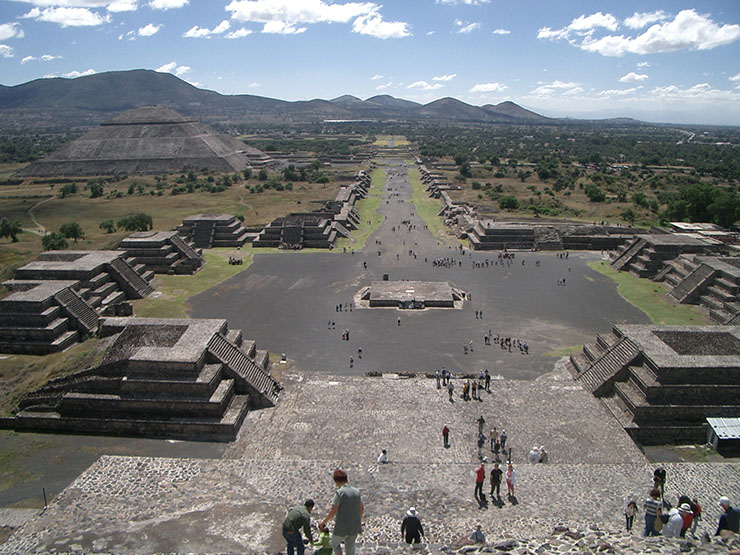
    Teotihuacán, in Mexico, is an immense, even overwhelming archaeological site, oriented along a twin axis. In the 1960s a team of archaeologists and surveyors mapped out the entire complex in great detail. The resultant map revealed an urban grid centred around two principal, almost perpendicular, alignments.

    From the Pyramid of the Moon at the north end, the complex extends south along the Avenue of the Dead beyond the Ciudadela and Great Compound complexes for about 3.2 kilometres. To this north-south axis we must add an east-west alignment that led from a point near the Pyramid of the Sun to a spot of prime astronomical significance on the western horizon.

    Anthony Aveni, an astronomer-anthropologist, discovered that on the day the Sun passes directly overhead in the spring of the Northern Hemisphere (May 18), the Pleiades star cluster makes its first annual predawn appearance. It was at this point on the western horizon that the Pleiades set, and the builders aimed the east-west axis.

    Additionally, the Sun also sets at this point on the horizon on August 12 – the anniversary of the beginning of the current Mesoamerican calendar cycle (5th Sun) – determined by a consensus of academic and independent scholars to have begun on August 12, 3114 BCE.

    It is very clear Teotihuacán was laid out according to a set of alignments that reflected celestial, geographic, as well as geodetic relationships. Walking along the avenue from one pyramid to another, up the steps to the top, and surveying the site from a multitude of angles, one is struck by the sense of being in the middle of some vast geometric matrix.

    Teotihuacán was the first true urban centre in the Americas. At its peak around 500 CE, it boasted a population of an estimated 200,000. George E. Stuart, archaeologist and the editor of National Geographic magazine sums up our ignorance:

    We speak of it with awe, as we do the pyramids of Egypt, but we still know next to nothing about the origins of the Teotihuacános, what language they spoke, how their society was organised, and what caused their decline.2

    As for one the most anomalous of artefacts on the planet, in the 1900s archaeologists discovered a sheet of mica in the upper tiers of the Pyramid of the Sun. This was no ho-hum pottery shard to catalogue and file away in a dusty box, yet that is about how archaeologists treated the find. To anyone with even a smattering of technical knowledge, discovering a large sheet of mica in an ancient pyramid site comes as a shock. In fact, it is one of the great ‘smoking guns’ that turn archaeologists mum.

    Mica is an inflammable and non-conductive mineral that grows in fairly weak plate-like structures. It is not at all useful as a structural building material. NASA uses it as a radiation shield in space vehicles. Mica is also utilised in electronic components and microwave ovens, and it is a good shield for electromagnetic radiation, like radio waves. Like the Great Pyramid, the Pyramid of the Sun has a subterranean cavity under the middle of the pyramid. A large pyramid with layers of thick mica would be an excellent EMI shield.

    Its placement in the complex raises questions that we could only answer today after the development of electronic, atomic and space age technologies.

    Thick sheets of mica were also found by archaeologists about 400 meters down the avenue from the Sun Pyramid, these precision-cut sheets were of considerable size: 27.5 meters square. They were located under a rock-slab floor of a complex now called “the Mica Temple”.

    What possible reason could the builders have had for including a layer of mica in any structure? It was obviously not decorative. To add greatly to the growing mystery, the particular mica used was traced to Brazil. Now we are getting in deep. How would a supposedly indigenous “Stone Age” culture know that mica existed 3200 kilometres away in the jungles of Brazil? Not only that, how did they transport these large sheets over that long distance intact without wheeled vehicles? Surely not via relay teams on foot travelling overland! No large seagoing boats or ports have ever been found in ancient Mexico.

    High Technology In Stone Age Peru

    Lake Titicaca borders Bolivia and Peru in the Andes. The highest large lake in the world, there are many signs it was once exposed to the ocean. Megalithic structures like the Gateway of the Sun in Tiahuanacu, Bolivia, also indicate a long lost past. The gateway was carved out of one solid block, the hard way to make a gate.

    Moving northward near Cuzco, Peru, we find even more large, impressive and mysterious structures. Here we find walls built with complex jigsaw type megalithic blocks similar to the more familiar walls found at nearby Machu Picchu. Some of the megalithic structures contain complex cut-rocks weighing over 100 tons; a few were joined together by bronze clamps. Some of the bronze had obviously been poured in place, a skill not available in pre-Columbian Peru.

    Like Sumer, the high Andes is an unlikely location for Stone Age cities, evidence of advanced technologies, and seminal agricultural discoveries. It is well established that the region around Tiahuanco, at 12,500 feet elevation, had been turned into a highly productive agricultural zone. That was achieved by the building of dikes, dams, canals and raised beds that created microclimates which protected the plants from frost.

    We have attempted to show our planet is full of ancient wonders and mysteries that have yet to be solved. You can find more information as well as our theories on who and what created these enigmas in our books, The Genesis Race (by Will Hart) and Ancient Gods and Their Mysteries: Will They Return in 2012 AD? (by Robert Berringer).

    [alert type=”general” dismiss=”no”]This article was published in New Dawn 90.[/alert]

    [alert type=”success” dismiss=”no”]If you appreciate this article, please consider subscribing to help maintain this website.[/alert]

    Footnotes:

    1. ‘Program Management BC’, Civil Engineering, June 1999, Craig Smith, P.E., www.pubs.asce.org/ceonline/0699feat.html

    2. ‘The Timeless Vision of Teotihuacán’, National Geographic magazine, December 1995

    © New Dawn Magazine and the respective author.
    For our reproduction notice, click here.

  • The Dawn of the Genesis Race: Our Extraterrestrial DNA and the True Origins of the Species

    The Dawn of the Genesis Race: Our Extraterrestrial DNA and the True Origins of the Species

    The mysteries of ancient history, such as how the Great Pyramid was built and by whom and why, have been well established over the past four decades. Similar archaeological enigmas litter the landscape around the planet and they raise many difficult questions about the origin of human civilisation.

    Erik Von Daniken’s series of books, which began with Chariots of the Gods, presented archeological evidence while recounting many mythological traditions that have “gods” arriving on Earth from a distant world and bringing technology and the arts of civilised life to primitive human tribes.

    Many writers followed Von Daniken’s lead and an entire school of alternative historical thought called the “ancient astronaut” theory emerged over the years. This school must be distinguished from another branch largely defined by such writers as Graham Hancock, which we can sum up as the “lost civilisation” school.

    The latter does not figure into this discussion nor is it covered in my book The Genesis Race because it never really addresses the issue of the ultimate origins of Man or civilisation. Even if you accept the idea ancient Egypt and Sumer had their origins in Atlantis, who created that civilisation and from what precursors?

    The essential questions the author has been studying over the past three decades are: 1) how did life originate and evolve on Earth?, and 2) how did civilisation suddenly emerge from mankind’s primitive roots? To my mind it seemed the ancient astronaut theory could be defeated if Darwin’s theory proved to be correct, which “official science” claims it has been. That premise can be justified using several valid arguments.

    The “ancient astronaut” theory generally includes the idea summed up in the first chapter of Genesis, which indicates the “gods” genetically engineered a proto-human race. The actual verse reads, “Let us make man in our image.” If Darwinism is accurate then this assertion would be untrue and the notion of cosmic intervention by an advanced race would fall apart.

    The second reason is Darwin’s theory has not only been applied to biology, it is also used to explain the emergence and development of human civilisation by a process referred to as cultural evolution.

    At its core Darwinism is based on a simple concept: life evolves slowly via a process of incremental adaptations to a wide variety of external stimulus. He applied it to biology and anthropologists, archaeologists and historians applied the same principles to culture and human history. If this is correct then we should not find any abrupt transformations in human “evolution” either biological or historical.

    I reason that if Darwinism is accurate then there may not be any valid scientific basis for the “ancient astronaut” theory, which posited intervention and rapid-fire metamorphosis in both the biological and historical spheres. The results of this research proved surprising. Darwinism is not only unproven – it has been shown by scientists to be fatally flawed. This is where my book, The Genesis Race, begins. Chapters two and three clearly show the flaws in the theory of evolution. It has failed exactly where Darwin feared it might – in the fossil record. Here we find – instead of widespread confirmation – a large number of missing links.

    The general public is given to believe the only “missing link” in the fossil record exists between apes and man. This is not true. The fossil record contains hundreds of gaps between ancient and modern plant and animal species. Darwin referred to the gap separating the primitive non-flowering plants (gymnosperms) and flowering plants (angiosperms) as the “abominable problem.” Why? Because the gymnosperms, like ferns, existed for billions of years and they still exist today. The angiosperms, like roses, appeared on the scene about 150 million years ago and they exist today. Where is the evidence showing the fern evolved through a series of slow, incremental changes into a rose?

    According to Darwinism the angiosperms evolved from the gymnosperms. If this is true then where are the intermediate forms linking the two very different types of plants? They have not been found in the fossil record and none exist today. This seems impossible and it is if you accept the principles of Darwinism.

    There is no scientific explanation for the lack of intermediate plants linking the ancient and modern types. In fact, there should be millions of such fossils since they would have been evolving for hundreds of millions of years, far longer than flowering plants.

    Scientists also have no explanation why gymnosperms and angiosperms exist side by side. Somehow all the intermediate plants they say connect the two kingdoms mysteriously vanished from the fossil record and became extinct. Logic would dictate that the older, ancient plants (non-flowering) should have been the ones to go the way of extinction. This is actually enough evidence to kill Darwinism. Official science would have us believe the only dissenters against Darwinism are Creationists that come from the ranks of the Religious Right. However, I present numerous references to bona fide scientists that slam the door on Darwin’s theory of natural evolution.

    What is, or should be, of great interest to anyone interested in the pursuit of science – as it applies to getting to the truth of human origins and the emergence of civilisation – are the works of Francis Crick and Fred Hoyle.

    While Von Daniken’s books were becoming popular in mainstream culture, these two eminent scientists wrote books about the origins of life on Earth. Both were highly critical of Darwinism and posited that life did not originate on Earth. They said the seeds of the biosphere originated in the cosmos.

    In his book Life Itself, Crick – a Nobel prize-winner and the co-founder of the shape of the DNA molecule – claimed an advanced civilisation transported the seeds of life to Earth in a spacecraft. Hoyle, an astronomer who gave the world the steady state theory of the Universe, proposed that life came from the stars borne on comets or riding on the currents of light waves. The unfortunate thing is these rigorous scientific arguments were largely dismissed or completely ignored by “official science”, and also overlooked by the same folks embracing Von Daniken’s relatively unscientific, yet popular approach. (Erik did make people question and think.)

    I want to clarify what I mean by that statement. Von Daniken claimed he was presenting a theory yet the title of his first book ended with a question mark. A new theory is normally offered by presenting arguments against the currently accepted theory, as Crick and Hoyle did, and it is presented assertively with equal measures of humility and confidence that do not end in a question mark. His somewhat insecure and uncritical approach has characterised much of the “ancient astronaut” literature, which official science finds easy to debunk.

    That is why The Genesis Race begins with a serious critique of Darwinism. That is followed by several chapters re-examining the account of human genesis and the early history found in the Bible. A revolutionary analysis of the first three chapters clearly shows there were two creation events of life (and mankind) on Earth. It also shows the history given in the Bible agrees with the findings of paleontology and anthropology. In the first chapter we find that an early proto-human race was created and lived in the wilderness, like other animals, as hunter-gatherers. They were given “every green thing to eat” by the gods andGenesis 1 ends with that covenant.

    However, in the second chapter we are told Adam is created to be a gardener and Eve is taken from Adam’s rib and the “gods” give them clothing and self-awareness. The chronological account of Creation in the second chapter is entirely different than that of the first chapter of Genesis.

    This is a critical point. Not only do the two accounts differ completely, we find Adam is not to live in the wilderness as an animal but is intended to be a caretaker and farmer. If the two accounts are compared side by side the difference is obvious: Adam and Eve are not equivalent to the race created inGenesis 1; and Genesis 2 and 3 are not a detailed elucidation of the events described in the first chapter, which is normally implied or taught in church Bible classes.

    What the first three chapters of Genesis actually describe are: 1) the creation of a proto-human race, the pre-Neanderthals and Neanderthals who live as hunter-gatherers in an innocent state as described in chapter 1, followed by, 2) the genesis of modern Homosapiens (Adam) fit for the agricultural revolution. That is exactly the history given in Genesis and it agrees with everything modern science establishes about the chronology of human pre-history.

    This is a radical revision giving much stronger support to the Biblical version of human genesis and how and why the agricultural revolution took place. It also clarifies who the “us” refers to when God is abruptly referred to as ‘a plurality’ that intervenes and genetically alters life on Earth, the Genesis Race; and it sets the stage for a presentation of the enigmatic archaeological and additional evidence that further supports the theory of intervention by a technologically advanced extraterrestrial race.

    Archaeology has never even addressed all the questions raised by the sudden emergence of agriculture and highly advanced civilisations in Mesopotamia and Egypt in the 3rd millennium BCE, let alone answered the most critical ones.

    From the perspective of conventional archeological and anthropological thinking, the origins of humankind and the emergence of civilisation from the Stone Age remain enigmatic. We have incontrovertible proof our ancestors could not have built the Great Pyramid with the tools and methods they possessed. Yet official science simply ignores or tries to explain away many serious questions and issues such as how the Great Pyramid – the world’s largest precision-engineered stone structure – was constructed using only hammer-stones, ropes, manpower and sledges.

    However, there are other issues that need to be addressed and today’s genetic research is shedding new light on this field. The implications of several important recent findings seem to have escaped the attention of many independent investigators. Established archaeologists and anthropologists have either ignored or railed against the findings of these controversial DNA studies. I am referring to genetic studies into the origin of the domesticated dog and into the diet of our Paleolithic and early Neolithic ancestors.

    You may ask what do the dog and Stone Age dietary habits have to do with solving the enigmas of mankind’s ancient past? The answer is everything. Until recently it was believed dogs (Canis familiaris) came from a variety of wild canines such as wolves, coyotes, dingos, jackals, etc. But the latest DNA research shows that the wolf alone is the ancestral race of all dogs.

    This poses a set of very difficult problems. The first dog would have been a mutant wolf. However, wolves are extremely sensitive to the genetic fitness and strength of each member of the pack. They are constantly testing and establishing a stringent social pecking order and only the alphas reproduce. So how would a mutant ever have survived and reproduced given the rigours of pack behaviour? No wolves in captivity have produced viable mutants and geneticists tell us mutants are normally unfit and do not survive.

    We are faced with a real conundrum. If we pose that early human tribes intervened and bred wolves into dogs we are faced with an equally impossible scenario. How could primitive humans have known it was possible to selectively breed a wild animal into one possessing only those traits beneficial to them? We take the characteristics of dogs for granted, however, they present us with a profound mystery. A dog is the embodiment of only those wolf traits that people find useful, attractive and safe. How did genetically illiterate Stone Age humans achieve this feat of genetic engineering?

    This problem is compounded when we are confronted by evidence from our earliest civilisations showing that salukis, sighthounds and the pharaoh’s hound, had already been bred in ancient Sumeria and Egypt. How is it possible our ancestors, recently emerged from the Stone Age, could have successfully engineered purebred lines at the onset of civilisation? In addition, dogs are not only temperamentally different than their wild progenitors, they differ physiologically as well.

    A wild alpha male and female only breed once a year, whereas dogs can breed any time. Wolves shed their winter coats, dogs do not. These diverging physiological characteristics take time to develop, in fact, many generations. Again, how did our ancestors at the onset of civilisation accomplish this?

    This mystery is underscored by the fact most of the modern dog breeds originated thousands of years ago. Science has not even addressed most of these issues let alone have the experts satisfactorily explained how wolves became dogs – 100,000 years ago – nor have they shown the step-by-step transitions. Purebred dogs just suddenly appear in the archeological record as if by magic. This is also true of agriculture and our key cereal and legume crops. Wheat, corn, beans and rice pose a second set of genetic enigmas.

    Research into the dietary habits of Stone Age tribes around the globe show our ancient hunter-gatherer ancestors subsisted on leafy plants and lean muscle meats. This makes perfect sense because these foods were readily available, took little or no processing, and wild game could be cooked over an open fire. The problem with our grain crops, and they are the basis of civilisation, is wild grass seeds are so miniscule the cost/benefit of harvesting them was not in favour of it. They also require harvesting, threshing and cooking technology since they have to be boiled extensively. This was technology Stone Age Man lacked.

    The reason grains have to be cooked is that the human gut is not adapted to digest wild grains. This makes it very clear the use of wild grass seeds as a primary food source is of recent origin. Our Paleolithic ancestors did not subsist on them. Once again, this poses a set of formidable problems that need to be studied rigorously. If our ancestors did not harvest and eat wild grains, how could they have domesticated and bred the wild species so quickly?

    Without many generations of trial and error experimentation – culminating in a vast body of agronomic knowledge and agricultural practices that would have included genetics and breeding – it is all but impossible to understand how the agricultural revolution was brought about. Official science tries to explain the evolution of nomadic hunter-gatherers into sedentary, crop-growing farmers by claiming they discovered crops quite by accident. We are told it happened when a primitive villager tossed a seed bearing plant into the trash pile and noticed that it sprouted.

    But that trite tale can hardly explain how they selected the best wild species to use as the basis for the agricultural revolution. There are thousands and thousands of potential wild plants that could be turned into agricultural crops. How is it people with very little experience with wild grasses were able to pick the best varieties to breed? This represents a quantum leap. What we are asked to believe is that our ancestors, without much experience at the seminal stage of civilisation, were able to select and breed the very best varieties of wild grass species.

    How do we know this is true? Because we still grow the very crops they supposedly selected even after 5000 years of continuous technological and agricultural development. We are asked to suspend disbelief and accept they also constructed the largest precision-engineered stone building the world has ever seen – the Great Pyramid of Giza – using only primitive hand tools and backbreaking labor. Something is obviously wrong with this picture.

    Is it logical to assume our Earthly ancestors could (or would) have thrown together the agricultural revolution and then the entire civilisations of Sumer and Egypt out of whole cloth? No it is not; and neither do these suppositions represent sound science.

    For those of us in the alternative history camp, one of the most fundamental questions we must impress upon the public and upon ‘official science’ is to ask where are the antecedents and precedents? Show us the slow Darwinian stages of development that official history presupposes. How can you explain the sudden appearance of genetically altered food crops and advanced engineering techniques at the onset of human civilisation?

    We need step-by-step documentation and incontrovertible evidence and it ought to be copious and devoid of missing links since we are supposedly talking about events that occurred thousands and not tens or hundreds of millions of years ago, as is the case with biological evolution.

    Where did our Paleolithic ancestors acquire the knowledge and skills to breed wild plants into food crops while also constructing planned cities? How did they achieve an exacting command of the principles of civil engineering as exhibited in Sumeria and the Harrappan civilisation of the Indus Valley? How did humans go from mud huts and collecting leafy plants to building ziggurats, flush toilets, public bathhouses (Mohenjo Daro), making bread in ovens, and inventing process metallurgy seemingly overnight? In plain language, where is the proof – the missing links – demonstrating your (official science) theories are confirmed in the archaeological record and meet simple standards of logic and commonsense?

    Turning to what our ancestors in Sumer, Mexico, Egypt and Peru have to say about the origins of agriculture and civilisation we find a very different story. According to the ancient records, written and oral traditions, none of the earliest civilisations claimed they invented it. What is of profound interest is they are in unanimous accord in claiming they were given the arts of civilisation by the ‘gods’.

    It is very unlike human nature to give credit to anyone else for anything we have invented or achieved. The ancient Egyptians left copious records of every aspect of their culture in a huge collection of artwork, hieroglyphics and texts. Yet we find no reference in their 3,000 year history as to how or why ‘they’ built the pyramids. What a curious lapse of documentation for such a communicative race assuming they did indeed built the pyramids. Would they have omitted any reference to their most important monuments?

    That seems a preposterous supposition and yet Egyptologists gloss over it as they do the lack of mummies in the alleged ‘pyramids-as-tombs’ scenario they embrace without blushing.

    These are all clues, pieces of a vast planetary puzzle, telling the story of the Genesis Race. The references to these ‘gods’ that arrived on Earth to uplift man are described in the Bible and other ancient texts and traditions. Their megalithic calling cards are found in Egypt, Mexico, Peru and China.

    The Darwinian-based theories of ‘official science’, concerning the origin of Man and human civilisation, lead to a series of intellectual dead ends. If we closely examine the record we find civilisation was founded upon five primary inventions: 1) Agriculture, 2) Urbanisation, 3) Writing, 4) The Wheel, and 5) Process metallurgy.

    Now, what happens when we try to uncover the origins of these key inventions in the archaeological and historical record? We find anthropologists and historians positing that agriculture was probably discovered by accident when our primitive ancestors tossed plants into the garbage heap and noticed the seeds produced new plants. Of course that does not explain what motivated them to plant and harvest wild grass seeds (they almost never ate) and how they learned to selectively breed and domesticate (alter) these plants genetically.

    Well, they brush aside these queries with the same logic. This, too, was probably a serendipitous process that moved forward by a series of benign and happy coincidences. We are given to imagine the first domesticated animal, an example of perfect selective breeding, also took place when Paleolithic tribesman – via unknown techniques – domesticated a line of mutant wolves. Then we learn that process metallurgy, too, was the result of an accident, when someone dropped a piece of malachite into a campfire and observantly noticed that as it melted it produced copper.

    In short, the fundamental paradigm ‘official science’ has formulated on how human life originated and how we created civilisation rests on a series of ‘miraculous’ accidents and impossible knowledge and skills! Egyptologists would have us believe the primitive tribes living along the Nile in oval huts who used mud-bricks to build mastabas for millennia were suddenly capable of advanced quarry operations, stonemasonry, architecture and corporate engineering.

    Of course, they cannot explain how these primitive peoples built a massive, precision-engineered pyramid using only round hammerstones, wooden sledges and human labor. The Egyptian’s could not have built it, did not build it, and never claimed they were the pyramid’s creators. It is simply not possible to quarry, lift, drag and transport 70-ton blocks of granite 500 miles from the Aswan quarry to Giza and up 150 vertical feet and precisely position them in the King’s Chamber as Egyptologists claim was done.

    I have repeatedly challenged Egyptologists, and their irrational, unscientific fellow travellers to demonstrate how the blocks of granite in the King’s Chamber can be quarried and lifted out of the quarry-bed and transported using the primitive tools and methods they claim were used. It cannot be done! Furthermore, this author claims he can show that any academics – mathematicians, anthropologists and/or engineering professors – who believe and teach these absurdities to students are lunatics running the asylums – our scientific institutions and universities.

    This is certainly a serious, bold indictment and yet it must be made because it is true and it is high time to expose the intellectual chicanery and fraud perpetrated upon generations. I am not making these claims to create a controversy but to resolve a long-standing debate that has profound ramifications since it involves eliminating falsehoods and getting to the historical facts. How can I make such strong accusations with complete confidence?

    First, the author has studied the engineering problems intensively and extensively comparing the building of modern-day monuments using state-of-the-art technology to the construction of the Great Pyramid using primitive tools and methods. Second, I have examined the recent record of tests conducted by Egyptologists and others trying to prove they could quarry, move and lift blocks of stone using nothing but ancient tools and techniques. Both studies yielded the same results: the Great Pyramid could not have been built with hammerstones, sledges and ramps.

    One test filmed by Nova was organised by Egyptologist Mark Lehner and involved leading experts in a variety of fields. The team set out to quarry, move and lift a 35-ton obelisk into place. They failed miserably at every step. The master stonemason could not quarry the block using the primitive tools he was given. A Cat was called in to quarry the block and lift it onto a flatbed truck; sensing defeat they never even tried to transport it using a wooden sledge. The block was half the weight of one those used in the King’s Chamber.

    A Nissan funded Japanese team conducted another serious test in 1978. They set out to build a small-scale duplicate of the Great Pyramid also using the primitive tools and techniques Egyptologists claim the ancients employed. This group was confident they could demonstrate how it was done. However, when they tried to quarry the blocks they found the hammerstones were not equal to the task. They called in pneumatic jackhammers. When they tried to ferry the blocks across the river on a primitive barge, they sank. They called in a modern tugboat for help.

    Then they loaded a block onto a sledge only to find that it stubbornly sank into the sand when they tried to drag it to the site. They called for trucks and loaders. The final coup d’ grace was delivered when they were forced to call in helicopters to lift and position the blocks into place. Even using modern technology the Japanese team found, to their utter embarrassment, they could not bring the apex of their tiny 60 feet tall replica together. They suffered a bitter and quite humbling defeat in the unforgiving Egyptian desert. Their replica of the Great Pyramid turned out to be a joke.

    We are supposed to believe men using tools marginally better than Stone Age equipment, quarried, lifted and hauled millions of blocks of stone to form a precision-engineered 4-million ton tomb. Stuff of nonsense! The conventional scenario is not just an absurd proposition that can only be maintained using intellectual smoke and mirrors, it is downright silly. The real question is, how could anyone with any commonsense have ever believed it?

    There are, of course, many other problems with the primitive tools and methods scenario and the Great Pyramid. To begin with Mark Lehner commissioned an engineering firm to study the site. They found that the 13-acre base had been leveled with an accuracy equal to that achieved by modern day lasers. Are we to believe a 13-acre limestone bench was planed with that degree of precision using rounded hammerstones to grind down the rock until it was almost perfectly flat?

    Furthermore, the Descending Passage was actually the next phase of this massive construction project. It too had to be dug out of solid bedrock. The problems with this phase of the project are manifold. The passageway was only about 3 by 4 feet, just large enough to accommodate one worker at a time. It was dug 150 feet underground maintaining a precise angle of 26 degrees and a negligible deviation from side to side and bottom to top throughout its length. Then it was opened up into several rooms and another passageway. How?

    Why would the ancients dig a straight tunnel under a 4-million ton tomb and how was the passageway kept straight and true? Egyptian ‘engineers’ had no more than ropes in their toolkits. The author can also prove these two phases alone – leveling the base and digging the Descending Passageway – would have required half the time Egyptologists have allotted to the entire construction project. They, in fact, never even include these two phases in their calculations.

    But we have other important fish to fry.  During decades of research the author noted some curious similarities between Sumer, Egypt and the Indus Valley – the sites of our earliest civilisations – that do not add up. As we all know now, the ruins of Sumer are located in modern day Iraq. Our history and anthropology books routinely tell us that agriculture and civilisation were given birth in benign and highly fertile river valleys. But when we stop and closely examine these locations we find they are some of the hottest, driest and most inhospitable places on the planet.

    The temperatures in these locations for 6 months out of the year are typically between 35-48 degrees Celsius. It is true the alluvial flood plains of the Nile, Tigris-Euphrates and ancient Indus rivers were fertile. But it takes considerable agronomic and hydrological knowledge to know this and to convert the marshes and control the floods to turn these wetlands into productive farmland. The question is how did our ancient ancestors, so recently emerged from the hunter-gatherer way of life, so quickly acquire this knowledge and develop these skills?

    When we peer out from the ziggurats of ancient Sumer, the sandblasted pyramids of Egypt or the ruined cities of the Indus Valley, we do not see fruited-plains but vast, blistering, desert expanses. Is it not difficult to envision our primitive ancestors rolling out their blueprints for civilisation while squinting into the sun and deciding this is where the first cities and great monuments would be built and the first real cropland cultivated?

    The scenario jars the mind and makes hash out of the comfortable fantasies painted by ‘official science’. Is something starting to smelly funny or is the author’s nose just too sensitive? I do seem to detect the subtle aroma of too many skeletons and enigmas – having been shoved hurriedly into too many closets and musty catacombs – wafting up from ancient stones and bones…

    We have to examine several other items that do not pass the smell test. Sumer, Egypt and the Indus Valley share some other critical features in common which make them unlikely places for primitive peoples to have developed our firstcivilisations. We should expect to find civilisations evolving where people had immediate access to a wide variety of resources. The most logical scenario would be in river valleys near forested, mineral rich mountains.

    This is a logical expectation since people needed water, fuel (wood) for fires, tool handles and building materials as well as copper, gold and silver to make jewellery and tools and so on. We would expect to find this association not just to establish they had immediate access to these necessary resources, but also that they had been engaged in a prolonged period of extracting, processing and working with these resources.

    Unfortunately, Sumer, the birthplace of civilisation, was completely lacking in forests, minerals and even stones. This is a curious, illogical fact. How did this strange tribe, speaking an odd tongue and calling themselves ‘the black-headed people’, invent civilisation in the middle of a barren desert wasteland? Egypt was also bereft of forests, as was the Indus Valley. The point is not that civilisation was or is impossible in these areas, but that it is supposed to have originated in these harsh, desert environs lacking many basic resources.

    Yet we find the Sumerians ingeniously mining copper and tin and creating the first alloy, bronze, in kilns around 3000 BCE. In rapid-fire succession they invented the wheel, the chariot, the sailboat, writing, cities, labor specialisation, civil engineering and on and on. Ostensibly, the tribes of the Indus Valley and the Nile would soon follow. They did all this while most of the world’s tribes were still living as hunter-gatherers, another fact that demolishes the theories of cultural Darwinists. You cannot explain the radical departure from the human norm by several tribes without invoking some form of racism or inexplicable genetic deviations.

    The other curious features we find in common among Earth’s ‘first’ civilisations are that none of them claimed they invented agriculture, laws, morality or the other prime tools of civilisation.

    The Sumerians claimed they owed everything to the ‘gods’ (Annunaki) that had descended from the heavens to Earth to create and teach mankind the arts of civilised life. The ancient Egyptians referred to the Nefertu who ruled over them during the Zep Tepi (First Time) for thousands of years until they handed over the reigns to the human pharaohs.

    Our real human history as handed down by our ancestors is far more exciting and incredible than the pabulum ‘official’ science has been force feeding us for many generations. Mankind is indeed on the threshold of a re-awakening to a new dawn; the time of profound revelations about the truth of our astonishing origins and history is at hand.
    [alert type=”general” dismiss=”no”]This article was published in New Dawn 81.[/alert]

    [alert type=”success” dismiss=”no”]If you appreciate this article, please consider subscribing to help maintain this website.[/alert]

    © New Dawn Magazine and the respective author.

    For our reproduction notice, click here.

  • Michael Moynihan Speaks With José Argüelles

    Michael Moynihan Speaks With José Argüelles

    This article was published in New Dawn 75 (Nov-Dec 2002)

    Editor’s Note: Dr. José Argüelles passed away in 2011. 

    It doesn’t take a crystal ball to discern that ours is a chaotically dysfunctional world. To point the way toward a solution does, however, require someone with a sense of vision that transcends the present-day labyrinth of commercialised and egotistical dead ends. A visionary is simply someone who can see beyond these ordinary confines, and a prophet is someone who can read the “writing on the wall” that most people pass by without ever looking up to notice. Dr. José Argüelles (1939-2011), aka Valum Votan, is both a visionary and a prophet.

    Argüelles began working as an art historian and artist in the late 1960s, and his creative sensibilities contributed greatly to an ability to peer through the veils of maya that opaquely shroud the modern realm. But alongside an artistic outlook, he also bears the mind of a scientist – just not the type of narrow-minded positivistic scientist that has come to exemplify the term in the West. Argüelles is a “whole-systems scientist,” and here again visionary skills come into play. In order to understand the complexity of life on Earth, and to recognise the deleterious factors that have put the entire biosphere in increasing jeopardy, the old reductionism and scientism of the West must be abandoned in favour of a more all-encompassing knowledge.

    As the following interview demonstrates, José Argüelles has always welcomed new experiences. He and his wife Lloydine have travelled the globe to share their insights, always on the frontlines of the effort to expand consciousness and awareness. And among many other achievements, Argüelles is also the author of a series of seminal works, the most well-known of which is probably The Mayan Factor: Path Beyond Technology (1987). It was here that he first revealed the understandings he gleaned from a deep study of Mayan time science.

    His latest endeavour, Time and the Technosphere: The Law of Time in Human Affairs (2002), may be his most crucial. In it, Argüelles looks at recent human events and worldwide developments from his whole-systems vantage point. With the courage to face an apocalyptic diagnosis, he offers evidence that the Earth has come to be dominated by the “technosphere,” an envelope of inhuman mechanisation that practically has a mind of its own and has us careening toward a cataclysmic future.

    But despite the bleak circumstances we now find ourselves in, Argüelles’s message is one of hope. The shattering “Inevitable Event” of September 11th, 2001 – seen almost simultaneously by a vast section of the world’s population via high-speed electronic media – represented a rupturing of the technospheric bubble, and therefore an opportunity for humans to establish a genuine alternative paradigm on a global scale. This is where the World Thirteen Moon Calendar Change Peace Movement steps in, offering a vision and a model for a new time.

    As Argüelles persuasively argues, it is largely dissynchronous timing standards that have kept human beings off-balance and alienated from the natural cycles of the Earth they inhabit. The worst culprit is the Gregorian calendar, and by extension the “12:60 frequency” that it fosters – together these have become, in essence, the inescapable time clock of globalist capitalism. But is there really no escape? Through the medium of his work, and through the example of a life artistically lived, Argüelles points the way to a new beginning. The choice is in our hands, and now it is truly a question of time.
    – Michael Moynihan

    Michael: The best description for you and your work might be that of a “visionary.” When and how did you first realise that your interpretation of larger events was something you felt compelled to communicate to others?

    José: I always knew I was an “outsider,” to use Colin Wilson’s phrase. But it wasn’t until after I experimented with LSD that I realised I was a visionary. That was back in 1965 and 1966. I then felt compelled to express myself, first in painting. I did a series of paintings which came to be known as “The Doors of Perception” (Humphrey Osmond himself, who coined the word psychedelic, gave those paintings that name). But I saw that as fantastic as painting was, it was a limited medium in terms of audience. And besides, visionary artists – really visionary artists – don’t usually get much exposure in their time. Especially me – I made it a point of never signing my painting because I felt I was simply the channel, the cosmic ballpoint pen, drawing down the visionary flow from the cosmic realm of endless archetypal form. And I also wanted to get away from all this individualistic ego trip of modern art and artists. “Ownerless in the ownerless land of vision,” I used to say to characterise my attitude.

    Because of this I also knew that I would have to tackle the medium of the written word to get out my message. My vision and message were always very simple. History is a fall from grace. We are at the end of time and the end of history. Therefore a renewal of vision, the Great Return, the creation of the Great Work of the Art of Harmony must be reestablished in order to save fallen humanity from the graceless state of merciless materialism and the fragmented exhaustion of the profane order of mechanised history. By the time I was 28 or so I felt very compelled to get out this message. I envisioned a monumental work dealing with this issue to be entitled Art at the Dawn of a New Magic. I also knew my trip was so far out that the only way I could establish credibility was to get a Ph.D. So I did. My thesis was turned into a book, my first book, Charles Henry and the Formation of a Psychophysical Aesthetic (1972). Sounds pretty academic, but look at the very first words in my very first book, and you’ll see the theme from which I have never veered: “Many are the attempts that are made and the words that are spoken with regard to the age-old ideal of harmony: the union of all faculties, of all senses, of all knowledge. The highest dreamers would proclaim that the true art and science are one…”

    Michael: Could you tell us a bit about Charles Henry and what drew you to him and his ideas?

    José: Charles Henry was a French psychomathematician born in 1859 and who died in 1926. During the 1880s his ideas of a “scientific aesthetic” were a great influence on what came to be known as the post-impressionist painters, especially the pointillist Georges Seurat. That is actually how I came to discover Charles Henry, when I was in Paris doing my Ph.D. research on neo-impressionism in 1965 and ’66. I discovered LSD at the same time, and as I read some of Charles Henry’s later works, I thought his theories on sense impressions, perceptions and consciousness confirmed my psychedelic experiences. After the LSD I found the art history neo-impressionist stuff a bit tedious, and so I decided I would forget it and paint instead. But something about Charles Henry intrigued me.

    I decided to delve into him a bit further, and decided that I would get my Ph.D. after all, but my thesis would be on this enigmatic, little-known explorer of consciousness, Charles Henry. I had the feeling that he was a special type of incarnation, like a French reborn sufi-saint or some kind of bodhisattva who was carrying on the tradition of the “invisible college” and St. Germain, setting out a bunch of clues that only I could decipher and decode. His last works were on the nature of consciousness, specifically “Post-mortem survival and the Nature of Consciousness,” in which he wrote: “Death is but a physiochemical change. It is only after death that I will truly begin to amuse myself.” I also found it interesting that he was talking about synergy and synergetics well before Bucky Fuller, a fact I brought to Fuller’s attention in some correspondence with him in 1969. That was a good thing because Bucky answered back and agreed that it must have been Charles Henry’s post-mortem synergetic thought form that he received in 1927, when the idea of synergetics first came to him. That connection was very fruitful, because Bucky also suggested to me the idea of a psi bank around the Earth in which all of the ideas and thoughts of all the ages keep recirculating. I knew he was right. Anyway, that gives you some idea of Charles Henry and my process.

    Michael: Given your non-materialistic outlook, was entering the academy to obtain your Ph.D. a bit like diving into the belly of the beast?

    José: Well, kind of. But I knew that it was my survival. I got my B.A. degree from the University of Chicago as well, and found out that all I could do was get a job as an insurance salesman. That really didn’t cut it for me. I knew I was made for other things. That was back in 1961. I seesawed between being a full-blown beatnik on the road or going back to school. So I ended up going back to the University of Chicago for a degree in art history. I had to be on good behaviour because I had actually been thrown out of the undergraduate program in 1960 for being a full-blown beatnik, accused of being the ringleader of a pot-smoking set of thugs meant to undermine the freshman women. But in this life you have to experience everything and academia was part of that experience. As William Blake put it, “The road to the palace of wisdom is paved with excess.” I was as good an academic as I was a beatnik, in fact I really excelled. But I knew by my inner guidance, it was but a means to an end – discipline, for sure, to keep my many-levelled mind on track, and credibility for something I knew not yet what.

    Michael: Getting back to the subject of your early paintings, some people will be familiar with them due to their appearance in your book Mandala. How would you characterise the relationship between your own artistic endeavours and these traditional forms? Did one inform directly the other?

    José: Actually the mandala principle seemed to be a very natural and inevitable consequence of the psychedelic experience, affirmed for me by my studies of Charles Henry and my free-form exploration at that time of Tibetan mysticism. I never thought of the mandala form as particularly traditional, but instead rather timeless. I thought of using the Doors of Perception and other large mandala-style paintings to create an actual environment where someone could sit and experience this timelessness, get lifted from their ego and see the white light. In 1971, when I finally met a real Tibetan, Chogyam Trungpa Rinpoche, who ended up being my friend and teacher for the next sixteen years, he took a good look at my paintings, and with a sly grin looked at me and said, “I see you already know all about tantra.” I think tradition is good if it gets you to that place of timelessness and self-transcendence. That’s what Trungpa meant by his comment. There are many ways to get to the same place. But you should also know I stopped painting mandalas around 1973. I started to do one, and I said to myself, “What does the world need with another gimmick?” I didn’t paint like that again for almost another 20 years, though I have done a lot of other artistic things.

    Michael: From a few of the comments you’ve been making, I get the feeling you don’t place any great emphasis on the modern obsession with “originality” and novelty, which fuels so much of the commercial art world.

    José: No, I don’t. Modernist “originality” is a fall from the sacred into the profane, the exaltation of ego. There is a true originality, but that is what is usually called revelation. That is, revelation that is genuine and is meant to light a new path for a fallen humanity. I think the true artist is meant to be a creative channel and not an inventor of cheap tricks or clever mannerisms.

    Michael: Chogyam Trunga is well known as one of the first people to bring Tibetan Buddhist teachings to a contemporary Western audience. In your mind, what are some of the most important aspects of his legacy?

    José: Trungpa Rinpoche was a truly interesting human being. As much as he was a teacher of the way of “crazy wisdom,” he was also an artist at heart. His two greatest legacies were his emphasis of mindfulness training and his vision of dharma art – art as everyday life, but an everyday life in which the sacred is the normative experience. Here we can define the sacred as being the sense of awe that breaks your heart, that touches and moves you mysteriously and poignantly even though and maybe just because it is an ordinary experience of reality. But you cannot have dharma art without mindfulness training, meditation without an object. So art is how you organise your life moment-to-moment with an all-consuming awareness or sense of mindfulness. Take nothing for granted. Elegance and a simple sense of ceremony transform your everyday environment and place you in cosmic harmony – dharma art is the ceaseless expression of the universal norm of existence.

    Michael: As part of living a creative existence outside the workaday world, you and Lloydine spent years travelling the globe and interacting with people to share your visions and ideas. Surely this was also part of your own fulfillment of “dharma art.” What lessons did you learn from the experience?

    José: Yes, for over a decade beginning late in 1991, we have been galactic peace mercenaries bringing the message of the new time, a message of peace through time. We were “commanded” to take the tools and research of our investigation into the natural timing frequency as represented by the Mayan calendar to all the peoples of the world. We did this essentially without any visible means of support. And we did this always without asking for monetary recompense for delivering our message that the old time was over, and that a new time is already prepared. In this way when we said our message was the truth we were not compromising it by asking for money.

    The truth cannot be bought or sold, and we stuck to this premise. It took us on a mighty trail of adventures, too. We had some patrons from time to time give us support. But we had to go places where we had never been. We had to go Berlin and Russia after the end of the Cold War, we had to travel throughout Latin America. We were in South Africa and Egypt, India, Hong Kong and Japan. Much of the time we spent living with the people who shared with us their lives, their food, their dwellings. Our dharma art and mindfulness training was our survival. It allowed us to blend in and participate fully in the various cultures as if we were natives. It was also really helpful not to ask for anything. It doesn’t do you any good to be a fussy vegetarian in a culture that survives harsh winters on mutton. Our task was to see if people from different cultures could not only understand our message, but act on it as well. In the presentation of our message, art was of supreme value.

    I always play my flute, and together we do a prayer to the seven directions that is a simple ceremonial piece of art. We also always present the banner of peace to show that we are emissaries of peace through culture and that we are to demonstrate a new positively constructive approach to peace. We found that people generally respond very positively to this kind of approach. As a result we have been privileged to have many, many cultural experiences that even natives of some countries rarely have. For instance, we were taken deep inside the Ise shrine in Japan as special guests, and attended a special performance of bugaku(ancient court music and dance). I was even able to play my flute – a Japanese Shakuhachi – in the ceremonial grounds, which is usually not allowed even for Japanese. You see, when you practice living art as everyday life, it creates a path of genuineness and gentleness which people are often very willing to accommodate.

    Michael: Somewhere along the way you encountered the work of Nicholas Roerich, the Russian painter, poet, and traveller into the Himalayas. When did you become aware of him?

    José: Back in 1967 when I was teaching art history at Princeton, I was looking for signs of Tibetan art wherever I could find them in New York City. And I found that one of the places was the Roerich Museum on the upper West Side. I liked his paintings and read about him, becoming aware that he was an early explorer of Tibet. I realised what an interesting artist he was, having designed the stage sets for Stravinsky’s Rite of Spring and then gone on his various pilgrimages.

    Michael: Julius Evola once wrote that Roerich’s images convey a spirit capable of awakening a “primordial and powerful sensation that has been buried in the subconscious due to the restless and prisonlike life of the modern Western world.” What meanings did his paintings evoke for you?

    José: Sacred awe and visionary splendour. A universalism of cultural or spiritual values as well. His writings on art show that he was seeking to restore the sense of the sacred to the modern world. I became aware of his work with the Banner of Peace sometime not too long after that. Roerich’s idea of peace through culture I found of enormous value and easy to integrate into my perceptions of the purpose of dharma art. Trungpa used to say, “The artist has tremendous power to change the world.” But how? The Banner of Peace seemed to provide a way of making a change by promoting a broad scale revolution of cultural values.

    So it was that early 1980s, my wife Lloydine and I decided to resurrect the idea of peace through culture, especially the Banner of Peace. In 1983 we incorporated it into our creation of the Planet Art Network (PAN). The original idea of the PAN was to create a network of artists – creative thinkers of every kind – who would become a force for creative non-political change in the world, or who would show the world that change can be attained through creative means and that political change could be superseded by something far more inspiring. However, the principle notion of Planet Art is that the Earth itself is a work of art, and that the next evolutionary wave of art – beyond modernism – would be the realisation and fulfillment of the Earth as a work of art.

    In the 1990s when we became totally involved in the Thirteen Moon Calendar Change Peace Movement, we moved the Banner of Peace and the Peace through Cultural initiative into the forefront of our peace plan. The Banner of Peace is now one of the official emblems of this Movement. Intended to protect cultural monuments in times of war, we now view the Banner of Peace as the symbol meant to protect the biosphere, the cradle of culture currently very seriously threatened by the war of globalisation.

    Michael: The difference between artists and politicians seems fundamental. Generally two artists can mutually respect one another and find common ground beyond whatever differences they may have. But people who are driven by or infused with materialistic political ideologies become like automatons, unable to acknowledge anything that doesn’t fit into their “correct” worldview. Not surprisingly, most artists want nothing to do with politicians – even less so since the latter are beholden to money values rather than creative values. How do you see a chance for creative values to take precedence in the world, given these circumstances?

    José: First of all we must see a further breaking down of all values and institutional structures which will continue to diminish the credibility in the way we have been doing things as a species. This process is already occurring and manifests as the increasing social, political and military-terroristic chaos so rampant in the world today. When people talk about the end times, well these are the end times. But it is only the end of the corrupted world, the end of the world as we know it, and to paraphrase R.E.M., we feel fine. Why? Because this means that a new world is already being born, a world which will inevitably and of necessity see a radical pole shift in values. If the predominant value of the corrupt world is “time is money,” supported by ruthless military supported monetary politics, then the new value system will be characterised by “time is art.” It is the difference between a value system stressing quantity of material abundance and a value system emphasising spiritual and aesthetic quality as the standard of life. This change is already in the evolutionary program of the biosphere, the evolving system of life on earth.

    We have reached a critical stage in which we are faced with planetary suicide – genocide – or planetary renewal. The system of life on Earth can only go in the direction of planetary renewal which means a total change in direction and way of life of humanity. This is already being prepared for and the first step will be a change in the timing frequency by which the human species governs itself. Currently the dominant order is governed by an anachronistic, irrational and irregular timing device, the Gregorian calendar, which has had and continues to have a debilitating effect on the mind and moral sensibility of the species. Combined with the mechanisation of time through the clock, and the worship of money as the be-all and end-all of existence, this has created an out-of-control species no longer in tune with nature or the natural order. Once this change of timing frequency is made and the species is returned to the harmonic order of natural time, artistic and cultural values will very soon supersede the witless determinism of monetary politics. Do not doubt it: the sentiment and comprehension for making this change, as well as the instrument for implementing this change – the 13 Moon/28-day calendar – are now a growing force throughout the world.

    Michael: Recently you travelled to the Altai region, where Roerich had explored three-quarters of a century ago. What brought you there, and what significance does a remote place such as Altai have for an increasingly globalised world?

    José: Actually we had received an official invitation from the government of Altai to be special guests and to share our message with the people. When The Mayan Factor was published in Russian, it reached the hands of some shamans in Altai – it is an autonomous republic, member of the Russian federation, with only 205,000 people on 92,000 square kilometres. Anyway, between the shamans and contacts that had already been made through official representatives of Altai government in one of our more recent trips to Russia, we were then ready to visit. We found it an interesting opportunity because our trip was timed precisely 75 years after the Roerichs had passed through Altai on their famous expedition Altai-Himalaya, 1926-28. In fact we visited the Roerich Museum, the house where Roerich had stayed, facing Mt. Belukha, the highest mountain in the Russian Federation, precisely on the day he had first arrived there 75 years earlier.

    Set between Khazakstan, China, Mongolia and Russia, Altai is an amazing piece of territory. There really is only one city, if you can call it that, Gorno-Altaisk, and once you leave that place, you enter a country that you didn’t think existed anymore on this planet. Endless valleys with wild horses roaming freely as if it were still 30,000 years ago. We visited shaman elders and little villages that are literally off both the beaten and the unbeaten paths. People were always already waiting for us. They knew who we were. And they shared with us many interesting aspects or facets of their history, a history that traces back to the stars.

    Some of the shamans felt the cosmology of The Mayan Factor confirmed or was even identical to their cosmology. But they were also feeling the pressures of the globalised world. A highway from China to Russia was in the works when we were there. We were in strong support of the government declaring the entire region a biospheric reserve. The thinking there is already advanced in this direction.

    We proposed the establishment of an International Foundation for Peace through Culture that would help establish Altai as a biospheric reserve, preserving the land and the culture in its entirety, and providing a world model for other cultures or peoples who wished to learn from this model. We presented this idea to the national Parliament and we know that it is still being discussed. It is interesting that among some of the shamans and locals, Roerich is not greatly liked. They feel that he was exploiting the people and the culture. And we have experienced some of that too, though we are still in communication through our representative there with key elders. Even now, the people of Altai are in the struggle between preservation of traditional values and the encroaching technosphere.

    But of all the places I have been, Altai is the most magical and incredible. It is truly another world, a doorway into timelessness. And I was very fortunate to have met so many of the holders of the ancient culture. One shaman, Anton Yudanov, gave me a topshure – a two-stringed fretless Siberian guitar – which I have treasured and learned how to play, singing spontaneously my own forms or versions of shaman rock and shaman blues. I truly pray that Altai will be preserved and stand as a model for the rest of the world as culture living in harmony with the biosphere.

    Michael: You’ve spoken of spiritual convergences there that indicate a “sign of the coming of Shambhala.” Can you elaborate on what you mean by this?

    José: Altai prides itself on the fact that Islam, Christianity and Buddhism all exist there side by side. One shaman we visited showed us a diagram in which the three religions are represented by signs from playing cards – Christianity, clubs; Islam, hearts, and Buddhism spades. Next to these three signs are two diamonds. These represent the old and the new shamanism of Altai. The new shamanism is called Ak Burkhan or the white faith and though it was introduced over two hundred and fifty years ago, it only became official in 1904. Through Ak Burkhan the prophecies of Shambhala or Belevodye, the White Land, are maintained. The spiritual convergence of Buddhism, Islam and Christianity is certainly one of the signs of the coming of Shambhala.

    Trungpa Rinpoche, as you know, also taught much about Shambhala, which can also be said to represent a spiritual harmony of the different traditions of the world religions. In Altai, however, there is no question that the native religion, Ak Burkhan, is a great factor in creating a sense of harmony with the land, as well as a spiritual harmony. At different points in our visit to Altai witnessing the dancing and the throat singing to the accompaniment of the topshure, it felt like the living culture of Shambhala was still shining through.

    Michael: Certainly the culture of Shambhala does not operate according to Gregorian time, or what you call the “12:60 frequency.” A major theme of your new book Time and the Technosphere concerns the discovery of the Law of Time. Can you briefly expound upon what this means?

    José: The Law of Time is a fundamental law, like that of gravity. And just as no one knew about that law until Newton discovered it, so it is with the Law of Time. That also means that the Law of Time, like gravity, has always operated – it is fundamental to the universe. We just didn’t know about it until now. I wouldn’t have known about it if I hadn’t delved so deeply into the mathematics behind the Mayan calendar. To test it out, Lloydine and I began to live the cycles of that calendar: 13-day cycles, 20-day cycles, 52-day cycles. That changes your life. We had begun doing that before the Harmonic Convergence in 1987, and continued doing that in the years just after. Then, as destiny would have it, we found ourselves in Geneva, Switzerland one cold and dreary Sunday – December 10, 1989, to be precise. To entertain ourselves we decided to take a busman’s holiday and visit the Museum of Time. After two or so hours looking at one archaic proto-clock after another, leading from the cuckoo up to the pendulum clock and then on down to digital quartz and cessium timepieces, we had a grand “Aha!” This place should be renamed the Museum of Mechanised Time! Because we had been living the Mayan cycles we had a contrast, both experientially and mathematically, by which to evaluate what we were experiencing in this Museum.

    We knew immediately that there are two timing frequencies. The natural one codified by the Maya we understood to be the frequency 13:20; the artificial one canonised in this museum we knew to be the 12:60 – the irregular 12-month calendar and artificial, mechanised 60-minute hour. We understood that the combination of these two timing standards unconsciously accepted by the human species established an artificial timing frequency which regulates the human race today in virtually every aspect of its existence. Since time is fundamentally of the mind, this 12:60 frequency has produced a species whose system of operations is a mechanised irregularity. And since a calendar is the macroprogram that governs a people or a culture, this means that all of these mechanised irregularities are programmed into that calendar. No wonder there are so many problems and no solutions! Change the calendar and you’ll change the program.

    The Mayan calendar cycles summarised by the mathematical ratio 13:20 we understood to represent the natural timing frequency which is the universal factor of synchronisation. Yes, the chief quality of natural time is synchronisation! That is why the ancient Maya operated with as many as seventeen different calendars. We are all fascinated by synchronicity, which is an anomaly only because we live a life of mechanised irregularities. But in the natural order of time, synchronicity is the norm. This also defines a whole order of reality, the synchronic order. This is fundamentally the fourth dimensional order of reality which regulates the third dimensional plane of existence. But we have a hard time dealing with this or knowing about it because our minds are so conditioned to artificial time which is linear and anything but synchronic. You can see what a dilemma this is. For this reason we immediately understood as well that to get the human race back on course, the first step would be to change the calendar, to replace it with a calendar of perfect harmony so the human race could straighten its mind out again. The means for doing that is the absolute perfection of the Thirteen Moon 28-day Calendar – 364 days 52 perfect weeks, plus a 365th Day Out of Time for forgiveness, and to give expression to “time is art.” Celebrated on old Gregorian July 25, this past year alone more than 500 Day Out of Time celebrations occurred planet-wide.

    That gets us to the other aspect of the Law of Time, and that is its formulation: T(E) = Art, energy factored by time equals art. That is to say, because time is the universal factor of synchronization – the ratio constant 13:20 – everything participates in a natural elegance. There is no such thing as an ugly sunset. Spiders and scorpions have their aesthetic elegance. Beauty is the basic norm of the universe. That gets us back to that dharma art thing. Only modern man has lost this innate artistic sensibility and prefers three-legged pink poodles to the real thing. Artificial time deforms the mind; mechanisation dehumanises it. Art and beauty really will save the world, but only if humanity returns to living in the perfect harmony of the Thirteen Moon Calendar and thus becomes synchronised again with the whole of the universal order of the cosmos. Then art as everyday life will be natural and inevitable – how can harmony do anything but enhance itself and produce more harmony? This is the point of what we call the Great Calendar Change of 2004 – July 26, 2004, to be precise. People get ready, there’s a new time a-coming… it is humanity’s last best hope, the untried solution: get a new calendar.

    Michael: There are apocalyptic warning signs all around us – a glance at a daily paper will confirm that. You don’t shy away from the reality of our precarious situation, yet you also offer a message of hope. How can people rise above the sort of nihilistic, numbed state that the powers-that-be seem to want everyone to remain in?

    José: Well, most people have a hard time accepting that it really is the end times, that they are living in the middle of the apocalypse. That’s why they are numbed-out and that is what keeps them numbed-out. They don’t want to face it, and certainly the media isn’t going to tell them to face it. Instead the media thrives on fear and violence and so the whole syndrome is self-perpetuated. From the point of view of the Law of Time this is the inevitable conclusion to absolute entrainment in an erroneous timing frequency which only produces increasingly dissynchronous states of mind. People have to understand this fundamental point. Because when you do, you also realise there is a solution, a radical fundamental change. Yes, so radical that it will end history. But if we don’t end history, history will end us.

    Ever since 1990 when we realised that the calendar change was the only solution, the first step toward getting out of an otherwise “geocidal” dead end, we have been promoting this change. At first it was very difficult. People would say, “How can a calendar have an effect on my mind?” or, “How could changing the calendar change anything?” or, “We tried that already.” Not really. The first calendar change movement that was promoted by the League of Nations did not succeed – it floundered on the Day Out of Time issue, which we have now proven to be a day of universal harmony – so that means we never really tried the calendar change as a solution. People have to understand that the Gregorian calendar is the world’s most insidious dogma, that this calendar is a tool of the Vatican, and that therefore, the Vatican maintains mind control over the human species with this calendar. And everybody knows that it is irregular and irrational as well – so why still follow it?

    By 1993 we knew we had to get serious with promoting the Thirteen Moon Calendar, and so we gave birth to the World Thirteen Moon Calendar Change Peace Movement. We saw the calendar change as the perfect opportunity to declare world peace, call for a universal cease fire, begin a disarmament process and also call for a work stoppage so as a species we could begin to shift priorities. My optimism comes from the fact that in less than a decade the use of the Thirteen Moon Calendar has spread to some 54 countries and the Day Out of Time has become very widespread as a Planetary Festival of Peace and Culture. The previous calendar change movement was a top-down thing. We knew that our efforts had to be a people’s revolution. Bob Marley sings, “It takes a revolution to make a solution,” and that’s so true. If enough people from many different countries and cultures are already following this calendar, then when we got to the point of notifying the world leadership it will be backed up by the people. Not that we haven’t already presented this to the U.N., the Vatican, and many other top leaders. But that has been a matter of course. If we hadn’t done that we wouldn’t be doing our jobs. Of course the Vatican chose to conceal our information and ultimately ignore it. Kofi Annan, however, did give us a positive letter of support. But of course, no one wants to take personal responsibility. So we say, that’s OK, show us a better, more comprehensive solution. We are ready anyway, and everyone who knows that this is real and true is getting ready to say goodbye to the Gregorian calendar and its self-fulfilling apocalypse in 2004 and walk right into a time of peace and harmony. If the rest of the world wants to join, it is an open invitation. Leave the old time and enter the new time. It is the only sure way to rise above the numbed-out nihilism of the decade without a name. Besides, the Mayan prophecy says that 2012 is the end of the cycle, and if we want to get there in one piece, we have to shift gears now. Believe it or not, to paraphrase Crosby, Stills, Nash and Young, I know we will “get back to the garden.”

    By the way, all of this calendar change activity is also a Mayan prophecy. In that regard, I am nothing but a messenger, and as a messenger, my name is Valum Votan, Closer of the Cycle. I would be avoiding my responsibility if I didn’t mention that. Thanks for the opportunity. I hope you have found this to be an interesting interview.

    [alert type=”success” dismiss=”no”]If you appreciate this article, please consider subscribing to help maintain this website.[/alert]

    © New Dawn Magazine and the respective author.
    For our reproduction notice, click here.