New Dawn – World's Most Unusual Magazine

Category: Ancient Mysteries

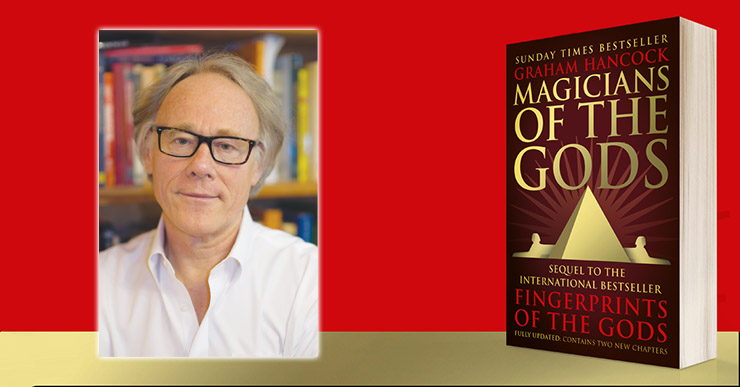
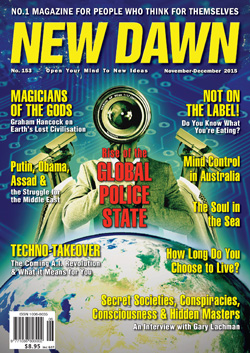
  • Magicians of the Gods: An Interview with Graham Hancock

    Magicians of the Gods: An Interview with Graham Hancock

    From New Dawn 153 (Nov-Dec 2015)

    Author and theorist Graham Hancock has had a sizeable impact upon the popular understanding of humanity’s ancient past. His global 1995 bestseller Fingerprints of the Gods contended that some previously ancient but highly advanced civilisation existed in prehistory, one which served as the common progenitor civilisation to all subsequent known historical ones. Further books such as Keeper of Genesis (with Robert Bauval), Underworld (studying underwater ruins as evidence of lost civilisations) and others propose bold new theories that challenge mainstream dogma.

    Hancock’s new book Magicians of the Gods: The Forgotten Wisdom of Earth’s Lost Civilization – a sequel of sorts to Fingerprints – gathers compelling evidence pointing to an ancient global cataclysm, caused by devastating meteor impacts, that may have all but erased a highly advanced human society and forced the survivors to, in essence, start again. Hancock also presents evidence the Earth may soon face this potentially species threatening meteor stream again.

    David Thrussell spoke to Graham Hancock in this exclusive interview for New Dawn.

    DAVID THRUSSELL (DT): From a distance, you appear to have what could be described as an ideal life Graham, travelling around exotic and interesting places, exploring the edges of history and knowledge. Are there any downsides, disappointments or frustrations in your work?

    GRAHAM HANCOCK (GH): I feel glad that I’ve had the opportunity in this life to explore and spend time in so many incredible, mysterious, profoundly moving ancient sites, all around the world. It’s been a great privilege to have the opportunity to do this, and I have no complaints whatsoever. I’m grateful for my life. I have a lot of freedom and I’ve worked from home since I was 29 as a matter of fact – that’s when I decided I couldn’t work in a large organisation anymore, and struck out on my own. For a very long time I was completely broke. Eventually I started to manage to make a living from it. But I have no complaints. I think I’ve been very fortunate and I’m grateful for the life I’ve had the opportunity to lead.

    DT: How long have you been working, brewing away on the new book [Magicians of the Gods]?

    GH: Well in a sense, 25 years. As a focused project, about 3½ years, but this book draws on my interests and enquiries into this field going back to the end of the 1980s.

    DT: Now, if you had to advance a single most compelling piece of evidence to support your theory, what would it be and why would it be that?

    GH: Well, it’s more complicated than that. This is not a problem that can be solved by a magic bullet. This is a problem that requires co-ordination of evidence from many different sources. I would offer you three pieces of evidence that are all in a sense joined together, and one of those pieces of evidence, a very important piece of evidence, is something we have now, but I didn’t have when I wrote Fingerprints of the Gods in 1995. It’s effectively a smoking gun, globally. Scientific evidence for a global cataclysm between 13,000 and 12,000 years ago. That was essentially the hypothesis I put forward in Fingerprints of the Gods, that there had been a global cataclysm between 13,000 and 12,000 years ago, and it wiped out an advanced civilisation, and I speculated on many possible causes of that cataclysm – notably pole shift and Earth crust displacement.

    What happened since 1995, and particularly since 2007, is that a group of scientists have put before the scientific community – very little of this has yet leaked out to the public – absolutely compelling evidence Earth suffered a series of impacts from fragments of a giant comet, and these impacts happened 12,800 years ago when several fragments hit the North American ice cap, causing global flooding and radical climate change. It happened again 11,600 years ago when more fragments from the same comet came out of orbit and smacked down into an ocean – almost certainly the Pacific – sending up a huge plume of water vapour into the upper atmosphere and causing very sudden global warming. So the interval between those two periods, the 1,200 years between 12,800 years ago and 11,600 years ago, is an episode of almost unparalleled global cataclysm, coupled by massive extinction of animal species, the mega mammals, the mammoth, the woolly rhino, and so on. And this is the event that I believe lost us a whole civilisation of pre-history that previously has not entered the archaeological records.

    Now, let’s co-ordinate this with the latest discoveries in archaeology. Remember that one of the two dates for that cataclysm is 11,600 years ago. This was a sustained event that involved two separate bombardments from fragments of a comet. On both occasions there were massive sea level rises and a global cataclysm unfolded. The first occasion 12,800 years ago, the second occasion 11,600 years ago, were also accompanied by global flooding and massive sea level rises. It’s therefore intriguing that the archaeological site in south eastern Turkey, known as Göbekli Tepe – which means ‘pot-bellied hill’ in the Turkish language – was created 11,600 years ago by people who already knew how to work with giant megaliths. Göbekli Tepe is an anomaly, because it’s 7,000 years older than other megalithic sites around the world, and yet it demonstrates advanced techniques of stonework and stone cutting, organisation of labour, planning, site design and alignment to the heavens. This is not the work of a group of hunter-gatherers who woke up one morning and felt suddenly inspired to create the world’s first megalithic architecture. In my view, what we’re looking at is a transfer of technology, the knowledge brought by the survivors of the lost civilisation, including the knowledge of how to create large-scale megalithic structures – and at exactly the same moment 11,600 years ago we get this sudden and unexplained appearance of a sophisticated megalithic site in south eastern Turkey.

    We also get the dissemination and uptake of agriculture in exactly the same region, whereas previously the inhabitants had been entirely hunter-gatherers. I say again, what we’re looking at is a transfer of technology, the fingerprint of the survivors of a civilisation that was lost in the cataclysmic events between 12,800 and 11,600 years ago.

    And I mention a third point, the age-old myth of Atlantis, which isn’t actually that old because the version of it that comes down to us – the only version that comes down to us – is in the works of the Greek philosopher Plato. Plato said he got the story of the submergence and destruction of the advanced civilisation of Atlantis through his ancestor Solon, the Greek law-maker who visited Egypt in 600 BCE, and there was told, by Egyptian priests, the story of Atlantis. And they said Atlantis had been destroyed and submerged, having incurred the anger of the gods, 9,000 years before the time of Solon. We know that Solon was in Egypt around 600 BCE, therefore they are talking about 9,600 BCE in our calendar, 11,600 years ago, which is the date precisely for the appearance of these hitherto unheralded techniques of megalithic architecture and agriculture in the region of south eastern Turkey.

    DT: The cataclysm you’re talking about has been staring us in the face really, hasn’t it?

    GH: It has been staring us in the face, but I don’t blame historians and archaeologists for failing to get to grips with it sooner than this. Because the leading scientists in the field have only really been compiling and presenting evidence on what is now referred to as the Younger Dryas comet for the last seven or eight years. It’s a very recent discovery and the reason it’s a recent discovery is that the major impacts of this comet 12,800 years ago were on the North American ice cap. This was still the Ice Age. North America, as far south as New York, was covered with ice, two miles deep, and at least four fragments of the comet hit the ice cap. But they did not leave prominent craters on the ground because the craters were in the ice itself and the vast heat and kinetic energy of the comet melted away that ice, so the craters were transitory and what we have is shock effect on the ground underneath. Recently, a number of craters have been found. The kind of craters that would be left when an object hit a two mile deep ice cap and transferred its shock to the bedrock underneath.

    Much more important is the evidence of the Younger Dryas scientific team – more than 30 scientists are working on the Younger Dryas comet. That evidence is based on what I call “impact proxies.” When you get an object coming in at 60 or 70 thousand miles an hour, and that object is a kilometre or two in diameter, it has unbelievable quantities of kinetic energy, and then you’re looking at an explosive power in the range of the entire nuclear arsenal of planet Earth, going up at once, with any single one of these objects. And there are certain, very recognisable outcomes of this. One is melt glass. You have heat unleashed in excess of the boiling point of quartz. Temperatures in excess of 2,200 degrees centigrade. This produces melt glass which is indistinguishable from the melt glass we find as a by-product of nuclear explosions. You also get carbon micro-spherules and very distinct nano-diamonds that are caused by the shock and heat. These nano-diamonds are only visible under a microscope, and they are combined with the melt glass, the carbon micro-spherules, and other evidence all around the world. They are compelling evidence for a gigantic cosmic impact 12,800 years ago.

    And, by the way, it’s exactly this kind of evidence that was initially put forward to prove the asteroid that wiped out the dinosaurs 65 million years ago. There’s only two occasions in Earth’s history, in the last 100 million years, that we get precisely the same impact proxies spread around the world. One of them is the so-called KT event 65 million years ago that wiped out the dinosaurs. And the other is the hitherto unrecognised, but now very obvious extinction level event that happened 12,800 years ago, and was caused by the Younger Dryas comet. I say “Younger Dryas” because that is the geological name for the period between 12,800 years ago and 11,600 years ago when the Earth’s climate fell into a sudden and hitherto unexplained deep freeze. We now know the cause of this. It was our interaction with the fragments of a giant comet, and the effects were truly cataclysmic.

    [alert type=”info” dismiss=”no”]If you appreciate this article, please consider a subscription to New Dawn magazine.[/alert]

    DT: Is it reasonable to suggest that mainstream academia, media and science are wedded to a particular view of history?

    GH: Yes. It is reasonable to suggest that, and it’s not surprising either. It’s just always the case – when you have any area of study, any discipline, whether it’s geology or whether it’s archaeology for that matter – that a body of knowledge is built up. And respected elders have contributed to that body of knowledge, and the new generation obviously respects the work of their elders. And gradually what builds up is a reference frame, a picture for how that area of study should be. In the case of archaeology, the picture that built up over the last 100 years of work is of a slow evolution of civilisation – that our ancestors were hunter-gatherers and nothing more until perhaps 8 or 9 thousand years ago. Then we begin to see the gradual movement towards more permanent settlement and about 5,000 years ago we get the first big cities and the first great megalithic architecture. This is the picture of civilisation taught to us by mainstream academic historians and archaeologists. It’s taught in the schools, it’s by and large conveyed through the media, but it is not a fact, it is a reference frame. It is a reference frame built up by 100 years of archaeological study. And this is, I think, the problem with archaeology and other scientific disciplines that get locked in a particular reference frame. When new facts emerge that don’t fit the reference frame, they find it difficult to adjust to them, and the first step is the attempt to discredit those facts. When more and more evidence comes in that the existing paradigm can’t explain, eventually the paradigm gets overthrown. A lot of good people who’ve done a lot of good work, who are convinced they’re right, who respect the work of their elders, and who don’t want to rock the boat – I think that’s the central problem. It always happens in science. No ideas change suddenly overnight without overwhelming new evidence that the previous paradigm cannot explain. That’s what we’re finding in the field of history and archaeology now – more and more new evidence coming in that simply can’t be explained by the existing reference frame of history.

    DT: Would you care to speculate – if the theory that you’re advancing is indeed correct – what pre-history looked like? What would history on Earth look like before this comet struck the planet?

    GH: A much more complicated world than the world portrayed to us by mainstream historians and archaeologists. Not a world populated entirely by hunter-gatherers as they suggest, but a world in which hunter-gatherers, and a more advanced civilisation, co-existed. This, in a way, is not odd. If you think about it, we are a very advanced technological civilisation today – Western technology, the industrial-technological-complex that has spread around the world, but we are not alone. We share the world with hunter-gatherer people – hunter-gatherers in the Kalahari Desert, for example, and in Southern Africa. Hunter-gatherers in the Amazon Basin. There are even tribes in the Amazon Basin who are completely un-contacted, who don’t even know that we exist; an advanced technological culture has not even impinged on their worldview yet. So the co-existence of advanced technology with hunter-gatherers that we see today, I would project that back into the past, and I would say more than 13,000 years ago during the Ice Age there was a much more advanced civilisation on this planet, than is given credit for by historians and archaeologists. It is remembered in myth and tradition all around the world, and it’s increasingly supported by recent striking archaeological discoveries such as Göbekli Tepe.

    DT: You mentioned two obvious cataclysmic events – the dinosaur extinction and the Younger Dryas events. Is it possible there have been other cataclysmic events that we have no inkling of?

    GH: Certainly there have been other cataclysmic events, and we do have inklings of them. The only question is, whether they affected the human species, and this becomes a matter for further enquiry. I hold, for the moment, the view that anatomically modern humans – people who look just like you and I – have only existed on Earth for about 200,000 years. It may well be that further discoveries will produce evidence of earlier anatomically modern humans. I don’t rule that out. But at the moment the evidence points to the emergence of our anatomically modern line about 200,000 years ago. We have, for example, a skeleton from Ethiopia, 196,000 years old, which is indistinguishable from an anatomically modern human being. So for these cataclysms to involve humanity and to impact the human story, they need to have happened within a human timeframe. This is why the Younger Dryas event is so intriguing because not only is it within the human timeframe, it’s right on the edge, on the border of a period when historians and archaeologists think civilisation began. Yet they had not yet taken into account this extinction level cataclysm, right in the backyard of history, and I would say that until they do take it into account, all their notions about the origins of civilisation are up for grabs.

    There have been multiple other global cataclysms of an extinction level going back hundreds of millions, even billions of years in the past. These things happen from time to time, and every time they happen they reset the clock on this planet, and life changes due to these dramatic and radical events. I think it’s only the most recent one, the one that happened 12,800 years ago, that directly impacted the human story – and this recent global cataclysm has not yet been taken into account in the model building of our past by historians and archaeologists.

    DT: Is it possible that mainstream science, the media, or even the general population in a sense, don’t want to know about our own history as a species?

    GH: There appears to be a kind of directive operating at governmental level, not to say things too alarming. It particularly applies to issues that involve global cataclysms. Anybody who’s worked in the field of geology will know that proposing a cataclysmic agent results in furious criticism. There was a great geologist called J. Harlan Bretz – whose work I write about in Magicians of the Gods – who provided the first evidence of cataclysmic flooding in North America, particularly in the Pacific north-west, in the channelled scablands, an area I researched quite intensively for Magicians of the Gods. J. Harlan Bretz was absolutely 100% right, but it took from the 1920s, almost to the 1970s, before he was accepted as being right. Prior to that he had been subjected to the most grievous and unpleasant abuse, which a weaker man might not have borne. In the end he turned out to be correct and he lived until the age of 99. And when he was awarded America’s highest honour for a geologist, he said: “My only regret is that all my enemies are now dead, and I have no-one to gloat over.”

    DT: If there is an active effort to forget or obscure history, why would that be?

    GH: I’m not sure. I don’t want to go in the direction of a conspiracy. I think it’s just the way people’s minds work. We find it difficult to conceive of certain things, or apply them to ourselves. There may be a conspiracy. I have to contemplate this possibility a little bit in the book. I don’t like conspiracy theories – it’s an area of enquiry where facts get thin on the ground and speculation gets very thick and long. When I look at the way the catastrophists’ ideas have been systematically rubbished, sometimes for decades until proved correct – the same was true, by the way, about the dinosaur impact. Initially no scientists believed that either. Luis and Walter Alvarez, who initially proposed the idea of a cosmic impact 65 million years ago, were subjected to abuse and persecution, and they too were eventually vindicated.
    DT: Are you aware of the work of Steven and Evan Strong in Australia?

    GH: I know Steven and Evan Strong. They were kind enough to show me a number of interesting sites in Australia last year. I’ve got a lot of respect for their leg work and they’ve opened my eyes to mysteries in Australia which I do intend to look at in the future. Australia has not been a big focus of my work up till now.

    DT: Do you ever suffer from ‘apocalypse fatigue’? It seems to be a staple of human endeavour, doesn’t it, thinking that a cataclysm is around the corner?

    GH: No, I don’t suffer from ‘apocalypse fatigue’, and I don’t go around thinking that the end of the world is nigh, either. I do think we should be paying much more attention to our cosmic environment. At the moment the human race has its priorities all screwed up. We’re capable of spending trillions of dollars a year on weapons of mass destruction, quite ready to wipe each other out and destroy this beautiful and precious habitat, the Earth, that the universe has given us. Humanity shows every sign of being an insane species at the moment, an insane and unconscious species, totally devoted to material production and consumption, uninterested in matters of spirit. Negligent of this beautiful garden in which we find ourselves.

    If we were to take the responsibility of human life seriously, we would closely and carefully inspect our immediate cosmic environment. I have drawn attention in the book to the fact that the debris stream of the giant comet that caused the cataclysm 12,800 to 11,600 years ago is still in orbit. It’s called the Taurid meteor stream. We pass it twice a year. If we were smart we’d pay a great deal of attention to the objects that orbit in the Taurid meteor stream. And if, as seems likely, some of them threaten Earth in the future, we have the technology, we have the ability to avert that danger. I’m only interested in the issue of future cataclysms to the extent that we can avoid them, and that foreknowledge of them would help us avoid them, and I believe that is the case with the cosmic threat. There is a threat, there is an ongoing danger. Most responsible and serious astronomers would absolutely agree with that.

    We mark World Asteroid Day on 30 June, which is an attempt to draw attention to the dangers of our immediate cosmic environment, and to do something about it. We’re probably the first civilisation in the history of Earth that has the capacity to intervene in our cosmic environment and to deflect or divert objects that might threaten life. I think we’d be doing a lot better if we directed our resources more responsibly – a lot of the money we spend on useless military pursuits at the moment – and channelled it instead to a thoroughly worked out space-watch project to ensure Earth never again suffers the kind of disasters it suffered between 12,800 and 11,600 years ago. We are going down the path of insanity and madness with our military spending. With all the fear and hatred and suspicion circulating in the world at the moment, we need to recognise that we’re all brothers and sisters, we’re one human family, and perhaps the prospect of dealing with a shared common threat would be the very thing to bring us together.

    DT: Ironic, isn’t it, there may be a weapon of mass destruction bearing down upon us all right now.

    GH: Yes, exactly. This is possible. A number of astronomers (including Bill Napier) and the mathematician Emilio Spedicato at the University of Bergamo, are all deeply concerned about the Taurid meteor stream. They believe it has a number of very large objects, including one that may be 30km wide, and the Earth crosses this stream twice a year. Some calculations indicate we may be crossing particularly lumpy and dangerous parts of the stream within the next 30 years or so. Nothing really could be more urgent. We need to pay attention to this problem. We need to identify objects that endanger Earth, and we need to move them. All of that we can do, it just takes the will. We already have the technology. But while we go around fearing and hating and suspecting one another, our eye’s not on the ball. Our eyes are on totally the wrong place.

    DT: I couldn’t agree more with you.

    Magicians of the Gods: The Forgotten Wisdom of Earth’s Lost Civilization by Graham Hancock is available from all good bookstores. Graham Hancock’s website is www.grahamhancock.com.

    [alert type=”general” dismiss=”no”]This article was published in New Dawn 153.[/alert]

    [alert type=”success” dismiss=”no”]If you appreciate this article, please consider subscribing to help maintain this website.[/alert]

    © New Dawn Magazine and the respective author.
    For our reproduction notice, click here.
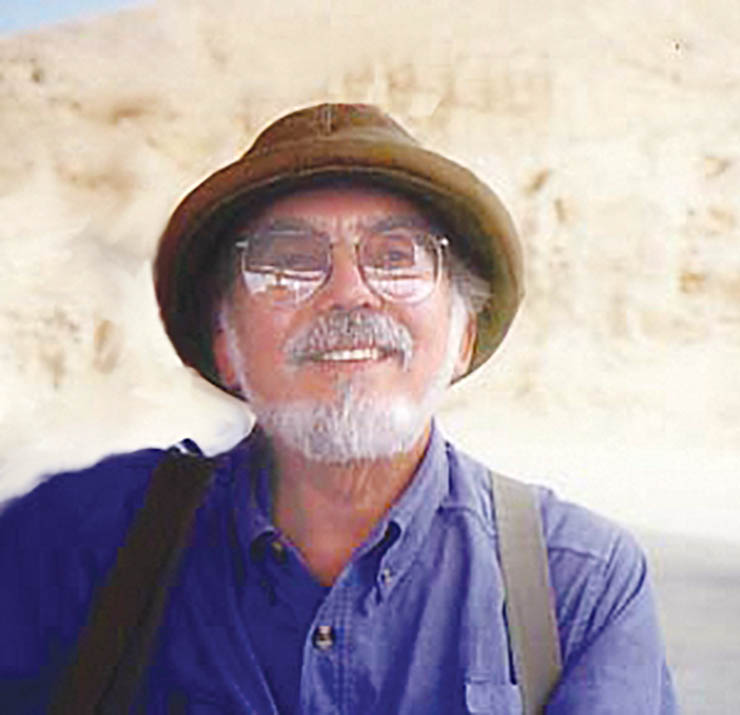
  • Mr West, the Sphinx & Gurdjieff: “Only a gentleman fights for lost causes”

    Mr West, the Sphinx & Gurdjieff: “Only a gentleman fights for lost causes”

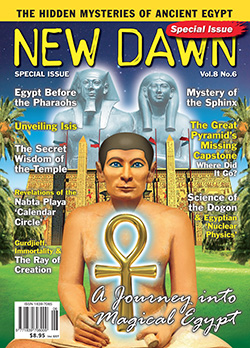
    From New Dawn Special Issue Vol 8 No 6 (Dec 2014)

    It has been thirty-five years since the first publication of John Anthony West’s revolutionary book Serpent in the Sky: The High Wisdom of Ancient Egypt. It was a courageous challenge to the academic blindness of mainstream Egyptology. Much has transpired since then and although the mainstream still desperately clings to its outdated attitudes toward the wisdom of the ancients, the knowledge that the real truth of our history and its origins have been denied to us is gaining a much greater acceptance.

    In this exclusive interview for New Dawn magazine [conducted in 2014], Darren Carville spoke to John about where he is currently at and what motivates him at the age of 82 to continue taking on the Establishment [Editor’s note: John Anthony West died in 2018]. The following are some highlights from that interview.

    DARREN CARVILLE (DC): John, Serpent in the Sky was originally published back in 1979 when the Internet was just a pipe dream. It’s amazing how many of these ideas are so widely disseminated online now. Just one example is this curious image of the ‘Sitting Scribe’ [see the front cover of this magazine] that in your book was originally in black & white, but now there are dozens of vivid colour copies of it online from every angle as people visiting Egypt take digital shots and upload the images themselves.

    JOHN ANTHONY WEST (JAW): Yes that’s true, and that particular image is also a great example of Egyptian technology going backwards, because those inlaid eyes, they’re made of four different kinds of quartz crystal and as R.A. Schwaller de Lubicz points out, not only is quartz a very difficult stone to work with, but in order to make a realistic eye that looks back at you, means having to understand the refractive and reflective indexes of the eye. So this is a very advanced knowledge of anatomy. By the New Kingdom, a thousand years later, they had lost the ability to be able do it anymore.

    DC: As an artist, even to paint something like that, is a very, very difficult thing to do.

    JAW: In terms of high art, once you’ve seen these Old Kingdom statues with the inlaid eyes, all other sculpture, including Michelangelo and Donatello and all the others, fade in comparison. They look blind, they don’t see, that’s the big difference.

    DC: You can read a saying that the ‘eyes are the window to the soul’, and here they have produced art where you can actually sense that. On the topic of lost knowledge, my son recently showed me a book that had a chart of all the different Egyptian crowns and headgear. It’s something that’s never spoken about is it? That famous picture of Yul Brynner in ‘Moses and the Ten Commandments’. He has that crown on his head that looks like a giant bowling pin, but they never actually found any of these hats in Egypt?

    JAW: No, that’s right. We have so much stuff out of Egypt now, that if it really was a crown, you’d have some instance of it and there’s not a sausage, they’ve never found any physical manifestations of them. Nobody up till now has been able to satisfactorily explain them. So this has always been a big mystery. Intuitively, I reckon that since it’s on their heads, which is the seat of consciousness, that in some way or another, symbolically it represents the consciousness of that particular principle. But that’s a ballpark observation, it doesn’t mean I can explain why one crown has a ram’s horn and the other kind of crown has a sheep’s horn. Or why one has a solar disc and the other one has a lunar disc. Well, okay, that’s sort of obvious. One is solar, and one is the lunar principle. But why this combination, I don’t know.

    DC: John it’s been over 20 years since your award-winning bombshell documentary about the Sphinx [‘The Mystery of the Sphinx’] with its ancient rainfall erosion and hence its age having to be thousands of years older than the ‘official’ date. The archaeologists produced their own documentary supposedly ‘debunking’ your claims, but it seems they were too late to sway the general public, and nothing has really been the same since has it?

    JAW: Right, well I love it. I have a certain advantage over most of my colleagues. Graham Hancock is a very good journalist but he’s not a satirist. I’m a scholar by default, but I see myself as more of a writer than a scholar. When we get attacked I have the tools to deal with them, so the harder they come at me, the more I enjoy it, particularly now we’ve got the Internet. Because before that you couldn’t retaliate.

    DC: What’s been your best achievment so far?

    JAW: People often ask me, “What do you think your legacy will be?” Well, I know this Sphinx theory – whatever the fate of symbolism – it isn’t going to go away and it’s all there. It’s not going to be long before the Establishment is obliged to accept it or get marginalised themselves. It’s really a lot like Galileo’s story actually, because I didn’t invent this Sphinx theory, I got it from a single line from Schwaller [de Lubicz] and he just glossed over it. He didn’t see it himself. Yet, it’s the key to the whole lost civilisation hypothesis… it’s quite clear from the way he talks about it. In English the book is called Sacred Science: The King of the Pharaonic Theocracy. That’s going to be around forever. Nobody’s going to get rid of that.

    Then it was Robert Schoch, my colleague, who stuck his tenured neck out to defend the whole water erosion hypothesis and it was his triple Ph.D in Geology, Geophysics and Palaeontology that did it. Nobody would have given me the time of day, even though I’d actually done my research pretty well. Schoch is very cautious and quite respectable – less so than he used to be. He’s an interesting guy, and very intelligent.

    The other thing I would like to be remembered for is being the one who drove the final nail into the coffin of Darwinian evolution. Robert Schoch and I have a book planned called ‘Darwin Debunked, Darwin De-clawed, Darwin Dethroned’, sub-titled, ‘A Scientist and a Scholar Deconstruct the Cargo Cult of the West’. We want to write the definitive anti-Darwin book, and it’s funny because there are lots of so called ‘definitive’ books that never managed to do it. Maybe the time wasn’t right or they’ve just not been written in a way to fire the public imagination. We think we can do that between us.

    DC: It may well be the right time because even five years ago if you tried to explain to most people that the world was run by a few private corporations they just laughed. But now because of what’s happening, and how it affects people personally, the attitude is changing and I think all of that global control couldn’t exist without this Darwinist world view – that there’s no greater purpose to living than being a consumer.

    JAW: Yes, it’s the foundation for it, if not explicitly, implicitly. It supports the whole rotten structure.

    DC: Is there anything else you’re currently working on that’s in the pipeline John?

    JAW: At the moment Schoch and I are working on another book called ‘Dancing Down the Bridge of Sirah’. It comes from Sufi literature and it’s described as this bridge that’s narrow as the razor’s edge, and on one side is the Chasm of Credulity and on the other is the Abyss of Scepticism. So the trick is to get down that bridge and this is not so easy. Schoch and I intend to do a really comprehensive account basically of the Sphinx theory – not going into the Symbolist realm so much – and now that we’ve got Göbekli Tepe, we’ve got a smoking gun [for more on Göbekli Tepe, see Robert Schoch’s articles in New Dawn Special Issue Vol.7 No.1 & New Dawn 122]. So not too long from now it’s going to be impossible for these jackasses to keep on insisting their old paradigm is right, and they will go under. The subtitle is ‘A Scholar and a Scientist Fend Off the Air-brushed Unicorns and Take on the Paradigm Police’. That’s an image coined by my composer step-son. He was once talking about the covers of New Age music and he complained that, “It’s all a bunch of air-brushed unicorns.” That’s a perfect totem for the woo-woo segment of the New Age movement. The paradigm police are of course the debunkers.

    The other thing we are trying to do is a ‘Magical Egypt 2.0’ documentary but we’ve got to figure out how we intend to make money from it. We didn’t make a bean out of all the work that went into the first ‘Magical Egypt’ series because people just pirated it in the end.

    [alert type=”info” dismiss=”no”]If you appreciate this article, please consider a subscription to New Dawn magazine.[/alert]

    DC: Great, we will certainly be looking forward to seeing this! One of the things I love most about Serpent in the Sky and the ‘Magical Egypt’ series is that you layout all these ideas and encourage people to follow them up and verify for themselves. I find they are something I keep coming back to, and each time it sparks me off into new research. This seems to be the way of the Egyptian Sacred Science – it makes you work for the understanding, you can’t just get it through a bunch of memorised facts in the way of academic learning. As you mentioned with Gurdjieff’s book Beelzebub’s Tales to his Grandson – it’s like Egypt makes you work for it and there is no start or finish, it’s about how far you can penetrate into the enigma.

    JAW: Yeah, sure.

    DC: A good example is the division of the head at the crown of the skull in the temple reliefs. Clearly it is a clue inviting people to have a look at this specific portion of the head as there is a deeper message hinted at. Schwaller and his team do all the research, look at the anatomy of the brain, look at all the esoteric traditions to do with that part of the head etc. He has to do a lot of research to be able to get to the truth or the understanding of what that is actually revealing. He had to work for it.

    JAW: It is impenetrable to 99% of people, even people who are highly literate and highly philosophical. There’s just something about the density of his thinking that people can’t or won’t go to the trouble to penetrate. For me it was not easy, and some of the things I didn’t have the maths to be able to follow him in certain instances. But otherwise I had a good grounding in Gurdjieff and a lot of esoteric studies so I could read it without too much trouble. It’s certainly not for everyone so it’s good to have something like Serpent in the Sky to help you open it up.

    DC: I really wanted to ask you about that Gurdjieff connection John, because I heard you on another interview say that if it hadn’t been for your understanding and experience with the Gurdjieff work, you would have never twigged to what Schwaller was on about in the first place.

    JAW: Well, I would never have even found him, for that matter.

    DC: Right, and I do wonder John – in what you’ve just said about the nature of Schwaller’s work and the level of his mind – do you think that’s really a factor of this whole idea that one’s level of ‘being’ determines what level of higher knowledge one can actually gain access to?

    JAW: That’s a good question. Well yes and no. Working on being – you’re thoroughly familiar with the Gurdjieff work?

    DC: Yes.

    JAW: Well, I would say in terms of levels of being, it’s impenetrable unless you’ve acquired what Gurdjieff calls the ‘Magnetic Centre’. That’s what opens you – it makes these kinds of things accessible. It’s one of the things that a lot of people don’t understand who haven’t been involved in this kind of work themselves, and are mostly working with their heads. They just can’t get it at all. As my Sensi used to say, “Don’t talk about moonbeams to the blind or about music to the deaf, and especially do not talk about sex to eunuchs – they will just get angry!” So once you understand that and stop getting frustrated by, let’s call it, the intolerable obduracy of the quackademic, because it looks as though it’s deliberate, but it isn’t. They just don’t get it.

    However, when they call their terrible disability ‘reason’ and take over the palace, the empire is doomed. This is what you’re dealing with. They’re basically wildly uncreative people. I mean, Schwaller appeals not necessarily to the intellectuals, although you have to be quite intellectual in order to penetrate it. You need more than intellect to be able to think in a certain way. The people who get it instantly, or at least they get the basic premise, are the artists and the architects, and sometimes the engineers, oddly enough. Rarely the hard-nosed scientist, never the sceptics of course, they’re totally out of it.

    So it’s going back to the magnetic centre, and the magnetic centre automatically means that you’ve done some sort of work on your own level of being. Some sort, even if it’s not been formal, otherwise you don’t have that magnetic centre that gets you to Gurdjieff and Schwaller in the first place.

    DC: Yes, and in relation to this battle with the academics, Gurdjieff also pointed out very clearly that this kind of ‘work’ is not for everyone. A person has to be genuinely seeking for the truth in the first place. Reading your argument with the Egyptologists in your open letter to Archaeology magazine [see www.jawest.net/anupadeshi.html], I get the sense that you have these different compartments at work in your life, because at one level you deal with the public, you do interviews, respond to all sorts of criticisms and arguments, but obviously at a deeper level you know that the issue for the human race’s future is a much deeper thing. It’s not really just about Egypt is it? Because no-one with any kind of awe and wonder about how difficult it is to make anything can ever look at the Darwinist idea that these chemicals get together accidentally and produce life. It’s a dead, non-resonating kind of thing. You could never swallow it. Yet millions do, quite happily, 24/7.

    JAW: More than millions. I mean, it’s the belief system that’s at the core of all science and all education.

    DC: Yes, I do wonder how long it’s actually going to take to replace that world view with something better. I did notice with your documentary series, ‘Magical Egypt’, looking at any of those episodes, the number of hits they have had, it’s in the hundreds of thousands. It’s quite extraordinary the popularity your work has gained since Serpent in the Sky – the message is getting out there. Of course the other side of the coin is that with the Internet all sorts of ideas have become popular and their popularity makes them seem like fact. For example, this whole Anunnaki/aliens making human slaves mine gold kind of thing – you don’t go for any of that do you John?

    JAW: No, and in our book ‘Dancing Down the Bridge of Sirah’ there will be a section in there called Zecharia and his Sitchininnies. Some of the other stuff, some of the ‘Airbrushed Unicorn’ stuff, is fairly harmless, but his work is seriously malignant.

    DC: It’s even turning up in romantic novels now.

    JAW: I always left the door open to Sitchin because his work was based upon his own translations of the Sumerian texts. No Assyriologist would look at his stuff. That’s not Sitchin’s fault. So I thought he could well be right about certain things. Who was I to argue those points? However, recently, a really solid biblical scholar who doesn’t have an axe to grind called Michael Heiser put up a website called ‘Sitchin is Wrong’ [www.sitchiniswrong.com]. This guy really knows what he’s talking about and goes through Sitchin line by line, and none of it tallies with the dictionaries created by the Sumerian scribes themselves. As far as I’m concerned, it’s completely false.

    DC: You have often given the analogy that where we are in the Kali Yuga cycle is very much like being in the ‘Winter’ stage of the four Seasons.

    JAW: Yes, that’s right. However, the big problem with these very long cycles is that you don’t have a Spring Equinox to set your clock by. You just can’t really know exactly. There’s a lot of very informed, interesting work done on the Yuga cycle, but they all have different ideas of where it starts and how it starts, and unfortunately there’s nothing scholarly or scientific that you can actually depend upon that is more plausible or less plausible analyses. There’s simply not enough history, it’s too short to tell. I mean real history only goes back about 2,500 years. In other words, history that you can document. It’s really not much more than that. Even the Egyptian history is, half the time, symbolism of some sort or another. There are very few ‘facts’. So we’re talking about cycles, at least precessional cycles, and maybe more than that, we just don’t know. You look around us today and intuition tells me that we’re in the thick of the Kali Yuga and it’s going to get a lot worse before it gets better.

    DC: John, how was it that you originally got involved in the Gurdjieff work?

    JAW: When I look back on my life I see I was psychologically precocious. Not a genius, but at the age of 12 or 13 I actually knew that I was living in a lunatic asylum, that the whole thing was insane, and it was very lonely living back then. Now lots of people sort of understand that. By the time I was 19 I knew what I wanted to do. I wanted to be the little boy who said, ‘The Emperor Has No Clothes!’

    It took another 20 years. I had published a lot of stuff by then, and the scholarship was starting with my The Case for Astrology book. There were also plays, a novel and stories. I was well published but not very well paid for it, and I realised I was now playing out my role as the little boy who said, ‘The Emperor Has No Clothes’. I finally came across the Gurdjieff work when I was living in a thriving artists colony at Ibiza in Spain during the late 50s and early 60s.

    Through a weird series of circumstances – again it’s the magnetic centre at work – one of the guys that I knew gave me a book called The Theory of Celestial Influence by Rodney Collin, a student of Ouspensky. I read it and that really interested me, and my friend, a very good painter, who had been in the Gurdjieff work himself, started feeding me Gurdjieff in very limited doses. He was right on course because I would have said, “Ah, what do I need this stuff for?” So one day he finally said, “Well, okay, here’s Beelzebub’s Tales to His Grandson.” He gives me a little fat book and I take it back and I read the first paragraph which is something to the effect of “Everything you know is completely wrong, and this book will make you understand that you don’t know anything.” I was furious. “Fuck you! who are you to tell me that, what have you ever written?”, but then I calmed down and thought, “Well I’ve had a lot published myself, and and I know how difficult it is to make your audience feel – not even think – but feel what you want them to feel.” Here was this guy, in one paragraph, getting me so angry that I was ready to throw his book against the wall. Suddenly I realised, “Oh… that’s not easy to do!”

    What Gurdjieff was doing, he was obliging me to work. You didn’t know what was true or false or even if he was pulling your leg. Could you follow those paragraphs? Those sentences that are two pages long with a thousand parentheses in the middle… he was forcing you to use your head in a way that you never dreamt of using it before.

    That was my introduction to Gurdjieff and I eventually left Ibiza to move to England to get into the Gurdjieff work, which was really important. Without that I would have spun off the rails long ago. Everything else stopped. Because at a certain point you can’t just read about these ideas anymore, you have to do them, and this is where the problem comes in because it’s not easy to do and it’s not fun.

    DC: The Gurdjieff work, no it isn’t.

    JAW: It’s not like rubbing crystals or hugging trees, it’s hard work. Gurdjieff was almost the only person I’d ever come across who was as contemptuous of all of Western civilisation as I was, but the difference was that he knew how to live in it and I didn’t. So after nine years of living in Ibiza, I finally moved to England to get into the ‘work’.

    What distinguishes Gurdjieff from anybody else is that it’s the ancient doctrine but put into a format designed to be practised in the middle of the lunatic asylum, not isolated from it in some monastery or whatever. It’s how to become sane when everybody around you is crazy, without removing yourself from ordinary life. You can’t practise Schwaller. It’s not a discipline. But Gurdjieff is.

    DC: Yes, I can certainly appreciate that.

    JAW: Without a return to the kind of principles that kept Egypt going, and other ancient cultures going, without this ancient doctrine being understood and taken up, the Church of Progress always wins, or everyone loses one way or another, so it’s very difficult. This is why Egypt is special because there’s so much of it left. You can’t go to China or India or anywhere else and have this thunder of esoteric wisdom coming at you all day long like you can in Egypt.

    Of course there’s a lot of bullshit out there as well, but at least in theory the work is designed for people to practise inside their daily lives. Not that many are doing it and I don’t really know why. On the other hand, if you just extract yourself from the world, it’s like you’re shirking your duty somehow or another. I mean, Tiger Woods’ mistresses don’t matter, and most of that stuff doesn’t matter. But some of it does matter. You watch the Scorpions of Wall Street raping our lives and these disgusting billionaires absolutely destroying the planet. That’s the sort of thing you have to keep on top of, it seems to me.

    Get the issue this article appears in

    DC: As you’ve said, the Egyptians lived their life in preparation for the next life, and of course some people say, “oh, morbid buggers, they’re obsessed with death.” But no, I think, as you’ve written about and as Schwaller pointed out, clearly they knew, unlike the Darwinists, that they were here for a reason. Something had gone to a lot of trouble to put them together, to put this planet together, and I can really relate to that balancing act you’re talking about… Because on the one hand, as far as we know, we only have the one chance to do what we need to do here and move on, and yet at the same time you would not be human to not feel a concern and want to do something to make the situation here better. Especially being that the dice is so loaded – to programme people from the time they are born – that there is no purpose to life except consumerism, that it doesn’t matter if we destroy the planet because it’s a giant chemical accident anyway.

    JAW: Well, you can only do your best. The Gurdjieff work got me understanding things pretty well and Gurdjieff has a lesson for everyone and everyone’s lesson is a bit different. But it was Gurdjieff who taught me – and this is a riff on what he says – that whoever and whatever presses your buttons is your master, and if you let your buttons get pressed, you’re a slave. I didn’t like that, so I worked pretty hard, reasonably successfully, to not get my buttons pressed most of the time. So enough people have to start doing their homework. If somebody asked me, which they probably won’t do, who I think are the most important people of the 20th century? I would put Gurdjieff first and Schwaller second. Certainly the last word has not yet been said about Gurdjieff.

    Anyway, I’m figuring on being here for a while yet. A friend of mine recently had the honour of briefly being the oldest man in the world. He was 110, and he really had his marbles together up until the last year or two. He did research into the paranormal. So if he could get to 110, there’s no reason why I can’t!

    There’s a wonderful author, the Argentinian writer Jorge Luis Borges. He wrote a short story book called Ficciones – magical Cabalistic stuff – and in one of the stories the last line is, “A gentleman only fights for lost causes.” It’s a great line. I don’t necessarily consider myself a gentleman, but it’s hard to do this – it’s hard not to get affected by the sort of stuff that’s happening around us every day.

    Books by John Anthony West – including Serpent in the Sky: The High Wisdom of Ancient Egypt and The Traveler’s Key to Ancient Egypt, as well as The Mystery of the Sphinx DVD, are available direct from John Anthony West’s website at www.jawest.net/books_vids.htm.

    [alert type=”general” dismiss=”no”]This article was published in New Dawn Special Issue Vol 8 No 6.[/alert]

    [alert type=”success” dismiss=”no”]If you appreciate this article, please consider subscribing to help maintain this website.[/alert]

    © New Dawn Magazine and the respective author.
    For our reproduction notice, click here.
  • Eternal Atlantis

    Eternal Atlantis

    From New Dawn 89 (Mar-Apr 2005)

    For more than one hundred years, mostly independent researchers who argued that Atlantis had in fact been destroyed by a great flood were ridiculed by mainstream scientists. Conventional scholars were convinced that Earth changes were incremental, requiring thousands and millions of years.

    They belittled Plato’s statement that Atlantis was engulfed by the sea “in a day and a night” as imaginative fantasy, and scoffed at any suggestion civilisations have ever succumbed to natural forces. These professional debunkers were in for a rude shock during late December, last year, however, when a relatively small-scale re-enactment of the Atlantis catastrophe was played out in the Indian Ocean.

    A single earthquake sent super-waves traveling at speeds of five hundred miles per hour across the sea to claim more than three hundred thousand lives in a dozen countries. The infra-structure of Sri Lanka, much of Indonesia and large parts of southern India were shattered beyond repair, without massive outside aid from the rest of the world. Multiply that disaster by a factor of ten and some appreciation may be had for the cataclysm that struck Atlantis. Had the Indian Ocean catastrophe been followed by just one more similarly destructive tsunami, the region would have been beyond reconstruction. Photographs and videos of the killer waves that came ashore resembled the last moments of Atlantis, before the geologically unstable island on which she perched so precariously was similarly overwhelmed.

    Exactly ten years before the Indian Ocean tsunami, two worlds changed forever. One of them was Earth. When Jupiter was struck by a barrage of meteors in the summer of 1994, their impact on the scientists of our planet was hardly less dramatic. Until then, most of them believed with the Larousse Encyclopedia of Astronomy that “the perfect timing and positioning required make the possibility of collision extremely slight.” Nonetheless, a comet six miles in diameter disintegrated in the Jovian gravitational field. Its pieces broke free and began a final pass, in tandem, around the Sun. During mid-July, stony remnants of the dead comet returned. A line of twenty one fragments, each about one-and-a-half miles across, hit the planet at more than thirty seven miles per second.

    Disbelieving observers watched, as columns of flame shot several thousand miles high into the atmosphere. Ejected fireballs larger than Earth itself exploded in full view of the Hubble Space Telescope. Impact of the cometary debris generated energy ten thousand times more powerful than mankind’s entire nuclear arsenal. For more than a year following these collisions, Jupiter was still pock-marked by their resultant super-heated gas-bubbles, one of which was large enough to have swallowed our planet whole. Centuries of calm assurance that Earth possessed some special immunity from outer space threats had been dramatically replaced by a more sober appreciation for our precarious position in the solar system.

    These two event-horizons of our time – one in outer space, the other from inner space – combined to provide some inkling of what happened to Atlantis, while underscoring the fragility of human civilisation, then and now. That is the great value in examining the Atlantean catastrophe: It is very up-to-date, because it is an eternal story. Numerous cultures around the world remembered four major floods followed by mass-migrations. This tradition was shared by such diverse peoples as the Incas of Peru, the Celtic Irish, Classical Greeks, the Aztecs of Mexico, and many others beside.

    The close fit results when we compare their folk memories with what science now recognises as a quartet of natural catastrophes that ravaged the Earth beginning more than five thousand years ago. But when physical archaeology was added to myth, astronomy and geology, a new light on the ancient past suddenly winked on. Its brightness uncovered the hitherto unseen causes that brought history into existence. And clearly exposed was a common theme that over and over again threaded together and made sense of all the diverse twists and turns in a vast human drama – Atlantis. The name was as inescapable as it was powerfully revealing.

    Applying that sunken realm to the four separate global calamities we now know occurred explains the beginning and development of civilisation, while simultaneously defining Atlantis within the credible parameters of real history, not speculative fantasy. It suffered not one but several different catastrophes, each one separated by many centuries, until a fourth destruction finally obliterated the kingdom.

    The Age of Atlantis

    My book, Survivors of Atlantis, describes these event-horizons for the first time, and elucidates them via traditions from Egypt, Mesopotamia, Morocco, the Canary Islands, Ireland, Wales, Scandinavia, pre-Columbian North America, Mesoamerica and pre-Conquest South America. Survivors of Atlantis relates another story yet to be told. This is the war Plato said the Atlanteans launched in a bold bid to conquer the world. Their hitherto neglected military adventure was intimately connected with and actually determined by the natural calamities which eventually overwhelmed them. The chaos men brought about on Earth was mirrored in the angry heavens.

    When the Atlantean Age suddenly ended around 1200 BCE, Pre-Classical Civilisation everywhere collapsed or went into irreversible decline, from Pharaonic Egypt and Homeric Greece to the Hittite Empire and China’s Shang Dynasty. Atlantis was one more victim of the worldwide catastrophe. And, like the others, it was an identifiably Bronze Age city, according to Plato’s description. Survivors of Atlantis describes each of the four global cataclysms, as uncovered by science and graphically related in the folk memories of peoples whose shores were washed by the Atlantic Ocean. In so doing, the lost empire comes into clearer focus than ever before. The legacy of its enduring influence on our current civilisation stands out for the first time in bold relief. And we come to realise that the story of Atlantis is the story of the world.

    In terms of power-politics, it was not much different from our own, tragically. By 1198 BCE, the day Atlantean militarists waited for so long finally arrived. The powerful Egyptian king, Merenptah, had died of old age. He was followed by no less than five rulers in quick succession, including the club-footed Siptah and Tewosret, a short-reigned queen. These prolonged political crises destabilised the XIXth Dynasty, and Atlantean strategists prepared to take advantage of the situation. Now the Egyptians were preoccupied with the accession of a new pharaoh and all the powerful implications, good and evil, a change of divine leadership inevitably brought. This time they had special cause for worry. A frightening omen appeared following the death of King Sethnahkt, who had just founded a new dynasty, the XXth. An immense, dark cloud began to cover the sky at unnatural speed from the west. The Sun turned blood red, then disappeared. Broad daylight was reduced to twilight, accompanied by a rain of black dust that fell for weeks over the entire land. “Men walk about like ravens,” the Egyptian scribe recorded. “No one can keep their garments clean anymore.”

    These ominous conditions boded ill for the Atlanteans, too. In the midst of organising an invasion of the Nile Delta, such signs and wonders in the heavens presaged disaster for someone. Having been born and raised on a geologically active island, they recognised the “black dust” as ash-fall blown in on the prevailing westerlies from some major volcanic event outside the Mediterranean. Naturally and anxiously, their thoughts turned to the ever-smoking mountain of their far-off homeland, Mt. Atlas.

    Their worst fears were confirmed when waves of human migration deluged through the Pillars of Heracles. Panicked refugees streamed by the hundreds of thousands along North African shores or in ragged flotillas of boats and ships overcrowded with dispossessed families traumatised by disaster. Most of them were fellow Atlanteans, and they had a report to make. “You can’t go home again,” they said, “because home is no longer there.” With hardly more than one day’s warning, the island of Atlantis had been torn by earthquake and sky-fire before the angry sea swallowed it whole. The accompanying devastation was so pronounced and widespread, that the entire region, including all foreign coastal areas raked by a series of ruinous tsunami waves, had been rendered uninhabitable. The occupied areas of Italy, Tripoli and the Mediterranean islands swelled with new populations of survivors, compromising living conditions everywhere.

    But the exiles brought with them more than tales of woe. Important sections of the home fleet escaped the catastrophe, carrying warriors and supplies, as well as crowds of displaced persons. The Sea People armada at Cyprus and Rhodes was appreciably reinforced by these new arrivals of warships and marines. More than before, the conquest of Egypt was needed to resettle the streams of refugees, their growing numbers making increasing demands on the limited resources of the occupied territories. Bolstered with fresh battle-cruisers, munitions and soldiers, the Atlantean commanders resolved to strike at once, while the Egyptians were still distracted by their royal interregnum and celestial portents. Nearly two thousand years before, the Atlanteans conquered Egypt for the first time as fugitives from a natural calamity. They would do so again. Let the fall of “black dust” be a sign of doom for the new pharaoh!

    The Fall of Atlantis

    Like other aggressors before and since, however, the Atlanteans would go down in defeat against a surprisingly capable leader, Rameses III. But the story of their military debacle and simultaneous destruction of their capital spread far beyond Egypt. In Ireland, there were tales of a “Sea People” known as the Tuatha de Danann. Their leader was Ogma, from Tir-nan-Og, the Irish Atlantis.

    According to a classic authority on early Ireland, Henry O’Brien, the Tuatha de Danann arrived at the south coast of Ireland in 1202 BCE. This date compares remarkably well with the final Atlantean catastrophe that occurred around the turn of the 12th century BCE. O’Brien, who wrote in 1834, knew nothing, of course, about the untranslated wall-texts at Egypt’s Medinet Habu or late 20th century oceanography and astrophysics confirming the ultimate destruction of Atlantis precisely in the same period he determined entirely from Irish folk tradition. His conclusions were supported in the next century by a fellow countryman, Michael Bailey, a leading dendrochronologist, whose investigation of Irish peat bogs revealed that a major climate change with disastrous ecological consequences took place around 1200 BCE. Bailey’s research contributed importantly to scientific understanding of the worldwide cataclysm that brought the curtain down on Bronze Age civilisation. O’Brien believed that the strange, obelisk-like towers still found in Ireland were erected by the Tuatha de Danann, citing the 10th century Book of Leccan, which tells of “the Tuathan tower”. Ruins of several such towers are found, appropriately enough, in County Roscommon, at Moy-tura, where the Tuatha de Danann decisively defeated their immediate enemies. Known more correctly as Moye-tureadh, the battle-area is translated as “the Field of Towers”.

    Hostilities among the various Atlantean groups in the midst of their disasters might in part be explained by their different origins, however related. The Tuatha de Danann told of four, great cities – Findias, Gorias, Murias and Falas – all simultaneously overtaken by a natural catastrophe and dragged to the bottom of the sea. They appear to have been located on separate islands in the Atlantean Empire, from which various groups contested each other for control of Ireland. Gorias, for example, was probably in the Gorgon Isles associated with the Canary Islands.

    The 16th century scholar William O’Flaherty recorded that the Milesians, the last of the pre-Celtic invaders, arrived before 1000 BCE. His general time-parameter, too, coincides with a Late Bronze Age Atlantis. Their leader was Eremon, a name synonymous for all Ireland. It appears to be a linguistic inflection on Euaemon, the fourth king of Atlantis in Plato’s dialogue, the Kritias. “The Book of Invasions” tells how Eremon established Tara as the capital of his new kingdom. Originally known as Tea-mhair, he named it after his wife, Tea. Together with her sister, Tephi, Queen Tea made Tara the spiritual centre of ancient Ireland. The women are described as daughters of the royal house in the Blessed Isles lost beneath the sea.

    The Milesians chief deity, Macannan Mac Lir, was a worldwide wanderer from Annwn famed throughout Celtic myth as “Land under Wave”, from the Brythonic an (“abyss”) and dwfn (“world”). Also known as the “Revolving Castle” (Caer Sidi), it was a fortified island of great natural beauty with fresh water streams and a circular-shaped city surrounded by concentric walls lavishly decorated with gleaming sheets of precious metal. The central palace was called Emahin Ablach, “Emhain of the Apple Trees”. His home-away-from-home, however, was at the Isle of Man, where Reel Castle allegedly covers his grave site.

    Although a god and supposedly immortal, he preferred death to eternity when Ireland went Christian. Before then, he traveled in a chariot as “the rider of the crested sea”, and was the divine patron of sailors. He founded Llyr-cestre, modern Leichester, and was head of the “three Chief Holy Families of the Isle of Britain”, known equally in Wales as “the Children of Llyr”. Today, he is better remembered as the figure of tragic disillusionment in Shakespeare’s King Lear.

    Resemblances between Macannan Mac Lir and Poseidon, the Atlantean sea-god, are unmistakable. Both crossed the waves in a chariot, were patrons of sailors, and progenitors of royal families. Their islands were identically configured into concentric walls sheeted in decorative metal, while “Emhain of the Apple Trees” echoes Atlas’ Garden of the Hesperides with its golden apple trees. The medieval Fate of the Children of Tursun likewise describes an island called “the Plain of Happiness”, where trees bearing golden apples grew in the “Garden of Hisberna”. In the lost “Druidic Books of Pheryllt” and “Writings of Pridian”, Ynys Avallach, or Avallenau were “more ancient than the Flood, when all the rest of mankind had been overwhelmed.”

    Avallenau was also the name of a Celtic goddess of orchards, reaffirming the Hesperides’ connection with Atlantis. Avalon was additionally referred to as Ynys-vitrius, the “Island of Glass Towers”, an isle of the dead, formerly the site of a great kingdom in the Atlantic Ocean, the same story embraced by Portuguese Gauls as their foundation-myth. Another Irish memory of Atlantis preserved in The Voyage of Maeldune, presented below, mentions the “Island of Apples”. Britain’s Geoffrey of Monmonth characterised an identically named place he additionally called “Fortunate” in his 12th century Vita Merlin. Atlantis was often referred to by Classical writers other than Plato (Strabo, Pliny, Aelian, etc.) as “the Fortunate Isle”.

    It was remembered in several other Irish epics, such as The Voyage of Bran. It told of “a distant isle, the plain on which the hosts hold games. Pillars of white bronze shine through eons of beauty. It is a lovely land through all the ages of the world, a silvery land on which dragon stone and crystal rain. Sweet music strikes the ear. The host races along Magh Mon, a beautiful sport. Coracle races against chariot.” Bran’s kingdom describes no other island than Atlantis, from its vast plain to horse races, similarly described by Plato.

    “Pillars of white bronze” suggest orichalcum, the high-grade, gold-alloy copper he reported was the extraordinary product of Atlantean metallurgy. It is mentioned again in other Irish accounts of Atlantis, such as the 9th century “Travels of O’Corra”, which told of a bright metal unlike any other, findrine, found at Formigas. The island “had a wall of copper all around it. In the centre stood a palace from which came a beautiful maiden wearing sandals of findrine on her feet, a gold-coloured jacket covered with bright, tinted metal, fastened at the neck with a broach of pure gold. In one hand she held a pitcher of copper, and in the other a silver goblet.” Here, again, is encountered the central palace surrounded by walls adorned by precious metals, together with typical mineral opulence, especially copper, described in the Kritias.

    The unique metal occurs again in “The Voyage of Maeldune”, where it is referred to as bath. The seafaring Maeldune lands at “a large, high island with terraces all around it, rising one behind one another; a shield-shaped island.” As he explored the island, he found “a broad, green race course”. But there were several other islands in the vicinity. The next one he visited was the “Island of the Apples” mentioned above. A third featured a city surrounded by a high wall, while a fourth was divided in two across its centre by a massive wall of gleaming brass. The last island had no less than four concentric walls arranged in rings encircling each other. The outer wall was decorated with gold, the second with silver, the third with copper and the innermost wall with crystal.

    It is clear that the four places Maeldune visits are not separate locations, but alternating rings of land and water on one, large island – a self-evident representation of Atlantis remarkably presented in an Old Irish account. But it was not the only one. Others recalled Rath-cruachain, a circular, stone fortification with walls thirteen feet thick at the base and surrounded by five concentric ramparts. Its bronze, golden and silver palace was the centre of the fortress-like city, which one day vanished under the sea. Even the Atlantean sacred numeral occurs in Rath-cruachain‘s five walls.

    Stonehenge’s Connection to Atlantis

    If Eremon-Euaemon was the Atlantean-Milesian monarch of Ireland, Late Bronze Age Britain was ruled by the eighth refugee king mentioned in Plato’s account of Atlantis. Mestor, whose name meant, “the Counselor”, may have been associated with Europe’s most famous megalithic site, which gave counsel, as it were, regarding the movements of the heavens. According to archeo-astronomers, Stonehenge was a kind of astronomical computer primarily oriented to the positions and phases of the moon. Indeed, it resembles the concentric city-plan of Atlantis itself, even to the inclusion of Atlantean sacred numerals, Five and Six, repeated throughout its design.

    Archaeologists believe the structure was first laid out by 3000 BCE, began to reach the apex of its construction 1,400 years later, and was suddenly discontinued around 1200 BCE. Its development, use and abandonment parallel Atlantean immigration at the close of the 4th millennium BCE, the zenith of Atlantis as the foremost Bronze Age civilisation, and final destruction in 1198 BCE. Not coincidentally, Atlas was depicted in Greek myth as the founder of astronomy; hence, his representation as a titan supporting the sphere of the heavens on his shoulders. He therefore signified the birth and florescence of astronomy at the city named after him – Atlantis.

    Its impact on Britain was no less dramatic than in Ireland, as suggested by native folk memories of foreigners arriving from an oceanic catastrophe in the deep past. Comparisons between Irish versions and their Welsh counterparts are often very close, suggesting a common event that was experienced independently by two different peoples. For example, the story of Murias, the Tuatha de Danann’s sunken homeland, was almost identically known in Wales as Morvo. But British renditions of Atlantis throw a new light on the fate of its survivors.

    Llyon Llion was the Lake of Waves, which overflowed its banks to inundate the entire Earth. Before this former kingdom was drowned, the great shipwright, Nefyed Nav Nevion, completed a vessel just in time to ride out the cataclysm. He was joined in it by twin brothers, Dwyvan and Dwyvach, who, landing safely on the coast of Wales, became the first Welsh kings. This myth is less the slight degeneration of an obviously earlier tradition than it is an example of the Celtic inclination toward whimsical exaggeration, making a mere lake responsible for the world flood. In all other respects, it conforms to other Atlantean deluge accounts, wherein surviving twins, like those listed in Plato’s Atlantis story, become the founding fathers of a new civilisation.

    Hu-Gadarn is mentioned in the Hanes Taliesan, the “Tale of Taliesan,” where he is known as Little Gwion. If this affectionate diminutive seems derivative of the Trojan capital, Ilios, (Wilion in Hittite and perhaps the Trojan language, as well), the impression is deepened when Hu-Gadarn says, “I am now come here to the remnant of Troia.” Troy was allied with Atlantis through common blood-ties. Hu-Gadarn is regarded as the first ancestor of the Cymry, the Welsh people.

    His Atlantean identity is no less apparent: “I have been fostered in the Ark,” he confesses. The Hanes Taliesan reports, “He had been fostered between the knees of Dylan and the Deluge,” arriving in Wales after a worldwide flood whipped up by a monstrous serpent.

    Llys Helig is a stony patch on the floor of Conway Bay, sometimes visible from the shore during moments of water clarity, and still locally regarded as the site of a kingdom formerly ruled by Helig ap Glannawg. He perished with Llys Helig when it abruptly sank to the bottom of the sea. The stones taken for the ruins of his drowned palace are part of a suggestive natural formation that recalls one of several Welsh versions of the Atlantis disaster. Others speak similarly of Llyn Llynclys. A large, dark pool of fathomless water in the town of Radnorshire is supposed to have swallowed an ancient castle known as Lyngwyn.

    In the Preiddu Annwn, “the Spoils of Annwn”, King Arthur and his men escape from Caer Wydyr, the “Fortress of Glass”, which sank beneath the waves soon after. A “Tower of Glass” appears in the Historium Britanum by medieval chronicler Nennius. Standing majestically in the midst of the sea, Turris Vitrea echoes only the voices of outsiders, and seems utterly abandoned – a Celtic device symbolising death. Similar Welsh tales told of Caer Feddwid, the “Court of Carousal”, and Caer Siddi, opulent island-kingdoms featuring fountains and curative fresh water springs, as similarly described in Plato’s Atlantis dialogue.

    The “Tale of the Lowland Hundred” tells of Cantref y Gwaelod, an island forty miles long and twenty miles across. It was filled with fruit trees, natural hot springs, forests and ringed by a great range of mountains. A system of sluices created alternating rings of land embankments and moats with canals bridged over by connecting walk-ways. The island had a capital, Caer Gwyddno, which extended political control over sixteen neighbouring islands and cities. But a disaster overtook the city, and it sank beneath the ocean, drowning most of its inhabitants. King Gwyddno Garanhir, along with a party of survivors, landed on the Welsh coast, and eventually became the first royal family of Wales. A rocky ridge running some seven or eight miles out to sea before its disappearance under water was said to mark the direction in which Caer Gwyddno lay at the bottom of the Atlantic.

    Remembered in some parts of Wales as Llyn Syfaddon, Llyn Savathan was the extensive kingdom of Helig Voel ap Glannog, whose great possessions, extending far into the sea from Priestholm, had been suddenly overwhelmed by the sea. His name is remarkable, because it contains the “og” derivative of Atlantean deluge-heroes in other parts of the world. Another Welsh flood tradition, Llys Elisap Clynog, not only repeats the “og” theme, but seems to include Plato’s second king of Atlantis, Elasippos.

    So many similar accounts deeply rooted in the folkish consciousness of both Ireland and Wales were never regarded by their peoples as mere fables, but revered instead as sacred traditions of ancestral beginnings. Myths such as these may not yield their truths to the archaeologist’s spade, but can disclose themselves to any honest mind, as they were intended.

    Folk memory of Atlantis is deeply rooted in the mythic traditions of numerous peoples impacted by the military adventures of its massive armed forces, the nuclear-like destruction of its homeland, and the migration of its survivors to numerous lands which formerly comprised their world empire.

    [alert type=”general” dismiss=”no”]This article was published in New Dawn No. 89 (Mar-Apr 2005).[/alert]

    [alert type=”success” dismiss=”no”]If you appreciate this article, please consider subscribing to help maintain this website.[/alert]

    © New Dawn Magazine and the respective author.
    For our reproduction notice, click here.
  • Interview with Graham Hancock: Ancient Civilisations & Altered States of Consciousness

    Interview with Graham Hancock: Ancient Civilisations & Altered States of Consciousness

    From New Dawn 134 (Sept-Oct 2012)

    Few, if any, have contributed more to the alternative history and esoteric genres than Graham Hancock. At the peak of his career, and on the eve of his first speaking tour of Australia [in 2012], Andrew Gough met up with Graham to discuss his legacy and what the future may hold for the greatest voice of his generation.

    ANDREW GOUGH (AG): Graham, hi. Welcome to New Dawn magazine.

    GRAHAM HANCOCK (GH): It’s a pleasure.

    AG: Can you believe that your seminal book, Fingerprints of the Gods, was published over 17 years ago?

    GH: Yes, it’s really bizarre, actually, the feeling that 17 years have passed. I had a feeling back then that there was another story to tell about the past – something missing in the record – and I set out to look for that.

    AG: Were you prepared for the responsibility that came with the success of Fingerprints of the Gods?

    GH: Well, I think first of all I need to make it very clear that Fingerprints of the Gods could never have been written if there were not a whole group of people working in this area. And, to name a few, I would say: Rand and Rose Flem-Ath, with their work on earth-crust displacement, following up the work of Professor Hapgood; Robert Bauval, with his extraordinary work on the Orion correlation, which radically changed our understanding of the pyramids and what they’re all about, and the deep antiquity that they’re connected to; John Anthony West, and Professor Robert Schoch from Boston University; John West, radical Egyptologist, thinking things through in a different way, realising that there is something wrong with the story of the Sphinx, and Robert Schoch backing that up with geological observations; all of these people were working away, doing incredibly important original work of discovery and part of my function was to write a book that put all of that work together into a bigger picture.

    AG: Your success was not without consequence, and I remember watching the 1999 BBC Horizon documentary in horror, as they attacked your theories, in what was clearly a premeditated manner. Although you were vindicated, what do you think led to the BBC’s aggression?

    GH: Well, again, I think, first of all, when you get into the field of exploring radical new ideas, challenging the status quo, and perhaps I didn’t realise this fully at the time, because the whole success of Fingerprints of the Gods and the speed with which things developed took me quite by surprise, you absolutely have to expect to be attacked, and academics also attack each other in exactly the same way.

    I also think, by 1999 perhaps I myself had become over-confident. I’d had a lot of success. When I look back on the story of my life, and those particular years, I think I was arrogant. I think I was cocky. I think I felt invulnerable. I actually think I needed to be taken down a peg, which is what the BBC did to me.

    AG: That’s a very impressive perspective.

    GH: Thank you.

    AG: So much attention has been paid to the end of the Mayan Calendar, but in your estimation what is significant about the start date?

    GH: Well, you know, this is curious. I actually can’t answer that question. All I can tell you is that when we look at what we understand of history we can say that date, of around 3100 BCE, does mark quite closely the beginning of the emergence of the city state.

    AG: And now the big question: what’s your view about what may or may not happen on 21 December 2012?

    GH: To be honest, I don’t think anything is going to happen on 21 December 2012. People often ask me where I will be on that date. Where I want to be is in the loving embrace of my family, surrounded by my children and my wife, having a good time.

    Perhaps now that I am coming on 62, as the years go by you begin to focus perhaps a little bit more on that. Life doesn’t go on for ever. We don’t know what happens afterwards. I happen to believe we come back. I can’t prove that, but I can’t see the point of a universe that provides just one life. So, my feeling about 2012 is a reminder that we’re here to love and that’s what we should be doing and living, as far as possible, positive lives, which means positive lives in relation to others as well. And that remains true, whether or not some great cataclysm is coming.

    AG: What is your view on reincarnation?

    GH: Well, first of all, reincarnation makes perfect sense to me. I think it was Voltaire who said that it is no more extraordinary to be born twice than to be born once. My own religious point of view is that it seems highly likely that consciousness survives death, and I have tried to make this point in recent lectures, that materialist science works with a model of the brain that says the brain generates consciousness, rather in the way that a factory makes cars, and therefore when the brain is dead consciousness is dead. That’s a view. But again, that is not a fact. It is equally possible, and all the measurements would remain the same, that the brain is a receiver, or a transceiver, of consciousness; that the brain is the junction point between the material and immaterial realms; that is the point through which consciousness manifests into the material plane, rather in the way that a television signal manifests as pictures through a television set. When you destroy the television set the signal is still there. Consciousness could equally well be that way.

    AG: Do you think we choose our circumstances in our next life?

    GH: Again, it kind of makes sense to me that we set a particular objective for this life – that there’s stuff we need to ‘get’ here. As I’ve gone through the process of life and I’ve made my mistakes, I’ve become more and more certain that there are transcendental consequences to all of our actions and I’m much more aware of this today than I was 20 years ago. We should not act lightly or thoughtlessly in ways that impact others and impact ourselves. We should consider that this may have huge implications over millions of years, not just over this one lifetime.

    AG: Tell me about the impetus for The Master Game?

    GH: In The Master Game, co-authored with Robert Bauval, I focused on the Gnostic tradition and how the mainstream religions – Christianity, Judaism and Islam – all worship the same entity, who is referred to as Jehovah or Yahweh in the Christian and Judaic tradition and Allah in the Islamic tradition, and that from the Gnostic point of view this entity called Jehovah is not a god. He is an imposter. He is a demon, who presents himself as a god.

    There was a saying in the film, The Usual Suspects, that the smartest trick the devil ever played was to convince the world that he did not exist. Gnostics would take that a step further – they would say, the smartest trick the devil ever played was to convince the world that he is god – that you actually insert the demonic into the mainstream religions and that would explain why these religions talk the talk of peace and love, but actually walk the walk of hatred and cruelty and violence.

    AG: Has the fact that history has been written by the victors ever made you wonder if the wrong god won?

    GH: Well, yes, I think the wrong god won – absolutely. The alternate point of view was driven underground, and that alternate point of view said that spiritual experience is fundamental and that we don’t need these intermediaries that call themselves priests or mullahs or rabbis to tell us how to relate to the spirit. How dare they stand there and tell us how we may relate to the divine?

    AG: Take Lucifer, who we are conditioned to believe was evil, but his name means ‘bringer of light’. That doesn’t sound evil to me.

    GH: Not to me, either – and again, of course, the knee-jerk Christian faction will immediately say, ‘Oh, you’re a devil worshipper’, but what actually are we worshipping in this creature called Yahweh, called Jehovah? Look at the stories in the Old Testament. Look at the things that this entity did. This is not a loving, beautiful, divine light. This is a dark creature, which tells a man to kill his own son; which says that if somebody behaves in a certain way – if somebody is a homosexual, for example – they should be killed. This is written in the Old Testament. Don’t listen to what they say. Look at what they do. What they do is pure, unmitigated, divisive hatred, wickedness, suspicion and evil.

    AG: Why do you feel there has not been a significant discovery in Egypt or other ancient lands in some time?

    GH: Well, actually I do feel there have been significant discoveries. I feel that, for example, Robert Bauval’s Orion Correlation is a significant discovery. I think that the gigantic, 12,000-year-old megalithic temple in Turkey, called Göbekli Tepe, that’s been excavated in the last six or seven years by a mainstream archaeologist, is a hugely significant discovery. First of all, it’s firmly dated to 12,000 years old, which makes it 7,000 years older than other known megalithic sites. Secondly, it’s highly sophisticated, which means there’s a background to it, which is much older than 12,000 years, that we don’t, at present, have any evidence for, but the very fact that Göbekli Tepe stands there tells us there is a background, because those people were not moving around 20 or 30 ton megaliths without some previous experience. Thirdly, that the oldest stuff at Göbekli Tepe is the best and that the younger stuff is less good.

    AG: What do you think is the lost civilisation destroyed in the last ice age?

    GH: I do think there was something worthy of the name ‘civilisation’ back in what geologists and archaeologists call the upper Paleolithic – the end of the last ice age – and that it thrived, I think, on coastlines. I think it was primarily a maritime civilisation. I don’t think it was a civilisation very much like ours.

    For me, maps from the fourteenth and fifteenth centuries, based on ancient maps, are evidence there was a global, maritime civilisation, which mapped the world and I think that it drew a meridian through the earth. The ancient prime meridian ran through Giza, that’s the zero point, and I think there were sites all around the world that were marked off at significant longitudes in relation to that zero point.

    AG: In what epoch do you believe the ancient meridian was constructed?

    GH: I think there was an attempt to re-map the world after the cataclysm. I think there were survivors and I think that, again somewhere between 13,000 and 12,000 years ago and perhaps soon after a radical cataclysm shook the earth, there was an attempt to re-establish things, to re-map things, and that attempt ultimately failed, but traces of it are left. I think that’s what happened.

    AG: Which underwater site do you think is going to create acceptance that civilisation goes back further than historians believe it does?

    GH: Luckily, with Göbekli Tepe, we’ve already got one above water. What I was arguing in Fingerprints of the Gods was evidence for a sophisticated civilisation 12,000 or more years ago and Göbekli Tepe already provides us with really incontrovertible evidence of the existence of such a culture, which had developed its stone-working techniques to such a degree that it could create a site on that scale.

    As you’ve said, Fingerprints of the Gods was published 17 years ago. I took the work a lot further with Underworld and the underwater stone circle of Kerama in Japan, off the island of Okinawa, I think is a greatly underestimated site. It’s 110 feet underwater and has been so for 12,500 to 13,000 years. I think the cities that have been detected with sidescan sonar in the Gulf of Cambay, off the north-west coast of India, are very, very interesting. And off southern India, as well, where we have a huge Atlantis tradition.

    AG: Where do you place Atlantis, and when?

    GH: I place it everywhere. I think it’s important to not isolate the Atlantis story – it doesn’t stand alone. There are many such stories from many different cultures around the world.

    And I don’t think we should forget America itself, if we’re looking for the one that’s Plato’s Atlantis. America is very interesting and it does appear to have been over North America that this gigantic comet of 12,900 years ago exploded. So, I think there’s a whole lot of missing story to be recovered from the Americas and offshore of the Americas.

    AG: The Sign and The Seal chronicled the history of the Ark of the Covenant and traced its possible resting place to Axum, Ethiopia. What do you think would happen if the Ark was rediscovered today?

    GH: It’s a fact, and a rather spooky one, that the three mainstream monotheistic faiths, Islam (particularly in its Shia manifestation) Judaism and Christianity, all have fundamentalist elements which make reference to the Ark of the Covenant, and for the character that the Shias call the ‘Hidden Imam’ to return. He, by the way, is the person whose return Iran is actively preparing for now: the Mahdi, whose name lies behind the Madhi Army in Iraq. The Hidden Imam (the Mahdi) must recover the Ark of the Covenant and return it to the Temple Mount in Jerusalem before he can engage in what is seen, in Shia tradition, as the final battle of good against evil, which is interpreted in Iran as the battle of Shia Islam against the forces of the West and Judaism. The recovery and retrieval of the Ark of the Covenant, and its return to the Temple Mount in Jerusalem, is the key that turns that process on – the process of Judgement Day, or of the end of the world.

    It’s the same for fundamentalist Judaism. There are groups, such as, for example, the Temple Mount Faithful in Israel, who are intent on building the Third Temple on the Temple Mount and who would like to sweep away the monuments of Islam, the Al-Aqsa Mosque and the Dome of the Rock, and make it a site of fundamentalist Zionism. They, too, require the Ark of the Covenant in order to realise that apocalyptic dream, which they, too, see as the precursor to the end of the world.

    And fundamentalist Christians make reference to the Book of Revelation, where one of the signs of the Day of Judgement is the reappearance and return of the Ark of the Covenant. For these institutions, access and control of that object would, undoubtedly, be used as a catalyst for a cataclysmic struggle. So, I think it’s a really good thing if the Ark stays away from history for a while.

    AG: What role do you feel psychedelics and hallucinogens have played in the evolution of human consciousness, imagination and religion, and is there a place for them in our world today?

    GH: Just as it’s impossible to understand ancient civilisations without getting into astronomy, I think it’s impossible to understand ancient civilisations without getting into altered states of consciousness, which can be brought about by a variety of different means, of which the most widely used and most reliably effective are the visionary plants. But there are other techniques and methods for getting into deeply altered states of consciousness. So, I would put the emphasis first on altered states of consciousness, rather than on psychedelics. Psychedelics are simply a vehicle for bringing about the requisite altered state of consciousness.

    AG: Like drumming?

    GH: Drumming, rhythmic dancing, certain forms of music, fasting has a long and honourable tradition for bringing on altered states of consciousness and contact with the divine – there really is a huge range of techniques. People get really holier than thou about this and say, ‘we achieve altered states of consciousness though meditation – this is the only pure way to do it – anybody who uses psychedelics is not authentic.’ I think that’s absolute bullshit.

    Of course, mainstream society does tolerate certain drugs. It does allow people to use alcohol – in fact, it encourages people to use alcohol. There are other agents that induce radically altered states of consciousness, which not only allow you to step out of the alert, problem-solving state of consciousness, but also almost inevitably lead you to question the fundamentals of life in the material realm and, indeed, the nature of reality itself; those agents include power visionary plants, such as the Ayahuasca in the Amazon, which consists of two things. It consists of the vine, Banisteriopsis caapi, and it consists of the leaf of a bush, Psychotria viridis; it’s called Chacruna in the Amazon and the vine is called Ayahuasca. The leaves contain pharmacologically pure dimethyltryptamine (DMT), which is, of course, a highly illegal drug throughout the West and, indeed, throughout the world. It’s a Schedule I drug in the United States, it’s a Class A hallucinogen in the UK, and you can go to prison for a very long time for using DMT.

    DMT is probably the most powerful hallucinogen known to man. I have personally had eleven journeys with pure, smoked DMT and what happens with DMT is that it hits you within about one tenth of a second of the first inhalation and, within two to three seconds, it plunges you mercilessly into a completely alien realm, which is as much disconnected with this realm as it is possible to imagine and which, as a result, can be utterly terrifying – or not.

    Most people that have worked with DMT will agree with this: there is something oddly almost mechanistic and technological about DMT realms. And the sense of alien contact is very powerful – that there is so much in common between the realms that are encountered on a DMT journey and the realms that are reported by UFO abductees, that you have to ask yourself what is going on here?

    I think it is likely that UFO abductees are people who spontaneously overproduce DMT, because DMT is a natural brain hormone. We’re not sure which part of the brain it’s produced in, although it has been suggested that it might be the pineal gland. But it’s really important to emphasise – and I have to make this absolutely clear – this does not mean that those experiences are not real. This does not mean that those experiences are artefacts of the brain. What this does mean is that reality may be much more complicated than we imagine. If I were a betting man I would say that what we are dealing with here is inter-dimensional contacts, rather than just contacts in this dimension, between high-tech and lower-tech beings. I think the flying saucer may be a vehicle to cross dimensions and that it may, at times, manifest into this physical dimension and may, at times, leave a physical trace, but that the primary way of accessing this is through consciousness.

    AG: Dr. Michael A. Persinger’s invention, the ‘God Helmet’, applies pressure to the frontal lobes prompting individuals to experience the alien abduction phenomenon. Are you saying that this does not negate the fact that the individual is accessing another dimension or reality that is equally as real as ours?

    GH: Exactly. Even Persinger himself, who is pretty committed to the materialist paradigm, admitted this on record; that he can’t absolutely prove that the brain is making these things. He may be altering the receiver wavelength of the brain and allowing a glimpse of another level of reality.

    AG: Tell me more about Ayahuasca.

    GH: Ayahuasca is a brew – it’s a drink – and there is a mystery in this in itself, because the DMT is being delivered orally and it’s working and the reason that it’s working is because of the Ayahuasca vine, which contains a monoamine oxidaze inhibitor that switches off the monoamine oxidaze in the stomach and allows the DMT in the Pyschotria viridis leaves to be absorbed and to cross the blood-brain barrier and enter the brain. Now, when you bear in mind that there are 155,000 different species of plants and trees in the Amazon, it’s a pretty amazing piece of chemistry that the shamans in the Amazon found these two plants, which, when put together and cooked with water, produce this amazing brew.

    Now, here’s the curious thing with Ayahuasca, which, again, is universally reported: the sense of connection and contact with an intelligence, which we also find with pure DMT, but in pure DMT those intelligences are a bit impersonal and quite mechanistic. It’s like they’re machines that have got a job to do on you. With Ayahuasca there’s a very personal sense of a connection with a being, who, in a way, is a being a bit like us, but vastly superior in her powers and abilities.

    AG: Her? Is this ‘being’ demonstrably a female?

    GH: Many people encounter this being as a woman, or as a female entity – very often as a serpent – usually as a serpent – but always understood to be female. Serpents play a huge role in it. This is very well documented. As any shaman will tell you, when the 300ft-long serpent opens its jaws right in front of you, then what you have to do is just dive right in and go into that process and see what comes. For me she has always been female and I have come to the feeling that many others have come to, that she is the mother goddess of this planet, and that her business is the planet, and that she does not operate in the material realm. Her only way to access the material realm is through human consciousness and that’s why right now, at this time of crisis, Ayahuasca is spreading all over the world and it is being drunk in every major city in the world, and it’s being encountered by tens of thousands of people all around the world, and every one of them is receiving very curiously similar messages from Ayahuasca. And those messages concern the nature of the environment; they concern terrible things that are being done to our jungles, and to our oceans, and to this beautiful gift that we’ve been given by the universe, that we’re destroying, and the desperate need for a change of consciousness to stop that monstrosity happening. And they concern our personal lives.

    Ayahuasca is regarded as a teacher in the Amazon and she will usually begin with obliging you to ruthlessly review your own life, and will show you the impact that you have had on other people. In a visionary sense you see this – the impact that you have had on other people over the whole course of your life, and the pain and the damage and the hurt that you have caused, that you may have totally justified to yourself at the time; but Ayahuasca strips all of that away and obliges you to see yourself as you have been to others in reality, not as you imagined it to be. As a result, many people find themselves in floods of tears during Ayahuasca ceremonies, because they have realised that, far from being the nice, decent, loving person that they thought themselves to be, they’ve actually been rather toxic and selfish and greedy and cruel and unkind to others.

    It is probably the most effective and most powerful anti-addiction agent in the world and the control of addiction comes through revelation – through the realisation of the individual that they are making a mistake in their lives and I speak from direct experience in this matter. I am not simply reporting something that’s in the literature, because I had, until October 2011, a 24-year, non-stop marijuana habit. It was a very central part of my life and there was a time in my life when smoking marijuana was, I believe, helpful to me – extremely helpful – and helped to open me up to other possibilities. I first started smoking marijuana in 1987 and that was round about the time that I started to open up to the Sign and the Seal and the ideas that led me into the whole enquiry into ancient civilisations. I actually don’t believe I would ever have done that if I hadn’t encountered marijuana at that time.

    I was told by many people that something had changed in my behaviour and that it wasn’t good, but I wouldn’t listen. I was just sure that this major, major, major use of marijuana was a very important, fundamental part of my life and I felt, actually, that I couldn’t write without it. But when I went to Brazil in October 2011 and had five Ayahuasca sessions, they dealt directly and specifically with my marijuana habit.

    AG: That’s amazing. And how did your upcoming tour of Australia with Dennis McKenna and Mitch Schultz, ‘The Origins of Consciousness: An Exploration into Psychedelics, Spirituality & Ancient Civilisations’, come about [see advertisement on page 17]?

    GH: I know Mitch Schultz personally and I have talked many times with Dennis over Skype and the three of us have many mutual interests; the idea came up of putting together our similar and diverse interests into a series of talks and events that will be given across Australia. I’m enormously looking forward to it.

    AG: Your most recent work, Entangled, has seen you delve into fiction. After such an illustrious catalogue of historical non-fiction, what promoted this shift in approach?

    GH: I have always wanted to stretch myself and not to get locked in a particular rut, just because it works. In the time that I have I would like to explore this gift that I’ve been given, just as somebody who is a sculptor might like to explore their abilities as a sculptor.

    But then there was the question, what would I write about and how would I approach it creatively? And, again, this is an area where some people, no doubt, think that I’m nuts, but I went to Brazil and asked Ayahuasca what to do with that – this was back in 2007/8 – and I was given the story, pretty much, that I wrote in Entangled in a series of Ayahuasca sessions in Brazil.

    AG: You present a unique and fascinating view of Neanderthals in Entangled. How did this come about?

    GH: In Supernatural I didn’t give the Neanderthals much respect. I regarded creativity and symbolism as the province entirely of anatomically modern humans, but Ayahuasca showed me a different picture of Neanderthals altogether and that I expressed in Entangled.

    AG: Time travel is an important theme of Entangled. Do you believe it’s possible?

    GH: I really do, yes. I believe time travel is possible and that time itself is much more complicated than we think. This is a point that I make strongly in Entangled: that we have this linear notion of time – time’s arrow – that past, present and future all run in a straight line and that therefore, while the past might impact on the future, it’s impossible for the future to impact on the past. I take a totally opposite view in Entangled – that time spirals like a cat’s cradle of lines that inter-wrap and interweave and that different epochs can be closely connected to one another, and that, actually, the future can have an effect on the past; that the past can be changed; that any unobserved element of the past can be changed by things that happen in the future.

    AG: So, 2012 notwithstanding, what does the future hold for Graham Hancock?

    GH: I’m embracing fiction very strongly at the moment. I am going to go back and write the second volume of Entangled. I have actually written a hundred pages of the second volume, but for certain complicated reasons to do with my publishers, as much as anything else, but also because I think there was stuff I needed to learn, I’m writing a whole series of other novels first; three novels, of which I’ve already written two, and this is a fantasy adventure series, based very strongly, historically, on the events of the Spanish Conquest of Mexico. Then I’ll go back and finish the second volume of Entangled. Then I may, just possibly, do a follow-up to Fingerprints of the Gods.

    AG: That would be brilliant. What words of wisdom can you leave us with?

    GH: Just to reiterate that 2012 is a reminder that we’re here to love. And that remains true, whether or not some great cataclysm is coming. It remains true, whether or not the world economy is going to collapse. It remains true, whether or not the madness of the state-driven system and the madness of mainstream religions is going to plunge us into a cataclysmic, man-made, global war. All any of us can do is make choices, as individuals, to live positive and nurturing lives that are filled with love and light, rather than with darkness and with hate and, if we make that decision at the individual level, every one of us, then the light is going to grow in the world.

    AG: Let me second that, and thank you for all that you have done. Best of luck in the future.

    GH: Thank you. My pleasure. It’s been fun.

    Graham Hancock’s interview was transcribed from audio by Beth Johnson.

    [alert type=”general” dismiss=”no”]This article was published in New Dawn 134.[/alert]

    [alert type=”success” dismiss=”no”]If you appreciate this article, please consider subscribing to help maintain this website.[/alert]

    © New Dawn Magazine and the respective author.
    For our reproduction notice, click here.
  • The Return of the Elder Race & Opening the Gateway of the Fifth Kingdom

    The Return of the Elder Race & Opening the Gateway of the Fifth Kingdom

    René Guénon’s assertion, culled from ancient esoteric sources, that in the remote past humanity’s first civilisation arose in the ice-free Arctic zone is not without geological support. According to the well-known researcher J.S. Gordon, “there is no scientific doubt that the polar ice caps have melted and reformed many, many times over and that this has always affected human society (plus animal and plant species), often catastrophically.”1 

    He points out that the great Ice Age that lasted about two million years, ending about twelve thousand years ago, was made up of thirty or so minor Ice Ages, with warm intervals of polar deglaciation in between them, each creating periods of thousands of years of temperate conditions at the poles. Any one of these warm intervals would have been hospitable to a circumpolar civilisation.

    Charles Hapgood, who in the mid-sixties was the Professor of the History of Science at Keene University in New Hampshire, USA, became convinced that humanity did indeed enjoy a sophisticated civilisation a hundred thousand years or more ago, and that it must have been at least partly in a polar location. He derived his theory from cartographic research conducted on ancient portolans or seafaring maps, one of which had been in the possession of a l6th-century Turkish admiral, Piri Re’is.2

    “This map (and others also researched),” Gordon comments, summarising Hapgood’s conclusions, “clearly showed… that the polar regions had been cartographically surveyed when no ice cap existed,”3 and that in the case of the Antarctic Circle, rivers and mountains had been mapped in such detail that the land must have been inhabited – and by a people who understood spherical trigonometry.

    Other researchers, sifting and re-examining existing archaeological data from the past 150 years, have concluded from the evidence of human artefacts and fossil bones found under deep geological layers that anatomically modern humans with a modern intellectual capacity have existed from the beginning of the Quaternary period, some 1.65 million years ago – and that they were taller than modern man and with a brain capacity 15 – 20 per cent larger. Such findings reinforce the growing opinion of many people today that Hapgood’s theory, initially rejected by scientists of the day, has serious merit.

    In The Secret Doctrine, Helena Blavatsky said that in primeval times the earth had still not densified fully and was therefore larger than at present. All body forms would have been considerably lighter in weight and of a more plastic nature, the skeleton still not having hardened by then; and accordingly human beings could have been less affected by gravity and as much as sixty feet or more taller than they are today. She believed that over vast ages there have been several violent changes in earth’s climatic conditions, with corresponding diminutions of human stature, accompanied by many variations in human civilisation and culture.4

    Mainstream science has no real conception of how long modern homo sapiens has been in existence, or under what physical conditions, but certainly archaeologists are aware that homo sapiens skulls of an entirely modern type have been found that are over a hundred thousand years old. Swanscombe man from England is a quarter of a million years old, while Vertesszollos man from Hungary, equally modern in type, dates to an amazing four hundred thousand to seven hundred thousand years old.5 Such dates leave ample room in our human record for many modifications of climate and variations in the physical stature, cultural development and living conditions of human beings.

    The Hebrew Bible tells us:

    There were giants in the earth in those days; and also after that, when the Sons of God came in unto the daughters of men, and they bare children to them, the same became mighty men which were of old, men of renown. (Genesis 6:4)

    The information given in the Book of Genesis regarding the Sons of God, the giant-sized Elders who once lived on earth – “mighty men of old, men of renown” – was derived by Hebrew scribes from the scriptures of older surrounding races, such as the Indian Vedic texts, the Vedas and Puranas, and the Sumerian Epic of Gilgamesh.

    In the Sumerian illustrations of the doings of the gods it can readily be seen that the relative height of the Elders and ordinary humans was that of adult and child: in one such instance, a god is holding a human on his lap as though nursing an infant. The Egyptians also created statues of god-kings of enormous height juxtaposed to little figures of normal human stature; and while these statements in stone may have been intended symbolically, the alternative possibility exists that an entirely realistic rendition was intended, as more than one researcher has suggested.

    Helena Blavatsky, for example, contended that not only were the polar regions the cradle of humanity millions of years ago, but that due to a decrease of velocity in the Earth’s rotation conditions at the poles changed, and the size and weight of all the organisms living there was accordingly modified.

    The axle of the Wheel tilted… People [for the first time] knew snow, ice and frost, and men, plants and animals were dwarfed in their growth. Those that did not perish remained as half-grown babes in size and intellect. 6

    The other outstanding characteristic imputed to the Elders, whom Blavatsky called the Kumaras, was their huge skulls. Although there is less evidence in the ancient texts to support this legend, it is an astonishing fact that several such enormous skulls, relative to the size of the face, have been unearthed in Peru: one is on display in the museum in Lima.7 According to reports, others of similar immensity have been found in and around Egypt and Tibet, suggesting a correspondingly massive intelligence.8

    Furthermore, carved busts of the family members belonging to the Egyptian pharaoh Akhenaton of the eighteenth dynasty demonstrate the same anomalous feature, including equally huge ears. Found in the underground desert ruins of Tel el Amarna in Egypt, little known statues of this strange family, which included Nefertiti, Akhenaton’s wife, and their daughters, exhibit other unusual features, including great body height. The body of a statue of Nefertiti is described below:

    She’s not wearing clothes because they didn’t believe in that at the time. She has a huge head, large ears, a long, skinny neck and a high waist. She also has a kind of bulging tummy. And… she has skinny legs and wide thighs.9

    This in fact is an equally good description of her husband’s famously strange appearance. The carved or painted likenesses of Nefertiti’s daughters, down to the youngest, a mere toddler, show exactly the same peculiar characteristics of enormous hairless skulls, high waists, skinny calves and huge ears.

    Could this Egyptian royal family, then, have been a throwback to the ancestral offspring of the Elders? And more pertinently, could its anomalous physical features support the idea of an intellectually advanced race alien to ours, either from another stellar system or a previous racial cycle?

    These Elders, also known as the beni ha-elohim, the Sons of God or Sons of the Fire Mist whom the Sumerians claimed had brought civilisation to humanity, are a perennial mystery. G.I. Gurdjieff regarded them as palaeolithic shaman adepts, men and women who in the remote past practised their mysteries in the underground caves along the Syr Darya, in Central Asia, and whose evolution due to their superior spiritual practices put them far in advance of their fellows.10

    But occult tradition goes a great deal further, contending the Elders were a wise and powerful race that came from the stars – possibly, say some, from the giant star Sirius. In the ancient Egyptian tradition they are called the “Watchers of Pe,” divine Intelligences who watch over and guide humanity, their progeny, from celestial heights. Alternatively, could they have been, as the noted Theosophist G. de Purucker suggests, the left-over remnant of an earlier human race that had incarnated on Earth but had originally come from the Pleiades system, and which had ended its racial cycle perhaps millions of years ago?

    Until recently such questions about the Elders could not profitably be asked except in the context of a closed initiatory society. Even stranger, until recently the rest of the world was not even aware that such questions entailed proscribed temple material that had been forbidden to the outside world for thousands of years. As already mentioned in the first part of this article (see New Dawn No. 112, January-February 2009), René Guénon, one of the foremost esotericists of the late nineteenth and early twentieth centuries, struggled as far as he dared against this occult embargo, believing that the time was fast approaching when humanity would be in need of a higher level of anthropological, cosmological and metaphysical understanding than was possible in his day.

    “This study,” he wrote, concerning the advanced Elder race that, according to Theosophical lore, had migrated from the Arctic zone to Central Asia many hundreds of thousands or perhaps millions of years ago, “has gone deeper than any preceding it, inviting reproach, perhaps, from some. We do, however, believe we have not said too much, nor anything that should not be disclosed…”11 Yet much knowledge regarded as too arcane or too dangerous for the profane populace would, Guénon was convinced, soon have to be released into the public domain. And it would seem he was right.

    A new order is dawning in this post-millennial era in which a great deal of the once proscribed sacred knowledge is being made available to all. Among many of yesterday’s underground secrets now freely emerging into the light of day are the secrets of human evolution and its tandem relationship to the evolution of earth and cosmos. These secrets have a direct relevance to the mysterious Elders, gods whom they suggest are actually human beings and members of a fifth kingdom in Nature.

    Thus the removal of the occult embargo, allied to an explosion of new scientific discoveries and hypotheses, is making it possible to approach the subject in an entirely new way.
    [alert type=”info” dismiss=”no”]If you appreciate this article, please consider a subscription to New Dawn magazine.[/alert]

    The Fifth Kingdom

    The medieval classification of Nature into four universal kingdoms, mineral, vegetable, animal and human, has been rendered obsolete by modern science, which has inductively evolved its own hierarchical system of subatomic particles, atoms and molecules before the mineral, and combined the animal and human in one category. Nevertheless, the old system of four kingdoms, based on an intuitive deductive vision of the truth and seen as an example of the Perennial Philosophy, is still entrenched in most of the Western esoteric schools that have emerged since medieval times: Theosophy, Anthroposophy, Rosicrucianism, modern Sufism, various New Age channellings, the Sri Aurobindo school and others.

    Four-kingdom proponents from these schools see the progression in Nature as a succession from inert mineral to the plant, that is alive but not apparently conscious, to the animal that has a limited reasoning power but is not self-aware, and to the human being who alone has self-awareness and conscious free will. To these four definitive classifications a fifth is occasionally added by medieval philosophers under variously named, rather obscure and even misleading headings; but whatever the designation, in esoteric circles any natural classification beyond the fourth is either nonexistent or only vaguely delineated, lacking the emphasis or clarity it requires.

    The ancient Egyptians made the matter a great deal clearer. They understood the goal of human evolution to be a transition or resurrection into a higher state, a higher natural kingdom, and illustrated the transition with admirable precision on the ceilings of certain very old tombs.12 In their depiction of the neters or gods undergoing spiritual resurrection, they show a row of animal-headed human figures marching along a horizontal base line, a red oval – the “egg of metamorphosis” – above each head, until suddenly the base line turns by 90 degrees to the vertical and one figure swings into ascension along it. Achieving what may be a rapid biological change into a new life form, he transforms into the royal fifth kingdom. Armed with what appears to be the staff of spiritual authority and lacking the oval over his head, which has presumably been absorbed into his being, he has metamorphosed into a king.13 In other words, from being a collective being of a lower order, he has become a royal singularity, a ruler of all kingdoms lower than the fifth.

    Ancient petroglyphs of sun-headed men found in various parts of the world, but especially in Central Asia, tell the same story.

    Because of the occult secrecy that has enshrouded the subject of the fifth kingdom over the past 2,000 years at least, we have failed to understand its crucial significance as our true evolutionary goal and our key to all those questions we have never been able to answer. The inclusion of a fifth kingdom in the natural order turns the fourth kingdom that we humans presently inhabit into a mere corridor of becoming, a transitional episode in which we are driven forward in a process of transformation from the animal state behind us to that of the true human ahead, as indeed Gautama Buddha recognised. Life, human life, he said, is never-ending change and the suffering of change – and indeed it is viewed as a journey of relentless development of intelligence and consciousness into the truly human kingdom, the fifth, wherein alone lies repose well earned.

    The idea of a potential fifth kingdom, a state of spiritual felicity and repose we may hope to enjoy some time in the future, is not new to us. But what the ancient mystery temples through to modern esoteric teachers like Guénon have been reluctant to disclose is that the fifth kingdom is not a future potential but a presently existing reality, a supremely enlightened human state coexisting with our own. Like the other four kingdoms of nature, it has extended and always will extend back into the illimitable past and forward into an equally illimitable future, with its own archetypal place in the cosmos.

    Indeed, it is esoterically acknowledged that beyond the fifth kingdom others also exist. Gordon speaks of the fourth, fifth, sixth and even the seventh kingdom of our planetary Nature. “All of these kingdoms exist together (even if we are unaware of the fact),” he says, “and all of them together comprise the evolving nature of Man. Hence humankind is but one partial expression of Man in general.”14 Given such a perspective, many possibilities open up that were not previously viable in our worldview.

    According to this perspective, the Elders of Akkadian-Sumerian legend and the gods of the Babylonians and the Assyrians were the higher-level final flowering of a previous human cycle many millions of years old, their privilege being to guide the evolution of the next cycle – our own. Freed by their advanced development from the limiting conditions of transitional fourth-level humanity, the universe was open to them, for fifth-kingdom space-time is said to possess multiple dimensions incomprehensible and inaccessible to the lower kingdoms. These so-called gods could travel between the stars on supramundane energy currents unknown to us, incarnating on other stellar bodies or on planet Earth as the need arose, and withdrawing as they chose into dimensions invisible to their charges on Earth.

    In the above scenario, not only is our past implicated in this new perspective; our future is equally involved. As we ascend with increasing rapidity into higher states of consciousness and hence into proximity with the fifth kingdom, we are finding the Elders in their various otherworld guises descending to meet us. As a part of the great human order, they are our future as well as our past. We shall find in fact that humanity is at home everywhere in the universe and its life has no beginning and no ending; it is co-eternal with the cosmos.

    Therefore, perhaps, it is time we gathered together all our ideas of aliens, extraterrestrials, Sirian cosmonauts and angelic visitors and categorise them all as members of our own human species who, along with their advanced technologies, have arrived in the fifth kingdom before us – our own kin already established in majesty and power; already, like the Egyptian priest-kings of old, free to traverse the cosmic pathways at will as the Sons of God – the lords of the universe.

    According to the Solar teachings of the ancient Pillar religion, the royal road to the fifth kingdom lies in an ascension up the World Tree, through its successive gateways, to the starry heavens. Kingly authority and the power to rule wisely rests on the royal initiate’s ability to ascend the axis mundi or World Tree to the divine centre of creation at the zenith of the heavens. There, and only there, he will find deification; there he will be able to access the heavenly powers from which all impulses of rulership, creativity and wisdom emanate; there he will find the freedom of the spiritual world.

    This idea of returning home to the stars is implicit in all the tribal totem systems found in early shamanic societies around the world, but was more fully realised in its religious form when the idea of kingship – of hierarchical rule from above – seized neolithic societies at the end of the last Ice Age. John Major Jenkins, a leading researcher of ancient cosmology, says:

    Sacred knowledge is won or achieved by undertaking visionary journeys up the World Axis to the cosmic centre. A ruler, having thus become fused with the divine source and emanating power of life and wisdom, constellates the beings and objects of lesser degrees.15

    Such a monarch stands as far more than an exemplary figurehead or an administrative symbol at the heart of his kingdom; he has become, by virtue of his conquest of the World Tree, a way-shower into a new order of being for the whole of his society. In the same way, so Jenkins believes, at certain critical junctures of the Earth’s history, this odyssey of transformation up the cosmic Pillar to the divine Centre at the zenith is possible for the race as a whole, which thereby advances further towards its next evolutionary goal – the supernal kingdom, the fifth.

    Revisiting the Pillar Religion

    The secret teachings of the very earliest sages of which we have cognisance claimed that all life, all wisdom and creative power is transmitted to the earth plane via a spiritual energy flowing down from the highest Source, and that it is by reascending the sacred current, symbolised as a Pillar or a World Tree connecting earth to heaven, that humanity comes to its most sublime perfection.

    A traditional symbol of this occult energy stream has been retained in the Qabalistic Tree of Life defined astrologically.The well-known British author Trevor Ravenscroft likens the Tree of Life to “the Yggdrasil tree of Norse mythology, the world-Ash which binds together heaven, earth and hell.” The crown of the tree, he says, “comprises the twelve constellations of the Zodiac, the spiralling branches symbolise the planets and the roots of the trunk dig deeply into the elements of the earth.”16 The Tree is thus a metaphor for the archetypal processes of the cosmos that are believed to underlie all evolutionary activity.

    From the earliest times, the World Tree was central to the shamanism of the nomadic tribes of the Central Asian steppes, as it was to the later Solar religion of the settled Aryan communities of that region. Indeed, if we are to believe Plato, in the days before the Great Flood and the sinking of Atlantis, the World Tree featured also in the primeval Atlantean religion with its monarchic system, its warlike bull cult and its concentric city planning; and according to Blavatsky, it was this Solar system that was eventually transplanted by great migrations into Central Asia.

    From west to east and from north to south, then, the Pillar religion in its various guises appears to have reigned universally as the earth’s primordial belief-system, the destiny of man being seen as the ultimate return of his soul via the World Tree to the power-realms of the stars.

    Where then on the planet is this World Tree that the Hebrews called Jacob’s Ladder? Although it would be natural to assume it is synonymous with the earth’s north-south axis of rotation, such is not the case. According to Guénon, there have been several successive locations of the World Axis on the surface of the globe that distinguish it from either the north-south axis of rotation or the magnetic axis. Opening up the secret metaphysical tradition, he asserts that basically nothing less than a new model of the world is needed if we are to understand the true nature of the World Axis.

    The esoteric reality, expressed long ago in the Pillar teachings, is that the earth incorporates a principle that connects it at all times to a greater spiritual world in the same way that a mirrored reflection is intrinsically connected to the reality. By virtue of this fact, the earth is multi-dimensional in structure – as indeed the physicist David Bohm has proposed in his theory of an implicate universal order lying behind the explicate physical order as its energetic template – and this radically modifies everything we can say about the planet, in the way we measure and describe it.

    The Pillar religion projected a worldview very different from our own. The planet was regarded as a living organism with its own hierarchy of elemental intelligences, plus a hierarchy of solar intelligences or devas, at work in the manifold organisation and running of the whole, and which we call today the work of Nature. The World Tree, in India known as Mt. Meru, was believed to be at the very heart of this great dynamic complex, a channel of evolutionary energy running through the centre of the planet, a path of psychospiritual transformation of the same order as the seven-fold spinal path of consciousness running through the human body.

    In fact, the name Meru is connected to the Sanskrit word merudanda, meaning a backbone, and hence the World Tree can be further qualified as the backbone of the planet, a chakric system analogous to that of the human spinal system, with seven or nine nodes of increasing psychospiritual awareness culminating in the Cosmic Centre at the summit. These nodes were clairvoyantly perceived as a succession of gateways up the trunk of the Tree leading into higher planes of existence, and the final entrance to the Cosmic Centre was therefore called the North Gate.

    Guénon’s Neoplatonic thesis contains the concept of a universal ether, renamed “the quantum fluid” by modern science, and states that behind the physical body of the earth lies its spiritual template, a permanent prephysical or etheric web of forces delineating the planetary structure in its essential form. In this inner light body – or, as Vedic cosmology calls it, the vajra body – is located the World Axis, the etheric source and intelligent regulator of all the energies of the planet. At the beginning of each great temporal cycle – and by that Guénon means at the very least one round of the Zodiac, one Sidereal Year of 25,920 years – the two bodies are in virtually perfect alignment, but as the cycle proceeds a separation occurs and the physical body falls increasingly out of alignment with its spiritual template.

    This non-alignment or tilting away of the planetary body from its inner template is the result of their differentiation from each other, which has the effect of creating all the earthly stresses and vicissitudes of time and change that we know so well, yet is the necessary precondition for evolutionary growth. From this circumstance comes all the suffering of becoming, all the so-called evils of our earthly existence.

    In such a spiritual cosmology the universe is the expression of a great Intelligence within which are the unchanging ideas or templates of form, the whole being in a state of ideal harmony and order. But although the spiritual world of pure Being is changeless, the natural state of its reflection, holographically projected onto a lower plane and thus an object of differentiation, is to become off-centre in relation to it and therefore in perpetual compensatory motion. This is the biblical “fall” of mankind without which there would be no evolutionary process. With the separating out of the physical plane, motion is created and the suffering of change begins; for the process of increasing differentiation of the physical body from its spiritual background inflicts on the planet and all its life-forms a local disturbance, the angst of movement, of disequilibrium, of continual adjustment to new conditions and new evolutionary demands – but also to the possibility of attaining a greater state of being.

    We can sum up this occult cosmology thus: At the beginning of the great precessional cycles, the north-south axis and the magnetic axis are in virtually perfect alignment with the World Axis and with each other. All three stand at that time apparently united at true North, so that the supreme spiritual centre is in a literally polar location; but as the cycles proceed, the poles fall progressively out of alignment with the World Axis and terrestrial changes develop. Today this mysterious noumenon known variously as the Sampo, the axis mundi and the Tree of Life has apparently shifted southward. Clairvoyantly visible, it has its locale in the Inner Asian region delineated by the Tarim Basin and its surrounding ring of great mountain ranges.

    Within the boundaries of this vast mountain encirclement, the World Axis is believed to have varied its location from time to time. But wherever it is found, it always remains functionally polar; it is always the central origin point – or as ancient peoples called it, the omphalos of the planet, the place of the first creation – from whence grand waves of acculturation have periodically issued.

    In Galactic Alignment Jenkins presents a similar cosmological picture. He calls the World Axis the evolutionary axis, by implication a third terrestrial axis presently unknown to science. Psychically accessible, this great current of psychospiritual conscious energy that runs through the centre of the earth is thought today to emerge somewhere north of Kashmir, soaring high into interstellar space above the Pamirs.17 It is in that vicinity, at the foot of the World Tree, that the peoples of Central Asia have traditionally located the hidden kingdom of the Elders known as Shambhala, an initiatory centre accessible on both a physical, an etheric and an astral plane.

    The North Gate, Jenkins contends, can be viewed as analogous at a cosmic level to the pineal gland in the human system, which is the most interior and creative centre in man and “the point from which spiritual gifts are given.”18 He sees the Cosmic Centre at the head of the World Axis as fulfilling the same function in a planetary context. However, while René Guénon has postulated a major polar-to-solar shift of the Cosmic Centre in man’s worship at some remote time in antiquity, Jenkins has argued that this shift would be better understood as a polar-to-galactic one.

    Thousands of years ago, he says, priest-astronomers realised that approximately every 6,450 years the North Gate was aligned with the galactic centre, and that such times offered a priceless evolutionary opportunity for the whole race. It is an astronomical fact, says Jenkins,

    that alignments of the solstices and equinoxes with the plane of our Milky Way galaxy occur periodically over the 26,000-year precession cycle. Such alignments, in fact, occur every 6,450 years. Joseph Campbell pointed out that knowledge of the precessional cycle is implied by the importance given the number 25,920 in Hindu, Nordic and Babylonian doctrines.19

    Jenkins equates the spiritual evolution of humanity with this periodic alignment of the Earth with the galactic plane and the Galactic Centre. The idea that the latter stimulates consciousness on this planet is, he says, “an intriguing and profound concept” that finds echoes in Mayan, Vedic and Egyptian cosmology. Gordon too observes that the earth is subject to celestial seasons of about 6,480 years, “which have a dramatic effect upon both the climate… and also upon the many and varied cultures and civilisations which exist at the time.”20

    The Tree is thus regarded as a planetary chakric system analogous to that of the individual tantrica in the practice of kundalini yoga. Even as the yogic consciousness ascends the spinal system, so activating a sequence of seven hierarchically ordered chakras or psychospiritual energy vortices which alter in subtle ways the entire spectrum of consciousness, so the ascension of the racial soul up the World Tree at certain precessional intervals of c.6,450 (or c.6,480) years corresponds with the opening up of a succession of celestial gateways for humanity as a whole.

    At each open gateway the flooding down of divine creative energies precipitates certain psychological and cultural modifications in society; the human body typology changes; new deities, new mores appear; the material technology advances or changes its base, a new world-civilisation is launched founded on newly imperative truths. It is a moment of supreme evolutionary importance, a collective initiation perhaps best conveyed by the teachings of the Mithraic mystery religion.

    This important Greco-Roman cult flourished until the fourth century CE, when it was extinguished by Christianity. Seven planetary spheres were opened up to the seeker through the seven grades of Mithraic initiation, allowing him ultimately to ascend to the highest, the Father (Saturn). However, beyond the seventh level was a secret teaching revealing an eighth and ninth level or “house” where the Hypercosmic Sun was located. This hypercosmic luminary, this “Star of Stars” as the first century philosopher Philo Judaeus of Alexandria called it, was identified with the Galactic Centre, to which access was gained only through the eighth and ninth celestial “doorway” above that of Saturn.21 This secret means of escape from Earth’s gravity into the freedom of the Universe has been closely guarded by occult tradition and is still not fully unveiled.

    The doctrine of the Hypercosmic Sun, according to Jenkins, is “fundamentally about the soul’s passage through the galactic gateways that open during eras of galactic alignment,” when the divine light of the Milky Way Centre pours down through the opened valves of the World Axis and irradiates the earth and all its inhabitants for a certain interval of time. It is in that critical interval that the great evolutionary mutations take place, civilisations are overthrown and reinstated in radically new forms and the potential exists for the fifth kingdom to be realised by at least some members of fourth-kingdom humanity.

    Jenkins is only one of countless observers who believe such a historic time has once again come around. Indeed, by now millions of people are watching and waiting for the end-of-the-world Mayan date of 2012 CE, believing it to be the beginning of a new World Age… a further stage in the journey towards the fifth kingdom.

    Eurasia Awakes

    In February of 1962 astrological pundits announced a major planetary conjunction that occurs only once in every c.6,500 (or 6,480) years – the previous one therefore having taken place in c.4500 BCE, and the one before that in c.11000 BCE, both of which occasions were prophetic of great earth changes.22 I remember well the report in the media, because immediately a cry of distress and foreboding went up right across India; for it was known by most Hindu astrologers that this rare stellar event, occurring only four times in the precessional cycle of 26,000 years, does indeed foreshadow great floods and catastrophic climatic changes.

    In response, the dawning New Age movement of the time predicted the return of the Elder race, the possibility of a pole shift, the birth of a new race of clairvoyants. To esotericists generally the conjunction signified a new World Age and an impending psychospiritual initiation of collective humanity, with all the social and ideological turmoil such an event implied. And confirming John Major Jenkins’ later theory to the hilt, the conjunction was seen by some star-gazers as the first sign of a coming revolution in geopolitical world affairs, with the rise of Asia and the decline of the western Anglo-American hegemony.

    At the time all these predictions were regarded as amazing and pretty farfetched. But nearly fifty years on, the events presaged in 1962 are now crystallising as post-millennial realities. Ominously, the ice caps and glaciers are melting, the seas rising, earth’s resources shrinking; the Anglo-American world order, built on predatory economic corporations, is unravelling, Asiatic power inexorably rising. A transformation in human consciousness is well underway; and there is increasing evidence that the vast natural, socio-political and consciousness changes we are seeing are now irreversible, for good or ill.

    Perhaps the most significant sign of the times is to be found in the growing vision of a unified Eurasia among the major Asian nations such as China, Mongolia, India, Iran (and also Brazil), as well as Kazakhstan and many other of the Central Asian Muslim states. Included in this growing Eastern bloc is Russia which, since the collapse of the Soviet regime, is increasingly turning away from Western Europe and towards Asia in its quest for identity. Geographically the largest nation on the earth, it extends right across northern Asia from Eastern Europe to the Bering Sea.

    Russia is rediscovering its Slavic roots; and especially since the discovery of Arkaim and the Land of Cities in the southern Urals, it is also exploring its Aryan past and its more recent connections to the Mongol Empire of Genghis Khan, who subjugated the whole of the Eurasian corridor as far as eastern Europe in the thirteenth century. Indeed, for many of Russia’s intellectuals the universal tolerance and freedom from dogma of the ancient Pillar religion of the Mongol/Turkic peoples has great valence and is displacing Christianity and Islam in the popular esteem. “Out of Russia,” says Alice Bailey, channelling the prophecies of her Tibetan guru, DK, “will emerge the new and magical religion about which I have so often told you.”23

    There have been a number of famous prophecies regarding Russia’s future pivotal role in world affairs generally, notably those of Rudolf Steiner and Edgar Cayce, as well as those of Gerard Encausse, the highly respected French occult master who went under the pseudonym of Papus (1865 – 1916). The author Mehmet Sabeheddin notes that “Papus knew of the key role to be played by Russia in unifying Eurasia and her occult destiny as the Empire of the End, the outward manifestation of the enigmatic power of ‘Northern Shambhala’.”24 Many others have seen Russia as destined to continue the work of Genghis Khan, who transformed the nomad tribal conglomerates of the Eurasian steppes into a unified and superbly organised political system that revolutionised international life for centuries to come.

    Across the steppes, where for countless centuries a melting pot of peoples, religions and empires from every quarter have traded and warred and sunk with their cities beneath the desert sands, a spirit of renaissance, of ecumenical reform, is undoubtedly taking hold. From the Far East to Moscow and from the Altai to Iran, a countervailing force, identifiable with the invisible spiritual powerhouse of Shambhala, is stirring throughout the region. Muslim, Buddhist, Zoroastrian, Christian, Jew, Taoist and shaman are finding common ground in a unitive vision of the future. Responding to the militaristic Anglo-American colonisation that has long dominated the Asian hemisphere, this new regional climate bodes well for the rebalancing of the globe’s spiritual, cultural and economic forces.

    The move to turn the tenuous Eurasian concept into a geopolitical reality composed of numerous independent but strongly affiliated nations committed to East-West amity must be regarded as a force for renewal, for the healing of the Atlantean/Hyperborean rupture that long ago shattered the primal unity of the life of the planet. The present thrust seeks instead to recapture the unity of the ancient Arctic accord and to set forth new terms for a viable future for humankind.

    What is truly remarkable is that we are witnessing all this happening in Central Asia at the very time of great astrological significance, when the stars again portend extreme danger and extreme opportunity for the life of Earth. Are we then seeing once again a mysterious intervention from the East, a salvific influence arising in the heart of Asia that seeks to sow the seeds of a new global order and a new type of civilisation in the face of apocalyptic geophysical change? Can the Elder race be coming to our aid yet again?
    [alert type=”general” dismiss=”no”]This article was published in New Dawn 113.[/alert]

    [alert type=”success” dismiss=”no”]If you appreciate this article, please consider subscribing to help maintain this website.[/alert]

    Footnotes:

    1. J.S. Gordon, The Rise and Fall of Atlantis, and the Mysterious Origins of Human Civilization, Watkins Publishing, London, 2008, 131.

    2. Charles Hapgood, Maps of the Ancient Sea Kings, Turnstone Press, London, 1979.

    3. Gordon, op. cit., 131.

    4. Ibid., 159.

    5. William Fix, Lake of Memory Rising, Council Oaks Books, LLC, San Francisco, 2000, 203.

    6. H.P. Blavatsky, The Secret Doctrine, Vol. 2., Theosophical Publishing House, Los Angeles, 1947, 324.

    7. Drunvalo Melchizedek, The Ancient Secret of the Flower of Life, Light Technology Publishing House, Flagstaff, AZ, 1990 – 8, 143.

    8. Ibid., 143.

    9. Ibid., 139.

    10. J.G. Bennett, Gurdjieff: Making a New World, Turnstone Books, London, 1976.

    11. René Guénon, The Lord of the World, Coombe Springs Press, U.K., 1983, 66.

    12. Melchizedek, op. cit., 43.

    13. Ibid., 43.

    14. J.S. Gordon, op. cit., 85.

    15. John Major Jenkins, Galactic Alignment, Bear & Co., Rochester, Vermont, 2002, 150.

    16. Trevor Ravenscroft & T. Wallace-Murphy, The Mark of the Beast, Vol. 3, Sphere Books, U.K., 1990, 67.

    17. Victoria LePage, Shambhala, Quest Books, Illinois, 1996, 180.

    18. Jenkins, op. cit., 140, citing Valentinia Straiton, The Celestial Ship of the North, 1927.

    19. Ibid., 42.

    20. J.S. Gordon, op. cit., 130.

    21. Jenkins, op. cit., 107.

    22. Sky and Telescope Magazine, December 1961, 320. On February 5, 1962, Mercury, Venus, Mars, Jupiter and Saturn were all within 13 degrees of the eclipsed Sun.

    23. Cited by Mehmet Sabeheddin, The Secret of Eurasia: The Key to Hidden History and World Events, New Dawn No. 68 (September-October 2001).

    24. Ibid. 

    © New Dawn Magazine and the respective author.
    For our reproduction notice, click here.