New Dawn – World's Most Unusual Magazine

Category: Ancient Mysteries

  • The True Story of Archaic & Predynastic Egypt

    The True Story of Archaic & Predynastic Egypt

    From New Dawn Special Issue 13 (Sept 2010)

    In my book Egyptian Dawn, I challenge many aspects of the conventional opinions about the history of Egypt before 2000 BCE. Not only do I put forward a lot of new evidence, I show that some of the old evidence is faked.

    For instance, it can be demonstrated that the Egyptian annals known as the ‘Cairo Fragments’ are the product of antiquities forgers in 1909/10. These were sold in the Cairo Bazaar in 1910 and credulously accepted by most Egyptologists. As a result, large portions of the reconstructed history of Archaic Egypt are false.

    My colleague Professor Ioannis Liritzis, of the University of the Aegean at Rhodes, and I have re-dated several key Egyptian monuments using a revolutionary new dating technique. It is called optical thermoluminescence (not the same as ordinary thermoluminescence which is used for pottery). It was invented by Ioannis, who as a former nuclear physicist has come up with this new method for dating stone structures directly for the first time. Most of our results show that the structures tested are older than they should be.

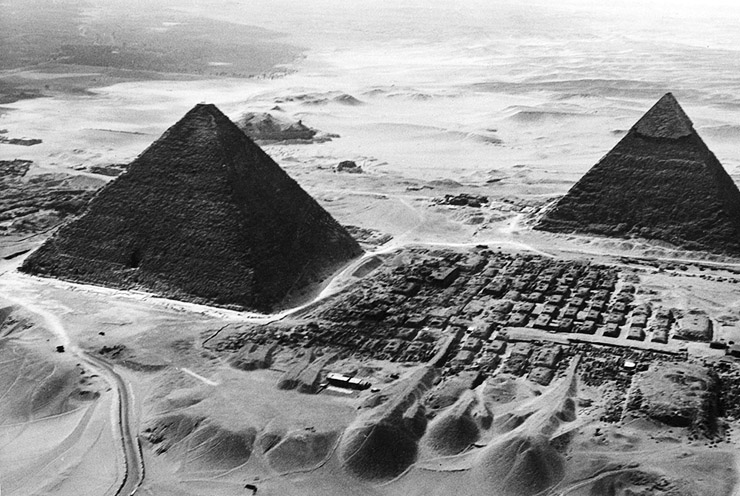
    From the sarcophagi within it, we have dated the famous Osiris Shaft which extends 114 feet below the surface of the Giza Plateau, and made surprising discoveries about it. We have re-dated the pyramids of Giza and proved that they could not have been built by Cheops, Chephren, and Mycerinus.
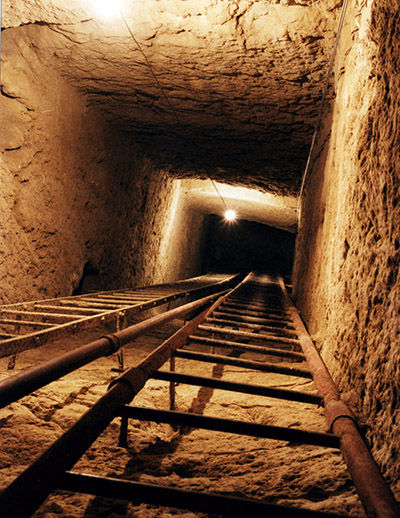
    A 75 foot drop down the central portion of the Osiris Shaft at Giza. Photo courtesy of Robert Temple.

    I describe the suppressed details of the royal pyramid of King Enezib, fifth king of the First Dynasty, at Saqqara, which was 75 long and 43 feet high, but is never mentioned in histories of pyramid evolution because it is ‘too embarrassing’. I show the surprising connection between it and the Step Pyramid of the later King Zoser, built by Imhotep. I translate for the first time the names of seven predynastic kings of Lower [northern] Egypt which are recorded on the Palermo Stone, an ancient annal.

    I believe I have discovered the precise locations of no fewer than seven intact royal tombs at Giza, and I publish the photos and plans. These include the tombs of Cheops, Chephren, and Mycerinus, which have never been entered since those pharaohs were buried. Those pharaohs were never buried in pyramids as naively imagined today, but within the Plateau, as insisted upon by Herodotus as long ago as the 5th century BCE, though everyone ignores his explicit statements because of ‘consensus blindness’. I believe the tomb of Sneferu is also one of them.

    As for the other three, I do not know whose they are. One is probably a gigantic Hall of Sokar (later referred to as Sokar-Osiris, Ptah-Sokar-Osiris, or simply as Osiris). This may be what enthusiasts tend to call ‘the Hall of Records’. A much larger ‘Tomb of Osiris’ is probably down there than the tiny one at the bottom of the Osiris Shaft. It would contain another subterranean canal surrounding an island with a sarcophagus, but on a very grand scale. I have discovered evidence connecting King Send (Sened), fifth king of the Second Dynasty, with Giza. It is possible that he is buried there. Only excavation and opening of these sealed time-capsules will answer our questions.

    I have been able to prove that large underground caverns were hollowed out of the limestone plateau of Giza, and that enormous complexes of subterranean chambers exist beneath the Giza Plateau, as many people have long suspected. I suspect that these locations must contain texts as well as the usual treasures, gold, etc. Frankly, I am more interested in texts than gold. Any sensible person would be.

    I have previously suggested in my earlier book The Sphinx Mystery (2009) that the Giza Plateau was a unified design complex, and that all three main pyramids and the Sphinx were constructed as one single concept. I produce much more proof of this in this new book.

    I have been able now to reconstruct the remaining two (of three) superimposed ‘Giza plans’ which explain the essentials of Giza. They consist of two separate but overlapping squares. One I call the ‘Shadow Square’ and the other I call the ‘Perfect Square’. These are merely names I have given them for convenience, but I believe them to be appropriate.

    The fundamental aspects which everyone else has missed in trying to reconstitute the concealed design plans of Giza are these: (1) there are three superimposed plans, each separate from the other, but complementary, and this was done on purpose to prevent anyone from ever discovering more than one, a kind of ‘triple lock’, and (2) the ‘key’ to unlocking the secrets of two of the plans is the shadow cast at noon on the winter solstice by the Great Pyramid. (Hence the name ‘Shadow Square’.) If you do not take this shadow into account, you cannot find the true northern boundaries to the Giza Plans. (One of them has the shadow tip define that distance, and the other is a secondary derivative of it.) In my study of the geometry of Giza I have achieved an accuracy to within two feet in an area of just under 11 million square feet.

    The ‘Perfect Square’ of Giza gives an Eye of Ra design staring up at the zenith of the sky. I reproduce this here (see illustration, courtesy of Robert Temple, on page 41). Only if this particular square is used can a compass point put at the NE and SW corners of the square swing arcs which make the vesica piscis (which constitutes the Egyptian hieroglyph for the letter ‘r’, thus writing ‘Ra’ or ‘Re’, and which also means ‘fraction’ in Egyptian mathematics) that cuts key points on the Giza monuments. When the correct circle is drawn within this using the centre of the Square as its origin, to form the iris of the eye, an Eye of Ra intersecting six key points is formed staring straight up at the sky.

    This Eye of Ra occurs throughout the entire history of Egyptian art for thousands of years. But its largest and finest expression was the invisible Eye of Ra formed upon the Giza Plateau as a consequence of the Giza Plan which gave rise to the precise sizes and positions of the three main pyramids. The Eye, seen in the illustration, intersects the apex, southeast corner, and midpoint of the base of the south face of the Great Pyramid, the midpoint of the Sphinx, and the midpoints of the bases of the northern and western faces of the Pyramid of Chephren.
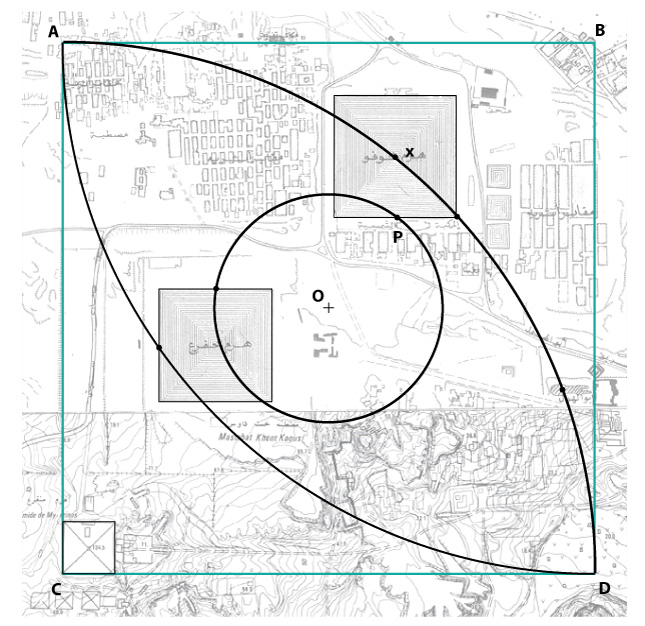
    ‘The Eye of Ra’ at Giza. This can meaningfully be inscribed only in the Perfect Square (where it intersects many key points of the monuments), not in the Shadow Square (where it intersects none). If you put a compass point on B and inscribe an arc between A and D, and put a compass point on C and inscribe an opposite arc between A and D, you get the eye shape. In geometry this is known as a vesica piscis, and is usually derived by the intersection of two circles of equal size. It is the Egyptian hieroglyph for the letter ‘r’ and in Egyptian mathematics it is also the sign meaning ‘fraction’. Since the Egyptians did not write vowels, it also means ‘Re’ or ‘Ra’, which is the name of the sun god. This inscribed hieroglyph intersects (1) the apex of the Great Pyramid, (2) the southeast corner of the Great Pyramid, (3) the midpoint of the waist of the Sphinx, (4) the midpoint of the base of the western face of the Pyramid of Chephren. If you take a compass point and put it on the centre of the Perfect Square, point O, and draw a circle of radius OP, it intersects both point P (the midpoint of the base of the southern face of the Great Pyramid) and the midpoint of the base of the northern face of the Pyramid of Chephren. The ‘Eye of Ra’ thus intersects six key points of the monuments within the Perfect Square of Giza. Because these are curves inscribed on the sloping surface of the Plateau rather than straight lines, as we find with all the other monument point correlations, the accuracy is slightly fuzzier than it is with the straight lines, and may be within a few feet of some points rather than within only one or two feet. However, as the Perfect Square contains nearly 11 million square feet, such a slightly diminished level of accuracy is still rigourous and acceptable. This ‘Eye of Ra’ gazes straight up at the sky, at the central point which we call the zenith. It is a fitting symbol of the solar nature of the entire Giza complex. (source: http://www.egyptiandawn.com/chapter1.html)

    One might well wonder why the ancient Egyptians should go to all this trouble to design an Eye of Ra which no one could ever see, and which is invisible, and even if it weren’t could only be seen looking down from the sky, since it exists only on a geometrical plan or in the mind, and nothing whatever can be seen on the ground. The answer to this may well be found in a strange text surviving amongst the collection of ancient wisdom texts known as the Hermetica, Tractate Five. (These texts are of mixed date, having been written in their present form in Greek under the rule of either the Ptolemies or the Romans, thus possibly as late as the 2nd century CE.) Many of them were reworked as Greek philosophical works mixed with ancient Egyptian material in a complete hodgepodge. No one has ever been able to come up with a definitive list of which material is Egyptian and which is Greek, as these are all mixed up, though a few of the tractates such as this one seem relatively undiluted. In this text, the Egyptian god of wisdom and writing, Thoth (in the guise of his Greek name, Hermes), is addressing his disciple called Tat:

    You must understand how something that seems invisible to the multitude will become entirely visible to you. Actually, if it were not invisible, it would not always be. Everything seen has been begotten because at some point it came to be seen. But the invisible always is, and, because it always is, it does not need to come to be seen. …Clearly, the one who alone is unbegotten is also unimagined and invisible… understanding… is invisible, sees the invisible, and if you have the strength, Tat, your mind’s eye will see it. …Can you have a vision of the image of god?… If you want to see god, consider the sun. …Would that you could grow wings and fly up into the air, lifted between earth and heaven, to see the solid earth… Oh, this is a most happy sight to see, my child… This is the order of the cosmos, and this is the cosmos of order.

    The answer is that the ancient Egyptian priests believed that the true image of the divine could only be invisible. This is the deeper truth of the Egyptian sacred mysteries, ironical in a civilisation normally believed to worship idols. In fact, the Egyptian did not ‘worship idols’ in the sense we think of those words at all. There was no word in ancient Egyptian meaning ‘belief’, just as there was no word meaning ‘religion’. They communed with the cosmic order, and all the gods and goddesses were personified images and facets of that One.
    Just as your parent or your spouse may keep an album or a computer folder of photographs of you, all different, some smiling, some frowning, some dressed as Santa Claus, so the Egyptians had their portrait gallery of the One Supreme Being looking like different personifications of the endless aspects of himself/herself, arrayed as statues and relief carvings and paintings in all the temples throughout the land. At one moment, God was Osiris, at another moment God was Isis, and at yet another God was Amun, which significantly means ‘the Hidden One’ who cannot be seen and is invisible. I believe that the sacred concept that the invisible is more important than the visible existed from predynastic times in Egypt and explains the thinking behind all the empty sarcophagi, tombs, pyramids, and secret chambers.

    What I have just said about invisible patterns does not appear in my book, it is an extension of what that book contains. Amongst the many other ‘invisibles’ and hidden things which I reveal is an elaborate network of secret passages, shafts, and chambers riddling the walls of the Valley Temple of Giza like a honeycomb. The book and its website www.egyptiandawn.com contain many, many photos of these previously unknown features of the only intact temple surviving from the Old Kingdom of Egypt. I have also translated from German the only excavation report of this structure, published in 1912, which does not mention these passages and chambers at all. This translation can be downloaded from the book’s website.

    Oh yes, and I almost forgot to mention that the final chapter of the book contains a solution to the riddle of Atlantis. What and where was it? Did it have any connection with ancient Egypt? All this is answered. I also publish photos and a description of the world’s largest megalithic ring, of which few people have until now had any knowledge at all.

    Illustrations courtesy of the author. Egyptian Dawn by Robert Temple is available from all good bookstores.

    [alert type=”general” dismiss=”no”]This article was published in New Dawn Special Issue 13.[/alert]

    [alert type=”success” dismiss=”no”]If you appreciate this article, please consider subscribing to help maintain this website.[/alert]

    © New Dawn Magazine and the respective author.
    For our reproduction notice, click here.
  • Was Our Solar System Designed to Produce Humans?

    Was Our Solar System Designed to Produce Humans?

    More than a decade has passed since we joined forces to try and find out if there was any reality to a claim that highly accurate units of length had been in used during the British Neolithic. We found that these supposedly primitive people were using a highly developed science that connected them to the rhythms of the Earth.

    But our biggest personal challenge has been to face up to the consequences of our own findings because they have brought us to the point where we have found compelling evidence that our planet and its environment has been carefully designed for us. Stranger still, there appears to be a message built into the very fabric of the solar system itself.

    This was not a finding that we had looked for or even care for. We are very pragmatic people working in an area of ancient research that is specialised and very sober.

    In early 2009 we decided to revisit all of our findings that had resulted in three joint books plus one still in draft manuscript form (now published). We were troubled because despite one of us being an agnostic and an atheist, we could not escape the conclusion we were looking at a message from what we called the UCA (Unknown Creative Agency) that had designed our solar system and all life on Earth.

    Then in late November 2009 we were contacted by David Cumming, an expert in AI (artificial intelligence) who had studied our evidence in great detail and independently come to the same conclusion. He claimed that it formed an equation with a very clear message from the creator. The equation and the mathematics of our discoveries is discussed later in this article.

    The Origin of the Megalithic Yard (MY)

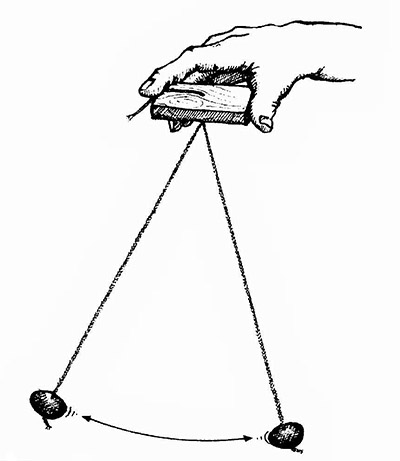
    A basic pendulum is a very accurate tool to measure time.

    The starting point of our joint research was simply to consider whether Alexander Thom had been right or wrong in his identification of a prehistoric unit he called the Megalithic Yard (MY). He was a professor of engineering at Oxford University who surveyed hundreds of Megalithic sites over the course of half a century to 1985. Thom concluded the planners and builders must have been highly skilled engineers. He deduced the builders had all been working to a common set of units based on the Megalithic Yard that was 2.722 +/- 0.002 feet (829.7 +/- 0.5 mm). Thom was viewed as an unwelcome outsider by nearly all archaeologists.

    Our starting hypothesis was that if the Megalithic Yard were real, then it is highly probable that its apparent accuracy can best be explained as being derived from nature. If we could identify a natural origin, then Thom was probably right.

    It did not take too long for us to realise there is only one aspect of nature that delivers up a near perfect means of creating measures – the revolving of the Earth on its axis. This provides the potential for creating a unit of time that can then be used to make units of length, weight and capacity – and potentially everything else from frequency to temperature.

    The most obvious way to observe the turning of the Earth is to watch the stars, which appear to pass overhead once for each rotation. They also move across the sky in an annual rotation due to the Earth’s orbit of the Sun. Megalithic astronomers could not help but notice there where 366 of the daily star movements to one annual one.

    We know that ancient peoples from across time liked to create patterns where the same values work upwards and downwards. And we had good reason to believe that early stargazers had used a 366 day calendar and a 366 degree circle. These astronomers knew there are 366 star rises (any star such as Sirius) over one circle of the Sun, so it was logical to divide the horizon into 366 parts to measure time in 1/366th part of a day.

    They measured time in the same way that all clocks did until recent times – with a pendulum. A hand-held ball of clay on a string is a perfect instrument. When stationary it is a plumb line to gauge verticals and when swinging its beats measure time with great accuracy. The only factors that have any significant effect on the beat are the length of the pendulum from fulcrum to the centreline of the weight and the mass of the Earth (gravity). The energy put into the swing by the user has no effect – if the swing is made more vigorous it just swings faster in a wider arc but the rate of beat remains exactly the same.

    Our first and most obvious assumption was that Megalithic people had divided the horizon up into 366 equal parts and then used a pendulum length that beat 366 times.

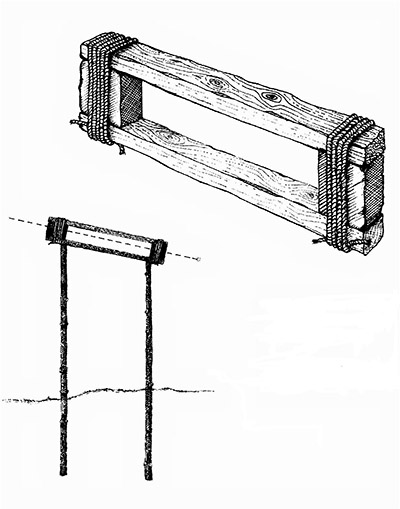
    A frame 1/366th of the horizon angled to time a star.

    We found that a pendulum that beat 366 times during one 366th of the Earth’s turn was, much to our joy and amazement, half a Megalithic Yard in length! A circle scribed by such a pendulum would have a diameter of one Megalithic Yard. Archie Roy, emeritus professor of astronomy at Glasgow University (and a friend of the late Alexander Thom) joined us to give a public demonstration of how the Megalithic Yard is a product of measured observational astronomy.

    We later refined the timing method, having realised that the Megalithic astronomers had improved their own accuracy by using the movement of the planet Venus at certain times rather than a star. Gordon Freeman, a distinguished professor of chemical physics and a much-published amateur archaeologist specialising in the Megalithic structures, was impressed with this saying; “Tying the MY to Venus path arcsecond is a major discovery. I’m an admirer of Thom, but was neutral about the MY. Now I’m a convert.”

    Alexander Thom had been right all along because the chances of this technique producing a perfect fit for his unit could not be a coincidence. But there was more – much more to this system. Given that the builders of these Megalithic sites some 5,000 years ago used a 366 degree circle caused us to look at the Earth itself. Taking the polar circumference as the textbook 40,000,000 metres, we turned it into Megalithic units and found this:

    Earth’s polar circumference   =   40,000,000 metres

    1 Megalithic degree (1/366th)   =   109290 metres

    1 Megalithic minute of arc (1/60th)  =   1822 metres

    1 Megalithic second of arc (1/6th)   =   303.6 metres

    Now, 303.6 metres for a second of arc may look a little boring but it is exactly 366 Megalithic Yards!

    The Megalithic second of arc appears to have been adopted later by the Minoan culture of Create some 4,000 years ago. The palaces of Crete were carefully surveyed by Canadian archaeologist J.W. Graham who identified a standard unit he called “the Minoan foot” of 30.36cm. It follows that 1,000 of these feet make precisely one Megalithic second of arc.

    Even earlier, the ancient Egyptian culture had adopted units driven by the same thinking. They took the Megalithic Yard and made it the circumference of a circle. The diameter of that circle was called a royal cubit and the hypotenuse of a square from that diameter was called a remen.

    Artefact Based Evidence

    When we wrote Civilization One, we stated that the people who created the Megalithic Yard must have built very large circles and divided the circumference into 366 parts to be sure they were viewing 1/366th part of the night sky. We suggested they may well have understood a quick method to do this by making a circle with a diameter 233 units (any length would do if they didn’t already have a Megalithic Yard). They then knew they would have a circle of 732 units – which is twice 366, so they could take every other pole on the circumference. This is a 99.999% accurate means of using Pi in a practical manner. For all engineering purposes, this means is perfect.

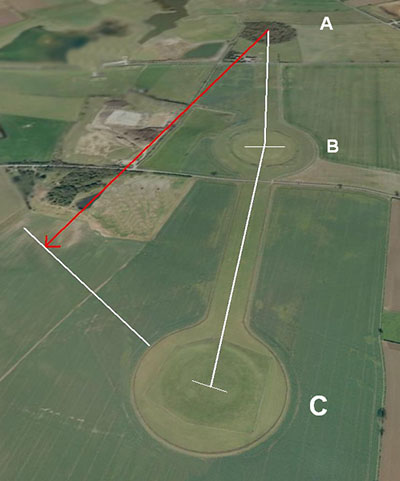
    The Thornborough henges, a perfect copy of the stars of Orion’s Belt. A to B is 366 Megalithic rods, B to C is 360 Megalithic rods and the true north/south latitudinal distance (black line) is 3 Megalithic seconds of arc.

    Several years later we found that structures even older than Megalithic monuments demonstrated the use of the 233/732 circles – exactly as we had predicted. These are henges – large circular mounds such as the group near Thornborough in North Yorkshire, England. They were built around 3500 BCE, well before the Megalithic builders began their stonework phase. What is more, they were using the Megalithic Yard. At Thornborough there are three interlinked henges that are 233 MY across and 732 MY around their outer perimeter. These structures are measurable with units and ratios being 366 Megalithic Rods between the centres of the first two and 360 between the second. The trio, which are also exactly 3 Megalithic seconds of arc apart by latitude, have also been identified as being laid out as a copy of the stars of Orion’s Belt – exactly like the Giza pyramids. The difference is that these are a thousand years older. We explain in our book Before the Pyramids how Khufu’s pyramid builders came to this location in England to get instructions on how to plan this star pattern on the ground!

    Weights and Measures

    Having established that the people of the British Neolithic had units of lengths and time, we wondered if they had other units such as capacity and weight. We knew (or so we thought) that the Metric system was devised by the French in the late 18th century when they used a pendulum that beat at the rate of one second to create a unit they called the metre (meaning to beat out time). They later made a very small adjustment so their metre was one 10,000,000th of the distance from the equator to the north pole. To create a unit of capacity they took a 1/10th part of the metre (10cm) and made a cube. Filled with distilled water, this cube’s capacity was called a litre and its weight was designated a kilogram.

    We applied the same logic to the Megalithic Yard, (which has 40 Megalithic Inches). We calculated what a 4 Megalithic Inch cube would contain. The answer is one pint – to an accuracy of one part in 5,000 as defined by the British government in 1601. And when carefully filled with any unpolished grain, such as barley, it weighed just one Imperial pound.

    This was odd in the extreme but it appears that (unknown to history) Imperial units were indeed based on cubes because by doubling the sides of the cube to 8 Megalithic Inches holds one Imperial gallon and doubling again produced a unit equivalent to a bushel, which was used as a dry weight until recent times.

    Next, we found some truly bizarre connections. We thought for thoroughness that we ought to consider the volumes of spheres with Megalithic dimensions in addition to the cubes: a 6 Megalithic Inch sphere held a litre and a 1.5 MY wide sphere of water weighs a metric tonne. The level of accuracy was not spot on, but at a level of 99% we were surprised to put it mildly.

    We are used to modern measurements that are ad hoc, but the 366 system works in depth. Take just two examples:

    1. Earth mass

    One Megalithic degree (366th) slice of the Earth = 360 x 1020 pounds

    One Megalithic minute slice of the Earth = 6 x 10²⁰ pounds

    One Megalithic second slice of the Earth = 1020 pounds

    2. Temperature (hypothetical scale)

    Water freezes     @  0 degrees

    Water boils         @  366 degrees

    Absolute zero     @  – 1,000 degrees

    The Jefferson Paradox

    Thomas Jefferson, one of the Founding Fathers of the United States, was an amazing polymath. He set out to create a new system of units which were never adopted. He started by looking at what means nature provided for producing a repeatable unit and, like us, he quickly identified the spinning of the Earth and he used a pendulum that beat at the rate of once per second as his starting point.

    Thomas Jefferson had unknowingly connected back into the system from prehistory. The following is true:

    1,000 Jefferson Feet  = 360 Megalithic Yards

    366 Jefferson Furlongs  = 1 Megalithic degree of arc of the Earth

    3662 Jefferson Furlongs  = The exact circumference of the Earth

    This is a case-winning piece of evidence!

    The Sun and the Moon

    It is strange that the disc of the Moon should appear to be exactly the same size as the Sun. The Moon is obviously tiny compared to the Sun, and is much closer to Earth, but they still appear as equal discs. To be precise, the Moon is 400 times smaller than the Sun but is 400 times closer to the Earth. Strange!

    The odds against this happening at all are huge – but how bizarre that both values are the same, round number. Isaac Asimov, the respected scientist and science-fiction guru, described this perfect visual alignment as being, “the most unlikely coincidence imaginable.”

    This perfect fit only works at this point in time because it was very different in the distant past and it will change again.

    The strangeness of the Moon continues because it is either hollow or made up of extremely low density material. It centres of mass are just below its surface. Odd!

    Applying the Megalithic 366 system of geometry and MYs to the Moon and the Sun produces an astonishing result:

    One Megalithic second on Moon  =  100 Megalithic Yards

    One Megalithic second on Sun  =  40,000 Megalithic Yards

    It is almost as though we are looking at the blueprint of the solar system.

    The Rhythm of the Solar System

    Looking closely at every aspect, the following values also stand out:

    366
    The number of complete rotations of the Earth in a year
    The number of MY in a Megalithic second of arc on the Earth
    The percentage size of the Earth compared to the Moon

    100
    The number of MY in a lunar Megalithic second of arc
    The number of times the Earth rotates faster than the Moon

    400
    The Sun is larger than the Moon
    The number of kilometres the Moon turns on its axis in a day
    The number of times the Moon is closer to the Earth than the Sun

    10,000
    The number of times faster that light travels in a vacuum compared to Earth’s speed of orbit around the Sun
    The number of Earth turns in an orbit of the Sun x the number of Earth turns in one lunar orbit of the Earth

    40,000
    The number of kilometres to Earth’s polar circumference
    The number of MY in a solar second of arc

    1,000,000
    The number of times faster that light travels in a vacuum compared to the Moon’s speed of orbit around the Earth

    109.25
    The number of Earth diameters to the Sun’s
    The number of solar diameters across the maximum diameter of the Earth’s orbit around the Sun

    27.322
    The number times the Earth turns in one turn of the Moon
    The percentage size of the Moon to the Earth

    The Message

    Are we looking at ‘God’s blueprint’? These integer numbers could not possible fall out of the Earth – Moon – Sun relationship by accident when every other solar system body appears to have no rules whatsoever.

    The Search for Extraterrestrial Intelligence (SETI), originally set up by NASA, spends a vast amount of energy searching for radio messages from a non-human origin based on the belief that we are probably not alone. Professor Christopher Rose and Dr. Gregory Wright have suggested:

    “Rather than transmitting radio messages, extraterrestrial civilisations would find it far more efficient to send us a ‘message in a bottle’, some kind of physical message inscribed on matter. And it could be waiting for us in our own backyard.”

    Could the Moon have been constructed as a message by integrating ratios and values of both the Sun and the Moon?

    Could humans have been ‘seeded’ on a planet that would sustain us? The Moon is an ‘incubator’ to nurture life. No Moon would mean no humans.

    Which brings us to David Cumming’s idea that all of this can be expressed as an ‘equation’ that formally identifies there is a message.

    The Equation

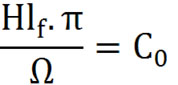
    The equation describes a relationship between the hydrogen fine transition line, the ratio between the circumference and diameter of a circle, and the speed of light in a vacuum.

    The top line of the equation, Hlf.π is the hydrogen line – a universal value used as the search frequency by SETI (the Search for Extra-Terrestrial Intelligence).

    Omega is the number 0.0123456789 – all the characters of the base 10 number system. Standard physics says that the frequency of a wave, multiplied by the wavelength of that wave, is equal to the speed of the wave. In the case of the equation, when you divide out π/Ω, the answer must be equal to the wavelength of the hydrogen line, because the hydrogen line frequency multiplied by the hydrogen line wavelength must equal the speed of light.

    When we look at the overall equation, we know in advance that the equation will give the value for the speed of light very accurately because what we’re doing is multiplying the frequency of the hydrogen line by the wavelength of the hydrogen line. But remember, we’ve divided π (3.141592653) by Ω (0.0123456790) to get a result for the hydrogen line wavelength expressed in MYs, so the fact that we get a highly accurate answer appears to be nothing short of a miracle.

    The speed of light calculated using the equation is 1420,405,751 cycles per sec (frequency [Hz]) multiplied by 0.2544690072 MY (wavelength). This works out at 361,449,241.3 MY per second – the speed of light in Stone Age units!

    Amongst the many surprises of the last few years, there is one we came across in early 2009 that stumped us. As we explain in Before the Pyramids, there can be no doubt that the Founding Fathers of the USA secretly designed Washington DC using Megalithic seconds of arc for every detail of the City plan. It is still happening. The Pentagon is a perfect and inspirational exposition of Stone Age knowledge – using the 366 system with as much perfection as Stonehenge or Thornborough.

    And this was driven by the 33rd degree of the Ancient Scottish Rite of Freemasonry. Presidents and people unknown have been driven to build a city using God’s own values – a city fit for God’s great purpose.

    Do the powers that be in the USA already understand this message? Are they preparing to respond? Is there a new dawn ahead?

    Illustrations courtesy of the authors. Much more on the above is available in Christopher Knight and Alan Butler’s book Before the Pyramids: Cracking Archaeology’s Greatest Mystery (Watkins, 2009), available from all good bookstores.

    [alert type=”general” dismiss=”no”]This article was published in New Dawn Special Issue 13.[/alert]

    [alert type=”success” dismiss=”no”]If you appreciate this article, please consider a contribution to help maintain this website.[/alert]

    © New Dawn Magazine and the respective author.
    For our reproduction notice, click here.
  • Sufism & The Nine Unknowns

    Sufism & The Nine Unknowns

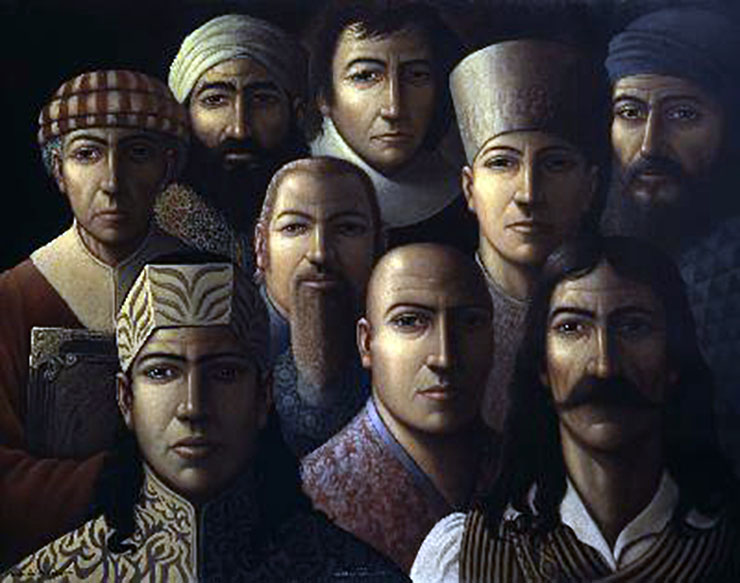
    The French diplomat Louis Jacolliot (1837 – 1890) first alerted the West to the legend of the Nine Unknowns. Jacolliot claimed these unknown adepts were still alive and that he was in touch with them. But another French mystic, Saint-Ives d’Alvedre (1824 – 1909), claimed that the legend was far older. He said that the Nine Unknowns were beings from the star Sirius who came originally to the Tarim Basin in Central Asia in 34,000 BCE and there established their Shambhalic headquarters. Their sojourn in Atlantis came much later.

    Sufis attribute great mystical significance to their tradition of the Nine Unknown Masters as it is expressed in the No-Koonja, the nine-pointed Sufi diagram also known as the Naqsh or Seal. They say that this metaphysical glyph “reaches for the innermost secrets of man”; and the Sufi writer Ernest Scott in his classic The People of the Secret implies that it stands for one of the highest and most authoritative echelons in the Sufi hierarchy.

    In Indonesia, which covers all the islands of the Sunda Strait, Sufic Islam has dominated the culture since the fourteenth century CE. For seven centuries – that is, until the twentieth century and the rise of Modernist Islam – the dominant religion has been a syncretic blend of Sufic Islam, Hindu-Buddhism, Tao and animism, with an increasing infusion of Christian and Theosophical elements. The Indonesians are a deeply spiritual people, and in the largest island, that of Java, the Nine Unknowns are a household word, an integral part of the rich mythological fare that sustains the whole society.

    A story circulates widely in Javanese esoteric schools that in the early part of the twentieth century the circle of Nine Unknown Sages met in Java to bring a new spiritual practice into the world. For this purpose they formed a closed meditative circuit that generated powerful cosmic energies. They knew that humanity was on the threshold of a higher stage in consciousness involving the awakening of the Spiritual Soul, an organ still relatively dormant in most people on earth today; and the Nine elected to become a spearhead into that future.

    There are three soul centres – animal, human and spiritual – in each individual, with the last-named, the Spiritual Soul, under the governance and direction of the divine Will. When awakened in the course of evolution, the Spiritual Soul profoundly energises and unifies the various lower instruments that normally compete and jostle within human consciousness. The animal and human souls then come under its dominance, and the union of the three under divine Command immeasurably elevates and spiritualises the individual’s state of being. To aid in this evolutionary process the Nine Masters sought to lay down a path capable of stimulating in men and women a greater consciousness and control of the love/wisdom powers of the Spiritual Soul.

    The result of the Nine’s meditations was that one night a brilliant beam of light descended from the sky onto a young Javanese Muslim called Muhammad Subuh who was returning home from a Sufi Nachshbandi meeting. The beam of light “programmed” him, thus opening the way to a spiritual revelation. This seed-revelation developed into a new practice and teaching called Subud that would presently be taken to the West.

    One of the Javanese sects that indirectly emerged as a result of this event was Sumarah, “the Way of Surrender” – surrender being the essential meaning of the word Islam. Sumarah has become a large-scale movement in Indonesia. It teaches that all the world religions have their roots in the same esoteric source. The same truth underlies them all. All have germinated from a divine seed that lies deep in the Soul of humanity and share equally in its grace. Sumarah’s method therefore calls for universal peace between religions. It raises consciousness from the ordinary mind, whose dualistic and divisive nature breeds images of evil, warfare and religious conflict, to an intuitive state beyond divisions. In that unified state the enlightened mind pursues visions of inwardness, of oneness, of spiritual redemption, of a peaceful coexistence of the family of religions.

    Excerpted from ‘Sufism and The Nine Unknowns’ by Victoria LePage, http://vlepage.newteam.org.

    [alert type=”general” dismiss=”no”]This article was published in New Dawn Special Issue 10.[/alert]

    [alert type=”success” dismiss=”no”]If you appreciate this article, please consider a contribution to help maintain this website.[/alert]

    © New Dawn Magazine and the respective author.
    For our reproduction notice, click here.
  • The Nine Unknown Men & the Power of Conspiracy

    The Nine Unknown Men & the Power of Conspiracy

    Looking down from the watchtower of their hidden glory, the Nine Unknowns watched civilisation being born, destroyed and born again, tolerant rather than indifferent – and ready to come to the rescue – but always observing that rule of silence which is the mark of human greatness.
    – Louis Pauwels and Jacques Bergier1

    We live in the most exciting time in the history of humankind. Technology is developing in leaps and bounds, not only in the form of computers and mass communication, but also toward helping us understand the secrets of the human brain.

    In the West, our traditions, institutions and power structures are challenged and crumbling. The rest of the world is also undergoing transformation in all these areas.

    Has something brought us to this point? Could a group of enlightened people have guided humanity since time immemorial?

    This idea has drifted through history for eons, and manifested in different forms. A prime example is the legend of the Nine Unknown Men, the keepers of sacred and celestial knowledge, sharing out as much in whimsy, as they are with will.

    The best-known story about the origins of the Nine Unknown Men comes from India. The group’s formation is connected to the Indian Emperor Ashoka the Great, who reigned from 304 BCE–232 BCE.

    Ashoka the Great, Emperor of India’s Maurya Dynasty, sought to propel his grandfather’s dreams of unification across the continent. Being the grandson of Chandragupta, the first known ‘Emperor’ of India, may well have left Ashoka with large shoes to fill, but fill them he did, and the lines he drew on the map of India are largely in place to this day. At the height of Maurya power, the borders of India stretched from Afghanistan to Pakistan, Iran to Bangladesh.

    However, like most of human history, big changes are achieved with high costs, and the final war of Ashoka’s push for unity left the biggest impact on the fabled emperor.

    Kalinga (modern day Orissa) is a region on the east coast of India, and was one of the last strongholds against Maurya power. The people of Kalinga had successfully repelled Ashoka’s father, but this fact did little to help them withstand the might of Ashoka’s army.

    A huge battle lead to the death of 100,000 Kalinga, men, women and children, as well as 10,000 of Ashoka’s forces. The Daya River ran red with blood. Upon seeing this massive wave of death and destruction committed in his name, Ashoka vowed to take the path of non-violence and embraced Buddhism. Ashoka also vowed to place specific knowledge in the hands of a council of nine men who would not only guard but also dispense the knowledge at appropriate times along the course of human history.

    Many interpretations and adaptations have been added to the legend of the Nine Unknown Men. One theory has the legend extending back to Atlantis, where the Nine supposedly ruled with their higher knowledge and consciousness.

    Nine Sacred Books

    For the sake of this article, let us stick to the Ashoka version, which also tells of the nine books of knowledge, each entrusted to individual members of the council.

    The nine books contain knowledge deemed too powerful to be unleashed on the human psyche, except for when the time is right. The Nine literally teach humanity, seeding the information and watching it grow as the human species moves along its evolutionary road.

    The secrets of psychology, sociology, physiology, microbiology and biotechnology, alchemy, communication on all levels, the cosmology of the universe, as well as mastery of gravity and light, are espoused on the pages of the nine sacred books.

    Ancient, yet new developments, in all nine aspects covered by the books are drip-fed to the species over the course of time, leading to its eventual enlightenment and departure from this planet. So called ‘leaks’ of information are claimed to have occurred at various points along human history. In these cases, humans attained too much knowledge, too much power, way too soon.

    The martial arts ‘Touch of Death’ technique, in which a practitioner can kill a human with one touch, is said to have been leaked from the sacred book centring on physiology. While still unknown to the vast majority of people, this lethal technique that stops energy and blood flow supposedly exists.

    One can look upon the Touch of Death from two points of view, the first being purely scientific. It is possible to interfere with the timing of a person’s beating heart, such as striking it hard enough or applying a heart massage technique such as CPR to someone whose heart is beating. Both of these techniques can interrupt the heart’s natural rhythm, sending it into cardiac arrest that can lead to death.

    The second is the mysterious Chinese martial arts practice known as Dim Mak. The system of Dim Mak relies on pressure points and chi energy centres, which ones to attack and in what order to be most effective. By successfully shutting down a chi passage in the human body, the build up of chi is said to stagnate which supposedly leads to death.

    However, this is notoriously hard to verify, as practitioners of Dim Mak are nigh on possible to come by, let alone contact and learn from, apart from the occasional one that popped up in the 70’s and 80’s to demonstrate the Touch of Death, and almost immediately debunked as frauds.

    While it is easy to postulate on examples of information that may have ‘leaked’ from these books, it is important to remember that no one on this planet, maybe not even on this plane of existence, knows the plan of the Nine Unknown Men, except the Nine Unknown Men themselves. Leaks can be perceived as no more than the Nine’s plan unfolding perfectly, even if humanity clearly suffers.

    The Nine and Hitler

    This group of Ashoka’s nine esoteric ones still continues because there are many conditions which help it continue. One is, it never comes directly in contact with the masses itself. It has still other groups in between. It always remains unknown, hidden, you can never know its whereabouts. And any person who is initiated in the group, the very moment he is initiated he disappears from your world – completely disappears.
    – Osho (1931–1990)

    The Indian mystic and spiritual teacher Osho (Bhagwan Shree Rajneesh) claimed that the Nine orchestrated the rise and fall of Adolf Hitler and the Nazis. Perhaps they exposed Hitler to esoteric ideas and devices of power.

    “Hitler was just a vehicle for other forces… He was just a means, he was used. Someone else was behind him, some other forces were working,” explains Osho in I Am The Gate.

    Witnesses claim to have seen Hitler almost possessed at the height of his powers. He was able to make vast audiences eat from the palm of his hand, and make implausible yet brilliant military manoeuvres while his generals scoffed at the ideas.

    But then the power driving Hitler started failing. Again, witnesses say he became a different man. His armies in retreat, battles being lost on all fronts, while Hitler shrank, sweated, mumbled and shuffled towards his doom.

    In his 1925 work Mein Kampf, Hitler explained how he chose the swastika that was to become the infamous symbol of Nazism:

    I myself, meanwhile, after innumerable attempts, had laid down a final form; a flag with a red background, a white disk, and a black swastika in the middle.

    Significantly, the Nazis reversed this ancient and powerful symbol that is widely used throughout Asia. Osho says “…the swastika was chosen and used in reverse. It had never existed in this way before, but due to this, events took altogether a new shape.”2

    Why the Nine Unknown Men, supposedly benevolent and desiring to take the best course of action to enlighten the human race, chose to send the species through one of its darkest periods, is a mystery. Perhaps it was just another in the long line of ‘Dark Nights of the Soul’ for humanity. Maybe these stages are necessary to speed up our development – wiping the slate clean so to speak – and bring about new conditions conducive to the hidden plans of the Nine.

    Where are the Nine Unknown Men?

    Legends abound as to where the Nine could reside or exist. Talk to David Icke and he will tell you they are deep underground, living in partnership with shape-shifting lizard people. Nicholas Roerich or G.I. Gurdjieff may have said they reside in the mythical kingdom of Shambhala, somewhere in Central Asia.

    The idea of a hidden city, secret paradise or Invisible College has entranced humans for hundreds of years, and especially occult experts in the West, once the East truly opened up to exploration.

    The Greek-Armenian mystic and spiritual teacher George Gurdjieff reported that he contacted secret masters while journeying through Central Asia. It is said he was given access to secret knowledge and then sent back to ‘civilisation’ with it. He never revealed the identity of these men, the school they may or may not have belonged to, and of course, he did not disclose their secret location. Many people postulate that Gurdjieff visited the kingdom of Shambhala, hidden somewhere in Inner Asia.

    The Russian painter, philosopher, and writer Nicholas Roerich also explored the area in the 1920s and 30s, making many expeditions to Central Asia, but primarily focusing on the Himalayas. Nicholas and his wife Helena acted as conduits for a ‘Wise Man of the East’, known as Mahatma Morya. El Morya, as he was called, directed the founding of the Agni Yoga Society and dictated the Agni Yoga book series through Helena.

    El Morya gives hints in his work about Shambhala, and ended up becoming quite literal regarding the mythical paradise, even describing some of the trials one must go through to gain access to the hidden kingdom. Andrew Tomas writes:

    At a certain spot not to be mentioned to outsiders, there is a chasm spanned by a frail bridge of woven grasses and with a raging torrent underneath. The bravest member of your Alpine clubs would scarcely dare to venture the passage, for it hangs like a spider’s web and seems to be rotten and impassable. Yet it is not: and he who dares the trial and succeeds – as he will if he is right that he should be permitted – comes into a gorge of surpassing beauty of scenery, to one of our places and to some of our people, of which and whom there is no note or minute among European geographers.3

    Thus, access to Shambhala is gained by permission of the Nine, but more importantly, the worthy aspirant can only penetrate the veil.

    The Christian idea of Heaven, we are lead to believe, is an actual place where our souls go if we have been ‘good’ in life. Clouds, harps, Angels, the Palace of God – this sounds very similar to the paradise known as Shambhala. A place of spiritual comfort and bliss, where time stops because time has no meaning to the enlightened.

    One of the best descriptions on gaining access to Shambhala is found in Andrew Tomas’ book, Shambhala: Oasis of Light:

    They have renounced all, yet they possess the world… The disciple’s heart is aflame with compassion for mankind. His mind is illuminated by an unseen light from cosmic depths. A cold mind, a warm heart and a fiery will – these are the passwords to Shambhala…4

    The Number 9

    The number 9 has a long history, so it should not come as much of a surprise that it still pops up in places where you least expect it. There are Nine Unknown Men, controlling sacred information, and letting it loose upon the world at appropriate times in order to facilitate the evolution of humankind.

    Why 9? 9 is the number with the highest numerical value within the Base Ten numerical system we currently follow, therefore symbolising perfection and completeness. It is at an almost instinctual level and can affect us as such.

    The number 9 is revered in Hinduism and considered a complete, perfected and divine number because it represents the end of a cycle in the decimal system, which originated from the Indian subcontinent as early as 3000 BCE.

    In the Bahá’í Faith, a 9-pointed star is used to symbolise the religion. Nine is important in Islam also. The holiest month, that of Ramadan, is the ninth month on the Islamic calendar. The Qur’an was revealed to Mohammad in the ninth month of the year. In observance with Mohammad’s own fasting, fervent prayer and eventual contact with Allah, all Muslims are expected to do the same.

    It is not only an important number in religion, but also in popular culture. John Lennon, arguably one of the most gifted songwriters of last century, incorporated the number into one of the Beatles more esoteric tracks, ‘Revolution 9’, on the immortal ‘White’ album, produced in 1968. The primary vocals throughout the song are the repeating phrase, ‘number nine’. Given that Lennon wrote this song after spiritual activities in India, using sounds like a mashed up remix of a radio being tuned, it is more than likely that he came to understand the significance of nine as the number of completion/perfection, incorporating it not only in this song, but also a solo recording he completed named ‘#9 Dream’.

    Numbers do have vibrational power, they are ‘something’ that can be relied on in this world, they spell out certain secrets of reality and existence, but we must also be careful of the meanings we thrust upon them.

    The Power of Conspiracy

    People like to think they are not in control of their lives. Ask any one of the 1.9 billion Christians, or the 1.1 billion Muslims on this planet, whom they think is running everything, and they will say ‘God’ or ‘Allah’. Ask a banker who they think is in charge, and they may reply, ‘the market’; a politician might say that the prime minister or president is in charge, but really mean the banker.

    Yes, people love to shift the blame around. We love to run from responsibility, just as much as we love to run senselessly into situations when these blame-centres are called to account.

    Many conspiracy theories lead up to an ‘End of the World’ scenario. Western society was run on the idea of M.A.D (Mutually Assured Destruction) since the nuclear bombing of Japan in 1945 up until the fall of the Soviet Union in 1991. Unlike almost every other doomsday, with M.A.D. we see how our world can end by our own hands. The power this held over populations was unlike anything ever experienced before, and its spectre still hangs over humanity to this day with the invention of new and more efficient weapons.

    Have we grown numb to the idea? That it has not happened yet only adds to our confusion, explains Sufi-anarchist Hakim Bey in T.A.Z.: The Temporary Autonomous Zone, Ontological Anarchy, Poetic Terrorism:

    What does it mean that we have invented a way to destroy all life on earth? Nothing much. We have dreamed this as an escape from the contemplation of our own individual deaths. We have made an emblem to serve as the mirror image of a discarded immorality. Like demented dictators we swoon at the thought of taking it all down with us into the Abyss.5

    Seeing that finally we are more than capable of taking out not only our own species, but all life on the planet, has clearly done something to our collective psyche. For the last 70 years we have ridden this wave of reckless self-destruction, trying to get as much as we can before we die, or we all die. Running a race where the winners have not only already finished, but are making bets on who else is going to make it over the finish line. Or scampering, hoping to get clear of the blast zone. These ideas have driven Western society over the last century, but again, Bey helps us clear things up:

    The A.O.A (Association for Ontological Anarchy), declares itself bored with the End of the World. The canonical version has been used since 1945 to keep us cowering in fear of Mutual Assured Destruction and in snivelling servitude to our superhero politicians… We suggest that the End of the World be declared a fiat accompli; the exact date is unimportant. The ranters in 1650 knew that the millennium comes now into each soul that wakes to itself, to its own certainty and divinity. ‘Rejoice, fellow creature’, was their greeting. ‘All is ours!’6

    Something new must be born. Not new in the sense that is just a copy of an old idea, clad in a new guise of ‘hope-it-works-this-time’. Beware those espousing the importance of freedom. Beware of the groups saying they have the answers, and that you must believe them.

    The youth of today, like all youth, are in revolt against society, and that is a good thing in itself, but revolt is a reaction and that reaction sets up its own pattern and you get caught in that pattern. You think it is something new. It is not; it is the old in a different mold. Any social or political revolt will inevitably revert to the good old bourgeois mentality.7

    In the early years of the 20th century, Jiddu Krishnamurti was groomed for messianic purposes by the Theosophical Society. Brought up within the Society, he was to usher in a new religion to a world lost on the faded ideals of bygone traditions. In a surprise turn of events, he turned his back on his master’s plans and followed his own path, which perhaps is the simplest way to find the new.

    So, dear reader, do not spend too much time thinking about the Nine Unknown Men, who they are, where they could be, and what they may or may not be doing to make your life better or worse. Simply step back, take stock, some deep breaths, and know that life is truly what you make it.

    Victoria LePage, author of the highly regarded book Shambhala: The Fascinating Truth Behind the Myth of Shangri-La, concludes:

    So who are the Nine, really? A dense veil falls over these mysterious Beings the more we seek to penetrate it. Many of the current myths about them can be discounted. The truth is that we know almost nothing about these shadowy Guides of humanity. They remain a mystery, an X factor in the story of human evolution, an elusive presence that Sufis call the Hidden Directorate, but about whose hierarchy – or even existence – we can only speculate.8

    [alert type=”general” dismiss=”no”]This article was published in New Dawn Special Issue 10.[/alert]

    [alert type=”success” dismiss=”no”]If you appreciate this article, please consider a contribution to help maintain this website.[/alert]

    Footnotes

    1. Louis Pauwels and Jacques Bergier, The Morning of the Magicians, Stein & Day, 1960
    2. Osho, I Am The Gate, Rebel Publishing House, 1990
    3. Andrew Tomas, Shambhala: Oasis of Light, Sphere, 1977, 36
    4. Ibid., 38
    5. Hakim Bey, T.A.Z.: The Temporary Autonomous Zone, Ontological Anarchy, Poetic Terrorism, Autonomedia, 1991, 34
    6. Ibid., 35
    7. Jiddu Krishnamurti, Freedom From The Known, Harper & Row, 1969, 68
    8. ‘Sufism and The Nine Unknowns’ by Victoria LePage, www.victoria-lepage.org

    Further Reading

    Ernest Scott, The People of the Secret, Octagon Press, 1983
    Andrew Tomas, Shambala: Oasis of Light, Sphere Books, 1977
    Lynn Picknett & Clive Prince, The Stargate Conspiracy, Little, Brown & Company, 1999
    David Icke, The Biggest Secret, Bridge of Love Publications, 1999
    Hakim Bey, T.A.Z.: The Temporary Autonomous Zone, Ontological Anarchy, Poetic Terrorism, Autonomedia, 1991
    Jiddu Krishnamurti, Freedom From The Known, Harper & Row, 1969
    Osho, I Am the Gate, Rebel Publishing House, 1990

    © New Dawn Magazine and the respective author.
    For our reproduction notice, click here.
  • The Quest for the Grail

    The Quest for the Grail

    For most of us, the Grail is a mirage or a rainbow’s end. We may catch a glimpse of it, but if we allow ourselves to be led in its direction, we soon find that it recedes; if we steal a few steps closer, it disappears. And so the Grail has become the quintessential metaphor for all that is beautiful but unattainable.

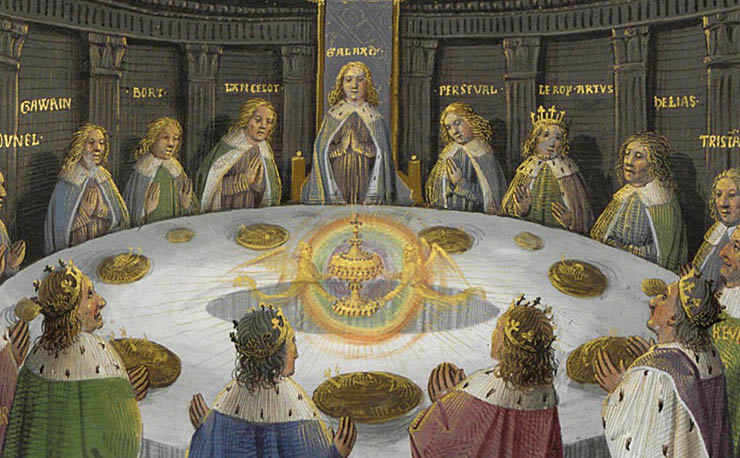
    The Grail is usually imagined as a cup or chalice, specifically the cup used by Jesus Christ during the Last Supper (or used to catch his blood as it flowed on the cross). Legend says that after Christ’s death and Resurrection, Joseph of Arimathea – who had lent him his tomb for a few days – took this cup to Glastonbury in Somersetshire, England.

    Glastonbury is the site of innumerable legends and fables connected not only with Joseph of Arimathea but with King Arthur and his knights; indeed it was said the bones of Arthur and Guinevere were unearthed there in medieval times. While this may be mere fable, it’s unquestionably true that Glastonbury functioned as the site of an abbey from the seventh century till 1536, when Henry VIII ordered the dissolution of all the monasteries in England. The Gothic ruins of Glastonbury Abbey can still be seen today, and the town remains a popular destination for New Age pilgrims.

    The Grail too has become intertwined with the legends of Arthur and his knights; this motif first appears in courtly romances written in the late twelfth and early thirteenth centuries. The oldest is the Perceval of Chrétien de Troyes, a kind of Bildungsroman in which a young man proves himself as a knight. During his adventures, he comes to a castle where he witnesses a strange procession:

    A squire entered from a chamber, grasping by the middle a white lance… All present beheld the white lance and the white point, from which a drop of red blood ran down to the squire’s hand…

    Then two other squires came in, right handsome, bearing in their hands candelabra of fine gold and niello work, and in each candelabrum were at least ten candles. A damsel came in with these squires, holding between her two hands a grail. She was beautiful, gracious, splendidly garbed, and as she entered with the grail in her hands, there was such a brilliant light that the candles lost their brightness, just as the stars do when the moon or sun rises. After her came a damsel holding a carving platter of silver. The grail which preceded her was of refined gold; and it was set with precious stones of many kinds.

    The young man is curious about this strange procession, but, minding his manners, he does not say anything about it. The next morning he awakes to find the castle empty, and he rides off. Only later, when he describes the episode to a maiden he meets, does he discover that he has been the guest of “the rich Fisher King.”

    “He is still in such pain that he cannot mount a horse,” the maiden says, “but when he wishes to divert himself, he has himself placed in a boat and goes fishing; therefore he is called the Fisher King.” The maiden also tells the young man that if he had asked the meaning of the Grail procession, he “would have cured the maimed King, so that he would have recovered the use of his limbs and would have ruled his lands and great good would have come of it!”

    The Grail here seems to be a familiar object. In fact the word “grail” is derived from the Old French gradale or graal, and often simply means a large serving-dish. Later on a hermit tells Perceval, “The rich Fisher is the son of the King who causes himself to be served with the Grail. But do not think that he takes from it a pike, a lamprey, or a salmon. The holy man sustains and refreshes his life with a single Mass wafer. So sacred a thing is the grail, and he himself is so spiritual, that he needs no more for his sustenance.”

    There have been other images for the Grail as well. In the thirteenth-century Parsifal of Wolfram von Eschenbach, the Grail is not a cup but a stone fallen from heaven – the lapsit exillis. This obscure Latin phrase has evoked many explanations. Lapsit is a garbled word, meaningless in Latin, but evoking associations of lapis, “stone,” and lapsus, “fallen.” Exillis resembles exilis, “meager” or “poor,” also exsilium, “exile,” elixir, and even ex illis, “from those.” Most likely it is either a mistake – another instance of the barbarous Latin common in the Middle Ages – or a kind of Joycean portmanteau word, deliberately cryptic and meant to evoke a rich nexus of meanings.

    The image of the stone is itself ancient; in describing his version of a Grail Castle, an ancient Greek novelist known as Pseudo-Callisthenes says, “A precious stone, which took the place of a fire, lit the whole temple.”

    All of which leaves us asking, what is the Grail? It does not seem to be a mere object, however sacred. For the Swiss psychiatrist C.G. Jung, the Grail was no less than the principium individuationis (“principle of individuation”) that in us which strives to realise itself and become conscious. For R.J. Stewart, a well-known writer on Celtic themes, the Grail is preeminently “the mystery of regeneration.”

    To integrate these different perspectives, it may be helpful to recollect that in most of the legends the Grail is the cup Christ used at the Last Supper, and which was later used to catch his blood on the cross. Thus it is a cup that holds blood. This, I think, provides the key to the true meaning of this enigmatic symbol. Each of us has within us a cup that holds blood. It is the heart. The Grail is the heart, illumined and awakened so that it may serve as a receptacle for divine energies.

    Few people, in our era or indeed in any era, have their hearts awakened to this extent. This fact helps explain one of the central themes in the Grail mythos: many are called but few are chosen. It would also explain why the few successful candidates are those who are pure of heart, for the heart must be pure before it can be illumined.

    That the Grail is a metaphor for the illumined heart also casts light on two other details in the legends. The Grail is sometimes seen as a serving-platter; moreover, in some versions the question the seeker is supposed to ask is, “Whom does it serve?” Once the heart is illumined and awakened, it becomes a vehicle for service. The question then becomes, whom or what does it serve? That the Grail heroes usually forget to ask this question indicates that it does not admit facile or ready-made answers.

    While few of us are going to be knights or warriors like the Grail heroes, our emotions, refined and purified by insight and integrity of purpose, can form a chalice into which divine energies can flow. Like the Grail itself, this ideal may seem remote, elusive, and unattainable.

    Yet, as the old legends suggest, there is something in the very quest that may serve as its own justification and reward. And once we reach it, we will be asked – or we will ask ourselves – whom or what are we serving?

    A version of this article appeared in Gnosis magazine #51.
    [alert type=”general” dismiss=”no”]This article was published in New Dawn Special Issue 2.[/alert]
    [alert type=”success” dismiss=”no”]If you appreciate this article, please consider a contribution to help maintain this website.[/alert]

    © New Dawn Magazine and the respective author.
    For our reproduction notice, click here.