New Dawn – World's Most Unusual Magazine

Category: Ancient Mysteries

  • The Lord of the World: What’s Really Behind the Legend of the Mysterious Kingdom of Agarttha?

    The Lord of the World: What’s Really Behind the Legend of the Mysterious Kingdom of Agarttha?

    From New Dawn 151 (Jul-Aug 2015)

    A current theory holds that the secret rulers of humanity are an alien, reptilian race. The best-known version of this view comes from British author David Icke. (See Donald Tyson’s “Reptilians ’R Us” in New Dawn Special Issue Vol. 9 No. 2).

    It is all too easy to believe that the current leaders of humanity are operating from the reptilian part of the brain, which is devoid of any capacity for love, compassion, or justice. But an alien race? What makes reptiles aliens? They have been on this planet for over 300 million years.

    We then face the disturbing possibility that there is nothing less alien than this reptilian impulse. In fact, it is most likely the product of the earth and of earthly evolution. We may then turn around and ask whether it’s actually the higher, more selfless types of motivation that are implants from an alien world.

    The visionary author Philip K. Dick believed something like this. For him the “Immortal One” or the “plasmate,” as he called it, is an impulse that comes from outside our world but can bond with the human entity to create a homoplasmate, in which the mortal human is annexed permanently to the immortal. The Divine Invasion, the title of one of Dick’s novels, alludes to this possibility.

    This consideration leads us to look at a powerful idea that comes out of the world of esotericism: that, just as there are visible hierarchies bent on perpetuating their own power, there are other, unseen hierarchies that are moving (or attempting to move) the human race toward higher and purer states.

    One of the most intriguing versions of this teaching is the idea of the Lord of the World, the head of an unseen but benevolent hierarchy that governs humanity. Governs, that is, in a certain sense only, because any hierarchy that was completely in control of present-day humanity could not possibly be benevolent. So the idea of the Lord of the World encompasses another facet: this sacred hierarchy is, for reasons that are not terribly clear, blocked off and hidden from the majority of the human race. As of course would be his domain – if it exists in earthly terms at all.

    This idea seems to have long existed in Asia, but it only came to the attention of the educated West in the nineteenth century, first from a French jurist named Louis Jacolliot, who had been a magistrate in southern India and had collected local lore when he was there. In his 1873 book Les fils du Dieu (“The Sons of God”), he mentions a legend of “Asgartha, city of the sun, the capital of the Brahmatma, seat of brahminical power, ancestor of Thebes, Babylon, and Nineveh, the Rome of antediluvian times,” destroyed by a revolt of the Kshatriyas (the warrior caste) around 5000 BCE.

    The Subterranean Agarttha

    It was the French occultist Alexandre Saint-Yves d’Alveydre who brought the idea of this mysterious kingdom to the attention of mystics and esotericists. In his book Mission de l’Inde (“Mission of India”), he spoke of the city of Agarttha (whose name in Sanskrit, according to Saint-Yves, meant “inaccessible to violence”) and which continues to exist in some unspecified location of Central Asia, both “on the surface and in the bowels of the earth.”

    For Saint-Yves, Agarttha was a real and palpable city, hidden but in theory discoverable. Indeed, part of the motive of writing his book, he implied, was that “certain powers, in their competition with each other across the whole of Asia” were bound to discover it and try to invade it. He was alluding to Great Britain and Russia, which were then engaged in the “Great Game” for control of Central Asia. By divulging its existence, Saint-Yves believed, he was warning the colonial powers to leave Agarttha alone – for their own good.

    Saint-Yves’ book was published in 1886, but abortively. For obscure reasons, he had almost the entire edition pulled and burned. Only a stray copy or two survived, which made the full publication of the book possible in 1910, a year after his death.

    Mission de l’Inde – published in English under the title The Kingdom of Agarttha – is a short but grandiose work, propounding the idea of “the Sovereign Pontiff” of Agarttha – the Brahmatma. After it was published, it attracted much attention in French occultist circles.

    In 1924, another book appeared: a memoir called Beasts, Men, and Gods by Ferdinand Ossendowski. Ossendowski had been a White officer in the Russian Civil War. After the Whites lost, he had to make his escape across Siberia and Mongolia. Much of the book is a description of these adventures, but the last chapters are dedicated to some of the legends that Ossendowski said he had heard along the way. One was of a subterranean land called “Agarthi.” According to Ossendowski, one lama told him:

    More than sixty thousand years ago a Holyman [sic] disappeared with a whole tribe of people under the ground and never appeared again on the surface of the earth. Many people, however, have since visited this kingdom, Sakkia Mouni [the historical Buddha], Undur Gheghen, Paspa, Khan Baber and others. No one knows where this place is. One says Afghanistan, others India. All the people there are protected against Evil and crimes do not exist within its bournes. Science has there developed calmly and nothing is threatened with destruction. The subterranean people have reached the highest knowledge. Now it is a large kingdom, millions of men with the King of the World as their ruler. He knows all the forces of the world and reads all the souls of humankind and the great book of their destiny. Invisibly he rules eight hundred million men on the surface of the earth and they will accomplish his every order.

    Ossendowski also reported a prophecy allegedly made by the King of the World in the winter of 1890. He forecast fifty years of bloodshed.

    Then I shall send a people, now unknown, which shall tear out the weeds of madness and vice with a strong hand and will lead those who still remain faithful to the spirit of man in the fight against Evil. They will found a new life on the earth purified by the death of nations. In the fiftieth year only three great kingdoms will appear, which will exist happily seventy-one years. Afterwards there will be eighteen years of war and destruction. Then the peoples of Agharti will come up from their subterranean caverns to the surface of the earth.

    It is tempting, though of course completely speculative, to connect the “fifty years of bloodshed” with the two World Wars, followed by a period of comparative peace under three great nations (the United States, Russia, and China?) that would last seventy-one years. If you start this seventy-one years at the end of World War II in 1945, that brings us to 2016. By this reckoning, the people of Agharti will emerge in 2034. Ever since 2012 came and went, we have had no new dates for the imminent End of Time, so those in need of such a thing may want to consider this as a possibility.

    Ossendowski’s book became a best-seller and drew further attention to the idea of Agarttha and the Lord of the World. There has been much debate about whether Ossendowski borrowed his legends from Saint-Yves. Those who say he did point to the similarities even in superficial detail between the two. Those who deny the connection included Ossendowski himself, who said he had never heard of Saint-Yves or his theories before his own book was published.

    René Guénon

    One figure who came out in support of Ossendowski was the famous French esotericist René Guénon. In a short book published in 1927 and entitled Le roi du monde (“The King of the World”; the English title is The Lord of the World), Guénon wrote, “Even if a certain amount of plagiarism were to be admitted, the fact remains that Ossendowski puts forward various original ideas which definitely are not to be found in Mission de l’Inde and which he would certainly not have been able to invent in their entirety,” if only because Ossendowski was “so ignorant of anything which touched upon the esoteric, that he was manifestly incapable of seizing their true import.”

    Guénon’s book is surprising. Ordinarily he had nothing but contempt for the material that came out of French occultist circles like Saint-Yves’. Hence his support for this idea of a hidden kingdom of initiates may seem strange. But in fact it fits in well with Guénon’s worldview.

    One of the mainsprings of Guénon’s thought is the idea that the society of the modern West is not a triumph of evolution (an idea he despised) but rather a reflection of an extremely degenerate age that he equated with the Hindu Kali Yuga, or Age of Darkness. One corollary of this idea is the belief that humanity did have a connection with a sacred centre and hierarchy – in prehistoric times – but this connection has been obscured and to all practical purposes lost.

    Thus it was natural for Guénon to hold to an idea of a hidden sacred kingdom. “This ‘Holy Land,’ which is defended by guardians who keep it hidden from profane view while ensuring a certain exterior communication, is to all intents and purposes inaccessible and invisible to all except those possessing the necessary qualifications for entry,” he wrote.

    Does this holy land exist physically, or does it exist in a symbolic sense only? Guénon replied: “The simple answer is that both geographical and historical facts possess a symbolic validity that in no way detracts from their being facts, but that actually, beyond this reality, gives them a higher significance.”

    The Lord of the World is a short book but a somewhat disjointed one, including chapters on subjects as diverse as the Grail, the mysterious biblical figure of Melchizedek, and the angel Metatron of Kabbalistic legend. Its views can be sketched as follows:

    There is a secret Lord of the World, known as the Brahmatma, possibly to be identified with both Metatron and Melchizedek. Under this potentate, also known as the Brahmatma, are two figures, the Mahatma and the Mahanga, who represent the priestly and royal functions respectively. The abode from which the Brahmatma reigns was called Paradesa before the coming of the Kali Yuga around 3000 BCE (the name was, Guénon says, the source of our word “paradise”) and is now called Agarttha. This “Supreme Centre” is represented in various geographical locales by sacred cities including Jerusalem and Rome, but none of these are the “centre” itself.

    “Agarttha,” Guénon writes, “did not always exist underground and will not always remain so.” Hence the prophecy that the people of Agarttha will, at some point in the (possibly near) future, return to the surface. For Guénon, this symbolises the end of the Kali Yuga, the dark phase of the cycle in which we now live. For the time being, though, Agarttha is hidden and occluded.

    Some who are familiar with Eastern traditions will see a similarity between Agarttha and the kingdom of Shambhala, known from the Tibetan Buddhist tradition. Shambhala, too, is hidden, inaccessible; it is described sometimes as an actual place, sometimes almost as a state of mind. One difference, however, is that Shambhala is seen as a city (possibly) on earth rather than a subterranean one. (See accompanying article on page 66 for an account of Shambhala.)

    This fact led an Italian writer named Marco Baistrocchi to publish several articles in a journal called Politica Romana from 1995 to 1997. Baistrocchi claimed that the truth about Agarttha was quite different: that Saint-Yves and Jacolliot had borrowed the idea from a novel by the British author Sir Edward Bulwer-Lytton. Entitled The Coming Race and published in 1871, it spoke of a subterranean race that had mastered an occult life force known as Vril.

    According to Baistrocchi, Guénon picked up on this idea of a subterranean race for rather convoluted reasons. Mainly he wanted to discourage Western seekers from making contact with authentic sources of Asian spirituality. He wanted instead to channel them toward Western forms – first a kind of initiatic Catholicism reconstituted on medieval lines, and, after that clearly was not going to happen, toward Islam. (Guénon converted to Islam around 1912 and moved to Cairo in 1930; he lived there for the rest of his life.) Guénon thus followed Saint-Yves in trying to prevent “Europeans from restoring contact with the true and authentic Asiatic world, and above all with the doctrine of the Kalachakra from which the myth of Shambhala derives,” writes Baistrocchi. “With the help of his disciples who continued to promote his works, Saint-Yves succeeded in turning aside the curiosity and interest in the Indo-Tibetan world that [H.P.] Blavatsky and the Theosophical Society, for all their limitations, had fostered.”

    The argument, with its plots and counterplots like those in Umberto Eco’s clumsy novel Foucault’s Pendulum, can be hard to follow. Certainly Guénon’s attitude toward the world religions is complex. He regards Christianity as degenerate, believing that its links to the esoteric traditional centre were broken in late medieval times. In the West, only very small and obscure initiatic lineages preserve some semblance of this tradition in Christianity. The religion he prizes above all is Hinduism. Most of his metaphysical theory is derived from Hindu thought in one way or another. Guénon writes fairly little about Islam.

    On the other hand, it is true that Guénon’s influence turned many of his followers into Muslims – with disastrous results, according to Baistrocchi: “By draining the spiritual energies from Europe, the crisis [of the modern world] has been indirectly accelerated and regeneration has been hindered. At the same time, Islam has been reinforced, in which there grows from day to day an ever more rigid, anti-spiritual, and counter-traditional fundamentalism.”

    This claim may be extreme, but it does seem Guénon’s influence has been stronger in the Muslim world and may have fed fundamentalist trends in Islam. Mark Sedgwick’s book Against the Modern World discusses this question in some detail. From a nonacademic point of view, a strange book by Jean-Marc Allemand, René Guénon et les sept tours du diable (“René Guénon and the Seven Towers of the Devil”), explores the “counterinitiatic,” i.e., diabolical elements of our time and locates their centres in such places as Syria, Sudan, and Iraq. (This book has not been translated into English and is out of print in French. For a map of these centres, visit a French blog called “Les chroniques de Rorschach.”)
    C.W. Leadbeater, Alice Bailey & the Christ

    To return to the main thread of our story, travellers who made contact with Tibet in the early twentieth century (when it was still a rarity) were struck by the resemblances between Agarttha, which they knew from the occultist literature, and the decidedly nonsubterranean kingdom of Shambhala, about which they heard in their travels. But they found no stories about a subterranean kingdom. The French explorer Alexandra David-Neel said she asked the Thirteenth Dalai Lama (the predecessor of the one now in office) about this legend. He replied, “Do you take us for moles?” Another high Tibetan authority, the Panchen Lama, told her, “You know that beyond making machines and things like that, Westerners aren’t very intelligent, but I never thought they could have been stupid enough to imagine such things.”

    Agarttha may in a distorted fashion reflect the very real Tibetan legend of Shambhala. If Guénon’s aim had been to steer Westerners away from it – which I very much doubt – he failed miserably, largely because the real legend of Shambhala, central to Tibetan Buddhism, has become so well-known in the West.

    As a result of this direct infusion of Tibetan knowledge, the legend of Agarttha has faded into the background. But the theme of the Lord of the World persists. Along different lines it was propounded by the British Theosophist C.W. Leadbeater. Leadbeater wrote in 1925:

    Our world is governed by a spiritual King – one of the Lords of the Flame who came long ago from Venus. He is called by the Hindus Sanat Kumara, the last word being a title, meaning Prince or Ruler. Other names given to him are the One Initiator, the One without a Second, the Eternal Youth of sixteen summers; and often we speak of him as the Lord of the World. He is the Supreme Ruler; in his hand and within his actual aura lies the whole of this planet….

    In his mind he holds the whole plan of evolution at some high level of which we know nothing; he is the Force which drives the whole world-machine, the embodiment of the Divine Will on this planet…. His consciousness is of so extended a nature that it comprehends at once all the life on our globe.

    The Lord of the World, Leadbeater added, is the head of the Brotherhood, the collection of individuals who have awakened at least to some degree and are working to promote the collective evolution of humanity. The Hierarchy of adepts described by Leadbeater is extremely complex. But, for example, Sanat Kumara, the Lord of the World, is the head of a trinity of rulers of the human race, along with “the Lord Buddha” and “the Maha Chohan.”

    The idea of the Lord of the World was developed further by the British esotericist Alice Bailey, who started as a Theosophist but broke with the Theosophical Society in 1920 because the society’s leaders disapproved of materials she allegedly channelled from the Tibetan master Djwhal Khul (pronounced “jwal kool”).

    Bailey foretells the reappearance of the Christ. Originally Theosophy, the source of all these teachings, did not place much emphasis on the concept of Christ, preferring to see the “Christos” as “the spiritual Ego” or higher Self in each individual. However, both Leadbeater, an Anglican priest, and Bailey, an active proselytizer for evangelical Christianity in her youth, tended to see Christian themes in a more positive way – and put them at the centre of their myth.

    For Bailey the Christ is a high member of the Hierarchy. He is an “avatar,” a divine messenger who is due to return to earth, but not in the way conceived by mainstream Christianity. “No one knows in what nation He will come; He may appear as an Englishman, a Russian, a Negro, a Latin, a Turk, a Hindu, or any other nationality,” Bailey wrote. But it was the preparation for this reappearance of the Christ that was the main work of the Hierarchy in her day.

    To this end “preparation is being made for the emergence of the Hierarchy in the world of men,” Bailey added. “The Hierarchy is orienting itself to a much closer rapport with humanity,” and the members of the Hierarchy “are already – one by one entering into outer activity on the physical plane.”

    This “externalisation of the Hierarchy,” as Bailey called it, the reappearance of the Christ, and the new world religion that will emerge from these events, are all to foster the “Plan.” This Plan, she wrote, “will make available to every man all past achievements and knowledges, it will reveal to man the true significance of his mind and brain, and make him the master of that equipment, and will make him therefore omnipresent and eventually open the door to omniscience. This next development of the Plan will produce in man an understanding – intelligent and co-operative – of the divine purpose.”

    Bailey’s ideas in turn were taken up by the Scottish visionary Benjamin Creme, who, accepting Leadbeater’s identification of the Christ with Maitreya, the coming Buddha of Buddhism, announced in 1975 that Maitreya had already taken incarnation. In the years since, Creme has continued to assert that Maitreya, the “World Teacher is here – and needed.” Creme has even claimed that Maitreya appeared on American television, though when and in what identity is not specified.

    The Dark Forces

    If we are governed from the inner planes by a supernaturally wise and benign spiritual hierarchy, why does the world so often seem to be ruled by evil? One might conclude that anyone who was Lord of the World as we know it would be someone to stay away from.

    In response, Bailey said there are also “dark forces… which are working against the living principle of love (as embodied in the Hierarchy).”

    Like many occult writers, Bailey paints an ambiguous picture of these dark forces. At times they seem to be an essential part of the cosmic order. “The dark forces work with the form side of expression,” she writes, but then adds, “and with the founding of a centre of control which will be theirs entirely.” One has the impression that in some way these dark forces are necessary (in that the “form side of expression” is necessary), but in some other way they represent a kind of corruption and imbalance.

    In any event, if there is a Lord of the World with an attendant Hierarchy, there must also be a corresponding hierarchy of evil, employing, in Bailey’s words, “chaos, disruption, lack of established security, and consequent fear.” This would go toward explaining why, despite the efforts of high beings on the inner planes, the world seems so often to go awry.

    Is it plausible to believe in such things as the Hierarchy or a benevolent Lord of the World living in the etheric realm?

    Certainly it seems unrealistic to search for anything that would prove the existence of such beings and societies in any way that would be satisfying, say, to a journalist. But the fact that these legends persist, and have cropped up so many times in so many different forms, leads one to believe that we as humans recognise that other, larger forces govern our lives. Nor is it satisfying to assume these are simply the forces of nature or of the political and economic powers that be. There is an intuition, however dim, that there are powers behind the scenes of physical reality shaping this reality. Whether you find this possibility inspiring or troubling may, in the end, simply be a matter of your character, taste, and aspiration.

    [alert type=”general” dismiss=”no”]This article was published in New Dawn 151.[/alert]

    [alert type=”success” dismiss=”no”]If you appreciate this article, please consider subscribing to help maintain this website.[/alert]

    Sources

    Jean-Marc Allemand, René Guénon et les sept tours du diable, Maisnie Tredaniel, 1990

    Alice A. Bailey, Ponder on This, Lucis, 1971

    Alice A. Bailey, The Reappearance of the Christ, Lucis, 1948

    Marco Baistrocchi, ‘Agarttha: A Guénonian Manipulation?’, Translated by Joscelyn Godwin, Theosophical History: Occasional Papers, vol. 12 (2010)

    “Les chroniques de Rorschach” Web site: http://leschroniquesderorschach.blogspot.com/2014/10/rene-guenon-et-les-sept-tours-du-diable.html; accessed 20 May 2015

    Philip K. Dick, “Exegesis: Excerpts,” Tekgnostics Web site: www.tekgnostics.com/PDK.HTM; accessed 6 May 2015

    Joscelyn Godwin, Arktos: The Polar Myth in Science, Symbolism, and Nazi Survival, Adventures Unlimited, 1996

    Wouter J. Hanegraaff, ed., Dictionary of Gnosis and Western Esotericism, 2 vols, Brill, 2005

    Philip J. Harris, ed., Theosophical Encyclopedia, Theosophical Publishing House, 2006

    Louis Jacolliot, Les fils de Dieu, Albert Lacroix, 1875

    “Kalachakra Initiations by the Dalai Lama.” The Fourteenth Dalai Lama’s Web site: www.dalailama.com/teachings/kalachakra-initiations; accessed 15 May 2015

    C.W. Leadbeater, The Masters and the Path, 4th ed., Theosophical Publishing House, 1983

    Ferdinand Ossendowski, Beasts, Men, and Gods, Translated by Lewis Stanton Palen, www.gutenberg.org/files/2067/2067-h/2067-h.htm; accessed 15 May 2015

    Alexandre Saint-Yves d’Alveydre, The Kingdom of Agarttha: A Journey into the Hollow Earth, Translated by Jon E. Graham, Inner Traditions, 2008

    Mark Sedgwick, Against the Modern World: Traditionalism and the Secret Intellectual History of the Twentieth Century, Oxford University Press, 2009

    © New Dawn Magazine and the respective author.
    For our reproduction notice, click here.
  • The Kali Yuga: Dicing with Death

    The Kali Yuga: Dicing with Death

    One of the most well-known cultural imports from India that has exerted an influence on Western thought is that of the Kali Yuga. This topic has been particularly dwelt upon by the Perennialist School, which includes authors such as René Guénon and Alain Daniélou. The reason for the popularity of this subject in the West is two-fold: Firstly, the Kali Yuga can be used to explain a number of political, economic, and environmental problems which currently face humanity. Secondly, the Kali Yuga and whole concept of cyclic time is not entirely foreign. The theory of time as non-linear and not always ‘progressive’ is a very ancient one, rooted in our own past. A similar cycle of Ages is present in Greek history, notably within the works of Hesiod, where he speaks of a fall from a Golden Age towards an apex of decline in the Iron Age. This cycle is also found in the Voluspá of the Poetic Edda which outlines Ragnarök and a Wolf Age (the equivalent of the Kali Yuga/Iron Age).

    The four Yugas (Satya, Treta, Dvapara, and Kali) have two standards of measurement, the chronological and the ethical. The chronological approach is based on astronomical positions and mathematical calculations. The stars and planetary positions have long been thought of as capable of influencing human behaviour via astrology, so from this viewpoint the cosmos itself would be the cause of the Yugas. Joscelyn Godwin brings the astronomical perspective to the fore when he states that “one of the recurrent themes of the Golden Age is that during it the earth’s axis was perpendicular to the ecliptic… If this were so there would be no seasons, but equal day and night throughout the year.”1 The influence on time would therefore be direct and visible. The symbolism used to portray the Golden Age often implies an alteration to time, as major planetary conjunctions are said to occur at the end of the Kali Yuga – and they are permanent conjunctions, which strongly implies time itself ceases.

    However, the majority of issues which arise in the Kali Yuga can also be attributed to a decline in human morality and ethics, so many of the problems could be entirely man-made. The imagery of time, the ultimate horror for all sapient life, could simply have been added as a metaphor for a more psychologically healthy state, wherein man no longer feels enslaved by others ‘from the cradle to the grave’, enjoying the spontaneous nature of life in a seemingly endless Golden Age.

    The Yuga itself is governed by the forces of ṛṭa, dharma, and karma. The first, ṛṭa (the cosmic law), is eternal and cannot be broken down. The second function, dharma (through ṛṭa) develops into a notion of individual human and social actions in relationship with the overarching cosmic order. It is dharma, the code of ethics which governs human society that erodes. Dharma decreases as the material aspect of existence (tamas) increases, and at certain points when the dharma is severely weakened, a new Yuga commences.

    Not only do the Yugas differ in the quality of dharma, they also differ in duration, for as the author René Guénon notes, the Yugas themselves have “decreasing lengths of the respective durations of the four Yugas that together make up a Manvantāra.”2 The duration of the Yugas decrease proportionally with a ratio of 4:3:2:1.3 Guénon elaborates on the different lengths of the Yugas explaining that “it can therefore be said not only that time compresses space, but also that time is itself subject to a progressive contraction, appearing in the proportionate shortening of the four Yugas, with all that this implies, not excepting the corresponding diminution in the length of human life.”4 Guénon provides an example of this explaining that if “the duration of the Manvantāra is 4,320, those of the four Yugas will respectively be 1,728, 1,296, 864, and 432.”5 Jean Robin highlights a flaw here though. Commenting on Guénon’s chronology, Robin states that Guénon’s calculations mean that the Kali Yuga would have ended in 1999: “The beginning of the Kali Yuga would thus be in the year 4481 BCE (3761 + 720), and its end would have to come 6,480 years later, i.e. in the year 1999 (6480–4481).”6

    The Kali Behind the Yuga’s Name

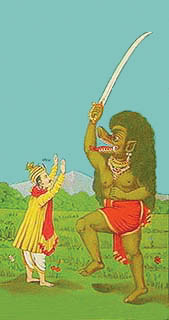
    It is a common misconception that the Kali Yuga is named after the Goddess Kālī. Instead it takes its name from an extremely powerful male demon. This mistake occurs due to errors in English translations of the name Kali – in Sanskrit the Goddess is named Kālī (with long vowels) – the name of the demon is spelt Kali (with short vowels). The demonic Kali takes his name from the Sanskrit root kad which means to “suffer, grieve, hurt, confound, or confuse.” Kali is the archenemy of Kalki, the 10th avatar of the God Viṣṇu. When Viṣṇu incarnates as an avatar, so does Kali – in the Mahābhārata he is said to be Duryodhana, and in the Rāmāyaa he is Rāvaṇa. Kali is the great-great-grandson of Lord Brahmā, as well as Adharma who was originally created from Lord Brahmā’s back as a Maleen Pataka (a sinful object). This is found in the Śrī Kalki Purāa where it says that, “After the annihilation, the secondary creator of the universe, Lord Brahmā, the grandfather of everyone, who was born on the universal lotus flower, created Sin personified, having a black complexion, from his back.”7 An alternate version of Kali’s origin states that he was born from the left-over poison that was drunk by Lord Śiva during the churning of the ocean of milk.

    Kali as dark-skinned monster with sword, From “The Cow with 84 Deities”, c. 1912, Ravi Varma Press

    Depictions of Kali portray him as both revolting and terrifying. The Kalki Purāa describes Kali as huge and the colour of “soot,” with a long tongue and a terrible stench. He carries a bone and has an abdomen that is said to be like that of a crow. Kali is always portrayed holding his genitals in his left hand and he has a dark complexion, like black ointment that has been mixed with oil.8 The Bhāgavata Purāa also describes him as a śūdra wearing the garments of a king. Kali’s symbol is an owl and he rides a donkey instead of a horse. Kali is very fond of gambling, drinking wine, enjoying the company of prostitutes, and associating with merchants – his whole persona exudes an aura of extreme excess, gluttony, and greed. Kali is also presumed to be responsible for all evil scriptures and badly composed religious texts. The favourite residences of Kali are

    the playgrounds of ghosts, foxes, and jackals. These places were permeated with the foul odour of decaying beef, and they were infested with crows and owls. Kali’s domain can be found wherever there is gambling and intoxication, as well as where women constantly quarrel.9

    In sum his domains are those which are deemed impure by Hinduism, and are found wherever people lose their rationality, generating strife and conflict. It is the influence of Kali that distorts the perception of humanity and lures them from the dharma. Kali’s association with negative human emotions and antagonism towards the dharma is symbolised by the names of his destructive progeny.

    Kali’s sister was Durukti (Harsh Speech). From Durukti’s womb Kali begot a son named Bhaya (Fear), and a daughter named Mṛtyu (Death). Bhaya begot a son named Niraya (Hell) from the womb of Mṛtyu, and Niraya begot ten thousand sons in the womb of his sister, Yatana (Excessive Pain). Thus I have described the destructive progeny of Kali, who were all blasphemers of genuine religious principles.10

    Kali’s reign, the Kali Yuga, commences within the Mahābhārata and this book is a pivotal text for understanding both the demon and the Yuga. The end of the Mahābhārata is traditionally believed to herald the dawn of the Kali Yuga, and it begins when Kṛṣṇa, the avatar of the God Viṣṇu, departs. Based on the astronomical observations of Parāśara, a date of c.1350 BCE can be provided for the Mahābhārata.11

    Kali’s presence in the text is subtle, and for the most part revealed only through symbolism. Hints of the infernal origin of Duryodhana are hidden within the Mahābhārata. Vidura issues warnings of the inauspicious symbols which surround Duryodhana and link him to Kali, saying,

    Listen to me, sire, even if my words are bitter, like medicine to a dying man. When Duryodhana was born he cried like a jackal. He will destroy us all. A jackal stalks our palace. Order Arjuna to kill him. Sacrifice a crow to get peacocks, sire; sell a jackal to buy tigers.12

    Jackals are one of the animals traditionally associated with both Kali and bad omens. In a different translation of the Mahābhārata, Kali’s presence is clearly stated.

    Know that Pāṇḍu of unfading glory and distinguished above all others, sprung from the Maruts. Kṣattri and Yudhiṣṭhira are both portions of the deity of Righteousness. Know that Duryodhana was Kali, and Śakuni was Dvāpara.13

    Just as the other main characters within the Mahābhārata are avatars of deities, so too is Duryodhana the avatar of Kali. The identity of Kali as the villain of the Mahābhārata also sheds much light on the actions of Krṣṇa, the avatar of Viṣṇu, and the role he plays in teaching Arjuna the katriya dharma. Kali also appears as Nala in the Mahābhārata, who he possesses via the dice game (a form of gambling). During the dice game, Nala loses everything and is forced into exile. Kali’s possession of Nala ends when the Nāga Karkoṭaka bites him and the venom turns Nala into an ugly dwarf named Bāhuka, who eventually masters the dice game. Learning this enables Nala to exorcise the demon and he vomits Kali from his mouth. The story of Nala is a micro-version of the Mahābhārata itself – Duryodhana also lures Yudhiṣṭhira into playing the dice game, unaware that Duryodhana, aided by another demon Dvāpara (who has incarnated as Śakuni) is manipulating the dice so he can take over the kingdom.

    “Challenged, I never retreat,” replied Yudhiṣṭhira. “We are pawns in the hand of fate. Let us begin. Who plays against me?” “I will supply the stakes,” Duryodhana said. “My uncle Śakuni will play.”14

    Yudhiṣṭhira loses the kingdom, his brothers, himself, and even his wife. The dice game is also of further importance because the Yugas were originally named after the four throws of dice – Krita, Trita, Dvita, and Kali – Krita being the best throw and Kali the worst. Therefore, Kali is not only winning the dice game, he is winning the Yuga and declaring it, albeit symbolically, as his reign and preparing to engage in conflict with his traditional enemy, Viṣṇu, who incarnates as Krṣṇa in the Bhagavad-Gītā section of the Mahābhārata. Despite the defeat of Kali/Duryodhana in the epic, the end of the Mahābhārata is the beginning of the Kali Yuga, because it is believed that the very moment Krṣṇa left the earth, Kali became active in the world.

    Kali will not leave the world again until his nemesis Viṣṇu incarnates as Kalki. The Kalki Purāa is set at the end of the Kali Yuga and narrates the battle between the final avatar of Viṣṇu and Kali, who is defeated one-third of the way through the text. As Kali’s connection to the Kali Yuga is much more explicit in the Kalki Purāa, the manner in which he influences humanity and the dharma is also more obvious. The problems of the Kali Yuga are both moral and ethical, and the central issue of the Kalki Purāa is that society rejects the dharma and Vedic teachings. This is portrayed in Kalki’s role vis á vis the mleccha. The mlecchas are understood to be

    those who do not follow the Vedic principles. In former days, the mlecchas were fewer, and Visvāmitra Muni cursed his sons to become mlecchas. But in the present age, [the] Kali Yuga, there is no need of cursing, for people are automatically mlecchas. This is only the beginning of [the] Kali Yuga, but at the end of [the] Kali Yuga the entire population will consist of mlecchas because no one will follow the Vedic principles. At that time the incarnation Kalki will appear.15

    It is also stated that,

    the pious Brāhmaa have left this country (India), having been chastised by the powerful Kali, who is envious of saintly persons, and who destroys the practice of religious principles.16

    In addition to the mlecchas multiplying and the Brāhmaṇas departing, the caste system also breaks down into a fifth caste that is a result of the other four intermingling, as stated in the Mahānirvāna Tantra: “In the Kali Age, however, there are five castes – namely, Brāhmaṇa, Kṣatriya, Vaishya, Śūda, and Sāmānya.”17 The effect of the lack of dharma in the Kali Yuga can therefore be interpreted as the collapse of traditional law and the negation of all things ethical, moral, or spiritual. The goal of Kalki is not to simply slay Kali, but also to restore the dharma and to reinstate Vedic Traditions. Kali, on the other hand, spreads adharma by perverting religious discourse and creating unscrupulous scriptures. This is undoubtedly what Guénon has in mind when he speaks of the “counter-tradition” in the context of the Kali Yuga.

    The reign of the ‘counter-tradition’ is in fact precisely what is known as the ‘reign of the Antichrist’, and the Antichrist, independently of all possible preconceptions, is in any case that which will concentrate and synthesize in itself for this task all the powers of the ‘counter-initiation’, whether it be conceived as an individual or as a collectivity.18

    The adharmic counter-tradition of the Kali Yuga is also identified with rigid dogma and out of date fundamentalist thinking, notes Alain Daniélou, who writes that, “Visually symbols – that is, the various forms of writing – only begin to be used to fix certain elements of tradition when the evolution of the cycle announces the decline of knowledge.”19 He elaborates further on this stating that,

    writing is an urban phenomenon, characteristic of the Kali Yuga. To freeze the teachings of “prophets” in books regarded as sacred is to paralyse the spirit of research; it fixes so-called established truths and tends to create blind faith instead of the search for knowledge.20

    This is very much in line with depictions of Kali (metaphorically) possessing the minds of men to compose scriptures with ‘evil intent’. One only needs to read the daily news to see how ‘cherry-picked’ religious passages can be used to attack ethnic groups, sexes, and sexual orientations. The most obvious modern example would be Daesh deliberately distorting Islamic teachings to perpetuate political violence in both Europe and the Middle East. But it is only when all spiritual teachings have been eradicated that Kalki will be born, for the Śrīmad Bhāgavatam says that, “At the end of [the] Kali Yuga, when there exist no topics on the subject of God, even at the residences of so-called saints and respectable gentlemen of the three higher varas and when nothing is known of the techniques of sacrifice, even by word, at that time the Lord will appear as the supreme chastiser.”21 It is by restoring the dharma, the moral and spiritual essence of society, that Kalki is able to end the Kali Yuga. Kalki says this himself when he announces that, “I will then again establish Satya Yuga, and thus reinstate the principles of religion as they were before.”22

    Events to Occur in the Kali Yuga

    Alain Daniélou provides numerous examples of events that will occur in the Kali Yuga from the Liga Purāa and the Viṣṇu Purāa. The vast majority of these events are disasters which arise from human actions. All of the issues cited here by Daniélou arise from socio-cultural problems such as greed, lust, pride, arrogance, and political corruption which are the end result of the negation of dharma. As the dharma decreases, the vice and evil in humanity increases. The predictions for the Kali Yuga include the following:

    They will be surrounded by pretentious, false philosophers.

    There will be many beggars and unemployed people.

    Rapes will be frequent.

    Unqualified people will pass as experts in matters of morals and religion.

    Women of good birth will abandon themselves to the desires of the basest of men and perform obscene acts.

    Men will devote themselves to earning money; the richest will hold power.

    Through the fault of the public authorities, many children will die.

    People will accept theories promulgated by anyone as articles of faith.

    In the Kali Yuga men will be without virtues, purity, or a sense of decency, and will know great hardship.23

    The Mahānirvāna Tantra also states that, “Those born in the Kali Age are by their nature weak in intellect, and their minds are distracted by lust,” implying that the character of people is what causes them to adopt practices which are essentially harmful to both themselves and others.24 Due to the growing influence of materialism, greed will also become a source of admiration, and only those who are wealthy will be deemed worthy of respect. The Kalki Purāa states that,

    In [the] Kali Yuga, a person with a lot of money will naturally be respected as a great soul. If a twice-born person earns his livelihood by lending money on interest, he will be considered a pillar of society.25

    Other human created disasters associated with the Kali Yuga are clearly the result of bad governments. Taxes will increase and political figures will be self-serving rather than protectors of the people. There will also be mass migrations – something that is currently happening as people leave the Middle East for more prosperous and stable countries. These events found in the Kali Yuga are located in the discourse by Mārkaṇḍeya in the Mahābhārata where it is written that,

    Rulers will become unreasonable: they will levy taxes unfairly.

    Rulers will no longer see it as their duty to promote spirituality, or to protect their subjects: they will become a danger to the world.

    People will start migrating, seeking countries where wheat and barley form the staple food source.

    Not all of the events of the Kali Yuga will be purely caused by the immoral activities of humans though, for there will also be natural disasters at the close of the Yuga.

    The God of the clouds will be inconsistent with the rains.

    There will be many children born whose life expectancy is no more than sixteen years.

    People who live for a hundred years will be few.

    Water will be lacking, and in many regions people will watch the sky, hoping for rain.26

    In light of recent warnings about climate change and critical levels of pollution in China, these events could also be interpreted as man-made, via neglect and the wanton use of natural resources that harm the environment. Regardless of whether the cause is natural or caused by people, these passages indicate severe climatic instability that afflicts the population and shortens the human life span. However, there is one disastrous event in the Kali Yuga which is definitely not man-made. There is a poignant description of a mass extinction event in the form of an under-water volcano.

    Fire from the mouth of an underground serpent will burn the lower worlds, then the surface of the earth, and will set the atmosphere ablaze […] Surrounded by these circles of fire, all animate and inanimate beings will be destroyed.27 Huge ash clouds then cover earth […] Then, by means of interminable downpour, they will flood the whole earth with water. This torrential rain will swamp the earth for twelve years, and humanity shall be destroyed.28

    It is worth mentioning that the Ring of Fire is currently very active, and that large earthquakes have become more frequent in recent years. Violent earthquakes have been particularly prolific in Japan and New Zealand – close to the site of what is a developing super-volcano growing on the ocean floor. Science predicts that this new super-volcano will be strong enough to eradicate most life in the Southern Hemisphere, and cover the world with ash clouds powerful enough to ruin the climate globally. Currently it is believed that the volcano will take at least thousands of years to form, despite the fact that Daniélou calculates the end of the Kali Yuga to be 2,442,29 a date which if correct places us very close to a catastrophic disaster.

    All is not lost however. Although dharma is set to collapse according to these texts, some Traditions rewrote their teachings in order to adapt to the changing current of the Kali Yuga. The most well-known of these are the esoteric branches of Hinduism collectively referred to as Tantra. The Mahānirvāna Tantra says that, “when the Kali Age is in full sway for all castes, commencing with the Brāhmaṇas, Tāntrika rites are alone appropriate.”30 Daniélou repeats this sentiment stating that, “Only Tantric Yoga methods are efficacious in this age in which values are lost; the rites, asceticism and virtues of other ages are ineffective.”31 He also believes that the “teachings of Lakuliśa expose the principles of the Darśana (the paths of knowledge) in a simple and popular form full of imagery, and suggest patterns of behaviour suitable for the final stages of the Kali Yuga.”32 The most simple and effective method of resisting the influence of the Kali Yuga, however, is actually very easy and can be practiced by anyone, for the Mahānirvāna Tantra says that,

    in the Kali Age alms are efficacious in the accomplishment of all things. The proper objects of such alms are the poor devoted to meritorious acts.33

    Thus the humble act of charity can counter the woe, greed, and cruelty of the Kali Yuga. If anything can save humanity from the disastrous effects of the Kali Yuga, then it must be human action, performed in accordance with dharma. Even if this assumption is incorrect, it may still be enough to make the world a slighter brighter place in this, the darkest of all ages, and forestall the apocalypse for just a little while longer.
    [alert type=”general” dismiss=”no”]This article was published in New Dawn Special Issue Vol 10 No 2.[/alert]
    [alert type=”success” dismiss=”no”]If you appreciate this article, please consider a contribution to help maintain this website.[/alert]

    Footnotes

    1. J. Godwin, ‘Decoding the Cycles of Time: When Does the Kali Yuga End?’, New Dawn 138 (May-June, 2013), 64
    2. R. Guénon, The Reign of Quantity & Signs of the Times, Sophia Perennis, 2004, 42
    3. B. G. Sidharth, The Celestial Key to the Vedas, Inner Traditions International, 1999, 60
    4. R. Guénon, The Reign of Quantity & Signs of the Times, 159
    5. R. Guénon, Traditional Forms & Cosmic Cycles, Sophia Perennis, 2004, 6
    6. J. Godwin, New Dawn 138, 65
    7. Śrī Kalki Purāa, trans. Bhumipati Das, B., ed. Das, P., (Tai Nitai Press), 5
    8. Śrī Kalki Purāa, 5
    9. Śrī Kalki Purāa, 5
    10. Śrī Kalki Purāa, 6
    11. B. G. Sidharth, 118
    12. Vyāsa, The Mahābhārata of Vyasa, trans. Lal, P., Vikas Publishing House, 1980, 129
    13. Vyāsa, The Mahābhārata of Krṣṇa-Dvaipāyana Vyāsa, trans. Kisari Mohan Ganguli, K. M., (c. 1883–1896), section XXXI
    14. Vyāsa, The Mahābhārata of Vyasa, trans. Lal, P., 128
    15. Śrīmad Bhāgavatam, 9:16:33
    16. Kalki Purāa, 2.45
    17. A. Avalon, The Tantra of the Great Liberation, Dover Publications, 1972
    18. R. Guénon, The Reign of Quantity & Signs of the Times, 270
    19. A. Daniélou, Shiva and the Primordial Tradition: From the Tantras to the Science of Dreams, Inner Traditions International Ltd., 2003, 103
    20. A. Daniélou, While the Gods Play, Inner Traditions International Ltd., 1987, 87
    21. Śrīmad Bhāgavatam, 2.7
    22. Śrī Kalki Purāa, 16
    23. While the Gods Play, 212-215
    24. The Tantra of the Great Liberation
    25. Śrī Kalki Purāa, 8-10
    26. While the Gods Play, 212-215
    27. Viṣṇu Purāa 1.8.18-31
    28. While the Gods Play, 218
    29. While the Gods Play, 197
    30. The Tantra of the Great Liberation
    31. A. Daniélou, Gods of Love and Ecstasy: The Traditions of Shiva and Dionysus, Inner Traditions International Ltd., 1992, 235
    32. While the Gods Play, 120
    33. The Tantra of the Great Liberation

    © New Dawn Magazine and the respective author.
    For our reproduction notice, click here.
  • Antarctica in Myth, Fantasy & Reality

    Antarctica in Myth, Fantasy & Reality

    From New Dawn Special Issue Vol 11 No 1 (Feb 2017)

    At the Bottom of the World

    Athanasius Kircher (1602-1680), in his book about the subterranean world, compares the earth to a human body. It drinks in the oceans at the North Pole, digests them in its interior, extracts the minerals, and expels the remains at the South Pole.2 This undignified image of Antarctica is not merely northern chauvinism, for the earth itself presents a marked contrast between its two polar regions. In the north, cities such as Oslo, Helsinki, Tallinn, and Leningrad cluster around the sixtieth parallel, to say nothing of Reykjavik at 64ºN. To their north extend vast tracts of useful land, supporting agriculture and abundant forest life. Coal and other minerals are mined on Norway’s Svalbard Islands (Spitsbergen), which reach beyond the 80th parallel. In the rosy days before the Nazis coopted the myth of Thule, the Canadian explorer Vilhjalmur Stefansson (1879-1962) claimed that “there is no northern boundary beyond which productive enterprise cannot go until North meets North on the opposite shore of the Arctic Ocean as East has met West on the Pacific”3 – and he should know, having spent five months marooned on an ice-floe. Nowadays ice-breakers open the Northwest Passage every spring for a busy sea traffic; airplanes crisscross the Pole, and nuclear submarines pass beneath the thin ice of the Arctic Ocean, even breaking through at the North Pole itself, as the USS Skate did in March 1959.

    In the South, things are quite different. As Charles Fort (1874-1932) phrased it, “History, like South America and Africa, tapers southward. […] Preponderantly peninsulas are southward droops.”4 Cape Horn, the last landfall of Chile, has drooped away by 56ºS, and by the sixtieth parallel one is nearing the uninhabited South Orkney Islands, the first straggling harbingers of the Antarctic Peninsular. There are beautiful things about Antarctica, still miraculously free from mining and territorial claims; one can enjoy real and imaginary pictures of its unspoilt scenery and largely untroubled wildlife. But the unattractive things about this continent, as big as the United States and Europe combined, are such that none but scientists want to live there. It is hard to reach, being surrounded on all sides by seas of notorious roughness. It is much colder than the Arctic, thanks to the absence of warming currents like the Gulf Stream; the eccentricity of the earth’s orbit, which makes the Antarctic summer a week shorter than that of the north; and the perpetual rolling down of chilled air from the icecap that covers the continent to a depth of up to three miles. Finally, apart from the creatures on its fringes supported by the krill – whales, seals, penguins, gulls, mites, etc. – virtually the only life of its interior is the alien one of clouds and frozen water.

    At least, that is the view in educated and scientific circles. But the kind of people who write about Commander Richard E. Byrd’s (1888-1957) flight beyond the pole into the hollow earth are also quick to ascribe to him the sighting of lushly vegetated lands, preferably with a mammoth blundering through the undergrowth. The German Antarctic expedition to Queen Maud Land in 1938-39 made some surprising discoveries, including “a group of low-lying hills sprinkled with many lakes and completely free of ice and snow,” resembling the barren hot springs region of Iceland.5 Claiming this Norwegian sector with swastika flags, the Germans renamed it Neuschwabenland (New Swabia).

    According to the Chilean diplomat Miguel Serrano (1917-2009), the Germans also found there a way of communication with the Hollow Earth and its secret cities, where the First Hyperboreans had taken refuge from the disaster that reversed the Poles.6 There a secret base was prepared during the war years, and thither Adolf Hitler escaped in a vimana (flying saucer plane) to direct the “esoteric war” to this day. Serrano states this as fact in his philosophical testament, and supplies a diagram that blends the physical with the mythological: partly a cutaway diagram of the inner earth, it is also an explanation of the subtle currents at the two poles and their complementarity (see image to the left).7

    But Serrano was only repeating a favorite theme of neo-Nazi and sensational literature. In his well-documented study The Hitler Survival Myth (1981), Donald McKale identifies the earliest source of the myth of Hitler’s escape to the southern hemisphere as the unexpected surrender of a German submarine in early July 1945 at Mar del Plata, Argentina. Several Buenos Aires newspapers, in defiance of Argentine Navy statements, said that rubber boats had been seen landing from it, and other submarines spotted in the area. One paper, Critica, carried on 17 July 1945 the report that Adolf Hitler and Eva Braun had landed from a U-530 in Antarctica, and mentioned the 1938-39 expedition, as a result of which a “new Berchtesgaden” was “likely to have been built.” This report received wide distribution through quotation in Le Monde and the New York Times on 18 July; on the 16th, the Chicago Times had carried a sensational article on the Hitlers having slipped off to Argentina.8

    The myth of an Antarctic refuge, armed with flying saucers, reached its apotheosis in W. A. Harbinson’s thriller Genesis (1980). This develops the Jules-Vernian theme of a “Master of the World” who, thanks to the Nazi régime, has become a technocratic power before which even Washington and Moscow must quail. Harbinson supplements his fiction with an excellent list of factual sources about Nazi saucer-planes and Antarctic explorations.9 Another version of the myth appears in Opération Orth (1989), a strange and surely ironic work by Jean Robin, one of the foremost authorities on the Traditionalist René Guénon and no lover of the “Counter-initiation” of which he holds Hitler to have been a primary, if unconscious, agent.

    Jean Robin writes, supposedly on the evidence of a friend who had been there, of a subterranean complex of high technology entered near Valparaiso by a vimana which could pass through solid rock. There was found the new Asgard or Agartha, the headquarters of the Black Order, where 350,000 initiates await “Him Who Shall Come.”10 A mysterious green flame suspended in a niche of stone and called the Cheskin serves to recharge their energies and focus their cult.11

    Is Adolf Hitler “He Who Shall Come,” as Miguel Serrano believed him to be? No: in Robin’s book Hitler died in this subterranean retreat in 1953, and his body is enshrined and visible in a hexagonal casket – side by side with that of Raoul Wallenberg, the Swedish diplomat who saved thousands of Hungarian Jews during the war, and was “kidnapped” by the Soviets in Budapest.12 This dual presence, Robin’s friend was given to understand, poses no problem to the many Jews who belong to the Black Order: they blame their fellows for their “refusal to collaborate” with the evolutionary process.13

    Opération Orth poses every manner of problem, however, to the reader, who can only wonder what prompted Jean Robin to present the images of Hitler and Wallenberg reconciled, and the casual dismissal of the Holocaust by the Jews of his Black Order. In the context of Guénonian attitudes, which are nothing if not respectful of the Jewish people and their tradition, there is nothing to be said, unless it be that Robin actually accepts his friend’s account, and is warning us of the Counter-initiation’s final obscenity.

    Those who believe in the Nazi Antarctic bases, with or without Hitler alive or dead, will find it significant that Richard Byrd went there in 1946-47, and again in 1956, on expeditions massively supported by the United States Navy. But here is the most extraordinary thing: according to the official maps of his many flights, shown here,14 Byrd’s expeditions left Queen Maud Land absolutely unvisited. The conspiratorial literature has no difficulty in explaining this: Byrd was scared away by the protective power demonstrated by the secret center, and after losing four planes, kept his distance.15

    Poe, Verne, Lovecraft

    Writers of fictions about Antarctica seem anxious for their work to be mistaken for fact. This was a common affectation in nineteenth-century fiction, and often used by the first great imaginative writer on Antarctica, Edgar Allen Poe (1809-1849). The South Pole appears in the short story MS. Found in a Bottle (1833), which employs the common literary device of a ship blown off course to discover new worlds. Poe’s narrator, of course, goes one better: his own ship wrecked, he is hurled onto the rigging of a grotesquely antique, oversized galleon, manned by the living dead, which heads straight for the Pole. Scribbling frantically in the face of certain doom, he writes of his descent into a gigantic whirlpool:

    Oh, horror upon horror! – the ice opens suddenly to the right, and to the left, and we are whirling dizzily, in immense concentric circles, round and round the borders of a gigantic amphitheatre, the summit of whose walls is lost in the darkness and the distance. But little time will be left to me to ponder upon my destiny! The circles rapidly grow small – we are plunging madly within the grasp of the whirlpool – and amidst a roaring, and bellowing, and thundering of ocean and of tempest, the ship is quivering – oh God! and – going down!16

    Poe, who tried to be accurate in his facts, later felt obliged to add a note to the end of this tale, saying that it was only many years afterwards that, “I became acquainted with the maps of Mercator, in which the ocean is represented as rushing, by four mouths, into the (northern) Polar Gulf, to be absorbed into the bowels of the earth; the Pole itself being represented by a black rock, towering to a prodigious height.”17 Poe would make good his error in A Descent into the Maelstrom, which is set in the North. But his polar masterpiece, and the longest piece of fiction he ever wrote, was The Narrative of Arthur Gordon Pym (1838).

    At the time of Poe’s writing, Antarctica had been touched on but not yet “discovered” in any real sense. Captain James Cook, in 1775, had reported after his circumnavigation of Antarctica, that “no continent was to be found in this ocean but must lie so far south as to be wholly inaccessible on account of ice.”18 Subsequent explorations by the British and Russians were inconclusive, and mostly limited to the islands and peninsular. In 1825, John R. Reynolds of Ohio began vigorous agitations in favor of an American Antarctic expedition, twice addressing the U.S. Congress. (One notes circumstantially that John Cleves Symmes’ petition to explore the hole at the North Pole had been made to the General Assembly of Ohio, in 1824.) Public opinion eventually came to his aid, and in 1836 an Exploring Expedition was authorized. After all manner of controversies and delays, the expedition set sail in August 1838 under Charles Wilkes. Poe’s Narrative thus appeared in serial form in the full light of public interest and excitement about the Antarctic.

    The Narrative of Arthur Gordon Pym is too well-known a literary work to delay us long. Suffice it to recall that the narrator discovers, beyond the ice-floes, a warm land inhabited by disagreeable black-toothed savages who bring about the deaths of all but himself and the half-breed Dirk Peters. The natives of this black land have a superstitious horror of anything white, which draws from them the cry Tekeli-li! Although they now live in the most primitive of shelters, Pym discovers a system of underground passages that seem to have been made in significant shapes, and also records what may be archaic script from the wall of one of the chambers. After the usual privations and hair-raising adventures, the two men escape and enter a calm polar sea that becomes ever warmer and whiter in hue, while flocks of gigantic white birds pass overhead crying Tekeli-li! At last they find themselves driven towards a silent cataract of white vapor.

    And now we rushed into the embraces of the cataract, where a chasm threw itself open to receive us. But there arose in our pathway a shrouded human figure, very far larger in its proportions than any dweller among men. And the hue of the skin of the figure was of the perfect whiteness of snow.19

    Thus the Narrative ends; a Postscript apologizes for the loss of the “few remaining chapters” upon Pym’s recent death.

    There is little doubt that Symmes’ theory of the hollow earth furnished Poe with the unacknowledged basis for his story. The Antarctic hole would have to be far smaller than the 6,000-mile diameter Symmes gave to it – about 500 miles would fit Pym’s bearings. But Poe could well be describing the unknowing traversal of its rim and the entry into an inner world which, like Symmzonia, is entirely white.

    One person who could not bear to leave Pym’s narrative unfinished was Jules Verne (1828-1905). In his Le Sphinx des Glaces (The Sphinx of the Icy Regions, 1897), he reintroduces Dirk Peters on a voyage to Antarctica whose secret object is the rescue of Arthur Gordon Pym – not returned and dead as Poe’s informant had it, but abandoned and perhaps still alive in that mysterious polar land.

    Verne’s story takes his characters on open sea to the same black land, now devoid of its inhabitants who have perished in an earthquake. Still seeking Pym, they proceed northwards on the other side of the Pole until they find the curtain of mist which lifts to reveal the Sphinx of the title, presumably identical to the giant white figure of Poe’s conclusion. It is a mountain shaped naturally into a crouching sphinx – but a magnetic mountain, so powerful as to suck every piece of iron out of a ship. There they find Pym’s last and tragic resting-place, pinioned to the rock by his own musket. Dirk Peters dies of a broken heart at thus finding his “poor Pym”; the others just manage to clear the ice-barrier before winter freezes it, and so they come home.

    In a typically didactic digression, Jules Verne’s narrator tries to account for this magnetic mountain:

    The Trade-winds bring a constant succession of clouds or mists in which immense quantities of electricity not completely exhausted by storms, are stored. Hence there exists a formidable accumulation of electric fluid at the poles, and it flows towards the land in a permanent stream. […] it would suffice that a block of iron should be subjected to [these currents’] action for it to be changed into a magnet of power proportioned to the intensity of the current, to the number of turns of the electric helix, and to the square root of the diameter of the block of magnetized iron.20

    The turns of the coil of this giant electro-magnet are supplied, he supposes, by the windings of a metallic lode in the ground, connected with the base of the block. So the south polar vortex in this case is not a watery but an electrical one.

    Now we turn to the inheritor of Poe’s literary mantle, Howard Phillips Lovecraft (1890-1937). This writer of fantastic literature sketched in a handful of stories a whole mythological complex dealing – as any complete mythology must – with the origins of the human race. After Lovecraft’s death it was elaborated by other writers, especially August Derleth, into what the latter called the “Chthulhu Mythos,” after the monstrosity let loose upon the world in Lovecraft’s The Call of Chthulhu (1926). So far this resembles the continuation of Poe’s tale by Jules Verne. But in Lovecraft’s case there is more: the mythology which he himself regarded as no more than dream-inspired fiction was accepted as factual by the aficionados of the Shaver Mystery on the one hand, and, on the other, by certain highly educated practitioners of the “Magick” of the Left Hand Path, led by the prestigious mage of the Ordo Templi Orientis (OTO), Kenneth Grant.

    One of Lovecraft’s longest and by general consent finest tales, At the Mountains of Madness (written 1931, published 1936), is set in Antarctica, whither the narrator has gone on an expedition sponsored by the fictitious Miskatonic University. As Peter Cannon points out,21 Lovecraft had been fascinated by the Antarctic since boyhood; he was surely inspired by the recent expedition of Richard Byrd, who in 1929 was the first to fly over the South Pole; and he pays explicit tribute in the story to Poe’s Narrative of Arthur Gordon Pym.

    At the Mountains of Madness tells of the discovery of the star-headed, barrel-bodied, five-winged Old Ones,22 who came to earth before there was any life upon it, and when the continents had not yet drifted apart (Lovecraft was an early follower of Wegener’s theory). They created life on earth and built on the Antarctic “Plateau of Leng” a gigantic city of obsidian, which the explorers discover by airplane. Landing there at the risk of their lives, the narrator and one companion explore the city and learn from elaborate bas-reliefs of the incredible history of the Old Ones and the planet for which they have cared; of the other races that have evolved or arrived from elsewhere, usually to the detriment of the Old Ones’ utopian civilization. Lovecraft evokes sympathy for these primordial beings, gentle scientists and historians by nature, and for the pathetic end of the ones awoken by the explorers from their age-long sleep, only to be eaten by their own creations, the ghastly Shoggoths.

    Lovecraft’s mythopoeic methods were the antithesis of those of a Tolkien, who supported his mythology with carefully worked-out philological and geographical documents. This is why August Derleth took it upon himself to improve the Chthulhu Mythos through his own fictional contributions, filling out gaps and giving it a tighter organization. A case of Lovecraft’s casual accretion is the “Plateau of Leng.”23 In The Hound (1922), just after the first mention in any of Lovecraft’s works of the grimoire Necronomicon, comes an allusion to “the corpse-eating cult of inaccessible Leng, in Central Asia.”24 A few years later, in The Dream-Quest of Unknown Kadath (1927), the Plateau of Leng is a dream-place where the protagonist confronts a high priest masked in yellow silk. Finally, in At the Mountains of Madness, the explorers find an endless plateau and identify it as the true Plateau of Leng. “Mythologists,” explains the narrator, “have placed Leng in Central Asia; but the racial memory of man – or of his predecessors – is long.

    A hidden center in Central Asia inevitably recalls Agarttha, first described by Saint-Yves d’Alveydre (1842-1909),25 publicized by Ferdinand Ossendowski in Beasts, Men and Gods (1922), and confirmed by René Guénon in Le Roi du Monde in the same year (1927) as Lovecraft’s Dream-Quest. In the Traditionalist version of prehistory, the supreme spiritual center of the globe moved there from its previous Arctic location in “Hyperborea.” A separate study would have to be made of Arctic archetypes in modern fantasy-literature and the games derived from it. For a start, two of Lovecraft’s friends set their fantasy-novels in the uttermost North: Robert E. Howard, with his series on Conan the Barbarian, and Clark Ashton Smith, with his Commorian legends also set in frozen Hyperborea.

    Lovecraft’s ancient civilization in Antarctica is placed so far back in time that those who wish can actually reconcile it with geology. I follow here the scientific account of the Polar medalist Margaret Bradshaw,26 who writes that Antarctica, as part of the supercontinent of Gondwana, was probably in equatorial latitudes during the Cambrian Period (about 500 million years ago). By the beginning of the Permian Period (300 my), Gondwana was polar, the South Pole migrating in the course of twenty million years from the region that would later become Africa/South America, across Antarctica, to Australia. In the Triassic Period (240-190 my), Antarctica was richly forested and inhabited by reptiles. After that came the period of violent volcanic activity that eventually led to the breakup of Gondwana and the beginning of the continents’ progress to their present situations. In the course of the Tertiary Period (65-1.5 my), the major mountain chains were built on the continent, and the present ice-sheet was formed. The continent has been thoroughly glaciated for about twenty million years, so any later habitation is out of the question.

    While this is the large-scale story, there may have been variations within shorter spans of Antarctic history. Charles Hapgood (1904-1982), in his Maps of the Ancient Sea Kings (1979), reproduces the findings of geologists of impeccable credentials that show, in his words, that “during the last million years or so there have been at least three periods of temperate climate in Antarctica when the shores of the Ross Sea must have been free of ice.”27 In particular, there was a longish warm period that ended about 4,000 BCE. Hapgood’s book is subtitled Evidence of Advanced Civilization in the Ice Age, and presents a wide variety of ancient maps that show uncannily accurate knowledge not only of lands undiscovered until the modern age, such as the Antarctic coast, but also of lands invisible at any age of human existence, namely the shores of the Ross Sea. Alas, history has no room in its limited imagination for theories such as Hapgood’s, however persuasively argued and well-documented, because they would require too thorough a revision of the status quo. It is one thing for analyses of Antarctic sea-floor cores to be published in the Journal of Geology; it is quite another to ask prehistorians to imagine a civilization 6,000 years ago which was capable of mapping the whole globe. Like the cardinals who refused to look through Galileo’s telescope, lest they should see what he saw and suffer the same delusions, most prehistorians simply do not read books with subtitles such as Hapgood’s.

    Polarity of North and South

    The mythology surrounding the North Pole has tended to be positive: it is always the Arctic that is imagined as the location of the endless springtime and the cradle of noble races. The Antarctic, on the other hand, is negative: it evokes tales of gloom and destruction, and is populated by primordial horrors, or else by their recent representative, the Nazis. If the Arctic Ocean is still imaginable as open to the world within, from which the Aurora Borealis streams in all its wonder and beauty, any hole at the South Pole is firmly shut with a lid of ice three miles thick. In short, the North is the positive and the South the negative pole of the earth.

    In the accounts of this from “illumined” sources, there seems either to be confusion of the physical with the non-physical – magnetism and electricity with the soul, for instance – or else there is evidence of some occult unity which modern science, ignorant of the ways of souls, cannot fathom. For example, in 1845 an uneducated girl gave in mesmeric trance a number of answers to questions of cosmology and occultism that have a bearing on our subject. Her answers were recorded by Zadkiel (Richard Morrison) in his Almanac, and reprinted in Peter Davidson’s Occult Magazine.28 One of them states:

    The magnetism of the Earth is another modification of electricity, and also circulates through the system. It passes off from the Earth at the North Pole, producing the Aurora Borealis, circulates through the other planets, and returns to the Earth in a purified state…

    Another evokes the situation in which the earth’s axis lies parallel to the ecliptic, which would give each hemisphere six months of light and heat, and six of cold and darkness:

    [Question] Will you look at the Earth and say whether the pole be turned away from its course – the same as it was 10,000 years ago – or be less turned away?

    [Answer] Yes, it is less turned away. The Sun once went over the Pole of the Earth, but that was a long time ago – that was before Adam – there were other kinds of men on the Earth then.

    In Ghostland, an occult novel of 1876, the anonymous author writes of the great spirit Metron, tutelary angel of this planet. (Possibly he means Metatron, who in Kabbalah is the spirit of the Primum Mobile.) Metron governs the “electric life evolved from the galvanic action of metallic lodes threading their way like a gigantic nervous system through every globe; vast reservoirs of polar force generated in the Arctic North and Antarctic South.”29 These regions, we are told, “form the brain and feet of the living Earth,”30 but Metron’s station is in the “brain regions of the polar North.”31

    H.P. Blavatsky (1831-1891) concurs with this polarization of the earth. She writes in The Secret Doctrine (1888) of how when the first Atlanteans were born on Lemuria, they very soon began to divide into those who worshipped “the one unseen Spirit of Nature, the ray of which man feels within himself,” and those who offered “fanatical worship to the Spirits of the Earth, the dark Cosmic anthropomorphic Powers, with whom they made alliance.”32 It was the latter, one understands, who gravitated to the South Pole, called “the pit, cosmically and terrestrially – whence breathe the hot passions blown into hurricanes by the cosmic Elementals, whose abode it is.”33 Elsewhere she explains that the earth’s seven zones correspond to the Seven Principles of man, Mount Meru or the North Pole answering to the Seventh principle, “the region of Atma, of pure soul, and Spirituality.”34 Therefore the South, although Blavatsky does not spell it out, is probably to be taken as corresponding to the physical body, the lowest of the principles.

    We meet an interesting reference to Meru in Saint-Yves d‘Alveydre’s Mission de I’lnde:

    Everything has been plumbed [by the Agarthians], from the fiery entrails of the Globe to its subterranean streams of gas and water, both fresh and salt, even to the living beings who inhabit these flames, gases, and waters,

    Everything has been plumbed across the breadth and depth of the oceans, even the role of magnetic currents which interfere with one another longitudinally from pole to pole, and latitudinally from tropic to tropic. […]

    Everything has been revealed, even to the universal harmonies that produce the terrestrial seasons, and the ascending migrations of souls by the North Pole: that unfindable Mount Meru and that undecipherable Alborj of the Vedic and Pahlevi books.35

    Movement of souls, it seems, is from South to North, and that is what one would expect if the North is closer to the spiritual world.

    Among more recent philosophers whose polar theory is in accord with that of Theosophy, Schwaller de Lubicz (1887-1961) compares the poles to the active (North) and passive (South), or male and female principles.36 Commenting on ancient symbolism, he depicts the movement from one to another as literally as the circulation of Kircher’s oceans:

    Let us note something not generally known: that is, that the North Pole and the South Pole repels, with respect to the masses of these rotating bodies [planets, etc.]. Our North Pole hollows out the earth and it can be said to absorb the continents, whereas the South Pole extrudes earth and it can be said to create the continents. The entire mass of our continents is projected in a spiral motion toward the North Pole.37

    This passage, written in 1949, bears study in the context of what is now known of Continental Drift. In the scientists’ reconstruction of Gondwana, Antarctica lies between Africa, India, and South Australia. The other continents have gradually moved away from it to their present positions surrounding the Arctic Ocean. As for the extrusion and absorption of earth, one can at least say that ancient maps of the North Atlantic and Arctic Oceans record islands and mainland regions that have since disappeared.38

    The reversal of the two poles of the earth relative to the celestial poles, already a persistent theme in esoteric prehistory, naturally raises questions about this matter of polarity. Does the negativity of Antarctica derive from its position on earth, or from its orientation in space? Miguel Serrano thought that the reversal of the poles during the cataclysm of Hyperborea had raised Antarctica to the place of honor, and that for the “Last Avatar” to take up residence there in a revived Hyperborea was absolutely appropriate. But being Chilean must give one a certain parti-pris, which in Serrano’s case goes to the logical extreme of making his homeland, the southernmost country on earth, into the refuge for the Kali Yuga and the spiritual center of the New Age.39

    Another aspect of reversal occurs in the work of Kenneth Grant (1924-2011), dedicated to the exaltation of the god Set, or Shaitan, or Satan. “Shaitan,” he says in The Magical Revival (1972), “is the God of the South, yet his votaries face North when invoking him.” He explains this by the fact that “on entering Capricorn, the zodiacal house of Shaitan [Saturn], the sun turns northward. Consequently the worshipper identifies himself with the sun – Horus – which is therefore not the object of worship, for he is the god that dies and is reborn on entering the House of Set (Capricornus).” Grant also hints at a physical reversal of poles as he continues: “There was a time when the South had precedence and was the primary station of the Pole Star.”40 Later he says that Set “was Lord of the (South) Pole, first born of the seven sons, or stars, represented by the Northern Constellation of Typhon, the Great Bear. When primitive man moved northward from Equatoria, the Star of Set in the South sank beneath the horizon and was supposed to have ‘fallen’.”41

    It is a small step from Antarctica as the house of Satan or of the Führer, alive or dead, to the myth of the lurking Old Ones and Shoggoths of Lovecraft’s fantasy – and from there to the astonishing number of people who take this kind of myth literally. Here is an account of the “arch enemies of mankind” as presented by Robert Ernst Dickhoff in his Agharta:

    Agents of Venus are hidden in places on earth and in the earth, only known to themselves, which are at present in suspended animation, awaiting the coming of their rescuers from Venus when they are sure of success. […]

    If Kadath is one of the remaining ice-bound cities in Antarctica, of which there were an original seven, including Rainbow City now open for operation, and nature turns the keys of release at a time yet to come, it will reveal of what Rhani Khatani speaks, when she hints that there too will be found rows upon rows of crypts filled with serpents, awaiting this release from the strange gas which keeps them alive in suspended animation. They should be destroyed if found, before they are released by sympathetic humans obeying serpent commands.42

    Dickhoff was not making this up. He was merely reproducing and elaborating on the Rainbow City myth, which has its roots in a document known as the Hefferlin Manuscript, circulated privately since the 1940s.43 In a summary of this work by Timothy Green Beckley, we read that William C. and Gladys Hefferlin are now believed to be living in this Antarctic refuge, described as:

    an ancient center of culture called “Rainbow City,” which currently is in the hands of reincarnated descendants of the first colonizers from outer space who made tropical Antarctica the “Mother Land of the World” some two and a half million years ago. There also exist six other cities (all connected by vast underground tunnels), completely dormant, while “Rainbow City” is protected on all sides by warm hot springs. However to prevent its being discovered, and exploited by outsiders, ice walls some ten thousand feet high have been built around the city so that it can be reached only by those who know its exact location.44

    Rainbow City derives its name from its construction, which, like some monstrous Legoland, is entirely out of colored plastic blocks. It is part of the network of underground cities founded aeons ago by Martians, the first colonizers of our planet. Rani Khatani, mentioned by Dickhoff, is one of the “Ancient Three,” Martians reincarnated in human form. (One notices a correspondence to the triple rulership of Agartha’s Brahmatma, Mahatma, and Mahanga.) The serpent or crocodile-people are later interlopers from the planet Venus, enemies of the Martians and hostile to mankind whom they have periodically forced or tricked into worshipping them.45 It is H. P. Lovecraft who supplies the name of Kadath, and, in At the Mountains of Madness, anticipates the pattern of good colonizers usurped by evil ones; while in The Nameless City (1921) he describes a crypt-passage leading to an inner earth, lined with caskets holding the bodies of an unknown, pseudo-crocodilic race. The entrance to the Nameless City is in “the desert of Araby”; others place it at the North Pole, or under Mount Shasta – but that is another story.46 It little matters, if as the Hefferlins say the whole earth is honeycombed with passages through which trains pass at 2,000 m.p.h.47

    The Antarctic continent, fully discovered only in the twentieth century, is the ideal location for the favorite myths of our time: those of extraterrestrial visitations, secret technology, the eternal war of good against evil, and the coming New Age. Even as I write [in 1992], the Antarctic myth is taking on other accretions. What could be more appropriate than the reflection of the fabled hole at the South Pole in the ozone layer, allowing the ingress of evil influences which threaten us with cancer, and the whole region with the demise of its sustaining krill? What more symbolic than the placing of a United States base under a giant geodesic dome at the South Pole, where it can study impotently the rent in the sky, and, if the reports in the tabloids are to be believed, the chasm opening beneath its feet?48 And what exactly prompts the United States to dissent from the community of nations and refuse to sign an agreement to ban Antarctic mining for fifty years?49

    Postscript, 2017. As anyone can discover from the Internet, these questions can now be answered. After 30 years, the ozone hole is diminishing. The geodesic dome was taken down in 2009. The ban on mining, now with US support, has held up for 25 years.

    Joscelyn Godwin’s Arktos: The Polar Myth in Science, Symbolism, and Nazi Survival is available from all good bookstores.

    [alert type=”general” dismiss=”no”]This article was published in New Dawn Special Issue Vol 11 No 1.[/alert]

    [alert type=”success” dismiss=”no”]If you appreciate this article, please consider subscribing to help maintain this website.[/alert]

    Footnotes

    1. First published in Joscelyn Godwin, Arktos: The Polar Myth in Science, Symbolism, and Nazi Survival, Phanes Press and Thames & Hudson, 1993. Reprinted Adventures Unlimited, 1996; editions in French, Spanish, Italian, German, Greek, and Japanese. This excerpt is changed only by adding some dates and definitions, and clarifying references to other chapters of the book.
    2. Athanasius Kircher, Mundus Subterraneus, Rome, 1678, 169, 171.
    3. Vilhjalmur Stefanssson, The Northward Course of Empire, Macmillan, 1924, 19.
    4. Charles Fort, The Books of Charles Fort, Henry Holt, 1941, 732.
    5. Walter Sullivan, Quest for a Continent, McGraw Hill, 1957, 125-26; Christof Friedrich, Germany’s Antarcttic Claims: Secret Nazi Polar Expeditions, Samisdat, 1979, 60-72 with illustrations.
    6. Miguel Serrano, Adolf Hitler, el último avatãra, La Nueva Edad, 1984, 288.
    7. Serrano, 1984, 396, by permission.
    8. Donald McKale, The Hitler Survival Myth, Stein & Day, 1981, 62-63.
    9. See W. A. Harbinson, Genesis, Dell, 1982, 589-605; also Walter Kafton-Minkel, Subterranean Worlds, Loompanics, 1989, 217-42.
    10. Jean Robin, Opération Orth, ou l’incroyable secret de Rennes-le-Château, Trédaniel, 1989, 231.
    11. Robin 1989, 232.
    12. Robin 1989, 257.
    13. Robin 1989, 261.
    14. Sullivan 1957, 199, 341, by permission.
    15. See Friedrich Mattern, UFOs, Nazi Secret Weapon? Samisdat, 1979, 98; Friedrich 1979, 106, 111, with maps.
    16. Edgar Allen Poe, Poetry and Tales, Library of America, 1984, 199.
    17. Poe 1984, 199.
    18. Lawrence Kirwan, A History of Polar Exploration, Penguin, 1962, 69.
    19. Poe 1984, 1179.
    20. Jules Verne, Works, F. Tyler Daniels, 1911, XIV, 385.
    21. Peter Cannon, H. P. Lovecraft, Twayne, 1989, 101.
    22. See the analyses in S. T. Joshi, ed., H. P. Lovecraft: Four Decades of Criticism, Ohio University Press, 1980, 148-51; Cannon 1989, 102-5; Maurice Lévy, Lovecraft: A Study in the Fantastic, Wayne State University Press, 1988, 69-71.
    23. See Donald R. Burleson, H. P. Lovecraft: A Critical Study, Greenwood Press, 1983, 85.
    24. H. P. Lovecraft, Cry Horror! Avon, 1947, 158.
    25. See Joscelyn Godwin, “Agarttha: Taking the Lid off the Underground Kingdom,” New Dawn 109 (2008): 59-61.
    26. M. A. Bradshaw, “Geological History,” in Trevor Hatherton, ed., Antarctica: The Ross Sea Region, Dept. of Scientific and Industrial Research, 1990, 42-63.
    27. Charles Hapgood, Maps of the Ancient Sea Kings, Turnstone, 1979, 82.
    28. “Truths from Humble Sources,” The Occult Magazine, I/8 (Sept. 1885): 58.
    29. Ghostland, or Researches into the Mysteries of Occultism, Progressive Thinker, 1897, 262.
    30. Ghostland 1897, 291.
    31. Ghostland 1897, 293.
    32. H. P. Blavatsky, The Secret Doctrine, Theosophical Publishing Co., 1888, II, 273.
    33. Blavatsky 1888, II, 274.
    34. Blavatsky 1888, II, 403.
    35. Saint-Yves d’Alveydre, Mission de l’Inde en Europe; Mission de l’Europe en Asie, Bélisane, 1981, 89-90.
    36. R. A. Schwaller de Lubicz, Symbol and the Symbolic, Autumn Press, 1978, 67.
    37. R. A. Schwaller de Lubicz, The Temple in Man, Autumn Press, 1977, 85.
    38. See Hapgood 1979, 132.
    39. Serrano 1984, 50.
    40. Kenneth Grant, The Magical Revival, Frederick Muller, 1972, 55.
    41. Grant 1972, 61.
    42. Robert Ernst Dickhoff, Agharta, Bruce Humphries, 1951, 75-76.
    43. See Kafton-Minkel 1989, 154-67; Michael X, Rainbow City and the Inner Earth People, Saucerian Books, 1969, 14-18.
    44. Timothy Green Beckley, The Shaver Mystery and the Inner Earth, Health Research, 1985, 56; see also John Godwin, Occult America, Doubleday, 1972, 177-78.
    45. Dickhoff 1951, 28.
    46. See Kafton-Minkel 1989, 119-32; Joscelyn Godwin, Atlantis and the Cycles of Time, Inner Traditions, 2011, 246-47, 257-58.
    47. Beckley 1985, 62.
    48. See unidentified newspaper report in publisher’s appendix to Beckley 1985.
    49. New York Times, June 23, 1991.

    © New Dawn Magazine and the respective author.
    For our reproduction notice, click here.
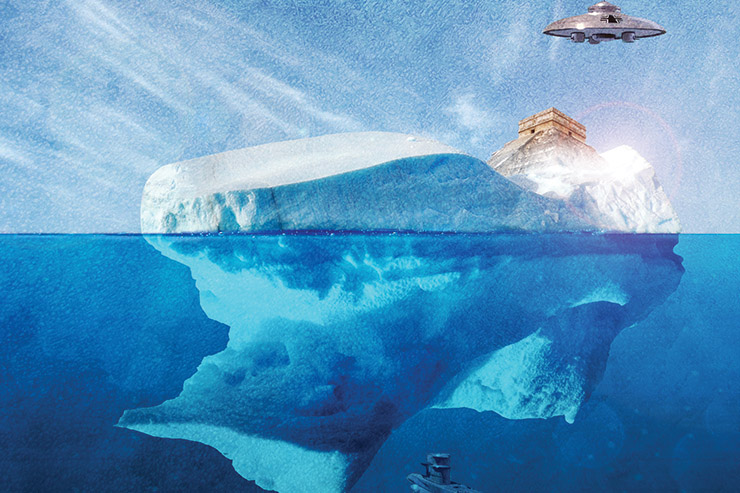
  • Lemuria in Australia & the Pacific

    Lemuria in Australia & the Pacific

    From New Dawn 95 (Mar-Apr 2006)

    The most important questions we can ask are about ourselves, not only as individuals, but as a species. Where did we come from? How did we get here? A question that has bedevilled us for as long as we can remember is: Where and when did we take the step from savagery to civilisation?

    Mainstream historians, who write our textbooks, insist they know: in Mesopotamia, about 5500 years ago. But they are contradicted by places like Chatal Hueyuek, a 13-hectare condominium village that flourished as part of a much broader urban centre in central Turkey, 15 centuries earlier. More ancient still, archaeologists excavated a nine-metre-high, stone castle in the Near East, at Jerico, that is a 1000 years older. The sophisticated level of construction at Chatal Hueyuek, Jerico, and similar, pre-fourth millennium BCE sites proves they were not the first of their kind, but must have developed from much older precursors. Just who were these precursors, and how far back into prehistory did they lay the foundation for all subsequent civilisations, including our own?

    This was the question that sparked more than ten years of concerted research and world travel. I found clues left behind by the long-dead ‘Cliff-Dwellers’ of the American Southwest; among the living oral traditions of Polynesia, Micronesia, Melanesia, Australia, and New Zealand; and in the pre-Buddhist temples of Japan and Southeast Asia.

    The accumulated evidence compelled me to conclude that mankind’s first civilisation gradually arose in the Pacific around 50,000 years. This period coincided with the Upper Paleolithic, or Late Stone Age, famous for its cave-art in southwestern France, and lowered sea-levels, allowing for occupation of Australia by exposed land-bridges. For the next 38,000 years of relative peace and isolation, the Pacific islanders developed the scientific and spiritual arts to high degrees of sophistication through close observance of natural law.

    Their country was known as Mu, the “Motherland,” less a specific geographical territory, than a people and culture spread out over many lands from what is now west-coastal America, throughout Oceania, to Japan. The inhabitants were “Lemurians,” or the residents of sea-girt Mu. Although they venerated numerous deities, the Sun personified the literal and spiritual Enlightenment of a Compassionate Intelligence that ordered the Universe, and attached the eternity of the human soul to recurring patterns evidenced in the cycles of nature.

    The Motherland itself was mostly a low-lying, tropical country, much of it close to the equator, and therefore beset by a hot climate. Her population lived in small fishing villages or on farms. Cities were not unknown, but more ceremonial than urban centres. Step-pyramids, temples, plazas and other examples of sacred architecture, many oriented to various positions of the Sun, adorned the verdant landscape. Lemuria’s prolonged civilised idyll lasted until 12,000 years ago, when the last Ice Age came to an end, causing dynamic increases in sea-level. Much, but not all, of Mu was inundated, and large numbers of its inhabitants fled to the Americas and Asia, where the Jomon Culture arose in Japan.

    Lemurian refugees and their descendants migrated across China and the then-fertile Gobi Desert region. But Mu recovered from the Late Pleistocene devastation, and her people spent the next 69 centuries elevating their scientific spirituality to levels of achievement still unsurpassed, particularly in monumental construction and what would today be referred to as the development of “psychic powers,” still known throughout Polynesia as mana.

    In 3100 BCE, however, an aberrant comet passed near the Earth, provoking a global catastrophe. The lands of Mu were severely effected, and some slipped beneath the sea. Many immigrants escaped to South America, superseding a previous Lemurian colonisation of Pacific coastal Peru. The troublesome comet returned less than a thousand years later to unleash a bombardment of meteoritic material. Mu suffered, but endured, then revived yet again. Her agricultural engineers transformed the high hills of the Philippines into mountainous rice terraces, making Luzon the breadbasket of the Pacific.

    Then, in 1628 BCE, major volcanism and violent seismicity spawned by a final, cometary pass, afflicted the South Central Pacific. Most of the lands of Mu dropped beneath the sea, or were depopulated by hundred-foot-high tsunamis. With her ceremonial centres toppled, and infrastructure shattered beyond repair, the survivors abandoned what was left of their broken Motherland. Their arrival in other parts of the world acted as powerful stimuli for the beginning of new societies, forming the basis of new civilisations in Asia and America. The lost Motherland was subsequently remembered by numerous names – Rutas, Haiviki, Baralku, etc. – by the various peoples who shared in the Lemurian experience.

    During the eighth century BCE, early or proto-Romans began celebrating the annual Lemuria festival to mollify the restless spirits (lemures) of their ancestors. Four hundred years later, the Lemurian domination of Japan ended with the collapse of the Jomon Culture and the arrival of a Mongoloid people from Korea. They found the islands already inhabited by Caucasian indigenes, the degenerated descendants of once-civilised Lemurians. As recently as the early 19th century, the last Lemurians were exterminated by Polynesians in the Poike Ditch Massacre at Easter Island.

    Later that same century, English scientist, Philip Lutley Sclater, postulated the former existence of Lemuria to explain the occurrence of early primates on either side of the Indian Ocean. His contemporary, the German biologist, Ernst Haeckel, concluded that mankind first evolved in Lemuria. But the first popular discussion of the Pacific Motherland was not published until 1926, by British Army Colonel James M. Churchward. His Lost Continent of Mu, based on a translation of ancient tablets purporting to describe the drowned civilisation, ignited a controversy that persists to this day.

    Dismissed by most readers as a fantasy at best or a fabrication at worst, it found credibility 60 years later, when Kihachiro Aratake found a monumental building under water near Yonaguni, southernmost of the Japanese Ryukyu Islands. Its discovery was followed by at least a dozen other sunken structures observed off the shores of Japan, Taiwan, Pompei, Fiji, Peru and North America. This story, as incredible as it may appear to mainstream scholars, was not invented, but emerged entirely from an immense body of evidence, including related folk traditions, archaeological remains and artefacts, geology, and genetics.

    If Mu really existed and the natural catastrophe that destroyed her actually took place, we should expect at least something of this drama to have left its mark in Australia and New Zealand. Indeed, a people who never knew the written word, yet preserved a vivid knowledge of the Lemurian disaster, are the Australian Aboriginals. They tell of Mu-Mu-Na, the flaming rainbow serpent, also known as Mu-It, that fell from heaven to cause a world flood. When recounting the story, even today, Aboriginals swing a bull-roarer named after their mythic rendering of the deluge-inducing comet, because it imitates the fearsome sound produced by the falling “rainbow-serpent.” Their narrations often include descriptions of an ancestral paradise before it sank beneath the sea, remembered as Baralku.

    New Zealand’s Maori tell of a priest who prayed for salvation from a great celestial flame that threatened to incinerate the world when it was still new. His prayers were answered with a colossal flood that quenched all the fires, but wiped out a once splendid kingdom, killing most of its inhabitants. Australian Aborigines believe the tenets of their “Dream-time” cult arrived from the “land of Perfection” before it was engulfed by the sea. In Mangaian myth, Ru was the god of Avaiki, the undersea palace of the dead, and creator of an island at the centre of the world, Rangi-motia, yet another name for the sunken civilisation.

    The noted 19th century anthropologist Abraham Fornander researched a “Polynesian legend from Raiatea Society group, which states that the Deluge was occasioned by the wrath of Rua-Haku (‘Rua, the Lord’), the great ocean-god of that group.” The Deluge itself was known as Te tai o Rua-tapu after its flood-hero, Rua-tapa, in pre-Christian New Zealand. He was a legendary craftsman from Avaiki, who taught the Maori ancestors the art of woodcarving. Churchward’s statement that “the word tau (ta-oo) is one of the few of the Motherland that has been handed down” appears borne out in Hora-nui-a-Tau, “the Great Out-Stretched Land of Tau,” and Hau-papa-nui-a-Tau, “the Hilly Land of Tau.” In Maori folk tradition, these were the homelands from which the Tangata-Whenua, the original inhabitants of New Zealand, arrived in the ancient past.

    The Lemuria glyph symbolising their homeland was configured into a “T,” and pronounced ta-oo, identical to tau in the Greek alphabet. The same T-glyph is repeated in Aboriginal bark painting. It encloses seven sparkling figures corresponding to the Pleiades. Aboriginal myth recalls that the constellation belonged to a group of spirits, the Muramura, which combines the names of the sunken Motherland with that of the sun-god, Ra. They created human beings by smoothing out the limbs of unformed beasts, then gave them the first rites of initiation into sacred mysteries. The Muramura were said to have travelled over the world before being drawn up into the night sky by a long hair cord. Their name (a contraction of Mu, the Motherland, and the ‘Egyptian’ sun-god, Ra), function as creators of human life, and world-travellers, emphasising their Lemurian identity.

    The Hawaiians referred to the same constellation by the provocative name of Humu. Their tau-shaped “Cross of God” was known as the ta-ha-oo. Nearly 3000 miles from Hawaii, a colossal pyramidal platform, the Tauhala, stands in Mu’a, an ancient port-city on the Polynesian island of Tonga. These self-evidently Lemurian names spread across the vast ocean from Australia to Hawaii are invariably connected to enduring traditions of a lost homeland destroyed by an awesome act of nature.

    The Maoris believed that Te-Tumu was the ‘source’ which gave birth to mankind in the land of Mataaho, known in the Marquesas’ Deluge-chant, Tai-Toko, as Matahou. Sometime thereafter, it was overwhelmed by a killer-wave which some ancestral survivors escaped by sailing a great “canoe” called the Takitumu, “in remembrance of the original home they came from,” according to the ‘Travels of Tamatea’, an indigenous New Zealand chant transcribed in the late 19th century. It also mentions a place called Muri-wai-hou, a submarine realm reigned over by Limu, the god and guardian of the dead, from his vast palace in the depths of the sea. The chant describes the lost country of Irihia:

    “It was a great home of the Maori people, and in it was situated the whare-kura (or temple of learning) of Rongo-marae-roa. It was from this land that men and tribes dispersed to the islands of the great ocean.”

    Numerous oral traditions such as these have been confirmed by regional geologic evidence, which defines the three natural catastrophes that decimated Lemuria before 3000 BCE, around 2100 BCE, and in 1628 BCE. A submerged forest near Wellington in Hutt Valley, New Zealand, dated to circa 3100 BCE, shows a good correspondence with the similar submerged forest deposits of this age in western Europe. Along the west coast of Australia, a prominent ‘fresh’ submerged beach platform has been noted by divers at a depth of three to four meters below sea-level, which has also been tentatively dated to about 5000 years ago.

    American investigator Kenneth Caroli states that “the last known mega-tsunami in the Indian Ocean hit western Australia around 2000 B.C.” William Jett, a US anthropologist, says there was “severe climate change in Asia about 2100 B.C.”

    Get the issue this article appears in

    The outstanding volcanic event of 1628 BCE, the final destruction of Mu, was a blast produced by New Zealand’s Taupo Valley centre. Says Caroli, “the Taupo volcanic zone is quite large, about two hundred fifty kilometres long by forty to fifty kilometres wide, encompassing more than just New Zealand’s north island. It is also broken down into sub-regions. Via carbon-14 dating, it could be exactly contemporary with Akiachak, in Alaska.” It generated a 200-foot high wall of water travelling several hundred miles per hour like an all-encompassing shock-wave throughout the entire Pacific Ocean. Islands standing in its way were overwhelmed and utterly swept clean of every obstruction. Whole archipelagos vanished or were depopulated. Others abruptly sank beneath the surface of the ocean in accompanying earthquakes.

    Section of the Kaimanawa ‘Wall’

    Despite the trans-Pacific devastation of these natural catastrophes, the physical remains of Lemurian civilisation in New Zealand still exist. Immediately south of Lake Taupo, the Kaimanawa ‘Wall’ is more probably a step-pyramid or terraced, ceremonial marae of immense proportions. The American maverick archaeologist, David Hatcher Childress, who investigated the site in 1996, observed that “the blocks seem to be a standard 1.8 meters long by 1.5 meters high. The bottom block runs straight down to 1.7 meters and beyond. The blocks run for twenty five meters in a straight line from east to west and the wall faces due north. The wall consists of approximately ten regular blocks that are seemingly cut and fitted together without mortar.”

    The Lemurian impact on New Zealand and Australia was profound. And as more evidence emerges to confirm the ancient oral traditions of its native inhabitants, mankind gradually realises that our civilised origins are far more profound, technologically and spiritually greater than we have been led to believe.

    [alert type=”general” dismiss=”no”]This article was published in New Dawn 95.[/alert]

    [alert type=”success” dismiss=”no”]If you appreciate this article, please consider subscribing to help maintain this website.[/alert]

    © New Dawn Magazine and the respective author.
    For our reproduction notice, click here.

  • Epoch & Aeon: Understanding Cosmic Cycles (Part 1)

    Epoch & Aeon: Understanding Cosmic Cycles (Part 1)

    From New Dawn 152 (Sept-Oct 2015)

    We may have entered a new epoch, or so some scientists are telling us. The Anthropocene is a geological epoch characterised by the noticeable impact of humanity on the surface of the Earth. The previous epoch was the interglacial Holocene, which began after the fourth ice age. The Anthropocene is said to have begun with the Industrial Revolution in the eighteenth century. Others argue that substantial human influence on the lithosphere began up to 15,000 BP (BP=Before Present, the scale used for large periods of time) when human activity left its first traces on the rock record. Others specify 1945 as a clear date, due to the sudden arrival of radioactive material in the rock strata from the explosion of atomic bombs.

    As a term, Anthropocene reminds me of esoteric concepts of humanity’s ages and cycles, aeons and epochs. A belief in cosmic cycles has been specified as one of the typical characteristics of esotericism. This categorising of history and prehistory is one of several examples where religious and esoteric ideas exist in a symbiosis with scientific and secular ideas. Scientific concepts such as the ages of stone, bronze and iron owe their existence to myth; modern esoteric ideas of human development, of cosmic ages and cycles, draw on the scientific knowledge of the period.

    The Anthropocene is partly a tool for highlighting the extent that humanity is currently influencing the global environment. Yet it is typical of materialist science that only mankind’s physical impact on the world is being assessed. Mankind appears in the geological picture mostly due to the damage we have done. In contrast to this, esoteric theories of aeons, epochs and cycles typically see in mankind a development towards an ever more spiritual form of consciousness, or a descent from a golden age into barbarism, or the repetition of cycles of a variety of divine or cosmic influences.

    The difference between scientific systems of ages and esoteric-religious systems is this: scientific systems are based on measurement, esoteric systems on value. The best esotericism incorporates scientific and practical knowledge into a worldview that has a cosmic significance and acknowledges human psychological and spiritual development. The technologies of esotericism are those of personal transformation and sacred science. Esotericism is concerned with the inner meaning of whatever phenomena it touches upon, whether those of religion, myth or science.

    It Was a Golden Age

    Probably the most familiar Western system of ages is that of the classical world. We are so used to the gold, silver and bronze medals of the modern Olympics that the combination and order of these medals barely seems strange to us. It was Hesiod in the eighth century BCE who first wrote of the ages of development associated with metals, and he was surely drawing on existing tradition. Hesiod’s account follows on from the story of Prometheus bringing fire to mankind and Zeus punishing humanity by fashioning Pandora with the aid of the other gods, whose infamous box unleashed evils and sufferings on the world, with Hope as the only positive quality. Hesiod describes five ages – gold, silver, bronze, the heroes, and finally iron, the age in which he lived and we still live.

    In the golden age, ruled by the titan Kronos, humanity was free from labour and ill-health, people lived long happy lives and died peacefully in their sleep. After death people lived on as good spirits of the earth who protect and bring wealth. The silver race was fashioned by and ruled by the Olympian gods. They were also long-lived as children but once they grew to adulthood they fought and were killed, forsaking the gods. These live on as spirits of the underworld.

    People of the bronze age were strong and powerful but hard-hearted, dying in wars. Our age is that of iron, to which Hesiod apportions a series of woes mixed in with only a little good meted out by the gods. Hesiod tells us he would rather that he had not been born than live in our age of iron. Between the ages of bronze and iron was the heroic age. Its anomalous status, not being associated with a metal, suggests it was added to the scheme later. The heroic age was the age of the heroes and demi-gods of Greek myth, from the Seven at Thebes to participants of the Trojan War. They live on in the blessed isles.

    Myths can encode social imperatives, taboos, justifications for ritual, and spiritual and psychological truths. They can also preserve ancient folk memories. Archaeological ages of materials technology, of course, show that bronze was used before iron was smelted. The modern scientific threefold scheme of stone, bronze and iron ages derives from Michele Mercati in the sixteenth century, with numerous subdivisions and refinements made as evidence accumulated and the scheme developed. The scientific understanding of archaeological ages of materials technology owes its inspiration to the Greek myth of the ages of metal.

    In Book V of The Nature of the Universe, Lucretius, the first century BCE Roman writer, describes a progress in the human use of stone then copper (and hence its amalgam, bronze) and then to iron. Lucretius was an Epicurean and in many ways a precursor of modern rationalism. His method was not based on experimentation and measurement but on assigning natural materialistic explanations to phenomena. Hence, Lucretius ascribes mankind’s knowledge of the use of fire not to Prometheus but from seeing forest fires caused by lightning. He surmises that humanity learned to smelt metals from seeing the results of a forest fire on ore. Lucretius sees mankind as developing in phases from primitive technologies to the advanced civilisations of his time, from using stone to copper or bronze, and latterly to iron. It is the myth of progress.

    Hesiod and Lucretius offer examples of the two opposing models of human development: a descent and an ascent, on the one hand a fall from grace and away from the perfection of the golden age and on the other a development from barbarism to civilisation.

    [alert type=”info” dismiss=”no”]If you appreciate this article, please consider a subscription to New Dawn magazine.[/alert]

    The Great Age & Yugas

    In the Western mind the four (or five) Greek ages, or at least the concept of a golden age, are part of the common culture. Astrological ages and the Indian Yugas (Hindu, though there are Buddhist and Jain adaptations too) are probably the next well known, the latter chiefly among those with spiritual, New Age or esoteric leanings.

    The Yugas, which are of course still current in Hindu culture, are the most ancient and massive cycles. The total length of a Great Age (Mahayuga) is 4,320,000 years. The four Yugas have durations of 4:3:2:1 proportions, running from the golden age Krita or Satya Yuga (Fortunate Age) at 4,000 divine years, amounting to 1,440,000 human years, on through Treta Yuga (Third Age, or of three parts, 3,000 divine years/1,080,000 human years), Dwapara Yuga (Second Age, or of two parts, 2,000/720,000) and our very own Kali Yuga (Age of Conflict, 1,000/360,000 years). There are additional periods that precede and follow each Yuga, each 1/10 of the length of the Yuga.

    Joscelyn Godwin cites midnight February 17 or 18, 3102 BCE as the beginning of the current Kali Yuga, according to Indian astronomers, and calculates its end in 427,000 CE.1 The Kali Yuga thus covers the period from more or less the dawn of civilisation to the extremely remote future. These vast periods are difficult to find meaningful.

    The vast time scale has prompted some more recent commentators to accommodate the lengths to a more human scale. René Guénon, the Traditionalist, suggested knocking off three zeros and multiplying by 15. The resulting periods mesh successfully with human affairs, with the current Kali Yuga conveniently ending in 1999. Despite Guénon’s erudition, this surely amounts to convenient adaptation of a difficult idea; on the other hand it is the duty of esotericism to concern itself with the meaningful. The best known resizing of the Yugas, possibly better known than the original periods, is that of Sri Yukteswar Giri, the guru of Paramahansa Yogananda, known widely for his Autobiography of a Yogi. In Yukteswar’s system of Yugas the Kali Yuga has already ended and we are now in an ascending era in which the Great Year runs in reverse. Thus the myths of descent and ascent are combined.

    Consonant with their vast lengths, the Yugas are associated with very broad characteristics of human life. As with the golden age of the Greeks, in the Krita Yuga humans have long lives (4,000 years), have no diseases and don’t need to work. Kali Yuga is characterised by the greed of mankind, by irresponsible rulers, wide use of drugs and drink, and continual migration of peoples. A distinctive Hindu characteristic of the ages is that they each have different numbers of avatars of the Lord Vishnu, with the Kali Yuga having only one, Kalki, who will return on a white horse to fight against the demon Kali (not to be confused with the goddess Kali) who is the ruler of the age.

    This is the dawning of the Age of Aquarius

    The astrological ages are widely known. In the official history of science it was Hipparchus in the 2nd century BCE who, on the island of Rhodes, computed the precession of the equinoxes (see graphic on page 62 in magazine). In the 2nd century CE Ptolemy, the great astronomer/astrologer, worked out that precession was due to a wobble of the starry sphere. Heliocentric science eventually determined that the wobble was in Earth’s orbit.

    The great year of astrological ages is computed at 25,770 years. This is usually rounded to 26,000 years although the figure has sometimes been lower and until the cycle was properly measured it was assumed that it matched Plato’s Great Year of 36,000 years. This number divided by 12 gives 2,147.5 years for an astrological age if the signs of the zodiac are equally spaced.

    The sign in which the Sun rises on the vernal (spring) equinox is believed to influence humanity as a whole in a similar way to the effect of the 12 signs on a human being. The ages of Leo, Cancer and Gemini show mankind emerging from prehistory, with Gemini, ruled by Mercury, associated with the development of writing, Leo emphasising the importance of the Sun, and Cancer that of the mother goddess. The age of Taurus began around 4000-4500 BCE, depending on the method of computation, and is associated with bull god cults such as those found in Egypt, Assyria and Crete. Around 2000 BCE, give or take a couple of centuries, the spring equinox Sun moved into fiery and warlike Aries. This was a time of empire building and heroic ages, of martial conquest and the use of iron for weapons. It also included the development of monotheism.

    From around 100 CE to the turn of the Christian era – about which, more in a moment – is the dawning of the age of Pisces. The fish associations of Christianity, the symbol of the vesica piscis, the fisherman disciples who become fishers of men, and several parables and miracles that include fish, are all consonant with Pisces. Pisces is also notable for its dreamy quality, hence the characterisation of the age of Pisces as a time of deception.

    We look with hope to the age of Aquarius but there are many views as to when it will come. We may have already gone over the cusp. Those who calculate the astrological ages according to the constellation boundaries rather than the equally spaced 30 degree zodiacal constellations, compute that it may take another 600 or 700 years before we enter Aquarius.

    Many fascinating investigations into archaeology and astronomy suggest that knowledge of the precession of the equinoxes is encoded in myths from a wide variety of sources and in the alignments of ancient sites all around the world. This would make the astrological ages the arbiters of epoch par excellence. In these ages the position of the zodiac at the spring equinox aligns with chronology, mathematics and a zeitgeist that lasts for two millennia. That zeitgeist manifests through large scale human endeavour such as empire, war and civilisation, through symbolism and religious forms.

    For us, who now stand two millennia away from the beginning of our Christian calendar, the astrological ages are extensive enough to carry a significance beyond the length of a single civilisation, yet not so long that they are incomprehensible on human terms. Although there is plenty of argument over the specific beginning and ends of ages (though their length is not so controversial), the scheme is admirable. It is like a tool of the right size and weight that fits comfortably in the hand.

    It also has a predictive value lacking in the Yugas and the metallic ages. The Greek system offers no development after the iron age. The Yugas offer an eventual return to the beginning of the cycle and a new golden age, which is a source of optimism. But the massive time scales and our place within the Kali Yuga can only allow us to sigh at the misery of mankind and its fall from grace. The astrological ages cycle through varying qualities but are not characterised by ascent or descent. When an age becomes tired and decadent, complementary qualities may be at hand in the influence of the forthcoming age.

    From Adam to Christ

    Astrology comes from Babylon and was formulated in its Western version in the pagan classical world. Although both Christianity and Judaism have at times had their own strong astrological traditions, astrology was vulnerable to criticism as a pagan science whose symbolism and terms of reference didn’t extol Yahweh or Christ as the foundation stones of the universe. According to the astrological ages, the bull and the fish are merely passing fads, albeit fads of 2,000 years duration. Thus it fell to Christians to come up with their own aeons and epochs that drew on their own mythologies and understanding of the world. From a Christian and Western standpoint, the Yugas and astrological ages are merely turning around in circles.

    The Christian view of time follows a line not a circle. It runs from creation to destruction, from Genesis to Revelation, from Fall to Apocalypse. Yet the line can still be divided into sections, marked out by the character of the times, by the stage in the process of the redemption of humankind. The Christian schemes take us out of the ancient world and into the Middle Ages.

    Our standard Western method of counting years is in fact a simple system of two epochs, BC, Before Christ, and AD, Anno Domini, the year of our Lord. The BC/AD system did not take root for several centuries after its invention in the 6th century. It reflected the basic Old Testament/New Testament divide of the Christian Bible but has no category for the Second Coming. It has no predictive quality built into it.

    It was that giant of influence, St Augustine, who formulated the most influential Christian scheme of ages. Augustine’s scheme utilised the seven days of creation. Inspired by Psalm 90:4 (quoted in II Peter 3:8), in which “one day with the Lord is as a thousand years,” each day was literally a millennium. The seventh age corresponded to the seventh day, the Sabbath, on which day God rested from his labours, and was outside of history.

    Each age of 1,000 years could approximately be matched with chronologies produced from the genealogies of the Bible. The six ages were:

    1. From Adam to Noah and the flood.
    2. From post-flood Noah to Abraham
    3. From Abraham to David
    4. From David to the captivity in Babylon
    5. From the return from Babylon to the birth of Jesus.
    6. From Jesus to the second coming.

    Thus we are living in the sixth age, which will continue until the Apocalypse. The sixth age is clearly and uniquely Christian; all of the preceding ages are defined by Jewish figures yet are claimed for Christianity. There is no accommodation of, for instance, the Greek philosophers who would have lived in the fifth age, or for Homer in the fourth age, no room to allow for the Greek heroes or the Gods of Egypt, Greece, Rome and other Mediterranean countries.

    What can this system of ages say about mankind and the world in general? The great civilisations of antiquity, the gods and goddesses and daemons, are all swept away in favour of the purloined traditions of a people (the Jews) who weren’t even included in the new religious dispensation unless they acknowledged Christ. There was little room for each age to have its own spiritual or psychological colouring or even for a straightforward cycle of progress or corruption.

    Those six ages did allow for a coming transformation into the seventh age, but Augustine placed the Christian Apocalypse conveniently far enough in the future to be of no concern for a few centuries.

    Augustine took over an existing Jewish scheme but may have been influenced by Gnostic ideas. In the Gnostic Second Treatise of the Great Seth, the history of the world is effectively divided into three stages. Barbelo, the divine feminine figure, visits Adam, then gives the seed to Seth, then later to the resurrected Christ. In the further reaches of Gnosticism we find similar demarcations of history based around important characters in the Bible. Bardaisan came up with a scheme that involved 6,000 year periods that made up a Great Year. The Manichaean religion is unusual in acknowledging both biblical figures from Adam and Seth down to Jesus and non-Abraham prophets including Zoroaster and Buddha.

    Father, Son & the Holy Spirit

    After the first Christian millennium ended, Augustine’s six ages still had some validity because the beginning of the sixth age and the literalness of the thousand year period could be disputed.

    Joachim of Fiore (c.1132-1202) first proposed that history was ascending through three stages ruled by each separate member of the Trinity. Hence, the period from Adam to the birth of Jesus was the Age of the Father, characterised by the Law; from Christ onwards was the Age of the Son, which was the age of the gospel; at some date in the near future would be the advent of the Age of the Spirit or Holy Ghost. Abbott Joachim, who was a devout Catholic, believed the third age would bring the kingdom of God on Earth. This third age would no longer require the Church (which was just an artefact of the second age) but would consist of celibate monks in direct communion with the Holy Spirit. Joachim believed the third age would dawn in 1200-1260 and so must have died believing it was imminent. Joachim’s influence on the development of Christianity would be indirect but considerable. His concept of the replacement of the Church by saintly individuals would be picked up by various Protestant movements and lend itself to use by later antinomian Christian sects. There was no compulsion to accept Joachim’s own estimate of the dawning of the Age of the Spirit, therefore interest in his three ages would re-emerge in aspects of twentieth century esotericism.

    Islam could take the same approach by delineating ages according to the six prophets mentioned in the Qur’an (Qur 19,21-22), while in Ismaili Islam a series of emanations from Allah determine the different characteristics of the ages. Minority Middle Eastern religions such as the Zoroastrians and the Yezidis also had their own schemes. That of the Druze is notable for a scheme of aeons that each last for an astonishing 343 million years. Other aspects of their little-known scheme include a series of 159 masters through history, in addition to the six prophets of Islam, with history deteriorating gradually until a final liberation takes place. These 159 masters are pre-existent but are somehow controlled by Christ and the four evangelists as cosmic figures. Outside of the scope of this article are the wide rage of mythic ages found around the world like the five Suns of the Aztec ages, or the Mayan calendar.

    The True Religion of Noah

    Isaac Newton (1642-1727) was the founder of modern science, but also a Christian, astrologer, alchemist and esotericist. He has sometimes been characterised as the last magician rather than the first modern scientist. Newton believed that the true religion was that of Noah. He also believed that the Sabaeans, Confucius, the Brahmins and Pythagoras all inherited this post-diluvian wisdom. As each of these figures and movements arose, the light of “true religion” renewed, only to decline steadily until the next renewal. Egypt, however, according to Newton, was responsible for much of the corruption and decline of this true religion, including the concept of the Christian Trinity, which Newton abhorred.

    All this resembles the familiar Abrahamic scheme of a succession of prophets periodically bringing law or religion or gnosis to humanity. But Newton has integrated figures like Pythagoras (and Hyram of Tyre, of Masonic fame) into the scheme. Newton believed that Pythagoras gave mathematics to the Greeks with one hand and the “true religion” with the other.

    It will become characteristic of esotericism to incorporate figures from many religions and cultures, not just Jewish and Christian ones, into the patterns of development. Esotericism is interested in the inner meaning and inner significance of traditions, usually sees religions and cultures as sharing fundamental principles (or often regarding as debased those that don’t fit in) and hence can accommodate almost any criteria. Given his scientific nature Newton saw these prophet figures as bringing sciences such as mathematics and astronomy with them. The purest and most ancient civilisation was that of Israel, from whom, with a hefty amount of chronological juggling, all others copied.

    All graphics for this article are viewable in the digital or print version of this issue.

    The second part of this article, published in New Dawn 153 (Nov-Dec 2015), looks at how the concept of race was related to esoteric history, as well as the cycle cosmology of Theosophy, the “gyres” of W.B. Yeats, Thelema aeons, spin offs from G.I. Gurdjieff including Rodney Collin & J.G. Bennett, and the work of Jean Gebser and Peter Carroll, plus more.

    [alert type=”general” dismiss=”no”]This article was published in New Dawn 152.[/alert]

    [alert type=”success” dismiss=”no”]If you appreciate this article, please consider subscribing to help maintain this website.[/alert]

    Footnote

    1. ‘When Does the Kali Yuga End?’ by Joscelyn Godwin, New Dawn 138 (May-June 2013)

    © New Dawn Magazine and the respective author.
    For our reproduction notice, click here.