New Dawn – World's Most Unusual Magazine

Category: Behind the News

  • The Golden Age of Social Engineering

    The Golden Age of Social Engineering

    From New Dawn 163 (Jul-Aug 2017)

    The totalitarian urge is not, historically speaking, a new thing. The eons are etched with the rise and fall of empires, despots and demagogues: numberless battles waged and endless conflicts have been fought for the bodies, hearts and minds of the many.

    In the past century alone, obvious examples of the instinct to control mass populations surfaced repeatedly. While it is generally accepted these totalitarian tides ultimately foundered, the extraordinary advances in electronic and computer technologies witnessed in recent decades may have delivered us to the final and fatal shores of potential permanent technocratic enslavement. A penultimate moment in the great swinging pendulum of fragile human freedom. The ‘Golden Age’ of the cyber-yoke.

    In previous eras, imperial conquests, resource grabs and the intranational and international slave markets captured bodies and shackled armies of unfortunates into indentured servitude. Over time this trade withered (it could be argued more so due to inherent logistical and economic unsustainability than the more common and more palatable narrative of ‘moral awakening’). It could also be speculated that the instinct to dominate ‘lessers’ never really vanished but remains strategically dormant from time to time. 

    We now stand, however, at a precipice where it is no longer necessary nor even desirable to capture bodies for political or economic power: today’s battlefield is for the mind, the technological management of perceptions, the vast yet subtle canvas of technologically-enabled social engineering. For, if the slave cannot see himself as a slave, then he can never truly resist his bondage either.

    This new mechanism for permanent mass mental-enslavement has two gargantuan pincers – one overground and one underground. The overground rubric consists of the omniscient media and conditioning biosphere – traditionally formed by a coalition of industrially minted Hollywood-style mass ‘entertainment’ products, the organs of compulsory state ‘education’ and the self-regulating and self-reinforcing ‘news’ media. In recent years ‘digital disruption’ has given rise to the painful yet inevitable displacement of the all-powerful legacy media by the emerging online titans of ‘social media’.

    While ostensibly an organic process, it’s instructional to note that the ‘Internet explosion’ has innumerable connections to our intelligence agencies and so-called ‘Deep State’ nexus. Are we witnessing a unique era of hyper-controlled information and opinion?

    How the CIA Made Google

    In a thorough, detailed, substantive, striking and universally ignored January 2015 Medium magazine piece, journalist and academic Nafeez Ahmed chronicled at length the substantial seed-funding channelled from the CIA/NSA/DARPA locus to Google founders Sergey Brin and Larry Page while they developed their nascent (and soon omniscient) online Goliath at Stanford University.

    According to Ahmed, “the United States intelligence community funded, nurtured and incubated Google as part of a drive to dominate the world through control of information. Seed-funded by the NSA and CIA, Google was merely the first among a plethora of private sector start-ups co-opted by US intelligence to retain ‘information superiority’.” He further claims this clandestine process, “allowed some of the most powerful special interests in corporate America to systematically circumvent democratic accountability and the rule of law to influence government policies, as well as public opinion in the US and around the world. The results have been catastrophic: NSA mass surveillance, a permanent state of global war, and a new initiative to transform the US military into Skynet.”

    Perception management was the focus of this project from the outset, as arms of the Pentagon/Deep State octopus mushroomed outward. Marketed as supposedly fresh-faced dot-com innovators, “Google styles itself as a friendly, funky, user-friendly tech firm that rose to prominence through a combination of skill, luck, and genuine innovation. This is true. But it is a mere fragment of the story. In reality, Google is a smokescreen behind which lurks the US military-industrial complex.”

    Through a labyrinth of shadowy funding cut-outs like the MITRE Corporation and MDDS, and directed by the equally obscure ‘Highlands Forum’ (a ‘liaison/bridge’ between the Pentagon/CIA/NSA and ‘private’ industry and the major defence contractors), Brin and Page spent years being shepherded by the invisible hand of the secret state. It’s not difficult to hypothesise what the secret state wanted in return – ‘Total Information Awareness’.

    According to a career CIA scientific researcher and academic attached to the project, “the last time we met in September 1998, Mr. Brin demonstrated to us his search engine which became Google soon after.” That very same month, Brin and Page officially incorporated the Google company.

    In-Q-Tel – Funding New Technologies of Surveillance

    Founded in 1999, In-Q-Tel is the CIA venture capital investment arm. Linked numerous times to Google (through rotating board members and executive officers, and even more directly in co-investments and stock connections), the In-Q-Tel website lists, “Information and Communication Technologies,” “Physical and Biological Technologies,” “On-site determination of individual human traits for Intelligence Community purposes,” “Tracking and/or authentication of both individuals and objects,” “Nano-bio Convergence” and “Physiological Intelligence” as areas of activity. A deep domain of mass surveillance and mass conditioning.

    According to Lee Fang in The Intercept, April 2016, In-Q-Tel has also invested in “a range of skin care products… a patented technology that removes a thin outer layer of the skin, revealing unique biomarkers that can be used for a variety of diagnostic tests, including DNA collection.” Dr. Kevin O’Connell, a ‘senior solutions architect’ with In-Q-Tel, remarked that, “The DNA contained in microorganisms in a person’s gut or on a person’s skin may contain sequences that indicate a particular geographical origin.” Even skin will be analysed and weaponised.

    In-Q-Tel was also a presence at the birth of the now ubiquitous data-mining colossus Facebook, through a number of board member and funding connections (notably Accel Partners and DARPA) that ran into many millions of dollars. It is estimated that today Facebook has at least 1.2 billion daily users – vast swathes of their personal information available to be collated, analysed, actioned and owned in perpetuity. As the Facebook terms of use noted at one point, “by posting Member Content to any part of the Website, you automatically grant, and you represent and warrant that you have the right to grant, to Facebook an irrevocable, perpetual, non-exclusive, transferable, fully paid, worldwide license to use, copy, perform, display, reformat, translate, excerpt and distribute such information and content and to prepare derivative works of, or incorporate into other works, such information and content, and to grant and authorise sub-licenses of the foregoing.”

    With economical irony Facebook’s ‘privacy policy’ also declared: “Facebook may also collect information about you from other sources, such as newspapers, blogs, instant messaging services, and other users of the Facebook service through the operation of the service… in order to provide you with more useful information and a more personalised experience.”

    This is, in effect, a blanket permission to retain, collate, combine, analyse, monetise and weaponise any and all information gleaned through the site and other sources. An open ticket for permanent surveillance.

    ‘Total Information Awareness’

    Indeed, an abortive attempt to launch a doppelgänger omniscient surveillance dragnet first surfaced through the Pentagon’s ‘Information Awareness Office’ in 2002.

    ‘Total Information Awareness’ was a US programme (commissioned by the IAO) from early 2003 until it was defunded in late 2003 after a public backlash over its admittedly ominous title and logos. Scientific American remarked that the “creepy” Total Information Awareness programme “never really ended,” the New York Times noting that it was “quietly thriving” at the NSA. TIA may have overreached with its draconian branding and sinister sub-Illuminati presentation. An alternate branding, something a little more ‘friendly and funky’, perhaps with an exuberant, geeky figurehead, would probably fly a little better with the public.

    The Facebook website was officially launched on 4 February 2004.

    Supposed chieftain of the now world-beating Facebook mega-corporation, Mark Zuckerberg, has never really impressed as anything more than the Deep State’s start-up poster-boy.

    Zuckerberg in his 2017 ‘Mission Statement’ was clearly prodded to include as many saccharine buzz-words (“civically-engaged,” “inclusive,” “supportive” etc) as possible, while attempting to lamely obscure the manifesto’s barely-subterranean push for censorship, political partisanship and global governance. A high-tech low-calorie caterwaul for the New World Order.

    Indeed, it would be laughable were Facebook not the leading global disseminator of ‘news’ and aggregator of pilfered mass personal information. The clouds grow thicker and more sinister again when one considers Facebook’s experiments in ‘emotional contagion’, ‘voter engagement’, ‘shadow-banning’ and regular disappearing of ‘disagreeable opinions’.

    An unsubtle crop of ever-more familiar names rotate through positions at the Pentagon, NSA, DARPA, CIA, Google and Facebook (and the institutions and corporations that have invested, developed or greased-wheels between them). Peter Thiel, Anita Jones, Regina Dugan, Gilman Louie, Rob Painter, James Breyer and countless others spin in ever-decreasing circles around the nexus of ‘national security’, high technology and ‘Information Superiority’. As Ahmed pointed out, “many of Google’s most senior executives are affiliated with the Pentagon Highlands Forum, which throughout the period of Google’s growth over the last decade, has surfaced repeatedly as a connecting and convening force. The US intelligence community’s incubation of Google from inception occurred through a combination of direct sponsorship and informal networks of financial influence, themselves closely aligned with Pentagon interests.”

    Google bought the ‘Keyhole’ satellite imaging technologies that power Google Earth from In-Q-Tel (the CIA venture capital arm): just one among countless instances of advanced technologies that bounce easily between military and ‘private’ spheres.

    Google was also directly and regularly in business with the Pentagon: quietly selling “enhanced versions of Google Earth” (as targeting systems for drone strikes and alike) and “search engines that can be used internally by agencies.” 

    A series of 2014 emails surfaced between then NSA Chief General Keith Alexander and Sergey Brin, wherein Gen. Alexander described Google bluntly as a “key member of [the US military’s] Defense Industrial Base.”

    Notable also is the number of Goldman Sachs executives and senior partners on that rotating list, marking the financial and banking behemoth, “responsible for creating the billion dollar fortunes of the tech sensations of the 21st century, from Google to Facebook, (as also) intimately linked to the US military intelligence community.”

    Going Underground in the Battle for the Mind

    The Deep State/Military-Industrial-Entertainment-Complex aims for ‘Full Spectrum Dominance’ not simply on the traditional battlefield but now more so in the battle for the mind – a conflict raging across social media, legacy media, new media and essentially all electronic communications. The 2014 Pentagon report ‘A New Information Paradigm? From Genes to “Big Data” and Instagram to Persistent Surveillance… Implications for National Security’ was typical of the vast and incalculably ambitious event horizon where all roads appear to lead to globally co-ordinated social control.
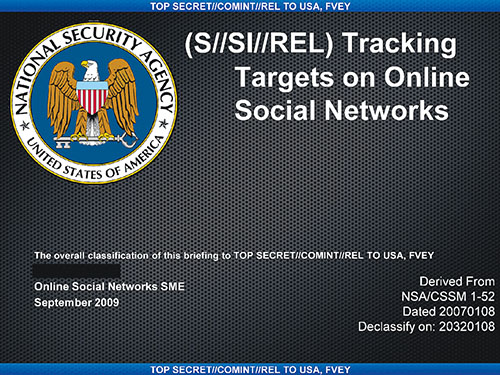
    Screenshot from NSA’s online spy toolkit, part of “XKEYSCORE,” a software program that collects “nearly everything a user does on the Internet,” according to former NSA contractor Edward Snowden who leaked the classified programs in 2013.

    And it’s here that the Leviathan goes underground. Thanks to alleged whistleblowers like Edward Snowden, William Binney and Wikileaks’ ‘Vault7’ revelations, we now have an inkling as to the mind-boggling reputed surveillance capabilities of largely secret (and wholly unaccountable) agencies like the NSA and Great Britain’s GCHQ. Through a plethora of programmes such as PRISM and XKEYSCORE, it would appear that every electronic communication, every photo, every video, every tweet and phone call, is now collected and available for analysis or use (we also know that Google often directly builds and supplies surveillance technology in partnership with the NSA). The standard media apologist or sweaty politician’s justification for this gargantuan dragnet is ‘terrorism’, an excuse so lame that it does not deserve a serious response. Internal Pentagon communications make the actual target perfectly clear – “the domestic population.”

    It’s entertaining to witness unpredictable data-mining upstart Cambridge Analytica crib basic social engineering and election ‘management’ ploys from the NSA/Google playbook – as the organs of controlled media ‘opposition’ like The Guardian look on and meltdown in agonised apoplexy.

    We now have the distinction of being the most surveilled populace in all of history. Every tyrant from ages past spins with electro-static envy.

    Further Pentagon communications also advocate weaponising “armed non-state groups” and the creation of “pseudo-terrorist groups” for the express purpose of manipulating the opinions and emotional “core” of domestic populations – a glib and bland clarion call for permanent war, propaganda and social conditioning of the highest order.

    According to Ahmed’s research, “The Pentagon must also increase its capacity for ‘behavioural modelling and simulation’ to ‘better understand and anticipate the actions of a population’ based on ‘foundation data on populations, human networks, geography, and other economic and social characteristics’.”

    Ongoing projects evaluated how “the psychological reaction to narrated events is ‘influenced by how the narrator frames the events, appealing to different values, knowledge, and experiences of the listener’. Narrative framing that ‘targets the sacred values of the listener, including core personal, nationalistic, and/or religious values, is particularly effective at influencing the listener’s interpretation of narrated events’, because such ‘sacred values’ are closely tied with ‘the psychology of identity, emotion, moral decision making, and social cognition’. By applying sacred framing to even mundane issues, such issues ‘can gain properties of sacred values and result in a strong aversion to using conventional reasoning to interpret them’.”

    One line of research has been dedicated to “extracting narratives from millions of American, Iranian and Chinese weblogs, and subjecting them to automated discourse analysis to compare them quantitatively across the three languages. The investigators then follow up using behavioural experiments with readers/listeners from different cultures to gauge their reaction to different narratives ‘where each story makes an appeal to a sacred value to explain or justify a morally-questionable behaviour of the author’.”

    Surely, only the naive would ask why the Pentagon funds research investigating how to exploit people’s ‘sacred values’ to extinguish their capacity for logical reasoning, and enhance their emotional openness to ‘morally-questionable behaviour’?

    A plot, it appears quite clearly, for ultimate and systemic control. The new ‘mental plantation’ of emotional triggers, bewildered dupes, permanent animalised fear and electronic herd instincts. All in service, it would seem, to the digital overlords and the ‘rape-and-pillage’ economics of globalism.

    Ideas Ripped from Literary Sources?

    It’s possible to see the modern informational and political landscape as inexorably and perversely shaped and even predicted by a triumvirate of influential historic literary sources – H. G. Wells, Aldous Huxley and George Orwell.
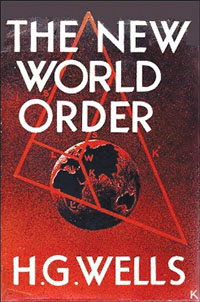
    Though largely known today as ‘merely’ a science-fiction writer (War of the Worlds, The Time Machine etc.), Wells was also a prodigious non-fiction writer, theorist, committed socialist and passionate forward-thinker. An entire sub-set of his writings has almost completely vanished from the popular consciousness: extraordinarily insightful, prophetic and relevant books like The New World Order (1940) and The Open Conspiracy (1928), oddly out-of-print for many decades.
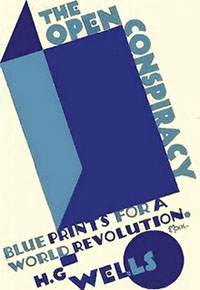
    In those latter two volumes, Wells clearly advocated for the titular ‘New World Order’, arguing that only a one-world government supported by a vigorous, free and open press (in his view) would be strong enough to resist the inevitable and malignant power of transnational corporations and the financial elite. The Open Conspiracy acknowledged that the general population would have great animus toward such a project, without a concerted campaign of mass propaganda and a subterranean scheme to disable nationhood and democracy through secret trade agreements and labyrinthine international treaties. However well-meaning Wells’ original concepts, they have been inverted to secure a global architecture of control into the hands of the very financial elites and transnational corporations that he sought to blunt.

    The most noteworthy political leader to reanimate Wells’ ‘New World Order’ concept and phrase in modern times was US President George Herbert Walker Bush. It’s tempting to see him as some kind of Golem/Homunculus re-combination of ‘Herbert George Wells’ and American imperialist and slaver hero William Walker.

    Note also that this project has advanced in part through the perky mass entertainment distractions of Huxley’s ‘feelies’ and the conditioning of his pan-pharmaceutical, soporific ‘soma’. From Orwell’s nightmare dystopia Nineteen Eight-Four we seem to have inherited the perpetual war state, fuelled by a revisionist propaganda atmosphere, waves of perpetually synchronised ersatz ‘terrorist’ attacks, omniscient surveillance and the obligatory Emmanuel Goldstein/Osama Bin Laden/ISIL crew (direct from central casting). Though these authors wrote cautionary tales, those tales have now been weaponised.

    No matter what their actual provenance, many foundational documents of ‘conspiracy’ folklore are today eerily prescient about decades-long social engineering projects.

    Originally available as a series of three cassette recordings (taped in 1988 and sometimes titled ‘The New Order of Barbarians’), the recollections of Dr. Lawrence Dunegan prove to be haunting and compelling. He described a lecture he ostensibly attended on 20 March 1969 (given by one Dr. Richard Day), wherein a nefarious plan for the complete disablement and infantilisation of civic, democratic society was tabled. Dr. Day invoked a mass campaign of propaganda, brainwashing and social engineering of such scale as to be difficult to comprehend. The vast majority of his outlandish predictions now seem to have come to pass.

    Likewise, an anonymously xeroxed samizdat document ‘Silent Weapons For Quiet Wars’ (most likely authored by the intriguing figure of Hartford Van Dyke) mapped human society in a series of pseudo-scientific diagrams and descriptions, specifying suggested positions for economic and cultural ‘shocks’ to render the body politic paralysed and obedient.

    Despite this apparently omniscient ‘Manhattan Project’ of sinister synthetic bondage, resistance might yet arise in unpredictable places.
    The Rise of the ‘Precariat’

    A recently identified substrata or caste of people, the so-called ‘Precariat’ (a neologism: being the presumed combination of ‘precarious’ and ‘proletariat’), draw their numbers from the collapsing middle-class and tend to be ‘over-educated’ and unable (in today’s ‘flexible’ labour market) to find secure employment suitable to their upscale skill-set. They also tend to be smart, disenchanted, disenfranchised, angry, supposedly ‘irrational’ and liable to be unconvinced by mainstream political orthodoxies. In other words – they don’t think (or vote) the way they are supposed to – and some ‘blame’ them for the shock of Brexit and the election of orange-plated iconoclast Donald Trump. Not ‘racists’, nor ‘homophobes’, nor ‘misogynists’: as globalism savages those excluded from the professional-elite-enabling and media/academic classes, the Precariat can only grow in numbers and seething underground rage. 

    Sir John Glubb was a professional soldier, diplomat, scholar and writer. His little-known 1978 volume The Fate of Empires lucidly charted the rise and fall of numerous empires past. It’s difficult not to see reflections of our own Golden epoch in its pages: as the Anglo-American empire stumbles through the inevitable downward imperial arc (the ‘Age of Affluence’ followed by the final ‘Age of Decadence’) and violently thrashes to stay afloat – grasping at God-like schemes of complete control (or planet-wide annihilation). 

    Both Orwell and Lenin voiced the opinion that humanity’s best hope rested in the hands of an awakened proletariat. Perhaps, if they were alive today, they might shift their allegiances to the Precariat – that educated yet entirely uncomfortable class destined to listless part-time work in unfulfilling service fields (like ‘Uber’) and environmentally inoculated against the prevalent parasitic thought paradigm (and its attendant globally networked, socially engineered zeitgeist).

    The scholars and scientists in service of empire have likely studied Glubb, Wells, Huxley, Orwell and alike: synthesising a delightful, gilded menu of utterly fantastical control mechanisms. History, however, tells us that all empires overreach and collapse inwardly from decadence and hubris. But we stand on a knife-edge. Can these ‘science-fiction’ technologies override the inherent cycles of civilisation? Will these inhuman and autocratic sciences prevail and condemn us to an ahistoric future of permanent soul-slavery? Or will those ‘cast-offs’ – the human detritus discarded by the machines of external and internal conquest – vanguard an unlikely resistance?

    It’s up to you.

    It is better to perish than to live as slaves.
    – Sir Winston Churchill

    [alert type=”general” dismiss=”no”]This article was published in New Dawn 163.[/alert]

    [alert type=”success” dismiss=”no”]If you appreciate this article, please consider subscribing to help maintain this website.[/alert]

    References

    Sir John Glubb, The Fate of Empires, William Blackwood & Sons, Edinburgh, 1978
    H.G. Wells, The New World Order, Secker & Warburg, London, 1940
    H.G. Wells, The Open Conspiracy, Victor Gollancz Ltd., London, 1928
    Aldous Huxley, Brave New World, Chatto & Windus, London, 1932
    George Orwell, Nineteen Eighty-Four, Secker & Warburg, London, 1949
    “How the CIA made Google: Inside the secret network behind mass surveillance, endless war, and Skynet—part 1” by Nafeez Ahmed, https://me
    dium.com/insurge-intelligence/how-the-cia-made-google-e836451a959e
    “How the CIA made Google: Inside the secret network behind mass surveillance, endless war, and Skynet—part 2” by Nafeez Ahmed, https://medium.com/insurge-intelligence/why-google-made-the-nsa-2a80584c9c1
    ‘CIA’s Venture Capital Arm Is Funding Skin Care Products That Collect DNA’ by Lee Fang, https://theintercept.com/2016/04/08/cia-skincare-startup/
    https://wikileaks.org/ciav7p1/index.html

    © New Dawn Magazine and the respective author.
    For our reproduction notice, click here.
  • Western Disorder, China Rising….

    Western Disorder, China Rising….

    From New Dawn 164 (Sept-Oct 2017)

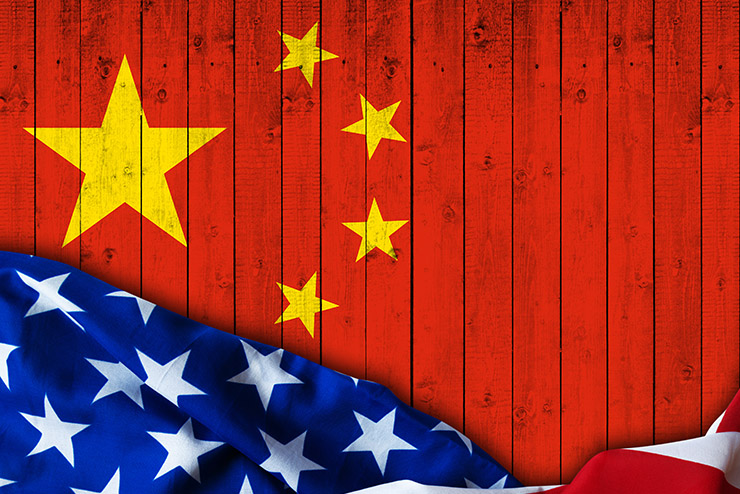
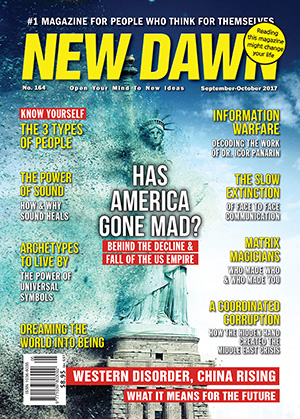
    Are we approaching the end of the English speaking world order? asks former Australian diplomat Reg Little  (1936-2019). This article, published in 2017, explains the reasons for the current state of affairs and the decline of the so-called “West.”

    Western decline is explored on a daily basis by anyone surfing a variety of websites addressing subjects like international finance, global geopolitics, advances in the China Russia partnership, troubles in any of America’s small wars, or technology advances in areas like quantum computing and hyper-sonic missiles. 

    Even a Pentagon study, “At Our Own Peril: DoD Risk Assessment in a Post-Primacy World,” which appeared in June 2017, explored aspects of the situation. This highlighted the problem as it was part of an effort to further raise the ineffective military spending that has already been a major contributor to US decline. In fact, the study provided evidence of a sense of desperation. Normally, Western political leaders and their mainstream media do their best to render any interest in such matters as evidence of folly and misguided loyalties.

    One sentence, randomly encountered in a daily commentary on precious metals, captures much of the widespread sentiment amongst informed observers: Watching America’s “leadership” destroy itself; aided and abetted by a vicious, yet self-immolating mainstream media that has, for all intents and purposes, been re-branded the “fake news,” it’s difficult to have hope for the future.

    As America has declined, China has become the world’s largest economy in real terms, the largest trading partner for most nations, the repository of the world’s largest financial reserves, the unrivalled leader in maintaining substantial rapid economic growth, and the pace-setter in critical technology innovation. It is also the leading global strategist, through its use of the Belt and Road initiative (BRI) to restructure the global trading community. This has the potential to marginalise recalcitrant English speaking, maritime nations accustomed to global authority.

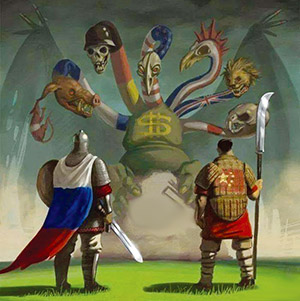
    Russia, despite inherent differences with its neighbour, has been thrust into a close partnership with China by clumsy and counter-productive Western policies. This has strengthened China’s economic and political position through facilitating access to energy, nurturing an unrivalled defence and technology partnership, and providing an unchallengeable foundation for the BRI, reaching across Eurasia, into Africa, and even commanding attention across vast oceans.

    In the past, native speakers of the English language have been privileged in a variety of ways to be at the forefront of unprecedented intellectual, political, economic and technological initiatives for more than three hundred years. These built first a global empire and then aspired to construct a new world order, only today to confront an End of Empire moment. 

    The challenge posed by the BRI and highlighted by a Beijing meeting, hosted by China’s President Xi Jinping in May 2017, is very poorly appreciated. Its vision of new-tech infrastructure spanning and uniting Eurasia, Africa and beyond represents a fundamental conceptual transformation of the international trading and cultural order. China is at the strategic centre, in terms of infrastructure capacity, financial organisation and technological vision.

    The BRI will create many newly empowered multi-lingual and multi-cultural trading communities where the authority of the English language and its associated ways and values will be a fading memory. High-speed rail networks, massive ports and a variety of free trade zones will marginalise the English speaking, maritime people who have shaped the past three centuries, unless they integrate fully. 

    End of Empire periods are characterised by a major dilemma. Loyalty demands a commitment to the values and actions that have defined the past and the construction of empire. Strategic response and action, in contrast, demands a fundamental re-evaluation of those past values and actions and a readiness to anticipate and manage often unattractive imperatives. As relationships evolve and shift, this is a troubled and confused process. Previously privileged groups find themselves struggling internally to defend accustomed, but fading, powers and privileges.

    While the above historical phenomena seems universal, it is best and most copiously recorded in one part of the world. China has extensive written histories, and more recently diverse television series, exploring and evaluating human behaviour in the course of successive rises and falls of dynasties. These offer many insights into the confusing and chaotic trials being experienced in the English speaking world today. The complacent certainties of Manchu aristocrats at the end of the 19th century can seem to foreshadow similar qualities in Wall Street bankers in the early 21st century. In both instances, the comforts and certainties of the recent past inhibit the development of any coherent strategies to manage the challenges of the present and future.

    Competing English & Chinese Strategic Wit 

    Unfortunately, in today’s English speaking world there is neither a similar body of historical experience nor any form of comparable historical record. This allows the Chinese leadership class to oversee Western decline with both passive inaction and superior understanding. 

    A Western leadership class educated in Chinese classics and history might have remarked that its problems began over seven decades ago. At that time, a conquered and occupied Japan resorted in a highly disciplined manner to utilising a strategy that could be traced back at least as far as the Zhou Dynasty three millennia ago. The Twelve Civil Offensives of the Six Secret Teachings attributed to Jiang Taigong, the major strategist in the founding of the Dynasty, outline a means of conquest through service. A more powerful adversary is made first dependent, then vulnerable, through immaculate service.

    Despite a type of Western counter attack against the Asian Economic Miracle with the 1997 Asian Financial Crisis, China and other Asian peoples have been able to continue emulating Japan’s post-1945 example. Even so, no relevant Western leader has remarked on, let alone responded strategically to, this type of disciplined dexterity that turns weakness into strength, when confronted with a more powerful adversary.

    This example is but one of many that illustrate the contemporary failings of the English speaking peoples. A mythology has been created around their leadership role in creating a culture of progress. This works to render the past irrelevant and eliminate the need to study the historical experience and wisdom of other peoples. The British historian John Hobson in The Eastern Origins of Western Civilization identified a British practice of “intellectual apartheid,” which mocked and looked down on people who did not share the progressive values of the European Enlightenment.

    The folly of this Western culture of progress also elevates a type of financial power and corporate calculation to a form of supreme authority. This is displayed in a major form of criticism levelled against the BRI. This argues that it is difficult to see how many of the projects can produce an acceptable return on capital but neglects to note:

    • China’s need to find new markets to replace uncertain, and often declining, Western markets
    • China’s need to address economic instability amongst people on its Western borders
    • China’s rewards from economic dynamism in its Western regions
    • China’s already advanced strategy of becoming the global infrastructure standard setter
    • China’s use of BRI as a productive outlet for its reserves of fragile US dollars 
    • China’s use of BRI to defuse attempts to pressure it geopolitically
    • China’s use of BRI to consolidate its important relationship with Russia and other neighbours
    • China’s use of BRI to bond with surrounding and distant regions
    • China’s use of BRI to assume a central and leading position in global geopolitics 
    • China’s use of BRI to reduce the power and influence of an often hostile English speaking world 
    • The neglect, deliberately or otherwise, of these issues by most English language commentators reflects a variety of deep-seated Western vulnerabilities, including:
    • Chinese strategic thought and action frequently escape Western recognition
    • Chinese strategic action is almost impossible to comprehend using Western corporate values and priorities
    • Chinese strategic action exploits a deep mastery of Western thought 
    • Chinese strategic action can be based on Western ignorance of Chinese thought
    • Chinese remember and Westerners forget a century of Chinese humiliation
    • Chinese easily master the financial and corporate stereotypes that dictate Western thought
    • Chinese classical and historical wisdom has an infinite variety 
    • Chinese language limits severely Western understanding
    • Chinese strategists can count on the untranslatable character of much of their wisdom

    Interestingly, a book has just appeared with the title Cracking the China Conundrum: Why Conventional Economic Wisdom Is Wrong.

    A Problem for Imperial Legacies 

    Peoples such as those in what might be termed legacies of empire, like Australia, confront unique challenges during end of empire times. The centres of empire do not want to surrender accustomed privileges, even in distant parts of the world. The outposts of empire are also accustomed to various privileges, even if they are in decline, and can be loath to take the initiative in preparing for a future that promises less favours. Even worse, many habits of thought and behaviour are the product of empire and people have little idea of other possibilities even as these assume a powerful role in distant places. In this situation past habits and practices can continue to rule even when they no longer serve their intended purFor example, people in a country like Australia can continue to believe in the superiority of American and English education, commerce and technology even as evidence mounts that global best practice standards are being set in Japan or China. These sentimental and customary attachments become most difficult to abandon when such an adjustment demands the mastery of a difficult language, an alien way of thinking and challenging forms of community coherence. A review of the Australian Cabinet reveals not one person with any education, experience or interest of significance in a major Asian language, culture or economy.

    Not surprisingly, such a leadership community looks constantly to declining centres of empire far from Australia for guidance on how to respond to unfamiliar challenges. Alternatively, it takes guidance from those educated to the standards and habits of thought of those declining centres of empire. These authoritative figures produce guidelines for policy makers with erudite think pieces with headlines in English like “Saving the Global Economic System.” A more appropriate theme would be “The Challenges of Prospering in an Unfamiliar Global Economic System.” 

    In reality, the English language has become a thought prison for most. They cannot begin to think from the perspective of an emerging Chinese global economic system. Of course, this is no simple matter. 

    Once out of the education system, few career focused individuals can afford to venture into such a challenging and alien environment. Those who might decide that this cannot be avoided are unlikely to progress far. It will simply be too hard to build a community of like educated and like-minded allies to exercise any influence on the mainstream, to advance a professional career or become more than an irritating critic on the sidelines.

    In fact, three decades, from early childhood rote learning of the classics to professional relevance, would be needed to educate a generation of China literate professionals. As a consequence, most of the English speaking world will become ever more dependent on ethnic Chinese native speakers to assume leadership roles in a bewildering environment, best understood from Beijing. This is easily foreseeable and predictable today. This assertion, however, will be bitterly, if ineptly, contested in the English speaking world.

    Inevitable economic difficulties and budget funding shortages are already pervasive. These will become increasingly acute, as English language leaders continue to neglect the development of a greater capacity to comprehend the character of Chinese thought culture. 

    This is transforming the world first constructed by the Honorable English East India Company, under the guidance of its discreet, strategic and knowledgeable financiers. Unfortunately, few English speaking political leaders comprehend in any depth either the financial strategists who have shaped the fading global order or the Chinese strategists who are creating a dynamic new global order. 

    Today the West’s financial strategists not only support a succession of self-defeating wars but continue to neglect the importance of effective industrial policy and infrastructure maintenance. American infrastructure is in an advanced stage of neglect and disintegration. The Australian Treasurer has just announced plans to spend $10 billion over the next decade on an inland rail upgrade. But this may symbolise Australia’s increasing backwardness in rail efficiency. On completion, it could lag Chinese standards by more than several decades. At a time of imperial decline, the cost of being a legacy of empire takes many forms.

    The British Imperial Legacy

    Australia, being placed geopolitically and geocommercially in close proximity to, if not as part of, the dynamic Asian region, offers perhaps the most acute study of the dilemmas posed by the legacy of the British empire. Its present government in Canberra displays no evidence of any serious understanding of BRI or other Chinese and Asian dynamics. 

    It is difficult to avoid the impression that its Ministers are more guided by influences from a fading imperial past than by any understanding of Australia’s geopolitical and geocommercial realities. The nation’s leaders seem restricted to developing policy shaped by ‘information’ from the Murdoch and Fairfax media, which rarely strays from the orthodoxies of mainstream New York media and its financial masters. 

    In a sense, Australia’s present leadership seems too indolent to explore information from alternative sources or from insights and evaluations shaped by other traditions of thought culture. In many respects, and despite Australia’s geocommercial Asian dependence, Australia’s leaders seem to be little more than modelled on global English language stereotypes. As such they are captives of the disorder that is the contemporary legacy of an English speaking empire or world order.

    After some of their predecessors tried but failed to give substance to rhetoric about an Australian Asian future, the present generation of leaders seem resigned to leaving the future to others who will come later. They seem content to limit themselves to managing domestic disappointments as the economy is unnecessarily marginalised in a global order offering fewer and fewer privileges to English speaking peoples. Democratic processes perform poorly in this environment as Ministers mostly come to power with little relevant education or experience and leave power before the consequences of their failings become evident. English language limitations and conventions ensure a minimum of informed criticism of this process, as the maintenance of the mythology of democracy takes priority. 

    In Australia’s case there is a faint but unnerving echo of the innocence of the Aboriginal people before the arrival of European settlers. Mono-cultural Australian leaders today have little more real understanding of their neighbouring Asian civilisations than earlier settlers had of European civilisation several centuries ago. Yet the imperial certainties that created today’s Australia are now under challenge.

    [alert type=”general” dismiss=”no”]This article was published in New Dawn 164.[/alert]

    [alert type=”success” dismiss=”no”]If you appreciate this article, please consider subscribing to help maintain this website.[/alert]

    © New Dawn Magazine and the respective author.
    For our reproduction notice, click here.
  • The Philosopher Tsar: Vladimir Putin’s Favourite Thinkers

    The Philosopher Tsar: Vladimir Putin’s Favourite Thinkers

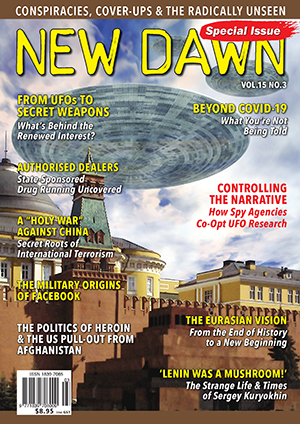
    From New Dawn Special Issue Vol 15 No 3 (June 2021)

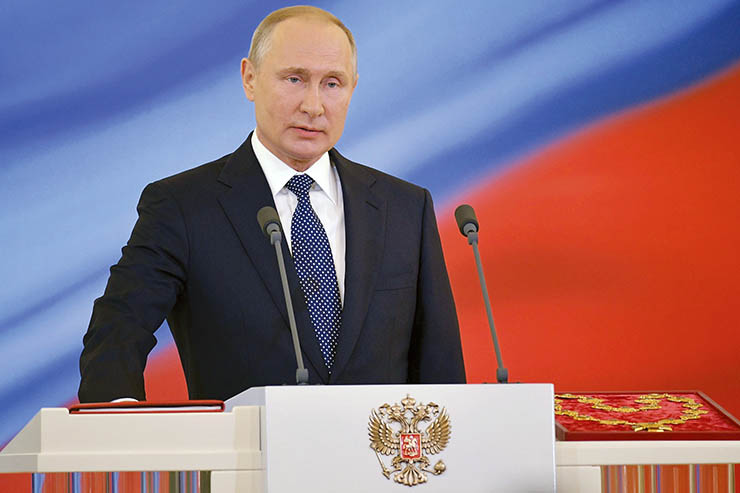
    In 2014, at the annual meeting of United Russia, the Russian Federation’s dominant political party, amidst the standard rhetoric of party politics, Russian President Vladimir Putin gave his regional governors a list of books he said they should read. 

    Putin likes to come across as a reader – Dostoyevsky is a favourite writer of his – and he isn’t averse to name dropping some classics in the middle of an interview. But the list he gave to his governors at that meeting didn’t include Crime and Punishment, War and Peace, or Dead Souls, to mention just a few of the contributions to world literature that Mother Russia has made, by way of Dostoyevsky, Tolstoy, and Gogol. 

    The names that drew attention from political commentators in the West wouldn’t be easy to find on Kindle or in an airport bookstall on your way to Vladivostok, Irkutsk, or wherever your regional office might be. They were names of philosophers, individuals who, traditionally, are not known for producing page-turners. 

    Putin wanted his governors to become familiar with them because the Russia he saw on the horizon would be informed with the spirit of their thought. 

    A lot has happened since that meeting in both Russia and the world. Among other things, the United States had some new presidents. Putin, of course, has remained in power, seemingly as fixed in place as the tsars of old. 

    No doubt Joe Biden has advisers guiding him on how best to establish a new relationship with Russia. But if he finds himself with time to kill en route to wherever his proposed summit with the Russian leader might be, he might up his game a bit by skimming through the weighty volumes that Putin assigned to his governors.

    The three thinkers that Putin suggested the governors should read were Vladimir Solovyov (1853–1900), a friend of Dostoyevsky and, according to the late American Russian scholar James Scanlan, the greatest and most influential of Russian philosophers; Nikolai Berdyaev (1874–1948), an aristocratic, fiercely independent thinker who combined a passionate religious temperament with an existential commitment to freedom; and Ivan Ilyin (1883–1954), a much more political thinker than Solovyov and Berdyaev. 

    All three were part of a remarkable period in Russia’s cultural history known as the Silver Age, a time of deep spiritual and mystical experiment and excitement aborted by the rise of the Bolsheviks. 

    In recent years, Putin has looked back to this time in an attempt to revive the character of “Holy Russia” as a way of resolving the identity crisis Russia has struggled with since the collapse of the Soviet Union. For some critics in the West, the philosophers Putin namechecked were simply examples of a kind of “mystical exceptionalism,” a reheating of nineteenth-century ideas about Russia’s “messianic role in world history.”1

    Whatever Putin’s real aims in namedropping these thinkers may be – and of course he is a cagey politician before anything else and has his own purposes in mind – they deserve to be read. If nothing else, if Biden did read them, he might get an angle on Tsar Vladimir that might otherwise escape him.

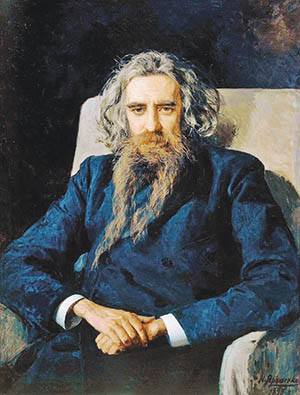
    Vladimir Solovyov

    Portrait of Vladimir Solovyov by Nikolai Yaroshenko, 1892.

    Solovyov’s The Justification of the Good, for example, which is on Putin’s list, is a long, detailed, eminently logical and rigorously rational argument for the supreme value of the “good in-itself,” the Good in a Platonic sense, that is. 

    Since the eighteenth century, the West has seen the “good” in a purely utilitarian sense, a “practical” good, one that can be seen and measured in material things: a new car, a new computer, a holiday in the tropics. Or it sees the good in terms of the consequences of some action. Hence the notions of “the greatest good for the greatest number” and “the ends justify the means,” formulas that historically have had disastrous results. 

    This idea of a measurable good is at the root of Western consumerism, as well as that of the various socialist alternatives to it; both see the good in terms of higher living standards, more and better things. 

    While it is undeniably good that all should be fed, clothed, and housed decently – a belief Solovyov, who gave away what money he had, put into practice – a society that defines the good in this way forgets the truth of the Gospel: that man does not live by bread alone. 

    Solovyov saw that the dominance of rationalism in the West had eclipsed the perception of the spiritual dimension of life, an argument he made in his first major work, The Crisis of Western Philosophy. The series of lectures he gave on the “God-Man,” the path of theosis, our evolution into a higher, more spiritual consciousness, were attended by Tolstoy and Dostoyevsky and influenced both. Russia, he believed, could be the birthplace of such a consciousness, and his ideas informed the Silver Age. He died in 1900.

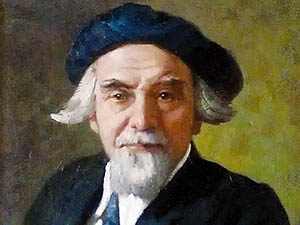
    Nikolai Berdyaev 

    Nikolai Berdyaev 

    Nikolai Berdyaev was one of the many Russian thinkers, poets, critics and other members of the intelligentsia who in 1922 were aboard the “philosophy steamers” that carried them out of their homeland and into exile in the West, courtesy of Comrade Lenin. 

    A devout if eccentric Christian, Berdyaev started out as a Marxist but after reading Solovyov rejected Marx’s materialism. He became a radical religious existentialist, obsessed we can say with the idea of freedom. His early work, The Philosophy of Inequality, another on Putin’s reading list, was a response to the enforced egalitarianism of the Revolution. 

    He argued that the intelligentsia’s passion for the “people” and the “proletariat” had become little more than idolatry. Truth in itself, like Solovyov’s good in itself, had fallen away, and only those truths that were helpful to the Revolution were embraced. (Is there a parallel with our own times, perhaps?) But without real truth, existential truth, human beings fall prey to the forces of materialism and become little more than the property of the state or the market. 

    Berdyaev continued his philosophical struggle for freedom from Berlin and then Paris, writing book after book, with titles like The Destiny of Man, Slavery and Freedom, and Spirit and Reality, his remarkable autobiography, until his death in 1948.

    Ivan Ilyin 

    Portrait of Ivan Ilyin by Mikhail Nesterov, 1921. 

    Ivan Ilyin started out as a political idealist, believing that if people could grasp what he called “legal consciousness,” a kind of intuition of the need of rule of law, government would not be necessary, as we could govern ourselves. This naivety received a buffeting with the 1905 Revolution, and Ilyin’s views changed radically. 

    From a kind of spiritual anarchist, he became the advocate of the need for a small group of dedicated men who had achieved “legal consciousness” to guide the vast majority who hadn’t. This was rather the same view as Lenin, except that his small band of dedicated revolutionaries would usher in the new, classless, godless society. 

    Ilyin’s view was much more that of Dostoyevsky’s Grand Inquisitor in The Brothers Karamazov, who argues that men do not want freedom but bread and that the church, which rules the state, must shoulder the burden of their freedom for them. Like Berdyaev, Ilyin was shipped out of Russia on the “philosophy steamers,” and until his death in 1954, he was a voice of opposition to the Soviets. 

    Our Tasks is a collection of Ilyin’s writings that Putin put on his list. One essay, “What the Dismemberment of Russia Means for the World,” written in the 1950s, spells out in eerily prescient detail what will happen to Russia with the collapse of communism and the introduction of Western democracy and the free market. In the chaos that would follow what he called “the Balkanization of Russia” – and which actually did happen – Ilyin predicted that a strong man would arise, who would re-establish order and control and reunite the nation… No wonder that of the three, Ilyin’s name turns up the most in Putin’s speeches.

    Of course, here I can only suggest why readers might want to take a look at Putin’s philosophers. They all warrant attention; Solovyov and Berdyaev for their own sake; Ilyin, I would say, to get an idea of what’s on the Russian President’s mind. 

    For more on this subject, read Gary Lachman’s book The Return of Holy Russia, which covers Vladimir Putin, the Silver Age, Solovyov, Berdyaev, Ilyin and the other remarkable figures making up Russia’s tumultuous spiritual history.

    Footnote

    1. www.nytimes.com/2014/03/04/opinion/brooks-putin-cant-stop.html

    [alert type=”general” dismiss=”no”]This article was published in New Dawn Special Issue Vol 15 No 3.[/alert]

    [alert type=”success” dismiss=”no”]If you appreciate this article, please consider subscribing to help maintain this website.[/alert]

    © New Dawn Magazine and the respective author.
    For our reproduction notice, click here.
  • Culling the Herd: Eugenics, Depopulation & the Extermination of Lower Classes

    Culling the Herd: Eugenics, Depopulation & the Extermination of Lower Classes

    From New Dawn 182 (Sept-Oct 2020)

    Eugenics is an attempt to produce genetically desirable children and to terminate the lives of those considered to be genetically inferior. Elements of eugenics exist everywhere. For example, when given the choice, people produce children with partners whom they find attractive. Part of them hopes that those attractive qualities will manifest in the offspring. A more extreme form is infanticide: killing children usually because of physical or mental deformity; a practice as old as humanity.1 In Ancient Greece, Plato and Socrates (c. 470-399 BCE) suggested ways of breeding to promote the superior traits of the elite, as sickly infants were deliberately left to die of exposure.2

    Today, there is a sensible and ethical side of what is often called eugenics. Examples include disabled children having operations to save their lives and individuals with learning difficulties asking for sterilisation because they can’t manage contraception and don’t want children. But institutions like the state, prisons, and medical facilities, as well as privileged elites, use eugenics as a way of trying to exterminate the elements of society whom they consider to be a burden. What started out as selective breeding and infanticide has today developed into forced sterilisation and genetic editing to produce “designer babies.” This thinking also informs certain depopulation agendas.

    ORIGINS OF THE THEORY

    In 1866 in Imperial Russia, the obstetrician Vasilii Florinskii authored a book advocating for scientific methods to improve human traits. Given the poverty of Russia at the time, there were no medical facilities to realise Florinskii’s ideas.3 Russia would not endure a eugenics programme until the Bolsheviks seized power in 1917. In Germany, the term “racial hygiene” (Rassenhygiene) was coined in 1895 by the biologist Dr Alfred Ploetz (1860-1940). The notion later informed Nazi thinking on eugenics. 

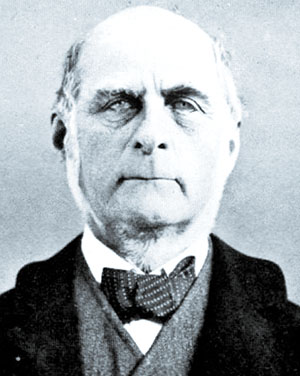
    British biologist Sir Francis Galton coined the term eugenics.

    The British biologist Sir Francis Galton (1822-1911) coined the term eugenics (meaning of good birth) and described it as “the science of improving inherited stock, not only by judicious matings, but by all the influences which give more suitable strains a better chance.”4 Galton was inspired by his cousin, Charles Darwin (1809-82), who was cautious about eugenics. The influential book An Essay on the Principle of Population (1798) written by the economist, Thomas Malthus (1766-1834), also influenced Galton. In it, Malthus argued that unlimited population growth was unsustainable. More inspiration came from Herbert Spencer (1820-1903), the sociologist who coined the term “survival of the fittest.”5 In 1907, Galton established the University of London’s Eugenics Laboratory. 

    In Germany, Wilhelm Schallmayer (1857-1919) authored popular books concerning selective breeding among elites to further “civilisation.”6 Just as US eugenicist groups were sponsored by corporate foundations, Schallmayer was promoted by Krupp, the German industrial giant. Most early feminists opposed abortion, so eugenics was, in many ways, a proxy for abortion. In the 1900s, Germany’s Bund für Mutterschutz (Organisation for Maternal Protection) saw feminists and socialists advocate for eugenics in an effort to own their bodies and gain credence in the male-dominated science milieu. The BfM was established by Elisabeth Bouness (Ruth Bré, 1862-1911), who fostered support groups for single, unwed mothers. Other, more right-wing eugenicists like Agnes Bluhm (1862-1943), dismissed the BfM’s utopianism. Men, conversely, tended to see eugenics as an opportunity to further their control over female bodies. 

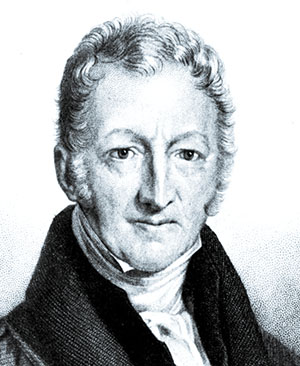
    English economist and demographer Thomas Malthus, best known for his theory that population growth will always tend to outrun the food supply (hence the term Malthusian).

    Inspired by Malthus, the British Eugenics Education Society was founded in 1907 by Sybil Gotto (1885-1955) and headed by Galton. Forty-percent of its members were women. For many feminists, male dominant sexuality produced “maimed, diseased, unwanted babies.” Dora Marsden (1882-1960), editor of Freewoman, opposed the Eugenics Education Society (EES) as “a conspiracy against the poor.” The Swedish feminist Ellen Key (1849-1926) explained that society should protect all “except that which gives occasion to a weak offspring and produces bad conditions for the development of that offspring.”7

    Eugenicists relied on biology to try to define superior and inferior characteristics. They utilised statistics to try to prove that the lowest classes of people were outbreeding the highest. EES members like the mathematician and later Ministry of Food statistician, David Heron (1881-1969), explained that: “higher net fertility is shewn… to be very markedly correlated with the most undesirable social factors (sic).” We now know that poverty can cause serious cognitive problems in developing brains. At the time, poverty-related impaired cognitive function – then called “feeble mindedness” – was falsely attributed to genetics. A 1912 report by the Committee to Consider the Eugenic Aspect of Poor Law Reform refers to the “feeble-minded” – who could not work and were of negative value to the capitalist class – as “the chief burden on the public purse,” as they required health and social care; both of which were still in their infancy. British eugenicists failed in their lobby to legalise for forced sterilisation,8 passing instead the Mental Deficiency Act 1913, which sought to institutionalise people with particular needs. Many British female eugenicists opposed the Act because it primarily targeted single mothers.9 

    The British economist John Maynard Keynes (1883-1946) is credited with influential theories concerning state-planning over national economies. Keynes believed that law and other coercive measures could be imposed on population abroad to improve their living standards by reducing their overall numbers. In 1914, for instance, he wrote: “In many, if not in most, parts of the world there actually exists at the present time a denser population than is compatible with a high level of economic wellbeing.”10 

    FROM BRITAIN TO THE USA

    According to some scholars, 19th-century pedigree animal breeding inspired US eugenics, with the American Breeders Association splintering to form the eugenics movement.11 By the 1910s, US states, particularly in the south, hosted “Better Babies” competitions, in which the mental and physical characteristics of infants were measured and tabulated by eugenicists.12 Writing for American Breeders Magazine in 1910, C.B. Davenport (1866-1944), director of the Cold Spring Harbor Station for Experimental Study of Evolution, argued that “society must protect itself” from the so-called feeble-minded by “segregation” or even sterilisation. American eugenicists established the Carnegie-funded Eugenics Record Office.13 

    American birth control activist Margaret Sanger was recently targeted by activists over her ties to eugenics and racism.

    The US socialist, feminist, and birth control advocate, Margaret Sanger (1879-1966), opened America’s first birth control clinic in New York in 1916. Sanger also helped to create the organisation Planned Parenthood. But these progressive steps masked another agenda.14 Sanger was a strong advocate for eugenics, even speaking about the subject at a Ku Klux Klan meeting to white supremacists, who had an interest in wiping out the Black population.15 In 1924, the psychologist and feminist, Leta Hollingworth (1886-1939), explained that “the very intelligent are those who rise in the world of competition, and who are also able to produce children like themselves.” Sponsored by eugenics societies, “Fitter Families” competitions awarded medals, inscribed with: “Yea, I have a goodly heritage.”16

    In the US, eugenicists were behind the Immigration Act 1924 which limited the entering into the US of foreign paupers whom the establishment considered genetically inferior.17 In 1927, US Justice Oliver Wendell Holmes affirmed the constitutionality of forced sterilisation when he decreed in the case of Carrie Buck (who was erroneously thought to have had learning difficulties) vs. John Hendren Bell (a eugenicist): “three generations of imbeciles are enough.” (Buck’s mother had also been misdiagnosed with mental disorders.)18 After Buck v. Bell, a dozen US states felt empowered to enact sterilisation laws against the institutionalised.19

    By the mid-1930s, eugenicists recognised their failure to turn their theory and practice into a science. But there was no clear demarcation and eugenicist ideas developed as “reform eugenics.” The majority of eugenics sterilisation in the US was conducted between 1930 and 1960.20 Into the 1970s, federally-funded US medical facilities continued to quietly perform forced sterilisation, usually on Black women; the most high-profile case being that of Minnie and Mary Relf, aged 12 and 14. Other cases included the sterilisation of Mexican migrant women by Californian obstetricians.21 In 1975, the federally-funded Indian Health Service sterilised 25,000 Indigenous women.22

    As part of its population-reducing, one-child policies, between 1971 and 2013, Chinese state and local authorities forced 200 million sterilisations and over 330 million abortions on lower-class women, offering wealthier families the chance to offset their breeding by paying “social compensation” fees. As part of India’s so-called Emergency, declared in 1975 in response to population booms, India began the forcible sterilisation of 10 million people by 1977. Later, allegedly softer measures were imposed, such as financial incentives for poor families to undergo sterilisation: 90 percent of the victims were women and included 4.6 million people in the year 2012 alone. In the poorest state, Bihar, 13,000 medical camps were established to sterilise 650,000 women.

    GIVING EUGENICS A BAD NAME

    In 1920, the German jurist Karl Binding (1841-1920) and the psychiatrist Alfred Hoche (1865-1943) co-authored the book, Permitting the Destruction of Life Unworthy of Living (Die Freigabe der Vernichtung Lebensunwertes Lebens), in which they gave legal and medical justifications for murder as mercy killing (euthanasia). Their text cites eugenics and social Darwinism. Rejected by most physicians at the time, the Binding-Hoche thesis informed Nazi eugenics policy.23 

    Between the mid-1920s and the close of the Second World War, 60,000 Americans were forcibly sterilised. After the Nazis gave eugenics a bad name, US sterilisation typically occurred behind closed doors in institutions.24

    In 1930s Germany, conditions including epilepsy, manic-depression, and schizophrenia were attributed solely to Mendelian regressive genes.25 When the Nazis came to power in 1933, they legislated to have physicians send patients with particular needs, including physical and mental, to sterilisation courts where judges, panels, witnesses, and medical professionals would decide their reproductive fate.26 The Nazis promoted Lebensborn (Fount of Life) to increase the birth-rate of “Aryan” children.27 At least 350,000 Germans were forcibly sterilised by the Nazis up to 1945. Because sterilisation was legal in many US states, the Nazis were not tried at Nuremberg for eugenics.28 

    By the mid-1930s, more than half of Germany’s physicians had joined the Nazi Party, seeing themselves as “biological soldiers” in the war against racial impurity. “Defective” German children were left to die of starvation and exposure in unheated wards. Others were poisoned with cyanide. Nazi Germany’s forced sterilisation law was also imposed on the countries it occupied, including Austria and Norway. The mass murder of “unfit” adults was usually conducted by morphine injections and the issuance of fake death certificates. By 1939, over 200,000 people had been murdered in the T4 eugenics programme.29

    EUGENICS & DEPOPULATION

    One of the more unusual chapters in the history of the eugenics-depopulation agenda pushed by some elites concerns the Georgia Guidestones. Elberton, Georgia, is known as the granite capital of the world.30 In 1979, one Robert C. Christian (pseudonym) commissioned Joe H. Fendley (c. 1935-2005), President of the Elberton Granite Finishing Company, to construct the five, capped slabs of the 19-feet-high monument to “The Age of Reason.” The Guidestones’ inscribed “ten commandments” include depopulation and eugenics: “Maintain humanity under 500,000,000 in perpetual balance with nature. Guide reproduction wisely improving fitness and diversity.” 

    We’ve seen how the elites feared being outbred by the riffraff. This theme continued into the late-1960s, with fears that third world populations were breeding out of control and threatening the resources of the privileged. Many of the theories were presented as humanitarian, that the poor hadn’t enough food and space to live worthwhile lives. This was popularised by the biologist, Paul Ehrlich (born 1932), whose book The Population Bomb (1968) presented an internationalist argument for population control through education, contraception, and financial inducements. Under cover of philanthropy, the book pushed an environmental agenda. Notably absent from the book is a critique of capitalism, which observes that children starve because poor countries export food to rich markets, that big industry poisons children as a consequence of profit-seeking, and health systems are often privatised. 

    Founded in the same year as Ehrlich’s book, the Club of Rome was set up by Aurelio Peccei and Alexander King. Its book The Limits to Growth (1972, Universe Books) made much the same arguments as Ehrlich. In 1988, the Club of Rome welcomed a speech by Britain’s Prince Philip (born 1921). In the same year, the noble Prince told German media: “In the event that I am reincarnated, I would like to return as a deadly virus, to contribute something to solving overpopulation,”31 and in doing so exposed the antihuman thread that underlies some of the environmental movement. Infamously, another Club of Rome endeavour, The First Global Revolution (1991), argued that humans need a common enemy. Where states and religious minorities fail to act as that enemy, “the new enemy” would be “humanity itself.” Of course, the Club of Rome’s limited budget was no match for the oil industry, which swamped public opinion with climate change denial propaganda, so their agenda largely failed. 

    Climate change deniers attacked sustainability initiatives such as the United Nations Conference on Environment and Development’s document, Agenda 21, a nonbinding, failed roadmap towards sustainability.32 In fairness to those who see conspiracy, the UN Environment Programme’s co-founder and energy businessman, Maurice Strong (1929-2015), told the Earth Summit 1992: “We are now a species out of control. Our very success is leading us to a dangerous future… [O]verall, this [population] growth cannot continue… Population must be stabilised.”33

    The global corporate system has extracted material wealth from the third world, including food and minerals. In doing so, it has facilitated third world overpopulation (China pop. 1.4bn, India 1.3bn), because poor people tend to have more children than middle-class people due to factors including lack of sex education, the unavailability of contraception, religious indoctrination, male domination, and efforts to increase the likelihood of offspring survival by bearing large numbers of children. 

    In richer countries, like those of North America, Europe, and Australasia, fertility has declined drastically. The wealth that is sucked out of the third world causes socioeconomic changes in the West, where people have affluence in the form of smartphones and packaged holidays but no real wealth in terms of affordable housing or savings. This makes it difficult to raise families. It takes two people to make a baby. That means if the fertility rate is two children per female in her lifetime, global population will not significantly fall or rise above its present rate. Globally, the average number of children per female was 4.7 in 1950, hence the rapid growth of the world’s population. But by 2017, it was 2.4. Across Western Europe, it is 1.7, meaning that Europe is in demographic decline.34

    Unlike the ideologies of the recent past, like those of the Club of Rome, today’s depopulation agenda has coupled with big oil. The Michael Moore production, Planet of the Humans (2020), uses outdated and often false information about renewable energy to attack the green movement (big oil agenda) while simultaneously interviewing privileged middle-aged-to-elderly white males about how people of colour in poor countries are killing the planet (Club of Rome-type agenda). The filmmakers’ solution to overconsumption is depopulation. 

    EUGENICS TODAY

    Today, genetic screening and gene editing have the potential to realise the dreams of eugenicists. Part of their agenda is to own life, while the agenda of the corporations to which some of them ally is purely to make money. This can be done, in part, via patenting genes: the building blocks of life.

    The patenting of life began in 1971. Dr Ananda Chakrabarty (1938-2020) of the giant corporation, General Electric, applied to the US Patent and Trademark Office (PTO) to register a genetically-modified organism (GMO), which he’d engineered to eat oil spills. The PTO rejected the application on the grounds that living things are not patentable. Chakrabarty appealed to the Court of Customs and Patent Appeals, whose judges voted in his favour. The decision allowed anything but a “complete” human being to be patented. Since then, the race to patent every gene and combination means that corporations and entrepreneurs own 20 percent of the human genome via 40,000 patents.35 In 1984, after one John Moore (1945-2001) attended the University of California-Los Angeles for cancer treatment, the University together with the Sandoz Pharmaceutical Corp. obtained and patented his spleen cells (making $3 billion in the process), without Moore’s knowledge or consent. In 1990, the Supreme Court of California ruled that Moore had no rights over his cells. By 2003, 127,000 patent applications were filed for human genes and sequences.36

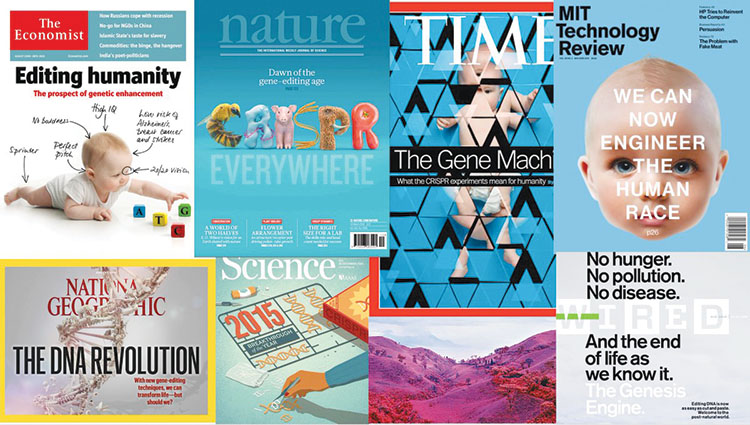
    What is called “consumer eugenics” is already prevalent in many countries and future possibilities widely discussed in magazines in recent years. Through preimplantation genetic diagnosis, physicians routinely test embryos for hundreds of genes. Parents can select embryos with certain genes to avoid particular diseases – or to pick the sex of their future child.

    In 1998, the geneticist Dr David J. Galton, a relative of Sir Francis, wrote not of the immorality of eugenics but of the need for better regulation: “To prevent such abuses in the future statutory bodies, such as a genetics commission, should be established to provide guidance and rules of conduct.”37 In 2003, the geneticist Charles Epstein wrote: “modern human genetics and medical genetics… are eugenic – if not a literal return to the eugenics of the past, at least a reincarnation of that eugenics in a new guise.”38 Between 2005 and 2016, dozens of female prisoners were sterilised in California without their informed consent.39 Historian Daniel J. Kevles says that humanity “now possesses tools to reshape its own hereditary capacities, perhaps even to realise the dream of eugenicists that human beings might take charge of their own evolution.”40

    Today, dozens of gene-editing companies offer services in agbiotech, biobanking, cell therapy, DNA sequencing, stems, synthetic biology, and vaccines.41 These profit-seeking companies have the potential to work in the interests of eugenicists; for example, by editing genes to enhance certain traits desired by parents. Under the section “New Humans,” the UK Ministry of Defence notes that out to the year 2036: “The application of advanced genetics could challenge current assumptions about human nature and existence.” It goes on to note that, “[i]nitially employed for medical purposes, breakthroughs in these areas could be put to ethically questionable uses.” Examples include “the super-enhancement of human attributes, including physical strength and sensory perception.” It concludes that “[e]xtreme variation in attributes could arise between individuals, [or] between societies, creating additional reasons for conflict.” Another section of the report notes that “biotechnology and genetic engineering may be combined to create ‘designer’ bio-weapons to target crops, livestock, or particular ethnic groups” (emphasis in original). The document ends with reference to the final step in eugenics: ethnic cleansing. In referencing neutron weapons, which kill life and leave property undamaged, the MoD states: “The ability to inflict organic destruction, while leaving infrastructure intact, might make it a weapon of choice for extreme ethnic cleansing in an increasingly populated world.”42

    Get the issue this article appears in

    CONCLUSION

    This article has traced the thread of eugenics from our ancient past to the trans- and post-humanist visions of gene-editing tech-heads. The article has documented how eugenics can infringe upon human rights and even lead to genocide. 

    A final thought concerns elder care and social security in economically neoliberal states. In the UK, the policies of the ruling Tory party (2010-present) have, in the last decade, killed a quarter of a million economically useless Britons via fiscal austerity: old people who needed later-life care, disabled people claiming social security, and the most impoverished who depended on the state for their survival.43 

    In the minds of policymakers, eugenics is alive and well. 

    [alert type=”general” dismiss=”no”]This article was published in New Dawn 182.[/alert]

    [alert type=”success” dismiss=”no”]If you appreciate this article, please consider subscribing to help maintain this website.[/alert]

    Footnotes

    1. Marianne Hem Eriksen (2013) World Archaeology, 49(3): 338-356
    2. Timothy M. Reynolds (2009) Clinical Biochemical Reviews, 30: 187-96. 
    3. Nikolai Krementsov (2011) Annals of Science, 68(1): 61-92.
    4. David J. Galton and Clare J. Galton (1998) Journal of Medical Ethics, 24(2): 99-105.
    5. Philip R. Reilly (2015) Annual Review of Genomics and Human Genetics, 16: 351-68.
    6. Reilly, op. cit.
    7. Ann Taylor Allen (2000) German Studies Review, 23(3): 477-505.
    8. Pauline M. H. Mazumdar (2002) Trends in Eugenics, 18(1): 48-52.
    9. Allen, op. cit.
    10. Quoted in Edward W. Fuller, Mises Institute, 14 November 2019, https://mises.org/wire/keynes-eugenics-race-and-population-control#footnote5_z3fncpw
    11. Mazumdar, op. cit. 
    12. Steven Selden (2005) Proceedings of the American Philosophical Society, 149(2): 199-225.
    13. Mazumdar, op. cit.
    14. Reilly, op. cit. 
    15. Margaret Sanger (1938) Margaret Sanger: An Autobiography, NY: W.W. Norton & Co., pp. 366-67. 
    16. Selden, op. cit. 
    17. Mazumdar, op. cit.
    18. Victoria Nourse (2016) Nature, 530: 418.
    19. Reilly, op. cit.
    20. Mazumdar, op. cit.
    21. Reilly, op. cit.
    22. Angela Gonzales et al. (2007) The Public Historian, 29(3): 53-67
    23. Michael A. Grodin et al. (2018) AJPH, 108(1): 53-57
    24. Reilly, op. cit.
    25. Mazumdar, op. cit.
    26. Grodin et al., op. cit.
    27. Reilly, op. cit.
    28. Mazumdar, op. cit.
    29. Grodin et al., op. cit.
    30. City of Elberton, “Welcome…,” no date, www.cityofelberton.net/
    31. Quoted in Charlie Proctor, Royal Central, 14 March 2020, https://royalcentral.co.uk/uk/philip/prince-philips-deadly-virus-gaffe-139041/
    32. United Nations Conference on Environment & Development, Rio de Janeiro, Brazil, 3rd to 14th June 1992, https://sustainabledevelopment.un.org/content/documents/Agenda21.pdf
    33. Maurice Strong, Earth Summit Opening Plenary Part 2, 3 June 1992, www.c-span.org/video/?26478-1/earth-summit-opening-plenary-part-2
    34. James Gallagher, BBC, 9 November 2018, www.bbc.co.uk/news/health-46118103
    35. Chester S. Chuang and Denys T. Lau (2010) Clinical Therapy, 32(12): 2054-56.
    36. See my Privatized Planet (2019, New Internationalist).
    37. Galton and Galton, op. cit. 
    38. Diane B. Paul (2014) Science and Education, 23: 259-71. 
    39. Grodin et al., op cit. 
    40. Daniel J. Kevles (2016) Science and Technology, 32(3): 45-50.
    41. Biotech-careers, no date, https://biotech-careers.org/company-core-activity/gene-editing
    42. Ministry of Defence, The DCDC Global Strategic Trends Programme: 2007-2036, January 2007, pp. 79, 71, 85, https://ia800702.us.archive.org/28/items/strat_trends_23jan07/strat_trends_23jan07.pdf
    43. See my article in The London Economic, 1 July 2020, www.thelondoneconomic.com/politics/tory-policies-have-killed-a-quarter-of-a-million-people-in-the-last-decade/01/07/

    © New Dawn Magazine and the respective author.
    For our reproduction notice, click here.
  • The Depopulation Agenda: Does it Exist?

    The Depopulation Agenda: Does it Exist?

    From New Dawn 182 (Sept-Oct 2020)

    An agenda doesn’t have to be written on some secret government document to prove it exists.1 Ideology and established assumption, loosely based on facts, is enough to motivate many people to act from a place of good faith or to implement a dark agenda. 

    “Most of the evil in this world is done by people with good intentions,” quipped the writer T.S. Eliot. Albert Camus, in his 1947 novel The Plague which resurfaced during COVID-19, said something similar: “The evil that is in the world comes out of ignorance, and good intentions may do as much harm as malevolence, if they lack understanding.”

    Ask people what they think is the biggest problem facing the world and many will say overpopulation. That’s what we’ve been told for a whole generation and longer. And indeed, the world’s population is set to grow in coming decades but then sharply declines on current trajectories.

    The idea of a population problem got its big push with the 1968 publication of The Population Bomb, written by Stanford University Professor Paul R. Ehrlich. It warned of the mass starvation of humans in the 1970s and 1980s due to overpopulation, as well as other major societal upheavals. The book received blanket media coverage and advocated immediate action to limit population growth.

    Later, The Population Bomb was discredited because its predictions were wrong. The real problem was how this book changed perceptions about people in the so-called developing world. Although it wasn’t voiced in such terms, the feeling was that something had to be done about all these coloured people breeding up in the Third World. The book essentially offered a veneer of academic credibility to a depopulation agenda that had real consequences. 

    In the book, Ehrlich argued: “We are going to have to adopt some very tough foreign policy positions… We must use our political power to push other countries into programs which combine agricultural development and population control.”

    These worries about unhindered population growth led to the US government taking certain actions on the basis of its notorious 1974 National Security Study Memorandum or NSSM-200. Covert plans were drawn up to reduce population growth in poor countries through birth control and other measures. It is also alleged that war, famine and disease (AIDS) were part of this agenda. 

    Psychological manipulation is critical because people convince themselves they are saving the world or the earth – ‘good intentions’ – but in fact they are acting within an elite-driven compartmentalised bureaucratic machine on a mission. The general population would turn a blind eye to some tragedies in Third World countries because we all ‘know’ that population growth is out of control (also driven by open and covert racism). 

    Concerns about overpopulation have continued into the present day, and now we have the phenomenon of the super-rich virtue signalling their concern for the future of humanity and planet earth. 

    Income inequality across the world is getting worse and recent annual reports issued by Oxfam reveal increasing concentrations of wealth in the hands of a tiny group of billionaires. They hold more wealth than many countries and can make things happen with their extreme wealth, influencing government policy (one example is George Soros who has donated $32 billion to various causes in recent years). 

    Billionaires often conspire in business forums to figure out ways to increase profit, but they seldom get together for ostensibly ‘good’ causes. In 2009 an elite of billionaire philanthropists met in New York City. Normally such meetings are top secret, but this was different – the cause of their coming together was seen as ‘positive’: how to deal with overpopulation. 

    Dubbed ‘The Good Club’, its members included billionaires Bill Gates, Warren Buffett, David Rockefeller (1915–2017), Eli Broad, George Soros, Ted Turner, Oprah Winfrey, and Michael Bloomberg. According to an article in The Sunday Times of London, headlined “Billionaire Club in Bid to Curb World Population,” the elite gathering took “their cue from [Bill] Gates,” and “they all agreed that overpopulation” was the “umbrella cause” that should subsume all other concerns.

    The central theme and purpose of The Good Club meeting was the priority concern posed by Bill Gates, namely, how to advance more effectively birth control and global population reduction. In the talks, a consensus reportedly emerged that they would “back a strategy in which population growth would be tackled as a potentially disastrous environmental, social and industrial threat.”2

    So here we have a group of people who are not experts in fields of the humanities, biology or genetics (but very good at business) making important decisions affecting billions of people’s lives. You don’t get to the top of the capitalist business tree by being a nice person. Ruthlessness comes with the territory – some might add psychopathy into that mix. 

    Like the rest of us, none of these rich people are immune from believing the general consensus on overpopulation, and the Malthusian proposition that catastrophe occurs when population growth outpaces agricultural production. And you will not find any honest appraisal of their true beliefs because the billionaire class control most mainstream media. So it is interesting to read the thoughts of a former advisor to the President of the Russian Federation, and member of the Russian Academy of Sciences, Sergey Glazyev, who recently said that among the Western ruling elites, “primitive Malthusian ideas still prevail, one constantly hears there are too many humans, that the planet, they say, cannot survive so many people, and so on.” 

    The Rockefeller Century

    The negative impact of population growth on all of our planetary ecosystems is becoming appallingly evident.
    – David Rockefeller (1915–2017)

    Before moving back to the present, we make a brief detour to the past which might inform us of the direction we are heading in the future.

    When, in 2017, David Rockefeller, the de facto Patriarch of the American establishment, died at age 101, he was showered with praise for his philanthropy and life’s work. 

    At the time, a leading analyst of international geopolitics and economics, F. William Engdahl, offered his “more honest picture” of Rockefeller – a hidden history – reproduced at length here:

    In 1939, along with his four brothers – Nelson, John D. III, Laurance and Winthrop – David Rockefeller and their Rockefeller Foundation financed the top-secret War & Peace Studies at the New York Council on Foreign Relations, the most influential private US foreign policy think-tank which also was controlled by the Rockefellers. A collection of American academics gathered even before the outbreak of World War II to plan a postwar world empire, what Time-Life insider Henry Luce later called The American Century. They made a blueprint for taking over a global empire from the bankrupt British, but carefully decided to call it not an empire. Rather they called it “spreading democracy, freedom, the American way of free enterprise.”

    Their project looked at the geopolitical map of the world and planned how the USA would replace the British Empire as de facto the dominant empire. The creation of the United Nations was a key part. The Rockefeller brothers donated the land in Manhattan for the UN Headquarters (and in the process made billions in the increased prices of the adjoining real estate that they also owned). This is the Rockefeller “philanthropy” method. Every grant donated is calculated to increase family wealth and power.

    After the war, David Rockefeller dominated US foreign policy and the countless wars in Africa, Latin America, Asia. The Rockefeller faction created the Cold War against the Soviet Union, and NATO in order to keep a reviving Western Europe under American vassal status….

    If philanthropy should be motivated by love of our fellow man, the grants of the Rockefeller Foundation are not. Take medical research. During the period until 1939 and the War, the Rockefeller Foundation financed biological research at the Kaiser Wilhelm Institute in Berlin. It was Nazi eugenics – how to breed a superior race and how to kill off or sterilise those they deemed “inferior.” Rockefeller financed Nazi eugenics. Rockefeller’s Standard Oil also violated US law to secretly supply the Nazi Air Force with scarce fuel during the War. After the war, the Rockefeller brothers arranged for leading Nazi scientists involved in ghastly human experiments to be brought to the USA and Canada under sanitised identities to continue their eugenics research. Many worked in the CIA top-secret MK-Ultra project.

    In the 1950s the Rockefeller brothers founded the Population Council to advance eugenics, disguised as population research into birth control. The Rockefeller brothers were responsible in the 1970s for a US Government Top Secret project directed by Rockefeller National Security Adviser Kissinger, NSSM-200 titled, “Implications of Worldwide Population Growth for US Security and Overseas Interests.” It argued high population growth in developing nations with strategic raw materials like oil or minerals were a US “national security threat” as more population demands national economic growth, using those resources internally. NSSM-200 made developing world population reduction programs a precondition of US aid. In the 1970s the Rockefeller Foundation also financed together with WHO development of a special tetanus vaccine that limited population by making a woman incapable of maintaining a pregnancy, literally going after the human reproductive process itself.

    If we speak of an unseen, powerful network some call the Deep State, we might say David Rockefeller saw himself as Patriarch of that Deep State. His true acts deserve to be honestly seen for what they were – misanthropic and not philanthropic. 

    In the course of his research, F. William Engdahl also came across documented evidence that the “Rockefeller Foundation had financed much of the work of Margaret Sanger and her eugenics Planned Parenthood organisation during the 1930s when her ‘Negro Project’ in black Harlem was trying to develop ways to eliminate the black population… The same Rockefeller family in the 1950’s created and financed the enormously influential eugenics work of the John D. Rockefeller III Population Council.”

    Engdahl continues: “In June 1952 John D. Rockefeller III convened a secret conference at Williamsburg, Virginia where some thirty of the nation’s most eminent conservationists, public health experts, Planned Parenthood leaders, agriculturalists, demographers and social scientists met. They formed a new group which could act as ‘a coordinating and catalytic agent in the broad field of population.’ John D. Rockefeller III publicly christened The Population Council and announced that he himself would serve as its first president. They organised their vast financial and media resources to spread the myth of over-population that today is blindly accepted by most as scientific truth. They spread the myth that ‘people pollute,’ or as the Rockefeller Foundation’s Alan Gregg preferred to describe growing human populations in the developing world, ‘cancerous growths that demand food.’ Population reduction became the strategic priority, step-wise, of the US Government and then the US-controlled World Bank.

    “The mainstream media that has been controlled by Rockefellers and their eugenics-loving very rich and very loveless friends for decades, pumped us full of the myth that the world was a human ‘population bomb’ as the title of a lying book by Paul Ehrlich, The Population Bomb.”3

    COVID & Bill Gates

    Microsoft founder Bill Gates has made headlines throughout 2020 due to his funding of projects connected to the COVID-19 pandemic, and also because the whole area of population, vaccines and health interests him. 

    Speaking to Bill Moyers in 2003, Gates revealed that “one issue that really grabbed me as urgent were issues related to population… reproductive health.”

    MOYERS: “But did you come to reproductive issues as an intellectual?” GATES: “When I was growing up, my parents were always involved in various volunteer things. My dad was head of Planned Parenthood. And it was very controversial to be involved with that.”

    The reason he said “controversial” was that “population control” and “reproductive health” had been used for half a century as a euphemism for eugenics, the discredited pseudoscience that holds that certain families are fit to be leaders of society by virtue of their superior genes.

    Bill Gates, with an estimated net worth today of $112 billion, was born into money. His father William H. Gates, Sr. was a prominent Seattle-area lawyer who co-founded a powerful law and lobbying firm. Speaking on his father’s 90th birthday, Bill admitted “my dad was a large presence, both physically and in terms of his wisdom.” In his 2009 book, Showing Up for Life, William H. Gates, Sr. writes admiringly of the Rockefellers and their influence in the health field: “Every corner we’ve turned in the field of global health, we’ve found that the Rockefellers were already there and had been there for years.” 

    Dad’s ideas are sure to have rubbed off on his son who, with his wife Melinda, set up the Bill & Melinda Gates Foundation, the world’s largest private charitable foundation. What the Rockefellers achieved was surely an inspiration.

    After COVID-19 hit, the Gates Foundation made it known it was throwing vast sums of money into a vaccine. Gates soon became the focus of theories that went viral on the internet. In early May, a video circulated that the coronavirus was actually a laboratory-manipulated virus deployed to wreak havoc so that a resulting vaccine could be used for profit. As part of this “Plandemic,” Gates would control these efforts so that a tracking device could be implanted in all vaccines enabling full control over the entire world’s population through 5G networks. 

    Most of these ‘conspiracy’ theories were amplified by the fact that in October 2019 Gates, through his foundation, co-organised a pandemic simulation exercise. The ‘Event 201’ exercise simulated the outbreak of a novel coronavirus, modelled largely on SARS, with no known vaccines. It was strangely prescient given that COVID-19 appeared on the scene a few months later.

    Bill Gates’ push for vaccinations and his ‘concerns’ about population are much discussed in the Black community. Earlier this year, in a widely televised address, the Black American leader, the Honourable Minister Louis Farrakhan, accused Bill Gates of trying to “depopulate the Earth.” Farrakhan warned his “brothers and sisters in Africa, if they come up with a vaccine, be careful. Don’t let them vaccinate you with their history of treachery through vaccines…” 

    To avoid the pejorative label ‘conspiracy theorist’ which today is used to silence discussions of sensitive topics, we can simply rely on mainstream media sources on the activities of Bill Gates to help us understand this man’s motivations to help ‘save’ humanity. 

    In his speech to the 64th World Health Assembly on 17 May 2011, Gates said: “And for all 193 member states, you must make vaccines a high priority in your health systems, to ensure that all your children have access to existing vaccines now – and to new vaccines as they become available.”

    In his speech to the Long Beach, California TED2010 Conference, Gates declared: “First we got population. The world today has 6.8 billion people. That’s headed up to about 9 billion. Now if we do a really great job on new vaccines, health care, reproductive health services, we lower that by perhaps 10 or 15 per cent.” This is often cited to prove Gates’ hidden agenda – tainted vaccines to kill off millions. (His defenders claim this comment is about vaccines reducing child mortality rates, thereby increasing the chance of a child surviving to adulthood and encouraging parents to have smaller families.) 

    In June 2020, after Trump cut its funding, the Gates Foundation was set to become the World Health Organization’s top donor. “It would enable a single rich philanthropist to set the global health agenda,” exclaimed Lawrence Gostin, director of WHO’s Collaborating Center on National and Global Health Law.

    Speaking at the Financial Inclusion Forum, 1 December 2015, Gates said: “And the lack of an ID system is a problem, not just for the payment system, but also for voting and health and education and taxation. And so it’s a wonderful thing to go in and create a broad identification system.”

    On transactions: “Once financial flows go underground – where you have lots of legitimate transactions mixed in with the ones you want to track – and once they’re going over a digital system that the US has no connection to, it’s far more difficult to find the transactions that you want to be aware of or that you want to block.” (Bill Gates at the Financial Inclusion Forum)

    Speaking about the coronavirus pandemic and his work toward a vaccine, Gates excitedly told CNBC: “We’re gonna have this intermediate period of opening up, and it won’t be normal until we get an amazing vaccine to the entire world.” 

    Publicly available information suggests that Gates is interested in ‘saving humanity’ by regulating and controlling people’s lives. The same mathematical certainty that Gates found in his computer work can be programmed into the hardware and software of humanity to make us run smoothly – virus-free! 

    Barbara Oakley of Oakland University refers to a type of behaviour, more prevalent in this age of “strategic philanthropy,” that she terms “pathological altruism.” This is altruism that attempts to promote the welfare of others but instead results in unanticipated harm.4

    We can be quite certain Bill goes to sleep each night knowing he’s doing great things for humanity while his bank accounts increase exponentially. From the point of view of us mortals in the firing line of the billionaire masters of the universe, we can’t help but think all these efforts are not about improving the world for humankind but securing the world for their own kind.

    Governments and the corporate billionaire class have come up with lots of ways to save humanity by killing large sections of it: wars, economic sanctions, engineered food shortages and disease outbreaks, forced sterilisation, cancers caused by poisoned environments, water and food, and the list goes on. 

    In answer to the title of this article – yes, a depopulation agenda exists, but it’s tightly sealed away in a bubble of propaganda and obfuscation crafted by highly paid spin doctors who ensure we only hear one message: We do what we do because we love humanity and have your best interests at heart.

    This article has two sidebars: “World transitioning into natural population decline” & “NSSM-200 Exposed: The US Government Depopulation Plan Put into Action”, available to read when you purchase this magazine.

    Footnotes

    1. In this particular case, an agenda for depopulation can be actually found in a government document: US National Security Study Memorandum or NSSM-200 (see page 35).
    2. John Harlow, “Billionaire club in bid to curb overpopulation”, The Sunday Times, 24 May 2009
    3. D. Rockefeller’s Gruesome Legacy by F. William Engdahl, www.williamengdahl.com/englishNEO26Mar2017.php
    4. www.pnas.org/content/pnas/early/2013/06/04/1302547110.full.pdf