The world is governed by very different personages from what is imagined by those who are not behind the scenes. – Benjamin Disraeli
We like to believe we are rational, in control of our lives and making our own decisions. We pride ourselves on our independence and take offence if someone suggests we are being irrational or that our decisions are somehow influenced by someone else. Sadly, free will is not as credible an idea as it first seems. Years of psychological research reveals the immense influence of genetics, culture and the environment on how we behave. While we may justify our decisions by supposedly rational reasoning, these are usually always the result of our emotions responding to unconscious factors.
Meme Theory
The best way to understand this mechanism of control is via meme theory. A meme, according to the Merriam-Webster dictionary, is an “idea, behaviour, style or usage that spreads from person to person within a culture.” The concept was first proposed by Richard Dawkins in his 1976 book The Selfish Gene. While we may disagree with Dawkins’ extreme materialism and reductionist Darwinism, his understanding of memes is a great model to explain how symbols, ideas and images can be used to manipulate behaviour.
Just as the mechanism of physical evolution works via the gene desiring to reproduce at all costs, within the world of the unconscious the meme reproduces by moving from mind to mind. While genes reproduce by the paroxysm of pleasure, the meme uses whatever primal emotional hook it can latch onto – more often than not this is lust, aggression, violence or fear.
There are ‘positive’ memes, but sadly the baser human emotions work better to pass on a given idea or system of ideas (a memeplex). Nightmares, urban legends and tales of ghosts, ghouls and murderers pass from generation to generation with ease. In recent times it is easy to locate memes within urban legends about escaped killers, murderers or supernatural monsters of the night. For example, the ‘Tall Man’ or ‘Slender Man’ began as an Internet meme created by Eric Knudson in 2009. It triggered a flood of Internet fiction and YouTube movies about a strange character with a blank and featureless face wearing a black suit who hunts children. Unfortunately, this meme became all too real when in Wisconsin in 2014 two twelve-year-old girls lured another to a secluded place and stabbed her 19 times to impress the ‘Slender Man’.
Semiotics and Meme Theory
Semiotics is the study of how symbols and signs are used to create meaning. When combined with meme theory we can come to an understanding of how symbols, signs, images, pieces of music and related factors can be used to anchor complex ideas and manipulate individuals, groups and even whole populations on an unconscious level.
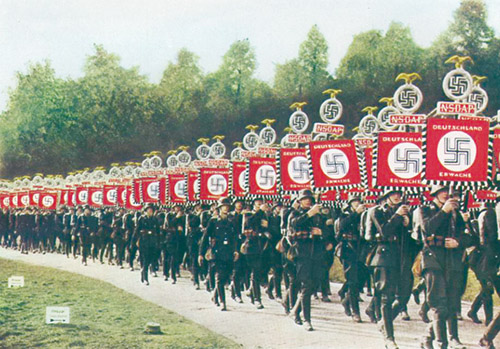
In National Socialist Germany, soldiers carry banners with their borrowed symbol of power: the Swastika.
Let’s examine some examples. The most obvious is the Swastika. Originally an Indo-European symbol for luck – the whirling spirals of the sun have a long and veritable history as perhaps the most sacred of esoteric symbols – it was taken by the National Socialists and transformed into a symbol of German ascendancy. While it is still found today throughout India, Tibet and many other countries, it triggers a shiver down the spine of most Westerners. The use of it by Nazism was deliberate. They attempted to harness the whole ‘memetic’ heritage of the image and bring it under the command of a new vision of Aryanism as promoted by Germany. The use of the symbol was highly successful as it evoked, on an unconscious level, a wide range of associations from race theory to total obedience to the state, without any forethought. Emotions were swayed, and the German population reacted unconsciously to the Swastika, backed up with complex ritualised parades and rallies, iconography and uniforms. The Germans felt they were rationally choosing a leader who would take them out of the post-First World War depression era when there was nothing rational about it at all.
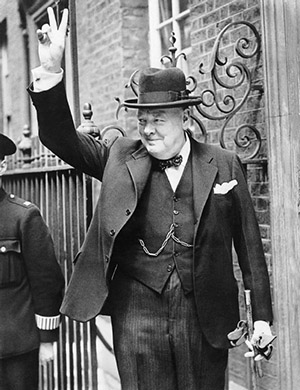
Winston Churchill makes the V for Victory sign.
Another example is Winston Churchill’s use of the V for Victory sign. There is evidence the occultist and spy Aleister Crowley took what was a Greco-Roman sign for victory and, during his work for Britain’s MI5, recommended the sign to Churchill as a foil against the use of the Swastika by Hitler. It was also remarkably successful, even expressed in music using a form of Morse code as a call to arms throughout the war. Once again, the symbol triggered a whole population to react unconsciously and rally to fight.
There are many other examples such as the symbol of the cross which has transformed from the sacred tree to the Ankh of Egypt to the crucifix of Christianity. Each culture adapted and used the image in its own way. Sadly, with Christianity, it came to be used as a symbol of the forced conversion of other cultures. As Emperor Constantine said, “in hoc signo vinces” – in this sign you will conquer. Of course, the debate continues regarding the Sixties peace sign. While it was composed of the letters N and D for nuclear disarmament, others claim it is a broken crucifix. The history of the cross would take a whole book to explore as would the Swastika. Both are complex symbols with long histories and innumerable variations.
Cinematic Motifs
Cinema uses symbols, signs and images to create unconscious reactions. Early German Expressionist cinema, for example ‘Nosferatu’ made in 1922, uses strange angles, manipulation of shadows and occult symbols, to evoke a sense of fear. Albion Grau designed the sets for this film at Prana Studios (Prana is the Hindu term for life force) and was also a leading member of Fraternatis Saturni, a significant occult order of the period. We see the same trend in the psychedelic films of the Sixties where images, symbols and signs are used to unconsciously transmit a message. In 1973, ‘The Holy Mountain’ by Alejandro Jodorowsky took Cannes by storm with its surreal journey through the planets based on the esotericism of Georges Ivanovich Gurdjieff.
While esoteric themes can be used to create a good ghost, horror or surreal film, they can just as easily be used to manipulate the viewer’s opinion. There are works which are clear propaganda. Such works are far less dangerous than the more subtle forms of cultural manipulation because they are so obvious the filter of the conscious mind tends to ignore their message. A range of motifs in modern cinema appear on a regular basis. Now if these are considered as ‘signs’ representing a deeper meaning, which those behind the movie studios wish to imprint on the collective unconscious, then we can begin to decode how the power elite is manipulating the populace at large.
The development of the zombie film began with the ‘White Zombie’ in 1932 and was followed by a trickle of films until the literal explosion of these films and TV shows today. The motif of the small threatened population trying to fight off an infected menace (read foreign) as the world self-destructs and falls into mayhem. Unconsciously, the call is for law and order and more government to avoid such a catastrophe. As the films become more violent, brutal and confronting they bring in fears of unknown plagues and uncontrollable viruses that can only be contained by tighter controls on immigration and bigger government. Wherever you stand on the immigration debate, this unconscious manipulation of the fears of the populace is obvious.
Reality TV – Life as a Simulation
The craze that’s taken over most programming on television is so-called Reality TV. This ranges from the tawdry ‘Big Brother’ to music and cooking shows and even couples fighting to be the best designers of a home in ‘The Block’. In such programs we live our lives vicariously through the characters on screen – they do the things we would never think of doing and we therefore transfer our emotions onto them. They cook, make music and design so much better than us. We seek to be a little like them through imitation. We can watch ‘MasterChef’, get the recipes online, become better consumers at home and bring a little bit of glamour to the tea table. Such programs as ‘Big Brother’ offers the right combination of nudity, sex, emotional cruelty and interpersonal friction to keep viewers hooked.
Through such shows we forget our own lives and our own journeys. Instead of facing ourselves, and what is happening in the world, we are reduced to passive consumers. Retail companies pay for their products to be placed in the shows, for us to buy and possess to mimic the characters. Of course, we cannot be like them – they are artificial simulations created by TV producers – but we continue to watch, consume and mould ourselves into role models that are nothing but shadows and marketing ploys.
The Cult of Celebrity
Celebrity is another example of the simulacrum, the image or representation of someone or something. These individuals are made to seem real but are actually artificially moulded by the media and publicity companies. They are memes in the flesh and cannot be seen as real but as representing that what is behind them. When we experience a celebrity we are experiencing a simulacrum, a walking simulation or holographic meme created to trigger certain responses from those they interact with. In many ways celebrities are caricatures – they are not people but carefully engineered memeplexes created by publicity companies to manipulate and trigger specific reactions on an unconscious level. This may seem harsh but unless we see them this way we cannot see through them and begin to appreciate just how conditioned we are and the way in which symbols and signs are used to mould and create what we perceive to be reality.
Diversionary Memetics
A second level technique known as ‘Diversionary Memetics’ captures those who do start to ask the important questions, but it leads them to dead ends.
Many thinking people spend large amounts of time running around investigating ‘micro conspiracies’, government corruption, information spread on the Internet, etc. The original source of many diversionary memes are often obscure. They are engineered to spread like wildfire, the Internet being a particularly effective way to quickly proliferate a meme designed to get us angry and wanting to do ‘something’. Of course most people simply spread the meme to other people, and ultimately feel quite disempowered when they realise nothing really changes. The memes (political, economic & social problems) keep coming at us in a never-ending stream.
Studying and exposing all the small conspiracies is certainly an important service but unless we look behind the scenes to decode the overall system of control, then real change becomes impossible. We never see the big picture.
What we need to appreciate is that the world is controlled by memes. The media and the entertainment industry reinforce the values that those at the top want us to hold. We are passive consumers who, on the whole, do not question – we believe what we are told.
For practical purposes, too, it is very important to recognise the instruments of the occult war, namely the means employed by the secret forces of global subversion to conceal their action, prevent their opponents’ action, and continue to exercise their influence. – Julius Evola
There is no doubt symbols and signs are used to create systems of control. Our reality is manipulated by encoded images with the help of celebrities who are more representational than real. Political Correctness defines our thinking by manipulating how we speak because the language of a people reflects their soul. When we are more concerned with the language of technology and social networking than personal communication, we have a real problem. When we cannot speak our mind because someone, somewhere may be offended, then self-censorship limits our ability to think beyond certain predefined boundaries.
Chaos and upheavals are changing the world at a rapid pace, but we are dancing, singing and partying. Unless we come to see our chains we cannot set ourselves free. The first step in this process is decoding the layers of symbolism, programming, memes and brainwashing that are conditioning us every minute of every day. We believe we are free agents and can think for ourselves. But look at the media, television, films, entertainment (not to mention computer games), and you can begin to appreciate how our beliefs about ourselves, who we are and our role in the world, are totally artificial, totally conditioned, and represent what the power elite want us to think. It is time to take the Red Pill.
In 1904 the British geographer Halford Mackinder addressed the Royal Geographical Society in London.1 He advanced a geopolitical theory that is now known as the “Heartland Theory.” Mackinder divided the world into three major regions: the “World Island” comprising the continents of Africa, Asia and Europe; the “Offshore Islands,” which included the UK and Japan; and the “Outlying Islands” which included the North and South American continents and Australia.
At the centre of the World Island was an entity he described as the “Heartland”; an arc stretching from the Volga (in modern Russia) to the Yangtze in China. That is the region we now describe as Eurasia. After World War I, Mackinder summarised his theory in these terms:
Who rules East Europe commands the Heartland.
Who rules the Heartland commands the World Island
Who rules the World Island commands the world.2
The world was a very different place in 1904. Russia was a feudal monarchy; China was weakened by colonial occupation and exploitation; most of Africa was ruled by European colonial powers; and the US was yet to emerge as a significant military and geopolitical force.
The hundred years following Mackinder’s presentation to the Royal Society saw unprecedented change in the world’s geopolitical structure. Two world wars, the Bolshevik Revolution, the decolonisation of Africa and Asia, the relative collapse of European colonial imperial power and the rise of an aggressively expansionist United States, saw a fundamental shift of power in the period from 1914 to 1990. As will be argued, the explanatory power of Mackinder’s vision is an effective tool for understanding contemporary geopolitical structures and the likely course of future events.
The seeds of US foreign policy, which dominated the past several decades, were planted in the 19th century. In 1853 a US naval convoy under the command of Commodore Matthew Perry sailed into Tokyo Harbour. On behalf of the US government, Perry demanded a treaty with Japan that would allow trade between Japan and the United States. Japan had no navy and was forced to acquiesce to the American demands. A treaty was duly signed permitting trade and opening Japanese ports to US merchant shipping.
A similar exercise in gunboat diplomacy occurred in 1866 when the USS General Sherman steamed up the Taedong River in an attempt to open up Korea to trade by force. The attempt was repelled, but a US flotilla returned five years later and attacked Korean forts. Although the Americans withdrew after inflicting heavy losses, traditional Korean society was weakened, and within a few years Korea had been forced into unequal treaties with Japan, the US, Britain, Russia and other countries.3
World War II wrought devastating losses on the two powers that might have been able to challenge American post-war hegemony – Russia and China. They each lost between 25 and 30 million people fighting off the German and Japanese invasions respectively.
The scale of these losses is scarcely acknowledged in the Western popular media. Countless films, books and TV programs inculcate images of a heroic British empire fighting alone until Pearl Harbor in December 1941 brought the Americans into the war. The British element of the war was then fought in a long slog across North Africa, Italy, and then with the Americans in Italy and the D Day landings of June 1944. The Americans fought the Japanese across the Pacific, island by island.
Total British casualties in World War II (civilian and military) were 451,000. American losses, primarily military, were 419,000. Total Canadian, Australian and New Zealand casualties were 106,000. To put those numbers into perspective, Russia had 1.1 million casualties in the Battle of Stalingrad (July 1942 to January 1943) alone.
China’s war with Japan began in 1937 and continued until August 1945. Accurate statistics are hard to come by, but the number of civilian deaths is variously placed at between 10 and 25 million, and up to four million military deaths.4 Clearly, once again, these deaths dwarf Western-allied casualties, but there is even less acknowledgment in the Western media than is the case with Russia.
These figures are mentioned because the scale of those casualties has exerted a dominant influence over Russian and Chinese strategic thinking ever since. It is impossible to understand modern geopolitical structures without appreciating how both governments are driven to avoiding being placed in that position again.
Full Spectrum Dominance
The end of World War II did not see the end of military action by the West. The US, in particular, has sought to exercise a level of control over nations around the world that is best encapsulated in the doctrine of “full spectrum dominance.”5 By this, it was intended that the US would be without military parallel at sea, on the land, in the air, and in cyberspace.
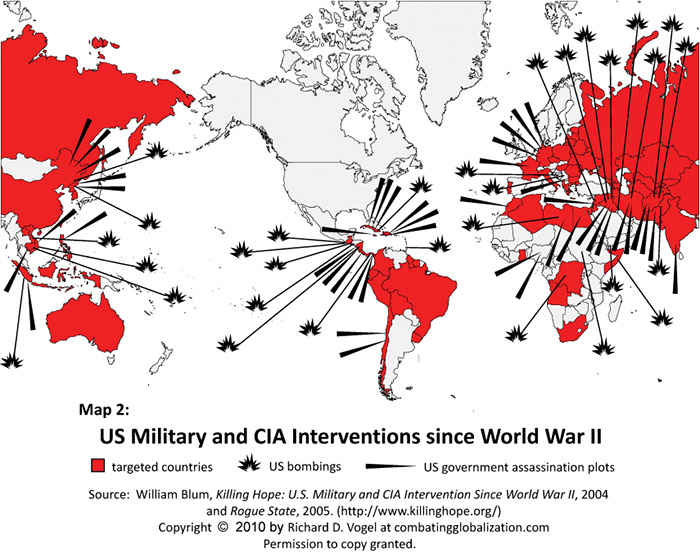
In pursuit of that doctrine, the US has since World War II invaded, occupied, bombed and/or overthrown the governments of 70 nations, killing between 30 and 40 million people in the process.6
Its troops currently occupy or are fighting in, either directly or through proxies, Afghanistan, Iraq, Somalia, Sudan, Syria and Yemen. None of these wars have any legitimacy in international law, the defiance of which is a dominant characteristic of US foreign policy.7 In addition to direct military intervention, the US is a major sponsor of hybrid warfare on every continent.8
The experiences of Russia and China have been very different. After World War II, the Soviet Union occupied those Eastern European countries it had captured from German occupation or who were part of the Axis coalition during the war. Western propaganda persistently portrayed that occupation as evidence of a Soviet desire to conquer the world. It is more accurately viewed as the creation of buffer states to insulate Russia from further Western invasions. That invasion history did not begin with the German invasion in July 1941.9
The agreement between Presidents Mikhail Gorbachev and Bush the Elder that allowed the reunification of the two parts of Germany had been accompanied by a pledge by the Americans that NATO would “not advance one inch further east.”10 The subsequent history of Eastern Europe is a perfect illustration of why American assurances are not to be trusted.
Despite there now being foreign troops stationed on Russia’s borders, the installation of missile systems directed at Russia, and the regular carrying out of large-scale military exercises, again clearly aimed at Russia, it is Russia that is portrayed in the Western media as being aggressive. It is this capacity for hypocrisy and doublethink that again is a prominent feature of Western policy.
In 1990 the Soviet Union collapsed. That collapse was followed by a disastrous decade under Yeltsin when Russia’s resources were plundered by homegrown oligarchs and Western corporations. Life expectancy fell and living standards plummeted. Yeltsin was succeeded by Vladimir Putin who has achieved a miraculous turnaround in Russia’s fortunes.11 It is this, more than any other single factor, which probably explains the constant demonisation of Putin by the American media.12
China’s Experience
China’s post-war history was also disruptive. After the Japanese had been defeated, the civil war resumed, concluding with victory under Mao in 1949. The Korean War commenced the following year, and it was US General McArthur’s threat to cross the Yalu River that brought China into that war. We now know that the Americans seriously considered the use nuclear weapons on China.13
That war was barely concluded when Mao embarked on his Great Leap Forward (da yue jin) program (1958–1962). Although intended to transform China from an agrarian to an industrial society, it was in many respects a disaster. Widespread famine was one consequence. Internal party criticism of Mao by people such as Deng Xiaoping led to Mao’s marginalisation within the Party. The Cultural Revolution (1966–1976) was aimed at restoring Mao’s control, but it had disastrous consequences on China’s economy and society. It was Deng Xiaoping, who led China from 1978 until 1989 with his “four Modernisations” first proposed by Zhou Enlai in 1963, that began the transformation of China into its current status. Those four pillars of modernisation were agriculture, industry, defence, and science and technology.
Ever since China has sustained a level of development unparalleled anywhere in the world. More than half a billion people have been lifted out of poverty into the middle class. Huge infrastructure developments including more high-speed rail than the rest of the world combined, and the development of centres of technological excellence as in the transformation of Shenzhen from a small fishing village to a world-class centre of excellence in less than 40 years. Shenzhen is one of China’s Special Economic Zones where investment strategies owe more to entrepreneurial capitalism than they do to the outmoded depiction of China as a communist nation.
On the basis of parity purchasing power, China’s economy is now larger than that of the United States, and the disparity grows wider every day. The United States did not have anything as dramatic as the collapse of the Soviet Union or the transformation of China, but it did have a geopolitical event, the consequences of which have profoundly affected the direction of US policy, and contributed to a rebalancing of the world’s geopolitical structure.
The Geopolitical Event of 9/11
That event was the attacks within the United States of 11 September 2001 (‘9/11’). These attacks were attributed to 19 Muslim hijackers directed by Osama bin Laden from his cave in Afghanistan. It is outside the scope of this article to discuss those events and the official explanation that rapidly emerged and was reinforced by the Report of the 9/11 Commission.14 Suffice to say for present purposes that the US government’s version of events is completely unsupported by the scientific evidence, as has been conclusively demonstrated in a number of excellent studies.15
The significance of 9/11 for present purposes is that it provided the springboard for a sustained attack by the US and its coalition allies, including Australia, upon a number of countries. Afghanistan was the first victim; falsely attributed with harbouring the alleged mastermind of 9/11, bin Laden, and refusing to hand him over for “justice.”16 We now know, for example, that the decision to invade Afghanistan was made in July 2001. The real motives had nothing to do with bin Laden.17
Afghanistan was followed by Iraq in 2003, Libya in 2011 and Syria in 2014, among many other targets. They all had a common theme. All were based upon lies of one sort or another, and none of them had any basis in international law. All were justified in the name of being part of a “war on terror” which, apart from being singularly ironic coming as it does from the world’s greatest perpetrator of terror by a considerable margin,18 provided a perfect smokescreen for the erosion of civil liberties,19 the exploitation of foreign resources,20 the massive expansion of the military budget, and a continued expansion of what was already a worldwide network of bases.21
The invasions of Afghanistan and Iraq may have seemed successful at first, but the longer the occupation continued (now 16 and 14 years respectively) the greater the destruction of those societies and the greater the internal resistance. On the positive side, there has been a growing realisation, including in Australia, that there has to be a better alternative to the relentless destruction and plundering that has marked the “American century.”
What has transpired, especially in the past 16 years, is a geopolitical realignment that has given fresh impetus to Mackinder’s prescient view of the emergence of the “Heartland,” that is, Eurasia, as the focus and dynamic centre for the 21st century.
A Coming Together in the Heartland
To facilitate this development a number of organisations and agreements were established. Most of these, until very recently, have flown under the radar of the Western media. The first, chronologically, was the Eurasian Economic Community, a grouping of six former members of the Soviet Union, with Russia the largest and most economically and politically important member. This evolved into the Eurasian Economic Union (EAEU) in 2010 and currently incorporates the six original members. Its focus is on interregional trade and investment and moving toward a common currency zone.
More recently, the EAEU has begun forming links outside the original six with other trading groups and also individual countries. Of these, the most significant is Turkey, which in 2017 began negotiating a free trade deal with the EAEU and talking about possible future membership. This is significant as it marks the final disenchantment of Turkey with the European Union with whom it has been holding negotiations for the past 30 years without obvious progress.
Turkey is also a member of NATO and its reorientation to the East has further ramifications. Turkey recently signed a multibillion-dollar deal with Russia to be supplied with the Russian S400 antimissile defence system, much to the consternation of the Americans whose own missile defence system is inferior to the Russian version, but who have always seen NATO as providing a captive market for its own military sales.
In March 2017 the prime ministers of Iran and the six EAEU member states signed cooperation agreements, and further integration is anticipated. Russia has also sold its S400 system to Iran and Iran has provided an airbase for the Russian military at Hamadan, located 47 km from the city of the same name.
Iran is also a key link in the North South Transportation Corridor (NSTC) that links India with Russia via Iran and Azerbaijan. To facilitate the NSTC and the other developments discussed below, Iran is investing in major infrastructure projects with the financial and technical assistance of Russia and China. This notably includes upgraded rail linkages.
Iran also made a recent agreement with Qatar to jointly develop the huge natural gas resources in the Persian Gulf, known as the South Pars field in Iran and the North Dome field in Qatar. This agreement was a major factor in the recent threats, demands and economic moves against Qatar made by Saudi Arabia, from which the Saudis have largely resiled.
Another important factor in the Saudi-Qatar dispute was the decision by Qatar to sell $50 billion of natural gas to China, the key fact being that the deal was not denominated in US dollars. It was an important milestone in the disappearance of the petrodollar,22 a fact of more significance to the US on whose behalf Saudi Arabia was undoubtedly acting.
Another grouping is BRICS, an acronym coined in 2001 by Jim O’Neill, chairman of Goldman Sachs, with the initials representing the (original) four countries of Brazil, Russia, India and China. The ‘S’ represents South Africa that did not join until 2010. The first meeting of the BRIC nations was in 2006 at Foreign Minister level with the first full-scale conference in Yekaterinburg, Russia, in June 2009.
BRICS is significant not only for its membership, representing as it does a significant percentage of the world’s population and GDP, and not only its geographical spread, but also that it is taking increasing steps to separate itself from the US and European dominated World Bank and IMF by setting up its own development bank. It is also instrumental in setting up CHIPS, an alternative to SWIFT, the interbank trading system that has been used as a tool in imposing financial sanctions on, among others, Iran and Russia. Those sanctions have been a form of financial imperialism.
Arguably the most important grouping, however, is the Shanghai Cooperation Organisation (SCO), the details and significance of which is almost entirely absent from most Western media analysis. The SCO was formed in 2001 and initially comprised China and Russia, plus Kazakhstan, Kyrgyzstan, Tajikistan and Uzbekistan. It had six Observer States and six Dialogue Partners.
Iran is an Observer State and has applied for full membership, with the strong backing of Russia. It is likely to become a full member in 2018.
Two other Observer States that achieved full membership in July 2017 were India and Pakistan. Egypt and Syria have applied for Observer State status, and another Observer State, Turkey, has applied for full membership. Afghanistan is another Observer State, although its attempts to have a fuller level of cooperation with other SCO members and benefit from infrastructure investment have been blocked by the US. President Trump has openly stated that Afghanistan’s significant natural resources, estimated by the US geological survey in 2012 at up to $3 trillion, should be exploited by the US.23 Significantly, that resource includes more than one million tonnes of rare earth elements, a key component of modern technology.24
The US is unlikely to relinquish its role in Afghanistan any time soon as, apart from its mineral wealth, it provides 93% of the world’s heroin25 of which the US is a significant beneficiary,26 and has military bases designed to form part of its containment policy of China. [As of April 2021, the US announced it was finally going to withdraw from Afghanistan. We are yet to learn the exact details of what that really means including how many US private contractors stay on and how many troops remain to protect military bases.]
The US has also, since at least Operation Cyclone in the 1970s, used Afghanistan as a springboard for the infiltration of Muslim extremists into Iran, China and Central Asia as part of its hybrid warfare role in the destabilisation of those countries.27
Perhaps, needless to add, none of these facts form part of the Western narrative with regard to Afghanistan, particularly in Australia, that prefers to perpetuate its myth of being there in a “training and advisory role.”28 A role that after 16 years has been spectacularly unsuccessful in achieving anything approaching positive results.
Since 2004 the SCO has also had a security cooperation component (CSTO) aimed at coordinating responses by SCO members to security (including terrorist) threats to member states. Other areas of focus include combatting drug trafficking, organised crime and religious extremism. Unlike NATO, SCO does not need an external enemy to justify its existence. Covering a quarter of the world’s population and three-fifths of the Eurasian landmass, it again provides an alternative model for tackling common problems, many of which are generated outside its borders.
The reader will have noted that BRICS, the EAEU, the NSTC and the SCO have considerable overlapping memberships. While that is not without its problems, as with the recent confrontation of India and China over the Donglang region of the China-Bhutan border and elsewhere on their common frontier, these problems have thus far been resolved without resort to war. Dialogue has been the key, a factor notably lacking with the US in, for example, Afghanistan and Korea.29
One Belt One Road: Will Australia Ruin its Continued Prosperity?
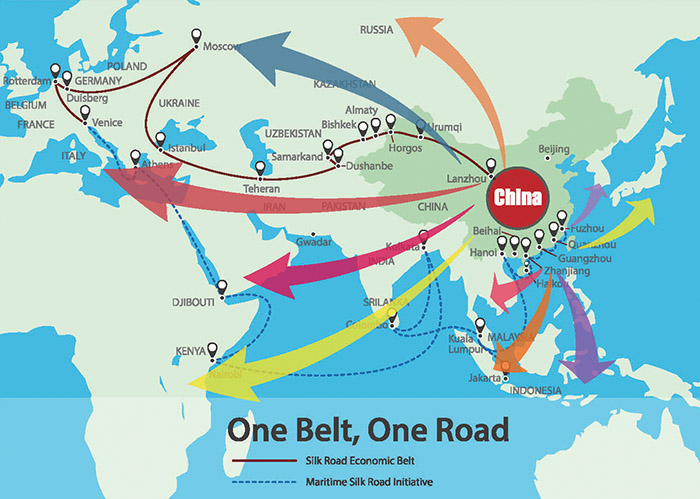
Towering over all these developments, however, is a project that is transforming Eurasia in its scope and ambition. It is the world’s largest infrastructure project by a significant margin. Publicly announced by China’s President Xi Jinping in 2014, it’s been variously described as the New Silk Roads, One Belt One Road (Yi dai Yi lu) (Xi’s original description) and its current nomenclature, the Belt and Road Initiative (BRI). I have previously discussed this project in New Dawn30 and will not repeat that here.
As may be seen from the various graphic representations, the BRI has both land and maritime components, linking Eurasia with Africa and South America. Its land component is a combination of road, high-speed rail and fibre optic communications. One illustration is the China-Pakistan Economic Corridor (CPEC), itself a $50 billion project linking China with the Pakistan port of Gwadar.
Among its many virtues, CPEC bypasses the narrow Strait of Malacca through which more than 80% of China’s oil imports currently pass. Australia regularly joins with the US in an exercise, Operation Talisman Sabre, that practices blockading the Malacca Strait. Unsurprisingly, this is seen as an unfriendly act by China. Australian governments seem not to appreciate that the countries (now more than 60) that have joined the BRI also produce the same commodities that Australia has grown rich on selling to China over the past 50 years. If Australia persists in its unfriendly acts towards China, for example by joining with the Americans in hostility toward China over Korea and the South China Sea, then the day will surely come when China switches its preferred suppliers from Australia to friendlier nations reachable by high speed rail.31
Looked at from a broader perspective, American military misadventures since the 2001 invasion of Afghanistan may be seen as symptomatic of the disintegration and collapse of the American empire. Ironically, this has been recognised by the Pentagon itself, as detailed in a recent study.32 Their proposed “solution,” however, is more of the same policies that led to America’s decline in the first place: more surveillance; more strategic manipulation of perception (i.e. propaganda); and more military interventions. The contrast with President Xi’s “win-win” philosophy and his geopolitical analysis outlined in Switzerland in 201733 could not be greater.
How likely is it that the US empire will collapse and be replaced by, at the very least, a multi-polar alternative world? The American historian Alfred McCoy in his latest book34 sees the decline in the US’s ability to retain global hegemony as attributable to a number of factors. One important factor is the decline in US educational standards resulting from years of underinvestment as crucial spending was subsumed to the needs of an ever more bloated military establishment. The F35 debacle is a classic metaphor for all that is wrong with military investment and an inability to produce a quality product.
Another factor that McCoy identifies is the dollar’s disappearance as the world’s sole reserve currency; a status that has enabled the US to live beyond its means for decades. The de-dollarisation of the world is growing rapidly, not least as noted above in the Eurasian trading blocs and separate deals (e.g. Qatar) outside those blocs. Trading is increasingly in local currencies like the Ruble or Yuan, or through constructs such as Special Drawing Rights or gold based convertible notes.35 China’s increasing economic dominance will accelerate that trend.
The new world order that is emerging is fulfilling Mackinder’s vision of 114 years ago. For the reasons set out above, Russia and China are central to that realignment. Ironically, the Russophobia of America’s Deep State and their fundamental inability to grasp the nature and the consequences of the re-emergence of Chinese power has expedited the strategic relationship between these two powers.
The US will undoubtedly continue to strive to undermine the Eurasian partnership through a range of manoeuvres. Its provocative conduct in the South China Sea; its bellicosity to North Korea; its trouble making between China and India; its conduct in Ukraine and elsewhere in Eastern Europe; and its continuing addiction to hybrid warfare show no signs of abating.
The fundamental fact of the 21st century is that the US no longer has the power to impose its will as it was largely able to do from 1945 to 2000. A new model, centred on the World Island Heartland is taking shape, with China and Russia as its major drivers.
[alert type=”success” dismiss=”no”]If you appreciate this article, please consider subscribing to help maintain this website.[/alert]
Footnotes
1. H. Mackinder, The Geographical Journal, April 1904
2. Mackinder, Democratic Ideals and Reality: A Study in the Politics of Reconstruction(1919)
3. P. Duus, The Abacus and the Sword: the Japanese Penetration of Korea, University of California Press (1998); Y-L Chung, Korea Under Siege 1876-1945, OUP (2005)
4. R Rummel, China’s Bloody Century, Transaction (1991)
5. US Department of Defence, Joint vision 2020 (2000)
6. W. Blum, Killing Hope (2008); Blum, America’s Deadliest Export: Democracy (2014); Blum, Rogue State (rev.ed) (2016)
7. C. Doebbler, American Hypocrisy in International Law, www.counterpunch.org, 6 March 2014
8. A. Korybko, Hybrid Wars, www.orientalreview.org August 2015
9. D. Stone, A Military History of Russia, Greenwood Publishing (2006)
10. U. Klussmann et al, Did the West Break its Promise to Moscow, www.spiegel.de 26 November 2009
11. S. Djankov, Russia’s Economy Under Putin, www.piie.com, September 2015
12. S. Cohen, Stop the Pointless Demonization of Putin, www.thenation.com, 7 May 2012
13. C. Posey, How the Korean War almost Went Nuclear, www.airspacemag.com July 2015; B. Guertzman, US Papers Tell of 1953 Policy to A-Bomb Korea, www.nytimes.com, 8 June 1984
14. The 9/11 Commission Report, July 2004
15. D. Griffin, Bush and Cheney: How they Ruined America and the World, Olive Branch Press, 2017
16. Ibid.
17. J. O’Neill, Trump and Afghanistan: A Hidden Agenda, www.journal-neo.org, 25 August 2017
18. Blum, op cit. N6
19. T. Stephens, Civil Liberties After September 11, www. counterpunch.org, 11 July 2003
20. M. Chossudovsky, The War is Worth Waging: Afghanistan’s Vast Reserves of Minerals & Natural Gas, www.globalresearch.ca, 22 August 2017
21. D. Vine, The US Probably has more Bases than any Other People, Nation or empire in History, www.thenation.com, 14 September 2015
22. J. O’Neill, The Demise of the Petrodollar and the New Multipolar World, www.independentaustralia.net, 4 July 2017
23. M. Landler & J. Risen, Trump finds Reason for the US to Remain in Afghanistan: Minerals, www.nytimes.com, 25 July 2017
24. www.newsecuritybeat.org, 27 July 2017
25. UN Office of Drugs and Crime, World Drug Report 2016
26. P. Scott, Drugs, Oil and War: The US in Afghanistan, Colombia and Indochina, Rowman & Littlefield (2004)
27. Z. Brzezinski, The Grand Chessboard, Basic Books (1998); S. Coll, Ghost Wars, Penguin (2004)
28. J. O’Neill, Myths, Legends and Lies: Australia’s Policy in Afghanistan, www.gumshoenews.com, 26 July 2017
29. US Skips Out on Afghan-Taliban Conference in Moscow, www.dw.com, 14 April 2017
30. J. O’Neill, The New Silk Roads: The Quiet Revolution, New Dawn155 (Mar-Apr 2016)
31. B. Habib & V. Faulkner, The Belt and Road Initiative, www.theconversation.com, 17 May 2017
32. US Army War College, At Our Own Peril (2017)
33. President Xi’s Opening Plenary Speech at Davos, www. weforum.org, 17 January 2017.
34. A. McCoy, In the Shadow of the American Century: The Rise and Decline of US Global Power, Haymarket Books (2017)
35. K. Rapoza, Much to the Dismay of China Haters the Yuan Goes Global on October 1, www.forbes.com, 30 September 2016; JN. Willie, Gold Trade Note sighted, www.goldseekers.com, 16 February 2017
A reconfiguration of power has been in process for some time and is now rapidly emerging as part of a medical-political-economic institutionalised complex that I will refer to as biopower.
The current lockdowns and quarantine travel measures are only a foretaste of what is to come once new regimes of biopower become fully established. Biopower is now knocking on our doors and gaining entry and dominion over the whole domain of personal sovereignty.
What we are seeing unfold – after the ‘trigger’ of COVID-19 was pulled – is a radical alteration of legal and power narratives that control and categorise life and death. With the “pandemic landscape” now being formed,1 we are witness to a post-sovereign world where biopolitics legitimises a network of socialising regimes from biocapitalism to biosecurity.
The World Economic Forum’s Klaus Schwab says these “COVID times” are “our defining moment” and that “we will be dealing with its fallout for years, and many things will change forever.” In the pages of his book The Great Reset, he brazenly declares the coming “economic disruption of monumental proportions, creating a dangerous and volatile period on multiple fronts – politically, socially, geopolitically – raising deep concerns about the environment and also extending the reach of technology into our lives.” We are told that life for many of us is “unravelling at alarming speed.”2
I contend that we shall see newly defined, and pervasively employed, forms of biopower in the age of this ‘Great Reset’.
A Post-Sovereign Era
The French philosopher and social theorist Michel Foucault is credited with coining the term biopower in his work in the mid-to-late 1970s. Foucault traced the development and application of power to the rise of “disciplinary” measures and institutions set up by governments to regulate populations in the eighteenth, nineteenth, and early twentieth centuries.
An array of “corrective institutions” started spreading across the social field – asylums, prisons, factories, schools, hospitals, universities, etc. – each serving to inculcate a mode of human conduct and consciousness.
Above these socialising institutions stood the Sovereign (the Monarch) which later became the State. According to Foucault, the classical privilege of sovereign power is the “right to take life or let live.” It was the model codified in classical politics and remained essentially unaltered during the transition from traditional sovereign power (monarchical) to modern State power.
“For Foucault, biopower is a technology of power for managing humans in large groups; the distinctive quality of this political technology is that it allows for the control of entire populations,” notes the scholar Mark Kelly.3
Foucault’s description of disciplinary power as exercised by institutions is again relevant to what is happening now. We see a pervasive, fluid, almost free-floating, administration of power – on the State and global levels – to control societies in the post-sovereign era. Welcome to a new age of biopower.
Producing what Foucault called “docile bodies” (the masses of people) – the basic unit of disciplinary power – is now the purview of modern States. The modern human condition is such that the individual is not the object but rather the subject of biopower.
Biopower
Within the context of a biological threat, the subsequent ‘pandemic’ is establishing a social-political engineered construct – the ‘new normal’ – for human society. This overly hyped ‘new normal’ is being enacted by a series of measures granting biopower authority over the individual and the collective body. In short, biopower exercises control over the administration of life.
Biopower over the human body means the State has the legal right to place individuals under surveillance and punish by incarceration. We have seen this in numerous cases as in the 28-year-old Perth woman who broke the Western Australian quarantine rules and was handed a six-month prison sentence.4 The form of biopower exercised under the pandemic ‘state of emergency’ is concerned with mapping all of life – social, political, and economic.
Biopower has come into existence today via the response to the COVID-19 pandemic. It utilises a language of ‘health risks’ for intervention and intrusion in private lives. This includes jurisdiction to enter a person’s house without permission to forcibly remove people either considered a health risk or who are failing to ‘obey’ quarantine measures.
Dr Michael Ryan, Executive Director of the World Health Organization (WHO) Health Emergencies Program, on 30 March 2020 stated that authorities might have to enter people’s homes to remove suspected family members to an “isolated designated facility.” Such measures have now been enacted into law. For example, under the New Zealand state of emergency, police officers now have the power to enter homes to enforce self-isolation rules.5 In a similar move, the Australian State of Victoria deployed 2,000 military personnel to enforce what they refer to as “virus-control measures.”6
In an ironic twist, citizens opposing such draconian measures are negatively labelled “sovereign citizens.” The term sovereign individual used to mean the moral or natural right of a person to have bodily integrity and maintain exclusive control of their own body and life. Here we see a deliberate twisting of language to support and enforce the regimes of biopower.
Biopower refers to a range of strategies backed by “specialised medical knowledge” and adopted by the State along with a supporting network of institutions, agencies, and non-State actors. One disturbing trend is the empowerment of private military actors and ‘authorised officers’ to enforce new public health directions.7 In the future, these officers might be given police-level powers to impose State directives such as searching homes and cars without a warrant (for example, such officers could detain and imprison someone they believe represents a health ‘threat’). This emerging state of affairs has already led to many reports of overreach and overzealous policing (especially in the State of Victoria, Australia).
Continuous localised lockdowns, track-and-trace impositions, constant surveillance, the loss of the right to protest, and other such measures are now becoming established in the ‘new normal’ regime of biopower exercised by States across the world. These forms of control and regulation are without precedent and serve to increasingly affect the psychological well-being of citizens.
Biopower is also seen in the regulation of social life (mask-wearing, social distancing, ‘dobbing in’ and reporting violations of rules, etc.), and the self-policing of the mental landscape (right thinking, self-censorship).
Severe financial penalties are yet another way biopower will intrude into everyday life, for example, the new coronavirus rules enacted in the Australian State of Victoria in early October. ‘Illegal gatherings’ such as bringing people into a household above the limit set by the State, or more than five people meeting in a local park (even from the same family), can attract a $5,000 fine per breach.
Biopolitics
The new field of biopolitics binds the individual and the collective into a strengthening mix of the technological, the political, the legal, and the financial. Modern biopolitics ties into the global restructuring of power (‘The Great Reset’ – covered in New Dawn Special Issue Vol 14 No 5) and new regimes rendered into existence in response to the pandemic emergency.
We are being lined up for a twenty-first century medical totalitarianism. Biopower and biopolitics, along with biocapital and biosecurity, combining to create a totalised and singular form of power.
In terms of collective humanity, the biopoliticising of the human race is developing new forms of population management. To be clear, the biopolitical agenda is the control of societies and the rendering of human life as “docile bodies” that do not resist intervention. To frame human life under a regime of total biopolitical power, State authorities seek to render conscious life under its rule. What we ‘think’ and who we are in the physical sense is being brought under State jurisdiction. The State automatically assumes the power to dictate our thinking from birth.
From this perspective, we see why the current regime of censorship (in particular, across the internet where information can freely circulate across the globe) and curtailing of free speech has been so dominant and heavy-handed. Total power requires total domination – external control over an individual’s body and their thought processes – mental (conditioning, programming) and biological (health treatment, vaccination).
The biopolitical agenda incorporates non-State bodies to enact strategies – most notably philanthropic organisations, social pressure groups, NGOs, and assorted globalist organisations. This field extends from annual health check-ups, health insurance, and preventive medicine to incorporate pandemic measures of random testing, forced isolation, and vaccination.
All human life is ‘biopoliticised’. There is no refuge from its reach when both the exterior and interior life of an individual falls under the jurisdiction of total State control. A person’s body, health, and happiness – even their right as an ‘individual sovereign self’ – is to be subsumed into the realm of authoritarian biopower.
Biopower and biopolitics is a dangerous mix of narratives based upon a monopoly of so-called ‘scientific knowledge’. In this sense, biopolitics harnesses ‘science’ and an array of ‘experts’ to formulate ‘evidence’ that justifies policymaking.
Biocapitalism
Non-State bodies play a key role in the biopolitical agenda, especially with the rise of the pharmaceutical industry, global healthcare strategies, and tech giants. The field of biocapitalism covers the strategies and policies that develop and maximise profits for pharmaceutical markets and other healthcare interventions.
With COVID-19, the administration of biocapital policies upon the majority of the world’s population is technologically feasible in ways not possible in the past. This should give every thinking person cause for concern. It is now urgent that we develop conceptual tools for critically analysing how biopolitics will play out in relation to biocapital. This is the merger of health (and health economics) with the data of surveillance capitalism.
With the accelerating expansion of datasets – data tracing and tracking – we see a burgeoning rise of surveillance capitalism.8 Contact-tracing applications developed by the likes of Google and Apple are gathering colossal amounts of new data, adding to the escalating data supply chains. Healthcare and biomedical data collection is doubling every 12-14 months. Back in 2012, a Ponemon Institute study found that the healthcare industry utilised 30% of all the digital data storage in the world.9 Imagine how much that figure has increased in the intervening years. The move to digital has been rapid over the past decade; for example, Electronic Healthcare Records (EHR) adoption rates for US hospitals rose from 10 to 90% in that time.10 The range of medical wearables on the market is extensive and growing. It is now possible to monitor most aspects of an individual’s health. It is estimated that remote patient monitoring and health trackers will generate $20 billion annually by 2023.11
Analysis of digital healthcare data and its use for predictive analytics is profoundly changing the way patients are managed as health wearables are part of patients’ treatment plans. Patient health data will heavily influence the business models of the biocapital market. This data will only increase from the track & trace apps that most governments are pushing upon their populations.
Biocapitalism is firmly embedded in the portfolio expansion of the tech giants. A cursory glance at the list of projects owned or invested in by the FAMGA (Facebook, Amazon, Microsoft, Google and Apple) tech giants reveals an unsettling array of healthcare projects – medical patient databases, hospital research data, pharmacy retail collaborations, AI research facilities, and insurance. In autumn 2018, Google’s parent company Alphabet invested $375 million in Oscar Health, a ‘next-generation’ health insurance company.12 According to CEO Oscar Health, it aims to manage people’s health care from a reinvented and rebuilt technological perspective.13
Biocapitalism is wedded to biopolitics. In March 2020, the UK government’s Secretary of State for Health and Social Care, Matt Hancock, signed an agreement to provide legal backing for the National Health Service (NHS) which sets aside its duty of confidentiality in data-sharing arrangements. The so-called ‘Covid-19 Purpose’ is a new data-sharing agreement for NHS organisations and general medical practitioners (GPs) to share patient data with any organisation they choose, as long as it’s for the purpose of “fighting the coronavirus outbreak.”14
The pharmaceutical industry is also clearly at the forefront of biocapitalism. Big Pharma will make huge profits from the current pandemic situation, especially from vaccination. Big Pharma’s warning to governments that they need substantial upfront funding – if vaccines and testing are to be rolled out faster – has been heeded.15 Most COVID-19 vaccine manufacturing costs are expected to be offset by government funding. One example is pharmaceutical giant AstraZeneca which reached agreement with Europe’s Inclusive Vaccines Alliance (IVA) to supply up to 400 million doses of their COVID-19 vaccine. AstraZeneca also completed similar agreements with the UK, US, the Coalition for Epidemic Preparedness Innovations, and Gavi the Vaccine Alliance, for 700 million doses. The Australian government, which is aiming for a 95% vaccination rate, has secured 85 million doses of a vaccine (34 million from AstraZeneca and 51 million from CSL, Queensland), although only having a population of 25 million. AstraZeneca has agreed on a license with the Serum Institute of India for the supply of an additional one billion doses. This is one company out of many, and this is likely the first vaccine out of many more to come.
In a 2020 report,16 public ‘health expert’ Tony Fauci and epidemiologist David Morens claimed that humanity has “entered a pandemic era.” The report states that the current pandemic is only the first of more to come and we are likely to see an accelerating rate of future outbreaks in the years ahead.17 What this indicates is that the future of vaccine rollouts must be secured alongside a continuation of emergency powers.
A consequence of lockdowns is the huge economic bombshell for struggling business. Many businesses, particularly in the middle-to-small scale, are on the cusp of collapse, or have folded. Larger players are likely to seek State financial intervention. Some major corporate enterprises – especially if they are seen as providing critical supplies or services – might come under the control of the State. A trajectory that mimics China’s State control of the commercial sector.
The changing biopolitical arena of the 21st century, with its biocapitalist economic agenda, implies a rising need for biosecurity.
It is no surprise that State institutions are determined to preserve a monopoly over the use of force to ensure biosecurity of the population.
On 18March 2020, the Governor-General of Australia declared that a ‘human biosecurity emergency’ existed. This declaration gave the Minister for Health unprecedented power to issue any requirement or direction under the Biosecurity Act 2015.
For example, during the human biosecurity emergency period, the Health Minister may issue any direction to any person and determine any requirement the State considers is necessary to prevent or control the spread of COVID-19 in Australia. Each and all individuals must comply with the emergency requirements. Any person found engaging in conduct that “contravenes a requirement or a direction” can face a maximum penalty of imprisonment for five years and/or a fine of 300 penalty units ($63,000).18
These new powers under the Biosecurity Act 2015 were quickly put into effect. In July, 3,000 people living in public housing tower blocks in Melbourne were confined to a police-guard lockdown without prior warning. Food parcels were left on doorsteps for the most vulnerable tenants.
In the new biosecurity regime, no-one is granted liberty unless they succumb to the new rules of ‘immunity’ jurisdiction, likely to include an ‘immunity passport’. This will create reconfigured spaces of mobility and access in which travel, public and social events, and State services, may be closed to those who, without verified biosecure immunity, are personanon grata.
Travel within nations and across international boundaries will become possible only through a highly regulated architecture of surveillance and on-body tracking. If a person does not submit live bio-data, travel is likely to be disallowed or highly curtailed. The early signs of this exercise of biosecurity is already emerging in States such as Singapore which is tagging citizens for bio-surveillance.19
The danger is these draconian strategies silence and stifle life for people, including basic rights to free speech and protest. The threat and fear of being ‘cut off’ or punished for noncompliance place us on course for an unhealthy relationship with power. Biosecurity measures become the instruments of a biopowered authoritarian dictatorship operating through the façade of health and safety. Human biological life is merged with the physical-digital structures of State biopower.
What is a Human Life?
We move perilously toward a future in which, in the words of one CEO, “Humans are biohazards, machines are not.”20 The citizen is subjected to external authority in ways never before possible. Humans are targeted as objects – or ‘units’ – to be controlled, both our bodies and minds – the new colonies to be conquered.
Does this mean that the only way to escape is renouncing one’s citizenship – to be a ‘non-citizen’? Could stateless places exist in the contemporary world? Will this trigger the rise of new people’s ‘republics’? In light of recent events, we are compelled to ask – what is an authentic human? Is it possible to live authentically when subjected to the external power regimes of authority that deny a person individual sovereignty?
We should recognise there exists the ‘biopower’ of the human collective that stands in opposition to top-down State control. As individuals, we have our very real human power.
Biopolitics is fast being used to turn us into the “docile bodies” for the ‘Great Reset’ agenda and its technocratic future. It is not an overstatement that the future of humanity is on the table. How the next years unfold will determine not only the direction of our human future but also, importantly, the physical and mental environment of thathuman future.
It seems many have forgotten the Hippocratic oath that states: “Neither will I administer a poison to anybody when asked to do so, nor will I suggest such a course.” The politics of life (and death) are being usurped by an agenda that shows little, if no, human compassion and fellowship.
State biopower is concerned with power over life rather than life itself. The World Economic Forum’s envisioned ‘Great Reset’ speaks of renewal and recalibration, but this technology-dominated era is voiding the core qualities of being human in a living, organic world. We face the central question: What does being human mean to me? Hopefully from the answer to this question we can each find our own source of power and inner strength.
[alert type=”general” dismiss=”no”]This article was published in New Dawn 183.[/alert]
[alert type=”success” dismiss=”no”]If you appreciate this article, please consider subscribing to help maintain this website.[/alert]
Footnotes
1. See my article “Post-Pandemic Landscapes” in New Dawn 182
2. See www.weforum.org/agenda/2020/07/covid19-this-is-how-to-get-the-great-reset-right & COVID-19: The Great Reset by Klaus Schwab & Thierry Malleret
19. https://21stcenturywire.com/2020/09/23/bio-surveillance-singapore-issuing-bluetooth-tracking-tag-for-citizens/20. See my article “Post-Pandemic Landscapes” in New Dawn 182
Make no mistake about it: for decades, the government-media complex has been waging information warfare against the public and on behalf of powerful transnational corporate interests.
The latest fake news crisis is just another campaign in the information war. By throwing a variety of websites into one big basket and labelling everything with the derogatory term ‘fake news’, the political class and mainstream media are attempting to discredit alternative sources of information to regain some of the audience traffic they have lost over the last 15 years. They want to turn back the clock to a time when the establishment enjoyed a complete monopoly over news and information, and if there’s one thing that history proves time and time again – absolute power corrupts absolutely.
Here are a few examples of some of the greatest fake news scandals of all-time – brought to you by the mainstream media…
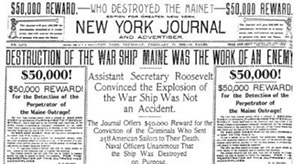
In the winter of 1898, a terrible incident befell America when one of its flagship naval vessels, the USS Maine, sunk following an unexplained explosion in Havana harbour, Cuba. Afterwards some leading US newspapers took advantage of the confusion and emotive nature of the story. William Randolph Hearst’s New York Journal and its racy sister publication, the Evening Journal, as well as Joseph Pulitzer’s New York World, blamed the incident on Spanish saboteurs. Shortly afterwards, the US entered the Spanish-American War in order to capture Cuba, Puerto Rico, Guam and the Philippines.
The practice of over-reporting and embellishing a story to stir public outrage became known as yellow journalism – a badge proudly worn by Hearst at the time. Hearst was ahead of his time in believing media outlets should insert themselves into events in order to affect political outcomes on behalf of the government. One year earlier, in 1897, Hearst’s New York World opined the doctrine of “journalism of action” which meant a newspaper should inject itself into public life in order to “fitly render any public service within its power.”1 Are things really much different today?
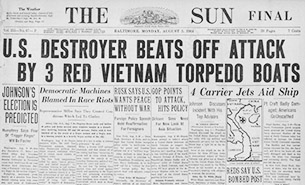
On 4 August 1964, a joint US Navy patrol ran into bad weather off the coast of Vietnam, causing problems with US radar and sonar. This happened at a time of heightened tensions in the region with US national security on red alert. Amid the confusion, some US agent or official – either in the CIA, the NSA or the Pentagon national security structure – circulated a false report that US Navy vessels and planes were under attack from North Vietnamese patrol attack boats in international waters in the Gulf of Tonkin. The next day, US President Lyndon B. Johnson appeared on national television to announce his intent to retaliate against North Vietnamese targets, stating: “Repeated acts of violence against the armed forces of the United States must be met not only with alert defense, but with positive reply. The reply is being given as I speak to you tonight.”2 The infamous event came to be known as the ‘Gulf of Tonkin Incident’. Despite the fact of obvious discrepancies in the government’s account of events, the mainstream media accepted the government’s fake story without question. With the media providing public relations backing, Washington took the next step and declared war on Vietnam, albeit on false pretences. This was the beginning a 10 year-long bloody conflict which saw 55,000 US servicemen killed, 250,000 injured and maimed, along with over 1 million Vietnamese killed.
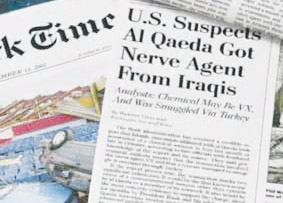
In March 2003, on the eve of the Iraq War, US and UK government officials managed to convince their respective mainstream media cadres that Iraq’s Saddam Hussein was concealing massive stockpiles of chemical weapons which came to be known as “Weapons of Mass Destruction.” Despite repeated assurances by UN weapons inspectors and on-the-ground US weapons experts that these WMDs were nowhere to be found, both US President George W. Bush and UK Prime Minister Tony Blair had made up their minds Saddam was hiding vast stores of deadly munitions, and therefore a US-led invasion was a fait accompli. With no proof or actual evidence, the press went along with it all because they were “very confident” about the “intelligence.” The White House dispatched Secretary of State Colin Powell to the United Nations where he regurgitated a made-up story about Saddam Hussein’s deadly mobile anthrax labs, aka “The Winnebagos of Death.”3 Yes, it sounded completely crazy to millions of intelligent, normal people at the time, and yet it was good enough for the mainstream media circa 2002-2003. Aside from CNN, ABC, and NBC’s complete allegiance to the government’s fraudulent war effort, America’s alleged ‘papers of record’, The New York Times and The Washington Post, helped by republishing government-issued fictional accounts. One ‘journalist’ in particular, Judith Miller from The New York Times, managed to dupe the public by citing ‘sources’ like disgraced Iraqi dissident Ahmed Chalabi, who fed the US intelligence community false information about Iraq’s supposed stockpiles of WMDs. The Times later admitted that many of Miller’s stories were false. Still, the damage was already done. The result of this government-media campaign of actual fake news was 1 million dead Iraqis, thousands of dead US servicemen, tens of thousands wounded and maimed, along with trillions of US taxpayer funds spent – an open bill which continues to this day.
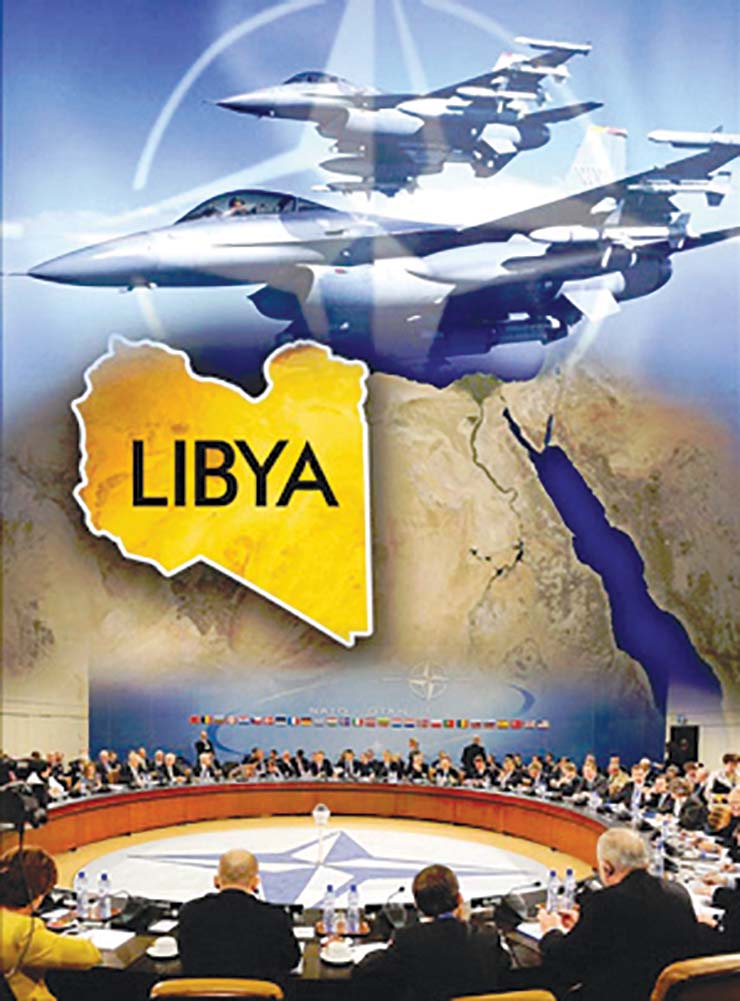
In 2011, after working behind the scenes helping to organise, arm and equip militant Jihadi fighters and rebel operatives in Libya, the Obama Administration led by then Secretary of State Hillary Clinton desperately needed an excuse to ground the Libyan Air Force in order that NATO-backed Jihadi fighters on the ground could successfully overthrow the government of Colonel Muammar Qadhafi. The most direct route to achieve air superiority would be to implement a No Fly Zone over Libya. But with the public relations scars still fresh from the Iraq debacle, Barack Obama and France’s Nicolas Sarkozy knew that a No Fly Zone needed broad international support and therefore had to be authorised by the United Nations. In order to get the global public behind the campaign, a series of fake news stories were concocted by the US State Department and the mainstream media. The first one was the popular talking point that Qadhafi was using military fighter jets to “gun down peaceful protesters in the streets.” Despite no proof or evidence this actually happened, the media ran with it anyway. It became the keystone of the No Fly Zone campaign. Another outlandish tale had Qadhafi issuing Viagra to his troops so they could go out and commit “mass rape” against the women of Libya. This invented story was originally disseminated by Qatari government media outlet Al Jazeera,4 and specifically designed to help generate liberal/Left sympathy for a ‘humanitarian intervention’ by NATO. The key emissary to deliver this fake news to the public and give it credibility was none other than Obama’s former US ambassador to the UN, Susan Rice.5 As a result of these and other unfounded ‘human rights’ abuses trumpeted by the mainstream media, on 17 March 2011 UN Resolution 1973 was passed by the UN Security Council and the No Fly Zone was immediately transformed into a US-led mass-bombing campaign of Libya by NATO. It is estimated that 30,000 Libyans were killed through ‘rebel’ ground fighting, artillery and relentless NATO bombing which toppled the Libyan government, turning the country into a permanent failed state and terrorist haven. Looking back, it’s hard to believe so few questioned the made-up stories, but like Iraq and so many other wars, the media played their role in propelling the fake news.
In the heat of the 2016 US presidential election, a near repeat of the Iraq WMD scam unfolded, only this time the Obama Administration and the same ‘intelligence community’ generated an official conspiracy theory that Russia had somehow hacked into the US election systems, the Democratic National Committee (DNC), and Clinton campaign manager John Podesta’s emails. Backed by the Obama White House, Democratic candidate Hillary Clinton and the mainstream media pressed ahead on blaming Russia – not just for DNC leaks but also for hacking into US election systems in Arizona – despite the fact there was no evidence other than innuendo and pure speculation. The media’s coverage on this issue was deceptive from the onset. In a leading news release entitled “Russian hackers targeted Arizona election system,”6 we can see how after the cock-sure headline the first paragraph would sound definitive: “Hackers targeted voter registration systems in Illinois and Arizona, and the FBI alerted Arizona officials in June that Russians were behind the assault on the election system in that state.” Later in the article you can see the media walking back the charge to cover themselves for future inquiry: “It turned out that the hackers had not compromised the state system or even any county system. They had, however, stolen the username and password of a single election official in Gila County.” Here we see how the media and the ruling party use emotive headlines to sell an idea, even though there is nothing in the story at all. The ‘Russian Hack’ story was then expanded by the White House and the Democratic Party to claim that Russia actually intervened in the presidential election on behalf of Donald Trump, thus helping him defeat the odds-on favourite Hillary Clinton. To date, no actual evidence has been produced by the US government to back-up this incredible conspiracy theory. Interestingly, just as in 2003 with Iraq, the establishment enlisted the help of some of the same media operatives to advance the mainstream’s fake news story. This story has unnecessarily set back US-Russian relations to the Cold War era. In December 2016, a month after the election, Judith Miller (now with FOX News) suddenly appeared on the scene to give support to the White House and CIA’s shaky ‘Russian Hack’ narrative. “As Sen. McCain said, it’s pretty clear that the Russians did something,” said Miller. “And it’s pretty clear – according to 17 US intelligence agencies – what they did helped Donald Trump.”7 Another case of mainstream media déjà vu.
These are a few examples demonstrating what can, and will go wrong when the press blindly accepts the government narrative as gospel, allowing the mainstream media to push out and validate government-approved fake news to an unsuspecting public.
[alert type=”general” dismiss=”no”]This article was published in New Dawn 161.[/alert]
[alert type=”success” dismiss=”no”]If you appreciate this article, please consider subscribing to help maintain this website.[/alert]
Footnotes
1.‘New Pulitzer Biography: An Opportunity Missed’ by W. Joseph Campbell, https://mediamythalert.wordpress.com/2010/01/25/new-pulitzer-biography-an-opportunity-missed/
2. ‘The Truth About Tonkin’ by Lt Commander Pat Paterson, Naval History Magazine, Feb 2008, www.usni.org/magazines/naval history/2008-02/truth-about-tonkin
3. ‘Winnebagos of Death’ by William Rivers Pitt, http://truth-out.org/archive/component/k2/item/58516:winnebagos-of-death
4. ‘Rape used “as a weapon” in Libya’, Al Jazeera, 28 Mar 2011
5. ‘Gaddafi “supplies troops with Viagra to encourage mass rape”, claims diplomat’ by Ewen MacAskill, 20 Apr 2011, The Guardian
6. ‘Russian hackers targeted Arizona election system’ by Ellen Nakashima, 29 Aug 2016, The Washington Post
7. ‘Fox contributor Judy Miller calls investigation of Russian hacking Obama’s “tar baby” gift to Trump’ by David Ferguson, 11 Dec 2016, www.rawstory.com
The ‘COVID Event’ handed the unreal world its great coup over the place of the real. This perception intervention gave the final stimulus necessary to tip the twenty-first century into an awaiting technologically manipulated reality. A new landscape is emerging where, for the first time, the human mind is finding itself out-of-place within its own territory. Emerging ‘post-pandemic’ landscapes are likely to be hazardous territory for our mental, emotional and physical states. The human condition is under modification.
New forms of power are rising, embedded within structures of health security, re-imagining our social lives, living and workspaces, and our physical and digital movements. Until now, the spider’s web of social control mainly operated below the waterline in a space where an almost intangible world existed beyond governance or accountability. Now the Kraken awakes and unashamedly rises to the surface. The beast of behaviour modification spreads its tentacles through our established social and cultural landscape without shame – all in the name of health security (the new nom de plume for social management). It is encroaching upon our media, city life, the office, and – perhaps most of all – the online digital world. The modification of these spaces is set to further desensitise, anaesthetise, and dehumanise us – the collective human mind is being groomed and prepared for a new consensus reality of “normalised dissonance.”
The post-pandemic landscape is merging physical world pandemics with its own viral digital epidemics that now infect the human psyche. The Italian philosopher Franco Berardi has noted that our “electronic mediascape” places “the sensitive organism in a state of permanent electrocution.”1 The social body is deliberately targeted by strategies that cause anxiety, fragmentation, exhaustion, confusion, polarisation and fear. We can see this happening through national and local lockdowns; social distancing; anti-social interaction; social ostracisation; loss of economic independence, and more.
In early July, Prof Sir Venki Ramakrishnan, President of the Royal Society (the UK’s national academy of science) stated publicly that face masks should be worn in all public spaces (as they already are in many places in Europe and worldwide). Not wearing a face covering, he added, “should be regarded as ‘anti-social’ in the same way as drink driving or failing to wear a seatbelt.”2 This is nothing short of encouraging a regime of public shaming. The human condition subjected to a new rhythm of the modern power-machine that breaks down social alliances.
The established conditions that maintain a sense of social reality are being dissolved and replaced with a regime aimed at managing the masses through forms of separation and quantification. That is, techniques necessary to form a technologised humanity. These processes seek to reduce human life, and its environment, to something measurable and predictable – a life ordained by algorithms. These imposed changes are creating disequilibrium in the human psyche – a fragmentation of the human self. Furthermore, they are breaking down our trusted social relations.
Something insidious creeps into the global collective that is attempting to create a world of sleepwalkers, plied with fear-pills, updated with vaccines, programmed with nonsense, and dismissive of alternative thinking. As a conscious, biological organism, we are being prepared to mimic the automation of the machine. Humanity is mentally sleeping and slipping into the void where a new form of the ‘social collective’ awaits us.
Techniques are being devised and employed to produce normalised and standardised behaviour for a socially manageable populace. The collective human mind is being adapted and adopted into an infrastructure of control that operates largely through modes of digital connectivity. I refer to this rising mechanism of social engineering as the modern power-machine (MPM) that exerts control over human expression and autonomy of behaviour. To enact this, a consortium of institutions have been selected to structure contemporary societies toward specific functions that offer the promise of security and human well-being whilst developing increased social dependency. This is the post-pandemic landscape now rapidly arising and to which all future generations shall be born into.
Childhood’s End
Luciano Floridi, a professor of philosophy and the ethics of information, believes that human civilisation is shifting into a phase of “hyperhistory.” A hyperhistorical society that is dependent upon integrative technologies, says Floridi, could also become human-independent – that is, not needing us. Life on this planet is to be incorporated into an infrastructure that favours machinic intelligence and artificial organisms, thus de-territorialising the human experience. Our urban environments may soon be more conducive to artificial ‘life’ than biological life. No one is yet ready for the mutation at hand. Are we being programmed to take a new position in the world that erodes the possibility of human transcendence – a world where the ‘flesh robot’ eventually dominates the reality consensus?
We are witnessing an unprecedented migration of humanity from the physical space to the digital-sphere – an environment of surveillance and technocratic social management. Incoming generations will recognise no fundamental difference between the digital-sphere and the physical world as this merging will form the reality they are born into. To the new generations, the digital-physical-sphere will be their only reality for they will have been born without the offline-online distinction. In the words of Luciano Floridi, they are born onlife. This is their reality, and it is ‘onlife’. The world that many of us recognise as being human will never be the same again. With the ‘onlife’ mode, a new era of history begins. Childhood ends when you stop being a child and become a user. The user inhabits whole new realities – realities believed to be ‘user-generated’ when in fact the reverse is likely the case.
Connectivity and access will be part of the new power-machine regime. The rights of access are going to be a matter of consensus health security (as addressed in New Dawn #180/#181). Aligning with the power-machine will mean opting-in to its sanctioned and on-surveillance connections. Opting out will be an almost impossible alternative. Connecting into the power-machine will become the new cartography of ‘human reality’. Living ‘manually’ – offline – will become one of the last ways of resistance as human life becomes regulated-by-automation.
The City as Machine Cradle
Modern living, especially within dense urban metropolises, as well as within poverty-stricken neighbourhoods, severely affects the human psychological condition and the nervous system. Journalist Naomi Klein has noted how a form of ‘Pandemic Shock Doctrine’ is emerging where city metropolises are forming suspicious partnerships with large tech conglomerates to re-design city living.
Klein has stated that the quarantine lockdowns were not so much to save lives “but as a living laboratory for a permanent – and highly profitable – no-touch future.”3 One technology company CEO told Klein: “There has been a distinct warming up to human-less, contactless technology… Humans are biohazards, machines are not.”4 Several local city governments are in negotiations with large private tech companies to create a “seamless integration” between city government, education, health and policing operations. Further, the individual home will become a smart-enclosed hub for the urban dweller. All this, and more, as a part of the “frontline pandemic response.”
Online learning, the home office, telehealth, and online commerce/shopping are all now part of an emerging investment landscape to convert existing physical-digital infrastructures to ‘cloud’-based run by now-under-construction 5G networks. All in the name of providing citizens with a securitised ‘virus-free’ landscape.
Eric Schmidt, ex-CEO of Google/Alphabet and now chair of the Defense Innovation Board that advises the US Department of Defense on military Artificial Intelligence (AI), recently stated: “The benefit of these corporations, which we love to malign, in terms of the ability to communicate, the ability to deal with health, the ability to get information, is profound. Think about what your life would be like in America without Amazon.”5
Schmidt has been hired to head up the task force commissioned to reimagine New York’s post-COVID reality. And he won’t be alone. High-tech is now jumping to get into partnerships with local governments in order to bring a safer, more ‘securitised’ landscape into civil society – all for ‘our’ benefit.
Part of this process is modifying the behaviour of people working in business environments, with the office landscape set to be re-organised to regulate further and isolate the social interactions of working colleagues. Jeff Green and Michelle F. Davis in a recent Bloomberg business analysis suggested: “The pre-COVID workplace, with its shared desks and common areas designed for ‘creative collisions’, is getting a makeover for the social distancing era. So far, what employers have come up with is a mash-up of airport security style entrance protocols and surveillance combined with precautions already seen at grocery stores, like sneeze guards and partitions.”6
The authors also foresee that the newly returned office worker will likely be encased in a makeshift cubicle of plexiglass sheets. A new mode of interaction-prevention is clearly in the works.
Hundreds of major companies have already announced they plan what they call “employee re-orientation programs” and are hiring “thermal scanners” to monitor employees for fevers, according to the article’s sources. The authors also noted that there had been a spike in job postings for “tracers” – who would track down the contacts of anyone testing positive for the virus. In short, companies are now looking for a range of solutions to keep people away from one another throughout the working day. IBM, for example, is looking to use existing sensors or find new technology to detect when people are too close or “trending” in that direction. Another report from the UK noted how companies may develop their own specialist employee smartphone apps that would operate elevators hands-free.7 Employers are discussing the creation of “safe bubbles” around employees with monitoring so bubbles do not overlap. How would they manage such monitoring?
Various companies, the UK report goes on to say, are looking to teach AI to monitor the video cameras that monitor employees. Dr Mahesh Saptharishi, Motorola Solutions’ chief technology officer, explained that AI algorithms can offer feedback about “pinch points” where people are too close together. Instead of employers (read ‘humans’) having to spend time (read ‘waste time’) monitoring video surveillance feeds, they can ‘ask’ AI if social distancing is being observed and any problem points.8 Issue solved! We’ll just rely on AI algorithms to tell us how to ‘social distance’ in our non-interacting bubbles, and we can modify our behaviour accordingly. Job done!
Importantly, this also signifies that to modify our behaviour, machine intelligence will need to gather ever greater datasets about us – all of us. ‘Smart cities’ and ‘secure offices’ means increased surveillance that translates into expanded datasets. The “Black Iron Prison” that science fiction writer Philip K. Dick saw coming is now hitting us squarely in the form of surveillance capitalism.
Professor Shoshana Zuboff, author of the widely acclaimed The Age of Surveillance Capitalism, says that digital connection is now a means to others’ commercial ends. With the rapid rise of data collection for commercial gain, Zuboff explains, “the result is that both the world and our lives are pervasively rendered as information.”9 People are reduced to less than products because they are rendered into a mere ‘input’ for the creation of the real product which is the data. People are reduced to “prediction products” that are designed to “anticipate what you will do now, soon, and later.” Your life as a product, writes Zuboff, is then sold off in “behavioural futures markets.” Zuboff considers surveillance capitalism to be, at its core, parasitic and self-referential – a parasite that feeds on every aspect of every human’s experience.
“Surveillance capitalism,” notes Zuboff, “unilaterally claims human experience as free raw material for translation into behavioural data.” It then becomes a product of value. Using this material, organisations can intervene in our lives to shape and modify our behaviour in order to favour outcomes most desirable for their commercial gain. Behaviour modification in the hands of private capital and undertaken with minimal external oversight.
At its most basic, humans have been reduced to ‘batteries’ that produce datasets for algorithms and machine learning. By and large, and somewhat of a worry, the general population is ignorant of what is going on quite literally beneath their fingertips. People are unknowingly funding their own manipulation says Zuboff.
Through its operations of technocratic ‘normalisation’ and the deliberate breaking up of social groupings, the power-machine age wants to manufacture a new standardisation of the human body and mind. With the encroachment of socially managed interventions, people are made vulnerable to the increased destabilising of the human self. The human sense of ‘self’ and identity has become a fragile thing; it is analysed, scrutinised, and criticised through social media; it is modified through surveillance capitalism; and it is increasingly being rendered by AI facial recognition systems such as Clearview (see New Dawn #180). As these post-pandemic landscapes roll out into our social environments, we are likely to see, as a consequence, an ever-greater fragmentation of the human self.
The Fragmented Self
It is no exaggeration that humanity is entering a period of existential crisis, perhaps not witnessed since the Middle Ages. But this time we don’t have the religious institutions to offer us salvation. The responsibility is upon our shoulders to find salvation by becoming fully human in the face of dehumanising forces. At present, we are being bombarded with such contradictory information leaving many people unable to find coherence or make a whole picture out of the shards. That is, the human mind is finding it increasingly difficult to see the patterns and connect the dots. Many people will also now be experiencing forms of cognitive dissonance: “Cognitive dissonance refers to a situation involving conflicting attitudes, beliefs or behaviours. This produces a feeling of mental discomfort leading to an alteration in one of the attitudes, beliefs or behaviours to reduce the discomfort and restore balance.”10
The result is that the mind desperately wishes to reduce this discomfort and restore balance by seeking – or being provided with – a coherent picture, or closure. This ‘closure’ or ‘coherent picture’ may be provided by an institution or body (a structure of orthodox ‘authority’), and many people will accept it as a way of gaining closure, and thus comfort. In truth, we need to find this coherence and closure within ourselves – through our own resources.
With the increasing breakdown of social relations and a massively changing human environment, people’s consciousness is being further fragmented so that events are seen as random rather than interrelated and meaningful. Virtual attractions will be offered to compensate this lack of meaningfulness as the digital-sphere increasingly becomes the ‘safe and secure’ home for people. Critical thinking, perceptive observation and intuitive knowing will face the onslaught of nullifying behaviour modification.
As we are now seeing in the public space, self-identity (race, sexuality, etc.) is becoming a target of division, creating doubt, anxiety and social polarisation. Psychologically, people are being pushed to acquiesce, submit and accept measures implemented in the ‘new normal’ post-pandemic landscapes. And the more we submit, the more we become vulnerable to further submission and disempowerment.
Bureaucratic regimes and administrative structures will encroach deeper into our living, work and leisure until a form of what French philosopher Michel Foucault calls disciplinary power will dominate over the human condition. New forms of social discipline and collective obedience fostering an artificial and engineered state of perception.
We are right in the middle of a time of intense “enforced socialisation,” or what Edward Snowden recently referred to as an “architecture of oppression.” For some, the only response to this overwhelming “architecture of oppression” will be to find their comfort zones – such as sitting at home with their ‘surrogates’ roaming the digital-physical landscape on their part.11 Or, as the 2008 computer-animated sci-fi film Wall-E depicted, growing lazy and obese, indulging in infantile entertainments, while robots cater to every need. We can only hope this shall never be the case.
Humanity has entered unprecedented times. Such times demand an unprecedented response. It appears we are now being asked to ‘step up’ to accept our responsibility for our human becoming – to become fully human. By doing nothing, we allow our behaviour to be modified and our self-identities to be splintered.
In these post-pandemic landscapes, the choices we make will be choices that, like never before, determine our future as a human species. I suggest it is time to declare our unity as an empowered fully human species and not accept the push of the power-machine for distanced and disempowered individuals.
[alert type=”general” dismiss=”no”]This article was published in New Dawn 182.[/alert]
[alert type=”success” dismiss=”no”]If you appreciate this article, please consider subscribing to help maintain this website.[/alert]
Footnotes
1. Berardi, Franco. 2015. AND: Phenomenology of the End. South Pasadena, CA: Semiotext(e), 88
2. Coronavirus: Wear masks in crowded public spaces, says science body, www.bbc.com/news/uk-53316491