New Dawn – World's Most Unusual Magazine

Category: Behind the News

  • What Is Jordan B. Peterson Really Saying?

    What Is Jordan B. Peterson Really Saying?

    If you are an English speaker and have had access to the Internet, television, radio, or newspapers anytime within the last few months, odds are you have heard the name Jordan B. Peterson. A year or so ago you might have shaken your head in ignorance and muttered an innocent ‘who?’ at the mention of Peterson and not been accused of cultural illiteracy. But not anymore. With the release of his book, 12 Rules For Life: An Antidote to Chaos, at the start of 2018, Peterson shot to the top of the bestselling lists in Canada – his native land – the United States, the United Kingdom and Australia practically overnight, and is maintaining his dominance, an important word for Peterson, even as I write, with successful book tours and sold-out audiences. Before this he was a prestigious but relatively little-known Canadian professor and psychologist who did important work at Harvard in studying the links between aggression and drug and alcohol abuse and who had a long and passionate obsession with the place of evil and suffering in human existence.

    This obsession with what C.G. Jung, a central influence on Peterson, called ‘the shadow’ in the human psyche gave rise to a fascination in him with totalitarian ideologies and the question of how human beings can be so enamoured of their belief systems that they were willing to engage in global conflict – even annihilation – rather than abandon them. Nightmares of nuclear catastrophe and nihilistic dread informed much of Peterson’s early years.

    Peterson’s research material was ready to hand: the Cold War that he had lived under since his birth in 1962 – in Fairview, Alberta – until the fall of the Soviet Union, the Stalin purges that preceded it and the atrocities of National Socialism that hit a high water mark for human inhumanity. His first book, Maps of Meaning: The Architecture of Belief (1999) was an ambitious if not entirely successful attempt to come to grips with how human beings generate ‘meaning’ – how we create order out of chaos, a central theme for Peterson – with the help of behavioural psychology, ancient myths, and healthy doses of then current neuroscience. It took Peterson thirteen years to write and it had its readers. Not as many as 12 Rules for Life, although the success of his second-born is benefiting his first. His publishers, keen to capitalise on Petersonmania, are bringing out a new edition of the work. This is not sheer opportunism. The 12 rules for life Peterson sets his new readers to follow are anchored in the insights of his earlier book, and adventurous readers of his later work may want to follow his ideas to their roots.

    What took Peterson out of relative academic obscurity and into the media spotlight was controversy. In 2016 he came to public attention, at first in Canada then farther afield, when he refused to comply with rules of ‘compelled speech’ – his term – that would come into effect on the University of Toronto campus, where he taught, when the hotly debated Bill C-16 was passed, as it seemed sure to be, by the Canadian government. This proposition would add “gender identity or expression” as prohibited grounds of discrimination under the Canadian Human Rights Act. It would also widen the definition of what committing a ‘hate crime’ meant under Canada’s criminal code.

    Peterson had by this time attracted attention by his vocal objection to ‘political correctness’, which for him is a form of leftist social authoritarianism, an outgrowth of postmodernism, an intellectual and cultural movement that he considers a kind of nihilistic Marxism. For Peterson the demand that he use neologisms like zhe and zher, as C-16 would compel him to, when addressing a student or faculty member that ‘identified’ as a non-binary gender, was bad news. Innocuous as such a demand seemed, he believed it was the thin edge of the wedge that would open the door to more immediately recognisable and less easily resisted consequences. As he put it, such compulsion marked “the vanguard of a postmodern radical leftist ideology that I detest, and which is… frighteningly similar to the Marxist doctrines that killed at least 100 million people in the 20th century.”1

    The links between contentious personal pronouns, postmodernism, and the evils of Pol Pot may not be immediately obvious. But Peterson had his reasons for believing they exist and he was not shy about letting people know.

    Introducing Jordan Peterson

    I first became aware of Peterson when a Facebook friend suggested I watch the videos of his classroom lectures that were on YouTube. Peterson had been posting them since 2013 and in 2017 he hired a production crew to do a professional job of it. They did. Peterson may in fact be the first YouTube philosopher; it was certainly through these videos, and not the demanding pages of Maps of Meaning, that he became a grassroots sensation. Peterson is an engaging speaker, committed and feisty, something like a prairie Jeremiah come to call the corrupt to account; it’s not surprising that he draws a great deal on the Judeo-Christian tradition, with equal helpings of Dostoevsky, Nietzsche, Orwell and Solzhenitsyn. One of his most popular lecture series deals with his reinterpretation of biblical symbols. He also has a sense of humour.

    When I clicked on one link my correspondent had sent, I was taken to a video of an exchange between Peterson and a transgender student which was warm to begin with but quickly heated up. Peterson, however, didn’t lose his temper and stuck to his point, expressing it as clearly as he could. He gave his reasons calmly but firmly, maintaining a composure that has served him in good stead.2 He was serious. A crowd gathered and soon shouting started. But he kept to the issue: that while there are things he agreed he shouldn’t say – he is no fan of ‘hate speech’ – he would not comply with words that he was compelled to say. He was being told what he had to say, what he must say, and he refused. Period.

    I got his point. It was, as Peterson maintained, a question of freedom of speech, which ultimately means freedom of thought. Words are what we have to think with and what we use to express thought. Being compelled to use certain words means being compelled to think certain thoughts. That, of course, is the whole idea of Orwell’s 1984 in which the dictionary of the English language becomes smaller and smaller with each new edition, leaving fewer and fewer words with which to express one’s fewer and fewer thoughts. Eventually all that are left are grunts and groans, or in our case, emojis.3 Paranoid? Perhaps. But Peterson’s point came home to me and I had to say that I agreed with him.

    I watched a few other videos, read some articles about the pronoun scandal and others, and learned that at campuses and other sites Peterson had been shouted down and his talks cancelled because of student protests and disruptions that became increasingly familiar to him and his followers.4 This happened to some other academics who were also deemed not politically correct.5 Even teaching assistants were being interrogated for not denouncing Peterson as an evil equal to Hitler.6 It was also happening to advocates of more obviously far-right ideas, putting the notion of ‘tolerance’ through several difficult twists.7 They, too, were shouted down and suddenly it seemed that ‘free speech’ had become a conservative issue, a neat turnaround. Predictably, Peterson, who declares himself a centrist and “old style British liberal” with no interest in the far-right, got entangled in this, and has been picked up by some fans of the alt-right. In recent times he has gone out of his way to make his political position more clear.8

    When we think of student protest we generally have in mind the 1960s, and the civil rights and anti-Vietnam war demonstrations. But there were students before the 1960s and they did not always protest in favour of peace and love. In the 1930s, in Nazi Germany, students harassed Jewish professors until they resigned, were fired, or worse; they also burned books.9 And in the 1960s, many leftist student radicals were not averse to using violence to attain their aims.10 Protest in itself is neither here nor there; who is protesting and for what are the important questions. And there is a difference between a protest and a mob. Free speech means being able to say things that others disagree with. It also ensures that those who disagree can voice their arguments in reply. The aim of this exchange is to think things through. It is not so much a right, as Peterson points out, as a responsibility. It is through this dialogue that civilisation carries on, and bad ideas get weeded out. Shouting down voices you do not want to hear, as a mob does, is a sign of barbarism, not civilisation.

    There was another reason I found myself agreeing with Peterson. I was aware of the dominance of leftist ideas and sensibilities on American universities, of the spread of postmodernism and deconstructionism through the humanities, having experienced some of the effects of this myself, years earlier. While getting my undergraduate degree in California in the late 1980s, I was advised not to be seen reading Allan Bloom’s The Closing of the American Mind, which sounded a warning about precisely the situation that Peterson, and many others, believe we are in. Thirty years ago Bloom warned that the student radicals of the 1960s were now tenured professors – ‘tenured radicals’ as another book had it – and in their classrooms were spreading the medley of half-digested Nietzsche, Heidegger and the Frankfurt School that fed the postmodernist monster.11 A few years later I hit this wall myself when I embarked on a PhD track in English Lit at a prestigious southern California university. The department was dominated by the fashionable postmodern schools and I soon realised that had I continued I would most likely not have found a job. I was a white male mature student who had no interest in deconstructing anything. I dropped out after a year and abandoned the idea of an academic career – a good decision, as it turned out. Now Peterson seemed to be taking on practically singlehandedly the fully grown behemoth that I had encountered in its infancy and I found myself thinking ‘good for him!’

    The Post Modernist Project

    What does Peterson have against postmodernism and the politically correct shibboleths to which it has given rise such as the ‘patriarchy’, ‘equity’, ‘white privilege’ ‘cultural appropriation’ and others, which increasingly seem aimed at giving modern white males a guilt-complex and undermining Western civilisation, if not seriously impacting on children’s Halloween costumes?12 The short answer is that he sees postmodernism and its fellow traveller, deconstructionism, as Marxism 2.0.

    Peterson points out that by the late 1960s and early ‘70s, the belief in Marxism as an ideology furthering the human project had bottomed out. Although many French intellectuals, such as Jean-Paul Sartre and Maurice Merleau-Ponty, had bent over backward to absolve Stalin of his crimes – at least six million Russians were killed in Ukraine alone during the agricultural collectivisation of the 1920s – or at least to ignore them, the events of the Prague Spring and the publication of Alexander Solzhenitsyn’s The Gulag Archipelago (1973) made it apparent that, as the title of an early critique of Communism had it, the Soviet experiment was a “god that failed.”13

    Yet old intellectual habits and political resentments die hard. What happened, according to Peterson, was that the new crop of anti-Western ideologues, the generation of May ’68, abandoned the old economic class war as the basis for their detestation, which they could no longer uphold and be taken seriously, and widened their brief. Now economic oppression need not carry the weight of their condemnation alone. It was no longer simply that the bourgeoisie oppressed the worker. The entire structure of Western civilisation was built on the principle of oppression. From day one the system was geared to favour white European males and the mechanics of oppression inform it from top to bottom. It is rooted in our language and in the very attempt at using logic and reason to understand the world – which, sadly, the West has been trying to do since around 500 BCE, give or take a century, with admittedly debatable results.

    Although versions of this assessment had earlier been voiced by Nietzsche and Heidegger, this last indictment was made most influentially by the doyen of deconstructionism, the French philosopher Jacques Derrida, an avowed Marxist. Derrida argued against the very idea of logic, a neat trick for a philosopher, or anyone, as argument itself relies on it. But no matter. Yet that is precisely the point. As Peterson spells out in lecture after lecture, the whole idea of logic and argument is anathema to postmodernism. Logic is a tool of white European male oppression. Technically it is termed ‘phallogocentricism’, a Derridean coinage highlighting a male organ not usually associated with logical thinking. To avoid it, many promoters of political correctness rely on emotion and what Peterson calls “weaponised compassion” to support their ideology. Hence the attempts to paint Peterson as a bully when he merely tries to be logical and stick to a point. But that is what an oppressive white male would do, wouldn’t he?

    Derrida took the work of the nineteenth century Swiss linguist Ferdinand Sausurre who argued that language was based on a system of arbitrary signs, and ran with it. There are signifiers – words – and the signified – things – but there is no necessary relation between them. Words point, they do not ‘mean’, in the sense that they do not point to a meaning that is there, waiting to be discovered. Meanings are culturally generated, which is not far from Marx’s belief that all ‘meanings’ and ‘values’ are socially produced, are the products of ‘history’, that is, relative, not absolute. Truth, in the sense that the Western mind has pursued it since Plato, does not exist; nor for that matter do the Good or the Beautiful. Even worse: all three are agents of oppression and have been used to secure and maintain the dominance of one view of the world to the exclusion of others: that of Dead White European Males, or DWEMs. This meant Plato, Shakespeare, Dante, Newton, Goethe, Beethoven, and the rest of what we consider the A list of Western culture. What it also means is that all criteria of truth produced by this culture are suspect. Does 2+2=4? For a diehard postmodernist, it does only for those who benefit from such an equation – which, one assumes, includes the postmodern professor, when it comes to his pay-check.

    As Peterson points out, this is an expression of the postmodern belief which has practically come to be accepted as fact – forgetting that postmodernism itself denies the reality of facts – that everything we know, believe, and understand about ourselves is ‘socially constructed’. What is behind this process, Derrida and company say, is power, nothing more. How could there be if there is no Truth but only ‘truths’ relative to the cultures that produce them? What a postmodernist would say about the ‘truths’ of National Socialism is unclear, although one prestigious deconstructionist, the Belgian Paul de Man, was able to accommodate some aspects of it.14 Just as for Marx, religion, philosophy, literature, art – all culture in fact – were merely part of the ‘superstructure’, the pleasant façade of Western society camouflaging the ugly truth that everything depended on the ‘means of production’ – which, of course, was in the hands of the hated bourgeoisie – so, too, for postmodernism all ideas about Truth are simply many disguises concealing the ugly truth – we can’t escape the word – that what is at work here is simply power, who has it and how they keep it.

    ‘Existential Self-Help’: 12 Rules for Life

    These concerns have trickled down from the academic heights and infiltrated everyday life, Peterson says, affecting how we live and what we think, hence his worry. The social and political influence of postmodernism, he believes, is wholly pernicious because, among other things, it denies the reality of human nature and the unique differences and potentialities with which each individual is born. For postmodernism, the idea there are things about us that are not ‘socially constructed’ but simply given – such as gender and its differences – is merely another weapon in the hands of the oppressor. It hates the idea of a human nature because it suggests something resistant to its desire to create a perfect world through social planning and legislature, as previous Marxist experiments attempted – with, as Peterson points out, disastrous results. This would be a world of ‘equality’ where there are no winners or losers, no differences between people, only a homogenous sameness – an odd target for utopians concerned about ‘diversity’. In the meantime, what this leaves, Peterson warns, is a culture of victims and perpetrators, a society of the ‘oppressed’ which is encouraged by postmodern ideology to take out its revenge – called ‘social justice’ – on its oppressor, in order to level the playing field.

    What this amounts to for Peterson is an attack on the individual and the value of personal responsibility. For politically correct reasons, he or she is reduced to being merely a member of a group; as such they are responsible for the perceived guilt or privilege of that group, regardless of their own individual conduct. Just as Marxism does, postmodernism denies the autonomous ego. They – we – do not exist. There are only representatives of different communities – racial, economic, national, sexual, etc. – who are embroiled in a ‘war of all against all’ in the scramble for power. Hence ‘identity politics’ and ‘tribalism’. This is Hobbes’ vision of our natural state before civilisation, enshrined as its summit.

    For Peterson, such a vision enables one of the darkest, most shadowy aspects of human reality, what Nietzsche called ressentiment, to arise. This is the sour grapes attitude toward life. It blames its own shortcomings on others and disparages what it is unable to achieve. In the worst cases it takes revenge on life itself – or ‘being’, as Peterson prefers – for not going out of its way to make things easier for it, and for allowing others to do well. This existential spite, Peterson argues, is behind much of human evil, from Cain’s slaying of his brother Abel, to violent revolutions, serial killers, and totalitarian governments.

    Peterson’s 12 Rules for Life is his prescription for the exact opposite attitude. It is a personal and professional pep talk and day-planner for taking responsibility for one’s life. As a motivational work, which it is, it is less combative and more inspirational than his videos. At times it does not avoid an eyebrow raising earnestness. But for a self-help book – Peterson is, after all, a psychotherapist – this is not unusual and shouldn’t take away from the main message. Which is: don’t blame anyone else – the ‘system’, your parents, your wife, your boss, the ‘patriarchy’ – for your failings. This, he tells us, is the first step in overcoming them. No wonder that ‘clean your room’, ‘get your act together,’ and similar admonitions are his mantras.

    I call this a work of ‘existential self-help’. It begins with the fact – one not socially constructed – that we find ourselves in a world we do not understand, having no idea where we came from, why we are here, and what we are supposed to do now that we are. But we nevertheless have the capacity – the responsibility, Peterson insists – to face these dark unknowns honestly, authentically, and with some dignity. This means, as Peterson points out, taking on the burden of being and consciousness, embracing the pain, suffering, confusion and failure that are inextricable parts of life – perhaps its most important parts – without trying to avoid them or resent them as the work of some oppressor. This is an existential attitude, and he finds it in Dostoevsky and Nietzsche, but it could also be called a religious one.

    As I followed Peterson through his rules – I leave the reader to discover them if they haven’t already – it struck me that they all emerge from what we can see as his own Golden Rule #6 in the book: Set your house in perfect order before criticising the world.15 If you want to change the world, the best place to start is with yourself. You can start with something small and go from there. As the Swedish savant Swedenborg said long ago, do the good that you know. It is not hard to find. Usually it is right there, in front of you.

    It’s this call to the individual to stand up for his or herself – straight and with your shoulders back, Rule #1, that is responsible for Peterson’s popularity, especially with young people. He challenges them to own their own lives rather than whine about them, and to fix what they can rather than save the world. His message seems to be getting across. His audience is growing. His YouTube subscribers number more than one million and his videos have been seen by over 50 million viewers. 12 Rules for Life remains on the bestseller lists and his Patreon forum, which raises a not inconsiderable sum, has nearly 10,000 supporters.16 If Petersonmania carries on like this, we may be post-postmodernists sooner than we think.

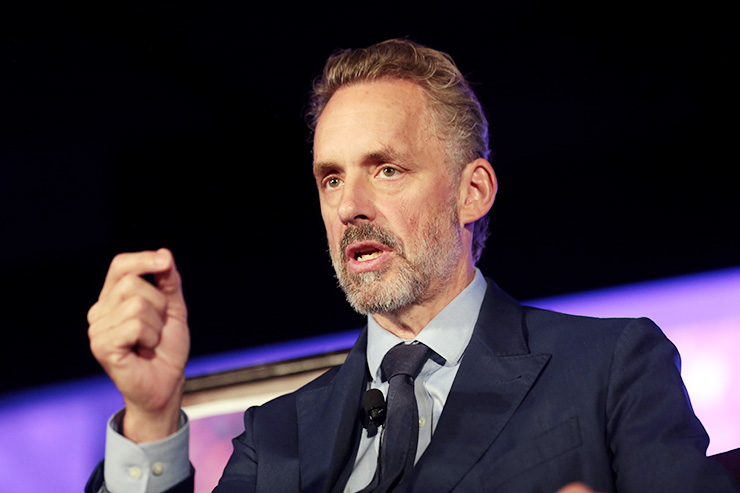
    Top image credit: https://www.flickr.com/photos/gageskidmore/29054996858

    [alert type=”general” dismiss=”no”]This article was published in New Dawn 168.[/alert]

    [alert type=”success” dismiss=”no”]If you appreciate this article, please consider subscribing to help maintain this website.[/alert]

    Footnotes

      1. “The right to be politically incorrect: Why I refuse to use genderless pronouns” by Jordan Peterson, National Post, 8 Nov 2016, http://nationalpost.com/opinion/jordan-peterson-the-right-to-be-politically-incorrect
      2. Witness his remarkable exchange with the UK Channel 4 newsperson Cathy Newman: www.theguardian.com/commentisfree/2018/jan/21/banning-jordan-peterson-causing-offence-cathy-newman-free-speech
      3. An opposite but equally effective method is to purposely inflate the language, to burden it with empty terms that obscure their own vacuity, as much of postmodernism and other recent critical studies do.
      4. www.youtube.com/watch?v=uMsi61OtkE4
      5. “A Campus Argument Goes Viral. Now the College Is Under Siege” by Anemona Hartocollis, New York Times, 16 June 2017, www.nytimes.com/2017/06/16/us/evergreen-state-protests.html
      6. “The Interrogation of a TA” by Scott Jaschik, Inside Higher Ed, 22 Nov 2017, www.insidehighered.com/news/2017/11/22/university-faces-uproar-over-recording-showing-how-teaching-assistant-was-questioned
      7. “’Go home, racist!’ Richard Spencer shouted down at University of Florida speech”, USA Today, 19 Oct 2017, www.usatoday.com/story/news/nation-now/2017/10/19/richard-spencer-shouted-down-university-florida-speech/781966001/
      8. www.youtube.com/watch?v=lhEG69ZGwUI
      9. David Clay Large, When Ghosts Wake: Munich’s Road to the Third Reich, W. W. Norton and Com., 1997, 245
      10. Colin Wilson, A Criminal History of Mankind, Diamond Books, 1993, 626-35
      11. Allan Bloom, The Closing of the American Mind, Simon and Schuster, 1987; Roger Kimball, Tenured Radicals, HarperCollins, 1990
      12. “Is it OK for a white kid to dress up as Moana for Halloween? And other cultural appropriation questions” by Alia E. Dastagir, USA Today, 24 Oct 2017, www.usatoday.com/story/news/2017/10/23/halloween-cultural-appropriation-questions/780479001/
      13. Richard Grossman, ed., The God That Failed: A Confession, Harper & Brothers, 1949. This was a collection of essays by ex-Communists such as Arthur Koestler and André Gide, on why they lost the faith.
      14. “Paul de Man Was a Total Fraud” by Robert Alter, New Republic, 6 April 2014, https://newrepublic.com/article/117020/paul-de-man-was-total-fraud-evelyn-barish-reviewed
      15. www.youtube.com/watch?v=awTgtA3BuRY
      16. www.patreon.com/jordanbpeterson

    © New Dawn Magazine and the respective author.
    For our reproduction notice, click here.
  • George Orwell’s Guide to the News

    George Orwell’s Guide to the News

    From New Dawn 134 (Sept-Oct 2012)

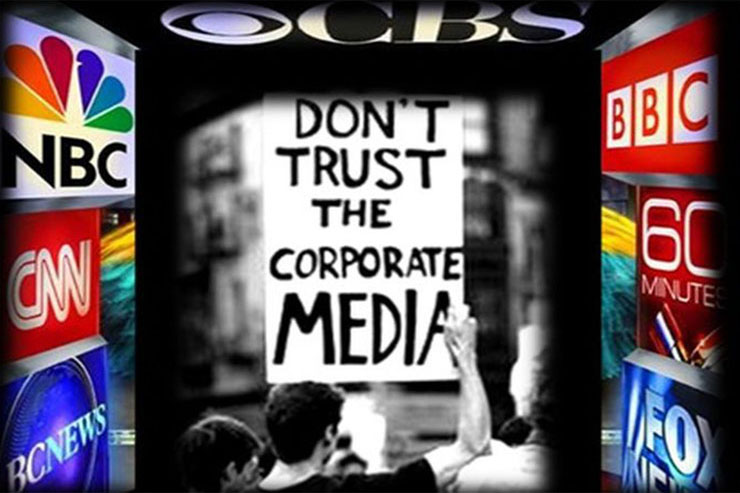
    The Western mainstream media falsifies the news resorting to euphemisms, half-truths and lies in the best (worst) style of George Orwell’s novel 1984.

    We all live in the unreal world of “Newspeak” used by the Global Power Elite to control our minds.

    Man gets confused when things that happen around him and to him, or which are done in his name, cannot be properly grasped, understood or made sense of.

    Normally, such confusion leads to inaction. If you’re lost at night in the middle of a forest but you can still see the stars, then a bit of astronomical knowledge will at least quickly tell you which way is north. But if it’s cloudy or you’re ignorant of the constellations in starry heaven, then you might as well light up a fire and do nothing until dawn…. You’re lost!

    Today, mainstream media coverage uses programmed distortion, confusion, even outright lying when its Money Power masters order it to support the “official story” on any major political, economic or financial process. When looked at closely, however, the “official story” of things can be seen to be inaccurate, misleading, often hardly believable if not downright stupid.

    Examples of this: Iraq’s nonexistent WMD’s leading to the invasion and destruction of that country; global mega-banker bail-outs with taxpayer money; irrational US diplomatic, military, financial and ideological alignment to Israeli objectives; “we-killed-Osama-Bin-Laden-and-dumped-his-body-into-the-sea”; and the wide array of “whodunits” surrounding 9/11 in New York and Washington, 7/7 in London, the AMIA/Israeli Embassy attacks in Buenos Aires in 1992/1994, and – of course – that all time favourite: who shot JFK…?

    These are but a few of the paradigmatic cases that have at least served to trigger millions of people to wake up and think with their own minds instead of the mainstream media’s!

    But, unfortunately, the vast majority of such cases are not so clear-cut. The vast majority of Newspeak lies are like knots, difficult to untie as they carry built-in complexity resembling Gordian Knots. And, as with all Gordian Knots, you need to cut right through them, and this requires swift and precise action plus a good measure of intellectual courage.

    To give an example of what we say, let’s take a quick look at how a “Newspeak” operation works. It requires sequential planning, it requires time, it requires proper logistics, it requires “credible” spokespeople in public and private sectors, it requires choosing the right words and images at the right time and in the right circumstances.

    So, let’s say the Global Power Elite – working through the governments of the US, UK, EU into which they are deeply embedded, and joint-venturing with a wide array of media outlets, defense companies, oil companies, security and construction companies, and powerful lobbies – decide that they wish to overrun and destroy a specific country…

    How do they ensure that “the international community” will just quietly look on (except for the still relatively small minority of voices that are increasingly raising hell against them)?

    The Seven Step Mainstream Media Country Destruction Guide

    1. First, they start by targeting a country ripe for “Regime Change,” and brand it a “rogue state”; then
    2. They arm, train, finance local terrorist groups through CIA, MI6, Mossad, Al-Qaeda (a CIA operation), drug cartels (often CIA operations) and call them “freedom fighters”; then…
    3. As mock UN Security Council Resolutions are staged that rain death and destruction upon millions of civilians, they call it “UN sanctions to protect civilians”; then…
    4. They spread flagrant lies through their “newsrooms” and paid journalists, and call it “the international community’s concerns expressed by prestigious spokespeople and analysts…” then…
    5. They bomb, invade and begin to control the target country and call it “liberation”; then…
    6. As the target country falls fully under their control, they impose “the kind of democracy that we want to see” (as Hillary Clinton before visiting Egypt and Tunisia on 10 March 2011), until finally…
    7. They steal appetising oil, mineral and agricultural reserves handing them over to Global Power Elite corporations, and impose unnecessary private banking debt and call it “foreign investment and reconstruction.”

    Their keynotes are: Force and Hypocrisy, which they have used time and again to destroy entire countries, always in the name of “freedom,” “democracy,” “peace” and “human rights.” Utmost force and violence is used to achieve their ends and goals.

    [alert type=”general” dismiss=”no”]This article was published in New Dawn 134.[/alert]

    [alert type=”success” dismiss=”no”]If you appreciate this article, please consider subscribing to help maintain this website.[/alert]

    © New Dawn Magazine and the respective author.
    For our reproduction notice, click here.

  • Empire of Mammon: Secret History of the World’s Financial Capital

    Empire of Mammon: Secret History of the World’s Financial Capital

    From New Dawn 133 (Jul-Aug 2012)

    ‘The City’ – or, ‘The Square Mile’ – refers to the City of London Corporation. Together with Wall Street, The City forms the hub of the plutocratic system that controls most of the world, and is presently engulfing the few remaining states that it does not control, through the time-proven tactics of plutocracy: revolution ostensibly in the name of ‘the people’.1

    Because The City is situated in England, and because it is often confused with the ancient capital, London, there has been a lot of obfuscation as to the character of the plutocratic system that is partially based in The City. Hence, there has been a great deal stated, even by the well-informed, in regard to the British Empire and even the British Crown, being intrinsically a part of this international oligarchy. This is to misunderstand the nature of international capital, which owes no steadfast loyalty to any system of government, head of state, religion, ethos, nation, ethnicity or culture. Any such allegiance is conditional.

    What is ‘The City’?

    The City of London Corporation is described in its promotional statements as “the world’s leading financial centre,” and as “the financial and commercial heart of Britain, the ‘Square Mile’.”2

    The City of London is at the heart of the world’s financial markets. It is a unique concentration of international expertise and capital, with a supportive legal and regulatory system, an advanced communications and information technology infrastructure and an unrivalled concentration of professional services…3

    Since the demise of the British Empire, worn out by two world wars that benefited it not a jot, Wall Street has popularly become identified as the international financial capital. Again, this is due to the error in thinking that British imperial interests were synonymous with international plutocracy, and because Britain is no longer a world power, ‘London’ is subordinated to New York. However, The City of London Corporation is neither synonymous with Britain nor British interests, other than when these happen to coincide with the interests of international finance. That is why, even though the British Empire has been defunct for over half a century, The City remains, in the words of its promoters, “at the heart of the world’s financial markets.”

    Hence while Britain and the Commonwealth has a symbolic Head-of-State in the Monarch, the analogous Head-of-State for The City has precedence over the British Sovereign. The Lord Mayor of the City of London Corporation is “not the Mayor of (Greater) London”; nor is he a ‘mayor’ in the limited sense of the word. He assumes the position as ‘Head-of-State’, not of merely a borough or a county. This Lord Mayor is elected for one year, and acts as a global ambassador for the international financial institutions situated in The City, and is “treated overseas as a Cabinet level Minister.”4 He lives in the palatial 250-year-old ‘Mansion House’. On state visits the British Monarch waits at the Gate of The City to seek permission to enter and is presented with the sword of The City by the Lord Mayor.5

    This tradition has been preserved for more than 400 years, and the ceremony now is carried out on major state occasions where the Queen halts at Temple Bar to request permission to enter the City of London and is offered the Lord Mayor’s Sword of State as a sign of loyalty.6

    No matter how one rationalises the ceremony as an ostensible mark of ‘loyalty’ by The City towards the British Monarch, it is nonetheless the Monarch who is placed in a subordinated position in seeking permission for entry and waiting for a symbolic affirmation of loyalty from The City on each occasion.

    International Finance

    It should be kept in mind that ‘international finance’ is exactly that: international; not Dutch, German, British, or American. Jewish bankers might be loyal to Judaism or to Israel, and the French Huguenots who went to London had a religious identity. But international finance is not bound to the states of its residence.

    The ‘modern’ financial system did not originate in Britain, or even in the Occident. Ezra Pound, the famous poet who was also an avid opponent of usury-banking and an advocate of Social Credit banking reform, traced the premises of the ‘modern’ usurious financial system back to “the loans of seed-corn in Babylon in the third millennium BC.”7

    As indicated above, international finance can shift focus over the world as the requirements of commerce dictate. As for the shift of the Money Power to England, this can be traced to the English Civil War, and even to the Reformation, where a Cromwell was significant in both. Thomas Cromwell, Secretary of State, who “represented the mercantile community,”8 as distinct from the traditional landed interests, urged Henry VIII to suppress the religious Orders in 1533. Brooks Adams states of this in his historical masterpiece, The Law of Civilisation and Decay, that:

    In 1533 Henry’s position was desperate. He confronted not only the pope and the emperor, but all that remained of the old feudal society, and all that survived of the decaying imaginative age. Nothing could resist this combination save the rising power of centralised capital, and Henry therefore had to become the mouthpiece of the men who gave expression to this force. He needed money, and money in abundance, and Cromwell rose to a practical dictatorship because he was fittest to provide it.9

    Adams details how the era of Henry VIII and the Reformation was the beginning of the speculative, capitalistic system.10 Additionally, “The sixteenth-century landlords were a type quite distinct from the ancient feudal gentry. As a class they were gifted with the economic, and not with the martial instinct, and they throve on competition.”11

    The expansion of commerce in the wake of the Age of Exploration, and the formation of the British East India Company in 1600, five years after the East India Company in Holland, were symptoms of this historical trend that had already been set in motion by the Reformation. The merchant interests felt constrained by the Monarchy and another Cromwell, Oliver, came forward, like his great-great-grand-uncle Thomas, to radically change England in the interests of money. The British Empire was expanding towards Asia and buccaneering was establishing fortunes. However,

    As the city grew rich it chafed at the slow movement of the aristocracy, who, timid and peaceful, cramped it by closing the channels through which it reached the property of foreigners; and, just when the yeomanry were exasperated by rising rents, London began to glow with that energy which, when given vent, was destined to subdue so large a portion of the world. Perhaps it is not going too far to say that, even from the organisation of the East India Company, the mercantile interest controlled England. Not that it could then rule alone, it lacked the power to do so for nearly a hundred years to come; but, after 1600, its weight turned the scale on which side soever thrown.

    Macaulay has very aptly observed that but for the hostility of The City, Charles the First would never have been vanquished, and that, without the help of The City, Charles the Second could scarcely have been restored.12

    From the middle of the 16th century capital accumulated, and “the men adapted to be its instruments grew to be the governing class.”13 Adams states of the era, “In 1688, when the momentum of England suddenly increased, the change was equivalent to the conquest of the island by a new race.”14 London became the centre of this global expansionist acquisition, a new Rome, where the wealth of the world was deposited:

    These hoards, the savings of millions of human beings for centuries, the English seized and took to London, as the Romans had taken the spoil of Greece and Pontus to Italy. What the value of the treasure was, no man can estimate, but it must have been many millions of pounds – a vast sum in proportion to the stock of the precious metals then owned by Europeans.15

    What Adams calls a regime of merchants ruled England from 1688 to 1815. The wealth they accumulated, states Adams, became the primary source of power, and it was in the hands of a new breed of merchant: the bankers. “With the advent of the bankers, a profound change came over civilisation, for contraction began.”16 The value of money as distinct from the mercantile concern at the value of wares was the concern of the bankers. At the close of the 18th century “the great hoards of London” passed into the hands of the bankers, the “most conspicuous example” being the Rothschilds.17

    It is here that we see a dichotomy arising between the old merchant, including the mercantile adventurers, such as Robert Clive of India to Cecil Rhodes, and on the other hand, the merchant bankers epitomised by the Rothschilds. It is here where the two are often mistaken as forming a common power elite.

    Dr. Carroll Quigley18 described the character of international finance and the move of its centre to The City: “Financially, England had discovered the secret of credit. Economically, England had embarked on the Industrial Revolution.”19 Here we discern immediately a dichotomy operating within British power-politics: that of usury-based finance, which is cosmopolitan and parasitic; and that of the ingenuity of the Englishman and Scott as inventor and entrepreneur, as creator. It was this creativity and inventiveness, coupled with the bravery of the British military and the dedication of the British administrator, that was pressed into the service of parasitic finance, behind the cover of the British flag and Crown. These two factors at work: one cosmopolitan and one British, are often confused as being one and the same. Quigley continues:

    Credit had been known to the Italians and the Netherlanders long before it became one of the instruments of English world supremacy. Nevertheless, the founding of the Bank of England by William Paterson and his friends in 1694 is one of the great dates in world history.20

    Quigley explained, far more succinctly than economists, that the basis of the debt finance system is “fractional reserves.” This method had its origin in the realisation by goldsmiths that they did not need to hold the equivalent of gold reserves in their vaults to the amount of paper certificates issued representing the value of gold. As there was unlikely to be a run on the vault by its depositors all demanding at once the return of their gold deposits, the goldsmith could issue paper certificates far in excess of the value of the amount of gold in his vaults.21

    Fractional reserves remains the method of international finance, albeit no longer with the need for gold reserves. In particular, it should be kept in mind that the basis of the system is usury, where interest is charged for the loan of this bogus credit. Not only must the principal be paid back in real wealth – productive labour or creativity – but added interest.

    Quigley remarks that “in effect, this creation of paper claims greater than the reserves available means that bankers were creating money out of nothing.” According to Quigley, William Paterson, having obtained the Royal charter for the Bank of England in 1694 remarked, “The Bank hath benefit of interest on all moneys which it creates out of nothing.”22

    The centre of gravity for the merchant bankers had long been Amsterdam. The “Republic of the United Provinces,” which included Holland, had from the start accorded Jews, as the catalysts of incipient international free trade, equal protection.23 According to Dr. Stanley Chapman, Professor of Economic History at Nottingham University, the Sephardic Jewish community in Amsterdam had become adroit as lenders to foreign governments.24

    Shall we, then, say there had been a ‘conspiracy of Dutch merchants to rule the world’? I think not. Yet neither can it be said in justice this was a ‘Jewish conspiracy’. The establishment of the Bank of England was a Protestant affair with anti-Catholic underpinnings. From France came the Huguenots who, like the Dutch Sephardim, had established international connections through family networks across Europe and had also formed a community in The City, by the mid 18th century.25 The English Revolution of 1642-1648, which established the republican Commonwealth under Oliver Cromwell in 1649, enduring under his son Richard until 1659, had opened the way for a shift of international banking from Amsterdam to London. The impetus for British imperial expansion had started under Cromwell. The merchant coterie of Amsterdam, which had backed Cromwell, was permitted entry into England. Menasseh ben Israel had appealed to Cromwell on the grounds of mercantile profitability to any nation that gave the Jewish merchant bankers freedom, as Amsterdam had done. Menasseh assured Cromwell that profit was the best reason why the merchant bankers should be permitted into England:

    Profit is a most powerfull motive, and which all the World preferres before all other things: and therefore we shall handle that point first. It is a thing confirmed, the merchandising is, as it were, the roper profession of the Nation of Jews…26

    Menasseh proceeded with explanations as to why this is so, due to the lack of opportunity from the time of the Exile, to possess a state of their own and to till the land, leading Jews to “give themselves wholly unto marchandising.” Their dispersion throughout the world enabled them to form networks across borders, to engage in commerce, with a common language that transcended the linguistic barriers of others.27

    While the supremacy of Money in England was set in motion by Henry VIII’s Reformation, and the English Revolution a century later heralded the triumph of the merchant, it was not until the usurpation of the Throne by William III of Orange in 1688, with the deposing of James II, that the Bank of England was established. From then on a National Debt was owed to the usurers.

    From the time of King Henry I talley sticks had served as the King’s currency. These talley sticks were carved sticks broken lengthwise. The Chancellor of the Exchequer kept one half, and the King spent the other half into circulation,28 like President John F Kennedy did in 1963, when he issued $4 billion ‘United States Notes’ directly into circulation via the US Treasury, circumventing the Federal Reserve Bank.29 Eventually, the two halves would be matched to prevent counterfeiting. The talley sticks could be used as exchange for commerce and in payment of taxes. They circulated in England for 726 years until eliminated on the demand of the Bank of England in 1826.30

    Although William was the maternal grandson of Charles I, he was born in Holland and destined to fulfil the legacy of Cromwell in placing England under the bondage of the merchant bankers, then centred in Holland. The anti-Catholic sentiment that had started under Henry VIII was a catalyst in assuring William support in driving James II from the Throne. Under William the authority of the Monarchy was reduced, and that of Parliament enhanced. The epochal act of William was to grant the Charter to William Paterson to establish the Bank of England. This acquiescence might be explained by William having “heavily borrowed in Amsterdam to fight his continental wars.”31 The link between the bankers of Amsterdam and of London was maintained even into the 19th century, and by the mid 18th century there was a considerable colony formed in the City by the scions of the Amsterdam banking families.32

    The idea for the Bank of England came from the example of the Wisselbank, founded in 1609 which, according to the Bank of England’s account, was the lender to the City of Amsterdam, the Province of Holland and the Dutch East India Company, exercising a monopoly over state borrowing and coinage.33 The move to establish such a bank in England gained momentum “after the Glorious Revolution of 1688 when William of Orange and Queen Mary jointly ascended the throne of England.” The political economist Sir William Petty wrote that the power of England would be magnified if there were a bank to lend the Throne credit.34 He did not explain why it could not be a state bank issuing its own credit, and had to be a private bank accruing interest on credit that it makes out of nothing, as its founder, William Paterson, explained. According to Petty such a bank would “furnish Stock enough to drive the Trade of the whole Commercial World.”35

    The Bank of England explains that after the rejection by Parliament of several proposals the bank and a “Fund for Perpetual Interest” were accepted, having gained support from The City on recommendation by Michael Godfrey, “a leading merchant.”36

    In 1734 the Bank of England moved into a ‘vast’ purpose-built building, nicknamed ‘The Old Lady of Threadneedle Street’, in The City.37 It was from the founding of the Bank of England that “the funded National Debt was born.”38 The present-day description of credit by the Bank of England is quite illuminating. The Bank’s historical account states that at the time credit was called “imaginary money.” Until then ‘the man in the street’ had simply thought of money as coins, but this ‘shibboleth’ was now overturned. Money could take other forms “that had no intrinsic value.” “The 18th century was a period dominated by governmental demand on the Bank for finance: the National Debt grew from £12 million in 1700 to £850 million by 1815, the year of Napoleon’s defeat at Waterloo.”39

    In 1946 the Bank was ‘nationalised’, but as in the nationalisation of other such banks, such as New Zealand’s Reserve Bank in 1936, this means little, as the real authority comes from the creation of credit by the international merchant bankers. However, as the Bank’s account states, in 1997 the Government formally handed its financial authorities over to the Bank and it “thus rejoined the ranks of the world’s ‘independent’ central banks.”40

    The purpose of these ‘central banks’, which the general public believes are controlled by governments, was to bring into their

    financial network the provincial banking centres… to form all of these into a single financial system on an international scale which manipulated the quantity and flow of money so that they were able to influence, if not control, governments on one side and industries on the other. The men who did this… aspired to establish dynasties of international bankers…41 The centre of the system was in London, with major offshoots in New York and Paris, and it has left, as its greatest achievement, an integrated banking system…42

    Rothschilds: Lords of International Finance

    From the establishment of the Rothschild banking dynasty in England by Nathan M Rothschild, The City becomes synonymous with that dynasty. Further still, these suddenly ‘British’ Rothschilds become ‘British’ imperialists in the manner a chameleon changes his colour according to survival needs. It is the insinuation of the Rothschilds into the British power-structure that has generated much discussion of a ‘British’ imperial conspiracy centred around Cecil Rhodes and Alfred Milner, and the so-called ‘Round Table Group’ that they founded to extend British influence throughout the world. It is further frequently claimed this emerged as an ‘Anglo-American’ conspiratorial ‘network’ that continues to the present in attempting to establish ‘Anglo-American’ global hegemony.

    Theorists of this ‘Anglo-American network’ most frequently cite Harvard historian Dr. Carroll Quigley, who had access to what were presumably the papers of the Council on Foreign Relations. For reasons not known to this writer, Dr. Quigley, informative on so much in the course of his magnum opus, Tragedy & Hope, erred in thinking that an oligarchic ‘Anglo-American network’ was formed in the aftermath of World War I and continues to the present. We shall briefly examine this error in due course. However, for the moment Quigley had some pertinent things to say about both the Rothschilds and the “international system of control” that was developing.

    Quigley stated that one of the primary reasons the centre of international finance shifted to London was because the British upper class, which was not as rooted in noble birth as in money, “was quite willing to recruit both money and ability from lower levels of society and even from outside the country, welcoming American heiresses and central-European Jews to its ranks.” This allowed the power structure to take on a cosmopolitan flavour. (We might note this vulgarisation of the English ruling-class seems to have begun during the time of Henry VIII).

    Quigley described the development of the financial network by the international bankers into a world control system, and the assumption of the Rothschild dynasty to primacy:

    In time they brought into their financial network the provisional banking centres, organised as commercial banks and savings banks, as well as insurance companies… The greatest of these dynasties, of course, were the descendents of Meyer Amschel Rothschild… whose male descendants, for at least two generations, generally married first cousins or even nieces. Rothschilds five sons, established at branches in Vienna, London, Naples, and Paris, as well as Frankfort, cooperated together in ways which other international banking dynasties copied but rarely excelled.43

    Quigley pointed out these bankers were “cosmopolitan and international rather than nationalistic,”44 and this, by the very nature of their business, is what they remain.

    Brooks Adams states that towards the close of the 18th century the boards of The City passed from the merchants to merchant bankers, “the most conspicuous example [being] the family of Rothschild.”45

    Mayer Amschel had established his fortune by handling the financial affairs of William IX of Hesse-Kassel, who had been paid well by the British Government for supplying troops against the American revolt. At the time Amsterdam had been the capital of international banking, but the Napoleonic invasion of Holland had led to the closing of the Amsterdam Bourse, “the leading Continental exchange.” Mayer Amschel and several others were situated to provide William IX with funds.46 Additionally, in 1800 Mayer Amschel had become Imperial Crown Agent for the Emperor of Austria. He was what Derek Wilson described as “one of the first of a new breed of businessmen – the truly international merchant banker.” Wilson states that for centuries the Jews had played a prominent part in “long distance commerce” due to their communal loyalty with which they were able to create a “commercial sub-culture.” However, they were reliant on the patronage of rulers. Now, the revolutionary tumult in Europe had swept away traditional rulers and placed money on a footing of power.

    In 1798 Nathan Rothschild set up shop in England and in 1806 he became a “naturalised Englishman.”47 The Rothschilds were backing the coalition against Napoleon, who was upsetting the Continental system of finance. In 1808 Nathan took over the financial affairs of the Landgrave William IX in England. That year he moved his business to 12 Great Helen’s Street, The City, under the name of N M Rothschild and Brothers.48 With agents throughout Europe, the Rothschilds were valuable allies in organising smugglers and couriers in the war against Napoleon. By now, on the initiative of Nathan Rothschild, “the nerve centre of Rothschild operations had shifted from Frankfurt to London.”49 Wilson reiterates that through Nathan’s family and his “large network of agents and couriers he was better informed about European affairs than any man in London – including members of the government.”50 Wilson is altogether too charitable in ascribing ‘patriotic’ – British – motives to Nathan, in contrast to what he frankly says about the lack of national ‘patriotism’ among the other Rothschild brothers toward anything other than “loyalty and responsibility to the Chosen People.”51 Rather, Nathan and the rest of the dynasty were assisting in the fight against Napoleon because the upstart was undermining the financial system.

    Quigley explains that the credit creation mechanism developed by the international bankers, as previously described, was to become one of the chief weapons in the victory over Napoleon in 1815. “The emperor, as the last great mercantilist, could not see money in any but concrete terms, and was convinced that his efforts to fight wars on the basis of ‘sound money’, by avoiding the creation of credit, would ultimately win him a victory by bankrupting England.”52 Hence, the war against Napoleon was in part a war between two systems of economics involving the reorganisation of Europe.

    The British Empire & Cecil Rhodes

    It is a significant error of interpretation for historians such as Carroll Quigley or E C Knuth53 to suppose there is an ‘Anglo-American’ network working for world rule on the edifice of English sentiments. It is also erroneous to assume that because the merchant bankers found it opportune to lend credit to governments that ruled over empires, these bankers, who are cosmopolitan, have an enduring commitment to some type of nationally based imperialism, whether it be ‘British’, ‘American’, ‘German’, ‘Dutch’, etc.

    The theory of the ‘Anglo-American’ network written about by Quigley was adopted by conspiracy theorists such as W Cleon Skousen.54 The basis of these theories centres on Lord Rothschild being the banker to Cecil Rhodes. The theory states that Lord Natty Rothschild was part of Rhodes’ secret society, the Round Table Groups, that aimed to spread the benevolence of British imperialism over the world.55 These imperial ideals were said to be motivated by the teachings of the Oxford art historian John Ruskin, who exhorted his students to take British culture to the ends of the Earth. While Lord Rothschild saw the Empire as the means by which commerce could be spread and maintained by force of arms, the support was pragmatic, and owes nothing to a commitment to any British ideals as envisaged by Rhodes et al. Derek Wilson writes of this in relation to Lord Rothschild’s opposition to Gladstone’s ‘flabby’ foreign policy: “But Lord Rothschild was not an unbridled expansionist. This is clearly shown by his relationship with a man who was an unbridled expansionist – Cecil Rhodes.”56

    When diamonds were discovered in South Africa, the Rothschilds bought into the Anglo-African Diamond Mining Company Ltd., which was amalgamated with DeBeers. In 1887 Rhodes returned from South Africa to Britain to ask Lord Rothschild for financial backing. Lord Rothschild saw this as the means of establishing commercial stability in South Africa against their main rival, the Barnato Diamond Mining Company, which also ended up merging with DeBeers.57 For Rhodes, making money was a means of spreading British imperial ideals. Not so for Rothschild, although Rhodes persuaded himself Natty was of like mind. “He was wrong. Lord Rothschild was not an unreserved imperialist, as Rhodes gradually discovered.” In 1888 Rhodes made a will nominating Natty to administer most of his estate for funding The Round Table Groups. Wilson writes:

    In response to Rhodes’ suggestion that company funds be used to finance territorial expansion, his banker advised: “if… you require money to finance territorial expansion, you will have to obtain it from other sources than the cash reserves of the DeBeers Company.” And Rhodes cannot have been very pleased to learn, in 1892, that Rothschilds had floated a loan for the Boer government of the Transvaal.58

    The Rothschilds were interested in commercial stability, not British imperial expansion. By the time of the abortive Jameson Raid organised by Rhodes against the Boer Transvaal Republic in 1895,

    he had long ceased to have close and cordial relations with Natty. Probably he never grasped the fact that, though the Rothschilds disliked Gladstone’s policy of colonial retrenchment, they were not advocates of unbridled imperialism for its own sake.59

    Hence, when a few decades later imperialism became a hindrance to unbridled international free trade, the international bankers used the newly emergent power of the USA to scuttle the old European Empires over the course of half a century, and the oligarchs moved into the power-vacuum of the new decolonised states.60

    This myth of the ‘Anglo-American network’ for world control is centred around a supposed alliance between the Royal Institute of International Affairs (RIIA) and the US globalist think tank, the Council on Foreign Relations (CFR),61 founded in the aftermath of World War I by the US power elite. Again, this assumed alliance is erroneous: the proffered alliance between the two bodies never eventuated. Far from there being accord between supposed ‘Anglophiles’ on both sides of the Atlantic, there was a breach. Peter Grose, the CFR’s historian, mentions that both sides soon rejected the suggested alliance before it eventuated.62

    The Rothschilds were concerned with Britain’s imperial links “for sound commercial reasons,” but with “maximum freedom of trade.”63 It was inevitable that ‘free trade’ and the old European imperialism were going to conflict. The role assumed by the USA in subverting and destroying the old empires can be discerned by ‘The Fourteen Points’ decreed by President Woodrow Wilson as the blueprint for the post-war world in 1918;64 and by the ‘Atlantic Charter’,65 imposed on Britain by President F D Roosevelt in 1945, both of which focus on international free trade as the basis for the world economy and specifically repudiate the old empires.66

    Soon after World War II the Rothschilds increased their focus on Wall Street, and their hitherto relatively small Amsterdam Incorporated was reformed as an investment bank named New Court Securities, its share capital being taken up by the Rothschild banks in Paris and London. Where hitherto the Rothschilds had mainly been concerned with negotiating loans with states, they were now involved in the rapid post-war expansion of Western commerce and industry,67 freed up by the destruction of the old empires, and the inauguration of a new era of international financial agreements, formalised by the Bretton Woods Agreement.

    This is what the biographer Wilson calls the Rothschilds’ “new, deliberate internationalism”;68 no longer constrained by nation-states and imperial ideals. However, The City remains a focus. The Rothschilds led the way in forging links between Tokyo and London. Edmund co-led a delegation from The City to Tokyo in 1962 and received The Order of the Sacred Treasure from Emperor Hirohito.

    Regardless of these new avenues opened up for post-war globalisation and free trade, certain plutocratic traditions remain features of The City: the ‘Gold Fixing Room’ at the Rothschild offices, New Court, continue to be the place where the leading London bullion dealers daily sit around a table “to agree on the price of gold.” N M Rothschild “continues to be the most important bullion dealer” in Britain.69 Of the “four hundred and eighty banks in the city,” Rothschild remains supreme.70

    Get the issue this article appears in

    London: Capital of the World

    However, other avenues for profit besides the traditional dealings in gold bullion are emerging. The one for our era is credits for greenhouse emissions, and with this profit also comes new schemes for world control.

    In 2008 Simon Linnett, Executive Vice Chairman of N M Rothschild, wrote a policy document on the issue.71 Linnett defines “greenhouse emissions” as the new form of “social market.” He states that while it must be free trade that operates in defining the value of the carbon emission exchange, what is required is an “international institution.” He writes that “such a market has to be established on a world basis coordinated by an international institution with a constitution to match.”72 Linnett frankly states that this involves a “new world order”:

    That, perhaps, it might be regarded as having wider benefits than merely ‘saving the planet’ – perhaps it might be the basis of a new world order…73

    Of various methods suggested to limit carbon emissions, carbon trading is held by Linnet to be the most effective.74 Implicit in the various measures, including funding new technology and changing the consumption habits of individuals is, “that nations have to be prepared to subordinate, to a certain extent, some of their sovereignty to this world initiative.”75 “When countries are already foregoing the right of direct control over monetary policy through the creation of independent central banks, this could be a relatively small price to pay for such inclusion.”76 The system being proposed by Linnett, in the cause of “saving the planet,” is the consolidation of the international banking system under a central authority. Linnett states that the European nations have already ceded their sovereignty to the European Union; the next step being, “to yield sovereignty to a bigger world body on carbon trading.”77 “If such a route map could be found, then perhaps we might be at the beginning of a new world constitution and a new world order.”78

    The world authority that Linnett proposes he calls the World Environment Authority (WEA). This would be based in what he calls a “world city.”79 Linnett suggests that this “world city” should be London, The City, due to it being “a world financial centre (possibly ‘the’ world financial centre).”80

    Whatever might be said about Wall Street, or the shift of global political power to Washington and New York, clearly The City still holds sway in the thinking of some of the primary oligarchs of international finance.

    [alert type=”general” dismiss=”no”]This article was published in New Dawn 133.[/alert]

    [alert type=”success” dismiss=”no”]If you appreciate this article, please consider subscribing to help maintain this website.[/alert]

    Footnotes

    1. K R Bolton, Revolution from Above, London: Arktos Media Ltd., 2011, passim.
    2. City of London, ‘What is the City of London?’, www.cityoflondon.gov.uk/Corporation/LGNL_Services/Council_and_democracy/Council_departments/whatis.htm
    3. Ibid., “Business”, www.cityoflondon.gov.uk/Corporation/LGNL_Services/Business/
    4. Ibid., ‘The Lord Mayor of the City of London’, www.cityoflondon.gov.uk/Corporation/LGNL_Services/Council_and_democracy/Councillors_democracy_and_elections/The_Lord_Mayor/
    5. ‘History of Temple Bar’, www.thetemplebar.info/history
    6. Ibid.
    7. Ezra Pound (1944), America, Roosevelt & the Causes of the Present War, London: Peter Russell, 1951, 6.
    8. Brooks Adams, The Law of Civilisation, London: MacMillan, 1896, 230.
    9. Ibid., 233.
    10. Ibid., 245.
    11. Ibid., 245.
    12. Ibid., 292-293.
    13. Ibid., 294.
    14. Ibid., 298.
    15. Ibid., 305.
    16. Ibid., 321.
    17. Ibid., 321.
    18. Carroll Quigley, of Harvard University, and the Foreign Service School at Georgetown University, was a scholar of considerable reputation, until he wrote a few dozen pages on the conspiratorial nature of international finance – albeit in a sympathetic light – in his 1,300 page magnum opus Tragedy & Hope in 1966.
    19. Carroll Quigley, Tragedy & Hope, New York: Macmillan co., 1966, 48.
    20. Ibid., 48.
    21. Ibid., 48.
    22. Ibid., 49.
    23. ‘The Estates General of the Republic of the United Provinces: Declaration Protecting the Interests of Jews Residing in Holland’, 13 July 1657; in Paul R Mendes-Flohr and Jehuda Reinharz (ed) The Jew in the Modern World: A Documentary History, New York: Oxford University Press, 1980, 16.
    24. Stanley Chapman, The Rise of Merchant Banking, Oxon: Routledge, 2006, 2.
    25. Ibid., 4.
    26. Menasseh ben Israel, ‘How Profitable the Nation of the Jews Are’, ‘to His Highness the Lord Protector of the Commonwealth of England, Scotland and Ireland’, in Paul R Mendes-Flohr and Jehuda Reinharz (ed) The Jew in the Modern World, op. cit., 9.
    27. Ibid., 10. The editors remark that although Menasseh’s mission to Cromwell in 1655 was “ostensibly unsuccessful, it did prepare the way for the resettlement of the Jews in England.” (Ibid., 12 Note 1).
    28. L. LaBorde, ‘The Unholy Alliance’, Silver Trading Company, Article #18, 12 February 2012, www.silvertrading.net/articles_metals_18_the_unholy_alliance.html
    29. J F Kennedy, ‘Executive Order 11110’, 4 June 1963.
    30. L. LaBorde, op. cit.
    31. Stanley Chapman op. cit. 2.
    32. Stanley Chapman, Ibid., 3.
    33. ‘Major Developments’, Bank of England, www.bankofengland.co.uk/about/history/major_developments.htm
    34. Ibid., www.bankofengland.co.uk/about/history/major_developments.htm#2
    35. Ibid.
    36. Ibid.
    37. ‘Visit The City: the Bank of England’, www.visitthecity.co.uk/index.php/attractions/view/448/
    38. Ibid., www.bankofengland.co.uk/about/history/major_developments.htm#2
    39. Ibid., www.bankofengland.co.uk/about/history/major_developments.htm#3
    40. Ibid., www.bankofengland.co.uk/about/history/major_developments.htm#5
    41. Carroll Quigley, op. cit., 51.
    42. Carroll Quigley, Ibid., 50.
    43. Ibid., 51.
    44. Ibid., 51-52.
    45. Brooks Adams, op. cit., 322.
    46. D Wilson, Rothschild: A Story of Wealth & Power, London: André Deutsch Ltd., 1988, 17.
    47. Ibid., 21.
    48. Ibid., 33.
    49. Ibid., 34.
    50. Ibid., 41.
    51. Ibid., 42.
    52. Carroll Quigley, op.cit., 49.
    53. E C Knuth (1946), The Empire of ‘The City’, Milwaukee, Wisc.; reprinted 1982 (no other publication details).
    54. W Cleon Skousen, The Naked Capitalist: A Review & Commentary on Dr Carroll Quigley’s Book Tragedy & Hope, Salt Lake City, Utah, 1971.
    55. Carroll Quigley, op. cit., 131; W Cleon Skousen, op. cit., 30.
    56. Derek Wilson, op. cit., 303.
    57. Derek Wilson, Ibid., 304.
    58. Ibid., 305.
    59. Ibid.
    60. A K Chesterton, The New Unhappy Lords, Hampshire: Candour Publishing Co., 1975, passim
    61. Carroll Quigley, op. cit., 132-133; W Cleon Skousen, op. cit., 31.
    62. Peter Grose, Continuing The Inquiry: The Council on Foreign Relations from 1921 to 1996, New York: Council on Foreign Relations, 2006. The entire book can be read online at: Council on Foreign Relations: www.cfr.org/about/history/cfr/index.html; K R Bolton, Revolution from Above, op. cit., 24-25, Note 5.
    63. Derek Wilson, op. cit., 305.
    64. W Wilson, ‘Fourteen Points’, 1918, www.fordham.edu/halsall/mod/1918wilson.html
    65. Franklin D Roosevelt and Winston S. Churchill, ‘The Atlantic Charter’, 14 August 1941, http://usinfo.org/docs/democracy/53.htm
    66. E Roosevelt, As He Saw It, New York: Duell, Sloan and Pearce, 1946, 31, 35.
    67. Derek Wilson, op. cit., 397.
    68. Derek Wilson, Ibid.
    69. Ibid., 436.
    70. Ibid.
    71. Simon Linnett, Trading Emissions: Full Global Potential, London: The Social Market Foundation, January 2008. Online at: www.smf.co.uk/assets/files/publications/SMF_Trading_Emissions.pdf
    72. Ibid., 4.
    73. Ibid.
    74. Ibid., 8.
    75. Ibid., 12.
    76. Ibid.
    77. Ibid., 12.
    78. Ibid., 18.
    79. Ibid., 15.
    80. Ibid., 19.

    © New Dawn Magazine and the respective author.
    For our reproduction notice, click here.
  • Polar Inversions & Other Cosmic Catastrophes

    Polar Inversions & Other Cosmic Catastrophes

    From New Dawn Special Issue Vol 11 No 3 (June 2017)

    The great George Ivanovitch Gurdjieff taught that even though our brains and minds may ‘wake up’ every morning allowing us to function as social beings, that in no way means we are truly Awake in a philosophical and spiritual sense. ‘Waking up’ every morning only means we continue in our social roles as in a ‘wakeful dream’. A fact that becomes painfully evident whenever we come to terms with the vast and deep unknown of the Collective Psyche and its impingement on each of us.

    Often, the dreams we have when our bodies are asleep may be construed as metaphors of how the psyche tends to represent deep truths and feelings in rather simplistic, even literal ways. If we’re about to venture on a hard and perilous journey, we won’t be surprised if the night before we have nightmares of horrific airplane, ship or bus accidents, of any manner of physical misadventure. If when awake we watch a movie about a great and fearful fire, we may that night have nightmares of being trapped inside a flaming house… In short, dreams are often literal, childish renditions of far more complex matters churning in our minds or deep inside our souls.

    Ages Come; Ages Go

    We all dream as individual, social persons, but we seldom ask if we might also dream as a race? If we do, how long do those collective dreams endure? If individual dreams last one night, do collective dreams go on for whole decades, a century, or even a millennium?

    Just as individual dreams may be triggered by everyday experiences, worries and angst, are collective dreams governed by more subtle long-term forces of a more genetic, even cosmic nature? Does such collective dreaming impinge upon the individual psyche, becoming potential untapped sources of perilous and primordial forces and group experience, and if so, how may we tap into them?

    Today, people live longer than our forebears. An average person in the West may live 75, perhaps 80 years, less for people in other regions of the world. Interestingly, if modern man lives on average, say 72 years, that is equivalent to one degree (i.e., 1/360th) of a Great Year or Platonic Year of 25,920 years (i.e., 72 years x 360 degrees = 25,920 years).

    Which brings us to the transitional upheavals upon our Collective Psyche today, as the end of the Platonic Month or ‘Age’ of Pisces draws nigh. This period also marks the end of an entire Great Year in the 25,920-year ‘Precession of the Equinoxes’ cycle, as we transit into the next 2,160-year period, or ‘month’, as the Sun rises at the vernal equinox with the constellation of Aquarius as stellar backdrop.

    Yes, we are transitioning into the so-called ‘month’ of Aquarius, symbolically marked by the Water Bearer, Ganymede,1 and its astrological opposite, Leo, the Lion. Back in the 1970s, the Hippie culture sang hymns to the dawning ‘Age of Aquarius’, naively believing the Aquarian archetype of the New Age would be filled with light, joy and happiness. They did not realise archetypes are ambivalent psychic beasts. Whilst you may wishfully think you are on its ‘light-ward side’, with the shining Sun above and the archetype at your feet, instead you might unwittingly – and far more likely – find yourself beneath the archetype: in its shadow, with all its darkness, gloom and confusion.

    Even now, as Pisces wanes and Aquarius waxes, the human race seems trapped on the ‘dark side’ of both archetypes, with their darkest shadows covering our world in blackest night.

    During these cosmic transitions, which impact the collective psyche, the dawning Platonic Month activates deep-rooted archetypes in the Collective Psyche. At the same time, the ‘used up’ waning archetypes plunge into slumber and deactivation, as the ‘dying’ month falls ‘asleep’ below the horizon.

    No one human being can actually experience these long-term changes because they literally span thousands of years. However, we can see them reflected – as in the wall of Plato’s Cave – in collective symbols, social paradigms and human behaviour as they ‘dawn’ and ‘wane’.

    The now waning Age of Pisces grew strong and powerful at the start of Christianity, two millennia ago, as the Trinity and Crucifixion resonated age-old archetypes – the Father-Mother-Son Triad, the Hero-Avatar, the sacrificial Cross or Yggdrasil Tree – and spontaneously linked it all to the Piscean fishes. Christ miraculously fed multitudes with baskets filled with fish, followed by His fishermen Apostles, walked on the Sea of Galilee, marking His clandestine fish symbol – ICHTHYS – deep into the catacombs of the Western psyche. Pisces, in turn, was balanced by its astronomical counterpart Virgo – the Virgin Mary/Isis – acting as a flywheel.

    In spite of its present decadence and materialistic rationalisations as a worldly institution, unworthy today of its luminous ancient roots, the Roman Catholic Church has nevertheless stood its ground on the profound significance of this cosmic symbol. Today, it continues to uphold the Pisces-Virgo Axis, something Protestant sects abandoned half a millennium ago, severing links to these subtle vital cosmic forces.

    When speaking of Platonic Months, we speak not so much in terms of physical sequential time – i.e. Chronos – but rather in terms of sacred time, Kairos: significant and meaningful points in time. Thus, the ‘end’ of Pisces and ‘beginning’ of Aquarius carry no specific date in chronological time. Rather, we are dealing with an imprecise, complex overlapping as one age gives way to the next and powerful forces are suddenly unleashed, as if both ages were psychic ‘tectonic plates’: long silent until sudden cataclysmic upheavals unleash psychic earthquakes shaking the collective unconscious!

    Some constellations of the Zodiac occupy large swathes of sky whilst others are more modest by comparison. Accordingly and true to Kairos, the Zodiac is not a mathematically exact definition of a specific geography in the heavens centred on the sidereal equator; much more it is a symbol, an anagram, a reflection of earthly matters in the sky (and vice-versa), and as such no causal relationships exist – nor indeed need be found or ‘scientifically’ proven – between human affairs on Earth and the imagery of signs and shapes Man projects upon the heavens by literally ‘joining the dots’ in the sky, something he’s been doing for thousands of years.

    Rather, we should think in terms of Carl Jung’s synchronicities: certain events have no direct causal link, but project ‘meaning’ for us in our individual and collective life experiences.

    Thus, if you’re born a Pisces, Leo, or Scorpio, people around you will notice certain traits, patterns, tendencies and attitudes that somehow ‘fit’ the way Pisceans, Leos or Scorpions behave. Understanding and nurturing these meanings is more of an Art than a science. Seek no elusive Cartesian causal links, because none are to be found. That’s how synchronicity works: qualitative leaps towards a higher order of things, which in its jagged and labyrinth-like trajectory are not concerned with sequential logic.

    We thus dive deep into the sacred realm of Meaning and the deep-seated mystery of Becoming, where archetypes, synchronicities and Platonic Months are the compasses that ensure we do not lose our way.

    Worlds in Collision

    In this train of thought, there is deep-seated lore pointing to ‘polar inversions’ taking place over eons of time. In its materialistic interpretation, they seem to resolve in End Times, when Earth’s poles switch place. Proponents of this theory claim the planet performs some sort of somersault on its own axis leading to all manner of geological catastrophes bringing ghastly fire and brimstone raining upon all of us, 200-metre tsunamis sweep across continents obliterating cities and lands, killing billions of people and flattening civilisation.

    That’s the History Channel version, which does naught but reflect American materialism gone ballistic as Hollywood makes millions of dollars cashing in on ‘Coming Catastrophe Syndrome’. Especially after the 11 September 2001 False Flag event, with that overpowering vision of the two mighty Twin Towers collapsing free fall into their footprints in just eleven seconds.

    Rather than explaining the otherwise unexplainable (save for Deep State conspiracies), Hollywood plays on our irrational anguish, delivering to the masses nightmarish catastrophe after catastrophe, explosion after explosion, cataclysm after cataclysm, unleashing and tapping into deep-seated collective psychic forces. Is their hidden agenda to prepare us for even fiercer False Flag events? As wizard’s apprentices, they may also unleash terribly dark forces that feedback from the collective psyche into the physical world of climate, war, violence and real tectonic plates slipping one into the other. A real case scenario of Velikovsky’s ‘worlds in collision’!

    Polar Inversions

    As the Great Year draws to the end of its current cycle, the ‘polar inversion’ we’re already seeing might be a mutually influencing synchronistic ‘dance’ emanating from Man’s collective psyche. Mankind is coming fast to understand that the present Western-dominated civilisation has come up against an inescapable dead-end.

    Those usurping all the wealth and power of the world do so at the cost of raping our planet of its resources. They destroy people’s psyche by levelling them into mental slavery, poverty, humiliation and death. All at an alarmingly fast pace, spinning ever-faster like a drain down a cosmic sinkhole. While billions exist in a ‘hell-on-earth’, a tiny minority harness technology to their service, preserving a status quo that allows them to retain and steal more and more of the world’s resources.

    Who are ‘they’? This clique has been called various names: the Establishment, the Elite, One-Worlders, the Controllers, the Globalists… As a researcher into global geopolitical power structures, I prefer to simply call them the ‘Global Power Elite’ (GPE): ‘Global’ because they have planet-wide reach and mismanage the world instead of preserving this beautiful planet belonging to us all; ‘Power’ in that they illegitimately usurped almost all the world’s material power – economic, financial, media, social, military, intellectual – hijacking it to serve their selfish objectives; and ‘Elite’ (even though they do not deserve an aristocratic description) in that they are an illegitimate ruling class.

    To date, their power base is mainly in the northern hemisphere, structured into geographically small, dense and highly focused power nodes or centres they call ‘major cities’: New York, London, Paris, Berlin, Moscow, Beijing, Tokyo, Los Angeles, Chicago, Paris, Mexico City, and Bombay, spinning like a runaway merry-go-round, particularly their virtual, vampire-like parasitic financial system. These nodes have spilled southwards too: Sydney, Sao Paulo, Buenos Aires.

    In part, this evolution is easy to understand considering 68% of Earth’s landmass lies north of the equator whilst only 32% lies south of it. That 71% of our planet is underwater makes the 29% landmass quite crowded, especially in the north.

    This overcrowding is one of the GPE’s main concerns, potentially impacting them, and they seem to be taking evasive action as discretely as possible. The northern hemispheric crisis includes growing geopolitical dangers facing Europe, the Middle East and other regions of the north, where the largest countries today are the Russian Federation and China, neither of which are in the least bit willing to share their huge landmass with the GPE.

    A geopolitical imperative noted over a century ago by British geographer Halford Mackinder holds that the vast Eurasian region is the ‘Heartland’, and whoever controls it controls the ‘World Island’ and thus the entire world. Today, the ‘Heartland’ is firmly under the control of Russia and its Asian allies: China & India. The US, UK and the European Union, where the GPE is based, understand their weakness all too well.

    For centuries, the UK and the US have had an insular geopolitical strategy. Not only is Britain an island, but in geopolitical terms the US can be likened to a giant island with only a small connection to its South American ‘backyard’ through the Isthmus of Panama. The US and UK have made strenuous efforts to ensure no one country should control the ‘World Island’, using a ‘divide and conquer’ strategy, whether against Napoleon, Hitler or Stalin.

    The nightmare for the GPE is as follows: what if Russia, which is rediscovering its soul after shrugging off seventy years of foreign-imposed Bolshevism, joins forces with Germany, once that country too finally frees itself from US occupation? [Germany is home to the largest US airbase outside North America.] Imagine such a phenomenal geopolitical alliance: Berlin-Moscow-Beijing.

    “Go South, Young Man…”

    The GPE are looking further afield for new lands and places of conquest, migration, refuge and re-settlement: Earth’s landmass lying south of the equator. This is roughly two-thirds of South America, one-third of Africa, Australia, New Zealand, and a myriad of island and island-states in the south Pacific, south Atlantic and Indian oceans… plus mysterious Antarctica!

    In South America, the GPE have financed puppet governments in all its weak, nominally ‘free and democratic’ countries. They’ve purchased gigantic swathes of land for their private use, or corporate control if they sit on the oil, gas, minerals, potable water and arable soil. The writing is on the wall.

    There are clear signs the northern hemisphere will soon be impacted by uncontrollable turmoil: political, financial, physical, and environmental. Our Southern Lands hold the key to survival for them. They are thus increasingly transforming their financial – virtual – wealth into economic – concrete – wealth, centred on land ownership and control.

    Major moves can be seen on their ‘Grand Chessboard’: the breakup of the European Union, the demise of NATO, the exhaustion of oil, the re-invention of the British ‘Empire’ after Brexit (where Britain reverts to ‘Imperial Mode’, as recent sabre-rattling with Spain over Gibraltar shows), the collapse of the US Dollar through hyperinflation and of the Euro through political break-up.

    Yes, it’s true. The GPE are making furious plans to mitigate the impact of the Armageddon syndrome on them. Hollywood described this in their blockbuster film 2012, alluding to a so-called ‘Mayan Calendar’ prophecy of planetary meltdown on 21 December 2012. But – alas – nothing happened! End Times, pole shifts and Age transitions don’t work that way. Maybe the GPE cannot fathom anything outside their materialistic sequential thought patterns and paradigms. For them, everything has a fixed ‘due-date’ as if there’s always some fancy report or financial sheet that needs to be ‘submitted by…’ They seem to be scared frozen, not understanding that this time it’s not about money – and that leaves them totally helpless.

    When South Becomes North

    A Pole Shift actually points to where the Light of Mankind will shine from. The most Ur-ancient lore of the Indo-European tradition says we incarnated into this planet from God’s Cosmos through a point in coldest, darkest and farthest north. Greek poet Pindar nailed it when he wrote of “Hyperboreans.” The Indian mystic Bal Lokmanya Tilak wrote of these ideas in his book The Arctic Home in the Vedas.

    As the eternal light of spirit becomes brighter and brighter, emanating from the South, the Arctic ‘cosmic door’ will ‘close’ and become darker and darker in spiritual terms, as the southern Antarctic door ‘opens’. The coming battle is not to save the North, but to give birth to the South.

    Only this time, the ‘rules of engagement’ are very different: the South has a plentiful landmass in Antarctica which the North lacks, a fact clearly understood by the GPE as reflected in their renewed interest in Antarctica, for ‘scientific purposes’, of course.

    Their mistake, however, is to consider this an egotistic blank check to wriggle their way out of history’s coming justice and their accountability for the disasters they wrought against Mankind over past centuries. They believe they can use their wealth and gold to buy up the tastiest chunks of Patagonia, Amazonia, the Pampas, New Zealand, Australia, even Tasmania, and, of course, consolidate their hold over Antarctica. This explains why they will never let go of their Falkland Islands enclave, and their control over the south Atlantic via Ascension Island, the south Pacific via Hawaii, and the Indian Ocean via Diego Garcia.

    For them it’s a question of money, money and more money. Every time their sick pranks go into self-destructive overdrive, as their banking system did in 2008, they organise to dump all their toxic financial waste onto the working people, giving it a smart-sounding name like ‘subprime crisis’, ‘financial cycle crisis’ and ‘quantitative easing’.

    They make-believe these catastrophes are ‘not their fault’. No sir, it was just ‘business as usual’, as their media puppets painstakingly try to explain. Where ‘usual’ means privatising all profits for them, and socialising all losses by dumping them on ‘We The People’. It then becomes a sanitised problem of ‘financial-cycle management’, where global war is part of financial whitewashing and ‘reconstruction’. If 10, 20 or 30 million die in the course of any one of these ‘cycles’, well… you know the explanation: it’s business-as-usual’s ‘collateral damage’. This time, however, they know only too well that the upheavals will be of a titanic nature. Most worrying for us Southern Peoples is they are coming this way. Make no mistake, the next ‘global reset’ will not be an orderly and peaceful experience.

    We Hold the Key

    We understand what it’s all about. It’s not about money; our war is not money-based. It’s about understanding and awakening. It’s about establishing the foundations of a New Society on a different set of pillars. It’s about becoming attuned to the cosmic nature of our planet. It’s about understanding and listening to the music of our planet which is exuding a new song as its melodies echo into the Heavens, announcing a New Sky, for the old sky shall be no more. It means shedding fear and understanding that mind-slavery and taboos – like the Orwellian ‘2 + 2 = 5’ – are outright lies.

    Perhaps what failed to save the North will now re-awaken in new spirit in the South, in a totally different garment, one aligned to our Southern lands, winds and our peoples’ different origins. Eternal archetypes flourish here with a different flavour, aroma and melody. That is our greatest challenge: to understand the next step in Man’s cosmic evolution, and to take that step boldly and without wavering. For as the Australian poet Henry Lawson wrote, “The South must look to the South for strength in the Storm that is to Come…”

    [alert type=”general” dismiss=”no”]This article was published in New Dawn Special Issue Vol 11 No 3.[/alert]

    [alert type=”success” dismiss=”no”]If you appreciate this article, please consider subscribing to help maintain this website.[/alert]

    Footnote

    1. Ganymede was the loveliest born of the race of mortals. The Olympian “gods caught him away to themselves, to be Zeus’ wine-pourer, for the sake of his beauty, so he might be among the immortals” (Homer, Iliad, Book XX). A model for the ancient Greek social custom of paiderastia, the socially acceptable erotic homosexual relationship between an adult male and an adolescent male; Ganymede poured wine for Zeus. No wonder the age-old homosexuality archetype is waking up today!

    © New Dawn Magazine and the respective author.
    For our reproduction notice, click here.
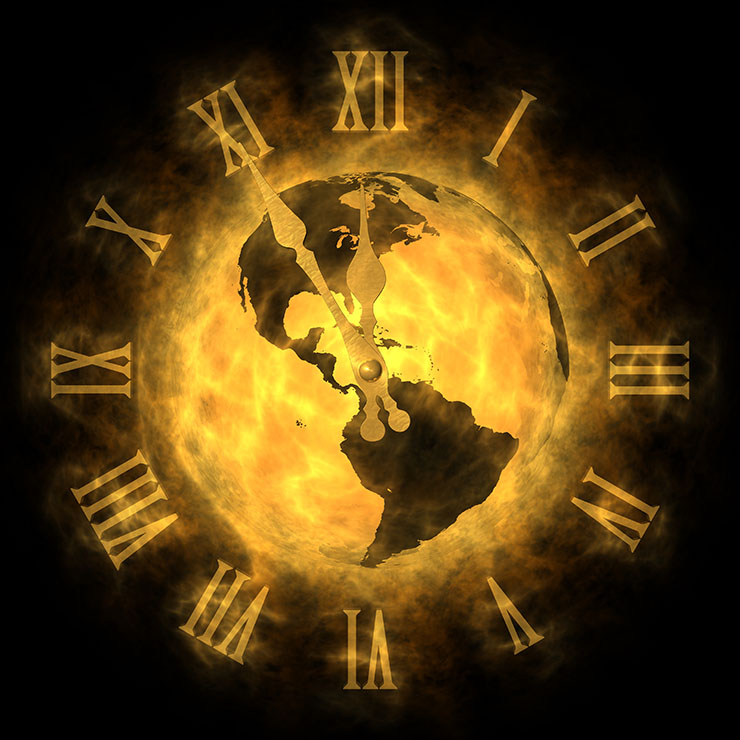
  • Oceania Forever: Rise of the Global Police State

    Oceania Forever: Rise of the Global Police State

    From New Dawn 153 (Nov-Dec 2015)

    Much has been written about the approaching Police State in alternative media. Commentary ranges from various warnings, to shock and outrage, and fear over an impending martial law takeover in North America and Western Europe. It’s hitting us from so many different angles, and yet the mainstream conversation continues to be woefully inadequate in both characterising the situation and offering a remedy.

    In order to really understand the modern Police State, we need to explore some very profound and difficult questions. Many people who consider themselves aware think Western society has already reached the tipping point and the deteriorating situation is simply inevitable. If you feel like Winston Smith right about now you aren’t alone.

    Prior to the mid 1990s, one might have described the militarisation of public law enforcement something of a creeping paradigm, but one that was still a long way off. Society explored many aspects of the Police State, both the physical and Orwellian psychological scenario, through literature and film. American science fiction writer Philip K. Dick penned some significant works like The Minority Report, and cinematic hits like Paul Verhoeven’s Robocop and Terry Gilliam’s Brazil also explored what this dystopic, future vision of fascist technocracy might look like. As it turned out, and far from fantasy, countless devices, systems and themes depicted in so many of these supposedly ‘fictional’ classics have since made their way into our day to day lives. The dark dream became real.

    Unfortunately, as humanity’s freshmen class of the early 21st century, we can no longer afford the intellectual distance enjoyed by previous generations between life today and that blurry, far-off spectre of something that might arrive sometime at some point in the future.

    Any modern globalised Police State requires a social engineering framework in order to provide its shape and scope of law enforcement. The latest social engineering blueprint for global technocratic management was unveiled at this year’s 70th United Nations General Assembly in New York City. Their ‘new’ agenda (newer than the old one) entitled, Agenda 2030,1 hopes to “transform our world for the better by 2030.” Author Michael Snyder from the blogEnd of The American Dream’ explains: “The entire planet is going to be committing to work toward 17 sustainable development goals and 169 specific sustainable development targets, and yet there has been almost a total media blackout about this…”2

    Within its 17 ‘universal goals’, the actual Police State provision for Agenda 2030 can be found within Goal 11, which states how the new global government will, “Make cities and human settlements inclusive, safe, resilient and sustainable.” Translated in technocracy terms, this means more Big Brother tech, smart grid tracking and big data surveillance states.

    The age of computerisation and database integration, along with advances in military and crowd control technology perfected overseas, have enabled a sharp advance toward the Police State. Trying to make sense of ‘it’ is a major challenge, to say the least. In its totality, the control system is both multifaceted and multilayered. It may have been possible to describe it, or even define it 20, 30, or 40 years ago, as Philip K. Dick and so many others did. Today, as society has already eclipsed the possible, we face a situation whereby the very thing we are trying to describe is woven through nearly every fabric of modern social, professional, family, religious and political life.

    If you happen to live in one of the technocratic nations, you can’t opt out, nor can you fully repeal the advances already made by the control system. What other options are available?

    Firstly, we have to try and understand, from an economic, cultural and political perspective at least, how this control system came to be.

    What are its strongest areas? Can we reform those areas? Where is it still emerging? Cannot those areas be slowed down? What was the political climate that enabled it?

    How to Build a Police State

    When you observe a modern Police State, the first things you might notice will not necessarily be the batons, shield, helmets or MRAPs. Think Switzerland or Singapore. A modern Police State will be neat, clean and efficient. Retail zones will be shiny and feature all the top designer brands. Many of the people you see in public will be well-groomed, well-healed and beautiful, but often with only one political party and a strict public code.

    Just like admirers of the modern Chinese State, Singapore’s proponents refer to the single party State as “a great argument for Authoritarianism.” Order and civility rule the day, so long as you don’t fall foul of the narrow perimeters set by the State.

    What has been accomplished in Southeast Asia since 1965, and what is possible in previously ‘free’ countries like the US, UK and Australia, are two very different social and political evolutions. Still, the modern Police State is advancing globally and it’s being driven primarily by three factors: technology, for-profit industry, and an age-old obsession by the ruling class to manage the masses.

    The first and easiest area to challenge is the physical realm of the control system. The most obvious of these are the gadgets and toys. They are easy to see. Look at your local police department and notice the difference between what officers looked like and what they wore in the 1970s, 1980s, 1990s and now in the 21st century. Notice the firearms and tasers, the ‘Bat-Belts’, and now the body cameras. Your average officer today looks like a cross between a soldier and an android. Dress them like robots and don’t be surprised when they act like machines (and it won’t be long until many of them are replaced by machines).

    If you’ve ever attended a street protest or witnessed some civil unrest, then you’ll have noticed the high-tech body armour, the riot and ‘crowd suppression’ equipment.

    My first intense experience where I felt the full force of the modern Police State was in 2009, at the G20 Protests in the City of London, England. It was early in the evening and approximately 4,000 demonstrators suddenly found themselves trapped at Bishopsgate. Several hundred police officers on foot and horseback had blocked all the entrances and egresses in and out of the main road. Even alleyways were manned by riot police. Then police began charging the crowds, and beating protesters with clubs. They alternated their ‘surge’ efforts, from different ends of the street, north to south, one brutal flurry after another. The worst part about it was there was no escape route away from the police. Many were beaten and trampled on that evening. It was as if police planners were playing a video game.

    Finally, at around 9pm, after being forced to stand, surrounded by police in a ‘Kettle’ for nearly three hours, along with 500 other demonstrators and press, who spent most of that time pressed up against police shields and not knowing what would happen next – I realised this is an impersonal, disinterested and totally uncompromising machine. It does not care who you are, what your views and opinions are, or whether you were innocent or guilty. The lesson was simple: “next time, stay home.” The only detail this machine is concerned with is that you comply with orders, and if no orders are given, then the machine demands you stay where you are until the machine decides what to do with you. If you complain too much, or become emotional, or heaven forbid act out in any way, then the machine will move in to subdue and detain you. That is all there is to it.

    Big Brother Reality

    It’s well-known that Great Britain is home of the world’s largest and most sophisticated physical Police State, including tens of millions of closed circuit television (CCTV) cameras, covering every conceivable inch of habitable space, both indoors and outdoors. The CCTV phenomenon in Britain was fuelled by an obsession with cameras that became increasingly popular with both government and corporate technocrats in the 1980s and 1990s. The psychology behind the exponential proliferation in cameras was mainly a fairly crude bit of criminology which held that the cameras would somehow act as a deterrent to criminal behaviour, and thus subdue the feral population into a more docile state. Industry used this line too, as sales persons were deployed en masse with endless flip charts and statistical models that claimed CCTV cameras would prevent the UK’s spiralling social malaise.

    The only problem is that more cameras don’t equal less crime. Canadian writer Cory Doctorow observed this reality back in 2011, explaining: “After all, that’s how we were sold on CCTV – not mere forensics after the fact, but deterrence. And although study after study has concluded that CCTVs don’t deter most crime (a famous San Francisco study showed that, at best, street crime shifted a few metres down the pavement when the CCTV went up), we’ve been told for years that we must all submit to being photographed all the time because it would keep the people around us from beating us, robbing us, burning our buildings and burglarising our homes.”3

    The CCTV is only one single aspect of Big Brother. It turns out that the real value of the CCTV camera grid is not so much the monitoring of crime per se, as it is in mass applied behavioural psychology.

    [alert type=”info” dismiss=”no”]If you appreciate this article, please consider a subscription to New Dawn magazine.[/alert]

    The Panopticon

    The physical Police State could not exist without some philosophical underpinning. Before Orwell, there was Bentham…

    In the mid 19th century Britain developed a new style of prison architecture known as the ‘Panopticon’ under the aegis of utilitarian philosopher Jeremy Bentham.4 The unique feature of this Panopticon concept was the transparent nature of each prisoner cell, visible to a central surveillance guard tower that could eye inmates at all times. The result of this psychological experiment, according to the pragmatic Benthamite philosophy, was to produce a regime of “self-policing” amongst the inmates, a kind of early behavioural conditioning. For technocrats and emerging utilitarian social managers of that era, this was seen as the most economic and efficient solution. Ultimately, this Benthamite concept is what underpinned phase one of the mass CCTV deployment throughout the UK. Sitting well above the security minions and the industry profiteers, elite scholars knew full well that CCTV cameras do not stop crime.

    The real power of the Panopticon is in convincing the general population they are under constant surveillance. After that point, through a long-term process of nudging, diversions and scare tactics, the State gradually moulds the behaviour and thoughts of its subjects.

    In order to keep citizens locked into this new conscious state of fear and trepidation, the State needs an enemy…

    The Long War & ‘The Extremist’

    One of the chief campaigns to nudge society towards a fully-functional Orwellian State is the War on Terror. Ever since September 11, 2001, the concept of an endless war against the ‘terrorists’ – a seemingly ubiquitous and constantly shape-shifting enemy – has been used to justify nearly every large new security expenditure and policy. Back in 2006, US President George W. Bush’s chief architect of the ‘long war’, Secretary of Defense Donald Rumsfeld, laid out the tea leaves for the next 100 years, stating: “It does not have to do with deployment of US military forces, necessarily. It has to do with the struggle that’s taking place within that faith between violent extremists – a small number of them, relatively – who are capable of going out and killing a great many people, as they’re doing, and the overwhelming majority of that religion that does not believe in violent extremism or terrorism.”5

    In George Orwell’s classic novel 1984, Winston Smith also grappled with the State’s endless war. “Oceania was at war with Eurasia: therefore Oceania had always been at war with Eurasia.”

    In Oceania, people eventually forgot what started the long war. The news was just one terrorist attack after another. The enemy was everywhere, but nowhere too. The population learned to acquiesce to the idea that war was the permanent state of affairs, and that questioning the provenance of this idea was futile.

    “Winston could not definitely remember a time when his country had not been at war, but it was evident that there had been a fairly long interval of peace during his childhood, because one of his early memories was of an air raid, which appeared to take everyone by surprise. Perhaps it was the time when the atomic bomb had fallen on Colchester. He did not remember the raid itself.”

    And so it was, in the early moments of the 21st century, Orwell’s dream suddenly became a waking reality. Social engineers are firm believers that if the Panopticon (married with the threat of an invisible enemy) can remain in place for a generation, then the State could fundamentally change a once free-thinking society into something noticeably different – a much more fearful and compliant populace.

    The Social Media Panopticon

    As terror scares and attacks become somewhat of a daily event in the West, identifying and quarantining the ‘extremist’ becomes a primary fetish of the Police State and its media arms. This is very much evident in how terrorists and ‘active shooters’ (dead or alive) are now profiled after the event. The mainstream media has integrated this into its work practice by crafting the post hoc guilty verdict of the accused, prior to a trial, with circumstantial or non sequitur accusations based on an individual’s “web history” that may have “radicalised” the suspect. In effect, the mainstream media’s function as an establishment propaganda arm results in trial by media – the bypassing of any trial by jury as the accused have already been implicitly or explicitly declared guilty by association or something as nebulous as “web history.”

    Such incidents, as they are portrayed in the media for psychological conditioning purposes, are intended to cause the public mind to dismiss outdated notions of fair and due process and rule of law in favour of fiat corporate news and government “official” pronouncements. The net effect of this trend is that social media users, ie. the majority of the population, are adopting self-policing habits in their communications online. According to the principals of applied behavioural psychology, if you change the language people use, then eventually you change the way they think and act.

    Like Bentham’s Panopticon, this new social media monitoring system works by utilising the digital web, which is arguably the most economic and efficient solution. The acceptance of self-policing and vague terms such as “radicalised” that are subject to the increasingly elastic definitions of the social engineering establishment.

    This leads to one of the most profound questions one might ask in the wake of Edward Snowden’s NSA spying revelations: Knowing what we know now, are people more outspoken or are they more self-policing because of the Snowden leaks?

    ‘The Daily Shooter’

    By extension, once the technocrat has regained some modicum of physical control, then the next domain to be conquered is the mind. In 1984, the technocracy was viewed through the eyes of the protagonist Winston Smith, who while remaining a physical prisoner of the Police State, could still retreat into his own mental state.

    In our day, the expansion of the surveillance State and vast spying by the likes of the NSA and GCHQ are precisely intended to achieve this same effect, with the justification for such intrusions being an endless series of terror spectacles and lone wolf public shooting events. In the US, these mass shootings and terror scares are happening on an almost daily basis, hence, ‘The Daily Shooter’. Media coverage is both chaotic and relentless. As a result, the pubic are left stupefied and completely unable to challenge whatever narrative the government-media complex is selling at that time. The Police State marches forward.

    A similar psychodrama also played out for 1984’s protagonist Winston Smith. As time progressed, however, maintaining some level of autonomy in one’s own thoughts became increasingly difficult for Winston. The final objective of the Police State, it seemed, was not only to fundamentally transform the way citizens act, but how they think too. The all-seeing and all-controlling “Big Brother” State was also the de facto social authority figure. The State’s law enforcement police force also became the “thought police.”

    We see this same exact narrative playing out today as the State’s political figureheads continue in their mission to widen their definition of “extremism” along with other State-issued euphemisms used to describe citizens who should be regarded with suspicion.

    Fall out of line and you might even be segregated or sent away to a special camp. Following the recent mass shooting in Chattanooga, Tennessee, retired US General and NATO Commander Wesley Clark proposed that any “disloyal Americans” should be sent to internment camps for the “duration of the conflict.” Notice the language: “for the duration of the conflict.” Indeed, it seems that Oceania is at war. He went even further, calling for the US government to identify people most likely to be “radicalised” so we can “cut this off at the beginning.”

    “At the beginning?” Here, it seems Clark might be alluding to pre-crime, which will be powered by A.I…

    Artificial Intelligence

    Post-September 11, UK society was still hooked on their CCTV matrix, and with millions of cameras already in place and crime continuing to rise, security ‘experts’ and politicians simply doubled down on their previous wager, insisting that what the country really needed was more cameras. They believed that once a certain CCTV saturation was reached, by default they would somehow reached their twisted utopia.

    It turned out that’s not humanly possible for security workers, most of whom are on a mere £7-10 (aud$14-20) per hour, to keep track, let alone analyse, a seemingly endless stream of footage. For the technocrat, the operative word here is ‘humanly’. Enter A.I…

    Once again, advanced technology enters the narrative and supplies the solution to this previous insurmountable problem. The age of Artificial Intelligence, or A.I., is nearly upon us, and this next step in technological development is certain to radically change the entire concept of the Police State.

    Laying down the framework an A.I. grid is not easy because the grid must be designed to cope with the application of A.I. As A.I.’s potential and practical applications have not yet been fully realised, designing the grid upon which it will be unleashed has been problematic up to this point. Sadly, society on the whole appears disinterested in questioning the social and unethical imperative currently driving the adoption of these new technologies.

    At present, the big money is on the Smart Grid. Technocrats and their corporate partners are hoping to usher in their new surveillance grid under the auspices of ‘smart’ technologies. With A.I. in play, technocrats will be able to utilise the smart grid – which includes your mobile phone – to detect and track multiple targets over a wide area.6 Add facial recognition and data profiling to the mix and it’s a recipe for a full-on A.I. Smart Grid future. The ultimate hands-free, ‘surveillance selfie’ – compliments of Big Brother.

    Just imagine, one day you’re simply walking down the street and pointing to something in the air. All of it is being captured on a 1.8 billion pixel video stream from the sky. They already know your identity and location with the phone in your pocket, and they already have your face logged and tracked.7

    At this point we introduce Philip K. Dick’s concept of “pre-crime” whereby an A.I. system can predict an action you are likely to take.8 The system will then close the ‘Big Data’ loop by storing the video footage alongside your profile into a massive data ‘mash-up’. It will then compare with other potentially ‘suspicious’ activity in the area. Great Britain’s national police force, the Metropolitan Police, are already using a type of pre-crime software that British technocrats believe will somehow ‘revolutionalise’ modern policing in the 21st century.9

    UK consumer advocate Pippa King explains how CCTV is already being phased out: “CCTV, closed circuit television, is not quite what is operating on our streets today. What we have now is IPTV, an internet protocol television network that can relay images to analytical software that uses algorithms to determine pre-crime area in real time.”

    “Currently this AI looks at areas that may be targeted for crimes such as burglaries or joyriding,10 with the predicted hotspot information being sent direct to law enforcement smart phones in the field. This analytical software is being used in Glasgow, hailed as Britain’s first ‘smart city’,11 where the Israeli security firm NICE Systems are running the CCTV/IPTV network, analysing data from the 442 fixed HD surveillance cameras and 30 mobile units under a project called ‘Community Safety Glasgow’,12 whose primary objectives are described as ‘delivering Glasgow a more efficient traffic management system, identifying crime in the city and tracking individuals’.”13
    This all can happen thanks to the US Defense Advanced Research Projects Agency’s (DARPA) latest creation – the ARGUS camera, Autonomous Real-Time Ground Ubiquitous Surveillance.14 According to its designers ARGUS, “melds together video from each of its 368 chips to create a 1.8 billion pixel video stream” all in real-time and archived. It’s just one of the many new toys used by the State to realise its Orwellian ambitions.

    Who’s Paying For It All?

    Aside from its ability to trample over the rights of law abiding citizens, the Police State has one other chief characteristic which may also be its Achilles heal: it’s bankrupting the State. Here’s how it works:

    The gravy chain is endless, but only with the help of taxpayers’ money, along with a series of bribes and favours between politicians and corporates. If you have ‘friends’ in government administration, then you are more likely to cash in on any number of lucrative ‘domestic defense’ contracts.

    Where you have constant crisis you also have constant business opportunity. In this dark paradigm, timing is everything. As US President Barack Obama’s sociopathic15 former chief of staff, now Mayor of Chicago, Rahm Emmanuel, once said: “You never let a serious crisis go to waste. And what I mean by that it’s an opportunity to do things you think you could not do before.”

    With that mantra in mind, in the wake of any shooting, terror scare, or crisis, industrial lobbyists and their elected political gophers will waste no time pushing for new federally-funded add-ons like training courses, workplace psychologists, regulators, specialist contractors, police cameras and other big-ticket items16 – anything to help “solve the crisis.” One such program in the US is known simply as the ‘1033’.

    Joseph Lemieux writes: “The 1033 program has flooded our local police forces with military equipment, and has turned them from Peace Officers, to a domestic army.”

    “Officers stopped looking like officers, and more like soldiers all kitted out with fully automatic weapons, armoured vehicles, body armour, grenades launchers, night vision, and even bayonets! Besides the cost of liberty, how much has this domestic army cost you the tax payer?”17

    In the US, no single entity embodies the Police State gravy train more than the Department of Homeland Security (DHS), where federal grants are used to bribe local law enforcement and absorb them into a larger framework of institutional dependency.

    At over $200 billion per year, the DHS is now America’s most expensive federal agency. As any sane local law enforcement chief will tell you, once you smoke from the federal crack pipe, you’re hooked for life. Remember that each federal Police State agenda item has a lucrative contract attached to it. With each move central government makes, a large amount of money is also made (by someone).

    By cutting off public money that is driving the runaway federal Police State in Western countries, the people have a chance to mitigate and potentially reform the current agenda.

    If we hope to preserve what is left of our hard fought democracy, then now is the time to put it to the test. The alternative is unthinkable.

    Patrick Henningsen is a regular contributor to New Dawn magazine. Check out his article “Technetronic Enslavement: Life Inside the Matrix of Control” in New Dawn 156 (May-June).

    [alert type=”general” dismiss=”no”]This article was published in New Dawn 153.[/alert]

    [alert type=”success” dismiss=”no”]If you appreciate this article, please consider subscribing to help maintain this website.[/alert]

    Footnotes

    1. ‘Transforming our world: the 2030 Agenda for Sustainable Development’, https://sustainabledevelopment.un.org/post2015/transforming
      ourworld
    2. ‘The 2030 Agenda: This Month The UN Launches A Blueprint For A New World Order With The Help Of The Pope’ by Michael Snyder, 2 Sept 2015, http://endoftheamericandream.com/archives/the-2030-agenda-this-month-the-un-launches-a-blueprint-for-a-new-world-order-with-the-help-of-the-pope
    3. ‘Why CCTV has failed to deter criminals’ by Cory Doctorow, The Guardian, 17 August 2011
    4. www.ucl.ac.uk/Bentham-Project/who/panopticon
    5. www.sourcewatch.org/index.php/The_Long_War
    6. ‘Bilderberg 2015: Implementation of the A.I. Grid’ by Jay Dyer, 21st Century Wire (www.21stcenturywire.com), 14 June 2015
    7. ‘Britain Launches “Big Brother” System, Uploads One Third of Population to Facial Recognition Database’, 21st Century Wire, 3 Feb 2015
    8. ‘Already Underway: Smart A.I. Running Our Police and Cities’ by Pippa King, 21st Century Wire, 13 Mar 2015
    9. ‘British Police Roll Out New “Precrime” Software to Catch Would-Be Criminals’, 21st Century Wire, 13 Mar 2015
    10. ‘Pre-crime software recruited to track gang of thieves’ by Chris Baraniuk, New Scientist, 11 Mar 2015
    11. ‘Glasgow wins “smart city” government cash’, BBC News, www.bbc.com/news/technology-21180007
    12. www.saferglasgow.com
    13. ‘Already Underway: Smart A.I. Running Our Police and Cities’, op.cit.
    14. www.darpa.mil/program/autonomous-real-time-ground-ubiquitous-surveillance-infrared
    15. ‘The Two Sides of Rahm Emanuel: Sociopathic Political Hitman and Puppy Lover’ by Foster Kamer, 16 Aug 2009, gawker.com
    16. ‘Mayor de Blasio Announces Retraining of New York Police’ by Marc Santoradec, The New York Times, 4 Dec 2014
    17. ‘How Much Money Have American Taxpayers Spent on Building a Domestic Police State?’ by Joseph Lemieux, 1 Dec 2014, http://theantimedia.org/taxpayers-police-state/

    © New Dawn Magazine and the respective author.
    For our reproduction notice, click here.