New Dawn – World's Most Unusual Magazine

Category: Behind the News

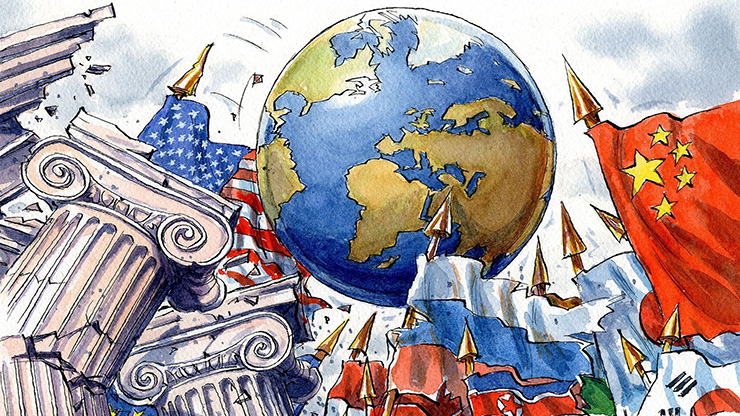
  • Trending to a Multipolar World: Opportunities & Challenges

    Trending to a Multipolar World: Opportunities & Challenges

    From New Dawn Special Issue Vol 13 No 3 (June 2019)

    At the conclusion of the Second World War, the United States was the overwhelmingly dominant military and economic power. The other major colonial powers, in particular France and the United Kingdom, had been financially exhausted by the war. Germany was shattered, its industry in ruins. The United States had a monopoly on nuclear weapons, and there were serious plans to use those weapons on the Soviet Union (Operation Unthinkable).1

    The Soviet Union had borne the vast brunt of the fighting against the Germans, losing at least 28 million soldiers and civilians, a sacrifice of people and treasure that has never received the acknowledgement in the West that it is due. Generations of Australians and New Zealanders, among others, were raised on the mythology of “plucky Britain” standing alone against the Nazi hoards.

    In fact, as many Russians died during the siege of Leningrad (September 1941– January 1944) as total US and UK casualties combined for the whole war. Nearly half a million Russians were killed in the battle of Stalingrad (July 1942–February 1943), which is more than total US losses for the whole war.

    Had Churchill’s plan for a surprise nuclear attack on the Soviet Union after the defeat of the Germans in May 1945 eventuated, additional casualties would have been incalculable. It is the memory of those horrendous losses during the war, and the treachery of the British and the Americans after the defeat of Germany, that is essential to an understanding of the reaction of Soviet, then Russian, leaders ever since to the actions of the Western powers. 

    Any thoughts of a military confrontation between the West and the USSR was resolved in 1949 when the Soviet Union successfully exploded its own nuclear bombs. Instead of a ‘hot’ war, the two sides engaged in what is generally referred to as a Cold War. That term is somewhat of a misnomer as war was indeed waged on a number of fronts: ideological, propaganda, economic and via a series of proxy actions in third countries.

    The other great shock to American sensibilities in 1949 was the defeat of the Chiang Kai Shek nationalist forces in the Chinese civil war. In what was to be a precedent for the following decades, the United States refused to accept Mao’s Government as the legitimate rulers of China and fought to retain the nationalists as China’s representative on the United Nations Security Council. US Navy ships patrolled the narrow straight between Formosa (known later as Taiwan) and the Chinese mainland. The fiction of Taiwan as representative of China in the United Nations persisted until 1971.

    In an echo of Operation Unthinkable, the United States military command in the Korean War (1950–53) urged US President Truman to allow the use of nuclear weapons against China,2 after China entered the war on the side of the North Koreans. US and Allied forces defied the clear intention of United Nations Security Council Resolution 82 and invaded North Korea, continuing to the Yalu River which marked the border between North Korea and the People’s Republic of China.

    The Allied forces were quickly driven back to the North/South border, itself a unilateral creation by the Americans in 1945 without reference to the citizens of either the North or the South.3 From then until the armistice of 27 July 1953, the United States and Allied troops waged a relentless war against the North. The entire country was devastated with civilian infrastructure almost completely destroyed. That, together with the use of chemical and biological weapons, amount to a sustained war crime against North Korea.4 As is the case with all atrocities committed by the United States and its allies in the almost continuous warfare waged since 1945 against mostly poor and relatively defenceless nations, the issue of accountability for war crimes is a non-issue as far as the Western powers are concerned.

    In the American case, not only do they not subscribe to the International Criminal Court, they have threatened sanctions and worse5 should that body ever have the temerity to investigate the actions of its military personnel or those of its allies, much less prosecute them.

    As a result of that war, North Korea lost an estimated 8 to 9 million people or about one-third of its total population at that time. By comparison, the United Kingdom lost 0.94% of its population during World War II, which lasted twice as long as the Korean War.

    An understanding of that war, as well as the history of United States intervention in Korean affairs, which dates back to the 1880s,6 is essential to understanding the contemporary geopolitical situation on the Korean peninsula.

    Exceptional Interventionism

    The post-World War II military and economic dominance of the United States and its imperviousness to international law had a number of other consequences. In particular, it bred an attitude best expressed in their own self-description of being the “exceptional nation.” The ordinary definition of the word exceptional implies being atypical, extraordinary, or out of the common or usual mode.

    In the American case, however, it came to be equated with much more, in particular a profound belief in all levels of society that their way was the only way. Deviations from their defined path were not to be tolerated, and recalcitrant nations or individuals were subject to “regime change” operations, economic and financial sanctions, and in extreme cases invasion and occupation.7

    These actions always justified in terms of “bringing democracy” or “upholding the rules-based international order” or some other patently self-serving justification.

    It is difficult to reconcile these high-minded concepts with the actual behaviour of the United States and its allies. Operation Boot (UK name) Ajax (US title) on behalf of the Anglo Persian Oil Company overthrew the democratically elected Iranian government in 1953. That coup was reversed with the Islamic Revolution in 1979, an outcome that still dominates United States attitudes and behaviour towards Iran.

    That was followed in 1954 by Operation PBSuccess, the overthrow of the Guatemala government, to the great benefit of the United Fruit Company. Operation Condor from 1968 to 1989 involved the assassination or disappearance of tens of thousands of Latin American civilians, and the installation of a series of brutal dictatorships, all supported by and paying obeisance to the United States.

    The “Whitlam problem”

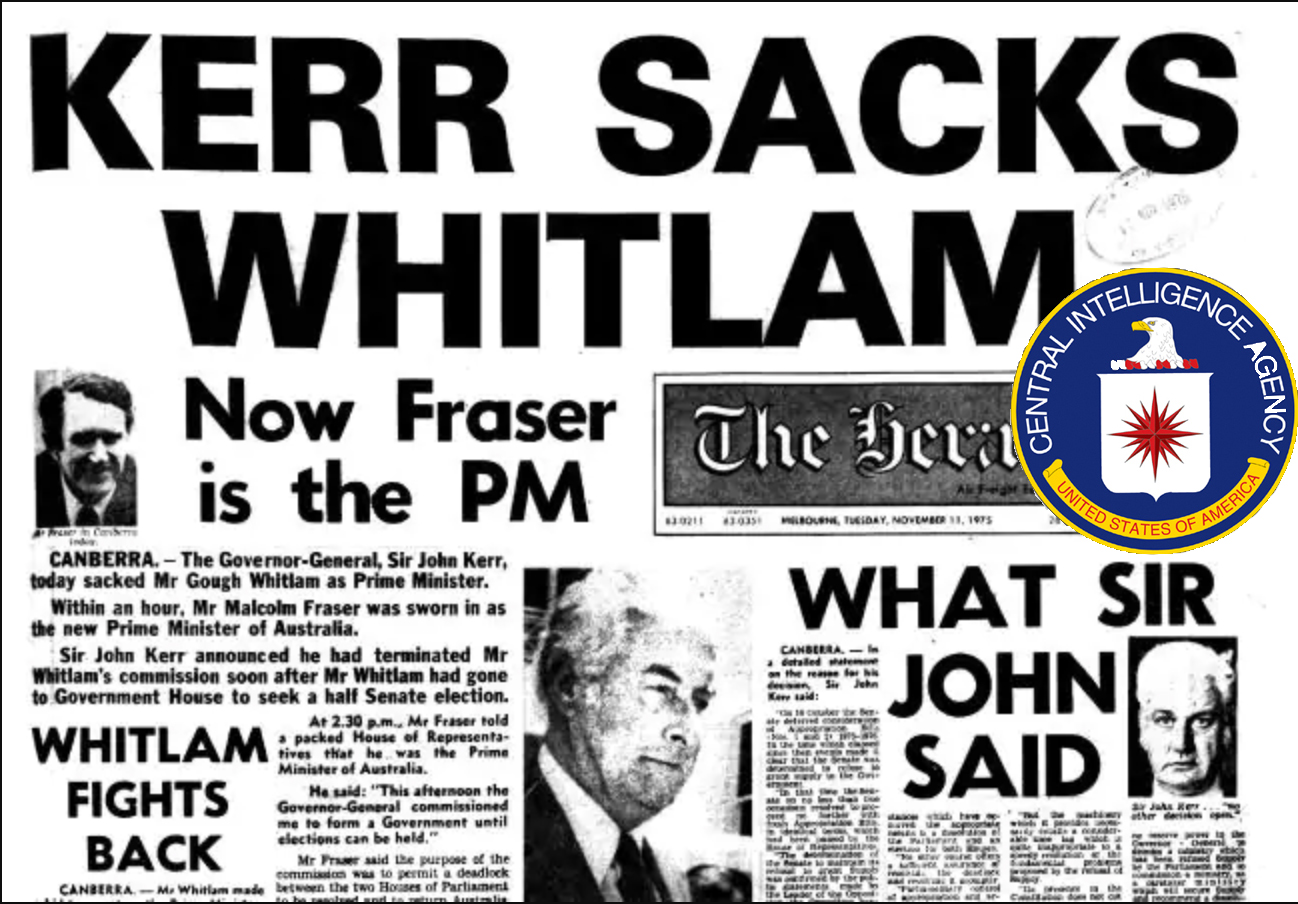
    From an Australian perspective, there is a common thread running through many of the CIA coups of the post-war era. There was a coup in South Korea in 1961; in Indonesia in 1965 (where more than 500,000 were killed at the instigation of the CIA); Chile in 1973 and Australia in 1975. The common denominator to all four was US State Department diplomat Marshall Green, named in CIA and State Department circles as the “coupmaster.”

    Declassified CIA and State Department documents show that Green was sent to Canberra as US ambassador in 1973 with a specific brief to deal with the “Whitlam problem.”8

    Whitlam was threatening to close Pine Gap spy station; the United States lease was due to expire in December 1975. The Governor General sacked him in November 1975, the day before he was to make an announcement in the Australian Parliament about Pine Gap.

    Again, to return to the earlier point, it is impossible to understand the stance taken by Australia viz a viz the Americans and their illegal wars without understanding the effect that the coup had on successive Australian governments.

    Historian Jenny Hocking makes worthy efforts to uncover the role of the British, and in particular the correspondence between Governor-General Kerr and Buckingham Palace, but in this writer’s view she misses the main point.9 By 1975 the British had become of peripheral relevance to Australia’s geopolitical perspective. Then, as now, Australia was an appendage to US foreign policy, “joined at the hip” in former Prime Minister Malcolm Turnbull’s infamous phrase.

    Australia joined illegal wars in Afghanistan, Iraq and Syria to support the Americans when any vital Australian interest is vanishingly small. 

    Hubris & Containment

    American hubris reached its pinnacle following the collapse of the Soviet Union in December 1991. Boris Yeltsin became president and the following decade was catastrophic for the Russians. Life expectancy plummeted. State assets were sold off at fire-sale prices to Western corporations and Russian oligarchs. Yeltsin, an incompetent drunk, would in all probability have lost the 1996 presidential election were it not for blatant and large-scale US interference to his benefit.10

    That they had “their” man in office only added to the sense of US triumphalism. This history is bitterly ironic given the hysterical and wholly fake allegations of Russian interference in the 2016 US presidential election.

    From an American perspective, the demise of the Soviet Union and the election of a pliable puppet in the form of Yeltsin meant they had won the Cold War. In what was a common and disturbing pattern, the undertaking given by George HW Bush to Mikhail Gorbachev that NATO “would not advance one inch to the east” was almost immediately broken. Successive US presidents have overseen the expansion of NATO and US military bases right up to Russia’s borders.

    This was a pattern repeated in the east with a steady increase in US military bases on China’s borders. They made no secret of the fact that the policy was to “contain” China.11

    Despite the frequent invocation of phrases such as “Chinese assertiveness” or “a threat to America’s allies” in the Asian region, there was never any evidence to support such claims.

    What the US sought to “contain” in fact was the rise of an economic and military powerhouse that threatened US hegemony of the world. On the basis of parity purchasing power, China is now the world’s largest economy, and the gap is destined to widen for the foreseeable future. The US reaction to this has been an increase in economic warfare through sanctions, tariffs, and an unrelenting propaganda barrage to paint each and every positive development emanating from China in negative terms.

    Managing the News

    This is not a new phenomenon. Victor Marchetti told the United States Congress decades ago that the CIA provided $250 million annually (in modern value) to the Asia Foundation for anti-communist academics to disseminate a negative view of China, and paid journalists and publishers elsewhere in the world to do the same.

    Operation Mockingbird was a large-scale CIA program that began in the 1950s to infiltrate student organisations, newspapers and magazines, and other forms of media outlets to “manage” the news in such a way as to favour US interests.12 Any resemblance to the truth was coincidental. The only thing that changed since the 1950s is the scale and the sophistication of the penetration of news outlets.

    The German journalist Udo Ulfkotte’s book Gehanfte Journalisten (Bought Journalists, 2014) which exposed how German mainstream journalists had been compromised, had its English rights bought by a Canadian company but was never published. Amazon does not stock it, although it can be purchased (in German) on Book Depository.

    What is a unipolar world?

    When Vladimir Putin replaced Yeltsin as President of Russia, he initially sought to cooperate with the United States. He has been criticised within Russia for persisting in seeking détente in the face of constant rebuffs and unilateral moves such as the United States withdrawal from the antiballistic missile treaty in 2002, and the aforementioned constant expansion of NATO.

    Putin’s change of heart became most clearly evident when he addressed the Munich Security Conference on 10 February 2007. His speech included the following remarks that are worth quoting:

    “What is a unipolar world?…. It refers to one type of situation, namely one centre of authority, one centre of force, one centre of decision-making. It is a world in which there is one master, one sovereign. At the end of the day, this is pernicious not only for all those within the system but also for the sovereign itself because it destroys itself from within.

    “I consider that the unipolar model is not only unacceptable but impossible in today’s world. Today we are witnessing an almost uncontained hyper use of force in international relations, force that is plunging the world into an abyss of permanent conflicts…. we are seeing a greater and greater disdain for the basic principles of international law. One State, first and foremost the United States, has overstepped its national borders in every way.”

    If the unipolar world is not only unacceptable but “impossible in today’s world,” what then is the alternative?

    The pattern of voting in the United Nation’s General Assembly over the past few decades, in particular, reveals that the overwhelming majority of the world’s nations want a better alternative than the unipolar model dominated by the United States.

    Rise of China

    Those nations see, for example, the transformation of China in the 40 years since the “reform and opening up” of the Chinese economy and society that officially began under Deng Xiaoping. Those reforms have seen more than 600 million Chinese (more than the whole of Europe’s population) lifted into the middle class since the turn of the century.

    China outspends the United States on basic science and technology research by a ratio of 4:1. It leads the world in patent applications with more than twice the number of the United States (1.38 million versus 606.9 thousand in 2017) which in turn represented more than a third of all the world’s patent applications in that year.

    Significantly, Chinese patent applications to the World Intellectual Property Organisation in Geneva grew by 14.2% over the previous year, while United States applications grew by 0.2% (so much for allegations of intellectual property theft).

    The fundamental difference between the rise of China to a dominant position compared to that of the United States is that China does not seek either to dominate the world or to impose its system on others.

    The philosophy underlying China’s international posture was clearly set out by President Xi Jinping in his speech to the World Economic Forum in Davos in January 2017. Again, it is worth quoting some key passages from Xi’s speech:

    “The global economic landscape has changed profoundly in the past few decades. However, the global governance system has not embraced these new changes and is therefore adequate in terms of representation and inclusiveness.

    “(Red Cross founder) Henry Dunant once said ‘our real enemy is not the neighbouring country: it is hunger, poverty, ignorance, superstition and prejudice’.

    “We should pursue a well-coordinated and connected approach to develop a model of open and win-win cooperation. There is a growing call from the international community for reforming the global economic governance system, which is a pressing task for us.

    “We should adhere to multilateralism to uphold the authority and efficacy of multilateral institutions. We should honour promises and abide by rules. One should not select or bend rules as he sees fit. No country should view its own development path as the only viable one, still less should it impose its own development path on others.”

    It is not difficult to identify which country Xi had in mind. The Chinese model of development is seen for example in the following organisations.

    The Belt and Road Initiative (BRI) is the best known of these modern vehicles for multilateral development, but it is far from the only one. Others include the BRICS nations (Brazil, Russia, India, China and South Africa), which has as a primary aim the establishment of an equitable, democratic and multipolar world. Dating from 2001, BRICS developed its own bank and other forms of financial cooperation. It is not a coincidence that both Brazil and India are targets of United States’ foreign policy aimed at undermining their growing relationship with China.

    The Shanghai Cooperation Organisation (SCO) also began in 2001 with six original members (China, Kazakhstan, Kyrgyzstan, Russia, Tajikistan and Uzbekistan). Pakistan and India both joined at the same time in 2017. In addition, there are four observer States (Afghanistan, Belarus, Iran and Mongolia) and six dialogue partners (Armenia, Azerbaijan, Cambodia, Nepal, Sri Lanka and Turkey).

    Countries as diverse as Egypt, Israel and Ukraine among others have applied for observer or dialogue partner status and others in the Middle East such as Iraq, Bahrain and Qatar have expressed interest.

    The North South Transportation Corridor (NSTC) grew out of the Ashgabat Agreement in 2011 and a rail link from Mumbai to Moscow via Iran, Armenia and Azerbaijan is now up and running. Again, a range of countries in proximity to the original route have expressed an interest in becoming part of this transformative transport project. As with the major rail projects that are an integral component of the BRI, these developments have the potential to slash both transport times and costs for goods traversing Eurasia.

    Eurasian Economic Union. This organisation was formalized in 2015 and incorporates Armenia, Belarus, Kazakhstan, Kyrgyzstan and Russia, with Iran signing a free trade agreement in 2018.

    There is a notable overlap of membership of these organisations. They increasingly trade in their own currencies, part of a rapidly increasing move toward the elimination of the United States dollar as the principal medium of international trade. The demise of the dollar from its central role will remove one of the United States’ most powerful tools for imposing its policy preferences upon sovereign nations.

    The reserve status of the dollar has enabled the United States to defy economic logic, running huge internal and balance of payments deficits without the consequences that would ordinarily flow. That day of reckoning is rapidly approaching.

    The United States has for decades neglected its own vital infrastructure and educational standards as more than half of each federal dollar is spent on its military industrial intelligence complex. It has not been value for money, as both Russian and Chinese military technology is significantly superior, as even the Americans now acknowledge.13

    War or Peaceful Development?

    There is little evidence, however, that the United States recognises the cause and effect between its preference for military expenditure over civilian needs; the political, economic and reputational costs of endless wars for and on behalf of vested interests; and its steady decline in the world both in absolute and relative terms.

    The United States will undoubtedly continue waging its wars, whether they are hybrid wars using terrorist proxies which it has done since at least Operation Cyclone in the 1970s, or overt invasions and destruction of sovereign states as in Korea, Vietnam, Laos, Cambodia, Afghanistan, Iraq, Libya and Syria, to name but a few.

    There is a remarkable correlation between victim countries of the past two decades and the “seven countries in five years” identified by US General Wesley Clark.14 

    The world tires of this endless aggression and the chaos which ensues. For an increasing number, the win-win philosophy expanded by President Xi is the most attractive option. This is why more than 128 nations have now signed a Memorandum of Understanding with the BRI, in Africa, Latin America, Island States in the Pacific and Indian Oceans, the Middle East and throughout the Eurasian continent. They clearly view the multipolar world as the preferable alternative. The question is whether they will be able to continue to develop along their preferred path or will the frankly insane US political class make one final attempt at regaining world hegemony, and in the process destroy us all. 

    [alert type=”general” dismiss=”no”]This article was published in New Dawn Special Issue Vol 13 No 3.[/alert]

    [alert type=”success” dismiss=”no”]If you appreciate this article, please consider subscribing to help maintain this website.[/alert]

    Footnotes

    1. J. Walker, Operation Unthinkable: the Third World War, The History Press 2013

    2. C. Posey, ‘How the Korean War almost Went Nuclear’, www.airandspacemag.com, July 2015

    3. B. Cumings, The Korean War: A History, Modern Library 2011

    4. J. Kaye, ‘Revealed: The Long Suppressed Official Report of US Biowarfare on North Korea’, www.medium.com, 20 February 2018

    5. S. Vasaliev, ‘Not Just another Crisis’, www.ejiltalk.com, 19 April 2019 (Part 1); 20 April 2019 (Part 2)

    6. M. Pembroke, Korea: Where the American Century Began, One World Publications 2018

    7. W. Blum, America’s Deadliest Export: Democracy, Zed Books 2013

    8. J. Jiggens, ‘11 November Coup? What Coup?’ www.greenleft.org, 20 November 2010

    9. J. Hocking, The Dismissal Dossier, Melbourne University Press 2015

    10. S. Shane, ‘Russia Isn’t the Only One Meddling in Elections: we do it too’, www.nytimes.org, 17 February 2018; S. Cohen, Failed Crusade: America and the Tragedy of Post Communist Russia, Norton & Co (updated edition) 2001

    11. J. Reed, ‘Surrounded: How the US is Encircling China with Military Bases’, www.foreignpolicy.com, 20 August 2013

    12. C. Bernstein, ‘CIA & The Media’ www.rollingstone.com, 20 October 1977; J. Tracy, ‘The CIA and the Media’, www.globalresearch.ca, 30 January 2018

    13. A. Martyanov, Losing Military Supremacy, Clarity Press 2018; The Saker, ‘Newly Revealed Russian Weapons Systems’, www.southfront.org, 9 March 2018; R. Ridenour, ‘Has the US Lost its Military Supremacy over Russia’, www.counterpunch.org, 4 April 2019

    14. J. Conason, ‘Seven Countries in Five Years’, www.salon.com, 12 October 2007

    © New Dawn Magazine and the respective author.
    For our reproduction notice, click here.

  • A Coordinated Corruption: How the Hidden Hand Created a Modern Crisis in the Middle East (Part 3)

    A Coordinated Corruption: How the Hidden Hand Created a Modern Crisis in the Middle East (Part 3)

    From New Dawn 165 (Nov-Dec 2017)

    In the third and final part of this series, MARC STAR looks at how the war on Iraq in 2003 was based on a deliberate deception. This disastrous war opened the gates of hell in the Middle East – with the killing and destruction continuing to this very day (read Part One here & Part Two here).

    By late 2002, the White House and a complicit American press were beating the same war drums, characterising Saddam Hussein’s regime as non-compliant with UN Security Council resolutions via the concealment of an active weapons of mass destruction (WMD) program – most notably a nuclear development capability. 

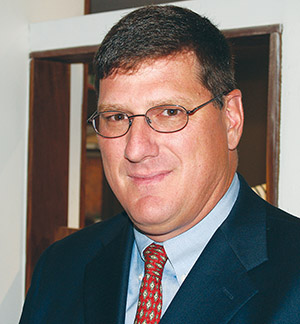
    Amidst this din of propaganda, dissenting voices were generally drowned out – save for one, former UN weapons inspector Scott Ritter, who was often seen on US national news programs. When interviewed for a September 2002 book entitled War on Iraq, Ritter refuted the entire case for war – with authority.

    “Since 1998 Iraq has been fundamentally disarmed,” Mr Ritter said. “90-95% of Iraq’s weapons of mass destruction capability has been verifiably eliminated… We have to remember that this missing 5-10% doesn’t necessarily constitute a threat. It doesn’t even constitute a weapons program… There’s no evidence Iraq retains this material… When I left Iraq in 1998, when the UN inspection program ended, the infrastructure and facilities had been 100% eliminated. There’s no debate about that.”73 

    Former UN weapons inspector Scott Ritter

    The only ongoing point of non-compliance Mr Ritter would later relate in a pair of books released after the initiation of the war on Iraq (Iraq Confidential and Frontier Justice), was that Iraq failed to reveal its concealment program – the methods by which it sought to protect its state secrets from UN weapons inspectors, methods that led directly to the presidential security apparatus of Saddam Hussein. So long as the Iraqi regime resisted UNSCOM inspections into the presidential security system – what may have been Iraq’s last bastion of sovereignty against what it rightly saw as cover for a CIA spying operation – inspectors could not declare Iraq disarmed, thus placing it in the crosshairs of UN non-compliance. As it would turn out, compliance was a bigger threat to those fuelling the US agenda than non-compliance.

    “Inspections could expose the truth,” Mr Ritter noted. “And truth was the enemy.”74 Truth was, Iraq had been disarmed, and a disarmed Iraq provided no justification for invasion.

    In order for the Bush administration to sell the war, it had to fabricate a lie. A big one. In the shape of a mushroom cloud. 

    The war on Iraq was largely sold on the fear generated by the Niger documents, a set of forgeries that alleged Iraq had attempted to purchase uranium from mines in Niger. The source of the documents – delivered to the CIA and to Britain’s MI6 – was Italy’s intelligence agency, SISMI, which used a cash-strapped freelance Italian spy, Rocco Martino, to pass the forgeries and take the fall. In a series of articles exposing the scandal, la Repubblica described Mr Martino as “a failed policeman. A dishonest snitch… a scoundrel.”75 Mr Martino, however, described himself as a pawn.

    “It’s true,” he ultimately confessed. “I had a hand in the dissemination of those documents (Niger uranium), but I was deceived. Behind this story there are, together, Americans and Italians. It was a disinformation operation.”76 It would ultimately become part of a much larger agenda: “…the active deception of the United States Congress, the international community, and the American people,”77 wrote Ambassador Joe Wilson. 

    In February 2002, the CIA asked Ambassador Wilson to travel to Niger to investigate the uranium charges – charges that the CIA found dubious. During his trip, he found nothing to substantiate the claims. He wasn’t the only one. The American ambassador to Niger, as well as Marine General Carlton Fulford, the deputy commander of US Armed Forces Europe, each met with Niger’s president and concluded that due to the controls in place, the uranium deal could not possibly have happened. Ambassador Wilson concluded the same thing.

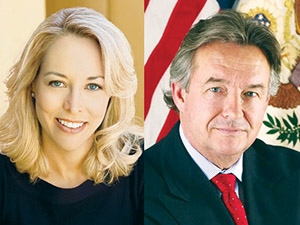
    Former US Ambassador Joe Wilson and his wife Valerie Plame. She was outed as a covert CIA officer by the neo-cons responsible for the war on Iraq.

    While the matter died a slow death in the American intelligence community, President Bush’s National Security Adviser, Dr Condoleezza Rice, on 8 September 2002, set the stage for its return during a CNN interview in which she said: “We know that [Saddam] has the infrastructure… [and] there will always be some uncertainty about how quickly he can acquire nuclear weapons. But we don’t want the smoking gun to be a mushroom cloud.”78 Two weeks later, the British government resuscitated the corpse in a white paper that stated, “there is intelligence that Iraq has sought the supply of significant quantities of uranium from Africa.”79

    Although the charge had been discredited by Ambassador Wilson, General Fulford, the CIA and the ambassador to Niger, this Frankenstein accusation became the cornerstone in the US rebuttal to Iraq’s last ditch effort to fully declare the history of its WMD program. A 12,000 page disclosure submitted in December 2002, the final attempt by Iraq to publicly demonstrate compliance and avoid war. The US State Department, in reply to Iraq’s disclosure, asked, “Why is the Iraqi regime hiding their Niger procurement?”80 It was a question that Franz Kafka may have appreciated. 

    January 2003 was pivotal for marketing the Iraq war to the world. That month Australian Prime Minister John Howard met with his US and UK counterparts in Washington to discuss “post-invasion plans, including issues of security, humanitarian issues, reconstruction, political leadership, economic matters and the oil industry.”81 A week later, President Bush sold it to the American people in his State of the Union address, claiming that, “The British government has learned that Saddam Hussein recently sought significant quantities of uranium from Africa.”82 

    According to ex-CIA agent Paul Pillar: “The White House attributed the charge to the British because the CIA wouldn’t vouch for it.”83 In fact, Secretary of State Colin Powell, during his infamous address to the UN Security Council the following month, avoided citing the uranium claims and instead relied on a cache of aluminium tubes which had been intercepted in 2001 on their way to Iraq. These tubes would cause Secretary Powell to conclude, “there is no doubt in my mind, these elicit procurement efforts show that Saddam Hussein is very much focused on putting in place the key missing piece for his nuclear weapons program.”84

    The tubes, however, were for conventional rockets.85 International Atomic Energy Agency (IAEA) Director General Mohamed el-Baradei concluded as such and confirmed that the Niger documents were, in fact, forgeries when he addressed the UN Security Council on 7 March 2003. 

    That day the United Nations made this point crystal clear in its press release: 

    “The Director-General of the IAEA, Mr ElBaradei, reported that, after three months of intrusive inspections, the Agency had found no evidence or plausible indication of the revival of a nuclear weapons programme in Iraq. There was also no indication that Iraq had attempted to import uranium since 1990 or that it had attempted to import aluminium tubes for use in centrifuge enrichment.”86

    The American media failed to bring the UN’s news to a volume that could compete with the national debate over mushroom clouds. The White House had made its case and presented war as the only solution. Twelve days later, the United States invaded Iraq.

    But there was, in fact, another option.

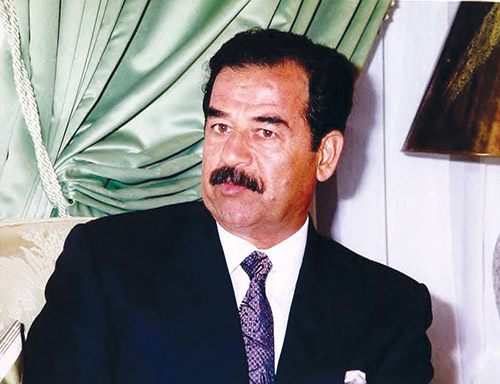
    Former President of Iraq, Saddam Hussein (1937–2006), tried in vain to negotiate a path away from war, but the Anglo-Americans had already made up their mind, even justifying the invasion of Iraq based on lies (Saddam’s “weapons of mass destruction” and link to 9/11). Saddam Hussein was subjected to a show trial by the interim Iraqi authorities and hanged in 2006. 

    Peace Deal

    In October 2002, when Hans Blix, the head of the United Nations Monitoring, Verification and Inspection Commission (UNMOVIC) and Mohamed el-Baradei, Director General of the International Atomic Energy Agency (IAEA), met with Amer al-Saadi, Saddam’s liaison with the UN weapons inspectors, the Iraqis were ready to comply, if only to avoid a full-scale invasion. During the meeting, Iraq agreed to once again cooperate with UN weapons inspectors, and as a result, inspections resumed that November. 

    As war approached, Saddam Hussein’s regime was cooperating with UN inspections, Mr Blix later told CNN correspondent Christiane Amanpour.87 In reply to Iraq’s cooperation, a White House official told CNN, “We’re not surprised. Obviously the Iraqis want to delay and deceive.”88

    But the White House did not have any open communication channels with Iraqi diplomats. White House policy was based on hunches and gut feelings absent of any face-to-face dialogue. Susan Lindauer, however, had been negotiating with Iraqi diplomats, on behalf of the CIA, since November 2000, and what she accomplished had the power to pull the rug right out from underneath Bush’s war footing. 

    Fortunately, she kept a fairly detailed record of her progress via multiple correspondences to her second cousin, Andy Card, Bush’s chief of staff, the man who, on 11 September 2001, in front of a class of second grade students, whispered in the President’s ear, “America is under attack.” Ms Lindauer’s letters are dated from 1 March 2001 and continue to 6 January 2003. They detail an intriguing story that begins with Iraq’s desire to peacefully end its conflict with the United States and continues towards desperation as the American invasion drew imminent.

    Ms Lindauer’s negotiations began with Dr Saeed Hasan, Iraq’s Ambassador to the United Nations. “I emphasised that the return of weapons inspectors would be a critical precondition to ending the conflict,” Ms Lindauer wrote in the first of her letters. “Dr Hasan confirmed that Iraq could complete negotiations within three to four weeks, so great was the government’s desire for a comprehensive resolution to the troubles.”89 The Bush administration was just settling into the White House at this point, but wasted no time to exercise aggression. An American and UK bombing campaign against Iraq on 16 February 2001 complicated Ms Lindauer’s efforts. 

    Nevertheless, “Iraq is ready for direct dialogue with no conditions,” Dr Hasan told Ms Lindauer. “Once the United States conducts a thorough review of its regional policy, we are ready for a mature discussion that will achieve a comprehensive solution.”90

    By July 2001, Ms Lindauer was discussing Iraqi oil concessions for American petroleum companies. But what she really needed was “White House support.”91

    After 11 September, everything changed. Ms Lindauer’s 24 September letter to Mr Card was sent with “an urgent prayer for peace”92 between the US and Iraq. Whereas, previously, Iraqi diplomats had insisted on meeting with high-level representatives from the White House or State Department, the Iraqis put on paper their willingness to meet “any American official in a covert or incovert manner to discuss the common issue.”93 By December, the Iraqis upped the ante. In addition to allowing the weapons inspectors to return, Iraq offered its cooperation on terrorism investigations. By March 2002, Baghdad offered concessions to American corporations to help rebuild Iraq, which was in dire need of infrastructure after twelve years of sanctions and bombings. Additionally, “Baghdad offered to buy one million American manufactured automobiles every year for 10 years.”94

    Nevertheless, by January 2003 the invasion of Iraq seemed all but inevitable. Andy Card had not responded to a single one of her missives during the two years she delivered them. She made one final attempt to make contact with the Bush administration, delivering a letter to Colin Powell on 27 January 2003, one week before his presentation at the UN.

    “Mr Secretary, there’s a great deal that can be done… if you would allow me, I will set this in motion. I would be more than content to make the appropriate introductions for a covert meeting, which could take place in Baghdad or Jordan. I could make sure you’ve got the right people in the room, and then I could step into the hallway, and get out of the way.”95

    Ms Lindauer had the skeleton of bilateral negotiations on paper – a framework for peace. Concessions in hand. But there were no negotiations. And the weapons inspectors of UNMOVIC were ignored.

    As Mr. Blix later concluded, “Had the inspections been allowed to continue, there would likely have been a very different situation in Iraq.”96

    The Unravelling

    While the first chink in the Bush administration’s shield of lies was exposed by former FBI agent Coleen Rowley, who revealed how close the FBI was to actually breaking open the 9/11 case in August 2001, the public was content to let the buck stop at FBI Director Robert Mueller. 

    By summer 2003, no WMDs had been found in Iraq. Fingers started pointing.

    In June 2003, the US Senate Select Committee on Intelligence (SSCI) initiated the first phase of its investigation, ultimately to determine “the objectivity, reasonableness, independence, and accuracy” of the intelligence community’s judgments and “whether any influence was brought to bear on anyone to shape their analysis to support policy objectives.”97 In other words, did the White House pressure CIA to ensure that its intel matched the President’s script?

    On 6 July 2003, the New York Times published an op-ed piece by Ambassador Joe Wilson that reverberated all the way to the White House and which, after the White House took its revenge, led to Vice President Dick Cheney’s chief of staff, “Scooter” Libby, taking the fall in a legal case that stopped far short of its potential.

    In Ambassador Wilson’s article, titled “What I Didn’t Find in Africa,” he laid bare the truth from the first sentence: “Did the Bush administration manipulate intelligence about Saddam Hussein’s weapons programs to justify an invasion of Iraq?”98 Ambassador Wilson then told a story to which the general public had not yet been privy: the truth about his trip to Niger to confirm that the so-called Niger documents were utterly baseless – confirmation that the Bush administration knew that no substantive evidence existed to suggest Iraq had a nuclear program. 

    Like gangsters, Cheney and his posse went after Ambassador Wilson’s family – his wife, Valerie Plame – by outing her as a covert CIA officer.

    “It seemed that the motive for the attacks on me was to discourage anyone else from coming forward who had a critical story to tell,” Ambassador Wilson later wrote. “The message to mid-career intelligence officers was clear: Should you decide to speak, we will come after you and your family.”99

    The Fall Guy

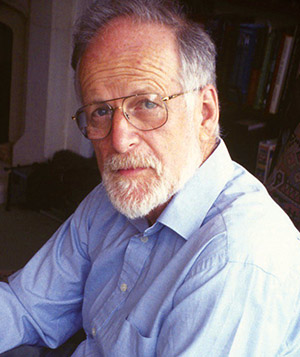
    Welsh weapons inspector Dr David Kelly supposedly committed suicide on 17 July 2003. In the previous days, Kelly had testified before the UK Parliament’s Foreign Affairs Select Committee that he was not the source of a BBC story which had accused the government of making false claims about Iraq’s WMD. His death ruled suicide at the time, now even close friends of Dr Kelly believe he was murdered by agents of British intelligence.

    Within weeks of Ambassador Wilson’s op-ed piece, Welsh weapons inspector Dr David Kelly was found dead – a supposed suicide – in the woodlands of Oxfordshire, England. His wrists were cut, but paramedics reported a suspicious lack of blood at the scene.100 The knife he apparently used to slash his wrists had no fingerprints, nor did the blister pack of pills from which he allegedly overdosed.101 Although Ambassador Wilson and Dr Kelly aren’t directly linked, both cases involved governments lying their countries to war on bogus intelligence and leaking names after the truth was revealed. In both cases, the public narrative focused on who leaked instead of the far more important issue of bogus intelligence and how such shoddy intel could make its way into the speeches of President Bush and Prime Minister Tony Blair.

    Days after Ambassador Wilson’s article, on 11 July, CIA Director George Tenet took the fall for the Niger debacle, issuing a press release that stated, “I am responsible for the approval process in my agency.”102 

    The White House officially had its scapegoat. 

    In fact, the Bush administration was in full propaganda mode, using legendary Watergate journalist Bob Woodward as its mouthpiece. Mr Woodward was given exclusive access to Bush and his circle at the end of 2003 for Plan of Attack, which details the debates within the White House about going to war. According to Mr Woodward, the President was hesitant about invading Iraq until swayed by an emotional outburst by the CIA chief.

    “Bush turned to Tenet. ‘I’ve been told all this intelligence about having WMD and this is the best we’ve got?’… Tenet rose up, threw his arms in the air. ‘It’s a slam dunk case!’ the DCI said.”103

    War of the Words

    Within months of the Iraq invasion and Bush’s declaration of “Mission Accomplished,” things started getting messy. It was in August 2003 when America got the first real taste of what the Iraq invasion had wrought. The doors had been opened for the next stage of jihad. Abu Musab al-Zarqawi was a mujahideen-turned-street thug who ended up in a Jordanian prison during the late 1990s. Here he was indoctrinated in Wahhabist philosophy by Abu Muhammad al-Maqdisi, “a firebrand preacher known for penning screeds against Arab leaders.”104 

    Within a three-week period that August, Zarqawi’s network in Iraq executed three mass murder attacks that first served to isolate America and then initiated a quagmire into which the US would sink deeper and deeper. On 7 August, Zarqawi’s team set off a remote controlled bomb at the Jordanian embassy, killing 17. On 19 August, a suicide bomber hit the UN building, killing 22, the deadliest attack ever on a UN facility. The UN left the country. The NGOs were driven out and nations were discouraged from opening embassies. On 29 August, two car bombs exploded at a Shia mosque, Imam Ali, killing at least 85 people and igniting a sectarian war between Shia and Sunni. 

    The American “coalition” military was left alone in the midst of a civil war. Americans were dying in Iraq. The quagmire had begun and former Treasury Secretary Paul O’Neill, who retired in 2003, found that the price of loyalty to Bush was too high.

    With Mr O’Neill, journalist Ron Suskind co-wrote a damning exposé of the Bush administration, published in February 2004, and for the first time the protective code of secrecy surrounding the criminals in the White House had been broken. Mr O’Neill was one of the principals within the administration from 2001 to 2003. When Price of Loyalty was released, so too was a first glimpse of the truth – a President who was disengaged from the threat of terrorism and overly obsessed with invading Iraq.

    In February 2004, the Senate Select Committee on Intelligence (SSCI) broadened the scope of its inquiry beyond WMD to “the collection of intelligence on Iraq from the end of the Gulf War to the commencement of Operation Iraqi Freedom.”105 That is when Susan Lindauer decided to go public. She called the offices of Senators Trent Lott and John McCain. She wanted to go on record and testify.

    “If Congress wanted to study Pre-War Intelligence,” Ms Lindauer would later write, “they had better talk to me.”106

    On 11 March 2004, Ms Lindauer was arrested and charged with being an unregistered Iraqi agent.107

    Two weeks later, former Terrorism Czar Richard Clarke released his tell-all, Against All Enemies, giving the public its first true glimpse into the White House’s crisis management of 9/11. The title alone, quoted from the United States Oath of Allegiance, stated what Mr Clarke would only imply – that the enemies of the United States are not only foreign, but also domestic.

    The Incarceration and Vindication of Susan Lindauer

    Spies are not encouraged to keep diaries, send memos or make carbon copies of reports. If they attract suspicion, ‘deniability’ is their only hope. But if a spy is cut off by his own country, deniability works like a hangman’s noose… it usually comes down to his word against his government’s. 
    – Lester Coleman & Donald Goddard, Trail of the Octopus108

    Although Susan Lindauer was not a spy, she was an intelligence asset, working covertly for the CIA. In March 2004, she was arrested under the authority of the Patriot Act. As such, evidence against her was classified, her court appointed attorney was legally forbidden from sharing information with her, and if he did share this “secret evidence,” he would risk going to jail or being disbarred. It was, in effect, an attempt to prevent Ms Lindauer from building her case. But those who wanted to keep her quiet had more than indefinite detention in mind. In order to discredit her, the government intended to label her crazy. 

    Her arrest under the Patriot Act was only the first act of very dark drama. The second act began with a psychiatric evaluation.

    “In the 1970s and 1980s due to the systematic political abuse of psychiatry in the Soviet Union… approximately one-third of the political prisoners were locked up in psychiatric hospitals.”109

    Prior to the dissolution of the Soviet Union, those who opposed the regime were deemed mentally ill because “there was no other logical explanation why one would oppose the best sociopolitical system in the world.”110 This abuse became so rampant within the USSR that the Soviets were forced to withdraw from the World Psychiatric Association in 1983. Prior to that, however, in 1972, representatives of the USSR testified in front of the US Congress to bring this abuse to the world’s attention.

    When the chief counsel for the Senate subcommittee introduced the topic of the hearing, “Abuse of Psychiatry for Political Repression in the Soviet Union,” he added, “and its implications for American security.”111 Truth is American security is compromised by an infrastructure that mimics exactly the types of abuses performed by the former Soviet Union – in particular, “special hospitals [that] are, in fact, prisons under military supervision and guards.”112 

    Ms Lindauer had intended to use a government defense at her trial, arguing that she “had authorization to deal with Iraq because of my Asset status.”113 But after she was compelled to submit to court ordered psychiatric evaluations, the psychiatrist recommended that she was “incompetent to stand trial” because she wouldn’t agree to an insanity defense, and because she insisted that her court appointed lawyer pursue witnesses, and because she believed she would prevail at trial.114 

    Subsequently she was transferred to Carswell Prison, a psychiatric prison inside of Carswell Air Force Base, where she would undergo an extended psychiatric evaluation – for the next year. 

    “Legally, once a person has been found psychotic or ‘not responsible’ by the Soviet authorities, compulsory treatment may be terminated only by a court of justice,” noted one of the Russian witnesses in 1972. “In practice, a favorable determination by the commission usually depends on the readiness of the patient to give the desired answers to certain questions; namely, recognition of the correctness of the patient’s confinement, admission that his views were wrong, and the promise to conform with the established ideology in the future.”115

    Ms Lindauer refused to give the desired answers, refused to admit to the correctness of her confinement and refused to admit her views were wrong.

    Then came the drugs.

    “There are many cases of the forcible use in Soviet psychiatric hospitals of medical preparations harmful to the mental and physical health of the patient,” one Russian witness noted in 1972. Another added: “A deeply disquieting pattern, sometimes involving the punitive and potentially dangerous use of powerful drugs, seems to be emerging in the treatment of dissenters in Soviet mental institutions.”116 

    Within the military-run psychiatric prison of Carswell Air Force Base, the doctors proposed for Ms Lindauer a treatment of Benzodiazepeines, Prozac and Haldol. Common side effects of Haldol include hallucinations, seizures and memory loss. 

    Ms Lindauer described her experience with one of the Carswell inmates who had been subjected to Haldol treatments for a number of years: “She was docile like a baby. She could no longer speak in sentences. Or eat. Or dress. Or bathe. She slept 18 to 20 hours a day, and wet the bed frequently. All family ties had been lost, since she could not talk on the prison phones.”117

    However, Ms Lindauer’s uncle, Thayer Lindauer, a corporate lawyer, took up her case and sidelined the court-appointed attorney during a yearlong fight to keep his niece from being forcibly drugged. Mr Lindauer later wrote in an affidavit:

    “She has not exaggerated the threat of ‘indefinite’ detention that she faced, or the aggressive push to forcibly drug her with Haldol.

    “It is absolutely correct that Carswell’s psychology staff, the US Attorney’s Office in New York, the FBI and the main Justice Department had direct knowledge that Susan had told the truth about her Asset work. I have spoken to witnesses myself, who told me that they assured the FBI and/or psychologists at Carswell that Susan was telling the truth. I must conclude the request for forcible drugging was politically motivated.” 

    Fortunately, Ms Lindauer prevailed in court and she retained her senses, so upon release she could tell her tale.

    Nevertheless, the question remains: Why does the United States have an infrastructure in place that mimics exactly the type of infrastructure used by the Soviet Union to abuse psychiatry to repress political dissidents? Who copied whom? Or are both infrastructures a matter of similar origin?

    In September 2006, Ms Lindauer was released from prison on bail after Judge Michael Mukasey ruled against forced medication. She would continue to fight the charges for another two-and-a-half years until the government disposed of the case in a filing that stated, “the continued prosecution of this case… would not be in the interests of justice.”118 But while her story of back channel communication with Iraq may seem contrary to the establishment narrative, Ms Lindauer’s peace negotiations were only one avenue the Iraqis sought to avert a looming war.

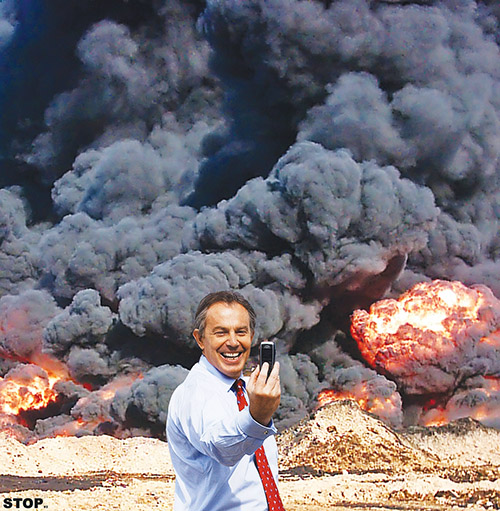
    Former UK Prime Minister Tony Blair. Doctored photo illustrates Blair’s willingness to invade Iraq in 2003.
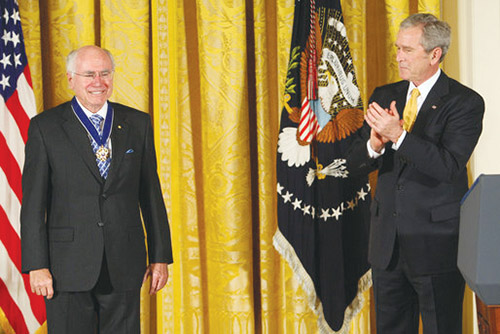
    In 2009, US President George W Bush awarded Australian Prime Minister John Howard the US Medal of Freedom, describing Howard as “his man of steel.” In the immediate aftermath of 9/11, George W Bush, Tony Blair and John Howard strutted the world stage as members of the ‘Coalition of the Willing’. They led the invasion of Iraq in 2003, a country that had nothing to do with the events of 11 September 2001. Their reputations have since been savagely damaged. Britain’s recent Chilcot Report slammed the nation’s rush to war. A report from the Australian Directorate of Army Research, declassified in 2016, demonstrated that the only reason Australia got involved in the war was to shore up its alliance with the USA. The conflict reverberates to this day, with Amnesty International recently accusing Australia of war crimes. A number of international tribunals have found the trio guilty of war crimes. Former intelligence officer Andrew Wilkie, the only insider to publicly speak out about the false evidence used to justify the invasion of Iraq, recently said: “Prime Minister John Howard and then foreign minister Alexander Downer rightly stand accused of war crimes and their actions should be properly investigated. The bottom line is that these matters constitute Australia’s greatest foreign and security policy blunder in our history.” (Source: www.thenewdaily.com.au/news/national/2017/09/11/911-terror-attack-anniversary)

    History Repeats Itself

    The root of all the destruction in our world is itself the very thing that can wake us up.
    – Paul Levy119

    We are almost a generation removed from 9/11 and the Iraq War, but the pattern of corruption hasn’t much changed – only the intensity of violence broadcast around the world. The murder of 3,000 Americans on 11 September 2001 was savage. The digital age culture of beheadings initiated by Zarqawi relishes in that savagery. There’s also been the savagery of so-called ‘Islamic State’ – mass beheadings, immolations, crucifixions, firing line executions – recorded on video and distributed throughout the Internet. Such violence, however intense, pales in comparison to the mass murder visited on the civilian populations of the Middle East via Western initiated or sponsored warfare.

    In the West, whistleblowers have become fugitives, with Edward Snowden exiled in Russia and Wikileaks’ Julian Assange exiled at the Ecuadorian embassy in London. Meanwhile the Western public is fed a steady diet of anti-Russian and anti-Iranian propaganda.

    Though sidelined by analysts and academics, al Qaeda is alive and kicking with Muslim Brother al Zawahiri the man in charge. In Pakistan alone, there are reportedly 24,000 madrassas preaching Wahhabi-style jihad to two million boys.120

    Israel, meanwhile, has become the most militarised nation in the world.121 Its defense sector is exporting technology and population control methodology, what Jeff Halper (head of the Israeli Committee Against House Demolitions) calls securitization, or the securocratic war against the people, lab tested on Palestinians in the occupied territories. The two-state solution is now all but dead. Meanwhile, Israel’s former enemy, Saddam Hussein’s Iraq, has basically been removed from the chessboard while its primary enemy, Iran, is encircled by Western forces and its other enemy, Syria, is in tatters.

    The rise of so-called ‘Islamic State’ neatly paralleled aspects of the rise of the Taliban, with abandoned weapons caches supporting highly mobilised infantries zipping through the countryside in waves of Toyota trucks, promising stability to populations racked by civil war and corrupt administrations – along with plenty of outside funding to back up their efforts. Not surprisingly, a Hillary Clinton email released by Wikileaks named Saudi Arabia as a primary funder of ISIL.122 Closer to the truth is the following statement by a former veteran jihadist whose testimony was recently published by Oxford University Press:

    “In his description of the Islamic State in Iraq and other such ‘post-al-Qaeda’ groups at the time, he said that ‘the support infrastructure provided by Gulf financiers has been the elephant in the room… funded and directed by the elite for their own purposes… Jihad is no longer an activity carried out by the [whole Muslim world]; it is jihad led by the rich’.”123

    It is a jihad led by the rich and used as a tool to destabilise regimes that are non-compliant with the global corporatocracy. And when we put it all together, that is the point – the looming global elite takeover. It’s not ultimately about oil, war profits, Hanbali sharia or any of the singular narrative threads within this ego-driven ball of yarn. Rather, it is the closing in of a global corporate takeover. The same global takeover that Bill Cooper – and more recently David Icke – warned us about.

    Humanity on planet Earth has been corrupted by an ordering principle of criminality that quietly self-organises behind the scenes in a web of common interests. 

    Does it completely self-organise? Or, like intersecting ripples on the surface of the water, do the various strands of the web merge as the result of impulses originating from sources unknown; moments of inspiration, as Mr Brzezinski would say, to knowingly increase the probability that certain things will occur, perhaps many years in the future?

    As of this writing, the so-called ‘Islamic State’ is on its last leg, entrenched in the dwindling territory of its former ‘capital’, Raqqa, in Syria, where it is currently surrounded and losing territory by the day. “The caliphate’s short, brutal life is drawing to a close,” The Economist reported.124

    If history is any guide, however, the Islamist infrastructure will produce a new wave of jihad. The jihadists are reportedly fleeing to the northwestern Syrian countryside and regrouping for the next period of jihadi gestation.125 With increasing American involvement in Syria, global jihad is preparing for a fresh new call. Just like the Iraq war saved a dying al Qaeda, American engagement in Syria will likely save a dying ISIL.

    [alert type=”general” dismiss=”no”]This article was published in New Dawn 165.[/alert]

    [alert type=”success” dismiss=”no”]If you appreciate this article, please consider subscribing to help maintain this website.[/alert]

    Footnotes

    73. Scott Ritter, War on Iraq, Context Books, 2002, 28-31
    74.  Ritter, Frontier Justice, 150
    75. Carlo Bonini, Giuseppe D’Avanzo, “Double Agents and Amateur Italians of Nigergate”, la Repubblica, 24 October 2005, www.repubblica.it/2005/j/sezioni/esteri/iraq69/sismicia/sismicia.html
    76. Ibid.
    77. Wilson, 424
    78. Wolf Blitzer, “Search for the ‘Smoking Gun’,” CNN, 10 January 2003, www.cnn.com/2003/US/01/10/wbr.smoking.gun/
    79. United States Senate Select Committee on Intelligence, Report on the U.S. Intelligence Community’s Prewar Intelligence Assessments on Iraq, 9 July 2004, 50
    80. U.S. Department of State, “Illustrative Examples of Omissions From the Iraqi Declaration to the United Nations Security Council,” 19 December 2002, https://2001-2009.state.gov/r/pa/prs/ps/2002/16118.htm
    81. James O’Neill, “Lessons from the Iraq War: a reappraisal,” 7 January 2017, http://johnmenadue.com/?p=8963
    82. George Bush, “State of the Union,” 28 January 2003, https://george
    wbush-whitehouse.archives.gov/news/releases/2003/01/20030128-19.html
    83. “Niger Uranium Rumors Wouldn’t Die,” Los Angeles Times, 17
    February 2006
    84. Colin Powell, “Remarks to the United Nations Security Council,”
    5 February 2003, https://2001-2009.state.gov/secretary/former/powell/
    remarks/2003/17300.htm
    85. The Commission on the Intelligence Capabilities of the United States Regarding Weapons of Mass Destruction, Report to the President of the United States, 31 March 2005,49
    86. United Nations, United Nations Weapons Inspectors Report to Security Council on Progress in Disarmament of Iraq, 7 March 2003, www.un.org/press/en/2003/sc7682.doc.htm
    87. “U.N. weapons inspector Hans Blix faults Bush administration for lack of ‘critical thinking’ in Iraq,” 18 March 2004, www.berkeley.edu/news/media/releases/2004/03/18_blix.shtml
    88. Kelly Wallace, “Iraq: No obstacles to inspections,” CNN, 12 October 2002, www.cnn.com/2002/WORLD/meast/10/12/iraq.letters/index.html
    89. Susan Lindauer, Letter to Andy Card, 1 March 2001, http://911review.org/Lindauer/
    90. Ibid. 
    91. Susan Lindauer, Letter to Andy Card, 3 July 2001, http://911review.org/Lindauer/
    92. Susan Lindauer, Letter to Andy Card, 24 September 2001, http://911review.org/Lindauer/
    93. Ibid. 
    94. Lindauer, 405
    95. Susan Lindauer, Letter to Colin Powell, 27 January 2003, www.scribd.com/document/337187153/Susan-Lindauer-letter-to-Colin-Powell
    96. “U.N. weapons inspector Hans Blix faults Bush administration for lack of ‘critical thinking’ in Iraq,” 18 March 2004, www.berkeley.edu/news/media/releases/2004/03/18_blix.shtml

    98. Joseph Wilson, “What I Didn’t Find in Africa,” The New York Times, 6 July 2003

    97. U.S. Senate Select Committee on Intelligence, 20 June 2003, www.
    intelligence.senate.gov/press/senator-pat-roberts-r-ks-chairman-and-
    senator-jay-rockefeller-iv-d-wv-vice-chairman-senate
    99. Wilson, 6, 338.
    100. “Medics raise Kelly death doubts,” BBC News, 12 December 2004, http://news.bbc.co.uk/2/hi/uk_news/4089729.stm
    101. “Attorney General refuses Fiat for fresh inquest into death of Dr David Kelly,” Leigh Day, 9 June 2011, www.leighday.co.uk/News/2011/June-2011/Attorney-General-refuses-Fiat-for-fresh-inquest-in
    102. Jamie MacIntyre, David Ensor, “Tenet admits error in approving Bush speech,” CNN, 25 December 2003, www.cnn.com/2003/ALL
    POLITICS/07/11/sprj.irq.wmdspeech/
    103. Bob Woodward, Plan of Attack, Simon & Schuster, 2004, 249
    104. Joby Warrick, Rise of Isis, Anchor, 2016, 19
    105. U.S. Senate Select Committee on Intelligence, 12 February 2004, www.intelligence.senate.gov/press/chairman-roberts-and-vice-chairman-rockefeller-issue-statement-intelligence-committees-review
    106. Lindauer,11
    107. United States of America vs. Susan Lindauer,S2 03 Cr. 807 (MBM), http://news.findlaw.com/usatoday/docs/iraq/uslindauer31004ind.pdf
    108. Lester Coleman & Donald Goddard, Trail of the Octopus,
    Bloomsbury, 1993, 2
    109. Robert Van Voren, “Political Abuse of Psychiatry – An Historical Overview,” Schizophrenia Bulletin, vol. 36 no. 1, 2010, 33
    110. Ibid.
    111. United States Senate Committee on the Judiciary, Abuse of Psychiatry for Political Repression in the Soviet Union, Arno Press, 1974, 6
    112. United States Senate Committee on the Judiciary, 6-7
    (emphasis added)
    113. Lindauer, 222
    114. Lindauer, 226-227, 238
    115. United States Senate Committee on the Judiciary, 7
    116. Ibid., 8, 44
    117. Lindauer, 297
    118. United States of America vs. Susan Lindauer,S2 03 Cr. 807 (LAP), www.courtlistener.com/docket/4328367/108/united-states-v-al-anbuke/
    119. Paul Levy, Dispelling Wetiko, (North Atlantic Books, 2013), 100.
    120. “The Hard Choice for Pakistan,” The Economist, 2 April 2016
    121. Max M. Mutschler/BICC, Global Militarization Index 2016, Bonn International Center for Conversion, 2016
    122. Patrick Cockburn, “US allies Saudi Arabia and Qatar are funding Isis,” The Independent, 14 October 2016,www.independent.co.uk/voices/hillary-clinton-wikileaks-email-isis-saudi-arabia-qatar-us-allies-funding-barack-obama-knew-all-a7362071.html
    123. Christopher Davidson, Shadow Wars, OneWorld, 2016, 446-447
    124. “The Iraqi army is on the brink of defeating Islamic State,”
    The Economist, 11 March 2017
    125. “‘Second ISIS’ made up of defeated rebels is emerging in Syria,” RT, 11 March 2017, www.rt.com/news/380308-second-isis-syria-rebels/

    © New Dawn Magazine and the respective author.
    For our reproduction notice, click here.

  • A Coordinated Corruption: How the Hidden Hand Created a Modern Crisis in the Middle East (Part 2)

    A Coordinated Corruption: How the Hidden Hand Created a Modern Crisis in the Middle East (Part 2)

    From New Dawn 164 (Sept-Oct 2017)

    In the second part of this series, MARC STAR examines ignored or suppressed events connected to the September 11, 2001 attacks and the real reasons for the war against Iraq (read Part One here).

    9/11 and the Plan to Remake the Middle East

    In the United States of the 1990s, officials within the Clinton administration were well aware of the growing threat of global terrorism. From the original World Trade Center bombing in 1993, the bombings of Kenya and Nairobi in 1998, the foiled Millennial Plot at the turn of the century, and the attack on the USS Cole in 2000, counterterrorism had become an official priority and a covert policy. Public policy, however, consisted of NATO wars, Iraq’s UN weapons violations and the President’s Oval Office inequities with female interns. 

    In 1998, Iraq ceased cooperating with UN weapons inspectors after accusing UNSCOM (United Nations Special Commission) of running cover for a CIA spying program. In response, the US pulled out the inspectors and began Operation Desert Fox, a bombing campaign that, as UN weapons inspector Scott Ritter would later note, “…had nothing to do with weapons production capability, but rather the leadership and security establishments of the government of Iraq and that the precision in which these targets were bombed was due in large part… to the information gathered by weapons inspectors.”28

    Mr. Ritter’s account of his years as a weapons inspector details his unfolding realisation the CIA was using UNSCOM as a cover to spy on Iraq. In January 1999, US government employees admitted as such to the Washington Post and Boston Globe with, as the newspapers claimed, documentation to back it up. American officials substantiated the allegations later that month – all, however, under the cover of anonymity.29 

    Nevertheless, by 2000 a division within the CIA was interested in developing a covert dialogue with Iraqi diplomats to foster a framework for peace. Perhaps it was clear that Saddam was not going to step down or be deposed. Perhaps public support for bombing campaigns and sanctions had dried up. Or perhaps, just as UN weapons inspectors were used as cover for a CIA spying program, the CIA wanted a cover in the Iraqi embassy. 

    This division of the CIA chose a declared peace activist, Susan Lindauer, to be its liaison with Iraqi diplomats.

    In the overt world, Ms. Lindauer had been, most notably, a congressional staffer. Covertly, she had been a CIA asset for years, working in the 1990s with Libyan diplomats “for the hand over of accused Lockerbie bombers to Scottish authorities”30 on behalf of her liaison at the CIA, Dr. Richard Fuisz.

    In 2000, Dr. Fuisz gave Ms. Lindauer the opportunity to bring her negotiating talents to the issue of Iraqi weapons inspections.

    “It would be a One-Woman Experiment with a new and wholly different approach to counter-terrorism. Success would depend on my ability to cultivate difficult relationships with… Iraqi diplomats in the opposite direction of official US policy,” she wrote.31 But, of course, it wasn’t only about peace. “[The CIA] wanted to leverage access from my activism to these embassies because they understood that Iraq and Libya had the best intelligence on terrorist activity in the Middle East. And the US needed to capture that intelligence.”32

    By 2001, the relationships Ms. Lindauer had developed would prove to be of paramount importance as the chatter of an impending event grew to a near deafening volume.

    9/11 Warnings

    When President George W. Bush took office at the beginning of 2001, he was not interested in the threat of terrorism – despite alarm bells being rung by Richard Clarke, the National Coordinator for Counterterrorism, or the regular warnings given by CIA Director George Tenet and his analysts. 

    Instead, as later revealed by former Treasury Secretary Paul O’Neill, the Bush administration was drawing up plans and looking for excuses to invade Iraq from January 2001. According to Mr. O’Neill, “Ten days in, and it was about Iraq.”33 

    Richard Clarke

    Mr. Clarke noted that in regards to funding, the Bush administration “had not placed terrorism in the top-priority issues for the Justice Department.”34 Additionally, Mr. Clarke’s position as National Coordinator for Counterterrorism (or Terrorism Czar, as the press labelled him) was downgraded below the status of principal. During the Clinton administration, he had been included in top-level meetings. After Bush took office, Mr. Clarke was excluded and, as he describes it, ignored.

    Nevertheless, Mr. Tenet would plainly note, “at CIA, we knew al-Qa’ida was coming.”35

    By 6 August, the intelligence community couldn’t have been clearer. In a now-famous President’s Daily Brief entitled “Bin Ladin Determined to Strike in US,” hand-delivered to Bush, he reportedly dismissed the PDB and responded, “You’ve covered your ass, now.”36 The 9/11 Commission later concluded that not only was no further action taken by Bush in response to this memo, “We have found no indication of any further discussion before September 11 among the President and his top advisers of the possibility of a threat of an al Qaeda attack in the United States.”37 

    Bush’s National Security Adviser, Condoleezza Rice, in 2004, testified to Congress: “Let me read you some of the actual chatter that was picked up in that spring and summer. ‘Unbelievable news coming in weeks’, said one. ‘Big Event. There will be a very, very, very, very big uproar. There will be attacks in the near future’. Troubling, yes, but they don’t tell us when. They don’t tell us where. They don’t tell us who. And they don’t tell us how.”38 It is almost unconscionable that the administration in charge of the United States of America, without being spoon-fed a specific when, where, who and how, would instead simply choose to do nothing. 

    Truth is, there was more than enough intelligence available to put the puzzle pieces together. The only thing missing was leadership from the top and a cohesive policy. In other words, the President should have gotten off the golf course and done his job because that summer’s prize capture, Zacarias Moussaoui, the alleged “20th hijacker,” was found in possession of flight manuals for the Boeing 747 Model 400, a flight simulator computer program, software that could be used to review pilot procedures for the Boeing 747 Model 400 and more.39 FBI Minneapolis Chief Division Counsel Coleen Rowley would later blow the whistle that within days of Moussaoui’s arrest, “the French Intelligence Service confirmed [Moussaoui’s] affiliations with radical Islamic fundamentalist groups and activities connected to Osama bin Laden.”40

    While the Bush administration was wilfully and knowingly asleep at the wheel in 2001, the intelligence community was not. That summer, Dr. Fuisz tasked Susan Lindauer to deliver a message to the Iraqi embassy. As the United States had no official communication channels with Iraq, Ms. Lindauer found herself in the role of messenger.

    Dr. Fuisz instructed her to demand that, “‘Iraq must hand over any intelligence regarding conspiracies involving airplane hijackings or airplane bombings… The United States would bomb Baghdad back into the Stone Age… if [we] discovered a terrorist conspiracy involving airplane hijackings or airplane bombings and [Iraq] failed to notify us. They would lose everything. We would destroy them. Those threats originated at the highest levels of government’, and I quote, ‘above the CIA Director and the Secretary of State’.”41

    Ms. Lindauer added, “There’s no question that months before 9/11, a cabal of pro-War neo-Conservatives at the top of the government was already prepping the Intelligence Community to accept War with Iraq in the aftermath of a strike.”42 

    A close friend of Ms. Lindauer, Parke Godfrey, a tenured associate professor in the Department of Computer Science and Engineering at York University in Toronto, Canada, would later testify at a court hearing in June 2008 that Ms. Lindauer did share with him, in the summer of 2001, warnings of the impending terrorist attack.

    “In the spring and summer of 2001, on several occasions Ms. Lindauer expressed heightened concern that a terrorist attack was in the works that would strike the southern part of Manhattan. She claimed it would reprise the 1993 attack on the World Trade Center.”43

    9/11

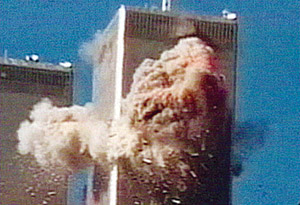
    The story of 11 September 2001 is one of fascinating coincidences and absurd anomalies. Perhaps the most amazing coincidence is the incredible story of the Naudet brothers, Jules and Thomas, two filmmakers who happened to be shooting a documentary about the firemen of Engine 7, Ladder 1, the closest firehouse to the World Trade Center complex. Brother Jules happened to be on the streets of Lower Manhattan that morning with a small crew of firefighters responding to a gas leak – at a spot that gave Mr. Naudet a clear view of American Airlines Flight 11 as it flew overhead before impacting the North Tower between the 93rd and 99th floors. Mr. Naudet’s footage is, as far as the public knows, the only footage of the impact of Flight 11, the first plane to strike. 

    Jules Naudet’s film footage incidentally captured the moment when the first plane hit the North Tower of the World Trade Center. 

    That morning, President Bush was reading a children’s book to a class of second graders. However, he would later say, “I was sitting outside the classroom, waiting to go in, and I saw an airplane hit the tower. The TV was obviously on. I used to fly myself, and I said ‘There’s one terrible pilot’.”44

    But Jules Naudet’s footage of Flight 11 wasn’t broadcast on television until long after both towers had collapsed and Jules had made his way through the dust. What footage did President Bush claim to see that morning?

    The North Tower impact was captured by only one known video, that taken by Jules Naudet. However, his video only came to light long after the event, so what footage did President Bush claim to see that morning?

    One might even wonder how hijacked airplanes could possibly confound the world’s most sophisticated air defense system, NORAD (North American Air Defense). The answer to this may lie in a military exercise being conducted that day called Vigilant Guardian, a semi-annual drill that, among other things, simulates plane hijackings. In 2006, Vanity Fair had the opportunity to review the NORAD tapes.

    “For the neads [Northeast Air Defense Sector] crew, 9/11 was not a story of four hijacked airplanes, but one of a heated chase after more than a dozen potential hijackings – some real, some phantom – that emerged from the turbulence of misinformation that spiked in the first 100 minutes of the attack… At one point, in the span of a single mad minute, one hears [Major Kevin] Nasypany struggling to parse reports of four separate hijackings at once.”45

    Following the impact of United Airlines Flight 175 into the South Tower, Bush’s chief of staff Andy Card entered the classroom and whispered in his ear, “A second plane hit the second tower. America is under attack.” Bush then took to the air within Air Force One while Vice President Cheney holed up in the President’s Emergency Operations Center (PEOC), an underground bunker beneath the White House. The task of managing the 9/11 crisis fell entirely on the shoulders of Richard Clarke, the recently demoted National Coordinator for Counterterrorism.

    “I was most of the day, the nation’s crisis manager,” Mr. Clarke would later recount. “The government had largely fled Washington.”46

    Safely underground in the PEOC bunker, the senior official of the executive branch of the United States government at the White House, Vice President Dick Cheney, was actively cutting off communication between his PEOC bunker and the crisis management team in the White House Situation Room, led by Mr. Clarke. At the outset of the crisis, Mr. Clarke sent Army Major Mike Fenzel into the PEOC to maintain an open line with him in the Situation Room. In the midst of it all, “Major Fenzel whispered, ‘but I can’t hear the crisis conference because Mrs. Cheney keeps turning down the volume on you so she can hear CNN… and the Vice President keeps hanging up the open line to you.”47

    Susan Lindauer, meanwhile, was on the phone with her CIA handler, Dr. Fuisz. He knew, somehow, about the existence of video footage showing the first plane hitting the North Tower.

    “‘How often does a bystander have a camera cued up to record a car accident on the street?’” Ms. Lindauer would later quote him telling her. “‘It never happens, Susan. It never happens’.” He would then add one of the most disturbing revelations of that day. “‘Those are Israeli agents’,” he told her. “‘They were waiting for it all morning’.”48

    Israeli Spies

    This brings us to perhaps the most controversial aspect of 9/11 – the Israeli connection. While Dr. Fuisz’s comment to Ms. Lindauer is, on its face, hearsay, an additional incident that occurred on 9/11 stands out as more than simply anomalous – the strange case of the so-called “dancing” Israelis. 

    As the Twin Towers burned that morning on 9/11, three young men were seen atop the roof of a white van taking photos of themselves with the World Trade Center ablaze in the background. The woman who reported the incident later said, “They were like happy, you know…” She wrote down the van’s license plate number and reported it to the police. When the van was pulled over later that day, five men were found inside. The driver told the arresting officer, “We are Israeli. We are not your problem. Your problems are our problems. The Palestinians are the problem.”49,50

    The white van belonged to Urban Moving Systems. The FBI questioned the company’s owner, Dominik Otto Suter, an Israeli citizen, not only about the five detained Israelis, but also, “oddly,” as the FBI report stated, about another Urban Moving Systems truck stopped in Pennsylvania, headed towards the direction of Shanksville, the location where Flight 93 crashed. Mr. Suter told the FBI that the truck had no scheduled pickups or deliveries outside of New Jersey that day.51 Following the interview, Mr. Suter fled back to Israel. When the New York State Department of Transportation learned that the company’s main office was only a mailing address, its business license was revoked.52

    Four of the arrested Israelis passed lie detector tests. A fifth, Paul Kurzberg, refused. Ten weeks later, however, Mr. Kurzberg finally agreed to test and failed. After 71 days in jail, the five Israelis were charged with visa violations and deported. The FBI closed its case, concluding that “no basis” was found to suggest that four of the Israelis were “in possession of or had any prior knowledge relating to the attacks on the World Trade Center of 9/11/01.” The FBI, however, found “no articulate facts… to demonstrate” that the “least cooperative” of the five Israelis “was in possession of or had any prior knowledge…”53 In other words, the FBI couldn’t make the case on Paul Kurzberg, despite a potential basis for doing so. 

    Forward, an American Jewish weekly, was able to get to the bottom of the story. According to a “former high-ranking American intelligence official… the five Israelis arrested in New Jersey last September were conducting a Mossad surveillance mission and… their employer, Urban Moving Systems… served as a front.” The mission was to spy on “a common enemy… radical Islamic networks suspected of links to Middle East terrorism.”54

    The Forward article concludes with a quote from Chip Berlet, a senior analyst at the Boston-based Political Research Associates, noting a “backdoor agreement between allies that says that if one of your spies gets caught and didn’t do too much harm, he goes home. It goes on all the time. The official reason is always a visa violation.”

    Harmless enough, until one more incident is taken into account. Prior to 11 September, a group of 120 Israeli “art students” were rounded up as part of a “widespread investigation into a suspected espionage ring run by Israel inside the USA.”55 One group of students resided in Hollywood, Florida, “just down the block from the 3389 Sheridan St. apartment where terrorist mastermind Mohammed Atta holed up with three other Sept. 11 plotters.”56 According to a French intelligence report on the “art student” bust, “Mossad agents were spying on Mohammed Atta and Marwan al-Shehi, two of [the] leaders of the 9/11 hijack teams.”57

    Vincent Cannistraro, former chief of operations for counterterrorism with the CIA, told journalist Christopher Ketcham, “the FBI investigation [of the ‘dancing’ Israelis] operated on the premise that the Israelis had foreknowledge.” But the investigation was quashed. And the order to do so came from the top. A former CIA counterterrorism officer also told Mr. Ketcham, “There was no question but that [the order to close down the investigation] came from the White House. It was immediately assumed at CIA headquarters that this basically was going to be a cover-up so that the Israelis would not be implicated in any way in 9/11.”58 

    Some Mossad agents had foreknowledge. Some at the White House had foreknowledge. The events that unfolded indicate they knew each other knew, at least after the fact. 

    The 800-pound gorilla in the room, however, is the question of why Mossad agents would have been publicly celebrating on 9/11, conducting themselves in a way to attract the most attention? And why would Israeli spies posing as art students have “an inexplicable interest in peddling art to G-men”?59 Aside from the fact that both missions have been identified as surveillance programs to track Islamists in America, both sets of agents behaved in a manner that suggests they intended to be caught.

    And Then the Towers Disappeared

    Amidst the tragedy of 11 September 2001, an anomaly occurred that should give everyone pause for thought. It is a story of 14 firemen and an office worker trapped between the first and the sixth floors of the North Tower’s B stairwell when the tower disintegrated – the only people from inside either disintegrating tower who lived to tell the tale – and it was later immortalised in a UK broadcast documentary The Miracle of Stairway B.60

    Arrow marks the section of North Tower’s B stairwell that somehow survived the collapse of the tower. 

    After the second plane hit, firemen were on their way up the North Tower, while office workers were on their way down. About an hour into the firemen’s journey, they had reached the 31st floor, which is when the South Tower disintegrated, causing such an earth shaking rumble that the firemen in the North Tower’s stairwell B were thrown to the floor. Captain Jay Jonas soon gathered that the South Tower had “collapsed.” He knew that his men were now in a race against time to descend the 31 floors they had just climbed. But they didn’t make it out.

    As the North Tower disintegrated, “you could actually hear the floors hitting one another,” fireman Sal D’Agostino said. “Boom, boom, boom, boom. And as it fell, it got faster” (emphasis added). One hundred floors of the North Tower and more than a half million tons of material were presumably falling down upon them. Truth was, the 110-story tower disintegrated in just under 10 seconds – except for one pocket of the building in which fourteen people were left untouched. 

    The building didn’t fall down upon them. It disintegrated around them. Hours later, when the dust cleared, something amazing happened.

    “All of the sudden, a ray of sunshine hit the stairwell,” said Captain Jonas. 

    “It was clearly sunlight,” added fireman Mickey Kross. “A 110-story building fell down on top of us, and I’m on the third floor looking at sunlight.”

    The documentary claimed that, “experts… offered a tentative explanation. The tower fell with its exterior collapsing outwards at a faster rate than its interior, leaving a protected stump towards the base of the building.” Such an explanation, however, ignores one enormously crucial necessity: the cause of the “collapse.” The collapse hypothesis requires a ten-story section above the impact point of each tower crushing the floors below it.

    The only problem with this hypothesis – which any cursory study of top-down images of ground zero will confirm – is that no ten-story sections are evident at the site. Absent the evidence of these ten-story sections at ground zero one must question the collapse hypothesis.

    This lack of rubble was not lost on ABC News anchor Peter Jennings who, on 12 September, asked a question that bears repeating. 

    Aerial shot of collapse zone, fifteen days after 11 September, revealed a strange lack of rubble.

    Mr. Jennings asked George Stephanopoulos, “[ABC News correspondent] Jackie Judd and several other people keep asking us, when you look at where the towers used to stand, there is surprisingly so little rubble. Where did all the rubble go?” 

    Mr. Stephanopoulos, the ABC reporter at Ground Zero, responded: “The reason there is so little rubble is that all of it simply fell down into the ground and was pulverized, evaporated.”61

    The ten-story sections that supposedly crushed the 90-plus stories of building below them hit the ground and evaporated.

    Magic.

    The Plan

    In March 2007, Amy Goodman of Democracy Now! interviewed Wesley Clark, a retired American four-star general who had commanded allied forces in the Kosovo War during his term as the Supreme Allied Commander Europe of NATO from 1997 to 2000. By 2007, the American war on Iraq had become an embarrassment, and insiders wanting to distance themselves from the Bush administration’s misadventures, were speaking freely. General Clark recounted a story that still has meaning today.

    “About 10 days after 9/11,” General Clark said, “I went through the Pentagon [to see] Secretary Rumsfeld and Deputy Secretary Wolfowitz. I went downstairs just to say hello to some of the people on the Joint Staff who used to work for me, and one of the generals called me in. He said, ‘Sir you’ve got to come in and talk to me a second… We’ve made the decision we’re going to war with Iraq.’ …I said, ‘We’re going to war with Iraq? Why?’ He said, ‘I don’t know… I guess they don’t know what else to do’.

    “So I came back to see him a few weeks later, and by that time we were bombing in Afghanistan. I said, ‘Are we still going to war with Iraq?’ And he said, ‘Oh it’s worse than that… I just got this down from upstairs’ – meaning the secretary of defense’s office – ‘…This is a memo that describes how we’re going to take out seven countries in five years, starting with Iraq, and then Syria, Lebanon, Libya, Somalia, Sudan and finishing off Iran’.”62

    Love/Hate Affair With Saddam

    Your government allowed this to happen to its own people, so you could declare war on us. 
    – Iraqi diplomat to Susan Lindauer after 9/1163

    Elements within the government of the United States were no doubt itching to invade Iraq to not only clean up the mess the West created when it supported the Ba’athists to power in the late 1960s, and gain control of Iraq’s oil fields – a fuel-hungry military sweep through the Middle East was looming – but it also would be the beginning of a plan to subdue geopolitically relevant Middle Eastern countries not aligned or subordinated to the Western corporate power structure.

    The CIA had initially helped the Ba’athists take power in 1960s Iraq to oust Prime Minister Abdel Kassem, a pro-communist who withdrew Iraq from the pro-West Baghdad Pact and opposed foreign forces on Iraqi soil. The CIA provided the Ba’athists with a list of communists and pro-leftists. The result was a bloodbath. “Soon, Western corporations like Mobil, Bechtel and British Petroleum were doing business with Baghdad – for American firms, their first major involvement in Iraq.”64

    Al-Shaheed Monument (Martyr’s Memorial) was constructed in the Iraqi capital, Baghdad, by President Saddam Hussein’s Ba’athist government, and is dedicated to the Iraqi soldiers who died in the Iraq-Iran war.

    But that relationship soured when Iraq nationalised its oil resources in 1972 and expelled Western oil companies. Saddam Hussein rose to power in 1979. It is now clear that the subsequent Iran-Iraq War, started when Iraqi forces invaded Iran, developed into a wilful effort to weaken two countries that weren’t playing ball with Western petroleum companies. In order to “avoid victory by both sides,”65 the US backed Iraq with covert arms shipments, while Israel clandestinely shipped US arms to Iran (in addition to secret US arms shipments to Iran that came to light during the Iran/Contra scandal in 1980s America).

    The Arc of Triumph in Baghdad, also called the Swords of Qādisīyah, was constructed to commemorate the Iran-Iraq war, led by then Iraqi President Saddam Hussein. 

    When the war ended in August 1988, Iraq’s coffers had bled dry. Iraq was in debt to the tune of $80 billion, the bulk owed to surrounding Gulf states. Meanwhile, oil prices were dropping.

    “By 1990, he [Saddam Hussein] was regularly defaulting on payments to his Arab creditors, particularly Kuwait, which held some $10 billion of Iraq’s debt.”66 But the drop in oil was no accident. Kuwait and the United Arab Emirates were overproducing, driving the prices down. Exacerbating the situation, Iraq claimed Kuwait was siphoning oil from the Rumaila oilfield underneath the Iraqi side of the border. 

    US Ambassador April Glaspie (on left) told Iraq’s President Saddam Hussein, “[W]e have no opinion on the Arab-Arab conflicts, like your border disagreement with Kuwait.”

    As Iraqi forces massed along the border with neighbouring Kuwait, the US State Department and President George H. W. Bush, in official statements, took no position on the brewing conflict.67 US Ambassador April Glaspie told Saddam, “[W]e have no opinion on the Arab-Arab conflicts, like your border disagreement with Kuwait.”68 State Department spokeswoman Margaret Tutwiler stated, “We do not have any defense treaties with Kuwait, and there are no special defense or security commitments to Kuwait.”69 Ambassador Joseph Wilson would later write that Assistant Secretary of State John Kelly declared: “We don’t have any defense treaty with the Gulf States. That’s clear.” Ambassador Wilson added, “Within minutes, Kelly’s testimony was transmitted to Iraq.”70

    Like the Soviet “Afghanistan trap,” Mr. Brzezinski might have categorised Iraq’s invasion of Kuwait as such: We didn’t push Iraq to invade Kuwait, but we knowingly increased the probability that it would.

    Iraq’s invasion of Kuwait was followed by America’s Gulf War of 1991, the first salvo of a twelve-year process by which Iraq was beaten and slowly bled dry. By 2003, sanctions and ongoing bombing campaigns had effectively destroyed the country’s economy, infrastructure and military – well before Americans fired the first shot during the March 2003 invasion. 

    The Afghanistan War of 2002 was primarily a CIA-led conflict, executed with a strategy that the CIA does best – purchasing support from local warlords and supplying them with the means to get the job done. The American military was barely involved and, notoriously, Osama bin Laden escaped. The full force of the United States war machine instead was being saved for Iraq.

    “There was… a surety inside CIA – also widely held – that the President would eventually get his way and there would be an invasion,” wrote journalist Ron Suskind.71

    The Islamists also knew Iraq was next. After the US started bombing Afghanistan, members of al Qaeda began fleeing to Iraq, including Abu Musab al-Zarqawi, who “began establishing local support networks in Baghdad,”72 later becoming the leader of al Qaeda in Iraq.

    All that remained was for the Bush administration to create enough fear to sell the war to the American people and the United Nations. 

    The third and final part of this series appears in New Dawn 165. 

    [alert type=”general” dismiss=”no”]This article was published in New Dawn 164.[/alert]

    [alert type=”success” dismiss=”no”]If you appreciate this article, please consider subscribing to help maintain this website.[/alert]

    Footnotes

    28. Scott Ritter, Frontier Justice, Context Books, 2003, 37-38
    29. Barton Gellman, “U.S. Spied On Iraq Via U.N.”, The Washington Post, 2 March 1999
    30. Michael Collins, “American Cassandra – Susan Lindauer’s Story”, Scoop Independent News, 17 October 2007, www.scoop.co.nz/stories/HL0710/S00266.htm
    31. Susan Lindauer, Extreme Prejudice, (self-published, 2010), 48
    32. Lindauer, 60
    33. Ron Suskind, The Price of Loyalty, Simon & Schuster, 2004, 75
    34. Richard A. Clarke, Against All Enemies, Free Press, 2004, 256
    35. Tenet, 187
    36. Ron Suskind, One Percent Doctrine, Simon & Schuster, 2006, 2
    37. Thomas H. Kean and Lee Hamilton, 9/11 Commission Report, National Commission on Terrorist Attacks Upon the United States, 2004, 261-262
    38. “Testimony of Condoleezza Rice Before 9/11 Commission,” The New York Times, 8 April 2004
    39. United States vs. Zacarias Moussaoui, Statement of Facts, Criminal No. 01-455-A, www.vaed.uscourts.gov/notablecases/moussaoui1/dktsheets/docs/70543/0.pdf
    40. “Coleen Rowley’s Memo to FBI Director Robert Mueller”, Time, 21 May 2002
    41. Lindauer, 20-21
    42. Lindauer, 22
    43. Parke Godfrey, Affidavit, 19 October 2009, https://extremeprejudiceusa.files.wordpress.com/2010/10/parke-godfrey-affidavit-on-911-warning.pdf
    44. “On 9/11, Bush watched the first plane impact,” www.youtube.com/watch?v=BUXglJU2w6U
    45. Michael Bronner, “9/11 Live: The Norad Tapes,” Vanity Fair, 17 October 2006,www.vanityfair.com/news/2006/08/norad200608
    46. Clarke, 17-18
    47. Clarke, 18
    48. Lindauer, 95
    49. Chris Isham, et al., “Were Israelis Detained on Sept. 11 Spies?”, 20/20, 21 June 2002, http://abcnews.go.com/2020/story?id=123885&page=1
    50. Scott DeCarlo. East Rutherford Police Department, CSRR# 014157.
    51. FBI, Unclassified report 2010-07-21 (Newark, NJ), Section 1, p. 36, https://archive.org/stream/FBIandPoliceReportUrbanMoving/dancing-israelis-fbi-document-section-1-1138796-001-303a-nk-105536-
    section-1-944861.
    52. Neil Mackay, “Five Israelis were seen filming as jet liners ploughed into the Twin Towers on September 11”, Sunday Herald, 02 November 2003, http://web.archive.org/web/20031202162323/http://www.sunday
    herald.com/37707
    53. FBI, Unclassified report 2010-07-21 (Newark, NJ), Section 6, pp. 54-56, https://archive.org/stream/FBIandPoliceReportUrbanMoving/
    FBI-document-Section-6-1138796-001-303A-NK-105536-Section-6
    54. Marc Perleman, “Spy Rumors Fly on Gusts of Truth”, Forward,15 March 2002, http://web.archive.org/web/20020323052403/http://www.forward.com/issues/2002/02.03.15/news2.html
    55. Sunday Herald, 2 November 2003
    56. Christopher Ketcham, “The Israeli ‘Art Student’ Mystery”, Salon,7 May 2002, www.salon.com/2002/05/07/students/
    57. Sunday Herald, 2 November 2003
    58. Christopher Ketcham, “What did Israel Know in Advance of the 9/11 Attacks?”, Counterpunch, vol. 14, no. 3/4, 3
    59. Ketcham, “The Israeli ‘Art Student’ Mystery”
    60. “The Miracle of Stairway B”, www.youtube.com/watch?v=EpTRNEVKMY4
    61. “ABC News, ‘Where’s all the rubble gone?’ (12:44 pm 9/12/2001)”, www.youtube.com/watch?v=GdBQOe85i3M
    62. “Gen. Wesley Clark Weighs Presidential Bid”, Democracy Now!, 2 March 2007, www.democracynow.org/2007/3/2/gen_wesley_clark_weighs_presidential_bid
    63. Lindauer, 103
    64. Roger Morris, “A Tyrant 40 Years in the Making”, The New York Times, 14 March 2003
    65. Seymour Hersh, “U.S. Secretly Gave Aid to Iraq Early in Its War Against Iran”, The New York Times, 26 January 1992
    66. Zachary Karabell, Philip Zelikow, “Prelude to war: US Policy Toward Iraq 1988-1990”, Harvard Intelligence and Policy Project, 1999
    67. R. Jeffrey Smith, “State Department Cable Traffic on Iraq – Kuwait Tensions, July 1990,” Washington Post, 21 October 1992
    68. Stephen M. Walt, “Wikilieaks, April Glaspie, and Saddam Hussein,” Foreign Policy, 9 January 2011
    69. Elaine Sciolino, Michael R. Gordon, “Confrontation in the Gulf; U.S. Gave Iraq Little Reason Not to Mount Kuwait Assault”, The New York Times, 23 September 1990
    70. Joseph Wilson, Politics of Truth, PublicAffairs, 2005, 104
    71. Suskind, 189
    72. Atwan, 197

    © New Dawn Magazine and the respective author.
    For our reproduction notice, click here.

  • A Coordinated Corruption: How the Hidden Hand Created a Modern Crisis in the Middle East (Part 1)

    A Coordinated Corruption: How the Hidden Hand Created a Modern Crisis in the Middle East (Part 1)

    From New Dawn 163 (Jul-Aug 2017)

    Those who cannot remember the past are condemned to repeat it.
    – George Santayana1

    In May 2017, The Atlantic headlined “The Scramble for Post-ISIS Syria Has Officially Begun” as American-led forces are now directly attacking the Assad government and its Iranian-backed allies. What was once a proxy war has evolved into a Western dominated effort to “carve out spheres of influence”2 in Syria.

    Like Iraq and Libya before it, Syria was next in line among a list of seven nations officially targeted by the American government to be taken out. The list, revealed by American General Wesley Clark in 2007, was quietly circulated at the Pentagon following the post-9/11 invasion of Afghanistan – and one by one, those targeted nations have been destabilised. The list ends with Iran. 

    While the mainstream media, year after year, reports on the events in the Middle East as happenstance conflicts exacerbated by popular rebellions and illogical fanatics bent on destroying infidels (unbelievers), the truth is far more revealing. The endless wars of our post-9/11 era have been a calculated drive to eliminate those resource-rich countries outside of Western corporate-military influence – most particularly countries within the sphere of Russian and Iranian influence.

    To accomplish this goal, the West chose as its ally the very force against which most believe we are fighting – Islamist jihadists. 

    In 2015, the US watchdog group Judicial Watch obtained an August 2012 declassified US Department of Defense (DoD) document about the conflict in Syria. That document revealed, “The West, Gulf countries, and Turkey support the opposition” which, it noted, is comprised of “Salafist[s], the Muslim Brotherhood, and AQI [al-Qaeda in Iraq].”3

    The document also revealed that Western support would create “safe havens” for the opposition to allow “the possibility of establishing a declared or undeclared Salafist principality in Eastern Syria… and this is exactly what the supporting powers to the opposition want in order to isolate the Syrian regime.”

    Islamic State was exactly that principality predicted by the DoD document. Contrary to what the mainstream media and popular consensus intone, Islamic State and most jihadists are the undeclared allies of the West. This alliance, however, is not a new development. It is a courtship that spanned the entirety of the 20th century and into the 21st.

    To study this alliance is truly an adventure in Wonderland – a crucial first step towards understanding how far the rabbit hole goes. Are you ready to take the red pill?

    Global Terrorism and the Seduction of the Islamist Mind

    The overriding reason for keeping the Middle East divided has been to ensure that no single power dominates the region’s oil resources and so that a strong combination of powers cannot challenge Western hegemony.
    – Mark Curtis, Secret Affairs4

    Today, we live in a post-9/11 world and it is therefore imperative, most of all, to understand this pivot point in the global narrative. It was 9/11 that brought the United States into Iraq, and it was the destruction of Iraq that gave rise to Islamic State (IS).But if we want to understand contemporary jihad, we must examine, at least briefly, the origin of political Islam, or Islamism, which finds its most extreme expression in Salafism, an ideology that seeks to emulate the traditions of the Salaaf (the “pious forefathers” or “devout ancestors”). Global jihad is built on a Salafist ideology, and those who answer the call are the latest participants in a decades-old effort to export Hanbali-style sharia law (the most orthodox form of sharia) from Saudi Arabia to the rest of the Muslim world via the establishment of a modern caliphate.

    Significantly, the West has had a long relationship with this pan-Islamic movement. 

    The impetus to establish a 21st century caliphate can be traced to a late-19th century freemason named Sayyid Jamal al-Din al-Afghani who established himself in Egypt, the intellectual centre of the Islamic world, to rouse Muslims to “unite under the banner of one Caliph”5 and expel the British.

    Al-Afghani’s ideological success brought him to the attention of British officials who, in 1885, met with him in London to discuss joining the forces of Islam with England in an alliance against Russia. Although al-Afghani was rebuffed, the idea of this alliance did not die. Following the First World War, Britain used the Islamic world to complete the dismantling of the Ottoman Empire. This Arab Revolt against their Ottoman rulers cleared the way for the Sykes-Picot Agreement, a secret agreement which carved up the Middle East between England and France, establishing the nations with which we are familiar today – Iraq, Syria, Palestine, Saudi Arabia, Jordan, Kuwait and others. 

    Preceding the Arab Revolt, the British had promised to pave the way for an Islamic caliphate centred in Mecca, the spiritual centre of Islam, under the rule of Hussein ibn Ali, Sharif of Mecca, regarded as a descendant of Prophet Muhammad. But after the dissolution of the Ottoman Empire, the British did an about face and gave their support to Ibn Saud, patriarch of modern Saudi Arabia, whose forces took complete control of Arabia by 1924 and whose alliance with the Wahhabi cult – philosophical brethren of Salafists everywhere – would help solidify an authoritarian kingdom under Saudi rule. It would also be the start of an ideological arms race between extremist Sunni and extremist Shia sects. For the UK, it was a natural fit. The British, foremost among the world’s imperial powers, were masters at dividing indigenous populations, keeping them too busy fighting amongst themselves to unite against English rule. 

    Among England’s interests in the Middle East, oil was (and is) significant. Following WWI and Sykes-Picot, the region’s oilfields were in the hands of Western oil companies – companies that became synonymous with “British interests.” In all its new nations of the Middle East, England sponsored client rulers whose loyalties sided with British interests, at the expense of the local populations. Naturally, this fostered unrest in the Arab street, which found expression in three competing ideologies: Arab nationalism, communism and Islamism. Arab nationalism threatened to nationalise the oil industry, and thus extricate Western corporations from Middle Eastern oil fields. Communism threatened to do virtually the same. Islamism, however, would become a tool used by the West to undermine the threat of the other two – starting with the Muslim Brotherhood.6

    In the 1920s, al-Afghani’s ideological successor, Hassan al-Banna, founded the Muslim Brotherhood, which “…preached strict observance of the tenets of Islam and offered a religious alternative to both the secular nationalist movements and communist parties in Egypt and the Middle East.”7 In 1942, during a meeting with Egyptian Finance Minister Amin Osman Pacha at their embassy in Cairo, Britain formally began financing and infiltrating the Muslim Brotherhood. A British embassy document stated that “‘subsidies from the Wafd [Party] to the Ikhwan el Muslimin [Muslim Brotherhood] would be discreetly paid by the [Egyptian] government and they would require some financial assistance in this matter from the [British] Embassy’. In addition, the Egyptian government ‘would introduce reliable agents into the Ikhwan to keep a close watch on activities and would let us [the British embassy] have the information obtained from such agents’.”8 

    While at the time it might not have seemed such a scandalous turn of events – at least not scandalous enough to keep out of the official record – the Brotherhood would go on to be, at the very least, the ideological foundation of every major Sunni militant organisation that has made headline news for the past fifty years. 

    While England cozied up to the Brotherhood, the Nazis looted the gold supply from all the central banks of Europe and laundered it by the ton through the Swiss banks.9 Following WWII, flush from the greatest robbery of the 20th century, the financial capitalists turned to America, methodically constructing the world’s most formidable war machine.

    The war machine needed oil. Therefore, in 1945, just after the Yalta Conference, US President Franklin D. Roosevelt met with Saudi Arabia’s King Abdulaziz ibn Saud aboard the USS Quincy to secure a formal arrangement that still exists today. In exchange for a steady supply of Saudi oil, the US would guarantee military support in defence of the royal family – from both internal and external threats. 

    One can only guess if FDR knew he was also guaranteeing support for the Saud family’s partners in authoritarian rule – the Wahhabis, the cult that provides the Saudis the spiritual authority to maintain their rule over Mecca and Medina, the holiest shrines of Islam. We will see that while al-Afghani’s ideology formed the intellectual foundation of the modern Islamist movement, the Wahhabi cult is the totalitarian source that has indoctrinated a Salafist army. 

    The Muslim Brotherhood and Saudi Arabia

    The Muslim Brotherhood is the origin of it all. All these other extremists emanated from them.
    – Abdel Fattah el-Sisi, President of Egypt10

    In the 1950s, Arabs were wise to the West’s trickery, steering many to the populist side of politics. This secular, nationalist fervour must have been felt in Saudi Arabia because by 1952 the royal family had a plan in place. In a US State Department memo entitled “Conversation with Prince Saud,” the Saudi intention to ignite a pan-Islamic movement was revealed.

    In the 1952 memo, Frederick Awalt, of the US State Department’s Office of African and Near Eastern Affairs, wrote: “[Prince Saud] added that Saudi Arabia was a leader among the Arab states because of two things; the presence of the Holy Cities within the Kingdom and the enormous prestige enjoyed by the King…. Some day, he said, he was going to give more tangible form to this leadership. He said he had plans which he did not wish to discuss in detail now to spark plug a pan-Islamic movement.”11

    Gamal Abdel Nasser (1918–1970) served as president of Egypt from 1956 to his death in 1970.

    Months later, in July 1952, that prestige would be threatened by the overthrow of the Egyptian monarchy by the Free Officers led by Gamal Abdel Nasser who later became President of Egypt. Nasser nationalised the Suez Canal and gained widespread support among the Arab world, inspiring a movement that became the latest, and perhaps final, expression of secular Arab Nationalism (save for the Palestinian struggle). 

    To the global financial powers that controlled the Suez Canal, Nasser was a threat, and with little hesitation the Muslim Brotherhood, covertly funded by Britain and infiltrated by British informants, went on the attack, attempting to assassinate him. The assassination failed. Members of the Brotherhood were rounded up, jailed, tortured, murdered and expelled. 

    The survivors were welcomed into Saudi Arabia. The respected Arab journalist Abdel Bari Atwan writes they were, “assimilated into the Wahhabi kingdom’s own particular brand of fundamentalism, many rising to positions of great influence. While Saudi Arabia actively prevented the formation of a home-grown branch of the Muslim Brotherhood, it encouraged and financed the movement abroad in other Arab countries.”12

    By 1970, the Western powers and their client states in the Middle East had neutralised Nasser. His successor Anwar Sadat welcomed the Muslim Brotherhood back to Egypt, flush with two decades of Saudi financing and support. With Nasser’s Arab Nationalism in retreat, the plans for a Saudi inspired pan-Islamic movement, first revealed to the US in 1952, would now kick into high gear. 

    Brzezinski’s Jihad

    In the 1970s, Saudi Arabia’s vaults were overflowing with oil money. The plan for a pan-Islamic movement was put into action via the funding of a Wahhabi-based madrassa (Islamic school) system dotted throughout the Muslim world – most notably in the Baluchistan province that straddles the border between Afghanistan and Pakistan. By 1979, the “godfather”13 of Islamic jihad, aMuslim Brother named Abdullah Azzam, was travelling the world, proselytising the call to jihad. Azzam had studied sharia at Damascus University and Al-Azhar University in Cairo where he formed his early connections to the Muslim Brotherhood. He later took a lecturing post at the King Abdul Aziz University of Jedda, Saudi Arabia, where he is said to have become a Wahhabi. Informed by Brotherhood and Wahhabist ideology, Azzam travelled the Muslim world and inspired an army of youth into the Saudi-sponsored madrassas and CIA-funded training camps in Pakistan and Afghanistan. They came to be known as the “Afghan Arabs,” 20 to 30,000 strong, and a critical component of Afghanistan’s army of mujahideen who fought against the Soviet Union’s occupation. 

    Notable in this context is the name of one of Azzam’s most famous students at King Abdul Aziz University: Osama bin Laden. Azzam and bin Laden set up an office in Afghanistan to register the influx of foreign recruits, the Office of Services to the Mujahideen. This organisation would later become al Qaeda.

    United States political strategist Zbigniew Brzezinski was President Jimmy Carter’s National Security Advisor at the time. Years after the events in question, he revealed in an interview to Le Nouvel Observateur that the mujahideen were not roused in resistance to Soviet aggression, they were roused to incite a Soviet invasion.

    National Security Advisor Zbigniew Brzezinski and US President Jimmy Carter at the daily brief, 1979. It was Brzezinski who devised the “Afghanistan trap,” a plan that succeeded in drawing the Soviets into Afghanistan.

    “According to the official version of history, CIA aid to the Mujahiddin began during 1980, that is to say, after the Soviet army invaded Afghanistan on December 24, 1979. But the reality, closely guarded until now, is completely otherwise: Indeed, it was July 3, 1979 that President Carter signed the first directive for secret aid to the opponents of the pro-Soviet regime in Kabul. And that very day, I wrote a note to the president in which I explained to him that in my opinion this aid was going to induce a Soviet military intervention.” 

    Mr. Brzezinski added, “We didn’t push the Russians to intervene, but we knowingly increased the probability that they would.”14

    Mr. Brzezinski referred to it as the “Afghanistan trap,” or the USSR’s Vietnam War. Conveniently, an army of youth indoctrinated through the Saudi Arabian madrassas was ready to go into action. It is now known the CIA funded the mujahideen. 

    The US State Department’s website, in an effort to distance itself from the idea that the United States created Osama bin Laden, quotes CNN terrorism analyst Peter Bergen: “The United States wanted to be able to deny that the CIA was funding the Afghan war, so its support was funnelled through Pakistan’s Inter Services Intelligence agency (ISI). ISI in turn made the decisions about which Afghan factions to arm and train, tending to favour the most Islamist and pro-Pakistan.”15 ISI’s funding went primarily to the most ruthless of mujahideen commanders, Gulbuddin Hekmatyar, who founded a branch of the Muslim Brotherhood in Kabul, Afghanistan in the 1960s, and was later funded by the Muslim Brotherhood during the Afghan War against the Soviets.16

    The United States didn’t simply help fund the mujahideen into existence. The CIA directly provided training to those who would later be re-named terrorists and whose network would be responsible for the attacks of September 11, 2001.

    Michael Springmann was former head of the American visa bureau in Jeddah, Saudi Arabia from 1987 to 1989 – the final years of the Afghan jihad. He was repeatedly ordered by “high level [US] State Department officials” to issue visas to unqualified applicants.

    “I complained bitterly at the time there. I returned to the US, I complained to the State Department here, to the General Accounting Office, to the Bureau of Diplomatic Security and to the Inspector General’s office. I was met with silence. What I was protesting was, in reality, an effort to bring recruits, rounded up by Osama Bin Laden, to the US for terrorist training by the CIA. They would then be returned to Afghanistan to fight against the then-Soviets.”17

    Michael Springmann was subsequently fired.

    Order From Chaos

    This alliance between the West and the forces of political Islam has been described by various authors as partnerships of convenience, expediency, or the result of plain ignorance. For the Western politicos involved, such assessments may very well be true. But if we step back at this point and assess the larger picture, something else begins to emerge. 

    Afghan fighters at a camp in Pakistan in 1980, not long after the Soviets invaded Afghanistan.

    By the end of the Afghan War against the Soviets, a jihad factory had been established in Pakistan. The country had transformed from an Islamic nation to an Islamist nation under the Saudi supported General Zia. The Saudi Arabian madrassa system was indoctrinating youth by the thousands into a life of jihad against what ultimately turned out to be the common enemies of the West and its client states in the Middle East. This long-term plan can be traced on paper at least back to the 1950s (as demonstrated by the US State Department memo) and, at least overtly, seems to be driven financially by Saudi Arabia, whose monarchy likely would not exist absent the support of the West. It is worth reading between the lines. 

    Conveniently, filmmaker George Lucas provides us with an apt analogy. In Episode II of the Star Wars saga, a young Obi Wan Kenobi arrives on Kamino to find that the Republic is in possession of a freshly minted clone army, bred in secret under orders from Supreme Chancellor Palpatine and conveniently ready to take on the impending threat of the Trade Federation’s droid forces. The Republic has no choice but to use the clone army in its defence, and the result is an all out galactic war, the Clone Wars. 

    To what end? In the Star Wars universe, it is the Sith who step out from the shadows and, with deceptive charm, are called to bring order to the chaos. Such is how the Empire is formed.

    Global Terrorism Phase 2: Proof of Concept

    …the Taliban were not a new, post-Soviet phenomenon. They were taught by the same teachers in the same seminaries that had produced the mujahideen. 
    – Former President of Pakistan, General Pervez Musharraf18

    On 4 October 1995, Abdul Rahim Ghafoorzai, the Deputy Minister for Foreign Affairs of Afghanistan, spoke at the United Nations. He was calling on the nations of the world to help end the conflict still raging within Afghanistan. By 1995, it had been six years since the mujahideen defeated the Soviets. In Afghanistan, a country nearly destroyed by war and abandoned by its former allies in the West, the people were desperate for stability. 

    Following the Soviet withdrawal, the United States and the Soviet Union negotiated the Geneva Accord of 1988 between Pakistan and the Republic of Afghanistan, the Soviet-backed communist regime against which the mujahideen had spent the previous decade fighting. Although the mujahideen had defeated the Soviets, they were subsequently left out of the peace process, and Afghanistan was left in the hands of Mohammad Najibullah, former head of KHAD, Afghanistan’s secret police under Soviet occupation. Not surprisingly, the mujahideen rejected the agreement. Civil war ensued. By 1992, Kabul fell to the mujahideen, and President Najibullah fled to the United Nations headquarters in Afghanistan’s capital, a refugee from a war that continued to rage after his retreat – most notably from the ongoing belligerence of Muslim Brotherhood-sponsored Gulbuddin Hekmatyar, whose support from Pakistan and Saudi Arabia allowed him to terrorise Kabul with years of rocket attacks. 

    Mr. Brzezinski and his ilk had achieved their primary goal – the dissolution of the Soviet Union, which officially disbanded in 1991. The next step was to extract Afghanistan from the sphere of Russian and Iranian influence. The mujahideen warlords who took control of Kabul in 1992 – those who would later be renamed the Northern Alliance – were part of that sphere.

    By 1995, Hekmatyar’s belligerence had taken its toll, and the resultant instability paved the way for a brand new threat, a threat bred in Pakistan via the Saudi Arabian-backed madrassas, a threat whose very name indicated from whence they came – the Taliban. Talib means student.

    When Mr. Ghafoorzai spoke at the United Nations on 4 October, the Taliban had already taken over most of the country and were knocking on the doorstep of Kabul. Mr. Ghafoorzai was amazed, in fact, that those outside Afghanistan were referring to the conflict within his country as a ‘civil war’, since not only did the funding originate from foreign sources, but the majority of fighters were foreigners, Arab youth from around the Middle East, raised in the madrassas and led to war with Pakistani logistical, technical and air support, along with additional command support from former mujahideen and enough cash to purchase a threshold of alliances. The Taliban’s initial sweep through the Pushtun provinces in 1994 possessed an air of invincibility, inevitability and the myth that the talib would stabilise Afghanistan.

    “Our people find it astonishing,” Mr. Ghafoorzai said at the UN, “…[that] the actual causes of the continuing imposed war… are not understood…. Some call this a civil war in a society that they consider ‘fragmented’. Others look at it as the scene of a contest, a struggle for power. Yet others try to find the roots of the conflict in the ethnic and tribal composition of the country. The truth is far more clear: whatever it is, it is not a civil war; nor is it a tribal or ethnic conflict; it is an imposed war.”19

    On 26 September 1996, the Taliban overran Kabul and stormed the United Nations headquarters. Residents awoke the next morning to find the tortured corpse of Mohammad Najibullah, the former president, hanging from a traffic tower. Two days later, the US State Department sent a cable to its embassy in Pakistan: “We wish to engage the new Taliban ‘interim government’ at an early stage to… demonstrate USG [US government] willingness to deal with them as authorities in Kabul…”20

    It seems preposterous that the United States would rush to legitimise the Taliban, a barbaric regime that had primarily served to destabilise the formation of any potentially representative government. Tellingly, the oil industry along with Western governments and their allies, were painting a picture of the Taliban as a stabilising force in the region. 

    Central Asia is a motherlode of oil and natural gas. Afghanistan sits on the path of potential pipelines. One of the first relationships the Taliban struck was with UNOCAL, an oil company looking to construct a pipeline from the fields of Turkmenistan through Afghanistan to Pakistan.

    Oil, however, was not the point. Oil is a means to an end – in this case, an attempt to normalise and legitimise the Taliban regime, for the Taliban would be the first to impose an institutional adoption of Hanbali-style sharia outside of Saudi Arabia. 

    Osama bin Laden

    After issuing the first of two fatwas in 1998 followed by the simultaneous bombings of US embassies in Nairobi and Dar-es Salaam, Osama bin Laden became public enemy number one in the West. Global terrorism suddenly had a face, and a focus. As Abdel Bari Atwan, former editor-in-chief of the London-based pan-Arab newspaper Al Quds Al Arabi, notes in The Secret History of al Qaeda, “Al-Zawahiri’s strategy was a master stroke of propaganda; bin Laden’s face was flashed around the globe.”21

    But bin Laden was neither the main theoretician of al-Qaeda, nor main strategist, nor operations chief, nor the main source of funding. Rather, he was propped up as the spiritual leader of al-Qaeda, always making clear his desire for martyrdom. He was, in a sense, the most famous would-be suicide bomber of all, giving his face and life for the cause, while a well-established network of jihad, in various stages of development for decades, operated well below the radar.

    Former Muslim Brother, Ayman al-Zawahiri, has been identified as the “undisputed main theoretician and strategist of al-Qaeda.”22 Khalid Sheikh Mohammed, also a Muslim Brother, was the operations chief. And as the National Commission on Terrorist Attacks concluded in 2004:

    “Contrary to common belief, Bin Laden did not have access to any significant amounts of personal wealth (particularly after his move from Sudan to Afghanistan) and did not personally fund al-Qaeda, either through an inheritance or businesses he was said to have owned in Sudan. Rather, al-Qaeda was funded, to the tune of approximately $30 million per year, by diversions of money from Islamic charities and the use of well-placed financial facilitators who gathered money from both witting and unwitting donors, primarily in the Gulf region.”23

    Bin Laden was a fundraiser. He was the Jerry Lewis of the al-Qaeda Telethon. Meanwhile al-Zawahiri, who began his career as a Muslim Brother, stood by bin Laden’s side the whole time, whispering in his ear, not unlike the role Vice President Dick Cheney played to President Bush. 

    Bin Laden was Azzam’s successor – Azzam who created the Afghan call to war by proselytising jihad to the madrassa youth of the Muslim world. After the Soviets left, Azzam’s vision for al-Qaeda conflicted with the vision of al-Zawahiri. Azzam wanted to liberate his homeland of Palestine from the Israelis; and he likely would have been a moderating force upon bin Laden.24 Al-Zawahiri, at least at this point, was focused on liberating Islamic countries from illegitimate governments – in particular, Egypt.25 Multiple analysts have speculated, and events played out suggest, that Azzam was removed to make way for al-Zawahiri’s more extreme style of jihad in which civilians are seen as legitimate targets.

    Azzam’s murder cleared the way for bin Laden to assume the public face of terrorism. And when bin Laden returned to Afghanistan in 1996, the Saudi-sponsored madrassashad already primed a fresh set of ‘clone army’ soldiers into the Afghanistan-based terrorist training camps.

    CIA Director George Tenet says that an al-Qaeda defector informed the CIA that bin Laden, “…was the head of a world-wide terrorist organisation with a board of directors that would include the likes of Ayman al-Zawahiri…”26 In any corporation, the board of directors ultimately steers the ship. CEOs are hired and fired. Osama bin Laden filled a particular role, at a particular time. 

    Yet, as Ahmed Rashid noted in Foreign Affairs at the end of 1999:

    “…Washington’s sole response so far has been its single-minded obsession with bringing to justice the Saudi-born terrorist Usama bin Ladin – hardly a comprehensive policy for dealing with this increasingly volatile part of the world.”27

    Hardly, indeed. It was a classic case of misdirection. Not only was the administration of President Bill Clinton waging a covert war on a figurehead, the brunt of American foreign policy was on a collision course with Iraq.

    Go to Part Two of this article in New Dawn 164.

    [alert type=”general” dismiss=”no”]This article was published in New Dawn 163.[/alert]

    [alert type=”success” dismiss=”no”]If you appreciate this article, please consider subscribing to help maintain this website.[/alert]

    Footnotes

    1. https://en.wikiquote.org/wiki/George_Santayana
    2. Uri Freidman, “The Scramble for Post-ISIS Syria Has Officially Begun”, The Atlantic, 20 May 2017
    3. US Department of Defense, 12 August 2012, R 050839Z, www.judicialwatch.org
    4. Mark Curtis, Secret Affairs, Profile Books, 2011, 264
    5. A. Albert Kudsi-Zadeh, “Afghani and Freemasonry in Egypt”, Journal of the American Oriental Society 92:1, (Jan-Mar 1972) 34
    6. Richard Dreyfus, Devil’s Game, Metropolitan Books, 2005; Curtis, Secret Affairs.
    7. Curtis, 22
    8. British embassy, Cairo, ‘First Fortnightly Meeting with Amin Osman Pacha’, 18 May 1942, FO141/838 (cited in Secret Affairs, p. 24).
    9. Jean Ziegler, The Swiss, the Gold and the Dead, Houghton Mifflin Harcourt, 1998
    10. Dieter Bednarz, Klaus Brinkbäumer, “Extremists Offend the Image of God”, Spiegel Online, 9 February 2015, www.spiegel.de/international/world/islamic-state-egyptian-president-sisi-calls-for-help-in-is-fight-a-1017434.html
    11. National Security Archive, Conversation with Prince Saud, http://nsarchive.gwu.edu/NSAEBB/NSAEBB78/propaganda%20055.pdf
    12. Abdel Bari Atwan, Islamic State: Digital Caliphate, University of California Press, 2015, 194
    13. Charles Allen, God’s Terrorists, Da Capo Press, 2006, 279
    14. Zbignew Brzezinski, as translated and quoted in David Gibbs, “Afghanistan: The Soviet Invasion in Retrospect,” International Politics 37 (June 2000) 241
    15. US Department of State, ‘Did the U.S. “Create” Osama bin Laden?’, https://web.archive.org/web/20050310111109/http://usinfo.state.gov/media/Archive/2005/Jan/24-318760.html
    16. Alfred McCoy, Politics of Heroin, Chicago Review Press, 2003, 475; Thomas H. Johnson, “Financing Afghan Terrorism,” in Harold Trinkunas and Jeanne Giraldo, eds., Terrorism Financing and State Responses, Stanford University Press, 2007, 108
    17. Michael Springman, “CBC Interview,” 3 July 2002, https://web.archive.org/web/20030101072456/radio.cbc.ca/programs/dispatches/audio/020116_springman.rm
    18. Pervez Musharraf, In the Line of Fire: A Memoir, Free Press, 2008, 209
    19. United Nations, Official Records of the General Assembly, Fiftieth Session, Plenary Meetings,19th meeting, A/50/PV.19, 4 October 1995, 7
    20. US Department of State Cable, 1996STATE203322, “Dealing with the Taliban in Kabul,” September 28, 1996
    21. Abdel Bari Atwan, Secret History of al Qaeda, University of California Press, 2008, 79
    22. Ibid., 82
    23. John Roth, Douglas Greenburg and Serena Wille, “Monograph on Terrorist Financing: Staff Report to the Commission,” National Commission on Terrorist Attacks Upon the United States, 2004, 4
    24. Aryn Baker, “Who Killed Abdullah Azzam”, Time, 18 June 2009 
    25. Marc Sageman, Understanding Terror Networks, University of Pennsylvania Press, 2004, 36
    26. George Tenet, At the Center of the Storm, Harper Collins, 2007, 102
    27. Ahmed Rashid, “The Taliban: Exporting Extremism,” Foreign Affairs, (November/December 1999), 23

    © New Dawn Magazine and the respective author.
    For our reproduction notice, click here.

  • Coup D’etat in Australia: 20 Years of Cover-Up

    Coup D’etat in Australia: 20 Years of Cover-Up

    [alert type=”general” dismiss=”no”]The following article was published in New Dawn Nos 39 (Nov-Dec 1996) & 40 (Jan-Feb 1997).[/alert]

    Former CIA agent Victor Marchetti explained the U.S.-Australian relationship very well: “Australia is going to be increasingly important to the United States, and so long as Australians keep electing the right people then there’ll be a stable relationship between the two countries.” (A Secret Country, p. 353).

    For 23 years before 1972, the Australian people had been electing the “right people,” the Liberal-National Country Party Coalition headed for most of that period by Robert Menzies. The Coalition was essentially conservative, and had a foreign policy which was sycophantic, to say the least. Menzies himself actually despised Australia, and would much rather have been the Prime Minister of Britain. He once said, “A sick feeling of repugnance grows in me as I near Australia.” He hated his country so much, and loved England enough to beg the British government to conduct their nuclear bomb tests from 1952 to 1958 in the Australian deserts at Maralinga (home of thirteen Aboriginal settlements). Menzies agreed to the testing without even consulting his cabinet. As John Pilger says, “Australia gained the distinction of becoming the only country in the world to have supplied uranium for nuclear bombs which its Prime Minister allowed to be dropped by a foreign power on his own people without adequate warning.” (A Secret Country, p. 168).

    Later Liberal Prime Ministers turned their sycophancy towards the United States. John Gorton said in 1969 “We will go a-waltzing Matilda with you,” and Harold Holt coined the phrase “All the way with LBJ” when sending Australian troops to the Vietnam War. Again, the Liberal government was so desperate to please the Americans that they did all they could to engineer from the South Vietnamese government an invitation to send Australian troops. When the South Vietnamese government was not forthcoming, the Liberal government sent troops and advisers anyway, and mislead Parliament in a similar way that Lyndon Johnson misled Congress with the Gulf of Tonkin incident.

    Compared to the Coalition government (made up of the conservative Liberal and National Country parties), the Labor Party which was elected into office in December 1972 on the platform of “It’s Time” quickly showed themselves to be the “wrong people” in the eyes of the United States.

    In the domestic sphere, Labor Prime Minister Gough Whitlam’s first 100 days put Bill Clinton to shame. The Whitlam government ended conscription and ordered the last Australian troops home from Vietnam. It brought in legislation giving equal pay to women, established a national health service free to all, doubled spending on education and abolished university fees, increased wages, pensions and unemployment benefits, ended censorship, reformed divorce laws and set up the Family Law Courts, funded the arts and film industry, assumed federal government responsibility for Aboriginal affairs (health, education, welfare and land rights), scrapped royal patronage, and replaced “God Save the Queen” as the national anthem with “Advance Australia Fair.”

    Whitlam and several of his ministers, most notably Rex Connor, Minister for Minerals and Energy, and Dr. Jim Cairns, who eventually became Treasurer and Deputy Prime Minister, wanted to pursue a policy of “buying back the farm.”

    Buying Back The Farm

    The 1973 oil crisis pushed the costs of energy to an all-time high, and caused disarray to economies all over the world. Australia suffered with the rest of them, with rising inflation and unemployment.

    Yet one of the Whitlam government’s platforms was to reclaim Australian ownership of Australia’s vast natural resources, such as oil and minerals, and its manufacturing industries. By the late 1960s, foreign control of the mining industry, for example, stood at 60%, while 97% of the automobile industry was foreign-owned. Both Whitlam and Rex Connor had grandiose ideas for developing the necessary infrastructure, and the means to help Australian companies to “buy back the farm.” Connor’s schemes included a petroleum pipeline across Australia, uranium enrichment plants, updated port facilities, and solar energy development, as well as the establishment of government bodies with the authority to oversee development and investment in key areas, such as oil refineries and mining. Connor estimated that Australia’s mineral and energy reserves were worth $5.7 trillion dollars.

    However, buying back the farm would not be cheap for a nation in the grip of inflation and economic stagnation. It was determined that the government would need about $4 billion. While Australia had an excellent credit rating with its usual lending banks in the U.S. and England, no established bank would extend Australia an amount even close to a quarter of what it wanted.

    The other side to the oil crisis of 1973 was that the OPEC members in the Middle East were rolling in petrodollars. To Whitlam, Rex Connor and Jim Cairns, the Middle East seemed an appealing source of funds, as it would also be yet another step towards gaining independence from Australia’s traditional economic partners.

    In 1974, Whitlam instructed Connor and Cairns to find a Middle Eastern source for a $4 billion loan.

    So began the Loans affairs.

    The Loans Affairs

    Once word got out that the Australian government wanted to obtain such a large loan, both Connor and Cairns were inundated with offers to broker the loan. Most offers were from crackpots. There were two offers, however, which brought about the downfall of both the Ministers involved, and eventually the downfall of the Labor government.

    In March 1975, Treasurer and Deputy Prime Minister Jim Cairns met with George Harris, a Melbourne businessman, who told Cairns that a $4 billion loan was available “with a once-only brokerage fee of 2.5%.” To confirm that the offer was genuine, Harris showed Cairns a letter from the New York office of Commerce International. According to an intermediary present at the meeting, Cairns rejected the offer, as the terms of the loan were “unbelievable” and a “fairy tale” and Cairns refused to sign any letters making a commitment to the brokerage fee. He did, however, write for Harris two letters saying that the Australian government was interested in raising a loan.

    Two months later, Cairns was asked in Parliament whether he had signed a letter committing the government to a 2.5% brokerage fee. Cairns denied he had signed any such agreement. However, several days later, an incriminating letter with Cairns signature was reproduced in major newspapers around Australia. Cairns did not remember signing the letter, and said so. Nevertheless, he was forced to resign his position for misleading Parliament.

    The Khemlani Affair

    Minister for Minerals and Energy, Rex Connor, was also commissioned by Whitlam to find a Middle Eastern source for the $4 billion loan.

    The Khemlani affair began in October 1974 when South Australian Greek emigre Gerry Karidis met up with and old friend of his, Labor Minister Clyde Cameron, at a party in Cameron’s electorate. Karidis told Cameron that he knew of some sources for loans if the Australian government was interested. Cameron passed the information on to Cairns and Connor, who then met with Karidis.

    Karidis was not certain of the sources of the funds, but a friend of his said that the money could certainly be raised.

    The connection between Karidis and Khemlani is circuitous. Khemlani, who was manager of Dalamal and Sons, a London-based commodities firm, was a business associate of Theo Crannendonk, a Dutch arms and commodities trader. Crannendonk in turn knew Thomas Yu, a Hong Kong arms dealer, who in turn knew Karidis’ friend, Tibor Shelley.

    Khemlani said he first heard that the Australian government was interested in raising a loan while he was visiting his friend Crannendonk. Khemlani was in Crannendonk’s office when a telex about the loan came through from Thomas Yu. Khemlani volunteered to broker the loan at very reasonable rates, despite the fact that he had no experience in brokering loans, let alone such a large one.

    Khemlani arrived in Australia on November 11, 1974 with Theo Crannendonk, and met with Cameron and Connor. Connor told Khemlani about the government’s interest in a $4 billion loan, and gave him a letter of introduction to that effect. On December 13, the Labor Party’s Executive Council (which on that day consisted of Connor, Cairns, Whitlam, and Lionel Murphy) authorised Connor to raise the $4 billion 20-year loan “for temporary purposes.”

    The Executive Council can approve loan-raising activities without consulting the Labor Caucus or Parliament, but only if the loans are for temporary purposes. How Whitlam and his close circle of Ministers could consider a $4 billion loan over 20 years “temporary” is beyond comprehension, and smacks of attempting to keep the matter as secret as possible.

    Unfortunately, by not consulting the Labor Party Caucus, Whitlam, Connor, Cairns, and Murphy were their own worst enemies. Had they consulted with their colleagues and Parliament, they would not have placed their party and their government in hot water, and would not have entertained the idea of a loan the terms of which meant that the Australian government would have to pay $20 billion in November 1995.

    Various attempts were supposedly made by Khemlani to raise the money. But each time he claimed to have come up with the goods, the deals fell through. By late December of 1974, Australian Treasury and other officials became increasingly suspicious that Khemlani was leading the government on. Sir Frederick Wheeler, the permanent head of the Treasury Department convinced Cairns, then Treasurer, that Khemlani was lying to the Australian government about his ability to raise the loan.

    On December 21, 1974, Connor telexed Khemlani and terminated their relationship. On January 7, 1975, the Executive Council revoked Connor’s authority to search for loan sources.

    Nevertheless, Khemlani continued to work on the loan-raising, and on January 28 Connor’s loan authority was re-instated, on Khemlani’s promise that he was confident that a loan would soon be provided, even up to $8 billion. Connor’s authority, however, was reduced to securing a loan for only $2 billion.

    But again Khemlani failed. For months Khemlani promised Connor he could raise the money. Connor became obsessed that Khemlani was the man to get results, regardless of the many disappointments. Khemlani let Connor down every time.

    On May 20, 1975, Connor’s authority was revoked once and for all. But three days later, Khemlani contacted Connor and told him that a loan was within short reach. Connor replied positively, and continued to deal with Khemlani, behind the government’s back. Even Whitlam did not know of this. On June 10, Whitlam told a press conference that none of his Ministers any longer had the authority to raise a loan, and no loan was being raised. On July 9, Connor was asked to table in Parliament all documents relating to his loan-raising activities. He neglected to tell Parliament that he was still dealing with Khemlani.

    Leaks of the loan deals appeared in various newspapers around the country. Then in October 1975, after nearly a year of promises to drum up a loan, Khemlani turned up in Australia with two suitcases full of the telexes Connor had sent him, including those sent after Connor was ordered not to contact Khemlani again. Khemlani handed the telexes over to the Opposition (who had provided Khemlani with bodyguards on his arrival to Australia), and the incriminating telexes appeared in newspapers around the country.

    It is not known why Khemlani would turn on the government as he did, but it is presumed that he was handsomely rewarded for it. The Liberal-Country Party Coalition denied they had paid Khemlani, but there is evidence that the media did buy the telexes off him.

    Connor was forced to resign on October 14 for misleading Parliament, just like Jim Cairns five months before him. As Whitlam had also told the Australian people that no more attempts were being made to raise such a large loan, he was also accused of misleading the public. The scandal provided for the Opposition with the “reprehensible circumstances” they needed to block the passage of the Budget though the Senate and force an election.

    The scene was set for the dismissal of the Whitlam government.

    Towards Dismissal

    Although the Labor party won the 1972 election, it did not have a majority in the Senate. A majority is only required in the House of Representatives in order to form a government. The Senate is usually seen, and usually behaves, as a rubber-stamp body, approving the Bills introduced in the lower house. Nevertheless, in late 1973, the Coalition led by then Opposition leader, Liberal MP Billy Snedden, blocked the passage of the Budget in the Senate in order to force an election. As a result, both houses of Parliament were dissolved.

    As the Labor Government was riding high in popularity, Whitlam called an election for May 1974. His government was elected for the second time in 18 months. It also gained a few more seats in the Senate. Labor and the Coalition each held 29 seats, and two independents held the balance of power.

    Then in February 1975, Attorney-General Lionel Murphy was appointed to the High Court, thus leaving his New South Wales seat vacant. Traditionally, when a Minister retired from or died in office, the Premier from his State would replace him with a person from the same Party. However, the New South Wales Liberal Premier broke with tradition and appointed a non-Labor Senator. In May that year, Labor Senator Lance Barnard retired, and the Liberal Party won his seat in the June by-election. Then in June, Labor Senator Bert Milliner died in office. Queensland Premier, Joh Bjelke-Petersen, a staunchly anti-Labor man, also broke with tradition and appointed a non-Labor man to the vacant seat. The government balance in the Senate was lost.

    With three Labor seats handed to the Opposition or “independents”, it was possible for the Liberal-National Country Party Coalition in Opposition to again block Supply in the Senate. Malcolm Fraser had threatened to do since he wrested the Liberal Party leadership from Snedden in March 1975. On becoming leader of the Opposition, Fraser had announced that he would allow the government to govern, but kept his chances open to block the budget in the Senate and bring down the government, if the Labor Party provided any “reprehensible circumstances” that would force him to do so.

    When the loans scandals broke, Malcolm Fraser saw his chance to bring down the Labor Government. Attempting to raise $4 billion dollars was in itself reprehensible, but for two senior Ministers (Cairns and Connor) to mislead Parliament about their activities, and for the Prime Minister to mislead the public that loan-seeking had ceased, were definitely the “reprehensible circumstances” Fraser was looking for.

    Fraser made sure that he had the backing of the senior bureaucrats, big business, the legal authorities, and the media. He personally phoned the four main press barons, who ensured their support. Then on October 16, Coalition MPs in the Senate, under Fraser’s orders, deferred the Budget bills introduced by the Labor party, thus blocking Supply to the government.

    Day after day in the Senate, Coalition ministers refused to pass the Budget. Without its passage, the government would run out of money and would not be able to pay civil servants’ wages or pensions. The business of government would grind to a halt and cripple the country.

    The Opposition insisted that Whitlam call an election for December 1975. Whitlam refused and threatened a half-Senate election – which would cause the Senate to go to the polls – something Fraser did not want, due to the threat that Fraser could lose seats and, therefore, control of the Supply bills. Neither side would back down. The Labor government sought alternatives to the Supply budget, and designed a credit system with various banks to pay pensions and wages. As the days dragged on, public opinion began to sway in favor of the Labor Government. The public blamed the Opposition for the deadlock in the Senate, and for the government’s inability to pay wages and pensions. Many Coalition ministers began to waver, and tried to convince Fraser to back down. But Fraser stood firm in the face of public and party opinion, and risked his political career.

    Meanwhile, the Governor-General, Sir John Kerr made feeble attempts to broker a peace.

    Enter the Governor-General

    The Governor-General is the representative of the Australian Head of State, the Queen or King of England, who is also the Queen or King of Australia. The position is one of appointment – the Governor-General is not elected by the Australian people, but is appointed by the Prime Minister of the day.

    The duties of a Governor-General are ceremonial, though the there are some “reserve powers” which had never been used until November 1975.

    Both John Kerr and Gough Whitlam came from working class families. Both followed careers in law, and wanted to pursue careers in politics. Both started out early in the Labor party. But while Whitlam worked his way slowly to the top, Kerr followed a different path. Even when in the Labor party, Kerr was essentially conservative, and a monarchist. As time passed, he left the Labor Party and at one time wanted to join the Liberal Party, on the condition that if he were elected, he immediately be given a seat on the front bench. Liberal party leader Robert Menzies told him he would have to wait his time like everyone else did, so Kerr abandoned the idea.

    Given this background, it is interesting that Whitlam chose to appoint him Governor-General in July 1974. Kerr’s appointment was seen as an attempt to appease those who wanted a titled Governor-General as well as those who wanted someone more sympathetic to Labor. Whitlam believed that Kerr as Governor-General would take, as is the norm, “advice from his Prime Minister and from no-one else.”

    But this was not the case.

    The Dismissal – November 11, 1975

    The Budget crisis dragged on for a month.

    On November 11, Parliament sat as usual, after the morning commemorations for Remembrance Day. Whitlam and Fraser met mid-morning, and Fraser made it clear that he would accept nothing less than a full election. Whitlam then telephoned Kerr to make a 1 p.m. appointment to speak to him about a half-Senate election. Kerr then rang Fraser and made an appointment to see Fraser 10 minutes after his meeting with Whitlam. Fraser arrived early, and to save appearances, Kerr insisted that his car be parked out of sight, so that Whitlam would not see it, and hid Fraser in a back room.

    When Whitlam arrived, he was unaware that Fraser was waiting in the wings. Before Whitlam could present Kerr with the letter requesting a half-Senate election, Kerr asked the Prime Minister if he would hold a full election in December. Whitlam said no, but he would be willing to hold a half-Senate election. The Governor-General then used his reserve powers, and terminated Whitlam’s commission, at 1:10 p.m.; dismissing the government from office.

    Whitlam stormed out and went to the Prime Minister’s residence, without informing his Senate ministers of what had occurred.

    After Whitlam left, Kerr appointed Malcolm Fraser as caretaker Prime Minister until an election could be held on December 13.

    The Senate resumed sitting after lunch, at 2 p.m. The change in government had not been publicly announced, but Fraser had informed Coalition ministers in the Senate. So when Labor Senators re-introduced the Budget Bills 75 minutes after Whitlam was dismissed, the Coalition ministers passed the Budget, thus guaranteeing their new government had Supply.

    The new Coalition government called for an election on December 13, the last possible day to hold an election before the new year.

    Fraser won the election.

    Kerr’s Coup

    Sir John Kerr always insisted that the decision to sack the Whitlam government was his alone, and that he was well within his constitutional rights and duties to do so. He also insisted that he gave Whitlam enough warning about what he might do.

    Neither appears to be the case. On November 4th, Kerr consulted with the Governors of New South Wales and Victoria, and received an agreement from both that if advised by Kerr, they would not issue writs for a half-Senate election. He did this behind Whitlam’s back.

    On November 6, he sought legal advice from Sir Garfield Barwick, the Chief Justice of the High Court. Barwick’s written reply was that it was the Governor-General’s duty to dismiss the Whitlam government if Kerr was satisfied that the Labor government could not secure supply. The letter further advised that Kerr should give Whitlam the options of resigning or holding a general election. If Whitlam refused to do either, then, Barwick advised, Kerr should sack him.

    With Barwick’s backing, Kerr knew that dismissing Whitlam would not be considered illegal should the matter go to court.

    It is worth noting that Barwick’s decision was hardly non-partisan. He is a conservative with no sympathy for the Whitlam government. Garfield was recently interviewed on ABC’s Four Corners program, during which he admitted talking with former Liberal Prime Minister Robert Menzies a few days before the Dismissal. There is no doubt that the former PM would have taken the news of Kerr’s decision to Fraser. This would explain why Fraser stood unwavering in his commitment to bring down the Labor government while the rest of his party were about to give up.

    Kerr’s letter dismissing Whitlam said that the deadlock in the Senate had to be resolved as quickly as possible, and that Whitlam had to either resign or call a general election. He said that as Whitlam refused to do either, he was being dismissed, and a caretaker government was being appointed to secure supply and hold an election before the end of the year.

    However, there are many inconsistencies between Kerr’s letter and his previous actions.

    • At no stage did Kerr tell Whitlam that a prompt solution was necessary. And if a quick resolution was on his mind, why did he wait until the 26th day of the deadlock to dismiss Whitlam?
    • Kerr never previously indicated that Whitlam had to either call a general election or resign. On the contrary, the opposite impression was given.
    • Kerr never indicated that a half-Senate election was not suitable. Even on the 11 November, when Whitlam spoke to Kerr by phone about it, Kerr did not tell Whitlam that he would not accept it.
    • Kerr said he was satisfied that there was no chance of a compromise, yet many in the Liberal party believed there would be one.
    • Kerr said that a Prime Minister who could not obtain Supply could not govern, yet Supply had not yet been exhausted; the money would not run out for another two to three weeks. Why didn’t Kerr wait until Supply had run out?
    • Whitlam was never given the option to resign or call a general election. Kerr simply asked him if he would hold a general election. When Whitlam said no, Kerr sacked him. Therefore, Whitlam did not refuse both his options.
    • Kerr moved very secretly, and very quickly. This indicates that he did not want to give Whitlam a choice.
    • Kerr appointed as caretaker Prime Minister the leader of the minority party, and stood by his decision even after the House of Representatives had passed a vote of no confidence in Fraser.
    • It is also interesting to note that Kerr must have known that Fraser would accept the commission as caretaker Prime Minister, with the conditions that he would call a general election and guarantee the passage of the Supply Bills. Does that mean that he spoke to Fraser before dismissing Whitlam? If so, Fraser had prior knowledge about Kerr’s decision, and would have stood firm about blocking supply.

    That may explain the comments made to the press by Deputy Liberal Party leader, Phillip Lynch just hours before the dismissal: “We believe the present course is sound for reasons which will become apparent to you later.”

    After the dismissal, two other Liberal ministers said that they had known what Kerr was going to do that morning. (The Unmaking of Gough, p. 355). Of course, Fraser and Deputy Opposition leader, Doug Anthony, deny they had prior knowledge of Kerr’s decision.

    These inconsistencies call into question Kerr’s motives, and lead to questions about the timing and the real reasons behind the Dismissal of an democratically elected government.

    Coup D’etat – Was the CIA Involved in the Dismissal of an Australian Government?

    While the Loans affairs and the Supply crisis exploded onto the front page headlines day after day, another crisis simmered in the background – the security crisis. As John Menadue, the head of the Prime Minister’s Department, says, to understand the events leading to the dismissal, you must “follow the path of the security crisis.” (The National Times, November 9-15, 1980).

    The new Labor Government’s changes in both domestic and foreign policy earned Whitlam Henry Kissinger’s epithet of “one more effete social democrat.” Neither Kissinger nor Nixon had any time for Whitlam or left-wing politicians in general.

    People at the highest levels were concerned about what Whitlam might do to the long-standing Australian – U.S. relationship. CIA Director until 1975, William Colby, in his book Honorable Men, ranked the Whitlam government as one of the major crises of his career, comparable to the 1973 Yom Kippur (Arab-Israeli) War, when the U.S. had considered using nuclear weapons to help Israel win the war.

    Many others in the intelligence community were concerned, including Ted Shackley, head of the East Asia Division of the CIA, who was said to be paranoid about Whitlam; and James Jesus Angleton, head of the CIA’s Counter-Intelligence section, who despised the Labor government.

    One has to ask why a new government in an allied country would cause such consternation. It seems that in the areas of foreign policy and foreign (and domestic) intelligence and security that Whitlam’s Labor government stepped on a few (American) toes.

    American Toes

    Almost immediately after Whitlam came into office, his government’s foreign policy initiatives angered the Americans. Among Whitlam’s many sins were opening an embassy in Hanoi and allowing Cuba to open a consulate in Sydney.

    The question of the Vietnam War was a particularly sticky one between the new Labor government and the Americans. Several Labor politicians had gained popularity in Australia by leading the anti-Vietnam War movement. They outspokenly called Nixon and Kissinger “mass murderers” and “maniacs” for their conduct of the Vietnam War. Dr. Jim Cairns called for public rallies to condemn U.S. bombing in North Vietnam, and also for boycotts of American products. The Australian dockers unions reacted by refusing to unload American ships. While Whitlam was more moderate than Dr. Jim Cairns, Clyde Cameron and Tom Uren (prominent anti-Vietnam War Labor Ministers), he felt he had to say something to the Americans. He wrote what he considered a “moderately worded” letter to Nixon voicing his criticism of the bombing of Hanoi and Haiphong in North Vietnam, on the basis that it would be counterproductive. Nixon, needless to say, was not amused. Some insiders said he was apoplectic with rage and resented the implications that he was immoral and had to be told his duty by an outsider. Kissinger added that Whitlam’s “uninformed comments about our Christmas bombing [of North Vietnam] had made him a particular object of Nixon’s wrath.” (Mother Jones, Feb.-Mar., 1984, p. 15)

    Soon after Whitlam took office, the American ambassador to Australia, Walter Rice, was sent to meet with Whitlam in order to politely tell him to mind his own business about Vietnam. Whitlam ambushed Rice, dominated the meeting, and spoke for 45 minutes rebuking the U.S. for its conduct of the Vietnam War. Whitlam told Rice that in a press conference the next day, “It would be difficult to avoid words like ‘atrocious’ and ‘barbarous’” when asked about the bombing.

    Whitlam also brought up the issue of the American bases in Australia, and warned Rice that although he did not propose to alter the arrangements regarding the U.S. bases, “to be practical and realistic,” Whitlam said, “if there were any attempt, to use familiar jargon, ‘to screw us or bounce us’ inevitably these arrangements would become a matter of contention.” (Minutes of the meeting were reproduced in The Eye, July 1987.)

    Pine Gap

    The issue of Pine Gap was a touchy one for the Americans.

    The Pine Gap installation at Alice Springs is one of several U.S. bases in Australia. Its stated primary function is the collection of data from American satellites over the Soviet Union, China, and Europe, and other CIA sources and transmitters around the world. The base could pick up the Soviet’s coded messages about missile launchings, and can also intercept radar, radio, and microwave communications. It was integral for tracking Soviet missiles and missile testing during the Cold War, and making sure that the Soviet Union was adhering to arms control agreements. Pine Gap, as well as the other bases at Nurrungar in South Australia and North-West Cape in Western Australia are extremely important to the U.S. James Jesus Angleton, head of CIA counter-intelligence for 20 years, said Pine Gap’s importance was “unlike any similar installation that may be in any other place in the free world, it elevates Australia in terms of strategic matters.” (A Secret Country, p. 198). Among the reasons for Pine Gap’s importance are the political stability of Australia, the Australian government’s tendency towards loyalty to the United States, and the isolation of the location of Pine Gap itself. It is extremely well-placed for its purpose.

    Pine Gap is supposed to be a joint facility, staffed equally by Australians and Americans. The information gathered there is also supposed to be shared. However, it had long been suspected by Australians, and by many in the Labor Party, that the Americans did not share all the information with the Australian government, nor was the U.S. forthright about some of the functions of the base.

    There were at least three occasions when the Americans did not share vital information about the bases.

    1) The transmitters at the North West Cape were used to assist the U.S. in mining Haiphong harbor in 1972. The Whitlam government was opposed to the mining of Vietnamese harbors, and would not have appreciated U.S. facilities on Australian soil being used to assist such an undertaking.

    2) The satellites controlled by Pine Gap and Nurrungar were used to pinpoint targets for bombings in Cambodia. Again this was an activity to which the Whitlam government was opposed.

    3) Whitlam was furious when he found out after the fact that U.S. bases in Australia were put on a Level 3 alert during the Yom Kippur war. The Australian bases were in danger of attack, yet the Australian Prime Minister was not alerted to this. (Incidentally, Kissinger was angered that Whitlam could be such a pest about such matters.)

    There was also speculation that Pine Gap was really run by the CIA. Victor Marchetti, former Chief Executive Assistant to the Deputy Director of the CIA, and one of the drafters of the Pine Gap treaty, confirmed this suspicion: “The CIA runs it, and the CIA denies it,” he said (A Secret Country, p. 198).

    It was vitally important that the American base at Pine Gap remain in Australia. The U.S. had apparently discussed re-locating the base to Guam, because of the political turmoil in Australia in 1975. The cost of relocating the base was estimated to be over a billion dollars. Besides the costs, Guam was not considered to be nearly as suitable a location as Pine Gap (The National Times, Nov. 17-22, 1975).

    Whitlam’s conversation with Rice was not the only time he introduced uncertainties about the American bases. When asked in Parliament in April 1974 about Soviet approaches for scientific facilities in Australia (which were rejected), Whitlam suggested that the existing bases treaty with the Americans would not be extended.

    The treaty covering Pine Gap was due for renewal in mid-December 1975.

    In 1975, the Australian Defense Minister, Bill Morrison, met with CIA Director William Colby. Morrison was blunt with Colby, and said that he couldn’t guarantee the future of the U.S. bases if it was found that the CIA was involved in activities the Australian government hadn’t been told about. (The Sun, 30 April, 1977)

    Yet despite such comments, it seems unlikely that Whitlam would have closed the bases down. Comments like those made to Rice and in Parliament were mostly posturing. Most comments made by Whitlam indicated that he did not mind the bases being in Australia. What he did want was to reform the alliance. He would have preferred that the U.S. keep the Australian government informed about the true functions of the bases, and disclose all information gathered by the bases – not a totally unreasonable request.

    Security Risk

    Nevertheless, Whitlam’s posturing caused alarm. When Ambassador Marshall Green (Walter Rice’s replacement) was interviewed years after the Dismissal, it was suggested to him that Whitlam would never have closed the bases. He answered, “You might say that with hindsight, but you don’t know how complex things were at the time. The trouble was you never really knew where you stood with him [Whitlam]” (Book of Leaks, p. 90).

    Ted Shackley, chief of the East Asia Division at the CIA was furious about Whitlam’s threats to the bases. According to Frank Snepp, who served with him, Shackley was “paranoid” about Labor, and regarded it as a security risk.

    After Whitlam’s threats to the U.S. bases, Shackley in return threatened to cut off the flow of intelligence information to Australia. This was a serious threat, as Australia was a long-standing member of the UKUSA agreement by which Australia, the U.S., England, Canada and New Zealand shared intelligence information with each other.

    In this instance, the newly appointed CIA Station Chief in Australia, John Walker, successfully argued against cutting off the flow of intelligence information to Australia, on the grounds that the Labor government could then have legitimate grounds for shutting down Pine Gap.

    The Hatchet Man

    The appointment of Marshall Green as the U.S. Ambassador to Australia in 1973 indicates how seriously the U.S. took the situation. Green was far and away the most experienced man to be appointed Ambassador to Australia. The post was usually given to amateurs: friends of the President, or campaign contributors. Green, on the other hand, was a career diplomat who had served in many countries important to the U.S.

    His appointment was seen by some Labor ministers as a sinister move. Senator Bill Brown called Green a “top U.S. hatchet man” and pointed out that Green’s previous postings had been marked by coups and political upheaval in four of the countries in which he had been posted, including Indonesia. He was widely known as “the coupmaster”.

    Green’s stated goals (in order of importance) were 1) to maintain U.S. bases in Australia; 2) to keep the door open to American investment; and 3) to encourage Australian political support to the U.S. when and where it needed it, such as at the United Nations, and over issues such as East Timor, North Korea, and Vietnam.

    Unreliable

    Green’s appointment did little to ease the tensions between Australia and the U.S. government and intelligence community. It was too late.

    The security crisis began when Whitlam insisted that his aides did not need to be vetted by ASIO (the Australian Security and Intelligence Organisation, whose function is similar to the FBI). Sir Arthur Tange, permanent head of the Defense Department, and the UKUSA’s “main man” in Australia “dutifully” reported this to U.S. intelligence, who saw Whitlam’s move as not only irresponsible but dangerous. The next day, a U.S. Embassy official told Richard Hall, author of The Secret State, “Your Prime Minister has just cut off one of his only options.” (p. 2). Whitlam backed down immediately, but the impression of unreliability had already been made.

    The Murphy Raid

    The next glitch in the intelligence relationship came as a consequence of what came to be termed “the Murphy raid.” In March, 1973, the Attorney General, Lionel Murphy, was preparing security of the upcoming visit from the Yugoslav Prime Minister. It came to Murphy’s attention that ASIO was not being forthright about its knowledge of Croatian terrorist groups which might threaten the life of the Yugoslav Prime Minister. He flew down to the ASIO headquarters in Melbourne, where Commonwealth police had already secured the building, and went in search of the relevant information. The media got wind of the “raid”, and blew it out of proportion.

    The CIA was furious. “We entrusted the highest secrets of counter-intelligence to Australian services and we saw the sanctity of that information being jeopardized by a bull in a China shop,” said James Jesus Angleton, head of counter-intelligence at the CIA until 1974. Angleton said the raid “had shown an outrageous lack of confidence,” and added, “how could we stand aside without having a crisis in terms of our responsibilities as to whether we would maintain relationships with the Australian intelligence services.” The threat of breaking off the intelligence relationship had been a distinct possibility (Denis Freney,The CIA’s Australian Connection, 1977, p. 27-28).

    Angleton had seemed perplexed by the fact that it was Murphy’s prerogative, as an elected representative of the Australian people, and whose jurisdiction covered ASIO, to scrutinize ASIO’s activities.

    ASIO, ASIS, and the CIA

    As members of the UKUSA agreement, ASIO and ASIS (the Australian equivalent of the CIA) were very close to the CIA, and have often been accused of being more loyal to the U.S. and British intelligence community than to their own country’s government. In the early 1970s, many ASIO and ASIS agents were certainly ideologically closer to the right-wing elements in the CIA than to the Labor government. When Labor came to power, they did little to help the floundering relationship between the Whitlam government and the U.S., and instead tended to exaggerate the “threat” posed by the Labor party to themselves and to the American intelligence agencies.

    The relationship between the Whitlam government and the intelligence services (ASIO, ASIS and the CIA) was further soured by a number of other factors. For example, members of the Labor Party complained that ASIO dedicated too much of their time to following the activities of left-wing groups, and not enough time to right-wing groups. The Croatian terrorist groups were a case in point. ASIO resented having their resources diverted to what they saw as wasteful areas, such as keeping tabs on the small Nazi party.

    Another area of tension resulted when Whitlam discovered that ASIS agents were working with the CIA to destabilise Chile and overthrow President Salvador Allende. Whitlam ordered them to leave immediately. He was even more furious when he learned that the ASIS men had still not left Chile months later.

    A similar fracas occurred over East Timor, during the lead-up to Indonesia’s invasion of its small neighbour. In late October 1975, Whitlam sacked ASIS head William Robertson for not informing him that there was an ASIS contact working in East Timor. This caused great consternation in the U.S., because the American government wanted the Australians to at the very least ignore Indonesia’s actions in taking over East Timor. The concern (though unfounded) was that Whitlam would side with the left-wing Timorese independence movement. Certainly many Labor ministers did favor the Fretelin movement over Indonesia.

    The National Intelligence Daily, a top secret CIA briefing document for the eyes of the President, reported that “The Whitlam government seems willing to risk important relationships with Indonesia and the U.S. in order to appease leftist forces within the Labor Party.” (Book of Leaks, p.93).

    Whitlam also sacked ASIO head Peter Barbour in October 1975, though the reasons are unknown. Both Robertson and Barbour were long-standing and trusted members of the UKUSA community. Both were replaced by men Whitlam thought would be more loyal to him. The replacements were not approved of by the Americans.

    Whitlam also set up the Hope Royal Commission in 1975 to look into the domestic intelligence services. This was widely perceived to be a threat to the power and existence of the various intelligence organisations.

    The combination of incidents involving the security and intelligence services brought a sense of disquiet to U.S. intelligence, which was reinforced by Whitlam’s occasional hints that the treaty concerning U.S. bases in Australia, including Pine Gap, may not be renewed if the U.S. did anything to anger Whitlam.

    The Spy Uncovered

    The security crisis reached its peak in early November 1975. In October, various Labor staff members, including those at the Prime Minister’s department, began to look into foreign intelligence involvement in Australia, including the U.S. bases.

    They received a tip about Richard Stallings, the head of Pine Gap between 1966 and 1968, during the base’s construction. Whitlam heard that he was a CIA employee working under the cover of the U.S. Defense Department. In order to authenticate the information, the Prime Minister’s Department asked the Foreign Affairs Department for its list of all CIA agents in Australia. Stallings’ name was not on it. However, it came to Whitlam’s attention that the Australian Defence Department kept a more comprehensive list. Richard Stallings appeared on that list.

    Sir Arthur Tange, permanent head of the Defense Department, warned Whitlam that he (Tange) had a duty to inform the CIA that Whitlam knew the identity of one of its deep cover agents. Apparently Whitlam did not object. The CIA now knew what Whitlam was up to.

    In an almost campaign-style speech to an ALP rally in Alice Springs on November 2nd, 1975, Whitlam made a spur-of-the-moment remark: “Every week, he [Malcolm Fraser] gets more and more desperate in his abuse of me. I have had no association with CIA money in Australia as Mr. Anthony has,” he said, referring to National Country Party Leader, Doug Anthony, deputy leader of the Opposition. Anthony and Stallings had been friends for quite some time, after Stallings and his family had rented Anthony’s Canberra home.

    Whitlam did not actually name Stallings. The next day, an article in the Australian Financial Review took up Whitlam’s accusation, and named Richard Stallings as the CIA employee, and Pine Gap as a CIA-run installation.

    Anthony was compelled to defend himself. He retorted that he was not aware that his friend Stallings was a CIA man. He demanded that Whitlam provide evidence. In a speech two days later, Whitlam stated that he knew of at least two instances in which the CIA had funded the Opposition parties, but he did not provide any proof.

    At this point, the Australian Foreign Affairs and Defence Departments, via the U.S. embassy in Canberra, made it clear to the U.S. State Department and President Ford that they “would welcome formal U.S. government statements denying any CIA financial involvement in Australian political parties.” (Mother Jones, p. 44). The U.S. State Department obliged, and categorically denied that Stallings was a CIA employee. The U.S. embassy and the head of the CIA, William Colby, also denied CIA involvement in Australian politics.

    Sir Arthur Tange, was extremely concerned about the Stallings matter. Tange had extensive contacts with the intelligence community and realised how angry the Americans were about Whitlam and the press revealing CIA operatives and installations. He made frantic efforts to diffuse the situation. He asked Bill Morrison, the Defence Minister, to speak to Doug Anthony and convince him to drop the matter for the sake of “national security”. But it was too late. Anthony wanted to clear his name and refused to drop it. Instead, he put a question on the Parliamentary notice paper for Whitlam to provide proof of his accusations.

    Whitlam’s answer was scheduled to be read on November 11, the very day Whitlam and his government would be dismissed from office in Australia’s only coup d’etat.

    “National Security”

    A draft copy of Whitlam’s answer was circulated, and a copy given to Sir Arthur Tange. The answer stated that Whitlam had obtained his information from the Defence Department, which in turn obtained its information from the U.S. Defence Department. Tange tried desperately to get Whitlam to modify his answer. He was concerned that because the U.S. government had categorically denied that Stallings was a CIA employee, Whitlam would be calling members of the U.S. government liars. But Whitlam refused to change his answer, as he believed that not to reveal his sources would be to mislead Parliament. On the day Whitlam was to read his answer in Parliament, Tange told a Whitlam staffer that “This is the gravest risk to the nation’s security there has ever been.” (The Nation Review, May 7-13, 1976, p.733).

    The crisis inspired the now infamous cable from Ted Shackley via ASIO’s Washington office to ASIO headquarters in Australia. It is reprinted here in full:

    FOLLOWING MESSAGE RECEIVED FROM ASIO LIAISON OFFICER WASHINGTON: BEGINS: ON NOVEMBER 8 SHACKLEY CHIEF EAST ASIA DIVISION CIA REQUESTED ME TO PASS THE FOLLOWING MESSAGE TO DG [DIRECTOR GENERAL].

    ON 2 NOVEMBER THE PM OF AUSTRALIA MADE A STATEMENT AT ALICE SPRINGS TO THE EFFECT THAT THE CIA HAD BEEN FUNDING ANTHONY’S NATIONAL COUNTRY PARTY IN AUSTRALIA. ON 4 NOVEMBER THE U.S. EMBASSY IN AUSTRALIA APPROACHED AUSTRALIAN GOVERNMENT AT THE HIGHEST LEVEL AND CATEGORICALLY DENIED THAT CIA HAD GIVEN OR PASSED FUNDS TO AN ORGANISATION OR CANDIDATE FOR POLITICAL OFFICE IN AUSTRALIA AND TO THIS EFFECT WAS DELIVERED TO ROLAND AT DFA [DEPARTMENT OF FOREIGN AFFAIRS] CANBERRA ON 5 NOVEMBER. ON 6 NOVEMBER ASST SECRETARY EDWARDS OF U.S. STATE DEPARTMENT VISITING DCM [DEPUTY CHIEF OF MISSION] AT THE AUSTRALIAN EMBASSY IN WASHINGTON AND PASSED SAME MESSAGE THAT THE CIA HAD NOT FUNDED AN AUSTRALIAN POLITICAL PARTY. IT WAS REQUESTED THAT THIS MESSAGE BE SENT TO CANBERRA. AT THIS STAGE CIA WAS DEALING ONLY WITH THE STALLINGS INCIDENT AND WAS ADOPTING A NO COMMENT ATTITUDE IN THE HOPE THAT THE MATTER WOULD BE GIVEN LITTLE OR NO PUBLICITY. STALLINGS IS A RETIRED CIA EMPLOYEE [Author’s emphasis].

    ON NOVEMBER 6 THE PRIME MINISTER PUBLICLY REPEATED THE ALLEGATION THAT HE KNEW OF TWO INSTANCES IN WHICH CIA MONEY HAD BEEN USED TO INFLUENCE DOMESTIC AUSTRALIAN POLITICS. SIMULTANEOUSLY PRESS COVERAGE IN AUSTRALIA WAS SUCH THAT A NUMBER OF CIA MEMBERS SERVING IN AUSTRALIA HAVE BEEN IDENTIFIED -WALKER UNDER STATE DEPARTMENT COVER AND FITZWATER AND BONIN UNDER DEFENCE COVER. NOW THAT THESE FOUR PERSONS HAVE BEEN PUBLICISED IT IS NOT POSSIBLE FOR THE CIA TO CONTINUE TO DEAL WITH THE MATTER ON A NO COMMENT BASIS. THEY NOW HAVE TO CONFER WITH THE COVER AGENCIES WHICH HAVE BEEN SAYING THAT THE PERSONS CONCERNED ARE IN FACT WHAT THEY SAY THERE ARE, E.G. DEFENCE DEPARTMENT SAYING THAT STALLINGS IS A RETIRED DEFENCE DEPARTMENT EMPLOYEE.

    ON NOVEMBER 7 FIFTEEN NEWSPAPER OR WIRE SERVICE REPS CALLED THE PENTAGON SEEKING INFORMATION ON THE ALLEGATIONS MADE IN AUSTRALIA. CIA IS PERPLEXED AT THIS POINT AS TO WHAT ALL THIS MEANS. DOES THIS SIGNIFY SOME CHANGE IN OUR BILATERAL INTELLIGENCE SECURITY RELATED FIELDS? CIA CANNOT SEE HOW THIS DIALOGUE WITH CONTINUED REFERENCE TO CIA CAN DO OTHER THAN BLOW THE LID OFF THOSE INSTALLATIONS WHERE THE PERSONS CONCERNED HAVE BEEN WORKING AND WHICH ARE VITAL TO BOTH OF OUR SERVICES AND COUNTRIES, PARTICULARLY THE INSTALLATIONS AT ALICE SPRINGS.

    ON NOVEMBER 7, AT A PRESS CONFERENCE, COLBY WAS ASKED WHETHER THE ALLEGATIONS MADE IN AUSTRALIA WERE TRUE. HE CATEGORICALLY DENIED THEM.

    CONGRESSMAN OTIS PIKE CHAIRMAN OF THE CONGRESSIONAL COMMITTEE INQUIRING INTO THE CIA, HAS BEGUN TO MAKE ENQUIRIES ON THE ISSUE AND HAS ASKED WHETHER THE CIA HAS BEEN FUNDING AUSTRALIAN POLITICAL PARTIES. THIS HAS BEEN DENIED BY THE CIA REP IN CANBERRA IN PUTTING THE CIA POSITION TO RELEVANT PERSONS THERE.

    HOWEVER, CIA FEELS IT NECESSARY TO SPEAK ALSO DIRECTLY TO ASIO BECAUSE OF THE COMPLEXITY OF THE PROBLEM. HAS ASIO HQ BEEN CONTACTED OR INVOLVED? CIA CAN UNDERSTAND A STATEMENT MADE IN POLITICAL DEBATE BUT CONSTANT FURTHER UNRAVELING WORRIES THEM. IS THERE A CHANGE IN THE PRIME MINISTER’S ATTITUDE IN AUSTRALIAN POLICY IN THIS FIELD? THIS MESSAGE SHOULD BE REGARDED AS AN OFFICIAL DEMARCHE ON A SERVICE TO SERVICE LINK. IT IS A FRANK EXPLANATION OF A PROBLEM SEEKING COUNSEL ON THAT PROBLEM. CIA FEELS THAT EVERYTHING POSSIBLE HAS BEEN DONE ON A DIPLOMATIC BASIS AND NOW ON AN INTELLIGENCE LIAISON LINK THEY FEEL THAT IF THIS PROBLEM CANNOT BE SOLVED THEY DO NOT SEE HOW OUR MUTUALLY BENEFICIAL RELATIONSHIPS ARE GOING TO CONTINUE [authors’ emphasis].

    THE CIA FEELS GRAVE CONCERNS AS TO WHERE THIS TYPE OF PUBLIC DISCUSSION MAY LEAD. THE DG SHOULD BE ASSURED THAT CIA DOES NOT LIGHTLY ADOPT THIS ATTITUDE. YOUR URGENT ADVICE WOULD BE APPRECIATED AS TO THE REPLY WHICH SHOULD BE MADE TO CIA.

    AMBASSADOR IS FULLY INFORMED OF THIS MESSAGE.

    When Shackley was interviewed years later, he said that his cable had authorisation from above. Although he did not name names, the implication was that Kissinger had given the OK. (Book of Leaks, p. 97).

    The implications of the message were firstly that the CIA was bypassing the Australian government and virtually demanding that ASIO intervene and pressure the government, and that ASIO has an obligation of loyalty to the CIA to do so. The message was not meant to be passed on to Whitlam. However, the acting head of ASIO was a Whitlam appointee who saw the seriousness of the matter. He handed the cable to Whitlam. The cable was made public several years later.

    The cable also made it clear that the CIA had been deceiving Australian government about Richard Stallings and Pine Gap. What else were they deceiving the Australian government about?

    The cable also implied that the CIA would threaten to cut off the flow of intelligence information to the Australian services, and perhaps take even more strenuous action.

    As Shackley’s cable indicated, there were several other CIA men working under cover in Australia. Their identities had not been revealed by Whitlam, but by the media. Nevertheless, there was no way for Shackley and the CIA to know how much Whitlam knew, and how much he would reveal to the public, especially about Pine Gap, but also about other CIA activities in Australia. Shackley may have already known that Whitlam had begun to look into CIA matters in Australia.

    By revealing what he knew already, Whitlam had telegraphed his intentions. He had to be stopped.

    Whitlam did not have the opportunity to present the proof he had about CIA involvement in Australian politics to Parliament on November 11. He was dismissed by Governor-General Sir John Kerr at 1:10 p.m. that day.

    What may be nearly as unfortunate as the Dismissal of an elected government is the timing of Whitlam’s revelations about the CIA and Anthony. Labor Minister Clyde Cameron, wrote in his diaries, “Once his allegations hit the headlines, the sources dried up immediately.” (The Cameron Diaries, p. 499). Whitlam had moved too soon.

    CIA in Crisis

    Even in November 1975, speculation about CIA involvement in the Dismissal was rife. Since that day, speculation has not dampened.

    Yet from the time allegations about Richard Stallings and Pine Gap hit the papers, the CIA and the American government denied any involvement in Australia.

    This is understandable, considering that while the events of the dismissal unfolded, several Congressional committees were investigating the CIA’s activities all over the world. The CIA were facing pressures never before encountered. On November 2, 1975, the same day Whitlam made his accusations about the National Country Party being funded by the CIA, Henry Kissinger fired CIA director William Colby for being too honest with Congress. The CIA was in trouble.

    If Whitlam had stood up in Parliament on November 11 and revealed that Pine Gap was a CIA-run installation and that the CIA were funding political parties in Australia, the U.S. Congress may have initiated an investigation into CIA activities in Australia. It is bad enough to undermine a third world government, but to undermine an ally is worse. The CIA would have been condemned and swiftly re-organised or worse, possibly shut down completely.

    Therefore they continued to deny any involvement in the political events in Australia, and hoped the matter would fade away.

    Straight from the Horse’s Mouth

    Despite CIA denials, a picture has formed of their dirty tricks in Australia. And much of the evidence comes straight from the mouths of CIA employees.

    Former CIA deputy director of intelligence, Ray Cline, denies that there was any “formal” CIA covert action program against the Whitlam government during Cline’s time in office (Cline left the CIA in 1973). “I’m sure we never had a political action program, although some people around the office were beginning to think we should.” He explains that the U.S. and Australia had a very healthy relationship in the area of intelligence exchange. “But when the Whitlam government came to power, there was a period or turbulence to do with Alice Springs [Pine Gap].” He went on to say, “the whole Whitlam episode was very painful. He had a very hostile attitude.”

    Cline denied direct CIA interference, but outlined a scenario he saw as acceptable U.S. intelligence behavior. “You couldn’t possibly throw in a covert action program to a country like Australia, but the CIA would go so far as to provide information to people who would bring it to the surface in Australia…” for example a Whitlam error “which they were willing to pump into the system so it might be to his damage.” Such actions do not, in Cline’s opinion, amount to a “political operation.”

    The method as outlined by Cline would be for the CIA to supply damaging information which the Australian security services would use against the government, presumably via other people, such as the media and the Opposition parties. This scenario fits well with what others have said. A U.S. diplomat stationed in Australia at the time, tells how CIA station chief in Australia, John Walker would “blow in the ear” of National Country Party members, and not long afterwards, the Whitlam government would be asked embarrassing questions in Parliament (The National Times, March 21-27, 1982).

    Former Deputy Prime Minister Jim Cairns concurred that the methods used by the CIA would be as simple as that. When asked if he thought the CIA were capable of interfering with Australian politics, Cairns told the authors, “The CIA is capable, no doubt.” By interfering, Cairns means gossip, influencing people by words. He also said it was not a “conspiracy” as such, but that these people are like that anyway. That is, the CIA would seek out like-minded people: “They think the same way, act the same way – it’s not a conspiracy as such, just the way they think and act. And it’s still going on today.”

    The loans affairs are perfect examples where “gossip” could have been used to good effect – and was.

    Was Cairns Set-Up?

    The evidence that Cairns was set up is compelling. The motives may have been not only to discredit and damage the Whitlam government, but also to get him out of the way. Cairns was already one of the most popular Labor ministers for his leadership of the anti-Vietnam war movement. His popularity rose over Christmas 1974, when as Acting Prime Minister he flew to Darwin to view the destruction caused by Hurricane Tracy. As Deputy Prime Minister, he would be the next in line to take on the leadership of the Labor Party. But as he was even more left-wing and anti-American than Whitlam, the prospect of Cairns being the next Prime Minister frightened the CIA. Even early on attempts were made to discredit Cairns. For example, ASIO leaked their dossier on him to the Bulletin (June 1974). It indicated that ASIO’s main concern about Cairn’s was the “terrorist” potential of his part in the anti-Vietnam war protests.

    Far more startling are the facts concerning George Harris and the loans affair. The letter Harris showed Cairns was from Commerce International, an arms dealing company based in Belgium, and with widespread links with the CIA. Commerce International is a highly classified topic at the CIA.

    It does not seem completely clear how the Opposition obtained knowledge of the letter with Cairns signature on it. However, Harris was seen with Phillip Lynch, Deputy Leader of the Liberal Party, a few days before Cairns was asked in Parliament about the letter. If Harris was legitimate, why would he leak the information to the Opposition?

    Further evidence of a set-up was provided by Leslie Nagy, an intermediary at the meeting between Cairns and Harris. According to Nagy, Cairns had left the meeting, refusing to sign his name to a letter making a commitment to a brokerage fee. Yet minutes later, to Nagy’s surprise, Harris produced a letter with Cairns’ signature agreeing to the 2.5% brokerage fee. While Harris denies that he set Cairns up, Cairns still does not acknowledge that he signed the incriminating letter.

    Lastly, the CIA themselves provided an interesting hint that there was some sleight-of-hand in the loans affair. The National Intelligence Daily, the CIA’s intelligence gathering arm’s top secret briefing document for the President reported on July 3, 1975 that Dr. Cairns had been sacked, “even though some of the evidence had been fabricated.” An ASIO officer writing for the Bulletin in June 1976 concurred. He said he believed that “some of the documents which helped discredit the Labor Government in the last year in office were forgeries planted by the CIA.”

    Creepy Khemlani

    Khemlani was a suspicious character from the word go. Why Connor chose to deal through him in the first place, and why he continued to deal with him, is a mystery.

    Khemlani’s behavior during the 11 months of the loans affair was certainly peculiar. The heads of the Treasury Department and the Reserve Bank had various lengthy discussions about him. They asked the very pertinent question of why Khemlani had volunteered in the first place, and why he continued to say he could get the $4 billion loan. After all, Khemlani spent a great deal of time, and presumably a great deal of money, yet the Australian government had never promised him anything in return and had never paid him a cent. In fact, the arrangement was that Khemlani was to be paid by whomever provided the loan, rather than by the Australian government. So where was Khemlani getting his money? Why was he so patient, and why did he continue to search for the money when he was promised nothing in return?

    Khemlani’s connections, and his activities after the Dismissal shed some light on the loans affair.

    Khemlani heard about the Australian loan from Thomas Yu, a Hong Kong businessman. Both Yu and Khemlani’s friend Theo Crannendonk had entered into a joint venture with Commerce International’s Gerhard Whiffen, CI’s Singapore representative, in a proposal to ship arms to the CIA backed rebels in Angola. The joint venture also included Chris Brading and Don Booth. Booth was a former CIA employee. Brading was a pilot for Air America, a CIA airline which operated extensively during the Vietnam war all over South East Asia.

    It is highly possible that Yu sent Khemlani to Australia to conduct dirty tricks for the CIA.

    Interestingly, the CIA says it does not have any files on Khemlani. However, they told journalists Brian Toohey and Marian Wilkinson that the NSA did have information on Khemlani. The National Security Agency (NSA) is the U.S. intelligence organisation which intercepts communications overseas to pass on to other intelligence agencies. It is not surprising that they would have intelligence on Khemlani, as he was firing off telexes all over the Middle East. The NSA was very active in monitoring communications in the area, especially in the mid 1970s.

    Several years after the loans affair, Khemlani was still up to his old tricks, defrauding people of their money. In 1980, Khemlani financially ruined an American businessman by the name of Charles Murphy. He left behind in Murphy’s home suitcases full of documents detailing many of his activities over the last couple of years, including his connection with the Nugan Hand Bank of Sydney.

    In 1978, Khemlani entered into a relationship with the Nugan Hand Bank’s Cayman Island’s branch. The Nugan Hand Bank was based in Sydney from 1970. It collapsed in 1980 when one of its co-founders, Frank Nugan, was found dead in his car, with ex-CIA chief William Colby’s business card in his pocket. Nugan Hand Bank has since been found to have extensive links to arms and drug dealing, and the CIA. Its list of employees reads like a who’s who of the CIA and U.S. military circles. The other co-founder of Nugan Hand, Michael Hand, disappeared after the bank’s collapse. Hand was employed by the CIA for covert operations in South East Asia during the Vietnam War. Other Nugan Hand managers included General Edwin Black (Commander of U.S. forces in Thailand), Rear-Admiral Earl Yates (former Chief of Staff for Policy and Plans of the U.S. Pacific Command and a counter-insurgency specialist), Patry Loomis (CIA employee), and William Colby, head of the CIA.

    It is not known if Khemlani’s ties with Nugan Hand predated their relationship in 1978. But in September of that year, he contacted them with a proposal to have Nugan Hand act as a trustee for several of Khemlani’s projects.

    The papers held by Murphy also show that after his loan-raising activities with Australia, he went on to pull similar stunts in several third world countries, including Haiti, Sierra Leone, and Ghana.

    In 1979, Khemlani was arrested by the FBI for stealing $1 million worth of bonds from the Citizens National Bank in Chicago. He was given a suspended 3 year sentence for turning state’s evidence and fingering the Mafia people he was working for. U.S. authorities informed ASIO of Khemlani’s arrest. Why they told ASIO is not known, as there were no Australian warrants out for his arrest.

    Other evidence corroborates Khemlani’s possible CIA connections:

    Former CIA employee Ralph McGehee came out with his own tell-all book on the CIA, Deadly Deceits, following the example of Victor Marchetti and Phillip Agee, who in the early 1970s released their own books about the CIA’s nefarious activities. McGehee says that the CIA played a major part in the downfall of Connor and Cairns by releasing forged documents. The documents were tabled in Parliament to discredit and damage the Whitlam government. The documents provided by Khemlani were among the forgeries.

    On November 11, 1975, Whitlam received a letter, along with a draft of a telex, which shows the CIA involvement with Khemlani. The draft was found in a hotel room in Hawaii, and was posted anonymously to Whitlam. The draft reads:

    DRAFT COPY ONLY
    1. DO NOT TRANSMIT VIA PHONE OR LETTER. ENCIPHER BEFORE TRANSMITTING BY TELEX CONTACT ‘LM’ AT 536 6009 FOR ASSISTANCE.
    REFERENCE YOUR CORRESPONDENCE ON 11 OCT, 1975.
    ON 16 OCT., MR. T. KHEMLANI WILL BE DEPARTING FOR SINGAPORE TO ARRANGE MATTERS IN CASE GOVERNMENT CAPITULATION SEEMS NEAR.
    IF NOT MR. KHEMLANI WILL RETURN TO AUSTRALIA ON OR ABOUT 26 OCT 75 TO CREATE FURTHER CHAOS.
    NEWSPAPERS’ EDITORIALS MUST CONTINUE TO PUT PRESSURE ON THE LABOR GOVERNMENT IF CAPITULATION IS TO SUCCEED.
    IF NECESSARY OFFER….
    IF CAPITULATION DOES NOT SUCCEED BY 14 NOVEMBER 75, SUPPORT FROM OVERSEAS WILL CEASE UNTIL MID 76. (Author’s emphasis).

    The draft telex appeared in the Sun newspaper in May 1977. The reporter said that the CIA denied they had anyone with the initials ‘LM’ working in Hawaii.

    But when a National Times newspaper reporter rang the number given in the draft, they were connected to CIA headquarters in Hawaii.

    Was Nugan Hand Involved?

    In 1981, a CIA contract employee, Joseph Flynn, claimed that he had been paid to forge some documents relating to the loans affair, and also to bug Whitlam’s hotel room. The person who paid him was Michael Hand, co-founder of the Nugan Hand Bank. (The National Times, Jan. 4-10, 1981).

    The Boyce Trial

    In 1977, more confirmation and details about the CIA’s involvement in Australian politics emerged when Christopher Boyce and Andrew Dalton Lee were arrested in the United States for selling secrets to the Soviet Union.

    Boyce started work in 1974 with TRW Incorporated, a Californian aerospace company which did contract work for the CIA. Boyce’s job was as a cipher clerk in the “black vault”, a code room where top-secret messages from American bases and satellites were received and deciphered. Among the bases sending messages via TRW was Pine Gap.

    Boyce and Lee were both disillusioned by the state of America. One day, whilst discussing the Watergate scandal and the CIA inspired coup in Chile, Boyce said to Lee, “You think that’s bad? You should hear what the CIA is doing to the Australians.” He then told Lee about the deceptions practiced by the U.S. on the Australian government.

    Boyce and Lee decided that the best way to change things was to sell the secrets Boyce learned in the black vault to the Soviets. Boyce would photograph documents, and Lee sold them to the Soviet embassy in Mexico City. While Boyce’s motivation was his idealism, Lee, a drug-addict, was in it for the money.

    They were caught in 1977. Lee was arrested for loitering outside the Soviet embassy in Mexico City, and was brought back to the United States to face trial.

    At his trial, part of Boyce’s defence was that he was opposed to American and CIA activities overseas, particularly in Australia. Boyce told of his initial briefing at TRW, when he was informed that most of the communication received in the black vault came from Pine Gap, and that despite an agreement between the U.S. and Australian governments to share the information obtained at Pine Gap, the U.S. was not honoring the agreement. “Certain information” was being withheld from Australia.

    Boyce also told that Pine Gap was being used to monitor international telephone calls and telexes to and from Australia, especially those of a political and business nature. In addition, he said he had come across cables from the Canberra bureau chief to Langley inferring that the CIA had worked to subvert Australian unions, especially in the transport industry, and had funded the Opposition parties during Whitlam’s term. The CIA had been very concerned about an airport strike which would have delayed transportation of new equipment to Pine Gap. According to Boyce, the cable he saw said “don’t worry about that, send the stuff, we’ll take care of the strike the way we always do.” (Sunday Press, 23 May, 1982). He also told reporter William Pinwill that the CIA had a deep distrust for the Whitlam government, and had a great interest in the “monetary crisis” of 1975.

    The fact that communications between Pine Gap and the U.S. were handled by a private company was also news to Australia (The Sun, 27 May, 1977).

    Boyce’s lawyers had wanted to introduce evidence supporting Boyce’s claims about CIA activity in Australia. However, the judge complied with a CIA request not to allow it, because of concerns about revealing secret government information.

    Both Lee and Boyce were found guilty of selling secrets to the Soviets. Lee was immediately given a life sentence. However, Boyce was sent for 90 days of psychiatric evaluation, which indicated that he might get a light sentence, probably if he kept quiet about the allegations concerning Australia. Boyce made it clear he was “outraged” about the treatment of Australia, and was subsequently given a 40 year sentence. He is kept in solitary confinement.

    In 1980, Boyce escaped from prison, and led the Federal Marshalls on an 18-month chase before he was caught again. The total sentence he now has to serve is 68 years. The circumstances surrounding his escape are very suspicious.

    Others Speak:

    RICHARD STALLINGS

    Despite repeated denials that Stallings was a CIA employee, Ted Shackley admitted Stallings’ affiliations in his cable to ASIO on the 8th of November, 1975.

    Stallings went into early retirement in 1975 after suffering an injury in a car crash.

    However, during his tenure as head of Pine Gap, Stallings complained bitterly about CIA activities in Australia. According to Victor Marchetti, who knew Stallings well, Stallings was “copping a lot of static from the clandestine guys operating out of Canberra. Stallings didn’t approve of the stuff at the time; he figured his information-gathering operation at Pine Gap was being put at risk by the station chief’s men, who were interfering in Australia’s political parties and labor unions.” (Mother Jones, p. 20)

    JAMES JESUS ANGLETON

    In June 1977, during the furore caused by the Boyce trial, Angleton was interviewed on ABC radio’s Broadband program, after complaints from ABC’s top brass that the ABC had run too many programs slamming the CIA. For “balance”, they asked Angleton to come on and give the Agency’s point-of-view. Angleton had “retired” in 1974, but had devoted several years to attempting to restore the CIA’s battered image. Angleton discussed many aspects of the “security crisis” which was the Whitlam government (in his opinion), including Murphy’s raid on ASIO, Pine Gap, and whether the CIA funded political parties in Australia. When asked “If there was any funding by the CIA in Australian politics or unions, would it have had to come through your office in the time that you were there?” Angleton answered somewhat cryptically, “I will put it this way very bluntly – no one in the agency would ever believe that I would subscribe to any activity that was not co-ordinated with the chief of the Australian internal security.” (Freney, The CIA’s Australian Connection, p. 29) . He did not deny CIA funding, nor would he clarify his statement. He simply inferred that if the CIA were involved in Australian politics and unions, ASIO would know about it.

    VICTOR MARCHETTI

    In an interview with the Sydney Sun, the former CIA agent related what Richard Stallings had told him. He said that Stallings had told him that the CIA station chief in Canberra had channeled money directly to the conservative political parties (Liberals and the National Country Party). Marchetti said that money was used to undermine the Labor Party, since at least 1967. He also said that there were about six to eight “upfront” CIA agents in Canberra, and up to 30 clandestine operatives throughout Australia.

    ANONYMOUS SOURCE

    Robert Lindsay, who wrote two books about the Boyce trial, interviewed a CIA agent who wished to remain anonymous. The agent confirmed Boyce’s allegations, but said that the CIA involvement in Australia was more complicated than Boyce realised. The agent said that CIA money was given to the Coalition and would probably have been sent through ASIO (Flight of the Falcon).

    Whitlam’s Evidence

    When the authors contacted former Prime Minister Gough Whitlam, he politely declined to answer questions regarding CIA involvement in Australian politics. He did however, suggest that we read what he had said and written in the past.

    While Whitlam was not able on November 11, 1975, to give his evidence to Parliament regarding the CIA and Richard Stallings, he did raise the matter in Parliament on May 4, 1977, because of the allegations of CIA activity brought up by the Boyce trial and by Victor Marchetti, a former CIA employee. Whitlam began by saying, “There is increasing and profoundly disturbing evidence that foreign espionage and intelligence activities are being practiced in Australia on a wide scale.”

    He went to speak about the Boyce trial, and said that he had suggested to Prime Minister Fraser that he bring the matter to the attention to Justice Hope (who was still conducting the Hope Royal Commission into intelligence organisations in Australia).

    Whitlam then spoke about the cable sent to ASIO headquarters by Ted Shackley. He commented that “In plain terms, the cable revealed that the CIA had deceived the Australian Government and was still seeking to continue its deception. It confirmed that Mr. Stallings had been employed by the CIA. The cable made it clear that the CIA was making what was described, in the jargon of the trade, as an ‘official demarche on a service to service link’ – in other words, without informing the elected Government of Australia. Implicit in the CIA’s approach to ASIO for information on events in Australia was an understanding that the Australian organisation had obligations of loyalty to the CIA itself before its obligations to the Australian Government. The tone and content of the CIA message were offensive; its implications were sinister. Here was a foreign intelligence service telling Australia’s domestic security service to keep information from the Australian Government.”

    Whitlam also read out the statement he had prepared in response to Doug Anthony’s question on notice for 11 November, 1975: “I did not disclose that Mr. Stallings was a CIA agent. The Right Honorable gentleman [Anthony] did that. I was informed that Mr. Stallings worked for the CIA, not by the head of the Australian Foreign Affairs Department, or the United States State Department, but by the head of another of our Departments which in turn was informed by a Department in the United States other than the State Department.”

    Whitlam then said, “The coup on 11 November prevented that answer being given.” (Hansard, May 4, 1977)

    Whitlam also briefly discusses (for less than two pages) CIA involvement in the “security crisis” in his book, The Whitlam Government, 1972-1975. He comments that the newspaper stories disclosing the identity of Stallings and other CIA agents “greatly agitated” both Australian and U.S. security services. “The CIA sent a cable to ASIO which must have been founded on the assumption that ASIO would put its links with the CIA ahead of its obligations to the Australian Government.” He went on to say, “The episode lent colour to allegations that the CIA had been eavesdropping on me and my Ministers and had influenced the Governor-General, Sir John Kerr, to sack us.”

    However, Whitlam seems unwilling to say more than that. As he said in Parliament in 1977, “The difficulty which any head of government faces in responding to these matters – or any former head of government…is that he is bound by obligations of secrecy in the national interest. He cannot disclose what he knows. I readily acknowledge my own obligation.” (Hansard, 4 May, 1977, p. 1522). He will not reveal the confidences given to him by, or information about, the American installations in Australia.

    While Whitlam seems to accept that at the very least Australia should investigate whether the CIA has interfered with Australian politics, he is not so sure of Sir John Kerr’s role in relation to the security crisis.

    In The Whitlam Government, he says, “It is a fact that any country with the technical resources of the U.S. can eavesdrop on anyone in the world if it feels the effort worthwhile….It is not a fact, however, that Kerr, fascinated as he had long been with intelligence matters, needed any encouragement from the CIA.” (pp. 51-52)

    “Our Man Kerr”

    Among Christopher Boyce’s allegations is that the CIA chief at TRW had referred to Australia’s Governor-General as “Our man Kerr.”

    One of the most contentious questions about the dismissal was whether Kerr acted on his own in dismissing Whitlam, or whether he was working to further someone else’s goals. The question has come up in relation to the Liberal-National Party Coalition, and to the CIA and the intelligence community.

    Kerr consulted with High Court Chief Justice Sir Garfield Barwick before making the decision about the Senate deadlock. Garfield was a former Liberal minister. Perhaps more serious than that are the allegations that Kerr was informed of the CIA and the intelligence community’s concerns about Whitlam.

    Kerr had a long association with the intelligence community, particularly military intelligence. During World War Two, he worked for the Directorate of Research and Civil Affairs, part of military intelligence. Whilst in Washington, he was seconded to the Office of Strategic Services (the OSS, precursor to the CIA). Kerr continued to work in intelligence after the war in the School of Civil Affairs (later renamed the School of Pacific Administration).

    Later he became involved with the Association for Cultural Freedom, which is said to be closely affiliated with the activities of the CIA and U.S. State Department. He was also the founding president of the Law Association for Asia and the Western Pacific (LawAsia). Kerr went to the U.S. to obtain funds for LawAsia from the Asia Foundation. The Asia Foundation was discovered in 1967 to be backed by the CIA. According to CIA man Victor Marchetti, the Asia Foundation “often served as a cover for clandestine operations [and] its main purpose was to promote the spread of ideas which were anti-communist and pro-American.” (CIA and the Cult of Intelligence, p. 178-79) Despite this (or because of it?), Kerr again went to the Asia Foundation to obtain funds for LawAsia.

    It is not known if Whitlam was aware of Kerr’s association with the intelligence community when he appointed him Governor-General. As Governor-General, Kerr was said to take an unusual interest in foreign policy and intelligence matters.

    So much so that, according to Brian Toohey, on November 8, the day that ASIO received Ted Shackley’s cable calling Whitlam a security threat, “a senior Australian defence official” was sent to brief Kerr “about allegations from the CIA that the then Prime Minister, Mr. Whitlam, was jeopardizing the security bases in Australia.” (Financial Review, April 1977). The official is believed to be Dr. John Law Farrands, chief scientist at the Defence Department. He was probably sent by Tange. Farrands, Tange, Kerr all denied that Kerr was briefed about the CIA’s concerns. Whether Kerr was influenced by the CIA’s concerns is not known. But his timing of the dismissal is curious.

    Plausible Deniability

    As can be expected, there is no “smoking gun” which links the CIA to the demise of the Whitlam government. There is no substantial evidence that there was a carefully orchestrated plot against Whitlam. Nevertheless, there is a large body of evidence pointing to the CIA. As the Governor of Victoria, and a former judge, Richard McGarvie says, “sometimes the most reliable evidence is circumstantial evidence.”

    Subtle means were used to bring down the Labor government. All that was necessary was for the CIA to find like-minded people, and whisper in their ears information which could be used to discredit and destabilise their mutual enemy.

    The evidence pointing to the CIA’s dirty dealings includes:

    • Why did Sir John Kerr sack Whitlam on the same day that Whitlam was to provide proof to Parliament that the former head of Pine Gap was a CIA agent, thus proving that the U.S. had been misleading Australia about the bases?
    • Whitlam was dismissed just weeks before the crucial Pine Gap contract was to be reviewed.
    • The CIA knew, and informed the U.S. President, that documents used to discredit Jim Cairns were probably forgeries. How did they know? Did they provide them?
    • Questionable loans brokers with links to Commerce International, itself heavily linked to the CIA.
    • A draft cable, allegedly from the CIA, admitting that Khemlani was in Australia to cause chaos.
    • The Christopher Boyce allegations.
    • The words of several CIA employees.
    • The deep concern expressed by Ted Shackley’s cable that Whitlam would reveal all about Pine Gap and the CIA in Australia.

    All solid evidence of CIA involvement – albeit circumstantial.

    The only piece of the puzzle missing is a solitary fact, even small, that points the finger at the CIA knowing and participating not only after the event, but before and during.

    Coup De Grace

    The CIA and the U.S. government have repeatedly denied CIA activity in Australia.

    In July 1977, President Carter sent Assistant Secretary of State for Asia and the South Pacific, Warren Christopher, out of his way to meet Gough Whitlam at Sydney airport.

    Christopher delivered the following message from Carter: “The U.S. State Department will never again interfere in the domestic political process of Australia.” (The Whitlam Government, p. 53 – emphasis added).

    Never again…

    The Pine Gap treaty still stands.

    The Reserve Powers of the Governor-General to dismiss a democratically elected Government have not been revoked.

    The CIA continues operations in Australia.

    The events of November 1975 can be repeated.

    Postscript

    On December 26, 1995 The Australian newspaper ran a front page story, using newly unclassified documents dated July 1, 1974, dealing with President Nixon ordering a full review of the relationship with the Australian Whitlam Government in the “political-security area”.

    Nixon, through Henry Kissinger, set out six areas to be investigated, all dealing with the supposed security threat to the U.S. military bases from the Whitlam government.

    Of most importance is that one of the six areas in this now-released memo has been blacked out for security reasons.

    This document is of vital importance to understanding that the Whitlam government was indeed seen as a threat by those in power in Washington. The memo was addressed to the acting Secretary of State, Secretary of Defense, the Director of the CIA and also sent to the Joint Chiefs of Staff!

    The censored area, taking up four lines of text, now seems to be the “smoking gun” in the case. After twenty years the American Government still deems these few lines of so vital importance that they are withheld from us completely. What the censored order says is open to conjecture. Could it be an order to contact friends or agents within the government or opposition parties? Could it be an order to destabilize the Whitlam Government?

    Or could it be an order to re-activate Sir John Kerr as an agent for the CIA?

    We will not know until the document is unclassified completely.

    The document is viewable on the left.
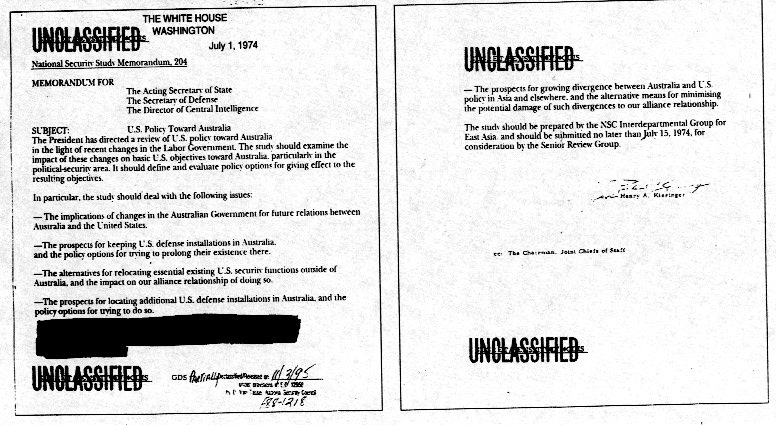
    We have the key in the lock, one more twist and the door will be wide open.

    [alert type=”general” dismiss=”no”]This article was published in New Dawn Nos 39 & 40.[/alert]

    [alert type=”success” dismiss=”no”]If you appreciate this article, please consider subscribing to help maintain this website.[/alert]

    © New Dawn Magazine and the respective authors.
    For our reproduction notice, click here.