New Dawn – World's Most Unusual Magazine

Category: Behind the News

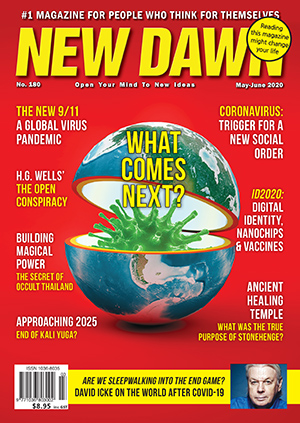
  • COVID-19: Trigger for a New Social Order

    COVID-19: Trigger for a New Social Order

    From New Dawn 180 (May-June 2020)

    I can remember them saying that ‘everything changed after 9/11’. It did, but certainly not for the better. I think we can all agree on that.  I remember how everyone surrendered their rights and key aspects of democracy, all in the name of ‘keeping us safe’.

    Back then, world-changing decisions were made in reaction to an exaggerated threat, with sweeping ‘emergency measures’ and laws enacted. Usually, nothing good follows from a government that is making decisions and formulating permanent policy, suspending constitutions and rights – imposing all of this on a population operating from a position of fear. That much we did learn. Some of us did anyway. 

    In January, like a leviathan sprung forth from the titans Oceanus and Ceto in ancient Greece, the global coronavirus pandemic was born. Like 9/11, it was a disruptive event, but this time on a scale unimaginable. Whether or not one believes this was naturally-occurring or a biologically-engineered pathogen (there is every reason to believe it could be), it is beyond argument that this ‘crisis’ is and will be used to advance a multi-pronged globalist agenda, likely to feature more wars between the great powers. 

    Modern man is now entering realms of dystopia only imagined before by the likes of Aldous Huxley and George Orwell, with more than a hint of Philip K. Dick. What makes all of this difficult for so many is that the sudden transition has been almost instantaneous, leaving people in a near callow state of bewilderment, wondering what just happened to their old life. 

    No matter which way this situation goes, it’s almost certain life will never be the same. 

    COVID CRISIS

    By now we should be familiar with the story: a novel coronavirus, scientifically known as SARS-CoV-2, or COVID-19, has made its way across the planet, infecting millions of people and registering over 100,000 deaths (as of the time of writing) across 180 countries. The victims of this outbreak are overwhelming elderly persons over the age of 70 and those in palliative care, most of who have severe and chronic underlying medical conditions. 

    Make no mistake about it – this is a disruptive event on a scale the modern world has never seen before. The shock and awe began from the moment the story broke from the Chinese city of Wuhan in Hubei Province. Global audiences were inundated with images of Chinese authorities putting hundreds of people into biological suits, hosing down the outside of buildings, before quarantining themselves in their apartments. Then began a state-sanctioned medieval-style program that western media and politicians enthusiastically dubbed a “lockdown,” a term aptly borrowed from the prison industrial complex. 

    Wuhan was an unforgettable spectacle which really impacted the western psyche, such that when the coronavirus made it to European and North American shores, the public was already conditioned to expect a Chinese-style response from their own governments. Not surprisingly, this is exactly what they got and, in fact, it was what they demanded

    On 12 March, British Prime Minister Boris Johnson called an emergency press conference where he took to the podium, flanked by his two leading science advisors, Sir Patrick Vallace and Chris Whitty, who proceeded to explain the government plan of action which was centred around the commonly known epidemiological concept of “herd immunity.” Their strategy was a familiar one because it has been the orthodoxy in modern epidemiology – allow a virus to go through approximately 60-80% of the population in order to achieve herd immunity, naturally extinguishing the virus in a single season. But Johnson made the fatal error of grossly overestimating the death rate at 1% of the total infected, an estimate that would have left the country with some 52 million infected and 500,000 fatalities. Of course, in hindsight, these numbers were pure fiction, but at the time everyone was so enveloped in fear that they believed the ‘experts’. Nonetheless, the herd immunity approach was more or less identical to the ‘no lockdown’ approach taken by European countries Sweden and Iceland, as well as Belarus, Mexico, and Japan. This would entail standard random sample testing nationally and for those exhibiting COVID-19 symptoms. The elderly and vulnerable people would be told to self-isolate for a period of time while studies were conducted. 

    ‘Plan A’ didn’t last long. On 24 March, Johnson appeared on national TV, this time without his science team, to announce a nationwide lockdown – an effective shutdown of society and most of the country’s economy. The UK was now following fellow NATO member states France, Italy, Spain and others, which had already imposed draconian national lockdowns, including strict new ‘social distancing’ guidelines preventing people from being together. 

    It appeared that Johnson’s sudden 180º degree turn was prompted in part by an alarmist report generated by one of the government ‘expert’ teams at Imperial College London, led by controversial computer modeler Neil Ferguson who was previously responsible for the 2001 ‘Foot and Mouth’ crisis, a debacle which ended in the unnecessary culling of some six million livestock in Britain. This time, Ferguson and his team worked their modelling magic to come up with an estimated half a million coronavirus deaths if the government did not implement “very intense social distancing and other interventions now in place.” While the figure was completely fictional, the media seized on it, as did government officials, which fuelled fear and panic across Britain’s government-media complex. Frightened and unsure, the public accepted the authoritarian measures, but the government never gave an end date to the quarantine; it was left open-ended at the discretion of the government’s scientific coterie.

    Once that bubble of fear had been sufficiently inflated, a medieval-style lockdown was a fait accompli in numerous countries including Australia and New Zealand. The impact of a full national quarantine is yet unknown, but it’s already becoming clear that it will be nothing short of cataclysmic for those countries who agreed to the voluntary self-destruction of their economies and the indefinite suspension of democracy. 

    It’s worth noting this isn’t the first time the United Nations, the World Health Organization (WHO), and Imperial College tried conjuring a global panic over a flu virus. Back in 2005, the “range of deaths,” the UN warned of bird flu virus H5N1, “could be anything between five and 150 million.” Officials even drafted in Imperial’s most reliable doomsayer, Neil Ferguson, to help come up with another completely fictional death toll of 200 million people. His high school level math equation was breathtaking in its over-simplicity: 

    “Around 40 million people died in the 1918 Spanish flu outbreak,” said Prof. Ferguson. “There are six times more people on the planet now so you could scale it up to around 200 million people probably.”

    That doomsday prediction led to the culling of tens of millions of birds in Southeast Asia, but the pandemic never really materialised. In the end, human fatalities numbered in the hundreds worldwide. It was a non event. 

    Similar unremarkable numbers followed the global hype over the H1N1 swine flu in 2009. Thanks to the work of investigative journalist Sharyl Attkisson, the Center for Disease Control (CDC) in the US was caught over-inflating the number of cases – a fraudulent move that had grave implications for government policy and stoking unfounded public fear. 

    With COVID-19, the globalist medical industrial complex, led by WHO, hoped to repeat the previous public relations campaigns by hyping the novel coronavirus as the next Spanish Flu. This time they were given an extraordinary opportunity thanks to China which put on an incredible media performance and ‘show of strength’ in the month of January by ‘locking down’ Wuhan – inspiring western and other leaders to try the same big government approach. However, the results would turn out economically disastrous for western ‘lockdown’ countries. 

    Economic Collapse

    All of this is certain to trigger a protracted global recession marked by at least 12 months of negative growth, with economic and social displacement the likes of which the world has never seen before. The decision by countries like the UK, France, Italy, Canada, Australia, New Zealand and the US to voluntarily implode their economies and place most of their populations under house arrest will have a lasting impact not only on national economies but also the global economy for years to come. In terms of scale, the damage caused to markets and industry has already surpassed the 2008 financial crisis by orders of magnitude, and there’s no end in sight. 

    To ‘fight the coronavirus’ governments have imploded their real economies and replaced them with nationalised pools of finance earmarked for each section of the economy. This emergency transformation is the same as a wartime mobilisation of an economy, with a heavy focus on the medical and pharmaceutical industrial complex, the military, and selected corporate partners hand-picked by the state. This hard fusion of state and corporate interests is classic corporatism or fascism. In this brutal and constrained environment, these are some of the only institutions strong enough to remain viable. 
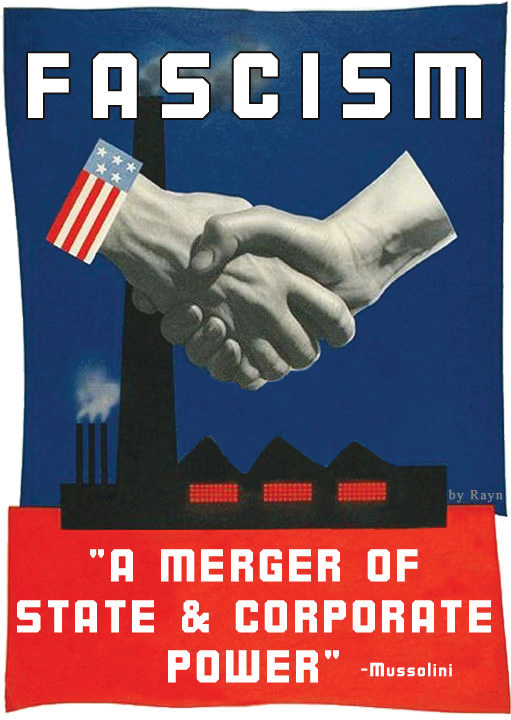
    The net effect of immediately putting millions of workers onto government welfare rolls and pushing hundreds of thousands of small-to-medium-sized businesses (SMEs) into bankruptcy will be the largest consolidation and transfer of wealth in modern history. Those with enough capital to ride out the crisis will be able to buy-up companies, and even whole industries, for literally pennies on the dollar. Monopolies like Amazon, Google and telecoms giants will consolidate and solidify their market shares as competitors gradually die off and are swallowed-up in receivership. Formerly independent contractors will now be reliant on government assistance, as will any business qualifying for government ‘relief’ grants and loans. Large corporations will now have governments covering the cost of their payrolls for the duration of the crisis. 

    There is no semblance of any discernible sound economic model to describe what is now happening with government printing up record amounts of money to cover the enormous cost of the shutdown. For a wealthy country like the US, the Federal Reserve Bank will simply go into overdrive, creating trillions of dollars to be released through various ‘stimulus plans’ and bailouts. The New York Fed is now pumping trillions of new dollars into banks, with the Fed also issuing ‘bridge’ loans directly to businesses. This never happened before in history. The US is also buying up unprecedented amounts of corporate stock in order to keep Wall Street afloat. With these levels of quantitative easing, there are risks of hyperinflation and other systemic problems. This may be coupled with higher food prices due to supply shortages, and stagnant wages due to a glut in the labour market after the government’s domestic scorched earth economic policies. The end result of all these bailouts (if they ever end) will be exactly as with any war in history: a rapid wholesale transfer of power, control and ownership into centralised government and the central banking cartel.

    For individuals and families, this means your savings are wiped-out, your property collapses in value, and your future prospects are dim, at least in the short to midterm, and you will have no choice but to load up on personal and family debt to survive. 

    Before this crisis, we saw the largest wealth gap in modern history since the Gilded Age (1870–1900), with the richest 1% now owning more than half of the world’s wealth. After the first phase of this crisis, that gap may double or even triple. With SMEs wiped out, the only jobs available will be with the government or with a handful of mega-corporations. 

    As is often the case after any war, developed and developing countries are likely to become dependent on credit lines from either the International Monetary Fund (IMF) or from the United States itself which will have plenty of dollars and US Treasury bonds for sale or loan at near zero percent interest rates. Plenty of funny money to go around, mostly for the elites.

    The shutting down of the world’s airlines – along with biosecurity and financial stagnation hitting certain sections of global trade – will severely injure the dominant system of globalisation. This will no doubt encourage already existing regional trading blocs, like ASEAN in Southeast Asia, and the African Union, leveraging their interests to create more regionalised and resilient trading networks. As physical trade and relations are codified regionally, globalisation will increase in the online digital sphere and with international e-commerce, online learning and social networking. 

    Now, with massive economic recession, marked by record levels of mass unemployment and debt, the balkanisation of formerly open globalisation routes, combined with a new global veil over scarcity of resources, all under a broad cloak of biological insecurity – the soil is fertile for more dismantling of democracy and a rise in fascist regimes, particularly in the West. The trend was already moving in this direction before the crisis, but now it will only accelerate. 

    Historically speaking, the scene is now set for another world war in which the winner sets the agenda for a ‘new world order’ going into the 21st century. 
    Full Spectrum Dominance:
    World War Footing

    Just as in 1914 and the onset of World War I, the year 2020 will be a major pivot point for the early 21st century and should be seen as a tangible prelude to a new world war. There are a number of reasons why this is likely. 

    It is true that you can implement more change in two years of war than you can in twenty years of peace. In the case of the corona crisis, that two years was reduced to two months. Presently, events are being framed by western powers as the “global fight against an invisible enemy,” but the corona crisis has created a number of new paradigms some of which are classic precursors for war. The first and most obvious is the fact that virtually overnight, the western countries, especially NATO member states the United States, United Kingdom and France, have effectively mobilised all aspects of their country’s economy and restructured society to reflect both a wartime economy and a state of martial law. The western bloc countries are now prepared to bunker down for a long war if need be. 

    The threat of a biological agent presents some serious problems for a globally-embedded military as America’s. Already the US had to cancel major NATO drills in Europe, and pull some of its naval fleet into dock because of the coronavirus and fears of infecting large numbers of military personnel. Other countries may have similar issues. In this sense, the disease has severely slowed fighting across the world – one of the more unexpected, albeit welcome, tertiary benefits of the crisis. 

    The western powers first obvious choice for instigating either a hot or cold war is China, along with its allies. When US President Donald Trump refers to COVID-19 as “the Chinese virus,” he is signalling to his base and to the war hawks in the Republican Party that the White House is preparing a confrontation. Anti-Chinese rhetoric and media propaganda has increased substantially in the US since the onset of the corona crisis, with many Americans, particularly the right-wing, now blaming the Chinese for releasing this pestilence into the world. 

    After a few more months of economic destruction, social malaise and an increasing death toll in the US, the new ranks of unemployed will be demanding a scapegoat for their terrible suffering, at which time a war with China could become more viable for Washington. This could take the form of an on-off, hot-cold war which lasts for 30 or 40 years, and pulls in other major powers using proxy battlegrounds in third party countries. 

    For the US empire, one primary objective in confronting China would be to disrupt and possibly derail Beijing’s historic infrastructure and economic development known as the Belt and Road Initiative, designed to link Europe with Asia along various routes over land and sea. If successful, the global centre of gravity would shift away from the US and back towards Eurasia. In the event of a global depression post-corona, the US is geopolitically well-placed to weather the storm as it commands the control of both the Atlantic and Pacific oceans. China’s Belt and Road would effectively upend Washington’s plans for Fortress America lording it over all global markets during this new tumultuous epoch. 

    In some ways, the crisis has disrupted the emergence of a new multipolar world, but the imperative for multipolarism may also be propelled by the economic balkanisation and the fact that the US will continue withdrawing its military assets from stalwart outposts like the Middle East. Any US withdrawal from the world stage will be filled by other emerging powers like Russia, India, Turkey and possibly Japan. Many of these emerging powers require resources and materials, so the scramble to establish trading routes in Africa will be a post-corona feature. 

    The corona crisis also provides a convenient cover for the aggressive roll-out of 5G networks around the world. These look to be the backbone of a new global surveillance state able to track and record everything in real-time. Along with millions of masts in towns and cities, the network will also feature an array of new satellites with the potential to flood our atmosphere and communities with even more untested high-frequency radiation. 

    One World Health &
    Medical Martial Law

    The current ‘state of war’ extends internationally with blanket travel restrictions already in place. There looks to be a rapid drive to institute a streamlined global system of mandatory digital tracking and tracing, implemented under the auspices of ‘global health’ and spearheaded by the World Health Organization (WHO). They are joined by participating governments and the transnational corporations that will roll out these new ‘health surveillance’ systems. 

    The real question that remains unanswered is what will happen once all the ‘lockdown’ measures are relaxed, and international air travel opens up again? There are already noises coming from governments and organisations about requiring citizens to pass some form of ‘immunity test’ for COVID-19 to be granted freedom of movement within society by carrying an ‘immunity passport’ or digital certificate stored on a microchip or smartphone. This dovetails with the rapid drive for a cashless society as a result of the corona scare. Due to corona contagion fears, paper money and coins are being stigmatised as ‘dirty’ with many retail outlets refusing to accept cash. Once this system is adopted domestically, it follows that these same restrictions will be extended to international travellers. Needless to say, this has grave implications for personal liberty and privacy. At present, this juggernaut seems difficult to stop. 

    If allowed, this new bio regime will become the de facto governance for the world’s population. Microsoft founder Bill Gates (net worth $97.8 billion) has called for a national vaccine tracking system in the US, funded in part by an estimated $100 million he and his wife Melinda’s Gates Foundation have donated to fight the coronavirus to discover ‘a fix’ as quickly as possible. Gates is already heavily invested in vaccine research, development and production and, with his wife, they are a primary driver in the proliferation of vaccines globally. Gates says he will front the investment for seven new vaccine factories around the globe, and as he told Daily Show host Trevor Noah during an interview on 2 April, “until we get the world vaccinated.” 

    Clearly, he has a vision for vaccinating every person on the planet, presumably for the coronavirus, or until the next big ‘outbreak’. “The only thing that really lets us go back completely to normal and feel good about sitting in stadiums with lots of other people is to create a vaccine and not just take care of our country but take that vaccine out to the global population,” said Gates.

    From oligarchs like Gates, the transnational pharmaceutical corporations, and the government officials in their pocket, the warning is clear: you will not be permitted to resume ‘normal life’ until you accept the latest vaccine. And do not expect the list of newly required vaccinations to end with the novel coronavirus. Once this first precedent is set, countries dependent on international travel and trade will be forced to adopt the regulatory framework of this new ‘one world health’ security complex. The trail is then blazed for a constant stream of vaccine requirements to ‘fight’ various and sundry outbreaks and ‘biothreats’, be they real, exaggerated or completely fabricated. This could be another disruptive force going forward.

    Combine this with naked authoritarian statements made by other self-appointed corona tsars like Dr Michael Ryan, Executive Director of WHO, who recently remarked that members of families may need to be removed from their homes by force. “Most of the transmission actually happening in many countries now, is happening in the household at family level…. In some sense, transmission has been taken off the streets and pushed back into family units. Now, we need to go and look at families to find those people who may be sick and remove them, and isolate them in a safe and dignified manner,” said Ryan. 

    The obvious danger here is that this new state-corporate regime will discriminate against and marginalise citizens based on their immunity records, requiring them to take a new vaccine to receive rights and privileges. This would be a complete abrogation of personal liberty and human rights, effectively turning the clock back hundreds of years – all based on what many leading doctors and epidemiologists agree is no more of a significant public health threat, in terms of infections and fatalities, than seasonal influenza. 

    A COVID Green New Deal?

    One of the clear main political beneficiaries of a COVID-19 global shutdown has been the climate change lobby. 

    By forcibly shutting down millions of businesses and pulling tens of millions of cars off the road and grounding world commercial airlines, the crisis has delivered young Greta Thunberg the evidence she and her supporters need to demonstrate the virtues of a net zero carbon world in a real-life simulation. 

    This will also accelerate the adoption of a so-called ‘Green New Deal’ internationally, which may have less to do with saving the environment or ‘changing the climate’, and more to do with the creation of new global financial bubble based on the commodification and financialisation of Earth’s ecosphere. This is essentially a new ‘green-backed’ and fully tradeable monetary credit, bond and derivatives market. 

    Greta didn’t appear out of nowhere in 2018. She and her handlers have been tasked with a mission, and now in just three weeks they are very close to realising large pieces of their agenda, which also dovetails with UN Agenda 2030 sustainability goals. 

    Who’s Winning:
    Globalism or Nationalism?
    Nationalism vs Globalism

    Another unexpected byproduct of this crisis has been a number of European Union member states kicking Brussels to the curb, either for not reacting fast enough to help, or simply for not releasing enough funds for struggling public institutions and businesses. As a result, countries like Italy and Poland are exerting their nationalist power over Brussels’ relatively weak and ineffectual response to requested assistance from members states. 

    At the same time, this new global control grid lends itself towards the implementation of a world government structure to be used to fund an international regime that regulates and adjudicates problems, as well as manage future ‘outbreaks’. In late March, former British PM and Chancellor, Gordon Brown, called for world leaders to create a provisional global government body in order to tackle the coronavirus pandemic and manage the global economic collapse. 
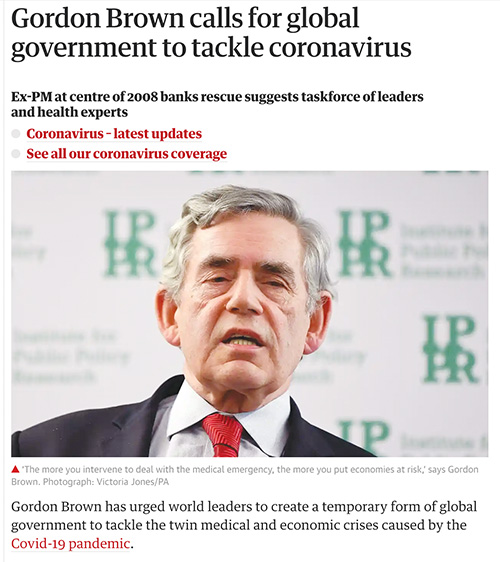
    ABOVE:   The Guardian, 26 March 2020

    Whatever geopolitical and social engineering agendas were already in motion before the crisis, you can be sure that the coronavirus has accelerated many of them. 

    In terms of power-grabs, this is the embodiment of “never let a good crisis go to waste.”

    Oh, and don’t forget –it’s really all about saving lives. 

    [alert type=”general” dismiss=”no”]This article was published in New Dawn 180.[/alert]

    [alert type=”success” dismiss=”no”]If you appreciate this article, please consider subscribing to help maintain this website.[/alert]

    FOOTNOTES
    1. Professor who predicted 500,000 Britons could die from coronavirus and prompted Boris Johnson to order lockdown accused of having ‘patchy record of modelling pandemics’, www.dailymail.co.uk/news/article-8164121/Professor-predicted-500-000-Britons-die-coronavirus-accused-having-patchy-record.html
    2. Return of the oppressed, https://aeon.co/essays/history-tells-us-where-the-wealth-gap-leads
    3. Is an ‘immunity certificate’ the way to get out of coronavirus lockdown?, https://edition.cnn.com/2020/04/03/health/immunity-passport-coronavirus-lockdown-intl/index.html
    4. The first steps after lockdown ends: How will Spain return to normal life?, https://english.elpais.com/society/2020-04-05/the-first-steps-after-lockdown-ends-how-will-spain-return-to-normal-life.html
    5. Bill Gates Calls For National Tracking System For Coronavirus During Reddit AMA, www.forbes.com/sites/mattperez/2020/03/18/bill-gates-calls-for-national-tracking-system-for-coronavirus-during-reddit-ama/
    6. Bill Gates on Fighting Coronavirus – The Daily Social Distancing Show (YouTube), www.youtube.com/watch?v=iyFT8qXcOrM
    7. The coronavirus is washing over the U.S. These factors will determine how bad it gets in each community, www.statnews.com/2020/04/01/coronavirus-how-bad-it-gets-different-communities/
    8. Gordon Brown calls for global government to tackle coronavirus, www.theguardian.com/politics/2020/mar/26/gordon-brown-calls-for-global-government-to-tackle-coronavirus

    © New Dawn Magazine and the respective author.
    For our reproduction notice, click here.
  • From Information Warfare to the Break-Up of the USA…  Decoding the Work of Dr. Igor Panarin

    From Information Warfare to the Break-Up of the USA… Decoding the Work of Dr. Igor Panarin

    From New Dawn 164 (Sept-Oct 2017)

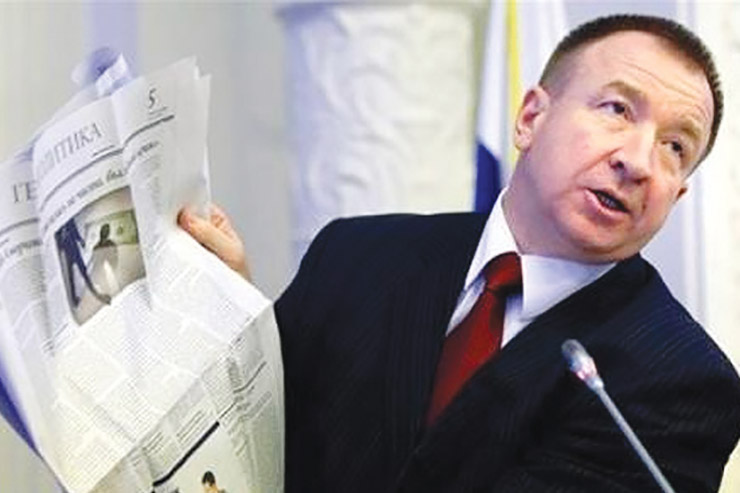
    Igor Nikolaevich Panarin (b. 1958), dean of the Russian Foreign Ministry’s school for future diplomats, is a geopolitical analyst, political scientist and media commentator, with significant influence on Russian thinking. An examination of his views and public pronouncements is therefore important in discerning the outlook of Russia’s leading academic and political circles, as well as considering what influences are shaping Russian national consciousness. Panarin is a former officer of the KGB. In 1991 he reached the rank of colonel in the Federal Agency of Government Communications and Information, then the Russian equivalent of the US National Security Agency.

    Dr. Panarin outlines two eras of US psycho-war against Russia. The first was during the Cold War. The second era, that continues today, is the period after Vladimir Putin became president of Russia. Psychological warfare is Panarin’s specialty, about which he wrote his doctoral thesis. As a strategist, his methodology is based on five stages of response: Forecasting and planning; Organisation and stimulation; Feedback; Operation adjustment; and Performance control. In response to US belligerence, Panarin proposes a centrally controlled information warfare campaign using propaganda, intelligence, analysis, secret agents, and the news media, in defence of Russia’s sovereignty and identity. 

    Dr. Panarin believes Russia’s destiny is Eurasia. He proposed his own version of the Eurasian Economic Union, ‘Eurasia-Rus’, an interstate formation modelled after the European Union. Panarin has called attention to the messianic legacy of Russia as the ‘Third Rome’, the centre of a new civilisation based on a sacred mission that is an inherent part of the Russian soul. This is an attitude one can discern in much of what Vladimir Putin says. The United States’ opposition to a revived Russia can thus be understood as part of a clash of world outlooks. 

    USA: Centre of World Revolution

    This messianic outlook endures in Russia regardless of the outward mode of political expression. It is the ‘eternal Russia’ articulated in various forms by novelist Fyodor Dostoyevsky, an array of writers, thinkers and artists of the late 19th century, and the present-day advocates of ‘Eurasia’ such as Alexander Dugin and Igor Panarin. Panarin discerns the contours of ‘eternal Russia’ even under what was nominally called ‘Bolshevism’, but which owed little to Marxism after the purging of Leon Trotsky and others from 1928 onward.1 Panarin explained this dichotomy as a struggle between the world outlooks of international Marxism, under Trotsky, and what has been called ‘National Bolshevism’, under the auspices of Joseph Stalin. He points out: 

    On 3 July 1941 when Stalin addressed the Soviet people as “Brothers and sisters,” this doctrine became the dominant geopolitical idea of the USSR-Rus and replaced Lenin-Trotsky’s idea of world revolution which was an external (imported) geopolitical project. The Pan-Eurasian nationalism of Trubetzkoy, fused with the “Moscow–Third Rome” idea realised in the conditions of the Soviet order, yielded a result – the USSR won a victory in the global skirmish with Fascism. And the Trotskyist ideas were victorious at the end of the 20th century in the USA, vividly manifested in the ideology of the liberal globalism of the contemporary American political elite.2

    Dr. Panarin’s analysis shows a depth of understanding one cannot readily find in the West’s political and scholarly circles. Although it continued using Marxist rhetoric and symbolism, after the elimination of Trotsky the Union of Soviet Socialist Republics (USSR) transfigured the doctrine of ‘world revolution’ into the old Russian messianic mission. Soviet officials and ideologues, even under the guise of ‘Bolshevism’, evoked Mother Russia, which included an end to the persecution of the Orthodox Church, much to the outrage of Trotsky and his followers in the West. 

    Of particular note, Panarin sees the United States as the custodian of Trotskyite ‘world revolution’. This will perplex superficial observers, especially the banal academics of the West who understand little of history’s depth. The so-called ‘neocons’, or ‘neoconservatives’, are either ‘former’ Trotskyites or the intellectual heirs of those Trotskyites who took over US foreign policy. Such was their hatred of Joseph Stalin that Trotskyism would eventually metamorphose into a primary ingredient of US foreign policy doctrine – resolute opposition to the Soviet Union.

    Founded in 1949 by the CIA, the Congress for Cultural Freedom was a major ideological instrument opposing and undermining the Soviet Union. Its positions were filled with Trotskyites and their apologists. Trotsky’s widow, Natalia Sedova, publicly broke with the Trotskyite Fourth International, charging that her late husband would have supported the United States against the USSR. She stated it was the Soviet Union, not the USA, which was the primary obstacle to “world revolution.”3 Leading Trotskyite ideologue Max Shachtman became another ‘Cold Warrior’ for the USA. After the Congress for Cultural Freedom had been thoroughly exposed as a CIA front, a ‘Shachtmanite’ leader of the American Federation of Labor, Tom Kahn, was instrumental in getting the US Congress to fund the National Endowment for Democracy (NED) in 1983. The NED remains the primary centre for world revolution as a leading sponsor of the so-called “colour revolutions.”4 

    Gorbachev, ‘Velvet Revolution’ & the ‘Information War’

    The ‘colour revolutions’ including the ‘Arab Spring’ and those in the former Soviet bloc states are recognised by Panarin as having been fostered by Washington. He has labelled the Soviet Union’s last leader, Mikhail Gorbachev, the “Antihero of Russia” for his pivotal role in the destruction of the USSR. 

    Gorbachev is feted among the globalist elite for bringing the Soviet bloc to ruin. He was given a gala celebration on his 80th birthday, at London’s Royal Albert Hall in 2011, where he was lauded by Israeli Prime Minister Shimon Peres, among others, as having “ended the Cold War.” Like every good retired head of state in the service of globalism, he has established his own foundation. On the occasion of his birthday celebration Gorbachev publicly threatened Vladimir Putin that should he stand for a third presidential term he might face a revolution.

    Igor Panarin is acutely aware of the methods used by the United States to bring down reticent nation-states that do not comply with globalist diktats. Among these are the ‘colour’ or ‘velvet’ revolutions. 

    It is ironic or, better said, hypocritical, that the US ‘Deep State’ is vociferous in its allegations of Russia having ‘interfered’ in the American presidential election, although evidence is elusive. The United States has been interfering in the political processes of nations for generations. When subversion and political manipulation do not work, mass bombing as in Yugoslavia, Iraq and Libya is the final resort. 

    Dr. Paranin’s perception of the USA as the leader of a “neo-Trotskyist world revolution” makes him an astute political observer. He has defined precisely the character of a world struggle between two antithetical outlooks, both messianic, and both having their own world-missions: Russia, the katechon, holding back the Antichrist with an enduring self-perception of its holy mission, as expressed by such writers as Dostoyevsky; and the USA, the Great Whore, heralding the system of the Antichrist. Whether interpreted literally or symbolically, this is the reality of the world-conflict between Russia and the USA. With Europe and Australasia acting as the dupes of the USA, in the name of a ‘West’ that lost any inner meaning centuries ago. 

    Hence Panarin sees the ‘velvet revolution’ in Czechoslovakia (1989), and the ‘colour revolutions’ in other former Soviet bloc states, along with the ‘Arab Spring’, as manifestations of American geopolitical strategy. A primary element of this subversion is the ‘information war’, in which he specialises. Panarin lists eight different components of information operations. 

    The first two are “social control” and “social maneuvering” which revolve around “influencing society” to achieve “intentional control of the public aimed at gaining certain benefits.” “Disinformation,” “fabrication of information,” and “information manipulation” all relate to supporting information operations through leveraging incorrect information.5 

    These tactics are clearly seen in operation against Russia, including the propaganda offensive to undermine Russia’s role in Syria. 

    The way information war unfolds was first noted in Czechoslovakia in 1971. A nihilistic, no-talent music group called ‘Plastic People of the Universe’ was established, and became a cause célèbre, lauded by The New York Times, Voice of America, etc. From this milieu Charter 77, a key initiative of the ‘velvet revolution’, was founded. Liaising with the Solidarity movement in Poland, these groups received sponsorship from globalist foundations in the US. Vaclav Havel was chosen by the globalists as the first president of a post-Soviet Czech state.6 Like Gorbachev, he was feted by the globalists, awarded the NED’s medal for service, and served on the board of George Soros’ Drug Policy Alliance, among others. 

    The Soviet geopolitical bloc, once the primary bulwark against globalist hegemony, was brought down by cultural subversion and political agitation sponsored first by the US Congress for Cultural Freedom, then by NED. Later, billionaire financier George Soros and a myriad of other Western-funded NGOs spread the pernicious values of globalism in the emerging nation-states of the former Soviet bloc.

    That today Russia is accused of waging ‘information war’ – directed, no less, by Dr. Panarin – is hard to beat for pure chutzpah, even by the standards of US hypocrisy and cant. Historically, the United States sponsored information and culture war of colossal proportions in the name of spreading ‘freedom’. This was described by American geopolitical strategist Major Ralph Peters as nothing short of a contagion designed to undermine the traditional fabric of states reticent about entering the brave new world.7 What Peters called “constant conflict” is tantamount to what Trotsky called “permanent revolution.” 

    Igor Panarin Targeted

    Bret Perry in his well-researched but antagonistic article, states of Dr. Panarin: 

    Although not officially confirmed, it is believed that the Russian government worked with Panarin to set up an office managed by a presidential special adviser “to oversee an international network of NGOs, information agencies and training institutions” for coordinating Russia’s whole-of-government information operations.8

    An article by Matthew Sussex (National Security College, Crawford School of Public Policy, College of Asia and the Pacific, Australian National University) for the Lowy Institute’s The Interpreter, focuses on the measures of ideological counter-insurgency that Russia is allegedly taking under the direction of Dr. Panarin. Sussex comments: “The West is understandably reluctant to openly engage in similar behaviour. One of the main constraints of deliberately manipulating information is that it is deceitful and dishonest.”9 To claim such moral rectitude for the “West” enters the realm of tragicomedy.

    It would be naïve to assume that Russia would not respond to an information war waged against it. It is difficult to discern that Russia has anything approaching the network of NGOs, information agencies and training institutions operated by the globalist Russophobes and their dupes around the world, with vast funding from the NED, the George Soros network and a multiplicity of others. One should readily see Putin’s expulsion of this NGO network from Russia as an obvious requirement in the interests of Russia, despite the squeals about ‘democracy’ from the Machiavellian subversives who were given the boot. 

    Panarin’s view is that Russia needs to respond to the information war for her own “protection.” Russophobia has escalated in recent years, especially after Russia acted to defend her interests in the Ukraine, where US interference was blatant. In a 2015 interview, Panarin explained in regard to the creation of a “Russian internet” that it “is not censorship and regulation, but ‘protection’.” This was condemned as an encroachment on ‘freedom’, but the United States has long used such ‘freedom’ to propagandise and agitate. Panarin’s concern is that ‘colour revolution’ is planned for Russia. It was social media that played a pivotal role, with sponsorship from globalist interests, in the fomenting of ‘colour revolutions’ in the former Soviet bloc states and across North Africa. Russian paranoia? Not at all.

    In 2008, with the backing of globalist corporations, an organisation was founded to specifically utilise social media to agitate youth. The Alliance of Youth Movements or Movements.org10 was co-founded by Jason Liebman of Howcast. This group worked with the US State Department and Defense Department. Among its corporate sponsors were: Google, Music TV, Pepsi, CBS News, Mobile Accord, Youtube, Facebook, MSN/NBC, National Geographic, Omnicom Group, Access 360 Media, and Gen Next. The ‘public partnerships’ were with Columbia Law School and the US State Department. Now its partners include the National Endowment for Democracy and Free Russia Foundation (FRF). This is how the Free Russia Foundation is described: 

    ‘The Free Russia Foundation is a nonprofit, nonpartisan, nongovernmental US-based organization, led by Russians abroad that seeks to be a voice for those who can’t speak under the repression of the current Russian leadership. Free Russia represents and coordinates the Russian diaspora and is focused on developing a strategic vision of a free and democratic Russia and a concrete program for the transition period.11

    The Washington-based SAIS Center for Transatlantic Relations is another ‘partner’, acting as a nexus between the US government, NGOs and corporations. It “engages international scholars and students directly with government officials, journalists, business executives, and other opinion leaders from both sides of the Atlantic on issues facing Europe and North America. The goal of the Center is to strengthen and reorient transatlantic relations to the dynamics of the globalizing world.”12 

    The Free Russian Foundation openly states: “We are focused on developing a strategic vision of Russia ‘After Putin’ and ‘Without Putinism’ and concrete programs for the transition period.” The administrators include those who have worked with the International Republican Institute, Chatham House, US Defense Department, Council on Foreign Relations and the Pentagon.13 The FRF sponsors so-called “civil society”14 which involves so-called ‘activists’ destabilising Russia. 

    Regardless of what one thinks of Vladimir Putin, the fact remains that Igor Panarin and others are accurate in stating there is a vast network directed against Russia, with sponsorship by the US government. What type of Russia is sought “After Putin” can be discerned from FRF partner the Committee for Russian Economic Freedom (CREF), an organisation comprised of lawyers founded in 2009 to promote ‘free market’ ideology.15 The chairman and founder of CREF, Pavel Ivlev, was “long time legal counsel for YUKOS,” an oil company that Putin nationalised, and its CEO Mikhail Khodorkovsky16 is one of the primary oligarchs Putin purged from Russia’s economic life. 

    Perhaps now the reader clearly understands the actual aims behind the rhetoric about ‘democracy’ and ‘human rights’ in Russia?

    According to America’s apologists such as Australian academic Matthew Sussex, the ‘West’ would not consider such nefarious activities as interfering in the internal politics of a country. Rather, we are told, it is unscrupulous Russians such as Igor Panarin who have the audacity to advocate countermeasures that intrude on ‘democracy’, including the freedom of oligarchs to pillage Russia. 

    Balkanisation of the USA

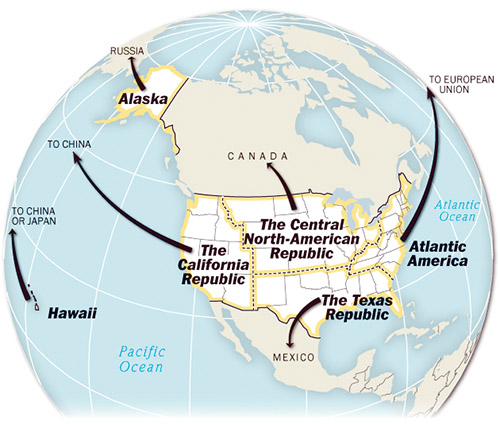
    In 2010 Dr. Panarin predicted the USA would balkanise, amidst social conflict, and split into separate states. Certainly the proposition of a ‘United States’ based on constitutionalism rests on weak foundations and has nothing of an organic character about it. There is no defining feature of an American ‘ethnos’, and no basis for a positive symbiotic relationship enduring between the sundry ethnicities. Panarin claims the United States is on course to balkanise due to the stressors of its huge debt, deficit and social protests. “The overlapping financial, economic and social challenges may eventually cause the world’s strongest superpower of the 20th century to collapse,” notes Panarin.17

    Map illustrating Dr. Panarin’s predicted breakup of the USA.

    Far from being a fanciful scenario, the US military recently addressed the same problems emerging from rapid urbanisation in ‘megacities’.

    The US military regards ‘megacities’ (populations of 10,000,000 or more) as an approaching problem of instability. The US Army comments that megacities are a unique environment that they do not fully understand.18 One of their reports gives a picture of proliferating criminal networks and underground economies, natural disasters and the inability of decaying infrastructures to withstand stressors. A predicted feature is the breakdown of civic order through ethnic and religious conflict among diverse groups that are forced together to share diminishing resources and utilities. 

    As resources become constrained, illicit networks could potentially fill the gap left by over-extended and undercapitalized governments. The risk of natural disasters compounded by geography, climate change, unregulated growth and substandard infrastructure will magnify the challenges of humanitarian relief. As inequality between rich and poor increases, historically antagonistic religions and ethnicities will be brought into close proximity in cities. Stagnation will coexist with unprecedented development, as slums and shanty towns rapidly expand alongside modern high-rises. This is the urban future.19 

    The report comments on the increasingly heterogeneous populations inherent in a megacity as potentially “explosive.” 

    One of the hallmarks of megacities is rapid hetero and homogeneous population growth that outstrips city governance capability. Many emerging megacities are ill-prepared to accommodate the kind of explosive growth they are experiencing.20 

    Radical income disparity, and racial, ethnic and sub cultural separation are major drivers of instability in megacities. As these divisions become more pronounced they create delicate tensions, which if allowed to fester, may build over time, mobilize segments of the population, and erupt as triggers of instability.21 

    The US Army analysis accords with the 2010 analysis of Dr. Igor Panarin. The time has indeed come to seriously consider Panarin’s unique insights into the geopolitics of today’s world and his predictions for the years ahead.

    [alert type=”general” dismiss=”no”]This article was published in New Dawn 164.[/alert]

    [alert type=”success” dismiss=”no”]If you appreciate this article, please consider subscribing to help maintain this website.[/alert]

    Footnotes

    1. K. R. Bolton, Stalin: The Enduring Legacy, Black House Publishing, 2012
    2. Ivor Panarin, ‘From united Russia to Eurasian Rus’, Cyril and Methodius, 12 January 2006 
    3. Natalia Sedova Trotsky, letter to the Socialist Workers Party, 9 May 1951, Labour Action (17 June, 1951). See Bolton, Stalin: The Enduring Legacy, 114-119 
    4. Bolton, Stalin: The Enduring Legacy, 121-124
    5. Jolanta Darczewska, ‘The Anatomy of Russian Information Warfare: The Crimean Operation, A Case Study’ (Warsaw, Poland: Ośrodek Studiów Wschodnich im. Marka Karpia, Centre for Eastern Studies, May, 2014); quoted by Bret Perry, ‘Non-Linear Warfare in the Ukraine: The Critical Role of Information Operations and Special Operations’, Small Wars Journal, 14 August 2015
    6. C. Gershman, ‘Giving Solidarity to the World’, Georgetown University, Washington, D.C.’, 19 May 2009
    7. Ralph Peters, ‘Constant Conflict’, Parameters, Summer 1997, 4-14: US Army War College, www.informationclearinghouse.info/article3011.htm
    8. Bret Perry, op. cit. 
    9. Matthew Sussex, ‘Trump, Putin and Information Warfare’, The Interpreter, Lowy Institute, 27 July 2016
    10. Tony Cartalucci, ‘Google’s Revolution Factory – Alliance of Youth Movements: Color Revolution 2.0’, Global Research, 23 February 2011, www.globalresearch.ca/index.php?context=va&aid=23283; www.movements.org
    11. www.movements.org/en/movements/our-partners/
    12. Ibid. 
    13. ‘About Free Russia’, www.4freerussia.org/about/
    14. ‘Programs’, www.4freerussia.org/about/
    15. ‘About CREF’, www.russianeconomicfreedom.org/about/
    16. ‘Experts’, www.russianeconomicfreedom.org/experts/
    17. Igor Panarin, ‘U.S. Break-up: Myth or Reality?, Russia Times, 27 October 2011; www.rt.com/politics/panarin-usa-collapse-economy-905/
    18. Colonel Marc Harris, et al., Megacities and the United States Army: Preparing for a Complex and Uncertain Future, Chief of Staff of the Army, US Army Strategic Studies Group, June 2014, 4, www.army.mil/e2/c/downloads/351235.pdf
    19. Ibid.
    20. Ibid.
    21. Ibid.

    © New Dawn Magazine and the respective author.
    For our reproduction notice, click here.
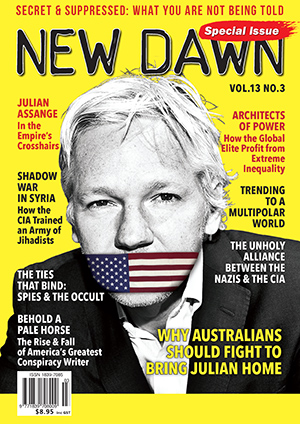
  • Architects of Power: How the Global Elite Profit from Extreme Inequality & Pre-empt the Backlash

    Architects of Power: How the Global Elite Profit from Extreme Inequality & Pre-empt the Backlash

    From New Dawn Special Issue Vol 13 No 3 (June 2019)

    There is a new, mega-rich global elite consisting of a small number of billionaires and multibillionaires. Many of them made their money in the technology sector. Others play financial markets or inherit fortunes. They are wealthier and more powerful than some entire nation-states. 

    The British Ministry of Defence (MoD) says: “Whilst there have always been differences between the wealthier, better educated and the less privileged, these differences appear likely to widen in the coming decades.” 

    The mega-rich deliberately order the world in ways that guarantee their wealth by institutionalising inequality. Occasionally, this is admitted. In 1997, a book published by the Royal Institute for International Affairs in the UK acknowledged: “The present international order may not be the best of all possible worlds, but for one of the ‘fat cats of the West’ enjoying a privileged position in an international society that is structured and organised in ways which perpetuate those privileges, there are good reasons for not pursuing radical change.” 

    This is also true of internal policymaking. The third richest man in the world, Warren Buffett (worth over $80bn), confirmed this: “There’s been class warfare for the last 20 years, and my class has won.” This echoes his statement in 2006, just prior to the global financial crisis: “There’s class warfare all right… but it’s my class, the rich class, that’s making war, and we’re winning.” Around the same time, the liquidity firm Citigroup circulated an investor memo, stating: “Society and governments need to be amenable to disproportionately allow/encourage the few to retain that fatter profit share.” More recently, the UK MoD admitted: “In the coming decades, the very highest earners will almost certainly remain rich, entrenching the power of a small elite. Vested interests could reduce the prospect of economic reforms that would benefit the poorest.”

    Consider the enormous concentration of wealth and power that results from this imbalance. 

    Ever-Increasing Power

    Global and national inequality is staggering and getting worse. By 2011, a mere 147 – mainly US and European – corporations owned and controlled 40% of world trade and investment. Just four corporations influence the profitability and power of these 147: McGraw-Hill, which owns Standard & Poor’s ratings agency; Northwestern Mutual, owner of the indexer Russell Investments; the CME Group, which owns 90% of the Dow Jones market index; and Barclay’s bond fund index. Evaluative decisions by analysts at these firms affect the wealth and performance of each of the 147 giants.

    That’s corporate wealth concentration. But what about wealth concentration among individuals?

    There are 7.7 billion people in the world. Of those, just 2,153 are billionaires. According to Forbes, their combined wealth totals $8.7 trillion. The list of billionaires reflects where power is most concentrated: in the US. While China and Europe’s number of billionaires declined in the previous 12 months, the US and Brazil gained billionaires. The US is home to 607 billionaires or 0.000001% of the population. It is worth noting that President Donald Trump was a billionaire before he came to power. Trump has cut taxes for his fellow billionaires. As an indication of continued wealth concentration, consider the wealth disparity among the billionaire class itself. He Xiangjian, founder of the Midea Group, is the joint-50th richest person, worth over $19.8bn. Jeff Bezos, by comparison, the founder of Amazon, is the richest man in the world, worth over $131bn – more than six times He Xiangjian.

    Part of the problem has been the US-led imposition of an economic dogma called “neoliberalism” (which is neither new nor liberal) on much of the rest of the world. 

    Neoliberalism can be roughly defined as: 

    1) Financialisation, i.e., allowing investors to make money from money as opposed to tangible things; 

    2) Deregulating financial services; 

    3) Taking out government insurance policies so that working people bail out financial institutions; 

    4) Cutting taxes for the wealthy; 

    5) Privatising public services to reduce social mobility; 

    6) Imposing austerity to make markets more attractive to investors. 

    Neoliberalism has cut taxes for the super-rich, enabling them to hold onto their wealth at the expense of others. According to Oxfam, the average rate of personal income tax for the wealthy was 62% in 1970. In 2013, it was 38%. In the UK, the poorest 10% pay a higher proportion of their income in taxes than the richest 10%. Global GDP, i.e., how much money there is in the world, is $80 trillion. But, of this, $7.6 trillion is untaxed. In the decade since the financial crisis, the number of billionaires doubled. This reveals that the system rewards greed. In 2017, 43 people owned as much wealth as half the world’s poorest. In 2018, the number was 26.

    To put all this into perspective, Jeff Bezos owns as much wealth as the poorest fifty countries. When it comes to more ‘developed’ nations, Bezos’s wealth equals the entire GDP of Hungary. Consider how Bezos makes his money. Amazon is a corporation that primarily advertises and delivers products. The innovation, design, and investment in and of those products is the work of others. Amazon treats “workers like robots” by spying on them, discouraging unions, offering insecure contracts, and encouraging long hours. Amazon is also notorious for paying little or no corporation tax. Amazon is an online retailer. The Internet was developed by the US Defense Department in the 1960s as ARPANET, with public money. The satellites that enable online transactions are first and foremost military hardware. Not only did Amazon take advantage of state-funded innovation, but it also rewards government investors by selling the CIA cloud technology and the Pentagon artificial intelligence.

    Bezos is far from being the only one. Bill Gates’s Microsoft and the late Steve Jobs’s Apple, which became the first trillion-dollar company, also enjoy low taxes, technologies developed with government grants, and procurement contracts. 

    Consider also the immoral activities of other hi-tech nouvelle méga riche. Without making it clear to users, Facebook founder Mark Zuckerberg (worth $66bn) has made his money by selling personal data to insurers and advertisers. Scientists have used Facebook in social media experiments without the knowledge or consent of users in an effort to see how memes affect mood. 

    Other mega-rich, including the hedge fund manager Robert Mercer of Renaissance Technologies, used Facebook to market political candidates. Other tech billionaires include Google founders Larry Page and Sergey Brin. Google technology was funded by the CIA’s venture capital firm In-Q-Tel. Also relying on technologies developed by the Pentagon with workers’ tax dollars, the company cooperates with the National Security Agency to spy on citizens and it has even enabled US assassination programmes. 

    Consequences

    How do the billionaires get away with it, and what are the social and political consequences? The examples below are from the US, but it should be noted that the US exports its mega-wealth model. 

    A study by Martin Gilens and Benjamin I. Page on plutocracy (government by the rich) notes that the rich buy political parties. Politicians draft and/or vote for laws that help the rich. The authors analysed 1,779 policy issues in the US and conclude that “average citizens and mass-based interest groups have little or no independent influence.” Unlike the public, “economic elites and organised groups representing business interests have substantial independent impacts on US government policy.” Other research into wealth inequality in the US finds that “[c]ertain policies, such as the decreased support for unions and tax cuts favouring the relatively well-off and corporations, have benefitted a small minority of the population at the expense of the majority and have thus contributed to widening income inequality.” 

    At the turn of the last century, 9% of American families owned 71% of the nation’s wealth. The elite of the day included familiar names: John D. Rockefeller (oil), J.P. Morgan (banking), W. Averell Harriman (industry), and so on. Things balanced out after the Second World War, with the majority of Americans becoming middle class. Gradually, state controls over the economy were removed, and the situation reverted to the inequality of bygone centuries. 

    Since the 1970s, the US middle class has been shrinking. Until recently, the middle classes of Asia grew, precisely because strong Asian economies (notably China, South Korea, and Singapore) either retained some state controls or refused to adopt the US neoliberal model. 

    Alan B. Krueger, a labour economist and key Obama advisor, explains that, “since the 1970s income has grown more for families at the top of the income distribution than in the middle, and it has shrunk for those at the bottom.” Between 1979 and 2007, the top 1% ((multi)millionaires and (multi)billionaires) enjoyed a 278% increase in their after-tax incomes. But 60% of Americans saw their incomes rise by just 40%, which when adjusted for rising living costs means stagnation. Krueger notes that during that period, $1.1 trillion of annual income was moved to the top 1%. “Put another way, the increase in the share of income going to the top 1% over this period exceeds the total amount of income that the entire bottom 40 percent of households receives.”

    The exportation of this model means that Australia, Britain, and Canada became what the billionaire-dollar liquidity firm Citigroup calls “plutonomies,” economies in which the rich drive luxury goods markets such as jewellery, fashion, cruises, and sports cars: hence the recent entry of celebrity Kylie Jenner into the billionaire class. The Citigroup document also notes that in plutonomies the top 1% owns 40% as much wealth as the bottom 95%. No matter where you live, you can’t escape the institutional structures that create inequality. 

    The US military exists, in part, to maintain the unjust status quo. Yet, it acknowledges the dangers of dominance: “A global populace that is increasingly attuned and sensitive to disparities in economic resources and the diffusion of social influence,” thanks in part to the very technologies that enrich the rich, “will lead to further challenges to the status quo and lead to system rattling events,” like Brexit or the Yellow Vest protestors in France. 

    The mega-rich and international think tanks and forums they sponsor are beginning to reluctantly accept that their status quo political puppets might get voted out of office and give way to so-called far-left or far-right parties unless they address wealth inequality. 

    New Paradigms of Control

    The question, then, is how to deal with the restless and disaffected majority while not radically altering the system and taking away the privileges of the elite. In 1961, US President John F Kennedy said: “If a free society cannot help the many who are poor, it cannot save the few who are rich.” In the 1980s, World Economic Forum founder Klaus Schwab said: “Economic globalisation has entered a critical phase. A mounting backlash against its effects… is threatening a very disruptive impact on economic activity and social stability in many countries… This can easily turn into revolt.” More recently, he said: “Today, we face a backlash against that system and the elites who are considered to be its unilateral beneficiaries.” Likewise, the billionaire Johann Rupert of Cartier jewellery (one of the many luxury services driving plutonomies) said: “We are destroying the middle classes at this stage and it will affect us.” Similarly, the British MoD discusses
    “[m]anagement of societal inequalities,” as opposed to the elimination of social inequality.

    Many of the new elites make people redundant by automating the workplace. While Amazon still relies on human shelf-stackers and delivery drivers, it uses an increasing number of physical robots to stack shelves and algorithmic robots to assist online customers. Likewise, Facebook and Google’s content filters rely on heavy automation. This is creating precarious employment conditions. According to the Washington Post (which is owned by Bezos): “…the modern emerging workforce of tech, urbanised professionals, and ‘gig economy’ labourers all represent an entirely new political demographic.” Politicians then “focus more on education, research and entrepreneurship, and less on regulations and the priorities of labour unions.” 

    But there are many problems. For one thing, the financial services economy, which markets everything, has made “education” a form of unsustainable debt. The quality of US education is notoriously low by world standards, and many young people are “overqualified” for menial jobs, like delivering for Uber or stacking shelves in Amazon warehouses. The UK MoD acknowledges that, “Freelance work is… often low-paid, lacking the benefits and security of formal employment and, therefore, the growth of the gig economy could increase inequality.”

    The crisis of what to do with a young, indebted, restless population automated out of steady work by – and competing with – algorithms and physical robots has been considered for at least 50 years. 

    Traditionally, ‘education’ meant brainwashing children to work in menial jobs for life in adulthood. But as the economy changes and employment becomes less stable, new methods of ‘education’ for re-skilling adults are required. In the late 1960s, future political advisor Zbigniew Brzezinski authored a book in which he advocated for lifelong learning as a way of re-skilling an aging population that finds its employment opportunities diminished, as small-to-medium-sized businesses get overtaken by tech giants. Around the same time, the British Labour Party (when it was a real labour party) introduced the Open University with the aim of providing lifelong learning. Likewise, in the 1980s, futurist Alvin Toffler envisaged an “electronic village” in which flexible working hours and lifelong learning would be required in a hi-tech economy.

    To keep the poor from rioting while trapping them in a system that works for those who design it, today’s multibillionaire elites help to privatise public services and education by offering scholarships and infrastructure investments. In doing so, they train poor people to work for their system by developing others’ technology skills while hiding their own taxable wealth in charity foundations. 

    Howard G. Buffett is the son of Warren. While enjoying largely tax-free wealth that further impoverishes the global poor, the Buffetts, via Howard’s foundation, invest in dams and irrigation in the poorest nations of Africa. Bezos’s foundation awards scholarships for STEM courses (Science, Technology, Engineering, Mathematics). Zuckerberg’s foundation seeks “to find new ways to leverage technology, community-driven solutions, and collaboration to accelerate progress in Science, Education, and within our Justice & Opportunity work.” 

    Conclusion

    By using free online services, we have allowed ourselves to be the products that tech giants sell to advertisers. By not organising to raise taxes on the mega-wealthy, we have underfunded our public services. By not keeping an eye on who’s funding what, we’ve allowed our political parties to hoover up donations from elites. By failing to understand the economy, we’ve allowed a new normal of instability and political uncertainty to flourish to the advantage of asset managers and hedge fund investors. As the US pursues global domination, this model will continue to be exported. It’s time to wake up. 

    The footnotes for this article are published in the print and PDF versions of this magazine.

    [alert type=”general” dismiss=”no”]This article was published in New Dawn Special Issue Vol 13 No 3.[/alert]

    [alert type=”success” dismiss=”no”]If you appreciate this article, please consider subscribing to help maintain this website.[/alert]

    © New Dawn Magazine and the respective author.
    For our reproduction notice, click here.
  • Rooted in Secrecy: The Clandestine Element Driving  Australia’s Foreign Misadventures

    Rooted in Secrecy: The Clandestine Element Driving Australia’s Foreign Misadventures

    From New Dawn 171 (Nov-Dec 2018)

    The dominant feature of all Australian politics is that governments come and go, with Labor alternating with the Liberal National coalition, but changes in Australian foreign policy are so slight as to be almost invisible.

    Not since the Whitlam Government was elected in 1972 and promptly recognised the Beijing government as the proper representative of China, and withdrew Australian troops from the enduring fiasco known as the Vietnam war, but more accurately described by Vietnamese themselves as the American war, has there been a truly bold and principle based foreign policy innovation.

    It is one of history’ revealing vignettes that Whitlam’s pre-election trip to China and obvious intention to recognise the PRC as the legitimate government was heavily criticised by Billy McMahon, the Liberal prime minister at the time. McMahon was adhering to what he thought was the Washington line when the United States itself, under Richard Nixon, was already moving to normalise US-China relations. It seems that no one in the United States administration thought to tell McMahon that the policy had changed, thereby exposing McMahon to embarrassment and ridicule. 

    The Whitlam era was notable for another aspect of foreign policy that Australian historians are loathe to approach, but which arguably has had an impact up to and including the present foreign policy stance of both major political parties.

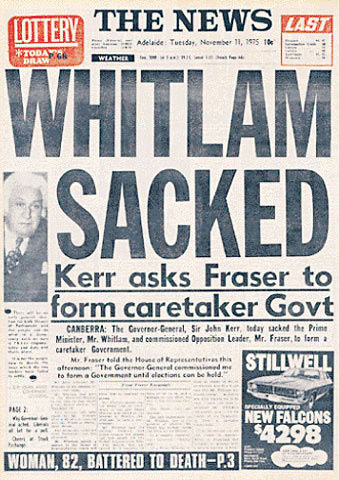
    The day before Whitlam was to make a speech in parliament announcing that the United States run spy facility at Pine Gap in the Northern Territory would be closed, he was deposed in a coup d’état by the Governor General Sir John Kerr. That much is common knowledge and has been widely analysed, in particular by historian Jenny Hocking who is engaged in an ongoing battle to access Kerr’s papers, in particular communications between Kerr and the British Queen.

    His next role was in Indonesia where he was instrumental in the 1965 coup that brought Suharto to power. Between 500,000 and three million Indonesians were murdered in the coup’s aftermath, many of them from a CIA supplied kill list of communists or suspected communist sympathisers.

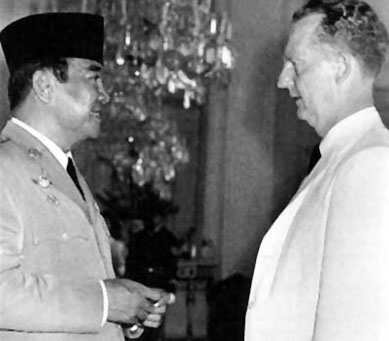
    Marshall Green (right), US ambassador to Indonesia between 1965 and 1968, meeting with Indonesia President Sukarno.

    Less well known was the role of the United States embassy in Canberra where Marshall Green was the ambassador. Green had an interesting career. He had been assigned to South Korea as charge d’affaires where he organised the 1961 coup that brought the dictatorship of Park Chung-Hee to power.

    He was similarly dispatched to Chile where he oversaw the resolution of the ‘problem’ being created for the United States by its left-wing president Allende. Allende was murdered and replaced by a military dictatorship under General Pinochet. Again, hundreds of thousands of Chileans were murdered or ‘disappeared’.

    Whitlam posed a similar ‘problem’ for the Americans with his intention to disclose the CIA’s role in Pine Gap. Thanks to Edward Snowden, it is established beyond doubt that Pine Gap is a giant electronic vacuum cleaner, spying on the communications of Australia and a range of other countries, friend and foe alike.

    Green, known in State Department and CIA circles as the “coup master,” was sent to Canberra as United States ambassador in 1974, specifically to deal with the Whitlam ‘problem’.

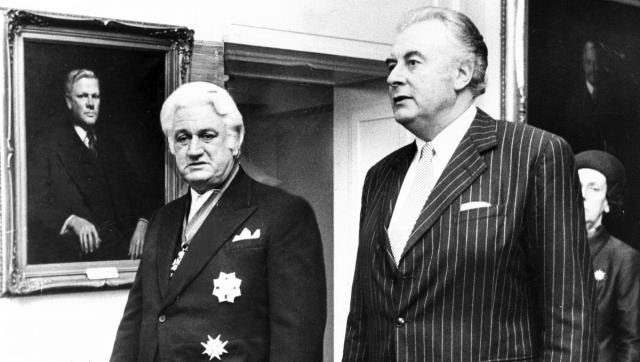
    1974: Sir John Kerr (left) and Australian Prime Minister Gough Whitlam, King’s Hall, Parliament House, Canberra. The day before Whitlam was to inform parliament he intended to close Pine Gap, he was sacked by Kerr. 

    Whitlam was unaware of Kerr’s close ties to the CIA. Neither did he know until 1975 that Britain’s MI6 had been intercepting secret foreign affairs communications for Whitlam’s Office, and passing those onto the Americans.

    On 10 November 1975 Whitlam was shown a Telex message later sourced to the notorious Ted Shackley of the CIA that described Whitlam as a security threat to his own country. The following day Kerr used his power to dismiss Whitlam.

    It has subsequently become clear that Green, Shackley, MI6 head Maurice Oldfield and CIA head William Colby co-ordinated the dismissal of the Whitlam Government, knowing that they could rely on “their man” Kerr to solve the Whitlam ‘problem’.

    My argument is that without knowledge of this historical background it is not possible to fully understand the foreign policy of Australia in subsequent decades.

    Not in Australia’s Interest

    Time and again Australia has undertaken foreign policy initiatives that if viewed from the perspective of Australia’s vital national interests are simply inexplicable. That process has if anything accelerated in recent years.

    In August 1990 Iraq invaded its neighbour Kuwait. Iraq had some legitimate grievances with Kuwait, but the decision to invade, otherwise a blatant violation of international law, was only made after the United States ambassador to Iraq told Saddam Hussein that the United States was not really interested in the argument between Iraq and Kuwait. Saddam took that as a green light.

    There followed a massive propaganda campaign against Iraq, perhaps best exemplified by the appearance of a young woman on US television describing how Iraqi soldiers took Kuwaiti babies from their cots in a Kuwait hospital and smashed them on the concrete floor.

    That the young woman concerned was the daughter of the Kuwaiti ambassador to the United States (not disclosed to viewers) and that she had witnessed no such thing was only part of the lie.

    The Americans assembled a “coalition of the willing” to force the Iraqis to leave Kuwait. Australia was a member of that coalition. The Iraqis were quickly defeated, but that did not prevent the slaughter of the retreating troops. Worse was to come. Sanctions were imposed on Iraq, supported by Australia, resulting in the deaths of more than half a million civilians, including women, children and old persons. This was infamously described by US Secretary of State Madeleine Albright as “worth it.”

    In what sense it was “worth it” for Australia to join this war in the first place, to sustain a role in the blockade and sanctioning of Iraq (tempered by dubious Wheat Board dealings), has never been adequately explained.

    In 2001 Australia again joined a United States led coalition in the attack upon, invasion and occupation of Afghanistan, an occupation still ongoing 17 years later. That the invasion was illegal under international law cannot be seriously argued against. We now know that the decision to invade Afghanistan was made in July 2001, two months prior to the ostensible excuse of the events of 11 September 2001, themselves one of the most distorted and falsified accounts of recent history.

    Nor can Australia explain why, 17 years later, it is still in Afghanistan, the Taliban government having been defeated before Christmas 2001. The official explanation, in so far as it is ever proffered, is that Australia is helping to train Afghan forces. The manifest absurdity of this claim, especially in the face of what are known to be the real reasons for the American invasion, is never questioned in the Australian mainstream media.

    Acknowledging the vital role the heroin crop plays in financing off the books United States operations; control of the gas pipeline from the Caspian Sea basin; the $3 trillion worth of unexploited mineral deposits; and providing a springboard for hybrid warfare operations in Central Asia and China is not permitted in mainstream discourse.

    The Afghanistan misadventure was closely followed by the 2003 invasion of Iraq, now widely regarded as one of the most disastrous United States foreign policy decisions of recent decades. Like so many of these foreign policy ventures, the 2003 Iraq invasion was built upon a multi-tiered pyramid of lies. Weapons of mass destruction are only the best known of these. The repercussions of that disastrous invasion are well documented. Three aspects from the Australian perspective are worth briefly noting.

    The first is that the Howard government did not need to be asked twice to participate. To their credit, they did table in the House of Representatives the legal opinion, poor as it was, that provided the ostensible justification for joining the invasion. But even an abysmal legal argument could not conceal the absolute lack of a national interest argument as to why Australia should join an invasion of a country that posed no threat whatsoever to Australia’s national interests.

    The second consequence was that the invasion spawned a plethora of terrorist groups. That these same terrorist groups are supported with arms, money, political cover and military intervention by the United States and its allies such as Israel and Saudi Arabia is never acknowledged, much less discussed, in either the Australian mainstream media or in political circles.

    Thirdly, the so called “terrorist attack” of 11th of September 2001 has spawned an avalanche of legislation ostensibly aimed at protecting Australia from terrorist threats, but in reality posing the greatest threat of all to human rights and civil liberties in Australia.

    More than 600 pieces of legislation have been passed that directly threaten what many Australians would regard as their basic human rights. Most are unaware of the draconian nature of that legislation. Australia is the only country in the so-called democratic world that does not have a national Bill or Charter of Rights.

    Significant portions of those 600+ Acts or Amendments would not survive judicial scrutiny in those democratic countries that do have a Bill of Rights or equivalent. It is difficult to know what is of more concern: that such legislation could be passed with the willing compliance of the opposition party (regardless of who is in power) or that such systematic erosion of civil liberties is not met with outrage and protest from media and public alike.

    Is Australia any longer a democracy?

    It is now legitimate to ask the question one never expected ever having to pose: is Australia any longer a democracy in any meaningful sense of the word?

    The other military misadventure that should be noted in this context is Australia joining, yet again, a United States led “coalition” attacking Syria. This war, while Australia’s involvement from a military point of view is largely inconsequential, nonetheless reveals several aspects of Australian foreign policy.

    For example, the then prime minister and foreign minister Tony Abbott and Julie Bishop respectively, announced in August 2015 that no decision would be made on joining the Syrian war until the government received legal advice on the matter. In September 2015 they announced that they were going to join that war. What they did not say was that they had received legal advice more than a year earlier. The government has refused (unlike the Howard government in 2003) to release that advice.

    When asked on ABC Radio what was the legal basis for joining the war, Bishop claimed it was pursuant to a request from the Iraqi Government, and also pursuant to the collective self-defence provisions of Article 51 of the United Nations Charter.

    The Iraqi Government issued a statement denying having made such a request; and Article 51 manifestly does not apply. In short, the ostensible reasons were as much a lie as the reasons given for the 2001 Afghanistan invasion and for the 2003 Iraq invasion.

    The real reasons are therefore different. Based on comments made by various government ministers over time, the inference may be drawn that Australia sees involvement in unwinnable, costly and illegal wars with no discernible benefit to Australia as premium payments on the national security insurance policy, the ANZUS Treaty.

    Australia helps the Americans, the argument runs, because in the event that Australia is attacked the Americans will come to their aid under the ANZUS Treaty. Like so many of the justifications put forward by the politicians for involvement in these various wars, this argument also does not withstand scrutiny.

    Unlike Article 5 of the NATO treaty, the ANZUS Treaty requires the parties, effectively now only Australia and the United States, to “consult” in accordance with their constitutional procedures. Notwithstanding the vagueness of this commitment, which is far from any kind of security guarantee, it appears to be an article of faith the United States will in fact come to Australia’s aid in the event that it is ever attacked. Like most faith-based systems, it lacks any empirical basis for the belief that motivates its adherents.

    That adherence to such a policy basis can result not only in involvement in wars, especially illegal ones such as Afghanistan, Iraq and Syria, and done with no discernible national interest, it can actually operate contrary to Australia’s national interest.

    Russia & China

    Two recent examples are the anti-Russian campaign waged by the United States and the United Kingdom in particular, and the trade wars being waged against China by the United States, itself part of a wider anti-China policy that has essentially been a centrepiece of American foreign policy since 1949.

    The anti-Russian campaign manifests itself in endless demonisation of Russia in general and of President Vladimir Putin in particular. Current illustrations of this are the alleged Russian “interference” in the 2016 US presidential election; Russia’s support for the legitimate Syrian government which is alleged to wage chemical warfare on its own people; the assault upon Sergei Skripal and his daughter Yulia in the English city of Salisbury; and the shooting down of MH17 over Ukraine in 2014.

    That there is not a shred of verifiable evidence to support any of these allegations, but rather, conclusive evidence to the contrary, is never acknowledged by the politicians, nor even given reasonable coverage by the mainstream media.

    When confronted with rebuttal evidence, or even shown the manifest absurdities and contradictions of the official narrative, the standard response is either denial or, more commonly, simply ignoring the evidence. A collateral response is to attack the intellectual integrity of the person(s) making the criticism.

    The hostility toward China is even less explicable. China is Australia’s largest trading partner by a very considerable margin. It is the largest source of foreign tourists, the largest source of foreign students, and the third largest source of foreign investment. Australia’s recent decades of prosperity and wealth accumulation owe more to China than to any other country. It is difficult therefore to comprehend the overt hostility, manifesting itself for example in the absurd claims about Chinese intentions in the South Pacific.

    It cannot be only ignorance and prejudice that explains the constant misreporting of China’s Belt and Road Initiative, or issues in the South China Sea, Tibet, Xinjiang province and elsewhere. One possible explanation is proffered by Hugh White who suggests that Australia has never really come to terms with the unique historical phenomenon of where Australia’s largest trading partner (and source of prosperity) is not also its ally.

    While this is undoubtedly true, it does not sufficiently explain the extraordinary degree of obeisance to Australia’s “joined at the hip” American ally. Even the recent revelations of obvious Russian and Chinese military superiority over the Americans have done little or nothing to shake what must now be described as blind and irrational faith.

    From UK colony to American Colony

    One possible explanation, and it is not suggested that it is a sufficient or complete explanation, lies in the history of 1975 outlined above and the multiple other examples of like behaviour by the Americans before and since.

    That is, Australian politicians are acutely aware of the coup organised against Whitlam when he was implementing policies, past and proposed, that the Americans perceived as a threat to their vital interests. That those vital interests include waging perpetual wars for perpetual profit; attempting to maintain a unipolar hegemony over all other nations; and moving ruthlessly to invoke “regime change” upon recalcitrant nations irrespective of their designation as friend or foe, is a lesson not lost upon the Australian body politic.

    Australia has gone from being a British colony to an American one without ever being truly independent. There is nothing in its current policy framework to suggest any imminent change in that position. When accompanied as it is by a progressive erosion of the structural elements of a functioning democracy, the future looks very bleak.

    There is another consequence of having a foreign policy that is in effect no more than an echo of the Washington line. Australia’s region, the “near North,” is undergoing major transformation. In part this transformation is a re-assertion of the traditional dominance of the East, interrupted as it was by the Anglo-American-European imperialism of the past three centuries. That transformation is being driven by the China led Belt and Road Initiative, creating trade and political linkages not only through Eurasia, but also to South America and Africa.

    The BRI in turn is linked to other major trade and security organisations such as the Shanghai Corporation Organisation and Eurasian Economic Union. There are parallel developments in the financial world leading inexorably to the demise of the Dollar based system.

    The unipolar hegemonic world of the past few decades is rapidly disappearing. Australia risks isolation from the prospects offered by this new multipolar world, clinging as it does to the discredited structures of the US dominated system. Even more than a change in policy, Australia needs a change in mindset. A failure to make that adjustment to the geopolitical realities of the 21st century will inevitably lead to Australia fulfilling Lee Kuan Yew’s prophecy of becoming the white trash of Asia.

    [alert type=”general” dismiss=”no”]This article was published in New Dawn 171.[/alert]

    [alert type=”success” dismiss=”no”]If you appreciate this article, please consider subscribing to help maintain this website.[/alert]

    References

    George Williams & Daniel Reynolds, A Charter of Rights for Australia, UNSW Press 2017
    Jenny Hocking, The Dismissal Dossier: Everything you were never meant to know about November 1975, Amazon Australia, 2016
    William Blum, America’s Deadliest Export, Zed Books, 2014
    www.theblogmire.com (on Skripal)
    Alfred McCoy, In the Shadows of the American Century, Haymarket Books, 2017
    Andrei Martyanov, Losing Military Supremacy, Clarity Press, 2018
    David Ray Griffin, Bush & Cheney: How They Ruined America and the World, Olive Branch Press, 2018

    © New Dawn Magazine and the respective author.
    For our reproduction notice, click here.
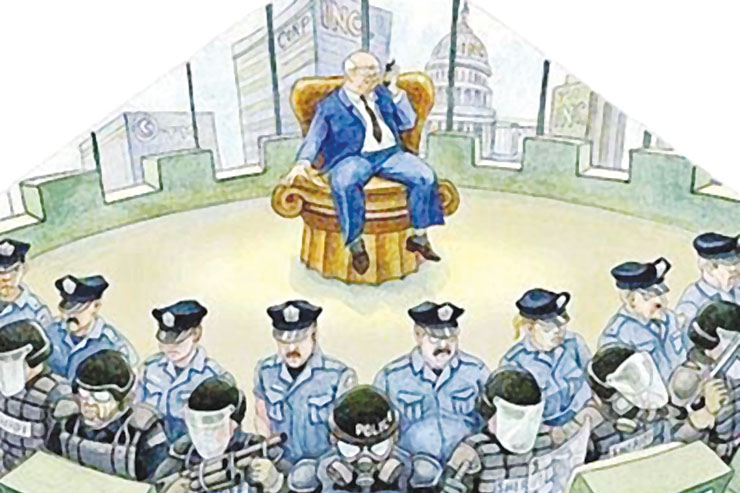
  • Will The Real Conspirators  Please Stand Up

    Will The Real Conspirators Please Stand Up

    From New Dawn Special Issue Vol 8 No 3 (June 2014)

    Today the name Illuminati is used in popular conspiracy literature to describe a mysterious hidden elite out to gain power over the whole world. For some writers the Illuminati is synonymous with a shadowy cabal of international bankers and mega-rich ‘Insiders’, while others see the ‘Enlightened Ones’ as the ultimate secret society committed to the enslavement of humanity in a ‘Satanic’ One World government. In the opinion of Tokyo based journalist Benjamin Fulford, former Asian Bureau chief for Forbes magazine, “the Illuminati are really inbred families of European and North American traditional aristocracy and banking families… Their goal is to create a world government.” 

    In order to understand the origin of much of what is written today about the Illuminati, it is necessary to begin with Adam Weishaupt (1748-1830), a professor of canon law at the University of Ingoltstadt in Bavaria. Together with four of his friends, Weishaupt founded the Order of the Illuminati – that is, the ‘Enlightened Ones’ – on 1 May 1776. Modelling his political secret society on the Catholic Society of Jesus (the Jesuits), he sought to advance the anti-clerical, anti-monarchist, liberal ideals proposed by Voltaire, Diderot, and other French philosophers of the time. “Princes and nations,” he forecast, “will disappear” and then “the human race will become one family and the world the abode of reasonable men.”

    Weishaupt tried to infiltrate and control the lodges of Freemasonry in an effort to advance his political agenda. He wrote: “The great strength of our Order lies in its concealment, let it never appear, in any place in its own name, but always covered by another name, and another occupation. None is fitter than the three lower degrees of Freemasonry; the public is accustomed to it, expects little from it, and therefore takes little notice of it.” In March 1785, in response to widespread anxiety in Catholic Bavaria over Weishaupt’s activities, the Bavarian government outlawed the Illuminati. Weishaupt, dismissed from his university post, fled into exile and ordered the Illuminati to go underground.

    When four years later, in 1789, the merciless French Revolution broke out, sending shock waves through Christian Europe, conservative writers suggested it was the result of a plot hatched by secret societies, principally the Freemasons. Books and pamphlets began to circulate revealing the Illuminati as the hidden hand behind the Revolution, having transferred its secret operations from Bavaria to France. A leading proponent of this idea was Abbé Augustin Barruel (1741-1820), a French Jesuit Catholic priest who had taken refuge in England.

    Barruel believed a widespread conspiracy involving Freemasons – inspired and directed by the Illuminati – was out to destroy Christianity and the European monarchies. Revealingly perhaps, the Jesuit priest Barruel dedicated his four volumes to the “English nation.” Barruel made a clear distinction between the radical Freemasons on the Continent and their Masonic brethren in England, describing the latter as “a society composed of good citizens.” Interestingly, Barruel pointed out how in Britain the Masonic lodges were loyal to the Crown, writing: “Let us admire it [the wisdom of England] for having known how to make a real source of benefit to the State out of those same mysteries which elsewhere conceal a profound conspiracy against the State and religion.” 

    Inspired by Barruel, the Scottish Freemason John Robison published a book of his own (see accompanying article in this same issue ‘Darkness Over All: John Robison and the Birth of the Illuminati Conspiracy’ by Mike Jay). The revelations by Barruel and Robison on the secret causes of the French Revolution created a sensation. Across Europe their claims were championed enthusiastically by conservative forces locked in battle with republicans. Catholic traditionalist author Joseph de Maistre referred to the Illuminati when he spoke of those “guilty men who dared to plan and even organise in Germany that dreadful, most criminal conspiracy to extinguish Christianity and royalty in Europe.”

    In an article in New Dawn Special Issue 11, Dr. Richard B. Spence, a specialist in the history of intelligence agencies, noted “that both Barruel and Robison wrote their books in Britain and that the government of Sir William Pitt the Younger embraced and promoted their ideas. At the very least, Pitt exploited the conspiracy theory to effectively discredit and demonise the French Revolution.”

    Secret Societies & Subversive Movements

    Following the 1917 Russian Revolution, in which the anti-monarchist, atheistic Bolsheviks forcibly seized power, the English writer Nesta Webster published The French Revolution: A Study in Democracy. In the tradition of Barruel and Robison, she claimed a secret conspiracy had prepared and carried out the French Revolution, concluding that: “The lodges of the German Freemasons and Illuminati were thus the source whence emanated all those anarchic schemes which culminated in the Terror.”

    Mrs Webster’s most influential book, however, was Secret Societies and Subversive Movements, in which she set out to document the existence of a vast, centuries old, secret conspiracy to overthrow Christian civilisation. Building on the work of Barruel and Robison, Nesta Webster argued that behind the forces of world revolution “whether Pan-German, Judaic, or Illuminist – beyond that invisible secret circle which perhaps directs them all,” is another force, still more potent, an “Occult Power.”

    Webster had a wide and influential readership. H.G. Wells called her Secret Societies and Subversive Movements, “a book that all serious people interested in the British situation ought to read and think about… I believe her [Mrs. Webster’s] influence has spread far beyond the circle of her actual readers.” Winston Churchill praised her in a 1920 article entitled “Zionism versus Bolshevism: A Struggle for the Soul of the Jewish People,” where he wrote of the growth of a “world-wide conspiracy for the overthrow of civilisation and for the reconstitution of society on the basis of arrested development, of envious malevolence, and impossible equality” which “played, as a modern writer, Mrs. Webster, has so ably shown, a definitely recognisable part in the tragedy of the French Revolution.” After reading Webster’s books, the British economic reformer Major C.H. Douglas, father of the Social Credit movement, declared: “Any serious endeavour to identify the origins of world unrest and war inevitably and invariably leads back to what is loosely called occultism.”

    It was not long before Nesta Webster’s writings made their way across the Atlantic to North America where they found a ready audience among right-wing Christians. “Without the influence of Nesta Webster,” notes the British historian Nicholas Goodrick-Clarke in Black Sun, “it is likely that few Americans today would have heard of the Illuminati. Due to the re-publication of her books and the popularisation of her ideas among the radical right, the Illuminati became a major theme of American conspiracy literature from the late 1960s onward.” 

    Nesta Webster, like Barruel and Robison before her, was quick to absolve English Freemasonry of any involvement in political subversion. By focusing on the ‘evil German’ Illuminati as the guilty party, she effectively diverted attention away from Britain’s clandestine role in many of the upheavals in Europe. That Mrs Webster, the daughter of a senior partner in Barclays Bank, was a committed British imperialist with close ties to the English ruling class, there is no doubt. After the First World War, Nesta Webster supported punitive measures against Germany. Starting in 1922 she penned a series of attacks against Pan-Germanism in the pages of The Morning Post. Webster believed that powerful forces in 1920s Germany had secretly allied with Bolshevik Russia to bring down the British Empire. She castigated the Jews for being dupes of Pan-Germanism who “from the time of Frederick the Great had frequently acted as Prussia’s most faithful and efficient agents.”  

    With Hitler’s rise to power in the 1930s, Webster supported Nazi Germany, seeing in the Third Reich a bulwark against the hated Soviet Union. A position held by sections of the British establishment who believed Hitler’s Germany was more of a threat to Communist Russia than the British Empire.

    More than any other author, Nesta Webster’s writings have played a major role in shaping the political/occult conspiracy theories in the English-speaking world for nearly a century. In the years prior to the Second World War, Webster enjoyed a special relationship with elements in British Intelligence. In fact her book World Revolution: The Plot Against Civilisation was based on lectures she gave to British military officers and members of the Secret Service at the end of the First World War. 

    Richard Gilman, author of Behind World Revolution: The Strange Career of Nesta H. Webster, who extensively studied her life, concluded that the real “function of her books was to blame the crimes of Britain’s power elite on others as well as defend the Empire in general.”

    [alert type=”general” dismiss=”no”]This article was published in New Dawn Special Issue Vol 8 No 3.[/alert]

    [alert type=”success” dismiss=”no”]If you appreciate this article, please consider subscribing to help maintain this website.[/alert]

    © New Dawn Magazine and the respective author.
    For our reproduction notice, click here.