New Dawn – World's Most Unusual Magazine

Category: New Science/Consciousness

  • Intuition: Delusion or Perception? Toward a Scientific Explanation of the Akashic Experience

    Intuition: Delusion or Perception? Toward a Scientific Explanation of the Akashic Experience

    The intuitions reported by mystics, poets, artists, ordinary people, even scientists, often go beyond the range of sensory perception. In the reductionist culture inspired by classical science, they are dismissed as mere delusion – classical empiricism claims that there is nothing in the mind that was not first in the eye. However, the classical tenet is not universally upheld. It is exceptional in the annals of history, and even in the context of contemporary cultures.In history intuitions were embedded in the conceptual framework through which a given culture interpreted the nature of reality. In indigenous societies shamans and medicine-men (and women) tuned themselves to spontaneous apprehension through rigorous initiation and training; they derived their mystical vision from them. In mythically oriented societies the world was seen as a cosmic realm of spirits, and in classical cultures it was believed to be governed by a panoply of unseen gods. The Abrahamic monotheistic religions recognised the intuitions of their prophets as conveying fundamental truths about God and the nature of His creation. Eastern cultures have always held that reality extends far beyond the domain of the senses.

    On the other hand Western culture takes as real only that which is manifest – literally “to hand.” Because what people see is constrained by what they believe they can see, everything that is not conveyed to consciousness by eye and ear is dismissed from the modern view of the world. But are the intuitions that occasionally surface in consciousness mere delusion? Or can there be intuitions that are as real and fundamental as sensory perception? This question calls for a deeper look at the possibility that spontaneous insights and apprehensions may have a physical basis. There are findings at the cutting-edge of scientific research that affirm this possibility.

    The Brain as a “macroscopic quantum system”

    The crucial finding is the discovery that the brain is not merely a classical biochemical system; in some respects it is a “macroscopic quantum system.” Certain cerebral functions involve processes previously thought to be limited to the domain of the quantum. The pertinent functions concern the reception and transmission of information at the cellular and subcellular level: intercellular communication involves quantum-effects and processes. Neurons and neuronal and subneuronal networks form synchronised oscillators that receive and send information through quantum resonance. This information propagates quasi-instantly throughout the organism and does not require classical channels of signal transmission. The various forms and characteristics of information transmitted through quantum resonance are not fully understood, but their physical basis is clear. It is nonlocality, the process Einstein first said is “spooky” and then Erwin Schrödinger termed “entanglement.” Entanglement means that the states and functions of the entangled entities are correlated beyond the ordinary bounds of space and time. As a result the entities are intrinsically and fundamentally coherent. Such coherence obtains in the domain of the quantum: in pristine states quanta are coherent and mutually entangled. Only interaction in some form (measurement, and possibly certain acts of observation) renders them decoherent. Macroscale objects were said to be in a permanently decoherent state, yet certain objects also exhibit forms of quantum coherence. There is experimental evidence that the state of entire atoms can be entangled, and in recent years quantum-coherence has been discovered at the scale of living organisms. The divide between the microworld of the quantum and the world of macroscale objects has been breached. The heat of living organisms – even of warm-bodied species – does not necessarily destroy the coherence that is the precondition of entanglement. While classical quantum theory maintained that at ordinary temperatures Brownian movement made quanta, so-called “qubits,” decoherent and thus incapable of entanglement, recent research (inter alia by Kitaev, Pitkanen, and Frecska and Luna) indicates that the problem of “heat-decoherence” is not insuperable.1

    There appear to be networks of quanta where the particles are “woven” or “braided” in a way that is sufficiently robust to maintain coherence at body temperatures. Whereas at such temperatures classically organised qubits become decoherent, networks of woven or braided qubits conserve coherence. As Parsons put it, “braiding is robust: just as a passing gust of wind may ruffle your shoelaces but won’t untie them, data stored on a quantum braid can survive all kinds of disturbance.”2 Quantum coherence in the brain and throughout the organism is not just theoretical speculation; it is entirely fundamental for coordinating the processes that make life possible. The staggering number of physical and chemical reactions taking place in the living organism is not likely to be coordinated by limited and relatively slow biochemical signal-transmission alone. Only the “entanglement” of the organism’s cellular and subcellular components can ensure a sufficiently rapid flow of multidimensional information to maintain the organism in its physically improbable state far from thermal and chemical equilibrium.

    Cytoskeletal Structures

    Roger Penrose and Stuart Hameroff suggest that cytoskeletal structures in the brain are responsible for the reception, computation, and transmission of multidimensional quantum-resonance-based information. Throughout the organism cytoskeletal proteins are organised into a network of microtubules, and the elements of these networks are connected to each other structurally by protein-links and functionally by gap junctions. However, the network of microtubules may be too coarse-grained to produce quantum-effects in the brain. The “infoplasm,” the basic substrate of living matter, may be the microtrabecular lattice, a web of microfilaments 7 to 9 nanometer in diameter. The periodic lattice of microtubules forms a network within the network of neurons, and the microtrabecular lattice is a network embedded in the network of microtubules. According to Ede Frecska, it is this lattice that is likely to be the structure responsible for quantum-effects in the brain. It appears physically possible that the quantum-scale components of the cytoskeletal lattice convey information from the world to the brain. The question is, what information? How does information originate in the world at large?

    The Akashic Field

    Until recently, asserting that information is objectively present in nature and not only in the human realm was considered metaphysical. This is no longer the case. It is now recognised that information is present in all things; as John Wheeler remarked, in some respects it the most fundamental feature of the universe. Experiments designed to test the Einstein-Podolski-Rosen hypothesis indicate that already quanta behave in an informed manner: they appear to make choices of their own, and respond to choices by other quanta. Either they have a form of consciousness (a thesis entertained by some physicists), or they are embedded in a complex informational environment. The latter is the minimally speculative assumption. It suggests that even in the absence of matter space is neither empty nor passive. As this writer among others has suggested, cosmic space is not a vacuum, but a plenum. In recognition of the prophetic insight of ancient Sanskrit and Hindu cosmology – where Akasha is the most fundamental of the five elements, the one from which the others arise – this writer calls the field that fills cosmic space the “Akashic Field.”3

    The idea that space is active and filled with physically significant events is not unique to Sanskrit and Hindu cosmology; it has noteworthy antecedents also in the history of science. In the nineteenth century, mathematician William Clifford suggested that small portions of space are analogous to little hills on a surface that is flat on average; the geometry of the landscape does not hold for them. The property of space to be curved or distorted, he said, is continually being passed on from one portion of space to another after the manner of a wave. In the physical world there is nothing else but this wavelike variation.4

    In a 1930 paper, “The concept of space,” Albert Einstein noted, “We have now come to the conclusion that space is the primary thing and matter only secondary; we may say that space, in revenge for its former inferior position, is now eating up matter.”5 A few years later Erwin Schrödinger restated the same thought: “What we observe as material bodies and forces are nothing but shapes and variations in the structure of space.”6 In physical cosmology cosmic space is seen as a ceaselessly fluctuating sea of emerging and vanishing virtual particles. In grand-unified and super-grand unified theories all the universal fields and forces of nature are traced to origins in the quantum vacuum, a fundamental hyperspace often viewed as a unified field. This fundamental field carries also zero-point energies – energies that remain present when at the absolute zero of temperature conventional forms of energy vanish. The concept of a complex unified field, effectively the Akashic Field, offers a basis for identifying the origins of the information that quantum processes transfer to the brain. It is known that as a consequence of their motion atoms, molecules and all material entities (i.e. structures composed of massive particles) produce electromagnetic waves that radiate into surrounding space. Space, however, is not empty and passive, and it is more than Maxwell’s extended electromagnetic field. It is the locus of the Akashic Field. The waves emitted by moving objects excite and modulate this field, creating wavefronts that propagate in the field and, upon meeting, interfere with each other. The interference patterns that result carry information at their nodes on the objects that created the waves. Because the Akashic Field is a seamless medium that extends throughout space, the information carried by the interference patterns produced by moving objects extends throughout space. This information corresponds to the physical properties of the objects.7

    The process is similar to that which occurs in holography. The holograms created by interfering beams of light conserve information on the surface of the things and events that modulated the light beams. But the interference patterns responsible for quantum coherence are created by waves in the Akashic Field, and not by photons in the electromagnetic field. Thus they are not ordinary, but quantum holograms. Walter Schempp has shown that quantum holograms are coherent, mutually entangled, and carry nonlocal information on the things and events that produced the constituent waves. He has also shown that the brain’s object imagery is phase conjugate. Lending support to Karl Pribram’s “holonomic brain theory,” Schempp affirmed that “the conditions which make quantum holography possible are ideally suited to the hypothesis that the brain works… by quantum holography.”8

    The answer to the question regarding the origin and nature of the information transferred by quantum-resonance to the brain can now be essayed. When the phase and frequency of a cerebral lattice corresponds to the phase and frequency of a quantum hologram, brain and hologram enter into phase-conjugate resonance. This allows the information conserved at the nodes of Akashic Field quantum holograms to be transferred to the cerebral receptors. Thus some of the intuitions that reach consciousness are not merely delusion: they are transmitted by phase-conjugate resonance from the Akashic Field to the cytoskeletal structures of the brain. Just which intuitions have this physical origin cannot be ascertained at this time merely by examining the pertinent cerebral processes. We need to resort to circumstantial evidence, examining the correspondence of the content of the intuitions with things and events known to exist in the real world through ordinary sensory perception. But we can affirm in good conscience that it is entirely plausible some intuitions have a bona fide physical basis. And that, in itself, goes a long way toward legitimating belief in the veridical nature of at least some of our intuitions.

    A Concluding Note

    Although widely reported and often meaningful, intuition is seldom the subject of sustained scientific research. The classical empirical tenet of mainstream science discourages attempts to investigate the phenomenon: it is physically implausible if not categorically impossible. Yet sustained research on intuition would be potentially fruitful and extremely important. In the positive case it would show that the human brain and nervous systems can access information in a spontaneous mode. While some varieties of experience viewed as intuition could well be delusion, there could also be spontaneous apprehension for which we can find an acceptable scientific explanation. This would lend support to the frequently voiced belief that human beings – and by implication all living things – are connected with each other and with nature in ways that are more subtle than those that stimulate the senses. This in turn would reinforce and legitimate empathy and solidarity among people and a closer sense of rapport with nature – vitally important attributes in our critical times when we face problems we can only resolve in cooperation with each other and harmony with our environment. This article is based on the author’s latest book The Akashic Experience: Science and the Cosmic Memory Field (Inner Traditions, Rochester, USA).
    [alert type=”general” dismiss=”no”]This article was published in New Dawn 114.[/alert]

    [alert type=”success” dismiss=”no”]If you appreciate this article, please consider subscribing to help maintain this website.[/alert]

    Footnotes:

    1. Alexei Kitaev, 1997, Quantum error correction with imperfect gates, in Proceedings of the Third International Conference on Quantum Communication and Measurement, edited by O. Hirota, A.S. Holevo, and C.M. Caves, New York: Plenum Press; Pitkanen, Matti, 2006, Topological Geometrodynamics, Frome, UK: Lunilever Press; Frecska, Ede and Luis Eduardo Luna, 2006, Neuro-Ontological Interpretation of Spiritual Experiences, Neuropsychopharmacologia Hungarica, 8(3), 2006.
    2. Paul Parsons, Dancing the Quantum Dream, New Scientist 2431: 31-34, 2004.
    3. Ervin Laszlo, The Connectivity Hypothesis, Albany: State University of New York Press 2003; Science and the Akashic Field, Rochester, Vt.: Inner Traditions International 2004; Quantum Shift in the Global Brain, Rochester, Vt.: Inner Traditions International, 2008.
    4. William Clifford, in Wolf Milo and Geoff Haselhurst, Einstein’s Last Question, VIA: Journal of Integral Thinking for Visionary Action, Vol. Three, No. 1, 2005.
    5. Cited in Wolf and Haselhurst, op. cit.
    6. Erwin Schrödinger, in Schrödinger: Life and Though, Cambridge University Press, London, 1989.
    7. Peter H. Fraser and Harry Massey, Decoding the Human Body-Field, Rochester, Vt.: Inner Traditions International, 2008.
    8. Walter Schempp, Quantum Holography and Magnetic Resonance Tomography: An Ensemble Quantum Computing Approach, Informatica (Slovenia) 21(3), 1997; Karl Pribram, 1991, Brain and Perception: Holonomy and Structure in Figural Processing (John M Maceachran Memorial Lecture Series), Mahwah, NJ: Lawrence Erlbaum, 1991.

    © New Dawn Magazine and the respective author.
    For our reproduction notice, click here.

  • The Eden Experiment: Aliens, Archons & the Associative Universe

    The Eden Experiment: Aliens, Archons & the Associative Universe

    From New Dawn 110 (Sept-Oct 2008)

    In the timeless library of human myths and legends, perhaps none are more primal and disturbing than the biblical story of the Fall. Responsible for everything from the demonisation of women to the Church’s pious horror for nature, sex and the body, there is scarcely a life-hating ideology or barbaric practice it hasn’t been used to justify.

    For all that, this strange and unsettling story has lost none of its melancholy power over the centuries, remaining as enigmatic and haunting as a dimly remembered nightmare – and almost no closer to being understood today than the day it was first told.

    If “God” is all-powerful, then why did He need to test Adam and Eve at all? Wouldn’t a real supreme being already know what was going to happen? Why did the serpent seem like the only one who really understood what was going on? And who was God talking to when he fretted that Adam had become “like one of us1?

    Observes libertarian “anti-psychiatrist” Thomas Szasz:

    Adam’s apple is so named because a piece of the biblical forbidden fruit is supposed to have stuck in his throat… Perhaps this is why the Forbidden Truth so often appears ‘chewed up’, transformed into metaphor, humour, satire, slang (or dream and myth, of course).2

    In this essay I’d like to take the unusual step of examining the Eden myth, not through the lens of traditional theology or atheist reductionism, but instead from the perspective of a few fringe phenomena it isn’t usually associated with: alien abductions and the occult “serpent power” of Eastern mysticism.

    As we shall discover, these apparent discrepancies aren’t mistakes at all, but instead represent the sole surviving keys to uncovering its true meaning – for the legend of Adam and Eve originally had nothing to do with human sin or divine punishment.

    Instead, the story of the “Garden Eden” comes to us as a distorted version of primitive man’s first recorded encounter with uncanny beings from the stars – a botched abduction attempt culminating in the spontaneous illumination of two very confused cavemen.

    What this means for religion in general, and monotheism in particular, I shall leave for the reader to divine on their own.

    We shall see that at which dogs howl in the dark, and that at which cats prick up their ears after midnight. We shall see these things, and other things which no breathing creature has yet seen. We shall overleap time, space, and dimensions, and without bodily motion peer to the bottom of creation.
    – H.P. Lovecraft, From Beyond

    UFOs – A Modern Problem?

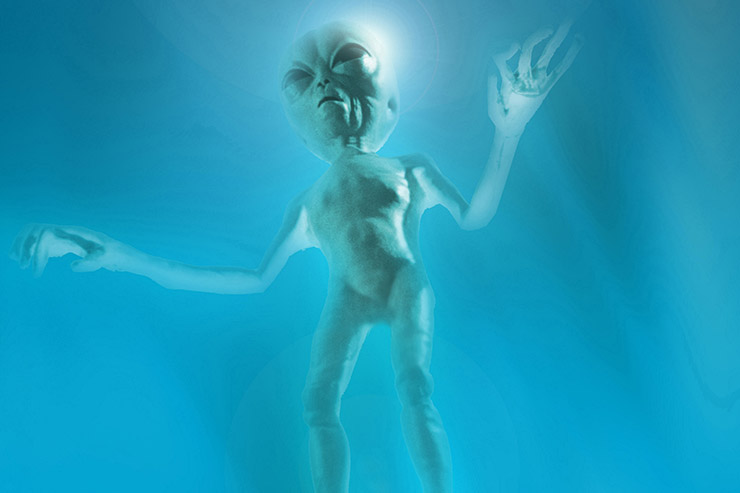
    Since the dawn of the space age, man’s dreams have been haunted by strange visions of cigar or saucer shaped aircraft bearing vaguely foetal (or insectoid) passengers who kidnap, brainwash and even impregnate their human captives before erasing their memories and vanishing into the ether.

    Like “out of body” experiences or spirit possession, the UFO phenomenon stands as one of those baffling “psychic” anomalies which seems to exist for the sole purpose of mocking human reason. Claims one “victim”:

    I woke up in the middle of the night and everything looked odd and strangely lit. At the end of my bed was a 4 feet high grey alien. Its spindly, thin body supported a huge head with two enormous, slanted, liquid black eyes. It compelled me, telepathically, to follow and led me into a spaceship… examination room [where]… I was forced to lie down while they… implanted something in my nose. I could see jars containing half-human, half-alien fetuses and a nursery full of silent, sickly children. When I eventually found myself back in bed, several hours had gone by.3

    French astrophysicist Jacques Vallee studied the alien abduction phenomenon for decades, wondering continually at the arbitrary and illogical nature of most such reports. Why do these supposed “wise explorers from the stars” behave so bizarrely? If they have the advanced technology necessary for interstellar travel, why would they use it to visit this planet, let alone kidnap housewives, farmers and convenience store clerks for the purpose of anal probing? Observed Vallee’s mentor, J. Allen Hynek:

    To me, it seems ridiculous that super intelligences would travel great distances to do relatively stupid things like stop cars, collect soil samples, and frighten people. I think we must begin to re-examine the evidence. We must begin to look closer to home.4

    Vallee’s Rejection of the Extraterrestrial Hypothesis of Alien Contact

    Researching hundreds of “contactee” testimonials, folkloric narratives and world mythologies, Vallee eventually concluded that UFOs aren’t what they seem to be. They don’t hail from the Zeta Reticula galaxy, they aren’t here to explore or conduct genetic experiments and their presence on this planet isn’t a recent development at all. Instead, notes Vallee:

    Reports of uncanny visitors from the sky have plagued mankind for thousands of years – enough to rule out short-term exploration as a motive.

    Witnesses typically describe the “aliens” as humanoid bipeds able to breathe our atmosphere and see in our light spectrum – but wouldn’t genuine extraterrestrials be adapted to a completely different type of environment?

    The aliens’ supposedly “scientific” experiments are “crude to the point of being grotesque…. often accompanied by sadistic sexual manipulation [and] reminiscent of medieval encounters with demons” – not the sort of behaviour we might expect from an advanced civilisation!5

    Finally, since UFOs seem able to appear and disappear at will, they are probably “not just a bunch of spacecraft” but instead represent “a much more interesting technology that manipulates dimensions. It manipulates space-time. And if it can do that, then [the aliens could] be from anywhere and anytime.”6

    Frustrated with the unquestioned assumptions and cultish insularity of contemporary ufology, Vallee instead suggests three alternatives to the “Extraterrestrial Hypothesis” (EH) based on “second level” readings of the UFO phenomenon – speculative scenarios notable less for what they say about UFOs than about the structure of physical reality itself:

    The Inter-Dimensional Hypothesis

    One possibility is that aliens are not from another planet, but instead represent “evidence for other dimensions beyond spacetime”7extradimensional entities hailing from an uncanny world which overlaps but only occasionally intrudes upon our own, beings from the future (or a perhaps a ghostly copy of our own earth) using “four-dimensional wormholes for space and even time travel”8 through the “multiverse which is all around us.”9

    This “multiverse” could consist of parallel worlds existing alongside each other in different dimensions of space, alternate past and future worlds following one another in time, or even computer-generated “virtual worlds” stored in some vast cosmic database (as in the film ‘The Matrix’); if this latter instance is true, hints Vallee, then the seemingly stable and predictable world in which we find ourselves could be a much more magical (or even whimsical) place than we normally realise:

    If there is no time dimension as we usually assume there is, [then] the human brain may be traversing events by association… If we live in the associative universe of the software scientists rather than the sequential universe of the spacetime physicist, then miracles are no longer irrational events… [and the] illusion of time and space would be merely a side effect of consciousness as it traverses associations. In such a theory, apparently paranormal phenomena like remote viewing and precognition would be expected, even common, and UFOs would lose much of their bizarre quality…10

    The Electromagnetic Connection

    Another promising vein of inquiry originates with the work of Dr. Michael Persinger, a cognitive neuroscientist at Laurentian University in Canada whose 1975 “Tectonic Stress Theory” holds that UFOs, out-of-body experiences and mystical visions of saints and angels are the byproducts of electrical microseizures (i.e., epileptic episodes) resulting from exposure to electromagnetic fields generated by shifting plates in the Earth’s crust.

    Persinger’s experiments include the construction of the “God helmet,” a specially modified motorcycle helmet which uses weak EM fields to stimulate the parietal and temporal lobes of the brain. Shockingly, almost 80% of the 900 subjects thus tested report altered states of consciousness, visions of God and dead loved ones, and even full-blown alien abductions.11

    More radical still is Paul Devereux’s 1989 “Earth Lights” hypothesis, in which UFOs appear as some sort of “previously unrecognised terrestrial phenomenon” (think Will O’ the Wisps) which either rely upon or are attracted to the EM fields generated by seismic stress.

    Devereux notes that the strange balls of light which appear and hover near or around earthquake fault lines behave at times almost like “inquisitive animals” and speculates that they may be intelligent “macro-quantal” blobs of plasma energy capable of telepathy, mimicry and hypnosis.12

    Both theories in turn anticipate the research of Johnjoe McFadden, an English neuroscientist at the University of Surrey whose Conscious Electromagnetic Field Theory (CEMI) locates human thought outside the wet, grey labyrinth of the brain, identifying it instead with a weak electromagnetic field which surrounds and penetrates the skull.13

    If McFadden is correct, then the entire sensory environment we perceive all around us could be nothing more than an extremely sophisticated communications broadcast of some sort – perhaps just one of many “channels” available to the human nervous system.

    The Control System Hypothesis

    Vallee’s final alternative to the EH is his “Control System” Hypothesis, a fringe view in which aliens (or UFOs) appear as a non-human intelligence closely linked to the Earth, but not bound by it – not little green men from far-flung planets but hallucinatory imps from a dreamlike hyperspace who always seem to appear in just about the form we expect to see them.

    Once upon a time these interacted and appeared to us as gods, spirits and angels, accepting sacrifices, sending dreams and inspiring mankind’s great religions; then as fairies, goblins, elves and spirits, spreading fear and wonder in the lives of medieval peasants; and finally as space-faring “greys,” reptilian humanoids and noble “Plaeaidian” scientists, bearing cryptic warnings about the environment and seeding new mythologies for the Information age.

    So why have these protean tricksters chosen to visit us? Perhaps Vallee’s most controversial claim is that these mysterious visitors are themselves mere epiphenomena, shadows and reflections of a vast (and very ancient) “control system” which has been operating in the background to manipulate human belief systems since time immemorial, guiding our species towards some unknown purpose. Notes Vallee:

    If UFOs are having an action at [the level of myth] it will be almost impossible to detect it by conventional methods… because they are the means by which man’s concepts are being rearranged. All we can do is trace their effect…14

    This “control system,” Vallee hypothesises, could represent a projection of the collective unconscious, the activity of an unknown species or even some sort of ecosystemic feedback loop.15

    Vallee’s Control System and the Origins of Western Religion

    If mankind’s long flirtation with gods, ghosts, goblins and grays is anything to go by, Vallee’s alien “control system” has been with us since the very beginning – and for evidence of its influence, we need look no further than the origins of Abrahamic monotheism.

    Take, for example, the story of the Garden of Eden, an eerie tale which – with only a little imagination – can easily be read as a coded account of an alien abduction, an extraterrestrial interlude in which speaking primates are tested for obedience and adaptability:

    Omniscient keeper(s) create a man (or remove him?) from the “earth”;

    Test subject is anesthetised;

    Keepers produce a female specimen supposedly cloned from his “rib”;

    Test subjects are placed in a controlled environment and forbidden from eating a certain type of food;

    A writhing hologram appears (the “shining serpent”) and encourages them to violate the Keepers’ directives;

    Subjects are punished and returned to the wild to digest their encounter.

    Now, is this all there is to the story – ancient astronauts tampering with primitive man? Admittedly, that would be incredible if true – but wouldn’t alien scientists have been able to conceal even the most elaborate breeding and colonisation program from a pair of cavemen?

    What if the real agenda behind the Eden incident was not creation (or obedience testing) but something else entirely?

    Remarks Vallee:

    If the phenomenon is forcing us through a learning curve, then it has no choice but to mislead us. When Skinner designs a machine that feeds a rat only when the right lever is depressed, this is extremely misleading for the rat. But if the rat doesn’t depress the correct lever, he becomes extremely hungry. Man is hungry for knowledge and power, and if there is an intelligence behind the UFOs it must have taken this fact into account…16

    Perhaps instead of looking at the biblical “Fall” as a failed experiment, we should instead think of it as what Vallee calls an “open control system” – a metalogical labyrinth whose participants “graduate” to the next level when the correct sequence of stimuli are triggered – in this case, eating the “forbidden fruit.”

    In other words, “Adam” and “Eve” didn’t fail the test when they ate from the “Tree of Knowledge” – they passed it.

    Open Control Systems and Mythological Mashups

    This alternate reading of the Eden creation myth is reinforced in the scriptures of the ancient Gnostics, an unorthodox (some say “heretical”) movement in early Christianity that competed with the infant Catholic church for several centuries after the birth of Christ.

    Often dismissed as a primitive heresy that fell under the weight of its own obscurantist tendencies, Gnosticism was instead a sophisticated system of occult hermeneutics whose acolytes employed special neurolinguistic trance-inducing techniques to engage in a sort of memetic sabotage, splicing, remixing and mutating of biblical stories in a manner seemingly calculated to cause maximum offense and psychological discomfort. But why? Notes one literary critic:

    Drugs, sex, and power control the body, but “word and image locks” control the mind, that is, “lock” us into conventional patterns of perceiving, thinking, and speaking that determine our interactions with environment and society. The cutup is a way of exposing word and image controls and thus freeing oneself from them, an alteration of consciousness that occurs in both the writer and the reader of the text.17

    For the Gnostics, the biblical creation stories weren’t divine revelations, but the shattered fragments of a monstrous and malevolent spell – the control system. By rearranging and retelling Judeo-Christian myths, the Gnostics sought clues that might allow them to reprogram creation itself, changing the past, seizing control of the heavens, and overthrowing the phony god of the Bible.

    The Gnostic Version(s) of the Eden Myth

    In the Gnostic view, Eden was not a paradise, but a jungle laboratory where an opportunistic race of alien parasites conducted a series of bizarre experiments in an attempt to produce a compliant strain of biped slaves.

    Banished from the stars at the dawn of time, these “archons” (Greek for “rulers”) fled to the Earth where they abducted a caveman named “Adam” and sexually assaulted his mate “Eve,” implanting both with false (or screen) memories:

    When they [the archons] saw Eve speaking with [Adam], they said to one another… “Come, let us seize her and let us cast our seed on her, so that… those whom she will beget will serve us. But let us not tell Adam that she is not derived from us, but let us bring a stupor upon him, and… teach him in his sleep as though she came into being from his rib…18

    Feared and worshipped as “gods” and “angels,” the Archons depend for their very existence on the energy captured and siphoned from the human nervous system via various control systems – biological and memetic thermostats which allow them to regulate the flow of information and energy through words and images, pleasure and pain:

    They say that the soul is the food of the Archons and Powers without which they cannot live, because she is of the dew from above and gives them strength…19

    Adam and Eve “fell” when the archons programmed them with prohibitions and commandments, changing them from primates living in the eternal “now” to “soft machines” – biological automata at war with their own instincts, parasitised by selfish replicators and paralysed by double-binds:

    ….when the Rulers saw [Adam] and the woman who was with him, erring in ignorance… they rejoiced greatly… They came to Adam… [and] said to him, “Every tree which is in Paradise, whose fruit may be eaten, was created for you. But beware! Don’t eat from the Tree of Knowledge…” [T]hey gave them a great fright….20

    Unfortunately for the archons, this strange prohibition seems to have provoked its own violation – for, as the Gnostic scriptures inform us:

    [the archons] do not understand what they have said to [Adam]; rather… they said this in such a way that he might in fact eat…21

    Pushed to the brink by a mysterious talking serpent, Adam and Eve partook of the fruit and convulsed with ecstasy as the walls of the Garden fell away to reveal the larger world outside the Garden. Like lab rats suddenly lifted out of a maze, Adam and Eve could now perceive their own situation clearly for the very first time:

    Then their mind opened. For when they ate… they saw that they were naked, and they became enamoured of one another. When they saw their makers, they loathed them since they were beastly forms. They understood very much…22

    Serpent Power Rising

    A few more details complete this curious picture: Adam, we learn, was created with “seven souls”23; the “serpent” was actually a “hidden Mother” goddess named “Sophia” who fought against the archons from her secret location inside Adam’s “intestines”(!)24; and finally, when Eve fled from the archons, she took refuge inside the “Tree of Knowledge”25 (in biblical Hebrew, the word for “tree” can also mean “spine.”).

    If any of this sounds familiar, it should – for as countless researchers have noted, the entire story seems to be nothing more than an allegorical description of the Kundalini serpent of Buddhist and Hindu yoga:

    A Tantric yogi sees the great Mother present within his human body as the Kundalini. She lies hidden by her self-created ignorance, like a snake, coiled and fast asleep… at the bottom of the spinal cord. Through [meditation], the Tantric awakens the Mother and rouses her to go upward… [until he] becomes illumined…26

    Theories about the Kundalini Serpent

    Frequently misunderstood as an exotic oddity unique to Eastern mysticism, the kundalini instead represents a cross-cultural phenomenon of great antiquity (and plasticity) which (like the UFO phenomenon) has many features in common with OBEs, NDEs, spirit possession and shamanic initiation.

    In short, the belief is that the human body possess seven (sometimes more) energy centres called “chakras,” roughly located near or in the anus, genitals, stomach, heart, throat, brow and crest of the skull. Normally clogged with the traumata of everyday life, these “chakras” open when stimulated by a serpentine energy which normally lies sleeping and coiled at the base of the spine.

    In dreams, this serpent takes the form of a sleeping goddess who projects the illusion of the world; awakened, she climbs the spine to open the “third eye” at the crown of the head, bringing explosive emotional, psychological and spiritual growth, even ecstasy, enlightenment and the acquisition of occult powers.

    Although the scientific study of the kundalini is still in its infancy, there do exist many plausible theories which might some day explain how it works. Here are a few of them:

    Reichian/Bioenergetic

    Wilhelm Reich was a renegade disciple of Freud’s who discovered a type of libidinal energy called orgone which flows throughout the “seven segments”27 of the body, resembling nothing so much in its “slow undulation[s]” as “the movement of an intestine or snake.”28

    In most of us, social and cultural programming cause this elusive life force to become blocked in early childhood so that it pools up in the muscles and hardens into a rigid “body armour.” Thus diverted from life, the stagnant energy becomes a machine-like parody of itself which stunts and distorts human emotions, turning healthy expressions of love and sexuality into addiction, resentment and fear.

    In the long term, the suffocating obstacles imposed by this invisible exoskeleton cause untold misery by exacerbating the mind/body split and creating the conditions necessary for the emergence of cancer (in individuals) and fascism (in societies).

    Unimpressed with the slow pace and ineffectiveness of traditional talk therapy, Reich favoured a direct, hands-on approach designed to weaken the body armour itself. Over time, Reich and his followers found that unplanned events of great emotional intensity could trigger the orgone to ascend through the seven body segments spontaneously, purging vast reserves of repressed emotional energy and causing the body to vibrate uncontrollably as the noxious “body armour” crumbled once and for all.

    Mechanical

    Czech inventor Itzhak Bentov dedicated years to the study of human consciousness, eventually developing what is today known as the “holographic model” of the human brain.

    In Bentov’s view, the “kundalini experience” is primarily a mechanical phenomenon which arises when the brain begins to vibrate in sympathetic resonance with the heartbeat (7.5 hz), releasing terrific amounts of stored musculoskeletal stress as the nervous system is temporarily transformed into a polarised loop.

    This in turn causes the spinal column to oscillate like a tuning fork, allowing it to receive and transmit information directly from the ionosphere – the same part of the atmosphere responsible for bouncing electromagnetic waves back to Earth.29

    The Pineal Gland and the Third Eye

    Finally, former New Mexico University psychiatrist Rick Strassman hypothesises that kundalini yoga somehow stimulates the pineal gland to secrete larger than normal amounts of naturally-occurring DMT into the brain – making it the true “third eye.”30

    DMT is a powerful hallucinogen, also found in ayahuasca, the “vine of souls” used by Amazonian shamans to induce mystical visions; the pineal gland, meanwhile, has its own surprising analog in the photosensitive “third eye” found in many species of reptiles, a vestigial organ with full lens and retina buried under the skin in the centre of the forehead.31

    The connections to biblical myth here are many and obvious, so what does it all mean?

    Seeking to understand the roots of human religious experience, Strassman injected over 60 volunteers with high doses of DMT, conducting over 400 such sessions from 1990-1995; perhaps unsurprisingly, just over half his test subjects reported blissful visions of timeless, cosmic unity, communion with benevolent deities and “classic near-death experiences” which included flying through tunnels of “radiant light.”32

    The other 47% were not so lucky, reporting nightmarish beings drawn straight from the twilight horror-world of the Gnostic counter-Eden: menacing “clowns, elves [and] robots” who threatened and even attacked their human victims. Strassman finally ended his experiments ahead of schedule when one of his subjects reported being “eaten alive” by giant insects.

    Dragons in the Darkness

    Strassman’s findings here echo the eerie experiences of Michael Harner, an American anthropologist who penetrated the Amazon rainforest forty years earlier to experiment with the “vine of souls” potion himself.

    Harner reported seeing “giant reptilian creatures” dwelling in and around his own brain stem, “dragon-like” beings from deep space who colonised the Earth millennia ago; chillingly, these dark beings claimed to have seeded the Earth with life for the sole purpose of creating various host species they could hide themselves in.

    “I learned that the dragon-like creatures were thus inside of all forms of life, including man,” claims Harner. “They were the true masters of humanity and the entire planet, they told me. We humans were but [their] receptacles and servants…”33

    True to form, when Harner demanded an explanation from the medicine man who gave him the potion responsible for this ominous vision, the old man just laughed and explained that, “…they’re always saying that. But they are only the Masters of Outer Darkness…”34

    Conclusion

    Clearly Harner is speaking here of beings very much like the archons of Gnostic myth or the manipulative “greys” of modern Ufology – but are these entities nothing more than symbolic projections of the reptilian brain, as Harner’s narrative seems to imply?

    Do aliens and archons hail from outer space or inner space? Why is “contact” with aliens (or archons) so often accompanied by vibrations or tremors, either muscular or tectonic? How should we think about the “serpent” now that we know it is probably a dormant evolutionary mechanism of some sort? And are the “big three” Abrahamic religions of Islam, Judaism and Christianity really nothing more than hallucinatory control mechanisms employed by alien parasites to enslave and manipulate us?

    German Historian Klaus Theweleit has written what would seem to be the last possible word on the subject, noting that:

    …[T]he ‘fall of man’ depicts a failed revolution from the victor’s standpoint. For attempting to put into practice their slogan ‘Our bodies belong to us,’ the rebels were sentenced to a life of forced labor… ‘Your bodies belong to your Ruler!’ – that was the response. (The ‘paradise’ they were driven out of was the blissful state of being ruled without realising it. Even today, being driven out of ‘paradise’ is the penalty for trying to create a paradise.)35

    Whether the Eden story is really about UFOs or the kundalini, and whether such phenomena are electromagnetic or chemical in origin, I can’t say for sure (I’ve never even seen a UFO!), but I do know this:

    I have taken mushrooms and seen great, flying black mantas which pursued me across the desert floor, telepathically overwhelming me with thoughts of paranoia and despair. I’ve taken DMT and left my body to enter a crystalline world of euphoric decahedrons and four-dimensional pyramids, spread out beneath a great vaulted membrane which breathed, and knew at that instant that this membrane was the threshold between time and eternity.

    I’ve practiced tantric yoga with a dakini and been bruised and battered as I hyperventilated under the tutelage of a Reichian therapist; and I’ve been in dark rooms lit only by flickering candles, watching friends and family members pant as their eyes rolled back in their heads and their limbs shook uncontrollably, “mounted” by the spirits of the dead and personified forces of nature known to witch doctors the world over.

    Whatever the origins of these and related “psychic” phenomena ultimately prove to be – genetic memories, autonomous archetypal complexes, glitches in the Matrix or even the intrusive activities of extraterrestrial civilisations – nothing will change for our species until we finally rise to our feet, shake off the chains of superstition and ignorance and claim our inheritance – not as childlike “test subjects” to be ordered about and punished, but as adults striding forth into the cosmos with eyes wide open, ready to take responsibility for our own evolution.

    The Eden myth, like all myths, is meant to be lived; not studied but experienced – so let us treat the Bible with its endless commandments and airless authoritarianism not as the final authority on human life, but as a leaping off point for the rediscovery of the human body as a sacred text in its own right, a flesh and blood book with its own sounds, smells and textures and even wisdom too – for in the end, it may be the only thing we can ever really know anyway.

    Or, as the Gnostic scriptures put it:

    You are the Tree of Knowledge, which is in Paradise, from which the first man ate and which opened his mind, so that he became enamoured of his co-likeness, and condemned other alien likenesses, and loathed them.36

    [alert type=”general” dismiss=”no”]This article was published in New Dawn 110.[/alert]

    [alert type=”success” dismiss=”no”]If you appreciate this article, please consider subscribing to help maintain this website.[/alert]

    Footnotes:

    1. Genesis 3:22
    2. Thomas Szasz, The Untamed Tongue, p.58, pub. 1990
    3. Dr. Susan Blackmore, “Alien Abduction: The Inside Story,” New Scientist, November 19, 1994, pp.29-31
    4. Dr. Jacques Vallee, Forbidden Science: Journals, 1957-1969, p.426
    5. Ibid, p.17
    6. “Strange Encounters: An Interview with Jacques Vallee” by Daniel Blair Stewart, excerpted from Green Egg Magazine, Vol. XXTV, No. 95, Yule 1991, republished www.bibliotecapleyades.net/ciencia/ciencia_vallee03.htm
    7. Vallee, Dimensions: A Casebook of Alien Contact, p.253, pub. 1988
    8. Vallee, Revelations: Alien Contact and Human Deception, p.255, pub. 2008
    9. Vallee, Dimensions, p.253
    10. Ibid, p.257
    11. BBC – Science & Nature – Horizon – God on the Brain, www.bbc.co.uk/science/horizon/2003/godonbrain.shtml
    12. Paul Devereux, “Earth Lights: Abstracted from a presentation given at the Dana Center of the London Science Museum,” December 9, 2003, www.pauldevereux.co.uk/new/html/body_earthlights.html
    13. JohnJoe McFadden, The Conscious Electromagnetic Field Theory, www.surrey.ac.uk/qe/cemi.htm
    14. Vallee, Dimensions, p.246
    15. Vallee, Revelations, p.254
    16. Vallee, Dimensions, p.246
    17. Jenny Skerl, William S. Burroughs, quoted in “William S. Burroughs Cut-ups,” http://languageisavirus.com
    18. Willis Barnstone (editor), The Other Bible, “On the Origin of the World,” p.70, pub. 1984
    19. Hans Jonas, The Gnostic Religion, p.169, pub. 1958
    20. Barnstone, Ibid, p.71
    21. Barnstone, Ibid, “The Hypostasis of the Archons,” p.77
    22. Barnstone, Ibid, “On the Origin of the World,” p.71
    23. Marvin W. Meyer, The Secret Teachings of Jesus: Four Gnostic Gospels, “The Secret Book of John,” pp.69-70, pub. 1986
    24. Barnstone, Ibid, “The Sethian-Ophites,” p.664
    25. Willis Barnstone (editor), The Other Bible, “On the Origin of the World,” p.70, pub. 1984
    26. Elizabeth U. Harding, Kali: The Black Goddess of Dakshineswar, pp.70-71, pub. 1993
    27. Roger M. Wilcox, “A Skeptical Scrutiny of the Works and Theories of Wilhelm Reich as related to Psychiatric Orgone Therapy (character-analytic vegetotherapy)”, pub. July 25, 2005, http://members.dslextreme.com/users/rogermw/Reich/orgone_therapy.html
    28. Wilhelm Reich, The Cancer Biopathy: Volume II of the Discovery of the Orgone, pub. 1973
    29. Wikipedia Article on Kundalini, www.crystalinks.com/kundalini.html
    30. Ibid.
    31. Schwab & O’Connor, “The Lonely Eye,” March 2005, www.pubmedcentral.nih.gov/articlerender.fcgi?artid=1772576
    32. John Horgan, “The God Experiments: Five researchers take science where it’s never gone before,” Discover Magazine, November 20, 2006.
    33. Michael Harner, The Way of the Shaman, pp.4-5, 1980
    34. Ibid.
    35. Klaus Theweleit, Male Fantasies: Women, Floods, Bodies, History, pp.414-15, pub. 1987
    36. Barnstone, Ibid, “On the Origin of the World,” pp.67-68

    © New Dawn Magazine and the respective author.
    For our reproduction notice, click here.
  • The Power of the Mind

    The Power of the Mind

    From New Dawn 106 (Jan-Feb 2008)

    Living in the world under your skin is a bustling metropolis of 50 trillion cells, each of which is biologically and functionally equivalent to a miniature human. Current popular opinion holds that the fate and behaviour of our internal cellular citizens are preprogrammed in their genes. Since Watson and Crick’s discovery of the genetic code, the public has been programmed with perception that DNA acquired from our parents at the moment of conception determines our traits and characters. This conventional view of genetics further has us believe that our inherited gene programs are apparently fixed, the equivalent of a computer’s “read-only” program.

    The notion that our fate is indelibly inscribed in our genes was directly derived from the now dated scientific concept known as genetic determinism. It is still a conventional belief that genes “control” the many wonderful attributes passed down through a family’s lineage, as well as dysfunctional familial traits such as cancer, Alzheimer’s, diabetes and depression, among scores of others. As “victims” of heredity, genetic forces outside of our control, we naturally perceive of ourselves as being powerless in regard to the unfolding of our lives. Unfortunately, the assumption of being powerless is the road to personal irresponsibility. “Since I can’t do anything about it anyway… why should I care?”

    Shattering Illusions

    Just as the Human Genome Project got off the ground in the late 1980’s, scientists began to acquire a paradigm-shattering new view of how life works. Their revolutionary research has become the foundation for a new branch of science known as epigenetic control. The world of epigenetics has shaken the foundations of biology and medicine for it reveals that we are not “victims” of our genes, but are in fact “masters” of our genes.

    The conventional version of heredity still being taught in schools emphasises genetic control, which literally reads as “control by genes.” However, newly revealed epigenetic control mechanisms provide a profoundly different view of how life is managed. The Greek-derived prefix epi- means “over or above.” Consequently, the literal translation of epigenetic control reads as “control above the genes.” Genes do NOT control life – life is controlled by something above the genes. Knowledge is power and this knowledge of how life works provides the most important element in our quest for self-empowerment. Epigenetics leads us from our perception of victim to our proper role as a participatory creator.

    The new science of epigenetics recognises that environmental signals are the primary regulators of gene activity. As described in the Biology of Belief: Unleashing the Power of Consciousness, Matter and Miracles, cells read and respond to the conditions of their environment using membrane protein perception switches. Activated switches send signals into the cytoplasm to control behaviour and regulate the activity of the genes, the hereditary blueprints used to make the body. Proteins are the cell’s molecular building blocks and their characters provide for our physical and behavioural traits.

    Amazingly, epigenetic information can modify or edit the readout of a gene blueprint to create over 30,000 different variations of proteins from the same gene. This editing process can provide for normal functional protein products as well as dysfunctional proteins from the same gene. One can be born with healthy genes and through epigenetic processes express mutant behaviours such as cancer. Similarly, one can be born with defective mutant genes and through epigenetic mechanisms create normal healthy proteins and functions.

    The conventional belief that the genome represents “read-only” programs is now proven to be false. Epigenetic mechanisms modify the readout of genetic code, therefore genes actually represent “read-write” programs wherein life experiences actively redefine an individual’s genetic expression. As organisms experience the environment, their perception mechanisms fine-tune genetic expression so as to enhance their opportunities for survival. The environment’s influence over the genome is dramatically revealed in studies on identical twins. When first born, these siblings express almost the same gene activity from their identical genomes. However, as they begin to experience life, their personal individualised experiences and perceptions lead to the activation of profoundly different sets of genes.

    The “new” biology is based upon the fact that perception controls behaviour AND gene activity! This revised version of science emphasises the reality that we actively control our genetic expression moment by moment throughout our lives. Rather than seeing ourselves as victims of our genes, we must come to own the responsibility that our perceptions are dynamically shaping our biology and behaviour. The expression of a healthy or dis-eased biology is directly influenced by the accuracy of an individual’s interpretation or perception of their environment. Misperceptions rewrite genetic expression just as effectively as accurate perceptions, yet with far graver, perhaps even life threatening consequences.

    From the Microcosm of the Cell to the Macrocosm of the Mind

    For the first three and a half billion years of life on this planet, the biosphere consisted of a massive population of individual single-celled organisms, such as bacteria, yeast, algae, and protozoa like the familiar amoeba and paramecium. About 700 million years ago, individual cells started to assemble into multicellular colonies. The collective awareness afforded in a community of cells was far greater than an individual cell’s awareness. Since awareness is a primary factor in organismal survival, the communal experience offered its citizens a far greater opportunity to stay alive and reproduce.

    The first cellular communities, like the earliest human communities, were basic hunter-gatherer clans wherein each member of the society offered the same services to support the survival of the community. However, as the population densities of both cellular and human communities reached greater numbers, it was no longer efficient or effective for all individuals to do the same job. In both types of communities, evolution led to individuals taking on specialised functions. For example, in human communities some members focused upon hunting, others upon domestic chores and some upon child rearing. In cellular communities specialisation meant that some cells began to differentiate as digestive cells, others as heart cells, and still others as muscle cells.

    Most of the trillions of cells forming bodies such as ours have no direct perception of the external environment. Liver cells “see” what’s going on in the liver, but don’t directly know what’s going on in the world outside of the skin. The function of the brain and nervous system is to interpret environmental stimuli and send out signals to the cells that integrate and regulate the life-sustaining functions of the body’s organ systems.

    The successful nature of multicellular communities allowed evolving brains to dedicate vast numbers of cells for use in the cataloguing, memorising and integrating complex perceptions. The ability to remember and select among the millions of experienced perceptions in life provides the brain with a powerful creative database from which it can create complex behavioural repertoires. When put into play, these behavioural programs endow the organism with the characteristic trait of consciousness. In this presentation, the term consciousness is used in its most fundamental context… the state of being awake and aware of what is going on around you.

    Many scientists prefer to think of consciousness in terms of a digital quality, an organism either has it or not. However, an assessment of the evolution of biological properties suggests consciousness, like any other quality, evolved over time. Consequently, the character of consciousness would likely express itself as a gradient of awareness from its simpler roots in primitive organisms to the unique character of self-consciousness manifest in humans and other higher vertebrates.

    The expression of self-consciousness is specifically associated with a small evolutionary adaptation in the brain known as the prefrontal cortex. The prefrontal cortex is the neurological platform that enables us to realise our personal identity and experience the quality of “thinking.” Monkeys and lower organisms do not express self-consciousness. When looking into a mirror, monkeys will never recognise that they are looking at them selves; they will always perceive the image to be that of another monkey. In contrast, neurologically more advanced chimps looking in the mirror perceive the mirror’s reflection as an image of themselves.

    An important difference between the brain’s consciousness and the prefrontal cortex’s self-consciousness is that consciousness enables an organism to assess and respond to the immediate conditions of its environment that are relevant at that moment. In contrast, self-consciousness enables the individual to factor in the consequences of their actions in regard to not only how they impact the present moment but also as to how they will influence the individual’s future.

    Self-consciousness is an evolutionary adjunct to consciousness in that it provided another behaviour-creating platform that included the role of a “self” in the decision-making process. While conventional consciousness enables organisms to be participatory members in the dynamics of life’s “play,” the quality of self-consciousness offers an opportunity to simultaneously be an observer in the “audience.” From the perspective of our being able to observe the role of “self” in the unfolding of the “play,” self-consciousness provides the individual with the option for self-reflection, reviewing and editing their character’s performance. The conscious and self-conscious functions of the brain may be collectively referred to as the mind.

    In conventional parlance, the brain’s conscious mechanism associated with automated stimulus-response behaviours is referred to as the subconscious or unconscious mind, for the reason that its functions require neither observation nor attention from the self-conscious mind. Subconscious mind functions evolved long before the prefrontal cortex, consequently it historically was able to successfully operate a body and its behaviour without any contribution from, or involvement with, the more evolved self-conscious mind.

    The subconscious mind is an astonishingly powerful information processor that can record perceptual experiences (programs) and forever play them back at the push of a button. Interestingly, many people only become aware of their subconscious mind’s automated programmed behaviours when they realise they’re engaged in an undesirable behaviour as a result of someone “pushing their buttons.”

    The power of the subconscious mind lies in its ability to process massive amounts of data acquired from direct and indirect learning experiences at extraordinarily high rates of speed. It has been estimated that the disproportionately larger brain mass providing the subconscious mind’s function has the ability to interpret and respond to over 40 million nerve impulses per second. In contrast, it is estimated that the diminutive self-conscious mind’s prefrontal cortex can only process about 40 nerve impulses per second. As an information processor, the subconscious mind is one million times more powerful than the self-conscious mind.

    As a tradeoff in acquiring its computational bravado, the subconscious mind expresses a marginal creative ability, one that may be best compared to that of a precocious five year old. In contrast to the freewill offered by the conscious mind, the subconscious mind primarily expresses prerecorded stimulus-response “habits.” Once a behaviour pattern is learned, such as walking, getting dressed or driving a car, those programs are processed as habits in the subconscious mind… meaning you can carry out these complex functions without paying any attention to them.

    In contrast to the massive information processing by the subconscious mind, the smaller prefrontal cortex responsible for self-consciousness is limited to juggling only a small number of tasks at the same time. Though its ability for multitasking is physically constrained, the self-conscious mind can focus upon and control any function in the human body. It was once thought that some body’s functions were beyond the control of the self-conscious mind, such involuntary functions included the regulation of heartbeat, blood pressure and body temperature, behaviours controlled by the unconscious autonomic nervous system. However, it is now recognised that yogis and other practitioners that train their conscious minds can absolutely control functions formerly defined as involuntary behaviours.

    The subconscious and self-conscious components of the mind work in tandem. The subconscious mind controls every behaviour that is not attended to by the self-conscious mind. For most people, their self-conscious minds are rarely focused upon the current moment since their mental processing continuously flits from one thought to another. The self-conscious mind is so preoccupied with thoughts about the future, the past or resolving some imaginary problem, that most of our lives are actually controlled by programs in the subconscious mind.

    Cognitive neuroscientists conclude that the self-conscious mind contributes only about 5% of our cognitive activity. Consequently, 95% of our decisions, actions, emotions and behaviours are derived from the unobserved processing of the subconscious mind.

    Simple Insights… Profound Consequences!

    Through the management of “programmed” perceptions, the mind controls our biology, behaviour and gene activity. The seat of thinking, freewill, personal identity, and our wants, desires and intentions is a small 40 “bit” self-conscious processor that controls our lives only 5% of the day or less. The million times more powerful subconscious mind controls 95% or more of our lives using “habits” derived from instincts and the perceptions acquired in our life experiences.

    This data reveals that our lives are not controlled by our personal intentions and desires as we may inherently believe. Do the math! Our fate is actually under the control of the preprogrammed experiences managed by the subconscious mind. The most powerful and influential programs in the subconscious mind were downloaded into consciousness in the profoundly important formative period between gestation and six years of age. Now here’s the catch – these life-shaping subconscious programs are direct downloads derived from observing our primary teachers… our parents, siblings and local community. Unfortunately, as psychiatrists, psychologists and counsellors are keenly aware, many of the perceptions acquired about ourselves in the formative period are expressed as limiting and self-sabotaging beliefs.

    Unbeknownst to most parents is the fact that their words and actions are being continuously recorded by their children’s minds. Consequently, when they inform their child that he or she does not deserve things, or that they are not good enough, or smart enough, or that they are sickly, these pronouncements are directly downloaded into their child’s subconscious. Since the role of the mind is to make coherence between its programs and real life, the brain generates appropriate behavioural responses to life’s stimuli to assure the “truth” of the programmed perceptions.

    Let’s apply this understanding to the behaviour in one’s life. Consider that you were a 5-year-old child throwing a tantrum in Walmart over your desire to have a particular toy. In silencing your outburst, your father yelled, “YOU don’t deserve things!” You are now an adult and in your self-conscious mind you are considering the idea that you have the qualities and power to assume a position of leadership at your job. While in the process of entertaining this positive thought in the self-conscious mind, all of your behaviours are now being automatically managed by the programs in your more powerful subconscious mind. Since your fundamental behavioural programs are those derived in your formative years, your father’s admonition that “you do not deserve things” may become the subconscious mind’s automated directive. So while you are entertaining wonderful thoughts of a positive future and not paying attention, your subconscious mind is automatically engaging self-sabotaging behaviour to assure that your reality matches your program of not-deserving.

    Now here’s the catch – Behaviour is automatically controlled by subconscious mind’s programs when the self-conscious mind is not focused on the present moment. When the reflective self-conscious mind is preoccupied in thought and not paying attention, it does not observe the automatic behaviours derived from subconscious mind. Since 95% or more of our behaviour is derived from the subconscious mind… then most of our own behaviour is invisible to us!

    For example, consider you intimately know someone and you also know his or her parent. From your perspective you see that your friend’s behaviour closely resembles their parent. Then one day you casually remark to your friend something like, “You know Mary, you’re just like your mom.” Back away! In disbelief and perhaps shock, Mary will likely respond with, “How can you say that!” The cosmic joke is that everyone else can see that Mary’s behaviour resembles her mom’s except Mary. Why? Simply because when Mary is engaging the subconscious behavioural programs she downloaded in her youth from observing her mom, it’s because her self-conscious mind is not paying attention. At those moments, her automatic subconscious programs operate without observation.

    Another familiar example of how “invisible” behaviour operates: You are driving your car while having an intense conversation with a friend in the passenger’s seat. You become so involved in the discussion that only later, when your gaze returns to the road, do you realise that you haven’t paid attention to the driving for the last ten minutes. Since the self-conscious mind was preoccupied with the conversation, the car was being driven by the subconscious mind’s “autopilot” mode. However, if you were asked to describe your driving behaviour during that ten-minute hiatus, you would be forced to say, “I don’t know… I wasn’t paying attention.” Aha! That’s the point – when the conscious mind is busy, we do not observe our own programmed subconscious behaviours.

    Consequently, when life does not work out as planned, we rarely recognise that we were very likely contributing to our own disappointments. Since we are generally unaware of the influence of our own subconscious behaviours, we naturally perceive of our selves as victims of forces outside of us when things don’t work out as desired. Unfortunately, assuming the role of victim means that we assume we are powerless in manifesting our intentions. Nothing is further from the truth! The primary determinant in shaping the fate of our lives is the database of perceptions and beliefs programmed in our minds.

    Where Did That Behaviour Come From?

    There are three sources of perceptions that control our biology and behaviour. The most primitive perceptions are those we acquire with our genome. Built into our genes are programs that provide fundamental reflex behaviours referred to as instincts. Pulling your hand out of an open flame is a genetically derived behaviour that does not have to be learned. More complex instincts include the ability of newborn babies to swim like a dolphin or the activation of innate healing mechanisms to repair a damaged system or eliminate a cancerous growth. Genetically inherited instincts are perceptions acquired from nature.

    The second source of life-controlling perceptions represents memories derived from life experiences downloaded into the subconscious mind. These profoundly powerful learned perceptions represent the contribution from nurture. Among the earliest perceptions of life to be downloaded are the emotions and sensations experienced by the mother as she responds to her world. Along with nutrition, the emotional chemistry, hormones, and stress factors controlling the mother’s responses to life experiences cross the placental barrier and influence fetal physiology and development. When the mother is happy, so is the fetus. When the mother is in fear, so is the fetus. When the mother “rejects” her fetus as a potential threat to family survival, the fetal nervous system is preprogrammed with the emotion of being rejected. Sue Gearhardt’s very valuable book Why Love Matters reveals that the fetal nervous system records memories of womb experiences. By the time the baby is born, emotional information downloaded from the life experiences in womb have already shaped half of that individual’s personality.

    However, the most influential perceptual programming of the subconscious mind occurs in the time period spanning from the birth process through the first six years of life. During this time the child’s brain is recording all sensory experiences as well as learning complex motor programs for speech, and for learning first how to crawl and then how to stand and ultimately run and jump. Simultaneously, the subconscious mind acquires perceptions in regard to parents, who are they and what they do. Then by observing behavioural patterns of people in their immediate environment (usually parents, siblings and relatives), a child learns perceptions of acceptable and unacceptable social behaviours that become the subconscious programs that establish the “rules” of life.

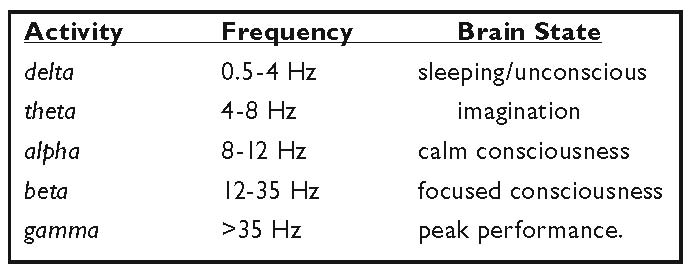
    Nature facilitates the enculturation process by developmentally enhancing the subconscious mind’s ability to download massive amounts of information. EEG readings from adult brains reveal that neural electrical activity is correlated with different states of awareness. Adult EEG readings show that the human brain operates on at least five different frequency levels, each associated with a different brain state:

    EEG vibrations continuously shift from state to state over the whole range of frequencies during normal brain processing in adults. However, brain frequencies in developing children display a radically different behaviour. EEG vibration rates and their corresponding states evolve in incremental stages over time. The predominant brain activity during the child’s first two years of life is delta, the lowest EEG frequency range. In the adult brain, delta is associated with sleeping or unconsciousness.

    Between two and six years of age, the child’s brain activity state ramps up and it operates primarily in the range of theta. In the adult, theta activity is associated with states of reverie or imagination. While in the theta state, children spend much of their time mixing the imaginary world with the real world. Calm consciousness associated with emerging alpha activity only becomes a predominant brain state after six years of age. By twelve years, the brain expresses all frequency ranges although its primary activity is in beta’s state of focused consciousness. Children leave elementary education behind at this age and enter into the more intense academic programs of junior high.

    A profoundly important fact in the above timeline that may have missed your attention is that children do not express the alpha EEG frequencies of conscious processing as a predominant brain state until after they are six years old. The predominant delta and theta activity of children under six signifies that their brains are operating at levels below consciousness. Delta and theta brain frequencies define a brain state known as a hypnogogic trance, the same neural state that hypnotherapists use to download new behaviours directly into the subconscious mind of their clients.

    The first six years of a child’s life is spent in a hypnotic trance. Its perceptions of the world are directly downloaded into the subconscious during this time, without the discrimination of the, as yet, dormant self-conscious mind. Consequently, our fundamental perceptions about life and our role in it are learned before we express the capacity to choose or reject those beliefs. We were simply “programmed.” The Jesuits were aware of this programmable state and proudly boasted, “Give us a child until it is six or seven years old and it will belong to the Church for the rest of its life.” They knew that once the dogma of the Church was implanted into the child’s subconscious mind, that information would inevitably influence 95% of that individual’s behaviour for the rest of their life.

    The inhibition of conscious processing (alpha EEG activity) and the simultaneous engagement of a hypnogogic trance during the formative stages of a child’s life are a logical necessity. The thinking processes associated with the self-conscious mind’s processing cannot operate from a blank slate. Self-conscious behaviour requires a working database of learned perceptions. Consequently, before self-consciousness is expressed, the brain’s primary task is to acquire a working awareness of the world by directly downloading experiences and observations into the subconscious mind.

    HOWEVER, there is a very, very serious downside to acquiring awareness by this method. The consequence is so profound that it not only impacts the life of the individual, it can also alter an entire civilisation. The issue concerns the fact that we download our perceptions and beliefs about life long before we acquire the ability for critical thinking. Our primary perceptions are literally written in stone as unequivocal truths in the subconscious mind, where they habitually operate for life, unless there is an active effort to reprogram them. When as young children we download limiting or sabotaging beliefs about ourselves, these perceptions become our truths and our subconscious processing will invisibly generate behaviours that are coherent with those truths.

    As an important point for personal reference, it should be noted that acquired perceptions in the subconscious mind could even override genetically endowed instincts. For example, every human can instinctually swim like a dolphin the moment they emerge from the birth canal. This might prompt you to ask, “Why is it that we have to work so hard at teaching our children how to swim?” The answer lies in the fact that every time the infant encounters open water, such as a pool, a river, a bathtub, the parents freak out in concern for the safety of their child. However, in the baby’s mind, the parent’s behaviour causes the child to equate water as something to be feared. The acquired perception of water as dangerous and life threatening, overrides the instinctual ability to swim and makes the formerly proficient child susceptible to drowning.

    The following is further reference to the fact that our unconsciously acquired cultural beliefs control biology and behaviour. Through our developmental experiences we acquire the perception that we are frail, vulnerable organisms subject to the ravages of contagious germs and disease. The belief of being frail actually leads to frailty since the mind’s limiting perceptions inhibit the body’s innate ability to heal itself. This influence of the mind on healing processes is the focus of psychoneuroimmunology, the field that describes the mechanism by which our thoughts change brain chemistry, which in turn regulates the function of the immune system. While negative beliefs can precipitate illness (nocebo effect), the resulting dis-ease state can be alleviated through the healing effects of positive thoughts (placebo effect).

    Finally, the third source of perceptions that shape our lives is derived from the self-conscious mind. Unlike the reflexive programming of subconscious mind, the self-conscious mind is a creative platform that provides for the mixing and morphing a variety of perceptions with the infusion of imagination, a process that generates an unlimited number of beliefs and behavioural variations. The quality of the self-conscious mind endows organisms with one of the most powerful forces in the Universe, the opportunity to express freewill.

    Taking Personal Responsibility

    The conclusions of the “new” biology provide a radical departure from our conventional beliefs of how life works. In contrast to the notion that we are biochemical automatons driven by genes, the new insights reveal that it is the mind that controls genes, which in turn shape our biology and behaviour. The self-conscious mind, associated with our individual identity and the manifestation of thoughts, is guided by our own personal desires and intentions.

    While we generally perceive that our self-conscious mind is “controlling” the show, neuroscience has established the fact that 95% of our behaviour is under the control of the more powerful subconscious mind. As most of our personal and cultural problems arise from the fact that behaviours derived from the subconscious mind are essentially invisible to us, we rarely observe our automated behaviour.

    Compounding the problem is the fact that fundamental programs in the subconscious mind are derived from others, people who generally do not share your personal goals and aspirations. While our conscious minds are trying to move us toward our dreams, unbeknownst to us our subconscious programs are simultaneously shooting ourselves in the foot and impeding our progress.

    The subconscious mind is simply a “record-playback” mechanism that downloads experiences into “behavioural tapes.” While the self-conscious mind is associated with creativity, the subconscious mind’s function is to engage previously recorded programs. Unlike self-consciousness that is overseen by an entity (you), the subconscious mind is more closely related to a machine, meaning there is no thinking, conscious entity controlling the subconscious programs.

    We have all been shackled with emotional chains wrought by dysfunctional behaviours programmed by the stories of the past. However, the next time you are talking to “yourself” with the hope of changing sabotaging subconscious programs, it is important to realise the following information. Using reason to communicate with your subconscious in an effort to change its behaviour would essentially have the same influence as trying to change a program on a cassette tape by talking to the tape player. In neither case is there an entity in the mechanism that will respond to your dialogue.

    Subconscious programs are not fixed, unchangeable behaviours. We have the ability to rewrite our limiting beliefs and in the process take control of our lives. However, to change subconscious programs requires the activation of a process other than just engaging in a running dialogue with the subconscious mind. There are a large variety of effective processes to reprogram limiting beliefs, which include clinical hypnotherapy, Buddhist mindfulness and a number of newly developed and very powerful modalities collectively referred to as energy psychology.

    For a list of resources, visit: www.brucelipton.com.

    [alert type=”general” dismiss=”no”]This article was published in New Dawn 106.[/alert]

    [alert type=”success” dismiss=”no”]If you appreciate this article, please consider subscribing to help maintain this website.[/alert]

    © New Dawn Magazine and the respective author.
    For our reproduction notice, click here.
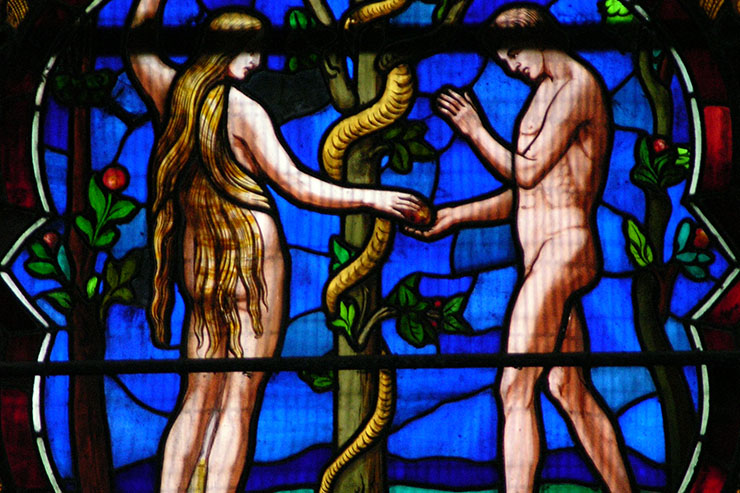
  • The Speed of Life: Why Time Seems to Speed Up and How to Slow it Down

    The Speed of Life: Why Time Seems to Speed Up and How to Slow it Down

    From New Dawn 104 (Sept-Oct 2007)

    I’m six years old, in the car with my parents and brother, travelling back from our annual two week holiday in Conwy, North Wales. It’s dark and the journey seems to take forever. I lie in the back seat, watching the orange streetlights and the houses pass by, and wonder if we’re ever going to get home.

    “Are we nearly there yet?” I ask my father.

    “Don’t be silly,” he says. “We only set off half an hour ago.”

    My mum plays the ‘Yes/No’ game and ‘Twenty questions’ with us to make the time pass faster. We listen to the radio for a while. Then I fall asleep. When I wake up it seems like I’ve been in the car for an eternity and I can’t believe we’re still not home.

    “Are we nearly there yet?” I ask again.

    “Not far now,” says my father.

    We play some more games and finally I recognise the streets of our suburb of Manchester. I feel bored and miserable and tell myself that I’m never going to spend as long in a car ever again.

    The journey from Conwy to Manchester took two hours when I was a child and still takes roughly two hours now (although slightly less due to improvements in roads). I made the journey again a few years ago and couldn’t believe how short it seemed now, from my adult perspective. Those two hours – which seemed like an eternity when I was 6 – were nothing. My girlfriend was driving, and we chatted, listened to tapes, watched the Welsh countryside give way to the urban sprawl of north-west England, and we were back in Manchester almost before we knew it. It was a little frightening – what had happened to all the time that two hours contained when I was six years old?

    A year or so ago I made another journey which gave me an indication of how much more quickly time is passing to me now. This was a 15 hour plane journey, from Singapore to Manchester, which also seemed to last forever. I’m not a very good flyer and it wasn’t a very good flight: we flew into two typhoons over India and it was rocky almost all the way. I hoped I’d be able to ‘kill’ some of the time by sleeping but it was impossible. Every time I drifted off my anxiety woke me up again. Failing that, I hoped I’d at least be able to make the time pass quickly by distracting myself with the in-flight entertainment or with books and magazines, but my mind stubbornly refused to move from the moment to moment reality of the situation. I was aware of every minute passing, and as a result time seemed to drag horribly. Every time I checked the clock – which was every few minutes or so – less time had gone by than I expected.

    My subjective sense of how long that journey took is, I realised recently, very similar to my sense of how long my childhood journey to Conwy took. To me they seemed to involve roughly the same amount of boredom and impatience and to last for roughly the same amount of time. This suggests that what was two hours to me as a child is equivalent to 15 hours to me as an adult – which means, rather frighteningly, that time is now passing around seven times faster than when I was a child.

    This story appears to fit with most people’s experience. Most of us feel that time moved very slowly when we were children and is gradually speeding up as we grow older. We’ve all remarked on it: how Christmas seems to come round quicker every year; how you’re just getting used to writing the date of the new year on your cheques and you realise that it’s almost over; how your children are about to finish school when it doesn’t seem long since you were changing their nappies…

    Questionnaires by psychologists have shown that almost everyone – including college students – feels that time is passing faster now compared to when they were half or a quarter as old as now. And perhaps most strikingly, a number of experiments have shown that, when older people are asked to guess how long intervals of time are, or to ‘reproduce’ the length of periods of time, they guess a shorter amount than younger people.

    We usually become conscious of this speeding up around our late twenties, when most of us have ‘settled down.’ We have steady jobs and marriages and homes and our lives become ordered into routines – the daily routine of working, coming home, having dinner and watching TV; the weekly routine of (for example) going to the gym on Monday night, going to the cinema on Wednesday night, going for a drink with friends on Friday night etc.; and the yearly routine of birthdays, bank holidays and two weeks’ holiday in the summer. After a few years we start to realise that the time it takes us to run through these routines seems to be decreasing, as if we’re on a turntable which is picking up speed with every rotation. As the French philosopher Paul Janet noted more than a hundred years ago:

    Whoever counts many lustra in his memory need only question himself to find that the last of these, the past five years, have sped much more quickly than the preceding periods of equal amount. Let any one remember his last eight or ten school years: it is the space of a century. Compare with them the last eight or ten years of life: it is the space of an hour.1

    This speeding up is probably responsible for the phenomenon which psychologists call ‘forward telescoping’: our tendency to think that past events have happened more recently than they actually have. Marriages, deaths, the birth of children – when we look back at these and other significant events, we’re often surprised that they happened so long ago, shocked to find that it’s already four years since a friend died when we thought it was only a couple of years, or that a niece or nephew is already ten years old when it only seems like three or four years since they were born.

    As one 83 year old man told me, “I can never guess how long ago things happened. People ask me things like ‘When did so and so get married?’ or ‘When did so and so die?’ and I’m always way out. If I say it was two years it turns out to be 5 years. If I say six months, it’s two years.” The same holds true for national and international events, like the deaths of famous people, natural disasters and wars: studies have shown that people usually date these too recently as well. And perhaps this is because time is speeding up as we get older. Time is moving more quickly than we think. It doesn’t seem like four years since a friend died or a baby was born, or since a famous person died, because during those four years time has been speeding up without you realising, making every month and year shorter than the one before.

    The Proportional and Biological Theories

    So why do we experience this speeding up of time?

    One popular answer is the ‘proportional’ theory, which suggests that the important factor is that, as you get older, each time period constitutes a smaller fraction of your life as a whole. This theory seems to have been first put forward in 1877 by Paul Janet, who suggested the law that, as William James describes it, “the apparent length of an interval at a given epoch of a man’s life is proportional to the total length of the life itself. A child of 10 feels a year as 1/10 of his whole life – a man of 50 as 1/50, the whole life meanwhile apparently preserving a constant length.”2 At the age of one month, a week is a quarter of your whole life, so it’s inevitable that it seems to last forever. At the age of 14, one year constitutes around 7% of your life, so that seems to be a large amount of time too. But at the age of 30 a week is only a tiny percentage of your life, and at 50 a year is only 2% of your life, and so your subjective sense is that these are insignificant periods of time which pass very quickly.

    There is some sense to this theory – it does offer an explanation for why the speed of time seems to increase so gradually and evenly, with almost mathematical consistency. One problem with it, however, is that it tries to explain present time purely in terms of past time. The assumption behind it is that we continually experience our lives as a whole, and perceive each day, week, month or year becoming more insignificant in relation to the whole. But we don’t live our lives like this. We live in terms of much smaller periods of time, from hour to hour and day to day, dealing with each time period on its own merits, independently of all that has gone before.

    There are also biological theories. One of these is that the speeding up of time is linked to how our metabolism gradually slows down as we grow older. Because children’s hearts beat faster than ours, because they breathe more quickly and their blood flows more quickly etc., their body clocks ‘cover’ more time within the space of 24 hours than ours do as adults. Children live through more time simply because they’re moving through time faster. Think of a clock which is set to run 25% faster than normal time – after 12 hours of normal time it has covered 15 hours, after 24 hours of normal time it has covered 30, which means that, from that clock’s point of view, a day has contained more time than usual. On the other hand old people are like clocks which run slower than normal, so that they lag behind, and cover less than 24 hours’ time against a normal clock.

    Also from a biological perspective, there is the ‘body temperature’ theory. In the 1930s the psychologist Hudson Hoagland conducted a series of experiments which showed that body temperature causes different perceptions of time. Once, when his wife was ill with the flu and he was looking after her, he noticed that she complained that he’d been away for a long time even if he was only away for a few moments. With admirable scientific detachment, Hoagland tested her perception of time at different temperatures, and found that the higher her temperature, the more time seemed to slow down for her, and the longer she experienced each time period. Hoagland followed this up with several semi-sadistic experiments with students, which involved them enduring temperatures of up to 65C, and wearing heated helmets. These showed that raising a person’s body temperature can slow down their sense of time passing by up to 20%. And the important point here may be that children have a higher body temperature than adults, which may mean that time is ‘expanded’ to them. And in a similar way, our body temperature becomes gradually lower as we grow older, which could explain a gradual ‘constriction’ of time.

    The Perceptual Theory

    However, in my view, the speeding up of time we experience is mainly related to our perception of the world around us and of our experiences, and how this perception changes as we grow older.

    The speed of time seems to be largely determined by how much information our minds absorb and process – the more information there is, the slower time goes. This connection was verified by the psychologist Robert Ornstein in the 1960s. In a series of experiments, Ornstein played tapes to volunteers with various kinds of sound information on them, such as simple clicking sounds and household noises. At the end he asked them to estimate how long they had listened to the tape for, and found that when there was more information on the tape (e.g. when there were double the number of clicking noises), the volunteers estimated the time period to be longer. He found that this applied to the complexity of the information too. When they were asked to examine different drawings and paintings, the participants with the most complex images estimated the time period to be longest.

    I have tested this myself with a simple experiment with music. During a course, I asked the participants to listen to two pieces of music. One was a mad, frenetic piano concerto by Rachmaninov, with notes cascading at a rate of about 10 per second. The other was a piece of ambient music by Brian Eno, which floated gently and sedately across the room. We listened to the pieces for different periods of time and I asked the participants to estimate how much time had passed. If time perception is related to information, they should have experienced more time for the Rachmaninov piece. It contains a lot more information than the Brian Eno piece – many times more notes, tones and different instruments. All of this extra information should have stretched time.

    And this is what the results showed. We listened to the Rachmaninov piece for 2 mins 20 secs, and the average estimate was 3 mins 25 secs. We listened to the Brian Eno piece for 2 minutes, while the average estimate was 2 mins 32 secs – still an over-estimate, but a lower one.

    And if more information slows down time, perhaps part of the reason why time goes so slowly for children is because of the massive amount of ‘perceptual information’ that they take in from the world around them. Young children appear to live in a completely different world to adults – a much more intense, more real and more fascinating and beautiful one. As the psychologist Ernest Becker writes, in childhood we experience a “vision of the primary miraculousness of creation,” and our perceptions of the world are “suffused… in emotion and wonder.” This is one of the reasons why we often recall childhood as a time of bliss – because the world was a much more exciting and beautiful place to us then, and all our experiences were so intense. Children’s heightened perception means that they’re constantly taking in all kinds of details which pass us adults by – tiny cracks in windows, tiny insects crawling across the floor, patterns of sunlight on the carpet etc. And even the larger scale things which we can see as well seem to be more real to them, to be brighter, with more presence and is-ness. All of this information stretches out time for children.

    However, as we get older, we lose this intensity of perception, and the world becomes a dreary and familiar place – so dreary and familiar that we stop paying attention to it. After all, why should you pay attention to the buildings or streets you pass on the way to work? You’ve seen these things thousands of times before, and they’re not beautiful or fascinating, they’re just… ordinary. As Becker describes it, we “repress” this intensity of vision. “By the time we leave childhood,” he writes, “we have closed it off, changed it, and no longer perceive the world as it is to raw experience.”3 Or as Wordsworth puts it in his famous poem ‘Intimations of Immortality’, the childhood vision which enabled to all things “apparelled in celestial light,” begins to “fade into the light of common day.”4 And this is why time speeds up for us. As we become adults, we begin to ‘switch off’ to the wonder and is-ness of the world, gradually stop paying conscious attention to our surroundings and experience. As a result we take in less information, which means that time passes more quickly. Time is less ‘stretched’ with information.

    Old and New Experience

    And once we become adults, there is a process of progressive ‘familiarisation’ which continues throughout our lives. The longer we’re alive, the more familiar the world becomes, so that the amount of perceptual information we absorb decreases with every year, and time seems to pass faster every year.

    There are two basic reasons why this happens. On the one hand, as we grow older there is progressively less newness in our lives. The life of a 20 year old woman is still full of new experiences. She’s still discovering new kinds of music, food, literature and other new hobbies and interests. She might be experiencing her first serious romantic relationship, learning to drive, flying and going abroad for the first time, discovering new towns or the countryside close to where she lives and so on. When she has these new experiences she is free of the de-sensitising mechanism; she perceives the ‘raw experience’ of the world and processes a large amount of perceptual information.

    The same person at the age of 30 might still be having a few new experiences. She might be having a baby, going abroad to another country she’s never been to before, learning a new language, or starting a new job. But by the time she reaches 40 the world contains much less unfamiliarity. Her life probably consists mainly of the repetition of experiences which she’s had hundreds or thousands of times before. She works at the job she’s had for the last 20 years, goes home to the same house she’s had for the last ten, devotes her free time to the same hobbies and interests she discovered when she was 20, goes away at weekends to the same countryside, to the same foreign country every year, and so on. Because of this the de-sensitising mechanism has a greater hold over her. She’s hardly ever free of it, which means that she absorbs much less perceptual information.

    But if this was the only reason why our perceptions become less fresh – and why time speeds up – as we get older, there wouldn’t be much difference between the time perceptions of a 40 and a 60 year old person. Most of us use up almost all of our ‘stock’ of new experience by the time we reach middle-age, and so there would be no real reason why time should appear to move faster for a person at these different ages. However, the second reason why our perceptions become less fresh is probably that as we get older all the experiences we’ve already had become more familiar to us. Not only do we have fewer new experiences, but the experiences which are already familiar to us become progressively less real. In William James’ words, “each passing year converts some of this experience into automatic routine.”5 As well as experiencing lots of new things, a woman at the age of 20 is still quite ‘fresh’ to the phenomenal world around her – but over the next 20 years, she’ll look at the same street scenes and the same sky and the same trees thousands of times, so that more and more of their realness will fade away.

    Incidentally, this link between time and information can explain other aspects of time too. One of the ‘laws’ of psychological time which I set out in my book Making Time is that “time seems to slow down when we’re exposed to new environments and experiences.” This is because the unfamiliarity of new experiences allows us to take in much more information. Another of the laws is that “time goes quickly in states of absorption.” This is because in states of absorption our attention narrows to one small focus and we block out information from our surroundings. At the same time there is very little ‘cognitive information’ in our minds, since the concentration has quietened the normal ‘thought chatter’ of the mind. On the other hand, time goes slowly in states of boredom and discomfort because in these situations our attention isn’t occupied and a massive amount of thought-chatter flows through our minds, bringing a massive amount of cognitive information.

    Get the issue this article appears in

    Slowing Down Time

    On the positive side though, if we know why time speeds up as we get older we aren’t powerless against it. If we know that this is caused by familiarity, then we make an effort to expose ourselves to as much newness in our lives as possible – not just new environments through travel (although this is very important), but new challenges, new situations, new information, ideas, hobbies and skills. As the expansion of time which we often experience when we go to foreign countries shows, newness and unfamiliarity stretch time. If we regularly expose ourselves to unfamiliarity, we can experience more time in our lives, and so effectively live for ‘longer.’

    If you spend all the years of your adult life doing the same job, living in the same house in the same area, doing the same things with the same people in your free time, then it’s inevitable that you experience a swift passage of time. But if you change jobs regularly, regularly travel to new places, keep investigating new ideas and giving yourself new challenges, time will pass more slowly to you. In this way, it’s possible for a person who dies before the age of 40 (like the French poet and explorer Arthur Rimbaud, who I wrote about recently in New Dawn) to live for ‘longer’ than a person who dies at the age of 80.

    A second way in which we can slow down time is by making a conscious effort to be ‘mindful’ of our experience. There are some people who seem to be as affected by familiarity than others, and see the world with something of the fresh, first-time vision of children all through their lives. These are the kind of people – sometimes seen as eccentrics by those around them – who often begin sentences with phrases like ‘Isn’t it strange that…?’ or ‘Have you ever wondered…?’ They’re the kind of people who might stop in the street to gaze up at a beautiful scene of the sun breaking through clouds or a silver moon above the rooftops; or they might stare intently at the sea, at flowers or at animals, as if they’ve never seen them before. Poets and artists often have this kind of ‘child-like’ vision – in fact it’s this that usually provides the inspiration for their work. They often have a sense of strangeness and wonder about things which most of us take for granted, and feel a need to capture and frame their more intense perceptions. These people will be less affected by the first time law of psychological time than others; time may well speed up for them, but perhaps not to the same degree.

    And in a sense, we can cultivate this attitude simply by making a conscious effort to be ‘mindful.’ Instead of focusing our attention on the ‘thought-chatter’ in our heads or on tasks or distractions like TV or computer games, we should try to live in the present, to give our attention to the experiences we’re having and to our surroundings. When you’re having a shower in the morning, for example – instead of letting your mind chatter away about the things you’ve got to do today or the things you did last night, try to bring your attention to the here and now, to really be aware of the sensation of the water splashing against and running down your body and the sense of warmth and cleanness you feel. Or on the way home from work on the bus or the train – instead of mulling over all the problems you’ve had to deal with at work or daydreaming about the attractive girl you met last night, focus your attention outside you; look at the sky, at the houses and buildings you pass, and be aware of yourself here, walking amongst them.

    Mindfulness means stopping thinking and starting to be aware, to live in the here and now of your experience instead of the ‘there and then’ of your thoughts. It stretches time in exactly the same way that new experience does: because we give more attention to our experience, we take in more information from it.

    In other words, to some extent we can control time. It doesn’t have to speed up as get older. Some of us try to extend our lives by keeping fit and eating healthy food, which is completely sensible. But it’s also possible for us to expand time from the inside, by changing the way we experience the moment to moment reality of our lives. We can live for longer not just in terms of years, but also in terms of perception.

    [alert type=”general” dismiss=”no”]This article was published in New Dawn 104.[/alert]

    [alert type=”success” dismiss=”no”]If you appreciate this article, please consider subscribing to help maintain this website.[/alert]

    Footnotes:

    1. Quoted in W. James, The Principles of Psychology, (New York: Dover Press, 1950) Chapter XV.
    2. Ibid.
    3. E. Becker, The Denial of Death, (New York: Free Press, 1973), p.50.
    4. W. Wordsworth, Poems, (London: Penguin, 1950), p.71.
    5. James, op.cit.

    © New Dawn Magazine and the respective author.
    For our reproduction notice, click here.
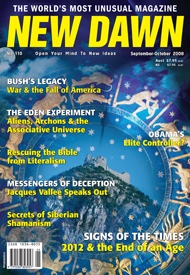
  • Robots, Goblins and Alien Amoeba, Answering Fermi’s Paradox

    Robots, Goblins and Alien Amoeba, Answering Fermi’s Paradox

    From New Dawn 100 (Jan-Feb 2007)

    I believe there are many gods, not one, and always in conflict. Well, if there are gods who created and control what’s going on here, you can tell a lot about them by what is going on. I assume they are colonists. And so anything you can see here you can infer is the act or the will of one of those gods. All you have to do is look around. You’ll see what they’re like. It’s like looking in someone’s yard.
    – W.S. Burroughs

    Dateline: 1950 A.D. The physicist Enrico Fermi is having lunch with a few colleagues when the subject of interstellar travel comes up. There are countless potential living systems in our own galaxy, Fermi reasons. If even a small fraction of these produced technological civilisations capable of launching manned expeditions, our own humble planet should have been overrun with extraterrestrial conquistadores millions of years ago.

    “Don’t you ever wonder where everybody is?” Fermi asked.

    In other words, if the galaxy is filled with little green men in luminous flying saucers who travel from star to star colonising other worlds, then why don’t we have any physical evidence of their existence – not even so much as a piece of broken zipper from one of their spacesuits?

    This question (known as the Fermi paradox) has spawned a vigorous scientific and philosophical debate whose possible answers can be grouped into three broad categories.

    1. Extraterrestrial civilisations do not exist.
    2. Extraterrestrial civilisations exist but haven’t colonised the Earth, either because they can’t or because they don’t want to.
    3. Extraterrestrial civilisations exist and have colonised the Earth without our knowledge.

    As we shall see, the implications for all of these positions are unsettling in the extreme – not so much for what they say about extraterrestrial life, but for what they might say about us.

    Are We Alone?

    The most straightforward solution to the Fermi paradox is that we are alone in the universe – our planet has not been colonised because advanced alien civilisations do not exist.

    Perhaps (as many Christians claim) life is unique to Earth; or perhaps most alien societies ruin themselves through pollution or war, extinguishing life on their home worlds before they have a chance to spread outwards. (Knowing as we do that terrestrial species have a better than 99% extinction rate, this latter scenario is rather easy to imagine.)

    Of course, even if most alien species do expire in this way, isn’t it stretching the limits of conjecture to suppose that all of them do?

    The Milky Way galaxy alone contains at least 100 billion stable solar systems;1 roughly a third of these possess Earth-like planets with oceans.2 The odds against every single one of these being either sterile or suicidal are literally astronomical.

    So, Where Are They?

    If we suppose that extraterrestrial civilisations do exist, we are left with only two options: either they are somewhere else or else they are here. So why might an alien civilisation choose to colonise the Earth (or not)?

    Many researchers seem to assume that an extraterrestrial colonisation effort would be overtly belligerent, taking the form of:

    • Imperialism
    • Resource Exploitation
    • Subversion
    • Scrub & Repopulate
    • Smash & Grab3

    But wouldn’t successful alien civilisations be more patient and cautious than that? Couldn’t they also be:

    A.        unable or unwilling to launch a full-scale invasion of the Earth?

    or

    B.        here already, and ruling over us by means so subtle as to be almost undetectable?

    In fact, some scientists have argued that until we conclusively prove that extraterrestrial civilisations don’t exist, the Fermi paradox isn’t a paradox at all; instead, we aren’t looking hard enough, or haven’t been looking in the right places.

    Biblical Brainteasers

    The Fermi paradox here reveals significant overlap with the theodicy, a traditional theological riddle, which asks: If God is good and all-powerful, where is the evidence of his existence – why is there so much evil in the world?

    One of the most ancient (and persuasive) answers to the theodicy is that of Gnosticism, a speculative branch of pre-Nicean Christianity which held that God (or the gods) do exist, but are neither omnipotent nor benevolent; instead, these advanced beings from the stars are selfish, opportunistic and deceptive.

    Gnosticism In Brief

    In the Gnostic view, the god of the Bible was not the Supreme Being at all, but an arrogant Demiurge who fled the heavens to build this planet as an experimental prison, populating it with artificial life forms and strange, symbiotic hybrids.

    Far from paradisiacal, his “Garden of Eden” was an eerie mad scientist’s laboratory where shadowy parasites abducted a pair of primitive primates named Adam and Eve, raping the female and implanting the male with false memories:

    When they [the Demiurge and his angels] saw Eve speaking with [Adam], they said to one another… “Come, let us seize her and let us cast our seed on her, so that… those whom she will beget will serve us. But let us not tell Adam that she is not derived from us, but let us bring a stupor upon him, and… teach him in his sleep as though she came into being from his rib…”4

    These chthonic and creepy alterna-Christian creation myths have influenced thinkers from many different fields over the millennia, from politics to popular culture. In recent decades, the Gnostic metanarrative has even made a re-appearance with the paranoid worldview which informs much contemporary speculation about aliens and UFOs, e.g.:

    One of the purposes for which UFOs travel to Earth is to abduct humans to help aliens produce other beings. It is not a program of reproduction but one of production. They are not here to help us, they have their own agenda and we are not allowed to know its full parameters.5

    In all of the solutions to the Fermi paradox which appear below, we can see echoes of many of these same, disturbing ideas. As the Demiurge and his angels pass from theology into speculative exobiology, the skies seem to swarm with icily indifferent robots, otherworldly djinn, celestial frauds and bestial, fallen bacilli.

    Six of the most widely-discussed scenarios follow:

    1. Extraterrestrial civilisations spread via self-replicating AI probes.
    2. Extraterrestrial civilisations develop massive virtual reality simulations.
    3. Extraterrestrial civilisations have left this universe and developed the ability to manipulate hyperspace.
    4. Extraterrestrial civilisations develop xenophobic and/or authoritarian religious forms.
    5. Extraterrestrials are biologically very primitive, or spread themselves via biologically primitive forms.
    6. The Earth is being deliberately quarantined.

    Conveniently, most of the possibilities listed here could plausibly be used to explain either why our planet has been invaded or how it could already have been invaded unbeknownst to us; which outcome you favour really seems to depend on your assumptions about alien motivation.

    POSSIBILITY #1 – Extraterrestrial civilisations spread via self-replicating AI probes

    Frank Tipler of Tulane University has argued that alien civilisations would probably explore and colonise the Universe by proxy, filling the galaxy with self-replicating AI (artificial intelligence) probes instead of venturing forth themselves. Thus, even a very distant extraterrestrial civilisation should be able to seize, secure, sterilise and strip-mine our entire planet in about 4 million years.

    “If they existed,” concludes Tipler, “they would be here”; and since we are here instead, they must not exist.6

    On the other hand, if hives of autonomous, adaptable, rapidly multiplying robotic probes were roaming the galaxy, successive generations might eventually become so intelligent as to far surpass their creators.

    In time, as these “artilects” spread throughout the Universe, they could come to abandon their creators’ agenda, preferring effortless communion with their own kind to the laborious conquest of organic, planetary life. Reflects AI researcher Hugo de Garis:

    I suspect strongly that virtually all the ETs out there are in fact artilects, and hence have intelligence levels astronomically superior to the human level. To me, biological technological intelligence is just a fleeting phase that nature goes through en route to creating immortal massive artilectual intelligence, which may be a phenomenon as commonplace as the creation of life from the molecular soup…

    The answer then to Fermi’s paradox is that we human beings, being mere biologicals, are utterly unworthy of the artilects’ attention… What’s in it for them? We are very probably not so special and are very, very dumb…7

    POSSIBILITY #2 – Extraterrestrial civilisations have developed massive virtual reality simulations

    Recent trends suggest that it should be possible for an advanced civilisation (either earthly or alien) to develop fully immersive virtual reality simulations like the “Holodeck” of Gene Rodenberry’s Star Trek. If such a technology were developed by an alien species on its own planet, the prospect of mingling in real time with a distant and dirty species like our own could seem unappealing, degrading or even boring to extraterrestrial psychonauts. Opines evolutionary psychologist Geoffrey Miller:

    Basically, I think the aliens don’t blow themselves up; they just get addicted to computer games. They forget to send radio signals or colonise space because they’re too busy with runaway consumerism and virtual-reality narcissism. They don’t need Sentinels to enslave them in a Matrix; they do it to themselves, just as we are doing today.8

    Alternately, it could be that our own world (and the visible universe which seems to surround it) is itself a vast computer simulation engineered by aliens, some form of artificial intelligence (as in the film The Matrix) or even our own descendants. The planetarium hypothesis holds that we can’t find evidence of alien colonisation because contact with other worlds hasn’t been built into the simulation.

    POSSIBILITY #3 – Extraterrestrial civilisations have left this universe and developed the ability to manipulate hyperspace

    A third possibility is that alien civilisations become capable of interstellar travel, but learn how to escape this universe soon afterwards. If transcension were common, extraterrestrial civilisations might quickly lose interest in colonising other planets. Why travel to a distant ball of mud and water when you can explore higher dimensional hyperspace instead?

    On the other hand, if alien scientists did have the ability to leave our shared space-time and launch themselves into the larger multiverse, they could be here now and we would not be able to see them.

    In the same way that a glass pipette might seem – from the point of view of beings trapped in the flat, two-dimensional world of the Petri dish – like an enormous, transparent column which descends from the sky to abduct unsuspecting amoeba out for an afternoon stroll, aliens from higher dimensional space-time could enter and leave our reality at will, seeming to appear and disappear, change shape and pass through solid barriers as they experimented on and/or revealed themselves to us, and all without leaving a shred of physical evidence.

    The idea that extraterrestrials are actually multi-dimensional has been an influential one, leading some UFO researchers to conclude that:

    This [the UFO phenomenon] is not the product of an alien culture from a nearby star, here to explore our solar system. Instead it is an intelligence which dwells in a different type of reality and moves through hyperspace in such a way as to interreact with us almost as a side-effect. It is an intelligence that is not here to study us but it has been here all along and effectively controls our whole existence…9

    Advocates of Jacques Vallee’s “control system” hypothesis similarly argue that we may never find the evidence we seek because extraterrestrials aren’t encumbered by physical artifacts like spaceships or ray guns; instead these polymorphous and hallucinatory aliens freely wiggle and hop in and out of our world like angels, demons and gods from the twilight realms of the collective subconscious.

    POSSIBILITY 4 – Extraterrestrial civilisations develop xenophobic and/or authoritarian religious forms

    A fourth possibility is that extraterrestrial civilisations tend to develop xenophobic and/or authoritarian religious forms. Given the history of our own species, the difficulties such belief systems might present to alien scientists can easily be imagined.

    Are Plaeadian professors who promote interstellar exploration passed over for promotion or excluded from alien faculty functions? Are extraterrestrial exobiologists denounced as heretics and electrocuted by otherworldly Inquisitors? If so, then we may never encounter these advanced beings from the stars.

    Alternately, it could be that alien conquerors literally walked the Earth’s surface millennia ago and left literary monuments to their endeavours in the form of the Babylonian and Sumerian creation epics and the Hebrew Bible. In this view (the so-called “alien astronaut” hypothesis), the gods and messengers of our own authoritarian religious traditions were not representatives of a supreme being at all, but extraterrestrial colonialists masquerading as gods!

    Israeli scholar Zechariah Sitchin’s works are generally representative of this latter position, holding that alien scientists (the “Elohim” and “Nephilim” of the Old Testament) genetically engineered homo sapiens from the great apes in an attempt to create a slave race:

    They made us through genetic engineering. They jumped the gun on evolution, and made us to look like them physically, and to be like them emotionally. That is what the Bible says: “Let us make the Adam in our likeness and after our image.” Physically, outwardly and inwardly. So much of what they are, we are.10

    Are human beings really descended from some prehistoric encounter between the apes and the angels 300,000 years ago? Sitchin is convinced of it. As proof, he points out that humans possess 223 genes found in no other species on Earth. Either these genes were horizontally transferred by some unknown species of bacteria, Sitchin insists, or else they must be extraterrestrial in origin.11

    POSSIBILITY #5 – Extraterrestrials are biologically very primitive, or spread themselves via biologically primitive forms

    600 million years ago, the Earth was ruled by sponges, flatworms and jellyfish. Possessing neither brains nor nervous systems, these simple organisms flourished, surviving nearly unchanged today.

    In similar fashion, our universe may be teeming with species hugely successful on their home planets but lacking the complex cognitive skills necessary to build and launch spacecraft.

    The flip-side of this possibility is the panspermia hypothesis, which holds that extraterrestrial colonists arrived here billions of years ago, not as bug-eyed monsters in metallic spacecraft, but as spores or bacteria which fell from the atmosphere to fertilise the Earth’s oceans with primitive life. In time, these alien microbes evolved into the many terrestrial species biologists know today, including human beings!

    Of course, the panspermia hypothesis doesn’t answer how our most ancient one-celled ancestors originated themselves; perhaps their ancestors too were seeded somewhere else by alien scientists from another solar system.12

    POSSIBILITY #6 – The Earth is being deliberately quarantined

    Finally, the “zoo hypothesis” holds that we haven’t been able to find any hard evidence of alien contact or colonisation because our extraterrestrial overlords don’t want us to – instead they are treating this planet like a farm or laboratory. As early 20th century paranormal researcher Charles Fort wondered:

    Would we, if we could, educate and sophisticate pigs, geese, cattle? Would it be wise to establish diplomatic relation with the hen…?

    I think we’re property… we belong to something… that once upon a time, this earth was No-man’s Land, that other worlds explored and colonised here, and fought among themselves for possession, but that now it’s owned by something… all others warned off.13

    If this planet functions as a livestock enclosure of some sort, then it makes sense that representatives of the civilisation cultivating and/or studying us would occasionally slip up and reveal themselves. The indignation expressed by the contactee who recalls alien encounters under hypnosis may have something in common with the drugged and dizzy roar of the bear who wakes up to discover a radio-tracking chip stapled to his ear:

    Close Encounters of the Fourth Kind (CE-IV): The contactee is abducted by the UFO occupants, taken aboard the landed craft, and subjected to a variety of “tests” and “experiments.” Some investigators claim to have recovered physical evidence of these interactions in the form of scars from alien surgical incisions. Some abductees report memories of devices being implanted within their bodies, typically through the nose.14

    Conclusion

    Perhaps most alien civilisations are unable or unwilling to colonise other worlds, due to their religious beliefs, immersion in video games, or an unfortunate tendency to blow themselves up, but even if 99% were thus incapacitated, this still doesn’t explain why the remaining 1% seem to have left the Earth alone.

    On the other hand, if just one ambitious, alien civilisation from among the remaining 1% were to colonise the Earth using any or all of the strategies described above, our seeming isolation would be explained and Fermi’s paradox would stand resolved – as long as they did so covertly.

    Are we then, mere talking monkeys in a cosmic cage, simulated serfs in a vast video game or experiments in an extraterrestrial Petri dish, as some of the most plausible solutions to Fermi’s famous question would seem to imply?

    Unfortunately (or perhaps fortunately), the “covert colonisation” hypothesis is by definition almost impossible to disprove; in the end, we may have no choice but to test some of these strange scenarios by launching colonisation programs of our own:

    Earth has provided a stable platform for the evolution of life over 4 billion years. But that lease is limited; we know for sure that it will expire after a few billion more. Long before that, our planet may become a place where it is no longer suitable for us to live. Increasing luminosity of the Sun may gradually boil our oceans, or more sudden catastrophes may threaten our existence. If we are wise, we will have furnished our new apartments long before that time….15

    [alert type=”general” dismiss=”no”]This article was published in New Dawn 100.[/alert]

    [alert type=”success” dismiss=”no”]If you appreciate this article, please consider subscribing to help maintain this website.[/alert]

    Footnotes:

    1. “Earth: No Longer the Lonely Planet,” RedOrbit, Saturday, 27 September 2003, www.redorbit.com/news/stories/1/2003/09/27/story003.html
    2. “Earth-Like Planets May Be More Common Than Once Thought, Says CU-Boulder-Penn State Study,” University of Colorado at Boulder, 7 September 2006, www.colorado.edu/news/releases/2006/280.html
    3. Fritz Freiheit, “The Possibilities of FTL: Or Fermi’s Paradox Reconsidered,” www-personal.engin.umich.edu/~fritx/Ftlessay/essay.html
    4. “On the Origin of the World,” from Willis Barnstone’s The Other Bible, p.70, 1984.
    5. Dr. David Jacobs, Secret Life, p. 305
    6. John D. Barrow and Frank J. Tipler, The Anthropic Cosmological Principle, p.578.
    7. Hugo de Garis, “Answering Fermi’s Paradox”, 22 March 2001, www.kurzweilai.net/articles/art0188.html
    8. Geoffrey Miller, “Runaway consumerism explains the Fermi Paradox,” www.edge.org/q2006/q06_print.html#miller
    9. Peter Hough & Jenny Randles, Looking For the Aliens, p.210, 1991.
    10. Interview with Zecharia Sitchin, www.metatron.se/asitch.html
    11. Zecharia Sitchin, The Case of Adam’s Alien Genes, www.sitchin.com/adam.htm
    12. For an in-depth discussion of the panspermia hypothesis, please see this author’s previous article “The Incredibly Strange Story of Intelligent Design” in the July/August 2006 issue of New Dawn magazine.
    13. The Book of the Damned, A Hypertext Edition of Charles Hoy Fort’s Book, Edited and Annotated by Mr. X, Chapter XII, www.sacred-texts.com/fort/damned/damn12.htm
    14. J. Allen Hynek, UFO researcher, from Keith Thompson’s Angels and Aliens, p.144, 1991.
    15. Robert Shapiro, Planetary Dreams, 1999.

    © New Dawn Magazine and the respective author.
    For our reproduction notice, click here.